EP1606269B1 - Biaryl substituted triazoles as sodium channel blockers - Google Patents
Biaryl substituted triazoles as sodium channel blockers Download PDFInfo
- Publication number
- EP1606269B1 EP1606269B1 EP04720360A EP04720360A EP1606269B1 EP 1606269 B1 EP1606269 B1 EP 1606269B1 EP 04720360 A EP04720360 A EP 04720360A EP 04720360 A EP04720360 A EP 04720360A EP 1606269 B1 EP1606269 B1 EP 1606269B1
- Authority
- EP
- European Patent Office
- Prior art keywords
- alkyl
- alkylene
- phenyl
- aryl
- optionally substituted
- Prior art date
- Legal status (The legal status is an assumption and is not a legal conclusion. Google has not performed a legal analysis and makes no representation as to the accuracy of the status listed.)
- Expired - Lifetime
Links
- 0 C*CC=CC=C(C)c1ccccc1OCC(F)(F)F Chemical compound C*CC=CC=C(C)c1ccccc1OCC(F)(F)F 0.000 description 4
- OXSYDFVDCVZFLN-UHFFFAOYSA-N CC(c1nc(-c2cc(C3C(OC(F)(F)F)=CC=CC3)ccc2)n[nH]1)F Chemical compound CC(c1nc(-c2cc(C3C(OC(F)(F)F)=CC=CC3)ccc2)n[nH]1)F OXSYDFVDCVZFLN-UHFFFAOYSA-N 0.000 description 1
- DTITZDLSUXGRBR-UHFFFAOYSA-N COC(c(nc1)n[n]1-c1cc(-c2ccccc2OCC(F)(F)F)ccc1)=O Chemical compound COC(c(nc1)n[n]1-c1cc(-c2ccccc2OCC(F)(F)F)ccc1)=O DTITZDLSUXGRBR-UHFFFAOYSA-N 0.000 description 1
- OLGOLVPJGQAVPK-UHFFFAOYSA-N FC(Oc(cccc1)c1-c1cccc(-c2n[nH]cn2)c1)(F)F Chemical compound FC(Oc(cccc1)c1-c1cccc(-c2n[nH]cn2)c1)(F)F OLGOLVPJGQAVPK-UHFFFAOYSA-N 0.000 description 1
- LHQJLGMJACRRPG-UHFFFAOYSA-N FC(Oc1ccccc1-c1cccc(N=C2C3C2C3)c1)(F)F Chemical compound FC(Oc1ccccc1-c1cccc(N=C2C3C2C3)c1)(F)F LHQJLGMJACRRPG-UHFFFAOYSA-N 0.000 description 1
- JPXUVKRKAWRRGL-UHFFFAOYSA-N NC(c1nc(-c(cc(cc2)-c(cccc3)c3OC(F)(F)F)c2F)n[nH]1)=O Chemical compound NC(c1nc(-c(cc(cc2)-c(cccc3)c3OC(F)(F)F)c2F)n[nH]1)=O JPXUVKRKAWRRGL-UHFFFAOYSA-N 0.000 description 1
- DZVXHBAKIHJALL-UHFFFAOYSA-N Nc1cc(-c(cccc2)c2OCC(F)(F)F)ccc1 Chemical compound Nc1cc(-c(cccc2)c2OCC(F)(F)F)ccc1 DZVXHBAKIHJALL-UHFFFAOYSA-N 0.000 description 1
Classifications
-
- C—CHEMISTRY; METALLURGY
- C07—ORGANIC CHEMISTRY
- C07D—HETEROCYCLIC COMPOUNDS
- C07D249/00—Heterocyclic compounds containing five-membered rings having three nitrogen atoms as the only ring hetero atoms
- C07D249/02—Heterocyclic compounds containing five-membered rings having three nitrogen atoms as the only ring hetero atoms not condensed with other rings
- C07D249/08—1,2,4-Triazoles; Hydrogenated 1,2,4-triazoles
-
- A—HUMAN NECESSITIES
- A61—MEDICAL OR VETERINARY SCIENCE; HYGIENE
- A61P—SPECIFIC THERAPEUTIC ACTIVITY OF CHEMICAL COMPOUNDS OR MEDICINAL PREPARATIONS
- A61P1/00—Drugs for disorders of the alimentary tract or the digestive system
- A61P1/04—Drugs for disorders of the alimentary tract or the digestive system for ulcers, gastritis or reflux esophagitis, e.g. antacids, inhibitors of acid secretion, mucosal protectants
-
- A—HUMAN NECESSITIES
- A61—MEDICAL OR VETERINARY SCIENCE; HYGIENE
- A61P—SPECIFIC THERAPEUTIC ACTIVITY OF CHEMICAL COMPOUNDS OR MEDICINAL PREPARATIONS
- A61P23/00—Anaesthetics
- A61P23/02—Local anaesthetics
-
- A—HUMAN NECESSITIES
- A61—MEDICAL OR VETERINARY SCIENCE; HYGIENE
- A61P—SPECIFIC THERAPEUTIC ACTIVITY OF CHEMICAL COMPOUNDS OR MEDICINAL PREPARATIONS
- A61P25/00—Drugs for disorders of the nervous system
-
- A—HUMAN NECESSITIES
- A61—MEDICAL OR VETERINARY SCIENCE; HYGIENE
- A61P—SPECIFIC THERAPEUTIC ACTIVITY OF CHEMICAL COMPOUNDS OR MEDICINAL PREPARATIONS
- A61P25/00—Drugs for disorders of the nervous system
- A61P25/04—Centrally acting analgesics, e.g. opioids
-
- A—HUMAN NECESSITIES
- A61—MEDICAL OR VETERINARY SCIENCE; HYGIENE
- A61P—SPECIFIC THERAPEUTIC ACTIVITY OF CHEMICAL COMPOUNDS OR MEDICINAL PREPARATIONS
- A61P25/00—Drugs for disorders of the nervous system
- A61P25/08—Antiepileptics; Anticonvulsants
-
- A—HUMAN NECESSITIES
- A61—MEDICAL OR VETERINARY SCIENCE; HYGIENE
- A61P—SPECIFIC THERAPEUTIC ACTIVITY OF CHEMICAL COMPOUNDS OR MEDICINAL PREPARATIONS
- A61P25/00—Drugs for disorders of the nervous system
- A61P25/24—Antidepressants
-
- A—HUMAN NECESSITIES
- A61—MEDICAL OR VETERINARY SCIENCE; HYGIENE
- A61P—SPECIFIC THERAPEUTIC ACTIVITY OF CHEMICAL COMPOUNDS OR MEDICINAL PREPARATIONS
- A61P29/00—Non-central analgesic, antipyretic or antiinflammatory agents, e.g. antirheumatic agents; Non-steroidal antiinflammatory drugs [NSAID]
-
- A—HUMAN NECESSITIES
- A61—MEDICAL OR VETERINARY SCIENCE; HYGIENE
- A61P—SPECIFIC THERAPEUTIC ACTIVITY OF CHEMICAL COMPOUNDS OR MEDICINAL PREPARATIONS
- A61P29/00—Non-central analgesic, antipyretic or antiinflammatory agents, e.g. antirheumatic agents; Non-steroidal antiinflammatory drugs [NSAID]
- A61P29/02—Non-central analgesic, antipyretic or antiinflammatory agents, e.g. antirheumatic agents; Non-steroidal antiinflammatory drugs [NSAID] without antiinflammatory effect
-
- A—HUMAN NECESSITIES
- A61—MEDICAL OR VETERINARY SCIENCE; HYGIENE
- A61P—SPECIFIC THERAPEUTIC ACTIVITY OF CHEMICAL COMPOUNDS OR MEDICINAL PREPARATIONS
- A61P9/00—Drugs for disorders of the cardiovascular system
- A61P9/06—Antiarrhythmics
-
- A—HUMAN NECESSITIES
- A61—MEDICAL OR VETERINARY SCIENCE; HYGIENE
- A61P—SPECIFIC THERAPEUTIC ACTIVITY OF CHEMICAL COMPOUNDS OR MEDICINAL PREPARATIONS
- A61P9/00—Drugs for disorders of the cardiovascular system
- A61P9/10—Drugs for disorders of the cardiovascular system for treating ischaemic or atherosclerotic diseases, e.g. antianginal drugs, coronary vasodilators, drugs for myocardial infarction, retinopathy, cerebrovascula insufficiency, renal arteriosclerosis
-
- C—CHEMISTRY; METALLURGY
- C07—ORGANIC CHEMISTRY
- C07D—HETEROCYCLIC COMPOUNDS
- C07D249/00—Heterocyclic compounds containing five-membered rings having three nitrogen atoms as the only ring hetero atoms
- C07D249/02—Heterocyclic compounds containing five-membered rings having three nitrogen atoms as the only ring hetero atoms not condensed with other rings
- C07D249/08—1,2,4-Triazoles; Hydrogenated 1,2,4-triazoles
- C07D249/10—1,2,4-Triazoles; Hydrogenated 1,2,4-triazoles with hetero atoms or with carbon atoms having three bonds to hetero atoms with at the most one bond to halogen, e.g. ester or nitrile radicals, directly attached to ring carbon atoms
Definitions
- the present invention is directed to a series of biaryl substituted triazole compounds.
- this invention is directed to biaryl substituted triazoles that are sodium channel blockers useful for the treatment of chronic and neuropathic pain.
- the compounds of the present invention are also useful for the treatment of other conditions, including disorders of the central nervous system (CNS) such as epilepsy, manic depression, bipolar disorder, depression, anxiety and diabetic neuropathy.
- CNS central nervous system
- Voltage-gated ion channels allow electrically excitable cells to generate and propagate action potentials and therefore are crucial for nerve and muscle function.
- Sodium channels play a special role by mediating rapid depolarization, which constitutes the rising phase of the action potential and in turn activates voltage-gated calcium and potassium channels.
- Voltage-gated sodium channels represent a multigene family. Nine sodium channel subtypes have been cloned and functionally expressed to date. [ Clare, J. J., Tate, S. N., Nobbs, M. & Romanos, M. A. Voltage-gated sodium channels as therapeutic targets. Drug Discovery Today 5, 506-520 (2000 )]. They are differentially expressed throughout muscle and nerve tissues and show distinct biophysical properties.
- All voltage-gated sodium channels are characterized by a high degree of selectivity for sodium over other ions and by their voltage-dependent gating. [ Catterall, W. A. Structure and function of voltage-gated sodium and calcium channels. Current Opinion in Neurobiology 1, 5-13 (1991 )]. At negative or hyperpolarized membrane potentials, sodium channels are closed. Following membrane depolarization, sodium channels open rapidly and then inactivate. Sodium channels only conduct currents in the open state and, once inactivated, have to return to the resting state, favored by membrane hyperpolarization, before they can reopen. Different sodium channel subtypes vary in the voltage range over which they activate and inactivate as well as in their activation and inactivation kinetics.
- Sodium channels are the target of a diverse array of pharmacological agents, including neurotoxins, antiarrhythmics, anticonvulsants and local anesthetics. [ Clare, J. J., Tate, S. N., Nobbs, M. & Romanos, M. A. Voltage-gated sodium channels as therapeutic targets. Drug Discovery Today 5, 506-520 (2000 )].
- Several regions in the sodium channel secondary structure are involved in interactions with these blockers and most are highly conserved. Indeed, most sodium channel blockers known to date interact with similar potency with all channel subtypes. Nevertheless, it has been possible to produce sodium channel blockers with therapeutic selectivity and a sufficient therapeutic window for the treatment of epilepsy (e.g. lamotrigine, phenytoin and carbamazepine) and certain cardiac arrhythmias (e.g. lignocaine, tocainide and mexiletine).
- epilepsy e.g. lamotrigine, phenytoin and carbamazepin
- neuropathic pain include, but are not limited to, postherpetic neuralgia, trigeminal neuralgia, diabetic neuropathy, chronic lower back pain, phantom limb pain, pain resulting from cancer and chemotherapy, chronic pelvic pain, complex regional pain syndrome and related neuralgias. It has been shown in human patients as well as in animal models of neuropathic pain, that damage to primary afferent sensory neurons can lead to neuroma formation and spontaneous activity, as well as evoked activity in response to normally innocuous stimuli.
- Lidoderm ® lidocaine applied in the form of a dermal patch, is currently the only FDA approved treatment for PHN. [ Devers, A. and B.S. Galer, Topical lidocaine patch relieves a variety of neuropathic pain conditions: an open-label study. Clinical Journal of Pain, 2000. 16(3): p. 205-208 ].
- sodium channel blockers In addition to neuropathic pain, sodium channel blockers have clinical uses in the treatment of epilepsy and cardiac arrhythmias. Recent evidence from animal models suggests that sodium channel blockers may also be useful for neuroprotection under ischaemic conditions caused by stroke or neural trauma and in patients with multiple sclerosis (MS). [Clare, J.J., et al . And Anger, T., et al .].
- the present invention is directed to biaryl substituted triazole compounds which are sodium channel blockers useful for the treatment of chronic and neuropathic pain.
- the compounds of the present invention are also useful for the treatment of other conditions, including disorders of the CNS such as epilepsy, manic depression and bipolar disorder.
- This invention also provides pharmaceutical compositions comprising a compound of the present invention, either alone, or in combination with one or more therapeutically active compounds, and a pharmaceutically acceptable carrier.
- This invention further comprises methods for the treatment of acute pain, chronic pain, visceral pain, inflammatory pain, neuropathic pain and disorders of the CNS including, but not limited to, epilepsy, manic depression, depression, anxiety and bipolar disorder comprising administering the comounds and pharmaceutical compositions of the present invention.
- the invention also encompasses a process for making the instant compounds.
- the present invention comprises compounds represented by Formula (I) or (II): or pharmaceutically acceptable salts thereof, wherein R 1 is
- the present invention further comprises compounds described by Formula III: or pharmaceutical salts thereof, wherein R 1 -R 7 each is as defined above.
- the present invention provides a compound described by the chemical Formula (I), or a pharmaceutically acceptable salt thereof, wherein
- R 5 is other than H and is attached at the ortho position, and all other variables are as previously defined.
- the present invention provides a compound described by the chemical Formula (I), or a pharmaceutically acceptable salt thereof, wherein
- R 5 is -OR a , and all other variables are as previously defined.
- the present invention provides a compound described by the chemical Formula (I), or a pharmaceutically acceptable salt thereof, wherein
- the present invention provides a compound described by the chemical Formula (II), or a pharmaceutically acceptable salt thereof, wherein
- R 5 is other than H and is attached at the ortho position, and all other variables are as previously defined.
- the present invention provides a compound described by the chemical Formula (II), or a pharmaceutically acceptable salt thereof, wherein
- R 5 is -OR a , and all other variables are as previously defined.
- the present invention provides a compound described by the chemical Formula (II), or a pharmaceutically acceptable salt thereof, wherein
- the present invention provides a compound described by the chemical Formula (III), or a pharmaceutically acceptable salt thereof, wherein
- R 5 is other than H and is attached at the ortho position, and all other variables arc as previously defined.
- the present invention provides a compound described by the chemical Formula (III), or a pharmaceutically acceptable salt thereof, wherein
- R 5 is -OR a , and all other variables are as previously defined.
- the present invention provides a compound described by the chemical Formula (III), or a pharmaceutically acceptable salt thereof, wherein
- the present invention provides compounds described by the chemical Formula (I), which includes compounds of the Formula Ia: or pharmaceutically acceptable salts thereof, wherein
- R 5 is -OR a or -C 0 -C 4 -alkylene-C 1 -C 4 -perfluoroalkyl, and all other variables are as previously defined.
- the present invention further provides a process for making a compound of Formula (I), or a pharmaceutically acceptable salt thereof, the process comprising reacting a compound of Formula 34 or 35: with a compound of Formula 36: wherein R 1 - R 7 each is as defined above, in the presence of a base to yield a compound of Formula (I), or a pharmaceutically acceptable salt thereof.
- the present invention provides a process for making a compound of Formula (I), or a pharmaceutically acceptable salt thereof, wherein the base is a metal acetate, metal carbonate or tertiary amine.
- the present invention provides a process for making a compound of Formula (I), or a pharmaceutically acceptable salt thereof, wherein the base is potassium acetate.
- the present invention further provides a process for making a compound of Formula (I), or a pharmaceutically acceptable salt thereof, the process comprising reacting a compound of Formula 34 or 35: with a compound of Formula 36 : wherein R 1 - R 7 each is as defined above, in the presence of a base, and optionally an alcoholic solvent, and optionally heat, to yield a compound of Formula (I), or a pharmaceutically acceptable salt thereof.
- alkyl as well as other groups having the prefix “alk” such as, for example, alkoxy, alkanoyl, alkenyl, and alkynyl means carbon chains which may be linear or branched or combinations thereof.
- alkyl groups include methyl, ethyl, propyl, isopropyl, butyl, sec - and tert -butyl, pentyl, hexyl, and heptyl.
- alkyl alkynyl
- alkynyl and other like terms include carbon chains containing at least one unsaturated C-C bond.
- cycloalkyl means carbocycles containing no heteroatoms, and includes mono-, bi- and tricyclic saturated carbocycles, as well as fused ring systems.
- fused ring systems can include one ring that is partially or fully unsaturated such as a benzene ring to form fused ring systems such as benzofused carbocycles.
- Cycloalkyl includes such fused ring systems as spirofused ring systems.
- cycloalkyl examples include cyclopropyl, cyclobutyl, cyclopentyl, cyclohexyl, decahydronaphthalene, adamantane, indanyl, indenyl, fluorenyl, and 1,2,3,4-tetrahydronaphalene.
- cycloalkenyl means carbocycles containing no heteroatoms and at least one non-aromatic C-C double bond, and include mono-, bi- and tricyclic partially saturated carbocycles, as well as benzofused cycloalkenes.
- Examples of cycloalkenyl examples include cyclohexenyl, and indenyl.
- aryl includes, but is not limited to, an aromatic substituent that is a single ring or multiple rings fused together. When formed of multiple rings, at least one of the constituent rings is aromatic.
- aryl also includes heteroaryls, and thus includes stable 5- to 7-membered monocyclic and stable 9- to 10-membered fused bicyclic heterocyclic ring systems that consist of carbon atoms and from one to four heteroatoms selected from the group consisting of N, O and S, wherein the nitrogen and sulfur heteroatoms may optionally be oxidized, and the nitrogen heteroatom may optionally be quaternized.
- Suitable aryl groups include phenyl,naphthyl, pyridyl, pyrimidinyl, furyl, thienyl, pyrrolyl, triazolyl, pyrazolyl, thiazolyl, isoxazolyl, oxazolyl, and oxadiazolyl.
- cycloalkyloxy includes a cycloalkyl group connected by a short C 1-2 alkyl to the oxy connecting atom.
- C 0-6 alkyl includes alkyls containing 6, 5, 4, 3, 2, 1, or no carbon atoms.
- An alkyl with no carbon atoms is a hydrogen atom substituent when the alkyl is a terminal group and is a direct bond when the alkyl is a bridging group.
- hetero includes one or more O, S, or N atoms.
- heterocycloalkyl and heteroaryl include ring systems that contain one or more O, S, or N atoms in the ring, including mixtures of such atoms.
- the hetero atoms replace ring carbon atoms.
- a heterocycloC 5 alkyl is a five-member ring containing from 4 to no carbon atoms.
- heteroaryls include pyridinyl, quinolinyl, isoquinolinyl, pyridazinyl, pyrimidinyl, pyrazinyl, quinoxalinyl, furyl, benzofuryl, dibenzofuryl, thienyl, benzthienyl, pyrrolyl, indolyl, pyrazolyl, indazolyl, oxazolyl, benzoxazolyl, isoxazolyl, thiazolyl, benzothiazolyl, isothiazolyl, imidazolyl, benzimidazolyl, oxadiazolyl, thiadiazolyl, triazolyl, and tetrazolyl.
- heterocycloalkyls examples include azetidinyl, pyrrolidinyl, piperidinyl, piperazinyl, morpholinyl, tetrahydrofuranyl, imidazolinyl, pyrolidin-2-one, piperidin-2-one, and thiomorpholinyl.
- heteroC 0-4 alkyl means a heteroalkyl containing 3, 2, 1, or no carbon atoms. However, at least one heteroatom must be present. Thus, as an example, a heteroC 0-4 alkyl having no carbon atoms but one N atom would be a -NH- if a bridging group and a -NH 2 if a terminal group. Analogous bridging or terminal groups are clear for an O or S heteroatom
- amine unless specifically stated otherwise, includes primary, secondary and tertiary amines.
- carbonyl unless specifically stated otherwise, includes a C 0-6 alkyl substituent group when the carbonyl is terminal.
- halogen includes fluorine, chlorine, bromine and iodine atoms.
- optionally substituted is intended to include both substituted and unsubstituted.
- optionally substituted aryl could represent a pentafluorophenyl or a phenyl ring.
- optionally substituted multiple moieties such as, for example, alkylaryl are intended to mean that the alkyl and the aryl groups are optionally substituted. If only one of the multiple moieties is optionally substituted then it will be specifically recited such as "an alkylaryl, the aryl optionally substituted with halogen or hydroxyl.”
- base includes metal acetate bases, metal carbonate bases, and tertiary amine bases.
- metal acetate bases include potassium acetate and sodium acetate.
- metal carbonate bases include potassium carbonate and sodium carbonate.
- Tertiary amine bases include trialkyl amine bases such as triethylamine.
- alcoholic solvent or "alcohol solvent” includes, for example, methanol, ethanol, isopropanol and 1-butanol.
- the process can be carried out in the temperature range of between about 40°C to about 150°C, including about 50°C to about 140°C, about 50°C to about 130°C, about 60°C to about 120°C, about 65°C to about 100°C, or about 65°C to about 85°C.
- solvent/co-solvent mixture includes solvent mixtures such as toluene/tetrahydrofuran, tetrahydrofuran/diethylether, toluene/diethylether, tetrahydrofuran/methyl-t-butylether, toluene/methyl-t-butylether, toluene/dioxane, and tetrahydrofuran/dioxane.
- Compounds described herein can contain one or more asymmetric centers and may thus give rise to diastereoisomers and optical isomers.
- the present invention includes all such possible diastereoisomers as well as their racemic mixtures, their substantially pure resolved enantiomers, all possible geometric isomers, and pharmaceutically acceptable salts thereof.
- the above chemical Formulas are shown without a definitive stereochemistry at certain positions.
- the present invention includes all stereoisomers of the chemical Formulas and pharmaceutically acceptable salts thereof. Further, mixtures of stereoisomers as well as isolated specific stereoisomers are also included. During the course of the synthetic procedures used to prepare such compounds, or in using racemization or epimerization procedures known to those skilled in the art, the products of such procedures can be a mixture of stereoisomers.
- salts refers to salts prepared from pharmaceutically acceptable non-toxic bases or acids.
- pharmaceutically acceptable non-toxic bases including inorganic bases and organic bases.
- Salts derived from such inorganic bases include aluminum, ammonium, calcium, copper (ic and ous), ferric, ferrous, lithium, magnesium, manganese (ic and ous), potassium, sodium, zinc and the like salts.
- Salts derived from pharmaceutically acceptable organic non-toxic bases include salts of primary, secondary, and tertiary amines, as well as cyclic amines and substituted amines such as naturally occurring and synthesized substituted amines.
- organic non-toxic bases from which salts can be formed include ion exchange resins such as, for example, arginine, betaine, caffeine, choline, N, N ' -dibenzylethylenediamine, diethylamine, 2-diethylaminoethanol, 2-dimethylaminoethanol, ethanolamine, ethylenediamine, N-ethylmorpholine, N-ethylpiperidine, glucamine, glucosamine, histidine, hydrabamine, isopropylamine, lysine, methylglucamine, morpholine, piperazine, piperidine, polyamine resins, procaine, purines, theobromine, triethylamine, trimethylamine, tripropylamine, and tromethamine.
- ion exchange resins such as, for example, arginine, betaine, caffeine, choline, N, N ' -dibenzylethylenediamine, diethylamine,
- the compound of the present invention When the compound of the present invention is basic, its corresponding salt can be conveniently prepared from pharmaceutically acceptable non-toxic acids, including inorganic and organic acids.
- acids include, for example, acetic, benzenesulfonic, benzoic, camphorsulfonic, citric, ethanesulfonic, fumaric, gluconic, glutamic, hydrobromic, hydrochloric, isethionic, lactic, maleic, malic, mandelic, methanesulfonic, mucic, nitric, pamoic, pantothenic, phosphoric, succinic, sulfuric, tartaric, p-toluenesulfonic acid and the like.
- compositions of the present invention comprise a compound of the invention (or pharmaceutically acceptable salts thereof) as an active ingredient, a pharmaceutically acceptable carrier, and optionally one or more additional therapeutic agents or adjuvants.
- additional therapeutic agents can include, for example, i) opiate agonists or antagonists, ii) calcium channel antagonists, iii) 5HT receptor agonists or antagonists, iv) sodium channel antagonists, v) NMDA receptor agonists or antagonists, vi) COX-2 selective inhibitors, vii) NK1 antagonists, viii) non-steroidal anti-inflammatory drugs ("NSAID”), ix) selective serotonin reuptake inhibitors ("SSRI”) and/or selective serotonin and norepinephrine reuptake inhibitors (“SSNRI”), x) tricyclic antidepressant drugs, xi) norepinephrine modulators, xii) lithium, xiii) valproate, and xiv) neurontin
- compositions suitable for oral, rectal, topical, and parenteral (including subcutaneous, intramuscular, and intravenous) administration although the most suitable route in any given case will depend on the particular host, and nature and severity of the conditions for which the active ingredient is being administered.
- the pharmaceutical compositions may be conveniently presented in unit dosage form and prepared by any of the methods well known in the art of pharmacy.
- the present compounds and compositions are useful for the treatment of chronic, visceral, inflammatory and neuropathic pain syndromes. They are useful for the treatment of pain resulting from traumatic nerve injury, nerve compression or entrapment, postherpetic neuralgia, trigeminal neuralgia, and diabetic neuropathy.
- the present compounds and compositions are also useful for the treatment of chronic lower back pain, phantom limb pain, chronic pelvic pain, neuroma pain, complex regional pain syndrome, chronic arthritic pain and related neuralgias, and pain associated with cancer, chemotherapy, HIV and HIV treatment-induced neuropathy.
- Compounds of this invention may also be utilized as local anesthetics.
- Compounds of this invention are useful for the treatment of irritable bowel syndrome and related disorders, as well as Crohns disease.
- the instant compounds have clinical uses for the treatment of epilepsy and partial and generalized tonic seizures. They are also useful for neuroprotection under ischaemic conditions caused by stroke or neural trauma and for treating multiple sclerosis.
- the present compounds are useful for the treatment of tachy-arrhythmias.
- the instant compounds are useful for the treatment of neuropsychiatric disorders, including mood disorders, such as depression or more particularly depressive disorders, for example, single episodic or recurrent major depressive disorders and dysthymic disorders, or bipolar disorders, for example, bipolar I disorder, bipolar II disorder and cyclothymic disorder; anxiety disorders, such as panic disorder with or without agoraphobia, agoraphobia without history of panic disorder, specific phobias, for example, specific animal phobias, social phobias, obsessive-compulsive disorder, stress disorders including post-traumatic stress disorder and acute stress disorder, and generalised anxiety disorders;
- mood disorders such as depression or more particularly depressive disorders, for example, single episodic or recurrent major depressive disorders and dysthymic disorders
- bipolar disorders for example, bipolar I disorder, bipolar II disorder and cyclothymic disorder
- anxiety disorders such as panic disorder with or without agoraphobia, agoraphobia without history of panic disorder, specific phobias, for example, specific animal phobias, social phobia
- a compound of the present invention may be used in conjunction with other anti-depressant or anti-anxiety agents, such as norepinephrine reuptake inhibitors, selective serotonin reuptake inhibitors (SSRIs), monoamine oxidase inhibitors (MAOIs), reversible inhibitors of monoamine oxidase (RIMAs), serotonin and noradrenaline reuptake inhibitors (SNRIs), ⁇ -adrenoreceptor antagonists, atypical anti-depressants, benzodiazepines, 5-HT 1A agonists or antagonists, especially 5-HT 1A partial agonists, neurokinin-1 receptor antagonists, corticotropin releasing factor (CRF) antagonists, and pharmaceutically acceptable salts thereof.
- SSRIs selective serotonin reuptake inhibitors
- MAOIs monoamine oxidase inhibitors
- RIMAs reversible inhibitors of monoamine oxidase
- SNRIs noradren
- compounds of this invention can be administered at prophylactically effective dosage levels to prevent the above-recited conditions and disorders, as well as to prevent other conditions and disorders associated with sodium channel activity.
- Creams, ointments, jellies, solutions, or suspensions containing the instant compounds can be employed for topical use. Mouth washes and gargles are included within the scope of topical use for the purposes of this invention.
- Dosage levels from about 0.01mg/kg to about 140mg/kg of body weight per day are useful in the treatment of inflammatory and neuropathic pain, or alternatively about 0.5mg to about 7g per patient per day.
- inflammatory pain may be effectively treated by the administration of from about 0.01mg to about 75mg of the compound per kilogram of body weight per day, or alternatively about 0.5mg to about 3.5g per patient per day.
- Neuropathic pain may be effectively treated by the administration of from about 0.01mg to about 125mg of the compound per kilogram of body weight per day, or alternatively about 0.5mg to about 5.5g per patient per day.
- the amount of active ingredient that may be combined with the carrier materials to produce a single dosage form will vary depending upon the host treated and the particular mode of administration.
- a formulation intended for the oral administration to humans may conveniently contain from about 0.5mg to about 5g of active agent, compounded with an appropriate and convenient amount of carrier material which may vary from about 5 to about 95 percent of the total composition.
- Unit dosage forms will generally contain between from about 1mg to about 1000mg of the active ingredient, typically 25mg, 50mg, 100mg, 200mg, 300mg, 400mg, 500mg, 600mg, 800mg or 1000mg.
- the specific dose level for any particular patient will depend upon a variety of factors. Such patient-related factors include the age, body weight, general health, sex, and diet of the patient. Other factors include the time and route of administration, rate of excretion, drug combination, and the severity of the particular disease undergoing therapy.
- the compounds of the invention or pharmaceutically acceptable salts thereof can be combined as the active ingredient in intimate admixture with a pharmaceutical carrier according to conventional pharmaceutical compounding techniques.
- the carrier may take a wide variety of forms depending on the form of preparation desired for administration, e.g., oral or parenteral (including intravenous).
- the pharmaceutical compositions of the present invention can be presented as discrete units suitable for oral administration such as capsules, cachets or tablets each containing a predetermined amount of the active ingredient.
- compositions can be presented as a powder, as granules, as a solution, as a suspension in an aqueous liquid, as a non-aqueous liquid, as an oil-in-water emulsion or as a water-in-oil liquid emulsion.
- the compounds of the invention or pharmaceutically acceptable salts thereof may also be administered by controlled release means and/or delivery devices.
- the compositions may be prepared by any of the methods of pharmacy. In general, such methods include a step of bringing into association the active ingredient with the carrier that constitutes one or more necessary ingredients.
- the compositions are prepared by uniformly and intimately admixing the active ingredient with liquid carriers or finely divided solid carriers or both. The product can then be conveniently shaped into the desired presentation.
- compositions of this invention may include a pharmaceutically acceptable carrier and a compound or a pharmaceutically acceptable salt of the present compounds.
- the compounds of the invention, or pharmaceutically acceptable salts thereof, can also be included in pharmaceutical compositions in combination with one or more therapeutically active compounds.
- the pharmaceutical carrier employed can be, for example, a solid, liquid, or gas.
- solid carriers include lactose, terra alba, sucrose, talc, gelatin, agar, pectin, acacia, magnesium stearate, and stearic acid.
- liquid carriers are sugar syrup, peanut oil, olive oil, and water.
- gaseous carriers include carbon dioxide and nitrogen.
- any convenient pharmaceutical media may be employed.
- water, glycols, oils, alcohols, flavoring agents, preservatives, coloring agents and the like may be used to form oral liquid preparations such as suspensions, elixirs and solutions; while carriers such as starches, sugars, microcrystalline cellulose, diluents, granulating agents, lubricants, binders, and disintegrating agents can be used to form oral solid preparations such as powders, capsules and tablets.
- carriers such as starches, sugars, microcrystalline cellulose, diluents, granulating agents, lubricants, binders, and disintegrating agents can be used to form oral solid preparations such as powders, capsules and tablets.
- tablets and capsules are the preferred oral dosage units whereby solid pharmaceutical carriers are employed.
- tablets may be coated by standard aqueous or nonaqueous techniques
- a tablet containing the composition of this invention may be prepared by compression or molding, optionally with one or more accessory ingredients or adjuvants.
- Compressed tablets may be prepared by compressing, in a suitable machine, the active ingredient in a free-flowing form such as powder or granules, optionally mixed with a binder, lubricant, inert diluent, surface active or dispersing agent. Molded tablets may be made by molding in a suitable machine, a mixture of the powdered compound moistened with an inert liquid diluent.
- Each tablet preferably contains from about 0.1mg to about 500mg of the active ingredient and each cachet or capsule preferably containing from about 0.1mg to about 500mg of the active ingredient.
- a tablet, cachet, or capsule conveniently contains 0.1mg, 1mg, 5mg, 25mg, 50mg, 100mg, 200mg, 300mg, 400mg, or 500mg of the active ingredient taken one or two tablets, cachets, or capsules, once, twice, or three times daily.
- compositions of the present invention suitable for parenteral administration may be prepared as solutions or suspensions of the active compounds in water.
- a suitable surfactant can be included such as, for example, hydroxypropylcellulose.
- Dispersions can also be prepared in glycerol, liquid polyethylene glycols, and mixtures thereof in oils. Further, a preservative can be included to prevent the detrimental growth of microorganisms.
- compositions of the present invention suitable for injectable use include sterile aqueous solutions or dispersions.
- the compositions can be in the form of sterile powders for the extemporaneous preparation of such sterile injectable solutions or dispersions.
- the final injectable form must be sterile and must be effectively fluid for easy syringability.
- the pharmaceutical compositions must be stable under the conditions of manufacture and storage, and thus should be preserved against the contaminating action of microorganisms such as bacteria and fungi.
- the carrier can be a solvent or dispersion medium containing, for example, water, ethanol, polyol (e.g. glycerol, propylene glycol and liquid polyethylene glycol), vegetable oils, and suitable mixtures thereof.
- compositions of the present invention can be in a form suitable for topical use such as, for example, an aerosol, cream, ointment, lotion, and dusting powder. Further, the compositions can be in a form suitable for use in transdermal devices. These formulations may be prepared, utilizing a compound of the instant invention , or pharmaceutically acceptable salts thereof, via conventional processing methods. As an example, a cream or ointment is prepared by mixing hydrophilic material and water, together with about 5 wt% to about 10 wt% of the compound, to produce a cream or ointment having a desired consistency.
- compositions of this invention can be in a form suitable for rectal administration wherein the carrier is a solid, such as, for example, where the mixture forms unit dose suppositories.
- suitable carriers include cocoa butter and other materials commonly used in the art.
- the suppositories may be conveniently formed by first admixing the composition with the softened or melted carrier(s) followed by chilling and shaping in moulds.
- the pharmaceutical formulations described above may include, as appropriate, one or more additional carrier ingredients such as diluents, buffers, flavoring agents, binders, surface-active agents, thickeners, lubricants, and preservatives (including anti-oxidants).
- additional carrier ingredients such as diluents, buffers, flavoring agents, binders, surface-active agents, thickeners, lubricants, and preservatives (including anti-oxidants).
- additional carrier ingredients such as diluents, buffers, flavoring agents, binders, surface-active agents, thickeners, lubricants, and preservatives (including anti-oxidants).
- additional carrier ingredients such as diluents, buffers, flavoring agents, binders, surface-active agents, thickeners, lubricants, and preservatives (including anti-oxidants).
- other adjuvants can be included to render the formulation isotonic with the blood of the intended recipient.
- an aspect of the invention is the treatment in mammals of maladies that are amenable to amelioration through blockage of neuronal sodium channels, including, for example, acute pain, chronic pain, visceral pain, inflammatory pain, and neuropathic pain by administering an effective amount of a compound of this invention.
- mammals includes humans, as well as other animals, such as, for example, dogs, cats, horses, pigs, and cattle. Accordingly, it is understood that the treatment of mammals other than humans refers to the treatment of clinical conditions in non-human mammals that correlate to the above-recited conditions.
- the instant compounds can be utilized in combination with one or more therapeutically active compounds.
- the inventive compounds can be advantageously used in combination with i) opiate agonists or antagonists, ii) calcium channel antagonists, iii) 5HT receptor agonists or antagonists, iv) sodium channel antagonists, v) N-methyl-D-aspartate (NMDA) receptor agonists or antagonists, vi) COX-2 selective inhibitors, vii) neurokinin receptor 1 (NK1) antagonists, viii) non-steroidal anti-inflammatory drugs (UNSAID), ix) selective serotonin reuptake inhibitors (SSRI) and/or selective serotonin and norepinephrine reuptake inhibitors (SSNRI).
- SSRI serotonin reuptake inhibitors
- SSNRI selective serotonin and norepinephrine reuptake inhibitors
- x) tricyclic antidepressant drugs xi) norepinephrine modulators, x
- the identification of inhibitors of the sodium channel is based on the ability of sodium channels to cause cell depolarization when sodium ions permeate through agonist-modified channels. In the absence of inhibitors, exposure of an agonist-modified channel to sodium ions will cause cell depolarization. Sodium channel inhibitors will prevent cell depolarization caused by sodium ion movement through agonist-modified sodium channels. Changes in membrane potential can be determined with voltage-sensitive fluorescence resonance energy transfer (FRET) dye pairs that use two components, a donor coumarin (CC 2 DMPE) and an acceptor oxanol (DiSBAC 2 (3)). Oxanol is a lipophilic anion and distributes across the membrane according to membrane potential.
- FRET voltage-sensitive fluorescence resonance energy transfer
- HEK-PN1 PN1 sodium channel
- the media was aspirated, and the cells were washed with PBS buffer, and incubated with 100Ml of 10Mm CC 2 -DMPE in 0.02% pluronic acid. After incubation at 25°C for 45min, media was removed and cells were washed 2x with buffer. Cells were incubated with 100M1 of DiSBAC 2 (3) in TMA buffer containing 20Mm veratridine, 20Nm brevetoxin-3, and test sample.
- Electrophysiological Assays In Vitro assays:
- a HEK-293 cell line stably expressing the PN1 sodium channel subtype was established in-house.
- the cells were cultured in MEM growth media (Gibco) with 0.5mg/Ml G418, 50 units/Ml Pen/Strep and 1Ml heat-inactivated fetal bovine serum at 37°C and 10% CO 2 .
- MEM growth media Gibco
- 50 units/Ml Pen/Strep 50 units/Ml Pen/Strep
- 1Ml heat-inactivated fetal bovine serum at 37°C and 10% CO 2 .
- cells were plated on 35mm dishes coated with poly-D-lysine.
- HEK-293 cells stably expressing the PN1 sodium channel subtype were examined by whole cell voltage clamp ( Hamill, et al. Pfluegers Archives 391:85-100 (1981 )) using an EPC-9 amplifier and Pulse software (HEKA Electronics, Lamprecht, Germany). Experiments were performed at room temperature. Electrodes were fire-polished to resistances of 2-4 M ⁇ . Voltage errors were minimized by series resistance compensation, and the capacitance artifact was canceled using the EPC-9's built-in circuitry. Data were acquired at 50 kHz and filtered at 7-10 kHz.
- the bath solution consisted of 40 mM NaCl, 120 mM NMDG Cl, 1 mM KCI, 2.7 mM CaCl 2 , 0.5 mM MgCl 2 , 10 mM NMDG HEPES, Ph 7.4, and the internal (pipet) solution contained 110 mM Cs-methanesulfonate, 5 mM NaCl, 20mM CsCl, 10mM CsF, 10 mM BAPTA (tetra Cs salt), 10 mM Cs HEPES, Ph 7.4.
- K i Drug e - ⁇ ⁇ V k - 1
- Rat Formalin Paw test ( in vivo assay):
- compounds were prepared in either a EPEGS vehicle or a Tween80 (10%)/sterile water (90%) vehicle and were injected i.v. (via the lateral tail vein 15min after formalin) or p.o. (60min before formalin).
- the number of flinches was counted continuously for 60min using an automated nociception analyzer (UCSD Anesthesiology Research, San Diego, CA). Statistical significance was determined by comparing the total flinches detected in the early (0-10min) and late (11-60min) phase with an unpaired t-test.
- CFA complete Freund's adjuvant
- emulsion 0.5mg Mycobacterium/Ml
- Mechanical hyperalgesia was assessed 3 days after tissue injury using a Randall-Selitto test. Repeated Measures ANOVA, followed by Dunnett's Post Hoc test.
- Tactile allodynia was assessed with calibrated von Frey filaments using an up-down paradigm before and two weeks following nerve injury. Animals were placed in plastic cages with a wire mesh floor and allowed to acclimate for 15min before each test session. To determine the 50% response threshold, the von Frey filaments (over a range of intensities from 0.4 to 28.8g) were applied to the mid-plantar surface for 8s, or until a withdrawal response occurred. Following a positive response, an incrementally weaker stimulus was tested. If there was no response to a stimulus, then an incrementally stronger stimulus was presented. After the initial threshold crossing, this procedure was repeated for four stimulus presentations per animal per test session. Mechanical sensitivity was assessed 1 and 2 hr post oral administration of the test compound.
- the compounds described in this invention displayed sodium channel blocking activity of from about ⁇ 0.1mM to about ⁇ 50mM in the in vitro assays described above. It is advantageous that the compounds display sodium channel blocking activity of ⁇ 5mM in the in vitro assays. It is more advantageous that the compounds display sodium channel blocking activity of ⁇ 1mM in the in vitro assays. It is even more advantageous that the compounds display sodium channel blocking activity of ⁇ 0.5mM in the in vitro assays. It is still more advantageous that the compounds display sodium channel blocking activity of ⁇ 0.1mM in the in vitro assays.
- NMR data is in the form of delta ( ⁇ ) values for major diagnostic protons, given in parts per million (ppm) relative to tetramethylsilane (TMS) as internal standard, determined at 300MHz, 400MHz or 500MHz using the indicated solvent.
- TMS tetramethylsilane
- Conventional abbreviations used for signal shape are: s. singlet; d. doublet; t. triplet; m. multiplet; br. Broad; etc.
- “Ar” signifies an aromatic signal.
- novel compounds of the present invention can be readily synthesized using techniques known to those skilled in the art, such as those described, for example, in Advanced Organic Chemistry, March, 4th Ed., John Wiley and Sons, New York, NY, 1992 ; Advanced Organic Chemistry, Carey and Sundberg, Vol.
- the procedures described herein for synthesizing the compounds may include one or more steps of protecting group manipulations and of purification, such as, recrystallization, distillation, column chromatography, flash chromatography, thin-layer chromatography (TLC), radial chromatography and high-pressure chromatography (HPLC).
- the products can be characterized using various techniques well known in the chemical arts, including proton and carbon-13 nuclear magnetic resonance ( 1 H and 13 C NMR), infrared and ultraviolet spectroscopy (IR and UV), X-ray crystallography, elemental analysis and HPLC and mass spectrometry (LC-MS).
- Methods of protecting group manipulation, purification, structure identification and quantification are well known to one skilled in the art of chemical synthesis.
- solvents are those which will at least partially dissolve one or all of the reactants and will not adversely interact with either the reactants or the product.
- Suitable solvents are aromatic hydrocarbons (e.g, toluene, xylenes), halogenated solvents (e.g, methylene chloride, chloroform, carbontetrachloride, chlorobenzenes), ethers (e.g, diethyl ether, diisopropylether, tert-butyl methyl ether, diglyme, tetrahydrofuran, dioxane, anisole), nitriles (e.g, acetonitrile, propionitrile), ketones (e.g, 2-butanone, dithyl ketone, tert-butyl methyl ketone), alcohols (e.g, methanol, ethanol, n-propanol, iso-propanol, n-butanol, t-butanol
- Suitable bases are, generally, alkali metal hydroxides, alkaline earth metal hydroxides such as lithium hydroxide, sodium hydroxide, potassium hydroxide, barium hydroxide, and calcium hydroxide; alkali metal hydrides and alkaline earth metal hydrides such as lithium hydride, sodium hydride, potassium hydride and calcium hydride; alkali metal amides such as lithium amide, sodium amide and potassium amide; alkali metal carbonates and alkaline earth metal carbonates such as lithium carbonate, sodium carbonate, Cesium carbonate, sodium hydrogen carbonate, and cesium hydrogen carbonate; alkali metal alkoxides and alkaline earth metal alkoxides such as sodium methoxide, sodium ethoxide, potassium tert-butoxide and magnesium ethoxide; alkali metal alkyls such as methyllithium, n-butyllithium, sec-butyllithium, t-bultyl
- any of the usual pharmaceutical media can be employed.
- oral liquid preparations such as suspensions, elixirs and solutions
- water, glycols, oils, alcohols, flavoring agents, preservatives, coloring agents and the like may be used; or in the case of oral solid preparations such as powders, capsules and tablets, carriers such as starches, sugars, microcrystalline cellulose, diluents, granulating agents, lubricants, binders, disintegrating agents, and the like may be included.
- carriers such as starches, sugars, microcrystalline cellulose, diluents, granulating agents, lubricants, binders, disintegrating agents, and the like may be included.
- tablets and capsules represent the most advantageous oral dosage unit form in which solid pharmaceutical carriers are employed.
- tablets may be coated by standard aqueous or nonaqueous techniques.
- controlled release means and/or delivery devices may also be used in administering the instant compounds and compositions.
- 3-bromobenzoic acid 1 is coupled with t-butyl carbazate by activation with HOBt (hydroxybenzotriazole) in the presence of a suitable carbodiimide such as EDC [1-(3-dimethylaminopropyl)-3-ethylcarbodiimide) and diisopropylethylamine (DIEA) in dichloromethane or THF to give the protected hydrazide 2.
- EDC 1-(3-dimethylaminopropyl)-3-ethylcarbodiimide
- DIEA diisopropylethylamine
- Compound 2 can be converted to a variety of unsymmetrical biphenyl intermediates 3 by means of a variety of coupling reactions.
- One type is the Suzuki reaction wherein bromo, iodo, or triflate compound 2 is reacted with an aryl boronic acid in the presence of a palladium catalyst such as palladium acetate with triphenyl phosphine and aqueous sodium carbonate in a solvent such as toluene and a co-solvent such as n-propanol.
- a palladium catalyst such as palladium acetate with triphenyl phosphine and aqueous sodium carbonate
- solvent such as toluene
- co-solvent such as n-propanol.
- aryl boronic acids are commercially available or can be prepared conveniently from the corresponding aryl bromide or iodide by converting it to an organolithium derivative [Appel, J. E., et al. Tetrahedron Lett. 39, 707-710 (1998 )], or a Grignard reagent followed by treatment with trialkylborate [ Li, J. J. et al, J. Med. Chem, 38: 4570-4578(1995 ) and Piettre, S. R., et al. J. Med Chem. 40, 4208-4221 (1997 )].
- Aryl boronates can also be used as an alternative to aryl boronic acids in these Pd-catalyzed coupling reactions [ Giroux, A. , et al., Tetrahedron Lett., 38, 3841(1997 )].
- the boronates can be easily prepared from the aryl bromides, iodides and trifluoromethane sulfonates using the method described by Murata, M., et al. [J. Org. Chem. 65: 164-168 (2000 )].
- the Boc protecting group of compound 3 is removed by standard conditions - trifluoroacetic acid in dichloromethane - to give the TFA salt of hydrazide 4 which can be desalted with aqueous NaOH solution.
- the reagent carbethoxy-S-methyl-thioforminidium tetrafluoroborate is prepared by reaction of ethyl-2-thiooxamate with trimethyl oxonium tetrafluoroborate (see Catarzi, et al . above) in dichloromethane.
- Ester 8 can be converted to an amide by heating it with the corresponding amine, in this case ammonia, in a solvent such as methanol. Ester 8 can be hydrolyzed to the corresponding acid under standard conditions, and the resulting acid can be converted to an amide under a variety of conditions such as those described in Scheme 1.
- ester 8 can be reduced to a primary alcohol with, for example, sodium borohydride (NaBH 4 ), to provide compounds of Formula (I) wherein R 1 is hydroxymethyl.
- ester 8 can be converted to a secondary alcohol by reaction with a mixture of lithium borohydride and a Grignard reagent in an aprotic solvent such as THF.
- Such primary or secondary alcohol derived from ester 8 can be further derivatized by a number of methods, including oxidation to a ketone by an oxidizing reagent such as a chromium-based reagent.
- Such alcohol can also be converted to a fluoride derivative by, for example, reaction with diethylaminosulfurtrifluoride (DAST) in dichlormethane at reduced temperatures.
- DAST diethylaminosulfurtrifluoride
- ester 11 is hydrolyzed to the corresponding acid which is then activated with carbonyldiimidazole (CDI) in DMF, followed by the addition of ammonia in the form of ammonium acetate to give amide 12.
- CDI carbonyldiimidazole
- Amide 12 in dimethylformamide dimethylacetal is heated to give intermediate 13 which, when heated with hydrazine in acetic acid, gives triazole 14.
- Boc-protected anline 26 containing a boronic acid group or boronate ester and an aryl bromide, iodide or triflate is converted to a variety of unsymmetrical biphenyl intermediates 23 as described in Scheme 1.
- 31 and 32 can be converted to a biphenyl intermediate 33 by using, for example, a Suzuki-Miyaura coupling reaction with a palladium acetate/triphenyl phosphine catalyst system.
- the biphenyl intermediate 33 can be converted to imidate HCl salt 34 under standard Pinner conditions using, for example, a concentrated hydrochloric acid ethanolic solution.
- the imidate 34 can be converted to triazole 37 by free basing using a biphasic mixture such as EtOAc and NaOH to give ethyl imidate 35, followed by treatment with oxamic hydrazide 36, an alcoholic solvent such as ethanol and any one of many appropriate bases, including a metal acetate base such as potassium acetate, a tertiary amine base or a metal carbonate base, followed by heating.
- a biphasic mixture such as EtOAc and NaOH
- oxamic hydrazide 36 an alcoholic solvent such as ethanol
- any one of many appropriate bases including a metal acetate base such as potassium acetate, a tertiary amine base or a metal carbonate base, followed by heating.
- the imidate 34 is converted to triazole 37 by direct addition of oxamic hydrazide 36, an alcoholic solvent such as ethanol and any one of many appropriate bases, including a metal acetate base such as potassium acetate, a tertiary amine base, or a metal carbonate base, followed by heating.
- an alcoholic solvent such as ethanol
- any one of many appropriate bases including a metal acetate base such as potassium acetate, a tertiary amine base, or a metal carbonate base, followed by heating.
- compounds of Formulas (I) or (II) wherein R 2 is H, 38 can be converted by deprotonation with a metal alkoxide base such as potassium tert -butoxide or sodium tert -butoxide in an appropriate solvent/co-solvent mixture to yield a salt 39.
- a metal alkoxide base such as potassium tert -butoxide or sodium tert -butoxide in an appropriate solvent/co-solvent mixture
- the reaction mixture was washed with EtOAc.
- the aqueous fraction was acidified with 2N HCl solution and stirred for 1 h at RT.
- the reaction mixture was extracted with EtOAc and the organic fractions were washed with water, saturated NaCl solution (brine), dried over Na 2 SO 4 and filtered. The filtrate was concentrated to give the title compound as a white solid.
- Step B Ethyl-3-(2-Trifluoromethoxyphenyl)-benzoate
- Step E 3-[3-(2-Trifluoromethoxyphenyl)-phenyl]-1,2,4-triazole
- Examples 2-7 were prepared using procedures similar to that described in Example 1. The preparation of any intermediates that were not commercially available are described.
- Step B Ethyl-3-(2-(2,2,2-trifluoroethoxyphenyl)-benzoate
- Step C 3-[3-(2-(2,2,2-Trifluoroethoxyphenyl)-phenyl]-1,2,4-triazole
- the title compound can be prepared using procedures similar to that described in Example 1, Steps C - E.
- Step B Methyl-3-((2-(2,2,2-trifluoroethoxy)phenyl)-4-fluorobenzoate
- Step C 3-[3-((2-(2,2,2-Trifluoroethoxy)-phenyl)-(4-fluoro)phenyl]-1,2,4-triazole
- the title compound can be prepared using procedures similar to that described in Example 1, Steps C - E.
- Step B 3-((2-Trifluoromethoxy)phenyl)-phenylhydrazide
- Step C 5-Methyl-3-[3-((2-trifluoromethoxy)phenyl]-phenyl]-1,2,4-triazole
- Step A Ethyl- N 1 -3-(2-trifluoromethoxy)-benzoyl- N 2 -oxamidrazonate
- Step B 5-Ethyl-3-[3-((2-trifluoromethoxy)-phenyl)-phenyl]-1,2,4-triazole-5-carboxylate
- Step C 3-[3-((2-Trifluoromethoxy)phenyl)-phenyl]-1,2,4-triazole-5-carboxamide
- Step A 3-((2-(2,2,2-Trifluoroethoxy)-phenyl)-4-fluorobenzoic acid
- Step B 3-[3-((2-(2,2,2-Trifluoroethoxy)-phenyl)-4-fluorophenyl]-1,2,4-triazole-5-carboxamide
- 3-bromo-4-fluorobenzonitrile (1.0 equivalent), 2-(trifluoromethoxy)benzeneboronic acid (1.25 equivalent), palladium acetate (0.005 equivalent) and triphenylphosphine (0.01 equivalent) were sequentially charged to a multi-necked flask. After purging the flask with nitrogen, toluene (5mL/gram of 3-bromo-4-fluorobenzonitrile) was added and the resulting slurry was stirred while bubbling nitrogen subsurface for about 20 minutes. In a separate flask, an aqueous potassium phosphate solution was prepared by dissolving solid potassium phosphate (2.0 equivalents) into water (2mL/gram of potassium phosphate).
- the resulting solution was de-oxygenated by bubbling nitrogen subsurface while stirring for about 30 minutes.
- the aqueous potassium phosphate solution was added to the toluene slurry and the reaction mixture was warmed to 60-65 °C by heating with steam. The progress of the reaction was monitored by HPLC and the reaction temperature was held between 63-69 °C. When 3-bromo-4-fluorobenzonitrile was consumed, heating was discontinued and the reaction mixture was cooled to RT using an ice bath.
- the aqueous layer was siphoned from the vessel and Ecosorb C-941 (0.5 gram/grams of 3-bromo-4-fluorobenzonitrile, commercially available from Graver Technologies, Glasgow, Delaware) was added to the reaction vessel.
- the resulting black slurry was stirred at RT for 15 hours.
- the carbon was removed by filtering the slurry through a pad of solka flok on a filter pot.
- the filter cake was washed with toluene (4mL/gram of 3-bromo-4-fluorobenzonitrile).
- the combined filtrates were batch concentrated (40-50 °C) to provide the biaryl nitrile product as a thick, light-orange oil (94.0% yield).
- Step B Preparation of :
- Absolute ethanol (1.8 mL/gram of biaryl nitrile) was charged to a round bottom flask. The stirred ethanol was chilled with an ice/acetone bath and gaseous hydrogen chloride was bubbled subsurface while the internal temperature was maintained less than 20 °C. Addition of HCl was monitored by proton titration using a Metrohm 808 Titrando (commercially available from Metrohm Ltd.) to determine HCl concentration of the ethanol solution. The addition was stopped after the concentration of HCl reached 38% (7.5 equivalents).
- the biaryl nitrile from step A (1.0 equivalent) was added as a neat oil to the chilled ethanolic HCl solution and the reaction solution was allowed to warm to RT while being stirred overnight (>15h). The reaction was deemed complete when assay by HPLC showed no presence of the starting biaryl nitrile.
- the resulting reaction was then diluted with toluene (8mL/gram of biaryl nitrile). To induce crystallization, the batch was solvent switched to toluene by co-distillation with ethanol ( ⁇ 35°C internal temperature) which azeotropically removed ethanol. This process was carried out until the ethanol content in the mother liquor was less than 1 mol% relative to toluene.
- Oxamic hydrazide (1.1 equivalents) and potassium acetate (5.0 equivalents) were added to the ethanol solution containing the imidate from above.
- the resulting heterogeneous mixture was then heated to between 60-70 °C using a steam batch along with vigorous stirring.
- the reaction was monitored by HPLC analysis for conversion of the imidate to the desired triazole product. Once the reaction was complete, it was cooled to ambient temperature followed by the slow addition of water (4mL/gram of imidate HCl salt) to crystallize the desired product from the reaction.
- the desired product was then collected by vacuum filtration as an off-white solid (85% yield).
- Step D Preparation of :
- the triazole product of Step C (1.0 equivalents) was added to a reaction vessel, followed by the addition of toluene (5.3 mL/gram of triazole) and THF (1.7mL/gram of triazole). The resulting heterogeneous mixture was stirred at ambient temperature. To this slurry was added a solution of potassium tert-butoxide (1.1 equivalents). The rate of addition of the base was periodically adjusted to maintain the reaction temperature below 35 °C. As the addition proceeded, the reaction mixture became less heterogeneous. Once the addition of the base was complete, the now homogeneous light yellow solution was allowed to stir at ambient temperature for 30 min. At this point, water (2.5 equivalents) was slowly added (ca. 10 min) to the batch with no noticeable exotherm.
- Step A 3-((2-(2,2.2-Trifluoroethoxy)-phenyl)-aniline
- StepB Methyl-1-[3-((2-(2,2,2-Trifluoroethoxy)-phenyl)-phenyl]-1,2,4-triazole-3-carboxylate
- Step C 1-[3-((2-(2,2,2-Trifluoroethoxy)-phenyl)-phenyl]-1,2,4-triazole-3-carboxylic acid
- Step D 1-[3-((2-(2,2,2-Trifluoroethoxy)-phenyl)-phenyl]-1,2,4-triazole-3-carboxamide
- Step B 1-N-t-butoxycarbonyl-3-((2-Trifluoromethoxyl-phenyl)analine
- Step D 1-[3-((2-Trifluoromethoxy)phenyl)-phenyl]-1,2,4-triazole-3-carboxamide
- Examples 39 -40 were prepared according to the procedures described in Examples 37 or 38.
- the titled compound is prepared using procedures described in Examples 19 and 20.
Landscapes
- Health & Medical Sciences (AREA)
- Chemical & Material Sciences (AREA)
- Organic Chemistry (AREA)
- General Health & Medical Sciences (AREA)
- Animal Behavior & Ethology (AREA)
- Veterinary Medicine (AREA)
- Chemical Kinetics & Catalysis (AREA)
- General Chemical & Material Sciences (AREA)
- Medicinal Chemistry (AREA)
- Nuclear Medicine, Radiotherapy & Molecular Imaging (AREA)
- Public Health (AREA)
- Pharmacology & Pharmacy (AREA)
- Life Sciences & Earth Sciences (AREA)
- Bioinformatics & Cheminformatics (AREA)
- Engineering & Computer Science (AREA)
- Pain & Pain Management (AREA)
- Biomedical Technology (AREA)
- Neurology (AREA)
- Neurosurgery (AREA)
- Rheumatology (AREA)
- Heart & Thoracic Surgery (AREA)
- Cardiology (AREA)
- Anesthesiology (AREA)
- Urology & Nephrology (AREA)
- Psychiatry (AREA)
- Vascular Medicine (AREA)
- Pharmaceuticals Containing Other Organic And Inorganic Compounds (AREA)
- Plural Heterocyclic Compounds (AREA)
- Medicines That Contain Protein Lipid Enzymes And Other Medicines (AREA)
Abstract
Description
- The present invention is directed to a series of biaryl substituted triazole compounds. In particular, this invention is directed to biaryl substituted triazoles that are sodium channel blockers useful for the treatment of chronic and neuropathic pain. The compounds of the present invention are also useful for the treatment of other conditions, including disorders of the central nervous system (CNS) such as epilepsy, manic depression, bipolar disorder, depression, anxiety and diabetic neuropathy.
- Voltage-gated ion channels allow electrically excitable cells to generate and propagate action potentials and therefore are crucial for nerve and muscle function. Sodium channels play a special role by mediating rapid depolarization, which constitutes the rising phase of the action potential and in turn activates voltage-gated calcium and potassium channels. Voltage-gated sodium channels represent a multigene family. Nine sodium channel subtypes have been cloned and functionally expressed to date. [Clare, J. J., Tate, S. N., Nobbs, M. & Romanos, M. A. Voltage-gated sodium channels as therapeutic targets. Drug Discovery Today 5, 506-520 (2000)]. They are differentially expressed throughout muscle and nerve tissues and show distinct biophysical properties. All voltage-gated sodium channels are characterized by a high degree of selectivity for sodium over other ions and by their voltage-dependent gating. [Catterall, W. A. Structure and function of voltage-gated sodium and calcium channels. Current Opinion in Neurobiology 1, 5-13 (1991)]. At negative or hyperpolarized membrane potentials, sodium channels are closed. Following membrane depolarization, sodium channels open rapidly and then inactivate. Sodium channels only conduct currents in the open state and, once inactivated, have to return to the resting state, favored by membrane hyperpolarization, before they can reopen. Different sodium channel subtypes vary in the voltage range over which they activate and inactivate as well as in their activation and inactivation kinetics.
- Sodium channels are the target of a diverse array of pharmacological agents, including neurotoxins, antiarrhythmics, anticonvulsants and local anesthetics. [Clare, J. J., Tate, S. N., Nobbs, M. & Romanos, M. A. Voltage-gated sodium channels as therapeutic targets. Drug Discovery Today 5, 506-520 (2000)]. Several regions in the sodium channel secondary structure are involved in interactions with these blockers and most are highly conserved. Indeed, most sodium channel blockers known to date interact with similar potency with all channel subtypes. Nevertheless, it has been possible to produce sodium channel blockers with therapeutic selectivity and a sufficient therapeutic window for the treatment of epilepsy (e.g. lamotrigine, phenytoin and carbamazepine) and certain cardiac arrhythmias (e.g. lignocaine, tocainide and mexiletine).
- It is well known that the voltage-gated Na+ channels in nerves play a critical role in neuropathic pain. Injuries of the peripheral nervous system often result in neuropathic pain persisting long after the initial injury resolves. Examples of neuropathic pain include, but are not limited to, postherpetic neuralgia, trigeminal neuralgia, diabetic neuropathy, chronic lower back pain, phantom limb pain, pain resulting from cancer and chemotherapy, chronic pelvic pain, complex regional pain syndrome and related neuralgias. It has been shown in human patients as well as in animal models of neuropathic pain, that damage to primary afferent sensory neurons can lead to neuroma formation and spontaneous activity, as well as evoked activity in response to normally innocuous stimuli. [Carter, G.T. and B.S. Galer, Advances in the management of neuropathic pain. Physical Medicine and Rehabilitation Clinics of North America, 2001. 12(2): p. 447-459]. The ectopic activity of normally silent sensory neurons is thought to contribute to the generation and maintenance of neuropathic pain. Neuropathic pain is generally assumed to be associated with an increase in sodium channel activity in the injured nerve. [Baker, M.D. and J.N. Wood, Involvement of Na channels in pain pathways. TRENDS in Pharmacological Sciences, 2001. 22(1): p. 27-31].
- Indeed, in rat models of peripheral nerve injury, ectopic activity in the injured nerve corresponds to the behavioral signs of pain. In these models, intravenous application of the sodium channel blocker and local anesthetic lidocaine can suppress the ectopic activity and reverse the tactile allodynia at concentrations that do not affect general behavior and motor function. [ Mao, J. and L.L. Chen, Systemic lidocaine for neuropathic pain relief. Pain, 2000. 87: p. 7-17]. These effective concentrations were similar to concentrations shown to be clinically efficacious in humans. [Tanelian, D.L. and W.G. Brose, Neuropathic pain can be relieved by drugs that are use-dependent sodium channel blockers: lidocaine, carbamazepine and mexiletine. Anesthesiology, 1991. 74(5): p. 949-951]. In a placebo-controlled study, continuous infusion of lidocaine caused reduced pain scores in patients with peripheral nerve injury, and in a separate study, intravenous lidocaine reduced pain intensity associated with postherpetic neuralgia (PHN). [Mao, J. and L.L. Chen, Systemic lidocaine for neuropathic pain relief. Pain, 2000. 87: p. 7-17. Anger, T., et al., Medicinal chemistry of neuronal voltage-gated sodiwn channel blockers. Journal of Medicinal Chemistry, 2001. 44(2): p. 115-137]. Lidoderm®, lidocaine applied in the form of a dermal patch, is currently the only FDA approved treatment for PHN. [Devers, A. and B.S. Galer, Topical lidocaine patch relieves a variety of neuropathic pain conditions: an open-label study. Clinical Journal of Pain, 2000. 16(3): p. 205-208].
- In addition to neuropathic pain, sodium channel blockers have clinical uses in the treatment of epilepsy and cardiac arrhythmias. Recent evidence from animal models suggests that sodium channel blockers may also be useful for neuroprotection under ischaemic conditions caused by stroke or neural trauma and in patients with multiple sclerosis (MS). [Clare, J.J., et al. And Anger, T., et al.].
- International Patent Publication
WO 00/57877 WO 01/68612 WO 99/32462 - The present invention is directed to biaryl substituted triazole compounds which are sodium channel blockers useful for the treatment of chronic and neuropathic pain. The compounds of the present invention are also useful for the treatment of other conditions, including disorders of the CNS such as epilepsy, manic depression and bipolar disorder. This invention also provides pharmaceutical compositions comprising a compound of the present invention, either alone, or in combination with one or more therapeutically active compounds, and a pharmaceutically acceptable carrier.
- This invention further comprises methods for the treatment of acute pain, chronic pain, visceral pain, inflammatory pain, neuropathic pain and disorders of the CNS including, but not limited to, epilepsy, manic depression, depression, anxiety and bipolar disorder comprising administering the comounds and pharmaceutical compositions of the present invention. The invention also encompasses a process for making the instant compounds.
- The present invention comprises compounds represented by Formula (I) or (II):


R1 is - (a) H;
- (b) C1-C6-alkyl, C2-C4-alkenyl, C2-C4-alkynyl, C3-C6-cycloalkyl, or C1-C4-alkylene-[C3-C6-cycloalkyl], any of which is optionally substituted with one or more of the following substituents: F, CF3, OH, O-(C1-C4)alkyl, S(O)0-2-(C1-C4)alkyl, O-CONRaRb, NRaRb, N(Ra)CONRaRb, COO-(C1-C4)alkyl, COOH, CN, CONRaRb, SO3NRaRb, N(Ra)SO2NRaRb, -C(=NH)NH2, tetrazolyl, triazolyl, imidazolyl, oxazolyl, oxadiazolyl, isoxazolyl, thiazolyl, furyl, thienyl, pyrazolyl, pyrrolyl, pyridyl, pyrimidinyl, pyrazinyl, phenyl, piperidinyl, morpholinyl, pyrrolidinyl or piperazinyl;
- (c) -C0-C4-alkylene-C1-C4-perfluoroalkyl;
- (d) NO2;
- (e) NRaRb, -N(CORa)Rb, -N(SO2Ra)Rb, -N(Ra)SO2Ra, -N(ORa)CONRaRb, -N(Ra)CON(Ra)2, or-N(Ra)SO2N(Ra)2;
- (f) -CH(ORa)Ra, -C(ORb)CF3, -CH(NHRb)Ra, -C(=O)Ra, C(=O)CF3, -SOCH3, -SO2CH3, COORa, CN, CONRaRb, -COCONRaRb, -SO2NRaRb, -CH2O-SO2NRaRb, SO2N(Ra)ORa, -C(=NH)NH2, -CR2=NORa, CH=CHCONRaRb ;
- (g) -CONRa(CH2)0-2C(Ra)(Rb)(CH2)0-2CONRaRb;
- (h) tetrazolyl, tetrazolinonyl, triazolyl, triazolinonyl, imidazolyl, imidazolonyl, oxazolyl, oxadiazolyl, isoxazolyl, thiazolyl, furyl, thienyl, pyrazolyl, pyrazolonyl, pyrrolyl, pyridyl, pyrimidinyl, pyrazinyl, or phenyl, any of which is optionally substituted with 1-3 independent substituents selected from i) F, Cl, Br, I, ii) -CN, iii) -NO2, iv) -C(=O)Ra, v) C1-C6-alkyl, vi) -O-Ra, vii) -NRaRb, viii) - C0-C4-alkylene -CO-ORa, ix) -(C0-C4-alkylene)-NH-CO-ORa, x) -(C0-C4-alkylene)-CO-NRa Rb, xi) -S(O)0-2Ra, xii) -SO2NRaRb, xiii) -NHSO2Ra, xiv) -C1-C4-perfluoroalkyl, and xv) -O-C1-C4-perfluoroalkyl;
- (i) -C(Ra)=C(Rb)-COORa, or -C(Ra)=C(Rb)-CONRaRb;
- (j)

- (k) piperidin-1-yl, morpholin-4-yl, pyrrolidin-1-yl, piperazin-1-yl or 4-susbstituted piperazin-1-yl, any of which is optionally substituted with 1-3 substituents selected from i) -CN, ii) -C(=O)(Ra), iii) C1-C6-alkyl, iv) -ORa, v) -NRaRb, vi) -C0-C4-alkylene-CO-ORa, vii) -(C0-C4-alkylene)-NH-CO-ORa, viii) -(C0-C4-alkylene)-CON(Ra)(Rb), ix) -SRa, x) -S(O)0-2Ra, xi) -SO2N(Ra)(Rb), xii) -NRaSO2Ra xiii) -C1-C4-perfluoroalkyl and xiv) -O-C1-C4-perfluoroalkyl;
- (a) H;
- (b) C1-C4-alkyl, optionally substituted with one or more of the following substituents: F, CF3, OH, O-(C1-C4)alkyl, S(O)0-2-(C1-C4)alkyl, -OCONH2, -OCONH(C1-C4alkyl), -OCON(C1-C4alkyl)(C1-C4alkyl), -OCONH(C1-C4alkyl-aryl), -OCON(C1-C4alkyl)(C1-C4alkyl-aryl), NH2, NH(C1-C4alkyl), N(C1-C4alkyl)(C1-C4alkyl), NH(C1-C4alkyl-aryl), N(C1-C4alkyl)(C1-C4alkyl-aryl), NHCONH2, NHCONH(C1-C4alkyl), NHCONH(C1-C4alkyl-aryl), -NHCON(C1-C4alkyl)(C1-C4alkyl), NHCON(C1-C4alkyl)(C1-C4alkyl-aryl), N(C1-C4alkyl)CON(C1-C4alkyl)(C1-C4alkyl), N(C1-C4alkyl)CON(C1-C4alkyl)(C1-C4alkyl-aryl), COO-(C1-C4-alkyl), COOH, CN, CONH2, CONH(C1-C4alkyl), CON(C1-C4alkyl)(C1-C4alkyl), SO2NH2, SO2NH(C1-C4alkyl), SO2NH(C1-C4alkyl-aryl), SO2N(C1-C4alkyl)(C1-C4alkyl), NHSO2NH2, -C(=NH)NH2, tetrazolyl, triazolyl, imidazolyl, oxazolyl, oxadiazolyl, isooxazolyl, thiazolyl, furyl, thienyl, pyrazolyl, pyrrolyl, pyridyl, pyrimidinyl, pyrazinyl, phenyl, piperidinyl, morpholinyl, pyrrolidinyl or piperazinyl;
- (c) C0-C4-alkylene-(C1-C4)-pefluoroalkyl; or
- (d) -C1-C4-alkylene-aryl, wherein aryl is phenyl, pyridyl, pyrimidinyl, furyl, thienyl, pyrrolyl, triazolyl, pyrazolyl, thiazolyl, isoxazolyl, oxazolyl, or oxadiazolyl, any aryl of which is optionally substituted with 1-3 substituents selected from i) F, Cl, Br, I, ii) -CN, iii) -NO2, iv) -C(=O)(C1-C4-alkyl), v) -O(C1-C4-alkyl), vi) -N(C1-C4-alkyl)(C1-C4-alkyl), vii) -C1-10alkyl, and viii) -C1-10alkyl,wherein one or more of the alkyl carbons can be replaced by a - O-, -S(O)1-2-, -O-C(O)-, -C(O)-O-, -C(O)-, -CH(OH)-, -C=C-, or -C≡C-;
- (a) H; or
- (b) C1-C6-alkyl, optionally substituted with one or more of the following substituents: F, CF3, OH, O-(C1-C4)alkyl, S(O)0-2-(C1-C4)alkyl, -OCONH2, -OCONH(C1-C4alkyl), NH2, NH(C1-C4alkyl), N(C1-C4alkyl)(C1-C4alkyl), NHCONH2, NHCONH(C1-C4alkyl), -NHCON(C1-C4alkyl)(C1-C4alkyl), COO-(C1-C4-alkyl), COOH, CN, or CONH2;
- (a) H;
- (b) -C1-C4-alkyl, -C3-C6-cycloalkyl or -C1-C4-alkylene-(C3-C6)-cycloalkyl, optionally substituted with one or more of the following substituents: F, CF3, OH, O-(C1-C4)alkyl, S(O)0-2-(C1-C4)alkyl, O-CONRaRb, NRaRb, N(Ra)CONRaRb, COO-(C1-C4)alkyl, COOH, CN, CONRaRb, SO2NRaRb, N(RaRb)SO2NRaRb, -C(=NH)NH2, tetrazolyl, triazolyl, imidazolyl, oxazolyl, oxadiazolyl, isooxazolyl, thiazolyl, furyl, thienyl, pyrazolyl, pyrrolyl, pyridyl, pyrimidinyl, pyrazinyl, phenyl, piperidinyl, morpholinyl, pyrrolidinyl or piperazinyl;
- (c) -C0-C4-alkylenc-C1-C4-perfluoroalkyl;
- (d) aryl or -(C1-C4-alkylene)-aryl, wherein aryl is phenyl, pyridyl, pyrimidinyl, furyl, thienyl, pyrrolyl, triazolyl, pyrazolyl, thiazolyl, isoxazolyl, oxazolyl, or oxadiazolyl, any aryl of which is optionally substituted with 1-3 substituents selected from i) F, Cl, Br, I, ii) -CN, iii) -NO2, iv) -C(=O)(Ra), v) -ORa, vi) -NRaRb, vii) -C0-4alkylene-CO-ORa, viii) -(C0-4alkylene)-NH-CO-ORa, ix) -(C0-4alkylene)-CO-N(Ra)(Rb), x) -S(O)0-2Ra, xi) -SO2N(Ra)(Rb), xii) -NRaSO2Ra, xiii) -C1-10alkyl and xiv) -C1-10alkyl,wherein one or more of the alkyl carbons can be replaced by a -NRa-, -O-, -S(O)1-2-, -O-C(O)-, -C(O)-O-, -C(O)-N(Ra)-, -N(Ra)-C(O)-, -N(Ra)-C(O)-N(Ra)-, -C(O)-, -CH(OH)-, -C=C-, or -C≡-C-;;
- (e) -C(=O)(R2), -CONRaRb, -COO-(C1-C4)alkyl, -SO2R3, -SO2N(Ra)(Rb);
- (a) H;
- (b) -C1-C6-alkyl, -C2-C6-alkenyl, -C2-C6-alkynyl or -C3-C6-cycloalkyl, any of which is optionally substituted with one or more of the following substituents: F, CF3, -O-(C1-C4)alkyl, CN, N(Ra)(Rb), - N(Ra)CO-(C1-C4)alkyl, COORb, CON(Ra)(Rb) or phenyl;
- (c) -O-C0-C6-alkyl, -O-aryl, or -O-C1-C4-alkylene-aryl, wherein aryl is phenyl, pyridyl, pyrimidinyl, furyl, thienyl, pyrrolyl, triazolyl, pyrazolyl, thiazolyl, isoxazolyl, oxazolyl, or oxadiazolyl, any aryl of which is optionally substituted with 1-3 substituents selected from i) F, Cl, Br, I, ii) -CN, iii) -NO2, iv) -C(=O)(Ra), v) -ORa, vi) -NRaRb, vii) -C0-4alkylene-CO-ORa, viii) -(C0-4alkylene)-NH-CO-ORa, ix) -(C0-4alkylene)-CO-N(Ra)(Rb), x) -S(O)0-2Ra, xi) -SO2N(Ra)(Rb), xii) -NRaSO2Ra, xiii) -C1-10alkyl, and xiv) -C1-10alkyl,wherein one or more of the alkyl carbons can be replaced by a -NRa-, - O-, -S(O)1-2-, -O-C(O)-, -C(O)-O-, -C(O)-N(Ra)-, -N(Ra)-C(O)-, -N(Ra)-C(O)-N(Ra)-, -C(O)-, -CH(OH)-, -C=C-, or -C≡C-;
- (d) -C0-C4-alkylone-C1-C4-perfluoroalkyl, or -O-C0-C4-alkylene-C1-C4-perfluoroalkyl; or
- (e) CN, NH2, NO2, F, Cl, Br, I, OH, OCON(Ra)(Rb) O(C1-C4-alkylene)CONRaRb, -OSO2N(Ra)(Rb), COORb, CON(Ra)(Rb), or aryl, wherein aryl is phenyl, pyridyl, pyrimidinyl, furyl, thienyl, pyrrolyl, triazolyl, pyrazolyl, thiazolyl, isoxazolyl, oxazolyl, or oxadiazolyl, any aryl of which is optionally substituted with 1-3 substituents selected from i) F, Cl, Br, I, ii) -CN, iii) -NO2, iv) -C(=O)(Ra), v) -ORa, vi) -NRaRb, vii) -C0-4alkylene-CO-ORa, viii) -(C0-4alkylene)-NH-CO-ORa, ix) -(C0-4alkylene)-CO-N(Ra)(Rb), x) -S(O)0-2Ra, xi) -SO2N(Ra)(Rb), xii) -NR2SO2Ra, xiii) -C1-10alkyl, and xiv) -C1-10alkyl,wherein one or more of the alkyl carbons can be replaced by a -NRa-, - O-, -S(O)1-2-, -O-C(O)-, -C(O)-O-, -C(O)-N(Ra)-, -N(Ra)-C(O)-, -N(Ra)-C(O)-N(Ra)-, -C(O)-, -CH(OH)-, -C=C-, or -C≡C; and
- (a) H;
- (b) C1-C6-alkyl, C2-C4-alkenyl, C2-C4-alkynyl or C3-C6-cycloalkyl, any of which is optionally substituted with one or more of the following substituents: F, CF3, OH, O-(C1-C4)alkyl, OCON(Ra)(Rb), NRaRb, COORa, CN, CONRaRb, N(RaRb)CONRaRb, N(RaRb)SO2NRaRb, SO2NRaRb, S(O)0-2(C1-C4-alkyl), - C(=NH)NH2, tetrazolyl, triazolyl, imidazolyl, oxazolyl, oxadiazolyl, isoxazalyl, thiazolyl, furyl, thienyl, pyrazolyl, pyrrolyl, pyridyl, pyrimidinyl, pyrazinyl, phenyl, piperidinyl, morpholinyl, pyrrolidinyl, or piperazinyl;
- (c) -O- C1-C6-alkyl, -O-C3-C6-cycloalkyl, -S-C1-C6-alkyl or -S-C3-C6-cycloalkyl, any of which is optionally substituted with one or more of the following substituents: F, CF3, OH, O-(C1-C4)alkyl, NH2, NH(C1-C4-alkyl), N(C1-C4-alkyl)2, COOH, CN, CONH2, CONH(C1-C4-alkyl), CON(C1-C4-alkyl)2, SO2NH2, SO2NH(C1-C4-alkyl), tetrazolyl, triazolyl, imidazolyl, oxazolyl, oxadiazolyl, isooxazolyl, thiazolyl, furyl, thienyl, pyrazolyl, pyrrolyl, pyridyl, pyrimidinyl, pyrazinyl, phenyl, piperidinyl, morpholinyl, pyrrolidinyl, or piperazinyl;
- (d) -C0-C4-alkylene-C1-C4-perfluoroalkyl, or -O-C0-C4-alkylene-C1-C4-perfluoroalkyl;
- (e) -O-aryl, or -O-C1-C4-alkylene-aryl, wherein aryl is phenyl, pyridyl, pyrimidinyl, furyl, thienyl, pyrrolyl, triazolyl, pyrazolyl, thiazolyl, isoxazolyl, oxazolyl, or oxadiazolyl, any aryl of which is optionally substituted with 1-3 substituents selected from i) F, Cl, Br, I, ii) -CN, iii) NO2,
- iv) -C(=O)(Ra), v) -ORa, vi) -NRaRb, vii) -C0-4alkylene-CO-ORa, viii) -(C0-4alkylene)-NH-CO-ORa, ix) -(C0-4alkylene)-CO-N(Ra)(Rb), x) -S(O)0-2Ra, xi) -SO2N(Ra)(Rb), xii) -NR2SO2Ra, xiii) -C1-10alkyl, and xiv) -C1-10alkyl,wherein one or more of the alkyl carbons can be replaced by a -NRa-, - O-, - S(O)1-2-, -O-C(O)-, -C(O)-O-, -C(O)-N(Ra)-, -N(Ra)-C(O)-, -N(Ra)-C(O)-N(Ra)-, -C(O)-, -CH(OH)-, - C=C-, or -C≡C;
- (f) CN, N(Ra)(Rb), NO2, F, Cl, Br, I, -ORa, -SRa, -OCON(Ra)(Rb), -OSO2N(Ra)(Rb), COORb, CON(Ra)(Rb), -N(Ra)CON(Ra)(Rb), -N(Ra)SO2N(Ra)(Rb), -C(ORb)Ra, -C(ORa)CF3, -C(NHRa)CF3, - C(=O)Ra, C(=O)CF3, -SOCH3, -SO2CH3, -NHSO2(C1-6-alkyl), -NHSO2-aryl, SO2N(Ra)(Rb), CH2OSO2N(Ra)(Rb), SO2N(Rb)-ORa, -C(=NH)NH2, -CRa=N-ORa, CH=CH or aryl, wherein aryl is phenyl, pyridyl, pyrimidinyl, furyl, thienyl, pyrrolyl, triazolyl, pyrazolyl, thiazolyl, isoxazolyl, oxazolyl, or oxadiazolyl, any aryl of which is optionally substituted with 1-3 substituents selected from i) F, Cl, Br, I, ii) -CN, iii) -NO2, iv) -C(=O)(Ra), v) -ORa, vi) -NRaRb, vii) -C0-4alkylene-CO-ORa, viii) -(C0-4alkylene)-NH-CO-ORa, ix) -(C0-4alkylene)-CO-N(Ra)(Rb), x) -S(O)0-2Ra, xi) -SO2N(Ra)(Rb), xii) -NRaSO2Ra, xiii) -C1-10alkyl, and xiv) -C1-10alkyl, wherein one or more of the alkyl carbons can be replaced by a NRa-, - O-, -S(O)1-2-, -O-C(O)-, -C(O)-O-, -C(O)-N(Ra)-, -N(Ra)-C(O)-, -N(Ra)-C(O)-N(Ra)-, -C(O)-, -CH(OH)-, -C=C-, or -C≡C;
- The present invention further comprises compounds described by Formula III:

R1-R7 each is as defined above. - The following compounds as such are excluded from the present invention: 1-methyl-3-(2-chlorophenyl)-5-[3-(4-trifluoromethylphenyl)phenyl]-1,2,4-triazole; 1-methyl-3-(2-chloro-6-fluorophenyl)-5-[3-(4-trifluoromethylphenyl)phenyl]-1,2,4-triazole; 1-methyl-3-(2,6-difluorophenyl)-5-[3-(4-trifluoromethylphenyl)phenyl]-1,2,4-triazole; 1-methyl-3-(2,6-difluorophenyl)-5-[3-(4-trifluoromethoxyphenyl)phenyl]-1,2,4-triazole; and 1-(3-phenyl)phenyl-1,2,4-triazole.
- In one aspect, the present invention provides a compound described by the chemical Formula (I), or a pharmaceutically acceptable salt thereof, wherein
- R5 is other than H and is attached at the ortho position, and all other variables are as previously defined.
- In an embodiment of this first aspect, the present invention provides a compound described by the chemical Formula (I), or a pharmaceutically acceptable salt thereof, wherein
- R5 is -ORa, and all other variables are as previously defined.
- In another embodiment of this first aspect, the present invention provides a compound described by the chemical Formula (I), or a pharmaceutically acceptable salt thereof, wherein
- R1 is optionally substituted C1-C6-alkyl, optionally substituted C3-C6-cycloalkyl,-C(=O)Ra or CONRaRb, and all other variables are as previously defined.
- In a second aspect, the present invention provides a compound described by the chemical Formula (II), or a pharmaceutically acceptable salt thereof, wherein
- R5 is other than H and is attached at the ortho position, and all other variables are as previously defined.
- In an embodiment of this second aspect, the present invention provides a compound described by the chemical Formula (II), or a pharmaceutically acceptable salt thereof, wherein
- R5 is -ORa, and all other variables are as previously defined.
- In another embodiment of this second aspect, the present invention provides a compound described by the chemical Formula (II), or a pharmaceutically acceptable salt thereof, wherein
- R1 is optionally substituted C1-C6-alkyl, optionally substituted C3-C6-cycloalkyl, -C(=O)Ra or CONRaRb, and all other variables are as previously defined.
- In a third aspect, the present invention provides a compound described by the chemical Formula (III), or a pharmaceutically acceptable salt thereof, wherein
- R5 is other than H and is attached at the ortho position, and all other variables arc as previously defined.
- In an embodiment of this third aspect, the present invention provides a compound described by the chemical Formula (III), or a pharmaceutically acceptable salt thereof, wherein
- R5 is -ORa, and all other variables are as previously defined.
- In another embodiment of this third aspect, the present invention provides a compound described by the chemical Formula (III), or a pharmaceutically acceptable salt thereof, wherein
- R1 is optionally substituted C1-C6-alkyl, optionally substituted C1-C6-cycloalkyl, - C(=O)Ra or CONRaRb, and all other variables are as previously defined.
- In a fourth aspect, the present invention provides compounds described by the chemical Formula (I), which includes compounds of the Formula Ia:

- R1 is optionally substituted C1-C6-alkyl, optionally substituted C3-C6-cycloalkyl, - C(=O)Ra or CONRaRb,
- R5 is -ORa or -C0-C4-alkylene-C1-C4-perfluoroalkyl, and all other variables are as previously defined.
- The present invention further provides a process for making a compound of Formula (I), or a pharmaceutically acceptable salt thereof,
the process comprising reacting a compound of Formula 34 or 35:

or a pharmaceutically acceptable salt thereof. - In a first aspect of the inventive process, the present invention provides a process for making a compound of Formula (I), or a pharmaceutically acceptable salt thereof, wherein
R1 is H, -C(=O)Ra, COORa, CONRaRb, C1-C6 alkyl or C3-C6 cycloalkyl, wherein alkyl and cycloalkyl is optionally substituted with one or more of F, OH, or NRaRb,
R2 is H,
R5, R6 and R7 each independently is H, F, -ORa, C1-C6-alkyl, or -O-C1-C6-alkyl, optionally substituted with one or more of F, CF3, or O-(C1-C4)alky, and all other variables are as previously defined. - In a second aspect of the inventive process, the present invention provides a process for making a compound of Formula (I), or a pharmaceutically acceptable salt thereof, wherein
the base is a metal acetate, metal carbonate or tertiary amine. - In a third aspect of the inventive process, the present invention provides a process for making a compound of Formula (I), or a pharmaceutically acceptable salt thereof, wherein
the base is potassium acetate. - The present invention further provides a process for making a compound of Formula (I), or a pharmaceutically acceptable salt thereof,
the process comprising reacting a compound of Formula 34 or 35:

- As used herein, "alkyl" as well as other groups having the prefix "alk" such as, for example, alkoxy, alkanoyl, alkenyl, and alkynyl means carbon chains which may be linear or branched or combinations thereof. Examples of alkyl groups include methyl, ethyl, propyl, isopropyl, butyl, sec- and tert-butyl, pentyl, hexyl, and heptyl. "Alkenyl," "alkynyl" and other like terms include carbon chains containing at least one unsaturated C-C bond.
- The term "cycloalkyl" means carbocycles containing no heteroatoms, and includes mono-, bi- and tricyclic saturated carbocycles, as well as fused ring systems. Such fused ring systems can include one ring that is partially or fully unsaturated such as a benzene ring to form fused ring systems such as benzofused carbocycles. Cycloalkyl includes such fused ring systems as spirofused ring systems. Examples of cycloalkyl include cyclopropyl, cyclobutyl, cyclopentyl, cyclohexyl, decahydronaphthalene, adamantane, indanyl, indenyl, fluorenyl, and 1,2,3,4-tetrahydronaphalene. Similarly, "cycloalkenyl" means carbocycles containing no heteroatoms and at least one non-aromatic C-C double bond, and include mono-, bi- and tricyclic partially saturated carbocycles, as well as benzofused cycloalkenes. Examples of cycloalkenyl include cyclohexenyl, and indenyl. The term "aryl" includes, but is not limited to, an aromatic substituent that is a single ring or multiple rings fused together. When formed of multiple rings, at least one of the constituent rings is aromatic. The term "aryl", unless specifically noted otherwise, also includes heteroaryls, and thus includes stable 5- to 7-membered monocyclic and stable 9- to 10-membered fused bicyclic heterocyclic ring systems that consist of carbon atoms and from one to four heteroatoms selected from the group consisting of N, O and S, wherein the nitrogen and sulfur heteroatoms may optionally be oxidized, and the nitrogen heteroatom may optionally be quaternized. Suitable aryl groups include phenyl,naphthyl, pyridyl, pyrimidinyl, furyl, thienyl, pyrrolyl, triazolyl, pyrazolyl, thiazolyl, isoxazolyl, oxazolyl, and oxadiazolyl.
- The term "cycloalkyloxy," unless specifically stated otherwise, includes a cycloalkyl group connected by a short C1-2alkyl to the oxy connecting atom.
- The term "C0-6alkyl" includes alkyls containing 6, 5, 4, 3, 2, 1, or no carbon atoms. An alkyl with no carbon atoms is a hydrogen atom substituent when the alkyl is a terminal group and is a direct bond when the alkyl is a bridging group.
- The term "hetero," unless specifically stated otherwise, includes one or more O, S, or N atoms. For example, heterocycloalkyl and heteroaryl include ring systems that contain one or more O, S, or N atoms in the ring, including mixtures of such atoms. The hetero atoms replace ring carbon atoms. Thus, for example, a heterocycloC5alkyl is a five-member ring containing from 4 to no carbon atoms. Examples of heteroaryls include pyridinyl, quinolinyl, isoquinolinyl, pyridazinyl, pyrimidinyl, pyrazinyl, quinoxalinyl, furyl, benzofuryl, dibenzofuryl, thienyl, benzthienyl, pyrrolyl, indolyl, pyrazolyl, indazolyl, oxazolyl, benzoxazolyl, isoxazolyl, thiazolyl, benzothiazolyl, isothiazolyl, imidazolyl, benzimidazolyl, oxadiazolyl, thiadiazolyl, triazolyl, and tetrazolyl. Examples of heterocycloalkyls include azetidinyl, pyrrolidinyl, piperidinyl, piperazinyl, morpholinyl, tetrahydrofuranyl, imidazolinyl, pyrolidin-2-one, piperidin-2-one, and thiomorpholinyl.
- The term "heteroC0-4alkyl" means a heteroalkyl containing 3, 2, 1, or no carbon atoms. However, at least one heteroatom must be present. Thus, as an example, a heteroC0-4alkyl having no carbon atoms but one N atom would be a -NH- if a bridging group and a -NH2 if a terminal group. Analogous bridging or terminal groups are clear for an O or S heteroatom
- The term "amine," unless specifically stated otherwise, includes primary, secondary and tertiary amines.
- The term "carbonyl," unless specifically stated otherwise, includes a C0-6alkyl substituent group when the carbonyl is terminal.
- The term "halogen" includes fluorine, chlorine, bromine and iodine atoms.
- The term "optionally substituted" is intended to include both substituted and unsubstituted. Thus, for example, optionally substituted aryl could represent a pentafluorophenyl or a phenyl ring. Further, optionally substituted multiple moieties such as, for example, alkylaryl are intended to mean that the alkyl and the aryl groups are optionally substituted. If only one of the multiple moieties is optionally substituted then it will be specifically recited such as "an alkylaryl, the aryl optionally substituted with halogen or hydroxyl."
- As used herein for purposes of the inventive process, the term "base" includes metal acetate bases, metal carbonate bases, and tertiary amine bases. Examples of metal acetate bases include potassium acetate and sodium acetate. Examples of metal carbonate bases include potassium carbonate and sodium carbonate. Tertiary amine bases include trialkyl amine bases such as triethylamine.
- As used herein for purposes of the inventive process, the term "alcoholic solvent" or "alcohol solvent" includes, for example, methanol, ethanol, isopropanol and 1-butanol.
- Where the inventive process utilizes heat, the process can be carried out in the temperature range of between about 40°C to about 150°C, including about 50°C to about 140°C, about 50°C to about 130°C, about 60°C to about 120°C, about 65°C to about 100°C, or about 65°C to about 85°C.
- As used herein, the term "solvent/co-solvent mixture" includes solvent mixtures such as toluene/tetrahydrofuran, tetrahydrofuran/diethylether, toluene/diethylether, tetrahydrofuran/methyl-t-butylether, toluene/methyl-t-butylether, toluene/dioxane, and tetrahydrofuran/dioxane.
- Compounds described herein may contain one or more double bonds and may thus give rise to cis/trans isomers as well as other conformational isomers. The present invention includes all such possible isomers as well as mixtures of such isomers unless specifically stated otherwise.
- Compounds described herein can contain one or more asymmetric centers and may thus give rise to diastereoisomers and optical isomers. The present invention includes all such possible diastereoisomers as well as their racemic mixtures, their substantially pure resolved enantiomers, all possible geometric isomers, and pharmaceutically acceptable salts thereof. The above chemical Formulas are shown without a definitive stereochemistry at certain positions. The present invention includes all stereoisomers of the chemical Formulas and pharmaceutically acceptable salts thereof. Further, mixtures of stereoisomers as well as isolated specific stereoisomers are also included. During the course of the synthetic procedures used to prepare such compounds, or in using racemization or epimerization procedures known to those skilled in the art, the products of such procedures can be a mixture of stereoisomers.
- The term "pharmaceutically acceptable salts" refers to salts prepared from pharmaceutically acceptable non-toxic bases or acids. When the compound of the present invention is acidic, its corresponding salt can be conveniently prepared from pharmaceutically acceptable non-toxic bases, including inorganic bases and organic bases. Salts derived from such inorganic bases include aluminum, ammonium, calcium, copper (ic and ous), ferric, ferrous, lithium, magnesium, manganese (ic and ous), potassium, sodium, zinc and the like salts. Salts derived from pharmaceutically acceptable organic non-toxic bases include salts of primary, secondary, and tertiary amines, as well as cyclic amines and substituted amines such as naturally occurring and synthesized substituted amines. Other pharmaceutically acceptable organic non-toxic bases from which salts can be formed include ion exchange resins such as, for example, arginine, betaine, caffeine, choline, N, N'-dibenzylethylenediamine, diethylamine, 2-diethylaminoethanol, 2-dimethylaminoethanol, ethanolamine, ethylenediamine, N-ethylmorpholine, N-ethylpiperidine, glucamine, glucosamine, histidine, hydrabamine, isopropylamine, lysine, methylglucamine, morpholine, piperazine, piperidine, polyamine resins, procaine, purines, theobromine, triethylamine, trimethylamine, tripropylamine, and tromethamine..
- When the compound of the present invention is basic, its corresponding salt can be conveniently prepared from pharmaceutically acceptable non-toxic acids, including inorganic and organic acids. Such acids include, for example, acetic, benzenesulfonic, benzoic, camphorsulfonic, citric, ethanesulfonic, fumaric, gluconic, glutamic, hydrobromic, hydrochloric, isethionic, lactic, maleic, malic, mandelic, methanesulfonic, mucic, nitric, pamoic, pantothenic, phosphoric, succinic, sulfuric, tartaric, p-toluenesulfonic acid and the like.
- The pharmaceutical compositions of the present invention comprise a compound of the invention (or pharmaceutically acceptable salts thereof) as an active ingredient, a pharmaceutically acceptable carrier, and optionally one or more additional therapeutic agents or adjuvants. Such additional therapeutic agents can include, for example, i) opiate agonists or antagonists, ii) calcium channel antagonists, iii) 5HT receptor agonists or antagonists, iv) sodium channel antagonists, v) NMDA receptor agonists or antagonists, vi) COX-2 selective inhibitors, vii) NK1 antagonists, viii) non-steroidal anti-inflammatory drugs ("NSAID"), ix) selective serotonin reuptake inhibitors ("SSRI") and/or selective serotonin and norepinephrine reuptake inhibitors ("SSNRI"), x) tricyclic antidepressant drugs, xi) norepinephrine modulators, xii) lithium, xiii) valproate, and xiv) neurontin (gabapentin). The instant compositions include compositions suitable for oral, rectal, topical, and parenteral (including subcutaneous, intramuscular, and intravenous) administration, although the most suitable route in any given case will depend on the particular host, and nature and severity of the conditions for which the active ingredient is being administered. The pharmaceutical compositions may be conveniently presented in unit dosage form and prepared by any of the methods well known in the art of pharmacy.
- The present compounds and compositions are useful for the treatment of chronic, visceral, inflammatory and neuropathic pain syndromes. They are useful for the treatment of pain resulting from traumatic nerve injury, nerve compression or entrapment, postherpetic neuralgia, trigeminal neuralgia, and diabetic neuropathy. The present compounds and compositions are also useful for the treatment of chronic lower back pain, phantom limb pain, chronic pelvic pain, neuroma pain, complex regional pain syndrome, chronic arthritic pain and related neuralgias, and pain associated with cancer, chemotherapy, HIV and HIV treatment-induced neuropathy. Compounds of this invention may also be utilized as local anesthetics. Compounds of this invention are useful for the treatment of irritable bowel syndrome and related disorders, as well as Crohns disease.
- The instant compounds have clinical uses for the treatment of epilepsy and partial and generalized tonic seizures. They are also useful for neuroprotection under ischaemic conditions caused by stroke or neural trauma and for treating multiple sclerosis. The present compounds are useful for the treatment of tachy-arrhythmias. Additionally, the instant compounds are useful for the treatment of neuropsychiatric disorders, including mood disorders, such as depression or more particularly depressive disorders, for example, single episodic or recurrent major depressive disorders and dysthymic disorders, or bipolar disorders, for example, bipolar I disorder, bipolar II disorder and cyclothymic disorder; anxiety disorders, such as panic disorder with or without agoraphobia, agoraphobia without history of panic disorder, specific phobias, for example, specific animal phobias, social phobias, obsessive-compulsive disorder, stress disorders including post-traumatic stress disorder and acute stress disorder, and generalised anxiety disorders;
- It will be appreciated that for the treatment of depression or anxiety, a compound of the present invention may be used in conjunction with other anti-depressant or anti-anxiety agents, such as norepinephrine reuptake inhibitors, selective serotonin reuptake inhibitors (SSRIs), monoamine oxidase inhibitors (MAOIs), reversible inhibitors of monoamine oxidase (RIMAs), serotonin and noradrenaline reuptake inhibitors (SNRIs), □-adrenoreceptor antagonists, atypical anti-depressants, benzodiazepines, 5-HT1A agonists or antagonists, especially 5-HT1A partial agonists, neurokinin-1 receptor antagonists, corticotropin releasing factor (CRF) antagonists, and pharmaceutically acceptable salts thereof.
- Further, it is understood that compounds of this invention can be administered at prophylactically effective dosage levels to prevent the above-recited conditions and disorders, as well as to prevent other conditions and disorders associated with sodium channel activity.
- Creams, ointments, jellies, solutions, or suspensions containing the instant compounds can be employed for topical use. Mouth washes and gargles are included within the scope of topical use for the purposes of this invention.
- Dosage levels from about 0.01mg/kg to about 140mg/kg of body weight per day are useful in the treatment of inflammatory and neuropathic pain, or alternatively about 0.5mg to about 7g per patient per day. For example, inflammatory pain may be effectively treated by the administration of from about 0.01mg to about 75mg of the compound per kilogram of body weight per day, or alternatively about 0.5mg to about 3.5g per patient per day. Neuropathic pain may be effectively treated by the administration of from about 0.01mg to about 125mg of the compound per kilogram of body weight per day, or alternatively about 0.5mg to about 5.5g per patient per day.
- The amount of active ingredient that may be combined with the carrier materials to produce a single dosage form will vary depending upon the host treated and the particular mode of administration. For example, a formulation intended for the oral administration to humans may conveniently contain from about 0.5mg to about 5g of active agent, compounded with an appropriate and convenient amount of carrier material which may vary from about 5 to about 95 percent of the total composition. Unit dosage forms will generally contain between from about 1mg to about 1000mg of the active ingredient, typically 25mg, 50mg, 100mg, 200mg, 300mg, 400mg, 500mg, 600mg, 800mg or 1000mg.
- It is understood, however, that the specific dose level for any particular patient will depend upon a variety of factors. Such patient-related factors include the age, body weight, general health, sex, and diet of the patient. Other factors include the time and route of administration, rate of excretion, drug combination, and the severity of the particular disease undergoing therapy.
- In practice, the compounds of the invention or pharmaceutically acceptable salts thereof, can be combined as the active ingredient in intimate admixture with a pharmaceutical carrier according to conventional pharmaceutical compounding techniques. The carrier may take a wide variety of forms depending on the form of preparation desired for administration, e.g., oral or parenteral (including intravenous). Thus, the pharmaceutical compositions of the present invention can be presented as discrete units suitable for oral administration such as capsules, cachets or tablets each containing a predetermined amount of the active ingredient. Further, the compositions can be presented as a powder, as granules, as a solution, as a suspension in an aqueous liquid, as a non-aqueous liquid, as an oil-in-water emulsion or as a water-in-oil liquid emulsion. In addition to the common dosage forms set out above, the compounds of the invention or pharmaceutically acceptable salts thereof, may also be administered by controlled release means and/or delivery devices. The compositions may be prepared by any of the methods of pharmacy. In general, such methods include a step of bringing into association the active ingredient with the carrier that constitutes one or more necessary ingredients. In general, the compositions are prepared by uniformly and intimately admixing the active ingredient with liquid carriers or finely divided solid carriers or both. The product can then be conveniently shaped into the desired presentation.
- Thus, the pharmaceutical compositions of this invention may include a pharmaceutically acceptable carrier and a compound or a pharmaceutically acceptable salt of the present compounds. The compounds of the invention, or pharmaceutically acceptable salts thereof, can also be included in pharmaceutical compositions in combination with one or more therapeutically active compounds.
- The pharmaceutical carrier employed can be, for example, a solid, liquid, or gas. Examples of solid carriers include lactose, terra alba, sucrose, talc, gelatin, agar, pectin, acacia, magnesium stearate, and stearic acid. Examples of liquid carriers are sugar syrup, peanut oil, olive oil, and water. Examples of gaseous carriers include carbon dioxide and nitrogen.
- In preparing the compositions for oral dosage form, any convenient pharmaceutical media may be employed. For example, water, glycols, oils, alcohols, flavoring agents, preservatives, coloring agents and the like may be used to form oral liquid preparations such as suspensions, elixirs and solutions; while carriers such as starches, sugars, microcrystalline cellulose, diluents, granulating agents, lubricants, binders, and disintegrating agents can be used to form oral solid preparations such as powders, capsules and tablets. Because of their ease of administration, tablets and capsules are the preferred oral dosage units whereby solid pharmaceutical carriers are employed. Optionally, tablets may be coated by standard aqueous or nonaqueous techniques
- A tablet containing the composition of this invention may be prepared by compression or molding, optionally with one or more accessory ingredients or adjuvants. Compressed tablets may be prepared by compressing, in a suitable machine, the active ingredient in a free-flowing form such as powder or granules, optionally mixed with a binder, lubricant, inert diluent, surface active or dispersing agent. Molded tablets may be made by molding in a suitable machine, a mixture of the powdered compound moistened with an inert liquid diluent. Each tablet preferably contains from about 0.1mg to about 500mg of the active ingredient and each cachet or capsule preferably containing from about 0.1mg to about 500mg of the active ingredient. Thus, a tablet, cachet, or capsule conveniently contains 0.1mg, 1mg, 5mg, 25mg, 50mg, 100mg, 200mg, 300mg, 400mg, or 500mg of the active ingredient taken one or two tablets, cachets, or capsules, once, twice, or three times daily.
- Pharmaceutical compositions of the present invention suitable for parenteral administration may be prepared as solutions or suspensions of the active compounds in water. A suitable surfactant can be included such as, for example, hydroxypropylcellulose. Dispersions can also be prepared in glycerol, liquid polyethylene glycols, and mixtures thereof in oils. Further, a preservative can be included to prevent the detrimental growth of microorganisms.
- Pharmaceutical compositions of the present invention suitable for injectable use include sterile aqueous solutions or dispersions. Furthermore, the compositions can be in the form of sterile powders for the extemporaneous preparation of such sterile injectable solutions or dispersions. In all cases, the final injectable form must be sterile and must be effectively fluid for easy syringability. The pharmaceutical compositions must be stable under the conditions of manufacture and storage, and thus should be preserved against the contaminating action of microorganisms such as bacteria and fungi. The carrier can be a solvent or dispersion medium containing, for example, water, ethanol, polyol (e.g. glycerol, propylene glycol and liquid polyethylene glycol), vegetable oils, and suitable mixtures thereof.
- Pharmaceutical compositions of the present invention can be in a form suitable for topical use such as, for example, an aerosol, cream, ointment, lotion, and dusting powder. Further, the compositions can be in a form suitable for use in transdermal devices. These formulations may be prepared, utilizing a compound of the instant invention , or pharmaceutically acceptable salts thereof, via conventional processing methods. As an example, a cream or ointment is prepared by mixing hydrophilic material and water, together with about 5 wt% to about 10 wt% of the compound, to produce a cream or ointment having a desired consistency.
- Pharmaceutical compositions of this invention can be in a form suitable for rectal administration wherein the carrier is a solid, such as, for example, where the mixture forms unit dose suppositories. Suitable carriers include cocoa butter and other materials commonly used in the art. The suppositories may be conveniently formed by first admixing the composition with the softened or melted carrier(s) followed by chilling and shaping in moulds.
- In addition to the aforementioned carrier ingredients, the pharmaceutical formulations described above may include, as appropriate, one or more additional carrier ingredients such as diluents, buffers, flavoring agents, binders, surface-active agents, thickeners, lubricants, and preservatives (including anti-oxidants). Furthermore, other adjuvants can be included to render the formulation isotonic with the blood of the intended recipient. Compositions containing a compound of the present invention, or pharmaceutically acceptable salts thereof, can also be prepared in powder or liquid concentrate form.
- The compounds and pharmaceutical compositions of this invention have been found to block sodium channels. Accordingly, an aspect of the invention is the treatment in mammals of maladies that are amenable to amelioration through blockage of neuronal sodium channels, including, for example, acute pain, chronic pain, visceral pain, inflammatory pain, and neuropathic pain by administering an effective amount of a compound of this invention. The term "mammals" includes humans, as well as other animals, such as, for example, dogs, cats, horses, pigs, and cattle. Accordingly, it is understood that the treatment of mammals other than humans refers to the treatment of clinical conditions in non-human mammals that correlate to the above-recited conditions.
- Further, as described above, the instant compounds can be utilized in combination with one or more therapeutically active compounds. In particular, the inventive compounds can be advantageously used in combination with i) opiate agonists or antagonists, ii) calcium channel antagonists, iii) 5HT receptor agonists or antagonists, iv) sodium channel antagonists, v) N-methyl-D-aspartate (NMDA) receptor agonists or antagonists, vi) COX-2 selective inhibitors, vii) neurokinin receptor 1 (NK1) antagonists, viii) non-steroidal anti-inflammatory drugs (UNSAID), ix) selective serotonin reuptake inhibitors (SSRI) and/or selective serotonin and norepinephrine reuptake inhibitors (SSNRI). x) tricyclic antidepressant drugs, xi) norepinephrine modulators, xii) lithium, xiii) valproate, and xiv) neurontin (gabapentin).
- The abbreviations used herein have the following tabulated meanings. Abbreviations not tabulated below have their meanings as commonly used unless specifically stated otherwise.
Ac Acetyl AIBN 2,2'-azobis(isobutyronitrile) BINAP 1,1'-bi-2-naphthol Bn Benzyl CAMP cyclic adenosine-3',5'-monophosphate DAST (diethylamino)sulfur trifluoride DEAD diethyl azodicarboxylate DBU 1,8-diazabicyclo[5.4.0]undec-7-ene DIBAL diisobutylaluminum hydride DMAP 4-(dimethylamino)pyridine DMF N,N-dimethylformamide Dppf 1,1'-bis(diphenylphosphino)-ferrocene EDCI 1-(3-dimethylaminopropyl)-3-ethylcarbodiimide hydrochloride Et3N Triethylamine GST glutathione transferase HMDS Hexamethyldisilazide LDA lithium diisopropylamide m-CPBA metachloroperbenzoic acid MMPP monoperoxyphthalic acid MPPM monoperoxyphthalic acid, magnesium salt 6H2O Ms methanesulfonyl = mesyl = SO2Me Ms0 methanesulfonate = mesylate NBS N-bromo succinimide NSAID non-steroidal anti-inflammatory drug o-Tol ortho-tolyl OXONE® 2KHSO5•KHSO4•K2SO4 PCC pyridinium chlorochromate Pd2(dba)3 Bis(dibenzylideneacetone) palladium(0) PDC pyridinium dichromate PDE Phosphodiesterase Ph Phenyl Phe Benzenediyl PMB para-methoxybenzyl Pye Pyridinediyl r.t. or RT room temperature Rac. Racemic SAM aminosulfonyl or sulfonamide or SO2NH2 SEM 2-(trimethylsilyl)ethoxymethoxy SPA scintillation proximity assay TBAF tetra-n-butylammonium fluoride Th 2- or 3-thienyl TFA trifluoroacetic acid TFAA trifluoroacetic acid anhydride THF Tetrahydrofuran Thi Thiophenediyl TLC thin layer chromatography TMS-CN trimethylsilyl cyanide TMSI trimethylsilyl iodide Tz 1H (or 2H)-tetrazol-5-yl XANTPHOS 4,5-Bis-diphenylphosphanyl-9,9-dimethyl-9H-xanthene C3H5 Allyl -
Me = Methyl Et = ethyl n_Pr = normal propyl i-Pr = isopropyl n-Bu = normal butyl i-Bu = isobutyl s-Bu = secondary butyl t-Bu = tertiary butyl c-Pr = cyclopropyl c-Bu = cyclobutyl c-Pen = cyclopentyl c-Hex = cyclohexyl - The following in vitro and in vivo assays were used in assessing the biological activity of the instant compounds.
- The identification of inhibitors of the sodium channel is based on the ability of sodium channels to cause cell depolarization when sodium ions permeate through agonist-modified channels. In the absence of inhibitors, exposure of an agonist-modified channel to sodium ions will cause cell depolarization. Sodium channel inhibitors will prevent cell depolarization caused by sodium ion movement through agonist-modified sodium channels. Changes in membrane potential can be determined with voltage-sensitive fluorescence resonance energy transfer (FRET) dye pairs that use two components, a donor coumarin (CC2DMPE) and an acceptor oxanol (DiSBAC2(3)). Oxanol is a lipophilic anion and distributes across the membrane according to membrane potential. In the presence of a sodium channel agonist, but in the absence of sodium, the inside of the cell is negative with respect to the outside, oxanol is accumulated at the outer leaflet of the membrane and excitation of coumarin will cause FRET to occur. Addition of sodium will cause membrane depolarization leading to redistribution of oxanol to the inside of the cell, and, as a consequence, to a decrease in FRET. Thus, the ratio change (donor/acceptor) increases after membrane depolarization. In the presence of a sodium channel inhibitor, cell depolarization will not occur, and therefore the distribution of oxanol and FRET will remain unchanged.
- Cells stably transfected with the PN1 sodium channel (HEK-PN1) were grown in polylysine-coated 96-well plates at a density of ca. 140,000 cells/well. The media was aspirated, and the cells were washed with PBS buffer, and incubated with 100Ml of 10Mm CC2-DMPE in 0.02% pluronic acid. After incubation at 25°C for 45min, media was removed and cells were washed 2x with buffer. Cells were incubated with 100M1 of DiSBAC2(3) in TMA buffer containing 20Mm veratridine, 20Nm brevetoxin-3, and test sample. After incubation at 25°C for 45min in the dark, plates were placed in the VIPR instrument, and the fluorescence emission of both CC2-DMPE and DiSBAC2(3) recorded for 10s. At this point, 100Ml of saline buffer was added to the wells to determine the extent of sodium-dependent cell depolarization, and the fluorescence emission of both dyes recorded for an additional 20s. The ratio CC2-DMPE/DiSBAC2(3), before addition of saline buffer equals 1. In the absence of inhibitors, the ratio after addition of saline buffer is > 1.5. When the sodium channel has been completely inhibited by either a known standard or test compound, this ratio remains at 1. It is possible, therefore, to titrate the activity of a sodium channel inhibitor by monitoring the concentration-dependent change in fluorescence ratio.
- Cell preparation: A HEK-293 cell line stably expressing the PN1 sodium channel subtype was established in-house. The cells were cultured in MEM growth media (Gibco) with 0.5mg/Ml G418, 50 units/Ml Pen/Strep and 1Ml heat-inactivated fetal bovine serum at 37°C and 10% CO2. For electrophysiological recordings, cells were plated on 35mm dishes coated with poly-D-lysine.
- Whole-cell recordings: HEK-293 cells stably expressing the PN1 sodium channel subtype were examined by whole cell voltage clamp (Hamill, et al. Pfluegers Archives 391:85-100 (1981)) using an EPC-9 amplifier and Pulse software (HEKA Electronics, Lamprecht, Germany). Experiments were performed at room temperature. Electrodes were fire-polished to resistances of 2-4 MΩ. Voltage errors were minimized by series resistance compensation, and the capacitance artifact was canceled using the EPC-9's built-in circuitry. Data were acquired at 50 kHz and filtered at 7-10 kHz. The bath solution consisted of 40 mM NaCl, 120 mM NMDG Cl, 1 mM KCI, 2.7 mM CaCl2, 0.5 mM MgCl2, 10 mM NMDG HEPES, Ph 7.4, and the internal (pipet) solution contained 110 mM Cs-methanesulfonate, 5 mM NaCl, 20mM CsCl, 10mM CsF, 10 mM BAPTA (tetra Cs salt), 10 mM Cs HEPES, Ph 7.4.
- The following protocols were used to estimate the steady-state affinity of compounds for the resting and inactivated state of the channel (Kr and Ki, respectively):
- 1. 8ms test-pulses to depolarizing voltages from -60Mv to +50Mv from a holding potential of -90Mv were used to construct current-voltage relationships (IV-curves). A voltage near the peak of the IV-curve (typically -10 or 0 Mv) was used as the test-pulse voltage throughout the remainder of the experiment.
- 2. Steady-state inactivation (availability) curves were constructed by measuring the current activated during an 8ms test-pulse following 10s conditioning pulses to potentials ranging from - 120Mv to -10Mv.
- 3. Compounds were applied at a holding potential at which 20-50% of the channels was inactivated and sodium channel blockage was monitored during 8ms test pulses at 2s intervals.
- 4. After the compounds equilibrated, the voltage-dependence of steady-state inactivation in the presence of compound was determined according to protocol 2) above. Compounds that block the resting state of the channel decrease the current elicited during test-pulses from all holding potentials, whereas compounds that primarily block the inactivated state shift the mid-point of the steady-state inactivation curve. The maximum current at negative holding potentials (Imax) and the difference in the mid-points of the steady-state inactivation curves (ΔV) in control and in the presence of a compound were used to calculate Kr and Ki using the following equations:


- In cases where the compound did not affect the resting state, Ki was calculated using the following equation:

- Compounds were assessed for their ability to inhibit the behavioral response evoked by a 50Ml injection of formalin (5%). A metal band was affixed to the left hind paw of male Sprague-Dawley rats (Charles River, 200-250g) and each rat was conditioned to the band for 60min within a plastic cylinder (15cm diameter). Rats were dosed with either vehicle or a test compound either before (local) or after (systemic) formalin challenge. For local administration, compounds were prepared in a 1:4:5 vehicle of ethanol, PEG400 and saline (EPEGS) and injected subcutaneously into the dorsal surface of the left hind paw 5min prior to formalin. For systemic administration, compounds were prepared in either a EPEGS vehicle or a Tween80 (10%)/sterile water (90%) vehicle and were injected i.v. (via the lateral tail vein 15min after formalin) or p.o. (60min before formalin). The number of flinches was counted continuously for 60min using an automated nociception analyzer (UCSD Anesthesiology Research, San Diego, CA). Statistical significance was determined by comparing the total flinches detected in the early (0-10min) and late (11-60min) phase with an unpaired t-test.
- Unilateral inflammation was induced with a 0.2 ml injection of complete Freund's adjuvant (CFA: Mycobacterium tuberculosis, Sigma; suspended in an oil/saline (1:1) emulsion; 0.5mg Mycobacterium/Ml) in the plantar surface of the left hindpaw. This dose of CFA produced significant hind paw swelling but the animals exhibited normal grooming behavior and weight gain over the course of the experiment. Mechanical hyperalgesia was assessed 3 days after tissue injury using a Randall-Selitto test. Repeated Measures ANOVA, followed by Dunnett's Post Hoc test.
- Tactile allodynia was assessed with calibrated von Frey filaments using an up-down paradigm before and two weeks following nerve injury. Animals were placed in plastic cages with a wire mesh floor and allowed to acclimate for 15min before each test session. To determine the 50% response threshold, the von Frey filaments (over a range of intensities from 0.4 to 28.8g) were applied to the mid-plantar surface for 8s, or until a withdrawal response occurred. Following a positive response, an incrementally weaker stimulus was tested. If there was no response to a stimulus, then an incrementally stronger stimulus was presented. After the initial threshold crossing, this procedure was repeated for four stimulus presentations per animal per test session. Mechanical sensitivity was assessed 1 and 2 hr post oral administration of the test compound.
- The compounds described in this invention displayed sodium channel blocking activity of from about <0.1mM to about <50mM in the in vitro assays described above. It is advantageous that the compounds display sodium channel blocking activity of <5mM in the in vitro assays. It is more advantageous that the compounds display sodium channel blocking activity of <1mM in the in vitro assays. It is even more advantageous that the compounds display sodium channel blocking activity of <0.5mM in the in vitro assays. It is still more advantageous that the compounds display sodium channel blocking activity of <0.1mM in the in vitro assays.
- The present compounds can be prepared according to the general Schemes provided below as well as the procedures provided in the Examples. The following Schemes and Examples further describe, but do not limit, the scope of the invention.
- Unless specifically stated otherwise, the experimental procedures were performed under the following conditions: All operations were carried out at room or ambient temperature; that is, at a temperature in the range of 18-25°C. Evaporation of solvent was carried out using a rotary evaporator under reduced pressure (600-4000pascals: 4.5-30mm. Hg) with a bath temperature of up to 60°C. The course of reactions was followed by thin layer chromatography (TLC) and reaction times are given for illustration only. Melting points are uncorrected and 'd' indicates decomposition. The melting points given are those obtained for the materials prepared as described. Polymorphism may result in isolation of materials with different melting points in some preparations. The structure and purity of all final products were assured by at least one of the following techniques: TLC, mass spectrometry, nuclear magnetic resonance (NMR) spectrometry or microanalytical data. When given, yields are for illustration only. When given, NMR data is in the form of delta (δ) values for major diagnostic protons, given in parts per million (ppm) relative to tetramethylsilane (TMS) as internal standard, determined at 300MHz, 400MHz or 500MHz using the indicated solvent. Conventional abbreviations used for signal shape are: s. singlet; d. doublet; t. triplet; m. multiplet; br. Broad; etc. In addition, "Ar" signifies an aromatic signal. Chemical symbols have their usual meanings; the following abbreviations are used: v (volume), w (weight), b.p. (boiling point), m.p. (melting point), L (liter(s)), ml (milliliters), g (gram(s), mg (milligrams(s), mol (moles), mmol (millimoles), eq (equivalent(s).
- Compounds of the present invention can be prepared according to the Schemes provided below as well as the procedures provided in the Examples. The substituents are the same as in the above Formulas except where defined otherwise or otherwise apparent to the ordinary skilled artisan.
- The novel compounds of the present invention can be readily synthesized using techniques known to those skilled in the art, such as those described, for example, in Advanced Organic Chemistry, March, 4th Ed., John Wiley and Sons, New York, NY, 1992; Advanced Organic Chemistry, Carey and Sundberg, Vol. A and B, 3rd Ed., Plenum Press, Inc., New York, NY, 1990; Protective groups in Organic Synthesis, Green and Wuts, 2nd Ed., John Wiley and Sons, New York, NY, 1991; Comprehensive Organic Transformations, Larock, VCH Publishers, Inc., New York, NY, 1988; Handbook of Heterocyclic Chemistry, Katritzky and Pozharskii, 2nd Ed., Pergamon, New York, NY, 2000 and references cited therein. The starting materials for the present compounds may be prepared using standard synthetic transformations of chemical precursors that are readily available from commercial sources, including Aldrich Chemical Co. (Milwaukee, WI); Sigma Chemical Co. (St. Louis, MO); Lancaster Synthesis (Windham, N.H.); Ryan Scientific (Columbia, S. C.); Maybridge (Cornwall, UK); Matrix Scientific (Columbia, S. C.); Arcos, (Pittsburgh, PA) and Trans World Chemicals (Rockville, MD).
- The procedures described herein for synthesizing the compounds may include one or more steps of protecting group manipulations and of purification, such as, recrystallization, distillation, column chromatography, flash chromatography, thin-layer chromatography (TLC), radial chromatography and high-pressure chromatography (HPLC). The products can be characterized using various techniques well known in the chemical arts, including proton and carbon-13 nuclear magnetic resonance (1H and 13C NMR), infrared and ultraviolet spectroscopy (IR and UV), X-ray crystallography, elemental analysis and HPLC and mass spectrometry (LC-MS). Methods of protecting group manipulation, purification, structure identification and quantification are well known to one skilled in the art of chemical synthesis.
- Appropriate solvents are those which will at least partially dissolve one or all of the reactants and will not adversely interact with either the reactants or the product. Suitable solvents are aromatic hydrocarbons (e.g, toluene, xylenes), halogenated solvents (e.g, methylene chloride, chloroform, carbontetrachloride, chlorobenzenes), ethers (e.g, diethyl ether, diisopropylether, tert-butyl methyl ether, diglyme, tetrahydrofuran, dioxane, anisole), nitriles (e.g, acetonitrile, propionitrile), ketones (e.g, 2-butanone, dithyl ketone, tert-butyl methyl ketone), alcohols (e.g, methanol, ethanol, n-propanol, iso-propanol, n-butanol, t-butanol), dimethyl formamide (DMF), dimethylsulfoxide (DMSO) and water. Mixtures of two or more solvents can also be used. Suitable bases are, generally, alkali metal hydroxides, alkaline earth metal hydroxides such as lithium hydroxide, sodium hydroxide, potassium hydroxide, barium hydroxide, and calcium hydroxide; alkali metal hydrides and alkaline earth metal hydrides such as lithium hydride, sodium hydride, potassium hydride and calcium hydride; alkali metal amides such as lithium amide, sodium amide and potassium amide; alkali metal carbonates and alkaline earth metal carbonates such as lithium carbonate, sodium carbonate, Cesium carbonate, sodium hydrogen carbonate, and cesium hydrogen carbonate; alkali metal alkoxides and alkaline earth metal alkoxides such as sodium methoxide, sodium ethoxide, potassium tert-butoxide and magnesium ethoxide; alkali metal alkyls such as methyllithium, n-butyllithium, sec-butyllithium, t-bultyllithium, phenyllithium, alkyl magnaesium halides, organic bases such as trimethylamine, triethylamine, triisopropylamine, N,N-diisopropylethylamine, piperidine, N-methyl piperidine, morpholine, N-methyl morpholine, pyridine, collidines, lutidines, and 4-dimethylaminopyridine; and bicyclic amines such as DBU and DABCO.
- As described previously, in preparing the compositions for oral dosage form, any of the usual pharmaceutical media can be employed. For example, in the case of oral liquid preparations such as suspensions, elixirs and solutions, water, glycols, oils, alcohols, flavoring agents, preservatives, coloring agents and the like may be used; or in the case of oral solid preparations such as powders, capsules and tablets, carriers such as starches, sugars, microcrystalline cellulose, diluents, granulating agents, lubricants, binders, disintegrating agents, and the like may be included. Because of their ease of administration, tablets and capsules represent the most advantageous oral dosage unit form in which solid pharmaceutical carriers are employed. If desired, tablets may be coated by standard aqueous or nonaqueous techniques. In addition to the common dosage forms set out above, controlled release means and/or delivery devices may also be used in administering the instant compounds and compositions.
- It is understood that the functional groups present in compounds described in the Schemes below can be further manipulated, when appropriate, using the standard functional group transformation techniques available to those skilled in the art, to provide desired compounds described in this invention.
- Other variations or modifications, which will be obvious to those skilled in the art, are within the scope and teachings of this invention. This invention is not to be limited except as set forth in the following claims.
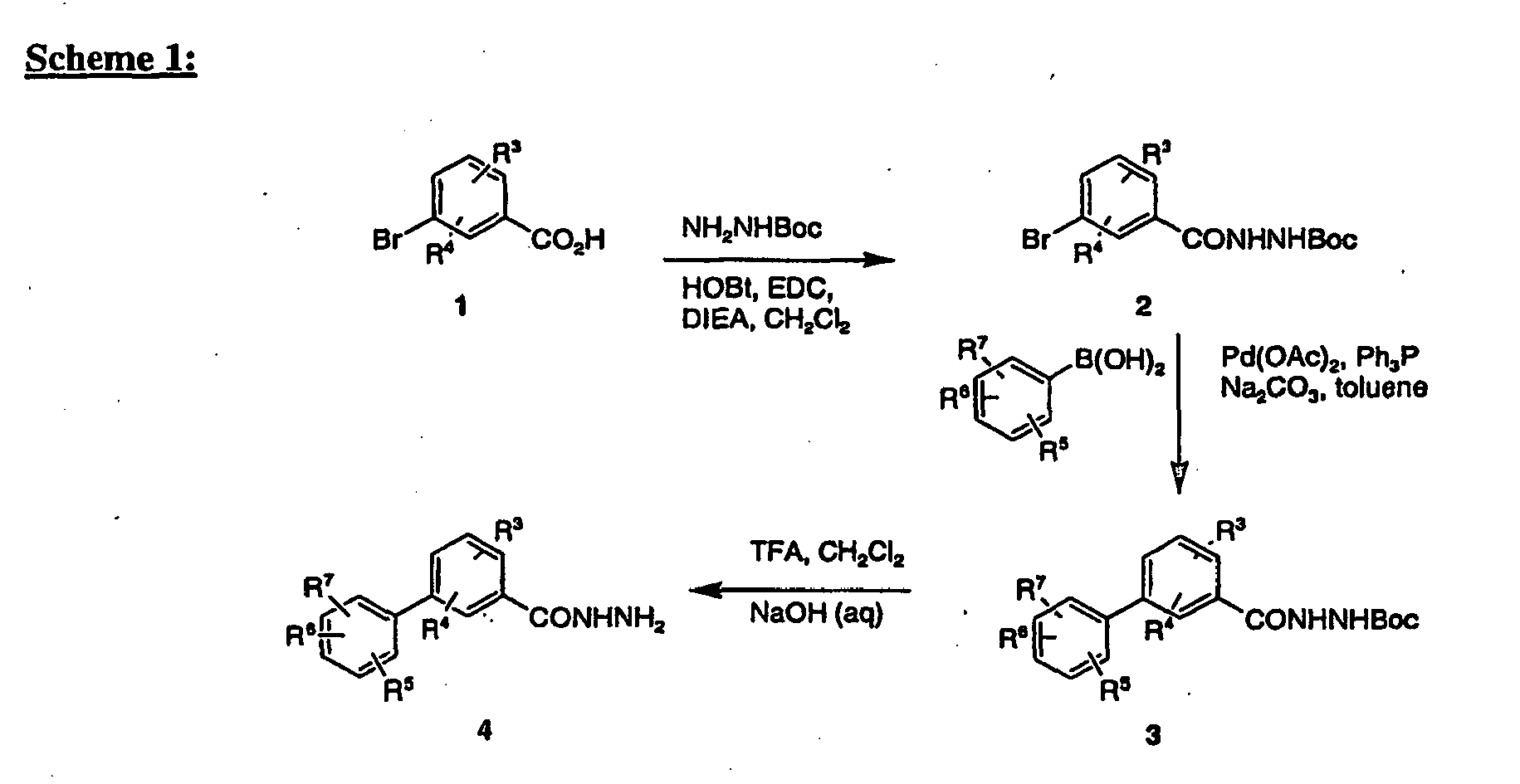
- In one protocol, 3-bromobenzoic acid 1 is coupled with t-butyl carbazate by activation with HOBt (hydroxybenzotriazole) in the presence of a suitable carbodiimide such as EDC [1-(3-dimethylaminopropyl)-3-ethylcarbodiimide) and diisopropylethylamine (DIEA) in dichloromethane or THF to give the protected hydrazide 2. There are numerous other suitable methods to activate carboxylic acids for coupling formation (see March J. "Advanced Organic Chemistry", 5th ed., John Wiley & Sons, New York, pp. 506-512 (2001). Compound 2 can be converted to a variety of unsymmetrical biphenyl intermediates 3 by means of a variety of coupling reactions. One type is the Suzuki reaction wherein bromo, iodo, or triflate compound 2 is reacted with an aryl boronic acid in the presence of a palladium catalyst such as palladium acetate with triphenyl phosphine and aqueous sodium carbonate in a solvent such as toluene and a co-solvent such as n-propanol. (see Suzuki, et al. Chem. Rev., 95, 2457, 1995). A variety of aryl boronic acids are commercially available or can be prepared conveniently from the corresponding aryl bromide or iodide by converting it to an organolithium derivative [Baldwin, J. E., et al. Tetrahedron Lett. 39, 707-710 (1998)], or a Grignard reagent followed by treatment with trialkylborate [Li, J. J. et al, J. Med. Chem, 38: 4570-4578(1995) and Piettre, S. R., et al. J. Med Chem. 40, 4208-4221 (1997)]. Aryl boronates can also be used as an alternative to aryl boronic acids in these Pd-catalyzed coupling reactions [Giroux, A. , et al., Tetrahedron Lett., 38, 3841(1997)]. The boronates can be easily prepared from the aryl bromides, iodides and trifluoromethane sulfonates using the method described by Murata, M., et al. [J. Org. Chem. 65: 164-168 (2000)]. The Boc protecting group of compound 3 is removed by standard conditions - trifluoroacetic acid in dichloromethane - to give the TFA salt of hydrazide 4 which can be desalted with aqueous NaOH solution.

- In Scheme 2, a method is described for preparing 5-biphenyl-3-substituted-1, 2, 4-triazole derivatives wherein the substitution can be esters, acids, amides, etc. (Catarzi , et al. J. Med. Chem., 38, 2196-2201, 1995). Reaction of hydrazide 4 with carbethoxy-S-methyl-thioformimidium tetrafluoroborate and triethylamine in dichloromethane gives oxamidrazonate 7 which is cyclized to triazole ester 8. The reagent carbethoxy-S-methyl-thioforminidium tetrafluoroborate is prepared by reaction of ethyl-2-thiooxamate with trimethyl oxonium tetrafluoroborate (see Catarzi, et al. above) in dichloromethane. Ester 8 can be converted to an amide by heating it with the corresponding amine, in this case ammonia, in a solvent such as methanol. Ester 8 can be hydrolyzed to the corresponding acid under standard conditions, and the resulting acid can be converted to an amide under a variety of conditions such as those described in Scheme 1. Additionally, ester 8 can be reduced to a primary alcohol with, for example, sodium borohydride (NaBH4), to provide compounds of Formula (I) wherein R1 is hydroxymethyl. Alternatively, ester 8 can be converted to a secondary alcohol by reaction with a mixture of lithium borohydride and a Grignard reagent in an aprotic solvent such as THF. Such primary or secondary alcohol derived from ester 8 can be further derivatized by a number of methods, including oxidation to a ketone by an oxidizing reagent such as a chromium-based reagent. Such alcohol can also be converted to a fluoride derivative by, for example, reaction with diethylaminosulfurtrifluoride (DAST) in dichlormethane at reduced temperatures.

- In Scheme 3, a method is described for preparing an unsubstituted 3-triazole ring system (Lin, et al, J.Org. Chem., 44(23), 4160-4165, 1979). Ethyl-3-bromobenzoate 10 is reacted with an aryl boronic acid as described in Scheme 1 to give biphenylester 11. The ester 11 provides a preformed biphenyl intermediate that can be further elaborated to compound 4 and related derivatives as described in earlier Schemes 1-2. In this Scheme 3, ester 11 is converted to amide 12 under standard conditions. Specifically, ester 11 is hydrolyzed to the corresponding acid which is then activated with carbonyldiimidazole (CDI) in DMF, followed by the addition of ammonia in the form of ammonium acetate to give amide 12. Amide 12 in dimethylformamide dimethylacetal is heated to give intermediate 13 which, when heated with hydrazine in acetic acid, gives triazole 14.

- In a protocol to prepare 1-biphenyl-3-substituted-1,2,4-triazole derivatives, bromoaniline 22, wherein the amino group is protected with a Boc group, and an arylboronic acid is converted to a variety of unsymmetrical biphenyl intermediates 23 as described in Scheme 1. The Boc protecting group of compound 23 is removed as described previously and converted to its diazonium salt 24 by standard reaction with sodium nitrite and HCl in water. Addition of compound 24 to a mixture of methylisocyanoacetate and sodium acetate in methanol and water gave the triazole ester 25. The key intermediate 25 can be then converted to a variety of useful derivatives using the methods described in Schemes 1-3.

- In a variation to the protocols described in Schemes 1, 3 and 4 above, the Boc-protected anline 26 containing a boronic acid group or boronate ester and an aryl bromide, iodide or triflate is converted to a variety of unsymmetrical biphenyl intermediates 23 as described in Scheme 1.

- In accordance with Scheme 6, 31 and 32 can be converted to a biphenyl intermediate 33 by using, for example, a Suzuki-Miyaura coupling reaction with a palladium acetate/triphenyl phosphine catalyst system. The biphenyl intermediate 33 can be converted to imidate HCl salt 34 under standard Pinner conditions using, for example, a concentrated hydrochloric acid ethanolic solution. The imidate 34 can be converted to triazole 37 by free basing using a biphasic mixture such as EtOAc and NaOH to give ethyl imidate 35, followed by treatment with oxamic hydrazide 36, an alcoholic solvent such as ethanol and any one of many appropriate bases, including a metal acetate base such as potassium acetate, a tertiary amine base or a metal carbonate base, followed by heating.

- In a variation to Scheme 6, the imidate 34 is converted to triazole 37 by direct addition of oxamic hydrazide 36, an alcoholic solvent such as ethanol and any one of many appropriate bases, including a metal acetate base such as potassium acetate, a tertiary amine base, or a metal carbonate base, followed by heating.

- In accordance with Scheme 8, compounds of Formulas (I) or (II) wherein R2 is H, 38, can be converted by deprotonation with a metal alkoxide base such as potassium tert-butoxide or sodium tert-butoxide in an appropriate solvent/co-solvent mixture to yield a salt 39.
-

-

- To a stirred solution of 2 g (9.5 mmol) of 1-bromo-2-trifluoromethoxy benzene in 28 Ml of tetrahydrofuran (THF) at - 78°C, was carefully added a solution of 5.9 Ml of a 1.7 M solution of t-butyl lithium in hexanes (9.5 mmol). This reaction mixture was stirred at -78 °C for 45 min. To this reaction mixture at -78°C was added 2.58 Ml (11.1 mmol) of tri-isopropyl borate and the mixture was slowly warmed to room temperature (RT) over a period of 16 h. The reaction mixture was diluted with water and made basic with 2N NaOH solution. The reaction mixture was washed with EtOAc. The aqueous fraction was acidified with 2N HCl solution and stirred for 1 h at RT. The reaction mixture was extracted with EtOAc and the organic fractions were washed with water, saturated NaCl solution (brine), dried over Na2SO4 and filtered. The filtrate was concentrated to give the title compound as a white solid. 1HNMR (CDCl3) (δ, ppm): 7.96 (dd, J= 7.2, 1.6 Hz, 1 H), 7.53 (ddd, J = 9.1, 7.3, 1.8 Hz, 1 H), 7.38 (td, J = 7.3, 0.7 Hz, 1 H), 7.28 (d, J = 8.2 Hz, 1 H), 5.25 (br s, 2H). MS (M+H): 206.9.
-

- To a solution of 0.94 g (4.58 mmol) of ethyl-3-bromobenzoate in 14.5 Ml of toluene at RT was added 0.25 g (0.218 mmol) of tetrakis(triphenylphosphine) palladium(O), 0.94 g (4.58 mmol) of 2-trifluoromethoxyphenylboronic acid, 2.22 Ml (4.45 mmol) of 2M aqueous sodium carbonate solution and 7 Ml of ethanol. The reaction mixture was heated at reflux for 18 h. The reaction mixture was cooled and diluted with ethyl acetate and water. The organic fraction was separated and washed with saturated NaCl solution (brine), dried over MgSO4, filtered and the filtrate was concentrated to an oil which was purified by chromatography (silica, 1%, 5%, 30% successively ethyl acetate: hexanes) to give the title compound. 1H NMR (CD3OD) (δ, ppm): 8.02 (s, 1H), 7.97 (dd, J = 7.8, 1.2 Hz, 1H), 7.60 (dd, J = 7.7, 1.3 Hz, 1H), 7.50-7.33 (m, 5H), 4.31(q, 2H), 1.31(t, 3H). Mass Spectrum (ESI) m/e (M+1): 311.2.
-

- A solution of 0.3 g (4.19 mmol) of ethyl-3-(2-trifluoromethoxyphenyl) -benzoate and 8.3 Ml (8.3 mmol) of a 1N solution of NaOH in 12.5 Ml of methanol was stirred 18 h at RT. The reaction mixture was concentrated and the Ph was adjusted to Ph=2 with 1 N HCl solution. The mixture was extracted with ethyl acetate (EtOAc) and the organic fraction was dried over MgSO4, filtered and the filtrate was concentrated to give the title compound as a white solid that was used without further purification.
-

- To a solution of 0.94 g (3.36 mmol) of 3-(2-trifluoromethoxyphenyl)-benzoic acid in 17 Ml of DMF was added 0.55 g (3.36 mmol) of carbonyldiimidazole (CDI) and the reaction was stirred at RT for 4 h. To the reaction mixture was added 2.6 g (33.6 mmol) of ammonium acetate and the reaction mixture was stirred over night at RT. The reaction mixture was partitioned between ethyl acetate and water and the organic fraction was washed with brine, dried over MgSO4, filtered and the filtrate was concentrated. The residue was purified by chromatography (silica, 30%, 50% successively EtOAc: hexanes) to give the title compound. Mass Spectrum (ESI) m/e (M+1): 282.2.
-

- A solution of 0.137 g (0.48 mmol) of 3-(2-trifluoromethoxyphenyl)-benzamide in 1 Ml of N,N-dimethylformamide dimethyl acetal was heated at 120° C for 2 h at which time the reaction was concentrated in vacuo. To this material in 2.3 Ml of acetic acid was added 0.028 g (0.55 mmol) of hydrazine hydrate and the reaction mixture was heated at 90 Oc for 2 h. The reaction mixture was then concentrated and partitioned between EtOAc and saturated NaHCO3 solution. The organic fraction was washed with brine, dried over MgSO4, filtered and the filtrate was concentrated. The residue was purified by chromatography (silica, 30:1, 9:1, 3:1 successively CH2Cl2: acetone) to give the title compound. 1H NMR (CD3OD) (δ, ppm): 8.32 (s, 1H), 8.06 (s, 1H), 7.98 (m, 1H), 7.50 (m, 3H), 7.39(m, 3M).Mass Spectrum (ESI) m/e (M+1): 306.1.
- The following Examples 2-7 were prepared using procedures similar to that described in Example 1. The preparation of any intermediates that were not commercially available are described.
-

- Mass Spectrum (ESI) m/e (M+1): 290.1.
-

-

- A solution of 0.35 g (2 mmol) of 2-bromophenol, 0.63 g (3 mmol) of 2,2,2-trifluoroethyliodide, 0.55 g (4 mmol) of potassium carbonate in 2 MI of DMF was reacted at 150°C in a microwave system (Personal Chemistry, Smithcreator) for 30 min. After cooling to RT, the reaction mixture was diluted with water and extracted with ethyl acetate. The organic fraction was dried over MgSO4, filtered and the filtrate was concentrated. The residue was purified by chromatography (5%, 10% successively EtOAc: hexanes) to give the title compound.
-

- To a solution of 2.5 g (9.8 mmol) of 2-trifluoroethoxyphenyl bromide in 33 Ml of toluene at RT was added 0.57 g (0.49 mmol) of tetrakis(triphenyl-phosphine) palladium(0), 0.2 g (10.3 mmol) of 3-ethoxycarbonylphenylboronic acid, 5.9 Ml (11.8 mmol) of 2M aqueous sodium carbonate solution and 17 Ml of ethanol. The reaction mixture was heated at reflux for 18 h. The reaction mixture was cooled and diluted with ethyl acetate and water. The organic fraction was separated and washed with saturated NaCl solution (brine), dried over MgSO4, filtered and the filtrate was concentrated to an oil which was purified by chromatography (silica, 1%, 5%, 30% successively ethyl acetate: hexanes) to give the title compound. Mass Spectrum (ESI) m/e (M+1): 325.1.
- The title compound can be prepared using procedures similar to that described in Example 1, Steps C - E.
-

- Mass Spectrum (ESI) m/e (M+1): 358.3.
-
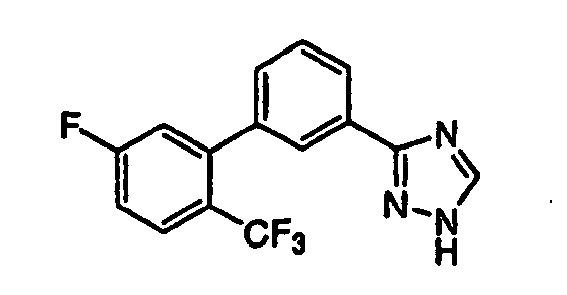
- Mass Spectrum (ESI) m/e (M+1): 308.0.
-

- Mass Spectrum (ESI) m/e (M+1): 324.1.
-

- Mass Spectrum (ESI) m/e (M+1): 324.0.
-

- Mass Spectrum (ESI) m/e (M+1): 338.0.
-

- To a solution of 2 g (8.45 mmol) of methyl-3-bromo-4-fluorobenzoate in 28 Ml of toluene at RT was added 0.49 g (0.42 mmol) of tetrakis(triphenyl phosphine)palladium(O), 1.95 g (8.9 mmol) of 2-(4,4,5,5,-tetramethyl-1.3.2-dioxaborolan-2-yl)phenol, 5.1 Ml (10.15 mmol) of 2M aqueous sodium carbonate solution and 14 Ml of n-propanol. The reaction mixture was heated at reflux for 18 h. The reaction mixture was cooled and diluted with ethyl acetate and water. The organic fraction was separated and washed with saturated NaCl solution (brine), dried over MgSO4, filtered and the filtrate was concentrated to an oil which was purified by chromatography (silica, 90:1, 30:1 successively CH2Cl2: acetone) to give the title compound. Mass Spectrum (ESI) m/e (M+1): 247.0.
-

- A mixture of 1.7 g (7.1 mmol) of methyl-3-((2-hydroxy)phenyl)-4-fluorobenzoate, 2.46 g (10.6 mmol) of 2,2,2,-trifluoroethyl trifluoromethanesulfonate and 3.45 g (10.6 mmol) of cesium carbonate in 35 Ml of DMF was stirred at 60 °C for 18 h. The cooled reaction mixture was partitioned between EtOAc and water. The aqueous layer was extracted with EtOAc and the combined organic fractions were washed with water, brine, dried over MgSO4 and filtered. The filtrate was concentrated and purified by chromatography (silica, 5%, 30% successively EtOAc: hexanes) to give the title compound as a white solid. Mass Spectrum (ESI) m/e (M+1): 329.0.
- The title compound can be prepared using procedures similar to that described in Example 1, Steps C - E.
-

-

- A solution of 1 g (4.97 mmol) of 3-bromobenzoic acid, 0.59 g (4.52 mmol) of t-butylcarbazate, 0.95 g (4.97 mmol) of EDC [1-(3-dimethylaminopropyl)-3-ethylcarbodiimide), 0.67 g (4.97 mmol) of hydroxybenzotriazole (HOBt) and 3.15 Ml (18.1 mmol) of diisopropylethylamine in 23 Ml of CH2Cl2 was stirred at RT for 18 h. The reaction mixture was diluted with CH2Cl2 and washed with 1N HCl solution, saturated NaHCO3 solution and brine. The solution was dried over MgSO4, filtered and the filtrate was concentrated. The residue was purified by chromatography (silica, 30:1, 9:1, 3:1 successively CH2Cl2:acetone) to give the title compound. Mass Spectrum (ESI) m/e (M): 314.0, (M+2): 316.0
-

- A solution of 0.22 g (1.07 mmol) of 2-trifluoromethoxyphenylboronic acid and 0.32 g (1.02 mmol) of 3-bromophenylcarbonyl-N-t-butoxycarbonylhydrazide in 5 Ml of toluene and 2.5 Ml of n-propanol was stirred for 30 min. To this reaction mixture was added 0.0007 g (0.003 mmol) of palladium acetate, 0.0024 g (0.009 mmol) of triphenylphosphine and 0.61 Ml (1.2 mmol) of a 2M aqueous sodium carbonate solution and the reaction mixture was heated at reflux for 18 h. The reaction mixture was cooled and diluted with EtOAc and water. The organic fraction was dried over MgSO4, filtered and the filtrate was concentrated. The residue was purified by chromatography (silica, 30:1, 9:1 successively, CH2Cl2: acetone) to give the protected hydrazide which was then dissolved in a mixture of 2.1 Ml of TFA and 2.1 Ml of CH2Cl2. The reaction mixture was stirred for 2 h whereupon it was concentrated, dissolved in CH2Cl2 and washed with 1N NaOH solution. The organic fraction was dried over MgSO4, filtered and the filtrate was concentrated to give the tile compound as a white solid. Mass Spectrum (ESI) m/e (M+1): 297.1.
-

- To a solution of 0.093 g (0.98 mmol) of acetamidine hydrochloride in 1.1 Ml of ethanol was added 0.22 Ml (0.98 mmol) of a 25% solution of sodium methoxide in methanol and the reaction mixture was stirred for 30 min. whereupon it was filtered. To the filtrate was added 0.19 g (0.66 mmol) of 3-((2-trifluoromethoxy) phenyl)-bromophenylhydrazide and the reaction mixture was stirred over night. The reaction mixture was concentrated and purified by chromatography (silica, 3%, 10%, 30% successively, methanol: CH2Cl2) to give a white solid. The white solid was heated (neat) to its melting temperature for 30 min. The reaction was cooled to RT, dissolved in CH2Cl2 and concentrated. The residue was purified by chromatography (silica, 3%, 10%, successively, methanol: CH2Cl2) to give the title compound as a white solid. 1H NMR (CD3OD) (δ, ppm): 8.00 (s, 1H), 7.93 (m, 1H), 7.49 - 7.34 (m, 6H), 2.41(s, 3H). Mass Spectrum (ESI) m/e (M+1): 320.5.
- The following Examples 10 to 18 were prepared according to the procedure described in Example 9, using the corresponding substituted amidine.
-

- Mass Spectrum (ESI) m/e (M+1): 304.0.
-

- Mass Spectrum (ESI) m/e (M+1): 372.5.
-

- Mass Spectrum (ESI) m/e (M+1): 334.1.
- The title compound was prepared from the acid of ethyl-3-(2-trifluoroethoxyphenyl)-benzoate which was prepared in Example 3, Step B.
-

- Mass Spectrum (ESI) m/e (M+1): 338.1.
-

- Mass Spectrum (ESI) m/e (M+1): 338.1.
-

- Mass Spectrum (ESI) m/e (M+1): 352.0.
- The title compound was prepared from the acid of Methyl-3-(2-trifluoroethoxy-(4-fluoro)-phenyl)-benzoate which was prepared in Example 8, Step B.
-

- Mass Spectrum (ESI) m/e (M+1): 346.2.
-

- Mass Spectrum (ESI) m/e (M+1): 374.1.
-

- Mass Spectrum (ESI) m/e (M+1): 321.9.
-

-

- To a solution of 0.45 g (1.54 mmol) of 3-(2-trifluoromethoxyphenyl)-bromophenylhydrazide (Example 9, Step B) in 20 Ml of CH2Cl2 was added 0.54 g (2.3 mmol) of carbethoxy-S-methylthioformimidium tetrafluoroborate and and 0.43 Ml (3.08 mmol) of triethylamine and the reaction was stirred at refluxing temperatures for 4 hr. The reaction mixture was cooled to RT, washed with water, dried over Na2SO4, filtered and the filtrate was concentrated to a solid. Two Ml of CH2Cl2 was added and the resulting solid product was recovered by filtration. Mass Spectrum (ESI) m/e (M+1): 396.1.
- The solid Ethyl-N 1-3-(2-trifluoromethoxy)-benzoyl-N 2-oxamidrazonate (0.25 g, 0.616 mmol) was heated in an oil bath above its melting point for 20 min. After cooling to RT, the residue was dissolved in CH2Cl2 and concentrated to give a yellow solid. It was purified by chromatography (silica, 10%, 30%, 50% successively, EtOAc: hexanes) to give a white solid. Mass Spectrum (ESI) m/e (M+1): 378.1.
- A solution of 0.13 g (0.34 mmol) of 5-ethyl-3-[3-((2-trifluoromethoxy)phenyl)-phenyl]-1,2,4-triazole-5-carboxylate in 2 Ml of methanol in a tube was saturated with ammonia. The tube was sealed and the reaction mixture was heated at 60 °C overnight. The reaction mixture was then concentrated and the residue was purified by chromatography (silica, 3%, 10%, 20% successively methanol: CH2Cl2) to give the title compound. 1H NMR (CD3OD) (δ,.ppm): 8.10 (s, 1H), 8.02 (m, 1H). 7.54 - 7.36 (m, 6H). Mass Spectrum (ESI) m/e (M+1): 349.2.
-

-

- To a solution of 0.75 g (2.29 mol) of Methyl 1-3-((2-trifluoroethoxy)phenyl)-4-fluorobenzoate (Example 8, Step B) in 11.5 Ml of a 3:1 mixture of THF: water was added 0.164 g (6.86 mmol) of LiOH and the reaction mixture was stirred at RT for 18 hr. The reaction mixture was concentrated and the Ph was adjusted to Ph=2 with 1N HCl solution. The mixture was extracted with EtOAc and the combine organic fractions were washed with brine, dried over MgSO4, filtered and the filtrate was concentrated to give the title compound which was used without further purification.
- The title compound was prepared from 3-((2-trifluoroethoxy)phenyl)-4-fluorobenzoic acid according to procedures described in Example 9 Steps A&B and Example 19. 1H NMR (CD3OD) (δ, ..ppm): 8.02 (m, 2H), 7.99 (m, 1H), 7.39(m, 1H), 7.30 (m, 1H), 7.16(m, 2H), 4.45 (q, J = 8.5Hz, 2H).Mass Spectrum (ESI) m/e (M+1): 381.0.
- The following Examples 21- 26 were prepared according to procedures described in Examples 19 and 20.
-

- Mass Spectrum (ESI) m/e (M+1): 333.1.
-

- Mass Spectrum (ESI) m/e (M+1): 363.1.
-

- Mass Spectrum (ESI) m/e (M+1): 367.0.
-

- Mass Spectrum (ESI) m/e (M+1): 351.0.
-
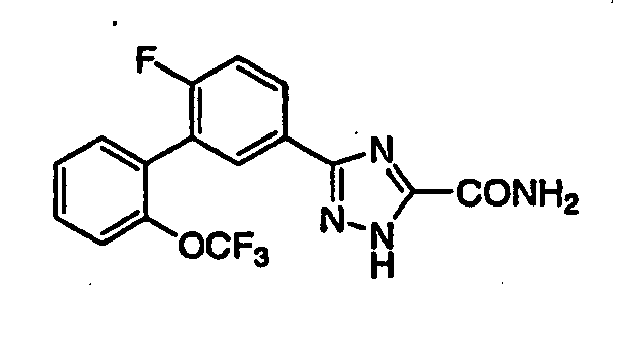
- Mass Spectrum (ESI) m/e (M+1): 367.0.
- 3-bromo-4-fluorobenzonitrile (1.0 equivalent), 2-(trifluoromethoxy)benzeneboronic acid (1.25 equivalent), palladium acetate (0.005 equivalent) and triphenylphosphine (0.01 equivalent) were sequentially charged to a multi-necked flask. After purging the flask with nitrogen, toluene (5mL/gram of 3-bromo-4-fluorobenzonitrile) was added and the resulting slurry was stirred while bubbling nitrogen subsurface for about 20 minutes. In a separate flask, an aqueous potassium phosphate solution was prepared by dissolving solid potassium phosphate (2.0 equivalents) into water (2mL/gram of potassium phosphate). The resulting solution was de-oxygenated by bubbling nitrogen subsurface while stirring for about 30 minutes. The aqueous potassium phosphate solution was added to the toluene slurry and the reaction mixture was warmed to 60-65 °C by heating with steam. The progress of the reaction was monitored by HPLC and the reaction temperature was held between 63-69 °C. When 3-bromo-4-fluorobenzonitrile was consumed, heating was discontinued and the reaction mixture was cooled to RT using an ice bath. The aqueous layer was siphoned from the vessel and Ecosorb C-941 (0.5 gram/grams of 3-bromo-4-fluorobenzonitrile, commercially available from Graver Technologies, Glasgow, Delaware) was added to the reaction vessel. The resulting black slurry was stirred at RT for 15 hours. The carbon was removed by filtering the slurry through a pad of solka flok on a filter pot. The filter cake was washed with toluene (4mL/gram of 3-bromo-4-fluorobenzonitrile). The combined filtrates were batch concentrated (40-50 °C) to provide the biaryl nitrile product as a thick, light-orange oil (94.0% yield).
-

- Absolute ethanol (1.8 mL/gram of biaryl nitrile) was charged to a round bottom flask. The stirred ethanol was chilled with an ice/acetone bath and gaseous hydrogen chloride was bubbled subsurface while the internal temperature was maintained less than 20 °C. Addition of HCl was monitored by proton titration using a Metrohm 808 Titrando (commercially available from Metrohm Ltd.) to determine HCl concentration of the ethanol solution. The addition was stopped after the concentration of HCl reached 38% (7.5 equivalents). The biaryl nitrile from step A (1.0 equivalent) was added as a neat oil to the chilled ethanolic HCl solution and the reaction solution was allowed to warm to RT while being stirred overnight (>15h). The reaction was deemed complete when assay by HPLC showed no presence of the starting biaryl nitrile. The resulting reaction was then diluted with toluene (8mL/gram of biaryl nitrile). To induce crystallization, the batch was solvent switched to toluene by co-distillation with ethanol (<35°C internal temperature) which azeotropically removed ethanol. This process was carried out until the ethanol content in the mother liquor was less than 1 mol% relative to toluene. This endpoint was determined by proton NMR in CDCl3 of the mother liquor. The solids were isolated by filtration, washed with toluene (2.3mL/gram of biaryl nitrile). The white crystalline HCl salt of the ethyl imidate product was dried under a stream of nitrogen.
-

- The imidate HCl salt from Step B (1.0 equivalent) and EtOAc (4mL/gram of imidate HCl salt) were added to a flask, followed by stirring to give a heterogeneous slurry. This slurry was cooled to 10°C followed by the slow addition of a solution of 5.0 N NaOH (3.3 equivalents). The rate of addition of the NaOH solution was periodically adjusted to maintain the reaction temperature below 15 °C. Once the addition of NaOH was complete, the biphasic reaction mixture was allowed to warm to ambient temperature at which point all of the solids had dissolved (ca. 30 min). Stirring was stopped and the two layers were allowed to separate. The bottom aqueous layer was removed and discarded. To the flask containing the organic layer was added water (2 mL/gram of HCl imidate salt) and the resulting biphasic mixture was stirred for 5 minutes. The layers were allowed to separate and the bottom aqueous layer was removed and discarded. This was followed by the addition of a 10% NaCl aqueous solution (2mL/gram of HCl imidate salt) to the flask. The resulting two layers were stirred for 5 minutes, and the bottom aqueous layer was removed and discarded. The top organic layer was transferred to a round bottom flask that was connected to a batch concentrator. A solvent switch from EtOAc to EtOH was then performed by removing the EtOAc by co-distillation with EtOH. Once the solvent switch was complete (< 3% EtOAc by 1H NMR, imidate concentration approximately 185 mg/mL), the ethanolic solution containing the free base imidate was transferred to a new flask.
- Oxamic hydrazide (1.1 equivalents) and potassium acetate (5.0 equivalents) were added to the ethanol solution containing the imidate from above. The resulting heterogeneous mixture was then heated to between 60-70 °C using a steam batch along with vigorous stirring. The reaction was monitored by HPLC analysis for conversion of the imidate to the desired triazole product. Once the reaction was complete, it was cooled to ambient temperature followed by the slow addition of water (4mL/gram of imidate HCl salt) to crystallize the desired product from the reaction. The desired product was then collected by vacuum filtration as an off-white solid (85% yield).
-

- The triazole product of Step C (1.0 equivalents) was added to a reaction vessel, followed by the addition of toluene (5.3 mL/gram of triazole) and THF (1.7mL/gram of triazole). The resulting heterogeneous mixture was stirred at ambient temperature. To this slurry was added a solution of potassium tert-butoxide (1.1 equivalents). The rate of addition of the base was periodically adjusted to maintain the reaction temperature below 35 °C. As the addition proceeded, the reaction mixture became less heterogeneous. Once the addition of the base was complete, the now homogeneous light yellow solution was allowed to stir at ambient temperature for 30 min. At this point, water (2.5 equivalents) was slowly added (ca. 10 min) to the batch with no noticeable exotherm. After about about 15 min, the reaction became increasingly cloudy and the batch temperature slowly began to rise. Approximately 20 min after addition of water, solids began to form indicating the crystallization had begun. After about 30 min, the batch temperature had reached its maximum (24.9 °C). The heterogeneous batch was allowed to stir for an additional 30 minutes. The batch was filtered onto a filter pot using the mother liquor to obtain any residual solids in the reaction vessel. The wet cake was washed with fresh toluene (4mL/gram of triazole). The batch was transferred to a vacuum oven and dried at 45°C and 100 torr for 24 hours to provide the potassium salt dihydrate product as a white solid (95% yield).
-

- Mass Spectrum (ESI) m/e (M+1): 401.0.
-

- To a solution of 0.12 g (0.328 mmol) of 3-[3-((2-trifluoromethoxy) phenyl)-(4-fluoro)-phenyl]-1,2,4-triazole-5-carboxamide (Example 25) in 1.5 Ml of methanol was added 0.1 Ml (0.46 mmol) of a solution of NaOCH3 (25% in methanol) and 0.02 Ml of methyl iodide. The tube was sealed and heated overnight at 100 °C. The reaction mixture was concentrated and the residue was purified by chromatography (silica, 30:1, 9:1, 1% successively methanol: CH2Cl2) to give the title compounds. (26) 1H NMR (CD3OD) (δ, ppm): 8.09 (m, 1H), 8.00 (dd, J = 7.1, 2.3 Hz,1H), 7.50 - 7.36 (m, 4H), 7.23 (t, J = 9.2Hz, 1H), 4.18 (s, 3H).Mass Spectrum (ESI) m/e (M+1): 381.0
(26'1H NMR (CD3OD) (δ,.ppm): 7.84 (m, 1H), 7.77. dd, J = 6.6,2.3 Hz, 1H), 7.52 - 7.44 (m, 5H), 4.00 (s, 3H).Mass Spectrum (ESI) m/e (M+1): 381.0. - The following Examples 27/27' and 28/28' were prepared according to the procedure described in Example 26 and 26'.
-

- (27) Mass Spectrum (ESI) m/e (M+1): 395.2.
(27') Mass Spectrum (ESI) m/e (M+1): 395.2. -

- (28) Mass Spectrum (ESI) m/e (M+1): 334.2.
(28') Mass Spectrum (ESI) m/e (M+1): 334.2. -

- To a solution of 0.083 g (0.24 mmol) of 3-[3-((2-trifluoromethoxy)-phenyl)-phenyl]-1,2,4-triazole-5-carboxylic acid (made from 5-ethyl-3-[3-((2-trifluoromethoxy)phenyl)-phenyl]-1,2,4-triazole-5-carboxylate Example 19 according to procedures described in Example 20) in 1.2 Ml of DMF at RT was added 0.038 g (0.24 mmol) of carbonyldiimidazole (CDI) and the reaction mixture was stirred for 3 hr. To the reaction mixture was added 1.2 Ml (2.4 mmol) of a 2M solution of methylamine in THF and the reaction mixture was stirred overnight at RT. The reaction mixture was concentrated and partitioned between EtOAc and water. The aqueous fraction was extracted with EtOAc and the combined organic fractions were washed with water and brine, dried over MgSO4, filtered and the filtrate was concentrated. The residue was purified by chromatography (silica, 30%, 50% successively EtOAc: hexanes) to give the title compound as a foamy white solid. Mass Spectrum (ESI) m/e Mass Spectrum (ESI) m/e (M+1): 363.0.
- The following Examples 30 and 31 were prepared using the procedure described in Example 29.
-

- Mass Spectrum (ESI) m/e (M+1): 377.2.
-

- Mass Spectrum (ESI) m/e (M+1): 405.0.
-

- To a solution of 0.007 Ml (0.133 mmol) of a 2M solution of LiBH4 in THF at RT was added a solution 0.18 Ml (0.53 mmol) of a 3M solution of MeMgCl in THF. After stirring, the reaction mixture was cooled to -20 °C and to it was added a solution of 0.1 g (0.265 mol) of 5-ethyl-3-[3-((2-trifluoromethoxy)-phenyl)-phenyl]-1,2,4-triazole-5-carboxylate (Example 19) in 1 Ml of THF and the reaction mixture was stirred at -20 °C for 24 hr. The reaction mixture was poured into cold 1N HCl solution. The aqueous fraction was extracted with diethyl ether and the combined organic fractions were washed with brine, dried over MgSO4, filtered and the filtrate was concentrated. The residue was purified by chromatography (silica, 9:1, CH2Cl2, acetone) to give the title compound. Mass Spectrum (ESI) m/e (M+1): 350.1.
-
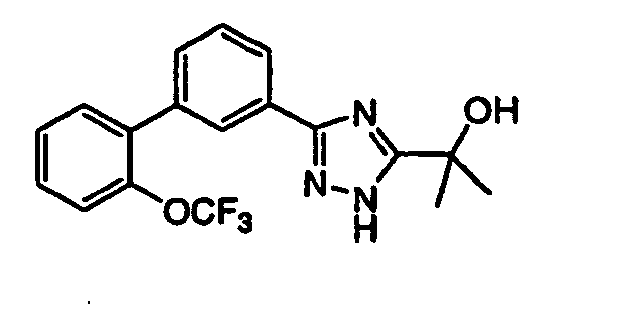
- The title compound is a by-product of Example 32.
Mass Spectrum (ESI) m/e (M+1): 364.1. -

- The title compound is a by-product of Example 32.
Mass Spectrum (ESI) m/e (M+1): 336.1. -

- To a solution of 0.13 g (0.37 mmol) of 5-(2-hydroxy)-ethyl-3-[3-((2-trifluoromethoxy)phenyl)-phenyl]-1,2,4-triazole in 2 Ml of CH2Cl2 at -78 °C was added 0.06 Ml of (diethylamino)sulfurtrifluoride (DAST) and the reaction was stirred at -78 °C for 1 hr. The reaction was quenched with a saturated solution of NaHCO3. The organic fraction was washed with brine, dried over MgSO4, filtered and the filtrate was concentrated. The residue was purified by chromatography (silica, 9:1 CH2Cl2: acetone) to give the title compound. Mass Spectrum (ESI) m/e (M+1): 352.0.
-

- To a suspension of 0.155 g (1.59 mmol) of N,O-dimethylhydroxylamine hydrochloride in 1.6 Ml of benzene at 5° C was added 0.8 Ml (1.59 mmol) of a 2M solution of trimethylaluminum in toluene. The reaction mixture was warmed to RT and stirred for 1 hr. This solution was then added dropwise to a solution of 0.3 g (0.79 mmol) of 5-ethyl-3-[3-((2-trifluoromethoxy)phenyl)-phenyl]-1,2,4-triazole-5-carboxylate in 8 Ml of benzene and the reaction mixture was heated at reflux for 18 hr. The reaction mixture was cooled to RT and quenched with a 5% solution of HCl. The aqueous fraction was extracted with EtOAc and the combined organic fractions were dried over MgSO4, filtered and the filtrate was concentrated. The residue was purified by chromatography (silica 10% methanol: CH2Cl2) to give the intermediate amide.
- To a solution of 0.19 g (0.49 mmol) of the amide in 2.5 Ml of THF at 0 °C was added 0.41 Ml (1.22 mmol) of a 3M solution of methylmagnesium chloride in THF and the reaction was stirred at 0 °C for 1 hr, warmed to RT and stirred for 18 hr. The reaction mixture was partitioned between EtOAc and saturated NH4Cl solution. The organic fraction was washed with saturated NaHCO3 solution, and brine. It was then dried over MgSO4, filtered and the filtrate was concentrated. The residue solid was triturated with CH2Cl2 and the title compound was isolated as a solid by filtration. Mass Spectrum (ESI) m/e (M+1): 348.1.
-

-

- To a solution of 1.0 g (3.93 mmol) of 2-trifluoroethoxyphenyl bromide (Example 3, Step A) in 39 Ml of toluene was added 0.136 g (0.118 mmol) of tetrakis(triphenylphosphine)palladium(0), 0.56 g (4.31 mol) of 3-aminophenylboronic acid, 47 Ml (94.1 mmol) of a 2M solution of sodium carbonate and 8 Ml of ethanol and the reaction mixture was heated at 90 °C for 22 hr. The reaction mixture was cooled to RT, and partitioned between water and EtOAc. The aqueous fraction was extracted with EtOAc and the combined organic fractions were washed with water and brine and dried over Na2SO4, filtered and the filtrate was concentrated. The residue was purified by chromatography (silica, 4:1 hexanes: EtOAc) to give the title compound. Mass Spectrum (ESI) m/e M+1 268.1.
-

- To a solution of 0.923 g (3.45 mmol) of 3-((2-trifluoroethoxy)-phenyl)analine in 6 Ml of a 1N solution of HCl at 0 °C was added 0.238 g (3.45 mmol) of sodium nitrite and 1 Ml of water and the reaction mixture was stirred for 20 min. to give the diazonium salt solution.
- To a solution of 0.27 g (2.76 mmol) of methylisocyanoacetate in 15 Ml of methanol and 2 Ml of water at 0° C was added 1.8 g (22.08 mmol) of sodium acetate. To this reaction mixture was added dropwise the diazonium salt solution and the reaction mixture was stirred at 0° C for 1 h. The reaction mixture was then diluted with methanol and concentrated. The residue was diluted with EtOAc and 0.5N HCl solution. The aqueous layer was extracted with EtOAc and the combined organic fractions were washed with 5% NaHCO3 solution, brine, dried over Na2SO4, filtered and the filtrate was concentrated. The residue was purified by chromatography (silica, 1:1 EtOAc: hexanes) to give the title compound. Mass Spectrum (ESI) m/e M+1 378.1.
-

- A solution of 0.29 g (0.769 mmol) of methyl-1-[3-((2-trifluoroethoxy)-phenyl)-phenyl]-1,2,4-triazole-3-carboxylate and 2.2 Ml (2.2 mmol) of a 1M solution of NaOH in water was stirred for 18 hr at RT. The reaction mixture was concentrated. The residue was diluted with water and the Ph was adjusted to 2-4 with 1N HCl solution. The mixture was extracted with EtOAc and the combined organic fractions were washed with brine, dried over Na2SO4, filtered and the filtrate was concentrated to give the title compound. Mass Spectrum (ESI) m/e M+1 363.9.
- To a solution of 0.225 g (0.619 mmol) of 1-[3-((2-trifluoroethoxy) phenyl)-phenyl]-1,2,4-triazole-3-carboxylic acid in 3.1 Ml of DMF was added 0.1 g (0.19 mmol) of CDI and the reaction mixture was stirred at RT for 4 hr. To the reaction mixture was added 0.477 g (6.19 mmol) of ammonium acetate and the reaction mixture was stirred for 19 hr. The reaction mixture was diluted with water and EtOAc and the aqueous layer was extracted with EtOAc. The combined organic fractions were washed with brine, dried over Na2SO4, filtered and the filtrate was concentrated. The residue was purified by chromatography (silica,1:1 EtOAc: hexanes, 1% methanol: CH2Cl2, 10% methanol: CH2Cl2) to give the title compound. Mass Spectrum (ESI) m/e M+1 363.1.
-

-

- A solution of 10 g (58.13 mmol) of 3-bromoaniline and 15.2 g (69.75 mmol) of Boc2O in 300 Ml of toluene was heated overnight at 70 °C. The reaction mixture was concentrated and diluted with EtOAc and 0.5N HCl solution. The organic fraction was washed with 0.5N HCl solution and brine. It was dried over Na2SO4, filtered and the filtrate was concentrated. The residue was purified by chromatography (hexanes, 9:1 hexanes: EtOAc successively) to give the title compound.
-

- 1-N-t-Butoxycarbonylamino-3-bromobenzene was coupled with 2-trifluromethoxyphenylboronic acid according to procedures described in Example 37, Step A.
-

- A solution of 0.977 g (2.77 mmol) of 1-N-t-butoxycarbonyl-3-((2-Trifluoromethoxy)-phenyl)analine in 7 Ml of TFA and 7 Ml of CH2Cl2 was stirred at RT for 1 hr. The reaction mixture was concentrated and the residue was diluted with 1N NaOH solution and EtOAc. The organic fraction was washed with 1N NaOH solution and brine, dried over Na2SO4 filtered and the filtrate was concentrated to give the title compound. Mass Spectrum (ESI) m/e M+1 254.1.
- The title compound was prepared from 3-((2-Trifluoro-methoxy)phenyl)aniline according to procedures described in Example 37. Mass Spectrum (ESI) m/e M+1 349.1.
- The following Examples 39 -40 were prepared according to the procedures described in Examples 37 or 38.
-

- Mass Spectrum (ESI) m/e M+1 401.1.
-

- Mass Spectrum (ESI) m/e M+1 381.2.
- The following Examples 41 to 44 were prepared according to procedures described in Example 29.
-

- Mass Spectrum (ESI) m/e M+1 363.1.
-

- Mass Spectrum (ESI) m/e M+1 377.1.
-

- Mass Spectrum (ESI) m/e M+1 405.2.
-

- Mass Spectrum (ESI) m/e M+1 393.1.
-

- The title compound was prepared according to procedures described in Example 32.
Mass Spectrum (ESI) m/e M+1 350.1. -

- The title compound was isolated according to the procedure for preparing the compound of Example 45. Mass Spectrum (ESI) m/e M+1 364.0.
-

- The title compound was isolated according to the procedure for preparing the compound of Example 45. Mass Spectrum (ESI) m/e M+1 336.1.
-

- The title compound was prepared from 3-(1-hydroxy)-eth-1-yl-1-[3-((2-trifluoromethoxy)phenyl)-phenyl]-1,2,4-triazole (Example 45) according to procedures described in Example 35.
Mass Spectrum (ESI) m/e M+1 352.0. -

- The title compound was prepared from 3-(1-hydroxy-1-methyl)eth-1-yl-1-[3-((2-trifluoromethoxy)phenyl)-phenyl]-1,2,4-triazole (Example 46) according to procedures described in Example 35.
Mass Spectrum (ESI) m/e M+1 366.1. -

- The title compound was prepared from 1-[3-((2-Trifluoroethoxy)-phenyl)-phenyl]-1,2,4-triazole-3-carboxylic acid (from Example 38) according to procedures described in Example 36.
Mass Spectrum (ESI) m/e M+1 348.1. -

- A solution of 0.037 g (0.106 mmol) of 3-(1-oxo)-eth-1-yl-1-[3-((2-trifluoromethoxy)-phenyl)-phenyl]-1,2,4-triazole (Example 50), 0.082 g (1.06 mmol) of NH4Oac and 0.1 Ml (0.72 mmol) of triethylamine in 1 Ml of THF was stirred for 2 hr. To the reaction mixture was added 0.045 g (0.212) of sodium triacetoxy-borohydride and 0.02 Ml (0.212 mmol) of acetic acid. The reaction mixture was stirred at RT for 72 hr. The reaction mixture was diluted with Saturated NaHCO3 solution and the mixture was stirred for 45 min. The reaction mixture was extracted with diethyl ether and combined organic fractions were washed with brine, dried over Na2SO4, filtered and the filtrate was concentrated. The residue was purified by chromatography (silica, 1:1 EtOAc: hexanes, 1% methanol: CH2Cl2, 10% methanol: CH2Cl2 successively) to give the title compound.
Mass Spectrum (ESI) m/e M+1 349.1 -

- The title compound was prepared according to procedures described in Example 51. Mass Spectrum (ESI) m/e M+1 363.1.
-

- The titled compound is prepared using procedures described in Examples 19 and 20.
-

- Mass Spectrum (ESI) m/e M+1 381.
Claims (11)
- A pharmaceutical composition comprising a therapeutically effective amount of a compound represented by Formula (I) or (II):


R1 is(a) H;(b) C1-C6-alkyl, C3-C4-alkenyl, C2-C4-alkynyl, C3-46-cycloalkyl, or C1-C4-alkylene-[C3-C6-cycloalkyl], any of which is optionally substituted with one or more of the following substituents: F, CF3, OH, O-(C1-C4)alkyl, S(O)0-2-(C1-C4)alkyl, O-CONRaRb, NRaRb, N(Ra)CONRaRb, COO-(C1-C4)alkyl, COOH, CN, CONRaRb, SO2NRaRb, N(Ra)SO2NRaRb, -C(=NH)NH2, tetrazolyl, triazolyl, imidazolyl, oxazolyl, oxadiazolyl, isoxazolyl, thiazolyl, furyl, thienyl, pyrazolyl, pyrrolyl, pyridyl, pyrimidinyl, pyrazinyl, phenyl, piperidinyl, morpholinyl, pyrrolidinyl or piperazinyl;(c) -C0-C4-alkylene-C1-C4-perfluoroalkyl;(d) NO2;(e) NRaRb, -N(CORa)Rb, -N(SO2Ra)Rb, -N(Ra)CON(Ra)2, -N(Ra)SO2Ra, -N(ORa)CONRaRb, or-N(Ra)SO2N(Ra)2;(f) -CH(ORa)Ra, -C(ORb)CF3, -CH(NHRb)Ra, -C(=O)Ra, C(=O)CF3, -SOCH3, -SO2CH3, COORa, CN, CONRaRb, -COCONRaRb, -SO2NRaRb, -CH2O-SO2NRaRb, SO2N(Ra)ORa, -C(=NH)NH2, -CRa=NORa, CH=CHCONRaRb;(g) -CONRa(CH2)0-2C(Ra)(Rb)(CH2)0-1CONRaRb;(h) tetrazolyl, tetrazolinonyl, triazolyl, triazolinonyl, imidazolyl, imidazolonyl, oxazolyl, oxadiazolyl, isoxazolyl, thiazolyl, furyl, thienyl, pyrazolyl, pyrazolonyl, pyrrolyl, pyridyl, pyrimidinyl, pyrazinyl, or phenyl, any of which is optionally substituted with 1-3 independent substituents selected from i) F, Cl, Br, I, ii) -CN, iii) -NO2, iv) -C(=O)Ra, v) C1-C6-alkyk, vi) -O-Ra, vii) -NRaRb, viii)- C0-C4-alkylene -CO-O Ra, ix) -(C0-C4-alkylene)-NH-CO-ORa, x) -(C0-C4-alkylene)-CO-NRa Rb, xi) -S(O)0-2Ra, xii) -SO2NRaRb, xiii) -NHSO2Ra, xiv) -C1-C4-perfluoroalkyl, and xv) -O-C1-C4-perfluoroalkyl;(i) -C(Ra)=C(Rb)-COORa, or -C(Ra)=C(Rb)-CONRaRb;(j) (k) piperidin-1-yl, morpholin-4-yl, pyrrolidin-1-yl, piperazin-1-yl or 4-susbstituted piperazin-1-yl, any of which is optionally substituted with 1-3 substituents selected from i) -CN, ii) -C(=O)(Ra), iii) C1-C6-alkyl, iv) -ORa, v) -NRaRb, vi) -C0-C4-alkylene-CO-ORa, vii) -(C0-C4-alkylene)-NH-CO-ORa, viii) -(C0-C4-alkylene)-CON(Ra)(Rb), ix) -SRa, x) -S(O)0-2Ra, xi) -SO2N(Ra)(Rb), xii) -NRaSO2Ra xiii) -C1-C4-perfluoroalkyl and xiv) -O-C1-C4-perfluoroalkyl;Ra is(a) H;(b) C1-C4-alkyl, optionally substituted with one or more of the following substituents: F, CF3, OH, O-(C1-C4)alkyl, S(O)0-2-(C1-C4)alkyl, -OCONH2, -OCONR(C1-C4alkyl), -OCON(C1-C4alkyl)(C1-C4alkyl), -OCONH(C1-C4alkyl-aryl), -OCON(C1-C4alkyl)(C1-C4alkyl-aryl), NH2, NH(C1-C4alkyl), N(C1-C4alkyl)(C1-C4alkyl), NH(C1-C4alkyl-aryl), N(C1-C4alkyl)(C1-C4alkyl-aryl), NHCONH2, NHCONH(C1-C4alkyl), NHCONH(C1-C4alkyl-aryl), -NHCON(C1-C4alkyl)(C1-C4alkyl), NHCON(C1-C4alkyl)(C1-C4alkyl-aryl), N(C1-C4alkyl)CON(C1-C4alkyl)(C1-C4alkyl), N(C1-C4alkyl)CON(C1-C4alkyl)(C1-C4alkyl-aryl), COO-(C1-C4-alkyl), COOH, CN, CONH2, CONH(C1-C4alkyl), CON(C1-C-4alkyl)(C1-C4alkyl), SO2NH2, SO2NH(C1-C4alkyl), SO2NH(C1-C4alkyl-aryl), SO2N(C1-C4alkyl)(C1-C4alkyl), NHSO2NH2, -C(=NH)NH2, tetrazolyl, triazolyl, imidazolyl, oxazolyl, oxadiazolyl, isooxazolyl, thiazolyl, furyl, thienyl, pyrazolyl, pyrrolyl, pyridyl, pyrimidinyl, pyrazinyl, phenyl, piperidinyl, morpholinyl, pyrrolidinyl or piperazinyl;(c) C0-C4-alkylenc-(C1-C4)-perfluoroalkyl; or(d) -C1-C4-alkylene-aryl, wherein aryl is phenyl, pyridyl, pyrimidinyl, furyl, thienyl, pyrrolyl, triazolyl, pyrazolyl, thiazolyl, isoxazolyl, oxazolyl, or oxadiazolyl, any aryl of which is optionally substituted with 1-3 substituents selected from i) F, Cl, Br, I, ii) -CN, iii) -NO2, iv) -C(=O)(C1-C4-alkyl), v) -O(C1-C4-alkyl), vi) -N(C1-C4-alkyl)(C1-C4-alkyl), vii) -C1-10alkyl, and viii) -C1-10alkyl,wherein one or more of the alkyl carbons can be replaced by a -O-, -S(O)1-2-, -O-C(O)-, -C(O)-O-, -C(O)-, -CH(OH)-, -C=C-, or -C=C-;Rb is(a) H; or(b) C1-C6-alkyl, optionally substituted with one or more of the following substituents: F, CF3, OH, O-(C1-C4)alkyl, S(O)0-2-(C1-C4)alkyl, -OCONH2, -OCONH(C1-C4alkyl), NH2, NH(C1-C4alkyl), N(C1-C4alkyl)(C1-C4alkyl), NHCONH2, NHCONH(C1-C4alkyl), -NHCON(C1-C4alkyl)(C1-C4alkyl), COO-(C1-C4-alkyl), COOH, CN, or CONH2;R2 is:(a) H;(b) -C1-C4-alkyl, -C3-C6-cycloalkyl or -C1-C4-alkylene-(C3-C6)-cycloalkyl, optionally substituted with one or more of the following substituents: F, CF3, OH, O-(C1-C4)alkyl, S(O)0-2(C1-C4)alkyl, O-CONRaRb, NRaRb, N(Ra)CONRaRb, COO-(C1-C4)alkyl, COOH, CN, CONRaRb, SO2NRaRb, N(RaRb)SO2NRaRb, -C(=NH)NH2, tetrazolyl, triazolyl, imidazolyl, oxazolyl, oxadiazolyl, isooxazolyl, thiazolyl, furyl, thienyl, pyrazolyl, pyrrolyl, pyridyl, pyrimidinyl, pyrazinyl, phenyl, piperidinyl, morpholinyl, pyrrolidinyl or piperazinyl;(c) -C0-C4-alkylene-C1-C4-perfluoroalkyl;(d) aryl or -(C1-C4-alkylene)-aryl, wherein aryl is phenyl, pyridyl, pyrimidinyl, furyl, thienyl, pyrrolyl, triazolyl, pyrazolyl, thiazolyl, isoxazolyl, oxazolyl, or oxadiazolyl, any aryl of which is optionally substituted with 1-3 substituents selected from i) F, Cl, Br, I, ii) -CN, iii) -NO2, iv) -C(=O)(Ra), v) -ORa, vi) -NRaRb, vii) -C0-4alkylene-CO-ORa, viii) -(C0-4alkylene)-NH-CO-ORa, ix) -(C0-4alkylene)-CO-N(Ra)(Rb), x) -S(O)0-2Ra, xi) -SO2N(Ra)(Rb), xii) -NRaSO2Ra, xiii) -C1-10alkyl, and xiv) -C1-10alkyl, wherein one or more of the alkyl carbons can be replaced by a -NRa-, -O-, -S(O)1-2-, -O-C(O)-, -C(O)-O-, -C(O)-N(Ra)-, -N(Ra)-C(O)-, -N(Ra)-C(O)-N(Ra)-, -C(O)-, -CH(OH)-, -C=C-, or -C≡C-;(e) -C(=O)(Ra), -CONRaRb, -COO-(C1-C4)alkyl, -SO2Ra, -SO2N(Ra)(Rb);R3 and R4 each independently is:(a) H;(b) -C1-C6-alkyl, -C2-C6-alkenyl, -C2-C6-alkynyl or -C3-C6-cycloalkyl, any of which is optionally substituted with one or more of the following substituents: F, CF3, -O-(C1-C4)alkyl, CN, -N(Ra)(Rb), - N(Ra)CO-(C1-C4)alkyl, COORb, CON(Ra)(Rb) or phenyl;(c) -O-C0-C6-alkyl, -O-aryl, or -O-C1-C4-alkylene-aryl, wherein aryl is phenyl, Pyridyl, pyrimidinyl, furyl, thienyl, pyrrolyl, triazolyl, pyrazolyl, thiazolyl, isoxazolyl, oxazolyl, or oxadiazolyl, any aryl of which is optionally substituted with 1-3 substituents selected from i) F, Cl, Br, I, ii) -CN, iii) -NO2, iv) -C(=O)(Ra), v) -ORa, vi) -NRaRb, vii) -C0-4alkylene-CO-ORa, viii) -(C0-4alkylene)-NH-CO-OR2, ix) -(C0-4alkylene)-CO-N(Ra)(Rb), x) -S(O)0-2Ra, xi) -SO2N(Ra)(Rb), xii) -NRaSO2Ra, xiii) -C1-10alkyl, and xiv) -C1-10alkyl,wherein one or more of the alkyl carbons can be replaced by a -NRa-, -O-, -S(O)1-2-, -O-C(O)-, -C(O)-O-, -C(O)-N(Ra)-, -N(Ra)-C(O)-, -N(Ra)-C(O)-N(Ra)-, -C(O)-, -CH(OH)-, -C=C-, or -C≡C-;(d) -C0-C4-alkylene-C1-G4-perfluoroalkyl, or -O-C0-C4-alkylene-C1-C4-perfluoroalkyl; or(e) CN, NH2, NO2, F, Cl, Br, I, OH, OCON(Ra)(Rb) O(C1-C4-alkylene)CONRaRb, -OSO2N(Ra)(Rb), COORb, CON(Ra)(Rb), or aryl, wherein aryl is phenyl, pyridyl, pyrimidinyl, furyl, thienyl, pyrrolyl, triazolyl, pyrazolyl, thiazolyl, isoxazolyl, oxazolyl, or oxadiazolyl, any aryl of which is optionally substituted with 1-3 substituents selected from i) F, Cl, Br, I, ii) -CN, iii) -NO2, iv) -C(=O)(Ra), v) -ORn, vi) -NRaRb, vii) -C0-4alkylene-CO-ORa, viii) -(C0-4alkylene)-NH-CO-ORa, ix) -(C0-4alkylene)-CO-N(Ra)(Rb), x) -S(O)0-2Ra, xi) -SO2N(Ra)(Rb), xii) -NRaSO2Ra, xiii) -C1-10alkyl, and xiv) -C1-10alkyl,wherein one or more of the alkyl carbons can be replaced by a -NRa-, -O-, -S(O)1-2-, -O-C(O)-, -C(O)-O-, -C(O)-N(Ra)-, -N(Ra)-C(O)-, -N(Ra)-C(O)-N(Ra)-, -C(O)-, -CH(OH)-, -C=C-, or -C=C; andR5, R6 and R7 each independently is:(a) H;(b) C1-C6-alkyl, C2-C4-alkenyl, C2-C4-alkynyl or C3-C6-cycloalkyl, any of which is optionally substituted with one or more of the following substituents: F, CF3, OH, O-(C1-C4)alkyl, OCON(Ra)(Rb), NRaRb, COORa, CN, CONRaRb, N(RaRb)CONRaRb, N(RaRb)SO2NRaRb, SO2NRaRb, S(O)0-2(C1-C4-alkyl), -C(=NH)NH2, tetrazolyl, triazolyl, imidazolyl, oxazolyl, oxadiazolyl, isoxazolyl, thiazolyl, furyl, thienyl, pyrazolyl, pyrrolyl, pyridyl, pyrimidinyl, pyrazinyl, phenyl, piperidinyl, morpholinyl, pyrrolidinyl, or piperazinyl;(c) -0- C1-C6-alkyl, -O-C3-C6-cycloalkyl, -S-C1-C6-alkyl or -S-C3-C6-cycloalkyl, any of which is optionally substituted with one or more of the following substituents: F, CF3, OH, O-(C1-C4)alkyl, NH2, NH(C1-C4-alkyl), N(C1-C4-alkyl)2, COOH, CN, CONH2, CONH(C1-C4-alkyl), CON(C1-C4-alkyl)2, SO2NH2, SO2NH(C1-C4-alkyl), tetrazolyl, triazolyl, imidazolyl, oxazolyl, oxadiazolyl, isoxazolyl, thiazolyl, furyl, thienyl, pyrazolyl, pyrrolyl, pyridyl, pyrimidinyl, pyrazinyl, phenyl, piperidinyl, morpholinyl, pyrrolidinyl, or piperazinyl;(d) -C0-C4-alkylene-C1-C4-perfluoroalkyl, or -O-C0-C4-alkylene-C1-C4-perfluoroalkyl;(c) -O-aryl, or -O-C1-C4-alkylene-aryl, wherein aryl is phenyl, pyridyl, pyrimidinyl, furyl, thienyl, pyrrolyl, triazolyl, pyrazolyl, thiazolyl, isoxazolyl, oxazolyl, or oxadiazolyl, any aryl of which is optionally substituted with 1-3 substituents selected from i) F, Cl, Br, I, ii) -CN, iii) -NO2, iv)-C(=O)(Ra), v) -ORa, vi) -NRaRb , vii) -C0-4alkylene-CO-ORa, viii) -(C0-4alkylene)-NH-CO-ORa, ix) -(C0-4alkylene)-CO-N(Ra)(Rb), x) -S(O)0-2Ra, xi) -SO2N(Ra)(Rb), xii) -NRaSO2Ra, xiii) -C1-10alkyl, and xiv) -C1-10alkyl,wherein one or more of the alkyl carbons can be replaced by a -NRa-, - O-, - S(O)1-2-, -O-C(O)-, -C(O)-O-, -C(O)-N(Ra)-, -N(Ra)-C(O)-, N(Ra)-C(O)-N(Ra)-, -C(O)-, -CH(OH)-, - C=C-, or -C≡C;(f) CN, N(Ra)(Rb), NO2, F, Cl, Br, I, -ORa, -SRa, -OCON(Ra)(Rb), -OSO2N(Ra)(Rb), COORb, CON(Ra)(Rb), -N(Ra)CON(Ra)(Rb), -N(Ra)SO2N(Ra)(Rb), -C(OR)Ra, -C(ORa)CF3, -C(NHRa)CF3, - C(=O)R3, C(=O)CF3, -SOCH3, -SO2CH3, -NHSO2(C1-6-alkyl), -NHSO2-aryl, SO2N(Ra)(Rb), - CH2OSO2N(Ra)(Rb), SO2N(Rb)-ORa, -C(=NH)NH2, -CRa=N-ORa, CH=CH or aryl, wherein aryl is phenyl, pyridyl, pyrimidinyl, furyl, thienyl, pyrrolyl, triazolyl, pyrazolyl, thiazolyl, isoxazolyl, oxazolyl, or oxadiazolyl, any aryl of which is optionally substituted with 1-3 substituents selected from i) F, Cl, Br, I, ii) -CN, iii) -NO2, iv) -C(=O)(Ra), v) -ORa, vi) -NRaRb, vii) -C0-4alkylene-CO-ORa, viii) -(C0-4alkylene)-NH-CO-ORa, ix) -CC0-4alkylene)-CO-N(Ra)(Rb), x) -S(O)0-2Ra, xi) -SO2N(Ra)(Rb), xii) -NRaSO2Ra, xiii) -C1-10alkyl, and xiv) -C1-10alkyl, wherein one or more of the alkyl carbons can be replaced by a -NRa-, -O-, -S(O)1-2-, -O-C(O)-, -C(O)-O-, -C(O)-N(Ra)-, -N(Ra)-C(O)-, -N(Ra)-C(O)-N(Ra)-, -C(O)-, -CH(OH)-, -C=C-, or -C≡C;with the proviso that when R5 and R6 are present on adjacent carbon atoms, R5 and R6, together with the benzene ring to which they are attached, may form a bicyclic aromatic ring selected from naphthyl, indolyl, quinolinyl, isoquinolinyl, quinoxalinyl, benzofuryl, benzothienyl, benzoxazolyl, benzothiazolyl, and benzimidazolyl, any of which is optionally substituted with 1-4 independent substituents selected from i) halogen, ii) -CN, iii) -NO2, iv) -CHO, v) -O-C1-4alkyl, vi) -N(C0-4alkyl)(C0-4alkyl), vii) -C0-4alkylene-CO-O(C0-4alkyl), viii) -(C0-4alkylene)-NH-CO-O(C0-4alkyl), ix) -(C0-4alkylene)-CO-N(C0-4alkyl)(C0-4alkyl), x) -S(C0-4alkyl), xi) -S(O)(C1-4alkyl), xii) -SO2(C0-4alkyl), xiii) -SO2N(C0-4alkyl)(C0-4alkyl), xiv) -NHSO2(C0-4alkyl)(C0-4alkyl), xv) -C1-10alkyl and xvi) -C1-10alkyl in which one or more of the carbons can be replaced by a -N(C0-6alkyl)-, -O-, -S(O)1-2-, -O-C(O)-, -C(O)-O-, -C(O)-N(C0-6alkyl)-, -N(C0-6alkyl)-C(O)-, -N(C0-6alkyl)-C(O)-N(C0-6alkyl)-, -C(O)-, -CH(OH), -C=C-, or -C≡C-; and a pharmaceutically acceptable carrier.
 - A pharmaceutical composition comprising a therapeutically effective amount of a compound represented by Formula (III)

- The pharmaceutical composition of claim 1 wherein, in the compound described by the chemical Formula (I)
R5 is other than H and is attached at the ortho position, and all other variables are as previously defined. - The pharmaceutical composition of claim 1 wherein, in the compound described by the chemical Formula (II)
R5 is other than H and is attached at the ortho position, and all other variables arc as previously defined. - The pharmaceutical composition of claim 2 wherein, in the compound described by the chemical Formula (III)
R5 is other than H and is attached at the ortho position, and all other variables are as previously defined. - A pharmaceutical composition comprising a therapeutically effective amount of a compound represented by
 ; and a pharmaceutically acceptable carrier.
- A compound as defined in any preceding claim, or a pharmaceutically acceptable salt thereof, with the exception of 1-methyl-3-(2-chlorophenyl)-5-[3-(A-trifluoromethylphenyl)phenyl]-1,2,4-triazole, 1-methyl-3-(2-chloro-6-fluorophenyl)-5-[3-(4-trifluoromethylphenyl)phenyl]-1,2,4-triazole, 1-methyl-3-(2,6-difluorophenyl)-5-[3-(fl-trifluoromethylphenyl)phenyl]-1,2,4-triazole, 1-methyl-3-(2,6-difluorophenyl)-5-[3-(4-trifluoromethoxyphenyl)phenyl]-1,2,4-triazole and 1-(3-phenyl)phenyl-1,2,4-triazole.
- The pharmaceutical composition according to any one of claims 1 to 6, further comprising a second therapeutic agent selected from the group consisting of: i) opiate agonists, ii) opiate antagonists, iii) calcium channel antagonists, iv) 5HT receptor agonists, v) 5HT receptor antagonists vi) sodium channel antagonists, vii) NMDA receptor agonists, viii) NMDA receptor antagonists, ix) COX-2 selective inhibitors, x) NK1 antagonists, xi) non-steroidal anti-inflammatory drugs , xii) selective serotonin reuptake inhibitors, xiii) selective serotonin and norepinephrine reuptake inhibitors, xiv) tricyclic antidepressant drugs, xv) norepinephrine modulators, xvi) lithium, xvii) valproate, and xviii) neurontin.
- A compound as defined in any one of claims 1 to 6, or a pharmaceutically acceptable salt thereof, for use in a method of treatment of the human body by therapy.
- Use of a compound as defined in any one of claims 1 to 6, or a pharmaceutically acceptable salt thereof, for the manufacture of a medicament for the treatment or prevention of pain; administering local anaesthesia; treatment of irritable bowel syndrome and/or Crohn's disease; treatment of epilepsy and/or partial and generalized tonic seizures; neuroprotection under ischemic conditions caused by stroke or neural trauma; treatment of multiple sclerosis; treatment of bipolar disorder, or treatment of tachy-arrhythmias.
- A use according to claim 10 wherein the pain is chronic, visceral, inflammatory and/or neuropathic pain syndromes; pain resulting from, or associated with, traumatic nerve injury, nerve compression or entrapment, postherpetic neuralgia, trigeminal neuralgia, diabetic neuropathy, cancer and/or chemotherapy; chronic lower back pain; phantom limb pain; or HIV and IHV-treatment-induced neuropathy, chronic pelvic pain, neuroma pain, complex regional pain syndrome, chronic arthritic pain and/or related neuralgias.
Priority Applications (3)
| Application Number | Priority Date | Filing Date | Title |
|---|---|---|---|
| SI200430959T SI1606269T1 (en) | 2003-03-18 | 2004-03-12 | Biaryl substituted triazoles as sodium channel blockers |
| PL04720360T PL1606269T3 (en) | 2003-03-18 | 2004-03-12 | Biaryl substituted triazoles as sodium channel blockers |
| CY20091100054T CY1108720T1 (en) | 2003-03-18 | 2009-01-15 | BATTERY SUBSTITUTED TRIOLOGIES AS SATELLITE BATTERIES |
Applications Claiming Priority (3)
| Application Number | Priority Date | Filing Date | Title |
|---|---|---|---|
| US45595203P | 2003-03-18 | 2003-03-18 | |
| US455952P | 2003-03-18 | ||
| PCT/US2004/007597 WO2004083189A1 (en) | 2003-03-18 | 2004-03-12 | Biaryl substituted triazoles as sodium channel blockers |
Publications (2)
| Publication Number | Publication Date |
|---|---|
| EP1606269A1 EP1606269A1 (en) | 2005-12-21 |
| EP1606269B1 true EP1606269B1 (en) | 2008-10-29 |
Family
ID=33030073
Family Applications (1)
| Application Number | Title | Priority Date | Filing Date |
|---|---|---|---|
| EP04720360A Expired - Lifetime EP1606269B1 (en) | 2003-03-18 | 2004-03-12 | Biaryl substituted triazoles as sodium channel blockers |
Country Status (34)
| Country | Link |
|---|---|
| US (2) | US7326726B2 (en) |
| EP (1) | EP1606269B1 (en) |
| JP (1) | JP4482554B2 (en) |
| KR (1) | KR100737721B1 (en) |
| CN (2) | CN101289428A (en) |
| AR (1) | AR044503A1 (en) |
| AT (1) | ATE412639T1 (en) |
| AU (1) | AU2004221885C1 (en) |
| BR (1) | BRPI0408407A (en) |
| CA (1) | CA2519252C (en) |
| CL (1) | CL2004000551A1 (en) |
| CY (1) | CY1108720T1 (en) |
| DE (1) | DE602004017438D1 (en) |
| DK (1) | DK1606269T3 (en) |
| EC (1) | ECSP056018A (en) |
| EG (1) | EG25994A (en) |
| ES (1) | ES2314387T3 (en) |
| HR (1) | HRP20050816A2 (en) |
| IS (1) | IS8001A (en) |
| JO (1) | JO2480B1 (en) |
| MA (1) | MA27665A1 (en) |
| MX (1) | MXPA05009847A (en) |
| MY (1) | MY142651A (en) |
| NO (1) | NO20054775L (en) |
| NZ (1) | NZ542205A (en) |
| PE (1) | PE20041066A1 (en) |
| PL (1) | PL1606269T3 (en) |
| PT (1) | PT1606269E (en) |
| RU (1) | RU2356897C2 (en) |
| SI (1) | SI1606269T1 (en) |
| TW (1) | TWI337605B (en) |
| UA (1) | UA81660C2 (en) |
| WO (2) | WO2004083190A1 (en) |
| ZA (1) | ZA200506906B (en) |
Families Citing this family (26)
| Publication number | Priority date | Publication date | Assignee | Title |
|---|---|---|---|---|
| ATE405840T1 (en) | 2002-12-19 | 2008-09-15 | Scripps Research Inst | COMPOSITIONS AND METHODS FOR STABILIZING TRANSTHYRETIN AND INHIBITING TRANSTHYRETIN MISFOLDING |
| MY142651A (en) * | 2003-03-18 | 2010-12-15 | Merck Sharp & Dohme | Biaryl substituted triazoles as sodium channel blockers |
| AU2004289694B2 (en) * | 2003-11-10 | 2010-05-13 | Merck Sharp & Dohme Corp. | Substituted triazoles as sodium channel blockers |
| JP2007538103A (en) | 2004-05-20 | 2007-12-27 | ザ スクリップス リサーチ インスティテュート | Transthyretin stabilization |
| TW200728258A (en) | 2005-10-10 | 2007-08-01 | Glaxo Group Ltd | Novel compounds |
| ATE472529T1 (en) | 2005-10-10 | 2010-07-15 | Glaxo Group Ltd | PROLINAMIDE DERIVATIVES AS SODIUM CHANNEL MODULATORS |
| TW200730494A (en) | 2005-10-10 | 2007-08-16 | Glaxo Group Ltd | Novel compounds |
| JP2010516731A (en) * | 2007-01-24 | 2010-05-20 | グラクソ グループ リミテッド | Pharmaceutical composition comprising 2-methoxy-5- (5-trifluoromethyl-tetrazol-1-yl) -benzyl]-(2S-phenyl-piperidin-3S-yl) -amine |
| CN101679319B (en) | 2007-02-08 | 2014-07-09 | 辛塔医药品有限公司 | Triazoles for the treatment of proliferative disorders such as cancer |
| CA2963784A1 (en) | 2007-06-08 | 2008-12-18 | Mannkind Corporation | Ire-1.alpha. inhibitors |
| PT2464645T (en) | 2009-07-27 | 2017-10-11 | Gilead Sciences Inc | HETEROCYCLIC COMPOUNDS FUSIONED AS ION CHANNEL MODULATORS |
| WO2012003392A1 (en) | 2010-07-02 | 2012-01-05 | Gilead Sciences, Inc. | Fused heterocyclic compounds as ion channel modulators |
| AU2012253653A1 (en) | 2011-05-10 | 2013-05-02 | Gilead Sciences, Inc. | Fused heterocyclic compounds as sodium channel modulators |
| NO3175985T3 (en) | 2011-07-01 | 2018-04-28 | ||
| TWI622583B (en) | 2011-07-01 | 2018-05-01 | 基利科學股份有限公司 | Fused heterocyclic compound as ion channel regulator |
| RU2586330C2 (en) | 2011-09-16 | 2016-06-10 | Пфайзер Инк. | Solid forms of transthyretin dissociation inhibitor |
| WO2013131018A1 (en) * | 2012-03-02 | 2013-09-06 | Zalicus Pharmaceuticals Ltd. | Biaryl inhibitors of the sodium channel |
| TWI568722B (en) | 2012-06-15 | 2017-02-01 | 葛蘭馬克製藥公司 | Triazolone compounds as mpges-1 inhibitors |
| US9751869B2 (en) | 2013-03-15 | 2017-09-05 | Bristol-Myers Squibb Company | LXR modulators |
| ES2912881T3 (en) | 2014-12-23 | 2022-05-30 | Convergence Pharmaceuticals | Procedure for preparing alpha-carboxamide pyrrolidine derivatives |
| JP6616244B2 (en) * | 2015-05-29 | 2019-12-04 | 北興化学工業株式会社 | Novel hydroxyphenylboronic acid ester and method for producing the same, and method for producing hydroxybiphenyl compound |
| CN112153968A (en) | 2017-10-05 | 2020-12-29 | 生物基因公司 | Process for preparing α-carboxamide pyrrolidine derivatives |
| KR102512548B1 (en) | 2017-12-22 | 2023-03-22 | 삼성디스플레이 주식회사 | Organic electroluminescence device and compound including nitrogen for organic electroluminescence device |
| US20210002232A1 (en) * | 2018-03-09 | 2021-01-07 | Pi Industries Ltd. | Heterocyclic compounds as fungicides |
| CN108794413A (en) * | 2018-06-25 | 2018-11-13 | 青岛科技大学 | A kind of synthetic method of 1,2,4- triazoles -3- formamides |
| CN108863965A (en) * | 2018-06-25 | 2018-11-23 | 青岛科技大学 | The method that one kettle way prepares 1,2,4- triazole -3- formamide |
Family Cites Families (17)
| Publication number | Priority date | Publication date | Assignee | Title |
|---|---|---|---|---|
| US875782A (en) * | 1907-04-29 | 1908-01-07 | Walter H Cook | Fast-nut. |
| TW226993B (en) * | 1992-05-29 | 1994-07-21 | Kumiai Chemical Industry Co | |
| US5455252A (en) | 1993-03-31 | 1995-10-03 | Syntex (U.S.A.) Inc. | Optionally substituted 6,8-quinolines |
| JP3682075B2 (en) * | 1993-04-16 | 2005-08-10 | クミアイ化学工業株式会社 | Triazole derivatives and insecticides, acaricides |
| TW533205B (en) * | 1996-06-25 | 2003-05-21 | Novartis Ag | Substituted 3,5-diphenyl-l,2,4-triazoles and their pharmaceutical composition |
| IT1292091B1 (en) * | 1997-06-05 | 1999-01-25 | Geange Ltd | NITROGEN AROMATIC HETEROCYCLIC DERIVATIVES, PROCEDURE FOR THEIR PREPARATION AND THEIR USE AS ANTIGESTATIVES, IMMUNOSUPPRESSORS AND |
| GB9726987D0 (en) | 1997-12-22 | 1998-02-18 | Glaxo Group Ltd | Compounds |
| ES2345921T3 (en) | 1999-03-26 | 2010-10-06 | Euro-Celtique S.A. | PIRAZOLES, IMIDAZOLES, OXAZOLES, TIAZOLES AND PIRROLES REPLACED WITH ARILO AND ITS USE. |
| AR029489A1 (en) | 2000-03-10 | 2003-07-02 | Euro Celtique Sa | PIRIDINES, PYRIMIDINES, PIRAZINAS, TRIAZINES REPLACED BY ARILO, PHARMACEUTICAL COMPOSITIONS AND THE USE OF THE SAME FOR THE MANUFACTURE OF A MEDICINAL PRODUCT |
| CA2445568A1 (en) * | 2001-04-27 | 2002-11-07 | Vertex Pharmaceuticals Incorporated | Triazole-derived kinase inhibitors and uses thereof |
| US6797722B2 (en) * | 2002-05-03 | 2004-09-28 | Sigma-Tau Industrie Farmaceutiche Riunite S.P.A. | Use of 3-(2-ethylphenyl)-5-(3-methoxyphenyl)-1H-1,2,4-triazole for the treatment of autoimmune diseases |
| ATE543497T1 (en) * | 2002-07-09 | 2012-02-15 | Bristol Myers Squibb Co | SUBSTITUTED HETEROCYCLIC DERIVATIVES AS AGENT AGAINST DIABETES AND OBESITY AND METHODS |
| KR100467668B1 (en) * | 2002-08-07 | 2005-01-24 | 씨제이 주식회사 | 1,2,4-Triazole derivatives, processes for the preparation thereof, and pharmaceutical compositions containing the same |
| KR100470075B1 (en) * | 2002-11-21 | 2005-02-05 | 씨제이 주식회사 | 1,2,4-triazole derivatives, processes for the preparation thereof, and pharmaceutical compositions containing the same |
| JO2397B1 (en) * | 2002-12-20 | 2007-06-17 | ميرك شارب اند دوم كوربوريشن | Triazole Derivatives As Inhibitors Of 11-Beta -Hydroxysteriod Dehydrogenase-1 |
| MY142651A (en) * | 2003-03-18 | 2010-12-15 | Merck Sharp & Dohme | Biaryl substituted triazoles as sodium channel blockers |
| AU2004289694B2 (en) * | 2003-11-10 | 2010-05-13 | Merck Sharp & Dohme Corp. | Substituted triazoles as sodium channel blockers |
-
2004
- 2004-03-11 MY MYPI20040842A patent/MY142651A/en unknown
- 2004-03-11 AR ARP040100789A patent/AR044503A1/en unknown
- 2004-03-12 NZ NZ542205A patent/NZ542205A/en not_active IP Right Cessation
- 2004-03-12 AU AU2004221885A patent/AU2004221885C1/en not_active Ceased
- 2004-03-12 CN CNA2008101000997A patent/CN101289428A/en active Pending
- 2004-03-12 HR HR20050816A patent/HRP20050816A2/en not_active Application Discontinuation
- 2004-03-12 WO PCT/US2004/007830 patent/WO2004083190A1/en not_active Ceased
- 2004-03-12 CA CA002519252A patent/CA2519252C/en not_active Expired - Fee Related
- 2004-03-12 EP EP04720360A patent/EP1606269B1/en not_active Expired - Lifetime
- 2004-03-12 AT AT04720360T patent/ATE412639T1/en active
- 2004-03-12 DE DE602004017438T patent/DE602004017438D1/en not_active Expired - Lifetime
- 2004-03-12 US US10/799,230 patent/US7326726B2/en not_active Expired - Lifetime
- 2004-03-12 PT PT04720360T patent/PT1606269E/en unknown
- 2004-03-12 WO PCT/US2004/007597 patent/WO2004083189A1/en not_active Ceased
- 2004-03-12 CN CNA200480013089XA patent/CN1788002A/en active Pending
- 2004-03-12 JP JP2006507122A patent/JP4482554B2/en not_active Expired - Fee Related
- 2004-03-12 SI SI200430959T patent/SI1606269T1/en unknown
- 2004-03-12 ES ES04720360T patent/ES2314387T3/en not_active Expired - Lifetime
- 2004-03-12 DK DK04720360T patent/DK1606269T3/en active
- 2004-03-12 BR BRPI0408407-1A patent/BRPI0408407A/en not_active IP Right Cessation
- 2004-03-12 PL PL04720360T patent/PL1606269T3/en unknown
- 2004-03-12 UA UAA200509759A patent/UA81660C2/en unknown
- 2004-03-12 KR KR1020057017327A patent/KR100737721B1/en not_active Expired - Fee Related
- 2004-03-12 RU RU2005132168/04A patent/RU2356897C2/en not_active IP Right Cessation
- 2004-03-12 MX MXPA05009847A patent/MXPA05009847A/en active IP Right Grant
- 2004-03-14 JO JO200430A patent/JO2480B1/en active
- 2004-03-16 PE PE2004000280A patent/PE20041066A1/en not_active Application Discontinuation
- 2004-03-17 TW TW093107083A patent/TWI337605B/en not_active IP Right Cessation
- 2004-03-17 CL CL200400551A patent/CL2004000551A1/en unknown
-
2005
- 2005-08-29 IS IS8001A patent/IS8001A/en unknown
- 2005-08-29 ZA ZA200506906A patent/ZA200506906B/en unknown
- 2005-09-06 MA MA28481A patent/MA27665A1/en unknown
- 2005-09-14 EC EC2005006018A patent/ECSP056018A/en unknown
- 2005-09-18 EG EGNA2005000548 patent/EG25994A/en active
- 2005-10-17 NO NO20054775A patent/NO20054775L/en not_active Application Discontinuation
-
2008
- 2008-01-30 US US12/011,967 patent/US7572822B2/en not_active Expired - Lifetime
-
2009
- 2009-01-15 CY CY20091100054T patent/CY1108720T1/en unknown
Also Published As
Similar Documents
| Publication | Publication Date | Title |
|---|---|---|
| US7572822B2 (en) | Biaryl substituted triazoles as sodium channel blockers | |
| AU2004232936B2 (en) | Biaryl substituted thiazoles, oxazoles and imidazoles as sodium channel blockers | |
| US20060293339A1 (en) | Biaryl substituted 6-membered heterocycles as sodium channel blockers | |
| EP1615895A1 (en) | Biaryl substituted pyrazoles as sodium channel blockers | |
| EP1732564A1 (en) | Biaryl substituted pyrazinones as sodium channel blockers | |
| EP1694654B1 (en) | Substituted triazoles as sodium channel blockers | |
| US20060183897A1 (en) | Biaryl substituted triazoles as sodium channel blockers | |
| MXPA06005298A (en) | Substituted triazoles as sodium channel blockers |
Legal Events
| Date | Code | Title | Description |
|---|---|---|---|
| PUAI | Public reference made under article 153(3) epc to a published international application that has entered the european phase |
Free format text: ORIGINAL CODE: 0009012 |
|
| 17P | Request for examination filed |
Effective date: 20051018 |
|
| AK | Designated contracting states |
Kind code of ref document: A1 Designated state(s): AT BE BG CH CY CZ DE DK EE ES FI FR GB GR HU IE IT LI LU MC NL PL PT RO SE SI SK TR |
|
| AX | Request for extension of the european patent |
Extension state: AL LT LV MK |
|
| GRAP | Despatch of communication of intention to grant a patent |
Free format text: ORIGINAL CODE: EPIDOSNIGR1 |
|
| GRAS | Grant fee paid |
Free format text: ORIGINAL CODE: EPIDOSNIGR3 |
|
| GRAA | (expected) grant |
Free format text: ORIGINAL CODE: 0009210 |
|
| AK | Designated contracting states |
Kind code of ref document: B1 Designated state(s): AT BE BG CH CY CZ DE DK EE ES FI FR GB GR HU IE IT LI LU MC NL PL PT RO SE SI SK TR |
|
| AX | Request for extension of the european patent |
Extension state: AL LT LV MK |
|
| REG | Reference to a national code |
Ref country code: GB Ref legal event code: FG4D |
|
| REG | Reference to a national code |
Ref country code: CH Ref legal event code: EP |
|
| REG | Reference to a national code |
Ref country code: CH Ref legal event code: NV Representative=s name: RITSCHER & PARTNER AG |
|
| REG | Reference to a national code |
Ref country code: IE Ref legal event code: FG4D |
|
| REF | Corresponds to: |
Ref document number: 602004017438 Country of ref document: DE Date of ref document: 20081211 Kind code of ref document: P |
|
| REG | Reference to a national code |
Ref country code: SE Ref legal event code: TRGR Ref country code: PT Ref legal event code: SC4A Free format text: AVAILABILITY OF NATIONAL TRANSLATION Effective date: 20081203 |
|
| REG | Reference to a national code |
Ref country code: RO Ref legal event code: EPE |
|
| REG | Reference to a national code |
Ref country code: DK Ref legal event code: T3 |
|
| REG | Reference to a national code |
Ref country code: GR Ref legal event code: EP Ref document number: 20090400135 Country of ref document: GR |
|
| REG | Reference to a national code |
Ref country code: ES Ref legal event code: FG2A Ref document number: 2314387 Country of ref document: ES Kind code of ref document: T3 |
|
| REG | Reference to a national code |
Ref country code: PL Ref legal event code: T3 |
|
| PG25 | Lapsed in a contracting state [announced via postgrant information from national office to epo] |
Ref country code: PL Free format text: LAPSE BECAUSE OF FAILURE TO SUBMIT A TRANSLATION OF THE DESCRIPTION OR TO PAY THE FEE WITHIN THE PRESCRIBED TIME-LIMIT Effective date: 20081029 |
|
| PLBE | No opposition filed within time limit |
Free format text: ORIGINAL CODE: 0009261 |
|
| STAA | Information on the status of an ep patent application or granted ep patent |
Free format text: STATUS: NO OPPOSITION FILED WITHIN TIME LIMIT |
|
| 26N | No opposition filed |
Effective date: 20090730 |
|
| PG25 | Lapsed in a contracting state [announced via postgrant information from national office to epo] |
Ref country code: MC Free format text: LAPSE BECAUSE OF NON-PAYMENT OF DUE FEES Effective date: 20090331 |
|
| REG | Reference to a national code |
Ref country code: HU Ref legal event code: AG4A Ref document number: E006016 Country of ref document: HU |
|
| NLT1 | Nl: modifications of names registered in virtue of documents presented to the patent office pursuant to art. 16 a, paragraph 1 |
Owner name: MERCK SHARP & DOHME CORP. |
|
| REG | Reference to a national code |
Ref country code: HU Ref legal event code: GB9C Owner name: MERCK SHARP & DOHME CORP., US Free format text: FORMER OWNER(S): MERCK & CO., INC., US Ref country code: HU Ref legal event code: FH1C Free format text: FORMER REPRESENTATIVE(S): KMETHY BOGLARKA, DANUBIA SZABADALMI ES JOGI IRODA KFT., HU Representative=s name: DANUBIA SZABADALMI ES JOGI IRODA KFT., HU |
|
| REG | Reference to a national code |
Ref country code: FR Ref legal event code: CD |
|
| REG | Reference to a national code |
Ref country code: SI Ref legal event code: SP73 Owner name: MERCK SHARP & DOHME CORP.; US Effective date: 20100413 |
|
| REG | Reference to a national code |
Ref country code: SK Ref legal event code: TC4A Ref document number: E 4977 Country of ref document: SK Owner name: MERCK SHARP & DOHME CORP., RAHWAY, NJ, US Effective date: 20100429 |
|
| REG | Reference to a national code |
Ref country code: ES Ref legal event code: PC2A |
|
| PGFP | Annual fee paid to national office [announced via postgrant information from national office to epo] |
Ref country code: PL Payment date: 20110217 Year of fee payment: 8 |
|
| REG | Reference to a national code |
Ref country code: CH Ref legal event code: PFA Owner name: MERCK SHARP & DOHME CORP. Free format text: MERCK & CO., INC.#126 EAST LINCOLN AVENUE#RAHWAY, NEW JERSEY 07065-0907 (US) -TRANSFER TO- MERCK SHARP & DOHME CORP.#126 EAST LINCOLN AVENUE#RAHWAY, NEW JERSEY 07065 (US) |
|
| REG | Reference to a national code |
Ref country code: CH Ref legal event code: PFUS Owner name: SCHERING CORPORATION, US Free format text: FORMER OWNER: MERCK SHARP + DOHME CORP., US Ref country code: CH Ref legal event code: PFA Owner name: MERCK SHARP & DOHME CORP. Free format text: SCHERING CORPORATION#2000 GALLOPING HILL ROAD#KENILWORTH, NJ 07033 (US) -TRANSFER TO- MERCK SHARP & DOHME CORP.#126 EAST LINCOLN AVENUE#RAHWAY, NEW JERSEY 07065 (US) |
|
| REG | Reference to a national code |
Ref country code: GB Ref legal event code: 732E Free format text: REGISTERED BETWEEN 20120726 AND 20120801 |
|
| REG | Reference to a national code |
Ref country code: NL Ref legal event code: SD Effective date: 20120828 |
|
| PGFP | Annual fee paid to national office [announced via postgrant information from national office to epo] |
Ref country code: CY Payment date: 20120305 Year of fee payment: 9 |
|
| REG | Reference to a national code |
Ref country code: NL Ref legal event code: TD Effective date: 20120924 |
|
| REG | Reference to a national code |
Ref country code: ES Ref legal event code: PC2A Owner name: MERCK SHARP & DOHME CORP. Effective date: 20121019 |
|
| REG | Reference to a national code |
Ref country code: DE Ref legal event code: R081 Ref document number: 602004017438 Country of ref document: DE Owner name: MERCK SHARP & DOHME CORP., US Free format text: FORMER OWNER: MERCK SHARP & DOHME CORP., 07065-0900 RAHWAY, US Effective date: 20121213 Ref country code: DE Ref legal event code: R082 Ref document number: 602004017438 Country of ref document: DE Representative=s name: ABITZ & PARTNER, DE Effective date: 20121213 Ref country code: DE Ref legal event code: R081 Ref document number: 602004017438 Country of ref document: DE Owner name: SCHERING CORPORATION, US Free format text: FORMER OWNER: MERCK SHARP & DOHME CORP., 07065-0900 RAHWAY, US Effective date: 20121213 Ref country code: DE Ref legal event code: R081 Ref document number: 602004017438 Country of ref document: DE Owner name: MERCK SHARP & DOHME CORP., RAHWAY, US Free format text: FORMER OWNER: MERCK SHARP & DOHME CORP., 07065-0900 RAHWAY, NEW JERSEY, US Effective date: 20121213 Ref country code: DE Ref legal event code: R082 Ref document number: 602004017438 Country of ref document: DE Representative=s name: ABITZ & PARTNER PATENTANWAELTE MBB, DE Effective date: 20121213 |
|
| REG | Reference to a national code |
Ref country code: FR Ref legal event code: TP Owner name: SCHERING CORPORATION, US Effective date: 20130318 Ref country code: FR Ref legal event code: CD Owner name: SCHERING CORPORATION, US Effective date: 20130319 |
|
| REG | Reference to a national code |
Ref country code: DE Ref legal event code: R082 Ref document number: 602004017438 Country of ref document: DE Representative=s name: ABITZ & PARTNER, DE |
|
| PG25 | Lapsed in a contracting state [announced via postgrant information from national office to epo] |
Ref country code: PL Free format text: LAPSE BECAUSE OF NON-PAYMENT OF DUE FEES Effective date: 20120312 |
|
| REG | Reference to a national code |
Ref country code: PL Ref legal event code: LAPE |
|
| REG | Reference to a national code |
Ref country code: DE Ref legal event code: R081 Ref document number: 602004017438 Country of ref document: DE Owner name: MERCK SHARP & DOHME CORP., US Free format text: FORMER OWNER: SCHERING CORPORATION, RAHWAY, US Effective date: 20130514 Ref country code: DE Ref legal event code: R082 Ref document number: 602004017438 Country of ref document: DE Representative=s name: ABITZ & PARTNER, DE Effective date: 20130514 Ref country code: DE Ref legal event code: R081 Ref document number: 602004017438 Country of ref document: DE Owner name: MERCK SHARP & DOHME CORP., RAHWAY, US Free format text: FORMER OWNER: SCHERING CORPORATION, RAHWAY, US Effective date: 20130514 Ref country code: DE Ref legal event code: R082 Ref document number: 602004017438 Country of ref document: DE Representative=s name: ABITZ & PARTNER PATENTANWAELTE MBB, DE Effective date: 20130514 |
|
| REG | Reference to a national code |
Ref country code: CH Ref legal event code: PFA Owner name: MERCK SHARP AND DOHME CORP., US Free format text: FORMER OWNER: MERCK SHARP AND DOHME CORP., US |
|
| PG25 | Lapsed in a contracting state [announced via postgrant information from national office to epo] |
Ref country code: CY Free format text: LAPSE BECAUSE OF FAILURE TO SUBMIT A TRANSLATION OF THE DESCRIPTION OR TO PAY THE FEE WITHIN THE PRESCRIBED TIME-LIMIT Effective date: 20130703 |
|
| PG25 | Lapsed in a contracting state [announced via postgrant information from national office to epo] |
Ref country code: CY Free format text: LAPSE BECAUSE OF FAILURE TO SUBMIT A TRANSLATION OF THE DESCRIPTION OR TO PAY THE FEE WITHIN THE PRESCRIBED TIME-LIMIT Effective date: 20130312 |
|
| PGFP | Annual fee paid to national office [announced via postgrant information from national office to epo] |
Ref country code: IE Payment date: 20140226 Year of fee payment: 11 Ref country code: CZ Payment date: 20140305 Year of fee payment: 11 Ref country code: RO Payment date: 20140306 Year of fee payment: 11 Ref country code: EE Payment date: 20140227 Year of fee payment: 11 Ref country code: FI Payment date: 20140305 Year of fee payment: 11 Ref country code: BG Payment date: 20140114 Year of fee payment: 11 Ref country code: DK Payment date: 20140225 Year of fee payment: 11 Ref country code: SK Payment date: 20140228 Year of fee payment: 11 Ref country code: SE Payment date: 20140307 Year of fee payment: 11 Ref country code: CH Payment date: 20140127 Year of fee payment: 11 |
|
| PGFP | Annual fee paid to national office [announced via postgrant information from national office to epo] |
Ref country code: HU Payment date: 20140225 Year of fee payment: 11 Ref country code: GR Payment date: 20140227 Year of fee payment: 11 Ref country code: AT Payment date: 20140226 Year of fee payment: 11 Ref country code: ES Payment date: 20140314 Year of fee payment: 11 Ref country code: LU Payment date: 20140403 Year of fee payment: 11 Ref country code: SI Payment date: 20140228 Year of fee payment: 11 Ref country code: IT Payment date: 20140319 Year of fee payment: 11 Ref country code: TR Payment date: 20140225 Year of fee payment: 11 |
|
| PGFP | Annual fee paid to national office [announced via postgrant information from national office to epo] |
Ref country code: PT Payment date: 20140227 Year of fee payment: 11 |
|
| PGFP | Annual fee paid to national office [announced via postgrant information from national office to epo] |
Ref country code: BE Payment date: 20140324 Year of fee payment: 11 |
|
| PGFP | Annual fee paid to national office [announced via postgrant information from national office to epo] |
Ref country code: NL Payment date: 20140311 Year of fee payment: 11 |
|
| REG | Reference to a national code |
Ref country code: PT Ref legal event code: MM4A Free format text: LAPSE DUE TO NON-PAYMENT OF FEES Effective date: 20150914 |
|
| REG | Reference to a national code |
Ref country code: DK Ref legal event code: EBP Effective date: 20150331 Ref country code: LT Ref legal event code: MM9D Effective date: 20150312 |
|
| PG25 | Lapsed in a contracting state [announced via postgrant information from national office to epo] |
Ref country code: CZ Free format text: LAPSE BECAUSE OF NON-PAYMENT OF DUE FEES Effective date: 20150312 Ref country code: FI Free format text: LAPSE BECAUSE OF NON-PAYMENT OF DUE FEES Effective date: 20150312 Ref country code: RO Free format text: LAPSE BECAUSE OF NON-PAYMENT OF DUE FEES Effective date: 20150312 Ref country code: PT Free format text: LAPSE BECAUSE OF NON-PAYMENT OF DUE FEES Effective date: 20150914 Ref country code: LU Free format text: LAPSE BECAUSE OF NON-PAYMENT OF DUE FEES Effective date: 20150312 |
|
| REG | Reference to a national code |
Ref country code: CH Ref legal event code: PL |
|
| REG | Reference to a national code |
Ref country code: AT Ref legal event code: MM01 Ref document number: 412639 Country of ref document: AT Kind code of ref document: T Effective date: 20150312 |
|
| REG | Reference to a national code |
Ref country code: EE Ref legal event code: MM4A Ref document number: E002715 Country of ref document: EE Effective date: 20150331 |
|
| PG25 | Lapsed in a contracting state [announced via postgrant information from national office to epo] |
Ref country code: SE Free format text: LAPSE BECAUSE OF NON-PAYMENT OF DUE FEES Effective date: 20150313 |
|
| REG | Reference to a national code |
Ref country code: SE Ref legal event code: EUG |
|
| REG | Reference to a national code |
Ref country code: NL Ref legal event code: MM Effective date: 20150401 |
|
| REG | Reference to a national code |
Ref country code: SK Ref legal event code: MM4A Ref document number: E 4977 Country of ref document: SK Effective date: 20150312 |
|
| REG | Reference to a national code |
Ref country code: GR Ref legal event code: ML Ref document number: 20090400135 Country of ref document: GR Effective date: 20151002 |
|
| PG25 | Lapsed in a contracting state [announced via postgrant information from national office to epo] |
Ref country code: IT Free format text: LAPSE BECAUSE OF NON-PAYMENT OF DUE FEES Effective date: 20150312 |
|
| REG | Reference to a national code |
Ref country code: SI Ref legal event code: KO00 Effective date: 20151117 |
|
| REG | Reference to a national code |
Ref country code: IE Ref legal event code: MM4A |
|
| PG25 | Lapsed in a contracting state [announced via postgrant information from national office to epo] |
Ref country code: IE Free format text: LAPSE BECAUSE OF NON-PAYMENT OF DUE FEES Effective date: 20150312 Ref country code: LI Free format text: LAPSE BECAUSE OF NON-PAYMENT OF DUE FEES Effective date: 20150331 Ref country code: CH Free format text: LAPSE BECAUSE OF NON-PAYMENT OF DUE FEES Effective date: 20150331 Ref country code: GR Free format text: LAPSE BECAUSE OF NON-PAYMENT OF DUE FEES Effective date: 20151002 Ref country code: EE Free format text: LAPSE BECAUSE OF NON-PAYMENT OF DUE FEES Effective date: 20150331 |
|
| REG | Reference to a national code |
Ref country code: FR Ref legal event code: PLFP Year of fee payment: 13 |
|
| PG25 | Lapsed in a contracting state [announced via postgrant information from national office to epo] |
Ref country code: AT Free format text: LAPSE BECAUSE OF NON-PAYMENT OF DUE FEES Effective date: 20150312 Ref country code: SK Free format text: LAPSE BECAUSE OF NON-PAYMENT OF DUE FEES Effective date: 20150312 Ref country code: HU Free format text: LAPSE BECAUSE OF NON-PAYMENT OF DUE FEES Effective date: 20150313 Ref country code: SI Free format text: LAPSE BECAUSE OF NON-PAYMENT OF DUE FEES Effective date: 20150313 |
|
| REG | Reference to a national code |
Ref country code: ES Ref legal event code: FD2A Effective date: 20160426 |
|
| PG25 | Lapsed in a contracting state [announced via postgrant information from national office to epo] |
Ref country code: DK Free format text: LAPSE BECAUSE OF NON-PAYMENT OF DUE FEES Effective date: 20150331 |
|
| PG25 | Lapsed in a contracting state [announced via postgrant information from national office to epo] |
Ref country code: ES Free format text: LAPSE BECAUSE OF NON-PAYMENT OF DUE FEES Effective date: 20150313 |
|
| REG | Reference to a national code |
Ref country code: FR Ref legal event code: PLFP Year of fee payment: 14 |
|
| PG25 | Lapsed in a contracting state [announced via postgrant information from national office to epo] |
Ref country code: NL Free format text: LAPSE BECAUSE OF NON-PAYMENT OF DUE FEES Effective date: 20150401 Ref country code: BG Free format text: LAPSE BECAUSE OF NON-PAYMENT OF DUE FEES Effective date: 20150331 |
|
| PG25 | Lapsed in a contracting state [announced via postgrant information from national office to epo] |
Ref country code: BE Free format text: LAPSE BECAUSE OF NON-PAYMENT OF DUE FEES Effective date: 20150331 |
|
| PG25 | Lapsed in a contracting state [announced via postgrant information from national office to epo] |
Ref country code: TR Free format text: LAPSE BECAUSE OF NON-PAYMENT OF DUE FEES Effective date: 20150312 |
|
| REG | Reference to a national code |
Ref country code: FR Ref legal event code: PLFP Year of fee payment: 15 |
|
| REG | Reference to a national code |
Ref country code: DE Ref legal event code: R081 Ref document number: 602004017438 Country of ref document: DE Owner name: MERCK SHARP & DOHME LLC, RAHWAY, US Free format text: FORMER OWNER: MERCK SHARP & DOHME CORP., RAHWAY, N.J., US |
|
| REG | Reference to a national code |
Ref country code: GB Ref legal event code: 732E Free format text: REGISTERED BETWEEN 20220908 AND 20220914 |
|
| PGFP | Annual fee paid to national office [announced via postgrant information from national office to epo] |
Ref country code: FR Payment date: 20230209 Year of fee payment: 20 |
|
| PGFP | Annual fee paid to national office [announced via postgrant information from national office to epo] |
Ref country code: GB Payment date: 20230208 Year of fee payment: 20 Ref country code: DE Payment date: 20230210 Year of fee payment: 20 |
|
| REG | Reference to a national code |
Ref country code: DE Ref legal event code: R071 Ref document number: 602004017438 Country of ref document: DE |
|
| REG | Reference to a national code |
Ref country code: GB Ref legal event code: PE20 Expiry date: 20240311 |
|
| PG25 | Lapsed in a contracting state [announced via postgrant information from national office to epo] |
Ref country code: GB Free format text: LAPSE BECAUSE OF EXPIRATION OF PROTECTION Effective date: 20240311 |