EP1605595A1 - Method for compressing a short message - Google Patents
Method for compressing a short message Download PDFInfo
- Publication number
- EP1605595A1 EP1605595A1 EP04291438A EP04291438A EP1605595A1 EP 1605595 A1 EP1605595 A1 EP 1605595A1 EP 04291438 A EP04291438 A EP 04291438A EP 04291438 A EP04291438 A EP 04291438A EP 1605595 A1 EP1605595 A1 EP 1605595A1
- Authority
- EP
- European Patent Office
- Prior art keywords
- character
- message
- characters
- data
- encoded
- Prior art date
- Legal status (The legal status is an assumption and is not a legal conclusion. Google has not performed a legal analysis and makes no representation as to the accuracy of the status listed.)
- Withdrawn
Links
Images
Classifications
-
- H—ELECTRICITY
- H03—ELECTRONIC CIRCUITRY
- H03M—CODING; DECODING; CODE CONVERSION IN GENERAL
- H03M7/00—Conversion of a code where information is represented by a given sequence or number of digits to a code where the same, similar or subset of information is represented by a different sequence or number of digits
- H03M7/30—Compression; Expansion; Suppression of unnecessary data, e.g. redundancy reduction
- H03M7/3066—Compression; Expansion; Suppression of unnecessary data, e.g. redundancy reduction by means of a mask or a bit-map
-
- H—ELECTRICITY
- H03—ELECTRONIC CIRCUITRY
- H03M—CODING; DECODING; CODE CONVERSION IN GENERAL
- H03M7/00—Conversion of a code where information is represented by a given sequence or number of digits to a code where the same, similar or subset of information is represented by a different sequence or number of digits
- H03M7/30—Compression; Expansion; Suppression of unnecessary data, e.g. redundancy reduction
Definitions
- the invention relates to a method to compress a message, in particular a SMS message to be sent by a GSM (Global System for Mobile Communication) network. More generally, it also relates to a method of communication between a sending party and a receiving party, said sending party sending messages compressed according to the invention.
- GSM Global System for Mobile Communication
- SMS Short Message Service
- SMS Short Message Service
- An SMS is a short text limited to 140 bytes, which is sent from one user to another using a GSM network.
- An SMS can carry a maximum of 140 ASCII characters if each character is coded in one byte.
- the compression ratio is defined as (C -C ini )/C ini , where C ini is the maximum length of the message without compression and C is the maximum length of the message with compression.
- the compression ratio is limited for SMS to ⁇ 14.28%, i.e. (160-140)/140.
- Huffman method maps each character of the text to become a bit representation, the length of which being variable according to the frequency of appearance. The higher the frequency of a character is, the shorter the bit representation of this character is. Huffman method is only effective if the plain data is "homogeneous”. Also, Huffman method is only effective if the size of data is relatively big. It is not so effective to compress short data such as a SMS.
- Keywords method defines a set of most-used words in a certain language and codes these words with determined bytes. Sending and receiving parties maintain a same dictionary table. For example, the word "Please" may be associated with the byte '1010 0100'. The receiving party will decompress '10100100' back to become "Please", using the dictionary table. Thus, keywords method is language specific. It does not compress the words which are not in the dictionary and therefore, it is not appropriate to SMS, the words of which are not limited.
- the aim of the present invention is to provide for such a method.
- the aim of the invention is achieved with a method for compressing a message, in particular a SMS message to be sent by a GSM network, said message being made of message characters encoded in long character codes, comprising the following compression steps :
- a new reduced set of character codes hereafter called "binary short character codes"
- the length of the short character codes is minimal, provided it allows the coding of all of the different characters of the message.
- the number of characters that it becomes possible to code within the limited number of available bits of a SMS is therefore increased.
- the method of the invention can present compression ratios between about 28% and 50%.
- the method according to the invention preferably presents the following features.
- the invention also relates to a method of communication between a sending party and a receiving party, said sending party using a method according to the invention, wherein said character encoding table is made available to both sending and receiving parties.
- the character encoding table is loaded in the phone handsets or the SIM cards.
- said receiving party operates a decompression of said compressed plain data received from said sending party, said method comprising the following decompression steps :
- a message 10 containing 23 encoded alpha numerical characters 11 chosen from a list of usable characters, is to be sent by a mobile phone.
- the message 10 is an SMS message to be sent by a GSM network, for example: "ABCDEFGHI123456781 B2C3D4"
- the method according to the invention is loaded as a software into a mobile phone handset.
- the software Before sending this message, the software first analyses the message 10 to determine the number "d" of different characters 12 it contains (step a)). In the example, "d” is 17 since the message 10 contains the 17 following different characters 12 : A,B,C,D,E,F,G,H,I,1,2,3,4,5,6,7,8.
- the characters 12 are initially encoded with long character codes, preferably on 8 bits, according to the ASCII table.
- “d” short character codes 14 are then generated and associated to each of the "d” different encoded characters 12 of the message 10 .
- One short character code 14 is associated to one, and only one, encoded character 12 of the message 10 (step c)). If d ⁇ > 2 b , the number of possible short character codes 14 is more than the number "d" of different characters 12. A rule of association "R 1 " is then to be used.
- the first "d" short character codes 14 are ordered increasingly. They may be stored in a list 16 .
- the "d" different encoded characters 12 are ordered according to their position in a character encoding table and, according to their order, are associated to the corresponding ordered short character code 14 .
- the sending and receiving parties determines the way of ordering of the short character codes 14.
- the "d" short character codes 14 are ordered increasingly, starting from 0, each short character code 14 being incremented by 1 from the previous short character code.
- the short character codes 14 may however be ordered in other ways that by increasing values, for example by decreasing values.
- Another agreement between the sending and receiving parties determines the way of ordering the "d" different characters 12 .
- the sending and receiving parties have access to a character encoding table 30 providing, for each usable encoded character 32 (i.e. available to the user to compose the message 10), a single order number or "position" 34.
- the character encoding table contains 120 characters.
- characters 12 are ordered increasingly according to their position in the character encoding table 30, according to a rule R 3 .
- other rules may be used. For instance, characters 12 may be ordered inversely to their position in the character encoding table 30.
- the ordered characters 12 are represented in a list 18.
- the rule of association R 1 preferably associates to the short character code 14 at the position "p" of the list 16 the character 12 at the position "p" of the list 18.
- Other rules of association are possible, for example in order to scramble the sent data.
- conversion table 19 the resulting table is called "conversion table" 19 .
- each encoded character 12 has been associated with a short character code 14
- the message 10 is transformed into a binary compressed message data 20 , each character 11 being replaced by its corresponding short character code 14 (step d), see figure 1).
- the length of the message is 85 bits (17 characters * 5 bits/character). Without the method of the invention, its length would have been 136 bits (17 characters * 8 bits/character). Hence, the length of the message is reduced and more characters may be sent.
- the receiving party needs to interpret the binary compressed message data 20 and to determine what is the length "b" of each short character code as well as the character corresponding to each of the received short character code. According to the invention, additional information is therefore sent with the binary compressed message data 20 . To explain how the method according to the invention operates, we refer to figure 2.
- a mapping table 40 identifying the respective position of each of said "d" different characters 12 in said character encoding table 30 is generated (step A)).
- the mapping table 40 is preferably made of a number "n" of ordered bits 42 , each of the ordered bits being associated with one, and only one, character 32 of the character encoding table 30 . All usable characters 32 are therefore represented in both the character encoding table 30 and the mapping table 4 0.
- the position of a bit 42 representing a character 32 in the mapping table 40 is the same as the position of this character in the character encoding table 30 .
- this character may be very simply identified by checking which character is located at the position "p" of the character encoding table 30 .
- a bit of the mapping table 40 , at position "p", is preferably set to 1 if the encoded character corresponding to the position "p" in the character encoding table 30 is present in the message 10, and set 0 otherwise.
- the character encoding table 30 should only contain the most frequently necessary characters, so as to minimize the size of the mapping table 40 .
- the updated mapping table 40 may be represented as a binary mapping table data 50 (step B)) which may be concatenated to the compressed message data 20 into a compressed plain data.
- the mapping table data 50 the length "L" of which (here 120 bits) is equal to the number of usable characters 32 , may precede the compressed message data 20 .
- the compressed plain data contains all the information necessary for the receiving party and is then ready to be sent.
- the method according to the invention advantageously allows a user to send more information for a same charge.
- the method may also be applied to data which are not coded on 8 bits as for the SMS.
- it may be applied to UCS2 coded data.
- the length of the mapping table 40 would be adapted consequently.
- the receiving party When the receiving party receives the compressed plain data, it determines the number "d” of different characters 11 in the original message 10 from the number of bits set to "1" in the first L bits of the compressed plain data. As explained previously (step b)), it infers the number "b" of bits coding for each short character code 14, and generates and orders "d" short character codes 14, represented in a list 16' identical to the list 16 used by the sending party. According to the rule R 2 , the short character codes 14 are ordered increasingly, starting from 0.
- a character encoding table 30 ' identical to the character encoding table 30 is available to the receiving party.
- the receiving party compares the mapping table data 50 with the character encoding table 30', using the same rule R 3 as the sending party, so as to identify the long character codes of the "d" different characters 11 of the message 10 , and orders them, for example into a list 18 ' identical to the list 18 .
- each of the different characters 12 of the message 10 is associated with one short character code of the list 16 '.
- Each of the binary short character code constituting the binary compressed message data 20 is then replaced by its corresponding encoded character 12 , so as to provide the original message 10 .
- each short character code (5 bit code in the example) will be replaced by an 8 bit code used, according to the ASCII table, to display the corresponding message character 11 .
- the message 10 is scanned and the mapping table 40 , initially full of "0" is updated, a bit corresponding, in the character encoding table 30 , to a character appearing in the message 10 being set to "1" in the mapping table 40.
- the number "d” of different characters may be calculated as the message 10 is scanned, or calculated at the end of the scanning by summing all the bits of the mapping table 40 . "b" is determined consequently.
- a conversion table 19 is then directly generated as follows.
- the 8 bit code of the character corresponding, in the character encoding table 30, to the first bit "1" encountered in the mapping table 40 is associated with 0 expressed as a binary short character code (00000).
- the 8 bit code of the character corresponding to the second bit “1” encountered in the mapping table 40 is associated with 1 expressed as a binary short character code (00001).
- the 8 bit code of the character corresponding to the third bit "1" encountered in the mapping table 40 is associated with 2 expressed as a binary short character code (00010), etc.
- the message 10 is then converted into a compressed message data, each byte coding for the successive characters of the message 10 being changed into the corresponding 5 bit code of the conversion table 19 .
- the compressed message data is concatenated with the mapping table 40 .
- the resulting compressed plain data is then ready to be sent.
Landscapes
- Engineering & Computer Science (AREA)
- Theoretical Computer Science (AREA)
- Compression, Expansion, Code Conversion, And Decoders (AREA)
Abstract
A method for compressing a message (10), in particular a SMS message to be
sent by a GSM network, the message (10) being made of encoded message characters
(11), comprising the following compression steps :
Description
- The invention relates to a method to compress a message, in particular a SMS message to be sent by a GSM (Global System for Mobile Communication) network. More generally, it also relates to a method of communication between a sending party and a receiving party, said sending party sending messages compressed according to the invention.
- It is known to compress messages before sending then and several compression algorithms may be used. Usually, these algorithms need to deal with relative large amount of data to achieve a result with enough effectiveness. Therefore these algorithms are not applicable with short messages.
- An SMS (Short Message Service) unit, or "SMS", is a short text limited to 140 bytes, which is sent from one user to another using a GSM network. An SMS can carry a maximum of 140 ASCII characters if each character is coded in one byte. To compress an SMS, an algorithm called "7bit compression algorithm" may be used. According to this algorithm, characters which are usable belong to the so-called "default alphabet" which contains a maximum of 128 characters. These characters may therefore be coded in only seven bits (27=128) instead of eight. Consequently, with the "7 bit compression algorithm", the number of characters that one unit of SMS can carry is increased to 160.
- The compression ratio is defined as (C -Cini)/Cini, where Cini is the maximum length of the message without compression and C is the maximum length of the message with compression.
- With the "7 bit compression algorithm", the compression ratio is limited for SMS to ~14.28%, i.e. (160-140)/140.
- Several other compression algorithms have also been defined inside ETSI GSM 3.42 standard, for example Huffman method, keywords method, punctuation method, etc. However, these algorithms have their own limitations.
- Huffman method maps each character of the text to become a bit representation, the length of which being variable according to the frequency of appearance. The higher the frequency of a character is, the shorter the bit representation of this character is. Huffman method is only effective if the plain data is "homogeneous". Also, Huffman method is only effective if the size of data is relatively big. It is not so effective to compress short data such as a SMS.
- Keywords method defines a set of most-used words in a certain language and codes these words with determined bytes. Sending and receiving parties maintain a same dictionary table. For example, the word "Please" may be associated with the byte '1010 0100'. The receiving party will decompress '10100100' back to become "Please", using the dictionary table. Thus, keywords method is language specific. It does not compress the words which are not in the dictionary and therefore, it is not appropriate to SMS, the words of which are not limited.
- There is therefore a need for a method to compress a message with better compression ratio than the compression ratio of the "7 bit compression algorithm", and which would be efficient for short messages, more particularly for SMS.
- The aim of the present invention is to provide for such a method.
- The aim of the invention is achieved with a method for compressing a message, in particular a SMS message to be sent by a GSM network, said message being made of message characters encoded in long character codes, comprising the following compression steps :
- a) Counting the number "d" of different encoded characters in said message;
- b) Calculating the minimum number of bits "b" sufficient to generate "d" different binary short character codes;
- c) Associating to each of said "d" different encoded characters one, and only one, of said binary short character codes, according to the position of said encoded characters in a character encoding table providing, for each usable character one, and only one, position;
- d) Transforming said message into a binary compressed message data by replacing each of said message characters by its corresponding binary short character code.
-
- Since one unit of SMS may not carry more than 160 characters, it is very unlikely that all 128 usable characters will appear in a message. According to the invention, a new reduced set of character codes, hereafter called "binary short character codes", is created. The length of the short character codes is minimal, provided it allows the coding of all of the different characters of the message. The number of characters that it becomes possible to code within the limited number of available bits of a SMS is therefore increased.
- As it will be explained in more details, the method of the invention can present compression ratios between about 28% and 50%.
- The method according to the invention preferably presents the following features.
- At step c), an encoded character located at a position "p" in said character encoding table is associated with the pth short character code, said short character codes being ordered increasingly or decreasingly.
- The method according to the invention further comprises the step of
- A) Generating a mapping table identifying the respective position of each of said "d" different encoded characters in said character encoding table.
- The method according to the invention further comprises the following steps :
- B) Representing said mapping table as a binary mapping table data;
- C) Concatenating said mapping table data and said compressed message data into a compressed plain data;
- Said mapping table is made of a number "n" of ordered bits, each of said ordered bits being associated with one, and only one, encoded character of said character encoding table.
- Said mapping table is made of "n" ordered bits, a bit of said mapping table, at position "p", being set to 1 if the encoded character corresponding to the position "p" in said character encoding table is present in said message, and set 0 otherwise.
- The invention also relates to a method of communication between a sending party and a receiving party, said sending party using a method according to the invention, wherein said character encoding table is made available to both sending and receiving parties. Preferably, the character encoding table is loaded in the phone handsets or the SIM cards.
- Preferably, said receiving party operates a decompression of said compressed plain data received from said sending party, said method comprising the following decompression steps :
- Getting said mapping table data from said compressed plain data;
- According to said mapping table data and a character encoding table identical to the character encoding table used by the sending party, calculating the length of said short character codes, and associating an encoded character of said character encoding table to each of the different short character codes of said compressed message data;
- Replacing each of said short character code of said binary message data by its corresponding character.
- The invention will now be described in more details.
-
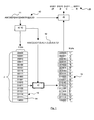
- Figure 1 is a diagram schematically representing a method according to the invention.
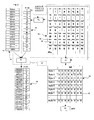
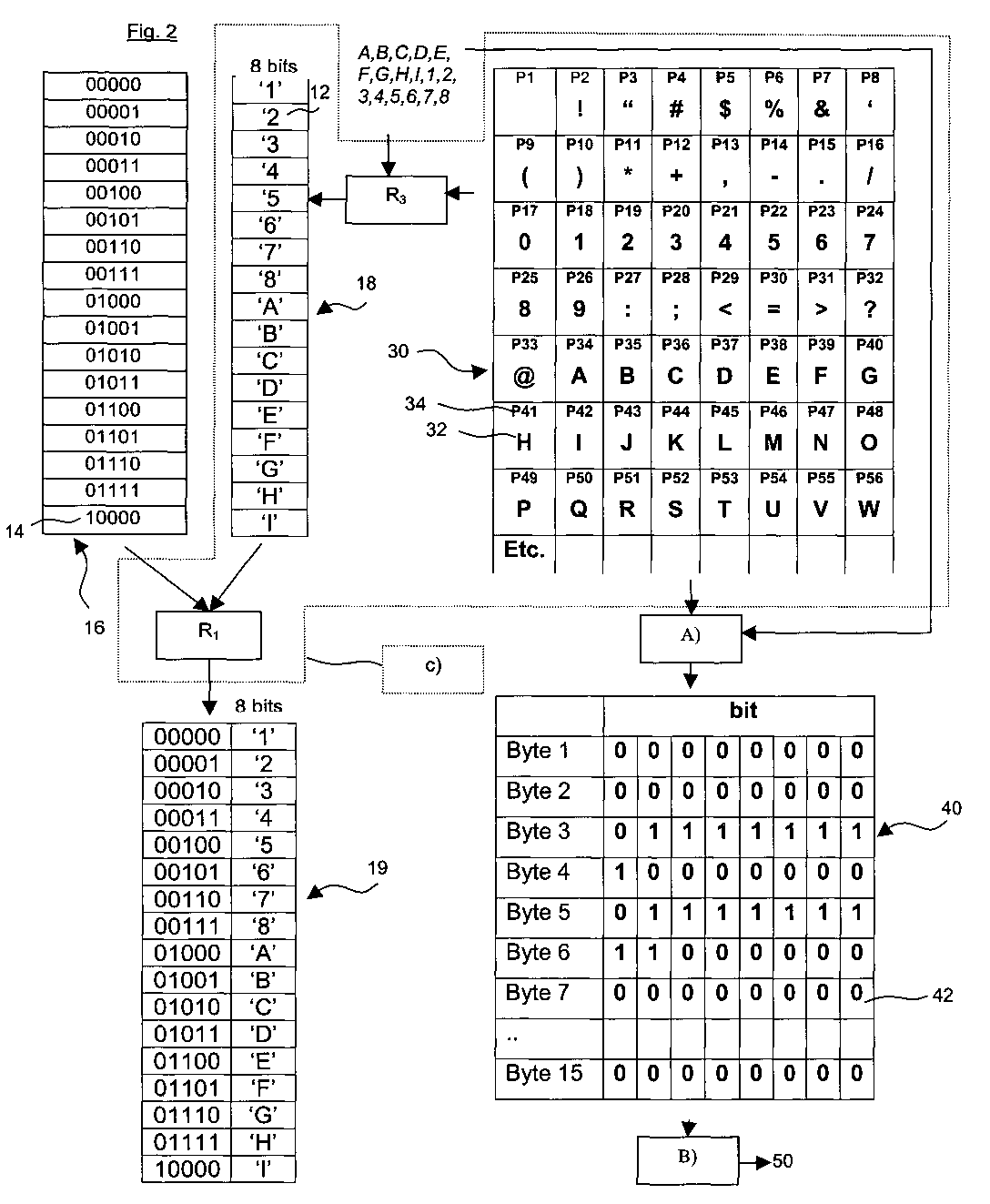
- Figure 2 is a diagram schematically representing a part of the method represented in figure 1.
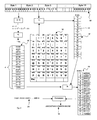
- Figure 3 is a diagram schematically representing a method used to decompress a compressed message sent according to the method represented in figures 1 and 2.
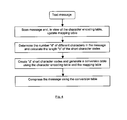
- Figure 4 is a diagram schematically representing a compression method according to the invention, in the preferred embodiment.
-
- The following example is intended to illustrate the invention and to easy its understanding. It is described in a functional way and is not limitative. In particular, the practical way of implementing the method of the invention may be different from the way it is described.
- The preferred compression method of the invention follows this illustrative example.
- We now refer to figure 1.
- A
message 10, containing 23 encoded alphanumerical characters 11 chosen from a list of usable characters, is to be sent by a mobile phone. We assume that themessage 10 is an SMS message to be sent by a GSM network, for example:
"ABCDEFGHI123456781 B2C3D4" - The method according to the invention is loaded as a software into a mobile phone handset. Before sending this message, the software first analyses the
message 10 to determine the number "d" ofdifferent characters 12 it contains (step a)). In the example, "d" is 17 since themessage 10 contains the 17 following different characters 12:
A,B,C,D,E,F,G,H,I,1,2,3,4,5,6,7,8. - The
characters 12 are initially encoded with long character codes, preferably on 8 bits, according to the ASCII table. - The software then calculates the minimum number of bits "b" to generate "d" different binary codes, hereafter called "short character codes" 14. With "b" bits, it is possible to generate up to 2b binary
short character codes 14. In other words, to generate between 2b-1+1 and 2b binaryshort character codes 14, b bits are required. 17 is comprised between 24 +1 (=17) and 25 (=32), therefore b = 5 (step b)). - "d"
short character codes 14 are then generated and associated to each of the "d" different encodedcharacters 12 of themessage 10. Oneshort character code 14 is associated to one, and only one, encodedcharacter 12 of the message 10 (step c)). If d <> 2b, the number of possibleshort character codes 14 is more than the number "d" ofdifferent characters 12. A rule of association "R1" is then to be used. - According to the preferred rule of association, and as represented in figure 1, the first "d"
short character codes 14 are ordered increasingly. They may be stored in alist 16. - The "d" different encoded
characters 12 are ordered according to their position in a character encoding table and, according to their order, are associated to the corresponding orderedshort character code 14. - This procedure is now described in more details with reference to figure 2, wherein the block c) represented in the figure 1 is expanded.
- An agreement between the sending and receiving parties determines the way of ordering of the
short character codes 14. Preferably, according to a rule R2, the "d"short character codes 14 are ordered increasingly, starting from 0, eachshort character code 14 being incremented by 1 from the previous short character code. Theshort character codes 14 may however be ordered in other ways that by increasing values, for example by decreasing values. - Another agreement between the sending and receiving parties determines the way of ordering the "d"
different characters 12. Preferably, the sending and receiving parties have access to a character encoding table 30 providing, for each usable encoded character 32 (i.e. available to the user to compose the message 10), a single order number or "position" 34. In the example, the character encoding table contains 120 characters. Preferably,characters 12 are ordered increasingly according to their position in the character encoding table 30, according to a rule R3. However, other rules may be used. For instance,characters 12 may be ordered inversely to their position in the character encoding table 30. - The ordered
characters 12 are represented in alist 18. - The rule of association R1 preferably associates to the
short character code 14 at the position "p" of thelist 16 thecharacter 12 at the position "p" of thelist 18. Other rules of association are possible, for example in order to scramble the sent data. - Hereafter, the resulting table is called "conversion table" 19.
- Once each encoded
character 12 has been associated with ashort character code 14, themessage 10 is transformed into a binarycompressed message data 20, eachcharacter 11 being replaced by its corresponding short character code 14 (step d), see figure 1). - In the example, the length of the message is 85 bits (17 characters * 5 bits/character). Without the method of the invention, its length would have been 136 bits (17 characters * 8 bits/character). Hence, the length of the message is reduced and more characters may be sent.
- The receiving party needs to interpret the binary
compressed message data 20 and to determine what is the length "b" of each short character code as well as the character corresponding to each of the received short character code. According to the invention, additional information is therefore sent with the binarycompressed message data 20. To explain how the method according to the invention operates, we refer to figure 2. - According to the method of the invention, a mapping table 40 identifying the respective position of each of said "d"
different characters 12 in said character encoding table 30 is generated (step A)). - The mapping table 40 is preferably made of a number "n" of ordered
bits 42, each of the ordered bits being associated with one, and only one,character 32 of the character encoding table 30. Allusable characters 32 are therefore represented in both the character encoding table 30 and the mapping table 40. Preferably, the position of abit 42 representing acharacter 32 in the mapping table 40 is the same as the position of this character in the character encoding table 30. Hence, if abit 42 located at position "p" in the mapping table 40 indicates that a character is present in themessage 10, this character may be very simply identified by checking which character is located at the position "p" of the character encoding table 30. - A bit of the mapping table 40, at position "p", is preferably set to 1 if the encoded character corresponding to the position "p" in the character encoding table 30 is present in the
message 10, and set 0 otherwise. - Since the character encoding table 30 contains 120 characters, the mapping table 40 may be encoded with 15 bytes (15 bytes * 8 bits/bytes = 120). Preferably, the character encoding table 30 should only contain the most frequently necessary characters, so as to minimize the size of the mapping table 40.
- When a character is used in the SMS but is not included inside the character encoding table 30, this character will be lost and will not be recovered by the receiving party. Preferably, only the characters which are not useful to the user, for example the characters which are not visible to the user, will not be included in the character encoding table 30.
- The updated mapping table 40 may be represented as a binary mapping table data 50 (step B)) which may be concatenated to the
compressed message data 20 into a compressed plain data. For example, themapping table data 50, the length "L" of which (here 120 bits) is equal to the number ofusable characters 32, may precede thecompressed message data 20. - The compressed plain data contains all the information necessary for the receiving party and is then ready to be sent.
- It is now clear that the method according to the invention allows high compression ratio for short messages, in particular for SMS. The compression ratio depends on the degree of homogeneity of the message and on the number of
usable characters 32. In other words, it depends on the number of bits for eachshort character code 14 and on the length of the mapping table 40. For instance, if the set offusable characters 32 contains 120 characters or less, the length for themapping table data 50 will be 120 bits or less. There remains 1000 bits (140*8 - 120) to code for thecompressed message data 20. If themessage 10 contains between 17 and 32 different characters, which therefore may be coded on 5 bits, themessage 10 may therefore contain up to 200 characters (1000 bits / 5 bits/character). In this example, the compression ratio is therefore 42.86% (= (200-140)/140). - In GSM environment, a user is charged for each SMS sent no matter how much data the SMS carry. The method according to the invention advantageously allows a user to send more information for a same charge.
- Advantageously, the method may also be applied to data which are not coded on 8 bits as for the SMS. For example, it may be applied to UCS2 coded data. The length of the mapping table 40 would be adapted consequently.
- We now refer to figure 3.
- When the receiving party receives the compressed plain data, it determines the number "d" of
different characters 11 in theoriginal message 10 from the number of bits set to "1" in the first L bits of the compressed plain data. As explained previously (step b)), it infers the number "b" of bits coding for eachshort character code 14, and generates and orders "d"short character codes 14, represented in a list 16' identical to thelist 16 used by the sending party. According to the rule R2, theshort character codes 14 are ordered increasingly, starting from 0. - A character encoding table 30', identical to the character encoding table 30 is available to the receiving party. The receiving party compares the
mapping table data 50 with the character encoding table 30', using the same rule R3 as the sending party, so as to identify the long character codes of the "d"different characters 11 of themessage 10, and orders them, for example into a list 18' identical to thelist 18. - Using the same association rule R1 as the sending party, each of the
different characters 12 of themessage 10 is associated with one short character code of the list 16'. Each of the binary short character code constituting the binarycompressed message data 20 is then replaced by its corresponding encodedcharacter 12, so as to provide theoriginal message 10. For an SMS, each short character code (5 bit code in the example) will be replaced by an 8 bit code used, according to the ASCII table, to display thecorresponding message character 11. - We now describe the preferred compression method of the invention, referring to figure 4.
- According to the preferred method of the invention, the
message 10, the characters of which are encoded on 8 bits, is scanned and the mapping table 40, initially full of "0" is updated, a bit corresponding, in the character encoding table 30, to a character appearing in themessage 10 being set to "1" in the mapping table 40. - The number "d" of different characters may be calculated as the
message 10 is scanned, or calculated at the end of the scanning by summing all the bits of the mapping table 40. "b" is determined consequently. - A conversion table 19 is then directly generated as follows. The 8 bit code of the character corresponding, in the character encoding table 30, to the first bit "1" encountered in the mapping table 40 is associated with 0 expressed as a binary short character code (00000). The 8 bit code of the character corresponding to the second bit "1" encountered in the mapping table 40 is associated with 1 expressed as a binary short character code (00001). The 8 bit code of the character corresponding to the third bit "1" encountered in the mapping table 40 is associated with 2 expressed as a binary short character code (00010), etc.
- The
message 10 is then converted into a compressed message data, each byte coding for the successive characters of themessage 10 being changed into the corresponding 5 bit code of the conversion table 19. - Finally, the compressed message data is concatenated with the mapping table 40. The resulting compressed plain data is then ready to be sent.
- The above examples are not limitative.
Claims (8)
- A method for compressing a message (10), in particular a SMS message to be sent by a GSM network, said message (10) being made of message characters (11) encoded in long character codes, comprising the following compression steps :a) Counting the number "d" of different encoded characters (12) in said message (10);b) Calculating the minimum number of bits "b" sufficient to generate "d" different binary short character codes (14);c) Associating to each of said "d" different encoded characters (12) one, and only one, of said binary short character codes (14), according to the position of said encoded characters in a character encoding table (30) providing, for each usable character (32) one, and only one, position (34)d) Transforming said message (10) into a binary compressed message data (20) by replacing each of said message characters (11) by its corresponding binary short character code (14).
- A method according to claim 1, wherein, at step c), an encoded character (32) located at a position "p" in said character encoding table (30) is associated with the pth short character code (14), said short character codes being ordered increasingly or decreasingly.
- A method according to claim 2, further comprising the step ofA) Generating a mapping table (40) identifying the respective position of each of said "d" different encoded characters (12) in said character encoding table (30).
- A method according to claim 3, further comprising the following steps :B) Representing said mapping table (40) as a binary mapping table data (50);C) Concatenating said mapping table data (50) and said compressed message data (20) into a compressed plain data;
- A method according to claim 3, wherein said mapping table (40) is made of a number "n" of ordered bits (42), each of said ordered bits (42) being associated with one, and only one, encoded character (32) of said character encoding table (30).
- A method according to claim 3, wherein said mapping table (40) is made of "n" ordered bits (42), a bit of said mapping table (40), at position "p", being set to 1 if the encoded character (32) corresponding to the position "p" in said character encoding table (30) is present in said message (10), and set 0 otherwise.
- A method of communication between a sending party and a receiving party, said sending party using a compression method according to any preceding claim, wherein said character encoding table (30) is made available to both sending and receiving parties.
- A method according to claim 7, wherein said receiving party operates a decompression of said compressed plain data received from said sending party, said method comprising the following decompression steps :Getting said mapping table data (50) from said compressed plain data;According to said mapping table data (50) and a character encoding table (30') identical to the character encoding table (30) used by the sending party, calculating the length of said short character codes (14), and associating an encoded character (12) of said character encoding table (30) to each of the different short character codes of said compressed message data (20);Replacing each of said short character code (14) of said binary message data (20) by its corresponding character code (11).
Priority Applications (1)
| Application Number | Priority Date | Filing Date | Title |
|---|---|---|---|
| EP04291438A EP1605595A1 (en) | 2004-06-09 | 2004-06-09 | Method for compressing a short message |
Applications Claiming Priority (1)
| Application Number | Priority Date | Filing Date | Title |
|---|---|---|---|
| EP04291438A EP1605595A1 (en) | 2004-06-09 | 2004-06-09 | Method for compressing a short message |
Publications (1)
| Publication Number | Publication Date |
|---|---|
| EP1605595A1 true EP1605595A1 (en) | 2005-12-14 |
Family
ID=34931157
Family Applications (1)
| Application Number | Title | Priority Date | Filing Date |
|---|---|---|---|
| EP04291438A Withdrawn EP1605595A1 (en) | 2004-06-09 | 2004-06-09 | Method for compressing a short message |
Country Status (1)
| Country | Link |
|---|---|
| EP (1) | EP1605595A1 (en) |
Cited By (5)
| Publication number | Priority date | Publication date | Assignee | Title |
|---|---|---|---|---|
| US7515899B1 (en) | 2008-04-23 | 2009-04-07 | International Business Machines Corporation | Distributed grid computing method utilizing processing cycles of mobile phones |
| GB2467565A (en) * | 2009-02-06 | 2010-08-11 | Openmind Networks Ltd | Packaging the text of an SMS message within a binary-coded message and updating the state of stored messages |
| US10506388B1 (en) | 2018-06-27 | 2019-12-10 | Harris Global Communications, Inc. | Efficient short message compression |
| CN115361454A (en) * | 2022-10-24 | 2022-11-18 | 北京智芯微电子科技有限公司 | Message sequence coding, decoding and transmitting method and coding and decoding equipment |
| CN115577433A (en) * | 2022-10-27 | 2023-01-06 | 中交建筑集团有限公司 | A method to make BIM model lightweight |
-
2004
- 2004-06-09 EP EP04291438A patent/EP1605595A1/en not_active Withdrawn
Non-Patent Citations (5)
| Title |
|---|
| 3GPP: "3rd Generation Partnership Project; Technical Specification Group Terminals; Compression algorithm for text messaging services (3G TS 23.042 version 3.0.0)", INTERNET ARTICLE, July 1999 (1999-07-01), XP002296641, Retrieved from the Internet <URL:http://www.soulinfo.com/~hugang/3gpp/specs/23042-300.pdf> [retrieved on 20040916] * |
| ANDERSON K: "OVERVIEW OF HUFFMAN ENCODING AS COMPRESSION TECHNIQUE", COMPUTER TECHNOLOGY REVIEW, WESTWORLD PRODUCTION CO. LOS ANGELES, US, vol. 11, no. 6, 1 May 1991 (1991-05-01), pages 97 - 98,100, XP000230832, ISSN: 0278-9647 * |
| ANONYMOUS: "Heap memory allocation: The bitmap", INTERNET ARTICLE, 18 March 1998 (1998-03-18), XP002297075, Retrieved from the Internet <URL:http://dysphoria.net/OperatingSystems1/4_allocation_bitmap.html> [retrieved on 20040920] * |
| ANONYMOUS: "Memory Management", INTERNET ARTICLE, 10 October 1996 (1996-10-10), XP002297085, Retrieved from the Internet <URL:http://people.msoe.edu/~sebern/courses/cs400/team1/memory.htm> [retrieved on 20040920] * |
| DAVID SALOMON: "DATA COMPRESSION: THE COMPLETE REFERENCE", 1998, SPRINGER VERLAG, NEW YORK, US, XP002296642 * |
Cited By (9)
| Publication number | Priority date | Publication date | Assignee | Title |
|---|---|---|---|---|
| US7515899B1 (en) | 2008-04-23 | 2009-04-07 | International Business Machines Corporation | Distributed grid computing method utilizing processing cycles of mobile phones |
| GB2467565A (en) * | 2009-02-06 | 2010-08-11 | Openmind Networks Ltd | Packaging the text of an SMS message within a binary-coded message and updating the state of stored messages |
| EP2574088A3 (en) * | 2009-02-06 | 2013-08-21 | Openmind Networks Limited | A messaging system |
| US8630669B2 (en) | 2009-02-06 | 2014-01-14 | Openmind Networks Limited | Messaging system |
| US10506388B1 (en) | 2018-06-27 | 2019-12-10 | Harris Global Communications, Inc. | Efficient short message compression |
| US10873836B2 (en) | 2018-06-27 | 2020-12-22 | Harris Global Communications, Inc. | Efficient short message compression |
| CN115361454A (en) * | 2022-10-24 | 2022-11-18 | 北京智芯微电子科技有限公司 | Message sequence coding, decoding and transmitting method and coding and decoding equipment |
| CN115361454B (en) * | 2022-10-24 | 2023-03-24 | 北京智芯微电子科技有限公司 | Message sequence encoding, decoding, transmission method and encoding, decoding equipment |
| CN115577433A (en) * | 2022-10-27 | 2023-01-06 | 中交建筑集团有限公司 | A method to make BIM model lightweight |
Similar Documents
| Publication | Publication Date | Title |
|---|---|---|
| US6320522B1 (en) | Encoding and decoding apparatus with matching length detection means for symbol strings | |
| US6100824A (en) | System and method for data compression | |
| US6883035B2 (en) | System and method for communicating with temporary compression tables | |
| US6985965B2 (en) | Static information knowledge used with binary compression methods | |
| US20120044097A1 (en) | Method and system for reducing contexts for context based compression systems | |
| JPH11168390A (en) | Data compression device and data decompression device, data compression method and data decompression method, data compression / decompression dictionary creation device, and computer-readable recording medium recording data compression program or data decompression program | |
| US20070279261A1 (en) | Method and apparatus for lossless run-length data encoding | |
| EP0776097A2 (en) | Mobile data terminals with text-to-speech capability | |
| US6963587B2 (en) | Communication system and method utilizing request-reply communication patterns for data compression | |
| JP2001507543A (en) | Methods and means for processing information | |
| CN101729075A (en) | Data compression method, data compression device, data decompression method and data decompression device | |
| CN101345952B (en) | Data storage and reading method, device and system for customer identity identification card | |
| KR100663421B1 (en) | SMS message exchange system and method | |
| CN117294764A (en) | Bill data compression and transmission method, device, equipment and storage medium | |
| US20060291505A1 (en) | Method for extended transmission capabilities of short message service | |
| KR100494876B1 (en) | Data compression method for multi-byte character language | |
| EP1334559A2 (en) | Communication system and method utilizing request-reply communication patterns for data compression | |
| CN1130615C (en) | Compressing ideographic characters | |
| EP2113845A1 (en) | Character conversion method and apparatus | |
| CN113014551B (en) | Data decompression method and data transmission method based thereon, computer device and readable storage medium | |
| WO2011004207A1 (en) | Method and system for compressing short messages, computer program and computer program product therefor | |
| Shanmugasundaram et al. | IIDBE: A lossless text transform for better compression | |
| Husodo et al. | Arithmetic coding modification to compress SMS | |
| CN1753536A (en) | Method and apparatus for sending files by sms | |
| Shanmugasundaram et al. | Text preprocessing using enhanced intelligent dictionary based encoding (EIDBE) |
Legal Events
| Date | Code | Title | Description |
|---|---|---|---|
| PUAI | Public reference made under article 153(3) epc to a published international application that has entered the european phase |
Free format text: ORIGINAL CODE: 0009012 |
|
| AK | Designated contracting states |
Kind code of ref document: A1 Designated state(s): AT BE BG CH CY CZ DE DK EE ES FI FR GB GR HU IE IT LI LU MC NL PL PT RO SE SI SK TR |
|
| AX | Request for extension of the european patent |
Extension state: AL HR LT LV MK |
|
| AKX | Designation fees paid | ||
| REG | Reference to a national code |
Ref country code: DE Ref legal event code: 8566 |
|
| STAA | Information on the status of an ep patent application or granted ep patent |
Free format text: STATUS: THE APPLICATION IS DEEMED TO BE WITHDRAWN |
|
| 18D | Application deemed to be withdrawn |
Effective date: 20060616 |