EP1605439A1 - Unified treatment of resolved and unresolved harmonics - Google Patents
Unified treatment of resolved and unresolved harmonics Download PDFInfo
- Publication number
- EP1605439A1 EP1605439A1 EP04019076A EP04019076A EP1605439A1 EP 1605439 A1 EP1605439 A1 EP 1605439A1 EP 04019076 A EP04019076 A EP 04019076A EP 04019076 A EP04019076 A EP 04019076A EP 1605439 A1 EP1605439 A1 EP 1605439A1
- Authority
- EP
- European Patent Office
- Prior art keywords
- band
- harmonics
- frequency
- given
- fundamental frequency
- Prior art date
- Legal status (The legal status is an assumption and is not a legal conclusion. Google has not performed a legal analysis and makes no representation as to the accuracy of the status listed.)
- Granted
Links
- 238000000034 method Methods 0.000 claims abstract description 48
- 238000001914 filtration Methods 0.000 claims abstract description 5
- 238000004422 calculation algorithm Methods 0.000 claims abstract description 4
- 238000012805 post-processing Methods 0.000 claims abstract description 3
- 238000011156 evaluation Methods 0.000 claims description 4
- 230000004927 fusion Effects 0.000 claims description 3
- 238000004590 computer program Methods 0.000 claims description 2
- 238000004364 calculation method Methods 0.000 description 9
- 238000000926 separation method Methods 0.000 description 7
- 238000004458 analytical method Methods 0.000 description 4
- 238000012545 processing Methods 0.000 description 3
- 238000013459 approach Methods 0.000 description 2
- 230000001427 coherent effect Effects 0.000 description 2
- 238000010586 diagram Methods 0.000 description 2
- 230000005236 sound signal Effects 0.000 description 2
- 238000013528 artificial neural network Methods 0.000 description 1
- 210000003926 auditory cortex Anatomy 0.000 description 1
- 238000000354 decomposition reaction Methods 0.000 description 1
- 238000013461 design Methods 0.000 description 1
- 230000000694 effects Effects 0.000 description 1
- 230000002452 interceptive effect Effects 0.000 description 1
- 238000011835 investigation Methods 0.000 description 1
- 238000005070 sampling Methods 0.000 description 1
- 238000005204 segregation Methods 0.000 description 1
Images


Classifications
-
- G—PHYSICS
- G10—MUSICAL INSTRUMENTS; ACOUSTICS
- G10L—SPEECH ANALYSIS TECHNIQUES OR SPEECH SYNTHESIS; SPEECH RECOGNITION; SPEECH OR VOICE PROCESSING TECHNIQUES; SPEECH OR AUDIO CODING OR DECODING
- G10L21/00—Speech or voice signal processing techniques to produce another audible or non-audible signal, e.g. visual or tactile, in order to modify its quality or its intelligibility
- G10L21/02—Speech enhancement, e.g. noise reduction or echo cancellation
- G10L21/0272—Voice signal separating
-
- G—PHYSICS
- G10—MUSICAL INSTRUMENTS; ACOUSTICS
- G10L—SPEECH ANALYSIS TECHNIQUES OR SPEECH SYNTHESIS; SPEECH RECOGNITION; SPEECH OR VOICE PROCESSING TECHNIQUES; SPEECH OR AUDIO CODING OR DECODING
- G10L25/00—Speech or voice analysis techniques not restricted to a single one of groups G10L15/00 - G10L21/00
- G10L25/03—Speech or voice analysis techniques not restricted to a single one of groups G10L15/00 - G10L21/00 characterised by the type of extracted parameters
- G10L25/18—Speech or voice analysis techniques not restricted to a single one of groups G10L15/00 - G10L21/00 characterised by the type of extracted parameters the extracted parameters being spectral information of each sub-band
Definitions
- the present invention relates to a method to separate acoustic sound sources in monaural recordings based on their underlying fundamental frequency. Especially a method enabling the treatment of resolved and unresolved harmonics with the same algorithm and the subsequent combination of the results is proposed.
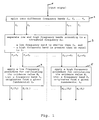
- Fig. 1 shows a known approach of resolving said problem.
- the low frequency and the high frequency procedures are applied to the bands by considering a threshold frequency f T .
- the method indeed consists in choosing the results from one procedure 4 for all bands below a given frequency f T and take those of the other procedure 5 for all remaining bands (see e.g. G. Hu and D. Wang. Monaural speech segregation based on pitch tracking and amplitude. IEEE Trans. On Neural Networks, 2004).
- Another object is to propose a method for applying the same evidence value calculation procedure to both resolved and unresolved harmonics, wherein the evidence value reflects the fact that a harmonic originates from a given fundamental.
- the basic idea of the invention is to apply a band-pass filter bank to the modulation envelope in order to get information about the harmonics of the modulation envelope.
- a post-processing method of a modulation envelope resulting from the interference of two harmonics in one filter band is proposed.
- the method is based on the filtering of the modulation envelope with a band-pass filter bank, wherein the combination of demodulation and application of a band-pass filter on the modulation envelope enables the use of identical algorithms for resolved and unresolved harmonics.
- a method to evaluate if a given frequency band shows amplitude modulation comprises the step of calculating if a given frequency band is wide enough to contain two harmonics of a given fundamental frequency.
- a method to combine the evidence values of frequency bands to emanate from a certain fundamental frequency wherein depending on the result of the evaluation during fusion the evidence value for a given fundamental frequency, a given frequency band, and a given instant in time is taken either from the procedure working on the low or high frequencies, respectively resolved or unresolved harmonics.
- the present invention is directed to the use of the foregoing methods to separate acoustic sound sources in monaural recordings based on their underlying fundamental frequency.
- the present invention extends the known separation methods for harmonic signals as it applies a band-pass filter bank on the modulation envelope. By doing so the distortions and noise present in the envelope can be reduced significantly.
- the modulation envelope When using non-coherent amplitude demodulation, the modulation envelope also consists of a fundamental frequency, identical to the fundamental frequency of the original input signal, and many harmonics (the non-coherent demodulation results in a doubling in frequency of the envelope).
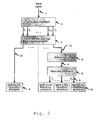
- Fig. 2 shows how to process an input sound signal utilizing the filtered modulation envelope according to the present invention in order to separate the harmonic signals and later on the acoustic sources.
- the frequency bands are separated 3 into two categories: low 12 and high 11 frequency bands.
- the low frequency bands 12 contain resolved harmonics and the high frequency bands 11 contain unresolved harmonics.
- the low frequency bands 12 are processed by a specific evidence value calculation procedure adapted to low frequency bands, as for example known auto-correlation based methods, cross-channel correlation methods or harmonicity based methods.
- the present application makes use of the fact that filter responses of unresolved harmonics are amplitude modulated and that the response envelopes fluctuate at the fundamental frequency of the considered acoustic sound source.
- Each high frequency band 11 is thus demodulated 6 to get the modulation envelope 7 of the frequency band 11.
- the modulation envelope 7 is passed to a band-pass filter bank 8 that outputs the frequency bands f' 1 to f' m .
- a band-pass filter bank 8 After applying a band-pass filter bank 8 on said modulation envelope 7, an identical evidence value calculation procedure 10 as for the low frequencies 12 can now be applied to the obtained frequency bands f' 1 to f' m (e.g. auto-correlation based).
- the band-pass filter banks 2, 8 respectively used for original decomposition of the input signal 1 and filtering 8 of the envelope 7 are identical.
- the above-described proposed method increases the robustness of the procedure inter alia by taking the information contained in the harmonics of the modulation envelope 7 into account.
- Fig. 3 shows how the frequency bands f 1 to f n are separated into two groups of low and high frequencies that contains respectively resolved and unresolved harmonics.
- the frequency band which contains at least two harmonics of the fundamental frequency under consideration is calculated. By this means it can be determined which frequency bands show amplitude modulation and during fusion only the evidence values of those frequency bands will be taken from the procedure 6,8,10 working on the high frequencies and the remaining evidence values are determined from the procedure 4 working on the low frequencies.
- the frequency band contains at least two harmonics of the fundamental frequency if following equation is verified: n - m ⁇ 1 wherein m and n are integers defined by: m -1 ⁇ f i - ⁇ f i 2 f F ⁇ m n ⁇ f i + ⁇ f i 2 f F ⁇ n +1
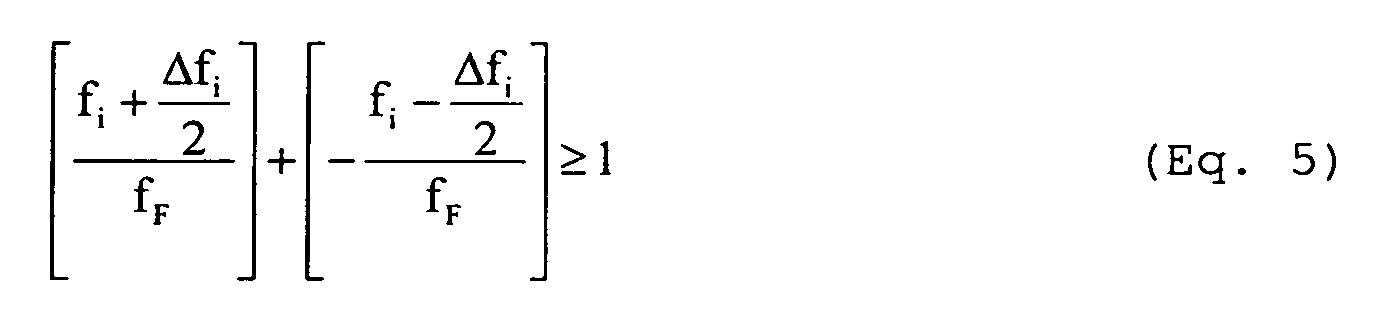
- the frequency band f i contains at least two harmonics of the fundamental frequency f F if following equation is true:
- the bands containing at least two harmonics of a given fundamental can be selected 14.
- bands not fulfilling Eq. 5 show resolved harmonics and are treated 4 with the procedure for low frequencies.
- the bands fulfilling Eq. 5 contain unresolved harmonics and are treated by the above-described procedure of the present invention consisting in demodulating 6 the envelope 7, band-pass filtering 8 the envelope into frequency bands f' 1 to f' m , and applying 10 said procedure for low frequencies to the frequency bands f' 1 to f' m .
- Fig. 4 shows a block diagram of a device according to the present invention used for the separation of acoustic sound sources in monaural recordings.
- a sound signal is recorded by a microphone 21 and passed through a pre-amplifier 22.
- a band-pass filter bank 23 then generates n different contiguous frequency bands f 1 to f n .
- a separation unit 24 is then in charge of the separation of the resolved 12 and unresolved 11 harmonics in two distinct groups.
- the first group 12 of resolved harmonics i.e. each low frequency band, is processed by an auto-correlator 25 to calculate an evidence value for this frequency band to originate from a given fundamental frequency.
- the auto-correlator 25 can be exchanged with any other unit able to deal with low frequencies.
- the result of the auto-correlator 25 is fed to a frequencies combination unit 31.
- the second group 11 of unresolved harmonics i.e. each high frequency band, is at first processed by a rectification unit 26 and then by a low-pass filter 27 to generate the modulation envelope 7 of said frequency band 11.
- the envelope 7 is filtered by a band-pass filter bank 28 that can be identical to the band-pass filter bank 23.
- the envelope 7 is thereby cut in frequency bands f' 1 to f' m and each band f' 1 to f' m is fed to an auto-correlator 29.
- the result of the m auto-correlators 29 is then input to a maximum detector 30, which result is fed to the frequencies combination unit 31.
- the last unit of the device 20 is a frequencies combination unit 31 with n inputs and 1 output. Each input is fed with the output of the resolved harmonics block 25 or unresolved harmonics block 26-30, wherein each block is respectively processing a low 12 or a high 11 frequency band.
- the frequencies combination unit 31 shows only two inputs: the first input for sequentially feeding the processing results of all low frequency bands and the second input for sequentially feeding the processing results of all high frequency bands.
- the output of the device 20 and of the frequencies combination unit 31 is passed to a device responsible for the effective source separation.
- Fig. 2 and 4 illustrates the fact that according to the present invention the procedure 4, 10 and the unit 25, 29 responsible for the evidence value calculation are the same for resolved and unresolved harmonics
Landscapes
- Engineering & Computer Science (AREA)
- Computational Linguistics (AREA)
- Quality & Reliability (AREA)
- Signal Processing (AREA)
- Health & Medical Sciences (AREA)
- Audiology, Speech & Language Pathology (AREA)
- Human Computer Interaction (AREA)
- Physics & Mathematics (AREA)
- Acoustics & Sound (AREA)
- Multimedia (AREA)
- Stereophonic System (AREA)
- Tone Control, Compression And Expansion, Limiting Amplitude (AREA)
- Soundproofing, Sound Blocking, And Sound Damping (AREA)
- Telephone Function (AREA)
Abstract
Description
- Fig. 1
- shows a known method for applying a different evidence value calculation procedure to low and high frequency bands,
- Fig. 2
- shows a method for applying the same evidence value calculation procedure to low and high frequency bands according to an embodiment of the present invention,
- Fig. 3
- shows a further embodiment of the present invention, in which the frequency bands showing amplitude modulation are selected, and
- Fig. 4
- shows a block diagram of a device according to the present invention for the separation of acoustic sound sources in monaural recordings.
[x] being an integer, and
Claims (6)
- A post-processing method of a modulation envelope (7) resulting from the interference of two harmonics in one filter band, the method comprising the step of:filtering the modulation envelope (7) with a band-pass filter bank (6), wherein the combination of demodulation and application of a band-pass filter (6) on the modulation envelope (7) enables the use of identical algorithms for resolved and unresolved harmonics.
- A method to evaluate if a given frequency band shows amplitude modulation, the method comprising the following step:calculating if the given frequency band is wide enough to contain two harmonics of a given fundamental frequency.
- A method to combine the evidence values of frequency bands to emanate from a certain fundamental frequency,
the method being based on the evaluation described in claim 2,
wherein depending on the result of the evaluation during fusion the evidence value for a given fundamental frequency, a given frequency band, and a given instant in time is taken either from the procedure working on the low or high frequencies, respectively resolved or unresolved harmonics. - A computer program product, implementing a method according to any of the preceding claims when run on a computing device.
- A computing device designed to carry out a method according to any of claims 1 to 3.
- Use of a method of any of claims 1 to 3 to separate acoustic sound sources in monaural recordings based on their underlying fundamental frequency.
Priority Applications (4)
| Application Number | Priority Date | Filing Date | Title |
|---|---|---|---|
| EP04019076A EP1605439B1 (en) | 2004-06-04 | 2004-08-11 | Unified treatment of resolved and unresolved harmonics |
| US11/142,095 US8185382B2 (en) | 2004-06-04 | 2005-05-31 | Unified treatment of resolved and unresolved harmonics |
| JP2005162484A JP4790319B2 (en) | 2004-06-04 | 2005-06-02 | Unified processing method for resolved and unresolved harmonics |
| CN 200510077848 CN1707609B (en) | 2004-06-04 | 2005-06-03 | Unified treatment of resolved and unresolved harmonics |
Applications Claiming Priority (3)
| Application Number | Priority Date | Filing Date | Title |
|---|---|---|---|
| EP04013274 | 2004-06-04 | ||
| EP04013274 | 2004-06-04 | ||
| EP04019076A EP1605439B1 (en) | 2004-06-04 | 2004-08-11 | Unified treatment of resolved and unresolved harmonics |
Publications (2)
| Publication Number | Publication Date |
|---|---|
| EP1605439A1 true EP1605439A1 (en) | 2005-12-14 |
| EP1605439B1 EP1605439B1 (en) | 2007-06-27 |
Family
ID=34926134
Family Applications (1)
| Application Number | Title | Priority Date | Filing Date |
|---|---|---|---|
| EP04019076A Expired - Lifetime EP1605439B1 (en) | 2004-06-04 | 2004-08-11 | Unified treatment of resolved and unresolved harmonics |
Country Status (3)
| Country | Link |
|---|---|
| US (1) | US8185382B2 (en) |
| EP (1) | EP1605439B1 (en) |
| JP (1) | JP4790319B2 (en) |
Families Citing this family (12)
| Publication number | Priority date | Publication date | Assignee | Title |
|---|---|---|---|---|
| JP4882899B2 (en) * | 2007-07-25 | 2012-02-22 | ソニー株式会社 | Speech analysis apparatus, speech analysis method, and computer program |
| EP2312579A1 (en) * | 2009-10-15 | 2011-04-20 | Honda Research Institute Europe GmbH | Speech from noise separation with reference information |
| EP3684463B1 (en) | 2017-09-19 | 2025-05-14 | Neuroenhancement Lab, LLC | Method and apparatus for neuroenhancement |
| US11717686B2 (en) | 2017-12-04 | 2023-08-08 | Neuroenhancement Lab, LLC | Method and apparatus for neuroenhancement to facilitate learning and performance |
| US11318277B2 (en) | 2017-12-31 | 2022-05-03 | Neuroenhancement Lab, LLC | Method and apparatus for neuroenhancement to enhance emotional response |
| US12280219B2 (en) | 2017-12-31 | 2025-04-22 | NeuroLight, Inc. | Method and apparatus for neuroenhancement to enhance emotional response |
| US11364361B2 (en) | 2018-04-20 | 2022-06-21 | Neuroenhancement Lab, LLC | System and method for inducing sleep by transplanting mental states |
| US11452839B2 (en) | 2018-09-14 | 2022-09-27 | Neuroenhancement Lab, LLC | System and method of improving sleep |
| US11786694B2 (en) | 2019-05-24 | 2023-10-17 | NeuroLight, Inc. | Device, method, and app for facilitating sleep |
| US20230219230A1 (en) | 2020-12-18 | 2023-07-13 | Strong Force Vcn Portfolio 2019, Llc | Fleet Management Platform for Multi-Purpose Robots |
| US20230111429A1 (en) | 2020-12-18 | 2023-04-13 | Strong Force Vcn Portfolio 2019, Llc | Additive Manufacturing Robotic Fleet Configuration |
| US12585654B2 (en) | 2021-05-11 | 2026-03-24 | Strong Force Vcn Portfolio 2019, Llc | Dynamic vision system for robot fleet management |
Family Cites Families (21)
| Publication number | Priority date | Publication date | Assignee | Title |
|---|---|---|---|---|
| US3622706A (en) | 1969-04-29 | 1971-11-23 | Meguer Kalfaian | Phonetic sound recognition apparatus for all voices |
| US3629510A (en) | 1969-11-26 | 1971-12-21 | Bell Telephone Labor Inc | Error reduction logic network for harmonic measurement system |
| NL7410763A (en) | 1974-08-12 | 1976-02-16 | Philips Nv | DIGITAL TRANSMISSION SYSTEM FOR LOW PULSE FREQUENCY (BIT RATE) TRANSMISSION OF CALL SIGNALS AND A TRANSMITTER FOR USE IN SUCH A SYSTEM. |
| US4091237A (en) | 1975-10-06 | 1978-05-23 | Lockheed Missiles & Space Company, Inc. | Bi-Phase harmonic histogram pitch extractor |
| US4640134A (en) | 1984-04-04 | 1987-02-03 | Bio-Dynamics Research & Development Corporation | Apparatus and method for analyzing acoustical signals |
| US4783805A (en) | 1984-12-05 | 1988-11-08 | Victor Company Of Japan, Ltd. | System for converting a voice signal to a pitch signal |
| US4905285A (en) | 1987-04-03 | 1990-02-27 | American Telephone And Telegraph Company, At&T Bell Laboratories | Analysis arrangement based on a model of human neural responses |
| DE69124005T2 (en) | 1990-05-28 | 1997-07-31 | Matsushita Electric Ind Co Ltd | Speech signal processing device |
| US5136267A (en) | 1990-12-26 | 1992-08-04 | Audio Precision, Inc. | Tunable bandpass filter system and filtering method |
| JP3149466B2 (en) * | 1991-07-26 | 2001-03-26 | カシオ計算機株式会社 | Pitch extraction device and electronic musical instrument using the same |
| US5214708A (en) * | 1991-12-16 | 1993-05-25 | Mceachern Robert H | Speech information extractor |
| JP3149097B2 (en) * | 1992-08-28 | 2001-03-26 | カシオ計算機株式会社 | Sound component extraction device, electronic musical instrument using the same, and frequency component extraction device |
| US6130949A (en) * | 1996-09-18 | 2000-10-10 | Nippon Telegraph And Telephone Corporation | Method and apparatus for separation of source, program recorded medium therefor, method and apparatus for detection of sound source zone, and program recorded medium therefor |
| JP3112654B2 (en) * | 1997-01-14 | 2000-11-27 | 株式会社エイ・ティ・アール人間情報通信研究所 | Signal analysis method |
| ID29029A (en) * | 1998-10-29 | 2001-07-26 | Smith Paul Reed Guitars Ltd | METHOD TO FIND FUNDAMENTALS QUICKLY |
| US6563298B1 (en) * | 2000-08-15 | 2003-05-13 | Ltx Corporation | Separating device response signals from composite signals |
| US7076433B2 (en) * | 2001-01-24 | 2006-07-11 | Honda Giken Kogyo Kabushiki Kaisha | Apparatus and program for separating a desired sound from a mixed input sound |
| US20030084277A1 (en) * | 2001-07-06 | 2003-05-01 | Dennis Przywara | User configurable audio CODEC with hot swappable audio/data communications gateway having audio streaming capability over a network |
| KR101101384B1 (en) * | 2003-04-24 | 2012-01-02 | 코닌클리케 필립스 일렉트로닉스 엔.브이. | Parameterized Time Characterization |
| US7377233B2 (en) * | 2005-01-11 | 2008-05-27 | Pariff Llc | Method and apparatus for the automatic identification of birds by their vocalizations |
| US20070083365A1 (en) * | 2005-10-06 | 2007-04-12 | Dts, Inc. | Neural network classifier for separating audio sources from a monophonic audio signal |
-
2004
- 2004-08-11 EP EP04019076A patent/EP1605439B1/en not_active Expired - Lifetime
-
2005
- 2005-05-31 US US11/142,095 patent/US8185382B2/en not_active Expired - Fee Related
- 2005-06-02 JP JP2005162484A patent/JP4790319B2/en not_active Expired - Fee Related
Non-Patent Citations (1)
| Title |
|---|
| GUONING HU ET AL: "On amplitude modulation for monaural speech segregation", PROCEEDINGS OF THE 2002 INTERNATIONAL JOINT CONFERENCE ON NEURAL NETWORKS. IJCNN'02. HONOLULU, HAWAII, MAY 12 - 17, 2002, INTERNATIONAL JOINT CONFERENCE ON NEURAL NETWORKS, NEW YORK, NY : IEEE, US, vol. VOL. 1 OF 3, 12 May 2002 (2002-05-12), pages 69 - 74, XP010590768, ISBN: 0-7803-7278-6 * |
Also Published As
| Publication number | Publication date |
|---|---|
| EP1605439B1 (en) | 2007-06-27 |
| US20060009968A1 (en) | 2006-01-12 |
| JP2005346079A (en) | 2005-12-15 |
| JP4790319B2 (en) | 2011-10-12 |
| US8185382B2 (en) | 2012-05-22 |
Similar Documents
| Publication | Publication Date | Title |
|---|---|---|
| Sailor et al. | Auditory filterbank learning for temporal modulation features in replay spoof speech detection | |
| EP1605439B1 (en) | Unified treatment of resolved and unresolved harmonics | |
| Saste et al. | Emotion recognition from speech using MFCC and DWT for security system | |
| KR101122838B1 (en) | Method and apparatus for separating sound-source signal and method and device for detecting pitch | |
| JP4177755B2 (en) | Utterance feature extraction system | |
| US20050228518A1 (en) | Filter set for frequency analysis | |
| CN101960516A (en) | Speech enhancement | |
| Xiang et al. | Extracting efficient spectrograms from mp3 compressed speech signals for synthetic speech detection | |
| WO2019062197A1 (en) | A method for extracting noise signal of alternative energy vehicle motor and system | |
| Hu et al. | Monaural speech separation | |
| JP4705480B2 (en) | How to find the fundamental frequency of a harmonic signal | |
| Zhu et al. | Ssf-dst: A spectro-spatial features enhanced deep spatiotemporal network for eeg-based auditory attention detection | |
| CN111028857B (en) | Method and system for multi-channel audio and video conference noise reduction based on deep learning | |
| CN1707609B (en) | Unified treatment of resolved and unresolved harmonics | |
| JP2005266797A (en) | Sound source signal separation device and method, and pitch detection device and method | |
| JP3707135B2 (en) | Karaoke scoring device | |
| JPH07234132A (en) | Signal processor | |
| CN114613391A (en) | Snore identification method and device based on half-band filter | |
| JP2863214B2 (en) | Noise removal device and speech recognition device using the device | |
| Muhsina et al. | Signal enhancement of source separation techniques | |
| JP3312636B2 (en) | Acoustic signal analysis and synthesis device | |
| JP2021157082A (en) | Fundamental frequency estimator, active noise control device, fundamental frequency estimation method and fundamental frequency estimation program | |
| San Juan et al. | Proposed Integration Algorithm to Optimize the Separation of Audio Signals Using the ICA and Wavelet Transform | |
| CN121415798A (en) | Acoustic feature enhancement methods, devices, and media based on blind source separation and two-stage filtering | |
| Zhang et al. | Audio-Visual Speech Separation via Bottleneck Iterative Network |
Legal Events
| Date | Code | Title | Description |
|---|---|---|---|
| PUAI | Public reference made under article 153(3) epc to a published international application that has entered the european phase |
Free format text: ORIGINAL CODE: 0009012 |
|
| AK | Designated contracting states |
Kind code of ref document: A1 Designated state(s): AT BE BG CH CY CZ DE DK EE ES FI FR GB GR HU IE IT LI LU MC NL PL PT RO SE SI SK TR |
|
| AX | Request for extension of the european patent |
Extension state: AL HR LT LV MK |
|
| 17P | Request for examination filed |
Effective date: 20060419 |
|
| 17Q | First examination report despatched |
Effective date: 20060719 |
|
| AKX | Designation fees paid |
Designated state(s): DE FR GB |
|
| GRAC | Information related to communication of intention to grant a patent modified |
Free format text: ORIGINAL CODE: EPIDOSCIGR1 |
|
| GRAP | Despatch of communication of intention to grant a patent |
Free format text: ORIGINAL CODE: EPIDOSNIGR1 |
|
| GRAS | Grant fee paid |
Free format text: ORIGINAL CODE: EPIDOSNIGR3 |
|
| GRAA | (expected) grant |
Free format text: ORIGINAL CODE: 0009210 |
|
| AK | Designated contracting states |
Kind code of ref document: B1 Designated state(s): DE FR GB |
|
| REG | Reference to a national code |
Ref country code: GB Ref legal event code: FG4D |
|
| REF | Corresponds to: |
Ref document number: 602004007249 Country of ref document: DE Date of ref document: 20070809 Kind code of ref document: P |
|
| ET | Fr: translation filed | ||
| PLBE | No opposition filed within time limit |
Free format text: ORIGINAL CODE: 0009261 |
|
| STAA | Information on the status of an ep patent application or granted ep patent |
Free format text: STATUS: NO OPPOSITION FILED WITHIN TIME LIMIT |
|
| 26N | No opposition filed |
Effective date: 20080328 |
|
| PGFP | Annual fee paid to national office [announced via postgrant information from national office to epo] |
Ref country code: DE Payment date: 20101029 Year of fee payment: 7 |
|
| PGFP | Annual fee paid to national office [announced via postgrant information from national office to epo] |
Ref country code: GB Payment date: 20110824 Year of fee payment: 8 Ref country code: FR Payment date: 20110829 Year of fee payment: 8 |
|
| GBPC | Gb: european patent ceased through non-payment of renewal fee |
Effective date: 20120811 |
|
| REG | Reference to a national code |
Ref country code: FR Ref legal event code: ST Effective date: 20130430 |
|
| PG25 | Lapsed in a contracting state [announced via postgrant information from national office to epo] |
Ref country code: DE Free format text: LAPSE BECAUSE OF NON-PAYMENT OF DUE FEES Effective date: 20130301 Ref country code: GB Free format text: LAPSE BECAUSE OF NON-PAYMENT OF DUE FEES Effective date: 20120811 |
|
| PG25 | Lapsed in a contracting state [announced via postgrant information from national office to epo] |
Ref country code: FR Free format text: LAPSE BECAUSE OF NON-PAYMENT OF DUE FEES Effective date: 20120831 |
|
| REG | Reference to a national code |
Ref country code: DE Ref legal event code: R119 Ref document number: 602004007249 Country of ref document: DE Effective date: 20130301 |