EP1604984A1 - Water-soluble phenylpyridazine derivative and medicine containing the same - Google Patents
Water-soluble phenylpyridazine derivative and medicine containing the same Download PDFInfo
- Publication number
- EP1604984A1 EP1604984A1 EP04721008A EP04721008A EP1604984A1 EP 1604984 A1 EP1604984 A1 EP 1604984A1 EP 04721008 A EP04721008 A EP 04721008A EP 04721008 A EP04721008 A EP 04721008A EP 1604984 A1 EP1604984 A1 EP 1604984A1
- Authority
- EP
- European Patent Office
- Prior art keywords
- pyridazin
- fluoro
- methyl
- piperazinyl
- yield
- Prior art date
- Legal status (The legal status is an assumption and is not a legal conclusion. Google has not performed a legal analysis and makes no representation as to the accuracy of the status listed.)
- Withdrawn
Links
- 0 CCOC(*C1=CC(c(cc2)ccc2OC)=NN(CC=Cc(cc2)ccc2Cl)C1=O)=O Chemical compound CCOC(*C1=CC(c(cc2)ccc2OC)=NN(CC=Cc(cc2)ccc2Cl)C1=O)=O 0.000 description 4
Images

Classifications
-
- A—HUMAN NECESSITIES
- A61—MEDICAL OR VETERINARY SCIENCE; HYGIENE
- A61K—PREPARATIONS FOR MEDICAL, DENTAL OR TOILETRY PURPOSES
- A61K31/00—Medicinal preparations containing organic active ingredients
- A61K31/33—Heterocyclic compounds
- A61K31/395—Heterocyclic compounds having nitrogen as a ring hetero atom, e.g. guanethidine or rifamycins
- A61K31/495—Heterocyclic compounds having nitrogen as a ring hetero atom, e.g. guanethidine or rifamycins having six-membered rings with two or more nitrogen atoms as the only ring heteroatoms, e.g. piperazine or tetrazines
- A61K31/50—Pyridazines; Hydrogenated pyridazines
- A61K31/501—Pyridazines; Hydrogenated pyridazines not condensed and containing further heterocyclic rings
-
- A—HUMAN NECESSITIES
- A61—MEDICAL OR VETERINARY SCIENCE; HYGIENE
- A61K—PREPARATIONS FOR MEDICAL, DENTAL OR TOILETRY PURPOSES
- A61K31/00—Medicinal preparations containing organic active ingredients
- A61K31/33—Heterocyclic compounds
- A61K31/395—Heterocyclic compounds having nitrogen as a ring hetero atom, e.g. guanethidine or rifamycins
- A61K31/495—Heterocyclic compounds having nitrogen as a ring hetero atom, e.g. guanethidine or rifamycins having six-membered rings with two or more nitrogen atoms as the only ring heteroatoms, e.g. piperazine or tetrazines
- A61K31/50—Pyridazines; Hydrogenated pyridazines
-
- A—HUMAN NECESSITIES
- A61—MEDICAL OR VETERINARY SCIENCE; HYGIENE
- A61P—SPECIFIC THERAPEUTIC ACTIVITY OF CHEMICAL COMPOUNDS OR MEDICINAL PREPARATIONS
- A61P1/00—Drugs for disorders of the alimentary tract or the digestive system
- A61P1/04—Drugs for disorders of the alimentary tract or the digestive system for ulcers, gastritis or reflux esophagitis, e.g. antacids, inhibitors of acid secretion, mucosal protectants
-
- A—HUMAN NECESSITIES
- A61—MEDICAL OR VETERINARY SCIENCE; HYGIENE
- A61P—SPECIFIC THERAPEUTIC ACTIVITY OF CHEMICAL COMPOUNDS OR MEDICINAL PREPARATIONS
- A61P19/00—Drugs for skeletal disorders
- A61P19/02—Drugs for skeletal disorders for joint disorders, e.g. arthritis, arthrosis
-
- A—HUMAN NECESSITIES
- A61—MEDICAL OR VETERINARY SCIENCE; HYGIENE
- A61P—SPECIFIC THERAPEUTIC ACTIVITY OF CHEMICAL COMPOUNDS OR MEDICINAL PREPARATIONS
- A61P19/00—Drugs for skeletal disorders
- A61P19/08—Drugs for skeletal disorders for bone diseases, e.g. rachitism, Paget's disease
- A61P19/10—Drugs for skeletal disorders for bone diseases, e.g. rachitism, Paget's disease for osteoporosis
-
- A—HUMAN NECESSITIES
- A61—MEDICAL OR VETERINARY SCIENCE; HYGIENE
- A61P—SPECIFIC THERAPEUTIC ACTIVITY OF CHEMICAL COMPOUNDS OR MEDICINAL PREPARATIONS
- A61P29/00—Non-central analgesic, antipyretic or antiinflammatory agents, e.g. antirheumatic agents; Non-steroidal antiinflammatory drugs [NSAID]
-
- A—HUMAN NECESSITIES
- A61—MEDICAL OR VETERINARY SCIENCE; HYGIENE
- A61P—SPECIFIC THERAPEUTIC ACTIVITY OF CHEMICAL COMPOUNDS OR MEDICINAL PREPARATIONS
- A61P31/00—Antiinfectives, i.e. antibiotics, antiseptics, chemotherapeutics
- A61P31/04—Antibacterial agents
-
- A—HUMAN NECESSITIES
- A61—MEDICAL OR VETERINARY SCIENCE; HYGIENE
- A61P—SPECIFIC THERAPEUTIC ACTIVITY OF CHEMICAL COMPOUNDS OR MEDICINAL PREPARATIONS
- A61P37/00—Drugs for immunological or allergic disorders
-
- A—HUMAN NECESSITIES
- A61—MEDICAL OR VETERINARY SCIENCE; HYGIENE
- A61P—SPECIFIC THERAPEUTIC ACTIVITY OF CHEMICAL COMPOUNDS OR MEDICINAL PREPARATIONS
- A61P37/00—Drugs for immunological or allergic disorders
- A61P37/02—Immunomodulators
- A61P37/06—Immunosuppressants, e.g. drugs for graft rejection
-
- A—HUMAN NECESSITIES
- A61—MEDICAL OR VETERINARY SCIENCE; HYGIENE
- A61P—SPECIFIC THERAPEUTIC ACTIVITY OF CHEMICAL COMPOUNDS OR MEDICINAL PREPARATIONS
- A61P43/00—Drugs for specific purposes, not provided for in groups A61P1/00-A61P41/00
-
- A—HUMAN NECESSITIES
- A61—MEDICAL OR VETERINARY SCIENCE; HYGIENE
- A61P—SPECIFIC THERAPEUTIC ACTIVITY OF CHEMICAL COMPOUNDS OR MEDICINAL PREPARATIONS
- A61P9/00—Drugs for disorders of the cardiovascular system
- A61P9/10—Drugs for disorders of the cardiovascular system for treating ischaemic or atherosclerotic diseases, e.g. antianginal drugs, coronary vasodilators, drugs for myocardial infarction, retinopathy, cerebrovascula insufficiency, renal arteriosclerosis
-
- C—CHEMISTRY; METALLURGY
- C07—ORGANIC CHEMISTRY
- C07D—HETEROCYCLIC COMPOUNDS
- C07D237/00—Heterocyclic compounds containing 1,2-diazine or hydrogenated 1,2-diazine rings
- C07D237/02—Heterocyclic compounds containing 1,2-diazine or hydrogenated 1,2-diazine rings not condensed with other rings
- C07D237/06—Heterocyclic compounds containing 1,2-diazine or hydrogenated 1,2-diazine rings not condensed with other rings having three double bonds between ring members or between ring members and non-ring members
- C07D237/10—Heterocyclic compounds containing 1,2-diazine or hydrogenated 1,2-diazine rings not condensed with other rings having three double bonds between ring members or between ring members and non-ring members with hetero atoms or with carbon atoms having three bonds to hetero atoms with at the most one bond to halogen, e.g. ester or nitrile radicals, directly attached to ring carbon atoms
- C07D237/14—Oxygen atoms
Definitions
- This invention relates towater-solublephenylpyridazine derivatives, which exhibit excellent inhibitory activity against interleukin-1 ⁇ production, have high water solubility and oral absorbability, and are useful for the prevention and treatment of immune system diseases, inflammatory diseases, and ischemic diseases, for example, and also to medicines containing them as active ingredients.
- interleukin-1 ⁇ which is an inflammatory cytokine
- This interleukin-1 ⁇ serves to induce synthesis of an enzyme which is considered to take part in inflammation - like collagenase and PLA2 - and, when intra-articularly injected to animals, causes multiarticular damage highly resembling rheumatoid arthritis.
- the activity of interleukin-1 ⁇ is controlled by interleukin-1 receptor, soluble interleukin-1 receptor and interleukin-1 receptor antagonist.
- interleukin-1 ⁇ has been found to play an important role in the body, leading to an increasing potential of substances having interleukin-1 ⁇ inhibitory activity as therapeutics for such diseases.
- immunosuppressors and steroids which are used for the treatment of rheumatism among these many diseases, have been reported to inhibit production of interleukin-1 ⁇ .
- KE298 a benzoylpropionic acid derivative [ The Japanese Society of Inflammation (11th), 1990], for example, has been reported to also exhibit inhibitory activity against interleukin-1 ⁇ production although it is an immunoregulator. Inhibitory activity against interleukin-1 ⁇ production is also observed in a group of compounds which are called "COX-2 selective inhibitors", for example, nimesulide as a phenoxysulfonanilide derivative (DE Publication No. 2333643), T-614 as a phenoxybenzopyran derivative (US Patent 4,954,518), and tenidap (oxyindole derivative) as a dual inhibitor (COX-1/5-LO).
- COX-2 selective inhibitors for example, nimesulide as a phenoxysulfonanilide derivative (DE Publication No. 233
- interleukin-1 ⁇ production inhibitory activity is not the primary action or effect of any of these compounds so that the inhibitory activity against interleukin-1 ⁇ production is less than the primary action thereof.
- the compounds disclosed in WO 99/44995 exhibit strong inhibitory activity against interleukin-1 ⁇ production.
- the water solubility of these compounds is so low that formulating them into pharmaceutical preparations, such as tablets, required further investigations.
- the present inventors discovered that the introduction of a substituted or unsubstituted aminoalkyl group to the 4-position of 6-phenylpyridazin-3-one affords a compound useful as a preventive or therapeutic for immune system diseases, inflammatory diseases, and ischemic diseases, for example, due to its significantly improved water solubility, good oral absorbability and excellent inhibitory activity against interleukin-1 ⁇ production, leading to the completion of the present invention.
- a medicine comprising the phenylpyridazine derivative or the salt thereof as an active ingredient.
- a pharmaceutical composition comprising the phenylpyridazine derivative (1) or the salt thereof and a pharmacologically acceptable carrier.
- a method for treating a disease caused by increased production of interleukin-1 ⁇ production which comprises administering the phenylpyridazine derivative (1) or the salt thereof.
- the alkyl moieties in the alkyl, hydroxyalkyl, dihydroxyalkyl, alkoxy, alkylthio, alkylsulfinyl and alkylsulfonyl represent those having 1 to 12 carbon atoms, more preferably 1 to 7 carbon atoms.
- alkyl moieties include linear, branched, cyclic as well as alkyl groups having cyclic structures, for example, methyl, ethyl, n-propyl, isopropyl, n-butyl, isobutyl, cyclopropyl, cyclobutyl, cyclopentyl, cyclohexyl, cyclopropylmethyl, cyclopropylethyl, cyclobutylmethyl, cyclopentylmethyl and cyclohexylmethyl.
- the alkyl represented by R 1 has preferably 1 to 12 carbon atoms, more preferably 1 to 7 carbon atoms, notably 4 to 7 carbon atoms.
- Illustrative of such alkyl groups are linear, branched, cyclic as well as alkyl groups having cyclic structures.
- Preferred examples include methyl, ethyl, propyl, isobutyl, cyclobutyl, cyclopentyl, cyclohexyl, cyclopropylmethyl, cyclopropylethyl, cyclobutylmethyl, cyclopentylmethyl and cyclohexylmethyl, with methyl, ethyl, isobutyl, cyclopropylmethyl and cyclopentylmethyl being particularly preferred.
- the alkenyl represented by R 1 preferably has 2 to 12 carbon atoms, with 2 to 7 carbon atoms being particularly preferred.
- Illustrative of such alkenyl groups are linear and branched alkenyl groups, for example, vinyl, propenyl, butenyl and pentenyl.
- Illustrative of group (s) which the alkyl or alkenyl group represented by R 1 may contain as substituent (s) are optionally substituted aryl groups and optionally substituted heteroaryl groups.
- substituent (s) are optionally substituted aryl groups and optionally substituted heteroaryl groups.
- the aryl groups include aryl groups having 6 to 14 carbon atoms, for example, phenyl and naphthyl, with phenyl being particularly preferred.
- heteroaryl groups examples include 5- or 6-membered cyclic heteroaryl groups having 1 to 3 nitrogen atoms, for example, pyrrolyl, imidazolyl, pyrazolyl, pyridyl, pyrimidyl, pyrazinyl and pyridazinyl, with pyridyl being particularly preferred.
- aryl or heteroaryl groups may contain 1 to 3 substituents such as halogen atoms, alkyl groups or alkoxy groups.
- substituents such as halogen atoms, alkyl groups or alkoxy groups.
- the halogen atoms include fluorine, chlorine, bromine and iodine, with fluorine and chlorine being particularly preferred.
- alkyl and alkoxy groups preferably have 1 to 12 carbon atoms, with 1 to 7 carbon atoms being particularly preferred.
- the alkyl, hydroxyalkyl and dihydroxyalkyl represented by R 2 and R 3 preferably have 1 to 12 carbon atoms, with 1 to 7 carbon atoms being particularly preferred. These groups may preferably be linear or branched. Specific examples include methyl, ethyl, n-propyl, isopropyl, n-butyl, isobutyl, hydroxyethyl, hydroxypropyl, hydroxybutyl, dihydroxypropyl and dihydroxybutyl.
- the alkynyls represented by R 2 and R 3 preferably have 3 to 12 carbon atoms, with 3 to 7 carbon atoms being particularly preferred.
- Illustrative is propargyl (2-propynyl).
- nitrogen-containing, saturated heterocyclic group which may be formed as a result of fusion of R 2 and R 3 with the adjacent nitrogen atom are 5- to 7-membered saturated heterocyclic groups, for example, pyrrolidinyl, piperidino, piperazinyl, homopiperazinyl and morpholino, with pyrrolidinyl, piperazinyl, piperidino and morpholino being particularly preferred.
- Illustrative of group (s) which these heterocyclic groups may contain as substituent (s) are halogen atoms, alkyl groups, alkoxycarbonyl groups and aralkyl groups.
- substituent (s) are halogen atoms, alkyl groups, alkoxycarbonyl groups and aralkyl groups.
- the halogen atoms include fluorine, chlorine, bromine and iodine.
- the alkyl groups can contain 1 to 12 carbon atoms, preferably 1 to 7 carbon atoms.
- Illustrative of the alkoxycarbonyl groups are C 1 -C 12 alkyloxycarbonyl groups, with C 1 -C 7 alkyloxycarbonyl groups being preferred.
- aralkyl groups are phenyl (C 1 -C 7 alkyl) groups, with benzyl being particularly preferred.
- Illustrative of the halogens represented by X, Y and Z are fluorine, chlorine, bromine, and iodine.
- the alkyl groups can contain 1 to 12 carbon atoms, with 1 to 7 carbon atoms being particularly preferred. Among these alkyl groups, linear or branched ones are particularly preferred.
- Illustrative of group(s) which the alkyl group may contain as substituent(s) are halogen atoms and alkoxy groups.
- the alkoxy, alkylthio, alkylsulfinyl and alkylsulfonyl groups can contain 1 to 12 carbon atoms, with 1 to 7 carbon atoms being particularly preferred.
- alkoxy alkylthio, alkylsulfinyl and alkylsulfonyl groups
- linear or branched ones are particularly preferred.
- Specific examples include methoxy, ethoxy, propoxy, isopropoxy, butoxy, methylthio, ethylthio, propylthio, isopropylthio, butylthio, methylsulfinyl, ethylsulfinyl, propylsulfinyl, isopropylsulfinyl, butylsulfinyl, methylsulfonyl, ethylsulfonyl, propylsulfonyl, isopropylsulfonyl, and butylsulfonyl.
- aryl are aryl groups having 6 to 14 carbon atoms, for example, phenyl and naphthyl, with phenyl being particularly preferred.
- group(s) which the aryl may contain as substituent (s) are halogen atoms, alkyl groups, and alkoxy groups.
- n stands for a number of from 1 to 5, with 1 to 3 being more preferred, and with 1 or 3 being particularly preferred.
- R 1 is a benzyl group or a C 1 -C 3 alkyl group
- R 2 and R 3 are not hydrogen atoms or the same C 1 -C 3 alkyl groups at the same time.
- R 1 particularly preferred as R 1 are isobutyl, cyclopropylmethyl, cyclopentylmethyl, cinnamyl, halogenocinnamyl, benzyl, halogenobenzyl, dihalogenobenzyl, (halogenophenyl)ethyl, (dihalogenophenyl)ethyl, (halogenophenyl)propyl, and (dihalogenophenyl)propy.
- Preferred as R 2 and R 3 are hydrogen, C 1-7 alkyl, C 1-7 hydroxyalkyl, and propargyl.
- heterocyclic group formed by R 2 and R 3 are piperazinyl, piperidino, pyrrolidinyl and morpholino, each of which may optionally be substituted by one or more C 1-7 alkyl orbenzyl groups.
- Preferred as X are methyl, methoxy, methylthio, and halogens.
- Preferred as Y are hydrogen, methyl and halogens.
- Preferred as Z is hydrogen.
- n are 1 and 3.
- R 1 is a group selected from halogenobenzyl, dihalogenobenzyl, (halogenophenyl) ethyl, (dihalogenophenyl)ethyl, (halogenophenyl)propyl or (dihalogenophenyl)propyl;
- R 2 (R 3 )N- is a group selected from amino, dimethylamino, piperazinyl or N-methylpiperazinyl;
- X is halogen or methoxy;
- Y is methyl or halogen;
- Z is hydrogen; and n stands for 1 or 3.
- R 1 is a group selected fromchlorobenzyl, dichlorobenzyl, fluorobenzyl, difluorobenzyl,-(chlorophenyl)ethyl, (dichlorophenyl)ethyl, (chlrorophenyl)propyl or (dichlorophenyl)propyl;
- R 2 (R 3 )N- is a group selected from amino, dimethylamino, piperazinyl or N-methylpiperazinyl;
- X is halogen or methoxy;
- Y is methyl or halogen;
- Z is hydrogen; and n stands for 1 or 3.
- the following compounds are preferred: 4-dimethylaminomethyl-6-(3-fluoro-4-methylphenyl)-2-isobutyl-2H-pyridazin-3-one, 2-cyclopropylmethyl-4-dimethylaminomethyl-6-(3-fluoro-4-methoxyphenyl)-2H-pyridazin-3-one, 2-cyclopropylmethyl-6-(3-fluoro-4-methoxyphenyl)-4-(4-benzyl-1-piperazinyl)methyl-2H-pyridazin-3-one, 2-cyclopropylmethyl-6-(3-fluoro-4-methoxyphenyl)-4-(1-piperazinyl)methyl-2H-pyridazin-3-one, 4-N,N-bis(2-hydroxyethyl)aminomethyl-2-cyclopropylmethyl-6--(3-fluoro-4-methoxyphenyl)-2H-pyridazin-3-one, 4-N,N
- an acid addition salt is preferred.
- the acid addition salt include inorganic acid salts, such as the hydrochloride, sulfate, nitrate and phosphate, andorganicacid salts, such as the methane sulfonate, maleate, fumarate, citrate and oxalate.
- the compound according to the present invention may exist in the form of solvates and a keto-enol tautomer.
- solvates and tautomer are encompassed by the present invention.
- Illustrative of the solvates are those formed as a result of addition of solvents used upon production, for example, water and alcohols. No particular limitation is imposed on the solvents insofar as they do not adversely affect the inhibitory activity or the like of the compound according to the present invention against interleukin-1 ⁇ production.
- the hydrate is preferred.
- the phenylpyridazine compound (1) according to the present invention can be prepared, for example, by the following preparation processes (a) to (d).
- the salt of the compound (1) according to the present invention can be obtained by causing an organic acid or inorganic acid to act in a manner known per se in the art.
- the compound (1) according to the present invention can be isolated and purified by subjecting it to purification procedures commonly employed in organic synthesis chemistry, for example, filtration, extraction, washing, drying, concentration, recrystallization, various chromatographic procedures, and/or the like. Each intermediate can be subj ected to the subsequent reaction without bothering to purify it.
- the compound (1) may be provided as a solvate with a solvent such as a reaction solvent or recrystallization solvent, especially as the hydrate.
- the compound (1) according to the present invention is excellent inwater solubility, is also good inoral absorbability and has inhibitory activity against interleukin-1 ⁇ production, and therefore, is useful as a preventive or therapeutic for immune system diseases, inflammatory diseases, ischemic diseases, osteoporosis, ichorrhemia and the like.
- ischemic diseases include ischemic heart diseases, ischemic encephalopathy, ischemic nephritis, and ischemic hepatitis.
- the pharmaceutical composition of the present invention contains the compound (1) or the salt thereof as an active ingredient.
- a pharmacologically acceptable carrier such as a solubilizer, excipient, binder or extender, it can be formed into pharmaceutical preparation forms such as tablets, capsules, granules, powders, injections and suppositories. These pharmaceutical preparations can be produced by known methods.
- oral preparations can be produced by suitably formulating the compound (1) or the salt in combination with solubilizers such as tragacanth gum, gumarabic, sucrose esters, lecithin, olive oil, soybean oil and PEG400; excipients such as starch, mannitol and lactose; binders such as carboxymethylcellulose sodium and hydroxypropylcellulose; disintegrators such as crystalline cellulose and carboxymethylcellulose calcium; lubricants such as talc and magnesium stearate; anticaking agents such as light anhydrous silicic acid.
- solubilizers such as tragacanth gum, gumarabic, sucrose esters, lecithin, olive oil, soybean oil and PEG400
- excipients such as starch, mannitol and lactose
- binders such as carboxymethylcellulose sodium and hydroxypropylcellulose
- disintegrators such as crystalline cellulose and carboxymethylcellulose calcium
- lubricants such as talc and magnesium ste
- the administered dosage of the pharmaceutical composition according to the present invention varies depending on the body weight, age, sex, conditions and the like of each patient. In general, however, it is preferred to administer to an adult in an amount of about 0.01 to 1,000 mg, preferably 0.1 to 100 mg, of the present pharmaceutical composition in terms of the compound (1) per day in 1 to 3 portions.
- the extract was successively washed with a saturated aqueous sodium hydrogencarbonate and brine, and was then dried over anhydrous sodium sulfate.
- the solvent was distilled off under reduced pressure.
- the residue was recrystallized from chloroform-hexane to yield the title compound as a colorless crystalline powder (139 mg, 44.5%).
- the extract was successively washed with a saturated aqueous sodium hydrogencarbonate and brine, and was then dried over anhydrous sodium sulfate.
- the solvent was distilled off under reduced pressure.
- the residue was recrystallized from chloroform-hexane to yield the title compound as a colorless crystalline powder (209 mg, 85.3%).
Landscapes
- Health & Medical Sciences (AREA)
- Chemical & Material Sciences (AREA)
- Organic Chemistry (AREA)
- Veterinary Medicine (AREA)
- Public Health (AREA)
- General Health & Medical Sciences (AREA)
- Animal Behavior & Ethology (AREA)
- Life Sciences & Earth Sciences (AREA)
- Medicinal Chemistry (AREA)
- Pharmacology & Pharmacy (AREA)
- General Chemical & Material Sciences (AREA)
- Chemical Kinetics & Catalysis (AREA)
- Bioinformatics & Cheminformatics (AREA)
- Engineering & Computer Science (AREA)
- Nuclear Medicine, Radiotherapy & Molecular Imaging (AREA)
- Immunology (AREA)
- Rheumatology (AREA)
- Physical Education & Sports Medicine (AREA)
- Epidemiology (AREA)
- Orthopedic Medicine & Surgery (AREA)
- Cardiology (AREA)
- Communicable Diseases (AREA)
- Oncology (AREA)
- Pain & Pain Management (AREA)
- Heart & Thoracic Surgery (AREA)
- Vascular Medicine (AREA)
- Urology & Nephrology (AREA)
- Transplantation (AREA)
- Pharmaceuticals Containing Other Organic And Inorganic Compounds (AREA)
- Medicinal Preparation (AREA)
Abstract
A phenylpyridazine derivative represented by the formula
(1) :
 Wherein, R1, R2, R3, X, Y, Z and n have the same meaning as
defined in the specification; or a salt thereof, or a medicine
containing the compound. The present invention provides
water-soluble phenylpyridazine derivatives and medicines
containing them, which have excellent inhibitory activity
against interleukin-β production, high water solubility and
high oral absorbability.
Wherein, R1, R2, R3, X, Y, Z and n have the same meaning as
defined in the specification; or a salt thereof, or a medicine
containing the compound. The present invention provides
water-soluble phenylpyridazine derivatives and medicines
containing them, which have excellent inhibitory activity
against interleukin-β production, high water solubility and
high oral absorbability.
Description
This invention relates towater-solublephenylpyridazine
derivatives, which exhibit excellent inhibitory activity
against interleukin-1β production, have high water solubility
and oral absorbability, and are useful for the prevention and
treatment of immune system diseases, inflammatory diseases,
and ischemic diseases, for example, and also to medicines
containing them as active ingredients.
In many diseases, for example, rheumatism, arthritis,
osteoporosis, inflammatorycolitis, immune deficiency syndrome,
ichorrhemia, hepatitis, nephritis, ischemic diseases,
insulin-dependent diabetes mellitus, arterial sclerosis,
Parkinson's disease, Alzheimer's disease, and leukemia, an
increased production of interleukin-1β, which is an
inflammatory cytokine, is observed. This interleukin-1β
serves to induce synthesis of an enzyme which is considered
to take part in inflammation - like collagenase and PLA2 - and,
when intra-articularly injected to animals, causes
multiarticular damage highly resembling rheumatoid arthritis.
In a healthy body, on the other hand, the activity of
interleukin-1β is controlled by interleukin-1 receptor,
soluble interleukin-1 receptor and interleukin-1 receptor
antagonist.
From research conducted using recombinant
bioactivity-inhibiting substances, anti-interleukin-1β
antibodies and anti-receptor antibodies against various
disease models and also from research performed using knockout
mice, interleukin-1β has been found to play an important role
in the body, leading to an increasing potential of substances
having interleukin-1β inhibitory activity as therapeutics for
such diseases.
For example, immunosuppressors and steroids, which are
used for the treatment of rheumatism among these many diseases,
have been reported to inhibit production of interleukin-1β.
Among compounds currently under development, KE298, a
benzoylpropionic acid derivative [The Japanese Society of
Inflammation (11th), 1990], for example, has been reported to
also exhibit inhibitory activity against interleukin-1β
production although it is an immunoregulator. Inhibitory
activity against interleukin-1β production is also observed
in a group of compounds which are called "COX-2 selective
inhibitors", for example, nimesulide as a phenoxysulfonanilide
derivative (DE Publication No. 2333643), T-614 as a
phenoxybenzopyran derivative (US Patent 4,954,518), and
tenidap (oxyindole derivative) as a dual inhibitor
(COX-1/5-LO).
However, interleukin-1β production inhibitory activity
is not the primary action or effect of any of these compounds
so that the inhibitory activity against interleukin-1β
production is less than the primary action thereof.
More recently, increased synthetic research has been
conducted emphasizing inhibitory activity against
interleukin-1β production. Production inhibitors can be
classified into a group of compounds which inhibit the transfer
process and an inflammatory signal to a cell nucleus, the
transcription or translation stage, and another group of
compounds which inhibit the enzyme ICE that functions in the
processing of a precursor of interleukin-1β. Known examples
of compounds presumed to have the former action include SB203580
[JP-A-1995-503017], FR167653 (Eur. J. Pharm., 327, 169-175,
1997), E-5090 (EP Patent Publication No. 376288), CGP47969A
(Gastroenterology, 109, 812-818, 1995), hydroxyindole
derivatives (Eur. J. Med. Chem. 31, 187-198, 1996), and
triarylpyrrole derivatives (WO 9705878), while known examples
of compounds presumed to have the latter action include VE-13, 045
which is a peptide compound (Cytokine, 8(5), 377-386, 1996).
None of these compounds, however, exhibit sufficient
inhibitory activity against interleukin-1β production.
On the other hand, it is known that
5,6-diphenyl-pyridazine derivatives exhibit analgesic and
anti-inflammatory action (Eur. J. Med. Chem., 14, 53-60, 1979) .
Further, 6-phenylpyridazinones have been reported to be useful
as cardiotovics (US Patent 4,404,203). Nothing has been
reported, however, with respect to inhibitory activity of these
pyridazine compounds against interleukin-1β production.
The present inventors previously reported in WO 99/44995
that high inhibitory activity against interleukin-1β
production was observed on phenylpyridazine derivatives.
Recently, certain phenylpyridazine derivatives having
inhibitory activity against interleukin-1β production have
been reported (JP 7-69894 A, WO 98/41511, WO 99/10331, WO
99/10332, WO 99/25697, WO 00/50408). These reported compounds,
however, are different in chemical structure from the compounds
of the present invention.
The compounds disclosed in WO 99/44995 exhibit strong
inhibitory activity against interleukin-1β production.
However, the water solubility of these compounds is so low that
formulating them into pharmaceutical preparations, such as
tablets, required further investigations. In the course of
a further investigation, the present inventors discovered that
the introduction of a substituted or unsubstituted aminoalkyl
group to the 4-position of 6-phenylpyridazin-3-one affords a
compound useful as a preventive or therapeutic for immune system
diseases, inflammatory diseases, and ischemic diseases, for
example, due to its significantly improved water solubility,
good oral absorbability and excellent inhibitory activity
against interleukin-1β production, leading to the completion
of the present invention.
Thus, in one aspect of the present invention, there is
provided a phenylpyridazine derivative represented by the
formula (1):
 wherein:
In another aspect of the present invention, there is also
provided a medicine comprising the phenylpyridazine derivative
or the salt thereof as an active ingredient.
In a further aspect of the present invention, there is
also provided a pharmaceutical composition comprising the
phenylpyridazine derivative (1) or the salt thereof and a
pharmacologically acceptable carrier.
In a still further aspect of the present invention, there
is also provided use of the phenylpyridazine derivative (1)
or the salt thereof for the production of a medicine.
In a yet further aspect of the present invention, there
is also provided a method for treating a disease caused by
increased production of interleukin-1β production, which
comprises administering the phenylpyridazine derivative (1)
or the salt thereof.
In the above formula (1), the alkyl moieties in the alkyl,
hydroxyalkyl, dihydroxyalkyl, alkoxy, alkylthio,
alkylsulfinyl and alkylsulfonyl represent those having 1 to
12 carbon atoms, more preferably 1 to 7 carbon atoms. These
alkyl moieties include linear, branched, cyclic as well as alkyl
groups having cyclic structures, for example, methyl, ethyl,
n-propyl, isopropyl, n-butyl, isobutyl, cyclopropyl,
cyclobutyl, cyclopentyl, cyclohexyl, cyclopropylmethyl,
cyclopropylethyl, cyclobutylmethyl, cyclopentylmethyl and
cyclohexylmethyl.
In the above formula (1), the alkyl represented by R1
has preferably 1 to 12 carbon atoms, more preferably 1 to 7
carbon atoms, notably 4 to 7 carbon atoms. Illustrative of
such alkyl groups are linear, branched, cyclic as well as alkyl
groups having cyclic structures. Preferred examples include
methyl, ethyl, propyl, isobutyl, cyclobutyl, cyclopentyl,
cyclohexyl, cyclopropylmethyl, cyclopropylethyl,
cyclobutylmethyl, cyclopentylmethyl and cyclohexylmethyl,
with methyl, ethyl, isobutyl, cyclopropylmethyl and
cyclopentylmethyl being particularly preferred.
The alkenyl represented by R1 preferably has 2 to 12 carbon
atoms, with 2 to 7 carbon atoms being particularly preferred.
Illustrative of such alkenyl groups are linear and branched
alkenyl groups, for example, vinyl, propenyl, butenyl and
pentenyl.
Illustrative of group (s) which the alkyl or alkenyl group
represented by R1 may contain as substituent (s) are optionally
substituted aryl groups and optionally substituted heteroaryl
groups. Examples of the aryl groups include aryl groups having
6 to 14 carbon atoms, for example, phenyl and naphthyl, with
phenyl being particularly preferred. Examples of the
heteroaryl groups, on the other hand, include 5- or 6-membered
cyclic heteroaryl groups having 1 to 3 nitrogen atoms, for
example, pyrrolyl, imidazolyl, pyrazolyl, pyridyl, pyrimidyl,
pyrazinyl and pyridazinyl, with pyridyl being particularly
preferred.
These aryl or heteroaryl groups may contain 1 to 3
substituents such as halogen atoms, alkyl groups or alkoxy groups.
Examples of the halogen atoms include fluorine, chlorine,
bromine and iodine, with fluorine and chlorine being
particularly preferred. These alkyl and alkoxy groups
preferably have 1 to 12 carbon atoms, with 1 to 7 carbon atoms
being particularly preferred.
The alkyl, hydroxyalkyl and dihydroxyalkyl represented
by R2 and R3 preferably have 1 to 12 carbon atoms, with 1 to
7 carbon atoms being particularly preferred. These groups may
preferably be linear or branched. Specific examples include
methyl, ethyl, n-propyl, isopropyl, n-butyl, isobutyl,
hydroxyethyl, hydroxypropyl, hydroxybutyl, dihydroxypropyl
and dihydroxybutyl.
The alkynyls represented by R2 and R3 preferably have 3
to 12 carbon atoms, with 3 to 7 carbon atoms being particularly
preferred. Illustrative is propargyl (2-propynyl).
Illustrative of the nitrogen-containing, saturated
heterocyclic group which may be formed as a result of fusion
of R2 and R3 with the adjacent nitrogen atom are 5- to 7-membered
saturated heterocyclic groups, for example, pyrrolidinyl,
piperidino, piperazinyl, homopiperazinyl and morpholino, with
pyrrolidinyl, piperazinyl, piperidino and morpholino being
particularly preferred.
Illustrative of group (s) which these heterocyclic groups
may contain as substituent (s) are halogen atoms, alkyl groups,
alkoxycarbonyl groups and aralkyl groups. Examples of the
halogen atoms include fluorine, chlorine, bromine and iodine.
The alkyl groups can contain 1 to 12 carbon atoms, preferably
1 to 7 carbon atoms. Illustrative of the alkoxycarbonyl groups
are C1-C12 alkyloxycarbonyl groups, with C1-C7 alkyloxycarbonyl
groups being preferred. Illustrative of the aralkyl groups
are phenyl (C1-C7 alkyl) groups, with benzyl being particularly
preferred.
Illustrative of the halogens represented by X, Y and Z
are fluorine, chlorine, bromine, and iodine. The alkyl groups
can contain 1 to 12 carbon atoms, with 1 to 7 carbon atoms being
particularly preferred. Among these alkyl groups, linear or
branched ones are particularly preferred. Illustrative of
group(s) which the alkyl group may contain as substituent(s)
are halogen atoms and alkoxy groups. The alkoxy, alkylthio,
alkylsulfinyl and alkylsulfonyl groups can contain 1 to 12 carbon
atoms, with 1 to 7 carbon atoms being particularly preferred.
Among these alkoxy, alkylthio, alkylsulfinyl and alkylsulfonyl
groups, linear or branched ones are particularly preferred.
Specific examples include methoxy, ethoxy, propoxy, isopropoxy,
butoxy, methylthio, ethylthio, propylthio, isopropylthio,
butylthio, methylsulfinyl, ethylsulfinyl, propylsulfinyl,
isopropylsulfinyl, butylsulfinyl, methylsulfonyl,
ethylsulfonyl, propylsulfonyl, isopropylsulfonyl, and
butylsulfonyl. Illustrative of the aryl are aryl groups having
6 to 14 carbon atoms, for example, phenyl and naphthyl, with
phenyl being particularly preferred. Illustrative of group(s)
which the aryl may contain as substituent (s) are halogen atoms,
alkyl groups, and alkoxy groups.
n stands for a number of from 1 to 5, with 1 to 3 being
more preferred, and with 1 or 3 being particularly preferred.
When R1 is a benzyl group or a C1-C3 alkyl group, R2 and
R3 are not hydrogen atoms or the same C1-C3 alkyl groups at the
same time.
In the formula (1), particularly preferred as R1 are
isobutyl, cyclopropylmethyl, cyclopentylmethyl, cinnamyl,
halogenocinnamyl, benzyl, halogenobenzyl, dihalogenobenzyl,
(halogenophenyl)ethyl, (dihalogenophenyl)ethyl,
(halogenophenyl)propyl, and (dihalogenophenyl)propy.
Specifically, chlorobenzyl, dichlorobenzyl, fluorobenzyl,
difluorobenzyl, (chlorophenyl) ethyl, (dichlorophenyl) ethyl,
(fluorophenyl)ethyl, (difluorophenyl)ethyl,
(chlorophenyl)propyl, (dichlorophenyl)propyl,
(fluorophenyl) propyl and (difluorophenyl) propyl are preferred
in particular. Preferred as R2 and R3 are hydrogen, C1-7alkyl,
C1-7hydroxyalkyl, and propargyl. Preferred as the heterocyclic
group formed by R2 and R3 are piperazinyl, piperidino,
pyrrolidinyl and morpholino, each of which may optionally be
substituted by one or more C1-7 alkyl orbenzyl groups. Preferred
as X are methyl, methoxy, methylthio, and halogens. Preferred
as Y are hydrogen, methyl and halogens. Preferred as Z is
hydrogen. Preferred as n are 1 and 3.
In the present invention, still more preferred are
compounds of the formula (1) in which R1 is a group selected
from halogenobenzyl, dihalogenobenzyl, (halogenophenyl) ethyl,
(dihalogenophenyl)ethyl, (halogenophenyl)propyl or
(dihalogenophenyl)propyl; R2(R3)N- is a group selected from
amino, dimethylamino, piperazinyl or N-methylpiperazinyl; X
is halogen or methoxy; Y is methyl or halogen; Z is hydrogen;
and n stands for 1 or 3.
Particularly preferred are compounds of the formula (1)
in which R1 is a group selected fromchlorobenzyl, dichlorobenzyl,
fluorobenzyl, difluorobenzyl,-(chlorophenyl)ethyl,
(dichlorophenyl)ethyl, (chlrorophenyl)propyl or
(dichlorophenyl)propyl; R2(R3)N- is a group selected from amino,
dimethylamino, piperazinyl or N-methylpiperazinyl; X is
halogen or methoxy; Y is methyl or halogen; Z is hydrogen; and
n stands for 1 or 3.
Among these, the following compounds are preferred:
4-dimethylaminomethyl-6-(3-fluoro-4-methylphenyl)-2-isobutyl-2H-pyridazin-3-one,
2-cyclopropylmethyl-4-dimethylaminomethyl-6-(3-fluoro-4-methoxyphenyl)-2H-pyridazin-3-one,
2-cyclopropylmethyl-6-(3-fluoro-4-methoxyphenyl)-4-(4-benzyl-1-piperazinyl)methyl-2H-pyridazin-3-one,
2-cyclopropylmethyl-6-(3-fluoro-4-methoxyphenyl)-4-(1-piperazinyl)methyl-2H-pyridazin-3-one,
4-N,N-bis(2-hydroxyethyl)aminomethyl-2-cyclopropylmethyl-6--(3-fluoro-4-methoxyphenyl)-2H-pyridazin-3-one,
4-aminomethyl-2-cyclopropylmethyl-6-(3-fluoro-4-methoxyphenyl)-2H-pyridazin-3-one,
4-dimethylaminomethyl-2-isobutyl-6-(4-methylphenyl)-2H-pyridazin-3-one,
4-diethylaminomethyl-2-isobutyl-6-(4-methylphenyl)-2H-pyridazin-3-one,
4-N,N-bis(2-hydroxyethyl)aminomethyl-6-(4-methylphenyl)-2-isobutyl-2H-pyridazin-3-one,
-
6-(4-fluoro-3-methylphenyl)-2-isobutyl-4-(4-methyl-1-piperazinyl)methyl-2H-pyridazin-3-one,
4-dimethylaminomethyl-6-(4-fluoro-3-methylphenyl)-2-isobutyl-2H-pyridazin-3-one,
4-N,N-bis(2-hydroxyethyl)aminomethyl-6-(3,4-difluorophenyl)-2-isobutyl-2H-pyridazin-3-one,
2-(4-chlorocinnamyl)-6-(4-fluoro-3-methylphenyl)-4-(4-methyl-1-piperazinyl)methyl-2H-pyridazin-3-one,
2-cyclopropylmethyl-4-(4-methyl-1-piperazinyl)methyl-6-[4-(methylthio)phenyl]-2H-pyridazin-3-one,
4-N,N-bis(2-hydroxyethyl)aminomethyl-2-cyclopropylmethyl-6--[4-(methylthio)phenyl]-2H-pyridazin-3-one,
2-cyclopropylmethyl-4-dimethylaminomethyl-6-[4-(methylthio)phenyl]-2H-pyridazin-3-one,
2-isobutyl-6-[4-(methylthio)phenyl]-4-propargylaminomethyl-2H-pyridazin-3-one,
4-dimethylaminomethyl-2-isobutyl-6-[4-(methylthio)phenyl]-2H-pyridazin-3-one,
2-(4-chlorobenzyl)-4-dimethylaminomethyl-6-(3-fluoro-4-methoxyphenyl)-2H-pyridazin-3-one,
2-cyclopentylmethyl-6-(3-fluoro-4-methoxyphenyl)-4-(4-methyl-1-piperazinyl)methyl-2H-pyridazin-3-one,
2-cyclopentylmethyl-4-dimethylaminomethyl-6-(3-fluoro-4-methoxyphenyl)-2H-pyridazin-3-one,
2-cyclopentylmethyl-6-(3-fluoro-4-methoxyphenyl)-4-(1-piperazinyl)methyl-2H-pyridazin-3-one,
4-aminomethyl-2-cyclopentylmethyl-6-(3-fluoro-4-methoxyphenyl)-2H-pyridazin-3-one,
2-(4-fluorobenzyl)-6-(3-fluoro-4-methoxyphenyl)-4-(4-methyl-1-piperazinyl)methyl-2H-pyridazin-3-one,
4-dimethylaminomethyl-2-(4-fluorobenzyl)-6-(3-fluoro-4-methoxyphenyl)-2H-pyridazin-3-one,
2-(4-fluorobenzyl)-6-(3-fluoro-4-methoxyphenyl)-4-(1-piperazinyl)methyl-2H-pyridazin-3-one,
4-aminomethyl-2-(4-fluorobenzyl)-6-(3-fluoro-4-methoxyphenyl)-2H-pyridazin-3-one,
4-aminomethyl-2-(4-chlorobenzyl)-6-(3-fluoro-4-methoxyphenyl)-2H-pyridazin-3-one,
2-(3,4-difluorobenzyl)-6-(3-fluoro-4-methoxyphenyl)-4-(4-methyl-1-piperazinyl)methyl-2H-pyridazin-3-one,
2-(3,4-difluorobenzyl)-4-dimethylaminomethyl-6-(3-fluoro-4-methoxyphenyl)-2H-pyridazin-3-one,
6-(3-fluoro-4-methoxyphenyl)-2-[3-(4-fluorophenyl)propyl]-4-(4-methyl-1-piperazinyl)methyl-2H-pyridazin-3-one,
4-dimethylaminomethyl-6-(3-fluoro-4-methoxyphenyl)-2-[3-(4-fluorophenyl)propyl]-2H-pyridazin-3-one,
4-N,N-bis(2-hydroxyethyl)aminomethyl-6-(3-fluoro-4-methoxyphenyl)-2-[3-(4-fluorophenyl)propyl]-2H-pyridazin-3-one,
6-(3-fluoro-4-methoxyphenyl)-2-[3-(4-fluorophenyl)propyl]-4-(1-piperazinyl)methyl-2H-pyridazin-3-one,
4-aminomethyl-6-(3-fluoro-4-methoxyphenyl)-2-[3-(4-fluorophenyl)propyl]-2H-pyridazin-3-one,
2-(4-chlorocinnamyl)-6-(3-fluoro-4-methoxyphenyl)-4-[4-(2-hydroxyethyl)-1-piperazinyl]methyl-2H-pyridazin-3-one,
2-(4-chlorocinnamyl)-6-(3-fluoro-4-methoxyphenyl)-4-(4-methyl-1-piperazinyl)methyl-2H-pyridazin-3-one,
2-cyclopropylmethyl-6-(3-fluoro-4-methoxyphenyl)-4-[3-(4-methyl-1-piperazinyl)propyl]-2H-pyridazin-3-one,
2-cyclopropylmethyl-4-(3-dimethylaminopropyl)-6-(3-fluoro-4-methoxyphenyl)-2H-pyridazin-3-one,
2-cyclopropylmethyl-6-(3-fluoro-4-methoxyphenyl)-4-[3-(1-piperazinyl)propyl]-2H-pyridazin-3-one,
and
4-(3-aminopropyl)-2-cyclopropylmethyl-6-(3-fluoro-4-methoxyphenyl)-2H-pyridazin-3-one.
Further, the following compounds are especially
preferred:
In particular, the following compounds are preferred:
Specifically, the following compounds are preferred from
the standpoint of water solubility and oral absorbability:
As the salt of the compound (1) of the present invention,
an acid addition salt is preferred. Examples of the acid
addition salt include inorganic acid salts, such as the
hydrochloride, sulfate, nitrate and phosphate, andorganicacid
salts, such as the methane sulfonate, maleate, fumarate, citrate
and oxalate.
Further, the compound according to the present invention
may exist in the form of solvates and a keto-enol tautomer.
Such solvates and tautomer are encompassed by the present
invention. Illustrative of the solvates are those formed as
a result of addition of solvents used upon production, for
example, water and alcohols. No particular limitation is
imposed on the solvents insofar as they do not adversely affect
the inhibitory activity or the like of the compound according
to the present invention against interleukin-1β production.
As a solvate, the hydrate is preferred.
The phenylpyridazine compound (1) according to the
present invention can be prepared, for example, by the following
preparation processes (a) to (d).
in which n=1

in which n=3

in which n=2

in which n=4 or 5
These compounds can be obtained by combining the synthesis
processes (b) and (c).
The salt of the compound (1) according to the present
invention can be obtained by causing an organic acid or inorganic
acid to act in a manner known per se in the art.
The compound (1) according to the present invention can
be isolated and purified by subjecting it to purification
procedures commonly employed in organic synthesis chemistry,
for example, filtration, extraction, washing, drying,
concentration, recrystallization, various chromatographic
procedures, and/or the like. Each intermediate can be
subj ected to the subsequent reaction without bothering to purify
it. The compound (1) may be provided as a solvate with a solvent
such as a reaction solvent or recrystallization solvent,
especially as the hydrate.
The compound (1) according to the present invention is
excellent inwater solubility, is also good inoral absorbability
and has inhibitory activity against interleukin-1β production,
and therefore, is useful as a preventive or therapeutic for
immune system diseases, inflammatory diseases, ischemic
diseases, osteoporosis, ichorrhemia and the like. Examples
of ischemic diseases include ischemic heart diseases, ischemic
encephalopathy, ischemic nephritis, and ischemic hepatitis.
The pharmaceutical composition of the present invention
contains the compound (1) or the salt thereof as an active
ingredient. Using the active ingredient alone or together with
a pharmacologically acceptable carrier such as a solubilizer,
excipient, binder or extender, it can be formed into
pharmaceutical preparation forms such as tablets, capsules,
granules, powders, injections and suppositories. These
pharmaceutical preparations can be produced by known methods.
For example, oral preparations can be produced by suitably
formulating the compound (1) or the salt in combination with
solubilizers such as tragacanth gum, gumarabic, sucrose esters,
lecithin, olive oil, soybean oil and PEG400; excipients such
as starch, mannitol and lactose; binders such as
carboxymethylcellulose sodium and hydroxypropylcellulose;
disintegrators such as crystalline cellulose and
carboxymethylcellulose calcium; lubricants such as talc and
magnesium stearate; anticaking agents such as light anhydrous
silicic acid. The pharmaceutical composition according to the
present invention is administered orally or parenterally.
The administered dosage of the pharmaceutical
composition according to the present invention varies depending
on the body weight, age, sex, conditions and the like of each
patient. In general, however, it is preferred to administer
to an adult in an amount of about 0.01 to 1,000 mg, preferably
0.1 to 100 mg, of the present pharmaceutical composition in
terms of the compound (1) per day in 1 to 3 portions.
The present invention will now be further described by
reference to the following Examples. The Examples are provided
solely for purposes of illustration and are not intended to
be limitative.
1H NMR(400MHz, CDCl3)δ:
1.46(3H, d, J=6.4 Hz), 2.26(3H, d, J=1.8 Hz), 4.85(1H, q, J=6.4 Hz), 6.99-7.06(2H, m), 7.14(1H, dd, J=7.8, 7.8 Hz).
1H NMR (400MHz, CDCl3)δ:
2.32(3H, d, J=1.8Hz), 2.56(3H, s), 7.26(1H, dd, J=7.6, 7.6 Hz), 7.56(1H, dd, J=1.6, 10.4 Hz), 7.62(1H,dd, J=1.6, 7.8 Hz).
Melting point: 68.7-69.0°C
1H NMR(400MHz, CDCl3)δ:
1.30(6H, t, J=7.1 Hz), 2.34(3H, s), 3.78(2H, s), 4.25(1H, s), 4.31(4H, q, J=7.1Hz), 7.29(1H, dd, J=7.6Hz), 7.59(1H, d, J=10.2 Hz), 7.65(1H, dd, J=1.5, 7.8 Hz).
IR (KBr) cm-1: 3485, 1740, 1684, 1253, 856, 577.
Melting point: 281.3-282.0°C (dec.)
1H NMR(400MHz, DMSO-d6)δ:
2.28(3H,d,J=1.0Hz), 7.41(1H, dd, J=8.1, 8.1 Hz), 7.67-7.73(2H, m), 8.49(1H, s), 14.09(1H, br).
IR(KBr) cm-1: 1736, 1641, 1441, 1125, 926, 806.
Melting point: 206.0-207.3°C
1H NMR(400MHz, CDCl3)δ:
2.33(3H, d, J=1.7Hz), 4.00(3H, s), 7.29(1H, dd, J=7.9, 7.9 Hz), 7.46-7.53 (2H, m), 8.32 (1H, s), 11.61(1H, s).
IR(KBr) cm-1: 1715, 1671, 1266, 1177, 1091, 812.
1H NMR(400MHz, CDCl3)δ:
0.99(6H, d, J=6.6Hz), 2.32-2.42(1H, m), 2.33(3H, s), 3.98(3H, s), 4.12(2H, d, J=7.4Hz), 7.28(1H, dd, J=7.8, 7.8Hz), 7.46(1H, dd, J=1.6, 7.8 Hz), 7.50(1H, dd, J=1.6, 10.7 Hz), 8.21(1H, s).
Melting point: 159.0-159.5°C
1H NMR(400MHz, CDCl3)δ:
1.02(6H, d, J=6.7 Hz), 2.33-2.42(1H, m), 2.35(3H, d, J=1.6 Hz), 4.21(2H, d, J=7.4Hz), 7.32(1H, dd, J=7.8, 7.8Hz), 7.52(1H, dd, J=1.8, 8.0 Hz), 7.55(1H, dd, J=1.8, 10.6 Hz), 8.63(1H, s), 14.13(1H, s).
IR(KBr) cm-1: 2960, 1742, 1633, 1574, 1425, 1101, 820.
Melting point: 147.3-147.5°C
1H NMR(400MHz, CDCl3)δ:
0.99(6H, d, J=6.6 Hz), 2.29-2.39(1H, m), 2.32(3H, d, J=1.8 Hz), 3.05(1H, t, J=6.0Hz), 4.08(2H, d, J=7.4Hz), 4.71(2H, dd, J=1.2, 6.0Hz), 7.26(1H, dd, J=7.8Hz), 7.46(1H, dd, J=7.8, 7.8Hz), 7.50(1H, dd, J=1.8, 10.8 Hz), 7.65(1H, s).
IR(KBr) cm-1: 3330, 1644, 1596, 1514, 1226, 1087, 824.
1H NMR(400MHz, CDCl3)δ:
0.99(6H, d, J=6.8 Hz), 2.30-2.34(1H, m), 2.33(3H, d, J=1.8 Hz), 3.17(3H, s), 4.08(2H, d, J=7.4Hz), 5.27(2H, d, J=1.4Hz), 7.27(1H, dd, J=7.8, 7.8 Hz), 7.45(1H, dd, J=1.8, 8.0 Hz), 7.50(1H, dd, J=1.8, 10.9 Hz), 7.76(1H, t, J=1.4 Hz).
IR(KBr) cm-1: 3435, 2964, 1658, 1610, 1354, 1165, 875.
1H NMR(400MHz, CDCl3)δ:
0.98(6H, d, J=3.4Hz), 1.47(9H, s), 2.28-2.40(1H, m), 2.33(3H, s), 2.52(4H, t, J=4.7 Hz), 3.51(4H, t, J=4.7 Hz), 3.58(2H, s), 4.07(2H, d, 4.1Hz), 7.27(1H, dd, J=7.6, 7.6Hz), 7.44-7.52(2H, m), 7.77(1H, s).
To a solution of
4-(4-tert-butoxycarbonyl-1-piperazinyl)methyl-6-(3-fluoro-4-methylphenyl)-2-isobutyl-2H-pyridazin-3-one
(115 mg, 0.25
mmol) in ethyl acetate (2 mL) was added a 4 mol/L solution (2
mL) of hydrochloric acid in ethyl acetate, and the mixture was
stirred at 50°C for 1 hour. The temperature of the reaction
mixture was allowed to drop back to room temperature, and then,
diethyl ether was added. The precipitate was collected to yield
the title compound as a colorless crystalline powder (81.1 mg,
75.0%).
Melting point: 186.2-195.0°C (dec.)
1H NMR(400MHz, DMSO-d6)δ:
0.95(6H, d, J=6.8 Hz), 2.22-2.33(1H, m), 2.29(3H, d, J=2.0 Hz), 3.15(4H, br), 3.32(4H, t, J=5,2Hz), 3.93(2H,s),4.02(2H, d, J=7.1 Hz), 7.40(1H, dd, J= 8.1, 8.1 Hz), 7.59-7. 66 (2H, m), 8.21(1H, s).
IR(KBr) cm-1: 1656, 1610, 1425, 1306, 956.
Mass m/z: 358(M+)
Melting point: 186.2-195.0°C (dec.)
1H NMR(400MHz, DMSO-d6)δ:
0.95(6H, d, J=6.8 Hz), 2.22-2.33(1H, m), 2.29(3H, d, J=2.0 Hz), 3.15(4H, br), 3.32(4H, t, J=5,2Hz), 3.93(2H,s),4.02(2H, d, J=7.1 Hz), 7.40(1H, dd, J= 8.1, 8.1 Hz), 7.59-7. 66 (2H, m), 8.21(1H, s).
IR(KBr) cm-1: 1656, 1610, 1425, 1306, 956.
Mass m/z: 358(M+)
Following the procedure of Example 1(10),
6-(3-fluoro-4-methylphenyl)-2-isobutyl-4-methanesulfonyloxymethyl-2H-pyridazin-3-one
and 1-methylpiperazine were
reacted to yield the title compound as a yellow oil (yield:
93.4%).
1H NMR(400MHz, CDCl3)δ:
0.98(6H, d, J=6.8Hz), 2.28-2.40(1H, m), 2.33(6H, s), 2.52(4H, br), 2.62(4H, br), 3.58(2H, s), 4.07(2H, d, J=7.4Hz), 7.27(1H, dd, J=7.9, 7.9Hz), 7.46-7.52(2H, m), 7.75(1H, d, J=1.0Hz).
1H NMR(400MHz, CDCl3)δ:
0.98(6H, d, J=6.8Hz), 2.28-2.40(1H, m), 2.33(6H, s), 2.52(4H, br), 2.62(4H, br), 3.58(2H, s), 4.07(2H, d, J=7.4Hz), 7.27(1H, dd, J=7.9, 7.9Hz), 7.46-7.52(2H, m), 7.75(1H, d, J=1.0Hz).
To a solution of
6-(3-fluoro-4-methylphenyl)-2-isobutyl-4-(4-methyl-1-piperazinyl)methyl-2H-pyridazin-3-one
(94.4 mg, 0.25 mmol) in
methanol (1 mL) was added dropwise at room temperature under
stirring a 4 mol/L solution (0.15 mL) of hydrochloric acid in
ethyl acetate. The solvent was distilled off under reduced
pressure. The residue was recrystallized from methanol-ether
to yield the title compound as a colorless crystalline powder
(71.9 mg, 63.7%).
Melting point: 248.5-252.0°C (dec.)
1H NMR(400MHz, DMSO-d6)δ:
0.94(6H, d, J=6.8Hz), 2.29(3H, d, J=1.8Hz), 2.22-2.33(1H, m), 2.77(3H, s), 3.18(4H, br), 3.38(4H, br), 3.91(2H, s), 4.02 (2H, d, J=7.0Hz), 7.40 (1H, dd, J=8.0, 8.0Hz), 7.59-7.65 (2H, m), 8.16(1H, s).
IR (KBr) cm-1: 1653, 1609, 1451, 1425, 951.
Mass m/z: 372 (M+)
Melting point: 248.5-252.0°C (dec.)
1H NMR(400MHz, DMSO-d6)δ:
0.94(6H, d, J=6.8Hz), 2.29(3H, d, J=1.8Hz), 2.22-2.33(1H, m), 2.77(3H, s), 3.18(4H, br), 3.38(4H, br), 3.91(2H, s), 4.02 (2H, d, J=7.0Hz), 7.40 (1H, dd, J=8.0, 8.0Hz), 7.59-7.65 (2H, m), 8.16(1H, s).
IR (KBr) cm-1: 1653, 1609, 1451, 1425, 951.
Mass m/z: 372 (M+)
Following the procedure of Example 1(10),
6-(3-fluoro-4-methylphenyl)-2-isobutyl-4-methanesulfonyloxymethyl-2H-pyridazin-3-one
and diethanolamine were reacted to
yield the title compound as a yellow oil (yield: 84.8%).
1H NMR(400MHz, CDCl3)δ:
0.96(6H, d, J=6.6Hz), 2.27-2.38(1H, m), 2.30(3H, s), 2.70(4H, t, J=5.0 Hz), 3.66(4H, t, J=5.2 Hz), 3.69(2H, s), 4.06(2H, d, J=7.2 Hz), 7.23(1H, dd, J=7.9, 7.9 Hz), 7.46-7.52(2H, m), 7.79(1H, s).
1H NMR(400MHz, CDCl3)δ:
0.96(6H, d, J=6.6Hz), 2.27-2.38(1H, m), 2.30(3H, s), 2.70(4H, t, J=5.0 Hz), 3.66(4H, t, J=5.2 Hz), 3.69(2H, s), 4.06(2H, d, J=7.2 Hz), 7.23(1H, dd, J=7.9, 7.9 Hz), 7.46-7.52(2H, m), 7.79(1H, s).
Following the procedure of Example 4,
4-N,N-bis(2-hydroxyethyl)aminomethyl-6-(3-fluoro-4-methylphenyl)-2-isobutyl-2H-pyridazin-3-one
was reacted to yield the
title compound as a color less crystalline powder (yield: 85.9%).
Melting point: 159.7-160.7°C
1H NMR(400MHz, DMSO-d6)δ:
0.96(6H, d, J=6.6 Hz), 2.20-2.34(1H, m), 2.30(3H, d, J=1.7 Hz), 3.35(4H, t, J=5.1Hz), 3.84(4H, t, J=5.1Hz), 4.05(2H, d, J=7.0 Hz), 4.45(2H, s), 7.42(1H, dd, J=8.2, 8.2 Hz), 7.62-7.68(2H, m), 8.47(1H, s).
IR (KBr) cm-1: 1663, 1613, 1427, 1087, 1052, 821.
Mass m/z: 359(M+-H2O)
1H NMR(400MHz, DMSO-d6)δ:
0.96(6H, d, J=6.6 Hz), 2.20-2.34(1H, m), 2.30(3H, d, J=1.7 Hz), 3.35(4H, t, J=5.1Hz), 3.84(4H, t, J=5.1Hz), 4.05(2H, d, J=7.0 Hz), 4.45(2H, s), 7.42(1H, dd, J=8.2, 8.2 Hz), 7.62-7.68(2H, m), 8.47(1H, s).
IR (KBr) cm-1: 1663, 1613, 1427, 1087, 1052, 821.
Mass m/z: 359(M+-H2O)
To
6-(3-fluoro-4-methylphenyl)-2-isobutyl-4-methanesulfonylox
ymethyl-2H-pyridazin-3-one (100 mg, 0.27 mmol) was added a 40%
aqueous dimethylamine (1 mL), and the mixture was stirred at
80°C for 2 hours. The temperature of the reaction mixture was
allowed to drop back to room temperature, and then, water was
added. The mixture was extracted with chloroform. The extract
was dried over anhydrous sodium sulfate. The solvent was
distilled off under reduced pressure, and the residue was
purified by column chromatography on silica gel
[chloroform/methanol (40/1)] to yield the title compound as
a yellow oil (69.7 mg, 80.9%).
1H NMR(400MHz, CDCl3)δ:
0.98(6H, d, J=6.8 Hz), 2.23-2.41(1H, m), 2.31(3H, s), 2.35(6H, s), 3.50(2H, d, J=1.2 Hz), 4.08(2H, d, J=7.4 Hz), 7.26(1H, dd, J=7.9, 7.9Hz), 7.47-7.54(2H, m), 7.76(1H, d, J=1.4 Hz).
1H NMR(400MHz, CDCl3)δ:
0.98(6H, d, J=6.8 Hz), 2.23-2.41(1H, m), 2.31(3H, s), 2.35(6H, s), 3.50(2H, d, J=1.2 Hz), 4.08(2H, d, J=7.4 Hz), 7.26(1H, dd, J=7.9, 7.9Hz), 7.47-7.54(2H, m), 7.76(1H, d, J=1.4 Hz).
Following the procedure of Example 4,
4-dimethyl-aminomethyl-6-(3-fluoro-4-methylphenyl)-2-isobutyl-2H-pyridazin-3-one
was reacted to yield the title compound
as a colorless crystalline powder (yield: 85.4%).
Melting point: 246.5-248.5°C
1H NMR (400MHz, DMSO-d6)δ:
0.96(6H, d, J=6.6Hz), 2.23-2.34(1H, m), 2.30(3H, s), 2.81(6H, s), 4.05(2H, d, J=7.0Hz), 4.27(2H, s), 7.41(1H, dd, J=8.0, 8.0 Hz), 7.22-7.68(2H, m), 8.52(1H, s).
IR(KBr) cm-1: 1648, 1607, 1422, 1227, 1110, 1051.
Mass m/z: 317(M+)
Melting point: 246.5-248.5°C
1H NMR (400MHz, DMSO-d6)δ:
0.96(6H, d, J=6.6Hz), 2.23-2.34(1H, m), 2.30(3H, s), 2.81(6H, s), 4.05(2H, d, J=7.0Hz), 4.27(2H, s), 7.41(1H, dd, J=8.0, 8.0 Hz), 7.22-7.68(2H, m), 8.52(1H, s).
IR(KBr) cm-1: 1648, 1607, 1422, 1227, 1110, 1051.
Mass m/z: 317(M+)
Melting point: 169.1-170.7°C
1H NMR(400MHz, CDCl3)δ:
0.50-0.67(4H, m), 1.40-1.50(1H, m), 3.97(3H, s), 4.23(2H, d, J=7.3 Hz), 7.07(1H, dd, J=8.5, 8.5 Hz), 7.57(1H, ddd, J=1.2, 2.2, 8.5 Hz), 7.85(1H, dd, J=2.2, 12.2 Hz), 8.63(1H, s), 14.20(1H, s).
IR (KBr) cm-1 : 1761, 1629, 1521, 1476, 1461.
Mass m/z: 318(M+).
Melting point: 119.4-122.6°C
1H NMR(400MHz, CDCl3)δ:
0.45-0.60(4H, m), 1.36-1.47(1H,m), 3.12(1H, t, J=6.0Hz), 3.95(3H, s), 4.10(2H, d, J=7.3 Hz), 4.72(2H, dd, J=1.2, 5.9 Hz), 7.03(1H, dd, J=8.5, 8.5 Hz), 7.51(1H, ddd, J=1.2, 2.2, 8.5 Hz), 7.62(1H, dd, J=2.2, 12.4 Hz), 7.65(1H, t, J=1.2 Hz).
IR (KBr) cm-1: 3431, 1652, 1604, 1524.
Mass m/z: 304(M+).
Melting point: 156.9-158.4°C
1H NMR(400MHz, CDCl3)δ:
0.45-0.61(4H, m), 1.36-1.46(1H, m), 3.18(3H, s), 3.95(3H, s), 4.10(2H, d, J=7.3 Hz), 5.28(2H, d, J=1.2 Hz), 7.03(1H, dd, J=8.5, 8.5 Hz), 7.51(1H, ddd, J=1.2, 2.2, 8.5 Hz), 7.62(1H, dd, J=2.2, 12.2 Hz), 7.76(1H, t, J=1.2 Hz).
IR(KBr) cm-1: 1656, 1612, 1523, 1358, 1177.
Mass m/z: 382(M+).
1H NMR(400MHz, CDCl3)δ:
0.45-0.59(4H, m), 1.36-1.47(1H, m), 1.85(1H, br), 2.52 (3H, s), 3.80(2H, d, J=1.2 Hz), 3.95(3H, s), 4.10(2H, d, J=7.3 Hz), 7.01(1H, dd, J=8.5, 8.5 Hz), 7.52(1H, ddd, J=1.2, 2.2, 8.5 Hz), 7.62(1H, dd, J=2.2, 12.4 Hz), 7.66(1H, t, J=1.2 Hz).
Mass m/z: 317 (M+).
Following the procedure of Example 4,
2-cyclopropylmethyl-6-(3-fluoro-4-methoxyphenyl)-4-methylaminomethyl-2H-pyridazin-3-one
was reacted to yield the title
compound as slightly yellow needles (yield: 93.8%).
Melting point: 220.8-224.3°C (dec.)
1H NMR(400MHz, DMSO-d6)δ:
0.44-0.54(4H, m), 1.29-1.40(1H, m), 2.66(3H, s), 3.91(3H, s), 4.05(2H, d, J=7.3 Hz), 4.12(2H, s), 7.33(1H, dd, J=8.5, 8.5 Hz), 7.70-7.79(2H, m), 8.39 (1H, s).
IR(KBr) cm-1: 1645, 1599, 1521, 1437.
Melting point: 220.8-224.3°C (dec.)
1H NMR(400MHz, DMSO-d6)δ:
0.44-0.54(4H, m), 1.29-1.40(1H, m), 2.66(3H, s), 3.91(3H, s), 4.05(2H, d, J=7.3 Hz), 4.12(2H, s), 7.33(1H, dd, J=8.5, 8.5 Hz), 7.70-7.79(2H, m), 8.39 (1H, s).
IR(KBr) cm-1: 1645, 1599, 1521, 1437.
Following the procedure of Example 1(10),
2-cyclopropylmethyl-6-(3-fluoro-4-methoxyphenyl)-4-methane
sulfonyloxymethyl-2H-pyridazin-3-one and N-methylpiperazine
were reacted to yield the title compound as a yellow oil (yield:
73.8%).
1H NMR(400MHz, CDCl3)δ:
0.45-0.59(4H, m), 1.36-1.47(1H, m), 2.33(3H, s), 2.52(4H, br), 2.62(4H, br), 3.80(2H, d, J=1.2 Hz), 3.58(2H, d, J=1.0 Hz), 3.95(3H, s), 4.09(2H, d, J=7.3 Hz), 7.04(1H, dd, J=8.5, 8.5 Hz), 7.53(1H, ddd, J=1.2, 2.2, 8.5 Hz), 7.61(1H, dd, J=2.2, 12.4 Hz), 7.74(1H, t, J=1.2 Hz).
IR(Neat) cm-1: 1652, 1608, 1520, 1456, 1440.
Mass m/z: 386(M+).
1H NMR(400MHz, CDCl3)δ:
0.45-0.59(4H, m), 1.36-1.47(1H, m), 2.33(3H, s), 2.52(4H, br), 2.62(4H, br), 3.80(2H, d, J=1.2 Hz), 3.58(2H, d, J=1.0 Hz), 3.95(3H, s), 4.09(2H, d, J=7.3 Hz), 7.04(1H, dd, J=8.5, 8.5 Hz), 7.53(1H, ddd, J=1.2, 2.2, 8.5 Hz), 7.61(1H, dd, J=2.2, 12.4 Hz), 7.74(1H, t, J=1.2 Hz).
IR(Neat) cm-1: 1652, 1608, 1520, 1456, 1440.
Mass m/z: 386(M+).
Following the procedure of Example 4,
2-cyclopropylmethyl-6-(3-fluoro-4-methoxyphenyl)-4-(4-methyl-1-piperazinyl)methyl-2H-pyridazin-3-one
was reacted to
yield the title compound as pale yellow needles (yield: 81.0%).
Melting point: 237.4-238.4°C (dec.)
1H NMR(400MHz, DMSO-d6)δ:
0.47-0.58(4H, m), 1.31-1.41(1H, m), 2.33(3H, s), 2.52(4H, br), 2. 62 (4H, br), 2.90-3.85(10H, m), 3.91(3H, s), 4.03(2H, d, J=7.3 Hz), 7.30(1H, dd, J=8.5, 8.5 Hz), 7.70-7.78(2H, m), 8.28(1H, brs).
IR(KBr) cm-1: 1653, 1608, 1523, 1438.
1H NMR(400MHz, DMSO-d6)δ:
0.47-0.58(4H, m), 1.31-1.41(1H, m), 2.33(3H, s), 2.52(4H, br), 2. 62 (4H, br), 2.90-3.85(10H, m), 3.91(3H, s), 4.03(2H, d, J=7.3 Hz), 7.30(1H, dd, J=8.5, 8.5 Hz), 7.70-7.78(2H, m), 8.28(1H, brs).
IR(KBr) cm-1: 1653, 1608, 1523, 1438.
Following the procedure of Example 7,
2-cyclopropylmethyl-6-(3-fluoro-4-methoxyphenyl)-4-methane
sulfonyloxymethyl-2H-pyridazin-3-one and dimethylamine were
reacted to yield the title compound as a yellow oil (yield:
88.1%).
1H NMR(400MHz, CDCl3)δ:
0.45-0.59(4H, m), 1.37-1.48(1H, m), 2.36(6H, s), 3.51(2H, s), 3.95(3H, s), 4.10(2H, d, J=7.3Hz), 7.02(1H, dd, J=8.5, 8.5 Hz), 7.53-7.57(1H, m), 7.64(1H, dd, J=2.2, 12.7 Hz), 7.75(1H, s).
IR(Neat) cm-1: 1652, 1608, 1523, 1456, 1438.
Mass m/z: 331(M+).
1H NMR(400MHz, CDCl3)δ:
0.45-0.59(4H, m), 1.37-1.48(1H, m), 2.36(6H, s), 3.51(2H, s), 3.95(3H, s), 4.10(2H, d, J=7.3Hz), 7.02(1H, dd, J=8.5, 8.5 Hz), 7.53-7.57(1H, m), 7.64(1H, dd, J=2.2, 12.7 Hz), 7.75(1H, s).
IR(Neat) cm-1: 1652, 1608, 1523, 1456, 1438.
Mass m/z: 331(M+).
Following the procedure of Example 4,
2-cyclopropylmethyl-4-dimethylaminomethyl-6-(3-fluoro-4-methoxyphenyl)
-2H-pyridazin-3-one was reacted to yield the title
compound as slightly yellow needles (yield: 89.0%).
Melting point: 233.6-235.0°C (dec.)
1H NMR(400MHz, DMSO-d6)δ:
0.41-0.54(4H, m), 1.27-1.37 (1H, m), 2.83(6H, s), 3.92(3H, s), 4.06(2H, d, J=7.3Hz), 4.30(2H, s), 7.33(1H, dd, J=8.8, 8.8 Hz), 7.69-7.77(2H, m), 8.51(1H, s).
IR(KBr) cm-1: 1648, 1584, 1522, 1439.
Melting point: 233.6-235.0°C (dec.)
1H NMR(400MHz, DMSO-d6)δ:
0.41-0.54(4H, m), 1.27-1.37 (1H, m), 2.83(6H, s), 3.92(3H, s), 4.06(2H, d, J=7.3Hz), 4.30(2H, s), 7.33(1H, dd, J=8.8, 8.8 Hz), 7.69-7.77(2H, m), 8.51(1H, s).
IR(KBr) cm-1: 1648, 1584, 1522, 1439.
Following the procedure of Example 9(4),
2-cyclopropylmethyl-6-(3-fluoro-4-methoxyphenyl)-4-methane
sulfonyloxymethyl-2H-pyridazin-3-one and 2-aminoethanol were
reacted to yield the title compound as a yellow oil (yield:
72.1%).
1H NMR(400MHz, CDCl3)δ:
0.44-0.59(4H, m), 1.36-1.47(1H, m), 2.86(2H, t, J=5.1 Hz), 3.73(2H, t, J=5.1 Hz), 3.84(2H, d, J=1.0 Hz), 3.94(3H, s), 4.10(2H, d, J=7.3 Hz), 7.02(1H, dd, J=8.5, 8.5 Hz), 7.50-7.54(1H, m), 7.62(1H, dd, J=2.2, 12.7 Hz), 7.67(1H, s).
IR(Neat) cm-1: 3411, 1651, 1605, 1523, 1439.
Mass m/z: 347(M+).
1H NMR(400MHz, CDCl3)δ:
0.44-0.59(4H, m), 1.36-1.47(1H, m), 2.86(2H, t, J=5.1 Hz), 3.73(2H, t, J=5.1 Hz), 3.84(2H, d, J=1.0 Hz), 3.94(3H, s), 4.10(2H, d, J=7.3 Hz), 7.02(1H, dd, J=8.5, 8.5 Hz), 7.50-7.54(1H, m), 7.62(1H, dd, J=2.2, 12.7 Hz), 7.67(1H, s).
IR(Neat) cm-1: 3411, 1651, 1605, 1523, 1439.
Mass m/z: 347(M+).
Following the procedure of Example 4,
2-cyclopropylmethyl-6-(3-fluoro-4-methoxyphenyl)-4-(2-hydroxyethyl)aminomethyl-2H-pyridazin-3-one
was reacted to
yield the title compound as pale brown needles (yield: 79.2%).
Melting point: 166.8-169.3°C (dec.)
1H NMR(400MHz, CDCl3)δ:
0.40-0.54(4H, m), 1.27-1.37(1H, m), 3.13(2H, br), 3.28(2H, br), 3.74(3H, s), 4.05(2H, d, J=7.1Hz), 4.18(2H, s), 5.31(1H, br), 7.33(1H, dd, J=8.8, 8.8Hz), 7.69-7.79(2H, m), 8.40(1H, s).
IR(KBr) cm-1: 3334, 1654, 1616, 1604, 1523, 1441.
1H NMR(400MHz, CDCl3)δ:
0.40-0.54(4H, m), 1.27-1.37(1H, m), 3.13(2H, br), 3.28(2H, br), 3.74(3H, s), 4.05(2H, d, J=7.1Hz), 4.18(2H, s), 5.31(1H, br), 7.33(1H, dd, J=8.8, 8.8Hz), 7.69-7.79(2H, m), 8.40(1H, s).
IR(KBr) cm-1: 3334, 1654, 1616, 1604, 1523, 1441.
Following the procedure of Example 1(10),
2-cyclopropylmethyl-6-(3-fluoro-4-methoxyphenyl)-4-methane
sulfonyloxymethyl-2H-pyridazin-3-one and 1-benzylpiperazine
were reacted to yield the title compound as a yellow oil (yield:
97.7%).
1H NMR(400MHz, CDCl3)δ:
0.44-0.58(4H, m), 1.36-1.46(1H, m), 2.56(4H, br), 2.62(4H, br), 3.56(2H, s), 3.58(2H,d, J=1.0Hz), 3.95(3H, s), 4.09(2H, d, J=7.1 Hz), 7.04(1H, dd, J=8.5, 8.5 Hz), 7.23-7.36(5H, m), 7.50-7.55(1H, m), 7.61(1H, dd, J=2.2, 12.7 Hz), 7.75(1H, s).
IR(Neat) cm-1: 1652, 1608, 1522, 1438, 1289, 1237.
Mass m/z: 462 (M+).
1H NMR(400MHz, CDCl3)δ:
0.44-0.58(4H, m), 1.36-1.46(1H, m), 2.56(4H, br), 2.62(4H, br), 3.56(2H, s), 3.58(2H,d, J=1.0Hz), 3.95(3H, s), 4.09(2H, d, J=7.1 Hz), 7.04(1H, dd, J=8.5, 8.5 Hz), 7.23-7.36(5H, m), 7.50-7.55(1H, m), 7.61(1H, dd, J=2.2, 12.7 Hz), 7.75(1H, s).
IR(Neat) cm-1: 1652, 1608, 1522, 1438, 1289, 1237.
Mass m/z: 462 (M+).
Following the procedure of Example 4,
4-(4-benzyl-1-piperazinyl)methyl-2-cyclopropylmethyl-6-(3-fluoro-4-methoxyphenyl)-2H-pyridazin-3-one
was reacted to
yield the title compound as slightly yellow prisms (yield:
85.7%).
Melting point: 253.0-257.9°C (dec.)
1H NMR (400MHz, DMSO-d6)δ:
0.41-0.55(4H, m), 1.27-1.38(1H, m), 3.06-3.49(10H, br), 3.56(2H, s), 3.91(3H, s), 4.02(2H, d, J=7.3 Hz), 4.39(2H, brs), 7.30(1H, dd, J=8.5, 8.5 Hz), 7.44-7.48(3H, m), 7.59-7.64(2H, m), 7.69-7.77(2H, m), 8.30(1H, brs).
IR(KBr) cm-1: 1656, 1616, 1523, 1439, 1292, 1271.
Melting point: 253.0-257.9°C (dec.)
1H NMR (400MHz, DMSO-d6)δ:
0.41-0.55(4H, m), 1.27-1.38(1H, m), 3.06-3.49(10H, br), 3.56(2H, s), 3.91(3H, s), 4.02(2H, d, J=7.3 Hz), 4.39(2H, brs), 7.30(1H, dd, J=8.5, 8.5 Hz), 7.44-7.48(3H, m), 7.59-7.64(2H, m), 7.69-7.77(2H, m), 8.30(1H, brs).
IR(KBr) cm-1: 1656, 1616, 1523, 1439, 1292, 1271.
Following the procedure of Example 1(10),
2-cyclopropylmethyl-6-(3-fluoro-4-methoxyphenyl)-4-methane
sulfonyloxymethyl-2H-pyridazin-3-one and tert-butyl
1-piperazinecarboxylate were reacted to yield the title
compound as a pale brown oil (yield: 98.9%).
1H NMR(400MHz, CDCl3)δ :
0.44-0.59(4H, m), 1.47(9H, s), 1.38-1.46(1H, m), 2.53(4H, t, J=4.9Hz), 3.51 (4H, t, J=4.9 Hz), 3.58 (2H, d, J=1.2 Hz), 3.95(3H, s), 4.10(2H, d, J=7.3 Hz), 7.03(1H, dd, J=8.5, 8.5 Hz), 7.51(1H, ddd, J=1.2, 2.2, 8.5Hz), 7.61(1H, dd, J=2.2, 12.7 Hz), 7.76(1H, s).
IR(Neat) cm-1: 1698, 1653, 1609, 1523, 1438, 1427.
Mass m/z: 472(M+).
1H NMR(400MHz, CDCl3)δ :
0.44-0.59(4H, m), 1.47(9H, s), 1.38-1.46(1H, m), 2.53(4H, t, J=4.9Hz), 3.51 (4H, t, J=4.9 Hz), 3.58 (2H, d, J=1.2 Hz), 3.95(3H, s), 4.10(2H, d, J=7.3 Hz), 7.03(1H, dd, J=8.5, 8.5 Hz), 7.51(1H, ddd, J=1.2, 2.2, 8.5Hz), 7.61(1H, dd, J=2.2, 12.7 Hz), 7.76(1H, s).
IR(Neat) cm-1: 1698, 1653, 1609, 1523, 1438, 1427.
Mass m/z: 472(M+).
4-(4-tert-Butoxycarbonyl-1-piperazinyl)methyl-2-cyclopropylmethyl-6-(3-fluoro-4-methoxyphenyl)-2H-pyridazine-3-one
(220 mg, 0.47 mmol) was dissolved in ice-cold
trifluoroacetic acid (2 mL), and at the same temperature, the
mixture was stirred for 15 minutes. Water (10 mL) was added
to the reaction mixture. The mixture was alkalinized with
potassium carbonate and extracted twice with chloroform (20
mL). The extracts were washed with brine (20 mL) and dried
over anhydrous sodium sulfate. The solvent was distilled off
under reduced pressure. The residue was recrystallized from
chloroform-hexane to yield the title compound as pale yellow
prisms (120 mg, 69.2%).
Melting point: 111.5-118.0°C
1H NMR(400MHz, CDCl3)δ:
0.45-0.59(4H, m), 1.36-1.47-(1H, m), 2.55(4H, br), 2.96(4H, t, J=4. 9 Hz), 3.56(2H, d, J=1.5 Hz), 3.95(3H, s), 4.09(2H, d, J=7.3 Hz), 7.04(1H, dd, J=8.5, 8.5 Hz), 7.53(1H, ddd, J=1.2, 2.2, 8.5 Hz), 7.62(1H, dd, J=2.2, 12.7 Hz), 7.76(1H, t, J=1.5 Hz).
IR(KBr) cm-1: 3328, 1648, 1605, 1520, 1437.
Mass m/ z : 372(M+).
Melting point: 111.5-118.0°C
1H NMR(400MHz, CDCl3)δ:
0.45-0.59(4H, m), 1.36-1.47-(1H, m), 2.55(4H, br), 2.96(4H, t, J=4. 9 Hz), 3.56(2H, d, J=1.5 Hz), 3.95(3H, s), 4.09(2H, d, J=7.3 Hz), 7.04(1H, dd, J=8.5, 8.5 Hz), 7.53(1H, ddd, J=1.2, 2.2, 8.5 Hz), 7.62(1H, dd, J=2.2, 12.7 Hz), 7.76(1H, t, J=1.5 Hz).
IR(KBr) cm-1: 3328, 1648, 1605, 1520, 1437.
Mass m/ z : 372(M+).
Following the procedure of Example 4,
2-cyclopropylmethyl-6-(3-fluoro-4-methoxyphenyl)-4-(1-piperazinyl)methyl-2H-pyridazin-3-one
was reacted to yield the
title compound as slightly yellow prisms (yield: 94.5%).
Melting point: 139.1-142.4°C
1H NMR(400MHz, DMSO-d6)δ:
0.42-0.56(4H, m), 1.29-1.39(1H, m), 3.40(4H, br), 3.70(4H, br), 3.91(3H, s), 4.16(2H, d, J=7.3 Hz), 4.16(2H, brs), 7.31(1H, dd, J=8.5, 8.5 Hz), 7.71-7.73(2H, m), 8.41(1H, brs).
IR(KBr) cm-1: 3435, 1660, 1610, 1526, 1440, 1291.
Melting point: 139.1-142.4°C
1H NMR(400MHz, DMSO-d6)δ:
0.42-0.56(4H, m), 1.29-1.39(1H, m), 3.40(4H, br), 3.70(4H, br), 3.91(3H, s), 4.16(2H, d, J=7.3 Hz), 4.16(2H, brs), 7.31(1H, dd, J=8.5, 8.5 Hz), 7.71-7.73(2H, m), 8.41(1H, brs).
IR(KBr) cm-1: 3435, 1660, 1610, 1526, 1440, 1291.
Following the procedure of Example 1(10),
2-cyclopropylmethyl-6-(3-fluoro-4-methoxyphenyl)-4-methane
sulfonyloxymethyl-2H-pyridazin-3-one and diethanolamine were
reacted to yield the title compound as a pale brown oil (yield:
83.0%).
1H NMR(400MHz, CDCl3)δ :
0.43-0.58(4H, m), 1.35-1.46(1H, m), 2.71(4H, t, J=4.9 Hz), 3.67(4H, t, J=4.9 Hz), 3.71(2H, s), 3.85(2H, br), 3.94(3H, s), 4.10(2H, d, J=7.3 Hz), 7.01(1H, dd, J=8.5, 8.5 Hz), 7.51-7.56(1H, m), 7.61(1H, dd, J=2.2, 12.4 Hz), 7.73(1H, t, J=1.5 Hz).
IR(Neat) cm-1: 3616, 3476, 3275, 1648, 1601, 1529.
Mass m/z: 391(M+).
1H NMR(400MHz, CDCl3)δ :
0.43-0.58(4H, m), 1.35-1.46(1H, m), 2.71(4H, t, J=4.9 Hz), 3.67(4H, t, J=4.9 Hz), 3.71(2H, s), 3.85(2H, br), 3.94(3H, s), 4.10(2H, d, J=7.3 Hz), 7.01(1H, dd, J=8.5, 8.5 Hz), 7.51-7.56(1H, m), 7.61(1H, dd, J=2.2, 12.4 Hz), 7.73(1H, t, J=1.5 Hz).
IR(Neat) cm-1: 3616, 3476, 3275, 1648, 1601, 1529.
Mass m/z: 391(M+).
Following the procedure of Example 4,
4-N,N-bis(2-hydroxyethyl)aminomethyl-2-cyclopropylmethyl-6-(3-fluoro-4-methoxyphenyl)-2H-pyridazin-3-one
was reacted
to yield the title compound as pale yellow prisms (yield: 75.9%).
Melting point: 175.2-176.8°C
1H NMR(400MHz, DMSO-d6)δ:
0.42-0.55(4H, m), 1.28-1.39(1H, m), 3.36(4H, br), 3.82(4H, br), 3.92(3H, s), 4.06(2H, d, J=7.3 Hz), 4.49(2H, brs), 7.33(1H, dd, J=8.5, 8.5Hz), 7.71-7.79(2H, m), 8.47(1H, brs).
IR(KBr) cm-1: 3162, 1652, 1604, 1531.
1H NMR(400MHz, DMSO-d6)δ:
0.42-0.55(4H, m), 1.28-1.39(1H, m), 3.36(4H, br), 3.82(4H, br), 3.92(3H, s), 4.06(2H, d, J=7.3 Hz), 4.49(2H, brs), 7.33(1H, dd, J=8.5, 8.5Hz), 7.71-7.79(2H, m), 8.47(1H, brs).
IR(KBr) cm-1: 3162, 1652, 1604, 1531.
Melting point: 241.7-243.6°C
1H NMR(400MHz, CDCl3)δ :
0.45-0.59(4H, m), 1.37-1.47(1H, m), 3.90(3H, s), 4.10(2H, d, J=7.1 Hz), 4.91 (2H, d, J=1.2 Hz), 6.95(1H, dd, J=8.5, 8.5 Hz), 7.29(1H, t, J=1.2 Hz), 7.38(1H, ddd, J=1.2, 2.2, 8.5 Hz), 7.48(1H, dd, J=2.2, 12.4 Hz), 7.76-7.81(2H, m), 7.90-7.95(2H, m).
IR(KBr) cm-1: 1712, 1653, 1614, 1524.
Mass m/z: 433(M+).
1H NMR(400MHz, CDCl3)δ:
0.45-0.59(4H, m), 1.37-1.47(1H, m), 1.51(2H, br), 3.89(2H, d, J=1.2 Hz), 3.95(3H, s), 4.11(2H, d, J=7.1 Hz), 7.02(1H, dd, J=8.5, 8.5Hz), 7.53(1H, ddd, J=1.2, 2.4, 8.5Hz), 7.63(1H, dd, J=2.2, 12.7 Hz), 7.68(1H, s).
IR(KBr) cm-1: 3393, 1651, 1606, 1523, 1438, 1293.
Mass m/z: 303(M+).
Following the procedure of Example 4,
4-aminomethyl-2-cyclopropylmethyl-6-(3-fluoro-4-methoxyphenyl)-2H-pyridazin-3-one
was reacted to yield the title compound
as pale yellow needles (81.0%).
Melting point: 188.2-194.2°C (dec.)
1H NMR(400MHz, DMSO-d6)δ :
0.42-0.55(4H, m), 1.29 -1.39(1H, m), 3.92(3H, s), 4.01(2H, s), 4.06(2H, d, J=7.1 Hz), 7.34(1H, dd, J=8.5, 8.5 Hz), 7.71-7.78(2H, m), 8.31(1H, s).
IR(KBr)cm-1: 3507, 3440, 1644, 1581, 1522, 1438.
Melting point: 188.2-194.2°C (dec.)
1H NMR(400MHz, DMSO-d6)δ :
0.42-0.55(4H, m), 1.29 -1.39(1H, m), 3.92(3H, s), 4.01(2H, s), 4.06(2H, d, J=7.1 Hz), 7.34(1H, dd, J=8.5, 8.5 Hz), 7.71-7.78(2H, m), 8.31(1H, s).
IR(KBr)cm-1: 3507, 3440, 1644, 1581, 1522, 1438.
Following the procedure of Example 1(10),
6-(3-fluoro-4-methoxyphenyl)-2-isobutyl-4-methanesulfonyloxymethyl-2H-pyridazin-3-one
and tert-butyl
1-piperazinecarboxylate were reacted to yield the title
compound as a yellow oil (yield: 94.3%).
1H NMR(400MHz, CDCl3)δ:
0.98(6H, d, J=6.6Hz), 1.46(9H, s), 2.27-2.40(1H, m), 2.52(4H, t, J=5.2 Hz), 3.50(4H, t, J=5.2 Hz), 3.57(2H, s), 3.95(3H, s), 4.06(2H, d, J=7.4Hz), 7.03(1H, dd, J=8.6, 8.6Hz), 7.51(1H, dd, J=1.2, 8.4 Hz), 7.60(1H, dd, J=2.2, 12.5 Hz), 7.75(1H, s).
1H NMR(400MHz, CDCl3)δ:
0.98(6H, d, J=6.6Hz), 1.46(9H, s), 2.27-2.40(1H, m), 2.52(4H, t, J=5.2 Hz), 3.50(4H, t, J=5.2 Hz), 3.57(2H, s), 3.95(3H, s), 4.06(2H, d, J=7.4Hz), 7.03(1H, dd, J=8.6, 8.6Hz), 7.51(1H, dd, J=1.2, 8.4 Hz), 7.60(1H, dd, J=2.2, 12.5 Hz), 7.75(1H, s).
Following the procedure of Example 2,
4-(4-tert-butoxycarbonyl-1-piperazinyl)methyl-6-(3-fluoro-4-methoxyphenyl)-2-isobutyl-2H-pyridazin-3-one
was reacted
to yield the title compound as a colorless crystalline powder
(yield: 58.5%).
Melting point: 163.0-177.0°C (dec.)
1H NMR(400MHz, DMSO-d6)δ :
0.94(6H, d, J=6.8 Hz), 2.22-2.33(1H, m), 3.17(4H, br), 3.33(4H, t, J=5.3Hz), 3.92 (3H, s), 3.96 (2H, s), 4.01 (2H, d, J=7.1Hz), 7.27(1H, dd, J=8.9, 8.9Hz), 7.67-7.72(2H, m), 8.22(1H, s).
IR(KBr) cm-1: 1656, 1608, 1522, 1440, 1291, 1113.
Mass m/z: 374(M+)
Melting point: 163.0-177.0°C (dec.)
1H NMR(400MHz, DMSO-d6)δ :
0.94(6H, d, J=6.8 Hz), 2.22-2.33(1H, m), 3.17(4H, br), 3.33(4H, t, J=5.3Hz), 3.92 (3H, s), 3.96 (2H, s), 4.01 (2H, d, J=7.1Hz), 7.27(1H, dd, J=8.9, 8.9Hz), 7.67-7.72(2H, m), 8.22(1H, s).
IR(KBr) cm-1: 1656, 1608, 1522, 1440, 1291, 1113.
Mass m/z: 374(M+)
Following the procedure of Example 1(10),
6-(3-fluoro-4-methoxyphenyl)-2-isobutyl-4-methanesulfonyloxymethyl-2H-pyridazin-3-one
and 1-methylpiperazine were
reacted to yield the title compound as a yellow oil (yield:
80.9%) .
1H NMR(400MHz, CDCl3)δ:
0.98(6H, d, J=6.8Hz), 2.28-2.40(1H, m), 2.34(3H, s), 2.55(4H, br), 2. 63 (4H, br), 3.58 (2H, d, J=1.4Hz), 3.95 (3H, s), 4.06(2H, d, J=7.4Hz), 7.04(1H, dd, J=8.6, 8.6Hz), 7.53(1H, dd, J=1.2, 8. 6 Hz), 7.61(1H, dd, J=2.2, 12.5 Hz), 7.73(1H, s) .
1H NMR(400MHz, CDCl3)δ:
0.98(6H, d, J=6.8Hz), 2.28-2.40(1H, m), 2.34(3H, s), 2.55(4H, br), 2. 63 (4H, br), 3.58 (2H, d, J=1.4Hz), 3.95 (3H, s), 4.06(2H, d, J=7.4Hz), 7.04(1H, dd, J=8.6, 8.6Hz), 7.53(1H, dd, J=1.2, 8. 6 Hz), 7.61(1H, dd, J=2.2, 12.5 Hz), 7.73(1H, s) .
Following the procedure of Example 4,
6-(3-fluoro-4-methoxyphenyl)-2-isobutyl-4-(4-methyl-1-piperazinyl)methyl-2H-pyridazin-3-one
was reacted to yield the
title compound as a colorless crystalline powder (yield: 73.3%).
Melting point: 236.9-237.0°C
1H NMR (400MHz, DMSO-d6)δ:
0.94(6H, d, J=6.8Hz), 2.21-2.32(1H, m), 2.77(3H, s), 3.14(4H, br), 3.36(4H, br), 3.87(2H, s), 3.91(3H, s), 4.00(2H, d, J=7.1 Hz), 7.26(1H, dd, J=8.5, 8.5Hz), 7.66-7.71(2H, m), 8.12(1H, s).
IR(KBr) cm-1: 1655, 1606, 1524, 1440, 1291, 1113, 1022.
Mass m/z: 388 (M+)
1H NMR (400MHz, DMSO-d6)δ:
0.94(6H, d, J=6.8Hz), 2.21-2.32(1H, m), 2.77(3H, s), 3.14(4H, br), 3.36(4H, br), 3.87(2H, s), 3.91(3H, s), 4.00(2H, d, J=7.1 Hz), 7.26(1H, dd, J=8.5, 8.5Hz), 7.66-7.71(2H, m), 8.12(1H, s).
IR(KBr) cm-1: 1655, 1606, 1524, 1440, 1291, 1113, 1022.
Mass m/z: 388 (M+)
Following the procedure of Example 1(10),
6-(3-fluoro-4-methoxyphenyl)-2-isobutyl-4-methanesulfonyloxymethyl-2H-pyridazin-3-one
and diethanolamine were reacted
to yield the title compound as a yellow oil (yield: 87.2%).
1H NMR(400MHz, CDCl3)δ:
0.96(6H, d, J=6.8 Hz), 2.27-2.39(1H, m), 2.71(4H, t, J=5.0 Hz), 3.67(4H, t, J=5.0Hz), 3.70 (2H, s), 3.93(3H, s), 4.07(2H, d, J=7.4Hz), 7.01(1H, dd, J=8.6, 8.6Hz), 7.53(1H, dd, J=1.4, 8.4 Hz), 7.61(1H, dd, J=2.2, 12.5 Hz), 7.72(1H, s).
0.96(6H, d, J=6.8 Hz), 2.27-2.39(1H, m), 2.71(4H, t, J=5.0 Hz), 3.67(4H, t, J=5.0Hz), 3.70 (2H, s), 3.93(3H, s), 4.07(2H, d, J=7.4Hz), 7.01(1H, dd, J=8.6, 8.6Hz), 7.53(1H, dd, J=1.4, 8.4 Hz), 7.61(1H, dd, J=2.2, 12.5 Hz), 7.72(1H, s).
Following the procedure of Example 4,
4-N,N-bis(2-hydroxyethyl)aminomethyl-6-(3-fluoro-4-methoxyphenyl)-2-isobutyl-2H-pyridazin-3-one
was reactedto yield the
title compound as colorless flakes (yield: 89.0%).
Melting point: 129.8-133.1°C
1H NMR(400MHz, DMSO-d6)δ:
0.95(6H, d, J=6.8 Hz), 2.23-2.34(1H, m), 3.34(4H, t, J=5.1 Hz), 3.83(4H, t, J=5.2Hz), 3.92(3H, s), 4.03(2H, d, J=7.0Hz), 4.44(2H, s), 7.29(1H, dd, J=8.7,8.7Hz), 7.69-7.75(2H, m), 8.46(1H, s).
IR(KBr) cm-1: 1652, 1601, 1525, 1440, 1277.
Mass m/z: 362(M+-CH2OH)
Melting point: 129.8-133.1°C
1H NMR(400MHz, DMSO-d6)δ:
0.95(6H, d, J=6.8 Hz), 2.23-2.34(1H, m), 3.34(4H, t, J=5.1 Hz), 3.83(4H, t, J=5.2Hz), 3.92(3H, s), 4.03(2H, d, J=7.0Hz), 4.44(2H, s), 7.29(1H, dd, J=8.7,8.7Hz), 7.69-7.75(2H, m), 8.46(1H, s).
IR(KBr) cm-1: 1652, 1601, 1525, 1440, 1277.
Mass m/z: 362(M+-CH2OH)
Following the procedure of Example 7,
6-(3-fluoro-4-methoxyphenyl)-2-isobutyl-4-methanesulfonyloxymethyl-2H-pyridazin-3-one
and dimethylamine were reacted to
yield the title compound as a yellow oil (yield: 88.6%).
1H NMR(400MHz, CDCl3)δ:
0.98(6H, d, J=6.8Hz), 2.30-2.40(1H, m), 2.36(6H, s), 3.50(2H, s), 3.93(3H, s), 4.07(2H, d, J=7.2Hz), 7.02(1H, dd, J=8.6, 8.6Hz), 7.55(1H, d, J=8.6Hz), 7.63(1H, dd, J=2.1, 12.5Hz), 7.75(1H, s).
1H NMR(400MHz, CDCl3)δ:
0.98(6H, d, J=6.8Hz), 2.30-2.40(1H, m), 2.36(6H, s), 3.50(2H, s), 3.93(3H, s), 4.07(2H, d, J=7.2Hz), 7.02(1H, dd, J=8.6, 8.6Hz), 7.55(1H, d, J=8.6Hz), 7.63(1H, dd, J=2.1, 12.5Hz), 7.75(1H, s).
Following the procedure of Example 4,
4-dimethylaminomethyl-6-(3-fluoro-4-methoxyphenyl)-2-isobutyl-2H-pyridazin-3-one
was reacted to yield the title
compound as colorless needles (yield: 81.0%).
Melting point: 212.4-212.8°C
1H NMR(400MHz, DMSO-d6)δ:
0.95(6H, d, J=6.8Hz), 2.23-2.33(1H, m), 2.81(6H, s), 3.92(3H, s), 4.04(2H, s, J=7.1Hz), 4.27(2H, s), 7.29(1H, dd, J=8.1, 8.1 Hz), 7.70-7.75(2H, m), 8.51(1H, s).
IR(KBr) cm-1: 1652, 1607, 1522, 1439, 1292, 1112.
Mass m/z: 333(M+)
Melting point: 212.4-212.8°C
1H NMR(400MHz, DMSO-d6)δ:
0.95(6H, d, J=6.8Hz), 2.23-2.33(1H, m), 2.81(6H, s), 3.92(3H, s), 4.04(2H, s, J=7.1Hz), 4.27(2H, s), 7.29(1H, dd, J=8.1, 8.1 Hz), 7.70-7.75(2H, m), 8.51(1H, s).
IR(KBr) cm-1: 1652, 1607, 1522, 1439, 1292, 1112.
Mass m/z: 333(M+)
Melting point: 202.5-206.2°C (dec.)
1H NMR(400MHz, CDCl3)δ:
4.01(3H, s), 7.45-7.54(3H, m), 7.78-7.85(2H, m), 8.38(1H, s), 11.86(1H, br).
IR(KBr) cm-1: 1717, 1670, 1443, 1259.
Mass m/z: 230(M+).
1H NMR(400MHz, CDCl3)δ:
1.00(6H, d, J=6.6Hz), 2.33-2.44(1H, m), 3.98(3H, s), 4.14(2H, d, J=7.4Hz), 7.42-7.51 (3H, m), 7.79-7.83(2H, m), 8.27(1H, s).
Melting point: 120.5-121.0°C
1H NMR(400MHz, CDCl3)δ:
1.03(6H, d, J=6.6 Hz), 2.34-2.45(1H, m), 4.23(2H, d, J=7.4 Hz),7.49-7.54(3H,m),7.84-7.89(2H,m),8.69(1H,s),14.20(1H, s).
IR(KBr) cm-1: 3448, 2956, 1741, 1636, 1418, 1116.
Mass m/z: 272(M+)
1H NMR(400MHz, CDCl3)δ:
0.98(6H, d, J=6.6Hz), 2.29-2.40(1H, m), 3.67(1H, br), 4.08(2H, d, J=7.4Hz), 4.72(2H, d, J=3.9Hz), 7.39-7.49(3H,m), 7.76 (1H, t, J=1.4 Hz), 7.79-7.84(2H, m).
Melting point: 129.7°C
1H NMR(400MHz, CDCl3)δ:
0.99(6H, d, J=6.6 Hz), 2.30-2.41(1H, m), 3.17(3H, s), 4.10(2H, d, J=7.2 Hz), 5.28(2H, d, J=1.2 Hz), 7.43-7.52(3H, m), 7.79-7.82(3H, m).
IR(KBr) cm-1: 3442, 2963, 1658, 1611, 1355, 1165, 872.
Mass m/z: 336(M+)
1H NMR (400MHz, CDCl3)δ:
0.99(6H, d, J=6.8 Hz), 1.47(9H, s), 2.53(4H, t, J=4.9 Hz), 3.50(4H, t, J=4.9 Hz), 3.59(2H, d, J=1.0 Hz), 4.09(2H, d, J=7.2 Hz), 7.40-7.50(3H, m), 7.80-7.84(3H, m).
Following the procedure of Example 2,
4-(4-tert-butoxycarbonyl-1-piperazinyl)methyl-2-isobutyl-6-phenyl-2H-pyridazin-3-one
was reacted to yield the title
compound as a white solid (yield: 67.9%).
Melting point: 154.3-159.5°C
1H NMR(400MHz, CDCl3)δ:
0.94(6H, d, J=6.8Hz), 2.20-2.32(1H, m), 2.86(4H, br), 3.21(4H, br), 3.71 (2H, s), 4.01(2H, d, J=7.2 Hz), 7.42-7.53(3H, m), 7.84-7.89(2H, m), 7.96(1H, s).
IR (KBr) cm-1: 1656, 1610, 1445, 694.
Mass m/z: 326 (M+)
Melting point: 154.3-159.5°C
1H NMR(400MHz, CDCl3)δ:
0.94(6H, d, J=6.8Hz), 2.20-2.32(1H, m), 2.86(4H, br), 3.21(4H, br), 3.71 (2H, s), 4.01(2H, d, J=7.2 Hz), 7.42-7.53(3H, m), 7.84-7.89(2H, m), 7.96(1H, s).
IR (KBr) cm-1: 1656, 1610, 1445, 694.
Mass m/z: 326 (M+)
Following the procedure of Example 1(10),
2-isobutyl-4-methanesulfonyloxymethyl-6-phenyl-2H-pyridazin-3-one
and N-methylpiperazine were reacted to yield the title
compound as a yellow oil (yield: 77.1%).
1H NMR (400MHz, CDCl3)δ:
0.99(6H, d, J=6.8Hz), 2.30-2.40(1H, m), 2.34(3H, s), 2.55(4H, br), 2.64(4H, br), 3.59(2H, d, J=1.4Hz), 4.08(2H, d, J=7.2 Hz), 7.40-7.50(3H, m), 7.78-7.84(3H, m).
1H NMR (400MHz, CDCl3)δ:
0.99(6H, d, J=6.8Hz), 2.30-2.40(1H, m), 2.34(3H, s), 2.55(4H, br), 2.64(4H, br), 3.59(2H, d, J=1.4Hz), 4.08(2H, d, J=7.2 Hz), 7.40-7.50(3H, m), 7.78-7.84(3H, m).
Following the procedure of Example 4,
2-isobutyl-4-(4-methyl-1-piperazinyl)methyl-6-phenyl-2H-pyridazin-3-one
was reacted to yield the title compound as a
colorless crystalline powder (yield: 66.3%).
Melting point: 243.8-244.3°C
1H NMR(400MHz, DMSO-d6)δ:
0.95(6H, d, J=6.8Hz), 2.22-2.34(1H, m), 2.76(3H, s), 3.01(4H, br), 3.30(4H, br), 3.77(2H, s), 4.02(2H, d, J=7.2 Hz), 7.43-7.53(3H, m), 7.85-7.89(2H, m), 8.02(1H, s).
IR(KBr) cm-1: 2960, 1653, 1610, 1446.
Mass m/z: 340(M+)
Melting point: 243.8-244.3°C
1H NMR(400MHz, DMSO-d6)δ:
0.95(6H, d, J=6.8Hz), 2.22-2.34(1H, m), 2.76(3H, s), 3.01(4H, br), 3.30(4H, br), 3.77(2H, s), 4.02(2H, d, J=7.2 Hz), 7.43-7.53(3H, m), 7.85-7.89(2H, m), 8.02(1H, s).
IR(KBr) cm-1: 2960, 1653, 1610, 1446.
Mass m/z: 340(M+)
Following the procedure of Example 1(10),
2-isobutyl-4-methanesulfonyloxymethyl-6-phenyl-2H-pyridazin-3-one
and diethanolamine were reacted to yield the title
compound as a yellow oil (yield: 38.7%).
1H NMR(400MHz, CDCl3)δ:
0.97(6H, d, J=6.6Hz), 2.29-2.40(1H, m), 2.79(4H, br), 3.70(4H, br), 3.80(2H, s), 4.09(2H, d, J=7.4 Hz), 7.39-7.48(3H, m), 7.81-7.87(3H, m).
1H NMR(400MHz, CDCl3)δ:
0.97(6H, d, J=6.6Hz), 2.29-2.40(1H, m), 2.79(4H, br), 3.70(4H, br), 3.80(2H, s), 4.09(2H, d, J=7.4 Hz), 7.39-7.48(3H, m), 7.81-7.87(3H, m).
Following the procedure of Example 4,
4-N,N-bis(2-hydroxyethyl)aminomethyl-2-isobutyl-6-phenyl-2H-pyridazin-3-one
was reacted to yield the title compound as
colorless flakes (yield: 68.4%).
Melting point: 131.6-132.0°C
1H NMR (400MHz, DMSO-d6)δ:
0.96(6H, d, J=6.6Hz), 2.25-2.35(1H,m), 3.35(4H, t, J=5.1Hz), 3.84(4H, t, J=5.4 Hz), 4.06(2H, d, J=7.1 Hz), 4.47(2H, s), 7.45-7.54(3H, m), 7.90-7.94(2H, m), 8.48(1H, s).
IR(KBr) cm-1: 1655, 1610, 1421, 1053.
Mass m/z: 314(M+-CH2OH)
Melting point: 131.6-132.0°C
1H NMR (400MHz, DMSO-d6)δ:
0.96(6H, d, J=6.6Hz), 2.25-2.35(1H,m), 3.35(4H, t, J=5.1Hz), 3.84(4H, t, J=5.4 Hz), 4.06(2H, d, J=7.1 Hz), 4.47(2H, s), 7.45-7.54(3H, m), 7.90-7.94(2H, m), 8.48(1H, s).
IR(KBr) cm-1: 1655, 1610, 1421, 1053.
Mass m/z: 314(M+-CH2OH)
Following the procedure of Example 7,
2-isobutyl-4-methanesulfonyloxymethyl-6-phenyl-2H-pyridazin-3-one
and dimethylamine were reacted to yield the title
compound as a yellow oil (yield: 81.1%).
1H NMR(400MHz, CDCl3)δ:
0.99(6H, d, J=6.8Hz), 2.32-2.41(1H, m), 2.35(6H, s), 3.51(2H, d, J=1.2 Hz), 4.09(2H, d, J=7.2 Hz), 7.38-7.48(3H, m), 7.80-7.87(3H, m).
1H NMR(400MHz, CDCl3)δ:
0.99(6H, d, J=6.8Hz), 2.32-2.41(1H, m), 2.35(6H, s), 3.51(2H, d, J=1.2 Hz), 4.09(2H, d, J=7.2 Hz), 7.38-7.48(3H, m), 7.80-7.87(3H, m).
Following the procedure of Example 4,
4-dimethylaminomethyl-2-isobutyl-6-phenyl-2H-pyridazin-3-one
was reacted to yield the title compound as pale yellow flakes
(yield: 71.5%).
Melting point: 221.7-222.3°C
1H NMR(400MHz, DMSO-d6)δ:
0.96(6H, d, J=6.8Hz), 2.24-2.35(1H, m), 2.82(6H, s), 4.06(2H, d, J=7.1Hz), 4.29(2H, s), 7.44-7.54(3H, m), 7.90-7.94(2H, m), 8.54(1H, s).
IR (KBr) cm-1: 1648, 1610, 1460, 1052.
Mass m/z: 285(M+)
Melting point: 221.7-222.3°C
1H NMR(400MHz, DMSO-d6)δ:
0.96(6H, d, J=6.8Hz), 2.24-2.35(1H, m), 2.82(6H, s), 4.06(2H, d, J=7.1Hz), 4.29(2H, s), 7.44-7.54(3H, m), 7.90-7.94(2H, m), 8.54(1H, s).
IR (KBr) cm-1: 1648, 1610, 1460, 1052.
Mass m/z: 285(M+)
Melting point: 67.0-70.1°C
1H NMR(400MHz, CDCl3)δ:
0.99(6H, d, J=6.6Hz), 2.32-2.43(1H, m), 2.41(3H, s), 3.98(3H, s), 4.13(2H, d, J= 7.3 Hz), 7.28(2H, d, J=8.3 Hz), 7.70(2H, d, J=8.3 Hz), 8.24(1H, s).
IR(KBr) cm-1: 1718, 1663, 1605.
Mass m/z: 300(M+).
Melting point: 162.1-165.4°C
1H NMR(400MHz, CDCl3)δ:
1.02(6H, d, J=6.8 Hz), 2.34-2.44(1H, m), 2.47(3H, s), 4.21(2H, d, J=7.3 Hz), 7.31(2H, d, J=8. 3 Hz), 7.75(2H, d, J=8.3 Hz), 8.66(1H, s), 14.26(1H, s).
IR(KBr) cm-1: 1740, 1633, 1571, 1425.
Mass m/z: 286(M+).
Melting point: 121.9-123.5°C
1H NMR(400MHz, CDCl3)δ:
0.99(6H, d, J=6.8 Hz), 2.30-2.40(1H, m), 2.40(3H, s), 3.22(1H, br), 4.08(2H, d, J=7.3 Hz), 4.71 (2H, s), 7.27(2H, d, J=8.3 Hz), 7.77(1H, s), 7.70(2H, d, J=8.3 Hz).
IR(KBr) cm-1: 3334, 1645, 1596, 1522.
Mass m/z: 272(M+).
Melting point: 132.0-135.5°C
1H NMR(400MHz, CDCl3)δ:
0.99(6H, d, J=6.6 Hz), 2.29-2.39(1H, m), 2.41 (3H, s), 3.17 (3H, s), 4.08(2H, d, J=7.6Hz), 5.27(2H, t, J=1.5Hz), 7.27(2H, d, J=8.3Hz), 7.72(2H, d, J=8.3Hz), 7.79(1H, t, J=1.5Hz).
IR(KBr) cm-1: 1656, 1609, 1355, 1166.
Mass m/z: 350(M+).
1H NMR(400MHz, CDCl3)δ:
0.97(6H, d, J=6.8 Hz), 2.29-2.39(1H, m), 2.41(3H, s), 2.55(4H, br), 2.61(4H, br), 3.54(2H, s), 3.57 (2H, d, J=1.5Hz), 4.07(2H, d, J=7.3Hz), 7.22-7.36(7H, m), 7.70(2H, d, J=8.3Hz), 7.77(1H, t, J=1.5 Hz).
IR(Neat) cm-1: 1657, 1652, 1518, 1455.
Mass m/z: 430(M+).
Following the procedure of Example 4,
4-(4-benzyl-1-piperazinyl)methyl-2-isobutyl-6-(4-methylphenyl)
-2H-pyridazin-3-one was reacted to yield the title compound
as colorless needles (yield: 91.8%).
Melting point: 253.5-260.1°C (dec.)
1H NMR(400MHz, DMSO-d6)δ:
0.92(6H, d, J=6.6 Hz), 2.18-2.28 (1H, m), 2.34(3H, s), 3.43(10H, br), 3.99(2H, d, J=7.3Hz), 4.36(2H, brs), 7.22(2H, d, J=8.1Hz), 7.43-7.49 (3H, m), 7.58-7.65(2H, m), 7.78 (2H, d, J=8.1 Hz), 8.30(1H brs).
IR(KBr) cm-1: 1660, 1617, 1452.
Melting point: 253.5-260.1°C (dec.)
1H NMR(400MHz, DMSO-d6)δ:
0.92(6H, d, J=6.6 Hz), 2.18-2.28 (1H, m), 2.34(3H, s), 3.43(10H, br), 3.99(2H, d, J=7.3Hz), 4.36(2H, brs), 7.22(2H, d, J=8.1Hz), 7.43-7.49 (3H, m), 7.58-7.65(2H, m), 7.78 (2H, d, J=8.1 Hz), 8.30(1H brs).
IR(KBr) cm-1: 1660, 1617, 1452.
Following the procedure of Example 7,
2-isobutyl-4-methanesulfonyloxymethyl-6-(4-methylphenyl)-2H-pyridazin-3-one
and dimethylamine were reacted to yield the
title compound as a slightly yellow oil (yield: 96.6%).
1H NMR(400MHz, CDCl3)δ:
0.98(6H, d, J=6.8 Hz), 2.38-2.41(1H, m), 2.35(6H, s), 2. 40 (3H, s), 3.50(2H, d, J=1.5 Hz), 4.08(2H, d, J=7.3 Hz), 7.26(2H, d, J=8.1 Hz), 7.73(2H, d, J=8.1 Hz), 7.78(1H, t, J=1.5 Hz).
IR(Neat) cm-1: 1652, 1609, 1518, 1455.
Mass m/z: 299(M+).
1H NMR(400MHz, CDCl3)δ:
0.98(6H, d, J=6.8 Hz), 2.38-2.41(1H, m), 2.35(6H, s), 2. 40 (3H, s), 3.50(2H, d, J=1.5 Hz), 4.08(2H, d, J=7.3 Hz), 7.26(2H, d, J=8.1 Hz), 7.73(2H, d, J=8.1 Hz), 7.78(1H, t, J=1.5 Hz).
IR(Neat) cm-1: 1652, 1609, 1518, 1455.
Mass m/z: 299(M+).
Following the procedure of Example 4,
4-dimethylaminomethyl-2-isobutyl-6-(4-methylphenyl)-2H-pyridazin-3-one
was reacted to yield the title compound as colorless
needles (yield: 91.8%).
Melting point: 237.6-239.6°C
1H NMR(400MHz, DMSO-d6)δ:
0.94(6H, d, J=6.8Hz), 2.19-2.30(1H, m), 2.37(3H, s), 2.81(6H, s), 4.02(2H, d, J=7.0 Hz), 4.30(2H, s), 7.34(2H, d, J=8.1 Hz), 7.81(2H, d, J=8.1 Hz), 8.46(1H, s).
IR(KBr) cm-1: 1648, 1605, 1460, 1421.
Melting point: 237.6-239.6°C
1H NMR(400MHz, DMSO-d6)δ:
0.94(6H, d, J=6.8Hz), 2.19-2.30(1H, m), 2.37(3H, s), 2.81(6H, s), 4.02(2H, d, J=7.0 Hz), 4.30(2H, s), 7.34(2H, d, J=8.1 Hz), 7.81(2H, d, J=8.1 Hz), 8.46(1H, s).
IR(KBr) cm-1: 1648, 1605, 1460, 1421.
Following the procedure of Example 9(4),
2-isobutyl-4-methanesulfonyloxymethyl-6-(4-methylphenyl)-2H-pyridazin-3-one
and diethylamine were reacted to yield the
title compound as a pale yellow oil (yield: 95.0%).
1H NMR(400MHz, CDCl3)δ:
0.98(6H, d, J=6.8Hz), 1.07(6H, t, J=7.1Hz), 2.30-2.42(1H, m), 2.40(3H, s), 2.60(4H, q, J=7.1 Hz), 3.60(2H, d, J=1.5 Hz), 4.08(2H, d, J=7.3 Hz), 7.26(2H, d, J=8.1 Hz), 7.73(2H, d, J=8.1 Hz), 7.89(1H, t, J=1.5 Hz).
IR(Neat) cm-1: 1652, 1609, 1518, 1465, 1455.
Mass m/z: 327(M+).
1H NMR(400MHz, CDCl3)δ:
0.98(6H, d, J=6.8Hz), 1.07(6H, t, J=7.1Hz), 2.30-2.42(1H, m), 2.40(3H, s), 2.60(4H, q, J=7.1 Hz), 3.60(2H, d, J=1.5 Hz), 4.08(2H, d, J=7.3 Hz), 7.26(2H, d, J=8.1 Hz), 7.73(2H, d, J=8.1 Hz), 7.89(1H, t, J=1.5 Hz).
IR(Neat) cm-1: 1652, 1609, 1518, 1465, 1455.
Mass m/z: 327(M+).
Following the procedure of Example 4,
4-diethylaminomethyl-2-isobutyl-6-(4-methylphenyl)-2H-pyridazin-3-one
was reacted to yield the title compound as
slightly yellow needles (yield: 93.8%).
Melting point: 203.9-207.0°C
1H NMR(400MHz, DMSO-d6)δ:
0.94(6H, d, J=6.6 Hz), 1.27(6H, t, J=7.2 Hz), 2.20-2.30(1H, m), 2.37(3H, s), 3.09-3.24(4H, m), 4.03(2H, d, J=7.1 Hz), 4.28(2H, d, J=5.4 Hz), 7.34(2H, d, J=8.1 Hz), 7.82(2H, d, J=8.1 Hz), 8.55(1H, s).
IR(KBr) cm-1: 1652, 1610, 1523, 1481, 1468.
Melting point: 203.9-207.0°C
1H NMR(400MHz, DMSO-d6)δ:
0.94(6H, d, J=6.6 Hz), 1.27(6H, t, J=7.2 Hz), 2.20-2.30(1H, m), 2.37(3H, s), 3.09-3.24(4H, m), 4.03(2H, d, J=7.1 Hz), 4.28(2H, d, J=5.4 Hz), 7.34(2H, d, J=8.1 Hz), 7.82(2H, d, J=8.1 Hz), 8.55(1H, s).
IR(KBr) cm-1: 1652, 1610, 1523, 1481, 1468.
Following the procedure of Example 1(10),
2-isobutyl-4-methanesulfonyloxymethyl-6-(4-methylphenyl)-2H-pyridazin-3-one
and diethanolamine were reacted to yield the
title compound as a pale yellow oil (yield: 95.0%).
1H NMR(400MHz, CDCl3)δ:
0.97(6H, d, J=6.6 Hz), 2.28-2.41(1H, m), 2.40(3H, s), 2.71(4H, t, J=5.0 Hz), 3.66(4H, t, J=5.0 Hz), 3.70(2H, s), 3.78(2H, br), 4.09 (2H, d, J=7.6Hz), 7.26(2H, d, J=8.1Hz), 7.68(1H, s), 7.70(2H, d, J=8.1 Hz).
IR(Neat) cm-1: 3392, 1645, 1600, 1520.
Mass m/z: 341 (M+-H2O).
1H NMR(400MHz, CDCl3)δ:
0.97(6H, d, J=6.6 Hz), 2.28-2.41(1H, m), 2.40(3H, s), 2.71(4H, t, J=5.0 Hz), 3.66(4H, t, J=5.0 Hz), 3.70(2H, s), 3.78(2H, br), 4.09 (2H, d, J=7.6Hz), 7.26(2H, d, J=8.1Hz), 7.68(1H, s), 7.70(2H, d, J=8.1 Hz).
IR(Neat) cm-1: 3392, 1645, 1600, 1520.
Mass m/z: 341 (M+-H2O).
Following the procedure of Example 4,
4-N,N-bis(2-hydroxyethyl)aminomethyl-6-(4-methylphenyl)-2-isobutyl-2H-pyridazin-3-one
was reacted to yield the title
compound as slightly yellow needles (yield: 86.4%).
Melting point: 158.9-161.5°C (dec.)
1H NMR(400MHz, DMSO-d6)δ:
0.94(6H, d, J=6.6 Hz), 2.19-2.30(1H, m), 2.37(3H, s), 3.27-3.46 (4H, m), 3.77-3.85 (4H, m), 4.02(2H, d, J=7.3 Hz), 4.50(2H, brs), 5.35(2H, br), 7.34(2H, d, J=8.1 Hz), 7.81(2H, d, J=8.1 Hz), 8.46(1H, s).
IR(KBr) cm-1: 3292, 1664, 1615, 1423.
Melting point: 158.9-161.5°C (dec.)
1H NMR(400MHz, DMSO-d6)δ:
0.94(6H, d, J=6.6 Hz), 2.19-2.30(1H, m), 2.37(3H, s), 3.27-3.46 (4H, m), 3.77-3.85 (4H, m), 4.02(2H, d, J=7.3 Hz), 4.50(2H, brs), 5.35(2H, br), 7.34(2H, d, J=8.1 Hz), 7.81(2H, d, J=8.1 Hz), 8.46(1H, s).
IR(KBr) cm-1: 3292, 1664, 1615, 1423.
Melting point: 221.6-223.8°C
1H NMR(400MHz, CDCl3)δ:
0.98 (6H, d, J=6.6Hz), 2.27-2.41(1H, m), 2.36 (3H, s), 4.08(2H, d, J=7.3 Hz), 4.91 (2H, d, J=1.5Hz), 7.20(2H, d, J=8.1 Hz), 7.32(1H, t, J=1.5 Hz), 7.56(2H, d, J=8.1 Hz), 7.75-7.80(2H, m), 7.89-7.94(2H, m).
IR(KBr) cm-1: 1767, 1721, 1655, 1616.
Mass m/z: 401(M+).
Melting point: 74.9-77.9°C
1H NMR(400MHz, CDCl3)δ:
0.98(6H, d, J=6.9 Hz), 1.68(2H, br), 2.28-2.42(1H, m), 2.40(3H, s), 3.87(2H, d, J=1.2 Hz), 4.07 (2H, d, J=7.3 Hz), 7.26(2H, d, J=8.0 Hz), 7.69(1H, t, J=1.5 Hz), 7.71(2H, d, J=8.0 Hz).
IR(KBr) cm-1: 3363, 3289, 1648, 1604, 1519.
Mass m/z: 271(M+).
Following the procedure of Example 4,
4-aminomethyl-2-isobutyl-6-(4-methylphenyl)-2H-pyridazin-3-one
was reacted to yield the title compound as pale yellow
prisms (yield: 93.1%).
Melting point: 207.4-209.4°C (dec.)
1H NMR(400MHz, DMSO-d6)δ:
0.93(6H, d, J=6.6Hz), 2.19-2.30(1H, m), 2.37(3H, s), 4.01(2H, d, J=7.1 Hz), 4.02 (2H, s), 7.34(2H, d, J=8.1Hz), 7.80(2H, d, J=8.1 Hz), 8.26(1H, s).
IR(KBr) cm-1: 1655, 1616, 1520, 1467.
Melting point: 207.4-209.4°C (dec.)
1H NMR(400MHz, DMSO-d6)δ:
0.93(6H, d, J=6.6Hz), 2.19-2.30(1H, m), 2.37(3H, s), 4.01(2H, d, J=7.1 Hz), 4.02 (2H, s), 7.34(2H, d, J=8.1Hz), 7.80(2H, d, J=8.1 Hz), 8.26(1H, s).
IR(KBr) cm-1: 1655, 1616, 1520, 1467.
Following the procedure of Example 1(10),
2-isobutyl-4-methanesulfonyloxymethyl-6-(4-methylphenyl)-2H-pyridazin-3-one
and 2-amino-1,3-propanediol were reacted to
yield the title compound as colorless needles (yield: 83.7%).
Melting point: 134.1-135.2°C
1H NMR(400MHz, CDCl3)δ:
0.97(6H, d, J=6.6Hz), 2.29-2.39(1H, m), 2.40(3H, s), 2.60(3H, br), 2.82-2.87(1H, m), 3.64(2H, dd, J=5.6, 11.2 Hz), 3.80 (2H, dd, J=4.5, 11.2 Hz), 3.86(2H, d, J=1.0 Hz), 4.07(2H, d, J=7.3 Hz), 7.26 (2H, d, J=8.1 Hz), 7.71 (2H, d, J=8.1 Hz), 7.74(1H, s).
IR (KBr) cm-1: 3408, 3293, 1641, 1592, 1520.
Mass m/z: 345(M+).
Melting point: 134.1-135.2°C
1H NMR(400MHz, CDCl3)δ:
0.97(6H, d, J=6.6Hz), 2.29-2.39(1H, m), 2.40(3H, s), 2.60(3H, br), 2.82-2.87(1H, m), 3.64(2H, dd, J=5.6, 11.2 Hz), 3.80 (2H, dd, J=4.5, 11.2 Hz), 3.86(2H, d, J=1.0 Hz), 4.07(2H, d, J=7.3 Hz), 7.26 (2H, d, J=8.1 Hz), 7.71 (2H, d, J=8.1 Hz), 7.74(1H, s).
IR (KBr) cm-1: 3408, 3293, 1641, 1592, 1520.
Mass m/z: 345(M+).
Following the procedure of Example 4,
4-(1,3-dihydroxypropan-2-yl)aminomethyl-2-isobutyl-6-(4-methylphenyl)-2H-pyridazin-3-one
was reacted to yield the
title compound as colorless needles (yield: 95.7%).
Melting point: 191.2-193.0°C
1H NMR(400MHz, DMSO-d6)δ:
0.93(6H, d, J=6.6Hz), 2.19-2.30(1H, m), 2.37(3H, s), 3.29(1H, br), 3.60-3.78(4H, m), 4.02(2H, d, J=7.1Hz), 4.29(2H, s), 5.40 (2H, brs), 7.34 (2H, d, J=8.1Hz), 7.81 (2H, d, J=8.1Hz), 8.38(1H, s).
IR(KBr) cm-1: 3392, 1652, 1610.
Melting point: 191.2-193.0°C
1H NMR(400MHz, DMSO-d6)δ:
0.93(6H, d, J=6.6Hz), 2.19-2.30(1H, m), 2.37(3H, s), 3.29(1H, br), 3.60-3.78(4H, m), 4.02(2H, d, J=7.1Hz), 4.29(2H, s), 5.40 (2H, brs), 7.34 (2H, d, J=8.1Hz), 7.81 (2H, d, J=8.1Hz), 8.38(1H, s).
IR(KBr) cm-1: 3392, 1652, 1610.
Following the procedure of Example 9(4),
2-isobutyl-4-methanesulfonyloxymethyl-6-(4-methylphenyl)-2H-pyridazin-3-one
and methylamine were reacted to yield the
title compound as a slightly yellow oil (yield: 94.5%).
1H NMR(400MHz, CDCl3)δ:
0.98(6H, d, J=6.6 Hz), 1.87(1H, br), 2.29-2.42(1H, m), 2.40(3H, s), 2.50(3H, s), 3.76(2H, d, J=1.2 Hz), 4.07(2H, d, J=7.3 Hz), 7.26(2H, d, J=8.1 Hz), 7.67(1H, t, J=1.2 Hz), 7.71(2H, d, J=8.1 Hz).
IR(Neat) cm-1: 3317, 1652, 1607.
Mass m/z: 285(M+).
1H NMR(400MHz, CDCl3)δ:
0.98(6H, d, J=6.6 Hz), 1.87(1H, br), 2.29-2.42(1H, m), 2.40(3H, s), 2.50(3H, s), 3.76(2H, d, J=1.2 Hz), 4.07(2H, d, J=7.3 Hz), 7.26(2H, d, J=8.1 Hz), 7.67(1H, t, J=1.2 Hz), 7.71(2H, d, J=8.1 Hz).
IR(Neat) cm-1: 3317, 1652, 1607.
Mass m/z: 285(M+).
Following the procedure of Example 4,
2-isobutyl-4-methylaminomethyl-6-(4-methylphenyl)-2H-pyridazin-3-one
was reacted to yield the title compound as colorless
needles (yield: 97.5%).
Melting point: 198.3-201.0°C
1H NMR(400MHz, DMSO-d6)δ:
0.94(6H, d, J=6.8Hz), 2.20-2.31(1H, m), 2.37(3H, s), 2. 65(3H, s), 4.02(2H, d, J=7.3 Hz), 4.12(2H, s), 7.34(2H, d, J=8.1 Hz), 7.80(2H, d, J=8.1 Hz), 8.35(1H, s).
IR(KBr) cm-1: 3085, 1652, 1612.
Melting point: 198.3-201.0°C
1H NMR(400MHz, DMSO-d6)δ:
0.94(6H, d, J=6.8Hz), 2.20-2.31(1H, m), 2.37(3H, s), 2. 65(3H, s), 4.02(2H, d, J=7.3 Hz), 4.12(2H, s), 7.34(2H, d, J=8.1 Hz), 7.80(2H, d, J=8.1 Hz), 8.35(1H, s).
IR(KBr) cm-1: 3085, 1652, 1612.
Following the procedure of Example 9(4),
2-isobutyl-4-methanesulfonyloxymethyl-6-(4-methylphenyl)-2H-pyridazin-3-one
and 2-aminoethanol were reacted to yield the
title compound as a slightly yellow oil (yield: 80.3%).
1H NMR(400MHz, CDCl3)δ:
0.98(6H, d, J=6.8Hz), 2.20-2.38(3H, m), 2.39 (3H, s), 2.84 (2H, t, J=5.1 Hz), 3.72(2H, t, J=5.1 Hz), 3.82(2H, d, J=1.2 Hz), 4.07(2H, d, J=7.3 Hz), 7.26(2H, d, J=8.1 Hz), 7.68(1H, s), 7.70(2H, d, J=8.1 Hz).
IR(Neat) cm-1: 3429, 1652, 1601, 1519.
Mass m/z: 315(M+).
1H NMR(400MHz, CDCl3)δ:
0.98(6H, d, J=6.8Hz), 2.20-2.38(3H, m), 2.39 (3H, s), 2.84 (2H, t, J=5.1 Hz), 3.72(2H, t, J=5.1 Hz), 3.82(2H, d, J=1.2 Hz), 4.07(2H, d, J=7.3 Hz), 7.26(2H, d, J=8.1 Hz), 7.68(1H, s), 7.70(2H, d, J=8.1 Hz).
IR(Neat) cm-1: 3429, 1652, 1601, 1519.
Mass m/z: 315(M+).
Following the procedure of Example 4,
4-(2-hydroxyethyl)aminomethyl-2-isobutyl-6-(4-methylphenyl)-2H-pyridazin-3-one
was reacted to yield the title compound
as colorless needles (yield: 93.4%).
Melting point: 190.8-191.9°C
1H NMR(400MHz, DMSO-d6)δ:
0.94(6H, d, J=6. 6 Hz), 2.20-2.31(1H, m), 2.37(3H, s), 3.12(2H, t, J=5.4Hz), 3.70-3.76(2H, m), 4.02(2H, d, J=7.3 Hz), 4.18(2H, s), 5.30(1H, br), 7.34(2H, d, J=8.3 Hz), 7.81(2H, d, J=8.3 Hz), 8.36(1H, s).
IR(KBr) cm-1: 3491, 1652, 1611.
Melting point: 190.8-191.9°C
1H NMR(400MHz, DMSO-d6)δ:
0.94(6H, d, J=6. 6 Hz), 2.20-2.31(1H, m), 2.37(3H, s), 3.12(2H, t, J=5.4Hz), 3.70-3.76(2H, m), 4.02(2H, d, J=7.3 Hz), 4.18(2H, s), 5.30(1H, br), 7.34(2H, d, J=8.3 Hz), 7.81(2H, d, J=8.3 Hz), 8.36(1H, s).
IR(KBr) cm-1: 3491, 1652, 1611.
1H NMR(400MHz, CDCl3)δ:
1.30(6H, t, J=7.1 Hz), 3.85(2H, s), 4.22(1H, s), 4.31(4H, q, J=7.1 Hz), 7.76(2H, d, J=8. 6 Hz), 8.07(2H, d, J=8.6 Hz).
IR(KBr) cm-1: 3446, 1750, 1727, 1691.
Mass m/z: 343 (M+-H2O).
1H NMR(400MHz, CDCl3)δ:
4.02(3H, s), 7.75(2H, d, J=8.2 Hz), 7.95(2H, d, J=8.2 Hz), 8.39(1H, s), 11.69(1H, br).
IR(KBr) cm-1: 3218, 3140, 3097, 1720, 1678, 1326.
Mass m/z: 298(M+).
1H NMR(400MHz, CDCl3)δ:
1.00(6H, d, J=6. 6 Hz), 2.32-2.43(1H, m), 3.99(3H, s), 4.15(2H, d, J=7.2 Hz), 7.74(2H, d, J=8.4 Hz), 7.93(2H, d, J=8.4 Hz), 8.12(1H, s).
IR(Neat) cm-1: 2961, 1746, 1670, 1327, 1115, 1068.
Mass m/z: 354(M+).
Melting point: 184.4-185.0°C
1H NMR(400MHz, CDCl3)δ:
1.03(6H, d, J=6.6 Hz), 2.34-2.45(1H, m), 4.25(2H, d, J=7.2 Hz), 7.78(2H, d, J=8.2Hz), 7.99(2H, d, J=8.2Hz), 8.70(1H, s), 14.02(1H, s).
IR(KBr) cm-1: 3447, 1739, 1631, 1570, 1330, 1174, 1114, 1070, 847. Mass m/z: 340(M+)
Melting point: 145.8-146.5°C
1H NMR(400MHz, CDCl3)δ:
0.99(6H, d, J=6.8 Hz), 2.30-2.41(1H, m), 2.96(1H, t, J=5.9 Hz), 4.11(2H, d, J=7.4 Hz), 4.74(2H, dd, J=1.4, 5.8 Hz), 7.70-7.74(3H, m), 7.94(2H, d, J=8.2 Hz).
IR(KBr) cm-1: 3339, 1646, 1596, 1328, 1131, 1070, 848.
Melting Point: 122.9-123.8°C
1H NMR(400MHz, CDCl3)δ:
0.99(6H, d, J=6.6Hz), 2.29-2.40(1H, m), 3.18(3H, s), 4.11(2H, d, J=7.2Hz), 5.29(2H, d, J=1.4 Hz), 7.73(2H, d, J=8.2Hz), 7.83(1H, t, J=1.4 Hz), 7.93(2H, d, J=8.2 Hz).
IR(KBr) cm-1: 3447, 1659, 1613, 1359, 1329, 1169, 1123, 1071, 846. Mass m/z: 404(M+)
1H NMR(400MHz, CDCl3)δ:
0.99(6H, d, J=6.6Hz), 1.47(9H, s), 2.29-2.41(1H, m), 2.53(4H, t, J=4.9 Hz), 3.51(4H, t, J=4.8 Hz), 3.60(2H, s), 4.10(2H, d, J=7.4 Hz), 7.72(2H, d, J=8.2 Hz), 7.84(1H, s), 7.94(2H, d, J=8.2 Hz).
Following the procedure of Example 2,
4-(4-tert-butoxycarbonyl-1-piperazinyl)methyl-2-isobutyl-6-(4-trifluoromethylphenyl)-2H-pyridazin-3-one
was reacted to
yield the title compound as a colorless crystalline powder
(yield: 95.0%).
Melting point: 210.8-212.5°C
1H NMR(400MHz, DMSO-d6)δ:
0.96(6H, d, J=6.6Hz), 2.22-2.35(1H, m), 3.12(4H, br), 3.30(4H, t, J=5.2 Hz), 3.92(2H, s), 4.05(2H, d, J=7.1 Hz), 7.84(2H, d, J=8.3 Hz), 8.11(2H, d, J=8.1 Hz), 8.25(1H, s).
IR(KBr) cm-1: 1656, 1608, 1328, 1125, 1069.
Mass m/z: 394(M+)
Melting point: 210.8-212.5°C
1H NMR(400MHz, DMSO-d6)δ:
0.96(6H, d, J=6.6Hz), 2.22-2.35(1H, m), 3.12(4H, br), 3.30(4H, t, J=5.2 Hz), 3.92(2H, s), 4.05(2H, d, J=7.1 Hz), 7.84(2H, d, J=8.3 Hz), 8.11(2H, d, J=8.1 Hz), 8.25(1H, s).
IR(KBr) cm-1: 1656, 1608, 1328, 1125, 1069.
Mass m/z: 394(M+)
Following the procedure of Example 1(10),
2-isobutyl-4-methanesulfonyloxymethyl-6-(4-trifluoromethyl
phenyl)-2H-pyridazin-3-one and 1-methylpiperazine were
reacted to yield the title compound as a yellow oil (yield:
81.1%).
1H NMR(400MHz, CDCl3)δ:
0.99(6H, d, J=6. 6Hz), 2.30-2.41(1H, m), 2.33(3H, s), 2.53(4H, br), 2.63(4H,br), 3.60(2H, s), 4.10(2H, d, J=7.2Hz), 7.72(2H, d, J=8.2 Hz), 7.83(1H, s), 7.94(2H, d, J=8.2 Hz).
1H NMR(400MHz, CDCl3)δ:
0.99(6H, d, J=6. 6Hz), 2.30-2.41(1H, m), 2.33(3H, s), 2.53(4H, br), 2.63(4H,br), 3.60(2H, s), 4.10(2H, d, J=7.2Hz), 7.72(2H, d, J=8.2 Hz), 7.83(1H, s), 7.94(2H, d, J=8.2 Hz).
Following the procedure of Example 4,
2-isobutyl-4-(4-methyl-1-piperazinyl)methyl-6-(4-trifluoromethylphenyl)-2H-pyridazin-3-one
was reacted to yield the
title compound as colorless flakes (yield: 88.6%).
Melting point: 249.9-252.8°C
1H NMR(400MHz, DMSO-d6)δ:
0.95(6H, d, J=6.8 Hz), 2.22-2.35(1H, m), 2.77(3H, s), 3.14(4H, br), 3.35(4H, br), 3.88(2H, s), 4.05(2H, d, J=7.2Hz), 7.84(2H, d, J=8.2 Hz), 8.10(2H, d, J=8.0 Hz), 8.19(1H, s).
IR(KBr) cm-1: 2966, 1653, 1610, 1328, 1125, 1069.
Mass m/z: 408(M+)
Melting point: 249.9-252.8°C
1H NMR(400MHz, DMSO-d6)δ:
0.95(6H, d, J=6.8 Hz), 2.22-2.35(1H, m), 2.77(3H, s), 3.14(4H, br), 3.35(4H, br), 3.88(2H, s), 4.05(2H, d, J=7.2Hz), 7.84(2H, d, J=8.2 Hz), 8.10(2H, d, J=8.0 Hz), 8.19(1H, s).
IR(KBr) cm-1: 2966, 1653, 1610, 1328, 1125, 1069.
Mass m/z: 408(M+)
Following the procedure of Example 1(10),
2-isobutyl-4-methanesulfonyloxymethyl-6-(4-trifluoromethyl
phenyl)-2H-pyridazin-3-one and diethanolamine were reacted to
yield the title compound as a yellow oil (yield: 79.5%).
1H NMR(400MHz, CDCl3)δ:
0.98(6H, d, J=6.6Hz), 2.29-2.40(1H, m), 2.72(4H, br), 3.67(4H, t, J=4.2 Hz), 3.72(2H, s), 4.10(2H, d, J=7.4 Hz), 7.70(2H, d, J=7.6 Hz), 7.82(1H, s), 7. 94 (2H, d, J=8.2 Hz) .
1H NMR(400MHz, CDCl3)δ:
0.98(6H, d, J=6.6Hz), 2.29-2.40(1H, m), 2.72(4H, br), 3.67(4H, t, J=4.2 Hz), 3.72(2H, s), 4.10(2H, d, J=7.4 Hz), 7.70(2H, d, J=7.6 Hz), 7.82(1H, s), 7. 94 (2H, d, J=8.2 Hz) .
Following the procedure of Example 4,
4-N,N-bis(2-hydroxyethyl)aminomethyl-2-isobutyl-6-(4-trifluoromethylphenyl)-2H-pyridazin-3-one
was reacted to yield the
title compound as a colorless crystalline powder (yield: 58.2%)
Melting point: 134.9-135.4°C
1H NMR(400MHz, DMSO-d6)δ:
0.97(6H, d, J=6. 6 Hz), 2.25-2.36(1H, m), 3.34 (4H, br), 3.83(4H, t, J=5.1 Hz), 4.07(2H, d, J=7.0 Hz), 4.46(2H, s), 7.86(2H, d, J=8.2 Hz), 8.13(2H, d, J=8.2 Hz), 8.55(1H, s).
IR(KBr) cm-1: 1653, 1605, 1319, 1125, 1069.
Mass m/z: 395(M+-H2O)
1H NMR(400MHz, DMSO-d6)δ:
0.97(6H, d, J=6. 6 Hz), 2.25-2.36(1H, m), 3.34 (4H, br), 3.83(4H, t, J=5.1 Hz), 4.07(2H, d, J=7.0 Hz), 4.46(2H, s), 7.86(2H, d, J=8.2 Hz), 8.13(2H, d, J=8.2 Hz), 8.55(1H, s).
IR(KBr) cm-1: 1653, 1605, 1319, 1125, 1069.
Mass m/z: 395(M+-H2O)
Following the procedure of Example 7,
2-isobutyl-4-methanesulfonyloxymethyl-6-(4-trifluoromethyl
phenyl)-2H-pyridazin-3-one was reacted to yield the title
compound as a yellow oil (yield: 80.7%).
1H NMR(400MHz, CDCl3)δ:
0.99(6H, d, J=6.6Hz), 2.31-2.40(1H, m), 2.36(6H, s), 3.51(2H, d, J=1.2Hz), 4.10(2H, d, J=7.4Hz), 7.71(2H, d, J=8.4Hz), 7.83(1H t, J=1.4 Hz), 7.97(2H, d, J=8.2 Hz).
1H NMR(400MHz, CDCl3)δ:
0.99(6H, d, J=6.6Hz), 2.31-2.40(1H, m), 2.36(6H, s), 3.51(2H, d, J=1.2Hz), 4.10(2H, d, J=7.4Hz), 7.71(2H, d, J=8.4Hz), 7.83(1H t, J=1.4 Hz), 7.97(2H, d, J=8.2 Hz).
Following the procedure of Example 4,
4-dimethylaminomethyl-2-isobutyl-6-(4-trifluoromethylphenyl)-2H-pyridazin-3-one
was reacted to yield the title compound
as pale yellow flakes (yield: 93.0%).
Melting point: 242.2-242.3°C
1H NMR(400MHz, DMSO-d6)δ:
0.97(6H, d, J=6.6Hz), 2.25-2.36(1H, m), 2.83(6H, s), 4.07(2H, d, J=7.3 Hz), 4.30(2H, s), 7.86(2H, d, J=8.3 Hz), 8.14(2H, d, J=8.0 Hz), 8.61(1H, s).
IR(KBr) cm-1: 2963, 1646, 1606, 1321, 1115, 1069.
Mass m/z: 353(M+)
Melting point: 242.2-242.3°C
1H NMR(400MHz, DMSO-d6)δ:
0.97(6H, d, J=6.6Hz), 2.25-2.36(1H, m), 2.83(6H, s), 4.07(2H, d, J=7.3 Hz), 4.30(2H, s), 7.86(2H, d, J=8.3 Hz), 8.14(2H, d, J=8.0 Hz), 8.61(1H, s).
IR(KBr) cm-1: 2963, 1646, 1606, 1321, 1115, 1069.
Mass m/z: 353(M+)
Melting point: 88.0-88.3°C
1H NMR(400MHz, CDCl3)δ:
1.31(6H, t, J=7.1 Hz), 3.87(2H, s), 4.32(4H, q, 7.1 Hz), 7.41(1H, tt, J=1.4, 7.2Hz), 7.48(2H, dd, J=7.2, 7.2Hz), 7.63(2H, d, J=7.0 Hz), 7.70(2H, d, J=8.6 Hz), 8.04(2H, d, J=8.6 Hz).
IR(KBr) cm-1: 3449, 1736, 1680, 1604, 1301, 1244, 1204, 763.
Melting point: 299.7-300.8°C (dec.)
1H NMR(400MHz, DMSO-d6)δ:
7.40(1H, t, J=7.4Hz), 7.49(2H, dd, J=7.4, 7.4Hz), 7.74(2H, d, J=7.2Hz), 7.82(2H, d, J=8.4Hz), 8.03(2H, d, J=8.4Hz), 8.54(1H, s).
IR(KBr) cm-1: 1753, 1652, 1590, 1446, 1201, 768.
Melting point: 277.0-277.9°C (dec.)
1H NMR(400MHz, CDCl3)δ:
4.01(3H, s), 7.39-7.45(3H, m), 7.64(2H, d, J=7.2Hz), 7.72(2H, d, J=8.2 Hz), 7.89(2H, d, J=8.0 Hz), 8.42(1H, s), 10.7(1H, s).
IR(KBr) cm-1: 2954, 1727, 1671, 1594, 1265, 1098, 768.
Melting point: 186.2-195.0°C
1H NMR(400MHz, CDCl3)δ:
1.01(6H, d, J=6.8Hz), 2.34-2.45(1H,m), 3.99(3H, s), 4.16(2H, d, J=7.4Hz), 7.39(1H, tt, J=1.4, 7.4Hz), 7.48(2H, dd, J=7.2, 7.2Hz), 7.64(2H, d, J=7.0Hz), 7.71(2H, d, J=8.6Hz), 7.89(2H, d, J=8.6 Hz), 8.31(1H, s).
Melting point: 156.9-157.6°C
1H NMR(400MHz, CDCl3)δ:
1.04(6H, d, J=6.6 Hz), 2.36-2.46(1H, m), 4.24(2H, d, J=7.4 Hz), 7.41(1H, t, J=7.4Hz), 7.49(2H, dd, J=7.4, 7.4Hz), 7.65(2H, d, J=7.0Hz), 7.74(2H, d, J=8.4Hz), 7.95(2H, d, J=8.4Hz), 8.73(1H, s), 14.22(1H, s).
IR (KBr) cm-1: 2963, 1749, 1631, 1565, 1470, 735.
Melting point: 146.4-147.5°C
1H NMR(400MHz, CDCl3)δ:
1.01(6H, d, J=6.8 Hz), 2.32-2.43(1H, m), 3.13(1H, t, J=6.2 Hz), 4.11(2H, d, J=7.4 Hz), 4.74(2H, dd, J=1.2, 6.2Hz), 7.39(1H, t, J=7.3Hz), 7.48(2H, dd, J=7.4, 7.4Hz), 7.64(2H, d, J=7.0 Hz), 7.70(2H, d, J=8.6Hz), 7.74(1H, t, J=1.2Hz), 7.90(2H, d, J=8.6 Hz).
IR(KBr) cm-1: 3431, 2961, 1647, 1596, 1077, 769.
Melting point: 121.3-122.0°C
1H NMR(400MHz, CDCl3)δ:
1.01(6H, d, J=6.8Hz), 2.33-2.42(1H, m), 3.18(3H, s), 4.12(2H, d, J=7.4 Hz), 5.30 (2H, d, J=1.2Hz), 7.39(1H, t, J=7.4 Hz), 7.48(2H, dd, J=7.6 Hz), 7.64(2H, d, J=7.4. Hz), 7.71(2H, d, J=8.4 Hz), 7.85-7.91(3H, m).
IR(KBr) cm-1: 2964, 1658, 1610, 1354, 1165, 874, 529.
1H NMR(400MHz, CDCl3)δ:
1.00(6H, d, J=6.6Hz), 1.47(9H, s), 2.30-2.43 (1H, m), 2.54(4H, t, J=4.9Hz), 3.51(4H, t, J=4.9Hz), 3.60(2H, d, J=1.4Hz), 4.10(2H, d, J=7.4Hz), 7.38(1H, tt, J=1.4, 7.2Hz), 7.47(2H, dd, J=7.4, 7.4Hz), 7.64(2H, d, J=7.0Hz), 7.70(2H, d, J=8.6 Hz), 7.85-7.92(3H, m).
Following the procedure of Example 2,
6-(4-biphenylyl)-4-(4-tert-butoxycarbonyl-1-piperazinyl)methyl-2-isobutyl-2H-pyridazin-3-one
was reacted to yield the
title compound as a colorless crystalline powder (yield: 51.5%).
Melting point: 226.8-228.0°C
1H NMR(400MHz, DMSO-d6)δ:
0.97(6H, d, J=6.8 Hz), 2.25-2.36(1H, m), 3.19(4H, br), 3.34(4H, t, J=5.1 Hz), 3.98(2H, s), 4.05(2H, d, J=7.1 Hz), 7.39(1H, t, J=7.3 Hz), 7.49(2H, dd, J=7.7, 7.7 Hz), 7.71(2H, d, J=7.8 Hz), 7.79(2H, d, J=8.3 Hz), 7.99(2H, d, J=8. 3 Hz), 8.29(1H, s).
IR(KBr) cm-1: 1653, 1604, 1446, 771.
Mass m/z: 402(M+)
1H NMR(400MHz, DMSO-d6)δ:
0.97(6H, d, J=6.8 Hz), 2.25-2.36(1H, m), 3.19(4H, br), 3.34(4H, t, J=5.1 Hz), 3.98(2H, s), 4.05(2H, d, J=7.1 Hz), 7.39(1H, t, J=7.3 Hz), 7.49(2H, dd, J=7.7, 7.7 Hz), 7.71(2H, d, J=7.8 Hz), 7.79(2H, d, J=8.3 Hz), 7.99(2H, d, J=8. 3 Hz), 8.29(1H, s).
IR(KBr) cm-1: 1653, 1604, 1446, 771.
Mass m/z: 402(M+)
Following the procedure of Example 1(10),
6-(4-biphenylyl)-2-isobutyl-4-methanesulfonyloxymethyl-2H-pyridazin-3-one
and 1-methylpiperazine were reacted to yield
the title compound as a yellow oil (yield: 68.2%).
1H NMR(400MHz, CDCl3)δ:
1.00 (6H, d, J=6.6Hz), 2.30-2.43(1H, m), 2.34 (3H, s), 2.55 (4H, br), 2.65(4H, br), 3.61(2H, d, J=1.2 Hz), 4.10(2H, d, J=7.2 Hz), 7.38(1H, t, J=7.3 Hz), 7.47(2H, dd, J=7.5, 7.5 Hz), 7.64(2H, d, J=7.2 Hz), 7.70(2H, d, J=8.4 Hz), 7.84(1H, s), 7.90(2H, d, J=8.4 Hz).
1H NMR(400MHz, CDCl3)δ:
1.00 (6H, d, J=6.6Hz), 2.30-2.43(1H, m), 2.34 (3H, s), 2.55 (4H, br), 2.65(4H, br), 3.61(2H, d, J=1.2 Hz), 4.10(2H, d, J=7.2 Hz), 7.38(1H, t, J=7.3 Hz), 7.47(2H, dd, J=7.5, 7.5 Hz), 7.64(2H, d, J=7.2 Hz), 7.70(2H, d, J=8.4 Hz), 7.84(1H, s), 7.90(2H, d, J=8.4 Hz).
Following the procedure of Example 4,
6-(4-biphenylyl)-2-isobutyl-4-(4-methyl-1-piperazinyl)methyl-2H-pyridazin-3-one
was reacted to yield the title compound
as a colorless crystalline powder (yield: 69.9%).
Melting point: 262.2-263.6°C
1H NMR(400MHz, DMSO-d6)δ:
0.97(6H, d, J=6.6Hz), 2.26-2.35(1H, m), 2.77 (3H, s), 3.10(4H, br), 3.34 (4H, br), 3.85 (2H, s), 4.04 (2H, d, J=7.1 Hz), 7.39 (1H, t, J=7. 6 Hz), 7. 49 (2H, dd, J=8. 0, 8.0 Hz), 7.71 (2H, d, J=8. 0 Hz), 7.78(2H, d, J=8.3Hz), 7.89(2H, d, J=8.3 Hz), 8.13(1H, s).
IR(KBr) cm-1: 1652, 1607, 1465, 1050.
Mass m/z: 416(M+)
Melting point: 262.2-263.6°C
1H NMR(400MHz, DMSO-d6)δ:
0.97(6H, d, J=6.6Hz), 2.26-2.35(1H, m), 2.77 (3H, s), 3.10(4H, br), 3.34 (4H, br), 3.85 (2H, s), 4.04 (2H, d, J=7.1 Hz), 7.39 (1H, t, J=7. 6 Hz), 7. 49 (2H, dd, J=8. 0, 8.0 Hz), 7.71 (2H, d, J=8. 0 Hz), 7.78(2H, d, J=8.3Hz), 7.89(2H, d, J=8.3 Hz), 8.13(1H, s).
IR(KBr) cm-1: 1652, 1607, 1465, 1050.
Mass m/z: 416(M+)
Following the procedure of Example 1(10),
6-(4-biphenylyl)-2-isobutyl-4-methanesulfonyloxymethyl-2H-pyridazin-3-one
and diethanolamine were reacted to yield the
title compound as a yellow oil (yield: 62.4%).
1H NMR(400MHz, CDCl3)δ:
0.99(6H, d, J=6.6 Hz), 2.30-2.43(1H, m), 2.73(4H, t, J=4.8 Hz), 3.67(4H, t, J=4.8 Hz), 3.73(2H, s), 4.12(2H, d, J=7.4 Hz), 7.38(1H, t, J=7.2 Hz), 7.47(2H, dd, J=7.2, 7.2 Hz), 7.63(2H, d, J=7.4 Hz), 7.68(2H, d, J=8.2 Hz), 7.79(1H, s), 7.89(2H, d, J=8.2 Hz).
1H NMR(400MHz, CDCl3)δ:
0.99(6H, d, J=6.6 Hz), 2.30-2.43(1H, m), 2.73(4H, t, J=4.8 Hz), 3.67(4H, t, J=4.8 Hz), 3.73(2H, s), 4.12(2H, d, J=7.4 Hz), 7.38(1H, t, J=7.2 Hz), 7.47(2H, dd, J=7.2, 7.2 Hz), 7.63(2H, d, J=7.4 Hz), 7.68(2H, d, J=8.2 Hz), 7.79(1H, s), 7.89(2H, d, J=8.2 Hz).
Following the procedure of Example 4,
6-(4-biphenylyl)-4-N,N-bis(2-hydroxyethyl)aminomethyl-2-isobutyl-2H-pyridazin-3-one
was reacted to yield the title
compound as a colorless crystalline powder (yield: 63.9%).
Melting point: 218.3-218.6°C
1H NMR(400MHz, DMSO-d6)δ:
0.98(6H, d, J=6.8 Hz), 2.26-2.37(1H, m), 3.36(4H, t, J=5.1 Hz), 3.85(4H, t, J=5.1 Hz), 4.08(2H, d, J=7.3 Hz), 4.48(2H, s), 7.40(1H, tt, J=1.2, 7.3 Hz), 7.49(2H, dd, J=7.3 Hz), 7.72(2H, dd, J=1.2, 7.3Hz), 7.81(2H, d, J=8.3Hz), 8.01(2H, d, J=8.3 Hz), 8.52(1H, s).
IR(KBr) cm-1: 1654, 1607, 1053, 847, 769.
m/z (EI) : 403(M+-H2O)
1H NMR(400MHz, DMSO-d6)δ:
0.98(6H, d, J=6.8 Hz), 2.26-2.37(1H, m), 3.36(4H, t, J=5.1 Hz), 3.85(4H, t, J=5.1 Hz), 4.08(2H, d, J=7.3 Hz), 4.48(2H, s), 7.40(1H, tt, J=1.2, 7.3 Hz), 7.49(2H, dd, J=7.3 Hz), 7.72(2H, dd, J=1.2, 7.3Hz), 7.81(2H, d, J=8.3Hz), 8.01(2H, d, J=8.3 Hz), 8.52(1H, s).
IR(KBr) cm-1: 1654, 1607, 1053, 847, 769.
m/z (EI) : 403(M+-H2O)
Following the procedure of Example 7,
6-(4-biphenylyl)-2-isobutyl-4-methanesulfonyloxymethyl-2H-pyridazin-3-one
was reacted to yield the title compound as a
yellow oil (yield: 87.7%).
1H NMR (400MHz, CDCl3)δ:
1.00(6H, d, J=6.6Hz), 2.36(6H, s), 2.29-2.43(1H, m), 3.52(2H, d, J=1.0Hz), 4.10(2H, d, J=7.2 Hz), 7.37(1H, t, J=7.4Hz), 7.46(2H, dd, J=7.4, 7.4Hz), 7.63(2H, d, J=7.2 Hz), 7.68(2H, d, J=8.4 Hz), 7.85(1H, s), 7.92(2H, d, J=8.4 Hz).
1H NMR (400MHz, CDCl3)δ:
1.00(6H, d, J=6.6Hz), 2.36(6H, s), 2.29-2.43(1H, m), 3.52(2H, d, J=1.0Hz), 4.10(2H, d, J=7.2 Hz), 7.37(1H, t, J=7.4Hz), 7.46(2H, dd, J=7.4, 7.4Hz), 7.63(2H, d, J=7.2 Hz), 7.68(2H, d, J=8.4 Hz), 7.85(1H, s), 7.92(2H, d, J=8.4 Hz).
Following the procedure of Example 4,
6-(4-biphenylyl)-4-dimethylaminomethyl-2-isobutyl-2H-pyridazin-3-one
was reacted to yield the title compound as
colorless flakes (yield: 58.2%).
Melting point: 243.9-244.1°C
1H NMR(400MHz, DMSO-d6)δ:
0.98(6H, d, J=6. 6 Hz), 2.26-2.37(1H,m), 2.83(6H,s), 4.03(2H, d, J=7.1Hz), 4.30(2H, s), 7.39(1H, tt, J=1.2, 7.3Hz), 7.49(2H, dd, J=7.3, 7.3 Hz), 7.72(2H, dd, J=1.2, 7.1 Hz), 7.81(2H, d, J=8.8 Hz), 8.02(2H, d, J=8.6 Hz), 8.57(1H, s).
IR(KBr) cm-1: 1647, 1604, 1460-, 1409, 1052.
Mass m/z: 361 (M+)
Melting point: 243.9-244.1°C
1H NMR(400MHz, DMSO-d6)δ:
0.98(6H, d, J=6. 6 Hz), 2.26-2.37(1H,m), 2.83(6H,s), 4.03(2H, d, J=7.1Hz), 4.30(2H, s), 7.39(1H, tt, J=1.2, 7.3Hz), 7.49(2H, dd, J=7.3, 7.3 Hz), 7.72(2H, dd, J=1.2, 7.1 Hz), 7.81(2H, d, J=8.8 Hz), 8.02(2H, d, J=8.6 Hz), 8.57(1H, s).
IR(KBr) cm-1: 1647, 1604, 1460-, 1409, 1052.
Mass m/z: 361 (M+)
Following the procedure of Example 1(10),
6-(3-chloro-4-methoxyphenyl)-2-isobutyl-4-methanesulfonyloxymethyl-2H-pyridazin-3-one
and tert-butyl
1-piperazinecarboxylate were reacted to yield the title
compound as a yellow oil (yield: 89.0%).
1H NMR(400MHz, CDCl3)δ:
0.98 (6H, d, J=6.8 Hz), 1.47(9H, s), 2.27-2.40 (1H, m), 2.52 (4H, t, J=4.9Hz), 3.50(4H, t, J=5.0Hz), 3.57(2H, d, J=1.4 Hz), 3.96(3H, s), 4.07 (2H, d, J=7.2 Hz), 7.00(1H, d, J=8. 6 Hz), 7.66(1H, dd, J=2.4, 8.6Hz), 7.74(1H, t, J=1.3Hz), 7.86(1H, d, J=2.4 Hz).
1H NMR(400MHz, CDCl3)δ:
0.98 (6H, d, J=6.8 Hz), 1.47(9H, s), 2.27-2.40 (1H, m), 2.52 (4H, t, J=4.9Hz), 3.50(4H, t, J=5.0Hz), 3.57(2H, d, J=1.4 Hz), 3.96(3H, s), 4.07 (2H, d, J=7.2 Hz), 7.00(1H, d, J=8. 6 Hz), 7.66(1H, dd, J=2.4, 8.6Hz), 7.74(1H, t, J=1.3Hz), 7.86(1H, d, J=2.4 Hz).
Following the procedure of Example 2,
4-(4-tert-butoxycarbonyl-1-piperazinyl)methyl-6-(3-chloro-4-methoxyphenyl)-2-isobutyl-2H-pyridazin-3-one
was reacted
to yield the title compound as a white solid (yield: 70.2%).
Melting point: 203.6-204.5°C
1H NMR(400MHz, DMSO-d6)δ:
0.95(6H, d, J=6.6 Hz), 2.20-2.34(1H, m), 3.14(4H, br), 3.31(4H, t, J=5.2 Hz), 3.93(5H, s), 4.01(2H, d, J=7.0 Hz), 7.26(1H, d, J=8.8Hz), 7.84(1H, dd, J=2.4, 8.6Hz), 7.91(1H, d, J=2.4 Hz), 8.19(1H, s).
IR(KBr) cm-1: 1654, 1608, 1507, 1289, 1065.
Mass m/z: 390(M+), 392(M+).
1H NMR(400MHz, DMSO-d6)δ:
0.95(6H, d, J=6.6 Hz), 2.20-2.34(1H, m), 3.14(4H, br), 3.31(4H, t, J=5.2 Hz), 3.93(5H, s), 4.01(2H, d, J=7.0 Hz), 7.26(1H, d, J=8.8Hz), 7.84(1H, dd, J=2.4, 8.6Hz), 7.91(1H, d, J=2.4 Hz), 8.19(1H, s).
IR(KBr) cm-1: 1654, 1608, 1507, 1289, 1065.
Mass m/z: 390(M+), 392(M+).
Following the procedure of Example 1(10),
6-(3-chloro-4-methoxyphenyl)-2-isobutyl-4-methanesulfonyloxymethyl-2H-pyridazin-3-one
and 1-methylpiperazine were
reacted to yield the title compound as a yellow oil (yield:
76.1%).
1H NMR(400MHz, CDCl3)δ:
0.98(6H,d,J=6.6Hz), 2.28-2.40(1H, m), 2.33(3H, s), 2.53(4H, br), 2. 63 (4H, br), 3. 58 (2H, d, J=1.2Hz), 3.96(3H, s), 4.06(2H, d, J=7.2 Hz), 7.01(1H, d, J=8.6 Hz), 7.67(1H, dd, J=2.2, 8.6 Hz), 7.72(1H, s), 7.86(1H, d, J=2.2 Hz).
1H NMR(400MHz, CDCl3)δ:
0.98(6H,d,J=6.6Hz), 2.28-2.40(1H, m), 2.33(3H, s), 2.53(4H, br), 2. 63 (4H, br), 3. 58 (2H, d, J=1.2Hz), 3.96(3H, s), 4.06(2H, d, J=7.2 Hz), 7.01(1H, d, J=8.6 Hz), 7.67(1H, dd, J=2.2, 8.6 Hz), 7.72(1H, s), 7.86(1H, d, J=2.2 Hz).
Following the procedure of Example 4,
6-(3-chloro-4-methoxyphenyl)-2-isobutyl-4-(4-methyl-1-piperazinyl)methyl-2H-pyridazin-3-one
was reacted to yield the
title compound as a colorless crystalline powder (yield: 67.5%) .
Melting point: 235.8-236.7°C
1H NMR(400MHz, DMSO-d6)δ:
0.94(6H, d, J=6.6 Hz), 2.25-2.32(1H, m), 2.77 (3H, s), 3.15(4H, br), 3.36(4H, br), 3.88(2H, s), 3.93(3H, s), 4.01(2H, d, J=7.0 Hz), 7.26(1H, d, J=8.6 Hz), 7.83(1H, dd, J=2.2, 8.6 Hz), 7.91(1H, d, J=2.2 Hz), 8.12(1H, s).
IR(KBr) cm-1: 1653, 1608, 1507, 1289, 1064.
Mass m/z: 404(M+), 406(M+).
Melting point: 235.8-236.7°C
1H NMR(400MHz, DMSO-d6)δ:
0.94(6H, d, J=6.6 Hz), 2.25-2.32(1H, m), 2.77 (3H, s), 3.15(4H, br), 3.36(4H, br), 3.88(2H, s), 3.93(3H, s), 4.01(2H, d, J=7.0 Hz), 7.26(1H, d, J=8.6 Hz), 7.83(1H, dd, J=2.2, 8.6 Hz), 7.91(1H, d, J=2.2 Hz), 8.12(1H, s).
IR(KBr) cm-1: 1653, 1608, 1507, 1289, 1064.
Mass m/z: 404(M+), 406(M+).
Following the procedure of Example 1(10),
6-(3-chloro-4-methoxyphenyl)-2-isobutyl-4-methanesulfonyloxymethyl-2H-pyridazin-3-one
and diethanolamine were reacted
to yield the title compound as a yellow oil (yield: 79.6%).
1H NMR(400MHz, CDCl3)δ:
0.96(6H, d, J=6.6Hz), 2.28-2.39(1H, m), 2.71(4H, t, J=4.9 Hz), 3. 66 (4H, t, J=4.9Hz), 3.70 (2H, s), 3. 94 (3H, s), 4.07(2H, d, J=7.4 Hz), 6.98(1H, d, J=8.8 Hz), 7.68(1H, dd, J=1.8, 8.7 Hz), 7.72(1H, s), 7.85(1H, d, J=2.1 Hz).
0.96(6H, d, J=6.6Hz), 2.28-2.39(1H, m), 2.71(4H, t, J=4.9 Hz), 3. 66 (4H, t, J=4.9Hz), 3.70 (2H, s), 3. 94 (3H, s), 4.07(2H, d, J=7.4 Hz), 6.98(1H, d, J=8.8 Hz), 7.68(1H, dd, J=1.8, 8.7 Hz), 7.72(1H, s), 7.85(1H, d, J=2.1 Hz).
Following the procedure of Example 4,
4-N,N-bis(2-hydroxyethyl)aminomethyl-6-(3-chloro-4-methoxy
phenyl)-2-isobutyl-2H-pyridazin-3-one was reacted to yield the
title compoundas a colorless crystalline powder (yield: 60.1%).
Melting point: 153.0-153.5°C
1H NMR(400MHz, DMSO-d6)δ:
0.95(6H, d, J=6.6 Hz), 2.23-2.34(1H, m), 3.34(4H, t, J=5.1 Hz), 3.83(4H, t, J=5.1 Hz), 3.94(3H, s), 4.04(2H, d, J=7.1 Hz), 4.44(2H, s), 7.28(1H, d, J=8.8Hz), 7.85(1H, dd, J=2.4, 8.6 Hz), 7.94(1H, d, J=2.4 Hz), 8.45(1H, s).
IR(KBr) cm-1: 1652, 1607, 1508, 1421, 1293, 1062.
Mass m/z: 391(M+-H2O)
1H NMR(400MHz, DMSO-d6)δ:
0.95(6H, d, J=6.6 Hz), 2.23-2.34(1H, m), 3.34(4H, t, J=5.1 Hz), 3.83(4H, t, J=5.1 Hz), 3.94(3H, s), 4.04(2H, d, J=7.1 Hz), 4.44(2H, s), 7.28(1H, d, J=8.8Hz), 7.85(1H, dd, J=2.4, 8.6 Hz), 7.94(1H, d, J=2.4 Hz), 8.45(1H, s).
IR(KBr) cm-1: 1652, 1607, 1508, 1421, 1293, 1062.
Mass m/z: 391(M+-H2O)
Following the procedure of Example 7,
6-(3-chloro-4-methoxyphenyl)-2-isobutyl-4-methanesulfonyloxymethyl-2H-pyridazin-3-one
was reacted to yield the title
compound as a yellow oil (yield: 84.8%).
1H NMR(400MHz, CDCl3)δ:
0.98(6H, d, J=6.6 Hz), 2.31-2.39(1H, m), 2.35(6H, s), 3.50(2H, s), 3.95(3H, s), 4.07(2H, d, J=7.2 Hz), 6.99(1H, d, J=8.6 Hz), 7.70(1H, dd, J=1.4, 8.6 Hz), 7.88(1H, d, J=1.4 Hz).
1H NMR(400MHz, CDCl3)δ:
0.98(6H, d, J=6.6 Hz), 2.31-2.39(1H, m), 2.35(6H, s), 3.50(2H, s), 3.95(3H, s), 4.07(2H, d, J=7.2 Hz), 6.99(1H, d, J=8.6 Hz), 7.70(1H, dd, J=1.4, 8.6 Hz), 7.88(1H, d, J=1.4 Hz).
Following the procedure of Example 4,
6-(3-chloro-4-methoxyphenyl)-4-dimethylaminomethyl-2-isobutyl-2H-pyridazin-3-one
was reacted to yield the title compound
as a white solid (yield: 69.4%).
Melting point: 213.6-214.3°C
1H NMR (400MHz, DMSO-d6)δ:
0.95(6H, d, J=6.8Hz), 2.22-2.34(1H, m), 2.81(6H, s), 3.94(3H, s), 4.04(2H, d, J=7.1Hz), 4.27(2H, s), 7.28(1H, d, J=8.8 Hz), 7.87(1H, dd, J=2.2, 8.8 Hz), 7.95(1H, d, J=2.2 Hz), 8.53(1H, s).
IR(KBr) cm-1: 1652, 1608, 1508, 1289, 1064.
Mass m/z: 349(M+), 351(M+).
Melting point: 213.6-214.3°C
1H NMR (400MHz, DMSO-d6)δ:
0.95(6H, d, J=6.8Hz), 2.22-2.34(1H, m), 2.81(6H, s), 3.94(3H, s), 4.04(2H, d, J=7.1Hz), 4.27(2H, s), 7.28(1H, d, J=8.8 Hz), 7.87(1H, dd, J=2.2, 8.8 Hz), 7.95(1H, d, J=2.2 Hz), 8.53(1H, s).
IR(KBr) cm-1: 1652, 1608, 1508, 1289, 1064.
Mass m/z: 349(M+), 351(M+).
Following the procedure of Example 1(3),
5-acetyl-2-fluorotoluene was reacted to yield the title
compound as pale yellow prisms (yield: 95.9%).
1H NMR(400MHz, CDCl3)δ:
1.30(6H, t, J=7.1 Hz), 2.33(3H, d, J=1.7 Hz), 3.79(2H, s), 4.29(1H, s), 4.31 (4H, q, J=7.1 Hz), 7.08(1H, dd, J=8.8, 8.8 Hz), 7.78-7.85(2H, m).
1H NMR(400MHz, CDCl3)δ:
1.30(6H, t, J=7.1 Hz), 2.33(3H, d, J=1.7 Hz), 3.79(2H, s), 4.29(1H, s), 4.31 (4H, q, J=7.1 Hz), 7.08(1H, dd, J=8.8, 8.8 Hz), 7.78-7.85(2H, m).
Following the procedure of Example 1(4), ethyl
2-ethoxycarbonyl-4-(4-fluoro-3-methylphenyl)-2-hydroxy-4-oxobutanoate
was reacted to yield the title compound as a pale
yellow crystalline powder (yield: 88.9%).
Melting point: 213.6-214.3°C
1H NMR(400MHz, DMSO-d6)δ:
2.51(3H, d, J=1.7 Hz), 7.26(1H, dd, J=9.1, 9.1 Hz), 7.77-7.81(1H, m), 7.89(1H, d, J=7.3 Hz), 8.49(1H, s), 13.99(1H, br).
Melting point: 213.6-214.3°C
1H NMR(400MHz, DMSO-d6)δ:
2.51(3H, d, J=1.7 Hz), 7.26(1H, dd, J=9.1, 9.1 Hz), 7.77-7.81(1H, m), 7.89(1H, d, J=7.3 Hz), 8.49(1H, s), 13.99(1H, br).
Following the procedure of Example 1(5),
4-carboxy-6-(4-fluoro-3-methylphenyl)-2H-pyridazin-3-one
was reacted to yield the title compound as a pale yellow
crystalline powder (yield: 76.8%).
1H NMR(400MHz, CDCl3)δ:
2.35(3H, d, J=2.0Hz), 3.99(3H, s), 7.10(1H, dd, J=8.9, 8.9 Hz), 7.58-7.62(1H, m), 7.60(1H, d, J=7.3Hz), 8.31(1H, s).
1H NMR(400MHz, CDCl3)δ:
2.35(3H, d, J=2.0Hz), 3.99(3H, s), 7.10(1H, dd, J=8.9, 8.9 Hz), 7.58-7.62(1H, m), 7.60(1H, d, J=7.3Hz), 8.31(1H, s).
Following the procedure of Example 1(6),
6-(4-fluoro-3-methylphenyl)-2-methoxycarbonyl-2H-pyridazin-3-one
was reacted to yield the title compound as pale yellow
prisms (yield: 86.3%).
Melting point: 71.4-73.8°C
1H NMR(400MHz, CDCl3)δ:
0.99(6H, d, J=6.8 Hz), 2.31-2.42(1H, m), 2.35(3H, d, J=2.0 Hz), 3.98(3H, s), 4.12(2H, d, J=7.3 Hz), 7.10(1H, dd, J=8.8, 8.8 Hz), 7.57-7.65(2H, m), 8.21(1H, s).
Melting point: 71.4-73.8°C
1H NMR(400MHz, CDCl3)δ:
0.99(6H, d, J=6.8 Hz), 2.31-2.42(1H, m), 2.35(3H, d, J=2.0 Hz), 3.98(3H, s), 4.12(2H, d, J=7.3 Hz), 7.10(1H, dd, J=8.8, 8.8 Hz), 7.57-7.65(2H, m), 8.21(1H, s).
Following the procedure of Example 1(7),
6-(4-fluoro-3-methylphenyl)-2-isobutyl-4-methoxycarbonyl-2H-pyridazin-3-one
was reacted to yield the title compound as
pale yellow needles (yield: 90.0%).
Melting point: 129.3-132.1°C
1H NMR(400MHz, CDCl3)δ:
1.02(6H, d, J=6.8 Hz), 2.33-2.44(1H, m), 2.37(3H, d, J=2.0 Hz), 4.21(2H, d, J=7.3 Hz), 7.13(1H, dd, J=8.8, 8.8 Hz), 7.64-7.71(2H, m), 8.63(1H, s).
IR(KBr) cm-1: 1742, 1636, 1537, 1422.
Mass m/z: 304(M+).
Melting point: 129.3-132.1°C
1H NMR(400MHz, CDCl3)δ:
1.02(6H, d, J=6.8 Hz), 2.33-2.44(1H, m), 2.37(3H, d, J=2.0 Hz), 4.21(2H, d, J=7.3 Hz), 7.13(1H, dd, J=8.8, 8.8 Hz), 7.64-7.71(2H, m), 8.63(1H, s).
IR(KBr) cm-1: 1742, 1636, 1537, 1422.
Mass m/z: 304(M+).
Following the procedure of Example 1(8),
4-carboxy-6-(4-fluoro-3-methylphenyl)-2-isobutyl-2H-pyridazin-3-one
was reacted to yield the title compound as colorless
needles (yield: 24.7%).
Melting point: 107.4-110.4°C
1H NMR(400MHz, CDCl3)δ:
0.99(6H, d, J=6.6 Hz), 2.29-2.40(1H, m), 2.35(3H, d, J=1.7 Hz), 3.14(1H, t, J=5.9 Hz), 4.08(2H, d, J=7. 6 Hz), 4.71(2H, d, J=5.9 Hz), 7.08 (1H, dd, J=8.8, 8.8 Hz), 7.56-7.65(3H, m).
IR(KBr) cm-1: 3401, 1658, 1648, 1618, 1602, 1501.
Mass m/z: 290(M+).
Melting point: 107.4-110.4°C
1H NMR(400MHz, CDCl3)δ:
0.99(6H, d, J=6.6 Hz), 2.29-2.40(1H, m), 2.35(3H, d, J=1.7 Hz), 3.14(1H, t, J=5.9 Hz), 4.08(2H, d, J=7. 6 Hz), 4.71(2H, d, J=5.9 Hz), 7.08 (1H, dd, J=8.8, 8.8 Hz), 7.56-7.65(3H, m).
IR(KBr) cm-1: 3401, 1658, 1648, 1618, 1602, 1501.
Mass m/z: 290(M+).
Following the procedure of Example 1(9),
6-(4-fluoro-3-methylphenyl)-4-hydroxymethyl-2-isobutyl-2H-pyridazin-3-one
was reacted to yield the title compound as
colorless needles (yield: 91.4%).
Melting point: 114.6-117.1°C
1H NMR(400MHz, CDCl3)δ:
0.99(6H, d, J=6.8Hz), 2.29-2.40(1H,m), 2.36(3H, s), 3.17(3H, s), 4.08(2H, d, J=7.6Hz), 5.27(2H, d, J=1.5Hz), 7.09 (1H, dd, J=8.9, 8.9Hz), 7.56-7.69(2H, m), 7.75(1H, t, J=1.5Hz).
IR(KBr) cm-1: 1656, 1611, 1505, 1354, 1166.
Mass m/z: 368(M+).
Melting point: 114.6-117.1°C
1H NMR(400MHz, CDCl3)δ:
0.99(6H, d, J=6.8Hz), 2.29-2.40(1H,m), 2.36(3H, s), 3.17(3H, s), 4.08(2H, d, J=7.6Hz), 5.27(2H, d, J=1.5Hz), 7.09 (1H, dd, J=8.9, 8.9Hz), 7.56-7.69(2H, m), 7.75(1H, t, J=1.5Hz).
IR(KBr) cm-1: 1656, 1611, 1505, 1354, 1166.
Mass m/z: 368(M+).
Following the procedure of Example 1(10),
6-(4-fluoro-3-methylphenyl)-2-isobutyl-4-methanesulfonyloxymethyl-2H-pyridazin-3-one
and 1-methylpiperazine were
reacted to yield the title compound as a slightly yellow oil
(yield: 79.1%).
1H NMR(400MHz, CDCl3)δ:
0.98(6H, d, J=6.8Hz), 2.27-2.40 (1H, m), 2.32(3H, s), 2.36(3H, d, J=2.0Hz), 2.51(4H, br), 2.62(4H, br), 3.58(2H, d, J=1.5 Hz), 4.07(2H, d, J=7.3 Hz), 7.09 (1H, dd, J=8.8, 8.8 Hz), 7.58(1H, ddd, J=2. 0, 4.9, 8.8 Hz), 7.64(1H, dd, J=2.0, 7.3 Hz), 7.73(1H, t, J=1.5 Hz).
IR(Neat) cm-1: 1652, 1609, 1503.
Mass m/z: 372(M+).
1H NMR(400MHz, CDCl3)δ:
0.98(6H, d, J=6.8Hz), 2.27-2.40 (1H, m), 2.32(3H, s), 2.36(3H, d, J=2.0Hz), 2.51(4H, br), 2.62(4H, br), 3.58(2H, d, J=1.5 Hz), 4.07(2H, d, J=7.3 Hz), 7.09 (1H, dd, J=8.8, 8.8 Hz), 7.58(1H, ddd, J=2. 0, 4.9, 8.8 Hz), 7.64(1H, dd, J=2.0, 7.3 Hz), 7.73(1H, t, J=1.5 Hz).
IR(Neat) cm-1: 1652, 1609, 1503.
Mass m/z: 372(M+).
Following the procedure of Example 4,
6-(4-fluoro-3-methylphenyl)-2-isobutyl-4-(4-methyl-1-piperazinyl)methyl-2H-pyridazin-3-one
was reacted to yield the
title compound as colorless prisms (yield: 95.9%).
Melting point: 234.8-237.4°C (dec.)
1H NMR(400MHz, DMSO-d6)δ:
0.93(6H, d, J=6.8 Hz), 2.19-2.30(1H, m), 2.32(3H, d, J=2.0 Hz), 2.81(3H, s), 2.89-3.62(10H, brm), 4.00(2H, d, J=7.3 Hz), 7.29(1H, dd, J=9.0, 9.0 Hz), 7.72-7.78(1H, m), 7.83(1H, dd, J=2.4, 7.6 Hz), 8.31(1H, brs).
IR(KBr) cm-1: 1660, 1609, 1504.
Melting point: 234.8-237.4°C (dec.)
1H NMR(400MHz, DMSO-d6)δ:
0.93(6H, d, J=6.8 Hz), 2.19-2.30(1H, m), 2.32(3H, d, J=2.0 Hz), 2.81(3H, s), 2.89-3.62(10H, brm), 4.00(2H, d, J=7.3 Hz), 7.29(1H, dd, J=9.0, 9.0 Hz), 7.72-7.78(1H, m), 7.83(1H, dd, J=2.4, 7.6 Hz), 8.31(1H, brs).
IR(KBr) cm-1: 1660, 1609, 1504.
Following the procedure of Example 9(4),
6-(4-fluoro-3-methylphenyl)-2-isobutyl-4-methanesulfonylox
ymethyl-2H-pyridazin-3-one was reacted to yield the title
compound as a pale yellow oil (yield: 96.2%).
1H NMR(400MHz, CDCl3)δ:
0.98(6H, d, J=6.8 Hz), 1.65(1H, br), 2.29-2.42(1H, m), 2.34(3H, d, J=1.7 Hz), 2.51 (3H, s), 3.77(2H, d, J=1.2 Hz), 4.07(2H, d, J=7.3 Hz), 7.07 (1H, dd, J=8.8, 8.8 Hz), 7.54-7.63(2H, m), 7.64(1H, t, J=1.2 Hz).
IR(Neat) cm-1: 3306, 1653, 1605, 1507.
Mass m/z: 303(M+).
1H NMR(400MHz, CDCl3)δ:
0.98(6H, d, J=6.8 Hz), 1.65(1H, br), 2.29-2.42(1H, m), 2.34(3H, d, J=1.7 Hz), 2.51 (3H, s), 3.77(2H, d, J=1.2 Hz), 4.07(2H, d, J=7.3 Hz), 7.07 (1H, dd, J=8.8, 8.8 Hz), 7.54-7.63(2H, m), 7.64(1H, t, J=1.2 Hz).
IR(Neat) cm-1: 3306, 1653, 1605, 1507.
Mass m/z: 303(M+).
Following the procedure of Example 4,
6-(4-fluoro-3-methylphenyl)-2-isobutyl-4-methylaminomethyl-2H-pyridazin-3-one
was reacted to yield the title compound
as colorless prisms (yield: 86.6%).
Melting point: 196.8-199.7°C
1H NMR(400MHz, DMSO-d6)δ:
0.93(6H, d, J=6.8Hz), 2.19-2.31(1H, m), 2.32(3H, s), 2.65(3H, s), 4.02(2H, d, J=7.3 Hz), 4.12(2H, s), 7.31(1H, dd, J=8.5, 8.5 Hz), 7.72-7.78(1H, m), 7.80-7.85(1H, m), 8.32(1H, s).
IR(KBr) cm-1: 2722, 1652, 1615, 1505.
Melting point: 196.8-199.7°C
1H NMR(400MHz, DMSO-d6)δ:
0.93(6H, d, J=6.8Hz), 2.19-2.31(1H, m), 2.32(3H, s), 2.65(3H, s), 4.02(2H, d, J=7.3 Hz), 4.12(2H, s), 7.31(1H, dd, J=8.5, 8.5 Hz), 7.72-7.78(1H, m), 7.80-7.85(1H, m), 8.32(1H, s).
IR(KBr) cm-1: 2722, 1652, 1615, 1505.
Following the procedure of Example 1(10),
6-(4-fluoro-3-methylphenyl)-2-isobutyl-4-methanesulfonyloxymethyl-2H-pyridazin-3-one
and 1-benzylpiperazine were
reacted to yield the title compound as a pale yellow oil (yield:
98.6%).
1H NMR(400MHz, CDCl3)δ:
0.97(6H, d, J=6.8Hz), 2.29-2.39 (1H, m), 2.36(3H, d, J=1.7 Hz), 2.55(4H, br), 2.61(4H, br), 3.55(2H, s), 3.57(2H, d, J=1.2 Hz), 4.06(2H, d, J=7.6 Hz), 7.09(1H, dd, J=8.9, 8.9 Hz), 7.23-7.34(5H, m), 7.51(1H, ddd, J=2.4, 4.8, 8.9 Hz), 7.63(1H, dd, J=2.4, 7.2 Hz), 7.72(1H, s).
IR(Neat) cm-1: 1652, 1608, 1505.
Mass m/z: 448(M+).
1H NMR(400MHz, CDCl3)δ:
0.97(6H, d, J=6.8Hz), 2.29-2.39 (1H, m), 2.36(3H, d, J=1.7 Hz), 2.55(4H, br), 2.61(4H, br), 3.55(2H, s), 3.57(2H, d, J=1.2 Hz), 4.06(2H, d, J=7.6 Hz), 7.09(1H, dd, J=8.9, 8.9 Hz), 7.23-7.34(5H, m), 7.51(1H, ddd, J=2.4, 4.8, 8.9 Hz), 7.63(1H, dd, J=2.4, 7.2 Hz), 7.72(1H, s).
IR(Neat) cm-1: 1652, 1608, 1505.
Mass m/z: 448(M+).
Following the procedure of Example 4,
4-(4-benzyl-1-piperazinyl)methyl-6-(4-fluoro-3-methylphenyl)-2-isobutyl-2H-pyridazin-3-one
was reacted to yield the
title compound as colorless needles (yield: 95.3%).
Melting point: 259.1-263.1°C (dec.)
1H NMR(400MHz, DMSO-d6)δ:
0.93(6H, d, J=6.6 Hz), 2.17-2.29(1H, m), 2.32(3H, s), 2.55(4H, br), 3.23-3.56(8H, brm), 4.00(2H, d, J=7.3 Hz), 4.11(2H, brs), 4.38(2H, brs), 7.29(1H, dd, J=9.0, 9.0 Hz), 7.43-7.48(3H, m), 7.59-7.65(2H, m), 7.72-7.77(1H, m), 7.79-7.84(1H, m), 8.35(1H, brs).
IR(KBr) cm-1: 1660, 1618, 1612, 1453.
Melting point: 259.1-263.1°C (dec.)
1H NMR(400MHz, DMSO-d6)δ:
0.93(6H, d, J=6.6 Hz), 2.17-2.29(1H, m), 2.32(3H, s), 2.55(4H, br), 3.23-3.56(8H, brm), 4.00(2H, d, J=7.3 Hz), 4.11(2H, brs), 4.38(2H, brs), 7.29(1H, dd, J=9.0, 9.0 Hz), 7.43-7.48(3H, m), 7.59-7.65(2H, m), 7.72-7.77(1H, m), 7.79-7.84(1H, m), 8.35(1H, brs).
IR(KBr) cm-1: 1660, 1618, 1612, 1453.
Following the procedure of Example 7,
6-(4-fluoro-3-methylphenyl)-2-isobutyl-4-methanesulfonyloxymethyl-2H-pyridazin-3-one
was reacted to yield the title
compound as a slightly yellow oil (yield: 96.4%).
1H NMR(400MHz, CDCl3)δ:
0.98(6H, d, J=6.8 Hz), 2.28-2.39(1H, m), 2.35(3H, d, J=2.2 Hz), 2.56(6H, s), 3.50(2H, d, J=1.2 Hz), 4.07(2H, d, J=7.3 Hz), 7.07(1H, dd, J=8.9, 8.9Hz), 7.59-7.67(2H, m), 7.74(1H, t, J=1.2 Hz).
IR(Neat) cm-1: 1652, 1608, 1506.
Mass m/z: 317(M+).
1H NMR(400MHz, CDCl3)δ:
0.98(6H, d, J=6.8 Hz), 2.28-2.39(1H, m), 2.35(3H, d, J=2.2 Hz), 2.56(6H, s), 3.50(2H, d, J=1.2 Hz), 4.07(2H, d, J=7.3 Hz), 7.07(1H, dd, J=8.9, 8.9Hz), 7.59-7.67(2H, m), 7.74(1H, t, J=1.2 Hz).
IR(Neat) cm-1: 1652, 1608, 1506.
Mass m/z: 317(M+).
Following the procedure of Example 4,
4-dimethylaminomethyl-6-(4-fluoro-3-methylphenyl)-2-isobutyl-2H-pyridazin-3-one
was reacted to yield the title compound
as colorless needles (yield: 97.2%).
Melting point: 208.5-213.0°C
1H NMR(400MHz, DMSO-d6)δ: 0.94(6H, d, J=6.6 Hz), 2.19-2.30(1H, m), 2.32(3H, s), 2.81(6H, s) , 4.03(2H, d, J=7.0Hz), 4.30(2H, s), 7.30(1H, dd, J=9.0, 9.0 Hz), 7.74-7.80(1H, m), 7.85(1H, m), 8.51(1H, s).
IR(KBr) cm-1: 1648, 1608, 1507.
Melting point: 208.5-213.0°C
1H NMR(400MHz, DMSO-d6)δ: 0.94(6H, d, J=6.6 Hz), 2.19-2.30(1H, m), 2.32(3H, s), 2.81(6H, s) , 4.03(2H, d, J=7.0Hz), 4.30(2H, s), 7.30(1H, dd, J=9.0, 9.0 Hz), 7.74-7.80(1H, m), 7.85(1H, m), 8.51(1H, s).
IR(KBr) cm-1: 1648, 1608, 1507.
Following the procedure of Example 1(10),
6-(4-fluoro-3-methylphenyl)-2-isobutyl-4-methanesulfonyloxymethyl-2H-pyridazin-3-one
and diethanolamine were reacted to
yield the title compound as a slightly yellow oil (yield: 91.5%).
1H NMR(400MHz, CDCl3)δ:
0.97(6H, d, J=6.8 Hz), 2.27-2.40(1H, m), 2.34(3H, d, J=2.0 Hz), 2.70(4H, t, J=5.0Hz), 3.66(4H, d, J=5.0 Hz), 3.69(2H, s), 3.91(2H, br), 4.07(2H, d, J=7.6 Hz), 7.07(1H, dd, J=8.9, 8.9 Hz), 7.60(1H, ddd, J=2.2, 5.1, 8.9 Hz), 7.64(1H, dd, J=2.2, 7.3 Hz), 7.71(1H, s).
IR(Neat) cm-1: 3391, 1654, 1371, 1505.
Mass m/z: 359 (M+-H2O).
1H NMR(400MHz, CDCl3)δ:
0.97(6H, d, J=6.8 Hz), 2.27-2.40(1H, m), 2.34(3H, d, J=2.0 Hz), 2.70(4H, t, J=5.0Hz), 3.66(4H, d, J=5.0 Hz), 3.69(2H, s), 3.91(2H, br), 4.07(2H, d, J=7.6 Hz), 7.07(1H, dd, J=8.9, 8.9 Hz), 7.60(1H, ddd, J=2.2, 5.1, 8.9 Hz), 7.64(1H, dd, J=2.2, 7.3 Hz), 7.71(1H, s).
IR(Neat) cm-1: 3391, 1654, 1371, 1505.
Mass m/z: 359 (M+-H2O).
Following the procedure of Example 4,
4-N,N-bis(2-hydroxyethyl)aminomethyl-6-(4-fluoro-3-methylphenyl)-2-isobutyl-2H-pyridazin-3-one
was reacted to yield the
title compound as slightly yellow needles (yield: 92.4%).
Melting point: 155.1-157.3°C
1H NMR(400MHz, DMSO-d6)δ:
0.94(6H, d, J=6.6 Hz), 2.20-2.31(1H, m), 2.32(3H, d, J=1.2 Hz), 3.35(4H, br, overlappedwithH2O), 3.82 (4H, br), 4.02 (2H, d, J=7.3 Hz), 4.50(2H, s), 5. 37 (2H, br), 7.30(1H, dd, J=9.0, 9.0 Hz), 7.78(1H, ddd, J=2.0, 4.9, 9.0 Hz), 7.85(1H, dd, J=2.0, 7.3 Hz), 7.71(1H, s).
IR(KBr) cm-1: 3281, 1655, 1606.
Melting point: 155.1-157.3°C
1H NMR(400MHz, DMSO-d6)δ:
0.94(6H, d, J=6.6 Hz), 2.20-2.31(1H, m), 2.32(3H, d, J=1.2 Hz), 3.35(4H, br, overlappedwithH2O), 3.82 (4H, br), 4.02 (2H, d, J=7.3 Hz), 4.50(2H, s), 5. 37 (2H, br), 7.30(1H, dd, J=9.0, 9.0 Hz), 7.78(1H, ddd, J=2.0, 4.9, 9.0 Hz), 7.85(1H, dd, J=2.0, 7.3 Hz), 7.71(1H, s).
IR(KBr) cm-1: 3281, 1655, 1606.
6-(4-Fluoro-3-methylphenyl)-2-isobutyl-4-methanesulfonyloxymethyl-2H-pyridazin-3-one
(80 mg, 0.22
mmol) and piperidine (55mg, 0.65mmol) were dissolved in ethanol
(0.5 mL), and the mixture was heated at 80°C for 1 hour under
stirring. The solvent was distilled off under reduced pressure.
The residue was purified by preparative thin-layer
chromatography on silica gel [developing solvent:
chloroform/methanol (10/1)] to yield the title compound as a
slightly yellow oil (73 mg, 94.0%).
1H NMR(400MHz, CDCl3)δ:
0.98(6H, d, J=6.9 Hz), 1.45-1.53 (2H, m), 1.61-1.68(4H, m), 2.28-2.41(1H, m), 2.36(3H, d, J=2.0Hz), 2.47-2.53(4H, m), 3.52(2H, d, J=1.5 Hz), 4.07(2H, d, J=7.3 Hz), 7.08(1H, dd, J=8.9, 8.9 Hz), 7.59(1H, ddd, J=1.7, 4.9, 8.9 Hz), 7.65(1H, dd, J=1.7, 7.3 Hz), 7.76(1H, t, J=1.5 Hz).
IR(Neat) cm-1: 1652, 1616, 1506.
Mass m/z: 357(M+).
1H NMR(400MHz, CDCl3)δ:
0.98(6H, d, J=6.9 Hz), 1.45-1.53 (2H, m), 1.61-1.68(4H, m), 2.28-2.41(1H, m), 2.36(3H, d, J=2.0Hz), 2.47-2.53(4H, m), 3.52(2H, d, J=1.5 Hz), 4.07(2H, d, J=7.3 Hz), 7.08(1H, dd, J=8.9, 8.9 Hz), 7.59(1H, ddd, J=1.7, 4.9, 8.9 Hz), 7.65(1H, dd, J=1.7, 7.3 Hz), 7.76(1H, t, J=1.5 Hz).
IR(Neat) cm-1: 1652, 1616, 1506.
Mass m/z: 357(M+).
Following the procedure of Example 4,
6-(4-fluoro-3-methylphenyl)-2-isobutyl-4-(piperidino)methyl-2H-pyridazin-3-one
was reacted to yield the title compound
as slightly yellow prisms (yield: 90.7%).
1H NMR(400MHz, DMSO-d6)δ:
0.94(6H, d, J=6.6Hz), 1.34-1.47(1H, m), 1.64-1.73(1H, m), 1.74-1.83(4H, m), 2.20-2.30(1H, m), 2.32(3H, s), 2.95-3.02(2H, m), 3.36-3.45(1H, m), 4.02(2H, d, J=7.3Hz), 4.25(2H, d, J=5.1 Hz), 7.30(1H, dd, J=9.0, 9.0 Hz), 7.75-7.80(1H, m), 7.83-7.87(1H, m), 8.59(1H, s).
IR(KBr) cm-1: 2532, 1652, 1616, 1505, 1433.
1H NMR(400MHz, DMSO-d6)δ:
0.94(6H, d, J=6.6Hz), 1.34-1.47(1H, m), 1.64-1.73(1H, m), 1.74-1.83(4H, m), 2.20-2.30(1H, m), 2.32(3H, s), 2.95-3.02(2H, m), 3.36-3.45(1H, m), 4.02(2H, d, J=7.3Hz), 4.25(2H, d, J=5.1 Hz), 7.30(1H, dd, J=9.0, 9.0 Hz), 7.75-7.80(1H, m), 7.83-7.87(1H, m), 8.59(1H, s).
IR(KBr) cm-1: 2532, 1652, 1616, 1505, 1433.
Following the procedure of Example 92,
6-(4-fluoro-3-methylphenyl)-2-isobutyl-4-methanesulfonyloxymethyl-2H-pyridazin-3-one
and morpholine were reacted to
yield the title compound as a slightly yellow oil (yield: 97.4%).
1H NMR(400MHz, CDCl3)δ:
0.98(6H, d, J=6.8 Hz), 2.28-2.41(1H, m), 2.36(3H, d, J=2.0 Hz), 2.58(4H, t, J=4.6Hz), 3.57(2H, d, J=1.2 Hz), 3.78(4H, t, J=4.6 Hz), 4.07(2H, d, J=7.3 Hz), 7.09(1H, dd, J=8.8, 8.8 Hz), 7.58(1H, ddd, J=2.0, 4.9, 8.8 Hz), 7.64(1H, dd, J=2.0, 7.3 Hz), 7.75(1H, t, J=1.5 Hz).
IR(Neat) cm-1: 1659, 1606, 1503.
Mass m/z: 359(M+).
1H NMR(400MHz, CDCl3)δ:
0.98(6H, d, J=6.8 Hz), 2.28-2.41(1H, m), 2.36(3H, d, J=2.0 Hz), 2.58(4H, t, J=4.6Hz), 3.57(2H, d, J=1.2 Hz), 3.78(4H, t, J=4.6 Hz), 4.07(2H, d, J=7.3 Hz), 7.09(1H, dd, J=8.8, 8.8 Hz), 7.58(1H, ddd, J=2.0, 4.9, 8.8 Hz), 7.64(1H, dd, J=2.0, 7.3 Hz), 7.75(1H, t, J=1.5 Hz).
IR(Neat) cm-1: 1659, 1606, 1503.
Mass m/z: 359(M+).
Following the procedure of Example 4,
6-(4-fluoro-3-methylphenyl)-2-isobutyl-4-(morpholino)methyl-2H-pyridazin-3-one
was reacted to yield the title compound
as colorless prisms (yield: 92.4%).
Melting point: 215.4-216.6°C
1H NMR (400MHz, DMSO-d6)δ:
0.94(6H, d, J=6.6Hz), 2.19-2.30(1H, m), 2.32(3H, s), 3.21(2H, br), 3.79-3.98 (6H, m), 4.02(2H, d, J=7.3Hz), 4.33(2H,brs), 7.30(1H, dd, J=9.0, 9.0Hz), 7.74-7.79(1H, m), 7.81-7.86(1H, m), 8.56(1H, brs).
IR(KBr) cm-1: 2392, 1647, 1607.
Melting point: 215.4-216.6°C
1H NMR (400MHz, DMSO-d6)δ:
0.94(6H, d, J=6.6Hz), 2.19-2.30(1H, m), 2.32(3H, s), 3.21(2H, br), 3.79-3.98 (6H, m), 4.02(2H, d, J=7.3Hz), 4.33(2H,brs), 7.30(1H, dd, J=9.0, 9.0Hz), 7.74-7.79(1H, m), 7.81-7.86(1H, m), 8.56(1H, brs).
IR(KBr) cm-1: 2392, 1647, 1607.
Following the procedure of Example 24(1),
6-(4-fluoro-3-methylphenyl)-2-isobutyl-4-methanesulfonyloxymethyl-2H-pyridazin-3-one
was reacted to yield the title
compound as slightly yellow needles (yield: 93.7%).
Melting point: 181.2-187.2°C
1H NMR(400MHz, CDCl3)δ:
0.98(6H, d, J=6. 6 Hz), 2.29-2.40(1H, m),2.30(3H, s), 4.07(2H, d, J=7.3 Hz), 4.91 (2H, s), 7.01(1H, dd, J=9.0, 9.0 Hz), 7.31(1H, s), 7.41-7.46(1H, m), 7.50-7.53(1H, m), 7.76-7.81(2H, m), 7.90-7.95(2H, m).
IR (KBr) cm-1: 1720, 1656, 1619, 1611.
Mass m/z: 419(M+).
Melting point: 181.2-187.2°C
1H NMR(400MHz, CDCl3)δ:
0.98(6H, d, J=6. 6 Hz), 2.29-2.40(1H, m),2.30(3H, s), 4.07(2H, d, J=7.3 Hz), 4.91 (2H, s), 7.01(1H, dd, J=9.0, 9.0 Hz), 7.31(1H, s), 7.41-7.46(1H, m), 7.50-7.53(1H, m), 7.76-7.81(2H, m), 7.90-7.95(2H, m).
IR (KBr) cm-1: 1720, 1656, 1619, 1611.
Mass m/z: 419(M+).
Following the procedure of Example 24(2),
6-(4-fluoro-3-methylphenyl)-2-isobutyl-4-phthalimidomethyl-2H-pyridazin-3-one
was reacted to yield the title compound
as a slightly yellow oil (yield: 99.6%).
1H NMR(400MHz, CDCl3)δ:
0.98(6H, d, J=6.8 Hz), 1.64(2H, br), 2.30-2.40(1H, m), 2.35(3H, d, J=2.0 Hz), 3.89(2H, d, J=1.2 Hz), 4.07(2H, d, J=7.3Hz), 7.07(1H, dd, J=8.8, 8.8 Hz), 7.60(1H, ddd, J=2.1, 4.9, 8.8Hz), 7.64(1H dd, J=2.1, 7.4 Hz), 7.67(1H, t, J=1.2 Hz).
IR(Neat) cm-1: 3372, 3301, 1655, 1605, 1504.
Mass m/z: 289(M+).
1H NMR(400MHz, CDCl3)δ:
0.98(6H, d, J=6.8 Hz), 1.64(2H, br), 2.30-2.40(1H, m), 2.35(3H, d, J=2.0 Hz), 3.89(2H, d, J=1.2 Hz), 4.07(2H, d, J=7.3Hz), 7.07(1H, dd, J=8.8, 8.8 Hz), 7.60(1H, ddd, J=2.1, 4.9, 8.8Hz), 7.64(1H dd, J=2.1, 7.4 Hz), 7.67(1H, t, J=1.2 Hz).
IR(Neat) cm-1: 3372, 3301, 1655, 1605, 1504.
Mass m/z: 289(M+).
Following the procedure of Example 4,
4-aminomethyl-6-(4-fluoro-3-methylphenyl)-2-isobutyl-2H-pyridazin-3-one
was reacted to yield the title compound as
colorless needles (yield: 79.8%).
Melting point: 217.5-220.5°C (dec.)
1H NMR(400MHz, DMSO-d6)δ:
0.93(6H, d, J=6.6Hz), 2.20-2.30(1H, m), 2.32(3H, d, J=1.7 Hz), 4.01(2H, d, J=2.2Hz), 4.02(2H, d, J=7.3Hz), 7.31(1H, dd, J=9.0, 9.0Hz), 7.75(1H, ddd, J=2.1, 4.9, 9.0Hz), 7.83(1H, dd, J=2.1, 7.4 Hz), 8.28(1H, s).
IR(KBr) cm-1: 2960, 2927, 2872, 1656, 1614, 1507.
Melting point: 217.5-220.5°C (dec.)
1H NMR(400MHz, DMSO-d6)δ:
0.93(6H, d, J=6.6Hz), 2.20-2.30(1H, m), 2.32(3H, d, J=1.7 Hz), 4.01(2H, d, J=2.2Hz), 4.02(2H, d, J=7.3Hz), 7.31(1H, dd, J=9.0, 9.0Hz), 7.75(1H, ddd, J=2.1, 4.9, 9.0Hz), 7.83(1H, dd, J=2.1, 7.4 Hz), 8.28(1H, s).
IR(KBr) cm-1: 2960, 2927, 2872, 1656, 1614, 1507.
Following the procedure of Example 9(4),
6-(4-fluoro-3-methylphenyl)-2-isobutyl-4-methanesulfonyloxymethyl-2H-pyridazin-3-one
and diethylamine were reacted to
yield the title compound as a slightly yellow oil (yield: 94.7%).
1H NMR(400MHz, CDCl3)δ:
0.98(6H, d, J=6.8Hz), 1.07(6H, t, J=7.1Hz), 2.30-2.41(1H, m), 2.35(3H, d, J=1.5 Hz), 2.61(4H, q, J=7.1 Hz), 3.60(2H, d, J=1.7 Hz), 4.08(2H, d, J=7.5 Hz), 7.08(1H, dd, J=8.9, 8.9 Hz), 7.60(1H, ddd, J=2.2, 4.9, 8.9 Hz), 7.65(1H, dd, J=2.2, 7.3 Hz), 7.85(1H, t, J=1.5 Hz).
IR(Neat) cm-1: 1652, 1609, 1506.
Mass m/z: 345(M+).
1H NMR(400MHz, CDCl3)δ:
0.98(6H, d, J=6.8Hz), 1.07(6H, t, J=7.1Hz), 2.30-2.41(1H, m), 2.35(3H, d, J=1.5 Hz), 2.61(4H, q, J=7.1 Hz), 3.60(2H, d, J=1.7 Hz), 4.08(2H, d, J=7.5 Hz), 7.08(1H, dd, J=8.9, 8.9 Hz), 7.60(1H, ddd, J=2.2, 4.9, 8.9 Hz), 7.65(1H, dd, J=2.2, 7.3 Hz), 7.85(1H, t, J=1.5 Hz).
IR(Neat) cm-1: 1652, 1609, 1506.
Mass m/z: 345(M+).
Following the procedure of Example 4,
4-diethylaminomethyl-6-(4-fluoro-3-methylphenyl)-2-isobutyl-2H-pyridazin-3-one
was reacted to yield the title compound
as slightly yellow needles (yield: 70.1%).
Melting point: 154.3-157.3°C
1H NMR (400MHz, CDCl3)δ:
0.92(6H, d, J=6.8Hz), 1.29(6H, t, J=7.2Hz), 2.20-2.30(1H, m), 2.32(3H, d, J=1.2 Hz), 3.09-3.25(4H, m), 4.03(2H, d, J=7.3 Hz), 4.28(2H, d, J=5.6 Hz), 7.30(1H, dd, J=9.0, 9.0 Hz), 7.80(1H, ddd, J=2.0, 4.9, 9.0 Hz), 7.87(1H, dd, J=2.0, 7.3 Hz), 7.85(1H, t, J=1.5 Hz).
IR(KBr) cm-1: 2559, 2491, 1652, 1613, 1507.
Melting point: 154.3-157.3°C
1H NMR (400MHz, CDCl3)δ:
0.92(6H, d, J=6.8Hz), 1.29(6H, t, J=7.2Hz), 2.20-2.30(1H, m), 2.32(3H, d, J=1.2 Hz), 3.09-3.25(4H, m), 4.03(2H, d, J=7.3 Hz), 4.28(2H, d, J=5.6 Hz), 7.30(1H, dd, J=9.0, 9.0 Hz), 7.80(1H, ddd, J=2.0, 4.9, 9.0 Hz), 7.87(1H, dd, J=2.0, 7.3 Hz), 7.85(1H, t, J=1.5 Hz).
IR(KBr) cm-1: 2559, 2491, 1652, 1613, 1507.
Following the procedure of Example 1(10),
6-(4-fluoro-3-methylphenyl)-2-isobutyl-4-methanesulfonyloxymethyl-2H-pyridazin-3-one
and tert-butyl
1-piperazinecarboxylate were reacted to yield the title
compound as a slightly yellow oil (yield: 97.5%).
1H NMR(400MHz, CDCl3)δ:
0.98(6H, d, J=6.6Hz), 1.46(9H, s), 2.28-2.40(1H, m), 2.36(3H, d, J=1.7 Hz), 3.50(4H, t, J=4.9 Hz), 3.58(2H, d, J=1.0 Hz), 4.08(2H, d, J=7.3 Hz), 7.09(1H, dd, J=8.9, 8.9Hz), 7.58(1H, ddd, J=2.0, 4.9, 8.9 Hz), 7.63 (1H, dd, J=2.0, 7.3 Hz), 7.75(1H, s).
IR(Neat) cm-1: 1695, 1652, 1608, 1506.
1H NMR(400MHz, CDCl3)δ:
0.98(6H, d, J=6.6Hz), 1.46(9H, s), 2.28-2.40(1H, m), 2.36(3H, d, J=1.7 Hz), 3.50(4H, t, J=4.9 Hz), 3.58(2H, d, J=1.0 Hz), 4.08(2H, d, J=7.3 Hz), 7.09(1H, dd, J=8.9, 8.9Hz), 7.58(1H, ddd, J=2.0, 4.9, 8.9 Hz), 7.63 (1H, dd, J=2.0, 7.3 Hz), 7.75(1H, s).
IR(Neat) cm-1: 1695, 1652, 1608, 1506.
Following the procedure of Example 20,
4-(4-tert-butoxycarbonyl-1-piperazinyl)methyl-6-(4-fluoro-3-methylphenyl)-2-isobutyl-2H-pyridazin-3-one
was reacted to
yield the title compound as a pale yellow oil (yield:
quantitative).
1H NMR(400MHz, CDCl3)δ:
0.98(6H, d, J=6.8 Hz), 1.47(1H, br), 2.28-2.40(1H, m), 2.36(3H, d, J=1.7 Hz), 2.56(4H, t, J=4.9 Hz), 2.97(4H, t, J=4.9 Hz), 3.56(2H, d, J=1.4 Hz), 4.07(2H, d, J=7.3 Hz), 7.09(1H, dd, J=8.8, 8.8 Hz), 7.58(1H, ddd, J=2.0, 4.9, 8.8 Hz), 7.64(1H, dd, J=2.0, 7.3 Hz), 7.75(1H, t, J=1.4 Hz).
IR(Neat) cm-1: 3308, 1648, 1607, 1506.
Mass m/z: 358 (M+).
1H NMR(400MHz, CDCl3)δ:
0.98(6H, d, J=6.8 Hz), 1.47(1H, br), 2.28-2.40(1H, m), 2.36(3H, d, J=1.7 Hz), 2.56(4H, t, J=4.9 Hz), 2.97(4H, t, J=4.9 Hz), 3.56(2H, d, J=1.4 Hz), 4.07(2H, d, J=7.3 Hz), 7.09(1H, dd, J=8.8, 8.8 Hz), 7.58(1H, ddd, J=2.0, 4.9, 8.8 Hz), 7.64(1H, dd, J=2.0, 7.3 Hz), 7.75(1H, t, J=1.4 Hz).
IR(Neat) cm-1: 3308, 1648, 1607, 1506.
Mass m/z: 358 (M+).
Following the procedure of Example 4,
6-(4-fluoro-3-methylphenyl)-2-isobutyl-4-(1-piperazinyl)methyl-2H-pyridazin-3-one
was reacted to yield the title compound
as pale yellow prisms (yield: 87.2%).
Melting point: 154.9-158.0°C
1H NMR(400MHz, DMSO-d6)δ:
0.94(6H, d, J=6.8 Hz), 2.19-2.30(1H, m), 2.32(3H, d, J=1.7 Hz), 3.04(4H, br), 3.71(4H, br), 4.01(2H, d, J=7.3 Hz), 7.28(1H, dd, J=8.8, 8.8 Hz), 7.76(1H, ddd, J=2.0, 4.9, 8.8 Hz), 7.83(1H, dd, J=2.0, 7.3 Hz), 8.40(1H, brs).
IR(KBr) cm-1: 1659, 1610, 1504, 1422.
Melting point: 154.9-158.0°C
1H NMR(400MHz, DMSO-d6)δ:
0.94(6H, d, J=6.8 Hz), 2.19-2.30(1H, m), 2.32(3H, d, J=1.7 Hz), 3.04(4H, br), 3.71(4H, br), 4.01(2H, d, J=7.3 Hz), 7.28(1H, dd, J=8.8, 8.8 Hz), 7.76(1H, ddd, J=2.0, 4.9, 8.8 Hz), 7.83(1H, dd, J=2.0, 7.3 Hz), 8.40(1H, brs).
IR(KBr) cm-1: 1659, 1610, 1504, 1422.
Following the procedure of Example 1(3),
3',4'-difluoroacetophenone was reacted to yield the title
compound as a pale yellow oil (yield: 81.6%).
1H NMR(400MHz, CDCl3)δ:
1.30(6H, t, J=7.1 Hz), 3.78(2H, s), 4.22(1H, s), 4.31(4H, q, J=7.1 Hz), 7.24-7.30(1H, m), 7.73-7.82(2H, m).
IR(Neat) cm-1: 3483, 1740, 1695, 1612.
Mass m/z: 312 (M+-H2O).
1H NMR(400MHz, CDCl3)δ:
1.30(6H, t, J=7.1 Hz), 3.78(2H, s), 4.22(1H, s), 4.31(4H, q, J=7.1 Hz), 7.24-7.30(1H, m), 7.73-7.82(2H, m).
IR(Neat) cm-1: 3483, 1740, 1695, 1612.
Mass m/z: 312 (M+-H2O).
Following the procedure of Example 1(4), ethyl
4-(3,4-difluorophenyl)-2-ethoxycarbonyl-2-hydroxy-4-oxobutanoate
was reacted to yield the title compound as a pale yellow
crystalline powder (yield: 88.9%).
Following the procedure of Example 1(5),
4-carboxy-6-(3,4-difluorophenyl)-2H-pyridazin-3-one was
reacted to yield the title compound as a pale yellow crystalline
powder (yield: 85.8%).
1H NMR(400MHz, CDCl3)δ:
4.01(3H, s), 7.25-7.32(1H, m), 7.53-7.57(1H, m), 7.67-7.73(1H, m), 8.31(1H, s), 11.70(1H, br).
IR(KBr) cm-1: 3223, 3159, 1722, 1676, 1659.
Mass m/z: 266(M+).
1H NMR(400MHz, CDCl3)δ:
4.01(3H, s), 7.25-7.32(1H, m), 7.53-7.57(1H, m), 7.67-7.73(1H, m), 8.31(1H, s), 11.70(1H, br).
IR(KBr) cm-1: 3223, 3159, 1722, 1676, 1659.
Mass m/z: 266(M+).
Following the procedure of Example 1(6),
6-(3,4-difluorophenyl)-4-methoxycarbonyl-2H-pyridazin-3-one
was reacted to yield the title compound as a yellow oil (yield:
quantitative).
1H NMR(400MHz, CDCl3)δ:
0.99(6H, d, J=6.8Hz), 2.30-2.41(1H, m), 3.98(3H, s), 4.13(2H, d, J=7.2 Hz), 7.23-7.30(1H, m), 7.49-7.55(1H, m), 7.68(1H, ddd, J=2.2, 7.6, 11.1 Hz), 8.20(1H, s).
1H NMR(400MHz, CDCl3)δ:
0.99(6H, d, J=6.8Hz), 2.30-2.41(1H, m), 3.98(3H, s), 4.13(2H, d, J=7.2 Hz), 7.23-7.30(1H, m), 7.49-7.55(1H, m), 7.68(1H, ddd, J=2.2, 7.6, 11.1 Hz), 8.20(1H, s).
Following the procedure of Example 1(7),
6-(3,4-difluorophenyl)-2-isobutyl-4-methoxycarbonyl-2H-pyridazin-3-one
was reacted to yield the title compound as
colorless fine-needles (yield: 91.4%).
Melting point: 163.4-163.7°C
1H NMR(400MHz, CDCl3)δ:
1.02(6H, d, J=6.6 Hz), 2.33-2.43(1H, m), 4.22(2H, d, J=7.4 Hz), 7.27-7.35(1H, m), 7.56-7.62(1H, m), 7.74(1H, ddd, J=2.4, 7.6, 11.2 Hz), 8.62(1H, s), 14.05(1H, s).
IR(KBr) cm-1: 3436, 1737, 1635, 1522, 1434, 1276, 1102, 806. Mass m/z: 308(M+)
Melting point: 163.4-163.7°C
1H NMR(400MHz, CDCl3)δ:
1.02(6H, d, J=6.6 Hz), 2.33-2.43(1H, m), 4.22(2H, d, J=7.4 Hz), 7.27-7.35(1H, m), 7.56-7.62(1H, m), 7.74(1H, ddd, J=2.4, 7.6, 11.2 Hz), 8.62(1H, s), 14.05(1H, s).
IR(KBr) cm-1: 3436, 1737, 1635, 1522, 1434, 1276, 1102, 806. Mass m/z: 308(M+)
Following the procedure of Example 1(8),
4-carboxy-6-(3,4-difluorophenyl)-2-isobutyl-2H-pyridazin-3-one
was reacted to yield the title compound as colorless
fine-needles (yield: 25.0%).
1H NMR(400MHz, CDCl3)δ:
0.99(6H, d, J=6.8 Hz), 2.29-2.39(1H, m), 2.96(1H, t, J=5.9 Hz), 4.08(2H, d, J=7.4 Hz), 4.72(2H, dd, J=1.2, 5.8 Hz), 7.22-7.28(1H, m), 7.51-7.55(1H, m), 7.64-7.71(2H, m).
1H NMR(400MHz, CDCl3)δ:
0.99(6H, d, J=6.8 Hz), 2.29-2.39(1H, m), 2.96(1H, t, J=5.9 Hz), 4.08(2H, d, J=7.4 Hz), 4.72(2H, dd, J=1.2, 5.8 Hz), 7.22-7.28(1H, m), 7.51-7.55(1H, m), 7.64-7.71(2H, m).
Following the procedure of Example 1(9),
6-(3,4-difluorophenyl)-4-hydroxymethyl-2-isobutyl-2H-pyridazin-3-one
was reacted to yield the title compound as colorless
fine-needles (yield: 81.4%).
Melting point: 113.3-113.4°C
1H NMR(400MHz, CDCl3)δ:
0.99(6H, d, J=6.6Hz), 2.27-2.40(1H, m), 3.18(3H, s), 4.08(2H, d, J=7.4 Hz), 5.28(2H, d, J=1.6 Hz), 7.23-7.30(1H, m), 7.50-7.54(1H, m), 7.68(1H, ddd, J=2.2, 7.6, 11.1Hz), 7.75(1H, t, J=1.4 Hz).
IR(KBr) cm-1: 3447, 1656, 1613, 1522, 1354, 1167, 1049, 877. Mass m/z: 372(M+)
Melting point: 113.3-113.4°C
1H NMR(400MHz, CDCl3)δ:
0.99(6H, d, J=6.6Hz), 2.27-2.40(1H, m), 3.18(3H, s), 4.08(2H, d, J=7.4 Hz), 5.28(2H, d, J=1.6 Hz), 7.23-7.30(1H, m), 7.50-7.54(1H, m), 7.68(1H, ddd, J=2.2, 7.6, 11.1Hz), 7.75(1H, t, J=1.4 Hz).
IR(KBr) cm-1: 3447, 1656, 1613, 1522, 1354, 1167, 1049, 877. Mass m/z: 372(M+)
Following the procedure of Example 1(10),
6-(3,4-difluorophenyl)-2-isobutyl-4-methanesulfonyloxymethyl-2H-pyridazin-3-one
and tert-butyl 1-piperazinecarboxylate
were reacted to yield the title compound as a yellow oil (yield:
85.5%).
1H NMR(400MHz, CDCl3)δ:
0.98 (6H, d, J=6.6Hz), 1.47(9H, s), 2.28-2.38(1H, m), 2.52(4H, t, J=4.7 Hz), 3.51(4H, t, J=4.7 Hz), 3.58(2H, s), 4.07(2H, d, J=7.2 Hz), 7.21-7.29 (1H, m), 7.50-7.55(1H, m), 7.64-7.71(1H, m), 7.76(1H, d, J=1.0 Hz).
1H NMR(400MHz, CDCl3)δ:
0.98 (6H, d, J=6.6Hz), 1.47(9H, s), 2.28-2.38(1H, m), 2.52(4H, t, J=4.7 Hz), 3.51(4H, t, J=4.7 Hz), 3.58(2H, s), 4.07(2H, d, J=7.2 Hz), 7.21-7.29 (1H, m), 7.50-7.55(1H, m), 7.64-7.71(1H, m), 7.76(1H, d, J=1.0 Hz).
Following the procedure of Example 2,
4-(4-tert-butoxycarbonyl-1-piperazinyl)methyl-6-(3,4-difluorophenyl)-2-isobutyl-2H-pyridazin-3-one
was reacted to yield
the title compound as a white solid (yield: 72.5%).
Melting point: 182.5-186.0°C
1H NMR(400MHz, DMSO-d6)δ:
0.94(6H,d,J=6.6Hz),2.22-2.33(1H,m),3.11(4H,br),3.30(4H, t, J=5.1 Hz), 3.90(2H, s), 4.02(2H, d, J=7.1 Hz), 7.52(1H, ddd, J=8.6, 8.6, 10.5 Hz), 7.73-7.78(1H, m), 7.90(1H, ddd, J=2.2, 8.0, 11.7 Hz), 8.20(1H, s).
IR(KBr) cm-1: 1656, 1609, 1522, 1436, 1276, 1112.
Mass m/z: 362(M+)
Melting point: 182.5-186.0°C
1H NMR(400MHz, DMSO-d6)δ:
0.94(6H,d,J=6.6Hz),2.22-2.33(1H,m),3.11(4H,br),3.30(4H, t, J=5.1 Hz), 3.90(2H, s), 4.02(2H, d, J=7.1 Hz), 7.52(1H, ddd, J=8.6, 8.6, 10.5 Hz), 7.73-7.78(1H, m), 7.90(1H, ddd, J=2.2, 8.0, 11.7 Hz), 8.20(1H, s).
IR(KBr) cm-1: 1656, 1609, 1522, 1436, 1276, 1112.
Mass m/z: 362(M+)
Following the procedure of Example 1(10),
6-(3,4-difluorophenyl)-2-isobutyl-4-methanesulfonyloxymethyl-2H-pyridazin-3-one
and 1-methylpiperazine were reacted to
yield the title compound as a yellow oil (yield: 79.1%).
1H NMR(400MHz, CDCl3)δ:
0.98(6H, d, J=6.8Hz), 2.28-2.39(1H, m), 2.34(3H, s), 2.55(4H, br), 2.63(4H, br), 3.58(2H, s), 4.07(2H, d, J=7.2 Hz), 7.22-7.29(1H, m), 7.50-7.57(1H, m), 7.64-7.72(1H, m), 7.74(1H, s) .
1H NMR(400MHz, CDCl3)δ:
0.98(6H, d, J=6.8Hz), 2.28-2.39(1H, m), 2.34(3H, s), 2.55(4H, br), 2.63(4H, br), 3.58(2H, s), 4.07(2H, d, J=7.2 Hz), 7.22-7.29(1H, m), 7.50-7.57(1H, m), 7.64-7.72(1H, m), 7.74(1H, s) .
Following the procedure of Example 4,
6-(3,4-difluorophenyl)-2-isobutyl-4-(4-methyl-1-piperaziny1)methyl-2H-pyridazin-3-one
was reacted to yield the title
compound as a colorless crystalline powder (yield: 70.3%).
Melting point: 242.5-243.4°C
1H NMR(400MHz, DMSO-d6)δ:
0.94(6H, d, J=6.8Hz), 2.22-2.33(1H, m), 2.77(3H, s), 3.11(4H, br), 3.34 (4H, br), 3.84 (2H, s), 4.02 (2H, d, J=7.1Hz), 7.52(1H, ddd, J=8.6, 8.6, 10.5 Hz), 7.72-7.77(1H, m), 7.89(1H, ddd, J=2.2, 7.9, 11.7 Hz), 8.12(1H, s).
IR(KBr) cm-1: 1652, 1607, 1522, 1435, 1278.
Mass m/z: 376(M+)
1H NMR(400MHz, DMSO-d6)δ:
0.94(6H, d, J=6.8Hz), 2.22-2.33(1H, m), 2.77(3H, s), 3.11(4H, br), 3.34 (4H, br), 3.84 (2H, s), 4.02 (2H, d, J=7.1Hz), 7.52(1H, ddd, J=8.6, 8.6, 10.5 Hz), 7.72-7.77(1H, m), 7.89(1H, ddd, J=2.2, 7.9, 11.7 Hz), 8.12(1H, s).
IR(KBr) cm-1: 1652, 1607, 1522, 1435, 1278.
Mass m/z: 376(M+)
Following the procedure of Example 1(10),
6-(3,4-difluorophenyl)-2-isobutyl-4-methanesulfonyloxymethyl-2H-pyridazin-3-one
and diethanolamine were reacted to yield
the title compound as a yellow oil (yield: 75.8%).
1H NMR(400MHz, CDCl3)δ:
0.97(6H, d, J=6.6 Hz), 2.25-2.38(1H, m), 2.70(4H, br), 3.64-3.70(6H, m), 4.06(2H, d, J=7.4Hz), 7.15-7.25(1H, m), 7.54-7.58(1H, m), 7.67-7.73(1H, m), 7.88(1H, s).
1H NMR(400MHz, CDCl3)δ:
0.97(6H, d, J=6.6 Hz), 2.25-2.38(1H, m), 2.70(4H, br), 3.64-3.70(6H, m), 4.06(2H, d, J=7.4Hz), 7.15-7.25(1H, m), 7.54-7.58(1H, m), 7.67-7.73(1H, m), 7.88(1H, s).
Following the procedure of Example 4,
4-N,N-bis(2-hydroxyethyl)aminomethyl-6-(3,4-difluorophenyl)-2-isobutyl-2H-pyridazin-3-one
was reacted to yield the title
compound as a white solid (yield: 70.3%).
Melting point: 127.5-128.3°C
1H NMR(400MHz, DMSO6)δ:
0.95(6H, d, J=6.8 Hz), 2.23-2.34(1H, m), 3.35(4H, t, J=5.1 Hz), 3.84(4H, t, J=5.1Hz), 4.05(2H, d, J=7.1Hz), 4.45(2H, s), 7.54(1H, ddd, J=8.6, 8.6, 10.5 Hz), 7.76-7.81(1H, m), 7.93(1H, ddd, J=2.2, 7.8, 12.0 Hz), 8.53(1H, s).
IR(KBr) cm-1: 1653, 1604, 1521, 1437, 1275.
Mass m/z: 363(M+-H2O)
Melting point: 127.5-128.3°C
1H NMR(400MHz, DMSO6)δ:
0.95(6H, d, J=6.8 Hz), 2.23-2.34(1H, m), 3.35(4H, t, J=5.1 Hz), 3.84(4H, t, J=5.1Hz), 4.05(2H, d, J=7.1Hz), 4.45(2H, s), 7.54(1H, ddd, J=8.6, 8.6, 10.5 Hz), 7.76-7.81(1H, m), 7.93(1H, ddd, J=2.2, 7.8, 12.0 Hz), 8.53(1H, s).
IR(KBr) cm-1: 1653, 1604, 1521, 1437, 1275.
Mass m/z: 363(M+-H2O)
Following the procedure of Example 7,
6-(3,4-difluorophenyl)-2-isobutyl-4-methanesulfonyloxymethyl-2H-pyridazin-3-one
was reacted to yield the title compound
as a yellow oil (yield: 85.5%).
1H NMR(400MHz, CDCl3)δ:
0.98(6H, d, J=6.6Hz), 2.29-2.40(1H, m), 2.35(6H, s), 3.50(2H, s), 4.07(2H, d, J=7.4Hz), 7.20-7.30(1H, m), 7.53-7.60(1H, m), 7.67-7.73(1H, m), 7.74(1H, s).
1H NMR(400MHz, CDCl3)δ:
0.98(6H, d, J=6.6Hz), 2.29-2.40(1H, m), 2.35(6H, s), 3.50(2H, s), 4.07(2H, d, J=7.4Hz), 7.20-7.30(1H, m), 7.53-7.60(1H, m), 7.67-7.73(1H, m), 7.74(1H, s).
Following the procedure of Example 4,
6-(3,4-difluorophenyl)-4-dimethylaminomethyl-2-isobutyl-2H-pyridazin-3-one
was reacted to yield the title compound as
slightly yellow flakes (yield: 85.9%).
Melting point: 226.5-227.7°C
1H NMR(400MHz, DMSO-d6)δ:
0.96(6H, d, J=6.8Hz), 2.23-2.34(1H, m), 2.81(6H, s), 4.05(2H, d, J=7.1 Hz), 4.28(2H, s), 7.54(ddd, J=8.7, 8.7, 10.5 Hz), 7.76-7.81(1H, m), 7.93(1H, ddd, J=2.2, 7.9, 12.0Hz), 8.57(1H, s).
IR (KBr) cm-1: 1648, 1607, 1525, 1437, 1288, 1112.
Mass m/z: 321(M+)
Melting point: 226.5-227.7°C
1H NMR(400MHz, DMSO-d6)δ:
0.96(6H, d, J=6.8Hz), 2.23-2.34(1H, m), 2.81(6H, s), 4.05(2H, d, J=7.1 Hz), 4.28(2H, s), 7.54(ddd, J=8.7, 8.7, 10.5 Hz), 7.76-7.81(1H, m), 7.93(1H, ddd, J=2.2, 7.9, 12.0Hz), 8.57(1H, s).
IR (KBr) cm-1: 1648, 1607, 1525, 1437, 1288, 1112.
Mass m/z: 321(M+)
Following the procedure of Example 1(3),
2',4'-difluoroacetophenone was reacted to yield the title
compound as a pale yellow oil (yield: 76.8%).
1H NMR(400MHz, CDCl3)δ:
1.30(6H, t, J=7.1 Hz), 3.81(2H, d, J=3.4 Hz), 4.18(1H, s), 4.30(4H, q, J=7.1 Hz), 6.90(1H, ddd, J=2.4, 8.5, 10.0 Hz), 6.94-7.00(1H, m), 7.94(1H, ddd, J=6.6, 8.5, 8.5 Hz).
IR(Neat) cm-1: 3491, 1743, 1692, 1612.
Mass m/z: 312(M+-H2O)
1H NMR(400MHz, CDCl3)δ:
1.30(6H, t, J=7.1 Hz), 3.81(2H, d, J=3.4 Hz), 4.18(1H, s), 4.30(4H, q, J=7.1 Hz), 6.90(1H, ddd, J=2.4, 8.5, 10.0 Hz), 6.94-7.00(1H, m), 7.94(1H, ddd, J=6.6, 8.5, 8.5 Hz).
IR(Neat) cm-1: 3491, 1743, 1692, 1612.
Mass m/z: 312(M+-H2O)
Following the procedure of Example 1(4), ethyl
4-(2,4-difluorophenyl)-2-ethoxycarbonyl-2-hydroxy-4-oxobutanoate
was reacted to yield the title compound as a pale yellow
crystalline powder (yield: 95.2%).
Following the procedure of Example 1(5),
4-carboxy-6-(2,4-difluorophenyl)-2H-pyridazin-3-one was
reacted to yield the title compound as a pale yellow crystalline
powder (yield: 81.2%).
1H NMR(400MHz, CDCl3)δ:
3.99(3H, s), 6.96 (1H, ddd, J=2.4, 8.8, 10.1 Hz), 6.99-7.04 (1H, m), 7.77(1H ddd, J=6.3, 8.8, 8.8 Hz), 8.30(1H d, J=2.0 Hz), 12.05(1H br).
IR(KBr) cm-1: 3217, 3148, 1721, 1673, 1611.
Mass m/z: 266(M+).
1H NMR(400MHz, CDCl3)δ:
3.99(3H, s), 6.96 (1H, ddd, J=2.4, 8.8, 10.1 Hz), 6.99-7.04 (1H, m), 7.77(1H ddd, J=6.3, 8.8, 8.8 Hz), 8.30(1H d, J=2.0 Hz), 12.05(1H br).
IR(KBr) cm-1: 3217, 3148, 1721, 1673, 1611.
Mass m/z: 266(M+).
Following the procedure of Example 1(6),
6-(2,4-difluorophenyl)-4-methoxycarbonyl-2H-pyridazin-3-one
was reacted to yield the title compound as a pale yellow oil
(yield: 84.8%).
1H NMR(400MHz, CDCl3)δ:
0.99(6H, d, J=6. 6 Hz), 2.29-2.42(1H, m), 3.97(3H, s), 4.12(2H, d, J=7.3Hz), 6.94(1H, ddd, J=2.4, 8.8, 11.2Hz), 6.98-7.04(1H, m), 7.73(1H, ddd, J=6.3, 6.3, 8.8 Hz), 8.18(1H, d, J=2.0 Hz).
IR(Neat) cm-1: 1755, 1748, 1668, 1620, 1506.
Mass m/z: 322(M+).
1H NMR(400MHz, CDCl3)δ:
0.99(6H, d, J=6. 6 Hz), 2.29-2.42(1H, m), 3.97(3H, s), 4.12(2H, d, J=7.3Hz), 6.94(1H, ddd, J=2.4, 8.8, 11.2Hz), 6.98-7.04(1H, m), 7.73(1H, ddd, J=6.3, 6.3, 8.8 Hz), 8.18(1H, d, J=2.0 Hz).
IR(Neat) cm-1: 1755, 1748, 1668, 1620, 1506.
Mass m/z: 322(M+).
Following the procedure of Example 1(7),
6-(2,4-difluorophenyl)-2-isobutyl-4-methoxycarbonyl-2H-pyridazin-3-one
was reacted to yield the title compound as
slightly yellow needles (yield: 92.7%).
Melting point: 126.5-128.2°C
1H NMR(400MHz, CDCl3)δ:
1.02(6H, d, J=6.6 Hz), 2.31-2.43(1H, m), 4.22(2H, d, J=7.6 Hz), 6.96-7.07(2H, m), 7.74(1H, ddd, J=6.3, 6.3, 8.8 Hz), 8.61(1H, d, J=2.2 Hz), 14.02(1H, s).
IR(KBr) cm-1: 1739, 1636, 1618, 1573, 1465.
Mass m/z: 308 (M+).
Melting point: 126.5-128.2°C
1H NMR(400MHz, CDCl3)δ:
1.02(6H, d, J=6.6 Hz), 2.31-2.43(1H, m), 4.22(2H, d, J=7.6 Hz), 6.96-7.07(2H, m), 7.74(1H, ddd, J=6.3, 6.3, 8.8 Hz), 8.61(1H, d, J=2.2 Hz), 14.02(1H, s).
IR(KBr) cm-1: 1739, 1636, 1618, 1573, 1465.
Mass m/z: 308 (M+).
Following the procedure of Example 1(8),
4-carboxy-6-(2,4-difluorophenyl)-2-isobutyl-2H-pyridazin-3-one
was reacted to yield the title compound as a pale yellow
oil (yield: 45.0%).
1H NMR(400MHz, CDCl3)δ:
0.98(6H, d, J=6.8 Hz), 2.27-2.40(1H, m), 3.15(1H, t, J=6.1 Hz), 4.08(2H, d, J=7.3 Hz), 4.69(2H, dd, J=1.2, 6.1 Hz), 6.93(1H, ddd, J=2.4, 8.8, 11.2 Hz), 6.96-7.02(1H, m), 7.61-7.63(1H, m), 7.72(1H, ddd, J=6.3, 6.3, 8.8 Hz).
IR(Neat) cm-1: 3412, 1652, 1620, 1507.
Mass m/z: 294(M+).
1H NMR(400MHz, CDCl3)δ:
0.98(6H, d, J=6.8 Hz), 2.27-2.40(1H, m), 3.15(1H, t, J=6.1 Hz), 4.08(2H, d, J=7.3 Hz), 4.69(2H, dd, J=1.2, 6.1 Hz), 6.93(1H, ddd, J=2.4, 8.8, 11.2 Hz), 6.96-7.02(1H, m), 7.61-7.63(1H, m), 7.72(1H, ddd, J=6.3, 6.3, 8.8 Hz).
IR(Neat) cm-1: 3412, 1652, 1620, 1507.
Mass m/z: 294(M+).
Following the procedure of Example 1(9),
6-(2,3-difluorophenyl)-4-hydroxymethyl-2-isobutyl-2H-pyridazin-3-one
was reacted to yield the title compound as
colorless needles (yield: 96.3%).
Melting point: 86.7-88.6°C
1H NMR(400MHz, CDCl3)δ:
0.99(6H, d, J=6.8Hz), 2.26-2.39(1H, m), 3.16(3H, s), 4.08(2H, d, J=7.3 Hz), 5.26(2H, d, J=1.2 Hz), 6.94(1H, ddd, J=2.4, 8.8, 11.2 Hz), 6.97-7.03(1H, m), 7.71(1H, ddd, J=6.3, 6.3, 8.8 Hz), 7.73-7.75(1H, m).
IR(KBr) cm-1: 1659, 1612, 1508, 1359, 1166.
Mass m/z: 372(M+).
Melting point: 86.7-88.6°C
1H NMR(400MHz, CDCl3)δ:
0.99(6H, d, J=6.8Hz), 2.26-2.39(1H, m), 3.16(3H, s), 4.08(2H, d, J=7.3 Hz), 5.26(2H, d, J=1.2 Hz), 6.94(1H, ddd, J=2.4, 8.8, 11.2 Hz), 6.97-7.03(1H, m), 7.71(1H, ddd, J=6.3, 6.3, 8.8 Hz), 7.73-7.75(1H, m).
IR(KBr) cm-1: 1659, 1612, 1508, 1359, 1166.
Mass m/z: 372(M+).
Following the procedure of Example 24(1),
6-(2,4-difluorophenyl)-2-isobutyl-4-methanesulfonyloxymethyl-2H-pyridazin-3-one
was reacted to yield the title compound
as colorless needles (yield: 91.1%).
Melting point: 152.3-155.6°C
1H NMR(400MHz, CDCl3)δ:
0.98(6H, d, J=6. 6 Hz), 2.28-2.39(1H, m), 4.07(2H, d, J=7.3 Hz), 4.89(2H, d, J=1.0 Hz), 6.83(1H, ddd, J=2.4, 8.8, 11.0 Hz), 6.91-6.97(1H, m), 7.27-7.31(1H, m), 7.66(1H, ddd, J=6.3, 6.3, 8.8 Hz), 7.74-7.80(2H, m), 7.86-7.94(2H, m).
IR(KBr) cm-1: 1773, 1720, 1650, 1617, 1509, 1418, 1389.
Mass m/z: 423(M+).
Melting point: 152.3-155.6°C
1H NMR(400MHz, CDCl3)δ:
0.98(6H, d, J=6. 6 Hz), 2.28-2.39(1H, m), 4.07(2H, d, J=7.3 Hz), 4.89(2H, d, J=1.0 Hz), 6.83(1H, ddd, J=2.4, 8.8, 11.0 Hz), 6.91-6.97(1H, m), 7.27-7.31(1H, m), 7.66(1H, ddd, J=6.3, 6.3, 8.8 Hz), 7.74-7.80(2H, m), 7.86-7.94(2H, m).
IR(KBr) cm-1: 1773, 1720, 1650, 1617, 1509, 1418, 1389.
Mass m/z: 423(M+).
Following the procedure of Example 24(2),
2-isobutyl-6-(2,4-difluorophenyl)-4-phthalimidomethyl-2H-pyridazin-3-one
was reacted to yield the title compound as a
slightly yellow oil (yield: 98.4%).
1H NMR(400MHz, CDCl3)δ:
0.98(6H, d, J=6.8 Hz), 1.66(2H, br), 2.24-2.41(1H, m), 3.87(2H, s), 4.08(2H, d, J=7.3 Hz), 6.92(1H, ddd, J=2.4, 8.8, 11.2 Hz), 6.97-7.02(1H, m), 7.63(1H, t, J=1.1 Hz), 7.71(1H, ddd, J=6.3, 6.3, 8.8 Hz).
IR(Neat) cm-1: 3381, 3307, 1652, 1611, 1508.
Mass m/z: 293(M+).
1H NMR(400MHz, CDCl3)δ:
0.98(6H, d, J=6.8 Hz), 1.66(2H, br), 2.24-2.41(1H, m), 3.87(2H, s), 4.08(2H, d, J=7.3 Hz), 6.92(1H, ddd, J=2.4, 8.8, 11.2 Hz), 6.97-7.02(1H, m), 7.63(1H, t, J=1.1 Hz), 7.71(1H, ddd, J=6.3, 6.3, 8.8 Hz).
IR(Neat) cm-1: 3381, 3307, 1652, 1611, 1508.
Mass m/z: 293(M+).
Following the procedure of Example 4,
4-aminomethyl-6-(2,4-difluorophenyl)-2-isobutyl-2H-pyridazin-3-one
was reacted to yield the title compound as slightly
yellow needles (yield: 94.9%).
Melting point: 161.4-163.9°C
1H NMR(400MHz, DMSO-d6)δ:
0.93(6H, d, J=6.8 Hz), 2.18-2.34(1H, m), 4.01 (2H, s), 4.02 (2H, d, J=7.3 Hz), 7.24-7.31(1H, m), 7.46(1H, ddd, J=2.4, 8.8, 11.5 Hz), 7.76(1H, ddd, J=6.3, 6.3, 8.8 Hz), 7.95(1H, s).
IR(KBr) cm-1: 1652, 1616, 1597, 1509.
Melting point: 161.4-163.9°C
1H NMR(400MHz, DMSO-d6)δ:
0.93(6H, d, J=6.8 Hz), 2.18-2.34(1H, m), 4.01 (2H, s), 4.02 (2H, d, J=7.3 Hz), 7.24-7.31(1H, m), 7.46(1H, ddd, J=2.4, 8.8, 11.5 Hz), 7.76(1H, ddd, J=6.3, 6.3, 8.8 Hz), 7.95(1H, s).
IR(KBr) cm-1: 1652, 1616, 1597, 1509.
Following the procedure of Example 7,
6-(2,4-difluorophenyl)-2-isobutyl-4-methanesulfonyloxymethyl-2H-pyridazin-3-one
was reacted to yield the title compound
as a slightly yellow oil (yield: 94.1%).
1H NMR(400MHz, CDCl3)δ:
0.98 (6H, d, J=6. 8 Hz), 2.27-2.38(1H, m), 2.34 (6H, s), 3.49 (2H, d, J=1.5 Hz), 4.07(2H, d, J=7.6 Hz), 6.92(1H, ddd, J=2.4, 8.8, 11.2 Hz), 6.95-7.01(1H, m), 7.70(1H, t, J=1.5 Hz), 7.71(1H, ddd, J=6.3, 6.3, 8.8 Hz).
IR(Neat) cm-1: 1652, 1612, 1508.
Mass m/z: 321(M+).
1H NMR(400MHz, CDCl3)δ:
0.98 (6H, d, J=6. 8 Hz), 2.27-2.38(1H, m), 2.34 (6H, s), 3.49 (2H, d, J=1.5 Hz), 4.07(2H, d, J=7.6 Hz), 6.92(1H, ddd, J=2.4, 8.8, 11.2 Hz), 6.95-7.01(1H, m), 7.70(1H, t, J=1.5 Hz), 7.71(1H, ddd, J=6.3, 6.3, 8.8 Hz).
IR(Neat) cm-1: 1652, 1612, 1508.
Mass m/z: 321(M+).
Following the procedure of Example 4,
6-(2,4-difluorophenyl)-4-dimethylaminomethyl-2-isobutyl-2H
-pyridazin-3-one was reacted to yield the title compound as
pale yellow prisms (yield: 89.8%).
Melting point: 170.1-173.5°C
1H NMR(400MHz, DMSO-d6)δ:
0.94(6H, d, J=6.8Hz), 2.18-2.29(1H, m), 2.80(6H, s), 4.03(2H, d, J=7.3 Hz), 4.30(2H, s), 7.25-7.31(1H, m), 7.45(1H, ddd, J=2.4, 8.8, 11.2 Hz), 7.81(1H, ddd, J=6.3, 6.3, 8.8 Hz). 8.15(1H, d, J=1.7 Hz),
IR(KBr) cm-1: 1648, 1612, 1523, 1510.
Melting point: 170.1-173.5°C
1H NMR(400MHz, DMSO-d6)δ:
0.94(6H, d, J=6.8Hz), 2.18-2.29(1H, m), 2.80(6H, s), 4.03(2H, d, J=7.3 Hz), 4.30(2H, s), 7.25-7.31(1H, m), 7.45(1H, ddd, J=2.4, 8.8, 11.2 Hz), 7.81(1H, ddd, J=6.3, 6.3, 8.8 Hz). 8.15(1H, d, J=1.7 Hz),
IR(KBr) cm-1: 1648, 1612, 1523, 1510.
Following the procedure of Example 9(4),
6-(2,4-difluorophenyl)-2-isobutyl-4-methanesulfonyloxymethyl-2H-pyridazin-3-one
and diethylamine were reacted to yield
the title compound as a pale yellow oil (yield: quantitative).
1H NMR(400MHz, CDCl3)δ:
0.98(6H, d, J=6. 8 Hz), 1.06(6H, t, J=7.1Hz), 2.27-2.39(1H, m), 2.59(4H, q, J=7.1 Hz), 3.59(2H, d, J=1.7 Hz), 4.07(2H, d, J=7.3Hz), 6.92 (1H, ddd, J=2.4, 8.8, 11.2Hz), 6.95-7.01(1H, m), 7.72(1H, ddd, J=6.3, 6.3, 8.8 Hz), 7.83(1H, td, J=1.5, 2.9 Hz).
IR(Neat) cm-1: 1656, 1613, 1508.
Mass m/z: 349(M+).
1H NMR(400MHz, CDCl3)δ:
0.98(6H, d, J=6. 8 Hz), 1.06(6H, t, J=7.1Hz), 2.27-2.39(1H, m), 2.59(4H, q, J=7.1 Hz), 3.59(2H, d, J=1.7 Hz), 4.07(2H, d, J=7.3Hz), 6.92 (1H, ddd, J=2.4, 8.8, 11.2Hz), 6.95-7.01(1H, m), 7.72(1H, ddd, J=6.3, 6.3, 8.8 Hz), 7.83(1H, td, J=1.5, 2.9 Hz).
IR(Neat) cm-1: 1656, 1613, 1508.
Mass m/z: 349(M+).
Following the procedure of Example 4,
4-diethylaminomethyl-6-(2,4-difluorophenyl)-2-isobutyl-2H-pyridazin-3-one
was reacted to yield the title compound as
colorless needles (yield: 80.9%).
Melting point: 128.9-131.7°C
1H NMR(400MHz, DMSO-d6)δ: 0.94(6H, d, J=6.8 Hz), 1.28(6H, t, J=7.2 Hz), 2.18-2.29(1H, m), 3.10-3.23(4H, m), 4.03(2H, d, J=7.3 Hz), 4.29(2H, d, J=5.4 Hz), 7.28(1H, ddd, J=2.2, 8.8, 8.8 Hz), 7.45(1H, ddd, J=2.2, 8.8, 8.8 Hz), 7.81(1H, ddd, J=6.3, 8.8, 8.8 Hz), 8.24(1H, d, J=1.5 Hz).
Melting point: 128.9-131.7°C
1H NMR(400MHz, DMSO-d6)δ: 0.94(6H, d, J=6.8 Hz), 1.28(6H, t, J=7.2 Hz), 2.18-2.29(1H, m), 3.10-3.23(4H, m), 4.03(2H, d, J=7.3 Hz), 4.29(2H, d, J=5.4 Hz), 7.28(1H, ddd, J=2.2, 8.8, 8.8 Hz), 7.45(1H, ddd, J=2.2, 8.8, 8.8 Hz), 7.81(1H, ddd, J=6.3, 8.8, 8.8 Hz), 8.24(1H, d, J=1.5 Hz).
Following the procedure of Example 1(10),
6-(2,4-difluorophenyl)-2-isobutyl-4-methanesulfonyloxymethyl-2H-pyridazin-3-one
and diethanolamine were reacted to yield
the title compound as a slightly yellow oil (yield: 97.6%).
1H NMR(400MHz, CDCl3)δ:
0.97(6H, d, J=6.6Hz), 2.26-2.40(1H, m), 2.70(4H, t, J=5.0 Hz), 3.65(4H, t, J=5.0 Hz), 3.70(2H, s), 4.09(2H, d, J=7.3 Hz), 6.92(1H, ddd, J=2.7, 8.8, 11.2 Hz), 6.97-7.03(1H, m), 7.63(1H, d, J=2.4 Hz), 7.75(1H, ddd, J=6.3, 6.3, 8.8 Hz).
IR(Neat) cm-1: 3401, 1648, 1597, 1508.
Mass m/z: 363(M+-H2O).
0.97(6H, d, J=6.6Hz), 2.26-2.40(1H, m), 2.70(4H, t, J=5.0 Hz), 3.65(4H, t, J=5.0 Hz), 3.70(2H, s), 4.09(2H, d, J=7.3 Hz), 6.92(1H, ddd, J=2.7, 8.8, 11.2 Hz), 6.97-7.03(1H, m), 7.63(1H, d, J=2.4 Hz), 7.75(1H, ddd, J=6.3, 6.3, 8.8 Hz).
IR(Neat) cm-1: 3401, 1648, 1597, 1508.
Mass m/z: 363(M+-H2O).
Following the procedure of Example 4,
4-N,N-bis(2-hydroxyethyl)aminomethyl-6-(2,4-difluorophenyl)-2-isobutyl-2H-pyridazin-3-one
was reacted to yield the title
compound as slightly yellow prisms (yield: 89.0%).
Melting point: 161.8-163.9°C
1H NMR(400MHz, DMSO-d6)δ:
0.93(6H, d, J=6. 6 Hz), 2.18-2.29(1H, m), 3.27-3.40 (4H, br, overlapped with H2O), 3.76-3.84(4H, m), 4.03(2H, d, J=7.3 Hz), 4.51(2H, brs), 5.34(2H, br), 7.24-7.31(1H, m), 7.41-7.48(1H, m), 7.76-7.84(1H, m), 8.15(1H, m).
IR(KBr) cm-1: 3233, 3172, 1645, 1613, 1593, 1421.
Melting point: 161.8-163.9°C
1H NMR(400MHz, DMSO-d6)δ:
0.93(6H, d, J=6. 6 Hz), 2.18-2.29(1H, m), 3.27-3.40 (4H, br, overlapped with H2O), 3.76-3.84(4H, m), 4.03(2H, d, J=7.3 Hz), 4.51(2H, brs), 5.34(2H, br), 7.24-7.31(1H, m), 7.41-7.48(1H, m), 7.76-7.84(1H, m), 8.15(1H, m).
IR(KBr) cm-1: 3233, 3172, 1645, 1613, 1593, 1421.
Following the procedure of Example 1(10),
6-(2,4-difluorophenyl)-2-isobutyl-4-methanesulfonyloxymethyl-2H-pyridazin-3-one
and 1-methylpiperazine were reacted to
yield the title compound as a pale yellow oil (yield: 94.0%).
1H NMR(400MHz, CDCl3)δ:
0.97 (6H, d, J=6. 6 Hz), 2.28-2.38 (1H, m), 2. 31 (3H, s), 2.50 (4H, br), 2.61(4H, br), 3. 57 (2H, d, J=1.5 Hz), 4.07(2H, d, J=7.3 Hz), 6.93(1H, ddd, J=2.4, 8.8, 11.2 Hz), 6.96-7.02 (1H, m), 7.69-7.75(2H, m).
IR(Neat) cm-1: 1655, 1616, 1596, 1508.
Mass m/z: 376(M+).
1H NMR(400MHz, CDCl3)δ:
0.97 (6H, d, J=6. 6 Hz), 2.28-2.38 (1H, m), 2. 31 (3H, s), 2.50 (4H, br), 2.61(4H, br), 3. 57 (2H, d, J=1.5 Hz), 4.07(2H, d, J=7.3 Hz), 6.93(1H, ddd, J=2.4, 8.8, 11.2 Hz), 6.96-7.02 (1H, m), 7.69-7.75(2H, m).
IR(Neat) cm-1: 1655, 1616, 1596, 1508.
Mass m/z: 376(M+).
Following the procedure of Example 4,
6-(2,4-difluorophenyl)-2-isobutyl-4-(4-methyl-1-piperazinyl)methyl-2H-pyridazin-3-one
was reacted to yield the title
compound as colorless needles (yield: 90.4%).
Melting point: 248.1-251.7°C (dec.).
1H NMR(400MHz, DMSO-d6, 100°C)δ:
0.93(6H, d, J=6.8Hz), 2.20-2.29(1H,m), 2.76(3H, s), 3.09(4H, br, overlapped with H2O), 3.27 (4H, br), 3.74 (2H, s), 4.00 (2H, d, J=7.1 Hz), 7.14-7.29(2H, m), 7.71-7.79(2H, m).
IR(KBr) cm-1: 1652, 1612, 1514.
1H NMR(400MHz, DMSO-d6, 100°C)δ:
0.93(6H, d, J=6.8Hz), 2.20-2.29(1H,m), 2.76(3H, s), 3.09(4H, br, overlapped with H2O), 3.27 (4H, br), 3.74 (2H, s), 4.00 (2H, d, J=7.1 Hz), 7.14-7.29(2H, m), 7.71-7.79(2H, m).
IR(KBr) cm-1: 1652, 1612, 1514.
Following the procedure of Example 1(10),
6-(2,4-difluorophenyl)-2-isobutyl-4-methanesulfonyloxymethyl-2H-pyridazin-3-one
and tert-butyl 1-piperazinecarboxylate
were reacted to yield the title compound as a slightly yellow
oil (yield: 97.5%).
1H NMR (400MHz, CDCl3)δ:
0.98(6H, d, J=6. 8 Hz), 1.47(9H, s), 2.28-2.39(1H, m), 2.52 (4H, t, J=4.9 Hz), 3.49(4H, t, J=4.9 Hz), 3.57(2H, d, J=1.2 Hz), 4.07(2H, d, J=7.3 Hz), 6.93(1H, ddd, J=2.4, 8.8, 11.2 Hz), 6.96-7.02(1H, m), 7.69-7.75(2H, m).
IR(Neat) cm-1: 1695, 1655, 1613, 1508, 1425.
Mass m/z: 462(M+).
1H NMR (400MHz, CDCl3)δ:
0.98(6H, d, J=6. 8 Hz), 1.47(9H, s), 2.28-2.39(1H, m), 2.52 (4H, t, J=4.9 Hz), 3.49(4H, t, J=4.9 Hz), 3.57(2H, d, J=1.2 Hz), 4.07(2H, d, J=7.3 Hz), 6.93(1H, ddd, J=2.4, 8.8, 11.2 Hz), 6.96-7.02(1H, m), 7.69-7.75(2H, m).
IR(Neat) cm-1: 1695, 1655, 1613, 1508, 1425.
Mass m/z: 462(M+).
Following the procedure of Example 20,
4-(4-tert-butoxycarbonyl-1-piperazinyl)methyl-6-(2,4-difluorophenyl)-2-isobutyl-2H-pyridazin-3-one
was reacted to yield
the title compound as a pale yellow oil (yield: quantitative).
1H NMR(400MHz, CDCl3)δ:
0.98(6H, d, J=6.8 Hz), 1.81(1H, br), 2.27-2.39(1H, m), 2.50-2.56(4H, brm), 2.94(4H, t, J=4.8Hz), 3.54(2H, d, J=1.2 Hz), 4.07(2H, d, J=7.3 Hz), 6.93(1H, ddd, J=2.4, 8.8, 11.2 Hz), 6.94-7.02(1H, m), 7.69-7.76(2H, m).
IR(Neat) cm-1: 3314, 1655, 1613, 1508.
Mass m/z: 362(M+).
0.98(6H, d, J=6.8 Hz), 1.81(1H, br), 2.27-2.39(1H, m), 2.50-2.56(4H, brm), 2.94(4H, t, J=4.8Hz), 3.54(2H, d, J=1.2 Hz), 4.07(2H, d, J=7.3 Hz), 6.93(1H, ddd, J=2.4, 8.8, 11.2 Hz), 6.94-7.02(1H, m), 7.69-7.76(2H, m).
IR(Neat) cm-1: 3314, 1655, 1613, 1508.
Mass m/z: 362(M+).
Following the procedure of Example 4,
6-(2,4-difluorophenyl)-2-isobutyl-4-(1-piperazinyl)methyl-2H-pyridazin-3-one
was reacted to yield the title compound as
a slightly yellow crystalline powder (yield: 90.8%).
Melting point: 136.3-140.9°C
1H NMR(400MHz, DMSO-d6)δ:
0.93(6H, d, J=6.6 Hz), 2.20-2.30(1H, m), 2.95(4H, t, J=5.0 Hz), 3.02(4H, t, J=5.0 Hz), 3.76(2H, s), 4.00(2H, d, J=7.3 Hz), 7.14-7.20(1H, m), 7.26(1H, ddd, J=2.7, 8.8, 11.2 Hz), 7.86(1H, ddd, J=6.6, 6.6, 8.8 Hz), 7.81(1H, s).
IR(KBr) cm-1: 1656, 1616, 1597, 1509, 1426.
Melting point: 136.3-140.9°C
1H NMR(400MHz, DMSO-d6)δ:
0.93(6H, d, J=6.6 Hz), 2.20-2.30(1H, m), 2.95(4H, t, J=5.0 Hz), 3.02(4H, t, J=5.0 Hz), 3.76(2H, s), 4.00(2H, d, J=7.3 Hz), 7.14-7.20(1H, m), 7.26(1H, ddd, J=2.7, 8.8, 11.2 Hz), 7.86(1H, ddd, J=6.6, 6.6, 8.8 Hz), 7.81(1H, s).
IR(KBr) cm-1: 1656, 1616, 1597, 1509, 1426.
Following the procedure of Example 1(6),
6-(4-fluoro-3-methylphenyl)-4-methoxycarbonyl-2H-pyridazin-3-one
and benzyl chloride were reacted to yield the title
compound as yellow needles (yield: 71.0%).
Melting point: 109.0-110.5°C
1H NMR(400MHz, CDCl3)δ:
2.35(3H, d, J=1.7 Hz), 3.96(3H, s), 5.44(2H, s), 7.10(1H, dd, J=8.8, 8.8Hz), 7.28-7.37(3H, m), 7.52(2H, d, J=6.3Hz), 7.57-7.64(2H, m), 8.21(1H, s).
IR(KBr) cm-1: 1750, 1744, 1657, 1278, 1233, 1123.
Mass m/z: 352 (M+).
Melting point: 109.0-110.5°C
1H NMR(400MHz, CDCl3)δ:
2.35(3H, d, J=1.7 Hz), 3.96(3H, s), 5.44(2H, s), 7.10(1H, dd, J=8.8, 8.8Hz), 7.28-7.37(3H, m), 7.52(2H, d, J=6.3Hz), 7.57-7.64(2H, m), 8.21(1H, s).
IR(KBr) cm-1: 1750, 1744, 1657, 1278, 1233, 1123.
Mass m/z: 352 (M+).
Following the procedure of Example 1(7),
2-benzyl-6-(4-fluoro-3-methylphenyl)-4-methoxycarbonyl-2H-pyridazin-3-one
was reacted to yield the title compound as a
pale yellow crystalline powder (yield: 65.2%).
Melting point: 191.2-192.3°C
1H NMR(400MHz, CDCl3)δ:
2.37(3H, d, J=2.0 Hz), 5.52(2H, s), 7.13(1H, dd, J=8.8, 8.8 Hz), 7.33-7.41(3H, m), 7.48-7.52(2H, m), 7.64-7.70(2H, m), 8.62(1H, s), 14.01(1H, br).
IR(KBr) cm-1: 1739, 1633, 1569, 1457, 1423, 1240.
Mass m/z: 338(M+).
Melting point: 191.2-192.3°C
1H NMR(400MHz, CDCl3)δ:
2.37(3H, d, J=2.0 Hz), 5.52(2H, s), 7.13(1H, dd, J=8.8, 8.8 Hz), 7.33-7.41(3H, m), 7.48-7.52(2H, m), 7.64-7.70(2H, m), 8.62(1H, s), 14.01(1H, br).
IR(KBr) cm-1: 1739, 1633, 1569, 1457, 1423, 1240.
Mass m/z: 338(M+).
Following the procedure of Example 1(8),
2-benzyl-4-carboxy-6-(4-fluoro-3-methylphenyl)-2H-pyridazin-3-one
was reacted to yield the title compound as slightly
yellow needles (yield: 28.4%).
Melting point: 119.5-120.6°C
1H NMR(400MHz, CDCl3)δ:
2.34(3H, d, J=1.7 Hz), 3.01(1H, t, J=5.9 Hz), 4.70(2H, dd, J=1.2, 5.9 Hz), 5.41(2H, s), 7.08 (1H, dd, J=8.8, 8.8 Hz), 7.27-7.37(3H, m), 7.48(1H, d, J=6.6Hz), 7.57-7.65(2H, m), 7.66(1H, t, J=1.2 Hz).
IR(KBr) cm-1: 3330, 1657, 1643, 1611, 1597, 1506, 1239.
Mass m/z: 324(M+).
Melting point: 119.5-120.6°C
1H NMR(400MHz, CDCl3)δ:
2.34(3H, d, J=1.7 Hz), 3.01(1H, t, J=5.9 Hz), 4.70(2H, dd, J=1.2, 5.9 Hz), 5.41(2H, s), 7.08 (1H, dd, J=8.8, 8.8 Hz), 7.27-7.37(3H, m), 7.48(1H, d, J=6.6Hz), 7.57-7.65(2H, m), 7.66(1H, t, J=1.2 Hz).
IR(KBr) cm-1: 3330, 1657, 1643, 1611, 1597, 1506, 1239.
Mass m/z: 324(M+).
Following the procedure of Example 1(9),
2-benzyl-6-(4-fluoro-3-methylphenyl)-4-hydroxymethyl-2H-pyridazin-3-one
was reacted to yield the title compound as slightly
yellow needles (yield: 98.9%).
Melting point: 147.6-148.3°C
1H NMR(400MHz, CDCl3)δ:
2.35(3H, d, J=2.0 Hz), 3.15(3H, s), 5.26(2H, d, J=1.2 Hz), 5.41(2H, s), 7.09 (1H, dd, J=8.8, 8.8 Hz), 7.27-7.37(3H, m), 7.47(2H, d, J=6.6Hz), 7.62(1H, d, J=7.3Hz), 7.57-7.60(1H, m), 7.75(1H, s).
IR(KBr) cm-1: 1656, 1617, 1507, 1355, 1168, 1033, 879.
Mass m/z: 402(M+).
Melting point: 147.6-148.3°C
1H NMR(400MHz, CDCl3)δ:
2.35(3H, d, J=2.0 Hz), 3.15(3H, s), 5.26(2H, d, J=1.2 Hz), 5.41(2H, s), 7.09 (1H, dd, J=8.8, 8.8 Hz), 7.27-7.37(3H, m), 7.47(2H, d, J=6.6Hz), 7.62(1H, d, J=7.3Hz), 7.57-7.60(1H, m), 7.75(1H, s).
IR(KBr) cm-1: 1656, 1617, 1507, 1355, 1168, 1033, 879.
Mass m/z: 402(M+).
Following the procedure of Example 1(10),
2-benzyl-6-(4-fluoro-3-methylphenyl)-4-methanesulfonyloxymethyl-2H-pyridazin-3-one
and tert-butyl
1-piperazinecarboxylate were reacted to yield the title
compound as a yellow oil (yield: 91.8%).
1H NMR(400MHz, CDCl3)δ:
1.46(9H, s), 2.35(3H, d, J=1.8 Hz), 2.50(4H, t, J=4.9 Hz), 3.49(4H, t, J=4.9 Hz), 3.56(2H, d, J=1.4 Hz), 5.40(2H, s), 7.26-7.36 (4H, m), 7.49(2H, d, J=6.6Hz), 7.55-7.60(1H, m), 7.63(1H, dd, J=1.8, 7.2 Hz), 7.74(1H, s).
1H NMR(400MHz, CDCl3)δ:
1.46(9H, s), 2.35(3H, d, J=1.8 Hz), 2.50(4H, t, J=4.9 Hz), 3.49(4H, t, J=4.9 Hz), 3.56(2H, d, J=1.4 Hz), 5.40(2H, s), 7.26-7.36 (4H, m), 7.49(2H, d, J=6.6Hz), 7.55-7.60(1H, m), 7.63(1H, dd, J=1.8, 7.2 Hz), 7.74(1H, s).
Following the procedure of Example 2,
2-benzyl-4-(4-tert-butoxycarbonyl-1-piperazinyl)methyl-6-(4-fluoro-3-methylphenyl)-2H-pyridazin-3-one
was reacted to
yield the title compound as a colorless crystalline powder
(yield: 60.9%).
Melting point: 162.7-180.7°C (dec.)
1H NMR(400MHz, DMSO-d6)δ:
2.31(3H, d, J=2.0Hz), 3.09(4H, br), 3.28(4H, t, J=5.2Hz), 3.89(2H, s), 5.36(2H, s), 7.21-7.40(6H, m), 7.70-7.76(1H, m), 7.79(1H, dd, J=1.7, 7.3 Hz), 8.16(1H, s).
IR(KBr) cm-1: 1656, 1607, 1505, 1239, 1126, 700.
Mass m/z: 392(M+)
Melting point: 162.7-180.7°C (dec.)
1H NMR(400MHz, DMSO-d6)δ:
2.31(3H, d, J=2.0Hz), 3.09(4H, br), 3.28(4H, t, J=5.2Hz), 3.89(2H, s), 5.36(2H, s), 7.21-7.40(6H, m), 7.70-7.76(1H, m), 7.79(1H, dd, J=1.7, 7.3 Hz), 8.16(1H, s).
IR(KBr) cm-1: 1656, 1607, 1505, 1239, 1126, 700.
Mass m/z: 392(M+)
Following the procedure of Example 1(10),
2-benzyl-6-(4-fluoro-3-methylphenyl)-4-methanesulfonyloxymethyl-2H-pyridazin-3-one
and 1-methylpiperazine were reacted
to yield the title compound as a yellow oil (yield: 81.3%).
1H NMR(400MHz, CDCl3)δ:
2.33(3H, s), 2.36(3H, d, J=1.8 Hz), 2.53(4H, br), 2.61 (4H, br), 3.57 (2H, d, J=1.4Hz), 5.40 (2H, s), 7.08(1H, t, J=8.9Hz), 7.26-7.36(3H, m), 7.49(2H, d, J=6.8Hz), 7.56-7.60(1H, m), 7.64(1H, dd, J=1.8, 7.2 Hz), 7.73(1H, s).
1H NMR(400MHz, CDCl3)δ:
2.33(3H, s), 2.36(3H, d, J=1.8 Hz), 2.53(4H, br), 2.61 (4H, br), 3.57 (2H, d, J=1.4Hz), 5.40 (2H, s), 7.08(1H, t, J=8.9Hz), 7.26-7.36(3H, m), 7.49(2H, d, J=6.8Hz), 7.56-7.60(1H, m), 7.64(1H, dd, J=1.8, 7.2 Hz), 7.73(1H, s).
Following the procedure of Example 4,
2-benzyl-6-(4-fluoro-3-methylphenyl)-4-(4-methyl-1-piperazinyl)methyl-2H-pyridazin-3-one
was reacted to yield the title
compound as a colorless crystalline powder (yield: 78.6%).
Melting point: 240.0-242.5°C (dec.)
1H NMR(400MHz, DMSO-d6)δ:
2.31(3H, d, J=1.7 Hz), 2.76(3H, s), 3.10(4H, br), 3.33(4H, br), 3.84(2H, s), 5.36(2H, s), 7.21-7.39(6H, m), 7.69-7.74(1H, m), 7.78(1H, dd, J=2.1, 7.8 Hz), 8.09(1H, s).
IR(KBr) cm-1: 1653, 1607, 1504, 1454, 1240, 1127.
Mass m/z: 406(M+)
Melting point: 240.0-242.5°C (dec.)
1H NMR(400MHz, DMSO-d6)δ:
2.31(3H, d, J=1.7 Hz), 2.76(3H, s), 3.10(4H, br), 3.33(4H, br), 3.84(2H, s), 5.36(2H, s), 7.21-7.39(6H, m), 7.69-7.74(1H, m), 7.78(1H, dd, J=2.1, 7.8 Hz), 8.09(1H, s).
IR(KBr) cm-1: 1653, 1607, 1504, 1454, 1240, 1127.
Mass m/z: 406(M+)
Following the procedure of Example 1(10),
2-benzyl-6-(4-fluoro-3-methylphenyl)-4-methanesulfonyloxymethyl-2H-pyridazin-3-one
and diethanolamine were reacted to
yield the title compound as a yellow oil (yield: 87.6%).
1H NMR(400MHz, CDCl3)δ:
2.33(3H, s), 2.69(4H, t, J=4.9 Hz), 3.64(4H, t, J=5.0 Hz), 3.68(2H, s), 5.40 (2H, s), 7.06(1H, t, J=8.9Hz), 7.26-7.38(3H, m), 7.45(2H, d, J=7.0 Hz), 7.58-7.68(2H, m), 7.75(1H, s).
1H NMR(400MHz, CDCl3)δ:
2.33(3H, s), 2.69(4H, t, J=4.9 Hz), 3.64(4H, t, J=5.0 Hz), 3.68(2H, s), 5.40 (2H, s), 7.06(1H, t, J=8.9Hz), 7.26-7.38(3H, m), 7.45(2H, d, J=7.0 Hz), 7.58-7.68(2H, m), 7.75(1H, s).
Following the procedure of Example 4,
2-benzyl-4-N,N-bis(2-hydroxyethyl)aminomethyl-6-(4-fluoro-3-methylphenyl)-2H-pyridazin-3-one
was reacted to yield the
title compound as a pale yellow crystalline powder (yield:
75.9%).
Melting point: 161.7-163.0°C
1H NMR(400MHz, DMSO-d6)δ:
2.31(2H, d, J=2.0 Hz), 3.34(4H, t, J=5.2 Hz), 3.83(4H, t, J=5.4 Hz), 4.47(2H, s), 5.39(2H, s), 7.23-7.40(6H, m), 7.73-7.77(1H, m), 7.82(1H, dd, J=1.7, 7.3Hz), 8.47(1H, s).
IR(KBr) cm-1: 1602, 1503, 1239, 1088.
Mass m/z: 393(M+-H2O)
Melting point: 161.7-163.0°C
1H NMR(400MHz, DMSO-d6)δ:
2.31(2H, d, J=2.0 Hz), 3.34(4H, t, J=5.2 Hz), 3.83(4H, t, J=5.4 Hz), 4.47(2H, s), 5.39(2H, s), 7.23-7.40(6H, m), 7.73-7.77(1H, m), 7.82(1H, dd, J=1.7, 7.3Hz), 8.47(1H, s).
IR(KBr) cm-1: 1602, 1503, 1239, 1088.
Mass m/z: 393(M+-H2O)
Following the procedure of Example 7,
2-benzyl-6-(4-fluoro-3-methylphenyl)-4-methanesulfonyloxymethyl-2H-pyridazin-3-one
and dimethylamine were reacted to
yield the title compound as a yellow oil (yield: 92.7%).
1H NMR(400MHz, CDCl3)δ:
2.34(9H, s), 3.49(2H, s), 5.40(2H, s), 7.06(1H, t, J=8.9Hz), 7.25-7.35(3H, m), 7.49(2H, d, J=7.4 Hz), 7.58-7.67(2H, m), 7.75(1H, s).
1H NMR(400MHz, CDCl3)δ:
2.34(9H, s), 3.49(2H, s), 5.40(2H, s), 7.06(1H, t, J=8.9Hz), 7.25-7.35(3H, m), 7.49(2H, d, J=7.4 Hz), 7.58-7.67(2H, m), 7.75(1H, s).
Following the procedure of Example 4,
2-benzyl-4-dimethylaminomethyl-6-(4-fluoro-3-methylphenyl)-2H-pyridazin-3-one
was reacted to yield the title compound
as colorless flakes (yield: 72.6%).
Melting point: 225.3-226.0°C
1H NMR(400MHz, DMSO-d6)δ: 2.31(3H, d, J=2.0 Hz), 2.81(6H, s), 4.28(2H, s), 5.39(2H, s), 7.21-7.41(6H, m), 7.73-7.78(1H, m), 7.83(1H, dd, J=2.2, 7.6 Hz), 8.52(1H, s).
IR(KBr) cm-1: 1652, 1610, 1506, 1240, 1126, 702.
Mass m/z: 351 (M+)
Melting point: 225.3-226.0°C
1H NMR(400MHz, DMSO-d6)δ: 2.31(3H, d, J=2.0 Hz), 2.81(6H, s), 4.28(2H, s), 5.39(2H, s), 7.21-7.41(6H, m), 7.73-7.78(1H, m), 7.83(1H, dd, J=2.2, 7.6 Hz), 8.52(1H, s).
IR(KBr) cm-1: 1652, 1610, 1506, 1240, 1126, 702.
Mass m/z: 351 (M+)
Following the procedure of Example 1(6),
6-(3-fluoro-4-methylphenyl)-4-methoxycarbonyl-2H-pyridazin-3-one
and cinnamyl bromide were reacted to yield the title
compound as pale yellow needles (yield: 58.7%).
Melting point: 95.9-96.7°C
1H NMR(400MHz, CDCl3)δ:
2.35(3H, d, J=1.7 Hz), 3.99(3H, s), 5.04(2H, dd, J=1.2, 6.8 Hz), 6.45(1H, dt, J=15.9, 6.8 Hz), 6.75(1H, d, J=15.9 Hz), 7.10(1H, dd, J=8.9, 8.9 Hz), 7.20-7.33(3H, m), 7.39(2H, d, J=7.1 Hz), 7.58-7.66(2H, m), 8.23(1H, s).
IR(KBr) cm-1: 1724, 1661, 1603, 1501, 1292, 1234, 1123.
Mass m/z: 378(M+).
Melting point: 95.9-96.7°C
1H NMR(400MHz, CDCl3)δ:
2.35(3H, d, J=1.7 Hz), 3.99(3H, s), 5.04(2H, dd, J=1.2, 6.8 Hz), 6.45(1H, dt, J=15.9, 6.8 Hz), 6.75(1H, d, J=15.9 Hz), 7.10(1H, dd, J=8.9, 8.9 Hz), 7.20-7.33(3H, m), 7.39(2H, d, J=7.1 Hz), 7.58-7.66(2H, m), 8.23(1H, s).
IR(KBr) cm-1: 1724, 1661, 1603, 1501, 1292, 1234, 1123.
Mass m/z: 378(M+).
Following the procedure of Example 1(7),
2-cinnamyl-6-(4-fluoro-3-methylphenyl)-4-methoxycarbonyl-2H-pyridazin-3-one
was reacted to yield the title compound as
pale yellow needles (yield: 85.1%).
Melting point: 142.8-143.6°C
1H NMR(400MHz, CDCl3)δ:
2.36(3H, d, J=2.0Hz), 5.12(2H, dd, J=1.2, 6.8 Hz), 6.42(1H, dt, J=15.9, 6.8 Hz), 6.80(1H, d, J=15.9 Hz), 7.13(1H, dd, J=8.8, 8.8 Hz), 7.22-7.36(3H, m), 7.40-7.43(2H, m), 7.65-7.72(2H, m), 8.64(1H, s), 14.04(1H, br).
IR(KBr) cm-1: 3438, 3061, 2688, 1747, 1637, 1567, 1463, 1244. Mass m/z: 364(M+).
Melting point: 142.8-143.6°C
1H NMR(400MHz, CDCl3)δ:
2.36(3H, d, J=2.0Hz), 5.12(2H, dd, J=1.2, 6.8 Hz), 6.42(1H, dt, J=15.9, 6.8 Hz), 6.80(1H, d, J=15.9 Hz), 7.13(1H, dd, J=8.8, 8.8 Hz), 7.22-7.36(3H, m), 7.40-7.43(2H, m), 7.65-7.72(2H, m), 8.64(1H, s), 14.04(1H, br).
IR(KBr) cm-1: 3438, 3061, 2688, 1747, 1637, 1567, 1463, 1244. Mass m/z: 364(M+).
Following the procedure of Example 1(8),
4-carboxy-2-cinnamyl-6-(4-fluoro-3-methylphenyl)-2H-pyridazin-3-one
was reacted to yield the title compound as slightly
yellow needles (yield: 20.1%).
Melting point: 139.9-140.9°C
1H NMR(400MHz, CDCl3)δ:
2.34(3H, d, J=1.5 Hz), 3.00(1H, br), 4.73(2H, s), 5.01(2H, d, J=6.6Hz), 6.44(1H, dt, J=15.9, 6. 6 Hz), 6.72(2H, d, J=15.9 Hz), 7.08(1H, dd, J=8.9, 8.9 Hz), 7.24(1H, t, J=7.3 Hz), 7.30(2H, dd, J=7.3, 7.3 Hz), 7.39(2H, d, J=7.3 Hz), 7.58-7.62(1H, m), 7.64(1H, d, J=7.3 Hz), 7.67(1H, s).
IR(KBr) cm-1: 3393, 1655, 1648, 1602, 1505, 1451, 1238, 1077.
Mass m/z: 350(M+).
Melting point: 139.9-140.9°C
1H NMR(400MHz, CDCl3)δ:
2.34(3H, d, J=1.5 Hz), 3.00(1H, br), 4.73(2H, s), 5.01(2H, d, J=6.6Hz), 6.44(1H, dt, J=15.9, 6. 6 Hz), 6.72(2H, d, J=15.9 Hz), 7.08(1H, dd, J=8.9, 8.9 Hz), 7.24(1H, t, J=7.3 Hz), 7.30(2H, dd, J=7.3, 7.3 Hz), 7.39(2H, d, J=7.3 Hz), 7.58-7.62(1H, m), 7.64(1H, d, J=7.3 Hz), 7.67(1H, s).
IR(KBr) cm-1: 3393, 1655, 1648, 1602, 1505, 1451, 1238, 1077.
Mass m/z: 350(M+).
Following the procedure of Example 1(9),
2-cinnamyl-6-(4-fluoro-3-methylphenyl)-4-hydroxymethyl-2H-pyridazin-3-one
was reacted to yield the title compound as
colorless needles (yield: 91.9%).
Melting point: 78.4-80.5°C
1H NMR (400MHz, CDCl3)δ:
2.35(3H, d, J=2.0Hz), 3.17(3H, s), 5.10(2H, dd, J=1.2, 6.8 Hz), 5.28(2H, d, J=1.2 Hz), 6.42(1H, dt, J=15.9, 6.8 Hz), 6.73(1H, d, J=15.9 Hz), 7.09(1H, dd, J=8.9, 8.9 Hz), 7.21-7.33(3H, m), 7.40(2H, d, J=8.8 Hz), 7.57-7.62(1H, m), 7.64(1H, d, J=8.8 Hz), 7.77(1H, t, J=1.3 Hz).
IR(KBr) cm-1: 1663, 1612, 1508, 1355, 1241, 1167, 988, 958, 873. Mass m/z: 428 (M+) .
Melting point: 78.4-80.5°C
1H NMR (400MHz, CDCl3)δ:
2.35(3H, d, J=2.0Hz), 3.17(3H, s), 5.10(2H, dd, J=1.2, 6.8 Hz), 5.28(2H, d, J=1.2 Hz), 6.42(1H, dt, J=15.9, 6.8 Hz), 6.73(1H, d, J=15.9 Hz), 7.09(1H, dd, J=8.9, 8.9 Hz), 7.21-7.33(3H, m), 7.40(2H, d, J=8.8 Hz), 7.57-7.62(1H, m), 7.64(1H, d, J=8.8 Hz), 7.77(1H, t, J=1.3 Hz).
IR(KBr) cm-1: 1663, 1612, 1508, 1355, 1241, 1167, 988, 958, 873. Mass m/z: 428 (M+) .
Following the procedure of Example 1(10),
2-cinnamyl-6-(4-fluoro-3-methylphenyl)-4-methanesulfonyloxymethyl-2H-pyridazin-3-one
and tert-butyl
1-piperazinecarboxylate were reacted to yield the title
compound as a yellow oil (yield: 86.7%).
1H NMR(400MHz, CDCl3)δ:
1.47(9H, s), 2.35(3H, d, J=1.6 Hz), 2.52(4H, t, J=5.0 Hz), 3.51(4H, t, J=4.9 Hz), 3.59(2H, d, J=1.4 Hz), 5.00(2H, dd, J=1.0, 6.6 Hz), 6.45(1H, dt, J=15.8, 6.6 Hz), 6.72(1H, d, J=15.8 Hz), 7.08(1H, dd, J=8.9, 8.9 Hz), 7.22(1H, t, J=7.2 Hz), 7.29(2H, dd, J=7.0, 7.0 Hz), 7.38(2H, d, J=7.7 Hz), 7.56-7.61(1H, m), 7.65(1H, dd, J=1.8, 7.2Hz), 7.77(1H, s).
1H NMR(400MHz, CDCl3)δ:
1.47(9H, s), 2.35(3H, d, J=1.6 Hz), 2.52(4H, t, J=5.0 Hz), 3.51(4H, t, J=4.9 Hz), 3.59(2H, d, J=1.4 Hz), 5.00(2H, dd, J=1.0, 6.6 Hz), 6.45(1H, dt, J=15.8, 6.6 Hz), 6.72(1H, d, J=15.8 Hz), 7.08(1H, dd, J=8.9, 8.9 Hz), 7.22(1H, t, J=7.2 Hz), 7.29(2H, dd, J=7.0, 7.0 Hz), 7.38(2H, d, J=7.7 Hz), 7.56-7.61(1H, m), 7.65(1H, dd, J=1.8, 7.2Hz), 7.77(1H, s).
Following the procedure of Example 2,
4-(4-tert-butoxycarbonyl-1-piperazinyl)methyl-2-cinnamyl-6-(4-fluoro-3-methylphenyl)-2H-pyridazin-3-one
was reacted to
yield the title compound as a colorless crystalline powder
(yield: 96.0%).
Melting point: 171.1-187.1°C (dec.)
1H NMR (400MHz, DMSO-d6)δ:
2.31(3H, d, J=2.0 Hz), 3.21(4H, t, J=4.9 Hz), 3.34(4H, t, J=5.1Hz), 3.99(2H, s), 4.95(2H, dd, J=1.3, 6.4Hz), 6.45(1H, dt, J=16.1, 6.3Hz), 6.68(1H, d, J=16.1Hz), 7.20-7.26(2H, m), 7.29-7.34(2H, m), 7.41-7.45(2H, m), 7.73-7.79(1H, m), 7.83(1H dd, J=1.7, 7.3 Hz), 8.26(1H s).
IR(KBr) cm-1: 1656, 1605, 1505, 1239, 962.
Mass m/z: 418(M+)
(yield: 96.0%).
Melting point: 171.1-187.1°C (dec.)
1H NMR (400MHz, DMSO-d6)δ:
2.31(3H, d, J=2.0 Hz), 3.21(4H, t, J=4.9 Hz), 3.34(4H, t, J=5.1Hz), 3.99(2H, s), 4.95(2H, dd, J=1.3, 6.4Hz), 6.45(1H, dt, J=16.1, 6.3Hz), 6.68(1H, d, J=16.1Hz), 7.20-7.26(2H, m), 7.29-7.34(2H, m), 7.41-7.45(2H, m), 7.73-7.79(1H, m), 7.83(1H dd, J=1.7, 7.3 Hz), 8.26(1H s).
IR(KBr) cm-1: 1656, 1605, 1505, 1239, 962.
Mass m/z: 418(M+)
Following the procedure of Example 1(10),
2-cinnamyl-6-(4-fluoro-3-methylphenyl)-4-methanesulfonyloxymethyl-2H-pyridazin-3-one
and 1-methylpiperazine were
reacted to yield the title compound as a yellow oil (yield:
80.1%).
1H NMR(400MHz, CDCl3)δ:
2.32(3H, s), 2.35(3H, d, J=1.8 Hz), 2.51(4H, br), 2.62(4H, br), 3.59(2H, d, J=1.4Hz), 4.99(2H, dd, J=1.1, 6.6Hz), 6.45(1H, dt, J=15.8, 6.0 Hz), 6.72(1H, d, J=15.8 Hz), 7.08(1H, dd, J=8.9, 8.9 Hz), 7.22(1H, tt, J=1.6, 7.2 Hz), 7.29(2H, dd, J=7.2, 7.2Hz), 7.39(2H, dd, J=1.4, 7.2Hz), 7.56-7.61(1H, m), 7.65(1H, dd, J=1.8, 7.2 Hz), 7.75(1H, t, J=1.4 Hz).
1H NMR(400MHz, CDCl3)δ:
2.32(3H, s), 2.35(3H, d, J=1.8 Hz), 2.51(4H, br), 2.62(4H, br), 3.59(2H, d, J=1.4Hz), 4.99(2H, dd, J=1.1, 6.6Hz), 6.45(1H, dt, J=15.8, 6.0 Hz), 6.72(1H, d, J=15.8 Hz), 7.08(1H, dd, J=8.9, 8.9 Hz), 7.22(1H, tt, J=1.6, 7.2 Hz), 7.29(2H, dd, J=7.2, 7.2Hz), 7.39(2H, dd, J=1.4, 7.2Hz), 7.56-7.61(1H, m), 7.65(1H, dd, J=1.8, 7.2 Hz), 7.75(1H, t, J=1.4 Hz).
Following the procedure of Example 4,
2-cinnamyl-6-(4-fluoro-3-methylphenyl)-4-(4-methyl-1-piperazinyl)methyl-2H-pyridazin-3-one
was reacted to yield the
title compound as a colorless crystalline powder (yield: 66.3%).
Melting point: 236.1-237.1°C
1H NMR(400MHz, DMSO-d6)δ:
2.32(3H, d, J=2.2Hz), 2.76(3H, s), 3.08(4H, br), 3.32(4H, br), 3.83(2H, s), 4.94(2H, dd, J=1.2, 6.4Hz), 6.45(1H, dt, J=16.1, 6.3Hz), 6.67(1H, d, J=15.8Hz), 7.19-7.26(2H, m), 7.29-7.34(2H,m), 7.41-7.44(2H,m), 7.71-7.76(1H,m), 7.81(1H, dd, J=2.2, 7.6 Hz), 8.07(1H, s).
IR (KBr) cm-1: 1652, 1607, 1505, 1239, 1129.
Mass m/z: 432 (M+)
Melting point: 236.1-237.1°C
1H NMR(400MHz, DMSO-d6)δ:
2.32(3H, d, J=2.2Hz), 2.76(3H, s), 3.08(4H, br), 3.32(4H, br), 3.83(2H, s), 4.94(2H, dd, J=1.2, 6.4Hz), 6.45(1H, dt, J=16.1, 6.3Hz), 6.67(1H, d, J=15.8Hz), 7.19-7.26(2H, m), 7.29-7.34(2H,m), 7.41-7.44(2H,m), 7.71-7.76(1H,m), 7.81(1H, dd, J=2.2, 7.6 Hz), 8.07(1H, s).
IR (KBr) cm-1: 1652, 1607, 1505, 1239, 1129.
Mass m/z: 432 (M+)
Following the procedure of Example 1(10),
2-cinnamyl-6-(4-fluoro-3-methylphenyl)-4-methanesulfonyloxymethyl-2H-pyridazin-3-one
and
diethanolamine were reacted to yield the title compound as a
yellow oil (yield: 83.7%).
1H NMR(400MHz, CDCl3)δ:
2.32(3H, s), 2. 69 (4H, t, J=4.9 Hz), 3. 65 (4H, d, J=4.9 Hz), 3.69(2H, s), 4.98(2H, d, J=6.6Hz), 6.41(1H, dt, J=15.8, 6.5 Hz), 6.68(1H, d, J=15.8 Hz), 7.05(1H, dd, J=8.9, 8.9 Hz), 7.21(1H, t, J=7.2Hz), 7.28(2H, dd, J=7.2, 7.2Hz), 7.37 (2H, d, J=7.6Hz), 7.58-7.63(1H, m), 7.66(1H, dd, J=1.8, 7.2Hz), 7.81(1H, s).
1H NMR(400MHz, CDCl3)δ:
2.32(3H, s), 2. 69 (4H, t, J=4.9 Hz), 3. 65 (4H, d, J=4.9 Hz), 3.69(2H, s), 4.98(2H, d, J=6.6Hz), 6.41(1H, dt, J=15.8, 6.5 Hz), 6.68(1H, d, J=15.8 Hz), 7.05(1H, dd, J=8.9, 8.9 Hz), 7.21(1H, t, J=7.2Hz), 7.28(2H, dd, J=7.2, 7.2Hz), 7.37 (2H, d, J=7.6Hz), 7.58-7.63(1H, m), 7.66(1H, dd, J=1.8, 7.2Hz), 7.81(1H, s).
Following the procedure of Example 4,
4-N,N-bis(2-hydroxyethyl)aminomethyl-2-cinnamyl-6-(4-fluoro-3-methylphenyl)-2H-pyridazin-3-one
was reacted to yield the
title compoundas a colorless crystallinepowder (yield: 63.2%).
Melting point: 112.5-113.2°C
1H NMR(400MHz, DMSO-d6)δ:
2.32(3H, d, J=1.9 Hz), 3.35(4H, t, J=5.1 Hz), 3.84(4H, t, J=5.1Hz), 4.46(2H, s), 4.98(2H, dd, J=1.5, 6.1Hz), 6.45(1H, dt, J=15.8, 6.1Hz), 6.69(1H, d, J=16.0Hz), 7.21-7.27(2H, m), 7.29-7.34(2H, m), 7.41-7.44(2H, m), 7.75-7.80(1H, m), 7.85(1H, dd, J=2.0, 7.3 Hz), 8.47(1H, s).
IR(KBr) cm-1: 1652, 1604, 1505, 1241, 971.
Mass m/z: 419(M+-H2O)
Melting point: 112.5-113.2°C
1H NMR(400MHz, DMSO-d6)δ:
2.32(3H, d, J=1.9 Hz), 3.35(4H, t, J=5.1 Hz), 3.84(4H, t, J=5.1Hz), 4.46(2H, s), 4.98(2H, dd, J=1.5, 6.1Hz), 6.45(1H, dt, J=15.8, 6.1Hz), 6.69(1H, d, J=16.0Hz), 7.21-7.27(2H, m), 7.29-7.34(2H, m), 7.41-7.44(2H, m), 7.75-7.80(1H, m), 7.85(1H, dd, J=2.0, 7.3 Hz), 8.47(1H, s).
IR(KBr) cm-1: 1652, 1604, 1505, 1241, 971.
Mass m/z: 419(M+-H2O)
Following the procedure of Example 7,
2-cinnamyl-6-(4-fluoro-3-methylphenyl)-4-methanesulfonyloxymethyl-2H-pyridazin-3-one
and dimethylamine were reacted to
yield the title compound as a yellow oil (yield: 90.9%).
1H NMR(400MHz, CDCl3)δ:
2.34(3H, d, J=2.0 Hz), 2.36(6H, s), 3.51(2H, d, J=1.4 Hz), 5.00(2H, dd, J=1.3, 6.8 Hz), 6.46(1H, dt, J=15.8, 6.6 Hz), 6.72(1H, d, J=15.8Hz), 7.07(1H, dd, J=8.9, 8.9Hz), 7.22(1H tt, J=1.4, 7.2 Hz), 7.29(2H, dd, J=7.2, 7.2 Hz), 7.39(2H, dd, J=1.6, 7.0 Hz), 7.60-7.65(1H, m), 7.67(1H, dd, J=2.2, 7.2 Hz), 7.76(1H, s).
1H NMR(400MHz, CDCl3)δ:
2.34(3H, d, J=2.0 Hz), 2.36(6H, s), 3.51(2H, d, J=1.4 Hz), 5.00(2H, dd, J=1.3, 6.8 Hz), 6.46(1H, dt, J=15.8, 6.6 Hz), 6.72(1H, d, J=15.8Hz), 7.07(1H, dd, J=8.9, 8.9Hz), 7.22(1H tt, J=1.4, 7.2 Hz), 7.29(2H, dd, J=7.2, 7.2 Hz), 7.39(2H, dd, J=1.6, 7.0 Hz), 7.60-7.65(1H, m), 7.67(1H, dd, J=2.2, 7.2 Hz), 7.76(1H, s).
Following the procedure of Example 4,
2-cinnamyl-4-dimethylaminomethyl-6-(4-fluoro-3-methylpheny1)-2H-pyridazin-3-one
was reacted to yield the title compound
as a colorless crystalline powder (yield: 81.1%).
Melting point: 183.6-184.5°C
1H NMR(400MHz, DMSO-d6)δ:
2.32(3H, d, J=2.0 Hz), 2.83(6H, s), 4.29(2H, s), 4.98(2H, dd, J=1.3, 6.4 Hz), 6.46(1H, dt, J=16.1, 6.3 Hz), 6.69(1H, d, J=16.1Hz), 7.22-7.27(2H,m), 7.29-7.35(2H,m), 7.41-7.44(2H, m), 7.76-7.81(1H, m), 7.86(1H, dd, J=2.2, 7.3Hz), 8.50(1H, s).
IR(KBr) cm-1: 1652, 1607, 1505, 1240, 965.
Mass m/z: 377 (M+)
Melting point: 183.6-184.5°C
1H NMR(400MHz, DMSO-d6)δ:
2.32(3H, d, J=2.0 Hz), 2.83(6H, s), 4.29(2H, s), 4.98(2H, dd, J=1.3, 6.4 Hz), 6.46(1H, dt, J=16.1, 6.3 Hz), 6.69(1H, d, J=16.1Hz), 7.22-7.27(2H,m), 7.29-7.35(2H,m), 7.41-7.44(2H, m), 7.76-7.81(1H, m), 7.86(1H, dd, J=2.2, 7.3Hz), 8.50(1H, s).
IR(KBr) cm-1: 1652, 1607, 1505, 1240, 965.
Mass m/z: 377 (M+)
Following the procedure of Example 1(6),
6-(3-fluoro-4-methylphenyl)-4-methoxycarbonyl-2H-pyridazin-3-one
and 4-chlorocinnamyl chloride were reacted to yield the
title compound as yellow needles (yield: 71.7%).
Melting point: 137.8-138.8°C
1H NMR(400MHz, CDCl3)δ:
2.35(3H, d, J=1.7 Hz), 3.99(3H, s), 5.03(2H, d, J=6.6 Hz), 6.43(1H, dt, J=15.6, 6.6 Hz), 6.70(1H, d, J=15.6 Hz), 7.10(1H, d, J=8.8 Hz), 7.27(2H, d, J=8.8Hz), 7.31 (2H, d, J=8.8 Hz), 7.58-7.63(1H, m), 7.64(1H, dd, J= 2.1, 7.0 Hz), 8.24(1H, s).
IR(KBr) cm-1: 1724, 1709, 1667, 1506, 1291, 1236, 1126, 831.
Mass m/z: 412(M+), 414(M+).
Melting point: 137.8-138.8°C
1H NMR(400MHz, CDCl3)δ:
2.35(3H, d, J=1.7 Hz), 3.99(3H, s), 5.03(2H, d, J=6.6 Hz), 6.43(1H, dt, J=15.6, 6.6 Hz), 6.70(1H, d, J=15.6 Hz), 7.10(1H, d, J=8.8 Hz), 7.27(2H, d, J=8.8Hz), 7.31 (2H, d, J=8.8 Hz), 7.58-7.63(1H, m), 7.64(1H, dd, J= 2.1, 7.0 Hz), 8.24(1H, s).
IR(KBr) cm-1: 1724, 1709, 1667, 1506, 1291, 1236, 1126, 831.
Mass m/z: 412(M+), 414(M+).
Following the procedure of Example 1(7),
2-(4-chlorocinnamyl)-6-(4-fluoro-3-methylphenyl)-4-methoxy
carbonyl-2H-pyridazin-3-one was reacted to yield the title
compound as a yellow crystalline powder (yield: 86.2%).
Melting point: 186.0-186.6°C
1H NMR(400MHz, CDCl3)δ:
2.36(3H, d, J=2. 0 Hz), 5.11(2H, dd, J=1.2, 6. 8 Hz), 6.39(1H, dt, J=15.9, 6.8 Hz), 6.75(1H, d, J=15.6 Hz), 7.13(1H, dd, J=8.8, 8.8 Hz), 7.29(2H, d, J=8.5 Hz), 7.33(2H, d, J=8.5 Hz), 7.65-7.71(2H, m), 8.64(1H, s), 13.98(1H, br).
IR(KBr) cm-1: 3471, 1738, 1631, 1566, 1490, 1467, 1403, 1242, 812, 802.
Mass m/z: 398(M+), 400(M+).
Melting point: 186.0-186.6°C
1H NMR(400MHz, CDCl3)δ:
2.36(3H, d, J=2. 0 Hz), 5.11(2H, dd, J=1.2, 6. 8 Hz), 6.39(1H, dt, J=15.9, 6.8 Hz), 6.75(1H, d, J=15.6 Hz), 7.13(1H, dd, J=8.8, 8.8 Hz), 7.29(2H, d, J=8.5 Hz), 7.33(2H, d, J=8.5 Hz), 7.65-7.71(2H, m), 8.64(1H, s), 13.98(1H, br).
IR(KBr) cm-1: 3471, 1738, 1631, 1566, 1490, 1467, 1403, 1242, 812, 802.
Mass m/z: 398(M+), 400(M+).
Following the procedure of Example 1(8),
4-carboxy-2-(4-chlorocinnamyl)-6-(4-fluoro-3-methylphenyl)-2H-pyridazin-3-one
was reacted to yield the title compound
as slightly yellow needles (yield: 17.2%).
Melting point: 131.8-133.1°C
1H NMR(400MHz, CDCl3)δ:
2.34(3H, d, J=2.0 Hz), 4.73 (2H, d, J=1.2 Hz), 4.99(2H, dd, J=1.0, 6.6 Hz), 6.40(1H, dt, J=15.9, 6.6 Hz), 6.75(1H, d, J=15.9 Hz), 7.08(1H, dd, J=8.9, 8.9 Hz), 7.26(2H, d, J=8.8 Hz), 7.31(2H, d, J=8.8. Hz), 7.57-7.62(1H, m), 7.64(1H, dd, J=2.2, 7.3 Hz), 7.69(1H, t, J=1.2 Hz).
IR(KBr) cm-1: 3359, 1653, 1598, 1506, 1492, 1240, 1091, 1076.
Mass m/z: 384(M+), 386(M+).
Melting point: 131.8-133.1°C
1H NMR(400MHz, CDCl3)δ:
2.34(3H, d, J=2.0 Hz), 4.73 (2H, d, J=1.2 Hz), 4.99(2H, dd, J=1.0, 6.6 Hz), 6.40(1H, dt, J=15.9, 6.6 Hz), 6.75(1H, d, J=15.9 Hz), 7.08(1H, dd, J=8.9, 8.9 Hz), 7.26(2H, d, J=8.8 Hz), 7.31(2H, d, J=8.8. Hz), 7.57-7.62(1H, m), 7.64(1H, dd, J=2.2, 7.3 Hz), 7.69(1H, t, J=1.2 Hz).
IR(KBr) cm-1: 3359, 1653, 1598, 1506, 1492, 1240, 1091, 1076.
Mass m/z: 384(M+), 386(M+).
Following the procedure of Example 1(9),
2-(4-chlorocinnamyl)-6-(4-fluoro-3-methylphenyl)-4-hydroxy
methyl-2H-pyridazin-3-one was reacted to yield the title
compound as colorless needles (yield: 94.9%).
Melting point: 117.8-119.5°C
1H NMR(400MHz, CDCl3)δ:
2.35(3H, d, J=2.0Hz), 3.17(3H, s), 4.99(2H, dd, J=1.2, 6.6 Hz), 5.28(2H, d, J=1.2 Hz), 6.38(1H, dt, J=15.9, 6.6 Hz), 6.75(1H, d, J=15.9Hz), 7.10(1H, dd, J=8.8, 8.8Hz), 7.27(2H, d, J=8.5 Hz), 7.32(2H, d, J=8.5. Hz), 7.57-7.65(2H, m), 7.78(1H, t, J=1.3 Hz).
IR (KBr) cm-1: 1663, 1619, 1506, 1492, 1346, 1240, 1172, 960, 830.
Mass m/z: 462(M+), 464(M+).
Melting point: 117.8-119.5°C
1H NMR(400MHz, CDCl3)δ:
2.35(3H, d, J=2.0Hz), 3.17(3H, s), 4.99(2H, dd, J=1.2, 6.6 Hz), 5.28(2H, d, J=1.2 Hz), 6.38(1H, dt, J=15.9, 6.6 Hz), 6.75(1H, d, J=15.9Hz), 7.10(1H, dd, J=8.8, 8.8Hz), 7.27(2H, d, J=8.5 Hz), 7.32(2H, d, J=8.5. Hz), 7.57-7.65(2H, m), 7.78(1H, t, J=1.3 Hz).
IR (KBr) cm-1: 1663, 1619, 1506, 1492, 1346, 1240, 1172, 960, 830.
Mass m/z: 462(M+), 464(M+).
Following the procedure of Example 1(10),
2-(4-chlorocinnamyl)-6-(4-fluoro-3-methylphenyl)-4-methane
sulfonyloxymethyl-2H-pyridazin-3-one and tert-butyl
1-piperazinecarboxylate were reacted to yield the title
compound as a yellow oil (yield: 87.9%).
1H NMR(400MHz, CDCl3)δ:
1.47(9H, s), 2.35(3H, d, J=1.6 Hz), 2.52(4H, t, J=4.9 Hz), 3.50(4H, t, J=5.0 Hz), 3.59(2H, d, J=1.2 Hz), 4.99(2H, dd, J=1.0, 6.6 Hz), 6.42(1H, dt, J=15.8, 6.6 Hz), 6.67(1H, d, J=16.0 Hz), 7.09(1H, dd, J=8.9, 8.9 Hz), 7.25(2H, d, J=8.8 Hz), 7.31(2H, d, J=8.6 Hz), 7.55-7.61(1H, m), 7.64(1H, dd, J=2.0, 7.2 Hz), 7.77(1H, s).
1H NMR(400MHz, CDCl3)δ:
1.47(9H, s), 2.35(3H, d, J=1.6 Hz), 2.52(4H, t, J=4.9 Hz), 3.50(4H, t, J=5.0 Hz), 3.59(2H, d, J=1.2 Hz), 4.99(2H, dd, J=1.0, 6.6 Hz), 6.42(1H, dt, J=15.8, 6.6 Hz), 6.67(1H, d, J=16.0 Hz), 7.09(1H, dd, J=8.9, 8.9 Hz), 7.25(2H, d, J=8.8 Hz), 7.31(2H, d, J=8.6 Hz), 7.55-7.61(1H, m), 7.64(1H, dd, J=2.0, 7.2 Hz), 7.77(1H, s).
Following the procedure of Example 2,
4-(4-tert-butoxycarbonyl-1-piperazinyl)methyl-2-(4-chlorocinnamyl)-6-(4-fluoro-3-methylphenyl)-2H-pyridazin-3-one
was
reacted to yield the title compound as a pale brown crystalline
powder (yield: 84.7%).
Melting point: 186.7-197.0°C (dec.)
1H NMR(400MHz, DMSO-d6)δ:
2.31(3H, d, J=2.0Hz), 3.15(4H, br), 3.31(4H, t, J=5.2Hz), 3.94(2H, s), 4.95(2H, dd, J=1.3, 6.3Hz), 6.47(1H, dt, J=15.9, 6.1Hz), 6.66(1H, d, J=15.9Hz), 7.22(1H, dd, J=9.0, 9.0Hz), 7.34(2H, d, J=8.6Hz), 7.45(2H, d, J=8.6Hz), 7.73-7.78(1H, m), 7.82(1H, dd, J=1.9, 7.6 Hz), 8.21(1H, s) .
IR(KBr) cm-1: 1656, 1606, 1240, 1090, 964.
Mass m/z: 452(M+), 454 (M+).
Melting point: 186.7-197.0°C (dec.)
1H NMR(400MHz, DMSO-d6)δ:
2.31(3H, d, J=2.0Hz), 3.15(4H, br), 3.31(4H, t, J=5.2Hz), 3.94(2H, s), 4.95(2H, dd, J=1.3, 6.3Hz), 6.47(1H, dt, J=15.9, 6.1Hz), 6.66(1H, d, J=15.9Hz), 7.22(1H, dd, J=9.0, 9.0Hz), 7.34(2H, d, J=8.6Hz), 7.45(2H, d, J=8.6Hz), 7.73-7.78(1H, m), 7.82(1H, dd, J=1.9, 7.6 Hz), 8.21(1H, s) .
IR(KBr) cm-1: 1656, 1606, 1240, 1090, 964.
Mass m/z: 452(M+), 454 (M+).
Following the procedure of Example 1(10),
2-(4-chlorocinnamyl)-6-(4-fluoro-3-methylphenyl)-4-methanesulfonyloxymethyl-2H-pyridazin-3-one
and
1-methylpiperazine were reacted to yield the title compound
as a yellow oil (yield: 71.8%).
1H NMR(400MHz, CDCl3)δ:
2.32 (3H, s), 2.35 (3H, s), 2.51 (4H, br), 2. 62 (4H, br), 3.59 (2H, s), 4.99 (2H, d, J=6.6Hz), 6.42 (1H, dt, J=15.8, 6.4Hz), 6.66 (1H, d, J=15.9Hz), 7.09(1H, dd, J=8.9, 8.9Hz), 7.24(2H, d, J=8.6 Hz), 7.30(2H, d, J=8.6 Hz), 7.56-7.62(1H, m), 7.65(1H, dd, J=1.8, 7.2 Hz), 7.76(1H, s).
1H NMR(400MHz, CDCl3)δ:
2.32 (3H, s), 2.35 (3H, s), 2.51 (4H, br), 2. 62 (4H, br), 3.59 (2H, s), 4.99 (2H, d, J=6.6Hz), 6.42 (1H, dt, J=15.8, 6.4Hz), 6.66 (1H, d, J=15.9Hz), 7.09(1H, dd, J=8.9, 8.9Hz), 7.24(2H, d, J=8.6 Hz), 7.30(2H, d, J=8.6 Hz), 7.56-7.62(1H, m), 7.65(1H, dd, J=1.8, 7.2 Hz), 7.76(1H, s).
Following the procedure of Example 4,
2-(4-chlorocinnamyl)-6-(4-fluoro-3-methylphenyl)-4-(4-methyl-1-piperazinyl)methyl-2H-pyridazin-3-one
was reacted to
yield the title compound as a colorless crystalline powder
(yield: 80.4%).
Melting point: 229.7-243.3°C (dec.)
1H NMR(400MHz, DMSO-d6)δ:
2.31(3H, d, J=1.8 Hz), 2.76(3H, s), 3.09(4H, br), 3.33(4H, br), 3.83(2H, s), 4.94(2H, dd, J=1.2, 6.0Hz), 6.42(1H dt, J=16.0, 6.2Hz), 6.65(1H, d, J=16.OHz), 7.22(1H, dd, J=9.1, 9.1 Hz), 7.34(2H, d, J=8.6 Hz), 7.45(2H, d, J=8.6 Hz), 7.71-7.76(1H, m), 7.80(1H, dd, J=2.2, 7.0Hz), 8.08(1H, s).
IR(KBr) cm-1: 1652, 1608, 1492, 1239, 1130.
Mass m/z: 466(M+), 468(M+).
(yield: 80.4%).
Melting point: 229.7-243.3°C (dec.)
1H NMR(400MHz, DMSO-d6)δ:
2.31(3H, d, J=1.8 Hz), 2.76(3H, s), 3.09(4H, br), 3.33(4H, br), 3.83(2H, s), 4.94(2H, dd, J=1.2, 6.0Hz), 6.42(1H dt, J=16.0, 6.2Hz), 6.65(1H, d, J=16.OHz), 7.22(1H, dd, J=9.1, 9.1 Hz), 7.34(2H, d, J=8.6 Hz), 7.45(2H, d, J=8.6 Hz), 7.71-7.76(1H, m), 7.80(1H, dd, J=2.2, 7.0Hz), 8.08(1H, s).
IR(KBr) cm-1: 1652, 1608, 1492, 1239, 1130.
Mass m/z: 466(M+), 468(M+).
Following the procedure of Example 1(10),
2-(4-chlorocinnamyl)-6-(4-fluoro-3-methylphenyl)-4-methanesulfonyloxymethyl-2H-pyridazin-3-one
and
diethanolamine were reacted to yield the title compound as a
yellow oil (yield: 76.6%).
1H NMR(400MHz, CDCl3)δ:
2.33(3H, s), 2.70(4H, t, J=4.5 Hz), 3.66(4H, t, J=4.9 Hz), 3.70(2H, s), 4.98(2H, d, J=6.6Hz), 6.36(1H, dt, J=15.8, 6.5 Hz), 6.63(1H, d, J=15.8 Hz), 7.06(1H, dd, J=8.6, 8.6 Hz), 7.24(2H, d, J=8.6Hz), 7.30(2H, d, J=8.2Hz), 7.58-7.63(1H, m), 7.65(1H, dd, J=1.8, 7.2 Hz), 7.78(1H, s).
1H NMR(400MHz, CDCl3)δ:
2.33(3H, s), 2.70(4H, t, J=4.5 Hz), 3.66(4H, t, J=4.9 Hz), 3.70(2H, s), 4.98(2H, d, J=6.6Hz), 6.36(1H, dt, J=15.8, 6.5 Hz), 6.63(1H, d, J=15.8 Hz), 7.06(1H, dd, J=8.6, 8.6 Hz), 7.24(2H, d, J=8.6Hz), 7.30(2H, d, J=8.2Hz), 7.58-7.63(1H, m), 7.65(1H, dd, J=1.8, 7.2 Hz), 7.78(1H, s).
Following the procedure of Example 4,
4-N,N-bis(2-hydroxyethyl)aminomethyl-2-(4-chlorocinnamyl)-6-(4-fluoro-3-methylphenyl)-2H-pyridazin-3-one
was reacted
to yield the title compound as a colorless crystalline powder
(yield: 76.1%).
Melting point: 151.9-153.4°C
1H NMR(400MHz, DMSO-d6)δ:
2.32(3H, d, J=1.7 Hz), 3.35(4H, t, J=5.1 Hz), 3.83(4H, t, J=5.4Hz), 4.46(2H, s), 4.97(2H, dd, J=1.2, 6.1Hz), 6.48(1H, dt, J=15.9, 6.2 Hz), 6.67(1H, d, J=15.9 Hz), 7.24(1H, dd, J=9.1, 9.1Hz), 7.35(2H, d, J=8.8Hz), 7.45(2H, d, J=8.6Hz), 7.75-7.80(1H, m), 7.85(1H, dd, J=1.7, 7.9Hz), 8.48(1H, s).
IR(KBr) cm-1: 1652, 1604, 1492, 1240, 1090, 968.
Mass m/z: 440(M+), 442(M+).
(yield: 76.1%).
Melting point: 151.9-153.4°C
1H NMR(400MHz, DMSO-d6)δ:
2.32(3H, d, J=1.7 Hz), 3.35(4H, t, J=5.1 Hz), 3.83(4H, t, J=5.4Hz), 4.46(2H, s), 4.97(2H, dd, J=1.2, 6.1Hz), 6.48(1H, dt, J=15.9, 6.2 Hz), 6.67(1H, d, J=15.9 Hz), 7.24(1H, dd, J=9.1, 9.1Hz), 7.35(2H, d, J=8.8Hz), 7.45(2H, d, J=8.6Hz), 7.75-7.80(1H, m), 7.85(1H, dd, J=1.7, 7.9Hz), 8.48(1H, s).
IR(KBr) cm-1: 1652, 1604, 1492, 1240, 1090, 968.
Mass m/z: 440(M+), 442(M+).
Following the procedure of Example 7,
2-(4-chlorocinnamyl)-6-(4-fluoro-3-methylphenyl)-4-methane
sulfonyloxymethyl-2H-pyridazin-3-one was reacted to yield the
title compound as a yellow oil (yield: 84.6%).
1H NMR(400MHz, CDCl3)δ:
2.33(3H, d, J=1.6 Hz), 2.36(6H, s), 3.52(2H, d, J=1.2 Hz), 4.99(2H, dd, J=1.0, 6.6 Hz), 6.43(1H, dt, J=15.8, 6.6 Hz), 6.66(1H, d, J=15.8Hz), 7.07(1H, dd, J=8.9, 8.9Hz), 7.24(2H, d, J=8.6 Hz), 7.30(2H, d, J=8.6Hz), 7.60-7.68(2H, m), 7.77(1H, s).
1H NMR(400MHz, CDCl3)δ:
2.33(3H, d, J=1.6 Hz), 2.36(6H, s), 3.52(2H, d, J=1.2 Hz), 4.99(2H, dd, J=1.0, 6.6 Hz), 6.43(1H, dt, J=15.8, 6.6 Hz), 6.66(1H, d, J=15.8Hz), 7.07(1H, dd, J=8.9, 8.9Hz), 7.24(2H, d, J=8.6 Hz), 7.30(2H, d, J=8.6Hz), 7.60-7.68(2H, m), 7.77(1H, s).
Following the procedure of Example 4,
2-(4-chlorocinnamyl)-4-dimethylaminomethyl-6-(4-fluoro-3-methylphenyl)-2H-pyridazin-3-one
was reacted to yield the
titlecompoundasacolorlesscrystallinepowder (yield: 34.4%).
Melting point: 201.3-201.9°C
1H NMR(400MHz, DMSO-d6)δ:
2.32(3H, d, J=1.7 Hz), 2.83(6H, s), 4.28(2H, s), 4.98(2H, dd, J=1.3, 6.1 Hz), 6.48(1H, dt, J=16.1, 6.1 Hz), 6.67(1H, d, J=16.1Hz), 7.24(1H, dd, J=9.3, 9.3Hz), 7.35(2H, d, J=8.6 Hz), 7.45 (2H, d, J=8.6Hz), 7.75-7.80(1H, m), 7.85(1H, dd, J=2.3, 7.6 Hz), 8.47(1H, s).
IR(KBr) cm-1: 1652, 1608, 1491, 1239, 968.
Mass m/z: 411(M+), 413(M+).
1H NMR(400MHz, DMSO-d6)δ:
2.32(3H, d, J=1.7 Hz), 2.83(6H, s), 4.28(2H, s), 4.98(2H, dd, J=1.3, 6.1 Hz), 6.48(1H, dt, J=16.1, 6.1 Hz), 6.67(1H, d, J=16.1Hz), 7.24(1H, dd, J=9.3, 9.3Hz), 7.35(2H, d, J=8.6 Hz), 7.45 (2H, d, J=8.6Hz), 7.75-7.80(1H, m), 7.85(1H, dd, J=2.3, 7.6 Hz), 8.47(1H, s).
IR(KBr) cm-1: 1652, 1608, 1491, 1239, 968.
Mass m/z: 411(M+), 413(M+).
Following the procedure of Example 1(7),
2-cyclopropylmethyl-4-methoxycarbonyl-6-[4-(methylthio)phenyl]
-2H-pyridazin-3-one was reacted to yield the title compound
as a yellow crystalline powder (yield: 98.2%).
1H NMR(400MHz, CDCl3)δ:
0.50-0.66(4H, m), 1.40-1.53(1H, m), 2.54(3H, s), 4.24(2H, d, J=7.4Hz), 7.34(2H, d, J=8. 6 Hz), 7.78(2H, d, J=8.6 Hz), 8.66(1H, s), 14.22(1H, s).
IR(KBr) cm-1: 3430, 1752, 1631, 1472, 1452, 1403, 1093, 825.
Mass m/z: 316 (M+)
1H NMR(400MHz, CDCl3)δ:
0.50-0.66(4H, m), 1.40-1.53(1H, m), 2.54(3H, s), 4.24(2H, d, J=7.4Hz), 7.34(2H, d, J=8. 6 Hz), 7.78(2H, d, J=8.6 Hz), 8.66(1H, s), 14.22(1H, s).
IR(KBr) cm-1: 3430, 1752, 1631, 1472, 1452, 1403, 1093, 825.
Mass m/z: 316 (M+)
Following the procedure of Example 1(8),
4-carboxy-2-cyclopropylmethyl-6-[4-(methylthio)phenyl]-2H-pyridazin-3-one
was reacted to yield the title compound as a
pale yellow crystalline powder (yield: 22.6%).
1H NMR(400MHz, CDCl3)δ:
0.45-0.60(4H, m), 1.37-1.46(1H, m), 2.53(3H, s), 3.09(1H, t, J=6.1 Hz), 4.11(2H, d, J=7.2 Hz), 4.72(2H, d, J=6.0 Hz), 7.32(2H, d, J=8.6 Hz), 7.67(1H, s), 7.74(2H, d, J=8.6 Hz).
IR(KBr) cm-1: 3393, 1657, 1602, 1514, 1095, 822.
Mass m/z: 302 (M+).
1H NMR(400MHz, CDCl3)δ:
0.45-0.60(4H, m), 1.37-1.46(1H, m), 2.53(3H, s), 3.09(1H, t, J=6.1 Hz), 4.11(2H, d, J=7.2 Hz), 4.72(2H, d, J=6.0 Hz), 7.32(2H, d, J=8.6 Hz), 7.67(1H, s), 7.74(2H, d, J=8.6 Hz).
IR(KBr) cm-1: 3393, 1657, 1602, 1514, 1095, 822.
Mass m/z: 302 (M+).
Following the procedure of Example 1(9),
2-cyclopropylmethyl-4-hydroxymethyl-6-[4-(methylthio)phenyl]-2H-pyridazin-3-one
was reacted to yield the title compound
as pale yellow fine-needles (yield: 78.6%).
1H NMR(400MHz, CDCl3)δ:
0.45-1.61(4H, m), 1.37-1.47(1H, m), 2.53(3H, s), 3.17(3H, s), 4.11(2H, d, J=7.2 Hz), 5.28(2H, s), 7.33(2H, d, J=8.4 Hz), 7.74(2H, d, J=8.4 Hz), 7.79(1H, s).
IR(KBr) cm-1: 3446, 1652, 1607, 1359, 1178, 1024, 829.
Mass m/z: 380(M+).
1H NMR(400MHz, CDCl3)δ:
0.45-1.61(4H, m), 1.37-1.47(1H, m), 2.53(3H, s), 3.17(3H, s), 4.11(2H, d, J=7.2 Hz), 5.28(2H, s), 7.33(2H, d, J=8.4 Hz), 7.74(2H, d, J=8.4 Hz), 7.79(1H, s).
IR(KBr) cm-1: 3446, 1652, 1607, 1359, 1178, 1024, 829.
Mass m/z: 380(M+).
Following the procedure of Example 1(10),
2-cyclopropylmethyl-4-methanesulfonyloxymethyl-6-[4-(methylthio)phenyl]-2H-pyridazin-3-one
and
1-methylpiperazine were reacted to yield the title compound
as a yellow oil (yield: 85.7%).
1H NMR(400MHz, CDCl3)δ:
0.44-0.58(4H, m), 1.36-1.48(1H, m), 2.33(3H, s), 2.53(3H, s), 2.47-2.66(8H, m), 3.59(2H, s), 4.10(2H, d, J=7.3 Hz), 7.33(2H, d, J=8.3 Hz), 7.75(2H, d, J=8.3 Hz), 7.78(1H, s).
1H NMR(400MHz, CDCl3)δ:
0.44-0.58(4H, m), 1.36-1.48(1H, m), 2.33(3H, s), 2.53(3H, s), 2.47-2.66(8H, m), 3.59(2H, s), 4.10(2H, d, J=7.3 Hz), 7.33(2H, d, J=8.3 Hz), 7.75(2H, d, J=8.3 Hz), 7.78(1H, s).
Following the procedure of Example 4,
2-cyclopropylmethyl-4-(4-methyl-1-piperazinyl)methyl-6-[4-(methylthio)phenyl]-2H-pyridazin-3-one
was reacted to yield
the title compound as a colorless crystalline powder (yield:
69.1%).
Melting point: 234.6-239.2°C
1H NMR(400MHz, DMSO-d6)δ:
0.40-0.45(2H, m), 0.50-0.56(2H, m), 1.30-1.40(1H, m), 2.53(3H, s), 2.77 (3H, s), 2.97(4H, br), 3.28 (4H, br), 3.72 (2H, s), 4.05(2H, d, J=7.1 Hz), 7.39 (2H, d, J=8. 6 Hz), 7.82(2H, d, J=8.3 Hz), 7.96(1H, s).
IR(KBr) cm-1: 3438, 1651, 1606, 1402, 1095.
Mass m/z: 384 (M+).
Melting point: 234.6-239.2°C
1H NMR(400MHz, DMSO-d6)δ:
0.40-0.45(2H, m), 0.50-0.56(2H, m), 1.30-1.40(1H, m), 2.53(3H, s), 2.77 (3H, s), 2.97(4H, br), 3.28 (4H, br), 3.72 (2H, s), 4.05(2H, d, J=7.1 Hz), 7.39 (2H, d, J=8. 6 Hz), 7.82(2H, d, J=8.3 Hz), 7.96(1H, s).
IR(KBr) cm-1: 3438, 1651, 1606, 1402, 1095.
Mass m/z: 384 (M+).
Following the procedure of Example 1(10),
2-cyclopropylmethyl-4-methanesulfonyloxymethyl-6-[4-(methylthio)phenyl]-2H-pyridazin-3-one
and diethanolamine
were reacted to yield the title compound as a yellow oil (yield:
78.9%).
1H NMR(400MHz, CDCl3)δ:
0.44-0.59(4H, m), 1.36-1.45(1H m), 2.53(3H, s), 2.73(4H, br), 3.67(4H, t, J=4. 9 Hz), 3.73(2H, s), 4,13(2H, d, J=7.3 Hz), 7.32(2H, d, J=8.3 Hz), 7.70(1H, s), 7.74(2H, d, J=8.3 Hz).
1H NMR(400MHz, CDCl3)δ:
0.44-0.59(4H, m), 1.36-1.45(1H m), 2.53(3H, s), 2.73(4H, br), 3.67(4H, t, J=4. 9 Hz), 3.73(2H, s), 4,13(2H, d, J=7.3 Hz), 7.32(2H, d, J=8.3 Hz), 7.70(1H, s), 7.74(2H, d, J=8.3 Hz).
Following the procedure of Example 4,
4-N,N-bis(2-hydroxyethyl)aminomethyl-2-cyclopropylmethyl-6-[4-(methylthio)phenyl]-2H-pyridazin-3-one
was reacted to
yield the title compound as a slightly yellow solid (yield:
75.1%).
Melting point: 169.2-171.7°C
1H NMR(400MHz, DMSO-d6)δ:
0.42-0.46(2H, m), 0.52-0.57(2H, m), 1.30-1.40(1H, m), 2.53(3H, s), 3.31(4H, br), 3.81(4H, t, J=5.3 Hz), 4.42(2H, s), 7.41(2H, d, J=8.8 Hz), 7.85(2H, d, J=9.0 Hz), 8.37(1H, s) .
IR(KBr) cm-1: 3242, 1652, 1604, 1420, 1094, 1059, 823.
Mass m/z: 358(M+-CH2OH).
Melting point: 169.2-171.7°C
1H NMR(400MHz, DMSO-d6)δ:
0.42-0.46(2H, m), 0.52-0.57(2H, m), 1.30-1.40(1H, m), 2.53(3H, s), 3.31(4H, br), 3.81(4H, t, J=5.3 Hz), 4.42(2H, s), 7.41(2H, d, J=8.8 Hz), 7.85(2H, d, J=9.0 Hz), 8.37(1H, s) .
IR(KBr) cm-1: 3242, 1652, 1604, 1420, 1094, 1059, 823.
Mass m/z: 358(M+-CH2OH).
Following the procedure of Example 7,
2-cyclopropylmethyl-4-methanesulfonyloxymethyl-6-[4-(methylthio)phenyl]-2H-pyridazin-3-one
was reacted to yield
the title compound as a yellow oil (yield: 98.6%).
1H NMR(400MHz, CDCl3)δ:
0.44-0.58(4H, m), 1.36-1.48(1H, m), 2.35(6H, s), 3.51(2H, s), 4.51(2H, d, J=7.3 Hz), 7.31(2H, d, J=8.3 Hz), 7.77(2H, d, J=7.8 Hz), 7.78(1H, s).
1H NMR(400MHz, CDCl3)δ:
0.44-0.58(4H, m), 1.36-1.48(1H, m), 2.35(6H, s), 3.51(2H, s), 4.51(2H, d, J=7.3 Hz), 7.31(2H, d, J=8.3 Hz), 7.77(2H, d, J=7.8 Hz), 7.78(1H, s).
Following the procedure of Example 4,
2-cyclopropylmethyl-4-dimethylaminomethyl-6-[4-(methylthio)phenyl]-2H-pyridazin-3-one
was reacted to yield the title
compound as a pale yellow crystalline powder (yield: 75.5%).
Melting point: 230.2-232.3°C
1H NMR(400MHz, DMSO-d6)δ:
0.42-0.46(2H, m), 0.52-0.58(2H, m), 1.31-1.40(1H, m), 2.53(3H, s), 2.82(6H, s), 4.09(2H, d, J=7.1 Hz), 4.25(2H, s), 7.41(2H, d, J=8.6 Hz), 7.84(2H, d, J=8.5 Hz), 8.34(1H, s).
IR(KBr) cm-1: 3435, 1646, 1604, 1402, 1093, 829.
Mass m/z: 329(M+).
1H NMR(400MHz, DMSO-d6)δ:
0.42-0.46(2H, m), 0.52-0.58(2H, m), 1.31-1.40(1H, m), 2.53(3H, s), 2.82(6H, s), 4.09(2H, d, J=7.1 Hz), 4.25(2H, s), 7.41(2H, d, J=8.6 Hz), 7.84(2H, d, J=8.5 Hz), 8.34(1H, s).
IR(KBr) cm-1: 3435, 1646, 1604, 1402, 1093, 829.
Mass m/z: 329(M+).
To a solution of
4-methoxycarbonyl-6-[4-(methylthio)phenyl]-2H-pyridazin-3-one
(8.00 g, 29.0 mmol) in N,N-dimethylformamide (80 mL) were
added potassium carbonate (8.02 g, 58.0 mmol) and isobutyl
bromide (4.76 g, 34.8 mmol), and the mixture was stirred at
80°C for 2 hours. The temperature of the reaction mixture was
allowed to drop back to room temperature, and a saturated aqueous
solution of sodium hydrogencarbonate was added. The mixture
was then extracted with ethyl acetate. The extract was washed
with brine, and dried over anhydrous sodium sulfate. The
solvent was distilled off under reduced pressure. Following
the procedure of Example 1 (7), the residue was reacted to yield
the title compound as a yellow solid [yield: 65.1% (2 steps)].
1H NMR(400MHz, CDCl3)δ:
1.01(6H, d, J=6.6Hz), 2.33-2.46(1H, m), 2.54(3H, s), 4.21(2H, d, J=7.4 Hz), 7.34(2H, d, J=8.4 Hz), 7.80(2H, d, J=8.4 Hz), 8.68(1H, s), 12.72(1H, s).
Mass m/z: 318(M+).
1H NMR(400MHz, CDCl3)δ:
1.01(6H, d, J=6.6Hz), 2.33-2.46(1H, m), 2.54(3H, s), 4.21(2H, d, J=7.4 Hz), 7.34(2H, d, J=8.4 Hz), 7.80(2H, d, J=8.4 Hz), 8.68(1H, s), 12.72(1H, s).
Mass m/z: 318(M+).
Following the procedure of Example 1(8),
4-carboxy-2-isobutyl-6-[4-(methylthio)phenyl]-2H-pyridazin-3-one
was reacted to yield the title compound as a yellow oil
(yield: 35.3%).
1H NMR(400MHz, CDCl3)δ:
0.98(6H, d, J=6.6Hz), 2.27-2.39(1H, m), 2.53(3H, s), 4.08(2H, d, J=7.4 Hz), 4.71(2H, d, J=5. 9 Hz), 7.26(2H, d, J=8.4 Hz), 7.66(1H, s), 7.73(2H, d, J=8.6 Hz).
1H NMR(400MHz, CDCl3)δ:
0.98(6H, d, J=6.6Hz), 2.27-2.39(1H, m), 2.53(3H, s), 4.08(2H, d, J=7.4 Hz), 4.71(2H, d, J=5. 9 Hz), 7.26(2H, d, J=8.4 Hz), 7.66(1H, s), 7.73(2H, d, J=8.6 Hz).
Following the procedure of Example 1(9),
4-hydroxymethyl-2-isobutyl-6-[4-(methylthio)phenyl]-2H-pyridazin-3-one
was reacted to yield the title compound as a
pale yellow crystalline powder (yield: 73.2%).
1H NMR(400MHz, CDCl3)δ:
0.99(6H, d, J=6. 6 Hz), 2.28-2.40(1H,m), 2.53(3H, s), 3.17(3H, s), 4.08(2H, d, J=7.4 Hz), 5.27(2H, d, J=1.2 Hz), 7.32(2H, d, J=8.4 Hz), 7.73 (2H, d, J=8.4 Hz), 7.75(1H, d, J=1.4 Hz).
Mass m/z: 382 (M+).
1H NMR(400MHz, CDCl3)δ:
0.99(6H, d, J=6. 6 Hz), 2.28-2.40(1H,m), 2.53(3H, s), 3.17(3H, s), 4.08(2H, d, J=7.4 Hz), 5.27(2H, d, J=1.2 Hz), 7.32(2H, d, J=8.4 Hz), 7.73 (2H, d, J=8.4 Hz), 7.75(1H, d, J=1.4 Hz).
Mass m/z: 382 (M+).
Following the procedure of Example 1(10),
2-isobutyl-4-methanesulfonyloxymethyl-6-[4-(methylthio)phenyl]-2H-pyridazin-3-one
and tert-butyl
1-piperazinecarboxylate were reacted to yield the title
compound as a yellow oil (yield: 88.0%).
1H NMR(400MHz, CDCl3)δ:
0.98(6H, d, J=6.6 Hz), 1.47(9H, s), 2.28-2.40(1H, m), 2.50-2.55(4H,m), 2.53(3H,s), 3.50(4H, t, J=4.8Hz), 3.58(2H, s), 4.07(2H, d, J=7.4 Hz), 7.32(2H, d, J=8.4 Hz), 7.73(2H, d, J=8.6 Hz), 7.78(1H, s).
1H NMR(400MHz, CDCl3)δ:
0.98(6H, d, J=6.6 Hz), 1.47(9H, s), 2.28-2.40(1H, m), 2.50-2.55(4H,m), 2.53(3H,s), 3.50(4H, t, J=4.8Hz), 3.58(2H, s), 4.07(2H, d, J=7.4 Hz), 7.32(2H, d, J=8.4 Hz), 7.73(2H, d, J=8.6 Hz), 7.78(1H, s).
Following the procedure of Example 2,
4-(4-tert-butoxycarbonyl-1-piperazinyl)methyl-2-isobutyl-6-[4-(methylthio)phenyl]-2H-pyridazin-3-one
was reacted to
yield the title compound as a yellow crystalline powder (yield:
70.5%).
Melting point: 248.5-253.7°C (dec.).
1H NMR(400MHz, DMSO-d6)δ:
0.95(6H, d, J=6.6Hz), 2.21-2.33(1H, m), 2.52(3H, s), 3.10(4H, t, J=4.8 Hz), 3.30(4H, t, J=5.2 Hz), 3.90(2H, s), 4.01(2H, d, J=7.3Hz), 7.39 (2H, d, J=8.3 Hz), 7.83 (2H, d, J=8.3 Hz), 8.15(1H, s).
IR(KBr) cm-1: 2961, 2442, 1640, 1596, 1511, 1433, 1406, 1089, 912.
Mass m/z: 372(M+).
Melting point: 248.5-253.7°C (dec.).
1H NMR(400MHz, DMSO-d6)δ:
0.95(6H, d, J=6.6Hz), 2.21-2.33(1H, m), 2.52(3H, s), 3.10(4H, t, J=4.8 Hz), 3.30(4H, t, J=5.2 Hz), 3.90(2H, s), 4.01(2H, d, J=7.3Hz), 7.39 (2H, d, J=8.3 Hz), 7.83 (2H, d, J=8.3 Hz), 8.15(1H, s).
IR(KBr) cm-1: 2961, 2442, 1640, 1596, 1511, 1433, 1406, 1089, 912.
Mass m/z: 372(M+).
Following the procedure of Example 1(10),
2-isobutyl-4-methanesulfonyloxymethyl-6-[4-(methylthio)phenyl]-2H-pyridazin-3-one
and 1-methylpiperazine were reacted
to yield the title compound as a yellow oil (yield: 68.3%).
1H NMR(400MHz, CDCl3)δ:
0.98 (6H, d, J=6.6Hz), 2.29-2.39(1H, m), 2.32 (3H, s), 2.51(4H, br), 2. 53 (3H, s), 2.62(4H, br), 3.58(2H, d, J=1.4Hz), 4.07(2H, d, J=7.4 Hz), 7.33(2H, d, J=8.6 Hz), 7.74(2H, d, J=6. 8 Hz), 7.76(1H, s).
1H NMR(400MHz, CDCl3)δ:
0.98 (6H, d, J=6.6Hz), 2.29-2.39(1H, m), 2.32 (3H, s), 2.51(4H, br), 2. 53 (3H, s), 2.62(4H, br), 3.58(2H, d, J=1.4Hz), 4.07(2H, d, J=7.4 Hz), 7.33(2H, d, J=8.6 Hz), 7.74(2H, d, J=6. 8 Hz), 7.76(1H, s).
Following the procedure of Example 4,
2-isobutyl-4-(4-methyl-1-piperazinyl)methyl-6-[4-(methylthio)phenyl]-2H-pyridazin-3-one
was reacted to yield the title
compound as a colorless crystalline powder (yield: 86.4%).
Melting point: 242.6-243.7°C
1H NMR(400MHz, DMSO-d6)δ:
0.94(6H, d, J=6.6Hz), 2.21-2.33(1H, m), 2.52(3H, s), 2.76(3H, s), 3.09(4H, br), 3.33(4H, br), 3.83(2H, s), 4.01(2H, d, J=7.1 Hz), 7.39(2H, d, J=8.6 Hz), 7.82(2H, d, J=8.5 Hz), 8.07(1H, s).
IR(KBr) cm-1: 3432, 2957, 2437, 1652, 1607, 1090, 953.
Mass m/z: 386 (M+) .
Melting point: 242.6-243.7°C
1H NMR(400MHz, DMSO-d6)δ:
0.94(6H, d, J=6.6Hz), 2.21-2.33(1H, m), 2.52(3H, s), 2.76(3H, s), 3.09(4H, br), 3.33(4H, br), 3.83(2H, s), 4.01(2H, d, J=7.1 Hz), 7.39(2H, d, J=8.6 Hz), 7.82(2H, d, J=8.5 Hz), 8.07(1H, s).
IR(KBr) cm-1: 3432, 2957, 2437, 1652, 1607, 1090, 953.
Mass m/z: 386 (M+) .
Following the procedure of Example 1(10),
2-isobutyl-4-methanesulfonyloxymethyl-6-[4-(methylthio)phenyl]-2H-pyridazin-3-one
and diethanolamine were reacted to
yield the title compound as a yellow oil (yield: 71.2%).
1H NMR(400MHz, CDCl3)δ:
0.96(6H, d, J=6.6Hz), 2.27-2.39(1H, m), 2.51(3H, s), 2.71(4H, t, J=5.1Hz), 3.66(4H, t, J=5.1Hz), 3.70(2H, s), 4.08(2H, d, J=7.2 Hz), 7.30(2H, d, J=8.6 Hz), 7.71-7.76(3H, m).
1H NMR(400MHz, CDCl3)δ:
0.96(6H, d, J=6.6Hz), 2.27-2.39(1H, m), 2.51(3H, s), 2.71(4H, t, J=5.1Hz), 3.66(4H, t, J=5.1Hz), 3.70(2H, s), 4.08(2H, d, J=7.2 Hz), 7.30(2H, d, J=8.6 Hz), 7.71-7.76(3H, m).
To a solution of
4-N,N-bis(2-hydroxyethyl)aminomethyl-2-isobutyl-6-[4-(methylthio)phenyl]-2H-pyridazin-3-one
(69.7 mg, 0.18 mmol) in
methanol (1 mL) was added at room temperature oxalic acid
dihydrate (22.4 mg, 0.18 mmol). The solvent was distilled off
under reduced pressure. The residue was recrystallized from
chloroform-diethyl ether to obtain the title compound as a white
solid (59.5 mg, 69.4%).
Melting point: 116.4-118.1°C
1H NMR(400MHz, DMSO-d6)δ:
0.94(6H, d, J=6.6Hz), 2.20-2.33(1H, m), 2.52(3H, s), 2.91(4H, t, J=5. 8 Hz), 3.61(4H, t, J=5.6 Hz), 3.94(2H, s), 4.01(2H, d, J=7.3 Hz), 7.39(2H, d, J=8. 6 Hz), 7. 81 (2H, d, J=8. 6 Hz), 8.14(1H, s).
IR(KBr) cm-1: 3344, 2927, 1659, 1611, 1402, 1049, 721.
Mass m/z: 360(M+-CH2OH).
Melting point: 116.4-118.1°C
1H NMR(400MHz, DMSO-d6)δ:
0.94(6H, d, J=6.6Hz), 2.20-2.33(1H, m), 2.52(3H, s), 2.91(4H, t, J=5. 8 Hz), 3.61(4H, t, J=5.6 Hz), 3.94(2H, s), 4.01(2H, d, J=7.3 Hz), 7.39(2H, d, J=8. 6 Hz), 7. 81 (2H, d, J=8. 6 Hz), 8.14(1H, s).
IR(KBr) cm-1: 3344, 2927, 1659, 1611, 1402, 1049, 721.
Mass m/z: 360(M+-CH2OH).
Following the procedure of Example 7,
2-isobutyl-4-methanesulfonyloxymethyl-6-[4-(methylthio)phenyl]-2H-pyridazin-3-one
was reacted to yield the title compound
as a yellow oil (yield: 73.9%).
1H NMR(400MHz, CDCl3)δ:
0.98(6H, d, J=6.6 Hz), 2.29-2.41(1H, m), 2.36(6H, s), 2.52(3H, s), 3.52(2H, d, J=1.2 Hz), 4.07(2H, d, J=7.4 Hz), 7.31(2H, d, J=8.6 Hz), 7.77(2H, d, J=8.4 Hz), 7.79(1H, s).
1H NMR(400MHz, CDCl3)δ:
0.98(6H, d, J=6.6 Hz), 2.29-2.41(1H, m), 2.36(6H, s), 2.52(3H, s), 3.52(2H, d, J=1.2 Hz), 4.07(2H, d, J=7.4 Hz), 7.31(2H, d, J=8.6 Hz), 7.77(2H, d, J=8.4 Hz), 7.79(1H, s).
Following the procedure of Example 4,
4-dimethylaminomethyl-2-isobutyl-6-[4-(methylthio)phenyl]-2H-pyridazin-3-one
was reacted to yield the title compound as
a colorless crystalline powder (yield: 82.3%).
Melting point: 216.8-218.4°C
1H NMR(400MHz, DMSO-d6)δ:
0.96(6H, d, J=6.8Hz), 2.23-2.36(1H, m), 2.53 (3H, s), 2.82(6H, s), 4.05(2H, d, J=7.1 Hz), 4.27(2H, s), 7.41(2H, d, J=8.3 Hz), 7.84(2H, d, J=8.3 Hz), 8.42(1H, s).
IR(KBr) cm-1: 3485, 1740, 1684, 1253, 856, 577.
Mass m/z: 331(M+).
Melting point: 216.8-218.4°C
1H NMR(400MHz, DMSO-d6)δ:
0.96(6H, d, J=6.8Hz), 2.23-2.36(1H, m), 2.53 (3H, s), 2.82(6H, s), 4.05(2H, d, J=7.1 Hz), 4.27(2H, s), 7.41(2H, d, J=8.3 Hz), 7.84(2H, d, J=8.3 Hz), 8.42(1H, s).
IR(KBr) cm-1: 3485, 1740, 1684, 1253, 856, 577.
Mass m/z: 331(M+).
Following the procedure of Example 1(10),
2-isobutyl-4-methanesulfonyloxymethyl-6-[4-(methylthio)phenyl]-2H-pyridazin-3-one
and propargylamine were reacted to
yield the title compound as a yellow oil (yield: 52.2%).
1H NMR(400MHz, CDCl3)δ:
0.98(6H, d, J=6.6 Hz), 2.26 (1H, t, J=2.3Hz), 2.29-2.40 (1H, m), 2.52(3H, s), 3.51(2H, d, J=2.4Hz), 3.90(2H, s), 4.07(2H, d, J=7.4 Hz), 7.31(2H, d, J=8.4 Hz), 7.70(1H, s), 7.73(2H, d, J=8.4 Hz).
1H NMR(400MHz, CDCl3)δ:
0.98(6H, d, J=6.6 Hz), 2.26 (1H, t, J=2.3Hz), 2.29-2.40 (1H, m), 2.52(3H, s), 3.51(2H, d, J=2.4Hz), 3.90(2H, s), 4.07(2H, d, J=7.4 Hz), 7.31(2H, d, J=8.4 Hz), 7.70(1H, s), 7.73(2H, d, J=8.4 Hz).
Following the procedure of Example 4,
2-isobutyl-6-[4-(methylthio)phenyl]-4-propargylaminomethyl-2H-pyridazin-3-one
was reacted to yield the title compound
as a white solid (yield: 73.6%).
Melting point: 197.5-198.4°C
1H NMR(400MHz, DMSO-d6)δ:
0.96(6H, d, J=6.6Hz), 2.23-2.36(1H, m), 2.53(3H, s), 3.48(1H, t, J=2.4 Hz), 3. 95 (2H, d, J=2.4 Hz), 4.03(2H, d, J=7.1 Hz), 4.17(2H, s), 7.41(2H, d, J=8.3 Hz), 7.82(2H, d, J=8. 6 Hz), 8.28(1H, s).
IR(KBr) cm-1: 3447, 3207, 2958, 2122, 1651, 1607, 1441, 1093.
Mass m/z: 341(M+).
Melting point: 197.5-198.4°C
1H NMR(400MHz, DMSO-d6)δ:
0.96(6H, d, J=6.6Hz), 2.23-2.36(1H, m), 2.53(3H, s), 3.48(1H, t, J=2.4 Hz), 3. 95 (2H, d, J=2.4 Hz), 4.03(2H, d, J=7.1 Hz), 4.17(2H, s), 7.41(2H, d, J=8.3 Hz), 7.82(2H, d, J=8. 6 Hz), 8.28(1H, s).
IR(KBr) cm-1: 3447, 3207, 2958, 2122, 1651, 1607, 1441, 1093.
Mass m/z: 341(M+).
To a solution of
2-cyclopropylmethyl-4-methanesulfonyloxymethyl-6-[4-(methylthio)phenyl]-2H-pyridazin-3-one
(300 mg, 0.79 mmol) in
methylene chloride (10 mL) was added dropwise at -20°C a solution
of 3-chloroperbenzoic acid (204 mg, 1.12 mmol) in methylene
chloride (2 mL), and at the same temperature, the mixture was
stirred for 30 minutes. A 10% aqueous sodium hydrogensulfite
was added to the reaction mixture, and then, the mixture was
extracted with chloroform. The extract was successively
washed with a saturated aqueous sodium hydrogencarbonate and
brine, and was then dried over anhydrous sodium sulfate. The
solvent was distilled off under reduced pressure. The residue
was recrystallized from chloroform-hexane to yield the title
compound as a colorless crystalline powder (139 mg, 44.5%).
1H NMR(400MHz, CDCl3)δ:
0.48-0.63(4H, m), 1.37-1.46(1H, m), 2.77(3H, s), 3.18(3H, s), 4.14(2H, d, J=7.3 Hz), 5.30(2H, d, J=1.4 Hz), 7.76(2H, d, J=8.6Hz), 7.84(1H, t, J=1.4Hz), 7.98(2H, d, J=8.8Hz).
Mass m/z: 396(M+).
1H NMR(400MHz, CDCl3)δ:
0.48-0.63(4H, m), 1.37-1.46(1H, m), 2.77(3H, s), 3.18(3H, s), 4.14(2H, d, J=7.3 Hz), 5.30(2H, d, J=1.4 Hz), 7.76(2H, d, J=8.6Hz), 7.84(1H, t, J=1.4Hz), 7.98(2H, d, J=8.8Hz).
Mass m/z: 396(M+).
Following the procedure of Example 1(10),
2-cyclopropylmethyl-4-methanesulfonyloxymethyl-6-[4-(methy1-sulfinyl)phenyl]-2H-pyridazin-3-one
and
1-methylpiperazine were reacted to yield the title compound
as a yellow oil (yield: 60.6%).
1H NMR(400MHz, CDCl3)δ:
0.46-0.60(4H, m), 1.37-1.49(1H, m), 2.34(3H, s), 2.54(4H, br), 2.64(4H, br), 2.78(3H, s), 3.61(2H, s), 4.13(2H, d, J=7.2 Hz), 7.75(2H, d, J=8.2 Hz), 7.84(1H, s), 7.99(2H, d, J=8.2 Hz).
1H NMR(400MHz, CDCl3)δ:
0.46-0.60(4H, m), 1.37-1.49(1H, m), 2.34(3H, s), 2.54(4H, br), 2.64(4H, br), 2.78(3H, s), 3.61(2H, s), 4.13(2H, d, J=7.2 Hz), 7.75(2H, d, J=8.2 Hz), 7.84(1H, s), 7.99(2H, d, J=8.2 Hz).
Following the procedure of Example 4,
2-cyclopropylmethyl-4-(4-methyl-1-piperazinyl)methyl-6-[4-(methylsulfinyl)phenyl]-2H-pyridazin-3-one
was reacted to
yield the title compound as a colorless crystalline powder
(yield: 64.3%).
Melting point: 80°C (dec.)
1H NMR(400MHz, DMSO-d6)δ:
0.41-0.57(4H, m), 1.30-1.41(1H, m), 2.76(3H, s), 2.77(3H, s), 3.01(4H, br), 3.31(4H, br), 3.77(2H, s), 4.08(2H, d, J=6.8 Hz), 7.80(2H, d, J=8.3 Hz), 8.05-8.09(3H, m).
IR(KBr) cm-1: 3430, 3005, 1652, 1607, 1458, 1401, 1010, 838.
Mass m/z: 400(M+).
(yield: 64.3%).
Melting point: 80°C (dec.)
1H NMR(400MHz, DMSO-d6)δ:
0.41-0.57(4H, m), 1.30-1.41(1H, m), 2.76(3H, s), 2.77(3H, s), 3.01(4H, br), 3.31(4H, br), 3.77(2H, s), 4.08(2H, d, J=6.8 Hz), 7.80(2H, d, J=8.3 Hz), 8.05-8.09(3H, m).
IR(KBr) cm-1: 3430, 3005, 1652, 1607, 1458, 1401, 1010, 838.
Mass m/z: 400(M+).
Following the procedure of Example 166(1),
2-isobutyl-4-methanesulfonyloxymethyl-6-[4-(methylthio)-phenyl]-2H-pyridazin-3-one
was reacted to yield the title
compound as a colorless crystalline powder (yield: 54.3%).
1H NMR(400MHz, CDCl3)δ:
1.00(6H, d, J=6.8 Hz), 2.29-2.41(1H, m), 2.77(3H, s), 3.18(3H, s), 4.11(2H, d, J=7.3 Hz), 5.29(2H, d, J=1.5 Hz), 7.76(2H, d, J=8.8 Hz), 7.83(1H, t, J=1.2 Hz), 7.98(2H, d, J=8.6 Hz).
Mass m/z: 398(M+).
1H NMR(400MHz, CDCl3)δ:
1.00(6H, d, J=6.8 Hz), 2.29-2.41(1H, m), 2.77(3H, s), 3.18(3H, s), 4.11(2H, d, J=7.3 Hz), 5.29(2H, d, J=1.5 Hz), 7.76(2H, d, J=8.8 Hz), 7.83(1H, t, J=1.2 Hz), 7.98(2H, d, J=8.6 Hz).
Mass m/z: 398(M+).
Following the procedure of Example 1(10),
2-isobutyl-4-methanesulfonyloxymethyl-6-[4-(methylsulfinyl)phenyl]-2H-pyridazin-3-one
and 1-methylpiperazine were
reacted to yield the title compound as a yellow oil (yield:
61.8%).
1H NMR(400MHz, CDCl3) δ:
0.99(6H, d, J=6. 6 Hz), 2.30-2.41(1H, m), 2.34(3H, s),2.54(4H, br), 2.64(4H, br), 2.77(3H, s), 3.60(2H, s), 4.10(2H, d, J=7.4 Hz), 7.75(2H, d, J=8.2 Hz), 7.82(1H, s), 7.99(2H, d, J=8.2 Hz).
1H NMR(400MHz, CDCl3) δ:
0.99(6H, d, J=6. 6 Hz), 2.30-2.41(1H, m), 2.34(3H, s),2.54(4H, br), 2.64(4H, br), 2.77(3H, s), 3.60(2H, s), 4.10(2H, d, J=7.4 Hz), 7.75(2H, d, J=8.2 Hz), 7.82(1H, s), 7.99(2H, d, J=8.2 Hz).
Following the procedure of Example 4,
2-isobutyl-4-(4-methyl-1-piperazinyl)methyl-6-[4-(methylsulfinyl)phenyl]-2H-pyridazin-3-one
was reacted to yield the
title compound as a colorless crystalline powder (yield: 76.1%) .
Melting point: 224.5-229.1°C (dec.)
1H NMR(400MHz, DMSO-d6)δ:
0.96(6H, d, J=6.6Hz), 2.22-2.35(1H, m), 2.76(3H, s), 2.77(3H, s), 3.14(4H, br), 3.35(4H, br), 3.87(2H, s), 4.04(2H, d, J=7.1 Hz), 7.80(2H, d, J=8.3 Hz), 8.07(2H, d, J=8.3 Hz), 8.18(1H, s).
IR(KBr) cm-1: 3426, 2960, 1656, 1608, 1459, 1400, 1044, 1011.
Mass m/z: 402(M+).
Melting point: 224.5-229.1°C (dec.)
1H NMR(400MHz, DMSO-d6)δ:
0.96(6H, d, J=6.6Hz), 2.22-2.35(1H, m), 2.76(3H, s), 2.77(3H, s), 3.14(4H, br), 3.35(4H, br), 3.87(2H, s), 4.04(2H, d, J=7.1 Hz), 7.80(2H, d, J=8.3 Hz), 8.07(2H, d, J=8.3 Hz), 8.18(1H, s).
IR(KBr) cm-1: 3426, 2960, 1656, 1608, 1459, 1400, 1044, 1011.
Mass m/z: 402(M+).
Following the procedure of Example 7,
2-isobutyl-4-methanesulfonyloxymethyl-6-[4-(methylsulfinyl)phenyl]-2H-pyridazin-3-one
was reacted to yield the title
compound as a yellow oil (yield: 46.2%).
1H NMR(400MHz, CDCl3)δ:
0.99(6H, d, J=6.8Hz), 2.30-2.43(1H, m), 2.38(6H, s), 2.76(3H, s), 3.54(2H, s), 4.10(2H, d, J=7.4 Hz), 7.74(2H, d, J=8.2 Hz), 7.87(1H, s), 8. 02 (2H, d, J=8.2 Hz).
1H NMR(400MHz, CDCl3)δ:
0.99(6H, d, J=6.8Hz), 2.30-2.43(1H, m), 2.38(6H, s), 2.76(3H, s), 3.54(2H, s), 4.10(2H, d, J=7.4 Hz), 7.74(2H, d, J=8.2 Hz), 7.87(1H, s), 8. 02 (2H, d, J=8.2 Hz).
Following the procedure of Example 4,
4-dimethylaminomethyl-2-isobutyl-6-[4-(methylsulfinyl)phenyl]-2H-pyridazin-3-one
was reacted to yield the title compound
as a colorless crystalline powder (yield: 77.4%).
Melting point: 204.2-206.0°C
1H NMR(400MHz, DMSO-d6)δ:
0.97(6H, d, J=6.6Hz), 2.24-2.36(1H, m), 2.78(3H, s) , 2.83(6H, s), 4.07(2H, d, J=7.1 Hz), 4.28(2H, s), 7.82(2H, d, J=8.3 Hz), 8.09(2H, d, J=8.3 Hz), 8.49(1H, s).
IR(KBr) cm-1: 3438, 2961, 1652, 1607, 1467, 1400, 1047.
Mass m/z: 347(M+).
Melting point: 204.2-206.0°C
1H NMR(400MHz, DMSO-d6)δ:
0.97(6H, d, J=6.6Hz), 2.24-2.36(1H, m), 2.78(3H, s) , 2.83(6H, s), 4.07(2H, d, J=7.1 Hz), 4.28(2H, s), 7.82(2H, d, J=8.3 Hz), 8.09(2H, d, J=8.3 Hz), 8.49(1H, s).
IR(KBr) cm-1: 3438, 2961, 1652, 1607, 1467, 1400, 1047.
Mass m/z: 347(M+).
To a solution of
2-cyclopropylmethyl-4-methanesulfonyloxymethyl-6-[4-(methylthio)phenyl]-2H-pyridazin-3-one
(226 mg, 0.59 mmol) in
methylene chloride (10 mL) was added dropwise at -20°C a solution
of 3-chloroperbenzoic acid (410 mg, 2.38 mmol) in methylene
chloride (2 mL), and at the same temperature, the mixture was
stirred for 30 minutes. A 10% aqueous sodium hydrogensulfite
was added to the reaction mixture, and then, the mixture was
extracted with chloroform. The extract was successively
washed with a saturated aqueous sodium hydrogencarbonate and
brine, and was then dried over anhydrous sodium sulfate. The
solvent was distilled off under reduced pressure. The residue
was recrystallized from chloroform-hexane to yield the title
compound as a colorless crystalline powder (209 mg, 85.3%).
1H NMR(400MHz, CDCl3)δ:
0.46-0.63(4H, m), 1.37-1.46(1H, m), 3.10(3H, s), 3.18(3H, s), 4.20(2H, d, J=7.3 Hz), 5.31(2H, d, J=1.2 Hz), 7.86(1H, t, J=1.2 Hz), 8.02(2H, d, J=8.8 Hz), 8.06(2H, d, J=9.0 Hz).
Mass m/z: 412(M+).
1H NMR(400MHz, CDCl3)δ:
0.46-0.63(4H, m), 1.37-1.46(1H, m), 3.10(3H, s), 3.18(3H, s), 4.20(2H, d, J=7.3 Hz), 5.31(2H, d, J=1.2 Hz), 7.86(1H, t, J=1.2 Hz), 8.02(2H, d, J=8.8 Hz), 8.06(2H, d, J=9.0 Hz).
Mass m/z: 412(M+).
Following the procedure of Example 1(10),
2-cyclopropylmethyl-4-methanesulfonyloxymethyl-6-[4-(methyl-sulfonyl)phenyl]-2H-pyridazin-3-one
and 1-methylpiperazine
were reacted to yield the title compound as a yellow oil (yield:
80.9%).
1H NMR(400MHz, CDCl3)δ: 0.46-0.61(4H, m), 1.38-1.48(1H, m), 2.34(3H, s), 2.54(4H, br), 2. 64 (4H, br), 3,10 (3H, s), 3.61(2H, d, J=1.2Hz), 4.13(2H, d, J=7.1Hz), 7.85(1H, t, J=1.2 Hz), 8.03(2H, d, J=9.0 Hz), 8.05(2H, d, J=9.0 Hz).
1H NMR(400MHz, CDCl3)δ: 0.46-0.61(4H, m), 1.38-1.48(1H, m), 2.34(3H, s), 2.54(4H, br), 2. 64 (4H, br), 3,10 (3H, s), 3.61(2H, d, J=1.2Hz), 4.13(2H, d, J=7.1Hz), 7.85(1H, t, J=1.2 Hz), 8.03(2H, d, J=9.0 Hz), 8.05(2H, d, J=9.0 Hz).
Following the procedure of Example 4,
2-cyclopropylmethyl-4-(4-methyl-1-piperazinyl)methyl-6-[4-(methylsulfonyl)phenyl]-2H-pyridazin-3-one
was reacted to
yield the title compound as a colorless crystalline powder
(yield: 76.8%).
Melting point: 209.0-211.4°C
1H NMR(400MHz, DMSO-d6)δ:
0.41-0.46(2H, m), 0.52-0.57(2H, m), 1.31-1.41(1H, m), 2.77 (3H, s), 3.04 (4H, br), 3.21 (3H, s), 3.31(4H,br), 3.80 (2H, s), 4.09(2H, d, J=7.1Hz), 8.04(2H, d, J=8.3 Hz), 8.12(1H, s), 8.14(2H, d, J=8.3 Hz).
IR(KBr) cm-1: 3434, 3012, 1652, 1596, 1458, 1402, 1302, 1150.
Mass m/z: 416(M+).
(yield: 76.8%).
Melting point: 209.0-211.4°C
1H NMR(400MHz, DMSO-d6)δ:
0.41-0.46(2H, m), 0.52-0.57(2H, m), 1.31-1.41(1H, m), 2.77 (3H, s), 3.04 (4H, br), 3.21 (3H, s), 3.31(4H,br), 3.80 (2H, s), 4.09(2H, d, J=7.1Hz), 8.04(2H, d, J=8.3 Hz), 8.12(1H, s), 8.14(2H, d, J=8.3 Hz).
IR(KBr) cm-1: 3434, 3012, 1652, 1596, 1458, 1402, 1302, 1150.
Mass m/z: 416(M+).
Following the procedure of Example 1(10),
2-cyclopropylmethyl-4-methanesulfonyloxymethyl-6-[4-(methylsulfonyl)phenyl]-2H-pyridazin-3-one
and
diethanolamine were reacted to yield the title compound as a
yellow oil (yield: 65.6%).
1H NMR(400MHz, CDCl3)δ:
0.45-0.62(4H, m), 1.39-1.49(1H, m), 2.38(6H, s), 3.09(3H, s), 3.55(2H, s), 4.14(2H, d, J=7.2 Hz), 7.89(1H, s), 8.02 (2H, d, J=8.4 Hz), 8.06(2H, d, J=8.6 Hz).
1H NMR(400MHz, CDCl3)δ:
0.45-0.62(4H, m), 1.39-1.49(1H, m), 2.38(6H, s), 3.09(3H, s), 3.55(2H, s), 4.14(2H, d, J=7.2 Hz), 7.89(1H, s), 8.02 (2H, d, J=8.4 Hz), 8.06(2H, d, J=8.6 Hz).
Following the procedure of Example 4,
2-cyclopropylmethyl-4-dimethylaminomethyl-6-[4-(methylsulfonyl)phenyl]-2H-pyridazin-3-one
was reacted to yield the title
compound as a colorless crystalline powder (yield: 63.4%).
Melting point: 239.5-240.7°C
1H NMR(400MHz, DMSO-d6)δ:
0.43-0.59(4H, m), 1.33-1.43(1H, m), 2.83(6H, s), 3.23(3H, s), 4.13(2H, d, J=7.1 Hz), 4.29(2H, s), 8.06(2H, d, J=7.8 Hz), 8.17(2H, d, J=8. 3 Hz), 8.57(1H, s).
IR(KBr) cm-1: 3447, 2674, 1646, 1608, 1596, 1306, 1150, 777.
Mass m/z: 361(M+).
Melting point: 239.5-240.7°C
1H NMR(400MHz, DMSO-d6)δ:
0.43-0.59(4H, m), 1.33-1.43(1H, m), 2.83(6H, s), 3.23(3H, s), 4.13(2H, d, J=7.1 Hz), 4.29(2H, s), 8.06(2H, d, J=7.8 Hz), 8.17(2H, d, J=8. 3 Hz), 8.57(1H, s).
IR(KBr) cm-1: 3447, 2674, 1646, 1608, 1596, 1306, 1150, 777.
Mass m/z: 361(M+).
Following the procedure of Example 170(1),
2-isobutyl-4-methanesulfonyloxymethyl-6-{4-(methylthio)phenyl]-2H-pyridazin-3-one
was reacted to yield the title compound
as a colorless crystalline powder (yield: 97.8%).
1H NMR(400MHz, CDCl3)δ:
0.99(6H, d, J=6.6Hz), 2.29-2.41(1H, m), 3.10(3H, s), 3.18(3H, s), 4.12(2H, d, J=7.3 Hz), 5.29(2H, d, J=1.2Hz), 7.85(1H, t, J=1.4Hz), 8.02(2H, d, J=8.8Hz), 8.05(2H, d, J=8.8Hz).
Mass m/z: 414(M+).
1H NMR(400MHz, CDCl3)δ:
0.99(6H, d, J=6.6Hz), 2.29-2.41(1H, m), 3.10(3H, s), 3.18(3H, s), 4.12(2H, d, J=7.3 Hz), 5.29(2H, d, J=1.2Hz), 7.85(1H, t, J=1.4Hz), 8.02(2H, d, J=8.8Hz), 8.05(2H, d, J=8.8Hz).
Mass m/z: 414(M+).
Following the procedure of Example 1(10),
2-isobutyl-4-methanesulfonyloxymethyl-6-[4-(methylsulfonyl)phenyl]-2H-pyridazin-3-one
and tert-butyl
1-piperazinecarboxylate were reacted to yield the title
compound as a yellow oil (yield: 75.9%).
1H NMR(400MHz, CDCl3)δ: 0.99(6H, d, J=6.6Hz), 1.47(9H, s), 2.29-2.41(1H, m), 2.54(4H, br), 3.09(3H, s), 3.51(4H, br), 3.60(2H, s), 4.11(2H, d, J=7.2 Hz), 7.86(1H, s), 8.02(2H, d, J=8.8 Hz), 8.05(2H, d, J=8.8 Hz).
1H NMR(400MHz, CDCl3)δ: 0.99(6H, d, J=6.6Hz), 1.47(9H, s), 2.29-2.41(1H, m), 2.54(4H, br), 3.09(3H, s), 3.51(4H, br), 3.60(2H, s), 4.11(2H, d, J=7.2 Hz), 7.86(1H, s), 8.02(2H, d, J=8.8 Hz), 8.05(2H, d, J=8.8 Hz).
Following the procedure of Example 2,
4-(4-tert-butoxycarbonyl-1-piperazinyl)methyl-2-isobutyl-6-[4-(methylsulfonyl)phenyl]-2H-pyridazin-3-one
was reacted
to yield the title compound as a colorless crystalline powder
(yield: 88.2%).
Melting point: 222.4-224.2°C
1H NMR(400MHz, DMSO-d6)δ:
0.96(6H, d, J=6.8 Hz), 2.22-2.35(1H, m), 3.06(4H, br), 3.21(3H, s), 3.28(4H, t, J=5.2 Hz), 3.87(2H, s), 4.05(2H, d, J=7.1Hz), 8.04(2H, d, J=8.6Hz), 8.14(2H, d, J=8.3 Hz), 8.22(1H, s).
IR(KBr) cm-1: 3421, 2957, 1656, 1611, 1597, 1305, 1149, 961.
Mass m/z: 404(M+).
Melting point: 222.4-224.2°C
1H NMR(400MHz, DMSO-d6)δ:
0.96(6H, d, J=6.8 Hz), 2.22-2.35(1H, m), 3.06(4H, br), 3.21(3H, s), 3.28(4H, t, J=5.2 Hz), 3.87(2H, s), 4.05(2H, d, J=7.1Hz), 8.04(2H, d, J=8.6Hz), 8.14(2H, d, J=8.3 Hz), 8.22(1H, s).
IR(KBr) cm-1: 3421, 2957, 1656, 1611, 1597, 1305, 1149, 961.
Mass m/z: 404(M+).
Following the procedure of Example 1(10),
2-isobutyl-4-methanesulfonyloxymethyl-6-[4-(methylsulfonyl)phenyl]-2H-pyridazin-3-one
and 1-methylpiperazine were
reacted to yield the title compound as a yellow oil (yield:
88.5%).
1H NMR(400MHz, CDCl3)δ:
0.99(6H, d, J=6.8 Hz), 2.28-2.40(1H, m), 2.37 (3H, s), 2.53 (4H, br), 2.63(4H, br), 3.10(3H, s), 3.60(2H, s), 4.10(2H, d, J=7.3 Hz), 7.84(1H, s), 8.02(2H, d, J=9.0 Hz), 8.05(2H, d, J=8.8 Hz).
1H NMR(400MHz, CDCl3)δ:
0.99(6H, d, J=6.8 Hz), 2.28-2.40(1H, m), 2.37 (3H, s), 2.53 (4H, br), 2.63(4H, br), 3.10(3H, s), 3.60(2H, s), 4.10(2H, d, J=7.3 Hz), 7.84(1H, s), 8.02(2H, d, J=9.0 Hz), 8.05(2H, d, J=8.8 Hz).
Following the procedure of Example 4,
2-isobutyl-4-(4-methyl-1-piperazinyl)methyl-6-[4-(methylsulfonyl)phenyl]-2H-pyridazin-3-one
was reacted to yield the
title compoundasacolorless crystalline powder (yield: 62.0%).
Melting point: 224.5-228.0°C
1H NMR (400MHz, DMSO-d6)δ: 0.95(6H, d, J=6.8Hz), 2.23-2.35(1H, m), 2.76(3H, s), 3.08(4H, br), 3.21(3H, s), 3.32(4H, br), 3.83(2H, s), 4.05(2H, d, J=7.1 Hz), 8.04(2H, d, J=8.3 Hz), 8.13(2H, d, J=8.5 Hz), 8.15(1H, s).
IR(KBr) cm-1: 3447, 2958, 1652, 1610, 1596, 1319, 1152, 955.
Mass m/z: 418(M+).
Melting point: 224.5-228.0°C
1H NMR (400MHz, DMSO-d6)δ: 0.95(6H, d, J=6.8Hz), 2.23-2.35(1H, m), 2.76(3H, s), 3.08(4H, br), 3.21(3H, s), 3.32(4H, br), 3.83(2H, s), 4.05(2H, d, J=7.1 Hz), 8.04(2H, d, J=8.3 Hz), 8.13(2H, d, J=8.5 Hz), 8.15(1H, s).
IR(KBr) cm-1: 3447, 2958, 1652, 1610, 1596, 1319, 1152, 955.
Mass m/z: 418(M+).
Following the procedure of Example 1(10),
2-isobutyl-4-methanesulfonyloxymethyl-6-[4-(methylsulfonyl)phenyl]-2H-pyridazin-3-one
and diethanolamine were reacted
to yield the title compound as a yellow oil (yield: 51.1%).
1H NMR(400MHz, CDCl3)δ:
0.98(6H, d, J=6.6 Hz), 2.28-2.40(1H, m), 2.73(4H, t, J=4.8 Hz), 3.08(3H, s), 3.68 (4H, t, J=4.9Hz), 3.73 (2H, s), 4.11(2H, d, J=7.4 Hz), 7.93(1H, s), 8.00(2H, d, J=8.6 Hz), 8.05(2H, d, J=8.8 Hz).
Mass m/z: 392(M+-CH2OH).
1H NMR(400MHz, CDCl3)δ:
0.98(6H, d, J=6.6 Hz), 2.28-2.40(1H, m), 2.73(4H, t, J=4.8 Hz), 3.08(3H, s), 3.68 (4H, t, J=4.9Hz), 3.73 (2H, s), 4.11(2H, d, J=7.4 Hz), 7.93(1H, s), 8.00(2H, d, J=8.6 Hz), 8.05(2H, d, J=8.8 Hz).
Mass m/z: 392(M+-CH2OH).
Following the procedure of Example 7,
2-isobutyl-4-methanesulfonyloxymethyl-6-[4-(methylsulfonyl)phenyl]-2H-pyridazin-3-one
was reacted to yield the title
compound as a yellow oil (yield: 82.1%).
1H NMR(400MHz, CDCl3)δ: 0.99(6H, d, J=6.6 Hz), 2.30-2.41(1H, m), 2.37(6H, s), 3.09(3H, s), 3.52 (2H, s), 4.11(2H, d, J=7.2 Hz), 7.86(1H, s), 8. 02 (2H, d, J=8.8 Hz), 8.05(2H, d, J=8.8 Hz).
1H NMR(400MHz, CDCl3)δ: 0.99(6H, d, J=6.6 Hz), 2.30-2.41(1H, m), 2.37(6H, s), 3.09(3H, s), 3.52 (2H, s), 4.11(2H, d, J=7.2 Hz), 7.86(1H, s), 8. 02 (2H, d, J=8.8 Hz), 8.05(2H, d, J=8.8 Hz).
Following the procedure of Example 4,
4-dimethylaminomethyl-2-isobutyl-6-[4-(methylsulfonyl)-phenyl]-2H-pyridazin-3-one
was reacted to yield the title
compound as a colorless crystalline powder (yield: 58.6%).
Melting point: 221.4-223.3°C
1H NMR (400MHz, DMSO-d6)δ: 0.97(6H, d, J=6.6Hz), 2.25-2.36(1H, m), 2.82(6H, s), 3.22(3H, s), 4.08 (2H, d, J=7.3 Hz), 4.28 (2H, s), 8.06(2H, d, J=8.3 Hz), 8.15(2H, d, J=8.5 Hz), 8.55(1H, s).
IR (KBr) cm-1: 3447, 2963, 1653, 1609, 1597, 1307, 1152, 777.
Mass m/z: 363(M+).
Melting point: 221.4-223.3°C
1H NMR (400MHz, DMSO-d6)δ: 0.97(6H, d, J=6.6Hz), 2.25-2.36(1H, m), 2.82(6H, s), 3.22(3H, s), 4.08 (2H, d, J=7.3 Hz), 4.28 (2H, s), 8.06(2H, d, J=8.3 Hz), 8.15(2H, d, J=8.5 Hz), 8.55(1H, s).
IR (KBr) cm-1: 3447, 2963, 1653, 1609, 1597, 1307, 1152, 777.
Mass m/z: 363(M+).
Following the procedure of Example 1(10),
2-cyclopropylmethyl-6-(3-fluoro-4-methoxyphenyl)-4-methanesulfonyloxymethyl-2H-pyridazin-3-one
and pyrrolidine
were reacted to yield the title compound as a yellow oil (yield:
75.9%).
1H NMR(400MHz, CDCl3)δ:
0.44-0.61(4H, m), 1.42(1H, m), 1.85-2.00(4H, m), 2.70-3.00(4H, m), 3.83(2H, brs), 3.94 (3H, s), 4.10 (2H, d, J=7.3 Hz), 7.03(1H, dd, J=8.5, 8.5Hz), 7.60(1H, d, J=8.5 Hz), 7.65(1H, dd, J=8.5, 2.0 Hz), 8.00(1H, brs).
IR(Neat) cm-1: 1652, 1608, 1523, 1438, 1286, 758.
Mass m/z: 357(M+).
1H NMR(400MHz, CDCl3)δ:
0.44-0.61(4H, m), 1.42(1H, m), 1.85-2.00(4H, m), 2.70-3.00(4H, m), 3.83(2H, brs), 3.94 (3H, s), 4.10 (2H, d, J=7.3 Hz), 7.03(1H, dd, J=8.5, 8.5Hz), 7.60(1H, d, J=8.5 Hz), 7.65(1H, dd, J=8.5, 2.0 Hz), 8.00(1H, brs).
IR(Neat) cm-1: 1652, 1608, 1523, 1438, 1286, 758.
Mass m/z: 357(M+).
Following the procedure of Example 1(6),
6-(3-fluoro-4-methoxyphenyl)-4-methoxycarbonyl-2H-pyridazin-3-one
and cyclopentylmethyl bromide {J. Org. Chem., 36, 3103
(1971)} were reacted to yield the title compound as yellow
needles (yield: 72.0%).
Melting point: 56-66°C
1H NMR(400MHz, CDCl3)δ :
1.30-1.45(2H, m), 1.53-1.65(2H, m), 1.65-1.80(4H, m), 2.57(1H, m), 3.95(3H, s), 3.98(3H, s), 4.24(2H, d, J=7.8 Hz), 7.03(1H, dd, J=8.5, 8.5 Hz), 7.50(1H, d, J=8.8 Hz), 7.61(1H, d, J=10.2 Hz), 8.19(1H, s).
Melting point: 56-66°C
1H NMR(400MHz, CDCl3)δ :
1.30-1.45(2H, m), 1.53-1.65(2H, m), 1.65-1.80(4H, m), 2.57(1H, m), 3.95(3H, s), 3.98(3H, s), 4.24(2H, d, J=7.8 Hz), 7.03(1H, dd, J=8.5, 8.5 Hz), 7.50(1H, d, J=8.8 Hz), 7.61(1H, d, J=10.2 Hz), 8.19(1H, s).
Following the procedure of Example 1(7),
2-cyclopentylmethyl-6-(3-fluoro-4-methoxyphenyl)-4-methoxycarbonyl-2H-pyridazin-3-one
was reacted to yield the
title compound as a yellow powder (yield: 71.1%).
Melting point: 159-161°C
1H NMR(400MHz, CDCl3)δ: :
1.33-1.45(2H, m), 1.58-1.65(2H, m), 1.68-1.82(4H, m), 2.57(1H, m), 3.97(3H, s), 4.32(2H, d, J=7.6 Hz), 7.06(1H, dd, J=8.5, 8.5 Hz), 7.56(1H, d, J=8.5 Hz), 7.68(1H, dd, J=12.2, 2.0 Hz), 8.61(1H, s).
Melting point: 159-161°C
1H NMR(400MHz, CDCl3)δ: :
1.33-1.45(2H, m), 1.58-1.65(2H, m), 1.68-1.82(4H, m), 2.57(1H, m), 3.97(3H, s), 4.32(2H, d, J=7.6 Hz), 7.06(1H, dd, J=8.5, 8.5 Hz), 7.56(1H, d, J=8.5 Hz), 7.68(1H, dd, J=12.2, 2.0 Hz), 8.61(1H, s).
Following the procedure of Example 1(8),
4-carboxy-2-cyclopentylmethyl-6-(3-fluoro-4-methoxyphenyl)-2H-pyridazin-3-one
was reacted to yield the title compound
as a yellow powder (yield: 47.3%).
Melting point: 130-133°C
1H NMR(400MHz, CDCl3)δ: :
1.30-1.42(2H, m), 1.50-1.62(2H, m), 1.62-1.80(4H, m), 2.54(1H, m), 3.95(3H, s), 4.19(2H, d, J=7.6 Hz), 4.71(2H, s), 7.02(1H, dd, J=8.5, 8.5 Hz), 7.51(1H, d, J=8.5 Hz), 7.62(1H, dd, J=12.8 ,1.5 Hz), 7.63(1H, s).
Melting point: 130-133°C
1H NMR(400MHz, CDCl3)δ: :
1.30-1.42(2H, m), 1.50-1.62(2H, m), 1.62-1.80(4H, m), 2.54(1H, m), 3.95(3H, s), 4.19(2H, d, J=7.6 Hz), 4.71(2H, s), 7.02(1H, dd, J=8.5, 8.5 Hz), 7.51(1H, d, J=8.5 Hz), 7.62(1H, dd, J=12.8 ,1.5 Hz), 7.63(1H, s).
Following the procedure of Example 1(9),
2-cyclopentylmethyl-6-(3-fluoro-4-methoxyphenyl)-4-hydroxymethyl-2H-pyridazin-3-one
was reacted to yield the
title compound as a yellow powder (yield: 75.3%).
Melting point: 108-116°C
1H NMR(400MHz, CDCl3)δ:
1.25-1.32(2H, m), 1.32-1.45(2H, m), 1.65-1.77(4H, m), 2.54(1H, m), 3.17(3H, s), 3.95(3H, s), 4.19(2H, d, J=7.6 Hz), 5.27(2H, s), 7.03(1H, dd, J=8.5, 8.5 Hz), 7.50(1H, d, J=8.5 Hz), 7.62(1H, dd, J=12.2, 2.2 Hz), 7.74(1H, s).
Melting point: 108-116°C
1H NMR(400MHz, CDCl3)δ:
1.25-1.32(2H, m), 1.32-1.45(2H, m), 1.65-1.77(4H, m), 2.54(1H, m), 3.17(3H, s), 3.95(3H, s), 4.19(2H, d, J=7.6 Hz), 5.27(2H, s), 7.03(1H, dd, J=8.5, 8.5 Hz), 7.50(1H, d, J=8.5 Hz), 7.62(1H, dd, J=12.2, 2.2 Hz), 7.74(1H, s).
Following the procedure of Example 1(10),
2-cyclopentylmethyl-6-(3-fluoro-4-methoxyphenyl)-4-methanesulfonyloxymethyl-2H-pyridazin-3-one
and
1-methylpiperazine were reacted to yield the title compound
as a yellow oil (yield: 61.4%).
1H NMR(400MHz, CDCl3)δ:
1.32-1.42(2H, m), 1.50-1.60(2H, m), 1.65-1.80(4H, m), 2.38, 2.40 (each s, 3H in total), 2.54(1H, m), 2.60-2.75(8H, m), 3.59(2H, s), 3.95(3H, s), 4.18(2H, d, J=7.6 Hz), 7.04(1H, dd, J=8.5, 8.5Hz), 7.54(1H, d, J=8.5Hz), 7.61(1H, dd, J=8.5, 2.2 Hz), 7.72(1H, s).
IR(Neat) cm-1: 1652, 1608, 1523, 1439, 1286, 760.
Mass m/z: 414 (M+) .
1H NMR(400MHz, CDCl3)δ:
1.32-1.42(2H, m), 1.50-1.60(2H, m), 1.65-1.80(4H, m), 2.38, 2.40 (each s, 3H in total), 2.54(1H, m), 2.60-2.75(8H, m), 3.59(2H, s), 3.95(3H, s), 4.18(2H, d, J=7.6 Hz), 7.04(1H, dd, J=8.5, 8.5Hz), 7.54(1H, d, J=8.5Hz), 7.61(1H, dd, J=8.5, 2.2 Hz), 7.72(1H, s).
IR(Neat) cm-1: 1652, 1608, 1523, 1439, 1286, 760.
Mass m/z: 414 (M+) .
Following the procedure of Example 4,
2-cyclopentylmethyl-6-(3-fluoro-4-methoxyphenyl)-4-(4-methyl-1-piperazinyl)methyl-2H-pyridazin-3-one
was reacted
to yield the title compound as a pale brown crystalline powder
(yield: 59.6%).
Melting point: 234-236°C (dec.)
1H NMR(400MHz, DMSO-d6)δ:
1.28-1.40(2H, m), 1.48-1.56(2H, m), 1.60-1.73(4H, m), 2.46(1H, m), 2.82(3H, s), 3.50-3.75(10H, m), 3.91(3H, s), 4.10(2H, d, J=7.6 Hz), 7.31(1H, dd, J=8.8, 8.8 Hz), 7.68-7.76(2H, m), 8.25(1H, s).
IR(KBr) cm-1: 1652, 1606, 1523, 1439, 1292, 764.
(yield: 59.6%).
Melting point: 234-236°C (dec.)
1H NMR(400MHz, DMSO-d6)δ:
1.28-1.40(2H, m), 1.48-1.56(2H, m), 1.60-1.73(4H, m), 2.46(1H, m), 2.82(3H, s), 3.50-3.75(10H, m), 3.91(3H, s), 4.10(2H, d, J=7.6 Hz), 7.31(1H, dd, J=8.8, 8.8 Hz), 7.68-7.76(2H, m), 8.25(1H, s).
IR(KBr) cm-1: 1652, 1606, 1523, 1439, 1292, 764.
Following the procedure of Example 1(10),
2-cyclopentylmethyl-6-(3-fluoro-4-methoxyphenyl)-4-methanesulfonyloxymethyl-2H-pyridazin-3-one
and
diethanolamine were reacted to yield the title compound as a
yellow oil (yield: 54.9%).
1H NMR(400MHz, CDCl3)δ :
1.30-1.45(2H, m), 1.50-1.62(2H, m), 1.62-1.80(4H, m), 2.53(1H, m), 2.75-2.90(4H, m), 3.70-3.75(4H, m), 3.80-3.85(2H, m), 3.94 (3H, s), 4.20(2H, d, J=7.6Hz), 7.02(1H, dd, J=8.5, 8.5Hz), 7.56(1H, d, J=8.5Hz), 7.63(1H, dd, J=8.5, 2.0 Hz), 7.65(1H, m).
IR(Neat) cm-1: 1648, 1598, 1523, 1439, 1267, 728.
Mass m/z: 383(M+-2H2O).
1H NMR(400MHz, CDCl3)δ :
1.30-1.45(2H, m), 1.50-1.62(2H, m), 1.62-1.80(4H, m), 2.53(1H, m), 2.75-2.90(4H, m), 3.70-3.75(4H, m), 3.80-3.85(2H, m), 3.94 (3H, s), 4.20(2H, d, J=7.6Hz), 7.02(1H, dd, J=8.5, 8.5Hz), 7.56(1H, d, J=8.5Hz), 7.63(1H, dd, J=8.5, 2.0 Hz), 7.65(1H, m).
IR(Neat) cm-1: 1648, 1598, 1523, 1439, 1267, 728.
Mass m/z: 383(M+-2H2O).
Following the procedure of Example 7,
2-cyclopentylmethyl-6-(3-fluoro-4-methoxyphenyl)-4-methanesulfonyloxymethyl-2H-pyridazin-3-one
and
dimethylamine were reacted to yield the title compound as a
yellow oil (yield: 63.7%).
1H NMR (400MHz, CDCl3)δ:
1.30-1.45(2H, m), 1.50-1.63(2H, m), 1.63-1.80(4H, m), 2.43(6H, s), 2.55(1H, m), 3.61(2H, s), 3.94 (3H, s), 4.19(2H, d, J=7.6 Hz), 7.20(1H, d, J=8.5, 8.5 Hz), 7.58(1H, d, J=8.5 Hz), 7.65(1H, dd, J=8.5, 2.2 Hz), 7.91(1H, brs).
IR(Neat) cm-1: 1652, 1608, 1523, 1438, 1288, 762.
Mass m/z: 359(M+).
1H NMR (400MHz, CDCl3)δ:
1.30-1.45(2H, m), 1.50-1.63(2H, m), 1.63-1.80(4H, m), 2.43(6H, s), 2.55(1H, m), 3.61(2H, s), 3.94 (3H, s), 4.19(2H, d, J=7.6 Hz), 7.20(1H, d, J=8.5, 8.5 Hz), 7.58(1H, d, J=8.5 Hz), 7.65(1H, dd, J=8.5, 2.2 Hz), 7.91(1H, brs).
IR(Neat) cm-1: 1652, 1608, 1523, 1438, 1288, 762.
Mass m/z: 359(M+).
Following the procedure of Example 1(10),
2-cyclopentylmethyl-6-(3-fluoro-4-methoxyphenyl)-4-methanesulfonyloxymethyl-2H-pyridazin-3-one
and tert-butyl
1-piperazinecarboxylate were reacted to yield the title
compound as a yellow oil (yield: 78.8%).
1H NMR(400MHz, CDCl3)δ:
1.35-1.43(2H, m), 1.47(9H, s), 1.55-1.60(2H, m), 1.65-1.75(4H, m), 2.45-2.60 (5H, m), 3.45-3.55(4H, m), 3.95(3H, s), 4.18(2H, d, J=7.6Hz), 7.03(1H, dd, J=8.5, 8.5 Hz), 7.52(1H, m), 7.62(1H, d, J=12.4 Hz), 7.74(1H, m).
1H NMR(400MHz, CDCl3)δ:
1.35-1.43(2H, m), 1.47(9H, s), 1.55-1.60(2H, m), 1.65-1.75(4H, m), 2.45-2.60 (5H, m), 3.45-3.55(4H, m), 3.95(3H, s), 4.18(2H, d, J=7.6Hz), 7.03(1H, dd, J=8.5, 8.5 Hz), 7.52(1H, m), 7.62(1H, d, J=12.4 Hz), 7.74(1H, m).
Following the procedure of Example 20,
4-(4-tert-butoxycarbonyl-1-piperazinyl)methyl-2-cyclopentylmethyl-6-(3-fluoro-4-methoxyphenyl)-2H-pyridazin-3-one
was
reacted to yield the title compound as a yellow oil (yield:
88.0%).
1H NMR(400MHz, CDCl3)δ:
1.33-1.43(2H, m), 1.50-1.62(2H, m), 1.62-1.80(4H, m), 2.55(1H, m), 2.57-2.63(4H, m), 3.00-3.02.(4H, m), 3.56(2H, brs), 3.95(3H,s), 4.18(2H, d, J=7.6 Hz), 7.04(1H, dd, J=8.5, 8.5Hz), 7.52(1H, d, J=8.5Hz), 7.62(1H, dd, J=8.5, 2.2 Hz), 7.73(1H, s).
IR(Neat) cm-1: 1652, 1608, 1523, 1439, 1287, 761.
Mass m/z: 400(M+).
1H NMR(400MHz, CDCl3)δ:
1.33-1.43(2H, m), 1.50-1.62(2H, m), 1.62-1.80(4H, m), 2.55(1H, m), 2.57-2.63(4H, m), 3.00-3.02.(4H, m), 3.56(2H, brs), 3.95(3H,s), 4.18(2H, d, J=7.6 Hz), 7.04(1H, dd, J=8.5, 8.5Hz), 7.52(1H, d, J=8.5Hz), 7.62(1H, dd, J=8.5, 2.2 Hz), 7.73(1H, s).
IR(Neat) cm-1: 1652, 1608, 1523, 1439, 1287, 761.
Mass m/z: 400(M+).
Following the procedure of Example 24(1),
2-cyclopentylmethyl-6-(3-fluoro-4-methoxyphenyl)-4-methanesulfonyloxymethyl-2H-pyridazin-3-one
was reacted to
yield a crude product. Without purification, the crude product
was reacted further in accordance with the procedure of Example
24 (2) to yield the title compound as a yellow oil (yield: 53.7%).
1H NMR(400MHz, CDCl3)δ:
1.30-1.45(2H, m), 1.50-1.63(2H, m), 1.63-1.80(4H, m), 2.54(1H, m), 3.91(2H, s), 3.93(3H, s), 4.17(2H, d, J=7.6 Hz), 7.01(1H, dd, J=8.5, 8.5 Hz), 7.52(1H, d, J=8.5 Hz), 7.62(1H, dd, J=8.5, 2.2 Hz), 7.71(1H, brs).
IR(Neat) cm-1: 3376, 1649, 1606, 1523, 1439, 1285, 761.
Mass m/z: 331(M+).
1.30-1.45(2H, m), 1.50-1.63(2H, m), 1.63-1.80(4H, m), 2.54(1H, m), 3.91(2H, s), 3.93(3H, s), 4.17(2H, d, J=7.6 Hz), 7.01(1H, dd, J=8.5, 8.5 Hz), 7.52(1H, d, J=8.5 Hz), 7.62(1H, dd, J=8.5, 2.2 Hz), 7.71(1H, brs).
IR(Neat) cm-1: 3376, 1649, 1606, 1523, 1439, 1285, 761.
Mass m/z: 331(M+).
Following the procedure of Example 4,
4-aminomethyl-2-cyclopentylmethyl-6-(3-fluoro-4-methoxyphe
nyl) -2H-pyridazin-3-one was reacted to yield the title compound
as a slightly-yellow crystalline powder (yield: 59.0%).
Melting point: 193-196°C
1H NMR(400MHz, DMSO-d6)δ:
1.29-1.40(2H, m), 1.45-1.57(2H, m), 1.60-1.70(4H, m), 2.45(1H, m), 3.91(3H, s), 4.00(2H, s), 4.12(2H, d, J=7.6 Hz), 7.34(1H, dd, J=8.5, 8.5 Hz), 7. 69-7.72 (2H, m), 8.47(1H, brs).
IR(KBr) cm-1: 3436, 1656, 1617, 1521, 1438, 1295, 763.
Melting point: 193-196°C
1H NMR(400MHz, DMSO-d6)δ:
1.29-1.40(2H, m), 1.45-1.57(2H, m), 1.60-1.70(4H, m), 2.45(1H, m), 3.91(3H, s), 4.00(2H, s), 4.12(2H, d, J=7.6 Hz), 7.34(1H, dd, J=8.5, 8.5 Hz), 7. 69-7.72 (2H, m), 8.47(1H, brs).
IR(KBr) cm-1: 3436, 1656, 1617, 1521, 1438, 1295, 763.
Following the procedure of Example 1(6),
6-(3-fluoro-4-methoxyphenyl)-4-methoxycarbonyl-2H-pyridazin-3-one
and 4-fluorobenzyl chloride were reacted to yield the
title compound as a slightly-yellow crystalline powder (yield:
86.6%).
1H NMR(400MHz, CDCl3)δ:
3.95(3H, s), 3.97(3H, s), 5.39(2H, s), 7.00-7.06(3H, m), 7.48-7.63(4H, m), 8.19(1H, s).
1H NMR(400MHz, CDCl3)δ:
3.95(3H, s), 3.97(3H, s), 5.39(2H, s), 7.00-7.06(3H, m), 7.48-7.63(4H, m), 8.19(1H, s).
Following the procedure of Example 1(7),
2-(4-fluorobenzyl)-6-(3-fluoro-4-methoxyphenyl)-4-methoxycarbonyl-2H-pyridazin-3-one
was reacted to yield the
title compound as a yellow powder (yield: 97.7%).
Melting point: 222-224°C
1H NMR(400MHz, CDCl3)δ:
3.97(3H, s), 5.47(2H, s), 7.03-7.10(3H, m), 7.49-7.56(3H, m), 7.67(1H, dd, J=12.1, 2.2 Hz), 8.60(1H, s).
Melting point: 222-224°C
1H NMR(400MHz, CDCl3)δ:
3.97(3H, s), 5.47(2H, s), 7.03-7.10(3H, m), 7.49-7.56(3H, m), 7.67(1H, dd, J=12.1, 2.2 Hz), 8.60(1H, s).
Following the procedure of Example 1(8),
4-carboxy-2-(4-fluorobenzyl)-6-(3-fluoro-4-methoxyphenyl)-2H-pyridazin-3-one
was reacted to yield the title compound as
a yellow powder (yield: 27.0%).
Melting point: 127-130°C
1H NMR(400MHz, CDCl3)δ: 3.95(3H, s), 4.79(2H, d, J=1.5Hz), 5.36(2H, s), 6.98-7.05(3H, m), 7.46-7.52(3H, m), 7.61(1H, dd, J=12.2, 2.2 Hz), 7.65(1H, s).
Melting point: 127-130°C
1H NMR(400MHz, CDCl3)δ: 3.95(3H, s), 4.79(2H, d, J=1.5Hz), 5.36(2H, s), 6.98-7.05(3H, m), 7.46-7.52(3H, m), 7.61(1H, dd, J=12.2, 2.2 Hz), 7.65(1H, s).
Following the procedure of Example 1(9),
2-(4-fluorobenzyl)-6-(3-fluoro-4-methoxyphenyl)-4-hydroxymethyl-2H-pyridazin-3-one
was reacted to yield the
title compound as a pale yellow powder (yield: 49.4%).
Melting point: 125-133°C
1H NMR(400MHz, CDCl3)δ : 3.15(3H, s), 3.95(3H, s), 5.25(2H, d, J=1.2 Hz), 5.35(2H, s), 7.00-7.06(3H, m), 7.45-7.55(3H, m), 7.61(1H, dd, J=12.4, 2.2 Hz), 7.74(1H, s).
Melting point: 125-133°C
1H NMR(400MHz, CDCl3)δ : 3.15(3H, s), 3.95(3H, s), 5.25(2H, d, J=1.2 Hz), 5.35(2H, s), 7.00-7.06(3H, m), 7.45-7.55(3H, m), 7.61(1H, dd, J=12.4, 2.2 Hz), 7.74(1H, s).
Following the procedure of Example 1(10),
2-(4-fluorobenzyl)-6-(3-fluoro-4-methoxyphenyl)-4-methanesulfonyloxymethyl-2H-pyridazin-3-one
and
1-methylpiprazine were reacted to yield the title compound as
a slightly-brown crystalline powder (yield: 45.8%).
Melting point: 112-113°C
1H NMR(400MHz, CDCl3)δ:
2.39(3H, s), 2.60-2.90(8H, m), 3.60(2H, s), 3.95(3H, s), 5.34(2H, s), 6.99-7.06(3H, m), 7.47-7.51(3H, m), 7.59(1H, dd, J=12.4, 2.0 Hz), 7.71(1H, s).
IR(KBr) cm-1: 1651, 1608, 1518, 1439, 1289, 764.
Mass m/z: 440(M+).
Melting point: 112-113°C
1H NMR(400MHz, CDCl3)δ:
2.39(3H, s), 2.60-2.90(8H, m), 3.60(2H, s), 3.95(3H, s), 5.34(2H, s), 6.99-7.06(3H, m), 7.47-7.51(3H, m), 7.59(1H, dd, J=12.4, 2.0 Hz), 7.71(1H, s).
IR(KBr) cm-1: 1651, 1608, 1518, 1439, 1289, 764.
Mass m/z: 440(M+).
Following the procedure of Example 7,
2-(4-fluorobenzyl)-6-(3-fluoro-4-methoxyphenyl)-4-methanesulfonyloxymethyl-2H-pyridazin-3-one
and
dimethylamine were reacted to yield the title compound as a
slightly-yellow crystalline powder (yield: 60.8%).
Melting point: 127-129°C
1H NMR(400MHz, CDCl3)δ:
2.41(6H, s), 3.58(2H, s), 3.94(3H, s), 5.35(2H, s), 6.98-7.05(3H, m), 7.46-7.52(2H, m), 7.56(1H, d, J=8.8Hz), 7.64(1H, dd, J=12.4, 2.2 Hz), 7.90(1H, brs).
IR(KBr) cm-1: 1652, 1612, 1519, 1439, 1291, 763.
Mass m/z: 385(M+).
Melting point: 127-129°C
1H NMR(400MHz, CDCl3)δ:
2.41(6H, s), 3.58(2H, s), 3.94(3H, s), 5.35(2H, s), 6.98-7.05(3H, m), 7.46-7.52(2H, m), 7.56(1H, d, J=8.8Hz), 7.64(1H, dd, J=12.4, 2.2 Hz), 7.90(1H, brs).
IR(KBr) cm-1: 1652, 1612, 1519, 1439, 1291, 763.
Mass m/z: 385(M+).
Following the procedure of Example 1(10),
2-(4-fluorobenzyl)-6-(3-fluoro-4-methoxyphenyl)-4-methanesulfonyloxymethyl-2H-pyridazin-3-one
and
diethanolamine were reacted to yield the title compound as a
yellow oil (yield: 66.1%).
1H NMR(400MHz, CDCl3)δ: 2.70-2.92(4H, m), 3.70-3.85(6H, m), 3.93(3H, s), 5.35(2H, s), 6.99-7.04(3H, m), 7.45-7.50(2H, m), 7.55(1H, d, J=8.3 Hz), 7.63(1H, dd, J=12.4, 2.0 Hz), 7.90(1H, m).
IR(Neat) cm-1: 1652, 1606, 1520, 1435, 1281, 762.
Mass m/z: 385(M+-CH2OH).
1H NMR(400MHz, CDCl3)δ: 2.70-2.92(4H, m), 3.70-3.85(6H, m), 3.93(3H, s), 5.35(2H, s), 6.99-7.04(3H, m), 7.45-7.50(2H, m), 7.55(1H, d, J=8.3 Hz), 7.63(1H, dd, J=12.4, 2.0 Hz), 7.90(1H, m).
IR(Neat) cm-1: 1652, 1606, 1520, 1435, 1281, 762.
Mass m/z: 385(M+-CH2OH).
Following the procedure of Example 1(10),
2-(4-fluorobenzyl)-6-(3-fluoro-4-methoxyphenyl)-4-methanesulfonyloxymethyl-2H-pyridazin-3-one
and tert-butyl
1-piperazinecarboxylate were reacted to yield the title
compound as a yellow oil (yield: 78.8%).
1H NMR(400MHz, CDCl3)δ:
1.46(9H, s), 1.55-1.65(4H, m), 3.40-3.60(4H, m), 3.95(3H, s), 5.34(2H, s), 6.96-7.05(3H, m), 7.47-7.50(3H, m), 7.41(1H, d, J=12.4 Hz), 7.74(1H, brs).
1H NMR(400MHz, CDCl3)δ:
1.46(9H, s), 1.55-1.65(4H, m), 3.40-3.60(4H, m), 3.95(3H, s), 5.34(2H, s), 6.96-7.05(3H, m), 7.47-7.50(3H, m), 7.41(1H, d, J=12.4 Hz), 7.74(1H, brs).
Following the procedure of Example 20,
4-(4-tert-butoxycarbonyl-1-piperazinyl)methyl-2-(4-fluorobenzyl)-6-(3-fluoro-4-methoxyphenyl)-2H-pyridazin-3-one
was
reacted to yield the title compound as a pale yellow crystalline
powder (yield: 63.4%).
Melting point: 142-143°C
1H NMR(400MHz, CDCl3)δ :
2.50-2.60(4H, m), 2.96-3.02(4H, m), 3.54(2H, d, J=1.2 Hz), 3.95(3H, s), 5.34(2H, s), 6.98-7.06(3H, m), 7.46-7.53(3H, m), 7.61(1H, dd, J=12.5, 2.2 Hz), 7.74(1H, br.s).
IR(KBr) cm-1: 1652, 1609, 1523, 1437, 1290, 762.
Mass m/z: 426(M+).
Melting point: 142-143°C
1H NMR(400MHz, CDCl3)δ :
2.50-2.60(4H, m), 2.96-3.02(4H, m), 3.54(2H, d, J=1.2 Hz), 3.95(3H, s), 5.34(2H, s), 6.98-7.06(3H, m), 7.46-7.53(3H, m), 7.61(1H, dd, J=12.5, 2.2 Hz), 7.74(1H, br.s).
IR(KBr) cm-1: 1652, 1609, 1523, 1437, 1290, 762.
Mass m/z: 426(M+).
Following the procedure of Example 4,
2-(4-fluorobenzyl)-6-(3-fluoro-4-methoxyphenyl)-4-(1-piperazinyl)methyl-2H-pyridazin-3-one
was reacted to yield the
title compoundas a colorless crystalline powder (yield: 76.9%).
Melting point: 153-156°C
1H NMR(400MHz, DMSO-d6)δ: 3.30-3.75(10H, m), 3.90(3H, s), 5.33(2H, s), 7.15-7.21(2H, m), 7.30(1H, m), 7.43-7.49(2H, m), 7.69-7.78(3H, m).
IR(KBr) cm-1: 1660, 1609, 1524, 1439, 1292, 766.
Melting point: 153-156°C
1H NMR(400MHz, DMSO-d6)δ: 3.30-3.75(10H, m), 3.90(3H, s), 5.33(2H, s), 7.15-7.21(2H, m), 7.30(1H, m), 7.43-7.49(2H, m), 7.69-7.78(3H, m).
IR(KBr) cm-1: 1660, 1609, 1524, 1439, 1292, 766.
Following the procedure of Example 24(1),
2-(4-fluorobenzyl)-6-(3-fluoro-4-methoxyphenyl)-4-methanesulfonyloxymethyl-2H-pyridazin-3-one
was reacted to
yield a crude product. Without purification, the crude product
was reacted further in accordance with the procedure of Example
24(2) to yield the title compound as a pale brown crystalline
powder (yield: 50.4%).
Melting point: 145-149°C
1H NMR(400MHz, CDCl3)δ:
3.92(3H, s), 3.94(2H, s), 5.31(2H, s), 6.95-7.03(3H, m), 7.40-7.52(3H, m), 7.60(1H, dd, J=12.5, 2.2 Hz), 7.75(1H, brs).
IR(KBr) cm-1: 3391, 1648, 1606, 1519, 1437, 1292, 761.
Mass m/z: 357(M+).
Melting point: 145-149°C
1H NMR(400MHz, CDCl3)δ:
3.92(3H, s), 3.94(2H, s), 5.31(2H, s), 6.95-7.03(3H, m), 7.40-7.52(3H, m), 7.60(1H, dd, J=12.5, 2.2 Hz), 7.75(1H, brs).
IR(KBr) cm-1: 3391, 1648, 1606, 1519, 1437, 1292, 761.
Mass m/z: 357(M+).
Following the procedure of Example 4,
4-aminomethyl-2-(4-fluorobenzyl)-6-(3-fluoro-4-methoxyphenyl)
-2H-pyridazin-3-one was reacted to yield the title compound
as a slightly-yellow crystalline powder (yield: 72.5%).
Melting point: 210-214°C
1H NMR(400MHz, DMSO-d6)δ:
3.91(3H, s), 4.01(2H, s), 5.35(2H, s), 7.16-7.21(2H, m), 7.34(1H, dd, J=8.8, 8.8Hz), 7.45-7.49(2H, m), 7. 68-7.78 (2H, m), 8.29(1H, s).
IR(KBr) cm-1: 3429, 1653, 1612, 1522, 1439, 1292, 764.
Melting point: 210-214°C
1H NMR(400MHz, DMSO-d6)δ:
3.91(3H, s), 4.01(2H, s), 5.35(2H, s), 7.16-7.21(2H, m), 7.34(1H, dd, J=8.8, 8.8Hz), 7.45-7.49(2H, m), 7. 68-7.78 (2H, m), 8.29(1H, s).
IR(KBr) cm-1: 3429, 1653, 1612, 1522, 1439, 1292, 764.
Following the procedure of Example 1(6),
6-(3-fluoro-4-methoxyphenyl)-4-methoxycarbonyl-2H-pyridazin-3-one
and the mesylate derivative of
3-(4-fluorophenyl)-1-propanol {J. Med. Chem., 19, 4 61 (1976)}
were reacted to yield the title compound as a yellow oil (yield:
90.1%). The mesylate derivative was prepared in accordance
with the procedure of Example 1(9).
1H NMR(400MHz, CDCl3)δ: 2.16-2.26(2H, m), 2.71 (2H, t, J=7.3 Hz), 3.95(3H, s), 3.98(3H, s), 4.32(2H, t, J=7.3Hz), 6.93-7.06(3H, m), 7.14-7.18(2H, m), 7.49(1H, m), 7.60(1H, dd, J=13.2, 2.2 Hz), 8.17(1H, s).
1H NMR(400MHz, CDCl3)δ: 2.16-2.26(2H, m), 2.71 (2H, t, J=7.3 Hz), 3.95(3H, s), 3.98(3H, s), 4.32(2H, t, J=7.3Hz), 6.93-7.06(3H, m), 7.14-7.18(2H, m), 7.49(1H, m), 7.60(1H, dd, J=13.2, 2.2 Hz), 8.17(1H, s).
Following the procedure of Example 1(7),
6-(3-fluoro-4-methoxyphenyl)-2-[3-(4-fluorophenyl)propyl]-4-methoxycarbonyl-2H-pyridazin-3-one
was reacted to yield the
title compound as a yellow powder (yield: 89.2%).
Melting point: 185-187°C
1H NMR(400MHz,CDCl3)δ: 2.20-2.30(2H, m), 2.74(2H, t, J= 7.3 Hz), 3.97(3H, s), 4.40(2H, t, J=7.3 Hz), 6.94-7.17(5H, m), 7.55(1H, d, J=8.5 Hz), 7.66(1H, dd, J=12.2, 2.2 Hz), 8.58(1H, s).
Melting point: 185-187°C
1H NMR(400MHz,CDCl3)δ: 2.20-2.30(2H, m), 2.74(2H, t, J= 7.3 Hz), 3.97(3H, s), 4.40(2H, t, J=7.3 Hz), 6.94-7.17(5H, m), 7.55(1H, d, J=8.5 Hz), 7.66(1H, dd, J=12.2, 2.2 Hz), 8.58(1H, s).
Following the procedure of Example 1(8),
4-carboxy-6-(3-fluoro-4-methoxyphenyl)-2-[3-(4-fluorophenyl)propyl]-2H-pyridazin-3-one
was reacted to yield the title
compound as a yellow powder (yield: 37.0%).
Melting point: 130-133°C
1H NMR(400MHz, CDCl3)δ :
2.15-2.22(2H, m), 2.71(2H, t, J=7.3 Hz), 3.95(3H, s), 4.27(2H, t, J=7.3 Hz), 4.70(2H, d, J=1.2Hz), 6.93-7.06(3H, m), 7.14-7.18(2H, m), 7.50(1H, d, J=8.8 Hz), 7.61(1H, dd, J=12.7, 2.2 Hz), 7.63(1H, s).
Melting point: 130-133°C
1H NMR(400MHz, CDCl3)δ :
2.15-2.22(2H, m), 2.71(2H, t, J=7.3 Hz), 3.95(3H, s), 4.27(2H, t, J=7.3 Hz), 4.70(2H, d, J=1.2Hz), 6.93-7.06(3H, m), 7.14-7.18(2H, m), 7.50(1H, d, J=8.8 Hz), 7.61(1H, dd, J=12.7, 2.2 Hz), 7.63(1H, s).
Following the procedure of Example 1(9),
6-(3-fluoro-4-methoxyphenyl)-2-[3-(4-fluorophenyl)propyl]-4-hydroxymethyl-2H-pyridazin-3-one
was reacted to yield the
title compound as a yellow powder (yield: 92.3%).
Melting point: 112-116°C
1H NMR(400MHz, CDCl3)δ:
2.15-2.25(2H, m), 2.71 (2H, t, J=7.3Hz), 3.17(3H, s), 3.95 (3H, s), 4.27(2H, t, J=7.3 Hz), 5.25(2H, d, J=1.2 Hz), 6.93-7.05(3H, m), 7.14-7.18(2H, m), 7.49(1H, d, J=8.5 Hz), 7.61(1H, dd, J=13.4, 2.0 Hz), 7.72(1H, s).
Melting point: 112-116°C
1H NMR(400MHz, CDCl3)δ:
2.15-2.25(2H, m), 2.71 (2H, t, J=7.3Hz), 3.17(3H, s), 3.95 (3H, s), 4.27(2H, t, J=7.3 Hz), 5.25(2H, d, J=1.2 Hz), 6.93-7.05(3H, m), 7.14-7.18(2H, m), 7.49(1H, d, J=8.5 Hz), 7.61(1H, dd, J=13.4, 2.0 Hz), 7.72(1H, s).
Following the procedure of Example 1(10),
6-(3-fluoro-4-methoxyphenyl)-2-[3-(4-fluorophenyl)propyl]-4-methanesulfonyloxymethyl-2H-pyridazin-3-one
and
1-methylpiperazine were reacted to yield the title compound
as a yellow oil (yield: 79.3%).
1H NMR(400MHz, CDCl3)δ:
2.15-2.25(2H, m), 2.41(3H, s), 2.60-2.75(10H, m), 3.58(2H, s), 3.75(3H, s), 4.27(2H, t, J=7.3 Hz), 6.92-7.06(3H, m), 7.14-7.18(2H, m), 7.51(1H, d, J=8.5 Hz), 7.60(1H, dd, J=12.4, 2.0 Hz), 7.69(1H, s).
IR(Neat) cm-1: 1652, 1608, 1511, 1439, 1284, 758.
Mass m/z: 468(M+).
1H NMR(400MHz, CDCl3)δ:
2.15-2.25(2H, m), 2.41(3H, s), 2.60-2.75(10H, m), 3.58(2H, s), 3.75(3H, s), 4.27(2H, t, J=7.3 Hz), 6.92-7.06(3H, m), 7.14-7.18(2H, m), 7.51(1H, d, J=8.5 Hz), 7.60(1H, dd, J=12.4, 2.0 Hz), 7.69(1H, s).
IR(Neat) cm-1: 1652, 1608, 1511, 1439, 1284, 758.
Mass m/z: 468(M+).
Following the procedure of Example 7,
6-(3-fluoro-4-methoxyphenyl)-2-[3-(4-fluorophenyl)propyl]-4-methanesulfonyloxymethyl-2H-pyridazin-3-one
and
dimethylamine were reacted to yield the title compound as a
pale yellow crystalline powder (yield: 61.8%).
Melting point: 97-100°C
1H NMR(400MHz, CDCl3)δ:
2.15-2.25(2H, m), 2.43(6H, s), 2.71 (2H, t, J=7.3Hz), 3.60(2H, s), 3.94(3H, s), 4.27(2H, t, J=7.3 Hz), 6.93-7.05(3H, m), 7.15-7.18(2H, m), 7.57(1H, d, J=8.5Hz), 7.64(1H, dd, J=12. 6, 2.2 Hz), 7.90(1H, brs).
IR (KBr) cm-1: 1653, 1611, 1510, 1436, 1296, 763.
Mass m/z: 413(M+).
Melting point: 97-100°C
1H NMR(400MHz, CDCl3)δ:
2.15-2.25(2H, m), 2.43(6H, s), 2.71 (2H, t, J=7.3Hz), 3.60(2H, s), 3.94(3H, s), 4.27(2H, t, J=7.3 Hz), 6.93-7.05(3H, m), 7.15-7.18(2H, m), 7.57(1H, d, J=8.5Hz), 7.64(1H, dd, J=12. 6, 2.2 Hz), 7.90(1H, brs).
IR (KBr) cm-1: 1653, 1611, 1510, 1436, 1296, 763.
Mass m/z: 413(M+).
Following the procedure of Example 1(10),
6-(3-fluoro-4-methoxyphenyl)-2-[3-(4-fluorophenyl)propyl]-4-methanesulfonyloxymethyl-2H-pyridazin-3-one
and
diethanolamine were reacted to yield the title compound as a
yellow oil (yield: 67.3%).
1H NMR(400MHz, CDCl3)δ:
2.14-2.22(2H, m), 2.70(2H, t, J=7.6 Hz), 2.75-2.95(4H, m), 3.70-3.80(6H, m), 3.94(3H, s), 4.28(2H, t, J=7.6 Hz), 6.93-7.05(3H, m), 7.15-7.18(2H, m), 7.56(1H, m), 7.63(1H, m), 7.85(1H, m).
IR(Neat) cm-1: 1645, 1601, 1510, 1439, 1277, 763.
Mass m/z: 473(M+).
1H NMR(400MHz, CDCl3)δ:
2.14-2.22(2H, m), 2.70(2H, t, J=7.6 Hz), 2.75-2.95(4H, m), 3.70-3.80(6H, m), 3.94(3H, s), 4.28(2H, t, J=7.6 Hz), 6.93-7.05(3H, m), 7.15-7.18(2H, m), 7.56(1H, m), 7.63(1H, m), 7.85(1H, m).
IR(Neat) cm-1: 1645, 1601, 1510, 1439, 1277, 763.
Mass m/z: 473(M+).
Following the procedure of Example 1(10),
6-(3-fluoro-4-methoxyphenyl)-2-[3-(4-fluorophenyl)propyl]-4-methanesulfonyloxymethyl-2H-pyridazin-3-one
and
tert-butyl 1-piperazinecarboxylate were reacted to yield the
title compound as a yellow oil (yield: 72.6%).
1H NMR(400MHz, CDCl3)δ:
1.40(9H, s), 2.07-2.16(2H, m), 2.40-2.50(4H, m), 2.63(2H, t, J=7.6Hz), 3.36-3.46(4H, m), 3.48(2H, brs), 3.88(3H, s), 4.20(2H, t, J=7.6Hz), 6. 84-6. 98 (3H, m), 7.07-7.11(2H, m), 7.43(1H, d, J=8.1Hz), 7.53(1H, d, J=12.4Hz), 7.65(1H, brs).
1H NMR(400MHz, CDCl3)δ:
1.40(9H, s), 2.07-2.16(2H, m), 2.40-2.50(4H, m), 2.63(2H, t, J=7.6Hz), 3.36-3.46(4H, m), 3.48(2H, brs), 3.88(3H, s), 4.20(2H, t, J=7.6Hz), 6. 84-6. 98 (3H, m), 7.07-7.11(2H, m), 7.43(1H, d, J=8.1Hz), 7.53(1H, d, J=12.4Hz), 7.65(1H, brs).
Following the procedure of Example 20,
4-(4-tert-butoxycarbonyl-1-piperazinyl)methyl-6-(3-fluoro-4-methoxyphenyl)-2-[3-(4-fluorophenyl)propyl]-2H-pyridazin-3-one
was reacted to yield the title compound as a yellow oil
(yield: 97.2%).
1H NMR(400MHz, CDCl3)δ:
2.12-2.22(2H, m), 2.50-2.60(4H, m), 2.71(2H, t, J=7.3 Hz), 2.92-3.02(4H, m), 3.53(2H, s), 3.95(3H, s), 4.27(2H, t, J=7.3 Hz), 6.91-7.06(3H, m), 7.15-7.18(2H, m), 7.51(1H, d, J=8.8 Hz), 7.61(1H, dd, J=12.5, 2.2 Hz), 7.73(1H, s).
IR(Neat) cm-1: 1650, 1607, 1510, 1439, 1275, 758.
Mass m/z: 454(M+).
1H NMR(400MHz, CDCl3)δ:
2.12-2.22(2H, m), 2.50-2.60(4H, m), 2.71(2H, t, J=7.3 Hz), 2.92-3.02(4H, m), 3.53(2H, s), 3.95(3H, s), 4.27(2H, t, J=7.3 Hz), 6.91-7.06(3H, m), 7.15-7.18(2H, m), 7.51(1H, d, J=8.8 Hz), 7.61(1H, dd, J=12.5, 2.2 Hz), 7.73(1H, s).
IR(Neat) cm-1: 1650, 1607, 1510, 1439, 1275, 758.
Mass m/z: 454(M+).
Following the procedure of Example 24(1),
6-(3-fluoro-4-methoxyphenyl)-2-[3-(4-fluorophenyl)propyl]-4-methanesulfonyloxymethyl-2H-pyridazin-3-one
was reacted to
yield a crude product. Without purification, the crude product
was reacted in accordance with-the procedure of Example 24(2)
to yield the title compound as a pale yellow crystalline powder
(yield: 41.7%).
Melting point: 82-84°C
1H NMR(400MHz, CDCl3)δ:
2.12-2.22(2H, m), 2.70 (2H, t, J=7.6Hz), 3. 89 (2H, s), 3. 94 (3H, s), 4.27(2H, t, J=7.6Hz), 6.93-7.04(3H, m), 7.15-7.18(2H, m), 7.51(1H, d, J=7.3 Hz), 7.61(1H, dd, J=12.4, 2.0 Hz), 7.67(1H, s).
IR(KBr) cm-1: 3366, 1651, 1605, 1509, 1436, 1273, 764.
Mass m/z: 385(M+).
Melting point: 82-84°C
1H NMR(400MHz, CDCl3)δ:
2.12-2.22(2H, m), 2.70 (2H, t, J=7.6Hz), 3. 89 (2H, s), 3. 94 (3H, s), 4.27(2H, t, J=7.6Hz), 6.93-7.04(3H, m), 7.15-7.18(2H, m), 7.51(1H, d, J=7.3 Hz), 7.61(1H, dd, J=12.4, 2.0 Hz), 7.67(1H, s).
IR(KBr) cm-1: 3366, 1651, 1605, 1509, 1436, 1273, 764.
Mass m/z: 385(M+).
Following the procedure of Example 4,
4-aminomethyl-6-(3-fluoro-4-methoxyphenyl)-2-[3-(4-fluorophenyl)propyl]-2H-pyridazin-3-one
was reacted to yield the
title compound as a slightly-yellow crystalline powder (yield:
73.1%).
Melting point: 160-165°C
1H NMR(400MHz, DMSO-d6)δ:
2.05-2.15(2H,m), 2. 66 (2H, t, J=7.3Hz), 3.92 (3H, s), 3.99(2H, s), 4.19(2H, t, J=7.3 Hz), 7.05-7.12(2H, m), 7.23-7.30(2H, m), 7.34(1H,dd, J=8.8, 8.8 Hz), 7.66-7.76(2H, m), 8.25(1H, s).
IR(KBr) cm-1: 3430, 1652, 1515, 1436, 1269, 763.
Melting point: 160-165°C
1H NMR(400MHz, DMSO-d6)δ:
2.05-2.15(2H,m), 2. 66 (2H, t, J=7.3Hz), 3.92 (3H, s), 3.99(2H, s), 4.19(2H, t, J=7.3 Hz), 7.05-7.12(2H, m), 7.23-7.30(2H, m), 7.34(1H,dd, J=8.8, 8.8 Hz), 7.66-7.76(2H, m), 8.25(1H, s).
IR(KBr) cm-1: 3430, 1652, 1515, 1436, 1269, 763.
Following the procedure of Example 1(6),
6-(3-fluoro-4-methoxyphenyl)-4-methoxycarbonyl-2H-pyridazin-3-one
and 4-chlorobenzyl chloride were reacted to yield the
title compound as yellow needles (yield: 97.6%).
Melting point: 170.5-171.1°C
1H NMR(400MHz, CDCl3)δ :
3.95(3H, s), 3.99(3H, s), 5.38((2H, s), 7.03(1H, dd, J=8.5, 8.5Hz), 7.31 (2H, d, J=8.5Hz), 7.47 (2H, d, J=8.5Hz), 7.49(1H, m), 7.60(1H, dd, J=12.2, 2.2 Hz), 8.20(1H, s)
IR(KBr) cm-1: 1723, 1670, 1526, 1271, 1128.
Mass m/z: 402(M+), 404(M+).
Melting point: 170.5-171.1°C
1H NMR(400MHz, CDCl3)δ :
3.95(3H, s), 3.99(3H, s), 5.38((2H, s), 7.03(1H, dd, J=8.5, 8.5Hz), 7.31 (2H, d, J=8.5Hz), 7.47 (2H, d, J=8.5Hz), 7.49(1H, m), 7.60(1H, dd, J=12.2, 2.2 Hz), 8.20(1H, s)
IR(KBr) cm-1: 1723, 1670, 1526, 1271, 1128.
Mass m/z: 402(M+), 404(M+).
Following the procedure of Example 1(7),
2-(4-chlorobenzyl)-6-(3-fluoro-4-methoxyphenyl)-4-methoxycarbonyl-2H-pyridazin-3-one
was reacted to yield the
title compound as a pale yellow crystalline powder (yield:
96.0%).
Melting point: 228.3-229.1°C
1H NMR(400MHz, CDCl3)δ:
3.97 (3H, s), 5.46(2H, s), 7.07(1H, dd, J=8.5, 8.5 Hz), 7.35(2H, d, J=8.3 Hz), 7.46(2H, d, J=8.3 Hz), 7.55(1H, d, J=8. 4 Hz), 7.67(1H, dd, J=12.2, 2.2 Hz), 8.61(1H, s).
IR(KBr) cm-1: 1745, 1635, 1456, 1447, 1431, 1298, 1273.
Mass m/z: 388(M+), 390(M+).
Melting point: 228.3-229.1°C
1H NMR(400MHz, CDCl3)δ:
3.97 (3H, s), 5.46(2H, s), 7.07(1H, dd, J=8.5, 8.5 Hz), 7.35(2H, d, J=8.3 Hz), 7.46(2H, d, J=8.3 Hz), 7.55(1H, d, J=8. 4 Hz), 7.67(1H, dd, J=12.2, 2.2 Hz), 8.61(1H, s).
IR(KBr) cm-1: 1745, 1635, 1456, 1447, 1431, 1298, 1273.
Mass m/z: 388(M+), 390(M+).
Following the procedure of Example 1(8),
4-carboxy-2-(4-chlorobenzyl)-6-(3-fluoro-4-methoxyphenyl)-2H-pyridazin-3-one
was reacted to yield the title compound as
pale yellow needles (yield: 20.4%).
Melting point: 164.6-165.3°C
1H NMR(400MHz, CDCl3)δ:
3.94(3H, s), 4.69(2H, s), 5.34 (2H, s), 7.01(1H, dd, J=8.5, 8.5Hz), 7.30 (2H, d, J=8.5Hz), 7.42 (2H, d, J=8.5Hz), 7.50 (1H, m), 7.63(1H, dd, J=12.4, 2.2 Hz), 7.67(1H, s).
IR(KBr) cm-1: 3373, 1653, 1610, 1527, 1291, 1135.
Mass m/z: 374(M+), 376(M+).
Melting point: 164.6-165.3°C
1H NMR(400MHz, CDCl3)δ:
3.94(3H, s), 4.69(2H, s), 5.34 (2H, s), 7.01(1H, dd, J=8.5, 8.5Hz), 7.30 (2H, d, J=8.5Hz), 7.42 (2H, d, J=8.5Hz), 7.50 (1H, m), 7.63(1H, dd, J=12.4, 2.2 Hz), 7.67(1H, s).
IR(KBr) cm-1: 3373, 1653, 1610, 1527, 1291, 1135.
Mass m/z: 374(M+), 376(M+).
Following the procedure of Example 1(9),
2-(4-chlorobenzyl)-6-(3-fluoro-4-methoxyphenyl)-4-hydroxymethyl-2H-pyridazin-3-one
was reacted to yield the
title compound as pale yellow needles (yield: 81.6%).
Melting point: 156.5-157.4°C
1H NMR(400MHz, CDCl3)δ:
3.15(3H, s), 3.95(3H, s), 5.22(2H, d, J=1.5 Hz), 5.35(2H, s), 7.03(1H, dd, J=8.5, 8.5Hz), 7.31(2H, d, J=8.5Hz), 7.42(2H, d, J=8.5 Hz), 7.49(1H, m), 7.61(1H, dd, J=12.2, 2.2 Hz), 7.75(1H, s).
IR (KBr) cm-1: 1658, 1616, 1358, 1183, 1017.
Melting point: 156.5-157.4°C
1H NMR(400MHz, CDCl3)δ:
3.15(3H, s), 3.95(3H, s), 5.22(2H, d, J=1.5 Hz), 5.35(2H, s), 7.03(1H, dd, J=8.5, 8.5Hz), 7.31(2H, d, J=8.5Hz), 7.42(2H, d, J=8.5 Hz), 7.49(1H, m), 7.61(1H, dd, J=12.2, 2.2 Hz), 7.75(1H, s).
IR (KBr) cm-1: 1658, 1616, 1358, 1183, 1017.
Following the procedure of Example 1(10),
2-(4-chlorobenzyl)-6-(3-fluoro-4-methoxyphenyl)-4-methanesulfonyloxymethyl-2H-pyridazin-3-one
and
1-methylpiperazine were reacted to yield the title compound
as pale brown prisms (yield: 39.5%).
Melting point: 128.7-130.2°C
1H NMR(400MHz, CDCl3)δ:
2.33(3H, s), 2.52(4H, brs), 2.60(4H, brs), 3.55(2H, s), 3.95 (3H, s), 5.34 (2H, s), 7.04 (1H, dd, J=8.5, 8.5Hz), 7.30 (2H, d, J=8.5Hz), 7.43(2H, d, J=8.5Hz), 7.51(1H, m), 7.60(1H, dd, J=12.4, 2.0 Hz), 7.73(1H, s).
IR(KBr) cm-1: 1652, 1607, 1524, 1516, 1438, 1288, 1135.
Melting point: 128.7-130.2°C
1H NMR(400MHz, CDCl3)δ:
2.33(3H, s), 2.52(4H, brs), 2.60(4H, brs), 3.55(2H, s), 3.95 (3H, s), 5.34 (2H, s), 7.04 (1H, dd, J=8.5, 8.5Hz), 7.30 (2H, d, J=8.5Hz), 7.43(2H, d, J=8.5Hz), 7.51(1H, m), 7.60(1H, dd, J=12.4, 2.0 Hz), 7.73(1H, s).
IR(KBr) cm-1: 1652, 1607, 1524, 1516, 1438, 1288, 1135.
Following the procedure of Example 7,
2-(4-chlorobenzyl)-6-(3-fluoro-4-methoxyphenyl)-4-methanesulfonyloxymethyl-2H-pyridazin-3-one
and
dimethylamine were reacted to yield the title compound as a
slightly-yellow crystalline powder (yield: 74.7%).
Melting point: 95.3-96.7°C
1H NMR(400MHz, CDCl3)δ:
2.33(6H,s), 3.47(2H, d, J=1.2 Hz), 3.94(3H, s), 5.34(2H, s), 7.01 (1H, dd, J=8.5, 8.5Hz), 7.30 (2H, d, J=8.5Hz), 7.44 (2H, d, J=8.5 Hz), 7.53(1H, ddd, J=8.5, 2.0, 1.2 Hz), 7.62(1H, dd, J=12.4, 2.2 Hz), 7.74(1H, s).
IR(KBr) cm-1: 1652, 1609, 1524, 1515, 1436, 1289, 1264, 1017.
Mass m/z: 401(M+), 403(M+).
Melting point: 95.3-96.7°C
1H NMR(400MHz, CDCl3)δ:
2.33(6H,s), 3.47(2H, d, J=1.2 Hz), 3.94(3H, s), 5.34(2H, s), 7.01 (1H, dd, J=8.5, 8.5Hz), 7.30 (2H, d, J=8.5Hz), 7.44 (2H, d, J=8.5 Hz), 7.53(1H, ddd, J=8.5, 2.0, 1.2 Hz), 7.62(1H, dd, J=12.4, 2.2 Hz), 7.74(1H, s).
IR(KBr) cm-1: 1652, 1609, 1524, 1515, 1436, 1289, 1264, 1017.
Mass m/z: 401(M+), 403(M+).
Following the procedure of Example 4,
2-(4-chlorobenzyl)-4-dimethylaminomethyl-6-(3-fluoro-4-methoxyphenyl)-2H-pyridazin-3-one
was reacted to yield the
title compound as a slightly-yellow crystalline powder (yield:
59.7%).
Melting point: 193.4-194.7°C
1H NMR(400MHz, CD3OD)δ:
2.96(6H, s), 3.94(3H, s), 4.33(2H, s), 5.43(2H, s), 7.22(1H, dd, J=8.5, 8.5 Hz), 7.36(2H, d, J=8.5 Hz), 7.46(2H, d, J=8.5 Hz), 7.67-7.72(2H, m), 8.20(1H, s).
IR(KBr) cm-1: 1655, 1616, 1529, 1327, 1279.
Melting point: 193.4-194.7°C
1H NMR(400MHz, CD3OD)δ:
2.96(6H, s), 3.94(3H, s), 4.33(2H, s), 5.43(2H, s), 7.22(1H, dd, J=8.5, 8.5 Hz), 7.36(2H, d, J=8.5 Hz), 7.46(2H, d, J=8.5 Hz), 7.67-7.72(2H, m), 8.20(1H, s).
IR(KBr) cm-1: 1655, 1616, 1529, 1327, 1279.
Following the procedure of Example 24(1),
2-(4-chlorobenzyl)-6-(3-fluoro-4-methoxyphenyl)-4-methanesulfonyloxymethyl-2H-pyridazin-3-one
was reacted to
yield the title compound as slightly-yellow needles (yield:
75.4%).
Melting point: 212.5-213.9°C
1H NMR(400MHz, CDCl3)δ:
3.90(3H, s), 4.88(2H, d, J=0.73 Hz), 5.35(2H, s), 6.95(1H, dd, J=8.5, 8.5Hz), 7.29(1H, s), 7.31(2H, d, J=8.5Hz), 7.36(1H, m), 7.44(2H, d, J=8.5 Hz), 7.47(1H, dd, J=12.2, 2.0 Hz), 7.76-7.81(2H, m), 7.89-7.94(2H, m).
IR(KBr) cm-1: 1773, 1713, 1651, 1610, 1522, 1439, 1419, 1393, 1300.
Mass m/z: 503(M+), 505(M+).
Melting point: 212.5-213.9°C
1H NMR(400MHz, CDCl3)δ:
3.90(3H, s), 4.88(2H, d, J=0.73 Hz), 5.35(2H, s), 6.95(1H, dd, J=8.5, 8.5Hz), 7.29(1H, s), 7.31(2H, d, J=8.5Hz), 7.36(1H, m), 7.44(2H, d, J=8.5 Hz), 7.47(1H, dd, J=12.2, 2.0 Hz), 7.76-7.81(2H, m), 7.89-7.94(2H, m).
IR(KBr) cm-1: 1773, 1713, 1651, 1610, 1522, 1439, 1419, 1393, 1300.
Mass m/z: 503(M+), 505(M+).
Following the procedure of Example 24(2),
2-(4-chlorobenzyl)-6-(3-fluoro-4-methoxyphenyl)-4-phthalimidomethyl-2H-pyridazin-3-one
was reacted to yield the
title compound as pale yellow-needles (yield: 48.8%).
Melting point: 128.5-131.4°C
1H NMR(400MHz, CDCl3)δ:
3.88(2H, s), 3,94(3H, s), 5.34(2H, s), 7.02(1H, dd, J=8.5, 8.5Hz), 7.30 (2H, d, J=8.5Hz), 7.43 (2H, d, J=8.5Hz), 7.51 (1H, ddd, J=8.5, 2.2, 1.2Hz), 7.61(1H, dd, J=12.4, 2.2Hz), 7.69(1H, t, J=1.2 Hz).
IR(KBr) cm-1: 3392, 1615, 1604, 1520, 1434, 1292, 1133, 1018.
Mass m/z: 373(M+), 375((M+).
Melting point: 128.5-131.4°C
1H NMR(400MHz, CDCl3)δ:
3.88(2H, s), 3,94(3H, s), 5.34(2H, s), 7.02(1H, dd, J=8.5, 8.5Hz), 7.30 (2H, d, J=8.5Hz), 7.43 (2H, d, J=8.5Hz), 7.51 (1H, ddd, J=8.5, 2.2, 1.2Hz), 7.61(1H, dd, J=12.4, 2.2Hz), 7.69(1H, t, J=1.2 Hz).
IR(KBr) cm-1: 3392, 1615, 1604, 1520, 1434, 1292, 1133, 1018.
Mass m/z: 373(M+), 375((M+).
Following the procedure of Example 4,
4-aminomethyl-2-(4-chlorobenzyl)-6-(3-fluoro-4-methoxyphenyl)
-2H-pyridazin-3-one was reacted to yield the title compound
as a slightly-yellow crystalline powder (yield: 66.0%).
Melting point: 202.0-205.5°C
1H NMR(400MHz, CD3OD)δ:
3.94(3H, s), 4.13(2H, s), 5.41(2H, s), 7.21(1H, dd, J=8.8, 8.8 Hz), 7.35(2H, d, J=8.5 Hz), 7.46(2H, d, J=8.5 Hz), 7.65-7.71(2H, m), 8.08(1H. s).
IR(KBr) cm-1: 2940, 1655, 1616, 1526, 1439, 1292.
Melting point: 202.0-205.5°C
1H NMR(400MHz, CD3OD)δ:
3.94(3H, s), 4.13(2H, s), 5.41(2H, s), 7.21(1H, dd, J=8.8, 8.8 Hz), 7.35(2H, d, J=8.5 Hz), 7.46(2H, d, J=8.5 Hz), 7.65-7.71(2H, m), 8.08(1H. s).
IR(KBr) cm-1: 2940, 1655, 1616, 1526, 1439, 1292.
Following the procedure of Example 1(6),
6-(3-fluoro-4-methoxyphenyl)-4-methoxycarbonyl-2H-pyridazin-3-one
and 3,4-difluorobenzyl bromide were reacted to yield
the title compound as a yellow crystalline powder (yield: 92.1%).
Melting point: 144-148°C
1H NMR ( 400MHz, CDCl3)δ:
3.96(3H, s), 3.97(3H, s), 5.35(2H, s), 7.04(1H, dd, J=8.5, 8.5 Hz), 7.12(1H, m), 7.28(1H, m), 7.36(1H, m), 7.50(1H, m), 7.60(1H, dd, J=12.2, 1.5 Hz), 8.21(1H, s).
IR(KBr) cm-1: 1756, 1656, 1609, 1518, 1439, 1239, 1293, 1278, 1204.
Mass m/z: 404(M+).
1H NMR ( 400MHz, CDCl3)δ:
3.96(3H, s), 3.97(3H, s), 5.35(2H, s), 7.04(1H, dd, J=8.5, 8.5 Hz), 7.12(1H, m), 7.28(1H, m), 7.36(1H, m), 7.50(1H, m), 7.60(1H, dd, J=12.2, 1.5 Hz), 8.21(1H, s).
IR(KBr) cm-1: 1756, 1656, 1609, 1518, 1439, 1239, 1293, 1278, 1204.
Mass m/z: 404(M+).
Following the procedure of Example 1(7),
2-(3,4-difluorobenzyl)-6-(3-fluoro-4-methoxyphenyl)-4-methoxycarbonyl-2H-pyridazin-3-one
was reacted to yield the title
compound as a yellow crystalline powder (yield: 97.6%).
Melting point: 196.4-197.0°C
1H NMR(400MHz, CDCl3)δ:
3.97(3H, s), 5.44(2H, s), 7.07(1H, dd, J=8.5, 8.5Hz), 7.17(1H, m), 7.27(1H, m), 7.36(1H, ddd, J=8.1, 8.1, 2.2 Hz), 7.56(1H, m), 7.66(1H, dd, J=12.2, 2.2 Hz), 8.61(1H, s), 13.83(1H, s).
IR(KBr) cm-1: 1757, 1636, 1567, 1518, 1463, 1440, 1284.
Mass m/z: 390(M+).
Melting point: 196.4-197.0°C
1H NMR(400MHz, CDCl3)δ:
3.97(3H, s), 5.44(2H, s), 7.07(1H, dd, J=8.5, 8.5Hz), 7.17(1H, m), 7.27(1H, m), 7.36(1H, ddd, J=8.1, 8.1, 2.2 Hz), 7.56(1H, m), 7.66(1H, dd, J=12.2, 2.2 Hz), 8.61(1H, s), 13.83(1H, s).
IR(KBr) cm-1: 1757, 1636, 1567, 1518, 1463, 1440, 1284.
Mass m/z: 390(M+).
Following the procedure of Example 1(8),
4-carboxy-2-(3,4-difluorobenzyl)-6-(3-fluoro-4-methoxyphenyl)
-2H-pyridazin-3-one was reacted to yield the title compound
as slightly-yellow needles (yield: 7.7%).
Melting point: 154.1-155.5°C
1H NMR(400MHz, CDCl3)δ:
2.85(1H, t, J=5.6 Hz), 3.95(3H, s), 4.71(2H, d, J=5.6 Hz), 5.33(2H, s), 7.03(1H, dd, J=8.5, 8.5Hz), 7.12(1H, m), 7.23(1H, m), 7.31(1H, ddd, J=11.0, 7.6, 2.2 Hz), 7.51(1H, ddd, J=8.5, 2.2, 1.2Hz), 7.61(1H, dd, J=12.4, 2.2 Hz), 7.68(1H, t, J=1.2 Hz).
IR(KBr) cm-1: 3390, 1648, 1602, 1518, 1440, 1285, 1141.
Mass m/z: 376(M+).
Melting point: 154.1-155.5°C
1H NMR(400MHz, CDCl3)δ:
2.85(1H, t, J=5.6 Hz), 3.95(3H, s), 4.71(2H, d, J=5.6 Hz), 5.33(2H, s), 7.03(1H, dd, J=8.5, 8.5Hz), 7.12(1H, m), 7.23(1H, m), 7.31(1H, ddd, J=11.0, 7.6, 2.2 Hz), 7.51(1H, ddd, J=8.5, 2.2, 1.2Hz), 7.61(1H, dd, J=12.4, 2.2 Hz), 7.68(1H, t, J=1.2 Hz).
IR(KBr) cm-1: 3390, 1648, 1602, 1518, 1440, 1285, 1141.
Mass m/z: 376(M+).
Following the procedure of Example 1(9),
2-(3,4-difluorobenzyl)-6-(3-fluoro-4-methoxyphenyl)-4-hydroxymethyl-2H-pyridazin-3-one
was reacted to yield the
title compound as slightly-yellow needles (yield: 91.5%).
Melting point: 145.6-146.6°C
1H NMR(400MHz, CDCl3)δ:
3.16(3H, s), 3.96(3H, s), 5.26(2H, d, J=1.2 Hz), 5.32(2H, s), 7.04(1H, dd, J=8.5, 8.5 Hz), 7.13(1H, m), 7.23(1H, m), 7.32(1H, m), 7.50(1H, m), 7.61(1H, dd, J=12.4, 2.2 Hz), 7.76(1H, t, J=1.2 Hz).
IR (KBr) cm-1: 1656, 1612, 1522, 1440, 1352, 1277, 1163.
Mass m/z: 454 (M+) .
Melting point: 145.6-146.6°C
1H NMR(400MHz, CDCl3)δ:
3.16(3H, s), 3.96(3H, s), 5.26(2H, d, J=1.2 Hz), 5.32(2H, s), 7.04(1H, dd, J=8.5, 8.5 Hz), 7.13(1H, m), 7.23(1H, m), 7.32(1H, m), 7.50(1H, m), 7.61(1H, dd, J=12.4, 2.2 Hz), 7.76(1H, t, J=1.2 Hz).
IR (KBr) cm-1: 1656, 1612, 1522, 1440, 1352, 1277, 1163.
Mass m/z: 454 (M+) .
Following the procedure of Example 1(10),
2-(3,4-difluorobenzyl)-6-(3-fluoro-4-methoxyphenyl)-4-methanesulfonyloxymethyl-2H-pyridazin-3-one
and
1-methylpiperazine were reacted to yield the title compound
as slightly-yellow needles (yield: 55.0%).
Melting point: 135.4-136.0°C
1H NMR(400MHz, CDCl3) δ :
2.33(3H, s), 2.51(4H, brs), 2. 62 (4H, brs), 3.56 (2H, d, J=1.5 Hz), 3.95(3H, s), 5.31(2H, s), 7.04(1H, dd, J=8.5, 8.5 Hz), 7.11(1H, m), 7.23(1H, m), 7.32(1H, ddd, J=11.0, 7.6, 2.0 Hz), 7.52(1H, ddd, J=8.5, 2.2, 1.2Hz), 7.59(1H, dd, J=12.2, 2.2 Hz), 7.74(1H, t, J=1.2 Hz).
IR(KBr) cm-1: 1652, 1608, 1522, 1437, 1291, 1273, 1139.
Mass m/z: 458 (M+).
Melting point: 135.4-136.0°C
1H NMR(400MHz, CDCl3) δ :
2.33(3H, s), 2.51(4H, brs), 2. 62 (4H, brs), 3.56 (2H, d, J=1.5 Hz), 3.95(3H, s), 5.31(2H, s), 7.04(1H, dd, J=8.5, 8.5 Hz), 7.11(1H, m), 7.23(1H, m), 7.32(1H, ddd, J=11.0, 7.6, 2.0 Hz), 7.52(1H, ddd, J=8.5, 2.2, 1.2Hz), 7.59(1H, dd, J=12.2, 2.2 Hz), 7.74(1H, t, J=1.2 Hz).
IR(KBr) cm-1: 1652, 1608, 1522, 1437, 1291, 1273, 1139.
Mass m/z: 458 (M+).
Following the procedure of Example 7,
2-(3,4-difluorobenzyl)-6-(3-fluoro-4-methoxyphenyl)-4-methanesulfonyloxymethyl-2H-pyridazin-3-one
and
dimethylamine were reacted to yield the title compound as
slightly-yellow needles (yield: 77.1%).
Melting point: 129.9-130.4°C
1H NMR(400MHz, CDCl3)δ:
2.35 (6H, s), 3.49 (2H, s), 3.95 (3H, s), 5.32 (2H, s), 7.02(1H, dd, J=8.5, 8.5Hz), 7.11(1H, m), 7.24(1H, m), 7.32(1H, ddd, J=11.0, 7.6, 2.2 Hz), 7.54(1H, ddd, J=8.5, 2.2, 1.2 Hz), 7.62(1H, dd, J=12.4, 2.2 Hz), 7.77(1H, s).
IR(KBr) cm-1: 1653, 1610, 1519, 1437, 1291, 1283, 1267, 1138, 1114.
Mass m/z: 403(M+).
Melting point: 129.9-130.4°C
1H NMR(400MHz, CDCl3)δ:
2.35 (6H, s), 3.49 (2H, s), 3.95 (3H, s), 5.32 (2H, s), 7.02(1H, dd, J=8.5, 8.5Hz), 7.11(1H, m), 7.24(1H, m), 7.32(1H, ddd, J=11.0, 7.6, 2.2 Hz), 7.54(1H, ddd, J=8.5, 2.2, 1.2 Hz), 7.62(1H, dd, J=12.4, 2.2 Hz), 7.77(1H, s).
IR(KBr) cm-1: 1653, 1610, 1519, 1437, 1291, 1283, 1267, 1138, 1114.
Mass m/z: 403(M+).
Following the procedure of Example 1(6),
6-(3-fluoro-4-methoxyphenyl)-4-methoxycarbonyl-2H-pyridazin-3-one
and 4-chlorocinnamyl chloride were reacted to yield
the title compound as a pale yellow crystalline powder (yield:
51.1%).
Melting point: 117-119°C
1H NMR(400MHz, CDCl3)δ:
3.95(3H, s), 3.98(3H, s), 5.02(2H, dd, J=6.8, 1.2 Hz), 6.43(1H, dt, J=15.9, 6.8 Hz), 6.70(1H, d, J=15.9 Hz), 7.03(1H, dd, J=8.5, 8.5 Hz), 7.25(2H, d, J=8.8 Hz), 7.31(2H, d, J=8.8 Hz), 7.50(1H, dt, J=8.5, 2.2 Hz), 7.62(1H, dd, J=12.2, 2.2 Hz), 8.22(1H,s).
IR(KBr) cm-1: 1724, 1709, 1667, 1506, 1291, 1236, 1126, 831.
Mass m/z: 412(M+), 414(M+).
Melting point: 117-119°C
1H NMR(400MHz, CDCl3)δ:
3.95(3H, s), 3.98(3H, s), 5.02(2H, dd, J=6.8, 1.2 Hz), 6.43(1H, dt, J=15.9, 6.8 Hz), 6.70(1H, d, J=15.9 Hz), 7.03(1H, dd, J=8.5, 8.5 Hz), 7.25(2H, d, J=8.8 Hz), 7.31(2H, d, J=8.8 Hz), 7.50(1H, dt, J=8.5, 2.2 Hz), 7.62(1H, dd, J=12.2, 2.2 Hz), 8.22(1H,s).
IR(KBr) cm-1: 1724, 1709, 1667, 1506, 1291, 1236, 1126, 831.
Mass m/z: 412(M+), 414(M+).
Following the procedure of Example 1(7),
2-(4-chlorocinnamyl)-6-(3-fluoro-4-methoxyphenyl)-4-methoxycarbonyl-2H-pyridazin-3-one
was reacted to yield the
title compound as a pale yellow crystalline powder (yield:
98.2%).
Melting point: 217.2-218.5°C
1H NMR(400MHz, CDCl3)δ:
3.97(3H, s), 5.10(2H, d, J=6.8 Hz), 6.39(1H, dt, J=15.9, 6.8 Hz), 6.75(1H, d, J=15.9 Hz), 7.06(1H, dd, J=8.5, 8.5 Hz), 7.30(2H, d, J=8.5 Hz), 7.34(2H, d, J=8.5 Hz), 7.57(1H, m), 7.69(1H, dd, J=12.2, 2.2 Hz), 8.63(1H, s), 13.99(1H, s) .
IR(KBr) cm-1: 3059, 1744, 1629, 1523, 1480, 1438, 1426, 1296, 1272.
Mass m/z: 414(M+), 416(M+).
Melting point: 217.2-218.5°C
1H NMR(400MHz, CDCl3)δ:
3.97(3H, s), 5.10(2H, d, J=6.8 Hz), 6.39(1H, dt, J=15.9, 6.8 Hz), 6.75(1H, d, J=15.9 Hz), 7.06(1H, dd, J=8.5, 8.5 Hz), 7.30(2H, d, J=8.5 Hz), 7.34(2H, d, J=8.5 Hz), 7.57(1H, m), 7.69(1H, dd, J=12.2, 2.2 Hz), 8.63(1H, s), 13.99(1H, s) .
IR(KBr) cm-1: 3059, 1744, 1629, 1523, 1480, 1438, 1426, 1296, 1272.
Mass m/z: 414(M+), 416(M+).
Following the procedure of Example 1(8),
4-carboxy-2-(4-chlorocinnamyl)-6-(3-fluoro-4-methoxyphenyl)-2H-pyridazin-3-one
was reacted to yield the title compound
as pale yellow crystals (yield: 17.0%).
Melting point: 158.2-160.5°C
1H NMR(400MHz, CDCl3)δ:
2.95(1H, t, J=5.9 Hz), 3.94(3H, s), 4.73(2H, dd, J=5.9, 1.2 Hz), 4.98(2H, dd, J=6.6, 1.2 Hz), 6.40(1H, dt, J=15.9, 6.6 Hz), 6.67(1H, d, J=15.9 Hz), 7.02(1H, dd, J=8.5, 8.5 Hz), 7.27(2H, d, J=8.5 Hz), 7.32(2H, d, J=8.5 Hz), 7.51(1H, ddd, J=8.8, 2.2, 1.2 Hz), 7.63(1H, dd, J=12.4, 2.2 Hz), 7.67(1H, t, J=1.2 Hz).
IR(KBr) cm-1: 3392, 1648, 1603, 1523, 1440, 1284, 1273, 1140.
Mass m/z: 400(M+), 402(M+).
Melting point: 158.2-160.5°C
1H NMR(400MHz, CDCl3)δ:
2.95(1H, t, J=5.9 Hz), 3.94(3H, s), 4.73(2H, dd, J=5.9, 1.2 Hz), 4.98(2H, dd, J=6.6, 1.2 Hz), 6.40(1H, dt, J=15.9, 6.6 Hz), 6.67(1H, d, J=15.9 Hz), 7.02(1H, dd, J=8.5, 8.5 Hz), 7.27(2H, d, J=8.5 Hz), 7.32(2H, d, J=8.5 Hz), 7.51(1H, ddd, J=8.8, 2.2, 1.2 Hz), 7.63(1H, dd, J=12.4, 2.2 Hz), 7.67(1H, t, J=1.2 Hz).
IR(KBr) cm-1: 3392, 1648, 1603, 1523, 1440, 1284, 1273, 1140.
Mass m/z: 400(M+), 402(M+).
Following the procedure of Example 1(9),
2-(4-chlorocinnamyl)-6-(3-fluoro-4-methoxyphenyl)-4-hydroxymethyl-2H-pyridazin-3-one
was reacted to yield the
title compound as pale yellow needles (yield: 90.7%).
Melting point: 135.8-136.4°C
1H NMR(400MHz, CDCl3)δ:
3.17(3H, s), 3.95(3H, s), 4.98(2H, dd, J=6.6, 0.98 Hz), 5.28(2H, d, J=1.5Hz), 6.39(1H, dt, J=15.9, 6.6Hz), 6.67(1H, d, J=15.9Hz), 7.03(1H, dd, J=8.5, 8.5 Hz), 7.27(2H, d, J=8.5 Hz), 7.32(2H, d, J=8.5Hz), 7.50(1H, m), 7.62(1H, dd, J=12.2, 2.2 Hz), 7.77(1H, t, J=1.2 Hz).
IR(KBr) cm-1: 1660, 1615, 1523, 1436, 1360, 1335, 1287, 1273, 1179.
Mass m/z: 478(M+), 480(M+).
Melting point: 135.8-136.4°C
1H NMR(400MHz, CDCl3)δ:
3.17(3H, s), 3.95(3H, s), 4.98(2H, dd, J=6.6, 0.98 Hz), 5.28(2H, d, J=1.5Hz), 6.39(1H, dt, J=15.9, 6.6Hz), 6.67(1H, d, J=15.9Hz), 7.03(1H, dd, J=8.5, 8.5 Hz), 7.27(2H, d, J=8.5 Hz), 7.32(2H, d, J=8.5Hz), 7.50(1H, m), 7.62(1H, dd, J=12.2, 2.2 Hz), 7.77(1H, t, J=1.2 Hz).
IR(KBr) cm-1: 1660, 1615, 1523, 1436, 1360, 1335, 1287, 1273, 1179.
Mass m/z: 478(M+), 480(M+).
Following the procedure of Example 1(10),
2-(4-chlorocinnamyl)-6-(3-fluoro-4-methoxyphenyl)-4-methanesulfonyloxymethyl-2H-pyridazin-3-one
and
1-methylpiperazine were reacted to yield the title compound
as pale brown needles (yield: 66.3%).
Melting point: 123.9-125.5°C
1H NMR(400MHz, CDCl3)δ :
2.33(3H, s), 2.52(4H, brs), 2.62(4H, brs), 3.58(2H, d, J=1.2 Hz), 3.95(3H, s), 4.98(2H, dd, J=6.8, 1.2 Hz), 6.41(1H, dt, J=15.9, 6.8 Hz), 6.66(1H, d, J=15.9Hz), 7.04(1H, dd, J=8.5, 8.5 Hz), 7.26 (2H, d, J=8.5 Hz), 7.32 (2H, d, J=8.5 Hz), 7.53 (1H, ddd, J=8.5, 2.0, 1.2 Hz), 7.62(1H, dd, J=12.4, 2.2 Hz), 7.75 (1H, t, J=1.2 Hz).
IR (KBr) cm-1: 1647, 1606, 1522, 1439, 1282, 1270.
Mass m/z: 482(M+), 484(M+).
Melting point: 123.9-125.5°C
1H NMR(400MHz, CDCl3)δ :
2.33(3H, s), 2.52(4H, brs), 2.62(4H, brs), 3.58(2H, d, J=1.2 Hz), 3.95(3H, s), 4.98(2H, dd, J=6.8, 1.2 Hz), 6.41(1H, dt, J=15.9, 6.8 Hz), 6.66(1H, d, J=15.9Hz), 7.04(1H, dd, J=8.5, 8.5 Hz), 7.26 (2H, d, J=8.5 Hz), 7.32 (2H, d, J=8.5 Hz), 7.53 (1H, ddd, J=8.5, 2.0, 1.2 Hz), 7.62(1H, dd, J=12.4, 2.2 Hz), 7.75 (1H, t, J=1.2 Hz).
IR (KBr) cm-1: 1647, 1606, 1522, 1439, 1282, 1270.
Mass m/z: 482(M+), 484(M+).
Following the procedure of Example 1(10),
2-(4-chlorocinnamyl)-6-(3-fluoro-4-methoxyphenyl)-4-methanesulfonyloxymethyl-2H-pyridazin-3-one
and
1-piperazineethanol were reacted to yield the title compound
as slightly-yellow needles (yield: 65.1%).
Melting point: 133.1-134.9°C
1H NMR(400MHz, CDCl3)δ :
2.57-2.62(11H, m), 3.58(2H, d, J=1.2 Hz), 3.63(2H, t, J=5.4 Hz), 3.94(3H, s), 4.97(2H, d, J=6.6 Hz), 6.41(1H, dt, J=15.9, 6.6 Hz), 6.67(1H, d, J=15.9 Hz), 7.03(1H, dd, J=8.5, 8.5 Hz), 7.26 (2H, d, J=8.5 Hz), 7.32 (2H, d, J=8.5 Hz), 7.53(1H, m), 7.61(1H, dd, J=12.4, 2.2 Hz), 7.75(1H, s).
IR(KBr) cm-1: 3451, 1647, 1605, 1523, 1438, 1285, 1274, 1137.
Mass m/z: 478(M+), 480(M+).
Melting point: 133.1-134.9°C
1H NMR(400MHz, CDCl3)δ :
2.57-2.62(11H, m), 3.58(2H, d, J=1.2 Hz), 3.63(2H, t, J=5.4 Hz), 3.94(3H, s), 4.97(2H, d, J=6.6 Hz), 6.41(1H, dt, J=15.9, 6.6 Hz), 6.67(1H, d, J=15.9 Hz), 7.03(1H, dd, J=8.5, 8.5 Hz), 7.26 (2H, d, J=8.5 Hz), 7.32 (2H, d, J=8.5 Hz), 7.53(1H, m), 7.61(1H, dd, J=12.4, 2.2 Hz), 7.75(1H, s).
IR(KBr) cm-1: 3451, 1647, 1605, 1523, 1438, 1285, 1274, 1137.
Mass m/z: 478(M+), 480(M+).
2-Cyclopropylmethyl-6-(3-fluoro-4-methoxyphenyl)-4-hydroxymethyl-2H-pyridazin-3-one
(185 mg, 0.61 mmol), carbon
tetrabromide (404 mg, 1.2 mmol) and pyridine (48 mg, 0.61 mmol)
were dissolved in tetrahydrofuran (3 mL), and under ice-cold
stirring, a solution of triphenylphosphine (319 mg, 1.2 mmol)
in tetrahydrofuran (3 mL) was added. Under ice cooling, the
mixture was stirred for 1 hour, and further stirred at room
temperature. Insoluble materials were filtered off, the
solvent was distilled off under reduced pressure, and the residue
was isolated and purified by column chromatography on silica
gel (hexane/ethyl acetate=2/1) to yield the title compound as
a yellow powder (yield: 155 mg, 69.5%).
1H NMR(400MHz, CDCl3)δ :
0.45-0.60(4H, m), 1.58(1H, m), 3.95(3H, s), 4.12(2H, d, J=7.3 Hz), 4.49(2H, s), 7.03(1H, dd, J=8.5, 8.5Hz), 7.50(1H, m), 7.60(1H, dd, J=13.4, 2.2 Hz), 7.77(1H, s).
1H NMR(400MHz, CDCl3)δ :
0.45-0.60(4H, m), 1.58(1H, m), 3.95(3H, s), 4.12(2H, d, J=7.3 Hz), 4.49(2H, s), 7.03(1H, dd, J=8.5, 8.5Hz), 7.50(1H, m), 7.60(1H, dd, J=13.4, 2.2 Hz), 7.77(1H, s).
After 55% sodium hydride (322 mg, 7.38 mmol) was added
to a solution of di-tert-butyl malonate (970 mg, 4.48 mmol)
in N,N-dimethylformamide (10 mL),
4-bromomethyl-2-cyclopropylmethyl-6-(3-fluoro-4-methoxyphenyl)-2H-pyridazin-3-one
(1.8 g, 4.90 mmol) was added under
ice-cold stirring. The reaction mixture was stirred at room
temperature for 1 hour, poured into water, and extracted with
ethyl acetate. The extract was washed with brine and dried
over anhydrous sodium sulfate. The solvent was distilled off
under reduced pressure. The residue was isolated and purified
by column chromatography on silica gel (hexane/ethyl
acetate=3/1) to yield the title compound as a yellow powder
(yield: 1.39 mg, 61.8%).
1H NMR(400MHz, CDCl3)δ:
0.44-0.50(2H, m), 0.50-0.58(2H, m), 1.41(18H, s), 1.56(1H, m), 3.12(2H, d, J=7.8 Hz), 3.87(1H, t, J=7.8 Hz), 3.94(3H, s), 4.09(2H, d, J=7.8 Hz), 7.01(1H, dd, J=8.5, 8.5 Hz), 7.43(1H, d, J=8.5 Hz), 7.50(1H, s), 7.57(1H, dd, J=12.4, 2.2 Hz).
1H NMR(400MHz, CDCl3)δ:
0.44-0.50(2H, m), 0.50-0.58(2H, m), 1.41(18H, s), 1.56(1H, m), 3.12(2H, d, J=7.8 Hz), 3.87(1H, t, J=7.8 Hz), 3.94(3H, s), 4.09(2H, d, J=7.8 Hz), 7.01(1H, dd, J=8.5, 8.5 Hz), 7.43(1H, d, J=8.5 Hz), 7.50(1H, s), 7.57(1H, dd, J=12.4, 2.2 Hz).
Trifluoroacetic acid (21 mL) was added to
2-cyclopropylmethyl-4-[2,2-di(tert-butoxycarbonyl)ethyl]-6-(3-fluoro-4-methoxyphenyl)-2H-pyridazin-3-one
(1.39 g, 2.77
mmol), and the mixture was stirred at room temperature for 30
minutes. The solvent was distilled off under reduced pressure,
and toluene was added further, followed by azeotropic boiling.
The residue was heated at 190 to 200°C for 30 minutes under
a nitrogen atmosphere to yield the title compound as a pale
brown powder (yield: 907 mg, 94.7%).
1H NMR(400MHz, CDCl3)δ:
0.45-0.50(2H, m), 0.50-0.60(2H, m), 1.41(1H, m), 2.80(2H, t, J=7.1 Hz), 2.97(2H, t, J=7.1 Hz), 3.94(3H, s), 4.10(2H, d, J=7.3Hz), 7.02(1H, dd, J=8.5, 8.5Hz), 7.47(1H, d, J=8.5 Hz), 7.55(1H, s), 7.59(1H, dd, J=12.4, 2.2 Hz).
1H NMR(400MHz, CDCl3)δ:
0.45-0.50(2H, m), 0.50-0.60(2H, m), 1.41(1H, m), 2.80(2H, t, J=7.1 Hz), 2.97(2H, t, J=7.1 Hz), 3.94(3H, s), 4.10(2H, d, J=7.3Hz), 7.02(1H, dd, J=8.5, 8.5Hz), 7.47(1H, d, J=8.5 Hz), 7.55(1H, s), 7.59(1H, dd, J=12.4, 2.2 Hz).
Following the procedure of Example 1(8),
4-(2-carboxyethyl)-2-cyclopropylmethyl-6-(3-fluoro-4-methoxyphenyl)-2H-pyridazin-3-one
was reacted to yield the
title compound as a brown oil (yield: 82.9%).
1H NMR(400MHz, CDCl3)δ: 0.44-0.52(2H, m), 0.52-0.60(2H, m), 1.42(1H, m), 1.88-1.94(2H, m), 2.81(2H, t, J=6.1Hz), 3.63(2H, t, J=5.9 Hz), 3.95(3H, s), 4.12(2H, d, J=7.3 Hz), 7.02(1H, dd, J= 8.5, 8.5Hz), 7.50(1H, m), 7.52(1H, s), 7.60(1H, dd, J=12.4, 2.2 Hz).
1H NMR(400MHz, CDCl3)δ: 0.44-0.52(2H, m), 0.52-0.60(2H, m), 1.42(1H, m), 1.88-1.94(2H, m), 2.81(2H, t, J=6.1Hz), 3.63(2H, t, J=5.9 Hz), 3.95(3H, s), 4.12(2H, d, J=7.3 Hz), 7.02(1H, dd, J= 8.5, 8.5Hz), 7.50(1H, m), 7.52(1H, s), 7.60(1H, dd, J=12.4, 2.2 Hz).
Following the procedure of Example 1(9),
2-cyclopropylmethyl-6-(3-fluoro-4-methoxyphenyl)-4-(3-hydroxypropyl)-2H-pyridazin-3-one
was reacted to yield the
title compound as a pale brown powder (yield: 82.0%).
1H NMR(400MHz, CDCl3)δ :
0.44-0.51(2H, m), 0.51-0.60(2H, m), 1.41(1H, m), 2.13-2.21 (2H, m), 2.80(2H, t, J=7.1 Hz), 3.04 (3H, s), 3.94(3H, s), 4.09(2H, d, J=7.3 Hz), 4.31(2H, t, J=6.1 Hz), 7.02(1H, dd, J=8.5, 8.5Hz), 7.49(1H, d, J=8.5Hz), 7.53(1H, s), 7.61(1H, dd, J=12.4, 2.2 Hz).
1H NMR(400MHz, CDCl3)δ :
0.44-0.51(2H, m), 0.51-0.60(2H, m), 1.41(1H, m), 2.13-2.21 (2H, m), 2.80(2H, t, J=7.1 Hz), 3.04 (3H, s), 3.94(3H, s), 4.09(2H, d, J=7.3 Hz), 4.31(2H, t, J=6.1 Hz), 7.02(1H, dd, J=8.5, 8.5Hz), 7.49(1H, d, J=8.5Hz), 7.53(1H, s), 7.61(1H, dd, J=12.4, 2.2 Hz).
Following the procedure of Example 1(10),
2-cyclopropylmethyl-6-(3-fluoro-4-methoxyphenyl)-4-(3-methanesulfonyloxypropyl)-2H-pyridazin-3-one
and
1-methylpiperazine were reacted to yield the title compound
as a yellow oil (yield: 62.0%).
1H NMR(400MHz, CDCl3)δ:
0.44-0.50(2H, m), 0.50-0.60(2H, m), 1.41(1H, m), 1.90-2.00(2H, m), 2.45(3H, s), 2.50-3.00(12H, m), 3.94(3H, s), 4.08(2H, d, J=7.3Hz), 7.02(1H, dd, J=8.5, 8.5Hz), 7.48(1H, s), 7.50(1H, d, J=8.5 Hz), 7.70(1H, dd, J=12.3, 2.0 Hz).
IR(Neat) cm-1: 1648, 1607, 1524, 1286, 1122, 1022, 755.
Mass m/z: 414(M+).
1H NMR(400MHz, CDCl3)δ:
0.44-0.50(2H, m), 0.50-0.60(2H, m), 1.41(1H, m), 1.90-2.00(2H, m), 2.45(3H, s), 2.50-3.00(12H, m), 3.94(3H, s), 4.08(2H, d, J=7.3Hz), 7.02(1H, dd, J=8.5, 8.5Hz), 7.48(1H, s), 7.50(1H, d, J=8.5 Hz), 7.70(1H, dd, J=12.3, 2.0 Hz).
IR(Neat) cm-1: 1648, 1607, 1524, 1286, 1122, 1022, 755.
Mass m/z: 414(M+).
Following the procedure of Example 7,
2-cyclopropylmethyl-6-(3-fluoro-4-methoxyphenyl)-4-(3-methanesulfonyloxypropyl)-2H-pyridazin-3-one
and
dimethylamine were reacted to yield the title compound as a
yellow oil (yield: 64.7%).
1H NMR(400MHz, CDCl3)δ:
0.44-0.50(2H, m), 0.53-0.60(2H, m), 1.40(1H, m), 2.24-2.35(2H, m), 2.75-2.80(2H, m), 2.79(6H, s), 3.03(2H, t, J=7.3 Hz), 3.94(3H, s), 4.08(2H, d, J=7.1 Hz), 7.04(1H, dd, J=8.5, 8.5Hz), 7.57(1H, d, J=8.5Hz), 7.65(1H, dd, J=12.4, 2.2 Hz), 7.72(1H, s).
IR(Neat) cm-1: 1649, 1608, 1524, 1288, 1122, 1022, 761.
Mass m/z: 359(M+).
1H NMR(400MHz, CDCl3)δ:
0.44-0.50(2H, m), 0.53-0.60(2H, m), 1.40(1H, m), 2.24-2.35(2H, m), 2.75-2.80(2H, m), 2.79(6H, s), 3.03(2H, t, J=7.3 Hz), 3.94(3H, s), 4.08(2H, d, J=7.1 Hz), 7.04(1H, dd, J=8.5, 8.5Hz), 7.57(1H, d, J=8.5Hz), 7.65(1H, dd, J=12.4, 2.2 Hz), 7.72(1H, s).
IR(Neat) cm-1: 1649, 1608, 1524, 1288, 1122, 1022, 761.
Mass m/z: 359(M+).
Following the procedure of Example 1(10),
2-cyclopropylmethyl-6-(3-fluoro-4-methoxyphenyl)-4-(3-methanesulfonyloxypropyl)-2H-pyridazin-3-one
and tert-butyl
1-piperazinecarboxylate were reacted to yield the title
compound as a yellow oil (yield: 76.9%).
1H NMR(400MHz, CDCl3)δ:
0.44-0.50(2H, m), 0.52-0.60(2H, m), 1.44(1H, m), 1.46(9H, s), 2.00-2.40(2H, m), 2.50-2.80(6H, m), 3.50-3.75(6H, m), 3.94(3H, s), 4.08(2H, d, J=7.1 Hz), 7.02(1H, dd, J=8.5, 8.5 Hz), 7.47-7.65(3H, m).
1H NMR(400MHz, CDCl3)δ:
0.44-0.50(2H, m), 0.52-0.60(2H, m), 1.44(1H, m), 1.46(9H, s), 2.00-2.40(2H, m), 2.50-2.80(6H, m), 3.50-3.75(6H, m), 3.94(3H, s), 4.08(2H, d, J=7.1 Hz), 7.02(1H, dd, J=8.5, 8.5 Hz), 7.47-7.65(3H, m).
Following the procedure of Example 20,
2-cyclopropylmethyl-4-[3-(4-tert-butoxycarbonyl-1-piperazinyl)propyl]-6-(3-fluoro-4-methoxyphenyl)-2H-pyridazin-3-one
was reacted to yield the title compound as a
yellow oil (yield: 78.9%).
1H NMR (400MHz, CDCl3)δ:
0.43-0.50(2H, m), 0.50-0.59(2H, m), 1.42(1H, m), 1.82-1.92(2H, m), 2.40-2.50(6H, m), 2.68(2H, t, J=7.6Hz), 2.93-2.95(4H, m), 3.94(3H, s), 4.08(2H, d, J=7.3 Hz), 7.01(1H, dd, J=8.5, 8.5Hz), 7.45(1H, s), 7.48(1H, d, J=8.5Hz), 7.59(1H, dd, J=11.4, 2.0 Hz).
IR(Neat) cm-1: 1648, 1607, 1523, 1288, 1122, 1023, 760.
Mass m/z: 400(M+).
1H NMR (400MHz, CDCl3)δ:
0.43-0.50(2H, m), 0.50-0.59(2H, m), 1.42(1H, m), 1.82-1.92(2H, m), 2.40-2.50(6H, m), 2.68(2H, t, J=7.6Hz), 2.93-2.95(4H, m), 3.94(3H, s), 4.08(2H, d, J=7.3 Hz), 7.01(1H, dd, J=8.5, 8.5Hz), 7.45(1H, s), 7.48(1H, d, J=8.5Hz), 7.59(1H, dd, J=11.4, 2.0 Hz).
IR(Neat) cm-1: 1648, 1607, 1523, 1288, 1122, 1023, 760.
Mass m/z: 400(M+).
Following the procedure of Example 4,
2-cyclopropylmethyl-6-(3-fluoro-4-methoxyphenyl)-4-[3-(1-piperazinyl)propyl]-2H-pyridazin-3-one
was reacted to yield
the title compound as a slightly-yellow crystalline powder
(yield: 83.1%).
Melting point: 174-178°C
1H NMR(400MHz, DMSO-d6)δ:
0.39-0.45(2H, m), 0.45-0.55(2H, m), 1.32(1H, m), 2.00-2.25(2H, m), 2.62-2.66 (2H, m), 3.20-3.85(10H, m), 3.90(3H, s), 4.01(2H, d, J=7.1 Hz), 7.28(1H, dd, J=8.8, 8.8 Hz), 7.72-7.80(2H, m), 7.96(1H, s).
IR(KBr) cm-1: 1647, 1604, 1523, 1297, 1123, 1020, 762.
Melting point: 174-178°C
1H NMR(400MHz, DMSO-d6)δ:
0.39-0.45(2H, m), 0.45-0.55(2H, m), 1.32(1H, m), 2.00-2.25(2H, m), 2.62-2.66 (2H, m), 3.20-3.85(10H, m), 3.90(3H, s), 4.01(2H, d, J=7.1 Hz), 7.28(1H, dd, J=8.8, 8.8 Hz), 7.72-7.80(2H, m), 7.96(1H, s).
IR(KBr) cm-1: 1647, 1604, 1523, 1297, 1123, 1020, 762.
Following the procedure of Example 1(10),
2-cyclopropylmethyl-6-(3-fluoro-4-methoxyphenyl)-4-(3-methanesulfonyloxypropyl)-2H-pyridazin-3-one
and
diethanolamine were reacted to yield the title compound as a
yellow oil (yield: 13.1%).
1H NMR(400MHz, CDCl3)δ:
0.44-0.50(2H, m), 0.50-0.60(2H, m), 1.41(1H, m), 2.10-2.20(2H, m), 2.76(2H, t, J=7.3 Hz), 3.00-3.15(6H, m), 3.87-3.92(4H, m), 3.94(3H, s), 4.08(2H, d, J=7.3 Hz), 7.02(1H, dd, J=8.5, 8.5 Hz), 7.53(1H, d, J=8.5 Hz), 7.60(1H, s), 7.62(1H, dd, J=12.4, 2.2 Hz).
IR(Neat) cm-1: 1645, 1602, 1524, 1288, 1123, 1024, 756.
Mass m/z: 400(M+-CH2OH).
1H NMR(400MHz, CDCl3)δ:
0.44-0.50(2H, m), 0.50-0.60(2H, m), 1.41(1H, m), 2.10-2.20(2H, m), 2.76(2H, t, J=7.3 Hz), 3.00-3.15(6H, m), 3.87-3.92(4H, m), 3.94(3H, s), 4.08(2H, d, J=7.3 Hz), 7.02(1H, dd, J=8.5, 8.5 Hz), 7.53(1H, d, J=8.5 Hz), 7.60(1H, s), 7.62(1H, dd, J=12.4, 2.2 Hz).
IR(Neat) cm-1: 1645, 1602, 1524, 1288, 1123, 1024, 756.
Mass m/z: 400(M+-CH2OH).
Following the procedure of Example 24(1),
2-cyclopropylmethyl-6-(3-fluoro-4-methoxyphenyl)-4-(3-methanesulfonyloxypropyl)-2H-pyridazin-3-one
was reacted to
yield a crude product. Without purification, the crude product
was reacted further in accordance with the procedure of Example
24 (2) to yield the title compound as a yellowoil (yield: 67.8%).
1H NMR(400MHz, CDCl3)δ:
0.44-0.50(2H, m), 0.50-0.60(2H, m), 1.41(1H, m), 1.84-1.96(2H, m), 2.67-2.80(4H, m), 2.87(2H, t, J=6. 1 Hz), 3.94(3H, s), 4.08(2H, d, J=7.3 Hz), 7.01(1H, dd, J=8.5, 8.5 Hz), 7.49(1H, d, J=8.5Hz), 7.50(1H, s), 7.59(1H, dd, J=12.4, 2.2 Hz).
IR(Neat) cm-1: 3370, 1648, 1606, 1523, 1289, 1122, 1023, 760.
Mass m/z: 331 (M+).
1H NMR(400MHz, CDCl3)δ:
0.44-0.50(2H, m), 0.50-0.60(2H, m), 1.41(1H, m), 1.84-1.96(2H, m), 2.67-2.80(4H, m), 2.87(2H, t, J=6. 1 Hz), 3.94(3H, s), 4.08(2H, d, J=7.3 Hz), 7.01(1H, dd, J=8.5, 8.5 Hz), 7.49(1H, d, J=8.5Hz), 7.50(1H, s), 7.59(1H, dd, J=12.4, 2.2 Hz).
IR(Neat) cm-1: 3370, 1648, 1606, 1523, 1289, 1122, 1023, 760.
Mass m/z: 331 (M+).
Following the procedure of Example 4,
4-(3-aminopropyl)-2-cyclopropylmethyl-6-(3-fluoro-4-methoxyphenyl)-2H-pyridazin-3-one
was reacted to yield the
title compound as a slightly-yellow crystalline powder (yield:
70.6%).
Melting point: 183-185°C
1H NMR(400MHz, DMSO-d6)δ:
0.40-0.45(2H, m), 0.45-0.55(2H, m), 1.32(1H, m), 1.88-1.93(2H, m), 2.64(2H, t, J=7.3 Hz), 2.78-2.88(2H, m), 3.90(3H, s), 4.00(2H, d, J=7.3 Hz), 7.28(1H, dd, J=8.5, 8.5 Hz), 7.70-7.78(2H, m), 7.96(1H, s).
IR(KBr) cm-1: 3437, 1648, 1608, 1526, 1273, 1122, 1021, 762.
Melting point: 183-185°C
1H NMR(400MHz, DMSO-d6)δ:
0.40-0.45(2H, m), 0.45-0.55(2H, m), 1.32(1H, m), 1.88-1.93(2H, m), 2.64(2H, t, J=7.3 Hz), 2.78-2.88(2H, m), 3.90(3H, s), 4.00(2H, d, J=7.3 Hz), 7.28(1H, dd, J=8.5, 8.5 Hz), 7.70-7.78(2H, m), 7.96(1H, s).
IR(KBr) cm-1: 3437, 1648, 1608, 1526, 1273, 1122, 1021, 762.
To a solution of 2, 6-dichlorobenzaldehyde (350 mg, 2.0
mmol) and triethyl phosphonoacetate (448 mg, 2.6 mmol) in THF
(5 mL), potassium tert-butoxide (291 mg, 2.6 mmol) was added
under ice cooling, and at the same temperature, the mixture
was stirred for 2 hours. A saturated aqueous solution of
ammonium chloride was added to the reaction mixture, followed
by extraction with ethyl acetate. The organic layer was dried
over anhydrous sodium sulfate and then concentrated under
reduced pressure. Further, the residue was purified by column
chromatography on silica gel (hexane/ethyl acetate=50/1) to
yield the title compound as a colorless syrupy substance (yield:
65.1%).
1H NMR(400MHz, CDCl3)δ:
1.35(3H, t, J=7.2 Hz), 4.30(2H, q, J=7.2 Hz), 6.59(1H, d, J=16.4 Hz), 7.19(1H, t, J=8.0 Hz), 7.36(2H, t, J=8.0 Hz), 7.79(1H, d, J=16.4 Hz).
1H NMR(400MHz, CDCl3)δ:
1.35(3H, t, J=7.2 Hz), 4.30(2H, q, J=7.2 Hz), 6.59(1H, d, J=16.4 Hz), 7.19(1H, t, J=8.0 Hz), 7.36(2H, t, J=8.0 Hz), 7.79(1H, d, J=16.4 Hz).
Lithium aluminum hydride (98.8 mg, 2.60 mmol) was added
to THF (5 mL), and under ice-cold stirring, a solution of ethyl
2,6-dichlorocinnamate (319 mg, 1.30 mmol) in THF (5 mL) was
added dropwise. The mixture was then stirred at room
temperature for 30 minutes. A small amount of a saturated
aqueous solution of ammonium chloride was added to the reaction
mixture, followed by drying over anhydrous magnesium sulfate.
Subsequent to filtration through Celite, the mixture was
concentrated under reduced pressure and further, purified by
column chromatography on silica gel (hexane/ethyl
acetate=10/1) to yield the title compound as a pale yellow syrupy
substance (yield: 46.9%).
1H NMR(400MHz, CDCl3)δ:
1.83-1.93(2H, m), 3.02(2H, t, J=7.8 Hz), 3.73(2H, t, J=6.3 Hz), 7.09(1H, t, J=8.3 Hz), 7.27(2H, d, J=8.3 Hz).
1H NMR(400MHz, CDCl3)δ:
1.83-1.93(2H, m), 3.02(2H, t, J=7.8 Hz), 3.73(2H, t, J=6.3 Hz), 7.09(1H, t, J=8.3 Hz), 7.27(2H, d, J=8.3 Hz).
To a solution of 3- (2, 6-dichlorophenyl) -1-propanol (125
mg, 0.61 mmol) and triethylamine (123 mg, 1.22 mmol) inmethylene
chloride (3 mL), methanesulfonyl chloride (105 mg, 0.915 mmol)
was added under ice cooling, followed by stirring at room
temperature for 2 hours. Brine was added to the reaction mixture.
The organic layer was allowed to separate, was collected, and
was then dried over anhydrous sodium sulfate. Subsequent to
concentration under reduced pressure, the residue was purified
by column chromatography on silica gel (hexane/ethyl
acetate=10/1) to yield the title compound as a pale yellow syrupy
substance (yield: quantitative).
1H NMR(400MHz, CDCl3)δ:
2.02-2.12(2H, m), 3.00-3.10(5H, m), 4.32(2H, t, J=6.3Hz), 7.10(1H, t, J=8.3 Hz), 7.28(2H, d, J=8.3 Hz).
1H NMR(400MHz, CDCl3)δ:
2.02-2.12(2H, m), 3.00-3.10(5H, m), 4.32(2H, t, J=6.3Hz), 7.10(1H, t, J=8.3 Hz), 7.28(2H, d, J=8.3 Hz).
Following the procedure of Example 1(6),
6-(4-fluoro-3-methylphenyl)-4-methoxycarbonyl-2H-pyridazin-3-one
and 3-(4-chlorophenyl)-1-propanol methanesulfonate
were reacted to yield a crude product. Without purification,
the crude product was reacted further in accordance with the
procedure of Example 1(7) to yield the title compound as a yellow
crystalline powder (yield: 80.8%).
Melting point: 120-123°C
1H NMR(400MHz, CDCl3)δ:
2.22-2.32 (2H, m), 2.37 (3H, d, J=1.7 Hz), 2.74 (2H, t, J=7.3 Hz), 4.06(2H, t, J=7.3 Hz), 7.13(2H, d, J=8.5 Hz), 7.14(1H, m), 7.24(2H, d, J=8.5 Hz), 7.60-7.70(2H, m), 8.59(1H, s).
Melting point: 120-123°C
1H NMR(400MHz, CDCl3)δ:
2.22-2.32 (2H, m), 2.37 (3H, d, J=1.7 Hz), 2.74 (2H, t, J=7.3 Hz), 4.06(2H, t, J=7.3 Hz), 7.13(2H, d, J=8.5 Hz), 7.14(1H, m), 7.24(2H, d, J=8.5 Hz), 7.60-7.70(2H, m), 8.59(1H, s).
Following the procedure of Example 1(8),
4-carboxy-2-[3-(4-chlorophenyl)propyl]-6-(4-fluoro-3-methylphenyl)-2H-pyridazin-3-one
was reacted to yield the title
compound as a yellow oil (yield: 25.2%).
1H NMR(400MHz, CDCl3)δ:
2.16-2.24(2H, m), 2.35(3H, d, J=1.7 Hz), 2.70(2H, t, J=7.3 Hz), 4.28(2H, t, J=7.3 Hz), 4.69(2H, d, J=1.2 Hz), 7.09(1H, m), 7.14(2H, d, J=8.3Hz), 7.23(2H, d, J=8.3 Hz), 7.55-7.64(2H, m), 7.64(1H, s).
1H NMR(400MHz, CDCl3)δ:
2.16-2.24(2H, m), 2.35(3H, d, J=1.7 Hz), 2.70(2H, t, J=7.3 Hz), 4.28(2H, t, J=7.3 Hz), 4.69(2H, d, J=1.2 Hz), 7.09(1H, m), 7.14(2H, d, J=8.3Hz), 7.23(2H, d, J=8.3 Hz), 7.55-7.64(2H, m), 7.64(1H, s).
Following the procedure of Example 1(9),
2-[3-(4-chlorophenyl)propyl]-6-(4-fluoro-3-methylphenyl)-4-hydroxymethyl-2H-pyridazin-3-one
was reacted to yield the
title compound as a yellow oil (yield: 89.8%).
1H NMR(400MHz, CDCl3)δ:
2.16-2.24(2H, m), 2.36(3H, d, J=2.0 Hz), 2.71(2H, t, J=7.3 Hz), 3.17(3H, s), 4.28(2H, t, J=7.3 Hz), 5.25(2H, d, J=1.5 Hz), 7.10(1H, m), 7.13(2H, d, J=8.5 Hz), 7.23(2H, d, J=8.5 Hz), 7.55-7.66(2H, m), 7.73(1H, t, J=1.2 Hz).
1H NMR(400MHz, CDCl3)δ:
2.16-2.24(2H, m), 2.36(3H, d, J=2.0 Hz), 2.71(2H, t, J=7.3 Hz), 3.17(3H, s), 4.28(2H, t, J=7.3 Hz), 5.25(2H, d, J=1.5 Hz), 7.10(1H, m), 7.13(2H, d, J=8.5 Hz), 7.23(2H, d, J=8.5 Hz), 7.55-7.66(2H, m), 7.73(1H, t, J=1.2 Hz).
Following the procedure of Example 1(10),
2-[3-(4-chlorophenyl)propyl]-6-(4-fluoro-3-methylphenyl)-4-methanesulfonyloxymethyl-2H-pyridazin-3-one
was reacted to
yield the title compound as a yellow oil (yield: 59.2%).
1H NMR(400MHz, CDCl3)δ:
2.16-2.23(2H, m), 2.36(3H, s), 2.37(3H, d, J=1.7 Hz), 2.55-2.73(10H, m), 3.56(2H, d, J=1.5Hz), 4.27(2H, t, J=7.3 Hz), 7.10(1H, m), 7.14(2H, d, J=8.5Hz), 7.21(2H, d, J=8.5 Hz), 7.55-7.65(2H, m), 7.69(1H, s).
IR(Neat) cm-1: 1652, 1608, 1493, 1239, 1015, 755.
Mass m/z: 468(M+), 470(M+).
1H NMR(400MHz, CDCl3)δ:
2.16-2.23(2H, m), 2.36(3H, s), 2.37(3H, d, J=1.7 Hz), 2.55-2.73(10H, m), 3.56(2H, d, J=1.5Hz), 4.27(2H, t, J=7.3 Hz), 7.10(1H, m), 7.14(2H, d, J=8.5Hz), 7.21(2H, d, J=8.5 Hz), 7.55-7.65(2H, m), 7.69(1H, s).
IR(Neat) cm-1: 1652, 1608, 1493, 1239, 1015, 755.
Mass m/z: 468(M+), 470(M+).
Following the procedure of Example 1(6),
6-(4-fluoro-3-methylphenyl)-4-methoxycarbonyl-2H-pyridazin-3-one
and 3-(2-chlorophenyl)-l-propanol methanesulfonate
were reacted to yield a crude product. Without purification,
the crude product was reacted further in accordance with the
procedure of Example 1 (7) to yield the title compound as a yellow
crystalline powder (76.8%).
Melting point: 156-159°C
1H NMR(400MHz, CDCl3)δ :
2.27-2.35(2H, m), 2.37(3H, d, J=2.0 Hz), 2.88(2H, t, J=7.3 Hz), 4.45(2H, t, J=7.3Hz), 7.11-7.34(5H, m), 7.63-7.72(2H, m), 8.60(1H, s).
Melting point: 156-159°C
1H NMR(400MHz, CDCl3)δ :
2.27-2.35(2H, m), 2.37(3H, d, J=2.0 Hz), 2.88(2H, t, J=7.3 Hz), 4.45(2H, t, J=7.3Hz), 7.11-7.34(5H, m), 7.63-7.72(2H, m), 8.60(1H, s).
Following the procedure of Example 1(8),
4-carboxy-2-[3-(2-chlorophenyl)propyl]-6-(4-fluoro-3-methylphenyl)-2H-pyridazin-3-one
was reacted to yield the title
compound as a yellow oil (yield: 38.9%).
1H NMR(400MHz, CDCl3)δ:
2.20-2.27(2H, m), 2.35(3H, d, J=2.0 Hz), 2.85(2H, t, J=7.3 Hz), 4.33(2H, t, J=7.3 Hz), 4.71(2H, d, J=1.2 Hz), 7.06-7.34(5H, m), 7.56-7.64(2H,m), 7.65(1H, s).
1H NMR(400MHz, CDCl3)δ:
2.20-2.27(2H, m), 2.35(3H, d, J=2.0 Hz), 2.85(2H, t, J=7.3 Hz), 4.33(2H, t, J=7.3 Hz), 4.71(2H, d, J=1.2 Hz), 7.06-7.34(5H, m), 7.56-7.64(2H,m), 7.65(1H, s).
Following the procedure of Example 1(9),
2-[3-(2-chlorophenyl)propyl]-6-(4-fluoro-3-methylphenyl)-4
-hydroxymethyl-2H-pyridazin-3-one was reacted to yield the
title compound as a brown oil (yield: 92.5%).
1H NMR(400MHz, CDCl3)δ:
2.20-2.27(2H, m), 2.36(3H, d, J=1.7 Hz), 2.85(2H, t, J=7.1 Hz), 3.17(3H, s), 4.33(2H, t, J=7.1Hz), 5.27(2H, d, J=1.2 Hz), 7.07-7.34(5H, m), 7.56-7.65(2H, m), 7.75(1H, s).
1H NMR(400MHz, CDCl3)δ:
2.20-2.27(2H, m), 2.36(3H, d, J=1.7 Hz), 2.85(2H, t, J=7.1 Hz), 3.17(3H, s), 4.33(2H, t, J=7.1Hz), 5.27(2H, d, J=1.2 Hz), 7.07-7.34(5H, m), 7.56-7.65(2H, m), 7.75(1H, s).
Following the procedure of Example 1(10),
2-[3-(2-chlorophenyl)propyl]-6-(4-fluoro-3-methylphenyl)-4
-methanesulfonyloxymethyl-2H-pyridazin-3-one was reacted to
yield the title compound as a yellow oil (yield: 66.7%).
1H NMR(400MHz, CDCl3)δ:
2.17-2.26(2H, m), 2.34(3H, s), 2.36(3H, d, J=2.0 Hz), 2.50-2.68(8H, m), 2.85(2H, t, J=7.6Hz), 3.58(2H, d, J=1.5 Hz), 4.32(2H, t, J=7.3 Hz), 7.07-7.35(5H, m), 7.58(1H, m), 7.65(1H, m), 7.72(1H, s).
IR(Neat) cm-1: 1652, 1608, 1456, 1238, 1015, 753.
Mass m/z: 468(M+), 470(M+).
1H NMR(400MHz, CDCl3)δ:
2.17-2.26(2H, m), 2.34(3H, s), 2.36(3H, d, J=2.0 Hz), 2.50-2.68(8H, m), 2.85(2H, t, J=7.6Hz), 3.58(2H, d, J=1.5 Hz), 4.32(2H, t, J=7.3 Hz), 7.07-7.35(5H, m), 7.58(1H, m), 7.65(1H, m), 7.72(1H, s).
IR(Neat) cm-1: 1652, 1608, 1456, 1238, 1015, 753.
Mass m/z: 468(M+), 470(M+).
Following the procedure of Example 4,
2-[3-(2-chlorophenyl)propyl]-6-(4-fluoro-3-methylphenyl)-4
-(4-methyl-1-piperazinyl)methyl-2H-pyridazin-3-one was
reacted to yield the title compound as colorless flakes (yield:
62.0%).
Melting point: 230-236°C
1H NMR(400MHz, DMSO-d6)δ:
2.08-2.16(2H,m), 2.32(3H, s), 2.79(2H, t, J=7.6Hz), 2.81(3H, s), 3.20-3.63(10H, m), 4.23(2H, t, J=7.6Hz), 7.20-7.32(3H, m), 7.38-7.39(2H, m), 7.41(1H, s), 7.71(1H, m), 8.27(1H, brs).
IR(KBr) cm-1: 3301, 2984, 1651, 1608.
Melting point: 230-236°C
1H NMR(400MHz, DMSO-d6)δ:
2.08-2.16(2H,m), 2.32(3H, s), 2.79(2H, t, J=7.6Hz), 2.81(3H, s), 3.20-3.63(10H, m), 4.23(2H, t, J=7.6Hz), 7.20-7.32(3H, m), 7.38-7.39(2H, m), 7.41(1H, s), 7.71(1H, m), 8.27(1H, brs).
IR(KBr) cm-1: 3301, 2984, 1651, 1608.
Following the procedure of Example 1(6),
6-(4-fluoro-3-methylphenyl)-4-methoxycarbonyl-2H-pyridazin-3-one
and 3-(3-chlorophenyl)-1-propanol methanesulfonate
were reacted to yield a crude product. Without purification,
the crude product was reacted further in accordance with the
procedure of Example 1 (7) to yield the title compound as a yellow
crystalline powder (79.1%).
Melting point: 117-120°C
1H NMR(400MHz, CDCl3)δ:
2.26-2.33(2H, m), 2.37(3H, d, J=2.0 Hz), 2.75(2H, t, J=7.3 Hz), 4.42(2H, t, J=7.3Hz), 7.06-7.22(5H, m), 7.63-7.70(2H, m), 8.58(1H, s).
Melting point: 117-120°C
1H NMR(400MHz, CDCl3)δ:
2.26-2.33(2H, m), 2.37(3H, d, J=2.0 Hz), 2.75(2H, t, J=7.3 Hz), 4.42(2H, t, J=7.3Hz), 7.06-7.22(5H, m), 7.63-7.70(2H, m), 8.58(1H, s).
Following the procedure of Example 1(8),
4-carboxy-2-[3-(3-chlorophenyl)propyl]-6-(4-fluoro-3-methylphenyl)-2H-pyridazin-3-one
was reacted to yield the title
compound as a yellow oil (yield: 51.8%).
1H NMR(400MHz, CDCl3)δ :
2.18-2.26(2H, m), 2.36(3H, d, J=2.0 Hz), 2.72(2H, t, J=7.6 Hz), 4.30(2H, t, J=7.3 Hz), 4.70(2H, s), 7.07-7.22(5H, m), 7.55-7.63(2H,m), 7.64(1H, s).
1H NMR(400MHz, CDCl3)δ :
2.18-2.26(2H, m), 2.36(3H, d, J=2.0 Hz), 2.72(2H, t, J=7.6 Hz), 4.30(2H, t, J=7.3 Hz), 4.70(2H, s), 7.07-7.22(5H, m), 7.55-7.63(2H,m), 7.64(1H, s).
Following the procedure of Example 1(9),
2-[3-(3-chlorophenyl)propyl]-6-(4-fluoro-3-methylphenyl)-4-hydroxymethyl-2H-pyridazin-3-one
was reacted to yield the
title compound as a brown oil (yield: 86.7%).
1H NMR(400MHz, CDCl3)δ:
2.20-2.26(2H, m), 2.36(3H, d, J=1.7 Hz), 2.71(2H, t, J=7.6 Hz), 3.17(3H, s), 4.30(2H, t, J=7.1 Hz), 5.25(2H, d, J=1.2 Hz), 7.07-7.22(5H, m), 7.55-7.64(2H, m), 7.73(1H, s).
1H NMR(400MHz, CDCl3)δ:
2.20-2.26(2H, m), 2.36(3H, d, J=1.7 Hz), 2.71(2H, t, J=7.6 Hz), 3.17(3H, s), 4.30(2H, t, J=7.1 Hz), 5.25(2H, d, J=1.2 Hz), 7.07-7.22(5H, m), 7.55-7.64(2H, m), 7.73(1H, s).
Following the procedure of Example 1(10),
2-[3-(3-chlorophenyl)propyl]-6-(4-fluoro-3-methylphenyl)-4-methanesulfonyloxymethyl-2H-pyridazin-3-one
was reacted to
yield the title compound as a yellow oil (yield: 56.2%).
1H NMR(400MHz, CDCl3)δ :
2.17-2.25(2H, m), 2.36(3H, s), 2.37(3H, s), 2.55-2.68(8H, m), 2.71(2H, t, J=7.6Hz), 3.57(2H, d, J=1.2 Hz), 4.28(2H, t, J=7.3 Hz), 7.07-7.22(5H, m), 7.57(1H, m), 7.64(1H, m), 7.70(1H, s).
IR(Neat) cm-1: 1652, 1607, 1456, 1239, 1015, 755.
Mass m/z: 468(M+), 470(M+).
1H NMR(400MHz, CDCl3)δ :
2.17-2.25(2H, m), 2.36(3H, s), 2.37(3H, s), 2.55-2.68(8H, m), 2.71(2H, t, J=7.6Hz), 3.57(2H, d, J=1.2 Hz), 4.28(2H, t, J=7.3 Hz), 7.07-7.22(5H, m), 7.57(1H, m), 7.64(1H, m), 7.70(1H, s).
IR(Neat) cm-1: 1652, 1607, 1456, 1239, 1015, 755.
Mass m/z: 468(M+), 470(M+).
Following the procedure-of Example 1(6),
6-(4-fluoro-3-methylphenyl)-4-methoxycarbonyl-2H-pyridazin-3-one
and 4-chlorobenzyl chloride were reacted to yield a crude
product. Without purification, the crude product was reacted
further in accordance with the procedure of Example 1(7) to
yield the title compound as a pale yellow crystalline powder
(46.5%).
Melting point: 219.5-220.5°C
1H NMR(400MHz, CDCl3) δ :
2.37 (3H, d, J=1.7 Hz), 5.48(2H, s), 7.14(1H, dd, J=8.8, 8.8 Hz), 7.35(2H, d, J=8.3 Hz), 7.46(2H, d, J=8.3 Hz), 7.63-7.70(2H, m), 8.62(1H, s), 13.90(1H, brs).
IR(KBr) cm-1: 1745, 1634, 1561, 1493, 1475, 1245, 806.
Melting point: 219.5-220.5°C
1H NMR(400MHz, CDCl3) δ :
2.37 (3H, d, J=1.7 Hz), 5.48(2H, s), 7.14(1H, dd, J=8.8, 8.8 Hz), 7.35(2H, d, J=8.3 Hz), 7.46(2H, d, J=8.3 Hz), 7.63-7.70(2H, m), 8.62(1H, s), 13.90(1H, brs).
IR(KBr) cm-1: 1745, 1634, 1561, 1493, 1475, 1245, 806.
Following the procedure of Example 1(8),
4-carboxy-2-(4-chlorobenzyl)-6-(4-fluoro-3-methylphenyl)-2
H-pyridazin-3-one was reacted to yield the title compound as
a slightly-yellow needles (yield: 23.3%).
Melting point: 157.1-158.3°C
1H NMR(400MHz, CDCl3)δ:
2.35(3H, d, J=2.0 Hz), 4.70(2H, s), 5.36(2H, s), 7.09(1H, dd, J=8.8, 8. 8 Hz), 7.31(2H, d, J=8.3Hz), 7.42(2H, d, J=8.3 Hz), 7.56-7.65(2H, m), 7.57(1H, s).
IR(KBr) cm-1: 3422, 1645, 1604, 1508, 1459, 1239, 1091, 819.
Mass m/z: 358(M+), 360(M+).
Melting point: 157.1-158.3°C
1H NMR(400MHz, CDCl3)δ:
2.35(3H, d, J=2.0 Hz), 4.70(2H, s), 5.36(2H, s), 7.09(1H, dd, J=8.8, 8. 8 Hz), 7.31(2H, d, J=8.3Hz), 7.42(2H, d, J=8.3 Hz), 7.56-7.65(2H, m), 7.57(1H, s).
IR(KBr) cm-1: 3422, 1645, 1604, 1508, 1459, 1239, 1091, 819.
Mass m/z: 358(M+), 360(M+).
Following the procedure of Example 1(9),
2-(4-chlorobenzyl)-6-(4-fluoro-3-methylphenyl)-4-hydroxymethyl-2H-pyridazin-3-one
was reacted to yield the title compound
as pale yellow needles (yield: 89.1%).
Melting point: 131.8-132.7°C
1H NMR(400MHz, CDCl3)δ:
2.36(3H, d, J=2.0 Hz), 3.15(3H, s), 5.25(2H, d, J=1.5 Hz), 5.36(2H, s), 7.10(1H, dd, J=9.0, 9.0 Hz), 7.31(2H, d, J=8.3 Hz), 7.42(2H, d, J=8.3 Hz), 7.55-7.63(2H, m), 7.76(1H, s).
IR(KBr) cm-1: 1661, 1618, 1352, 1165, 877.
Mass m/z: 436(M+), 438(M+).
Melting point: 131.8-132.7°C
1H NMR(400MHz, CDCl3)δ:
2.36(3H, d, J=2.0 Hz), 3.15(3H, s), 5.25(2H, d, J=1.5 Hz), 5.36(2H, s), 7.10(1H, dd, J=9.0, 9.0 Hz), 7.31(2H, d, J=8.3 Hz), 7.42(2H, d, J=8.3 Hz), 7.55-7.63(2H, m), 7.76(1H, s).
IR(KBr) cm-1: 1661, 1618, 1352, 1165, 877.
Mass m/z: 436(M+), 438(M+).
Following the procedure of Example 1(10),
2-(4-chlorobenzyl)-6-(4-fluoro-3-methylphenyl)-4-methanesulfonyloxymethyl-2H-pyridazin-3-one
was reacted to yield the
title compound as pale yellow needles (yield: 58.7%).
Melting point: 133.3-133.8°C
1H NMR(400MHz, CDCl3)δ:
2.35(3H, d, J=2.0Hz), 2.43(3H, s), 2.70(8H, brs), 3.58(2H, d, J=1.2Hz), 5.35(2H, s), 7.10(1H, dd, J=8.8, 8.8Hz), 7.30(2H, d, J=8.3 Hz), 7.43(2H, d, J=8.3 Hz), 7.59(1H, m), 7.62(1H, dd, J=7.3, 2.0 Hz), 7.71(1H, s).
IR(KBr) cm-1: 2798, 1655, 1606, 1492, 1235, 1166, 1104.
Mass m/z: 440(M+), 442(M+).
Melting point: 133.3-133.8°C
1H NMR(400MHz, CDCl3)δ:
2.35(3H, d, J=2.0Hz), 2.43(3H, s), 2.70(8H, brs), 3.58(2H, d, J=1.2Hz), 5.35(2H, s), 7.10(1H, dd, J=8.8, 8.8Hz), 7.30(2H, d, J=8.3 Hz), 7.43(2H, d, J=8.3 Hz), 7.59(1H, m), 7.62(1H, dd, J=7.3, 2.0 Hz), 7.71(1H, s).
IR(KBr) cm-1: 2798, 1655, 1606, 1492, 1235, 1166, 1104.
Mass m/z: 440(M+), 442(M+).
Following the procedure of Example 4,
2-(4-chlorobenzyl)-6-(4-fluoro-3-methylphenyl)-4-(4-methyl-1-piperazinyl)
methyl-2H-pyridazin-3-one was reacted to yield
the title compound as a colorless crystalline powder (yield:
88.5%).
Melting point: 246.4-249.7°C (dec.)
1H NMR(400MHz, DMSO-d6)δ: 2.31(3H, s), 2.82(3H, s), 3.17(8H, brs), 4.09(2H, brs), 5.36(2H, s), 7.30(1H, dd, J=9.0, 9.0Hz), 7.42(4H, s), 7.76(1H, m), 7.84(1H, dd, J=7.3, 2.2 Hz), 8.34(1H, s).
IR(KBr) cm-1: 1654, 1612, 1505.
Mass m/z: 440(M+), 442(M+).
Melting point: 246.4-249.7°C (dec.)
1H NMR(400MHz, DMSO-d6)δ: 2.31(3H, s), 2.82(3H, s), 3.17(8H, brs), 4.09(2H, brs), 5.36(2H, s), 7.30(1H, dd, J=9.0, 9.0Hz), 7.42(4H, s), 7.76(1H, m), 7.84(1H, dd, J=7.3, 2.2 Hz), 8.34(1H, s).
IR(KBr) cm-1: 1654, 1612, 1505.
Mass m/z: 440(M+), 442(M+).
Following the procedure of Example 1(6),
6-(4-fluoro-3-methylphenyl)-4-methoxycarbonyl-2H-pyridazin-3-one
and 2-chlorobenzyl chloride were reacted to yield a crude
product. Without purification, the crude product was reacted
further in accordance with the procedure of Example 1(7) to
yield the title compound as pale yellow needles (76.4%).
Melting point: 185.1-185.9°C
1H NMR(400MHz, CDCl3)δ:
2.34(3H, s), 5.67(2H, s), 7.10(1H, dd, J=8.8, 8.8 Hz), 7.25-7.35(3H,m), 7.46(1H,m), 7.62(1H,m), 7.65(1H,d, J=7.3 Hz), 8.66(1H, s), 13.92(1H, s).
IR(KBr) cm-1: 1751, 1638, 1565, 1472, 1239.
Mass m/z: 372(M+), 374(M+).
Melting point: 185.1-185.9°C
1H NMR(400MHz, CDCl3)δ:
2.34(3H, s), 5.67(2H, s), 7.10(1H, dd, J=8.8, 8.8 Hz), 7.25-7.35(3H,m), 7.46(1H,m), 7.62(1H,m), 7.65(1H,d, J=7.3 Hz), 8.66(1H, s), 13.92(1H, s).
IR(KBr) cm-1: 1751, 1638, 1565, 1472, 1239.
Mass m/z: 372(M+), 374(M+).
Following the procedure of Example 1(8),
4-carboxy-2-(2-chlorobenzyl)-6-(4-fluoro-3-methylphenyl)-2
H-pyridazin-3-one was reacted to yield the title compound as
pale yellow needles (yield: 21.3%).
Melting point: 149.0-149.7°C
1H NMR(400MHz, CDCl3)δ:
2.32(3H, d, J=1.7 Hz), 4.73(2H, d, J=1.2 Hz), 5.55(2H, s), 7.06(1H, dd, J=8.8, 8.8 Hz), 7.15-7.26(3H, m), 7.40(1H, m), 7.57(1H, m), 7.62(1H, dd, J=7.3, 2.2 Hz), 7.73(1H, t, J=1.2 Hz).
IR(KBr) cm-1: 3409, 1668, 1652, 1506, 1446, 1241.
Mass m/z: 358(M+), 360(M+).
Melting point: 149.0-149.7°C
1H NMR(400MHz, CDCl3)δ:
2.32(3H, d, J=1.7 Hz), 4.73(2H, d, J=1.2 Hz), 5.55(2H, s), 7.06(1H, dd, J=8.8, 8.8 Hz), 7.15-7.26(3H, m), 7.40(1H, m), 7.57(1H, m), 7.62(1H, dd, J=7.3, 2.2 Hz), 7.73(1H, t, J=1.2 Hz).
IR(KBr) cm-1: 3409, 1668, 1652, 1506, 1446, 1241.
Mass m/z: 358(M+), 360(M+).
Following the procedure of Example 1(9),
2-(2-chlorobenzyl)-6-(4-fluoro-3-methylphenyl)-4-hydroxymethyl-2H-pyridazin-3-one
was reacted to yield the title compound
as slightly-yellow needles (yield: 82.1%).
Melting point: 142.3-143.0°C
1H NMR(400MHz, CDCl3)δ:
2.33(3H, d, J=1.7 Hz), 3.16(3H, s), 5.29(2H, d, J=1.2 Hz), 5.56(2H, s), 7.07(1H, dd, J=8.8, 8.8 Hz), 7.19-7.28(3H, m), 7.42(1H, m), 7.56(1H, m), 7.60(1H, dd, J=7.3, 2.2 Hz), 7.81(1H, s).
IR(KBr) cm-1: 1659, 1618, 1613, 1355, 1166, 1034.
Mass m/z: 436(M+), 438(M+).
Melting point: 142.3-143.0°C
1H NMR(400MHz, CDCl3)δ:
2.33(3H, d, J=1.7 Hz), 3.16(3H, s), 5.29(2H, d, J=1.2 Hz), 5.56(2H, s), 7.07(1H, dd, J=8.8, 8.8 Hz), 7.19-7.28(3H, m), 7.42(1H, m), 7.56(1H, m), 7.60(1H, dd, J=7.3, 2.2 Hz), 7.81(1H, s).
IR(KBr) cm-1: 1659, 1618, 1613, 1355, 1166, 1034.
Mass m/z: 436(M+), 438(M+).
Following the procedure of Example 1(10),
2-(2-chlorobenzyl)-6-(4-fluoro-3-methylphenyl)-4-methanesulfonyloxymethyl-2H-pyridazin-3-one
was reacted to yield the
title compound as pale yellow needles (yield: 53.4%).
Melting point: 149.7-150.9°C
1H NMR(400MHz, CDCl3)δ :
2.33(3H, d, J=1.7Hz), 2.38 (3H, s), 2.61(4H, brs), 2. 68 (4H, brs), 3.61(2H, d, J=1.5Hz), 5.55(2H, s), 7.06(1H, dd, J=8.8, 8.8Hz), 7.17-7.26(3H, m), 7.41(1H, m), 7.56(1H, m), 7.62(1H, dd, J=7.1, 2.0 Hz), 7.77(1H, s).
IR(KBr) cm-1: 2792, 1659, 1618, 1611, 1504, 1285, 1237, 1170.
Mass m/z: 440(M+), 442(M+).
Melting point: 149.7-150.9°C
1H NMR(400MHz, CDCl3)δ :
2.33(3H, d, J=1.7Hz), 2.38 (3H, s), 2.61(4H, brs), 2. 68 (4H, brs), 3.61(2H, d, J=1.5Hz), 5.55(2H, s), 7.06(1H, dd, J=8.8, 8.8Hz), 7.17-7.26(3H, m), 7.41(1H, m), 7.56(1H, m), 7.62(1H, dd, J=7.1, 2.0 Hz), 7.77(1H, s).
IR(KBr) cm-1: 2792, 1659, 1618, 1611, 1504, 1285, 1237, 1170.
Mass m/z: 440(M+), 442(M+).
Following the procedure of Example 4,
2-(2-chlorobenzyl)-6-(4-fluoro-3-methylphenyl)-4-(4-methyl-1-piperazinyl)methyl-2H-pyridazin-3-one
was reacted to yield
the title compound as a slightly-yellow crystalline powder
(yield: 78.1%).
Melting point: 191-202°C (dec.)
1H NMR(400MHz, CD3OD)δ:
2.31(3H, d, J=1.7Hz), 3.01(3H, s), 3. 68 (8H, brs), 4.40(2H, s), 5.57(2H, s), 7.12(1H, dd, J=8.8, 8.8 Hz), 7.27-7.35(3H, m), 7.46(1H, m), 7.72(1H, m), 7.77(1H, d, J=7.1Hz), 8.40(1H, s).
IR(KBr) cm-1: 1656, 1612, 1504, 1446, 1128.
Mass m/z: 440(M+), 442(M+).
(yield: 78.1%).
Melting point: 191-202°C (dec.)
1H NMR(400MHz, CD3OD)δ:
2.31(3H, d, J=1.7Hz), 3.01(3H, s), 3. 68 (8H, brs), 4.40(2H, s), 5.57(2H, s), 7.12(1H, dd, J=8.8, 8.8 Hz), 7.27-7.35(3H, m), 7.46(1H, m), 7.72(1H, m), 7.77(1H, d, J=7.1Hz), 8.40(1H, s).
IR(KBr) cm-1: 1656, 1612, 1504, 1446, 1128.
Mass m/z: 440(M+), 442(M+).
Following the procedure of Example 211(1),
2-(2-chlorobenzyl)-6-(4-fluoro-3-methylphenyl)-4-hydroxymethyl-2H-pyridazin-3-one
was reacted to yield the title compound
as slightly-yellow needles (yield: 46.2%).
Melting point: 113-115°C
1H NMR(400MHz, CDCl3)δ:
2.33(3H, d, J=2.0 Hz), 4.50(2H, d, J=0.98 Hz), 5.75(2H, s), 7.07(1H, dd, J=8.8, 8.8 Hz), 7.21-7.25 (3H, m), 7.42(1H, m), 7.51-7.61(2H,m), 7.83(1H, t, J=0.98 Hz).
Melting point: 113-115°C
1H NMR(400MHz, CDCl3)δ:
2.33(3H, d, J=2.0 Hz), 4.50(2H, d, J=0.98 Hz), 5.75(2H, s), 7.07(1H, dd, J=8.8, 8.8 Hz), 7.21-7.25 (3H, m), 7.42(1H, m), 7.51-7.61(2H,m), 7.83(1H, t, J=0.98 Hz).
Following the procedure of Example 211(2),
4-bromomethyl-2-(2-chlorobenzyl)-6-(4-fluoro-3-methylphenyl)-2H-pyridazin-3-one
was reacted to yield the title compound
as a yellow oil (yield: 88.4%).
1H NMR(400MHz, CDCl3)δ:
1.41(18H, s), 2.31(3H, d, J=1.7 Hz), 3.14(2H, d, J=7.8 Hz), 3.87(1H, t, J=7.8 Hz), 5.54(2H, s), 7.04(1H, dd, J=8.8, 8.8 Hz), 7.14-7.24(3H, m), 7.40(1H, m), 7.48-7.56(2H, m), 7.57(1H, s).
1H NMR(400MHz, CDCl3)δ:
1.41(18H, s), 2.31(3H, d, J=1.7 Hz), 3.14(2H, d, J=7.8 Hz), 3.87(1H, t, J=7.8 Hz), 5.54(2H, s), 7.04(1H, dd, J=8.8, 8.8 Hz), 7.14-7.24(3H, m), 7.40(1H, m), 7.48-7.56(2H, m), 7.57(1H, s).
Following the procedure of Example 211(3),
2-(2-chlorobenzyl)-4-[2,2-di(tert-butoxycarbonyl)ethyl]-6-(4-fluoro-3-methylphenyl)-2H-pyridazin-3-one
was reacted to
yield the title compound as a yellow powder (yield: 99.1%).
1H NMR(400MHz, CDCl3)δ:
2.31(3H, d, J=1.7 Hz), 2.81(2H, t, J=6.8 Hz), 2.98(2H, t, J=6.8 Hz), 5.55(2H, s), 7.05(1H, dd, J=9.0, 9.0 Hz), 7.16-7.25(3H, m), 7.41(1H, m), 7.50-7.57(2H, m), 7.59(1H, s).
1H NMR(400MHz, CDCl3)δ:
2.31(3H, d, J=1.7 Hz), 2.81(2H, t, J=6.8 Hz), 2.98(2H, t, J=6.8 Hz), 5.55(2H, s), 7.05(1H, dd, J=9.0, 9.0 Hz), 7.16-7.25(3H, m), 7.41(1H, m), 7.50-7.57(2H, m), 7.59(1H, s).
Following the procedure of Example 1(8),
4-(2-carboxyethyl)-2-(2-chlorobenzyl)-6-(4-fluoro-3-methylphenyl)-2H-pyridazin-3-one
was reacted to yield the title
compound as a pale yellow oil (yield: 77.2%).
1H NMR(400MHz, CDCl3)δ:
1.88-1.95(2H, m), 2.32(3H, d, J=1.5 Hz), 2.82(2H, t, J=7.1 Hz), 3.63(2H, t, J=6.8Hz), 5.56(2H, s), 7.05(1H, dd, J=8.8, 8.8 Hz), 7.25-7.28(3H, m), 7.41(1H, m), 7.55-7.60(2H, m), 7.56(1H, s).
1H NMR(400MHz, CDCl3)δ:
1.88-1.95(2H, m), 2.32(3H, d, J=1.5 Hz), 2.82(2H, t, J=7.1 Hz), 3.63(2H, t, J=6.8Hz), 5.56(2H, s), 7.05(1H, dd, J=8.8, 8.8 Hz), 7.25-7.28(3H, m), 7.41(1H, m), 7.55-7.60(2H, m), 7.56(1H, s).
Following the procedure of Example 1(9),
2-(2-chlorobenzyl)-6-(4-fluoro-3-methylphenyl)-4-(3-hydroxypropyl)-2H-pyridazin-3-one
was reacted to yield the title
compound as a yellow oil (yield: 97.0%).
1H NMR(400MHz, CDCl3)δ:
2.14-2.21(2H, m), 2.32(3H, d, J=1.7Hz), 2.81(2H, t, J=7.1 Hz), 3.02 (3H, s), 4.30 (2H, t, J=6.1Hz), 5.54 (2H. s), 7.05 (1H, dd, J=8.8, 8.8 Hz), 7.17-7.25(3H, m), 7.41(1H, m), 7.53-7.62 (2H, m), 7.58(1H, s).
1H NMR(400MHz, CDCl3)δ:
2.14-2.21(2H, m), 2.32(3H, d, J=1.7Hz), 2.81(2H, t, J=7.1 Hz), 3.02 (3H, s), 4.30 (2H, t, J=6.1Hz), 5.54 (2H. s), 7.05 (1H, dd, J=8.8, 8.8 Hz), 7.17-7.25(3H, m), 7.41(1H, m), 7.53-7.62 (2H, m), 7.58(1H, s).
Following the procedure of Example 1(9),
2-(2-chlorobenzyl)-6-(4-fluoro-3-methylphenyl)-4-(3-methanesulfonyloxypropyl)-2H-pyridazin-3-one
was reacted to yield
the title compound as a yellow oil (yield: 75.9%).
1H NMR (400MHz, CDCl3)δ:
1.84-1.95(2H, m), 2.32(3H, brs), 2.33(3H, s), 2.45-2.58(8H,m), 2.70(2H, t, J=7.8 Hz), 3.26(2H, t, J=4.9 Hz), 5.54(2H.s), 7.05(1H, dd, J=8.8, 8.8 Hz), 7.15-7.23(3H, m), 7.40(1H, m), 7.51(1H, s), 7.53-7.59(2H, m).
IR(Neat) cm-1: 1655, 1608, 1447, 1239, 1014, 754.
Mass m/z: 468(M+), 470(M+).
1H NMR (400MHz, CDCl3)δ:
1.84-1.95(2H, m), 2.32(3H, brs), 2.33(3H, s), 2.45-2.58(8H,m), 2.70(2H, t, J=7.8 Hz), 3.26(2H, t, J=4.9 Hz), 5.54(2H.s), 7.05(1H, dd, J=8.8, 8.8 Hz), 7.15-7.23(3H, m), 7.40(1H, m), 7.51(1H, s), 7.53-7.59(2H, m).
IR(Neat) cm-1: 1655, 1608, 1447, 1239, 1014, 754.
Mass m/z: 468(M+), 470(M+).
Following the procedure of Example 24(1),
2-(2-chlorobenzyl)-6-(4-fluoro-3-methylphenyl)-4-(3-methanesulfonyloxypropyl)-2H-pyridazin-3-one
was reacted to yield
a crude product. Without purification, the crude product was
reacted further in accordance with the procedure of Example
24(2) to yield the title compound as a slightly-yellow
crystalline powder (yield: 43.9%).
Melting point: 80-85°C
1H NMR(400MHz, CDCl3)δ:
1.85-1.95(2H, m), 2.31(3H, d, J= 1.7 Hz), 2.74(2H, t, J=7.8 Hz), 2.85(2H, t, J=6.8 Hz), 5.54(2H. s), 7.04(1H, dd, J=8.8, 8.8 Hz), 7.15-7.24(3H, m), 7.40(1H, m), 7.56(1H, s), 7.58-7.59 (2H, m) .
IR(KBr) cm-1: 3425, 1652, 1607, 1445, 1238, 1039, 749.
Mass m/z: 385(M+), 387(M+).
Melting point: 80-85°C
1H NMR(400MHz, CDCl3)δ:
1.85-1.95(2H, m), 2.31(3H, d, J= 1.7 Hz), 2.74(2H, t, J=7.8 Hz), 2.85(2H, t, J=6.8 Hz), 5.54(2H. s), 7.04(1H, dd, J=8.8, 8.8 Hz), 7.15-7.24(3H, m), 7.40(1H, m), 7.56(1H, s), 7.58-7.59 (2H, m) .
IR(KBr) cm-1: 3425, 1652, 1607, 1445, 1238, 1039, 749.
Mass m/z: 385(M+), 387(M+).
Following the procedure of Example 4,
4-(3-aminopropyl)-2-(2-chlorobenzyl)-6-(4-fluoro-3-methylphenyl)-2H-pyridazin-3-one
was reacted to yield the title
compound as a pale brown crystalline powder (yield: 55.9%).
Melting point: 161-165°C
1H NMR(400MHz, CD3OD)δ:
1.98-2.06(2H, m), 2.30(3H, brs), 2.77(2H, t, J=7.8 Hz), 3.00(2H, t, J=7.6 Hz), 5.56(2H. s), 7.10(1H, dd, J=9.0, 9.0 Hz), 7.19(1H, m), 7.24-7.33(2H, m), 7.45(1H, m), 7.67(1H, m), 7.72(1H, m), 7.94(1H, s).
IR(KBr) cm-1: 3435, 1644, 1602, 1445, 1240, 1040, 748.
1H NMR(400MHz, CD3OD)δ:
1.98-2.06(2H, m), 2.30(3H, brs), 2.77(2H, t, J=7.8 Hz), 3.00(2H, t, J=7.6 Hz), 5.56(2H. s), 7.10(1H, dd, J=9.0, 9.0 Hz), 7.19(1H, m), 7.24-7.33(2H, m), 7.45(1H, m), 7.67(1H, m), 7.72(1H, m), 7.94(1H, s).
IR(KBr) cm-1: 3435, 1644, 1602, 1445, 1240, 1040, 748.
Following the procedure of Example 1(6),
6-(4-fluoro-3-methylphenyl)-4-methoxycarbonyl-2H-pyridazin-3-one
and 2-(2-chlorophenyl)ethanol methanesulfonate were
reacted to yield the title compound as a pale yellow solid (yield:
59.8%).
1H NMR(400MHz, CDCl3)δ:
2.32(3H, s), 3.33(2H, t, J=7.3 Hz), 3.99(3H, s), 4.58(2H, t, J=7.3 Hz), 7.05(1H, dd, J=8.8, 8.8 Hz), 7.14-7.27(3H, m), 7.34-7.44(3H, m), 8.19(1H, s).
1H NMR(400MHz, CDCl3)δ:
2.32(3H, s), 3.33(2H, t, J=7.3 Hz), 3.99(3H, s), 4.58(2H, t, J=7.3 Hz), 7.05(1H, dd, J=8.8, 8.8 Hz), 7.14-7.27(3H, m), 7.34-7.44(3H, m), 8.19(1H, s).
To a solution of
2-[2-(2-chlorophenyl)ethyl]-6-(4-fluoro-3-methylphenyl)-4-methoxycarbonyl-2H-pyridazin-3-one
(480 mg, 1.20 mmol) in
THF/methanol (2mL/1mL), cerium(III) chloridehexahydrate (425
mg, 1.20 mmol) was added at -15°C, followed by the addition
of sodium borohydride (45 mg, 1.20 mmol) . After stirred for
10 minutes, a saturated aqueous solution of ammonium chloride
was added to the reaction mixture, and the mixture was extracted
with ethyl acetate. The extract was dried over anhydrous sodium
sulfate, and was concentrated under reduced pressure. Further,
the concentrate was purified by column chromatography on silica
gel [hexane/ethyl acetate (2/1)] to yield the title compound
as a pale yellow syrupy substance (yield: 11.0%).
1H NMR(400MHz, CDCl3)δ: 2.32(3H, d, J=2.0 Hz), 3.32(2H, t, J=7.2 Hz), 4.54(2H, t, J=7.2 Hz), 4.69(2H, s), 7.05(1H, dd, J=9.2, 9.2 Hz), 7.13-7.23(3H, m), 7.36(1H, m), 7.42-7.48(2H, m), 7.62(1H, d, J=1.0 Hz).
1H NMR(400MHz, CDCl3)δ: 2.32(3H, d, J=2.0 Hz), 3.32(2H, t, J=7.2 Hz), 4.54(2H, t, J=7.2 Hz), 4.69(2H, s), 7.05(1H, dd, J=9.2, 9.2 Hz), 7.13-7.23(3H, m), 7.36(1H, m), 7.42-7.48(2H, m), 7.62(1H, d, J=1.0 Hz).
Following the procedure of Example 1(9),
2-[2-(2-chlorophenyl)ethyl]-6-(4-fluoro-3-methylphenyl)-4-hydroxymethyl-2H-pyridazin-3-one
was reacted to yield the
title compound as a pale yellow syrup (yield: 86.1%).
1H NMR(400MHz, CDCl3)δ:
2.33(3H, d, J=1.8 Hz), 3.16(3H, s), 3.31(2H, t, J=7.2 Hz), 4.55(2H, t, J=7.2 Hz), 5.26(2H, d, J=1.4 Hz), 7.06(1H, dd, J=9.2, 9.2 Hz), 7.14-7.21(3H, m), 7.37(1H, m), 7.40-7.47 (2H, m), 7.72 (1H, t, J=1.8 Hz).
1H NMR(400MHz, CDCl3)δ:
2.33(3H, d, J=1.8 Hz), 3.16(3H, s), 3.31(2H, t, J=7.2 Hz), 4.55(2H, t, J=7.2 Hz), 5.26(2H, d, J=1.4 Hz), 7.06(1H, dd, J=9.2, 9.2 Hz), 7.14-7.21(3H, m), 7.37(1H, m), 7.40-7.47 (2H, m), 7.72 (1H, t, J=1.8 Hz).
Following the procedure of Example 1(10),
2-[2-(2-chlorophenyl)ethyl]-6-(4-fluoro-3-methylphenyl)-4-methanesulfonyloxymethyl-2H-pyridazin-3-one
was reacted to
yield the title compound as a pale yellow syrup (yield: 61.2%).
1H NMR(400MHz, CDCl3)δ :
2.33(6H, s), 2.46-2.67(8H, m), 3.31(2H, t, J=7.3Hz), 3.57(2H, d, J=1.2 Hz), 4.53(2H, t, J=7.3 Hz), 7.05(1H, dd, J=9.3, 9.3 Hz), 7.13-7.24(3H, m), 7.36(1H, m), 7.42-7.47(2H, m), 7.70(1H, s).
IR(Neat) cm-1: 1653, 1606, 1504, 1284, 1238, 1116.
2.33(6H, s), 2.46-2.67(8H, m), 3.31(2H, t, J=7.3Hz), 3.57(2H, d, J=1.2 Hz), 4.53(2H, t, J=7.3 Hz), 7.05(1H, dd, J=9.3, 9.3 Hz), 7.13-7.24(3H, m), 7.36(1H, m), 7.42-7.47(2H, m), 7.70(1H, s).
IR(Neat) cm-1: 1653, 1606, 1504, 1284, 1238, 1116.
Following the procedure of Example 1(6),
6-(4-fluoro-3-methylphenyl)-4-methoxycarbonyl-2H-pyridazin-3-one
and 2-(4-chlorophenyl)ethanol methanesulfonate were
reacted to yield a crude product. Without purification, the
crude product was reacted further in accordance with the
procedure of Example 1 (7) to yield the title compound as a pale
yellow solid (yield: 56.3%).
1H NMR(400MHz, CDCl3)δ:
2.36(3H, d, J=1.8 Hz), 3.20(2H, t, J=7.4 Hz), 4.60(2H, t, J=7.4 Hz), 7.11(1H, dd, J=8.2, 8.2 Hz), 7.17(2H, d, J=8.4 Hz), 7.22-7.31(2H, m), 7.49-7.55(2H, m), 8.59(1H, s).
1H NMR(400MHz, CDCl3)δ:
2.36(3H, d, J=1.8 Hz), 3.20(2H, t, J=7.4 Hz), 4.60(2H, t, J=7.4 Hz), 7.11(1H, dd, J=8.2, 8.2 Hz), 7.17(2H, d, J=8.4 Hz), 7.22-7.31(2H, m), 7.49-7.55(2H, m), 8.59(1H, s).
Following the procedure of Example 1(8),
4-carboxy-2-[2-(4-chlorophenyl)ethyl]-6-(4-fluoro-3-methylphenyl)-2H-pyridazin-3-one
was reacted to yield the title
compound as a pale yellow oil (yield: 37.2%).
1H NMR(400MHz, CDCl3)δ:
2.34(3H, d, J=2.0 Hz), 3.14(2H, t, J=7.4 Hz), 4.47(2H, t, J=7.4Hz), 4.70(2H, s), 7.07(1H, dd, J=9.2, 9.2 Hz), 7.18(2H, d, J=8.4Hz), 7.26(2H, d, J=8.4Hz), 7.45-7.51(2H, m), 7.63(1H, t, J=1.2 Hz).
1H NMR(400MHz, CDCl3)δ:
2.34(3H, d, J=2.0 Hz), 3.14(2H, t, J=7.4 Hz), 4.47(2H, t, J=7.4Hz), 4.70(2H, s), 7.07(1H, dd, J=9.2, 9.2 Hz), 7.18(2H, d, J=8.4Hz), 7.26(2H, d, J=8.4Hz), 7.45-7.51(2H, m), 7.63(1H, t, J=1.2 Hz).
Following the procedure of Example 1(9),
2-[2-(4-chlorophenyl)ethyl]-6-(4-fluoro-3-methylphenyl)-4-hydroxymethyl-2H-pyridazin-3-one
was reacted to yield the
title compound as a pale yellow solid (yield: 34.0%).
1H NMR(400MHz, CDCl3)δ :
2.35(3H, d, J=1.9 Hz), 3.11-3.17(5H, m), 4.48(2H, t, J=7.3 Hz), 5.26(2H, d, J=1.5 Hz), 7.08(1H, dd, J=9.3, 9.3 Hz), 7.17(2H, d, J=8.3 Hz), 7.24-7.29(2H, m), 7.44-7.53(2H, m), 7.73(1H, t, J=1.2 Hz) .
1H NMR(400MHz, CDCl3)δ :
2.35(3H, d, J=1.9 Hz), 3.11-3.17(5H, m), 4.48(2H, t, J=7.3 Hz), 5.26(2H, d, J=1.5 Hz), 7.08(1H, dd, J=9.3, 9.3 Hz), 7.17(2H, d, J=8.3 Hz), 7.24-7.29(2H, m), 7.44-7.53(2H, m), 7.73(1H, t, J=1.2 Hz) .
Following the procedure of Example 1(10),
2-[2-(4-chlorophenyl)ethyl]-6-(4-fluoro-3-methylphenyl)-4-methanesulfonyloxymethyl-2H-pyridazin-3-one
was reacted to
yield the title compound as a colorless crystalline powder
(yield: 45.2%).
Melting point: 113-114°C
1H NMR(400MHz, CDCl3)δ:
2.32 (3H, s), 2.35 (3H, d, J=2.0Hz), 2.45-2.66 (8H, m), 3.13(2H, t, J=7.6 Hz), 3.57(2H, d, J=1.4 Hz), 4.46(2H, t, J=7. 6 Hz), 7.08(1H, dd, J=8.5, 8.5 Hz), 7.18(2H, d, J=8.3 Hz), 7.24-7.28 (2H, m), 7.45-7.50 (2H, m), 7.70(1H, t, J=1.4 Hz).
IR(KBr) cm-1: 1654, 1613, 1505, 1285, 1242, 1167, 1123.
Melting point: 113-114°C
1H NMR(400MHz, CDCl3)δ:
2.32 (3H, s), 2.35 (3H, d, J=2.0Hz), 2.45-2.66 (8H, m), 3.13(2H, t, J=7.6 Hz), 3.57(2H, d, J=1.4 Hz), 4.46(2H, t, J=7. 6 Hz), 7.08(1H, dd, J=8.5, 8.5 Hz), 7.18(2H, d, J=8.3 Hz), 7.24-7.28 (2H, m), 7.45-7.50 (2H, m), 7.70(1H, t, J=1.4 Hz).
IR(KBr) cm-1: 1654, 1613, 1505, 1285, 1242, 1167, 1123.
Following the procedure of Example 1(6),
6-(4-fluoro-3-methylphenyl)-4-methoxycarbonyl-2H-pyridazin-3-one
and 2,6-dichlorobenzyl-bromide were reacted to yield
a crude product. Without purification, the crude product was
reacted further in accordance with the procedure of Example
1 (7) to yield the title compound as a pale yellow solid (90.3%).
1H NMR(400MHz, CDCl3)δ:
2.28(3H, d, J=1.8 Hz), 5.81(2H, s), 7.03(1H, dd, J=8.8, 8.8 Hz), 7.31(1H, dd, J=8.8, 7.4 Hz), 7.39-7.49(4H, m), 8.62(1H, s) .
2.28(3H, d, J=1.8 Hz), 5.81(2H, s), 7.03(1H, dd, J=8.8, 8.8 Hz), 7.31(1H, dd, J=8.8, 7.4 Hz), 7.39-7.49(4H, m), 8.62(1H, s) .
Following the procedure of Example 1(8),
4-carboxy-2-(2,6-dichlorobenzyl)-6-(4-fluoro-3-methylphenyl)-2H-pyridazin-3-one
was reacted to yield the title compound
as a pale yellow solid (yield: 46.1%).
1H NMR(400MHz, CDCl3)δ:
2.26(3H, d, J=1.7 Hz), 4.74(2H, s), 5.70(2H, s), 6.98(1H, dd, J=9.0, 9.0Hz), 7.25(1H, dd, J=8.6, 7.3Hz), 7.32-7.45 (4H, m), 7.66(1H, s).
1H NMR(400MHz, CDCl3)δ:
2.26(3H, d, J=1.7 Hz), 4.74(2H, s), 5.70(2H, s), 6.98(1H, dd, J=9.0, 9.0Hz), 7.25(1H, dd, J=8.6, 7.3Hz), 7.32-7.45 (4H, m), 7.66(1H, s).
Following the procedure of Example 1(9),
2-(2,6-dichlorobenzyl)-6-(4-fluoro-3-methylphenyl)-4-hydroxymethyl-2H-pyridazin-3-one
was reacted to yield the title
compound as a pale yellow solid (yield: 78.9%).
1H NMR(400MHz, CDCl3)δ:
2.27(3H, d, J=1.7 Hz), 3.17(3H, s), 5.31(2H, d, J=1.2 Hz), 5.69(2H, s), 6.99(1H, dd, J=8.8, 8.8 Hz), 726(1H, m), 7.34-7.44(4H, m), 7.75(1H, t, J=1.4 Hz).
1H NMR(400MHz, CDCl3)δ:
2.27(3H, d, J=1.7 Hz), 3.17(3H, s), 5.31(2H, d, J=1.2 Hz), 5.69(2H, s), 6.99(1H, dd, J=8.8, 8.8 Hz), 726(1H, m), 7.34-7.44(4H, m), 7.75(1H, t, J=1.4 Hz).
Following the procedure of Example 1(10),
2-(2,6-dichlorobenzyl)-6-(4-fluoro-3-methylphenyl)-4-methanesulfonyloxymethyl-2H-pyridazin-3-one
was reacted to yield
the title compound as a colorless crystalline powder (yield:
69.4%).
Melting point: 150-152°C
1H NMR(400MHz, CDCl3)δ:
2.27 (3H, d, J=1.8 Hz), 2.33 (3H, s), 2.45-2. 67 (8H, m), 3. 62 (2H, d, J=1.4 Hz), 5.69(2H, s), 6.99(1H, dd, J=9.0, 9.0 Hz), 7.23(1H, dd, J=8.6, 7.4 Hz), 7.34-7.44(4H, m), 7.73(1H, s).
IR(KBr) cm-1: 1658, 1619, 1505, 1437, 1238, 1168.
Melting point: 150-152°C
1H NMR(400MHz, CDCl3)δ:
2.27 (3H, d, J=1.8 Hz), 2.33 (3H, s), 2.45-2. 67 (8H, m), 3. 62 (2H, d, J=1.4 Hz), 5.69(2H, s), 6.99(1H, dd, J=9.0, 9.0 Hz), 7.23(1H, dd, J=8.6, 7.4 Hz), 7.34-7.44(4H, m), 7.73(1H, s).
IR(KBr) cm-1: 1658, 1619, 1505, 1437, 1238, 1168.
Following the procedure of Example 1(10),
2-(2,6-dichlorobenzyl)-6-(4-fluoro-3-methylphenyl)-4-methanesulfonyloxymethyl-2H-pyridazin-3-one
and tert-butyl
1-piperazinecarboxylate were reacted to yield the title
compound as a yellow oil (yield: 90.8%).
1H NMR(400MHz, CDCl3)δ:
1.47(9H, s), 2.26(3H,s), 2.53(4H, t, J=4.9 Hz), 3.50((4H, t, J=4.9Hz), 3.61(2H, s), 5.69(2H, s), 6.98(1H, dd, J=8.8, 8.8 Hz), 7.23(1H, dd, J=8.5, 7.3 Hz), 7.35-7.43(4H, m), 7.75(1H, s).
1H NMR(400MHz, CDCl3)δ:
1.47(9H, s), 2.26(3H,s), 2.53(4H, t, J=4.9 Hz), 3.50((4H, t, J=4.9Hz), 3.61(2H, s), 5.69(2H, s), 6.98(1H, dd, J=8.8, 8.8 Hz), 7.23(1H, dd, J=8.5, 7.3 Hz), 7.35-7.43(4H, m), 7.75(1H, s).
Following the procedure of Example 20,
4-(4-tert-butoxycarbonyl-1-piperazinyl)methyl-2-(2,6-dichlorobenzyl)-6-(4-fluoro-3-methylphenyl)-2H-pyridazin-3-one
was reacted to yield the title compound as a colorless amorphous
powder (yield: 84.6%).
1H NMR(400MHz, CDCl3)δ:
2.27(3H, d, J=1.7 Hz), 2.51-2.60(4H, m), 2.95(4H, t, J=4.6 Hz), 3.59 (2H, d, J=1.2 Hz), 5.69(2H, s), 6.99(1H, dd, J=8.8, 8.8 Hz), 7.24(1H, m), 7.35-7.44(4H, m), 7.76(1H, s).
IR(KBr) cm-1: 1652, 1606, 1504, 1438, 1239, 1119.
1H NMR(400MHz, CDCl3)δ:
2.27(3H, d, J=1.7 Hz), 2.51-2.60(4H, m), 2.95(4H, t, J=4.6 Hz), 3.59 (2H, d, J=1.2 Hz), 5.69(2H, s), 6.99(1H, dd, J=8.8, 8.8 Hz), 7.24(1H, m), 7.35-7.44(4H, m), 7.76(1H, s).
IR(KBr) cm-1: 1652, 1606, 1504, 1438, 1239, 1119.
Following the procedure of Example 24(1),
2-(2,6-dichlorobenzyl)-6-(4-fluoro-3-methylphenyl)-4-methanesulfonyloxymethyl-2H-pyridazin-3-one
was reacted to yield
a crude product. Without purification, the crude product was
reacted further in accordance with the procedure of Example
24 (2) to yield the title compound as a yellow-brown crystalline
powder (yield: 12.7%).
1H NMR(400MHz, CDCl3)δ:
2.17(2H, brs), 2.25(3H, d, J=2.0Hz), 3.94(2H, d, J=1.0 Hz), 5.69(2H, s), 6.97(1H, dd, J=9.0, 9.0 Hz), 7.24(1H, dd, J=8.5, 7.3 Hz), 7.34-7.45(4H, m), 7.70(1H, s).
IR(KBr) cm-1: 3362, 1643, 1598, 1504, 1438, 1238, 1121.
1H NMR(400MHz, CDCl3)δ:
2.17(2H, brs), 2.25(3H, d, J=2.0Hz), 3.94(2H, d, J=1.0 Hz), 5.69(2H, s), 6.97(1H, dd, J=9.0, 9.0 Hz), 7.24(1H, dd, J=8.5, 7.3 Hz), 7.34-7.45(4H, m), 7.70(1H, s).
IR(KBr) cm-1: 3362, 1643, 1598, 1504, 1438, 1238, 1121.
Following the procedure of Example 1(6),
6-(4-fluoro-3-methylphenyl)-4-methoxycarbonyl-2H-pyridazin-3-one
and 3-(2,6-dichlorophenyl)-1-propanol
methanesulfonate were reacted to yield a crude product.
Without purification, the crude product was reacted further
in accordance with the procedure of Example 1(7) to yield the
title compound as a pale yellow solid (yield: 89.8%).
1H NMR(400MHz, CDCl3)δ:
2.22-2.32(2H, m), 2.37(3H, d, J=2.0Hz), 3.03-3.08(2H, m), 4.50(2H, t, J=7.0Hz), 7.06-7.17(2H, m), 7.25-7.29(2H, m), 7.64-7.72(2H, m), 8.63(1H, s), 14.12(1H, s).
1H NMR(400MHz, CDCl3)δ:
2.22-2.32(2H, m), 2.37(3H, d, J=2.0Hz), 3.03-3.08(2H, m), 4.50(2H, t, J=7.0Hz), 7.06-7.17(2H, m), 7.25-7.29(2H, m), 7.64-7.72(2H, m), 8.63(1H, s), 14.12(1H, s).
Following the procedure of Example 1(8),
4-carboxy-2-[3-(2,6-dichlorophenyl)propyl]-6-(4-fluoro-3-methylphenyl)-2H-pyridazin-3-one
was reacted to yield the title
compound as a pale yellow syrup (yield: 31.9%).
1H NMR(400MHz, CDCl3)δ:
2.14-2.24(2H, m), 2.35(3H, d, J=1.8 Hz), 3.00-3.06(2H, m), 4.38(2H, t, J=7.0 Hz), 4.72(2H, d, J=1.5 Hz), 7.01-7.12(2H, m), 7.23-7.28(2H, m), 7.57-7.70(3H, m).
1H NMR(400MHz, CDCl3)δ:
2.14-2.24(2H, m), 2.35(3H, d, J=1.8 Hz), 3.00-3.06(2H, m), 4.38(2H, t, J=7.0 Hz), 4.72(2H, d, J=1.5 Hz), 7.01-7.12(2H, m), 7.23-7.28(2H, m), 7.57-7.70(3H, m).
Following the procedure of Example 1(9),
2-[3-(2,6-dichlorophenyl)propyl]-6-(4-fluoro-3-methylphenyl)
-4-hydroxymethyl-2H-pyridazin-3-onewas reacted to yield the
title compound as a pale yellow syrup (yield: 25.8%).
1H NMR(400MHz, CDCl3)δ :
2.14-2.23(2H, m), 2.36(3H, d, J=1.8 Hz), 2.94-3.05(2H, m), 3.17(3H, s), 4.38(2H, t, J=7.0 Hz), 5.28(2H, d, J=1.4 Hz), 7.02-7.12(2H, m), 7.23-7.27(2H, m), 7.57-7.69(2H, m), 7.76(1H, t, J=1.4 Hz).
1H NMR(400MHz, CDCl3)δ :
2.14-2.23(2H, m), 2.36(3H, d, J=1.8 Hz), 2.94-3.05(2H, m), 3.17(3H, s), 4.38(2H, t, J=7.0 Hz), 5.28(2H, d, J=1.4 Hz), 7.02-7.12(2H, m), 7.23-7.27(2H, m), 7.57-7.69(2H, m), 7.76(1H, t, J=1.4 Hz).
Following the procedure of Example 1(10),
2-[3-(2,6-dichlorophenyl)propyl]-6-(4-fluoro-3-methylphenyl)-4-methanesulfonyloxymethyl-2H-pyridazin-3-one
was
reacted to yield the title compound as a pale yellow syrup (yield:
49.7%).
1H NMR(400MHz, CDCl3)δ:
2.13-2.22(2H, m), 2.33(3H, s), 2.36(3H, d, J=1.8 Hz), 2.45-2.67(8H, m), 2.99-3.05(2H, m), 3.58(2H, d, J=1.4 Hz), 4.37 (2H, t, J=7.0 Hz), 7.02-7.12(2H, m), 7.23-7.40 (2H, m), 7.59(1H, m), 7.65(1H, m), 7.73(1H, s).
IR(Neat) cm-1: 1653, 1607, 1504, 1436, 1238.
1H NMR(400MHz, CDCl3)δ:
2.13-2.22(2H, m), 2.33(3H, s), 2.36(3H, d, J=1.8 Hz), 2.45-2.67(8H, m), 2.99-3.05(2H, m), 3.58(2H, d, J=1.4 Hz), 4.37 (2H, t, J=7.0 Hz), 7.02-7.12(2H, m), 7.23-7.40 (2H, m), 7.59(1H, m), 7.65(1H, m), 7.73(1H, s).
IR(Neat) cm-1: 1653, 1607, 1504, 1436, 1238.
Following the procedure of Example 1(6),
6-(4-fluoro-3-methylphenyl)-4-methoxycarbonyl-2H-pyridazin-3-one
and 3,4-difluorobenzyl chloride were reacted to yield
a crude product. Without purification, the crude product was
reacted further in accordance with the procedure of Example
1 (7) to yield the title compound as a pale yellow solid (66.7%).
1H NMR(400MHz, CDCl3)δ:
2.36 (3H, d, J=2.0Hz), 5.43 (2H, s), 7.09-7.20(2H, m), 7.25(1H, m), 7.34(1H, m), 7.60-7.68(2H, m), 8.61(1H, s).
1H NMR(400MHz, CDCl3)δ:
2.36 (3H, d, J=2.0Hz), 5.43 (2H, s), 7.09-7.20(2H, m), 7.25(1H, m), 7.34(1H, m), 7.60-7.68(2H, m), 8.61(1H, s).
Following the procedure of Example 1(8),
4-carboxy-2-(3,4-difluorobenzyl)-6-(4-fluoro-3-methylphenyl)
-2H-pyridazin-3-one was reacted to yield the title compound
as a pale yellow solid (yield: 40.8%).
1H NMR(400MHz, CDCl3)δ:
2.33(3H, d, J= 2. 0 Hz), 4.69(2H, d, J=1.2 Hz), 5. 31 (2H, s), 6.98-7.17(2H, m), 7.21(1H, m), 7.30(1H, m), 7.53-7.62(2H, m), 7.67(1H, s).
1H NMR(400MHz, CDCl3)δ:
2.33(3H, d, J= 2. 0 Hz), 4.69(2H, d, J=1.2 Hz), 5. 31 (2H, s), 6.98-7.17(2H, m), 7.21(1H, m), 7.30(1H, m), 7.53-7.62(2H, m), 7.67(1H, s).
Following the procedure of Example 1(9),
2-(3,4-difluorobenzyl)-6-(4-fluoro-3-methylphenyl)-4-hydroxymethyl-2H-pyridazin-3-one
was reacted to yield the title
compound as a pale yellow solid (yield: 58.1%).
1H NMR(400MHz, CDCl3)δ:
2.34(3H, d, J=1.7 Hz), 3.13(3H, s), 5.24(2H, d, J=1.2 Hz), 5.31(2H, s), 7.05-7.15(2H, m), 7.22(1H, m), 7.30(1H, m), 7.54-7.62(2H, m), 7.75(1H, s).
1H NMR(400MHz, CDCl3)δ:
2.34(3H, d, J=1.7 Hz), 3.13(3H, s), 5.24(2H, d, J=1.2 Hz), 5.31(2H, s), 7.05-7.15(2H, m), 7.22(1H, m), 7.30(1H, m), 7.54-7.62(2H, m), 7.75(1H, s).
Following the procedure of Example 1(10),
2-(3,4-difluorobenzyl)-6-(4-fluoro-3-methylphenyl)-4-methanesulfonyloxymethyl-2H-pyridazin-3-one
was reacted to yield
the title compound as a pale yellow amorphous powder (yield:
70.6%).
1H NMR(400MHz, CDCl3)δ:
2.32 (3H, s), 2.36(3H, d, J=1.5 Hz), 2.45-2.70 (8H, m), 3.56(2H, d, J=1.3 Hz), 5.32(2H, s), 7.07-7.15(2H, m), 7.23(1H, m), 7.31(1H, m), 7.57(1H, m), 7.63(1H, m), 7.75(1H, s).
1H NMR(400MHz, CDCl3)δ:
2.32 (3H, s), 2.36(3H, d, J=1.5 Hz), 2.45-2.70 (8H, m), 3.56(2H, d, J=1.3 Hz), 5.32(2H, s), 7.07-7.15(2H, m), 7.23(1H, m), 7.31(1H, m), 7.57(1H, m), 7.63(1H, m), 7.75(1H, s).
Following the procedure of Example 4,
2-(3,4-difluorobenzyl)-6-(4-fluoro-3-methylphenyl)-4-(4-methyl-1-piperazinyl)methyl-2H-pyridazin-3-one
was reacted to
yield the title compound as a colorless crystalline powder
(yield: 47.9%).
Melting point: 220-225°C
1H NMR(400MHz, DMSO-d6)δ:
2.31(3H, s), 2.81(3H, s), 3.52(2H, brs), 3.60-4.25(8H, m), 5.35(2H, s), 7.25(1H, m), 7.30(1H, dd, J=9.3, 9.3 Hz), 7.38-7.50(2H, m), 7.76(1H, m), 7.84(1H, d, J=7. 3 Hz), 8.27(1H, m).
IR(KBr) cm-1: 3438, 3011, 2446, 1652, 1605, 1519.
Melting point: 220-225°C
1H NMR(400MHz, DMSO-d6)δ:
2.31(3H, s), 2.81(3H, s), 3.52(2H, brs), 3.60-4.25(8H, m), 5.35(2H, s), 7.25(1H, m), 7.30(1H, dd, J=9.3, 9.3 Hz), 7.38-7.50(2H, m), 7.76(1H, m), 7.84(1H, d, J=7. 3 Hz), 8.27(1H, m).
IR(KBr) cm-1: 3438, 3011, 2446, 1652, 1605, 1519.
Following the procedure of Example 24(1),
2-(2-chlorobenzyl)-6-(4-fluoro-3-methylphenyl)-4-methanesulfonyloxymethyl-2H-pyridazin-3-one
was reacted to yield a
crude product. Without purification, the crude product was
reacted further in accordance with the procedure of Example
24 (2) to yield the title compound as a pale yellow crystalline
powder (26.7%).
Melting point: 97.6-102.2°C
1H NMR(400MHz, CDCl3)δ:
2.31(3H, d, J=1.7 Hz), 3.48(2H, s), 5.55(2H, s), 7.05(1H, dd, J=8.8, 8.8 Hz), 7.15-7.25(3H, m), 7.41(1H, m), 7.58(1H, m), 7.62(1H, dd, J=7.3, 1.7 Hz), 7.76(1H, s).
IR(KBr) cm-1: 3404, 1648, 1600, 1505, 1239.
Mass m/z: 357(M+), 359(M+).
Melting point: 97.6-102.2°C
1H NMR(400MHz, CDCl3)δ:
2.31(3H, d, J=1.7 Hz), 3.48(2H, s), 5.55(2H, s), 7.05(1H, dd, J=8.8, 8.8 Hz), 7.15-7.25(3H, m), 7.41(1H, m), 7.58(1H, m), 7.62(1H, dd, J=7.3, 1.7 Hz), 7.76(1H, s).
IR(KBr) cm-1: 3404, 1648, 1600, 1505, 1239.
Mass m/z: 357(M+), 359(M+).
Following the procedure of Example 4,
4-aminomethyl-2-(2-chlorobenzyl)-6-(4-fluoro-3-methylphenyl)-2H-pyridazin-3-one
was reacted to yield the title compound
as pale yellow needles (yield: 68.9%).
Melting point: 201.9-206.4°C
1H NMR(400MHz, CD3OD)δ:
2.31(3H, d, J=1.7 Hz), 4.17(2H, s), 5.57(2H, s), 7.12(1H, dd, J=8.8, 8.8 Hz), 7.25-7.35(3H, m), 7.46(1H, m), 7.67(1H, m), 7.73(1H, d, J=6.9 Hz), 8.15(1H, s).
IR(KBr) cm-1: 3430, 2929, 1652, 1604, 1507, 1476, 1445, 1241.
Mass m/z: 357(M+), 359(M+).
Melting point: 201.9-206.4°C
1H NMR(400MHz, CD3OD)δ:
2.31(3H, d, J=1.7 Hz), 4.17(2H, s), 5.57(2H, s), 7.12(1H, dd, J=8.8, 8.8 Hz), 7.25-7.35(3H, m), 7.46(1H, m), 7.67(1H, m), 7.73(1H, d, J=6.9 Hz), 8.15(1H, s).
IR(KBr) cm-1: 3430, 2929, 1652, 1604, 1507, 1476, 1445, 1241.
Mass m/z: 357(M+), 359(M+).
Following the procedure of Example 211(1),
2-(4-fluorobenzyl)-6-(3-fluoro-4-methoxyphenyl)-4-hydroxymethyl-2H-pyridazin-3-one
was reacted to yield the title
compound as pale yellow needles (yield: 28.8%).
Melting point: 120-125°C
1H NMR(400MHz, CDCl3)δ:
3.95(3H, s), 4.46(2H, s), 5.37(2H, s), 6.95-7.06(4H, m), 7.46-7.52(2H, m), 7.60(1H, m), 7.77(1H. s).
Melting point: 120-125°C
1H NMR(400MHz, CDCl3)δ:
3.95(3H, s), 4.46(2H, s), 5.37(2H, s), 6.95-7.06(4H, m), 7.46-7.52(2H, m), 7.60(1H, m), 7.77(1H. s).
Following the procedure of Example 211(2),
4-bromomethyl-2-(4-fluorobenzyl)-6-(3-fluoro-4-methoxyphenyl)
-2H-pyridazin-3-one was reacted to yield the title compound
as a yellow oil (yield: 75.1%).
1H NMR(400MHz, CDCl3)δ:
1.38(18H, s), 3.10(2H, d, J=7.6 Hz), 3.84(1H, t, J=7.6 Hz), 3.94(3H, s), 5.34(2H, s), 6.98-7.04(3H,m), 7.41-7.50(4H, m), 7.56(1H, m).
1H NMR(400MHz, CDCl3)δ:
1.38(18H, s), 3.10(2H, d, J=7.6 Hz), 3.84(1H, t, J=7.6 Hz), 3.94(3H, s), 5.34(2H, s), 6.98-7.04(3H,m), 7.41-7.50(4H, m), 7.56(1H, m).
Following the procedure of Example 211(3),
4-[2,2-di-(tert-butoxycarbonyl)ethyl]-2-(4-fluorobenzyl)-6-(3-fluoro-4-methoxyphenyl)-2H-pyridazin-3-one
was reacted
to yield the title compound as a slightly-yellow powder (yield:
78.8%).
1H NMR(400MHz, CDCl3)δ:
2.78(2H, t, J=7.1 Hz), 2.95(2H, t, J=7.1 Hz), 3.94(3H, s), 534 (2H, s), 6.99-7.05(3H, m), 7.44-7.51(3H, m), 7.52(1H, s), 7.58(1H, dd, J=12.4, 2.2 Hz).
1H NMR(400MHz, CDCl3)δ:
2.78(2H, t, J=7.1 Hz), 2.95(2H, t, J=7.1 Hz), 3.94(3H, s), 534 (2H, s), 6.99-7.05(3H, m), 7.44-7.51(3H, m), 7.52(1H, s), 7.58(1H, dd, J=12.4, 2.2 Hz).
Following the procedure of Example 1(8),
4-(2-carboxyethyl)-2-(4-fluorobenzyl)-6-(3-fluoro-4-methoxyphenyl)-2H-pyridazin-3-one
was reacted to yield the title
compound as a pale yellow powder (yield: 98.0%).
1H NMR(400MHz, CDCl3)δ:
1.85-1.97(2H, m), 2.78(2H, t, J=7.1 Hz), 3.61(2H, t, J=5.9 Hz), 3.95(3H, s), 5.36(2H. s), 6.99-7.05(3H, m), 7.45-7.50(4H, m), 7.58(1H, dd, J=12.4, 2.2 Hz).
1H NMR(400MHz, CDCl3)δ:
1.85-1.97(2H, m), 2.78(2H, t, J=7.1 Hz), 3.61(2H, t, J=5.9 Hz), 3.95(3H, s), 5.36(2H. s), 6.99-7.05(3H, m), 7.45-7.50(4H, m), 7.58(1H, dd, J=12.4, 2.2 Hz).
Following the procedure of Example 1(9),
2-(4-fluorobenzyl)-6-(3-fluoro-4-methoxyphenyl)-4-(3-hydroxypropyl)-2H-pyridazin-3-one
was reacted to yield the title
compound as a pale brown crystalline powder (yield: 97.0%).
Melting point: 101-103°C
1H NMR(400MHz, CDCl3)δ:
2.11-2.18(2H, m), 2.78(2H, t, J=7.3Hz), 3.02(3H, s), 3.94(3H, s), 4.28(2H, t, J=6.1 Hz), 5.34(2H. s), 7.00-7.04(3H, m), 7.47-7.50(3H,m), 7.52(1H, s), 7.61(1H, dd, J=12.4, 2.2 Hz).
Melting point: 101-103°C
1H NMR(400MHz, CDCl3)δ:
2.11-2.18(2H, m), 2.78(2H, t, J=7.3Hz), 3.02(3H, s), 3.94(3H, s), 4.28(2H, t, J=6.1 Hz), 5.34(2H. s), 7.00-7.04(3H, m), 7.47-7.50(3H,m), 7.52(1H, s), 7.61(1H, dd, J=12.4, 2.2 Hz).
Following the procedure of Example 1(9),
2-(4-fluorobenzyl)-6-(3-fluoro-4-methoxyphenyl)-4-(3-methanesulfonyloxypropyl)-2H-pyridazin-3-one
was reacted to yield
the title compound as a pale brown powder (yield: 29.8%).
Melting point: 108-109°C
1H NMR(400MHz, CDCl3)δ:
1.84-1.90(2H, m), 2.32(3H, s), 2.45(2H, t, J=7.1 Hz), 2.48-2.60(8H,m), 2. 66 (2H, t, J=7. 3 Hz), 3.94(3H, s), 5.33(2H, s), 6.98-7.05(3H, m), 7.44(1H, s), 7.45-7.51(3H, m), 7.58(1H, dd, J=12.4, 2.2 Hz).
IR(KBr) cm-1: 1645, 1601, 1438, 1220, 1016, 807.
Mass m/z: 468 (M+).
Melting point: 108-109°C
1H NMR(400MHz, CDCl3)δ:
1.84-1.90(2H, m), 2.32(3H, s), 2.45(2H, t, J=7.1 Hz), 2.48-2.60(8H,m), 2. 66 (2H, t, J=7. 3 Hz), 3.94(3H, s), 5.33(2H, s), 6.98-7.05(3H, m), 7.44(1H, s), 7.45-7.51(3H, m), 7.58(1H, dd, J=12.4, 2.2 Hz).
IR(KBr) cm-1: 1645, 1601, 1438, 1220, 1016, 807.
Mass m/z: 468 (M+).
Following the procedure of Example 1(10),
2-(4-fluorobenzyl)-6-(3-fluoro-4-methoxyphenyl)-4-(3-methanesulfonyloxypropyl)-2H-pyridazin-3-one
and tert-butyl
1-piperazinecarboxylate were reacted to yield the title
compound as a brown oil (yield: 37.4%).
1H NMR(400MHz, CDCl3)δ:
1.46(9H, s), 1.80-2.00(2H, m), 2.30-2.60(8H, m), 2.67(2H, t, J=7.1 Hz), 3.40-3.52(2H, m), 3.94(3H, s), 5.33(2H, s), 6.99-7.05(3H, m), 7.45-7.51(4H, m), 7.59(1H, dd, J=12.4, 2.0 Hz).
1H NMR(400MHz, CDCl3)δ:
1.46(9H, s), 1.80-2.00(2H, m), 2.30-2.60(8H, m), 2.67(2H, t, J=7.1 Hz), 3.40-3.52(2H, m), 3.94(3H, s), 5.33(2H, s), 6.99-7.05(3H, m), 7.45-7.51(4H, m), 7.59(1H, dd, J=12.4, 2.0 Hz).
Following the procedure of Example 20,
4-[3-(4-tert-butoxycarbonyl-1-piperazinyl)propyl]-2-(4-fluorobenzyl)-6-(3-fluoro-4-methoxyphenyl)-2H-pyridazin-3-one
was reacted to yield the title compound as a brown oil (yield:
100%).
1H NMR(400MHz, CDCl3)δ:
1.80-1.91(2H, m), 2.37-2.51(6H, m), 2.66(2H, t, J=7.6 Hz), 2.89-2.95(4H, m), 3.94(3H, s), 5.34(2H, s), 6.98-7.05(3H, m), 7.44(1H, s), 7.45-7.51(3H, m), 7.58(1H, dd, J=11.5, 2.2 Hz).
IR(Neat) cm-1: 1651, 1608, 1438, 1222, 1025, 757.
Mass m/z: 454(M+).
1H NMR(400MHz, CDCl3)δ:
1.80-1.91(2H, m), 2.37-2.51(6H, m), 2.66(2H, t, J=7.6 Hz), 2.89-2.95(4H, m), 3.94(3H, s), 5.34(2H, s), 6.98-7.05(3H, m), 7.44(1H, s), 7.45-7.51(3H, m), 7.58(1H, dd, J=11.5, 2.2 Hz).
IR(Neat) cm-1: 1651, 1608, 1438, 1222, 1025, 757.
Mass m/z: 454(M+).
Following the procedure of Example 1(6),
6-(3-fluoro-4-methoxyphenyl)-4-methoxycarbonyl-2H-pyridazin-3-one
and 3-(2-chlorophenyl)-1-propanol methanesulfonate
were reacted to yield a crude product. Without purification,
the crude product was reacted further in accordance with the
procedure of Example 1(7) to yield the title compound as a pale
yellow solid (yield: 56.0%).
1H NMR(400MHz, CDCl3)δ:
2.25-2.38(2H, m), 2.86(2H, t, J=7.8Hz), 3.95(3H, s), 4.42(2H, t, J=7.8 Hz), 7.04(1H, dd, J=8.5, 8.5 Hz), 7.09-7.19(2H, m), 7.23(1H, m), 7.30(1H, m), 7.54(1H, m), 7.65(1H, dd, J=12.2, 2.4 Hz), 8.56(1H, s).
1H NMR(400MHz, CDCl3)δ:
2.25-2.38(2H, m), 2.86(2H, t, J=7.8Hz), 3.95(3H, s), 4.42(2H, t, J=7.8 Hz), 7.04(1H, dd, J=8.5, 8.5 Hz), 7.09-7.19(2H, m), 7.23(1H, m), 7.30(1H, m), 7.54(1H, m), 7.65(1H, dd, J=12.2, 2.4 Hz), 8.56(1H, s).
Following the procedure of Example 1(8),
4-carboxy-2-[3-(2-chlorophenyl)propyl]-6-(3-fluoro-4-methoxyphenyl)-2H-pyridazin-3-one
was reacted to yield the title
compound as a pale yellow solid (yield: 32.5%).
1H NMR(400MHz, CDCl3)δ:
2.17-2.28(2H, m), 2.84(2H, t, J=7.6 Hz), 3.94(3H, s), 4.31(2H, t, J=7.0 Hz), 4.71(2H, d, J=0.8 Hz), 7.01(1H, dd, J=8.6, 8.6 Hz), 7.13(1H, ddd, J=7.6, 7.6, 2.0 Hz), 7.18(1H, ddd, J=7.4, 7.4, 1.4 Hz), 7.26(1H, dd, J=7.4, 1.7 Hz), 7.32(1H, dd, J=7.6, 1.4 Hz), 7.51(1H, ddd, J=8.6, 2.1, 1.2 Hz), 7.61(1H, dd, J=12.3, 2.2 Hz), 7.66(1H, s).
1H NMR(400MHz, CDCl3)δ:
2.17-2.28(2H, m), 2.84(2H, t, J=7.6 Hz), 3.94(3H, s), 4.31(2H, t, J=7.0 Hz), 4.71(2H, d, J=0.8 Hz), 7.01(1H, dd, J=8.6, 8.6 Hz), 7.13(1H, ddd, J=7.6, 7.6, 2.0 Hz), 7.18(1H, ddd, J=7.4, 7.4, 1.4 Hz), 7.26(1H, dd, J=7.4, 1.7 Hz), 7.32(1H, dd, J=7.6, 1.4 Hz), 7.51(1H, ddd, J=8.6, 2.1, 1.2 Hz), 7.61(1H, dd, J=12.3, 2.2 Hz), 7.66(1H, s).
Following the procedure of Example 1(9),
2-[3-(2-chlorophenyl)propyl]-6-(3-fluoro-4-methoxyphenyl)-4-hydroxymethyl-2H-pyridazin-3-one
was reacted to yield the
title compound as a yellow solid (yield: 79.3%).
1H NMR(400MHz, CDCl3)δ:
2.18-2.28(2H, m), 2.85(2H, t, J=7.6Hz), 3.17(3H, s), 3.95(3H, s), 4.32(2H, t, J=7.3 Hz), 5.27 (2H, d, J=1.2 Hz), 7.03 (1H, dd, J=8.5, 8.5Hz), 7.13(1H, ddd, J=7.6, 7.6, 2.0Hz), 7.18(1H, ddd, J=7.3, 7.3, 1.4 Hz), 7.26(1H, m), 7.32(1H, dd, J=7.6, 1.4 Hz), 7.50(1H, ddd, J=8.6, 2.2, 1,2 Hz), 7.62(1H, dd, J=12.2, 2.2 Hz), 7.74(1H, t, J=1.2 Hz).
1H NMR(400MHz, CDCl3)δ:
2.18-2.28(2H, m), 2.85(2H, t, J=7.6Hz), 3.17(3H, s), 3.95(3H, s), 4.32(2H, t, J=7.3 Hz), 5.27 (2H, d, J=1.2 Hz), 7.03 (1H, dd, J=8.5, 8.5Hz), 7.13(1H, ddd, J=7.6, 7.6, 2.0Hz), 7.18(1H, ddd, J=7.3, 7.3, 1.4 Hz), 7.26(1H, m), 7.32(1H, dd, J=7.6, 1.4 Hz), 7.50(1H, ddd, J=8.6, 2.2, 1,2 Hz), 7.62(1H, dd, J=12.2, 2.2 Hz), 7.74(1H, t, J=1.2 Hz).
Following the procedure of Example 1(10),
2-[3-(2-chlorophenyl)propyl]-6-(3-fluoro-4-methoxyphenyl)-4-methanesulfonyloxymethyl-2H-pyridazin-3-one
was reacted to
yield the title compound as a pale yellow syrup (yield: 76.7%).
1H NMR(400MHz, CDCl3)δ:
2.17-2.26(2H, m), 2.33(3H, s), 2.46-2.68(8H, m), 2.84(2H, t, J=7.6 Hz), 3.57(2H, d, J=1.5 Hz), 3.95(3H, s), 4.31(2H, t, J=7.1 Hz), 7.04(1H, dd, J=8.6, 8.6 Hz), 7.12(1H, ddd, J=7.6, 7.6, 1.7Hz), 7.18(1H, ddd, J=7.3, 7.3, 1.4Hz), 7.27(1H, m), 7.32(1H, dd, J=7.8, 1.5 Hz), 7.53(1H, ddd, J=8.6, 2.2, 1.0 Hz), 7.61(1H, dd, J=12.4, 2.2 Hz), 7.73(1H, s).
IR(Neat) cm-1: 1652, 1608, 1521, 1437, 1290.
1H NMR(400MHz, CDCl3)δ:
2.17-2.26(2H, m), 2.33(3H, s), 2.46-2.68(8H, m), 2.84(2H, t, J=7.6 Hz), 3.57(2H, d, J=1.5 Hz), 3.95(3H, s), 4.31(2H, t, J=7.1 Hz), 7.04(1H, dd, J=8.6, 8.6 Hz), 7.12(1H, ddd, J=7.6, 7.6, 1.7Hz), 7.18(1H, ddd, J=7.3, 7.3, 1.4Hz), 7.27(1H, m), 7.32(1H, dd, J=7.8, 1.5 Hz), 7.53(1H, ddd, J=8.6, 2.2, 1.0 Hz), 7.61(1H, dd, J=12.4, 2.2 Hz), 7.73(1H, s).
IR(Neat) cm-1: 1652, 1608, 1521, 1437, 1290.
Following the procedure of Example 1(6),
6-(3-fluoro-4-methoxyphenyl)-4-methoxycarbonyl-2H-pyridazin-3-one
and 3-(4-chlorophenyl)-1-propanol methanesulfonate
were reacted to yield a crude product. Without purification,
the crude product was reacted further in accordance with the
procedure of Example 1 (7) to yield the title compound as a pale
yellow solid (yield: 56.1%).
1H NMR (400MHz, CDCl3)δ:
2.20-2.29(2H, m), 2. 72 (2H, t, J=7. 3 Hz), 3. 95 (3H, s), 4.37(2H, t, J=7.3Hz), 7.05(1H, dd, J=8.5, 8.5Hz), 7.10(2H, d, J=8.5 Hz), 7.22(2H, d, J=8.5Hz), 7.53(1H, m), 7.63(1H, dd, J=12.2, 2.2 Hz), 8.56(1H, s).
1H NMR (400MHz, CDCl3)δ:
2.20-2.29(2H, m), 2. 72 (2H, t, J=7. 3 Hz), 3. 95 (3H, s), 4.37(2H, t, J=7.3Hz), 7.05(1H, dd, J=8.5, 8.5Hz), 7.10(2H, d, J=8.5 Hz), 7.22(2H, d, J=8.5Hz), 7.53(1H, m), 7.63(1H, dd, J=12.2, 2.2 Hz), 8.56(1H, s).
Following the procedure of Example 1(8),
4-carboxy-2-[3-(4-chlorophenyl)propyl]-6-(3-fluoro-4-methoxyphenyl)-2H-pyridazin-3-one
was reacted to yield the title
compound as a pale yellow solid (yield: 32.5%).
1H NMR(400MHz, CDCl3)δ :
2.14-2.24(2H, m), 2.69(2H, t, J=7. 6 Hz), 3.33(1H, m), 3. 94 (3H, s), 4.26(2H, t, J=7.2 Hz), 4.69(2H, d, J=1.4 Hz), 7.01(1H, dd, J=8.4, 8.4Hz), 7.13(2H, d, J=8.2 Hz), 7.22(2H, d, J=8.2 Hz), 7.49(1H, ddd, J=8.4, 2.0, 1.2 Hz), 7.60(1H, dd, J=12.5, 2.1 Hz), 7.65(1H, s).
1H NMR(400MHz, CDCl3)δ :
2.14-2.24(2H, m), 2.69(2H, t, J=7. 6 Hz), 3.33(1H, m), 3. 94 (3H, s), 4.26(2H, t, J=7.2 Hz), 4.69(2H, d, J=1.4 Hz), 7.01(1H, dd, J=8.4, 8.4Hz), 7.13(2H, d, J=8.2 Hz), 7.22(2H, d, J=8.2 Hz), 7.49(1H, ddd, J=8.4, 2.0, 1.2 Hz), 7.60(1H, dd, J=12.5, 2.1 Hz), 7.65(1H, s).
Following the procedure of Example 1(9),
2-[3-(4-chlorophenyl)propyl]-6-(3-fluoro-4-methoxyphenyl)-4-hydroxymethyl-2H-pyridazin-3-one
was reacted to yield the
title compound as a pale yellow solid (yield: 79.3%).
1H NMR(400MHz, CDCl3)δ :
2.15-2.24(2H, m), 2.70(2H, t, J=7.3Hz), 3.17(3H, s), 3.95(3H, s), 4.27(2H, t, J=6.8 Hz), 5.25(2H, d, J=1.2 Hz), 7.03(1H, dd, J=8.6, 8.6 Hz), 7.13(2H, d, J=8.5 Hz), 7.23(2H, d, J=8.5 Hz), 7.49(1H, ddd, J=8.6, 2.2, 1,2 Hz), 7.61(1H, dd, J=12.2, 2.2 Hz), 7.72(1H, t, J=1.2 Hz).
1H NMR(400MHz, CDCl3)δ :
2.15-2.24(2H, m), 2.70(2H, t, J=7.3Hz), 3.17(3H, s), 3.95(3H, s), 4.27(2H, t, J=6.8 Hz), 5.25(2H, d, J=1.2 Hz), 7.03(1H, dd, J=8.6, 8.6 Hz), 7.13(2H, d, J=8.5 Hz), 7.23(2H, d, J=8.5 Hz), 7.49(1H, ddd, J=8.6, 2.2, 1,2 Hz), 7.61(1H, dd, J=12.2, 2.2 Hz), 7.72(1H, t, J=1.2 Hz).
Following the procedure of Example 1(10),
2-[3-(4-chlorophenyl)propyl]-6-(3-fluoro-4-methoxyphenyl)-4-methanesulfonyloxymethyl-2H-pyridazin-3-one
was reacted to
yield the title compound as a pale yellow syrup (yield: 76.9%).
1H NMR(400MHz, CDCl3)δ:
2.15-2.24(2H, m), 2.33(3H, s), 2.47-2.66(8H, m), 2.70(2H, t, J=7.6 Hz), 3.55(2H, d, J=1.4 Hz), 3.95(3H, s), 4.27(2H, t, J=7.1Hz), 7.04(1H, dd, J=8.8, 8.8 Hz), 7.13(2H, d, J=8.5 Hz), 7.21(2H, d, J=8.5Hz), 7.49(1H, m), 7.60(1H, dd, J=12.4, 2.2 Hz), 7.70(1H, s).
IR(Neat) cm-1: 1652, 1608, 1521, 1437, 1282.
1H NMR(400MHz, CDCl3)δ:
2.15-2.24(2H, m), 2.33(3H, s), 2.47-2.66(8H, m), 2.70(2H, t, J=7.6 Hz), 3.55(2H, d, J=1.4 Hz), 3.95(3H, s), 4.27(2H, t, J=7.1Hz), 7.04(1H, dd, J=8.8, 8.8 Hz), 7.13(2H, d, J=8.5 Hz), 7.21(2H, d, J=8.5Hz), 7.49(1H, m), 7.60(1H, dd, J=12.4, 2.2 Hz), 7.70(1H, s).
IR(Neat) cm-1: 1652, 1608, 1521, 1437, 1282.
Following the procedure of Example 24(1),
2-[3-(2-chlorophenyl)propyl]-6-(3-fluoro-4-methoxyphenyl)-4-methanesulfonyloxymethyl-2H-pyridazin-3-one
was reacted to
yield a crude product. Without purification, the crude product
was reacted further in accordance with the procedure of Example
24 (2) to yield the title compound as a pale yellow syrup (yield:
48.2%).
1H NMR(400MHz, CDCl3)δ:
2.17-2.27(2H, m), 2.85(2H, t, J=7.4 Hz), 3.89(2H, d, J=1.2 Hz), 3.94 (3H, s), 4.32(2H, t, J=7.0Hz), 7.02 (1H, dd, J=8.6, 8.6 Hz), 7.13(1H, ddd, J=7.6, 7.6, 2.0 Hz), 7.18(1H, ddd, J=7.4, 7.4, 1.6 Hz), 7.27(1H, m), 7.32(1H, dd, J=7.6, 1.4 Hz), 7.52(1H, m), 7.62(1H, dd, J=12.5, 2.2 Hz), 7.67(1H, s) .
IR(Neat) cm-1: 1652, 1604, 1522, 1438, 1275.
1H NMR(400MHz, CDCl3)δ:
2.17-2.27(2H, m), 2.85(2H, t, J=7.4 Hz), 3.89(2H, d, J=1.2 Hz), 3.94 (3H, s), 4.32(2H, t, J=7.0Hz), 7.02 (1H, dd, J=8.6, 8.6 Hz), 7.13(1H, ddd, J=7.6, 7.6, 2.0 Hz), 7.18(1H, ddd, J=7.4, 7.4, 1.6 Hz), 7.27(1H, m), 7.32(1H, dd, J=7.6, 1.4 Hz), 7.52(1H, m), 7.62(1H, dd, J=12.5, 2.2 Hz), 7.67(1H, s) .
IR(Neat) cm-1: 1652, 1604, 1522, 1438, 1275.
Following the procedure of Example 24(1),
2-[3-(4-chlorophenyl)propyl]-6-(3-fluoro-4-methoxyphenyl)-4-methanesulfonyloxymethyl-2H-pyridazin-3-one
was reacted to
yield a crude product. Without purification, the crude product
was reacted further in accordance with the procedure of Example
24 (2) to yield the title compound as a pale yellow solid (yield:
48.2%).
1H NMR(400MHz, CDCl3)δ :
2.14-2.26(2H, m), 2.70(2H, t, J=7.4Hz), 3.87(2H, s), 3.95(3H, s), 4.27(2H, t, J=7.2Hz), 7.02(1H, dd, J=8.6, 8. 6Hz), 7.14(2H, d, J=8.4 Hz), 7.22(2H, d, J=8.4 Hz), 7.51(1H, d, J=8.0 Hz), 7.61(1H, dd, J=12.5, 2.2 Hz), 7.65(1H, s).
IR(KBr) cm-1: 1652, 1604, 1522, 1438, 1275.
1H NMR(400MHz, CDCl3)δ :
2.14-2.26(2H, m), 2.70(2H, t, J=7.4Hz), 3.87(2H, s), 3.95(3H, s), 4.27(2H, t, J=7.2Hz), 7.02(1H, dd, J=8.6, 8. 6Hz), 7.14(2H, d, J=8.4 Hz), 7.22(2H, d, J=8.4 Hz), 7.51(1H, d, J=8.0 Hz), 7.61(1H, dd, J=12.5, 2.2 Hz), 7.65(1H, s).
IR(KBr) cm-1: 1652, 1604, 1522, 1438, 1275.
Following the procedure of Example 4,
2-(3,4-difluorobenzyl)-6-(3-fluoro-4-methoxyphenyl)-4-(4-methyl-1-piperazinyl)methyl-2H-pyridazin-3-one
was reacted to
yield the title compound as a colorless crystalline powder
(yield: 91.6%).
Melting point: 235-239°C (dec.)
1H NMR(400MHz, DMSO-d6)δ:
2.75(3H, s), 3.16-3.42(8H, m), 3.63(2H, s), 3.90(3H, s), 5.31(2H, s), 7.19-7.40(4H, m), 7.60-7.67(2H, m), 7.87(1H, s).
IR(KBr) cm-1: 3439, 1652, 1605, 1519, 1441, 1290, 1139.
Melting point: 235-239°C (dec.)
1H NMR(400MHz, DMSO-d6)δ:
2.75(3H, s), 3.16-3.42(8H, m), 3.63(2H, s), 3.90(3H, s), 5.31(2H, s), 7.19-7.40(4H, m), 7.60-7.67(2H, m), 7.87(1H, s).
IR(KBr) cm-1: 3439, 1652, 1605, 1519, 1441, 1290, 1139.
Following the procedure of Example 4,
2-(3,4-difluorobenzyl)-4-dimethylaminomethyl-6-(3-fluoro-4-methoxyphenyl)-2H-pyridazin-3-one
was reacted to yield the
title compound as a colorless crystalline powder (yield: 91.1%).
Melting point: 216-218°C
1H NMR(400MHz, DMSO-d6)δ:
2.77(6H, s), 3.91(3H, s), 4.24(2H, s), 5.35(2H, s), 7.21-7.44(4H, m), 7.66-7.74(2H, m), 8.45(1H, s).
IR(KBr) cm-1: 3435, 1647, 1606, 1519, 1438, 1284.
1H NMR(400MHz, DMSO-d6)δ:
2.77(6H, s), 3.91(3H, s), 4.24(2H, s), 5.35(2H, s), 7.21-7.44(4H, m), 7.66-7.74(2H, m), 8.45(1H, s).
IR(KBr) cm-1: 3435, 1647, 1606, 1519, 1438, 1284.
Following the procedure of Example 4,
2-[3-(4-chlorophenyl)propyl]-6-(4-fluoro-3-methylphenyl)-4-(4-methyl-1-piperazinyl)methyl-2H-pyridazin-3-one
was
reacted to yield the title compound as a colorless crystalline
powder (yield: 50.0%).
Melting point: 244-245°C
1H NMR(400MHz, DMSO-d6)δ:
2.05-2.15(2H,m), 2.32(3H, s), 2.68(2H, t, J=7.8 Hz), 2. 81 (3H, s), 3.20-3.60(10H, m), 4.18(2H, t, J=7.8 Hz), 7.27(2H, d, J=8.6 Hz), 7.29-7.39(3H, m), 7.75(1H, m), 7.80(1H, m), 8.37(1H, brs).
IR (KBr) cm-1: 1650, 1607, 1493, 1241, 1158, 1016, 942, 827.
Melting point: 244-245°C
1H NMR(400MHz, DMSO-d6)δ:
2.05-2.15(2H,m), 2.32(3H, s), 2.68(2H, t, J=7.8 Hz), 2. 81 (3H, s), 3.20-3.60(10H, m), 4.18(2H, t, J=7.8 Hz), 7.27(2H, d, J=8.6 Hz), 7.29-7.39(3H, m), 7.75(1H, m), 7.80(1H, m), 8.37(1H, brs).
IR (KBr) cm-1: 1650, 1607, 1493, 1241, 1158, 1016, 942, 827.
Following the procedure of Example 4,
2-(4-chlorocinnamyl)-6-(3-fluoro-4-methoxyphenyl)-4-(4-methyl-1-piperazinyl)methyl-2H-pyridazin-3-one
was reacted to
yield the title compound as a colorless crystalline powder
(yield: 85.2%).
Melting point: 248-250°C (dec.)
1H NMR(400MHz, DMSO-d6)δ :
2.76(3H, s), 2.98-3.18(4H, m), 3.25-3.39(4H, m), 3.82(2H, s), 3.90(3H, s), 4.92(2H, d, J=6.4Hz), 6.46(1H, dt, J=15.6, 6.4 Hz), 6.65(1H, d, J=15.6 Hz), 7.25(1H, dd, J=8.5, 8.5 Hz), 7.33(2H, d, J=8.5 Hz), 7.44(2H, d, J=8.5 Hz), 7.65-7.73(2H, m), 8.07(1H, s).
IR(KBr) cm-1: 2936, 1652, 1607, 1523, 1439, 1286.
Melting point: 248-250°C (dec.)
1H NMR(400MHz, DMSO-d6)δ :
2.76(3H, s), 2.98-3.18(4H, m), 3.25-3.39(4H, m), 3.82(2H, s), 3.90(3H, s), 4.92(2H, d, J=6.4Hz), 6.46(1H, dt, J=15.6, 6.4 Hz), 6.65(1H, d, J=15.6 Hz), 7.25(1H, dd, J=8.5, 8.5 Hz), 7.33(2H, d, J=8.5 Hz), 7.44(2H, d, J=8.5 Hz), 7.65-7.73(2H, m), 8.07(1H, s).
IR(KBr) cm-1: 2936, 1652, 1607, 1523, 1439, 1286.
Following the procedure of Example 4,
2-(4-chlorocinnamyl)-6-(3-fluoro-4-methoxyphenyl)-4-[4-(2-hydroxyethyl)-1-piperazinyl]methyl-2H-pyridazin-3-one
was
reacted to yield the title compound as a colorless crystalline
powder (yield: 82.6%).
Melting point: 220-228°C (dec.)
1H NMR(400MHz, DMSO-d6)δ:
2.96-3.08(4H, m), 3.17(2H, t, J=5.4 Hz), 3.28-3.44(4H, m), 3.75(2H, s), 3.79(2H, t, J=5.1 Hz), 3.90(3H, s), 4.92(2H, dd, J=6.4, 1.2 Hz), 6.46(1H, dt, J=16.1, 6.4 Hz), 6.65(1H, d, J=16.1Hz), 7.25(1H, dd, J=8.5, 8.5 Hz), 7.33(2H, d, J=8.5 Hz), 7.44(2H, d, J=8.5 Hz), 7.65-7.72(2H, m), 8.00(1H, s).
IR(KBr) cm-1: 2937, 1656, 1611, 1525, 1438, 1285.
Melting point: 220-228°C (dec.)
1H NMR(400MHz, DMSO-d6)δ:
2.96-3.08(4H, m), 3.17(2H, t, J=5.4 Hz), 3.28-3.44(4H, m), 3.75(2H, s), 3.79(2H, t, J=5.1 Hz), 3.90(3H, s), 4.92(2H, dd, J=6.4, 1.2 Hz), 6.46(1H, dt, J=16.1, 6.4 Hz), 6.65(1H, d, J=16.1Hz), 7.25(1H, dd, J=8.5, 8.5 Hz), 7.33(2H, d, J=8.5 Hz), 7.44(2H, d, J=8.5 Hz), 7.65-7.72(2H, m), 8.00(1H, s).
IR(KBr) cm-1: 2937, 1656, 1611, 1525, 1438, 1285.
HL-60 cells were cultured for 4 days until confluence
on RPMI 1640 medium with 10% fetal bovine serum (FBS) added
thereto. The medium was centrifuged. The supernatant was
discarded, and the cells were then suspended at 1 x 10⁶ cells/mL
on RPMI 1640 medium with 3% FBS, and lipopolysaccharide was
added to give a final concentration of 10 µg/mL. The culture
was inoculated at 1 mL/well to a 24-well plate. Asamplecompound
was added at 1 µL/well, followed by culturing for 3 days. Three
days later, the amount of interleukin-1β in each culture was
determined by ELISA. Each IC50 value was determined by a
comparison in yield with a control to which no test sample was
added. Results on some representative compounds are shown in
Tables 1 and 2.


Each sample compound was weighed in the amount shown in
Table 3, to which purified water was added in 0. 05 mL aliquots.
The solubility (%) of the compound was determined based on the
amount of water required for its dissolution.
As is shown in Table 3, the compounds of the present
invention showed water solubility significantly improved over
the comparative compounds.
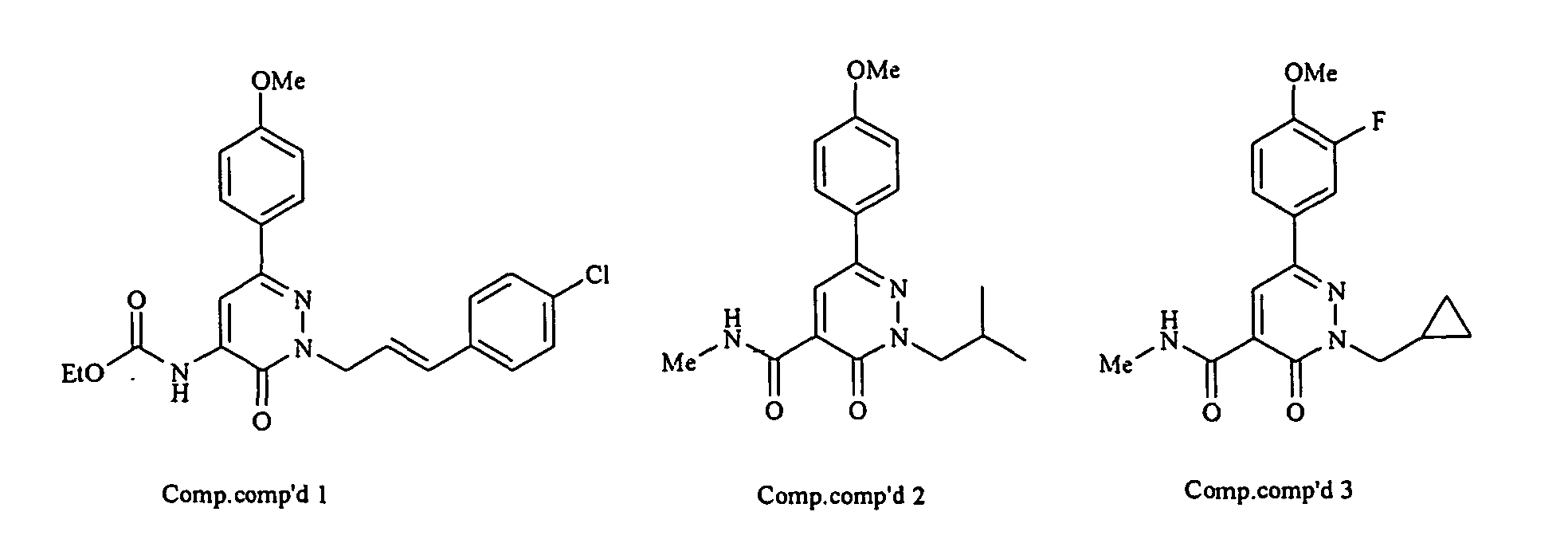

| Example No. | Weighed amount (mg) | Amount of added water (mL) | Solubility (%) |
| 14 | 2.048 | 0.25 | 0.8 |
| 18 | 1.048 | 0.1 | 1 |
| 21 | 10.47 | 0.05 | >20 |
| 23 | 10.82 | 0.1 | 10 |
| 25 | 1.025 | 0.25 | 0.4 |
| 45 | 10.37 | 0.25 | 4 |
| 47 | 10.47 | 0.05 | >20 |
| 89 | 10.57 | 0.05 | >20 |
| 108 | 9.75 | 0.045 | >20 |
| 143 | 5.023 | 0.05 | 10 |
| 149 | 3.09 | 0.03 | >10 |
| 153 | 2.95 | 0.6 | 0.5 |
| 188 | 2.008 | 2.5 | 0.08 |
| 193 | 5.032 | 0.1 | 5 |
| 195 | 5.072 | 2.2 | 0.2 |
| 206 | 2.042 | 3.5 | 0.06 |
| 214 | 5.061 | 0.05 | 10 |
| 217 | 5.061 | 0.05 | 10 |
| 245 | 5.020 | 0.05 | 10 |
| 246 | 4.992 | 0.2 | 2 |
| 247 | 4.999 | 0.05 | 10 |
| 248 | 2.002 | 3.5 | 0.06 |
| 249 | 2.017 | 7.0 | 0.03 |
| Comparative Compound 1 | 0.677 | 100 (insoluble) | <0.001 |
| Comparative Compound 2 | 0.742 | 100 (insoluble) | <0.001 |
| Comparative Compound 3 | 0.740 | 100 (insoluble) | <0.001 |
| Comparative Compound 4 | 0.95 | 100 (insoluble) | <0.001 |
The compound of Example 83 and the comparative compound
3 were suspended at 2 mg/mL with a 0.5% MC solution in mortars,
respectively, and were orally administered to male SD rats at
10 mg/5 mL/kg. Upon elapsed time of 0.25, 0.5, 1, 2, 4, 6 and
8 hours after the administration, blood samples were collected
and then centrifuged to provide plasma samples. The plasma
levels of the respective compounds were determined by HPLC.
As is shown in FIG. 1, no substantial absorption was observed
on the comparative compound 3, but good absorption was observed
on the compound of Example 83 equipped with increased water
solubility. The compound of Example 83 is, therefore, useful
as an orally dosable medicine.
In a similar manner as in Experiment 3, test compounds
of Examples 23, 25, 143, 193, 245, 246, 247, 248 and 249 were
orally administered to mice and/or rats to test their oral
absorbability. As is shown in FIGS. 2 to 6, good absorbability
was observed on all the test compounds of Examples 23, 25, 143,
193, 245, 246, 247, 248 and 249 so that they are useful as orally
dosable medicines.
Claims (23)
- A phenylpyridazine derivative represented by the formula (1) :wherein:
 with the proviso that R2 and R3 are not hydrogens or the same C1-C3 alkyl groups at the same time when R1 is a benzyl group or a C1-C3 alkyl group; or a salt thereof.R1 is optionally substituted or unsubstituted alkyl, or substituted or unsubstituted alkenyl;R2 and R3 each independently represents hydrogen or alkyl, hydroxyalkyl, dihydroxyalkyl or alkynyl, or R2 and R3 are fused together with the adjacent nitrogen atom to form a substituted orunsubstituted, nitrogen-containing, saturated heterocyclic group;X, Y and Z each independently represents hydrogen or halogen, substituted or unsubstituted alkyl, alkoxy, alkylthio, alkylsulfinyl or alkylsulfonyl, or substituted or unsubstituted aryl; andn stands for a number of from 1 to 5;
 - The compound of Claim 1, wherein R1 is substituted or unsubstituted alkyl having 1 to 7 carbon atoms or substituted or unsubstituted alkenyl having 2 to 7 carbon atoms.
- The compound of Claim 2, wherein one or more substituents on said alkyl or alkenyl represented by R1 are each independently aryl having 6 to 14 carbon atoms or 5- or 6-membered heteroaryl having 1 to 3 nitrogen atoms; and said aryl or heteroaryl groups are each substituted or unsubstituted by 1 to 3 substituents selected from the group consisting of halogen, alkyl and alkoxy.
- The compound of Claim 1, wherein R2 and R3 each independently represents hydrogen, alkyl, hydroxyalkyl, dihydroxyalkyl or alkynyl; or R2 and R3 are fused together with the adjacent nitrogen atom to form a 5- or 7-membered, nitrogen-containing, saturated heterocyclic group, said heterocyclic group being substituted or unsubstituted with one or more halogen atoms, or alkyl, alkoxycarbonyl or aralkyl groups.
- The compound of Claim 1, wherein X, Y and Z are each independently hydrogen, halogen, alkyl which is substituted or unsubstituted by one or more halogen atoms or alkoxy groups, alkoxy, alkylthio, alkylsulfinyl, alkylsulfonyl, or C6-C14 aryl which is substituted or unsubsituted by one or more halogen atoms, or alkyl or alkoxy groups.
- The compound of Claim 1, wherein R1 is isobutyl, cyclopropylmethyl, cyclopentylmethyl, cinnamyl, halogenocinnamyl, benzyl, halogenobenzyl, dihalogenobenzyl or (halogenophenyl)propyl; R2 and R3 are each independently hydrogen, C1-7 alkyl, C1-7 hydroxyalkyl or propargyl; said heterocyclic group formed by R2 and R3 is pyrrolidinyl, piperazinyl, piperidino or morpholino which is substituted or unsubstituted by one or more C1-7 alkyl or benzyl groups; X is methyl, methoxy, methylthio or halogen; Y is hydrogen, methyl or halogen; Z is hydrogen; and n is 1 or 3.
- The compound of Claim 1, which is
4-dimethylaminomethyl-6-(3-fluoro-4-methylphenyl)-2-isobutyl-2H-pyridazin-3-one,
2-cyclopropylmethyl-4-dimethylaminomethyl-6-(3-fluoro-4-methoxyphenyl)-2H-pyridazin-3-one,
2-cyclopropylmethyl-6-(3-fluoro-4-methoxyphenyl)-4-(4-benzyl-1-piperazinyl)methyl-2H-pyridazin-3-one,
2-cyclopropylmethyl-6-(3-fluoro-4-methoxyphenyl)-4-(1-piperazinyl)methyl-2H-pyridazin-3-one,
4-N,N-bis(2-hydroxyethyl)aminomethyl-2-cyclopropylmethyl-6-(3-fluoro-4-methoxyphenyl)-2H-pyridazin-3-one,
4-aminomethyl-2-cyclopropylmethyl-6-(3-fluoro-4-methoxyphenyl)-2H-pyridazin-3-one,
4-dimethylaminomethyl-2-isobutyl-6-(4-methylphenyl)-2H-pyridazin-3-one,
4-diethylaminomethyl-2-isobutyl-6-(4-methylphenyl)-2H-pyridazin-3-one,
4-N,N-bis(2-hydroxyethyl)aminomethyl-6-(4-methylphenyl)-2-isobutyl-2H-pyridazin-3-one,
6-(4-fluoro-3-methylphenyl)-2-isobutyl-4-(4-methyl-1-piperazinyl)methyl-2H-pyridazin-3-one,
4-dimethylaminomethyl-6-(4-fluoro-3-methylphenyl)-2-isobutyl-2H-pyridazin-3-one,
4-N,N-bis(2-hydroxyethyl)aminomethyl-6-(3,4-difluorophenyl)-2-isobutyl-2H-pyridazin-3-one,
2-(4-chlorocinnamyl)-6-(4-fluoro-3-methylphenyl)-4-(4-methyl-1-piperazinyl)methyl-2H-pyridazin-3-one,
2-cyclopropylmethyl-4-(4-methyl-1-piperazinyl)methyl-6-[4-(methylthio)phenyl]-2H-pyridazin-3-one,
4-N,N-bis(2-hydroxyethyl)aminomethyl-2-cyclopropylmethyl-6-[4-(methylthio)phenyl]-2H-pyridazin-3-one,
2-cyclopropylmethyl-4-dimethylaminomethyl-6-[4-(methylthio)phenyl]-2H-pyridazin-3-one,
2-isobutyl-6-[4-(methylthio)phenyl]-4-propargylaminomethyl-2H-pyridazin-3-one,
4-dimethylaminomethyl-2-isobutyl-6-[4-(methylthio)phenyl]-2H-pyridazin-3-one,
2-(4-chlorobenzyl)-4-dimethylaminomethyl-6-(3-fluoro-4-methoxyphenyl)-2H-pyridazin-3-one,
2-cyclopentylmethyl-6-(3-fluoro-4-methoxyphenyl)-4-(4-methyl-1-piperazinyl)methyl-2H-pyridazin-3-one,
2-cyclopentylmethyl-4-dimethylaminomethyl-6-(3-fluoro-4-methoxyphenyl)-2H-pyridazin-3-one,
2-cyclopentylmethyl-6-(3-fluoro-4-methoxyphenyl)-4-(1-piperazinyl)methyl-2H-pyridazin-3-one,
4-aminomethyl-2-cyclopentylmethyl-6-(3-fluoro-4-methoxyphenyl)-2H-pyridazin-3-one,
2-(4-fluorobenzyl)-6-(3-fluoro-4-methoxyphenyl)-4-(4-methy1-1-piperazinyl)methyl-2H-pyridazin-3-one,
4-dimethylaminomethyl-2-(4-fluorobenzyl)-6-(3-fluoro-4-methoxyphenyl)-2H-pyridazin-3-one,
2-(4-fluorobenzyl)-6-(3-fluoro-4-methoxyphenyl)-4-(1-piperazinyl)methyl-2H-pyridazin-3-one,
4-aminomethyl-2-(4-fluorobenzyl)-6-(3-fluoro-4-methoxyphenyl)-2H-pyridazin-3-one,
4-aminomethyl-2-(4-chlorobenzyl)-6-(3-fluoro-4-methoxyphenyl)-2H-pyridazin-3-one,
2-(3,4-difluorobenzyl)-6-(3-fluoro-4-methoxyphenyl)-4-(4-methyl-1-piperazinyl)methyl-2H-pyridazin-3-one,
2-(3,4-difluorobenzyl)-4-dimethylaminomethyl-6-(3-fluoro-4-methoxyphenyl)-2H-pyridazin-3-one,
6-(3-fluoro-4-methoxyphenyl)-2-[3-(4-fluorophenyl)propyl]-4-(4-methyl-1-piperazinyl)methyl-2H-pyridazin-3-one,
4-dimethylaminomethyl-6-(3-fluoro-4-methoxyphenyl)-2-[3-(4-fluorophenyl)propyl]-2H-pyridazin-3-one,
4-N,N-bis(2-hydroxyethyl)aminomethyl-6-(3-fluoro-4-methoxyphenyl)-2-[3-(4-fluorophenyl)propyl]-2H-pyridazin-3-one,
6-(3-fluoro-4-methoxyphenyl)-2-[3-(4-fluorophenyl)propyl]-4-(1-piperazinyl)methyl-2H-pyridazin-3-one,
4-aminomethyl-6-(3-fluoro-4-methoxyphenyl)-2-[3-(4-fluorophenyl)propyl]-2H-pyridazin-3-one,
2-(4-chlorocinnamyl)-6-(3-fluoro-4-methoxyphenyl)-4-[4-(2-hydroxyethyl)-1-piperazinyl]methyl-2H-pyridazin-3-one,
2-(4-chlorocinnamyl)-6-(3-fluoro-4-methoxyphenyl)-4-(4-methyl-1-piperazinyl)methyl-2H-pyridazin-3-one,
2-cyclopropylmethyl-6-(3-fluoro-4-methoxyphenyl)-4-[3-(4-methyl-1-piperazinyl)propyl]-2H-pyridazin-3-one,
2-cyclopropylmethyl-4-(3-dimethylaminopropyl)-6-(3-fluoro-4-methoxyphenyl)-2H-pyridazin-3-one,
2-cyclopropylmethyl-6-(3-fluoro-4-methoxyphenyl)-4-[3-(1-piperazinyl)propyl]-2H-pyridazin-3-one, or
4-(3-aminopropyl)-2-cyclopropylmethyl-6-(3-fluoro-4-methoxyphenyl)-2H-pyridazin-3-one; or a salt thereof. - The compound of Claim 1, wherein R1 is a group selected from halogenobenzyl, dihalogenobenzyl, (halogenophenyl) ethyl, (dihalogenophenyl)ethyl, (halogenophenyl)propyl or (dihalogenophenyl)propyl; R2(R3)N- is a group selected from amino, dimethylamino, piperazinyl or N-methylpiperazinyl; X is halogen or methoxy; Y is methyl or halogen; Z is hydrogen; and n stands for 1 or 3.
- The compound of Claim 1, wherein R1 is a group selected from chlorobenzyl, dichlorobenzyl, fluorobenzyl, difluorobenzyl, (chlorophenyl)ethyl, (dichlorophenyl)ethyl, (chlrorophenyl)propyl or (dichlorophenyl)propyl; R2(R3)N- is a group selected from amino, dimethylamino, piperazinyl or N-methylpiperazinyl; X is halogen or methoxy; Y is methyl or halogen; Z is hydrogen; and n stands for 1 or 3.
- The compound of Claim 1, which is:2-[3-(4-chlorophenyl)propyl]-6-(4-fluoro-3-methylphenyl)-4-(4-methyl-1-piperazinyl)methyl-2H-pyridazin-3-one,2-[3-(2-chlorophenyl)propyl]-6-(4-fluoro-3-methylphenyl)-4-(4-methyl-1-piperazinyl)methyl-2H-pyridazin-3-one,2-[3-(3-chlorophenyl)propyl]-6-(4-fluoro-3-methylphenyl)-4-(4-methyl-1-piperazinyl)methyl-2H-pyridazin-3-one,2-(4-chlorobenzyl)-6-(4-fluoro-3-methylphenyl)-4-(4-methyl-1-piperazinyl)methyl-2H-pyridazin-3-one,2-(2-chlorobenzyl)-6-(4-fluoro-3-methylphenyl)-4-(4-methyl-1-piperazinyl)methyl-2H-pyridazin-3-one,2-(2-chlorobenzyl)-6-(4-fluoro-3-methylphenyl)-4-[3-(4-methyl-1-piperazinyl)propyl]-2H-pyridazin-3-one,4-(3-aminopropyl)-2-(2-chlorobenzyl)-6-(4-fluoro-3-methylphenyl)-2H-pyridazin-3-one,2-[2-(2-chlorophenyl)ethyl]-6-(4-fluoro-3-methylphenyl)-4-(4-methyl-1-piperazinyl)methyl-2H-pyridazin-3-one,2-[2-(4-chlorophenyl)ethyl]-6-(4-fluoro-3-methylphenyl)-4-(4-methyl-1-piperazinyl)methyl-2H-pyridazin-3-one,2-(2,6-dichlorobenzyl)-6-(4-fluoro-3-methylphenyl)-4-(4-methyl-1-piperazinyl)methyl-2H-pyridazin-3-one,2-(2,6-dichlorobenzyl)-6-(4-fluoro-3-methylphenyl)-4-(1-piperazinyl)methyl-2H-pyridazin-3-one,4-aminomethyl-2-(2,6-dichlorobenzyl)-6-(4-fluoro-3-methylphenyl)-2H-pyridazin-3-one,2-[3-(2,6-dichlorophenyl)propyl]-6-(4-fluoro-3-methylphenyl)-4-(4-methyl-1-piperazinyl)methyl-2H-pyridazin-3-one,2-(3,4-difluorobenzyl)-6-(4-fluoro-3-methylphenyl)-4-(4-methyl-1-piperazinyl)methyl-2H-pyridazin-3-one,4-aminomethyl-2-(2-chlorobenzyl)-6-(4-fluoro-3-methylphenyl)-2H-pyridazin-3-one,2-(4-fluorobenzyl)-6-(3-fluoro-4-methoxylphenyl)-4-[3-(4-methyl-1-piperazinyl)propyl]-2H-pyridazin-3-one,2-(4-fluorobenzyl)-6-(3-fluoro-4-methoxylphenyl)-4-[3-(1-piperazinyl)propyl]-2H-pyridazin-3-one,2-[3-(2-chlorophenyl)propyl]-6-(3-fluoro-4-methoxylphenyl)-4-(4-methyl-1-piperazinyl)methyl-2H-pyridazin-3-one ,2-[3-(4-chlorophenyl)propyl]-6-(3-fluoro-4-methoxylphenyl)-4-(4-methyl-1-piperazinyl)methyl-2H-pyridazin-3-one ,4-aminomethyl-2-[3-(2-chlorophenyl)propyl]-6-(3-fluoro-4-methoxylphenyl)-2H-pyridazin-3-one,4-aminomethyl-2-[3-(4-chlorophenyl)propyl]-6-(3-fluoro-4-methoxylphenyl)-2H-pyridazin-3-one,2-cyclopropylmethyl-6-(3-fluoro-4-methoxylphenyl)-4-[3-(1-piperazinyl)propyl]-2H-pyridazin-3-one,4-(3-aminopropyl)-2-cyclopropylmethyl-6-(3-fluoro-4-methoxylphenyl)-2H-pyridazin-3-one,2-(4-fluorobenzyl)-6-(3-fluoro-4-methoxylphenyl)-4-(4-methyl-1-piperazinyl)methyl-2H-pyridazin-3-one,2-(4-fluorobenzyl)-6-(3-fluoro-4-methoxylphenyl)-4-(1-piperazinyl)methyl-2H-pyridazin-3-one,2-(3,4-difluorobenzyl)-6-(3-fluoro-4-methoxylphenyl)-4-(4-methyl-1-piperazinyl)methyl-2H-pyridazin-3-one,2-(3,4-difluorobenzyl)-4-dimethylaminomethyl-6-(3-fluoro-4-methoxylphenyl)-2H-pyridazin-3-one,2-(4-chlorocinnamyl)-6-(3-fluoro-4-methoxylphenyl)-4-(4-methyl-1-piperazinyl)methyl-2H-pyridazin-3-one,2-(4-chlorocinnamyl)-6-(3-fluoro-4-methoxylphenyl)-4-[4-(2-hydroxyethyl)-1-piperazinyl]methyl-2H-pyridazin-3-one,4-N,N-bis(2-hydroxyethyl)aminomethyl-2-cyclopropylmethyl-6-(3-fluoro-4-methoxylphenyl)-2H-pyridazin-3-one,4-aminomethyl-2-cyclopropylmethyl-6-(3-fluoro-4-methoxylphenyl)-2H-pyridazin-3-one, or2-(4-chlorocinnamyl)-6-(4-fluoro-3-methylphenyl)-4-(4-methyl-1-piperazinyl)methyl-2H-pyridazin-3-one; ora salt thereof.
- The compound of Claim 1, which is
2-[3-(4-chlorophenyl)propyl]-6-(4-fluoro-3-methylphenyl)-4-(4-methyl-1-piperazinyl)methyl-2H-pyridazin-3-one,
2-(4-chlorobenzyl)-6-(4-fluoro-3-methylphenyl)-4-(4-methyl-1-piperazinyl)methyl-2H-pyridazin-3-one,
4-(3-aminopropyl)-2-(2-chlorobenzyl)-6-(4-fluoro-3-methylphenyl)-2H-pyridazin-3-one,
2-[2-(4-chlorophenyl)ethyl]-6-(4-fluoro-3-methylphenyl)-4-(4-methyl-1-piperazinyl)methyl-2H-pyridazin-3-one,
2-(2,6-dichlorobenzyl)-6-(4-fluoro-3-methylphenyl)-4-(4-methyl-1-piperazinyl)methyl-2H-pyridazin-3-one,
2-[3-(2-chlorophenyl)propyl]-6-(3-fluoro-4-methoxylphenyl)-4-(4-methyl-1-piperazinyl)methyl-2H-pyridazin-3-one,
2-[3-(4-chlorophenyl)propyl]-6-(3-fluoro-4-methoxylphenyl)-4-(4-methyl-1-piperazinyl)methyl-2H-pyridazin-3-one,
2-cyclopropylmethyl-6-(3-fluoro-4-methoxylphenyl)-4-[3-(1-piperazinyl)propyl]-2H-pyridazin-3-one,
4-(3-aminopropyl)-2-cyclopropylmethyl-6-(3-fluoro-4-methoxylphenyl)-2H-pyridazin-3-one,
2-(4-fluorobenzyl)-6-(3-fluoro-4-methoxylphenyl)-4-(4-methyl-1-piperazinyl)methyl-2H-pyridazin-3-one,
2-(4-fluorobenzyl)-6-(3-fluoro-4-methoxylphenyl)-4-(1-piperazinyl)methyl-2H-pyridazin-3-one,
2-(3,4-difluorobenzyl)-6-(3-fluoro-4-methoxylphenyl)-4-(4-methyl-1-piperazinyl)methyl-2H-pyridazin-3-one,
2-(3,4-difluorobenzyl)-4-dimethylaminomethyl-6-(3-fluoro-4-methoxylphenyl)-2H-pyridazin-3-one,
2-(4-chlorocinnamyl)-6-(3-fluoro-4-methoxylphenyl)-4-(4-methyl-1-piperazinyl)methyl-2H-pyridazin-3-one,
2-(4-chlorocinnamyl)-6-(3-fluoro-4-methoxylphenyl)-4-[4-(2-hydroxyethyl)-1-piperazinyl]methyl-2H-pyridazin-3-one,
4-N,N-bis(2-hydroxyethyl)aminomethyl-2-cyclopropylmethyl-6-(3-fluoro-4-methoxylphenyl)-2H-pyridazin-3-one,
4-aminomethyl-2-cyclopropylmethyl-6-(3-fluoro-4-methoxylphenyl)-2H-pyridazin-3-one, or
2-(4-chlorocinnamyl)-6-(4-fluoro-3-methylphenyl)-4-(4-methyl-1-piperazinyl)methyl-2H-pyridazin-3-one; or a salt thereof. - The compound of Claim 1, which is
2-(3,4-difluorobenzyl)-4-dimethylaminomethyl-6-(3-fluoro-4-methoxyphenyl)-2H-pyridazin-3-one,
2-(4-chlorocinnamyl)-6-(4-fluoro-3-methylphenyl)-4-(4-methyl-1-piperazinyl)methyl-2H-pyridazin-3-one,
2-(4-fluorobenzyl)-6-(3-fluoro-4-methoxyphenyl)-4-(1-piperazinyl)methyl-2H-pyridazin-3-one,
2-[3-(4-chlorophenyl)propyl]-6-(4-fluoro-3-methylphenyl)-4-(4-methyl-1-piperazinyl)methyl-2H-pyridazin-3-one,
2-(4-chlorocinnamyl)-6-(3-fluoro-4-methoxyphenyl)-4-(4-methyl-1-piperazinyl)methyl-2H-pyridazin-3-one, or
2-(4-chlorocinnamyl)-6-(3-fluoro-4-methoxyphenyl)-4-[4-(2-hydroxyethyl)-1-piperazinyl]methyl-2H-pyridazin-3-one; or a salt thereof. - A medicine comprising as an active ingredient the compound of any one of claims 1-12 or a salt thereof.
- The medicine of claim 13, which is a preventive or therapeutic for a disease caused by stimulation of interleukin-1β production.
- The medicine of claim 13, which is a preventive or therapeutic for immune system diseases, inflammatory diseases, ischemic diseases, osteoporosis, or ichorrhemia.
- The medicine of claim 13, which is a preventive or therapeutic for rheumatism, arthritis or inflammatory colitis.
- An interleukin-1β production inhibitor comprising as an active ingredient the compound of any one of claims 1-12 or a salt thereof.
- A pharmaceutical composition comprising the compound of anyone of claims 1-12 or a salt thereof and a pharmacologically acceptable carrier.
- The pharmaceutical composition of claim 18, which is a pharmaceutical composition for the prevention or treatment of a disease caused by stimulation of interleukin-1βproduction.
- The pharmaceutical composition of claim 18, which is a pharmaceutical composition for the prevention or treatment of immune system diseases, inflammatory diseases, ischemic diseases, osteoporosis, or ichorrhemia.
- The pharmaceutical composition of claim 18, which is a pharmaceutical composition for the prevention or treatment of rheumatism, arthritis or inflammatory colitis.
- Use of the compound of any one of claims 1-12 or a salt thereof for the production of a medicine.
- A method for treating a disease caused by stimulation of interleukin-1β production, which comprises administering the compound of any one of Claims 1-12 or a salt thereof.
Applications Claiming Priority (3)
| Application Number | Priority Date | Filing Date | Title |
|---|---|---|---|
| JP2003073403 | 2003-03-18 | ||
| JP2003073403 | 2003-03-18 | ||
| PCT/JP2004/003487 WO2004083188A1 (en) | 2003-03-18 | 2004-03-16 | Water-soluble phenylpyridazine derivative and medicine containing the same |
Publications (1)
| Publication Number | Publication Date |
|---|---|
| EP1604984A1 true EP1604984A1 (en) | 2005-12-14 |
Family
ID=33027793
Family Applications (1)
| Application Number | Title | Priority Date | Filing Date |
|---|---|---|---|
| EP04721008A Withdrawn EP1604984A1 (en) | 2003-03-18 | 2004-03-16 | Water-soluble phenylpyridazine derivative and medicine containing the same |
Country Status (13)
| Country | Link |
|---|---|
| US (1) | US7211577B2 (en) |
| EP (1) | EP1604984A1 (en) |
| JP (1) | JPWO2004083188A1 (en) |
| KR (1) | KR20050113627A (en) |
| CN (1) | CN1759103A (en) |
| AU (1) | AU2004221966A1 (en) |
| BR (1) | BRPI0408359A (en) |
| CA (1) | CA2518227A1 (en) |
| MX (1) | MXPA05009972A (en) |
| NO (1) | NO20053592L (en) |
| RU (1) | RU2005132167A (en) |
| TW (1) | TW200510335A (en) |
| WO (1) | WO2004083188A1 (en) |
Cited By (3)
| Publication number | Priority date | Publication date | Assignee | Title |
|---|---|---|---|---|
| WO2014121942A1 (en) * | 2013-02-07 | 2014-08-14 | Merck Patent Gmbh | Macrocyclic pyridazinone derivatives |
| WO2014121931A1 (en) * | 2013-02-07 | 2014-08-14 | Merck Patent Gmbh | Pyridazinone-amides derivatives |
| WO2021105641A1 (en) * | 2019-11-28 | 2021-06-03 | Universite De Reims Champagne-Ardenne | N2-arylmethyl-4-haloalkyl-pyridazin-3-one cftr modulators for the treatment of cystic fibrosis |
Families Citing this family (2)
| Publication number | Priority date | Publication date | Assignee | Title |
|---|---|---|---|---|
| DE102004010207A1 (en) * | 2004-03-02 | 2005-09-15 | Aventis Pharma S.A. | New 4-benzimidazolyl-3(2H)-pyridazinone derivatives are kinase inhibitors, especially useful for treatment of cancer |
| US20090131443A1 (en) * | 2005-10-28 | 2009-05-21 | Kowa Co., Ltd. | Method for prevention and/or treatment of rheumatoid arthritis |
Family Cites Families (17)
| Publication number | Priority date | Publication date | Assignee | Title |
|---|---|---|---|---|
| AR206496A1 (en) | 1972-07-03 | 1976-07-30 | Riker Laboratories Inc | PROCEDURE FOR THE PREPARATION OF 2-PHENOXY-4-NITRO-ALKYL OR HALOALKYLSULPHONANILIDES |
| JPH0753725B2 (en) * | 1987-10-08 | 1995-06-07 | 富山化学工業株式会社 | 4H-1-benzopyran-4-one derivative and its salt, their production method and anti-inflammatory agent containing them |
| FI91062C (en) | 1988-12-28 | 1994-05-10 | Eisai Co Ltd | Process for the preparation of naphthalene derivatives useful as a medicament |
| MX9300141A (en) | 1992-01-13 | 1994-07-29 | Smithkline Beecham Corp | NOVEL IMIDAZOLE COMPOUNDS, PROCEDURE FOR THE PREPARATION AND PHARMACEUTICAL COMPOSITIONS CONTAINING IT. |
| ES2114654T3 (en) | 1993-06-08 | 1998-06-01 | Vertex Pharma | PIRIDAZINES AS INHIBITORS OF THE INTERLEUKIN-1BETA CONVERSION ENZYME. |
| WO1997005878A1 (en) | 1995-08-10 | 1997-02-20 | Merck & Co., Inc. | 2,5-substituted aryl pyrroles, compositions containing such compounds and methods of use |
| EP0975604B1 (en) | 1997-03-14 | 2004-07-21 | Merck Frosst Canada & Co. | Pyridazinones as inhibitors of cyclooxygenase-2 |
| DK1005460T3 (en) | 1997-08-22 | 2006-07-10 | Abbott Lab | Inhibitors of the biosynthesis of prostaglandin endoperoxide H synthase |
| CA2299300C (en) | 1997-08-22 | 2007-04-17 | Abbott Laboratories | Arylpyridazinones as prostaglandin endoperoxide h synthase bisoynthesis inhibitors |
| US6348468B1 (en) * | 1997-11-19 | 2002-02-19 | Kowa Co., Ltd. | Pyridazine compounds and compositions containing the same |
| TWI241295B (en) * | 1998-03-02 | 2005-10-11 | Kowa Co | Pyridazine derivative and medicine containing the same as effect component |
| TR200101765T2 (en) | 1998-10-27 | 2002-02-21 | Abbott Laboratories | Prostaglandin endoperoxide H synthase biosynthesis inhibitors |
| JP2000247959A (en) | 1999-02-26 | 2000-09-12 | Kowa Co | Pyridazin-3-one derivatives and pharmaceuticals containing the same |
| US6664256B1 (en) * | 2000-07-10 | 2003-12-16 | Kowa Co., Ltd. | Phenylpyridazine compounds and medicines containing the same |
| US6861428B2 (en) * | 2001-09-26 | 2005-03-01 | Kowa Co., Ltd. | Water-soluble phenylpyridazine compounds and compositions containing the same |
| US6869954B2 (en) | 2001-09-26 | 2005-03-22 | Kowa Co., Ltd. | Water-soluble phenylpyridazine compounds and compositions containing the same |
| BRPI0407519A (en) | 2003-03-07 | 2006-02-14 | Kowa Co | benzofuran derivatives |
-
2004
- 2004-03-16 RU RU2005132167/04A patent/RU2005132167A/en unknown
- 2004-03-16 BR BRPI0408359-8A patent/BRPI0408359A/en not_active IP Right Cessation
- 2004-03-16 JP JP2005503698A patent/JPWO2004083188A1/en active Pending
- 2004-03-16 CN CNA200480006774XA patent/CN1759103A/en active Pending
- 2004-03-16 KR KR1020057016226A patent/KR20050113627A/en not_active Withdrawn
- 2004-03-16 MX MXPA05009972A patent/MXPA05009972A/en not_active Application Discontinuation
- 2004-03-16 CA CA002518227A patent/CA2518227A1/en not_active Abandoned
- 2004-03-16 WO PCT/JP2004/003487 patent/WO2004083188A1/en not_active Ceased
- 2004-03-16 AU AU2004221966A patent/AU2004221966A1/en not_active Abandoned
- 2004-03-16 EP EP04721008A patent/EP1604984A1/en not_active Withdrawn
- 2004-03-16 US US10/544,881 patent/US7211577B2/en not_active Expired - Fee Related
- 2004-03-18 TW TW093107278A patent/TW200510335A/en unknown
-
2005
- 2005-07-25 NO NO20053592A patent/NO20053592L/en not_active Application Discontinuation
Non-Patent Citations (1)
| Title |
|---|
| See references of WO2004083188A1 * |
Cited By (13)
| Publication number | Priority date | Publication date | Assignee | Title |
|---|---|---|---|---|
| WO2014121942A1 (en) * | 2013-02-07 | 2014-08-14 | Merck Patent Gmbh | Macrocyclic pyridazinone derivatives |
| WO2014121931A1 (en) * | 2013-02-07 | 2014-08-14 | Merck Patent Gmbh | Pyridazinone-amides derivatives |
| KR20150118980A (en) * | 2013-02-07 | 2015-10-23 | 메르크 파텐트 게엠베하 | Macrocyclic pyridazinone derivatives |
| KR20150118981A (en) * | 2013-02-07 | 2015-10-23 | 메르크 파텐트 게엠베하 | Pyridazinone-amides derivatives |
| US9550794B2 (en) | 2013-02-07 | 2017-01-24 | Merck Patent Gmbh | Macrocyclic pyridazinone derivatives |
| US9567320B2 (en) | 2013-02-07 | 2017-02-14 | Merck Patent Gmbh | Pyridazinone-amides derivatives |
| AU2014214254B2 (en) * | 2013-02-07 | 2018-03-29 | Merck Patent Gmbh | Macrocyclic Pyridazinone derivatives |
| AU2014214321B2 (en) * | 2013-02-07 | 2018-04-19 | Merck Patent Gmbh | Pyridazinone-amides derivatives |
| RU2660435C2 (en) * | 2013-02-07 | 2018-07-06 | Мерк Патент Гмбх | Macrocyclic pyridazinone derivatives |
| US10064861B2 (en) | 2013-02-07 | 2018-09-04 | Merck Patent Gmbh | Macrocyclic pyridazinone derivatives |
| RU2666899C2 (en) * | 2013-02-07 | 2018-09-13 | Мерк Патент Гмбх | Pyridazinone-amide derivatives |
| WO2021105641A1 (en) * | 2019-11-28 | 2021-06-03 | Universite De Reims Champagne-Ardenne | N2-arylmethyl-4-haloalkyl-pyridazin-3-one cftr modulators for the treatment of cystic fibrosis |
| FR3103701A1 (en) * | 2019-11-28 | 2021-06-04 | Universite De Reims Champagne-Ardenne | TYPEN2-ARYLMETHYL-4-HALOALKYL-PYRIDAZIN-3-ONE COMPOUNDS AND THEIR USE |
Also Published As
| Publication number | Publication date |
|---|---|
| JPWO2004083188A1 (en) | 2006-06-22 |
| WO2004083188A1 (en) | 2004-09-30 |
| US20060142292A1 (en) | 2006-06-29 |
| KR20050113627A (en) | 2005-12-02 |
| RU2005132167A (en) | 2006-05-10 |
| CA2518227A1 (en) | 2004-09-30 |
| US7211577B2 (en) | 2007-05-01 |
| AU2004221966A1 (en) | 2004-09-30 |
| NO20053592D0 (en) | 2005-07-25 |
| BRPI0408359A (en) | 2006-03-21 |
| TW200510335A (en) | 2005-03-16 |
| MXPA05009972A (en) | 2005-11-04 |
| NO20053592L (en) | 2005-11-30 |
| CN1759103A (en) | 2006-04-12 |
Similar Documents
| Publication | Publication Date | Title |
|---|---|---|
| TW502025B (en) | Pyridazine derivatives having inhibitory activity against interleukin-1β production and pharmaceutical composition containing the same | |
| JP4328018B2 (en) | Novel pyridazine derivatives and pharmaceuticals containing the same as active ingredients | |
| EP1510519B1 (en) | Pharmaceutical compositions comprising 2,3-diarylpyrazolo[1,5-B]pyridazine derivatives | |
| JP2744070B2 (en) | Pyrimidopyrimidine derivative and method for producing the same | |
| JPWO1999044995A1 (en) | Novel pyridazine derivatives and medicines containing them as active ingredients | |
| JPH11501923A (en) | 6-Substituted pyrazolo [3,4-d] pyrimidin-4-ones, compositions containing them and methods of use | |
| RU2269519C2 (en) | Phenylpyridazine compounds and medicinal agents comprising thereof | |
| CA2335104C (en) | Arylalkanoylpyridazines | |
| CN109111438B (en) | Amidine compounds for IDO inhibitors | |
| EP1604984A1 (en) | Water-soluble phenylpyridazine derivative and medicine containing the same | |
| US6869954B2 (en) | Water-soluble phenylpyridazine compounds and compositions containing the same | |
| US6861428B2 (en) | Water-soluble phenylpyridazine compounds and compositions containing the same | |
| CN112543757A (en) | Condensed azaheteroaryl compounds having antibacterial activity against tubercle bacillus | |
| JP2006504803A (en) | Pyrazole derivative | |
| KR20020000550A (en) | Use of arylalkanoylpyridazines | |
| EA007202B1 (en) | New piperidinyl-alkylamino-pyridazinone derivatives, a process for the preparation thereof and pharmaceutical compositions containing said compounds | |
| MXPA00008549A (en) | Novel pyridazine derivatives and drugs containing the same as the active ingredient | |
| HK1070895B (en) | Pharmaceutical compositions comprising 2,3-diarylpyrazolo[1,5-b]pyridazine derivatives | |
| HK1070895A1 (en) | Pharmaceutical compositions comprising 2,3-diarylpyrazolo[1,5-b]pyridazine derivatives |
Legal Events
| Date | Code | Title | Description |
|---|---|---|---|
| PUAI | Public reference made under article 153(3) epc to a published international application that has entered the european phase |
Free format text: ORIGINAL CODE: 0009012 |
|
| 17P | Request for examination filed |
Effective date: 20050719 |
|
| AK | Designated contracting states |
Kind code of ref document: A1 Designated state(s): AT BE BG CH CY CZ DE DK EE ES FI FR GB GR HU IE IT LI LU MC NL PL PT RO SE SI SK TR |
|
| AX | Request for extension of the european patent |
Extension state: AL LT LV MK |
|
| DAX | Request for extension of the european patent (deleted) | ||
| STAA | Information on the status of an ep patent application or granted ep patent |
Free format text: STATUS: THE APPLICATION IS DEEMED TO BE WITHDRAWN |
|
| 18D | Application deemed to be withdrawn |
Effective date: 20081001 |