EP1604981A1 - Nitrogen-containing heterocyclic derivatives and drugs containing the same as the active ingredient - Google Patents
Nitrogen-containing heterocyclic derivatives and drugs containing the same as the active ingredient Download PDFInfo
- Publication number
- EP1604981A1 EP1604981A1 EP04720257A EP04720257A EP1604981A1 EP 1604981 A1 EP1604981 A1 EP 1604981A1 EP 04720257 A EP04720257 A EP 04720257A EP 04720257 A EP04720257 A EP 04720257A EP 1604981 A1 EP1604981 A1 EP 1604981A1
- Authority
- EP
- European Patent Office
- Prior art keywords
- amino
- group
- phenoxy
- methyl
- methanol
- Prior art date
- Legal status (The legal status is an assumption and is not a legal conclusion. Google has not performed a legal analysis and makes no representation as to the accuracy of the status listed.)
- Withdrawn
Links
- OWDKBTHTNXTRLN-WBZJENOGSA-N CCCC(CC)CNC([C@H](C[C@H]1C2)[C@H]3CN1C2(Cc(cc1)ccc1Oc(cc1)ccc1NS(C)(=O)=O)C3)=O Chemical compound CCCC(CC)CNC([C@H](C[C@H]1C2)[C@H]3CN1C2(Cc(cc1)ccc1Oc(cc1)ccc1NS(C)(=O)=O)C3)=O OWDKBTHTNXTRLN-WBZJENOGSA-N 0.000 description 1
- DBWYITWQUYFTBC-UHFFFAOYSA-N CS(Nc(cc1)ccc1Oc1ccc(CN(CC2)CCC2NC(NOCc2ccccc2)=O)cc1)(=O)=O Chemical compound CS(Nc(cc1)ccc1Oc1ccc(CN(CC2)CCC2NC(NOCc2ccccc2)=O)cc1)(=O)=O DBWYITWQUYFTBC-UHFFFAOYSA-N 0.000 description 1
Classifications
-
- C—CHEMISTRY; METALLURGY
- C07—ORGANIC CHEMISTRY
- C07D—HETEROCYCLIC COMPOUNDS
- C07D211/00—Heterocyclic compounds containing hydrogenated pyridine rings, not condensed with other rings
- C07D211/04—Heterocyclic compounds containing hydrogenated pyridine rings, not condensed with other rings with only hydrogen or carbon atoms directly attached to the ring nitrogen atom
- C07D211/06—Heterocyclic compounds containing hydrogenated pyridine rings, not condensed with other rings with only hydrogen or carbon atoms directly attached to the ring nitrogen atom having no double bonds between ring members or between ring members and non-ring members
- C07D211/08—Heterocyclic compounds containing hydrogenated pyridine rings, not condensed with other rings with only hydrogen or carbon atoms directly attached to the ring nitrogen atom having no double bonds between ring members or between ring members and non-ring members with hydrocarbon or substituted hydrocarbon radicals directly attached to ring carbon atoms
- C07D211/18—Heterocyclic compounds containing hydrogenated pyridine rings, not condensed with other rings with only hydrogen or carbon atoms directly attached to the ring nitrogen atom having no double bonds between ring members or between ring members and non-ring members with hydrocarbon or substituted hydrocarbon radicals directly attached to ring carbon atoms with substituted hydrocarbon radicals attached to ring carbon atoms
- C07D211/30—Heterocyclic compounds containing hydrogenated pyridine rings, not condensed with other rings with only hydrogen or carbon atoms directly attached to the ring nitrogen atom having no double bonds between ring members or between ring members and non-ring members with hydrocarbon or substituted hydrocarbon radicals directly attached to ring carbon atoms with substituted hydrocarbon radicals attached to ring carbon atoms with hydrocarbon radicals, substituted by doubly bound oxygen or sulfur atoms or by two oxygen or sulfur atoms singly bound to the same carbon atom
- C07D211/32—Heterocyclic compounds containing hydrogenated pyridine rings, not condensed with other rings with only hydrogen or carbon atoms directly attached to the ring nitrogen atom having no double bonds between ring members or between ring members and non-ring members with hydrocarbon or substituted hydrocarbon radicals directly attached to ring carbon atoms with substituted hydrocarbon radicals attached to ring carbon atoms with hydrocarbon radicals, substituted by doubly bound oxygen or sulfur atoms or by two oxygen or sulfur atoms singly bound to the same carbon atom by oxygen atoms
-
- A—HUMAN NECESSITIES
- A61—MEDICAL OR VETERINARY SCIENCE; HYGIENE
- A61K—PREPARATIONS FOR MEDICAL, DENTAL OR TOILETRY PURPOSES
- A61K31/00—Medicinal preparations containing organic active ingredients
- A61K31/33—Heterocyclic compounds
- A61K31/395—Heterocyclic compounds having nitrogen as a ring hetero atom, e.g. guanethidine or rifamycins
- A61K31/435—Heterocyclic compounds having nitrogen as a ring hetero atom, e.g. guanethidine or rifamycins having six-membered rings with one nitrogen as the only ring hetero atom
- A61K31/44—Non condensed pyridines; Hydrogenated derivatives thereof
- A61K31/445—Non condensed piperidines, e.g. piperocaine
- A61K31/4468—Non condensed piperidines, e.g. piperocaine having a nitrogen directly attached in position 4, e.g. clebopride, fentanyl
-
- A—HUMAN NECESSITIES
- A61—MEDICAL OR VETERINARY SCIENCE; HYGIENE
- A61K—PREPARATIONS FOR MEDICAL, DENTAL OR TOILETRY PURPOSES
- A61K31/00—Medicinal preparations containing organic active ingredients
- A61K31/33—Heterocyclic compounds
- A61K31/395—Heterocyclic compounds having nitrogen as a ring hetero atom, e.g. guanethidine or rifamycins
- A61K31/435—Heterocyclic compounds having nitrogen as a ring hetero atom, e.g. guanethidine or rifamycins having six-membered rings with one nitrogen as the only ring hetero atom
- A61K31/44—Non condensed pyridines; Hydrogenated derivatives thereof
- A61K31/445—Non condensed piperidines, e.g. piperocaine
- A61K31/45—Non condensed piperidines, e.g. piperocaine having oxo groups directly attached to the heterocyclic ring, e.g. cycloheximide
-
- A—HUMAN NECESSITIES
- A61—MEDICAL OR VETERINARY SCIENCE; HYGIENE
- A61P—SPECIFIC THERAPEUTIC ACTIVITY OF CHEMICAL COMPOUNDS OR MEDICINAL PREPARATIONS
- A61P1/00—Drugs for disorders of the alimentary tract or the digestive system
- A61P1/04—Drugs for disorders of the alimentary tract or the digestive system for ulcers, gastritis or reflux esophagitis, e.g. antacids, inhibitors of acid secretion, mucosal protectants
-
- A—HUMAN NECESSITIES
- A61—MEDICAL OR VETERINARY SCIENCE; HYGIENE
- A61P—SPECIFIC THERAPEUTIC ACTIVITY OF CHEMICAL COMPOUNDS OR MEDICINAL PREPARATIONS
- A61P1/00—Drugs for disorders of the alimentary tract or the digestive system
- A61P1/16—Drugs for disorders of the alimentary tract or the digestive system for liver or gallbladder disorders, e.g. hepatoprotective agents, cholagogues, litholytics
-
- A—HUMAN NECESSITIES
- A61—MEDICAL OR VETERINARY SCIENCE; HYGIENE
- A61P—SPECIFIC THERAPEUTIC ACTIVITY OF CHEMICAL COMPOUNDS OR MEDICINAL PREPARATIONS
- A61P11/00—Drugs for disorders of the respiratory system
-
- A—HUMAN NECESSITIES
- A61—MEDICAL OR VETERINARY SCIENCE; HYGIENE
- A61P—SPECIFIC THERAPEUTIC ACTIVITY OF CHEMICAL COMPOUNDS OR MEDICINAL PREPARATIONS
- A61P11/00—Drugs for disorders of the respiratory system
- A61P11/02—Nasal agents, e.g. decongestants
-
- A—HUMAN NECESSITIES
- A61—MEDICAL OR VETERINARY SCIENCE; HYGIENE
- A61P—SPECIFIC THERAPEUTIC ACTIVITY OF CHEMICAL COMPOUNDS OR MEDICINAL PREPARATIONS
- A61P11/00—Drugs for disorders of the respiratory system
- A61P11/06—Antiasthmatics
-
- A—HUMAN NECESSITIES
- A61—MEDICAL OR VETERINARY SCIENCE; HYGIENE
- A61P—SPECIFIC THERAPEUTIC ACTIVITY OF CHEMICAL COMPOUNDS OR MEDICINAL PREPARATIONS
- A61P13/00—Drugs for disorders of the urinary system
- A61P13/12—Drugs for disorders of the urinary system of the kidneys
-
- A—HUMAN NECESSITIES
- A61—MEDICAL OR VETERINARY SCIENCE; HYGIENE
- A61P—SPECIFIC THERAPEUTIC ACTIVITY OF CHEMICAL COMPOUNDS OR MEDICINAL PREPARATIONS
- A61P17/00—Drugs for dermatological disorders
-
- A—HUMAN NECESSITIES
- A61—MEDICAL OR VETERINARY SCIENCE; HYGIENE
- A61P—SPECIFIC THERAPEUTIC ACTIVITY OF CHEMICAL COMPOUNDS OR MEDICINAL PREPARATIONS
- A61P17/00—Drugs for dermatological disorders
- A61P17/04—Antipruritics
-
- A—HUMAN NECESSITIES
- A61—MEDICAL OR VETERINARY SCIENCE; HYGIENE
- A61P—SPECIFIC THERAPEUTIC ACTIVITY OF CHEMICAL COMPOUNDS OR MEDICINAL PREPARATIONS
- A61P17/00—Drugs for dermatological disorders
- A61P17/06—Antipsoriatics
-
- A—HUMAN NECESSITIES
- A61—MEDICAL OR VETERINARY SCIENCE; HYGIENE
- A61P—SPECIFIC THERAPEUTIC ACTIVITY OF CHEMICAL COMPOUNDS OR MEDICINAL PREPARATIONS
- A61P19/00—Drugs for skeletal disorders
- A61P19/02—Drugs for skeletal disorders for joint disorders, e.g. arthritis, arthrosis
-
- A—HUMAN NECESSITIES
- A61—MEDICAL OR VETERINARY SCIENCE; HYGIENE
- A61P—SPECIFIC THERAPEUTIC ACTIVITY OF CHEMICAL COMPOUNDS OR MEDICINAL PREPARATIONS
- A61P25/00—Drugs for disorders of the nervous system
-
- A—HUMAN NECESSITIES
- A61—MEDICAL OR VETERINARY SCIENCE; HYGIENE
- A61P—SPECIFIC THERAPEUTIC ACTIVITY OF CHEMICAL COMPOUNDS OR MEDICINAL PREPARATIONS
- A61P27/00—Drugs for disorders of the senses
- A61P27/16—Otologicals
-
- A—HUMAN NECESSITIES
- A61—MEDICAL OR VETERINARY SCIENCE; HYGIENE
- A61P—SPECIFIC THERAPEUTIC ACTIVITY OF CHEMICAL COMPOUNDS OR MEDICINAL PREPARATIONS
- A61P29/00—Non-central analgesic, antipyretic or antiinflammatory agents, e.g. antirheumatic agents; Non-steroidal antiinflammatory drugs [NSAID]
-
- A—HUMAN NECESSITIES
- A61—MEDICAL OR VETERINARY SCIENCE; HYGIENE
- A61P—SPECIFIC THERAPEUTIC ACTIVITY OF CHEMICAL COMPOUNDS OR MEDICINAL PREPARATIONS
- A61P3/00—Drugs for disorders of the metabolism
- A61P3/08—Drugs for disorders of the metabolism for glucose homeostasis
- A61P3/10—Drugs for disorders of the metabolism for glucose homeostasis for hyperglycaemia, e.g. antidiabetics
-
- A—HUMAN NECESSITIES
- A61—MEDICAL OR VETERINARY SCIENCE; HYGIENE
- A61P—SPECIFIC THERAPEUTIC ACTIVITY OF CHEMICAL COMPOUNDS OR MEDICINAL PREPARATIONS
- A61P31/00—Antiinfectives, i.e. antibiotics, antiseptics, chemotherapeutics
-
- A—HUMAN NECESSITIES
- A61—MEDICAL OR VETERINARY SCIENCE; HYGIENE
- A61P—SPECIFIC THERAPEUTIC ACTIVITY OF CHEMICAL COMPOUNDS OR MEDICINAL PREPARATIONS
- A61P31/00—Antiinfectives, i.e. antibiotics, antiseptics, chemotherapeutics
- A61P31/10—Antimycotics
-
- A—HUMAN NECESSITIES
- A61—MEDICAL OR VETERINARY SCIENCE; HYGIENE
- A61P—SPECIFIC THERAPEUTIC ACTIVITY OF CHEMICAL COMPOUNDS OR MEDICINAL PREPARATIONS
- A61P31/00—Antiinfectives, i.e. antibiotics, antiseptics, chemotherapeutics
- A61P31/12—Antivirals
- A61P31/14—Antivirals for RNA viruses
- A61P31/18—Antivirals for RNA viruses for HIV
-
- A—HUMAN NECESSITIES
- A61—MEDICAL OR VETERINARY SCIENCE; HYGIENE
- A61P—SPECIFIC THERAPEUTIC ACTIVITY OF CHEMICAL COMPOUNDS OR MEDICINAL PREPARATIONS
- A61P35/00—Antineoplastic agents
- A61P35/04—Antineoplastic agents specific for metastasis
-
- A—HUMAN NECESSITIES
- A61—MEDICAL OR VETERINARY SCIENCE; HYGIENE
- A61P—SPECIFIC THERAPEUTIC ACTIVITY OF CHEMICAL COMPOUNDS OR MEDICINAL PREPARATIONS
- A61P37/00—Drugs for immunological or allergic disorders
-
- A—HUMAN NECESSITIES
- A61—MEDICAL OR VETERINARY SCIENCE; HYGIENE
- A61P—SPECIFIC THERAPEUTIC ACTIVITY OF CHEMICAL COMPOUNDS OR MEDICINAL PREPARATIONS
- A61P37/00—Drugs for immunological or allergic disorders
- A61P37/02—Immunomodulators
- A61P37/06—Immunosuppressants, e.g. drugs for graft rejection
-
- A—HUMAN NECESSITIES
- A61—MEDICAL OR VETERINARY SCIENCE; HYGIENE
- A61P—SPECIFIC THERAPEUTIC ACTIVITY OF CHEMICAL COMPOUNDS OR MEDICINAL PREPARATIONS
- A61P37/00—Drugs for immunological or allergic disorders
- A61P37/08—Antiallergic agents
-
- A—HUMAN NECESSITIES
- A61—MEDICAL OR VETERINARY SCIENCE; HYGIENE
- A61P—SPECIFIC THERAPEUTIC ACTIVITY OF CHEMICAL COMPOUNDS OR MEDICINAL PREPARATIONS
- A61P43/00—Drugs for specific purposes, not provided for in groups A61P1/00-A61P41/00
-
- A—HUMAN NECESSITIES
- A61—MEDICAL OR VETERINARY SCIENCE; HYGIENE
- A61P—SPECIFIC THERAPEUTIC ACTIVITY OF CHEMICAL COMPOUNDS OR MEDICINAL PREPARATIONS
- A61P9/00—Drugs for disorders of the cardiovascular system
- A61P9/10—Drugs for disorders of the cardiovascular system for treating ischaemic or atherosclerotic diseases, e.g. antianginal drugs, coronary vasodilators, drugs for myocardial infarction, retinopathy, cerebrovascula insufficiency, renal arteriosclerosis
-
- C—CHEMISTRY; METALLURGY
- C07—ORGANIC CHEMISTRY
- C07D—HETEROCYCLIC COMPOUNDS
- C07D211/00—Heterocyclic compounds containing hydrogenated pyridine rings, not condensed with other rings
- C07D211/04—Heterocyclic compounds containing hydrogenated pyridine rings, not condensed with other rings with only hydrogen or carbon atoms directly attached to the ring nitrogen atom
- C07D211/06—Heterocyclic compounds containing hydrogenated pyridine rings, not condensed with other rings with only hydrogen or carbon atoms directly attached to the ring nitrogen atom having no double bonds between ring members or between ring members and non-ring members
- C07D211/08—Heterocyclic compounds containing hydrogenated pyridine rings, not condensed with other rings with only hydrogen or carbon atoms directly attached to the ring nitrogen atom having no double bonds between ring members or between ring members and non-ring members with hydrocarbon or substituted hydrocarbon radicals directly attached to ring carbon atoms
- C07D211/18—Heterocyclic compounds containing hydrogenated pyridine rings, not condensed with other rings with only hydrogen or carbon atoms directly attached to the ring nitrogen atom having no double bonds between ring members or between ring members and non-ring members with hydrocarbon or substituted hydrocarbon radicals directly attached to ring carbon atoms with substituted hydrocarbon radicals attached to ring carbon atoms
- C07D211/20—Heterocyclic compounds containing hydrogenated pyridine rings, not condensed with other rings with only hydrogen or carbon atoms directly attached to the ring nitrogen atom having no double bonds between ring members or between ring members and non-ring members with hydrocarbon or substituted hydrocarbon radicals directly attached to ring carbon atoms with substituted hydrocarbon radicals attached to ring carbon atoms with hydrocarbon radicals, substituted by singly bound oxygen or sulphur atoms
- C07D211/22—Heterocyclic compounds containing hydrogenated pyridine rings, not condensed with other rings with only hydrogen or carbon atoms directly attached to the ring nitrogen atom having no double bonds between ring members or between ring members and non-ring members with hydrocarbon or substituted hydrocarbon radicals directly attached to ring carbon atoms with substituted hydrocarbon radicals attached to ring carbon atoms with hydrocarbon radicals, substituted by singly bound oxygen or sulphur atoms by oxygen atoms
-
- C—CHEMISTRY; METALLURGY
- C07—ORGANIC CHEMISTRY
- C07D—HETEROCYCLIC COMPOUNDS
- C07D211/00—Heterocyclic compounds containing hydrogenated pyridine rings, not condensed with other rings
- C07D211/04—Heterocyclic compounds containing hydrogenated pyridine rings, not condensed with other rings with only hydrogen or carbon atoms directly attached to the ring nitrogen atom
- C07D211/06—Heterocyclic compounds containing hydrogenated pyridine rings, not condensed with other rings with only hydrogen or carbon atoms directly attached to the ring nitrogen atom having no double bonds between ring members or between ring members and non-ring members
- C07D211/08—Heterocyclic compounds containing hydrogenated pyridine rings, not condensed with other rings with only hydrogen or carbon atoms directly attached to the ring nitrogen atom having no double bonds between ring members or between ring members and non-ring members with hydrocarbon or substituted hydrocarbon radicals directly attached to ring carbon atoms
- C07D211/18—Heterocyclic compounds containing hydrogenated pyridine rings, not condensed with other rings with only hydrogen or carbon atoms directly attached to the ring nitrogen atom having no double bonds between ring members or between ring members and non-ring members with hydrocarbon or substituted hydrocarbon radicals directly attached to ring carbon atoms with substituted hydrocarbon radicals attached to ring carbon atoms
- C07D211/34—Heterocyclic compounds containing hydrogenated pyridine rings, not condensed with other rings with only hydrogen or carbon atoms directly attached to the ring nitrogen atom having no double bonds between ring members or between ring members and non-ring members with hydrocarbon or substituted hydrocarbon radicals directly attached to ring carbon atoms with substituted hydrocarbon radicals attached to ring carbon atoms with hydrocarbon radicals, substituted by carbon atoms having three bonds to hetero atoms with at the most one bond to halogen, e.g. ester or nitrile radicals
-
- C—CHEMISTRY; METALLURGY
- C07—ORGANIC CHEMISTRY
- C07D—HETEROCYCLIC COMPOUNDS
- C07D211/00—Heterocyclic compounds containing hydrogenated pyridine rings, not condensed with other rings
- C07D211/04—Heterocyclic compounds containing hydrogenated pyridine rings, not condensed with other rings with only hydrogen or carbon atoms directly attached to the ring nitrogen atom
- C07D211/06—Heterocyclic compounds containing hydrogenated pyridine rings, not condensed with other rings with only hydrogen or carbon atoms directly attached to the ring nitrogen atom having no double bonds between ring members or between ring members and non-ring members
- C07D211/36—Heterocyclic compounds containing hydrogenated pyridine rings, not condensed with other rings with only hydrogen or carbon atoms directly attached to the ring nitrogen atom having no double bonds between ring members or between ring members and non-ring members with hetero atoms or with carbon atoms having three bonds to hetero atoms with at the most one bond to halogen, e.g. ester or nitrile radicals, directly attached to ring carbon atoms
- C07D211/40—Oxygen atoms
- C07D211/44—Oxygen atoms attached in position 4
- C07D211/48—Oxygen atoms attached in position 4 having an acyclic carbon atom attached in position 4
-
- C—CHEMISTRY; METALLURGY
- C07—ORGANIC CHEMISTRY
- C07D—HETEROCYCLIC COMPOUNDS
- C07D211/00—Heterocyclic compounds containing hydrogenated pyridine rings, not condensed with other rings
- C07D211/04—Heterocyclic compounds containing hydrogenated pyridine rings, not condensed with other rings with only hydrogen or carbon atoms directly attached to the ring nitrogen atom
- C07D211/06—Heterocyclic compounds containing hydrogenated pyridine rings, not condensed with other rings with only hydrogen or carbon atoms directly attached to the ring nitrogen atom having no double bonds between ring members or between ring members and non-ring members
- C07D211/36—Heterocyclic compounds containing hydrogenated pyridine rings, not condensed with other rings with only hydrogen or carbon atoms directly attached to the ring nitrogen atom having no double bonds between ring members or between ring members and non-ring members with hetero atoms or with carbon atoms having three bonds to hetero atoms with at the most one bond to halogen, e.g. ester or nitrile radicals, directly attached to ring carbon atoms
- C07D211/56—Nitrogen atoms
- C07D211/58—Nitrogen atoms attached in position 4
-
- C—CHEMISTRY; METALLURGY
- C07—ORGANIC CHEMISTRY
- C07D—HETEROCYCLIC COMPOUNDS
- C07D211/00—Heterocyclic compounds containing hydrogenated pyridine rings, not condensed with other rings
- C07D211/04—Heterocyclic compounds containing hydrogenated pyridine rings, not condensed with other rings with only hydrogen or carbon atoms directly attached to the ring nitrogen atom
- C07D211/06—Heterocyclic compounds containing hydrogenated pyridine rings, not condensed with other rings with only hydrogen or carbon atoms directly attached to the ring nitrogen atom having no double bonds between ring members or between ring members and non-ring members
- C07D211/36—Heterocyclic compounds containing hydrogenated pyridine rings, not condensed with other rings with only hydrogen or carbon atoms directly attached to the ring nitrogen atom having no double bonds between ring members or between ring members and non-ring members with hetero atoms or with carbon atoms having three bonds to hetero atoms with at the most one bond to halogen, e.g. ester or nitrile radicals, directly attached to ring carbon atoms
- C07D211/60—Carbon atoms having three bonds to hetero atoms with at the most one bond to halogen, e.g. ester or nitrile radicals
- C07D211/62—Carbon atoms having three bonds to hetero atoms with at the most one bond to halogen, e.g. ester or nitrile radicals attached in position 4
-
- C—CHEMISTRY; METALLURGY
- C07—ORGANIC CHEMISTRY
- C07D—HETEROCYCLIC COMPOUNDS
- C07D211/00—Heterocyclic compounds containing hydrogenated pyridine rings, not condensed with other rings
- C07D211/04—Heterocyclic compounds containing hydrogenated pyridine rings, not condensed with other rings with only hydrogen or carbon atoms directly attached to the ring nitrogen atom
- C07D211/06—Heterocyclic compounds containing hydrogenated pyridine rings, not condensed with other rings with only hydrogen or carbon atoms directly attached to the ring nitrogen atom having no double bonds between ring members or between ring members and non-ring members
- C07D211/36—Heterocyclic compounds containing hydrogenated pyridine rings, not condensed with other rings with only hydrogen or carbon atoms directly attached to the ring nitrogen atom having no double bonds between ring members or between ring members and non-ring members with hetero atoms or with carbon atoms having three bonds to hetero atoms with at the most one bond to halogen, e.g. ester or nitrile radicals, directly attached to ring carbon atoms
- C07D211/60—Carbon atoms having three bonds to hetero atoms with at the most one bond to halogen, e.g. ester or nitrile radicals
- C07D211/62—Carbon atoms having three bonds to hetero atoms with at the most one bond to halogen, e.g. ester or nitrile radicals attached in position 4
- C07D211/66—Carbon atoms having three bonds to hetero atoms with at the most one bond to halogen, e.g. ester or nitrile radicals attached in position 4 having a hetero atom as the second substituent in position 4
-
- C—CHEMISTRY; METALLURGY
- C07—ORGANIC CHEMISTRY
- C07D—HETEROCYCLIC COMPOUNDS
- C07D211/00—Heterocyclic compounds containing hydrogenated pyridine rings, not condensed with other rings
- C07D211/04—Heterocyclic compounds containing hydrogenated pyridine rings, not condensed with other rings with only hydrogen or carbon atoms directly attached to the ring nitrogen atom
- C07D211/68—Heterocyclic compounds containing hydrogenated pyridine rings, not condensed with other rings with only hydrogen or carbon atoms directly attached to the ring nitrogen atom having one double bond between ring members or between a ring member and a non-ring member
- C07D211/72—Heterocyclic compounds containing hydrogenated pyridine rings, not condensed with other rings with only hydrogen or carbon atoms directly attached to the ring nitrogen atom having one double bond between ring members or between a ring member and a non-ring member with hetero atoms or with carbon atoms having three bonds to hetero atoms, with at the most one bond to halogen, directly attached to ring carbon atoms
-
- C—CHEMISTRY; METALLURGY
- C07—ORGANIC CHEMISTRY
- C07D—HETEROCYCLIC COMPOUNDS
- C07D211/00—Heterocyclic compounds containing hydrogenated pyridine rings, not condensed with other rings
- C07D211/04—Heterocyclic compounds containing hydrogenated pyridine rings, not condensed with other rings with only hydrogen or carbon atoms directly attached to the ring nitrogen atom
- C07D211/68—Heterocyclic compounds containing hydrogenated pyridine rings, not condensed with other rings with only hydrogen or carbon atoms directly attached to the ring nitrogen atom having one double bond between ring members or between a ring member and a non-ring member
- C07D211/72—Heterocyclic compounds containing hydrogenated pyridine rings, not condensed with other rings with only hydrogen or carbon atoms directly attached to the ring nitrogen atom having one double bond between ring members or between a ring member and a non-ring member with hetero atoms or with carbon atoms having three bonds to hetero atoms, with at the most one bond to halogen, directly attached to ring carbon atoms
- C07D211/74—Oxygen atoms
-
- C—CHEMISTRY; METALLURGY
- C07—ORGANIC CHEMISTRY
- C07D—HETEROCYCLIC COMPOUNDS
- C07D241/00—Heterocyclic compounds containing 1,4-diazine or hydrogenated 1,4-diazine rings
- C07D241/02—Heterocyclic compounds containing 1,4-diazine or hydrogenated 1,4-diazine rings not condensed with other rings
- C07D241/04—Heterocyclic compounds containing 1,4-diazine or hydrogenated 1,4-diazine rings not condensed with other rings having no double bonds between ring members or between ring members and non-ring members
-
- C—CHEMISTRY; METALLURGY
- C07—ORGANIC CHEMISTRY
- C07D—HETEROCYCLIC COMPOUNDS
- C07D295/00—Heterocyclic compounds containing polymethylene-imine rings with at least five ring members, 3-azabicyclo [3.2.2] nonane, piperazine, morpholine or thiomorpholine rings, having only hydrogen atoms directly attached to the ring carbon atoms
- C07D295/04—Heterocyclic compounds containing polymethylene-imine rings with at least five ring members, 3-azabicyclo [3.2.2] nonane, piperazine, morpholine or thiomorpholine rings, having only hydrogen atoms directly attached to the ring carbon atoms with substituted hydrocarbon radicals attached to ring nitrogen atoms
- C07D295/10—Heterocyclic compounds containing polymethylene-imine rings with at least five ring members, 3-azabicyclo [3.2.2] nonane, piperazine, morpholine or thiomorpholine rings, having only hydrogen atoms directly attached to the ring carbon atoms with substituted hydrocarbon radicals attached to ring nitrogen atoms substituted by doubly bound oxygen or sulphur atoms
- C07D295/104—Heterocyclic compounds containing polymethylene-imine rings with at least five ring members, 3-azabicyclo [3.2.2] nonane, piperazine, morpholine or thiomorpholine rings, having only hydrogen atoms directly attached to the ring carbon atoms with substituted hydrocarbon radicals attached to ring nitrogen atoms substituted by doubly bound oxygen or sulphur atoms with the ring nitrogen atoms and the doubly bound oxygen or sulfur atoms attached to the same carbon chain, which is not interrupted by carbocyclic rings
- C07D295/108—Heterocyclic compounds containing polymethylene-imine rings with at least five ring members, 3-azabicyclo [3.2.2] nonane, piperazine, morpholine or thiomorpholine rings, having only hydrogen atoms directly attached to the ring carbon atoms with substituted hydrocarbon radicals attached to ring nitrogen atoms substituted by doubly bound oxygen or sulphur atoms with the ring nitrogen atoms and the doubly bound oxygen or sulfur atoms attached to the same carbon chain, which is not interrupted by carbocyclic rings to an acyclic saturated chain
-
- C—CHEMISTRY; METALLURGY
- C07—ORGANIC CHEMISTRY
- C07D—HETEROCYCLIC COMPOUNDS
- C07D401/00—Heterocyclic compounds containing two or more hetero rings, having nitrogen atoms as the only ring hetero atoms, at least one ring being a six-membered ring with only one nitrogen atom
- C07D401/02—Heterocyclic compounds containing two or more hetero rings, having nitrogen atoms as the only ring hetero atoms, at least one ring being a six-membered ring with only one nitrogen atom containing two hetero rings
- C07D401/04—Heterocyclic compounds containing two or more hetero rings, having nitrogen atoms as the only ring hetero atoms, at least one ring being a six-membered ring with only one nitrogen atom containing two hetero rings directly linked by a ring-member-to-ring-member bond
-
- C—CHEMISTRY; METALLURGY
- C07—ORGANIC CHEMISTRY
- C07D—HETEROCYCLIC COMPOUNDS
- C07D401/00—Heterocyclic compounds containing two or more hetero rings, having nitrogen atoms as the only ring hetero atoms, at least one ring being a six-membered ring with only one nitrogen atom
- C07D401/02—Heterocyclic compounds containing two or more hetero rings, having nitrogen atoms as the only ring hetero atoms, at least one ring being a six-membered ring with only one nitrogen atom containing two hetero rings
- C07D401/06—Heterocyclic compounds containing two or more hetero rings, having nitrogen atoms as the only ring hetero atoms, at least one ring being a six-membered ring with only one nitrogen atom containing two hetero rings linked by a carbon chain containing only aliphatic carbon atoms
-
- C—CHEMISTRY; METALLURGY
- C07—ORGANIC CHEMISTRY
- C07D—HETEROCYCLIC COMPOUNDS
- C07D401/00—Heterocyclic compounds containing two or more hetero rings, having nitrogen atoms as the only ring hetero atoms, at least one ring being a six-membered ring with only one nitrogen atom
- C07D401/02—Heterocyclic compounds containing two or more hetero rings, having nitrogen atoms as the only ring hetero atoms, at least one ring being a six-membered ring with only one nitrogen atom containing two hetero rings
- C07D401/08—Heterocyclic compounds containing two or more hetero rings, having nitrogen atoms as the only ring hetero atoms, at least one ring being a six-membered ring with only one nitrogen atom containing two hetero rings linked by a carbon chain containing alicyclic rings
-
- C—CHEMISTRY; METALLURGY
- C07—ORGANIC CHEMISTRY
- C07D—HETEROCYCLIC COMPOUNDS
- C07D401/00—Heterocyclic compounds containing two or more hetero rings, having nitrogen atoms as the only ring hetero atoms, at least one ring being a six-membered ring with only one nitrogen atom
- C07D401/02—Heterocyclic compounds containing two or more hetero rings, having nitrogen atoms as the only ring hetero atoms, at least one ring being a six-membered ring with only one nitrogen atom containing two hetero rings
- C07D401/12—Heterocyclic compounds containing two or more hetero rings, having nitrogen atoms as the only ring hetero atoms, at least one ring being a six-membered ring with only one nitrogen atom containing two hetero rings linked by a chain containing hetero atoms as chain links
-
- C—CHEMISTRY; METALLURGY
- C07—ORGANIC CHEMISTRY
- C07D—HETEROCYCLIC COMPOUNDS
- C07D401/00—Heterocyclic compounds containing two or more hetero rings, having nitrogen atoms as the only ring hetero atoms, at least one ring being a six-membered ring with only one nitrogen atom
- C07D401/14—Heterocyclic compounds containing two or more hetero rings, having nitrogen atoms as the only ring hetero atoms, at least one ring being a six-membered ring with only one nitrogen atom containing three or more hetero rings
-
- C—CHEMISTRY; METALLURGY
- C07—ORGANIC CHEMISTRY
- C07D—HETEROCYCLIC COMPOUNDS
- C07D405/00—Heterocyclic compounds containing both one or more hetero rings having oxygen atoms as the only ring hetero atoms, and one or more rings having nitrogen as the only ring hetero atom
- C07D405/02—Heterocyclic compounds containing both one or more hetero rings having oxygen atoms as the only ring hetero atoms, and one or more rings having nitrogen as the only ring hetero atom containing two hetero rings
- C07D405/12—Heterocyclic compounds containing both one or more hetero rings having oxygen atoms as the only ring hetero atoms, and one or more rings having nitrogen as the only ring hetero atom containing two hetero rings linked by a chain containing hetero atoms as chain links
-
- C—CHEMISTRY; METALLURGY
- C07—ORGANIC CHEMISTRY
- C07D—HETEROCYCLIC COMPOUNDS
- C07D409/00—Heterocyclic compounds containing two or more hetero rings, at least one ring having sulfur atoms as the only ring hetero atoms
- C07D409/02—Heterocyclic compounds containing two or more hetero rings, at least one ring having sulfur atoms as the only ring hetero atoms containing two hetero rings
- C07D409/12—Heterocyclic compounds containing two or more hetero rings, at least one ring having sulfur atoms as the only ring hetero atoms containing two hetero rings linked by a chain containing hetero atoms as chain links
-
- C—CHEMISTRY; METALLURGY
- C07—ORGANIC CHEMISTRY
- C07D—HETEROCYCLIC COMPOUNDS
- C07D413/00—Heterocyclic compounds containing two or more hetero rings, at least one ring having nitrogen and oxygen atoms as the only ring hetero atoms
- C07D413/02—Heterocyclic compounds containing two or more hetero rings, at least one ring having nitrogen and oxygen atoms as the only ring hetero atoms containing two hetero rings
- C07D413/12—Heterocyclic compounds containing two or more hetero rings, at least one ring having nitrogen and oxygen atoms as the only ring hetero atoms containing two hetero rings linked by a chain containing hetero atoms as chain links
-
- C—CHEMISTRY; METALLURGY
- C07—ORGANIC CHEMISTRY
- C07D—HETEROCYCLIC COMPOUNDS
- C07D487/00—Heterocyclic compounds containing nitrogen atoms as the only ring hetero atoms in the condensed system, not provided for by groups C07D451/00 - C07D477/00
- C07D487/02—Heterocyclic compounds containing nitrogen atoms as the only ring hetero atoms in the condensed system, not provided for by groups C07D451/00 - C07D477/00 in which the condensed system contains two hetero rings
- C07D487/08—Bridged systems
Definitions
- the present invention relates to (1) compounds represented by formula (I) (wherein all symbols have the same meanings as described hereinafter.), salts thereof or solvates thereof, or prodrugs thereof, and (2) treatment and/or prevention for diseases through the intervention of CCR5 comprising compounds represented by formula (I), salts thereof or solvates thereof, or prodrugs thereof, as an active ingredient.
- Chemokine is known as a basic protein having endogeneous leukocyte chemotactic and activating abilities and strong heparin-binding abilities. At present, it is considered that chemokine is related to not only the control of infiltration of specific leukocyte at the time of inflammations and immune responses but also the development and homing of lymphocyte under physiological conditions and migration of hemocyte precursor cells and somatic cells.
- hemocytes Differentiation, proliferation and cell death of hemocytes are controlled by various types of cytokine.
- inflammations are found topically and differentiation, maturation and the like of lymphocytes are carried out at certain specified sites. That is, various necessary cells migrate into certain specified sites and accumulate therein to cause a series of inflammations and immune responses. Accordingly, migration of cells is also an indispensable phenomenon in addition to differentiation, proliferation and death of cells.
- hemocytes in the living body starts firstly in the development stage by the shift of hematopoiesis started in the AGM region into permanent hematopoiesis in bone marrow via fetal liver. Furthermore, precursor cells of T cells and thymus dendritic cells migrate from the fetal liver into the bone marrow and then into the thymus gland and cytodifferentiate under thymus environment. The T cell which received clone selection migrates into secondary lymphoid tissues and takes part in an immune response in the periphery.
- the memory T cell performs its homing again into the lymph node via lymphatic and blood vessels.
- B cell, T cell in the intestinal epithelium, ⁇ T cell, NKT cell and dendritic cell migrate from bone marrow without passing through the thymus gland and differentiate to take part in an immune response.
- Chemokine deeply takes part in the migration of such various cells. Chemokine receptors are greatly related to the control of inflammation and immune responses through a mechanism in which they are expressed at certain specified periods in variously specific cells and the effector cells are accumulated in a region where chemokine is produced.
- AIDS Acquired immunodeficiency syndrome
- HTV human immunodeficiency virus
- CD4-positive cell which is a principal target cell
- HIV repeats its proliferation in the body of the patient and, sooner or later, completely destroys T cell which takes charge of the immunological function.
- the immunological function is gradually reduced to cause fever, diarrhea, lymph node enlargement and the like various immunodeficiency conditions which are apt to cause complications with pneumocystis carinii pneumonia and the like various opportunistic infections.
- Such conditions are the onset of AIDS, and it is well known that they induce and worsen Kaposi sarcoma and the like malignant tumors.
- Helper T cells which take charge of the central of immune system are mainly infected with HIV. It is known since 1985 that HIV uses the membrane protein CD4 expressing on the membrane of T cells in the infection ( Cell, 52 , 631 (1985)).
- the CD4 molecule is composed of 433 amino acid residues, and its expression can be found in macrophages, some B cells, vascular endothelial cells, Langerhans' cells in skin tissues, dendritic cells in lymphoid tissues, glia cells of the central nervous system and the like, in addition to the mature helper T cells.
- the infection with HIV is not completed by the CD4 molecule alone, a possibility has been suggested on the presence of factors other than the CD4 molecule, which are related to the infection of cells with HIV.
- CCR5 which is a receptor of RANTES, MIP-1 ⁇ and MIP-1 ⁇ , is also used at the time of the infection with a macrophage tropic (R5) HIV ( Science, 272 , 1955 (1996)).
- CCR5 receptors are deeply related to the inflammation, immune disease or HIV infection.
- they are related to various inflammatory diseases (asthma, nephritis, nephropathy, hepatitis, arthritis, rheumatoid arthritis, rhinitis, conjunctivitis, ulcerative colitis and the like), immunologic diseases (autoimmune diseases, rejection in organ transplantation, immunosuppression, psoriasis, multiple sclerosis and the like), infection with human immunodeficiency virus (acquired immunodeficiency syndrome and the like), allergic diseases (atopic dermatitis, uticaria, allergic bronchopulmonary aspergillosis, allergic eosinophilic gastroenteritis and the like), ischemic reperfusion injury, acute respiratory distress syndrome, shock accompanying bacterial infection, diabetes mellitus, or cancer metastasis and the like.
- inflammatory diseases asthma, nephritis, nephropathy, hepatitis
- triazaspiro[5.5]undecane derivatives, quaternary ammonium salts thereof or N-oxides thereof, or pharmacologically acceptable salts thereof regulate the effect of chemokine/chemokine receptor, so they are used for prevention and/or treatment of various inflammatory diseases, asthma, atopic dermatitis, urticaria, allergic diseases (allergic bronchopulmonary aspergillosis or allergic eosinophilic gastroenteritis etc .), nephritis, nephropathy, hepatitis, arthritis, rheumatoid arthritis, psoriasis, rhinitis, conjunctivitis, ischemic reperfusion disorder, multiple sclerosis, ulcerative colitis, acute respiratory distress syndrome, cytotoxic shock, diabetes, autoimmune disease, in transplanted organ rejection reactions, immunosuppression, cancer metastasis and acquired immune deficiency syndrome (ref. specification of WO01/40227).
- the compound which regulates CCR5 receptor is used as prevention and treatment for diseases through the intervention of CCR5 receptor. Therefore it is desired that safety CCR5 regulators, especially CCR5 antagonists, are developed.
- the present invention relates to
- the "acidic group which may be protected” represented by R 1 represents the “acidic group” which may be protected by a “protecting group”.
- the “acidic group” include hydroxy, alkoxy, carboxy (-COOH), sulfo (-SO 3 H), sulfino (-SO 2 H), sulfonamide (-SO 2 NH 2 or -NR 101 SO 3 H (R 101 is hydrogen atom or hydrocarbon group which have a substituent(s).)), phosphono (-PO(OH) 2 ), phenol (-C 6 H 4 OH) or various types of Br ⁇ nsted acid such as a nitrogen-containing ring residue having hydrogen from which can be removed as proton.
- the "Br ⁇ nsted acid” means a substance which gives hydrogen ion to other substance. Examples of the "nitrogen-containing ring residue having hydrogen from which can be removed as proton” include:
- acidic group is carboxy or sulfonamide. More preferred is sulfonamide.
- Examples of the "protecting group” include hydrocarbon group which have a substituent(s), C1-6 alkoxy, amino group which have a substituent(s),
- the "hydrocarbon group” in the “hydrocarbon group which have a substituent(s)” includes, for example, C1-15 alkyl such as methyl, ethyl, propyl, isopropyl, butyl, isobutyl, s-butyl, t-butyl, pentyl, hexyl, heptyl, octyl, nonyl, decyl, undecyl, dodecyl, tridecyl, tetradecyl, pentadecyl etc .; C3-8 cycloalkyl such as cyclopropyl, cyclobutyl, cyclopentyl, cyclohexyl etc .; C2-10 alkenyl such as vinyl, allyl, 2-methylallyl, 2-but
- substituted by C1-8 hydrocarbon examples include, for example, (1) nitro, (2) hydroxy group, (3) oxo, (4) thioxo, (5) cyano, (6) carbamoyl, (7) aminocarbonyl substituted by C1-8 hydrocarbon etc.
- N-butylaminocarbonyl N-cyclohexylmethylaminocarbonyl, N-butyl-N-cyclohexylmethylaminocarbonyl, N-cyclohexylaminocarbonyl, phenylaminocarbonyl etc .
- carboxy e.g., N-butylaminocarbonyl, N-cyclohexylmethylaminocarbonyl, N-butyl-N-cyclohexylmethylaminocarbonyl, N-cyclohexylaminocarbonyl, phenylaminocarbonyl etc .
- carboxy e.g., N-butylaminocarbonyl, N-cyclohexylmethylaminocarbonyl, N-butyl-N-cyclohexylmethylaminocarbonyl, N-cyclohexylaminocarbonyl, phenylaminocarbonyl etc .
- carboxy e.g.,
- hydrocarbon group has the same meanings as above "hydrocarbon group” and may be substituted by oxo, amino which may be substituted by optional substituents ( e .
- hetero atoms selected from oxygen, sulfur and nitrogen besides carbon atom, and optionally has 1 to 4 substituents selected from (a) halogen such as bromine, chlorine, or fluorine, (b) hydrocarbon such as methyl, ethyl, propyl, isopropyl, benzyl, cyclohexyl, cyclohexylmethyl or cyclohexylethyl etc .
- hydrocarbon group has the same meanings as above “hydrocarbon group”
- halogenophenoxy such as o-, m- or p-chlorophenoxy, or o-, m- or p-bromophenoxy etc .
- oxo etc. (25) C1-10 haloalkyl such as difluoromethyl, trifluoromethyl, trifluoroethyl or trichloroethyl etc.
- hydroxyimino (27) alkyloxyimino such as methyloxyimino or ethyloxyimino etc .
- alkylsulfonylamino such as methylsulfonylamino, ethylsulfonylamino or benzylsulfonylamino etc .
- arylsulfonylamino such as methylsulfonylamino, ethylsulfonylamino or benzylsul
- the "hydrocarbon group which have a substituent(s)” can have 1 to 10 of substituents selected from above (1) to (29). If the "hydrocarbon group” is cycloalkyl, cycloalkenyl, aryl or aralkyl, it may have 1 to 4 of C1-4 lower alkyl such as methyl, ethyl, propyl, isopropyl or butyl etc. as substituent. When the number of substituents is two or more, each substituent may be same or different.
- the substituents of amino group in the "amino group which have a substituent(s)" in the “protecting group” includes the above-described "hydrocarbon group”.
- C1-6 alkoxy in the “protecting group” includes, for example, methoxy, ethoxy, propoxy, butoxy, pentyloxy or hexyloxy etc .
- R 1 is hydrocarbon group which have a substituent(s), and more preferred is C1-4 alkyl etc.
- the "acidic group which may be protected” represented by R 1 includes, for example, ester such as methoxycarbonyl or ethoxycarbonyl or amide such as carbamoyl.
- R 1 is -SO 2 NR 102 R 103 or -NR 101 SO 2 R 104 , -COOR 105 , -CONR 106 R 107 (wherein R 102 -R 107 is hydrogen atom or the above described protecting group and other symbols have the same meanings as described above.) and more preferred is - SO 2 NR 102 R 103 or -NR 101 SO 2 R 104 .
- the "spacer containing 1 to 3 atoms as a main chain” represented by X and Y means a space formed by 1 to 3 continued atoms of a main chain.
- the "number of atoms as a main chain” should be counted such that atoms as a main chain become minimum.
- the "C1-4 alkyl” includes methyl, ethyl, propyl or butyl etc .
- Preferred as X is a bond, -O- or -CH 2 - etc.
- Y Preferred as the "spacer having from 1 to 3 atoms as a main chain" represented by Y is "C1-3 alkylene".
- C1-3 alkylene includes methylene, ethylene or propylene etc. More preferably, Y is methylene.
- the "3- to 15-membered homocycle" in the "3- to 15-membered homocyclic group or heterocyclic group which have a substituent(s)" represented by ring A and ring B includes, for example, a "cyclic hydrocarbon” etc .
- the "cyclic hydrocarbon” includes, for example, a "unsaturated cyclic hydrocarbon” or a “saturated cyclic hydrocarbon”.
- the "saturated cyclic hydrocarbon” includes, for example, cycloalkane such as cyclopropane, cyclobutane, cyclopentane, cyclohexane, cycloheptane, cyclooctane, cyclononane, cyclodecane, cycloundecane, cyclododecane, cyclotridecane, cyclotetradecane or cyclopentadecane etc ; perhydropentalene; perhydroazulene; perhydroindene; perhydronaphthalene; perhydroheptalene; spiro[4.4]nonane; spiro[4.5]decane; spiro[5.5]undecane; bicyclo[2.2.1]heptane; bicyclo[3.1.1]heptane; bicyclo[2.2.2]octane; adamantane; noradamantane etc .
- the "unsaturated cyclic hydrocarbon” includes, for example, cycloalkene such as cyclopentene, cyclohexene, cycloheptene, cyclooctene, cyclopentadiene, cyclohexadiene, cycloheptadiene or cyclooctadiene etc ; benzene; pentalene; azulene; indene; indan; naphthalene; dihydronaphthalene; tetrahydronaphthalene; heptalene; biphenylene; as-indacene; s-indacene; acenaphthene; acenaphthylene; fluorene; phenalene; phenanthrene; anthracene; bicyclo[2.2.1]hept-2-ene; bicyclo[3.1.1]hept-2-ene; bicyclo[2.2.2]oct-2-ene etc
- the "3- to 15-membered heterocycle" in the "3- to 15-membered homocyclic group or heterocyclic group which have a substituent(s)" represented by ring A and ring B includes a "3- to 15-membered unsaturated heterocycle” or a "3- to 15-membered saturated heterocycle".
- the "3- to 15-membered unsaturated heterocycle” includes, for example, pyrrole, imidazole, triazole, tetrazole, pyrazole, pyridine, pyrazine, pyrimidine, pyridazine, azepine, diazepine, furan, pyran, oxepine, thiophene, thiopyran, thiepine, oxazole, isoxazole, thiazole, isothiazole, furazan, oxadiazole, oxazine, oxadiazine, oxazepine, oxadiazepine, thiadiazole, thiazine, thiadiazine, thiazepine, thiadiazepine, indole, isoindole, indolizine, benzofuran, isobenzofuran, benzothiophene, isobenzothiophen
- the "3- to 15-membered saturated heterocycle” includes, for example, aziridine, azetidine, azocane, pyrrolidine, imidazolidine, triazolidine, tetrazolidine, pyrazolidine, piperidine, piperazine, perhydropyrimidine, perhydropyridazine, perhydroazepine, perhydrodiazepine, oxirane, oxetane, tetrahydrofuran, tetrahydropyran, perhydrooxepine, thiirane, thietane, tetrahydrothiophene, tetrahydrothiopyran, perhydrothiepine, tetrahydrooxazole (oxazolidine), tetrahydroisoxazole (isoxazolidine), tetrahydrothiazole (thiazolidine), tetrahydroisothiazole (isothiazol
- the "3- to 15-membered homocyclic group or heterocyclic group" represented by ring A and ring B is a "5- to 10-membered homocyclic group or heterocyclic group".
- the "5- to 10-membered homocyclic group” includes, for example, C5-10 saturated cyclic hydrocarbon such as C5-10 cycloalkane ( e . g ., cyclopentane, cyclohexane or cyclobeptane) or C5-10 unsaturated cyclic hydrocarbon such as C5-10 cycloalkene ( e .
- cyclopentene cyclohexene, cycloheptene, cyclooctene, cyclopentadiene, cyclohexadiene, cycloheptadiene or cyclooctadiene); benzene; naphthalene; indene etc .
- the "5- to 10-membered heterocyclic group” includes 5- to 10-membered unsaturated heterocyclic group such as pyrrole, imidazole, triazole, tetrazole, pyrazole, pyridine, pyrazine, pyrimidine, pyridazine, azepine, diazepine, furan, pyran, oxepine, thiophene, thiopyran, thiepine, oxazole, isoxazole, thiazole, isothiazole, furazan, oxadiazole, oxazine, oxadiazine, oxazepine, oxadiazepine, thiadiazole, thiazine, thiadiazine, thiazepine, thiadiazepine, indole, isoindole, indolizine, benzofuran, isobenzofuran, benzothiophen
- ring A or ring B is a "5- to10-membered unsaturated homocyclic group or heterocyclic group".
- the "5- to10-membered unsaturated homocyclic group or heterocyclic group” is a "5- to10-membered unsaturated cyclic hydrocarbon" or "5- to10-membered unsaturated heterocyclic group”.
- 5- or 6-aromatic ring such as benzene, pyrrole, imidazole, triazole, tetrazole, pyrazole, pyridine, pyrazine, pyrimidine, pyridazine, triazine, furan, thiophene, oxazole, isoxazole, thiazole, isothiazole, furazan, oxadiazole or thiadiazole etc .
- substituted in the "3- to 15-membered homocyclic group or heterocyclic group which have a substituent(s)" represented by ring A or ring B includes, for example, (1) hydrocarbon group which have a substituent(s) (the " hydrocarbon group which have a substituent(s)" has a same meanings as the above-described " hydrocarbon group which have a substituent(s)".), (2) C1-6 alkoxy group which may be substituted by halogen atom ( e .
- cyclic aminocarbonyl such as 1-aziridinylcarbonyl, 1-azetidinylcarbonyl, 1-pyrrolidinylcarbonyl, 1-piperidinylcarbonyl, N-methylpiperazinylcarbonyl, morpholinocarbonyl etc .
- halogen atom such as fluorine, chlorine, bromine or iodine
- mono-, di- or tri-halogeno-C1-4alkyl group such as chloromethyl, dichloromethyl, trifluoromethyl or trifluoroethyl etc .
- (28) C1-3 alkylenedioxy group such as methylenedioxy or ethylenedioxy etc .
- (29) -B(OH) 2 (30) hydroxy group, (31) epoxy group, (32) nitro group, (33) cyano group, (34) mercapto group, (35) sulfo group, (36) sulfino group, (37) phosphono group, (38) sulfamoyl group, (39) C1-6 monoalkylsulfamoyl such as N-methylsulfamoyl, N-ethylsulfamoyl, N-propylsulfamoyl, N-isopropylsulfamoyl or N-butylsulfamoyl etc ., (40) di-C1-4 alkylsulfamoyl group such as N,N-dimethylsulfamoyl, N,N-diethylsulfamoyl, N,N-dipropy
- substituents in ring A and ring B may be substituted at replaceable positions in ring A and ring B.
- each substituent are the same or different.
- Preferred as substituents in ring A and ring B is hydrocarbon group which have a substituent(s), alkoxy group, carboxy group or alkanoylamide group etc ., and more preferred is hydrocarbon group or alkoxy group.
- the "nitrogen-containing heterocycle” in the "3- to 15-membered nitrogen-containing heterocyclic group which may have a substituent(s) " represented by ring D refers to a heterocycle which may contain, in addition to at least one nitrogen atom besides carbon atom, 1 to 3 hetero atoms selected from nitrogen, oxygen and sulfur atoms.
- the "3- to 15-membered nitrogen-containing heterocycle” includes a “3- to 15-membered nitrogen-containing unsaturated heterocycle” and "3- to 15-membered nitrogen-containing saturated heterocycle".
- the "3- to 15-membered nitrogen-containing unsaturated heterocycle” includes, for example, pyrrole, imidazole, triazole, tetrazole, pyrazole, indole, isoindole, indazole, purine, benzimidazole, benzazepine, benzodiazepine, benzotriazole, carbazole, beta-carboline, phenothiazine, phenoxazine, perimidine, pyrroline, imidazoline, triazoline, tetrazoline, pyrazoline, dihydropyridine, tetrahydropyridine, dihydropyrazine, tetrahydropyrazine, dihydropyrimidine, tetrahydropyrimidine, dihydropyridazine, tetrahydropyridazine, dihydroazepine, tetrahydroazepine, dihydrodiazepine,
- the "3- to 15-membered nitrogen-containing saturated heterocycle” includes, for example, aziridine, azetidine, azocane, pyrrolidine, imidazolidine, triazolidine, tetrazolidine, pyrazolidine, piperidine, piperazine, perhydropyrimidine, perhydropyridazine, perhydroazepine, perhydrodiazepine, tetrahydrooxazole (oxazolidine), tetrahydroisoxazole (isoxazolidine), tetrahydrothiazole (thiazolidine), tetrahydroisothiazole (isothiazolidine), tetrahydrofurazan, tetrahydrooxadiazole (oxadiazolidine), tetrahydrooxazine, tetrahydrooxadiazine, perhydrooxazepine, perhydrooxadiazepine, tetrahydrothi
- a "5- to 10-membered nitrogen-containing unsaturated heterocycle” includes, for example, pyrrole, imidazole, triazole, tetrazole, pyrazole, indole, isoindole, indazole, purine, benzimidazole, benzotriazole, pyrroline, imidazoline, triazoline, tetrazoline, pyrazoline, dihydropyridine, tetrahydropyridine, dihydropyrazine, tetrahydropyrazine, dihydropyrimidine, tetrahydropyrimidine, dihydropyridazine, tetrahydropyridazine, dihydroazepine, tetrahydroazepine, dihydrodiazepine, tetrahydrodiazepine, di
- a "5- to 10-membered nitrogen-containing saturated heterocycle” includes, for example, azocane, pyrrolidine, imidazolidine, triazolidine, tetrazolidine, pyrazolidine, piperidine, piperazine, perhydropyrimidine, perhydropyridazine, perhydroazepine, perhydrodiazepine, tetrahydrooxazole (oxazolidine), tetrahydroisoxazole (isoxazolidine), tetrahydrothiazole (thiazolidine), tetrahydroisothiazole (isothiazolidine), tetrahydrofurazan, tetrahydrooxadiazole (oxadiazolidine), tetrahydrooxazine, tetrahydrooxadiazine, perhydrooxazepine, perhydrooxadiazepine, tetrahydrothiadiazole (thiadiazolidine), t
- nitrogen-containing heterocycle is piperidine or piperazine. More preferred is piperidine.
- ring D has no substituent or is substituted by hydrocarbon group have a substituent(s), mono-C1-4 alkylamino group or di-C1-4 alkylamino group etc . More preferably, ring D has no substituent.
- hydrocarbon group in the "hydrocarbon group which have a substituent(s)” represented by R 2 has a same meaning as the "hydrocarbon group which have a substituent(s)” defined in the "protecting group” of the "acidic group which may be protected” represented by R 1 .
- Preferred as the " hydrocarbon group which have a substituent(s)” represented by R 2 is alkyl group substituted by oxo group or (C3-8 cycloalkyl)-(C1-4 alkyl) group substituted by oxo group.
- the "hydroxy group which may be protected” is the “hydroxy group” which may be protected by a “protecting group”.
- the "protecting group” of hydroxy group includes, for example, (1) C1-6 alkyl group ( e . g ., methyl, ethyl or n-propyl etc .) which may have 1 to 4 of substituents selected from halogen atom such as chlorine, bromine or fluorine etc .; C6-10 aryl such as phenyl or naphthyl etc.; C7-12 aralkyl group such as benzyl or phenylethyl etc .; and nitro group etc ., (2) C6-10 aryl ( e .
- phenyl or naphthyl etc . which may have 1 to 4 of substituents selected from halogen atom such as chlorine, bromine or fluorine etc .; C1-6 alkyl group such as methyl, ethyl or n-propyl etc .; C6-10 aryl such as phenyl or naphthyl etc .; C7-12 aralkyl group such as benzyl or phenylethyl etc.; and nitro group etc ., (3) C7-12 aralkyl group ( e .
- benzyl, phenylethyl or naphthylmethyl etc . which may have 1 to 4 of substituents selected from halogen atom such as chlorine, bromine or fluorine etc .; C1-6 alkyl group such as methyl, ethyl or n-propyl etc .; C6-10 aryl such as phenyl or naphthyl etc.; C7-12 aralkyl group such as benzyl or phenylethyl etc .; and nitro group etc., (4) formyl, (5) C1-6 alkyl-carbonyl group ( e.g., acetyl or propionyl etc .) which may have 1 to 4 of substituents selected from halogen atom such as chlorine, bromine or fluorine etc.; C1-6 alkyl group such as methyl, ethyl or n-propyl etc.; C6-10 aryl such as phenyl or naphthyl etc.
- phenyloxycarbonyl or naphthyloxycarbonyl etc . which may have 1 to 4 of substituents selected from halogen atom such as chlorine, bromine or fluorine etc .; C1-6 alkyl group such as methyl, ethyl or n-propyl etc .; C6-10 aryl such as phenyl or naphthyl etc .; C7-12 aralkyl group such as benzyl or phenylethyl etc .; and nitro group etc ., (7) C6-10 arylcarbonyl group ( e .
- benzoyl or naphthylcarbonyl etc . which may have 1 to 4 of substituents selected from halogen atom such as chlorine, bromine or fluorine etc.; C1-6 alkyl group such as methyl, ethyl or n-propyl etc.; C6-10 aryl such as phenyl or naphthyl etc .; C7-12 aralkyl group such as benzyl or phenylethyl etc .; and nitro group etc., (8) C7-12 aralkyl-carbonyl group ( e .
- benzylcarbonyl or phenethylcarbonyl etc . which may have 1 to 4 of substituents selected from halogen atom such as chlorine, bromine or fluorine etc .; C1-6 alkyl group such as methyl, ethyl or n-propyl etc .; C6-10 aryl such as phenyl or naphthyl etc.; C7-12 aralkyl group such as benzyl or phenylethyl etc.; and nitro group etc ., (9) pyranyl or furanyl which may have 1 to 4 of substituents selected from halogen atom such as chlorine, bromine or fluorine etc .; C1-6 alkyl group such as methyl, ethyl or n-propyl etc .; C6-10 aryl such as phenyl or naphthyl etc.; C7-12 aralkyl group such as benzyl or phenylethyl etc .;
- the "hydrocarbon group which have a substituent(s)” has the same meaning as the "hydrocarbon group which have a substituent(s)” defined in the "protecting group” of the "acidic group which may be protected” represented by R 1 .
- Preferred as the "substituents" in the "amino group which have a substituent(s)” represented by R 2 is the "hydrocarbon group which have a substituent(s)".
- the "3- to 15-membered heterocyclic group which have a substituent(s)" represented by R 2 has the same meanings as the "3- to 15-membered heterocyclic group which have a substituent(s)" represented by ring A or ring B.
- Preferred as the "3- to 15-membered heterocyclic group which have a substituent(s)" represented by R 2 is piperidine or piperazine which have a substituent(s) and more preferred is (wherein the arrow represents a binding position to ring D, and R 31 , R 32 , R 33 and R 34 each independently have the same meanings as the "substituents" of the "3- to 15-membered heterocyclic group which have a substituent(s)" represented by ring A or ring B.) etc .
- R 2 is, for example, hydrocarbon group which have a substituent(s) or amino group which have a substituent(s) etc ., and more preferred is (wherein the arrow represents a binding position to ring D, and R 51 , R 52 , R 53 and R 54 are each independently hydrogen atom, hydrocarbon group which have a substituent(s), 3- to 15-membered heterocyclic group which have a substituent(s), C1-4 alkoxy group which have a substituent(s), phenoxy which have a substituent(s) or benzyloxy which have a substituent(s).) etc.
- C1-4 alkoxy group includes, for example, methoxy, ethoxy, propoxy, isopropoxy, butoxy, isobutoxy, s-butoxy or t-butoxy etc .
- C1-4 alkoxy group, phenoxy group or benzyloxy group may have optional substituents.
- the substituents of C1-4 alkoxy group, phenoxy group or benzyloxy group include, for example, the above-described "substituents" of the "hydrocarbon group which have a substituent(s)".
- R 51 , R 52 , R 53 or R 54 is hydrogen atom, hydrocarbon group which have a substituent(s) or 3- to 15-membered heterocyclic group which have a substituent(s) etc .
- the compound wherein either among R 52 and R 53 is hydrogen atom is preferred.
- the compound represented by formula (I) including the combination of the above-described preferable group and ring is preferred.
- the compound of the present invention includes the compound described in Example, or 2-[3-methyl-4-(4- ⁇ 4-[(methylsulfonyl)amino]phenoxy ⁇ benzyl)piperazin-1-yl]-N-phenylhexanamide, N- ⁇ 4-[4-( ⁇ 4-[(anilinocarbonyl)(butyl)amino]-4'-methyl-1,4'-bipiperidin-1'-yl ⁇ methyl)phenoxy]phenyl ⁇ methanesulfonamide, N-[4-(4- ⁇ [3-[(anilinocarbonyl)(butyl)amino]-4-(3-fluorophenyl)pyrrolidin-1-yl]methyl ⁇ phenoxy)phenyl]methanesulfonamide, N-[4-(4- ⁇ [3-(butylamino)-4-(3-fluorophenyl)pyrrolidin-1-yl]methyl ⁇ phenoxy)phenyl
- alkyl, alkenyl, alkynyl, alkoxy, alkylthio, alkylene, alkenylene and alkynylene include straight chain and branched ones.
- alkyl, alkenyl, alkynyl, alkoxy, alkylthio, alkylene, alkenylene and alkynylene include straight chain and branched ones.
- symbol indicates that it is bound to the opposite side of the sheet (namely ⁇ -configuration)
- symbol indicates that it is bound to the front side of the sheet (namely ⁇ -configuration)
- symbol indicates that it is a mixture of ⁇ -configuration and ⁇ -configuration.
- the compound of the present invention can be converted into a salt by known methods.
- the salt is preferably a pharmacological acceptable salt.
- the salt includes salt with alkaline metal, salt with alkaline earth metal, ammonium salt, amine salt or acid addition salt etc.
- the salt is preferably water-soluble.
- the suitable salt is, for example, salt with alkaline metal (such as potassium and sodium), salt with alkaline earth metal (such as calcium and magnesium), ammonium salt and salt with pharmacological acceptable organic amine (such as tetramethylammonium, triethylamine, methylamine, dimethylamine, cyclopentylamine, benzylamine, phenethylamine, piperidine, monoethanolamine, diethanolamine, tris(hydroxymethyl)methylaminomethane, lysine, arginine and N-methyl-D-glucamine).
- alkaline metal such as potassium and sodium
- alkaline earth metal such as calcium and magnesium
- ammonium salt and salt with pharmacological acceptable organic amine such as tetramethylammonium, triethylamine, methylamine, dimethylamine, cyclopentylamine, benzylamine, phenethylamine, piperidine, monoethanolamine, diethanolamine
- the acid addition salt is preferably water-soluble.
- the suitable acid addition salt is, for example, inorganic acid salt such as hydrochloride, hydrobromide, hydroiodide, sulfate, phosphate and nitrate; or organic acid salt such as acetate, lactate, tartrate, benzoate, citrate, methanesulfonate, ethanesulfonate, benzenesulfonate, toluenesulfonate, isothionate, glucuronate and gluconate; etc .
- the compound represented by formula (I) and the salt thereof can be converted into the solvates.
- the solvate is preferably non toxic and water-soluble.
- the suitable solvate is, for example, solvate of water or alcohol ( e . g ., ethanol).
- the salt includes a quaternary ammonium salt.
- the quaternary ammonium salt of the compound represented by formula (I) is the compound where nitrogen of the compounds represented by formula (I) is quarternalized by R 0 .
- the R 0 is C1-8 alkyl or C1-8 alkyl substituted by phenyl.
- the compound of the present invention can be converted into an N-oxide by known methods.
- the N-oxide is the compound where nitrogen of the compound represented by formula (I) is oxidized.
- a prodrug of the compound of formula (I) means a compound which is converted to the compound of formula (I) by reaction with an enzyme, gastric acid or the like in the living body.
- a prodrug of the compound of formula (I) when the compound of formula (I) has an amino group, compounds in which the amino group is, for example, acylated, alkylated or phosphorylated ( e .
- a prodrug of the compound of formula (I) may also be a compound which is converted to the compound of formula (I) under physiologic condition as described in " Iyakuhin no kaihatsu, Vol.7 (Bunshi-sekkei), pp.163-198 (Hirokawa-Shoten), 1990". And the compound of formula (I) may also be labeled by a radio isotope (such as 3 H, 14 C, 35 S, 125 I, etc ,).
- a radio isotope such as 3 H, 14 C, 35 S, 125 I, etc ,).
- the compound of the present invention represented by formula (I) can be prepared by methods which properly improved and combined known methods, such as methods described below, methods described in Examples or methods described in Comprehensive Organic Transformations:A Guide to Functional Group Preparations, 2nd Edition (Richard C. Larock, John Wiley & Sons Inc, 1999).
- a starting material can be used as a salt thereof.
- An example of the salt includes a salt of compound of formula (I) described above.
- a compound wherein a spacer which is adjacent with ring D is -CH 2 -, -CO- or -SO 2 - can be prepared by alkylation, amidation or sulfonamidation by a compound represented by formula (II) (wherein Z is hydroxy group or a leaving group ( e . g ., halogen atom, p-toluenesulfonyloxy group, methanesulfonyloxy group, trifluoro methanesulfonyloxy group etc.
- Y 1 ' is a bond or a spacer containing 1 or 2 atoms as a main chain
- Y 2 ' is -CH 2 -, -CO- or -SO 2 -
- R 1 ', X', ring A' and ring B' have the same meanings as R 1 , X, ring A and ring B respectively.
- carboxy group, hydroxy group, amino group or thiol group in R 1 ', X', ring A' or ring B' may be protected, if necessary.
- Other symbols have the same meaning as described above.
- a compound represented by formula (III) wherein R 2 ' and ring D' have the same meanings as R 2 and D respectively.
- carboxy group, hydroxy group, amino group or thiol group in R 2 ' or ring D' may be protected, if necessary.), if necessary, followed by removal of the protecting group.
- the alkylation is well known. For example, it may be carried out in an organic solvent (e . g ., dimethylsulfoxide), in the presence of alkaline (e.g., potassium carbonate or sodium carbonate), and sodium iodide or potassium iodide at 0 to 150°C.
- organic solvent e.g., dimethylsulfoxide
- alkaline e.g., potassium carbonate or sodium carbonate
- sodium iodide or potassium iodide at 0 to 150°C.
- the amidation is known.
- it includes the method
- the reaction described in (1), (2) and (3) may be carried out under an inert gas (e . g ., argon, nitrogen) to avoid water in order to obtain a preferable result.
- an inert gas e . g ., argon, nitrogen
- the sulfoneamidation is well known. For example, it may be carried out by reacting sulfonic acid with acyl halide (e . g ., oxalyl chloride or thionyl chloride, phosphorus pentachloride or phosphorus trichloride) in an organic solvent (e.g., chloroform, dichloromethane, dichloroethane, diethyl ether, tetrahydrofuran or methyl t-butyl ether) or without a solvent at-20°C to reflux temperature. And then the obtained sulfonyl halide derivative may be reacted with amine in an organic solvent ( e .
- acyl halide e . g ., oxalyl chloride or thionyl chloride, phosphorus pentachloride or phosphorus trichloride
- organic solvent e.g., chloroform, dichloromethane, dichloro
- the removal of the protecting group is known and may be carried out by following method.
- the carboxyl-protective group includes, for example, methyl, ethyl, allyl, t-butyl, trichloroethyl, benzyl (Bn) or phenacyl etc .
- the protecting group of hydroxy includes, for example, methyl, trityl, methoxymethyl (MOM), 1-ethoxyethyl (EE), methoxyethoxymethyl (MEM), 2-tetrahydropyranyl (THP), trimethylsilyl (TMS), triethylsilyl (TES), t-butyldimethylsilyl (TBDMS), t-butyldiphenylsilyl (TBDPS), acetyl (Ac), pivaloyl, benzoyl, benzyl (Bn), p-methoxybenzyl, allyloxycarbonyl (Alloc), and 2,2,2-trichloroethoxycarbonyl (Troc) etc.
- MOM methoxymethyl
- EE 1-ethoxyethyl
- MEM methoxyethoxymethyl
- TMS trimethylsilyl
- TES triethylsilyl
- the protecting group of amino includes such as benzyloxycarbonyl, t-butoxycarbonyl, allyloxycarbonyl (Alloc), 1-methyl-1-(4-biphenyl)ethoxycarbonyl (Bpoc), trifluoroacetyl, 9-fluorenylmethoxycarbonyl, benzyl (Bn), p-methoxybenzyl, benzyloxymethyl (BOM) or 2-(trimethylsilyl)ethoxymethyl (SEM) etc .
- the protective group of thiol includes, for example, benzyl, methoxybenzyl, methoxymethyl (MOM), 2-tetrahydropyranyl (THP), diphenylmethyl and acetyl (Ac) etc.
- the protective group for carboxyl, hydroxyl, amino and thiol there is no particular limitation to the above ones so far as it is a group which is able to be easily and selectively detached.
- a deprotection reaction may be carried out by a method mentioned in "T. W. Greene, Protective Groups in Organic Synthesis, John Wiley & Sons Inc, 1999".
- reaction for removing the protective group for carboxyl, hydroxyl, amino or thiol is known and its examples are as follows.
- the deprotection may also be effected, for example, according to the methods described in T.W. Greene, Protective Groups in Organic Synthesis , Wiley, New York, 1999.
- the aimed compound of the present invention is able to be easily produced by using appropriate ones among those deprotection reactions.
- a compound wherein R 2 is amino group which have a substituent(s), i . e ., a compound represented by formula (I-a) (wherein R 2-1 is amino group which have a substituent(s) and other symbols have the same meanings as described above.) can be prepared by reductive amination of a compound represented by formula (IV) (wherein all symbols have the same meanings as described above.) and a compound represented by formula (V) (wherein R 301 and R 302 , which are the same or different, are hydrogen atom or have the same meanings as the "substituents" of the above-described " amino group which have a substituent(s)", and other symbols have the same meanings as described above.
- R 301 and R 302 which are the same or different, are hydrogen atom or have the same meanings as the "substituents" of the above-described " amino group which have a substituent(s)", and other symbols have the same meanings as described above.
- the reductive amination is well known. For example, it may be carried out in an organic solvent (e . g ., dichloroethane, dichloromethane or dimethylformamide) in the presence of tertiary amine (e . g ., triethylamine or diisopropylethylamine) and reducing agent (e . g ., sodium triacetoxyborohydride or sodium cyanoborohydride) at 0 to 40°C.
- tertiary amine e . g ., triethylamine or diisopropylethylamine
- reducing agent e . g ., sodium triacetoxyborohydride or sodium cyanoborohydride
- a compound represented by formula (I-b) (wherein all symbols have the same meanings as described above) can be prepared by cyclization of a compound represented by formula (VI) (wherein T is C1-4 alkyl group, C5-6 mono-carbocycle, or C1-4 alkyl substituted by C5-6 mono-carbocycle or 5- or 6-membered mono-heterocycle containing 1 or 2 nitrogen atoms and/or one oxygen atom, R 304 ', R 305 ' and R 306 ' are the same meanings as R 304 , R 305 and R 306 respectively and other symbols are the same meanings as described above. With proviso that, carboxy group, hydroxy group, amino group or thiol group in R 304 ', R 305 ' and R 306 ' may be protected, if necessary.), if necessary, followed by removal of the protecting group.
- the cyclization is well known. For example, it may be carried out in an organic solvent (e . g ., dichloroethane or toluene), with tertiary amine (e . g ., triethylamine or diisopropylethylamine) or acid ( e . g ., acetic acid or trifluoroacetic acid), or without tertiary amine or acid at 60 to 120°C.
- This cyclization reaction is carried out with the cleavage of T group.
- the removal of the protecting group may be carried out by the above described method.
- a compound wherein R 2 is i . e ., a compound represented by formula (I-c) (wherein all symbols have the same meanings as described above.) can be prepared by cyclization of a compound represented by formula (VII) (wherein all symbols have the same meanings as described above.), if necessary, followed by removal of the protecting group.
- the cyclization is well known. For example, it may be carried out in an organic solvent (e . g ., dichloroethane or toluene) with acid (e . g ., hydrochloric acid, sulfuric acid or p-toluenesulfonic acid) at 60 to 120°C.
- organic solvent e . g ., dichloroethane or toluene
- acid e . g ., hydrochloric acid, sulfuric acid or p-toluenesulfonic acid
- the removal of the protecting group may be carried out by the above described method.
- a compound wherein R 2 is i.e ., a compound represented by formula (I-d) (wherein all symbols have the same meanings as described above.) can be prepared by a below reaction using a compound represented by formula (IX) (wherein R 51 ' has the same meaning as R 51 and other symbols have the same meanings as described above. With proviso that, carboxy group, hydroxy group, amino group or thiol group in R 51' may be protected, if necessary.) and a compound represented by (X) R 52' ⁇ COOH (X) (wherein R 52 ' has the same meaning as R 52 and other symbols have the same meanings as described above. With proviso that, carboxy group, hydroxy group, amino group or thiol group in R 52 ' may be protected, if necessary.), if necessary, followed by removal of the protecting group.
- the reaction is well known. For example, it may be carried out in an organic solvent (e . g ., N,N-dimetylformamide, toluene or tetrahydrofuran) with base (e . g ., pyridine, triethylamine, dimethylaniline,dimethylaminopyridine or diisopropylethylamine) at 20 to 120°C.
- organic solvent e . g ., N,N-dimetylformamide, toluene or tetrahydrofuran
- base e . g ., pyridine, triethylamine, dimethylaniline,dimethylaminopyridine or diisopropylethylamine
- the removal of the protecting group may be carried out by the above described method.
- the compound represented by formula (I-d) can be prepared by a below reaction using the compound represented by formula (IX) and a compound represented by formula (XI) R 52' ⁇ NH 2 (XI) (wherein the symbol has the same meaning as described above.), if necessary, followed by removal of the protecting group.
- the reaction is well known. For example, it may be carried out in an organic solvent (e . g ., tetrahydrofuran or N,N-dimetylformamiden) in the presence of triphosgene with base (e . g ., triethylamine) at 0 to 40°C. Moreover, it may be carried out in an organic solvent (e . g ., methylene chloride or N,N-dimetylformamiden) in the presence of 1,1'-carbonylbis-1H-imidazole (CDI) with base ( e . g ., triethylamine or N-methylmorpholine) or without base at 0 to 80°C.
- organic solvent e . g ., tetrahydrofuran or N,N-dimetylformamiden
- triphosgene with base e . g ., triethylamine
- an organic solvent e . g .,
- the removal of the protecting group may be carried out by the above described method.
- a compound represented by formula (I) a compound wherein Y is methylene, i . e ., a compound represented by formula (I-e) (wherein all symbols have the same meanings as described above) can be prepared by reductive amination of a compound represented by formula (XII) (wherein all symbols have the same meanings as described above.) and the compound represented by formula (III), if necessary, followed by removal of the protecting group.
- the reductive amination is well known. For example, it may be carried out in an organic solvent (e . g ., dichloroethane, dichloromethane, dimethylformamide, acetic acid or a mixture of them) in the presence of reducing agent (e . g ., sodium triacetoxyborohydride, sodium cyanoborohydride or sodium borohydride) at 0 to 40°C.
- organic solvent e . g ., dichloroethane, dichloromethane, dimethylformamide, acetic acid or a mixture of them
- reducing agent e . g ., sodium triacetoxyborohydride, sodium cyanoborohydride or sodium borohydride
- the removal of the protecting group may be carried out by the above described method.
- a compound wherein at least one nitrogen atom is quaternary ammonium salt, i . e .,, a compounds of formula (I-2) (wherein R 1-2 , R 2-2 , X 2 , Y 2 , ring A 2 , ring B 2 and ring D 2 have the same meanings as R 1 , R 2 , X, Y, ring A, ring B and ring D respectively, and N 2 is nitrogen atom.
- At least one nitrogen atom is quaternary ammonium salt, and Q is halogen.
- Q is halogen.
- the reaction is well known, and it may be carried out, for example, in an organic solvent (acetone, dimethylformamide or methyl ethyl ketone etc .) at 0 to 40°C.
- organic solvent acetone, dimethylformamide or methyl ethyl ketone etc .
- a compound where at least one nitrogen is N-oxide, i . e .,, a compound of formula (I-3) (wherein R 1-3 , R 2-3 , X 3 , Y 3 , ring A 3 , ring B 3 and ring D 3 have the same meanings as R 1 , R 2 , X, Y, ring A, ring B and ring D respectively and N 3 is nitrogen atom.
- a compound where at least one nitrogen represents N-oxide.
- a compound of formula (I-3) can be prepared by an oxidation of a compound of formula (I).
- the oxidation is well known and it may be carried out, for example, in a suitable organic solvent (e . g ., dichloromethane, chloroform, benzene, hexane or t-butylalcohol) in the presence of an excessive oxidizing reagent (hydrogen peroxide, sodium periodate, acyl nitrite, sodium perborate, peroxidized acid (for example, 3-chloroperbenzoic acid or peracetic acid etc .) , OXONE (brand name, OXONE is an abbreviation for potassium peroxymonosulfate.), potassium permanganate or chromic acid etc .) at 20 to 60°C.
- a suitable organic solvent e . g ., dichloromethane, chloroform, benzene, hexane or t-butylalcohol
- an excessive oxidizing reagent hydrogen peroxide, sodium periodate, acyl nitrite, sodium perborate,
- the compound of the present invention can be prepared by these reactions or reactions modified a part of them.
- a solid phase reagent which is supported by polymer (for example, polystyrene, polyacrylamide, polypropylene or polyethyleneglycol etc .).
- the obtained products may be purified by conventional techniques.
- the purification may be carried out by distillation at atmospheric or reduced pressure, by high performance liquid chromatography with silica gel or magnesium silicate, by thin layer chromatography, by ion-exchange resin, by scavenger resin, by column chromatography, by washing or by recrystallization.
- the purification may be done each reaction or after several reactions.
- the toxicity of the compounds of the present invention is very low and therefore the compounds may be considered safe for pharmaceutical use.
- various inflammatory diseases asthma, ne
- the compounds of the present invention by formula (I), salts thereof or solvates salts, or prodrugs thereof may be normally administered systemically or locally, usually by oral or parenteral administration.
- the doses to be administered are determined depending upon, for example, age, body weight, symptom, the desired therapeutic effect, the route of administration, and the duration of the treatment.
- the doses per person are generally from 1 mg to 1000 mg, by oral administration, up to several times per day, and from 1 mg to 100 mg, by parenteral administration (preferably intravenous administration), up to several times per day, or continuous administration from 1 to 24 hours per day from vein.
- the doses to be used depend upon various conditions. Therefore, there are cases in which doses lower than or greater than the ranges specified above may be used.
- the compounds of the present invention may be administered for example, in the form of solid for oral administration, liquid forms for oral administration, injections, liniments or suppositories for parenteral administration.
- Solid forms for oral administration include compressed tablets, pills, capsules, dispersible powders, and granules.
- Capsules include hard capsules and soft capsules.
- one or more of the active compound(s) may be admixed with vehicles (such as lactose, mannitol, glucose, microcrystalline cellulose or starch), binders (such as hydroxypropyl cellulose, polyvinylpyrrolidone or magnesium metasilicate aluminate), disintegrants (such as cellulose calcium glycolate), lubricants (such as magnesium stearate), stabilizing agents, and solution adjuvants (such as glutamic acid or aspartic acid) and prepared according to methods well known in normal pharmaceutical practice.
- vehicles such as lactose, mannitol, glucose, microcrystalline cellulose or starch
- binders such as hydroxypropyl cellulose, polyvinylpyrrolidone or magnesium metasilicate aluminate
- disintegrants such as cellulose calcium glycolate
- lubricants such as magnesium stearate
- stabilizing agents such as glutamic acid or aspartic acid
- the solid forms may, if desired, be coated with coating agents (such as sugar, gelatin, hydroxypropyl cellulose or hydroxypropylmethyl cellulose phthalate), or be coated with two or more films. And further, coating may include containment within capsules of absorbable materials such as gelatin.
- coating agents such as sugar, gelatin, hydroxypropyl cellulose or hydroxypropylmethyl cellulose phthalate
- coating may include containment within capsules of absorbable materials such as gelatin.
- Liquid forms for oral administration include pharmaceutically acceptable solutions, suspensions, emulsions, syrups and elixirs.
- one or more of the active compound(s) may be dissolved, suspended or emulsified into diluent(s) commonly used in the art (such as purified water, ethanol or a mixture thereof).
- diluent(s) commonly used in the art (such as purified water, ethanol or a mixture thereof).
- Besides such liquid forms may also comprise some additives, such as wetting agents, suspending agents, emulsifying agents, sweetening agents, flavoring agents, aroma, preservative or buffering agent.
- Injections for parenteral administration include sterile aqueous, suspensions, emulsions and solid forms which are dissolved or suspended into solvent(s) for injection immediately before use.
- one or more of the active compound(s) may be dissolved, suspended or emulsified into solvent(s).
- the solvents may include distilled water for injection, saline, vegetable oil, propylene glycol, polyethylene glycol, alcohol such as ethanol, or a mixture thereof.
- Injections may comprise some additives, such as stabilizing agents, solution adjuvants (such as glutamic acid, aspartic acid or POLYSORBATE80 (registered trade mark)), suspending agents, emulsifying agents, soothing agent, buffering agents, preservative.
- They may be sterilized at a final step, or may be prepared according to sterile methods. They may also be manufactured in the form of sterile solid forms such as freeze-dried products, which may be dissolved in sterile water or some other sterile diluent(s) for injection immediately before use.
- parenteral administration include liquids for external use, ointments and endermic liniments, inhalations, sprays, suppositories and pessaries for vaginal administration which comprise one or more of the active compound(s) and may be prepared by methods known per se.
- Sprays may comprise additional substances other than diluents, such as stabilizing agents, such as sodium sulfate, isotonic buffers, such as sodium chloride, sodium citrate or citric acid.
- stabilizing agents such as sodium sulfate
- isotonic buffers such as sodium chloride, sodium citrate or citric acid.
- the compounds of the present invention represented by formula (I), salts thereof or solvates thereof, or prodrugs thereof may be used together with other drugs, for example, preventive and/or treating agent(s) for HIV infection (particularly agents for prevention and/or treatment for AIDS).
- the drug as such may be mixed with pharmacologically acceptable excipient, binder, disintegrating agent, lubricant, stabilizer, solubilizer, diluent, etc . either separately or simultaneously to make into a pharmaceutical preparation and that can be administered either orally or parenterally as a pharmaceutical composition for prevention and/or treatment of HIV infection.
- the compounds of the present invention represented by formula (I), salts thereof or solvates thereof, or prodrugs thereof have an infection inhibiting activity to HIV-I which acquired resistance to other agents for preventive and/or treating HIV infection (particularly agents for prevention and/or treatment for AIDS). Therefore, it is also able to be used for HIV-infected patients to whom other agents for preventive and/or treating HIV infection are no longer effective.
- the compound of the present invention may be used solely, it may be also used together with agents for preventive and/or treating HIV infection where infected HIV-1 strain acquired resistance or with other drugs.
- the present invention covers the case where the compounds represented by formula (I), salts thereof or solvates thereof, or prodrugs thereof is combined with drugs which do not inhibit the HIV infection whereby preventive and/or treating effect for HIV infection is enhanced as compared with a single preparation.
- Examples of other agent for preventive and/or treating HIV infection used for a combination with the compounds of the present invention represented by formula (I), salts thereof or solvates thereof, or prodrugs thereof are reverse transcriptase inhibitor, protease inhibitor, chemokine antagonist (such as CCR2 antagonist, CCR3 antagonist, CCR4 antagonist, CCR5 antagonist and CXCR4 antagonist), fusion inhibitor, antibody to surface antigen of HIV-1 and vaccine of HIV-1.
- chemokine antagonist such as CCR2 antagonist, CCR3 antagonist, CCR4 antagonist, CCR5 antagonist and CXCR4 antagonist
- Reverse transcriptase inhibitors are concretely (1) nucleoside/nucleotide reverse transcriptase inhibitors: zidovudine (brand name: Retrovir), didanosine (brand name: Videx), zalcitabine (brand name: HIVID), stavudine (brand name: Zerit), lamivudine (brand name: Epivir), abacavir (brand name: Ziagen), adefovir, adefovir dipivoxil, emtricitabine (brand name: Coviracil) or PMPA (brand name: Tenofovir) etc , and (2) nonnucleoside reverse transcriptase inhibitors : nevirapine (brand name: Viramune), delavirdine (brand name: Rescriptor), efavirenz (brand name: Sustiva, Stocklin) or capravirine (AG1549) etc.
- Protease inhibitors are concretely indinavir (brand name: Crixivan), ritonavir (brand name: Norvir), nelfinavir (brand name: Viracept), saquinavir (brand name: Invirase, Fortovase), amprenavir (brand name: Agenerase), lopinavir (brand name: Kaletra) or tipranavir etc .
- chemokine antagonists internal ligand of chemokine receptor, its derivatives, its non-peptide low molecular compound or antibody of chemokine receptor are included.
- the examples of internal ligand of chemokine receptor are concretely, MIP-1 ⁇ , MIP-1 ⁇ , RANTES, SDF-1 ⁇ , SDF-1 ⁇ , MCP-1, MCP-2, MCP-4, Eotaxin and MDC etc.
- the derivatives of internal ligand are concretely, AOP-RANTES, Met-SDF-1 ⁇ , Met- SDF-1 ⁇ etc.
- Antibodies of chemokine receptor are concretely, Pro-140 etc .
- CCR2 antagonists are concretely written in specification of WO99/07351, WO99/40913, WO00/46195, WO00/46196, WO00/46197, WO00/46198, WO00/46199, WO00/69432 or WO00/69815 or in Bioorg. Med. Chem. Lett., 10 , 1803 (2000) etc.
- CCR3 antagonists are concretely written in specification of DE19837386, WO99/55324, WO99/55330, WO00/04003, WO00/27800, WO00/27835, WO00/27843, WO00/29377, WO00/31032, WO00/31033, WO00/34278, WO00/35449, WO00/35451, WO00/35452, WO00/35453, WO00/35454, WO00/35876, WO00/35877, WO00/41685, WO00/51607, WO00/51608, WO00/51609, WO00/51610, WO00/53172, WO00/53600, WO00/58305, WO00/59497, WO00/59498, WO00/59502, WO00/59503, WO00/62814, WO00/73327 or WO01/09088 etc.
- CCR5 antagonists are concretely TAK-779, SCH-351125 (SCH-C), SCH-417690(SCH-D), UK-427857, GW873140A(ONO-4128), TAK-220 etc. Moreover, it includes compounds written in specification of WO99/17773, WO99/32100, WO00/06085, WO00/06146, WO00/10965, WO00/06153, WO00/21916, WO00/37455, EP1013276, WO00/38680, WO00/39125, WO00/40239, WO00/42045, WO00/53175, WO00/42852, WO00/66551, WO00/66558, WO00/66559, WO00/66141, WO00/68203, JP2000309598, WO00/51607, WO00/51608, WO00/51609, WO00/51610, WO00/56729, WO00/59497,
- CXCR4 antagonists are concretely AMD-3100, AMD-070, T-22, KRH-1120, KRH-1636 or the compounds written in specification of WO00/66112 etc .
- Fusion Inhibitors are concretely, T-20 (Pentafuside) and T-1249 etc .
- the compounds of the present invention represented by formula (I) has CCR5 antagonistic action, so they are useful as prevention and/or treatment for diseases through the intervention of CCR5 receptor.
- NMR data is 1 H-NMR data.
- the solvents in parenthesis in NMR show the solvents used for measurement.
- Example 3 To a solution of the compound prepared in Example 3 (117 mg) in N,N-dimethylformamide (3 mL) and triethylamine(0.1 mL) were added 1-methylcyclohexanecarboxylic acid (50 mg) and diphenylphosphorylazide (0.077 mL) and the solution was stirred at 80°C for 2 hours. After cooling, a saturated aqueous solution of sodium hydrogen carbonate was added the reaction mixture, which was extracted with ethyl acetate. The organic layer was washed with brine and dried over anhydrous sodium sulfate.
- 1-methylcyclohexanecarboxylic acid 50 mg
- diphenylphosphorylazide 0.077 mL
- the obtained residue was purified by column chromatography on silica gel (ethyl acetate) and high performance thin layer chromatography, and converted to hydrochloride salt by a conventional method to give the compound of the present invention (58 mg) having the following physical data.
Landscapes
- Chemical & Material Sciences (AREA)
- Organic Chemistry (AREA)
- Health & Medical Sciences (AREA)
- Life Sciences & Earth Sciences (AREA)
- Veterinary Medicine (AREA)
- Medicinal Chemistry (AREA)
- Pharmacology & Pharmacy (AREA)
- Animal Behavior & Ethology (AREA)
- General Health & Medical Sciences (AREA)
- Public Health (AREA)
- Nuclear Medicine, Radiotherapy & Molecular Imaging (AREA)
- Chemical Kinetics & Catalysis (AREA)
- General Chemical & Material Sciences (AREA)
- Engineering & Computer Science (AREA)
- Bioinformatics & Cheminformatics (AREA)
- Immunology (AREA)
- Pulmonology (AREA)
- Oncology (AREA)
- Communicable Diseases (AREA)
- Dermatology (AREA)
- Diabetes (AREA)
- Urology & Nephrology (AREA)
- Rheumatology (AREA)
- Epidemiology (AREA)
- Virology (AREA)
- Tropical Medicine & Parasitology (AREA)
- Orthopedic Medicine & Surgery (AREA)
- AIDS & HIV (AREA)
- Biomedical Technology (AREA)
- Neurology (AREA)
- Neurosurgery (AREA)
- Pain & Pain Management (AREA)
- Heart & Thoracic Surgery (AREA)
- Cardiology (AREA)
- Emergency Medicine (AREA)
- Endocrinology (AREA)
- Hematology (AREA)
- Obesity (AREA)
- Molecular Biology (AREA)
- Physical Education & Sports Medicine (AREA)
Abstract

Description

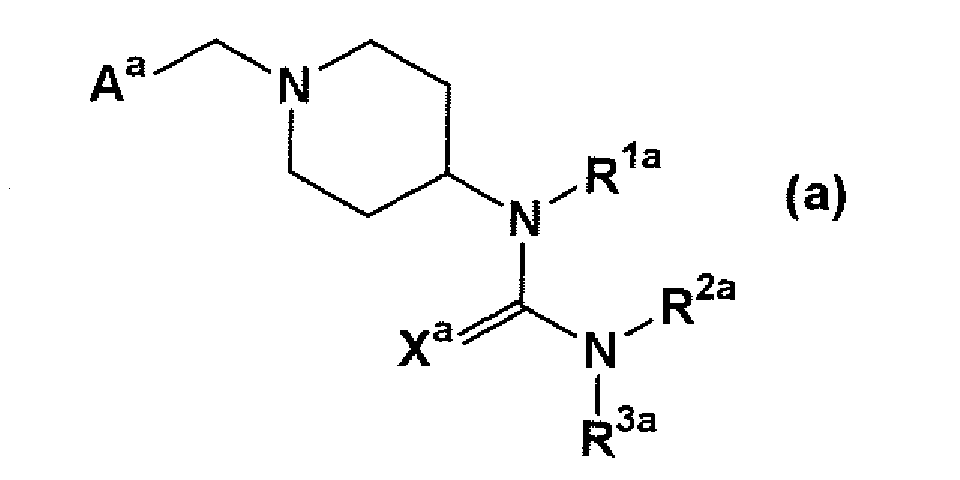
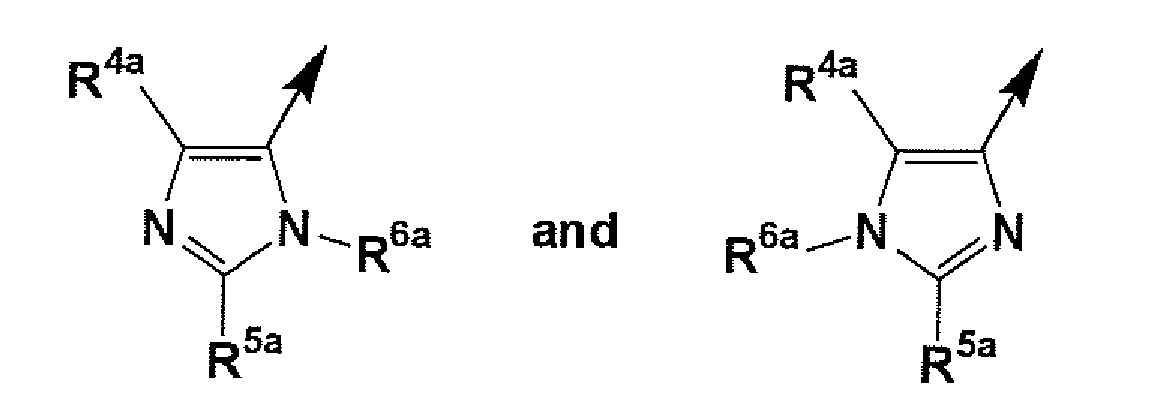
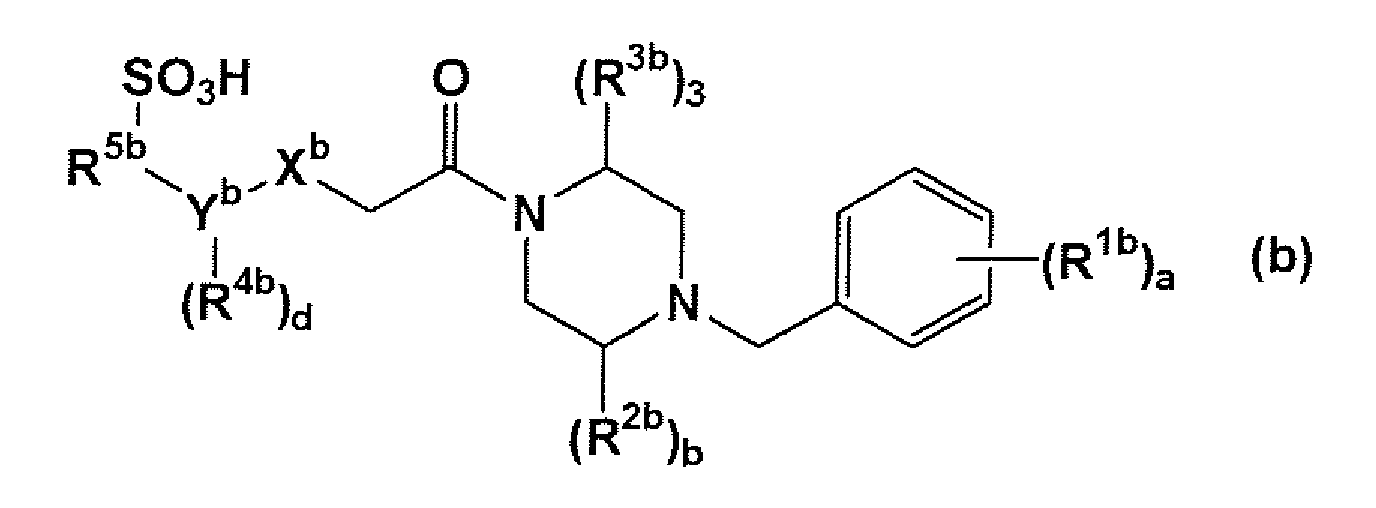


X and Y each independently represents a bond or a spacer containing 1 to 3 atoms as a main chain;
ring A and ring B, which are the same or different, each represents a 3- to 15-membered homocyclic group or heterocyclic group which may have a substituent(s);
ring D represents a 3- to 15-membered nitrogen-containing heterocyclic group which may have a substituent(s);
R2 represents (1) a hydrogen atom, (2) a hydrocarbon group which have a substituent(s), (3) a cyano group, (4) a hydroxy group which may be protected, (5) an amino group which have a substituent(s), (6) an oxo group, (7) a 3- to 15-membered heterocyclic group which have a substituent(s) or (8) =N-OR6, wherein R6 represents a hydrogen atom or C1-4 alkyl.,
a salt thereof or a solvate thereof, or a prodrug thereof,
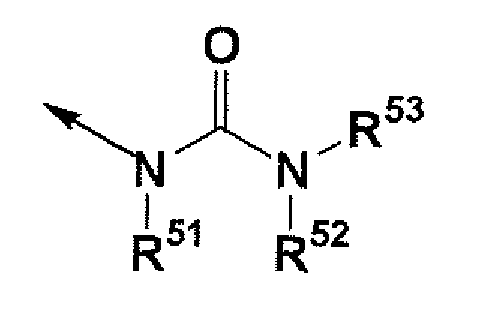
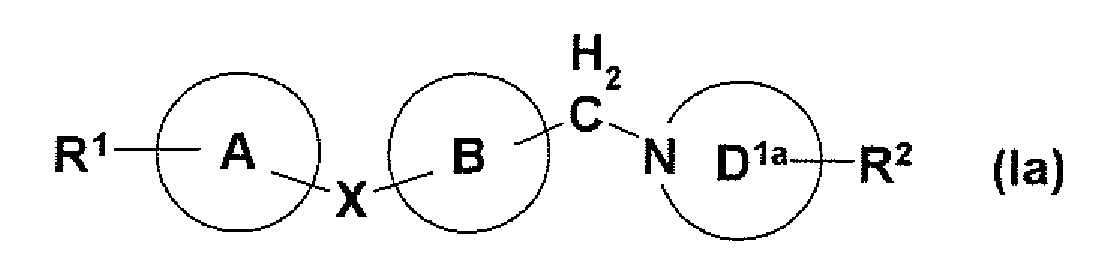
N-{4-[4-({4-[{[(4-fluorophenyl)amino]carbonyl}(1,3-thiazol-4-ylmethyl)amino]piperidin-1-yl}methyl)phenoxy]phenyl}methanesulfonamide,

X and Y each independently represents a bond or a spacer containing 1 to 3 atoms as a main chain;
ring A and ring B, which are the same or different, each represents a 3- to 15-membered homocyclic group or heterocyclic group which may have a substituent(s);
ring D represents a 3- to 15-membered nitrogen-containing heterocyclic group which may have a substituent(s);
R2 represents (1) a hydrogen atom, (2) a hydrocarbon group which have a substituent(s), (3) a cyano group, (4) a hydroxy group which may be protected, (5) an amino group which have a substituent(s), (6) an oxo group, (7) a 3- to 15-membered heterocyclic group which have a substituent(s) or (8) =N-OR6, wherein R6 represents a hydrogen atom or C1-4 alkyl,
a salt thereof or a solvate thereof, or a prodrug thereof,

X and Y each independently represents a bond or a spacer containing 1 to 3 atoms as a main chain;
ring A and ring B, which are the same or different, each independently represents a 3- to 15-membered homocyclic group or heterocyclic group which may have a substituent(s);
ring D represents a 3- to 15-membered nitrogen-containing heterocyclic group which may have a substituent(s);
R2 represents (I) a hydrogen atom, (2) a hydrocarbon group which have a substituent(s), (3) a cyano group, (4) a hydroxy group which may be protected, (5) an amino group which have a substituent(s), (6) an oxo group, (7) a 3- to 15-membered heterocyclic group which have a substituent(s) or (8) =N-OR6, wherein R6 represents a hydrogen atom or C1-4 alkyl,
a salt thereof or a solvate thereof, or a prodrug thereof
for the manufacture of an agent for prevention and/or treatment for a disease through the intervention of CCR5.


pyrrole, imidazole, triazole, tetrazole, pyrazole, pyridine, pyrazine, pyrimidine, pyridazine, triazine, furan, thiophene, oxazole, isoxazole, thiazole, isothiazole, furazan, oxadiazole or thiadiazole etc.




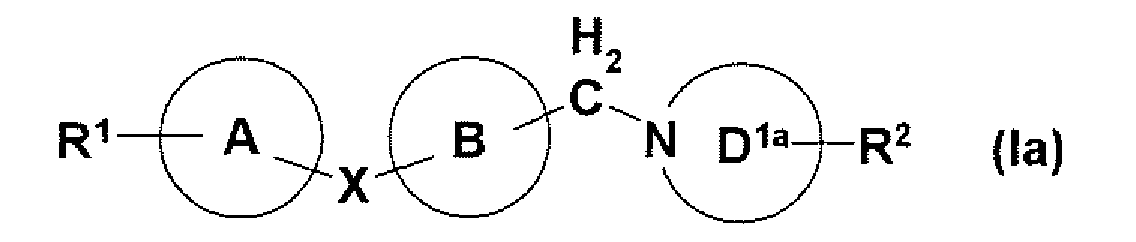


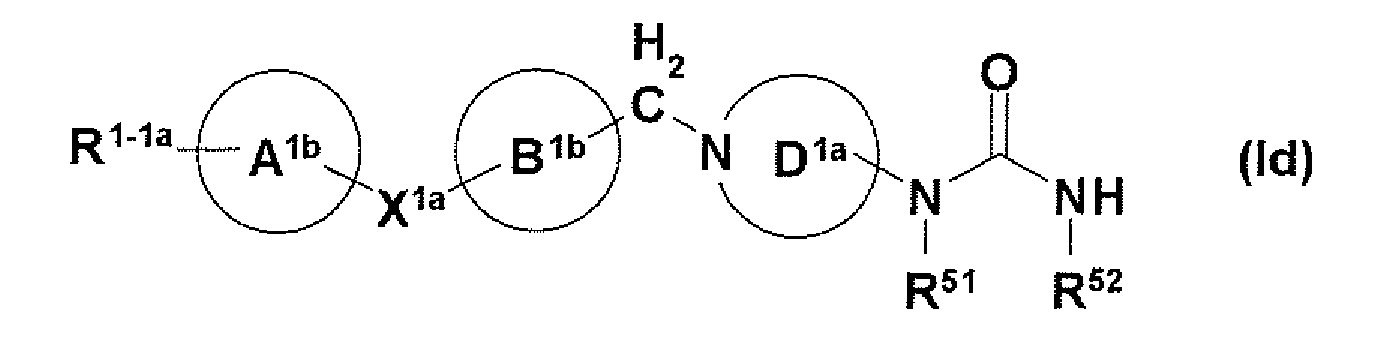
2-[3-methyl-4-(4-{4-[(methylsulfonyl)amino]phenoxy}benzyl)piperazin-1-yl]-N-phenylhexanamide,
N-{4-[4-({4-[(anilinocarbonyl)(butyl)amino]-4'-methyl-1,4'-bipiperidin-1'-yl}methyl)phenoxy]phenyl}methanesulfonamide,
N-[4-(4-{[3-[(anilinocarbonyl)(butyl)amino]-4-(3-fluorophenyl)pyrrolidin-1-yl]methyl}phenoxy)phenyl]methanesulfonamide,
N-[4-(4-{[3-(butylamino)-4-(3-fluorophenyl)pyrrolidin-1-yl]methyl}phenoxy)phenyl]methanesulfonamide,
N-butyl-N-(1-{3-ethyl-1-[4-(methylsulfonyl)benzyl]-1H-pyrazol-4-yl}piperidin-4-yl)-N'-phenylurea,
N-butyl-N-[1-({4-methyl-2-[4-(trifluoromethyl)phenyl]-1H-imidazol-5-yl}methyl)piperidin-4-yl]-N'-phenylurea,
N-{4-[4-({3-[(anilinocarbonyl)(butyl)amino]-8-azabicyclo[3.2.1]oct-8-yl}methyl)phenoxy]phenyl}methanesulfonamide,
N-[4-(4-{[4-(3-isopropyl-5-methyl-4H-1,2,4-triazol-4-yl)piperidin-1-yl]methyl}phenoxy)phenyl]methanesulfonamide,
N-[4-(4-{[4-(2-methyl-1H-benzimidazoll-yl)piperidin-1-yl]methyl}phenoxy)phenyl]methanesulfonamide,
N-[4-(4-{[4-[(anilinocarbonyl)(butyl)amino]-3,4-dihydroquinolin-1(2H)-yl]methyl}phenoxy)phenyl]methanesulfonamide,
N-[4-(4-{[4-(2-oxo-3-phenyl-6-propyltetrahydropyrimidin-1(2H)-yl)piperidin-1-yl]methyl}phenoxy)phenyl]methanesulfonamide,
N-(4-{4-[(3-butyl-2-oxo-1,2,3,3a,4,5-hexahydro-6H-pyrido[4,3,2-de]quinazolin-6-yl)methyl]phenoxy}phenyl)methanesulfonamide,
N-(4-{4-[(1-butyl-2-oxo-4-phenyloctahydropyrido[4,3-d]pyrimidin-6(2H)-yl)methyl]phenoxy}phenyl)methanesulfonamide,
N-{4-[4-({8-[(anilinocarbonyl)(butyl)amino]-3-azabicyclo[3.2.1]oct-3-yl}methyl)phenoxy]phenyl}methanesulfonamide,
N-[4-(4-{[(2Z)-1-butyl-2-(phenylimino)hexahydro-2H-pyrido[4,3-d][1,3]oxazin-6(4H)-yl]methyl}phenoxy)phenyl]methanesulfonamide or
N-[7-({4-[(anilinocarbonyl)(butyl)amino]piperidin-1-yl}methyl)-9H-xanthen-2-yl]methanesulfonamide etc.
N-[4-(4-{[4-(butyl{[(2,4-difluorophenyl)amino]carbonyl}amino)-1-piperidinyl]methyl}phenoxy)phenyl]methanesulfonamide,
N-[4-(4-{[4-(butyl{[(6-methyl-3-pyridinyl)amino]carbonyl}amino)-1-piperidinyl]methyl}phenoxy)phenyl]methanesulfonamide,
N-[4-(4-{[4-(butyl{[(2,4-difluorophenyl)amino]carbonyl}amino)piperidin-1-yl]methyl}-3,5-dimethyl-1H-pyrazol-1-yl)phenyl]methanesulfonamide,
N-[4-(4-{[4-(butyl{[(1-methyl-1H-pyrazol-4-yl)amino]carbonyl}amino)piperidin-1-yl]methyl}phenoxy)phenyl]methanesulfonamide,
3-[({butyl[1-(4-{4-[(methylsulfonyl)amino]phenoxy}benzyl)piperidin-4-yl]amino}carbonyl)amino]benzamide,
N-{4-[4-({4-[{[(4-fluorophenyl)amino]carbonyl}(phenyl)amino]piperidin-1-yl}methyl)phenoxy]phenyl}methanesulfonamide,
5-[({butyl[1-(4-{4-[(methylsulfonyl)amino]phenoxy}benzyl)piperidin-4-yl]amino}carbonyl)amino]-2-fluorobenzamide,
5-[({butyl[1-(4-{4-[(methylsulfonyl)amino]phenoxy}benzyl)piperidin-4-yl]amino}carbonyl)amino]-2,4-difluorobenzamide,
N-[4-(4-{[4-(butyl{[(3-cyano-4-fluorophenyl)amino]carbonyl}amino)piperidin-1-yl]methyl}phenoxy)phenyl]methanesulfonamide,
N-[4-(4-{[4-(butyl{[(3-hydroxycyclohexyl)amino]carbonyl}amino)piperidin-1-yl]methyl}phenoxy)phenyl]methanesulfonamide or
N-{4-[4-({4-[{[(4-fluorophenyl)amino]carbonyl}(1,3-thiazol-4-ylmethyl)amino]piperidin-1-yl}methyl)phenoxy]phenyl}methanesulfonamide,
salts thereof and solvates thereof, and prodrugs thereof.



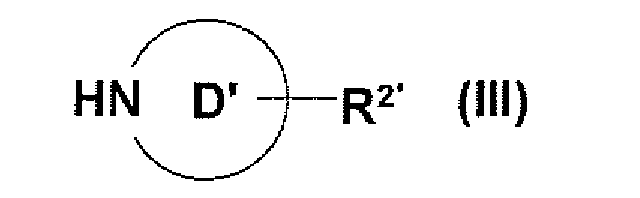

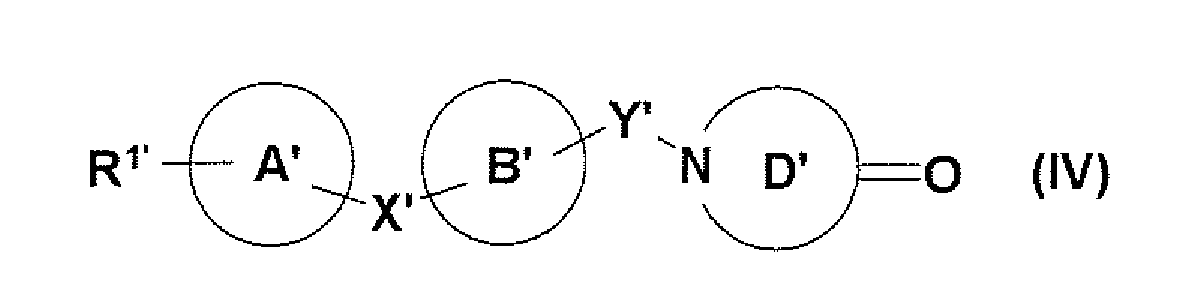
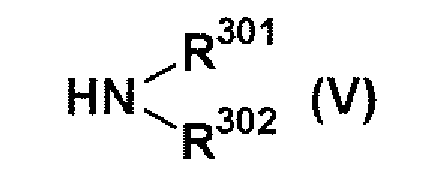

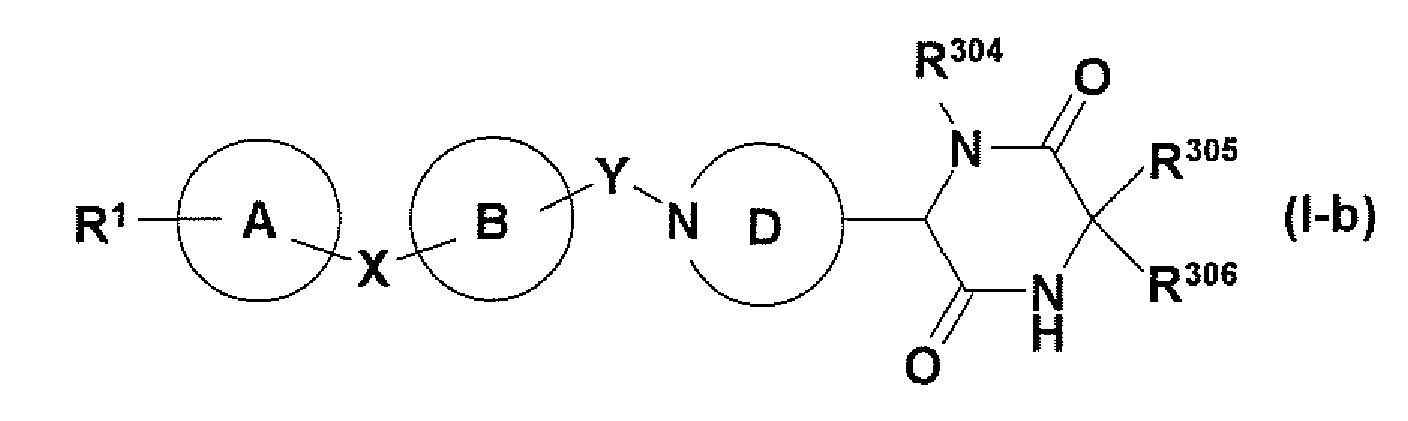
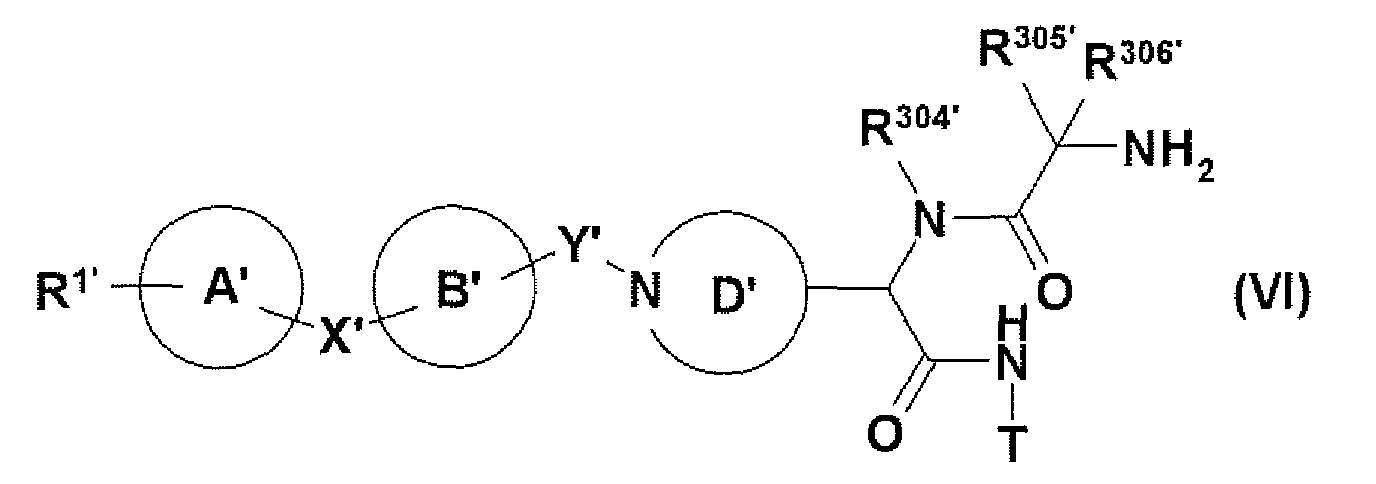


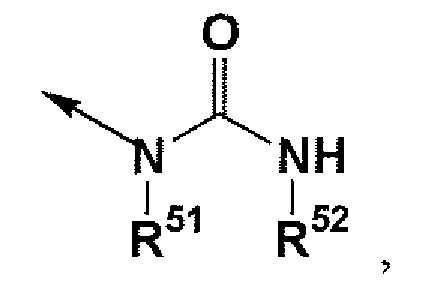



- Zidovudine:
- 100 mg capsule, 200 mg per dose, 3 times per day; 300 mg tablet, 300 mg per dose, twice per day;
- didanosine:
- 25-200 mg tablet, 125-200 mg per dose, twice per day;
- zalcitabine:
- 0.375-0.75 mg tablet, 0.75 mg per dose, 3 times per day;
- stavudine:
- 15-40 mg capsule, 30-40 mg per dose, twice per day;
- lamivudine:
- 150 mg tablet, 150 mg per dose, twice per day;
- abacavir:
- 300 mg tablet, 300 mg per dose, twice per day;
- nevirapine:
- 200 mg tablet, 200 mg per dose, once per day for 14 days and then twice per day;
- delavirdine:
- 100 mg tablet, 400 mg per dose, 3 times per day;
- efavirenz:
- 50-200 mg capsule, 600 mg per dose, once per day;
- indinavir:
- 200-400 mg capsule, 800 mg per dose, 3 times per day;
- ritonavir:
- 100 mg capsule, 600 mg per dose, twice per day;
- nelfinavir:
- 250 mg tablet, 750 mg per dose, 3 times per day;
- saquinavir:
- 200 mg capsule, 1,200 mg per dose, 3 times per day;
- amprenavir:
- 50-150 mg tablet, 1,200 mg per dose, twice per day.
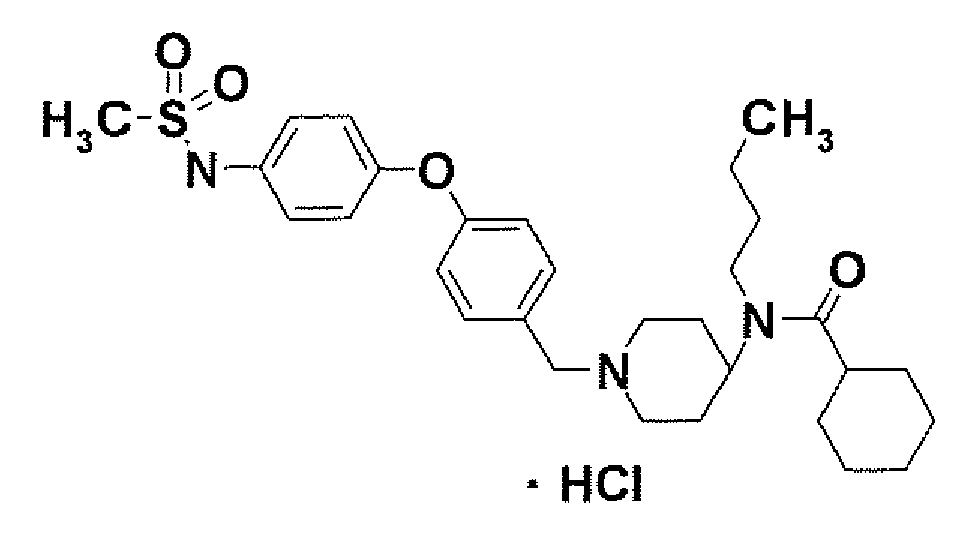
TLC:Rf 0.48(chloroform:methanol=5:1);
NMR (DMSO-d6): δ 1.29-1.42 (m, 2H), 1.63-1.73 (m, 2H), 1.95-2.05 (m, 2H), 2.59-2.68 (m, 2H), 2.95 (s, 3H), 3.38 (s, 2H), 3.43 (m, 1H), 4.51 (d, J=4.5 Hz, 1H), 6.91 (d, J=8.5 Hz, 2H), 6.99 (d, J=9.0 Hz, 2H), 7.21 (d, J=9.0 Hz, 2H), 7.25 (d, J=8.5 Hz, 2H), 9.59 (br s, 1H).

TLC:Rf 0.51(chloroform:methanol=10:1);
NMR (DMSO-d6): δ 2.33 (t, J=6.0 Hz, 4H), 2.66 (t, J=6.0 Hz, 4H), 2.95 (s, 3H), 3.57 (s, 2H), 6.94 (d, J=8.5 Hz, 2H), 7.00 (d, J=9.0 Hz, 2H), 7.22 (d, J=9.0 Hz, 2H), 7.33 (d, J=8.5 Hz, 2H), 9.59 (s, 1H).

TLC:Rf 0.22(chloroform:methanol=5:1);
NMR (CD3OD): δ 0.99 (t, J=7.5 Hz, 3H), 1.38-1.51 (m, 2H), 1.63-1.74 (m, 2H), 1.97-2,10 (m, 2H), 2.31-2.41 (m, 2H), 2.95 (s, 3H), 3.02-3.08 (m, 2H), 3.10-3.18 (m, 2H), 3.45 (m, 1H), 3.55-3.65 (m, 2H), 4.31 (s, 2H), 7.03 (d, J=9.0 Hz, 2H), 7.06 (d, J=9.0 Hz, 2H), 7.29 (d, J= 9.0 Hz, 2H), 7.53 (d, J=9.0 Hz, 2H).

TLC:Rf 0.49(chloroform:methanol=10:1);
NMR (CD3OD): δ 0.98 (t, J=7.0 Hz, 3H), 1.24-1.69 (m, 8H), 1.87-2.40 (m, 7H), 2.95 (s, 3H), 3.02-3.48 (m, 6H), 3.49-3.61 (m, 2H), 3.87-3.95 (m, 2H), 4.12 (m, 1H), 4.27-4.30 (m, 2H), 7.03 (d, J=9.0 Hz, 2H), 7.06 (d, J=8.5 Hz, 2H), 7.29 (d, J=9.0 Hz, 2H), 7.49 (d, J=8.5 Hz, 2H).
TLC:Rf 0.40(chloroform:methanol=10:1);
NMR (CD3OD): δ 0.86-1.39 (m, 9H), 1.48-2.14 (m, 9H), 2.22 (d, J=7.0 Hz, 2H), 2.27-2.39 (m, 2H), 2.95 (s, 3H), 3.02-3.25 (m, 4H), 3.49-3.61 (m, 2H), 4.13 (m, 1H), 4.27-4.29 (m, 2H), 7.03 (d, J=9.0 Hz, 2H), 7.06 (d, J=8.5 Hz, 2H), 7.29 (d, J=9.0 Hz, 2H), 7.49 (d, J=8.5 Hz, 2H).
TLC:Rf 0.28(chloroform:methanol=10:1);
NMR (CDCl3): δ 0.92 (t, J = 7.0 Hz, 3H), 1.19-1.53 (m, 6H), 1.45 (s, 9H), 1.82-1.87 (m, 2H), 2.55-2.66 (m, 3H), 2.74-2.82 (m, 2H), 4.00-4.10 (m, 2H).
TLC:Rf 0.50(hexane:ethyl acetate=2:1);
NMR (CDCl3): δ 0.87-1.01 (m, 2H), 0.95 (t, J = 7.5 Hz, 3H), 1.05-1.81 (m, 16H), 1.46 (s, 9H), 1.89 (m, 1H), 2.16 (d, J = 7.0 Hz, 2H), 2.68-2.85 (m, 2H), 3.08-3.18 (m, 2H), 4.09-4.35 (m, 2H), 4.52 (m, 1H).
TLC:Rf 0.35(chloroform:methanol=5:1);
NMR (CD3OD): δ 0.92-1.08 (m, 2H), 0.98 (t, J = 7.5 Hz, 3H), 1.15-2.36 (m, 17H), 2.23 (d, J = 7.0 Hz, 2H), 3.01-3.30 (m, 4H), 3.41-3.53 (m, 2H), 4.15 (m, 1H).

NMR (CDCl3): δ 0.87-1.01 (m, 2H), 0.93 (t, J=7.0 Hz, 3H), 1.07-2.06 (m, 15H), 2.19 (d, J=7.0 Hz, 2H), 2.49-2.84 (m, 4H), 3.02 (s, 3H), 3.17-3.27 (m, 2H), 3.49-3.59 (m, 2H), 3.81 (s, 3H), 4.10 (br s, 2H), 4.72 (m, 1H), 6.88-6.93 (m, 3H), 6.99 (d, J=8.5 Hz, 1H), 7.13 (d, J=2.5 Hz, 1H), 7.53 (d, J=8.5 Hz, 2H), 7.94 (br s, 1H), 12.14 (s, 1H).
NMR (CD3OD): δ 7.55-7.46 (m, 2H), 7.29 (d, J = 8.7 Hz, 2H), 7.10-7.00 (m, 4H), 4.33-4.25 (m, 2H), 4.19 (m, 1H), 3.62-3.48 (m, 2H), 3.30-3.02 (m, 4H), 2.95 (s, 3H), 2.48 (m, 1H), 2.35-2.08 (m, 2H), 1.98-1.63 (m, 7H), 1.63-1.18 (m, 9H), 1.03-0.88 (m, 3H).
NMR (CD3OD): δ 7.55-7.46 (m, 2H), 7.29 (d, J = 9.0 Hz, 2H), 7.10-7.00 (m, 4H), 4.32-4.24 (m, 2H), 4.16 (m, 1H), 3.63-3.48 (m, 2H), 3.30-3.01 (m, 4H), 2.95 (s, 3H), 2.40-2.08 (m, 4H), 2.00-1.60 (m, 8H), 1.60-1.10 (m, 7H), 1.10-0.90 (m, 5H).
NMR (CD3OD): δ 7.56-7.46 (m, 2H), 7.29 (d, J = 9.0 Hz, 2H), 7.10-7.00 (m, 4H), 4.32-4.23 (m, 2H), 4.16 (m, 1H), 3.62-3.47 (m, 2H), 3.30-3.00 (m, 4H), 2.95 (s, 3H), 2.50-2.03 (m, 4H), 2.02-1.84 (m, 2H), 1.82-1.60 (m, 5H), 1.60-1.10 (m, 10H), 1.05-0.83 (m, 5H).
NMR (CD3OD): δ 0.91-1.06 (m, 2H), 0.98 (t, J=7.5 Hz, 3H), 1.14-1.83 (m, 13H), 1.89-1.97 (m, 2H), 2.23 (d, J=6.5 Hz, 2H), 2.32-2.40 (m, 2H), 2.36 (s, 3H), 2.39 (s, 3H), 3.04 (s, 3H), 3.12-3.29 (m, 4H), 3.61-3.71 (m, 2H), 4.25 (s, 2H), 4.27 (m, 1H), 7.41 (d, J=9.0 Hz, 2H), 7.46 (d, J=9.0 Hz, 2H).
NMR (CD3OD): δ 0.91-1.04 (m, 2H), 0.98 (t, J=7.0 Hz, 3H), 1.12-1.99 (m, 15H), 2.22 (d, J=6.5 Hz, 2H), 2.25-2.36 (m, 2H), 2.97-3.30 (m, 4H), 3.46-3.60 (m, 2H), 4.10 (m, 1H), 4.29 (s, 2H), 7.13 (d, J=9.0 Hz, 2H), 7.17 (d, J=8.5 Hz, 2H), 7.55 (d, J=8.5 Hz, 2H), 7.90 (d, J=9.0 Hz, 2H).
NMR (CD3OD): δ 0.87-1.05 (m, 2H), 0.96 (t, J=7.0 Hz, 3H), 1.13-2.14 (m, 15H), 2.21 (d, J=7.0 Hz, 2H), 2.25-2.38 (m, 2H), 2.99 (s, 3H), 3.08-3.28 (m, 4H), 3.54-3.65 (m, 2H), 4.15 (m, 1H), 4.37-4.39 (m, 2H), 7.36 (d, J=9.0 Hz, 2H), 7.47 (d, J=7.5 Hz, 1H), 7.57 (t, J=7.5 Hz, 1H), 7.67 (d, J=9.0 Hz, 2H), 7.74-7.82 (m, 2H).
NMR (CD3OD): δ 0.94 (t, J=7.0 Hz, 3H), 0.98-1.08 (m, 2H), 1.18-1.41 (m, 7H), 1.53-1.80 (m, 8H), 2.24-2.49 (m, 4H), 2.96 (s, 3H), 3.05-3.21 (m, 6H), 3.70-3.81 (m, 3H), 4.32 (d, J=13.0 Hz, 1H), 4.53 (d, J=13.0 Hz, 1H), 7.04 (d, J=9.0 Hz, 2H), 7.08 (d, J=8.5 Hz, 2H), 7.30 (d, J=9.0 Hz, 2H), 7.56 (d, J=8.5 Hz, 2H).
NMR (CD3OD): δ 0.84-1.06 (m, 2H), 1.13-1.41 (m, 4H), 1.55-2.14 (m, 11H), 2.59 (m, 1H), 2.95 (s, 3H), 2.97-3.09 (m, 2H), 3.50-3.59 (m, 2H), 4.29 (s, 2H), 4.39 (dd, J=9.5, 5.5 Hz, 1H), 7.03 (d, J=9.0 Hz, 2H), 7.06 (d, J=9.0 Hz, 2H), 7.29 (d, J=9.0 Hz, 2H), 7.49 (d, J=9.0 Hz, 2H).
NMR (CD3OD): δ 7.49 (brd, J = 8.7 Hz, 2H), 7.29 (brd, J = 9.0 Hz, 2H), 7.07 (brd, J = 8.7 Hz, 2H), 7.03 (brd, J = 9.0 Hz, 2H), 4.44 (m, 1H), 4.29 (s, 2H), 4.04 (d, J = 16.8 Hz, 1H), 3.96 (t, J = 6.6 Hz, 1H), 3.83 (d, J = 16.8 Hz, 1H), 3.64-3.52 (m, 2H), 3.15 (m, 2H), 2.95 (s, 3H), 2.20-1.60 (m, 10H), 1.49 (m, 1H), 1.39-1.10 (m, 4H), 1.09-0.80 (m, 2H).
NMR (CD3OD): δ 7.50 (d, J = 8.7 Hz, 2H), 7.29 (d, J = 8.7 Hz, 2H), 7.05 (d, J = 8.7 Hz, 2H), 7.03 (d, J = 8.7 Hz, 2H), 4.50 (m, 1H), 4.26 (m, 1H), 4.23 (s, 2H), 4.14 (m, 1H), 3.82-3.76 (m, 2H), 3.53-3.33 (m, 4H), 3.09-3.01 (m, 2H), 2.95 (s, 3H), 2.65 (m, 1H), 2.19-1.88 (m, 4H), 1.79-1.70 (m, 5H), 1.49-1.21 (m, 5H).
NMR (CDCl3): δ 0.87-1.00 (m, 2H), 0.94 (t, J=7.5 Hz, 3H), 1.08-1.93 (m, 16H), 2.11 (d, J=7.0 Hz, 2H), 2.25 (m, 1H), 2.45-2.64 (m, 2H), 3.02 (s, 3H), 3.18-3.37 (m, 4H), 3.80 (s, 3H), 3.86-4.00 (m, 2H), 4.20 (dd, J=13.0, 4.0 Hz, 1H), 6.87-6.92 (m, 3H), 6.99 (d, J=8.5 Hz, 1H), 7.13 (d, J=2.5 Hz, 1H), 7.55 (d, J=8.5 Hz, 2H), 7.83 (br s, 1H), 11.87 (s, 1H).
NMR (CD3OD): δ 0.89-1.06 (m, 2H), 0.96 (t, J=7.0 Hz, 3H), 1.12-2.09 (m, 15H), 2.21 (d, J=7.0 Hz, 2H), 2.22-2.32 (m, 2H), 2.36 (s, 3H), 2.97-3.27 (m, 4H), 3.41-3.54 (m, 2H), 4.11 (m, 1H), 4.18-4.20 (m, 2H), 7.21 (d, J=8.5 Hz, 2H), 7.29 (d, J=8.5 Hz, 2H), 7.36 (d, J=8.5 Hz, 2H), 7.69 (d, J=8.5 Hz, 2H).
NMR (CD3OD): δ 0.77-1.39 (m, 13H), 1.47-1.96 (m, 16H), 2.05 (d, J=7.0 Hz, 2H), 2.22 (d, J=7.0 Hz, 2H), 2.24-2.41 (m, 2H), 3.04-3.26 (m, 4H), 3.48 (s, 3H), 3.51-3.65 (m, 2H), 4.13 (m, 1H), 4.31-4.33 (m, 2H), 7.13 (d, J=9,0 Hz, 2H), 7.18 (d, J=8.5 Hz, 2H), 7.38 (d, J=9.0 Hz, 2H), 7.56 (d, J=8.5 Hz, 2H).
NMR (DMSO-d6): δ 1.83-2.15 (m, 4H), 2.94-3.09 (m, 2H), 3.39-3.50 (m, 2H), 3.65 (s, 1H), 4.31 (br s, 2H), 7.09 (d, J=9.0 Hz, 2H), 7.19 (d, J=8.5 Hz, 2H), 7.65 (d, J=8.5 Hz, 2H), 7.76 (d, J=8.5 Hz, 2H), 7.93 (d, J=8.5 Hz, 2H), 7.97 (d, J=9.0 Hz, 2H), 10.52 (br s, 1H), 12.86 (br s, 1H).
NMR (CD3OD): δ 8.04 (brd, J = 8.7 Hz, 2H), 7.59 (brd, J = 8.1 Hz, 2H), 7.17 (brd, J = 8.1 Hz, 2H), 7.07 (brd, J = 8.7 Hz, 2H), 4.46 (m, 1H), 4.34 (s, 2H), 4.05 (d, J = 17.1 Hz, 1H), 3.97 (dd, J = 6.6, 5.4 Hz, 1H), 3.85 (d, J = 17.1 Hz, 1H), 3.68-3.53 (m, 2H), 3.17 (m, 2H), 2.24-2.04 (m, 2H), 1.94 (m, 1H), 1.84-1.56 (m, 7H), 1.48 (m, 1H), 1.38-1.08 (m, 4H), 1.08-0.80 (m, 2H).
NMR (CD3OD): δ 7.86-7.81 (m, 2H), 7.33(d, J = 8.0 Hz, 2H), 7.23(d, J = 8.0 Hz, 2H), 7.14(s, 1H), 7.06-7.01 (m, 3H), 4.78(s, 2H), 4.26(s, 2H), 3.88(s, 3H), 3.85(s, 3H), 3.58-3.54 (m, 2H), 3.10-3.00 (m, 2H), 2.90(m, 1H), 2.10-1.90 (m, 4H).
NMR (CD3OD): δ 7.50-7.37 (m, 4H), 7.18(t, J = 7.2 Hz, 1H), 7.07-7.02(m, 4H), 4.27(s, 2H), 4.15(m, 1H), 3.60-3.50 (m, 2H), 3.30-3.00 (m, 4H), 2.20-2.00 (m, 4H), 2.00-1.80 (m, 2H), 1.80-1.40 (m, 8H), 1.40-1.10 (m, 5H), 1.00-0.90 (m, 2H), 0.97(t, J = 7.4 Hz, 3H).
NMR (CD3OD): δ 8.04(d, J = 8.3 Hz, 2H), 7.56(d, J = 8.3 Hz, 2H), 7.17(d, J = 8.3 Hz, 2H), 7.07(d, J = 8.3 Hz, 2H), 4.31(s, 2H), 4.16(m, 1H), 3.60-3.50 (m, 2H), 3.30-3.00 (m, 4H), 2.20-2.00 (m, 4H), 2.00-1.80 (m, 2H), 1.80-1.40 (m, 8H), 1.40-1.10 (m, 5H), 1.00-0.90 (m, 2H), 0.97(t, J = 7.0 Hz, 3H).
NMR (CD3OD): δ 7.58-7.45(m, 5H), 4.24(s, 2H), 4.15(m, 1H), 3.60-3.50 (m, 2H), 3.30-3.00 (m, 4H), 2.37(s, 3H), 2.36(s, 3H), 2.40-2.10 (m, 4H), 2.00-1.80 (m, 2H), 1.80-1.40 (m, 8H), 1.40-1.10 (m, 5H), 1.00-0.90 (m, 2H), 0.98(t, J = 7.4 Hz, 3H).
NMR (CD3OD): δ 7.26(d, J = 9.0 Hz, 2H), 6.92(d, J = 9.0 Hz, 2H), 4.24(s, 2H), 4.15(m, 1H), 3.70-3.60 (m, 2H), 3.30-3.00 (m, 4H), 2.37(s, 3H), 2.32(s, 3H), 2.40-2.20 (m, 4H), 2.00-1.80 (m, 2H), 1.80-1.40 (m, 8H), 1.40-1.10 (m, 5H), 1.00-0.90 (m, 2H), 0.98(t, J = 7.4 Hz, 3H).
NMR (CD3OD): δ 1.21-1.49 (m, 6H), 1.70-1.98 (m, 10H), 2.20-2.35 (m, 2H), 2.60-2.70 (m, 2H), 2.95 (s, 3H), 2.95-3.23 (m, 4H), 3.55-3.80 (m, 4H), 4.28 (s, 2H), 7.03 (d, J = 8.5 Hz, 2H), 7.06 (d, J = 8.5 Hz, 2H), 7.29 (d, J = 8.5 Hz, 2H), 7.49 (d, J = 8.5 Hz, 2H).
NMR (CD3OD): δ 1.15-1.49 (m, 6H), 1.60-1.98 (m, 10H), 2.35-2.88 (m, 6H), 2.95 (s, 3H), 3.08-3.72 (m, 4H), 3.89 (d, J = 9.5 Hz, 1H), 4.04 (s, 2H), 4.62 (d, J = 22.5 Hz, 1H), 7.01 (d, J = 8.7 Hz, 2H), 7.02 (d, J = 8.7 Hz, 2H), 7.28 (d, J = 8.7 Hz, 2H), 7.42 (d, J = 8.7 Hz, 2H).
NMR (CD3OD): δ 0.89-1.00 (m, 2H), 1.21-1.29 (m, 3H), 1.68-1.71 (m, 8H), 2.03 (d, J = 6.9 Hz, 2H), 2.11-2.16 (m, 2H), 2.95 (s, 3H), 3.06-3.14 (m, 2H), 3.49-3.53 (m, 2H), 3.90 (m, 1H), 4.27 (s, 2H), 7.03 (d, J = 8.7 Hz, 2H), 7.06 (d, J = 8.7 Hz, 2H), 7.29 (d, J = 8.7 Hz, 2H), 7.47 (d, J = 8.7 Hz, 2H).
NMR (CD3OD): δ 0.90-1.00 (m, 2H), 1.13-1.29 (m, 3H), 1.67-1.78 (m, 8H), 2.03 (d, J = 6.9 Hz, 2H), 2.12-2.15 (m, 2H), 3.05-3.13 (m, 2H), 3.49-3.53 (m, 2H), 3.90 (m, 1H), 4.27 (s, 2H), 7.02-7.08 (m, 4H), 7.18 (m, 1H), 7.37-7.42 (m, 2H), 7.46-7.50 (m, 2H).
NMR (CD3OD): δ 0.91-1.02 (m, 2H), 1.14-1.34 (m, 3H), 1.69-1.85 (m, 8H), 2.05 (d, J = 6.9 Hz, 2H), 2.13-2.19 (m, 2H), 2.36 (s, 3H), 2.38 (s, 3H), 3.14-3.24 (m, 2H), 3.61-3.66 (m, 2H), 3.93 (m, 1H), 4.25 (s, 2H), 7.45-7.60 (m, 5H).
NMR (CD3OD): δ 0.80-2.36 (m, 24H), 2.95 (s, 3H), 3.04 (m, 1H), 3.46-3.69 (m, 3H), 3,78-4,12 (m, 3H), 4.26 (brs, 2H), 7.00-7.18 (m, 4H), 7.26-7.34 (m, 2H), 7.40-7.48 (m, 2H).
NMR (CD3OD): δ 0.80-2.32 (m, 21H), 2.95 (s, 3H), 2.84-3.02 (m, 3H), 3.40-3.60 (m, 4H), 3.80-4.14 (m, 3H), 4.26 (brs, 2H), 7.00-7.14 (m, 4H), 7.21-7.32 (m, 2H), 7.41-7.52 (m, 2H).
NMR (CD3OD): δ 0.96 (m, 1H), 1.12-1.36 (m, 3H), 1.44-2.38 (m, 14H), 2.95 (s, 3H), 2.98 (m, 2H), 3.36 (brs, 3H), 3.42-3.60 (m, 2H), 3.86-4.34 (m, 2H), 4.25 (brs, 2H), 6.98-7.08 (m, 4H), 7.24-7.30 (m, 2H), 7.40-7.52 (m, 2H).
NMR (CD3OD): δ 0.80-2.40 (m, 18H), 2.95 (s, 3H), 3.44-3.56 (m, 3H), 3.79 (m, 1H), 4.02-4.30 (m, 4H), 5.22 (m, 2H), 7.00-7.08 (m, 4H), 7.24-7.40 (m, 6H), 7.40-7.50 (m, 3H).
NMR (CD3OD): δ 0.80-2.38 (m, 24H), 3.03 (m, 2H), 3.46-3.70 (m, 3H), 3.76-4.10 (m, 2H), 4.26 (brs, 2H), 7.00-7.06 (m, 4H), 7.19 (m, 1H), 7.36-7.58 (m, 4H).
NMR (CD3OD): δ 0.80-1.10 (m, 2H), 1.12-2.10 (m, 16H), 2.16-2.62 (m, 2H), 2.98-4.14 (m, 11H), 4.26 (brs, 2H), 7.00-7.10 (m, 4H), 7.18 (m, 1H), 7.30-7.54 (m, 4H).
NMR (CD3OD): δ 0.84-2.40 (m, 18H), 2.76-3.04 (m, 2H), 3.42-3.60 (m, 2H), 3.78 (m, 1H), 4.10 (m, 1H), 4.16-4.34 (m, 3H), 5.20 (m, 1H), 6.98-7.14 (m, 4H), 7.19 (m, 1H), 7.20-7.52 (m, 9H).
NMR (CD3OD): δ 0.84-2.36 (m, 24H), 2.36 (brs, 3H), 2.38 (brs, 3H), 3.04-3.24 (m, 2H), 3.60-4.10 (m, 5H), 4.25 (brs, 2H), 7.40-7.60 (m, 5H).
NMR (CD3OD): δ 0.84-2.40 (m, 18H), 2.35 (m, 6H), 3.00 (brs, 3H), 3.09 (m, 2H), 3.56-3.70 (m, 2H), 3.82-4.12 (m, 2H), 4.24 (brs, 2H), 7.40-7.60 (m, 5H).
NMR (CD3OD): δ 0.80-2.40 (m, 18H), 2.35 (brs, 3H), 2.38 (brs, 3H), 3.00-3.20 (m, 3H), 3.33 (s, 3H), 3.49-3.72 (m, 4H), 3.88-4.16 (m, 3H), 4.25 (brs, 2H), 7.40-7.62 (m, 5H).
NMR (CD3OD): δ 0.92 (t, J = 7.2 Hz, 3H), 1.28-1.52 (m, 4H), 1.82-2.05 (m, 4H), 2.49 (m, 1H), 2.98-3.07 (m, 2H), 3.16 (t, J = 7.0 Hz, 2H), 3.52-3.56 (m, 2H), 4.28 (s, 2H), 7.02-7.06 (m, 4H), 7.18 (t, J = 7.5 Hz, 1H), 7,37-7.42 (m, 2H), 7.48 (d, J = 8.7 Hz, 2H).
NMR (CD3OD): δ 0.86-0.97 (m, 2H), 1.15-1.28 (m, 4H), 1.46 (m, 1H), 1.60-1.78 (m, 4H), 1.89-2.05 (m, 4H), 2.52 (m, 1H), 3.00 (d, J = 7.2 Hz, 2H), 3.00-3.07 (m, 2H), 3.51-3.56 (m, 2H), 4.29 (s, 2H), 7.01-7.06 (m, 4H), 7.18 (m, 1H), 7.37-7.42 (m, 2H), 7.49 (d, J = 8.7 Hz, 2H).
NMR (CD3OD): δ 0.89-1.00 (m, 5H), 1.18-1.71 (m, 13H), 1.92-2.00 (m, 5H), 2.92-3.55 (m, 6H), 3.51-3.55 (m, 2H), 4.28 (s, 2H), 7.02-7.07 (m, 4H), 7.18 (t, J = 7.2 Hz, 1H), 7.37-7.42 (m, 2H), 7.47 (d, J = 8.4 Hz, 2H).
NMR (CD3OD): δ 1.90-2.10 (m, 4H), 3.00-3.60 (m, 12H), 4.30 (s, 2H), 4.39 (s, 2H), 4.63 (m, 1H), 7.02-7.06 (m, 4H), 7.18 (t, J = 7.0 Hz, 1H), 7.37-7.42 (m, 2H), 7,48-7.58 (m, 7H).
NMR (CD3OD): δ 1.02-1.43 (m, 5H), 1.70-2.01 (m, 10H), 3.03(d, J = 6.6 Hz, 2H), 3.03-3.69 (m, 12H), 4.31 (s, 2H), 4.59 (m, 1H), 7.02-7.07 (m, 4H), 7.18 (t, J = 7.5 Hz, 1H), 7.37-7.42 (m, 2H), 7.50 (d, J = 8.7 Hz, 2H).
NMR (CD3OD): δ 0.92 (t, J = 7.2 Hz, 3H), 1.30-1.52 (m, 4H), 1.84-2.04 (m, 4H), 2.48 (m, 1H), 2.95 (s, 3H), 2.95-3.07 (m, 2H), 3.16 (t, J = 7.2 Hz, 2H), 3.51-3.56 (m, 2H), 4.28 (s, 2H), 7.02-7.08 (m, 4H), 7.29 (d, J = 9.0 Hz, 2H), 7.47 (d, J = 8.7 Hz, 2H).
NMR (CD3OD): δ 0.85-1.00 (m, 2H), 1.15-1.46 (m, 5H), 1.65-2.13 (m, 8H), 2.49 (m, 1H), 2.95 (s, 3H), 3.00 (d, J = 7.0 Hz, 2H), 3.00-3.06 (m, 2H), 3.52-3.56 (m, 2H), 4.28 (s, 2H), 7.02-7.08 (m, 4H), 7.29 (d, J = 8.7 Hz, 2H), 7.47 (d, J = 8.4 Hz, 2H).
NMR (CD3OD): δ 0.89-1.00 (m, 5H), 1.21-2.00 (m, 18H), 2.95 (s, 3H), 3.00-3.36 (m, 6H), 3.51-3.54 (m, 2H), 4.27 (s, 2H), 7.02-7.08 (m, 4H), 7.29 (d, J = 9.0 Hz, 2H), 7.47 (d, J = 8.1 Hz, 2H).
NMR (CD3OD): δ 1.90-2.10 (m, 4H), 2.95 (s, 3H), 3.05-3.56 (m, 12H), 4.30 (s, 2H), 4.39 (s, 2H), 4.63 (m, 1H), 7.02-7.08 (m, 4H), 7.29 (d, J = 9.0 Hz, 2H), 7.47-7.55 (m, 7H).
NMR (CD3OD): δ 1.05-1.43 (m, 5H), 1.70-2.01 (m, 10H), 2.95 (s, 3H), 3.03 (d, J =6.9 Hz, 2H), 3.03-3.63 (m, 12H), 4.31 (s, 2H), 4.59 (m, 1H), 7.02-7.08 (m, 4H), 7.29 (d, J =9.0 Hz, 2H), 7.49 (d, J = 8.7 Hz, 2H).
NMR (CD3OD): δ 1.01-1.11 (m, 2H), 1.19-1.41 (m, 4H), 1.66-2.02 (m, 8H), 2.19-2.31 (m, 2H), 2.97-3.37 (m, 8H), 3.45-3.64 (m, 3H), 3.80 (m, 1H), 4.29 (s, 2H), 4.35 (s, 1H), 7.01-7.06 (m, 4H), 7.18 (t, J=8.0 Hz, 1H), 7.39 (t, J=8.0 Hz, 2H), 7.52 (d, J=9.0 Hz, 2H).
NMR (CD3OD): δ 1.86-2.03 (m, 2H), 2.15-2.27 (m, 2H), 2.86-3.62 (m, 11H), 4.13-4.35 (m, 4H), 4.57 (d, J=12.5 Hz, 1H), 7.01-7.06 (m, 4H), 7.18 (t, J=7.5 Hz, 1H), 7.39 (t, J=8.0 Hz, 2H), 7.45-7.56 (m, 7H).
NMR (CD3OD): δ 1.22-1.57 (m, 5H), 1.67-1.85 (m, 5H), 2.06-2.78 (m, 5H), 2.96-3.23 (m, 4H), 3.46-3.70 (m, 5H), 4.08 (m, 1H), 4.31 (m, 1H), 4.33 (s, 2H), 5.53 (s, 1H), 7.02-7.07 (m, 4H), 7.18 (t, J=7.5 Hz, 1H), 7.36-7.42 (m, 2H), 7.54 (d, J=8.5 Hz, 2H).
NMR (CD3OD): δ 1.92-2.41 (m, 4H), 2.87-3.95 (m, 11H), 4.31 (s, 2H), 5.53 (s, 1H), 7.02-7.07 (m, 4H), 7.18 (t, J=7.5 Hz, 1H), 7.36-7.42 (m, 2H), 7.45-7.54 (m, 7H).
NMR (CD3OD): δ 0.97-1.13 (m, 2H), 1.24-1.44 (m, 3H), 1.55 (d, J=6.5 Hz, 3H), 1.65-1.95 (m, 6H), 2.08-2.47 (m, 4H), 3.10-3.28 (m, 4H), 3.40-4.21 (m, 10H), 4.33 (s, 2H), 7.02-7.07 (m, 4H), 7.18 (t, J=7.5 Hz, 1H), 7.37-7.42 (m, 2H), 7.53 (d, J=8.5 Hz, 2H).
NMR (CD3OD): δ 1.48 (d, J=6.5 Hz, 3H), 2.01-2.38 (m, 4H), 3.12-3.25 (m, 2H), 3.38-3.72 (m, 8H), 3.92 (br s, 2H), 4.31 (s, 2H), 4.41 (d, J=13.0 Hz, 1H), 4.47 (d, J=13.0 Hz, 1H), 7.01-7.06 (m, 4H), 7.18 (t, J=7.5 Hz, 1H), 7.36-7.42 (m, 2H), 7.49-7.53 (m, 5H), 7.58-7.62 (m, 2H).
NMR (CD3OD): δ 1.16-1.57 (m, 8H), 1.66-1.84 (m, 5H), 2.05-2.75 (m, 5H), 3.00-4.73 (m, 12H), 4.33 (s, 2H), 7.01-7.07 (m, 4H), 7.18 (t, J=7.5 Hz, 1H), 7.36-7.42 (m, 2H), 7.53 (d, J=8.5 Hz, 2H).
NMR (CD3OD): δ 1.29-1.55 (br, 3 H, -Me), 2.07-2.54 (m, 4H), 3.09-4.17 (m, 12H), 4.33 (s, 2H), 7.01-7.07 (m, 4H), 7.18 (t, J=7.5 Hz, 1H), 7.36-7.42 (m, 2H), 7.46-7.55 (m, 7H).
TLC:Rf 0.60(chloroform:methanol=9:1);
NMR (CDCl3): δ 7.32 (brd, J = 8.4 Hz, 2H), 7.22 (brd, J = 8.7 Hz, 2H), 7.01 (brd, J = 8.7 Hz, 2H), 6.96 (brd, J = 8.4 Hz, 2H), 3.72 (s, 2H), 3.51 (t, J = 7.2 Hz, 4H), 3.00 (s, 3H), 2.93 (t, J = 7.2 Hz, 4H).
TLC:Rf 0.67(chloroform:methanol=9:1);
NMR (CDCl3): δ 7.32-7.24 (m, 2H), 7.20 (brd, J = 9.0 Hz, 2H), 6.98 (brd, J = 9.0 Hz, 2H), 6.94 (brd, J = 9.0 Hz, 2H), 3.72 (s, 2H), 3.69 (s, 3H), 3.15 (dd, J = 4.8, 3.6 Hz, 1H), 3.00 (s, 3H), 2.70-2.36 (m, 8H), 1.80-1.18 (m, 6H), 0.89 (t, J = 5.4 Hz, 3H).

TLC:Rf 0.55 (chloroform:methanol=5:1);
NMR (CD3OD): δ 7.53 (brd, J = 8.7 Hz, 2H), 7.29 (brd, J = 9.0 Hz, 2H), 7.06 (brd, J = 8.7 Hz, 2H), 7.03 (brd, J = 9.0 Hz, 2H), 4.37 (s, 2H), 3.75 (brt, J = 6.3 Hz, 1H), 3.56-3.34 (m, 8H), 2.95 (s, 3H), 1.92-1.80 (m, 2H), 1.48-1.32 (m, 4H), 1.00-0.86 (m, 3H).
TLC:Rf 0.75(chloroform:methanol=5:1);
NMR (CD3OD): δ 7.49 (brd, J = 8.7 Hz, 2H), 7.29 (brd, J = 9.0 Hz, 2H), 7.05 (brd, J = 9.0 Hz, 2H), 7.02 (brd, J = 8.7 Hz, 2H), 4.30 (s, 2H), 3.68 (m, 1H), 3.50-3.00 (m, 8H), 2.95 (s, 3H), 1.90-1.58 (m, 8H), 1.44-1.12 (m, 9H), 0.92 (brt, J = 7.5 Hz, 3H).
NMR (CD3OD): δ 7.53 (brd, J = 8.7 Hz, 2H), 7.29 (brd, J = 9.0 Hz, 2H), 7.06 (brd, J = 9.0 Hz, 2H), 7.03 (brd, J = 8.7 Hz, 2H), 4.37 (s, 2H), 3.61 (m, 1H), 3.60-3.28 (m, 8H), 3.15 (dd, J = 7.5, 15.0 Hz, 1H), 2.99 (dd, J = 7.5, 15.0 Hz, 1H), 2.95 (s, 3H), 1.90-1.62 (m, 6H), 1.5 8-1.16 (m, 9H), 1.04-0.88 (m, 2H), 0.93 (t, J = 7.2 Hz, 3H).
NMR (CD3OD): δ 7.52 (brd, J = 6.6 Hz, 2H), 7.29 (brd, J = 8.4 Hz, 2H), 7.14-7.01 (m, 4H), 4.36 (brs, J = 2H), 3.69 (m, 1H), 3.64-3.24 (m, 9H), 2.95 (s, 3H), 1.92-1.70 (m, 6H), 1.65 (m, 1H), 1.46-1.14 (m, 7H), 0.97 (t, J = 7.5 Hz, 3H).
NMR (CD3OD): δ 7.90 (brd, J = 9.3 Hz, 2H), 7.63 (brd, J = 11.4 Hz, 2H), 7.18 (brd, J = 11.4 Hz, 2H), 7.13 (brd, J = 9.3 Hz, 2H), 4.45 (s, 2H), 3.80-3.42 (m, 9H), 1.96-1.56 (m, 7H), 1.46-1.18 (m, 10H), 0.93 (t, J = 7.2 Hz, 3H).
TLC:Rf 0.18(dichloromethane:methanol=5:1).
TLC:Rf 0.49(dichloromethane:methanol=10:1);
NMR (CD3OD): δ 7.35 (d, J = 9.0 Hz, 2H), 7.25 (d, J = 9.0 Hz, 2H), 6.98 (d, J = 9.0 Hz, 2H), 6.96 (d, J = 9.0 Hz, 2H), 3.69 (s, 2H), 3.01-2.99 (m, 2H), 2.93 (s, 3H), 2.88-2.85 (m, 2H), 2.53-2.44 (m, 2H), 2.16-2.02 (m, 4H), 1.75-1.64 (m, 6H), 1.43 (s, 9H), 1.28-1.18 (m, 3H), 0.96-0.89 (m, 2H).
TLC:Rf 0.35(methylene chloride: methanol= 10:1).

NMR (CD3OD): δ 7.52 (d, J = 9.0 Hz, 2H), 7.29 (d, J = 9.0 Hz, 2H), 7.06 (d, J = 9.0 Hz, 2H), 7.03 (d, J = 9.0 Hz, 2H), 4.34 (s, 2H), 3.70-3.56 (m, 3H), 3.20-2.79 (m, 7H), 2.95 (s, 3H), 2.46-2.30 (m, 2H), 1.73-1.58 (m, 8H), 1.46-1.38 (m, 2H), 1.28-1.15 (m, 3H), 1.05-0.95 (m, 2H), 0.97 (t, J = 7.2 Hz, 3H).
NMR (CD3OD): δ 7.54 (d, J = 8.7 Hz, 2H), 7.29 (d, J = 8.7 Hz, 2H), 7.05 (d, J = 8.7 Hz, 2H), 7.03 (d, J = 8.7 Hz, 2H), 4.33 (s, 2H), 3.67-3.63 (m, 2H), 3.37-3.00 (m, 8H), 2.95 (s, 3H), 2.84-2.80 (m, 2H), 2.64-2.51 (m, 2H), 1.84-1.57 (m, 10H), 1.46-1.17 (m, 7H), 1.05-0.92 (m, 2H), 0.98 (t, J = 7.2 Hz, 6H).

TLC:Rf 0.55(chloroform:methanol=9:1);
NMR (CD3OD): δ 7.60-7.44 (m, 2H), 7.29 (brd, J = 9.0 Hz, 2H), 7.09-6.96 (m, 4H), 4.31 (brs, 2H), 3.80-3.62 (m, 5H), 3.52-3.02 (m, 5H), 2.95 (s, 3H), 2.30-1.82 (m, 2H), 1.80-1.40 (m, 11H), 1.40-1.10 (m, 6H), 1.04 -0.80 (m, 5H).
TLC:Rf 0.16(chloroform:methanol=5:1);
NMR (CDCl3): δ 7.31-7.26 (m, 2H), 7.23-7.00 (m, 2H), 7.02-6.92 (m, 4H), 3.50 (d, J = 6.3 Hz, 2H), 3.47 (s, 2H), 3.00 (s, 3H), 2.98-2.86 (m, 2H), 1.97 (td, J = 11.7, 2.7 Hz, 2H), 1.79-1.64 (m, 2H), 1.50 (m, 1H), 1.36-1.20 (m, 2H).
TLC:Rf 0.32(chloroform:methanol=5:1);
NMR (CDCl3): δ 9.65 (d, J = 1.2 Hz, 1H), 7.32-7.24 (m, 2H), 7.24-7.18 (m, 2H), 7.02-6.90 (m, 4H), 3.47 (s, 2H), 3.00 (s, 3H), 2.82 (m, 2H), 2.26 (m, 2H), 2.11 (m, 2H), 1.90 (m, 2H), 1.71 (m, 2H).
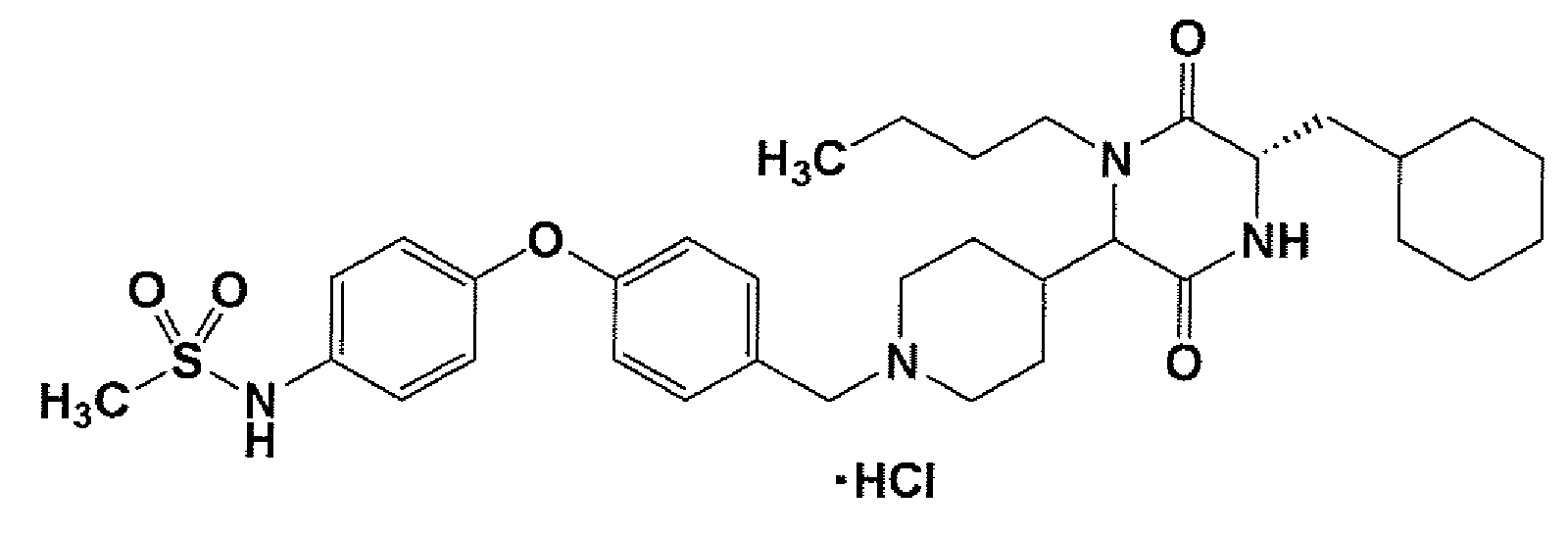
TLC:Rf 0.58(chloroform:methanol=5:1);
NMR (CD3OD): δ 7.48 (brd, J = 8.7 Hz, 2H), 7.29 (brd, J = 8.7 Hz, 2H), 7.08-7.00 (m, 4H), 4.26 (s, 2H), 4.12 (m, 1:2H), 4.04-3.92 (m, 1H), 3.88 (d, J = 5.2 Hz, 1:2H), 3.82 (d, J = 6.0 Hz, 1:2Hz), 3.80 (m, 1:2H), 3.60-3.48 (m, 2H), 3.08-2.78 (m, 3H), 2.95 (s, 3H), 2.34-2.10 (m, 1H), 2.10-1.44 (m, 13H), 1.40-1.12 (m, 6H), 1.10-0.84 (m, 2H), 0.94 (t, J = 7.2 Hz, 3:2H), 0.93 (t, J = 7.2 Hz, 3:2H).
NMR (CD3OD): δ 7.47 (brd, J = 9.0 Hz, 2H), 7.29 (brd, J = 9.0 Hz, 2H), 7.07-7.00 (m, 4H), 4.25 (s, 2H), 4.18(m, 1H), 3.98-3.72 (m, 2H), 3.57-3.45 (m, 2H), 3.26 (m, 1H), 3.06-2.78 (m, 3H), 2.95 (s, 3H), 2.46-2.18 (m, 1H), 2.14-1.86 (m, 4H), 1.86-1.48 (m, 7H), 1.44-0.82 (m, 8H), 0.94 (t, J = 7.2 Hz, 3H).
NMR (CD3OD): δ 8.04 (brd, J = 8.7 Hz, 2H), 7.54 (brd, J = 8.7 Hz, 2H), 7.16 (brd, J = 8.7 Hz, 2H), 7.06 (brd, J = 8.7 Hz, 2H), 4.30 (s, 2H), 4.12 (m, 1/2H), 4.05-3.92 (m, 1H), 3.92-3.76 (m, 3/2H), 3.61-3.46 (m, 2H), 3.10-2.78 (m, 3H), 2.36-1.92 (m, 5H), 1.90-1.44 (m, 10H), 1.40-1.14 (m, 5H), 1.04-0.82 (m, 5H).
NMR (CD3OD): δ 8.07-8.00 (m, 2H), 7.60-7.46 (m, 2H), 7.17 (brd, J = 8.7 Hz, 2H), 7.10-7.00 (m, 2H), 4.30 (s, 2H), 4.21-4.14 (m, 1H), 4.00-3.74 (m, 2H), 3.72-3.46 (m, 2H), 3.26 (m, 1H), 3.09-2.84 (m, 3H), 2.50-2.20 (m, 2H), 2.16-1.88 (m, 5H), 1.88-1.48 (m, 6H), 1.44-0.84 (m, 10H).
TLC:Rf0.27 (dichloromethane:methanol=5:1)
NMR (CDCl3): δ 7.31-7.20 (m, 5H), 4.46 (t, J = 5.5 Hz, 1H), 3.50 (s, 2H), 3.38 (s, 6H), 2.87-2.83 (m, 2H), 2.74 (d, J = 5.5 Hz, 2H), 2.45 (m, 1H), 2.07-1.98 (m, 2H), 1.86-1.82 (m, 2H), 1.46-1.34 (m, 2H).
TLC:Rf 0.36(ethyl acetate:methanol=10:1).
TLC:Rf 0.41 (ethyl acetate :methanol= 10:1);
NMR (CDCl3): δ 7.29-7.21 (m, 4H), 6.99 (d, J = 9.0 Hz, 2H), 6.94 (d, J = 9.0 Hz, 2H), 4.60 (t, J = 5.5 Hz, 1H), 4.20 (m, 1H), 4.13 (dd, J = 16.5, 4.0 Hz, 2H), 3.56-3.33 (m, 6H), 3.40 (s, 6H), 3.05-2.96 (m, 2H), 2.19-1.22 (m, 15H).

TLC:Rf 0.78(methylene chloride:methanol=10:1);
NMR (CD3OD): δ 7.50 (d, J = 9.0 Hz, 2H), 7.29 (d, J = 9.0 Hz, 2H), 7.06 (d, J = 9.0 Hz, 2H), 7.03 (d, J = 9.0 Hz, 2H), 6.60 (d, J = 6.0 Hz, 1H), 5.86 (d, J = 6.0 Hz, 1H), 4.58 (m, 1H), 4.30 (s, 2H), 4.27 (s, 2H), 3.61-3.57 (m, 2H), 3.20-3.12 (m, 2H), 2.95 (s, 3H), 2.26-1.21 (m, 15H).
NMR (CD3OD): δ 7.52 (s, 5H), 6.60 (d, J = 6.0 Hz, 1H), 5.84 (d, J = 6.0 Hz, 1H), 4.58 (m, 1H), 4.33 (s, 2H), 4.27 (s, 2H), 3.6-3.56 (m, 2H), 3.22-3.14 (m, 2H), 2.69 (m, 1H), 2.19-1.29 (m, 14H).
E-form:
TLC:Rf 0.37(chloroform:methanol=10:1);
NMR (CD3OD): δ 1.29 (t, J=7.0 Hz, 3H), 1.90-2.00 (m, 2H), 2.14-2.28 (m, 2H), 2.86-2.96 (m, 2H), 3.38-3.48 (m, 3H), 4.16 (s, 2H), 4.18 (q, J=7.0 Hz, 2H), 7.02 (d, J=9.0 Hz, 2H), 7.11 (d, J=9.0 Hz, 2H), 7.36 (d, J=9.0 Hz, 2H), 7.50 (d, J=9.0 Hz, 2H), 7.52 (d, J=9.0 Hz, 2H), 8.00 (d, J=9.0 Hz, 2H).
Z-form:
TLC:Rf 0.35(chloroform;methanol=10:1);
NMR (CD3OD): δ 1.16 (t, J=7.0 Hz, 3H), 1.76-1.91 (m, 2H), 2.43-2.14 (m, 2H), 2.89 (m, 1H), 3.02-3.11 (m, 2H), 3.50-3.58 (m, 2H), 4.03 (q, J=7.0 Hz, 2H), 4.31 (s, 2H), 7.06 (d, J=9.0 Hz, 2H), 7.16 (d, J=9.0 Hz, 2H), 7.25 (d, J=9.4 Hz, 2H), 7.55 (d, J=9.0 Hz, 2H), 7.57 (d, J=9.0 Hz, 2H), 8.03 (d, J=9.0 Hz, 2H).
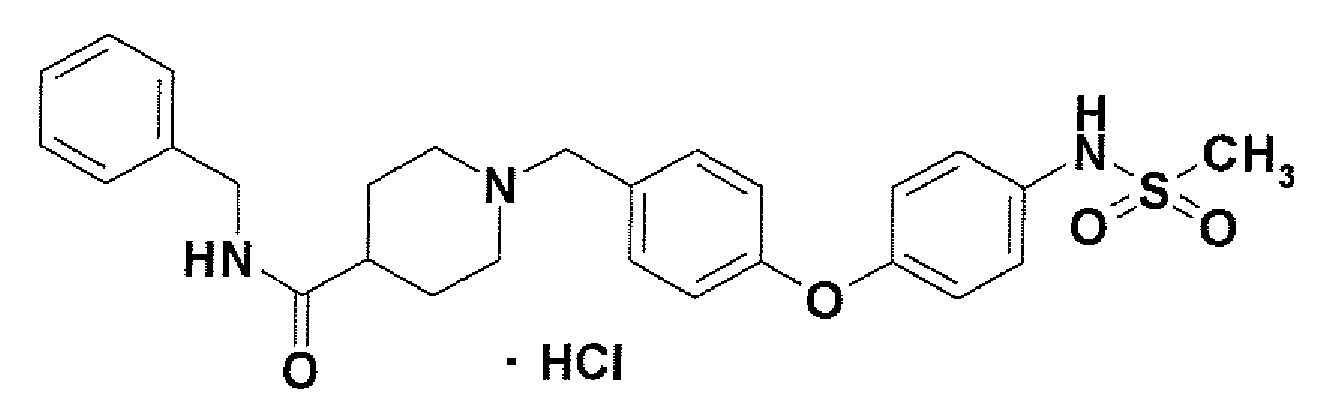
NMR (CD3OD): δ 1.92-2.03 (m, 4H), 2.51 (m, 1H), 2.82-2.92 (m, 2H), 2.95 (s, 3H), 3.40-3.44 (m, 2H), 4.15 (s, 2H), 4.35 (s, 2H), 7.02 (d, J = 8.7 Hz, 2H), 7.04 (d, J = 8.7 Hz, 2H), 7.23-7.33 (m, 7H), 7.45 (d, J = 8.7 Hz, 2H).
NMR (CD3OD): δ 0.94-1.00 (m, 2H), 1.14-1.30 (m, 4H), 1.60-1.80 (m, 6H), 1.99-2.17 (m, 5H), 3.08-3.16 (m, 2H), 3.52-3.56 (m, 2H), 3.92 (m, 1H), 4.31 (s, 2H), 7.07 (d, J = 8.7 Hz, 2H), 7.18 (d, J = 8.7 Hz, 2H), 7.56 (d, J = 8.7 Hz, 2H), 8.04 (d, J = 8.7 Hz, 2H).
NMR (CD3OD): δ 1.90-2.08 (m, 4H), 2.56 (m, 1H), 2.99-3.07 (m, 2H), 3.48-3.53 (m, 2H), 4.28 (s, 2H), 4.36 (s, 2H), 7.06 (d, J = 8.7 Hz, 2H), 7.16 (d, J = 8.4 Hz, 2H), 7.21-7.34 (m, 5H), 7.54 (d, J = 8.4 Hz, 2H), 8.03 (d, J = 8.7 Hz, 2H).
NMR (CD3OD): δ 0.93 (t, J = 7.2 Hz, 3H), 1.28-1.53 (m, 4H), 1.95-2.00 (m, 4H), 2.51 (m, 1H), 3.06-3.20 (m, 4H), 3.51-3.53 (m, 2H), 4.32 (s, 2H), 7.07 (d, J = 9.0 Hz, 2H), 7.17 (d, J = 8.5 Hz, 2H), 7.55 (d, J = 8.5 Hz, 2H), 8.04 (d, J = 9.0 Hz, 2H).
NMR (CD3OD): δ 0.87 (m, 2H), 1.19 -1.31 (m, 3H), 1.46 (m, 1H), 1.64-1.73 (m, 5H), 1.90-2.06 (m, 4H), 2.52 (m, 1H), 3.00-3.09 (m, 4H), 3.53-3.58 (m, 2H), 4.33 (s, 2H), 7.07 (d, J = 9.0 Hz, 2H), 7.18 (d, J = 8.7 Hz, 2H), 7.56 (d, J = 8.7 Hz, 2H), 8.04 (d, J = 9.0 Hz, 2H).
NMR (CD3OD): δ 0.82-1.02 (m, 2H), 1.12-1.36 (m, 4H), 1.49 (m, 1H), 1.60-1.88 (m, 6H), 2.31 (m, 2H), 2.95 (s, 3H), 3.04 (brt, J = 6.6 Hz, 2H), 3.22-3.45 (m, 4H), 4.32 (s, 2H), 6.98-7.01 (m, 4H), 7.29 (brd, J = 9.0 Hz, 2H), 7.50 (brd, J = 9.0 Hz, 2H), 8.09 (m, 1H).
NMR (CD3OD): δ 0.80-1.04 (m, 2H), 1.18-1.40 (m, 4H), 1.50 (m, 1H), 1.60-1.90 (m, 6H), 2.30 (m, 2H), 2.91 (s, 3H), 3.04 (m, 2H), 3.20-3.52 (m, 7H), 4.33 (s, 2H), 7.02-7.18 (m, 4H), 7.45 (brt, J = 9.0 Hz, 2H), 7.5 3 (brt, J = 8.7 Hz, 2H), 8.08 (m, 1H).
NMR (CD3OD): δ 1.18-1.56 (m, 5H), 1.64-1.85 (m, 5H), 2.65 (m, 1H), 2.95 (m, 3H), 2.90-3.20 (m, 3H), 3.32-3.58 (m, 3H), 4.28 (m, 1H), 4.35 (s, 2H), 4.67 (m, 1H), 7.00-7.12 (m, 4H), 7.29 (brd, J = 9.0 Hz, 2H), 7.5 2 (brd, J = 8.7 Hz 2H).
NMR (CD3OD): δ 0.90-1.06 (m, 2H), 1.08-1.40 (m, 3H), 1.60-1.80 (m, 6H), 2.31 (brd, J = 6.0 Hz, 2H), 2.95 (s, 3H), 2.86-3.18 (m, 3H), 3.36-3.60 (m, 3H), 4.21 (m, 1H), 4.35 (s, 2H), 4.69 (m, 1H), 7.00-7.12 (m, 4H), 7.29 (brd, J = 9.0 Hz, 2H), 7.51 (brd, J = 8.7 Hz, 2H).
NMR (CD3OD): δ 0.80-1.00 (m, 2H), 1.12-1.32 (m, 4H), 1.49 (m, 1H), 1.62-1.80 (m, 6H), 2.22-2.34 (m, 2H), 2.95 (s, 6H), 2.96-3.08 (m, 2H), 3.24-3.38 (m, 4H), 4.22 (s, 2H), 6.98-7.10 (m, 4H), 7.29 (brd, J = 9.3 Hz, 2H), 7.46 (brd, J = 8.7 Hz, 2H), 7.81 (m, 1H).
NMR (CD3OD): δ 0.95 (t, J = 7.2 Hz, 3H), 0.82-1.04 (m, 2H), 1.10-1.58 (m, 7H), 1.58-1.78 (m, 6H), 2.06-2.24 (m, 4H), 2.95 (s, 3H), 3.05 (t, J = 3.0 Hz, 2H), 3.08-3.44 (m, 6H), 4.32 (s, 2H), 7.00-7.12 (m, 4H), 7.29 (brd, J = 8.7 Hz, 2H), 7.50(brd, J = 8.7 Hz, 2H), 8.00 (m, 1H).
NMR (CD3OD): δ 1.08-1.44 (m, 5H), 1.58-1.92 (m, 5H), 2.95 (s, 3H), 2.95-3.60 (m, 9H), 4.31 (s, 2H), 7.00-7.12 (m, 4H), 7.29 (brd, J = 9.3 Hz, 2H), 7.49 (brd, J = 8.4 Hz, 2H).
NMR (CD3OD): δ 2.95 (s, 3H), 3.22 (m, 4H), 3.70 (m, 4H), 4.28 (s, 2H), 4.35 (s, 2H), 7.00-7.08 (m, 4H), 7.18-7.36 (m, 7H), 7.44-7.56 (m, 2H).
NMR (CD3OD): δ 2.95 (s, 3H), 3.10-3.42 (m, 8H), 4.29 (s, 2H), 7.00-7.10 (m, 5H), 7.21-7.40 (m, 6H), 7.49 (brd, J = 8.4 Hz, 2H).
NMR (CD3OD): δ 0.80-1.02 (m, 2H), 1.08-1.40 (m, 3H), 1.60-1.90 (m, 8H), 2.04-2.20 (m, 2H), 2.41 (d, J = 6.9 Hz, 2H), 2.72 (m, 1H), 2.95 (s, 3H), 3.05 (m, 2H), 3.48 (m, 2H), 4.27 (s, 2H), 7.00-7.10 (m, 4H), 7.29 (brd, J = 9.0 Hz, 2H), 7.48 (brd, J = 9.0 Hz, 2H).
NMR (CD3OD): δ 1.85-1.94 (m, 2H), 2.06-2.12 (m, 2H), 2.60-2.78 (m, 3H), 2.94 (s, 3H), 3.20-3.25 (m, 2H), 3.99 (s, 2H), 5.14 (s, 2H), 6.99-7.02 (m, 4H), 7.27 (d, J = 8.7 Hz, 2H), 7.32-7.36 (m, 5H), 7.40 (d, J = 8.7 Hz, 2H).
NMR (CD3OD): δ 1.20-1.40 (m, 2H), 1.54-1.64 (m, 2H), 1.67-1.84 (m, 2H), 1.88-2.21 (m, 5H), 2.95 (s, 3H), 3.06-3.18 (m, 2H), 3.30-3.46 (m, 2H), 3.46-3.56 (m, 2H), 3.85-3.97 (m, 3H), 4.28 (s, 2H), 7.03 (d, J = 8.7 Hz, 2H), 7.06 (d, J = 8.7 Hz, 2H), 7.29 (d, J = 8.7 Hz, 2H), 7.50 (d, J = 8.7 Hz, 2H).
NMR (CD3OD): δ 1.18-1.32 (m, 2H), 1.56-1.64 (m, 2H), 1.73 (m, 1H), 1.84-2.10 (m, 4H), 2.53 (m, 1H), 2.95 (s, 3H), 2.96-3.11 (m, 4H), 3.28-3.42 (m, 2H), 3.49-3.58 (m, 2H), 3.87-3.96 (m, 2H), 4.29 (s, 2H), 7.03 (d, J = 8.7 Hz, 2H), 7.06 (d, J = 8.7 Hz, 2H), 7.29 (d, J = 8.7 Hz, 2H), 7.49 (d, J = 8.7 Hz, 2H).
NMR (CD3OD): δ 1.56-1.76 (m, 2H), 1.84-2.04 (m, 2H), 2.41 (s, 3H), 2.95 (s, 3H), 3.00 (m, 1H), 3.14-3.45 (m, 4H), 4.20 (s, 2H), 6.98-7.10 (m, 4H), 7.22-7.34 (m, 2H), 7.38-7.52 (m, 4H), 7.72-7.80 (m, 2H).
NMR (CD3OD): δ 1.68-1.86 (m, 2H), 1.92-2.10 (m, 2H), 2.53 (m, 1H), 2.95 (s, 3H), 2.90-3.04 (m, 2H), 3.42-3.54 (m, 2H), 4.26 (s, 2H), 6.98-7.06 (m, 4H), 7.22-7.36 (m, 2H), 7.40-7.50 (m, 2H), 7.52-7.62 (m, 2H), 7.68 (m, 1H), 8.00 (brd, J = 7.5 Hz, 2H).
NMR (CD3OD): δ 1.70-1.92 (m, 2H), 2.08-2.26 (m, 2H), 2.95 (s, 3H), 2.98 (s, 3H), 3.00-3.18 (m, 2H), 3.28 -3.46 (m, 2H), 3.54 (m, 1H), 4.22 (s, 2H), 6.98-7.10 (m, 4H), 7.26-7.34 (m, 2H), 7.42-7.56 (m, 2H).
NMR (CD3OD): δ 1.18-1.48 (m, 6H), 1.63-1.86 (m, 4H), 2.16-2.42 (m, 5H), 2.95 (s, 3H), 3.00-3.14 (m, 2H), 3.26-3.41 (m, 2H), 4.23 (s, 2H), 7.00-7.10 (m, 4H), 7.28 (brd, J = 9.0 Hz, 2H), 7.47 (brd, J = 8.7 Hz, 2H).
NMR (CD3OD): δ 0.80-0.96 (m, 2H), 1.12-1.30 (m, 6H), 1.54-1.84 (m, 9H), 2.00-2.18 (m, 4H), 2.95 (s, 3H), 3.03-3.14 (m, 2H), 3.46-3.56 (m, 2H), 3.89 (m, 1H), 4.28 (s, 2H), 7.03 (d, J = 8.7 Hz, 2H), 7.05 (d, J = 8.7 Hz, 2H), 7.29 (d, J = 8.7 Hz, 2H), 7.50 (d, J = 8.7 Hz, 2H).
NMR (CD3OD): δ 0.83-0.98 (m, 2H), 1.12-1.53 (m, 4H), 1.48 (dd, J = 6.6, 15.0 Hz, 2H), 1.60-1.78 (m, 7H), 2.04-2.24 (m, 4H), 2.95 (s, 3H), 3.02-3.24 (m, 2H), 3.35-3.58 (m, 2H), 3.90 (m, 1H), 4.27 (s, 2H), 7.03 (d, J = 8.7 Hz, 2H), 7.06 (d, J = 8.7 Hz, 2H), 7.29 (d, J = 8.7 Hz, 2H), 7.48 (d, J = 8.7 Hz, 2H).
NMR (CD3OD): δ 0.90-1.10 (m, 2H), 1.10-1.40 (m, 3H), 1.60-1.90 (m, 8H), 2.05 (d, J = 6.6 Hz, 2H) 2.10-2.20 (m, 2H), 2.39 (s, 3H), 2.44 (s, 3H), 3.10-3.30 (m, 2H), 3.60-3.70 (m, 2H), 3.90 (m, 1H), 4.26 (s, 2H), 7.70 (d, J = 7.7 Hz, 2H), 8.07 (d, J = 7.7 Hz, 2H).
NMR (CD3OD): δ 0.90-1.10 (m, 2H), 1.10-1.40 (m, 8H), 1.60-1.90 (m, 13H), 2.05 (d, J = 7.2 Hz, 2H) 2.10-2.30 (m, 2H), 2.39 (s, 3H), 2.44 (s, 3H), 3.00-3.20 (m, 3H), 3.60-3.70 (m, 2H), 3.93 (m, 1H), 4.26 (s, 2H), 7.71 (d, J = 8.7 Hz, 2H), 8.03 (d, J = 8.7 Hz, 2H).
NMR (CD3OD): δ 0.90-1.10 (m, 2H), 1.10-1.40 (m, 3H), 1.60-1.90 (m, 8H), 2.05 (d, J = 6.9 Hz, 2H) 2.10-2.30 (m, 2H), 2.39 (s, 3H), 2.47 (s, 3H), 2.95 (s, 6H), 3.10-3.20 (m, 6H), 3.60-3.70 (m, 2H), 3.90 (m, 1H), 4.26 (s, 2H), 7.78 (d, J = 8.9 Hz, 2H), 8.07 (d, J = 8.9 Hz, 2H).
NMR (CD3OD): δ 0.90-1.10 (m, 2H), 1.10.-1.40 (m, 3H), 1.60-1.90 (m, 8H), 2.05 (d, J = 7.2 Hz, 2H) 2.10-2.30 (m, 2H), 2.39 (s, 3H), 2.46 (s, 3H), 3.10-3.40 (m, 8H), 3.50-3.70 (m, 4H), 3.80-3.90 (m, 3H), 4.10-4.20 (m, 2H), 4.26 (s, 2H), 7.77 (d, J = 8.7 Hz, 2H), 8.07 (d, J = 8.7 Hz, 2H).
NMR (CD3OD): δ 0.90-1.10 (m, 2H), 1.10-1.40 (m, 3H), 1.60-1.90 (m, 8H), 2.05 (d, J = 6.9 Hz, 2H) 2.10-2.30 (m, 2H), 2.39 (s, 3H), 2.46 (s, 3H), 2.74 (s, 6H), 3.10-3.20 (m, 2H), 3.60-3.70 (m, 2H), 3.90 (m, 1H), 4.26 (s, 2H), 7.76-7.80 (m, 2H), 7.94-7.97 (m, 2H).
NMR (CD3OD): δ 0.90-1.10 (m, 2H), 1.10-1.40 (m, 3H), 1.60-1.90 (m, 8H), 2.05 (d, J = 6.9 Hz, 2H) 2.10-2.30 (m, 2H), 2.39 (s, 3H), 2.45 (s, 3H), 2.87 (s, 3H), 3.10-3.20 (m, 2H), 3.19 (t, J = 5.9 Hz, 2H), 3.60-3.80 (m, 2H), 3.69 (t, J = 5.9 Hz, 2H), 3.93 (m, 1H), 4.26 (s, 2H), 7.75 (d, J = 8.7 Hz, 2H), 7.99 (d, J = 8.7 Hz, 2H).
NMR (CD3OD): δ 0.90-1.10 (m, 2H), 1.15 (t, J = 7.1 Hz, 6H), 1.10-1.40 (m, 3H), 1.60-1.75 (m, 6H), 1.75-1.90 (m, 2H), 2.05 (d, J = 7.2 Hz, 2H), 2.10-2.30 (m, 2H), 2.40 (s, 3H), 2.45 (s, 3H), 3.10-3.20 (m, 2H), 3.20-3.40 (m, 4H), 3.60-3.80 (m, 2H), 3.94 (m, 1H), 4.26 (s, 2H), 7.73 (d, J = 8.6 Hz, 2H), 7.99 (d, J = 8.6 Hz, 2H).
NMR (CD3OD): δ 0.90-1.10 (m, 2H), 1.10-1.40 (m, 3H), 1.60-1.75 (m, 6H), 1.75-1.90 (m, 2H), 2.06 (d, J = 7.2 Hz, 2H), 2.10-2.30 (m, 2H), 2.40 (s, 3H), 2.48 (s, 3H), 3.02 (t, J = 4.7 Hz, 4H), 3.10-3.20 (m, 2H), 3.60-3.80 (m, 2H), 3.71 (t, J = 4.7 Hz, 4H), 3.94 (m, 1H), 4.27 (s, 2H), 7.80 (d, J = 8.6 Hz, 2H), 7.95 (d, J = 8.6 Hz, 2H).
NMR (CD3OD): δ 0.90-1.10 (m, 2H), 1.10-1.40 (m, 3H), 1.60-1.80 (m, 6H), 1.80-2.00 (m, 2H), 2.06 (d, J = 6.9 Hz, 2H), 2.10-2.30 (m, 2H), 2.40 (s, 3H), 2.48 (s, 3H), 2.80-3.00 (m, 2H), 2.90 (s, 3H), 3.10-3.40 (m, 4H), 3.50-3.80 (m, 4H), 3.90-4.10 (m, 3H), 4.27 (s, 2H), 7.84 (d, J = 8.6 Hz, 2H), 8.01 (d, J = 8.6 Hz, 2H).
NMR (CD3OD): δ 0.90-1.10 (m, 2H), 1.10-1.40 (m, 3H), 1.30 (t, J = 7.1 Hz, 3H), 1.60-1.90 (m, 8H), 2.05 (d, J = 6.9 Hz, 2H), 2.10-2.30 (m, 2H), 2.40 (s, 3H), 2.49 (s, 3H), 3.10-3.20 (m, 2H), 3.40-4.00 (m, 11H), 4.22 (s, 2H), 4.27 (s, 2H), 4.29 (q, J = 7.2 Hz, 2H), 7.84 (d, J = 8.6 Hz, 2H), 8.02 (d, J = 8.6 Hz, 2H).
NMR (CD3OD): δ 0.90-1.10 (m, 2H), 1.10-1.40 (m, 3H), 1.60-1.90 (m, 8H), 2.05 (d, J = 7.2 Hz, 2H), 2.10-2.30 (m, 2H), 2.36 (s, 3H), 2.37 (s, 3H), 3.03 (s, 3H), 3.10-3.20 (m, 2H), 3.60-3.70 (m, 2H), 3.90 (m, 1H), 4.24 (s, 2H), 7.39-7.46 (m, 4H).
NMR (CD3OD): δ 0.90-1.10 (m, 2H), 1.10-1.40 (m, 3H), 1.60-1.80 (m, 8H), 2.03 (d, J = 6.9 Hz, 2H), 2.07 (s, 6H), 2.10-2.20 (m, 2H), 2.97 (s, 3H), 3.00-3.10 (m, 2H), 3.40-3.60 (m, 2H), 3.90 (m, 1H), 4.24 (s, 2H), 6.84 (d, J = 3.9 Hz, 2H), 7.04 (s, 2H), 7.45 (d, J = 8.7 Hz, 2H).
NMR (CD3OD): δ 0.90-1.10 (m, 2H), 1.10-1.40 (m, 3H), 1.60-1.80 (m, 8H), 2.04 (d, J = 7.2 Hz, 2H), 2.10-2.20 (m, 2H), 3.00-3.10 (m, 2H), 3.50-3.60 (m, 2H), 3.92 (m, 1H), 4.32 (s, 2H), 7.11-7.19 (m, 4H), 7.58-7.62 (m, 2H), 7.88-7.93 (m, 2H).
NMR (CD3OD): δ 0.90-1.10 (m, 2H), 1.10-1.40 (m, 3H), 1.60-1.80 (m, 8H), 2.05 (d, J = 6.9 Hz, 2H), 2.10-2.20 (m, 2H), 3.00-3.10 (m, 2H), 3.12 (s, 3H), 3.50-3.60 (m, 2H), 3.91 (m, 1H), 4.33 (s, 2H), 7.19-7.23 (m, 4H), 7.59 (d, J = 8.6 Hz, 2H), 7.95 (d, J = 8.6 Hz, 2H).
NMR (CD3OD): δ 0.90-1.10 (m, 2H), 1.10-1.40 (m, 3H), 1.60-1.80 (m, 8H), 2.02 (d, J = 6.9 Hz, 2H), 2.10-2.20 (m, 2H), 2.99 (s, 3H), 3.00-3.10 (m, 2H), 3.50-3.60 (m, 2H), 3.90 (m, 1H), 4.37 (s, 2H), 7.35 (d, J = 8.7 Hz, 2H), 7.45-7.60 (m, 2H), 7.67 (d, J = 8.7 Hz, 2H), 7.70-7.80 (m, 2H).
NMR (CD3OD): δ 0.90-1.10 (m, 2H), 1.10-1.40 (m, 3H), 1.60-1.80 (m, 8H), 2.03 (d, J = 7.2 Hz, 2H), 2.10-2.20 (m, 2H), 2.47 (s, 3H), 3.00-3.10 (m, 2H), 3.50-3.60 (m, 2H), 3.90 (m, 1H), 4.27 (s, 2H), 6.99 (d, J = 8.5 Hz, 2H), 7.04 (d, J = 8.5 Hz, 2H) 7.32 (d, J = 8.5 Hz, 2H), 7.48 (d, J = 8.5 Hz, 2H).
NMR (CD3OD): δ 0.97 (t, J = 7.2 Hz, 3H), 1.10 (t, J = 7.4 Hz, 3H), 1.20-1.70 (m, 4H), 1.80-2.10 (m, 2H), 2.20-2.50 (m, 2H), 2.35 (q, J = 7.6 Hz, 2H), 2.95 (s, 3H), 3.00-3.40 (m, 4H), 3.40-3.60 (m, 2H), 4.11 (m, 1H), 4.26 (s, 2H), 7.03 (d, J = 8.9 Hz, 2H), 7.06 (d, J = 8.9 Hz, 2H) 7.29 (d, J = 8.9 Hz, 2H), 7.48 (d, J = 8.9 Hz, 2H).
NMR (CD3OD): δ 1.08 (t, J = 7.5 Hz, 3H), 1.80-2.00 (m, 2H), 2.00-2.20 (m, 2H), 2.37 (q, J = 7.5 Hz, 2H), 2.95 (s, 3H), 3.00-3.20 (m, 2H), 3.40-3.60 (m, 2H), 4.22 (s, 2H), 4.40 (m, 1H), 4.61 (s, 2H), 7.00-7.05 (m, 4H), 7.22-7.46 (m, 7H), 7.45 (d, J = 8.4 Hz, 2H).
NMR (CD3OD): δ 1.07 (t, J = 7.4 Hz, 3H), 1.90-2.00 (m, 2H), 2.42 (q, J = 7.4 Hz, 2H), 2.40-2.60 (m, 2H), 2.96 (s, 3H), 3.00-3.20 (m, 2H), 3.34 (s, 3H), 3.40-3.60 (m, 4H), 4.05 (m, 1H), 4.28 (s, 2H), 7.01-7.06 (m, 4H), 7.28-7.31 (m, 2H), 7.51-7.56 (m, 2H).
NMR (CD3OD): δ 1.10 (t, J = 7.2 Hz, 3H), 1.19 (t, J = 6.0 Hz, 2H), 1.60-1.80 (m, 2H), 1.80-2.40 (m, 6H), 2.41 (q, J = 7.4 Hz, 2H), 2.95 (s, 3H), 3.00-3.20 (m, 2H), 3.40-3.60 (m, 4H), 3.80 (m, 1H), 4.05 (m, 1H), 4.28 (s, 2H), 7.03 (t, J = 8.7 Hz, 2H), 7.05 (t, J = 7.4 Hz, 2H), 7.29 (t, J = 7.4 Hz, 2H), 7.50 (t, J = 8.7 Hz, 2H).
NMR (CD3OD): δ 0.87-0.91 (m, 2H), 1.07 (t, J = 7.2 Hz, 3H), 1.10-1.40 (m, 5H), 1.60-1.80 (m, 4H), 1.80-2.00 (m, 2H), 2.36 (q, J = 7.2 Hz, 2H), 2.40-2.60 (m, 2H), 2.95 (s, 3H), 3.00-3.20 (m, 2H), 3.16 (d, J = 7.5 Hz, 2H), 3.40-3.60 (m, 2H), 3.80 (m, 1H), 4.26 (s, 2H), 7.03 (d, J = 8.7 Hz, 2H), 7.06 (d, J = 8.7 Hz, 2H), 7.29 (d, J = 8.7 Hz, 2H), 7.48 (d, J = 8.7 Hz, 2H).
NMR (CD3OD): δ 0.80-1.00 (m, 2H), 1.08-1.32 (m, 4H), 1.48 (m, 1H), 1.60-1.78 (m, 4H), 2.05 (brs, 3H), 2.10-2.50 (m, 4H), 2.95 (s, 3H), 3.00 (t, J = 6.3 Hz, 2H), 3.04-3.50 (m, 4H), 4.30 (s, 2H), 6.98-7.08 (m, 4H), 7.28 (brd, J = 9.0 Hz, 2H), 7.49 (brd, J = 8.7 Hz, 2H).
NMR (CD3OD): δ 0.90-1.10 (m, 2H), 1.20-1.40 (m, 3H), 1.60-1.80 (m, 8H), 2.04 (d, J = 7.2 Hz, 2H), 2.10-2.20 (m, 2H), 3.10-3.20 (m, 2H), 3.23 (s, 3H), 3.40-3.60 (m, 2H), 3.91 (m, 1H), 4.29 (s, 2H), 7.08-7.14 (m, 4H), 7.34 (d, J = 8.6 Hz, 2H), 7.54 (d, J = 8.6 Hz, 2H).
NMR (CD3OD): δ 0.30-0.40 (m, 2H), 0.60-0.70 (m, 2H), 0.95 (m, 1H), 1.10 (t, J = 7.4 Hz, 3H), 1.90-2.10 (m, 2H), 2.40-2.60 (m, 2H), 2.43 (q, J = 7.2 Hz, 2H), 2.95 (s, 3H), 3.00-3.20 (m, 2H), 3.22 (d, J = 6.3 Hz, 2H), 3.45-3.60 (m, 2H), 4.00 (m, 1H), 4.28 (s, 2H), 7.02-7.08 (m, 4H), 7.27-7.32 (m, 2H), 7.50 (t, J = 8.1 Hz, 2H).
NMR (CD3OD): δ 0.89-0.97 (m, 2H), 1.18-1.41 (m, 7H), 1.60-1.74 (m, 4H), 1.87-2.04 (m, 4H), 2.47 (m, 1H), 2.95 (s, 3H), 2.95-3.04 (m, 2H), 3.16-3.21 (m, 2H), 3.52-3.56 (m, 2H), 4.27 (s, 2H), 7.03 (d, J = 8.7 Hz, 2H), 7.06 (d, J = 8.7 Hz, 2H), 7.29 (d, J = 8.7 Hz, 2H), 7.47 (d, J = 8.7 Hz, 2H).
NMR (CD3OD): δ 0.90-1.10 (m, 2H), 1.10-1.40 (m, 3H), 1.60-1.80 (m, 8H), 2.04 (d, J = 6.9 Hz, 2H), 2.10-2.20 (m, 2H), 2.80 (s, 3H), 3.10-3.20 (m, 2H), 3.50-3.60 (m, 2H), 3.90 (m, 1H), 4.31 (s, 2H), 7.16 (d, J = 8.7 Hz, 2H), 7.22 (d, J = 9.0 Hz, 2H), 7.58 (d, J = 9.0 Hz, 2H), 7.74 (d, J = 8.7 Hz, 2H).
NMR (CD3OD): δ 1.23 (t, J = 7.5 Hz, 3H), 1.88-2.08 (m, 4H), 2.46-2.67 (m, 5H), 2.94-3.07 (m, 2H), 2.95 (s, 3H), 3.37 (t, J = 7.0 Hz, 2H), 3.52-3.56 (m, 2H), 4.28 (s, 2H), 7.03 (d, J = 9.0 Hz, 2H), 7.06 (d, J = 9.0 Hz, 2H), 7.29 (d, J = 9.0 Hz, 2H), 7.48 (d, J = 9.0 Hz, 2H).
NMR (CD3OD): δ 0.90-1.10 (m, 2H), 1.10-1.40 (m, 3H), 1.60-1.80 (m, 8H), 2.03 (d, J = 6.9 Hz, 2H), 2.10-2.20 (m, 2H), 2.99 (s, 3H), 3.00-3.20 (m, 2H), 3.40-3.60 (m, 2H), 3.72 (s, 3H), 3.89 (m, 1H), 4.31 (s, 2H), 6.83-6.94 (m, 3H), 6.99-7.05 (m, 2H), 7.39-7.45 (m, 2H).
NMR (CD3OD): δ 0.90-1.10 (m, 2H), 1.10-1.40 (m, 3H), 1.60-1.80 (m, 8H), 2.04 (d, J = 6.9 Hz, 2H), 2.10-2.20 (m, 2H), 2.96 (s, 3H), 3.00-3.20 (m, 2H), 3.40-3.60 (m, 2H), 3.90 (m, 1H), 4.29 (s, 2H), 6.79 (dd, J = 7.5, 2.4 Hz, 1H), 6.95-7.01 (m, 2H), 7.08-7.11 (m, 2H), 7.31-7.34 (m, 1H), 7.51-7.54 (m, 2H).
NMR (CD3OD): δ 0.82-1.44 (m, 8H), 1.60-1.85 (m, 6H), 2.30-2.42 (m, 2H), 2.95 (s, 3H), 2.95-3.65 (m, 5H), 4.10-5.15 (m, 4H), 7.00-7.12 (m, 4H), 7.24-7.38 (m, 2H), 7.52 (brd, J = 8.7 Hz, 2H).
NMR (CD3OD): δ 1.06-1.42 (m, 6H), 1.54-1.92 (m, 6H), 1.95-2.17 (m, 2H), 2.26 (m, 1H), 2.95 (s, 3H), 3.05-3.58 (m, 5H), 4.29 (s, 2H), 7.03 (d, J = 8.7 Hz, 2H), 7.06 (d, J = 8.7 Hz, 2H), 7.29 (d, J = 8.7 Hz, 2H), 7.49 (dd, J = 4.2, 8.7 Hz, 2H).
NMR (CD3OD): δ 1.00-1.34 (m, 5H), 1.48 (m, 1H), 1.58-1.80 (m, 4H), 1.83-2.11 (m, 5H), 2.58 (m, 1H), 2.95 (s, 3H), 2.87-3.00 (m, 2H), 3.40-3.49 (m, 2H), 3.51 (t, J = 6.0 Hz, 1H), 4.18 (s, 2H), 4.39 (d, J = 6.0 Hz, 1H), 7.02 (d, J = 8.7 Hz, 2H), 7.03 (d, J = 8.7 Hz, 2H), 7.28 (d, J = 8.7 Hz, 2H), 7.46 (d, J = 8.7 Hz, 2H).
NMR (CD3OD): δ 0.80-1.10 (m, 2H), 0.97 (t, J = 7.2 Hz, 3H), 1.20-1.40 (m, 5H), 1.40-1.60 (m, 2H), 1.60-2.00 (m, 8H), 2.30-2.40 (m, 2H), 2.32 (d, J = 7.2 Hz, 2H), 2.96 (s, 3H), 3.10-3.30 (m, 4H), 3.50-3.60 (m, 2H), 4.20 (m, 1H), 4.30 (s, 2H), 6.80 (m, 1H), 6.95 (m, 1H), 7.00 (m, 1H), 7.08 (d, J = 8.7 Hz, 2H), 7.33 (t, J = 8.1 Hz, 1H), 7.55-7.61 (m, 2H).
NMR (CD3OD): δ 0.90-1.00 (m, 3H), 0.97 (t, J = 7.4 Hz, 3H), 1.20-1.40 (m, 6H), 1.50-1.70 (m, 4H), 1.80-2.00 (m, 2H), 2.20-2.40 (m, 4H), 3.00-3.20 (m, 4H), 3.50-3.70 (m, 2H), 4.10 (m, 1H), 4.31 (s, 2H), 7.07 (d, J = 9.0 Hz, 2H), 7.17 (d, J = 9.0 Hz, 2H), 7.56 (d, J = 9.0 Hz, 2H), 8.04 (d, J = 9.0 Hz, 2H).
NMR (CD3OD): δ 0.86 (t, J = 7.2 Hz, 3H), 1.20-1.50 (m, 4H), 1.50-1.70 (m, 2H), 1.88-1.95 (m, 2H), 2.00-2.20 (m, 2H), 2.30-2.40 (m, 2H), 3.00-3.20 (m, 2H), 3.50-3.60 (m, 2H), 4.27 (s, 2H), 4.45 (m, 1H), 4.62 (s, 2H), 7.03-7.07 (m, 2H), 7.13-7.37 (m, 7H), 7.52 (d, J = 8.4 Hz, 2H), 8.01-8.04 (m, 2H).
NMR (CD3OD): δ 0.90-1.00 (m, 2H), 0.97 (t, J = 7.2 Hz, 3H), 1.20-1.40 (m, 5H), 1.40-1.80 (m, 8H), 1.80-2.00 (m, 2H), 2.21 (d, J = 6.9 Hz, 2H), 2.30-2.40 (m, 2H), 2.98 (s, 3H), 3.00-3.30 (m, 4H), 3.50-3.60 (m, 2H), 4.20 (m, 1H), 4.28 (s, 2H), 6.98 (m, 1H), 7.12 (d, J = 8.7 Hz, 2H), 7.18-7.21 (m, 2H), 7.52-7.54 (m, 3H).
NMR (CD3OD): δ 0.90 (t, J = 7.2 Hz, 3H), 1.21-1.36 (m, 2H), 1.42-1.58 (m, 2H), 1.88-2.00 (m, 2H), 2.09-2.34 (m, 2H), 2.95 (s, 3H), 3.00-3.14 (m, 2H), 3.17-3.28 (m, 2H), 3.43-3.58 (m, 2H), 3.93 (m, 1H), 4.25 (s, 2H), 5.12 (s, 2H), 7.03 (d, J = 8.7 Hz, 2H), 7.05 (d, J = 8.7 Hz, 2H), 7.24-7.38 (m, 7H), 7.47 (d, J = 8.7 Hz, 2H).
NMR (CD3OD): δ 1.90-2.01 (m, 2H), 2.09-2.19 (m, 2H), 2.95 (s, 3H), 3.01-3.12 (m, 2H), 3.44-3.55 (m, 2H), 3.89 (d, J = 5.5 Hz, 2H), 4.03 (m, 1H), 4.25 (s, 2H), 5.09-5.21 (m, 2H), 5.13 (s, 2H), 5.83 (ddd, J = 22.5, 10.2, 5.4 Hz, 1H), 7.03 (d, J = 8.7 Hz, 2H), 7.05 (d, J = 8.7 Hz, 2H), 7.25-7.38 (m, 7H), 7.47(d, J = 8.7 Hz, 2H).
NMR (CD3OD): δ 1.75 (t, J = 2.1 Hz, 3H), 1.95-2.08 (m, 2H), 2.18-2.36 (m, 2H), 2.95 (s, 3H), 3.03-3.18 (m, 2H), 3.47-3.57 (m, 2H), 4.03 (d, J = 2.1 Hz, 2H), 4.07 (m, 1H), 4.26 (s, 2H), 5.16 (s, 2H), 7.03 (d, J = 8.7 Hz, 2H), 7.06 (d, J = 8.7 Hz, 2H), 7.25-7.41 (m, 7H), 7.47 (d, J = 8.7 Hz, 2H).
NMR (CD3OD): δ 0.90-1.00 (m, 2H), 0.97 (t, J = 7.2 Hz, 3H), 1.10-1.40 (m, 5H), 1.50-1.80 (m, 8H), 1.80-2.00 (m, 2H), 2.21 (d, J = 6.9 Hz, 2H), 2.30-2.40 (m, 2H), 3.04 (s, 3H), 3.05-3.30 (m, 4H), 3.50-3.70 (m, 2H), 4.14 (m, 1H), 4.28 (s, 2H), 6.89 (d, J = 8.4 Hz, 1H), 7.10 (d, J = 7.5 Hz, 2H), 7.20-7.29 (m, 2H), 7.40-7.46 (m, 2H), 7.68 (d, J = 2.1 Hz, 1H).
NMR (CD3OD): δ 0.90-1.00 (m, 2H), 0.98 (t, J = 7.2 Hz, 3H), 1.10-1.40 (m, 5H), 1.50-1.80 (m, 8H), 1.80-2.00 (m, 2H), 2.22 (d, J = 6.6 Hz, 2H), 2.30-2.40 (m, 2H), 3.10-3.30 (m, 4H), 3.50-3.60 (m, 2H), 4.19 (m, 1H), 4.34 (s, 2H), 7.16 (d, J = 9.1 Hz, 2H), 7.24 (d, J = 8.4 Hz, 2H), 7.63 (d, J = 8.4 Hz, 2H), 8.27 (d, J = 9.1 Hz, 2H).
NMR (CD3OD): δ 0.90-1.00 (m, 2H), 0.97 (t, J = 7.2 Hz, 3H), 1.10-1.40 (m, 5H), 1.40-1.80 (m, 8H), 1.80-2.00 (m, 2H), 2.21 (d, J = 6.9 Hz, 2H), 2.30-2.40 (m, 2H), 3.00-3.20 (m, 4H), 3.23 (s, 3H), 3.50-3.60 (m, 2H), 4.18 (m, 1H), 4.29 (s, 2H), 7.11 (d, J = 9.0 Hz, 4H), 7.35 (d, J = 9.0 Hz, 2H), 7.54 (d, J = 9.0 Hz, 2H).
NMR (CD3OD): δ 0.90-1.00 (m, 2H), 0.97 (t, J = 7.2 Hz, 3H), 1.10-1.40 (m, 5H), 1.40-1.80 (m, 8H), 1.80-2.00 (m, 2H), 2.16 (s, 3H), 2.21 (d, J = 6.9 Hz, 2H), 2.30-2.40 (m, 2H), 2.96 (s, 3H), 3.00-3.20 (m, 4H), 3.50-3.60 (m, 2H), 4.10 (m, 1H), 4.25 (s, 2H), 6.91-6.98 (m, 3H), 7.13 (dd, J = 8.6, 2.6 Hz, 1H), 7.20 (m, 1H), 7.44-7.49 (m, 2H).
NMR (CD3OD): δ 0.90-1.00 (m, 2H), 0.97 (t, J = 7.2 Hz, 3H), 1.10-1.40 (m, 5H), 1.40-1.80 (m, 8H), 1.80-2.00 (m, 2H), 2.07 (s, 6H), 2.21 (d, J = 6.6 Hz, 2H), 2.30-2.40 (m, 2H), 2.97 (s, 3H), 3.00-3.20 (m, 4H), 3.50-3.60 (m, 2H), 4.17 (m, 1H), 4.24 (s, 2H), 6.86 (d, J= 8.7 Hz, 2H), 7.04 (s, 2H), 7.45 (d, J = 8.7 Hz, 2H).
NMR (CD3OD): δ 0.90-1.00 (m, 2H), 0.97 (t, J = 7.4 Hz, 3H), 1.20-1.40 (m, 5H), 1.40-1.60 (m, 2H), 1.60-2.00 (m, 8H), 2.21 (d, J = 6.6 Hz, 2H), 2.30-2.40 (m, 2H), 3.01 (s, 3H), 3.10-3.30 (m, 4H), 3.50-3.60 (m, 2H), 4.10 (m, 1H), 4.27 (s, 2H), 6.99 (d, J = 8.4 Hz, 2H), 7.13 (d, J = 9.0 Hz, 1H), 7.24 (dd, J = 9.0, 2.6 Hz, 1H), 7.43 (d, J = 2.6 Hz, 1H), 7.48-7.52 (m, 2H).
NMR (CD3OD): δ 1.06-1.38 (m, 5H), 1.45-1.94 (m, 8H), 2.05-2.16 (m, 2H), 2.95 (s, 3H), 3.03-3.17 (m, 2H), 3.48-3.57 (m, 2H), 3.79 (d, J = 4.0 Hz, 1H), 3.96 (m, 1H), 4.28 (s, 2H), 7.03 (d, J = 8.7H z, 2H), 7.06 (d, J = 8.7 Hz, 2H), 7.29 (d, J = 8.7 Hz, 2H), 7.51 (d, J = 8.7 Hz, 2H).
NMR (CD3OD): δ 1.06-1.38 (m, 5H), 1.45-1.94 (m, 8H), 2.05-2.16 (m, 2H), 2.95 (s, 3H), 3.03-3.17 (m, 2H), 3.48-3.57 (m, 2H), 3.79 (d, J = 4.0 Hz, 1H), 3.96 (m, 1H), 4.28 (s, 2H), 7.03 (d, J = 8.7H z, 2H), 7.06 (d, J = 8.7 Hz, 2H), 7.29 (d, J = 8.7 Hz, 2H), 7.51 (d, J = 8.7 Hz, 2H).
NMR (CD3OD): δ 0.90-1.00 (m, 2H), 0.97 (t, J = 7.2 Hz, 3H), 1.10-1.40 (m, 5H), 1.50-1.60 (m, 2H), 1.65-1.80 (m, 6H), 1.80-2.00 (m, 2H), 2.21 (d, J = 6.9 Hz, 2H), 2.30-2.40 (m, 2H), 3.00 (s, 3H), 3.10-3.30 (m, 4H), 3.50-3.60 (m, 2H), 3.74 (s, 3H), 4.10 (m, 1H), 4.26 (s, 2H), 6.98 (d, J = 8.7 Hz, 2H), 7.10 (d, J = 8.7 Hz, 1H), 7.45-7.52 (m, 3H), 7.79 (d, J = 3.0 Hz, 1H).
NMR (CD3OD): δ 0.95-1.05 (m, 2H), 0.97 (t, J = 7.3 Hz, 3H), 1.10-1.40 (m, 5H), 1.50-1.80 (m, 8H), 1.80-2.00 (m, 2H), 2.21 (d, J = 6.9 Hz, 2H), 2.30-2.40 (m, 2H), 3.01 (s, 3H), 3.05-3.25 (m, 4H), 3.50-3.60 (m, 2H), 4.10 (m, 1H), 4.26 (s, 2H), 6.95 (d, J = 8.7 Hz, 2H), 7.09 (d, J = 8.7 Hz, 1H), 7.46-7.51 (m, 3H), 7.83 (d, J = 2.7 Hz, 1H).
NMR (CD3OD): δ 0.90-2.58 (m, 22H), 2.95 (s, 3H), 3.02-3.35 (m, 4H), 3.50-3.60 (m, 2H), 3.94-4.17 (m, 2H), 4.28 (s, 2H), 7.03 (d, J = 8.7 Hz, 2H), 7.06 (d, J = 8.7 Hz, 2H), 7.29 (d, J = 8.7 Hz, 2H), 7.45-7.54 (m, 2H).
NMR (CD3OD): δ 0.90-2.58 (m, 22H), 2.95 (s, 3H), 3.02-3.35 (m, 4H), 3.50-3.60 (m, 2H), 3.94-4.17 (m, 2H), 4.28 (s, 2H), 7.03 (d, J = 8.7 Hz, 2H), 7.06 (d, J = 8.7 Hz, 2H), 7.29 (d, J = 8.7 Hz, 2H), 7.45-7.54 (m, 2H).
NMR (CD3OD): δ 0.84-1.04 (m, 2H), 0.93 (d, J = 6.0 Hz, 3H), 1.14-1.34 (m, 4H), 1.48 (m, 1H), 1.60-1.80 (m, 4H), 1.88-2.04 (m, 2H), 2.06-2.18 (m, 2H), 2.72 (m, 1H), 2.88-3.12 (m, 3H), 2.95 (s, 3H), 3.22-3.60 (m, 2H), 4.28 (brs, 2H), 7.00-7.18 (m, 4H), 7.29 (brd, J = 9.0 Hz, 2H), 7.48 (brd, J = 8.7 Hz, 2H).
NMR (CD3OD): δ 0.82-1.06 (m, 2H), 1.00 (d, J = 6.9 Hz, 3H), 1.13-1.34 (m, 4H), 1.46 (m, 1H), 1.62-1.80 (m, 4H), 1.92-2.24 (m, 3H), 2.55 (m, 1H), 2.90-3.12 (m, 2H), 2.95 (s, 3H), 3.13-3.62 (m, 4H), 4.29 (brs, 2H), 6.98-7.10 (m, 4H), 7.29 (brd, J = 9.0 Hz, 2H), 7.51 (brd, J = 8.7 Hz, 2H).
NMR (CD3OD): δ 0.80-1.02 (m, 2H), 1.19-1.35 (m, 4H), 1.49 (m, 1H), 1.60-1.80 (m, 4H), 2.95 (s, 3H), 3.06 (m, 2H), 3.61 (m, 1H), 4.12-4.32 (m, 4H), 4.39 (s, 2H), 6.98-7.06 (m, 4H), 7.29 (brd, J = 9.0 Hz, 2H), 7.4 5 (brd, J = 8.7 Hz, 2H).
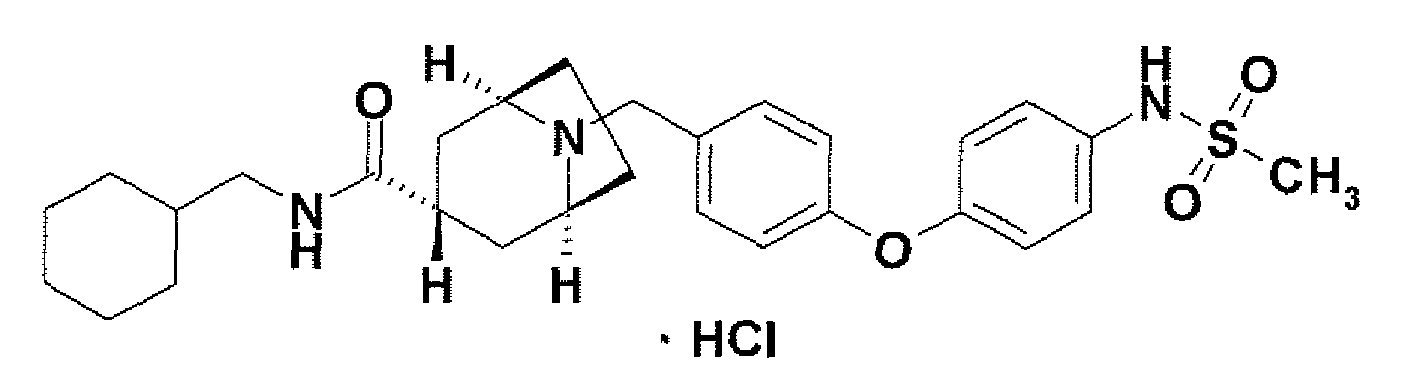
NMR (CD3OD): δ 0.85-1.04 (m, 2H), 1.20-1.36 (m, 4H), 1.46 (m, 1H), 1.60-1.78 (m, 4H), 1.85-1.90 (m, 2H), 2.08-2.16 (m, 4H), 2.38-2.50 (m, 2H), 2.88 (m, 1H), 2.95 (s, 3H), 3.00 (d, J = 6.9 Hz, 2H), 3.96 (m, 2H), 4.16 (s, 2H), 7.00-7.10 (m, 4H), 7.24-7.32 (m, 2H), 7.53 (brd, J = 8.7 Hz, 2H).
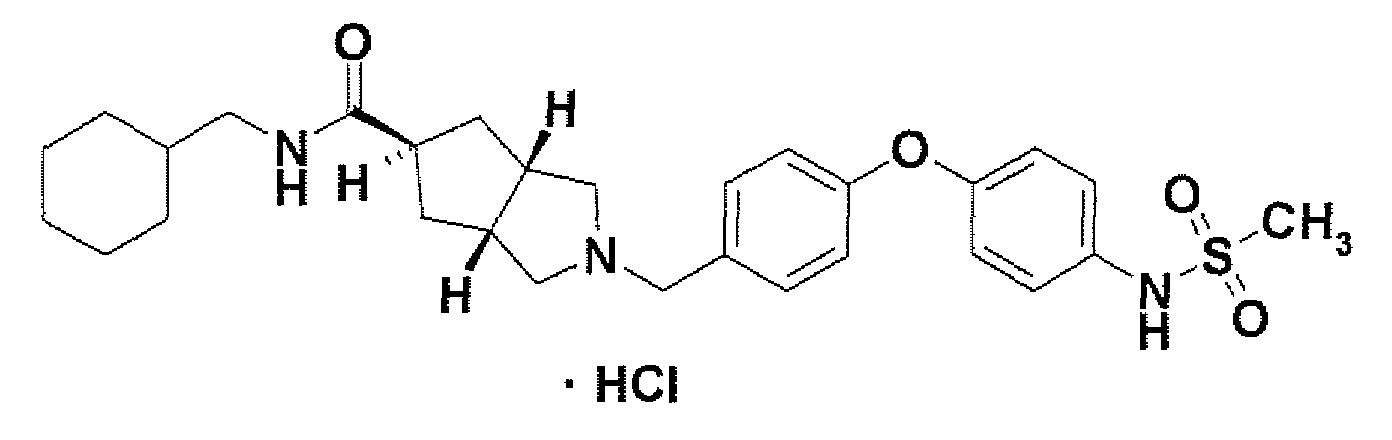
NMR (CD3OD): δ 0.80-1.02 (m, 2H), 1.04-1.36 (m, 3H), 1.46 (m, 1H), 1.60-2.18 (m, 9H), 2.76-3.04 (m, 7H), 2.95 (s, 3H), 3.60-3.78 (m, 2H), 4.35 (s, 2H), 7.00-7.19 (m, 4H), 7.24-7.32 (m, 2H), 7.42-7.58 (m, 2H).

NMR (CD3OD): δ 0.80-1.00 (m, 2H), 1.10-1.36 (m, 3H), 1.42 (m, 1H), 1.60-1.82 (m, 6H), 2.18 (m, 1H), 2.24-2.38 (m, 2H), 2.78-3.40 (m, 9H), 2.95 (s, 3H), 4.30 (s, 2H), 7.00-7.10 (m, 4H), 7.22-7.38 (m, 2H), 7.42-7.58 (m, 2H).

NMR (CD3OD): δ 0.82-2.42 (m, 24H), 2.80-3.12 (m, 2H), 3.56-3.70 (m, 2H), 3.79 (m, 1H), 4.02-4.16 (m, 4H), 5.12-5.38 (m, 1H), 7.20-7.62 (m, 10H).
NMR (CD3OD): δ 0.80-1.08 (m, 5H), 1.10-1.42 (m, 6H), 1.42-2.38 (m, 14H), 2.78-3.08 (m, 3H), 3.44-3.60 (m, 2H), 3.62-4.14 (m, 3H), 4.26 (brs, 2H), 7.00-7.06 (m, 4H), 7.18 (m, 1H), 7.38-7.52 (m, 4H).
NMR (CD3OD): δ 0.86-2.48 (m, 23H), 2.81-3.08 (m, 3H), 3.27 (m, 1H), 3.45-3.58 (m, 2H), 3.64-4.00 (m, 2H), 4.18 (m, 1H), 4.25 (brs, 2H), 7.00-7.07 (m, 4H), 7.18 (m, 1H), 7.28-7.52 (m, 4H).
NMR (CD3OD): δ 0.78-2.30 (m, 12H), 2.52-3.96 (m, 9H), 4.14-4.28 (m, 2H), 4.38 (m, 1H), 6.98-7.52 (m, 14H).
NMR (CD3OD): δ 0.78-1.00 (m, 3H), 1.00-2.38 (m, 20H), 2.78-3.08 (m, 3H), 3.48-4.04 (m, 5H), 4.26 (m, 2H), 6.98-7.10 (m, 4H), 7.18 (m, 1H), 7.39-7.54 (m, 4H).
NMR (CD3OD): δ 0.76-1.01 (m, 3H), 1.22-1.42 (m, 2H), 1.44-1.72 (m, 3H), 1.86-2.38 (m, 4H), 2.80-3.08 (m, 3H), 3.44-3.60 (m, 2H), 3.64-4.12 (m, 5H), 4.26 (brs, 2H), 6.96-7.10 (m, 4H), 7.18 (m, 1H), 7.36-7.52 (m, 4H).
NMR(CD3OD): δ 0.86-1.08 (m, 5H), 1.16-2.12 (m, 20H), 2.39 (m, 6H), 2.78-3.16 (m, 3H), 3.56-3.70 (m, 2H), 3.76-4.14 (m, 3H), 4.24 (brs, 2H), 7.47-7.56 (m, 5H).
NMR (CD3OD): δ 0.90-2.14 (m, 23H), 2.32-2.40 (m, 6H), 2.80-3.14 (m, 3H), 3.28 (m, 1H), 3.56-3.68 (m, 2H), 3.68-4.00 (m, 2H), 4.19 (m, 1H), 4.24 (brs, 2H), 7.42-7.60 (m, 5H).
NMR (CD3OD): δ 0.78-2.40 (m, 12H), 2.32-2.40 (m, 6H), 2.32-3.95 (m, 8H), 4.12-4.44 (m, 4H), 7.10-7.28 (m, 5H), 7.40-7.61 (m, 5H).
NMR (CD3OD): δ 0.80-1.00 (m, 3H), 1.02-2.22 (m, 20H), 2.32-2.40 (m, 6H), 2.80-3.18 (m, 3H), 3.58-4.08 (m, 5H), 4.24 (brs, 2H), 7.40-7.60 (m, 5H).
NMR (CD3OD): δ 0.95 (t, J = 7.5 Hz, 3H), 0.85-1.10 (m, 2H), 1.16-1.42 (m, 6H), 1.46-2.10 (m, 13H), 2.21 (m, 1H), 2.81 (m, 1H), 3.00-3.20 (m, 2H), 3.34-3.72 (m, 5H), 3.92-4.08 (m, 2H), 4.30 (s, 2H), 7.00-7.10 (m, 4H), 7.18 (m, 1H), 7.36-7.44 (m, 2H), 7.54 (brd, J = 8.4 Hz, 2H).
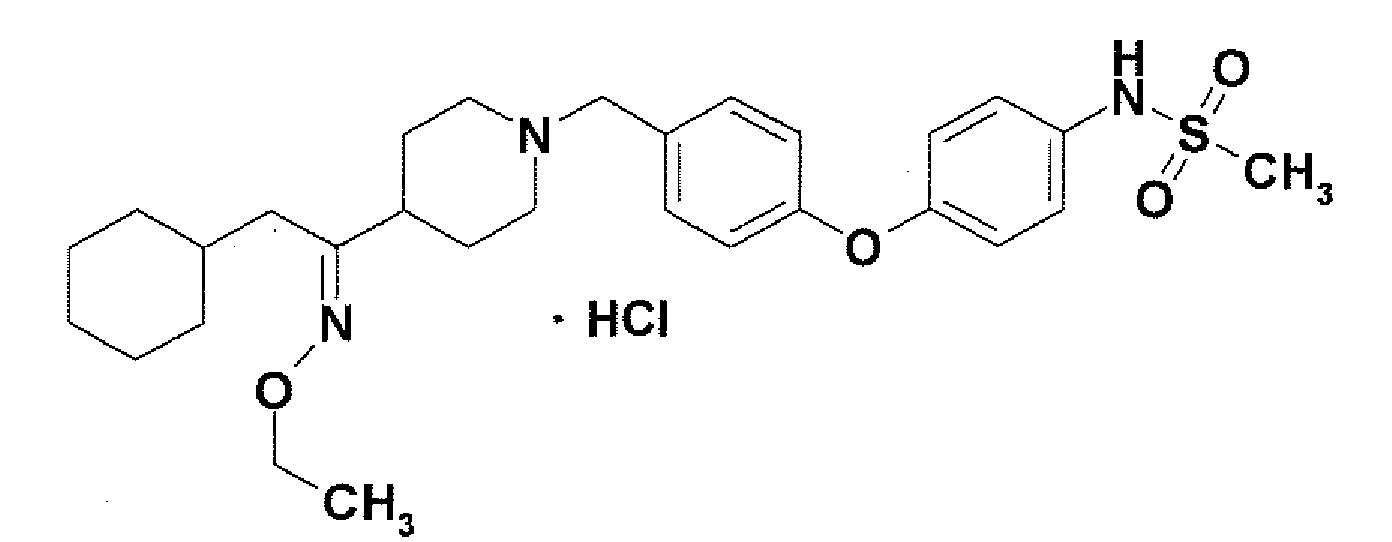

TLC:Rf 0.67, 0.73(chloroform:methanol=9:1);
NMR (CD3OD): δ 0.84-1.06 (m, 2H), 1.08-1.36 (m, 4H), 1.18 (t, J = 7.2 Hz, 3H), 1.58-2.18 (m, 9H), 2.23 (d, J = 7.2 Hz, 2H), 2.42 (m, 1H), 2.95 (s, 3H), 3.02 (m, 2H), 3.38-3.56 (m, 2H), 4.00 (q, J = 7.2 Hz, 2H), 4.26 (s, 2H), 7.00-7.10 (m, 4H), 7.22-7.36 (m, 2H), 7.47 (brd, J = 8.4 Hz, 2H).
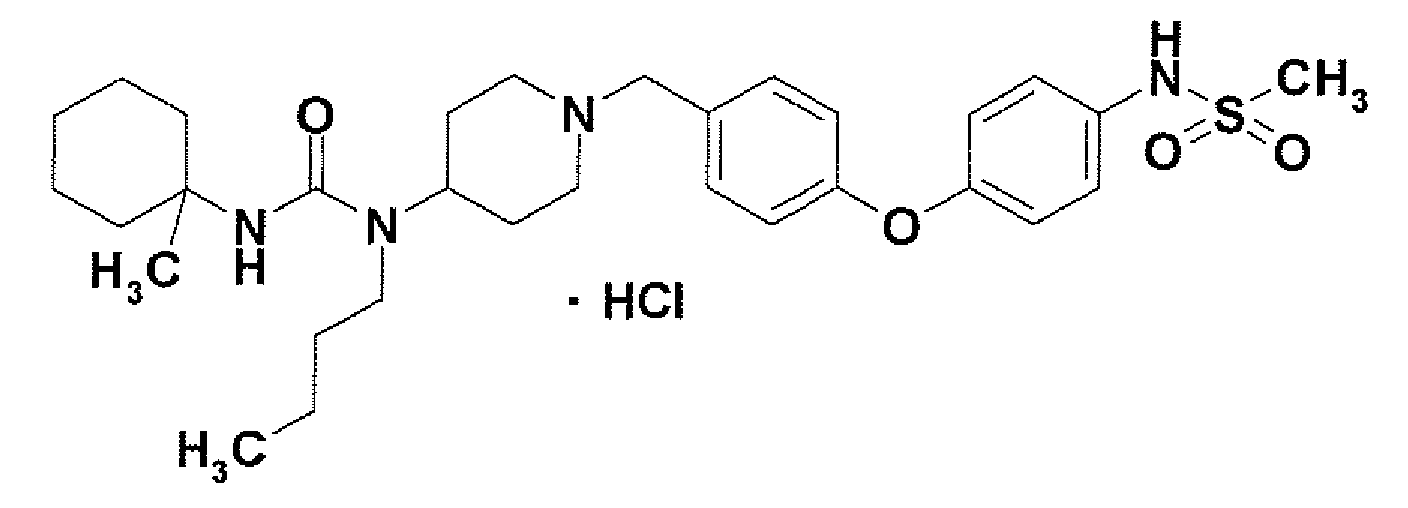
TLC:Rf 0.60(ethyl acetate);
NMR (CD3OD): δ 0.96 (t, J = 7.2 Hz, 3H), 1.30-1.60 (m, 12H), 1.32 (s, 3H), 1.87-2.07 (m, 6H), 2.95 (s, 3H), 3.05-3.15 (m, 4H), 3.52-3.56 (m, 2H), 4.19 (m, 1H), 4.28 (s, 2H), 7.03 (d, J = 9.0 Hz, 2H), 7.06 (d, J = 9.0 Hz, 2H), 7.29 (d, J = 9.0 Hz, 2H), 7.49 (d, J = 9.0 Hz, 2H).
NMR (CD3OD): δ 1.70-1.96 (m, 2H), 2.10-2.30 (m, 2H), 2.96 (s, 3H), 3.07-3.20 (m, 2H), 3.46-3.60 (m, 2H), 3.84 (m, 1H), 4.31 (s, 2H), 7.02-7.08 (m, 4H), 7.30 (d, J = 8.7 Hz, 2H), 7.35 (t, J = 7.8 Hz, 1H), 7.51 (d, J = 8.7 Hz, 2H), 7.59-7.66 (m, 2H), 8.04 (s, 1H).
NMR (CD3OD): δ 0.92 (t, J = 6.9 Hz, 3H), 0.94 (t, J = 6.9 Hz, 3H), 1.40-1.26 (m, 4H), 1.56-1.42 (m, 4H), 1.95-1.83 (m, 2H), 2.20-2.02(m, 2H), 2.95 (s, 3H), 3.17-3.05 (m, 6H), 3.60-3.50(m, 2H), 4.13 (m, 1H), 4.27 (s, 2H), 7.03(d, J = 8.7 Hz, 2H), 7.06 (d, J = 8.7 Hz, 2H), 7.29 (d, J = 8.7 Hz, 2H), 7.49 (d, J = 8.7 Hz, 2H).
NMR (CD3OD): δ 0.95 (t, J = 7.2 Hz, 3H), 1.33 (s, 9H), 1.40-1.25 (m, 2H), 1.58-1.44 (m, 2H), 1.92-1.83 (m, 2H), 2.10-1.97 (m, 2H), 2.95 (s, 3H), 3.15-3.02 (m, 4H), 3.58-3.50 (m, 2H), 4.15 (m, 1H), 4.28 (s, 2H), 7.03 (d, J = 8.7 Hz, 2H), 7.06 (d, J = 8.7 Hz, 2H), 7.30 (d, J = 9.0 Hz, 2H), 7.50 (d, J = 8.7 Hz, 2H).
NMR (CD3OD): δ 0.94 (t, J = 7.2 Hz, 3H), 1.95-1.10 (m, 18H), 2.20-2.02 (m, 2H), 2.95 (s, 3H), 3.18-3.02 (m, 4H), 3.60-3.50 (m, 3H), 4.18 (m, 1H), 4.27 (s, 2H), 7.03 (d, J = 8.7 Hz, 2H), 7.06 (d, J = 8.7 Hz, 2H), 7.29 (d, J = 8.7 Hz, 2H), 7.49 (d, J = 8.7 Hz, 2H).
NMR (CD3OD): δ 0.84-0.95 (m, 3H), 1.14-1.50 (m, 4H), 1.86-2.09 (m, 4H), 2.95 (s, 3H), 3.01-3.12 (m, 2H), 3.13 (t, J = 6.9 Hz, 2H), 3.44-3.52 (m, 2H), 4.24 (s, 2H), 4.35 (m, 1H), 4.46 (s, 2H), 7.02 (d, J = 9.0 Hz, 2H), 7.04 (d, J = 9.0 Hz, 2H), 7.20-7.35 (m, 7H), 7.46 (d, J = 9.0 Hz, 2H).
NMR (CD3OD): δ 1.02-1.40 (m, 6H), 1.52-2.08 (m, 8H), 2.95 (s, 3H), 3.02-3.13 (m, 2H), 3.44-3.60 (m, 3H), 4.22 (s, 2H), 4.39 (m, 1H), 4.43 (s, 2H), 7.02 (d, J = 9.0 Hz, 2H), 7.04 (d, J = 9.0 Hz, 2H), 7.20-7.36 (m, 7H), 7.46 (d, J = 9.0 Hz, 2H).
NMR (CD3OD): δ 1.02-1.13(m, 3H), 1.84-2.08 (m, 4H), 2.95 (s, 3H), 3.00-3.12 (m, 2H), 3.15-3.21(m, 2H), 3.42-3.52 (m, 2H), 4.23 (s, 2H), 4.32 (m, 1H), 4.46 (s, 2H), 7.01 (d, J = 9.0 Hz, 2H), 7.04 (d, J = 8.7 Hz, 2H), 7.20-7.34 (m, 7H), 7.46 (d, J = 8.7 Hz, 2H).
NMR (CD3OD): δ 1.12-1.44 (m, 6H), 1.54-2.13 (m, 8H), 2.95 (s, 3H), 3.02-3.14 (m, 2H), 3.28-3.40 (m, 2H), 3.37 (s, 3H), 3.42-3.58 (m, 5H), 4.13 (m, 1H), 4.27 (s, 2H), 7.03 (d, J = 8.7 Hz, 2H), 7.06 (d, J = 8.7 Hz, 2H), 7.29 (d, J = 8.7 Hz, 2H), 7.49 (d, J = 8.7 Hz, 2H).
NMR (CD3OD): δ 1.71-1.82 (m, 2H), 2.21-2.26 (m, 2H), 2.96 (s, 3H), 2.99-3.17 (m, 2H), 3.52-3.57 (m, 2H), 3.84 (m, 1H), 4.30 (s, 2H), 7.03-7.08 (m, 4H), 7.30 (d, J = 8.6 Hz, 2H), 7.47 (d, J = 8.6 Hz, 2H), 7.51 (d, J = 8.6 Hz, 2H), 7.91 (d, J = 8.6 Hz, 2H).
NMR (CD3OD): δ 1.93-1.97 (m, 2H), 2.95 (s, 3H), 2.96-3.30 (m, 4H), 3.55-3.59 (m, 2H), 4.31 (s, 2H), 5.19 (m, 1H), 7.04 (d, J = 8.7 Hz, 2H), 7.07 (d, J = 8.7 Hz, 2H), 7.13 (m, 1H), 7.22 (m, 1H), 7.29 (d, J = 8.7 Hz, 2H), 7.50 (d, J = 8.7 Hz, 2H), 7.63 (m, 1H), 8.02 (m, 1H).
NMR (CD3OD): δ 0.97 (t, J = 7.5 Hz, 3H), 1.30-1.45 (m, 2H), 1.54-1.66 (m, 2H), 1.94-2.04 (m, 2H), 2.14-2.32 (m, 2H), 2.95 (s, 3H), 3.05-3.18 (m, 2H), 3.24-3.34 (m, 2H), 3.51-3.63 (m, 2H), 4.19 (m, 1H), 4.29 (s, 2H), 7.03 (d, J = 8.7 Hz, 2H), 7.06 (d, J = 8.7 Hz, 2H), 7.23-7.34 (m, 7H), 7.51 (d, J = 8.7 Hz, 2H).
NMR (CD3OD): δ 0.90 (t, J = 7.2 Hz, 3H), 1.20-1.46 (m, 4H), 1.84-1.93 (m, 2H), 2.00-2.18 (m, 2H), 2.79 (t, J = 7.2 Hz, 2H), 2.95 (s, 3H), 2.99-3.12 (m, 4H), 3.39 (t, J = 7.2 Hz, 2H), 3.48-3.57 (m, 2H), 4.06 (m, 1H), 4.27 (s, 2H), 7.03 (d, J = 8.7 Hz, 2H), 7.06 (d, J = 8.7 Hz, 2H), 7.13-7.27 (m, 5H), 7.29 (d, J = 8.7 Hz, 2H), 7.49 (d, J = 8.7 Hz, 2H).
NMR (CD3OD): δ 0.97 (t, J = 7.5 Hz, 3H), 1.33-1.44 (m, 2H), 1.55-1.66 (m, 2H), 1.94-2.02 (m, 2H), 2.14-2.30 (m, 2H), 2.95 (s, 3H), 3.04-3.14 (m, 2H), 3.22-3.32 (m, 2H), 3.52-3.62 (m, 2H), 4.17 (m, 1H), 4.29 (s, 2H), 6.97-7.08 (m, 6H), 7.27-7.33 (m, 4H), 7.50 (d, J = 8.7 Hz, 2H).
NMR (CD3OD): δ 0.99 (t, J = 7.2 Hz, 3H), 1.34-1.48 (m, 2H), 1.60-1.71 (m, 2H), 1.95-2.04 (m, 2H), 2.14-2.30 (m, 2H), 2.16 (s, 3H), 2.27 (s, 3H), 2.95 (s, 3H), 3.04-3.16 (m, 2H), 3.24-3.34 (m, 2H), 3.52-3.60 (m, 2H), 4.15(m, 1H), 4.28 (s, 2H), 6.91-7.10 (m, 7H), 7.29 (d, J = 8.7 Hz, 2H), 7.49 (d, J = 8.7 Hz, 2H).
NMR (CD3OD): δ 1.94-2.20 (m, 4H), 2.95 (s, 3H), 3.02-3.14 (m, 2H), 3.44-3.55 (m, 2H), 4.25 (s, 2H), 4.36 (m, 1H), 4.64 (s, 2H), 6.97 (d, J = 8.7 Hz, 2H), 7.02 (d, J = 8.7 Hz, 2H), 7.05 (d, J = 8.7 Hz, 2H), 7.24-7.41 (m, 9H), 7.46 (d, J = 8.7 Hz, 2H).
NMR (CD3OD): δ 1.98-2.08 (m, 2H), 2.10-2.26 (m, 2H), 2.95 (s, 3H), 3.02-3.18 (m, 2H), 3.47 (s, 3H), 3.44-3.64 (m, 6H), 4.14 (m, 1H), 4.29 (s, 2H), 6.98-7.06 (m, 2H), 7.03 (d, J = 8.7 Hz, 2H), 7.07 (d, J = 8.7 Hz, 2H), 7.22-7.28 (m, 2H), 7.29 (d, J = 8.7 Hz, 2H), 7.50 (d, J = 8.7 Hz, 2H).
NMR (CD3OD): δ 0.98 (t, J = 7.2 Hz, 3H), 1.33-1.46 (m, 2H), 1.54-1.66 (m, 2H), 1.93-2.04 (m, 2H), 2.14-2.24 (m, 2H), 2.46 (s, 3H), 2.95 (s, 3H), 3.04-3.18 (m, 2H), 3.24-3.34 (m, 2H), 3.48-3.60 (m, 2H), 4.16 (m, 1H), 4.29 (s, 2H), 6.76 (m, 1H), 7.00-7.22 (m, 7H), 7.30 (d, J = 8.7 Hz, 2H), 7.50 (d, J = 8.7 Hz, 2H).
NMR (CD3OD): δ 1.90-2.02 (m, 2H), 2.04-2.20 (m, 2H), 2.43 (s, 3H), 2.95 (s, 3H), 3.00-3.15 (m, 2H), 3.42-3.54 (m, 2H), 4.23(s, 2H), 4.36 (m, 1H), 4.66 (s, 2H), 6.92 (m, 1H), 7.03 (d, J = 8.7 Hz, 2H), 7.04 (d, J = 8.7 Hz, 2H), 7.15 (d, J = 7.8 Hz, 2H), 7.25-7.39 (m, 9H), 7.45 (d, J = 8.7 Hz, 2H).
NMR (CD3OD): δ 0.98 (t, J = 7.2 Hz, 3H), 1.34-1.48 (m, 2H), 1.65-1.75 (m, 2H), 1.96-2.06 (m, 2H), 2.16-2.32 (m, 2H), 2.26 (s, 3H), 2.95 (s, 3H), 3.04-3.16 (m, 2H), 3.26-3.34 (m, 2H), 3.51-3.60 (m, 2H), 4.16 (m, 1H), 4.28 (s, 2H), 7.03 (d, J = 8.7 Hz, 2H), 7.06 (d, J = 8.7 Hz, 2H), 7.14-7.21 (m, 2H), 7.28-7.31 (m, 3H), 7.50 (d, J = 8.7 Hz, 2H).
NMR (CD3OD): δ 0.98 (t, J = 7.2 Hz, 3H), 1.34-1.46 (m, 2H), 1.61-1.73 (m, 2H), 1.94-2.04 (m, 2H), 2.13-2.30 (m, 2H), 2.15 (s, 6H), 2.23 (s, 3H), 2.95 (s, 3H), 3.04-3.16 (m, 2H), 3.24-3.32 (m, 2H), 3.52-3.60 (m, 2H), 4.15 (m, 1H), 4.28 (s, 2H), 6.87 (s, 2H), 7.03 (d, J = 8.7 Hz, 2H), 7.06 (d, J = 8.7 Hz, 2H), 7.29 (d, J = 8.7 Hz, 2H), 7.49 (d, J = 8.7 Hz, 2H).
NMR (CD3OD): δ 0.97 (t, J = 7.2 Hz, 3H), 1.33-1.45 (m, 2H), 1.55-1.68 (m, 2H), 1.96-2.06 (m, 2H), 2.15-2.32 (m, 2H), 2.58 (s, 3H), 2.95 (s, 3H), 3.06-3.19 (m, 2H), 3.25-3.35 (m, 2H), 3.53-3.62 (m, 2H), 4.19 (m, 1H), 4.30 (s, 2H), 7.04 (d, J = 8.7 Hz, 2H), 7.07 (d, J = 8.7 Hz, 2H), 7.29 (d, J = 8.7 Hz, 2H), 7.41 (t, J = 8.0 Hz, 1H), 7.50 (d, J = 8.7 Hz, 2H), 7.62 (ddd, J = 8.0, 2.1, 1.2 Hz, 1H), 7.68 (ddd, J = 8.0, 1.5, 1.2 Hz, 1H), 8.00 (m, 1H).
NMR (CD3OD): δ 0.94 (t, J = 7.2 Hz, 3H), 1.26-1.40 (m, 2H), 1.47-1.60 (m, 2H), 1.87-1.98 (m, 2H), 2.06-2.21 (m, 2H), 2.95 (s, 3H), 3.02-3.18 (m, 4H), 3.49-3.59 (m, 2H), 4.15 (m, 1H),4.27 (s, 2H) 4.36 (s, 2H), 7.03 (d, J = 8.7 Hz, 2H), 7.06 (J = 8.7 Hz, 2H), 7.23-7.31 (m, 7H), 7.49 (d, J = 8.7 Hz, 2H).
NMR (CD3OD): δ 1.18 (d, J = 6.3 Hz, 3H), 1.38-1.50 (m, 2H), 1.64-1.80 (m, 7H), 1.80-1.94 (m, 2H), 1.95-2.12 (m, 10H), 2.95 (s, 3H), 3.00-3.54 (m, 4H), 3.48-3.57 (m, 2H), 3.74 (m, 1H), 4.12 (m, 1H), 4.27 (s, 2H), 7.03 (d, J = 8.7 Hz, 2H), 7.06 (d, J = 8.7 Hz, 2H), 7.29 (d, J = 8.7 Hz, 2H), 7.49 (d, J = 8.7 Hz, 2H).
NMR (CD3OD): δ 0.95 (t, J = 7.2 Hz, 3H), 0.85-1.02 (m, 2H), 1.13-1.58 (m, 10H), 1.61-1.80 (m, 5H), 1.83-1.95 (m, 2H), 2.03-2.19 (m, 2H), 2.95 (s, 3H), 3.02-3.13 (m, 6H), 3.48-3.58 (m, 2H), 4.14 ( m, 1H), 4.27 (s, 2H), 7.03 (d, J = 8.7 Hz, 2H), 7.06 (d, J = 8.7 Hz, 2H), 7.29 (d, J = 8.7 Hz, 2H), 7.50 (d, J = 8.7 Hz, 2H).
NMR (CD3OD): δ 0.85-1.00 (m, 2H), 1.10-1.40 (m, 7H), 1.60-1.78 (m, 6H), 2.08-2.20 (m, 2H), 2.95 (s, 3H), 3.02-3.18 (m, 4H), 3.45-3.55 (m, 2H), 3.72 (m, 1H), 4.27 (s, 2H), 7.03 (d, J = 8.7 Hz, 2H), 7.05 (d, J = 8.7 Hz, 2H), 7.29 (d, J = 8.7 Hz, 2H), 7.50 (d, J = 8.7 Hz, 2H).
NMR (CD3OD): δ 0.84-1.00 (m, 2H), 1.15-1.44 (m, 7H), 1.60-1.78 (m, 6H), 1.97-2.13 (m, 2H), 2.74 (s, 3H), 2.95 (s, 3H), 3.03-3.20 (m, 4H), 3.51-3.60 (m, 2H), 4.28 (s, 2H),4.30(m, 1H), 7.03 (d, J = 8.7 Hz, 2H), 7.06 (d, J = 8.7 Hz, 2H), 7.29 (d, J = 8.7 Hz, 2H), 7.50 (d, J = 8.7 Hz, 2H).
NMR (CD3OD): δ 0.84-1.01 (m, 2H), 1.12 (t, J = 6.9 Hz, 3H), 1.08-1.45 (m, 6H), 1.58-1.80 (m, 5H), 1.85-1.94 (m, 2H), 1.97-2.18 (m, 2H), 2.95 (s, 3H), 3.02-3.14 (m, 6H), 3.48-3.59 (m, 2H), 4.20 (m, 1H), 4.28 (s, 2H), 7.03 (d, J = 8.7 Hz, 2H), 7.06 (d, J = 8.7 Hz, 2H), 7.29 (d, J = 8.7 Hz, 2H), 7.49 (d, J = 8.7 Hz, 2H).
NMR (CD30D): δ 0.91 (t, J = 7.5 Hz, 3H), 0.82-1.00 (m, 2H), 1.15-1.40 (m, 6H), 1.42-1.80 (m, 6H), 1.80-2.20 (m, 5H), 2.95 (s, 3H), 2.98-3.22 (m, 6H), 3.42-3.58 (m, 2H), 4.12 (m, 1H), 4.27 (s, 2H), 7.03 (d, J = 8.7 Hz, 2H), 7.06 (d, J = 8.7 Hz, 2H), 7.30 (d, J = 8.7 Hz, 2H), 7.50 (d, J = 8.7 Hz, 2H).
NMR (CD3OD): δ 0.85-1.00 (m, 2H), 1.08-1.40 (m, 6H), 1.60-1.80 (m, 5H), 1.87-2.18 (m, 4H), 2.95 (s, 3H), 3.02-3.18 (m, 2H), 3.15 (t, J = 6.2 Hz, 2H), 3.29-3.38 (m, 2H),3.36 (s, 3H), 3.45-3.57 (m, 4H), 4.08 (m, 1H), 4.27 (s, 2H), 7.03 (d, J = 8.7 Hz, 2H), 7.06 (d, J = 8.7 Hz, 2H), 7.29 (d, J = 8.7 Hz, 2H), 7.48 (d, J = 8.7 Hz, 2H).
NMR (CD3OD): δ 0.78-0.93 (m, 2H), 1.02-1.33 (m, 6H), 1.56-1.70 (m, 5H), 1.85-2.03 (m, 4H), 2.95 (s, 3H), 2.98-3.20 (m, 4H), 3.42-3.53 (m, 2H), 4.23 (s, 2H), 4.36 (m, 1H), 4.45 (s, 2H), 7.02 (d, J = 8.7 Hz, 2H), 7.04 (d, J = 8.7 Hz, 2H), 7.15-7.38 (m, 7H), 7.45 (d, J = 8.7 Hz, 2H).
NMR (CD3OD): δ 0.83-1.12 (m, 4H), 1.15-1.41 (m, 10H), 1.52-1.80 (m, 10H), 1.87-1.95 (m, 2H), 2.18-2.30 (m, 2H), 2.95 (s, 3H), 3.02-3.14 (m, 4H), 3.17 (t, J = 6.2 Hz, 2H), 3.48-3.57 (m, 2H), 3.91 (m, 1H), 4.27 (s, 2H), 7.03 (d, J = 8.7 Hz, 2H), 7.06 (d, J = 8.7 Hz, 2H), 7.29 (d, J = 8.7 Hz, 2H), 7.49 (d, J = 8.7 Hz, 2H).
NMR (CD3OD): δ 0.95 (t, J = 7.2 Hz, 3H), 0.82-1.05 (m, 2H), 1.14-1.42 (m, 5H), 1.43-1.58 (m, 3H), 1.62-1.81 (m, 5H), 1.85-1.98 (m, 2H), 1.99-2.22 (m, 2H), 2.95 (s, 3H), 2.99 (d, J = 6.9 Hz, 2H), 3 .02-3.17 (m, 4H), 3.48-3.60 (m, 2H), 4.15 (m, 1H), 4.28 (s, 2H), 7.03 (d, J = 8.7 Hz, 2H), 7.06 (d, J = 8.7 Hz, 2H), 7.29 (d, J = 8.7 Hz, 2H), 7.49 (d, J = 8.7 Hz, 2H).
NMR (CD3OD): δ 0.83-1.02 (m, 2H), 1.12-1.33 (m, 4H), 1.58-1.80 (m, 6H), 2.03 (m, 1H), 2.09-2.11 (m, 2H), 2.95 (s, 3H), 3.02-3.15 (m, 4H), 3.50-3.58 (m, 2H), 3.72 (m, 1H), 4.27 (s, 2H), 7.03 (d, J = 8.7 Hz, 2H), 7.05 (d, J = 8.7 Hz, 2H), 7.29 (d, J = 8.7 Hz, 2H), 7.49 (d, J = 8.7 Hz, 2H).
NMR (CD3OD): δ 0.81-1.00 (m, 2H), 1.13-1.32 (m, 4H), 1.48 (m, 1H), 1.60-1.90 (m, 6H), 1.93-2.12 (m, 2H), 2.75 (s, 3H), 2.95 (s, 3H), 2.98 (d, J = 6.9 Hz, 2H), 3.04-3.19 (m, 2H), 3.49-3.60 (m, 2H), 4.28 (s, 2H), 4.33 (m, 1H), 7.03 (d, J = 8.7 Hz, 2H), 7.06 (d, J = 8.7 Hz, 2H), 7.29 (d, J = 8.7 Hz, 2H), 7.50 (d, J = 8.7 Hz, 2H).
NMR (CD3OD): 5 0.83-0.99 (m, 2H), 1.14 (t, J = 6.9 Hz, 3H), 1.08-1.32 (m, 2H), 1.47 (m, 1H), 1.60-1.79 (m, 6H), 1.86-1.95 (m, 2H), 2.00-2.17 (m, 2H), 2.95 (s, 3H), 2.98 (dd, J = 7.2, 2.0 Hz, 2H), 3.02-3.25 (m, 4H), 3.49-3.58 (m, 2H), 4.22 (m, 1H), 4.28 (s, 2H), 7.03 (d, J = 8.7 Hz, 2H), 7.06 (d, J = 8.7 Hz, 2H), 7.29 (d, J = 8.7 Hz, 2H), 7.50 (d, J = 8.7 Hz, 2H).
NMR (CD3OD): δ 0.91 (t, J = 7.2 Hz, 3H), 0.83-0.99 (m, 2H), 1.10-1.33 (m, 4H), 1.40-1.80 (m, 7H), 1.85-1.96 (m, 2H), 2.02-2.20 (m, 2H), 2.95 (s, 3H), 2.98 (d, J = 7.2 Hz, 2H), 3.00-3.17 (m, 4H), 3.50-3.58 (m, 2H), 4.14 (m, 1H), 4.27 (s, 2H), 7.03 (d, J = 8.7 Hz, 2H), 7.06 (d, J = 8.7 Hz, 2H), 7.29 (d, J = 8.7 Hz, 2H), 7.49 (d, J = 8.7 Hz, 2H).
NMR (CD3OD): δ 0.85-1.00 (m, 2H), 1.15-1.35 (m, 3H), 1.43 (m, 1H), 1.63-1.80 (m, 5H), 1.88-2.18 (m, 4H), 2.95 (s, 3H), 2.95 (d, J = 6.6 Hz, 2H), 3.02-3.15 (m, 2H), 3.25-3.38 (m, 2H), 3.36 (s, 3H), 3.46-3.58 (m, 4H), 4.10 (m, 1H), 4.27 (s, 2H), 7.03 (d, J = 8.7 Hz, 2H), 7.06 (d, J = 8.7 Hz, 2H), 7.29 (d, J = 8.7 Hz, 2H), 7.49 (d, J = 8.7 Hz, 2H).
NMR (CD3OD): δ 0.72-0.85 (m, 2H), 1.08-1.40 (m, 4H), 1.50-1.79 (m, 5H), 1.90-2.08 (m, 4H), 2.95 (s, 3H), 2.96 (d, J = 6.9 Hz, 2H), 3.02-3.17 (m, 2H), 3.44-3.56 (m, 2H), 4.24 (s, 2H), 4.38 (m, 1H), 4.46 (s, 2H), 7.02 (d, J = 8.7 Hz, 2H), 7.04 (d, J = 8.7 Hz, 2H), 7.20-7.38 (m, 7H), 7.46 (d, J = 8.7 Hz, 2H).
NMR (CD3OD): δ 0.82-1.05 (m, 4H), 1.13-1.35 (m, 6H), 1.46 (m, 1H), 1.60-1.85 (m, 11H), 1.87-1.98 (m, 2H), 2.15-2.31 (m, 2H), 2.95 (s, 3H), 2.98 (d, J = 6.6 Hz, 2H), 2.94-3.13 (m, 4H), 3.50-3.59 (m, 2H), 3.89 (m, 1H), 4.26 (s, 2H), 7.03 (d, J = 8.7 Hz, 2H), 7.06 (d, J = 8.7 Hz, 2H), 7.30 (d, J = 8.7 Hz, 2H), 7.48 (d, J = 8.7 Hz, 2H).
NMR (CD3OD): δ 1.12 (t, J = 7.0 Hz, 3H), 1.07-1.43 (m, 5H), 1.59-1.96 (m, 7H), 1.97-2.18 (m, 2H), 2.95 (s, 3H), 3.03-3.26 (m, 4H), 3.48-3.61 (m, 3H), 4.21 (m, 1H), 4.28 (s, 2H), 7.03 (d, J = 8.7 Hz, 2H), 7.06 (d, J = 8.7 Hz, 2H), 7.30 (d, J = 8.7 Hz, 2H), 7.50 (d, J = 8.7 Hz, 2H).
NMR (CD3OD): δ 1.23 (t, J = 7.0 Hz, 3H), 1.94-2.04 (m, 2H), 2.10-2.29 (m, 2H), 2.95 (s, 3H), 3.05-3.19 (m, 2H), 3.38 (q, J = 7.0 Hz, 2H), 3.52-3.61 (m, 2H), 4.25 (m, 1H), 4.30 (s, 2H), 7.04 (d, J = 8.7 Hz, 2H), 7.07 (d, J = 8.7 Hz, 2H), 7.24-7.38 (m, 7H), 7.50 (d, J = 8.7 Hz, 2H).
NMR (CD3OD): δ 1.16 (t, J = 7.0 Hz, 3H), 1.89-1.97 (m, 2H), 2.02-2.18 (m, 2H), 2.95 (s, 3H), 3.02-3.15 (m, 2H), 3.25 (q, J = 7.0 Hz, 2H), 3.50-3.58 (m, 2H), 4.21 (m, 1H), 4.28 (s, 2H), 4.36 (s, 2H), 7.03 (d, J = 8.7 Hz, 2H), 7.06 (d, J = 8.7 Hz, 2H), 7.18-7.30 (m, 7H), 7.49 (d, J = 8.7 Hz, 2H).
NMR (CD3OD): δ 1.06 (t, J = 7.0 Hz, 3H), 1.84-1.93 (m, 2H), 1.98-2.15 (m, 2H), 2.79 (t, J = 7.5 Hz, 2H), 2.95 (s, 3H), 3.41-3.20 (m, 4H), 3.38 (t, J = 7.5 Hz, 2H), 3.50-3.59 (m, 2H), 4.19 (m, 1H), 4.28 (s, 2H), 7.03 (d, J = 8.7 Hz, 2H), 7.06 (d, J = 8.7 Hz, 2H), 7.12-7.33 (m, 7H), 7.49 (d, J = 8.7 Hz, 2H).
NMR (CD3OD): δ 1.09 (t, J = 7.2 Hz, 3H), 1.13 (t, J = 7.2 Hz, 3H), 1.85-1.95 (m, 2H), 1.98-2.18 (m, 2H), 2.95 (s, 3H), 3.03-3.24 (m, 6H), 3.50-3.59 (m, 2H), 4.21 (m, 1H), 4.29 (s, 2H), 7.03 (d, J = 8.7 Hz, 2H), 7.06 (d, J = 8.7 Hz, 2H), 7.30 (d, J = 8.7 Hz, 2H), 7.50 (d, J = 8.7 Hz, 2H).
NMR (CD3OD): δ 1.13 (t, J = 7.2 Hz, 3H), 1.33 (s, 9H), 1.82-1.93 (m, 2H), 1.95-2.11 (m, 2H), 2.95 (s, 3H), 3.02-3.15 (m, 2H), 3.18 (t, J = 7.2 Hz, 2H), 3.49-3.59 (m, 2H), 4.22 (m, 1H), 4.28 (s, 2H ), 7.03 (d, J = 8.7 Hz, 2H), 7.06 (d, J = 8.7 Hz, 2H), 7.29 (d, J = 8.7 Hz, 2H), 7.50 (d, J = 8.7 Hz, 2H).
NMR (CD3OD): δ 0.93 (t, J = 7.2 Hz, 3H), 1.13 (t, J = 7.0 Hz, 3H), 1.26-1.40 (m, 2H), 1.42-1.54 (m, 2H), 1.85-1.96 (m, 2H), 1.98-2.15 (m, 2H), 2.95 (s, 3H), 3.02-3.24 (m, 6H), 3.49-3.58 (m, 2H), 4.21 (m, 1H), 4.28 (s, 2H), 7.03 (d, J = 8.7 Hz, 2H), 7.06 (d, J = 8.7 Hz, 2H), 7.29 (d, J = 8.7 Hz, 2H), 7.50 (d, J = 8.7 Hz, 2H).
NMR (CD3OD): δ 0.93 (t, J = 7.2 Hz, 3H), 1.13-1.41 (m, 5H), 1.48-1.67 (m, 3H), 1.71-1.92 (m, 6H), 2.03-2.20 (m, 2H), 2.95 (s, 3H), 3.03-3.14 (m, 4H), 3.50-3.59 (m, 3H), 4.10 (m, 1H), 4.27 (s, 2H ), 7.03 (d, J = 8.7 Hz, 2H), 7.06 (d, J = 8.7 Hz, 2H), 7.29 (d, J = 8.7 Hz, 2H), 7.49 (d, J = 8.7 Hz, 2H).
NMR (CD3OD): δ 0.96 (t, J = 7.2 Hz, 3H), 1.59-1.72 (m, 2H), 1.95-2.06 (m, 2H), 2.15-2.31 (m, 2H), 2.95 (s, 3H), 3.05-3.18 (m, 2H), 3.22-3.32 (m, 2H), 3.52-3.61 (m, 2H), 4.18 (m, 1H), 4.29 (s, 2H), 7.03 (d, J = 8.7 Hz, 2H), 7.06 (d, J = 8.7 Hz, 2H), 7.23-7.37 (m, 7H), 7.50 (d, J = 8.7 Hz, 2H).
NMR (CD3OD): δ 0.91 (t, J = 7.0 Hz, 3H), 1.50-1.66 (m, 2H), 1.87-1.98 (m, 2H), 2.04-2.21 (m, 2H), 2.95 (s, 3H), 3.02-3.15 (m, 4H), 3.49-3.58 (m, 2H), 4.14 (m, 1H), 4.27 (s, 2H), 4.36 (s, 2H), 7.0 3 (d, J = 8.7 Hz, 2H), 7.06 (d, J = 8.7 Hz, 2H), 7.15-7.32 (m, 7H), 7.49 (d, J = 8.7 Hz, 2H).
NMR (CD3OD): δ 0.85 (t, J = 7.2 Hz, 3H), 1.38-1.51 (m, 2H), 1.84-1.93 (m, 2H), 2.00-2.19 (m, 2H), 2.75-2.82 (m, 2H), 2.95 (s, 3H), 2.94-3.15 (m, 4H), 3.33-3.41 (m, 2H), 3.48-3.58 (m, 2H), 4.11 (m, 1H), 4.27 (s, 2H), 7.03 (d, J = 8.7 Hz, 2H), 7.07 (d, J = 8.7 Hz, 2H), 7.13-7.31 (m, 7H), 7.49 (d, J = 8.7 Hz, 2H).
NMR (CD3OD): δ 0.91 (t, J = 7.0 Hz, 3H), 1.09 (t, J = 7.2 Hz, 3H), 1.46-1.60 (m, 2H), 1.86-1.95 (m, 2H), 2.03-2.19 (m, 2H), 2.95 (s, 3H), 3.00-3.22 (m, 6H), 3.50-3.59 (m, 2H), 4.13 (m, 1H), 4.28 (s, 2H), 7.03 (d, J = 8.7 Hz, 2H), 7.06 (d, J = 8.7 Hz, 2H), 7.29 (d, J = 8.7 Hz, 2H), 7.50 (d, J = 8.7 Hz, 2H).
NMR (CD3OD): δ 0.91 (t, J = 7.2 Hz, 3H), 1.32 (s, 9H), 1.47-1.61 (m, 2H), 1.84-1.94 (m, 2H), 1.95-2.11 (m, 2H), 2.95 (s, 3H), 3.01-3.15 (m, 4H), 3.50-3.57 (m, 2H), 4.16 (m, 1H), 4.28 (s, 2H), 7.0 3 (d, J = 8.7 Hz, 2H), 7.06 (d, J = 8.7 Hz, 2H), 7.29 (d, J = 8.7 Hz, 2H), 7.50 (d, J = 8.7 Hz, 2H).
NMR (CD3OD): δ 0.91 (t, J = 7.5 Hz, 3H), 0.92 (t, J = 7.5 Hz, 3H), 1.27-1.39 (m, 2H), 1.41-1.59 (m, 4H), 1.85-1.96 (m, 2H), 2.03-2.20 (m, 2H), 2.95 (s, 3H), 3.02-3.22 (m, 6H), 3.50-3.58 (m, 2H), 4.13 (m, 1H), 4.28 (s, 2H), 7.03 (d, J = 8.7 Hz, 2H), 7.06 (d, J = 8.7 Hz, 2H), 7.29 (d, J = 8.7 Hz, 2H), 7.50 (d, J = 8.7 Hz, 2H).
NMR (CD3OD): δ 0.91 (t, J = 7.2 Hz, 3H), 0.95 (t, J = 7.2 Hz, 3H), 1.23-1.41 (m, 6H), 1.44-1.58 (m, 4H), 1.86-1.95 (m, 2H), 2.03-2.20 (m, 2H), 2.95 (s, 3H), 3.02-3.17 (m, 6H), 3.48-3.58 (m, 2H), 4.14 (m, 1H), 4.28 (s, 2H), 7.03 (d, J = 8.7 Hz, 2H), 7.06 (d, J = 8.7 Hz, 2H), 7.29 (d, J = 8.7 Hz, 2H), 7.49 (d, J = 8.7 Hz, 2H).
NMR (CD3OD): δ 0.86 (t, J = 7.2 Hz, 3H), 1.10-1.50 (m, 6H), 1.88-2.09 (m, 4H), 2.95 (s, 3H), 3.01-3.17 (m, 2H), 3.13 (t, J = 7.0 Hz, 2H), 3.44-3.52 (m, 2H), 4.24 (s, 2H), 4.35 (m, 1H), 4.46 (s, 2H), 7.02 (d, J = 8.7 Hz, 2H), 7.04 (d, J = 8.7 Hz, 2H), 7.20-7.36 (m, 7H), 7.45 (d, J = 8.7 Hz, 2H).
NMR (CD3OD): δ 0.91 (t, J = 7.0 Hz, 3H), 1.22-1.38 (m, 4H), 1.41-1.54 (m, 2H), 1.87-2.19 (m, 4H), 2.95 (s, 3H), 3.02-3.16 (m, 2H), 3.11 (t, J = 7.0 Hz, 2H), 3.28-3.38 (m, 2H), 3.36 (s, 3H), 3.45- 3.58 (m, 4H), 4.10 (m, 1H), 4.27 (s, 2H), 7.03 (d, J = 8.7 Hz, 2H), 7.06 (d, J = 8.7 Hz, 2H), 7.29 (d, J = 8.7 Hz, 2H), 7.50 (d, J = 8.7 Hz, 2H).
NMR (CD3OD): δ 0.91 (t, J = 7.2 Hz, 3H), 1.13 (d, J = 6.6 Hz, 6H), 1.28-1.40 (m, 2H), 1.43-1.57 (m, 2H), 1.85-1.96 (m, 2H), 2.02-2.19 (m, 2H), 2.95 (s, 3H), 3.03-3.15 (m, 4H), 3.45-3.58 (m, 2H), 3 .91 (m, 1H), 4.13 (m, 1H), 4.28 (s, 2H), 7.03 (d, J = 8.7 Hz, 2H), 7.06 (d, J = 8.7 Hz, 2H), 7.29 (d, J = 8.7 Hz, 2H), 7.49 (d, J = 8.7 Hz, 2H).
NMR (CD3OD): δ 1.05 (d, J = 6.6 Hz, 6H), 1.86-2.10 (m, 4H), 2.95 (s, 3H), 3.02-3.15 (m, 2H), 3.44-3.53 (m, 2H), 3.91 (m, 1H), 4.24 (s, 2H), 4.35 (m, 1H), 4.47 (s, 2H), 7.02 (d, J = 8.7 Hz, 2H), 7.04 (d, J = 8.7 Hz, 2H), 7.21-7.39 (m, 7H), 7.46 (d, J = 8.7 Hz, 2H).
NMR (CD3OD): δ 0.93 (t, J = 7.2 Hz, 3H), 1.26-1.51 (m, 4H), 1.87-1.98 (m, 2H), 2.00-2.18 (m, 2H), 2.95 (s, 3H), 3.01-3.16 (m, 2H), 3.12 (t, J = 7.0 Hz, 2H), 3.28-3.37 (m, 2H), 3.36 (s, 3H), 3.45- 3.58 (m, 4H), 4.10 (m, 1H), 4.27 (s, 2H), 7.03 (d, J = 8.7 Hz, 2H), 7.06 (d, J = 8.7 Hz, 2H), 7.29 (d, J = 8.7 Hz, 2H), 7.49 (d, J = 8.7 Hz, 2H).
NMR (CD3OD): δ 1.66-1.73 (m, 2H), 2.22-2.26 (m, 2H), 2.95 (s, 3H), 3.08-3.17 (m, 2H), 3.51-3.55 (m, 2H), 3.80 (m, 1H), 3.86 (s, 3H), 4.29 (s, 2H), 6.86 (m, 1H), 6.94 (m, 2H), 7.04 (d, J = 9.0 Hz, 2H), 7.07 (d, J = 9.0 Hz, 2H), 7.29 (d, J = 9.0 Hz, 2H), 7.49 (d, J = 9.0 Hz, 2H), 7.96 (m, 1H).
NMR (CD3OD): δ 1.67-1.79 (m, 2H), 2.20-2.24 (m, 2H), 2.96 (s, 3H), 3.08-3.16 (m, 2H), 3.51-3.55 (m, 2H), 3.75 (s, 3H), 3.81 (m, 1H), 4.29 (s, 2H), 6.56 (m, 1H), 6.82 (m, 1H), 7.02-7.16 (m, 6H), 7.30 (d, J = 9.0 Hz, 2H), 7.50 (d, J = 9.0 Hz, 2H).
NMR (d6-DMSO): δ 1.66-1.75 (m, 2H), 1.99-2.23 (m, 2H), 2.97 (s, 3H), 2.97-3.05 (m, 2H), 3.31-3.35 (m, 2H), 3.64 (m, 1H), 3.67 (s, 3H), 4.22 (d, J = 4.8 Hz, 2H), 6.38 (br-d, J = 7.2 Hz, 1H), 6.79 (d, J = 9.0 Hz, 2H), 7.03 (d, J = 9.0 Hz, 2H), 7.06 (d, J = 9.0 Hz, 2H), 7.25 (d, J = 9.0 Hz, 2H), 7.26 (d, J = 9.0 Hz, 2H), 7.55 (d, J = 9.0 Hz, 2H), 8.24 (s, 1H), 9.70 (s, 1H).
NMR (CD3OD): δ 1.06-1.41 (m, 5H), 1.53-1.88 (m, 6H), 2.01 (m, 1H), 2.09-2.18 (m, 2H), 2.95 (s, 3H), 3.02-3.12 (m, 2H), 3.40-3.55 (m, 3H), 3.72 (m, 1H), 4.27 (s, 2H), 7.03 (d, J = 8.7 Hz, 2H), 7.0 5 (d, J = 8.7 Hz, 2H), 7.29 (d, J = 8.7 Hz, 2H), 7.49 (d, J = 8.7 Hz, 2H).
NMR (CD3OD): δ 1.64-1.89 (m, 2H), 2.10-2.25 (m, 2H), 2.95 (s, 3H), 3.03-3.25 (m, 2H), 3.36-3.57 (m, 2H), 3.85 (m, 1H), 4.29 (s, 2H), 6.97 (t, J = 7.5 Hz, 1H), 7.03 (d, J = 8.7 Hz, 2H), 7.06 (d, J = 8.7 Hz, 2H), 7.20-7.38 (m, 6H), 7.50 (d, J = 8.7 Hz, 2H).
NMR (CD3OD): δ 0.42-0.50 (m, 2H), 0.62-0.71 (m, 2H), 0.93 (t, J = 7.2 Hz, 3H), 1.23-1.37 (m, 2H), 1.41-1.53 (m, 2H), 1.84-1.96 (m, 2H), 2.04-2.23 (m, 2H), 2.51 (m, 1H), 2.95 (s, 3H), 3.02-3.15 (m, 4H), 3.49-3.59 (m, 2H), 4.09 (m, 1H), 4.28 (s, 2H), 7.03 (d, J = 8.7 Hz, 2H), 7.06 (d, J = 8.7 Hz, 2H), 7.29 (d, J = 8.7 Hz, 2H), 7.50 (d, J = 8.7 Hz, 2H).
NMR (CD3OD): δ 0.95 (t, J = 7.2 Hz, 3H), 1.26-1.41 (m, 2H), 1.44-1.56 (m, 2H), 1.60-1.73 (m, 2H), 1.84-2.30 (m, 8H), 2.95 (s, 3H), 3.02-3.15 (m, 4H), 3.48.-3.59 (m, 2H), 4.10 (m, 1H), 4.20 (m, 1H), 4.27 (s, 2H), 7.03 (d, J = 8.7 Hz, 2H), 7.06 (d, J = 8.7 Hz, 2H), 7.29 (d, J = 8.7 Hz, 2H), 7.50 (d, J = 8.7 Hz, 2H).
NMR (CD3OD): δ 0.94 (t, J = 7.2 Hz, 3H), 1.25-1.76 (m, 10H), 1.85-1.98 (m, 4H), 2.02-2.21 (m, 2H), 2.95 (s, 3H), 3.02-3.16 (m, 4H), 3.48-3.59 (m, 2H), 4.03 (m, 1H), 4.14 (m, 1H), 4.28 (s, 2H), 7.0 3 (d, J = 8.7 Hz, 2H), 7.06 (d, J = 8.7 Hz, 2H), 7.29 (d, J = 8.7 Hz, 2H), 7.50 (d, J = 8.7 Hz, 2H).
NMR (CD3OD): δ 0.95 (t, J = 7.2 Hz, 3H), 1.26-1.64 (m, 6H), 1.72-1.95 (m, 4H), 2.03-2.21 (m, 2H), 2.95 (s, 3H), 3.02-3.17 (m, 4H), 3.38-3.59 (m, 4H), 3.78 (m, 1H), 3.86-3.96 (m, 2H), 4.13 (m, 1H), 4.28 (s, 2H), 7.03 (d, J = 8.7 Hz, 2H), 7.06 (d, J = 8.7 Hz, 2H), 7.29 (d, J = 8.7 Hz, 2H), 7.49 (d, J = 8.7 Hz, 2H).
NMR (CD3OD): δ 0.94 (t, J = 7.2 Hz, 3H), 1.26-1.72 (m, 14H), 1.78-1.94 (m, 4H), 2.03-2.20 (m, 2H), 2.95 (s, 3H), 3.02-3.16 (m, 4H), 3.49-3.59 (m, 2H), 3.74 (m, 1H), 4.14 (m, 1H), 4.28 (s, 2H), 7.03 (d, J = 8.7 Hz, 2H), 7.06 (d, J = 8.7 Hz, 2H), 7.29 (d, J = 8.7 Hz, 2H), 7.50 (d, J = 8.7 Hz, 2H).
NMR (CD3OD): δ 0.92 (t, J = 7.2 Hz, 3H), 1.28-1.44 (m, 4H), 1.55-1.69 (m, 2H), 1.93-2.04 (m, 2H), 2.12-2.30 (m, 2H), 2.95 (s, 3H), 3.03-3.18 (m, 2H), 3.23-3.32 (m, 2H), 3.51-3.60 (m, 2H), 4.19 (m, 1H), 4.29 (s, 2H), 7.03 (d, J = 8.7 Hz, 2H), 7.06 (d, J = 8.7 Hz, 2H), 7.22-7.35 (m, 5H), 7.41 (d, J = 7.5 Hz, 2H), 7.50 (d, J = 8.7 Hz, 2H).
NMR (CD3OD): δ 0.91 (t, J = 7.2 Hz, 3H), 1.12-1.41 (m, 9H), 1.46-1.93 (m, 9H), 2.02-2.19 (m, 2H), 2.95 (s, 3H), 3.02-3.15 (m, 4H), 3.48-3.60 (m, 3H), 4.13 (m, 1H), 4.28 (s, 2H), 7.03 (d, J = 8.7H z, 2H), 7.06 (d, J = 8.7 Hz, 2H), 7.29 (d, J = 8.7 Hz, 2H), 7.50 (d, J = 8.7 Hz, 2H).
NMR (CD3OD): δ 1.08-1.42 (m, 6H), 1.55-2.12 (m, 8H), 2.95 (s, 3H), 3.03-3.16 (m, 2H), 3.47-3.59 (m, 3H), 3.81 (d, J = 5.0 Hz, 2H), 4.27 (s, 2H), 4.32 (m, 1H), 5.18 (dd, J = 10.5, 1.5 Hz, 1H), 5.20 (dd J = 20.2, 1.5 Hz, 1H), 5.83 (ddd, J = 20.2, 10.5, 5.0 Hz, 1H), 7.03 (d, J = 8.7 Hz, 2H), 7.06 (d, J = 8.7 Hz, 2H), 7.29 (d, J = 8.7 Hz, 2H), 7.50 (d, J = 8.7 Hz, 2H).
NMR (CD3OD): δ 1.15-1.43 (m, 5H), 1.77 (t, J = 2.4 Hz, 3H), 1.58-2.00 (m, 7H), 2.05-2.20 (m, 2H), 2.95 (s, 3H), 3.03-3.18 (m, 2H), 3.50-3.62 (m, 3H), 3.92 (d, J = 2.4 Hz, 2H), 4.23 (m, 1H), 4.28 (s, 2H), 7.03 (d, J = 8.7 Hz, 2H), 7.06 (d, J = 8.7 Hz, 2H), 7.29 (d, J = 8.7 Hz, 2H), 7.50 (d, J = 8.7 Hz, 2H).
NMR (CD3OD): δ 0.89 (t, J = 7.2 Hz, 3H), 0.94 (t, J = 7.2 Hz, 3H), 1.25-1.41 (m, 2H), 1.45-1.58 (m, 4H), 1.85-1.95 (m, 2H), 2.04-2.22 (m, 2H), 2.95 (s, 3H), 3.03-3.16 (m, 6H), 3.48-3.59 (m, 2H), 4.15 (m, 1H), 4.28 (s, 2H), 7.03 (d, J = 8.7 Hz, 2H), 7.06 (d, J = 8.7 Hz, 2H), 7.29 (d, J = 8.7 Hz, 2H), 7.50 (d, J = 8.7 Hz, 2H).
NMR (CD3OD): δ 0.89 (t, J = 7.2 Hz, 3H), 0.92 (t, J = 7.0 Hz, 3H), 1.23-1.40 (m, 4H), 1.44-1.59 (m, 4H), 1.85-1.95 (m, 2H), 2.03-2.21 (m, 2H), 2.95 (s, 3H), 3.04-3.15 (m, 6H), 3.49-3.58 (m, 2H), 4.15 (m, 1H), 4.28 (s, 2H), 7.03 (d, J = 8.7 Hz, 2H), 7.06 (d, J = 8.7 Hz, 2H), 7.29 (d, J = 8.7 Hz, 2H), 7.50 (d, J = 8.7 Hz, 2H).
NMR (CD3OD): δ 0.91 (d, J = 7.2 Hz, 3H), 0.92 (t, J = 7.2 Hz, 3H), 1.24-1.41 (m, 6H), 1.43-1.59 (m, 4H), 1.85-1.96 (m, 2H), 2.03-2.21 (m, 2H), 2.95 (s, 3H), 3.03-3.20 (m, 6H), 3.49-3.58 (m, 2H), 4.15 (m, 1H), 4.28 (s, 2H), 7.03 (d, J = 8.7 Hz, 2H), 7.06 (d, J = 8.7 Hz, 2H), 7.29 (d, J = 8.7 Hz, 2H), 7.50 (d, J = 8.7 Hz, 2H).
NMR (CD3OD): δ 0.92 (t, J = 7.2 Hz, 3H), 0.83-1.00 (m, 2H), 1.15-1.80 (m, 13H), 1.87-1.98 (m, 2H), 2.13-2.32 (m, 2H), 2.95 (s, 3H), 3.00-3.17 (m, 6H), 3.48-3.57 (m, 2H), 3.89 (m, 1H), 4.27 (s, 2H), 7.03 (d, J = 8.7 Hz, 2H), 7.06 (d, J = 8.7 Hz, 2H), 7.29 (d, J = 8.7 Hz, 2H), 7.49 (d, J = 8.7 Hz, 2H).
NMR (CD3OD): δ 0.89 (t, J = 7.2 Hz, 3H), 0.94 (t, J = 7.2 Hz, 3H), 1.22-1.39 (m, 8H), 1.41-1.56 (m, 4H), 1.85-1.94 (m, 2H), 2.03-2.21 (m, 2H), 2.95 (s, 3H), 3.02-3.19 (m, 6H), 3.49-3.58 (m, 2H), 4.15 (m, 1H), 4.28 (s, 2H), 7.03 (d, J = 8.7 Hz, 2H), 7.06 (d, J = 8.7 Hz, 2H), 7.29 (d, J = 8.7 Hz, 2H), 7.50 (d, J = 8.7 Hz, 2H).
NMR (CD3OD): δ 0.90 (t, J = 7.2 Hz, 3H), 0.92 (t, J = 7.2 Hz, 3H), 1.23-1.40 (m, 8H), 1.44-1.60 (m, 4H), 1.86-1.95 (m, 2H), 2.03-2.20 (m, 2H), 2.95 (s, 3H), 3.02-3.20 (m, 6H), 3.49-3.58 (m, 2H), 4.15 (m, 1H), 4.28 (s, 2H), 7.03 (d, J = 8.7 Hz, 2H), 7.06 (d, J = 8.7 Hz, 2H), 7.29 (d, J = 8.7 Hz, 2H), 7.50 (d, J = 8.7 Hz, 2H).
NMR (CD3OD): δ 1.18 (s, 9H), 1.90-2.09 (m, 4H), 2.95 (s, 3H), 3.05-3.17 (m, 2H), 3.47-3.56 (m, 2H), 4.26 (s, 2H), 4.42 (s, 2H), 4.45 (m, 1H), 7.02 (d, J = 8.7 Hz, 2H), 7.05 (d, J = 8.7 Hz, 2H), 7.2 3-7.39 (m, 7H), 7.49 (d, J = 8.7 Hz, 2H).
NMR (CD3OD): δ 1.65-1.77 (m, 2H), 2.20-2.25 (m, 2H), 2.95 (s, 3H), 3.07-3.15 (m, 2H), 3.50-3.55 (m, 2H), 3.81 (m, 1H), 4.29 (s, 2H), 6.72-6.85 (m, 3H), 7.03 (d, J = 8.7 Hz, 2H), 7.06 (d, J = 8.7 Hz, 2H), 7.29 (d, J = 8.7 Hz, 2H), 7.50 (d, J = 8.7 Hz, 2H), 7.69 (m, 1H).

NMR (CD3OD): δ 0.88-1.00 (m, 3H), 1.14-1.84 (m, 16H), 2.00-2.22 (m, 2H), 2.70-3.79 (m, 9H), 2.95 (s, 3H), 4.08 (m, 1H), 4.35 (m, 2H), 7.00-7.10 (m, 4H), 7.22-7.34 (m, 2H), 7.45-7.58 (m, 2H).
NMR (CD3OD): δ 0.95 (t, J = 7.2 Hz, 3H), 1.27-1.41 (m, 2H), 1.45-1.59 (m, 2H), 1.87-1.97 (m, 2H), 2.03-2.20 (m, 2H), 2.95 (s, 3H), 3.02-3.15 (m, 4H), 3.33 (s, 3H), 3.32-3.36 (m, 2H), 3.40-3.47 (m, 2H), 3.51-3.58 (m, 2H), 4.14 (m, 1H), 4,28 (s, 2H), 7.03 (d, J = 8.7 Hz, 2H), 7.06 (d, J = 8.7 Hz, 2H), 7.29 (d, J = 8.7 Hz, 2H), 7.50 (d, J = 8.7 Hz, 2H).
NMR (CD3OD): δ 0.97 (t, J = 7.5 Hz, 3H), 1.39 (m, 2H), 1.62 (m, 2H), 1.92 (m, 2H), 2.22 (m, 2H), 2.95 (s, 3H), 3.18 (m, 2H), 3.25 (m, 2H), 3.52 (m, 2H), 4.14 (m, 1H), 4.27 (s, 2H), 6.68-6.78 (m, 2H), 7.00-7.10 ( m, 6H), 7.24-7.34 (m, 2H), 7.49 (brd, J = 8.4 Hz, 2H).
NMR (CD3OD): δ 0.96 (t, J = 7.5 Hz, 3H), 1.39 (m, 2H), 1.60 (m, 2H), 1.98 (m, 2H), 2.21 (m, 2H), 2.95 (s, 3H), 3.11 (m, 2H), 3.28 (m, 2H), 3.58 (m, 2H), 4.18 (m, 1H), 4.28 (s, 2H), 6.48 (m, 1H), 6.78 (m, 1H), 6.8 4 (m, 1H), 7.0 0-7.12 (m, 5H), 7.22-7.40 (m, 2H), 7.50 (brd, J = 8.7 Hz, 2H).
NMR (CD3OD): δ 1.70 (m, 2H), 2.19 (m, 2H), 2.95 (s, 3H), 3.08 (m, 2H), 3.48 (m, 2H), 3.78 (m, 1H), 4.25 (s, 2H), 6.62-6.78 (m, 2H), 7.00-7.36 (m, 8H), 7.47 (brd, J = 8.4 Hz, 2H).
NMR (CD3OD): δ 1.52 (m, 2H), 1.95 (m, 2H), 2.24 (m, 2H), 2.89 (m, 2H), 2.93 (s, 3H), 3.56 (s, 2H), 3.60 (m, 1H), 6.39 (m, 1H), 6.71 (m, 1H), 6.90-7.08 (m, 5H), 7.18-7.38 (m, 5H).
NMR (CD3OD): δ 0.96 (t, J = 7.2 Hz, 3H), 1.26-1.44 (m, 2H), 1.52-1.80 (m, 6H), 2.28 (m, 2H), 2.93 (s, 3H), 3.02 (m, 2H), 3.22 (m, 2H), 3.54 (s, 2H), 3.75 (s, 3H), 4.04 (m, 1H), 6.80-6.88 (m, 2H), 6.90-7.02 (m, 4H), 7.18-7.38 (m, 6H).
NMR (CD3OD): δ 0.97 (t, J = 7.5 Hz, 3H), 1.32-1.50 (m, 2H), 1.53-1.68 (m, 2H), 1.94-2.06 (m, 2H), 2.08-2.34 (m, 2H), 2.95 (s, 3H), 3.12 (m, 2H), 3.32 (m, 2H), 3.58 (m, 2H), 4.18 (m, 1H), 4.30 (s, 2H), 7.00-7.12 ( m, 4H), 7.22-7.38 (m, 2H), 7.42-7.60 (m, 6H).
NMR (CD3OD): δ 0.95 (t, J = 7.2 Hz, 3H), 1.27-1.42 (m, 2H), 1.50-1.63 (m, 2H), 1.81-2.02 (m, 2H), 2.11-2.30 (m, 2H), 2.95 (s, 3H), 3.05-3.21 (m, 4H), 3.51-3.60 (m, 2H), 4.13 (m, 1H), 4.29 (s, 2H), 7.03 (d, J = 8.7 Hz, 2H), 7.05 (d, J = 8.7 Hz, 2H), 7.29 (d, J = 8.7 Hz, 2H), 7.52 (d, J = 8.7 Hz, 2H).
NMR (CD3OD): δ 0.95 (t, J = 7.2 Hz, 3H), 1.27-1.41 (m, 2H), 1.45-1.79 (m, 10H), 1.86-1.95 (m, 2H), 2.03-2.22 (m, 2H), 2.95 (s, 3H), 3.02-3.17 (m, 4H), 3.48-3.65 (m, 3H), 3.87 (m, 1H), 4.15 (m, 1H), 4.29 (s, 2H), 7.03 (d, J = 8.7 Hz, 2H), 7.06 (d, J = 8.7 Hz, 2H), 7.29 (d, J = 8.7 Hz, 2H), 7.50 (d, J = 8.7 Hz, 2H).
NMR (CD3OD): δ 0.98 (t, J = 7.2 Hz, 3H), 1.32-1.48 (m, 2H), 1.58-1.72 (m, 2H), 1.95-2.06 (m, 2H), 2.14-2.33 (m, 2H), 2.95 (s, 3H), 3.03-3.18 (m, 2H), 3.25-3.35 (m, 2H), 3.52-3.61 (m, 2H), 4.17 (m, 1H), 4.29 (s, 2H), 7.03 (d, J = 8.7 Hz, 2H), 7.06 (d, J = 8.7 Hz, 2H), 7.10-7.18 (m, 3H), 7.29 (d, J = 8.7 Hz, 2H), 7.45 (dt, J = 2.4, 7.2 Hz, 1H), 7.51 (d, J = 8.7 Hz, 2H).
NMR (CD3OD): δ 0.97 (t, J = 7.2 Hz, 3H), 1.33-1.46 (m, 2H), 1.54-1.67 (m, 2H), 1.93-2.06 (m, 2H), 2.15-2.32 (m, 2H), 2.95 (s, 3H), 3.05-3.18 (m, 2H), 3.26-3.35 (m, 2H), 3.52-3.62 (m, 2H), 4.18 (m, 1H), 4.29 (s, 2H), 6.74 (dt, J = 2.4, 8.1 Hz, 1H), 7.04 (d, J = 8.7 Hz, 2H), 7.07 (d, J = 8.7 Hz, 2H), 7.12 (d, J = 4.0 Hz, 1H), 7.20-7.3 (m, 2H), 7.29 (d, J = 8.7 Hz, 2H), 7.51 (d, J = 8.7 Hz, 2H).
NMR (CD3OD): δ 0.96 (t, J = 7.4 Hz, 3H), 1.30-1.50 (m, 2H), 1.50-1.70 (m, 2H), 2.00-2.10 (m, 2H), 2.30-2.40 (m, 2H), 2.95 (s, 3H), 3.10-3.30 (m, 2H), 3.40-3.50 (m, 2H), 3.50-3.60 (m, 2H), 4.30 (m, 1H), 4.31 (s, 2H), 7.02-7.08 (m, 4H), 7.29 (d, J = 8.6 Hz, 2H), 7.54 (d, J = 8.6 Hz, 2H), 8.09 (d, J = 7.5 Hz, 2H), 8.47 (d, J = 7.5 Hz, 2H).
NMR (CD3OD): δ 0.97 (t, J = 7.2 Hz, 3H), 1.30-1.50 (m, 2H), 1.50-1.70 (m, 2H), 2.00-2.10 (m, 2H), 2.30-2.40 (m, 2H), 2.95 (s, 3H), 3.10-3.30 (m, 2H), 3.30-3.40 (m, 2H), 3.50-3.70 (m, 2H), 4.30 (m, 1H), 4.31 (s, 2H), 7.02-7.08 (m, 4H), 7.29 (d, J = 9.0 Hz, 2H), 7.53 (d, J = 9.0 Hz, 2H), 7.95 (dd, J = 8.5, 2.4 Hz, 1H), 8.43 (d, J = 8.5 Hz, 1H), 8.61 (d, J = 8.5 Hz, 1H), 9.20 (d, J = 2.4 Hz, 1H).
NMR (CD3OD): δ 0.97 (t, J = 7.5 Hz, 3H), 1.35-1.51 (m, 2H), 1.60-1.72 (m, 2H), 1.92-2.04 (m, 2H), 2.16-2.35 (m, 2H), 2.95 (s, 3H), 3.08-3.11 (m, 2H), 3.23-3.35 (m, 2H), 3.52-3.63 (m, 2H), 4.22-4.36 (m, 3H), 7.02 (t, J = 7.8 Hz, 1H), 7.03 (d, J = 8.7 Hz, 2H), 7.06 (d, J = 8.7 Hz, 2H), 7.29 (d, J = 8.7 Hz, 2H), 7.49 (dt, J = 1.8, 7.8 Hz, 1H), 7.54 (d, J = 8.7 Hz, 2H), 8.05 (dd, J = 7.8, 1.8 Hz, 1H), 8.42 (d, J = 7.8 Hz, 1H).
NMR (CD3OD): δ 0.95 (t, J = 7.5 Hz, 3H), 1.30-1.44 (m, 2H), 1.53-1.64 (m, 2H), 1.90-2.03 (m, 2H), 2.20-2.38 (m, 2H), 2.95 (s, 3H), 3.05-3.19 (m, 2H), 3.25-3.36 (m, 2H), 3.49-3.59 (m, 2H), 4.23 (m, 1H), 4.29 (s, 2H), 7.02 (d, J = 8.7 Hz, 2H), 7.04 (d, J = 8.7 Hz, 2H), 7.29 (d, J = 8.7 Hz, 2H), 7.36 (t, J = 7.8 Hz, 1H), 7.53 (d, J = 8.7 Hz, 2H), 7.60 (ddd, J = 7.8, 2.4, 1.8 Hz, 1H), 7.69 (dt, J = 7.8, 2.4 Hz, 1H), 8.04 (t, J = 1.8 Hz, 1H).
NMR (CD3OD): δ 0.97 (t, J = 7.2 Hz, 3H), 1.33-1.46 (m, 2H), 1.54-1.66 (m, 2H), 1.94-2.05 (m, 2H), 2.20-2.38 (m, 2H), 2.95 (s, 3H), 3.06-3.20 (m, 2H), 3.25-3.37 (m, 2H), 3.50-3.60 (m, 2H), 4.20 (m, 1H), 4.29 (s, 2H), 7.03 (d, J = 8.7 Hz, 2H), 7.06 (d, J = 8.7 Hz, 2H), 7.29 (d, J = 8.7 Hz, 2H), 7.49 (d, J = 8.5 Hz, 2H), 7.52 (d, J = 8.7 Hz, 2H), 7.92 (d, J = 8.5 Hz, 2H).
NMR (CD3OD): δ 0.94 (t, J = 7.2 Hz, 3H), 1.27-1.41 (m, 2H), 1.48-1.62 (m, 2H), 1.84-1.95 (m, 2H), 2.08-2.26 (m, 2H), 2.95 (s, 3H), 2.98-3.18 (m, 4H), 3.44-3.53 (m, 2H), 3.80
(s, 2H), 4.15 (m, 1H), 4.25 (s, 2H), 7.02 (d, J = 8.7 Hz, 2H), 7.03 (d, J = 8.7 Hz, 2H), 7.29 (d, J = 8.7 Hz, 2H), 7.53 (d, J = 8.7 Hz, 2H).
NMR (CD3OD): δ 1.10-1.50 (m, 6H), 1.60-1.80 (m, 4H), 1.80-2.00 (m, 4H), 2.00-2.20 (m, 2H), 2.95 (s, 3H), 3.00-3.15 (m, 2H), 3.20-3.30 (m, 2H), 3.40-3.70 (m, 5H), 4.10 (m, 1H), 4.27 (s, 2H), 7.03 (d, J = 8.7 Hz, 2H), 7.06 (d, J = 8.7 Hz, 2H), 7.29 (d, J = 9.0 Hz, 2H), 7.48 (d, J = 9.0 Hz, 2H).
NMR (CD3OD): δ 1.10-1.40 (m, 6H), 1.40-1.70 (m, 5H), 1.70-2.00 (m, 6H), 2.00-2.20 (m, 2H), 2.95 (s, 3H), 3.00-3.20 (m, 4H), 3.50-3.60 (m, 2H), 3.59 (t, J = 6.0 Hz, 2H), 4.10 (m, 1H), 4.27 (s, 2H), 7.03 (d, J = 8.8 Hz, 2H), 7.07 (d, J = 8.8 Hz, 2H), 7.29 (d, J = 8.8 Hz, 2H), 7.48 (d, J = 8.8 Hz, 2H).
NMR (CD3OD): δ 1.10-1.50 (m, 6H), 1.17 (d, J = 6.3 Hz, 3H), 1.70-2.00 (m, 9H), 2.00-2.20 (m, 2H), 2.95 (s, 3H), 3.00-3.20 (m, 4H), 3.50-3.60 (m, 2H), 3.70 (m, 1H), 4.10 (m, 1H), 4.27 (s, 2H), 7.02-7.07 (m, 4H), 7.29 (d, J = 8.9 Hz, 2H), 7.50 (d, J = 8.9 Hz, 2H).
NMR (CD3OD): δ 0.97 (t, J = 7.4 Hz, 3H), 1.10-2.20 (m, 16H), 2.99 (s, 3H), 3.10-3.20 (m, 4H), 3.40-3.60 (m, 4H), 4.10 (m, 1H), 4.27 (s, 2H), 7.01-7.08 (m, 4H), 7.28-7.31 (m, 2H), 7.48 (d, J = 8.7 Hz, 2H).
NMR (CD3OD): δ 0.95 (t, J = 7.5 Hz, 3H), 1.28-1.41 (m, 2H), 1.44-1.59 (m, 2H), 1.74-1.85 (m, 2H), 1.87-1.97 (m, 2H), 2.03-2.20 (m, 2H), 2.31 (t, J = 6.9 Hz, 2H), 2.95 (s, 3H), 3.02-3.15 (m, 4H), 3 20 (t, J = 6.9 Hz, 2H), 3.50-3.58 (m, 2H), 4.13 (m, 1H), 4.28 (s, 2H), 7.03 (d, J = 8.7 Hz, 2H), 7.06 (d, J = 8.7 Hz, 2H), 7.29 (d, J = 8.7 Hz, 2H), 7.50 (d, J = 8.7 Hz, 2H).
NMR (CD3OD): δ 0.96 (t, J = 7.2 Hz, 3H), 1.30-1.40 (m, 2H), 1.55-1.60 (m, 2H), 1.95-2.00 (m, 2H), 2.20-2.30 (m, 2H), 2.95 (s, 3H), 3.10-3.20 (m, 2H), 3.30-3.40 (m, 2H), 3.50-3.60 (m, 2H), 4.20 (m, 1H), 4.29 (s, 2H), 7.01-7.08 (m, 4H), 7.23-7.40 (m, 6H), 7.51 (d, J = 8.4 Hz, 2H).
NMR (CD3OD): δ 0.97 (t, J = 7.4 Hz, 3H), 1.30-1.40 (m, 2H), 1.55-1.65 (m, 2H), 1.95-2.05 (m, 2H), 2.20-2.30 (m, 2H), 2.96 (s, 3H), 3.10-3.20 (m, 2H), 3.30-3.40 (m, 2H), 3.50-3.60 (m, 2H), 4.15 (m, 1H), 4.29 (s, 2H), 7.00-7.09 (m, 5H), 7.23-7.31 (m, 4H), 7.48-7.51 (m, 3H).
NMR (CD3OD): δ 0.99 (t, J = 7.4 Hz, 3H), 1.30-1.50 (m, 2H), 1.60-1.80 (m, 2H), 2.00-2.10 (m, 2H), 2.20-2.30 (m, 2H), 2.95 (s, 3H), 3.10-3.20 (m, 2H), 3.30-3.40 (m, 2H), 3.50-3.60 (m, 2H), 4.20 (m, 1H), 4.29 (s, 2H), 7.02-7.10 (m, 4H), 7.14 (dd, J = 7.5, 1.5 Hz, 1H), 7.27-7.31 (m, 3H), 7.42 (dd, J = 7.5, 1.5 Hz, 1H), 7.50 (d, J = 8.4 Hz, 2H), 7.63 (dd, J = 7.5, 1.5 Hz, 1H).
NMR (CD3OD): δ 0.97 (t, J = 7.4 Hz, 3H), 1.30-1.40 (m, 2H), 1.55-1.65 (m, 2H), 1.95-2.05 (m, 2H), 2.20-2.30 (m, 2H), 2.28 (s, 3H), 2.95 (s, 3H), 3.10-3.20 (m, 2H), 3.20-3.30 (m, 2H), 3.50-3.60 (m, 2H), 4.20 (m, 1H), 4.29 (s, 2H), 7.02-7.10 (m, 6H), 7.19 (d, J = 8.4 Hz, 2H), 7.29 (d, J = 9.0 Hz, 2H), 7.50 (d, J = 9.0 Hz, 2H).
NMR (CD3OD): δ 0.97 (t, J = 7.4 Hz, 3H), 1.30-1.50 (m, 2H), 1.60-1.70 (m, 2H), 1.90-2.10 (m, 2H), 2.20-2.30 (m, 2H), 2.30 (s, 3H), 2.95 (s, 3H), 3.10-3.20 (m, 2H), 3.30-3.40 (m, 2H), 3.50-3.60 (m, 2H), 4.10 (m, 1H), 4.29 (s, 2H), 6.87 (d, J = 6.6 Hz, 1H), 7.01-7.15 (m, 7H), 7.29 (d, J = 8.9 Hz, 2H), 7.50 (d, J = 8.9 Hz, 2H).
NMR (CD3OD): δ 0.98 (t, J = 7.4 Hz, 3H), 1.30-1.50 (m, 2H), 1.60-1.80 (m, 2H), 1.90-2.10 (m, 2H), 2.20-2.30 (m, 2H), 2.22 (s, 3H), 2.95 (s, 3H), 3.00-3.20 (m, 2H), 3.30-3.40 (m, 2H), 3.50-3.60 (m, 2H), 4.14 (m, 1H), 4.28 (s, 2H), 7.02-7.15 (m, 7H), 7.19 (m, 1H), 7.29 (d, J = 8.7 Hz, 2H), 7.49 (d, J = 8.7 Hz, 2H).
NMR (CD3OD): δ 0.97 (t, J = 7.2 Hz, 3H), 1.30-1.40 (m, 2H), 1.50-1.70 (m, 2H), 1.90-2.10 (m, 2H), 2.10-2.30 (m, 2H), 2.95 (s, 3H), 3.00-3.20 (m, 2H), 3.30-3.40 (m, 2H), 3.50-3.60 (m, 2H), 3.76 (s, 3H), 4.15 (m, 1H), 4.29 (s, 2H), 6.63 (m, 1H), 6.91 (m, 1H), 7.01-7.08 (m, 5H), 7.16 (m, 1H), 7.29 (d, J = 8.9 Hz, 2H), 7.50 (d, J = 8.9 Hz, 2H).
NMR (CD3OD): δ 1.02 (t, J = 7.4 Hz, 3H), 1.40-1.50 (m, 2H), 1.60-1.70 (m, 2H), 1.90-2.10 (m, 2H), 2.10-2.30 (m, 2H), 2.95 (s, 3H), 3.00-3.20 (m, 2H), 3.30-3.40 (m, 2H), 3.50-3.60 (m, 2H), 3.87 (s, 3H), 4.26 (m, 1H), 4.29 (s, 2H), 6.89 (m, 1H), 6.99-7.08 (m, 6H), 7.29 (d, J = 8.7 Hz, 2H), 7.51 (d, J = 8.7 Hz, 2H), 7.76 (dd, J = 7.8, 1.5 Hz, 1H).
NMR (CD3OD): δ 0.97 (t, J = 7.2 Hz, 3H), 1.30-1.50 (m, 2H), 1.60-1.80 (m, 2H), 1.90-2.10 (m, 2H), 2.10-2.30 (m, 2H), 2.95 (s, 3H), 3.00-3.20 (m, 2H), 3.30-3.40 (m, 2H), 3.50-3.60 (m, 2H), 4.20 (m, 1H), 4.29 (s, 2H), 7.02-7.08 (m, 4H), 7.27-7.31 (m, 3H), 7.45 (m, 1H), 7.51 (d, J = 8.7 Hz, 2H), 7.60 (d, J = 8.4 Hz, 1H), 7.78 (s, 1H).
NMR (CD3OD): δ 1.52-1.72 (m, 9H), 2.01 (m, 1H), 2.10-2.21 (m, 2H), 2.95 (s, 3H), 3.02-3.14 (m, 2H), 3.47-3.62 (m, 3H), 3.72 (m, 1H), 3.78 (m, 1H), 4.27 (s, 2H), 7.03 (d, J = 8.7 Hz, 2H), 7.06 (d, J = 8.7 Hz, 2H), 7.29 (d, J = 8.7 Hz, 2H), 7.49 (d, J = 8.7 Hz, 2H).
NMR (CD3OD): δ 0.93 (d, J = 6.0 Hz, 6H), 0.95 (t, J = 7.5 Hz, 3H), 1.28-1.42 (m, 2H), 1.48-1.79 (m, 5H), 1.82-1.95 (m, 2H), 1.97-2.19 (m, 2H), 2.95 (s, 3H), 2.90-3.05 (m, 2H), 3.08-3.25 (m, 2H), 3 .42-3.52 (m, 2H), 4.13 (m, 1H), 4.19 (s, 2H), 4.32 (dd, J = 9.0, 6.0 Hz, 1H), 7.02 (d, J = 8.7 Hz, 2H), 7.04 (d, J = 8.7 Hz, 2H), 7.28 (d, J = 8.7 Hz, 2H), 7.47 (d, J = 8.7 Hz, 2H).
NMR (CD3OD): δ 0.96 (t, J = 7.2 Hz, 3H), 1.30-1.50 (m, 2H), 1.50-1.70 (m, 2H), 1.90-2.10 (m, 2H), 2.20-2.40 (m, 2H), 2.95 (s, 3H), 2.96 (s, 3H), 3.05-3.20 (m, 2H), 3.20-3.40 (m, 2H), 3.50-3.60 (m, 2H), 4.23 (m, 1H), 4.29 (s, 2H), 6.90 (m, 1H), 6.99-7.08 (m, 4H), 7.11 (m, 1H), 7.22 (t, J = 8.1 Hz, 1H), 7.29 (d, J = 9.0 Hz, 2H), 7.38 (t, J = 2.1 Hz, 1H), 7.53 (d, J = 9.0 Hz, 2H).
NMR (CD3OD): δ 0.97 (t, J = 7.2 Hz, 3H), 1.30-1.50 (m, 2H), 1.50-1.70 (m, 2H), 1.90-2.10 (m, 2H), 2.20-2.40 (m, 2H), 2.90 (s, 3H), 2.95 (s, 3H), 3.00-3.20 (m, 2H), 3.20-3.40 (m, 2H), 3.50-3.60 (m, 2H), 4.20 (m, 1H), 4.29 (s, 2H), 7.02-7.08 (m, 4H), 7.18 (t, J = 9.0 Hz, 2H), 7.28-7.33 (m, 4H), 7.55 (d, J = 9.0 Hz, 2H).
NMR (CD3OD): δ 0.95 (t, J = 7.2 Hz, 3H), 1.26-1.41 (m, 2H), 1.45-1.58 (m, 2H), 1.65-1.77 (m, 2H), 1.86-1.97 (m, 2H), 2.03-2.22 (m, 2H), 2.95 (s, 3H), 3.03-3.15 (m, 4H), 3.27 (t, J = 6.3 Hz, 2H), 3.59 (t, J = 6.3 Hz, 2H),3.50-3.65 (m, 2H), 4.14 (m, 1H), 4.25 (s, 2H), 7.03 (d, J = 8.7 Hz, 2H), 7.06 (d, J = 8.7 Hz, 2H), 7.29 (d, J = 8.7 Hz, 2H), 7.50 (d, J = 8.7 Hz, 2H).
NMR (CD3OD): δ 1.60-1.84 (m, 3H), 2.02 (m, 1H), 2.09-2.20 (m, 2H), 2.95 (s, 3H), 3.02-3.15 (m, 2H), 3.20 (t, J = 6.5 Hz, 2H), 3.45-3.61 (m, 2H), 3.57 (t, J = 6.5 Hz, 2H), 3.72 (m, 1H), 4.27 (s, 2H ), 7.03 (d, J = 8.7 Hz, 2H), 7.06 (d, J = 8.7 Hz, 2H), 7.29 (d, J = 8.7 Hz, 2H), 7.50 (d, J = 8.7 Hz, 2H).
NMR (CD3OD): δ 0.96 (t, J = 7.4 Hz, 3H), 1.30-1.50 (m, 2H), 1.50-1.70 (m, 2H), 1.90-2.10 (m, 2H), 2.10-2.30 (m, 2H), 2.95 (s, 3H), 3.05-3.20 (m, 2H), 3.20-3.40 (m, 2H), 3.50-3.60 (m, 2H), 4.20 (m, 1H), 4.29 (s, 2H), 7.02-7.11 (m, 5H), 7.18 (t, J = 3.3, 1.5 Hz, 1H), 7.25-7.31 (m, 3H), 7.51 (d, J = 8.7 Hz, 2H).
NMR (CD3OD): δ 0.95 (t, J = 7.4 Hz, 3H), 1.30-1.40 (m, 2H), 1.50-1.60 (m, 2H), 1.60-1.80 (m, 2H), 1.80-1.90 (m, 2H), 2.10-2.20 (m, 2H), 2.91 (s, 3H), 2.95-3.05 (m, 2H), 3.20-3.30 (m, 2H), 3.51 (s, 2H), 4.00 (m, 1H), 6.65 (m, 1H), 6.77-6.79 (m, 2H), 6.92-6.96 (m, 4H), 7.21-7.24 (m, 2H), 7.31 (d, J = 8.7 Hz, 2H).
NMR (CD3OD): δ 0.96 (t, J = 7.4 Hz, 3H), 1.30-1.40 (m, 2H), 1.50-1.70 (m, 2H), 1.90-2.10 (m, 2H), 2.10-2.30 (m, 2H), 2.95 (s, 3H), 3.00-3.20 (m, 2H), 3.20-3.40 (m, 2H), 3.50-3.60 (m, 2H), 4.10 (m, 1H), 4.20 (s, 4H), 4.28 (s, 2H), 6.72 (s, 2H), 6.85 (t, J = 1.4 Hz, 1H), 7.02-7.11 (m, 4H), 7.29 (d, J = 8.9 Hz, 2H), 7.48 (d, J = 8.9 Hz, 2H).
NMR (CD3OD): δ 0.96 (t, J = 7.2 Hz, 3H), 1.30-1.40 (m, 2H), 1.50-1.70 (m, 2H), 1.90-2.10 (m, 2H), 2.20-2.40 (m, 2H), 2.95 (s, 3H), 3.00-3.20 (m, 2H), 3.20-3.40 (m, 2H), 3.50-3.60 (m, 2H), 4.15 (m, 1H), 4.30 (s, 2H), 6.55 (m, 1H), 7.02-7.11 (m, 6H), 7.29 (d, J = 8.4 Hz, 2H), 7.51 (d, J = 8.4 Hz, 2H).
NMR (CD3OD): δ 0.97 (t, J = 7.5 Hz, 3H), 1.30-1.40 (m, 2H), 1.50-1.70 (m, 2H), 1.90-2.10 (m, 2H), 2.20-2.40 (m, 2H), 2.95 (s, 3H), 3.00-3.20 (m, 2H), 3.20-3.40 (m, 2H), 3.50-3.60 (m, 2H), 4.15 (m, 1H), 4.29 (s, 2H), 7.02-7.16 (m, 6H), 7.29 (d, J = 8.6 Hz, 2H), 7.40 (m, 1H), 7.55 (d, J = 8.6 Hz, 2H).
NMR (CD3OD): δ 0.96 (t, J = 7.4 Hz, 3H), 1.30-1.50 (m, 2H), 1.50-1.70 (m, 2H), 1.90-2.10 (m, 2H), 2.30-2.40 (m, 2H), 2.95 (s, 3H), 3.10-3.30 (m, 2H), 3.30-3.40 (m, 2H), 3.50-3.60 (m, 2H), 4.31 (s, 2H), 4.35 (m, 1H), 7.02-7.07 (m, 4H), 7.29 (d, J = 8.6 Hz, 2H), 7.55 (d, J = 8.6 Hz, 2H) 7.88 (dd, J = 8.9, 3.5 Hz, 1H), 8.39 (d, J = 2.7 Hz, 1H), 8.50 (d, J = 2.7 Hz, 1H), 9.39 (s, 1H).
NMR (CD3OD): δ 0.98 (t, J = 7.4 Hz, 3H), 1.30-1.50 (m, 2H), 1.50-1.70 (m, 2H), 1.90-2.10 (m, 2H), 2.10-2.30 (m, 2H), 2.95 (s, 3H), 3.00-3.20 (m, 2H), 3.20-3.40 (m, 2H), 3.50-3.60 (m, 2H), 4.17 (m, 1H), 4.29 (s, 2H), 6.92-7.00 (m, 2H), 7.02-7.08 (m, 4H), 7.26-7.41 (m, 3H), 7.49-7.52 (m, 2H);
amorphous;
softening point :about 196-198°C.
NMR (CD3OD): 5 0.96 (t, J = 7.4 Hz, 3H), 1.30-1.40 (m, 2H), 1.50-1.60 (m, 2H), 1.90-2.10 (m, 2H), 2.10-2.30 (m, 2H), 2.95 (s, 3H), 3.05-3.20 (m, 2H), 3.20-3.30 (m, 2H), 3.50-3.60 (m, 2H), 4.19 (m, 1H), 4.29 (s, 2H), 7.02-7.08 (m, 4H), 7.27-7.31 (m, 4H), 7.39 (d, J = 8.7 Hz, 2H), 7.51 (d, J = 8.7 Hz, 2H).
NMR (CD3OD): δ 0.87 (d, J = 6.6 Hz, 6H), 0.95 (t, J = 7.4 Hz, 3H), 1.30-1.40 (m, 2H), 1.50-1.60 (m, 2H), 1.76 (m, 1H), 1.80-2.00 (m, 2H), 2.00-2.20 (m, 2H), 2.96 (s, 3H), 2.96 (d, J = 7.5 Hz, 2H), 3.00-3.40 (m, 4H), 3.50-3.60 (m, 2H), 4.16 (m, 1H), 4.28 (s, 2H), 7.02-7.08 (m, 4H), 7.29 (d, J = 8.9 Hz, 2H), 7.50 (d, J = 8.9 Hz, 2H).
NMR (CD3OD): δ 1.75 (s, 6H), 1.92-2.03 (m, 2H), 2.07-2.23 (m, 2H), 2.95 (s, 3H), 3.05-3.19 (m, 2H), 3.50-3.60 (m, 2H), 3.94-4.02 (m, 2H), 4.20-4.35 (m, 3H), 5.18 (m, 1H), 6.98-7.10 (m, 6H), 7.26 -7.34 (m, 4H), 7.50 (d, J = 8.7 Hz, 2H).
NMR (CD3OD): δ 1.97-2.10 (m, 2H), 2.19-2.20 (m, 2H), 2.43 (m, 1H), 2.49-2.58 (m, 2H), 2.95 (s, 3H), 3.02-3.19 (m, 2H), 3.46-3.61 (m, 4H), 4.08 (m, 1H), 4.29 (s, 2H), 6.98-7.10 (m, 6H), 7.26-7.34 (m, 4H), 7.50 (d, J = 8.7 Hz, 2H).
NMR (CD3OD): δ 1.95-2.06 (m, 2H), 2.15-2.44 (m, 4H), 2.95 (s, 3H), 3.03-3.18 (m, 2H), 3.28-3.41 (m, 2H), 3.50-3.61 (m, 2H), 4.13 (m, 1H), 4.29 (s, 2H), 5.08 (d, J = 10.2 Hz, 1H), 5.14 (d, J = 17.1 Hz, 1H), 5.86 (m, 1H), 6.98-7.10 (m, 6H), 7.26-7.35 (m, 4H), 7.50 (d, J = 8.7 Hz, 2H).
NMR (CD3OD): δ 1.02 (t, J = 7.5 Hz, 3H), 1.44-1.60 (m, 2H), 1.95-2.28 (m, 4H), 2.95 (s, 3H), 3.01-3.36 (m, 4H), 3.47-3.60 (m, 2H), 3.66 (m, 1H), 4.10 (m, 1H), 4.28 (s, 2H), 6.98-7.10 (m, 6H), 7.2 2-7.34 (m, 4H), 7.50 (d, J = 8.7 Hz, 2H).
NMR (CD3OD): δ 0.97 (t, J = 7.4 Hz, 3H), 1.30-1.40 (m, 2H), 1.50-1.70 (m, 2H), 1.90-2.00 (m, 2H), 2.10-2.20 (m, 2H), 2.95 (s, 3H), 3.05-3.20 (m, 2H), 3.20-3.30 (m, 2H), 3.50-3.60 (m, 2H), 4.15 (m, 1H), 4.29 (s, 2H), 5.90 (s, 2H), 6.70-6.71 (m, 2H), 6.89 (d, J = 1.8 Hz, 1H), 7.02-7.08 (m, 4H), 7.29 (d, J = 8.7 Hz, 2H), 7.50 (d, J = 8.7 Hz, 2H).
NMR (CD3OD): δ 7.46 (brd, J = 8.4 Hz, 2H), 7.40-7.24 (m, 6H), 7.14-6.80 (m, 8H), 4.62 (s, 2H), 4.32 (m, 1H), 4.24 (s, 2H), 3.48 (m, 2H), 3.06 (m, 2H), 2.95 (s, 3H), 2.20-1.88 (m, 4H).
NMR (CD3OD): δ 7.45 (brd, J = 8.7 Hz, 2H), 7.30-7.19 (m, 6H), 7.16-6.90 (m, 8H), 4.59 (s, 2H), 4.32 (m, 1H), 4.23 (s, 2H), 3.88 (s, 3H), 3.47 (m, 2H), 3.08 (m, 2H), 2.95 (s, 3H), 2.18-1.88 (m, 4H).
NMR (CD3OD): δ 7.45 (brd, J = 8.7 Hz, 2H), 7.30-7.10 (m, 8H), 7.08-6.90 (m, 6H), 4.56 (s, 2H), 4.43 (m, 1H), 4.24 (s, 2H), 3.49 (m, 2H), 3.07 (m, 2H), 2.95 (s, 3H), 2.35 (s, 3H), 2.16-1.86 (m, 4H).
NMR (CD3OD): δ 0.96 (t, J = 7.2 Hz, 3H), 1.20-1.40 (m, 2H), 1.50-1.70 (m, 2H), 1.90-2.00 (m, 2H), 2.10-2.30 (m, 2H), 2.12 (s, 3H), 2.95 (s, 3H), 3.00-3.20 (m, 2H), 3.20-3.40 (m, 2H), 3.50-3.60 (m, 2H), 4.16 (m, 1H), 4.28 (s, 2H), 6.64 (dd, J = 8.0, 2.0 Hz, 1H), 6.83 (d, J = 2.0 Hz, 1H), 6.94 (d, J = 8.0 Hz, 1H), 7.02-7.08 (m, 4H), 7.29 (d, J = 8.4 Hz, 2H), 7.49 (d, J = 8.4 Hz, 2H).
NMR (d6-DMSO): δ 0.88 (t, J = 7.2 Hz, 3H), 1.20-1.40 (m, 2H), 1.40-1.50 (m, 2H), 1.70-1.80 (m, 2H), 2.10-2.30 (m, 2H), 3.16 (s, 3H), 3.30-3.40 (m, 2H), 3.60-3.90 (m, 4H), 4.14 (m, 1H), 4.22 (d, J = 4.8 Hz, 2H), 5.83 (t, J = 2.1 Hz, 1H), 6.37 (d, J = 2.1 Hz, 2H), 7.02-7.08 (m, 4H), 7.25 (d, J = 8.6 Hz, 2H), 7.57 (d, J = 8.6 Hz, 2H), 7.88 (s, 1H), 9.71 (s, 1H), 10.51 (s, 1H).
NMR (CD3OD): δ 0.96 (t, J = 7.2 Hz, 3H), 1.15 (s, 6H), 1.28-1.44 (m, 2H), 1.50-1.62 (m, 2H), 1.88-1.98 (m, 2H), 2.08-2.25 (m, 2H), 2.95 (s, 3H), 3.02-3.22 (m, 6H), 3.50-3.60 (m, 2H), 4.16 (m, 1H), 4.28 (s, 2H), 7.03 (d, J = 8.7 Hz, 2H), 7.06 (d, J = 8.7 Hz, 2H), 7.29 (d, J = 8.7 Hz, 2H), 7.50 (d, J = 8.7 Hz, 2H).
NMR (CD3OD): δ 1.15 (s, 6H), 1.60-1.78 (m, 2H), 2.00-2.21 (m, 2H), 2.95 (s, 3H), 3.01-3.15 (m, 4H), 3.44-3.55 (m, 2H), 3.73 (m, 1H), 4.27 (s, 2H), 7.03 (d, J = 8.7 Hz, 2H), 7.06 (d, J = 8.7 Hz, 2H ), 7.29 (d, J = 8.7 Hz, 2H), 7.49 (d, J = 8.7 Hz, 2H).
NMR (CD3OD): δ 0.32-0.37 (m, 2H), 0.57-0.63 (m, 2H), 1.06 (m, 1H), 1.97-2.10 (m, 2H), 2.25-2.42 (m, 2H), 2.95 (s, 3H), 3.05-3.18 (m, 2H), 3.25 (d, J = 6.6 Hz, 2H), 3.51-3.62 (m, 2H), 4.06 (m, 1H), 4.29 (s, 2H), 6.98-7.10 (m, 6H), 7.27-7.35 (m, 4H), 7.50 (d, J = 8.7 Hz, 2H).
NMR (CD3OD): δ 1.75-2.14 (m, 8H), 2.23-2.40 (m, 2H), 2.62 (m, 1H), 2.95 (s, 3H), 3.03-3.15 (m, 2H), 3.36 (d, J = 6.9 Hz, 2H), 3.50-3.60 (m, 2H), 3.95 (m, 1H), 4.28 (s, 2H), 6.98-7.08 (m, 6H), 7.2 7-7.32 (m, 4H), 7.50 (d, J = 8.7 Hz, 2H).
NMR (CD3OD): δ 1.98-2.32 (m, 4H), 2.95 (s, 3H), 3.09-3.21 (m, 2H), 3.50-3.60 (m, 2H), 4.30 (s, 2H), 4.40 (m, 1H), 4.72 (s, 2H), 6.97-7.10 (m, 6H), 7.29 (d, J = 8.7 Hz, 2H), 7.37 (dd, J = 9.0, 5.1 Hz, 2H), 7.53 (d, J = 8.7 Hz, 2H), 7.84 (t, J = 7.0 Hz, 1H), 8.08 (d, J = 7.0 Hz, 1H), 8.62 (d, J = 7.0 Hz, 1H), 8.69 (s, 1H).
NMR (CD3OD): δ 7.47 (m, 2H), 7.40-7.22 (m, 5H), 7.16 (m, 1H), 7.10-6.96 (m, 8H), 4.65 (s, 2H), 4.37 (m, 1H), 4.24 (s, 2H), 3.50 (m, 2H), 3.09 (m, 2H), 2.95 (s, 3H), 2.20-1.90 (m, 4H).
NMR (CD3OD): δ 7.46 (brd, J = 8.7 Hz, 2H), 7.40-7.22 (m, 6H), 7.20-6.92 (m, 8H), 4.69 (s, 2H), 4.39 (m, 1H), 4.25 (s, 2H), 3.51 (m, 2H), 3.10 (m, 2H), 2.95 (s, 3H), 2.20-1.89 (m, 4H).
NMR (CD3OD): δ 7.45 (brd, J = 8.7 Hz, 2H), 7.40-7.20 (m, 6H), 7.10-6.88 (m, 8H), 4.57 (s, 2H), 4.29 (m, 1H), 4.23 (s, 2H), 3.76 (s, 3H), 3.49 (m, 2H), 3.08 (m, 2H), 2.95 (s, 3H), 2.22-1.86 (m, 4H).
NMR (CD3OD): δ 7.46 (brd, J = 9.0 Hz, 2H), 7.30-7.20 (m, 5H), 7.08-6.94 (m, 6H), 6.92-6.76 (m, 3H), 4.62 (s, 2H), 4.35 (m, 1H), 4.24 (s, 2H), 3.77 (s, 3H), 3.49 (m, 2H), 3.08 (m, 2H), 2.95 (s, 3H), 2.20-1.90 (m, 4H).
NMR (CD3OD): δ 7.47 (brd, J = 9.0 Hz, 2H), 7.34-7.18 (m, 6H), 7.16-6.92 (m, 8H), 4.61 (s, 2H), 4.36 (m, 1H), 4.25 (s, 2H), 3.49 (m, 2H), 3.08 (m, 2H), 2.95 (s, 3H) 2.32 (s, 3H), 2.22-1.90 (m, 4H).
NMR (CD3OD): δ 1.82-2.02 (m, 4H), 2.10-2.30 (m, 2H), 2.43 (t, J = 6.3 Hz, 2H), 2.95 (s, 3H), 3.04-3.18 (m, 2H), 3.25-3.35 (m, 2H), 3.50-3.60 (m, 2H), 4.22-4.35 (m, 3H), 7.00 (dd, J = 17.1, 9.0 Hz, 2H), 7.03 (d, J = 8.7 Hz, 2H), 7.06 (d, J = 8.7 Hz, 2H), 7.29 (d, J = 8.7 Hz, 2H), 7.42-7.55 (m, 2H), 7.50 (d, J = 8.7 Hz, 2H).
NMR (CD3OD): δ 0.98 (t, J = 7.2 Hz, 3H), 1.32-1.47 (m, 2H), 1.58-1.70 (m, 2H), 1.95-2.03 (m, 2H), 2.12 (s, 3H), 2.26 (s, 3H), 2.15-2.25 (m, 2H), 2.95 (s, 3H), 3.03-3.17 (m, 2H), 3.21-3.32 (m, 2H), 3.50-3.60 (m, 2H), 4.10 (m, 1H), 4.29 (s, 2H), 7.03 (d, J = 8.7 Hz, 2H), 7.06 (d, J = 8.7 Hz, 2H), 7.29 (d, J = 8.7 Hz, 2H), 7.49 (d, J = 8.7 Hz, 2H).
NMR (CD3OD): δ 0.97 (t, J = 7.2 Hz, 3H), 1.31-1.45 (m, 2H), 1.57-1.67 (m, 2H), 1.97-2.08 (m, 2H), 2.22-2.38 (m, 2H), 2.70 (s, 3H), 2.95 (s, 3H), 3.10-3.25 (m, 2H), 3.28-3.36 (m, 2H), 3.52-3.62 (m, 2H), 4.30 (m, 1H), 4.31 (s, 2H), 7.03 (d, J = 8.7 Hz, 2H), 7.06 (d, J = 8.7 Hz, 2H), 7.29 (d, J = 8.7 Hz, 2H), 7.53 (d, J = 8.7 Hz, 2H), 7.79 (d, J = 8.7 Hz, 1H), 8.49 (dd, J = 8.7, 2.7 Hz, 1H), 9.02 (s, 1H).

TLC:Rf 0.69(ethyl acetate:methanol=10:1);
NMR (CD3OD): δ 0.88-1.03 (m, 2H), 0.96 (t, J = 7.2 Hz, 3H), 1.14-1.44 (m, 5H), 1.47-1.60 (m, 2H), 1.62-1.82 (m, 6H), 1.93-2.08 (m, 4H), 2.95 (s, 3H), 3.05-3.20 (m, 2H), 3.24-3.36 (m, 2H), 3.47 (d, J = 6.6 Hz, 2H), 3.50-3.60 (m, 2H), 4.29 (s, 2H), 5.66 (m, 1H), 7.03 (d, J = 8.7 Hz, 2H), 7.06 (d, J = 8.7 Hz, 2H), 7.29 (d, J = 8.7 Hz, 2H), 7.51 (d, J = 8.7 Hz, 2H).
NMR (CD3OD): δ 0.88-1.05 (m, 2H), 1.13-1.34 (m, 3H), 1.50-1.83 (m, 8H), 2.22-2.35 (m, 2H), 2.95 (s, 3H), 3.05-3.18 (m, 2H), 3.21-3.42 (m, 2H), 3.47-3.58 (m, 2H), 4.28 (s, 2H), 4.42 (m, 1H), 7.03 (d, J = 8.7 Hz, 2H), 7.06 (d, J = 8.7 Hz, 2H), 7.29 (d, J = 8.7 Hz, 2H), 7.50 (d, J = 8.7 Hz, 2H).
NMR (CD3OD): δ 0.62-0.78 (m, 2H), 1.00-1.14 (m, 3H), 1.30-1.62 (m, 6H), 1.89-2.13 (m, 4H), 2.95 (s, 3H), 3.09-3.21 (m, 2H), 3.36 (d, J = 6.6 Hz, 2H), 3.45-3.56 (m, 2H), 4.27 (s, 2H), 4.71 (s, 2H), 5.87 (m, 1H), 7.02 (d, J = 8.7 Hz, 2H), 7.04 (d, J = 8.7 Hz, 2H), 7.17-7.38 (m, 7H), 7.48 (d, J = 8.7 Hz, 2H).
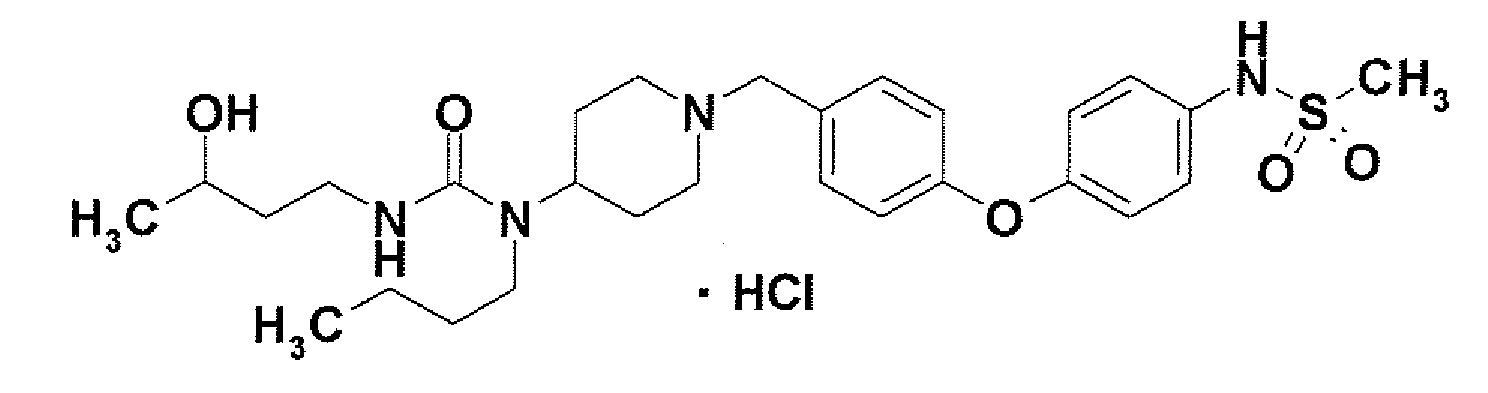
TLC:Rf 0.46(methylene chloride:methanol=9:1);
NMR (CD3OD): δ 0.95 (t, J = 7.2 Hz, 3H), 1.16 (d, J = 6.0 Hz, 3H), 1.26-1.41 (m, 2H), 1.44-1.70 (m, 4H), 1.85-1.97 (m, 2H), 2.05-2.21 (m, 2H), 2.95 (s, 3H), 3.03-3.13 (m, 4H), 3.17-3.38 (m, 2H), 3.50-3.58 (m, 2H), 3.78 (m, 1H), 4.13 (m, 1H), 4.27 (s, 2H), 7.03 (d, J = 8.7 Hz, 2H), 7.06 (d, J = 8.7 Hz, 2H), 7.29 (d, J = 8.7 Hz, 2H), 7.50 (d, J = 8.7 Hz, 2H).
NMR (CD3OD): δ 0.95 (t, J = 7.2 Hz, 3H), 1.23-1.42 (m, 6H), 1.47-1.61 (m, 2H), 1.65-1.77 (m, 2H), 1.88-2.05 (m, 4H), 2.05-2.22 (m, 2H), 2.95 (s, 3H), 3.02-3.20 (m, 4H), 3.34-3.48 (m, 2H), 3.50-3.59 (m, 2H), 4.14 (m, 1H), 4.28 (s, 2H), 7.03 (d, J = 8.7 Hz, 2H), 7.06 (d, J = 8.7 Hz, 2H), 7.29 (d, J = 8.7 Hz, 2H), 7.50 (d, J = 8.7 Hz, 2H).
NMR (CD3OD): δ 0.95 (t, J = 7.2 Hz, 3H), 1.23-1.42 (m, 6H), 1.47-1.61 (m, 2H), 1.65-1.77 (m, 2H), 1.88-2.05 (m, 4H), 2.05-2.22 (m, 2H), 2.95 (s, 3H), 3.02-3.20 (m, 4H), 3.34-3.48 (m, 2H), 3.50-3.59 (m, 2H), 4.14 (m, 1H), 4.28 (s, 2H), 7.03 (d, J = 8.7 Hz, 2H), 7.06 (d, J = 8.7 Hz, 2H), 7.29 (d, J = 8.7 Hz, 2H), 7.50 (d, J = 8.7 Hz, 2H).
NMR (CD3OD): δ 1.26-1.75 (m, 11H), 2.02(m, 1H), 2.10-2.21 (m, 2H), 2.95 (s, 3H), 3.03-3.16 (m, 4H), 3.45-3.55 (m, 2H), 3.72 (m, 1H), 4.27 (s, 2H), 7.03 (d, J = 8.7 Hz, 2H), 7.05 (d, J = 8.7 Hz, 2H), 7.29 (d, J = 8.7 Hz, 2H), 7.49 (d, J = 8.7 Hz, 2H).
NMR (CD3OD): δ 1.12-1.40 (m, 4H), 1.59-1.76 (m, 3H), 1.88-2.06 (m, 3H), 2.11-2.21 (m, 2H), 2.95 (s, 3H), 3.02-3.14 (m, 2H), 3.18-3.38 (m, 2H), 3.46-3.5 (m, 2H), 3.73 (m, 1H), 4.27 (s, 2H), 7.03 (d, J = 8.7 Hz, 2H), 7.06 (d, J = 8.7 Hz, 2H), 7.29 (d, J = 8.7 Hz, 2H), 7.49 (d, J = 8.7 Hz, 2H).
NMR (CD3OD): δ 1.12-1.40 (m, 4H), 1.59-1.76 (m, 3H), 1.88-2.06 (m, 3H), 2.11-2.21 (m, 2H), 2.95 (s, 3H), 3.02-3.14 (m, 2H), 3.18-3.38 (m, 2H), 3.46-3.55 (m, 2H), 3.73 (m, 1H), 4.27 (s, 2H), 7.03 (d, J = 8.7 Hz, 2H), 7.06 (d, J = 8.7 Hz, 2H), 7.29 (d, J = 8.7 Hz, 2H), 7.49 (d, J = 8.7 Hz, 2H).
NMR (CD3OD): δ 0.95 (t, J = 7.2 Hz, 3H), 1.30-1.40 (m, 2H), 1.40-1.50 (m, 2H), 1.70-1.80 (m, 2H), 1.80-2.00 (m, 2H), 2.00-2.20 (m, 4H), 2.95 (s, 3H), 3.00-3.20 (m, 6H), 3.30-3.50 (m, 2H), 3.54-3.60 (m, 2H), 3.80 (m, 1H), 4.10 (m, 1H), 4.28 (s, 2H), 7.02-7.08 (m, 4H), 7.29 (d, J = 8.7 Hz, 2H), 7.50 (d, J = 8.7 Hz, 2H).
NMR (CD3OD): δ 0.94 (t, J = 7.2 Hz, 3H), 1.32-1.52 (m, 2H), 1.58-1.75 (m, 1.6H), 1.98-2.08 (m, 0.4H), 2.10-2.20 (m, 2H), 2.95 (s, 3H), 3.00-3.14 (m, 2H), 3.16-3.40 (m, 2.6H), 3.45-3.54 (m, 2.4H), 3.68-3.78 (m, 0.8H), 3.90-3.95 (m, 0.2H), 4.27 (s, 1.6H), 4.33 (s, 0.4H), 7.03 (d, J = 8.7 Hz, 2H), 7.06 (d, J = 8.7 Hz, 2H), 7.29 (d, J = 8.7 Hz, 2H), 7.49 (d, J = 8.7 Hz, 2H).
NMR (CD3OD): δ 1.16 (d, J = 6.3 Hz, 2.4H), 1.17 (d, J = 6.3 Hz, 0.6H), 1.48-1.75 (m, 3.6H), 1.98-2.05 (m, 0.4H), 2.10-2.20 (m, 2H), 2.95 (s, 3H), 3.02-3.30 (m, 4H), 3.48-3.55 (m, 2H), 3.65-3.83 (m, 2H), 4.27 (s, 1.6H), 4.32 (s, 0.4H), 7.03 (d, J = 8.7 Hz, 2H), 7.05 (d, J = 8.7 Hz, 2H), 7.29 (d, J = 8.7 Hz, 2H), 7.49 (d, J = 8.7 Hz, 2H).
NMR (CD3OD): δ 0.95 (t, J = 7.2 Hz, 6H), 1.28-1.61 (m, 6H), 1.88-1.97 (m, 2H), 2.04-2.22 (m, 2H), 2.95 (s, 3H), 3.02-3.15 (m, 4H), 3.22-3.32 (m, 2H), 3.48-3.59 (m, 3H), 4.14 (m, 1H), 4.28 (s, 2H ), 7.03 (d, J = 8.7 Hz, 2H), 7.06 (d, J = 8.7 Hz, 2H), 7.29 (d, J = 8.7 Hz, 2H), 7.50 (d, J = 8.7 Hz, 2H).

NMR (CD3OD): δ 0.96 (t, J = 7.5 Hz, 3H), 1.27-1.70 (m, 14H), 1.88-1.97 (m, 2H), 2.04-2.21 (m, 2H), 2.95 (s, 3H), 3.02-3.18 (m, 4H), 3.20 (s, 2H), 3.48-3.60 (m, 2H), 4.15 (m, 1H), 4.28 (s, 2H), 7.03 (d, J = 8.7 Hz, 2H), 7.06 (d, J = 8.7 Hz, 2H), 7.29 (d, J = 8.7 Hz, 2H), 7.49 (d, J = 8.7 Hz, 2H).

TLC:Rf 0.61(chloroform:methanol=5:1);
NMR (CD3OD): δ 0.92 (t, J = 7.5 Hz, 3H), 1.20-1.70 (m, 10H), 1.90-2.05 (m, 2H), 2.06-2.24 (m, 2H), 2.95 (s, 3H), 3.02-3.18 (m, 4H), 3.18-3.38 (m, 4H), 3.45-3.62 (m, 3H), 4.27 (s, 2H), 7.00-7.12 (m, 4H), 7.24-7.3 4 (m, 2H), 7.44-7.58 (m, 2H).
NMR (CD3OD): δ 0.93 (t, J = 7.2 Hz, 3H), 1.20-1.40 (m, 2H), 1.42-1.56 (m, 2H), 1.88-2.02 (m, 2H), 2.06-2.30 (m, 2H), 2.95 (s, 3H), 3.02-3.16 (m, 4H), 3.21-3.34 (m, 3H), 3.44-3.70 (m, 8H), 4.23 (s, 2H), 7.00-7.10 (m, 4H), 7.12-7.38 (m, 2H), 7.49 (brd, J = 8.7 Hz, 2H).
NMR (CD3OD): δ 0.93 (t, J = 7.5 Hz, 6H), 1.31 (m, 4H), 1.49 (m, 4H), 1.70-1.88 (m, 2H), 2.04-2.14 (m, 2H), 2.95 (s, 3H), 3.08 (m, 2H), 3.14-3.35 (m, 4H), 3.50 (m, 2H), 3.79 (m, 1H), 4.27 (s, 2H), 7.00-7.10 (m, 4H), 7.22-7.34 (m, 2H), 7.49 (brd, J = 8.7 Hz, 2H).
NMR (CD3OD): δ 0.92 (t, J = 7.5 Hz, 3H), 1.22-1.36 (m, 2H), 1.38-1.52 (m, 2H), 1.80-2.02 (m, 6H), 2.04-2.24 (m, 2H), 2.95 (s, 3H), 3.02-3.15 (m, 4H), 3.26-3.38 (m, 4H), 3.52 (m, 2H), 3.72 (m, 1H), 4.26 (s, 2H), 7.00-7.10 (m, 4H), 7.22-7.36 (m, 2H), 7.42-7.56 (m, 2H).
NMR (CD3OD): δ 0.80-1.02 (m, 9H), 1.20-1.60 (m, 12H), 1.92-2.20 (m, 4H), 2.95 (s, 3H), 3.00-3.40 (m, 7H), 3.44-3.68 (m, 4H), 4.26 (s 2H), 7.00-7.12 (m, 4H), 7.29 (brd, J = 9.0 Hz, 2H), 7.48 (brd, J = 8.4 Hz, 2H).

TLC:Rf 0.42(ethyl acetate:methanol=5:1);
NMR (CD3OD): δ 1.63-1.79 (m, 2H), 1.96-2.07 (m, 2H), 2.96 (s, 3H), 3.00-3.12 (m, 2H), 3.44-3.54 (m, 2H), 3.74 (m, 1H), 4.26 (s, 2H), 4.76 (s, 2H), 7.04 (d, J = 8.7 Hz, 2H), 7.06 (d, J = 8.7 Hz, 2H ), 7.29 (d, J = 8.7 Hz, 2H), 7.33-7.43 (m, 5H), 7.48 (d, J = 8.7 Hz, 2H).

TLC:Rf 0.78(methylene chloride:methanol=5:1);
NMR (CD3OD): δ 0.98 (t, J = 7.2 Hz, 3H), 1.36-1.43 (m, 2H), 1.60-1.70 (m, 2H), 1.99-2.04 (m, 2H), 2.16-2.28 (m, 2H), 3.08-3.17 (m, 2H), 3.24-3.30 (m, 2H), 3.56-3.61 (m, 2H), 4.15 (m, 1H), 4.32 (s, 2H), 6.90-7.05 (m, 2H), 7.07 (d, J = 8.7 Hz, 2H), 7.18 (d, J = 8.7 Hz, 2H), 7.37 (m, 1H), 7.56 (d, J = 8.7 Hz, 2H), 8.04 (d, J = 8.7 Hz, 2H).
NMR (CD3OD): δ 0.98 (t, J = 7.2 Hz, 3H), 1.36-1.45 (m, 2H), 1.59-1.70 (m, 2H), 1.99-2.03 (m, 2H), 2.17-2.30 (m, 2H), 3.08-3.17 (m, 2H), 3.23-3.30 (m, 2H), 3.56-3.60 (m, 2H), 4.15 (m, 1H), 4.32 (s, 2H), 6.90-7.03 (m, 2H), 7.14 (d, J = 8.7 Hz, 2H), 7.18 (d, J = 8.7 Hz, 2H), 7.37 (m, 1H), 7.57 (d, J = 8.7 Hz, 2H), 7.91 (d, J = 8.7 Hz, 2H).
NMR (CD3OD): δ 0.98 (t, J = 7.5 Hz, 3H), 1.33-1.45 (m, 2H), 1.59-1.70 (m, 2H), 1.98-2.01 (m, 4H), 2.12-2.30 (m, 4H), 2.33 (s, 3H), 2.43 (s, 3H), 2.89 (s, 3H), 2.93-3.01 (m, 2H), 3.09-3.17 (m, 2H), 3.25-3.30 (m, 2H), 3.58-3.63 (m, 2H), 3.86-3.90 (m, 2H), 4.19 (s, 2H), 4.19 (m, 1H), 4.39 (m, 1H), 6.89-7.03 (m, 2H), 7.37 (m, 1H).
NMR (CD3OD): δ 0.97 (t, J = 7.5 Hz, 3H), 1.34-1.44 (m, 2H), 1.58-1.68 (m, 2H), 1.98-2.01 (m, 2H), 2.19-2.32 (m, 2H), 2.99 (s, 3H), 3.12-3.30 (m, 4H), 3.58-3.63 (m, 2H), 4.19 (m, 1H), 4.39 (s, 2H), 6.89-7.02 (m, 2H), 7.36 (d, J = 8.4 Hz, 2H), 7.37 (m, 1H), 7.49 (d, J = 7.5 Hz, 1H), 7.57 (t, J = 7.5 Hz, 1H), 7.68 (d, J = 8.4 Hz, 2H), 7. 76 (d, J = 7.5 Hz, 1H), 7.82 (s, 1H).
NMR (CD3OD): 5 0.98 (t, J = 7.5 Hz, 3H), 1.36-1.44 (m, 2H), 1.60-1.70 (m, 2H), 1.98-2.00 (m, 2H), 2.20-2.35 (m, 2H), 2.35 (s, 3H), 2.35 (s, 3H), 3.03 (s, 3H), 3.03-3.13 (m, 2H), 3.27-3.30 (m, 2H), 3.58-3.62 (m, 2H), 4.17 (m, 1H), 4.17 (s, 2H), 6.90-7.03 (m, 2H), 7.35-7.45 (m, 5H).
NMR (CD3OD): δ 0.96 (t, J = 7.5 Hz, 3H), 1.28-1.40 (m, 2H), 1.69-1.89 (m, 4H), 2.11-2.18 (m, 2H), 2.92 (s, 3H), 2.96-3.00 (m, 2H), 3.22-3.37 (m, 4H), 3.59 (s, 2H), 4.02 (m, 1H), 4.53 (s, 2H), 6.87-7.01 (m, 2H), 7.21 (d, J = 8.7 Hz, 2H), 7.33 (d, J = 8.7 Hz, 2H), 7.38 (m, 1H), 7.44 (d, J = 8.4 Hz, 2H), 7.82 (d, J = 8.4 Hz, 2H).
NMR (CD3OD): δ 0.97 (t, J = 7.5 Hz, 3H), 1.28-1.41 (m, 2H), 1.58-1.69 (m, 2H), 1.96-2.01 (m, 2H), 2.11-2.26 (m, 2H), 2.93 (s, 3H), 3.05-3.26 (m, 2H), 3.23-3.26 (m, 2H), 3.53-3.56 (m, 2H), 3.67 (s, 2H), 4.13 (m, 1H), 4.26 (s, 2H), 6.89-7.02 (m, 2H), 7.21 (d, J = 8.7 Hz, 2H), 7.32 (d, J = 8.7 Hz, 2H), 7.38 (m, 1H), 7.46 (d, J = 8.4 Hz, 2H), 7.70(d, J = 8.4 Hz, 2H).
NMR (CD3OD): δ 0.97 (t, J = 7.5 Hz, 3H), 1.34-1.42 (m, 2H), 1.55-1.60 (m, 2H), 1.94-2.00 (m, 2H), 2.12-2.20 (m, 2H), 2.99 (s, 3H), 3.03-3.12 (m, 2H), 3.23-3.25 (m, 2H), 3.47-3.51 (m, 2H), 4.13 (m, 1H), 4.25 (s, 2H), 4.85 (s, 2H), 6.68 (d, J = 8.7 Hz, 2H), 6.89-7.03 (m, 2H), 7.13 (d, J = 8.7 Hz, 2H), 7.36 (m, 1H), 7.42 (s, 4H).
NMR (CD3OD): δ 0.98 (t, J = 7.5 Hz, 3H), 1.36-1.44 (m, 2H), 1.63-1.68 (m, 2H), 1.97-2.04 (m, 2H), 2.29-2.34 (m, 2H), 2.39 (s, 3H), 2.46 (s, 3H), 2.58 (s, 3H), 3.16-3.36 (m, 4H), 3.66-3.70 (m, 2H), 4.23 (m, 1H), 4.27 (s, 2H), 6.89-7.03 (m, 2H), 7.38 (m, 1H), 7.73 (d, J = 8.7 Hz, 2H), 8.00 (d, J = 8.7 Hz, 2H).
NMR (CD3OD): δ 0.98 (t, J = 7.5 Hz, 3H), 1.33-1.45 (m, 2H), 1.59-1.69 (m, 2H), 1.98-2.02 (m, 2H), 2.15-2.28 (m, 2H), 2.88 (s, 3H), 3.06-3.15 (m, 2H), 3.24-3.30 (m, 2H), 3.54-3.59 (m, 2H), 4.14 (m, 1H), 4.24 (s, 2H), 4.28 (s, 2H), 6.89-7.03 (m, 2H), 7.03 (d, J = 8.7 Hz, 2H), 7.06 (d, J = 8.7 Hz, 2H), 7.37 (m, 1H), 7.41 (d, J = 8.7 Hz, 2H), 7.49 (d, J = 8.7 Hz, 2H).
NMR (CD3OD): δ 0.97 (t, J = 7.5 Hz, 3H), 1.34-1.42 (m, 2H), 1.60-1.66 (m, 2H), 1.96-2.01 (m, 2H), 2.12-2.20 (m, 2H), 2.95 (s, 3H), 3.04-3.11 (m, 2H), 3.23-3.30 (m, 2H), 3.52-3.56 (m, 2H), 4.12 (m, 1H), 4.24 (s, 2H), 5.10 (s, 2H), 6.86-7.03 (m, 2H), 7.10 (d, J = 8.7 Hz, 2H), 7.25 (d, J = 8.7 Hz, 2H), 7.36 (m, 1H), 7.41 (d, J = 8.7 Hz, 2H), 7.42 (d, J = 8.7 Hz, 2H).
NMR (CD3OD): 5 0.98 (t, J = 7.5 Hz, 3H), 1.35-1.45 (m, 2H), 1.58-1.69 (m, 2H), 1.98-2.02 (m, 2H), 2.12 (s, 3H), 2.15-2.27 (m, 2H), 3.06-3.14 (m, 2H), 3.24-3.30 (m, 2H), 3.54-3.58 (m, 2H), 4.14 (m, 1H), 4.28 (s, 2H), 6.89-7.03 (m, 2H), 7.00 (d, J = 8.7 Hz, 2H), 7.04 (d, J = 8.7 Hz, 2H), 7.36 (m, 1H), 7.47 (d, J = 8.7 Hz, 2H), 7.57 (d, J = 8.7 Hz, 2H).
NMR (CD3OD): δ 0.94 (t, J = 7.5 Hz, 3H), 2.00-1.06 (m, 19H), 2.95 (s, 3H), 3.02-2.88 m, 2H), 3.30-3.16 (m, 4H), 3.56-3.44 (m, 3H), 4.25 (s, 2H), 7.10.-7.00 (m, 4H), 7.29 (brd, J = 9.0 Hz, 2H), 7.48 (brd, J = 8.4 Hz, 2H).
NMR (CD3OD): δ8.04 (d, J = 9.0 Hz, 2H), 7.58 (d, J = 9.0 Hz, 2H), 7.17 (d, J = 9.0 Hz, 2H), 7.07 (d, J = 9.0 Hz, 2H), 4.75 (m, 1H), 4.40-4.10 (m, 3H), 3.70-3.05 (m, 6H), 2.40-1.30 (m, 14H), 1.01-0.93 (m, 9H).
NMR (CD3OD): δ 8.04 (d, J = 9.0 Hz, 2H), 7.58 (d, J = 8.7 Hz, 2H), 7.17 (d, J = 8.7 Hz, 2H), 7.07 (d, J = 9.0 Hz, 2H), 4.75 (m, 1H), 4.40-4.10 (m, 3H), 3.70-3.00 (m, 6H), 2.40-0.80 (m, 27H).
NMR (CD3OD): δ 0.97 (t, J = 7.2 Hz, 3H), 1.34-1.41 (m, 2H), 1.58-1.69 (m, 2H), 1.96-2.00 (m, 2H), 2.12-2.23 (m, 2H), 2.91 (s, 3H), 3.05-3.13 (m, 2H), 3.23-3.30 (m, 2H), 3.53-3.56 (m, 2H), 3.99 (s, 2H), 4.10 (m, 1H), 4.27 (s, 2H), 6.89-7.03 (m, 2H), 7.16 (d, J = 8.7 Hz, 2H), 7.20 (d, J = 8.7 Hz, 2H), 7.35 (m, 1H), 7.35 (d, J = 8.0 Hz, 2H), 7.42 (d, J = 8.0 Hz, 2H).
NMR (CD3OD): δ 0.97 (t, J = 7.2 Hz, 3H), 1.32-1.45 (m, 2H), 1.59-1.69 (m, 2H), 1.98-2.01 (m, 2H), 2.13-2.26 (m, 2H), 3.01 (s, 3H), 3.06-3.14 (m, 2H), 3.24-3.30 (m, 2H), 3.54-3.58 (m, 2H), 4.13 (m, 1H), 4.28 (s, 2H), 6.90-7.05 (m, 2H), 7.00 (d, J = 8.7 Hz, 2H), 7.13 (d, J = 8.7 Hz, 1H), 7.24 (dd, J = 8.7, 2.7 Hz, 1H), 7.36 (dt, J = 8.7, 6.0 Hz, 1H), 7.43 (d, J = 2.7 Hz, 1H), 7.48 (d, J = 8.7 Hz, 2H).
NMR (CD3OD): δ 0.99 (t, J = 7.5 Hz, 3H), 1.36-1.44 (m, 2H), 1.61-1.71 (m, 2H), 2.00-2.05 (m, 2H), 2.23-2.37 (m, 2H), 2.39 (s, 3H), 2.44 (s, 3H), 3.16-3.24 (m, 2H), 3.27-3.32 (m, 2H), 3.66-3.70 (m, 2H), 4.20 (m, 1H), 4.27 (s, 2H), 6.89-7.03 (m, 2H), 7.38 (dt, J = 9.0, 6.0 Hz, 1H), 7.72 (d, J = 8.4 Hz, 2H), 7.87 (d, J = 8.4 Hz, 2H).
NMR (CD3OD): δ 0.97 (t, J = 7.4 Hz, 3H), 1.30-1.50 (m, 2H), I.60-1.70 (m, 2H), 1.90-2.10 (m, 2H), 2.20-2.40 (m, 2H), 2.98 (s, 3H), 3.00-3.20 (m, 2H), 3.20-3.40 (m, 2H), 3.50-3.60 (m, 2H), 4.20 (m, 1H), 4.35 (s, 2H), 6.86-7.05 (m, 2H), 7.10-7.17 (m, 3H), 7.32-7.38 (m, 3H), 8.09 (dd, J = 8.7, 2.2 Hz, 1H), 8.32 (d, J = 2.2 Hz, 1H).
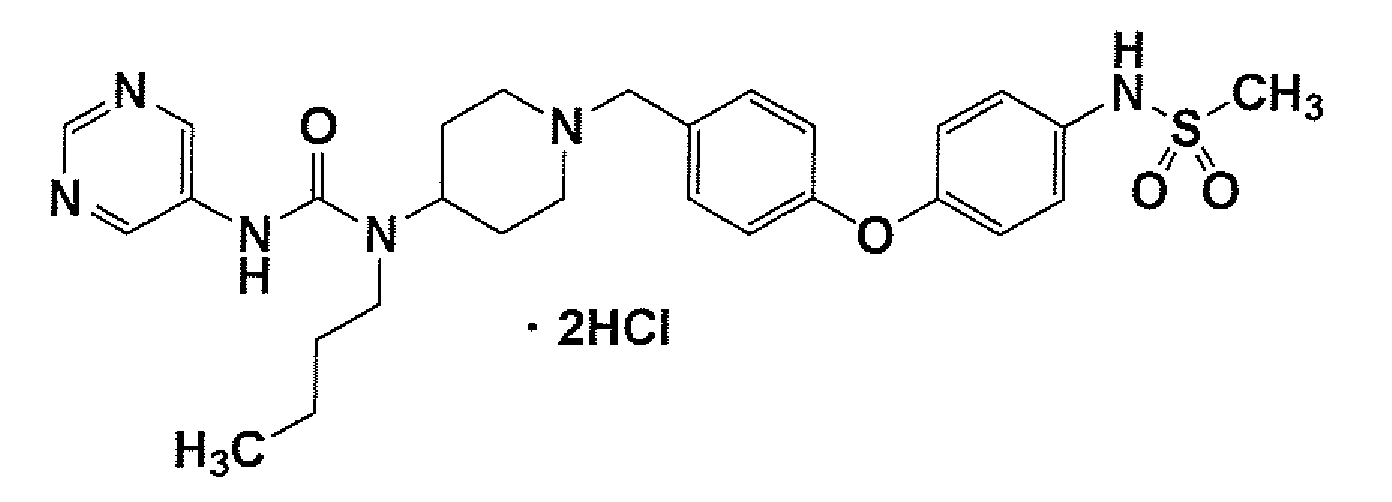
NMR (CD3OD): δ 0.98 (t, J = 7.2 Hz, 3H), 1.32-1.48 (m, 2H), 1.55-1.70 (m, 2H), 1.97-2.08 (m, 2H), 2.23-2.40 (m, 2H), 2.95 (s, 3H), 3.10-3.23 (m, 2H), 3.29-3.38 (m, 2H), 3.50-3.62 (m, 2H), 4.25 (m, 1H), 4.31 (s, 2H), 7.03 (d, J = 8.7 Hz, 2H), 7.06 (d, J = 8.7 Hz, 2H), 7.29 (d, J = 8.7 Hz, 2H), 7.53 (d, J = 8.7 Hz, 2H), 9.03 (s, 1H), 9.27 (s, 2H).
NMR (CD3OD): δ 0.97 (t, J = 7.5 Hz, 3H), 1.32-1.47 (m, 2H), 1.55-1.69 (m, 2H), 2.00-2.10 (m, 2H), 2.27-2.45 (m, 2H), 2.95 (s, 3H), 3.12-3.27 (m, 2H), 3.33-3.45 (m, 2H), 3.50-3.62 (m, 2H), 4.24-4.35 (m, 3H), 7.03 (d, J = 8.7 Hz, 2H), 7.06 (d, J = 8.7 Hz, 2H), 7.29 (d, J = 8.7 Hz, 2H), 7.53 (d, J = 8.7 Hz, 2H), 8.49 (dd, J = 7.2, 2.7 Hz, 1H), 9.13 (d, J = 7.2 Hz, 1H), 9.49 (d, J = 2.7 Hz, 1H).
NMR (CD3OD): δ 0.98 (t, J = 7.2 Hz, 3H), 1.30-1.45 (m, 2H), 1.55-1.70 (m, 2H), 1.97-2.08(m, 2H), 2.24-2.41 (m, 2H), 2.95 (s, 3H), 3.05-3.20 (m, 2H), 3.25-3.38 (m, 2H), 3.55-3.65 (m, 2H), 4.19 (m, 1H), 4.31 (s, 2H), 7.03 (d, J = 8.7 Hz, 2H), 7.07 (d, J = 8.7 Hz, 2H), 7.29 (d, J = 8.7 Hz, 2H), 7.51 (d, J = 8.7 Hz, 2H), 7.88 (dd, J = 9.6, 1.5 Hz, 1H), 7.99 (dd, J = 9.6, 1.5 Hz, 1H), 9.42 (d, J = 1 .5 Hz, 1H).
NMR (CD3OD): δ 0.97 (t, J = 7.4 Hz, 3H), 1.30-1.50 (m, 2H), 1.50-1.70 (m, 2H), 2.00-2.10 (m, 2H), 2.20-2.30 (m, 2H), 2.95 (s, 3H), 3.10-3.20 (m, 2H), 3.20-3.40 (m, 2H), 3.50-3.60 (m, 2H), 4.17 (m, 1H), 4.29 (s, 2H), 6.93 (m, 1H), 7.02-7.08 (m, 4H), 7.27-7.34 (m, 4H), 7.45 (m, 1H), 7.50 (d, J = 8.7 Hz, 2H).
NMR (CD3OD): δ 0.96 (t, J = 7.2 Hz, 3H), 1.30-1.50 (m, 2H), 1.50-1.70 (m, 2H), 2.00-2.10 (m, 2H), 2.20-2.40 (m, 2H), 2.55 (s, 3H), 2.95 (s, 3H), 3.00-3.20 (m, 2H), 3.20-3.40 (m, 2H), 3.50-3.60 (m, 2H), 4.10 (m, 1H), 4.30 (s, 2H), 7.03 (d, J = 8.9 Hz, 2H), 7.07 (d, J = 8.9 Hz, 2H), 7.29 (d, J = 8.9 Hz, 2H), 7.50 (d, J = 8.1 Hz, 2H), 7.53 (d, J = 8.1 Hz, 2H), 7.92 (d, J = 8.9 Hz, 2H).
NMR (CD3OD): δ 0.98 (t, J = 7.2 Hz, 3H), 1.35-1.50 (m, 2H), 1.60-1.80 (m, 2H), 1.90-2.10 (m, 2H), 2.20-2.40 (m, 2H), 2.95 (s, 3H), 3.00-3.20 (m, 2H), 3.20-3.40 (m, 2H), 3.40-3.60 (m, 2H), 4.16 (m, 1H), 4.29 (s, 2H), 7.02-7.08 (m, 4H), 7.19-7.34 (m, 5H), 7.48-7.51 (m, 2H), 7.60 (m, 1H).
NMR (CD3OD): δ 0.92 (t, J = 7.4 Hz, 3H), 1.30-1.40 (m, 2H), 1.60-1.70 (m, 2H), 2.00-2.10 (m, 2H), 2.30-2.40 (m, 2H), 2.95 (s, 3H), 3.05-3.20 (m, 2H), 3.30-3.40 (m, 2H), 3.50-3.60 (m, 2H), 4.10 (m, 1H), 4.27 (s, 2H), 7.02-7.06 (m, 4H), 7.29 (d, J = 9.0 Hz, 2H), 7.48-7.53 (m, 4H), 7.61 (m, 1H), 7.87 (d, J = 7.2 Hz, 2H).
NMR (CD3OD): δ 0.97 (t, J = 7.4 Hz, 3H), 1.30-1.50 (m, 2H), 1.50-1.70 (m, 2H), 1.90-2.10 (m, 2H), 2.20-2.40 (m, 2H), 2.95 (s, 3H), 3.05-3.20 (m, 2H), 3.20-3.40 (m, 2H), 3.50-3.60 (m, 2H), 4.20 (m, 1H), 4.29 (s, 2H), 7.01-7.08 (m, 4H), 7.18 (d, J = 9.0 Hz, 2H), 7.29 (d, J = 9.3 Hz, 2H), 7.43 (d, J = 9.3 Hz, 2H), 7.51 (d, J = 9.0 Hz, 2H).
NMR (CD3OD): δ 0.99 (t, J = 7.4 Hz, 3H), 1.40-1.50 (m, 2H), 1.60-1.70 (m, 2H), 2.00-2.10 (m, 2H), 2.30-2.40 (m, 2H), 2.95 (s, 3H), 3.20-3.30 (m, 2H), 3.20-3.40 (m, 2H), 3.55-3.65 (m, 2H), 4.30 (m, 1H), 4.32 (s, 2H), 7.02-7.09 (m, 4H), 7.30 (d, J = 8.9 Hz, 2H), 7.54 (d, J = 8.9 Hz, 2H), 7.91 (td, J = 7.2, 1.2 Hz, 1H), 8.02 (td, J = 7.2, 1.2 Hz, 1H), 8.14 (d, J = 8.4 Hz, 1H), 8.20 (d, J = 8.4 Hz, 1H), 9.05 (d, J = 2.4 Hz, 1H), 9.53 (d, J = 2.4 Hz, 1H).
NMR (CD3OD): δ 0.93 (t, J = 7.2 Hz, 3H), 1.20-1.40 (m, 2H), 1.40-1.60 (m, 2H), 1.80-2.00 (m, 2H), 2.00-2.20 (m, 2H), 2.24 (dd, J = 14.6, 5.6 Hz, 2H) 2.69 (dd, J = 14.6, 8.0 Hz, 2H) 2.95 (s, 3H), 3.00-3.20 (m, 4H), 3.50-3.60 (m, 2H), 4.15 (m, 1H), 4.28 (s, 2H), 4.39 (m, 1H), 5.69 (s, 2H), 7.02-7.07 (m, 4H), 7.29 (d, J = 8.9 Hz, 2H), 7.51 (d, J = 8.9 Hz, 2H).
NMR (CD3OD): δ 0.96 (t, J = 7.4 Hz, 3H), 1.30-1.50 (m, 2H), 1.50-1.70 (m, 2H), 1.90-2.00 (m, 2H), 2.10-2.30 (m, 2H), 2.95 (s, 3H), 3.00-3.20 (m, 2H), 3.20-3.40 (m, 2H), 3.50-3.60 (m, 2H), 4.15 (m, 1H), 4.29 (s, 2H), 6.77 (dd, J = 8.9, 2.4 Hz, 1H), 7.02-7.08 (m, 5H), 7.15 (d, J = 9.0 Hz, 1H), 7.29-7.31 (m, 2H), 7.47-7.51 (m, 2H).
NMR (CD3OD): δ 0.97 (t, J = 7.4 Hz, 3H), 1.30-1.50 (m, 2H), 1.50-1.70 (m, 2H), 1.90-2.10 (m, 2H), 2.10-2.30 (m, 2H), 2.95 (s, 3H), 3.00-3.20 (m, 2H), 3.20-3.40 (m, 2H), 3.50-3.60 (m, 2H), 4.15 (m, 1H), 4.29 (s, 2H), 6.70 (m, 1H), 6.90-7.00 (m, 2H), 7.02-7.08 (m, 4H), 7.29 (d, J = 8.9 Hz, 2H), 7.49 (d, J = 8.9 Hz, 2H).
NMR (CD3OD): δ 0.98 (t, J = 7.2 Hz, 3H), 1.30-1.50 (m, 2H), 1.60-1.80 (m, 2H), 2.00-2.10 (m, 2H), 2.20-2.40 (m, 2H), 2.95 (s, 3H), 3.10-3.30 (m, 2H), 3.30-3.50 (m, 2H), 3.50-3.70 (m, 2H), 4.30 (m, 1H), 4.32 (s, 2H), 7.02-7.09 (m, 4H), 7.30 (d, J = 8.9 Hz, 2H), 7.53 (d, J = 8.9 Hz, 2H), 8.01 (dd, J = 8.6, 5.6 Hz, 1H), 8.15 (d, J = 9.3 Hz, 1H), 8.31 (dd, J = 9.3, 2.4 Hz, 1H), 8.42 (m, 1H), 9.01-9.05 (m, 2H).
NMR (CD3OD): δ 0.97 (t, J = 7.4 Hz, 3H), 1.30-1.50 (m, 2H), 1.60-1.90 (m, 4H), 2.00-2.20 (m, 2H), 2.93 (s, 3H), 2.95-3.05 (m, 2H), 3.20-3.40 (m, 4H), 3.51 (s, 2H), 4.05 (m, 1H), 6.93-6.98 (m, 4H), 7.24 (d, J = 9.0 Hz, 2H), 7.32 (d, J = 9.0 Hz, 2H), 7.34 (m, 1H), 7.58-7.60 (m, 2H), 7.66 (d, J = 7.8 Hz, 1H).
NMR (CD3OD): δ 0.94 (t, J = 7.2 Hz, 3H), 1.26-1.58 (m, 7H), 1.70-1.80 (m, 2H), 1.85-2.20 (m, 7H), 2.95 (s, 3H), 3.02-3.17 (m, 4H), 3.48-3.65 (m, 3H), 4.13 (m, 1H), 4.28 (s, 2H), 7.03 (d, J = 8.7H z, 2H), 7.06 (d, J = 8.7 Hz, 2H), 7.29 (d, J = 8.7 Hz, 2H), 7.50 (d, J = 8.7 Hz, 2H).
NMR (CD3OD): δ 1.88-2.24 (m, 4H), 2.95 (s, 3H), 3.08 (m, 2H), 3.48 (m, 2H), 4.24 (s, 2H), 4.34 (m, 1H), 4.58 (s, 2H), 6.60-6.84 (m, 3H), 6.90-7.10 (m, 6H), 7.16 (m, 1H), 7.22-7.38 (m, 4H), 7.38-7.52 (m, 2H).
NMR (CD3OD): δ 0.98 (t, J = 7.2 Hz, 3H), 1.30-1.50 (m, 2H), 1.60-1.80 (m, 2H), 1.90-2.10 (m, 2H), 2.20 (s, 6H), 2.20-2.30 (m, 2H), 2.95 (s, 3H), 3.00-3.20 (m, 2H), 3.20-3.40 (m, 2H), 3.50-3.60 (m, 2H), 4.20 (m, 1H), 4.28 (s, 2H), 7.02-7.07 (m, 7H), 7.29 (d, J = 8.9 Hz, 2H), 7.52 (d, J = 8.9 Hz, 2H).
NMR (CD3OD): δ 1.00 (t, J = 7.5 Hz, 3H), 1.57-1.70 (m, 2H), 1.93-2.30 (m, 4H), 2.95 (s, 3H), 3.02-3.20 (m, 3H), 3.35-3.45 (m, 2H), 3.50 (s, 3H), 3.50-3.60 (m, 2H), 4.10 (m, 1H), 4.28 (s, 2H), 6.97-7.10 (m, 6H), 7.21-7.33 (m, 2H), 7.29 (d, J = 8.7 Hz, 2H), 7.50 (d, J = 8.7 Hz, 2H).
NMR (CD3OD): δ 1.02 (t, J = 7.5 Hz, 3H), 2.15-2.25 (m, 4H), 2.28 (q, J = 7.5 Hz, 2H), 2.96 (s, 3H), 3.13-3.29 (m, 2H), 3.58-3.70 (m, 2H), 4.26 (m, 1H), 4.33 (s, 2H), 6.39 (s, 1H), 7.04 (d, J = 8.7 Hz, 2H), 7.09 (d, J = 8.7 Hz, 2H), 7.20-7.35 (m, 6H), 7.52 (d, J = 8.7 Hz, 2H).
NMR (CD3OD): δ 1.06 (t, J = 7.5 Hz, 3H), 1.48 (m, 1H), 1.69 (m, 1H), 2.05-2.18 (m, 2H), 2.21-2.43 (m, 2H), 2.95 (s, 3H), 2.97 (s, 3H), 3.03-3.14 (m, 2H), 3.34 (d, J = 7.5 Hz, 2H), 3.42-3.61 (m, 3H), 3.95 (m, 1H), 4.28 (s, 2H), 6.96-7.10 (m, 6H), 7.26-7.40 (m, 4H), 7.50 (d, J = 8.7 Hz, 2H).
NMR (CD3OD): δ 0.94 (d, J = 7.5 Hz, 3H), 0.95 (t, J = 7.5 Hz, 3H), 1.16 (m, 1H), 1.50 (m, 1H), 1.74 (m, 1H), 1.95-2.07 (m, 2H), 2.28-2.47 (m, 2H), 2.95 (s, 3H), 3.02-3.24 (m, 4H), 3.50-3.60 (m, 2H ), 3.90 (m, 1H), 4.28 (s, 2H), 6.96-7.10 (m, 6H), 7.25-7.32 (m, 2H), 7.29 (d, J = 8.7 Hz, 2H), 7.50 (d, J = 8.7 Hz, 2H).
NMR (CD3OD): δ 0.93 (t, J = 7.5 Hz, 6H), 1.27-1.50 (m, 4H), 1.60 (m, 1H), 1.97-2.08 (m, 2H), 2.30-2.50 (m, 2H), 2.95 (s, 3H), 3.03-3.18 (m, 2H), 3.26 (d, J = 7.5 Hz, 2H), 3.50-3.60 (m, 2H), 3.87 ( m, 1H), 4.28 (s, 2H), 6.96-7.10 (m, 6H), 7.24-7.33 (m, 4H), 7.49 (d, J = 8.7 Hz, 2H).
NMR (CD3OD): δ 1.94-2.05 (m, 2H), 2.12-2.30 (m, 2H), 2.95 (s, 3H), 3.02-3.17 (m, 2H), 3.50-3.58 (m, 2H), 4.26 (s, 2H), 4.27 (m, 1H), 4.79 (s, 2H), 6.94-7.08 (m, 8H), 7.26-7.34 (m, 5H), 7.48 (d, J = 8.7 Hz, 2H).
NMR (CD3OD): δ 0.97 (t, J = 7.2 Hz, 3H), 1.28-1.45 (m, 2H), 1.56-1.67 (m, 2H), 1.98-2.02 (m, 2H), 2.11 (s, 3H), 2.16-2.28 (m, 2H), 2.96 (s, 3H), 3.07-3.15 (m, 2H), 3.26-3.30 (m, 2H), 3.55-3.59 (m, 2H), 4.16 (m, 1H), 4.29 (s, 2H), 7.04 (d, J = 8.7 Hz, 2H), 7.07 (d, J = 8.7 Hz, 2H), 7.10-7.23 (m, 3H), 7.30 (d, J = 8.7 Hz, 2H), 7.50 (d, J = 8.7 Hz, 2H), 7.69 (m, 1H).
NMR (CD3OD): δ 0.97 (t, J = 7.5 Hz, 3H), 1.29-1.42 (m, 2H), 1.55-1.67 (m, 2H), 1.98-2.02 (m, 2H), 2.10 (s, 3H), 2.13-2.28 (m, 2H), 2.96 (s, 3H), 3.03-3.15 (m, 2H), 3.25-3.30 (m, 2H), 3.55-3.59 (m, 2H), 4.16 (m, 1H), 4.29 (s, 2H), 7.04 (d, J = 8.7 Hz, 2H), 7.07 (d, J = 8.7 Hz, 2H), 7.27 (d, J = 8.7 Hz, 2H), 7.30 (d, J = 8.7 Hz, 2H) 7.46 (d, J = 8.7 Hz, 2H), 7.50(d, J = 8.7 Hz, 2H).
NMR (CD3OD): δ 2.08-2.38 (m, 4H), 2.95 (s, 3H), 3.08-3.11 (m, 2H), 3.52-3.65 (m, 2H), 4.04 (m, 1H), 4.18-4.35 (m, 4H), 6.99-7.08 (m, 6H), 7.26-7.37 (m, 4H), 7.50 (d, J = 8.7 Hz, 2H).
NMR (CD3OD): δ 0.96 (d, J = 6.6 Hz, 6H), 1.45-1.55 (m, 2H), 1.65 (m, 1H), 1.95-2.05 (m, 2H), 2.12-2.30 (m, 2H), 2.95 (s, 3H), 3.05-3.10 (m, 2H), 3.22-3.33 (m, 2H), 3.51-3.61 (m, 2H), 4.19 (m, 1H), 4.29 (s, 2H), 6.97-7.10 (m, 6H), 7.26-7.33 (m, 4H), 7.50 (d, J = 8.7 Hz, 2H).
NMR (CD3OD): δ 1.88-1.99 (m, 2H), 2.19-2.34 (m, 2H), 2.95 (s, 3H), 2.99-3.12 (m, 2H), 3.44-3.52 (m, 2H), 3.98 (m, 1H), 4.24 (s, 2H), 4.75 (s, 2H), 6.95-7.08 (m, 8H), 7.25-7.40 (m, 5H), 7.45 (d, J = 8.7 Hz, 2H).
NMR (CD3OD): δ 2.03-2.36 (m, 4H), 2.95 (s, 3H), 3.13-3.26 (m, 2H), 3.54-3.64 (m, 2H), 4.32 (s, 2H), 4.45 (m, 1H), 4.87 (s, 2H), 7.00 (d, J = 9.0 Hz, 2H), 7.02 (d, J = 8.7 Hz, 2H), 7.05 (d, J = 8.7 Hz, 2H), 7.29 (d, J = 8.7 Hz, 2H), 7.39 (dd, J = 9.0, 5.0 Hz, 2H), 7.56 (d, J = 8.7 Hz, 2H), 7.94 (t, J = 6.0 Hz, 1H), 8.03 (d, J = 8.0 Hz, 1H), 8.54 (dt, J = 1.8, 8.0 Hz, 1H), 8.75 (dd, J = 6.0, 1.8 Hz, 1H).
NMR (CD3OD): δ 1.98-2.10 (m, 2H), 2.18-2.35 (m, 2H), 2.95 (s, 3H), 3.10-3.23 (m, 2H), 3.50-3.60 (m, 2H), 4.30 (s, 2H), 4.43 (m, 1H), 4.80 (s, 2H), 7.00 (d, J = 9.0 Hz, 2H), 7.02 (d, J = 8.7 Hz, 2H), 7.05 (d, J = 8.7 Hz, 2H), 7.29 (d, J = 8.7 Hz, 2H), 7.38 (dd, J = 9.0, 5.0 Hz, 2H), 7.55 (d, J = 8.7 Hz, 2H), 8.05 (dd, J = 8.4, 5.7 Hz, 1H), 8.59 (d, J = 8.4 Hz, 1H), 8.75 (d, J= 5.7 Hz, 1H), 8.84 (s, 1H).
NMR (CD3OD): δ 2.02-2.30 (m, 4H), 2.95 (s, 3H), 3.10-3.23 (m, 2H), 3.50-3.60 (m, 2H), 4.30 (s, 2H), 4.48 (m, 1H), 4.88 (s, 2H), 6.99 (d, J = 9.0 Hz, 2H), 7.02 (d, J = 8.7 Hz, 2H), 7.05 (d, J = 8.7 Hz, 2H), 7.29 (d, J = 8.7 Hz, 2H), 7.36 (dd, J = 9.0, 5.0 Hz, 2H), 7.54 (d, J = 8.7 Hz, 2H), 8.02 (d, J = 6.6 Hz, 2H), 8.77 (d, J = 6.6 Hz, 2H).
NMR (CD3OD): δ 0.94 (t, J = 7.5 Hz, 3H), 1.30-1.40 (m, 2H), 1.40-1.60 (m, 2H), 1.80-2.00 (m, 2H), 2.10-2.20 (m, 2H), 2.72 (s, 3H), 2.95 (s, 3H), 3.00-3.15 (m, 4H), 3.50-3.60 (m, 2H), 4.12 (m, 1H), 4.27 (s, 2H), 7.02-7.08 (m, 4H), 7.29 (d, J = 8.9 Hz, 2H), 7.49 (d, J = 8.9 Hz, 2H).
NMR (CD3OD): δ 0.97 (t, J = 7.4 Hz, 3H), 1.30-1.50 (m, 2H), 1.50-1.70 (m, 2H), 1.90-2.10 (m, 2H), 2.20-2.30 (m, 2H), 2.95 (s, 3H), 3.10-3.30 (m, 4H), 3.50-3.60 (m, 2H), 4.30 (m, 1H), 4.31 (s, 2H), 7.02-7.08 (m, 4H), 7.29 (d, J = 8.9 Hz, 2H), 7.54 (d, J = 8.9 Hz, 2H), 7.93 (d, J = 2.1 Hz, 1H) 8.12 (d, J = 2.1 Hz, 1H), 8.68 (d, J = 1.5 Hz, 1H).
NMR (CD3OD): δ 0.98 (t, J = 7.4 Hz, 3H), 1.30-1.50 (m, 2H), 1.60-1.80 (m, 2H), 1.74 (d, J = 6.6 Hz, 6H), 2.00-2.10 (m, 2H), 2.20-2.40 (m, 2H), 2.96 (s, 3H), 3.10-3.30 (m, 2H), 3.30-3.40 (m, 2H), 3.50-3.60 (m, 2H), 4.30 (m, 1H), 4.32 (s, 2H), 5.34 (m, 1H), 7.02-7.08 (m, 4H), 7.30 (d, J = 8.9 Hz, 2H), 7.54 (d, J = 8.9 Hz, 2H), 7.77 (dd, J = 9.0, 1.5 Hz, 1H) 7.55 (d, J = 9.0 Hz, 1H), 8.17 (d, J = 1.5 Hz, 1H).
NMR (CD3OD): δ 2.08-2.18 (m, 2H), 2.20-2.38 (m, 2H), 2.80 (s, 3H), 2.95 (s, 3H), 3.14-3.26 (m, 2H), 3.52-3.62 (m, 2H), 4.32 (s, 2H), 4.47 (m, 1H), 4.83 (s, 2H), 7.00 (d, J = 9.0 Hz, 2H), 7.02 (d, J = 8.7 Hz, 2H), 7.05 (d, J = 8.7 Hz, 2H), 7.29 (d, J = 8.7 Hz, 2H), 7.37 (dd, J = 9.0, 5.0 Hz, 2H), 7.57 (d, J = 8.7 Hz, 2H), 7.76 (d, J = 8.0 Hz, 1H), 7.78 (d, J = 8.0 Hz, 1H), 8.40 (t, J = 8.0 Hz, 1H).
NMR (CD3OD): δ 0.97 (t, J = 7.2 Hz, 3H), 1.28-1.44 (m, 2H), 1.55-1.66 (m, 2H), 1.98-2.03 (m, 2H), 2.20-2.33 (m, 2H), 2.95 (s, 3H), 3.09-3.17 (m, 2H), 3.30-3.40 (m, 2H), 3.55-3.59 (m, 2H), 4.17 (m, 1H), 4.30 (s, 2H), 7.03 (d, J = 8.7 Hz, 2H), 7.07 (d, J = 8.7 Hz, 2H), 7.29 (d, J = 8.7 Hz, 2H), 7.36 (m, 1H), 7.44 (t, J = 8.0 Hz, 1H), 7.51 (d, J = 8.7 Hz, 2H), 7.64 (m, 1H), 7.82 (m, 1H).
NMR (CD3OD): δ 1.27-1.42 (m, 2H), 1.60-1.70 (m, 2H), 1.87-2.08 (m, 3H), 2.25-2.42 (m, 2H), 2.95 (s, 3H), 3.02-3.15 (m, 2H), 3.19-3.28 (m, 2H), 3.31-3.42 (m, 2H), 3.48-3.60 (m, 2H), 3.88-4.00 (m, 3H), 4.28 (s, 2H), 6.97-7.10 (m, 6H), 7.25-7.33 (m, 4H), 7.50 (d, J = 8.7 Hz, 2H).
NMR (CD3OD): δ 1.82-2.92 (m, 2H), 2.10-2.28 (m, 2H), 2.93 (t, J = 7.5 Hz, 2H), 2.95 (s, 3H), 3.00-3.12 (m, 2H), 3.49-3.59 (m, 4H), 4.10 (m, 1H), 4.27 (s, 2H), 6.97-7.10 (m, 6H), 7.18-7.37 (m, 9H), 7.50 (d, J = 8.7 Hz, 2H).
NMR (CD3OD): δ 1.98-2.10 (m, 2H), 2.28-2.44 (m, 2H), 2.95 (s, 3H), 3.09-3.22 (m, 2H), 3.34 (t, J = 7.2 Hz, 2H), 3.55-3.63 (m, 2H), 3.75 (t, J = 7.2 Hz, 2H), 4.25 (m, 1H), 4.33 (s, 2H), 6.97-7.10 (m, 6H), 7.26-7.33 (m, 4H), 7.57 (d, J = 8.7 Hz, 2H), 7.92 (ddd, J = 8.1, 5.7, 1.8 Hz, 1H), 8.06 (d, J = 8.1 Hz, 1H), 8.53 (dt, J = 1.8, 8.1 Hz, 1H), 8.74 (d, J = 5.7 Hz, 1H).
NMR (CD3OD): δ 0.99 (t, J = 7.2 Hz, 3H), 1.30-1.50 (m, 2H), 1.50-1.70 (m, 2H), 1.90-2.10 (m, 2H), 2.30-2.40 (m, 2H), 2.68 (s, 3H), 2.96 (s, 3H), 3.10-3.20 (m, 2H), 3.40-3.50 (m, 2H), 3.50-3.60 (m, 2H), 4.20 (m, 1H), 4.31 (s, 2H), 7.02-7.08 (m, 4H), 7.29 (d, J = 8.9 Hz, 2H), 7.53 (d, J = 8.9 Hz, 2H).
NMR (CD3OD): δ 0.98 (t, J = 7.2 Hz, 3H), 1.30-1.50 (m, 2H), 1.60-1.80 (m, 2H), 2.00-2.10 (m, 2H), 2.20-2.40 (m, 2H), 2.95 (s, 3H), 3.00-3.20 (m, 2H), 3.20-3.40 (m, 2H), 3.50-3.60 (m, 2H), 4.20 (m, 1H), 4.29 (s, 2H), 7.02-7.08 (m, 5H), 7.27 (m, 1H), 7.29 (d, J = 9.0 Hz, 2H), 7.50 (d, J = 9.0 Hz, 2H), 7.51 (m, 1H).
NMR (CD3OD): δ 0.96 (t, J = 7.2 Hz, 3H), 1.34-1.41 (m, 2H), 1.57-1.62 (m, 2H), 1.98-2.01 (m, 2H), 2.20-2.33 (m, 2H), 2.95 (s, 3H), 3.08-3.16 (m, 2H), 3.30-3.40 (m, 2H), 3.55-3.59 (m, 2H), 4.17 (m, 1H), 4.29 (s, 2H), 7.04 (d, J = 8.9 Hz, 2H), 7.07 (d, J = 8.9 Hz, 2H), 7.29 (d, J = 8.9 Hz, 2H), 7.50 (d, J = 8.9 Hz, 2H), 7.58 (d, J = 9.0 Hz, 2H), 7.61 (d, J = 9.0 Hz, 2H).
NMR (CD3OD): δ 0.97 (t, J = 7.2 Hz, 3H), 1.34-1.42 (m, 2H), 1.55-1.65 (m, 2H), 1.98-2.03 (m, 2H), 2.15-2.25 (m, 2H), 2.95 (s, 3H), 3.07-3.15 (m, 2H), 3.25-3.30 (m, 2H), 3.55-3.59 (m, 2H), 4.14 (m, 1H), 4.29 (s, 2H), 7.02-7.11 (m, 6H), 7.29 (d, J = 8.7 Hz, 2H), 7.33 (m, 1H), 7.49 (d, J = 8.7 Hz, 2H).
NMR (CD3OD): δ 0.97 (t, J = 7.4 Hz, 3H), 1.30-1.50 (m, 2H), 1.60-1.80 (m, 2H), 1.90-2.10 (m, 2H), 2.20-2.40 (m, 2H), 2.95 (s, 3H), 3.00-3.20 (m, 2H), 3.20-3.40 (m, 2H), 3.50-3.60 (m, 2H), 4.15 (m, 1H), 4.29 (s, 2H), 7.02-7.08 (m, 4H), 7.15 (m, 1H), 7.22 (dd, J = 6.3, 2.1 Hz, 1H), 7.29 (d, J = 8.9 Hz, 2H), 7.43 (m, 1H), 7.43 (d, J = 8.9 Hz, 2H).
NMR (CD3OD): δ 0.98 (t, J = 7.4 Hz, 3H), 1.30-1.50 (m, 2H), 1.60-1.70 (m, 2H), 2.00-2.10 (m, 2H), 2.20-2.40 (m, 2H), 2.95 (s, 3H), 3.00-3.20 (m, 2H), 3.20-3.40 (m, 2H), 3.50-3.60 (m, 2H), 4.30 (m, 1H), 4.31 (s, 2H), 4.39 (s, 3H), 7.02-7.08 (m, 4H), 7.29 (d, J = 9.0 Hz, 2H), 7.53 (d, J = 9.0 Hz, 2H), 7.69 (dd, J = 9.0, 1.8 Hz, 1H), 7.80 (d, J = 9.0 Hz, 1H), 8.09 (d, J = 1.8 Hz, 1H).
NMR (CD3OD): δ 0.96 (t, J = 7.2 Hz, 3H), 1.37-1.44 (m, 2H), 1.59-1.91 (m, 6H), 2.15-2.22 (m, 2H), 2.93 (s, 3H), 3.00-3.04 (m, 2H), 3.22-3.27 (m, 2H), 3.54 (s, 2H), 4.05 (m, 1H), 6.93-7.02 (m, 5H), 7.25 (d, J = 8.7 Hz, 2H), 7.32 (d, J = 8.7 Hz, 2H), 7.42 (t, J = 8.3 Hz, 1H), 7.69 (d, J = 8.3 Hz, 1H), 8.27 (d, J = 8.3 Hz, 1H).
NMR (CD3OD): δ 1.00 (t, J = 7.5 Hz, 3H), 1.39-1.46 (m, 2H), 1.63-1.70 (m, 2H), 2.01-2.06 (m, 2H), 2.22-2.35 (m, 2H), 2.52 (s, 3H), 2.64 (s, 3H), 2.95 (s, 3H), 3.12-3.20 (m, 2H), 3.30-3.37 (m, 2H), 3.56-3.60(m, 2H), 4.24 (m, 1H), 4.30 (s, 2H), 7.03 (d, J = 8.9 Hz, 2H), 7.06 (d, J = 8.9 Hz, 2H), 7.29 (d, J = 8.9 Hz, 2H), 7.52 (d, J = 8.9 Hz, 2H), 7.83 (d, J = 6.3 Hz, 1H), 8.48 (d, J = 6.3 Hz, 1H).
NMR (CD3OD): 5 0.99 (t, J = 7.5 Hz, 3H), 1.30-1.50 (m, 2H), 1.60-1.70 (m, 2H), 1.90-2.10 (m, 2H), 2.10-2.30 (m, 2H), 2.95 (s, 3H), 3.00-3.20 (m, 2H), 3.20-3.40 (m, 2H), 3.50-3.60 (m, 2H), 4.20 (m, 1H), 4.29 (s, 2H), 6.53-6.60 (m, 2H), 7.02-7.08 (m, 4H), 7.29 (d, J = 8.7 Hz, 2H), 7.46 (m, 1H), 7.49 (d, J = 8.7 Hz, 2H).
NMR (CD3OD): δ 0.99 (d, J = 6.9 Hz, 3H), 1.00 (d, J = 6.9 Hz, 3H), 1.74 (m, 1H), 1.95-2.25 (m, 4H), 2.95 (s, 3H), 3.07-3.20 (m, 2H), 3.25-3.42 (m, 2H), 3.47-3.62 (m, 3H), 4.16 (m, 1H), 4.29 (s, 2H ), 6.99 (d, J = 9.0 Hz, 2H), 7.03 (d, J = 8.7 Hz, 2H), 7.06 (d, J = 8.7 Hz, 2H), 7.24 (dd, J = 9.0, 5.0 Hz, 2H), 7.29 (d, J 8.7 Hz, 2H), 7.50 (d, J = 8.7 Hz, 2H).
NMR (CD3OD): δ 1.25 (s, 6H), 1.79 (t, J = 7.5 Hz, 2H), 1.92-2.02 (m, 2H), 2.08-2.23 (m, 2H), 2.95 (s, 3H), 3.08-3.18 (m, 2H), 3.40 (t, J = 7.5 Hz, 2H), 3.52-3.62 (m, 2H), 4.26-4.36 (m, 3H), 6.98 ( d, J = 9.0 Hz, 2H), 7.03 (d, J = 8.7 Hz, 2H), 7.06 (d, J = 8.7 Hz, 2H), 7.29 (d, J 8.7 Hz, 2H), 7.36 (dd, J = 9.0, 5.0 Hz, 2H), 7.50 (d, J = 8.7 Hz, 2H).
NMR (CD3OD): δ 1.00 (t, J = 7.2 Hz, 3H), 1.39-1.46 (m, 2H), 1.63-1.75 (m, 2H), 1.97-2.05 (m, 2H), 2.23-2.35 (m, 2H), 2.43 (s, 3H), 2.59 (s, 3H), 2.96 (s, 3H), 3.10-3.20 (m, 2H), 3.30-3.38 (m, 2H), 3.53-3.59 (m, 2H), 4.21 (m, 1H), 4.30 (s, 2H), 7.04 (d, J = 8.7 Hz, 2H), 7.07 (d, J = 8.7 Hz, 2H), 7.30 (d, J = 8.7 Hz, 2H), 7.52 (d, J = 8.7 Hz, 2H), 7.66 (d, J = 6.9 Hz, 1H), 8.59 (d, J = 6.9 Hz, 1H).
NMR (CD3OD): δ 0.96 (t, J = 7.2 Hz, 3H), 1.34-1.44 (m, 2H), 1.55-1.65 (m, 2H), 1.98-2.05 (m, 2H), 2.26-2.38 (m, 2H), 2.95 (s, 3H), 3.13-3.21 (m, 2H), 3.33-3.38 (m, 2H), 3.56-3.60 (m, 2H), 4.24 (m, 1H), 4.31 (s, 2H), 7.04 (d, J = 8.7 Hz, 2H), 7.07 (d, J = 8.4 Hz, 2H), 7.29 (d, J = 8.7 Hz, 2H), 7.52 (d, J = 8.4 Hz, 2H), 8.06 (d, J = 7.0 Hz, 2H), 8.59 (d, J = 7.0 Hz, 2H).
NMR (CD3OD): δ 0.97 (t, J = 7.2 Hz, 3H), 1.30-1.50 (m, 2H), 1.50-1.70 (m, 2H), 1.90-2.10 (m, 2H), 2.20-2.30 (m, 2H), 2.95 (s, 3H), 3.10-3.30 (m, 4H), 3.50-3.60 (m, 2H), 3.97 (s, 3H), 4.20 (m, 1H), 4.30 (s, 2H), 7.02-7.08 (m, 4H), 7.29 (d, J = 8.9 Hz, 2H), 7.52 (d, J = 8.9 Hz, 2H), 7.88 (s, 1H), 7.99 (s, 1H);
amorphous;
softening point :about 156-159°C.
NMR (CD3OD): δ 1.00 (t, J = 7.5 Hz, 3H), 1.40-1.60 (m, 2H), 1.97-2.31 (m, 4H), 2.95 (s, 3H), 3.02-3.41 (m, 4H), 3.50-3.71 (m, 3H), 4.12 (m, 1H), 4.28 (s, 2H), 6.83-7.02 (m, 2H), 7.03 (d, J = 8.7H z, 2H), 7.06 (d, J = 8.7 Hz, 2H), 7.29 (d, J = 8.7 Hz, 2H), 7.50 (d, J = 8.7 Hz, 2H), 7.63 (dt, J = 5.7, 9.0 Hz, 1H).
NMR (CD3OD): δ 2.01-2.30 (m, 4H), 2.62 (s, 3H), 2.95 (s, 3H), 3.16-3.30 (m, 2H), 3.50-3.61 (m, 2H), 4.31 (s, 2H), 4.51 (m, 1H), 4.88 (s, 2H), 6.98-7.08 (m, 6H), 7.28 (d, J = 8.7 Hz, 2H), 7.42-7.50 (m, 2H), 7.56 (d, J = 8.7 Hz, 2H), 7.86 (t, J = 6.5 Hz, 1H), 8.39 (d, J = 6.5 Hz, 1H), 8.54 (d, J = 6.5 Hz, 1H).
NMR (CD3OD): δ 1.20-1.35 (m, 2H), 1.52-1.87 (m, 6H), 1.98-2.07 (m, 2H), 2.22 (m, 1H), 2.30-2.48 (m, 2H), 2.95 (s, 3H), 3.03-3.18 (m, 2H), 3.28-3.33 (m, 2H), 3.50-3.60 (m, 2H), 3.88 (m, 1H), 4.28 (s, 2H), 6.98-7.08 (m, 6H), 7.24-7.32 (m, 4H), 7.49 (d, J = 8.7 Hz, 2H).
NMR (CD3OD): δ 0.98 (t, J = 7.4 Hz, 3H), 1.30-1.50 (m, 2H), 1.60-1.70 (m, 2H), 1.90-2.10 (m, 2H), 2.20-2.30 (m, 2H), 2.95 (s, 3H), 3.10-3.20 (m, 2H), 3.20-3.40 (m, 2H), 3.50-3.60 (m, 2H), 3.75 (s, 3H), 4.20 (m, 1H), 4.29 (s, 2H), 6.67 (m, 1H), 7.02-7.12 (m, 6H), 7.29 (d, J = 8.9 Hz, 2H), 7.52 (d, J = 8.9 Hz, 2H).
NMR (CD3OD): 5 0.98 (t, J = 7.4 Hz, 3H), 1.30-1.50 (m, 2H), 1.60-1.70 (m, 2H), 1.90-2.10 (m, 2H), 2.20-2.40 (m, 2H), 2.95 (s, 3H), 3.10-3.20 (m, 2H), 3.20-3.40 (m, 2H), 3.50-3.60 (m, 2H), 3.85 (s, 3H), 4.20 (m, 1H), 4.29 (s, 2H), 6.89 (m, 1H), 7.02-7.08 (m, 6H), 7.29 (d, J = 9.0 Hz, 2H), 7.50 (d, J = 9.0 Hz, 2H).
NMR (CD3OD): δ 0.98 (t, J = 7.4 Hz, 3H), 1.30-1.40 (m, 2H), 1.60-1.70 (m, 2H), 1.90-2.10 (m, 2H), 2.20-2.30 (m, 2H), 2.31 (s, 3H), 2.95 (s, 3H), 3.10-3.20 (m, 2H), 3.20-3.40 (m, 2H), 3.50-3.60 (m, 2H), 4.15 (m, 1H), 4.28 (s, 2H), 6.90-7.00 (m, 2H), 7.02-7.08 (m, 4H), 7.26-7.31 (m, 3H), 7.50 (d, J = 9.0 Hz, 2H).
NMR (CD3OD): δ 2.00-2.13 (m, 2H), 2.13-2.31 (m, 2H), 2.95 (s, 3H), 3.16 (m, 2H), 3.58 (m, 2H), 4.31 (s, 2H), 4.38 (m, 1H), 4.93 (s, 2H), 6.98-7.18 (m, 6H), 7.24-7.42 (m, 4H), 7.52 (brd, J = 8.7 Hz, 2H), 7.75 (d, J = 3.6 Hz, 1H), 7.93 (d, J = 3.6 Hz, 1H).
NMR (CD3OD): δ 0.97 (t, J = 7.4 Hz, 3H), 1.30-1.50 (m, 2H), 1.50-1.70 (m, 2H), 1.90-2.10 (m, 2H), 2.10-2.30 (m, 2H), 2.90 (s, 3H), 2.95 (s, 3H), 3.00-3.20 (m, 2H), 3.20-3.40 (m, 2H), 3.50-3.60 (m, 2H), 4.15 (m, 1H), 4.29 (s, 2H), 7.02-7.08 (m, 4H), 7.29 (d, J = 8.7 Hz, 2H), 7.30-7.50 (m, 3H), 7.50 (d, J = 8.7 Hz, 2H), 7.79 (s, 1H).
NMR (CD3OD): δ 0.97 (t, J = 7.4 Hz, 3H), 1.30-1.50 (m, 2H), 1.50-1.70 (m, 2H), 1.90-2.10 (m, 2H), 2.20-2.40 (m, 2H), 2.95 (s, 3H), 3.10-3.40 (m, 4H), 3.28 (s, 6H), 3.50-3.60 (m, 2H), 4.30 (m, 1H), 4.31 (s, 2H), 7.02-7.08 (m, 4H), 7.28-7.31 (m, 3H), 7.48-7.54 (m, 4H), 7.90 (m, 1H).
NMR (CD3OD): δ 0.98 (t, J = 7.4 Hz, 3H), 1.30-1.50 (m, 2H), 1.60-1.80 (m, 2H), 1.90-2.10 (m, 2H), 2.10-2.30 (m, 2H), 2.21 (s, 3H), 2.95 (s, 3H), 3.00-3.20 (m, 2H), 3.20-3.40 (m, 2H), 3.50-3.60 (m, 2H), 4.20 (m, 1H), 4.28 (s, 2H), 6.88 (m, 1H), 6.94-7.14 (m, 6H), 7.29 (d, J = 8.7 Hz, 2H), 7.51 (d, J = 8.7 Hz, 2H).
NMR (CD3OD): δ 0.98 (t, J = 7.4 Hz, 3H), 1.30-1.50 (m, 2H), 1.60-1.70 (m, 2H), 1.90-2.10 (m, 2H), 2.10-2.30 (m, 2H), 2.95 (s, 3H), 3.00-3.20 (m, 2H), 3.20-3.40 (m, 2H), 3.50-3.60 (m, 2H), 3.77 (s, 3H), 4.15 (m, 1H), 4.28 (s, 2H), 6.70-6.75 (m, 2H), 7.02-7.08 (m, 4H), 7.22 (m, 1H), 7.29 (d, J = 8.7 Hz, 2H), 7.49 (d, J = 8.7 Hz, 2H).
NMR (CD3OD): δ 0.97 (t, J = 7.4 Hz, 3H), 1.22 (t, J = 7.5 Hz, 3H), 1.30-1.50 (m, 2H), 1.50-1.70 (m, 2H), 1.90-2.10 (m, 2H), 2.10-2.30 (m, 2H), 2.60 (q, J = 7.1 Hz, 2H), 2.95 (s, 3H), 3.00-3.20 (m, 2H), 3.20-3.40 (m, 2H), 3.50-3.60 (m, 2H), 4.19 (m, 1H), 4.29 (s, 2H), 6.89 (m, 1H), 7.01-7.08 (m, 4H), 7.12-7.20 (m, 3H), 7.29-7.32 (m, 2H), 7.49-7.52 (m, 2H).
NMR (CD3OD): δ 2.02-2.30 (m, 4H), 2.95 (s, 3H), 3.12-3.25 (m, 2H), 3.50-3.60 (m, 2H), 4.30 (s, 2H), 4.43 (m, 1H), 6.95-7.08 (m, 6H), 7.29 (d, J = 8.7 Hz, 2H), 7.35 (dd, J = 9.0, 5.0 Hz, 2H), 7.52 (d, J = 8.7 Hz, 2H), 7.73 (t, J = 7.5 Hz, 1H), 7.85 (d, J = 7.5 Hz, 1H), 8.01 (t, J = 7.5 Hz, 1H), 8.68 (d, J = 7.5 Hz, 1H).
NMR (CD3OD): δ 0.97 (t, J = 7.2 Hz, 3H), 1.30-1.50 (m, 2H), 1.60-1.70 (m, 2H), 1.90-2.10 (m, 2H), 2.10-2.30 (m, 2H), 2.95 (s, 3H), 3.00-3.20 (m, 2H), 3.20-3.40 (m, 2H), 3.50-3.60 (m, 2H), 4.15 (m, 1H), 4.29 (s, 2H), 6.52-6.56 (m, 2H), 7.02-7.09 (m, 6H), 7.29 (d, J = 8.7 Hz, 2H), 7.49 (d, J = 8.7 Hz, 2H).
NMR (CD3OD): δ 0.99 (t, J = 7.4 Hz, 3H), 1.40-1.50 (m, 2H), 1.60-1.80 (m, 2H), 1.90-2.10 (m, 2H), 2.10-2.40 (m, 2H), 2.95 (s, 3H), 3.00-3.20 (m, 2H), 3.20-3.40 (m, 2H), 3.50-3.60 (m, 2H), 3.76 (s, 3H), 4.25 (m, 1H), 4.26 (s, 2H), 7.02-7.07 (m, 5H), 7.10-7.20 (m, 2H), 7.29 (d, J = 9.0 Hz, 2H), 7.30 (m, 1H), 7.45 (m, 1H), 7.49 (d, J = 9.0 Hz, 2H).
NMR (CD3OD): δ 0.97 (t, J = 7.4 Hz, 3H), 1.30-1.50 (m, 2H), 1.50-1.70 (m, 2H), 1.90-2.10 (m, 2H), 2.20-2.40 (m, 2H), 2.95 (s, 3H), 3.00-3.20 (m, 2H), 3.10 (s, 3H), 3.20-3.40 (m, 2H), 3.50-3.60 (m, 2H), 4.10 (m, 1H), 4.30 (s, 2H), 7.02-7.08 (m, 4H), 7.29 (d, J = 8.3 Hz, 2H), 7.51 (d, J = 8.3 Hz, 2H) 7.54-7.59 (m, 2H), 7.69 (m, 1H), 8.07 (m, 1H).
NMR (CD3OD): δ 0.97 (t, J = 7.4 Hz, 3H), 1.30-1.50 (m, 2H), 1.60-1.70 (m, 2H), 1.90-2.10 (m, 2H), 2.10-2.30 (m, 2H), 2.95 (s, 3H), 3.00-3.20 (m, 2H), 3.20-3.40 (m, 2H), 3.50-3.60 (m, 2H), 3.81 (s, 3H), 4.10 (m, 1H), 4.28 (s, 2H), 7.02-7.08 (m, 4H), 7.29 (d, J = 8.7 Hz, 2H), 7.45 (s, 1H), 7.49 (d, J = 8.7 Hz, 2H).
NMR (CD3OD): δ 1.40-1.49 (m, 2H), 1.79-1.90 (m, 2H), 2.15-2.32 (m, 2H), 2.39 (s, 6H), 2.80-2.90 (m, 2H), 2.92 (s, 3H), 3.14 (m, 1H), 3.40 (s, 2H), 4.68 (s, 2H), 6.87-7.15 (m, 10H), 7.20-7.32 (m, 5H).
NMR (CD3OD): δ 0.10-0.16 (m, 2H), 0.44-0.53 (m, 2H), 0.74 (m, 1H), 1.48-1.60 (m, 2H), 1.95-2.07 (m, 2H), 2.12-2.30 (m, 2H), 2.95 (s, 3H), 3.07-3.19 (m, 2H), 3.35-3.43 (m, 2H), 3.51-3.62 (m, 2H), 4.17 (m, 1H), 4.29 (s, 2H), 6.97-7.10 (m, 6H), 7.26-7.37 (m, 4H), 7.50 (d, J = 8.7 Hz, 2H).
NMR (CD3OD): δ 2.06-2.38 (m, 4H), 2.95 (s, 3H), 3.18 (m, 2H), 3.59 (m, 2H), 4.32 (s, 2H), 4.40 (m, 1H), 4.88 (s, 2H), 6.88-7.08 (m, 6H), 7.21-7.34 (m, 2H), 7.41 (m, 1H), 7.56 (brd, J = 8.4 Hz, 2H), 7.91 (m, 1H), 8.00 (m, 1H), 8.52 (m, 1H), 8.76 (brd, J = 5.4 Hz, 1H).
NMR (CD3OD): δ 2.01 (m, 2H), 2.25 (m, 2H), 2.42 (m, 2H), 2.95 (s, 3H), 3.10 (m, 2H), 3.37 (m, 2H), 3.56 (m, 2H), 4.12 (m, 1H), 4.28 (m, 2H), 5.09 (brd, J = 9.9 Hz, 1H), 5.16 (brd, J = 17.1 Hz, 1H), 5.88 (m, 1H), 6.88-7.12 (m, 6H), 7.22-7.42 (m, 3H), 7.42-7.52 (m, 2H).
NMR (CD3OD): δ 0.97 (t, J = 7.2 Hz, 3H), 1.30-1.50 (m, 2H), 1.50-1.70 (m, 2H), 1.90-2.10 (m, 2H), 2.20-2.30 (m, 2H), 2.95 (s, 3H), 3.00-3.20 (m, 2H), 3.20-3.40 (m, 2H), 3.50-3.60 (m, 2H), 4.20 (m, 1H), 4.30 (s, 2H), 7.02-7.08 (m, 4H), 7.29 (d, J = 9.0 Hz, 2H), 7.38 (m, 1H), 7.49-7.52 (m, 4H), 7.84 (m, 1H).
NMR (CD3OD): δ 0.97 (t, J = 7.2 Hz, 3H), 1.30-1.50 (m, 2H), 1.50-1.70 (m, 2H), 1.90-2.10 (m, 2H), 2.20-2.30 (m, 2H), 2.95 (s, 3H), 3.10-3.20 (m, 2H), 3.20-3.40 (m, 2H), 3.50-3.60 (m, 2H), 4.20 (m, 1H), 4.30 (s, 2H), 7.02-7.08 (m, 4H), 7.29 (d, J = 9.0 Hz, 2H), 7.52 (d, J = 9.0 Hz, 2H), 8.10 (s, 2H).
NMR (CD3OD): δ 0.97 (t, J = 7.4 Hz, 3H), 1.30-1.50 (m, 2H), 1.60-1.80 (m, 2H), 1.90-2.10 (m, 2H), 2.10-2.30 (m, 2H), 2.95 (s, 3H), 3.00-3.20 (m, 2H), 3.20-3.30 (m, 2H), 3.50-3.60 (m, 2H), 3.90 (s, 3H), 4.10 (m, 1H), 4.28 (s, 2H), 7.02-7.08 (m, 4H), 7.29 (d, J = 9.0 Hz, 2H), 7.49 (d, J = 9.0 Hz, 2H), 7.71 (s, 1H).
NMR (CD3OD): δ 1.98-2.25 (m, 4H), 2.95 (s, 3H), 3.15 (m, 2H), 3.58 (m, 2H), 4.30 (s, 2H), 4.34 (m, 1H), 4.84 (s, 2H), 6.98-7.08 (m, 6H), 7.24-7.41 (m, 4H), 7.51 (brd, J = 8.7 Hz, 2H).
NMR (CD3OD): δ 1.98 (m, 2H), 2.21 (m, 2H), 2.35 (m, 2H), 2.95 (s, 3H), 3.12 (m, 2H), 3.24-3.38 (m, 2H), 3.57 (m, 2H), 3.87 (s, 3H), 4.12 (m, 1H), 4.29 (s, 2H), 5.00-5.20 (m, 2H), 5.76-5.94 (m, 1H), 7.00-7.10 (m, 4H), 7.22-7.34 (m, 2H), 7.42-7.60 (m, 3H), 7.73 (m, 1H).
NMR (CD3OD): δ 2.00 (m, 2H), 2.22 (m, 2H), 2.70 (s, 3H), 2.95 (s, 3H), 3.17 (m, 2H), 3.55 (m, 2H), 4.30 (s, 2H), 4.48 (m, 1H), 4.75 (s, 2H), 6.98-7.10 (m, 4H), 7.29 (brd, J = 9.0 Hz, 2H), 7.48-7.56 (m, 3H), 7.62 (m, 1H), 7.80 (d, J = 8.7 Hz, 1H), 8.02 (m, 1H), 8.42 (m, 1H), 8.63 (m, 1H), 9.02 (d, J = 1.8 Hz, 1H).
NMR (CD3OD): δ 1.60-1.80 (m, 2H), 2.12-2.21 (m, 2H), 2.95 (s, 3H), 3.10-3.21 (m, 2H), 3.42-3.52 (m, 2H), 4.22 (s, 2H), 4.66 (m, 1H), 6.95 (t, J = 9.0 Hz, 2H), 7.01 (d, J = 8.7 Hz, 2H), 7.03 (d, J = 8.7 Hz, 2H), 7.19-7.35 (m, 6H), 7.42 (d, J = 8.7 Hz, 2H), 7.46-7.57 (m, 3H).
NMR (CD3OD): δ 0.98 (t, J = 7.4 Hz, 3H), 1.30-1.50 (m, 2H), 1.60-1.70 (m, 2H), 1.90-2.00 (m, 2H), 2.10-2.30 (m, 2H), 2.95 (s, 3H), 3.00-3.20 (m, 2H), 3.20-3.40 (m, 2H), 3.50-3.60 (m, 2H), 4.20 (m, 1H), 4.25 (s, 2H), 7.02-7.07 (m, 6H), 7.21 (s, 1H), 7.28-7.32 (m, 3H), 7.44 (m, 1H), 7.50 (d, J = 9.0 Hz, 2H).
NMR (CD3OD): δ 0.96 (t, J = 7.2 Hz, 3H), 1.30-1.40 (m, 2H), 1.50-1.70 (m, 2H), 1.90-2.00 (m, 2H), 2.20-2.30 (m, 2H), 2.95 (s, 3H), 3.00-3.20 (m, 2H), 3.20-3.40 (m, 2H), 3.50-3.60 (m, 2H), 3.90 (s, 3H), 4.15 (m, 1H), 4.28 (s, 2H), 7.02-7.07 (m, 4H), 7.29 (d, J = 9.0 Hz, 2H) 7.51 (d, J = 9.0 Hz, 2H), 7.71 (s, 1H).
NMR (CD3OD): δ 0.97 (t, J = 7.4 Hz, 3H), 1.30-1.50 (m, 2H), 1.60-1.70 (m, 2H), 1.90-2.00 (m, 2H), 2.10-2.30 (m, 2H), 2.95 (s, 3H), 3.00-3.20 (m, 2H), 3.20-3.40 (m, 2H), 3.50-3.60 (m, 2H), 4.20 (m, 1H), 4.29 (s, 2H), 6.52 (m, 1H), 6.88 (m, 1H), 6.95 (m, 1H), 7.02-7.08 (m, 4H), 7.29 (d, J = 8.9 Hz, 2H), 7.51 (d, J = 8.9 Hz, 2H).
NMR (CD3OD): δ 1.60-1.78 (m, 2H), 1.84-2.36 (m, 8H), 2.95 (s, 3H), 3.12 (m, 2H), 3.56 (m, 2H), 4.16-4.30 (m, 2H), 4.29 (s, 2H), 4.81 (m, 2H), 7.00-7.12 (m, 4H), 7.29 (brd, J = 8.7 Hz, 2H), 7.52 (brd, J = 8.7 Hz, 2H), 7.77 (brd, J = 3.6 Hz, 1H), 7.92 (brd, J = 3.6 Hz, 1H).
NMR (CD3OD): δ 2.00-2.18 (m, 2H), 2.18-2.40 (m, 2H), 2.71 (s, 3H), 2.95 (s, 3H), 3.29 (m, 2H), 3.57 (m, 2H), 4.32 (s, 2H), 4.59 (m, 1H), 5.00 (s, 2H), 7.00-7.12 (m, 4H), 7.29 (brd, J = 9.0 Hz, 2H), 7.55 (brd, J = 8.4 Hz, 2H), 7.77 (m, 1H), 7.82 (d, J = 9.0 Hz, 1H), 7.94 (brd, J = 2.1 Hz, 1H), 8.58 (m, 1H), 9.08 (brd, J = 2.1 Hz, 1H).
NMR (CD3OD): δ 2.00-2.32 (m, 4H), 2.95 (s, 3H), 3.12 (m, 2H), 3.57 (m, 2H), 4.29 (s, 2H), 4.32 (m, 1H), 4.91 (s, 2H), 6.90-7.12 (m, 6H), 7.29 (brd, J = 9.0 Hz, 2H), 7.39-7.60 (m, 3H), 7.70 (brd, J = 3.3 Hz, 1H), 7.88 (brd, J = 3.3 Hz, 1H).
NMR (CD3OD): δ 2.00-2.11 (m, 2H), 2.12-2.38 (m, 2H), 2.82 (s, 3H), 2.95 (s, 3H), 3.13 (m, 2H), 3.54 (m, 2H), 4.29 (s, 2H), 4.49 (m, 1H), 4.69 (s, 2H), 6.96-7.10 (m, 6H), 7.14-7.38 (m, 4H), 7.54 (brd, J = 8.4 Hz, 2H), 7.82 (m, 1H), 8.32 (m, 1H), 8.56 (d, J = 5.4 Hz, 1H).
NMR (CD3OD): δ 2.08-2.35 (m, 4H), 2.62 (s, 3H), 2.95 (s, 3H), 3.12-3.25 (m, 2H), 3.52-3.61 (m, 2H), 4.31 (s, 2H), 4.47 (m, 1H), 4.92 (s, 2H), 6.90-7.00 (m, 2H), 7.02 (d, J = 8.7 Hz, 2H), 7.04 (d, J = 8.7 Hz, 2H), 7.28 (d, J = 8.7 Hz, 2H), 7.47 (dt, J = 6.0, 9.0 Hz, 1H), 7.56 (d, J = 8.7 Hz, 2H), 7.89 (dd, J = 7.5, 5.7 Hz, 1H), 8.44 (d, J = 7.5 Hz, 1H), 8.57 (d, J = 5.7 Hz, 1H).
NMR (CD3OD): δ 1.63-1.75 (m, 2H), 1.95-2.30 (m, 8H), 2.59 (s, 3H), 2.95 (s, 3H), 3.10-3.22 (m, 2H), 3.49-3.58 (m, 2H), 4.20-4.37 (m, 4H), 4.74 (s, 2H), 7.02 (d, J = 8.7 Hz, 2H), 7.04 (d, J = 8.7H z, 2H), 7.28 (d, J = 8.7 Hz, 2H), 7.54 (d, J = 8.7 Hz, 2H), 7.86 (dd, J = 7.5, 6.0 Hz, 1H), 8.40 (d, J = 7.5 Hz, 1H), 8.51 (d, J = 6.0 Hz, 1H).
NMR (CD3OD): δ 2.10-2.39 (m, 4H), 2.64 (s, 3H), 2.71 (s, 3H), 2.95 (s, 3H), 3.22-3.35 (m, 2H), 3.50-3.60 (m, 2H), 4.32 (s, 2H), 4.75 (m, 1H), 4.96 (s, 2H), 7.02 (d, J = 8.7 Hz, 2H), 7.04 (d, J = 8.7 Hz, 2H), 7.28 (d, J = 8.7 Hz, 2H), 7.57 (d, J = 8.7 Hz, 2H), 7.83 (d, J = 8.7 Hz, 1H), 7.89 (dd, J = 7.5, 5.1 Hz, 1H), 8.44 (d, J = 7.5 Hz, 1H), 8.57 (d, J = 5.1 Hz, 1H), 8.68 (dd, J = 8.7, 2.4 Hz, 1H), 9.12 (d, J = 2.4 Hz, 1H).
NMR (DMSO-d6): δ 1.80-1.89 (m, 2H), 2.10-2.30 (m, 2H), 2.96 (s, 3H), 2.97-3.10 (m, 2H), 4.21 (s, 2H), 4.36 (m, 1H), 4.70 (s, 2H), 6.98-7.07 (m, 6H), 7.28 (d, J = 8.7 Hz, 2H), 7.35-7.43 (m, 3H), 7.55 (d, J = 8.7 Hz, 2H), 8.60 (m, 1H), 8.78 (d, J = 5.1 Hz, 2H), 9.35 (m, 1H).
NMR (CD3OD): δ 0.97 (t, J = 7.4 Hz, 3H), 1.30-1.50 (m, 2H), 1.60-1.70 (m, 2H), 1.90-2.10 (m, 2H), 2.20-2.40 (m, 2H), 2.95 (s, 3H), 3.00-3.20 (m, 2H), 3.20-3.40 (m, 2H), 3.50-3.60 (m, 2H), 4.15 (m, 1H), 4.28 (s, 2H), 6.88-6.94 (m, 2H), 7.02-7.07 (m, 4H), 7.29 (d, J = 9.2 Hz, 2H), 7.51 (d, J = 9.2 Hz, 2H).
NMR (CD3OD): δ 0.96 (t, J = 7.2 Hz, 3H), 1.37-1.58 (m, 2H), 1.97-2.25 (m, 4H), 2.60 (s, 3H), 2.95 (s, 3H), 3.10-3.23 (m, 4H), 3.50-3.67 (m, 3H), 4.27-4.38 (m, 3H), 4.80 (s, 2H), 7.02 (d, J = 8.7 Hz, 2H), 7.04 (d, J = 8.7 Hz, 2H), 7.29 (d, J = 8.7 Hz, 2H), 7.55 (d, J = 8.7 Hz, 2H), 7.88 (dd, J = 7.8, 6.0 Hz, 1H), 8.42 (d, J = 7.8 Hz, 1H), 8.54 (d, J = 6.0 Hz, 1H).
NMR (CD3OD): δ 1.60-1.74 (m, 2H), 1.90-2.30 (m, 8H), 2.95 (s, 3H), 3.11 (m, 2H), 3.56 (m, 2H), 4.18-4.32 (m, 2H), 4.30 (s, 2H), 4.72 (s, 2H), 7.00-7.10 (m, 4H), 7.29 (brd, J = 9.0 Hz, 2H), 7.53 (brd, J = 8.7 Hz, 2H), 7.80-7.92 (m, 2H), 8.44 (m, 1H), 8.71 (brd, J = 5.4 Hz, 1H).
NMR (CD3OD): δ 0.90 (t, J = 7.5 Hz, 3H), 1.20-1.50 (m, 2H), 1.90-2.02 (m, 4H), 2.32 (s, 3H), 2.95 (s, 3H), 3.00-3.34 (m, 4H), 3.42-3.51 (m, 3H), 4.24 (s, 2H), 4.39 (s, 2H), 4.41 (m, 1H), 6.98-7.04 (m, 4H), 7.08-7.20 (m, 4H), 7.28 (brd, 9.0 Hz, 2H), 7.45 (brd, J = 8.4 Hz, 2H).
NMR (CD3OD): δ 0.97 (t, J = 7.2 Hz, 3H), 1.30-1.50 (m, 2H), 1.50-1.70 (m, 2H), 1.90-2.10 (m, 2H), 2.20-2.40 (m, 2H), 2.95 (s, 3H), 3.00-3.20 (m, 2H), 3.20-3.40 (m, 2H), 3.50-3.60 (m, 2H), 4.15 (m, 1H), 4.29 (s, 2H), 7.02-7.07 (m, 4H), 7.13 (m, 1H), 7.29 (d, J = 9.0 Hz, 2H), 7.50 (d, J = 9.0 Hz, 2H), 7.52 (m, 1H), 7.78 (m, 1H).
NMR (CD3OD): δ 0.97 (t, J = 7.4 Hz, 3H), 1.30-1.50 (m, 2H), 1.60-1.70 (m, 2H), 1.90-2.10 (m, 2H), 2.10-2.20 (m, 2H), 2.95 (s, 3H), 3.00-3.20 (m, 2H), 3.20-3.40 (m, 2H), 3.50-3.60 (m, 2H), 4.15 (m, 1H), 4.28 (s, 2H), 7.02-7.07 (m, 5H), 7.29 (d, J = 8.7 Hz, 2H), 7.44 (m, 1H), 7.49 (d, J = 8.7 Hz, 2H).
NMR (CD3OD): δ 0.98 (t, J = 7.2 Hz, 3H), 1.30-1.50 (m, 2H), 1.60-1.80 (m, 2H), 1.90-2.10 (m, 2H), 2.20-2.40 (m, 2H), 2.95 (s, 3H), 3.00-3.20 (m, 2H), 3.20-3.40 (m, 2H), 3.50-3.60 (m, 2H), 4.10 (m, 1H), 4.28 (s, 2H), 7.02-7.07 (m, 4H), 7.17 (t, J = 10.5 Hz, 1H), 7.29 (d, J = 9.0 Hz, 2H), 7.49 (d, J = 9.0 Hz, 2H), 7.85 (m, 1H).
NMR (CD3OD): δ 0.97 (t, J = 7.4 Hz, 3H), 1.30-1.50 (m, 2H), 1.50-1.70 (m, 2H), 1.90-2.10 (m, 2H), 2.20-2.40 (m, 2H), 2.95 (s, 3H), 3.00-3.20 (m, 2H), 3.20-3.40 (m, 2H), 3.50-3.60 (m, 2H), 4.15 (m, 1H), 4.29 (s, 2H), 7.02-7.07 (m, 4H), 7.23-7.31 (m, 3H), 7.50 (d, J = 8.7 Hz, 2H), 7.66 (m, 1H), 7.91 (m, 1H).
NMR (CD3OD): δ 0.98 (t, J = 7.4 Hz, 3H), 1.30-1.50 (m, 2H), 1.50-1.70 (m, 2H), 1.90-2.10 (m, 2H), 2.20-2.40 (m, 2H), 2.95 (s, 3H), 3.00-3.20 (m, 2H), 3.20-3.40 (m, 2H), 3.50-3.60 (m, 2H), 4.10 (m, 1H), 4.29 (s, 2H), 7.02-7.08 (m, 4H), 7.29 (d, J = 8.9 Hz, 2H), 7.35 (m, 1H) 7.49 (d, J = 8.9 Hz, 2H), 7.87 (m, 1H).
NMR (CD3OD): δ 1.55-1.80 (m, 2H), 2.16-2.23 (m, 2H), 2.95 (s, 3H), 3.10-3.22 (m, 2H), 3.47-3.56 (m, 2H), 4.23 (s, 2H), 4.64 (m, 1H), 6.93-7.06 (m, 6H), 7.20-7.45 (m, 9H), 7.51 (m, 1H).
NMR (CD3OD): δ 1.63-1.82 (m, 2H), 2.12□2.23 (m, 2H), 2.95 (s, 3H), 3.10-3.21 (m, 2H), 3.44-3.55 (m, 2H), 4.23 (s, 2H), 4.64 (m, 1H), 6.93-7.07 (m, 6H), 7.15 (d, J = 6.9 Hz, 2H), 7.20-7.32 (m, 5H), 7.42 (d, J = 8.7 Hz, 2H), 7.54 (q, J = 6.9 Hz, 1H).
NMR (CD3OD): δ 1.59-1.79 (m, 2H), 2.10-2.20 (m, 2H), 2.95 (s, 3H), 3.09-3.21 (m, 2H), 3.45-3.54 (m, 2H), 4.22 (s, 2H), 4.64 (m, 1H), 6.91-7.05 (m, 6H), 7.20-7.38 (m, 8H), 7.43 (d, J = 8.7 Hz, 2H).
NMR (CD3OD): δ 0.97 (t, J = 7.4 Hz, 3H), 1.30-1.50 (m, 2H), 1.60-1.70 (m, 2H), 1.90-2.10 (m, 2H), 2.20-2.40 (m, 2H), 2.95 (s, 3H), 3.00-3.20 (m, 2H), 3.20-3.40 (m, 2H), 3.50-3.60 (m, 2H), 4.20 (m, 1H), 4.29 (s, 2H), 7.02-7.07 (m, 4H), 7.29 (d, J = 8.7 Hz, 2H), 7.50 (m, 1H), 7.50 (d, J = 8.7 Hz, 2H), 7.56 (dd, J = 10.5, 1.8 Hz, 1H), 7.83 (m, 1H).
NMR (CD3OD): δ 1.95-2.10 (m, 2H), 2.18-2.24 (m, 2H), 2.95 (s, 3H), 3.11-3.23 (m, 2H), 3.49-3.58 (m, 2H), 4.26 (s, 2H), 4.64 (m, 1H), 6.97-7.07 (m, 6H), 7.26-7.35 (m, 4H), 7.50 (d, J = 8.7 Hz, 2H), 8.15 (dd, J = 8.7, 5.7 Hz, 1H), 8.58 (dq, J = 8.7, 2.4 Hz, 1H), 8.89 (d, J = 5.7 Hz, 1H), 9.04 (d, J = 2.4 Hz, 1H).
NMR (CD3OD): δ 1.62 (m, 1H), 1.97-2.10 (m, 2H), 2.28-2.40 (m, 4H), 2.95 (s, 3H), 3.07-3.20 (m, 2H), 3.40-3.57 (m, 2H), 4.22 (s, 2H), 4.55 (m, 1H), 6.95 (t, J = 9.0 Hz, 2H), 7.01 (d, J = 8.7 Hz, 2H), 7.03 (d, J = 8.7 Hz, 2H), 7.08-7.47 (m, 10H).
NMR (CD3OD): δ 1.62-1.80 (m, 2H), 2.11-2.20 (m, 2H), 2.40 (s, 3H), 2.95 (s, 3H), 3.09-3.21 (m, 2H), 3.45-3.54 (m, 2H), 4.23(s, 2H), 4.63 (m, 1H), 6.95 (t, J = 9.0 Hz, 2H), 7.01 (d, J = 8.7 Hz, 2H), 7.03 (d, J = 8.7 Hz, 2H), 7.12 (d, J = 7.5 Hz, 1H), 7.15 (s, 1H), 7.21 (dd, J = 9.0, 5.0 Hz, 2H), 7.25-7.35 (m, 3H), 7.40 (d, J = 7.5 Hz, 1H), 7.42 (d, J = 8.7 Hz, 2H).
NMR (CD3OD): δ 1.59-1.78 (m, 2H), 2.10-2.20 (m, 2H), 2.40 (s, 3H), 2.95 (s, 3H), 3.08-3.20 (m, 2H), 3.44-3.50 (m, 2H), 4.21 (s, 2H), 4.67 (m, 1H), 6.95 (t, J = 9.0 Hz, 2H), 6.98-7.08 (m, 4H), 7.18-7.23 (m, 4H), 7.29 (d, J = 8.7 Hz, 2H), 7.36 (d, J = 7.8 Hz, 2H), 7.42 (d, J = 8.7 Hz, 2H).
NMR (CD3OD): δ 1.00 (t, J = 7.2 Hz, 3H), 1.37-1.49 (m, 2H), 1.63-1.71 (m, 2H), 1.98-2.03 (m, 2H), 2.14-2.27 (m, 2H), 2.96 (s, 3H), 3.09-3.17 (m, 2H), 3.25-3.30 (m, 2H), 3.55-3.59 (m, 2H), 4.24 (m, 1H), 4.30 (s, 2H), 6.76-6.94 (m, 3H), 7.04 (d, J = 8.7 Hz, 2H), 7.07 (d, J = 8.7 Hz, 2H), 7.30 (d, J = 8.7 Hz, 2H), 7.50 (d, J = 8.7 Hz, 2H), 7.59 (dd, J = 7.8, 1.5 Hz, 1H).
NMR (CD3OD): δ 0.98 (t, J = 7.2 Hz, 3H), 1.30-1.50 (m, 2H), 1.60-1.80 (m, 2H), 2.00-2.10 (m, 2H), 2.10-2.20 (m, 2H), 2.95 (s, 3H), 2.97 (s, 3H), 3.00-3.20 (m, 2H), 3.20-3.40 (m, 2H), 3.60-3.80 (m, 2H), 4.20 (m, 1H), 4.29 (s, 2H), 7.02-7.08 (m, 4H), 7.15 (m, 1H), 7.26-7.31 (m, 4H), 7.50 (d, J = 9.0 Hz, 2H), 7.75 (d, J = 8.1 Hz, 1H).
NMR (CD3OD): δ 7.47 (brd, J = 8.7 Hz, 2H), 7.36-7.14 (m, 8H), 7.10-6.92 (m, 6H), 4.60 (brs, 2H), 4.37 (m, 1H), 4.25 (s, 2H), 3.50 (m, 2H), 3.09 (m, 2H), 2.95 (s, 3H), 2.30 (s, 3H), 2.26-1.84 (m, 4H).
NMR (CD3OD): δ 0.96 (t, J = 7.4 Hz, 3H), 1.30-1.50 (m, 2H), 1.50-1.70 (m, 2H), 1.90-2.10 (m, 2H), 2.10-2.30 (m, 2H), 2.95 (s, 3H), 3.00-3.20 (m, 2H), 3.20-3.40 (m, 2H), 3.50-3.60 (m, 2H), 4.1 (m, 1H), 4.28 (s, 2H), 6.58 (dd, J = 8.4, 2.4 Hz, 1H), 6.68 (d, J = 8.4 Hz, 1H), 6.79 (d, J = 2.4 Hz, 1H), 7.02-7.08 (m, 4H), 7.29 (d, J = 8.9 Hz, 2H), 7.50 (d, J = 8.9 Hz, 2H).
NMR (CD3OD): δ 2.00-2.28 (m, 4H), 2.95 (s, 3H), 3.00-3.10 (m, 2H), 3.50-3.65 (m, 2H), 4.04-4.30 (m, 5H), 7.00-7.20 (m, 4H), 7.25-7.52 (m, 8H).
NMR (CD3OD): δ 0.97 (t, J = 7.2 Hz, 3H), 1.40 (m, 3H), 1.62 (m, 3H), 1.88 (m, 2H), 2.60 (m, 4H), 2.94 (s, 3H), 3.24 (m, 2H), 3.92 (s,2H), 4.18 (m, 1H), 7.00 (m, 4H), 7.20-7.50 (m, 5H), 7.71 (brd, J = 7.8 Hz, 1H), 7.86 (m,H).
NMR (CD3OD): δ 1.98-2.09 (m, 2H), 2.22-2.45 (m, 4H), 2.70 (s, 3H), 2.95 (s, 3H), 3.12-3.25 (m, 2H), 3.42 (t, J = 7.8 Hz, 2H), 3.54-3.66 (m, 2H), 4.26 (m, 1H), 4.31 (s, 2H), 5.08 (d, J = 10.2 Hz, 1H), 5.15 (d, J = 17.1 Hz, 1H), 5.85 (m, 1H), 7.03 (d, J = 8.7 Hz, 2H), 7.07 (d, J = 8.7 Hz, 2H), 7.29 (d, J = 8.7 Hz, 2H), 7.52 (d, J = 8.7 Hz, 2H), 7.80 (d, J = 9.0 Hz, 1H), 8.47 (dd, J = 9.0,.2.4 Hz, 1H), 9.02 (d, J = 2.4 Hz, 1H).
NMR (CD3OD): δ 1.62-1.74 (m, 2H), 1.88-2.35 (m, 10H), 2.95 (s, 3H), 3.02-3.15 (m, 2H), 3.20 (t, J = 7.8 Hz, 2H), 3.50-3.59 (m, 2H), 4.06 (m, 1H), 4.20 (m, 1H), 4.28 (s, 2H), 5.05 (d, J = 10.2 Hz, 1H), 5.11 (dd, J = 17.1, 2.1 Hz, 1H), 5.81 (m, 1H), 7.03 (d, J = 8.7 Hz, 2H), 7.06 (d, J = 8.7 Hz, 2H), 7.29 (d, J = 8.7 Hz, 2H), 7.49 (d, J = 8.7 Hz, 2H).
NMR (CD3OD): δ 1.60-2.18 (m, 14H), 2.20-2.30 (m, 2H), 2.95 (s, 3H), 3.02-3.15 (m, 2H), 3.49-3.59 (m, 2H), 3.77-3.82 (m, 2H), 4.15-4.25 (m, 2H), 4.27 (s, 2H), 5.06 (m, 1H), 7.03 (d, J = 8.7 Hz, 2H), 7.05 (d, J = 8.7 Hz, 2H), 7.29 (d, J = 8.7 Hz, 2H), 7.49 (d, J = 8.7 Hz, 2H).
NMR (CD3OD): δ 1.54-1.70 (m, 8H), 1.74 (s, 6H), 1.80-2.10 (m, 4H), 2.95 (s, 3H), 3.05-3.15 (m, 2H), 3.49-3.66 (m, 3H), 3.74-3.84 (m, 3H), 4.27 (s, 2H), 4.31 (m, 1H), 5.08 (m, 1H), 7.03 (d, J = 8.7 Hz, 2H), 7.06 (d, J = 8.7 Hz, 2H), 7.29 (d, J = 8.7 Hz, 2H), 7.50 (d, J = 8.7 Hz, 2H).
NMR (CD3OD): δ 1.50-1.60 (m, 8H), 1.90-2.03 (m, 4H), 2.33 (s, 3H), 2.95 (s, 3H), 3.02-3.14 (m, 2H), 3.45-3.53 (m, 2H), 3.63 (m, 1H), 3.79 (m, 1H), 4.24 (s, 2H), 4.40 (s, 2H), 4.45 (m, 1H), 7.01 (d, J = 8.7 Hz, 2H), 7.04 (d, J = 8.7 Hz, 2H), 7.07-7.21 (m, 4H), 7.28 (d, J = 8.7 Hz, 2H), 7.46 (d, J = 8.7 Hz, 2H).
NMR (CD3OD): δ 1.91-2.19 (m, 4H), 2.35 (s, 3H), 2.95 (s, 3H), 3.06-3.17 (m, 2H), 3.44-3.52 (m, 2H), 3.94 (s, 3H), 4.29 (s, 2H), 4.49 (m, 1H), 4.52 (s, 2H), 7.02 (d, J = 8.7 Hz, 2H), 7.03 (d, J = 8.7 Hz, 2H), 7.06-7.20 (m, 4H), 7.28 (d, J = 8.7 Hz, 2H), 7.48 (d, J = 8.7 Hz, 2H), 7.77 (s, 1H), 7.94 (s, 1H).
NMR (CD3OD): δ 2.00-2.10 (m, 2H), 2.18-2.35 (m, 2H), 2.63 (s, 3H), 2.95 (s, 3H), 3.18-3.34 (m, 2H), 3.50-3.60 (m, 2H), 3.96 (s, 3H), 4.32 (s, 2H), 4.54 (m, 1H), 4.91 (s, 2H), 7.02 (d, J = 8.7 Hz, 2H), 7.04 (d, J = 8.7 Hz, 2H), 7.28 (d, J = 8.7 Hz, 2H), 7.57 (d, J = 8.7 Hz, 2H), 7.89 (dd, J = 7.8, 6.0 Hz, 1H), 7.94 (s, 1H), 8.06 (s, 1H), 8.45 (d, J = 7.8 Hz, 1H), 8.54 (d, J = 6.0 Hz, 1H).
NMR (CD3OD): δ 1.72 (s, 3H), 1.73 (s, 3H), 1.90-2.22 (m, 4H), 2.95 (s, 3H), 3.08-3.20 (m, 2H), 3.50-3.60 (m, 2H), 3.90-3.97 (m, 2H), 3.97 (s, 3H), 4.23-4.32 (m, 3H), 5.12 (m, 1H), 7.03 (d, J = 8.7 Hz, 2H), 7.06 (d, J = 8.7 Hz, 2H), 7.29 (d, J = 8.7 Hz, 2H), 7.51 (d, J = 8.7 Hz, 2H), 7.85 (s, 1H), 7.98 (s, 1H).
NMR (CD3OD): δ 0.98 (t, J = 7.4 Hz, 3H), 1.30-1.50 (m, 2H), 1.60-1.70 (m, 2H), 1.90-2.10 (m, 2H), 2.14 (s, 3H), 2.20-2.30 (m, 2H), 2.95 (s, 3H), 3.00-3.20 (m, 2H), 3.20-3.40 (m, 2H), 3.50-3.60 (m, 2H), 4.15 (m, 1H), 4.28 (s, 2H), 6.97-7.08 (m, 5H), 7.29 (d, J = 9.0 Hz, 2H), 7.49 (d, J = 9.0 Hz, 2H), 7.65 (m, 1H).
NMR (CD3OD): δ 0.97 (t, J = 7.4 Hz, 3H), 1.30-1.50 (m, 2H), 1.60-1.70 (m, 2H), 1.90-2.10 (m, 2H), 2.14 (s, 3H), 2.20-2.30 (m, 2H), 2.95 (s, 3H), 3.00-3.20 (m, 2H), 3.20-3.40 (m, 2H), 3.50-3.60 (m, 2H), 4.15 (m, 1H), 4.28 (s, 2H), 7.02-7.10 (m, 5H), 7.29 (d, J = 8.9 Hz, 2H), 7.49 (d, J = 8.9 Hz, 2H), 7.95 (t, J = 7.5 Hz, 1H).
NMR (CD3OD): δ 0.98 (t, J = 7.5 Hz, 3H), 1.30-1.50 (m, 2H), 1.60-1.70 (m, 2H), 1.90-2.10 (m, 2H), 2.10 (s, 3H), 2.20-2.30 (m, 2H), 2.95 (s, 3H), 3.00-3.20 (m, 2H), 3.20-3.40 (m, 2H), 3.50-3.60 (m, 2H), 4.15 (m, 1H), 4.29 (s, 2H), 7.02-7.09 (m, 5H), 7.25 (m, 1H), 7.29 (d, J = 8.7 Hz, 2H), 7.49 (d, J = 8.7 Hz, 2H), 7.77 (dd, J = 6.9, 2.4 Hz, 1H).
NMR (CD3OD): δ 1.65-1.78 (m, 2H), 1.80-1.90 (m, 2H), 1.95-2.08 (m, 2H), 2.78-2.92 (m, 2H), 2.95 (s, 3H), 3.03-3.18 (m, 2H), 3.47-3.60 (m, 5H), 3.88-4.05 (m, 3H), 4.27 (s, 2H), 6.97-7.09 (m, 6H), 7.23-7.31 (m, 4H), 7.48 (d, J = 8.7 Hz, 2H).
NMR (CD3OD): δ 0.97 (t, J = 7.5 Hz, 3H), 1.30-1.50 (m, 2H), 1.60-1.80 (m, 2H), 1.90-2.10 (m, 2H), 2.20-2.40 (m, 2H), 2.28 (s, 3H), 2.95 (s, 3H), 3.00-3.20 (m, 2H), 3.20-3.40 (m, 2H), 3.50-3.60 (m, 2H), 3.99 (s, 3H), 4.20 (m, 1H), 4.29 (s, 2H), 7.02-7.08 (m, 4H), 7.29 (d, J = 9.0 Hz, 2H), 7.52 (d, J = 9.0 Hz, 2H), 7.95 (m, 1H).
NMR (CD3OD): δ 1.95-2.12 (m, 4H), 2.95 (s, 3H), 3.08-3.21 (m, 2H), 3.47-3.58 (m, 2H), 4.27 (s, 2H), 4.38 (m, 1H), 4.90 (s, 2H), 6.95-7.06 (m, 6H), 7.25-7.35 (m, 4H), 7.48 (d, J = 8.7 Hz, 2H), 7.62 (dd, J = 8.0, 5.0 Hz, 1H), 8.28 (d, J = 8.0 Hz, 1H), 8.81 (d, J = 5.0 Hz, 1H).
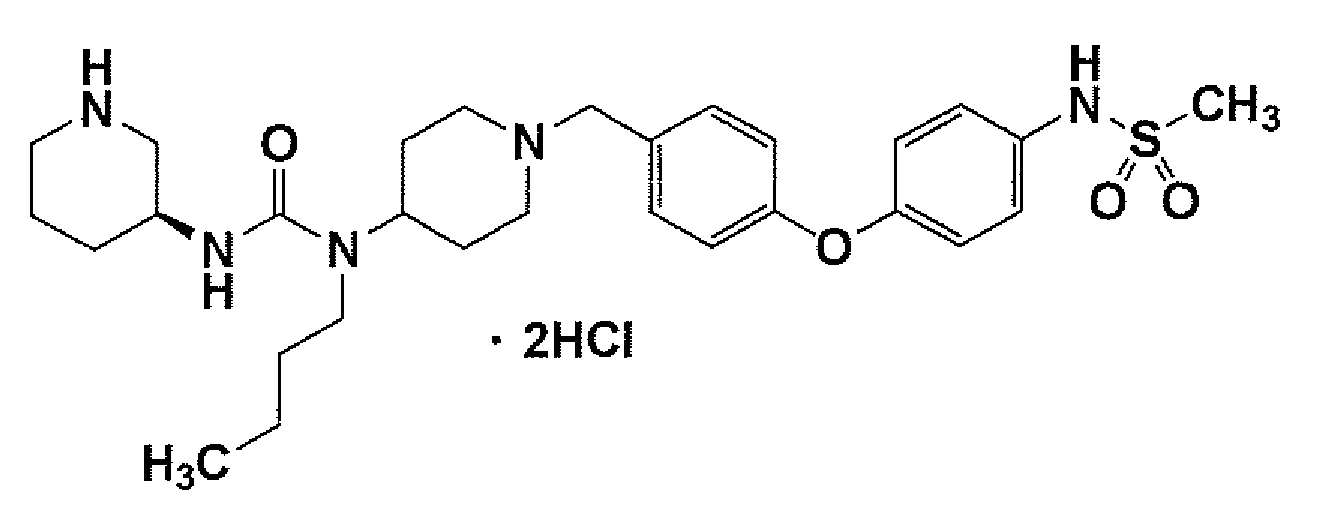
NMR (DMSO-d6): 5 0.91 (t, J = 7.1 Hz, 3H), 1.20-1.40 (m, 2H), 1.40-1.60 (m, 2H), 1.60-2.00 (m, 6H), 2.20-2.40 (m, 2H), 2.80-3.60 (m, 10H), 2.96 (s, 3H), 3.99 (m, 1H), 4.15 (m, 1H), 4.18 (s, 2H), 6.23 (m, 1H), 7.03 (d, J = 7.2 Hz, 4H), 7.28 (d, J = 8.7 Hz, 2H), 7.61 (d, J = 8.7 Hz, 2H), 8.83 (m, 1H), 9.35 (m, 1H), 9.47 (m, 1H).
NMR (DMSO-d6): δ 0.91 (t, J = 7.4 Hz, 3H), 1.20-1.40 (m, 2H), 1.40-1.60 (m, 2H), 1.60-2.00 (m, 6H), 2.20-2.40 (m, 2H), 2.80-3.60 (m, 10H), 2.96 (s, 3H), 3.98 (m, 1H), 4.15 (m, 1H), 4.20 (s, 2H), 6.22 (m, 1H), 7.03 (d, J = 8.7 Hz, 4H), 7.28 (d, J = 7.7 Hz, 2H), 7.61 (d, J = 7.7 Hz, 2H), 8.83 (m, 1H), 9.36 (m, 1H), 9.47 (m, 1H).
NMR (CD3OD): δ 0.98 (t, J = 7.2 Hz, 3H), 1.30-1.50 (m, 2H), 1.50-1.70 (m, 2H), 2.00-2.10 (m, 2H), 2.30-2.40 (m, 2H), 2.56 (s, 3H), 2.95 (s, 3H), 3.10-3.20 (m, 2H), 3.30-3.40 (m, 2H), 3.50-3.60 (m, 2H), 4.20 (m, 1H), 4.31 (s, 2H), 7.02-7.08 (m, 5H), 7.29 (d, J = 8.9 Hz, 2H), 7.53 (d, J = 8.9 Hz, 2H).
NMR (CD3OD): δ 0.98 (t, J = 7.2 Hz, 3H), 1.30-1.50 (m, 2H), 1.60-1.80 (m, 2H), 2.00-2.10 (m, 2H), 2.20-2.40 (m, 2H), 2.70 (s, 3H), 2.95 (s, 3H), 3.10-3.20 (m, 2H), 3.30-3.40 (m, 2H), 3.50-3.60 (m, 2H), 4.20 (m, 1H), 4.30 (s, 2H), 7.02-7.08 (m, 4H), 7.29 (d, J = 8.9 Hz, 2H), 7.52 (d, J = 8.9 Hz, 2H), 7.60 (dd, J = 9.0, 1.7 Hz, 1H), 7.90 (d, J = 9.0 Hz, 1H), 8.08 (d, J = 1.7 Hz, 1H).
NMR (CD3OD): δ 0.98 (t, J = 7.4 Hz, 3H), 1.30-1.50 (m, 2H), 1.60-1.70 (m, 2H), 2.00-2.10 (m, 2H), 2.20-2.40 (m, 2H), 2.95 (s, 3H), 3.10-3.20 (m, 2H), 3.30-3.40 (m, 2H), 3.50-3.60 (m, 2H), 3.78 (s, 3H), 4.20 (m, 1H), 4.29 (s, 2H), 6.34 (d, J = 2.4 Hz, 1H), 7.02-7.08 (m, 4H), 7.29 (d, J = 8.9 Hz, 2H), 7.51 (d, J = 8.9 Hz, 2H), 7.79 (d, J = 2.4 Hz, 1H).
NMR (CD3OD): δ 0.95 (t, J = 7.2 Hz, 3H), 1.23-2.20 (m, 16H), 2.95 (s, 3H), 3.02-3.16 (m, 4H), 3.50-3.59 (m, 2H), 3.66 (m, 1H), 3.95-4.22 (m, 2H), 4.28 (s, 2H), 7.03 (d, J = 8.7 Hz, 2H), 7.06 (d, J = 8.7 Hz, 2H), 7.29 (d, J = 8.7 Hz, 2H), 7.50 (d, J = 8.7 Hz, 2H).
NMR (CD3OD): δ 0.98 (t, J = 7.2 Hz, 3H), 1.30-1.50 (m, 2H), 1.60-1.70 (m, 2H), 1.90-2.10 (m, 2H), 2.20-2.40 (m, 2H), 2.27 (s, 6H), 2.95 (s, 3H), 3.10-3.20 (m, 2H), 3.20-3.40 (m, 2H), 3.50-3.60 (m, 2H), 3.93 (s, 3H), 4.24 (m, 1H), 4.30 (s, 2H), 7.02-7.07 (m, 4H), 7.29 (d, J = 8.7 Hz, 2H), 7.54 (d, J = 8.7 Hz, 2H).
NMR (CD3OD): δ 0.97 (t, J = 7.4 Hz, 3H), 1.30-1.50 (m, 2H), 1.60-1.70 (m, 2H), 1.90-2.10 (m, 2H), 2.20-2.30 (m, 2H), 2.95 (s, 3H), 3.00-3.20 (m, 2H), 3.20-3.40 (m, 2H), 3.50-3.60 (m, 2H), 4.10 (m, 1H), 4.25 (s, 2H), 7.01-7.06 (m, 5H), 7.29 (d, J = 8.7 Hz, 2H), 7.50 (d, J = 8.7 Hz, 2H), 7.89 (m, 1H).
NMR (CD3OD): δ 0.97 (t, J = 7.4 Hz, 3H), 1.30-1.50 (m, 2H), 1.50-1.70 (m, 2H), 1.90-2.10 (m, 2H), 2.20-2.40 (m, 2H), 2.95 (s, 3H), 3.00-3.20 (m, 2H), 3.20-3.40 (m, 2H), 3.50-3.60 (m, 2H), 4.20 (m, 1H), 4.30 (s, 2H), 7.02-7.08 (m, 4H), 7.12 (d, J = 9.0 Hz, 1H), 7.29 (d, J = 8.7 Hz, 2H), 7.53 (d, J = 8.7 Hz, 2H), 7.58 (m, 1H), 7.92 (m, 1H).
NMR (CD3OD): δ 0.97 (t, J = 7.4 Hz, 3H), 1.30-1.50 (m, 2H), 1.60-1.70 (m, 2H), 1.90-2.10 (m, 2H), 2.20-2.40 (m, 2H), 2.95 (s, 3H), 3.00-3.20 (m, 2H), 3.20-3.40 (m, 2H), 3.50-3.60 (m, 2H), 4.20 (m, 1H), 4.28 (s, 2H), 6.90 (m, 1H), 7.02-7.07 (m, 4H), 7.29 (d, J = 8.9 Hz, 2H), 7.40 (m, 1H), 7.50 (d, J = 8.9 Hz, 2H).
NMR (CD3OD): δ 2.10-2.20 (m, 2H), 2.20-2.40 (m, 2H), 2.62 (s, 3H), 2.95 (s, 3H), 3.00-3.20 (m, 2H), 3.50-3.60 (m, 2H), 4.31 (s, 2H), 4.50 (m, 1H), 7.00-7.06 (m, 4H), 7.17 (t, J = 10.2 Hz, 1H), 7.28 (d, J = 9.0 Hz, 2H), 7.56 (d, J = 9.0 Hz, 2H), 7.90-7.98 (m, 2H), 8.44 (d, J = 7.2 Hz, 1H), 8.57 (d, J = 8.7 Hz, 1H).
NMR (CD3OD): δ 2.10-2.20 (m, 2H), 2.20-2.30 (m, 2H), 2.40-2.50 (m, 2H), 2.95 (s, 3H), 3.00-3.20 (m, 2H), 3.30-3.40 (m, 2H), 3.50-3.60 (m, 2H), 4.10 (m, 1H), 4.29 (s, 2H), 5.08-5.19 (m, 2H), 5.85 (m, 1H), 7.02-7.08 (m, 4H), 7.14 (t, J = 10.4 Hz, 1H), 7.29 (d, J = 8.9 Hz, 2H), 7.49 (d, J = 8.9 Hz, 2H), 7.86 (m, 1H).

NMR (CD3OD): δ 0.90 (t, J = 7.2 Hz, 3H), 1.21-1.32 (m, 2H), 1.40-1.52 (m, 2H), 1.87-1.97 (m, 2H), 2.11-2.30 (m, 2H), 2.95 (s, 3H), 2.98-3.13 (m, 4H), 3.47-3.58 (m, 2H), 3.97 (m, 1H), 4.27 (s, 2H), 4.79 (s, 2H), 7.03 (d, J = 8.7 Hz, 2H), 7.06 (d, J = 8.7 Hz, 2H), 7.27-7.44 (m, 7H), 7.49 (d, J = 8.7 Hz, 2H).
NMR (CD3OD): δ 0.96 (t, J = 7.1 Hz, 3H), 1.30-1.50 (m, 2H), 1.50-1.70 (m, 2H), 1.90-2.10 (m, 2H), 2.20-2.40 (m, 2H), 2.95 (s, 3H), 2.99 (s, 3H), 3.10-3.30 (m, 2H), 3.30-3.40 (m, 2H), 3.50-3.60 (m, 2H), 4.30 (m, 1H), 4.31 (s, 2H), 7.01-7.05 (m, 4H), 7.29 (d, J = 8.9 Hz, 2H), 7.56 (d, J = 8.9 Hz, 2H), 7.67 (d, J = 8.3 Hz, 1H), 7.97 (d, J = 8.3 Hz, 1H), 8.23 (s, 1H).
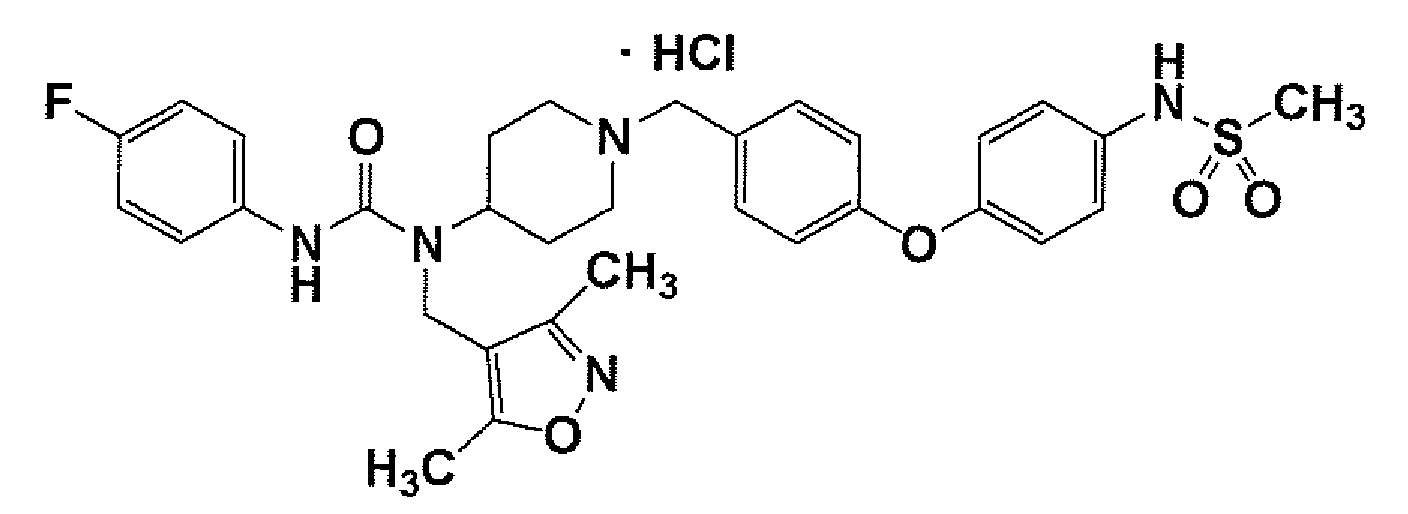
TLC:Rf 0.56(methylene chloride:methanol=9:1);
NMR (CD3OD): δ 1.91-2.00 (m, 2H), 2.12-2.32 (m, 2H), 2.25 (s, 3H), 2.39 (s, 3H), 2.95 (s, 3H), 3.02-3.16 (m, 2H), 3.48-3.57 (m, 2H), 4.05 (m, 1H), 4.26 (s, 2H), 4.42 (s, 2H), 6.97-7.08 (m, 6H), 7.25-7.37 (m, 4H), 7.49 (d, J = 8.7 Hz, 2H).
NMR (CD3OD): δ 1.92-2.01 (m, 2H), 2.15-2.31 (m, 2H), 2.23 (s, 3H), 2.95 (s, 3H), 3.00-3.15 (m, 2H), 3.43-3.55 (m, 2H), 3.76 (s, 3H), 4.01 (m, 1H), 4.25 (s, 2H), 4.48 (s, 2H), 6.97-7.08 (m, 6H), 7.25-7.37 (m, 4H), 7.49 (d, J = 8.7 Hz, 2H).
NMR (CD3OD): δ 1.92-2.04 (m, 2H), 2.16-2.33 (m, 2H), 2.95 (s, 3H), 3.11 (m, 2H), 3.54 (m, 2H), 4.29 (s, 2H), 4.31 (m, 1H), 4.69 (s, 2H), 6.98-7.08 (m, 6H), 7.22-7.40 (m, 4H), 7.44-7.58 (m, 2H), 7.64 (m, 1H), 9.2 2 (m, 1H).
NMR (CD3OD): δ 2.00-2.30 (m, 4H), 2.95 (s, 3H), 3.10-3.22 (m, 2H), 3.50-3.62 (m, 2H), 4.30 (s, 2H), 4.38 (m, 1H), 4.57 (s, 2H), 6.78 (d, J = 9.0 Hz, 1H), 6.82 (d, J = 7.5 Hz, 1H), 7.01 (t, J = 9.0 Hz, 2H), 7.02 (d, J = 8.7 Hz, 2H), 7.05 (d, J = 8.7 Hz, 2H), 7.29 (d, J = 8.7 Hz, 2H), 7.37 (dd, J = 9.0, 5.0 Hz, 2H), 7.53 (d, J = 8.7 Hz, 2H), 7.90 (dd, J = 9.0, 7.5 Hz, 1H).
NMR (CD3OD): δ 1.97-2.08 (m, 2H), 2.20-2.40 (m, 2H), 2.95 (s, 3H), 3.08-3.21 (m, 2H), 3.52-2.60 (m, 2H), 4.25-4.40 (m, 3H), 4.62 (s, 2H), 6.98-7.08 (m, 6H), 7.29 (d, J = 8.7 Hz, 2H), 7.40 (dd, J = 9.0, 5.0 Hz, 2H), 7.51 (s, 1H), 7.56 (d, J = 8.7 Hz, 2H), 8.80 (s, 1H).

TLC:Rf 0.60(chloroform:methanol=10:1);
NMR (CD3OD): δ 7.84 (d, J = 9.0 Hz, 2H), 7.57 (d, J = 8.4 Hz, 2H), 7.15 (d, J = 8.4 Hz, 2H), 7.08 (d, J = 9.0 Hz, 2H), 5.97 (m, 1H), 5.30-5.15 (m, 2H), 4.54 (dt, J = 5.7, 1.5 Hz, 2H), 4.38 (s, 2H), 3.68-3.59 (m, 2H), 3.44 (m, 1H), 3.23-3.07 (m, 2H), 2.91 (s, 3H), 2.68-2.63 (m, 2H), 2.40 (m, 1H).
TLC:Rf 0.80(chloroform:methanol=5:1).
TLC:Rf 0.55(chloroform:methanol=5:1);
NMR (CDCl3): δ 1.37 (t, J = 6.6 Hz, 1H), 2.83 (t, J = 6.6 Hz, 2H), 3.57 (m, 2H), 3.84 (q, J = 6.6 Hz, 2H), 6.62-6.70 (m, 2H), 5.84-6.92 (m, 4H), 7.12-7.20 (m, 2H).
TLC:Rf 0.89(chloroform:methanol=5:1);
NMR (CD3OD): δ 2.97 (s, 3H), 3.05 (t, J = 6.6 Hz, 2H), 3.41 (s, 6H), 4.43 (t, J = 6.6 Hz, 2H), 6.98-7.08 (m, 4H), 7.34-7.42 (m, 4H).
TLC:Rf 0.74(chloroform:methanol=5:1).

TLC:Rf 0.69(chloroform:methanol=5:1);
NMR (CD3OD): δ 0.97 (t, J = 7.2 Hz, 3H), 2.00-1.10 (m, 16H), 2.25-2.08 (m, 2H), 2.93 (s, 3H), 3.16-3.00 (m, 6H), 3.38-3.24 (m, 2H), 3.38-3.24 (m, 2H), 3.55 (m, 1H), 3.71 (m, 2H), 4.13 (m, 1H), 7.00-6.90 (m, 4H), 7.32-7.20 (m, 4H).
TLC:Rf 0.88 (chloroform:methanol=5:1);
NMR (CDCl3): δ 1.36-1.50 (m, 13H), 4.79 (m, 1H), 7.10-7.18 (m, 2H), 7.26-7.32 (m, 2H).
NMR (DMSO-d6): δ 1.52 (d, J = 6.6 Hz, 3H), 4.45 (m, 1H), 7.12 (brd, J = 9.3 Hz, 2H), 7.26 (brd, J = 8.7 Hz, 2H), 7.62 (brd, J = 8.7 Hz, 2H), 8.28 (brd, J = 9.3 Hz, 2H), 8.44 (m, 2H).
TLC: Rf 0.79(chloroform:methanol=9:1);
NMR (DMSO-d6): δ 1.75 (d, J = 6.9 Hz, 3H), 3H), 2.38-3.20 (m, 6H), 3.52 (m, 1H), 3.82 (m, 1H), 4.78 (m, 1H), 7.19 (d, J = 9.0 Hz, 2H), 7.29 (d, J = 9.0 Hz, 2H), 7.73 (d, J = 9.0 Hz, 2H), 8.27 (d, J = 9.0 Hz, 2H).

TLC:Rf 0.39(chloroform:methanol=9:1);
NMR (CD3OD): δ 0.94 (t, J = 7.2 Hz, 3H), 1.14-2.28 (m, 18H), 1.76 (d, J = 6.9 Hz, 3H), 2.80-3.05 (m, 2H), 2.95 (s, 3H), 3.12 (m, 2H), 3.41 (m, 1H), 3.52 (m, 1H), 3.74 (m, 1H), 4.02 (m, 1H), 4.46 (m, 1H), 7.00-7.19 (m, 4H), 7.29 (brd, J = 9.3 Hz, 2H), 7.50 (brd, J = 8.7 Hz, 2H).
TLC:Rf 0.53(chloroform:methanol=5:1).
TLC:Rf 0.19(chloroform:methanol=5:1).

TLC:Rf 0.71(chloroform:methanol=5:1);
NMR (CD3OD): δ 0.98 (t, J = 7.2 Hz, 3H), 1.16-1.48 (m, 7H), 1.58-1.94 (m, 7H), 2.08-2.38 (m, 4H), 2.95 (s, 3H), 3.08-3.35 (m, 4H), 3.56-4.15 (m, 6H), 4.31 (s, 2H), 7.00-7.08 (m, 4H), 7.24-7.34 (m, 2H), 7.55 (brd, J = 8.7 Hz, 2H).
TLC:Rf 0.43(hexane: ethyl acetate=3:1);
NMR (CDCl3): δ 1.57 (m, 4H), 1.79 (m, 4H), 3.45 (m, 2H), 3.79 (m, 2H), 6.29 (d, J = 6.3 Hz, 1H), 7.98 (d, J = 6.3 Hz, 1H).
TLC:Rf 0.23(dichloromethane:methanol:acetic acid=5:1:0.1);
NMR (CD3OD): δ 1.59-1.61 (m, 4H), 1.83-1.92 (m, 6H), 2.22-2.27 (m, 2H), 3.14-3.22 (m, 2H), 3.44-3.49 (m, 2H), 3.69 (t, J = 6.1 Hz, 2H), 3.91 (t, J = 6.1 Hz, 2H), 4.17 (m, 1H), 6.41 (d, J = 7.5 Hz, 1H), 7.68 (d, J = 7.5 Hz, 1H).

TLC:Rf 0.38(methylene chloride:methanol=10:1);
NMR (CD3OD): δ 1.61-1.62 (m, 4H), 1.83-1.98 (m, 6H), 2.20-2.33 (m, 2H), 2.95 (s, 3H), 3.16-3.24 (m, 2H), 3.55-3.61 (m, 2H), 3.69 (t, J = 6.0 Hz, 2H), 3.91 (t, J = 6.0 Hz, 2H), 4.15 (m, 1H), 4.31 (s, 2H), 6.40 (d, J = 7.5 Hz, 1H), 7.03 (d, J = 8.7 Hz, 2H), 7.06 (d, J = 8.7 Hz, 2H), 7.29 (d, J = 8.7 Hz, 2H), 7.54 (d, J = 8.7 Hz, 2H), 7.66 (d, J = 7.5 Hz, 1H).
TLC:Rf 0.53(methylene chloride:methanol=10:1);
NMR (CD3OD): δ 1.55-1.80 (m, 9H), 2.00-2.17 (m, 3H), 2.79 (m, 1H), 2.95 (s, 3H), 3.04 (m, 1H), 3.53-3.86 (m, 7H), 4.25 (d, J = 13.5 Hz, 1H), 4.33 (m, 1H), 4.44 (d, J = 13.5 Hz, 1H), 6.40 (d, J = 7.5 Hz, 1H), 7.02 (d, J = 8.7 Hz, 2H), 7.04 (d, J = 8.7 Hz, 2H), 7.29 (d, J = 8.7 Hz, 2H), 7.55 (d, J = 8.7 Hz, 2H), 7.66 (d, J = 7.5 Hz, 1H).


- Ec:
- measured value of Ca2+ transient increase by RANTES
- Ea:
- measured value of Ca2+ transient increase by RANTES when a test compound was added.
- Ec:
- (fluorescence measured value at the addition of 0.1% DMSO) - (fluorescence measured value of the naturally falling cells)
- Ea:
- (fluorescence measured value at the addition of the test compound) - (fluorescence measured value of the naturally falling cells)
| N-butyl-N-[1-(4-{4-[(methylsulfonyl)amino]phenoxy}benzyl)piperidin -4-yl]cyclohexanecarboxamide hydrochloride | 5.0g |
| calcium carboxymethyl cellulose (disintegrant) | 0.2 g |
| magnesium stearate (lubricant) | 0.1 g |
| microcrystalline cellulose | 4.7 g |
| N-butyl-N-[1-(4-{4-[(methylsulfonyl)amino]phenoxy}benzyl)piperidin -4-yl]cyclohexanecarboxamide hydrochloride | 2.0g |
| mannitol | 20 g |
| distilled water | 500 ml |
| N-butyl-N-[1-(4-{4-[(methylsulfonyl)amino]phenoxy}benzyl)plperidin -4-yl]cyclohexanecarboxamide hydrochloride | 100 g |
| calcium carboxymethyl cellulose (disintegrant) | 20.0 g |
| magnesium stearate (lubricant) | 10.0 g |
| microcrystalline cellulose | 870 g |
| N-butyl-N-[1-(4-{4-[(methylsulfonyl)amino]phenoxy}benzyl)piperidin -4-yl]cyclohexanecarboxamide hydrochloride | 200 g |
| mannitol | 2 kg |
| distilled water | 50 L |
Claims (26)
- A compound represented by formula (I):wherein R1 represents a hydrogen atom or an acidic group which may be protected;
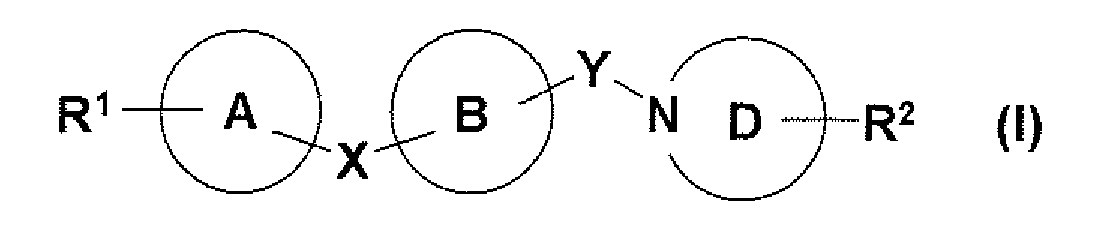
X and Y each independently represents a bond or a spacer containing 1 to 3 atoms as a main chain;
ring A and ring B, which are the same or different, each represents a 3- to 15-membered homocyclic group or heterocyclic group which may have a substituent(s);
ring D represents a 3- to 15-membered nitrogen-containing heterocyclic group which may have a substituent(s);
R2 represents (1) a hydrogen atom, (2) a hydrocarbon group which have a substituent(s), (3) a cyano group, (4) a hydroxy group which may be protected, (5) an amino group which have a substituent(s), (6) an oxo group, (7) a 3- to 15-membered heterocyclic group which have a substituent(s) or (8) =N-OR6, wherein R6 represents a hydrogen atom or C1-4 alkyl.,
a salt thereof or a solvate thereof, or a prodrug thereof. - The compound according to claim 1, wherein R1 is an acidic group which may be protected.
- The compound according to claim 2, wherein the acidic group is carboxy or sulfonamide.
- The compound according to claim 1, wherein X and Y are each independently a bond or a divalent group selected from (1)-CR7R8-, (2)-NR9-, (3)-CO-, (4)-O-, (5)-S-, (6)-SO-, (7)-SO2- and (8)-C(=N-OR10)-, wherein R7 and R8 each independently represents a hydrogen atom, C1-4 alkyl, -OR11 or phenyl; R9 represents a hydrogen atom C1-4 alkyl, or phenyl; R10 and R11 each independently represents a hydrogen atom or C1-4 alkyl.
- The compound according to claim 4, wherein X is a bond, -O- or -CH2-.
- The compound according to claim 1, wherein Y is C1-3 alkylene.
- The compound according to claim 1, wherein ring D is a 5- to 10-membered nitrogen-containing heterocyclic group which may have a substituent(s).
- The compound according to claim 1, wherein ring A and ring B, which are the same or different, are each a 5- to 10-membered homocyclic group or heterocyclic group which may have a substituent(s).
- The compound according to claim 1, wherein ring A and ring B, which are the same or different, are each a 5- or 6-membered aromatic ring which may have a substituent(s).
- The compound according to claim 1, wherein R2 iswherein the arrow represents a binding position to ring D; R51, R52 and R53 each independently represents (1) a hydrogen atom, (2) a hydrocarbon group which have a substituent(s), (3) a 3- to 15-membered heterocyclic group which have a substituent(s), (4) a C1-4 alkoxy group which have a substituent(s), (5) a phenoxy group which have a substituent(s) or (6) a benzyloxy group which have a substituent(s).

- The compound according to claim 1, which is represented by formula (Ia):wherein ring D1a is piperidine or piperazine which have a substituent(s) and other symbols have the same meanings as those described in claim 1.

- The compound according to claim 1, which is selected from the group consisting of(1) N-[4-(4-{[4-(butyl{[(2,4-difluorophenyl)amino]carbonyl}amino)-1-piperidinyl]methyl}phenoxy)phenyl]methanesulfonamide,(2) N-[4-(4-{[4-(butyl{[(6-methyl-3-pyridinyl)amino]carbonyl}amino)-1-piperidinyl]methyl}phenoxy)phenyl]methanesulfonamide,(3) N-[4-(4-{[4-(butyl{[(2,4-difluorophenyl)amino]carbonyl}amino)piperidin-1-yl]methyl}-3,5-dimethyl-1H-pyrazol-1-yl)phenyl]methanesulfonamide,(4) N-[4-(4-{[4-(butyl{[(1-methyl-1H-pyrazol-4-yl)amino]carbonyl}amino)piperidin-1-yl]methyl}phenoxy)phenyl]methanesulfonamide,(5) 3-[({butyl[1-(4-{4-[(methylsulfonyl)amino]phenoxy}benzyl)piperidin-4-yl]amino}carbonyl)amino]benzamide,(6) N-{4-[4-({4-[{[(4-fluorophenyl)amino]carbonyl}(phenyl)amino]piperidin-1-yl}methyl)phenoxy]phenyl}methanesulfonamide,(7) 5-[({butyl[1-(4-{4-[(methylsulfonyl)amino]phenoxy}benzyl)piperidin-4-yl]amino}carbonyl)amino]-2-fluorobenzamide,(8) 5-[({butyl[1-(4-{4-[(methylsulfonyl)amino]phenoxy}benzyl)piperidin-4-yl]amino}carbonyl)amino]-2,4-difluorobenzamide,(9) N-[4-(4-{[4-(butyl{[(3-cyano-4-fluorophenyl)amino]carbonyl}amino)piperidin-1-yl]methyl}phenoxy)phenyl]methanesulfonamide, and(10) N-[4-(4-{[4-(butyl{[(3-hydroxycyclohexyl)amino]carbonyl}amino)piperidin-1-yl]methyl }phenoxy)phenyl]methanesulfonamide, and
N-{4-[4-({4-[{[(4-fluorophenyl)amino]carbonyl}(1,3-thiazol-4-ylmethyl)amino]piperidin-1-yl}methyl)phenoxy]phenyl}methanesulfonamide. - A CCR5 regulator comprising the compound according to claim 1, a salt thereof or a solvate thereof, or a prodrug thereof.
- The CCR5 regulator according to claim 13, which is a CCR5 antagonist.
- The CCR5 regulator according to claim 13, which is an agent for treatment and/or prevention for a disease through the intervention of CCR5.
- The CCR5 regulator according to claim 15, wherein the disease through the intervention of CCR5 is infection with human immunodeficiency virus.
- The CCR5 regulator according to claim 16, wherein the infection with human immunodeficiency virus is acquired immune deficiency syndrome.
- The CCR5 regulator according to claim 15, wherein the disease through the intervention of CCR5 is immunological diseases.
- The CCR5 regulator according to claim 18, wherein the immunological disease is rejection in organ transplantation.
- The CCR5 regulator according to claim 15, wherein the disease through the intervention of CCR5 is inflammatory diseases.
- The CCR5 regulator according to claim 20, wherein the inflammatory disease is asthma.
- An agent for prevention and/or treatment for infection with human immunodeficiency virus, immunological diseases or inflammatory diseases, which comprises the compound represented by formula (I) according to claim 1, a salt thereof or a solvate thereof, or a prodrug thereof.
- A pharmaceutical composition, which comprises the compound represented by formula (I) according to claim 1, a salt thereof or a solvate thereof, or a prodrug thereof.
- A medicament which comprises the compound represented by formula (I) according to claim 1, a salt thereof or a solvate thereof, or a prodrug thereof, in combination with one or at least two of a reverse transferase inhibitor, a protease inhibitor, a CCR2 antagonist, a CCR3 antagonist, a CCR4 antagonist, a CCR5 antagonist, a CXCR4 antagonist, a fusion inhibitor, an antibody against a surface antigen of HIV-1, and a vaccine of HIV-1.
- A method for treating or preventing a disease through the intervention of CCR5 in a mammal, which comprises administering to a mammal an effective amount of a compound represented by formula (I):wherein R1 represents a hydrogen atom or an acidic group which may be protected;

X and Y each independently represents a bond or a spacer containing 1 to 3 atoms as a main chain;
ring A and ring B, which are the same or different, each represents a 3- to 15-membered homocyclic group or heterocyclic group which may have a substituent(s);
ring D represents a 3- to 15-membered nitrogen-containing heterocyclic group which may have a substituent(s);
R2 represents (1) a hydrogen atom, (2) a hydrocarbon group which have a substituent(s), (3) a cyano group, (4) a hydroxy group which may be protected, (5) an amino group which have a substituent(s), (6) an oxo group, (7) a 3- to 15-membered heterocyclic group which have a substituent(s) or (8) =N-OR6, wherein R6 represents a hydrogen atom or C1-4 alkyl,
a salt thereof or a solvate thereof, or a prodrug thereof. - Use of a compound represented by formula (I):wherein R1 represents a hydrogen atom or an acidic group which may be protected;

X and Y each independently represents a bond or a spacer containing I to 3 atoms as a main chain;
ring A and ring B, which are the same or different, each independently represents a 3- to 15-membered homocyclic group or heterocyclic group which may have a substituent(s);
ring D represents a 3- to 15-membered nitrogen-containing heterocyclic group which may have a substituent(s);
R2 represents (1) a hydrogen atom, (2) a hydrocarbon group which have a substituent(s), (3) a cyano group, (4) a hydroxy group which may be protected, (5) an amino group which have a substituent(s), (6) an oxo group, (7) a 3- to 15-membered heterocyclic group which have a substituent(s) or (8) =N-OR6, wherein R6 represents a hydrogen atom or C1-4 alkyl,
a salt thereof or a solvate thereof, or a prodrug thereof
for the manufacture of an agent for prevention and/or treatment for a disease through the intervention of CCR5.
Priority Applications (1)
| Application Number | Priority Date | Filing Date | Title |
|---|---|---|---|
| EP11158323A EP2385040A1 (en) | 2003-03-14 | 2004-03-12 | Nitrogen-containing heterocyclic derivatives and drugs containing the same as the active ingredient |
Applications Claiming Priority (5)
| Application Number | Priority Date | Filing Date | Title |
|---|---|---|---|
| JP2003070347 | 2003-03-14 | ||
| JP2003070347 | 2003-03-14 | ||
| JP2003385683 | 2003-11-14 | ||
| JP2003385683 | 2003-11-14 | ||
| PCT/JP2004/003333 WO2004080966A1 (en) | 2003-03-14 | 2004-03-12 | Nitrogen-containing heterocyclic derivatives and drugs containing the same as the active ingredient |
Publications (2)
| Publication Number | Publication Date |
|---|---|
| EP1604981A1 true EP1604981A1 (en) | 2005-12-14 |
| EP1604981A4 EP1604981A4 (en) | 2008-12-24 |
Family
ID=32992980
Family Applications (2)
| Application Number | Title | Priority Date | Filing Date |
|---|---|---|---|
| EP04720257A Withdrawn EP1604981A4 (en) | 2003-03-14 | 2004-03-12 | NITROGEN-CONTAINING HETEROCYCLIC DERIVATIVES AND MEDICAMENTS CONTAINING THESE DERIVATIVES AS AN ACTIVE INGREDIENT |
| EP11158323A Withdrawn EP2385040A1 (en) | 2003-03-14 | 2004-03-12 | Nitrogen-containing heterocyclic derivatives and drugs containing the same as the active ingredient |
Family Applications After (1)
| Application Number | Title | Priority Date | Filing Date |
|---|---|---|---|
| EP11158323A Withdrawn EP2385040A1 (en) | 2003-03-14 | 2004-03-12 | Nitrogen-containing heterocyclic derivatives and drugs containing the same as the active ingredient |
Country Status (16)
| Country | Link |
|---|---|
| US (1) | US7910741B2 (en) |
| EP (2) | EP1604981A4 (en) |
| JP (1) | JP4736043B2 (en) |
| KR (1) | KR101078505B1 (en) |
| CN (1) | CN101928284A (en) |
| AU (2) | AU2004220225B2 (en) |
| BR (1) | BRPI0408332A (en) |
| CA (1) | CA2517888C (en) |
| IL (2) | IL170690A (en) |
| MA (1) | MA27756A1 (en) |
| MX (1) | MXPA05009771A (en) |
| NO (1) | NO333573B1 (en) |
| NZ (1) | NZ542304A (en) |
| RU (2) | RU2366655C2 (en) |
| TW (2) | TWI344955B (en) |
| WO (1) | WO2004080966A1 (en) |
Cited By (28)
| Publication number | Priority date | Publication date | Assignee | Title |
|---|---|---|---|---|
| WO2006068594A1 (en) * | 2004-12-21 | 2006-06-29 | Astrazeneca Ab | HETEROCYCLIC MCHr1 ANTAGONISTS AND THEIR USE IN THERAPY |
| EP1790637A1 (en) | 2004-09-13 | 2007-05-30 | Ono Pharmaceutical Co., Ltd. | Nitrogenous heterocyclic derivative and medicine containing the same as an active ingredient |
| WO2007066784A2 (en) | 2005-12-05 | 2007-06-14 | Otsuka Pharmaceutical Co., Ltd. | Diarylether derivatives as antitumor agents |
| US7642263B2 (en) | 2005-07-09 | 2010-01-05 | Astrazeneca Ab | Heteroaryl benzamide derivatives for use as GLK activators in the treatment of diabetes |
| US7671060B2 (en) | 2006-10-26 | 2010-03-02 | Astrazeneca Ab | Heteroaryl benzamide derivatives |
| EP1852432A4 (en) * | 2005-02-25 | 2010-04-14 | Ono Pharmaceutical Co | Nitrogenous heterocyclic compound and medicinal use thereof |
| US7745475B2 (en) | 2004-06-05 | 2010-06-29 | Astrazeneca Ab | Heteroaryl benzamide derivatives as GLK activators |
| EP2133077A4 (en) * | 2007-01-23 | 2010-12-22 | Derivatives of azabicyclo octane, the method of making them and the uses thereof as inhibitors of dipeptidyl peptidase iv | |
| US7910741B2 (en) | 2003-03-14 | 2011-03-22 | Ono Pharmaceutical Co., Ltd. | Nitrogen-containing heterocyclic derivatives and drugs containing the same as the active ingredient |
| US8003642B2 (en) | 2006-03-10 | 2011-08-23 | Ono Pharmaceutical Co., Ltd. | Nitrogenated heterocyclic derivative, and pharmaceutical agent comprising the derivative as active ingredient |
| US8071608B2 (en) * | 2009-04-09 | 2011-12-06 | Astrazeneca Ab | Therapeutic agents |
| US8071585B2 (en) | 2009-04-09 | 2011-12-06 | Astrazeneca Ab | Therapeutic agents |
| US8076481B2 (en) | 2009-02-13 | 2011-12-13 | Astrazeneca Ab | Chemical process 632 |
| US8093252B2 (en) | 2009-02-13 | 2012-01-10 | Astrazeneca Ab | Crystalline polymorphic form of glucokinase activator |
| US8143263B2 (en) | 2008-08-04 | 2012-03-27 | Astrazeneca Ab | Therapeutic agents |
| US8188277B2 (en) | 2004-08-06 | 2012-05-29 | Otsuka Pharmaceutical Co., Ltd. | Aromatic compounds for suppressing the generation of collagen |
| US8263599B2 (en) | 2006-10-02 | 2012-09-11 | Otsuka Pharmaceutical Co., Ltd. | STAT3/5 activation inhibitor |
| US8741909B2 (en) | 2009-10-19 | 2014-06-03 | Respivert Ltd. | PI3 kinase inhibitors |
| US9266883B2 (en) | 2013-10-25 | 2016-02-23 | Novartis Ag | Ring-fused bicyclic pyridyl derivatives as FGFR4 inhibitors |
| US9340545B2 (en) | 2010-10-18 | 2016-05-17 | Respivert Ltd. | Quinazolin-4 (3H)—one derivatives used as P13 kinase inhibitors |
| US9642799B2 (en) | 2012-03-13 | 2017-05-09 | Respivert, Ltd. | Crystalline 6-(2-((4-amino-3-(3-hydroxyphenyl)-1H-pyrazolo[3,4-D]pyrimidin-1-yl)methyl)-3-(2-chlorobenzyl)-4-0X0-3,4-dihydroquinazolin-5-yl)-N,N-bis(2-methoxyethyl)hex-5-ynamide |
| US9745306B2 (en) | 2013-03-15 | 2017-08-29 | Respivert Limited | 2-((4-amino-3-(3-fluoro-5-hydroxyphenyl)-1H-pyrazolo[3,4-D]pyrimidin-1-yl)methyl)-3-(2-(trifluoromethyl)benzyl) quinazolin-4(3H)-one derivatives and their use as phosphoinositide 3-kinase inhibitors |
| US9763957B2 (en) | 2013-07-18 | 2017-09-19 | Novartis Ag | Autotaxin inhibitors |
| US9802917B2 (en) | 2015-03-25 | 2017-10-31 | Novartis Ag | Particles of N-(5-cyano-4-((2-methoxyethyl)amino)pyridin-2-yl)-7-formyl-6-((4-methyl-2-oxopiperazin-1-yl)methyl)-3,4-dihydro-1,8-naphthyridine-1(2H)-carboxamide |
| WO2018215070A1 (en) * | 2017-05-24 | 2018-11-29 | Johann Wolfgang Goethe-Universität Frankfurt am Main | Dual modulators of farnesoid x receptor and soluble epoxide hydrolase |
| WO2020039088A3 (en) * | 2018-08-24 | 2020-04-02 | Xeniopro GmbH | Aromatic molecules for use in the treatment of pathological conditions |
| WO2021053234A1 (en) * | 2019-09-19 | 2021-03-25 | Johann Wolfgang Goethe-Universität Frankfurt am Main | Compounds and compositions for treating kidney disease |
| WO2023156386A3 (en) * | 2022-02-16 | 2023-09-28 | Duke Street Bio Limited | Pharmaceutical compound |
Families Citing this family (90)
| Publication number | Priority date | Publication date | Assignee | Title |
|---|---|---|---|---|
| EP1415987B1 (en) | 2000-10-20 | 2007-02-28 | Eisai R&D Management Co., Ltd. | Nitrogenous aromatic ring compounds as anti cancer agents |
| WO2004052862A1 (en) | 2002-12-10 | 2004-06-24 | Ono Pharmaceutical Co., Ltd. | Nitrogen-containing heterocyclic compounds and medicinal use thereof |
| WO2005044788A1 (en) * | 2003-11-11 | 2005-05-19 | Eisai Co., Ltd. | Urea derivative and process for producing the same |
| ATE428421T1 (en) * | 2004-09-17 | 2009-05-15 | Eisai R&D Man Co Ltd | MEDICAL COMPOSITION WITH IMPROVED STABILITY AND REDUCED GELING PROPERTIES |
| EP1836179B1 (en) * | 2004-12-30 | 2015-05-06 | Janssen Pharmaceutica NV | Piperidine- and piperazine-1-carboxylic acid amide derivatives and related compounds as modulators of fatty acid amide hydrolase (faah) for the treatment of anxiety, pain and other conditions |
| MX2007010068A (en) * | 2005-02-16 | 2007-10-10 | Schering Corp | Piperazine-piperidines with cxcr3 antagonist activity. |
| EP1925676A4 (en) | 2005-08-02 | 2010-11-10 | Eisai R&D Man Co Ltd | METHOD FOR ANALYZING THE EFFECT OF A VASCULARIZATION INHIBITOR |
| EP1924265A4 (en) * | 2005-08-16 | 2010-06-02 | Genzyme Corp | Chemokine receptor binding compounds |
| JP5142513B2 (en) * | 2005-12-05 | 2013-02-13 | 大塚製薬株式会社 | Medicine |
| WO2007136103A1 (en) | 2006-05-18 | 2007-11-29 | Eisai R & D Management Co., Ltd. | Antitumor agent for thyroid cancer |
| KR101472600B1 (en) | 2006-08-28 | 2014-12-15 | 에자이 알앤드디 매니지먼트 가부시키가이샤 | Antitumor agent for undifferentiated gastric cancer |
| CA2669311C (en) * | 2006-11-13 | 2011-09-20 | Pfizer Products Inc. | Diaryl, dipyridinyl and aryl-pyridinyl derivatives and uses thereof |
| EP2119707B1 (en) | 2007-01-29 | 2015-01-14 | Eisai R&D Management Co., Ltd. | Composition for treatment of undifferentiated-type of gastric cancer |
| CL2008001631A1 (en) * | 2007-06-06 | 2009-01-02 | Smithkline Beecham Corp | Compounds derived from substituted heterocycles, with the presence of a phenoxy group, reverse transcriptase inhibitors; pharmaceutical composition; and use in the treatment of HIV viral infections. |
| CN101848895B (en) | 2007-11-09 | 2013-10-23 | 卫材R&D管理有限公司 | Combined use of angiogenesis inhibitory substance and antitumor platinum complex |
| WO2010081851A1 (en) | 2009-01-14 | 2010-07-22 | Genoscience Pharma | Piperidin-4-ylpiperazine compounds for the treatment of hcv infection |
| US8420686B2 (en) * | 2009-02-17 | 2013-04-16 | Enanta Pharmaceuticals, Inc. | Linked diimidazole antivirals |
| US8637561B2 (en) * | 2009-02-17 | 2014-01-28 | Enanta Pharmaceuticals, Inc. | Linked diimidazole derivatives |
| WO2010096462A1 (en) * | 2009-02-17 | 2010-08-26 | Enanta Pharmaceuticals, Inc | Linked diimidazole derivatives |
| US8101643B2 (en) * | 2009-02-27 | 2012-01-24 | Enanta Pharmaceuticals, Inc. | Benzimidazole derivatives |
| US8426458B2 (en) * | 2009-02-27 | 2013-04-23 | Enanta Pharmaceuticals, Inc. | Hepatitis C Virus inhibitors |
| US9765087B2 (en) | 2009-02-27 | 2017-09-19 | Enanta Pharmaceuticals, Inc. | Benzimidazole derivatives |
| US8673954B2 (en) | 2009-02-27 | 2014-03-18 | Enanta Pharmaceuticals, Inc. | Benzimidazole derivatives |
| US8507522B2 (en) * | 2009-03-06 | 2013-08-13 | Enanta Pharmaceuticals, Inc. | Hepatitis C virus inhibitors |
| EP2623101B1 (en) * | 2009-04-02 | 2021-04-21 | Merck Patent GmbH | Piperidine and piperazine derivatives as autotaxin inhibitors |
| BR112012003592B8 (en) | 2009-08-19 | 2021-05-25 | Eisai R&D Man Co Ltd | pharmaceutical composition containing quinoline derivative |
| ES2782999T3 (en) * | 2009-11-06 | 2020-09-16 | Aerpio Therapeutics Inc | Compositions and methods for treating colitis |
| WO2011060321A1 (en) | 2009-11-16 | 2011-05-19 | Chdi, Inc. | Transglutaminase tg2 inhibitors, pharmaceutical compositions, and methods of use thereof |
| US8933110B2 (en) | 2010-01-25 | 2015-01-13 | Enanta Pharmaceuticals, Inc. | Hepatitis C virus inhibitors |
| CN102843909A (en) | 2010-01-25 | 2012-12-26 | 埃南塔制药公司 | Hepatitis c virus inhibitors |
| WO2011127350A1 (en) | 2010-04-09 | 2011-10-13 | Enanta Pharmaceuticals, Inc. | Hepatitis c virus inhibitors |
| UA108233C2 (en) | 2010-05-03 | 2015-04-10 | Fatty acid amide hydrolysis activity modulators | |
| US8778938B2 (en) | 2010-06-04 | 2014-07-15 | Enanta Pharmaceuticals, Inc. | Hepatitis C virus inhibitors |
| CA2802644C (en) | 2010-06-25 | 2017-02-21 | Eisai R & D Management Co., Ltd. | Antitumor agent using compounds having kinase inhibitory effect in combination |
| EP2603080A4 (en) | 2010-08-12 | 2014-01-22 | Enanta Pharm Inc | Hepatitis c virus inhibitors |
| EP2700403B1 (en) | 2011-04-18 | 2015-11-25 | Eisai R&D Management Co., Ltd. | Therapeutic agent for tumor |
| US8889716B2 (en) | 2011-05-10 | 2014-11-18 | Chdi Foundation, Inc. | Transglutaminase TG2 inhibitors, pharmaceutical compositions, and methods of use thereof |
| EP2709455A4 (en) | 2011-05-18 | 2014-11-05 | Enanta Pharm Inc | Processes for the preparation of 5-azaspiro[2.4]heptane-6-carboxylic acid and its derivatives |
| RU2456287C1 (en) * | 2011-05-20 | 2012-07-20 | Николай Филиппович Савчук | Incretin secretagogues, methods for preparing and applying them |
| WO2012166899A2 (en) | 2011-06-03 | 2012-12-06 | Eisai R&D Management Co., Ltd. | Biomarkers for predicting and assessing responsiveness of thyroid and kidney cancer subjects to lenvatinib compounds |
| MY167575A (en) | 2011-10-14 | 2018-09-20 | Ambit Biosciences Corp | Heterocyclic compounds and use thereof as modulators of type iii receptor tyrosine kinases |
| US9024017B2 (en) * | 2012-07-19 | 2015-05-05 | Janssen Pharmaceutica Nv | Octahydro-cyclopentapyrrolyl antagonists of CCR2 |
| AU2013364953A1 (en) | 2012-12-21 | 2015-04-30 | Eisai R&D Management Co., Ltd. | Amorphous form of quinoline derivative, and method for producing same |
| AR095353A1 (en) | 2013-03-15 | 2015-10-07 | Respivert Ltd | COMPOUND |
| CN105264380B (en) | 2013-05-14 | 2017-09-05 | 卫材R&D管理有限公司 | Biomarkers for predicting and evaluating responsiveness of endometrial cancer subjects to lenvatinib compounds |
| JO3442B1 (en) | 2013-10-07 | 2019-10-20 | Takeda Pharmaceuticals Co | Antagonists of somatostatin receptor subtype 5 (sstr5) |
| RS58321B1 (en) | 2013-10-29 | 2019-03-29 | Takeda Pharmaceuticals Co | Heterocyclic compound |
| KR102421235B1 (en) | 2014-02-13 | 2022-07-15 | 인사이트 코포레이션 | Cyclopropylamines as lsd1 inhibitors |
| US9527835B2 (en) | 2014-02-13 | 2016-12-27 | Incyte Corporation | Cyclopropylamines as LSD1 inhibitors |
| EP3392244A1 (en) | 2014-02-13 | 2018-10-24 | Incyte Corporation | Cyclopropylamines as lsd1 inhibitors |
| NZ723203A (en) | 2014-02-13 | 2020-08-28 | Incyte Corp | Cyclopropylamines as lsd1 inhibitors |
| WO2016007731A1 (en) | 2014-07-10 | 2016-01-14 | Incyte Corporation | Imidazopyridines and imidazopyrazines as lsd1 inhibitors |
| US9695180B2 (en) | 2014-07-10 | 2017-07-04 | Incyte Corporation | Substituted imidazo[1,2-a]pyrazines as LSD1 inhibitors |
| WO2016007722A1 (en) | 2014-07-10 | 2016-01-14 | Incyte Corporation | Triazolopyridines and triazolopyrazines as lsd1 inhibitors |
| US9758523B2 (en) | 2014-07-10 | 2017-09-12 | Incyte Corporation | Triazolopyridines and triazolopyrazines as LSD1 inhibitors |
| CA2957005C (en) | 2014-08-28 | 2021-10-12 | Eisai R&D Management Co., Ltd. | High-purity quinoline derivative and method for manufacturing same |
| WO2016054483A1 (en) | 2014-10-03 | 2016-04-07 | Novartis Ag | Use of ring-fused bicyclic pyridyl derivatives as fgfr4 inhibitors |
| SG11201706630UA (en) | 2015-02-25 | 2017-09-28 | Eisai R&D Man Co Ltd | Method for suppressing bitterness of quinoline derivative |
| WO2016140717A1 (en) | 2015-03-04 | 2016-09-09 | Merck Sharp & Dohme Corp. | Combination of a pd-1 antagonist and a vegfr/fgfr/ret tyrosine kinase inhibitor for treating cancer |
| UA122688C2 (en) | 2015-04-03 | 2020-12-28 | Інсайт Корпорейшн | HETEROCYCLIC COMPOUNDS AS LSD1 INHIBITORS |
| BR112017027227B1 (en) | 2015-06-16 | 2023-12-12 | Eisai R&D Management Co., Ltd | ANTI-CANCER AGENT |
| JP7427363B2 (en) | 2015-08-12 | 2024-02-05 | インサイト・ホールディングス・コーポレイション | LSD1 inhibitor salt |
| JP6553726B2 (en) | 2015-08-20 | 2019-07-31 | エーザイ・アール・アンド・ディー・マネジメント株式会社 | Tumor therapeutic agent |
| US10166221B2 (en) | 2016-04-22 | 2019-01-01 | Incyte Corporation | Formulations of an LSD1 inhibitor |
| US10316021B2 (en) | 2016-11-28 | 2019-06-11 | Pfizer Inc. | Heteroarylphenoxy benzamide kappa opioid ligands |
| US12303505B2 (en) | 2017-02-08 | 2025-05-20 | Eisai R&D Management Co., Ltd. | Tumor-treating pharmaceutical composition |
| BR112019023064A2 (en) | 2017-05-16 | 2020-06-09 | Eisai R&D Man Co Ltd | treatment of hepatocellular carcinoma |
| SG11202001684PA (en) | 2017-10-06 | 2020-03-30 | Forma Therapeutics Inc | Inhibiting ubiquitin specific peptidase 30 |
| BR122023024273A2 (en) | 2018-02-27 | 2024-02-20 | Incyte Corporation | IMIDAZOPIRIMIDINE AND TRIAZOLOPYRIMIDIINE COMPOUNDS, THEIR USES, METHOD FOR INHIBITING AN ADENOSINE RECEPTOR ACTIVITY AND PHARMACEUTICAL COMPOSITION THEREOF |
| ES2988920T3 (en) | 2018-05-17 | 2024-11-22 | Forma Therapeutics Inc | Fused bicyclic compounds useful as inhibitors of ubiquitin-specific peptidase 30 |
| EP3810610A1 (en) | 2018-05-18 | 2021-04-28 | Incyte Corporation | Fused pyrimidine derivatives as a2a / a2b inhibitors |
| AU2019297361B2 (en) | 2018-07-05 | 2024-06-27 | Incyte Corporation | Fused pyrazine derivatives as A2A / A2B inhibitors |
| WO2020047198A1 (en) | 2018-08-31 | 2020-03-05 | Incyte Corporation | Salts of an lsd1 inhibitor and processes for preparing the same |
| WO2020061103A1 (en) | 2018-09-18 | 2020-03-26 | Nikang Therapeutics, Inc. | Fused tricyclic ring derivatives as src homology-2 phosphatase inhibitors |
| PL3860989T3 (en) | 2018-10-05 | 2023-07-10 | Forma Therapeutics, Inc. | Fused pyrrolines which act as ubiquitin-specific protease 30 (usp30) inhibitors |
| TWI829857B (en) | 2019-01-29 | 2024-01-21 | 美商英塞特公司 | Pyrazolopyridines and triazolopyridines as a2a / a2b inhibitors |
| WO2021138391A1 (en) | 2019-12-30 | 2021-07-08 | Tyra Biosciences, Inc. | Indazole compounds |
| AU2021224588B2 (en) | 2020-02-18 | 2024-07-18 | Gilead Sciences, Inc. | Antiviral compounds |
| TWI794742B (en) | 2020-02-18 | 2023-03-01 | 美商基利科學股份有限公司 | Antiviral compounds |
| TWI874791B (en) | 2020-02-18 | 2025-03-01 | 美商基利科學股份有限公司 | Antiviral compounds |
| US11629196B2 (en) | 2020-04-27 | 2023-04-18 | Incelldx, Inc. | Method of treating SARS-CoV-2-associated hypercytokinemia by administering a human monoclonal antibody (PRO-140) that inhibits CCR5/CCL5 binding interactions |
| JP7688152B2 (en) | 2021-04-16 | 2025-06-03 | ギリアード サイエンシーズ, インコーポレイテッド | Method for preparing carbanucleosides using amides |
| JP7719954B2 (en) | 2021-08-18 | 2025-08-06 | ギリアード サイエンシーズ, インコーポレイテッド | Phospholipid compounds and methods for producing and using same |
| CN115317473B (en) * | 2022-07-12 | 2023-10-13 | 中国人民解放军军事科学院军事医学研究院 | Use of palmitoylation inhibitor in preparation of peripheral blood hematopoietic stem/progenitor cell mobilizing medicine |
| CN115414357B (en) * | 2022-08-30 | 2023-09-22 | 天津医科大学眼科医院 | Application of an amide compound in the preparation of drugs for preventing and treating myopia |
| WO2024158863A1 (en) * | 2023-01-25 | 2024-08-02 | The Rockefeller University | Sulfonamide-1h-pyrrole-2-carboxamide inhibitors of sars-cov-2 nsp14 methyltransferase and derivatives thereof |
| EP4654964A1 (en) * | 2023-01-25 | 2025-12-03 | The Rockefeller University | Sulfone-1h-pyrrole-2-carboxamide inhibitors of sars-cov-2 nsp14 methyltransferase and derivatives thereof |
| WO2024182633A2 (en) * | 2023-03-01 | 2024-09-06 | The Regents Of The University Of California | Targeted dephosphorylation of tau |
| CN117843616B (en) * | 2023-12-26 | 2025-05-27 | 中国药科大学 | 3-Cyano-substituted quinoline compound, and pharmaceutical composition and application thereof |
| WO2025160592A1 (en) * | 2024-01-28 | 2025-07-31 | Purdue Research Foundation | Benzothiazole and indole derivative compounds, compositions, and uses thereof for dual inhibition of tau 2n4r |
Family Cites Families (116)
| Publication number | Priority date | Publication date | Assignee | Title |
|---|---|---|---|---|
| BE555319A (en) | 1956-03-21 | 1900-01-01 | ||
| US3095355A (en) | 1961-10-12 | 1963-06-25 | Revlon | Aerosol composition |
| GB1063744A (en) | 1964-05-25 | 1967-03-30 | American Cyanamid Co | 4-substituted-4'-tertiary aminoalkoxy biphenyls |
| US5169855A (en) * | 1990-03-28 | 1992-12-08 | Du Pont Merck Pharmaceutical Company | Piperidine ether derivatives as psychotropic drugs or plant fungicides |
| US5486534A (en) | 1994-07-21 | 1996-01-23 | G. D. Searle & Co. | 3,4-substituted pyrazoles for the treatment of inflammation |
| US5593994A (en) | 1994-09-29 | 1997-01-14 | The Dupont Merck Pharmaceutical Company | Prostaglandin synthase inhibitors |
| DE19516483A1 (en) * | 1995-05-05 | 1996-11-07 | Merck Patent Gmbh | Adhesion receptor antagonists |
| IL118469A (en) | 1995-06-15 | 2000-08-13 | Tanabe Seiyaku Co | Naphthalene derivatives their preparation and intermediates thereof |
| EA001437B1 (en) | 1996-03-28 | 2001-02-26 | Глаксо Груп Лимитед | Pyrrolopyrrolone derivatives as inhibitors of neutrophil elastase |
| FR2757160B1 (en) * | 1996-12-13 | 1999-03-12 | Sanofi Sa | 1-PHENYLALKYL-1,2,3,6-TETRAHYDROPYRIDINES |
| AU5803398A (en) | 1996-12-13 | 1998-07-03 | Merck & Co., Inc. | Spiro-substituted azacycles as modulators of chemokine receptor activity |
| RU2199535C2 (en) | 1996-12-19 | 2003-02-27 | Авентис Фармасьютикалз Инк. | Novel carboxy-substituted cyclic derivatives of carboxamide |
| ZA985542B (en) | 1997-07-03 | 1999-04-07 | Smithkline Beecham Corp | Substituted benzanilides as CCR5 receptor ligands antiinflammatory agents and antiviral agents |
| CA2296314A1 (en) * | 1997-07-25 | 1999-02-04 | Merck & Co., Inc. | Cyclic amine modulators of chemokine receptor activity |
| GB9716657D0 (en) | 1997-08-07 | 1997-10-15 | Zeneca Ltd | Chemical compounds |
| IL125658A0 (en) | 1997-08-18 | 1999-04-11 | Hoffmann La Roche | Ccr-3 receptor antagonists |
| DE69839887D1 (en) | 1997-10-02 | 2008-09-25 | Eisai R&D Man Co Ltd | CONDENSED PYRIDINE DERIVATIVES |
| AR013669A1 (en) | 1997-10-07 | 2001-01-10 | Smithkline Beecham Corp | COMPOUNDS AND METHODS |
| PL192083B1 (en) * | 1997-11-18 | 2006-08-31 | Dupont Pharmaceuticals Res Lab | Derivatives of cyclic amines and their application as drugs |
| WO1999031062A1 (en) * | 1997-12-17 | 1999-06-24 | Shionogi & Co., Ltd. | Novel pyridine compounds |
| US6172061B1 (en) * | 1997-12-19 | 2001-01-09 | Takeda Chemical Industries, Ltd. | Pharmaceutical composition for antagonizing CCR5 comprising anilide derivative |
| EP1052992A1 (en) | 1998-02-02 | 2000-11-22 | Merck & Co., Inc. | Cyclic amine modulators of chemokine receptor activity |
| GB9803226D0 (en) | 1998-02-17 | 1998-04-08 | Zeneca Ltd | Chemical compounds |
| CA2329821A1 (en) | 1998-04-27 | 1999-11-04 | Dashyant Dhanak | Ccr-3 receptor antagonists |
| CA2329777A1 (en) | 1998-04-27 | 1999-11-04 | Dashyant Dhanak | Ccr-3 receptor antagonists |
| WO2000004003A1 (en) | 1998-07-14 | 2000-01-27 | Smithkline Beecham Corporation | Ccr-3 receptor antagonists |
| CA2338697A1 (en) | 1998-07-28 | 2000-02-10 | Smithkline Beecham Corporation | Compounds and methods |
| JP2002521441A (en) | 1998-07-28 | 2002-07-16 | スミスクライン・ビーチャム・コーポレイション | Propenamide as a CCR5 modulator |
| HUP0102752A3 (en) | 1998-07-28 | 2002-11-28 | Smithkline Beecham Corp | Substituted anilide compounds |
| AU5301599A (en) | 1998-08-20 | 2000-03-14 | Takeda Chemical Industries Ltd. | Quaternary ammonium salts and their use |
| WO2000021916A1 (en) | 1998-10-15 | 2000-04-20 | Takeda Chemical Industries, Ltd. | Process for the preparation of amine derivatives |
| WO2000027835A1 (en) | 1998-11-09 | 2000-05-18 | Smithkline Beecham Corporation | Ccr-3 receptor antagonists |
| WO2000027800A1 (en) | 1998-11-09 | 2000-05-18 | Smithkline Beecham Corporation | Ccr-3 receptor antagonists |
| WO2000027843A1 (en) | 1998-11-09 | 2000-05-18 | Smithkline Beecham Corporation | Ccr-3 receptor antagonists |
| PT1131291E (en) | 1998-11-17 | 2005-01-31 | Hoffmann La Roche | ANTAGONISTS III OF THE 4-AROIL-PIPERIDIN-CCR-3 RECEPTOR |
| KR20010081034A (en) | 1998-11-20 | 2001-08-25 | 프리돌린 클라우스너, 롤란드 비. 보레르 | Piperidine ccr-3 receptor antagonists |
| JP3593037B2 (en) | 1998-11-20 | 2004-11-24 | エフ.ホフマン−ラ ロシュ アーゲー | Pyrrolidine derivative CCR-3 receptor antagonist |
| CN1149214C (en) | 1998-12-04 | 2004-05-12 | 东丽株式会社 | Triazolo derivatives and chemokine inhibitors containing them as effective components |
| ATE302005T1 (en) | 1998-12-18 | 2005-09-15 | Bristol Myers Squibb Pharma Co | N-UREIDOALKYLPIPERIDINES AS MODULATORS OF CHEMOKINE RECEPTOR ACTIVITY |
| AU3126700A (en) | 1998-12-18 | 2000-07-03 | Du Pont Pharmaceuticals Company | N-ureidoalkyl-piperidines as modulators of chemokine receptor activity |
| CA2347912A1 (en) | 1998-12-18 | 2000-06-22 | Soo S. Ko | Heterocyclic piperidines as modulators of chemokine receptor activity |
| AU2056700A (en) | 1998-12-18 | 2000-07-03 | Du Pont Pharmaceuticals Company | 2-substituted-4-nitrogen heterocycles as modulators of chemokine receptor activity |
| EP1156807A4 (en) | 1998-12-18 | 2002-04-03 | Du Pont Pharm Co | N-ureidoalkyl-piperidines as modulators of chemokine receptor activity |
| CA2347909A1 (en) | 1998-12-18 | 2000-06-22 | Joseph B. Santella, Iii | N-ureidoalkyl-piperidines as modulators of chemokine receptor activity |
| AU2057200A (en) | 1998-12-18 | 2000-07-03 | Du Pont Pharmaceuticals Company | N-ureidoalkyl-piperidines as modulators of chemokine receptor activity |
| AU1690100A (en) | 1998-12-21 | 2000-07-12 | Takeda Chemical Industries Ltd. | Benzothiepin-anilide derivatives, their production and their use for antagonizing ccr-5 |
| EP1013276A1 (en) | 1998-12-23 | 2000-06-28 | Pfizer Inc. | Aminoazacycloalkanes as CCR5 modulators |
| PE20001420A1 (en) | 1998-12-23 | 2000-12-18 | Pfizer | CCR5 MODULATORS |
| US7217714B1 (en) | 1998-12-23 | 2007-05-15 | Agouron Pharmaceuticals, Inc. | CCR5 modulators |
| ATE264100T1 (en) | 1998-12-30 | 2004-04-15 | Smithkline Beecham Corp | COMPOSITION AND METHOD |
| WO2000042045A2 (en) | 1999-01-13 | 2000-07-20 | Warner-Lambert Company | Functionalized heterocycles as chemokine receptor modulators |
| WO2000041685A1 (en) | 1999-01-19 | 2000-07-20 | Smithkline Beecham Corporation | Ccr-3 receptor antagonists |
| WO2000042852A1 (en) | 1999-01-25 | 2000-07-27 | Smithkline Beecham Corporation | Compounds and methods |
| GB9902452D0 (en) | 1999-02-05 | 1999-03-24 | Zeneca Ltd | Chemical compounds |
| GB9902453D0 (en) | 1999-02-05 | 1999-03-24 | Zeneca Ltd | Chemical compounds |
| GB9902461D0 (en) | 1999-02-05 | 1999-03-24 | Zeneca Ltd | Chemical compounds |
| GB9902459D0 (en) | 1999-02-05 | 1999-03-24 | Zeneca Ltd | Chemical compounds |
| GB9902455D0 (en) | 1999-02-05 | 1999-03-24 | Zeneca Ltd | Chemical compounds |
| US6303593B1 (en) | 1999-03-02 | 2001-10-16 | Merck & Co., Inc. | 3-thienyl and 3-furanyl pyrrolidine modulators of chemokine receptor activity |
| AU3389300A (en) | 1999-03-02 | 2000-09-21 | Merck & Co., Inc. | Pyrrolidine modulators of chemokine receptor activity |
| US6489354B1 (en) | 1999-03-02 | 2002-12-03 | Merck & Co., Inc. | 3-alkyl substituted pyrrolidine modulators of chemokine receptor activity |
| AU3386500A (en) | 1999-03-02 | 2000-09-21 | Merck & Co., Inc. | 3-cyclopropyl and 3-cyclobutyl pyrrolidine modulators of chemokine receptor activity |
| WO2000053172A1 (en) | 1999-03-08 | 2000-09-14 | Smithkline Beecham Corporation | Ccr-3 receptor antagonists |
| ATE270547T1 (en) | 1999-03-10 | 2004-07-15 | Smithkline Beecham Corp | SUBSTITUTED BENZO(1,2-B:5,4-B')DIPYRAN-4-AMINES AS CCR5 MODULATORS |
| WO2000053600A1 (en) | 1999-03-11 | 2000-09-14 | Banyu Pharmaceutical Co., Ltd. | Novel piperidine derivatives |
| AP1654A (en) | 1999-03-24 | 2006-09-01 | Anormed Inc | Chemokine receptor binding heterocyclic compounds. |
| EE200100502A (en) | 1999-03-26 | 2002-12-16 | Astrazeneca Ab | Compounds |
| US6265434B1 (en) | 1999-04-06 | 2001-07-24 | Merck & Co., Inc. | Pyrrolidine modulators of chemokine receptor activity |
| US6498161B1 (en) | 1999-04-06 | 2002-12-24 | Merck & Co., Inc. | Pyrrolidine modulators of chemokine receptor activity |
| US6248755B1 (en) | 1999-04-06 | 2001-06-19 | Merck & Co., Inc. | Pyrrolidine modulators of chemokine receptor activity |
| US6399619B1 (en) | 1999-04-06 | 2002-06-04 | Merck & Co., Inc. | Pyrrolidine modulators of chemokine receptor activity |
| US6358697B2 (en) | 1999-04-21 | 2002-03-19 | Children's Hospital Medical Center | Intracellular pharmaceutical targeting |
| AU4143300A (en) | 1999-04-28 | 2000-11-17 | Takeda Chemical Industries Ltd. | Cyclic amide compounds, process for the preparation of the same and uses thereof |
| WO2000066112A1 (en) | 1999-05-03 | 2000-11-09 | Smithkline Beecham Corporation | Cxcr-4 receptor antagonists - thrombopoietin mimetics |
| PT1175224E (en) | 1999-05-04 | 2005-07-29 | Schering Corp | HIV COMBINATION THERAPY WITH PEGUILED ALPHA INTERPHANT AND A CCR5 ANTAGONIST |
| CZ301161B6 (en) | 1999-05-04 | 2009-11-18 | Schering Corporation | Piperidinopiperidyl derivative usable as CCR5 antagonist and pharmaceutical composition in which the derivative is comprised |
| US6391865B1 (en) | 1999-05-04 | 2002-05-21 | Schering Corporation | Piperazine derivatives useful as CCR5 antagonists |
| TR200103214T2 (en) | 1999-05-04 | 2002-03-21 | Schering Corporation | Useful piperazine transitions as useful CCR5 antagonists. |
| US6627651B1 (en) | 1999-05-07 | 2003-09-30 | Takeda Chemical Industries, Ltd. | Cyclic compounds and uses thereof |
| WO2000069815A1 (en) | 1999-05-13 | 2000-11-23 | Teijin Limited | Ureido-substituted cyclic amine derivatives and their use as drug |
| ES2250132T3 (en) | 1999-05-18 | 2006-04-16 | Teijin Limited | PREVENTIVE REMEDIES FOR DISEASES ASSOCIATED WITH CHEMIOQUINS. |
| EP1181310A1 (en) | 1999-05-27 | 2002-02-27 | Celltek Biotechnologies Inc. | Chemokine receptor ccr3 antagonists |
| US6165261A (en) | 1999-06-10 | 2000-12-26 | Ergon, Inc. | Water-resistant gypsum composition |
| WO2001009088A1 (en) | 1999-07-28 | 2001-02-08 | Kirin Beer Kabushiki Kaisha | Urea derivatives as inhibitors of ccr-3 receptor |
| SE9902987D0 (en) | 1999-08-24 | 1999-08-24 | Astra Pharma Prod | Novel compounds |
| PT1236726E (en) | 1999-12-03 | 2005-04-29 | Ono Pharmaceutical Co | TRIAZAESPIRO DERIVATIVES [5.5] UNDECANE AND DRUGS THAT CONTAIN THEM AS ACTIVE INGREDIENT |
| GB0011838D0 (en) * | 2000-05-17 | 2000-07-05 | Astrazeneca Ab | Chemical compounds |
| CN1474810A (en) | 2000-09-14 | 2004-02-11 | ���鹫˾ | Substituted urea, neuropeptide YY5 receptor antagonist |
| US6894063B2 (en) | 2000-09-14 | 2005-05-17 | Schering Corporation | Substituted urea neuropeptide Y Y5 Receptor antagonists |
| AR031130A1 (en) * | 2000-09-20 | 2003-09-10 | Abbott Lab | PROMOTING N-ACILSULFONAMIDS OF APOPTOSIS |
| GB0100102D0 (en) | 2001-01-03 | 2001-02-14 | Syngenta Participations Ag | Organic compounds |
| WO2002074758A2 (en) | 2001-03-16 | 2002-09-26 | Abbott Laboratories | Novel amines as histamine-3 receptor ligands and their therapeutic applications |
| RU2269528C2 (en) | 2001-03-19 | 2006-02-10 | Оно Фармасьютикал Ко., Лтд. | Derivative of triazaspiro[5,5]undecane and pharmaceutical composition comprising its as active component |
| GB0108099D0 (en) | 2001-03-30 | 2001-05-23 | Hoffmann La Roche | Aminopiperidine derivatives |
| WO2002083628A1 (en) | 2001-04-13 | 2002-10-24 | Boehringer Ingelheim Pharmaceuticals, Inc. | 1,4-disubstituted benzo-fused compounds |
| JP2003009598A (en) | 2001-04-16 | 2003-01-10 | Sanken Electric Co Ltd | Device and method of ac motor vector control |
| DE60214392T2 (en) | 2001-06-05 | 2008-01-17 | Boehringer Ingelheim Pharmaceuticals, Inc., Ridgefield | 1,4-Disubstituted benzo-fused cycloalkyl urea compounds |
| EE200400023A (en) | 2001-06-20 | 2004-06-15 | Pfizer Products Inc. | New sulphonic acid derivatives |
| US6867221B2 (en) | 2001-08-30 | 2005-03-15 | Kowa Co., Ltd. | Cyclic amine compounds and pharmaceutical composition containing the same |
| AU2002363236A1 (en) | 2001-10-30 | 2003-05-12 | Millennium Pharmaceuticals, Inc. | Compounds, pharmaceutical compositions and methods of use therefor |
| JP2005509032A (en) | 2001-11-14 | 2005-04-07 | シェーリング コーポレイション | Cannabinoid receptor ligand |
| TW200302717A (en) | 2002-02-06 | 2003-08-16 | Schering Corp | Novel gamma secretase inhibitors |
| GB0203994D0 (en) | 2002-02-20 | 2002-04-03 | Celltech R&D Ltd | Chemical compounds |
| US20030195192A1 (en) | 2002-04-05 | 2003-10-16 | Fortuna Haviv | Nicotinamides having antiangiogenic activity |
| AU2003242252A1 (en) | 2002-06-07 | 2003-12-22 | Kyowa Hakko Kogyo Co., Ltd. | Bicyclic pyrimidine derivatives |
| KR20050057408A (en) * | 2002-09-18 | 2005-06-16 | 오노 야꾸힝 고교 가부시키가이샤 | Triazaspiro[5.5]undecane derivatives and drugs comprising the same as the active ingredient |
| AU2003284984B2 (en) | 2002-10-30 | 2008-10-23 | Merck Sharp & Dohme Corp. | Gamma-aminoamide modulators of chemokine receptor activity |
| ATE552253T1 (en) * | 2002-11-08 | 2012-04-15 | Novartis Int Pharm Ltd | 3-SUBSTITUTED-6-ARYL-PYRIDINE DERIVATIVES AS LIGANDS FOR C5A RECEPTORS |
| JPWO2004046110A1 (en) | 2002-11-15 | 2006-03-16 | アステラス製薬株式会社 | Melanin-concentrating hormone receptor antagonist |
| GB0305426D0 (en) | 2003-03-08 | 2003-04-16 | Glaxo Group Ltd | Novel compounds |
| WO2004080966A1 (en) | 2003-03-14 | 2004-09-23 | Ono Pharmaceutical Co., Ltd. | Nitrogen-containing heterocyclic derivatives and drugs containing the same as the active ingredient |
| WO2004096131A2 (en) | 2003-04-24 | 2004-11-11 | Merck & Co., Inc. | Inhibitors of akt activity |
| NZ553696A (en) | 2004-09-13 | 2010-02-26 | Ono Pharmaceutical Co | Nitrogenous heterocyclic derivative and medicine containing the same as an active ingredient |
| JP2007063268A (en) | 2005-08-05 | 2007-03-15 | Tanabe Seiyaku Co Ltd | Pharmaceutical composition |
| EP1924265A4 (en) | 2005-08-16 | 2010-06-02 | Genzyme Corp | Chemokine receptor binding compounds |
| WO2007105637A1 (en) | 2006-03-10 | 2007-09-20 | Ono Pharmaceutical Co., Ltd. | Nitrogenated heterocyclic derivative, and pharmaceutical agent comprising the derivative as active ingredient |
-
2004
- 2004-03-12 WO PCT/JP2004/003333 patent/WO2004080966A1/en not_active Ceased
- 2004-03-12 TW TW093106620A patent/TWI344955B/en not_active IP Right Cessation
- 2004-03-12 KR KR1020057017025A patent/KR101078505B1/en not_active Expired - Fee Related
- 2004-03-12 BR BRPI0408332-6A patent/BRPI0408332A/en not_active IP Right Cessation
- 2004-03-12 EP EP04720257A patent/EP1604981A4/en not_active Withdrawn
- 2004-03-12 CN CN2010100015348A patent/CN101928284A/en active Pending
- 2004-03-12 EP EP11158323A patent/EP2385040A1/en not_active Withdrawn
- 2004-03-12 AU AU2004220225A patent/AU2004220225B2/en not_active Ceased
- 2004-03-12 CA CA2517888A patent/CA2517888C/en not_active Expired - Fee Related
- 2004-03-12 TW TW099103459A patent/TW201018661A/en unknown
- 2004-03-12 JP JP2005503613A patent/JP4736043B2/en not_active Expired - Fee Related
- 2004-03-12 US US10/549,120 patent/US7910741B2/en not_active Expired - Fee Related
- 2004-03-12 RU RU2005131833/04A patent/RU2366655C2/en not_active IP Right Cessation
- 2004-03-12 MX MXPA05009771A patent/MXPA05009771A/en active IP Right Grant
- 2004-03-12 NZ NZ542304A patent/NZ542304A/en unknown
-
2005
- 2005-09-06 IL IL170690A patent/IL170690A/en not_active IP Right Cessation
- 2005-09-13 NO NO20054244A patent/NO333573B1/en not_active IP Right Cessation
- 2005-10-03 MA MA28534A patent/MA27756A1/en unknown
-
2009
- 2009-05-07 RU RU2009117469/04A patent/RU2009117469A/en not_active Application Discontinuation
- 2009-11-17 IL IL202190A patent/IL202190A0/en unknown
-
2010
- 2010-04-22 AU AU2010201633A patent/AU2010201633A1/en not_active Abandoned
Cited By (50)
| Publication number | Priority date | Publication date | Assignee | Title |
|---|---|---|---|---|
| US7910741B2 (en) | 2003-03-14 | 2011-03-22 | Ono Pharmaceutical Co., Ltd. | Nitrogen-containing heterocyclic derivatives and drugs containing the same as the active ingredient |
| US7745475B2 (en) | 2004-06-05 | 2010-06-29 | Astrazeneca Ab | Heteroaryl benzamide derivatives as GLK activators |
| US8188277B2 (en) | 2004-08-06 | 2012-05-29 | Otsuka Pharmaceutical Co., Ltd. | Aromatic compounds for suppressing the generation of collagen |
| EP1790637A1 (en) | 2004-09-13 | 2007-05-30 | Ono Pharmaceutical Co., Ltd. | Nitrogenous heterocyclic derivative and medicine containing the same as an active ingredient |
| US8143404B2 (en) | 2004-09-13 | 2012-03-27 | Ono Pharmaceutical Co., Ltd | Nitrogenous heterocylic derivative and medicine containing the same as an active ingredient |
| EP2546234A1 (en) * | 2004-09-13 | 2013-01-16 | Ono Pharmaceutical Co., Ltd. | Nitrogeneous heterocyclic derivative and medicine containing the same as an active ingredient |
| US8410276B2 (en) | 2004-09-13 | 2013-04-02 | Ono Pharmaceutical Co., Ltd. | Nitrogenous heterocyclic derivative and medicine containing the same as an active ingredient |
| EP1790637A4 (en) * | 2004-09-13 | 2010-03-24 | Ono Pharmaceutical Co | Nitrogenous heterocyclic derivative and medicine containing the same as an active ingredient |
| US8604207B2 (en) | 2004-09-13 | 2013-12-10 | Ono Pharmaceutical Co., Ltd. | Nitrogenous heterocyclic derivative and medicine containing the same as an active ingredient |
| WO2006068594A1 (en) * | 2004-12-21 | 2006-06-29 | Astrazeneca Ab | HETEROCYCLIC MCHr1 ANTAGONISTS AND THEIR USE IN THERAPY |
| US8680092B2 (en) | 2005-02-25 | 2014-03-25 | Ono Pharmaceutical Co., Ltd. | Nitrogenous heterocyclic compound and medicinal use thereof |
| EP1852432A4 (en) * | 2005-02-25 | 2010-04-14 | Ono Pharmaceutical Co | Nitrogenous heterocyclic compound and medicinal use thereof |
| US7842694B2 (en) | 2005-07-09 | 2010-11-30 | Astrazeneca Ab | Heteroaryl benzamide derivatives for use as GLK activators in the treatment of diabetes |
| US7642259B2 (en) | 2005-07-09 | 2010-01-05 | Astrazeneca Ab | Heteroaryl benzamide derivatives for use as GLK activators in the treatment of diabetes |
| US7977328B2 (en) | 2005-07-09 | 2011-07-12 | Astrazeneca Ab | Heteroaryl benzamide derivatives for use as GLK activators in the treatment of diabetes |
| US7642263B2 (en) | 2005-07-09 | 2010-01-05 | Astrazeneca Ab | Heteroaryl benzamide derivatives for use as GLK activators in the treatment of diabetes |
| WO2007066784A3 (en) * | 2005-12-05 | 2007-10-25 | Otsuka Pharma Co Ltd | Diarylether derivatives as antitumor agents |
| US8236826B2 (en) | 2005-12-05 | 2012-08-07 | Otsuka Pharmaceutical Co., Ltd. | Diarylether derivatives as antitumor agents |
| WO2007066784A2 (en) | 2005-12-05 | 2007-06-14 | Otsuka Pharmaceutical Co., Ltd. | Diarylether derivatives as antitumor agents |
| US8003642B2 (en) | 2006-03-10 | 2011-08-23 | Ono Pharmaceutical Co., Ltd. | Nitrogenated heterocyclic derivative, and pharmaceutical agent comprising the derivative as active ingredient |
| US8263599B2 (en) | 2006-10-02 | 2012-09-11 | Otsuka Pharmaceutical Co., Ltd. | STAT3/5 activation inhibitor |
| US7964725B2 (en) | 2006-10-26 | 2011-06-21 | Astrazeneca Ab | Heteroarylbenzamide derivatives for use in the treatment of diabetes |
| US7671060B2 (en) | 2006-10-26 | 2010-03-02 | Astrazeneca Ab | Heteroaryl benzamide derivatives |
| EP2133077A4 (en) * | 2007-01-23 | 2010-12-22 | Derivatives of azabicyclo octane, the method of making them and the uses thereof as inhibitors of dipeptidyl peptidase iv | |
| US8143263B2 (en) | 2008-08-04 | 2012-03-27 | Astrazeneca Ab | Therapeutic agents |
| US8093252B2 (en) | 2009-02-13 | 2012-01-10 | Astrazeneca Ab | Crystalline polymorphic form of glucokinase activator |
| US8076481B2 (en) | 2009-02-13 | 2011-12-13 | Astrazeneca Ab | Chemical process 632 |
| US8071585B2 (en) | 2009-04-09 | 2011-12-06 | Astrazeneca Ab | Therapeutic agents |
| US8071608B2 (en) * | 2009-04-09 | 2011-12-06 | Astrazeneca Ab | Therapeutic agents |
| US8741909B2 (en) | 2009-10-19 | 2014-06-03 | Respivert Ltd. | PI3 kinase inhibitors |
| US9321773B2 (en) | 2009-10-19 | 2016-04-26 | Respivert, Ltd. | Compounds |
| US9834560B2 (en) | 2009-10-19 | 2017-12-05 | Respivert Ltd. | Compounds |
| US10028959B2 (en) | 2010-10-18 | 2018-07-24 | Respivert Ltd. | Quinazolin-4 (3H)-one derivatives used as P13 kinase inhibitors |
| US9340545B2 (en) | 2010-10-18 | 2016-05-17 | Respivert Ltd. | Quinazolin-4 (3H)—one derivatives used as P13 kinase inhibitors |
| US9637494B2 (en) | 2010-10-18 | 2017-05-02 | Respivert, Ltd. | Quinazolin-4 (3H)-one derivatives used as P13 kinase inhibitors |
| US9642799B2 (en) | 2012-03-13 | 2017-05-09 | Respivert, Ltd. | Crystalline 6-(2-((4-amino-3-(3-hydroxyphenyl)-1H-pyrazolo[3,4-D]pyrimidin-1-yl)methyl)-3-(2-chlorobenzyl)-4-0X0-3,4-dihydroquinazolin-5-yl)-N,N-bis(2-methoxyethyl)hex-5-ynamide |
| US9745306B2 (en) | 2013-03-15 | 2017-08-29 | Respivert Limited | 2-((4-amino-3-(3-fluoro-5-hydroxyphenyl)-1H-pyrazolo[3,4-D]pyrimidin-1-yl)methyl)-3-(2-(trifluoromethyl)benzyl) quinazolin-4(3H)-one derivatives and their use as phosphoinositide 3-kinase inhibitors |
| US9763957B2 (en) | 2013-07-18 | 2017-09-19 | Novartis Ag | Autotaxin inhibitors |
| US10183025B2 (en) | 2013-07-18 | 2019-01-22 | Novartis Ag | Autotaxin inhibitors |
| US9533988B2 (en) | 2013-10-25 | 2017-01-03 | Novartis Ag | Ring-fused bicyclic pyridyl derivatives as FGFR4 inhibitors |
| US9896449B2 (en) | 2013-10-25 | 2018-02-20 | Novartis Ag | Ring-fused bicyclic pyridyl derivatives as FGFR4 inhibitors |
| US9266883B2 (en) | 2013-10-25 | 2016-02-23 | Novartis Ag | Ring-fused bicyclic pyridyl derivatives as FGFR4 inhibitors |
| US9802917B2 (en) | 2015-03-25 | 2017-10-31 | Novartis Ag | Particles of N-(5-cyano-4-((2-methoxyethyl)amino)pyridin-2-yl)-7-formyl-6-((4-methyl-2-oxopiperazin-1-yl)methyl)-3,4-dihydro-1,8-naphthyridine-1(2H)-carboxamide |
| WO2018215610A1 (en) * | 2017-05-24 | 2018-11-29 | Johann Wolfgang Goethe-Universität Frankfurt am Main | Dual modulators of farnesoid x receptor and soluble epoxide hydrolase |
| WO2018215070A1 (en) * | 2017-05-24 | 2018-11-29 | Johann Wolfgang Goethe-Universität Frankfurt am Main | Dual modulators of farnesoid x receptor and soluble epoxide hydrolase |
| WO2020039088A3 (en) * | 2018-08-24 | 2020-04-02 | Xeniopro GmbH | Aromatic molecules for use in the treatment of pathological conditions |
| US20220354949A1 (en) * | 2018-08-24 | 2022-11-10 | Xeniopro GmbH | Novel compounds |
| WO2021053234A1 (en) * | 2019-09-19 | 2021-03-25 | Johann Wolfgang Goethe-Universität Frankfurt am Main | Compounds and compositions for treating kidney disease |
| WO2023156386A3 (en) * | 2022-02-16 | 2023-09-28 | Duke Street Bio Limited | Pharmaceutical compound |
| EP4674841A3 (en) * | 2022-02-16 | 2026-04-01 | Duke Street Bio Limited | Pharmaceutical compound |
Also Published As
| Publication number | Publication date |
|---|---|
| JP4736043B2 (en) | 2011-07-27 |
| AU2004220225A1 (en) | 2004-09-23 |
| IL170690A (en) | 2012-03-29 |
| TWI344955B (en) | 2011-07-11 |
| AU2004220225B2 (en) | 2010-06-17 |
| TW200510310A (en) | 2005-03-16 |
| NO333573B1 (en) | 2013-07-15 |
| RU2009117469A (en) | 2010-11-20 |
| CA2517888A1 (en) | 2004-09-23 |
| BRPI0408332A (en) | 2006-03-21 |
| MXPA05009771A (en) | 2005-10-26 |
| RU2005131833A (en) | 2006-04-20 |
| AU2010201633A1 (en) | 2010-05-20 |
| IL202190A0 (en) | 2010-06-16 |
| CN101928284A (en) | 2010-12-29 |
| TW201018661A (en) | 2010-05-16 |
| NO20054244L (en) | 2005-12-14 |
| RU2366655C2 (en) | 2009-09-10 |
| NO20054244D0 (en) | 2005-09-13 |
| NZ542304A (en) | 2009-07-31 |
| KR20050108386A (en) | 2005-11-16 |
| WO2004080966A1 (en) | 2004-09-23 |
| US7910741B2 (en) | 2011-03-22 |
| EP1604981A4 (en) | 2008-12-24 |
| MA27756A1 (en) | 2006-02-01 |
| KR101078505B1 (en) | 2011-10-31 |
| CA2517888C (en) | 2012-05-01 |
| US20060178399A1 (en) | 2006-08-10 |
| IL170690A0 (en) | 2011-08-01 |
| EP2385040A1 (en) | 2011-11-09 |
| JPWO2004080966A1 (en) | 2006-06-08 |
Similar Documents
| Publication | Publication Date | Title |
|---|---|---|
| US7910741B2 (en) | Nitrogen-containing heterocyclic derivatives and drugs containing the same as the active ingredient | |
| JP4894518B2 (en) | Nitrogen-containing heterocyclic derivatives and drugs containing them as active ingredients | |
| US20090131403A1 (en) | Nitrogenated heterocyclic derivative , and pharmaceutical agent comprising the derivative as active ingredient | |
| AU2013344605A1 (en) | Dihydropyrazole GPR40 modulators | |
| CN1787996B (en) | Nitrogen-containing heterocyclic derivative and drug containing the same as active ingredient | |
| CN101056855B (en) | Nitrogen-containing heterocyclic derivatives and drugs containing them as active ingredients | |
| HK1080851A (en) | Nitrogen-containing heterocyclic derivatives and drugs containing the same as the active ingredient |
Legal Events
| Date | Code | Title | Description |
|---|---|---|---|
| PUAI | Public reference made under article 153(3) epc to a published international application that has entered the european phase |
Free format text: ORIGINAL CODE: 0009012 |
|
| 17P | Request for examination filed |
Effective date: 20050914 |
|
| AK | Designated contracting states |
Kind code of ref document: A1 Designated state(s): AT BE BG CH CY CZ DE DK EE ES FI FR GB GR HU IE IT LI LU MC NL PL PT RO SE SI SK TR |
|
| AX | Request for extension of the european patent |
Extension state: AL LT LV MK |
|
| REG | Reference to a national code |
Ref country code: HK Ref legal event code: DE Ref document number: 1080851 Country of ref document: HK |
|
| DAX | Request for extension of the european patent (deleted) | ||
| A4 | Supplementary search report drawn up and despatched |
Effective date: 20081126 |
|
| 17Q | First examination report despatched |
Effective date: 20091215 |
|
| STAA | Information on the status of an ep patent application or granted ep patent |
Free format text: STATUS: THE APPLICATION IS DEEMED TO BE WITHDRAWN |
|
| 18D | Application deemed to be withdrawn |
Effective date: 20110322 |
|
| REG | Reference to a national code |
Ref country code: HK Ref legal event code: WD Ref document number: 1080851 Country of ref document: HK |