EP1604020B1 - Method to confer cell culture replication activity to different hepatitis c virus isolates - Google Patents
Method to confer cell culture replication activity to different hepatitis c virus isolates Download PDFInfo
- Publication number
- EP1604020B1 EP1604020B1 EP04709488A EP04709488A EP1604020B1 EP 1604020 B1 EP1604020 B1 EP 1604020B1 EP 04709488 A EP04709488 A EP 04709488A EP 04709488 A EP04709488 A EP 04709488A EP 1604020 B1 EP1604020 B1 EP 1604020B1
- Authority
- EP
- European Patent Office
- Prior art keywords
- replicon
- hcv
- amino acid
- replication
- construct
- Prior art date
- Legal status (The legal status is an assumption and is not a legal conclusion. Google has not performed a legal analysis and makes no representation as to the accuracy of the status listed.)
- Expired - Lifetime
Links
Images


Classifications
-
- C—CHEMISTRY; METALLURGY
- C12—BIOCHEMISTRY; BEER; SPIRITS; WINE; VINEGAR; MICROBIOLOGY; ENZYMOLOGY; MUTATION OR GENETIC ENGINEERING
- C12N—MICROORGANISMS OR ENZYMES; COMPOSITIONS THEREOF; PROPAGATING, PRESERVING, OR MAINTAINING MICROORGANISMS; MUTATION OR GENETIC ENGINEERING; CULTURE MEDIA
- C12N15/00—Mutation or genetic engineering; DNA or RNA concerning genetic engineering, vectors, e.g. plasmids, or their isolation, preparation or purification; Use of hosts therefor
- C12N15/09—Recombinant DNA-technology
- C12N15/63—Introduction of foreign genetic material using vectors; Vectors; Use of hosts therefor; Regulation of expression
- C12N15/79—Vectors or expression systems specially adapted for eukaryotic hosts
- C12N15/85—Vectors or expression systems specially adapted for eukaryotic hosts for animal cells
- C12N15/86—Viral vectors
-
- C—CHEMISTRY; METALLURGY
- C07—ORGANIC CHEMISTRY
- C07K—PEPTIDES
- C07K14/00—Peptides having more than 20 amino acids; Gastrins; Somatostatins; Melanotropins; Derivatives thereof
- C07K14/005—Peptides having more than 20 amino acids; Gastrins; Somatostatins; Melanotropins; Derivatives thereof from viruses
-
- C—CHEMISTRY; METALLURGY
- C12—BIOCHEMISTRY; BEER; SPIRITS; WINE; VINEGAR; MICROBIOLOGY; ENZYMOLOGY; MUTATION OR GENETIC ENGINEERING
- C12N—MICROORGANISMS OR ENZYMES; COMPOSITIONS THEREOF; PROPAGATING, PRESERVING, OR MAINTAINING MICROORGANISMS; MUTATION OR GENETIC ENGINEERING; CULTURE MEDIA
- C12N7/00—Viruses; Bacteriophages; Compositions thereof; Preparation or purification thereof
-
- C—CHEMISTRY; METALLURGY
- C12—BIOCHEMISTRY; BEER; SPIRITS; WINE; VINEGAR; MICROBIOLOGY; ENZYMOLOGY; MUTATION OR GENETIC ENGINEERING
- C12N—MICROORGANISMS OR ENZYMES; COMPOSITIONS THEREOF; PROPAGATING, PRESERVING, OR MAINTAINING MICROORGANISMS; MUTATION OR GENETIC ENGINEERING; CULTURE MEDIA
- C12N2770/00—MICROORGANISMS OR ENZYMES; COMPOSITIONS THEREOF; PROPAGATING, PRESERVING, OR MAINTAINING MICROORGANISMS; MUTATION OR GENETIC ENGINEERING; CULTURE MEDIA ssRNA viruses positive-sense
- C12N2770/00011—Details
- C12N2770/24011—Flaviviridae
- C12N2770/24211—Hepacivirus, e.g. hepatitis C virus, hepatitis G virus
- C12N2770/24221—Viruses as such, e.g. new isolates, mutants or their genomic sequences
-
- C—CHEMISTRY; METALLURGY
- C12—BIOCHEMISTRY; BEER; SPIRITS; WINE; VINEGAR; MICROBIOLOGY; ENZYMOLOGY; MUTATION OR GENETIC ENGINEERING
- C12N—MICROORGANISMS OR ENZYMES; COMPOSITIONS THEREOF; PROPAGATING, PRESERVING, OR MAINTAINING MICROORGANISMS; MUTATION OR GENETIC ENGINEERING; CULTURE MEDIA
- C12N2770/00—MICROORGANISMS OR ENZYMES; COMPOSITIONS THEREOF; PROPAGATING, PRESERVING, OR MAINTAINING MICROORGANISMS; MUTATION OR GENETIC ENGINEERING; CULTURE MEDIA ssRNA viruses positive-sense
- C12N2770/00011—Details
- C12N2770/24011—Flaviviridae
- C12N2770/24211—Hepacivirus, e.g. hepatitis C virus, hepatitis G virus
- C12N2770/24222—New viral proteins or individual genes, new structural or functional aspects of known viral proteins or genes
-
- C—CHEMISTRY; METALLURGY
- C12—BIOCHEMISTRY; BEER; SPIRITS; WINE; VINEGAR; MICROBIOLOGY; ENZYMOLOGY; MUTATION OR GENETIC ENGINEERING
- C12N—MICROORGANISMS OR ENZYMES; COMPOSITIONS THEREOF; PROPAGATING, PRESERVING, OR MAINTAINING MICROORGANISMS; MUTATION OR GENETIC ENGINEERING; CULTURE MEDIA
- C12N2770/00—MICROORGANISMS OR ENZYMES; COMPOSITIONS THEREOF; PROPAGATING, PRESERVING, OR MAINTAINING MICROORGANISMS; MUTATION OR GENETIC ENGINEERING; CULTURE MEDIA ssRNA viruses positive-sense
- C12N2770/00011—Details
- C12N2770/24011—Flaviviridae
- C12N2770/24211—Hepacivirus, e.g. hepatitis C virus, hepatitis G virus
- C12N2770/24241—Use of virus, viral particle or viral elements as a vector
- C12N2770/24243—Use of virus, viral particle or viral elements as a vector viral genome or elements thereof as genetic vector
-
- C—CHEMISTRY; METALLURGY
- C12—BIOCHEMISTRY; BEER; SPIRITS; WINE; VINEGAR; MICROBIOLOGY; ENZYMOLOGY; MUTATION OR GENETIC ENGINEERING
- C12N—MICROORGANISMS OR ENZYMES; COMPOSITIONS THEREOF; PROPAGATING, PRESERVING, OR MAINTAINING MICROORGANISMS; MUTATION OR GENETIC ENGINEERING; CULTURE MEDIA
- C12N2770/00—MICROORGANISMS OR ENZYMES; COMPOSITIONS THEREOF; PROPAGATING, PRESERVING, OR MAINTAINING MICROORGANISMS; MUTATION OR GENETIC ENGINEERING; CULTURE MEDIA ssRNA viruses positive-sense
- C12N2770/00011—Details
- C12N2770/24011—Flaviviridae
- C12N2770/24211—Hepacivirus, e.g. hepatitis C virus, hepatitis G virus
- C12N2770/24251—Methods of production or purification of viral material
Definitions
- HCV Hepatitis C virus
- the HCV genome consists of a single strand RNA about 9.5 kb in length, encoding a precursor polyprotein about 3000 amino acids. ( Choo et al., 1989. Science 244, 362-364 , Choo et al., 1989. Science 244, 359-362 , Takamizawa et al., 1991. J. Virol. 65, 1105-1113 .)
- the HCV polyprotein contains the viral proteins in the order: C-E1-E2-p7-NS2-NS3-NS4A-NS4B-NS5A-NS5B.
- the non-structural proteins NS3, NS4A, NS4B, NS5A and NS5B presumably form the virus replication machinery and are released from the polyprotein.
- a zinc-dependent protease associated with NS2 and the N-terminus of NS3 is responsible for cleavage between NS2 and NS3.
- a distinct serine protease located in the N-terminal domain of NS3 is responsible for proteolytic cleavages at the NS3/NS4A, NS4A/NS4B, NS4B/NS5A and NS5A/NS5B junctions.
- RNA stimulated NTPase and helicase activities are located in the C-terminal domain of NS3.
- NS4A provides a cofactor for NS3 protease activity. ( Failla et al., J. Virol. 1994. 68, 3753-3760 , De Francesco et al., U.S. Patent No. 5,739,002 .)
- NS5A is a highly phosphorylated protein conferring interferon resistance. ( De Francesco et al., 2000. Semin Liver Dis., 20(1), 69-83 , Pawlotsky 1999. J. Viral Hepat. Suppl. 1, 47-48 .)
- NS5B provides an RNA-dependent RNA polymerase.
- HCV HCV-derived neuropeptide derived neuropeptide derived neuropeptide derived neuropeptide .
- HCV high level of genetic variability
- This variability is underscored by the identification of six major HCV genotypes (designated 1 through 6)), more than fifty subtypes, and numerous quasi-species within each subtype. ( Farci et al., 2000. Sem. Liver Dis. 20, 103-126 .)
- HCV-H77 genotype 1a EBL Accession No. AF009606
- S1179I mutation in the nonstructural protein NS5A which did not result in detectable replication in Huh7 cells.
- US-A-2002/0155133 (Anadys Pharmaceuticals, Inc.) describes a method for screening for anti-HCV therapeutics, by measuring the level of HCV subgenomic replicon RNA or replicon RNA-associated protein expression in stable cell lines contacted with a candidate therapeutic agent, where a decrease in the level indicates inhibitory activity.
- the present invention features methods for producing HCV replicons using HCV encoding sequences from different isolates.
- the featured methods are based on the discovered importance of NS3 amino acid position 470 in conferring cell culture replication activity to different HCV isolates.
- a HCV replicon is an RNA molecule able to autonomously replicate in a cultured cell, such as Huh7, and produce detectable levels of one or more HCV proteins.
- the HCV replicon expresses the HCV derived components of the replication machinery and contains cis-elements required for replication in a cultured cell.
- a first aspect of the present invention describes a method of making a HCV replicon having increased replication activity.
- the method comprises the step of modifying a HCV replicon construct to encode an amino acid substitution at a position corresponding to about 470 of NS3. Modifications in addition to NS3 amino acid 470 may also be introduced.
- the replicon encoding the NS3 amino acid 470 substitution in combination with an isoleucine in a position corresponding to amino acid 232 of NS5A has an increased replication activity.
- An HCV replicon construct is either a HCV replicon or an HCV replicon intermediate.
- An HCV replicon intermediate can be modified to produce an HCV replicon.
- a "corresponding" position is with respect to the replicon ofSEQ ID NO: 1.
- the exact amino acid number may vary for different replicon constructs.
- the corresponding position in different constructs can be identified by aligning the relevant regions in the constructs to achieve the greatest degree of homology around the position in question.
- Modifying indicates production of a sequence with one or more differences from a reference or starting sequence. Modifying includes altering one or more nucleotides of a nucleic acid and producing a modified sequence by, for example, nucleic acid synthesis techniques.
- Another aspect of the present invention describes a method for identifying a HCV replicon that grows in cell culture. The method involves the steps of:
- SEQ ID NO: 1 is a HCV NS3-NS4A-NS4B-NS5A-NS5B polyprotein (also referred to as "NS3-NS5B") sequence based on HCV-BK.
- SEQ ID NO: 2 is a NS3-NS5B HCV sequence based on HCV-H77.
- Another aspect of the present invention describes a method of measuring the ability of a compound to affect HCV replicon activity. Measuring can be performed qualitatively or quantitatively.
- the replicon used in the method is a replicon that is described herein or a replicon that is made using the techniques described herein.
- HCV NS3 amino acid 470 is present in helicase domain II.
- Providing cell culture activity to replicons based on different HCV isolates has a variety of different uses such as facilitating identification of broadly efficacious compounds against different HCV isolates and facilitating HCV research.
- Compounds inhibiting HCV replication have research and therapeutic applications.
- Therapeutic applications include using those compounds having appropriate pharmacological properties such as efficacy and lack of unacceptable toxicity to treat or inhibit onset of HCV in a patient.
- HCV replicon constructs that can be modified at a position corresponding to about amino acid 470 of NS3 to increase replicon activity, can be based on different HCV sequences.
- HCV sequences include naturally occurring sequences, chimeric sequences, and functional variants of such sequences.
- Functional variants of a natural occurring or a chimeric sequence contain one or more mutations and are able to function as a replicon.
- HCV isolates include those well known in the art and clinical isolates. HCV isolates can be classified into the following six major genotypes comprising one or more subtypes: HCV-1/(1a, 1b, 1c), HCV-2/(2a, 2b, 2c), HCV-3/(3a, 3b, 10a), HCV-4/(4a), HCV-5/(5a) and HCV-6/(6a, 6b, 7b, 8b, 9a, 11a). ( Simmonds, 2001. J. Gen. Virol., 82, 693-712 .) Examples of HCV sequences have been deposited in GenBank and described in various publications. (See, for example, Chamberlain, et al., 1997. J. Gen. Virol., 78, 1341-1347 .)
- HCV HCV NS3-NS5B polyprotein along with a suitable 5'-UTR-partial core (PC) region and 3'-UTR.
- NS3-NS5B may contain different regions from different HCV strains. Additional regions may be present including those coding for HCV proteins or elements such as the complete core, E1, E2, p7 or NS2; and those coding for other types of proteins or elements such as an encephalomyocarditis virus (EMCV) internal ribosome entry site (IRES), a reporter protein, or a selection protein.
- EMCV encephalomyocarditis virus
- IRS internal ribosome entry site
- reporter protein or a selection protein.
- the HCV 5'-UTR-PC region provides an IRES for protein translation and elements needed for replication.
- the HCV 5'-UTR-PC region includes naturally occurring HCV 5'-UTR extending about 36 nucleotides into a HCV core encoding region, and functional derivatives thereof.
- the IRES and PC can be present in different locations such as a site downstream from a sequence encoding a selection protein, a reporter protein, or an HCV polyprotein.
- Functional derivatives of the 5'-UTR-PC region able to initiate translation and assist replication can be designed taking into account structural requirements for HCV translation initiation. (See, for example, Honda et al., 1996. Virology 222, 31-42 .)
- the effect of different modifications to a 5'-UTR-PC region can be determined using techniques measuring replicon activity.
- IRES elements can also be present in a replicon.
- Other types of IRES elements can be present in different locations including immediately upstream of the region encoding an HCV polyprotein.
- non-HCV IRES elements that can be used are the EMCV IRES, poliovirus IRES, and bovine viral diarrhea virus IRES.
- HCV 3'-UTR assists HCV replication.
- HCV 3'-UTR includes naturally occurring HCV 3'-UTR and functional derivatives thereof.
- Naturally occurring 3'-UTR's have a poly U tract and an additional region of about 100 nucleotides.
- Tanaka et al., 1996. J. Virol. 70, 3307-3312 Kolykhalov et al., 1996. J. Virol. 70, 3363-3371 .
- the 3'-UTR appears to be essential for replication.
- Examples of naturally occurring 3' UTR derivatives are described by Bartenschlager International Publication Number EP 1 043 399 .
- the NS3-NS5B polyprotein encoding region provides for a polyprotein that can be processed in a cell into different proteins.
- Suitable NS3-NS5B polyprotein sequences that may be part of a replicon include those present in different HCV strains and functional equivalents thereof resulting in the processing of NS3-NS5B to produce functional replication machinery. Proper processing can be measured by assaying, for example, HCV protein production.
- An HCV replicon may contain non-HCV sequences in addition to HCV sequences.
- the additional sequences should not prevent replication and expression, and preferably serve a useful function.
- Sequences that can be used to serve a useful function include a selection sequence, a reporter sequence, transcription elements and translation elements.
- a selection sequence in a HCV replicon facilitates the identification and/or isolation of a cell containing the replicon.
- Selection sequences providing resistance to an agent that inhibits cell growth can be used in conjunction with selective pressure inhibiting growth of cells not containing the selection sequence.
- Examples of selection sequences include sequences encoding antibiotic resistance, and ribozymes; and reporters compatible with cell sorting such as green fluorescence protein and beta-lactamase.
- Antibiotic resistance can be used in conjunction with an antibiotic to select for cells containing replicons.
- selection sequences providing antibiotic resistance are sequences encoding resistance to neomycin, hygromycin, puromycin, or zeocin.
- a ribozyme serving as a selection sequence can be used in conjunction with an inhibitory nucleic acid molecule preventing cellular growth.
- the ribozyme recognizes and cleaves the inhibitory nucleic acid.
- a reporter sequence can be used to detect replicon replication or protein expression.
- Preferred reporter proteins are enzymatic proteins whose presence can be detected by measuring product produced by the protein. Examples of reporter proteins include luciferase, beta-lactamase, secretory alkaline phosphatase, beta-glucuronidase, green fluorescent protein and its derivatives.
- a reporter nucleic acid sequence can be used to provide a reference sequence that can be targeted by a complementary nucleic acid probe. Hybridization of the complementary nucleic acid probe to its target can be determined using standard techniques.
- Replicons containing reporter sequences may or may not also contain a selection sequence. Selection sequences providing resistance to an agent inhibiting cell growth can be used in conjunction with selective pressure to select for cells maintaining the replicon.
- Additional sequences can be part of the same cistron as the HCV polyprotein or can be a separate cistron. If part of the same cistron, additional sequences coding for a protein should result in a product that is either active as a chimeric protein or is cleaved inside a cell so it is separated from HCV protein.
- Selection and reporter sequences encoding a protein when present as a separate cistron should be associated with elements needed for translation.
- Such elements include an IRES 5' to the selection or reporter sequence.
- a preferred construct is a bicistronic replicon, where one cistron encodes for a selection or reporter sequence and the second cistron encodes for HCV proteins. More preferably, the first cistron contains a HCV 5'-UTR-PC region joined to the selection or reporter sequence; and the second cistron contains the EMCV internal ribosome entry site, NS2-NS5B or NS3-NS5B, and a 3'-UTR.
- HCV replicons containing a modification at a position corresponding to amino acid 470 of NS3 also contains an adaptive mutation corresponding to the NS5A S232I mutation described by Blight et al . ( Blight et al. 2000. Science 290, 1972-1974 ).
- Replicons may contain additional mutations. Examples of additional mutations and techniques for identifying adaptive mutations are noted in different references such as those concerning the effect of different mutations on replicon activity.
- Replicon construct modifications can be achieved by different techniques such as altering one or more nucleotides present on a nucleic acid and by synthesizing a nucleic acid sequence to be different from a reference sequence. Modifications to a nucleic acid are one or more of the following: addition(s), substitution(s), and deletion(s). Techniques for altering nucleotides and synthesizing nucleic acid are well known in the art. ( Ausubel, Current Protocols in Molecular Biology, John Wiley, 1987-1998 , and Sambrook et al., Molecular Cloning, A Laboratory Manual, 2nd Edition, Cold Spring Harbor Laboratory Press, 1989 .)
- Modifications to a particular location in a construct sequence can be achieved by first identifying a corresponding position.
- a corresponding location is identified using SEQ ID NO: 1 as a reference sequence.
- the corresponding position can be identified by aligning the relevant regions in the construct and reference sequence to achieve the greatest degree of homology around the position in question.
- Amino acid differences include addition(s), substitution(s), and deletion(s).
- nucleic acid encoding the modified replicon can be produced by techniques such as mutating a nucleic acid or synthesizing a nucleic acid. Nucleic acid encoding a particular amino acid sequence can be obtained taking into account the genetic code. Amino acids are encoded by codons as follows:
- the effect of a particular modification can be evaluated by producing a replicon construct containing elements needed for replication.
- a bicistronic replicon is employed.
- Replicon activity can be measured using techniques such those described in references dealing with adaptive mutations (Section II. supra .), and those described in the Examples infra .
- Resistance phenotyping can be performed to determine the effect of a particular compound on different HCV isolates.
- the guidance provided herein can be employed to confer replication activity to replicons based on different HCV isolates.
- Resistance phenotyping can also be performed using a replicon as a template for producing chimeric replicons.
- Chimeric HCV replicons contain HCV regions from different HCV strains.
- the template contains a HCV-1a 3' UTR.
- Bases 7759-7987 of SEQ ID NO: 3 and bases 7762-7990 of SEQ ID NO: 4 provide the nucleotide sequence of the HCV-1a 3' UTR.
- HCV regions that can be transferred to a template and analyzed include HCV encoded enzymes such as NS2/3 protease, NS3 protease, NS3 helicase, and NS5B, as well as polynucleotide regions important for HCV replication.
- Huh-7 cells are Huh-7 cells and Huh-7 derived cells.
- Huh-7 derived cells are cells produced starting with Huh-7 cells and introducing one or more phenotypic and/or genotypic modifications.
- Huh-7 derived cells include replicon enhanced cells produced from Huh-7.
- Replicon enhanced cells can be obtained by introducing a replicon into a cell, selecting for cells supporting replicon activity, and completely or partially curing the cells of the replicon.
- the cured or partially cured cells can be used as a host for introducing another replicon.
- replicon enhanced cells contain a first HCV replicon having a drug resistance gene and a second HCV replicon having a reporter.
- the first replicon is present in an amount (copy number) compatible with efficient replication of the second HCV replicon.
- the combination of the two replicons in a replicon enhanced cell is particularly useful for high throughput screening.
- Different HCV replicons can be constructed for use as the first replicon.
- a drug resistance gene can be used to isolate cells supporting replication of the first replicon.
- the first replicon can encode a reporter gene compatible with cell sorting allowing isolation of cells that support replication of the first replicon.
- the first replicon if present in a cell containing the second replicon, should be present in an amount compatible with efficient replication of the second HCV replicon.
- the enhanced phenotype of a replicon enhanced cell can be masked or inhibited if the copy number of the first replicon is too high.
- the copy number of the first replicon can be reduced by treating cells with inhibitors of HCV replication or by using cell culture conditions that are not compatible with replicon replication.
- the latter includes maintaining the cells at high cell densities for prolonged periods of time.
- the second replicon can be used to monitor HCV replication in enhanced cells.
- Inhibitors of HCV replicon replication include IFN- ⁇ and HCV inhibitor compounds targeting a HCV protein. Examples of HCV inhibitory compounds are described in Llinas-Brunet, et al., 2000. Bioorg Med Chem. Lett. 10(20), 2267-2270 .
- the second replicon in addition to containing an HCV sequence preferably contains a reporter sequence. More preferably, the second replicon contains a reporter sequence such as beta-lactamase, beta-galactosidase, green fluorescence protein or luciferase.
- Methods for detecting replicon activity include those measuring the production or activity of replicon RNA and encoded protein. Measuring can be by qualitative or quantitative analysis. Preferably, replicon activity is measured using a reporter protein.
- Beta-lactamases are enzymes catalyzing the cleavage of the beta-lactam ring present in cephalosporins.
- Different naturally occurring beta-lactamases and functional derivatives of naturally occurring beta-lactamases are well known in the art. (For example, see, Ambler, Phil. Trans R. Soc. Lond. Ser. B. 1980. 289, 321-331 , Kadonaga et al., 1984. J. Biol. Chem. 259, 2149-2154 , and U.S. Patent No. 5,744,320 .)
- Intracellular beta-lactamase activity is preferably measured using a fluorogenic substrate that is cleaved by beta-lactamase.
- Preferred substrates are membrane permeant fluorogenic substrates that become membrane impermeant inside a cell, and that are cleaved by beta-lactamase to produce a detectable signal. Examples of such substrates are provided in Zlokarnik et al., 1998. Science 279, 84-88 , and Tsien et al., U.S. Patent No. 5,741,657 .
- Beta-lactamase activity can be measured, for example, using a cell-permeant fluorescent beta-lactamase substrate such as CCF2-AM or CCF4-AM (Aurora Biosciences, Inc., San Diego, CA). These substrates contain an ester group facilitating transport across the cell membrane. Inside the cell, the ester group is cleaved rendering the substrate membrane impermeant. The intact substrates when stimulated with light of ⁇ 405 nm, emit green fluorescence ( ⁇ 530 nm) due to resonant energy transfer from a coumarin to fluorescein dye molecule.
- CCF2-AM Cell-permeant fluorescent beta-lactamase substrate
- CCF4-AM Aurora Biosciences, Inc., San Diego, CA.
- Cleavage of the substrate by beta-lactamase disrupts the resonance energy transfer and, the fluorescence emission changes to a blue color ( ⁇ 460 nm) of only the coumarin.
- the fluorescence emissions of the substrate present in the cells can be detected by, for example, fluorescence microscopy or by a fluorometer in conjunction with appropriate emission and excitation filters.
- Beta-lactamase inhibitors such as clavulanic acid can be used to enhance a beta-lactamase reporter system by being present throughout the assay.
- clavulanic acid being present throughout an assay involving an HCV replicon beta-lactamase reporter sensitizes the assay towards HCV replication inhibitors.
- Beta-lactamase activity can be measured, for example, by direct visualization of cells using a fluorescence microscope. Quantitation of HCV replication can be accomplished using a CCD camera acquiring digital images and suitable software quantitating the number of blue and green cells present in such images. This method quantitates the number of cells in a population harboring HCV replicons expressing beta-lactamase and this measurement is typically expressed as percentage blue cells (% Blue cells).
- Another method for measuring beta-lactamase activity employs a fluorescence plate reader that quantitates the amount of green ( ⁇ 530 nm) or blue ( ⁇ 460 nm) fluorescence emitted by cells stimulated with light of ⁇ 405 nm. This method can be used for high throughput screening.
- Quantitation of beta-lactamase activity can also be accomplished by FACS. This method quantitates the number of blue and green cells in a given cell population as well as the amount of blue and green fluorescence. Instruments capable of cell sorting can be used to isolate cells harboring HCV replicons expressing beta-lactamase.
- RNA can be detected using, for example, complementary hybridization probes or quantitative PCR.
- Techniques for measuring hybridization between complementary nucleic acids and quantitative PCR are well known in the art. (See for example, Ausubel, Current Protocols in Molecular Biology, John Wiley, 1987-1998 , Sambrook et al., Molecular Cloning, A Laboratory Manual, 2nd Edition, Cold Spring Harbor Laboratory Press, 1989 , and U.S. Patent No. 5,731,148 .)
- RNA enzymatic activity can be provided to the replicon by using a ribozyme sequence. Ribozyme activity can be measured using techniques detecting the ability of the ribozyme to cleave a target sequence.
- Techniques measuring protein production include those detecting the presence or activity of a produced protein.
- the presence of a particular protein can be determined by, for example, immunological techniques.
- Protein activity can be measured based on the activity of an HCV protein or a reporter protein sequence.
- HCV protein activity vary depending upon the protein that is measured. Techniques for measuring the activity of different non-structural proteins such as NS2/3, NS3, and NS5B, are well known in the art. (See, for example, references provided in the Background of the Invention.)
- Assays measuring replicon activity also include those detecting virion production from a replicon producing a virion; and those detecting a cytopathic effect from a replicon producing proteins exerting such an effect. Cytopathic effects can be detected by assays suitable to measure cell viability.
- Assays measuring replicon activity can be used to evaluate the ability of a compound to modulate HCV activities. Such assays can be carried out by providing one or more test compounds to a cell expressing a HCV replicon and measuring the effect of the compound on replicon activity. If a preparation containing more than one compound modulates replicon activity, individual compounds or smaller groups of compounds can be tested to identify replicon active compounds.
- This example describes different materials and methods that were employed to identify amino acids important for replicon activity and to produce replicons.
- Huh7 human hepatoma cells were grown in Dulbecco's modified minimal essential medium (Cellgro) supplemented with 2 mM Glutamax, non-essential amino acids, 100 u/ml penicillin, 100 ⁇ g streptomycin, and 10% heat-inactivated fetal bovine serum (Gibco-BRL). Media for culture of cell lines harboring replicon expressing neomycin phosphotransferase were supplemented with G418 as indicated. Cells were grown at 37°C and 5% CO 2 and passaged twice per week.
- Bla-replicon constructs were derived from pHCVneo17.wt ( Evolutionla et al., 2002. Virology 293, 31-43 ), a template for T7 transcription of RNA was identical in sequence to the replicon I37 7neo/NS3-3'/wt ( Lohmann et al., 2000. Science 285, 110-113 .).
- the beta-lactamase coding region was PCR amplified using pcDNA3-blaM (Aurora Biosciences) as template with primers that introduced Asc I and Pme I sites at the 5'- and 3'- ends, respectively, and subcloned into the corresponding sites of pHCVneo17.wt.
- a silent mutation was subsequently introduced to eliminate a Sca I restriction site from the bla coding region.
- the cell culture adaptive mutation S2204I (amino acid position 232 of NS5A) was introduced by PCR mutagenesis using the QuickChange PCR Mutagenesis kit (Stratagene).
- the HCV-BK subgenomic replicon was constructed by replacing the NS3 through 3'-UTR sequence of the HCV-con1 replicon with the corresponding region from HCV-BK.
- the HDV ribozyme was added to the 3'-ends of both the HCV-con1 and HCV-BK replicons to facilitate generation of native 3'-ends ( Wang et al., 1986. Nature (London) 323, 508-514 ).
- a unique Cla I restriction site has been introduced at the NS5B-3'-UTR junction. Mutations were introduced as indicated using the QuickChange PCR Mutagenesis kit (Stratagene).
- RNAs were transcribed from templates that were linearized by digestion with the Xba I restriction endonuclease which cleaves downstream of the HDV ribozyme.
- RNA was transcribed using a commercially available transcription kit (MEGAscript TM T7 kit; Ambion, Inc., Austin, TX), treated with DNAse I for 30 minutes to digest template, and then purified using a commercially available RNA purification kit (RNeasy Mini kit; QIAGEN Inc., Valencia, CA). Integrity of the transcribed RNAs was checked by analytical agarose gel electrophoresis, and RNA was quantitated by absorbance.
- MEGAscript TM T7 kit Ambion, Inc., Austin, TX
- RNeasy Mini kit QIAGEN Inc., Valencia, CA
- Huh7 cells were plated at 2.5-3 x 10 5 cells/well in 6-well tissue culture plates and allowed to adhere overnight. Cells were lipo-transfected with DMRIE-C at the indicated concentrations of bla-replicon RNA for 6-8 hours and then incubated overnight. To assay for expression of the beta-lactamase reporter, medium was removed and cells were stained for 90 minutes with CCF4-AM (Aurora Biosciences Corp.) in DMEM supplemented with 25 mM HEPES, pH 8.0. For quantitation of the fraction of cells harboring bla-replicons, cells were photographed using a digital CCD color camera and green and blue cells were counted by digital image processing (DIP) using Image-Pro Plus software. Alternatively, fluorescence was measured using a CytoFluor 4000 Fluorescence plate reader. Cells were stained 16-24 hours after transfection to determine transfection efficiency.
- CCF4-AM Aurora Biosciences Corp.
- Cells were split 1:6 and then assayed at day 3 or day 4 for replication by staining for beta-lactamase expression and quantitating either the fraction of cells that harbored replicon by digital image processing or by measuring fluorescence using a fluorescence plate reader.
- 2x10 5 cells were transfected with the indicated neo-replicon RNA using DMRIE-C.
- Medium for selection experiments was supplemented with 250 ⁇ g/ml G418. Colonies were counted three to four weeks after transfection.
- HCV RNA was isolated from chimpanzee serum using the RNeasy RNA purification kit (Qiagen), and total RNA was purified from 10 6 replicon harboring cells by Trizol (Gibco) extraction followed by spun-column purification using the RNeasy RNA purification kit.
- cDNAs comprising the NS3 region were generated by reverse transcription using Superscript II reverse transcriptase (Gibco). cDNAs were subsequently amplified with Expand High Fidelity polymerase, subcloned into pSTBlue1 (Novagen), and then sequenced with an ABI 373 Sequencer.
- NS3 helicases were subcloned into the Bam HI and Hind III restriction sites of pET-21B and expressed in BL21(DE3) cells.
- NS3 helicases were isolated from clarified bacterial lysates in three steps using immobilized metal affinity chromatography, Q-sepharose (Amersham Pharmacia) chromatography, and poly-U sepharose column chromatography. Purified helicases were stored at -20°C in 20 mM tris, pH 7.0, 10 % glycerol. Protein concentrations were determined by absorbance at 280 nm using a calculated molar extinction coefficient of 47480 M -1 cm -1 .
- the 32 P end-labeled partial duplex DNA helicase substrate was prepared essentially as described by Levin et al., 1999. J. Biol. Chem. 274, 31839-31846 . Unwinding assay reactions were performed in 20 ⁇ l and contained 25 mM MOPS, pH 6.5, 3 mM MgCl 2 , 2 mM DTT, 100 ⁇ g/ml BSA, 2 nM substrate, and 10 nM helicase. Helicase and substrate were pre-incubated for 15 minutes at 25°C prior to initiating the reaction by adding ATP to 5 mM. Reactions were stopped at various times by the addition of 5 ⁇ l of 5x termination mix. Products were resolved using 10% acrylamide TBE gels and quantified by densitometric scanning with a Storm 860 PhosphoImager and ImageQuant software (Molecular Dynamics).
- HCV-BK based nucleic acid was produced to contain the genotype 1b BK sequence from the 5'-UTR through the Kpn I restriction site in NS5B derived from a Japanese patient ( Takamizawa et al., 1991. J. Virol. 65, 1105-1113 ), and a 3'-UTR (genotype 1a) derived from an Italian patient.
- the HCV-BK based nucleic acid was transcribed and injected into chimpanzees. Direct intrahepatic injection of the in vitro transcribed HCV BK RNA caused HCV infection in chimpanzees. Inoculation of a second chimpanzee with serum from an HCV BK infected chimpanzee also resulted in infection demonstrating that the BK sequences used in this study are infectious.
- Replicon constructs comprising the NS3 through NS5B non-structural genes and the 3'-UTR from HCV BK were tested for cell-culture replication and found not to have significant replication activity.
- the constructs were engineered with an HDV ribozyme, which auto-catalytically cleaves itself from the 3'-end of the replicon to yield replicon RNA transcripts with native 3'-ends.
- HCV-con1 replicons transcribed with the HDV ribozyme show the same replication activity as replicons transcribed from a Sca I digested template without the ribozyme.
- Replicons were generated either with the beta-lactamase (bla) reporter for transient replication assays or with the neomycin phosphotransferase gene for selection experiments.
- the S232I mutation in NS5A that confers cell-culture adaptation to the HCV-con1 replicon was engineered into the HCV-BK based replicon.
- the wild type replicon derived from the BK chimpanzee-infectious genome replicates very poorly in the transient replication assay ( Figure 5 ).
- the activity of the HCV-BK replicon containing the S232I mutation is not significantly different than that of the replication deficient HCV-con1 replicon (GAA mutation) indicating that this adaptive mutation does not confer replication competence to HCV-BK based replicons ( Figure 5 ).
- HCV-BK replicons failed to replicate efficiently in Huh7 cells either with or without the S232I NS5A adaptive mutation.
- chimeras were constructed in which the various non-structural proteins of HCV-BK and HCV-con1 were swapped. These swaps were initially made using HCV-BK replicons that had S232I since this mutation modestly improved BK replicon replication.
- results obtained from the chimera experiments demonstrate that the block to HCV-BK replication in cell culture maps to NS3.
- An alignment of the HCV-BK and HCV-con1 sequences revealed that there are 12 amino acid differences in NS3 with one mutation mapping to the protease domain and the remaining eleven mapping to the helicase domain.
- HCV-BK replicons containing R470P and R470G mutations were tested. Proline, glycine, and leucine are frequently seen in genotype 1 HCV isolates at this position (Table I). As shown in Table II, replicons containing either proline or glycine in place of R470 replicated albeit not as robustly as those with methionine at this position. Table I. Variability of HCV NS3 helicase at position 470.
- Residue Frequency R 44 G 28 L 27 P 20 S 16 A 10 M 8 H 7 I 2 T 2 Q 1 Table II.
- R470G and R470P in NS3 helicase are compatible with efficient replication.
- Replicon Em 460 nm
- Em 530 nm
- HCV-BK HCV-BK
- NS5A-S232I 0.45 ⁇ 0.03
- NS3-R470M 3.94 ⁇ 0.22 + NS3-R470G 2.78 ⁇ 0.22 + NS3-R470P 2.14 ⁇ 0.25
- HCV-con1 (NS5A-S232I; NS5B-GAA) 0.29 ⁇ 0.07
- HCV-con1 replicons were engineered to have the T196S, M470R, or both mutations and were tested in Bla-Rep. As shown in Table III, the effects of these mutations on HCV-con1 replication was the converse with T196S and M470R causing a modest and dramatic reduction in replication activity, respectively, while the combination of both mutations essentially abrogated replication activity. These results demonstrate that residues 196 and 470 also influence replication of HCV-con1 replicons. Table III. Residues present at positions 196 and 470 in HCV-BK NS3 attenuate replication of the HCV-con1 replicon.
- the S232I adaptive mutation in NS5A had minimal effects on the replication competence of the BK replicon, but robust replication of BK replicons was observed when this mutation was combined with R470M and to a lesser extent with S 196T NS3 helicase mutations.
- the corresponding replicons without the S232I mutation in NS5A were tested in transient replication assays to assess the importance of S196T and R470M helicase mutations.
- NS3 helicase domain mutations at positions 196 and 470 confer replication competence to HCV-H77 (genotype 1a) replicons.
- HCV-H77 genotype 1a isolate HCV-H77 is an example of an infectious clone that fails to replicate efficiently in cell culture with the introduction of the single adaptive mutation S232I in NS5A. ( Kolykhalov et al., 1997. Science 277, 570-574 , Blight et al., 2000. Science 290, 1972-1974 .)
- Wild-type HCV-H77 NS3 helicase has a serine at position 196 and a proline at position 470, a combination that is compatible with efficient replication in HCV-BK replicons.
- a series of HCV-H77 replicons containing either the wild-type serine or a threonine at position 196 and either the wild-type proline, or methionine or leucine at position 470 in NS3 with and without the S232I adaptive mutation in NS5A were generated. These replicons were assayed by Bla-Rep and the data are summarized in Table V. Table V.
- HCV-H77 replicons required the S232I adaptive mutation irrespective of which additional mutations were present in NS3.
- the H77 replicon containing S196 and P470 failed to replicate as did replicons containing the point mutations S 196T and P470M in combination with S232I.
- HCV-H77 replicons containing P470L showed a significant enhancement in replication thus demonstrating the importance of this region of NS3 helicase in the cell-culture adaptation of HCV-H77.
- the S196T had essentially no effect in isolation, introduction of this mutation into the HCV-H77 replicon containing P470L further enhanced replication activity.
- HCV-BK NS3 helicase domains with and without the S196T and R470M mutations were expressed and purified to homogeneity from E. coli .
- Helicases were then compared in unwinding assays using double stranded DNA substrates. As shown in Table VI, rates of unwinding were comparable for each protein. This together with the fact that both NS3 mutations map to the protein surface suggest that these mutations might mediate interactions with other viral or host encoded proteins involved viral replication.
Landscapes
- Health & Medical Sciences (AREA)
- Life Sciences & Earth Sciences (AREA)
- Chemical & Material Sciences (AREA)
- Genetics & Genomics (AREA)
- Organic Chemistry (AREA)
- Engineering & Computer Science (AREA)
- Bioinformatics & Cheminformatics (AREA)
- Wood Science & Technology (AREA)
- Zoology (AREA)
- Biomedical Technology (AREA)
- General Health & Medical Sciences (AREA)
- Biochemistry (AREA)
- General Engineering & Computer Science (AREA)
- Biotechnology (AREA)
- Virology (AREA)
- Biophysics (AREA)
- Medicinal Chemistry (AREA)
- Microbiology (AREA)
- Molecular Biology (AREA)
- Proteomics, Peptides & Aminoacids (AREA)
- Gastroenterology & Hepatology (AREA)
- Physics & Mathematics (AREA)
- Plant Pathology (AREA)
- Immunology (AREA)
- Micro-Organisms Or Cultivation Processes Thereof (AREA)
- Measuring Or Testing Involving Enzymes Or Micro-Organisms (AREA)
- Preparation Of Compounds By Using Micro-Organisms (AREA)
- Peptides Or Proteins (AREA)
- Apparatus Associated With Microorganisms And Enzymes (AREA)
Abstract
Description
- The references cited in the present application are not admitted to be prior art to the claimed invention.
- It is estimated that about 3% of the world's population are infected with the Hepatitis C virus (HCV). (Wasley et al., 2000. Semin. Liver Dis. 20, 1-16.) Exposure to HCV results in an overt acute disease in a small percentage of cases, while in most instances the virus establishes a chronic infection causing liver inflammation and slowly progresses into liver failure and cirrhosis. (Iwarson, 1994. FEMS Microbiol. Rev. 14, 201-204.) Epidemiological surveys indicate HCV plays an important role in hepatocellular carcinoma pathogenesis. (Kew, 1994. FEMS Microbiol. Rev. 14, 211-220, Alter, 1995. Blood 85, 1681-1695.)
- The HCV genome consists of a single strand RNA about 9.5 kb in length, encoding a precursor polyprotein about 3000 amino acids. (Choo et al., 1989. Science 244, 362-364, Choo et al., 1989. Science 244, 359-362, Takamizawa et al., 1991. J. Virol. 65, 1105-1113.) The HCV polyprotein contains the viral proteins in the order: C-E1-E2-p7-NS2-NS3-NS4A-NS4B-NS5A-NS5B.
- Individual viral proteins are produced by proteolysis of the HCV polyprotein. Host cell proteases release the putative structural proteins C, E1, E2, and p7, and create the N-terminus of NS2 at amino acid 810. (Mizushima et al., 1994. J. Virol. 68, 2731-2734, Hijikata et al., 1993. Proc. Natl. Acad. Sci. USA 90, 10773-10777.)
- The non-structural proteins NS3, NS4A, NS4B, NS5A and NS5B presumably form the virus replication machinery and are released from the polyprotein. A zinc-dependent protease associated with NS2 and the N-terminus of NS3 is responsible for cleavage between NS2 and NS3. (Grakoui et al., 1993. J. Virol. 67, 1385-1395, Hijikata et al., 1993. Proc. Natl. Acad. Sci. USA 90, 10773-10777.)
- A distinct serine protease located in the N-terminal domain of NS3 is responsible for proteolytic cleavages at the NS3/NS4A, NS4A/NS4B, NS4B/NS5A and NS5A/NS5B junctions. (Barthenschlager et al., 1993. J. Virol. 67, 3835-3844, Grakoui et al., 1993. Proc. Natl. Acad. Sci. USA 90, 10583-10587, Tomei et al., 1993. J. Virol. 67, 4017-4026.) RNA stimulated NTPase and helicase activities are located in the C-terminal domain of NS3.
- NS4A provides a cofactor for NS3 protease activity. (Failla et al., J. Virol. 1994. 68, 3753-3760,
De Francesco et al., U.S. Patent No. 5,739,002 .) - NS5A is a highly phosphorylated protein conferring interferon resistance. (De Francesco et al., 2000. Semin Liver Dis., 20(1), 69-83, Pawlotsky 1999. J. Viral Hepat. Suppl. 1, 47-48.)
- NS5B provides an RNA-dependent RNA polymerase. (
De Francesco et al., International Publication Number WO 96/37619, published November 28, 1996 - An important feature of HCV is its high level of genetic variability, which is believed to be a consequence of the low fidelity of the viral polymerase. This variability is underscored by the identification of six major HCV genotypes (designated 1 through 6), more than fifty subtypes, and numerous quasi-species within each subtype. (Farci et al., 2000. Sem. Liver Dis. 20, 103-126.)
- Several HCV clones that are infectious in chimpanzees have been described. (Kolykhalov et al., 1997. Science 277, 570-574, Yanagi et al., 1998. Proc. Natl. Acad. Sci. USA 94, 8738-8743, Hong et al., 1999. Virology 256, 36-44.) Isolates based on HCV-con1 and HCV-N have been shown to replicate robustly in cell culture. (Lohmann et al., 1999. Science 285, 110-113, Ikeda et al., 2002. J. Virol. 76, 2997-3006, Guo et al., 2001. J. Virol. 75, 8516-8523.)
- Efficient replication in cell culture has been invariably associated with adaptive mutations that dramatically increase the frequency with which replication is established. (Ikeda et al., 2002. J. Virol. 76, 2997-3006, Blight et al., 2000. Science 290, 1972-1974, Lohman et al., 2001. J. Virol. 75, 1437-1449, Kriege et al., 2001. J. Virol. 75, 4614-4624.) Adaptive mutations in the HCV-con1 isolate have been localized to various non-structural genes, though substitutions upstream of the interferon sensitivity determining region in NS5A, for example S232I, appear to be the most effective. (Blight et al., 2000. Science 290, 1972-1974.) Similarly, a 4 amino acid insertion in NS5A that is not commonly observed in vivo is important for replication in cell culture of the HCV-N isolate. (Ikeda et al., 2002. J. Virol. 76, 2997-3006.)
- Blight et al, Science, 290, 1972-1974, 2000, discloses the engineering of an HCV replicon, based on the HCV-H77 genotype 1a (EMBL Accession No. AF009606), comprising an S1179I mutation in the nonstructural protein NS5A, which did not result in detectable replication in Huh7 cells.
US-A-2002/0155133 (Anadys Pharmaceuticals, Inc.) describes a method for screening for anti-HCV therapeutics, by measuring the level of HCV subgenomic replicon RNA or replicon RNA-associated protein expression in stable cell lines contacted with a candidate therapeutic agent, where a decrease in the level indicates inhibitory activity. - The present invention features methods for producing HCV replicons using HCV encoding sequences from different isolates. The featured methods are based on the discovered importance of NS3 amino acid position 470 in conferring cell culture replication activity to different HCV isolates.
- A HCV replicon is an RNA molecule able to autonomously replicate in a cultured cell, such as Huh7, and produce detectable levels of one or more HCV proteins. The HCV replicon expresses the HCV derived components of the replication machinery and contains cis-elements required for replication in a cultured cell.
- Thus, a first aspect of the present invention describes a method of making a HCV replicon having increased replication activity. The method comprises the step of modifying a HCV replicon construct to encode an amino acid substitution at a position corresponding to about 470 of NS3. Modifications in addition to NS3 amino acid 470 may also be introduced. The replicon encoding the NS3 amino acid 470 substitution in combination with an isoleucine in a position corresponding to amino acid 232 of NS5A has an increased replication activity.
- An HCV replicon construct is either a HCV replicon or an HCV replicon intermediate. An HCV replicon intermediate can be modified to produce an HCV replicon.
- A "corresponding" position is with respect to the replicon ofSEQ ID NO: 1. The exact amino acid number may vary for different replicon constructs. The corresponding position in different constructs can be identified by aligning the relevant regions in the constructs to achieve the greatest degree of homology around the position in question.
- Reference to "about" indicates within the approximate position and takes into account variability between different HCV stains. Preferably, "about" is at the same exact position or is at a position one or two amino acids from the exact position.
- Reference to "modifying" indicates production of a sequence with one or more differences from a reference or starting sequence. Modifying includes altering one or more nucleotides of a nucleic acid and producing a modified sequence by, for example, nucleic acid synthesis techniques.
- Another aspect of the present invention describes a method for identifying a HCV replicon that grows in cell culture. The method involves the steps of:
- (a) producing a modified replicon construct encoding an amino acid modification at a position corresponding to amino acid 470 of NS3, where the modified replicon construct contains an isoleucine in a position corresponding to amino acid 232 of NS5A;
- (b) introducing the modified replicon construct into a cell; and
- (c) measuring replication activity of the modified replicon construct.
- Another aspect of the present invention describes a replicon encoding either SEQ ID NO: 1 or SEQ NO: 2. SEQ ID NO: 1 is a HCV NS3-NS4A-NS4B-NS5A-NS5B polyprotein (also referred to as "NS3-NS5B") sequence based on HCV-BK. SEQ ID NO: 2 is a NS3-NS5B HCV sequence based on HCV-H77.
- Another aspect of the present invention describes a method of measuring the ability of a compound to affect HCV replicon activity. Measuring can be performed qualitatively or quantitatively. The replicon used in the method is a replicon that is described herein or a replicon that is made using the techniques described herein.
- Other features and advantages of the present invention are apparent from the additional descriptions provided herein including the different examples. The provided examples illustrate different components and methodology useful in practicing the present invention. Based on the present disclosure the skilled artisan can identify and employ other components and methodology useful for practicing the present invention.
-
-
Figure 1 illustrates the amino acid sequence SEQ ID NO: 1. The different HCV NS regions are present as follows:- NS3: amino acids 2 - 632 (NS3 position 470 is underlined);
- NS4A: amino acids 633 - 686;
- NS4B: amino acids 687 - 947;
- NS5A: amino acids 948 -1394 (NS5A position 232 is underlined); and
- NS5B: amino acids 1395-1985.
-
Figure 2 illustrates the amino acid sequence SEQ ID NO: 2. The different HCV NS regions are present as follows:- NS3: amino acids 2 - 632 (NS3 position 470 is underlined);
- NS4A: amino acids 633 - 686;
- NS4B: amino acids 687 - 947;
- NS5A: amino acids 948 -1395 (NS5A position 232 is underlined); and
- NS5B: amino acids 1396-1985.
-
Figures 3A-3D illustrate the nucleotide sequence SEQ ID NO: 3. The different regions are present as follows:- 5'-UTR-PC: nucleotides 1-386;
- beta-lactamase: nucleotides 387-1181;
- EMCV IRES: nucleotides 1225-1800;
- NS3: nucleotides 1804-3696 (codon for amino acid NS3 470M is underlined);
- NS4A: nucleotides 3697-3858;
- NS4B: nucleotides 3859-4641;
- NS5A: nucleotides 4642-5982 (codon for amino acid 232I is underlined);
- NS5B: nucleotides 5983-7755; and
- 3'-UTR: nucleotides 7759-7987.
-
Figures 4A-4D illustrate the nucleotide sequence SEQ ID NO: 4. The different regions are present as follows:- 5'-UTR-PC: nucleotides 1-386;
- beta-lactamase: nucleotides 387-1181;
- EMCV IRES: nucleotides 1225-1800;
- NS3: nucleotides 1804-3696 (codon for amino acid 470L is underlined);
- NS4A: nucleotides 3697-3858;
- NS4B: nucleotides 3859-4641;
- NS5A: nucleotides 4642-5985 (codon for amino acid 232I is underlined);
- NS5B: nucleotides 5986-7758; and
- 3'-UTR: nucleotides 7762-7990.
-
Figure 5 illustrates subgenomic replicon maps for different replicons and the ability of the replicons to replicate. Huh7 cells were transfected with 5 µg of the indicated replicons and then assayed for replication at day 4. Regions derived from HCV-BK are indicated by the shaded boxes and those from HCV-con1 by the open boxes. Results are averages of three or more independent experiments. -
Figure 6 illustrates the effects of different mutations in NS3 on HCV-BK replicon cell-culture replication. All constructs contain the S232I mutation in NS5A. - Cell-culture replication activity was found to be enhanced by modifying an amino acid located at position 470 of HCV NS3. HCV NS3 amino acid 470 is present in helicase domain II.
- The ability of modifications to NS3 amino acid 470 to enhance replicon activity is illustrated by modifying HCV-BK and HCV-H77. Substitutions in NS3 residue 470 in combination with the NS5A S232I adaptive mutation produced robust cell culture replication to otherwise inactive HCV-BK and HCV-H77 replicons.
- Providing cell culture activity to replicons based on different HCV isolates has a variety of different uses such as facilitating identification of broadly efficacious compounds against different HCV isolates and facilitating HCV research. Compounds inhibiting HCV replication have research and therapeutic applications. Therapeutic applications include using those compounds having appropriate pharmacological properties such as efficacy and lack of unacceptable toxicity to treat or inhibit onset of HCV in a patient.
- HCV replicon constructs that can be modified at a position corresponding to about amino acid 470 of NS3 to increase replicon activity, can be based on different HCV sequences. HCV sequences include naturally occurring sequences, chimeric sequences, and functional variants of such sequences. Functional variants of a natural occurring or a chimeric sequence contain one or more mutations and are able to function as a replicon.
- Naturally occurring HCV isolates include those well known in the art and clinical isolates. HCV isolates can be classified into the following six major genotypes comprising one or more subtypes: HCV-1/(1a, 1b, 1c), HCV-2/(2a, 2b, 2c), HCV-3/(3a, 3b, 10a), HCV-4/(4a), HCV-5/(5a) and HCV-6/(6a, 6b, 7b, 8b, 9a, 11a). (Simmonds, 2001. J. Gen. Virol., 82, 693-712.) Examples of HCV sequences have been deposited in GenBank and described in various publications. (See, for example, Chamberlain, et al., 1997. J. Gen. Virol., 78, 1341-1347.)
- The basic subunit of an HCV replicon encodes a HCV NS3-NS5B polyprotein along with a suitable 5'-UTR-partial core (PC) region and 3'-UTR. NS3-NS5B may contain different regions from different HCV strains. Additional regions may be present including those coding for HCV proteins or elements such as the complete core, E1, E2, p7 or NS2; and those coding for other types of proteins or elements such as an encephalomyocarditis virus (EMCV) internal ribosome entry site (IRES), a reporter protein, or a selection protein.
- The HCV 5'-UTR-PC region provides an IRES for protein translation and elements needed for replication. The HCV 5'-UTR-PC region includes naturally occurring HCV 5'-UTR extending about 36 nucleotides into a HCV core encoding region, and functional derivatives thereof. The IRES and PC can be present in different locations such as a site downstream from a sequence encoding a selection protein, a reporter protein, or an HCV polyprotein.
- Functional derivatives of the 5'-UTR-PC region able to initiate translation and assist replication can be designed taking into account structural requirements for HCV translation initiation. (See, for example, Honda et al., 1996. Virology 222, 31-42.) The effect of different modifications to a 5'-UTR-PC region can be determined using techniques measuring replicon activity.
- In addition to the HCV 5'-UTR-PC region, other types of IRES elements can also be present in a replicon. Other types of IRES elements can be present in different locations including immediately upstream of the region encoding an HCV polyprotein. Examples of non-HCV IRES elements that can be used are the EMCV IRES, poliovirus IRES, and bovine viral diarrhea virus IRES.
- The HCV 3'-UTR assists HCV replication. HCV 3'-UTR includes naturally occurring HCV 3'-UTR and functional derivatives thereof. Naturally occurring 3'-UTR's have a poly U tract and an additional region of about 100 nucleotides. (Tanaka et al., 1996. J. Virol. 70, 3307-3312, Kolykhalov et al., 1996. J. Virol. 70, 3363-3371.) At least in vivo, the 3'-UTR appears to be essential for replication. (Kolykhalov et al., 2000. J. Virol. 4, 2046-2051.) Examples of naturally occurring 3' UTR derivatives are described by Bartenschlager International
Publication Number EP 1 043 399 . - The NS3-NS5B polyprotein encoding region provides for a polyprotein that can be processed in a cell into different proteins. Suitable NS3-NS5B polyprotein sequences that may be part of a replicon include those present in different HCV strains and functional equivalents thereof resulting in the processing of NS3-NS5B to produce functional replication machinery. Proper processing can be measured by assaying, for example, HCV protein production.
- An HCV replicon may contain non-HCV sequences in addition to HCV sequences. The additional sequences should not prevent replication and expression, and preferably serve a useful function. Sequences that can be used to serve a useful function include a selection sequence, a reporter sequence, transcription elements and translation elements.
- A selection sequence in a HCV replicon facilitates the identification and/or isolation of a cell containing the replicon. Selection sequences providing resistance to an agent that inhibits cell growth can be used in conjunction with selective pressure inhibiting growth of cells not containing the selection sequence. Examples of selection sequences include sequences encoding antibiotic resistance, and ribozymes; and reporters compatible with cell sorting such as green fluorescence protein and beta-lactamase.
- Antibiotic resistance can be used in conjunction with an antibiotic to select for cells containing replicons. Examples of selection sequences providing antibiotic resistance are sequences encoding resistance to neomycin, hygromycin, puromycin, or zeocin.
- A ribozyme serving as a selection sequence can be used in conjunction with an inhibitory nucleic acid molecule preventing cellular growth. The ribozyme recognizes and cleaves the inhibitory nucleic acid.
- A reporter sequence can be used to detect replicon replication or protein expression. Preferred reporter proteins are enzymatic proteins whose presence can be detected by measuring product produced by the protein. Examples of reporter proteins include luciferase, beta-lactamase, secretory alkaline phosphatase, beta-glucuronidase, green fluorescent protein and its derivatives. In addition, a reporter nucleic acid sequence can be used to provide a reference sequence that can be targeted by a complementary nucleic acid probe. Hybridization of the complementary nucleic acid probe to its target can be determined using standard techniques.
- Replicons containing reporter sequences may or may not also contain a selection sequence. Selection sequences providing resistance to an agent inhibiting cell growth can be used in conjunction with selective pressure to select for cells maintaining the replicon.
- Additional sequences can be part of the same cistron as the HCV polyprotein or can be a separate cistron. If part of the same cistron, additional sequences coding for a protein should result in a product that is either active as a chimeric protein or is cleaved inside a cell so it is separated from HCV protein.
- Selection and reporter sequences encoding a protein when present as a separate cistron should be associated with elements needed for translation. Such elements include an IRES 5' to the selection or reporter sequence.
- A preferred construct is a bicistronic replicon, where one cistron encodes for a selection or reporter sequence and the second cistron encodes for HCV proteins. More preferably, the first cistron contains a HCV 5'-UTR-PC region joined to the selection or reporter sequence; and the second cistron contains the EMCV internal ribosome entry site, NS2-NS5B or NS3-NS5B, and a 3'-UTR.
- The production and use of HCV replicons, and the effect of different mutations on replicon activity are described in different references. (See, for example, Lohmann et al., 1999. Science 285, 110-113, Bartenschlager,
European Patent Application 1 043 399, published October 11, 2000 , Blight et al., 2000. Science 290, 1972-1974, Lohmann et al., 2001. Journal of Virology 75, 1437-1449, Pietschmann et al., 2001. Journal of Virology 75, 1252-1264,Rice et al., International Publication Number WO 01/89364, published November 29,2001 Bichko International Publication Number WO 02/238793, published May 16. 2002 Kukolj et al., International Publication Number WO 02/052015, published July 4, 2002 De Francesco et al., International Publication Number WO 02/059321, published August 1, 2002 - In a preferred embodiment, HCV replicons containing a modification at a position corresponding to amino acid 470 of NS3 also contains an adaptive mutation corresponding to the NS5A S232I mutation described by Blight et al. (Blight et al. 2000. Science 290, 1972-1974). Replicons may contain additional mutations. Examples of additional mutations and techniques for identifying adaptive mutations are noted in different references such as those concerning the effect of different mutations on replicon activity.
- Replicon construct modifications can be achieved by different techniques such as altering one or more nucleotides present on a nucleic acid and by synthesizing a nucleic acid sequence to be different from a reference sequence. Modifications to a nucleic acid are one or more of the following: addition(s), substitution(s), and deletion(s). Techniques for altering nucleotides and synthesizing nucleic acid are well known in the art. (Ausubel, Current Protocols in Molecular Biology, John Wiley, 1987-1998, and Sambrook et al., Molecular Cloning, A Laboratory Manual, 2nd Edition, Cold Spring Harbor Laboratory Press, 1989.)
- Modifications to a particular location in a construct sequence can be achieved by first identifying a corresponding position. A corresponding location is identified using SEQ ID NO: 1 as a reference sequence. The corresponding position can be identified by aligning the relevant regions in the construct and reference sequence to achieve the greatest degree of homology around the position in question.
- Maximum homology is the alignment providing the least number of total amino acid differences. Amino acid differences include addition(s), substitution(s), and deletion(s).
- An example of determining the location of a position corresponding to amino acid 470 of NS3 in a replicon construct is as follows:
- a) use SEQ ID NO: 1 as a reference sequence;
- b) align the reference sequence and construct sequence to achieve maximum homology around NS3 amino acid 470 of the reference sequence. The alignment preferably involves
bases 460 to 480 of SEQ ID NO: 1 (about 10 bases on either side of the identified position); and - c) identify the amino acid in the construct located in the position aligned with NS3 amino acid 470 of the reference sequence.
- After identifying the corresponding location, nucleic acid encoding the modified replicon can be produced by techniques such as mutating a nucleic acid or synthesizing a nucleic acid. Nucleic acid encoding a particular amino acid sequence can be obtained taking into account the genetic code. Amino acids are encoded by codons as follows:
- A=Ala=Alanine: codons GCA, GCC, GCG, GCU
- C=Cys=Cysteine: codons UGC, UGU
- D=Asp=Aspartic acid: codons GAC, GAU
- E=Glu=Glutamic acid: codons GAA, GAG
- F=Phe=Phenylalanine: codons UUC, UUU
- G=Gly=Glycine: codons GGA, GGC, GGG, GGU
- H=His=Histidine: codons CAC, CAU
- I=Ile=Isoleucine: codons AUA, AUC, AUU
- K=Lys=Lysine: codons AAA, AAG
- L=Leu=Leucine: codons UUA, UUG, CUA, CUC, CUG, CUU
- M=Met=Methionine: codon AUG
- N=Asn=Asparagine: codons AAC, AAU
- P=Pro=Proline: codons CCA, CCC, CCG, CCU
- Q=Gln=Glutamine: codons CAA, CAG
- R=Arg=Arginine: codons AGA, AGG, CGA, CGC, CGG, CGU
- S=Ser=Serine: codons AGC, AGU, UCA, UCC, UCG, UCU
- T=Thr=Threonine: codons ACA, ACC, ACG, ACU
- V=Val=Valine: codons GUA, GUC, GUG, GUU
- W=Trp=Tryptophan: codon UGG
- Y=Tyr=Tyrosine: codons UAC, UAU.
- The effect of a particular modification can be evaluated by producing a replicon construct containing elements needed for replication. Preferably, a bicistronic replicon is employed. Replicon activity can be measured using techniques such those described in references dealing with adaptive mutations (Section II. supra.), and those described in the Examples infra.
- Resistance phenotyping can be performed to determine the effect of a particular compound on different HCV isolates. The guidance provided herein can be employed to confer replication activity to replicons based on different HCV isolates. Resistance phenotyping can also be performed using a replicon as a template for producing chimeric replicons.
- Chimeric HCV replicons contain HCV regions from different HCV strains. Preferably, the template contains a HCV-1a 3' UTR. Bases 7759-7987 of SEQ ID NO: 3 and bases 7762-7990 of SEQ ID NO: 4 provide the nucleotide sequence of the HCV-1a 3' UTR. HCV regions that can be transferred to a template and analyzed include HCV encoded enzymes such as NS2/3 protease, NS3 protease, NS3 helicase, and NS5B, as well as polynucleotide regions important for HCV replication.
- Preferred cells for use with a HCV replicon are Huh-7 cells and Huh-7 derived cells. "Huh-7 derived cells" are cells produced starting with Huh-7 cells and introducing one or more phenotypic and/or genotypic modifications.
- Huh-7 derived cells include replicon enhanced cells produced from Huh-7. Replicon enhanced cells can be obtained by introducing a replicon into a cell, selecting for cells supporting replicon activity, and completely or partially curing the cells of the replicon. The cured or partially cured cells can be used as a host for introducing another replicon.
- Preferably, replicon enhanced cells contain a first HCV replicon having a drug resistance gene and a second HCV replicon having a reporter. The first replicon is present in an amount (copy number) compatible with efficient replication of the second HCV replicon. The combination of the two replicons in a replicon enhanced cell is particularly useful for high throughput screening.
- Different HCV replicons can be constructed for use as the first replicon. A drug resistance gene can be used to isolate cells supporting replication of the first replicon. Alternatively, the first replicon can encode a reporter gene compatible with cell sorting allowing isolation of cells that support replication of the first replicon.
- The first replicon, if present in a cell containing the second replicon, should be present in an amount compatible with efficient replication of the second HCV replicon. The enhanced phenotype of a replicon enhanced cell can be masked or inhibited if the copy number of the first replicon is too high.
- If needed, the copy number of the first replicon can be reduced by treating cells with inhibitors of HCV replication or by using cell culture conditions that are not compatible with replicon replication. The latter includes maintaining the cells at high cell densities for prolonged periods of time. The second replicon can be used to monitor HCV replication in enhanced cells.
- Inhibitors of HCV replicon replication include IFN-α and HCV inhibitor compounds targeting a HCV protein. Examples of HCV inhibitory compounds are described in Llinas-Brunet, et al., 2000. Bioorg Med Chem. Lett. 10(20), 2267-2270.
- Different HCV replicons can be constructed for use as the second replicon. The second replicon in addition to containing an HCV sequence preferably contains a reporter sequence. More preferably, the second replicon contains a reporter sequence such as beta-lactamase, beta-galactosidase, green fluorescence protein or luciferase.
- Methods for detecting replicon activity include those measuring the production or activity of replicon RNA and encoded protein. Measuring can be by qualitative or quantitative analysis. Preferably, replicon activity is measured using a reporter protein.
- Preferred reporters are beta-lactamases and luciferases. Beta-lactamases are enzymes catalyzing the cleavage of the beta-lactam ring present in cephalosporins. Different naturally occurring beta-lactamases and functional derivatives of naturally occurring beta-lactamases are well known in the art. (For example, see, Ambler, Phil. Trans R. Soc. Lond. Ser. B. 1980. 289, 321-331, Kadonaga et al., 1984. J. Biol. Chem. 259, 2149-2154, and
U.S. Patent No. 5,744,320 .) - Intracellular beta-lactamase activity is preferably measured using a fluorogenic substrate that is cleaved by beta-lactamase. Preferred substrates are membrane permeant fluorogenic substrates that become membrane impermeant inside a cell, and that are cleaved by beta-lactamase to produce a detectable signal. Examples of such substrates are provided in Zlokarnik et al., 1998. Science 279, 84-88, and
Tsien et al., U.S. Patent No. 5,741,657 . - Beta-lactamase activity can be measured, for example, using a cell-permeant fluorescent beta-lactamase substrate such as CCF2-AM or CCF4-AM (Aurora Biosciences, Inc., San Diego, CA). These substrates contain an ester group facilitating transport across the cell membrane. Inside the cell, the ester group is cleaved rendering the substrate membrane impermeant. The intact substrates when stimulated with light of ∼405 nm, emit green fluorescence (∼530 nm) due to resonant energy transfer from a coumarin to fluorescein dye molecule. Cleavage of the substrate by beta-lactamase disrupts the resonance energy transfer and, the fluorescence emission changes to a blue color (∼460 nm) of only the coumarin. The fluorescence emissions of the substrate present in the cells can be detected by, for example, fluorescence microscopy or by a fluorometer in conjunction with appropriate emission and excitation filters.
- Beta-lactamase inhibitors such as clavulanic acid can be used to enhance a beta-lactamase reporter system by being present throughout the assay. For example, clavulanic acid being present throughout an assay involving an HCV replicon beta-lactamase reporter sensitizes the assay towards HCV replication inhibitors.
- Beta-lactamase activity can be measured, for example, by direct visualization of cells using a fluorescence microscope. Quantitation of HCV replication can be accomplished using a CCD camera acquiring digital images and suitable software quantitating the number of blue and green cells present in such images. This method quantitates the number of cells in a population harboring HCV replicons expressing beta-lactamase and this measurement is typically expressed as percentage blue cells (% Blue cells).
- Another method for measuring beta-lactamase activity employs a fluorescence plate reader that quantitates the amount of green (∼530 nm) or blue (∼460 nm) fluorescence emitted by cells stimulated with light of ∼405 nm. This method can be used for high throughput screening.
- Quantitation of beta-lactamase activity can also be accomplished by FACS. This method quantitates the number of blue and green cells in a given cell population as well as the amount of blue and green fluorescence. Instruments capable of cell sorting can be used to isolate cells harboring HCV replicons expressing beta-lactamase.
- Techniques suitable for measuring RNA production include those detecting the presence or activity of RNA. RNA can be detected using, for example, complementary hybridization probes or quantitative PCR. Techniques for measuring hybridization between complementary nucleic acids and quantitative PCR are well known in the art. (See for example, Ausubel, Current Protocols in Molecular Biology, John Wiley, 1987-1998, Sambrook et al., Molecular Cloning, A Laboratory Manual, 2nd Edition, Cold Spring Harbor Laboratory Press, 1989, and
U.S. Patent No. 5,731,148 .) - RNA enzymatic activity can be provided to the replicon by using a ribozyme sequence. Ribozyme activity can be measured using techniques detecting the ability of the ribozyme to cleave a target sequence.
- Techniques measuring protein production include those detecting the presence or activity of a produced protein. The presence of a particular protein can be determined by, for example, immunological techniques. Protein activity can be measured based on the activity of an HCV protein or a reporter protein sequence.
- Techniques for measuring HCV protein activity vary depending upon the protein that is measured. Techniques for measuring the activity of different non-structural proteins such as NS2/3, NS3, and NS5B, are well known in the art. (See, for example, references provided in the Background of the Invention.)
- Assays measuring replicon activity also include those detecting virion production from a replicon producing a virion; and those detecting a cytopathic effect from a replicon producing proteins exerting such an effect. Cytopathic effects can be detected by assays suitable to measure cell viability.
- Assays measuring replicon activity can be used to evaluate the ability of a compound to modulate HCV activities. Such assays can be carried out by providing one or more test compounds to a cell expressing a HCV replicon and measuring the effect of the compound on replicon activity. If a preparation containing more than one compound modulates replicon activity, individual compounds or smaller groups of compounds can be tested to identify replicon active compounds.
- Examples are provided below further illustrating different features of the present invention. The examples also illustrate useful methodology for practicing the invention. These examples do not limit the claimed invention.
- This example describes different materials and methods that were employed to identify amino acids important for replicon activity and to produce replicons.
- Huh7 human hepatoma cells were grown in Dulbecco's modified minimal essential medium (Cellgro) supplemented with 2 mM Glutamax, non-essential amino acids, 100 u/ml penicillin, 100 µg streptomycin, and 10% heat-inactivated fetal bovine serum (Gibco-BRL). Media for culture of cell lines harboring replicon expressing neomycin phosphotransferase were supplemented with G418 as indicated. Cells were grown at 37°C and 5% CO2 and passaged twice per week.
- Standard protocols were used for all manipulation of nucleic acids. Bla-replicon constructs were derived from pHCVneo17.wt (Mottola et al., 2002. Virology 293, 31-43), a template for T7 transcription of RNA was identical in sequence to the replicon I377neo/NS3-3'/wt (Lohmann et al., 2000. Science 285, 110-113.). The beta-lactamase coding region was PCR amplified using pcDNA3-blaM (Aurora Biosciences) as template with primers that introduced Asc I and Pme I sites at the 5'- and 3'- ends, respectively, and subcloned into the corresponding sites of pHCVneo17.wt. A silent mutation was subsequently introduced to eliminate a Sca I restriction site from the bla coding region. The cell culture adaptive mutation S2204I (amino acid position 232 of NS5A) was introduced by PCR mutagenesis using the QuickChange PCR Mutagenesis kit (Stratagene).
- The HCV-BK subgenomic replicon was constructed by replacing the NS3 through 3'-UTR sequence of the HCV-con1 replicon with the corresponding region from HCV-BK. The HDV ribozyme was added to the 3'-ends of both the HCV-con1 and HCV-BK replicons to facilitate generation of native 3'-ends (Wang et al., 1986. Nature (London) 323, 508-514). In addition, a unique Cla I restriction site has been introduced at the NS5B-3'-UTR junction. Mutations were introduced as indicated using the QuickChange PCR Mutagenesis kit (Stratagene).
- Replicon RNAs were transcribed from templates that were linearized by digestion with the Xba I restriction endonuclease which cleaves downstream of the HDV ribozyme. RNA was transcribed using a commercially available transcription kit (MEGAscript™ T7 kit; Ambion, Inc., Austin, TX), treated with DNAse I for 30 minutes to digest template, and then purified using a commercially available RNA purification kit (RNeasy Mini kit; QIAGEN Inc., Valencia, CA). Integrity of the transcribed RNAs was checked by analytical agarose gel electrophoresis, and RNA was quantitated by absorbance.
- For transient replication assays, Huh7 cells were plated at 2.5-3 x 10⁵ cells/well in 6-well tissue culture plates and allowed to adhere overnight. Cells were lipo-transfected with DMRIE-C at the indicated concentrations of bla-replicon RNA for 6-8 hours and then incubated overnight. To assay for expression of the beta-lactamase reporter, medium was removed and cells were stained for 90 minutes with CCF4-AM (Aurora Biosciences Corp.) in DMEM supplemented with 25 mM HEPES, pH 8.0. For quantitation of the fraction of cells harboring bla-replicons, cells were photographed using a digital CCD color camera and green and blue cells were counted by digital image processing (DIP) using Image-Pro Plus software. Alternatively, fluorescence was measured using a CytoFluor 4000 Fluorescence plate reader. Cells were stained 16-24 hours after transfection to determine transfection efficiency.
- Cells were split 1:6 and then assayed at
day 3 or day 4 for replication by staining for beta-lactamase expression and quantitating either the fraction of cells that harbored replicon by digital image processing or by measuring fluorescence using a fluorescence plate reader. - For colony formation assays, 2x10⁵ cells were transfected with the indicated neo-replicon RNA using DMRIE-C. Medium for selection experiments was supplemented with 250 µg/ml G418. Colonies were counted three to four weeks after transfection.
- HCV RNA was isolated from chimpanzee serum using the RNeasy RNA purification kit (Qiagen), and total RNA was purified from 106 replicon harboring cells by Trizol (Gibco) extraction followed by spun-column purification using the RNeasy RNA purification kit. cDNAs comprising the NS3 region were generated by reverse transcription using Superscript II reverse transcriptase (Gibco). cDNAs were subsequently amplified with Expand High Fidelity polymerase, subcloned into pSTBlue1 (Novagen), and then sequenced with an ABI 373 Sequencer.
- NS3 helicases were subcloned into the Bam HI and Hind III restriction sites of pET-21B and expressed in BL21(DE3) cells. NS3 helicases were isolated from clarified bacterial lysates in three steps using immobilized metal affinity chromatography, Q-sepharose (Amersham Pharmacia) chromatography, and poly-U sepharose column chromatography. Purified helicases were stored at -20°C in 20 mM tris, pH 7.0, 10 % glycerol. Protein concentrations were determined by absorbance at 280 nm using a calculated molar extinction coefficient of 47480 M-1 cm-1.
- The 32P end-labeled partial duplex DNA helicase substrate was prepared essentially as described by Levin et al., 1999. J. Biol. Chem. 274, 31839-31846. Unwinding assay reactions were performed in 20 µl and contained 25 mM MOPS, pH 6.5, 3 mM MgCl2, 2 mM DTT, 100 µg/ml BSA, 2 nM substrate, and 10 nM helicase. Helicase and substrate were pre-incubated for 15 minutes at 25°C prior to initiating the reaction by adding ATP to 5 mM. Reactions were stopped at various times by the addition of 5 µl of 5x termination mix. Products were resolved using 10% acrylamide TBE gels and quantified by densitometric scanning with a Storm 860 PhosphoImager and ImageQuant software (Molecular Dynamics).
- HCV-BK based nucleic acid was produced to contain the genotype 1b BK sequence from the 5'-UTR through the Kpn I restriction site in NS5B derived from a Japanese patient (Takamizawa et al., 1991. J. Virol. 65, 1105-1113), and a 3'-UTR (genotype 1a) derived from an Italian patient. The HCV-BK based nucleic acid was transcribed and injected into chimpanzees. Direct intrahepatic injection of the in vitro transcribed HCV BK RNA caused HCV infection in chimpanzees. Inoculation of a second chimpanzee with serum from an HCV BK infected chimpanzee also resulted in infection demonstrating that the BK sequences used in this study are infectious.
- Replicon constructs comprising the NS3 through NS5B non-structural genes and the 3'-UTR from HCV BK were tested for cell-culture replication and found not to have significant replication activity. The constructs were engineered with an HDV ribozyme, which auto-catalytically cleaves itself from the 3'-end of the replicon to yield replicon RNA transcripts with native 3'-ends. HCV-con1 replicons transcribed with the HDV ribozyme show the same replication activity as replicons transcribed from a Sca I digested template without the ribozyme.
- Replicons were generated either with the beta-lactamase (bla) reporter for transient replication assays or with the neomycin phosphotransferase gene for selection experiments. In addition, the S232I mutation in NS5A that confers cell-culture adaptation to the HCV-con1 replicon (Blight et al., 2000. Science 290, 1972-1974) was engineered into the HCV-BK based replicon.
- The wild type replicon derived from the BK chimpanzee-infectious genome replicates very poorly in the transient replication assay (
Figure 5 ). The activity of the HCV-BK replicon containing the S232I mutation is not significantly different than that of the replication deficient HCV-con1 replicon (GAA mutation) indicating that this adaptive mutation does not confer replication competence to HCV-BK based replicons (Figure 5 ). - Similar analyses were performed using a colony formation assay and corresponding neor replicons. The wild-type HCV-BK replicon did not yield any colonies. Introduction of the S232I adaptive mutation conferred modest replication competence to HCV-BK (∼100 colonies/µg) compared to corresponding HCV-con1 replicons (∼5000 colonies/µg). These results indicate that the introduction of only the NS5A-S232I adaptive mutation is not sufficient to confer robust replication competence to the HCV-BK based replicon.
- Regardless of the assay format used, HCV-BK replicons failed to replicate efficiently in Huh7 cells either with or without the S232I NS5A adaptive mutation. To identify the block to replication in the BK replicons, chimeras were constructed in which the various non-structural proteins of HCV-BK and HCV-con1 were swapped. These swaps were initially made using HCV-BK replicons that had S232I since this mutation modestly improved BK replicon replication.
- As shown in
Figure 5 , replacement of the NS3 coding region in the BK replicon with the con1 NS3 resulted in a replicon replicating with essentially the same activity as the HCV- con1 replicon with the NS5A S232I mutation. Conversely, introduction of the HCV-BK NS3 into the HCV-con1 replicon essentially abolished replication activity (Figure 5 ). In contrast, none of the other con1 regions yielded any improvement in replication of the HCV-BK replicon (data not shown). - The results obtained from the chimera experiments demonstrate that the block to HCV-BK replication in cell culture maps to NS3. An alignment of the HCV-BK and HCV-con1 sequences revealed that there are 12 amino acid differences in NS3 with one mutation mapping to the protease domain and the remaining eleven mapping to the helicase domain.
- To identify the amino acid differences accounting for the dramatic changes in replication efficiency, each of the residues in the HCV-BK NS3 differing from that in HCV-con1 were individually mutated to the residue found in HCV-con1. The resulting replicons were then tested for replication activity by Bla-Rep.
- As shown in
Figure 6 , two mutations provided significant enhancement of replication activity. Introduction of R470M mutation into the HCV-BK NS3 helicase resulted in a replicon with significantly higher replication efficiency than the HCV-con1 S232I replicon. The NS3-S196T mutation also enhanced HCV-BK replicon activity but with lower efficiency than the R470M mutation. At all other positions tested, introduction of the corresponding con1 residue had only modest effects. When the NS3-S196T and R470M mutations were combined, modest but reproducible additivity in transduction efficiency was observed (data not shown). - Although the NS3-R470M mutation dramatically enhances replication activity of HCV-BK replicons, different residues are observed at this position in clinical isolates. To determine whether arginine at this position is incompatible with replication or rather that the methionine at this position is unique in conferring cell-culture replication competence, HCV-BK replicons containing R470P and R470G mutations were tested. Proline, glycine, and leucine are frequently seen in
genotype 1 HCV isolates at this position (Table I). As shown in Table II, replicons containing either proline or glycine in place of R470 replicated albeit not as robustly as those with methionine at this position.Table I. Variability of HCV NS3 helicase at position 470. Residue Frequency R 44 G 28 L 27 P 20 S 16 A 10 M 8 H 7 I 2 T 2 Q 1 Table II. R470G and R470P in NS3 helicase are compatible with efficient replication. Replicon Em (460 nm) / Em (530 nm) HCV-BK (NS5A-S232I) 0.45 ± 0.03 + NS3-R470M 3.94 ± 0.22 + NS3-R470G 2.78 ± 0.22 + NS3-R470P 2.14 ± 0.25 HCV-con1 (NS5A-S232I; NS5B-GAA) 0.29 ± 0.07 - To assess the effect of BK residues at position 196 and 470 on HCV-con1 replication fitness, corresponding HCV-con1 replicons were engineered to have the T196S, M470R, or both mutations and were tested in Bla-Rep. As shown in Table III, the effects of these mutations on HCV-con1 replication was the converse with T196S and M470R causing a modest and dramatic reduction in replication activity, respectively, while the combination of both mutations essentially abrogated replication activity. These results demonstrate that residues 196 and 470 also influence replication of HCV-con1 replicons.
Table III. Residues present at positions 196 and 470 in HCV-BK NS3 attenuate replication of the HCV-con1 replicon. Replicon Em (460 nm) / Em (530 nm) ± S.E.M. HCV-con1 (NS5A-S232I) 2.57 ± 0.18 + T196S 1.51 ± 0.18 + M470R 0.78 ± 0.07 + T196S + M470R 0.41 ± 0.03 HCV-con1 (NS5A-S232I; NS5B-GAA) 0.29 ± 0.07 - The S232I adaptive mutation in NS5A had minimal effects on the replication competence of the BK replicon, but robust replication of BK replicons was observed when this mutation was combined with R470M and to a lesser extent with S 196T NS3 helicase mutations. The corresponding replicons without the S232I mutation in NS5A were tested in transient replication assays to assess the importance of S196T and R470M helicase mutations.
- HCV BK replicons containing S 196T and R470M helicase mutations but not the S232I NS5A adaptive mutation did not efficiently replicate (Table IV.). Additional analyses using a colony formation assay also indicated that residue 470 makes a significantly greater contribution to replication activity than residue 196 (Table IV).
Table IV. Replicon Bla-Rep assay
Em (460 nm) / Em (530 nm)Colony formation assay HCV-BK (WT) 0.33 ± 0.12 0 + NS3-S196T 0.20 ± 0.09 100 + NS3-R470M 0.29 ± 0.05 0 + NS5A-S232I 0.51 ± 0.07 0 + NS5A-S232I + NS3-S196T 2.05 ± 0.08 55 + NS5A-S232I + NS3-R470M 4.31 ± 0.14 22400 HCV-con1
(NS5A-S232I + NS5B-GAA)0.28 ± 0.23 0 - NS3 helicase domain mutations at positions 196 and 470 confer replication competence to HCV-H77 (genotype 1a) replicons. Like HCV-BK, the genotype 1a isolate HCV-H77 is an example of an infectious clone that fails to replicate efficiently in cell culture with the introduction of the single adaptive mutation S232I in NS5A. (Kolykhalov et al., 1997. Science 277, 570-574, Blight et al., 2000. Science 290, 1972-1974.)
- "Wild-type" HCV-H77 NS3 helicase has a serine at position 196 and a proline at position 470, a combination that is compatible with efficient replication in HCV-BK replicons. A series of HCV-H77 replicons containing either the wild-type serine or a threonine at position 196 and either the wild-type proline, or methionine or leucine at position 470 in NS3 with and without the S232I adaptive mutation in NS5A were generated. These replicons were assayed by Bla-Rep and the data are summarized in Table V.
Table V. Replicon Em (460 nm) / Em (530 nm) HCV-H77 (NS5A-S232I) 0.22 ± 0.01 + NS3-S196T 0.14 ± 0.03 + NS3-P470M 0.25 ± 0.03 + NS3-S 196T + NS3-P470M 0.25 ± 0.00 + NS3-P470L 0.50 ± 0.06 + NS3-S 196T + NS3-P470L 0.73 ± 0.13 HCV-con1 (NS5A-S232I + NS5B-GAA 0.21 ± 0.02 - As with HCV-BK, efficient replication of HCV-H77 replicons required the S232I adaptive mutation irrespective of which additional mutations were present in NS3. The H77 replicon containing S196 and P470 failed to replicate as did replicons containing the point mutations S 196T and P470M in combination with S232I. However, HCV-H77 replicons containing P470L showed a significant enhancement in replication thus demonstrating the importance of this region of NS3 helicase in the cell-culture adaptation of HCV-H77. Although the S196T had essentially no effect in isolation, introduction of this mutation into the HCV-H77 replicon containing P470L further enhanced replication activity. These data indicate that NS3 helicase residues at position 196 and 470 influence the replication potential of genotype 1a replicons.
- To explore the effects of the cell-culture adaptive mutations on helicase unwinding activity, HCV-BK NS3 helicase domains with and without the S196T and R470M mutations were expressed and purified to homogeneity from E. coli. Helicases were then compared in unwinding assays using double stranded DNA substrates. As shown in Table VI, rates of unwinding were comparable for each protein. This together with the fact that both NS3 mutations map to the protein surface suggest that these mutations might mediate interactions with other viral or host encoded proteins involved viral replication.
Table VI. Helicase Rate (min-1 x 10³) Wild-type 1.16 S196T 0.91 R470M 1.29 -
- <110> Merck & Co., Inc.
- <120> METHOD TO CONFER CELL CULTURE REPLICATION ACTIVITY TO DIFFERENT HEPATITIS C VIRUS ISOLATES
- <130> 21236 PCT
- <150>
60/447,318
<151> 2003-02-13 - <160> 4
- <170> FastSEQ for Windows Version 4.0
- <210> 1
<211> 1985
<212> PRT
<213> Artificial Sequence - <220>
<223> HCV Replicon - <400> 1


- <210> 2
<211> 1986
<212> PRT
<213> Artificial Sequence - <220>
<223> HCV Replicon - <400> 2

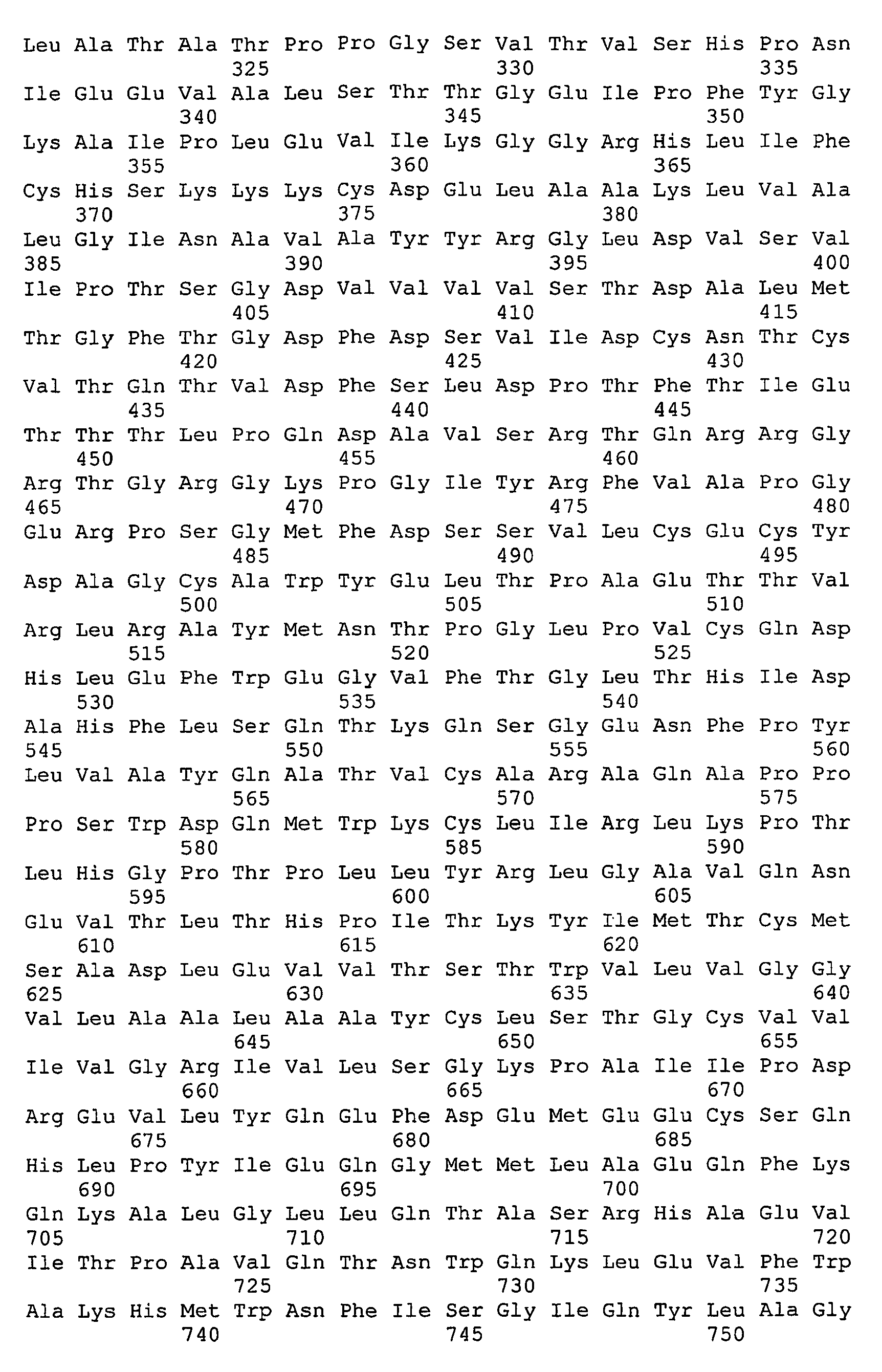


- <210> 3
<211> 7987
<212> DNA
<213> Artificial Sequence - <220>
<223> Chimeric HCV Replicon - <400> 3


- <210> 4
<211> 7990
<212> DNA
<213> Artificial Sequence - <220>
<223> Chimeric HCV Repicon - <400> 4

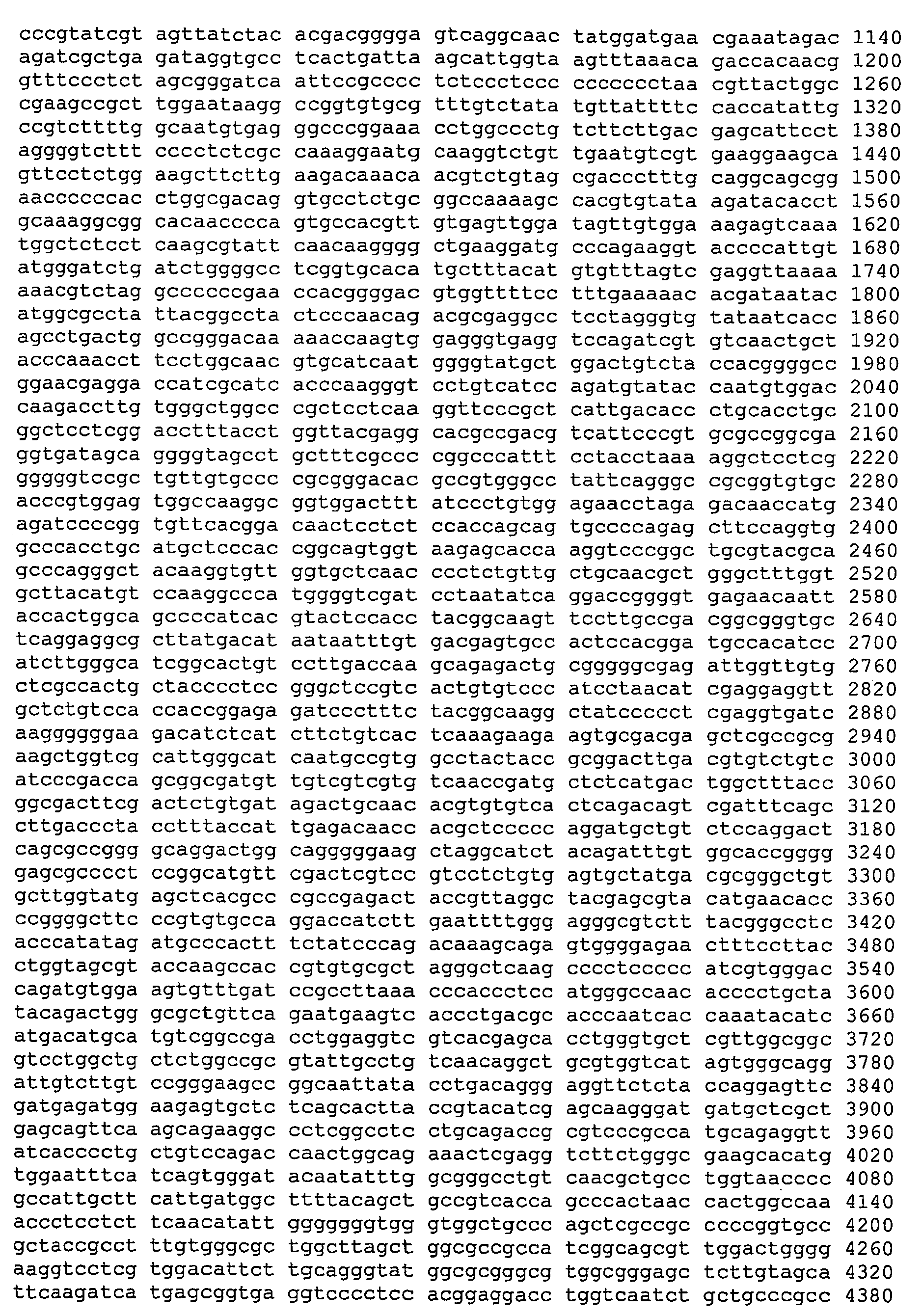


Claims (14)
- A method of making a Hepatitis C virus (HCV) replicon having an increased replication activity comprising modifying a HCV replicon construct to encode an amino acid substitution at a position corresponding to amino acid 470 of NS3 and isoleucine in a position corresponding to amino acid 232 of NS5A using SEQ ID NO: 1 as a reference standard, wherein the modified HCV replicon has an increased replication activity compared to said HCV replicon construct prior to said modifying.
- The method of claim 1, further comprising an amino acid modification in said replicon at a position corresponding to amino acid 196 of NS3.
- The method of claim 1, wherein said amino acid modification is performed on a replicon construct derived from HCV genotype 1a strain.
- The method of claim 1, wherein said amino acid modification is performed on a replicon construct derived from HCV-BK, and said modification results in a methionine at said position corresponding to amino acid 470 of NS3.
- The method of claim 1, wherein said amino acid modification is performed on a replicon construct derived from HCV-H77, and said modification results in a leucine at said position corresponding to amino acid 470 of NS3.
- The method of any preceding claim wherein the HCV replicon is made in an Huh7 cell or a derivative thereof.
- A method for identifying a Hepatitis C virus (HCV) replicon that grows in cell culture comprising the steps of:(a) modifying a HCV replicon construct to produce a modified replicon construct, wherein said modifying comprises introducing at least one modification resulting in said modified replicon construct encoding an amino acid modification at a position corresponding to amino acid 470 of NS3, wherein said modified replicon construct contains an isoleucine in a position corresponding to amino acid 232 of NS5A using SEQ ID NO: 1 as a reference standard;(b) introducing said modified replicon construct into a cell; and(c) measuring replication activity of said modified replicon construct, wherein if said modified replicon construct exhibits replication activity greater than replication activity of said replicon construct said modified replicon construct is identified as said HCV replicon.
- The method of claim 7, wherein said cell is an Huh7 cell or a derivative thereof.
- A replicon comprising a nucleotide sequence encoding for either SEQ ID NO: 1 or SEQ ID NO: 2, which is substituted of position 470 of NS3 and which replicon has increased replication activity compared to said replicon without said substitution.
- The replicon of claim 9, wherein said replicon consists of the nucleic acid sequence of SEQ ID NO: 3 or SEQ ID NO: 4.
- The replicon of claim 9 encoding for SEQ ID NO: 2 which is further substituted at position 196 of NS3 by threonine.
- The replicon of claim 9 encoding for SEQ ID NO: 2, the replicon of claim 10 consisting of SEQ ID NO: 4, which is substituted at position 470 of NS3 by leucine.
- A method of measuring the ability of a compound to affect HCV replicon activity comprising the steps of:a) providing said compound to a cell comprising a replicon made by the method of any one of claims 1-6, or the replicon of claims 9, 10, 11 or 12; andb) measuring the effect of said compound on HCV replicon activity.
- The method of claim 13 wherein the cell is an Huh7 cell or a derivative thereof.
Applications Claiming Priority (3)
| Application Number | Priority Date | Filing Date | Title |
|---|---|---|---|
| US44731803P | 2003-02-13 | 2003-02-13 | |
| US447318P | 2003-02-13 | ||
| PCT/US2004/003726 WO2004074507A2 (en) | 2003-02-13 | 2004-02-09 | Method to confer cell culture replication activity to different hepatitis c virus isolates |
Publications (3)
| Publication Number | Publication Date |
|---|---|
| EP1604020A2 EP1604020A2 (en) | 2005-12-14 |
| EP1604020A4 EP1604020A4 (en) | 2007-05-16 |
| EP1604020B1 true EP1604020B1 (en) | 2009-12-16 |
Family
ID=32908422
Family Applications (1)
| Application Number | Title | Priority Date | Filing Date |
|---|---|---|---|
| EP04709488A Expired - Lifetime EP1604020B1 (en) | 2003-02-13 | 2004-02-09 | Method to confer cell culture replication activity to different hepatitis c virus isolates |
Country Status (6)
| Country | Link |
|---|---|
| US (1) | US7807455B2 (en) |
| EP (1) | EP1604020B1 (en) |
| AT (1) | ATE452192T1 (en) |
| CA (1) | CA2514918C (en) |
| DE (1) | DE602004024658D1 (en) |
| WO (1) | WO2004074507A2 (en) |
Families Citing this family (5)
| Publication number | Priority date | Publication date | Assignee | Title |
|---|---|---|---|---|
| EP1801116A1 (en) * | 2005-12-21 | 2007-06-27 | F. Hoffmann-La Roche Ag | HCV replicon shuttle vectors |
| GB0716292D0 (en) | 2007-08-21 | 2007-09-26 | Biofocus Dpi Ltd | Imidazopyrazine compounds |
| EP2385116A4 (en) * | 2008-12-26 | 2013-09-18 | Toray Industries | HEPATITIS C-VIRUS NUCLEIC ACID AND ANY EXPRESSION VECTOR, TRANSFORMED CELL AND HEPATITIS C VIRUS PARTICLE MANUFACTURED / MANUFACTURED THEREOF |
| US20150072418A1 (en) * | 2013-08-16 | 2015-03-12 | Gilead Sciences, Inc. | Hcv genotype 4d replicons |
| CN117737089B (en) * | 2023-12-21 | 2024-11-01 | 昆明理工大学 | A subgenomic replicon of hepatitis C virus type 3b and its application |
Family Cites Families (8)
| Publication number | Priority date | Publication date | Assignee | Title |
|---|---|---|---|---|
| IT1272179B (en) | 1994-02-23 | 1997-06-16 | Angeletti P Ist Richerche Bio | METHODOLOGY TO REPRODUCE IN VITRO THE PROTEOLITHIC ACTIVITY OF THE NS3 PROTEASE OF THE VIRUS HCV. |
| IT1278077B1 (en) | 1995-05-25 | 1997-11-17 | Angeletti P Ist Richerche Bio | METHODOLOGY TO REPRODUCE IN VITRO THE ACTIVITIES OF RNA-DEPENDENT RNA POLYMERASE AND OF TERMINAL NUCLEOTIDYLTRANSPHERASE CODED BY THE |
| US5744320A (en) | 1995-06-07 | 1998-04-28 | Promega Corporation | Quenching reagents and assays for enzyme-mediated luminescence |
| WO2001089364A2 (en) | 2000-05-23 | 2001-11-29 | Washington University | Hcv variants |
| DE19915178A1 (en) | 1999-04-03 | 2000-10-05 | Univ Mainz Johannes Gutenberg | Hepatitis C virus cell culture system |
| AU2002225895A1 (en) | 2000-11-07 | 2002-05-21 | Anadys Pharmaceuticals, Inc. | Hepatitis c virus constructs characterized by high efficiency replication |
| DE60128835T2 (en) | 2000-12-22 | 2008-03-20 | Boehringer Ingelheim (Canada) Ltd., Laval | SELF-REPLICATING RNA MOLECULAR FROM HEPATITIS C VIRUS |
| EP2050822B1 (en) | 2001-01-23 | 2013-07-31 | Istituto Di Ricerche Di Biologia Molecolare P. Angeletti S.P.A. | Hepatitis C virus replicons and replicon enhanced cells |
-
2004
- 2004-02-09 US US10/543,633 patent/US7807455B2/en not_active Expired - Fee Related
- 2004-02-09 EP EP04709488A patent/EP1604020B1/en not_active Expired - Lifetime
- 2004-02-09 AT AT04709488T patent/ATE452192T1/en not_active IP Right Cessation
- 2004-02-09 WO PCT/US2004/003726 patent/WO2004074507A2/en not_active Ceased
- 2004-02-09 CA CA2514918A patent/CA2514918C/en not_active Expired - Fee Related
- 2004-02-09 DE DE602004024658T patent/DE602004024658D1/en not_active Expired - Lifetime
Also Published As
| Publication number | Publication date |
|---|---|
| EP1604020A2 (en) | 2005-12-14 |
| ATE452192T1 (en) | 2010-01-15 |
| CA2514918A1 (en) | 2004-09-02 |
| WO2004074507A2 (en) | 2004-09-02 |
| WO2004074507A3 (en) | 2005-04-21 |
| EP1604020A4 (en) | 2007-05-16 |
| US7807455B2 (en) | 2010-10-05 |
| DE602004024658D1 (en) | 2010-01-28 |
| CA2514918C (en) | 2012-07-03 |
| WO2004074507A8 (en) | 2005-06-02 |
| US20060228697A1 (en) | 2006-10-12 |
Similar Documents
| Publication | Publication Date | Title |
|---|---|---|
| Lohmann et al. | Viral and cellular determinants of hepatitis C virus RNA replication in cell culture | |
| JP4299540B2 (en) | Hepatitis C virus replicon and replicon enhanced cells | |
| US7935676B2 (en) | Nucleic acid construct containing a nucleic acid derived from the genome of hepatitis C virus (HCV) of genotype 2A, and a cell having such nucleic acid construct introduced therein | |
| EP2423216B1 (en) | Replication competent hepatitis C virus and methods of use | |
| JP2006304803A (en) | Self-replicated rna molecule from hepatitis c virus | |
| US8354518B2 (en) | HCV replicons containing NS5B from genotype 2B | |
| US7807455B2 (en) | Method to confer cell culture replication activity to different Hepatitis C virus isolates | |
| EP1499748B1 (en) | Hepatitis c virus assay systems | |
| US20090035747A1 (en) | Nucleic Acid and Gene Derived from Novel HCV Strain and Replicon-Replicating Cell Using Said Gene | |
| Lemm et al. | Replication-competent chimeric hepatitis C virus subgenomic replicons | |
| US20050239205A1 (en) | Gb virus b based replicons and replicon enhanced cells | |
| WO2003091439A1 (en) | Reporter-selectable hepatitis c virus replicon | |
| WO2011024875A1 (en) | Polynucleotide derived from novel hepatitis c virus strain and use thereof | |
| HK1034094B (en) | Hepatitis c virus cell culture system |
Legal Events
| Date | Code | Title | Description |
|---|---|---|---|
| PUAI | Public reference made under article 153(3) epc to a published international application that has entered the european phase |
Free format text: ORIGINAL CODE: 0009012 |
|
| 17P | Request for examination filed |
Effective date: 20051021 |
|
| AK | Designated contracting states |
Kind code of ref document: A2 Designated state(s): AT BE BG CH CY CZ DE DK EE ES FI FR GB GR HU IE IT LI LU MC NL PT RO SE SI SK TR |
|
| AX | Request for extension of the european patent |
Extension state: AL LT LV MK |
|
| DAX | Request for extension of the european patent (deleted) | ||
| RIC1 | Information provided on ipc code assigned before grant |
Ipc: C12N 7/00 20060101ALI20070404BHEP Ipc: C07K 14/18 20060101ALI20070404BHEP Ipc: C12N 15/51 20060101AFI20070404BHEP |
|
| A4 | Supplementary search report drawn up and despatched |
Effective date: 20070418 |
|
| 17Q | First examination report despatched |
Effective date: 20070926 |
|
| GRAP | Despatch of communication of intention to grant a patent |
Free format text: ORIGINAL CODE: EPIDOSNIGR1 |
|
| GRAS | Grant fee paid |
Free format text: ORIGINAL CODE: EPIDOSNIGR3 |
|
| GRAA | (expected) grant |
Free format text: ORIGINAL CODE: 0009210 |
|
| AK | Designated contracting states |
Kind code of ref document: B1 Designated state(s): AT BE BG CH CY CZ DE DK EE ES FI FR GB GR HU IE IT LI LU MC NL PT RO SE SI SK TR |
|
| REG | Reference to a national code |
Ref country code: GB Ref legal event code: FG4D |
|
| REG | Reference to a national code |
Ref country code: CH Ref legal event code: EP |
|
| REG | Reference to a national code |
Ref country code: CH Ref legal event code: NV Representative=s name: SERVOPATENT GMBH |
|
| REG | Reference to a national code |
Ref country code: IE Ref legal event code: FG4D |
|
| REF | Corresponds to: |
Ref document number: 602004024658 Country of ref document: DE Date of ref document: 20100128 Kind code of ref document: P |
|
| RAP2 | Party data changed (patent owner data changed or rights of a patent transferred) |
Owner name: MERCK SHARP & DOHME CORP. |
|
| REG | Reference to a national code |
Ref country code: NL Ref legal event code: VDEP Effective date: 20091216 |
|
| PG25 | Lapsed in a contracting state [announced via postgrant information from national office to epo] |
Ref country code: FI Free format text: LAPSE BECAUSE OF FAILURE TO SUBMIT A TRANSLATION OF THE DESCRIPTION OR TO PAY THE FEE WITHIN THE PRESCRIBED TIME-LIMIT Effective date: 20091216 Ref country code: SE Free format text: LAPSE BECAUSE OF FAILURE TO SUBMIT A TRANSLATION OF THE DESCRIPTION OR TO PAY THE FEE WITHIN THE PRESCRIBED TIME-LIMIT Effective date: 20091216 |
|
| PG25 | Lapsed in a contracting state [announced via postgrant information from national office to epo] |
Ref country code: SI Free format text: LAPSE BECAUSE OF FAILURE TO SUBMIT A TRANSLATION OF THE DESCRIPTION OR TO PAY THE FEE WITHIN THE PRESCRIBED TIME-LIMIT Effective date: 20091216 |
|
| PG25 | Lapsed in a contracting state [announced via postgrant information from national office to epo] |
Ref country code: AT Free format text: LAPSE BECAUSE OF FAILURE TO SUBMIT A TRANSLATION OF THE DESCRIPTION OR TO PAY THE FEE WITHIN THE PRESCRIBED TIME-LIMIT Effective date: 20091216 |
|
| PG25 | Lapsed in a contracting state [announced via postgrant information from national office to epo] |
Ref country code: RO Free format text: LAPSE BECAUSE OF FAILURE TO SUBMIT A TRANSLATION OF THE DESCRIPTION OR TO PAY THE FEE WITHIN THE PRESCRIBED TIME-LIMIT Effective date: 20091216 Ref country code: ES Free format text: LAPSE BECAUSE OF FAILURE TO SUBMIT A TRANSLATION OF THE DESCRIPTION OR TO PAY THE FEE WITHIN THE PRESCRIBED TIME-LIMIT Effective date: 20100327 Ref country code: BG Free format text: LAPSE BECAUSE OF FAILURE TO SUBMIT A TRANSLATION OF THE DESCRIPTION OR TO PAY THE FEE WITHIN THE PRESCRIBED TIME-LIMIT Effective date: 20100316 Ref country code: PT Free format text: LAPSE BECAUSE OF FAILURE TO SUBMIT A TRANSLATION OF THE DESCRIPTION OR TO PAY THE FEE WITHIN THE PRESCRIBED TIME-LIMIT Effective date: 20100416 Ref country code: NL Free format text: LAPSE BECAUSE OF FAILURE TO SUBMIT A TRANSLATION OF THE DESCRIPTION OR TO PAY THE FEE WITHIN THE PRESCRIBED TIME-LIMIT Effective date: 20091216 Ref country code: EE Free format text: LAPSE BECAUSE OF FAILURE TO SUBMIT A TRANSLATION OF THE DESCRIPTION OR TO PAY THE FEE WITHIN THE PRESCRIBED TIME-LIMIT Effective date: 20091216 |
|
| PG25 | Lapsed in a contracting state [announced via postgrant information from national office to epo] |
Ref country code: CZ Free format text: LAPSE BECAUSE OF FAILURE TO SUBMIT A TRANSLATION OF THE DESCRIPTION OR TO PAY THE FEE WITHIN THE PRESCRIBED TIME-LIMIT Effective date: 20091216 Ref country code: SK Free format text: LAPSE BECAUSE OF FAILURE TO SUBMIT A TRANSLATION OF THE DESCRIPTION OR TO PAY THE FEE WITHIN THE PRESCRIBED TIME-LIMIT Effective date: 20091216 Ref country code: BE Free format text: LAPSE BECAUSE OF FAILURE TO SUBMIT A TRANSLATION OF THE DESCRIPTION OR TO PAY THE FEE WITHIN THE PRESCRIBED TIME-LIMIT Effective date: 20091216 |
|
| PLBE | No opposition filed within time limit |
Free format text: ORIGINAL CODE: 0009261 |
|
| STAA | Information on the status of an ep patent application or granted ep patent |
Free format text: STATUS: NO OPPOSITION FILED WITHIN TIME LIMIT |
|
| PG25 | Lapsed in a contracting state [announced via postgrant information from national office to epo] |
Ref country code: GR Free format text: LAPSE BECAUSE OF FAILURE TO SUBMIT A TRANSLATION OF THE DESCRIPTION OR TO PAY THE FEE WITHIN THE PRESCRIBED TIME-LIMIT Effective date: 20100317 Ref country code: CY Free format text: LAPSE BECAUSE OF FAILURE TO SUBMIT A TRANSLATION OF THE DESCRIPTION OR TO PAY THE FEE WITHIN THE PRESCRIBED TIME-LIMIT Effective date: 20091216 Ref country code: MC Free format text: LAPSE BECAUSE OF NON-PAYMENT OF DUE FEES Effective date: 20100301 |
|
| 26N | No opposition filed |
Effective date: 20100917 |
|
| PG25 | Lapsed in a contracting state [announced via postgrant information from national office to epo] |
Ref country code: DK Free format text: LAPSE BECAUSE OF FAILURE TO SUBMIT A TRANSLATION OF THE DESCRIPTION OR TO PAY THE FEE WITHIN THE PRESCRIBED TIME-LIMIT Effective date: 20091216 Ref country code: IE Free format text: LAPSE BECAUSE OF NON-PAYMENT OF DUE FEES Effective date: 20100209 |
|
| PG25 | Lapsed in a contracting state [announced via postgrant information from national office to epo] |
Ref country code: IT Free format text: LAPSE BECAUSE OF FAILURE TO SUBMIT A TRANSLATION OF THE DESCRIPTION OR TO PAY THE FEE WITHIN THE PRESCRIBED TIME-LIMIT Effective date: 20091216 |
|
| REG | Reference to a national code |
Ref country code: CH Ref legal event code: PFUS Owner name: SCHERING CORPORATION, US Free format text: FORMER OWNER: MERCK SHARP + DOHME CORP., US Ref country code: CH Ref legal event code: PFA Owner name: MERCK SHARP & DOHME CORP. Free format text: SCHERING CORPORATION#2000 GALLOPING HILL ROAD#KENILWORTH, NJ 07033 (US) -TRANSFER TO- MERCK SHARP & DOHME CORP.#126 EAST LINCOLN AVENUE#RAHWAY, NEW JERSEY 07065 (US) |
|
| PG25 | Lapsed in a contracting state [announced via postgrant information from national office to epo] |
Ref country code: HU Free format text: LAPSE BECAUSE OF FAILURE TO SUBMIT A TRANSLATION OF THE DESCRIPTION OR TO PAY THE FEE WITHIN THE PRESCRIBED TIME-LIMIT Effective date: 20100617 Ref country code: LU Free format text: LAPSE BECAUSE OF NON-PAYMENT OF DUE FEES Effective date: 20100209 |
|
| PG25 | Lapsed in a contracting state [announced via postgrant information from national office to epo] |
Ref country code: TR Free format text: LAPSE BECAUSE OF FAILURE TO SUBMIT A TRANSLATION OF THE DESCRIPTION OR TO PAY THE FEE WITHIN THE PRESCRIBED TIME-LIMIT Effective date: 20091216 |
|
| REG | Reference to a national code |
Ref country code: FR Ref legal event code: TP Owner name: SCHERING CORPORATION, US Effective date: 20130318 Ref country code: FR Ref legal event code: CD Owner name: SCHERING CORPORATION, US Effective date: 20130319 |
|
| PGFP | Annual fee paid to national office [announced via postgrant information from national office to epo] |
Ref country code: FR Payment date: 20130218 Year of fee payment: 10 Ref country code: DE Payment date: 20130228 Year of fee payment: 10 Ref country code: CH Payment date: 20130129 Year of fee payment: 10 Ref country code: GB Payment date: 20130125 Year of fee payment: 10 |
|
| REG | Reference to a national code |
Ref country code: DE Ref legal event code: R082 Ref document number: 602004024658 Country of ref document: DE Representative=s name: ABITZ & PARTNER, DE |
|
| REG | Reference to a national code |
Ref country code: DE Ref legal event code: R082 Ref document number: 602004024658 Country of ref document: DE Representative=s name: ABITZ & PARTNER, DE |
|
| REG | Reference to a national code |
Ref country code: DE Ref legal event code: R082 Ref document number: 602004024658 Country of ref document: DE Representative=s name: ABITZ & PARTNER, DE |
|
| REG | Reference to a national code |
Ref country code: GB Ref legal event code: 732E Free format text: REGISTERED BETWEEN 20130704 AND 20130710 |
|
| REG | Reference to a national code |
Ref country code: DE Ref legal event code: R082 Ref document number: 602004024658 Country of ref document: DE Representative=s name: ABITZ & PARTNER, DE Effective date: 20130625 Ref country code: DE Ref legal event code: R081 Ref document number: 602004024658 Country of ref document: DE Owner name: MERCK SHARP & DOHME CORP., US Free format text: FORMER OWNER: MERCK SHARP & DOHME CORP., 07065-0900 RAHWAY, US Effective date: 20130625 Ref country code: DE Ref legal event code: R082 Ref document number: 602004024658 Country of ref document: DE Representative=s name: ABITZ & PARTNER, DE Effective date: 20130618 Ref country code: DE Ref legal event code: R081 Ref document number: 602004024658 Country of ref document: DE Owner name: MERCK SHARP & DOHME CORP., US Free format text: FORMER OWNER: SCHERING CORPORATION, RAHWAY, US Effective date: 20130626 Ref country code: DE Ref legal event code: R081 Ref document number: 602004024658 Country of ref document: DE Owner name: MERCK SHARP & DOHME CORP., US Free format text: FORMER OWNER: MERCK & CO., INC., WHITEHOUSE STATION, US Effective date: 20130618 Ref country code: DE Ref legal event code: R082 Ref document number: 602004024658 Country of ref document: DE Representative=s name: ABITZ & PARTNER, DE Effective date: 20130626 Ref country code: DE Ref legal event code: R081 Ref document number: 602004024658 Country of ref document: DE Owner name: MERCK SHARP & DOHME CORP., RAHWAY, US Free format text: FORMER OWNER: SCHERING CORPORATION, RAHWAY, US Effective date: 20130626 Ref country code: DE Ref legal event code: R081 Ref document number: 602004024658 Country of ref document: DE Owner name: MERCK SHARP & DOHME CORP., RAHWAY, US Free format text: FORMER OWNER: MERCK SHARP & DOHME CORP., 07065-0900 RAHWAY, NEW JERSEY, US Effective date: 20130625 Ref country code: DE Ref legal event code: R081 Ref document number: 602004024658 Country of ref document: DE Owner name: MERCK SHARP & DOHME CORP., RAHWAY, US Free format text: FORMER OWNER: MERCK & CO., INC., WHITEHOUSE STATION, N.J., US Effective date: 20130618 Ref country code: DE Ref legal event code: R082 Ref document number: 602004024658 Country of ref document: DE Representative=s name: ABITZ & PARTNER PATENTANWAELTE MBB, DE Effective date: 20130625 Ref country code: DE Ref legal event code: R082 Ref document number: 602004024658 Country of ref document: DE Representative=s name: ABITZ & PARTNER PATENTANWAELTE MBB, DE Effective date: 20130626 Ref country code: DE Ref legal event code: R082 Ref document number: 602004024658 Country of ref document: DE Representative=s name: ABITZ & PARTNER PATENTANWAELTE MBB, DE Effective date: 20130618 |
|
| REG | Reference to a national code |
Ref country code: DE Ref legal event code: R119 Ref document number: 602004024658 Country of ref document: DE |
|
| REG | Reference to a national code |
Ref country code: CH Ref legal event code: PL |
|
| GBPC | Gb: european patent ceased through non-payment of renewal fee |
Effective date: 20140209 |
|
| PG25 | Lapsed in a contracting state [announced via postgrant information from national office to epo] |
Ref country code: LI Free format text: LAPSE BECAUSE OF NON-PAYMENT OF DUE FEES Effective date: 20140228 Ref country code: CH Free format text: LAPSE BECAUSE OF NON-PAYMENT OF DUE FEES Effective date: 20140228 |
|
| REG | Reference to a national code |
Ref country code: FR Ref legal event code: ST Effective date: 20141031 |
|
| REG | Reference to a national code |
Ref country code: DE Ref legal event code: R119 Ref document number: 602004024658 Country of ref document: DE Effective date: 20140902 |
|
| PG25 | Lapsed in a contracting state [announced via postgrant information from national office to epo] |
Ref country code: GB Free format text: LAPSE BECAUSE OF NON-PAYMENT OF DUE FEES Effective date: 20140209 Ref country code: DE Free format text: LAPSE BECAUSE OF NON-PAYMENT OF DUE FEES Effective date: 20140902 Ref country code: FR Free format text: LAPSE BECAUSE OF NON-PAYMENT OF DUE FEES Effective date: 20140228 |