EP1603303A1 - Enhanced language support for legacy call control system - Google Patents
Enhanced language support for legacy call control system Download PDFInfo
- Publication number
- EP1603303A1 EP1603303A1 EP05103835A EP05103835A EP1603303A1 EP 1603303 A1 EP1603303 A1 EP 1603303A1 EP 05103835 A EP05103835 A EP 05103835A EP 05103835 A EP05103835 A EP 05103835A EP 1603303 A1 EP1603303 A1 EP 1603303A1
- Authority
- EP
- European Patent Office
- Prior art keywords
- strings
- legacy
- adapter
- call control
- control system
- Prior art date
- Legal status (The legal status is an assumption and is not a legal conclusion. Google has not performed a legal analysis and makes no representation as to the accuracy of the status listed.)
- Granted
Links
Images




Classifications
-
- H—ELECTRICITY
- H04—ELECTRIC COMMUNICATION TECHNIQUE
- H04L—TRANSMISSION OF DIGITAL INFORMATION, e.g. TELEGRAPHIC COMMUNICATION
- H04L65/00—Network arrangements, protocols or services for supporting real-time applications in data packet communication
- H04L65/1066—Session management
- H04L65/1069—Session establishment or de-establishment
-
- H—ELECTRICITY
- H04—ELECTRIC COMMUNICATION TECHNIQUE
- H04L—TRANSMISSION OF DIGITAL INFORMATION, e.g. TELEGRAPHIC COMMUNICATION
- H04L65/00—Network arrangements, protocols or services for supporting real-time applications in data packet communication
- H04L65/1066—Session management
- H04L65/1101—Session protocols
Definitions
- This invention relates to an IP telephony call control system, and more particularly to a method and apparatus for adapting a legacy call control system for additional language support, where the legacy system supports a limited, predefined character set.
- IP telephony is a complex technology that requires a long development cycle and incurs high development costs. Part of the value of such a complex technology is derived from deployment maturity. A mature complex technology equates to a stable technology, with relatively lower risk and higher ease of deployment.
- a legacy system is defined as a system that was developed many years ago, and is still used in business because of its value to the business and the high risk and cost to modify it or replace it with a contemporary system.
- An example of such a legacy system is the call control system in IP telephone switches.
- Call control systems are highly complex systems, typically requiring high investment costs to develop, and years to become stable/mature enough to be deployable. As a result, legacy call control systems are still used in many modern IP telephone switches.
- IP telephony call control systems It is highly desirable to adapt IP telephony call control systems to support additional character sets, so as to provide the same functions as the original system and perform those functions with strings of a newly introduced language.
- a call control system for incorporation in an IP telephony switch, comprising a legacy call control system for inputing incoming events, and legacy strings, and, in response, outputing resulting events and, legacy strings.
- the system also comprises an adapter for inputing incoming events and alternate strings.
- the adapter generates the legacy strings, corresponding to the alternate strings, passes the incoming events and corresponding legacy strings to the legacy call control system, and receives, from the legacy call control system, the resulting events and said corresponding legacy strings.
- the adapter also identifies, using the received corresponding legacy strings, the alternate strings, and outputs the resulting events and the alternate strings.
- an information path can be modeled as a functional block that converts input to output. Regardless of the actual embodiment, an information path contains at least one processing unit that performs information conversion.
- information path 100 receives an event, e i , and a string s k and generates in response to the input ⁇ e i , s k > an event e j , and a string s k ; where e i ⁇ e j .
- the information path 100 has a memory of previously received strings 110.
- an input consisting of only e i can trigger information path 200 to generate output ⁇ e j , s k >.
- each processing unit can be modelled as an information path.
- An information path is said to be an atomic information path if and only if it contains only one processing unit that can not be decomposed into information paths in a finer granularity.
- the character set capacity of an information path determines the scope of processing capability with respect to what strings may be handled.
- S S* and S*-S ⁇ ⁇ S S* and S*-S ⁇ ⁇
- S ⁇ S* and S* ⁇ S and S* ⁇ S ⁇ .
- An atomic information path 310 that is not modifiable, can be adapted into a modifiable information path by using the transformation method as illustrated in Figure 3.
- the path 310 is wrapped with an adapter 320 formed of an input adapter 330, memory 340, and output adapter that, in combination, facilitate the transformation.
- Input adapter 330 receives e i ⁇ E and s n ⁇ S* as input and generates ⁇ e i , s k > as the input to path 310, where s k ⁇ S.
- a one to one mapping f can be used to generate s n from s k .
- Memory 340 is used to store ⁇ s k , s n > such that the content in memory 340 can be later retrieved by using s k as a key.
- Output adapter 350 receives ⁇ e j , s k > as input and generates ⁇ e j , s n > as the corresponding output. This process uses f -1 the reverse function of f to map s k back to s n . It should be noted that if f -1 can be mathematically determined from f, memory 340 is not needed; otherwise, s k received from path 310 can be used as a key to retrieve s n from memory 340.
- the information path 310 is not modifiable.
- the transformation wraps path 310 with the input adapter 330, output adapter 350 , and memory 340.
- a new information path 300 is formulated that consists of path 310, and adapter 320.
- the information path of figure 3 is a modifiable information path to the upstream component that sends ⁇ e i , s n > and to the downstream component that receives ⁇ e j , s n >.
- the information path takes e i as input and generates ⁇ e j , s n > as the corresponding output.
- mapping f For s j ⁇ S* and s j ⁇ S, the one to one mapping f should satisfy f (s j ) ⁇ s j ; and for s j ⁇ S* and s j ⁇ S, the mapping f should satisfy f (s j ) ⁇ s k , where s k ⁇ S.
- a complex system may contain many information paths.
- a complex system with a legacy system as the main component may retain the legacy system in many of its information paths.
- An IP telephone switch is a complex system.
- a typical IP telephone switch incorporating a legacy call control system 410 is illustrated in Figure 4.
- the legacy call control system only accepts strings in Extended ASCII as input and generates strings in Extended ASCII as output.
- the call control system is coupled to switch management system 420, device control 430, applications 440 and trunks 450 by, respectively, call control database access 425, call/media and stimulus signaling protocol 435, application specific protocols 445, and native trunk protocols 455.
- Device control 430 is further coupled to IP transport 460 via Media stimulus control protocol 465.
- Device control 430 may incorporate IP devices 432.
- the trunks 450 are coupled externally via external trunk protocols 457.
- IP transport 460 may communicate with applications 440 or devices such as IP telephones 470 via Media stimulus control protocol messages 467.
- information path 100 In the IP telephone switch as shown in Figure 4, the following paths can be defined as information paths of the type identified above as information path 100:
- the following paths can be defined as information paths of the type identified above as information path 200:
- IP telephone switch shown in Figure 4
- IP telephone switch 470 and applications 440 there is a requirement to modify the IP telephone switch shown in Figure 4, to support display in IP telephones 470 and applications 440 in multiple languages.
- the contemporary approach to multiple language display on an electronic display panel is the use of the Unicode based coding scheme.
- S denotes the set of strings in Extended ASCII
- S* denotes the set of strings in Unicode.
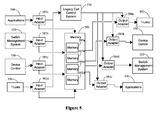
- FIG. 5 there is shown a IP telephone switch that applies the principles of path modification discussed in reference to the paths of figure 3, to the switch of figure 4.
- the switch illustrated in figure 5 has non-atomic information paths, discussed in greater detail below, corresponding to the paths i. through viii. of figure 4. These paths incorporate only one non-modifiable atomic information path i.e. legacy call control system 510 identical to system 410.
- the transformation method described above is applied to all of the non-atomic information paths. Since the legacy call control system 510 is atomic and non-modifiable, the transformation method is applied at the system 510 (i.e. for each information path there is a corresponding adapter configured to system 510). Each component that sends events and strings to the call control system 510, is output coupled to the system 510 via an input adapter 582a through 582d (each as per adapter 330). Components that send events and strings to the call control system are the switch management system 520, device control 530, applications 540, and trunks 550.
- Each component that receives events and strings from call control 510 is input coupled thereto via an output adapter 584a through 584d (each as per adapter 350 in figure 3).
- Components that receive events and strings from the Call Control System 510 are switch management system 520, device control 530, applications 540, and trunks 550.
- memories 592a through 592d associated with the four input adapters, can be aggregated into one memory service 590 that is coupled, at memory input, to the input adapters 582a through 582d and coupled, at memory output, to the output adapters 584a through 584d.
- Figure 6 shows an exemplary embodiment of an IP telephone switch according to the present invention, wherein the call control system 610 is coupled to switch management system 620, device control 630, applications 640 and trunks 650 by, respectively, call control database access 625, call/media and stimulus signaling protocol 635, application specific protocols 645, and native trunk protocols 655.
- Device control 630 is further coupled to IP transport 660 via media stimulus control protocol 665.
- Device control 630 may incorporate IP devices 632.
- the trunks 650 are coupled externally via external trunk protocols 657.
- IP transport 660 may communicate with applications 640 or devices 670 via Media stimulus control protocol messages 667.
- T-clients 621, 631, 641 and 651 are provided, along with one T-Server 690 introduced as per the transformation of Figure 5.
- Switch management system T-client 621 corresponds to input adapter 582b.
- Trunks T-client 651 corresponds to input adapter 582d and output adapter 584a.
- Device control T-client 631 corresponds to input adapter 582c and output adapter 584b
- Applications T-client 641 corresponds to input adapter 582a and output adapter 584c.
- T-Server 690 corresponds to the aggregated memory 590.
- each information path is served by an input adapter, an output adapter, and a memory.
- the adapters correspond to the respective T-Clients 621, 631, 641, or 651, and the memory corresponds to the T-server 690.
Landscapes
- Engineering & Computer Science (AREA)
- Business, Economics & Management (AREA)
- General Business, Economics & Management (AREA)
- Multimedia (AREA)
- Computer Networks & Wireless Communication (AREA)
- Signal Processing (AREA)
- Telephonic Communication Services (AREA)
Abstract
Description
- This invention relates to an IP telephony call control system, and more particularly to a method and apparatus for adapting a legacy call control system for additional language support, where the legacy system supports a limited, predefined character set.
- In order to derive the fullest benefit, it is desirable to deploy a given technology to the broadest audience possible. In the emerging global marketplace, it is a prerequisite for local sales, that a technology support local languages.
- IP telephony is a complex technology that requires a long development cycle and incurs high development costs. Part of the value of such a complex technology is derived from deployment maturity. A mature complex technology equates to a stable technology, with relatively lower risk and higher ease of deployment.
- However, many current mature IP telephony systems were designed before the market for such technology was ripe, globally. As a result, these systems were designed without the ability to support the linguistic character sets of many prospective customers. Current systems support ASCII characters, which do not enable certain characters, which are, conversely, available in Unicode.
- A legacy system is defined as a system that was developed many years ago, and is still used in business because of its value to the business and the high risk and cost to modify it or replace it with a contemporary system. An example of such a legacy system is the call control system in IP telephone switches. Call control systems are highly complex systems, typically requiring high investment costs to develop, and years to become stable/mature enough to be deployable. As a result, legacy call control systems are still used in many modern IP telephone switches.
- It is highly desirable to adapt IP telephony call control systems to support additional character sets, so as to provide the same functions as the original system and perform those functions with strings of a newly introduced language.
- In the past, additional character sets have been supported by modifying the code-base of the technology to incorporate additional, or alternate, characters. However, this approach has the drawback of undermining the maturity of the code. Without the history of deployment associated with the original code-base, there is a greater risk of instability. As a result, the full confidence in such a system is compromised.
- What is needed is incorporation, with a legacy IP telephony call control system, of additional language character support, that further, does not compromise the maturity of the legacy system. It would be of additional benefit if such character support could be introduced in runtime.
- It is an object of an aspect to provide a call control system that combines the stability of a mature legacy call control system, while also providing language support not included in the legacy system.
- Therefore, according to an embodiment of the present invention, a call control system is provided for incorporation in an IP telephony switch, comprising a legacy call control system for inputing incoming events, and legacy strings, and, in response, outputing resulting events and, legacy strings. The system also comprises an adapter for inputing incoming events and alternate strings. The adapter generates the legacy strings, corresponding to the alternate strings, passes the incoming events and corresponding legacy strings to the legacy call control system, and receives, from the legacy call control system, the resulting events and said corresponding legacy strings. The adapter also identifies, using the received corresponding legacy strings, the alternate strings, and outputs the resulting events and the alternate strings.
- A detailed description of the preferred embodiment(s) of the present invention is provided herein below with reference to the accompanying drawings in which:
- Figure 1 shows a model of an information path;
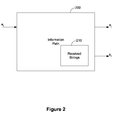
- Figure 2 shows the model of Figure 1 where sk is previously stored in memory;
- Figure 3 shows an information path transformation of an non-modifiable legacy information path according to an aspect of the present invention;
- Figure 4 shows a block diagram of an IP telephone switch using a legacy call control system;
- Figure 5 shows a system for transforming a generic IP telephone switch for multiple information paths according to the transformation principles of Figure 3; and
- Figure 6 shows an exemplary embodiment of an IP telephone switch using a legacy call control system, and modified according to the transformation principles of Figure 3.
-
- The concept of an information path is introduced to describe paths through which events and strings flow, such as provided by a legacy call control system. An information path can be modeled as a functional block that converts input to output. Regardless of the actual embodiment, an information path contains at least one processing unit that performs information conversion. As shown in Figure 1,
information path 100 receives an event, ei, and a string sk and generates in response to the input <ei, sk > an event ej, and a string sk; where ei≠ej. Theinformation path 100 has a memory of previously receivedstrings 110. As illustrated in Figure 2, once sk is stored in thememory 210, an input consisting of only ei can triggerinformation path 200 to generate output <ej, sk >. - Assuming that E={ei} is the set of all events that an
information path 100 can receive and generate, and S={sk} is the set of all strings that theinformation path 100 can receive and retrieve from its memory, then, for a given E, the ability ofinformation path 100 to handle received input is constrained by S. - When an information path contains multiple processing units, connected with each other in a cascade, each processing unit can be modelled as an information path. An information path is said to be an atomic information path if and only if it contains only one processing unit that can not be decomposed into information paths in a finer granularity. The character set capacity of an information path determines the scope of processing capability with respect to what strings may be handled.
- As discussed above, legacy call control systems were developed at a time when there was not an obvious need for supporting multiple languages. Depending on the language, the call control system may not be modifiable to support a given language. An atomic information path P is defined as not modifiable if P can not be modified to handle all sn∈S*, where S S* and S*-S ≠ , or S⊄S* and S*⊄S and S*∩S=. Thus, there is a requirement for changing an
information path 100 to support the handling of all sn∈S*, without modifying thatpath 100. - An
atomic information path 310, that is not modifiable, can be adapted into a modifiable information path by using the transformation method as illustrated in Figure 3. In this method, thepath 310 is wrapped with anadapter 320 formed of aninput adapter 330,memory 340, and output adapter that, in combination, facilitate the transformation. -
Input adapter 330 receives ei∈ E and sn∈ S* as input and generates <ei, sk > as the input topath 310, where sk∈ S. Inadapter 330, a one to one mapping f can be used to generate sn from sk. -
Memory 340 is used to store <sk, sn > such that the content inmemory 340 can be later retrieved by using sk as a key. -
Output adapter 350 receives <ej, sk > as input and generates <ej, sn > as the corresponding output. This process uses f -1 the reverse function of f to map sk back to sn . It should be noted that if f -1 can be mathematically determined from f,memory 340 is not needed; otherwise, sk received frompath 310 can be used as a key to retrieve sn frommemory 340. - Initially, the
information path 310 is not modifiable. Thetransformation wraps path 310 with theinput adapter 330,output adapter 350 , andmemory 340. After the transformation, anew information path 300 is formulated that consists ofpath 310, andadapter 320. - Thus, the information path of figure 3 is a modifiable information path to the upstream component that sends <ei, sn > and to the downstream component that receives <ej, sn >. For the case illustrated in Figure 2, the information path takes ei as input and generates <ej, sn > as the corresponding output.
- This method of figure 3 is bound by certain constraints: Specifically, Assuming that S=A∪A 2∪A 3∪...∪A m and S*=B∪B 2∪B 3∪...∪B n, where A2=A×A, ... ,wherein A is the character set based on which all sk∈ S are composed, and B is the character set based on which all sj∈ S* are composed, if A≠B and A∩B=, then S⊄S*, S*⊄ S, S∩S*=. In this case, by properly choosing m and n so that |S| ≥ |S*|, a one to one mapping f(sj)→sk can be determined. If A≠B and A∩B≠, then S∩S*≠. In this case, for sj∈ S* and sj∈ S, the one to one mapping f should satisfy f(sj)→sj; and for sj∈ S* and sj∉ S, the mapping f should satisfy f(sj)→sk, where sk∈ S.
- Many legacy systems can be modeled by using the non-modifiable information path defined above. As discussed above, a complex system may contain many information paths. Thus, according to the above method, a complex system with a legacy system as the main component may retain the legacy system in many of its information paths.
- An IP telephone switch is a complex system. A typical IP telephone switch incorporating a legacy
call control system 410 is illustrated in Figure 4. The legacy call control system only accepts strings in Extended ASCII as input and generates strings in Extended ASCII as output. - The call control system is coupled to switch
management system 420,device control 430,applications 440 andtrunks 450 by, respectively, callcontrol database access 425, call/media andstimulus signaling protocol 435, applicationspecific protocols 445, andnative trunk protocols 455. -
Device control 430 is further coupled toIP transport 460 via Mediastimulus control protocol 465.Device control 430 may incorporateIP devices 432. Thetrunks 450 are coupled externally viaexternal trunk protocols 457.IP transport 460 may communicate withapplications 440 or devices such asIP telephones 470 via Media stimuluscontrol protocol messages 467. - In the IP telephone switch as shown in Figure 4, the following paths can be defined as information paths of the type identified above as information path 100:
- i.
Switch Management System 420 →Call Control system 410→Device Control 430 →IP telephones 470 - ii.
Switch Management System 420 →Call Control system 410→Switch Management System 420 - iii.
Switch Management System 420 →Call Control system 410→Applications 440 - iv.
Trunks 450 →Call Control system 410 →Device Control 430 →IP telephones 470 -
- The following paths can be defined as information paths of the type identified above as information path 200:
- v.
IP telephones 470 →Device Control 430 →Call Control system 410 →Trunks 450 - vi.
IP telephones 470 →Device Control 430 →Call Control system 410 →Applications 440 - vii.
IP telephone 470 →Device Control 430 →Call Control system 410 →Device Control 430 →IP telephone 470 - viii.
Application 440 →Call Control system 410 →Device Control 430 →IP telephone 470 - ix.
Application 440 →Call Control system 410 →Trunks 450 -
- There is a requirement to modify the IP telephone switch shown in Figure 4, to support display in
IP telephones 470 andapplications 440 in multiple languages. In the art, the contemporary approach to multiple language display on an electronic display panel is the use of the Unicode based coding scheme. - Adapting the information path theory set forth above to these circumstances, S denotes the set of strings in Extended ASCII; S* denotes the set of strings in Unicode.
- None of the information paths, listed i. through viii. above, for the IP telephone switch shown in Figure 4, is modifiable to support display on
IP telephones 470 of languages in Unicode. This is because the legacycall control system 410 is not modifiable to support strings in Unicode. For these information paths, the legacycall control system 410 is the only information path that is atomic and not modifiable. - Referring to Figure 5 there is shown a IP telephone switch that applies the principles of path modification discussed in reference to the paths of figure 3, to the switch of figure 4. The switch illustrated in figure 5 has non-atomic information paths, discussed in greater detail below, corresponding to the paths i. through viii. of figure 4. These paths incorporate only one non-modifiable atomic information path i.e. legacy
call control system 510 identical tosystem 410. - The transformation method described above is applied to all of the non-atomic information paths. Since the legacy
call control system 510 is atomic and non-modifiable, the transformation method is applied at the system 510 (i.e. for each information path there is a corresponding adapter configured to system 510). Each component that sends events and strings to thecall control system 510, is output coupled to thesystem 510 via aninput adapter 582a through 582d (each as per adapter 330). Components that send events and strings to the call control system are theswitch management system 520,device control 530,applications 540, andtrunks 550. - Each component that receives events and strings from
call control 510, is input coupled thereto via anoutput adapter 584a through 584d (each as peradapter 350 in figure 3). Components that receive events and strings from theCall Control System 510 areswitch management system 520,device control 530,applications 540, andtrunks 550. - Between the transformations applied to these information paths, there is a great similarity and content overlap in the use of memories. Therefore,
memories 592a through 592d, associated with the four input adapters, can be aggregated into onememory service 590 that is coupled, at memory input, to theinput adapters 582a through 582d and coupled, at memory output, to theoutput adapters 584a through 584d. - Thus, the non-atomic information paths referred to above, for figure 5, are as follows:
- Path I: covered by
input adapter 582b,output adapter 584b and memory 592b - Path II: covered by
input adapter 582b,output adapter 584c and memory 592b - Path III: covered by
input adapter 582d,output adapter 584b andmemory 592d - Path IV: covered by
input adapter 582c,output adapter 584a andmemory 592c - Path V: covered by
input adapter 582c,output adapter 584c andmemory 592c - Path VI: covered by
input adapter 582c,output adapter 584b andmemory 592c - Path VII: covered by
input adapter 582a,output adapter 584b andmemory 592a - Path VIII: covered by
input adapter 582a,output adapter 584a andmemory 592a -
- Figure 6 shows an exemplary embodiment of an IP telephone switch according to the present invention, wherein the
call control system 610 is coupled to switchmanagement system 620,device control 630,applications 640 andtrunks 650 by, respectively, callcontrol database access 625, call/media andstimulus signaling protocol 635, applicationspecific protocols 645, andnative trunk protocols 655. -
Device control 630 is further coupled toIP transport 660 via mediastimulus control protocol 665.Device control 630 may incorporateIP devices 632. Thetrunks 650 are coupled externally viaexternal trunk protocols 657.IP transport 660 may communicate withapplications 640 ordevices 670 via Media stimuluscontrol protocol messages 667. - In the switch of figure 6, four T-
clients Server 690 introduced as per the transformation of Figure 5. Switch management system T-client 621 corresponds to inputadapter 582b. Trunks T-client 651 corresponds to inputadapter 582d andoutput adapter 584a. Device control T-client 631 corresponds to inputadapter 582c andoutput adapter 584b Applications T-client 641 corresponds to inputadapter 582a andoutput adapter 584c. T-Server 690 corresponds to the aggregatedmemory 590. - In this embodiment, each information path is served by an input adapter, an output adapter, and a memory. The adapters correspond to the respective T-
Clients server 690. - For any legacy system, if information paths contain atomic non-modifiable paths as defined above, and there is a requirement to adapt a character set to support the corresponding strings, the requirement can be fulfilled by using the method set forth herein above.
- It will be appreciated that, although embodiments of the invention have been described and illustrated in detail, various modifications and changes may be made. Different implementations may be made by those familiar with the technology, without departing from the scope of the invention. It may be appreciated that aspects of the invention may be implemented separately, or cooperatively. Any such choice of implementation may be made without departing from the sphere and scope of the invention as described by the claims appended hereto.
Claims (6)
- A call control system for incorporation in an IP telephony switch, said system comprising:a legacy call control system for receiving incoming events and legacy strings and, in response, outputing resulting events and said legacy strings; andan adapter for, (i) receiving said incoming events and alternate strings, (ii) generating said legacy strings corresponding to said alternate strings, (iii) passing said incoming events and said corresponding legacy strings to said legacy call control system, (iv) receiving from said legacy call control system said resulting events and said corresponding legacy strings, (v) identifying said alternate strings using said received corresponding legacy strings and (vi) outputing said resulting events and said alternate strings.
- The system of claim 1 wherein said adapter additionally stores pairs of said alternate strings and said corresponding legacy strings, for use in identifying said alternate strings.
- The system of claim 2 wherein said adapter comprises a memory for storing said stored pairs.
- The system of claim 1, claim 2, or claim 3 wherein said adapter comprises:an input adapter for (i) said receiving of said incoming events and alternate strings, (ii) said generating of said legacy strings, and (iii) said passing of said incoming events and said corresponding legacy strings to said legacy call control system; andan output adapter for (iv) said receiving of said resulting events and said corresponding legacy strings, (v), said identifying of said alternate strings, and (vi), said outputing of said resulting events and said alternate strings.
- The system of claim 3 wherein said IP telephony switch includes:an IP telephony application,a device control,a switch management system,and a trunk,and wherein said adapter further comprises a plurality of clients for cooperating with said IP telephony application, said device control, said switch management system, and said trunk.
- A method of adapting a legacy call control system for inputing incoming events and legacy strings and, in response, outputing resulting events and said legacy strings, said method comprising:i) inputing said incoming events and alternate strings into an adapter,ii) withen said adapter generating said legacy strings, corresponding to said alternate strings,iii) withen said adapter passing said incoming events and said corresponding legacy strings from said adapter to said legacy call control system,iv) withen said adapter receiving, from said legacy call control system, said resulting events and said corresponding legacy strings,v) withen said adapter identifying said alternate strings using said corresponding legacy strings received in step iv), andvi) withen said adapter outputing said resulting events and said alternate strings.
Applications Claiming Priority (2)
| Application Number | Priority Date | Filing Date | Title |
|---|---|---|---|
| GB0412424A GB2414890A (en) | 2004-06-03 | 2004-06-03 | Enhanced language support for legacy call control system |
| GB0412424 | 2004-06-03 |
Publications (2)
| Publication Number | Publication Date |
|---|---|
| EP1603303A1 true EP1603303A1 (en) | 2005-12-07 |
| EP1603303B1 EP1603303B1 (en) | 2011-03-09 |
Family
ID=32696627
Family Applications (1)
| Application Number | Title | Priority Date | Filing Date |
|---|---|---|---|
| EP05103835A Expired - Lifetime EP1603303B1 (en) | 2004-06-03 | 2005-05-09 | Enhanced language support for legacy call control system |
Country Status (5)
| Country | Link |
|---|---|
| US (1) | US7508841B2 (en) |
| EP (1) | EP1603303B1 (en) |
| CA (1) | CA2506927C (en) |
| DE (1) | DE602005026746D1 (en) |
| GB (1) | GB2414890A (en) |
Citations (1)
| Publication number | Priority date | Publication date | Assignee | Title |
|---|---|---|---|---|
| US6601108B1 (en) * | 1997-03-27 | 2003-07-29 | Netmask (El-Mar) Internet Technologies Ltd. | Automatic conversion system |
Family Cites Families (8)
| Publication number | Priority date | Publication date | Assignee | Title |
|---|---|---|---|---|
| US5784069A (en) * | 1995-09-13 | 1998-07-21 | Apple Computer, Inc. | Bidirectional code converter |
| US6411696B1 (en) * | 1996-12-31 | 2002-06-25 | Intel Corporation | System for finding a user with a preferred communication mechanism |
| US6484309B2 (en) * | 1998-10-08 | 2002-11-19 | Intel Corporation | Enabling software designed for one operating system to operate on another operating system |
| JP3382572B2 (en) * | 1999-04-13 | 2003-03-04 | キヤノン株式会社 | Character string information output device, character string information output system, character string information output method, character string information recording device, character string information recording method, and storage medium |
| US7379981B2 (en) * | 2000-01-31 | 2008-05-27 | Kenneth W. Garrard | Wireless communication enabled meter and network |
| US6438220B1 (en) * | 2000-03-30 | 2002-08-20 | Worldcom, Inc. | Method and apparatus for internet-based telephone access to prepaid card and pin systems |
| US6985573B2 (en) * | 2001-04-13 | 2006-01-10 | General Instrument Corporation | Customer premises equipment that can support multiple call control languages or multiple call agents |
| AU2002301409B2 (en) * | 2001-10-13 | 2003-11-06 | Samsung Electronics Co., Ltd. | Internet protocol telephony exchange system and call control method thereof |
-
2004
- 2004-06-03 GB GB0412424A patent/GB2414890A/en not_active Withdrawn
-
2005
- 2005-05-09 EP EP05103835A patent/EP1603303B1/en not_active Expired - Lifetime
- 2005-05-09 CA CA002506927A patent/CA2506927C/en not_active Expired - Lifetime
- 2005-05-09 DE DE602005026746T patent/DE602005026746D1/en not_active Expired - Lifetime
- 2005-05-12 US US11/128,004 patent/US7508841B2/en active Active
Patent Citations (1)
| Publication number | Priority date | Publication date | Assignee | Title |
|---|---|---|---|---|
| US6601108B1 (en) * | 1997-03-27 | 2003-07-29 | Netmask (El-Mar) Internet Technologies Ltd. | Automatic conversion system |
Non-Patent Citations (1)
| Title |
|---|
| FALTSTROM CISCO P HOFFMAN IMC & VPNC A COSTELLO UC BERKELEY P: "Internationalizing Domain Names in Applications (IDNA)", IETF STANDARD, INTERNET ENGINEERING TASK FORCE, IETF, CH, March 2003 (2003-03-01), XP015009273, ISSN: 0000-0003 * |
Also Published As
| Publication number | Publication date |
|---|---|
| GB2414890A (en) | 2005-12-07 |
| US7508841B2 (en) | 2009-03-24 |
| CA2506927C (en) | 2008-07-15 |
| EP1603303B1 (en) | 2011-03-09 |
| GB0412424D0 (en) | 2004-07-07 |
| CA2506927A1 (en) | 2005-12-03 |
| DE602005026746D1 (en) | 2011-04-21 |
| US20050271081A1 (en) | 2005-12-08 |
Similar Documents
| Publication | Publication Date | Title |
|---|---|---|
| US8151003B2 (en) | System and method for routing data by a server | |
| JP7427016B2 (en) | dynamic translation | |
| US9553755B2 (en) | Method for implementing and executing communication center routing strategies represented in extensible markup language | |
| US20070121856A1 (en) | Cross-platform message notification | |
| US20080307058A1 (en) | Message handling for user interfaces | |
| US9924036B2 (en) | Assigning to a call a unique key associated with caller specific data for retrieving data from a database | |
| US20050114431A1 (en) | System and method for a generic mobile synchronization framework | |
| US7254610B1 (en) | Delivery of services to a network enabled telephony device based on transfer of selected model view controller objects to reachable network nodes | |
| US11991309B2 (en) | Generating visualizations of interactive voice response menu options during a call | |
| US12407609B2 (en) | Methods for shunting clustered gateways | |
| EP1619663A1 (en) | Speech enabled computing system | |
| CA2480496A1 (en) | Monitoring of information in a network environment | |
| CN108040126B (en) | Method and device for initiating HTTP request | |
| CN109739872A (en) | An implementation method, system and operation method of SQL statement processing | |
| JPH0695999A (en) | Method and system for inter-process communication | |
| US8571065B2 (en) | Method and apparatus for assigning a virtual address to and text-messaging to multiple text-capable destination entities | |
| CN113722754A (en) | Generation method and device of privacy executable file and server | |
| CA2826380A1 (en) | Method and system for unified management of communication events | |
| US9258431B2 (en) | Methods, systems, and computer program products for providing a dynamic and flexible media gateway termination identifier | |
| US20030234815A1 (en) | Controlling a user interface | |
| CN106095424B (en) | The treating method and apparatus for calling of trading in application component | |
| US6701382B1 (en) | Name service for transparent container objects | |
| EP1603303B1 (en) | Enhanced language support for legacy call control system | |
| US20080040177A1 (en) | Method and apparatus for automatic out of office assistant activation | |
| US10264133B1 (en) | Remote management of VoIP device contact lists |
Legal Events
| Date | Code | Title | Description |
|---|---|---|---|
| PUAI | Public reference made under article 153(3) epc to a published international application that has entered the european phase |
Free format text: ORIGINAL CODE: 0009012 |
|
| AK | Designated contracting states |
Kind code of ref document: A1 Designated state(s): AT BE BG CH CY CZ DE DK EE ES FI FR GB GR HU IE IS IT LI LT LU MC NL PL PT RO SE SI SK TR |
|
| AX | Request for extension of the european patent |
Extension state: AL BA HR LV MK YU |
|
| 17P | Request for examination filed |
Effective date: 20060518 |
|
| AKX | Designation fees paid |
Designated state(s): DE FR GB |
|
| 17Q | First examination report despatched |
Effective date: 20060810 |
|
| 17Q | First examination report despatched |
Effective date: 20060810 |
|
| GRAP | Despatch of communication of intention to grant a patent |
Free format text: ORIGINAL CODE: EPIDOSNIGR1 |
|
| GRAS | Grant fee paid |
Free format text: ORIGINAL CODE: EPIDOSNIGR3 |
|
| GRAA | (expected) grant |
Free format text: ORIGINAL CODE: 0009210 |
|
| AK | Designated contracting states |
Kind code of ref document: B1 Designated state(s): DE FR GB |
|
| REG | Reference to a national code |
Ref country code: GB Ref legal event code: FG4D |
|
| REF | Corresponds to: |
Ref document number: 602005026746 Country of ref document: DE Date of ref document: 20110421 Kind code of ref document: P |
|
| REG | Reference to a national code |
Ref country code: DE Ref legal event code: R096 Ref document number: 602005026746 Country of ref document: DE Effective date: 20110421 |
|
| PLBE | No opposition filed within time limit |
Free format text: ORIGINAL CODE: 0009261 |
|
| STAA | Information on the status of an ep patent application or granted ep patent |
Free format text: STATUS: NO OPPOSITION FILED WITHIN TIME LIMIT |
|
| 26N | No opposition filed |
Effective date: 20111212 |
|
| REG | Reference to a national code |
Ref country code: DE Ref legal event code: R097 Ref document number: 602005026746 Country of ref document: DE Effective date: 20111212 |
|
| REG | Reference to a national code |
Ref country code: FR Ref legal event code: PLFP Year of fee payment: 12 |
|
| REG | Reference to a national code |
Ref country code: FR Ref legal event code: PLFP Year of fee payment: 13 |
|
| REG | Reference to a national code |
Ref country code: FR Ref legal event code: PLFP Year of fee payment: 14 |
|
| REG | Reference to a national code |
Ref country code: DE Ref legal event code: R079 Ref document number: 602005026746 Country of ref document: DE Free format text: PREVIOUS MAIN CLASS: H04L0029060000 Ipc: H04L0065000000 |
|
| PGFP | Annual fee paid to national office [announced via postgrant information from national office to epo] |
Ref country code: GB Payment date: 20240321 Year of fee payment: 20 |
|
| PGFP | Annual fee paid to national office [announced via postgrant information from national office to epo] |
Ref country code: FR Payment date: 20240308 Year of fee payment: 20 |
|
| PGFP | Annual fee paid to national office [announced via postgrant information from national office to epo] |
Ref country code: DE Payment date: 20240313 Year of fee payment: 20 |
|
| REG | Reference to a national code |
Ref country code: DE Ref legal event code: R071 Ref document number: 602005026746 Country of ref document: DE |
|
| REG | Reference to a national code |
Ref country code: GB Ref legal event code: PE20 Expiry date: 20250508 |
|
| PG25 | Lapsed in a contracting state [announced via postgrant information from national office to epo] |
Ref country code: GB Free format text: LAPSE BECAUSE OF EXPIRATION OF PROTECTION Effective date: 20250508 |