EP1603077A1 - Biological image correlation device and correlation method thereof - Google Patents
Biological image correlation device and correlation method thereof Download PDFInfo
- Publication number
- EP1603077A1 EP1603077A1 EP04717743A EP04717743A EP1603077A1 EP 1603077 A1 EP1603077 A1 EP 1603077A1 EP 04717743 A EP04717743 A EP 04717743A EP 04717743 A EP04717743 A EP 04717743A EP 1603077 A1 EP1603077 A1 EP 1603077A1
- Authority
- EP
- European Patent Office
- Prior art keywords
- image
- image quality
- image data
- collation
- biometric
- Prior art date
- Legal status (The legal status is an assumption and is not a legal conclusion. Google has not performed a legal analysis and makes no representation as to the accuracy of the status listed.)
- Granted
Links
Images




Classifications
-
- G—PHYSICS
- G06—COMPUTING OR CALCULATING; COUNTING
- G06V—IMAGE OR VIDEO RECOGNITION OR UNDERSTANDING
- G06V40/00—Recognition of biometric, human-related or animal-related patterns in image or video data
- G06V40/10—Human or animal bodies, e.g. vehicle occupants or pedestrians; Body parts, e.g. hands
- G06V40/12—Fingerprints or palmprints
- G06V40/1347—Preprocessing; Feature extraction
-
- G—PHYSICS
- G06—COMPUTING OR CALCULATING; COUNTING
- G06V—IMAGE OR VIDEO RECOGNITION OR UNDERSTANDING
- G06V10/00—Arrangements for image or video recognition or understanding
- G06V10/98—Detection or correction of errors, e.g. by rescanning the pattern or by human intervention; Evaluation of the quality of the acquired patterns
- G06V10/993—Evaluation of the quality of the acquired pattern
-
- G—PHYSICS
- G06—COMPUTING OR CALCULATING; COUNTING
- G06V—IMAGE OR VIDEO RECOGNITION OR UNDERSTANDING
- G06V40/00—Recognition of biometric, human-related or animal-related patterns in image or video data
- G06V40/10—Human or animal bodies, e.g. vehicle occupants or pedestrians; Body parts, e.g. hands
- G06V40/12—Fingerprints or palmprints
- G06V40/1365—Matching; Classification
Definitions
- the present invention relates to a biometric image collation apparatus and collation method therefor for biometric images such as fingerprints and irises used as authentication means.
- Biometric images used as authentication means include fingerprints, irises, and the like. Take fingerprints as an example.
- the image data (check image) of an unknown fingerprint is compared/collated with the image data (registered image) of a fingerprint which is stored in a database or the like in advance and associated with a specific individual. If it is determined that they are identical to each other, this unknown fingerprint image belongs to the specific individual.
- the magnitude of quality of a fingerprint image greatly influences authentication accuracy.
- the image quality of fingerprint images changes depending on differences in skin condition among individuals and the ambient environment such as temperature and humidity under which fingerprints are sampled. For this reason, to select images to be registered, from images sampled in advance, so as to store them in a database or the like, as well as to perform fingerprint authentication, the technique of evaluating the quality of obtained fingerprint images and selecting and registering images with high quality in advance is an effective means from the point of view of an improvement in authentication accuracy.
- a conventional fingerprint collation apparatus 101 is comprised of a sensor unit 102 which captures a fingerprint image, an image processing unit 103 which performs image processing for the fingerprint image input from the sensor unit 102, an image quality evaluation unit 104 which evaluates the image quality of the image data input from the image processing unit 103, an image quality determination unit 105 which determines, on the basis of the evaluation result on the image quality which is input from the image quality evaluation unit 104, whether the image quality is good, and determines whether or not to store the image data input from the image processing unit 103, a registration image storage unit 106 which stores the image data input from the image quality determination unit 105, a check image storage unit 108 which stores check fingerprint image data for authentication, and an image collation unit 107 which compares/collates the registration fingerprint image data stored in the registration image storage unit 106 with the check fingerprint image data stored in the check image storage unit 108, and output the result.
- a technique of determining image quality by using the number of characteristic points (minutiae) in fingerprint patterns such as end points or branch points has been reported as a technique of evaluation and determination on image quality which are performed by the image quality evaluation unit 104 and image quality determination unit 105 (for example, Japanese Patent Laid-Open Nos. 8-129644 and 8-263658).
- the present invention has been made to solve the above problems and challenges in the prior art, and has as its object to provide a biometric image collation apparatus and method which can obtain authentication accuracy higher than that in the prior art.
- a biometric image collation apparatus characterized by comprising an image quality priority level decision processing unit which evaluates a magnitude of an image quality of each of a plurality of first image data formed from biometric images associated with the same target on the basis of a specific index having a relationship of a monotone function with authentication accuracy of biometric authentication, and outputs each of the first image data upon adding a priority level thereto on the basis of the evaluation result, a first image storage unit which stores each of the first image data having a priority level added thereto from the image quality priority level decision processing unit, a second image storage unit which stores second image data used for comparison/collation with the first image data, an image collation unit which compares/collates the second image data stored in the second image storage unit with the first image data stored in the first image storage unit and outputs the comparison/collation result, and a control unit which controls each of the units, wherein the control unit causes the image collation unit to compare/collate the second image data
- a biometric image collation method characterized by comprising the image quality magnitude evaluation step of evaluating a magnitude of an image quality of each of a plurality of first image data formed from biometric images associated with the same target on the basis of a specific index having a relationship of a monotone function with authentication accuracy of biometric authentication, and outputting each of the first image data upon adding a priority level thereto on the basis of the evaluation result, the first image storage step of causing a first image storage unit to store each of the first image data to which a priority level is added in the image quality priority level decision step, and the collation step of comparing/collating second image data stored in advance in a second image storage unit with the first image data stored in the first image storage unit in accordance with the priority levels, and outputting the comparison/collation result.
- FIG. 1 shows a case wherein the present invention is applied to a fingerprint collation apparatus as a biometric image collation apparatus according to an embodiment of the present invention.
- a fingerprint collation apparatus 1 is comprised of a sensor unit 2 which captures a fingerprint image, an image processing unit 3 which performs image processing for the fingerprint image input from the sensor unit 2, an image quality magnitude evaluation unit 4 which evaluates the magnitude of image quality of the image data input from the image processing unit 3 and outputs the result as an image quality evaluation index, an image quality priority level determination unit 5 which stores, in a registration image storage unit 6, the image data input from the image processing unit 3 upon assigning the image a priority level including information indicating whether or not to perform collation on the basis of the image quality evaluation index input from the image quality magnitude evaluation unit 4, the registration image storage unit 6 which stores the fingerprint image data input from the image quality priority level determination unit 5, a check image storage unit 8 which stores check fingerprint image data as an authentication target, an image collation unit 7 which compares/collates the registration image data stored in the registration image storage unit 6
- the image quality magnitude evaluation unit 4 and priority level determination unit 5 constitute an image quality priority level decision processing unit 40, which receives a plurality of image data having undergone image processing and sequentially sent from the image processing unit 3, determines the priority level of the image quality of each image data, and sends each image data to which the priority level is added to the image storage unit 6 on the subsequent stage.
- collation is equivalent to determining whether or not the image stored in the check image storage unit 8 is identical to the registration fingerprint image data stored in the registration image storage unit 6.
- image quality in the present invention indicates the quality represented by the index calculated by evaluating an image in association with a specific factor that determines the authentication accuracy of biometric authentication instead of the quality of an image which is represented by a comprehensive index including various factors such as density and contrast which influence authentication accuracy.
- the fingerprint collation apparatus 1 described above is actually comprised of an arithmetic unit, image processing unit, and storage unit like a computer.
- the arithmetic unit, image processing unit, and storage unit are connected to each other by a system bus.
- the arithmetic unit and storage unit are connected to each other by a system bus, and the storage unit and image processing unit are connected to each other by a local bus.
- the arithmetic unit implements the function of each component described above by operating these hardware resources.
- the image quality magnitude evaluation unit 4 is comprised of an image quality evaluation pattern element storage unit 4-1 which stores a reference image pattern of m pixels (vertical) x n pixels (horizontal) (where m and n are integers), and an image pattern matching image quality evaluation unit 4-2 which detects the number of matches between the image data input from the image processing unit 3 and the reference image pattern elements stored in the image quality evaluation pattern element storage unit 4-1 by an image pattern matching technique, and outputs the number of matches as an index for image quality evaluation.
- an image quality evaluation pattern element storage unit 4-1 which stores a reference image pattern of m pixels (vertical) x n pixels (horizontal) (where m and n are integers)
- an image pattern matching image quality evaluation unit 4-2 which detects the number of matches between the image data input from the image processing unit 3 and the reference image pattern elements stored in the image quality evaluation pattern element storage unit 4-1 by an image pattern matching technique, and outputs the number of matches as an index for image quality evaluation.
- the image pattern matching image quality evaluation unit 4-2 performs scanning operation of superimposing a stored reference image pattern element on the image data while spatially shifting the element, detects a point where a black pixel pattern in the reference image pattern element coincides with a black pixel pattern in the input image data, and finally outputs the number of coincidence points obtained by scanning the entire image data or a preset range.
- the number of coincidence points is sent to the image quality priority level determination unit 5, and the image data input from the image processing unit 3 is stored in the registration image storage unit 6 upon assigning it a priority level on the basis of the image quality evaluation index input from the image quality magnitude evaluation unit 4.
- the image quality priority level determination unit 5 may sequentially select input data and store them in the registration image storage unit 6. Alternatively, the image quality priority level determination unit 5 may temporarily store input image data as a plurality of registration candidates and their image quality evaluation indices, and may finally select these temporarily stored data and store them in the registration image storage unit 6 altogether. Since data as registration candidates are processed altogether, the image quality priority level determination unit 5 can temporarily store a plurality of image data and image quality evaluation indices.
- the sensor unit 2 captures a fingerprint image, which is a biometric image, as electronic data, and the captured fingerprint image is input to the image processing unit 3 (S201).
- the image processing unit 3 performs known image processing such as noise elimination and binarization for the captured fingerprint image, and the resultant image data is input to the image quality magnitude evaluation unit 4 and image quality priority level determination unit 5 (S202).
- the image quality magnitude evaluation unit 4 evaluates the image quality of the image data having undergone the image processing and input from the image processing unit 3, and outputs the result as an image quality evaluation index (S203).
- the image pattern matching image quality evaluation unit 4-2 evaluates the image quality of the loaded image data (S302).
- the index to be used for the evaluation of image quality by the image pattern matching image quality evaluation unit 4-2 is the number of specific image patterns caused in the image due to the characteristics of an image quality of interest. This number is obtained by causing the image quality evaluation pattern element storage unit 4-1 to store in advance an image pattern unique to the image quality or an image pattern forming part thereof as reference image pattern elements each comprised of m pixels (vertical) x n pixels (horizontal) and causing the image pattern matching image quality evaluation unit 4-2 to perform image pattern matching between the input image and these reference image pattern elements.
- pattern matching is performed by performing scanning operation of superimposing a stored reference image pattern element on input image data while spatially shifting the element, detecting a point where a black pixel pattern in the reference image pattern element coincides with a black pixel pattern in the input image data, and finally calculating the number of coincidence points obtained by scanning the reference image pattern element with respect to the entire image data or a preset range.
- a plurality of reference image pattern elements may be prepared.
- the number of matches between all the reference image pattern elements and loaded image data is evaluated (S303), and the sum total of matches associated with all the reference image pattern elements is obtained (S304). This total sum is used as an image quality evaluation index for the image quality of interest.
- an image quality evaluation index uniquely associated with the magnitude of authentication accuracy can be calculated by this technique of directly detecting the number of patterns caused by the image quality and setting the number as an image quality evaluation index.
- This image quality evaluation index has the relationship of an increasing function or decreasing function, i.e., a monotone function, with authentication accuracy. For example, with a larger image quality evaluation index, i.e., a larger number of reference image pattern elements detected, it can be determined that the authentication accuracy is poor.
- a plurality of sets of image evaluation pattern elements to be stored in advance may be prepared.
- An image quality evaluation index may be calculated from one of a plurality of factors influencing image quality which influences authentication accuracy or may be calculated from a plurality of factors which influence authentication accuracy.
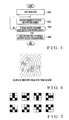
- the image shown in Fig. 4 is a fingerprint image obtained by thinning a fingerprint pattern used as a registration image for template matching collation.
- the ridge and valley lines of the fingerprint are expressed in black and white, respectively.
- a line segment which joins two ridge lines is generated as indicated by a circle in Fig. 4.
- a portion where the line segment which joins these two line segments is regarded as a unique pattern caused by image collapse.
- a portion which forms this pattern is schematically expressed, and a pattern element like that shown in Fig. 5 is stored as an image pattern in the image quality evaluation pattern element storage unit 4-1.
- Pattern elements for detecting patterns unique to image collapse which are stored in the image quality evaluation pattern element storage unit 4-1 are not limited to those shown in Fig. 5. For example, other pattern elements having different sizes may be used.
- pattern elements different from the pattern elements unique to image collapse which are shown in Fig. 5, may be defined as other pattern elements unique to image collapse, and the above evaluation may be performed on the basis of the pattern elements.
- the image pattern matching image quality evaluation unit 4-2 evaluates the number of matches between the loaded fingerprint image data and all the pattern elements by image pattern matching (S302), and calculates and outputs the sum total of matches as an image quality evaluation index associated with image collapse (S3003: Y, S304).
- step S205 calculation of an image quality evaluation index representing the magnitude of image quality described above (S201 to S203) is repeated by the number of times equal to the number of images (h images) to be prepared as registration candidates to acquire image quality evaluation indices for the respective images.
- a certain threshold (reference value) may be set for the image quality evaluation indices, and indices which do not meet the threshold may be excluded in the image quality priority level determination unit 5 (S204).
- the image quality priority level determination unit 5 selects a maximum of k image data in descending order of image quality evaluation indices, assigns priory levels to the image data in descending order of image quality evaluation indices, and stores them in the registration image storage unit 6.
- Selection of the acquired image data and storage thereof in the registration image storage unit 6 may be sequentially performed for each image data.
- a plurality of image data as registration candidates and corresponding image quality evaluation indices may be temporarily stored, and selection and storage may be done simultaneously with respect to these temporarily stored data.
- image quality evaluation index image collapse evaluation index
- a priority level in the collation order is set low (S206).
- image data of the images captured by the sensor unit 2 as registration image candidates are discarded because it is assumed that they are low in image quality and authentication accuracy.
- images expected to be high in image quality and authentication accuracy can be selected from the images (h images) as registration candidates in accordance with the number (k) of images required for registration, and can be registered.
- the image selection method using this image quality evaluation can always obtain an authentication result with higher authentication accuracy and at a higher speed.
- Fig. 7 shows a modification of the first embodiment, in which an output from an image quality priority level determination unit 5 forming part of an image quality priority level decision processing unit 40 is stored in a check image storage unit 81 (step 206' in Fig. 8).
- fingerprint image data as a reference is stored in a registration image storage unit 61 in advance.
- a lamp 91 may be turned on to display that fingerprint images are being read, while a plurality of fingerprint image data are loaded under the control of a control unit 9.
- a plurality of image data may be registered like check images, or single image data may be registered as in the prior art.
- the operations of the remaining components are the same as those in the first embodiment, and hence a detailed description thereof will be omitted.
- an image quality magnitude evaluation index is represented by the number of unique image pattern elements generated in images originating from the characteristics of an image quality of interest. However, this numerical value depends on the number of pixels of image data as an evaluation target as well as an image quality.
- a more accurate index is obtained in association with an image quality by calculating an index by using the number of pixels of image data subjected to image quality evaluation in addition to the number of image quality evaluation pattern elements detected.
- an image collation unit 7 compares/collates registration images with the check image stored in a check image storage unit 8 in accordance with priority levels in the collation order to determine whether the check image is identical to any one of the registration images (S207), and outputs the result as a collation result (S208).
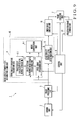
- Fig. 9 shows the third embodiment of a fingerprint collation apparatus 1 according to the present invention.
- the third embodiment differs from the first embodiment in the arrangement of an image quality magnitude evaluation unit 4.
- the image quality magnitude evaluation unit 4 of the third embodiment includes a pixel count evaluation unit 4-3 which obtains the number of pixels of the image data input from an image processing unit 3 and outputs the numerical value result, and an index computation unit 4-4 which performs an arithmetical operation of the numerical values output from the image pattern matching image quality evaluation unit 4-2 and pixel count evaluation unit 4-3, and outputs the result as an image quality evaluation index.
- the index computation unit 4-4 outputs, for example, the result obtained by performing division of the numerical values input from the image pattern matching image quality evaluation unit 4-2 and pixel count evaluation unit 4-3 as an image quality evaluation index.
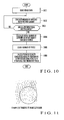
- Fig. 10 shows the flow of calculation of an image quality evaluation index.
- image data having undergone image processing is loaded by the image processing unit 3 (S401).
- the image pattern matching image quality evaluation unit 4-2 then evaluates the image quality of the loaded image data (S402). In evaluating this image quality, if there are a plurality of reference image pattern elements, the number of matches between all the pattern elements and the loaded image data is evaluated (S403).
- the sum total of matches associated with all the reference image pattern elements is obtained (S404). Thereafter, the number of pixels of the loaded image is calculated (S405). The result obtained by dividing the number of matches with all the pattern elements by the number of pixels is calculated as an image quality evaluation index, and the calculation result is output (S406).
- Fig. 11 shows an example of a blurred fingerprint image.
- a fingerprint image is blurred
- many fragments of ridge lines are generated as indicated by the circle in Fig. 11.
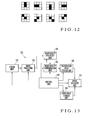
- These short line segments are therefore regarded as a unique pattern originating from blurring, and pattern elements like those shown in Fig. 12 are stored in the image quality evaluation pattern element storage unit 4-1 to detect such a pattern.
- Pixel patterns for detecting such a pattern unique to blurring are not limited to these patterns. For example, other pattern elements having different sizes may be used.
- the image pattern matching image quality evaluation unit 4-2 evaluates the number of matches between input fingerprint image data as registration candidates and all these reference image pattern elements by the image pattern matching technique (S402), and outputs the numerical value result. Thereafter, the number of pixels of the loaded image data is counted (S405), and the number of pixels is divided by the sum total of matches (S406). The division result is then set as an evaluation index.
- the subsequent collation sequence is the same as in the flow shown in Fig. 2. In S406 described above, the total sum of matches may be divided by the number of pixels, and the division result may be set as an evaluation index.
- the number of pixels is counted after the number of matches with the pattern elements is evaluated.
- these operations may be done in the reverse order. That is, the sum total of matches may be calculated after the number of pixels is counted.
- the two appearance probabilities coincide with each other at ⁇ .
- the appearance probability of patterns unique to an image quality of interest which does not depend on the number of pixels of the loaded image can be extracted and used as an image quality evaluation value.
- the above third embodiment has exemplified the case wherein the index computation unit 4-4 of the image quality magnitude evaluation unit 4 performs division of the numerical values input from the image pattern matching image quality evaluation unit 4-2 and pixel count evaluation unit 4-3.
- a multiplication result may be output as an image quality evaluation index.
- step S406 of Fig. 10 when an evaluation index is to be calculated in step S406 of Fig. 10 from the sum total of matches obtained in step S404 and the number of pixels obtained in step S405, the number of matches with all the reference image pattern elements is multiplied by the number of pixels, and the result is output as an image quality evaluation index.
- the image quality evaluation value increases unlike the case wherein an image quality evaluation value is calculated by division. For this reason, when an image quality evaluation value is large, the image quality priority level determination unit 5 determines that image quality is high and higher authentication accuracy can be obtained, and performs image selection.
- the above third embodiment has exemplified the case wherein the index computation unit 4-4 of the image quality magnitude evaluation unit 4 performs division of the numerical values input from the image pattern matching image quality evaluation unit 4-2 and pixel count evaluation unit 4-3.
- a subtraction result may be output as an image quality evaluation index.
- step S406 of Fig. 10 when an evaluation index is to be calculated in step S406 of Fig. 10 from the sum total of matches obtained in step S404 and the number of pixels obtained in step S405, the result obtained by subtracting the number of matches with all pattern elements from the number of pixels is output as an image quality evaluation index.
- the result obtained by subtracting the number of pixels from the number of matches with all reference image pattern elements may be output as an image quality evaluation index.
- N the number of pixels of a loaded image
- ⁇ the probability that patterns unique to blurring of this image appear
- (1 - ⁇ ) represents the probability that pattern elements unique to blurring of this image do not appear.
- the number of pixels which are not blurred is calculated by multiplying this probability by the number of pixels. That is, with the use of this evaluation technique, the number of portions where no blurring is detected in the fingerprint image, i.e., the number of portions which are not blurred, can be used as an image quality evaluation index.
- the image quality priority level determination unit 5 determines that image quality is high and higher authentication accuracy can be obtained, and performs image selection.
- the above third embodiment has exemplified the case wherein the index computation unit 4-4 of the image quality magnitude evaluation unit 4 performs division of the numerical values input from the image pattern matching image quality evaluation unit 4-2 and pixel count evaluation unit 4-3.
- an addition result may be output as an image quality evaluation index.
- step S406 of Fig. 10 when an evaluation index is to be calculated in step S406 of Fig. 10 from the sum total of matches obtained in step S404 and the number of pixels obtained in step S405, the result obtained by adding the number of matches with all reference image pattern elements to the number of pixels is output as an image quality evaluation index.
- the third embodiment described above has exemplified the case wherein the index computation unit 4-4 performs a single computation.
- the number of computations is not limited to one, and a combination of a plurality of computations may be executed.
- the first, second, and third embodiments have exemplified the case wherein evaluation is performed with respect to one image quality of interest, and images to be registered are selected in accordance with the obtained image quality evaluation index.
- the number of image qualities of interest is not limited to one, and evaluation may be performed in consideration of a plurality of image qualities. Image selection may be performed by using the obtained image quality evaluation indices.
- the image pattern matching technique of directly comparing/collating fingerprint patterns is used as a technique of causing the image collation unit 7 to compare/collate the registration fingerprint image data stored in the registration image storage unit 6 or 61 with the check fingerprint image data stored in the check image storage unit 8 or 81 for authentication.
- the influence of the image quality on collation accuracy can be accurately evaluated, thereby realizing collation with higher accuracy.
Landscapes
- Engineering & Computer Science (AREA)
- Physics & Mathematics (AREA)
- General Physics & Mathematics (AREA)
- Multimedia (AREA)
- Theoretical Computer Science (AREA)
- Quality & Reliability (AREA)
- Human Computer Interaction (AREA)
- Computer Vision & Pattern Recognition (AREA)
- Collating Specific Patterns (AREA)
- Image Analysis (AREA)
Abstract
Description
Claims (29)
- A biometric image collation apparatus characterized by comprising:wherein said control unit causes said image collation unit to compare/collate the second image data stored in said second image storage unit with the first image data stored in said first image storage unit in accordance with the priority levels, and outputs the comparison/collation result from said image collation unit.an image quality priority level decision processing unit which evaluates a magnitude of an image quality of each of a plurality of first image data formed from biometric images associated with the same target on the basis of a specific index having a relationship of a monotone function with authentication accuracy of biometric authentication, and outputs each of the first image data upon adding a priority level thereto on the basis of the evaluation result;a first image storage unit which stores each of the first image data having a priority level added thereto from said image quality priority level decision processing unit;a second image storage unit which stores second image data used for comparison/collation with the first image data;an image collation unit which compares/collates the second image data stored in said second image storage unit with the first image data stored in said first image storage unit and outputs the comparison/collation result; anda control unit which controls each of said units,
- A biometric image collation apparatus according to claim 1, characterized in that said image quality priority level decision processing unit comprises:an image quality magnitude evaluation unit which evaluates a magnitude of an image quality of each of the first image data and outputs the evaluation result as an image quality evaluation index; andan image quality priority level determination unit which outputs, to said first image storage unit, each of the first image data upon adding a priority level thereto on the basis of each image quality evaluation index output from said image quality magnitude evaluation unit.
- A biometric image collation apparatus according to claim 2, characterized in that said image quality magnitude evaluation unit calculates and outputs, as the image quality evaluation index for each of the first image data, an index value indicating a factor which degrades authentication accuracy.
- A biometric image collation apparatus according to claim 3, characterized in that said image quality magnitude evaluation unit calculates, as the evaluation index for each of the first image data, an index value indicating a degree of image collapse or blurring of the image.
- A biometric image collation apparatus according to claim 2, characterized in that said image quality magnitude evaluation unit comprises:an image quality evaluation pattern element storage unit which stores at least one reference image pattern of m pixels (vertical) x n pixels (horizontal) (where m and n are integers) as one pattern element; andan image pattern matching image quality evaluation unit which obtains the number of data of the check image data which are identical to the reference image pattern element, and outputs the result as an image quality evaluation index, andsaid image quality priority level determination unit determines the priority level on the basis of the image quality evaluation index output from said image pattern matching image quality evaluation unit.
- A biometric image collation apparatus according to claim 2, characterized in that said image quality magnitude evaluation unit comprises:a pixel count evaluation unit which obtains a total number of pixels of one of the plurality of first image data and outputs the result; andan index computation unit which performs computation using the number of matches with the reference image pattern element which is output from said image pattern matching image quality evaluation unit and the number of pixels, and outputs the result as an image quality evaluation index.
- A biometric image collation apparatus according to claim 6, characterized in that said index computation unit calculates the image quality evaluation index by performing division of the number of pixels and the number of matches.
- A biometric image collation apparatus according to claim 6, characterized in that said index computation unit calculates the image quality evaluation index by multiplying the number of pixels and the number of matches.
- A biometric image collation apparatus according to claim 6, characterized in that said index computation unit calculates the image quality evaluation index by performing subtraction of the number of pixels and the number of matches.
- A biometric image collation apparatus according to claim 6, characterized in that said index computation unit calculates the image quality evaluation index by adding the number of pixels and the number of matches.
- A biometric image collation apparatus according to claim 1, characterized in that said image collation unit performs comparison/collation by an image pattern matching technique to check whether or not the first image data stored in said first image storing unit is identical to the second image data stored in said second image storage unit, and outputs the collation result.
- A biometric image collation apparatus according to claim 1, characterized by further comprising:a sensor unit which captures a biometric image; andan image processing unit which performs image processing of the biometric image from said sensor unit,wherein a plurality of biometric images having undergone image processing in said image processing unit are input as the first image data to said image quality priority level decision processing unit.
- A biometric image collation apparatus according to claim 1, characterized in that the first image data stored in said first image storage unit is check image data to be newly checked in the comparison/collation, and the second image data stored in said second image storage unit is reference image data representing an authentic target.
- A biometric image collation apparatus according to claim 1, characterized in that the first image data stored in said first image storage unit is reference image data representing an authentic target, and the second image data stored in said second image storage unit is check image data to be newly checked in the comparison/collation.
- A biometric image collation apparatus according to claim 1, characterized in that the biometric image comprises one selected from a fingerprint, an iris, and biometric image information unique to a living body which characterizes the living body.
- A biometric image collation method
characterized by comprising:the image quality magnitude evaluation step of evaluating a magnitude of an image quality of each of a plurality of first image data formed from biometric images associated with the same target on the basis of a specific index having a relationship of a monotone function with authentication accuracy of biometric authentication, and outputting each of the first image data upon adding a priority level thereto on the basis of the evaluation result;the first image storage step of causing a first image storage unit to store each of the first image data to which a priority level is added in the image quality priority level decision step; andthe collation step of comparing/collating second image data stored in advance in a second image storage unit with the first image data stored in the first image storage unit in accordance with the priority levels, and outputting the comparison/collation result. - A biometric image collation method according to claim 16, characterized in that in the image quality magnitude evaluation step, an index value representing a factor which degrades authentication accuracy is calculated and output for each of the first image data as the image quality evaluation index.
- A biometric image collation method according to claim 17, characterized in that in the image quality magnitude evaluation step, for each of the first image data, an index value indicating a degree of image collapse or blurring of the image is calculated as the evaluation index.
- A biometric image collation method according to claim 16, characterized in that in the image quality magnitude evaluation step, the image quality evaluation index is obtained by detecting, as a match count, the number of matches between the image data and a reference image pattern of m pixels (vertical) x n pixels (horizontal) (where m and n are integers).
- A biometric image collation method according to claim 16, characterized in that in the image quality magnitude evaluation step, the number of matches between the image data and a reference image pattern of m pixels (vertical) x n pixels (horizontal) (where m and n are integers) is set as a match count, and the image quality evaluation index is calculated by performing computation with respect to the match count and the number of pixels.
- A biometric image collation method according to claim 20, characterized in that in the image quality magnitude evaluation step, the image quality evaluation index is calculated by performing division of the match count and the number of pixels.
- A biometric image collation method according to claim 20, characterized in that in the image quality magnitude evaluation step, the image quality evaluation index is calculated by multiplying the match count and the number of pixels.
- A biometric image collation method according to claim 20, characterized in that in the image quality magnitude evaluation step, the image quality evaluation index is calculated by performing subtraction of the number of pixels and the match count.
- A biometric image collation method according to claim 20, characterized in that in the image quality magnitude evaluation step, the image quality evaluation index is calculated by adding the number of pixels and the match count.
- A biometric image collation method according to claim 16, characterized in that in the collation step, comparison/collation is performed by an image pattern matching technique to check whether or not the first image data is identical to the second image data.
- A biometric image collation method according to claim 16, characterized by further comprising:the image processing step of performing image processing of a biometric image captured by a sensor unit; andthe step of inputting a plurality of biometric images having undergone image processing in the image processing step as the first image data to the image quality priority level decision processing unit.
- A biometric image collation method according to claim 16, characterized in that the first image data stored in the first image storage unit is check image data to be newly checked in the comparison/collation, and the second image data stored in the second image storage unit is reference image data representing an authentic target.
- A biometric image collation method according to claim 16, characterized in that the first image data stored in the first image storage unit is reference image data representing an authentic target, and the second image data stored in the second image storage unit is check image data to be newly checked in the comparison/collation.
- A biometric image collation method according to claim 16, characterized in that the biometric image comprises one selected from a fingerprint, an iris, and biometric image information unique to a living body which characterizes the living body.
Applications Claiming Priority (3)
| Application Number | Priority Date | Filing Date | Title |
|---|---|---|---|
| JP2003061921 | 2003-03-07 | ||
| JP2003061921 | 2003-03-07 | ||
| PCT/JP2004/002785 WO2004079658A1 (en) | 2003-03-07 | 2004-03-05 | Biological image correlation device and correlation method thereof |
Publications (3)
| Publication Number | Publication Date |
|---|---|
| EP1603077A1 true EP1603077A1 (en) | 2005-12-07 |
| EP1603077A4 EP1603077A4 (en) | 2008-01-23 |
| EP1603077B1 EP1603077B1 (en) | 2010-06-02 |
Family
ID=32958984
Family Applications (1)
| Application Number | Title | Priority Date | Filing Date |
|---|---|---|---|
| EP04717743A Expired - Lifetime EP1603077B1 (en) | 2003-03-07 | 2004-03-05 | Biological image correlation device and correlation method thereof |
Country Status (6)
| Country | Link |
|---|---|
| US (1) | US7673145B2 (en) |
| EP (1) | EP1603077B1 (en) |
| JP (1) | JP4369922B2 (en) |
| CN (1) | CN100397421C (en) |
| DE (1) | DE602004027469D1 (en) |
| WO (1) | WO2004079658A1 (en) |
Cited By (1)
| Publication number | Priority date | Publication date | Assignee | Title |
|---|---|---|---|---|
| CN107992800A (en) * | 2017-11-10 | 2018-05-04 | 杭州晟元数据安全技术股份有限公司 | A kind of fingerprint image quality determination methods based on SVM and random forest |
Families Citing this family (35)
| Publication number | Priority date | Publication date | Assignee | Title |
|---|---|---|---|---|
| US20050227217A1 (en) * | 2004-03-31 | 2005-10-13 | Wilson Andrew D | Template matching on interactive surface |
| US7394459B2 (en) | 2004-04-29 | 2008-07-01 | Microsoft Corporation | Interaction between objects and a virtual environment display |
| US7787706B2 (en) | 2004-06-14 | 2010-08-31 | Microsoft Corporation | Method for controlling an intensity of an infrared source used to detect objects adjacent to an interactive display surface |
| US7593593B2 (en) | 2004-06-16 | 2009-09-22 | Microsoft Corporation | Method and system for reducing effects of undesired signals in an infrared imaging system |
| US7519223B2 (en) | 2004-06-28 | 2009-04-14 | Microsoft Corporation | Recognizing gestures and using gestures for interacting with software applications |
| US7576725B2 (en) * | 2004-10-19 | 2009-08-18 | Microsoft Corporation | Using clear-coded, see-through objects to manipulate virtual objects |
| US20060171571A1 (en) * | 2005-02-01 | 2006-08-03 | Chan Michael T | Systems and methods for quality-based fusion of multiple biometrics for authentication |
| US7499027B2 (en) * | 2005-04-29 | 2009-03-03 | Microsoft Corporation | Using a light pointer for input on an interactive display surface |
| US7525538B2 (en) * | 2005-06-28 | 2009-04-28 | Microsoft Corporation | Using same optics to image, illuminate, and project |
| US7911444B2 (en) * | 2005-08-31 | 2011-03-22 | Microsoft Corporation | Input method for surface of interactive display |
| US8060840B2 (en) | 2005-12-29 | 2011-11-15 | Microsoft Corporation | Orientation free user interface |
| KR20070083436A (en) * | 2006-02-21 | 2007-08-24 | 삼성전자주식회사 | Object authentication device and method |
| JP4952026B2 (en) * | 2006-03-31 | 2012-06-13 | 株式会社日立製作所 | Biometric information authentication apparatus and authentication method |
| US8212857B2 (en) | 2007-01-26 | 2012-07-03 | Microsoft Corporation | Alternating light sources to reduce specular reflection |
| JP4594945B2 (en) * | 2007-02-13 | 2010-12-08 | 株式会社東芝 | Person search device and person search method |
| JP5061370B2 (en) * | 2008-03-27 | 2012-10-31 | Necソフト株式会社 | Ridge region extraction device, ridge region extraction system, ridge region extraction method, and program |
| JP4935930B2 (en) * | 2008-06-10 | 2012-05-23 | 富士通株式会社 | Image correction apparatus and image correction method |
| JP5353172B2 (en) * | 2008-10-02 | 2013-11-27 | 富士通株式会社 | Authentication method, authentication program, and information processing apparatus |
| JP5304901B2 (en) * | 2009-10-27 | 2013-10-02 | 富士通株式会社 | Biological information processing apparatus, biological information processing method, and computer program for biological information processing |
| JP2011243042A (en) * | 2010-05-19 | 2011-12-01 | Nec Corp | Organism imaging device and method |
| CN101901336B (en) * | 2010-06-11 | 2012-03-14 | 哈尔滨工程大学 | Fingerprint and finger vein bimodal recognition decision level fusion method |
| US20120170855A1 (en) * | 2010-07-21 | 2012-07-05 | Panasonic Corporation | Image management device, image management method, program, recording medium, and image management integrated circuit |
| JP5751019B2 (en) | 2011-05-30 | 2015-07-22 | 富士通株式会社 | Biological information processing apparatus, biological information processing method, and biological information processing program |
| GB2500823B (en) * | 2013-03-28 | 2014-02-26 | Paycasso Verify Ltd | Method, system and computer program for comparing images |
| US9122911B2 (en) | 2013-03-28 | 2015-09-01 | Paycasso Verify Ltd. | System, method and computer program for verifying a signatory of a document |
| US9965608B2 (en) * | 2013-07-18 | 2018-05-08 | Samsung Electronics Co., Ltd. | Biometrics-based authentication method and apparatus |
| CN105659253B (en) * | 2014-08-25 | 2020-09-04 | 华为技术有限公司 | Fingerprint extraction method and device |
| JP2016099835A (en) * | 2014-11-21 | 2016-05-30 | キヤノン株式会社 | Image processing apparatus, image processing method, and program |
| KR102434562B1 (en) * | 2015-06-30 | 2022-08-22 | 삼성전자주식회사 | Method and apparatus for detecting fake fingerprint, method and apparatus for recognizing fingerprint |
| CN105303174B (en) | 2015-10-19 | 2019-12-10 | Oppo广东移动通信有限公司 | fingerprint input method and device |
| CN109800741B (en) * | 2015-11-13 | 2023-07-14 | Oppo广东移动通信有限公司 | Fingerprint registration method, device and terminal equipment |
| US11184766B1 (en) * | 2016-09-07 | 2021-11-23 | Locurity Inc. | Systems and methods for continuous authentication, identity assurance and access control |
| CN106843389B (en) | 2017-01-09 | 2022-08-05 | Oppo广东移动通信有限公司 | Electronic device |
| SE1750762A1 (en) * | 2017-06-15 | 2018-12-16 | Fingerprint Cards Ab | Template matching of a biometric object |
| KR102434703B1 (en) * | 2017-08-14 | 2022-08-22 | 삼성전자주식회사 | Method of processing biometric image and apparatus including the same |
Family Cites Families (19)
| Publication number | Priority date | Publication date | Assignee | Title |
|---|---|---|---|---|
| JPS57159362A (en) * | 1981-03-26 | 1982-10-01 | Toshiyuki Sakai | Two-dimensional pattern resetting system |
| JPH08110949A (en) * | 1993-05-07 | 1996-04-30 | Sharp Corp | Fingerprint image quality judgment method |
| JPH08129644A (en) | 1993-05-07 | 1996-05-21 | Sharp Corp | Fingerprint image quality judgment method |
| JP3634419B2 (en) * | 1994-07-25 | 2005-03-30 | セイコーエプソン株式会社 | Image processing method and image processing apparatus |
| JP2990491B2 (en) | 1995-03-20 | 1999-12-13 | 富士通電装株式会社 | Fingerprint registration method and fingerprint collation device |
| US5841888A (en) * | 1996-01-23 | 1998-11-24 | Harris Corporation | Method for fingerprint indexing and searching |
| US7159116B2 (en) * | 1999-12-07 | 2007-01-02 | Blue Spike, Inc. | Systems, methods and devices for trusted transactions |
| JPH10105707A (en) * | 1996-09-25 | 1998-04-24 | Sony Corp | Image collation device |
| JP2815045B2 (en) * | 1996-12-16 | 1998-10-27 | 日本電気株式会社 | Image feature extraction device, image feature analysis device, and image matching system |
| US6052384A (en) * | 1997-03-21 | 2000-04-18 | Scientific-Atlanta, Inc. | Using a receiver model to multiplex variable-rate bit streams having timing constraints |
| US6289112B1 (en) * | 1997-08-22 | 2001-09-11 | International Business Machines Corporation | System and method for determining block direction in fingerprint images |
| FR2769453B1 (en) * | 1997-10-06 | 2000-01-07 | Telediffusion Fse | METHOD FOR EVALUATING THE DEGRADATION OF A VIDEO IMAGE INTRODUCED BY A CODING AND / OR STORAGE AND / OR DIGITAL TRANSMISSION SYSTEM |
| JP2000222556A (en) * | 1999-01-27 | 2000-08-11 | Sony Corp | Fingerprint image acquisition device and fingerprint collation device |
| EP1155360B1 (en) * | 1999-02-04 | 2007-10-17 | Quvis, Inc. | Quality priority image storage and communication |
| JP3434756B2 (en) * | 1999-12-07 | 2003-08-11 | エヌイーシ−カスタムテクニカ株式会社 | Fingerprint authentication method and device |
| JP2002083290A (en) * | 2000-09-06 | 2002-03-22 | Nippon Telegr & Teleph Corp <Ntt> | Fingerprint collation device |
| JP2002222424A (en) | 2001-01-29 | 2002-08-09 | Nec Corp | Fingerprint matching system |
| US6895104B2 (en) * | 2001-02-16 | 2005-05-17 | Sac Technologies, Inc. | Image identification system |
| US7230344B2 (en) * | 2004-09-17 | 2007-06-12 | Rockwell Automation Technologies, Inc. | Apparatus and method for transient and uninterruptible power |
-
2004
- 2004-03-05 JP JP2005503114A patent/JP4369922B2/en not_active Expired - Fee Related
- 2004-03-05 US US10/515,566 patent/US7673145B2/en not_active Expired - Fee Related
- 2004-03-05 EP EP04717743A patent/EP1603077B1/en not_active Expired - Lifetime
- 2004-03-05 CN CNB2004800002444A patent/CN100397421C/en not_active Expired - Fee Related
- 2004-03-05 DE DE602004027469T patent/DE602004027469D1/en not_active Expired - Lifetime
- 2004-03-05 WO PCT/JP2004/002785 patent/WO2004079658A1/en not_active Ceased
Cited By (1)
| Publication number | Priority date | Publication date | Assignee | Title |
|---|---|---|---|---|
| CN107992800A (en) * | 2017-11-10 | 2018-05-04 | 杭州晟元数据安全技术股份有限公司 | A kind of fingerprint image quality determination methods based on SVM and random forest |
Also Published As
| Publication number | Publication date |
|---|---|
| EP1603077B1 (en) | 2010-06-02 |
| DE602004027469D1 (en) | 2010-07-15 |
| US20050226467A1 (en) | 2005-10-13 |
| CN1698066A (en) | 2005-11-16 |
| EP1603077A4 (en) | 2008-01-23 |
| CN100397421C (en) | 2008-06-25 |
| JP4369922B2 (en) | 2009-11-25 |
| JPWO2004079658A1 (en) | 2006-06-08 |
| WO2004079658A1 (en) | 2004-09-16 |
| US7673145B2 (en) | 2010-03-02 |
Similar Documents
| Publication | Publication Date | Title |
|---|---|---|
| US7673145B2 (en) | Biometric image collation apparatus and collation method therefor | |
| US7120280B2 (en) | Fingerprint template generation, verification and identification system | |
| US20010040989A1 (en) | Method and device for identifying fingerprints | |
| WO2008140539A1 (en) | Methods for gray-level ridge feature extraction and associated print matching | |
| WO2008008591A2 (en) | Method and apparatus for determining print image quality | |
| WO2008054940A2 (en) | Print matching method and apparatus using pseudo-ridges | |
| US7133542B2 (en) | Fingerprint verification device and fingerprint verification method | |
| JP4553138B2 (en) | Face image authentication device | |
| CN106503610A (en) | Video frequency identifying method and device | |
| EP1403811B1 (en) | Fingerprint authentication with input image validation based on the analysis of the spatial distribution of the brightness | |
| CN112699811A (en) | Living body detection method, apparatus, device, storage medium, and program product | |
| JP2803313B2 (en) | Fingerprint collation device | |
| Gamassi et al. | Fingerprint local analysis for high-performance minutiae extraction | |
| CN117576819A (en) | A fingerprint recognition access control method and system | |
| US20060120578A1 (en) | Minutiae matching | |
| US20070292005A1 (en) | Method and apparatus for adaptive hierarchical processing of print images | |
| US11216639B2 (en) | Template matching of a biometric object | |
| Poh et al. | Anti-forensic resistant likelihood ratio computation: A case study using fingerprint biometrics | |
| JPH09330408A (en) | Fingerprint matching device | |
| KR20040047401A (en) | Apparatus for processing fingerprint image and method thereof | |
| US8194943B2 (en) | Method for automatically recognizing fingerprints | |
| JP2006072567A (en) | Biometric authentication device | |
| JP2003271961A (en) | Fingerprint authentication method and device | |
| CN120977024A (en) | Methods, devices, equipment and storage media for dynamic updating of biometrics | |
| Huang et al. | A fingerprint capture system and the corresponding image quality evaluation algorithm based on FPS200 |
Legal Events
| Date | Code | Title | Description |
|---|---|---|---|
| PUAI | Public reference made under article 153(3) epc to a published international application that has entered the european phase |
Free format text: ORIGINAL CODE: 0009012 |
|
| 17P | Request for examination filed |
Effective date: 20041116 |
|
| AK | Designated contracting states |
Kind code of ref document: A1 Designated state(s): AT BE BG CH CY CZ DE DK EE ES FI FR GB GR HU IE IT LI LU MC NL PL PT RO SE SI SK TR |
|
| AX | Request for extension of the european patent |
Extension state: AL LT LV MK |
|
| DAX | Request for extension of the european patent (deleted) | ||
| RBV | Designated contracting states (corrected) |
Designated state(s): DE FR GB |
|
| A4 | Supplementary search report drawn up and despatched |
Effective date: 20071227 |
|
| RIC1 | Information provided on ipc code assigned before grant |
Ipc: G06T 7/00 20060101ALI20071218BHEP Ipc: G06K 9/00 20060101AFI20071218BHEP |
|
| 17Q | First examination report despatched |
Effective date: 20080604 |
|
| GRAP | Despatch of communication of intention to grant a patent |
Free format text: ORIGINAL CODE: EPIDOSNIGR1 |
|
| RIN1 | Information on inventor provided before grant (corrected) |
Inventor name: OKAZAKI, YUKIO Inventor name: IKEDA, NAMIKO Inventor name: NAKANISHI, MAMORU Inventor name: HATANO, TAKAHIRO Inventor name: MACHIDA, KATSUYUKI Inventor name: SHIGEMATSU, SATOSHI Inventor name: MORIMURA, HIROKI |
|
| GRAF | Information related to payment of grant fee modified |
Free format text: ORIGINAL CODE: EPIDOSCIGR3 |
|
| GRAS | Grant fee paid |
Free format text: ORIGINAL CODE: EPIDOSNIGR3 |
|
| GRAF | Information related to payment of grant fee modified |
Free format text: ORIGINAL CODE: EPIDOSCIGR3 |
|
| GRAL | Information related to payment of fee for publishing/printing deleted |
Free format text: ORIGINAL CODE: EPIDOSDIGR3 |
|
| GRAS | Grant fee paid |
Free format text: ORIGINAL CODE: EPIDOSNIGR3 |
|
| GRAA | (expected) grant |
Free format text: ORIGINAL CODE: 0009210 |
|
| AK | Designated contracting states |
Kind code of ref document: B1 Designated state(s): DE FR GB |
|
| REG | Reference to a national code |
Ref country code: GB Ref legal event code: FG4D |
|
| REF | Corresponds to: |
Ref document number: 602004027469 Country of ref document: DE Date of ref document: 20100715 Kind code of ref document: P |
|
| PLBE | No opposition filed within time limit |
Free format text: ORIGINAL CODE: 0009261 |
|
| STAA | Information on the status of an ep patent application or granted ep patent |
Free format text: STATUS: NO OPPOSITION FILED WITHIN TIME LIMIT |
|
| 26N | No opposition filed |
Effective date: 20110303 |
|
| REG | Reference to a national code |
Ref country code: DE Ref legal event code: R097 Ref document number: 602004027469 Country of ref document: DE Effective date: 20110302 |
|
| REG | Reference to a national code |
Ref country code: FR Ref legal event code: PLFP Year of fee payment: 13 |
|
| PGFP | Annual fee paid to national office [announced via postgrant information from national office to epo] |
Ref country code: FR Payment date: 20151130 Year of fee payment: 13 |
|
| PGFP | Annual fee paid to national office [announced via postgrant information from national office to epo] |
Ref country code: DE Payment date: 20151223 Year of fee payment: 13 |
|
| PGFP | Annual fee paid to national office [announced via postgrant information from national office to epo] |
Ref country code: GB Payment date: 20160108 Year of fee payment: 13 |
|
| REG | Reference to a national code |
Ref country code: DE Ref legal event code: R119 Ref document number: 602004027469 Country of ref document: DE |
|
| GBPC | Gb: european patent ceased through non-payment of renewal fee |
Effective date: 20170305 |
|
| REG | Reference to a national code |
Ref country code: FR Ref legal event code: ST Effective date: 20171130 |
|
| PG25 | Lapsed in a contracting state [announced via postgrant information from national office to epo] |
Ref country code: FR Free format text: LAPSE BECAUSE OF NON-PAYMENT OF DUE FEES Effective date: 20170331 Ref country code: DE Free format text: LAPSE BECAUSE OF NON-PAYMENT OF DUE FEES Effective date: 20171003 |
|
| PG25 | Lapsed in a contracting state [announced via postgrant information from national office to epo] |
Ref country code: GB Free format text: LAPSE BECAUSE OF NON-PAYMENT OF DUE FEES Effective date: 20170305 |