EP1602722A1 - Process for producing microbial transglutaminase - Google Patents
Process for producing microbial transglutaminase Download PDFInfo
- Publication number
- EP1602722A1 EP1602722A1 EP04717856A EP04717856A EP1602722A1 EP 1602722 A1 EP1602722 A1 EP 1602722A1 EP 04717856 A EP04717856 A EP 04717856A EP 04717856 A EP04717856 A EP 04717856A EP 1602722 A1 EP1602722 A1 EP 1602722A1
- Authority
- EP
- European Patent Office
- Prior art keywords
- pro
- actinomycetes
- mtg
- neutral metalloprotease
- metalloprotease
- Prior art date
- Legal status (The legal status is an assumption and is not a legal conclusion. Google has not performed a legal analysis and makes no representation as to the accuracy of the status listed.)
- Granted
Links
Images


Classifications
-
- C—CHEMISTRY; METALLURGY
- C12—BIOCHEMISTRY; BEER; SPIRITS; WINE; VINEGAR; MICROBIOLOGY; ENZYMOLOGY; MUTATION OR GENETIC ENGINEERING
- C12N—MICROORGANISMS OR ENZYMES; COMPOSITIONS THEREOF; PROPAGATING, PRESERVING, OR MAINTAINING MICROORGANISMS; MUTATION OR GENETIC ENGINEERING; CULTURE MEDIA
- C12N15/00—Mutation or genetic engineering; DNA or RNA concerning genetic engineering, vectors, e.g. plasmids, or their isolation, preparation or purification; Use of hosts therefor
- C12N15/09—Recombinant DNA-technology
-
- C—CHEMISTRY; METALLURGY
- C12—BIOCHEMISTRY; BEER; SPIRITS; WINE; VINEGAR; MICROBIOLOGY; ENZYMOLOGY; MUTATION OR GENETIC ENGINEERING
- C12N—MICROORGANISMS OR ENZYMES; COMPOSITIONS THEREOF; PROPAGATING, PRESERVING, OR MAINTAINING MICROORGANISMS; MUTATION OR GENETIC ENGINEERING; CULTURE MEDIA
- C12N9/00—Enzymes; Proenzymes; Compositions thereof; Processes for preparing, activating, inhibiting, separating or purifying enzymes
- C12N9/10—Transferases (2.)
- C12N9/1025—Acyltransferases (2.3)
- C12N9/104—Aminoacyltransferases (2.3.2)
- C12N9/1044—Protein-glutamine gamma-glutamyltransferase (2.3.2.13), i.e. transglutaminase or factor XIII
-
- C—CHEMISTRY; METALLURGY
- C12—BIOCHEMISTRY; BEER; SPIRITS; WINE; VINEGAR; MICROBIOLOGY; ENZYMOLOGY; MUTATION OR GENETIC ENGINEERING
- C12N—MICROORGANISMS OR ENZYMES; COMPOSITIONS THEREOF; PROPAGATING, PRESERVING, OR MAINTAINING MICROORGANISMS; MUTATION OR GENETIC ENGINEERING; CULTURE MEDIA
- C12N9/00—Enzymes; Proenzymes; Compositions thereof; Processes for preparing, activating, inhibiting, separating or purifying enzymes
- C12N9/10—Transferases (2.)
-
- C—CHEMISTRY; METALLURGY
- C12—BIOCHEMISTRY; BEER; SPIRITS; WINE; VINEGAR; MICROBIOLOGY; ENZYMOLOGY; MUTATION OR GENETIC ENGINEERING
- C12N—MICROORGANISMS OR ENZYMES; COMPOSITIONS THEREOF; PROPAGATING, PRESERVING, OR MAINTAINING MICROORGANISMS; MUTATION OR GENETIC ENGINEERING; CULTURE MEDIA
- C12N9/00—Enzymes; Proenzymes; Compositions thereof; Processes for preparing, activating, inhibiting, separating or purifying enzymes
- C12N9/14—Hydrolases (3)
- C12N9/48—Hydrolases (3) acting on peptide bonds (3.4)
- C12N9/50—Proteinases, e.g. Endopeptidases (3.4.21-3.4.25)
- C12N9/52—Proteinases, e.g. Endopeptidases (3.4.21-3.4.25) derived from bacteria or Archaea
-
- C—CHEMISTRY; METALLURGY
- C12—BIOCHEMISTRY; BEER; SPIRITS; WINE; VINEGAR; MICROBIOLOGY; ENZYMOLOGY; MUTATION OR GENETIC ENGINEERING
- C12N—MICROORGANISMS OR ENZYMES; COMPOSITIONS THEREOF; PROPAGATING, PRESERVING, OR MAINTAINING MICROORGANISMS; MUTATION OR GENETIC ENGINEERING; CULTURE MEDIA
- C12N9/00—Enzymes; Proenzymes; Compositions thereof; Processes for preparing, activating, inhibiting, separating or purifying enzymes
- C12N9/14—Hydrolases (3)
- C12N9/48—Hydrolases (3) acting on peptide bonds (3.4)
- C12N9/50—Proteinases, e.g. Endopeptidases (3.4.21-3.4.25)
- C12N9/64—Proteinases, e.g. Endopeptidases (3.4.21-3.4.25) derived from animal tissue
- C12N9/6421—Proteinases, e.g. Endopeptidases (3.4.21-3.4.25) derived from animal tissue from mammals
- C12N9/6489—Metalloendopeptidases (3.4.24)
Definitions
- the present invention relates to a new protease which efficiently cleaves the pro-structure part of pro-transglutaminase to convert to an active form transglutaminase and to a nucleic acid encoding it, said pro-transglutaminase being produced by actinomycetes.
- the present invention also relates to a method of producing microbial transglutaminase in its active form using said protease. Additionally, the present invention relates to a method of producing the neutral metalloprotease.
- Transglutaminase is an enzyme which catalyzes acyltransfer reaction of ⁇ -carboxylamide groups in the peptide chain of the protein. When the enzyme is reacted with a protein, the formation of the cross-linkage ⁇ - ( ⁇ - Glu) - Lys and the replacement of Gln with Glu by deamidation can be occurred.
- Transglutaminases have been used to manufacture gelled food products such as jelly, yogurt, cheese or gelled cosmetics and others, and to improve the quality of meat, etc. (Japanese publication of examined application (JP-Kokoku) No. 1-50382).
- transglutaminase is an enzyme having industrially high usefulness in that it has been used to manufacture materials for thermostable microcapsules, carrier for immobilized enzyme etc.
- Transglutaminases from animals, which are calcium-dependent in expressing the activities, and transglutaminases from microorganisms microbial transglutaminase(s), which is/are also referred to as "MTG(s)" hereinafter
- MTG microbial transglutaminase(s)
- a transglutaminase from a bacterium belonging to genus Streptoverticillium has been discovered.
- Streptoverticillium bacteria include, for example, Streptoverticillium griseocameum IFO 12776, Streptoverticillium cinnamoneum sub sp.
- transglutaminases Although these transglutaminases, however, have been produced through the purification from the cultures such as those of microorganisms described above, there have been problems in terms of the amount and the efficiency and the like. Then, as a method for secreting heterologous proteins efficiently, the method was established wherein a coryneform bacterium is selected as a host, a fused protein having transglutaminase connected downstream to the signal peptide domain of a coryneform bacterium, and the transglutaminase was efficiently secreted to obtain high yield of transglutaminase (WO 01/23591).
- pro MTG is secreted in an inactive form as pro-transglutaminase (referred to as "pro MTG” hereinafter) in which a pro-structure part is connected to MTG, and then the pro-structure part of the pro MTG is cleaved by a protease to convert it into a transglutaminase having activity, as well as a method wherein an active transglutaminase is directly produced in the culture medium by co-expressing SAM-P45, which is a serine protease derived from actinomycetes, at a required and sufficient amount in a coryneform bacterium producing the pro MTG.
- SAM-P45 is a serine protease derived from actinomycetes
- a dispase derived from Bacillus polymyxa As an enzyme which cleaves the pro-structure part of pro MTG, besides SAM-P45, a dispase derived from Bacillus polymyxa is known (Eur. J. Biochem., vol. 257, p. 570-576 (1998)). A large amount of enzymes, however, are required for the cleavage of the pro-structure part, and there is a risk of the over-decomposition of the transglutaminase itself. In addition, a dispase is the reagent for cell culture, so it is expensive as an enzyme for industrial use.
- protease which can selectively cleave only the pro-structure part of pro MTG, and cause an over-decomposition of the transglutaminase itself as little as possible for performing the production of an active form transglutaminase advantageously, as mentioned above. Additionally, if proteases could be used which can selectively cleave only the pro-structure part of pro MTG, and cause an over-decomposition of the transglutaminase itself as little as possible, it was believed to be advantageous for the production of an active transglutaminase.
- transglutaminase which can selectively cleave the pro-structure part of pro MTG were those which could be secreted extracellularly, it was believed to be more preferable because active transglutaminases could be directly produced in the culture medium by co-expressing them together with the pro MTG.
- an object of the present invention is to provide a protease which is useful for the production of transglutaminase and which selectively cleaves the pro-structure part of pro MTG.
- an object of the invention is to provide protease which selectively cleaves the pro-structure part of pro MTG, wherein said protease can be produced by using a coryneform bacterium as a host, and can be easily secreted extracellularly.
- An object of the invention is also to provide a nucleic acid molecule encoding said protease.
- Another object of the invention is to provide a method of producing MTG efficiently using said protease.
- an object of the invention is to provide a method of producing said protease.
- the inventors of the present invention searched a protease which would selectively cleave the pro-structure part of pro MTG, but would cause the decomposition of the transglutaminase itself as little as possible, and then they could isolate and purify a neutral metalloprotease having such a property.
- the inventors also obtained a DNA encoding said protease, introduced it into a coryneform bacterium, and then they were successful in its secretory expression using a coryneform bacterium as a host.
- the present enzyme was actually reacted on the pro MTG to cleave the pro-structure part, and then the active transglutaminase was recovered.
- the inventors established the present invention by identifying neutral metalloproteases derived from microorganisms of other sources having an equivalent function, which have been proved similarly useful for the production of an active MTG.
- the present invention is a neutral metalloprotease from actinomycetes having high selectivity in cleaving the pro-structure part of pro MTG, and a nucleic acid molecule encoding it.
- the present invention is also a method of producing an active MTG, comprising cleaving a pro-structure part of a pro MTG by a neutral metalloprotease.
- the present invention is also a method of producing said metalloprotease, comprising introducing a nucleic acid molecule encoding said neutral metalloprotease into a coryneform bacterium, culturing the coryneform bacterium into which said nucleic acid molecule has been introduced, thereby allowing the expression of said neutral metalloprotease, and recovering said extracellularly secreted metalloprotease.
- the present invention is a neutral metalloprotease SVP35 from actinomycetes having the following properties:
- the present invention is also a neutral metalloprotease SVP70 having the following properties:
- the present invention is also a nucleic acid molecule encoding said SVP35 or SVP70.
- the present invention is also a method of producing an active MTG, comprising cleaving the pro-structure part of pro MTG by said SVP35 or SVP70.
- the present invention is a method of producing SVP35 or SVP70, comprising introducing a nucleic acid molecule encoding said SVP35 or SVP70 into a coryneform bacterium, culturing the coryneform bacterium into which said nucleic acid molecule has been introduced, and recovering the extracellularly secreted SVP35 or SVP70.
- a secretory protein is translated as a prepeptide or a prepropeptide and thereafter its signal peptide ("a pre-part") is cleaved to be converted into a mature peptide or propeptide, and the propeptide is cleaved at the domain referred to as pro-structure to be a mature peptide.
- a pro-structure part of a secretory protein may be simply referred to as "pro-structure”.
- a signal sequence refers to the sequence which is located at the N-terminal of a secretory protein precursor and which is not present in a naturally occurring mature protein
- a signal peptide refers to the peptide which is cleaved from such a protein precursor.
- a signal sequence is cleaved by a protease following the extracellular secretion.
- proprotein a protein which dose not contain a signal peptide but dose contain a pro-structure part
- proprotein for example "protransglutaminase” or "pro MTG”.
- pro-structure part of a secretory protein may be simply referred to as “a pro-structure” or “a pro-structure part”, and these terms can be herein used interchangeably.
- proteases which are assumed to be able to express easily in a coryneform bacterium, the inventors firstly performed the search for a protease having high specificity and selectivity for the substrate of interest, i.e. a protease which selectively cleaves the pro-structure part of a pro MTG, and causes the over-decomposition of the transglutaminase itself as little as possible.
- MTG When MTG is secreted extracellularly by an actinomycetes, it has been assumed to be firstly secreted as a pro MTG, followed by the cleavage of the pro-structure part of the pro MTG resulting in an active form MTG ( Eur. J. Biochem., vol. 257, p. 570-576 (1998)). Accordingly, the inventors have expected that a protease that cleaves the pro-structure part of a pro MTG is present within MTG producing actinomycetes.
- protease Since this protease is originally a protease that cleaves the pro-structure part, it is expected that the protease has a high selectivity for substrates and cleaves only the pro-structure part, while it acts on the MTG itself in less degree.
- both a structural gene of a pro MTG of actinomycetes and a structural gene of the protease SAM-P45 can be effectively expressed in a coryneform bacterium, and they can be secreted extracellularly.
- an earnest investigation has been made in order to find the protease of interest from a MTG producing bacterium which is an actinomycetes, and as a result, it was revealed that the MTG producing strain Streptoverticillium mobaraense had a high cleavage selectivity for the pro-structure part of the pro MTG and produces new neutral metalloproteases useful for the production of an active MTG.
- the present inventors isolated and purified these neutral metalloproteases and demonstrated their enzymological properties. Furthermore, the inventors determined the amino acid sequences of the N-terminal parts of these metalloproteases, and obtained the genes encoding the metalloproteases.
- the inventors introduced the enzyme gene into a coryneform bacterium, allowing the expression of it in a system using a coryneform bacterium as a host, and as a result, the enzyme was secreted extracellularly. Furthermore, the enzyme was practically reacted on a pro MTG of a pro-structure part, resulting in the cleavage of the pro-structure part to yield an active transglutaminase. Neutral metalloproteases from microorganisms of other sources having an equivalent function have also found, which have been revealed to be similarly useful for the production of an active form MTG.
- the neutral metalloproteases according to the present invention can be prepared from the surfaces of a cultured actinomycetes or culture supernatant of the actinomycetes including Streptoverticillium mobaraense, Streptomyces griseus, Streptomyces coelicolor, etc.
- the cultivation of a bacterium to obtain the neutral metalloprotease according to the present invention can be carried out according to the methods conventionally used for the cultivation of actinomycetes.
- a common medium containing conventional carbon sources, nitrogen sources, inorganic ions and others can be used as a medium for the culture.
- Glucose, starch, sucrose and others can be used as the carbon sources.
- Peptone, yeast extract, meat extract, malt extract, ammonium salt and others are optionally used as the nitrogen sources if necessary.
- the culture may be conducted under the aerobic condition which is appropriately controlled within the pH range of between pH 5.0 and 8.5 and the temperature range between 15°C and 37°C.
- the culture is preferably continued until the maximum amount of the intended neutral metalloprotease may be achieved, and then it can be terminated.
- the suitable culture period depends on the temperature, pH and the type of medium, usually the period is preferably about 1 to 12 days. After the culturing period, the culture may be separated into the cells and the culture supernatant by centrifugation and the like.
- the new neutral metalloproteases according to the present invention can be obtained from the culture supernatant as well as the recovered cells, in particular from the surface of the cells.
- any methods which are conventionally used for purifying a enzyme for example ammonium sulfate salting-out technique, gel filtration technique, ion-exchange chromatography, hydrophobic chromatography and the like can be adopted.
- the protease can be purified more efficiently using high performance liquid chromatography (HPLC) etc.
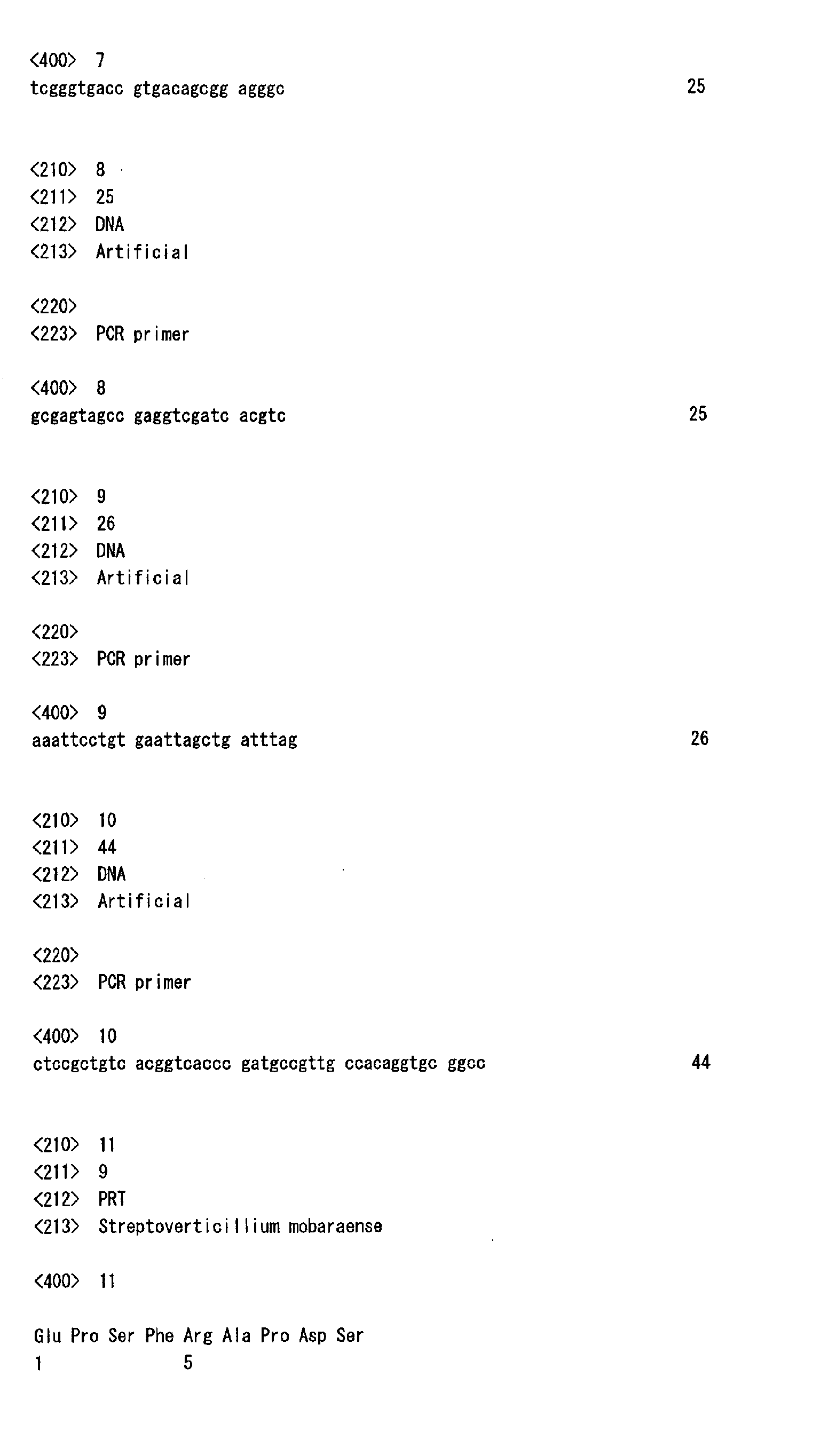
- the measurement of the enzyme activity of the neutral metalloprotease obtained in this way can be determined by reacting the enzyme with a peptide which contains a region connecting the pro-part of a protransglutaminase and a mature transglutaminase, for example synthetic peptide Glu-Pro-Ser-Phe-Arg-Ala-Pro-Asp-Ser (SEQ ID NO: 11) (Peptide Institute) as a substrate and calculating the reduced amount of the substrate.
- the neutral metalloprotease according to the invention purified from the recovered cells, in particular from the surface of the cells, or from the supernatant of the culture, can be analyzed for the N-terminal amino acid sequence by a gas phase protein sequencer to determine the partial amino acid sequence. Furthermore, the enzymatic properties (optimum pH, pH stability, optimum temperature, the effect of an inhibitor, etc.) of the isolated and purified neutral metalloprotease can be examined.
- the neutral metalloprotease named SVP35 was obtained from the surface of the cells of Streptoverticillium mobaraense and the neutral metalloprotease named SVP70 can be obtained from the culture supernatant of Streptoverticillium mobaraense.
- the neutral metalloprotease according to the invention is the neutral metalloprotease SVP35 having the following properties:
- the neutral metalloprotease according to the present invention is the neutral metalloprotease SVP70 having the following properties:
- both of them show a high selective cleavage activity on the pro-structure part of the MTG. Namely, since both of the enzymes are characterized by converting the pro MTG into the active MTG efficiently, while the activity for degrading the resulting active MTG itself is low, both of them are the suitable enzymes for producing an active MTG using pro MTG as a raw material.
- the N-terminal amino acid sequences of the two new neutral metalloproteases are shown in SEQ ID NO: 1 for SVP35, and in SEQ ID NO: 2 for SVP70, which reveals the homology between these sequences.
- proteases can be also used in the same way as SVP35 and SVP70 for the selective cleavage of the pro-structure part of a pro MTG, and they can be used in order to produce an active MTG using a pro MTG as a row material.
- a number of examples of producing useful proteins including enzymes, physiologically active substances and the like using the recombinant DNA technique have been known.
- the advantage of using the recombinant DNA technique is the ability of mass-production of useful proteins that exist in minute quantity in nature.
- a genetic construct is firstly generated, where the genetic construct contains a promoter, a sequence encoding a proper signal peptide, a nucleic acid fragment encoding the neutral metalloprotease according to the invention, and a regulatory sequence (an operator or terminator, etc.) which is necessary to express the gene for the neutral metalloprotease in a coryneform bacterium, in a proper position such that they can function.
- the neutral metalloprotease according to the invention may have a pro-structure part at the N-terminal.
- Vectors which can be used for this construct, are not particularly limited and include any one which can function in a coryneform bacterium, and they may be those which autonomously replicate such as plasmids or those which are integrated into the chromosome of the bacterium.
- plasmids derived from coryneform bacteria are particularly preferable as vectors. These include, for example, pHM1519 (Agric. Biol. Chem., 48, 2901-2903 (1984)), pAM330 (Agric. Biol. Chem., 48, 2901-2903 (1984)), and modified plasmids, which possess drug-resistant genes.
- Corynebacterium which can be used as a host bacterium in the present invention include mutant strains derived from wild type strains including Brevibacterium saccharolyticum ATCC14066, Brevibacterium immariophilum ATCC14068, Brevibacterium lactofermentum (Corynebacterium glutamicum) ATCC13869, Brevibacterium roseum ATCC13825, Brevibacterium flavum (Corynebacterium glutamicum) ATCC14067, Corynebacterium acetoacidophilum ATCC13870, Corynebacterium glutamicum ATCC13032, Corynebacterium lilium (Corynebacterium glutamicum) ATCC15990, Brevibacterium ammoniagenes (Corynebacterium ammoniagenes) ATCC6871 and the like, or mutant strains derived from mutants strain of these wild types.
- Brevibacterium saccharolyticum ATCC14066 Brevibacterium immariophilum ATCC14068
- Mutant strains which are used in the present invention include, for example mutant strains defective in the ability to produce glutamate, mutant strains for amino acids production such as lysine and the like, and mutant strains modified to produce other substances such as nucleic acids, for example, inosine.
- Such mutant strains can be obtained by performing the treatment with ultraviolet irradiation or chemical mutagen such as N-methyl-N'-nitrosoguanidine and the like, and then selecting the strains of which ability to secreto-produce proteins has been increased.
- Corynebacterium glutamicum AJ1203 (FERM BP-734) (the original deposition on March 26, 1984) (currently, National Institute of Advanced Industrial Science and Technology, International Patent Organism Depositary, Tsukuba Central 6, 1-1, Higashi 1-Chome, Tsukuba-shi, Ibaraki-ken, 305-8566, Japan), which has isolated from the wild type Corynebacterium glutamicum (C.
- glutamicum ATCC13869 as a streptomycin-resistant mutant strain, is expected to have a mutation in a functional gene associated with the secretion of proteins, and its ability to secreto-produce heterologous proteins is extremely as high as approximately 2- or 3-fold as a accumulated amount as compared with its parent strain (wild strain) under the optimum culture condition, so it is suitable as a host bacterium (see WO 02/081694).
- Such a modification can be performed by introducing a mutation into the cell surface protein gene on the chromosome or into its expressional regulatory region through mutagenesis or gene recombination techniques.
- promoters from a coryneform bacterium include promoters for the genes of cell surface proteins PS1, PS2, and SlpA, promoters for the genes in biosynthetic systems of various amino acids, for example, glutamine synthetase gene, aspartokinase gene in the lysine biosynthetic system and the like.
- the signal peptide which is used in the present invention is the signal peptide of a secretory protein from coryneform bacterium, the host, and preferably it is the signal peptide of a cell surface protein from a coryneform bacterium.
- the cell surface proteins of coryneform bacteria include PS1 and PS2 from C. glutamicum (JP-Kokai No. 6-502548), and SlpA from C. ammoniagenes (JP-Kokai No. 10-108675).
- a DNA encoding such a neutral metalloprotease is required.
- the neutral metalloprotease SVP35 is produced by using the recombinant DNA technique.
- the DNA encoding SVP35 can be obtained as follows.
- the amino acid sequence of the purified SVP35 is determined.
- Edman method (Edman, P., Acta Chem. Scand. 4, 227 (1950)) can be used to determine the amino acid sequence.
- Gas-phase protein sequencer from Shimadzu Co. Ltd. Co. Ltd. and the like can be also used to determine the amino acid sequence.
- SEQ ID NO: 1 For the neutral metalloprotease SVC35 according to the present invention, the sequence shown in SEQ ID NO: 1 has been found by sequencing 20 amino acid residues from its N-terminal.
- This information can be used to synthesize an appropriate primer for PCR and generate a probe to obtain the neutral metalloprotease according to the present invention.
- a protease gene from actinomycetes which is expected to have a homology based on the search results for the homology in the N-terminal amino acid sequence
- a metalloprotease (GenBank/EMBL/DDBJ CAB76001) gene from Streptomyces coelicolor can be subjected to PCR using an actinomycetes DNA prepared by the method of Saito and Miura [Biochem. Biophys. Acta, 72, 619 (1963)] as a template, to amplify the fragment of the gene encoding this protease.
- the amplified fragment can be used as a probe.
- the actinomycetes DNA prepared by the method of Saito and Miura for example the chromosomal DNA of Streptoverticillium mobaraense IFO13819, is digested with appropriate different restriction enzymes, for example various restriction enzymes which recognize 6-base sequences.
- the digested actinomycetes chromosomal DNA can be analyzed by the techniques well known to those skilled in the art such as Southern blot hybridization technique described in Molecular Cloning 2nd edition [J. Sambrook E. F. Fritsch and T. Maniatis, Cold Spring Harbor Laboratory Press, p9. 31 (1989)] and the like by using the 32 P-labeled PCR-product obtained by the above-described PCR.
- the nucleic acid molecule encoding the neutral metalloprotease according to the present invention or the part thereof can be cloned by recovering the fragment which has been confirmed by Southern blot to have a high homology with the used probe, and cloning it into an appropriate vector.
- the techniques necessary for such a gene cloning are well known to those skilled in the art (see for example, J. Sambrook E. F. Fritsch and T. Maniatis, Cold Spring Harbor Laboratory Press, p1. 90 (1989)).
- PCR is performed using the chromosomal DNA of Streptomyces coelicolor A3(2) as a template to produce a probe. Furthermore, a single band of about 8 kb hybridizable with 32 P-labeled probes detected in the digested product of Streptoverticillium mobaraense IFO13819 chromosomal DNA digested with Sphl.
- the chromosomal DNA of Streptoverticillium mobaraense IFO13819 prepared by the foregoing method is digested with Sphl, the fragment of about 8 kb is recovered through an agarose gel electrophoresis, the recovered fragment is introduced at the Sphl site in pUC18, and then it is introduced into a competent cell of Escherichia coli JM109 to generate a library.
- the clones of interest can be obtained by screening the generated library using a synthetic oligonucleotide as a probe according to the colony hybridization techniques described in Molecular Cloning 2nd edition (supra), and selecting the strain which harbors the plasmid containing the gene fragment of SVP35 cloned into the plasmid.
- the plasmid recovered from this strain is herein designated as pVSV1.
- the nucleotide sequence of the fragment cloned into pVSV1 is analyzed, the primary amino acid sequence is deduced to confirm that the fragment encodes the previously determined N-terminal amino acid sequence.
- the obtained gene is confirmed to be the gene encoding SVP35.
- a recombinant nucleic acid molecule can be constructed to express the neutral metalloprotease according to the present invention by ligating a genetic construct containing the DNA encoding the obtained metalloprotease to an appropriate vector depending on the properties of the host used.
- the host, coryneform bacterium cells are transformed with the recombinant nucleic acid molecule.
- the transformed cells can be cultured in a suitable medium to recover the neutral metalloprotease according to the present invention secreted or accumulated in the medium and/or in the cell.
- the neutral metalloprotease used in the production of an active MTG can be reacted on a pro MTG as a fraction containing the neutral metalloprotease prepared from the culture medium of a neutral metalloprotease producing bacterium. It can be also used as more highly purified neutral metalloprotease with high specific activity. Furthermore, as described below, the neutral metalloprotease can be also used, wherein the neutral metalloprotease can be obtained by culturing the cell transformed with a recombinant nucleic acid molecule which may be obtained by connecting a DNA encoding a neutral metalloprotease having strong selective cleavage activity for a pro-structure part of pro MTG.
- the pro MTG used for the production of MTG may be a fraction containing the pro MTG prepared from the culture medium a pro MTG producing bacterium. More highly purified pro MTG may be also used.
- the reaction may be performed under the condition that the amount of a neutral metalloprotease added to the pro MTG is from 1 /10 to 1/500 by weight and that is appropriately adjusted within the reaction temperature ranging between 15°C and 50°C and the pH range of between pH 5.0 and 9.
- the genetic construct which is constructed as described above and which contains the DNA encoding the neutral metalloprotease according to the present invention, may be introduced into a microorganism containing the genetic construct encoding a pro MTG, in particular, into a coryneform bacterium, to produce in a single bacterial cell both of the pro MTG and the neutral metalloprotease according to the present invention, thereby the pro MTG may be converted into a mature MTG under the above condition.
- More detailed method for efficiently producing a pro MTG in coryneform cells the genetic construct used for such a method, and a coryneform bacterium into which the genetic construct has been introduced are disclosed in, for example WO 01/23591.
- a coryneform bacterium which can efficiently secrete a pro MTG protein extracellularly may be obtained by introducing a genetic construct into a coryneform bacterium, wherein the genetic construct is obtained by connecting the sequence having the sequence encoding a pro MTG, which is located downstream to the sequence encoding the signal peptide domain of a coryneform bacterium, particularly the signal peptide domain of a cell surface protein, downstream to an appropriate promoter.
- the signal peptide, promoter and host which can be used for this purpose can be selected from signal peptides, promoters and hosts which are suitable for expressing the neutral metalloproteases according to the present invention as above mentioned.
- the mature MTG can be obtained by introducing an appropriate genetic expression construct containing the DNA encoding the neutral metalloprotease according to the present invention as mentioned above into a coryneform bacterium producing a pro MTG, or vice versa, by introducing an appropriate genetic expression construct encoding a pro MTG into coryneform bacterium producing the neutral metalloprotease according to the present invention, thereby allowing the genetic constructs which can express the pro MTG and the neutral metalloprotease according to the present invention to coexist in the same bacterium, culturing the bacterium, and keeping the culture in an appropriate condition such that the neutral metalloprotease according to the present invention may be active.
- the transglutaminase produced by the method according to the present method can be isolated and purified from reaction mixture according to the methods well known to those skilled in the art.
- the transglutaminase can be isolated and purified by removing the cells from the mixture by centrifugation, etc. and then by using known appropriate methods such as salting-out, ethanol precipitation, ultrafiltration, gel filtration chromatography, ion-exchange column chromatography, affinity chromatography, medium high-pressure liquid chromatography, reversed-phase chromatography, hydrophobic chromatography or the combination thereof.
- Example 1 a Neutral metalloprotease produced by Streptoverticillium mobaraense IFO13819
- Sakaguchi flask 5 L of Sakaguchi flask (shaking flask) was received 800 mL of ISP2 culture medium (4 g of Yeast Extract , 10 g of Malt Extract , 4 g of Glucose per liter of water, adjusted to pH 7.3), and was inoculated with Streptoverticillium mobaraense IFO13819 from a plate, and cultured by shaking at 30°C for 9 days at 120 rpm. The culture medium was centrifuged, and the supernatant of the culture was collected. It was filtered using Depth filter (3 ⁇ m of pore size, Saltorius Co. Ltd.), followed by concentration using Sartocon Slice membrane having a pore size of 10,000Da (Saltorius Co. Ltd.).
- the concentrate was diluted 10-fold with Tris-HCl buffer / 5mM calcium chloride (pH 7.5), subjected to DEAE-Sepharose FF (2.6 ⁇ ⁇ 10 cm, Amersham Pharmacia Co. Ltd.) column equilibrated with the same buffer, using FPLC (Amersham Pharmacia Co. Ltd.), and eluted using linear concentration gradient of 0-0.5 M sodium chloride.
- a fraction containing active ingredient was collected, subjected to phenyl Sepharose HP (1.6 ⁇ ⁇ 10 cm, Amersham Pharmacia Co.
- the enzyme solution was added to 20 mM sodium phosphate buffer containing peptide GPSFRAPDS (Peptide Institute) (SEQ ID NO: 11) to yield 170 ⁇ l of total liquid volume, and it was reacted at 30°C for 10 minutes, followed by heating at 95°C for 5 minutes to terminate the reaction. 80 ⁇ l of this solution was analyzed by HPLC under the following condition and its activity was calculated based on the decreased amount of the substrate.
- the peptide GPSFRAPDS was eluted from 13 to 14 minutes of retention time, and the degraded product FRAPDS was eluted from 7.5 to 8.5 minutes of retention time.
- the amount of the enzyme that catalyzes one (1) nmol of pro MTG decomposition in a minute was defined as one (1) unit of the enzyme activity.
- the enzyme activity at each step was measured using peptide GPSFRAPDS as a substrate in the same manner as in (1).
- the amino acid sequences of the obtained peptide fragments were analyzed by PPSQ-10 (Shimadzu Co. Ltd.) to characterize the sequences of the cleavage points for SVP35. As a result, it was confirmed that the peptide was cleaved before (at the N-terminal of) especially Phe, often Leu, sometimes Tyr, Trp, Ile, Val, and that SVP recognized the aromatic amino acids and hydrophobic amino acids with bulky side-chains positioned at P' 1 of the cleavage site.
- SVP35 was strongly inhibited by ethylene diamine tetraacetic acid, 1,10-phenanthroline and phosphoramidon which are metalloprotease inhibitors, and by Streptomyces subtilisin inhibitor (SSI) derived from actinomycetes (see Figure 5).
- the substrate specificity was examined similarly as described in (3)-i). As a result, it was revealed that the substrate was cleaved before (at N-terminal side of) especially Phe, often Leu, sometimes Tyr, Trp, Ile, Val, and that SVP70 recognized the aromatic amino acids and hydrophobic amino acids with bulky side-chains positioned at P' 1 of the cleavage site.
- the Optimum pH of SVP70 was examined similarly as (3)-ii). As a result, it was revealed that the Optimum pH of SVP70 was around 7.0, and that if the activity at pH 7.0 is defined as 100%, SVP70 had an activity of 90% or more at pH 6.0-8.0 and an activity of 95% or more at pH 6.5-7.5 (see Figure 1).
- the pH stability was examined similarly to (3)-iii). As a result, it was shown that SVP70 was stable within pH 5 to pH 10, but it was less stable than SVP35 at slightly alkaline (see Figure 2). Specifically, if the activity at pH 5.0 was defined as 100%, it had an activity 90% or more in the range of pH 5 to pH 7, and it had an activity about 80% or more even in the range of pH 7 to pH 10.
- the Optimum temperature of SVP70 was examined similarly as (3)-iv). As a result, it was shown that the Optimum temperature of SVP70 was within the range from about 50°C to 55°C, especially around 55°C (see Figure 3).
- SVP70 underwent strong inhibitory action by ethylene diamine tetraacetic acid, 1,10-phenanthroline and phosphoramidon, which are metalloprotease inhibitors, and by reductant dithiothreitol, urea, and Streptomyces subtilisin inhibitor (SSI) derived from actinomycetes (see Figure 5).
- the purified enzymes of SVP35 and SVP70 obtained in (1) and (2) above were transferred onto Polyvinilidene-difluoride (PVDF) membrane using Membrane Cartridge (Perkin Elmer Co. Ltd.) and N-terminal amino acid sequence was analyzed using gas-phase Protein Sequencer PPSQ-10 (Shimadzu Co. Ltd.).
- the amino acid sequence of SVP35 is shown in SEQ ID NO: 1
- the amino acid sequence of SVP70 is shown in SEQ ID NO: 2. A homology can be seen in these sequences.
- proteases for N-terminal amino acid sequences were searched, and then metalloprotease SGMP II (J. Biochem., Vol. 110, p. 339-344, 1991) from Streptomyces griseus, and three metalloproteases (GenBank/EMBL/DDBJ CAB76000, the same CAB76001, and the same CAB69762), etc. from Streptomyces coelicolor were found.
- metalloprotease SGMP II J. Biochem., Vol. 110, p. 339-344, 1991
- GenBank/EMBL/DDBJ CAB76000, the same CAB76001, and the same CAB69762 etc. from Streptomyces coelicolor were found.
- These proteases also can be used to cleave selectively the pro-structure part of the pro MTG, and therefore they can be used to produce an active form MTG according to the prevent invention.
- the chromosomal DNA of Streptomyces coelicolor A3(2) was prepared using the method of Saito and Miura [Biochem. Biohhys. Acta, 72, 619 (1963)]. Primers shown in SEQ ID NO: 3 and SEQ ID NO: 4 were synthesized on referring to the sequence of metalloprotease (GenBank/EMBL/DDBJ CAB76001) gene from Streptomyces coelicolor which have a homology in the N-terminal amino acid sequence.
- Primers shown in SEQ ID NO: 3 and SEQ ID NO: 4 were used to perform PCR using the chromosomal DNA of Streptomyces coelicolor A3(2) as a template, and the gene region in the metalloprotease gene was amplified.
- Pyrobest DNA polymerase (Takarasyuzo Co. LTD.) was used and the reaction condition followed the protocol recommended by the manufacturer.
- the chromosomal DNA of Streptoverticillium mobaraense IFO13819 prepared by the method of Saito and Miura was digested by various restriction enzymes which recognize 6-base sequence, the digested samples were analyzed by Southern blot hybridization as described in Molecular Cloning 2nd edition [J. Sambrook E. F.
- the recovered fragment was inserted into Sphl site of pUC18, which was introduced into competent cells of Escherichia coli JM109 (Takarasyuzo Co. LTD.) to generate a library.
- the library was screened for the bacterium strain which contains the plasmid where the SVP35 gene fragment was cloned, by colony hybridization as described in Molecular Cloning 2nd edition [J. Sambrook E. F. Fritsch and T. Maniatis, Cold Spring Harbor Laboratory Press, p1. 90 (1989)], using the synthetic nucleotide as a probe.
- the plasmid was recovered from the strain obtained above and was designated as pVSV1.
- the nucleotide sequence of the fragment cloned in pVSV1 was determined.
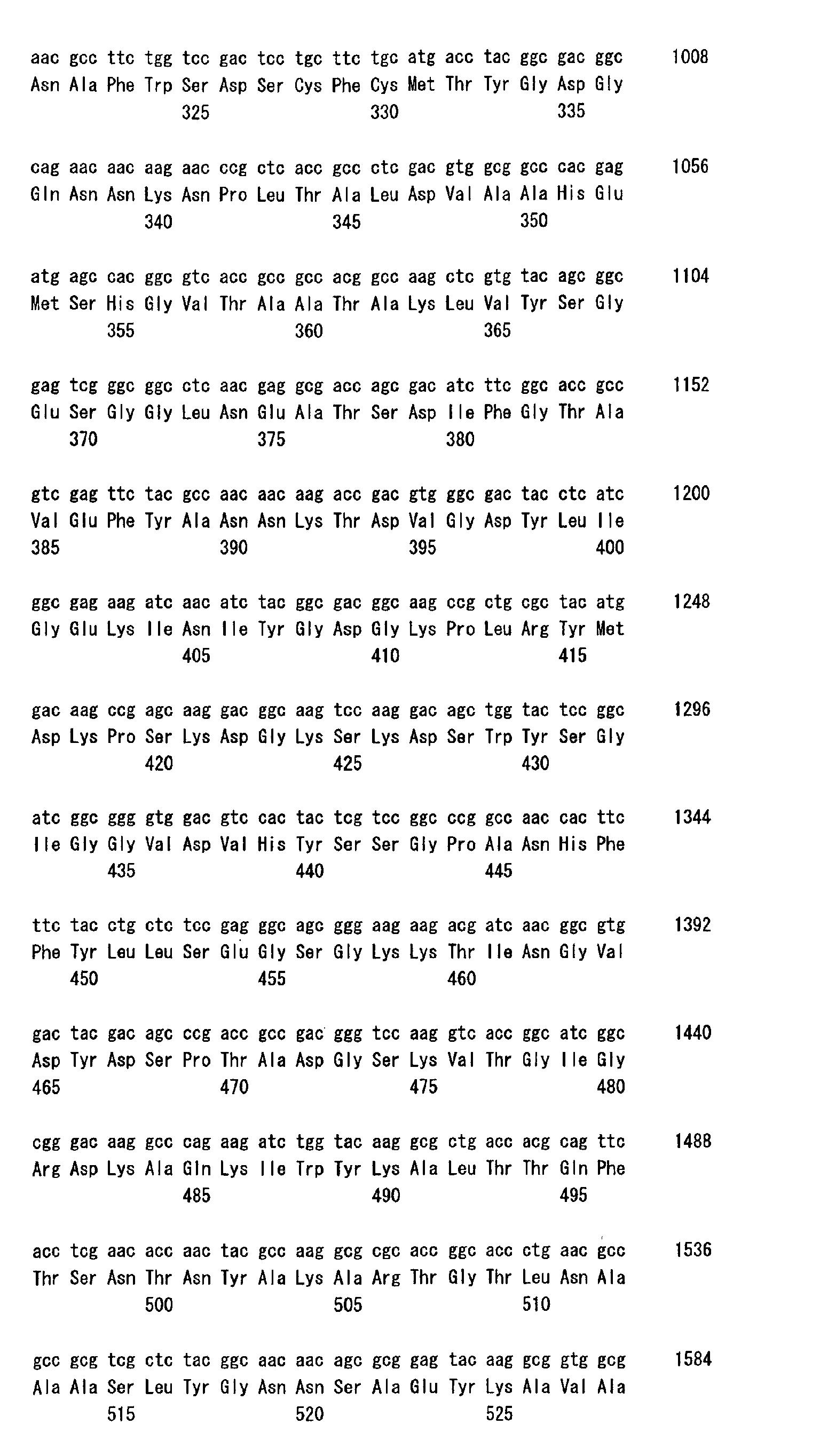
- the nucleotide sequence of this cloned fragment is shown in SEQ ID NO: 5.
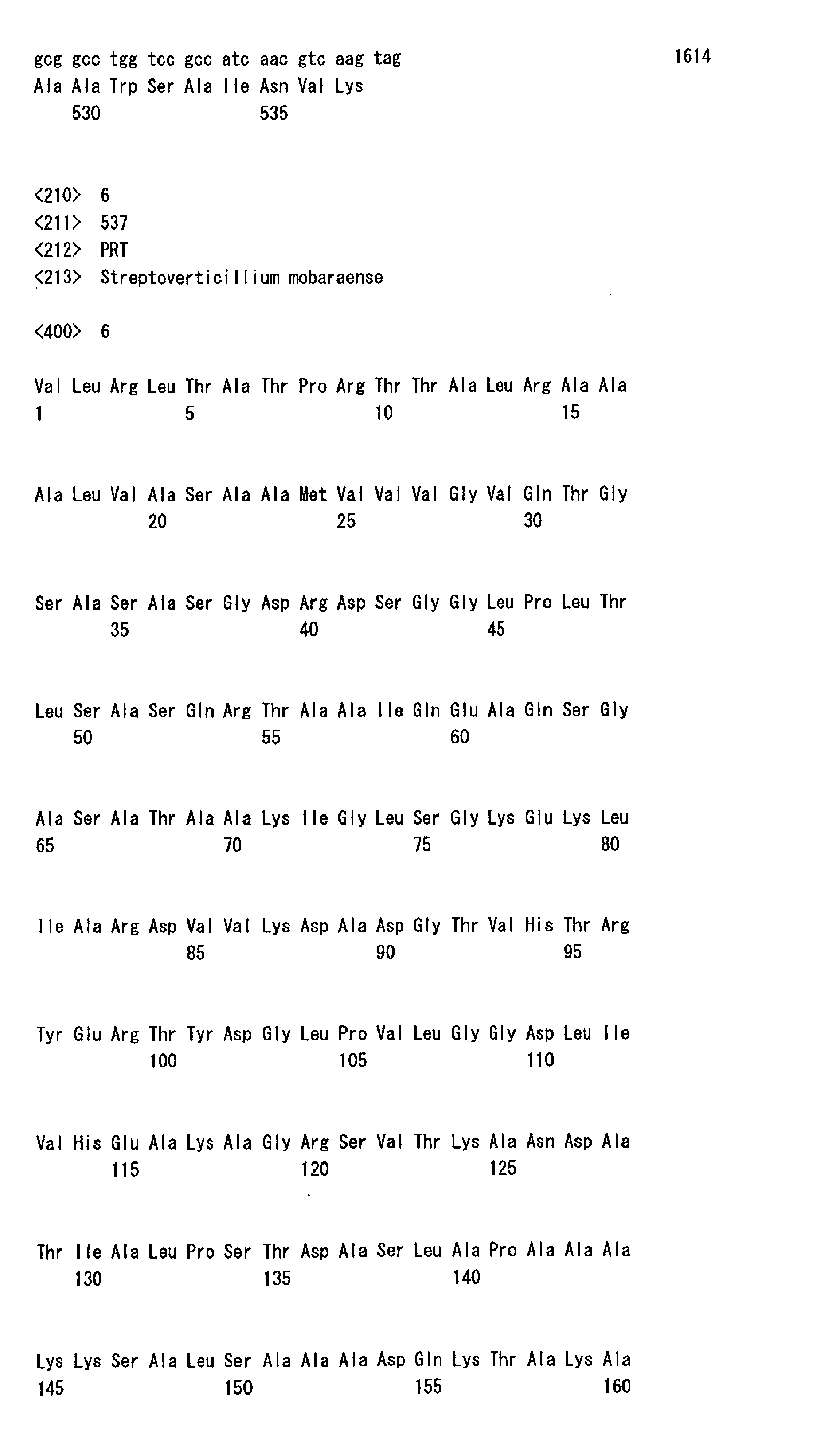
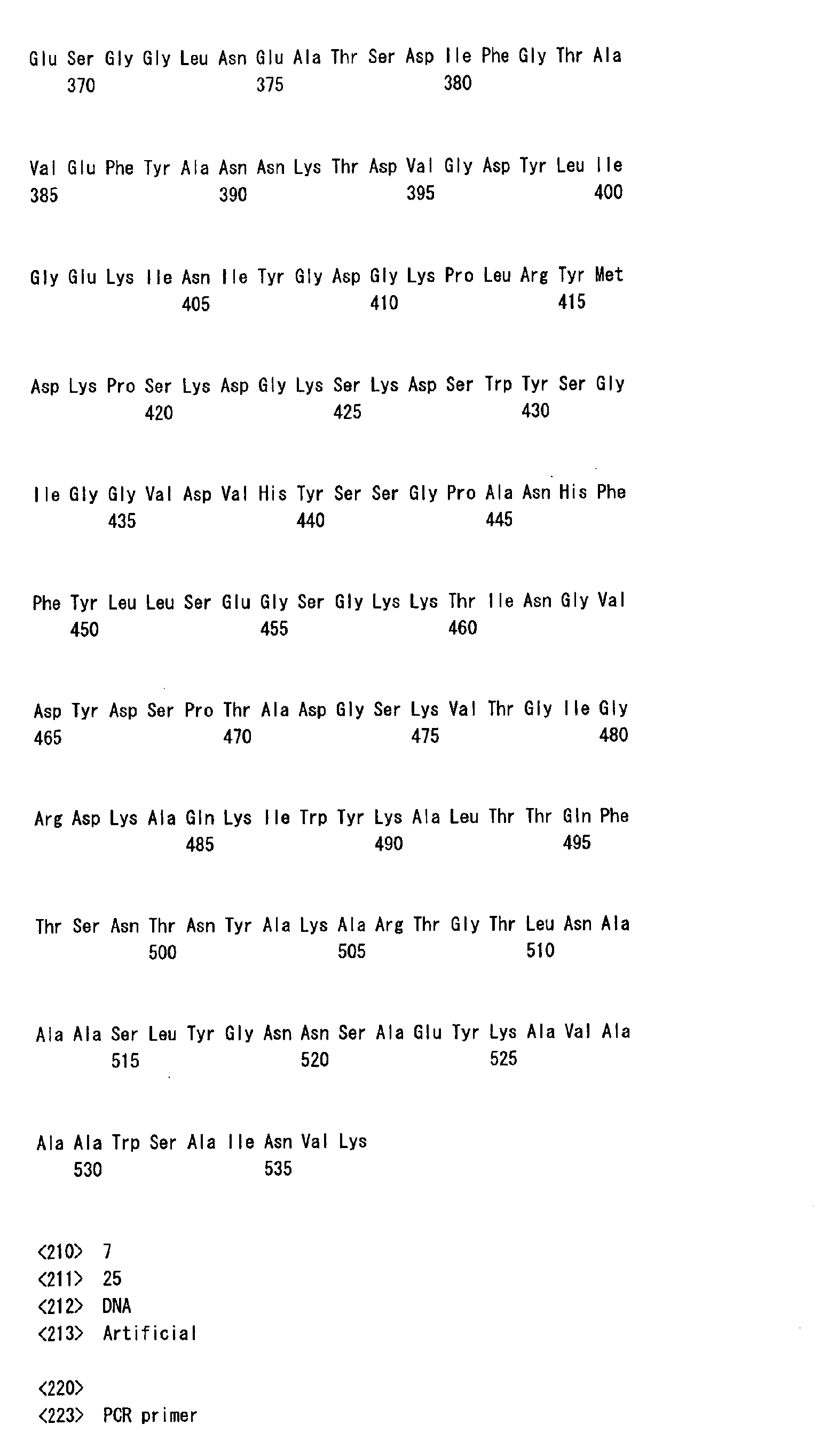
- the primary amino acid sequence encoded by this gene was deduced, which allowed the determination of the entire primary amino acid sequence of SVP35 containing the signal sequence of SVP35 including the amino acid sequence of previously determined N-terminal portion and the region assumed as a pro-structure part.
- the entire amino acid sequence of SVP35 is shown in SEQ ID NO: 6. It is presumed that amino acids nos. 1-36 of amino acid sequence described in SEQ ID NO: 6 refer to the signal sequence, amino acids nos. 37-216 refer to the pro-structure part, and amino acids nos. 217-537 correspond to the mature SVP35.
- Primers shown in SEQ ID NO: 7 and SEQ ID NO: 8 were synthesized using pVSV1 as a template on referring to the sequence of SEQ ID NO: 5, and the gene region containing the pro-structure part of SVP35 and the mature SVP35 was amplified by PCR technique.
- Pyrobest DNA polymerase (Takarasyuzo Co. Ltd.) was used and the reaction condition followed the protocol recommended by the manufacturer.
- cell surface protein of C.ammoniagenes was amplified by PCR technique using the combination of oligonucleotides of SEQ ID NO: 9 and SEQ ID NO: 10.
- the primer shown in SEQ ID NO: 10 contains the sequence encoding the N-terminal amino acids of SVP35 having a pro-structure part.
- the gene of the heterologous fusion pre-pro SVP35 gene fragment which was connected to the 5'-upstream region comprising the promoter region of PS2 gene and the signal sequence of SipA, the cell surface protein, from C.ammoniagenes, was amplified by performing cross-over PCR with SEQ ID NO: 8 and SEQ ID NO: 9 using the mixture of 1 ⁇ l of each of the amplified PCR solution.
- the amplified fragment of about 2.3 kb was detected by agarose gel electrophoresis.
- the PCR product was subjected to agarose gel electrophoresis to recover a fragment of about 2.3 kb, and after blunting its ends using DNA Blunting Kit (Takarasyuzo Co.
- the fragment was inserted into Smal site of pCV7 as described in JP-Kokai No. 9-070291 to obtain pVSV1.
- the nucleotide sequence of the inserted fragment was determined according to the conventional method to confirm that the fusion gene was constructed as expected.
- C. glutamicum ATCC13869 was transformed with the constructed pVSV1 and the strains grown on the CM2S agar medium comprising 5 mg/l of chloramphenicol (10 g of yeast extract, 10 g of tryptone, 5 g of sucrose, 5 g of NaCl, 15 g of agar per liter of distilled water) were selected. Then, the selected C.
- chloramphenicol 10 g of yeast extract, 10 g of tryptone, 5 g of sucrose, 5 g of NaCl, 15 g of agar per liter of distilled water
- glutamicum ATCC13869 harboring pVSV1 was cultured in MMTG culture medium (60 g of glucose, 0.4 g of magnesium sulfate heptahydrate, 30 g of ammonium sulfate, 1 g of potassium dihydrogenphosphate, 0.01 g of ferrous sulfate heptahydrate, 0.01 g of manganese sulfate pentahydrate, 450 ⁇ g of thiamine hydrochloride, 450 ⁇ g of biotin, 0.15 g of DL-methionine, 50 g of calcium carbonate per liter of distilled water, adjusted to pH 7.5) comprising 5 mg/l of chloramphenicol at 30 °C for 30 hours.
- MMTG culture medium 60 g of glucose, 0.4 g of magnesium sulfate heptahydrate, 30 g of ammonium sulfate, 1 g of potassium dihydrogenphosphate, 0.01 g of ferrous sulfate h
- Example 2 Conversion of transglutaminase produced by Streptoverticillium mobaraense IFO 13819 precursor (pro MTG) into an active form
- SAM-P45 generated only insufficient transglutaminase activity even at an amount of 1/50 of the substrate, and that the complete conversion to the active form was not observed.
- SAM-P45 was added at an amount of 1/10 of the substrate, the conversion into the active MTG was observed, but the decrease in the amount and the activity of MTG-protein were observed. This suggests that over-decomposition of the mature MTG occurred by SAM-P45.
- the present invention provides a new protease from an actinomycetes, Streptoverticillium mobaraense, which specifically cleaves the pro-structure part of transglutaminase precursor to activate it, and the gene thereof.
- the new protease according to the present invention can be expressed in a large amount by a coryneform bacterium, and thereby the present invention provides a method for producing transglutaminase from microorganisms efficiently.
- the advantage of using the neutral metalloproteases from actinomycetes according to the present invention for the production of an active MTG is that these enzymes have a strong activities of selectively cleaving the pro-structure part of the pro MTG, and that these enzymes can be expressed extracellularly by a coryneform bacterium.
- the pro MTG from actinomycetes can be efficiently expressed and secreted by a coryneform bacterium, it is possible to produce more efficiently an active MTG by a single bacterial cell by co-expressing and secreting the pro MTG and the neutral metalloprotease. In this instance, it is sufficient to express the neutral metalloprotease in only an amount required and sufficient for cleaving the pro-structure part of the pro MTG.
Landscapes
- Health & Medical Sciences (AREA)
- Life Sciences & Earth Sciences (AREA)
- Chemical & Material Sciences (AREA)
- Engineering & Computer Science (AREA)
- Genetics & Genomics (AREA)
- Zoology (AREA)
- Organic Chemistry (AREA)
- Bioinformatics & Cheminformatics (AREA)
- Wood Science & Technology (AREA)
- Biomedical Technology (AREA)
- General Engineering & Computer Science (AREA)
- Biotechnology (AREA)
- Microbiology (AREA)
- Biochemistry (AREA)
- Molecular Biology (AREA)
- General Health & Medical Sciences (AREA)
- Medicinal Chemistry (AREA)
- Physics & Mathematics (AREA)
- Biophysics (AREA)
- Plant Pathology (AREA)
- Enzymes And Modification Thereof (AREA)
- Micro-Organisms Or Cultivation Processes Thereof (AREA)
- Preparation Of Compounds By Using Micro-Organisms (AREA)
Abstract
Description



Claims (8)
- A method of producing an active microbial transglutaminase from a microbial protransglutaminase, comprising culturing a microorganism into which a gene encoding a neutral metalloprotease from actinomycetes has been introduced, thereby producing the neutral metalloprotease, cleaving a pro-structure part of the protransglutaminase by the neutral metalloprotease which is produced by the microorganism.
- The method according to claim 1, wherein the microorganism into which a gene encoding a neutral metalloprotease from actinomycetes is a coryneform bacterium.
- The method according to claim 1, wherein the neutral metalloprotease from actinomycetes is characterized in that1) it has a molecular weight of about 35,000;2) it has the optimum pH of pH7.0;3) it is stable at pH of pH4-10;4) it has the optimum temperature of about 45°C;5) it is stable below about 50°C; and6) it is strongly inhibited by ethylene diamine tetraacetic acid, 1,10- phenanthroline and phosphoramidon which are metalloprotease inhibitors, and by Streptomyces subtilisin inhibitor (SSI) from actinomycetes.
- The method according to claim 1, wherein the neutral metalloprotease from actinomycetes is characterized in that1) it has a molecular weight of about 71,000;2) it has the optimum pH of 7.0;3) it is stable at pH of 5-10;4) it has the optimum temperature of about 55°C; and5) it is strongly inhibited by ethylene diamine tetraacetic acid, 1,10-phenanthroline and phosphoramidon which are metalloprotease inhibitors, dithiothreitol which is a SH-reductant, and by Streptomyces subtilisin inhibitor (SSI) derived from actinomycetes.
- A neutral metalloprotease from actinomycetes characterized in that1) it has a molecular weight of about 35,000;2) it has the optimum pH of 7.0;3) it is stable at pH of 4-10;4) it has the optimum temperature of about 45°C;5) it is stable below about 50°C; and6) it is strongly inhibited by ethylene diamine tetraacetic acid, 1,10- phenanthroline and phosphoramidon which are metalloprotease inhibitors, and by Streptomyces subtilisin inhibitor (SSI) derived from actinomycetes.
- A neutral metalloprotease from actinomycetes characterized in that1) it has a molecular weight of about 71,000;2) it has the optimum pH of 7.0;3) it is stable at pH of 5-10;4) it has the optimum temperature of about 55°C; and5) it is strongly inhibited by ethylene diamine tetraacetic acid, 1,10-phenanthroline and phosphoramidon which are metalloprotease inhibitors, dithiothreitol which is a SH-reductant, and by Streptomyces subtilisin inhibitor (SSI) derived from actinomycetes.
- A nucleic acid molecule encoding the neutral metalloprotease from actinomycetes according to claim 5 or 6.
- A method of producing a neutral metalloprotease from actinomycetes, comprising culturing a coryneform bacterium into which the nucleic acid molecule according to claim 7 has been introduced and recovering the neutral metalloprotease from actinomycetes which is secreted extracellularly.
Applications Claiming Priority (3)
| Application Number | Priority Date | Filing Date | Title |
|---|---|---|---|
| JP2003061623 | 2003-03-07 | ||
| JP2003061623 | 2003-03-07 | ||
| PCT/JP2004/002923 WO2004078973A1 (en) | 2003-03-07 | 2004-03-05 | Process for producing microbial transglutaminase |
Publications (3)
| Publication Number | Publication Date |
|---|---|
| EP1602722A1 true EP1602722A1 (en) | 2005-12-07 |
| EP1602722A4 EP1602722A4 (en) | 2006-08-02 |
| EP1602722B1 EP1602722B1 (en) | 2011-01-26 |
Family
ID=32958965
Family Applications (1)
| Application Number | Title | Priority Date | Filing Date |
|---|---|---|---|
| EP04717856A Expired - Lifetime EP1602722B1 (en) | 2003-03-07 | 2004-03-05 | Process for producing microbial transglutaminase |
Country Status (13)
| Country | Link |
|---|---|
| US (2) | US7704707B2 (en) |
| EP (1) | EP1602722B1 (en) |
| JP (1) | JP4482938B2 (en) |
| KR (1) | KR20050106502A (en) |
| CN (1) | CN100381569C (en) |
| AT (1) | ATE496995T1 (en) |
| BR (1) | BRPI0407911A (en) |
| CA (1) | CA2518049C (en) |
| DE (1) | DE602004031198D1 (en) |
| DK (1) | DK1602722T3 (en) |
| ES (1) | ES2356149T3 (en) |
| RU (1) | RU2316594C2 (en) |
| WO (1) | WO2004078973A1 (en) |
Cited By (2)
| Publication number | Priority date | Publication date | Assignee | Title |
|---|---|---|---|---|
| EP2774982A4 (en) * | 2011-11-02 | 2015-03-18 | Ajinomoto Kk | PROCESS FOR SECRETION AND PRODUCTION OF PROTEINS |
| US9187554B2 (en) | 2011-11-02 | 2015-11-17 | Ajinomoto Co., Inc. | Method for secretory production of protein |
Families Citing this family (21)
| Publication number | Priority date | Publication date | Assignee | Title |
|---|---|---|---|---|
| BRPI0016995B1 (en) * | 2000-01-21 | 2016-03-08 | Ajinomoto Kk | genetically modified escherichia coli bacteria, and method for producing l-lysine |
| CA2518049C (en) * | 2003-03-07 | 2013-05-07 | Ajinomoto Co., Inc. | Method of producing microbial transglutaminase |
| DK1748077T3 (en) * | 2004-04-20 | 2013-04-08 | Ajinomoto Kk | PROCEDURE FOR PRODUCING PROTEIN |
| JP4631436B2 (en) * | 2004-12-22 | 2011-02-16 | 岡山県 | Metalloendopeptidase |
| CN101248176B (en) * | 2005-08-30 | 2011-05-11 | 味之素株式会社 | Method for preparing transglutaminase-containing products with reduced protease activity |
| TW200801198A (en) * | 2005-08-30 | 2008-01-01 | Ajinomoto Kk | Method for measuring protease activity of transglutaminase and transglutaminase composition |
| JPWO2008099898A1 (en) * | 2007-02-15 | 2010-05-27 | 味の素株式会社 | Disulfide bond-introduced transglutaminase |
| EP2138049B1 (en) | 2007-03-29 | 2014-06-25 | Ajinomoto Co., Inc. | Enzyme preparation for adhesion and method of producing adhesion-molded food product |
| KR20100085083A (en) | 2007-11-19 | 2010-07-28 | 아지노모토 가부시키가이샤 | Processed fiber product, and method for production thereof |
| WO2009102050A1 (en) * | 2008-02-15 | 2009-08-20 | Ajinomoto Co., Inc. | Intestinal immune system stimulator |
| WO2010005099A1 (en) * | 2008-07-09 | 2010-01-14 | 味の素株式会社 | Method for producing aminohydroxybenzoic acid |
| TWI444146B (en) | 2008-09-25 | 2014-07-11 | Ajinomoto Kk | Enzyme preparations for bound and formed foods and methods for producing bound and formed foods |
| WO2010101256A1 (en) | 2009-03-06 | 2010-09-10 | 味の素株式会社 | Thermotolerant transglutaminase originating in actinomyces |
| CN107365388B (en) | 2011-06-23 | 2021-05-14 | 味之素株式会社 | Method for preparing polymer protein |
| CN103917656B (en) | 2011-10-25 | 2016-09-28 | 味之素株式会社 | The secretion production method of protein |
| JP6183358B2 (en) | 2012-05-29 | 2017-08-23 | 味の素株式会社 | Method for producing 3-acetylamino-4-hydroxybenzoic acid |
| EP3218473B1 (en) * | 2014-11-10 | 2020-04-08 | Novozymes A/S | Metalloproteases and uses thereof |
| CN108103041A (en) * | 2018-02-02 | 2018-06-01 | 泰兴市东圣生物科技有限公司 | A kind of thermostabilization microbial transglutaminase and its encoding gene |
| CN113528478B (en) * | 2020-04-13 | 2023-01-20 | 中国科学院微生物研究所 | Method for efficiently producing transglutaminase and special engineering bacteria thereof |
| CN113528479B (en) * | 2020-04-13 | 2023-01-24 | 中国科学院微生物研究所 | Efficient preparation method of transglutaminase and special engineering bacteria thereof |
| KR102277403B1 (en) * | 2021-01-27 | 2021-07-14 | 씨제이제일제당 주식회사 | Novel ribonuclease P variant and a method for producing L-glutamic acid using the same |
Family Cites Families (11)
| Publication number | Priority date | Publication date | Assignee | Title |
|---|---|---|---|---|
| JPH0665280B2 (en) * | 1987-03-04 | 1994-08-24 | 味の素株式会社 | Protein gelling agent and protein gelling method using the same |
| TW306932B (en) * | 1993-08-27 | 1997-06-01 | Holland Sweetener Co | |
| DE69535037T2 (en) * | 1994-08-26 | 2006-12-07 | Novozymes A/S | Microbial transglutaminases, their preparation and their use |
| JPH0970291A (en) | 1995-06-30 | 1997-03-18 | Ajinomoto Co Inc | Gene amplification method using artificial transposon |
| CN1174889A (en) * | 1997-06-16 | 1998-03-04 | 中国医学科学院医药生物技术研究所 | A novel plasminase produced by Streptomyces |
| ATE532870T1 (en) * | 1999-09-30 | 2011-11-15 | Ajinomoto Kk | METHOD FOR PRODUCING TRANSGLUTAMINASE |
| RU2224796C2 (en) * | 1999-09-30 | 2004-02-27 | Адзиномото Ко., Инк. | Method for preparing heterologous secretory protein |
| DE60234247D1 (en) * | 2001-03-30 | 2009-12-17 | Ajinomoto Kk | PROCESS FOR THE SECRETION AND PRODUCTION OF PROTEIN |
| RU2209244C2 (en) * | 2001-04-28 | 2003-07-27 | Закрытое акционерное общество "АСГЛ-Фармацевтические Инновации" | Nucleic acid encoding leader sequence (variants), vector based on plasmid p6803-platform (variants), leader peptide (variants) and method for preparing proteins |
| CA2518049C (en) * | 2003-03-07 | 2013-05-07 | Ajinomoto Co., Inc. | Method of producing microbial transglutaminase |
| DK1748077T3 (en) * | 2004-04-20 | 2013-04-08 | Ajinomoto Kk | PROCEDURE FOR PRODUCING PROTEIN |
-
2004
- 2004-03-05 CA CA2518049A patent/CA2518049C/en not_active Expired - Lifetime
- 2004-03-05 JP JP2005503155A patent/JP4482938B2/en not_active Expired - Fee Related
- 2004-03-05 RU RU2005127869/13A patent/RU2316594C2/en active
- 2004-03-05 BR BRPI0407911-6A patent/BRPI0407911A/en not_active Application Discontinuation
- 2004-03-05 ES ES04717856T patent/ES2356149T3/en not_active Expired - Lifetime
- 2004-03-05 DK DK04717856.1T patent/DK1602722T3/en active
- 2004-03-05 AT AT04717856T patent/ATE496995T1/en not_active IP Right Cessation
- 2004-03-05 EP EP04717856A patent/EP1602722B1/en not_active Expired - Lifetime
- 2004-03-05 CN CNB2004800062248A patent/CN100381569C/en not_active Expired - Fee Related
- 2004-03-05 WO PCT/JP2004/002923 patent/WO2004078973A1/en not_active Ceased
- 2004-03-05 KR KR1020057016640A patent/KR20050106502A/en not_active Ceased
- 2004-03-05 DE DE602004031198T patent/DE602004031198D1/en not_active Expired - Lifetime
-
2005
- 2005-09-06 US US11/218,780 patent/US7704707B2/en not_active Expired - Lifetime
-
2010
- 2010-03-01 US US12/714,853 patent/US8105802B2/en not_active Expired - Lifetime
Non-Patent Citations (2)
| Title |
|---|
| DATABASE UniProt 1 October 2000 (2000-10-01), BENTLY ET AL: "Putative neutral zinc metalloprotease" XP002386174 retrieved from EBI Database accession no. Q9L1F8 & BENTLEY S D ET AL: "Complete genome sequence of the model actinomycete Streptomyces coelicolor A3(2)" NATURE (LONDON), vol. 417, no. 6885, 9 May 2002 (2002-05-09), pages 141-147, ISSN: 0028-0836 * |
| See also references of WO2004078973A1 * |
Cited By (4)
| Publication number | Priority date | Publication date | Assignee | Title |
|---|---|---|---|---|
| EP2774982A4 (en) * | 2011-11-02 | 2015-03-18 | Ajinomoto Kk | PROCESS FOR SECRETION AND PRODUCTION OF PROTEINS |
| AU2012333515B2 (en) * | 2011-11-02 | 2015-07-16 | Ajinomoto Co., Inc. | Method for secreting and producing proteins |
| US9187554B2 (en) | 2011-11-02 | 2015-11-17 | Ajinomoto Co., Inc. | Method for secretory production of protein |
| US9404138B2 (en) | 2011-11-02 | 2016-08-02 | Ajinomoto Co., Inc. | Method for secretory production of protein |
Also Published As
| Publication number | Publication date |
|---|---|
| EP1602722A4 (en) | 2006-08-02 |
| KR20050106502A (en) | 2005-11-09 |
| ES2356149T3 (en) | 2011-04-05 |
| JPWO2004078973A1 (en) | 2006-06-08 |
| CA2518049A1 (en) | 2004-09-16 |
| JP4482938B2 (en) | 2010-06-16 |
| US8105802B2 (en) | 2012-01-31 |
| RU2005127869A (en) | 2006-02-10 |
| WO2004078973A1 (en) | 2004-09-16 |
| CA2518049C (en) | 2013-05-07 |
| BRPI0407911A (en) | 2006-02-14 |
| US7704707B2 (en) | 2010-04-27 |
| US20060019367A1 (en) | 2006-01-26 |
| CN1759180A (en) | 2006-04-12 |
| US20100159560A1 (en) | 2010-06-24 |
| RU2316594C2 (en) | 2008-02-10 |
| DK1602722T3 (en) | 2011-05-16 |
| ATE496995T1 (en) | 2011-02-15 |
| DE602004031198D1 (en) | 2011-03-10 |
| CN100381569C (en) | 2008-04-16 |
| EP1602722B1 (en) | 2011-01-26 |
Similar Documents
| Publication | Publication Date | Title |
|---|---|---|
| US8105802B2 (en) | Method of producing microbial transglutaminase | |
| US7972829B2 (en) | Process for producing transglutaminase | |
| Verhaert et al. | Molecular cloning and analysis of the gene encoding the thermostable penicillin G acylase from Alcaligenes faecalis | |
| EP0726317B1 (en) | Bacillus-derived transglutaminase | |
| JP4362651B2 (en) | Protein secretory production | |
| EP0994191A1 (en) | System for expressing hyperthermostable protease | |
| Wu et al. | Over-production of stereoselective nitrile hydratase from Pseudomonas putida 5B in Escherichia coli: activity requires a novel downstream protein | |
| Otten et al. | Altering the substrate specificity of cephalosporin acylase by directed evolution of the β-subunit | |
| CN100523197C (en) | Feedback-resistant acetohydroxy acid synthetase mutants | |
| JP3408737B2 (en) | Protein involved in nitrile hydratase activation and gene encoding the same | |
| Arima et al. | Gene cloning and overproduction of an aminopeptidase from Streptomyces septatus TH-2, and comparison with a calcium-activated enzyme from Streptomyces griseus | |
| Komeda et al. | L-Stereoselective amino acid amidase with broad substrate specificity from Brevundimonas diminuta: characterization of a new member of the leucine aminopeptidase family | |
| Nandakumar et al. | Overexpression of salt-tolerant glutaminase frommicrococcus luteusk-3 inescherichia coliand its purification | |
| Ohmachi et al. | Identification, Cloning, and Sequencing of the Genes Involved in the Conversion of D, L-2-Amino-Δ2-Thiazoline-4-Carboxylic Acid to… | |
| Ryabchenko et al. | Cloning the amidase gene from Rhodococcus rhodochrous M8 and its expression in Escherichia coli | |
| EP1103612B1 (en) | Gene participating in the production of homo-glutamic acid and utilization thereof | |
| JP4489598B2 (en) | D-aminoacylase | |
| Hyun et al. | Alteration of substrate specificity of valine dehydrogenase from Streptomyces albus | |
| KR102405289B1 (en) | Polypeptide having cephalosporin c acylase activity and use thereof | |
| JP4627039B2 (en) | Polypeptide having amidase activity and gene thereof | |
| JP2006055131A (en) | Novel D-aminoacylase and gene thereof | |
| JP2010207168A (en) | Asparaginase | |
| KR20030001269A (en) | Activated rec-d-hydantoinases |
Legal Events
| Date | Code | Title | Description |
|---|---|---|---|
| PUAI | Public reference made under article 153(3) epc to a published international application that has entered the european phase |
Free format text: ORIGINAL CODE: 0009012 |
|
| 17P | Request for examination filed |
Effective date: 20050825 |
|
| AK | Designated contracting states |
Kind code of ref document: A1 Designated state(s): AT BE BG CH CY CZ DE DK EE ES FI FR GB GR HU IE IT LI LU MC NL PL PT RO SE SI SK TR |
|
| AX | Request for extension of the european patent |
Extension state: AL LT LV MK |
|
| DAX | Request for extension of the european patent (deleted) | ||
| A4 | Supplementary search report drawn up and despatched |
Effective date: 20060704 |
|
| 17Q | First examination report despatched |
Effective date: 20090211 |
|
| GRAP | Despatch of communication of intention to grant a patent |
Free format text: ORIGINAL CODE: EPIDOSNIGR1 |
|
| GRAS | Grant fee paid |
Free format text: ORIGINAL CODE: EPIDOSNIGR3 |
|
| GRAA | (expected) grant |
Free format text: ORIGINAL CODE: 0009210 |
|
| AK | Designated contracting states |
Kind code of ref document: B1 Designated state(s): AT BE BG CH CY CZ DE DK EE ES FI FR GB GR HU IE IT LI LU MC NL PL PT RO SE SI SK TR |
|
| REG | Reference to a national code |
Ref country code: GB Ref legal event code: FG4D |
|
| REG | Reference to a national code |
Ref country code: CH Ref legal event code: EP |
|
| REG | Reference to a national code |
Ref country code: IE Ref legal event code: FG4D |
|
| REF | Corresponds to: |
Ref document number: 602004031198 Country of ref document: DE Date of ref document: 20110310 Kind code of ref document: P |
|
| REG | Reference to a national code |
Ref country code: DE Ref legal event code: R096 Ref document number: 602004031198 Country of ref document: DE Effective date: 20110310 |
|
| REG | Reference to a national code |
Ref country code: ES Ref legal event code: FG2A Ref document number: 2356149 Country of ref document: ES Kind code of ref document: T3 Effective date: 20110405 |
|
| REG | Reference to a national code |
Ref country code: SE Ref legal event code: TRGR |
|
| REG | Reference to a national code |
Ref country code: NL Ref legal event code: T3 |
|
| REG | Reference to a national code |
Ref country code: DK Ref legal event code: T3 |
|
| PG25 | Lapsed in a contracting state [announced via postgrant information from national office to epo] |
Ref country code: GR Free format text: LAPSE BECAUSE OF FAILURE TO SUBMIT A TRANSLATION OF THE DESCRIPTION OR TO PAY THE FEE WITHIN THE PRESCRIBED TIME-LIMIT Effective date: 20110427 Ref country code: PT Free format text: LAPSE BECAUSE OF FAILURE TO SUBMIT A TRANSLATION OF THE DESCRIPTION OR TO PAY THE FEE WITHIN THE PRESCRIBED TIME-LIMIT Effective date: 20110526 |
|
| PG25 | Lapsed in a contracting state [announced via postgrant information from national office to epo] |
Ref country code: CY Free format text: LAPSE BECAUSE OF FAILURE TO SUBMIT A TRANSLATION OF THE DESCRIPTION OR TO PAY THE FEE WITHIN THE PRESCRIBED TIME-LIMIT Effective date: 20110126 Ref country code: PL Free format text: LAPSE BECAUSE OF FAILURE TO SUBMIT A TRANSLATION OF THE DESCRIPTION OR TO PAY THE FEE WITHIN THE PRESCRIBED TIME-LIMIT Effective date: 20110126 Ref country code: FI Free format text: LAPSE BECAUSE OF FAILURE TO SUBMIT A TRANSLATION OF THE DESCRIPTION OR TO PAY THE FEE WITHIN THE PRESCRIBED TIME-LIMIT Effective date: 20110126 Ref country code: BG Free format text: LAPSE BECAUSE OF FAILURE TO SUBMIT A TRANSLATION OF THE DESCRIPTION OR TO PAY THE FEE WITHIN THE PRESCRIBED TIME-LIMIT Effective date: 20110426 Ref country code: AT Free format text: LAPSE BECAUSE OF FAILURE TO SUBMIT A TRANSLATION OF THE DESCRIPTION OR TO PAY THE FEE WITHIN THE PRESCRIBED TIME-LIMIT Effective date: 20110126 Ref country code: SI Free format text: LAPSE BECAUSE OF FAILURE TO SUBMIT A TRANSLATION OF THE DESCRIPTION OR TO PAY THE FEE WITHIN THE PRESCRIBED TIME-LIMIT Effective date: 20110126 |
|
| PG25 | Lapsed in a contracting state [announced via postgrant information from national office to epo] |
Ref country code: EE Free format text: LAPSE BECAUSE OF FAILURE TO SUBMIT A TRANSLATION OF THE DESCRIPTION OR TO PAY THE FEE WITHIN THE PRESCRIBED TIME-LIMIT Effective date: 20110126 Ref country code: MC Free format text: LAPSE BECAUSE OF NON-PAYMENT OF DUE FEES Effective date: 20110331 |
|
| REG | Reference to a national code |
Ref country code: CH Ref legal event code: PL |
|
| PG25 | Lapsed in a contracting state [announced via postgrant information from national office to epo] |
Ref country code: RO Free format text: LAPSE BECAUSE OF FAILURE TO SUBMIT A TRANSLATION OF THE DESCRIPTION OR TO PAY THE FEE WITHIN THE PRESCRIBED TIME-LIMIT Effective date: 20110126 Ref country code: SK Free format text: LAPSE BECAUSE OF FAILURE TO SUBMIT A TRANSLATION OF THE DESCRIPTION OR TO PAY THE FEE WITHIN THE PRESCRIBED TIME-LIMIT Effective date: 20110126 Ref country code: CZ Free format text: LAPSE BECAUSE OF FAILURE TO SUBMIT A TRANSLATION OF THE DESCRIPTION OR TO PAY THE FEE WITHIN THE PRESCRIBED TIME-LIMIT Effective date: 20110126 |
|
| PLBE | No opposition filed within time limit |
Free format text: ORIGINAL CODE: 0009261 |
|
| STAA | Information on the status of an ep patent application or granted ep patent |
Free format text: STATUS: NO OPPOSITION FILED WITHIN TIME LIMIT |
|
| 26N | No opposition filed |
Effective date: 20111027 |
|
| REG | Reference to a national code |
Ref country code: IE Ref legal event code: MM4A |
|
| PG25 | Lapsed in a contracting state [announced via postgrant information from national office to epo] |
Ref country code: CH Free format text: LAPSE BECAUSE OF NON-PAYMENT OF DUE FEES Effective date: 20110331 Ref country code: LI Free format text: LAPSE BECAUSE OF NON-PAYMENT OF DUE FEES Effective date: 20110331 Ref country code: IE Free format text: LAPSE BECAUSE OF NON-PAYMENT OF DUE FEES Effective date: 20110305 |
|
| REG | Reference to a national code |
Ref country code: DE Ref legal event code: R097 Ref document number: 602004031198 Country of ref document: DE Effective date: 20111027 |
|
| PG25 | Lapsed in a contracting state [announced via postgrant information from national office to epo] |
Ref country code: LU Free format text: LAPSE BECAUSE OF NON-PAYMENT OF DUE FEES Effective date: 20110305 |
|
| PG25 | Lapsed in a contracting state [announced via postgrant information from national office to epo] |
Ref country code: TR Free format text: LAPSE BECAUSE OF FAILURE TO SUBMIT A TRANSLATION OF THE DESCRIPTION OR TO PAY THE FEE WITHIN THE PRESCRIBED TIME-LIMIT Effective date: 20110126 |
|
| PG25 | Lapsed in a contracting state [announced via postgrant information from national office to epo] |
Ref country code: HU Free format text: LAPSE BECAUSE OF FAILURE TO SUBMIT A TRANSLATION OF THE DESCRIPTION OR TO PAY THE FEE WITHIN THE PRESCRIBED TIME-LIMIT Effective date: 20110126 |
|
| PGFP | Annual fee paid to national office [announced via postgrant information from national office to epo] |
Ref country code: SE Payment date: 20150311 Year of fee payment: 12 |
|
| PGFP | Annual fee paid to national office [announced via postgrant information from national office to epo] |
Ref country code: BE Payment date: 20150311 Year of fee payment: 12 |
|
| REG | Reference to a national code |
Ref country code: FR Ref legal event code: PLFP Year of fee payment: 13 |
|
| PG25 | Lapsed in a contracting state [announced via postgrant information from national office to epo] |
Ref country code: BE Free format text: LAPSE BECAUSE OF NON-PAYMENT OF DUE FEES Effective date: 20160331 |
|
| REG | Reference to a national code |
Ref country code: SE Ref legal event code: EUG |
|
| PG25 | Lapsed in a contracting state [announced via postgrant information from national office to epo] |
Ref country code: SE Free format text: LAPSE BECAUSE OF NON-PAYMENT OF DUE FEES Effective date: 20160306 |
|
| REG | Reference to a national code |
Ref country code: FR Ref legal event code: PLFP Year of fee payment: 14 |
|
| REG | Reference to a national code |
Ref country code: FR Ref legal event code: PLFP Year of fee payment: 15 |
|
| PGFP | Annual fee paid to national office [announced via postgrant information from national office to epo] |
Ref country code: GB Payment date: 20220127 Year of fee payment: 19 Ref country code: DK Payment date: 20220309 Year of fee payment: 19 Ref country code: DE Payment date: 20220203 Year of fee payment: 19 |
|
| PGFP | Annual fee paid to national office [announced via postgrant information from national office to epo] |
Ref country code: NL Payment date: 20220215 Year of fee payment: 19 Ref country code: IT Payment date: 20220210 Year of fee payment: 19 Ref country code: FR Payment date: 20220209 Year of fee payment: 19 |
|
| PGFP | Annual fee paid to national office [announced via postgrant information from national office to epo] |
Ref country code: ES Payment date: 20220401 Year of fee payment: 19 |
|
| REG | Reference to a national code |
Ref country code: DE Ref legal event code: R119 Ref document number: 602004031198 Country of ref document: DE |
|
| REG | Reference to a national code |
Ref country code: DK Ref legal event code: EBP Effective date: 20230331 |
|
| REG | Reference to a national code |
Ref country code: NL Ref legal event code: MM Effective date: 20230401 |
|
| GBPC | Gb: european patent ceased through non-payment of renewal fee |
Effective date: 20230305 |
|
| PG25 | Lapsed in a contracting state [announced via postgrant information from national office to epo] |
Ref country code: NL Free format text: LAPSE BECAUSE OF NON-PAYMENT OF DUE FEES Effective date: 20230401 |
|
| PG25 | Lapsed in a contracting state [announced via postgrant information from national office to epo] |
Ref country code: GB Free format text: LAPSE BECAUSE OF NON-PAYMENT OF DUE FEES Effective date: 20230305 |
|
| PG25 | Lapsed in a contracting state [announced via postgrant information from national office to epo] |
Ref country code: GB Free format text: LAPSE BECAUSE OF NON-PAYMENT OF DUE FEES Effective date: 20230305 Ref country code: FR Free format text: LAPSE BECAUSE OF NON-PAYMENT OF DUE FEES Effective date: 20230331 Ref country code: DE Free format text: LAPSE BECAUSE OF NON-PAYMENT OF DUE FEES Effective date: 20231003 |
|
| PG25 | Lapsed in a contracting state [announced via postgrant information from national office to epo] |
Ref country code: ES Free format text: LAPSE BECAUSE OF NON-PAYMENT OF DUE FEES Effective date: 20230306 |
|
| REG | Reference to a national code |
Ref country code: ES Ref legal event code: FD2A Effective date: 20240426 |
|
| PG25 | Lapsed in a contracting state [announced via postgrant information from national office to epo] |
Ref country code: IT Free format text: LAPSE BECAUSE OF NON-PAYMENT OF DUE FEES Effective date: 20230305 Ref country code: ES Free format text: LAPSE BECAUSE OF NON-PAYMENT OF DUE FEES Effective date: 20230306 Ref country code: DK Free format text: LAPSE BECAUSE OF NON-PAYMENT OF DUE FEES Effective date: 20230331 |