EP1602236B1 - Method to transmit and receive font information in streaming systems - Google Patents
Method to transmit and receive font information in streaming systems Download PDFInfo
- Publication number
- EP1602236B1 EP1602236B1 EP04705813.6A EP04705813A EP1602236B1 EP 1602236 B1 EP1602236 B1 EP 1602236B1 EP 04705813 A EP04705813 A EP 04705813A EP 1602236 B1 EP1602236 B1 EP 1602236B1
- Authority
- EP
- European Patent Office
- Prior art keywords
- font
- elementary stream
- font information
- information
- text
- Prior art date
- Legal status (The legal status is an assumption and is not a legal conclusion. Google has not performed a legal analysis and makes no representation as to the accuracy of the status listed.)
- Expired - Lifetime
Links
Images

Classifications
-
- H—ELECTRICITY
- H04—ELECTRIC COMMUNICATION TECHNIQUE
- H04N—PICTORIAL COMMUNICATION, e.g. TELEVISION
- H04N21/00—Selective content distribution, e.g. interactive television or video on demand [VOD]
- H04N21/20—Servers specifically adapted for the distribution of content, e.g. VOD servers; Operations thereof
- H04N21/23—Processing of content or additional data; Elementary server operations; Server middleware
- H04N21/235—Processing of additional data, e.g. scrambling of additional data or processing content descriptors
-
- G—PHYSICS
- G06—COMPUTING OR CALCULATING; COUNTING
- G06F—ELECTRIC DIGITAL DATA PROCESSING
- G06F3/00—Input arrangements for transferring data to be processed into a form capable of being handled by the computer; Output arrangements for transferring data from processing unit to output unit, e.g. interface arrangements
- G06F3/14—Digital output to display device ; Cooperation and interconnection of the display device with other functional units
-
- G—PHYSICS
- G06—COMPUTING OR CALCULATING; COUNTING
- G06F—ELECTRIC DIGITAL DATA PROCESSING
- G06F40/00—Handling natural language data
- G06F40/10—Text processing
- G06F40/103—Formatting, i.e. changing of presentation of documents
- G06F40/109—Font handling; Temporal or kinetic typography
-
- G—PHYSICS
- G09—EDUCATION; CRYPTOGRAPHY; DISPLAY; ADVERTISING; SEALS
- G09G—ARRANGEMENTS OR CIRCUITS FOR CONTROL OF INDICATING DEVICES USING STATIC MEANS TO PRESENT VARIABLE INFORMATION
- G09G5/00—Control arrangements or circuits for visual indicators common to cathode-ray tube indicators and other visual indicators
- G09G5/22—Control arrangements or circuits for visual indicators common to cathode-ray tube indicators and other visual indicators characterised by the display of characters or indicia using display control signals derived from coded signals representing the characters or indicia, e.g. with a character-code memory
- G09G5/222—Control of the character-code memory
- G09G5/225—Control of the character-code memory comprising a loadable character generator
-
- H—ELECTRICITY
- H04—ELECTRIC COMMUNICATION TECHNIQUE
- H04N—PICTORIAL COMMUNICATION, e.g. TELEVISION
- H04N21/00—Selective content distribution, e.g. interactive television or video on demand [VOD]
- H04N21/20—Servers specifically adapted for the distribution of content, e.g. VOD servers; Operations thereof
- H04N21/23—Processing of content or additional data; Elementary server operations; Server middleware
- H04N21/234—Processing of video elementary streams, e.g. splicing of video streams or manipulating encoded video stream scene graphs
- H04N21/23412—Processing of video elementary streams, e.g. splicing of video streams or manipulating encoded video stream scene graphs for generating or manipulating the scene composition of objects, e.g. MPEG-4 objects
-
- H—ELECTRICITY
- H04—ELECTRIC COMMUNICATION TECHNIQUE
- H04N—PICTORIAL COMMUNICATION, e.g. TELEVISION
- H04N21/00—Selective content distribution, e.g. interactive television or video on demand [VOD]
- H04N21/20—Servers specifically adapted for the distribution of content, e.g. VOD servers; Operations thereof
- H04N21/23—Processing of content or additional data; Elementary server operations; Server middleware
- H04N21/234—Processing of video elementary streams, e.g. splicing of video streams or manipulating encoded video stream scene graphs
- H04N21/2343—Processing of video elementary streams, e.g. splicing of video streams or manipulating encoded video stream scene graphs involving reformatting operations of video signals for distribution or compliance with end-user requests or end-user device requirements
- H04N21/234318—Processing of video elementary streams, e.g. splicing of video streams or manipulating encoded video stream scene graphs involving reformatting operations of video signals for distribution or compliance with end-user requests or end-user device requirements by decomposing into objects, e.g. MPEG-4 objects
-
- H—ELECTRICITY
- H04—ELECTRIC COMMUNICATION TECHNIQUE
- H04N—PICTORIAL COMMUNICATION, e.g. TELEVISION
- H04N21/00—Selective content distribution, e.g. interactive television or video on demand [VOD]
- H04N21/40—Client devices specifically adapted for the reception of or interaction with content, e.g. set-top-box [STB]; Operations thereof
- H04N21/43—Processing of content or additional data, e.g. demultiplexing additional data from a digital video stream; Elementary client operations, e.g. monitoring of home network or synchronising decoder's clock; Client middleware
- H04N21/44—Processing of video elementary streams, e.g. splicing a video clip retrieved from local storage with an incoming video stream or rendering scenes according to encoded video stream scene graphs
- H04N21/44012—Processing of video elementary streams, e.g. splicing a video clip retrieved from local storage with an incoming video stream or rendering scenes according to encoded video stream scene graphs involving rendering scenes according to scene graphs, e.g. MPEG-4 scene graphs
-
- H—ELECTRICITY
- H04—ELECTRIC COMMUNICATION TECHNIQUE
- H04N—PICTORIAL COMMUNICATION, e.g. TELEVISION
- H04N21/00—Selective content distribution, e.g. interactive television or video on demand [VOD]
- H04N21/40—Client devices specifically adapted for the reception of or interaction with content, e.g. set-top-box [STB]; Operations thereof
- H04N21/47—End-user applications
- H04N21/472—End-user interface for requesting content, additional data or services; End-user interface for interacting with content, e.g. for content reservation or setting reminders, for requesting event notification, for manipulating displayed content
- H04N21/47205—End-user interface for requesting content, additional data or services; End-user interface for interacting with content, e.g. for content reservation or setting reminders, for requesting event notification, for manipulating displayed content for manipulating displayed content, e.g. interacting with MPEG-4 objects, editing locally
Definitions
- This invention relates to font information that is usable for electronic devices containing a display, and in particular a method for transmitting, receiving and updating said font information.
- an audio/video (AV) scene can be composed from several audio, video and synthetic 2D/3D objects that can be coded with different MPEG-4 format coding types and can be transmitted as binary compressed data in a multiplexed bitstream, comprising audio, video and other substreams, e.g. text to be displayed.
- a substream is also referred to as Elementary Stream (ES), and can be accessed through a descriptor.
- ES Elementary Stream
- a scene is generally understood as an audio-visual space that a user can interact with.
- composition means mixing multiple individual AV objects, e.g. a presentation of a video with related audio and text, after reconstruction of packets and separate decoding of their respective ES.
- User interaction, terminal capability, and terminal configuration may be used when determining how to compose a scene at a receiver terminal.
- the bitstream defined in the mentioned MPEG-4 standard contains an ES called 'Scene Description Stream' being a set of general instructions for composition of scenes, and further contains other substreams, so called Object Description Streams, that contain configuration information being necessary for decoding the AV substreams.
- Object Description Streams that contain configuration information being necessary for decoding the AV substreams.
- the configuration substreams are extracted and used to set up the required AV decoders.
- the AV substreams are decoded separately to objects, and the received composition instructions are used to prepare a single presentation from the decoded AV objects. This final presentation, or scene, which is no more under full control of the broadcaster or content provider due to terminal dependent composition, is then played back.
- An InitialObjectDescriptor contains descriptors for the Scene Description Stream and a dedicated OD Stream.
- the Scene Description Stream contains a scene description consisting of an encoded tree of nodes.
- 'Node' means a processing step or unit used in the MPEG-4 standard, e.g. an interface carrying out time synchronisation between a decoder and subsequent processing units.
- Nodes can have attributes, referred to as fields, and other information attached.
- a leaf node in this tree corresponds either to elementary AV data by pointing to an OD within the OD stream, which in turn contains an ES Descriptor pointing to AV data in an ES, or to a graphical 2D/3D synthetic object, e.g. a cube; a curve or text.
- Intermediate nodes, or scene description nodes group this material to form AV objects, and perform e.g. grouping and transformation on such AV objects.
- FontStyle node In the FontStyle node semantics, the family field permits to the content creator to select the font the terminal uses to display, or render, the text. If the font is available on the client platform, it is used to render the given text strings. Otherwise a default font has to be used. In contrast to many other nodes of the Scene Description, the FontStyle node fields are static, i.e. they cannot be modified by updates.
- a system is proposed that is able to stream font information towards a terminal that can download the information and use it for determining how to display text.
- the font information refers to one or more symbols, usually a set of characters, but also typographic symbols, or dingbats, and may comprise specifications for e.g. typeface, or shape, size, color, bold and italic style, line spacing, proportional pitch or fixed pitch.
- a font may be used for all text, or may be linked to a certain text content that needs such information in order to be rendered on a device.
- the inventive system comprises format data for one or more fonts, means for integrating the data into bit streams, e.g. being composed of time stamped multiplexed packets, means for transmission, transport and reception of said bit streams, a terminal accepting said bit streams as input and containing means, e.g. decoders, to manage font and other content data and to compose managed content, and a rendering device for presenting said composed content.
- Fig.1 shows the components of a general font streaming system according to the invention.
- Font data 1 are packed, e.g. multiplexed, together with AV and scene data 2, the scene data including text, to a bitstream 4 in an appropriate device 3, containing e.g. a multiplexer and a server for transmission.
- the transmission may include broadcast, and the bitstream 4 and its substreams may be structured, e.g. as multiplexed packets.
- the bitstream is demultiplexed to ES, e.g. control, audio, video and font streams, wherein control ES comprise Scene Description, including text, and OD streams, and said ES are distributed to the concerned managers.
- ES e.g. control, audio, video and font streams
- control ES comprise Scene Description, including text, and OD streams
- AUs Access Units
- Decoder Manager 7 is setup using the Decoder Specific Information 11 (DSI).
- DSI 11 Decoder Specific Information 11 can be setup or modified, e.g. using information received in the control substreams of the bitstream.
- the Decoder Manager 7 generates Composition Units (CUs) 8 being input to a Compositor 9, which in turn generates an input signal 10 for a rendering device 13, e.g. PC or TV. Since the CUs may be generated before being required by the Compositor 9, they may be buffered in Composition Buffers. In the inventive case of the data being font data it may be advantageous to store the font data at a local Storage Device 12, e.g. memory, flash, disc or hard-disc, for later usage. The font data can be used for composition in the Compositor 9, e.g. when a content provider specifies the font to be used for certain text. As the Compositor 9 is platform dependent, the Decoder Manager 7 can, independently from the streaming system, generate the CU format the Compositor 9 requires, so that the text is rendered as intended by the content provider.
- CUs Composition Units
- the MPEG-4 Systems standard defines that management times may be associated with the AUs 6 that are used by the Decoder Manager 7 as times at which the data have to be decoded.
- the data thus converted to CUs 8 and prepared for the Compositor 9, are transmitted to the Composition Buffer.
- composition times defined that the Compositor 9 uses to determine at what time a CU has to be used to render the content.
- the server 3 sending the packets to the client must ensure the packets will arrive at the client terminal 5 soon enough for the information to be available to the Compositor 9 in time. This issue can be treated at content creation time.
- the terminal 20 contains an interface 21, referred to as DMIF Application Interface. It is used for the stream data packet format conversion between the synchronization layer SL and the delivery layer DL. Further it demultiplexes the bitstream to substreams, or ES. Substreams containing scene data, along with the text, are sent to appropriate decoding buffers 22,26, and then to decoders 23,27 at specified times. Each decoder is for a certain type of ES, and is setup only when required. The information specifying a decoder may be received in a dedicated ES, e.g.
- OD stream by a dedicated manager 29 prior to usage of the decoder.
- the decoder output is fed to a composition buffer 24,28 and then to the compositor 25 at a specified time, namely at its respective composition time.
- the received font data are stored at the receiver for later usage, while in another embodiment only the last received font is stored, and other fonts must be downloaded whenever the content requires them to be used.
- a downloaded font is stored until the client is disconnected from the content.
- the bitstream may contain a notification whether the font information should be stored or not.
- the user may control, i.e. enable or disable, this download of font data.
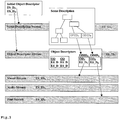
- Fig.3 shows the Object Descriptor Framework of an MPEG-4 system containing also font data. It consists of an Initial Object Descriptor and five Elementary Streams (ES).
- the Initial Object Descriptor contains two Elementary Stream Descriptors (ES_D) pointing to ES, notably ES_D S having the value ES_ID S and thus pointing to the Scene Description Stream, and ES_D O having the value ES_ID O and thus pointing to the Object Descriptor Stream.
- the Scene Description Stream contains a scene description that describes geometry, animation and interactivity of the scene and also links to each object of the scene to be reproduced, by specifying how to obtain the object from ES.
- Object Descriptor Identifiers pointing to Object Descriptors being received in the Object Descriptor Stream.
- One Object Descriptor Identifier ODID V points to an Object Descriptor OD V for a visual object
- another Object Descriptor Identifier ODID T points to an Object Descriptor OD T for a text object.
- Each Object Descriptor contains one or more ES Descriptors ES_D that are references to ES to be reproduced in the scene.
- the text object is included inside a Scene Description Stream containing the actual text node and refers to an ES, namely a Font Stream containing the respective font.
- the two streams are referenced by the ES descriptors ES_D S and ES_D F having the value of the respective identifiers ES_ID S and ES_ID F .
- the reference can be the ES_ID as in Fig.3 or the name of the font as a string value, or both.
- the font data corresponding to the referenced font may have been inserted as an ES in the MPEG-4 stream before, with the corresponding ES_ID and optionally an additional name string.
- the font data, name and related information can be stored for later usage. In that case the font can be referenced e.g. by name.
- no filename is streamed, so that system compatible filenames can be selected for storage.
- a dedicated unit at the receiver may handle all font related issues, e.g. selecting a standard font, checking if a special required font was already stored before, receiving a new font, updating stored fonts etc.
- the specific font related information mentioned above as DSI and used for decoder setup, may comprise e.g.
- the DSI is transported in the OD stream.
- the font decoder there are two possibilities to transmit the information specifying the font decoder: either all said information is contained in the DSI, and the font AU contains raw font data, or the DSI contains an indication that said information is together with the raw font data within the AU.
- An indication which of the two solutions is used can be encoded in the fontFormat variable within the DSI.
- the settings for the font decoder are self-sufficient, i.e. completely defined in the OD structure, and therefore all AU packets containing font information have the same internal format, defined by the fontFormat value. This means that it is not possible to modify dynamically the format of the received font, i.e. the font used for text rendering, but on the other hand it requires only a simple type of decoder.
- the fontFormat variable is used from the DSI, and the other font related information in the DSI is ignored. Instead, this information is contained in the AU packets for font information and can be extracted e.g. from the packet headers. This can be called a self-contained font. In this case it is sufficient to use a specific reserved value for fontFormat in the DSI.
- This solution means that the font stream AU packets may have different internal formats, and therefore the decoder must be more complex than in the first solution, since it must extract some of its required DSI from the packets. But advantageously dynamic font modification is possible, since a newly received font can be immediately used.
- Said enhancements refer to the stream type, the AU format, the decoder type and the node semantics. Since a new type of ES is used, a new value of the streamType parameter must be defined, which is used by the terminal to identify the substream as being a font ES, create the required decoder and connect it to the ES.
- the proposed new streamType can be added as follows: Table 1 streamType value Stream type description 0x00 Forbidden 0x01 ObjectDescriptorStream 0x02 ClockReferenceStream 0x03 SceneDescriptionStream 0x04 VisualStream 0x05 AudioStream 0x06 MPEG7Stream 0x07 IPMPStream 0x08 ObjectContentInfoStream 0x09 MPEGJStream 0x0A Interaction Stream 0x0B FontStream 0x0C-0x1F reserved for ISO use 0x20-0x3F User private
- An ObjectTypeIndication is not required for such stream, so that the value 0xFF (no object type specified) can be used.
- a simple way to transport font information is to embed the font file into an AU, thus creating a new AU type.
- Such AU can be split into synchronization layer (SL) packets during streaming as described in the MPEG-4 standard.
- SL synchronization layer
- a new decoder has to be defined to manage the font AUs. The decoder extracts the font data from the AU using DSI configuration. If the DSI is implemented e.g. as a class in an Object Oriented language, it may have the following format:
- the fontFormat variable contained in the DSI may be specified as follows: Table 2 fontFormat AU content Decoder behaviour 0x00 Self Contained Font Use 1 AU as Self Contained Font 0x01 TrueType Font (TTF) Use 1 AU as TrueType font 0x02 Font (FON) Use 1 AU as Font 0x03 Zipped TTF Uncompress 1 AU with ZIP algorithm, then use it as TTF 0x04 Zipped FON Uncompress 1 AU with ZIP algorithm, then use it as FON 0x05-0x7F User private Proprietary font formats
- the decoder For the fontFormat variable having values of 0x01 to 0x04, the decoder needs all DSI information to process data, and for the fontFormat variable having the value 0x00, the decoder may find the information it requires within the AUs.
- An exemplary font AU format according to the invention is described below.
- the storeFont flag may be used to decide whether or not to store a received font, and the name received in the fontName field should be attached to the font data, e.g. by associating it to the file or selecting a meaningful file name.
- the fontSpecInfo field may be empty by default, and may be used for any user private implementation, indicated by fontFormat having a value from 0x05 to 0x07.
- each font AU may contain data of the following structure:
- FontStyle node semantics described in the standard need modification to enable font streaming.
- the corresponding paragraph refers to the VRML 97 standard (ISO/IEC 14772-1:1998).
- the following behavior is added to the node: "The family field can also contain ObjectDescriptorIdentifier (ODID) referring to a stream of type 'FontStream', containing the font information.”
- ODID ObjectDescriptorIdentifier
- the first SFString value of the family field should contain the font name as described in the VRML97 standard.
- the second value should contain the ODID pointing to the stream containing the font.
- the terminal can investigate if the font named in the first value already exists in the terminal, and then can reuse if. Otherwise, it can process the font stream as described in the MPEG-4 System standard, with the inventive feature enabled, and store it.
- the structural representation of the font information i.e. the fontStyle node
- An exemplary scene sample using the font streaming feature may contain the following fragment:
- the terminal should use the font with the name 'Times New Roman' to render the text strings, with the given parameters for size, spacing and style. If the font is not available in the receiver, the MPEG-4 terminal may connect to the stream with ODID '104' to retrieve the required font information.
- the inventive font-streaming feature can also be included into MPEG-4 authoring tools: when the author defines a specific font for text strings, the tool may insert the font family name in the first part of the family field, create a new ES containing the font information, and insert the ODID for said ES into the second part of the family field.
- any font format can be streamed, e.g. TrueType font, Basic font, OpenType font, Asian characters, scalable fonts, symbol fonts etc., as long as the receiving terminal can identify and manage such format.
- the invention can be used for all kinds of devices that are capable of displaying information content, especially content comprising text or symbols, and that may receive font information, e.g. TV, DVB, computer displays, navigation devices, and hand-held devices such as mobile phones, mobile computers, Personal Digital Assistants (PDAs), MP3 players or other music rendering devices with display.
- devices that are capable of displaying information content, especially content comprising text or symbols, and that may receive font information, e.g. TV, DVB, computer displays, navigation devices, and hand-held devices such as mobile phones, mobile computers, Personal Digital Assistants (PDAs), MP3 players or other music rendering devices with display.
- PDAs Personal Digital Assistants
- MP3 players or other music rendering devices with display.
- the invention is particularly good for all MPEG-4 streaming systems.
Landscapes
- Engineering & Computer Science (AREA)
- Theoretical Computer Science (AREA)
- Signal Processing (AREA)
- Multimedia (AREA)
- General Physics & Mathematics (AREA)
- Physics & Mathematics (AREA)
- General Engineering & Computer Science (AREA)
- Human Computer Interaction (AREA)
- Databases & Information Systems (AREA)
- Computational Linguistics (AREA)
- General Health & Medical Sciences (AREA)
- Audiology, Speech & Language Pathology (AREA)
- Artificial Intelligence (AREA)
- Health & Medical Sciences (AREA)
- Computer Hardware Design (AREA)
- Two-Way Televisions, Distribution Of Moving Picture Or The Like (AREA)
- Controls And Circuits For Display Device (AREA)
- Information Transfer Between Computers (AREA)
- Television Systems (AREA)
Description
- This invention relates to font information that is usable for electronic devices containing a display, and in particular a method for transmitting, receiving and updating said font information.
- In the MPEG-4 standard ISO/IEC 14496, in particular in
part 1 Systems, an audio/video (AV) scene can be composed from several audio, video and synthetic 2D/3D objects that can be coded with different MPEG-4 format coding types and can be transmitted as binary compressed data in a multiplexed bitstream, comprising audio, video and other substreams, e.g. text to be displayed. A substream is also referred to as Elementary Stream (ES), and can be accessed through a descriptor. A scene is generally understood as an audio-visual space that a user can interact with. - The process of synthesizing a single scene from the component objects is called composition, and means mixing multiple individual AV objects, e.g. a presentation of a video with related audio and text, after reconstruction of packets and separate decoding of their respective ES. User interaction, terminal capability, and terminal configuration may be used when determining how to compose a scene at a receiver terminal. The bitstream defined in the mentioned MPEG-4 standard contains an ES called 'Scene Description Stream' being a set of general instructions for composition of scenes, and further contains other substreams, so called Object Description Streams, that contain configuration information being necessary for decoding the AV substreams. In a receiver the configuration substreams are extracted and used to set up the required AV decoders. Then the AV substreams are decoded separately to objects, and the received composition instructions are used to prepare a single presentation from the decoded AV objects. This final presentation, or scene, which is no more under full control of the broadcaster or content provider due to terminal dependent composition, is then played back.
- In ISO/IEC 14496-1:2002, which is the current version of the MPEG-4 Systems standard, a hierarchical model for presenting AV scenes is described, using a parametric approach.
An InitialObjectDescriptor (IOD) contains descriptors for the Scene Description Stream and a dedicated OD Stream. The Scene Description Stream contains a scene description consisting of an encoded tree of nodes. 'Node' means a processing step or unit used in the MPEG-4 standard, e.g. an interface carrying out time synchronisation between a decoder and subsequent processing units. Nodes can have attributes, referred to as fields, and other information attached. A leaf node in this tree corresponds either to elementary AV data by pointing to an OD within the OD stream, which in turn contains an ES Descriptor pointing to AV data in an ES, or to a graphical 2D/3D synthetic object, e.g. a cube; a curve or text. Intermediate nodes, or scene description nodes, group this material to form AV objects, and perform e.g. grouping and transformation on such AV objects. - Text to be displayed is contained in a Scene Description ES. The reproduction of text is described with the FontStyle node. In the FontStyle node semantics, the family field permits to the content creator to select the font the terminal uses to display, or render, the text. If the font is available on the client platform, it is used to render the given text strings. Otherwise a default font has to be used. In contrast to many other nodes of the Scene Description, the FontStyle node fields are static, i.e. they cannot be modified by updates.
- In various applications a content provider wishes to determine the style or font in which transmitted text is displayed at a receiver. But usually receivers can only display few fonts and styles since they lack corresponding information. This problem is solved by the present invention as disclosed in
claims claims 13 and 14, respectively. - A system is proposed that is able to stream font information towards a terminal that can download the information and use it for determining how to display text. The font information refers to one or more symbols, usually a set of characters, but also typographic symbols, or dingbats, and may comprise specifications for e.g. typeface, or shape, size, color, bold and italic style, line spacing, proportional pitch or fixed pitch. A font may be used for all text, or may be linked to a certain text content that needs such information in order to be rendered on a device.
- The inventive system comprises format data for one or more fonts, means for integrating the data into bit streams, e.g. being composed of time stamped multiplexed packets, means for transmission, transport and reception of said bit streams, a terminal accepting said bit streams as input and containing means, e.g. decoders, to manage font and other content data and to compose managed content, and a rendering device for presenting said composed content.
- Exemplary embodiments of the invention are described with reference to the accompanying drawings, which show in
-
Fig.1 an exemplary general font streaming system framework; -
Fig.2 the general structure of an MPEG-4 terminal; and -
Fig.3 an MPEG-4 Object Descriptor Framework including a font stream. -
Fig.1 shows the components of a general font streaming system according to the invention.Font data 1 are packed, e.g. multiplexed, together with AV andscene data 2, the scene data including text, to abitstream 4 in anappropriate device 3, containing e.g. a multiplexer and a server for transmission. The transmission may include broadcast, and thebitstream 4 and its substreams may be structured, e.g. as multiplexed packets. - At the
receiving device 5 the bitstream is demultiplexed to ES, e.g. control, audio, video and font streams, wherein control ES comprise Scene Description, including text, and OD streams, and said ES are distributed to the concerned managers. Individually accessible portions of an ES are referred to as Access Units (AUs) 6, which are then decoded by aDecoder Manager 7 into a platform dependent, presentable format. For the specific decoding required by an ES, theDecoder Manager 7 is setup using the Decoder Specific Information 11 (DSI). Said DSI 11 can be setup or modified, e.g. using information received in the control substreams of the bitstream. TheDecoder Manager 7 generates Composition Units (CUs) 8 being input to aCompositor 9, which in turn generates aninput signal 10 for arendering device 13, e.g. PC or TV. Since the CUs may be generated before being required by theCompositor 9, they may be buffered in Composition Buffers. In the inventive case of the data being font data it may be advantageous to store the font data at alocal Storage Device 12, e.g. memory, flash, disc or hard-disc, for later usage. The font data can be used for composition in theCompositor 9, e.g. when a content provider specifies the font to be used for certain text. As theCompositor 9 is platform dependent, theDecoder Manager 7 can, independently from the streaming system, generate the CU format theCompositor 9 requires, so that the text is rendered as intended by the content provider. - The MPEG-4 Systems standard defines that management times may be associated with the
AUs 6 that are used by theDecoder Manager 7 as times at which the data have to be decoded. The data, thus converted toCUs 8 and prepared for theCompositor 9, are transmitted to the Composition Buffer. For CUs there may be composition times defined that theCompositor 9 uses to determine at what time a CU has to be used to render the content. Theserver 3 sending the packets to the client must ensure the packets will arrive at theclient terminal 5 soon enough for the information to be available to theCompositor 9 in time. This issue can be treated at content creation time. - For the case of the invention being used for MPEG-4 or similar stream oriented systems, the terminal structure is depicted in
Fig.2 . Theterminal 20 contains aninterface 21, referred to as DMIF Application Interface. It is used for the stream data packet format conversion between the synchronization layer SL and the delivery layer DL. Further it demultiplexes the bitstream to substreams, or ES. Substreams containing scene data, along with the text, are sent toappropriate decoding buffers decoders dedicated manager 29 prior to usage of the decoder. The decoder output is fed to acomposition buffer compositor 25 at a specified time, namely at its respective composition time. In this embodiment of the invention there is onedecoding buffer 26,decoder 27 andcomposition buffer 28 used for downloading font information. - In one embodiment of the invention the received font data are stored at the receiver for later usage, while in another embodiment only the last received font is stored, and other fonts must be downloaded whenever the content requires them to be used. In a third embodiment a downloaded font is stored until the client is disconnected from the content. In a fourth embodiment the bitstream may contain a notification whether the font information should be stored or not. In a fifth embodiment of the invention the user may control, i.e. enable or disable, this download of font data.
-
Fig.3 shows the Object Descriptor Framework of an MPEG-4 system containing also font data. It consists of an Initial Object Descriptor and five Elementary Streams (ES). The Initial Object Descriptor contains two Elementary Stream Descriptors (ES_D) pointing to ES, notably ES_DS having the value ES_IDS and thus pointing to the Scene Description Stream, and ES_DO having the value ES_IDO and thus pointing to the Object Descriptor Stream. The Scene Description Stream contains a scene description that describes geometry, animation and interactivity of the scene and also links to each object of the scene to be reproduced, by specifying how to obtain the object from ES. The leaf nodes of the scene description hierarchy tree linked to media objects use Object Descriptor Identifiers (ODID) pointing to Object Descriptors being received in the Object Descriptor Stream. One Object Descriptor Identifier ODIDV points to an Object Descriptor ODV for a visual object, and another Object Descriptor Identifier ODIDT points to an Object Descriptor ODT for a text object. Each Object Descriptor contains one or more ES Descriptors ES_D that are references to ES to be reproduced in the scene. The text object is included inside a Scene Description Stream containing the actual text node and refers to an ES, namely a Font Stream containing the respective font. The two streams are referenced by the ES descriptors ES_DS and ES_DF having the value of the respective identifiers ES_IDS and ES_IDF. - When a font is referenced in e.g. multimedia content, the reference can be the ES_ID as in
Fig.3 or the name of the font as a string value, or both. The font data corresponding to the referenced font may have been inserted as an ES in the MPEG-4 stream before, with the corresponding ES_ID and optionally an additional name string. Advantageously the font data, name and related information can be stored for later usage. In that case the font can be referenced e.g. by name. Advantageously, no filename is streamed, so that system compatible filenames can be selected for storage. - A dedicated unit at the receiver, referred to as font manager, may handle all font related issues, e.g. selecting a standard font, checking if a special required font was already stored before, receiving a new font, updating stored fonts etc.
- The specific font related information, mentioned above as DSI and used for decoder setup, may comprise e.g.
- the font type, i.e. internal format of the font data, being different for e.g. TrueType fonts, OpenType fonts or zipped fonts etc.;
- a font storage information, specifying whether or not the font should be stored for later usage;
- the font name, i.e. a string to be used as a reference to the font; and
- system specific information for the font manager, e.g. if the font should be used only for certain characters or symbols, or e.g. for capitals only.
- In MPEG-4 systems the DSI is transported in the OD stream. According to the invention, there are two possibilities to transmit the information specifying the font decoder: either all said information is contained in the DSI, and the font AU contains raw font data, or the DSI contains an indication that said information is together with the raw font data within the AU. An indication which of the two solutions is used can be encoded in the fontFormat variable within the DSI.
- With the first solution the settings for the font decoder are self-sufficient, i.e. completely defined in the OD structure, and therefore all AU packets containing font information have the same internal format, defined by the fontFormat value. This means that it is not possible to modify dynamically the format of the received font, i.e. the font used for text rendering, but on the other hand it requires only a simple type of decoder.
- For the second solution only the fontFormat variable is used from the DSI, and the other font related information in the DSI is ignored. Instead, this information is contained in the AU packets for font information and can be extracted e.g. from the packet headers. This can be called a self-contained font. In this case it is sufficient to use a specific reserved value for fontFormat in the DSI. This solution means that the font stream AU packets may have different internal formats, and therefore the decoder must be more complex than in the first solution, since it must extract some of its required DSI from the packets. But advantageously dynamic font modification is possible, since a newly received font can be immediately used.
- For an MPEG-4 implementation of the invention few enhancements are necessary to the standard, as described in the following. Said enhancements refer to the stream type, the AU format, the decoder type and the node semantics.
Since a new type of ES is used, a new value of the streamType parameter must be defined, which is used by the terminal to identify the substream as being a font ES, create the required decoder and connect it to the ES. Based on the above-mentioned standard, the proposed new streamType can be added as follows:Table 1 streamType value Stream type description 0x00 Forbidden 0x01 ObjectDescriptorStream 0x02 ClockReferenceStream 0x03 SceneDescriptionStream 0x04 VisualStream 0x05 AudioStream 0x06 MPEG7Stream 0x07 IPMPStream 0x08 ObjectContentInfoStream 0x09 MPEGJStream 0x0A Interaction Stream 0x0B FontStream 0x0C-0x1F reserved for ISO use 0x20-0x3F User private - An ObjectTypeIndication is not required for such stream, so that the value 0xFF (no object type specified) can be used. A simple way to transport font information is to embed the font file into an AU, thus creating a new AU type. Such AU can be split into synchronization layer (SL) packets during streaming as described in the MPEG-4 standard. Further, a new decoder has to be defined to manage the font AUs. The decoder extracts the font data from the AU using DSI configuration. If the DSI is implemented e.g. as a class in an Object Oriented language, it may have the following format:
 Class Font_DecoderConfig extends DecoderSpecificInfo :
 bit(8)tag=DecSpecificInfoTag{
 bit (7) fontFormat;
 if (fontFormat != 0x00) {
  bit (1) storeFont;
  bit (8) fontNameLength;
  bit (8) fontName [fontNameLength] ;
  bit (8) fontSpecInfo[sizeOfInstance - fontNameLength -1];
 }
 }
| fontFormat | AU content | Decoder behaviour | |
| 0x00 | Self Contained | Use | 1 AU as Self Contained Font |
| 0x01 | TrueType Font (TTF) | | |
| 0x02 | Font (FON) | | |
| 0x03 | | Uncompress | 1 AU with ZIP algorithm, then use it as TTF |
| 0x04 | | Uncompress | 1 AU with ZIP algorithm, then use it as FON |
| 0x05-0x7F | User private | Proprietary font formats |
- storeFont - defining whether or not to store the font for later usage,
- fontNameLength - indicating the length of the fontName field,
- fontName - indicating the name of the font, and
- fontSpecInfo - being an opaque container with information for a specific font handler.
In the case of the AU content being a self-contained font, and the AU being implemented e.g. as a class in an Object Oriented language, each font AU may contain data of the following structure:
 Class FontAccessUnit() {
 bit (7) fontFormat;
 bit (1) storeFont;
 bit(8) fontNameLength;
 bit (8) fontName [fontNameLength] ;
 bit (8) fontSpecInfoLength;
 bit (8) fontSpecInfo[fontSpecInfoLength] ;
 bit (8) fontData[sizeOfInstance - fontNameLength -
     fontSpecInfoLength - 2]
     }
fontSpecInfoLength defines the length of the fontSpecInfo field, and fontData is the raw font data. The other fields have the same meaning as in the DSI.
The following behavior is added to the node:
"The family field can also contain ObjectDescriptorIdentifier (ODID) referring to a stream of type 'FontStream', containing the font information."
 fontStyle FontStyle {
 family ["Times New Roman","ODID:104"]
 size 25.0
 spacing 1.25
 style "BOLD"
 }
Claims (19)
- A method for transmitting font information, comprising the following steps:- defining a font for text or symbol content to be presented on a display;- providing said font information comprising a font description, the font description defining how to render, or display, single characters or symbols or sets thereof;- converting said font information to a format suitable for transmission in a font information elementary stream;- adding to a scene description elementary stream containing text a reference to the font information elementary stream; and- transmitting said font information elementary stream and said scene description elementary stream containing text.
- A method for adding or modifying font information in electronic devices containing or being connectable to a display, comprising the following steps:- receiving a font information elementary stream, the font information in said elementary stream comprising a font description defining how to render, or display, single characters or symbols or sets thereof;- converting the format of said font information such that it can be utilized for processing;- receiving a scene description elementary stream containing text and a reference to the font information elementary stream;- storing said font information before or during or after said conversion; and- rendering said text using font information from the referenced font information elementary stream.
- Method according to claim 1 or 2, wherein said reference points to a descriptor (ODIDT), which identifies the font information elementary stream (ES_DF).
- Method according to any of claims 1-3, wherein a font is defining the rendering characteristics for characters or symbols, the characteristics comprising at least one of the following items: typeface, shape, size, colour, bold style, italic style, line spacing, or pitch type.
- Method according to any of claims 1-4, wherein control information is transmitted, the information determining whether or not the receiver should store said font information,
- Method according to any of claims 1-5, wherein separate elementary streams are used for transport of different data types, and some or all of said elementary streams are multiplexed together.
- Method according to any of claims 1-6, wherein said font information comprises parameters, such as size, colour, style or line spacing, while the typeface, shape or pitch information is available at the receiver.
- Method according to any of claims 1-7, wherein the font information elementary stream is encoded and contains time information indicating a required time for being decoded.
- Bitstream comprising two or more multiplexed elementary streams, wherein a first elementary stream (ES_IDf) contains font information, and a second elementary stream (ES_IDs) contains text and a reference to said first elementary stream, said second elementary stream being a scene description elementary stream.
- Bitstream according to claim 9, wherein a scene is to be composed according to the scene description.
- Bitstream according to claim 9 or 10, wherein the first elementary stream contains time information indicating a required time for being decoded.
- Bitstream according to one of the claims 9-11, further comprising decoding information specifying a decoder for decoding said first elementary stream.
- An apparatus for transmitting font information for electronic devices, comprising- means for defining a font for text or symbol content to be presented on a display;- means for providing said font information comprising a font description, the font description defining how to render, or display, single characters or symbols or sets thereof;- means for converting said font information to a format suitable for transmission in a font information elementary stream;- means for adding to a scene description elementary stream containing text a reference to the font information elementary stream; and- means for transmitting said font information elementary stream and said scene description elementary stream containing text.
- An apparatus for adding or modifying font information in electronic devices, comprising- means for receiving a font information elementary stream, the font information in said elementary stream comprising a font description defining how to render, or display, single characters or symbols or sets thereof;- means for converting said font information to a format that is suitable for processing;- means for receiving a scene description elementary stream containing text and a reference to the font information elementary stream;- means for storing said font information before or after said conversion; and- means for rendering said text using font information from the referenced font information elementary stream.
- Apparatus according to claim 13 or 14, wherein said reference points to a descriptor (ODIDT), which identifies the font information elementary stream (ES-DF).
- Apparatus according to any of claims 13-15, wherein a font defines the rendering characteristics for characters or symbols, the characteristics comprising at least one of the following items: typeface, shape, size, colour, bold style, italic style, line spacing, or pitch type.
- Apparatus according to any of claims 13-16, further comprising means for receiving within an elementary stream control information determining whether or not the receiver should store said font information, and means for storing said font information if storage is required by said control information.
- Apparatus according to any of claims 13-17, wherein separate elementary streams are used for transport of different data types, and some or all of said elementary streams are multiplexed together.
- Apparatus according to any of claims 13-18, wherein said font information comprises parameters, such as size, colour, style or line spacing, while the typeface, shape or pitch information is available at the receiver.
Priority Applications (1)
| Application Number | Priority Date | Filing Date | Title |
|---|---|---|---|
| EP04705813.6A EP1602236B1 (en) | 2003-02-10 | 2004-01-28 | Method to transmit and receive font information in streaming systems |
Applications Claiming Priority (4)
| Application Number | Priority Date | Filing Date | Title |
|---|---|---|---|
| EP03290324 | 2003-02-10 | ||
| EP03290324A EP1445954A1 (en) | 2003-02-10 | 2003-02-10 | Method to transmit and receive font information in streaming systems |
| PCT/EP2004/000959 WO2004071097A1 (en) | 2003-02-10 | 2004-01-28 | Method to transmit and receive font information in streaming systems |
| EP04705813.6A EP1602236B1 (en) | 2003-02-10 | 2004-01-28 | Method to transmit and receive font information in streaming systems |
Publications (2)
| Publication Number | Publication Date |
|---|---|
| EP1602236A1 EP1602236A1 (en) | 2005-12-07 |
| EP1602236B1 true EP1602236B1 (en) | 2019-11-13 |
Family
ID=32605447
Family Applications (2)
| Application Number | Title | Priority Date | Filing Date |
|---|---|---|---|
| EP03290324A Withdrawn EP1445954A1 (en) | 2003-02-10 | 2003-02-10 | Method to transmit and receive font information in streaming systems |
| EP04705813.6A Expired - Lifetime EP1602236B1 (en) | 2003-02-10 | 2004-01-28 | Method to transmit and receive font information in streaming systems |
Family Applications Before (1)
| Application Number | Title | Priority Date | Filing Date |
|---|---|---|---|
| EP03290324A Withdrawn EP1445954A1 (en) | 2003-02-10 | 2003-02-10 | Method to transmit and receive font information in streaming systems |
Country Status (10)
| Country | Link |
|---|---|
| US (1) | US7701458B2 (en) |
| EP (2) | EP1445954A1 (en) |
| JP (2) | JP5118342B2 (en) |
| KR (1) | KR101010498B1 (en) |
| CN (1) | CN1748426B (en) |
| BR (1) | BRPI0407310B1 (en) |
| MX (1) | MXPA05008037A (en) |
| MY (1) | MY143494A (en) |
| TW (1) | TWI323126B (en) |
| WO (1) | WO2004071097A1 (en) |
Families Citing this family (23)
| Publication number | Priority date | Publication date | Assignee | Title |
|---|---|---|---|---|
| KR100725387B1 (en) * | 2004-08-24 | 2007-06-08 | 삼성전자주식회사 | Method and apparatus for transmitting code set signaling in data broadcasting |
| DE102005051657A1 (en) | 2005-10-28 | 2007-05-03 | GM Global Technology Operations, Inc., Detroit | Pyrotechnic actuator |
| FR2892885B1 (en) * | 2005-11-02 | 2008-01-25 | Streamezzo Sa | METHOD FOR MANAGING CHARACTER FONTS WITHIN MULTIMEDIA SCENES, CORRESPONDING COMPUTER PROGRAM AND TERMINAL. |
| KR100686879B1 (en) * | 2005-11-28 | 2007-02-26 | 엘지전자 주식회사 | How to provide color and size information of text and text boxes provided by dynamic label service |
| KR101323979B1 (en) * | 2006-12-13 | 2013-10-30 | 엘지전자 주식회사 | System and Method of Supportting Portable Handler |
| US20100199174A1 (en) * | 2009-02-03 | 2010-08-05 | Microsoft Corporation | Extensible font file loading |
| US9319444B2 (en) * | 2009-06-22 | 2016-04-19 | Monotype Imaging Inc. | Font data streaming |
| US8615709B2 (en) | 2010-04-29 | 2013-12-24 | Monotype Imaging Inc. | Initiating font subsets |
| US9218680B2 (en) * | 2010-09-01 | 2015-12-22 | K-Nfb Reading Technology, Inc. | Systems and methods for rendering graphical content and glyphs |
| US20130215126A1 (en) * | 2012-02-17 | 2013-08-22 | Monotype Imaging Inc. | Managing Font Distribution |
| US9817615B2 (en) | 2012-12-03 | 2017-11-14 | Monotype Imaging Inc. | Network based font management for imaging devices |
| US9569865B2 (en) | 2012-12-21 | 2017-02-14 | Monotype Imaging Inc. | Supporting color fonts |
| EP2943894A2 (en) | 2013-01-09 | 2015-11-18 | Monotype Imaging Inc. | Advanced text editor |
| US9317777B2 (en) | 2013-10-04 | 2016-04-19 | Monotype Imaging Inc. | Analyzing font similarity for presentation |
| US9691169B2 (en) | 2014-05-29 | 2017-06-27 | Monotype Imaging Inc. | Compact font hinting |
| US10115215B2 (en) | 2015-04-17 | 2018-10-30 | Monotype Imaging Inc. | Pairing fonts for presentation |
| US11537262B1 (en) | 2015-07-21 | 2022-12-27 | Monotype Imaging Inc. | Using attributes for font recommendations |
| JP6921075B2 (en) | 2015-11-20 | 2021-08-18 | ジェネテック インコーポレイテッド | Secure hierarchical encryption of data streams |
| WO2017083985A1 (en) * | 2015-11-20 | 2017-05-26 | Genetec Inc. | Media streaming |
| US11334750B2 (en) | 2017-09-07 | 2022-05-17 | Monotype Imaging Inc. | Using attributes for predicting imagery performance |
| US10909429B2 (en) | 2017-09-27 | 2021-02-02 | Monotype Imaging Inc. | Using attributes for identifying imagery for selection |
| US11657602B2 (en) | 2017-10-30 | 2023-05-23 | Monotype Imaging Inc. | Font identification from imagery |
| CN112070860A (en) * | 2020-08-03 | 2020-12-11 | 广东以诺通讯有限公司 | Picture processing method |
Family Cites Families (21)
| Publication number | Priority date | Publication date | Assignee | Title |
|---|---|---|---|---|
| JP2714022B2 (en) * | 1988-08-24 | 1998-02-16 | 株式会社日立製作所 | Character data management system and character data management method |
| EP0700205A3 (en) * | 1994-08-31 | 1997-04-02 | Toshiba Kk | Multimedia television receiver and method of booting the same |
| US5946105A (en) * | 1994-08-31 | 1999-08-31 | Canon Kabushiki Kaisha | Facsimile apparatus and control method therefor |
| JP2887572B2 (en) | 1995-04-07 | 1999-04-26 | 富士ゼロックス株式会社 | Image output device and image processing method |
| US5926189A (en) * | 1996-03-29 | 1999-07-20 | Apple Computer, Inc. | Method and apparatus for typographic glyph construction including a glyph server |
| JP3487738B2 (en) * | 1996-08-26 | 2004-01-19 | 富士通株式会社 | Apparatus and method for font processing in network environment |
| US6141002A (en) | 1996-11-12 | 2000-10-31 | Opentv, Inc. | System and method for downloading and rendering glyphs in a set top box |
| EP0866616A1 (en) * | 1997-03-21 | 1998-09-23 | CANAL+ Société Anonyme | Method of and apparatus for transmitting data |
| US6323864B1 (en) * | 1997-06-30 | 2001-11-27 | Sun Microsystems, Inc. | Using and accessing information from fonts in multiple formats |
| AU761202B2 (en) * | 1997-09-22 | 2003-05-29 | Sony Corporation | Generation of a bit stream containing binary image/audio data that is multiplexed with a code defining an object in ascii format |
| JP4136066B2 (en) * | 1998-05-11 | 2008-08-20 | パイオニア株式会社 | Document data creation device and character display device |
| JPH11341536A (en) * | 1998-05-27 | 1999-12-10 | Nec Shizuoka Ltd | Radio portable terminal provided with character font switching function |
| CN1322739C (en) | 1998-06-12 | 2007-06-20 | 皇家菲利浦电子有限公司 | Transmission system |
| JP2000099501A (en) * | 1998-09-17 | 2000-04-07 | Internatl Business Mach Corp <Ibm> | Method and system for padding information into document data |
| WO2000038170A2 (en) * | 1998-12-18 | 2000-06-29 | Powertv, Inc. | Font substitution system |
| US7640571B1 (en) * | 1999-07-15 | 2009-12-29 | General Instrument Corporation | Method and apparatus for preventing disruptions in set-top terminal function due to the download of updated programming or data to the set-top terminal |
| EP1087617A3 (en) * | 1999-09-21 | 2003-01-08 | Texas Instruments Incorporated | System for nonlinear viewing of television show segments |
| US20020087702A1 (en) * | 2000-12-29 | 2002-07-04 | Koichi Mori | Remote contents displaying method with adaptive remote font |
| JP3714880B2 (en) * | 2001-03-07 | 2005-11-09 | シャープ株式会社 | Subtitle display device |
| JP3871123B2 (en) * | 2001-06-16 | 2007-01-24 | 三星電子株式会社 | Information storage medium having preloaded font information, reproducing apparatus and reproducing method thereof |
| JP4000844B2 (en) * | 2001-12-11 | 2007-10-31 | 日本電気株式会社 | Content distribution system, content distribution system distribution server and display terminal, and content distribution program |
-
2003
- 2003-02-10 EP EP03290324A patent/EP1445954A1/en not_active Withdrawn
-
2004
- 2004-01-28 EP EP04705813.6A patent/EP1602236B1/en not_active Expired - Lifetime
- 2004-01-28 WO PCT/EP2004/000959 patent/WO2004071097A1/en not_active Ceased
- 2004-01-28 KR KR1020057014659A patent/KR101010498B1/en not_active Expired - Lifetime
- 2004-01-28 BR BRPI0407310-0A patent/BRPI0407310B1/en not_active IP Right Cessation
- 2004-01-28 CN CN2004800037250A patent/CN1748426B/en not_active Expired - Lifetime
- 2004-01-28 MX MXPA05008037A patent/MXPA05008037A/en active IP Right Grant
- 2004-01-28 JP JP2006501714A patent/JP5118342B2/en not_active Expired - Lifetime
- 2004-01-28 US US10/544,331 patent/US7701458B2/en active Active
- 2004-02-06 TW TW093102706A patent/TWI323126B/en not_active IP Right Cessation
- 2004-02-09 MY MYPI20040373A patent/MY143494A/en unknown
-
2011
- 2011-07-25 JP JP2011162306A patent/JP2012029297A/en active Pending
Non-Patent Citations (1)
| Title |
|---|
| None * |
Also Published As
| Publication number | Publication date |
|---|---|
| JP5118342B2 (en) | 2013-01-16 |
| MY143494A (en) | 2011-05-31 |
| US20070008309A1 (en) | 2007-01-11 |
| BRPI0407310B1 (en) | 2022-05-24 |
| EP1445954A1 (en) | 2004-08-11 |
| CN1748426B (en) | 2012-09-05 |
| CN1748426A (en) | 2006-03-15 |
| KR101010498B1 (en) | 2011-01-24 |
| US7701458B2 (en) | 2010-04-20 |
| TW200423724A (en) | 2004-11-01 |
| JP2006517368A (en) | 2006-07-20 |
| KR20050103920A (en) | 2005-11-01 |
| TWI323126B (en) | 2010-04-01 |
| WO2004071097A1 (en) | 2004-08-19 |
| JP2012029297A (en) | 2012-02-09 |
| BRPI0407310A (en) | 2006-02-21 |
| MXPA05008037A (en) | 2006-05-19 |
| EP1602236A1 (en) | 2005-12-07 |
Similar Documents
| Publication | Publication Date | Title |
|---|---|---|
| US7701458B2 (en) | Method to transmit and receive font information in streaming systems | |
| US8046338B2 (en) | System and method of organizing data to facilitate access and streaming | |
| US20040167916A1 (en) | System and method of organizing data to facilitate access and streaming | |
| US20020024539A1 (en) | System and method for content-specific graphical user interfaces | |
| US8421923B2 (en) | Object-based audio-visual terminal and bitstream structure | |
| CN100432937C (en) | send multimedia description | |
| US11403804B2 (en) | Method for real time texture adaptation | |
| US7199836B1 (en) | Object-based audio-visual terminal and bitstream structure | |
| CN107547933A (en) | Broadcasting pictures generation method, apparatus and system | |
| CN113615205A (en) | Method, apparatus and computer program for signaling available portions of packaged media content | |
| KR100622645B1 (en) | Object replacement and attribute conversion device and method in MP-4 scene rendering on embedded system | |
| US9271028B2 (en) | Method and apparatus for decoding a data stream in audio video streaming systems | |
| WO2000038170A2 (en) | Font substitution system | |
| KR20240107164A (en) | Signaling for picture-in-picture in media container files and streaming manifests | |
| KR20040016566A (en) | Method for representing group metadata of mpeg multi-media contents and apparatus for producing mpeg multi-media contents | |
| WO2025212395A1 (en) | Volumetric video experiences using dynamic mesh coding | |
| EP1613089A1 (en) | Object-based audio-visual terminal and corresponding bitstream structure | |
| Xiang et al. | Combining the product of Interactive Multimedia Creator with MPEG4 technology | |
| Lim et al. | MPEG Multimedia Scene Representation | |
| Tran et al. | CASE STUDY: A BASIC COMPOSING TOOL FOR EDITING SYSTEM INFORMATION MPEG-4 | |
| Basso et al. | Flexible interchange of coded multimedia facilitating access and streaming | |
| Kaczor et al. | MPEG-4’s Binary Format Codec for Scene Description |
Legal Events
| Date | Code | Title | Description |
|---|---|---|---|
| PUAI | Public reference made under article 153(3) epc to a published international application that has entered the european phase |
Free format text: ORIGINAL CODE: 0009012 |
|
| 17P | Request for examination filed |
Effective date: 20050711 |
|
| AK | Designated contracting states |
Kind code of ref document: A1 Designated state(s): AT BE BG CH CY CZ DE DK EE ES FI FR GB GR HU IE IT LI LU MC NL PT RO SE SI SK TR |
|
| AX | Request for extension of the european patent |
Extension state: AL LT LV MK |
|
| DAX | Request for extension of the european patent (deleted) | ||
| 17Q | First examination report despatched |
Effective date: 20070518 |
|
| RAP1 | Party data changed (applicant data changed or rights of an application transferred) |
Owner name: THOMSON LICENSING |
|
| RAP1 | Party data changed (applicant data changed or rights of an application transferred) |
Owner name: INTERDIGITAL VC HOLDINGS, INC. |
|
| REG | Reference to a national code |
Ref country code: DE Ref legal event code: R079 Ref document number: 602004054358 Country of ref document: DE Free format text: PREVIOUS MAIN CLASS: H04N0007240000 Ipc: H04N0021236000 |
|
| RIC1 | Information provided on ipc code assigned before grant |
Ipc: H04N 21/44 20110101ALI20190424BHEP Ipc: H04N 21/2343 20110101ALI20190424BHEP Ipc: H04N 21/234 20110101ALI20190424BHEP Ipc: H04N 21/236 20110101AFI20190424BHEP |
|
| GRAP | Despatch of communication of intention to grant a patent |
Free format text: ORIGINAL CODE: EPIDOSNIGR1 |
|
| STAA | Information on the status of an ep patent application or granted ep patent |
Free format text: STATUS: GRANT OF PATENT IS INTENDED |
|
| INTG | Intention to grant announced |
Effective date: 20190606 |
|
| RIN1 | Information on inventor provided before grant (corrected) |
Inventor name: KERBIRIOU, PAUL Inventor name: VIELLARD, THIERRY Inventor name: SAHUC, DAVID |
|
| GRAS | Grant fee paid |
Free format text: ORIGINAL CODE: EPIDOSNIGR3 |
|
| GRAA | (expected) grant |
Free format text: ORIGINAL CODE: 0009210 |
|
| STAA | Information on the status of an ep patent application or granted ep patent |
Free format text: STATUS: THE PATENT HAS BEEN GRANTED |
|
| AK | Designated contracting states |
Kind code of ref document: B1 Designated state(s): AT BE BG CH CY CZ DE DK EE ES FI FR GB GR HU IE IT LI LU MC NL PT RO SE SI SK TR |
|
| REG | Reference to a national code |
Ref country code: GB Ref legal event code: FG4D |
|
| REG | Reference to a national code |
Ref country code: CH Ref legal event code: EP Ref country code: AT Ref legal event code: REF Ref document number: 1202924 Country of ref document: AT Kind code of ref document: T Effective date: 20191115 |
|
| REG | Reference to a national code |
Ref country code: DE Ref legal event code: R096 Ref document number: 602004054358 Country of ref document: DE |
|
| REG | Reference to a national code |
Ref country code: IE Ref legal event code: FG4D |
|
| RAP2 | Party data changed (patent owner data changed or rights of a patent transferred) |
Owner name: INTERDIGITAL VC HOLDINGS, INC. |
|
| REG | Reference to a national code |
Ref country code: NL Ref legal event code: FP |
|
| PG25 | Lapsed in a contracting state [announced via postgrant information from national office to epo] |
Ref country code: ES Free format text: LAPSE BECAUSE OF FAILURE TO SUBMIT A TRANSLATION OF THE DESCRIPTION OR TO PAY THE FEE WITHIN THE PRESCRIBED TIME-LIMIT Effective date: 20191113 Ref country code: FI Free format text: LAPSE BECAUSE OF FAILURE TO SUBMIT A TRANSLATION OF THE DESCRIPTION OR TO PAY THE FEE WITHIN THE PRESCRIBED TIME-LIMIT Effective date: 20191113 Ref country code: BG Free format text: LAPSE BECAUSE OF FAILURE TO SUBMIT A TRANSLATION OF THE DESCRIPTION OR TO PAY THE FEE WITHIN THE PRESCRIBED TIME-LIMIT Effective date: 20200213 Ref country code: GR Free format text: LAPSE BECAUSE OF FAILURE TO SUBMIT A TRANSLATION OF THE DESCRIPTION OR TO PAY THE FEE WITHIN THE PRESCRIBED TIME-LIMIT Effective date: 20200214 Ref country code: PT Free format text: LAPSE BECAUSE OF FAILURE TO SUBMIT A TRANSLATION OF THE DESCRIPTION OR TO PAY THE FEE WITHIN THE PRESCRIBED TIME-LIMIT Effective date: 20200313 Ref country code: SE Free format text: LAPSE BECAUSE OF FAILURE TO SUBMIT A TRANSLATION OF THE DESCRIPTION OR TO PAY THE FEE WITHIN THE PRESCRIBED TIME-LIMIT Effective date: 20191113 |
|
| PG25 | Lapsed in a contracting state [announced via postgrant information from national office to epo] |
Ref country code: RO Free format text: LAPSE BECAUSE OF FAILURE TO SUBMIT A TRANSLATION OF THE DESCRIPTION OR TO PAY THE FEE WITHIN THE PRESCRIBED TIME-LIMIT Effective date: 20191113 Ref country code: CZ Free format text: LAPSE BECAUSE OF FAILURE TO SUBMIT A TRANSLATION OF THE DESCRIPTION OR TO PAY THE FEE WITHIN THE PRESCRIBED TIME-LIMIT Effective date: 20191113 Ref country code: DK Free format text: LAPSE BECAUSE OF FAILURE TO SUBMIT A TRANSLATION OF THE DESCRIPTION OR TO PAY THE FEE WITHIN THE PRESCRIBED TIME-LIMIT Effective date: 20191113 Ref country code: EE Free format text: LAPSE BECAUSE OF FAILURE TO SUBMIT A TRANSLATION OF THE DESCRIPTION OR TO PAY THE FEE WITHIN THE PRESCRIBED TIME-LIMIT Effective date: 20191113 |
|
| REG | Reference to a national code |
Ref country code: DE Ref legal event code: R097 Ref document number: 602004054358 Country of ref document: DE |
|
| REG | Reference to a national code |
Ref country code: AT Ref legal event code: MK05 Ref document number: 1202924 Country of ref document: AT Kind code of ref document: T Effective date: 20191113 |
|
| PG25 | Lapsed in a contracting state [announced via postgrant information from national office to epo] |
Ref country code: SK Free format text: LAPSE BECAUSE OF FAILURE TO SUBMIT A TRANSLATION OF THE DESCRIPTION OR TO PAY THE FEE WITHIN THE PRESCRIBED TIME-LIMIT Effective date: 20191113 Ref country code: MC Free format text: LAPSE BECAUSE OF FAILURE TO SUBMIT A TRANSLATION OF THE DESCRIPTION OR TO PAY THE FEE WITHIN THE PRESCRIBED TIME-LIMIT Effective date: 20191113 |
|
| REG | Reference to a national code |
Ref country code: CH Ref legal event code: PL |
|
| PLBE | No opposition filed within time limit |
Free format text: ORIGINAL CODE: 0009261 |
|
| STAA | Information on the status of an ep patent application or granted ep patent |
Free format text: STATUS: NO OPPOSITION FILED WITHIN TIME LIMIT |
|
| REG | Reference to a national code |
Ref country code: BE Ref legal event code: MM Effective date: 20200131 |
|
| 26N | No opposition filed |
Effective date: 20200814 |
|
| PG25 | Lapsed in a contracting state [announced via postgrant information from national office to epo] |
Ref country code: LU Free format text: LAPSE BECAUSE OF NON-PAYMENT OF DUE FEES Effective date: 20200128 |
|
| PG25 | Lapsed in a contracting state [announced via postgrant information from national office to epo] |
Ref country code: BE Free format text: LAPSE BECAUSE OF NON-PAYMENT OF DUE FEES Effective date: 20200131 Ref country code: SI Free format text: LAPSE BECAUSE OF FAILURE TO SUBMIT A TRANSLATION OF THE DESCRIPTION OR TO PAY THE FEE WITHIN THE PRESCRIBED TIME-LIMIT Effective date: 20191113 Ref country code: AT Free format text: LAPSE BECAUSE OF FAILURE TO SUBMIT A TRANSLATION OF THE DESCRIPTION OR TO PAY THE FEE WITHIN THE PRESCRIBED TIME-LIMIT Effective date: 20191113 Ref country code: CH Free format text: LAPSE BECAUSE OF NON-PAYMENT OF DUE FEES Effective date: 20200131 Ref country code: LI Free format text: LAPSE BECAUSE OF NON-PAYMENT OF DUE FEES Effective date: 20200131 |
|
| PG25 | Lapsed in a contracting state [announced via postgrant information from national office to epo] |
Ref country code: IE Free format text: LAPSE BECAUSE OF NON-PAYMENT OF DUE FEES Effective date: 20200128 |
|
| PGFP | Annual fee paid to national office [announced via postgrant information from national office to epo] |
Ref country code: TR Payment date: 20210118 Year of fee payment: 18 |
|
| PG25 | Lapsed in a contracting state [announced via postgrant information from national office to epo] |
Ref country code: CY Free format text: LAPSE BECAUSE OF FAILURE TO SUBMIT A TRANSLATION OF THE DESCRIPTION OR TO PAY THE FEE WITHIN THE PRESCRIBED TIME-LIMIT Effective date: 20191113 |
|
| PGFP | Annual fee paid to national office [announced via postgrant information from national office to epo] |
Ref country code: FR Payment date: 20230124 Year of fee payment: 20 |
|
| PGFP | Annual fee paid to national office [announced via postgrant information from national office to epo] |
Ref country code: IT Payment date: 20230120 Year of fee payment: 20 Ref country code: GB Payment date: 20230124 Year of fee payment: 20 Ref country code: DE Payment date: 20230127 Year of fee payment: 20 |
|
| PGFP | Annual fee paid to national office [announced via postgrant information from national office to epo] |
Ref country code: NL Payment date: 20230124 Year of fee payment: 20 |
|
| P01 | Opt-out of the competence of the unified patent court (upc) registered |
Effective date: 20230628 |
|
| REG | Reference to a national code |
Ref country code: DE Ref legal event code: R071 Ref document number: 602004054358 Country of ref document: DE |
|
| REG | Reference to a national code |
Ref country code: NL Ref legal event code: MK Effective date: 20240127 |
|
| REG | Reference to a national code |
Ref country code: GB Ref legal event code: PE20 Expiry date: 20240127 |
|
| PG25 | Lapsed in a contracting state [announced via postgrant information from national office to epo] |
Ref country code: GB Free format text: LAPSE BECAUSE OF EXPIRATION OF PROTECTION Effective date: 20240127 |
|
| PG25 | Lapsed in a contracting state [announced via postgrant information from national office to epo] |
Ref country code: TR Free format text: LAPSE BECAUSE OF NON-PAYMENT OF DUE FEES Effective date: 20220128 |