EP1602018B1 - Message translation using adaptive agents - Google Patents
Message translation using adaptive agents Download PDFInfo
- Publication number
- EP1602018B1 EP1602018B1 EP04710004.5A EP04710004A EP1602018B1 EP 1602018 B1 EP1602018 B1 EP 1602018B1 EP 04710004 A EP04710004 A EP 04710004A EP 1602018 B1 EP1602018 B1 EP 1602018B1
- Authority
- EP
- European Patent Office
- Prior art keywords
- mapping
- translation
- message
- map
- mappings
- Prior art date
- Legal status (The legal status is an assumption and is not a legal conclusion. Google has not performed a legal analysis and makes no representation as to the accuracy of the status listed.)
- Expired - Lifetime
Links
Images


Classifications
-
- G—PHYSICS
- G06—COMPUTING OR CALCULATING; COUNTING
- G06F—ELECTRIC DIGITAL DATA PROCESSING
- G06F16/00—Information retrieval; Database structures therefor; File system structures therefor
- G06F16/20—Information retrieval; Database structures therefor; File system structures therefor of structured data, e.g. relational data
- G06F16/25—Integrating or interfacing systems involving database management systems
- G06F16/252—Integrating or interfacing systems involving database management systems between a Database Management System and a front-end application
-
- G—PHYSICS
- G06—COMPUTING OR CALCULATING; COUNTING
- G06F—ELECTRIC DIGITAL DATA PROCESSING
- G06F16/00—Information retrieval; Database structures therefor; File system structures therefor
- G06F16/20—Information retrieval; Database structures therefor; File system structures therefor of structured data, e.g. relational data
- G06F16/25—Integrating or interfacing systems involving database management systems
- G06F16/258—Data format conversion from or to a database
Definitions
- This invention relates to a system and process for translating messages between two or more different formats.
- the present invention is particularly useful in translating messages between multiple business applications that have been integrated.
- Document EP 1 271 360 A2 discloses a universal mapping system, including apparatuses and methods, which is configurable through use of selectable configuration files to perform the bi-directional mapping and conversion of data between different data structures and formats.
- Each configuration file uniquely corresponds to a particular type of device which stores mappable data in a structure and/or format different than those of other types of devices.
- the universal mapping system is operable to perform mappings of data according to priority rules which are definable in the configuration files and which govern the order in which the mappings of data elements are performed.
- the universal mapping system is also adapted to maintain associations between data elements resulting from prior mappings. Additionally, the universal mapping system is operable to persist unmappable data from a source during a mapping in one direction and to return the unmappable data to that source during a subsequent mapping in the opposite direction.
- Document US 2002/0184213 A1 discloses a data instance transformation tool for transforming a source instance to a target instance.
- Embodiments thereof provide a graphical rendering of source and target data instances enabling a user to select mappings between elements in the source data instance and elements in the target data instance.
- the data instances are typically input to embodiments as text files (e.g., DTD, XML, XML Schema Definition ("XSD") files, HTML files or the like). Additionally, in some embodiments additional characteristics or functions operating on data populating the mapped structures can be provided.
- embodiments Upon receipt of the mapping data (and, optionally, additional characteristic or function operations) embodiments generate a list of elements mapped from the target data instance.
- templates or code blocks are generated by embodiments which enable a script or source code file to be generated.
- the generated script or source code file when processed on data streams of input data conforming to the original source data definition, will output a data stream which conforms to the original target data definition.
- the output data stream may be, for example, be formatted as an XML output file.
- Document US 2001/0014890 A1 discloses a rule-based methodology which supports automatic mapping of data fields between different data sets in a data processing environment. If a field cannot be mapped or matched based on name alone (e.g., an identical match), the methodology employs rules to determine a type for the field, based on the field's name. The determined type of the field is then used for matching. The methodology can be employed to match fields which appear dissimilar phonetically but are otherwise appropriate for matching.
- rules are stated in form of: regular expressions type.
- the regular expression member lists the text strings or substring(s) for the field. The rules are ordered in descending preference according to the likelihood that a given rule will correctly identify a field. In this manner, the methodology allows the task of mapping fields from one data set to another to be entirely automated.
- a semantic mapping is the translation of a message from the syntax and data format of one application to the syntax and data format of another application.
- a semantic mapping can be costly.
- Static mappings are also susceptible to having errors that are difficult to detect. If such errors are present, they could cause the propagation of corrupted data throughout the integrated applications.
- mappings may need to be performed to facilitate translation to and from the new format.
- the larger number of mappings required when integrating a larger number of applications the higher the cost and risk of corrupting data.
- this risk increases.
- Syntax translation is the mapping between the fields of one document format to the fields of another document format. Field names, number of fields, complex data types, missing fields, and field format all can cause problems in syntax translation. Thus, they all should be addressed in a message translation solution.
- Data translation is usually needed because the different applications usually have differing ways of representing the same data. Some cases of the need for data translation are use of internal IDs, misspelling or different spellings (for example, American and British spellings of certain words differ), different levels of granularity, the used of abbreviations and different representations of the same information.
- Cupid In an article entitled "General Schema Matching with Cupid", an algorithm called Cupid is described that discovers mappings between schema elements. It does this through the use of the elements' names, data types, constraints and schema structure. It attempts to match elements through linguistic matching .and structural matching. In its linguistic matching, simple token manipulation is tolerant of variations of element names. The inventors recommend a thesaurus that incrementally learns synonyms and abbreviations from mappings performed over time.
- the present invention is a higher-level architecture and process than the prior art without its drawbacks.
- the present invention consists of using software agents capable of learning to address the problem of message translation. Existing translations, external translation services and a mapping knowledge base that is continuously enhanced by the agents are employed. The present invention is thus capable of handing the translation problems without the drawbacks of traditional static mappings and other prior art solutions.
- This invention has many advantages over the prior art. It provides translation with reduced cost, greater flexibility and greater reliability. Another advantage is that when adding a new version of an existing application this agent of the present invention has the required intelligence and knowledge to perform the initial partial mapping and present it to a user for completion and approval.
- An embodiment of the present invention provides a. system for translating messages between two or more applications.
- Another embodiment of the present invention provides a process for translating messages between two or more applications.
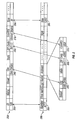
- FIG. 1 An example of potential syntax problems that should be addressed when translating messages is shown in Figure 1 .
- Two different messages 20a and 20b with different syntax formats are shown.
- the name of a field 10a may be different from the name of the field 10b in message 20b that contains the equivalent data.
- a field named "ID" in message 20a could be known as "Number" in message 20b.
- a single field in message 20a may be presented in the message 20b as multiple fields.
- a name field 11a in message 20a may be presented as separate fields of first name 11b and last name 12b in message 20b.
- Another potential problem is that complex data types may be present in a field such as an address field 13b in message 20b.
- the entire address information could exist within a single field 13b that may have to be separated into fields 13a, 14a, 15a, 16a and 17a when translated into the format of.message 20a.
- a field 18 may be entirely missing in one of the formats.
- no field for the information regarding style 18 in message 20b exists in message 20a.
- Another worry is handling different field formats. For instance, information relating to size could be a two-character field 19a in message 20a and be a four-integer field 19b in message 20b. Any solution should be capable of handling each of these potential syntax translation problems.
- Another potential data' translation problem is with granularity.
- the information related to ZIP Code may be a traditional five digit ZIP Code 36a in message 20a, while it may be the more detailed nine digit ZIP Code 36b in message 20b.
- Another potential problem is abbreviations.
- "United States" 37a is listed as the country.
- that same information is presented as "USA” 37b.
- the system includes an interface 102 that accepts incoming documents 101a-x having messages to be translated.
- Agent 103 is provided for managing the translation.
- the system includes a database 105 for storing mappings 104a-x.
- An outside message translation service 106 can be accessed through interface 102 for translating messages. Additional outside message translation services could also be accessed if desired.
- preferred outside services could be specified so that certain more trusted outside services are used over services not as trusted when mappings are available from more than one service.
- Mapping knowledge base 107 is provided for mapping translations for messages.
- Mapping knowledge base 107 contains relationship information 110, which in turn contains information relating to.both fields 108 and data 109.
- Mapping knowledge base 111 also contains experience information 111 gained through successful mappings and proximities information 112.
- a user interface 113 is provided to provide a user 114, preferably, with a mapping workbench and work list.
- the mapping knowledge base 107 could be partially pre-configured with knowledge typical for mapping business documents or other documents from certain products and their associated versions.
- Some examples of such preconfigured knowledge based on the cases of syntax translation are: 1) field names (names like product, item and material may be synonymous); 2) complex data types (for example, addresses); 3) missing fields (currency type, for example, can be derived from the country; and 4) field format (checks for non-trivial conversions like between character and numeric).
- Some examples of pre-configured knowledge based on cases of data translation are: 1) abbreviations (common abbreviations such as ISO codes and country specific standards) and 2) representation (conversion between different units of measure.
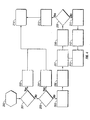
- FIG. 4 A process according to an embodiment of the present invention is depicted in Figure 4 .
- This process uses the system of Figure 3 .
- a message that needs to be translated 101a is sent to agent 103 through interface 102.
- Information (such as product and its associated release version and document type) relating to the format of the message and the format into which the message needs to be translated is preferably included in the document and sent along with the message. If the format of the message is unknown, a separate agent (not shown) can be used to determine this format.
- agent 103 checks whether it has access to an existing map 104a in database 105 that can be used to translate message 101a into the appropriate format. If one is available, in step 202 the existing map is used. If one is not available, in step 203 it is determined if an external .mapping service 106 is available that has an appropriate map to be used in the translation or to handle the mapping. If one is available, in step 204, outside mapping service 106 can be used to obtain the map or to generate the mapping. If desired, the resulting map may be stored in database 105. As mentioned above, preferred services can be set up to permit utilization of more trusted services when multiple services can provide the appropriate mapping. If an external service is not available, then agent 103 starts working with knowledge base 107 to generate the mapping.
- step 205 initially, the format of the message is determined and the proximity of the format of the message to the known formats is determined.
- the access to the knowledge base will be guided by the determined proximity.
- the syntax mapping is performed first. Based on experience gained in past mappings, the document is decomposed into its basic components. These can be individual fields or groups of fields. For each component, a suitable mapping is located in the knowledge base. The agent calculates confidence levels for each individual mapping as well as for larger parts of the document. Predefined thresholds exist. When the syntax mapping has been completed the data mapping takes place.
- step 206 document building blocks are identified. Once the building blocks are identified, all possible partial mappings are performed in step 207 using information in mapping knowledge base 107. This permits successful partial mappings to be reused between different formats.
- completeness and confidence levels are checked in step 208.
- step 209 it is determined if the mapping is complete and satisfactory. This determination can be the use of predefined confidence threshold. If the confidence level falls below the predefined threshold, it is determined to be unsatisfactory. If the mapping is satisfactory, the mapping knowledge base 107 is updated, if appropriate, and the map is stored in database 105 in step 210. If it is unsatisfactory, then in step 211, the mapping is added to a work list for user 114.
- step 212 user 114 performs work required by the work list. In addition to or in lieu of work done by a user, other agents or algorithms can be employed to handle the work required on the work list.
- mapping knowledge base 107 is updated based upon the results of the work performed as required by the work list. Then the process returns to step 207. Once an adequate mapping is obtained, either from database 105, external mapping service 106 or from mapping knowledge base 107, a document translation is performed in step 214 and the translated message is forwarded back out interface 102 to the appropriate destination.
Landscapes
- Engineering & Computer Science (AREA)
- Databases & Information Systems (AREA)
- Theoretical Computer Science (AREA)
- Data Mining & Analysis (AREA)
- Physics & Mathematics (AREA)
- General Engineering & Computer Science (AREA)
- General Physics & Mathematics (AREA)
- Machine Translation (AREA)
Description
- This invention relates to a system and process for translating messages between two or more different formats. The present invention is particularly useful in translating messages between multiple business applications that have been integrated.
- Document
EP 1 271 360 A2 discloses a universal mapping system, including apparatuses and methods, which is configurable through use of selectable configuration files to perform the bi-directional mapping and conversion of data between different data structures and formats. Each configuration file uniquely corresponds to a particular type of device which stores mappable data in a structure and/or format different than those of other types of devices. The universal mapping system is operable to perform mappings of data according to priority rules which are definable in the configuration files and which govern the order in which the mappings of data elements are performed. The universal mapping system is also adapted to maintain associations between data elements resulting from prior mappings. Additionally, the universal mapping system is operable to persist unmappable data from a source during a mapping in one direction and to return the unmappable data to that source during a subsequent mapping in the opposite direction. - Document
US 2002/0184213 A1 discloses a data instance transformation tool for transforming a source instance to a target instance. Embodiments thereof provide a graphical rendering of source and target data instances enabling a user to select mappings between elements in the source data instance and elements in the target data instance. The data instances are typically input to embodiments as text files (e.g., DTD, XML, XML Schema Definition ("XSD") files, HTML files or the like). Additionally, in some embodiments additional characteristics or functions operating on data populating the mapped structures can be provided. Upon receipt of the mapping data (and, optionally, additional characteristic or function operations) embodiments generate a list of elements mapped from the target data instance. From this list, templates or code blocks are generated by embodiments which enable a script or source code file to be generated. The generated script or source code file, when processed on data streams of input data conforming to the original source data definition, will output a data stream which conforms to the original target data definition. The output data stream may be, for example, be formatted as an XML output file. - Document
US 2001/0014890 A1 discloses a rule-based methodology which supports automatic mapping of data fields between different data sets in a data processing environment. If a field cannot be mapped or matched based on name alone (e.g., an identical match), the methodology employs rules to determine a type for the field, based on the field's name. The determined type of the field is then used for matching. The methodology can be employed to match fields which appear dissimilar phonetically but are otherwise appropriate for matching. In one embodiment, rules are stated in form of: regular expressions type. Here, the regular expression member lists the text strings or substring(s) for the field. The rules are ordered in descending preference according to the likelihood that a given rule will correctly identify a field. In this manner, the methodology allows the task of mapping fields from one data set to another to be entirely automated. - Many businesses desire to use integrated software applications. However, different independently developed business applications usually use different formats to handle and store data. When integrating such.applications, one must take care to ensure that this data can be reliably transferred between applications. As the number of applications and integration points grows, this task gets more complicated. If data is to be exchanged among business partners over the Internet, for example, the task can be further complicated.
- Integrating two or more software applications usually requires a semantic mapping. A semantic mapping is the translation of a message from the syntax and data format of one application to the syntax and data format of another application. Unfortunately, developing such mappings can be costly. Additionally, once a static mapping is in place, it potentially reduces flexibility and becomes an inhibitor to change. Static mappings are also susceptible to having errors that are difficult to detect. If such errors are present, they could cause the propagation of corrupted data throughout the integrated applications.
- When a new application with a new format is introduced, several new individual mappings may need to be performed to facilitate translation to and from the new format. Of course, with the larger number of mappings required when integrating a larger number of applications, the higher the cost and risk of corrupting data. Additionally, with the integration of applications of which the integrator has little knowledge, this risk increases.
- When integrating such applications, one must take care to ensure that information is properly translated. Syntax translation may be necessary. Syntax translation is the mapping between the fields of one document format to the fields of another document format. Field names, number of fields, complex data types, missing fields, and field format all can cause problems in syntax translation. Thus, they all should be addressed in a message translation solution.
- Data translation is usually needed because the different applications usually have differing ways of representing the same data. Some cases of the need for data translation are use of internal IDs, misspelling or different spellings (for example, American and British spellings of certain words differ), different levels of granularity, the used of abbreviations and different representations of the same information.
- The prior art focused on low-level data representation in terms of schemas. In some solutions, weight is assigned to the elements or structures of the schema. Rules are formulated to compute the mapping from one schema to another.
- In an article entitled "General Schema Matching with Cupid", an algorithm called Cupid is described that discovers mappings between schema elements. It does this through the use of the elements' names, data types, constraints and schema structure. It attempts to match elements through linguistic matching .and structural matching. In its linguistic matching, simple token manipulation is tolerant of variations of element names. The inventors recommend a thesaurus that incrementally learns synonyms and abbreviations from mappings performed over time.
- The present invention is a higher-level architecture and process than the prior art without its drawbacks.
- The present invention consists of using software agents capable of learning to address the problem of message translation. Existing translations, external translation services and a mapping knowledge base that is continuously enhanced by the agents are employed. The present invention is thus capable of handing the translation problems without the drawbacks of traditional static mappings and other prior art solutions. This invention has many advantages over the prior art. It provides translation with reduced cost, greater flexibility and greater reliability. Another advantage is that when adding a new version of an existing application this agent of the present invention has the required intelligence and knowledge to perform the initial partial mapping and present it to a user for completion and approval.
- An embodiment of the present invention provides a. system for translating messages between two or more applications.
- Another embodiment of the present invention provides a process for translating messages between two or more applications.
- As such, it is an object of the present invention to provide for the translation of messages between two or more applications at a reduced cost and with higher flexibility and reliability than traditional translation methods.
-
-
Figure 1 is a block diagram depicting examples of potential syntax translation problems between two different message formats according to an embodiment of the present invention. -
Figure 2 is a block diagram depicting examples of potential data translation problems between two different message formats according to an embodiment of the present invention. -
Figure 3 is a block diagram of a system for message translation according to an embodiment of the present invention. -
Figure 4 is a block diagram of a process of message translation according to an embodiment of the present invention. - The present invention will be better understood by reference to the accompanying drawings.
- As mentioned above, syntax and data translation difficulties can be present when dealing with translation. An example of potential syntax problems that should be addressed when translating messages is shown in
Figure 1 . Twodifferent messages message 20a, the name of afield 10a may be different from the name of thefield 10b inmessage 20b that contains the equivalent data. For example, a field named "ID" inmessage 20a could be known as "Number" inmessage 20b. - A single field in
message 20a may be presented in themessage 20b as multiple fields. For example, aname field 11a inmessage 20a may be presented as separate fields offirst name 11b andlast name 12b inmessage 20b. Another potential problem is that complex data types may be present in a field such as anaddress field 13b inmessage 20b. For example, the entire address information could exist within asingle field 13b that may have to be separated intofields format of.message 20a. - Yet another potential problem is that a
field 18 may be entirely missing in one of the formats. In the example shown, no field for theinformation regarding style 18 inmessage 20b exists inmessage 20a. Another worry is handling different field formats. For instance, information relating to size could be a two-character field 19a inmessage 20a and be a four-integer field 19b inmessage 20b. Any solution should be capable of handling each of these potential syntax translation problems. - In
Figure 2 , an example of problems with data translation between two different message formats is shown. Internal ID of "123" 31a may exist inmessage 20a that equates to the same information inmessage 20b, but in that format it may be known as "4711" 31b. Misspellings may also exist. For example, inmessage 20b the city of "San Diego" is infield 34a. Obviously,field 34b inmessage 20b refers to San Diego as well, but it is misspelled as "San Deigo". - Another potential data' translation problem is with granularity. For example, the information related to ZIP Code may be a traditional five
digit ZIP Code 36a inmessage 20a, while it may be the more detailed ninedigit ZIP Code 36b inmessage 20b. Another potential problem is abbreviations. Inmessage 20a, "United States" 37a is listed as the country. However, inmessage 20b, that same information is presented as "USA" 37b. - Representation is also a potential problem. For example, in
message 20a, size is represented as "M" 39a. However, that same size may be represented as "1203" 39b inmessage 20b. Each of these potential problems with data translation should be addressed by any message translation solution. - Referring to
Figure 3 , a system according to an embodiment of the present invention is shown that addresses both the syntax and data translation problems in a relatively inexpensive, flexible and reliable manner. The system includes aninterface 102 that acceptsincoming documents 101a-x having messages to be translated.Agent 103 is provided for managing the translation. The system includes adatabase 105 for storingmappings 104a-x. An outsidemessage translation service 106 can be accessed throughinterface 102 for translating messages. Additional outside message translation services could also be accessed if desired. Moreover, preferred outside services could be specified so that certain more trusted outside services are used over services not as trusted when mappings are available from more than one service. -
Mapping knowledge base 107 is provided for mapping translations for messages.Mapping knowledge base 107 containsrelationship information 110, which in turn contains information relating to.bothfields 108 anddata 109.Mapping knowledge base 111 also containsexperience information 111 gained through successful mappings andproximities information 112. Auser interface 113 is provided to provide auser 114, preferably, with a mapping workbench and work list. - The
mapping knowledge base 107 could be partially pre-configured with knowledge typical for mapping business documents or other documents from certain products and their associated versions. Some examples of such preconfigured knowledge based on the cases of syntax translation are: 1) field names (names like product, item and material may be synonymous); 2) complex data types (for example, addresses); 3) missing fields (currency type, for example, can be derived from the country; and 4) field format (checks for non-trivial conversions like between character and numeric). Some examples of pre-configured knowledge based on cases of data translation are: 1) abbreviations (common abbreviations such as ISO codes and country specific standards) and 2) representation (conversion between different units of measure. - A process according to an embodiment of the present invention is depicted in
Figure 4 . This process uses the system ofFigure 3 . Instep 200, a message that needs to be translated 101a is sent toagent 103 throughinterface 102. Information (such as product and its associated release version and document type) relating to the format of the message and the format into which the message needs to be translated is preferably included in the document and sent along with the message. If the format of the message is unknown, a separate agent (not shown) can be used to determine this format. - In
step 201,agent 103 checks whether it has access to an existingmap 104a indatabase 105 that can be used to translatemessage 101a into the appropriate format. If one is available, instep 202 the existing map is used. If one is not available, instep 203 it is determined if an external .mapping service 106 is available that has an appropriate map to be used in the translation or to handle the mapping. If one is available, instep 204,outside mapping service 106 can be used to obtain the map or to generate the mapping. If desired, the resulting map may be stored indatabase 105. As mentioned above, preferred services can be set up to permit utilization of more trusted services when multiple services can provide the appropriate mapping. If an external service is not available, thenagent 103 starts working withknowledge base 107 to generate the mapping. - In
step 205, initially, the format of the message is determined and the proximity of the format of the message to the known formats is determined. The access to the knowledge base will be guided by the determined proximity. The syntax mapping is performed first. Based on experience gained in past mappings, the document is decomposed into its basic components. These can be individual fields or groups of fields. For each component, a suitable mapping is located in the knowledge base. The agent calculates confidence levels for each individual mapping as well as for larger parts of the document. Predefined thresholds exist. When the syntax mapping has been completed the data mapping takes place. - In
step 206, document building blocks are identified. Once the building blocks are identified, all possible partial mappings are performed instep 207 using information inmapping knowledge base 107. This permits successful partial mappings to be reused between different formats. Next, completeness and confidence levels are checked instep 208. Instep 209, it is determined if the mapping is complete and satisfactory. This determination can be the use of predefined confidence threshold. If the confidence level falls below the predefined threshold, it is determined to be unsatisfactory. If the mapping is satisfactory, themapping knowledge base 107 is updated, if appropriate, and the map is stored indatabase 105 instep 210. If it is unsatisfactory, then instep 211, the mapping is added to a work list foruser 114. - In
step 212,user 114 performs work required by the work list. In addition to or in lieu of work done by a user, other agents or algorithms can be employed to handle the work required on the work list. Instep 213, mappingknowledge base 107 is updated based upon the results of the work performed as required by the work list. Then the process returns to step 207. Once an adequate mapping is obtained, either fromdatabase 105,external mapping service 106 or from mappingknowledge base 107, a document translation is performed instep 214 and the translated message is forwarded back outinterface 102 to the appropriate destination. - Although the.preferred embodiments of the present invention have been described and illustrated in detail, it will be evident to those skilled in the art that various modifications and changes may be made thereto without departing from the spirit and scope of the invention as set forth in the appended claims and equivalents thereof.
Claims (13)
- A message translation system for handling message translation including syntax and data translation comprising:an interface (102), said interface (102) accepting a message (20a, 20b) to be translated and communicating with at least one external translation service (106) capable of providing a mapping;a mapping database (105), said mapping database (105) storing existing mappings (104a-x);a mapping knowledge base (107), said mapping knowledge base (107) being capable of being used to build mappings, wherein said mapping knowledge base (107) comprises proximities information (112);a mapping agent (103), said mapping agent (103) communicating with said interface (102), said mapping database (105) and said mapping knowledge base (107) to manage mappings to be used in translation of messages (20a, 20b), wherein the message translation system is enabled to determine the format of the message (20a, 20b) and the proximity of the format of the message to known formats.
- The message translation system as in claim 1, further comprising a user interface (113), said user interface (113) providing a work list for mappings determined to not be acceptable and a mapping workbench permitting a user (114) to work on mappings.
- The message translation system as in claim 2, wherein said work list may be completed by said user (114) working on said mapping workbench or through an algorithm functioning without user intervention.
- The message translation system as in one of the preceding claims, wherein said mapping knowledge base (107) comprises relationship information (110), said relationship information (110) comprising field information (108) and data information (109).
- The message translation system as in one of the preceding claims, wherein said mapping knowledge base (107) comprises experience information (111).
- The message translation system as in claim 5, wherein said experience information (111) is updated based upon- successful mappings; and/or- work results of work performed in response to said work list.
- A process for translating messages (20a, 20b) between different formats comprising the steps of:determining if a stored map (104a-x) can be used to perform said translation;if said stored map (104a-x) can be used to perform said translation, utilizing said stored map (104a-x) to perform said translation;if said stored map (104a-x) cannot be used to perform said translation, determining if an external service (106) can be used to obtain an external map to use in said translation;if said external service (106) can be used to obtain said external map, obtaining said external map and performing said translation utilizing said external map;if said external service (106) cannot be used to obtain said external map, generating an internal map and utilizing said internal map to perform said translation, wherein said generating said internal map step comprises identifying a format of said message (20a, 20b) and a proximity to similar formats.
- The process for translating messages (20a, 20b) as in claim 7, wherein said generating said internal map step comprises identifying document building blocks.
- The process for translating messages (20a, 20b) as in claim 7 or 8, wherein said generating said internal map step comprises performing possible partial mappings and generating an internal mapping.
- The process for translating messages (20a, 20b) as in claim 9, wherein said generating said internal map step comprises calculating completeness of an internal mapping and a confidence level.
- The process for translating messages (20a, 20b) as in claim 10, wherein said generating said internal map step further comprises determining if said internal mapping is complete and satisfactory, said satisfaction being determined by comparing said confidence level to a pre-determined threshold.
- The process for translating messages (20a, 20b) as in claim 10 or 11, wherein said generating said internal map step further comprises preparing a work list if said confidence level falls below said pre-determined threshold.
- The process for translating messages (20a, 20b) as in claim 12, wherein generating said internal map step comprises updating a mapping knowledge base with information obtained from- results of work performed as required by said work list; and/or- successful mappings.
Applications Claiming Priority (3)
| Application Number | Priority Date | Filing Date | Title |
|---|---|---|---|
| US366180 | 1994-12-29 | ||
| US10/366,180 US20040162823A1 (en) | 2003-02-13 | 2003-02-13 | Message translation using adaptive agents |
| PCT/EP2004/001281 WO2004072755A2 (en) | 2003-02-13 | 2004-02-11 | Message translation using adaptive agents |
Publications (2)
| Publication Number | Publication Date |
|---|---|
| EP1602018A2 EP1602018A2 (en) | 2005-12-07 |
| EP1602018B1 true EP1602018B1 (en) | 2015-11-18 |
Family
ID=32849714
Family Applications (1)
| Application Number | Title | Priority Date | Filing Date |
|---|---|---|---|
| EP04710004.5A Expired - Lifetime EP1602018B1 (en) | 2003-02-13 | 2004-02-11 | Message translation using adaptive agents |
Country Status (3)
| Country | Link |
|---|---|
| US (1) | US20040162823A1 (en) |
| EP (1) | EP1602018B1 (en) |
| WO (1) | WO2004072755A2 (en) |
Families Citing this family (8)
| Publication number | Priority date | Publication date | Assignee | Title |
|---|---|---|---|---|
| FR2946208B1 (en) * | 2009-05-26 | 2012-02-10 | Thales Sa | METHOD FOR ADAPTING DATA IN A DATA TRANSMISSION SYSTEM AND ASSOCIATED SYSTEM |
| US9529657B2 (en) | 2014-02-07 | 2016-12-27 | Oracle International Corporation | Techniques for generating diagnostic identifiers to trace events and identifying related diagnostic information |
| US9935959B2 (en) | 2014-02-07 | 2018-04-03 | Oracle International Corporation | Cloud service custom execution environment |
| US9529658B2 (en) | 2014-02-07 | 2016-12-27 | Oracle International Corporation | Techniques for generating diagnostic identifiers to trace request messages and identifying related diagnostic information |
| WO2015119658A1 (en) | 2014-02-07 | 2015-08-13 | Oracle International Corporation | Mobile cloud service architecture |
| SG11201605786SA (en) | 2014-03-31 | 2016-10-28 | Oracle Int Corp | Infrastructure for synchronization of mobile device with mobile cloud service |
| US10063661B2 (en) | 2015-01-14 | 2018-08-28 | Oracle International Corporation | Multi-tenant cloud-based queuing systems |
| CN109074265B (en) | 2016-03-28 | 2020-06-09 | 甲骨文国际公司 | Preformed instructions for mobile cloud services |
Family Cites Families (14)
| Publication number | Priority date | Publication date | Assignee | Title |
|---|---|---|---|---|
| WO1993023817A1 (en) * | 1992-05-08 | 1993-11-25 | Release Management Systems (Rms) | Data interchange system |
| US5710917A (en) * | 1995-06-07 | 1998-01-20 | International Business Machines Corporation | Method for deriving data mappings and data aliases |
| US5915259A (en) * | 1996-03-20 | 1999-06-22 | Xerox Corporation | Document schema transformation by patterns and contextual conditions |
| US5778373A (en) * | 1996-07-15 | 1998-07-07 | At&T Corp | Integration of an information server database schema by generating a translation map from exemplary files |
| US6216131B1 (en) * | 1998-02-06 | 2001-04-10 | Starfish Software, Inc. | Methods for mapping data fields from one data set to another in a data processing environment |
| US6718320B1 (en) * | 1998-11-02 | 2004-04-06 | International Business Machines Corporation | Schema mapping system and method |
| US20010047385A1 (en) * | 1999-12-30 | 2001-11-29 | Jeffrey Tuatini | Passthru to shared service funtionality |
| US6823495B1 (en) * | 2000-09-14 | 2004-11-23 | Microsoft Corporation | Mapping tool graphical user interface |
| TW571201B (en) * | 2001-02-02 | 2004-01-11 | Wistron Corp | Conversion method and system for contents format of document file |
| US6792431B2 (en) * | 2001-05-07 | 2004-09-14 | Anadarko Petroleum Corporation | Method, system, and product for data integration through a dynamic common model |
| CA2349469A1 (en) * | 2001-06-01 | 2002-12-01 | Ibm Canada Limited-Ibm Canada Limitee | A data instance transformation tool for transforming a source instance to a target instance |
| US20040093342A1 (en) * | 2001-06-27 | 2004-05-13 | Ronald Arbo | Universal data mapping system |
| US6785689B1 (en) * | 2001-06-28 | 2004-08-31 | I2 Technologies Us, Inc. | Consolidation of multiple source content schemas into a single target content schema |
| BR0316087A (en) * | 2002-11-08 | 2005-09-27 | Arbitration Forums Inc | System and process for electronic subrogation, interorganization workflow management, interorganization transaction processing, and optimized web-based user interaction |
-
2003
- 2003-02-13 US US10/366,180 patent/US20040162823A1/en not_active Abandoned
-
2004
- 2004-02-11 WO PCT/EP2004/001281 patent/WO2004072755A2/en not_active Ceased
- 2004-02-11 EP EP04710004.5A patent/EP1602018B1/en not_active Expired - Lifetime
Also Published As
| Publication number | Publication date |
|---|---|
| EP1602018A2 (en) | 2005-12-07 |
| WO2004072755A2 (en) | 2004-08-26 |
| US20040162823A1 (en) | 2004-08-19 |
| WO2004072755A3 (en) | 2006-08-17 |
Similar Documents
| Publication | Publication Date | Title |
|---|---|---|
| CN100478958C (en) | Method for changing document semanteme coded and sent by source semanteme edition | |
| US6587849B1 (en) | Method and system for constructing personalized result sets | |
| US6591260B1 (en) | Method of retrieving schemas for interpreting documents in an electronic commerce system | |
| US6397232B1 (en) | Method and system for translating the format of the content of document file | |
| US9280569B2 (en) | Schema matching for data migration | |
| US5909570A (en) | Template mapping system for data translation | |
| US7401336B2 (en) | Role based integrated platform | |
| US7243120B2 (en) | Transaction-based enterprise application integration (EAI) and development system | |
| US8024465B2 (en) | Managing uneven authorizations in a computer data exchange | |
| CN1829987B (en) | Term database extension for label system | |
| US20040083199A1 (en) | Method and architecture for data transformation, normalization, profiling, cleansing and validation | |
| JP4399127B2 (en) | Document management method and apparatus, processing program therefor, and storage medium storing the same | |
| CN100462962C (en) | Text marking system - translation and multilingual support at runtime and design | |
| WO2004084002A2 (en) | Systems and methods for providing access to data stored in different types of data repositories | |
| WO2003044699A9 (en) | Translating configuration files among network devices | |
| WO2002057882A2 (en) | System and method for conducting electronic commerce | |
| US20010025287A1 (en) | Document integrated management apparatus and method | |
| US20030149742A1 (en) | Method and system for staging content | |
| US7333986B2 (en) | Hierarchical database management system, hierarchical database management method, and hierarchical database management program | |
| US8862609B2 (en) | Expanding high level queries | |
| US20040162823A1 (en) | Message translation using adaptive agents | |
| US7283994B2 (en) | Merging of products into a database | |
| US7594167B1 (en) | System and method for schema evolution in an e-commerce network | |
| JP3489216B2 (en) | File system | |
| JP3660390B2 (en) | Term dictionary management device |
Legal Events
| Date | Code | Title | Description |
|---|---|---|---|
| PUAI | Public reference made under article 153(3) epc to a published international application that has entered the european phase |
Free format text: ORIGINAL CODE: 0009012 |
|
| 17P | Request for examination filed |
Effective date: 20050908 |
|
| AK | Designated contracting states |
Kind code of ref document: A2 Designated state(s): AT BE BG CH CY CZ DE DK EE ES FI FR GB GR HU IE IT LI LU MC NL PT RO SE SI SK TR |
|
| AX | Request for extension of the european patent |
Extension state: AL LT LV MK |
|
| RAP1 | Party data changed (applicant data changed or rights of an application transferred) |
Owner name: SAP AG |
|
| DAX | Request for extension of the european patent (deleted) | ||
| PUAK | Availability of information related to the publication of the international search report |
Free format text: ORIGINAL CODE: 0009015 |
|
| RIC1 | Information provided on ipc code assigned before grant |
Ipc: G06F 17/30 20060101AFI20060915BHEP |
|
| 17Q | First examination report despatched |
Effective date: 20090514 |
|
| RAP1 | Party data changed (applicant data changed or rights of an application transferred) |
Owner name: SAP SE |
|
| GRAP | Despatch of communication of intention to grant a patent |
Free format text: ORIGINAL CODE: EPIDOSNIGR1 |
|
| INTG | Intention to grant announced |
Effective date: 20150625 |
|
| GRAS | Grant fee paid |
Free format text: ORIGINAL CODE: EPIDOSNIGR3 |
|
| GRAA | (expected) grant |
Free format text: ORIGINAL CODE: 0009210 |
|
| AK | Designated contracting states |
Kind code of ref document: B1 Designated state(s): AT BE BG CH CY CZ DE DK EE ES FI FR GB GR HU IE IT LI LU MC NL PT RO SE SI SK TR |
|
| REG | Reference to a national code |
Ref country code: GB Ref legal event code: FG4D |
|
| REG | Reference to a national code |
Ref country code: CH Ref legal event code: EP |
|
| REG | Reference to a national code |
Ref country code: AT Ref legal event code: REF Ref document number: 761873 Country of ref document: AT Kind code of ref document: T Effective date: 20151215 |
|
| REG | Reference to a national code |
Ref country code: IE Ref legal event code: FG4D |
|
| REG | Reference to a national code |
Ref country code: DE Ref legal event code: R096 Ref document number: 602004048257 Country of ref document: DE |
|
| REG | Reference to a national code |
Ref country code: FR Ref legal event code: PLFP Year of fee payment: 13 |
|
| REG | Reference to a national code |
Ref country code: NL Ref legal event code: MP Effective date: 20160218 |
|
| REG | Reference to a national code |
Ref country code: AT Ref legal event code: MK05 Ref document number: 761873 Country of ref document: AT Kind code of ref document: T Effective date: 20151118 |
|
| PG25 | Lapsed in a contracting state [announced via postgrant information from national office to epo] |
Ref country code: IT Free format text: LAPSE BECAUSE OF FAILURE TO SUBMIT A TRANSLATION OF THE DESCRIPTION OR TO PAY THE FEE WITHIN THE PRESCRIBED TIME-LIMIT Effective date: 20151118 Ref country code: ES Free format text: LAPSE BECAUSE OF FAILURE TO SUBMIT A TRANSLATION OF THE DESCRIPTION OR TO PAY THE FEE WITHIN THE PRESCRIBED TIME-LIMIT Effective date: 20151118 Ref country code: NL Free format text: LAPSE BECAUSE OF FAILURE TO SUBMIT A TRANSLATION OF THE DESCRIPTION OR TO PAY THE FEE WITHIN THE PRESCRIBED TIME-LIMIT Effective date: 20151118 |
|
| PG25 | Lapsed in a contracting state [announced via postgrant information from national office to epo] |
Ref country code: FI Free format text: LAPSE BECAUSE OF FAILURE TO SUBMIT A TRANSLATION OF THE DESCRIPTION OR TO PAY THE FEE WITHIN THE PRESCRIBED TIME-LIMIT Effective date: 20151118 Ref country code: GR Free format text: LAPSE BECAUSE OF FAILURE TO SUBMIT A TRANSLATION OF THE DESCRIPTION OR TO PAY THE FEE WITHIN THE PRESCRIBED TIME-LIMIT Effective date: 20160219 Ref country code: BE Free format text: LAPSE BECAUSE OF NON-PAYMENT OF DUE FEES Effective date: 20160229 Ref country code: PT Free format text: LAPSE BECAUSE OF FAILURE TO SUBMIT A TRANSLATION OF THE DESCRIPTION OR TO PAY THE FEE WITHIN THE PRESCRIBED TIME-LIMIT Effective date: 20160318 Ref country code: SE Free format text: LAPSE BECAUSE OF FAILURE TO SUBMIT A TRANSLATION OF THE DESCRIPTION OR TO PAY THE FEE WITHIN THE PRESCRIBED TIME-LIMIT Effective date: 20151118 Ref country code: AT Free format text: LAPSE BECAUSE OF FAILURE TO SUBMIT A TRANSLATION OF THE DESCRIPTION OR TO PAY THE FEE WITHIN THE PRESCRIBED TIME-LIMIT Effective date: 20151118 |
|
| PG25 | Lapsed in a contracting state [announced via postgrant information from national office to epo] |
Ref country code: CZ Free format text: LAPSE BECAUSE OF FAILURE TO SUBMIT A TRANSLATION OF THE DESCRIPTION OR TO PAY THE FEE WITHIN THE PRESCRIBED TIME-LIMIT Effective date: 20151118 |
|
| REG | Reference to a national code |
Ref country code: DE Ref legal event code: R097 Ref document number: 602004048257 Country of ref document: DE |
|
| PG25 | Lapsed in a contracting state [announced via postgrant information from national office to epo] |
Ref country code: DK Free format text: LAPSE BECAUSE OF FAILURE TO SUBMIT A TRANSLATION OF THE DESCRIPTION OR TO PAY THE FEE WITHIN THE PRESCRIBED TIME-LIMIT Effective date: 20151118 Ref country code: EE Free format text: LAPSE BECAUSE OF FAILURE TO SUBMIT A TRANSLATION OF THE DESCRIPTION OR TO PAY THE FEE WITHIN THE PRESCRIBED TIME-LIMIT Effective date: 20151118 Ref country code: RO Free format text: LAPSE BECAUSE OF FAILURE TO SUBMIT A TRANSLATION OF THE DESCRIPTION OR TO PAY THE FEE WITHIN THE PRESCRIBED TIME-LIMIT Effective date: 20151118 Ref country code: SK Free format text: LAPSE BECAUSE OF FAILURE TO SUBMIT A TRANSLATION OF THE DESCRIPTION OR TO PAY THE FEE WITHIN THE PRESCRIBED TIME-LIMIT Effective date: 20151118 |
|
| PLBE | No opposition filed within time limit |
Free format text: ORIGINAL CODE: 0009261 |
|
| STAA | Information on the status of an ep patent application or granted ep patent |
Free format text: STATUS: NO OPPOSITION FILED WITHIN TIME LIMIT |
|
| PG25 | Lapsed in a contracting state [announced via postgrant information from national office to epo] |
Ref country code: MC Free format text: LAPSE BECAUSE OF FAILURE TO SUBMIT A TRANSLATION OF THE DESCRIPTION OR TO PAY THE FEE WITHIN THE PRESCRIBED TIME-LIMIT Effective date: 20151118 Ref country code: LU Free format text: LAPSE BECAUSE OF FAILURE TO SUBMIT A TRANSLATION OF THE DESCRIPTION OR TO PAY THE FEE WITHIN THE PRESCRIBED TIME-LIMIT Effective date: 20160211 |
|
| REG | Reference to a national code |
Ref country code: CH Ref legal event code: PL |
|
| 26N | No opposition filed |
Effective date: 20160819 |
|
| PG25 | Lapsed in a contracting state [announced via postgrant information from national office to epo] |
Ref country code: LI Free format text: LAPSE BECAUSE OF NON-PAYMENT OF DUE FEES Effective date: 20160229 Ref country code: CH Free format text: LAPSE BECAUSE OF NON-PAYMENT OF DUE FEES Effective date: 20160229 |
|
| PG25 | Lapsed in a contracting state [announced via postgrant information from national office to epo] |
Ref country code: SI Free format text: LAPSE BECAUSE OF FAILURE TO SUBMIT A TRANSLATION OF THE DESCRIPTION OR TO PAY THE FEE WITHIN THE PRESCRIBED TIME-LIMIT Effective date: 20151118 |
|
| REG | Reference to a national code |
Ref country code: IE Ref legal event code: MM4A |
|
| PG25 | Lapsed in a contracting state [announced via postgrant information from national office to epo] |
Ref country code: BE Free format text: LAPSE BECAUSE OF FAILURE TO SUBMIT A TRANSLATION OF THE DESCRIPTION OR TO PAY THE FEE WITHIN THE PRESCRIBED TIME-LIMIT Effective date: 20151118 |
|
| PG25 | Lapsed in a contracting state [announced via postgrant information from national office to epo] |
Ref country code: IE Free format text: LAPSE BECAUSE OF NON-PAYMENT OF DUE FEES Effective date: 20160211 |
|
| REG | Reference to a national code |
Ref country code: FR Ref legal event code: PLFP Year of fee payment: 14 |
|
| REG | Reference to a national code |
Ref country code: FR Ref legal event code: PLFP Year of fee payment: 15 |
|
| PG25 | Lapsed in a contracting state [announced via postgrant information from national office to epo] |
Ref country code: CY Free format text: LAPSE BECAUSE OF FAILURE TO SUBMIT A TRANSLATION OF THE DESCRIPTION OR TO PAY THE FEE WITHIN THE PRESCRIBED TIME-LIMIT Effective date: 20151118 Ref country code: HU Free format text: LAPSE BECAUSE OF FAILURE TO SUBMIT A TRANSLATION OF THE DESCRIPTION OR TO PAY THE FEE WITHIN THE PRESCRIBED TIME-LIMIT; INVALID AB INITIO Effective date: 20040211 |
|
| PGFP | Annual fee paid to national office [announced via postgrant information from national office to epo] |
Ref country code: FR Payment date: 20180223 Year of fee payment: 15 |
|
| PG25 | Lapsed in a contracting state [announced via postgrant information from national office to epo] |
Ref country code: TR Free format text: LAPSE BECAUSE OF FAILURE TO SUBMIT A TRANSLATION OF THE DESCRIPTION OR TO PAY THE FEE WITHIN THE PRESCRIBED TIME-LIMIT Effective date: 20151118 |
|
| PG25 | Lapsed in a contracting state [announced via postgrant information from national office to epo] |
Ref country code: BG Free format text: LAPSE BECAUSE OF FAILURE TO SUBMIT A TRANSLATION OF THE DESCRIPTION OR TO PAY THE FEE WITHIN THE PRESCRIBED TIME-LIMIT Effective date: 20151118 |
|
| REG | Reference to a national code |
Ref country code: DE Ref legal event code: R079 Ref document number: 602004048257 Country of ref document: DE Free format text: PREVIOUS MAIN CLASS: G06F0017300000 Ipc: G06F0016000000 |
|
| PG25 | Lapsed in a contracting state [announced via postgrant information from national office to epo] |
Ref country code: FR Free format text: LAPSE BECAUSE OF NON-PAYMENT OF DUE FEES Effective date: 20190228 |
|
| PGFP | Annual fee paid to national office [announced via postgrant information from national office to epo] |
Ref country code: GB Payment date: 20230220 Year of fee payment: 20 Ref country code: DE Payment date: 20220620 Year of fee payment: 20 |
|
| REG | Reference to a national code |
Ref country code: DE Ref legal event code: R071 Ref document number: 602004048257 Country of ref document: DE |
|
| REG | Reference to a national code |
Ref country code: GB Ref legal event code: PE20 Expiry date: 20240210 |
|
| PG25 | Lapsed in a contracting state [announced via postgrant information from national office to epo] |
Ref country code: GB Free format text: LAPSE BECAUSE OF EXPIRATION OF PROTECTION Effective date: 20240210 |