EP1601079A2 - Dual-mode bus discharging circuit - Google Patents
Dual-mode bus discharging circuit Download PDFInfo
- Publication number
- EP1601079A2 EP1601079A2 EP05076196A EP05076196A EP1601079A2 EP 1601079 A2 EP1601079 A2 EP 1601079A2 EP 05076196 A EP05076196 A EP 05076196A EP 05076196 A EP05076196 A EP 05076196A EP 1601079 A2 EP1601079 A2 EP 1601079A2
- Authority
- EP
- European Patent Office
- Prior art keywords
- bus
- coupled
- discharge path
- energy storage
- storage device
- Prior art date
- Legal status (The legal status is an assumption and is not a legal conclusion. Google has not performed a legal analysis and makes no representation as to the accuracy of the status listed.)
- Withdrawn
Links
Images

Classifications
-
- H—ELECTRICITY
- H02—GENERATION; CONVERSION OR DISTRIBUTION OF ELECTRIC POWER
- H02J—ELECTRIC POWER NETWORKS; CIRCUIT ARRANGEMENTS OR SYSTEMS FOR SUPPLYING OR DISTRIBUTING ELECTRIC POWER; SYSTEMS FOR STORING ELECTRIC ENERGY
- H02J7/00—Circuit arrangements for charging or discharging batteries or for supplying loads from batteries
- H02J7/34—Parallel operation in networks using both storage and other DC sources, e.g. providing buffering
- H02J7/345—Parallel operation in networks using both storage and other DC sources, e.g. providing buffering using capacitors as storage or buffering devices
-
- H—ELECTRICITY
- H02—GENERATION; CONVERSION OR DISTRIBUTION OF ELECTRIC POWER
- H02M—APPARATUS FOR CONVERSION BETWEEN AC AND AC, BETWEEN AC AND DC, OR BETWEEN DC AND DC, AND FOR USE WITH MAINS OR SIMILAR POWER SUPPLY SYSTEMS; CONVERSION OF DC OR AC INPUT POWER INTO SURGE OUTPUT POWER; CONTROL OR REGULATION THEREOF
- H02M1/00—Details of apparatus for conversion
- H02M1/32—Means for protecting converters other than automatic disconnection
- H02M1/322—Means for rapidly discharging a capacitor of the converter for protecting electrical components or for preventing electrical shock
Definitions
- the present invention is generally directed to a bus discharging circuit and, more specifically, to a dual-mode bus discharging circuit.
- automotive power systems with advanced alternator technology e.g., 42 Volt automotive power systems
- a service disconnect occurs at the battery, e.g., during servicing of an associated motor vehicle
- the energy stored in the input capacitors has remained as a potential source for arcing, which may damage various electronic components of the motor vehicle.
- the automotive power system implements higher voltages, e.g., a 42 Volt power system, and the 42 Volt battery is disconnected for service of the electrical system of the motor vehicle, the probability of arcing is increased.
- a bleed resistor has been placed across the 42 Volt power bus to discharge the power bus when the battery is disconnected from the power bus to address the arcing problem.
- the energy stored in the input capacitors is discharged through the bleed resistor with a time constant determined by the value of the capacitance of the input capacitor(s) and the resistance of the bleed resistor.
- the resistance of the bleed resistor is required to be relatively high, e.g., several MOhm, to meet power bus leakage current requirements.
- the present invention is directed to a system and method for discharging an energy storage device coupled to a power bus.
- the system and method provide a first discharge path for an energy storage device that is coupled to a power bus when the power bus is connected to a battery.
- the system and method provide a second discharge path for the energy storage device when the power bus is disconnected from the battery.
- the first discharge path has a higher impedance value than the second discharge path.
- the present invention is directed to a system and method for discharging an energy storage device coupled to a power bus.
- a battery of the motor vehicle it is common for a battery of the motor vehicle to be disconnected.
- input capacitors have been used between a 42 Volt battery (or bank of batteries) and an inverter power stage to meet ripple current requirements.
- the energy stored in the capacitors remain as a potential source for arcing, which can damage various electronic subsystems of the motor vehicle.
- the power bus can be discharged within a relatively short period of time to a safe level to prevent damage to the various electronic subassemblies of the motor vehicle, when the power bus is disconnected from the battery.
- a power system 50 including an alternator 10 that is coupled to an inverter 20, provides a recharging current to a battery V BATT , e.g., a 42 Volt battery or battery bank.
- a capacitor C BUS is utilized to reduce ripple at the inverter 20 and a bleed resistor R B is utilized to discharge the capacitor C BUS when the battery V BATT is disconnected from the inverter 20.
- a power system 150 including an alternator 10, an inverter 20, a dual-mode bus discharging circuit 100 and a battery V BATT , is depicted.
- a pair of switches SW1 and SW2 are implemented to simulate removal (at t 0 )/reconnection (at t 1 ), respectively, of the battery V BATT from/to the dual-mode bus discharging circuit 100.
- exemplary components of the dual-mode bus discharging circuit 100 are shown in further detail.
- the battery V BATT is connected to an input capacitor C BUS during normal operation.
- Resistors R1 and R2, which act as bleed resistors, are coupled in parallel with the capacitor C BUS .
- the bleed resistors R1 and R2 may be selected to draw around one milliampere leakage current from a 42 Volt battery, depending upon the maximum leakage current allowed.
- the circuit 100 acts essentially the same as a bleed resistor of the prior art.
- the capacitor C BUS begins to discharge through resistors R1 and R2 (see Fig. 4, curve V2).
- a capacitor C1 at the time the battery V BATT is disconnected from the power bus, is also charged to the battery V BATT voltage level and remains fully charged when the resistors R1 and R2 are in the slow discharge mode, as a body diode (not shown) of transistor M1 (e.g., a P-channel FET) and a zener diode D 1 prevent current flow (see Fig. 4, curve V1).
- the transistor M1 When the capacitor C BUS is discharged to the point that the voltage differential between a gate and a source of the transistor M1, i.e., the voltage difference between the capacitor C 1 and the capacitor C BUS , is large enough, the transistor M1 conducts and provides a voltage at a gate of transistor M2 (e.g., an N-channel FET), which causes the transistor M2 to conduct (see Fig. 4, curve V3).
- transistor M2 e.g., an N-channel FET
- the resistor R2 When the transistor M2 is turned on, the resistor R2 is essentially shorted and the primary discharge path is through the resistor R1 and the transistor M2. As the "on-resistance" of the transistor M2 is generally much smaller than the value of the resistor R1, the resistor R1 essentially determines the fast discharging time. It should be appreciated that it is desirable to select the values for resistors R3 and R4 to set a time constant (determined by the capacitor C 1 and the resistors R3 and R4) that is larger than the time constant set by the capacitor C BUS and the resistor R1 to ensure that the transistor M1 is held on for the entire discharge period.
- Fig. 4 depicts a graph of exemplary voltage curves V1, V2 and V3 associated with the circuit of Fig. 3, when the battery V BATT has a voltage of 36 Volts.
- the switch SW1 opens at 'T' equal to IS and the switch SW2 closes at 'T' equal to 250S.
- a dual-mode bus discharging circuit has been described herein that advantageously provides an economical bus discharging circuit that reduces a voltage level on a power bus in a relatively short time period, while meeting bus leakage current requirements, for motor vehicles that utilize a 42 Volt power system. It should be appreciated that the dual-mode bus discharging circuit may also be implemented in a variety of power systems of differing voltages, where arcing after a service disconnect are of concern.
Landscapes
- Engineering & Computer Science (AREA)
- Power Engineering (AREA)
- Charge And Discharge Circuits For Batteries Or The Like (AREA)
- Direct Current Feeding And Distribution (AREA)
Abstract
A technique for discharging an energy storage device coupled to a
power bus provides a first discharge path for the energy storage device (CBUS),
when the power bus is connected to a battery (VBATT), and a second discharge path
for the energy storage device (CBUS), when the power bus is disconnected from the
battery (VBATT). The first discharge path has a higher impedance value than the
second discharge path.
Description
- The present invention is generally directed to a bus discharging circuit and, more specifically, to a dual-mode bus discharging circuit.
- In general, automotive power systems with advanced alternator technology, e.g., 42 Volt automotive power systems, have required one or more input capacitors between an automotive battery and an inverter power stage to satisfy ripple current requirements. Unfortunately, when a service disconnect occurs at the battery, e.g., during servicing of an associated motor vehicle, the energy stored in the input capacitors has remained as a potential source for arcing, which may damage various electronic components of the motor vehicle. When the automotive power system implements higher voltages, e.g., a 42 Volt power system, and the 42 Volt battery is disconnected for service of the electrical system of the motor vehicle, the probability of arcing is increased.
- Traditionally, in motor vehicles including 42 Volt power systems, a bleed resistor has been placed across the 42 Volt power bus to discharge the power bus when the battery is disconnected from the power bus to address the arcing problem. At a service disconnect, the energy stored in the input capacitors is discharged through the bleed resistor with a time constant determined by the value of the capacitance of the input capacitor(s) and the resistance of the bleed resistor. As a general rule, the resistance of the bleed resistor is required to be relatively high, e.g., several MOhm, to meet power bus leakage current requirements. Unfortunately, when a bleed resistor is implemented that satisfies bus leakage current requirements, the time period for discharging the power bus, when a battery disconnect occurs, is relatively high and, as such, the time period required for discharging the power bus to a safe level is relatively long.
- What is needed is a bus discharging circuit that reduces the voltage level on a power bus in a relatively short time period, while meeting bus leakage current requirements.
- The present invention is directed to a system and method for discharging an energy storage device coupled to a power bus. The system and method provide a first discharge path for an energy storage device that is coupled to a power bus when the power bus is connected to a battery. The system and method provide a second discharge path for the energy storage device when the power bus is disconnected from the battery. The first discharge path has a higher impedance value than the second discharge path.
- These and other features, advantages and objects of the present invention will be further understood and appreciated by those skilled in the art by reference to the following specification, claims and appended drawings.
- The present invention will now be described, by way of example, with reference to the accompanying drawings, in which:
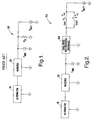
- Fig. 1 is a block diagram of an exemplary power system constructed according to the prior art;
- Fig. 2 is a block diagram of an exemplary power system constructed according to the present invention;
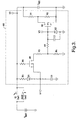
- Fig. 3 is an exemplary electrical schematic of a dual-mode bus discharging circuit constructed according to the present invention; and
- Fig. 4 is a graph depicting exemplary signals at various points in the circuit of Fig. 3 during operation.
-
- The present invention is directed to a system and method for discharging an energy storage device coupled to a power bus. During electrical service of a motor vehicle, it is common for a battery of the motor vehicle to be disconnected. As is discussed above, in 42 Volt power systems with advanced alternator technology, input capacitors have been used between a 42 Volt battery (or bank of batteries) and an inverter power stage to meet ripple current requirements. As is also discussed above, when a service disconnect occurs, the energy stored in the capacitors remain as a potential source for arcing, which can damage various electronic subsystems of the motor vehicle. As such, according to the present invention, a system and method for discharging an energy storage device, e.g., a capacitor, coupled to a power bus provides a first higher impedance discharge path for the energy storage device when the power bus is connected to the battery and a second lower impedance discharge path when the power bus is disconnected from the battery. By providing a second discharge path that has a lower impedance than the first discharge path, the power bus can be discharged within a relatively short period of time to a safe level to prevent damage to the various electronic subassemblies of the motor vehicle, when the power bus is disconnected from the battery.
- With reference to Fig. 1, a
power system 50, including analternator 10 that is coupled to aninverter 20, provides a recharging current to a battery VBATT, e.g., a 42 Volt battery or battery bank. As is discussed above, a capacitor CBUS is utilized to reduce ripple at theinverter 20 and a bleed resistor RB is utilized to discharge the capacitor CBUS when the battery VBATT is disconnected from theinverter 20. - Turning to Fig. 2, a
power system 150, including analternator 10, aninverter 20, a dual-modebus discharging circuit 100 and a battery VBATT, is depicted. A pair of switches SW1 and SW2 are implemented to simulate removal (at t0)/reconnection (at t1), respectively, of the battery VBATT from/to the dual-modebus discharging circuit 100. - With reference to Fig. 3, exemplary components of the dual-mode
bus discharging circuit 100 are shown in further detail. As is shown in Fig. 3, the battery VBATT is connected to an input capacitor CBUS during normal operation. Resistors R1 and R2, which act as bleed resistors, are coupled in parallel with the capacitor CBUS. The bleed resistors R1 and R2 may be selected to draw around one milliampere leakage current from a 42 Volt battery, depending upon the maximum leakage current allowed. Under normal operating conditions, i.e., when the battery VBATT is connected, thecircuit 100 acts essentially the same as a bleed resistor of the prior art. - When the battery VBATT is disconnected from the bus (e.g., by opening switch SW1 at T=1S), the capacitor CBUS begins to discharge through resistors R1 and R2 (see Fig. 4, curve V2). A capacitor C1, at the time the battery VBATT is disconnected from the power bus, is also charged to the battery VBATT voltage level and remains fully charged when the resistors R1 and R2 are in the slow discharge mode, as a body diode (not shown) of transistor M1 (e.g., a P-channel FET) and a
zener diode D 1 prevent current flow (see Fig. 4, curve V1). When the capacitor CBUS is discharged to the point that the voltage differential between a gate and a source of the transistor M1, i.e., the voltage difference between thecapacitor C 1 and the capacitor CBUS, is large enough, the transistor M1 conducts and provides a voltage at a gate of transistor M2 (e.g., an N-channel FET), which causes the transistor M2 to conduct (see Fig. 4, curve V3). - When the transistor M2 is turned on, the resistor R2 is essentially shorted and the primary discharge path is through the resistor R1 and the transistor M2. As the "on-resistance" of the transistor M2 is generally much smaller than the value of the resistor R1, the resistor R1 essentially determines the fast discharging time. It should be appreciated that it is desirable to select the values for resistors R3 and R4 to set a time constant (determined by the
capacitor C 1 and the resistors R3 and R4) that is larger than the time constant set by the capacitor CBUS and the resistor R1 to ensure that the transistor M1 is held on for the entire discharge period. - In various situations, it may be desirable to select the transistors M1 and M2 to be logic level field-effect transistors (FETs), as a faster response time is desired with the same amount of resistance under a slow discharging mode. In certain situations, it is desirable to provide zener diodes D1 and D2 to protect the transistors M1 and M2, respectively, to prevent their gate to source voltages from exceeding their rated values. For example, the
zener diodes D 1 and D2 may be selected in a range of 15 to 20 volts. As referenced above, Fig. 4 depicts a graph of exemplary voltage curves V1, V2 and V3 associated with the circuit of Fig. 3, when the battery VBATT has a voltage of 36 Volts. As is depicted in Figs. 3 and 4, the switch SW1 opens at 'T' equal to IS and the switch SW2 closes at 'T' equal to 250S. - Accordingly, a dual-mode bus discharging circuit has been described herein that advantageously provides an economical bus discharging circuit that reduces a voltage level on a power bus in a relatively short time period, while meeting bus leakage current requirements, for motor vehicles that utilize a 42 Volt power system. It should be appreciated that the dual-mode bus discharging circuit may also be implemented in a variety of power systems of differing voltages, where arcing after a service disconnect are of concern.
- The above description is considered that of the preferred embodiments only. Modifications of the invention will occur to those skilled in the art and to those who make or use the invention. Therefore, it is understood that the embodiments shown in the drawings and described above are merely for illustrative purposes and not intended to limit the scope of the invention, which is defined by the following claims as interpreted according to the principles of patent law, including the doctrine of equivalents.
Claims (18)
- A method for discharging an energy storage device coupled to a power bus, comprising the steps of:providing a first discharge path for an energy storage device (CBUS) that is coupled to a power bus when the power bus is connected to a battery (VBATT); andproviding a second discharge path for the energy storage device (CBUS) when the power bus is disconnected from the battery (VBATT), wherein the first discharge path has a higher impedance than the second discharge path.
- The method of claim 1, wherein the energy storage device (CBUS) is a capacitor.
- The method of claim 1, wherein the first discharge path is a resistive path.
- The method of claim 1, wherein the second discharge path is a resistive path.
- The method of claim 1, wherein the first and second discharge paths are resistive paths
- An automotive power system (150), comprising:an alternator (10);an inverter (20) coupled to the alternator (10);a dual-mode bus discharging circuit (100) coupled to the inverter (20) by a power bus;an energy storage device (CBUS) coupled to the power bus; anda battery (VBATT) coupled to the dual-mode bus discharging circuit (100), wherein the dual-mode bus discharging circuit (100) provides a first discharge path for the energy storage device (CBUS) when the power bus is connected to the battery (VBATT) and a second discharge path for the energy storage device (CBUS) when the power bus is disconnected from the battery (VBATT), and wherein the first discharge path has a higher impedance that the second discharge path.
- The system (150) of claim 6, wherein the energy storage device (CBUS) is a capacitor.
- The system (150) of claim 6, wherein the first discharge path is provided by a pair of serially coupled resistors (R1,R2) that are coupled in parallel with the energy storage device (CBUS).
- The system (150) of claim 8, wherein the second discharge path is provided by a first one of the pair of serially coupled resistors (R1) and a conducting N-channel field-effect transistor (FET) (M2), and wherein a drain and source of the FET (M2) are coupled to opposite sides of a second one of the pair of serially coupled resistors (R2).
- The system (150) of claim 9, wherein the dual-mode bus discharging circuit (100) includes a P-channel FET (M1) whose control terminal is coupled to the energy storage device (CBUS) and whose source is coupled to a battery voltage holding capacitor (C1), and wherein a drain of the P-channel FET (M1) is coupled to a gate of the N-channel FET (M2).
- The system (150) of claim 10, wherein the dual-mode bus discharging circuit (100) further comprises:a first voltage protection device (D2) coupled between the gate and source of the N-channel FET (M2); anda second voltage protection device (D1) coupled between the gate and source of the P-channel FET (M1).
- An automotive power system (150), comprising:an alternator (10);an inverter (20) coupled to the alternator (10);a dual-mode bus discharging circuit (100) coupled to the inverter (20) by a power bus;an energy storage device (CBUS) coupled to the power bus; anda 42 Volt battery (VBATT) coupled to the dual-mode bus discharging circuit (100), wherein the dual-mode bus discharging circuit (100) provides a first discharge path for the energy storage device (CBUS) when the power bus is connected to the battery (VBATT) and a second discharge path for the energy storage device (CBUS) when the power bus is disconnected from the battery (VBATT), and wherein the first discharge path has a higher impedance that the second discharge path.
- The system (150) of claim 12, wherein the energy storage device (CBUS) includes one or more capacitors.
- The system (150) of claim 13, wherein the first discharge path is provided by a pair of serially coupled resistors (R1,R2) that are coupled in parallel with the energy storage device (CBUS).
- The system (150) of claim 14, wherein the second discharge path is provided by a first one of the pair of serially coupled resistors (R1) and a conducting N-channel field-effect transistor (FET) (M2), and wherein a drain and source of the FET (M2) are coupled to opposite sides of a second one of the pair of serially coupled resistors (R2).
- The system (150) of claim 15, wherein the dual-mode bus discharging circuit (100) includes a P-channel FET (M1) whose control terminal is coupled to the energy storage device (CBUS) and whose source is coupled to a battery voltage holding capacitor (C1), and wherein a drain of the P-channel FET (M1) is coupled to a gate of the N-channel FET (M2).
- The system (150) of claim 16, wherein the dual-mode bus discharging circuit (100) further comprises:a first voltage protection device (D2) coupled between the gate and source of the N-channel FET (M2); anda second voltage protection device (D1) coupled between the gate and source of the P-channel FET (M1).
- The system (150) of claim 17, wherein the first and second voltage protection devices (D2,D1) are zener diodes.
Applications Claiming Priority (2)
| Application Number | Priority Date | Filing Date | Title |
|---|---|---|---|
| US853883 | 2004-05-26 | ||
| US10/853,883 US20050264256A1 (en) | 2004-05-26 | 2004-05-26 | Dual-mode bus discharging circuit |
Publications (1)
| Publication Number | Publication Date |
|---|---|
| EP1601079A2 true EP1601079A2 (en) | 2005-11-30 |
Family
ID=34978669
Family Applications (1)
| Application Number | Title | Priority Date | Filing Date |
|---|---|---|---|
| EP05076196A Withdrawn EP1601079A2 (en) | 2004-05-26 | 2005-05-24 | Dual-mode bus discharging circuit |
Country Status (2)
| Country | Link |
|---|---|
| US (1) | US20050264256A1 (en) |
| EP (1) | EP1601079A2 (en) |
Cited By (1)
| Publication number | Priority date | Publication date | Assignee | Title |
|---|---|---|---|---|
| CN106612067A (en) * | 2017-01-06 | 2017-05-03 | 浙江凯耀照明股份有限公司 | Overcharging preventive rapid charging circuit |
Families Citing this family (8)
| Publication number | Priority date | Publication date | Assignee | Title |
|---|---|---|---|---|
| DE102006062101B4 (en) * | 2006-12-30 | 2017-10-05 | Conti Temic Microelectronic Gmbh | Device for discharging the DC link capacitor of the power electronics of a hybrid drive system |
| US20120198262A1 (en) * | 2011-01-31 | 2012-08-02 | Hand Held Products, Inc. | Mobile device and method for extending battery life |
| DE102012100951A1 (en) * | 2012-02-06 | 2013-08-08 | Semikron Elektronik Gmbh & Co. Kg | Circuit arrangement for converters with DC link, and method for operating a power converter |
| DE102012109283A1 (en) * | 2012-09-28 | 2014-04-03 | Siemens Aktiengesellschaft | Power converter of electrical machine used for feeding three-phase motor of motor vehicle, has electrical resistance that is provided in circuit portion at same time through decoupling element |
| US10063073B2 (en) * | 2014-05-21 | 2018-08-28 | Dialog Semiconductor Inc. | USB power converter with bleeder circuit for fast correction of output voltage by discharging output capacitor |
| US20170203666A1 (en) * | 2016-01-19 | 2017-07-20 | Ford Global Technologies, Llc | Battery charging system and servicing method |
| DE102018221209A1 (en) * | 2018-12-07 | 2020-06-10 | Zf Friedrichshafen Ag | Device and method for discharging an intermediate circuit capacitor |
| DE102019216568B3 (en) | 2019-10-28 | 2020-10-15 | Magna powertrain gmbh & co kg | Discharge device for an electric drive arrangement of a vehicle and electric drive arrangement with the discharge device |
Family Cites Families (4)
| Publication number | Priority date | Publication date | Assignee | Title |
|---|---|---|---|---|
| US3890548A (en) * | 1973-11-02 | 1975-06-17 | Evgray Enterprises Inc | Pulsed capacitor discharge electric engine |
| US5619076A (en) * | 1994-12-19 | 1997-04-08 | General Signal Power Systems, Inc. | Method and apparatus for connection and disconnection of batteries to uninterruptible power systems and the like |
| US6612245B2 (en) * | 2001-03-27 | 2003-09-02 | General Electric Company | Locomotive energy tender |
| US7215097B2 (en) * | 2004-02-17 | 2007-05-08 | Keith D. Myers | Series resonant capacitive discharge motor |
-
2004
- 2004-05-26 US US10/853,883 patent/US20050264256A1/en not_active Abandoned
-
2005
- 2005-05-24 EP EP05076196A patent/EP1601079A2/en not_active Withdrawn
Cited By (1)
| Publication number | Priority date | Publication date | Assignee | Title |
|---|---|---|---|---|
| CN106612067A (en) * | 2017-01-06 | 2017-05-03 | 浙江凯耀照明股份有限公司 | Overcharging preventive rapid charging circuit |
Also Published As
| Publication number | Publication date |
|---|---|
| US20050264256A1 (en) | 2005-12-01 |
Similar Documents
| Publication | Publication Date | Title |
|---|---|---|
| US11646569B2 (en) | Secondary battery protection circuit, secondary battery protection apparatus and battery pack | |
| US10516276B2 (en) | Secondary battery protecting integrated circuit, secondary battery protecting circuit, charge control circuit, and battery pack | |
| US10224709B2 (en) | Battery protective circuit | |
| CN100514743C (en) | Battery protection device and system, and battery protection method | |
| US6316915B1 (en) | Charge/discharge protection circuit and battery pack having the charge/discharge protection circuit | |
| US9081069B2 (en) | Protection IC and method of monitoring a battery voltage | |
| EP3190680B1 (en) | Battery protection circuit | |
| KR20150127853A (en) | Battery protection ic and battery device | |
| JP2020014356A (en) | Semiconductor device and electronic control device | |
| CN101150250A (en) | Circuits that Provide Transient Protection | |
| EP1601079A2 (en) | Dual-mode bus discharging circuit | |
| KR20180115630A (en) | Charging/discharging control circuit and battery device | |
| KR102423888B1 (en) | Apparatus for controlling switch | |
| WO2021124684A1 (en) | Method, system and apparatus for diagnosing malfunction in a power distribution unit | |
| US7907380B2 (en) | High power integrating power conditioner | |
| US7504750B2 (en) | Device of protection against a polarity reversal | |
| KR20010014858A (en) | Output through rate control circuit | |
| US6653884B2 (en) | Input interface circuit for semiconductor integrated circuit device | |
| TW202401938A (en) | Driving circuit applied to protection switch of battery module | |
| CN109390904B (en) | Reverse polarity protection circuit arrangement and method for operating a reverse polarity protection circuit arrangement | |
| JP2003079058A (en) | Battery pack | |
| JP3361712B2 (en) | Charge / discharge control circuit | |
| WO2024135061A1 (en) | Semiconductor device, electronic apparatus, and vehicle | |
| US20250219398A1 (en) | Automotive-grade chip, protection circuit, and vehicle-mounted circuit | |
| KR20210048851A (en) | Battery disconnect apparatus and battery apparatus including the same |
Legal Events
| Date | Code | Title | Description |
|---|---|---|---|
| PUAI | Public reference made under article 153(3) epc to a published international application that has entered the european phase |
Free format text: ORIGINAL CODE: 0009012 |
|
| AK | Designated contracting states |
Kind code of ref document: A2 Designated state(s): AT BE BG CH CY CZ DE DK EE ES FI FR GB GR HU IE IS IT LI LT LU MC NL PL PT RO SE SI SK TR |
|
| AX | Request for extension of the european patent |
Extension state: AL BA HR LV MK YU |
|
| STAA | Information on the status of an ep patent application or granted ep patent |
Free format text: STATUS: THE APPLICATION IS DEEMED TO BE WITHDRAWN |
|
| 18D | Application deemed to be withdrawn |
Effective date: 20101201 |