EP1600976A2 - User interface using text compression - Google Patents
User interface using text compression Download PDFInfo
- Publication number
- EP1600976A2 EP1600976A2 EP05103912A EP05103912A EP1600976A2 EP 1600976 A2 EP1600976 A2 EP 1600976A2 EP 05103912 A EP05103912 A EP 05103912A EP 05103912 A EP05103912 A EP 05103912A EP 1600976 A2 EP1600976 A2 EP 1600976A2
- Authority
- EP
- European Patent Office
- Prior art keywords
- data
- user interface
- memory
- languages
- compressed
- Prior art date
- Legal status (The legal status is an assumption and is not a legal conclusion. Google has not performed a legal analysis and makes no representation as to the accuracy of the status listed.)
- Withdrawn
Links
Images
Classifications
-
- G—PHYSICS
- G11—INFORMATION STORAGE
- G11B—INFORMATION STORAGE BASED ON RELATIVE MOVEMENT BETWEEN RECORD CARRIER AND TRANSDUCER
- G11B27/00—Editing; Indexing; Addressing; Timing or synchronising; Monitoring; Measuring tape travel
- G11B27/10—Indexing; Addressing; Timing or synchronising; Measuring tape travel
- G11B27/34—Indicating arrangements
-
- G—PHYSICS
- G06—COMPUTING OR CALCULATING; COUNTING
- G06F—ELECTRIC DIGITAL DATA PROCESSING
- G06F9/00—Arrangements for program control, e.g. control units
- G06F9/06—Arrangements for program control, e.g. control units using stored programs, i.e. using an internal store of processing equipment to receive or retain programs
- G06F9/44—Arrangements for executing specific programs
- G06F9/451—Execution arrangements for user interfaces
- G06F9/454—Multi-language systems; Localisation; Internationalisation
Definitions
- the present invention relates to a user interface with the capability of displaying multiple languages, and to a device using such user interface.
- a typical TV-DVD combo i.e. a television set with a built-in DVD player
- up to fourteen languages are supported by the software.
- All necessary user interface text strings in these different languages are stored in a flash memory in the form of language blocks.
- Each language block contains an array of all possible employed user interface text strings for a specific language. All language blocks have the same contents, i.e. the arrays contain the same amount of strings and these strings are arranged in the same order, but in different translation languages.
- US 6,559,861 discloses an apparatus for displaying a page of a user interface of a computer system in multiple languages.
- the computer system includes a memory that contains a plurality of string values that correspond to text in different languages.
- a memory object represents a page of the user interface and includes a set of variables formatted to be associated with string values.
- a processor selectively associates the variables with the string values that correspond to the language selected by the user.
- an object of the invention to propose a device having a user interface capable of supporting multiple languages with a reduced amount of memory space for storing the user interface text strings.
- this object is achieved by a device having a user interface capable of supporting multiple languages, where data for a selected language are present in non-compressed form while data for non-selected languages are present in compressed form. Due to the compression the data for the unselected languages require only a reduced amount of memory space. Only the data for the selected language are non-compressed and require additional memory space. Preferably the data for the different languages are text strings, which can be efficiently compressed. Of course, the data can also be present in the form of images etc.
- the compressed data are stored in a first memory and the non-compressed data are stored in a second memory.
- the compressed data are stored as part of an executable file to the memory used for the firmware of the device, which usually is a flash memory.
- the uncompressed data for the selected language are then stored in a further memory, usually a random access memory (e.g. SDRAM), which is used for storing the application code of the device.
- a random access memory e.g. SDRAM
- the device includes a table indicating the required memory space for the non-compressed data of the different languages. This allows to easily allocate the required block of memory space in the second memory before uncompressing the data for the selected language.
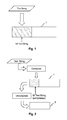
- Fig. 1 depicts an implementation of a user interface according to the prior art.
- the text strings are stored directly to the flash memory 1 in the form of language blocks.
- the software extracts the necessary text strings directly from the flash memory 1.
- the text strings are compressed using for example the "Huffman coding" compression method. This compression is preferably performed during the software compilation phase.
- the compressed text strings are stored to the flash memory 1 in the form of language blocks as part of an executable file.
- the software Upon start up from the mains or a user selection of a particular language setting, the software performs the following steps:
- the software then uses the uncompressed text strings stored in the further memory 2.
Landscapes
- Engineering & Computer Science (AREA)
- Software Systems (AREA)
- Theoretical Computer Science (AREA)
- Human Computer Interaction (AREA)
- Physics & Mathematics (AREA)
- General Engineering & Computer Science (AREA)
- General Physics & Mathematics (AREA)
- Stored Programmes (AREA)
- Document Processing Apparatus (AREA)
Abstract
Description
- Fig. 1
- shows an implementation of a user interface according to the prior art, and
- Fig. 2
- depicts an implementation of a user interface according to the invention.
Claims (10)
- Device having a user interface capable of supporting multiple languages, characterized in that data for a selected language are present in non-compressed form while data for non-selected languages are present in compressed form.
- Device according to claim 1, wherein the compressed data are stored in a first memory (1) and the non-compressed data are stored in a second memory (2).
- Device according to claim 1 or 2, wherein the first memory (1) is a flash memory and the second memory (2) is an SDRAM.
- Device according to one of claims 1 to 3, wherein the data are uncompressed on the fly.
- Device according to one of claims 1 to 4, further including a table indicating the required memory space for the non-compressed data of the different languages.
- Device according to one of claims 1 to 5, wherein the data are text strings.
- Device according to claim 1, wherein instead of supporting multiple languages other multiple possibilities are supported, wherein data for a selected possibility are present in non-compressed form while data for non-selected possibilities are present in compressed form.
- Device according to claim 7, wherein the multiple possibilities are different operation modes of the device.
- Device according to claim 7, wherein the multiple possibilities are different types of audio or video coding or decoding standards.
- Device according to claim 7, wherein the multiple possibilities are different background picture modes.
Priority Applications (1)
| Application Number | Priority Date | Filing Date | Title |
|---|---|---|---|
| EP05103912A EP1600976A3 (en) | 2004-05-28 | 2005-05-11 | User interface using text compression |
Applications Claiming Priority (5)
| Application Number | Priority Date | Filing Date | Title |
|---|---|---|---|
| EP04012732 | 2004-05-28 | ||
| EP04012732 | 2004-05-28 | ||
| EP04292435 | 2004-10-13 | ||
| EP04292435A EP1647883A1 (en) | 2004-10-13 | 2004-10-13 | User interface using text compression |
| EP05103912A EP1600976A3 (en) | 2004-05-28 | 2005-05-11 | User interface using text compression |
Publications (2)
| Publication Number | Publication Date |
|---|---|
| EP1600976A2 true EP1600976A2 (en) | 2005-11-30 |
| EP1600976A3 EP1600976A3 (en) | 2007-06-27 |
Family
ID=34939781
Family Applications (1)
| Application Number | Title | Priority Date | Filing Date |
|---|---|---|---|
| EP05103912A Withdrawn EP1600976A3 (en) | 2004-05-28 | 2005-05-11 | User interface using text compression |
Country Status (1)
| Country | Link |
|---|---|
| EP (1) | EP1600976A3 (en) |
Family Cites Families (3)
| Publication number | Priority date | Publication date | Assignee | Title |
|---|---|---|---|---|
| US5434776A (en) * | 1992-11-13 | 1995-07-18 | Microsoft Corporation | Method and system for creating multi-lingual computer programs by dynamically loading messages |
| US6467038B1 (en) * | 1999-03-12 | 2002-10-15 | Compaq Information Technologies Group, L.P. | Method for supporting optical international language modules flashed into ROM |
| US20030046605A1 (en) * | 2001-09-03 | 2003-03-06 | Farstone Technology Inc. | Data protection system and method regarding the same |
-
2005
- 2005-05-11 EP EP05103912A patent/EP1600976A3/en not_active Withdrawn
Also Published As
| Publication number | Publication date |
|---|---|
| EP1600976A3 (en) | 2007-06-27 |
Similar Documents
| Publication | Publication Date | Title |
|---|---|---|
| KR101102758B1 (en) | Recording medium, playback device, recording method, program, playback method | |
| JP2005531256A (en) | Slideshow with audio | |
| US8502709B2 (en) | Decoding variable length codes in media applications | |
| CN106470353B (en) | A kind of multimedia data processing method and its device, electronic equipment | |
| KR100968675B1 (en) | Variable-Length Code Decoding for WEB Applications | |
| US20070110408A1 (en) | Device for displaying boot animation of optical disc player and method thereof | |
| EP1647883A1 (en) | User interface using text compression | |
| US20050267737A1 (en) | User interface using text compression | |
| US20090217212A1 (en) | Extraction of video picture screen saver function | |
| CN1236627C (en) | Method for recording or reproducing sub-picture data and its device | |
| US9070403B2 (en) | Processing of scalable compressed video data formats for nonlinear video editing systems | |
| JP2004517527A (en) | Graphic image coding | |
| US20060269227A1 (en) | Subpicture display device utilizing micro-processor created subpicture address table and related method | |
| WO2007105514A1 (en) | Information recording device and information recording method | |
| US11909985B2 (en) | Electronic device and method of operating the same | |
| JP4401876B2 (en) | Playback device | |
| US20060018634A1 (en) | Creating a DVD compliant stream directly from encoder hardware | |
| US20050063678A1 (en) | Content reproducing apparatus and method for reproducing content | |
| US8687948B2 (en) | Apparatus and a record carrier for, and a method of recording a sequence of video data signals | |
| KR100698497B1 (en) | Recording medium, method of storing and reproducing digital image medium data on the recording medium | |
| JP2005295143A (en) | Image coding apparatus, control method therefor, and program | |
| EP1754227A1 (en) | Method and apparatus for generating continuous audio to a slideshow | |
| KR20030074004A (en) | Apparatus and method for outputting a text picture | |
| US20060078306A1 (en) | Image-and-audio data real-time integration system of an image-and-Audio data storage device | |
| KR20120012212A (en) | Portable RA image playback device and its playback method |
Legal Events
| Date | Code | Title | Description |
|---|---|---|---|
| PUAI | Public reference made under article 153(3) epc to a published international application that has entered the european phase |
Free format text: ORIGINAL CODE: 0009012 |
|
| AK | Designated contracting states |
Kind code of ref document: A2 Designated state(s): AT BE BG CH CY CZ DE DK EE ES FI FR GB GR HU IE IS IT LI LT LU MC NL PL PT RO SE SI SK TR |
|
| AX | Request for extension of the european patent |
Extension state: AL BA HR LV MK YU |
|
| PUAL | Search report despatched |
Free format text: ORIGINAL CODE: 0009013 |
|
| AK | Designated contracting states |
Kind code of ref document: A3 Designated state(s): AT BE BG CH CY CZ DE DK EE ES FI FR GB GR HU IE IS IT LI LT LU MC NL PL PT RO SE SI SK TR |
|
| AX | Request for extension of the european patent |
Extension state: AL BA HR LV MK YU |
|
| RIC1 | Information provided on ipc code assigned before grant |
Ipc: G06F 9/44 20060101ALI20070522BHEP Ipc: G11B 27/34 20060101AFI20051004BHEP |
|
| RIN1 | Information on inventor provided before grant (corrected) |
Inventor name: WU, TING Inventor name: LEE, GUAN SWEE |
|
| 17P | Request for examination filed |
Effective date: 20071220 |
|
| AKX | Designation fees paid |
Designated state(s): DE FR GB |
|
| RAP1 | Party data changed (applicant data changed or rights of an application transferred) |
Owner name: THOMSON LICENSING |
|
| 17Q | First examination report despatched |
Effective date: 20100930 |
|
| STAA | Information on the status of an ep patent application or granted ep patent |
Free format text: STATUS: THE APPLICATION IS DEEMED TO BE WITHDRAWN |
|
| 18D | Application deemed to be withdrawn |
Effective date: 20131203 |