EP1600947A2 - Subtractive cancellation of harmonic noise - Google Patents
Subtractive cancellation of harmonic noise Download PDFInfo
- Publication number
- EP1600947A2 EP1600947A2 EP04024861A EP04024861A EP1600947A2 EP 1600947 A2 EP1600947 A2 EP 1600947A2 EP 04024861 A EP04024861 A EP 04024861A EP 04024861 A EP04024861 A EP 04024861A EP 1600947 A2 EP1600947 A2 EP 1600947A2
- Authority
- EP
- European Patent Office
- Prior art keywords
- band
- signal
- estimation
- sinusoidal
- frequency
- Prior art date
- Legal status (The legal status is an assumption and is not a legal conclusion. Google has not performed a legal analysis and makes no representation as to the accuracy of the status listed.)
- Withdrawn
Links
Images


Classifications
-
- G—PHYSICS
- G10—MUSICAL INSTRUMENTS; ACOUSTICS
- G10L—SPEECH ANALYSIS TECHNIQUES OR SPEECH SYNTHESIS; SPEECH RECOGNITION; SPEECH OR VOICE PROCESSING TECHNIQUES; SPEECH OR AUDIO CODING OR DECODING
- G10L21/00—Speech or voice signal processing techniques to produce another audible or non-audible signal, e.g. visual or tactile, in order to modify its quality or its intelligibility
- G10L21/02—Speech enhancement, e.g. noise reduction or echo cancellation
- G10L21/0208—Noise filtering
-
- G—PHYSICS
- G10—MUSICAL INSTRUMENTS; ACOUSTICS
- G10L—SPEECH ANALYSIS TECHNIQUES OR SPEECH SYNTHESIS; SPEECH RECOGNITION; SPEECH OR VOICE PROCESSING TECHNIQUES; SPEECH OR AUDIO CODING OR DECODING
- G10L21/00—Speech or voice signal processing techniques to produce another audible or non-audible signal, e.g. visual or tactile, in order to modify its quality or its intelligibility
- G10L21/02—Speech enhancement, e.g. noise reduction or echo cancellation
- G10L21/0208—Noise filtering
- G10L2021/02085—Periodic noise
Definitions
- the present invention generally relates to the field of noise suppression and particularly to a method for canceling additive sinusoidal disturbances with unknown frequency in a signal of interest.
- the focus of the method is on enhancing audio signals.
- the invention however is not limited to the field of acoustics, i.e it may be applied to signals of a pressure sensor.
- a common problem in audio processing is that the information-bearing signal is disturbed by one or more sinusoidal signals.
- the traditional method for suppressing the interfering signals is to use fixed notch filters tuned to the frequency of the sinusoidal interference, as described in "Halbleiter-Scibilstechnik” by Ulrich Tietze and Christoph Schenk, Springer, 12th edition, 2002.
- the filter's notch is required to be very sharp, and for a good suppression the frequency of the interference needs to be known precisely. If this is not the case, the usual method of notch filtering is no longer applicable and an adaptive approach as proposed in "Adaptive IIR Filtering in Signal Processing and Control" by Philip A. Regalia, Marcel Dekker, 1994, has to be used.
- the filter synchronizes with the main sinusoidal interference that contains the most power and suppresses it completely. Furthermore, the filter is able to track minor time-dependent changes of the interference frequency.
- the approach has one major drawback: it does not preserve the spectral content of the information-bearing signal at the notch frequency. A clean separation of two sinusoids, one representing noise and the other representing useful information, is thus not possible.
- the estimation process can be slowed down or completely stopped, such that the estimator cannot track the changes in amplitude and phase caused by the signal of interest.
- the spectral content will be preserved as long as the parameters of the sinusoidal interference remain constant in time. If they change, this does not hold anymore, and one is forced to reactivate the usual estimation procedure.
- State of the art methods assume known frequencies for the cancellation and most of them use gradient descent for a sequential parameter estimation of amplitude and phase, e.g. "Gerduschreduktionsvon mit modellbas striv striving Ansdtzen fur Frei Kunststoff Rhein Kunststoffen in KraftGermanen” by Henning Puder, PhD Thesis, Technische (2015) Darmstadt, 2003.
- the estimation of the disturbing sinusoidal parameters is controlled by the step size of the descent and only activated during speech pauses. This way, suppression of useful spectral content in speech parts is greatly reduced.
- an object of the present invention is to provide for an improved technique of noise cancellation that can also be applied in case the interference frequency is unknown.
- the underlying invention basically removes individual sinusoidal interferences from a disturbed voice signal by means of a compensation technique.
- the basic idea is to use the in-phase/quadrature model for the sinusoidal interferences.
- the proposed method estimates and tracks the following parameters: in-phase amplitude, quadrature amplitude and frequency of each interference.
- the estimation is performed recursively by an Extended Kalman-Filter.
- the sinusoidal interferences are compensated in the disturbed signal by generating a reference signal and subtracting it from the disturbed signal.
- the estimation of the three unknown sinusoidal disturbance parameters is done sequentially by an Extended Kalman Filter.
- the filter converges - comparable to the adaptive notch filter - to the most powerful frequency and estimates its parameters.
- the parameter estimation procedure can be controlled by choosing different values for the assumed measurement and plant noise covariance in the Kalman framework. A high value in the measurement covariance fixes for example the estimated values and the reference signal.
- the method proposed by the underlying invention has the advantage that it is not necessary to know the frequency of the interference and, in contrast to the adaptive notch filter, no signal information is eliminated.
- the respective values for the initialization of the Kalman filter and for the variance of signals and interference can be determined by additional sensors e.g. a revolution counter of a motor in the case of the suppression of a motor noise. They can also be determined by a learning procedure, during which possible disturbances/ interferences/ noises and their properties are identified. The values thereby determined are not the exact values of the frequencies of the interference but only estimation values thereof, which are useful for speeding-up the Kalman filter adaptation and for improving the accuracy of the estimation.
- continuous sensor information after initialization can easily be integrated in the filtering process by adding separate measurement equations.
- a sensor fusion of a revolution counter and other devices can thus be accomplished.
- a method for canceling a sinusoidal disturbance of unknown frequency in a disturbed useful signal comprises the steps of estimating the three parameters of the sinusoidal disturbance that are amplitude, phase and frequency, generating a reference signal on the basis of the estimated parameters, and subtracting the reference signal from the disturbed useful signal.
- the estimation of the parameters of the sinusoidal disturbance can be initialized with values of additional sensors and/or of a learn procedure.
- the disturbed useful signal is band-pass filtered before the estimation step.
- the disturbed useful signal can be decomposed into bands by a number of band-pass filters before the method is applied to each band.
- a given sinusoidal disturbance can be canceled in a first band, and the given sinusoidal disturbance can also be canceled in a second band by means of the reference signal generated for canceling the given sinusoidal disturbance in the first band.
- the given sinusoidal disturbance can be canceled in the second band by adapting the reference signal generated for canceling the given sinusoidal disturbance in the first band, to the ratio of the first band frequency response to the second band frequency response.
- the estimation can be performed by an extended Kalman filter.
- the confidence in the initialization values of the estimation step can be adapted.
- the confidence can also then be adapted by controlling the error covariance matrix of the extended Kalman filter.
- the method can be executed time-selectively and particularly on the basis of a voice activity measurement.
- the obtained estimated useful signal can be filtered according to the method of Ephraim and Malah.
- a system for canceling a sinusoidal disturbance of unknown frequency in a disturbed information-bearing signal wherein a computing device executes the previous methods.
- the method proposed by the invention estimates (2) and tracks the following parameters for each interference: in-phase amplitude, quadrature amplitude and frequency.
- the estimation is performed recursively by an Extended Kalman-Filter.
- a reference signal (5) is generated (4) and subtracted (6) from the disturbed signal (1), such that the sinusoidal interference (9) is compensated in the disturbed signal (1).
- the reference signal that is utilized is an artificial signal (5) v and(n, ⁇ and) produced on the basis of a noise model (4).
- the artificial signal (5) represents an estimated value of the actual disturbing noise (9) v(n) that superimposes the information-bearing signal (8) s(n).
- v ( n , ⁇ ) ⁇ 1 cos (2 ⁇ 3 ⁇ n ) - ⁇ 2 sin (2 ⁇ 3 ⁇ n )
- the method basically eliminates the drawbacks of notch filtering. It allows to:
- the results obtained with said method depend on the accuracy of the estimators (2) as well as on the possibility to differentiate between the useful signal (8) and the noise signal (9).
- Small estimation errors in the phase, or in the frequency can lead after a period of time to large errors in the subtraction between the reference and the noise signal.
- a constant new estimation (2) is therefore absolutely necessary.
- the present invention proposes to use a sequential method.
- LMMSE linear minimum mean square error
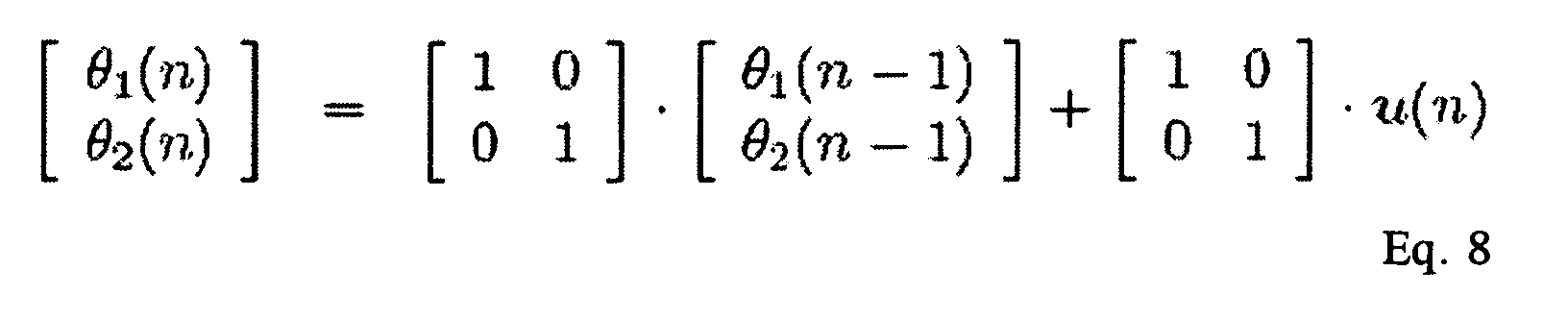
- ⁇ (n) can be observed via the disturbed noise signal (1) y(n): wherein w(n) expresses the influence of the voice signal (8) s(n) on the measure of the noise signal (9) v(n):
- the "voice noise" w(n) can be statistically described by its mean value ⁇ w (n) and its variance ⁇ w 2 (n). This is, however, not sufficient for a complete description of its statistical behavior because the assumption of a Gaussian distribution does not hold for the voice signal. Consequently, the Kalman Filter does not produce the best results in the sense of a minimum mean square error (MMSE), but provides only the best values for a linear estimation method (LMMSE).
- Fig. 2 shows the recursive Kalman estimation algorithm resulting from the above definitions and assumptions.
- the initialization consists in setting the values ⁇ and (-1
- -1) is determined by M(-1
- -1) is determined by M(-1
- the algorithm can look for the "right" parameters ⁇ (n) in the range of the beginning values during a certain period of time. If the algorithm does not find said parameters, it changes only slowly its “search direction” . The filter is exposed to a very strong “bias”.
- the tracking of the amplitude values ⁇ 1 (n) and ⁇ 2 (n) can be controlled via the covariance matrix Q.
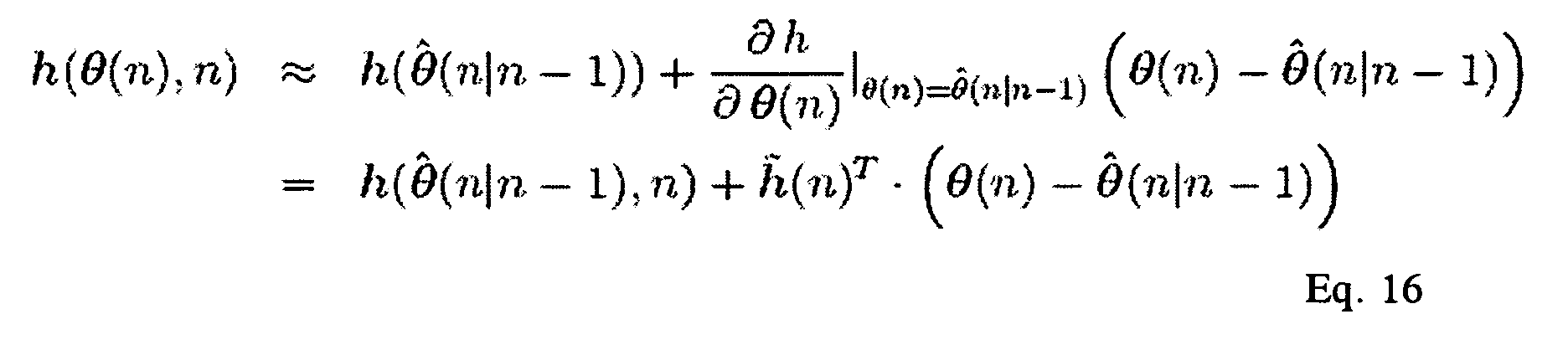
- step 4b uses the non-linear signal model h( ⁇ and(n
- step 4b uses the non-linear signal model h( ⁇ and(n
- step 4b uses the first order linearization (n), which has to be computed for each new step.
- the suppression according to the present invention is not directly performed on the disturbed voice signal (1) y(n). Instead, the invention proposes to carry out at first a sub-band decomposition, which is the first step of the subtractive cancellation of harmonic noise. Its function reproduces the neural signal processing of the human cochlea. The noise suppression then takes place at a neural higher level and uses the signal filtered by the cochlea.
- a model that shows good results is the gammatone filter bank proposed by Patterson.
- Said filter bank is composed of different band-pass filters of order 8, wherein the filters have different bandwidths and different center frequency distances to each other.
- the bandwidths as well as the distances or. band-overlaps are defined on the basis of a psycho-acoustic analysis and they increase with an increasing frequency.
- the compensation technique according to the present invention profits from the sub-band decomposition. Sinusoidal interferences that are close together are separated by the decomposition.
- the filter bank shows a low channel width particularly for deep frequencies such that it separates the sinusoidal oscillations having a high power, e.g. the 100Hz and 200Hz oscillations of the network humming.
- the estimation procedure is carried out only in one channel.
- the channel selected is the one having the largest amplitude course for the given initial frequency.
- the fixed relation between the transfer functions of the main and co-channels allows then to produce suitable artificial reference noises for the other channels.
- the compensation method proposed by the present invention differs from a notch filtering through two features:
- the present invention proposes to realize this control by means of a voice-activity-detection (VAD) method.
- VAD voice-activity-detection
- Such methods are used in the mobile communication field, see e.g. "Voice-Activity Detector", ETSI Rec. GSM 06.92, 1989.
- the parameter estimation and tracking starts again under the threshold value, i.e. when the voice is no longer present in the signal.
- the first filter has thus to eliminate the most powerful sinusoidal disturbance in the signal or in a given frequency band of the signal.
- the obtained signal is then supplied to the second filter that can suppress the second most powerful sinusoidal disturbance, etc.
- the signal can be filtered according to the method of Ephraim and Malah. Said method is described in the document "Speech enhancement using a minimum mean-square error short-time spectral amplitude estimator" by Yariv Ephraim and David Malah, IEEE Transactions on Acoustics, Speech and Signal Processing, 32(6), December 1984.
Landscapes
- Engineering & Computer Science (AREA)
- Computational Linguistics (AREA)
- Quality & Reliability (AREA)
- Signal Processing (AREA)
- Health & Medical Sciences (AREA)
- Audiology, Speech & Language Pathology (AREA)
- Human Computer Interaction (AREA)
- Physics & Mathematics (AREA)
- Acoustics & Sound (AREA)
- Multimedia (AREA)
- Noise Elimination (AREA)
- Filters That Use Time-Delay Elements (AREA)
Abstract
- estimating (2) the three sinusoidal parameters of the disturbance (9), i.e. amplitude, phase and frequency,
- generating (4) a reference signal (5) according to the estimated parameters, and
- subtracting (6) the reference signal (5) from the disturbed information bearing signal (1).
Description
- Fig. 1
- shows the elimination of a noise in a disturbed signal by adding a reference noise according to the present invention,
- Fig. 2
- shows the recursive Kalman estimation algorithm, and
- Fig. 3
- shows the recursive extended Kalman estimation algorithm.
e(n) is the error signal after noise compensation at time n,
s(n) is the useful signal at time n,
s and(n) is the estimated useful signal at time n,
v(n) is the interfering noise at time n,
v and(n) is the estimated interfering noise at time n, and
y(n) is the additive disturbed useful signal at time n.






- first, it requires only a limited preliminary knowledge of the frequency to compensate, i.e. the algorithm converges automatically to the most powerful frequency in the vicinity of the initial values,
- secondly, it can prevent the extended Kalman filter from removing voice portions of the same frequency by controlling the model noise parameters σw 2(n) and Q(n).
Claims (16)
- A method for canceling a sinusoidal disturbance (9) of unknown frequency in a disturbed useful signal (1),
comprising the steps of:estimating (2) the three parameters of the sinusoidal disturbance (9) that are amplitude, phase and frequency,generating (4) a reference signal (5) on the basis of the estimated parameters, andsubtracting (6) the reference signal (6) from the disturbed useful signal (1). - A method according to claim 1,
wherein the estimation (2) of the parameters of the sinusoidal disturbance (9) is initialized with values of additional sensors and/or of a learn procedure. - A method according to claim 1 or 2,
wherein information from additional sensors is integrated as an additional measurement equation in the Kalman formalism. - A method according to any of the preceding claims,
wherein a plurality of sinusoidal disturbances (9) is canceled by repeating the method of claim 1 in series. - A method according to any of the preceding claims,
wherein the disturbed useful signal (1) is band-pass filtered before the estimation (2) step. - A method according to claim 5,
wherein the disturbed useful signal (1) is decomposed into bands by a number of band-pass filters before the method of claim 1 or 4 is applied to each band. - A method according to claim 6,
whereina given sinusoidal disturbance (9) is canceled in a first band, andthe given sinusoidal disturbance (9) is canceled in a second band by means of the reference signal (5) generated for canceling the given sinusoidal disturbance (9) in the first band. - A method according to claim 7,
wherein the given sinusoidal disturbance (9) is canceled in the second band by adapting the reference signal (5), generated for canceling the given sinusoidal disturbance (9) in the first band, to the ratio of the first band frequency response to the second band frequency response. - A method according to any of the preceding claims,
wherein the estimation (2) is performed by an extended Kalman filter. - A method according to any of the preceding claims,
wherein the confidence in the initialization values of the estimation (2) step is adapted. - A method according to claim 10 when back referenced to claim 9,
wherein the confidence is adapted by controlling the error covariance matrix of the extended Kalman filter. - A method according to any of the preceding claims,
characterized in that
it is time-selectively executed. - A method according to claim 12,
characterized in that
it is executed on the basis of a voice activity measurement. - A method according to any of the preceding claims,
wherein the obtained estimated useful signal (7) is filtered according to the method of Ephraim and Malah. - A computer software program product,
implementing a method according to any of the preceding claims when running on a computing device. - A system for canceling a sinusoidal disturbance of unknown frequency in a disturbed information-bearing signal,
wherein a computing device is designed to implement a method according to any of claims 1 to 14.
Priority Applications (3)
| Application Number | Priority Date | Filing Date | Title |
|---|---|---|---|
| EP04024861A EP1600947A3 (en) | 2004-05-26 | 2004-10-19 | Subtractive cancellation of harmonic noise |
| US11/138,243 US7453963B2 (en) | 2004-05-26 | 2005-05-25 | Subtractive cancellation of harmonic noise |
| JP2005152153A JP4630727B2 (en) | 2004-05-26 | 2005-05-25 | How to cancel harmonic noise subtraction |
Applications Claiming Priority (3)
| Application Number | Priority Date | Filing Date | Title |
|---|---|---|---|
| EP04012471 | 2004-05-26 | ||
| EP04012471 | 2004-05-26 | ||
| EP04024861A EP1600947A3 (en) | 2004-05-26 | 2004-10-19 | Subtractive cancellation of harmonic noise |
Publications (2)
| Publication Number | Publication Date |
|---|---|
| EP1600947A2 true EP1600947A2 (en) | 2005-11-30 |
| EP1600947A3 EP1600947A3 (en) | 2005-12-21 |
Family
ID=34927034
Family Applications (1)
| Application Number | Title | Priority Date | Filing Date |
|---|---|---|---|
| EP04024861A Withdrawn EP1600947A3 (en) | 2004-05-26 | 2004-10-19 | Subtractive cancellation of harmonic noise |
Country Status (3)
| Country | Link |
|---|---|
| US (1) | US7453963B2 (en) |
| EP (1) | EP1600947A3 (en) |
| JP (1) | JP4630727B2 (en) |
Cited By (3)
| Publication number | Priority date | Publication date | Assignee | Title |
|---|---|---|---|---|
| EP1850328A1 (en) * | 2006-04-26 | 2007-10-31 | Honda Research Institute Europe GmbH | Enhancement and extraction of formants of voice signals |
| WO2009043066A1 (en) * | 2007-10-02 | 2009-04-09 | Akg Acoustics Gmbh | Method and device for low-latency auditory model-based single-channel speech enhancement |
| CN104751845A (en) * | 2015-03-31 | 2015-07-01 | 江苏久祥汽车电器集团有限公司 | Voice recognition method and system used for intelligent robot |
Families Citing this family (32)
| Publication number | Priority date | Publication date | Assignee | Title |
|---|---|---|---|---|
| US7680656B2 (en) * | 2005-06-28 | 2010-03-16 | Microsoft Corporation | Multi-sensory speech enhancement using a speech-state model |
| JP4765461B2 (en) * | 2005-07-27 | 2011-09-07 | 日本電気株式会社 | Noise suppression system, method and program |
| JP4755555B2 (en) * | 2006-09-04 | 2011-08-24 | 日本電信電話株式会社 | Speech signal section estimation method, apparatus thereof, program thereof, and storage medium thereof |
| JP4673828B2 (en) * | 2006-12-13 | 2011-04-20 | 日本電信電話株式会社 | Speech signal section estimation apparatus, method thereof, program thereof and recording medium |
| US8949025B2 (en) * | 2007-06-08 | 2015-02-03 | Qualcomm Incorporated | GNSS positioning using pressure sensors |
| US20090012786A1 (en) * | 2007-07-06 | 2009-01-08 | Texas Instruments Incorporated | Adaptive Noise Cancellation |
| US7894512B2 (en) * | 2007-07-31 | 2011-02-22 | Harris Corporation | System and method for automatic recovery and covariance adjustment in linear filters |
| US7809094B2 (en) * | 2007-10-15 | 2010-10-05 | Broadlogic Network Technologies Inc. | Method and apparatus for providing cancellation of harmonics signals with modulated signals for multi-channels |
| JP5640238B2 (en) * | 2008-02-28 | 2014-12-17 | 株式会社通信放送国際研究所 | Singularity signal processing system and program thereof |
| US8233870B2 (en) * | 2008-12-04 | 2012-07-31 | Broadcom Corporation | Multiple frequency band multiple standard transceiver |
| US8244523B1 (en) * | 2009-04-08 | 2012-08-14 | Rockwell Collins, Inc. | Systems and methods for noise reduction |
| US9210503B2 (en) * | 2009-12-02 | 2015-12-08 | Audience, Inc. | Audio zoom |
| US9838784B2 (en) | 2009-12-02 | 2017-12-05 | Knowles Electronics, Llc | Directional audio capture |
| US8798290B1 (en) | 2010-04-21 | 2014-08-05 | Audience, Inc. | Systems and methods for adaptive signal equalization |
| US9558755B1 (en) | 2010-05-20 | 2017-01-31 | Knowles Electronics, Llc | Noise suppression assisted automatic speech recognition |
| US20120245927A1 (en) * | 2011-03-21 | 2012-09-27 | On Semiconductor Trading Ltd. | System and method for monaural audio processing based preserving speech information |
| US9020080B2 (en) * | 2011-06-16 | 2015-04-28 | Lockheed Martin Corporation | Method and system to adaptively cancel sinusoidal interference from a signal processing system |
| US9223009B1 (en) | 2011-12-19 | 2015-12-29 | Lockheed Martin Corporation | Method and system for electromagnetic interference (EMI) mitigation using an auxiliary receiver |
| US8952844B1 (en) | 2011-12-23 | 2015-02-10 | Lockheed Martin Corporation | System and method for adaptively matching the frequency response of multiple channels |
| US9258653B2 (en) | 2012-03-21 | 2016-02-09 | Semiconductor Components Industries, Llc | Method and system for parameter based adaptation of clock speeds to listening devices and audio applications |
| JP6177513B2 (en) * | 2012-09-28 | 2017-08-09 | 株式会社日立ハイテクノロジーズ | Plasma processing equipment |
| US9536540B2 (en) | 2013-07-19 | 2017-01-03 | Knowles Electronics, Llc | Speech signal separation and synthesis based on auditory scene analysis and speech modeling |
| US9269370B2 (en) * | 2013-12-12 | 2016-02-23 | Magix Ag | Adaptive speech filter for attenuation of ambient noise |
| JP6160519B2 (en) * | 2014-03-07 | 2017-07-12 | 株式会社Jvcケンウッド | Noise reduction device |
| US9214185B1 (en) * | 2014-06-29 | 2015-12-15 | Avago Technologies General Ip (Singapore) Pte. Ltd. | Adaptive filter-based narrowband interference detection, estimation and cancellation |
| DE112015004185T5 (en) | 2014-09-12 | 2017-06-01 | Knowles Electronics, Llc | Systems and methods for recovering speech components |
| WO2016123560A1 (en) | 2015-01-30 | 2016-08-04 | Knowles Electronics, Llc | Contextual switching of microphones |
| JP6477295B2 (en) * | 2015-06-29 | 2019-03-06 | 株式会社Jvcケンウッド | Noise detection apparatus, noise detection method, and noise detection program |
| US9820042B1 (en) | 2016-05-02 | 2017-11-14 | Knowles Electronics, Llc | Stereo separation and directional suppression with omni-directional microphones |
| US20190061617A1 (en) * | 2017-08-29 | 2019-02-28 | GM Global Technology Operations LLC | Audio Control Systems And Methods Based On Driver Helmet Use |
| CN114422039B (en) * | 2022-01-21 | 2024-03-19 | 中车大连电力牵引研发中心有限公司 | Method for removing noise in signal |
| CN115906535B (en) * | 2023-01-06 | 2023-05-23 | 山东科技大学 | Harmonic detection method based on event trigger mechanism under influence of outlier |
Family Cites Families (9)
| Publication number | Priority date | Publication date | Assignee | Title |
|---|---|---|---|---|
| US4677668A (en) * | 1984-05-01 | 1987-06-30 | North Carolina State University | Echo canceller using parametric methods |
| JPH08158369A (en) * | 1994-12-07 | 1996-06-18 | Fujita Corp | Inverse analysis method |
| KR100199015B1 (en) * | 1996-11-25 | 1999-06-15 | 정선종 | FM demodulator with extended Kalman filter |
| JP2998794B2 (en) * | 1997-01-28 | 2000-01-11 | 日本電気株式会社 | Periodic noise removing apparatus and periodic noise removing method |
| JP2003514483A (en) * | 1999-11-03 | 2003-04-15 | テレフオンアクチーボラゲット エル エム エリクソン(パブル) | System and method for noise reduction in communication signals |
| US6757395B1 (en) * | 2000-01-12 | 2004-06-29 | Sonic Innovations, Inc. | Noise reduction apparatus and method |
| US7162165B2 (en) * | 2002-08-02 | 2007-01-09 | Agilent Technologies, Inc. | Kalman filter assembly intensity noise subtraction for optical heterodyne receivers |
| US7152495B2 (en) * | 2002-12-19 | 2006-12-26 | Honeywell International, Inc. | System and method for adaptive cancellation of disturbances |
| US7113850B2 (en) * | 2003-12-03 | 2006-09-26 | The Boeing Company | Method and apparatus for active acoustic damping motor control |
-
2004
- 2004-10-19 EP EP04024861A patent/EP1600947A3/en not_active Withdrawn
-
2005
- 2005-05-25 JP JP2005152153A patent/JP4630727B2/en not_active Expired - Fee Related
- 2005-05-25 US US11/138,243 patent/US7453963B2/en not_active Expired - Fee Related
Non-Patent Citations (5)
| Title |
|---|
| HARTMUT R PF ITZINGER DEPARTMENT OF PHONETICS AND SPEECH COMMUNICATION UNIVERSITY OF MUNICH ET AL: "REMOVING HUM FROM SPOKEN LANGUAGE RESOURCES" PROC. OF ICSLP 2000, 16 October 2000 (2000-10-16), pages 1-4, XP007010967 Beijing, China * |
| HENNING PUDER ET AL: "Speech Enhancement for Hands-Free Car Phones by Adaptive Compensation of Harmonic Engine Noise Components" EUROSPEECH 2003, September 2003 (2003-09), pages 1397-1400, XP007006861 Geneva * |
| LA SCALA B F ET AL: "Design of an extended Kalman filter frequency tracker" IEEE TRANSACTIONS ON SIGNAL PROCESSING, IEEE SERVICE CENTER, NEW YORK, NY, US, vol. 44, no. 3, March 1996 (1996-03), pages 739-742, XP002307184 ISSN: 1053-587X * |
| PARKER P J ET AL: "Frequency tracking of nonsinusoidal periodic signals in noise" SIGNAL PROCESSING NETHERLANDS, vol. 20, no. 2, June 1990 (1990-06), pages 127-152, XP002351721 ISSN: 0165-1684 * |
| WOOLFSON M S ET AL: "Adaptive cancellation of selected harmonics from a signal" IEE PROCEEDINGS: VISION, IMAGE AND SIGNAL PROCESSING, INSTITUTION OF ELECTRICAL ENGINEERS, GB, vol. 148, no. 4, 24 August 2001 (2001-08-24), pages 295-303, XP006017136 ISSN: 1350-245X * |
Cited By (5)
| Publication number | Priority date | Publication date | Assignee | Title |
|---|---|---|---|---|
| EP1850328A1 (en) * | 2006-04-26 | 2007-10-31 | Honda Research Institute Europe GmbH | Enhancement and extraction of formants of voice signals |
| WO2009043066A1 (en) * | 2007-10-02 | 2009-04-09 | Akg Acoustics Gmbh | Method and device for low-latency auditory model-based single-channel speech enhancement |
| GB2465910A (en) * | 2007-10-02 | 2010-06-09 | Akg Acoustics Gmbh | Method and device for low-latency auditory model-based single-channel speech enhancement |
| GB2465910B (en) * | 2007-10-02 | 2012-02-15 | Akg Acoustics Gmbh | Method and device for low-latency auditory model-based single-channel speech enhancement |
| CN104751845A (en) * | 2015-03-31 | 2015-07-01 | 江苏久祥汽车电器集团有限公司 | Voice recognition method and system used for intelligent robot |
Also Published As
| Publication number | Publication date |
|---|---|
| US20050276363A1 (en) | 2005-12-15 |
| US7453963B2 (en) | 2008-11-18 |
| JP2006005918A (en) | 2006-01-05 |
| JP4630727B2 (en) | 2011-02-09 |
| EP1600947A3 (en) | 2005-12-21 |
Similar Documents
| Publication | Publication Date | Title |
|---|---|---|
| US7453963B2 (en) | Subtractive cancellation of harmonic noise | |
| Abd El-Fattah et al. | Speech enhancement with an adaptive Wiener filter | |
| TWI420509B (en) | Noise variance estimator for speech enhancement | |
| EP1638084B1 (en) | Method and apparatus for multi-sensory speech enhancement | |
| Wan et al. | Dual extended Kalman filter methods | |
| EP2191465B1 (en) | Speech enhancement with noise level estimation adjustment | |
| EP1520395B1 (en) | Stationary spectral power dependent audio enhancement system | |
| EP1008140B1 (en) | Waveform-based periodicity detector | |
| US8751220B2 (en) | Multiple microphone based low complexity pitch detector | |
| WO2000036592A1 (en) | Improved noise spectrum tracking for speech enhancement | |
| US20160134984A1 (en) | Determining noise and sound power level differences between primary and reference channels | |
| Yuo et al. | Robust features for noisy speech recognition based on temporal trajectory filtering of short-time autocorrelation sequences | |
| US5963899A (en) | Method and system for region based filtering of speech | |
| CN100589184C (en) | Subtractive Elimination of Harmonic Noise | |
| Liebich et al. | Time-domain Kalman filter for active noise cancellation headphones | |
| KR20110021419A (en) | Complex Spectrum Noise Reduction Device and Method | |
| Wu et al. | A one-microphone algorithm for reverberant speech enhancement | |
| Martin et al. | Single‐Channel Speech Presence Probability Estimation and Noise Tracking | |
| KR20160116440A (en) | SNR Extimation Apparatus and Method of Voice Recognition System | |
| KR102718917B1 (en) | Detection of fricatives in speech signals | |
| KR20110061781A (en) | Speech processing apparatus and method for removing noise based on real-time noise estimation | |
| Lee et al. | Time-varying signal frequency estimation by VFF Kalman filtering | |
| Brajević et al. | Signal denoising using STFT with Bayes prediction and Ephraim-Malah estimation | |
| Youshen et al. | Speech enhancement in presence of colored noise using an improved least square estimation | |
| Gupta et al. | Performance Analysis of MSFRLS-VFF Based Real-Time Adaptive Noise Canceller with RLS and APA Algorithms Using TMS320C6713 Processor: D. Gupta et al. |
Legal Events
| Date | Code | Title | Description |
|---|---|---|---|
| PUAI | Public reference made under article 153(3) epc to a published international application that has entered the european phase |
Free format text: ORIGINAL CODE: 0009012 |
|
| PUAL | Search report despatched |
Free format text: ORIGINAL CODE: 0009013 |
|
| AK | Designated contracting states |
Kind code of ref document: A2 Designated state(s): AT BE BG CH CY CZ DE DK EE ES FI FR GB GR HU IE IT LI LU MC NL PL PT RO SE SI SK TR |
|
| AX | Request for extension of the european patent |
Extension state: AL HR LT LV MK |
|
| AK | Designated contracting states |
Kind code of ref document: A3 Designated state(s): AT BE BG CH CY CZ DE DK EE ES FI FR GB GR HU IE IT LI LU MC NL PL PT RO SE SI SK TR |
|
| AX | Request for extension of the european patent |
Extension state: AL HR LT LV MK |
|
| 17P | Request for examination filed |
Effective date: 20060621 |
|
| AKX | Designation fees paid |
Designated state(s): DE FR GB |
|
| 17Q | First examination report despatched |
Effective date: 20070209 |
|
| STAA | Information on the status of an ep patent application or granted ep patent |
Free format text: STATUS: THE APPLICATION IS DEEMED TO BE WITHDRAWN |
|
| 18D | Application deemed to be withdrawn |
Effective date: 20120503 |