EP1600825A1 - Electrophotographic toner and method of development therewith - Google Patents
Electrophotographic toner and method of development therewith Download PDFInfo
- Publication number
- EP1600825A1 EP1600825A1 EP04715526A EP04715526A EP1600825A1 EP 1600825 A1 EP1600825 A1 EP 1600825A1 EP 04715526 A EP04715526 A EP 04715526A EP 04715526 A EP04715526 A EP 04715526A EP 1600825 A1 EP1600825 A1 EP 1600825A1
- Authority
- EP
- European Patent Office
- Prior art keywords
- toner
- resin
- controlling agent
- photoreceptor
- cyclo
- Prior art date
- Legal status (The legal status is an assumption and is not a legal conclusion. Google has not performed a legal analysis and makes no representation as to the accuracy of the status listed.)
- Granted
Links
Images

Classifications
-
- G—PHYSICS
- G03—PHOTOGRAPHY; CINEMATOGRAPHY; ANALOGOUS TECHNIQUES USING WAVES OTHER THAN OPTICAL WAVES; ELECTROGRAPHY; HOLOGRAPHY
- G03G—ELECTROGRAPHY; ELECTROPHOTOGRAPHY; MAGNETOGRAPHY
- G03G9/00—Developers
- G03G9/08—Developers with toner particles
- G03G9/087—Binders for toner particles
-
- G—PHYSICS
- G03—PHOTOGRAPHY; CINEMATOGRAPHY; ANALOGOUS TECHNIQUES USING WAVES OTHER THAN OPTICAL WAVES; ELECTROGRAPHY; HOLOGRAPHY
- G03G—ELECTROGRAPHY; ELECTROPHOTOGRAPHY; MAGNETOGRAPHY
- G03G9/00—Developers
- G03G9/08—Developers with toner particles
- G03G9/087—Binders for toner particles
- G03G9/08702—Binders for toner particles comprising macromolecular compounds obtained by reactions only involving carbon-to-carbon unsaturated bonds
- G03G9/08704—Polyalkenes
-
- G—PHYSICS
- G03—PHOTOGRAPHY; CINEMATOGRAPHY; ANALOGOUS TECHNIQUES USING WAVES OTHER THAN OPTICAL WAVES; ELECTROGRAPHY; HOLOGRAPHY
- G03G—ELECTROGRAPHY; ELECTROPHOTOGRAPHY; MAGNETOGRAPHY
- G03G9/00—Developers
- G03G9/08—Developers with toner particles
- G03G9/083—Magnetic toner particles
-
- G—PHYSICS
- G03—PHOTOGRAPHY; CINEMATOGRAPHY; ANALOGOUS TECHNIQUES USING WAVES OTHER THAN OPTICAL WAVES; ELECTROGRAPHY; HOLOGRAPHY
- G03G—ELECTROGRAPHY; ELECTROPHOTOGRAPHY; MAGNETOGRAPHY
- G03G9/00—Developers
- G03G9/08—Developers with toner particles
- G03G9/087—Binders for toner particles
- G03G9/08702—Binders for toner particles comprising macromolecular compounds obtained by reactions only involving carbon-to-carbon unsaturated bonds
- G03G9/08735—Polymers of unsaturated cyclic compounds having no unsaturated aliphatic groups in a side-chain, e.g. coumarone-indene resins
-
- G—PHYSICS
- G03—PHOTOGRAPHY; CINEMATOGRAPHY; ANALOGOUS TECHNIQUES USING WAVES OTHER THAN OPTICAL WAVES; ELECTROGRAPHY; HOLOGRAPHY
- G03G—ELECTROGRAPHY; ELECTROPHOTOGRAPHY; MAGNETOGRAPHY
- G03G9/00—Developers
- G03G9/08—Developers with toner particles
- G03G9/087—Binders for toner particles
- G03G9/08775—Natural macromolecular compounds or derivatives thereof
- G03G9/08782—Waxes
-
- G—PHYSICS
- G03—PHOTOGRAPHY; CINEMATOGRAPHY; ANALOGOUS TECHNIQUES USING WAVES OTHER THAN OPTICAL WAVES; ELECTROGRAPHY; HOLOGRAPHY
- G03G—ELECTROGRAPHY; ELECTROPHOTOGRAPHY; MAGNETOGRAPHY
- G03G9/00—Developers
- G03G9/08—Developers with toner particles
- G03G9/087—Binders for toner particles
- G03G9/08784—Macromolecular material not specially provided for in a single one of groups G03G9/08702 - G03G9/08775
- G03G9/08791—Macromolecular material not specially provided for in a single one of groups G03G9/08702 - G03G9/08775 characterised by the presence of specified groups or side chains
-
- G—PHYSICS
- G03—PHOTOGRAPHY; CINEMATOGRAPHY; ANALOGOUS TECHNIQUES USING WAVES OTHER THAN OPTICAL WAVES; ELECTROGRAPHY; HOLOGRAPHY
- G03G—ELECTROGRAPHY; ELECTROPHOTOGRAPHY; MAGNETOGRAPHY
- G03G9/00—Developers
- G03G9/08—Developers with toner particles
- G03G9/09—Colouring agents for toner particles
- G03G9/0906—Organic dyes
- G03G9/091—Azo dyes
-
- G—PHYSICS
- G03—PHOTOGRAPHY; CINEMATOGRAPHY; ANALOGOUS TECHNIQUES USING WAVES OTHER THAN OPTICAL WAVES; ELECTROGRAPHY; HOLOGRAPHY
- G03G—ELECTROGRAPHY; ELECTROPHOTOGRAPHY; MAGNETOGRAPHY
- G03G9/00—Developers
- G03G9/08—Developers with toner particles
- G03G9/097—Plasticisers; Charge controlling agents
-
- G—PHYSICS
- G03—PHOTOGRAPHY; CINEMATOGRAPHY; ANALOGOUS TECHNIQUES USING WAVES OTHER THAN OPTICAL WAVES; ELECTROGRAPHY; HOLOGRAPHY
- G03G—ELECTROGRAPHY; ELECTROPHOTOGRAPHY; MAGNETOGRAPHY
- G03G9/00—Developers
- G03G9/08—Developers with toner particles
- G03G9/097—Plasticisers; Charge controlling agents
- G03G9/09708—Inorganic compounds
-
- G—PHYSICS
- G03—PHOTOGRAPHY; CINEMATOGRAPHY; ANALOGOUS TECHNIQUES USING WAVES OTHER THAN OPTICAL WAVES; ELECTROGRAPHY; HOLOGRAPHY
- G03G—ELECTROGRAPHY; ELECTROPHOTOGRAPHY; MAGNETOGRAPHY
- G03G9/00—Developers
- G03G9/08—Developers with toner particles
- G03G9/097—Plasticisers; Charge controlling agents
- G03G9/09708—Inorganic compounds
- G03G9/09716—Inorganic compounds treated with organic compounds
-
- G—PHYSICS
- G03—PHOTOGRAPHY; CINEMATOGRAPHY; ANALOGOUS TECHNIQUES USING WAVES OTHER THAN OPTICAL WAVES; ELECTROGRAPHY; HOLOGRAPHY
- G03G—ELECTROGRAPHY; ELECTROPHOTOGRAPHY; MAGNETOGRAPHY
- G03G9/00—Developers
- G03G9/08—Developers with toner particles
- G03G9/097—Plasticisers; Charge controlling agents
- G03G9/09708—Inorganic compounds
- G03G9/09725—Silicon-oxides; Silicates
Definitions
- the present invention relates to a toner for electrophotography used in image-forming devices such as copy machines, printers, facsimile machines or the like in which electrophotographic technology is used, and relates to a developing method.
- a dry-type developer used in image-forming devices in which electrophotographic technology is used there are basically three kinds of developers, that is, a two-components developer having a toner and a carrier such as ferrite powder, iron powder, glass beads or the like, a magnetic one-component developer having a toner containing magnetic powder therein, and a non-magnetic one-component developer.
- a toner used in these developers contains binder resin and coloring agent as a main component, and further contains waxes to improve fixability on recording sheets at low temperatures and releasability from a fusing member, and a charge controlling agent to add polarity (positive charge or negative charge).
- the toner is prepared by mixing these materials in predetermined ratios, by forming into powder by heat kneading, pulverizing, classifying and the like, and finally, by performing surface treatment using silica, titanium oxide, alumina, and some kinds of resin fine particles to control properties of flowing, charging, cleaning, and storage stability.
- a toner containing styrene-acrylic based resin as a binder resin has been mainly used conventionally.
- the toner comprising styrene-acrylic based resin can easily increase the fixing property.
- strength of the resin itself is decreased, and there is a problem of insufficient stress resistance, that is, the toner is easily broken by a friction with a sleeve or the like.
- polyester based resin is widely used.
- the amount of charge under low temperatures and low humidity changes very much, thickness of toner layer on a developing sleeve is increased depending on the increasing of the amount of charge, and as a result, excess amount of developing and fogging may occur. Furthermore, under high temperature and high humidity, amount of charge is insufficient to cause fogging, and then sufficient quality cannot be obtained.
- cyclo-olefin copolymer resins can be mentioned, and a toner using such resin is disclosed in Japanese Unexamined Patent Application Publications No. Hei 09-101631 and No. 2000-284528, for example.
- a developing method a developing method in which one-component developer is used to realize both miniaturization of a developing device and electrophotographic properties, has been suggested and is in practical use.
- One is a contact-type one-component developing method in which the one-component developer held on a non-magnetic sleeve is contacted and transferred to a photoreceptor having an electrostatic latent image
- the other is a non-contact-type one-component developing method in which a gap of a certain size is given between a non-magnetic sleeve holding one-component developer and a photoreceptor having an electrostatic latent image, and the one-component developer jumps to the electrostatic latent image without contacting to the photoreceptor.
- the one-component developer is only charged by friction of the charging blade, mechanical stress to the one-component developer is small.
- developing is performed via the gap, developing property is generally reduced compared to the contact-type developing method.
- desirable developing property is difficult to be obtained in the case in which a toner has a small diameter such as several micrometers.
- cyclo-olefin copolymer resin Since cyclo-olefin copolymer resin has high breaking strength, superior stress resistance can be exhibited. Therefore, in the two-components developer, life can be easily extended because fine powder of toner and carrier spent are less generated during friction with the carrier, and in the one-component developer, fine powder of toner and adhesion are less at the time at which the toner is charged by friction by pressing a charging blade made of SUS or silicone rubber to the sleeve. Furthermore, since the cyclo-olefin copolymer resin has low moisture-absorption property, sufficient amount of charge can be obtained under high temperature and high humidity, and fogging does not occur.
- the toner containing cyclo-olefin copolymer resin as a binder resin is used in the non-contacting developing method, electrical charge is easily accumulated during continuous copying of a large number of copies, a toner layer on the sleeve is thickened particularly under low humidity conditions.
- the outer layer of the toner layer is charged less and image contamination easily occurs, and at the same time, the inner layer of the toner layer is charged more since times of contact with the charging blade is increased and jumping property is decreased, causing reduction of image density.
- An object of the present invention is to provide a toner for electrophotography in which images are not contaminated even if the toner containing cyclo-olefin copolymer resin is used as a binder resin in the non-contacting developing method, and in which image density deterioration caused by jumping property deterioration is prevented by maintaining an appropriate amount of charge.
- the toner for electrophotography containing binder resin and charge controlling agent of the present invention contains cyclo-olefin copolymer resin as the binder resin, and concentration of the charge controlling agent on the surface of the toner is not less than 0.1 mg/toner 1g, and less than 1.0 mg/toner 1g.
- the cyclo-olefin copolymer resin contained in the toner for electrophotography of the present invention has larger breaking strength compared to that of conventional styrene-acrylic acid ester copolymer resin or polyester resin, and therefore, breaking of the toner can be reduced. In this way, not only can toner dusting be reduced but life of the developer also be prolonged. Furthermore, the resin is hardly effected by temperature and humidity, environmental resistance of the toner can be increased. In addition, since specific gravity of the resin is low and intrinsic volume resistance is high, developing (jumping) property and transferring property (transferring efficiency) can be increased.
- concentration of the charge controlling agent on the surface of the toner containing cyclo-olefin copolymer resin is not less than 0.1 mg/toner 1g, and less than 1.0 mg/toner 1g, deterioration of image density, fogging, and fogging of photoreceptor can be prevented even if a large number of copies are made continuously by the non-contacting developing method.
- the toner of the present invention can contain magnetic material, coloring agent, releasing agent or the like if necessary.
- the toner particle can be added fluidizing agent such as hydrophobic silica or titanium oxide, and other external additive agents if necessary.
- the developing method of the present invention has steps of holding the above-mentioned toner on a non-magnetic sleeve, applying an electric field between the photoreceptor and the sleeve, and jumping of the toner to an electrostatic latent image on the photoreceptor to form an image.
- Fig. 1 is a schematic diagram showing a device used in the non-contacting magnetic one-component developing method which is one embodiment of the present invention.
- the cyclo-olefin copolymer resin used in the toner particle of the present invention is a polyolefin resin having a ring structure unit, for example, a copolymer of ⁇ -olefin such as ethylene, propylene, butylene, or the like (acyclic olefin) and cyclo-olefin having double bonds such as cyclohexene, norbornene, tetracyclododecene, or the like.
- the copolymer can be a random copolymer or a block copolymer.
- cyclo-olefin copolymers can be obtained by a conventional polymerizing method in which metallocene based or Ziegler based catalyst is used.
- the cyclo-olefin copolymer can be modified by introducing a carboxylic group.
- methods disclosed in Japanese Unexamined Patent Application Publication No. Hei 05-339327, No. Hei 05-9223, and No. Hei 06-271628 can perform to synthesize the copolymer.
- one kind of the cyclo-olefin copolymer resin obtained by the above-mentioned method can be used, or a mixture of plural kinds of cyclo-olefin copolymer resins having different average molecular weight can be used.
- cyclo-olefin copolymer resin in the binder resin can be used with other kinds of resins.
- the ratio of the cyclo-olefin copolymer resin in the binder resin is desirably in a range from 50 to 100 wt%, and more desirably in a range from 80 to 100 wt%.
- the ratio of the cyclo-olefin copolymer resin is less than 50 wt%, it will become difficult to provide toner for electrophotography having high developing property and high transferring property, which can maintain sufficient image density under any environment, does not generate black spots (hereinafter referred to as "BS") generated by film formation on the photoreceptor, and does not generate contamination on developing members.
- BS black spots
- polystyrene resin polyacrylic acid ester resin, styrene-acrylic acid ester copolymer resin, styrene-methacrylic acid ester copolymer resin, polyvinyl chloride, polyvinyl acetate, polyvinylidene chloride, phenol resin, epoxy resin, polyester resin, hydrogenated rosin, cyclized rubber, polylactic acid resin, terpene phenol resin, polyolefin resin or the like can be mentioned.
- a resin which can increase viscosity of toner when melted is desirable to prevent paper wrapping to fusing roller when the toner is fused. Therefore, it is desirable that the melting start temperature (softening point) be relatively high (e.g., from 120 to 150°C), and that the glass transition temperature be not less than 65°C to improve storage stability.
- a metal such as cobalt, iron, nickel or the like; an alloy of aluminum, cobalt, copper, iron, nickel, magnesium, tin, zinc, gold, silver, selenium, titanium, tungsten, zirconium or other metals; a metal oxide such as aluminum oxide, iron oxide, or nickel oxide; strong magnetic ferrite, magnetite, or mixture thereof; can be used.
- a metal oxide such as aluminum oxide, iron oxide, or nickel oxide
- strong magnetic ferrite, magnetite, or mixture thereof can be used.
- MeO mixed sintered materials of MeO-Fe 2 O 3 can be used.
- MeO is an oxide of Mn, Zn, Ni, Ba, Co, Cu, Li, Mg, Cr, Ca, V or the like, and one or more kinds thereof can be used.
- the magnetite mixed sintered materials of FeO-Fe 2 O 3 can be used.
- Average particle diameter of the magnetic material is not limited in particular, but is desirably in a range from 0.05 to 3 ⁇ m
- the contained amount of the magnetic material is not limited in particular but is desirably in a range from 10 to 65 wt% of the magnetic toner if it is used in the magnetic one-component developing method.
- the contained amount is less than 10 wt%, the amount of charge is increased and image density is decreased easily, and in the case in which the contained amount is more than 65 wt%, intrinsic resistance of the magnetic toner is decreased and developing is difficult to perform.
- the concentration of the charge controlling agent on the surface of the toner of the present invention is required to be not less than 0.1 mg per 1 g of toner, and less than 1.0 mg per 1 g of toner. In the case in which the concentration is less than 0.1 mg, fogging and photoreceptor fogging is increased when a large number of copies is made continuously, and in the case in which the concentration is more than 1.0 mg, appropriate image density cannot be obtained.
- toner for electrophotography of the present invention for example, basic dyes, aminopilin, pyrimidine compounds, multinuclear polyamino compounds, aminosilanes, and a filler surface treated by above-mentioned compounds or the like, can be mentioned. More practically, Black 1, 2, 3, 5, 7 or the like of classification of color index C. I. Solvet (oil soluble dye) is desirable.
- a compound having a carboxylic group for example, alkylsalicylic acid metal chelate or the like
- metal complex salt dye for example, fatty acid soap, naphthenic acid metal salt or the like
- a complex salt azo dye containing chromium, iron, or cobalt which is soluble in alcohol
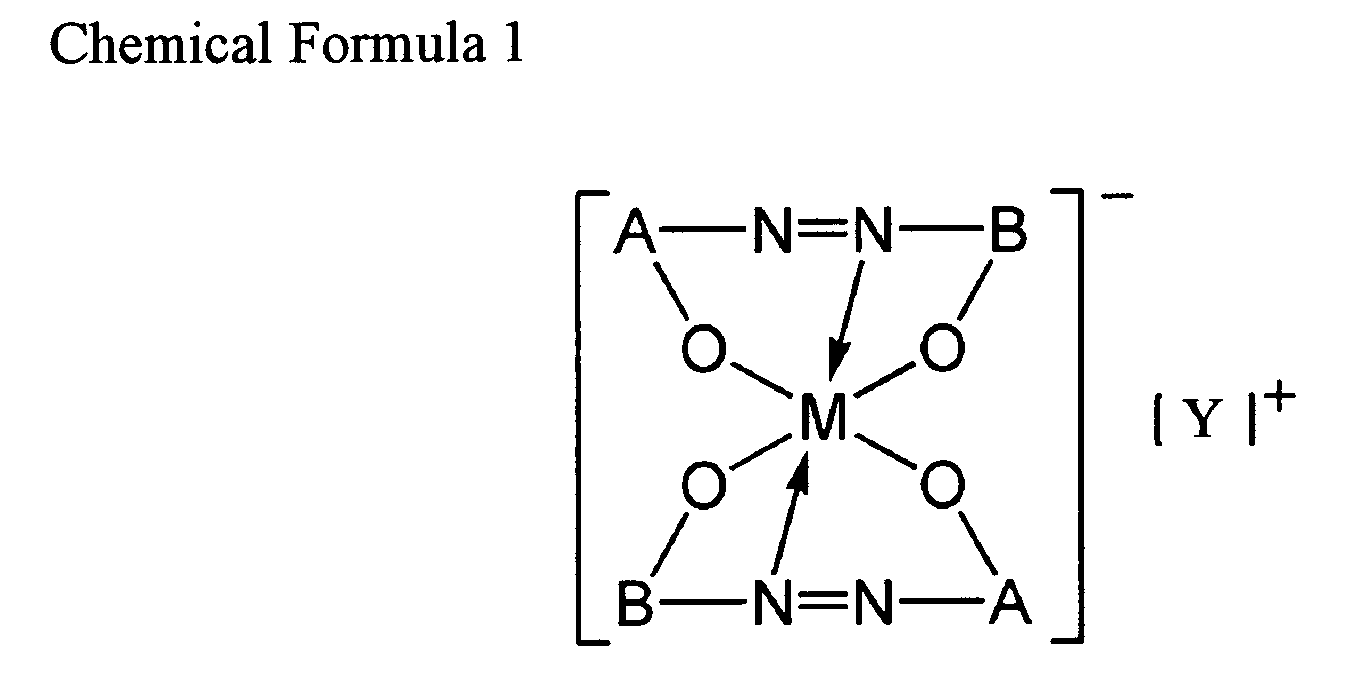
- sulfonylamine derivatives of copper phthalocyanine, or metal-containing monoazo type dye of 2:1 type shown in Chemical Formula 1 can be mentioned.
- A is a residue of a diazo component having a phenolic hydroxyl group at the ortho position
- B is a residue of coupling component
- M is chromium, iron, aluminum, zinc or cobalt atom
- [Y] + is an inorganic or organic cation
- the charge controlling agent is added in a range from 0.1 to 10 parts by weight and desirably in a range from 0.5 to 8 parts by weight to 100 parts by weight of a binder resin.
- the concentration of the surface of the toner As a method to control the concentration of the surface of the toner within the range mentioned above, a method in which the contained amount of the charge controlling agent is controlled, is generally mentioned.
- the surface concentration can be controlled by changing the period and stress of a preliminary mixing process and melting kneading process during the production process of the toner for electrophotography having mixing, kneading, and pulverizing processes.
- the preliminary mixing time is short, shearing force by mixing is not much applied on the charge controlling agent, and the agent is mixed and kneaded while retaining relatively large size in the binder resin. Therefore, after producing the toner by pulverizing and classifying, the charge controlling agent exists in relatively large size on the surface of the toner, and therefore increases the surface concentration.
- the preliminary mixing time is long, shearing force by mixing is much applied on the charge controlling agent and breaks the agent, and the agent is uniformly dispersed in the binder resin. Therefore, the amount of the charge controlling agent exposed on the surface of the toner particle, that is, surface concentration, is low. Furthermore, since the length of the above-mentioned period of the preliminary mixing time and surface concentration of the toner have a proportional relationship, the surface concentration can be controlled by controlling the preliminary mixing time.
- finer control of the surface concentration can be accomplished by combining the controlling of contained amount of the charge controlling agent, preliminary mixing, and melting kneading.
- wax be contained to improve fixability at low temperature and releasability at fusing.
- polyolefin based wax such as polyethylene wax, polypropylene wax or the like, synthesized wax such as Fischer-Tropsch wax or the like, petroleum wax such as paraffin wax, microcrystalline wax or the like, carnauba wax, candelilla wax, rice wax, hydrogenated castor oil or the like can be mentioned.
- modified polyethylene wax Two or more kinds of these waxes can be used together, also.
- the amount of the wax contained is desirably in range from 0.5 to 10.0 wt% in the toner particle, and more desirably in a range from 1.0 to 8.0 wt%. In the case in which the amount contained is less than 0.5 wt%, fixability at low temperature and releasability at fusing is not sufficient, and in the case in which the amount contained is more than 10.0 wt%, storage stability is not sufficient.
- Plural kinds of wax can be used if necessary; it is desirable that all the waxes used have melting points shown by the endothermic peak of DSC in a range from 80 to 160°C. In the case in which the melting point is less than 80°C, blocking of toner particles easily occurs, and there is a problem of durability, and in the case in which the melting point is more than 160°C, fixing strength is reduced.
- Measuring method of the melting point is as follows. About 10 mg of sample was put in an aluminum cell, the cell was placed in a differential scanning calorimeter (DSC) (trade name: SSC-5200, produced by Seiko Instruments Inc.), and N 2 gas was blown at 50 ml per minute. A process in which temperature was increased from 20 to 180°C at a rate of 10°C per minute and then decreased from 180 to 20°C rapidly, was repeated 2 times, and the endothermic peak temperature at that time (i.e., the second time) was measured.
- DSC differential scanning calorimeter
- carbon black or lamp black can be mentioned, as a magenta pigment, C. I. pigment red 1, 2, 3, 4, 5, 6, 7, 8, 9, 10, 11, 12, 13, 14, 15, 16, 17, 18, 19, 20, 21, 22, 23, 30, 31, 32, 37, 38, 39, 40, 41, 48, 49, 50, 51, 52, 53, 54, 55, 57, 58, 60, 63, 64, 68, 81, 83, 87, 88, 89, 90, 112, 114, 122, 123, 163, 202, 206, 207, 209; C. I. pigment violet 19; C. I. violet 1, 2, 10, 13, 15, 23, 29, 35 or the like can be mentioned, as a cyan pigment, C. I.
- pigment blue 2, 3, 15, 16, 17; C. I. vat blue 6; C. I. acid blue 45 or the like can be mentioned, and as a yellow pigment, C. I. pigment yellow 1, 2, 3, 4, 5, 6, 7, 10, 11, 12, 13, 14, 15, 16, 17, 23, 65, 73, 74, 83, 97, 155, 180 or the like can be mentioned. These are used alone or in combination.
- a coloring agent which is commonly used, carbon black, aniline blue, calco oil blue, chrome yellow, ultramarine blue, Dupont oil red, quinoline yellow, methylene blue chloride, phthalocyanine blue, malachite green oxalate, lamp black, rose Bengal or the like can be mentioned.
- the coloring agent is required to be sufficiently contained to form visible images having sufficient density. For example, it is contained in a range from about 1 to 20 parts by weight, desirably in a range from 1 to 7 parts by weight, to 100 parts by weight of the binder resin.
- Toner particle used in the toner of the present invention can be produced by mixing the above-mentioned raw materials in a predetermined ratio, melting and kneading the mixture, pulverizing into powder, and classifying.
- the toner particle can be produced by using a polymerizing method using raw materials of the above-mentioned materials.
- Volume average particle diameter of the toner particle is generally set in a range from 5 to 15 ⁇ m.
- Hydrophobic silica fine particles as fluidizing agent is desirably adhered to the toner particle in a range from 0.2 to 3.0 wt%, and more desirably in a range from 0.5 to 2.5 wt%.
- the adhered amount of the hydrophobic silica fine particle is less than 0.2 wt%, releasing agent contained in the toner particle is adhered to photoreceptors or charging members, and defects in images may easily occur.
- the adhered amount is more than 3.0 wt%, the hydrophobic silica may easily fall off from the toner particles, and BS on the photoreceptor may be generated.
- titanium oxide be adhered to the toner of the present invention. Flowing property is further improved by the titanium oxide, developing property is improved, and image density can be exhibited more.
- the primary average particle diameter of hydrophobic silica fine particle and titanium oxide are desirably less than 0.10 ⁇ m.
- particles having large diameter, middle diameter, and small diameter can be used in combination if necessary. In this way, more reliable property of adhesion resistance can be obtained.
- magnetic powder, alumina, talc, clay, calcium carbonate, magnesium carbonate, or some kinds of resin particles can be adhered to the toner to control flowing property, charging property, cleaning property, and storage stability of the toner.
- FIG. 1 is a schematic diagram showing a device used in the magnetic one-component developing method of non-contacting type.
- the developing device comprises a cylindrical photoreceptor drum 1 which is an electrostatic latent image holder, a hopper 2 containing a magnetic one-component developer 3, an aluminum non-magnetic sleeve 6 whose right half circumference is contained in the hopper 2 and left half circumference is faced with the photoreceptor drum 1 and which is placed at a position to have certain gap with the photoreceptor drum 1, a magnet roller 5 set in the non-magnetic sleeve 6, a magnetic blade 4 which makes uniform the thickness of the layer of the magnetic one-component developer 3 held on the non-magnetic sleeve 6, an agitator 7 which agitates the magnetic one-component developer 3 in the hopper 2, and an electric power source 8 which keeps the non-magnetic sleeve 6 and magnetic
- the non-contacting magnetic one-component developing method using above-mentioned device is performed as follows. First, an electrostatic latent image is formed on the surface of the photoreceptor drum 1 by a conventional method for electrophotography. On the other hand, the magnetic one-component developer 3 in the hopper 2 is held on the surface of the non-magnetic sleeve 6 having the magnetic roller 5 inside, to make the layer of the magnetic one-component developer 3 uniform by the magnetic blade 4, and the developer 3 is carried.
- the electric power source 8 applies alternating current bias voltage and direct current bias voltage to the photoreceptor drum 1, direct current electric field and alternating electric field are generated between the non-magnetic sleeve 6 and the photoreceptor drum 1, and therefore the magnetic one-component developer 3 on the surface of the non-magnetic sleeve 6 jumps to the electrostatic latent image on the photoreceptor drum 1 to be developed.
- the present invention is further explained by way of Examples and Comparative Examples. However, the present invention is not limited to the range thereof.
- Raw materials having ratios shown above were premixed by a super mixer for 10 minutes, heat melted and kneaded by a biaxial extruder at a rotation speed of 150 rpm, pulverized by a jet mil, and classified by a dry-type air flow classifier, to obtain toner particles having volume average particle diameter of 8 ⁇ m.
- hydrophobic silica (trade name: R-972, produced by Nippon Aerosil Co., Ltd., primary average particle diameter: 0.016 ⁇ m) and 0.5 wt% of the weight of the toner particle of hydrophobic titanium oxide (trade name: NKT-90, produced by Nippon Aerosil Co., Ltd., primary average particle diameter: 0.013 ⁇ m) were added to the obtained toner particles, and they were mixed by a Henschel mixer for 3 minutes at a circumferential velocity of 40 m/sec, to obtain Toner A.
- R-972 produced by Nippon Aerosil Co., Ltd., primary average particle diameter: 0.016 ⁇ m
- NKT-90 produced by Nippon Aerosil Co., Ltd., primary average particle diameter: 0.013 ⁇ m
- Toner B of the present invention was obtained in a manner similar to that in Example 1.
- Toner C of the present invention was obtained in a manner similar to that in Example 1.
- Toner D of the present invention was obtained in a manner similar to that in Example 1.
- Toner E of the Comparative Example was obtained in a manner similar to that in Example 1.
- Toner F of the Comparative Example was obtained in a manner similar to that in Example 1.
- Toner G of the Comparative Example was obtained in a manner similar to that in Example 1.
- Toner I of the Comparative Example was obtained in a manner similar to that in Example 1.
- the concentration of the charge controlling agent on the surface of the obtained toners was measured by the following method. 0.1 g of the toner was put in a screw tube, 50 ml of methanol was added, the mixture was stirred for 10 minutes, and was allowed to stand for 24 hours. The supernatant liquid was poured into a cell, and an absorbance at a wavelength specified by each charge controlling agent was measured by a spectrophotometer (trade name: UV-365, produced by Shimadzu Corporation) in a range from 350 to 1000 nm. Using a standard curve which was made in advance for each charge controlling agent, concentration of the charge controlling agent of the supernatant liquid was calculated by the Lambert-Bert's law. From the concentration of the charge controlling agent in the supernatant liquid, concentration of the charge controlling agent on the surface of the toner (mg/toner 1g) was calculated. The results are shown in Table 1.
- Fogging was evaluated by measuring the whiteness of the non-image part before and after copying by a color meter (trade name: ZE2000, produced by Nippon Denshoku Industries Co., Ltd.), and the whiteness thereof were compared.
- Fogging of photoreceptor (PCBG) was evaluated by forcibly cutting off electric power during a printing operation, taking a fogging on the photoreceptor before transferring by an adhesive tape (produced by Sumitomo 3M LIMITED), putting the tape on an A4 copy paper, and measuring the density using a Macbeth reflection densitometer. The results are shown in Table 1. ⁇ is less than 0.20, ⁇ is in a range from 0.20 to 0.30, and ⁇ is more than 0.30.
- the toner of the present invention can exhibit superior jumping properties and developing properties even under conditions of low temperature and low humidity.
- cyclo-olefin copolymer resin as a binder resin, and by the concentration of charge controlling agent on the surface of the toners ranging from not less than 0.1 mg/toner 1g, and less than 1.0 mg/toner 1g, a toner for electrophotography in which images are not contaminated and deterioration of image density caused by deterioration of jumping property is prevented by maintaining appropriate amount of charge even in the non-contacting developing method, can be provided.
Landscapes
- Physics & Mathematics (AREA)
- General Physics & Mathematics (AREA)
- Chemical & Material Sciences (AREA)
- Spectroscopy & Molecular Physics (AREA)
- Inorganic Chemistry (AREA)
- Chemical Kinetics & Catalysis (AREA)
- Developing Agents For Electrophotography (AREA)
- Dry Development In Electrophotography (AREA)
Abstract
Description
- Cyclo-olefin copolymer resin (trade name: TOPAS COC, produced by Ticona GmbH, ethylene-norbornene copolymer) 60 parts by weight
- Fischer-Tropsch wax (trade name: FT-100, produced by Nippon Seiro Co., Ltd., melting point: 92°C) 4 parts by weight
- Charge controlling agent (trade name: T-77, produced by Orient Chemical Industries, Ltd., 2:1 type iron complex salt monoazo dye) 1 part by weight
- Magnetite (trade name: EPT-1000, produced by Toda Kogyo CORP.) 35 parts by weight
Fogging (BG) was evaluated by measuring the whiteness of the non-image part before and after copying by a color meter (trade name: ZE2000, produced by Nippon Denshoku Industries Co., Ltd.), and the whiteness thereof were compared. Fogging of photoreceptor (PCBG) was evaluated by forcibly cutting off electric power during a printing operation, taking a fogging on the photoreceptor before transferring by an adhesive tape (produced by Sumitomo 3M LIMITED), putting the tape on an A4 copy paper, and measuring the density using a Macbeth reflection densitometer. The results are shown in Table 1. ○ is less than 0.20, Δ is in a range from 0.20 to 0.30, and × is more than 0.30.
| Toner | Concentration of Charge Controlling Agent | Initial | After 10,000 times | |||||
| ID | BG | PCBG | ID | BG | PCBG | |||
| Example 1 | A | 0.71 | 1.40 | 0.68 | ○ | 1.38 | 0.55 | ○ |
| Example 2 | B | 0.90 | 1.39 | 0.56 | ○ | 1.35 | 0.39 | ○ |
| Example 3 | C | 0.35 | 1.41 | 0.78 | ○ | 1.45 | 0.67 | ○ |
| Example 4 | D | 0.14 | 1.42 | 0.81 | ○ | 1.44 | 0.80 | ○ |
| Comparative Example 1 | E | 0.93 | 1.48 | 1.21 | × | 1.40 | 1.81 | × |
| Comparative Example 2 | F | 0.54 | 1.39 | 0.86 | ○ | 1.20 | 1.03 | Δ |
| Comparative Example 3 | G | 1.46 | 1.30 | 0.77 | ○ | 0.67 | 0.22 | ○ |
| Comparative Example 4 | H | 1.10 | 1.33 | 0.70 | ○ | 1.19 | 0.36 | ○ |
| Comparative Example 5 | I | 0.08 | 1.37 | 0.10 | Δ | 1.49 | 5.56 | × |
Claims (8)
- A toner for electrophotography containing:wherein concentration of the charge controlling agent on the surface of the toner is not less than 0.1 mg/toner 1g, and less than 1.0 mg/toner 1g.a binder resin containing at least cyclo-olefin copolymer resin; anda charge controlling agent,
- The toner for electrophotography according to claim 1, wherein the toner for electrophotography further contains magnetic material.
- The toner for electrophotography according to claim 1, wherein the toner further contains hydrophobic silica and titanium oxide as external additive agents.
- A developing method comprising steps of:holding the toner according to claim 1 on a non-magnetic sleeve;applying an electric field between a photoreceptor and the sleeve; andmaking the toner jump to an electrostatic latent image on the surface of the photoreceptor to form an image.
- The toner for electrophotography according to claim 1, wherein the cyclo-olefin copolymer resin is contained in the binder resin at 50 to 100 wt%.
- The toner for electrophotography according to claim 1, wherein the charge controlling agent is contained 0.1 to 10 parts by weight to 100 parts by weight of the binder resin.
- The toner for electrophotography according to claim 1, wherein the toner contains a wax having a melting point in a range from 80 to 160°C in a range from 0.5 to 10.0 wt%.
- The toner for electrophotography according to claim 3, wherein the hydrophobic silica in a range from 0.2 to 3.0 wt% is adhered to the toner particle.
Applications Claiming Priority (3)
| Application Number | Priority Date | Filing Date | Title |
|---|---|---|---|
| JP2003054385A JP4290442B2 (en) | 2003-02-28 | 2003-02-28 | Toner for electrophotography and developing method using the same |
| JP2003054385 | 2003-02-28 | ||
| PCT/JP2004/002442 WO2004077167A1 (en) | 2003-02-28 | 2004-02-27 | Electrophotographic toner and method of development therewith |
Publications (3)
| Publication Number | Publication Date |
|---|---|
| EP1600825A1 true EP1600825A1 (en) | 2005-11-30 |
| EP1600825A4 EP1600825A4 (en) | 2007-12-05 |
| EP1600825B1 EP1600825B1 (en) | 2012-08-29 |
Family
ID=32923462
Family Applications (1)
| Application Number | Title | Priority Date | Filing Date |
|---|---|---|---|
| EP04715526A Expired - Lifetime EP1600825B1 (en) | 2003-02-28 | 2004-02-27 | Electrophotographic toner and method of development therewith |
Country Status (6)
| Country | Link |
|---|---|
| US (1) | US20060172216A1 (en) |
| EP (1) | EP1600825B1 (en) |
| JP (1) | JP4290442B2 (en) |
| KR (1) | KR101079962B1 (en) |
| CN (1) | CN100419579C (en) |
| WO (1) | WO2004077167A1 (en) |
Families Citing this family (5)
| Publication number | Priority date | Publication date | Assignee | Title |
|---|---|---|---|---|
| JP4579779B2 (en) * | 2005-06-28 | 2010-11-10 | 京セラミタ株式会社 | Image forming method |
| CN105025530B (en) * | 2007-11-20 | 2019-05-28 | 交互数字专利控股公司 | A WTRU and method used by the WTRU |
| JP2009133959A (en) * | 2007-11-29 | 2009-06-18 | Ricoh Co Ltd | Toner for developing electrostatic image and image forming method and apparatus using the toner |
| US8057976B2 (en) * | 2008-08-21 | 2011-11-15 | Empire Technology Development Llc | Method for producing toner |
| US8252492B2 (en) * | 2008-09-10 | 2012-08-28 | Kyocera Document Solutions Inc. | Toner for electrostatic development, image forming apparatus, and image forming method |
Family Cites Families (21)
| Publication number | Priority date | Publication date | Assignee | Title |
|---|---|---|---|---|
| JPH0527483A (en) * | 1991-07-22 | 1993-02-05 | Mita Ind Co Ltd | Electrophotographic toner |
| US5272034A (en) * | 1991-07-22 | 1993-12-21 | Mita Industrial Co., Ltd. | Process for producing electrophotographic toner |
| JP3409102B2 (en) * | 1994-09-02 | 2003-05-26 | 株式会社リコー | Toner for developing electrostatic images |
| US5597673A (en) * | 1994-09-02 | 1997-01-28 | Ricoh Company, Ltd. | Toner for developing electrostatic latent image |
| JP3641728B2 (en) * | 1995-07-03 | 2005-04-27 | コニカミノルタホールディングス株式会社 | Novel developer for electrophotography and developing method using the same |
| JP3274052B2 (en) * | 1995-08-02 | 2002-04-15 | ティコナ・ゲゼルシャフト・ミット・ベシュレンクテル・ハフツング | Heating roller fixing type electrostatic image developing toner |
| JP3588213B2 (en) * | 1996-12-26 | 2004-11-10 | ティコナ・ゲゼルシャフト・ミット・ベシュレンクテル・ハフツング | Toner for developing electrostatic images containing polyolefin resin having cyclic structure |
| JPH1172948A (en) * | 1997-07-04 | 1999-03-16 | Ricoh Co Ltd | Toner for developing electrostatic images |
| JP4174105B2 (en) * | 1998-08-20 | 2008-10-29 | ティコナ・ゲゼルシャフト・ミット・ベシュレンクテル・ハフツング | Toner for electrostatic image development |
| JP2000321826A (en) * | 1999-05-17 | 2000-11-24 | Mitsubishi Chemicals Corp | Developer for two-component electrostatic image development |
| JP2000330329A (en) * | 1999-05-18 | 2000-11-30 | Mitsubishi Chemicals Corp | Two-component electrostatic image developing toner and developer using the same |
| DE60039947D1 (en) * | 1999-08-02 | 2008-10-02 | Canon Kk | Toner and process for its preparation and image production process |
| JP2001166543A (en) * | 1999-12-10 | 2001-06-22 | Ricoh Co Ltd | Image forming method |
| JP2001272816A (en) * | 2000-03-24 | 2001-10-05 | Mitsui Chemicals Inc | Electrostatic charge image developing toner |
| JP2002229321A (en) * | 2001-01-30 | 2002-08-14 | Canon Inc | Developer, image forming method and process cartridge |
| EP1239334B1 (en) * | 2001-03-08 | 2011-05-11 | Ricoh Company, Ltd. | Toner composition |
| JP2002371137A (en) * | 2001-06-13 | 2002-12-26 | Idemitsu Kosan Co Ltd | Method for producing resin composition, resin composition and toner |
| JP2003015354A (en) * | 2001-06-28 | 2003-01-17 | Kyocera Chemical Corp | Electrostatic charge image developing toner |
| JP2003015355A (en) * | 2001-06-29 | 2003-01-17 | Kyocera Chemical Corp | Electrostatic image developing toner |
| JP2003029430A (en) * | 2001-07-12 | 2003-01-29 | Canon Inc | Image forming method and process cartridge |
| JP3880359B2 (en) * | 2001-10-05 | 2007-02-14 | 株式会社巴川製紙所 | Full color toner for oilless fixing |
-
2003
- 2003-02-28 JP JP2003054385A patent/JP4290442B2/en not_active Expired - Fee Related
-
2004
- 2004-02-27 WO PCT/JP2004/002442 patent/WO2004077167A1/en not_active Ceased
- 2004-02-27 US US10/545,560 patent/US20060172216A1/en not_active Abandoned
- 2004-02-27 CN CNB2004800055494A patent/CN100419579C/en not_active Expired - Fee Related
- 2004-02-27 EP EP04715526A patent/EP1600825B1/en not_active Expired - Lifetime
-
2005
- 2005-08-29 KR KR1020057016101A patent/KR101079962B1/en not_active Expired - Fee Related
Also Published As
| Publication number | Publication date |
|---|---|
| EP1600825B1 (en) | 2012-08-29 |
| JP4290442B2 (en) | 2009-07-08 |
| KR20050105504A (en) | 2005-11-04 |
| US20060172216A1 (en) | 2006-08-03 |
| WO2004077167A1 (en) | 2004-09-10 |
| EP1600825A4 (en) | 2007-12-05 |
| KR101079962B1 (en) | 2011-11-04 |
| CN100419579C (en) | 2008-09-17 |
| JP2004264554A (en) | 2004-09-24 |
| CN1756999A (en) | 2006-04-05 |
Similar Documents
| Publication | Publication Date | Title |
|---|---|---|
| EP3893058A1 (en) | Image forming method and image forming apparatus | |
| US11537057B2 (en) | Toner, toner accommodating unit, image forming apparatus, and image forming method | |
| EP1600825B1 (en) | Electrophotographic toner and method of development therewith | |
| US10353311B2 (en) | White toner for electrostatic charge image development and image forming method | |
| JP3880359B2 (en) | Full color toner for oilless fixing | |
| JP3863054B2 (en) | Toner for electrostatic image development | |
| JP3942520B2 (en) | Toner for electrophotography and image forming method using the same | |
| JP3863744B2 (en) | Toner for recycling system and toner recycling developing method using the same | |
| EP1914597A1 (en) | Electrophotographic toner | |
| JP2004325843A (en) | Electrophotographic toner | |
| JP3731986B2 (en) | Non-magnetic toner for electrophotography | |
| EP1600823B1 (en) | Two-component developer for electrophotography and developing method using same | |
| JP3225093B2 (en) | Two-component toner for electrophotography | |
| US20060222981A1 (en) | Electrophotographic developer | |
| JP3290273B2 (en) | Electrophotographic toner | |
| JP2007140235A (en) | Toner for electrophotography and method for producing the same | |
| JP4184562B2 (en) | Magnetic one-component developer and developing method thereof | |
| JP2003167378A (en) | Reversal development toner and reversal development two-component developer | |
| JP2004294534A (en) | Non-magnetic toner for electrophotography and developing method using the same | |
| JPH11125932A (en) | Positively charged toner for electrophotography | |
| KR20050067999A (en) | Toners for electrophotographic imaging apparatuses having uniform charge distribution and improved anti-offset property | |
| JP2005092108A (en) | Magnetic toner and its manufacturing method |
Legal Events
| Date | Code | Title | Description |
|---|---|---|---|
| PUAI | Public reference made under article 153(3) epc to a published international application that has entered the european phase |
Free format text: ORIGINAL CODE: 0009012 |
|
| 17P | Request for examination filed |
Effective date: 20050928 |
|
| AK | Designated contracting states |
Kind code of ref document: A1 Designated state(s): AT BE BG CH CY CZ DE DK EE ES FI FR GB GR HU IE IT LI LU MC NL PT RO SE SI SK TR |
|
| AX | Request for extension of the european patent |
Extension state: AL LT LV MK |
|
| DAX | Request for extension of the european patent (deleted) | ||
| RBV | Designated contracting states (corrected) |
Designated state(s): DE FR GB |
|
| A4 | Supplementary search report drawn up and despatched |
Effective date: 20071107 |
|
| 17Q | First examination report despatched |
Effective date: 20080208 |
|
| GRAP | Despatch of communication of intention to grant a patent |
Free format text: ORIGINAL CODE: EPIDOSNIGR1 |
|
| GRAS | Grant fee paid |
Free format text: ORIGINAL CODE: EPIDOSNIGR3 |
|
| REG | Reference to a national code |
Ref country code: DE Ref legal event code: R079 Ref document number: 602004039125 Country of ref document: DE Free format text: PREVIOUS MAIN CLASS: G03G0009087000 Ipc: G03G0009090000 |
|
| RAP1 | Party data changed (applicant data changed or rights of an application transferred) |
Owner name: TOMOEGAWA PAPER CO. LTD. |
|
| RIN1 | Information on inventor provided before grant (corrected) |
Inventor name: GOTO, MORIYUKI,C/O TOMOEGAWA PAPER CO., LTD., |
|
| RIC1 | Information provided on ipc code assigned before grant |
Ipc: G03G 9/083 20060101ALI20120214BHEP Ipc: G03G 9/097 20060101ALI20120214BHEP Ipc: G03G 9/087 20060101ALI20120214BHEP Ipc: G03G 9/09 20060101AFI20120214BHEP |
|
| GRAA | (expected) grant |
Free format text: ORIGINAL CODE: 0009210 |
|
| AK | Designated contracting states |
Kind code of ref document: B1 Designated state(s): DE FR GB |
|
| RAP1 | Party data changed (applicant data changed or rights of an application transferred) |
Owner name: TOMOEGAWA CO., LTD. |
|
| REG | Reference to a national code |
Ref country code: GB Ref legal event code: FG4D |
|
| REG | Reference to a national code |
Ref country code: DE Ref legal event code: R096 Ref document number: 602004039125 Country of ref document: DE Effective date: 20121025 |
|
| PLBE | No opposition filed within time limit |
Free format text: ORIGINAL CODE: 0009261 |
|
| STAA | Information on the status of an ep patent application or granted ep patent |
Free format text: STATUS: NO OPPOSITION FILED WITHIN TIME LIMIT |
|
| 26N | No opposition filed |
Effective date: 20130530 |
|
| REG | Reference to a national code |
Ref country code: DE Ref legal event code: R097 Ref document number: 602004039125 Country of ref document: DE Effective date: 20130530 |
|
| GBPC | Gb: european patent ceased through non-payment of renewal fee |
Effective date: 20130227 |
|
| REG | Reference to a national code |
Ref country code: FR Ref legal event code: ST Effective date: 20131031 |
|
| REG | Reference to a national code |
Ref country code: DE Ref legal event code: R119 Ref document number: 602004039125 Country of ref document: DE Effective date: 20130903 |
|
| PG25 | Lapsed in a contracting state [announced via postgrant information from national office to epo] |
Ref country code: DE Free format text: LAPSE BECAUSE OF NON-PAYMENT OF DUE FEES Effective date: 20130903 Ref country code: GB Free format text: LAPSE BECAUSE OF NON-PAYMENT OF DUE FEES Effective date: 20130227 Ref country code: FR Free format text: LAPSE BECAUSE OF NON-PAYMENT OF DUE FEES Effective date: 20130228 |