EP1600790A1 - Method for estimating the parameters of several superimposed signals and/or signal replicas - Google Patents
Method for estimating the parameters of several superimposed signals and/or signal replicas Download PDFInfo
- Publication number
- EP1600790A1 EP1600790A1 EP04011862A EP04011862A EP1600790A1 EP 1600790 A1 EP1600790 A1 EP 1600790A1 EP 04011862 A EP04011862 A EP 04011862A EP 04011862 A EP04011862 A EP 04011862A EP 1600790 A1 EP1600790 A1 EP 1600790A1
- Authority
- EP
- European Patent Office
- Prior art keywords
- mvp
- signals
- computation
- matrix
- signal replicas
- Prior art date
- Legal status (The legal status is an assumption and is not a legal conclusion. Google has not performed a legal analysis and makes no representation as to the accuracy of the status listed.)
- Granted
Links
Images




Classifications
-
- G—PHYSICS
- G01—MEASURING; TESTING
- G01S—RADIO DIRECTION-FINDING; RADIO NAVIGATION; DETERMINING DISTANCE OR VELOCITY BY USE OF RADIO WAVES; LOCATING OR PRESENCE-DETECTING BY USE OF THE REFLECTION OR RERADIATION OF RADIO WAVES; ANALOGOUS ARRANGEMENTS USING OTHER WAVES
- G01S3/00—Direction-finders for determining the direction from which infrasonic, sonic, ultrasonic or electromagnetic waves, or particle emission, not having a directional significance, are being received
- G01S3/02—Direction-finders for determining the direction from which infrasonic, sonic, ultrasonic or electromagnetic waves, or particle emission, not having a directional significance, are being received using radio waves
- G01S3/74—Multi-channel systems specially adapted for direction-finding, i.e. having a single antenna system capable of giving simultaneous indications of the directions of different signals
Definitions
- the present invention relates to a method for estimating the parameters of several superimposed signals and/or signal replicas by use of a computation method of the Maximum Likelihood (ML) estimations based on the Modified Variable Projection (MVP) algorithm modelling a uniform and linear array of sensors receiving said signals and/or signal replicas.
- ML Maximum Likelihood
- MVP Modified Variable Projection
- a recurrent problem in many areas of signal processing is the estimation of several superimposed signals and/or signal replicas, and in the most common case, the signals are undamped exponentials.
- the following problems belong to this case:
- the WSF estimation is the argument that minimises the cost function L ⁇ tr ⁇ (I- P) ⁇ W ⁇ H ⁇ , where P ⁇ A ( A H A ) -1 A H is the projection matrix of A , W is the diagonal matrix and ⁇ and 2 / n is the noise variance estimation
- MVP Modified Variable Projection
- the improvement in efficiency obtained in this correspondence is based on repeatedly applying the properties of the Vandermonde structure of A to the elementary operations involved in the computation of ⁇ L and H .
- the first reduction in the number of operations consists of not repeating the same computation more than once.
- An evaluation procedure that avoids repetitions is presented in table I, in which several transitory variables with names R (.) are employed. The complexity order has been indicated to the right in each step.
- Table I shows the steps in the computation of ⁇ L and H in equation (13) with complexity order.
- the variables R (.) are transitory.
- step 2 The next step with highest complexity is step 2).
- the Vandermonde structure provides again a fast computation method if we realise that any component A H ⁇ w , say ⁇ A H ⁇ w ⁇ k , r is equal to the value of the polynomial with coefficients [ ⁇ w ], r at e -jwk .
- the k, r component of D H U w , ⁇ D H ⁇ w ⁇ k , r is equal to a constant times the value of the derivative of the same polynomial at e -jwk .
- Horner's synthetic division (Wiliam H. Press et al.: "Numerical Recipes in C", Cambridge University Press, 1997, section 5.3) is probably the most efficient method to evaluate a polynomial and its derivative using only sums and products without having to compute any integral power of the polynomial variable. In section I-B of the following part of description, this method is applied to the MVP iteration.
- step 2) of table I is still O( MK ) given that all elements of ⁇ have to be accessed in order to compute A H ⁇ w and D H ⁇ w .
- the computation of these products would absorb most of the computational burden.
- step 2) of table I can be reduced from O( MK ) to O( N I K ), where N I is a small number given by the required interpolation accuracy.
- the computation of the matrices of interpolation coefficients requires only O( N I M log 2 M ) because it can be performed through the FFT. The method is introduced by this invention.
- the r-th column of D H ⁇ w can be regarded as the values at the same abscissas of - jzp' r (z), where p' r (z) is the differential in z of p r ( z ).
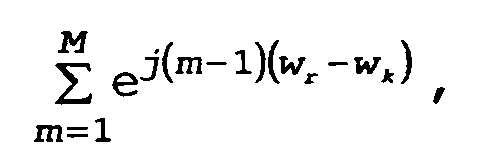
- a H A is sums of geometric series. Specifically, we have the following formula Also, the components of A H D and D H D can be written in terms of sums of the forms given in equation (15) for which it is not difficult to calculate closed-form expressions using, for example, the properties of the Z Transform.
- s 1 and s 2 are ⁇ A H A ⁇ k,r , ⁇ A H D ⁇ k,r and ⁇ D H D ⁇ k,r respectively.
- K and k ⁇ r ⁇ K requires 2K exponentials and K(K-1)/2 complex products, which is equivalent to 3 K 2 + K real flops. (We count two flops per exponential.) To evaluate equation (23) requires 46 flops, and this has to be done K ( K -1)/2 times. So, the three matrices can be calculated in 26 K 2 - 22 K flops.
- a H A is Hermitian and positive definite
- its inverse can be calculated through a Cholesky decomposition and solving two triangular systems (Gene H. Golub and Charles F. Loan: “Matrix Computations", The John Hopkins University Press, Third Edition, 1996, chapter 4).
- the computational burden of these operations is (32/3) K 3 .
- the linear system H -1 VL roughly requires (8/3)/ K 3 flops. It can be solved through a Cholesky decomposition and two triangular linear systems.
- the existing techniques have a computational burden that grows with the product of the number of signals to be estimated times the data size. This produces a large computational burden.
- the invention is characterised by decoupling said computation into two steps, the first one computing a matrix of interpolation coefficients by performing some Fast Fourier Transforms (FFTs), and the second one performing an iterative procedure, both steps in application to the MVP-method.
- FFTs Fast Fourier Transforms
- a coefficient matrix is computed with a complexity that is proportional to the one of the Fast Fourier Transform.
- an iterative procedure is carried out with a complexity that is independent of the data size. In this way, the computational burden is dramatically reduced and very efficient.
- the decoupling is based upon the interpolation formula developed in the following part of the description.
- the cost function is not changed at all, the estimation computed being the actual ML or Weighted Subspace Fitting (WSF) estimation in contrast to what happens in methods like Iterative MODE and IQML.
- WSF Weighted Subspace Fitting
- the complexity achieved is surprisingly small. It is shown that the most expensive matrix products in the MVP iteration can be either evaluated in closed form, efficiently computed via Horner's synthetic division, or interpolated through the new and inventive technique based on the FFT.
- the computation of the WSF or ML estimator according to the present invention is divided into a preliminary step in which a few FFTs are computed, and an iterative step with a complexity that is independent of the array size.
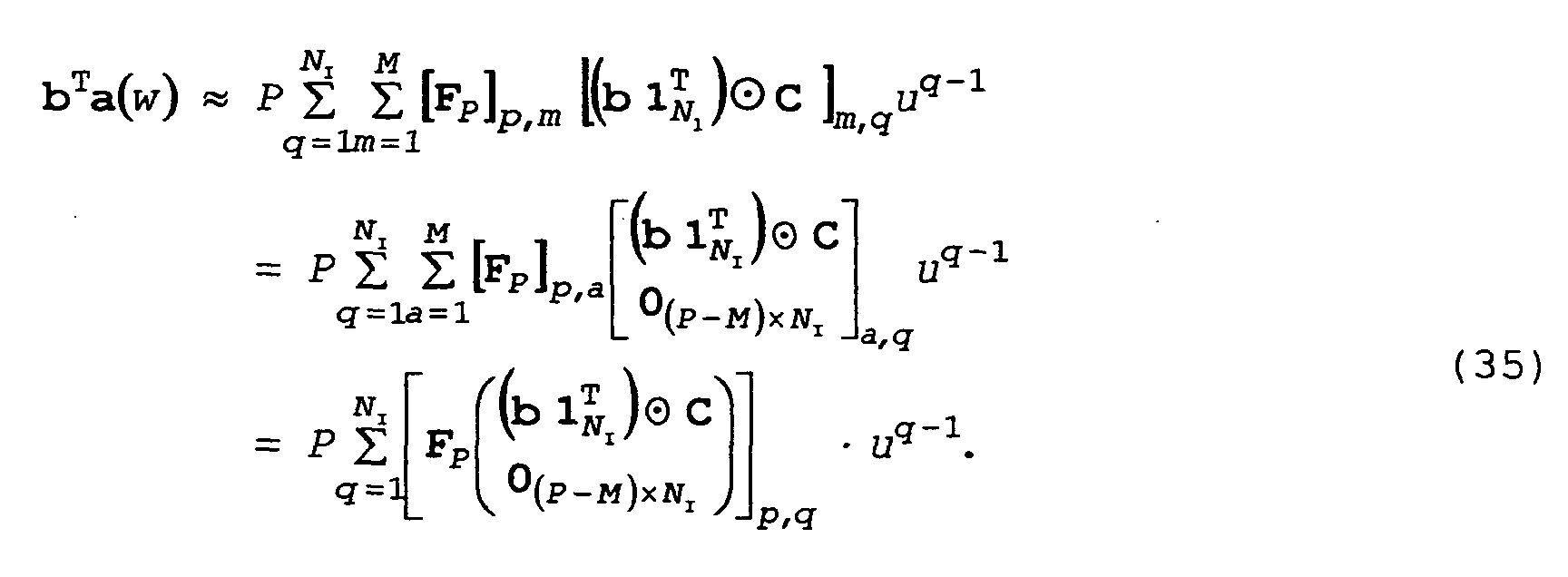
- the key idea in the proposed method according to the invention lies in dividing the domain of the exponentials that appear in equation (24) into small subdomains, and then applying a polynomial interpolation to each of them.
- w w o,p + 2 ⁇ r + u , where u is the shift of w-2 ⁇ r from w o , p which is inside [- ⁇ / P , ⁇ / P [.
- Table II shows a polynomial approximation of e jw .
- h (w) +0.999999999779501 + j 0.999999999982988 w -0.499999993561852 w 2 - j 0.166666666169556 w 3 +0.0416666361848792 w 4 + j 0.00833333097876213 w 5 -0.00138883605772982 w 6 - j 0.000198408616972258 w 7 +2.47601234957978 ⁇ 10 -5 w 8 + j 2.752529383739 ⁇ 10 -6 w 9 -2.60508847934104 ⁇ 10 -7 w 10 - j 2.3889607713183 ⁇ 10 -8 w 11
- the MODE and MVP iterations have a cost that is approximately polynomial in M, K and , due to the fact that most of the operations involved in their computation, like matrix sums and products, have a polynomial cost.
- An exception is the eigenvalue problem in MODE.
- I-MVP cost 8 N I K 2 + 122 3 K 3 + 32 K 2 - 41 3 K + 1 flops.
- the MVP and RELAX methods were started with the initial estimation in Iterative MODE.
- the costs of initialising and finishing the iterative procedures were not taken into account, i.e., the costs of the following operations were not accounted: the polynomial rooting required to initialise the MVP method, the computation of the initial amplitudes in RELAX, and the computation of the polynomial rooting required in the final step of 2step MODE and Iterative MODE. These exclusions allowed for a fair comparison.
- the iteration process was stopped in all methods when the error was smaller than 10 -4 .
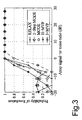
- Fig.2 and 3 show the Root-Mean-Square (RMS) error and the Probability of Resolution of 2-Step MODE, Iterative MODE, and of the MVP method.
- RMS Root-Mean-Square
- the results in these two figures are analogous to the ones in the literature, (Harry L. van Trees: "Detection, Estimation and Modulation Theory. Part IV", John Wiley & Sons, Inc., First Edition, 2002, section 8.7), and they confirm the validity of the MVP method.
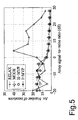
- Fig.4, 5 and 6 present the average number of flops, the average number of iterations, and the percentage of invalid trials for the three methods.
- a trial was declared invalid when it required more than 30 iterations.
- the number of flops in each iteration was from 2 to 2.8 times smaller in the MVP method than in Iterative MODE.
- the MODE and MVP iterations required 1958 and 1067 flops, respectively.
- SNR signal-to-noise ratio
- the MVP method only requires 1 or 2 iterations and, therefore, its computational burden is comparable to the one of 2-Step MODE.
- the percentage of invalid trials of both methods is quite similar.
- This invention presents an efficient implementation of the Modified Variable Projection (MVP) method for the estimation of the angles of arrival to a Uniform Linear Array.
- MVP Modified Variable Projection
- Its computational burden is very small for two reasons. First, there are closed-form expressions of the correlation matrices that appear in the MVP iteration and, therefore, they can be calculated in O ( K 2 ) real flops. Second, it is possible to perform the correlation with the data matrix through a set of polynomial evaluations, without computing any exponential.
Landscapes
- Physics & Mathematics (AREA)
- Engineering & Computer Science (AREA)
- General Physics & Mathematics (AREA)
- Radar, Positioning & Navigation (AREA)
- Remote Sensing (AREA)
- Complex Calculations (AREA)
- Geophysics And Detection Of Objects (AREA)
- Feedback Control In General (AREA)
- Radar Systems Or Details Thereof (AREA)
Abstract
Description
- Estimation of the frequencies of several undamped exponentials.
- Estimation of the delays of several signals for large observation intervals or for signals with approximate finite domain.
- Estimation of the angles of arrival of several signals to a uniform and linear array of sensors.
- New symbols or functions are defined using the symbol "≡" ;
- [A]m,k and [a]m respectively refer to the m, k and m components of the matrix A and vector a;
- The notation "." in a sub-script refers either to a complete row or column: [A], k and [A] m , are, respectively, the k-th column and m-th row of A;
- 1 N denotes a column vector of ones, and O M×N a matrix of zeros of size M × N;
- "⊙" denotes the Hadamard or element-by-element product.
- "tr{·}" is the trace operator;
- [x] is the greatest integer smaller or equal than x.








- Fig.1
- shows the already described pseudo-code that computes the matrices A H Û w and D H Û w of the known MVP iteration;
- Fig.2
- shows a simulated example of the Root-Mean-Square-Error [rad] as function of the array signal-to-noise ratio [dB];
- Fig.3
- shows a simulated example of the probability of resolution as function of the array signal-to-noise ratio [dB];
- Fig.4
- shows a simulated example of the average number of real flops as function of the array signal-to-noise ratio [dB];
- Fig.5
- shows a simulated example of the average number of iterations as function of the array signal-to-noise ratio [dB]; and
- Fig.6
- shows a simulated example of the percentage of invalid trials [%] as function of the array signal-to-noise ratio [dB].








| h (w) | |||
| +0.999999999779501 | +j0.999999999982988 | w | |
| -0.499999993561852 | w2 | -j0.166666666169556 | w3 |
| +0.0416666361848792 | w4 | +j0.00833333097876213 | w5 |
| -0.00138883605772982 | w6 | -j0.000198408616972258 | w7 |
| +2.47601234957978·10-5 | w8 | +j2.752529383739·10-6 | w9 |
| -2.60508847934104·10-7 | w10 | -j2.3889607713183·10-8 | w11 |
| |e jw - h(w)| <2.2·10-10 and |je jw - h' (w) | <7·10-9 for w in [-π/2, π/2]. |



- The matrix inversion required in the MODE iteration has been performed through a band Cholesky decomposition and solving a band triangular system.
- The elementary operations have been reduced to a minimum, and the same criteria has been applied in the flop count to the MODE and the MVP iterations. The implementation of RELAX followed aforementioned Zheng-She Liu, Jian Li, and Petre Stoica: "RELAX-based estimation of damped sinusoidal parameters", in Signal Processing Journal, Vol. 62, pp. 311-321, Nov. 1997.

Claims (5)
- A method for estimating the parameters of several superimposed signals and/or signal replicas by use of a computation method of the Maximum Likelihood (ML) estimations based on the Modified Variable Projection (MVP) algorithm modelling a uniform and linear array of sensors receiving said signals and/or signal replicas, characterised by decoupling said computation into two steps, the first one computing a matrix of interpolation coefficients by performing some Fast Fourier Transforms (FFTs), and the second one performing an iterative procedure, both steps in application to the MVP-method.
- A method as claimed in claim 1, characterised in that the respective parameters to estimate are the Directions of Arrival (DOA) of several signals and/or signal replicas to a linear and uniform antenna array.
- A method as claimed in claim 1, characterised in that the respective parameters to estimate are the frequencies of several signals being undamped exponentials.
- A method as claimed in claim 1, characterised in that the respective parameters to estimate are the delays of several signals for large observation intervals or for signals with approximate finite domain.
- A method as claimed in one of claims 1 to 4 to perform channel sounding.
Priority Applications (3)
| Application Number | Priority Date | Filing Date | Title |
|---|---|---|---|
| DE602004000692T DE602004000692T2 (en) | 2004-05-19 | 2004-05-19 | Method for estimating parameters of superimposed signals and / or signal replicas |
| AT04011862T ATE323889T1 (en) | 2004-05-19 | 2004-05-19 | METHOD FOR ESTIMATING PARAMETERS OF SUPERLAYED SIGNALS AND/OR SIGNAL REPLICAS |
| EP04011862A EP1600790B1 (en) | 2004-05-19 | 2004-05-19 | Method for estimating the parameters of several superimposed signals and/or signal replicas |
Applications Claiming Priority (1)
| Application Number | Priority Date | Filing Date | Title |
|---|---|---|---|
| EP04011862A EP1600790B1 (en) | 2004-05-19 | 2004-05-19 | Method for estimating the parameters of several superimposed signals and/or signal replicas |
Publications (2)
| Publication Number | Publication Date |
|---|---|
| EP1600790A1 true EP1600790A1 (en) | 2005-11-30 |
| EP1600790B1 EP1600790B1 (en) | 2006-04-19 |
Family
ID=34925061
Family Applications (1)
| Application Number | Title | Priority Date | Filing Date |
|---|---|---|---|
| EP04011862A Expired - Lifetime EP1600790B1 (en) | 2004-05-19 | 2004-05-19 | Method for estimating the parameters of several superimposed signals and/or signal replicas |
Country Status (3)
| Country | Link |
|---|---|
| EP (1) | EP1600790B1 (en) |
| AT (1) | ATE323889T1 (en) |
| DE (1) | DE602004000692T2 (en) |
Cited By (1)
| Publication number | Priority date | Publication date | Assignee | Title |
|---|---|---|---|---|
| DE102012206912A1 (en) | 2011-05-06 | 2012-11-08 | Deutsches Zentrum für Luft- und Raumfahrt e.V. | Method for determining operational time of signal transmitted from transmitter, such as satellite or base station to receiver, involves calculating mathematical derivative of transmitted signal according to operational time |
-
2004
- 2004-05-19 AT AT04011862T patent/ATE323889T1/en not_active IP Right Cessation
- 2004-05-19 EP EP04011862A patent/EP1600790B1/en not_active Expired - Lifetime
- 2004-05-19 DE DE602004000692T patent/DE602004000692T2/en not_active Expired - Lifetime
Non-Patent Citations (4)
| Title |
|---|
| GOLUB G ET AL: "Separable nonlinear least squares: the variable projection method and its applications", INVERSE PROBL. (UK), INVERSE PROBLEMS, APRIL 2003, IOP PUBLISHING, UK, vol. 19, no. 2, 14 February 2003 (2003-02-14), pages R1 - 26, XP002285436, ISSN: 0266-5611 * |
| LIU Z-S ET AL: "RELAX-based estimation of damped sinusoidal signal parameters", SIGNAL PROCESSING, ELSEVIER SCIENCE PUBLISHERS B.V. AMSTERDAM, NL, vol. 62, no. 3, 1 November 1997 (1997-11-01), pages 311 - 321, XP004107328, ISSN: 0165-1684 * |
| RUIZ R ET AL: "CDMA blind channel equalization: a weighted subspace approach", VEHICULAR TECHNOLOGY CONFERENCE, 1999 IEEE 49TH HOUSTON, TX, USA 16-20 MAY 1999, PISCATAWAY, NJ, USA,IEEE, US, 16 May 1999 (1999-05-16), pages 2373 - 2377, XP010342311, ISBN: 0-7803-5565-2 * |
| VIBERG M ET AL: "Detection and estimation in sensor arrays using weighted subspace fitting", IEEE TRANSACTIONS ON SIGNAL PROCESSING, IEEE, INC. NEW YORK, US, vol. 39, no. 11, November 1991 (1991-11-01), pages 2436 - 2449, XP002152004, ISSN: 1053-587X * |
Cited By (2)
| Publication number | Priority date | Publication date | Assignee | Title |
|---|---|---|---|---|
| DE102012206912A1 (en) | 2011-05-06 | 2012-11-08 | Deutsches Zentrum für Luft- und Raumfahrt e.V. | Method for determining operational time of signal transmitted from transmitter, such as satellite or base station to receiver, involves calculating mathematical derivative of transmitted signal according to operational time |
| DE102012206912B4 (en) * | 2011-05-06 | 2017-04-06 | Deutsches Zentrum für Luft- und Raumfahrt e.V. | Method for determining the transit time of signals between a transmitter and a receiver |
Also Published As
| Publication number | Publication date |
|---|---|
| EP1600790B1 (en) | 2006-04-19 |
| DE602004000692D1 (en) | 2006-05-24 |
| ATE323889T1 (en) | 2006-05-15 |
| DE602004000692T2 (en) | 2007-05-10 |
Similar Documents
| Publication | Publication Date | Title |
|---|---|---|
| Wu et al. | Source number estimators using transformed Gerschgorin radii | |
| US6567034B1 (en) | Digital beamforming radar system and method with super-resolution multiple jammer location | |
| Jakobsson et al. | Subspace-based estimation of time delays and Doppler shifts | |
| Vanderveen et al. | Estimation of multipath parameters in wireless communications | |
| Liang et al. | Cramér-Rao bound analysis of underdetermined wideband DOA estimation under the subband model via frequency decomposition | |
| US5495256A (en) | Method of efficiently computing maximum likelihood bearing estimator | |
| KR19990078194A (en) | Direction finder and device for processing measurement results for the same | |
| CN105334488A (en) | Grid offset optimization object DOA (Direction of Arrival) estimation method based on source number estimation | |
| Selva | An efficient Newton-type method for the computation of ML estimators in a uniform linear array | |
| CN102662158A (en) | Quick processing method for sensor antenna array received signals | |
| Durrani et al. | Eigenfilter approaches to adaptive array processing | |
| US5610612A (en) | Method for maximum likelihood estimations of bearings | |
| CN116540175B (en) | Direction finding method based on joint estimation of signal AOA and TOA based on dimensionality reduction multiple signal classification algorithm | |
| Grenier | Wideband source location through frequency-dependent modeling | |
| Song et al. | Angle of arrival estimation of plane waves propagating in random media | |
| Li et al. | A Barankin-type bound on direction estimation using acoustic sensor arrays | |
| Wong et al. | Effects of random sensor motion on bearing estimation by the MUSIC algorithm | |
| CN114460364B (en) | A refined frequency estimation method based on ESPRIT algorithm | |
| EP1600790B1 (en) | Method for estimating the parameters of several superimposed signals and/or signal replicas | |
| Dheringe et al. | Performance evaluation and analysis of direction of arrival estimation using MUSIC, TLS ESPRIT and Pro ESPRIT algorithms | |
| CN115859009B (en) | A decoupled estimation method for three-dimensional parameters of space-time near-field sources considering amplitude attenuation | |
| US20250147148A1 (en) | Numerically efficient radar signal processing for automotive radars | |
| Shi et al. | Two-step sparse representation based 2D DOA estimation with single moving acoustic vector sensor | |
| Arshaghi | Enhancing DOA Estimation: MUSIC Algorithm and Comparative Analysis of TOA, TDOA, and AOA Techniques | |
| Li et al. | DOA estimation for sparse nested MIMO radar with velocity receive sensor array |
Legal Events
| Date | Code | Title | Description |
|---|---|---|---|
| PUAI | Public reference made under article 153(3) epc to a published international application that has entered the european phase |
Free format text: ORIGINAL CODE: 0009012 |
|
| 17P | Request for examination filed |
Effective date: 20040813 |
|
| AK | Designated contracting states |
Kind code of ref document: A1 Designated state(s): AT BE BG CH CY CZ DE DK EE ES FI FR GB GR HU IE IT LI LU MC NL PL PT RO SE SI SK TR |
|
| AX | Request for extension of the european patent |
Extension state: AL HR LT LV MK |
|
| GRAP | Despatch of communication of intention to grant a patent |
Free format text: ORIGINAL CODE: EPIDOSNIGR1 |
|
| GRAS | Grant fee paid |
Free format text: ORIGINAL CODE: EPIDOSNIGR3 |
|
| GRAA | (expected) grant |
Free format text: ORIGINAL CODE: 0009210 |
|
| AK | Designated contracting states |
Kind code of ref document: B1 Designated state(s): AT BE BG CH CY CZ DE DK EE ES FI FR GB GR HU IE IT LI LU MC NL PL PT RO SE SI SK TR |
|
| AX | Request for extension of the european patent |
Extension state: AL HR LT LV MK |
|
| PG25 | Lapsed in a contracting state [announced via postgrant information from national office to epo] |
Ref country code: SK Free format text: LAPSE BECAUSE OF FAILURE TO SUBMIT A TRANSLATION OF THE DESCRIPTION OR TO PAY THE FEE WITHIN THE PRESCRIBED TIME-LIMIT Effective date: 20060419 Ref country code: RO Free format text: LAPSE BECAUSE OF FAILURE TO SUBMIT A TRANSLATION OF THE DESCRIPTION OR TO PAY THE FEE WITHIN THE PRESCRIBED TIME-LIMIT Effective date: 20060419 Ref country code: PL Free format text: LAPSE BECAUSE OF FAILURE TO SUBMIT A TRANSLATION OF THE DESCRIPTION OR TO PAY THE FEE WITHIN THE PRESCRIBED TIME-LIMIT Effective date: 20060419 Ref country code: CH Free format text: LAPSE BECAUSE OF FAILURE TO SUBMIT A TRANSLATION OF THE DESCRIPTION OR TO PAY THE FEE WITHIN THE PRESCRIBED TIME-LIMIT Effective date: 20060419 Ref country code: FI Free format text: LAPSE BECAUSE OF FAILURE TO SUBMIT A TRANSLATION OF THE DESCRIPTION OR TO PAY THE FEE WITHIN THE PRESCRIBED TIME-LIMIT Effective date: 20060419 Ref country code: NL Free format text: LAPSE BECAUSE OF FAILURE TO SUBMIT A TRANSLATION OF THE DESCRIPTION OR TO PAY THE FEE WITHIN THE PRESCRIBED TIME-LIMIT Effective date: 20060419 Ref country code: SI Free format text: LAPSE BECAUSE OF FAILURE TO SUBMIT A TRANSLATION OF THE DESCRIPTION OR TO PAY THE FEE WITHIN THE PRESCRIBED TIME-LIMIT Effective date: 20060419 Ref country code: LI Free format text: LAPSE BECAUSE OF FAILURE TO SUBMIT A TRANSLATION OF THE DESCRIPTION OR TO PAY THE FEE WITHIN THE PRESCRIBED TIME-LIMIT Effective date: 20060419 Ref country code: BE Free format text: LAPSE BECAUSE OF FAILURE TO SUBMIT A TRANSLATION OF THE DESCRIPTION OR TO PAY THE FEE WITHIN THE PRESCRIBED TIME-LIMIT Effective date: 20060419 Ref country code: CZ Free format text: LAPSE BECAUSE OF FAILURE TO SUBMIT A TRANSLATION OF THE DESCRIPTION OR TO PAY THE FEE WITHIN THE PRESCRIBED TIME-LIMIT Effective date: 20060419 Ref country code: AT Free format text: LAPSE BECAUSE OF FAILURE TO SUBMIT A TRANSLATION OF THE DESCRIPTION OR TO PAY THE FEE WITHIN THE PRESCRIBED TIME-LIMIT Effective date: 20060419 |
|
| REG | Reference to a national code |
Ref country code: GB Ref legal event code: FG4D |
|
| PG25 | Lapsed in a contracting state [announced via postgrant information from national office to epo] |
Ref country code: IE Free format text: LAPSE BECAUSE OF NON-PAYMENT OF DUE FEES Effective date: 20060519 |
|
| REF | Corresponds to: |
Ref document number: 602004000692 Country of ref document: DE Date of ref document: 20060524 Kind code of ref document: P |
|
| PG25 | Lapsed in a contracting state [announced via postgrant information from national office to epo] |
Ref country code: MC Free format text: LAPSE BECAUSE OF NON-PAYMENT OF DUE FEES Effective date: 20060531 |
|
| REG | Reference to a national code |
Ref country code: IE Ref legal event code: FG4D |
|
| PG25 | Lapsed in a contracting state [announced via postgrant information from national office to epo] |
Ref country code: SE Free format text: LAPSE BECAUSE OF FAILURE TO SUBMIT A TRANSLATION OF THE DESCRIPTION OR TO PAY THE FEE WITHIN THE PRESCRIBED TIME-LIMIT Effective date: 20060719 Ref country code: DK Free format text: LAPSE BECAUSE OF FAILURE TO SUBMIT A TRANSLATION OF THE DESCRIPTION OR TO PAY THE FEE WITHIN THE PRESCRIBED TIME-LIMIT Effective date: 20060719 |
|
| PG25 | Lapsed in a contracting state [announced via postgrant information from national office to epo] |
Ref country code: ES Free format text: LAPSE BECAUSE OF FAILURE TO SUBMIT A TRANSLATION OF THE DESCRIPTION OR TO PAY THE FEE WITHIN THE PRESCRIBED TIME-LIMIT Effective date: 20060730 |
|
| AKX | Designation fees paid |
Designated state(s): AT BE BG CH CY CZ DE DK EE ES FI FR GB GR HU IE IT LI LU MC NL PL PT RO SE SI SK TR |
|
| PG25 | Lapsed in a contracting state [announced via postgrant information from national office to epo] |
Ref country code: PT Free format text: LAPSE BECAUSE OF FAILURE TO SUBMIT A TRANSLATION OF THE DESCRIPTION OR TO PAY THE FEE WITHIN THE PRESCRIBED TIME-LIMIT Effective date: 20060919 |
|
| NLV1 | Nl: lapsed or annulled due to failure to fulfill the requirements of art. 29p and 29m of the patents act | ||
| REG | Reference to a national code |
Ref country code: CH Ref legal event code: PL |
|
| ET | Fr: translation filed | ||
| PLBE | No opposition filed within time limit |
Free format text: ORIGINAL CODE: 0009261 |
|
| STAA | Information on the status of an ep patent application or granted ep patent |
Free format text: STATUS: NO OPPOSITION FILED WITHIN TIME LIMIT |
|
| 26N | No opposition filed |
Effective date: 20070122 |
|
| PG25 | Lapsed in a contracting state [announced via postgrant information from national office to epo] |
Ref country code: GR Free format text: LAPSE BECAUSE OF FAILURE TO SUBMIT A TRANSLATION OF THE DESCRIPTION OR TO PAY THE FEE WITHIN THE PRESCRIBED TIME-LIMIT Effective date: 20060720 |
|
| PG25 | Lapsed in a contracting state [announced via postgrant information from national office to epo] |
Ref country code: EE Free format text: LAPSE BECAUSE OF FAILURE TO SUBMIT A TRANSLATION OF THE DESCRIPTION OR TO PAY THE FEE WITHIN THE PRESCRIBED TIME-LIMIT Effective date: 20060419 Ref country code: BG Free format text: LAPSE BECAUSE OF FAILURE TO SUBMIT A TRANSLATION OF THE DESCRIPTION OR TO PAY THE FEE WITHIN THE PRESCRIBED TIME-LIMIT Effective date: 20060719 |
|
| PG25 | Lapsed in a contracting state [announced via postgrant information from national office to epo] |
Ref country code: HU Free format text: LAPSE BECAUSE OF FAILURE TO SUBMIT A TRANSLATION OF THE DESCRIPTION OR TO PAY THE FEE WITHIN THE PRESCRIBED TIME-LIMIT Effective date: 20061020 Ref country code: LU Free format text: LAPSE BECAUSE OF NON-PAYMENT OF DUE FEES Effective date: 20060519 Ref country code: TR Free format text: LAPSE BECAUSE OF FAILURE TO SUBMIT A TRANSLATION OF THE DESCRIPTION OR TO PAY THE FEE WITHIN THE PRESCRIBED TIME-LIMIT Effective date: 20060419 |
|
| PG25 | Lapsed in a contracting state [announced via postgrant information from national office to epo] |
Ref country code: CY Free format text: LAPSE BECAUSE OF FAILURE TO SUBMIT A TRANSLATION OF THE DESCRIPTION OR TO PAY THE FEE WITHIN THE PRESCRIBED TIME-LIMIT Effective date: 20060419 |
|
| PGFP | Annual fee paid to national office [announced via postgrant information from national office to epo] |
Ref country code: FR Payment date: 20110511 Year of fee payment: 8 |
|
| PGFP | Annual fee paid to national office [announced via postgrant information from national office to epo] |
Ref country code: GB Payment date: 20110421 Year of fee payment: 8 |
|
| PGFP | Annual fee paid to national office [announced via postgrant information from national office to epo] |
Ref country code: IT Payment date: 20110521 Year of fee payment: 8 |
|
| GBPC | Gb: european patent ceased through non-payment of renewal fee |
Effective date: 20120519 |
|
| PG25 | Lapsed in a contracting state [announced via postgrant information from national office to epo] |
Ref country code: IT Free format text: LAPSE BECAUSE OF NON-PAYMENT OF DUE FEES Effective date: 20120519 |
|
| REG | Reference to a national code |
Ref country code: FR Ref legal event code: ST Effective date: 20130131 |
|
| PG25 | Lapsed in a contracting state [announced via postgrant information from national office to epo] |
Ref country code: FR Free format text: LAPSE BECAUSE OF NON-PAYMENT OF DUE FEES Effective date: 20120531 Ref country code: GB Free format text: LAPSE BECAUSE OF NON-PAYMENT OF DUE FEES Effective date: 20120519 |
|
| PGFP | Annual fee paid to national office [announced via postgrant information from national office to epo] |
Ref country code: DE Payment date: 20140602 Year of fee payment: 11 |
|
| REG | Reference to a national code |
Ref country code: DE Ref legal event code: R119 Ref document number: 602004000692 Country of ref document: DE |
|
| PG25 | Lapsed in a contracting state [announced via postgrant information from national office to epo] |
Ref country code: DE Free format text: LAPSE BECAUSE OF NON-PAYMENT OF DUE FEES Effective date: 20151201 |