EP1600150A1 - Composition pour le traitement de matières kératiniques comprenant un composé polycarboxylique particulier et un polymère épaississant et procédés la mettant en oeuvre - Google Patents
Composition pour le traitement de matières kératiniques comprenant un composé polycarboxylique particulier et un polymère épaississant et procédés la mettant en oeuvre Download PDFInfo
- Publication number
- EP1600150A1 EP1600150A1 EP05291146A EP05291146A EP1600150A1 EP 1600150 A1 EP1600150 A1 EP 1600150A1 EP 05291146 A EP05291146 A EP 05291146A EP 05291146 A EP05291146 A EP 05291146A EP 1600150 A1 EP1600150 A1 EP 1600150A1
- Authority
- EP
- European Patent Office
- Prior art keywords
- composition
- composition according
- acid
- weight
- chosen
- Prior art date
- Legal status (The legal status is an assumption and is not a legal conclusion. Google has not performed a legal analysis and makes no representation as to the accuracy of the status listed.)
- Withdrawn
Links
Classifications
-
- A—HUMAN NECESSITIES
- A61—MEDICAL OR VETERINARY SCIENCE; HYGIENE
- A61Q—SPECIFIC USE OF COSMETICS OR SIMILAR TOILETRY PREPARATIONS
- A61Q5/00—Preparations for care of the hair
- A61Q5/06—Preparations for styling the hair, e.g. by temporary shaping or colouring
- A61Q5/065—Preparations for temporary colouring the hair, e.g. direct dyes
-
- A—HUMAN NECESSITIES
- A61—MEDICAL OR VETERINARY SCIENCE; HYGIENE
- A61K—PREPARATIONS FOR MEDICAL, DENTAL OR TOILETRY PURPOSES
- A61K8/00—Cosmetics or similar toiletry preparations
- A61K8/18—Cosmetics or similar toiletry preparations characterised by the composition
- A61K8/30—Cosmetics or similar toiletry preparations characterised by the composition containing organic compounds
- A61K8/40—Cosmetics or similar toiletry preparations characterised by the composition containing organic compounds containing nitrogen
- A61K8/44—Aminocarboxylic acids or derivatives thereof, e.g. aminocarboxylic acids containing sulfur; Salts; Esters or N-acylated derivatives thereof
-
- A—HUMAN NECESSITIES
- A61—MEDICAL OR VETERINARY SCIENCE; HYGIENE
- A61K—PREPARATIONS FOR MEDICAL, DENTAL OR TOILETRY PURPOSES
- A61K8/00—Cosmetics or similar toiletry preparations
- A61K8/18—Cosmetics or similar toiletry preparations characterised by the composition
- A61K8/72—Cosmetics or similar toiletry preparations characterised by the composition containing organic macromolecular compounds
- A61K8/81—Cosmetics or similar toiletry preparations characterised by the composition containing organic macromolecular compounds obtained by reactions involving only carbon-to-carbon unsaturated bonds
- A61K8/8141—Compositions of homopolymers or copolymers of compounds having one or more unsaturated aliphatic radicals, each having only one carbon-to-carbon double bond, and at least one being terminated by only one carboxyl radical, or of salts, anhydrides, esters, amides, imides or nitriles thereof; Compositions of derivatives of such polymers
- A61K8/8158—Homopolymers or copolymers of amides or imides, e.g. (meth) acrylamide; Compositions of derivatives of such polymers
-
- A—HUMAN NECESSITIES
- A61—MEDICAL OR VETERINARY SCIENCE; HYGIENE
- A61K—PREPARATIONS FOR MEDICAL, DENTAL OR TOILETRY PURPOSES
- A61K8/00—Cosmetics or similar toiletry preparations
- A61K8/18—Cosmetics or similar toiletry preparations characterised by the composition
- A61K8/72—Cosmetics or similar toiletry preparations characterised by the composition containing organic macromolecular compounds
- A61K8/84—Cosmetics or similar toiletry preparations characterised by the composition containing organic macromolecular compounds obtained by reactions otherwise than those involving only carbon-carbon unsaturated bonds
-
- A—HUMAN NECESSITIES
- A61—MEDICAL OR VETERINARY SCIENCE; HYGIENE
- A61Q—SPECIFIC USE OF COSMETICS OR SIMILAR TOILETRY PREPARATIONS
- A61Q5/00—Preparations for care of the hair
- A61Q5/04—Preparations for permanent waving or straightening the hair
-
- A—HUMAN NECESSITIES
- A61—MEDICAL OR VETERINARY SCIENCE; HYGIENE
- A61Q—SPECIFIC USE OF COSMETICS OR SIMILAR TOILETRY PREPARATIONS
- A61Q5/00—Preparations for care of the hair
- A61Q5/08—Preparations for bleaching the hair
-
- A—HUMAN NECESSITIES
- A61—MEDICAL OR VETERINARY SCIENCE; HYGIENE
- A61Q—SPECIFIC USE OF COSMETICS OR SIMILAR TOILETRY PREPARATIONS
- A61Q5/00—Preparations for care of the hair
- A61Q5/10—Preparations for permanently dyeing the hair
-
- A—HUMAN NECESSITIES
- A61—MEDICAL OR VETERINARY SCIENCE; HYGIENE
- A61K—PREPARATIONS FOR MEDICAL, DENTAL OR TOILETRY PURPOSES
- A61K2800/00—Properties of cosmetic compositions or active ingredients thereof or formulation aids used therein and process related aspects
- A61K2800/40—Chemical, physico-chemical or functional or structural properties of particular ingredients
- A61K2800/51—Chelating agents
Definitions
- the subject of the present invention is a composition intended for the treatment of human keratin materials, comprising a compound carrying four functions carboxylic acid, in acid form or in salt form, said compound being associated with at least one particular thickening polymer. It concerns more processes for treating keratinous substances by applying said composition. Finally, it relates to processes of deformation, discoloration, staining of human keratin fibers using the composition according to the invention.
- the fiber Before, after, or simultaneously with the reduction of these disulfide bridges, the fiber is shaping in the desired way (hair curler, smoothing).
- This first step is done, it is necessary to implement a stage during which the disulfide bridges are reformed in order to stabilize the shape obtained.
- This form fixation step is usually performed at means of a composition comprising an oxidizing agent.
- these treatments are oxidation of the "melanin" pigment resulting in the solubilization and the partial or total elimination of this pigment in the fiber.
- bleaching compositions containing at least one peroxygen reagent and at least one alkaline agent as an activator of these compounds Peroxygen. These compositions are subsequently associated with the moment of employment at an aqueous composition of hydrogen peroxide.
- the purpose of the bleaching processes can be stripping the fiber, in other words to rid it of dyes artificial present.
- This type of discoloration can be done either in the presence of an oxidizing agent, as previously summarized, or in the presence of a reducing agent.
- the agent implemented is in fact conventionally chosen by those skilled in the art, in depending on the nature of the dye to be removed.
- the compounds used are precursors of oxidation dyes, more particularly oxidation bases possibly associated with one or more couplers. These compounds are colorless or slightly colored substances which, by a process of condensation in the presence of an oxidizing agent, lead to compounds which color fibers.
- the composition applied to the fibers comprise at least direct dyes, which are coloring compounds and colored, and may optionally also include at least one oxidizing agent, if one wish to obtain a lightening effect associated with the coloring.
- compositions employed must satisfy to relatively restrictive criteria because they are applied directly on the fibers and come in contact with the skin, and that they contain ingredients or are used under such conditions (in particular pH) which can lead to skin sensitization reactions, as well as long-term degradation, processed fibers.
- compositions contain numerous additives which, for example, aim to regulate the rheology of the composition so that it can be applied easily and quickly, without flowing out of the areas to be treated during the laying time.
- additives which aim to limit or to correct the effects of keratinous fiber degradation caused by processes.
- the additives present are not without effect on the results of treatment.
- the present invention aims to propose compositions which solve the above problems.
- Another object of the present invention is to apply the composition according to the invention on keratinous materials, more particularly human, and especially on fibers.
- human keratin materials is meant the skin and the fibers keratinous, and even more particularly hair.
- ready-to-use compositions obtained by mixing extemporaneous of several compositions, then these contents are to be modified according to the dilution ratio to obtain said ready-to-use composition.
- composition according to the invention comprises at least one compound selected from ethylenediamine-N, N'-disuccinic acid, a salt, or their mixture.
- the salts of the compounds are alkali metal salts (e.g. sodium, potassium), alkaline earth metals (including calcium, magnesium), ammonium substituted or not with one to three identical alkyl radicals or different, comprising 1 to 6 carbon atoms, preferably 1 to 4 carbon atoms, carbon, optionally carrying at least one hydroxyl radical.
- alkali metal salts e.g. sodium, potassium
- alkaline earth metals including calcium, magnesium
- the compound entering the composition according to the invention is present in the form of a sodium salt.
- the content of ethylenediamine-N, N'-disuccinic acid, in acid or salt form, or mixture represents between 0.01 and 20% by weight relative to the weight of the composition, plus particularly between 0.1 and 10% by weight relative to the weight of the composition, preferably between 0.2 and 5% by weight relative to the weight of the composition.
- composition according to the invention also comprises at least one polymer thickener selected from polymers with an aminoplast-ether skeleton, polymers associative cationic cross-linked homopolymers of 2-acrylamido-2-methylpropane sulfonic acid, or associative copolymers comprising at least one monomer with sulfonic group.
- polymer thickener selected from polymers with an aminoplast-ether skeleton, polymers associative cationic cross-linked homopolymers of 2-acrylamido-2-methylpropane sulfonic acid, or associative copolymers comprising at least one monomer with sulfonic group.
- a polymer is qualified associative when it has at least one hydrophilic part and at least a part hydrophobic and that polymer chains have the ability to associate with each other (interpolymer bonds) as well as with other components of the composition, such as for example surfactants.
- hydrophobic part means a chain comprising from 6 to 50 carbon atoms, preferably from 6 to 22 carbon atoms carbon, preferably 8 to 18 carbon atoms. It can be linear or branched, and possibly carry one or more ethylenic unsaturations (double carbon-carbon bonds).
- said hydrophobic portion corresponds to a radical chosen from alkyl, arylalkyl and alkylaryl radicals. More specifically, the aryl part of these radicals denotes phenyl, benzyl, naphthyl or anthryl.
- any product resulting from the condensation of an aldehyde with an amine or a amide as well as any structural unit consisting of an aminoplast residue and a residue divalent hydrocarbon bonded to the aminoplast residue through an ether linkage.
- Z 4 denotes a hydrogen atom or a methyl radical.
- t 0 and Z, Z 'and Z 3 denote -CH 2 CH 2 -, and at least one of y or y' is different from 0.
- the compounds of formula (XVII) are then polyethylene glycols.
- aminoplast ether polymers of formula (I) according to the invention are in described in US Pat. No. 5,914,373 to which reference may be made for more details.
- Aminoplast-ether backbone polymers of formula (I) can be especially mention Pure-Thix® L products [PEG-180 / Octoxynol-40 / TMMG Copolymer (INCI name)], Pure-Thix M® [PEG-180 / Laureth-50 / TMMG Copolymer (INCI name)], Pure-Thix® HH [Polyether-1 (INCI name)]; Pure Thix TX-1442® [copolymer PEG-18 / dodoxynol-5 / PEG-25 tristyrylphenol / tetramethoxy methyl glycolurile] proposed by the Süd-Chemie company.
- the thickening polymers used in the composition according to the invention may also be chosen from cationic associative polyurethanes.
- the only groups hydrophobic properties of these polyurethanes are the groups R and R 'located at the ends of chain.
- n and p are 0, it means that these polymers do not have no units derived from an amine-functional monomer incorporated in the polymer during polycondensation.
- the protonated amine functions of these polyurethanes result from the hydrolysis of Isocyanate functions, in excess, at the end of the chain, followed by alkylation of the functions primary amine formed by hydrophobic group alkylating agents, i.e. compounds of RQ or R'Q type, in which R and R 'are as defined above and Q is a leaving group such as halide, sulfate, etc.
- the number average molecular weight of associative polyurethanes cationic amphiphilic is usually between 400 and 500000, in particular between 1000 and 400000 and ideally between 1000 and 300000 g / mol.
- hydrophilic group is intended to mean a water-soluble polymeric group or not.
- hydrophilic agents are polyethers, sulphonated polyesters, sulfonated polyamides, or a mixture of these polymers.
- the compound hydrophilic is a polyether and in particular a poly (ethylene oxide) and / or poly (oxide propylene).
- the cationic thickening polymers used in the composition according to the invention may also be chosen from cationic polyvinyl lactams associative.
- the poly (vinyllactam) polymers present in the composition according to the invention may be crosslinked or uncrosslinked and may also be block polymers.
- the counterion Z- of the monomers of formula (XIX) is chosen from the halide ions, the phosphate ions, the methosulphate ion, the tosylate ion.
- R 3 , R 4 and R 5 denote, independently of one another, a hydrogen atom or a linear or branched C 1 -C 30 alkyl radical.
- the monomer b) is a monomer of formula (XIX) for which, even more preferably, m and n are equal to zero.
- the monomer (XXII) is the vinylpyrrolidone.
- Said poly (vinyllactam) polymers may also contain one or several additional monomers, preferably cationic or nonionic.
- terpolymers comprising, by weight, 40 to 95% of monomer (a), 0.1 to 55% of monomer (c) and 0.25 at 50% monomer (b).
- vinylpyrrolidone / dimethylaminopropylmethacrylamide / tosylate terpolymers dodecyl dimethyl methacrylamidopropylammonium
- vinylpyrrolidone / dimethylaminopropyl terpolymers methacrylamide / tosylate or chloride lauryidiméthylméthacrylamidopropylammonium it is possible to use in particular the vinylpyrrolidone / dimethylaminopropylmethacrylamide / tosylate terpolymers dodecyl dimethyl methacrylamidopropylammonium
- Vinylpyrrolidone / dimethylaminopropyl methacrylamide / chloride terpolymer lauryl dimethylmethacrylamido propylammonium is proposed in water at 20% by the ISP Company under the name Styleze W20®.
- Examples of quaternized alkylhydroxyethylcelluloses are Quatrisoft LM 200®, Quatrisoft LM-X 529-18-A®, Quatrisoft LM-X 529-18B® (alkylated C 12 ) and Quatrisoft LM-X 529-8® (C 18 alkyl) marketed by Amerchol and the products Crodacel QM®, Crodacel QL® (C 12 alkyl) and Crodacel QS® (C 18 alkyl) marketed by the company Croda.
- the thickening polymers used in the composition according to the invention may also be chosen from cross-linked homopolymers of 2-acrylamido-2-methylpropanesulphonic acid, or associative copolymers comprising at least one monomer of the vinylsulfonic acid type, styrene sulphonic acid, (meth) acrylamido (C 1 -C 22 ) alkylsulphonic acids, N- (C 1 -C 22 ) alkyl (meth) acrylamido (C 1 -C 22 ) alkylsulphonic acids such as undecylacrylamido acid; methanesulfonic; 2-acrylamido-2-methylpropanesulphonic acid being preferred.
- crosslinked homopolymers of 2-acrylamido-2-methylpropanesulphonic acid and their crosslinked acrylamide copolymers which may be partially or completely neutralized
- polymers comprising from 90 to 99.9% by weight , based on the total weight of the polymer, of units of formula (XXIII) below: wherein X + denotes a cation or mixture of cations, or a proton.
- the cations are chosen from alkaline metals (such as sodium, potassium), ammonium ions substituted or not by one to three radicals alkyl, identical or different, comprising 1 to 6 carbon atoms, optionally carrier of at least one hydroxyl radical, the cations derived from N-methylglucamine, basic amino acids such as arginine and lysine.
- the cation is a ammonium or sodium ion.
- the polymer comprises from 0.01 to 10% by weight, relative to the weight total of the polymer, crosslinking units originating from at least one monomer having at least minus two ethylenic unsaturation (carbon-carbon double bond).
- Crosslinking monomers having at least two ethylenic unsaturations are chosen for example from diallyl ether, triallyl cyanurate, diallyl maleate, allyl (meth) acrylate, dipropyleneglycol diallylether, polyglycol diallylethers, triethylene glycol divinyl ether, hydroquinone diallyl ether, tetraallyl oxethanoyl, di (meth) acrylate of tetra- or di-ethylene glycol, triallylamine, tetraallylethylenediamine trimethylolpropane diallyl ether, trimethylolpropane triacrylate, methylene-bis (meth) acrylamide or divinylbenzene, allyl ethers alcohols of the series of sugars, or other allyl- or vinyl-ethers of alcohols polyfunctional, as well as allyl esters of phosphoric acid derivatives and / or vinylphosphonic, or mixtures of these compounds.
- crosslinked copolymers of 2-acrylamido-2-methyl-propane acid sulfonic acid and acrylamide partially or totally neutralized mention may be made in particularly the product described in Example 1 of EP 503 853 and it will be possible to refer to this document for these polymers.
- Thickening polymers as an ingredient in the composition according to the invention may also be chosen from associative polymers comprising at least one ethylenically unsaturated monomer containing a sulfonic group, free form or partially or totally neutralized and comprising at least one hydrophobic part.
- said polymers are partially neutralized or totally by a mineral base (soda, potash, ammonia) or a base such as mono-, di- or tri-ethanolamine, an aminomethylpropanediol, the N-methylglucamine, basic amino acids such as arginine and lysine, and mixtures of these compounds.
- a mineral base soda, potash, ammonia
- a base such as mono-, di- or tri-ethanolamine, an aminomethylpropanediol, the N-methylglucamine, basic amino acids such as arginine and lysine, and mixtures of these compounds.
- these associative polymers may or may not be cross-linked, and preferably are crosslinked polymers.
- the crosslinking agents may in particular be selected from among the agents listed above as part of the description of the crosslinked homopolymers of 2-acrylamido-2-methyl-propane sulfonic acid. We use more particularly methylene-bis-acrylamide, allyl methacrylate or trimethylol propane triacrylate.
- the degree of crosslinking generally varies from 0.01 to 10% in mol, relative to the polymer.
- the ethylenically unsaturated monomers containing a sulfonic group are chosen in particular from vinylsulfonic acid, styrenesulphonic acid, (meth) acrylamido (C 1 -C 22 ) alkylsulphonic acids and N- (C 1 -C 22 ) alkyl acids ( meth) acrylamido (C 1 -C 22 ) alkylsulfonic acid such as undecyl-acrylamido-methanesulfonic acid and their partially or completely neutralized forms.
- (meth) acrylamido (C 1 -C 22 ) alkylsulfonic acids such as, for example, acrylamido-methanesulfonic acid, acrylamido-ethanesulfonic acid and acrylamido-propanesulfonic acid.
- 2-acrylamido-2-methylpropanesulfonic acid methacrylamido-2-methylpropanesulfonic acid, 2-acrylamido-n-butanesulfonic acid, 2-acrylamido-2,4,4-acid trimethylpentanesulphonic acid, 2-methacrylamido-dodecylsulphonic acid, 2-acrylamido-2,6-dimethyl-3-heptanesulfonic acid and their partially or totally neutralized forms.
- 2-acrylamido-2-methylpropanesulphonic acid is preferably used. (AMPS) as well as its partially or completely neutralized forms.
- amphiphilic polymers present in the composition according to the invention may also be chosen from AMPS random amphiphilic polymers modified by reaction with a n-monoalkylamine or a C 6 -C 22 di-n-alkylamine, and such as those described. in WO00 / 31154.
- the hydrophobic monomers which constitute the hydrophobic part of the polymer are preferably chosen from the acrylates or acrylamides of formula (XXIV) below: in which R 1 and R 3 , which may be identical or different, denote a hydrogen atom or a linear or branched C 1 -C 6 alkyl radical (preferably methyl); Y is O or NH; R 2 denotes a hydrophobic hydrocarbon radical as defined previously; x denotes a number of moles of alkylene oxide and ranges from 0 to 100.
- R 1 and R 3 which may be identical or different, denote a hydrogen atom or a linear or branched C 1 -C 6 alkyl radical (preferably methyl); Y is O or NH; R 2 denotes a hydrophobic hydrocarbon radical as defined previously; x denotes a number of moles of alkylene oxide and ranges from 0 to 100.
- the radical R 2 is advantageously chosen from linear C 6 -C 18 alkyl (for example n-hexyl, n-octyl, n-decyl, n-hexadecyl, n-dodecyl), branched or cyclic (for example cyclododecane ( C 12 ) or adamantane (C 10 )); perfluorinated C 6 -C 18 alkyl radicals (for example the group of formula - (CH 2 ) 2 - (CF 2 ) 9 -CF 3 ); the cholesteryl radical (C 27 ) or a cholesteryl ester residue such as the cholesteryl oxyhexanoate group; polycyclic aromatic groups such as naphthalene or pyrene.
- linear alkyl radicals, and more particularly the n-dodecyl radical are more particularly preferred.
- the monomer of formula (XXIV) has at least one alkylene oxide unit (x ⁇ 1) and preferably a chain polyoxyalkylenated.
- the polyoxyalkylenated chain preferably, consists of of ethylene oxide units and / or propylene oxide units and even more particularly composed of ethylene oxide units.
- the number of reasons oxyalkylenes generally ranges from 3 to 100 and more preferably from 3 to 50 and more preferably from 7 to 25.
- the copolymers may also contain other hydrophilic monomers ethylenically unsaturated chosen for example from (meth) acrylic acids, their ⁇ -substituted alkyl derivatives or their esters obtained with monoalcohols or mono- or polyalkylene glycols, (meth) acrylamides, vinylpyrrolidone, maleic anhydride, itaconic acid or maleic acid or mixtures thereof compounds.
- hydrophilic monomers ethylenically unsaturated chosen for example from (meth) acrylic acids, their ⁇ -substituted alkyl derivatives or their esters obtained with monoalcohols or mono- or polyalkylene glycols, (meth) acrylamides, vinylpyrrolidone, maleic anhydride, itaconic acid or maleic acid or mixtures thereof compounds.
- the distribution of the monomers in the copolymer can be statistical or block.
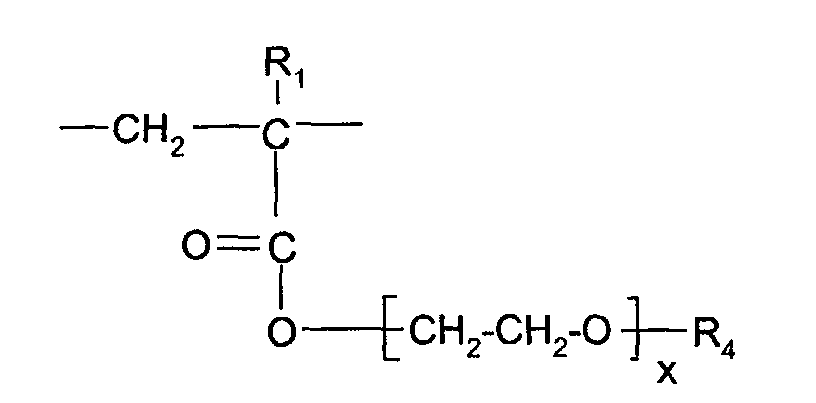
- X + has the same definition as before, and of the following formula (XXVI): in which x denotes an integer ranging from 3 to 100, preferably from 5 to 80 and more preferably from 7 to 25; R 1 has the same meaning as that indicated above in formula (XXIII) and R 4 denotes a linear or branched C 6 -C 22 and more preferably C 10 -C 22 alkyl.
- the polymers for which X + denotes sodium or ammonium are more particularly preferred.
- the polymers of the Genapol® range from Hoechst / Clariant can be used in the composition according to the invention.
- the polymer content thickener represents 0.01 to 20% by weight relative to the weight of the composition, preferably between 0.1 and 10% by weight relative to the weight of the composition, and even more advantageously, between 0.5 and 5% by weight relative to the weight of the composition.
- composition according to the invention may further comprise at least one agent oxidant.
- the oxidizing agent is chosen from hydrogen peroxide, peroxides of alkali or alkaline earth metals, such as sodium, potassium, magnesium; urea peroxide, alkali metal bromates or ferricyanides, persalts such as perborates and persulphates of alkali or alkaline earth metals, like sodium, potassium, magnesium, alone or in mixtures.
- the content of oxidizing agent is in general between 1 and 60% by weight, of preferably between 3 and 50% by weight relative to the weight of the composition.
- composition comprising the oxidizing agent may be in the form of a solution, an emulsion, or a paste.
- the dough does not include water or includes a content less than or equal to 1% by weight relative to the weight of the composition, preferably less than or equal to 0.5% by weight relative to the weight of the composition.
- the oxidizing composition in the case where the oxidizing composition is intended to be used for the discoloration or pickling of the keratinous fiber, it then preferably comprises at least one persalt, at least one alkaline agent and from 15 to 35% of at least one liquid inert organic.
- the alkaline agent is selected from urea; ammonium salts, as chlorides, sulphates, phosphates, nitrates; silicates, phosphates, alkali metal carbonates (such as sodium, potassium) or alkaline earth metals (especially magnesium) alone or combined.
- the organic inert liquid is a compound or a mixture of liquid compounds at room temperature (between 15 and 25 ° C) and at atmospheric pressure.
- it is chosen from polydecenes, mono- and polyesters of carboxylic acids, mono- or polyesters of C 8 -C 30 acid sugars, cyclic ethers, cyclic esters, oils and the like. silicones, mineral oils, vegetable oils, or mixtures thereof.
- compositions in the form of paste are obtained by any means conventional, for example by dispersion of the pulverulent compounds in the liquid inert, in which the other compounds have been previously dispersed or mixed liquids of the bleaching composition, or by extrusion.
- composition according to the invention may furthermore comprise at least one agent reducer, whether for stripping or permanent deformation of fibers.
- the reducing agent is chosen from reductones or compounds comprising sulfur, and in particular compounds with at least a thiol, (di) sulphide, sulphite or sulfinic function, in salt form or otherwise.
- reductones mention may be made, inter alia, of (iso) ascorbic acid, erythorbic, in acid form, esterified or salified. So particularly advantageous are ascorbic acid, isoascorbic acid, in acid form or one of its salts as the sodium salt.
- thiols which can be used as reducing compounds
- sulphites which can be used as reducing agents, which also include bisulphites, hydrosulphites, are suitable alkaline, alkaline earth or ammonium, and mixtures thereof. More particularly, mention may be made of sodium sulphite and sodium hydrosulfite.
- R 1 is selected from: a hydrogen atom, an NH 3 + ion, a monovalent metal ion, or an ion equivalent of divalent metal of groups Ia, IIa, IIb, IVa, and VIIIb of the periodic system of elements
- R 2 is chosen from an OH radical or a radical NR 5 R 6 in which R 5 and R 6 , which are identical or different, are chosen from a hydrogen atom or a C 1 -C 6 alkyl radical
- R 3 is chosen from, a hydrogen atom, a C 1 -C 6 alkyl or alkenyl or cycloalkyl radical; aryl unsubstituted or substituted with 1 to 3 substituents chosen, identical or different, from OH, C 1 -C 6 alkyl, O-C 1 -C 6 alkyl, halogen or CF 3
- R 4 is chosen from: a radical COOR
- the salts of the sulfinic compounds may be chosen from alkaline sulfinates (Na, K), alkaline earth (Ca, Mg) or zinc.
- sulphinic acid derivatives of formula above according to the invention are compounds known, described and prepared in the patent application WO 99/18067 and WO02 / 30369.
- R 1 is chosen from an NH 3 + ion, an alkali metal ion, an alkaline earth metal ion equivalent or zinc
- R 2 is an OH radical or an NH 2 radical
- R 3 is chosen from a hydrogen atom, an alkyl radical which is unsubstituted or substituted by one or two OH radicals or one or two C 1 -C 6 alkyl or alkoxy radicals
- R 4 is a radical COOR 1 or COOR 5 , in which R 1 and R 5 have the same meanings as those indicated above.
- the sulfinic acid derivative is such that R 1 represents sodium, R 2 represents OH, R 3 represents a hydrogen atom and R 4 represents COONa.
- mixtures comprising 40 to 60% of said compound, 10 to 20% of NaSO 3 -CHOH-COONa and 30 to 40% of Na 2 SO 3 (for example Brüggolite® FF6 from Bruggemann 50% of the compound NaSO 2 -CHOH-COONa, 15% of the compound NaSO 3 -CHOH-COONa and 35% of Na 2 SO 3 ).
- the reducing agent is chosen from ascorbic acid, sodium hydroxymethane sulfinate, thiols, sodium sulphite, alone or in mixtures.
- the reducing agent content in the composition is advantageously between 0.01 and 10% by weight relative to the weight of the composition, preferably between 0.1 and 5% by weight relative to the weight of the composition.
- composition may be in the form of a thickened lotion, a cream, gel, or other form suitable for subsequent application of this composition.
- composition when intended for a straightening or fiber, it is preferably in the form of a thickened cream of to keep the fibers to be treated as stiff as possible during the treatment.
- creams are produced in the form of "heavy" emulsions, obtained, for example, in emulsifying an aqueous phase, especially comprising the reducing agent, and a oily phase (vegetable oil, paraffin oil, fatty acid esters, wax, by example).
- liquids or gels containing agents thickeners such as carboxyvinyl polymers or copolymers which "stick" the fibers and keep them in the smooth position during the exposure time.
- composition may likewise comprise at least one dye direct, at least one oxidation base possibly associated with at least one coupler, or mixtures thereof.
- benzene dyes nitrates, azo, azomethine, methine dyes, tetraazapenthamethine, anthraquinone, naphthoquinone, benzoquinones, phenotiazinic indigoids, xanthenics, phenanthridines, phthalocyanines, those derived from triarylmethane, natural dyes, alone or in mixtures.
- the content of direct dye (s) in the composition varies in 0.001 to 20% by weight with respect to the composition, and preferably from 0.01 to 10% of the total weight of the composition.
- oxidation bases they can be chosen in particular among the o-phenylenediamines, p-phenylenediamines, bis-phenylenediamines, o-aminophenols, p-aminophenols, bis-para-aminophenols, bases heterocyclic acid addition salts thereof and mixtures thereof.
- the base content (s) oxidation is from 0.0005 to 12% by weight relative to the weight of the composition, advantageously from 0.005 to 8% by weight relative to the weight of the composition.
- one or more compounds chosen from m-aminophenols can be used, m-phenylenediamines, m-diphenols, naphthols, couplers heterocyclic acid addition salts thereof and mixtures thereof.
- these couplers represent more specifically 0.0001 to 10% by weight relative to the weight of the composition, and preferably from 0.005 to 5% by weight relative to the weight of the composition.
- acid addition salts of the oxidation bases and couplers are chosen in particular from hydrochlorides, hydrobromides, sulphates, citrates, succinates, tartrates, lactates, tosylates, benzenesulfonates, phosphates and acetates.
- composition according to the invention may further comprise at least one surfactant, preferably nonionic, anionic, amphoteric or zwitterionic.
- nonionic surfactants mention may be made of alcohols, alpha-diols, polyethoxylated and / or polypropoxylated alkylphenols having a hydrocarbon chain comprising, for example, from 8 to 30 carbon atoms, preferably from 8 to 18 carbon atoms, the number of ethylene oxide groups and / or propylene that can range from 2 to 50.
- anionic surfactants mention may be made, inter alia, of salts (in particular alkaline salts, especially of sodium, magnesium, ammonium salts, amine salts, aminoalcohol salts) of alkyl sulphates, alkyl ether sulphates, alkylamidoethersulfates, alkylarylpolyethersulfates, monoglycerides sulfates; alkylsulfonates, alkylphosphates, alkylamidesulfonates, alkylarylsulfonates, ⁇ -olefin-sulfonates, paraffin-sulfonates; (C 6 -C 24 ) alkylsulfosuccinates, (C 6 -C 24 ) alkylsulfosuccinates, (C 6 -C 24 ) alkylamidesulfosuccinates; (C 6 -C 24 ) alkyl sulphoacetates; acyl (C
- Fatty acid salts such as the salts of oleic, ricinoleic, palmitic and stearic acids, and hydrogenated or unhydrogenated coconut oil acids are also suitable; the alkyl D-galactoside uronic acids and their salts, polyoxyalkylenated (C 6 -C 24) ether carboxylic acids, polyoxyalkylenated (C 6 -C 24) aryl ether carboxylic acids, polyoxyalkylenated (C 6 -C 24 ) polyoxyalkylenated amido ether carboxylic acids and their salts, in particular those containing from 2 to 50 alkylene oxide groups, in particular ethylene, and mixtures thereof.
- amphoteric or zwitterionic surfactants the derivatives of aliphatic secondary or tertiary amines in which the aliphatic radical is a linear or branched chain containing 8 to 18 carbon atoms and containing at least one water-soluble anionic group (for example carboxylate, sulfonate, sulfate, phosphate or phosphonate); mention may also be made of (C 8 -C 20 ) alkylbetaines, sulphobetaines, (C 8 -C 20 ) alkylamido (C 1 -C 6 ) alkylbaryaines or (C 8 -C 20 ) alkylamidoalkyl (C 1 -C 6 ) sulfobetaines.
- the aliphatic radical is a linear or branched chain containing 8 to 18 carbon atoms and containing at least one water-soluble anionic group (for example carboxylate, sulfonate, sulfate, phosphat
- amphocarboxyglycinates and amphocarboxypropionates such as disodium cocoamphodiacetate, disodium lauroamphodiacetate, disodium caprylamphodiacetate, disodium cocoamphodipropionate, disodium lauroamphodipropionate, etc. (products of the Miranol® range, in particular Miranol® C2M concentrate marketed the company Rhodia Chimie).
- the surfactant content in the composition is usually from 0.01 to 40% by weight and preferably from 0.5 to 30% by weight, of the total weight of the composition.
- composition according to the invention may also comprise various adjuvants conventionally used, such as cationic substantive polymers or amphoteric, anionic, cationic, nonionic, amphoteric polymers, zwitterionic agents, mineral thickeners, antioxidants, alpha-oxocarboxylic acids (for example oxalic acid, glyoxalic acid, pyruvic acid or alpha-ketoglutaric acid), penetration agents, perfumes, buffers, basic amino acids such as arginine, dispersing agents, peptizing agents, conditioning agents such as by example of cations, volatile or non-volatile silicones, modified or otherwise modified, film-forming agents, ceramides, vitamins or provitamins, preservatives, stabilizers, opacifying agents or matifying agents like titanium dioxide, mineral fillers, such as clays, silicas pyrogensed compounds of hydrophilic or hydrophobic nature, binding polymers such as vinylpyrrolidone, lubricants such as stearate
- the adjuvants mentioned above are generally present in an amount of for each of them between 0.01 and 20% by weight relative to the weight of the composition.
- the medium of the composition is a cosmetically acceptable medium.
- it consists of water or a mixture water and one or more common organic solvents.
- the organic solvents are chosen from monoalcohols or diols, linear or branched, preferably saturated, comprising 2 to 10 carbon atoms, such as ethyl alcohol, isopropyl alcohol, hexylene glycol (2-methyl 2,4-pentanediol), neopentyl glycol and 3-methyl-1,5-pentanediol; aromatic alcohols such as benzyl alcohol, phenylethyl alcohol; glycols or glycol ethers such as, for example, ethylene glycol monomethyl, monoethyl and monobutyl ethers, propylene glycol or its ethers such as, for example, propylene glycol monomethyl ether, butylene glycol, dipropylene glycol; as well as the alkyl ethers of diethylene glycol, especially of C 1 -C 4 , such as, for example, diethylene glycol monoethyl ether or monobutyl ether, alone or as a
- the usual solvents described above, if present, represent usually from 1 to 40% by weight, more preferably from 5 to 30% by weight, relative to the total weight of the composition.
- the medium of the composition according to the invention does not include water or has a water content less than or equal to 1% weight relative to the weight of the composition, preferably less than or equal to 0.5% by weight relative to the weight of the composition.
- the medium of the composition is an inert organic liquid selected among those mentioned before.
- the content of this type of compound is between 15 and 35% by weight per relative to the weight of the composition.
- the pH of the composition according to the invention can be determined without difficulty by the person skilled in the art and depends in particular on the nature of the ingredients present but also of the application that one makes of said composition.
- the pH of the composition according to the invention is generally from about 3 to about 14, and preferably from about 5 to about 12.
- acidifying agents mention may be made, by way of examples, of mineral acids organic substances such as hydrochloric acid, orthophosphoric acid, sulfuric acid, acetic acid.
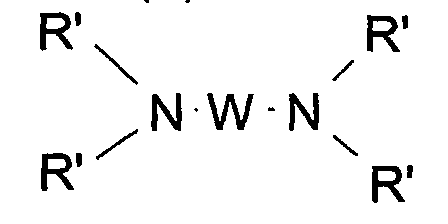
- alkalinizing agents that may be mentioned, for example, are ammonia, alkali carbonates, organic carbonates, alkanolamines such as mono-, di- and triethanolamines and their derivatives, hydroxides of sodium or potassium. and the compounds of formula (A) below: wherein W is a propylene residue optionally substituted by a hydroxyl group or a C1-C6 alkyl radical; the radicals R ', identical or different, represent a hydrogen atom, an alkyl radical C 1 -C 6 alkyl or hydroxy C 1 -C 6.
- composition according to the invention can be in the form of washing, such as shampoos, but also conditioners, formatting (such as lacquers, foam, etc.), staining, bleaching, shaping keratinous fibers.
- the present invention furthermore relates to methods implementing the composition according to the invention.
- the method consists in bringing the dry keratin materials into contact with each other. or wet, with the composition according to the invention which has just been described.
- the exposure time of the composition is between a few seconds and 30 minutes, preferably between 3 and 15 minutes.
- the temperature at which the composition is left to act is generally understood between ambient temperature (15 to 25 ° C) and 220 ° C, more particularly between room temperature and 80 ° C, preferably between 15 and 40 ° C.
- the keratin materials are rinsed, advantageously with water, and if necessary, washed with a shampoo and rinsed again with water
- the subject of the invention is a permanent deformation process of human keratinous fibers consisting of contact in a first step, a reducing composition with said keratinous fibers, the latter being shaped before, during or after the application of the reducing composition; then in a second step, to apply an oxidizing composition on the fibers thus treated; the compound carrying all four carboxylic functions and the thickening polymer found in the composition reducing agent and / or in the oxidizing composition.
- the first step is therefore to apply to said fibers, dry or wet, a reducing composition.
- This composition can possibly understand the compound carrying the four carboxylic functions and the polymer thickening.
- the pH of the reducing composition applied is at least 7.
- the latter are put under tension using curlers, before, during or after the application of the composition reductive.
- the composition is applied to the fibers in the smoothing.
- the exposure time is generally between a few seconds and 30 minutes, preferably between 3 and 15 minutes.
- the temperature at which the composition is left to act is generally understood between ambient temperature (15 to 25 ° C) and 220 ° C, more particularly between room temperature and 80 ° C, preferably between 15 and 40 ° C.
- an oxidizing composition is applied to the fibers.
- the oxidizing composition can optionally understand the compound carrying the four carboxylic functions and the polymer thickening.
- the composition comprises, as an oxidizing agent, hydrogen peroxide, alkali bromate, persalt or polythionate.
- the pH of this oxidizing composition is generally between 2 and 10.
- hydrogen peroxide is used with a pH advantageously between 2 and 7.
- the oxidizing composition can be further obtained by mixing at least two compositions, one of them comprising the oxidizing agent, the other comprising less an alkaline agent.
- the oxidizing composition can be advantageously under the form an emulsion, usually thickened.
- the exposure time of the oxidizing composition is generally between 3 and 30 minutes, preferably between 5 and 15 minutes.
- the fibers impregnated with the oxidizing composition are rinsed, usually with water. Before or after rinsing, the keratin fibers are separated from the means necessary to put them on.
- the fibers are then optionally washed with shampoo, rinsed then dried or left to dry.
- the process for shaping fibers human keratin consists in applying to the keratin fibers, dry or compositions, in addition to the compound (s) and polymer (s) aforementioned thickeners, at least one acalinizing agent, such as preferably sodium hydroxide.
- composition is particularly appropriate when one wishes to make a step of hair straightening.
- the fibers are smoothed during or after the application of the composition.
- the exposure time is generally between 3 and 30 minutes, preferably between 5 and 15 minutes.
- the temperature at which the composition is left to act is generally understood between ambient temperature (15 to 25 ° C) and 220 ° C, more particularly between room temperature and 80 ° C, preferably between 15 and 40 ° C.
- the fibers impregnated with the composition are rinsed thoroughly, usually with water, preferably washed with shampoo, rinsed and then dried or left to dry.
- the subject of the invention is a a process for bleaching keratin fibers by contacting the ready-to-use composition with said fibers for a period of time sufficient to get the desired effect.
- the ready-to-use composition comprises, in addition to the compound or compounds carrying the four carboxylic functions and the thickening polymer or polymers, at least one agent oxidant.
- a first possibility is constituted by a process implemented at a pH acid (less than 7).
- the oxidizing agent is hydrogen peroxide.
- the composition applied to the fibers keratin comprises at least one oxidizing agent, the compound and the polymer thickening.
- a second possibility is constituted by a process implemented at a pH basic (equal to or greater than 7).
- the ready-to-use composition applied to the fibers is preferably obtained by extemporaneous mixing, before application to the fibers, of a first composition comprising at least one persalt, with a second aqueous composition comprising an oxidizing agent, and optionally a third composition comprising at least one alkaline agent; the thickening polymer (s) and the compound having four carboxylic functions in acid or salified form, being, together or not, in one and / or the other of the aforementioned compositions.
- the first composition is in an anhydrous form, and comprises at least one persalt, optionally at least one alkaline agent, and optionally at least one inert liquid.
- the second composition which is an aqueous composition, comprises preferably as an oxidizing agent, hydrogen peroxide.
- e pH of this composition is less than or equal to 7.
- a third composition which is also in an aqueous form, comprising at least less an alkaline agent.
- the ready-to-use composition is therefore applied to the keratinous fibers, dry or wet, then left for a sufficient exposure time to obtain the discoloration sought. At the end of this period, the composition is eliminated by a rinse with water, followed by washing with a shampoo, then drying.
- the exposure time is between a few seconds and 30 minutes, preferably between 3 and 15 minutes.
- the temperature at which the composition is left to act is generally understood between ambient temperature (15 to 25 ° C) and 220 ° C, more particularly between room temperature and 80 ° C, preferably between 15 and 40 ° C.
- the ready-to-use composition comprises at least one reducing agent.
- This variant is particularly suitable when one wishes to withdraw artificial coloring, in so far as it can be eliminated by a reduction reaction. This is called stripping.
- the ready-to-use composition is applied to dyed fibers by means of oxidation dyes (base and / or coupler), direct dyes, or still a combination of these two families of dyes.
- the pH of the ready-to-use composition is advantageously less than 7, preferably between 3 and 7.
- the pH of the composition can be adapted in a conventional manner by using, as needed, one or more alkalizing or acidifying agents, such as especially those listed above.
- the method therefore consists in applying to the keratin fibers the composition ready to use and then to leave the composition for a period of time sufficient to get the discolouration, rinse the fibers to remove the composition, wash them with a shampoo, rinse them and possibly dry them.
- the exposure time varies between a few seconds and 60 minutes, preferably between 1 and 60 minutes, and more preferably between 10 and 50 minutes.
- the temperature at which the composition is left to act is generally understood between room temperature (15 to 25 ° C) and 220 ° C, especially between room temperature and 80 ° C, and preferably between 15 and 40 ° C.
- the subject of the invention is a process for staining human keratin fibers in which is placed in contact the ready-to-use composition with said fibers for a period of time sufficient to get the desired effect.
- the ready-to-use composition does not include oxidizing agent, it can be applied directly to the fibers.
- the ready-to-use composition comprises, in addition to the compound (s) carrying four carboxylic functions, the polymer (s) thickening (s), at least one direct dye.
- This composition can be stored as it is or result from extemporaneous mixture of at least one composition comprising at least one polymer thickener, of at least one composition comprising at least one direct dye: the compound carrying four carboxylic functions which may be in one and / or the other of the compositions.
- the ready-to-use composition can be stored as is.
- the composition is applied ready for use for the time necessary for the development of the coloring, then let dry or dry the fibers, without final rinsing or with a rinse.
- the exposure time is about a few seconds to 60 minutes, plus particularly from 5 to 60 minutes and preferably 5 to 40 minutes.
- the temperature necessary for the development of the coloration is generally between room temperature (15 to 25 ° C) and 220 ° C, especially between ambient temperature and 80 ° C, and preferably between 15 and 40 ° C.
- the ready-to-use composition comprises at least less an oxidizing agent.
- an oxidizing agent As indicated before, it is preferably obtained by extemporaneous mixing, before the application, of at least one composition comprising at least one thickening polymer, at least one oxidation base and / or at least one coupler and / or at least one direct dye with at least one composition oxidative; the compound carrying four carboxylic acid functions found in one or more of the above compositions.
- the oxidizing composition used in this case is conventional and corresponds usually to an aqueous composition comprising an oxidizing agent as listed before.
- the oxidizing composition can likewise comprise the usual additives in the domain, such as for example surfactants, hydrophobic liquids (if the composition is in emulsified form); sequestering agents; agents stabilizers hydrogen peroxide; anti-foam agents, etc.
- surfactants such as for example surfactants, hydrophobic liquids (if the composition is in emulsified form); sequestering agents; agents stabilizers hydrogen peroxide; anti-foam agents, etc.
- the exposure time is about a few seconds to 60 minutes, more preferably 5 to 60 minutes and preferably 5 to 40 minutes.
- this one is generally between room temperature (15 to 25 ° C) and 220 ° C, especially between room temperature and 80 ° C, and advantageously between 15 and 40 ° C.
- the fibers are usually washed with a shampoo, rinse and dry or allow to dry.
- Composition A is applied for 45 minutes under helmet, on hair dark natural, then rinse thoroughly with water.
- Composition A has an ideal texture for easy application and fast, which does not flow and does not evolve during the exposure time.
- Composition B is applied for 30 minutes under headphones on hair dark natural, then rinse thoroughly with water.
- Composition A has an ideal texture for easy and rapid application, which does not flow and does not change during the exposure time. The result is a powerful and even discoloration, and the hair is soft, shiny and easy to disentangle.
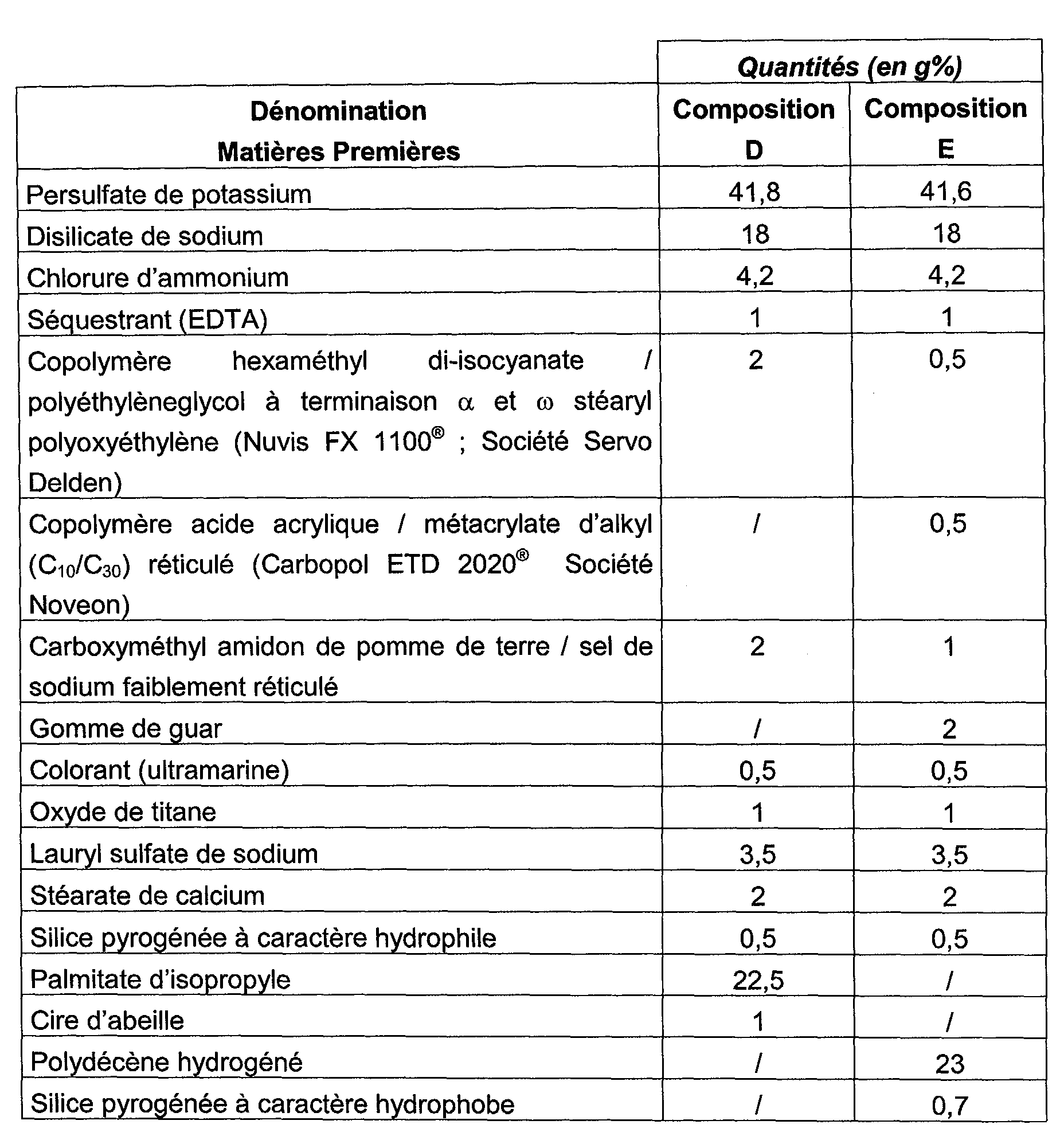
- 40 g of the bleaching composition D are mixed with 80 g of the oxidizing composition based on hydrogen peroxide C.
- the bleaching mixture is applied ready to use thus obtained 45 minutes under headphones on dark natural hair, then rinse thoroughly with water.
- bleaching composition E 40 g of the bleaching composition E are mixed with 60 g of the oxidizing composition based on hydrogen peroxide C.
- the bleaching mixture is applied ready to use thus obtained 25 minutes under headphones on dark natural hair, then rinse thoroughly with water.
- the ready-to-use composition obtained has a ideal texture for easy and fast application, does not flow and does not evolve during laying time.
- a powerful and homogeneous bleaching is obtained, with soft, shiny and easily disentangled hair.
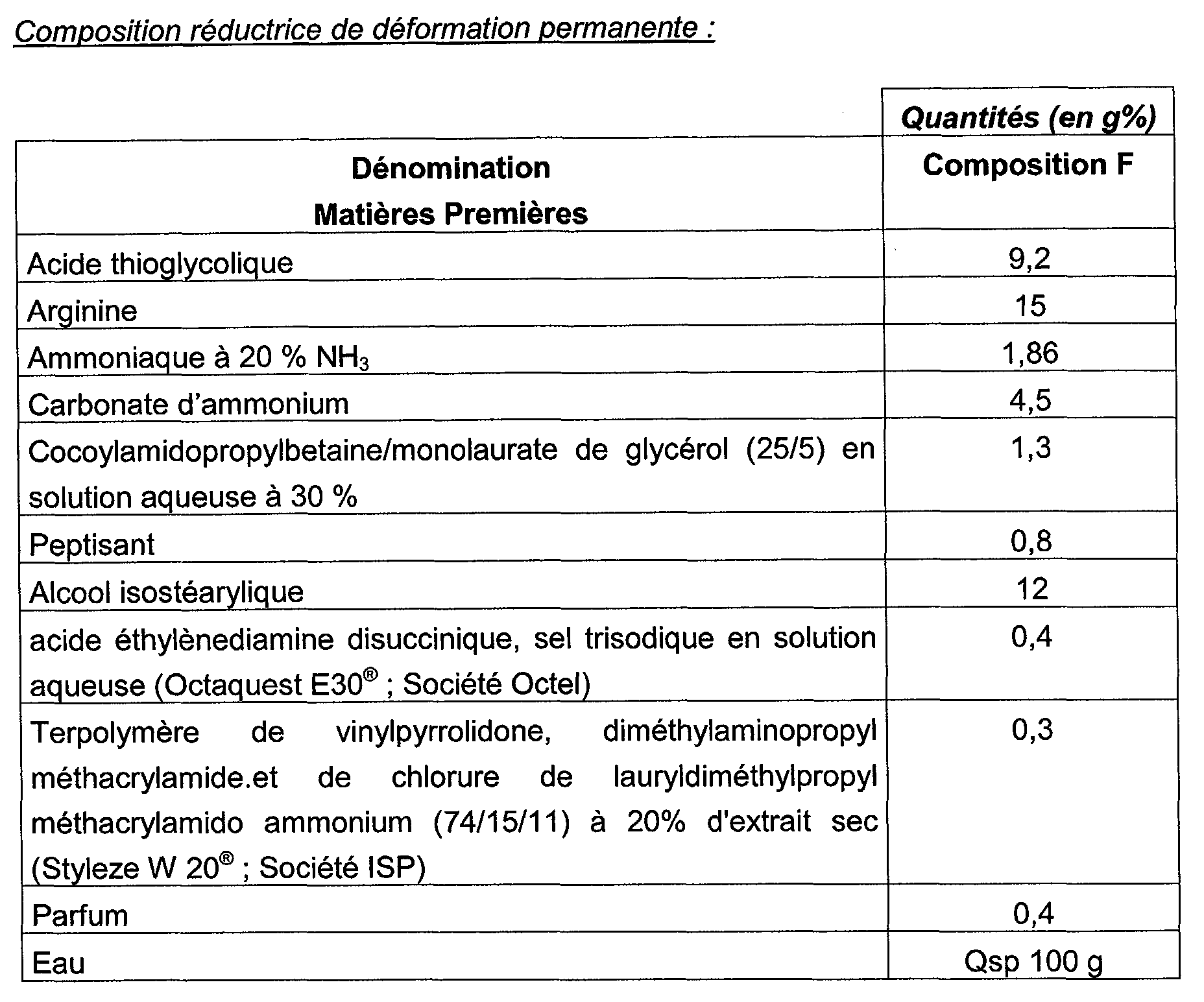
- the reducing composition F is applied to a lock of damp hair, previously rolled up on a curler 9 mm in diameter.
- the exposure time is 10 minutes.
- the composition has an ideal texture for easy and quick application, that does not flow and does not evolve during the exposure time
- the rush is thoroughly rinsed with water, then then applies the oxidizing composition C.
- the exposure time is 10 minutes.
- the bleaching compositions G, H and I are applied to gray hair natural 90% white, previously colored by the shade 6.66 of the range OREAL MAJIROUGE®, with a bath ratio of 10 g of product to 1 g of hair.
- the locks are rinsed and then treated for 2 minutes. using a 3% aqueous solution of hydrogen peroxide and then rinsed again.
- a standard shampoo is then produced, followed by the drying of hair.
- compositions (expressed in grams) were prepared:
- Oxidizing composition :
- the coloring compositions were mixed, at the time of use, in a plastic bowl and for 2 minutes, the oxidizing composition given above, to because of 1 part of coloring composition for 1.5 parts of oxidizing composition.
- the mixtures obtained were applied to locks of natural hair at 90% of whites and let stand 30 minutes.
- the ready-to-use compositions thus obtained have an ideal texture for easy and fast application, which does not run and does not evolve during the time deposit.
- the hair was dyed in both cases in a powerful red shade, and the hair is not rough.
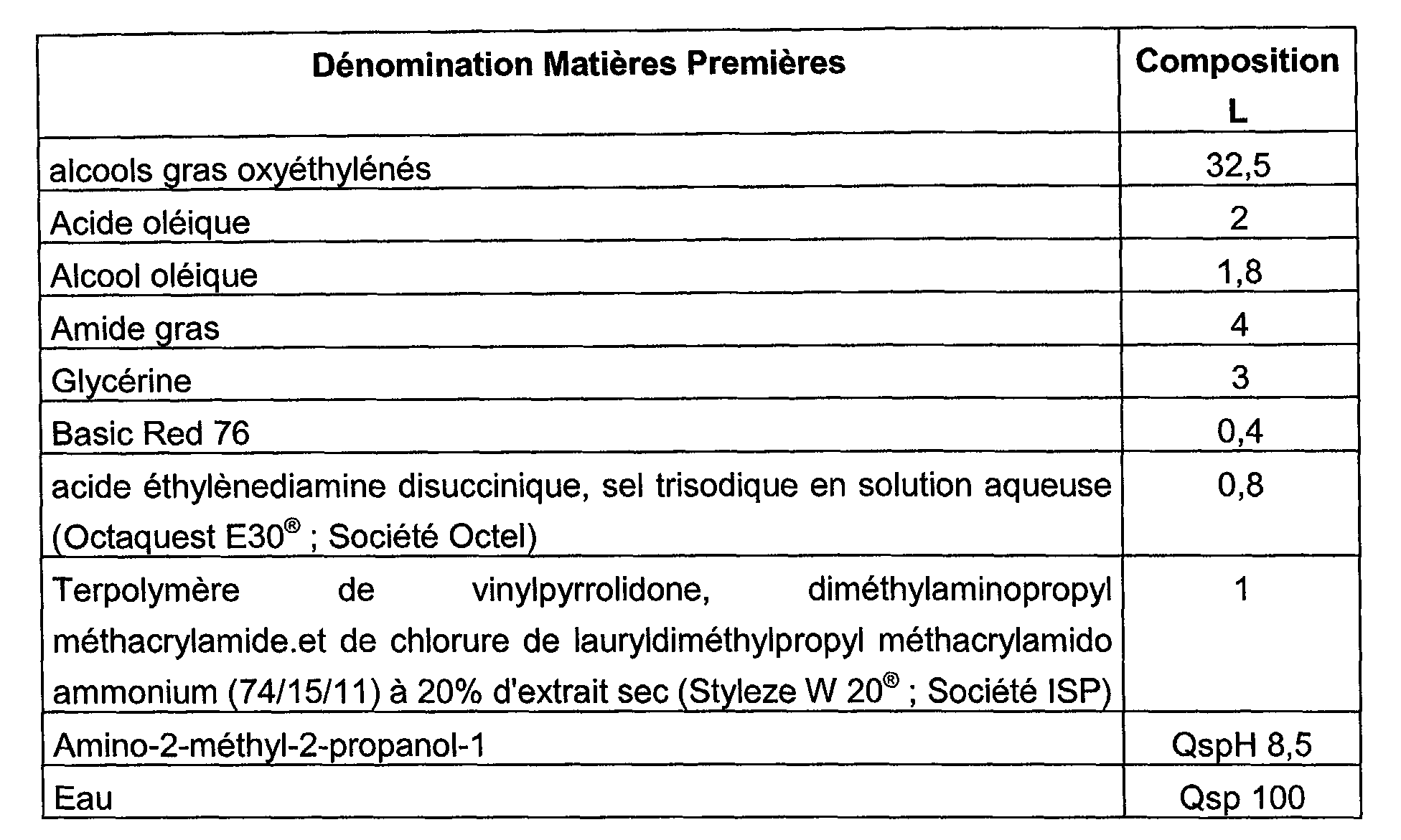
- composition L (expressed in grams) was prepared:
- This composition was applied 30 minutes on gray hair at 90% of white. After rinsing and drying the hair was colored in intense red and the hair is not rough.
- the coloring compositions were mixed, at the time of use, in a plastic bowl and for 2 minutes, the oxidizing composition C, at a rate of 1 part of coloring composition for 1.5 parts of oxidizing composition.
- the mixtures obtained were applied to locks of natural hair at 90% of whites and let stand 30 minutes.
- the ready-to-use compositions thus obtained have an ideal texture for easy and fast application, which does not run and does not evolve during the time deposit.
- the hair was dyed in both cases in a purple-red shade powerful, and the hair is not rough.
Landscapes
- Life Sciences & Earth Sciences (AREA)
- Health & Medical Sciences (AREA)
- Animal Behavior & Ethology (AREA)
- General Health & Medical Sciences (AREA)
- Public Health (AREA)
- Veterinary Medicine (AREA)
- Birds (AREA)
- Epidemiology (AREA)
- Cosmetics (AREA)
Abstract
Description
- au moins un composé choisi parmi l'acide éthylènediamine-N,N'-disuccinique, un sel, ou leur mélange,
- au moins un polymère épaississant choisi parmi les polymères à squelette aminoplaste-éther, les polymères cationiques associatifs, les homopolymères réticulés d'acide 2-acrylamido-2-méthylpropane sulfonique, ou les copolymères associatifs comprenant au moins un monomère à groupement sulfonique.

- AMP est un résidu aminoplaste avec des unités alkylènes (ou alkyle divalent),
- R désigne un atome d'hydrogène, un radical alkyle C1-C4 ou un radical acyle C1-C4,
- RO1 est un résidu alkylène-oxy divalent,
- p désigne un nombre entier positif,
- le ou les groupements OR étant liés aux unités alkylènes du résidu AMP.

- AMP, R, RO1 et p ont la même signification que précédemment,
- RO2 est un groupe différent de RO lié à AMP au moyen d'un hétéroatome et comprenant au moins deux atomes de carbone, et,
- q est un nombre entier positif.

- AMP, R, RO1, RO2, p et q ont la même signification que précédemment,
- R2 ou R3, identiques ou différents représentent un groupe terminal pouvant désigner un atome d'hydrogène, un groupement RO1H, un groupement RO2H, un groupement AMP(OR)p ou tout groupement monofonctionnel tel que alkyle, cycloalkyle, aryle, aralkyle, alkylaryle, alkyloxyalkyle, aryloxyalkyle, cycloalkoxyalkyle,
- a étant un nombre supérieur à 1 et de préférence supérieur à 2.
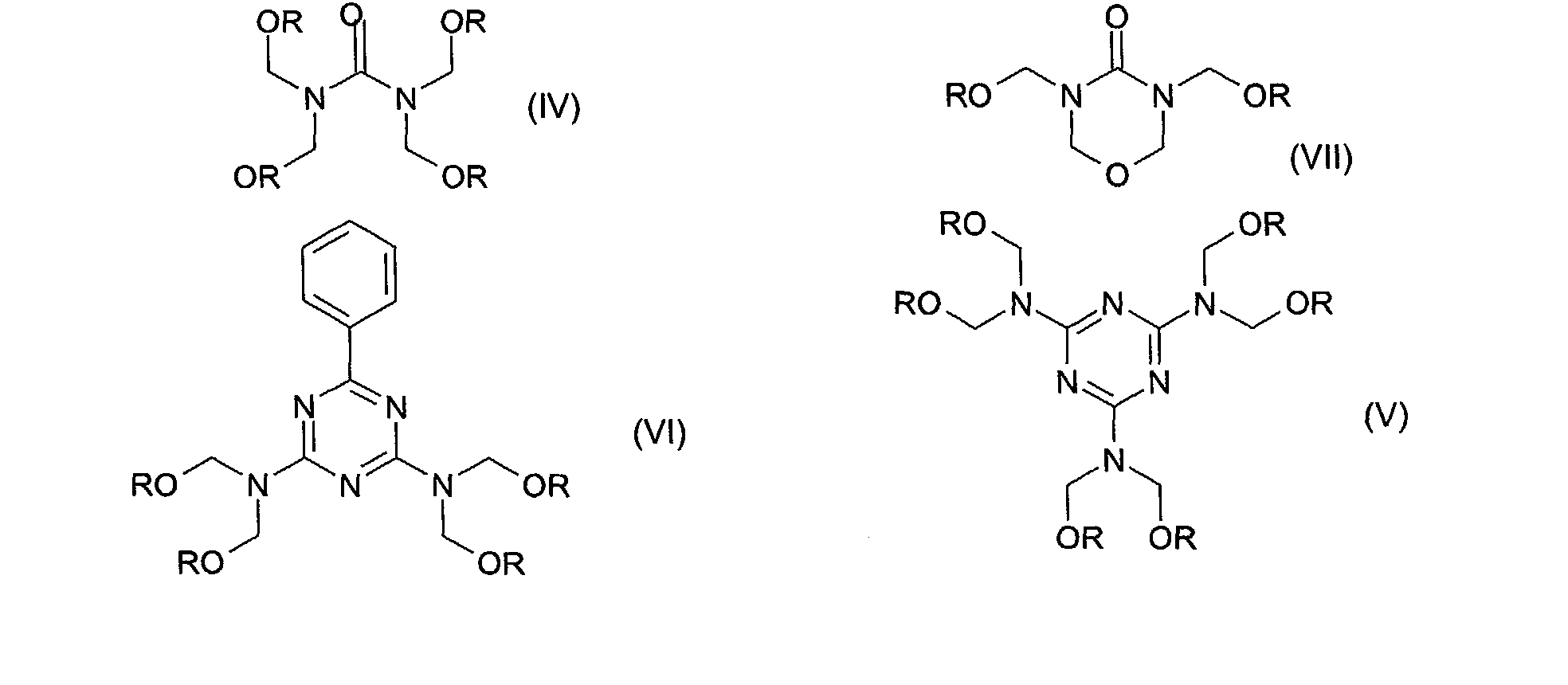

- R a la même signification que précédemment,
- R1 désigne alkyle C1-C4,
- y est un nombre au moins égal à 2,
- x désigne 0 ou 1.
De préférence, le ou les résidus aminoplastes porteurs de leurs groupements OR
sont choisis parmi ceux de structure (XVI) suivante :
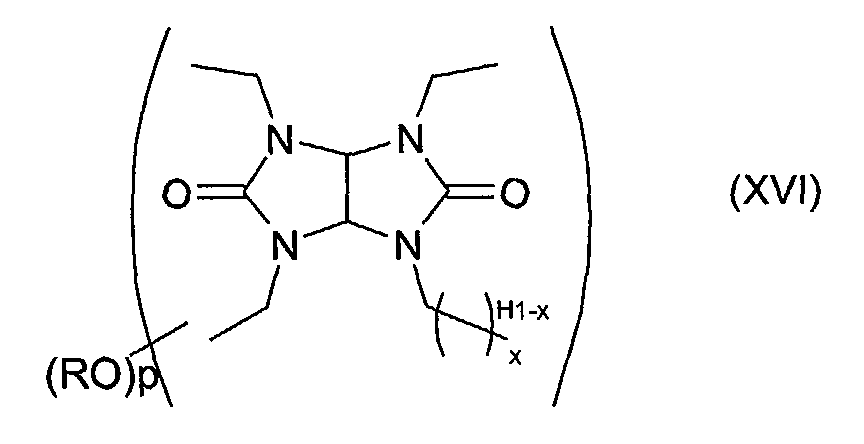
- y et y' étant des nombres allant de 0 à 1000,
- t et w étant des nombres allant de 0 à 10,
- Z, Z', Z2 et Z3 sont des radicaux alkylène en C2C4 et de préférence des radicaux -CH2-CH(Z4)- et -CH2-CH(Z4)-CH2-,
- Z1 étant un radical linéaire ou cyclique, ramifié ou non, aromatique ou non, comportant ou non un ou plusieurs hétéroatomes et possédant de 1 à 40 atomes de carbone,
- Z4 désignant un atome d'hydrogène ou un radical alkyle en C1-C4 ou un radical acyle en C1-C3 étant entendu qu'au moins un des radicaux Z4 des radicaux Z, Z', Z2 et Z3 est différent d'un radical acyle.
- R et R', identiques ou différents, représentent un groupement hydrophobe ou un atome d'hydrogène ;
- X et X', identiques ou différents, représentent un groupement comportant une fonction amine portant ou non un groupement hydrophobe, ou encore le groupement L" ;
- L, L' et L", identiques ou différents, représentent un groupement dérivé d'un diisocyanate ;
- P et P', identiques ou différents, représentent un groupement comportant une fonction amine portant ou non un groupement hydrophobe ;
- Y représente un groupement hydrophile ;
- r est un nombre entier compris entre 1 et 100, de préférence entre 1 et 50 et en particulier entre 1 et 25 ;
- n, m, et p valent chacun indépendamment des autres entre 0 et 1000 ;
- la molécule contenant au moins une fonction amine protonée ou quaternisée et au moins un groupement hydrophobe.
- R et R' représentent tous les deux indépendamment un groupement hydrophobe,
- X, X' représentent chacun un groupe L",
- n et p valent entre 1 et 1000 et
- L, L', L", P, P', Y et m ont la signification indiquée que dans la formule (XVIII).
- R et R' représentent tous les deux indépendamment un groupement hydrophobe,
- X, X' représentent chacun un groupe L",
- n et p valent 0,
- L, L', L", Y et m ont la signification que dans la formule (XVIII).
- R et R' représentent tous les deux indépendamment un groupement hydrophobe,
- X et X' représentent tous les deux indépendamment un groupement comportant une amine quaternaire,
- n et p valent zéro, et
- L, L', Y et m ont la signification indiquée dans la formule (XVIII).


- R2 représente un radical alkylène ayant de 1 à 20 atomes de carbone, linéaire ou ramifié, comportant ou non un cycle saturé ou insaturé, ou un radical arylène, un ou plusieurs des atomes de carbone pouvant chacun être remplacé par un hétéroatome choisi parmi N, S, O, P ;
- R1 et R3, identiques ou différents, désignent un radical alkyle ou alcényle en C1-C30, linéaire ou ramifié, un radical aryle, l'un au moins des atomes de carbone pouvant chacun être remplacé par un hétéroatome choisi parmi N, S, O, P ;
- A- est un contre-ion cosmétiquement acceptable.

- Z représente -O-, -S- ou -NH- ; et
- R4 représente un radical alkylène ayant de 1 à 20 atomes de carbone, linéaire ou ramifié, comportant ou non un cycle saturé ou insaturé, un radical arylène, un ou plusieurs des atomes de carbone pouvant chacun être remplacé par un hétéroatome choisi parmi N, S, O et P.

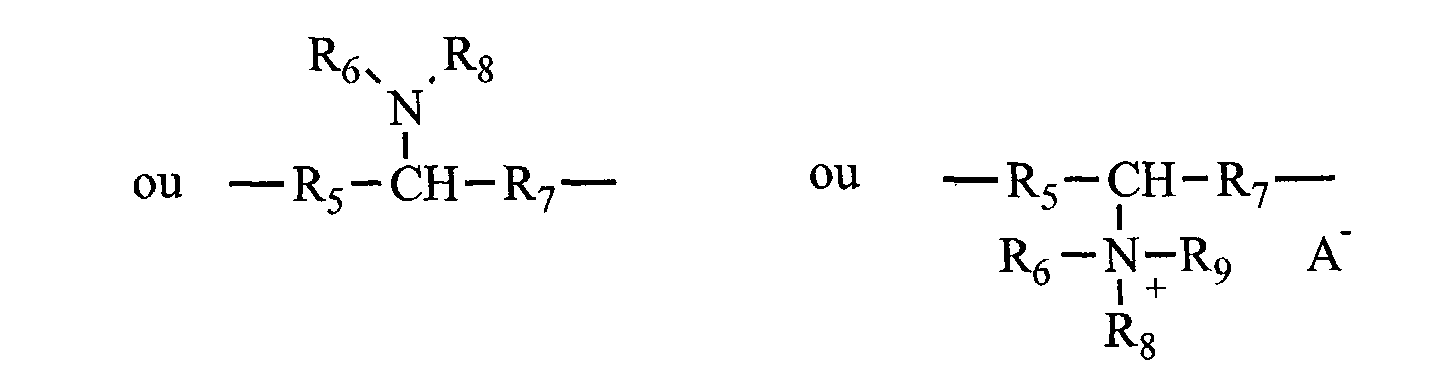
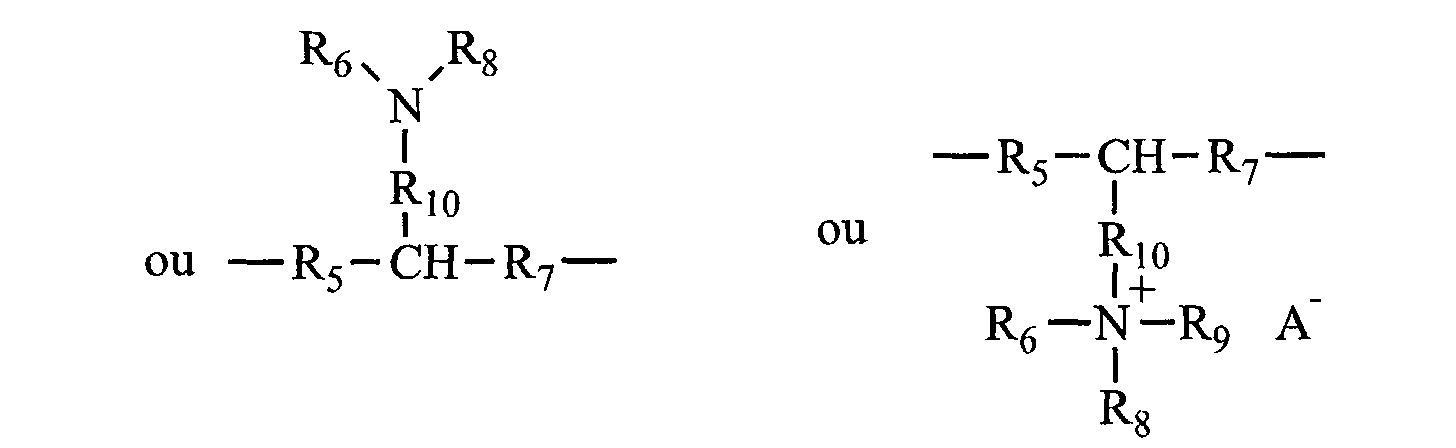
- R5 et R7 ont les mêmes significations que R2 défini précédemment ;
- R6, R8 et R9 ont les mêmes significations que R1 et R3 définis précédemment ;
- R10 représente un groupe alkylène, linéaire ou ramifié, éventuellement insaturé et pouvant contenir un ou plusieurs hétéroatomes choisis parmi N, O, S et P, et
- A- est un contre-ion cosmétiquement acceptable.

- X désigne un atome d'oxygène ou un radical NR'6,
- R1 et R6 désignent, indépendamment l'un de l'autre, un atome d'hydrogène ou un radical alkyle linéaire ou ramifié en C1-C5,
- R2 désigne un radical alkyle linéaire ou ramifié en C1-C4,
- R3, R4 et R5 désignent, indépendamment l'un de l'autre, un atome d'hydrogène, un
radical alkyle linéaire ou ramifié en C1-C30 ou un radical de formule (XXI) :

- Y, Y1 et Y2 désignent, indépendamment l'un de l'autre, un radical alkylène linéaire ou ramifié en C2-C16,
- R7 désigne un atome d'hydrogène, ou un radical alkyle linéaire ou ramifié en C1-C4 ou un radical hydroxyalkyle linéaire ou ramifié en C1-C4,
- R8 désigne un atome d'hydrogène ou un radical alkyle linéaire ou ramifié en C1-C30,
- p, q et r désignent, indépendamment l'un de l'autre, soit la valeur zéro, soit la valeur 1,
- m et n désignent, indépendamment l'un de l'autre, un nombre entier allant de 0 à 100,
- x désigne un nombre entier allant de 1 à 100,
- Z désigne un anion d'acide organique ou minéral,
- l'un au moins des substituants R3, R4, R5 ou R8 désigne un radical alkyle linéaire ou ramifié en C9-C30,
- si m ou n est différent de zéro, alors q est égal à 1,
- si m ou n sont égaux à zéro, alors p ou q est égal à 0.

- s désigne un nombre entier allant de 3 à 6,
- R9 désigne un atome d'hydrogène ou un radical alkyle linéaire ou ramifié en C1-C5,
- R10 désigne un atome d'hydrogène ou un radical alkyle linéaire ou ramifié en C1-C5,
- sous réserve que l'un au moins des radicaux R9 et R10 désigne un atome d'hydrogène.
- les celluloses cationiques quaternisées modifiées par des groupements comportant au moins une partie hydrophobe telle que définie auparavant,
- les hydroxyéthylcelluloses cationiques quaternisées modifiées par des groupements comportant au moins une partie hydrophobe définie auparavant.
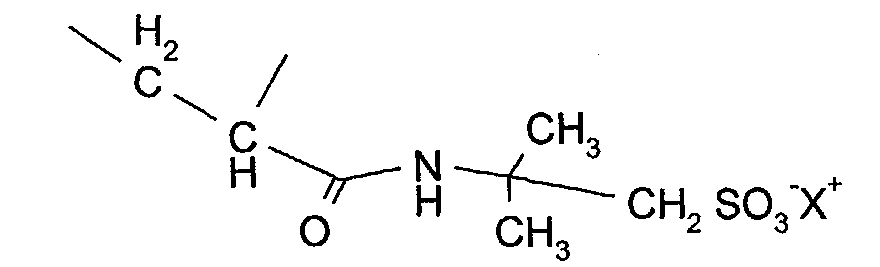

- les copolymères réticulés ou non réticulés, neutralisés ou non, comportant de 15 à 60% en poids de motifs AMPS et de 40 à 85% en poids de motifs (C8-C16)alkyl(méth)acrylamide ou de motifs (C8-C16)alkyl(méth)acrylate par rapport au polymère, tels que ceux décrits dans la demande EP-A750 899 ;
- les terpolymères comportant de 10 à 90% en mole de motifs acrylamide, de 0,1 à 10% en mole de motifs AMPS et de 5 à 80% en mole de motifs n-(C6-C18)alkylacrylamide, tels que ceux décrits dans le brevet US- 5089578.
- les copolymères d'AMPS totalement neutralisé et de méthacrylate de dodécyle ainsi que les copolymères d'AMPS et de n-dodécylméthacrylamide non-réticulés et réticulés, tels que ceux décrits dans les articles de Morishima cités ci-dessus.

et de motifs de formule (XXVI) suivante :

R1 est choisi parmi, un atome d'hydrogène, un ion NH3 +, un ion de métal monovalent ou un équivalent ionique de métal bivalent des groupes Ia, IIa, IIb, IVa et VIIIb du système périodique des éléments,
R2 est choisi parmi, un radical OH, un radical NR5R6 dans lequel R5 et R6, identiques ou différents, sont choisis parmi un atome d'hydrogène ou un radical alkyle en C1-C6,
R3 est choisi parmi, un atome d'hydrogène, un radical alkyle ou alcényle ou cycloalkyle en C1-C6 ; aryle non substitué ou substitué par 1 à 3 substituants choisis, identiques ou différents, parmi les radicaux OH, alkyle en C1-C6, O-alkyle en C1-C6, halogène ou CF3, R4 est choisi parmi, un radical COOR1, SO3R1, COR5, CONR5R6 ou COOR5 ou dans lesquels R1, R5, et R6 ont les significations précédentes,
et R4 désigne également un atome d'hydrogène, lorsque R3 désigne un radical aryle, et en particulier, un radical aryle substitué comme décrit précédemment,
et les sels desdits composés cosmétiquement acceptables.


On obtient une décoloration puissante et homogène, et les cheveux sont doux, brillants et faciles à démêler.



| Alcool gras | 2,3 |
| Alcool gras oxyéthyléné | 0,6 |
| Amide gras | 0,9 |
| Glycérine | 0,5 |
| Peroxyde d'hydrogène | 7,5 |
| parfum | qs |
| Eau déminéralisée qsp | 100 |


Claims (17)
- Composition destinée au traitement de fibres kératiniques humaines, comprenant :au moins un composé choisi parmi l'acide éthylènediamine-N,N'-disuccinique, un sel, ou leur mélange,au moins un polymère épaississant choisi parmi les polymères à squelette aminoplaste-éther, les polymères cationiques associatifs, les homopolymères réticulés d'acide 2-acrylamido-2-méthylpropane sulfonique, ou les copolymères associatifs comprenant au moins un monomère à groupement sulfonique.
- Composition selon l'une quelconque des revendications précédentes, caractérisée en ce que la teneur en composé est comprise entre 0,01 et 20 % en poids par rapport au poids de la composition, plus particulièrement entre 0,1 et 10 % en poids par rapport au poids de la composition, de préférence entre 0,2 et 5 % en poids par rapport au poids de la composition.
- Composition selon l'une quelconque des revendications précédentes, caractérisée en ce que les polymères cationiques associatifs sont choisis parmi les polyuréthanes cationiques amphiphiles, les polyvinyllactames cationiques amphiphiles, les dérivés de cellulose cationiques amphiphiles, ou leurs mélanges.
- Composition selon l'une quelconque des revendications précédentes, caractérisée en ce que les copolymères associatifs comprenant au moins un monomère à groupement sulfonique sont choisis parmi les copolymères associatifs comprenant au moins un monomère du type de l'acide vinylsulfonique, l'acide styrènesulfonique, les acides (méth)acrylamido(C1-C22)alkylsulfoniques, les acides N-(C1-C22)alkyl(méth)acrylamido(C1-C22)alkylsulfoniques comme l'acide undécyl-acrylamido-méthane-sulfonique, seuls ou en mélange.
- Composition selon l'une quelconque des revendications précédentes, caractérisée en ce que la teneur en polymère épaississant représente 0,01 à 20 % en poids par rapport au poids de la composition, de préférence entre 0,1 et 10 % en poids par rapport au poids de la composition, et de manière encore plus avantageuse, entre 0,5 et 5 % en poids par rapport au poids de la composition.
- Composition selon l'une quelconque des revendications précédentes, caractérisée en ce qu'elle comprend au moins un agent oxydant.
- Composition selon la revendication précédente, caractérisée en ce que l'agent oxydant est choisi parmi le peroxyde d'hydrogène, le peroxyde d'urée, les bromates ou ferricyanures de métaux alcalins, les persels tels que les perborates et les persulfates, seuls ou en mélanges.
- Composition selon l'une quelconque des revendications précédentes, caractérisée en ce qu'elle se présente sous la forme d'une pâte anhydre.
- Composition selon l'une quelconque des revendications 1 à 4, caractérisée en ce qu'elle comprend au moins un agent réducteur.
- Composition selon la revendication précédente, caractérisée en ce que l'agent réducteur est choisi parmi les réductones, les composés comprenant du soufre, et notamment des composés présentant au moins une fonction thiol, (di)sulfure, sulfite, sulfinique, sous forme de sel ou non.
- Composition selon l'une quelconque des revendications 1 à 8, caractérisée en ce qu'elle comprend au moins un colorant direct, au moins une base d'oxydation éventuellement associée à au moins un coupleur, ou leurs mélanges.
- Composition selon la revendication précédente, caractérisée en ce que le colorant direct est un colorant cationique ou non ionique, choisi parmi les colorants benzéniques nitrés, les colorants azoïques, azométhiniques, méthiniques, tétraazapenthaméthiniques, anthraquinoniques, naphtoquinoniques, benzoquinoniques, phénotiaziniques indigoïdes, xanthéniques, phénanthridiniques, phtalocyanines, ceux dérivés du triarylméthane, seuls ou en mélanges.
- Composition selon la revendication 11, caractérisée en ce que la base d'oxydation est choisie parmi les o-phénylènediamines, les p-phénylènediamines, les bis-phénylènediamines, les o-aminophénols, les p-aminophénols, les bis-para-aminophénols, les bases hétérocycliques, leurs sels d'addition avec un acide, ainsi que leurs mélanges.
- Composition selon la revendication 11, caractérisée en ce que le coupleur est choisi parmi les m-aminophénols, les m-phénylènediamines, les m-diphénols, les naphtols, les coupleurs hétérocycliques, leurs sels d'addition avec un acide, ainsi que leurs mélanges.
- Procédé de déformation permanente des fibres kératiniques humaines consistant à mettre en contact une composition selon l'une quelconque des revendications 1 à 10, avec lesdites fibres pendant une durée suffisante pour obtenir l'effet souhaité.
- Procédé de décoloration des fibres kératiniques humaines consistant à mettre en contact une composition selon l'une quelconque des revendications 1 à 10, avec lesdites fibres pendant une durée suffisante pour obtenir l'effet souhaité.
- Procédé de coloration des fibres kératiniques humaines consistant à mettre en contact une composition selon l'une quelconque des revendications 1 à 7 et 12 à 14, avec lesdites fibres pendant une durée suffisante pour obtenir l'effet souhaité.
Applications Claiming Priority (2)
| Application Number | Priority Date | Filing Date | Title |
|---|---|---|---|
| FR0405843 | 2004-05-28 | ||
| FR0405843A FR2870737B1 (fr) | 2004-05-28 | 2004-05-28 | Composition pour le traitement de matieres keratiniques comprenant un compose polycarboxylique particulier et un polymere epaississant et procedes la mettant en oeuvre |
Publications (1)
| Publication Number | Publication Date |
|---|---|
| EP1600150A1 true EP1600150A1 (fr) | 2005-11-30 |
Family
ID=34942357
Family Applications (1)
| Application Number | Title | Priority Date | Filing Date |
|---|---|---|---|
| EP05291146A Withdrawn EP1600150A1 (fr) | 2004-05-28 | 2005-05-27 | Composition pour le traitement de matières kératiniques comprenant un composé polycarboxylique particulier et un polymère épaississant et procédés la mettant en oeuvre |
Country Status (2)
| Country | Link |
|---|---|
| EP (1) | EP1600150A1 (fr) |
| FR (1) | FR2870737B1 (fr) |
Cited By (8)
| Publication number | Priority date | Publication date | Assignee | Title |
|---|---|---|---|---|
| EP1800659A1 (fr) * | 2005-12-22 | 2007-06-27 | L'Oréal | Composition cosmétique comprenant au moins un poly(vinyllactame) cationique, au moins un alcool gras et au moins un polyol, procédée de traitement des fibres kératiniques et utilisation de la composition |
| US8936779B2 (en) | 2005-12-22 | 2015-01-20 | L'oreal | Cosmetic composition comprising at least one cationic poly(vinyllactam), at least one fatty alcohol and at least one amino silicone, cosmetic process and use of the composition |
| US8940283B2 (en) | 2005-12-22 | 2015-01-27 | L'oreal | Cosmetic composition comprising at least one cationic poly(vinyllactam), at least one fatty alcohol, and at least one polyol, cosmetic process for treating keratin fibers and use of the composition |
| WO2016016441A1 (fr) * | 2014-08-01 | 2016-02-04 | L'oreal | Composition comprenant un copolymère amps® et un précurseur de colorant d'oxydation et/ou un colorant direct |
| FR3024359A1 (fr) * | 2014-08-01 | 2016-02-05 | Oreal | Composition comprenant un copolymere d'amps®, un amidon modifie ou non modifie et un precurseur de colorant d'oxydation |
| US9999583B2 (en) | 2013-07-19 | 2018-06-19 | L'oreal | Dye composition comprising a particular amphoteric surfactant and a sulfate or sulfonate surfactant |
| US10098825B2 (en) | 2013-07-19 | 2018-10-16 | L'oreal | Dye composition comprising a particular amphoteric surfactant and an oxyethylenated amide surfactant or an oxyethylatenated fatty alcohol surfactant comprising less than 10 OE units and mixture thereof |
| US12383482B2 (en) | 2020-11-26 | 2025-08-12 | Wella Germany Gmbh | Hair coloring compositions |
Citations (8)
| Publication number | Priority date | Publication date | Assignee | Title |
|---|---|---|---|---|
| WO1998004237A1 (fr) * | 1996-07-25 | 1998-02-05 | The Procter & Gamble Company | Compositions de shampooing |
| EP0943320A1 (fr) * | 1998-03-06 | 1999-09-22 | L'oreal | Procédé de teinture d'oxidation et composition de teinture d'oxidation pour fibres kératiniques comprenant un polymère amphiphile cationique |
| WO2001041723A1 (fr) * | 1999-12-08 | 2001-06-14 | L'oreal | Composition de teinture d'oxydation pour fibres keratiniques comprenant un polymere epaississant a squelette aminoplaste-ether |
| FR2819183A1 (fr) * | 2001-01-11 | 2002-07-12 | Oreal | Compositions autobronzantes a base de polymeres amphiphiles d'au moins un monomere a insaturation ethylenique a groupement sulfonique et comportant une partie hydrophobe |
| WO2002074273A1 (fr) * | 2001-03-20 | 2002-09-26 | The Procter & Gamble Company | Compositions oxydantes comprenant un agent chelatant et un agent revitalisant et procedes de traitement des cheveux |
| WO2002089754A1 (fr) * | 2001-03-20 | 2002-11-14 | The Procter & Gamble Company | Compositions convenant pour le traitement des cheveux comprenant des chélatants, et procédé pour réduire la détérioration des cheveux par oxydation |
| EP1279395A1 (fr) * | 2001-07-27 | 2003-01-29 | L'oreal S.A. | Composition pour la teinture d'oxydation des fibres kératiniques comprenant un alcool gras mono-ou poly-glycerole et un polyol particulier |
| EP1329216A1 (fr) * | 2001-12-21 | 2003-07-23 | L'oreal | Composition pour la teinture d'oxydation des fibres kératiniques comprenant un acide éther carboxylique oxyalkyléné, un tensioactif non-ionique et un polymère particulier |
-
2004
- 2004-05-28 FR FR0405843A patent/FR2870737B1/fr not_active Expired - Fee Related
-
2005
- 2005-05-27 EP EP05291146A patent/EP1600150A1/fr not_active Withdrawn
Patent Citations (8)
| Publication number | Priority date | Publication date | Assignee | Title |
|---|---|---|---|---|
| WO1998004237A1 (fr) * | 1996-07-25 | 1998-02-05 | The Procter & Gamble Company | Compositions de shampooing |
| EP0943320A1 (fr) * | 1998-03-06 | 1999-09-22 | L'oreal | Procédé de teinture d'oxidation et composition de teinture d'oxidation pour fibres kératiniques comprenant un polymère amphiphile cationique |
| WO2001041723A1 (fr) * | 1999-12-08 | 2001-06-14 | L'oreal | Composition de teinture d'oxydation pour fibres keratiniques comprenant un polymere epaississant a squelette aminoplaste-ether |
| FR2819183A1 (fr) * | 2001-01-11 | 2002-07-12 | Oreal | Compositions autobronzantes a base de polymeres amphiphiles d'au moins un monomere a insaturation ethylenique a groupement sulfonique et comportant une partie hydrophobe |
| WO2002074273A1 (fr) * | 2001-03-20 | 2002-09-26 | The Procter & Gamble Company | Compositions oxydantes comprenant un agent chelatant et un agent revitalisant et procedes de traitement des cheveux |
| WO2002089754A1 (fr) * | 2001-03-20 | 2002-11-14 | The Procter & Gamble Company | Compositions convenant pour le traitement des cheveux comprenant des chélatants, et procédé pour réduire la détérioration des cheveux par oxydation |
| EP1279395A1 (fr) * | 2001-07-27 | 2003-01-29 | L'oreal S.A. | Composition pour la teinture d'oxydation des fibres kératiniques comprenant un alcool gras mono-ou poly-glycerole et un polyol particulier |
| EP1329216A1 (fr) * | 2001-12-21 | 2003-07-23 | L'oreal | Composition pour la teinture d'oxydation des fibres kératiniques comprenant un acide éther carboxylique oxyalkyléné, un tensioactif non-ionique et un polymère particulier |
Non-Patent Citations (1)
| Title |
|---|
| Dr Nick Dixon: "EDDS a readily biodegradable chelant that can directly replace EDTA and phosphonates" memorandum for the UK awards for green chemical technology, 10 pages, 2003 * |
Cited By (9)
| Publication number | Priority date | Publication date | Assignee | Title |
|---|---|---|---|---|
| EP1800659A1 (fr) * | 2005-12-22 | 2007-06-27 | L'Oréal | Composition cosmétique comprenant au moins un poly(vinyllactame) cationique, au moins un alcool gras et au moins un polyol, procédée de traitement des fibres kératiniques et utilisation de la composition |
| FR2895250A1 (fr) * | 2005-12-22 | 2007-06-29 | Oreal | Composition cosmetique comprenant au moins un poly(vinyllactame) cationique, au moins un alcool gras et au moins un polyol, procede de traitement des fibres keratiniques et utilisation de la composition |
| US8936779B2 (en) | 2005-12-22 | 2015-01-20 | L'oreal | Cosmetic composition comprising at least one cationic poly(vinyllactam), at least one fatty alcohol and at least one amino silicone, cosmetic process and use of the composition |
| US8940283B2 (en) | 2005-12-22 | 2015-01-27 | L'oreal | Cosmetic composition comprising at least one cationic poly(vinyllactam), at least one fatty alcohol, and at least one polyol, cosmetic process for treating keratin fibers and use of the composition |
| US9999583B2 (en) | 2013-07-19 | 2018-06-19 | L'oreal | Dye composition comprising a particular amphoteric surfactant and a sulfate or sulfonate surfactant |
| US10098825B2 (en) | 2013-07-19 | 2018-10-16 | L'oreal | Dye composition comprising a particular amphoteric surfactant and an oxyethylenated amide surfactant or an oxyethylatenated fatty alcohol surfactant comprising less than 10 OE units and mixture thereof |
| WO2016016441A1 (fr) * | 2014-08-01 | 2016-02-04 | L'oreal | Composition comprenant un copolymère amps® et un précurseur de colorant d'oxydation et/ou un colorant direct |
| FR3024359A1 (fr) * | 2014-08-01 | 2016-02-05 | Oreal | Composition comprenant un copolymere d'amps®, un amidon modifie ou non modifie et un precurseur de colorant d'oxydation |
| US12383482B2 (en) | 2020-11-26 | 2025-08-12 | Wella Germany Gmbh | Hair coloring compositions |
Also Published As
| Publication number | Publication date |
|---|---|
| FR2870737A1 (fr) | 2005-12-02 |
| FR2870737B1 (fr) | 2006-07-14 |
Similar Documents
| Publication | Publication Date | Title |
|---|---|---|
| EP1648401B1 (fr) | Composition comprenant au moins un derive substitue de 2- 2 -(4-aminophenyl)elthenyl -1-pyridinium, procede de traitement des fibres keratiniques la mettant en oeuvre, dispositif et utilisation | |
| EP1347736B1 (fr) | Composition oxydante pour le traitement des matieres keratiniques a base de polymeres amphiphiles d'au moins un monomere a insaturation ethylenique a groupement sulfonique et comportant une partie hydrophobe | |
| CA2214021C (fr) | Composition de teinture d'oxydation pour fibres keratiniques comprenant un polymere amphiphile anionique | |
| FR2870724A1 (fr) | Composition pour le traitement de matieres keratiniques comprenant un compose polycarboxylique particulier et un agent nacrant et/ou opacifiant et procedes la mettant en oeuvre | |
| FR2825625A1 (fr) | Utilisation de composes dicationiques en teinture des fibres keratiniques humaines et compositions les contenant | |
| FR2883735A1 (fr) | Composition colorante a teneur diminuee en matieres premieres, procede de coloration de fibres keratiniques la mettant en oeuvre et dispositif | |
| FR2883737A1 (fr) | Composition colorante comprenant un ester de glyceryle et procede de coloration de fibres keratiniques la mettant en oeuvre | |
| FR2753094A1 (fr) | Composition de teinture d'oxydation pour fibres keratiniques comprenant un polymere amphiphile anionique | |
| FR2922444A1 (fr) | Composition comprenant au moins un sel d'ammonium, de l'ammoniaque et au moins un acide amine | |
| FR2818542A1 (fr) | Composition de teinture d'oxydation pour fibres keratiniques a base de polymere amphiphile d'au moins un monomere a insaturation ethylenique a groupement sulfonique et comportant une partie hydrophobe | |
| EP1600150A1 (fr) | Composition pour le traitement de matières kératiniques comprenant un composé polycarboxylique particulier et un polymère épaississant et procédés la mettant en oeuvre | |
| EP1792605A1 (fr) | Utilisation d'au moins un dérivé cationique de cyanine pour la coloration capillaire, composition le contenant, procédé de traitement des fibres kératiniques mettant en oeuvre ladite composition, dispositif et utilisation | |
| EP1415641B1 (fr) | Emulsion crème oxydante, huile-dans-eau, pour le traitement des fibres kératiniques humaines | |
| FR2883746A1 (fr) | Composition colorante comprenant une cellulose et procede de coloration de fibres keratiniques la mettant en oeuvre | |
| FR2883736A1 (fr) | Composition colorante comprenant un ester d'acide gras et procede de coloration de fibres keratiniques la mettant en oeuvre | |
| FR2915681A1 (fr) | Traitement de fibres keratiniques colorees avec une composition comprenant au moins un tensioactif alkylpolyglucoside | |
| EP1652553B1 (fr) | Composition comprenant au moins un dérivé substitué de carbocyanine, procédé de traitement des fibres kératiniques la mettant en oeuvre, dispositif et utilisation | |
| FR2848109A1 (fr) | Compositions oxydantes contenant un melange de polymeres dont au moins un copolymere a base d'acide acrylique ou d'acrylate d'alkyle eventuellement hydroxyle et d'acide 2-acrylamido-2-methylpropane sulfonique | |
| FR2818540A1 (fr) | Composition oxydante pour le traitement des matieres keratiniques a base de polymeres amphiphiles d'au moins un monomere a insaturation ethylenique a groupement sulfonique et comportant une partie hydrophobe | |
| EP1345576B1 (fr) | Composition de teinture directe pour fibres keratiniques a base de polymeres amphiphiles d'au moins un monomere a insaturation ethylenique a groupement sulfonique et comportant une partie hydrophobe | |
| FR2820033A1 (fr) | Composition de teinture directe pour fibres keratiniques comprenant un poly (vinyllactame) cationique | |
| EP1627627A1 (fr) | Composition pour le traitement de matières kératiniques comprenant un composé polycarboxylique particulier et un polymère cationique et procédés la mettant en oeuvre | |
| FR2930141A1 (fr) | Traitement de fibres colorees par des composes styryliques ou iminiques, en presence d'acides organiques ou mineraux et de sels de zinc. | |
| EP1634575A1 (fr) | Composition comprenant au moins un dérivé substitue de carbocyanine, procédé de traitement des fibres kératiniques la mettant en oeuvre, dispositif et utilisation | |
| FR2818545A1 (fr) | Composition reductrice pour le traitement des matieres keratiniques a base de polymeres amphiphiles d'au moins un monomere a insaturation ethylenique a groupement sulfonique et comportant une partie hydrophobe |
Legal Events
| Date | Code | Title | Description |
|---|---|---|---|
| PUAI | Public reference made under article 153(3) epc to a published international application that has entered the european phase |
Free format text: ORIGINAL CODE: 0009012 |
|
| AK | Designated contracting states |
Kind code of ref document: A1 Designated state(s): AT BE BG CH CY CZ DE DK EE ES FI FR GB GR HU IE IS IT LI LT LU MC NL PL PT RO SE SI SK TR |
|
| AX | Request for extension of the european patent |
Extension state: AL BA HR LV MK YU |
|
| 17P | Request for examination filed |
Effective date: 20060530 |
|
| AKX | Designation fees paid |
Designated state(s): AT BE BG CH CY CZ DE DK EE ES FI FR GB GR HU IE IS IT LI LT LU MC NL PL PT RO SE SI SK TR |
|
| 17Q | First examination report despatched |
Effective date: 20070110 |
|
| GRAP | Despatch of communication of intention to grant a patent |
Free format text: ORIGINAL CODE: EPIDOSNIGR1 |
|
| REG | Reference to a national code |
Ref country code: DE Ref legal event code: R079 Free format text: PREVIOUS MAIN CLASS: A61K0007135000 Ipc: A61K0008440000 |
|
| RIC1 | Information provided on ipc code assigned before grant |
Ipc: A61Q 5/10 20060101ALI20110210BHEP Ipc: A61Q 5/08 20060101ALI20110210BHEP Ipc: A61Q 5/06 20060101ALI20110210BHEP Ipc: A61Q 5/04 20060101ALI20110210BHEP Ipc: A61K 8/84 20060101ALI20110210BHEP Ipc: A61K 8/81 20060101ALI20110210BHEP Ipc: A61K 8/44 20060101AFI20110210BHEP |
|
| STAA | Information on the status of an ep patent application or granted ep patent |
Free format text: STATUS: THE APPLICATION IS DEEMED TO BE WITHDRAWN |
|
| 18D | Application deemed to be withdrawn |
Effective date: 20110708 |