EP1598728A2 - Method and device for digital rights enforcement - Google Patents
Method and device for digital rights enforcement Download PDFInfo
- Publication number
- EP1598728A2 EP1598728A2 EP05103626A EP05103626A EP1598728A2 EP 1598728 A2 EP1598728 A2 EP 1598728A2 EP 05103626 A EP05103626 A EP 05103626A EP 05103626 A EP05103626 A EP 05103626A EP 1598728 A2 EP1598728 A2 EP 1598728A2
- Authority
- EP
- European Patent Office
- Prior art keywords
- message
- content
- database
- user
- arrangement according
- Prior art date
- Legal status (The legal status is an assumption and is not a legal conclusion. Google has not performed a legal analysis and makes no representation as to the accuracy of the status listed.)
- Ceased
Links
Images

Classifications
-
- G—PHYSICS
- G06—COMPUTING OR CALCULATING; COUNTING
- G06F—ELECTRIC DIGITAL DATA PROCESSING
- G06F21/00—Security arrangements for protecting computers, components thereof, programs or data against unauthorised activity
- G06F21/10—Protecting distributed programs or content, e.g. vending or licensing of copyrighted material ; Digital rights management [DRM]
Definitions
- the present invention relates in general to digital rights management in a communication network. More specifically the present invention refers to digital rights enforcement of user initiated data.
- Digital rights management is a technique that aims to manage and enforce rights associated with digital content such as movies, music and pictures.
- content are created, owned and distributed by large companies which also control the rights to its use.
- media enabled mobile devices e.g. pictures, videos, music
- Current DRM systems allow super distribution of media files, which give end-users a chance to benefit from distributing content to others.
- WO 02/103968 A1 discloses an arrangement and a method for content policy control in a mobile multimedia messaging system.
- WO 03/040898 A1 discloses an arrangement and a method for content policy control with a trusted environment in a multimedia messaging system.
- the present invention relates in general to digital rights management in a communication network. More specifically the present invention refers to digital rights enforcement of user initiated data.
- An object of the present invention is to overcome the above mentioned drawback with the known systems.
- the present invention refers to an arrangement configured to allow end-users to register their locally produced content and hence configured to give them the benefit to own the rights to their work.
- the present invention can be applied in any message-based distribution system available such as Mail, SMS and MMS.
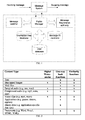
- FIG. 1 shows an embodiment of the inventive arrangement 20 for digital rights enforcement of a data message initiated by a first user A and transferred in a communication network by means of a Message System 10.
- the arrangement comprises a Rights Manager 22 communicatively connected to the Message System 10 and configured to receive and process an incoming message initiated by said user, and to forward said processed message to a recipient B, C, D.
- a Message Identifier 24 is communicatively connected to the Rights Manager 22 and configured to identify the content of said incoming message and an identification generator is communicatively connected to said Message Identifier 24 and configured to generate a unique ID for said content, CID.
- the arrangement comprises further means for comparing the identification information to existing content identities comprised in a Message ID database 30.
- a Message Registration Authority 26 is communicatively connected to the Rights Manager 22 and configured to register the content ownership and content ID in a Distribution Tree Database 28 and said Message ID database 30, respectively.
- the arrangement comprises means for updating the Distribution Tree Database 28 to include the ongoing distribution event if the CID exists in said Message ID Database 30.
- the Rights Manager 22 is thus configured to have responsibility for receiving and processing of incoming messages.
- the Rights Manager 22 is arranged to coordinate and call other modules and functions, e.g. the Message System 10, a Message Identifier 24, a Message Registration Authority 26, storage structures 28, 30 and 32. After processing, the message is forwarded to its intended recipient.
- the flowchart of the working of the Rights Manager 22 will be described below.
- the Message Identifier 24 is thus communicatively connected to the Rights Manager 22 and configured to identify the content of said incoming message.
- a unique ID for the content, CID is generated by means of an Identification Generator (not shown).
- the Identification generator may be comprised in said Message Identifier 24, but it may also be communicatively connected to said Message Identifier 24.
- the Rights manager 22 calls or activates the Message Registration Authority 26 to register the content ownership and content ID, CID, in a Distribution Tree Database 28 and a Message ID Database 30, respectively.
- the content Distribution Tree Database 28 is updated to include the ongoing distribution event, i.e. a new leaf-node 53 is added to the tree 50, cf. FIG. 3.
- the CID can be calculated or generated using a message ID generator scheme. Depending on the nature of the content, different identification schemes may be used, cf. FIG. 2. Possible identification schemes include digital watermarks, one-way hash functions and similarity functions.
- Digital watermarks can be integrated into the content to ensure re-identification of distributed messages.
- Digital watermarking i.e. fingerprinting
- different categories of digital watermarks may be applied, e.g. frequency domain transforms.
- Watermarked content should preferably satisfy the following criteria:
- One-way hash function can be used to identify content of any type.
- a one-way function takes a variable-length message and produces a fixed-length hash. Given the hash it is computationally infeasible to find a message with that hash.
- the one-way hash function returns a bit-string of k-bits which are unique for each input. However, different input may have identical hashes although with a negligible probability.
- One-way hash functions should satisfy several criteria:
- Similarity functions aim to find identify data which are similar under certain assumptions or in a certain context. Similarity functions need to be defined in relation to the domain of the content and its current context. Depending on the content type, several examples of similarity functions can be given, cf. Table I. Content Type Possible similarity functions Text Soundex, histograms, statistical analysis Audio Pattern recognition techniques, power spectrum analysis, beat and rhythmic timeseries analysis Images Histograms, segmentation and feature detection
- the Message Registration Authority 26 is communicatively connected to the Rights Manager 22 and configured to register the content ownership and content ID in a Distribution Tree Database 28 and said Message ID database 30, respectively.
- the message Registration Authority module 26 is thus configured to provide registration of previously unseen content which does not have an existing owner.
- the content ID, CID is stored in the Message ID database 30, whereby the content can be identified in the future.
- the user ID and a new top-node are written to the User Database 32 and Distribution Tree Database 28, respectively.
- the watermark is attached to the content.
- the arrangement comprises also means for updating said Distribution Tree Database 28 to include the ongoing distribution event if the CID exists in said Message ID Database 30.
- the Message System 10 is a message-based distribution system such as mail, SMS or MMS, and the data message is, or is an element of, a message from said message-based distribution system.
- the Identification Generator is configured to generate said CID by means of a message ID generator scheme.
- the message ID generator scheme comprises digital watermarks, one-way hash functions and/or similarity functions.
- the arrangement comprises further a User Database 32 communicatively connected to said Rights manager 22 and configured to comprise user information, such as unique User ID, e.g. IMSI; operator ID; terminal identification Number, e.g. IMEI; terminal capabilities and/or context information.
- user information such as unique User ID, e.g. IMSI; operator ID; terminal identification Number, e.g. IMEI; terminal capabilities and/or context information.
- the information in the Distribution Tree database 20 can be arranged in a distribution tree 50, cf. FIG. 3, configured to show how said content has been distributed from said first user A to a second user B, C, D, and configured to serve as a basis for revenue sharing and reverse billing mechanisms.
- FIG. 3 shows a typical distribution tree 50.
- User A is the originator and owner of the content. He distributes it to three of his contacts B, C and D which in turns redistribute it to their contacts. Hence, the tree 50 grows exponentially with respect to the depth of the tree.
- the Message ID Database 30 is configured to comprise identification elements, such as hashes, similarities measures, watermarks etc., for previously registered contents. Upon registration of content, the Message ID Database 30 is checked in order to ensure that the database 30 does not comprise an existing rights owner to the content.
- a typical chain of events are shown in the flowchart in FIG. 4.
- the chain of events comprises the steps of:
- the invention relates also to a method for digital rights enforcement of a data message initiated by a first user A and transferred in a communication network by means of a Message System 10.
- the method comprises the steps of:
- the method can further comprise the step of generating said CID by means of a message ID generator scheme.
- the invention relates also to a computer program product for use in the inventive arrangement, comprising computer code portions configured to realise functions and performing steps of the present invention.
Landscapes
- Engineering & Computer Science (AREA)
- Software Systems (AREA)
- Theoretical Computer Science (AREA)
- Multimedia (AREA)
- Technology Law (AREA)
- Computer Hardware Design (AREA)
- Computer Security & Cryptography (AREA)
- Physics & Mathematics (AREA)
- General Engineering & Computer Science (AREA)
- General Physics & Mathematics (AREA)
- Storage Device Security (AREA)
Abstract
Description
- CID
- Unique ID for the content
- DRM
- Digital Rights Management
- DRUID
- Device for Digital Rights Enforcement of User Initiated Data
- HTML
- HyperText Markup Language
- IMEI
- International Mobile Equipment Identity
- IMSI
- International Mobile Subscriber Identity
- MMS
- Multimedia Messaging Service
- MP3
-
MPEG Audio Layer 3 - MRA
- Message Registration Authority
- SMS
- Short Messaging Service
- XML
- EXtensible Markup Language
- A watermark must be difficult or impossible to delete. At least without seriously degrading the quality of the original content.
- The watermark must survive extensive content modification, e.g., scaling, colour requantization, dithering, cropping, compression, audio re-sampling & re-encoding.
- A watermark should be imperceptible so as not to affect user experience while rendering the content.
- Watermarks should be readily detectable by the proper authorities.
- Given x, h=f(x) should be easy to compute. The function f is a one-way hash function.
- Given h, it is computationally infeasible to compute x.
| Content Type | Possible similarity functions |
| Text | Soundex, histograms, statistical analysis |
| Audio | Pattern recognition techniques, power spectrum analysis, beat and rhythmic timeseries analysis |
| Images | Histograms, segmentation and feature detection |
- calling the Message Registration Authority 26, to register the content,
- the Message Registration Authority 26 creates a new distribution tree 50 for the content having the originator of the message as owner A;
- In addition, Message Registration Authority 26 may add digital watermarks to the content to ensure future identification.
- intercepting said message and sending said message to a Rights Manager 22 for processing;
- by means of a Message Identifier 24, identifying said incoming message and generating a unique content ID, CID;
- performing a lookup of the identification information in a Message ID database 30 to determine whether the content is previously owned by another user;
- if the content is previously owned, updating a Distribution Tree Database 28;
- if the content is new, calling said Message Registration Authority 26 to register the content; by means of said Message Registration Authority 26, creating a new distribution tree 51 for the content having the originator of the message as owner A; and
- forwarding the message to said intended recipient(s).
Claims (17)
- An arrangement (20) for digital rights enforcement of a data message initiated by a first user (A) and transferred in a communication network by means of a Message System (10), comprising:a Rights Manager (22) communicatively connected to said Message System (10) and configured to receive and process an incoming message initiated by said user (A), and to forward said processed message to a recipient (B, C, D);a Message Identifier (24) communicatively connected to said Rights Manager (22) and configured to identify the content of said incoming message;an identification generator communicatively connected to said Message Identifier (24) and configured to generate a unique ID for said content, CID;means for comparing the identification information to existing content identities comprised in a Message ID database (30);a Message Registration Authority (26) communicatively connected to said Rights Manager (22) and configured to register the content ownership and content ID in a Distribution Tree Database (28) and said Message ID database (30), respectively; andmeans for updating said Distribution Tree Database (28) to include the ongoing distribution event if the CID exists in said Message ID Database (30).
- An arrangement according to claim 1, wherein said Message System (10) is a message-based distribution system such as mail, SMS or MMS, and said data message is, or is an element of, a message from said message-based distribution system.
- An arrangement according to claim 1 or 2, wherein said Rights Manager (22) is configured to coordinate and call other modules and functions.
- An arrangement according to any preceding claim, wherein said Identification Generator is configured to generate said CID by means of a message ID generator scheme.
- An arrangement according to claim 4, wherein said message ID generator scheme comprises digital watermarks, one-way hash functions and/or similarity functions.
- An arrangement according to any preceding claim, wherein said Message Registration Authority (26) is configured to register previously unseen content which does not have an existing owner.
- An arrangement according to claim 6, wherein said Message Registration Authority (26) is configured to attach a watermark to said content in cases where digital watermarks are used as CID.
- An arrangement according to any preceding claim, further comprising a User Database (32) communicatively connected to said Rights manager (22) and configured to comprise user information, such as unique User ID, e.g. IMSI; operator ID; terminal identification Number, e.g. IMEI; terminal capabilities and/or context information.
- An arrangement according to any preceding claim, wherein the information in said Distribution Tree database (20) can be arranged in a distribution tree (50) configured to show how said content has been distributed from said first user (A) to a second user (B, C, D), and configured to serve as a basis for revenue sharing and reverse billing mechanisms.
- An arrangement according to any preceding claim, wherein said Message ID Database (30) is configured to comprise identification elements, such as hashes, similarities measures, watermarks etc., for previously registered contents.
- A method for digital rights enforcement of a data message initiated by a first user (A) and transferred in a communication network by means of a Message System (10), comprising the steps of:intercepting said message and sending said message to a Rights Manager (22) for processing;by means of a Message Identifier (24), identifying said incoming message and generating a unique content ID, CID;performing a lookup of the identification information in a Message ID database (30) to determine whether the content is previously owned by another user;if the content is previously owned, updating a Distribution Tree Database (28);if the content is new, calling said Message Registration Authority (26) to register the content; by means of said Message Registration Authority (26), creating a new distribution tree (51) for the content having the originator of the message as owner (A); andforwarding the message to said intended recipient(s).
- A method according to claim 11, comprising the step of generating said CID by means of a message ID generator scheme.
- A method according to claim 12, wherein said message ID generator scheme comprises digital watermarks, one-way hash functions and/or similarity functions.
- A method according to any of claims 11 - 13, wherein said Message Registration Authority (26) adds digital watermarks to the content to ensure future identification.
- A method according to any of claims 11 - 14,wherein the information in said Distribution Tree database (20) can be arranged in a distribution tree (50) showing how said content has been distributed from said first user (A) to a second user (B, C, D), and serving as a basis for revenue sharing and reverse billing mechanisms.
- A method according to any of claims 11 - 15, wherein said Message ID Database (30) comprises identification elements, such as hashes, similarities measures, watermarks etc., for previously registered contents.
- A computer program product for use in an arrangement according to any of the claims 1 - 10, comprising computer code portions configured to realise functions and performing steps of any of the preceding claims.
Applications Claiming Priority (2)
| Application Number | Priority Date | Filing Date | Title |
|---|---|---|---|
| SE0401203A SE527700C2 (en) | 2004-05-05 | 2004-05-05 | Method and apparatus for maintaining rights to digital goods in user-initiated data |
| SE4012035 | 2004-05-05 |
Publications (2)
| Publication Number | Publication Date |
|---|---|
| EP1598728A2 true EP1598728A2 (en) | 2005-11-23 |
| EP1598728A3 EP1598728A3 (en) | 2012-08-01 |
Family
ID=32390908
Family Applications (1)
| Application Number | Title | Priority Date | Filing Date |
|---|---|---|---|
| EP05103626A Ceased EP1598728A3 (en) | 2004-05-05 | 2005-05-02 | Method and device for digital rights enforcement |
Country Status (2)
| Country | Link |
|---|---|
| EP (1) | EP1598728A3 (en) |
| SE (1) | SE527700C2 (en) |
Cited By (1)
| Publication number | Priority date | Publication date | Assignee | Title |
|---|---|---|---|---|
| WO2009154526A1 (en) * | 2008-06-19 | 2009-12-23 | Telefonaktiebolaget Lm Ericsson (Publ) | A method and a device for protecting private content |
Family Cites Families (2)
| Publication number | Priority date | Publication date | Assignee | Title |
|---|---|---|---|---|
| NO314375B1 (en) * | 2001-06-15 | 2003-03-10 | Beep Science As | Arrangement and procedure for content control of data objects, special data objects in MMS messages |
| NO316737B1 (en) * | 2001-11-08 | 2004-04-19 | Beep Science As | Arrangement and procedure for content control of data objects, especially data objects in MMS messages |
-
2004
- 2004-05-05 SE SE0401203A patent/SE527700C2/en not_active IP Right Cessation
-
2005
- 2005-05-02 EP EP05103626A patent/EP1598728A3/en not_active Ceased
Cited By (1)
| Publication number | Priority date | Publication date | Assignee | Title |
|---|---|---|---|---|
| WO2009154526A1 (en) * | 2008-06-19 | 2009-12-23 | Telefonaktiebolaget Lm Ericsson (Publ) | A method and a device for protecting private content |
Also Published As
| Publication number | Publication date |
|---|---|
| SE527700C2 (en) | 2006-05-16 |
| SE0401203L (en) | 2005-11-06 |
| EP1598728A3 (en) | 2012-08-01 |
| SE0401203D0 (en) | 2004-05-05 |
Similar Documents
| Publication | Publication Date | Title |
|---|---|---|
| JP6385896B2 (en) | Apparatus and method for managing content conversion in a wireless device | |
| US9935905B2 (en) | System for restricting the distribution of attachments to electronic messages | |
| US7430754B2 (en) | Method for dynamic application of rights management policy | |
| US7925706B2 (en) | Filtering electronic messages | |
| CN101350826A (en) | Monitoring method for picture or multimedia video picture in communication system | |
| EP1209866A3 (en) | System and method for managing messages | |
| CN1722710A (en) | E-mail management system and method | |
| CN100589453C (en) | An anti-spam processing device and method | |
| US20060010073A1 (en) | Methods and apparatuses for sequestering content | |
| US7409206B2 (en) | Defending against unwanted communications by striking back against the beneficiaries of the unwanted communications | |
| US20040177042A1 (en) | Digital rights management for end-user content | |
| CN114358643A (en) | Multimedia content wind control management device and management method | |
| CN101711013A (en) | Method for processing multimedia message and device thereof | |
| US20150286808A1 (en) | Marked image file security system and process | |
| EP2154845B1 (en) | Methods and systems of multimedia data digital identification registering and processing | |
| NO323935B1 (en) | Method and device for enforcing digital rights of user-initiated data | |
| SE527700C2 (en) | Method and apparatus for maintaining rights to digital goods in user-initiated data | |
| Chen et al. | Image authentication for permissible cropping | |
| US20150286651A1 (en) | Marked image file security system and process | |
| US20150286807A1 (en) | Marked image file security system and process | |
| CN113806697A (en) | Watermark adding method and system under proxy mode | |
| EP1566931A1 (en) | Content management system | |
| US20040236594A1 (en) | Methods and apparatuses for sequestering content | |
| CN115564313B (en) | Shared service data management method and device based on shared management platform | |
| CN116781620B (en) | Data processing method, device, computer equipment and readable storage medium |
Legal Events
| Date | Code | Title | Description |
|---|---|---|---|
| PUAI | Public reference made under article 153(3) epc to a published international application that has entered the european phase |
Free format text: ORIGINAL CODE: 0009012 |
|
| AK | Designated contracting states |
Kind code of ref document: A2 Designated state(s): AT BE BG CH CY CZ DE DK EE ES FI FR GB GR HU IE IS IT LI LT LU MC NL PL PT RO SE SI SK TR |
|
| AX | Request for extension of the european patent |
Extension state: AL BA HR LV MK YU |
|
| PUAL | Search report despatched |
Free format text: ORIGINAL CODE: 0009013 |
|
| AK | Designated contracting states |
Kind code of ref document: A3 Designated state(s): AT BE BG CH CY CZ DE DK EE ES FI FR GB GR HU IE IS IT LI LT LU MC NL PL PT RO SE SI SK TR |
|
| AX | Request for extension of the european patent |
Extension state: AL BA HR LV MK YU |
|
| RIC1 | Information provided on ipc code assigned before grant |
Ipc: G06F 1/00 20060101AFI20120628BHEP Ipc: H04L 12/00 20060101ALI20120628BHEP |
|
| 17P | Request for examination filed |
Effective date: 20130118 |
|
| 17Q | First examination report despatched |
Effective date: 20130311 |
|
| AKX | Designation fees paid |
Designated state(s): AT BE BG CH CY CZ DE DK EE ES FI FR GB GR HU IE IS IT LI LT LU MC NL PL PT RO SE SI SK TR |
|
| AXX | Extension fees paid |
Extension state: LV Payment date: 20130201 |
|
| STAA | Information on the status of an ep patent application or granted ep patent |
Free format text: STATUS: THE APPLICATION HAS BEEN REFUSED |
|
| 18R | Application refused |
Effective date: 20150131 |