-
The present invention is related to methods for the amplification of a target nucleic acid and
methods comprising an amplification step such as methods for the detection of
polymorphisms, methods for diagnosis, methods for phase determination, methods for
genotyping, methods for genomic mapping, methods for DNA sequencing and methods for
synthesis of DNA probes.
-
Nucleic acid amplification technology has increased the ability to ask detailed questions about
genotype or transcriptional phenotype in small biological samples and has provided the
impetus for many significant advances in biology, especially in the field of genetics. One
method for amplifying nucleic acid and deoxyribonucleic acid in particular, is the so called
rolling circle amplification (RCA). This method is based on the finding that DNA circles can
be copied by a rolling circle replication mechanism which basically is known from the
replication of phage genomes. RCA is an isothermal process for generating multiple copies of
the sequences to be amplified. In rolling circle DNA replication in vivo a DNA polymerase
extends a primer on a circular template (Komberg, A. and Baker T. A., DNA Replication, W.
H. Freeman, New York 1991). The amplification products consist of tandemly linked copies
of the complementary sequence of the template. RCA is a method that has been adapted for
use in vitro for DNA amplification. Zhang et al. (Zhang D. Y. Gene, 274 (2001) 209-2016)
describe a DNA amplification technique which is termed ramification amplification (RAM),
whereby a circular probe or primer is used that is covalently linked by a DNA ligase when it
hybridises to a target. A DNA polymerase extends a bound forward primer along the circular
probe and continuously displaces a downstream strand, generating a multimeric single-stranded
DNA (ssDNA) which is analogous to the afore-described in vivo "rolling circle"
replication of bacteriophages. This multimeric ssDNA then serves as a template for multiple
reverse primers to hybridize. The reverse primers are also extended by the DNA polymerase,
and downstream DNA is again displaced, generating another multimeric product where the
initially used forward primers hybridize again and initiate another round of amplification. In
total, a large ramified (branching) DNA complex is produced, resulting in an exponential
amplification.
-
Nevertheless, any method of the prior art is facing a limitation in either specificity of the
amplification and thus, if used in connection with an analytical method, in sensitivity in
detection of a specific target nucleic acid. A further disadvantage of the methods according to
the prior art is the substantial generation of undesired by-products which add to the
aforementioned problem of unspecific amplification and loss in sensitivity.
-
The problem underlying the present invention was thus to provide a method for the
amplification of a target nucleic acid which is highly specific in terms of selectivity of the
nucleic acid to be amplified as well as in terms of specificity of the amplified nucleic acid, i.e.
that the amplified nucleic acid still corresponds to the nucleic acid to be amplified in terms of
sequence identity.
-
In a further aspect the problem underlying the present invention is to provide methods
comprising an amplification step such as methods for the detection of polymorphisms,
methods for diagnosis, methods for phase determination, methods for genotyping, methods
for genomic mapping, methods for DNA sequencing and methods for the synthesis of DNA
and DNA probes in particular, whereby such methods are more accurate in terms of
efficiency, selectivity and specificity as defined herein.
-
These and other objections are solved in a first aspect by a method for the amplification of a
target nucleic acid, whereby the method comprises the following steps:
- a) providing the target nucleic acid;
- b) providing a first primer, whereby the primer is at least partially complementary
to a part of the target nucleic acid;
- c) providing a polymerase;
- d) reacting the target nucleic acid, the primer and the polymerase providing a
reaction product, whereby the reaction product comprises a restriction site for a
restriction endonuclease;
- e) digesting the reaction product of step d) with the restriction endonuclease
providing a digestion product;
- f) ligating the 5' end of the first primer with the digestion product producing a
circular target;
- g) providing a second primer, whereby the second primer is at least partially
identical to the target nucleic acid;
- h) reacting the circular target with the second primer and a second polymerase
providing a first amplification product;
- i) optionally providing a third primer, whereby the sequence of the third primer is
at least partially identical to a part of the first primer or complementary to the
target nucleic acid; and
- j) optionally reacting the second and the third primer with the first amplification
product or the circular target and a third polymerase to provide a series of
second amplification products.
-
-
In an embodiment the 5'-end of the first primer is at least partially complementary to the 5'
overhang of the digestion product of step e)
-
In an embodiment the 5' end of the first primer is ligated to the 3' end of the reaction product
generated in steps d) and e).
-
In an embodiment the restriction enzyme generates a 5' overhang.
-
The problem underlying the present invention is solved in a second aspect by a method for the
amplification of a target nucleic acid, whereby the method comprises the following steps:
- a) providing the target nucleic acid;
- b) providing a first primer, whereby the primer is at least partially complementary
to a part of the target nucleic acid;
- c) providing a polymerase;
- d) reacting the target nucleic acid, the primer and the polymerase providing a
reaction product, whereby the reaction product comprises a restriction site for a
restriction endonuclease;
- e) digesting the reaction product of step d) with the restriction endonuclease
providing a digestion product;
- f) providing an extension oligonucleotide, whereby one end of the extension
oligonucleotide is at least partially complementary to the 3' overhang of the
digestion product of step e) annealing such extension oligonucleotide to the
digestion product of step e), providing an annealed digestion product;
- g) ligating the 5' end and 3' end of the annealed digestion product producing a
circular target;
- h) providing a second primer, whereby the second primer is at least partially
identical to the target nucleic acid;
- i) reacting the circular target with the second primer and a second polymerase
providing a first amplification product;
- j) optionally providing a third primer, whereby the sequence of the third primer is
at least partially identical to a part of the first primer or complementary to the
target nucleic acid; and
- k) optionally reacting the second and the third primer with the first amplification
product or the circular target and a third polymerase to provide a series of
second amplification products.
-
-
In an embodiment the restriction enzyme generates a 3' overhang.
-
In an embodiment the 5' end of the first primer is at least partially complementary to a stretch,
preferably an end, more preferably the 3' end of the extension oligonucleotide.
-
In an embodiment of the first and the second aspect the first primer comprises 30 to 400
nucleotides, preferably 50 to 80 nucleotides.
-
In an embodiment of the first and the second aspect the circular target comprises about 80 to
150 nucleotides.
-
In an embodiment of the first and the second aspect the 3' end of the first primer is at least
complementary to 15 -25 bp of the target nucleic acid.
-
In an embodiment of the first and the second aspect the extension oligonucleotide comprises
about 12 to 30 nucleotides, preferably 15 to 20 nucleotides.
-
In an embodiment of the first and the second aspect the second primer and/or the third primer
comprises 15 to 25 nucleotides of the target nucleic acid, preferably 20 nucleotides or a
complementary sequence thereto.
-
The problem underlying the present invention is solved in a third aspect by a method for the
amplification of a target nucleic acid comprising the following steps:
- a) providing the target nucleic acid;
- b) providing an extension oligonucleotide;
- c) providing a first mediating primer, whereby the first mediating primer is at
least partially complementary to a first stretch of the target nucleic acid and at
least partially complementary to a first stretch of the extension oligonucleotide;
- d) providing a second mediating primer, whereby the second mediating primer is
at least partially complementary to a second stretch of the target nucleic acid
and at least partially complementary to a second stretch of the extension
oligonucleotide;
- e) reacting the extension oligonucleotide, the first mediating primer and the
second mediating primer and the target nucleic acid with a ligase creating a
circular ligation product of the target nucleic acid and the first primer;
- f) providing a first primer, whereby the first primer is at least partially
complementary to the target nucleic acid;
- g) reacting the circular ligation product with the first primer and a first
polymerase providing a first amplification product;
- h) optionally providing a second primer, whereby the sequence of the second
primer is at least partially identical to a part of the extension oligonucleotide or
of the target nucleic acid; and
- i) reacting the first and second primer with the first amplification product or the
circular ligation product and a second polymerase to provide a series of second
amplification products.
-
-
In an embodiment of the third aspect the extension oligonucleotide comprises 30 to 400
nucleotides, preferably 50 to 80 nucleotides.
-
In an embodiment of the third aspect the target nucleic acid is created by cutting of a nucleic
acid molecule with one or several restriction enzymes and subsequent denaturation, whereby
the target nucleic acid preferably comprises about 40 to 150 nucleotides.
-
The problem underlying the present invention is solved in a fourth aspect by a method for the
amplification of a target nucleic acid comprising the following steps:
- a) providing a target nucleic acid;
- b) providing a mediating primer, whereby the first end of the mediating primer is
at least partially complementary to the first end of the target nucleic acid and
the second end of the mediating primer is at least partially complementary to
the second end of the target nucleic acid;
- c) reacting the target nucleic acid and the mediating primer with a ligase
providing a circular ligation product;
- d) reacting the circular ligation product with a DNA polymerase, whereby the
mediating primer is annealed to the circular ligation product providing an
amplification product;
- e) optionally providing a second primer, whereby the sequence of the second
primer is at least partially identical to the target nucleic acid; and
- f) reacting the mediating and second primer with the amplification product or the
ligation product and a first polymerase to provide a series of second
amplification products.
-
-
In an embodiment of the fourth aspect the target nucleic acid comprises about 40 to 500
nucleotides, preferably 80 to 150 nucleotides, and more preferably about 100 nucleotides.
-
In an embodiment of the fourth aspect the mediating primer comprises about 15 to 35 bp
nucleotides, preferably 20 nucleotides.
-
In an embodiment of the first, second, third and fourth aspect the target nucleic acid is a
deoxyribonucleic acid.
-
In an embodiment of the first, second, third and fourth aspect the target nucleic acid as used in
step a) is a single stranded nucleic acid.
-
In an embodiment of the first, second, third and fourth aspect any of the primers, mediating
primers and/or extension oligonucleotides used comprises a label.
-
In a preferred embodiment of the first, second, third and fourth aspect the label is selected
from the group comprising radiolabels and fluorescence labels
-
In a more preferred embodiment of the first, second, third and fourth aspect the label is a
combination of a quenching group and a fluorophore, whereby preferably the quenching
functionality being inherent to the primer(s).
-
In a most preferred embodiment of the first, second, third and fourth aspect the quenching
group and the fluorophore are attached or inherent to the primer in a spatially separated
manner, whereby upon ligation of the primer with or annealing of the primer to the target
nucleic acid, ligation product and/or amplification product, said primer exhibits a fluorescence
different from the fluorescence shown by the primer in an un-ligated and/or un-annealed
form.
-
In an embodiment of the first, second, third and fourth aspect the method is performed in
vitro.
-
In an embodiment of the first, second, third and fourth aspect the sequence of steps in its
entirety or parts thereof are carried out as an isothermal process.
-
In an embodiment of the first, second, third and fourth aspect any of the first, second and third
polymerase is a DNA polymerase.
-
In a preferred embodiment of the first, second, third and fourth aspect the DNA polymerase is
selected from the group comprising strand displacing DNA polymerase III, pol III-like DNA
polymerases, and pol I-type DNA polymerases.
-
In an embodiment of the first, second, third and fourth aspect the target nucleic acid is derived
from a ribonucleic acid by the following steps:
- a) providing a ribonucleic acid, preferably an mRNA;
- b) providing a primer which is at least partially complementary to the ribonucleic
acid of step a);
- c) reacting the ribonucleic acid and the primer with a reverse transcriptase
providing a reverse transcription product; and
- d) removing the RNA moiety of the reverse transcription product, preferably by
RNAse H digestion, providing a single stranded deoxyribonucleic acid.
-
-
In a preferred embodiment of the first, second, third and fourth aspect the single stranded
deoxyribonucleic acid is used as the target nucleic acid.
-
In an alternative embodiment of the first, second, third and fourth aspect the method further
comprises the following steps:
- e) providing a further primer which anneals at least partially to the single stranded
deoxyribonucleic acid;
- f) performing a DNA synthesis creating a double stranded nucleic acid; and
- g) using one strand of the double stranded nucleic acid as the target nucleic acid.
-
-
The problem underlying the present invention is solved in a fifth aspect by a method for the
detection of polymorphisms comprising an amplification process, whereby the amplification
process comprises the method according to any of the first, second, third and/or fourth aspect.
-
The problem underlying the present invention is solved in a sixth aspect by a method for
diagnosis comprising an amplification process, whereby the amplification process comprises
the method according to any of the first, second, third and/or fourth aspect.
-
The problem underlying the present invention is solved in a seventh aspect by a method for
phase determination comprising an amplification process, whereby the amplification process
comprises the method according to any of the first, second, third and/or fourth aspect.
-
The problem underlying the present invention is solved in an eighth aspect by a method for
genotyping comprising an amplification process, whereby the amplification process
comprises the method according to any of the first, second, third and/or fourth aspect.
-
The problem underlying the present invention is solved in a ninth aspect by a method for
genomic mapping comprising an amplification process, whereby the amplification process
comprises the method according to any of the first, second, third and/or fourth aspect.
-
The problem underlying the present invention is solved in a tenth aspect by a method for
DNA sequencing comprising an amplification process, whereby the amplification process
comprises the method according to any of the first, second, third and/or fourth aspect.
-
The problem underlying the present invention is solved in an eleventh aspect by a method for
synthesis of DNA probes comprising an amplification process, whereby the amplification
process comprises the method according to any of the first, second, third and/or fourth aspect.
-
The problem underlying the present invention is solved in a twelfth aspect by a method for
cloning comprising an amplification process, whereby the amplification process comprises the
method according to any of the first, second, third and/or fourth aspect.
-
Without wishing to be bound by any theory, the present inventor has surprisingly found that
rolling circle amplification of nucleic acid can be made more specific and allows for the use
of smaller amounts of target nucleic acid by including the original target or a copy thereof
into an artificially generated circle which is also referred to herein as the circularized target or
circular ligation product. It is within the present invention that such circle consists either of
the sequence of the target nucleic acid or consists of the sequence which is essentially
complementary, preferably complementary to the sequence of the target nucleic acid. As
preferably used herein, the term circular ligation product refers to a circular oligonucleotide or
a circular nucleic acid which comprises the target nucleic acid in full or in part, optionally
together with a further stretch of nucleotides. Such further stretch of nucleotides can be
derived from any oligonucleotide or part thereof or complementary sequence thereof which is
selected from the group comprising any first primer, any second primer, any third primer, any
extension oligonucleotide, any mediating primer, any first mediating primer, and any second
mediating primer. As preferably used herein, the term circular target refers to a circular
oligonucleotide or a circular nucleic acid which comprises a sequence which is
complementary to a part of or the full sequence of the target nucleic acid, optionally together
with a further stretch of nucleotides. Such further stretch of oligonucleotides can be derived
from any oligonucleotide or part thereof or complementary sequence thereof which is selected
from the group comprising any first primer, any second primer, any third primer, any
extension oligonucleotide, any mediating primer, any first mediating primer, and any second
mediating primer.
-
As used herein and if not indicated to the contrary, the term primer preferably comprises any
first primer, second primer, third primer, mediating primer, first mediating primer and second
mediating primer. As also used herein and if not indicated to the contrary, the term mediating
primer preferably comprises any mediating primer, any first mediating primer and any second
mediating primer. This circular target or circular ligation product contains necessarily some
part(s) of the original target nucleic acid or a copy thereof or a nucleic acid the sequence of
which is complementary thereto, which provides for the specificity or uniqueness of the
nucleic acid to be amplified. As used herein the terms target nucleic acid, some part thereof,
i.e. some part of the target nucleic acid, and copy of the target nucleic acid shall be used in
preferred embodiments in an interchangeable manner, if not indicated to the contrary.
-
In addition to the target nucleic acid, the circular target or circular ligation product may
contain, as outlined above, other sequences such as a further stretch of nucleotides, preferably
from synthetic oligonulceotides or from further target nucleic acids. The further stretch of
oligonucleotides is preferably used as a primer such as the first primer in case of the method
according to the first and second aspect of the present invention for the initiation of the
copying process, but may serve in other embodiments for different purposes i.e. for the
simultaneous detection of a second different target molecule, as structural element adjusting
the size of the circularized target or as annealing site for the second or third amplification
primer.
-
The specificity or uniqueness of the target nucleic acid is also reflected by the second and /or
third primer, the first mediating primer, the second mediating primer and the mediating primer
as used herein which may act in preferred embodiments and are also referred to herein as
forward/reverse primer, respectively, if not indicated to the contrary. These primers hybridize
to, or anneal with the circular target or the circular ligation product at that part thereof which
reflects the target nucleic acid and which is in a preferred embodiment characteristic for the
target nucleic acid, i.e. reflects or confers the uniqueness to the target nucleic acid and
provides for the selective amplification of the target nucleic acid. In preferred embodiments of
each aspect of the present invention the second primer has a sequence which is identical or
complementary to the target nucleic acid. In a further embodiment, the sequence of the second
primer may comprise further elements which reflect one or several nucleotides of the circular
target and the circular ligation product, respectively. The extent to which the second primer is
identical to the target nucleic acid depends on the length requirements to confer a selective
binding, i.e. hybridization of the second primer. The design of the second primer also depends
on the particular circumstances of the reaction such as salt conditions, in particular Mg++
concentration, melting point changing additives, primer and dNTP concentration, buffer and
temperature optimum of the employed polymerase as known to the one skilled in the art. Due
to this design of both the method and any type of the primers and extension oligonucleotides
used herein, any by-products which might be generated due to the unspecificity of the ligase
reaction during circularization of the linear components of the circular target and circular
ligation product, respectively, by ligating the respective 5'- and the 3'- terminal nucleotides to
each other, are not subject to later amplification, since these by-products do not contain the
unique target sequence of the target nucleic acid. Additionally, due to this design of the
method, smaller circles not including the target sequence, which are generated by the ligation
of the first primer, as used in the first and second aspect of the method according to the
present invention, which would overtake the amplification of the correct circular targets
which are larger in size, are not subject to amplification, because the uniqueness conferring
sequence of the target nucleic acid is not present. Said smaller circular, undesired products
amount to a wrong positive signal in any detection step. As in the methods according to the
present invention, only the desired circular target or circular ligation product comprising the
target nucleic acid and in particular at least that part of the target nucleic acid which accounts
for the specificity or uniqueness of the target nucleic acid, is amplified. Other measures to
avoid false positive results in any detection steps following the amplification process such as
separating the products by gel electrophoresis or verification of the products by Southern blot
analysis, restriction digest or PCR amplification are thus not necessary. The PCR used in the
respective methods of the prior art is typically carried out to preamplify the target nucleic acid
in order to avoid the afore-described overgrowth or dominance of smaller rings of the
circularized first primer which may exhibit only part of the target nucleic acid, if any.
-
A further advantage of the methods according to the present invention resides in the fact that
even the incorporation of a single mismatch or an inappropriate primer or extension
oligonucleotide into a nucleic acid to be amplified is not detrimental to the result of the
analysis. This characteristic is inherent to the rolling circle amplification process, since a
primer binding site generated by a wrongly inserted primer or extension oligonucleotide
represents only a single invalid binding site, while amplification is carried on by the
elongation of primers, annealing to a variety of correct binding sites present in each single
first amplification product. Thus, the exponential increase of wrong amplification products as
observed in the polymerase chain reaction is avoided. This effect is further strengthened by
the fact that during the reaction any primer can bind only once to the utmost 5'-end of any
rolling circle amplification product, since the resulting reaction product is double-stranded so
that no further primers can bind. Therefore, the undesired reaction products are permanently
removed from the reaction system. This allows discriminating the incorrect amplification
products from the desired, i.e. correct amplification products. Particularly in connection with
single nucleotide polymorphisms, this characteristic of the methods according to the present
invention turns out to be extremely advantageous. Due to this approach, it is possible to detect
as little as a single copy of the desired target nucleic acid, even if a thousand to millionfold
excess of highly homologous DNA, i.e. wild-type molecules is present in a sample.
-
The amount of the target nucleic acid, of any primer and of any extension oligonucleotide can
vary in a wide range depending on the particularities of the individual amplification process.
The particular design is within the skills of the ones of the art in view of the present
disclosure. It is therefore within the present invention that the circular target and circular
ligation product, respectively, comprises a target nucleic acid or a sequence which is
complementary thereto, which comprises more nucleotides than would be necessary to
specifically address or detect the target nucleic acid, particularly that part of the target nucleic
acid which confers uniqueness to the target nucleic acid. This unique part of the circular target
shall not be included or complementary to any added DNA but the target itself and any
specificity conferring primers or extension oligonucleotides. Such detection can be in situ, in
vivo, in vitro or in any artificial settings. Therefore, the specificity requirement depends,
among others, on other nucleic acids present in the system subject to the analysis setting or
the reaction system where the amplification process is run. If, as realized in preferred
embodiments, the analysis of a distinct gene is carried out starting from, e. g., a biopsy
sample, such sample will typically comprise genomic DNA and thus the length of the part of
the target nucleic acid which provides for the specificity of the particular gene is typically in
the range of 20 to 40 nucleotides. Therefore, the circular target and circular ligation product,
respectively, should comprise at least a stretch of 20 nucleotides reflecting that part of the
target nucleic acid which provides for the uniqueness or for the selective detection of said
target nucleic acid. However, it is within the present invention, that additional or less
nucleotides are necessary or sufficient in preferred embodiments, preferably at either end or
both ends of the respective basic target nucleic acid.
-
As used herein, the term that a nucleic acid, any primer or any extension oligonucleotide or
any nucleotide thereof refers to a nucleic acid sequence or refers to a target nucleic acid or a
nucleotide thereof shall mean in a preferred embodiment that the sequence of said nucleic
acid, of any of said primer or any of said extension oligonucleotide is identical to said nucleic
acid sequence or is identical to said target nucleic acid or a nucleotide or each thereof. In an
alternative preferred embodiment this term shall mean that the sequence of said nucleic acid,
of any of said primer or any of said extension oligonucleotide is complementary to said
nucleic acid sequence or is complementary to said target nucleic acid or a nucleotide of each
thereof.
-
In the method according to the first and second aspect of the present invention for amplifying
a target nucleic acid a first primer is provided. This first primer is preferably a linear nucleic
acid, more preferably a single-stranded oligonucleotide. The length of the oligonucleotide is
basically not limited. However, the minimum size is such as to allow the formation of a
rolling circle upon insertion of a part of the target nucleic acid as described herein. The first
primer comprises preferably at its 3'-end a sequence which is complementary to the target
nucleic acid, more preferably to a part of said target nucleic acid. Said part of the nucleic acid
is again preferably any part of the nucleic acid conferring specificity or uniqueness to the
target nucleic acid as discussed above. Upon annealing to the target nucleic acid, more
particularly to a single-stranded version thereof, the first primer is extended at its 3'-end
through a polymerase. The thus created reaction product comprises a restriction site for a
restriction endonuclease. The thus formed double-stranded reaction product of target nucleic
acid and first primer is subsequently cleaved by a restriction enzyme. Both the synthesis of
the double strand starting from the 3'-end of the first primer, as well as the digestion of the
thus formed double-stranded structure by restriction endonucleases are known to the one
skilled in the art. Among others, part of the performing of the respective step is to provide the
respective enzymatic activities, buffers, nucleotides and the like.
-
The 5' end of the first primer which has not been elongated by the polymerase reaction is
designed in a way that it hybridizes preferably to the single stranded 5' overhang of the
double-stranded structure which has been created by the restriction enzyme. The sequence
complementarity shown by the non-extended end of the first primer can be formed by a
recognition site or cleavage site for a restriction enzyme, preferably to the extent that such
recognition site or cleavage site is reflected on a single-stranded nucleic acid. If a restriction
enzyme with a 3' single stranded overhang is used for the digestion of the first reaction
product, the hybridization may be mediated by an additional mediating primer, also referred
to herein as extension oligonucleotide, particularly as in the second aspect of the present
invention, which is at its 3' end complementary to the 3' overhang generated by the restriction
endonuclease, and at its 5' end complementary to the 5' end of the first primer. The free end,
preferably the 5'-end of the first primer is ligated after phosphorylation by a ligase to the
double-stranded structure created upon elongation of the other end, preferably the 3'-end, of
the first primer by the polymerase activity and cutting of said structure through a restriction
endonuclease. Thus a circular target is obtained which comprises at least part of the target
nucleic acid or a sequence which is complementary thereto, preferably the specificity or
uniqueness conferring part of the target nucleic acid. It is within the present invention that the
first primer may comprise other or additional sequences which are not identical or
complementary to the target nucleic acid.
-
The second primer is preferably complementary to the sequence of the circular target or a part
thereof, more preferably to that part of the circular target which is complementary to the part
of the target nucleic acid providing for the specificity or uniqueness of the target nucleic acid
as defined above, i.e. providing a specific detection of the respective target nucleic acid. It is
within the present invention that the sequence of said second primer comprises at least that
part of the circular target and thus is identical to the part of the target nucleic acid providing
for the uniqueness or for the specific detection of said target nucleic acid. It is within the
present invention, that said second primer may comprise additional nucleotides either within,
or at each and/or any end of the primer or at both ends. In case the amplification step is part of
a detection method whereby polymorphisms are detected and the genotype is determined by
the part of the target nucleic acid providing for the specificity or uniqueness of the target
nucleotide, the second primer will preferably comprise a sequence which contains the site of
the differences of the various genotypes or the site of the mutation or nucleotide
polymorphism, preferably single nucleotide polymorphism, to be detected. It is to be
understood that due to the design of the primers as disclosed herein, in those embodiments
where a circular ligation product is formed, which is formed by or incorporates the target
nucleic acid or a copy thereof, the second primer is essentially complementary, preferably
complementary to the uniqueness conferring part of the circular ligation product.
-
The second primer hybridises to the corresponding part of the circular target or circular
ligation product, respectively, and, upon addition of buffer, dNTPs and polymerase, a
polymerase reaction is performed providing an amplification product, whereby such
amplification product consists of tandemly linked copies of the covalently closed circular
target comprising the target nucleic acid.
-
To create an exponential increase of the thus generated amplification product, a third primer is
provided in preferred embodiments. The sequence of this third primer, which is also referred
to herein as reverse primer, is identical to any part of the circular target or circular ligation
product. This embodiment is advantageous insofar as the first primer can be designed such as
to have a cassette which is target nucleic acid specific, whereas other part(s) of the circular
target or circular ligation product is/are different therefrom and can thus be used in connection
with the amplification process of different target nucleic acids. In such case, the third primer
can also be used for these various amplification reactions. As the specificity of the reaction is
provided by the ligation and the first amplification step mediated by the design of the first
and/or second primer and/or any mediating primer as outlined herein, a further discrimination
at the level of the third primer is not necessary. However, it is within the present invention
that the sequence of the third primer may at least partially be identical to that part of the
circular target which provides for the specificity or uniqueness of the target nucleic acid. By
doing so, any potentially existing undesired amplification products can be eliminated, at least
can be diluted by the further amplification step(s) and therefore, any potentially existing
background signal in any detection step may be reduced to an irrelevant level.
-
It is to be acknowledged that what is disclosed herein in connection with any aspect of the
present invention is in principle also applicable to each and any other aspect of the present
invention if not indicated to the contrary.
-
It is within the present invention, that the first, second and third polymerases are the same
polymerases, although also different polymerases can be used at the various steps of the
method according to the present invention.
-
The method for the amplification of a target nucleic acid according to the third aspect of the
present invention also encompasses an extension oligonucleotide which is preferably
phosphorylated at the 5' end and contains a sequence serving for binding of a not target
specific third primer or as structural material extending the length of the target molecule, if
the target circle is too small for efficient rolling circle amplification. Preferably, said
extension oligonucleotide does not comprise a part of the target nucleic acid, particularly not a
part which confers the specificity or uniqueness to the target nucleic acid or a nucleic acid
which is complementary thereto. In order to ligate the linear extension oligonucleotide with
the target nucleic acid, the target nucleic acid is generated, preferably by a digestion process
using restriction enzymes and the corresponding double-strand is then melted. The single-stranded
target nucleic acid or a nucleic acid which is complementary thereto is ligated to the
extension oligonucleotide using a first mediating primer and a second mediating primer to
align the participating reactants. The first mediating primer is at least partially complementary
to a first stretch of the target nucleic acid or a nucleic acid which is complementary thereto
and at least partially complementary to a first stretch of the extension oligonucleotide. The
first mediating primer thus comprises two moieties which are individually complementary to
said two nucleic acids, namely the target nucleic acid or a nucleic acid which is
complementary thereto, and the extension oligonucleotide. The same applies to the second
mediating primer. The particular design of the first mediating primer and second mediating
primer is within the one skilled in the art and requires a certain number of oligonucleotides to
provide for the required stability of the annealed structure. Preferably, the extension
oligonucleotide is linked to the target nucleic acid or a nucleic acid which is complementary
thereto via the annealing of the first mediating and the annealing of the second mediating
primer. Preferably, the thus created double strand is formed by about 10 nucleotides on each
side. Without wishing to be bound by any theory, the first mediating primer and the second
mediating primer thus act as a clamp nucleic acid to mediate the ligation process of the
extension oligonucleotide and the target nucleic acid or a nucleic acid which is
complementary thereto. Preferably, these mediating primers are blocked at the 3' end to avoid
elongation by the DNA polymerases during the amplification step.
-
The ligation process is carried out according to standard protocols known to the one skilled in
the art and, for example, described in Current protocols in Molecular Biology, editor
F.M.Ausubel, Wiley, USA.
-
The circular target which is present after the ligation step containing at least a sequence which
is complementary to at least a part of the target nucleic acid, and the circular ligation product
which contains at least part of the target nucleic acid, respectively, is then used as described in
connection with the methods according to the first and second aspect of the present invention.
Particularly the design of any further primers or extension oligonucleotides used to amplify
the target nucleic acid or a nucleic acid which is complementary thereto is applicable in
connection with the method according to this third aspect of the present invention as well.
-
The further steps also comprise the rolling circle replication process initiated by a second
primer and the optional use of a third primer so as to further amplify the ligation product and
amplification product.
-
The method according to the fourth aspect of the present invention also realizes the basic
principle of having a rolling circle amplification, whereby the circular ligation product
contains at least a part of the target nucleic acid or a nucleic acid which is complementary
thereto, preferably the part of the target nucleic acid mediating the specificity or uniqueness of
the target nucleic acid. In this aspect of the present invention, however, the circular ligation
product consists completely of the target nucleic acid or a nucleic acid which is
complementary thereto and does not comprise any non-target nucleic acid. According to the
third fourth aspect of the present invention, the circularization is facilitated by a mediating
primer that is at least partially complementary to a first as well as a last stretch of the target
nucleic acid or a nucleic acid which is complementary thereto and thus acts as a clamp nucleic
acid to mediate the ligation process. Due to this aspect, the target nucleic acid or a nucleic
acid which is complementary thereto should comprise from about 80 to 300 nucleotides.
Preferably, the uniqueness conferring part of the target nucleic acid which allows
discriminating the target nucleic acid from other nucleic acids preferably has a length of about
20 nucleotides.
-
According to this aspect of the present invention the target nucleic acid can be generated from
a larger nucleic acid, for example by digestion using restriction endonucleases. The thus
obtained double-stranded structure is converted into the single-stranded form of the target
nucleic acid, whereby, in principle, each of both strands can under these circumstances be
regarded as the target nucleic acid as generally applicable to any aspect of the present
invention disclosed herein. The mediating primer used in this method anneals to both ends of
the target nucleic acid and thus converts the target nucleic acid into a ligase substrate. Again,
the ligase reaction can be performed as known to the one skilled in the art. The mediating
primer acts in a manner similar to the first and second mediating primer as described in
connection with the method according to the third aspect of the present invention. The design
principles, particularly about the extent to which one end of the target nucleic acid is
complementary to the mediating primer and the extent to which the other end of the target
nucleic acid is complementary to the mediating primer is also governed by the same
considerations as outlined in connection with the mediating primers described for the second
and third aspect of the present invention.
-
In connection with any method according to any aspect of the present invention it is to be
noted that preferably the target nucleic acid is a deoxyribonucleic acid, more preferably a
double-stranded deoxyribonucleic acid and most preferably single-stranded deoxyribonucleic
acid. However, the target nucleic acid as used in the rolling circle amplification is a single-stranded
nucleic acid, more preferably a single-stranded deoxyribonucleic acid. It is known to
the one skilled in the art on how to transfer a double-stranded nucleic acid into a single-stranded
nucleic acid. Typically, this is performed by melting the respective double-stranded
structure by applying elevated temperatures and cooling the respective solution subsequently.
Typically, the thus obtained single-stranded ribonucleic acid, preferably deoxyribonucleic
acid is the target nucleic acid as referred to herein.
-
However, the methods described according to any aspect of the present invention are not
limited to the amplifications of deoxyribonucleic acid. Rather also ribonucleic acid can be
amplified. If said ribonucleic acid is present as a double-stranded form, also double-stranded
ribonucleic acid can be separated into individual single-stranded ribonucleic acids by methods
known in the art, including but not limited to, melting of the double-stranded structure. A
particularly preferred ribonucleic acid which is desirable to be amplified is, among others,
mRNA, hnRNA, viral RNA and the like. If the target nucleic acid as used in step a) of the
methods according to the various aspects of the present invention is a ribonucleic acid, the
ribonucleic acid is subject to a reverse transcription reaction. Such reverse transcription
reaction is known to the ones skilled in the art. Preferably, a gene specific primer is used for
this purpose. The remaining RNA moiety of the reverse transcription product is removed, for
example by RNAse H digestion. In one embodiment starting from the thus obtained single-stranded
deoxyribonucleic acid, a second strand is provided. For that purpose a still further
primer is used which anneals at least partially to the single-stranded deoxyribonucleic acid.
By providing such still further primer, the length of the deoxyribonucleic acid to be generated
is defined given the fact that the other end of the strand is defined by the primer used for the
synthesis of the first deoxyribonucleic acid strand. The thus obtained single-stranded
deoxyribonucleic acid strand can be used as a target nucleic acid in the sense of step a) of the
various methods according to any aspect of the present invention. It is particularly preferred to
use this kind of single-stranded deoxyribonucleic acid in the method according to the fourth
aspect of the method according to the present invention. Some polymerases exhibit terminal
transferase activities resulting in additional not target encoded nucleotides at the 3' ends.
These will be considered in the design of the mediating primers if necessary.
-
In an alternative embodiment, the reverse transcription product contains a recognition site for
a restriction endonuclease and allows thus to terminate or limit the length of the reverse
transcription product. The thus obtained DNA, preferably after digestion with a restriction
enzyme, is then used as a target nucleic acid, preferably a single-stranded target nucleic acid,
in any method according to any aspect of the present invention. Preferably, the method is the
method according to the fourth aspect of the present invention.
-
In a further embodiment of any aspect of the present invention, more preferably of the fourth
aspect of the present invention, the circular target and circular ligation product, respectively,
can be generated using the following approach. Based on the target nucleic acid a
recombination primer is provided. Such recombination primer comprises two stretches of
nucleotides which are essentially complementary to two sites within the target nucleic acid.
Upon annealing of the recombination primer to the target nucleic acid and in the presence of
respective recombinase activity, a homologous recombination occurs resulting in
circularisation of the target nucleic acid thus providing the circular ligation product and the
circular target, respectively, as used herein. Starting from this circular structure, the further
steps of any of the methods as described in connection with any aspect of the present
invention, can be practised for the purpose of amplifying said circular structure.
-
The amplification product, either the first amplification product obtained or the second
amplification product as obtained by the various methods according to the present invention
can be detected in further detection steps. The detection of nucleic acids, preferably of
oligonucleotides, is known to the one skilled in the art. Preferably, some label is introduced
into the amplification product so as to allow for the detection of the nucleic acid or any of its
derivatives. This can be done in the various embodiments of the methods according to the
present invention by introducing labels into the various primers, preferably into the second
and/or third primer. The respective label can be, for example, a radio label or a fluorescence
label. A thus labelled primer can be used advantageously for real-time detection of the
amplification product(s). Using this kind of labels and labelled compounds, respectively, the
amount of fluorescence or radioactivity observed is proportional to the amount of label
introduced and thus to the amount of amplification product generated. Due to this relationship
both the presence of a respective amplified product as such and the kinetic of the reaction as
well as the quantitative determination of the amplification product(s) can be realized. Suitable
radio-labels are selected from the group comprising 32P, 33P, 35S, 3H, 14C. Appropriate
fluorescent labels are preferentially selected from the group comprising FAM, JOE, HEX,
ROX.
-
It is within the skills of the one of the art to determine whether only one species or two or
several of the primer species used in the methods according to the present invention are
provided with a respective label. If two or more primers are labelled, it is within the present
invention to use different kinds of label for different primers. This allows monitoring the
amplification process at a level of the process where the individual primers are used.
-
A further means for quantitation and real-time monitoring the amplification product is the use
of intercalating dyes such as, among others, ethidium bromide, propidium iodide and
Cybergreen. Alternatively, pyrophosphate, a reaction product that accumulates during DNA
synthesis might be quantitated, e.g. by the addition of a dye (e.g. 1*2Zn, Lee DH, Im JH, Son
SU, Chung YK, Hong JI. An azophenol-based chromogenic pyrophosphate sensor in water. J
Am Chem Soc. 2003 Jul 2; 125(26): 7752-3) that changes colour in the presence of
pyrophosphate.
-
The amplification process can, in principle, be stopped at any stage and the amount of
amplification product(s) then determined. Apart from determining the kind and amount of
label incorporated, it is also necessary to discriminate between any incorporated labelled
primers and any non-incorporated labelled primers. For such purpose, gel analysis can be
performed, whereby the length of the amplification products compared to the length of the
labelled primers used in the amplification process is used for this kind of discrimination.
-
A further method to label the primer(s) used and the amplification product(s) is the use of so-called
modified molecular beacons as, for example, described by Nielson M. et al., Nucleic
Acids Research, 2002, vol. 30, no. 14, e66. The use of this kind of molecular beacon allows
real-time measurement of the amplification product both in a qualitative as well as a
quantitative manner. The molecular beacon is a hairpin-shaped hybridization probe such as
primer which is equipped with a fluorophore and a fluorescence quencher at either end so that
the fluorophore is brought close to the quencher when the free primers adopt a stem-loop
structure. Upon hybridization to a target nucleic acid and optionally subsequent incorporation
into the amplification product, the fluorophore is separated from the quencher and can emit
fluorescence. In other words, upon incorporation of the primer being designed as a molecular
beacon as described herein, a fluorescence signal can be detected. Based on the measured
values both the kinetics of the amplification process as well as the quantification can thus be
monitored and/or detected. Alternatively, self-quenched primers labelled with a single
fluorophore (Nazarenko I, Lowe B, Darfler M, Ikonomi P, Schuster D, Rashtchian A.
Multiplex quantitative PCR using self-quenched primers labeled with a single fluorophore.
Nucleic Acids Res. 2002 May 1; 30(9): e37) might be used.
-
In a preferred embodiment the methods according to the present invention are run as an
isothermal process. However, it is also within the present invention that some steps of the
process are not run in an isothermal manner, particularly the amplification steps using the
second and particularly the third primer upon generation of an amplification product
comprising a variety of amplified target nucleic acid linked to each other or linked to each
other but separated through a nucleic acid sequence stemming from the circular target and the
circular ligation product, respectively, in the rolling circle amplification process.
-
In preferred embodiments of the present invention, the polymerase is typically a DNA
polymerase and the primers are preferred DNA primers, particularly if not indicated to the
contrary or obvious to the one skilled in the art. DNA polymerases which can advantageously
be used in connection with the rolling circle amplification part of the present invention are
DNA polymerase III, pol III-type DNA polymerase and pol I-type DNA polymerase that are
capable of strand displacement polymerisation like e.g. Bst large fragment (Thomas DC,
Nardone GA, Randall SK. Amplification of padlock probes for DNA diagnostics by cascade
rolling circle amplification or the polymerase chain reaction. Arch Pathol Lab Med. 1999
Dec;123(12):1170-6), Vent exo- (Viguera E, Canceill D, Ehrlich SD. In vitro replication
slippage by DNA polymerases from thermophilic organisms. J Mol Biol. 2001
Sep 14;312(2):323-33), Deep vent exo- (Cline J, Braman JC, Hogrefe HH. PCR fidelity of pfu
DNA polymerase and other thermostable DNA polymerases. Nucleic Acids Res. 1996 Sep
15;24(18):3546-51), KlenowFragment of DNA polymerase I (Walker GT, Fraiser MS,
Schram JL, Little MC, Nadeau JG, Malinowski DP. Strand displacement amplification--an
isothermal, in vitro DNA amplification technique. Nucleic Acids Res. 1992 Apr
11;20(7):1691-6) or phi29 (Nelson JR, Cai YC, Giesler TL, Farchaus JW, Sundaram ST,
Ortiz-Rivera M, Hosta LP, Hewitt PL, Mamone JA, Palaniappan C, Fuller CW. TempliPhi,
phi29 DNA polymerase based rolling circle amplification of templates for DNA sequencing.
Biotechniques. 2002 Jun;Suppl:44-7).
-
It is within the skills of the one of the art how to use this kind of polymerases and to perform
respective polymerase reactions.
-
It is within the present invention that the individual polymerase used in each step of any
method according to the present invention is different from the polymerase used in a different
step of such method. It is, however, also within the present invention that the various
polymerases used in a method according to the present invention are either the same or of the
same type.
-
It is to be noted that actually any nucleic acid, preferably any deoxyribonucleic acid can act as
a target nucleic acid. Preferably, the target nucleic acid, however, comprises a minimum
length of about 40 to 50 nucleotides.
-
As used herein, the term "complementary" shall mean in preferred embodiments that a first
and a second nucleic acid can hybridize and/or anneal to each other. Preferably such
hybridization is mediated through Watson-Crick base pairing or other mechanisms known to
the ones skilled in the art. Most preferably, the hybridization and the underlying base pairing
are perfect. However, it is also within the present invention that the base pairing is not perfect
but exhibits one or more mismatches. The extent to which this kind of mismatches still allows
the carrying out of the respective method is obvious and known to the one skilled in the art. It
is therefore within a further preferred embodiment that a first nucleic acid is complementary
to a second nucleic acid such as any primer or any extension oligonucleotide, or vice versa,
whereby the first and the second nucleic acid, can hybridize to each other, at least under
stringent conditions such as described in Methods in molecular Biology, Vol 15, PCR
Protocols, ed: Bruce A. White, Humana Press, Totowa, New Jersey. As used herein, the term
"at least partially complementary" means in a preferred embodiment of the various aspects of
the present invention that a part of a first nucleic acid is complementary to at least a part of
another nucleic acid. Such part can be a single nucleotide or a plurality of nucleotides. The
term "at least partially complementary" also comprises the embodiment where each and all of
the respective nucleotides are complementary to each other.
-
As used herein the term "identical" shall mean in preferred embodiments of the various
aspects of the present invention that a first and a second nucleic acid would, if one of said
nucleic acids was present in its complementary form, would be complementary as defined
herein. In a further embodiment the term identical is to be understood that the two nucleic
acids which are identical share a homology at the nucleotide level of 80, 85, 90, 95, 96, 97,
98, 99 and/or 100%.
-
Although the methods for amplifying a target nucleic acid as well as any other methods
described herein are preferably in vitro methods, the various enzymatic activities and primers
described in connection with said methods according to the present invention can also be used
for the design or manufacture of a kit, whereby such kit is used for performing the respective
methods in vivo and/or in vitro.
-
In a further aspect the present invention is related to a method for the detection of a
polymorphism, preferable a single nucleotide polymorphism. Methods for the detection of
polymorphism are known to the one skilled in the art and, for example, described in Koeken
A, Cobbaert C, Quint W, van Doorn LJ. Genotyping of hemochromatosis-associated
mutations in the HFE gene by PCR-RFLP and a novel reverse hybridization method. Clin
Chem Lab Med. 2002 Feb;40(2):122-5; Aslanidis C, Nauck M, Schmitz G. High-speed
prothrombin G-->A 20210 and methylenetetrahydrofolate reductase C-->T 677 mutation
detection using real-time fluorescence PCR and melting curves. Biotechniques. 1999
Aug;27(2):234-6, 238; and Meyer M, Kutscher G, Vogel G. Simultaneous genotyping for
factor V Leiden and prothrombin G20210A variant by a multiplex PCR-SSCP assay on whole
blood. Thromb Haemost. 1999 Jan;81(1):162-3.
-
Polymorphisms are known to be of highly relevance in the medical field. It is known that the
efficacy of quite a number of pharmaceutically active compounds as well as side effects of
drugs strongly depend on the genetic background of the individual patient. This resides,
among others, in the receptor pattern or enzyme pattern of the individual patient.
Additionally, single nucleotide polymorphisms are known to be relevant insofar as a number
of hereditary diseases are known where a single point mutation is responsible for the disease
observed. Also there are polymorphisms which may occur in diseased tissue, for example in
cancer patients. Under all and any of these conditions, it is essential to determine whether a
sample comprises such polymorphism and single nucleotide polymorphism. Typically, the
respective stretch of the relevant gene where a polymorphism is observed in a population is
rather short. Therefore, it is sufficient to amplify only a comparatively short stretch of the
respective gene to be investigated for the particular purpose. Preferably the length of such
stretch of a gene is 60 - 300 bp. This stretch is also referred to herein as target nucleic acid or
part thereof which provides for the uniqueness of the gene.
-
To allow for the selective amplification, it is essential to amplify only those target nucleic
acids actually exhibiting the single nucleotide polymorphism as otherwise a false positive
result would be generated which could have detrimental effects. A particular scenario arises in
case the target nucleic acid comprises more than one single nucleotide polymorphism or if
highly homologous genes exist, like in gene families. Under these circumstances the design of
the second and third primer allows the simultaneous selective detection of two single
nucleotide polymorphisms, if they are made such that the 3' base of the respective primer
corresponds to the position of the respective SNP. Additional single nucleotide
polymorphisms may be simultaneously detected by choosing restriction endonucleases that
digest the target only if the single nucleotide polymorphism is present. Since the design is
made in a way that the digest is essential for the formation of the circular target and the
formation of the circular target or the circular ligation product, respectively, is essential for
the amplification, no product is generated in the absence of the single nucleotide
polymorphism. More preferably, this approach is realized in the method according to the third
and fourth aspect of the present invention. As the ends of the resulting DNA fragments are not
complementary to the first and second mediating primers in case of the method according to
the third aspect and to the single mediating primer of the method according to the fourth
aspect, the DNA fragments are not circularized and may therefore not be subject to rolling
circle amplification.
-
In a further aspect the present invention is related to a method for diagnosis, whereby the
method comprises an amplification step. This amplification step may be carried out according
to any aspect of the method for the amplification of a target nucleic acid according to the
present invention. As outlined already earlier in connection with the method for the detection
of polymorphisms according to the present invention, the diagnostic approach particularly
related to or based on single nucleotide polymorphisms, but also related to other scenarios
where a condition to be diagnosed is manifested within a certain target nucleic acid, can be
addressed using the technical teaching of the present invention (Silao CL, Padilla CD, Matsuo
M. A novel deletion creating a new terminal exon of the dihydrolipoyl transacylase gene is a
founder mutation of Filipino maple syrup urine disease. Mol Genet Metab. 2004 Feb; 81 (2):
100-4). The same applies also to genotyping: Werner FA, Durstewitz G, Habermann FA,
Thaller G, Kramer W, Kollers S, Buitkamp J, Georges M, Brem G, Mosner J, Fries R.
Detection and characterization of SNPs useful for identity control and parentage testing in
major European dairy breeds. Anim Genet. 2004 Feb; 35(1): 44-49. , genomic mapping:
Lustig LR, Peng H. Chromosome location and characterization of the human nicotinic
acetylcholine receptor subunit alpha (alpha) 9 (CHRNA9) gene. Cytogenet Genome Res.
2002; 98(2-3): 154-9. , DNA sequencing Ehlers A, Beck S, Forbes SA, Trowsdale J, Volz A,
Younger R, Ziegler A. MHC-linked olfactory receptor loci exhibit polymorphism and
contribute to extended HLA/OR-haplotypes. Genome Res. 2000 Dec;10(12):1968-78. und
synthesis of DNA probes: Wende H, Volz A, Ziegler A Extensive gene duplications and a
large inversion characterize the human leukocyte receptor cluster. Immunogenetics. 2000
Jul;51(8-9):703-13.] As obvious for the one skilled in the art from the description of the
various methods according to the different aspects of the present invention, the specificity of
the amplification process is crucial to any of these methods and allows to increase the
sensitivity and thus reliability of the respective methods.
-
Any of the methods according to the present invention may be subject to a high throughput
application. This resides in the fact that any of said methods according to the present
invention can, at least to the extent the amplification process is concerned, be run as a real-time
process including a real-time detection system which allows that the reaction vessel may
be discarded at the end of the reaction thus avoiding cross contamination. If the reaction
vessels are used several times or the reaction product shall be subject to a control via gel
analysis, the restriction enzymes used in some embodiments of the methods according to the
present invention can be selected such that the recognition site of at least one of these
enzymes is destroyed through the ligation process. As these products can no longer be cut by
the very same restriction endonuclease, no new cycles or rings can be formed so that
subsequent rolling circle amplification reactions would not result in false positive results
despite possible cross-contaminants or carryover contamination.
-
The invention is further illustrated by reference to the figures and examples from which
further features, embodiments and advantages of the present invention may be taken. More
particularly,
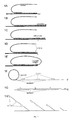
- Fig. 1A to 1H
- shows the principle reaction steps of the method according to the first aspect of
the present invention;
- Fig. 2
- shows some of the reaction steps of the method according to the second aspect
of the present invention, whereby these steps are those discriminating the
method according to the second aspect from the method according to the first
aspect of the present invention;
- Fig. 3
- shows essential steps of the method for the amplification of a target nucleic
acid according to the third aspect of the present invention;
- Fig. 4
- shows some essential steps of the method for the amplification of a target
nucleic acid according to the fourth aspect of the present invention;
- Fig. 5
- shows some essential steps of a method according to the fourth aspect of the
present invention, whereby the target nucleic acid is formed from an mRNA;
- Fig. 6
- shows the result of an amplification step of a fragment of the factor V gene
using different dilutions of the target, expressed as fluorescence as a function
of time in minutes;
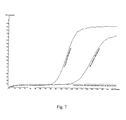
- Fig. 7
- shows the analysis of genomic DNA comprising about 3.000 copies compared
to 30 copies of the factor V wild type allele using a wild type specific assay.
The control contains again 3.000 copies of the factor V wild type allele but was
analysed with the Factor V Leiden specific variant of the assay, expressed as
fluorescence as a function of time in minutes;
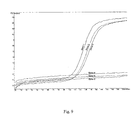
- Fig. 8 and 9
- show the result of an assay for the detection of Factor V from donor samples,
expressed as fluorescence as a function of time.
-
Fig. 1A shows a single-stranded target nucleic acid, which is a DNA, to which the first
primer, supplied in a 5' phosphorylated form, is partially hybridized due to sequence
complementarity between the 3'-end of the first primer and the target nucleic acid. In Fig. 1B
the first primer is extended through the activity of a polymerase reaction upon addition of
dNTPs, leading to a primer/target nucleic acid chimera which is double-stranded in the
downstream part and comprises a recognition site for a restriction enzyme. In the next step as
depicted in Fig. 1C, said double-stranded part of the nucleic acid is cleaved by the restriction
enzyme leaving an overhang, more particularly a 5' overhang created by the target nucleic
acid which allows the 5'-end of the first primer which is complementary to this overhang, to
anneal thereto (Fig 1D). The thus annealed and 5' phosphorylated first primer is ligated to the
copy of the target sequence thus forming the circular target (Fig. IE) which is used in the
rolling circle amplification process. Upon creation of the circular target a second primer is
used which is also referred to as forward primer and is specific insofar as it corresponds to the
target nucleic acid or a part thereof. In the present embodiment, the circular target comprises a
complementary copy of a part of the target nucleic acid, particularly that part of the target
nucleic acid which is conferring the specificity or uniqueness of the target nucleic acid. This
specificity or uniqueness may be defined such that the respective specificity or uniqueness
conferring target nucleic acid comprises the single nucleotide polymorphism or the particular
mutation to be detected in a respective process or method comprising an amplification step for
the thus defined target nucleic acid. Additionally, the circular target comprises a sequence of
nucleotides which are different from the target nucleic acid so as to allow for the formation of
a circular structure rather than the formation of a completely double-stranded structure (Fig
1D). As depicted in Fig. 1F a first amplification product is created due to the rolling circle
amplification process, whereby the target nucleic acid copies are separated from each other
through complementary copies of that part of the first primer which is different from the
target nucleic acid. To this linear amplification product a third primer is added. As depicted in
Fig. 1 F this primer is complementary to a part of the amplification product, which is also
referred to herein as the first amplification product. Preferably, the third primer is
complementary to either the target nucleic acid or identical to the part of the first primer
different from that target nucleic acid.
-
The annealed third primer is extended forming the second amplification product (Fig 1F und
G).
-
Fig. 2 shows some of the reaction steps of the method according to the second aspect of the
present invention, whereby these steps are those discriminating the method according to the
second aspect from the method according to the first aspect of the present invention. More
particularly, in Fig. 2A the first primer is shown annealed to the target nucleic acid and
extended through the activity of the polymerase using the target nucleic acid as matrix. In
principle, polymerase activity will last until the end of the target nucleic acid is reached,
however, may be terminated earlier. As in the method according to the first aspect of the
present invention, the thus elongated double-stranded target nucleic acid comprises a
recognition site for a restriction enzyme. In the method according to the second aspect,
however, the restriction enzyme generates a 3' overhang (Fig. 2B). To the thus created 3'
overhang an extension oligonucleotide is annealed through base pairing thus extending the 5'
end of the target nucleic acid generated upon the cleavage by the restriction endonuclease.
One end of the extension oligonucleotide is thereby complementary to the 3' overhang
generated by the endonuclease and allows for said annealing. Another part of the extension
oligonucleotide is complementary to the 5' end of the first primer. Thus, the function of the
extension oligonucleotide is similar to the one of the mediating primers as disclosed herein
and the respective design principles are applicable to this kind of extension oligonucleotide as
well.
-
Fig. 3 shows the essential steps of a method for the amplification of a target nucleic acid
according to the third aspect of the present invention. More particularly, a double-stranded
nucleic acid which comprises the target nucleic acid, i.e. a single-stranded DNA as part
thereof, is prepared by digesting said nucleic acid using one or two restriction enzymes. The
thus created double-stranded DNA structure is separated into the individual strands and each
individual strand can, in principle, form a target nucleic acid as used in the various
embodiments of the methods for the amplification of a nucleic acid according to the present
invention. The target nucleic acid is ligated to the ends of the linear extension oligonucleotide,
which is supplied in a 5' phosphorylated form. This ligation is mediated by two different
primers, namely the first mediating primer and the second mediating primer. One part or end
of the first mediating primer is essentially complementary to a first end of the target nucleic
acid and the other end is essentially complementary to a first end of the extension
oligonucleotide. The second mediating primer exhibits basically the same design, whereby
one part or end of said second mediating primer is complementary to a second end of the
target nucleic acid and the other end of the second mediating primer is essentially
complementary to the second end of the extension oligonucleotide. The mediating primers
anneal to the first primer and the target molecule in a way that the extension oligonucleotide
and the target molecule are directly adjacent to each other, i.e. no base is missing in between,
at both ends, respectively. In order to avoid side products in the latter amplification steps, the
mediating primers may be blocked (e.g. by phosphorylation or additional non fitting bases) at
the 3' end or used also as secondary primers. It is to be acknowledged that the first end of the
target nucleic acid is to be ligated to the first end of the extension oligonucleotide and the
second end of the target nucleic acid is to be ligated to the second end of the extension
oligonucleotide. Due to this design of both the extension oligonucleotide and the first
mediating primer and the second mediating primer, respectively, the extension
oligonucleotide can be ligated to the target nucleic acid forming a partially double-stranded
circular structure, the circular target. This partially double-stranded structure can be further
reacted using a polymerase and a first primer, whereby the first primer is at least partially
complementary to the target nucleic acid, preferably the first primer is complementary to a
part of the target nucleic acid contained in the circular target. It is within the present invention
that the first and/or second mediating primer is/are used as the first primer for performing the
polymerase reaction creating the first amplification product, if the second primer is designed
in a way that ensures specificity of the reaction by annealing to the uniqueness mediating part
of the first amplification product.
-
Fig. 4 shows essential steps of the method for the amplification of a target nucleic acid
according to the fourth aspect of the present invention. More particularly, the target nucleic
acid is prepared from a nucleic acid comprising the target nucleic acid which is typically
present as a double-stranded DNA. From said double-stranded DNA the target nucleic acid or
a larger fragment which comprises the actual target nucleic acid is prepared. Preferably, such
fragment is prepared by digesting said nucleic acid using one or two restriction enzymes. The
thus created double-stranded target nucleic acid is converted into the single-stranded form
creating the target nucleic acid as used in the various embodiments of the methods according
to the present invention. The single-stranded target nucleic acid is in the present embodiment
that big that it allows direct circularization which is mediated by a mediating primer. Said
mediating primer comprises a first end which is essentially complementary to a first end of
the target nucleic acid and a second end which is essentially complementary to the second end
of said target nucleic acid. The function of this mediating primer is thus similar to the one of
the first mediating and second mediating primer, respectively, as described in connection with
the method for the amplification of a target nucleic acid according to the third aspect of the
present invention. This primer may subsequently act as a second primer for amplification
purposes. It is, however, also within the scope of the present invention that the mediating
primer is used in a form blocked at the 3' end to avoid side products during the amplification
process and consequently, a further primer is added which acts as a second primer, i.e.
initiates the rolling circle amplification.
-
Fig. 5 shows some essential steps of the method according to the fourth aspect of the present
invention, whereby the target nucleic acid used in the amplification process is derived from an
mRNA. More particularly, Fig. 5A shows the mRNA to which a gene specific primer is
annealed which is extended through a reverse transcriptase (Fig. 5B). The thus generated
double-stranded structure is melted so as to provide the two corresponding single-stranded
nucleic acids, one being a ribonucleic acid and the other one being a deoxyribonucleic acid.
Alternatively, the RNA strand might be removed by RNAse H digestion. A further primer is
added to the deoxyribonucleic acid strand and, upon annealing to said strand and extension, a
double-stranded structure is generated. The synthesis of the double-strand will be stopped at
the end of the reverse primer thus creating a defined downstream end. Since both ends of this
second strand are clearly defined by the two primers used, the second strand may be used after
separation from the first strand in any of the methods according to the present invention.
-
Alternatively, the double-stranded cDNA structure can be used as source for any of the
methods according to the present invention.
Example 1: Detection of a factor V fragment in a serial dilution assay
Source:
-
As source, a fragment of the human factor V wild type gene, terminated by the primers F5-Mut-for_out
(5' CCACAGAAAATGATGCCCAG) and F5-Mut-rev2 (5'
GCCCCATTATTTAGCCAGGAG) and cloned in pCR4 (Invitrogen) was used. The isolated
plasmid (~100ng/µl) was diluted in TE containing 5ng/µl salmon sperm DNA. This blocking
DNA was added in order to avoid loss of the plasmid due to unspecific adsorption to the wall
of the reaction vessel. Serial dilutions, starting with 1:10000 (~10pg Plasmid DNA/µl) in 1:10
steps were used for target generation.
Target generation:
-
A 10 µl digest was performed at 37°C for 30 minutes. The reactions contained 0.3 µl source
DNA of the respective dilutions, 10 U Dde1 and 10 U MspI in 1 x Buffer K containing BSA
(Promega, Mannheim). Enzymes were inactivated and DNA was denatured for 1 minute at
96°C. The following sequence with a length of 116 bp was set free by this reaction:
Circular target generation:
-
The reaction was cooled to 25°C and 1 µl ligation mix, containing 20 fmol/µl F5-Loop_V3L
(5'-GAAATTCTGACATGAGAGACAT), 1nmol/µl ATP and 0,4 U T4-ligase (NEB,
Frankfurt/Main) in 1 µl diluent buffer A (NEB, Frankfurt/Main), was added. After thoroughly
mixing the reactants, the reaction was incubated for 15 minutes at 30°C to form the circular
target still 116 bases in size.
Rolling circle amplification:
-
The reaction mixture was put on ice and 30 µl of rolling circle mixture, containing 7,5 nmol
dATP, dTTP, dGTP, dCTP each, 5 pmol second primer (wild type specific: F5_norm 5'-AGAGCAGATCCCTGGACAGGCG,
F5 Leiden-variant: F5-Leiden 5'-AGAGCAGATCCCTGGACAGGCA),
5 pmol labelled third primer (F5-FRET 5'-6FAM-ATAGCGTTTTTACGCTA-T+Dabcyl-TAAGCCCAGAGGCGATGTCTCTCA)
and 4 U
Bst-polymerase (NEB, Frankfurt/Main) in Addon-buffer (36 mM Tris Cl pH8,6, 25 mM
NH4SO4, 4% Triton X100) were added. After mixing thoroughly, the reaction was transferred
into a real-time cycler (Rotorgene, Corbett Research, Mortlake) and incubated at 65°C. The
fluorescence was measured at 510 nm after excitation at 470 nm every minute.
-
The results of this experiment are shown in Fig. 6.
-
As maybe taken from Fig. 6 the serial dilution assay starting from about 3 pg of purified
plasmid corresponding to about 2.3 million copies of the respective fragment gave the
maximum reaction in said assay expressed as fluorescence after the shortest time. Any serial
dilusion of 1:10 resulted in an increase of time required to reach a similar level of
fluorescence. The maximum dilution depicted in Fig. 6 corresponds to about two copies
which were presented in the reaction assay. This confirms the high sensitivity of the
amplification methods according to the present invention. The high specificity is confirmed
by a reaction using also 2.3 million copies wild type F5 gene, but conducting the reaction with
the F5-Leiden specific primer. This reaction does not generate any fluorescence.
Example 2: Discrimination between genomic wildtype factor V DNA and genomic
factor V Leiden mutation DNA
-
This analysis was done exactly as example 1, but the diluted plasmids were replaced by 10 ng
genomic DNA of a healthy donor homozygous for the wild type allele. The result of this
experiment is depicted in Fig. 7. As maybe taken from Fig. 7 the above described assay could
discriminate between an amplification of the genomic wild-type factor V DNA and the
genomic factor V Leiden mutation DNA. The wild-type as well as the factor V Leiden
specific DNA amplification were started using 10 ng genomic DNA which corresponds to
about 3,000 copies or a dilution of 1:100 which corresponds to about 30 copies of the
genomic wild-type factor V DNA. The respective lines in Fig. 7 represent the kinetics
expressed as time over fluorescence. Although the difference between the Leiden mutation
and the wild-type sequence corresponds to a single nucleotide only, the wild type DNA
fragment was not amplified when using the Leiden specific second primer which confirms the
high specificity of the amplification process.
Example 3: Detection of wild type factor V DNA and factor V Leiden mutation DNA
in patient samples
-
This analysis was done exactly as example 1 and 2, but the samples were replaced by 20 ng
genomic DNA of 6 donors which were pretyped by a different (PCR/restriction digest)
method. Donor 1 was homozygous and Donors 2 and 3 were heterozygous for the factor V
Leiden allele. All donors were tested for the presence of the wild type allele (Fig. 8) and for
the presence of the Leiden allele (Fig. 9) using the embodiments as described herein. As may
be taken from Fig. 8 only the line of donor 1 did not result in the generation of the reaction
product, and therefore a fluorescence signal as a function of time using the wild-type specific
primer.
-
Using the primer, i.e. the second primer in the various embodiments as described herein,
having specificity for the factor V Leiden mutation, only donors 1, 2 and 3 (Fig. 9) which
were the only donors containing the respective allele were positive. Due to the fact that donor
no. 1 shows reactivity only in Fig. 9 but not in Fig. 8, it might be concluded that he is
homozygous for the factor V Leiden allele, whereas donors 2 and 3 show reactivity in both
reactions and are therefore heterozygous for the Leiden mutation.
-
The features of the present invention disclosed in the specification, the claims and/or the
drawings may both separately and in any combination thereof be material for realizing the
invention in various forms thereof.