FIELD OF THE INVENTION
-
The present invention relates to new regioselectively hydroxylated, protected and
functionalized spirolactams and to processes for their synthesis.
BACKGROUND OF THE INVENTION
-
Lactams are compounds of high interest due to their biological activities, for
example well known β-lactams such as some penicillins, cephalosporins and carbapenems
have antibacterial activity.
-
Spirolactams are one particular class of lactams that have shown interesting
biological properties. Some spiro-fused azetidinones have been described as having
antibacterial activity, see US 4,680,388, or hypocholesterolemic properties, see for
example WO 94 17038. Additionally, if these compounds have the adequate functionality
they are valuable intermediates towards different families of compounds. The spirolactam
ring is the equivalent of an alpha amino or hydroxy aminoacid and opens many
possibilities in diastero and/or enantioselective synthesis.
-
Miyazawa, E. et al. in Heterocycles, vol 59, 1:149-160 "Synthesis of spiro-fused
nitrogen heterocyclic compounds via N-methoxy-N-acylnitrenium ions using phenyliodine
(III) bis(trifluoroacetate) in trifluoroethanol" describe a process to obtain functionalised
spirolactams including some spirodienones.
-
Kukugawa, Y. e al. in J. Org. Chem. 2003, vol. 68, 6739-6744 "Intramolecular
cyclization with nitrenium ions generated by treatment of N-acylaminophthalimides with
hypervalent iodine compounds: formation of lactams and spirofused lactams" describes the
formation of functionalised spirolactams having diene and dienone funcionalities.
-
The conduritols, aminoconduritols, aminoinositols and their derivatives also
possess interesting biological properties, some of them have been shown as being
antitumoral and antibiotic. Although some synthetic processes exist for these compounds
(See Yong-Uk Kwon et al, J. Org. Chem. 2002, vl. 67, 3327-3338 "Facile syntheses of all
possible diastereomers of conduritol and various derivatives of inositol stereoisomers in
high enantiopurity from myo-inositol"), there are still difficulties to obtain these
compounds or corresponding analogues.
-
As it is apparent from the above, any efficient process for producing functionalised
spirolactam compounds in high yield, with various functionalities, introduced in a
controlled and regioselective manner, would be a wellcome contribution to the art and will
open the door to a variety of biologically active compounds.
SUMMARY OF THE INVENTION
-
Starting from the compounds described in our application EP 04380104.2, we
found a basic set of processes that allows the controlled obtention of very stable, highly
functionalised, spiro-fused azetidinones which are useful as intermediate compounds in the
preparation of a variety of chemical structures, including, if necessary, by means of
chimio-, loco-, regio-, diastero- and/or enantioselective processes.
-
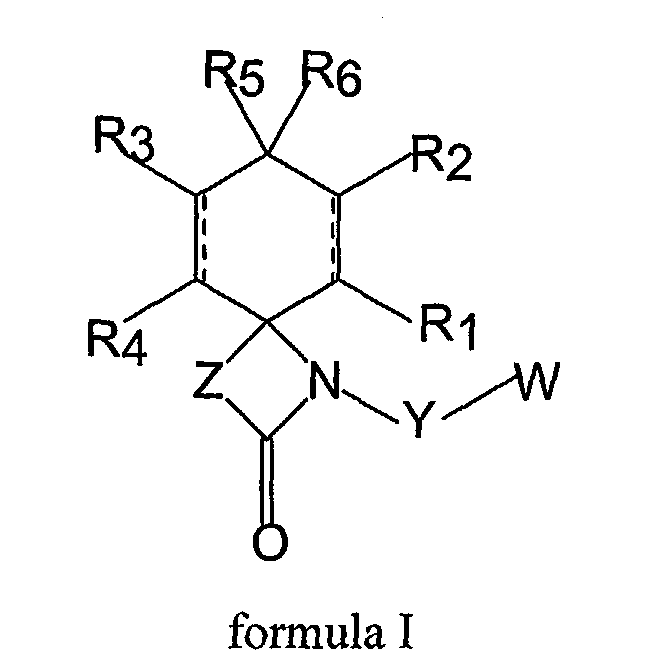
In one aspect the invention provides a compound of formula I:
wherein R
1, R
2, R
3, R
4 are each independently selected from H, OH or OPr;
R
5 and R
6 together are =O or R
5 is selected from H, OH, OPr and R
6 is selected from
hydrogen, cyano, substituted or unsubstituted alkyl, substituted or unsubstituted cycloalkyl,
substituted or unsubstituted alkenyl, substituted or unsubstituted alkinyl, substituted or
unsubstituted aryl, substituted or unsubstituted heterocyclyl, with the proviso that at least
one of R
1, R
2, R
3, R
4 or R
5 is OH or OPr;
Pr is an hydroxyl protecting group which can be the same or different on each of R
1, R
2,
R
3, R
4 or R
5;
the dotted line represents a single or double bond, with the proviso that when both R
1 and
R
2 or R
3 and R
4 are H then there is a double bond between the two C to which the H are
linked;
Z is -(CRaRb)
n- wherein n is a number selected from 1, 2, 3 and Ra and Rb are each
independently selected from hydrogen, substituted or unsubstituted alkyl, substituted or
unsubstituted cycloalkyl, substituted or unsubstituted alkenyl, substituted or unsubstituted
aryl, substituted or unsubstituted heterocyclyl, substituted or unsubstituted alkoxy,
substituted or unsubstituted aryloxy, substituted or unsubstituted amino or halogen;
Y is selected from -O-, -S-, -N(RaRb)- or -C(O)-, wherein Ra and Rb are as previously
defined and do not form a cyclic ring;
W is a group selected from substituted or unsubstituted arylalkyl, substituted or
unsubstituted heterocyclylalkyl, substituted or unsubstituted alkenyl;
or a salt, complex or solvate thereof.
-
In one embodiment we prefer that n is 1. In this case Z is preferably -CH2-.In another
embodiment W is arylalkyl, preferably benzyl. In a further embodiment Y is preferably -
O-.
-
The invention also provides for a process for the preparation of a compound
according of formula I, which comprises in any order one or more of a step selected from
the group consisting of:
- a) hydroxylation or dihydroxylation
- b) hydroxyl or carbonyl protection
- c) nucleophilic attack at the carbonyl group
- d) hydroxyl inversion
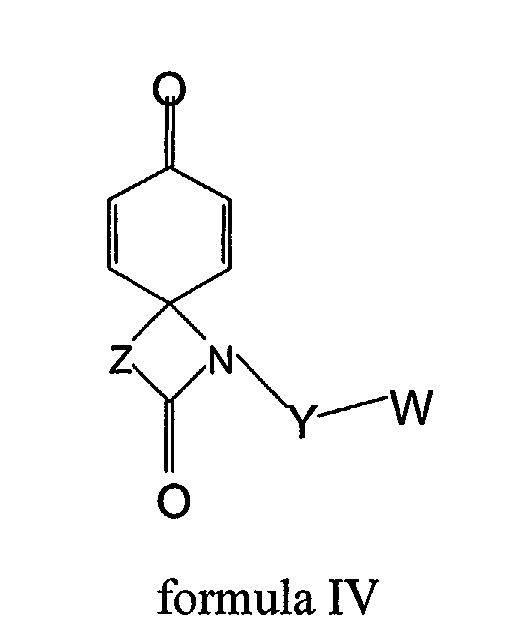
applied to a compound of formula IV:
wherein Z , Y and W are as defined above.-
DETAILED DESCRIPTION OF THE INVENTION
-
The invention provides compounds of formula I as above defined. In the
compounds of formula I, the group Z gives rise to a ring of 4, 5 or 6 members. Substitution
on position Z creates a stereogenic center that could induce selective functionalisation on
the benzodienone moiety. In a preferred embodiment Z is -(CH2)n-. Although rings of 5 or
6 are also comprised within the scope of the invention, in one embodiment the β-lactam
ring (n= 1) is preferred because of the further uses that can be given to such compounds.
-
The group Y in the compounds of formula I plays a role in the stability and
conformation. In an embodiment Y is preferably -O-, although other atoms are not
excluded as long as the final product is stable.
-
As we already mentioned the W group is important for the stabilization of the
compound of formula I. Preferably it comprises unsaturated bonds or aromatic groups to
increase the π interaction. Aralkyl groups and alkenyl groups are preferred since they give
the best stability. In a particular embodiment, W is -CRaRb-Q or -SiRaRb-Q since the
stability of the conformation is further improved by the presence of a -CRaRb- or a -
SiRaRb- linker between Y and the substituent Q which has π (pi) interactions with the
benzodienone moiety. The linker is preferably -CHRa-. In this case a stereogenic center is
introduced which allows for the selectivity or specificity of any further reaction,
distinguishing the two double bonds of the benzodienone. This will advantageously open
the way to diastero- and/or enantioselective synthesis in addition to the selection for one
face which is explained below. Depending on the size of Ra it can also modulate the π (pi)
interactions.
-
In one embodiment W is an aralkyl group. Among the aryl groups susbtituted or
unsubstituted phenyl and naphthyl are preferred. Heterocyclylalkyl groups are also
envisaged. Phenyl is the simplest subtituent and gives good results.
-
In the above definition of compounds of formula (I) and in the description the
following terms have the meaning indicated:
- "Alkyl" refers to a straight or branched hydrocarbon chain radical consisting of
carbon and hydrogen atoms, containing no saturation, having one to eight carbon atoms,
and which is attached to the rest of the molecule by a single bond, e. g., methyl, ethyl, n-propyl,
i-propyl, n-butyl, t-butyl, n-pentyl, etc. Alkyl radicals may be optionally substituted
by one or more substituents independently selected from the group consisting of a halo,
hydroxy, alkoxy, carboxy, cyano, carbonyl, acyl, alkoxycarbonyl, amino, nitro, mercapto
and alkylthio.
- "Alkoxy" refers to a radical of the formula -ORa where Ra is an alkyl radical as
defined above, e. g., methoxy, ethoxy, propoxy, etc. "Aryloxy" refers to a radical of
formula -ORb wherein Rb is an aryl radical as defined below.
- "Amino" refers to a radical of the formula-NH2 , -NHRa, -NRaRb.
- "Aryl" refers to a phenyl, naphthyl or anthracyl radical. The aryl radical may be
optionally substituted by one or more substituents selected from the group consisting of
hydroxy, mercapto, halo, alkyl, phenyl, alkoxy, haloalkyl, nitro, cyano, dialkylamino,
aminoalkyl, acyl and alkoxycarbonyl, as defined herein.
- "Aralkyl" refers to an aryl group linked to an alkyl group such as benzyl and
phenethyl.
- "Cycloalkyl" refers to a saturated carbocyclic ring having from 3 to 8 carbon atoms.
- "Heterocycle" refers to a heterocyclyl radical. The heterocycle refers to a stable 3-to
15- membered ring which consists of carbon atoms and from one to five heteroatoms
selected from the group consisting of nitrogen, oxygen, and sulfur, preferably a 4-to 8-membered
ring with one or more heteroatoms, more preferably a 5-or 6-membered ring
with one or more heteroatoms. For the purposes of this invention, the heterocycle may be a
monocyclic, bicyclic or tricyclic ring system, which may include fused ring systems; and
the nitrogen, carbon or sulfur atoms in the heterocyclyl radical may be optionally oxidised;
the nitrogen atom may be optionally quatemized; and the heterocyclyl radical may be
partially or fully saturated or aromatic. Examples of such heterocycles include, but are not
limited to, azepines, benzimidazole, benzothiazole, furan, isothiazole, imidazole, indole,
piperidine, piperazine, purine, quinoline, thiadiazole, tetrahydrofuran.
- "Hydroxyl protecting group" refers to a group that blocks the OH function for
further reactions. The hydroxyl protecting groups are well known in the art, representative
protecting groups are silyl ethers such as trimethylsilyl ether, triethylsilyl ether, tert-butyldimethylsilyl
ether, tert-butyldiphenylsilyl ether, tri-isopropylsilyl ether,
diethylisopropylsilyl ether, thexyldimethylsilyl ether, triphenylsilyl ether, di-tert-butylmethylsilyl
ether; alkyl ethers such as methyl ether, tert-butyl ether, benzyl ether, p-methoxybenzyl
ether , 3,4-dimethoxybenzyl ether, trityl ether; allyl ether; alkoxymethyl
ether such as methoxymethyl ether, 2-methoxyethoxymethyl ether, benzyloxymethyl ether,
p-methoxybenzyloxymethyl ether, 2-(trimethylsilyl)ethoxymethyl ether; tetrahydropyranyl
and related ethers; methylthiomethyl ether; Esters such as acetate ester, benzoate ester;
pivalate ester; methoxyacetate ester; chloroacetate ester; levulinate ester; Carbonates such
as benzyl carbonate, p-nitrobenzyl carbonate, tert-butyl carbonate, 2,2,2-trichloroethyl
carbonate, 2-(trimethylsilyl)ethyl carbonate, allyl carbonate. Additional examples of
hydroxyl protecting groups can be found in reference books such as Greene and Wuts'
"Protective Groups in Organic Synthesis", John Wiley & Sons, Inc., New York, 1999.
-
-
References herein to substituted groups in the compounds of the present invention
refer to the specified moiety that may be substituted at one or more available positions by
one or more suitable groups, e. g., halogen such as fluoro, chloro, bromo and iodo ; cyano;
hydroxyl ; nitro ; azido ; alkanoyl such as a C1-6 alkanoyl group such as acyl and the like ;
carboxamido ; alkyl groups including those groups having 1 to about 12 carbon atoms or
from 1 to about 6 carbon atoms and more preferably 1-3 carbon atoms ; alkenyl and
alkynyl groups including groups having one or more unsaturated linkages and from 2 to
about 12 carbon or from 2 to about 6 carbon atoms ; alkoxy groups having one or more
oxygen linkages and from 1 to about 12 carbon atoms or 1 to about 6 carbon atoms ;
aryloxy such as phenoxy ; alkylthio groups including those moieties having one or more
thioether linkages and from 1 to about 12 carbon atoms or from 1 to about 6 carbon atoms ;
alkylsulfinyl groups including those moieties having one or more sulfinyl linkages and
from 1 to about 12 carbon atoms or from 1 to about 6 carbon atoms ; alkylsulfonyl groups
including those moieties having one or more sulfonyl linkages and from 1 to about 12
carbon atoms or from 1 to about 6 carbon atoms ; aminoalkyl groups such as groups having
one or more N atoms and from 1 to about 12 carbon atoms or from 1 to about 6 carbon
atoms ; carbocylic aryl having 6 or more carbons, particularly phenyl or naphthyl and
aralkyl such as benzyl. Unless otherwise indicated, an optionally substituted group may
have a substituent at each substitutable position of the group, and each substitution is
independent of the other.
-
In our copending application, EP04380104.2, which is incorporated herein by
reference in its entirety, we describe new compounds having a formula IV and processes
for their obtention:
wherein Z is -(CRaRb)
n- wherein n is a number selected from 1, 2, 3 and Ra and Rb are
each independently selected from hydrogen, substituted or unsubstituted alkyl, substituted
or unsubstituted cycloalkyl, substituted or unsubstituted alkenyl, substituted or
unsubstituted aryl, substituted or unsubstituted heterocyclyl, substituted or unsubstituted
alkoxy, substituted or unsubstituted aryloxy, substituted or unsubstituted amino, or
halogen;
Y is selected from -O-, -S-, -N(RaRb)- or -C(O)-, wherein Ra and Rb are as previously
defined and do not form a cyclic ring;
and W is a group with sufficient electronic density to stabilize the compound through π (pi)
interactions with the benzodienone moiety, preferably a group having unsaturated bonds
or aromatic groups, more preferably it is selected from substituted or unsubstituted
arylalkyl, substituted or unsubstituted heterocyclylalkyl, substituted or unsubstituted
alkenyl.
-
These compounds are remarkably stable due to π interactions between the W group
and the benzodienone moiety. Additionally these compounds adopt a preferential
conformation in which the W group blocks one of the faces of the benzodienone
(hereinafter the β face) and is "fixed" there by the π interactions, directing further reactions
to the free face of the benzodienone moeity (hereinafter the α face).
-
Taking advantage of this, we have now found that starting from these compounds it
is possible to regioselectively hydroxylate, functionalise and protect the ,different positions
of the benzodienone group, to give a broad range of stable compounds having the desired
functionality and protection at each of the 5 available positions. These highly
functionalised compounds are useful as building blocks for a wide variety of bioactive
compounds.
-
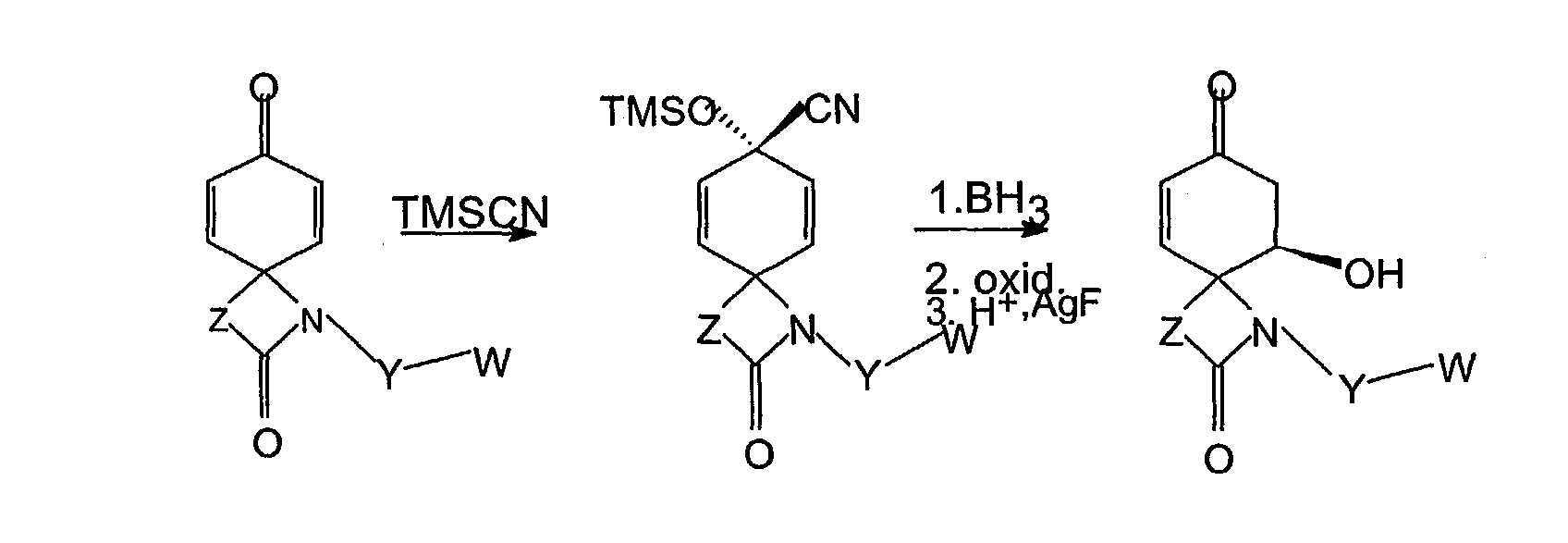
If only one hydroxy group is desired, it can be introduced regioselectively for
example via formation of the cyanhydrine on the carbonyl group, the hydroboration or
hydrosililation of one of the double bonds (via the α face), then oxidation and final
treatment with acid or AgF:
-
Other alternatives procedures are possible. Significantly, the hydroxylation takes
place via one face of the dienone only. The hydroxyl group can then be protected with any
desired hydroxyl protecting group such as those listed above.
-
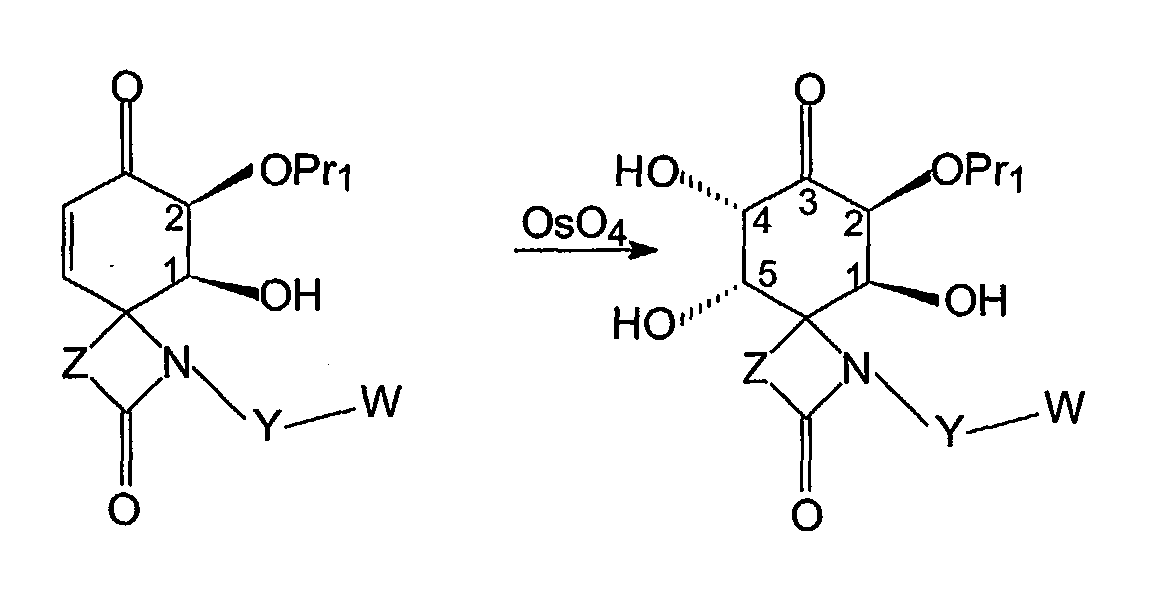
In another embodiment of the invention we provide for the diastereoselective
dihydroxylation of one of the double bonds of the benzodienone moiety. This is a
surprising result, in view of the expected poor reactivity of the structure of formula IV, due
to the highly deactivated double bonds. Additionally, contrary to what is expected, the
dihydroxylation takes place regioselectively, only via the α face:
-
This oxidation occurs readily under mild conditions, such as using OsO4 in a polar
solvent, for example a mixture of water an ketone, in the presence of an amine such as N-methylmorpholine
N-oxide. Alternative oxidation systems will be readily apparent to the
person skilled in the are and can be found in standard references for organic synthesis such
as Noyori, R. "Asymmetric catalysis in organic synthesis", John Wiley and Sons, Inc.
(1994) or Ojima, I. "Catalytic asymmetric synthesis VCH, (1993)
-
In another aspect of the invention we have found that the dihydroxylated compound
can be selectively protected. Indeed, when carrying out a protection such as with Cl-TBDMS
we found that the hydroxyl at position 2 reacted until being completely protected,
and only then the OH at position 1 is protected.
Without being bound by theory we believe that this is due to the existence of C-H π
interactions between the H at position 2 and the W group. This means that the -OH at
position 2 is in an equatorial conformation, more reactive, while the -OH at position 1 is in
an axial conformation, less reactive. This allows the selective reaction of one position with
respect to the other.
-
Therefore, both the facial selection (α versus β) when carrying out the
hydroxylation, and the different reactivity of positions 1 and 2, due to the particular
conformations generated by the presence of the W group and its interactions with the rest
of the molecule, allows for a fine tuned control of the functionalisation of the molecule.
-
The two hydroxy groups can be protected with the same protecting group as
explained above, or with different protecting groups, first protecting the position 2 and
then the position 1:
-
To introduce the hydroxyl protecting groups standard procedures can be used, such
as those described in Greene and Wuts' "Protective Groups in Organic Synthesis", John
Wiley & Sons, Inc., New York, 1999 or Kocienski, P.J. "Protecting Groups", 3rd
Ed.Thieme Chemistry, 2003.
-
In another embodiment the carbonyl group can also be selectively
functionalized for example by Nucleophilic addition. Importantly, the lactam group does
not react instead because it has a Weinreb type of amide. Thus cyanides, organolithium
compounds, Grignard's reagents, ketones among other can be easily added to introduce the
desired functionality at this position. If an hydride is used then an hydroxy at position 3 is
generated. Suitable procedures for this kind of reactions are known in the art and can be
found for example in Fischer, A. et al J. Org. Chem, 1987, 52, 4464-4468 "Formation of 4-nitrocyclohexa-2,5-dienols
by addition of organolithium reagents to 4-alkyl-4-nitrocyclohexa-2,5-dione";
Wipf et al., Angew. Chem. Int. Ed. Engl. 1997, 36, no.7, 764-767;
Fischer, A. et al., Tetrahedron lett., 1980, 21, 701-704; Carreno, M. et al., J. Org.
Chem, 1997, 62, 26, 9128-9137.
-
The additions can be done independently of the functionalisation of the other
positions. If no other hydroxy groups are present:
-
This reaction occurs with no stereoselectivity. The compounds can be in any case
separated by resolution procedures know in the art, such as chromatography.
-
As an alternative to functionalisation, if desired the carbonyl group can be protected
using know carbonyl protecting groups.
-
We have found that when the compound of formula IV is first dihydroxylated and
then the addition to the carbonyl is carried out, complete stereoselectivity is achieved.
Although not completely clear, it appears that this important stereoselectivity is due to
stereoelectronic effects between positions 2 and 3, and to the above mentioned
conformation at position 2. For example:
-
In this case the addition and the protection of the second hydroxyl group are carried
out at the same time. Alternatively, only addition can take place.
-
In another aspect of the invention, the second double bond (positions 4 and 5) can
also be stereoselectively hydroxylated. This occurs more readily when the carbonyl group
at position 3 is present, we think because it allows the in situ generation of an allylic
alcohol, which might indicate that it plays a role in the oxidation process. Thus, under mild
conditions:
-
In this case the hydroxyl groups appear at the β face, we believe for stereoelectronic
reasons. If a different stereochemistry is desired the appropriate oxidation or epimerization
conditions can be selected. For example, under selective acidic or basic conditions the
hydroxy at position 4 epimerizes. Alternatively hydroxyl inversions via the Mitsunobu
type reaction, such as using DEAD, Ph3P and an acid such as benzoic or p-nitrobenzoic
acid, can be used. Frequently, the inversion via Mitsunobu needs protection of the other
hydroxyl groups. Furhter details on the inversion via the Mitsunobu reaction can be found
in Mitsunobu, O., Synthesis, 1, 1981; or Hughes, D.L., Org. Reactions, 1992, 42, 335.
-
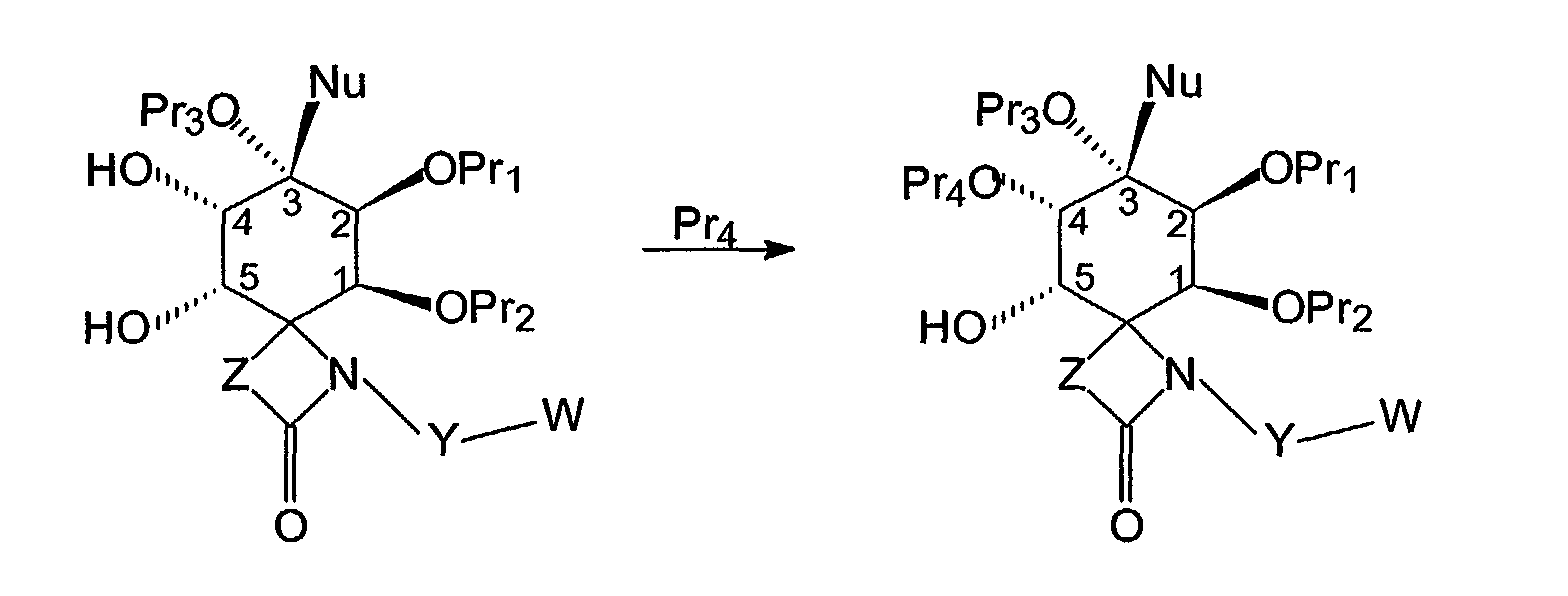
If the carbonyl group has already been functionalized, then stronger oxidation
conditions are needed, such as the use of RuCl
3 or similar systems:
Complete orthogonal and complete regioselective protection can be achieved from here by
introduction of a further protecting group:
-
The presence of vicinal hydroxyl groups allows the simultaneous protection of two
of them through the use of diol protecting groups if desired. Among the diol protecting
groups that can be used we have O,O-acetals such as isopropylidene acetals (acetonides);
cyclohexylidene and cyclopentylidene acetals; arylmethylene acetals; methylene acetals;
diphenylmethylene acetals; 1,2-diacetals such as dispiroketal (dispoke) derivatives,
cyclohexane-1,2-diacetals, butane-2,3-diacetals; silylene derivatives; 1,1,3,3-tetraisopropyldisiloxanylidene
derivatives or N,O-acetals. Additional examples of diol
protecting groups can be found in reference books such as Greene and Wuts' "Protective
Groups in Organic Synthesis", John Wiley & Sons, Inc., New York, 1999.
-
As can be understood from the above and will be apparent to the person skilled in
the art, due to the particular conformation and reactivity characteristics of the described
compounds, a great number of possibilities can be achieved. It is important to point out
that the obtained compounds of formula I will present a carefully crafted functionality at
the different positions 1-5 and the desired stereochemistry. The introduction of different
protecting groups opens the route to very selective further reactions by chosing the
appropriate protection-deprotection strategies.
-
The process to obtain any of these compounds can be readily designed by starting
from a compound of formula IV above and then applying a basic set of reactions selected
from:
- a) Hydroxilation or dihydroxylation: as above explained, using mild (such as OsO4/ N
oxide amine) or strong systems (such as RuCl3) depending on the position to be
hydroxylated. Alternative systems are also envisaged.
- b) Nucleophilic attack at the carbonyl group: for example with a carbanion on a sp, sp2 or
sp3 C, the carbanion can be prepared or generated in situ; or with an hydride.
- c) Hydroxyl inversion : as previously explained, for example through epimerization or
inversion, for example in Mitsunobu conditions.
- d) Hydroxyl or carbonyl protection: as explained above, using the same or different
protecting groups in conditions as explained above.
-
-
Although each of these procedures is well known and the appropriate reagents can be
selected by the person skilled in the art of organic synthesis, for example from those given
in the references above, their application to the our structures gives unexpected results in
terms of reactivity and selectivity.
-
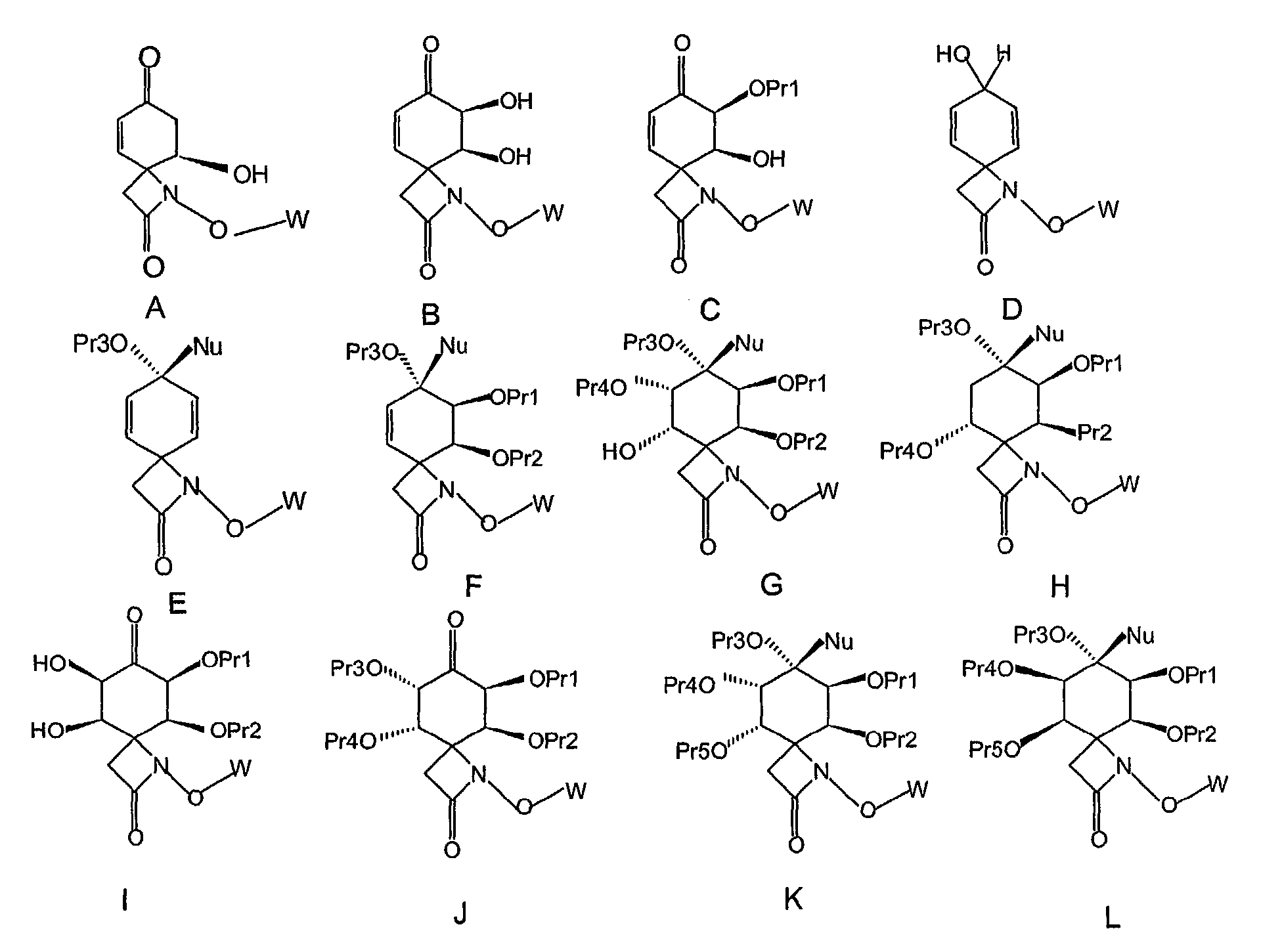
The following scheme I illustrates some of the possibilities, when Z is -CH
2- and Y
is O :
-
Mixtures of different diasteroisomers can be separated by conventional techniques.
All the compounds will be obtained as racemic mixtures. However, if enantiopurity is
desired, this can be achieved by introducing a chiral center in the W group as explained
above, or using chiral reagents or catalysts. Therefore the compounds of the present
invention represented by the above described formula (I) may include pure enantiomers
depending on the presence of stereogenic centers or diastereoisomers. The single isomers,
enantiomers or diastereoisomers and mixtures thereof fall within the scope of the present
invention.
-
Unless otherwise stated, the compounds of the invention are also meant to include
compounds which differ only in the presence of one or more isotopically enriched atoms.
For example, compounds having the present structures except for the replacement of a
hydrogen by a deuterium or tritium, or the replacement of a carbon by a 13C- or 14C-enriched
carbon or 15N-enriched nitrogen are within the scope of this invention.
-
Salts of compounds of the invention are synthesized from the parent compound
which contains a basic or acidic moiety by conventional chemical methods. Generally,
such salts are, for example, prepared by reacting the free acid or base forms of these
compounds with a stoichiometric amount of the appropriate base or acid in water or in an
organic solvent or in a mixture of the two. Generally, nonaqueous media like ether, ethyl
acetate, ethanol, isopropanol or acetonitrile are preferred. Examples of the acid addition
salts include mineral acid addition salts such as, for example, hydrochloride,
hydrobromide, hydroiodide, sulphate, nitrate, phosphate, and organic acid addition salts
such as, for example, acetate, maleate, fumarate, citrate, oxalate, succinate, tartrate, malate,
mandelate, methanesulphonate and p-toluenesulphonate.
-
The compounds of the invention may be in crystalline form either as free
compounds or as solvates (e.g. hydrates) and it is intended that both forms are within the
scope of the present invention. Methods of solvation are generally known within the art.
-
The invention will be further illustrated by means of examples.
EXAMPLES
General Methods and Materials.
-
All reactions described below were carried out under argon atmosphere unless
otherwise noted. The solvents used were distilled and dried under argon atmosphere before
use. All starting materials were purchased commercially (Aldrich, Fluka and Merck) and
used without further purification. Flash Chromatography was executed on columns loaded
with 230-400 mesh silica gel Merck. TLC was carried out on silica gel Merck (Kieselgel
60F-254).
-
Melting points (mp) were determined on a Reichert Microscopic Hot-Stage and are
uncorrected. 1H and 13C NMR spectra were measured on a Varian Gemini-200 and a
Varian Inova-300 spectrometer with (CH3)4Si as an internal reference and CDCl3 as
solvent unless otherwise noted. Both 1H and 13C NMR spectral data are reported in parts
per million (δ) relative to residual sign of the solvent (CDCl3, 7.26 ppm and 77.0 ppm for
1H and 13C NMR, respectively). 1H and 13C NMR designations are: s (singlete); s br.
(broad singlete); d (doublete); t (triplete); q (quartete); m (multiplete). Infrared (IR) spectra
were record on a Perkin-Elmer FT-IR spectrometer. UV spectra were record on a Perkin-Elmer
402 spectrometer. Low-resolution mass (LRMS) spectra were obtained on a Hewlett
Packard 5973 MSD spectrometer with a direct inlet system (EI) at 70 eV. Microanalytical
data (E.A.) were obtained on a Perkin-Elmer 240C and Heraus CHN-O instruments at the
Instrumental Analysis Department of Instituto de Quimica Orgánica General (C.S.I.C.).
-
The compounds below are nominated as derivatives of 1-azaspiro[3.5]nonan-2-one
and numerated following the numeration described below.
Example 1:
Preparation of
rac
-(4
R
,5
S
,6
S
)-1-benzyloxy-5,6-dihidroxy-1-azaspiro[3.5]nona-8-ene-2,7-dione
(2).
-
-
To a solution of meso-1-benzyloxy-1-azaspiro[3.5]nona-5,8-diene-2,7-dione (1) (804
mg, 3.150 mmol) in acetone (12 ml) was added sequentially at room temperature H2O (2.4
ml), N-methylmorpholine N-oxide (812 mg, 6.930 mmol) and osmium tetroxide (2.37 ml,
2.5 wt. % solution in 2-methyl-2-propanol, 0.189 mmol). The resultating mixture was
stirred at room temperature until the reaccion was complete (1 h, TLC monitoring, AcOEt),
and then quenched with 10% aqueous Na2S2O3 solution (3 ml). After 20 min, the mixture
was extrated with AcOEt (5x 6ml). The combined organic extracts were dried over
Na2SO4, filtered and concentrated under reduced pressure. The residue was purified by
silica gel column chromatography (hexane-AcOEt, 3:2) to give rac-(4R,5S,6S)-1-benzyloxy-5,6-dihidroxy-1-azaspiro[3.5]nona-8-ene-2,7-dione
(2) as a white solid (419
mg, 46%).
Rf = 0.47 (TLC, AcOEt); yield, 46%; white solid; 1H-NMR (200MHz, CD3OD): δ 7.56
(5H, s, Ph), 6.69 (1H, part A syst. AB, J9,8 = 10.1 Hz, H-9), 6.65 (1H, part B syst. AB, J8,9=
10.1 Hz, H-8), 5.19 (1H, part A syst. AB, J = 11.2 Hz, OCH 2Ph), 5.14 (1H, part B syst. AB,
J = 11.2 Hz, OCH 2Ph), 4.56 (1H, d, J= 2.9 Hz, H-6), 4.31 (1H, m, H-5), 3.32 (1H, part A
syst. AB, J = 14.4 Hz, H-3), 2.93 (1H, part B syst. AB, J = 14.4, H-3); 13C-NMR (75MHz,
CD3OD): δ 199.0, 167.0, 146.8, 136.7, 131.2, 131.1, 130.1, 80.9, 76.1, 74.2, 67.3, 43.4; IR
(KBr): ν 3429, 1772, 1692, 1631, 1450, 1382, 1053, 698 cm-1; LRMS(API-ES+): m/z 312
(M+Na)+, 290(M+H)+.
Example 2:
Preparation of
rac
-(4
R
,5
S
,6
S
)-1-benzyloxy-6-
tert
-butyldimethylsilyloxy-5-hydroxy-1-azaspiro[3.5]nona-8-ene-2,7-dione
(3)
-
-
To a solution of rac-(4R,5S,6S)-1-benzyloxy-5,6-dihydroxy-1-azaspiro[3.5]nona-8-ene-2,7-dione
(2) (123 mg, 0.425 mmol) and imidazole (35 mg, 0.510 mmol) in DMF (0.6 ml)
was added at 0 °C a solution of tert-butyldimethylsilyl chloride (77 mg, 0.510 mmol) in
DMF (1.2 ml). After 12 h at room temperature, the reaction was quenched with H2O (3 ml)
and the mixture extracted with AcOEt (3 x 5 ml). The combined extracts were washed with
saturated aqueous CuSO4 solution (2 x 10 ml) and brine (2 x 10 ml), dried over Na2SO4,
filtered and concentrated under reduced pressure. The residue was purified by silica gel
column chromatography (hexane-AcOEt, 5:2) to give rac-(4R,5S,6S)-1-benzyloxy-6-tert-butyldimethylsilyloxy-5-hydroxy-1-azaspiro[3.5]nona-8-ene-2,7-dione
(3) as a white solid
(133 mg, 78%).
R f = 0.56 (TLC, hexane-AcOEt, 1:1); yield, 78%; white solid; 1H-NMR (200MHz, CDCl3):
δ 7.40-7.29 (5H, m, Ph), 6.24 (1H, part A syst. AB, J9,8 = 10.1 Hz, H-9), 5.78 (1H, part B
syst. AB, J8,9 = 10.1 Hz, H-8), 5.00 (1H, part A syst. AB, J = 11.4 Hz, OCH 2Ph), 4.87 (1H,
part B syst. AB, J = 11.4 Hz, OCH 2Ph), 4.36 (1H, d, J = 2.7 Hz, H-6), 4.01 (1H, m, H-5),
3.25 (1H, part A syst. AB, J = 14.6 Hz, CH2), 2.63 (1H, part B syst. AB, J = 14.6 Hz, CH2),
2.56 (1H, d, J = 3.8 Hz, OH), 0.85 (9H, s, C(CH3)3), 0.09 (3H, s, SiCH3), 0.08 (3H, s,
SiCH3); 13C-NMR (75MHz, CDCl3): δ 195.4, 165.5, 145.2, 134.9, 129.6, 129.5, 129.3,
128.8, 79.3, 75.5, 71.7, 64.7, 41.9, 25.6, 18.1, -4.9, -5.3 ; IR (KBr): ν 3453, 2949, 2929,
2855, 1767, 1682, 1256, 1119, 1088, 980, 843, 782 cm-1; LRMS(API-ES+): m/z
829(2M+Na)+, 426(M+Na)+, 404(M+H)+.
Example 3:
Preparation of
rac
-(4
R
,5
S
,6
S
,8
S
,9
S
)-1-benzyloxy-6-
tert
-butyldimethylsilyloxy-5,8,9-trihydroxy-1-azaspiro[3.5]nona-2,7-dione
(4)
-
-
To a stirred solution of rac-(4R,5S,6S)-1-benzyloxy-6-tert-butyldimethylsilyloxy-5-hydroxy-1-azaspiro[3.5]nona-8-ene-2,7-dione
(3) (50 mg, 0.124 mmol) in acetone (0.45
ml) was added sequentially at room temperature H2O (0.09 ml), N-methylmorpholine N-oxide
(58 mg, 0.496 mmol) and osmium tetroxide (93 µl, 2.5 wt. % solution in 2-methyl-2-propanol,
7.4·10-3 mmol). The resulting mixture was stirred at room temperature until the
reaction was complete (18 h, TLC monitoring, hexane-AcOEt, 1:1), and then quenched
with 10% aqueous Na2S2O3 solution (20 drops). After 20 min, the mixture was filtered
through silica gel with MeOH and concentrated under reduced pressure. The residue was
purified by silica gel column chromatography (hexane-AcOEt, 2:1) to give rac-(4R,5S,6S,8S,9S)-1-benzyloxy-6-tert-butyldimethylsilyloxy-5,8,9-trihydroxy-1-azaspiro[3.5]nona-2,7-dione
(4) as a white solid (26 mg, 48%).
R f = 0.46 (TLC, hexane-AcOEt, 1:1); yield, 48%; white solid; 1H-NMR (200MHz, CDCl3):
δ 7.49-7.30 (5H, m, Ph), 5.11 (1H, part A syst. AB, J = 10.6 Hz, OCH 2Ph), 5.05 (1H, part
B syst. AB, J = 10.6 Hz, OCH 2Ph), 4.68 (1H, dd, J = 4.3, 3.7 Hz, H-8), 4.44-4.32 (2H, m,
H-5 and H-6), 4.22 (1H, dd, J = 1.8, 1.5 Hz, H-9), 3.48 (1H, d, J = 4.3 Hz, HO-C(8)), 3.36
(1H, part A syst. AB, J = 14.3 Hz, CH2), 2.73 (1H, d, J = 1.8 Hz, HO-C(9)), 2.45 (1H, part
B syst. AB, J = 14.3 Hz, CH2), 2.28 (1H, s br., HO-C(5)), 0.85 (9H, s, C(CH3)3), 0.13 (3H,
s, SiCH3), 0.04 (3H, s, SiCH3); 13C-NMR (75MHz, CDCl3): δ 204.8, 166.1, 135.1, 129.4,
129.0, 128.5, 78.9, 76.4, 75.5, 72.2, 67.4, 65.7, 37.5, 25.6, 18.0, -5.0, -5.3; IR (KBr): ν
3435, 2949, 2927, 2855, 1761, 1740, 1631, 1261, 1110, 1078, 837 cm-1; LRMS(API-ES+):
m/z 897(2M+Na)+, 460(M+Na)+, 438(M+H)+.
Example 4:
Preparation of
rac
-(4
R
,5
S
,6
S
,8
S
,9
S
)-1-benzyloxy-6-
tert
-butyldimethylsilyloxy-5-hydroxy-8,9-dimethylmethylendioxy-1-azaspiro[3.5]nona-2,7-dione
(5)
-
-
To a stirred solution of rac-(4R,5S,6S,8S,9S)-1-benzyloxy-6-tert-butyldimethylsilyloxy-5,8,9-trihydroxy-1-azaspiro[3.5]nona-2,7-dione
(4) (50 mg, 0.115 mmol) and 2,2-dimethoxypropane
(71 µl, 0.575 mmol) in dry acetone (0.5 ml) was added at room
temperature catalytic amount of p-TsOH (1% mmol). The resulting mixture was stirred at
room temperature for 18 h, then quenched with saturated aqueous Na2CO3 solution (1 ml)
and extracted with AcOEt (3 x 2 ml). The combined organic extracts were washed with
brine (3 ml), dried over Na2SO4, filtered and concentrated under reduced pressure. The
residue was purified by silica gel column chromatography (hexane-AcOEt, 3:1) to give
rac-(4R,5S,6S,8S,9S)-1-benzyloxy-6-tert-butyldimethylsityloxy-5-hydroxy-8,9-dimethylmethylendioxy-1-azaspiro[3.5]nona-2,7-dione
(5) as a white solid (27 mg, 49%) and
unreacted starting material (5) (13 mg, 24%).
R f = 0.77 (TLC, hexane-AcOEt, 1:1); yield, 49%; white solid; 1H-NMR (200MHz, CDCl3):
δ 7.40-7.34 (5H, m, Ph), 5.05 (1H, part A syst. AB, J = 10.2 Hz, OCH 2Ph), 5.02 (1H, part
B syst. AB, J = 10.2 Hz, OCH 2Ph), 4.84 (1H, d, J = 5.4 Hz, H-8), 4.45 (1H, d, J = 5.4 Hz,
H-9), 4.39 (1H, d, J = 2.7 Hz, H-6), 4.35 (1H, dd, J = 5.9, 2.7 Hz, H-5), 3.45 (1H, part A
syst. AB, J = 14.2 Hz, CH2), 2.56 (1H, d, J = 5.9 Hz, OH), 2.48 (1H, part B syst. AB, J =
14.2 Hz, CH2), 0.86 (9H, s, C(CH3)3), 0.11 (3H, s, SiCH3), 0.06 (3H, s, SiCH3); 13C-NMR
(75MHz, CDCl3): δ 203.6, 165.8, 135.0, 129.3, 128.9, 128.5, 111.3, 79.8, 79.0, 78.9, 77.7,
66.1, 65.4, 39.4, 26.9, 25.9, 25.5, 18.0, -5.1, -5.3 ; IR (KBr): ν 3434, 2930, 2855, 1764,
1739, 1628, 1453, 1384, 1255, 1225, 1111, 1086, 898, 832, 784 cm-1; LRMS(API-ES+):
m/z 977(2M+Na)+, 500(M+Na)+, 478(M+H)+.
Example 5:
Preparation of
rac
-(4
R
,5
S
,6
S
)-1-benzyloxy-6-
tert
-butyldimethylsilyloxy-5-trimethylsilyloxy-1-azaspiro[3.5]nona-8-ene-2,7-dione
(6)
-
-
A solution of rac-(4R,5S,6S)-1-benzyloxy-6-tert-butyldimethylsilyloxy-5-hydroxy-1-azaspiro[3.5]nona-8-ene-2,7-dione
(3) (130 mg, 0.322 mmol) in 1-trimethylsilylimidazole
(0.5 ml, 3.220 mmol) was stirred at room temperature for 16 h. The reaction was quenched
with Na2PO4 0.1 M buffer (2 ml) and the mixture extracted with AcOEt (3 x 4 ml). The
combined extracts were washed with saturated aqueous CuSO4 solution (1 x 8 ml) and
brine (2 x 8 ml), dried over Na2SO4, filtered and concentrated under reduced pressure. The
residue was purified by silica gel column chromatography (hexane-AcOEt, 5:1) to give
rac-(4R,5S,6S)-1-benzyloxy-6-tert-butyldimethylsilyloxy-5-trimethylsilyloxy-1-azaspiro[3.5]nona-8-ene-2,7-dione
(6) as a white solid (100 mg, 65%).
R f = 0.50 (TLC, hexane-AcOEt, 3:1); yield, 65%; white solid; 1H-NMR (200MHz, CDCl3):
δ 7.42-7.28 (5H, m, Ph), 6.09 (1H, part A syst. AB, J9,8 = 10.3 Hz, H-9), 5.68 (1H, part B
syst. AB, J8,9= 10.3 Hz, H-8), 4.98 (1H, part A syst. AB, J = 11.6 Hz, OCH 2Ph), 4.84 (1H,
part B syst. AB, J = 11.6 Hz, OCH 2Ph), 4.13 (2H, d, J = 2.4 Hz, H-5 and H-6), 3.40 (1H, m,
CH2), 2.47 (1H, d, J = 14.2 Hz, CH2), 0.79 (9H, s, C(CH3)3), 0.16 (9H, s, Si(CH3)3), 0.08
(3H, s, SiCH3), 0.00 (3H, s, SiCH3); LRMS(API-ES+): m/z 973(2M+Na)+, 498(M+Na)+,
476(M+H)+; LRMS(EI): m/z 475(M+,3), 460(2), 418(21), 384(5), 368(4), 354(6), 340(4),
324(3), 309(13), 269(43), 179(24), 147(34), 91(100), 73(57).
Example 6:
Preparation of
rac
-(4
R
,5
S
,6
S
,7
S
)-1-benzyloxy-6-
tert
-butyldimethylsilyloxy-7-cyano-5,7-bis(trimethylsilyloxy)-1-azaspiro[3.5]nona-8-ene-2-one
(7).
-
-
To a mixture of rac-(4R,5S,6S)-1-benzyloxy-6-tert-butyldimethylsilyloxy-1-azaspiro[3.5]nona-8-ene-2,7-dione
(3) (200 mg, 0.496 mmol) and trimethylsilyl cyanide (607
µl, 4.460 mmol) at room temperature (cooled with water bath) was slowly added DABCO
(6 mg, 0.050 mmol). The mixture was stirred at room temperature for 14 h and then
concentrated under reduced pressure. The residue was purified by silica gel column
chromatography (hexane-AcOEt, 5:1) to give rac-(4R,5S,6S,7S)-1-benzyloxy-6-tert-butyldimethylsilyloxy-7-cyano-5,7-bis(trimethylsilyloxy)-1-azaspiro[3.5]nona-8-ene-2-one
(7) as a
orange solid (254 mg, 89%).
Rf = 0.61 (TLC, hexane-AcOEt, 3:1); yield, 89%; orange solid; 1H-NMR (300MHz,
CDCl3): δ 7.37 (5H, s, Ph), 5.72 (1H, d, J = 10.0 Hz, H-9), 5.21 (1H, dd, J = 10.0, 1.9 Hz,
H-8), 4.96 (1H, part A syst. AB, J = 11.6 Hz, OCH 2Ph), 4.82 (1H, part B syst. AB, J = 11.6
Hz, OCH 2Ph), 4.49 (1H, d, J = 1.5 Hz, H-6), 4.10 (1H, t, J = 1.9, 1.5 Hz, H-5), 3.32 (1H,
part A syst. AB, J = 13.8 Hz, H-3), 2.26 (1H, part A syst. AB, J = 13.8 Hz, H-3), 0.80 (9H,
s, C(CH3)3), 0.28 (9H, s, Si(CH3)3), 0.20 (9H, s, Si(CH3)3), 0.09 (3H, s, SiCH3), 0.04 (3H,
s, SiCH3); 13C-NMR (75MHz, CDCl3): δ 165.7, 135.6, 132.6, 129.3, 128.8, 128.7, 126.9,
119.7, 78.8, 78.6, 69.8, 67.0, 65.6, 40.6, 25.8, 18.2, 1.4, 0.2, -4.1, -4.6, -7.0; IR
(NaCl,CCl4): ν 2957, 2891, 2855, 1785, 1255, 1101, 878, 843, 753 cm-1; LRMS(API-ES+):
m/z 1171(2M+Na)+, 598(M+Na)+, 575(M+H)+.
Example 7:
Preparation of
rac
-(4
R
,5
S
,6
S
,7
S
)-1-benzyloxy-7-cyano-5,6,7-tris(trimethylsilyloxy)-1-azaspiro[3.5]nona-8-ene-2-one
(8)
-
-
To a mixture of rac-(4R,5S,6S)-1-benzyloxy-5,6-dihydroxy-1-azaspiro[3.5]nona-8-ene-2,7-dione
(2) (44 mg, 0.152 mmol) and trimethylsilyl cyanide (186 µl, 1.368 mmol) at
room temperature (cooled with water bath) was slowly added DABCO (2 mg, 0.015
mmol). The mixture was stirred at room temperature for 14 h and then concentrated under
reduced pressure. The residue was purified by silica gel column chromatography (hexane-AcOEt,
5:1) to give rac-(4R,5S,6S,7S)-1-benzyloxy-7-cyano-5,6,7-tris(trimethylsilyloxy)-1-azaspiro[3.5]nona-8-ene-2-one
(8) as a yellow solid (51 mg, 62%).
R f = 0.50 (TLC, hexane-AcOEt, 3:1); yield, 62%; yellow solid; 1H-NMR (200MHz,
CDCl3): δ 7.37 (5H, s br., Ph), 5.33-5.20 (2H, m, H-8 and H-9), 4.96 (1H, part A syst. AB,
J = 11.6 Hz, OCH 2Ph), 4.81 (1H, part B syst. AB, J = 11.6 Hz, OCH 2Ph), 4.41 (1H, d, J =
1.5 Hz, H-5 or H-6), 4.08 (1H, t, J = 1.5 Hz, H-6 or H-5), 3.27 (1H, part A syst. AB, J =
14.1 Hz, CH2), 2.27 (1H, part B syst. AB, J = 14.1 Hz, CH2), 0.27 (9H, s, Si(CH3)3), 0.20
(9H, s, Si(CH3)3), 0.08 (9H, s, Si(CH3)3); 13C-NMR (75MHz, CDCl3): δ 165.9, 135.6,
132.8, 129.2, 128.8, 128.7, 126.7, 119.6, 78.8, 78.4, 69.4, 66.8, 65.5, 40.3, 1.3, 0.4, 0.2; IR
(NaCl, CCl4): 3391, 2958, 2898, 2222, 1785, 1455, 1400, 1253, 1168, 1104, 1030, 880,
843, 752 cm-1; LRMS(API-ES+): m/z 1087(2M+Na)+, 555(M+Na)+, 533(M+H)+.
Example 8:
Preparation of
rac
-(4
R
,5
S
,6
S
,7
S
)-1-benzyloxy-7-cyano-6-
tert
-butyldimethylsilyloxy-5,7-bis(methoxycarbonyloxy)-1-azaspiro[3.5]nona-8-ene-2-one
(9)
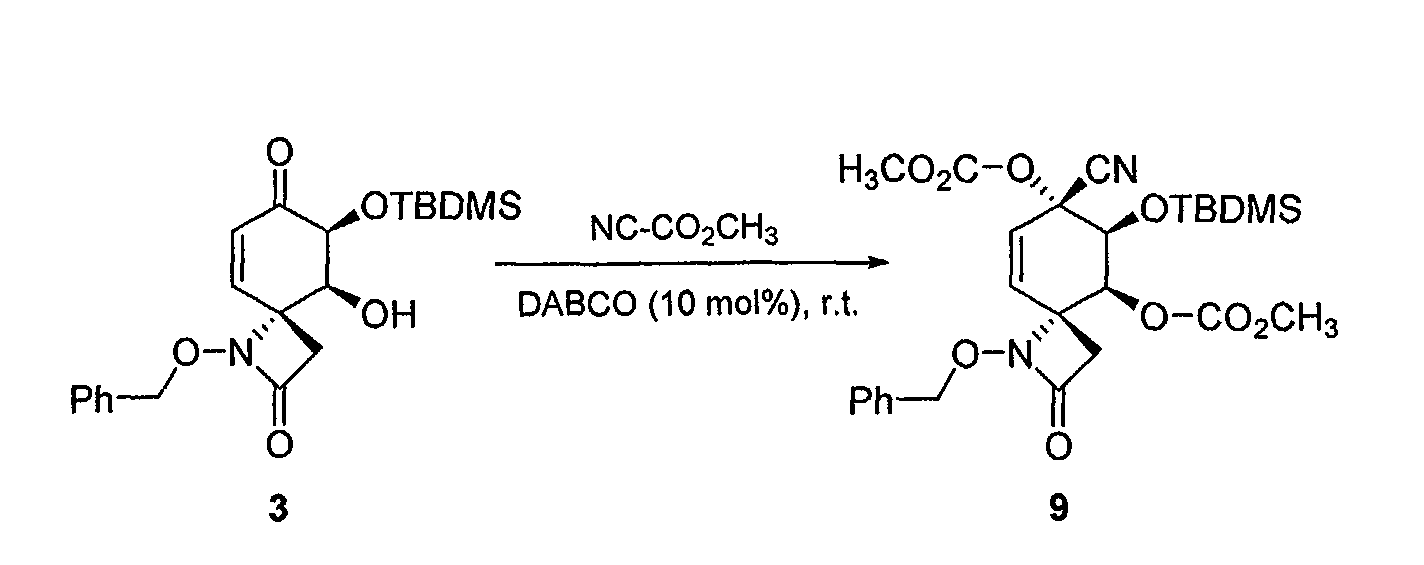
-
-
To a mixture of rac-(4R,5S,6S)-1-benzyloxy-6-tert-butyldimethylsilyloxy-5-hydroxy-1-azaspiro[3.5]nona-8-ene-2,7-dione
(3) (95 mg, 0.235 mmol) and methylcyanoformate (169
µl, 2.115 mmol) was added at room temperature DABCO (3 mg, 0.023 mmol). The
mixture was stirred at room temperature for 14 h and then concentrated under reduced
pressure. The residue was triturated with Et2O, filtered and the solvent was evaporated
under reduced pressure to give rac-(4R,5S,6S,7S)-1-benzyloxy-7-cyano-6-tert-butyldimethylsilyloxy-5,7-bis(methoxycarbonyloxy)-1-azaspiro[3.5]nona-8-ene-2-one
(9)
as a brown oil (110 mg, 86%), was used in the next reaction without further purification.
R f = 0.65 (TLC, hexane-AcOEt, 1:1); yield, 86%; brown oil; 1H-NMR (200MHz, CDCl3):
δ 7.39 (5H, s br., Ph), 5.73 (1H, dd, J = 10.3, 2.0 Hz, H-8 or H-9), 5.46 (1H, d, J = 10.3 Hz,
H-9 or H-8), 5.40 (1H, d, J = 1.8 Hz, H-5 or H-6), 4.95 (1H, part A syst. AB, J = 11.5 Hz,
OCH 2Ph), 4.87 (1H, part B syst. AB, J = 11.5 Hz, OCH 2Ph), 4.77 (1H, dd, J = 2.0, 1.8 Hz,
H-6 or H-5), 3.85 (3H, s, OCH3), 3.84 (3H, s, OCH3), 3.29 (1H, part A syst. AB, J = 14.4
Hz, CH2), 2.44 (1H, part B syst. AB, J = 14.4 Hz, CH2), 0.79 (9H, s, C(CH3)3), 0.07 (3H, s,
SiCH3), 0.04 (3H, s, SiCH3); 13C-NMR (75MHz, CDCl3): δ 165.5, 154.2, 152.9, 135.2,
133.9, 129.4, 129.3, 129.0, 128.9, 123.2, 115.1, 79.1, 72.5, 72.3, 70.9, 63.1, 55.7, 55.5,
41.7, 25.5, 25.1, 17.9, -4.5, -5.5; IR (NaCl, CCl4): 3355, 2958, 2927, 2855, 2233, 1786,
1763, 1442, 1274, 1255, 1155, 1050, 834, 783 cm-1; LRMS(API-ES+): m/z
1115(2M+Na)+, 569(M+Na)+, (M+H)+; LRMS(EI): m/z 546(M+, 2), 489(5), 455(1),
413(3), 337(18), 323(4), 295(17), 216(10), 190(17), 133(16), 91(100).
Example 9:
Preparation of
rac
-(4
R
,5
S
,6
S
,7
S
,8
S
,9
S
)-1-benzyloxy-6-
ter
-butyldimethylsilyloxy-7-cyano-8,9-dihydroxy-5,7-bis(trimethylsilyloxy)-1-azaspiro[3.5]nona-2-one
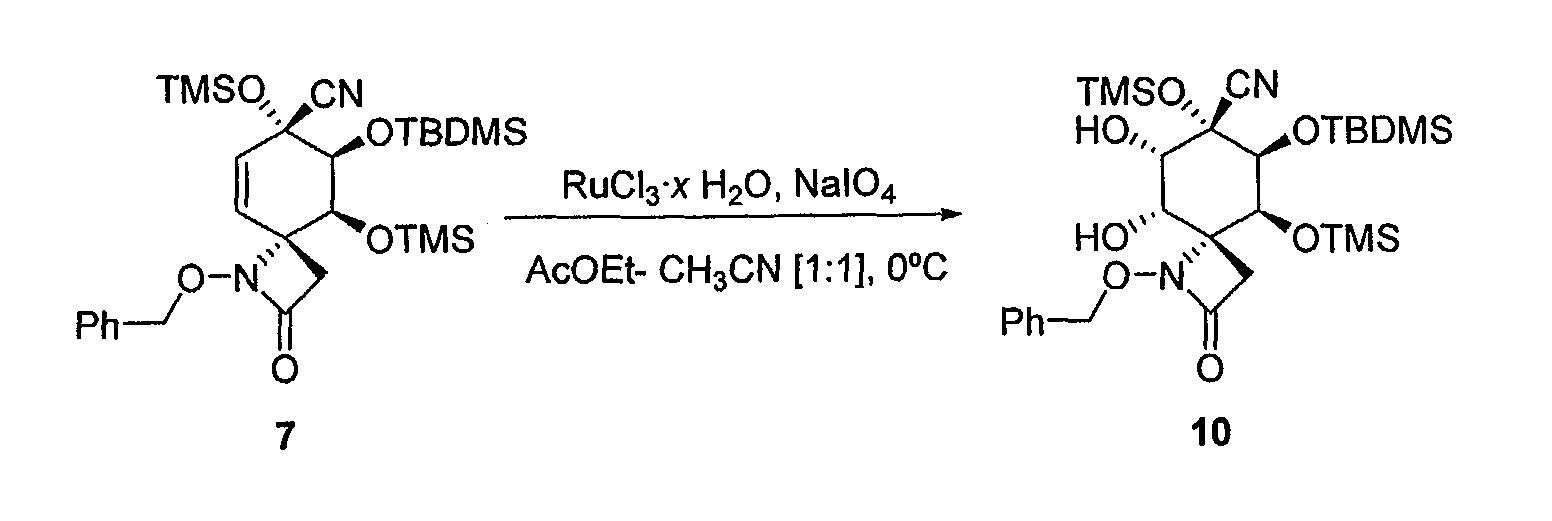
(10).
-
-
To a solution of rac-(4R,5S,6S,7S)-1-benzyloxy-6-tert-butyldimethylsilyloxy-7-cyano-5,7-bis(trimethylsilyloxy)-1-azaspiro[3.5]nona-8-ene-2-one
(7) (100 mg, 0.174 mmol) in
AcOEt (1 ml ) and CH3CN (1 ml) was added at 0 °C with vigorous stirring a solution of
ruthenium (III) chloride hydrate (9 mg, 0.043 mmol) and sodium periodate (71 mg,
0.331mmol) in H2O (0.35 ml). After 5 min the reaction the mixture was quenched with
saturated aqueous sodium hydrogensulfite solution (2ml) and extracted with AcOEt (3 x
2ml). The combinted organic extracts were dried over MgSO4, filtered and concentrated
under reduced pressure. The residue was purified by silica gel column chromatography
(hexane-AcOEt, 5:1) to give rac-(4R,5S,6S,7S,8S,9S)-1-benzyloxy-6-tert-butyldimethylsilyloxy-7-cyano-8,9-dihydroxy-5,7-bis
(trimethylsilyloxy)-1-azaspiro[3.5]
nona-2-one (10) as a white solid (73 mg, 69%).
Rf = 0.33 (TLC, hexane-AcOEt, 3:1); yield, 69%; white solid; 1H-NMR (200MHz,
CDCl3): δ 7.47-7.33 (5H, m, Ph), 5.21 (1H, part A syst. AB, J = 10.1 Hz, OCH 2Ph), 5.02
(1H, part B syst. AB, J = 10.1 Hz, OCH 2Ph), 4.74 (1H , d, J = 2.1 Hz, H-8 or H-7), 4.10
(1H, d, J = 2.1 Hz, H-7 or H-8), 3.92 (1H, m, H-6 or H-5), 3.83 (1H, m, H-5 or H-6), 3.27
(1H, part A syst. AB, J = 14.0 Hz, H-3), 3.27 (1H, s, OH), 2.15 (1H, part B syst. AB, J =
14.0 Hz, H-3), 2.01 (1H, s, OH), 0.86 (9H, s, C(CH3)3), 0.30 (9H, s, Si(CH3)3), 0.14 (3H, s,
SiCH3), 0.13 (9H, s, Si(CH3)3), 0.11 (3H, s, SiCH3); 13C-NMR (50MHz, CDCl3): δ 166.0,
134.9, 128.9, 128.5, 119.3, 97.1, 78.9, 78.7, 74.8, 73.9, 70.9, 68.8, 65.2, 38.6, 26.1, 18.3,
1.8, 0.4, -3.8, -5.0; IR (KBr):v 3434, 3028, 2957, 2927, 2898, 2855, 2152, 1762, 1630,
1253, 1169, 1107, 846, 740 cm-1; LRMS(API-ES+): m/z 1240(2M+Na)+, 631(M+Na)+,
609(M+H)+.
Example 10:
Preparation of
rac
-(4
R
,5
S
,6
S
,7
S
,8
S
,9
S
)-1-benzyloxy-6,8-bis(
tert
-butyldimethylsilyloxy)-7-cyano-9-hydroxy-5,7-bis(trimethylsilyloxy)-1-azaspiro[3.5]nona-2,7-dione
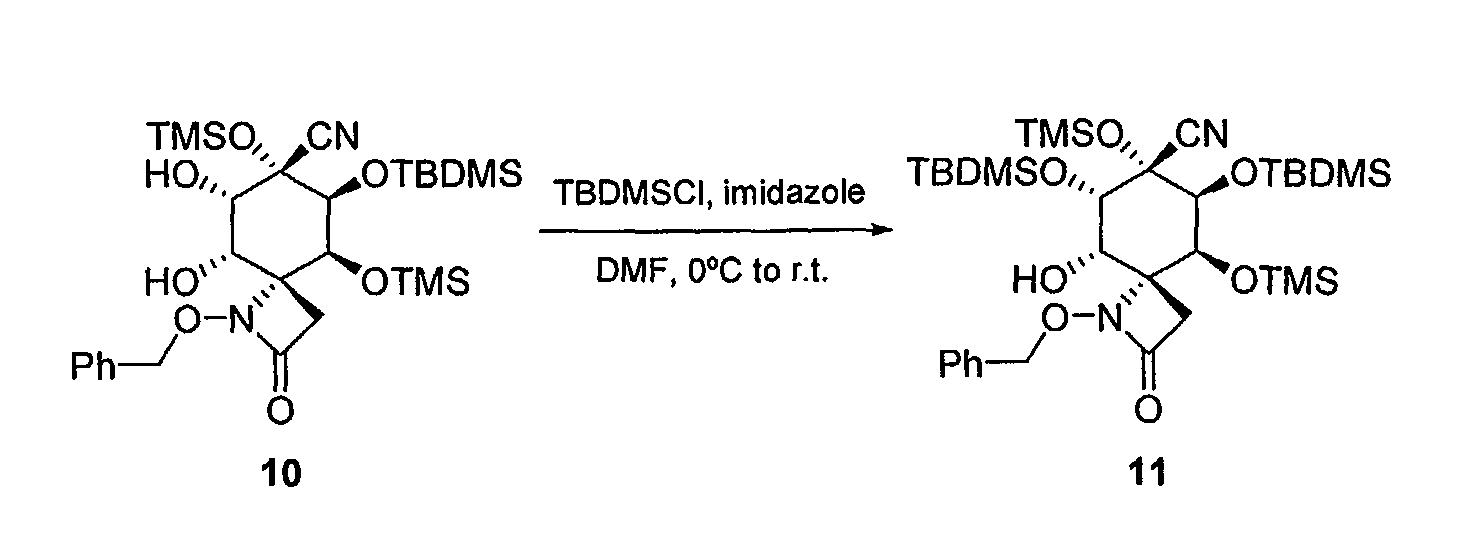
(11)
-
-
To a solution of rac-(4R,5S,6S,7S,8S,9S)-1-benzyloxy-6-tert-butyldimethylsilyloxy-7-cyano-8,9-dihydroxy-5,7-bis(trimethylsilyloxy)-1-azaspiro[3.5]nona-2,7-dione
(10) (63
mg, 0.103 mmol) and imidazole (8 mg, 0.124 mmol) in DMF (0.25 ml) was added at 0 °C a
solution of tert-butyldimethylsilyl chloride (19 mg, 0.124 mmol) in DMF (0.5 ml). After
16 h at room temperature, the reaction was quenched with H2O (2 ml) and the mixture
extracted with AcOEt (3 x 4 ml). The combined extracts were washed with saturated
aqueous CuSO4 solution (2 x 8 ml) and brine (2 x 8 ml), dried over Na2SO4, filtered and
concentrated under reduced pressure. The residue was purified by silica gel column
chromatography (hexane-AcOEt, 5:1) to give rac-(4R,5S,6S,7S,8S,9S)-1-benzyloxy-6,8-bis(tert-butyldimethylsilyloxy)-7-cyano-9-hydroxy-5,7-bis(trimethylsilyloxy)-1-azaspiro[3.5]nona-2,7-dione
(11) as a white solid (37mg, 46%).
R f = 0.60 (TLC, hexane-AcOEt, 3:1); yield, 46%; white solid; 1H-NMR (200MHz,
CO(CD3)2): δ 7.54-7.42 (2H, m, Ph), 7.41-7.29 (3H, m, Ph), 5.26 (1H, part A syst. AB, J =
10.2 Hz, OCH 2Ph), 5.06 (1H, part B syst. AB, J = 10.2 Hz, OCH 2Ph), 4.82 (1H, d, J = 2.4
Hz, H-5), 4.70 (1H, d, J = 2.4 Hz, OH), 4.27 (1H, d, J = 2.4 Hz, H-6), 4.16 (1H, m, H-9),
3.99 (1H, s br., H-8), 3.23 (1H, part A syst. AB, J = 13.7 Hz, CH2), 2.89 (1H, part B syst.
AB, J = 13.7 Hz, CH2), 0.91 (18H, s, C(CH3)3), 0.19 (6H, s, SiCH3), 0.18 (6H, s, SiCH3),
0.11 (18H, s, Si(CH3)3).
Example 11:
General procedure for the preparation of the silylcyanohydrin 12a and 12b from the
spiro β-lactams 1a and 1b, respectively.
-
-
To a mixture of spiro β-lactams 1a-b (0.588 mmol) and trimethylsilyl cyanide (1.763
mmol) at room temperature (cooled with water bath) was slowly added DABCO (10
mol%). The mixture was stirred at room temperature until the disappearance of starting
material by TLC (hexane-AcOEt, 1:1) was observed (the time required was 6 h for 1 a and
24 h for 1b), and then concentrated under reduced pressure. The silylcyanohydrin 12a-b
isolated by procedure could be used without further purification (the purification by silica
gel column chromatography to give mixtures of silylcyanohydrin 12a-b and starting
material 1 a-b).
rac-(4R,7S) and (4R,7R)-1-benzyloxy-7-cyano-1-azaspiro[3.5]nona-5,8-diene-2-one (12a)
R f = 0.64 (TLC, hexane-AcOEt, 1:1); yield, 88%; brown solid; 1H-NMR (200MHz,
CDCl3): δ 7.37 (5H, m Ph), 7.35 (5H, m, Ph), 6.09 (2H, part AA' syst. AA'BB', J5,6 = 10.1
Hz, CH=CHCO), 6.06 (2H, part AA' syst. AA'BB', J5,6 = 10.1 Hz, CH=CHCO), 5.87 (2H,
part BB' syst. AA'BB', J6,5= 10.1 Hz, CH=CHCO), 5.79 (2H, part BB' syst. AA'BB', J6,5=
10.1 Hz, CH=CHCO), 4.89 (2H, s, OCH 2Ph), 4.87 (2H, s, OCH 2Ph), 2.75 (2H, s, CH2),
2.73 (2H, s, CH2), 0.26 (9H, s, Si(CH3)3), 0.19 (9H, s, Si(CH3)3).
rac-(4R,7S) and 4R,7R)-1-methoxy-7-cyano-1-azaspiro[3.5]nona-5,8-diene-2-one (12b)
R f = 0.61 (TLC, hexane-AcOEt, 1:2); yield, 64%; brown solid; 1H-NMR (200MHz,
CDCl3): δ 6.26 (2H, part AA' syst. AA'BB', J5,6 = 10.1 Hz, CH=CHCO), 6.21 (2H, part
AA' syst. AA'BB', J5,6 = 10.1 Hz, CH=CHCO), 6.09 (2H, part BB' syst. AA'BB', J6,5= 10.1
Hz, CH=CHCO), 6.08 (2H, part BB' syst. AA'BB', J6,5= 10.1 Hz, CH=CHCO), 3.76 (6H, s,
OCH3), 2.81 (2H, s, CH2), 2.80 (2H, s, CH2), 0.24 (9H, s, Si(CH3)3), 0.23 (9H, s,
Si(CH3)3).
Example 12:
Preparation of
rac
-(4
R
,5
S
,6
S
)-1-benzyloxy-5,6-dimethylmethylendioxy-1-azaspiro[3.5]nona-8-ene-2,7-dione
(13)
-
-
To a stirred solution of rac-(4R,5S,6S)-1-benzyloxy-5,6-dihydroxy-1-azaspiro[3.5]nona-8-ene-2,7-dione
(2) (109 mg, 0.377 mmol) and 2,2-dimethoxypropane (0.24 ml,
1.885mmol) in dry acetone (0.75 ml) was added at room temperature catalytic amount of
p-TsOH (1% mmol). The resulting mixture was stirred at room temperature for 18 h, then
quenched with saturated aqueous Na2CO3 solution (1 ml) and extracted with AcOEt (3 x 2
ml). The combined organic extracts were washed with brine (3 ml), dried over Na2SO4,
filtered and concentrated under reduced pressure. The residue was purified by silica gel
column chromatography (hexane-AcOEt, 5:2) to give rac-(4R,5S,6S)-1-benzyloxy-5,6-dimethylmethylendioxy-1-azaspiro[3.5]nona-8-ene-2,7-dione
(13) as a solid (52 mg, 42%).
R f = 0.50 (TLC, hexane-AcOEt, 1:1); yield, 42%; solid; 1H-NMR (200MHz, CDCl3): δ
7.50-7.22 (5H, m, Ph), 6.28 (1H, part A syst. AB, J9,8 = 9.9 Hz, H-9), 5.91 (1H, part B syst.
AB, J8,9 = 9.9 Hz, H-8), 4.95 (1H, part A syst. AB, J = 11.4 Hz, OCH 2Ph), 4.85 (1H, part B
syst. AB, J = 11.4 Hz, OCH 2Ph), 4.27 (1H, part A syst. AB, J = 5.1 Hz, H-5 or H-6), 4.11
(1H, part B syst. AB, J = 5.1 Hz, H-6 or H-5), 6.37 (1H, part A syst. AB, J = 15.0 Hz, CH2),
2.79 (1H, part B syst. AB, J = 15.0 Hz, CH2), 1.34 (3H, s, CH3), 1.27 (3H, s, CH3).