EP1598085A1 - Biodegradable and pressure-sensitive material for medical use - Google Patents
Biodegradable and pressure-sensitive material for medical use Download PDFInfo
- Publication number
- EP1598085A1 EP1598085A1 EP04708441A EP04708441A EP1598085A1 EP 1598085 A1 EP1598085 A1 EP 1598085A1 EP 04708441 A EP04708441 A EP 04708441A EP 04708441 A EP04708441 A EP 04708441A EP 1598085 A1 EP1598085 A1 EP 1598085A1
- Authority
- EP
- European Patent Office
- Prior art keywords
- group
- medical material
- component
- bonding
- combination
- Prior art date
- Legal status (The legal status is an assumption and is not a legal conclusion. Google has not performed a legal analysis and makes no representation as to the accuracy of the status listed.)
- Granted
Links
Images
Classifications
-
- A—HUMAN NECESSITIES
- A61—MEDICAL OR VETERINARY SCIENCE; HYGIENE
- A61L—METHODS OR APPARATUS FOR STERILISING MATERIALS OR OBJECTS IN GENERAL; DISINFECTION, STERILISATION OR DEODORISATION OF AIR; CHEMICAL ASPECTS OF BANDAGES, DRESSINGS, ABSORBENT PADS OR SURGICAL ARTICLES; MATERIALS FOR BANDAGES, DRESSINGS, ABSORBENT PADS OR SURGICAL ARTICLES
- A61L24/00—Surgical adhesives or cements; Adhesives for colostomy devices
- A61L24/04—Surgical adhesives or cements; Adhesives for colostomy devices containing macromolecular materials
- A61L24/043—Mixtures of macromolecular materials
-
- A—HUMAN NECESSITIES
- A61—MEDICAL OR VETERINARY SCIENCE; HYGIENE
- A61L—METHODS OR APPARATUS FOR STERILISING MATERIALS OR OBJECTS IN GENERAL; DISINFECTION, STERILISATION OR DEODORISATION OF AIR; CHEMICAL ASPECTS OF BANDAGES, DRESSINGS, ABSORBENT PADS OR SURGICAL ARTICLES; MATERIALS FOR BANDAGES, DRESSINGS, ABSORBENT PADS OR SURGICAL ARTICLES
- A61L24/00—Surgical adhesives or cements; Adhesives for colostomy devices
- A61L24/001—Use of materials characterised by their function or physical properties
- A61L24/0042—Materials resorbable by the body
-
- A—HUMAN NECESSITIES
- A61—MEDICAL OR VETERINARY SCIENCE; HYGIENE
- A61L—METHODS OR APPARATUS FOR STERILISING MATERIALS OR OBJECTS IN GENERAL; DISINFECTION, STERILISATION OR DEODORISATION OF AIR; CHEMICAL ASPECTS OF BANDAGES, DRESSINGS, ABSORBENT PADS OR SURGICAL ARTICLES; MATERIALS FOR BANDAGES, DRESSINGS, ABSORBENT PADS OR SURGICAL ARTICLES
- A61L2430/00—Materials or treatment for tissue regeneration
- A61L2430/36—Materials or treatment for tissue regeneration for embolization or occlusion, e.g. vaso-occlusive compositions or devices
Definitions
- the present invention relates to a novel two-component, bio-degradable/absorbable adhesive medical material comprising a biodegradable polymer serving as a bonding component and a biological low-molecular-weight derivative serving as a hardening component.
- the occlusion/joining of a wound site in the skin, internal organ, blood vessel or the like is one of the most fundamental techniques for use in surgical operations or the like, and generally performed by sutures using a thread in this day and age.
- a technique for quickly occluding/joining a wound site by means of a biologically compatible adhesive having an appropriate tension resistance without using the suture thread has been developed, and biological tissue adhesives, such as fibrin-based adhesives, cyanoacrylate-based adhesives and polyurethane-based adhesives, have been clinically used therein.
- Patent Publication 1 Japanese Patent Laid-Open Publication No. 06-218035
- Patent Publication 2 Japanese Patent Laid-Open Publication No. 07-163860
- Patent Publication 3 Japanese Patent Laid-Open Publication No. 09-103479
- Patent Publication 4 WO 98/54224
- Patent Publication 5 Japanese Patent Laid-Open Publication No. 2000-290633
- Patent Publication 6 Japanese Patent Laid-Open Publication No. 2000-503883 (Patent No. 3238711)
- the present invention is directed to a development of a bio-degradable/absorbable adhesive medical material having high bonding strength between tissues and low biological toxicity, through the use of a hardening component comprising a low-molecular-weight derivative derived from a biological molecule.
- the present invention provides a two-component, bio-degradable/absorbable adhesive medical material comprising a bonding component which consists of a solution containing a biodegradable polymer and either one of an organic solvent, water and a mixture of water and an organic solvent, and a hardening component which consists of a low-molecular-weight derivative prepared by modifying at least one carboxyl group in a di- or tri-carboxylic acid of the citric acid cycle, with an electron-attracting group.
- a bonding component which consists of a solution containing a biodegradable polymer and either one of an organic solvent, water and a mixture of water and an organic solvent
- a hardening component which consists of a low-molecular-weight derivative prepared by modifying at least one carboxyl group in a di- or tri-carboxylic acid of the citric acid cycle, with an electron-attracting group.
- the electron-withdrawing group may be one or a combination of two or more selected from the group consisting of a succinimidyl group, a sulfosuccinimidyl group, a maleimidyl group, a phthalimidyl group, an imidazolyl group, a nitrophenyl group and a tresyl group, and derivatives thereof.
- the biodegradable polymer to be used in the bonding component may be a natural biodegradable polymer which is one or a combination of two or more selected from the group consisting of collagen, atelocollagen, alkali-solubilized collagen, gelatin, keratin, albumin, globulin, fibrinogen, glycosaminoglycan, chitin and chitosan, and derivatives thereof, or may be a synthetic biodegradable polymer which is one or a combination of two or more selected from the group consisting of polyamino acid and polyalcohol, and derivatives thereof.
- the solvent for dissolving the biodegradable polymer may be one or a combination of two or more selected from the group consisting of distilled water, buffer solution and organic solvent.
- the organic solvent may be one or a combination of two or more selected from the group consisting of dimethyl sulfoxide (DMSO), N,N-dimethylformamide (DMF), lactic acid, lactic acid oligomer, polyethylene glycol and polypropylene glycol.
- DMSO dimethyl sulfoxide
- DMF N,N-dimethylformamide
- lactic acid lactic acid oligomer
- polyethylene glycol polypropylene glycol
- a di- or tri-carboxylic acid of the citric acid cycle to be used in the present invention may be malic acid, oxalacetic acid, citric acid, cis-aconitic acid, 2-ketoglutaric acid, or derivatives thereof.
- a biological low-molecular-weight derivative to be used in the present invention is prepared by introducing an active ester into the di- or tri-carboxylic acid of the citric acid cycle through the reaction between the di- or tri-carboxylic acid, and an electron-attracting group, such as one or a combination of two or more selected from the group consisting of a succinimidyl group, a sulfosuccinimidyl group, a maleimidyl group, a phthalimidyl group, an imidazolyl group, a nitrophenyl group and a tresyl group, and derivatives thereof.
- an electron-attracting group such as one or a combination of two or more selected from the group consisting of a succinimidyl group, a sulfosuccinimidyl group, a maleimidyl group, a phthalimidyl group, an imidazolyl group, a nitrophenyl group and a tresyl group
- the biological low-molecular-weight derivative in the present invention may be obtained by adding a molecule serving as an electron-attracting group, such as N-hydroxysuccinimide, to an organic solvent solution of the di- or tri-carboxylic acid of the citric acid cycle, under the presence of a condensing agent, such as 1-ethyl-3-(3-dimethylaminopropyl)carbodiimide, and purifying an obtained product by silica-gel column chromatography.
- a condensing agent such as 1-ethyl-3-(3-dimethylaminopropyl)carbodiimide
- a biodegradable polymer to be used in the present invention may be a natural biodegradable polymer, such as one or a combination of two or more selected from the group consisting of collagen (which may be either one of several ten types), atelocollagen (which may be either one of several ten types), alkali-solubilized collagen (which may be either one of several ten types), gelatin, keratin, albumin, globulin, fibrinogen, glycosaminoglycan, chitin and chitosan (which may have any degree of deacetylation or any molecular weight), and derivatives thereof.
- the protein may be derived from any suitable source organism.
- the biodegradable polymer to be used in the present invention may also be a synthetic biodegradable polymer, such as one or a combination of two or more selected from the group consisting of polyamino acid (which may be any type of amino acid or may have any molecular weight) and polyalcohol (which may be any type or may have any molecular weight), and derivatives thereof, each of which has a functional group reactable with a biological low-molecular-weight molecule modified with as an electron-withdrawing group.
- polyamino acid which may be any type of amino acid or may have any molecular weight
- polyalcohol which may be any type or may have any molecular weight
- the glycosaminoglycan may be one or a combination of two or more selected from the group consisting of chondroitin sulfate, dermatan sulfate, hyaluronic acid, heparan sulfate, heparin and keratan sulfate, and derivatives thereof.
- Each of the glycosaminoglycans may have any molecular weight or may be derived from any suitable source organism.
- the hardening component may be set at 0.01 to 1000 mM with respect to 0.01 to 80 weight% of the bonding component in the solvent, such as organic solvent, distilled water or buffer solution. More preferably, the bonding component in the solvent is set in the range of 10 to 60 weight%. Further, the hardening component is set more preferably in the range of about 10 to 200 mM with respect to the bonding component.
- the reaction between the bonding and hardening components is induced preferably at 0 to 100°C, more preferably at 4 to 60°C.
- each of the bonding and hardening components is prepared as a solution having an appropriate concentration, and then they are mixed together to induce a homogenous reaction therebetween.
- the solvent for forming the bonding-component solution or the hardening-component solution may include a buffer solution, such as physiological salt solution, sodium hydrogen carbonate, boric acid and phosphoric acid, as well as distilled water.
- a buffer solution such as physiological salt solution, sodium hydrogen carbonate, boric acid and phosphoric acid, as well as distilled water.
- the solvent may also be an organic solvent, such as one or a combination of two or more selected from the group consisting of dimethyl sulfoxide (DMSO), N,N-dimethylformamide (DMF), lactic acid, lactic acid oligomer and polyethylene glycol. Further, a mixed solvent prepared by mixing distilled water and organic solvent at an appropriate ratio may be used.
- DMSO dimethyl sulfoxide
- DMF N,N-dimethylformamide
- lactic acid lactic acid oligomer
- polyethylene glycol polyethylene glycol
- bio-degradable/absorbable adhesive medical material may be used as a biological tissue adhesive for bonding between soft tissues, such as skin tissue-to-skin tissue, bonding between hard tissues, such as bone tissue-to-bone tissue, and bonding between hard and soft tissues, such as bone tissue-to-cartilage tissue.
- This medical material may also be used as a hemostatic material, a blood-vessel embolizing material, a sealant or an aneurysm closing material.
- the bio-degradable/ absorbable adhesive medical material of the present invention exhibits characteristics of being degraded in the body and then absorbed/vanished after a lapse of a given time-period, and thereby will never remain in the body as a foreign material.
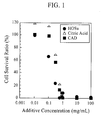
- a cytotoxicity test was carried out in the following manner.
- a biological low-molecular-weight derivative (CAD) was synthesized by modifying three carboxyl groups of a citric acid with N-hydroxysuccinimide (HOSu), and a cytotoxicity test was performed using L929 cells and the synthesized CAD. The number of cells in a sample added with no CAD was defined as 100%. The CAD exhibited extremely low toxicity as with citric acid and HOSu.
- Alkali-solubilized collagen (AlCol) was used as the biodegradable polymer.
- CAD solution containing 100 mM of commercially available CAD dissolved therein was added to 200 ⁇ L of DMSO solution containing 50 weight% of alkali-solubilized collagen (AlCol). The mixture was stirred at 25°C for several second to prepare a mixed solution.
- a bonding test on Inventive Examples 1 to 4 was carried out using a commercially available ham.
- a tissue bonding test was performed in the following manner. Each of the prepared mixed solutions was applied onto a prepared ham (thickness: 2 mm, width: 2 cm, length: 6 cm) in an area of 2 ⁇ 2 cm 2 , and a piece of ham having the same size was superimposed on the bonding surface. Further, 50 g of weight was loaded on the bonding surface, and the hams were left at 37°C for 12 hours.
- a bonding strength was measured by a tension tester (TA-XT 2i, available from Eko Instruments Co., Ltd., Japan). The measurement was performed at 25°C and a measurement speed of 5 mm/s.
- a and B liquids of fibrin paste (Beriplast P®, available from Hoechst AG, Germany) were mixed to prepare a biological tissue adhesive. 0.20 g of this biological tissue adhesive was applied onto a prepared ham (thickness: 2 mm, width: 2 cm, length: 6 cm) in an area of 2 ⁇ 2 cm 2 , and a piece of ham having the same size was superimposed on the bonding surface. Further, 50 g of weight was loaded on the bonding surface, and the hams were left at 37°C for 12 hours.
- Gelatin paste (GRF-glue®, available from E. H. S., France) consisting of two liquids of a gelatin-resorcinol solution and a formaldehyde-glutaraldehyde solution was used as the biological tissue adhesive. 0.20 g of the gelatin-resorcinol solution was applied onto a prepared ham (thickness: 2 mm, width: 2 cm, length: 6 cm) in an area of 2 ⁇ 2 cm 2 , and a piece of ham having the same size was superimposed on the bonding surface. Further, 50 g of weight was loaded on the bonding surface, and the hams were left at 37°C for 12 hours.
- GRF-glue® available from E. H. S., France
- 2-octyl cyanoacrylate (DERMABOND®, available from ETHICON. Inc., U.S.A.) was used. 0.25 g of this biological tissue adhesive was applied onto a prepared ham (thickness: 2 mm, width: 2 cm, length: 6 cm) in an area of 2 ⁇ 2 cm 2 , and a piece of ham having the same size was superimposed on the bonding surface. Further, 50 g of weight was loaded on the bonding surface, and the hams were left at 37°C for 12 hours.
- a bonding strength of each biological tissue adhesive in Comparative Examples 1 to 3 was measured by a tension tester (TA-XT 2i, available from Eko Instruments Co., Ltd., Japan). The measurement was performed at 25°C and a measurement speed of 5 mm/s.
- the test result on Comparative Examples 1 to 3 and the test result on Inventive Example 4 having the best bonding condition (AlCol concentration: 50 wt%, CAD concentration: 100 mM) are shown in Table 2.
- Adhesive Bonding Strength (kPa) Inventive Example 4 15.8 Comparative Example 1 0.7 Comparative Example 2 15.2 Comparative Example 3 25.8
- the present invention provides a low-toxic bio-degradable/absorbable adhesive medical material usable as a medical material to be crosslinked extemporarily on the site of medical procedures, such as a hemostatic material, a blood-vessel embolizing material, a sealant or an aneurysm closing material, as well as a biological tissue adhesive.
- This bio-degradable/ absorbable adhesive medical material has no need for taking account of toxicity in use, and can be handled in a significantly simple manner.
Landscapes
- Health & Medical Sciences (AREA)
- Surgery (AREA)
- Epidemiology (AREA)
- Life Sciences & Earth Sciences (AREA)
- Animal Behavior & Ethology (AREA)
- General Health & Medical Sciences (AREA)
- Public Health (AREA)
- Veterinary Medicine (AREA)
- Chemical & Material Sciences (AREA)
- Engineering & Computer Science (AREA)
- Materials Engineering (AREA)
- Materials For Medical Uses (AREA)
Abstract
Description
Patent Publication 1: Japanese Patent Laid-Open Publication No. 06-218035
Patent Publication 2: Japanese Patent Laid-Open Publication No. 07-163860
Patent Publication 3: Japanese Patent Laid-Open Publication No. 09-103479
Patent Publication 4: WO 98/54224
Patent Publication 5: Japanese Patent Laid-Open Publication No. 2000-290633
Patent Publication 6: Japanese Patent Laid-Open Publication No. 2000-503883 (Patent No. 3238711)
| Bonding Conditions | Bonding Strength (kPa) | |
| Inventive Example 1 | 30 wt% of AlCol + | 13.1 |
| Inventive Example 2 | 30 wt% of AlCol + CAD 50 mM | 6.2 |
| Inventive Example 3 | 30 wt% of AlCol + CAD 30 mM | 3.3 |
| Inventive Example 4 | 50 wt% of AlCol + | 19.9 |
| Adhesive | Bonding Strength (kPa) |
| Inventive Example 4 | 15.8 |
| Comparative Example 1 | 0.7 |
| Comparative Example 2 | 15.2 |
| Comparative Example 3 | 25.8 |
Claims (6)
- A two-component, bio-degradable/absorbable adhesive medical material comprising:a bonding component consisting of a solution containing a biodegradable polymer and either one of an organic solvent, water and a mixture of water and an organic solvent; anda hardening component consisting of a low-molecular-weight derivative prepared by modifying at least one carboxyl group in a di- or tri-carboxylic acid of the citric acid cycle, with an electron-withdrawing group.
- The medical material as defined in claim 1, wherein said electron-attracting group is one or a combination of two or more selected from the group consisting of a succinimidyl group, a sulfosuccinimidyl group, a maleimidyl group, a phthalimidyl group, an imidazolyl group, a nitrophenyl group and a tresyl group, and derivatives thereof.
- The medical material as defined in claim 1, wherein said biodegradable polymer is one or a combination of two or more selected from the group consisting of collagen, atelocollagen, alkali-solubilized collagen, gelatin, keratin, albumin, globulin, fibrinogen, glycosaminoglycan, chitin, chitosan, polyamino acid and polyalcohol, and derivatives thereof.
- The medical material as defined in claim 1, wherein said organic solvent is one or a combination of two or more selected from the group consisting of dimethyl sulfoxide (DMSO), N,N-dimethylformamide (DMF), lactic acid, lactic acid oligomer, polyethylene glycol and polypropylene glycol.
- A biological tissue adhesive for bonding between a soft tissue and a soft tissue, between a soft tissue and a hard tissue or between a hard tissue and a hard tissue, comprising the medical material as defined in either one of claims 1 to 4.
- An intravascular material consisting of either one of a hemostatic material, a blood-vessel embolizing material, a sealant and an aneurysm closing material, comprising the medical material as defined in either one of claims 1 to 4.
Applications Claiming Priority (3)
| Application Number | Priority Date | Filing Date | Title |
|---|---|---|---|
| JP2003035710A JP4585743B2 (en) | 2003-02-13 | 2003-02-13 | Biodegradable absorbable adhesive medical material |
| JP2003035710 | 2003-02-13 | ||
| PCT/JP2004/001194 WO2004071544A1 (en) | 2003-02-13 | 2004-02-05 | Biodegradable and pressure-sensitive material for medical use |
Publications (3)
| Publication Number | Publication Date |
|---|---|
| EP1598085A1 true EP1598085A1 (en) | 2005-11-23 |
| EP1598085A4 EP1598085A4 (en) | 2006-04-12 |
| EP1598085B1 EP1598085B1 (en) | 2009-11-04 |
Family
ID=32866305
Family Applications (1)
| Application Number | Title | Priority Date | Filing Date |
|---|---|---|---|
| EP04708441A Expired - Lifetime EP1598085B1 (en) | 2003-02-13 | 2004-02-05 | Biodegradable and pressure-sensitive material for medical use |
Country Status (7)
| Country | Link |
|---|---|
| US (1) | US20060239958A1 (en) |
| EP (1) | EP1598085B1 (en) |
| JP (1) | JP4585743B2 (en) |
| CN (1) | CN100339136C (en) |
| CA (1) | CA2513194C (en) |
| DE (1) | DE602004023919D1 (en) |
| WO (1) | WO2004071544A1 (en) |
Families Citing this family (16)
| Publication number | Priority date | Publication date | Assignee | Title |
|---|---|---|---|---|
| JP4912565B2 (en) * | 2003-12-15 | 2012-04-11 | 独立行政法人物質・材料研究機構 | Biodegradable absorbable adhesive medical material |
| JP2006051121A (en) * | 2004-08-10 | 2006-02-23 | National Institute For Materials Science | Biodegradable absorbable adhesive medical material composed of albumin and low molecular weight biological derivatives |
| JP2006052158A (en) * | 2004-08-10 | 2006-02-23 | National Institute For Materials Science | Biological low molecular weight derivatives, cross-linked products and biodegradable absorbable adhesive medical materials |
| JPWO2006016600A1 (en) * | 2004-08-10 | 2008-07-31 | 独立行政法人物質・材料研究機構 | Tartaric acid derivative and cross-linked polymer synthesized by the derivative |
| JP4844806B2 (en) * | 2005-06-14 | 2011-12-28 | 独立行政法人物質・材料研究機構 | Solid-liquid mixed type two-component biodegradable absorbable adhesive medical material |
| JP5173199B2 (en) * | 2006-01-16 | 2013-03-27 | 株式会社アイ・ティー・オー | Wound healing polymer composition |
| US8246992B2 (en) | 2007-11-01 | 2012-08-21 | Osaka City University | β-1,3-glucan-derived polyaldehyde/polyamine hydrogel |
| EP2231210A4 (en) * | 2007-12-12 | 2013-01-23 | Warsaw Orthopedic Inc | Bone/collagen composites and uses thereof |
| WO2010005513A2 (en) | 2008-06-30 | 2010-01-14 | The Texas A&M University System | Crystal structure of staphylococcus aureus clumping factor a in complex with fibrinogen derived peptide and uses thereof |
| US9408683B2 (en) | 2009-05-27 | 2016-08-09 | Parapatch, Inc. | Method and device for treating female pelvic nerve dysfunction |
| US20110171285A1 (en) * | 2009-10-28 | 2011-07-14 | The Texas A&M University System | Design of Fibrinogen and Fibrinogen Derived Products with Reduced Bacterial Binding by Using Modified Sequences of Fibrinogen Chains |
| CN103223190B (en) * | 2013-04-26 | 2014-05-28 | 天津大学 | Epsilon-polylysine-DOHA in-situ gel adhesive material and preparation method thereof |
| JP2017006472A (en) * | 2015-06-24 | 2017-01-12 | 株式会社 京都医療設計 | Embolic material for vascular channel |
| JP7012950B2 (en) | 2016-11-17 | 2022-01-31 | 地方独立行政法人東京都立産業技術研究センター | Sol for closing biological tissue holes, protecting ulcers and treating vascular embolism |
| CN109646709A (en) * | 2019-01-29 | 2019-04-19 | 青岛中腾生物技术有限公司 | A kind of medical hemostatic closed material of degradable absorption |
| EP3957338A1 (en) | 2020-08-20 | 2022-02-23 | Aobakasei Kabushiki Kaisha | Liquid medical material |
Family Cites Families (19)
| Publication number | Priority date | Publication date | Assignee | Title |
|---|---|---|---|---|
| DE3248188A1 (en) | 1982-12-27 | 1984-06-28 | Behringwerke Ag, 3550 Marburg | METHOD FOR PRODUCING A COLLAGEN FLEECE |
| JPS6169759A (en) * | 1984-09-14 | 1986-04-10 | Agency Of Ind Science & Technol | Modifying agent for crosslinking reaction of protein, and method for using same |
| US5936035A (en) * | 1988-11-21 | 1999-08-10 | Cohesion Technologies, Inc. | Biocompatible adhesive compositions |
| CN1091315A (en) * | 1992-10-08 | 1994-08-31 | E·R·斯奎布父子公司 | Fibrin sealant compositions and methods of use thereof |
| JPH06218035A (en) | 1993-01-28 | 1994-08-09 | Mitsubishi Rayon Co Ltd | Biomedical adhesive |
| JP2544075B2 (en) * | 1993-04-12 | 1996-10-16 | 新田ゼラチン株式会社 | Method for producing cured body for medical and dental treatment |
| JP3569311B2 (en) | 1993-10-22 | 2004-09-22 | ユニチカ株式会社 | Gelatin gel, its production method and its use |
| US5583114A (en) * | 1994-07-27 | 1996-12-10 | Minnesota Mining And Manufacturing Company | Adhesive sealant composition |
| US5634936A (en) * | 1995-02-06 | 1997-06-03 | Scimed Life Systems, Inc. | Device for closing a septal defect |
| JP3850905B2 (en) * | 1995-10-13 | 2006-11-29 | グンゼ株式会社 | Medical materials and manufacturing method thereof |
| WO1997022371A1 (en) * | 1995-12-18 | 1997-06-26 | Collagen Corporation | Crosslinked polymer compositions and methods for their use |
| JPH09296039A (en) * | 1996-05-02 | 1997-11-18 | Eiweiss Kk | Activated poly-L-glutamic acid, hemostatic / medical adhesive kit using the same, and method of using the kit |
| FR2754268B1 (en) * | 1996-10-07 | 1998-12-24 | Dev Des Utilisations Du Collag | ADHESIVE COMPOSITION BASED ON MACROMOLECULAR POLYALDEHYDE AND METHOD FOR CROSSLINKING COLLAGEN OR GELATIN |
| CA2291488A1 (en) | 1997-05-28 | 1998-12-03 | Yasuhiko Shimizu | Collagen gel |
| JP2000290633A (en) * | 1999-04-07 | 2000-10-17 | Toyobo Co Ltd | Adhesive for organism tissue |
| US6312725B1 (en) * | 1999-04-16 | 2001-11-06 | Cohesion Technologies, Inc. | Rapid gelling biocompatible polymer composition |
| ES2383122T3 (en) * | 1999-08-27 | 2012-06-18 | Angiodevice International Gmbh | Biocompatible Polymer Device |
| KR100339496B1 (en) * | 2000-04-17 | 2002-06-05 | 텍산메드테크(주) | Chitosan fiber non-woven fabric and preparation thereof |
| JP5156890B2 (en) * | 2002-09-11 | 2013-03-06 | 独立行政法人物質・材料研究機構 | Crosslinked polymer and method for producing the same |
-
2003
- 2003-02-13 JP JP2003035710A patent/JP4585743B2/en not_active Expired - Fee Related
-
2004
- 2004-02-05 WO PCT/JP2004/001194 patent/WO2004071544A1/en not_active Ceased
- 2004-02-05 DE DE602004023919T patent/DE602004023919D1/en not_active Expired - Lifetime
- 2004-02-05 EP EP04708441A patent/EP1598085B1/en not_active Expired - Lifetime
- 2004-02-05 CA CA2513194A patent/CA2513194C/en not_active Expired - Fee Related
- 2004-02-05 CN CNB2004800019591A patent/CN100339136C/en not_active Expired - Fee Related
- 2004-02-05 US US10/543,156 patent/US20060239958A1/en not_active Abandoned
Also Published As
| Publication number | Publication date |
|---|---|
| EP1598085A4 (en) | 2006-04-12 |
| WO2004071544A1 (en) | 2004-08-26 |
| CA2513194C (en) | 2012-10-30 |
| JP4585743B2 (en) | 2010-11-24 |
| CN1723046A (en) | 2006-01-18 |
| JP2004261222A (en) | 2004-09-24 |
| CN100339136C (en) | 2007-09-26 |
| DE602004023919D1 (en) | 2009-12-17 |
| EP1598085B1 (en) | 2009-11-04 |
| CA2513194A1 (en) | 2004-08-26 |
| US20060239958A1 (en) | 2006-10-26 |
Similar Documents
| Publication | Publication Date | Title |
|---|---|---|
| Jain et al. | Recent developments and clinical applications of surgical glues: An overview | |
| CA2513194C (en) | Biodegradable/absorbable adhesive medical material | |
| Sanders et al. | Clinical applications of surgical adhesives and sealants | |
| Annabi et al. | Elastic sealants for surgical applications | |
| CN106390185A (en) | Preparation method of biological mimetic tissue adhesive | |
| JP3412039B2 (en) | Surgical adhesive composition | |
| EP4545107A1 (en) | Peg two-component self-adhesive absorbable biological mesh, method for preparing same, and use thereof | |
| Qiu et al. | Bioadhesives in neurosurgery: a review | |
| Peng et al. | Novel wound sealants: Biomaterials and applications | |
| MX2008009752A (en) | Tissue-adhesive materials. | |
| AU2011202184B2 (en) | Tissue adhesives and sealants and method for their use | |
| AU2007215382B2 (en) | Joining and/or sealing tissues through photo-activated cross-linking of matrix proteins | |
| EP4450095A1 (en) | Medical tissue adhesive, and preparation method therefor and use thereof | |
| US20090028957A1 (en) | Implantable Tissue-Reactive Biomaterial Compositions and Systems, and Methods of Us Thereof | |
| WO2018079538A1 (en) | Hemostatic material | |
| CA3165244A1 (en) | Biocompatible adhesives and methods of manufacture thereof | |
| Suzuki et al. | Biomaterials for surgical operation | |
| US20110040323A1 (en) | Combination for an adhesive bonding of biological tissues | |
| Bhatia | Traumatic injuries | |
| JP4912565B2 (en) | Biodegradable absorbable adhesive medical material | |
| JP2006051121A (en) | Biodegradable absorbable adhesive medical material composed of albumin and low molecular weight biological derivatives | |
| AU2012244256B2 (en) | Novel drug delivery devices | |
| US20220168398A1 (en) | Hemostatic agent and container containing the same | |
| JP4844806B2 (en) | Solid-liquid mixed type two-component biodegradable absorbable adhesive medical material | |
| RU2443435C2 (en) | Tissues adhesives |
Legal Events
| Date | Code | Title | Description |
|---|---|---|---|
| PUAI | Public reference made under article 153(3) epc to a published international application that has entered the european phase |
Free format text: ORIGINAL CODE: 0009012 |
|
| 17P | Request for examination filed |
Effective date: 20050902 |
|
| AK | Designated contracting states |
Kind code of ref document: A1 Designated state(s): AT BE BG CH CY CZ DE DK EE ES FI FR GB GR HU IE IT LI LU MC NL PT RO SE SI SK TR |
|
| AX | Request for extension of the european patent |
Extension state: AL LT LV MK |
|
| A4 | Supplementary search report drawn up and despatched |
Effective date: 20060228 |
|
| DAX | Request for extension of the european patent (deleted) | ||
| RBV | Designated contracting states (corrected) |
Designated state(s): DE FR GB IT |
|
| 17Q | First examination report despatched |
Effective date: 20060811 |
|
| 17Q | First examination report despatched |
Effective date: 20060811 |
|
| GRAP | Despatch of communication of intention to grant a patent |
Free format text: ORIGINAL CODE: EPIDOSNIGR1 |
|
| RIC1 | Information provided on ipc code assigned before grant |
Ipc: A61L 24/04 20060101AFI20090512BHEP |
|
| GRAS | Grant fee paid |
Free format text: ORIGINAL CODE: EPIDOSNIGR3 |
|
| GRAA | (expected) grant |
Free format text: ORIGINAL CODE: 0009210 |
|
| AK | Designated contracting states |
Kind code of ref document: B1 Designated state(s): DE FR GB IT |
|
| REG | Reference to a national code |
Ref country code: GB Ref legal event code: FG4D |
|
| REF | Corresponds to: |
Ref document number: 602004023919 Country of ref document: DE Date of ref document: 20091217 Kind code of ref document: P |
|
| PLBE | No opposition filed within time limit |
Free format text: ORIGINAL CODE: 0009261 |
|
| STAA | Information on the status of an ep patent application or granted ep patent |
Free format text: STATUS: NO OPPOSITION FILED WITHIN TIME LIMIT |
|
| 26N | No opposition filed |
Effective date: 20100805 |
|
| REG | Reference to a national code |
Ref country code: FR Ref legal event code: PLFP Year of fee payment: 12 |
|
| PGFP | Annual fee paid to national office [announced via postgrant information from national office to epo] |
Ref country code: DE Payment date: 20150219 Year of fee payment: 12 Ref country code: IT Payment date: 20150225 Year of fee payment: 12 |
|
| PGFP | Annual fee paid to national office [announced via postgrant information from national office to epo] |
Ref country code: FR Payment date: 20150219 Year of fee payment: 12 Ref country code: GB Payment date: 20150218 Year of fee payment: 12 |
|
| REG | Reference to a national code |
Ref country code: DE Ref legal event code: R119 Ref document number: 602004023919 Country of ref document: DE |
|
| GBPC | Gb: european patent ceased through non-payment of renewal fee |
Effective date: 20160205 |
|
| REG | Reference to a national code |
Ref country code: FR Ref legal event code: ST Effective date: 20161028 |
|
| PG25 | Lapsed in a contracting state [announced via postgrant information from national office to epo] |
Ref country code: IT Free format text: LAPSE BECAUSE OF NON-PAYMENT OF DUE FEES Effective date: 20160205 |
|
| PG25 | Lapsed in a contracting state [announced via postgrant information from national office to epo] |
Ref country code: DE Free format text: LAPSE BECAUSE OF NON-PAYMENT OF DUE FEES Effective date: 20160901 Ref country code: GB Free format text: LAPSE BECAUSE OF NON-PAYMENT OF DUE FEES Effective date: 20160205 Ref country code: FR Free format text: LAPSE BECAUSE OF NON-PAYMENT OF DUE FEES Effective date: 20160229 |