EP1597269B1 - A method of generating metal chelating affinity ligands - Google Patents
A method of generating metal chelating affinity ligands Download PDFInfo
- Publication number
- EP1597269B1 EP1597269B1 EP03816091A EP03816091A EP1597269B1 EP 1597269 B1 EP1597269 B1 EP 1597269B1 EP 03816091 A EP03816091 A EP 03816091A EP 03816091 A EP03816091 A EP 03816091A EP 1597269 B1 EP1597269 B1 EP 1597269B1
- Authority
- EP
- European Patent Office
- Prior art keywords
- metal chelating
- scaffold
- derivatisation
- base matrix
- ligand
- Prior art date
- Legal status (The legal status is an assumption and is not a legal conclusion. Google has not performed a legal analysis and makes no representation as to the accuracy of the status listed.)
- Expired - Lifetime
Links
- 239000003446 ligand Substances 0.000 title claims abstract description 74
- 238000000034 method Methods 0.000 title claims abstract description 72
- 229910052751 metal Inorganic materials 0.000 title claims abstract description 64
- 239000002184 metal Substances 0.000 title claims abstract description 64
- 239000011159 matrix material Substances 0.000 claims description 39
- 238000000926 separation method Methods 0.000 claims description 29
- 238000001212 derivatisation Methods 0.000 claims description 26
- 239000003795 chemical substances by application Substances 0.000 claims description 13
- 238000007142 ring opening reaction Methods 0.000 claims description 9
- 125000003903 2-propenyl group Chemical group [H]C([*])([H])C([H])=C([H])[H] 0.000 claims description 8
- 230000007062 hydrolysis Effects 0.000 claims description 8
- 238000006460 hydrolysis reaction Methods 0.000 claims description 8
- STMDPCBYJCIZOD-UHFFFAOYSA-N 2-(2,4-dinitroanilino)-4-methylpentanoic acid Chemical compound CC(C)CC(C(O)=O)NC1=CC=C([N+]([O-])=O)C=C1[N+]([O-])=O STMDPCBYJCIZOD-UHFFFAOYSA-N 0.000 claims description 7
- KIWQWJKWBHZMDT-UHFFFAOYSA-N homocysteine thiolactone Chemical compound NC1CCSC1=O KIWQWJKWBHZMDT-UHFFFAOYSA-N 0.000 claims description 7
- NINIDFKCEFEMDL-UHFFFAOYSA-N Sulfur Chemical compound [S] NINIDFKCEFEMDL-UHFFFAOYSA-N 0.000 claims description 6
- 239000005864 Sulphur Substances 0.000 claims description 6
- 125000004432 carbon atom Chemical group C* 0.000 claims description 4
- 125000002915 carbonyl group Chemical group [*:2]C([*:1])=O 0.000 claims description 4
- 125000005842 heteroatom Chemical group 0.000 claims description 4
- 230000000269 nucleophilic effect Effects 0.000 claims description 4
- 125000004122 cyclic group Chemical group 0.000 claims description 3
- 150000002148 esters Chemical class 0.000 claims description 3
- 230000031709 bromination Effects 0.000 claims description 2
- 238000005893 bromination reaction Methods 0.000 claims description 2
- PQJJJMRNHATNKG-UHFFFAOYSA-N ethyl bromoacetate Chemical group CCOC(=O)CBr PQJJJMRNHATNKG-UHFFFAOYSA-N 0.000 claims description 2
- 239000012038 nucleophile Substances 0.000 claims description 2
- 125000003396 thiol group Chemical group [H]S* 0.000 claims 3
- 230000003213 activating effect Effects 0.000 claims 1
- 230000004913 activation Effects 0.000 claims 1
- 238000005937 allylation reaction Methods 0.000 claims 1
- 239000002585 base Substances 0.000 description 34
- PXHVJJICTQNCMI-UHFFFAOYSA-N nickel Substances [Ni] PXHVJJICTQNCMI-UHFFFAOYSA-N 0.000 description 33
- 239000002609 medium Substances 0.000 description 31
- 239000000499 gel Substances 0.000 description 21
- RAXXELZNTBOGNW-UHFFFAOYSA-N imidazole Natural products C1=CNC=N1 RAXXELZNTBOGNW-UHFFFAOYSA-N 0.000 description 21
- 238000001597 immobilized metal affinity chromatography Methods 0.000 description 21
- HEMHJVSKTPXQMS-UHFFFAOYSA-M Sodium hydroxide Chemical compound [OH-].[Na+] HEMHJVSKTPXQMS-UHFFFAOYSA-M 0.000 description 18
- 229910052759 nickel Inorganic materials 0.000 description 15
- 239000000047 product Substances 0.000 description 15
- 238000010168 coupling process Methods 0.000 description 13
- 230000008878 coupling Effects 0.000 description 12
- 238000005859 coupling reaction Methods 0.000 description 12
- 238000004587 chromatography analysis Methods 0.000 description 11
- 108090000623 proteins and genes Proteins 0.000 description 11
- 102000004169 proteins and genes Human genes 0.000 description 11
- 238000000746 purification Methods 0.000 description 11
- XLYOFNOQVPJJNP-UHFFFAOYSA-N water Chemical compound O XLYOFNOQVPJJNP-UHFFFAOYSA-N 0.000 description 11
- -1 and accordingly Substances 0.000 description 10
- 229910021645 metal ion Inorganic materials 0.000 description 10
- XEKOWRVHYACXOJ-UHFFFAOYSA-N Ethyl acetate Chemical compound CCOC(C)=O XEKOWRVHYACXOJ-UHFFFAOYSA-N 0.000 description 9
- YXFVVABEGXRONW-UHFFFAOYSA-N Toluene Chemical compound CC1=CC=CC=C1 YXFVVABEGXRONW-UHFFFAOYSA-N 0.000 description 9
- 239000002253 acid Substances 0.000 description 9
- 235000018102 proteins Nutrition 0.000 description 9
- 239000013076 target substance Substances 0.000 description 9
- FAPWRFPIFSIZLT-UHFFFAOYSA-M Sodium chloride Chemical compound [Na+].[Cl-] FAPWRFPIFSIZLT-UHFFFAOYSA-M 0.000 description 8
- 238000010511 deprotection reaction Methods 0.000 description 8
- 238000004895 liquid chromatography mass spectrometry Methods 0.000 description 8
- 239000000523 sample Substances 0.000 description 8
- 239000007787 solid Substances 0.000 description 8
- 239000000243 solution Substances 0.000 description 8
- 238000012360 testing method Methods 0.000 description 8
- ZMXDDKWLCZADIW-UHFFFAOYSA-N N,N-Dimethylformamide Chemical compound CN(C)C=O ZMXDDKWLCZADIW-UHFFFAOYSA-N 0.000 description 7
- VEQPNABPJHWNSG-UHFFFAOYSA-N Nickel(2+) Chemical compound [Ni+2] VEQPNABPJHWNSG-UHFFFAOYSA-N 0.000 description 7
- 239000000872 buffer Substances 0.000 description 7
- 239000003153 chemical reaction reagent Substances 0.000 description 7
- 239000007788 liquid Substances 0.000 description 7
- IJGRMHOSHXDMSA-UHFFFAOYSA-N Atomic nitrogen Chemical compound N#N IJGRMHOSHXDMSA-UHFFFAOYSA-N 0.000 description 6
- OKKJLVBELUTLKV-UHFFFAOYSA-N Methanol Chemical compound OC OKKJLVBELUTLKV-UHFFFAOYSA-N 0.000 description 6
- PPBRXRYQALVLMV-UHFFFAOYSA-N Styrene Chemical compound C=CC1=CC=CC=C1 PPBRXRYQALVLMV-UHFFFAOYSA-N 0.000 description 6
- 239000013522 chelant Substances 0.000 description 6
- 238000006243 chemical reaction Methods 0.000 description 6
- 239000012149 elution buffer Substances 0.000 description 6
- 239000000203 mixture Substances 0.000 description 6
- 125000006239 protecting group Chemical group 0.000 description 6
- 239000011541 reaction mixture Substances 0.000 description 6
- 239000011347 resin Substances 0.000 description 6
- 229920005989 resin Polymers 0.000 description 6
- 239000007858 starting material Substances 0.000 description 6
- 238000005406 washing Methods 0.000 description 6
- 229920000936 Agarose Polymers 0.000 description 5
- 238000004458 analytical method Methods 0.000 description 5
- 125000004429 atom Chemical group 0.000 description 5
- 239000000463 material Substances 0.000 description 5
- MYRTYDVEIRVNKP-UHFFFAOYSA-N 1,2-Divinylbenzene Chemical compound C=CC1=CC=CC=C1C=C MYRTYDVEIRVNKP-UHFFFAOYSA-N 0.000 description 4
- 101710175625 Maltose/maltodextrin-binding periplasmic protein Proteins 0.000 description 4
- VYPSYNLAJGMNEJ-UHFFFAOYSA-N Silicium dioxide Chemical compound O=[Si]=O VYPSYNLAJGMNEJ-UHFFFAOYSA-N 0.000 description 4
- UIIMBOGNXHQVGW-UHFFFAOYSA-M Sodium bicarbonate Chemical compound [Na+].OC([O-])=O UIIMBOGNXHQVGW-UHFFFAOYSA-M 0.000 description 4
- 238000001042 affinity chromatography Methods 0.000 description 4
- 230000015572 biosynthetic process Effects 0.000 description 4
- 239000002738 chelating agent Substances 0.000 description 4
- 239000012501 chromatography medium Substances 0.000 description 4
- 150000001875 compounds Chemical class 0.000 description 4
- 239000012153 distilled water Substances 0.000 description 4
- NBZBKCUXIYYUSX-UHFFFAOYSA-N iminodiacetic acid Chemical compound OC(=O)CNCC(O)=O NBZBKCUXIYYUSX-UHFFFAOYSA-N 0.000 description 4
- 229920005615 natural polymer Polymers 0.000 description 4
- 229910052757 nitrogen Inorganic materials 0.000 description 4
- 150000002924 oxiranes Chemical class 0.000 description 4
- 230000008569 process Effects 0.000 description 4
- 239000012723 sample buffer Substances 0.000 description 4
- 239000011780 sodium chloride Substances 0.000 description 4
- 238000003786 synthesis reaction Methods 0.000 description 4
- IIFWGMQXKAQOOT-YUMQZZPRSA-N (2r)-2-[bis(carboxymethyl)amino]-3-[[(2r)-2-[bis(carboxymethyl)amino]-2-carboxyethyl]disulfanyl]propanoic acid Chemical compound OC(=O)CN(CC(O)=O)[C@H](C(O)=O)CSSC[C@@H](C(O)=O)N(CC(O)=O)CC(O)=O IIFWGMQXKAQOOT-YUMQZZPRSA-N 0.000 description 3
- 238000001644 13C nuclear magnetic resonance spectroscopy Methods 0.000 description 3
- 238000005160 1H NMR spectroscopy Methods 0.000 description 3
- JPVYNHNXODAKFH-UHFFFAOYSA-N Cu2+ Chemical compound [Cu+2] JPVYNHNXODAKFH-UHFFFAOYSA-N 0.000 description 3
- XUJNEKJLAYXESH-REOHCLBHSA-N L-Cysteine Chemical compound SC[C@H](N)C(O)=O XUJNEKJLAYXESH-REOHCLBHSA-N 0.000 description 3
- 235000001014 amino acid Nutrition 0.000 description 3
- 239000011324 bead Substances 0.000 description 3
- 239000012148 binding buffer Substances 0.000 description 3
- 125000003178 carboxy group Chemical group [H]OC(*)=O 0.000 description 3
- 239000013067 intermediate product Substances 0.000 description 3
- 238000004255 ion exchange chromatography Methods 0.000 description 3
- 238000004519 manufacturing process Methods 0.000 description 3
- 229910001453 nickel ion Inorganic materials 0.000 description 3
- 229920000642 polymer Polymers 0.000 description 3
- 238000002360 preparation method Methods 0.000 description 3
- 125000002924 primary amino group Chemical group [H]N([H])* 0.000 description 3
- 230000035484 reaction time Effects 0.000 description 3
- 239000002904 solvent Substances 0.000 description 3
- 238000010561 standard procedure Methods 0.000 description 3
- 229920001059 synthetic polymer Polymers 0.000 description 3
- KHOMMWHGIAOVKF-UHFFFAOYSA-N 2-[2-[bis(carboxymethyl)amino]ethyl-(carboxymethyl)amino]acetic acid;nickel Chemical compound [Ni].OC(=O)CN(CC(O)=O)CCN(CC(O)=O)CC(O)=O KHOMMWHGIAOVKF-UHFFFAOYSA-N 0.000 description 2
- WFDIJRYMOXRFFG-UHFFFAOYSA-N Acetic anhydride Chemical compound CC(=O)OC(C)=O WFDIJRYMOXRFFG-UHFFFAOYSA-N 0.000 description 2
- HEDRZPFGACZZDS-UHFFFAOYSA-N Chloroform Chemical compound ClC(Cl)Cl HEDRZPFGACZZDS-UHFFFAOYSA-N 0.000 description 2
- RTZKZFJDLAIYFH-UHFFFAOYSA-N Diethyl ether Chemical compound CCOCC RTZKZFJDLAIYFH-UHFFFAOYSA-N 0.000 description 2
- KCXVZYZYPLLWCC-UHFFFAOYSA-N EDTA Chemical compound OC(=O)CN(CC(O)=O)CCN(CC(O)=O)CC(O)=O KCXVZYZYPLLWCC-UHFFFAOYSA-N 0.000 description 2
- BRLQWZUYTZBJKN-UHFFFAOYSA-N Epichlorohydrin Chemical compound ClCC1CO1 BRLQWZUYTZBJKN-UHFFFAOYSA-N 0.000 description 2
- 241000588724 Escherichia coli Species 0.000 description 2
- LFQSCWFLJHTTHZ-UHFFFAOYSA-N Ethanol Chemical compound CCO LFQSCWFLJHTTHZ-UHFFFAOYSA-N 0.000 description 2
- YLQBMQCUIZJEEH-UHFFFAOYSA-N Furan Chemical compound C=1C=COC=1 YLQBMQCUIZJEEH-UHFFFAOYSA-N 0.000 description 2
- 102000014150 Interferons Human genes 0.000 description 2
- 108010050904 Interferons Proteins 0.000 description 2
- 229910019142 PO4 Inorganic materials 0.000 description 2
- JUJWROOIHBZHMG-UHFFFAOYSA-N Pyridine Chemical compound C1=CC=NC=C1 JUJWROOIHBZHMG-UHFFFAOYSA-N 0.000 description 2
- YTPLMLYBLZKORZ-UHFFFAOYSA-N Thiophene Chemical compound C=1C=CSC=1 YTPLMLYBLZKORZ-UHFFFAOYSA-N 0.000 description 2
- HEDRZPFGACZZDS-MICDWDOJSA-N Trichloro(2H)methane Chemical compound [2H]C(Cl)(Cl)Cl HEDRZPFGACZZDS-MICDWDOJSA-N 0.000 description 2
- PTFCDOFLOPIGGS-UHFFFAOYSA-N Zinc dication Chemical compound [Zn+2] PTFCDOFLOPIGGS-UHFFFAOYSA-N 0.000 description 2
- 239000008351 acetate buffer Substances 0.000 description 2
- 150000001408 amides Chemical class 0.000 description 2
- 230000008901 benefit Effects 0.000 description 2
- 239000011203 carbon fibre reinforced carbon Substances 0.000 description 2
- 125000002057 carboxymethyl group Chemical group [H]OC(=O)C([H])([H])[*] 0.000 description 2
- 150000005829 chemical entities Chemical class 0.000 description 2
- 229910052802 copper Inorganic materials 0.000 description 2
- 239000010949 copper Substances 0.000 description 2
- 238000001962 electrophoresis Methods 0.000 description 2
- 238000010828 elution Methods 0.000 description 2
- 238000011067 equilibration Methods 0.000 description 2
- WBJINCZRORDGAQ-UHFFFAOYSA-N ethyl formate Chemical compound CCOC=O WBJINCZRORDGAQ-UHFFFAOYSA-N 0.000 description 2
- HHLFWLYXYJOTON-UHFFFAOYSA-N glyoxylic acid Chemical compound OC(=O)C=O HHLFWLYXYJOTON-UHFFFAOYSA-N 0.000 description 2
- 229910052736 halogen Inorganic materials 0.000 description 2
- 150000002367 halogens Chemical class 0.000 description 2
- 238000004191 hydrophobic interaction chromatography Methods 0.000 description 2
- 238000002347 injection Methods 0.000 description 2
- 239000007924 injection Substances 0.000 description 2
- 229940079322 interferon Drugs 0.000 description 2
- 238000011031 large-scale manufacturing process Methods 0.000 description 2
- 150000002739 metals Chemical class 0.000 description 2
- 239000002245 particle Substances 0.000 description 2
- YBYRMVIVWMBXKQ-UHFFFAOYSA-N phenylmethanesulfonyl fluoride Chemical compound FS(=O)(=O)CC1=CC=CC=C1 YBYRMVIVWMBXKQ-UHFFFAOYSA-N 0.000 description 2
- 230000002035 prolonged effect Effects 0.000 description 2
- 150000003254 radicals Chemical class 0.000 description 2
- 239000000741 silica gel Substances 0.000 description 2
- 229910002027 silica gel Inorganic materials 0.000 description 2
- 229910000030 sodium bicarbonate Inorganic materials 0.000 description 2
- 238000002415 sodium dodecyl sulfate polyacrylamide gel electrophoresis Methods 0.000 description 2
- 238000010532 solid phase synthesis reaction Methods 0.000 description 2
- 125000006850 spacer group Chemical group 0.000 description 2
- 238000001228 spectrum Methods 0.000 description 2
- 238000013112 stability test Methods 0.000 description 2
- 125000004354 sulfur functional group Chemical group 0.000 description 2
- 229910021653 sulphate ion Inorganic materials 0.000 description 2
- 229910001428 transition metal ion Inorganic materials 0.000 description 2
- ZVFBHJZKXPMYKV-BYPYZUCNSA-N (2r)-2-[bis(carboxymethyl)amino]-3-sulfanylpropanoic acid Chemical compound OC(=O)CN(CC(O)=O)[C@@H](CS)C(O)=O ZVFBHJZKXPMYKV-BYPYZUCNSA-N 0.000 description 1
- XBNGYFFABRKICK-UHFFFAOYSA-N 2,3,4,5,6-pentafluorophenol Chemical compound OC1=C(F)C(F)=C(F)C(F)=C1F XBNGYFFABRKICK-UHFFFAOYSA-N 0.000 description 1
- SGPUHRSBWMQRAN-UHFFFAOYSA-N 2-[bis(1-carboxyethyl)phosphanyl]propanoic acid Chemical compound OC(=O)C(C)P(C(C)C(O)=O)C(C)C(O)=O SGPUHRSBWMQRAN-UHFFFAOYSA-N 0.000 description 1
- BTJIUGUIPKRLHP-UHFFFAOYSA-N 4-nitrophenol Chemical compound OC1=CC=C([N+]([O-])=O)C=C1 BTJIUGUIPKRLHP-UHFFFAOYSA-N 0.000 description 1
- BTBUEUYNUDRHOZ-UHFFFAOYSA-N Borate Chemical compound [O-]B([O-])[O-] BTBUEUYNUDRHOZ-UHFFFAOYSA-N 0.000 description 1
- RYGMFSIKBFXOCR-UHFFFAOYSA-N Copper Chemical compound [Cu] RYGMFSIKBFXOCR-UHFFFAOYSA-N 0.000 description 1
- 229920002307 Dextran Polymers 0.000 description 1
- VTLYFUHAOXGGBS-UHFFFAOYSA-N Fe3+ Chemical compound [Fe+3] VTLYFUHAOXGGBS-UHFFFAOYSA-N 0.000 description 1
- UFHFLCQGNIYNRP-UHFFFAOYSA-N Hydrogen Chemical compound [H][H] UFHFLCQGNIYNRP-UHFFFAOYSA-N 0.000 description 1
- 239000004201 L-cysteine Substances 0.000 description 1
- 235000013878 L-cysteine Nutrition 0.000 description 1
- LEVWYRKDKASIDU-IMJSIDKUSA-N L-cystine Chemical compound [O-]C(=O)[C@@H]([NH3+])CSSC[C@H]([NH3+])C([O-])=O LEVWYRKDKASIDU-IMJSIDKUSA-N 0.000 description 1
- 239000004158 L-cystine Substances 0.000 description 1
- 235000019393 L-cystine Nutrition 0.000 description 1
- HNDVDQJCIGZPNO-YFKPBYRVSA-N L-histidine Chemical compound OC(=O)[C@@H](N)CC1=CN=CN1 HNDVDQJCIGZPNO-YFKPBYRVSA-N 0.000 description 1
- KIWQWJKWBHZMDT-VKHMYHEASA-N L-homocysteine thiolactone Chemical compound N[C@H]1CCSC1=O KIWQWJKWBHZMDT-VKHMYHEASA-N 0.000 description 1
- AFVFQIVMOAPDHO-UHFFFAOYSA-N Methanesulfonic acid Chemical compound CS(O)(=O)=O AFVFQIVMOAPDHO-UHFFFAOYSA-N 0.000 description 1
- 239000007832 Na2SO4 Substances 0.000 description 1
- 239000012507 Sephadex™ Substances 0.000 description 1
- PMZURENOXWZQFD-UHFFFAOYSA-L Sodium Sulfate Chemical compound [Na+].[Na+].[O-]S([O-])(=O)=O PMZURENOXWZQFD-UHFFFAOYSA-L 0.000 description 1
- VMHLLURERBWHNL-UHFFFAOYSA-M Sodium acetate Chemical compound [Na+].CC([O-])=O VMHLLURERBWHNL-UHFFFAOYSA-M 0.000 description 1
- HCHKCACWOHOZIP-UHFFFAOYSA-N Zinc Chemical compound [Zn] HCHKCACWOHOZIP-UHFFFAOYSA-N 0.000 description 1
- 150000007513 acids Chemical class 0.000 description 1
- 150000003926 acrylamides Chemical class 0.000 description 1
- 150000001252 acrylic acid derivatives Chemical class 0.000 description 1
- 238000005377 adsorption chromatography Methods 0.000 description 1
- 229910001854 alkali hydroxide Inorganic materials 0.000 description 1
- 150000008044 alkali metal hydroxides Chemical class 0.000 description 1
- 125000000217 alkyl group Chemical group 0.000 description 1
- 230000002152 alkylating effect Effects 0.000 description 1
- 230000029936 alkylation Effects 0.000 description 1
- 238000005804 alkylation reaction Methods 0.000 description 1
- 150000001413 amino acids Chemical class 0.000 description 1
- 125000003277 amino group Chemical group 0.000 description 1
- 238000007098 aminolysis reaction Methods 0.000 description 1
- QVGXLLKOCUKJST-UHFFFAOYSA-N atomic oxygen Chemical compound [O] QVGXLLKOCUKJST-UHFFFAOYSA-N 0.000 description 1
- 238000010364 biochemical engineering Methods 0.000 description 1
- 229910052794 bromium Inorganic materials 0.000 description 1
- 239000006227 byproduct Substances 0.000 description 1
- 238000011088 calibration curve Methods 0.000 description 1
- CREMABGTGYGIQB-UHFFFAOYSA-N carbon carbon Chemical compound C.C CREMABGTGYGIQB-UHFFFAOYSA-N 0.000 description 1
- 150000001733 carboxylic acid esters Chemical class 0.000 description 1
- 238000005119 centrifugation Methods 0.000 description 1
- 238000012993 chemical processing Methods 0.000 description 1
- 229910052801 chlorine Inorganic materials 0.000 description 1
- 238000011210 chromatographic step Methods 0.000 description 1
- 238000011097 chromatography purification Methods 0.000 description 1
- 238000003776 cleavage reaction Methods 0.000 description 1
- XLJKHNWPARRRJB-UHFFFAOYSA-N cobalt(2+) Chemical compound [Co+2] XLJKHNWPARRRJB-UHFFFAOYSA-N 0.000 description 1
- 230000002860 competitive effect Effects 0.000 description 1
- 238000007796 conventional method Methods 0.000 description 1
- 238000001816 cooling Methods 0.000 description 1
- 239000012043 crude product Substances 0.000 description 1
- XUJNEKJLAYXESH-UHFFFAOYSA-N cysteine Natural products SCC(N)C(O)=O XUJNEKJLAYXESH-UHFFFAOYSA-N 0.000 description 1
- 235000018417 cysteine Nutrition 0.000 description 1
- 229960003067 cystine Drugs 0.000 description 1
- 238000000354 decomposition reaction Methods 0.000 description 1
- 230000003247 decreasing effect Effects 0.000 description 1
- JGINYQJYFXZHHY-UHFFFAOYSA-L disodium 2-iminoacetate Chemical compound [Na+].[Na+].[O-]C(=O)C=N.[O-]C(=O)C=N JGINYQJYFXZHHY-UHFFFAOYSA-L 0.000 description 1
- 238000000921 elemental analysis Methods 0.000 description 1
- GKIPXFAANLTWBM-UHFFFAOYSA-N epibromohydrin Chemical compound BrCC1CO1 GKIPXFAANLTWBM-UHFFFAOYSA-N 0.000 description 1
- UYMKPFRHYYNDTL-UHFFFAOYSA-N ethenamine Chemical class NC=C UYMKPFRHYYNDTL-UHFFFAOYSA-N 0.000 description 1
- 125000001033 ether group Chemical group 0.000 description 1
- 125000001495 ethyl group Chemical group [H]C([H])([H])C([H])([H])* 0.000 description 1
- 238000002474 experimental method Methods 0.000 description 1
- 238000000855 fermentation Methods 0.000 description 1
- 230000004151 fermentation Effects 0.000 description 1
- 238000001914 filtration Methods 0.000 description 1
- 239000012467 final product Substances 0.000 description 1
- 238000003818 flash chromatography Methods 0.000 description 1
- CKHJYUSOUQDYEN-UHFFFAOYSA-N gallium(3+) Chemical compound [Ga+3] CKHJYUSOUQDYEN-UHFFFAOYSA-N 0.000 description 1
- 238000001879 gelation Methods 0.000 description 1
- 239000011521 glass Substances 0.000 description 1
- 238000010438 heat treatment Methods 0.000 description 1
- 125000000623 heterocyclic group Chemical group 0.000 description 1
- HNDVDQJCIGZPNO-UHFFFAOYSA-N histidine Natural products OC(=O)C(N)CC1=CN=CN1 HNDVDQJCIGZPNO-UHFFFAOYSA-N 0.000 description 1
- 125000000487 histidyl group Chemical group [H]N([H])C(C(=O)O*)C([H])([H])C1=C([H])N([H])C([H])=N1 0.000 description 1
- 238000000265 homogenisation Methods 0.000 description 1
- 239000001257 hydrogen Substances 0.000 description 1
- 229910052739 hydrogen Inorganic materials 0.000 description 1
- 125000002887 hydroxy group Chemical group [H]O* 0.000 description 1
- 239000003999 initiator Substances 0.000 description 1
- 229910052740 iodine Inorganic materials 0.000 description 1
- 238000002955 isolation Methods 0.000 description 1
- 150000002576 ketones Chemical class 0.000 description 1
- 239000012528 membrane Substances 0.000 description 1
- 150000002734 metacrylic acid derivatives Chemical class 0.000 description 1
- 230000007935 neutral effect Effects 0.000 description 1
- 238000006386 neutralization reaction Methods 0.000 description 1
- LGQLOGILCSXPEA-UHFFFAOYSA-L nickel sulfate Chemical compound [Ni+2].[O-]S([O-])(=O)=O LGQLOGILCSXPEA-UHFFFAOYSA-L 0.000 description 1
- 229910000363 nickel(II) sulfate Inorganic materials 0.000 description 1
- FEMOMIGRRWSMCU-UHFFFAOYSA-N ninhydrin Chemical compound C1=CC=C2C(=O)C(O)(O)C(=O)C2=C1 FEMOMIGRRWSMCU-UHFFFAOYSA-N 0.000 description 1
- 150000002825 nitriles Chemical class 0.000 description 1
- MGFYIUFZLHCRTH-UHFFFAOYSA-N nitrilotriacetic acid Chemical compound OC(=O)CN(CC(O)=O)CC(O)=O MGFYIUFZLHCRTH-UHFFFAOYSA-N 0.000 description 1
- 125000004433 nitrogen atom Chemical group N* 0.000 description 1
- 239000012074 organic phase Substances 0.000 description 1
- 239000001301 oxygen Substances 0.000 description 1
- 229910052760 oxygen Inorganic materials 0.000 description 1
- 238000012856 packing Methods 0.000 description 1
- IZUPBVBPLAPZRR-UHFFFAOYSA-N pentachloro-phenol Natural products OC1=C(Cl)C(Cl)=C(Cl)C(Cl)=C1Cl IZUPBVBPLAPZRR-UHFFFAOYSA-N 0.000 description 1
- 230000002085 persistent effect Effects 0.000 description 1
- 239000012071 phase Substances 0.000 description 1
- 239000010452 phosphate Substances 0.000 description 1
- 239000008363 phosphate buffer Substances 0.000 description 1
- 229920002704 polyhistidine Polymers 0.000 description 1
- 102000004196 processed proteins & peptides Human genes 0.000 description 1
- 108090000765 processed proteins & peptides Proteins 0.000 description 1
- IVRIRQXJSNCSPQ-UHFFFAOYSA-N propan-2-yl carbonochloridate Chemical compound CC(C)OC(Cl)=O IVRIRQXJSNCSPQ-UHFFFAOYSA-N 0.000 description 1
- 238000001742 protein purification Methods 0.000 description 1
- 238000005086 pumping Methods 0.000 description 1
- UMJSCPRVCHMLSP-UHFFFAOYSA-N pyridine Natural products COC1=CC=CN=C1 UMJSCPRVCHMLSP-UHFFFAOYSA-N 0.000 description 1
- 238000011002 quantification Methods 0.000 description 1
- 238000007342 radical addition reaction Methods 0.000 description 1
- 238000007348 radical reaction Methods 0.000 description 1
- 230000009467 reduction Effects 0.000 description 1
- 238000009877 rendering Methods 0.000 description 1
- 238000012552 review Methods 0.000 description 1
- 229920006395 saturated elastomer Polymers 0.000 description 1
- 230000007017 scission Effects 0.000 description 1
- 238000012216 screening Methods 0.000 description 1
- 150000003346 selenoethers Chemical class 0.000 description 1
- 238000007086 side reaction Methods 0.000 description 1
- 239000000377 silicon dioxide Substances 0.000 description 1
- HLBBKKJFGFRGMU-UHFFFAOYSA-M sodium formate Chemical compound [Na+].[O-]C=O HLBBKKJFGFRGMU-UHFFFAOYSA-M 0.000 description 1
- 229910052938 sodium sulfate Inorganic materials 0.000 description 1
- 238000003746 solid phase reaction Methods 0.000 description 1
- 241000894007 species Species 0.000 description 1
- 238000009987 spinning Methods 0.000 description 1
- 239000007921 spray Substances 0.000 description 1
- 238000010186 staining Methods 0.000 description 1
- 238000003756 stirring Methods 0.000 description 1
- 150000003440 styrenes Chemical class 0.000 description 1
- 239000000126 substance Substances 0.000 description 1
- 150000003456 sulfonamides Chemical class 0.000 description 1
- 125000001174 sulfone group Chemical group 0.000 description 1
- 239000000725 suspension Substances 0.000 description 1
- 238000010189 synthetic method Methods 0.000 description 1
- 125000000999 tert-butyl group Chemical group [H]C([H])([H])C(*)(C([H])([H])[H])C([H])([H])[H] 0.000 description 1
- 150000003568 thioethers Chemical class 0.000 description 1
- 150000003573 thiols Chemical class 0.000 description 1
- 229930192474 thiophene Natural products 0.000 description 1
- 125000005490 tosylate group Chemical group 0.000 description 1
- 125000000430 tryptophan group Chemical group [H]N([H])C(C(=O)O*)C([H])([H])C1=C([H])N([H])C2=C([H])C([H])=C([H])C([H])=C12 0.000 description 1
- 229920001567 vinyl ester resin Polymers 0.000 description 1
- 125000000391 vinyl group Chemical group [H]C([*])=C([H])[H] 0.000 description 1
- 150000003751 zinc Chemical class 0.000 description 1
- 239000011701 zinc Substances 0.000 description 1
- 229910052725 zinc Inorganic materials 0.000 description 1
Images



Classifications
-
- C—CHEMISTRY; METALLURGY
- C07—ORGANIC CHEMISTRY
- C07D—HETEROCYCLIC COMPOUNDS
- C07D333/00—Heterocyclic compounds containing five-membered rings having one sulfur atom as the only ring hetero atom
- C07D333/02—Heterocyclic compounds containing five-membered rings having one sulfur atom as the only ring hetero atom not condensed with other rings
- C07D333/04—Heterocyclic compounds containing five-membered rings having one sulfur atom as the only ring hetero atom not condensed with other rings not substituted on the ring sulphur atom
- C07D333/26—Heterocyclic compounds containing five-membered rings having one sulfur atom as the only ring hetero atom not condensed with other rings not substituted on the ring sulphur atom with hetero atoms or with carbon atoms having three bonds to hetero atoms with at the most one bond to halogen, e.g. ester or nitrile radicals, directly attached to ring carbon atoms
- C07D333/30—Hetero atoms other than halogen
- C07D333/32—Oxygen atoms
-
- B—PERFORMING OPERATIONS; TRANSPORTING
- B01—PHYSICAL OR CHEMICAL PROCESSES OR APPARATUS IN GENERAL
- B01J—CHEMICAL OR PHYSICAL PROCESSES, e.g. CATALYSIS OR COLLOID CHEMISTRY; THEIR RELEVANT APPARATUS
- B01J45/00—Ion-exchange in which a complex or a chelate is formed; Use of material as complex or chelate forming ion-exchangers; Treatment of material for improving the complex or chelate forming ion-exchange properties
-
- B—PERFORMING OPERATIONS; TRANSPORTING
- B01—PHYSICAL OR CHEMICAL PROCESSES OR APPARATUS IN GENERAL
- B01D—SEPARATION
- B01D15/00—Separating processes involving the treatment of liquids with solid sorbents; Apparatus therefor
- B01D15/08—Selective adsorption, e.g. chromatography
- B01D15/26—Selective adsorption, e.g. chromatography characterised by the separation mechanism
- B01D15/38—Selective adsorption, e.g. chromatography characterised by the separation mechanism involving specific interaction not covered by one or more of groups B01D15/265 and B01D15/30 - B01D15/36, e.g. affinity, ligand exchange or chiral chromatography
- B01D15/3804—Affinity chromatography
- B01D15/3828—Ligand exchange chromatography, e.g. complexation, chelation or metal interaction chromatography
-
- B—PERFORMING OPERATIONS; TRANSPORTING
- B01—PHYSICAL OR CHEMICAL PROCESSES OR APPARATUS IN GENERAL
- B01J—CHEMICAL OR PHYSICAL PROCESSES, e.g. CATALYSIS OR COLLOID CHEMISTRY; THEIR RELEVANT APPARATUS
- B01J20/00—Solid sorbent compositions or filter aid compositions; Sorbents for chromatography; Processes for preparing, regenerating or reactivating thereof
- B01J20/281—Sorbents specially adapted for preparative, analytical or investigative chromatography
- B01J20/286—Phases chemically bonded to a substrate, e.g. to silica or to polymers
-
- B—PERFORMING OPERATIONS; TRANSPORTING
- B01—PHYSICAL OR CHEMICAL PROCESSES OR APPARATUS IN GENERAL
- B01J—CHEMICAL OR PHYSICAL PROCESSES, e.g. CATALYSIS OR COLLOID CHEMISTRY; THEIR RELEVANT APPARATUS
- B01J20/00—Solid sorbent compositions or filter aid compositions; Sorbents for chromatography; Processes for preparing, regenerating or reactivating thereof
- B01J20/30—Processes for preparing, regenerating, or reactivating
- B01J20/32—Impregnating or coating ; Solid sorbent compositions obtained from processes involving impregnating or coating
- B01J20/3231—Impregnating or coating ; Solid sorbent compositions obtained from processes involving impregnating or coating characterised by the coating or impregnating layer
- B01J20/3242—Layers with a functional group, e.g. an affinity material, a ligand, a reactant or a complexing group
- B01J20/3244—Non-macromolecular compounds
- B01J20/3246—Non-macromolecular compounds having a well defined chemical structure
- B01J20/3248—Non-macromolecular compounds having a well defined chemical structure the functional group or the linking, spacer or anchoring group as a whole comprising at least one type of heteroatom selected from a nitrogen, oxygen or sulfur, these atoms not being part of the carrier as such
- B01J20/3251—Non-macromolecular compounds having a well defined chemical structure the functional group or the linking, spacer or anchoring group as a whole comprising at least one type of heteroatom selected from a nitrogen, oxygen or sulfur, these atoms not being part of the carrier as such comprising at least two different types of heteroatoms selected from nitrogen, oxygen or sulphur
-
- B—PERFORMING OPERATIONS; TRANSPORTING
- B01—PHYSICAL OR CHEMICAL PROCESSES OR APPARATUS IN GENERAL
- B01J—CHEMICAL OR PHYSICAL PROCESSES, e.g. CATALYSIS OR COLLOID CHEMISTRY; THEIR RELEVANT APPARATUS
- B01J20/00—Solid sorbent compositions or filter aid compositions; Sorbents for chromatography; Processes for preparing, regenerating or reactivating thereof
- B01J20/30—Processes for preparing, regenerating, or reactivating
- B01J20/32—Impregnating or coating ; Solid sorbent compositions obtained from processes involving impregnating or coating
- B01J20/3231—Impregnating or coating ; Solid sorbent compositions obtained from processes involving impregnating or coating characterised by the coating or impregnating layer
- B01J20/3242—Layers with a functional group, e.g. an affinity material, a ligand, a reactant or a complexing group
- B01J20/3244—Non-macromolecular compounds
- B01J20/3265—Non-macromolecular compounds with an organic functional group containing a metal, e.g. a metal affinity ligand
-
- C—CHEMISTRY; METALLURGY
- C07—ORGANIC CHEMISTRY
- C07C—ACYCLIC OR CARBOCYCLIC COMPOUNDS
- C07C323/00—Thiols, sulfides, hydropolysulfides or polysulfides substituted by halogen, oxygen or nitrogen atoms, or by sulfur atoms not being part of thio groups
- C07C323/50—Thiols, sulfides, hydropolysulfides or polysulfides substituted by halogen, oxygen or nitrogen atoms, or by sulfur atoms not being part of thio groups containing thio groups and carboxyl groups bound to the same carbon skeleton
- C07C323/51—Thiols, sulfides, hydropolysulfides or polysulfides substituted by halogen, oxygen or nitrogen atoms, or by sulfur atoms not being part of thio groups containing thio groups and carboxyl groups bound to the same carbon skeleton having the sulfur atoms of the thio groups bound to acyclic carbon atoms of the carbon skeleton
- C07C323/57—Thiols, sulfides, hydropolysulfides or polysulfides substituted by halogen, oxygen or nitrogen atoms, or by sulfur atoms not being part of thio groups containing thio groups and carboxyl groups bound to the same carbon skeleton having the sulfur atoms of the thio groups bound to acyclic carbon atoms of the carbon skeleton the carbon skeleton being further substituted by nitrogen atoms, not being part of nitro or nitroso groups
- C07C323/58—Thiols, sulfides, hydropolysulfides or polysulfides substituted by halogen, oxygen or nitrogen atoms, or by sulfur atoms not being part of thio groups containing thio groups and carboxyl groups bound to the same carbon skeleton having the sulfur atoms of the thio groups bound to acyclic carbon atoms of the carbon skeleton the carbon skeleton being further substituted by nitrogen atoms, not being part of nitro or nitroso groups with amino groups bound to the carbon skeleton
-
- C—CHEMISTRY; METALLURGY
- C07—ORGANIC CHEMISTRY
- C07D—HETEROCYCLIC COMPOUNDS
- C07D333/00—Heterocyclic compounds containing five-membered rings having one sulfur atom as the only ring hetero atom
- C07D333/02—Heterocyclic compounds containing five-membered rings having one sulfur atom as the only ring hetero atom not condensed with other rings
- C07D333/04—Heterocyclic compounds containing five-membered rings having one sulfur atom as the only ring hetero atom not condensed with other rings not substituted on the ring sulphur atom
- C07D333/26—Heterocyclic compounds containing five-membered rings having one sulfur atom as the only ring hetero atom not condensed with other rings not substituted on the ring sulphur atom with hetero atoms or with carbon atoms having three bonds to hetero atoms with at the most one bond to halogen, e.g. ester or nitrile radicals, directly attached to ring carbon atoms
- C07D333/30—Hetero atoms other than halogen
- C07D333/36—Nitrogen atoms
Definitions
- the present invention relates to a method of generating polydentate metal chelating affmity ligands.
- the invention also encompasses a method of generating a separation medium comprising such ligands, as well as such ligands and such a medium.
- Simple chelators have been suggested as ligands for IMAC, such as iminodiacetic acid (IDA).
- IDA iminodiacetic acid
- IDA coupled to agarose supports and subsequent charged with various metals, such as Cu 2+ , Zn 2+ and Ni 2+ , has been used for capture of proteins and peptides and is also available as commercial resins.
- USP 4,551,271 (Hochuli, assigned to Hoffmann-La Roche Inc.) discloses a metal chelate resin which comprises IDA ligands, in the purification of interferon.
- the resin can be defined by the following formula: [agarose] -O- (CH 2 )- CHOH- CH 2 - N(CH 2 COO - ) 2 Me 2+ , wherein Me is Ni or Cu.
- N,N,N',N'-tetrakis (carboxymethyl)-L-cystine has to be reduced to N,N -bis (carboxymethyl)-L-cysteine using tris (carboxyethyl) phosphine under alkaline conditions.
- This material can finally be used for coupling to a pre-activated solid support forming the chromatographic media.
- This synthetic method is elaborate and depends on a large excess of reagents to form the desired product that is eventually purified under specific chromatographic conditions, followed by reduction as an additional synthetic step, and is thereby less suited for use in large-scale production.
- the present invention relates to a method of generating at least one polydentate metal chelating affinity ligand, which method comprises the steps of
- the derivatisation agent(s) used in the present method can either comprise the metal chelating functionality in protected form, wherein the donor atoms are unavailable for reaction during the derivatisation of the scaffold, or in non-protected form.
- said protecting group should be easy to remove in a subsequent step.
- the protecting group is either acid labile, such as an alkyl group, or base labile, such as a tert-butyl group.
- the protecting group is a CH 2 CH 3 group.
- Various metal chelating functionalities are known in this field, and can in principle be any electron-donating group.
- the derivatisation agent is a halogenated carboxylic acid ester, such as a halogenated carboxylic acid alkyl ester.
- X 4 is NH 2 .
- Methods for reacting an NH 2 group with a group carrying a halogen or another leaving group are well known in this field and are conveniently performed at ambient temperature in a solvent such as N,N-dimethylformamide (DMF).
- DMF N,N-dimethylformamide
- the derivatisation agent in order to provide two metal chelating affinity ligand arms on each scaffold by the derivatisation, is used in a molar ratio of 2:1 to the scaffold.
- the skilled person can easily monitor the reaction and confirm the derivatisation obtained by a conventional method such as LC-MS.
- the present invention provides a less complex synthetic route to polydentate metal chelating affinity ligands than WO 01/81365 . Due to the advantageous chemistry, the present method also results in a more homogenous product.
- the yields obtained according to the present method can be as high as 90%, and the starting materials are at present readily available to a reasonable cost.
- step (c) ring-opening is provided at the bond between the carbonyl and the sulphur of the derivatised scaffold by adding a reagent, which adds one or more metal chelating affinity ligand arms of the scaffold.
- a reagent which adds one or more metal chelating affinity ligand arms of the scaffold.
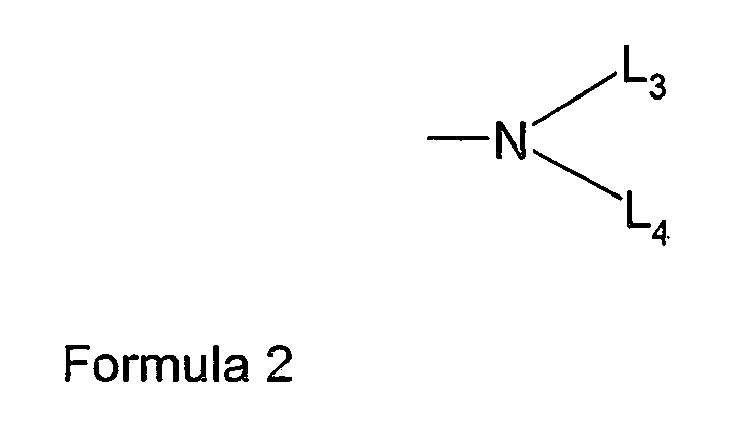
- the reagent is defined by the general formula II: wherein L 3 and L 4 comprise metal chelating functionalities, which can be the same or different. Further, in one embodiment, said ligand arms L 3 and L 4 are the same as those provided in step (b) by the derivatisation.
- a step of deprotection is preferably performed.
- said deprotection is performed as a separate step that follows step (c), and can be achieved by adding a base or an acid, as indicated above.
- the chemistry useful for protection/deprotection of functionalities are well-known in this field, and the skilled person in this field can easily perform such steps.
- the deprotection is performed in the same step as the ring-opening, i.e. essentially simultaneously. Accordingly, the great advantage of this embodiment is that polydentate metal chelating affinity ligands can be generated using a simple procedure that only comprises two steps. Consequently, this embodiment provides a less complex method than the prior art methods for the synthesis of polydentate metal chelating affinity ligands.
- the derivatisation agent comprises a base labile group
- this step is provided by addition of sodium hydroxide. The hydrolysis is advantageously performed at ambient temperature for e.g. 1-2 hours.
- step (c) this step is provided by addition of an acid, such as HCl.
- the product so obtained is coupled via its sulphur to a base matrix in order to produce a separation medium.
- a separation medium is useful for isolation of target substances, for analytical purposes etc.
- the base matrix used in the present method can be of any material suitable for the intended use.
- natural polymer beads are obtained from commercial sources, such as Amersham Biosciences AB, Uppsala, Sweden.
- Illustrative tradenames of such useful natural polymer beads are e.g. of the kind known as SepharoseTM or SephadexTM.
- the base matrix is comprised of cross-linked synthetic polymers, such as styrene or styrene derivatives, divinylbenzene, acrylamides, acrylate esters, methacrylate esters, vinyl esters, vinyl amides etc.
- synthetic polymers such as styrene or styrene derivatives, divinylbenzene, acrylamides, acrylate esters, methacrylate esters, vinyl esters, vinyl amides etc.
- Such polymers are easily produced according to standard methods, see e.g. " Styrene based polymer supports developed by suspension polymerization” (R Arshady: Chimica e L'Industria 70(9), 70-75 (1988 )).
- a commercially available product such as SourceTM (Amersham Biosciences AB, Uppsala, Sweden) can be surface-modified according to the invention.
- the reactive groups of the base matrix are allyl groups i.e. carbon-carbon double bonds.
- a commercially available base matrix, which already exhibits allyl groups is used.
- the allyl groups are provided according to well known methods.
- the present base matrix has been allylated by treatment with an epoxide carrying an allyl functionality at suitable temperatures and reaction times.
- an epoxide carrying an allyl functionality is allyl glycidyl ether (AGE).
- the present polydentate metal chelating affinity ligands are tridentate ligands are defined by the formula -S-(CH 2 )n-CH(COOH)-N(CH 2 COO - ) 2 .
- the present separation medium which comprises polydentate metal chelating affinity ligands coupled to a base matrix
- base matrix is e.g. in the form of a particle, then a plurality of ligands will be coupled to each particle as described above.
- kits which comprises a scaffold as defined by the general formula (I) above, which kit comprises said scaffold in a solid state together with instructions, preferably written, for use thereof in the manufacture of metal chelating affinity ligands or a separation medium comprising polydentate metal chelating affinity ligands coupled to a base matrix.
- a kit according to the invention comprises any other form of the scaffold, such as a partly or fully derivatised scaffold, together with liquids and/or reagents suitable for performing the method according to the invention.
- the present invention also encompasses a chromatography column packed with a medium according to the invention.
- the column can be of any size, such as for large-scale production or lab-scale, or suitable for analytical purpose.
- the column can also be combined with separation medium and optionally liquids into a second kind of kit, which is also encompassed by the present invention.
- the kit according to the invention comprises metal ions, such as Ni 2+ ions.
- the present invention also relates to a process of separating a target substance from a liquid, which process comprises to provide a separation medium as defined above, to charge said medium with suitable metal ions to form chelates and to contact said medium with the liquid to adsorb the target substance thereon.
- the process also comprises a step of eluting the target substance from the separation medium by adding a liquid that desorbs the target compound from the separation medium.
- the elution is obtained by using a liquid that comprises a decreasing pH gradient or by applying a gradient giving an increasing imidazole concentration.
- the present invention relates to a procedure of generating one or more diverse libraries of metal chelating affinity ligands for screening and optimising purposes.
- one arm carrying a dentate can be kept constant while other arms are selected in terms of optimal performance.
- L 1 , L 2 , L 3 and L 4 can be varied in order to identify the optimal form, and subsequently, once the optimised form has been identified, it is kept constant while other(s) are varied.
- the procedure of optimisation provides a tool to manufacture a separation medium comprising optimal, selected ligands.
- Example 1 Carboxymethylation of scaffold to provide N,N-bis(ethyl-carboxymethyl ester)+/-homocysteine thiolactone
- the solvent was evaporated, the resulting solid redissolved in CHCl 3 , extracted with H 2 O X 2.
- the organic phase was finally dried over Na 2 SO 4 , filtered and evaporated.
- the product was purified on flash column chromatography (toluene:ethyl acetate 3:1). Yield:7.636g (26.422mmol), 90%.
- Example 2 Hydrolysis to provide N,N-bis(carboxymethyl)+/-homocysteine and stability test
- N,N-bis(ethyl carboxymethyl ester)+/-homocysteine thiolactone (50 mg, 0.173 mmol) prepared as described in example 1 above, was dissolved in 1mL 1M NaOH. In a 100mL round-bottomed flask. The reaction mixture was stirred at ambient temperature for 100 minutes. The reaction was followed to completion until no starting material was visible according to LC-MS. Stability test: After complete hydrolysis, the above reaction mixture was diluted to 5mL with H 2 O. The pH was adjusted to 12.5 and the reaction mixture was heated at 50°C with stirring. A 50 ⁇ L sample was withdrawn from the mixture with 1h intervals for four hours.
- Example 3 Coupling of the product obtained from example 2 to allylated agarose using AGE
- Example 4 Purification of Maltose Binding Protein with (His) 6 -tail (MBP-His) using an IMAC separation medium generated according to the invention and metal leakage test
- Ni 2 + -sulphate solution 100 mM in water. Filter 0.2 um. pH ⁇ 4.6. Sample buffer and running conditions according to Instructions for ExcelGelTM (Amersham Biosciences, Uppsala, Sweden).
- NiSO 4 solution was injected to load the gel with Ni 2+ ions. Excess metal was removed by washing with water and phosphate buffer (20 mM PO 4 , 500 mM NaCl, pH 7.4). The nickel ions bound to the gel were eluted with EDTA, which is a very strong chelator and efficiently strips the metal ions from the gel. The peak area of the green coloured Ni-EDTA complex eluted was measured at 372 nm. A linear calibration curve was established from solutions with different concentrations of Ni-EDTA and was used for quantification. The nickel-binding capacity ( Figure 4 , peak 1) was given as ⁇ mol Ni/ml packed gel.
Landscapes
- Chemical & Material Sciences (AREA)
- Organic Chemistry (AREA)
- Analytical Chemistry (AREA)
- Chemical Kinetics & Catalysis (AREA)
- Peptides Or Proteins (AREA)
- Solid-Sorbent Or Filter-Aiding Compositions (AREA)
- Organic Low-Molecular-Weight Compounds And Preparation Thereof (AREA)
- Heterocyclic Compounds Containing Sulfur Atoms (AREA)
- Polymers With Sulfur, Phosphorus Or Metals In The Main Chain (AREA)
- Polyesters Or Polycarbonates (AREA)
- Treatment Of Liquids With Adsorbents In General (AREA)
- Medicines Containing Antibodies Or Antigens For Use As Internal Diagnostic Agents (AREA)
Abstract
Description
- The present invention relates to a method of generating polydentate metal chelating affmity ligands. The invention also encompasses a method of generating a separation medium comprising such ligands, as well as such ligands and such a medium.
- In any chemical or bioprocessing industry, the need to separate and purify a product from a complex mixture is a necessary and important step in the production line. Today, there exists a wide market of methods in which industry can accomplish these goals, one of which is chromatography. Chromatography is quite well suited to a variety of uses in the field of biotechnology, since it can separate complex mixtures with great precision and also is suitable for more delicate products, such as proteins, since the conditions under which it is performed are not typically severe.
- One chromatography method, which is an especially sensitive separation technique and also applicable to most types of proteins, is metal chelate affinity chromatography (MCAC), also known as immobilised metal ion adsorption chromatography (IMAC). This technique is commonly used in purification schemes together with another chromatographic step, such ion exchange chromatography (IEX) and/or hydrophobic interaction chromatography (HIC).
More specifically, IMAC utilises matrices that comprises a group capable of forming a chelate with a transition metal ion, which chelate in turn is used as the ligand in chromatography to adsorb a compound from a liquid. The binding strength in IMAC is affected predominately by the species of metal ion, the pH of the buffers and the nature of the ligand used. Since the metal ions are strongly bound to the matrix, the adsorbed protein can be eluted either by lowering the pH or by competitive elution.
In general, IMAC is useful for separation of proteins or other molecules that present an affinity for the transition metal ion of the matrix. For example, proteins will bind to the matrix upon the presence of accessible histidine, cysteine and tryptophan residues, which all exhibit affinity for the chelated metal.
With the advent of molecular biological techniques, proteins are now easily tailored or tagged with one or more histidine residues in order to increase their affinity to metal chelated ligands, and accordingly, metal chelate chromatography has more recently assumed a more important role in the purification of proteins. - Simple chelators have been suggested as ligands for IMAC, such as iminodiacetic acid (IDA). IDA, coupled to agarose supports and subsequent charged with various metals, such as Cu2+, Zn2+ and Ni2+, has been used for capture of proteins and peptides and is also available as commercial resins. More specifically,
USP 4,551,271 (Hochuli, assigned to Hoffmann-La Roche Inc.) discloses a metal chelate resin which comprises IDA ligands, in the purification of interferon. The resin can be defined by the following formula:
[agarose] -O- (CH2)- CHOH- CH2- N(CH2COO-)2 Me2+,
wherein Me is Ni or Cu.
The best results are obtained with this resin if the interferon has already been partially purified. The resin can according to the specification be prepared in a known manner by treating agarose with epichlorohydrin or epibromohydrin, reacting the resulting epoxide with iminoacetic acid disodium salt and converting the product into the copper or zinc salt by washing with a copper (II) or zinc solution. - More recently,
EP 87109892.7 USP 4,877,830 (Döbeli et al , assigned to Hoffmann-La Roche Inc.) disclosed a tetradentate chelator known as nitrilotriacetic acid (NTA) for use with metals that have six coordination sites. More specifically, the matrices can be described by the general formula [carrier matrix] - spacer - NH- (CH2)x- CH(COOH)- N(CH2COO-)2Ni2+, wherein x=2-4. The disclosed matrix is prepared by reacting an amino acid compound of the formula R-HN- (CH2)x- CH(NH2)- COOH, wherein R is an amino protecting group and x is 2, 3 or 4, with bromoacetic acid in alkaline medium and subsequently, after an intermediate purification step, cleaving off the protecting group and reacting this group with an activated matrix. Accordingly, the method of preparation involves separate steps for alkylating and deprotecting the amino acid, which steps renders the method time-consuming and hence costly. In addition, the alkylation chemistry is less efficient, and after deprotection, the product is not well defined regarding rest products from neutralisation and cleavage. Following this, the material is coupled to a solid support that carries carboxyl functionalities by forming an amide bond. However, this procedure may involve disadvantages, since the media obtained presents the immobilised desired chelating ligand as well as some unreacted carboxylic groups, thus yielding a heterogeneous media. Furthermore, mono-N-protected amino acid compounds are expensive starting materials, rendering the overall method even more costly. - Finally,
WO 01/81365 WO 01/81365
The solid phase synthesis is carried out by adding L-cysteine to a previously epichlorhydrine activated Sepharose™ gel under alkaline conditions for a prolonged reaction time (18h), followed by washings. Thereafter bromoacetic acid is added, again under alkaline conditions and a prolonged reaction time (72 h), and again followed by washings, and eventually capping of remaining free amino groups present on the gel with acetic acid anhydride. - Solid phase synthesis in this way offers poor control of the reaction and potential side reactions, and thereby yields a less homogeneous product.
The alternative route, relying on in solution phase synthesis of an intermediate product starts with addition of a large excess (40 times) of glyoxylic acid to L-cystine in an alkaline borate buffer. The intermediate product was thereafter, after pH manipulations and conductivity adjustment of the reaction mixture, purified with ion exchange chromatography to give N,N,N',N'-tetrakis (carboxymethyl)-L-cystine.
Before coupling to a solid support the N,N,N',N'-tetrakis (carboxymethyl)-L-cystine has to be reduced to N,N -bis (carboxymethyl)-L-cysteine using tris (carboxyethyl) phosphine under alkaline conditions. This material can finally be used for coupling to a pre-activated solid support forming the chromatographic media. This synthetic method is elaborate and depends on a large excess of reagents to form the desired product that is eventually purified under specific chromatographic conditions, followed by reduction as an additional synthetic step, and is thereby less suited for use in large-scale production. - Accordingly, there is still a need of improved methods for synthesis of IMAC ligands as well as of methods for the immobilisation thereof to a base matrix.
- Thus, one object of the present invention is an improved method of generating polydentate metal chelating affinity ligands for subsequent coupling to a base matrix, which method utilises cost-effective and easily available starting materials and reagents and provides high yields. This can be achieved as defined in
claim 1.
Another object of the present invention is to enable a careful selection of the ligands that are immobilised onto a base matrix for use in IMAC. This can be achieved by a method of generating a separation medium comprising polydentate metal chelating affinity ligands coupled to a base matrix, wherein the coupling chemistry is well defined and easy to control.
A further object of the invention is to provide such a method, which results in a homogenous product. - Yet a further object of the invention is to provide a method as discussed above, which also allows introducing two or more functionalities, which functionalities may be of the same kind or different.
- Another object of the present invention is to provide ligands for immobilised metal affinity chromatography, which ligands presents an improved handle for coupling to a base matrix and hence an improved coupling efficiency as compared to prior art ligands.
An additional object of the present invention is to provide a chromatographic medium, which in use for immobilised metal affinity chromatography (IMAC) yields a low leakage of metal ions. - Another object of the invention is to provide a method of generating a diverse library of metal chelating affinity ligands based on the same scaffold, which method can be used for ligand optimisation towards a specific application.
- The objects of the invention can be achieved by one or more of the appended claims. Further objects, advantages and embodiments of the present invention will appear from the detailed description that follows.
-
-
Figure 1 provides a schematic illustration of the general route to produce a separation medium that comprises polydentate metal chelating affinity chromatography ligands according to the invention. -
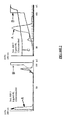
Figure 2 (a) and (b) illustrate purification of Maltose Binding Protein with (His)6-tail (MBP-His) using IMAC separation medium prepared according to the invention. More specifically,Figure 2(a) is the chromatogram, whileFigure 2(b) is an enlargement of the gradient part of said chromatogram. InFigure 2 , the curve at A280 nm is denoted A, the percentage (%) of elution buffer is denoted B and the conductivity is denoted C. -
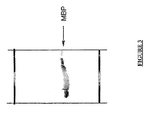
Figure 3 shows SDS-PAGE analyses of fractions from IMAC purification of MBP-His. Fraction numbering as inFigure 2 chromatogram.
-
Figure 4 shows a test chromatogram, wherein UV 372 nm = A, Conductivity = B, Injection = C. The nickel-binding capacity of this prototype was determined to 16 µmol Ni/ml and the metal leakage to 4%. -
Figure 5 shows the results of the nickel capacity test performed on a separation medium according to the invention as described in Example 5. - The term "separation medium" is used herein for a material useful e.g. as packing of a chromatography column, and more specifically consists of one or more ligands coupled to a base matrix. Thus, the base matrix acts as a carrier, while the ligands provide functionalities that interact with target substances in chromatography.
The term "spacer" is used for a chemical entity that distances a ligand from the base matrix.
The term "ligand" means herein a chemical entity capable of binding target substances. Such target substances may be either a compound, which it is desired to isolate or remove by chromatography, or alternatively an analytical target substance.
The term "polydentate metal chelating" ligands refers to ligands with two or more donor atoms that can coordinate to, i.e. chelate, a metal simultaneously. Thus, a polydentate ligand has two or more donor atoms and occupies two or more sites in a coordination sphere.
Thus, the term "metal chelating functionalities" refers to the groups that provides donor atoms. Usually, the functionalities are distanced from each other and hence the term "ligand arm" is used for each functionality.
The term "gel" is used for a separation matrix, which is in the form of a gel. - Thus, in a first aspect, the present invention relates to a method of generating at least one polydentate metal chelating affinity ligand, which method comprises the steps of
- (a) providing at least one scaffold defined by the general formula (I)
wherein X1, X2 and X3 irrespective of each other are sp2- or sp3-hybridised carbon atoms or heteroatoms,
X4 is a nucleophile and
m is an integer of 0-2; - (b) providing at least one polydentate metal chelating affinity ligand arm, optionally in a form wherein the metal chelating functionalities are protected on each scaffold by derivatisation of the nucleophilic X4 groups of said scaffolds by adding a derivatisation agent which is a halogenated protected ester while retaining the cyclic structure of the scaffold;
- (c) ring-opening by hydrolysis of the bond between the carbonyl and the sulphur of the derivatised scaffold by adding a base that adds one or more metal chelating affinity ligand arms to the scaffold; and, if required,
- (d) deprotecting the functionalities of the ligand arm(s) provided in step (b).
- The scaffold of step (a) can be provided as a solid or, preferably, in a solvent. In the most advantageous embodiment, in formula (I), X1, X2 and X3 are carbon atoms. In alternative embodiments, one or more of X1, X2 and X3 are heteroatoms, i.e. selected from the group comprised of oxygen, sulphur, nitrogen and/or silica, provided that said heteroatom does not interfere in the subsequent use of the ligands.
- In formula (I), X4 is any suitable nucleophilic group that enables derivatisation. Thus, in an illustrative embodiment, X4 is selected from a group such as -OH, -SH or-NH2. In an advantageous embodiment, X4 is -NH2.
- As mentioned above, m can be any integer of 0-2, i.e. 0, 1, or 2. As appears from the method steps, the value of m will decide the number of atoms between the ligand arms and its attachment point to a base matrix when it is developed into a separation medium.
- In an advantageous embodiment, in formula (I), m is 1 and the scaffold is homocysteine thiolactone. As the skilled person in this field will appreciate, homocysteine thiolactone can be used in pure or racemate form. Homocysteine thiolactone is commercially available, e.g. from Aldrich, catalogue no. H1, 580-2, and CAS no. 6038-19-3.
- In step (b), the derivatisation is performed by adding a suitable derivatisation agent comprised of a first part, which is electrophilic and hence capable of reacting with X4 of Formula (I), and a second part, which comprises a metal chelating functionality.
- The first part of the derivatisation agent, i.e. electrophilic part, can be illustrated by C=C; C-Y, wherein Y represents for example a halogen, such as Br, I, Cl, or a mesylate, or a tosylate group; or an acid or an activated acid such as WC=O, wherein W is for example formed from N-hydrosuccinimide, pentafluorophenol, para-nitrophenol or isopropyl chloroformate.
- In an advantageous embodiment, the derivatisation is provided by adding two derivatisation agents, each one of which comprises different or identical metal chelating functionalities, herein denoted L1 and L2. In this embodiment, the electrophilic parts of the agents are preferably of the same nature in order to facilitate the derivatisation. In an alternative embodiment, more than two different or identical metal chelating functionalities are introduced by derivatisation of X4, preferably by use of two or more different steps, as is realised by the skilled person in this field. Accordingly, multiple functionalities are easily provided in the same, polydentate metal chelating affinity ligand.
- The derivatisation agent(s) used in the present method can either comprise the metal chelating functionality in protected form, wherein the donor atoms are unavailable for reaction during the derivatisation of the scaffold, or in non-protected form. In the embodiment where the functionality is protected, said protecting group should be easy to remove in a subsequent step. Accordingly, the protecting group is either acid labile, such as an alkyl group, or base labile, such as a tert-butyl group. In one embodiment, the protecting group is a CH2CH3 group. Various metal chelating functionalities are known in this field, and can in principle be any electron-donating group. More specifically, the metal chelating functionalities used in the present method are selected from the group that consists of aromates, heterocyclic derivatives, such as pyridine, thiophene, furan and imidazole, acids, esters, ketones, amides, sulphones, sulphonamides, nitrile, carbon-carbon double and triple bonds.
- In an illustrative embodiment, the derivatisation agent is a halogenated carboxylic acid ester, such as a halogenated carboxylic acid alkyl ester. As mentioned above, in a more specific embodiment, X4 is NH2. Methods for reacting an NH2 group with a group carrying a halogen or another leaving group are well known in this field and are conveniently performed at ambient temperature in a solvent such as N,N-dimethylformamide (DMF). In one embodiment, in order to provide two metal chelating affinity ligand arms on each scaffold by the derivatisation, the derivatisation agent is used in a molar ratio of 2:1 to the scaffold. The skilled person can easily monitor the reaction and confirm the derivatisation obtained by a conventional method such as LC-MS. Thus, the present invention provides a less complex synthetic route to polydentate metal chelating affinity ligands than
WO 01/81365 - In step (c), ring-opening is provided at the bond between the carbonyl and the sulphur of the derivatised scaffold by adding a reagent, which adds one or more metal chelating affinity ligand arms of the scaffold. Thus, the cyclic structure is opened up in order to provide one or more further metal chelating ligand arms.
- The ring opening will also result in a handle available for subsequent coupling to a base matrix in the form of the thiophilic group, which due to its nucleophilic nature provides convenient coupling chemistry. In an advantageous embodiment, the ring opening is hydrolysis by addition of alkali hydroxide, such as NaOH, in which case the carbonyl of the scaffold is transformed into a carboxylic group. However, as the skilled person in this field will understand, if the ring opening is performed with a different reagent, one or more different metal chelating functionalities can be introduced. In an alternative embodiment, the ring opening is aminolysis, in which case the nitrogen carries one or more metal chelating functionalities. In this embodiment, the reagent is defined by the general formula II:
- Thus, as indicated above, in the embodiment where the metal chelating functionalities L1 and L2 were protected during the derivatisation step, a step of deprotection is preferably performed. In one embodiment, said deprotection is performed as a separate step that follows step (c), and can be achieved by adding a base or an acid, as indicated above. The chemistry useful for protection/deprotection of functionalities are well-known in this field, and the skilled person in this field can easily perform such steps.
- In an especially advantageous embodiment of the present method, the deprotection is performed in the same step as the ring-opening, i.e. essentially simultaneously. Accordingly, the great advantage of this embodiment is that polydentate metal chelating affinity ligands can be generated using a simple procedure that only comprises two steps. Consequently, this embodiment provides a less complex method than the prior art methods for the synthesis of polydentate metal chelating affinity ligands. In one embodiment, wherein the derivatisation agent comprises a base labile group, this step is provided by addition of sodium hydroxide. The hydrolysis is advantageously performed at ambient temperature for e.g. 1-2 hours. In fact, the present inventors have also shown that even though all the starting material can be converted within 90 minutes, an additional 48 hours does not give rise to any side products. Accordingly, the hydrolysis according to the invention results in a stable, homogenous and well-defined product. In an alternative embodiment, wherein the derivatisation agent comprises an acid labile group, in step (c), this step is provided by addition of an acid, such as HCl.
- In a specific embodiment, in the present method, steps (a) and (b) have been performed earlier to provide a ready-derivatised scaffold Accordingly, the present invention also encompasses a method, wherein the carboxymethylation of the scaffold has been performed earlier.
- In an advantageous embodiment, the product so obtained is coupled via its sulphur to a base matrix in order to produce a separation medium. (For a general review of immobilisation methods, especially coupling via sulphur, see e.g. Immobilized Affinity Ligand Techniques, Hermanson et al 1992, Greg T. Hermanson, A. Krishna Mallia and Paul K. Smith, Academic Press, INC: ). Such a separation medium is useful for isolation of target substances, for analytical purposes etc. The base matrix used in the present method can be of any material suitable for the intended use.
- Thus, in the case where the separation medium is intended for use in immobilised metal chelating affinity chromatography, the base matrix is commonly in beaded or monolithic form and made from natural polymers, e.g. agarose or dextran, or synthetic polymers, such as divinylbenzene or styrene. The base matrix can e.g. be in the form of a gel. As regards natural polymers, suitable porous polymer beads thereof are either easily performed by the skilled person in this field according to standard methods, such as inverse suspension gelation (S Hjertén: Biochim Biophys Acta 79(2), 393-398 (1964) or spinning disk technique (see e.g.
WO 88/07414 - As regards synthetic polymers, the base matrix is comprised of cross-linked synthetic polymers, such as styrene or styrene derivatives, divinylbenzene, acrylamides, acrylate esters, methacrylate esters, vinyl esters, vinyl amides etc. Such polymers are easily produced according to standard methods, see e.g. "Styrene based polymer supports developed by suspension polymerization" (R Arshady: Chimica e L'Industria 70(9), 70-75 (1988)). Alternatively, a commercially available product, such as Source™ (Amersham Biosciences AB, Uppsala, Sweden) can be surface-modified according to the invention.
- In alternative embodiments, the base matrix can e.g. be a membrane, a filter, one or more chips, surfaces, capillaries etc.
- In one embodiment, the reactive groups of the base matrix are allyl groups i.e. carbon-carbon double bonds. In one embodiment, a commercially available base matrix, which already exhibits allyl groups is used. In an alternative embodiment, the allyl groups are provided according to well known methods. Thus, in an illustrative embodiment, the present base matrix has been allylated by treatment with an epoxide carrying an allyl functionality at suitable temperatures and reaction times. One example of such a commonly used allyl-functional epoxide is allyl glycidyl ether (AGE). Accordingly, in a specific embodiment, in step (d), the sulphur group of the ligand is coupled to the base matrix via the activated allyl group of allyl glycidyl ether (AGE). In this embodiment, in the final product, the sulphur group will be attached to the base matrix by a spacer comprising ether groups and hydroxy groups, and the separation medium can be defined as base matrix -O-CH2-CHOH-CH2-O-CH2-CHOH-CH2-S- ligand.
- In alternative embodiments, other well-known coupling techniques of thiol-containing ligands are used, such as opening of epoxide or radical addition to double bonds.
- In a specific embodiment, said allyl groups are activated by bromination or alternatively, the coupling is a free radical reaction. The free radical used can be any suitable commercially available initiator, UV etc.
- A second aspect of the present invention is a polydentate metal chelating affinity ligand or a separation medium comprising at least one, preferably a plurality of, polydentate metal chelating affinity ligands coupled to a base matrix, which medium has been generated by a method as described above. In a specific embodiment, the metal chelating affinity ligands are tridentate. Such a separation medium can then be charged with a suitable metal ion, such as Cu(II), Zn(II), Ni(II), Ca(II), Co(II), Mg(II), Fe(III), Al(III), Ga(III), Sc(III) etc, and used according to well known principles of IMAC, e.g. as outlined in the section "Background" above. In the most preferred embodiment, Ni2+ is used.
- In an advantageous embodiment, the present polydentate metal chelating affinity ligands are tridentate ligands are defined by the formula
-S-(CH2)n-CH(COOH)-N(CH2COO-)2.
- In a specific embodiment, the present separation medium, which comprises polydentate metal chelating affinity ligands coupled to a base matrix, is defined by the general formula
base matrix-O-CH2-CHOH-CH2-O-CH2-CHOH-CH2S-(CH2)n-CH(COOH)-N(CH2COO-)2N2+
wherein n is an integer of 2-4. In one embodiment, n = 2. In this context, it is understood that if the base matrix is e.g. in the form of a particle, then a plurality of ligands will be coupled to each particle as described above. - A third aspect of the invention is the use of homocysteine thiolactone as a starting material in the preparation of polydentate metal chelating ligands, preferably be the method described above. The invention also encompasses the use of a carboxymethylated scaffold such as homocysteine thiolactone in the preparation of polydentate metal chelating ligands. In the most advantageous embodiment, said use is as defined above. As mentioned above, homocysteine thiolactone is commercially available.
- A further aspect of the present invention is a kit, which comprises a scaffold as defined by the general formula (I) above, which kit comprises said scaffold in a solid state together with instructions, preferably written, for use thereof in the manufacture of metal chelating affinity ligands or a separation medium comprising polydentate metal chelating affinity ligands coupled to a base matrix. In alternative embodiment, a kit according to the invention comprises any other form of the scaffold, such as a partly or fully derivatised scaffold, together with liquids and/or reagents suitable for performing the method according to the invention. In a specific embodiment, a kit is comprised of a scaffold reacted according to the present method except the deprotection, in which case the kit also comprises a suitable reagent for deprotection, such as a base or an acid, together with instructions for use.
- The present invention also encompasses a chromatography column packed with a medium according to the invention. The column can be of any size, such as for large-scale production or lab-scale, or suitable for analytical purpose. The column can also be combined with separation medium and optionally liquids into a second kind of kit, which is also encompassed by the present invention. In one embodiment, the kit according to the invention comprises metal ions, such as Ni2+ ions.
- In addition, the present invention also relates to a process of separating a target substance from a liquid, which process comprises to provide a separation medium as defined above, to charge said medium with suitable metal ions to form chelates and to contact said medium with the liquid to adsorb the target substance thereon. In an advantageous embodiment, the process also comprises a step of eluting the target substance from the separation medium by adding a liquid that desorbs the target compound from the separation medium. In one embodiment, the elution is obtained by using a liquid that comprises a decreasing pH gradient or by applying a gradient giving an increasing imidazole concentration. The general principles of chromatography for separating a target substance as discussed above are well-known in this field (see e.g. Protein Purification - Principles, High resolution methods and Applications (J-C Jansson and L. Rydén1989 VCH Publishers)), and the skilled person in this field can easily adopt the necessary parameters for use of the present process.
- Finally, the present invention relates to a procedure of generating one or more diverse libraries of metal chelating affinity ligands for screening and optimising purposes. Thus, in this procedure, one arm carrying a dentate can be kept constant while other arms are selected in terms of optimal performance. As the skilled person will understand, for example one or more of the above-discussed L1, L2, L3 and L4 can be varied in order to identify the optimal form, and subsequently, once the optimised form has been identified, it is kept constant while other(s) are varied. Accordingly, the procedure of optimisation provides a tool to manufacture a separation medium comprising optimal, selected ligands.
-
-
Figure 1 provides a schematic illustration of the general route to produce a separation medium that comprises polydentate metal chelating affinity chromatography ligands according to the invention. The first step corresponds to step (b) of the present method, i.e. a derivatisation, the second step is a hydrolysis to open up the ring of the derivatised scaffold and the last step is immobilisation i.e. coupling of the ligand so produced to a base matrix. As appears from the above, the second step is advantageously a combined ring-opening and deprotection. InFigure 1 , R denotes either hydrogen or alternatively an acid or base labile protecting group. -
Figure 2 (a) and (b) illustrate purification of Maltose Binding Protein with (His)6-tail (MBP-His) using IMAC separation medium according to the invention. More specifically,Figure 2(a) is the chromatogram, whileFigure 2(b) is an enlargement of the gradient part of said chromatogram. InFigure 2 , the curve at A280 nm is denoted A, the percentage (%) of elution buffer is denoted B, and the conductivity is denoted C. -
Figure 3 shows SDS-PAGE analyses of fractions from IMAC purification of MBP-His. Fraction numbering as inFigure 2 chromatogram. -
Figure 4 shows a test chromatogram, wherein UV 372 nm = A, Conductivity = B, Injection = C. The nickel-binding capacity of this prototype was determined to 16 µmol Ni/ml and the metal leakage to 4%, as explained in example 5 below. -
Figure 5 shows the results of the nickel- capacity test performed on a separation medium according to the invention as described in Example 5. More specifically, the X axis shows the ligand density while the Y axis shows the nickel-binding. It appears clearly that the nickel-binding capacity increases linearly with the ligand density and that the slope is close to one. - The following examples are provided for illustrative purposes only and should not be interpreted to limit the scope of the present invention as defined by the appended claims.
- 1H-NMR, 13C-NMR, CH-correlation, APT and cosy spectra were recorded in δ scale (ppm) with Bruker 300 MHz using TMS as reference. All spectra were recorded in CDCl3 unless otherwise stated. TLC was carried out using Merck precoated silica gel F254 plates. Ninhydrin or a mixture of Mo/Ce was used to visualise spots on TLC plates. LC-MS data were recorded using Hewlett Packard 1100 MSD electro spray. The flash column chromatographic purifications were carried out using Merck G-60 silica gel.
- In a dry 250mL round-bottomed flask, the D/L homocysteine thiolactone (4.5g, 29.22 mmol) was dissolved in 100mL DMF. To this was added bromo-acetic acid ethyl ester (9.76 g, 58.44 mmol, 6.48 mL), KI (4.850 g, 29.22mmol) and NaHCO3 (14.727g, 175 mmol). The reaction mixture was stirred at ambient temperature. The reaction was followed by TLC (toluene: ethyl acetate 3: 1) and LC-MS data. The reaction was completed after 3.5h.
The desired product has a Rf=0.35 (toluene: ethyl acetate 3: 1). The solvent was evaporated, the resulting solid redissolved in CHCl3, extracted with H2O X 2. The organic phase was finally dried over Na2SO4, filtered and evaporated. The product was purified on flash column chromatography (toluene:ethyl acetate 3:1). Yield:7.636g (26.422mmol), 90%.
1H-NMR : δ 1.52 (t, 6H, CH 3 -CH2-O-), δ 2.05-2.56 (m, 2H, -S-CH 2 -CH2-CH-C=O), δ 3.25 (m, 2H, -S-CH2-CH 2 -CH-C=O), δ 3.52 (s, 4H, -N-CH 2 -N-CH 2 -), δ 3.65 (dd, 1H, S-CH2-CH2-CH-C=O), δ 4.24 (m, 4H, CH3-CH 2 -O-) 13C-NMR : δ 14.71 (CH3-CH2-O-), δ 27.42 (S-CH2-CH2-CH-C=O), δ 29.68 (S-CH2-CH2-CH-C=O), δ 54.01 (CH3-CH2-O- ), δ 60.99 (-N-CH,-N-CH2), δ 67.15 (-S-CH2-CH2-CH-C=O), δ 170.94 (O=C-CH2-N-CH2-C=O), δ 207.20 (-S-CH2-CH2-CH-C=O). LC-MS : M+ 290. - N,N-bis(ethyl carboxymethyl ester)+/-homocysteine thiolactone (50 mg, 0.173 mmol) prepared as described in example 1 above, was dissolved in 1mL 1M NaOH.
In a 100mL round-bottomed flask. The reaction mixture was stirred at ambient temperature for 100 minutes. The reaction was followed to completion until no starting material was visible according to LC-MS.
Stability test: After complete hydrolysis, the above reaction mixture was diluted to 5mL with H2O. The pH was adjusted to 12.5 and the reaction mixture was heated at 50°C with stirring. A 50µL sample was withdrawn from the mixture with 1h intervals for four hours. Each 50µL sample was then mixed with 1mL MeOH for the LC-MS analysis. After this step, the reaction mixture was allowed to stand overnight and finally a 50µL sample was withdrawn for the LC-MS analysis as described above. No decomposition was observed during the time of the experiment.
The crude product was freeze-dried.
1H-NMR (D2O): δ 1.52 (m, 2H, -CH-CH2-CH 2 -SH), δ 2.24 (m, 2H, -CH-CH 2 -CH2-SH), δ 3.20 (m, 5H, O=C-CH 2 -N-CH-) ; 13C-NMR (D2O) : δ 22.34 (-CH-CH2-CH2-SH), δ 35.39 (-CH-CH2-CH2-SH), δ 57.33 (O=C-CH2-N-CH2-), δ 67.30 (-CH-CH2-CH2-SH), δ 180.55 (O=C-CH2-N-CH2-C=O), δ 181.84 (-N-CH-C=O) ; LC-MS : M+ 252. - 10 ml Sepharose™ HP-allyl (Amersham Biosciences, Uppsala, Sweden) (44 µmol/ml gel) was stirred in 20 ml distilled water with 1g NaOAc. Br2 aq. saturated was added until that a persisting yellow colour is formed. Sodium formiate was then added until the yellow colour has disappeared. The gel was then washed with distilled water. N,N-bis(ethyl carboxymethyl ester)+/-homocysteine thiolactone (102 mg) was stirred in 2 ml 1M NaOH at room temperature for 2 hours. 5 ml distilled water and 3 ml 1M NaHCO3 was added, and the pH was adjusted to 11.0 with 2M NaOH.
The ligand solution was then added to the drained gel in a vial, which was capped.
The vial was shaken at 50°C for 16 h, then the gel was washed with distilled water on a glass filter funnel. - C-terminally hexaHis-tailed Maltose Binding Protein, MBP-His, theoretical Mr and pI was 43 781 and 5.4:
- Fermentation of an E. coli clone expressing MBP-His and cell homogenisation was performed according to a standard procedure. The concentration of MBP-His in this extract was estimated to approximately 1.9 mg/ml.
- For one litre: (one PBS tablet to 1000 ml water is specified to give 10 mM Na-phosphate, 140 mM NaCl and 3 mM KCI, pH 7.4.) Two PBS tablets were dissolved in water, NaCl was added from 5 M stock to give an extra 720 mM (thus finally 140+140+720 mM = 1 M), pH adjusted to 7.4 with NaOH and final volume to 1000 ml. (Buffer also contains 6 mM KCl).
- Prepared in the same way as IMAC A-buffer, but also imidazole was added to 500 mM (from 2.0 M stock ofimidazole-HCl, pH 7.4) before final adjustment of pH and volume.
- Ni 2+ -sulphate solution: 100 mM in water. Filter 0.2 um. pH ≈ 4.6.
Sample buffer and running conditions according to Instructions for ExcelGel™ (Amersham Biosciences, Uppsala, Sweden). - Gels:
- ExcelGel™ SDS, gradient 8-18 %.
- Sample prep:
- Samples were mixed 1+1 with 2 x sample buffer (for purifications with large amounts of target protein) or 1 volume sample + 1/3 volume 4x sample buffer (purifications with small amounts of target protein). (4x sample buffer = 100 mM Tris-HAc pH 7.5, 2 % SDS.) Heating at 95°C for 3-5 minutes.
- Sample application:
- IEF sample application pieces (5x10 mm filter paper pieces, # 80-1129-46 (Amersham Biosciences, Uppsala, Sweden) were used. Up to 30-32 paper pieces were positioned with their short sides towards the running direction. 20 µl sample cocktail was applied to each piece. The pieces were left on the gel during the whole electrophoresis.
- Electrophoresis:
- In a Multiphor™ II (Amersham Biosciences, Uppsala, Sweden) apparatus at 15° C (circulating cooling bath). EPS 3500 Power Supply. Limiting settings: 600 V, 50 mA, 30 W.
- Staining:
- In 0.1 % Coomassie R 350 dissolved in 30 % MeOH, 10 % HAc. Destaining in 25 % EtOH, 8% HAc.
- Chromatography: The media was packed in HR 5/5 columns (Amersham Biosciences, Uppsala, Sweden) to a bed height of 5 cm = 1.0 ml bed. The media was charged with Ni2+ prior to use by pumping the Ni-sulphate solution onto the column (5 column volumes), followed by water and by equilibration with binding buffer (= IMAC A-buffer) with 5 mM imidazole added). A short blank run was performed by applying elution buffer, again followed by equilibration with binding buffer.
- The E. coli extract with MBP-His, 1.0 M NaCl, 5 mM imidazole and 1 mM PMSF (freshly added) was clarified by centrifugation and by 0.45 um filtration. The required volume was then introduced into a Superloop™ (Amersham Biosciences, Uppsala, Sweden) through a 0.2 um filter shortly prior to IMAC start. 3 ml was then applied to the column. After extensive washing with binding buffer, a 20-ml linear gradient was run (to 40 % Elution buffer = 200 mM imidazole) using a
ÄKTA™ Explorer 10 system (Amersham Biosciences, Uppsala, Sweden). Finally, a 5-ml push with 100 % Elution buffer (500 mM imidazole) was applied. All steps were at 1.0 ml/nin. - The nickel (Ni2+) binding capacity of a separation medium according to the invention was determined chromatographically using an
AKTA™ Explorer 10 system (Amersham Biosciences, Uppsala, Sweden) equipped with a UV/Vis DAD detector. The test was performed on gel to which N,N-bis(carboxymethyl)+/-homocysteine had been coupled according to earlier description, and packed in 1-ml HR5/5 columns (Figure 4 ). This result was compared with the ligand density present on the gel as determined by elemental analysis (nitrogen analysis, each ligand containing one nitrogen atom).
The correlation between nickel-binding capacity and ligand density was considered to be very good, i.e. one ligand is carrying one metal ion. Typical results are shown inFigure 5 . - A NiSO4 solution was injected to load the gel with Ni2+ ions. Excess metal was removed by washing with water and phosphate buffer (20 mM PO4, 500 mM NaCl, pH 7.4). The nickel ions bound to the gel were eluted with EDTA, which is a very strong chelator and efficiently strips the metal ions from the gel. The peak area of the green coloured Ni-EDTA complex eluted was measured at 372 nm. A linear calibration curve was established from solutions with different concentrations of Ni-EDTA and was used for quantification. The nickel-binding capacity (
Figure 4 , peak 1) was given as µmol Ni/ml packed gel. - A metal leakage test was performed to test the stability of the ligand-nickel complex. The nickel-loaded gel was then washed with acetate buffer, pH 4.0. before determining the Ni-content on the gel (
Figure 4 ). - The metal leakage was considered to be very low for all tested gels prepared according to the present invention; typically the leakage was 4 %.
- Leakage of nickel ions was tested analogously to the nickel-binding capacity. However, before eluting nickel ions with EDTA, the gel was washed with ten column volumes of acetate buffer, 100 mM, pH 4.0. The leakage was given as % of the binding capacity and was determined as the difference between the nickel-binding capacity and the amount eluted after washing with pH 4 (
Figure. 4 , peak 2) according to the formula: (area Peak 2-area Peak 1)/ area Peak 1.
Claims (14)
- A method of generating at least one polydentate metal chelating affinity ligand, which method comprises the steps of(a) providing at least one scaffold defined by the general formula (I)

X4 is a nucleophile and
m is an integer of 0-2;(b) providing at least one polydentate metal chelating affinity ligand arm, optionally in a form wherein the metal chelating functionalities are protected, on each scaffold by derivatisation of the nucleophilic X4 groups of said scaffolds by adding a derivatisation agent which is a halogenated, protected ester, while retaining the cyclic structure of the scaffold;(c) ring-opening by hydrolysis of the bond between the carbonyl and the sulphur of the derivatised scaffold by adding a base that adds one or more metal chelating affinity ligand arms to the scaffold; and, if required,(d) deprotecting the functionalities of the ligand arm(s) provided in step (b). - A method according to claim 1, wherein in formula (I), X1, X2 and X3 are carbon atoms.
- A method according to any one of the preceding claims, wherein in formula (I), X4 is -NH2.
- A method according to any one of the preceding claims, wherein in formula (I), m is 1 and the scaffold is homocysteine thiolactone.
- A method according to any one of the preceding claims, wherein the derivatisation is provided by adding two derivatisation agents, which comprise two different or identical metal chelating functionalities.
- A method according to any one of the preceding claims, wherein one derivatisation agent is bromo-acetic acid ethyl ester.
- A method according to any one of the preceding claims, wherein the metal chelating functionalities are protected in step (b), and subsequently, step (c) and step (d) are performed essentially simultaneously.
- A method according to any one of the preceding claims, wherein steps (a) and (b) have been performed earlier to provide a ready-derivatised scaffold.
- A method according to any one of the preceding claims, wherein the product obtained from step (d) is coupled via its thiol group to a base matrix in order to produce a separation medium.
- A method according to claim 9, wherein the thiol group is coupled to allyl groups of the base matrix.
- A method according to claim 9 or 10, which also includes a step of allylation of a base matrix to provide reactive groups.
- A method according to any one of the claims 9-11, wherein the thiol group of the ligand is coupled to the base matrix via the allyl group of allyl glycidyl ether (AGE).
- A method according to any one of the claims 9-12, which also comprises a step of activating the reactive groups of the base matrix.
- A method according to claim 13, wherein the activation is performed by bromination.
Applications Claiming Priority (3)
| Application Number | Priority Date | Filing Date | Title |
|---|---|---|---|
| SE0300567A SE526214C2 (en) | 2003-02-28 | 2003-02-28 | One way to generate metal chelating affinity ligands |
| SE0300567 | 2003-02-28 | ||
| PCT/SE2003/001903 WO2004076475A1 (en) | 2003-02-28 | 2003-12-08 | A method of generating metal chelating affinity ligands |
Publications (2)
| Publication Number | Publication Date |
|---|---|
| EP1597269A1 EP1597269A1 (en) | 2005-11-23 |
| EP1597269B1 true EP1597269B1 (en) | 2010-02-17 |
Family
ID=20290555
Family Applications (1)
| Application Number | Title | Priority Date | Filing Date |
|---|---|---|---|
| EP03816091A Expired - Lifetime EP1597269B1 (en) | 2003-02-28 | 2003-12-08 | A method of generating metal chelating affinity ligands |
Country Status (13)
| Country | Link |
|---|---|
| US (2) | US7005071B2 (en) |
| EP (1) | EP1597269B1 (en) |
| JP (1) | JP5015426B2 (en) |
| KR (1) | KR101060896B1 (en) |
| CN (1) | CN100595206C (en) |
| AT (1) | ATE457993T1 (en) |
| AU (1) | AU2003303976B2 (en) |
| CA (1) | CA2517231C (en) |
| DE (1) | DE60331370D1 (en) |
| ES (1) | ES2340032T3 (en) |
| GB (1) | GB2398782B (en) |
| SE (1) | SE526214C2 (en) |
| WO (1) | WO2004076475A1 (en) |
Families Citing this family (16)
| Publication number | Priority date | Publication date | Assignee | Title |
|---|---|---|---|---|
| SE0103084D0 (en) * | 2001-09-14 | 2001-09-14 | Amersham Pharm Biotech Ab | Generation of ion exchange media |
| AU2003286553A1 (en) * | 2002-10-18 | 2004-05-04 | Promega Corporation | Methods for separating molecules |
| SE526214C2 (en) * | 2003-02-28 | 2005-07-26 | Amersham Biosciences Ab | One way to generate metal chelating affinity ligands |
| SE0300624D0 (en) * | 2003-03-05 | 2003-03-05 | Amersham Biosciences Ab | A method of preparing affinity ligands |
| SE0300612D0 (en) * | 2003-03-05 | 2003-03-05 | Amersham Biosciences Ab | A method of preparing ligands for hydrophobic interaction chromatography |
| WO2004078349A1 (en) * | 2003-03-05 | 2004-09-16 | Amersham Biosciences Ab | A method of preparing multi-modal anion-exchange ligands |
| WO2008057108A2 (en) * | 2006-01-27 | 2008-05-15 | Los Alamos National Security, Llc | Chirality-based separation of carbon nanotubes |
| US20070256976A1 (en) * | 2006-04-10 | 2007-11-08 | Boyes Barry E | Metal-coated sorbents as a separation medium for HPLC of phosphorus-containing materials |
| GB0610479D0 (en) * | 2006-05-26 | 2006-07-05 | Ge Healthcare Bio Sciences Ab | A method for generating metal chelating affinity ligands |
| US7628915B2 (en) * | 2006-12-08 | 2009-12-08 | Varian, Inc. | Metal cyano bonded phases |
| CN101396650B (en) * | 2007-09-26 | 2010-12-22 | 中国科学院大连化学物理研究所 | Titanium ion fixation affinity chromatography material and preparation and use thereof |
| HU230585B1 (en) | 2012-05-30 | 2017-01-30 | Budapesti Műszaki és Gazdaságtudományi Egyetem | Carriers complexed with lanthanide metal ions capable for peptid absorption and isolation |
| SG11201407806YA (en) * | 2012-05-31 | 2014-12-30 | Agency Science Tech & Res | Mixed multifunctional metal affinity surfaces for reducing aggregate content in protein preparations field |
| CN113351190B (en) * | 2020-02-20 | 2023-05-30 | 中国科学院大连化学物理研究所 | Immobilized metal ion affinity chromatography microsphere material and preparation and application thereof |
| CN115583710A (en) * | 2022-07-19 | 2023-01-10 | 江苏驰佳环保科技有限公司 | A kind of chelating agent and preparation method thereof |
| CN116393174B (en) * | 2023-04-04 | 2024-06-21 | 大连理工大学 | Catalyst for preparing glycolide and polyglycolide simultaneously and preparation method thereof |
Family Cites Families (19)
| Publication number | Priority date | Publication date | Assignee | Title |
|---|---|---|---|---|
| US4434151A (en) | 1982-11-08 | 1984-02-28 | Medi-Physics, Inc. | Bifunctional chelating agents |
| ZA841395B (en) * | 1983-03-03 | 1984-10-31 | Hoffmann La Roche | Purification of interferon |
| CA1231306A (en) * | 1983-03-03 | 1988-01-12 | Erich Hochuli | Purification of interferon |
| US4595656A (en) * | 1984-01-06 | 1986-06-17 | Becton Dickinson & Company | Coupling agents and products produced therefrom |
| WO1986000897A1 (en) * | 1984-07-19 | 1986-02-13 | University Of Florida | Novel radiopharmaceuticals and chelating agents useful in their preparation |
| CA1304886C (en) * | 1986-07-10 | 1992-07-07 | Heinz Dobeli | Metal chelate resins |
| DE4311022C2 (en) | 1993-03-31 | 1996-07-11 | Diagnostikforschung Inst | Bifunctional chalcogen atom-interrupted chelating agents of the type S¶3¶N¶2¶ for radioactive isotopes and their metal complexes, processes for their preparation and pharmaceutical compositions containing them |
| DE4311023C2 (en) | 1993-03-31 | 1996-05-02 | Diagnostikforschung Inst | Bifunctional chalcogen atom-interrupted chelating agents of type XN¶1¶S¶1¶O¶1¶ for radioactive isotopes, their metal complexes, processes for their preparation and pharmaceutical compositions containing them |
| WO1999015664A1 (en) * | 1997-09-24 | 1999-04-01 | Genentech, Inc. | Insulin-like polypeptide and uses therefor |
| FR2761691B1 (en) * | 1997-04-03 | 1999-05-14 | Oreal | THIOL TERMINAL FUNCTION POLYMERS |
| WO1999056850A1 (en) * | 1998-04-30 | 1999-11-11 | Chelest Corporation | Chelate-forming filter, process for producing the same, and method of purifying liquid with the filter |
| SE9802214D0 (en) * | 1998-06-18 | 1998-06-18 | Amersham Pharm Biotech Ab | Ion exchanger and its use |
| JP2002534119A (en) * | 1999-01-14 | 2002-10-15 | ボルダー バイオテクノロジー, インコーポレイテッド | Method for producing a protein having a free cysteine residue |
| JP2000351776A (en) * | 1999-04-08 | 2000-12-19 | Kuraray Co Ltd | Method for producing optically active homocysteine thiolactone salt and intermediates thereof |
| JP2001199980A (en) * | 2000-01-21 | 2001-07-24 | Kuraray Co Ltd | Method for producing optically active homocysteine thiolactone salt |
| US6623655B1 (en) * | 2000-04-24 | 2003-09-23 | Sigma-Aldrich Co. | Metal chelating compositions |
| JP2002308882A (en) * | 2001-02-08 | 2002-10-23 | Yamanouchi Pharmaceut Co Ltd | Thienopyrimidine derivative |
| SE0103084D0 (en) * | 2001-09-14 | 2001-09-14 | Amersham Pharm Biotech Ab | Generation of ion exchange media |
| SE526214C2 (en) * | 2003-02-28 | 2005-07-26 | Amersham Biosciences Ab | One way to generate metal chelating affinity ligands |
-
2003
- 2003-02-28 SE SE0300567A patent/SE526214C2/en not_active IP Right Cessation
- 2003-10-30 GB GB0325329A patent/GB2398782B/en not_active Expired - Lifetime
- 2003-10-31 US US10/699,058 patent/US7005071B2/en not_active Expired - Lifetime
- 2003-12-08 DE DE60331370T patent/DE60331370D1/en not_active Expired - Lifetime
- 2003-12-08 CN CN200380110021A patent/CN100595206C/en not_active Expired - Lifetime
- 2003-12-08 ES ES03816091T patent/ES2340032T3/en not_active Expired - Lifetime
- 2003-12-08 KR KR1020057015945A patent/KR101060896B1/en not_active Expired - Lifetime
- 2003-12-08 EP EP03816091A patent/EP1597269B1/en not_active Expired - Lifetime
- 2003-12-08 AU AU2003303976A patent/AU2003303976B2/en not_active Expired
- 2003-12-08 WO PCT/SE2003/001903 patent/WO2004076475A1/en not_active Ceased
- 2003-12-08 AT AT03816091T patent/ATE457993T1/en not_active IP Right Cessation
- 2003-12-08 CA CA2517231A patent/CA2517231C/en not_active Expired - Lifetime
- 2003-12-08 JP JP2004568813A patent/JP5015426B2/en not_active Expired - Lifetime
-
2005
- 2005-10-06 US US11/244,603 patent/US20060027501A1/en not_active Abandoned
Also Published As
| Publication number | Publication date |
|---|---|
| EP1597269A1 (en) | 2005-11-23 |
| US20040168983A1 (en) | 2004-09-02 |
| AU2003303976A1 (en) | 2004-09-17 |
| SE0300567L (en) | 2004-10-28 |
| SE526214C2 (en) | 2005-07-26 |
| CN1756762A (en) | 2006-04-05 |
| SE0300567D0 (en) | 2003-02-28 |
| GB2398782B (en) | 2005-10-19 |
| ES2340032T3 (en) | 2010-05-28 |
| US7005071B2 (en) | 2006-02-28 |
| GB0325329D0 (en) | 2003-12-03 |
| JP2007528835A (en) | 2007-10-18 |
| US20060027501A1 (en) | 2006-02-09 |
| AU2003303976B2 (en) | 2010-07-15 |
| ATE457993T1 (en) | 2010-03-15 |
| CA2517231A1 (en) | 2004-09-10 |
| WO2004076475A1 (en) | 2004-09-10 |
| CA2517231C (en) | 2013-02-05 |
| JP5015426B2 (en) | 2012-08-29 |
| GB2398782A (en) | 2004-09-01 |
| DE60331370D1 (en) | 2010-04-01 |
| KR101060896B1 (en) | 2011-08-30 |
| CN100595206C (en) | 2010-03-24 |
| KR20050105496A (en) | 2005-11-04 |
Similar Documents
| Publication | Publication Date | Title |
|---|---|---|
| US7005071B2 (en) | Method of generating metal chelating affinity ligands | |
| US7988858B2 (en) | Method for generating metal chelating affinity ligands | |
| EP2183049B2 (en) | Use of immobilized chelator for purification of recombinant proteins by immobilized metal ion chromatography and method of purifying recombinant proteins | |
| EP2164591B1 (en) | Method for preparation of a biomolecule adsorbent | |
| EP2576502B1 (en) | Novel chelator and use thereof | |
| WO2007139470A1 (en) | A method of preparing an immobilised metal ion chromatography adsorbent and methods of purifying proteins, peptides or polynucleotides. | |
| JP4570052B2 (en) | Preparation of ligands for hydrophobic interaction chromatography | |
| AU610734B2 (en) | Polyethyleneimine matrixes for affinity chromatography | |
| US20220258130A1 (en) | Chromatography Media | |
| US4619984A (en) | Packing for use in resolution | |
| US7175767B2 (en) | Preparation of a metal chelating separation medium | |
| CA3035273C (en) | Novel chromatography media |
Legal Events
| Date | Code | Title | Description |
|---|---|---|---|
| PUAI | Public reference made under article 153(3) epc to a published international application that has entered the european phase |
Free format text: ORIGINAL CODE: 0009012 |
|
| 17P | Request for examination filed |
Effective date: 20050729 |
|
| AK | Designated contracting states |
Kind code of ref document: A1 Designated state(s): AT BE BG CH CY CZ DE DK EE ES FI FR GB GR HU IE IT LI LU MC NL PT RO SE SI SK TR |
|
| AX | Request for extension of the european patent |
Extension state: AL LT LV MK |
|
| RAP1 | Party data changed (applicant data changed or rights of an application transferred) |
Owner name: GE HEALTHCARE BIO-SCIENCES AB |
|
| DAX | Request for extension of the european patent (deleted) | ||
| 17Q | First examination report despatched |
Effective date: 20080407 |
|
| GRAP | Despatch of communication of intention to grant a patent |
Free format text: ORIGINAL CODE: EPIDOSNIGR1 |
|
| GRAS | Grant fee paid |
Free format text: ORIGINAL CODE: EPIDOSNIGR3 |
|
| RIN1 | Information on inventor provided before grant (corrected) |
Inventor name: GEBRU, TESFAI Inventor name: AXEN, ANDREAS Inventor name: TEDEBARK, ULF Inventor name: ANDERSSON, LARS, C. Inventor name: MALOISEL, JEAN-LUC |
|
| RIN1 | Information on inventor provided before grant (corrected) |
Inventor name: MALOISEL, JEAN-LUC Inventor name: TEDEBARK, ULF Inventor name: AXEN, ANDREAS Inventor name: ANDERSSON, LARS, C. Inventor name: GEBRU, TESFAI |
|
| GRAA | (expected) grant |
Free format text: ORIGINAL CODE: 0009210 |
|
| AK | Designated contracting states |
Kind code of ref document: B1 Designated state(s): AT BE BG CH CY CZ DE DK EE ES FI FR GB GR HU IE IT LI LU MC NL PT RO SE SI SK TR |
|
| REG | Reference to a national code |
Ref country code: GB Ref legal event code: FG4D |
|
| REG | Reference to a national code |
Ref country code: CH Ref legal event code: EP |
|
| REG | Reference to a national code |
Ref country code: IE Ref legal event code: FG4D |
|
| REF | Corresponds to: |
Ref document number: 60331370 Country of ref document: DE Date of ref document: 20100401 Kind code of ref document: P |
|
| REG | Reference to a national code |
Ref country code: CH Ref legal event code: NV Representative=s name: ISLER & PEDRAZZINI AG |
|
| REG | Reference to a national code |
Ref country code: NL Ref legal event code: T3 |
|
| REG | Reference to a national code |
Ref country code: ES Ref legal event code: FG2A Ref document number: 2340032 Country of ref document: ES Kind code of ref document: T3 |
|
| PG25 | Lapsed in a contracting state [announced via postgrant information from national office to epo] |
Ref country code: PT Free format text: LAPSE BECAUSE OF FAILURE TO SUBMIT A TRANSLATION OF THE DESCRIPTION OR TO PAY THE FEE WITHIN THE PRESCRIBED TIME-LIMIT Effective date: 20100617 |
|
| PG25 | Lapsed in a contracting state [announced via postgrant information from national office to epo] |
Ref country code: AT Free format text: LAPSE BECAUSE OF FAILURE TO SUBMIT A TRANSLATION OF THE DESCRIPTION OR TO PAY THE FEE WITHIN THE PRESCRIBED TIME-LIMIT Effective date: 20100217 Ref country code: FI Free format text: LAPSE BECAUSE OF FAILURE TO SUBMIT A TRANSLATION OF THE DESCRIPTION OR TO PAY THE FEE WITHIN THE PRESCRIBED TIME-LIMIT Effective date: 20100217 Ref country code: SI Free format text: LAPSE BECAUSE OF FAILURE TO SUBMIT A TRANSLATION OF THE DESCRIPTION OR TO PAY THE FEE WITHIN THE PRESCRIBED TIME-LIMIT Effective date: 20100217 |
|
| PG25 | Lapsed in a contracting state [announced via postgrant information from national office to epo] |
Ref country code: CY Free format text: LAPSE BECAUSE OF FAILURE TO SUBMIT A TRANSLATION OF THE DESCRIPTION OR TO PAY THE FEE WITHIN THE PRESCRIBED TIME-LIMIT Effective date: 20100217 Ref country code: EE Free format text: LAPSE BECAUSE OF FAILURE TO SUBMIT A TRANSLATION OF THE DESCRIPTION OR TO PAY THE FEE WITHIN THE PRESCRIBED TIME-LIMIT Effective date: 20100217 Ref country code: SE Free format text: LAPSE BECAUSE OF FAILURE TO SUBMIT A TRANSLATION OF THE DESCRIPTION OR TO PAY THE FEE WITHIN THE PRESCRIBED TIME-LIMIT Effective date: 20100217 Ref country code: RO Free format text: LAPSE BECAUSE OF FAILURE TO SUBMIT A TRANSLATION OF THE DESCRIPTION OR TO PAY THE FEE WITHIN THE PRESCRIBED TIME-LIMIT Effective date: 20100217 Ref country code: GR Free format text: LAPSE BECAUSE OF FAILURE TO SUBMIT A TRANSLATION OF THE DESCRIPTION OR TO PAY THE FEE WITHIN THE PRESCRIBED TIME-LIMIT Effective date: 20100518 Ref country code: BE Free format text: LAPSE BECAUSE OF FAILURE TO SUBMIT A TRANSLATION OF THE DESCRIPTION OR TO PAY THE FEE WITHIN THE PRESCRIBED TIME-LIMIT Effective date: 20100217 |
|
| PG25 | Lapsed in a contracting state [announced via postgrant information from national office to epo] |
Ref country code: CZ Free format text: LAPSE BECAUSE OF FAILURE TO SUBMIT A TRANSLATION OF THE DESCRIPTION OR TO PAY THE FEE WITHIN THE PRESCRIBED TIME-LIMIT Effective date: 20100217 Ref country code: SK Free format text: LAPSE BECAUSE OF FAILURE TO SUBMIT A TRANSLATION OF THE DESCRIPTION OR TO PAY THE FEE WITHIN THE PRESCRIBED TIME-LIMIT Effective date: 20100217 Ref country code: BG Free format text: LAPSE BECAUSE OF FAILURE TO SUBMIT A TRANSLATION OF THE DESCRIPTION OR TO PAY THE FEE WITHIN THE PRESCRIBED TIME-LIMIT Effective date: 20100517 |
|
| PLBE | No opposition filed within time limit |
Free format text: ORIGINAL CODE: 0009261 |
|
| STAA | Information on the status of an ep patent application or granted ep patent |
Free format text: STATUS: NO OPPOSITION FILED WITHIN TIME LIMIT |
|
| 26N | No opposition filed |
Effective date: 20101118 |
|
| PG25 | Lapsed in a contracting state [announced via postgrant information from national office to epo] |
Ref country code: DK Free format text: LAPSE BECAUSE OF FAILURE TO SUBMIT A TRANSLATION OF THE DESCRIPTION OR TO PAY THE FEE WITHIN THE PRESCRIBED TIME-LIMIT Effective date: 20100217 |
|
| PG25 | Lapsed in a contracting state [announced via postgrant information from national office to epo] |
Ref country code: MC Free format text: LAPSE BECAUSE OF NON-PAYMENT OF DUE FEES Effective date: 20101231 |
|
| GBPC | Gb: european patent ceased through non-payment of renewal fee |
Effective date: 20101208 |
|
| PG25 | Lapsed in a contracting state [announced via postgrant information from national office to epo] |
Ref country code: IE Free format text: LAPSE BECAUSE OF NON-PAYMENT OF DUE FEES Effective date: 20101208 |
|
| PG25 | Lapsed in a contracting state [announced via postgrant information from national office to epo] |
Ref country code: GB Free format text: LAPSE BECAUSE OF NON-PAYMENT OF DUE FEES Effective date: 20101208 |
|
| PG25 | Lapsed in a contracting state [announced via postgrant information from national office to epo] |
Ref country code: HU Free format text: LAPSE BECAUSE OF FAILURE TO SUBMIT A TRANSLATION OF THE DESCRIPTION OR TO PAY THE FEE WITHIN THE PRESCRIBED TIME-LIMIT Effective date: 20100818 Ref country code: LU Free format text: LAPSE BECAUSE OF NON-PAYMENT OF DUE FEES Effective date: 20101208 |
|
| PG25 | Lapsed in a contracting state [announced via postgrant information from national office to epo] |
Ref country code: TR Free format text: LAPSE BECAUSE OF FAILURE TO SUBMIT A TRANSLATION OF THE DESCRIPTION OR TO PAY THE FEE WITHIN THE PRESCRIBED TIME-LIMIT Effective date: 20100217 |
|
| PGFP | Annual fee paid to national office [announced via postgrant information from national office to epo] |
Ref country code: NL Payment date: 20131226 Year of fee payment: 11 |
|
| REG | Reference to a national code |
Ref country code: NL Ref legal event code: V1 Effective date: 20150701 |
|
| REG | Reference to a national code |
Ref country code: NL Ref legal event code: V1 Effective date: 20150701 |
|
| PG25 | Lapsed in a contracting state [announced via postgrant information from national office to epo] |
Ref country code: NL Free format text: LAPSE BECAUSE OF NON-PAYMENT OF DUE FEES Effective date: 20150701 |
|
| REG | Reference to a national code |
Ref country code: FR Ref legal event code: PLFP Year of fee payment: 13 |
|
| REG | Reference to a national code |
Ref country code: CH Ref legal event code: PUE Owner name: GE HEALTHCARE BIOPROCESS R&D AB, SE Free format text: FORMER OWNER: GE HEALTHCARE BIO-SCIENCES AB, SE Ref country code: CH Ref legal event code: NV Representative=s name: GLN S.A., CH |
|
| REG | Reference to a national code |
Ref country code: DE Ref legal event code: R082 Ref document number: 60331370 Country of ref document: DE Representative=s name: HEISSE KURSAWE EVERSHEDS RECHTSANWAELTE PATENT, DE Ref country code: DE Ref legal event code: R082 Ref document number: 60331370 Country of ref document: DE Ref country code: DE Ref legal event code: R081 Ref document number: 60331370 Country of ref document: DE Owner name: CYTIVA BIOPROCESS R&D AB, SE Free format text: FORMER OWNER: GE HEALTHCARE BIO-SCIENCES AB, UPPSALA, SE Ref country code: DE Ref legal event code: R081 Ref document number: 60331370 Country of ref document: DE Owner name: GE HEALTHCARE BIOPROCESS R&D AB, SE Free format text: FORMER OWNER: GE HEALTHCARE BIO-SCIENCES AB, UPPSALA, SE |
|
| REG | Reference to a national code |
Ref country code: ES Ref legal event code: PC2A Owner name: GE HEALTHCARE BIOPROCESS R&B AB Effective date: 20160801 |
|
| REG | Reference to a national code |
Ref country code: FR Ref legal event code: TP Owner name: GE HEALTHCARE BIOPROCESS R&D AB, SE Effective date: 20160912 |
|
| REG | Reference to a national code |
Ref country code: CH Ref legal event code: PFA Owner name: GE HEALTHCARE BIOPROCESS R&D AB, SE Free format text: FORMER OWNER: GE HEALTHCARE BIOPROCESS R&D AB, SE |
|
| REG | Reference to a national code |
Ref country code: FR Ref legal event code: PLFP Year of fee payment: 14 |
|
| PG25 | Lapsed in a contracting state [announced via postgrant information from national office to epo] |
Ref country code: IT Free format text: LAPSE BECAUSE OF NON-PAYMENT OF DUE FEES Effective date: 20151208 |
|
| REG | Reference to a national code |
Ref country code: DE Ref legal event code: R082 Ref document number: 60331370 Country of ref document: DE |
|
| PG25 | Lapsed in a contracting state [announced via postgrant information from national office to epo] |
Ref country code: IT Free format text: LAPSE BECAUSE OF NON-PAYMENT OF DUE FEES Effective date: 20151208 |
|
| PGRI | Patent reinstated in contracting state [announced from national office to epo] |
Ref country code: IT Effective date: 20170710 |
|
| REG | Reference to a national code |
Ref country code: FR Ref legal event code: PLFP Year of fee payment: 15 |
|
| REG | Reference to a national code |
Ref country code: CH Ref legal event code: NV Representative=s name: BOVARD SA NEUCHATEL CONSEILS EN PROPRIETE INTE, CH |
|
| REG | Reference to a national code |
Ref country code: DE Ref legal event code: R081 Ref document number: 60331370 Country of ref document: DE Owner name: CYTIVA BIOPROCESS R&D AB, SE Free format text: FORMER OWNER: GE HEALTHCARE BIOPROCESS R&D AB, UPPSALA, SE |
|
| REG | Reference to a national code |
Ref country code: CH Ref legal event code: PFA Owner name: CYTIVA BIOPROCESS R&D AB, SE Free format text: FORMER OWNER: GE HEALTHCARE BIOPROCESS R&D AB, SE |
|
| REG | Reference to a national code |
Ref country code: ES Ref legal event code: PC2A Owner name: CYTIVA BIOPROCESS R&D AB Effective date: 20210407 |
|
| PGFP | Annual fee paid to national office [announced via postgrant information from national office to epo] |
Ref country code: FR Payment date: 20221010 Year of fee payment: 20 |
|
| PGFP | Annual fee paid to national office [announced via postgrant information from national office to epo] |
Ref country code: IT Payment date: 20221111 Year of fee payment: 20 Ref country code: DE Payment date: 20221011 Year of fee payment: 20 |
|
| PGFP | Annual fee paid to national office [announced via postgrant information from national office to epo] |
Ref country code: ES Payment date: 20230113 Year of fee payment: 20 Ref country code: CH Payment date: 20230101 Year of fee payment: 20 |
|
| REG | Reference to a national code |
Ref country code: DE Ref legal event code: R071 Ref document number: 60331370 Country of ref document: DE |
|
| REG | Reference to a national code |
Ref country code: CH Ref legal event code: PL |
|
| REG | Reference to a national code |
Ref country code: ES Ref legal event code: FD2A Effective date: 20231227 |
|
| PG25 | Lapsed in a contracting state [announced via postgrant information from national office to epo] |
Ref country code: ES Free format text: LAPSE BECAUSE OF EXPIRATION OF PROTECTION Effective date: 20231209 |
|
| PG25 | Lapsed in a contracting state [announced via postgrant information from national office to epo] |
Ref country code: ES Free format text: LAPSE BECAUSE OF EXPIRATION OF PROTECTION Effective date: 20231209 |