EP1596485A2 - Energy safety notification system for electronic devices - Google Patents
Energy safety notification system for electronic devices Download PDFInfo
- Publication number
- EP1596485A2 EP1596485A2 EP05252124A EP05252124A EP1596485A2 EP 1596485 A2 EP1596485 A2 EP 1596485A2 EP 05252124 A EP05252124 A EP 05252124A EP 05252124 A EP05252124 A EP 05252124A EP 1596485 A2 EP1596485 A2 EP 1596485A2
- Authority
- EP
- European Patent Office
- Prior art keywords
- information
- power source
- display
- safety information
- user
- Prior art date
- Legal status (The legal status is an assumption and is not a legal conclusion. Google has not performed a legal analysis and makes no representation as to the accuracy of the status listed.)
- Withdrawn
Links
Images




Classifications
-
- H—ELECTRICITY
- H02—GENERATION; CONVERSION OR DISTRIBUTION OF ELECTRIC POWER
- H02J—ELECTRIC POWER NETWORKS; CIRCUIT ARRANGEMENTS OR SYSTEMS FOR SUPPLYING OR DISTRIBUTING ELECTRIC POWER; SYSTEMS FOR STORING ELECTRIC ENERGY
- H02J7/00—Circuit arrangements for charging or discharging batteries or for supplying loads from batteries
- H02J7/60—Circuit arrangements for charging or discharging batteries or for supplying loads from batteries including safety or protection arrangements
Definitions
- This invention relates generally to notification systems for electronic devices, and more particularly to a system for providing a user with safety information relating to the power source of the electronic device.
- Rechargeable batteries offer convenience by making the device portable. In addition, they reduce the overall cost of operating a device, as the user may simply recharge the battery rather than having to purchase new batteries each time they run out of energy.
- Rechargeable batteries are typically made from elements like lithium or nickel.
- Popular chemistries for rechargeable batteries include nickel-cadmium (NiCd), nickel-metal-hydride (NiMH), lithium-ion, and lithium-polymer. While these chemistries work well for storing and delivering energy, certain precautions must be taken when using rechargeable batteries. For example, it is not desirable to dispose rechargeable batteries in fire. Similarly, it is not desirable for a user to disassemble a rechargeable battery, as its reliability will generally be compromised in the process. Additionally, rechargeable batteries need to be charged in a specific manner for optimum performance.
- This invention provides safety information pertaining to the power source to a user on the display of the device.
- a power source like a battery, battery charger, or power supply
- the device is turned on
- safety information pertaining to that energy source is presented on the display of the device for a user to read.
- the user then is able to scroll through and read the information on the screen.
- the user can then indicate that he understands the information by pressing a key associated with an affirmative acknowledgement of the information.
- the user is then able to use the device normally.
- the device is powered down, as it is often prudent for a user to understand the safety information associated with a device prior to use.
- FIG. 1 illustrated therein is an electronic device capable of presenting safety information about the power source to a user in accordance with the invention.
- a portable electronic device 100 and a power source 101 are shown. While one embodiment of the invention is directed to a cellular telephone as the electronic device and a rechargeable battery as the power source, it will be clear to those of ordinary skill in the art that the invention is not so limited. The invention could equally be applied to a variety of electronic devices, including radios, pagers, PDAs, MP3 players, laptop computers and the like. Similarly, rather than using a rechargeable battery as the power source, other devices, including power supplies, battery chargers, fuel cells, Stirling engines, solar cells and the like could be substituted.
- the electronic device 100 includes a display 102 that is visible to a user.
- the display 102 generally comprises a liquid-crystal display, but other displays may be equally used.
- the power source 101 is capable of mechanically and/or electrically coupling to the electronic device 100 so as to provide the energy needed to operate the device 100.
- Safety information 103 pertaining to the power source 101 is presented on the display 102.
- One example of such safety information 103 may be, "Do not dispose of battery in fire.”
- Other information may include “Do not disassemble” or "Please recycle.”
- the safety information 103 may be presented either in the language of choice that has been selected within the electronic device 100, or it may be shown in multiple languages as local customs, laws, and regulations require.
- the electronic device 100 includes circuitry for determining when the power source is decoupled.
- This detection circuitry may include circuitry for detecting when the battery contacts 104 are coupled to the device 100.
- a voltage detector may sense battery voltage at the terminals of the device 100, or data circuitry may detect the presence of a memory device within the power source 101.
- a mechanical switch coupled to the electronic device may detect when a battery is decoupled.
- the electronic device 100 includes buttons, e.g. 105, with which a user may input information into the device. Additionally, multi-function buttons, e.g. 106, may allow the user to scroll through information 103 on the display 102.
- FIG. 2 illustrated therein is a circuit block diagram illustrating a portable telephone communication system 100, in keeping with the exemplary embodiment started in FIG. 1. Note that other electronic devices will include similar systems and circuitry.
- the system 200 includes a microprocessor 201, which serves as the device's central processing unit.
- a memory module 202 is coupled to the microprocessor 201.
- Software code which is executable by the microprocessor 201, is disposed within the memory 202.
- the software stored within the memory 202 includes commands corresponding to a plurality of steps for presenting the information relating to the power source upon the display 102. These steps will be recited in detail with reference to FIGS. 3-6 below.
- the device 100 includes a detector 203 capable of detecting the presence of the power source 101.
- the detector 203 may be capable of detecting whether the power source 101 has been coupled to the device 100 since the last power down operation.
- the detector 203 may also be capable of identifying the power source, for example by reading identification data from a memory 205, like an EPROM, disposed within the power source 101.
- the microprocessor 201 When the power source 101 is detected, as directed by the software, the microprocessor 201 then presents information about the power source 101 on the display 102 per the software's direction.
- This direction may include presenting the information when power is applied to the device 100, or presenting the information when the device 100 is turned on.
- the direction may include presenting the information when both the device 100 has detected that the power source 101 has been decoupled since the last time the device 100 was turned off or otherwise powered down, or presenting the information only if the power source 101 has been coupled to the device 100 since the last power down operation, or presenting the information when both the power source 101 has been decoupled since the device 100 was turned off, and the device 100 is turned on.
- the information is presented on the display 102, in one preferred embodiment the information is maintained on the display 102 until the user depresses a key on the keypad 204, or otherwise inputs information into the device 100.
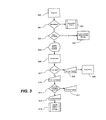
- FIG. 3 illustrated therein is a flow chart corresponding to software instructions or steps for providing safety information to a user.
- the device 100 is turned on or powered up.
- the device determines whether the battery, or other power source, is the same as at last power down, or whether it is new. This determination may be made in any of several ways.
- the power source does not include identification information like an EPROM 205 or coding resistor
- a new power source will be detected if the detector detects that the power source has been decoupled since the last power down operation. If the power source does include identification information, a new power source will be detected if the detector detects that the power source has been decoupled since the last power down and the identification information is not the same as with the previous power source. If no new battery or power source is detected, the normal start-up or boot process occurs at step 302.
- the device 100 checks to see if the power source is identifiable at step 303. For example, if the identification information includes a manufacturer's code, the device may check to see if the power source has been made by a manufacturer with certifiably safe products. If the power source is not identified, then safety information of a first type, for example an unknown product warning message, may appear at step 304. This warning may include language indicating that the type of power source is unknown, and that there may be an increased risk associated with using the product.
- a first type for example an unknown product warning message
- safety information of a second type for example basic safety information message, is displayed at step 305. Note that where the system does not include a power source having identification information, step 303 would be omitted from the routine.
- the forced scroll operation at step 306 ensures that the user sees the entirety of the message displayed on the screen.
- the scroll may be forced by displaying another segment of the information when each time a key is depressed, and so on, until the entire message is displayed.
- dedicated up/down scroll buttons may be provided on the device.
- the scrolling feature solves the problem of condensed information, as it is no longer necessary for engineers to summarize information.
- the information may be displayed in its entirety .
- a confirmation message is displayed on the screen.
- the confirmation message asks the user to input either an acceptance of the safety information or a rejection of the safety information.
- the acceptance may consist of a simple message like "Do you understand and agree to these terms? If yes, press 1. If no, press 2.” In the alternative, the message might state "By pressing any key other than POWER, you are agreeing that you have read and understand this information.”
- the device powers down at step 310. This is generally desirable in that it is not prudent for a user to operate a device when the user has indicated that they do not understand the safety information associated therewith.
- step 311 there is an optional "show this message at power up” prompt.
- the option of presenting the information each time the device is powered up at step 311 allows the user to indicate that he does not want to see the information again.
- the user's desire is communicated to the device through the "yes” or “no" entries of steps 313 and 312, respectively.
- the software overrides the user's selection at either step 313 or 312 when a power source is decoupled.
- step 314 there is an optional opportunity to poll a carrier or other third party for additional safety information. For example, when product recalls, new safety information or warranty notices arise, it may be desirable for the device not only to display information stored locally within the device, but also downloaded information as well. For this reason, step 314 offers the opportunity to gather such information. The details of step 314 will be illustrated in the discussion of FIG. 6.
- FIG. 4 one preferred method of determining whether the battery or other power source has been decoupled since the device was last operational will be examined in more detail.
- power sources come both with identification information and without.
- branches 400,401 are shown here, one for detecting whether a power source having identification information has been decoupled 400, and another for detecting whether a power source without identification information has been decoupled 401.
- this identification information is read by the device at step 402.
- the information is stored at step 403.
- the recently read information is compared from stored information, which corresponds to the power source identification information stored at the last time the device was operational. If the information matches, as determined at step 407, no new power source is indicated at step 408. Otherwise, a new power source is indicated at step 409. Note that if the power source has been changed from one that had identification to one that does not have identification information, or vice versa, the algorithm will proceed to step 409, as there will be no match at step 407.
- a detector detects decoupling at step 404.
- the detector could be a mechanical detector, for example a push button that sets a switch when a power source is coupled. It could also be a mechanical detector that detects the coupling of a connector.
- the detector may include an electrical switch that detects the presence of a voltage at the power source connectors, and sets an internal flag in the microprocessor accordingly. In either event, a toggling of this detector is set as a removal flag at step 405. The device then checks to see if this flag has been toggled at step 406. If yes, then the device proceeds to step 409. If not, the device proceeds to step 408.
- FIG. 5 illustrated there is one preferred embodiment of an unknown power source warning information message. Recall that step 304 of FIG. 3 discussed presenting an, unknown warning message where a power source was not identified. FIG. 5 illustrates one such method of presenting such a message.
- the device has learned that the power source is unidentified.
- a high-level warning is presented to the user. This high level warning may indicate, for example, that an unrecognized power source can not be authenticated for safety, and that a higher risk is associated with unknown power sources. Additionally, a recommendation not to use unknown power sources may be presented at step 502. Prior to use, some manufacturers may desire to include an assumption of risk message at step 503.
- step 504 The forced scroll of step 504 is the same as is recited above, and it ensures that the entirety of the message is displayed, without need for editing or consolidation.
- an acknowledgement prompt is presented at step 505.
- the user may acknowledge either in the affirmative or in the negative at steps 508, and 506, respectively. If the user acknowledges in the negative, one option is to power down the device at step 507.
- the device will poll the carrier for additional information at step 600.
- the carrier will acknowledge, either positively or negatively, at step 601. If the acknowledgement is in the affirmative, the device will download the information at step 602.
- the information may be any of a number of types, exemplary information includes carrier safety information, OEM or manufacturer safety information, and government-based safety information. Examples of government-based safety information include FDA warnings, CPSC, warnings, and WHO warnings.
- FIG. 7 illustrated therein is a top-level block diagram of one environment in which an electronic device 100 that receives messages from a third party may be used. To receive such a message, the device 100 needs communications capabilities. For communications devices, like cellular phones for example, communication is generally carried on with a service provider having at least one service center 700.
- the device 100 and the service center 700 may communicate with each other via wireless communications.
- the wireless communications are illustrated in FIG. 7 by communication arrows A and B.
- the communication A is a cellular wireless communication that is transmitted to a base station antenna 701, through a cellular network 702 and a public switched telephone network (PSTN) 703, and to the service center 703.
- PSTN public switched telephone network
- the service center 700 includes computers within which the third party safety messages are stored. Where the messages are, for example, OEM or governmental messages, these messages are communicated to the service center 700 from that particular third party 704.
- the communications are via a cellular wireless communication such as AMPS, CDMA, GSM or TDMA.
- the transmission from the device 100 to the service center 700 may also be made by other wireless communications such as a satellite communications.
- the service center 700 may transmit any locally stored safety information to the device 100.
- the communication B is a cellular wireless communication that is sent through the public switched telephone network (PSTN) 703 and cellular network 702 and transmitted by the base station antenna 701 to the device 100. The device may then display the information on the display.
- PSTN public switched telephone network
Landscapes
- Engineering & Computer Science (AREA)
- Power Engineering (AREA)
- Telephone Function (AREA)
- Power Sources (AREA)
- Mobile Radio Communication Systems (AREA)
- Calculators And Similar Devices (AREA)
- Alarm Systems (AREA)
- Emergency Alarm Devices (AREA)
Abstract
Description
Claims (30)
- A portable electronic device, comprising:wherein the portable electronic device presents safety information pertaining to the power source on the display.a. a display, wherein the display is visible to a user; andb. a power source;
- The device of claim 1, wherein the safety information is presented on the display when the device is turned on.
- The device of claim 1, wherein the device is capable of detecting whether the power source has been decoupled since the device was turned off.
- The device of claim 3, wherein the presentation of safety information occurs when the following have occurred:a. the power source has been decoupled since the device was turned off; andb. the device is turned on.
- The device of claim 2 or claim 3, wherein the safety information remains visible on the display until a user inputs information into the device.
- The device of claim 5, wherein the inputted information is selected from the group consisting of an acceptance of the safety information and a rejection of the safety information.
- The device of claim 6, wherein when the inputted information comprises the rejection of the safety information, the device turns off.
- The device of claim 1, wherein the device is capable of identifying the power source coupled thereto.
- The device of claim 8, wherein when the power source is identified, safety information of a first type is presented on the display, further wherein the power source is not identified, safety information of a second type is presented on the display.
- The device of claim 1, wherein the power source comprises a rechargeable battery.
- An electronic device, comprising:wherein the software includes a plurality of steps, the steps comprising:a. a microprocessor;b. memory coupled to the microprocessor, the memory having disposed therein software executable by the microprocessor; andc. a display;a. detecting the presence of a power source; andb. presenting information about the power source on the display.
- The device of claim 11, wherein the steps further comprise maintaining the information on the display until a user presses a key.
- The device of claim 12, wherein the presenting of information occurs at power being applied to the device.
- The device of claim 12, wherein the steps further comprise detecting whether the power source has been coupled to the device since the last power down operation.
- The device of claim 14, wherein the device presents information about the power source on the display only if the power source has been coupled to the device since the last power down operation.
- The device of claim 12, wherein the steps further comprise identifying the power source.
- The device of claim 16, wherein when the power source is identified, a first information message is presented on the display, further wherein when the power source is not identified, a second information message is presented on the display.
- The device of claim 12, wherein the steps further comprise polling a third party for an additional information message.
- The device of claim 18, wherein the additional information message is selected from the group consisting of carrier safety information, OEM safety information and government safety information.
- The device of claim 12, wherein the key is selected from the group consisting of at least a key indicating acknowledgement of the information and at least a key indicating non-acknowledgement of the information.
- The device of claim 20, wherein when the key selected by the user is the at least a key indicating non-acknowledgement of the information, the device powers down.
- The device of claim 12, wherein the steps comprise scrolling the information across the display.
- The device of claim 11, wherein the device is selected from the group consisting of telephones, pagers, two-way radios, computers, PDAs and MP3 players.
- The device of claims 11 or 12, wherein the power source comprises a rechargeable battery.
- A method of presenting safety information relating to a rechargeable battery to a user, the method comprising the steps of:a. detecting whether the rechargeable battery has been decoupled from the device since the device was last operational;b. presenting the safety information on a display of the device; andc. maintaining the presentation of the safety information on the display until user acknowledgement.
- The method of claim 25, further comprising powering down the device if the user acknowledges the safety information in the negative.
- The method of claim 25, further comprising removing the safety information from the display if the user acknowledges the safety information in the affirmative.
- The method of claim 25, further comprising identifying the type of rechargeable battery coupled to the device.
- The method of claim 28, wherein if the type of rechargeable battery is recognized by the device, safety information of a first type is presented on the display, further wherein if the type of rechargeable battery is not recognized by the device, safety information of a second type is presented on the display.
- The method of claim 25, further comprising polling a carrier for additional safety information.
Applications Claiming Priority (2)
| Application Number | Priority Date | Filing Date | Title |
|---|---|---|---|
| US10/824,704 US20050231160A1 (en) | 2004-04-15 | 2004-04-15 | Energy safety notification system for electronic devices |
| US824704 | 2007-07-02 |
Publications (2)
| Publication Number | Publication Date |
|---|---|
| EP1596485A2 true EP1596485A2 (en) | 2005-11-16 |
| EP1596485A3 EP1596485A3 (en) | 2008-03-19 |
Family
ID=34940716
Family Applications (1)
| Application Number | Title | Priority Date | Filing Date |
|---|---|---|---|
| EP05252124A Withdrawn EP1596485A3 (en) | 2004-04-15 | 2005-04-05 | Energy safety notification system for electronic devices |
Country Status (4)
| Country | Link |
|---|---|
| US (1) | US20050231160A1 (en) |
| EP (1) | EP1596485A3 (en) |
| JP (1) | JP2005302010A (en) |
| CN (1) | CN1683937A (en) |
Families Citing this family (4)
| Publication number | Priority date | Publication date | Assignee | Title |
|---|---|---|---|---|
| JP3838258B2 (en) * | 2005-03-10 | 2006-10-25 | ソニー株式会社 | Battery level display method |
| US20080252477A1 (en) * | 2007-04-16 | 2008-10-16 | Motorola, Inc. | Method and apparatus for authenticating use of a battery in a wireless communication device |
| US9071066B2 (en) * | 2009-12-22 | 2015-06-30 | Empire Technology Development Llc | Measurement of environmental impact of electronic devices |
| US20150247888A1 (en) * | 2011-07-20 | 2015-09-03 | Cmte Development Limited | Spark testing apparatus |
Family Cites Families (7)
| Publication number | Priority date | Publication date | Assignee | Title |
|---|---|---|---|---|
| US20020101218A1 (en) * | 1984-05-21 | 2002-08-01 | Intermec Ip Corp | Battery pack having memory |
| US6181103B1 (en) * | 1997-05-27 | 2001-01-30 | Shu-Chin Chen | Advanced intelligent computer power management system |
| JP2000068922A (en) * | 1998-08-20 | 2000-03-03 | Sharp Corp | Mobile terminal device |
| JP3825941B2 (en) * | 1999-07-28 | 2006-09-27 | 富士写真フイルム株式会社 | Warning device and method for composite electronic device |
| KR20010053847A (en) * | 1999-12-02 | 2001-07-02 | 윤종용 | Battery exchanging method during call processing of wireless telephone set |
| JP3448003B2 (en) * | 2000-03-09 | 2003-09-16 | 株式会社東芝 | Mobile communication terminal |
| US6985753B2 (en) * | 2001-12-07 | 2006-01-10 | Dashsmart Investments Llc | Portable navigation and communication systems |
-
2004
- 2004-04-15 US US10/824,704 patent/US20050231160A1/en not_active Abandoned
-
2005
- 2005-03-23 JP JP2005083250A patent/JP2005302010A/en active Pending
- 2005-04-05 EP EP05252124A patent/EP1596485A3/en not_active Withdrawn
- 2005-04-15 CN CNA2005100655466A patent/CN1683937A/en active Pending
Also Published As
| Publication number | Publication date |
|---|---|
| CN1683937A (en) | 2005-10-19 |
| US20050231160A1 (en) | 2005-10-20 |
| EP1596485A3 (en) | 2008-03-19 |
| JP2005302010A (en) | 2005-10-27 |
Similar Documents
| Publication | Publication Date | Title |
|---|---|---|
| EP3574546B1 (en) | Control method and electronic device based on battery leakage state | |
| US8284067B2 (en) | Delayed power-on function for an electronic device | |
| JP5611383B2 (en) | Short-distance wireless power receiving apparatus and method | |
| CN101415043B (en) | Mobile terminal aware of externally connected device and control method for the same | |
| CN1980440B (en) | Telephone handset, base and associated method for updating the software of the handset | |
| US8710961B2 (en) | Anti-fake battery pack and identification system thereof | |
| US8405363B2 (en) | Contact module for rechargeable battery, mobile electronic device having the same contact module and method of preventing rechargeable battery from exploding using the same contact module | |
| KR20190006596A (en) | Portable communication devices with accessory functions and related methods | |
| CA2573997A1 (en) | Method and apparatus for displaying battery fault notifications on wireless devices | |
| EP2709234A1 (en) | Portable terminal device, charging method and program | |
| KR102813618B1 (en) | Method for power supply and an electronic device thereof | |
| US11598306B2 (en) | Emergency start | |
| KR20090084488A (en) | Method and apparatus for determining external device connected to mobile terminal | |
| CN105044608A (en) | Method and apparatus for monitoring battery state | |
| EP3467527B1 (en) | Terminal device, adapter, battery safety monitoring method and monitoring system | |
| EP1596485A2 (en) | Energy safety notification system for electronic devices | |
| US20120095772A1 (en) | Portable device, battery pack, reporting method and reporting program | |
| EP1986406B1 (en) | System and method for recognizing external device by portable terminal | |
| CN210694614U (en) | Mobile terminal | |
| JP2019202633A (en) | Power storage device and method of controlling the same, and moving body control system | |
| JP5450231B2 (en) | Keyboard connection device | |
| US12218367B2 (en) | Device and battery module with integrated backup radio | |
| KR100648333B1 (en) | How to charge your phone | |
| KR0172470B1 (en) | Selective calling receiver | |
| JP2010087800A (en) | Apparatus use management system, information apparatus, method and program therefor |
Legal Events
| Date | Code | Title | Description |
|---|---|---|---|
| PUAI | Public reference made under article 153(3) epc to a published international application that has entered the european phase |
Free format text: ORIGINAL CODE: 0009012 |
|
| AK | Designated contracting states |
Kind code of ref document: A2 Designated state(s): AT BE BG CH CY CZ DE DK EE ES FI FR GB GR HU IE IS IT LI LT LU MC NL PL PT RO SE SI SK TR |
|
| AX | Request for extension of the european patent |
Extension state: AL BA HR LV MK YU |
|
| PUAL | Search report despatched |
Free format text: ORIGINAL CODE: 0009013 |
|
| AK | Designated contracting states |
Kind code of ref document: A3 Designated state(s): AT BE BG CH CY CZ DE DK EE ES FI FR GB GR HU IE IS IT LI LT LU MC NL PL PT RO SE SI SK TR |
|
| AX | Request for extension of the european patent |
Extension state: AL BA HR LV MK YU |
|
| AKX | Designation fees paid | ||
| REG | Reference to a national code |
Ref country code: DE Ref legal event code: 8566 Ref country code: DE Ref legal event code: R108 Effective date: 20081028 |
|
| STAA | Information on the status of an ep patent application or granted ep patent |
Free format text: STATUS: THE APPLICATION IS DEEMED TO BE WITHDRAWN |
|
| 18D | Application deemed to be withdrawn |
Effective date: 20080920 |
|
| P01 | Opt-out of the competence of the unified patent court (upc) registered |
Effective date: 20230520 |