EP1596451A1 - Active substance for negative electrode of lithium secondary battery, negative electrode of lithium secondary battery and lithium secondary battery - Google Patents
Active substance for negative electrode of lithium secondary battery, negative electrode of lithium secondary battery and lithium secondary battery Download PDFInfo
- Publication number
- EP1596451A1 EP1596451A1 EP04712180A EP04712180A EP1596451A1 EP 1596451 A1 EP1596451 A1 EP 1596451A1 EP 04712180 A EP04712180 A EP 04712180A EP 04712180 A EP04712180 A EP 04712180A EP 1596451 A1 EP1596451 A1 EP 1596451A1
- Authority
- EP
- European Patent Office
- Prior art keywords
- active material
- secondary battery
- lithium secondary
- negative
- electrode
- Prior art date
- Legal status (The legal status is an assumption and is not a legal conclusion. Google has not performed a legal analysis and makes no representation as to the accuracy of the status listed.)
- Withdrawn
Links
- 229910052744 lithium Inorganic materials 0.000 title claims abstract description 106
- WHXSMMKQMYFTQS-UHFFFAOYSA-N Lithium Chemical compound [Li] WHXSMMKQMYFTQS-UHFFFAOYSA-N 0.000 title claims abstract description 91
- 239000013543 active substance Substances 0.000 title 1
- 239000002245 particle Substances 0.000 claims abstract description 202
- 239000011149 active material Substances 0.000 claims abstract description 128
- 239000000843 powder Substances 0.000 claims abstract description 104
- 239000007773 negative electrode material Substances 0.000 claims abstract description 69
- 238000000034 method Methods 0.000 claims abstract description 51
- 239000006185 dispersion Substances 0.000 claims abstract description 46
- 230000000694 effects Effects 0.000 claims abstract description 16
- XLYOFNOQVPJJNP-UHFFFAOYSA-N water Substances O XLYOFNOQVPJJNP-UHFFFAOYSA-N 0.000 claims abstract description 15
- 239000011368 organic material Substances 0.000 claims abstract description 13
- 230000008719 thickening Effects 0.000 claims abstract description 13
- 229920002134 Carboxymethyl cellulose Polymers 0.000 claims abstract description 9
- 239000001768 carboxy methyl cellulose Substances 0.000 claims abstract description 9
- 235000010948 carboxy methyl cellulose Nutrition 0.000 claims abstract description 9
- 239000008112 carboxymethyl-cellulose Substances 0.000 claims abstract description 9
- 239000003792 electrolyte Substances 0.000 claims description 9
- 230000009467 reduction Effects 0.000 abstract description 5
- 239000000463 material Substances 0.000 description 80
- -1 argon ion Chemical class 0.000 description 72
- OKTJSMMVPCPJKN-UHFFFAOYSA-N Carbon Chemical compound [C] OKTJSMMVPCPJKN-UHFFFAOYSA-N 0.000 description 65
- 239000011362 coarse particle Substances 0.000 description 46
- 239000000203 mixture Substances 0.000 description 42
- 239000002002 slurry Substances 0.000 description 40
- 229920001577 copolymer Polymers 0.000 description 27
- 239000004020 conductor Substances 0.000 description 25
- 229910052799 carbon Inorganic materials 0.000 description 20
- 239000002131 composite material Substances 0.000 description 20
- 238000009826 distribution Methods 0.000 description 20
- 229910002804 graphite Inorganic materials 0.000 description 20
- 239000010439 graphite Substances 0.000 description 20
- 238000012360 testing method Methods 0.000 description 20
- 239000007774 positive electrode material Substances 0.000 description 18
- 239000002904 solvent Substances 0.000 description 18
- 230000002829 reductive effect Effects 0.000 description 15
- VGGSQFUCUMXWEO-UHFFFAOYSA-N Ethene Chemical compound C=C VGGSQFUCUMXWEO-UHFFFAOYSA-N 0.000 description 14
- 239000005977 Ethylene Substances 0.000 description 14
- 239000011230 binding agent Substances 0.000 description 14
- 238000011156 evaluation Methods 0.000 description 14
- 238000005259 measurement Methods 0.000 description 14
- 229910003481 amorphous carbon Inorganic materials 0.000 description 13
- 150000002500 ions Chemical class 0.000 description 13
- 238000002156 mixing Methods 0.000 description 13
- YXFVVABEGXRONW-UHFFFAOYSA-N Toluene Chemical compound CC1=CC=CC=C1 YXFVVABEGXRONW-UHFFFAOYSA-N 0.000 description 12
- 239000007833 carbon precursor Substances 0.000 description 12
- 238000001465 metallisation Methods 0.000 description 12
- 239000003960 organic solvent Substances 0.000 description 12
- 239000012298 atmosphere Substances 0.000 description 11
- BQCIDUSAKPWEOX-UHFFFAOYSA-N 1,1-Difluoroethene Chemical compound FC(F)=C BQCIDUSAKPWEOX-UHFFFAOYSA-N 0.000 description 10
- 230000000052 comparative effect Effects 0.000 description 10
- 239000008151 electrolyte solution Substances 0.000 description 10
- 239000011888 foil Substances 0.000 description 10
- 229920002981 polyvinylidene fluoride Polymers 0.000 description 10
- 229920005989 resin Polymers 0.000 description 10
- 239000011347 resin Substances 0.000 description 10
- 238000001507 sample dispersion Methods 0.000 description 10
- 230000003746 surface roughness Effects 0.000 description 10
- IJGRMHOSHXDMSA-UHFFFAOYSA-N Atomic nitrogen Chemical compound N#N IJGRMHOSHXDMSA-UHFFFAOYSA-N 0.000 description 9
- ZMXDDKWLCZADIW-UHFFFAOYSA-N N,N-Dimethylformamide Chemical compound CN(C)C=O ZMXDDKWLCZADIW-UHFFFAOYSA-N 0.000 description 9
- PXHVJJICTQNCMI-UHFFFAOYSA-N Nickel Chemical compound [Ni] PXHVJJICTQNCMI-UHFFFAOYSA-N 0.000 description 9
- 229910021383 artificial graphite Inorganic materials 0.000 description 9
- 239000011248 coating agent Substances 0.000 description 9
- 238000000576 coating method Methods 0.000 description 9
- 238000010438 heat treatment Methods 0.000 description 9
- 239000000835 fiber Substances 0.000 description 8
- 239000000945 filler Substances 0.000 description 8
- 229910052782 aluminium Inorganic materials 0.000 description 7
- 239000013078 crystal Substances 0.000 description 7
- 238000004898 kneading Methods 0.000 description 7
- 229910052751 metal Inorganic materials 0.000 description 7
- 239000002184 metal Substances 0.000 description 7
- 238000003825 pressing Methods 0.000 description 7
- 238000007873 sieving Methods 0.000 description 7
- 238000003756 stirring Methods 0.000 description 7
- 239000000126 substance Substances 0.000 description 7
- LFQSCWFLJHTTHZ-UHFFFAOYSA-N Ethanol Chemical compound CCO LFQSCWFLJHTTHZ-UHFFFAOYSA-N 0.000 description 6
- 239000004698 Polyethylene Substances 0.000 description 6
- XAGFODPZIPBFFR-UHFFFAOYSA-N aluminium Chemical compound [Al] XAGFODPZIPBFFR-UHFFFAOYSA-N 0.000 description 6
- 150000001875 compounds Chemical class 0.000 description 6
- 239000002612 dispersion medium Substances 0.000 description 6
- 229920000573 polyethylene Polymers 0.000 description 6
- 230000008569 process Effects 0.000 description 6
- 239000007787 solid Substances 0.000 description 6
- 239000007784 solid electrolyte Substances 0.000 description 6
- BFKJFAAPBSQJPD-UHFFFAOYSA-N tetrafluoroethene Chemical group FC(F)=C(F)F BFKJFAAPBSQJPD-UHFFFAOYSA-N 0.000 description 6
- RYGMFSIKBFXOCR-UHFFFAOYSA-N Copper Chemical compound [Cu] RYGMFSIKBFXOCR-UHFFFAOYSA-N 0.000 description 5
- KMTRUDSVKNLOMY-UHFFFAOYSA-N Ethylene carbonate Chemical compound O=C1OCCO1 KMTRUDSVKNLOMY-UHFFFAOYSA-N 0.000 description 5
- SECXISVLQFMRJM-UHFFFAOYSA-N N-Methylpyrrolidone Chemical compound CN1CCCC1=O SECXISVLQFMRJM-UHFFFAOYSA-N 0.000 description 5
- 239000004743 Polypropylene Substances 0.000 description 5
- 239000006230 acetylene black Substances 0.000 description 5
- 230000008859 change Effects 0.000 description 5
- 229910052802 copper Inorganic materials 0.000 description 5
- 239000010949 copper Substances 0.000 description 5
- 230000007423 decrease Effects 0.000 description 5
- 239000007789 gas Substances 0.000 description 5
- 230000001771 impaired effect Effects 0.000 description 5
- 229910003002 lithium salt Inorganic materials 0.000 description 5
- 159000000002 lithium salts Chemical class 0.000 description 5
- 238000004519 manufacturing process Methods 0.000 description 5
- 229910021382 natural graphite Inorganic materials 0.000 description 5
- 229910052759 nickel Inorganic materials 0.000 description 5
- 229920000642 polymer Polymers 0.000 description 5
- 229920001155 polypropylene Polymers 0.000 description 5
- 239000011148 porous material Substances 0.000 description 5
- OIFBSDVPJOWBCH-UHFFFAOYSA-N Diethyl carbonate Chemical compound CCOC(=O)OCC OIFBSDVPJOWBCH-UHFFFAOYSA-N 0.000 description 4
- IAZDPXIOMUYVGZ-UHFFFAOYSA-N Dimethylsulphoxide Chemical compound CS(C)=O IAZDPXIOMUYVGZ-UHFFFAOYSA-N 0.000 description 4
- 229910001290 LiPF6 Inorganic materials 0.000 description 4
- CTQNGGLPUBDAKN-UHFFFAOYSA-N O-Xylene Chemical compound CC1=CC=CC=C1C CTQNGGLPUBDAKN-UHFFFAOYSA-N 0.000 description 4
- 238000001069 Raman spectroscopy Methods 0.000 description 4
- RTAQQCXQSZGOHL-UHFFFAOYSA-N Titanium Chemical compound [Ti] RTAQQCXQSZGOHL-UHFFFAOYSA-N 0.000 description 4
- 239000000654 additive Substances 0.000 description 4
- RDOXTESZEPMUJZ-UHFFFAOYSA-N anisole Chemical compound COC1=CC=CC=C1 RDOXTESZEPMUJZ-UHFFFAOYSA-N 0.000 description 4
- 239000003125 aqueous solvent Substances 0.000 description 4
- XKRFYHLGVUSROY-UHFFFAOYSA-N argon Substances [Ar] XKRFYHLGVUSROY-UHFFFAOYSA-N 0.000 description 4
- 150000004945 aromatic hydrocarbons Chemical class 0.000 description 4
- MTAZNLWOLGHBHU-UHFFFAOYSA-N butadiene-styrene rubber Chemical compound C=CC=C.C=CC1=CC=CC=C1 MTAZNLWOLGHBHU-UHFFFAOYSA-N 0.000 description 4
- 239000010408 film Substances 0.000 description 4
- 238000001914 filtration Methods 0.000 description 4
- 239000012530 fluid Substances 0.000 description 4
- 239000011261 inert gas Substances 0.000 description 4
- 239000004615 ingredient Substances 0.000 description 4
- KWGKDLIKAYFUFQ-UHFFFAOYSA-M lithium chloride Chemical compound [Li+].[Cl-] KWGKDLIKAYFUFQ-UHFFFAOYSA-M 0.000 description 4
- 229920002493 poly(chlorotrifluoroethylene) Polymers 0.000 description 4
- 229920002857 polybutadiene Polymers 0.000 description 4
- 239000005023 polychlorotrifluoroethylene (PCTFE) polymer Substances 0.000 description 4
- 239000004810 polytetrafluoroethylene Substances 0.000 description 4
- 229920001343 polytetrafluoroethylene Polymers 0.000 description 4
- 238000010298 pulverizing process Methods 0.000 description 4
- 229910001220 stainless steel Inorganic materials 0.000 description 4
- 239000010935 stainless steel Substances 0.000 description 4
- 238000003860 storage Methods 0.000 description 4
- 239000000725 suspension Substances 0.000 description 4
- 229910052719 titanium Inorganic materials 0.000 description 4
- 239000010936 titanium Substances 0.000 description 4
- 239000008096 xylene Substances 0.000 description 4
- WEVYAHXRMPXWCK-UHFFFAOYSA-N Acetonitrile Chemical compound CC#N WEVYAHXRMPXWCK-UHFFFAOYSA-N 0.000 description 3
- UHOVQNZJYSORNB-UHFFFAOYSA-N Benzene Chemical compound C1=CC=CC=C1 UHOVQNZJYSORNB-UHFFFAOYSA-N 0.000 description 3
- 229920000049 Carbon (fiber) Polymers 0.000 description 3
- XTHFKEDIFFGKHM-UHFFFAOYSA-N Dimethoxyethane Chemical compound COCCOC XTHFKEDIFFGKHM-UHFFFAOYSA-N 0.000 description 3
- 239000004716 Ethylene/acrylic acid copolymer Substances 0.000 description 3
- HBBGRARXTFLTSG-UHFFFAOYSA-N Lithium ion Chemical compound [Li+] HBBGRARXTFLTSG-UHFFFAOYSA-N 0.000 description 3
- 229920000265 Polyparaphenylene Polymers 0.000 description 3
- WYURNTSHIVDZCO-UHFFFAOYSA-N Tetrahydrofuran Chemical compound C1CCOC1 WYURNTSHIVDZCO-UHFFFAOYSA-N 0.000 description 3
- BAPJBEWLBFYGME-UHFFFAOYSA-N acrylic acid methyl ester Natural products COC(=O)C=C BAPJBEWLBFYGME-UHFFFAOYSA-N 0.000 description 3
- 238000004220 aggregation Methods 0.000 description 3
- 230000002776 aggregation Effects 0.000 description 3
- 229910052786 argon Inorganic materials 0.000 description 3
- 239000011324 bead Substances 0.000 description 3
- 239000011305 binder pitch Substances 0.000 description 3
- 230000015572 biosynthetic process Effects 0.000 description 3
- 239000004917 carbon fiber Substances 0.000 description 3
- 239000003575 carbonaceous material Substances 0.000 description 3
- 150000005678 chain carbonates Chemical class 0.000 description 3
- 150000003950 cyclic amides Chemical class 0.000 description 3
- 150000005676 cyclic carbonates Chemical class 0.000 description 3
- 229910001873 dinitrogen Inorganic materials 0.000 description 3
- 238000001035 drying Methods 0.000 description 3
- JBTWLSYIZRCDFO-UHFFFAOYSA-N ethyl methyl carbonate Chemical compound CCOC(=O)OC JBTWLSYIZRCDFO-UHFFFAOYSA-N 0.000 description 3
- 229920006242 ethylene acrylic acid copolymer Polymers 0.000 description 3
- 239000000295 fuel oil Substances 0.000 description 3
- XPFVYQJUAUNWIW-UHFFFAOYSA-N furfuryl alcohol Chemical compound OCC1=CC=CO1 XPFVYQJUAUNWIW-UHFFFAOYSA-N 0.000 description 3
- 229910001416 lithium ion Inorganic materials 0.000 description 3
- 230000007774 longterm Effects 0.000 description 3
- 239000002609 medium Substances 0.000 description 3
- 229920003145 methacrylic acid copolymer Polymers 0.000 description 3
- 229910052757 nitrogen Inorganic materials 0.000 description 3
- 238000012856 packing Methods 0.000 description 3
- 239000012071 phase Substances 0.000 description 3
- 229920000098 polyolefin Polymers 0.000 description 3
- 239000000047 product Substances 0.000 description 3
- 230000002035 prolonged effect Effects 0.000 description 3
- RUOJZAUFBMNUDX-UHFFFAOYSA-N propylene carbonate Chemical compound CC1COC(=O)O1 RUOJZAUFBMNUDX-UHFFFAOYSA-N 0.000 description 3
- 238000011084 recovery Methods 0.000 description 3
- 230000001105 regulatory effect Effects 0.000 description 3
- 229920005992 thermoplastic resin Polymers 0.000 description 3
- BLTXWCKMNMYXEA-UHFFFAOYSA-N 1,1,2-trifluoro-2-(trifluoromethoxy)ethene Chemical compound FC(F)=C(F)OC(F)(F)F BLTXWCKMNMYXEA-UHFFFAOYSA-N 0.000 description 2
- ZZXUZKXVROWEIF-UHFFFAOYSA-N 1,2-butylene carbonate Chemical compound CCC1COC(=O)O1 ZZXUZKXVROWEIF-UHFFFAOYSA-N 0.000 description 2
- VAYTZRYEBVHVLE-UHFFFAOYSA-N 1,3-dioxol-2-one Chemical compound O=C1OC=CO1 VAYTZRYEBVHVLE-UHFFFAOYSA-N 0.000 description 2
- WNXJIVFYUVYPPR-UHFFFAOYSA-N 1,3-dioxolane Chemical compound C1COCO1 WNXJIVFYUVYPPR-UHFFFAOYSA-N 0.000 description 2
- YEJRWHAVMIAJKC-UHFFFAOYSA-N 4-Butyrolactone Chemical compound O=C1CCCO1 YEJRWHAVMIAJKC-UHFFFAOYSA-N 0.000 description 2
- DLFVBJFMPXGRIB-UHFFFAOYSA-N Acetamide Chemical compound CC(N)=O DLFVBJFMPXGRIB-UHFFFAOYSA-N 0.000 description 2
- CURLTUGMZLYLDI-UHFFFAOYSA-N Carbon dioxide Chemical compound O=C=O CURLTUGMZLYLDI-UHFFFAOYSA-N 0.000 description 2
- RTZKZFJDLAIYFH-UHFFFAOYSA-N Diethyl ether Chemical compound CCOCC RTZKZFJDLAIYFH-UHFFFAOYSA-N 0.000 description 2
- KRHYYFGTRYWZRS-UHFFFAOYSA-M Fluoride anion Chemical compound [F-] KRHYYFGTRYWZRS-UHFFFAOYSA-M 0.000 description 2
- ZHNUHDYFZUAESO-UHFFFAOYSA-N Formamide Chemical compound NC=O ZHNUHDYFZUAESO-UHFFFAOYSA-N 0.000 description 2
- FXHOOIRPVKKKFG-UHFFFAOYSA-N N,N-Dimethylacetamide Chemical compound CN(C)C(C)=O FXHOOIRPVKKKFG-UHFFFAOYSA-N 0.000 description 2
- LRHPLDYGYMQRHN-UHFFFAOYSA-N N-Butanol Chemical compound CCCCO LRHPLDYGYMQRHN-UHFFFAOYSA-N 0.000 description 2
- JUJWROOIHBZHMG-UHFFFAOYSA-N Pyridine Chemical compound C1=CC=NC=C1 JUJWROOIHBZHMG-UHFFFAOYSA-N 0.000 description 2
- SMWDFEZZVXVKRB-UHFFFAOYSA-N Quinoline Chemical compound N1=CC=CC2=CC=CC=C21 SMWDFEZZVXVKRB-UHFFFAOYSA-N 0.000 description 2
- YTPLMLYBLZKORZ-UHFFFAOYSA-N Thiophene Chemical compound C=1C=CSC=1 YTPLMLYBLZKORZ-UHFFFAOYSA-N 0.000 description 2
- 238000002441 X-ray diffraction Methods 0.000 description 2
- XLOMVQKBTHCTTD-UHFFFAOYSA-N Zinc monoxide Chemical compound [Zn]=O XLOMVQKBTHCTTD-UHFFFAOYSA-N 0.000 description 2
- DZBUGLKDJFMEHC-UHFFFAOYSA-N acridine Chemical compound C1=CC=CC2=CC3=CC=CC=C3N=C21 DZBUGLKDJFMEHC-UHFFFAOYSA-N 0.000 description 2
- 230000002411 adverse Effects 0.000 description 2
- 150000001408 amides Chemical class 0.000 description 2
- MWPLVEDNUUSJAV-UHFFFAOYSA-N anthracene Chemical compound C1=CC=CC2=CC3=CC=CC=C3C=C21 MWPLVEDNUUSJAV-UHFFFAOYSA-N 0.000 description 2
- 239000006229 carbon black Substances 0.000 description 2
- 235000019241 carbon black Nutrition 0.000 description 2
- 238000003763 carbonization Methods 0.000 description 2
- 239000006231 channel black Substances 0.000 description 2
- 230000006835 compression Effects 0.000 description 2
- 238000007906 compression Methods 0.000 description 2
- 150000004292 cyclic ethers Chemical class 0.000 description 2
- 230000001351 cycling effect Effects 0.000 description 2
- 238000000151 deposition Methods 0.000 description 2
- 230000008021 deposition Effects 0.000 description 2
- IEJIGPNLZYLLBP-UHFFFAOYSA-N dimethyl carbonate Chemical compound COC(=O)OC IEJIGPNLZYLLBP-UHFFFAOYSA-N 0.000 description 2
- ZUOUZKKEUPVFJK-UHFFFAOYSA-N diphenyl Chemical compound C1=CC=CC=C1C1=CC=CC=C1 ZUOUZKKEUPVFJK-UHFFFAOYSA-N 0.000 description 2
- VUPKGFBOKBGHFZ-UHFFFAOYSA-N dipropyl carbonate Chemical compound CCCOC(=O)OCCC VUPKGFBOKBGHFZ-UHFFFAOYSA-N 0.000 description 2
- 239000002270 dispersing agent Substances 0.000 description 2
- 239000003623 enhancer Substances 0.000 description 2
- KLKFAASOGCDTDT-UHFFFAOYSA-N ethoxymethoxyethane Chemical compound CCOCOCC KLKFAASOGCDTDT-UHFFFAOYSA-N 0.000 description 2
- FKRCODPIKNYEAC-UHFFFAOYSA-N ethyl propionate Chemical compound CCOC(=O)CC FKRCODPIKNYEAC-UHFFFAOYSA-N 0.000 description 2
- LYCAIKOWRPUZTN-UHFFFAOYSA-N ethylene glycol Natural products OCCO LYCAIKOWRPUZTN-UHFFFAOYSA-N 0.000 description 2
- 229920000840 ethylene tetrafluoroethylene copolymer Polymers 0.000 description 2
- 239000002657 fibrous material Substances 0.000 description 2
- 239000006260 foam Substances 0.000 description 2
- 239000006232 furnace black Substances 0.000 description 2
- 239000011521 glass Substances 0.000 description 2
- 150000003949 imides Chemical class 0.000 description 2
- 229910052909 inorganic silicate Inorganic materials 0.000 description 2
- 229910003480 inorganic solid Inorganic materials 0.000 description 2
- 239000010416 ion conductor Substances 0.000 description 2
- 239000003273 ketjen black Substances 0.000 description 2
- 239000006233 lamp black Substances 0.000 description 2
- 239000007788 liquid Substances 0.000 description 2
- AMXOYNBUYSYVKV-UHFFFAOYSA-M lithium bromide Chemical compound [Li+].[Br-] AMXOYNBUYSYVKV-UHFFFAOYSA-M 0.000 description 2
- 150000002642 lithium compounds Chemical class 0.000 description 2
- 229910052748 manganese Inorganic materials 0.000 description 2
- 239000011572 manganese Substances 0.000 description 2
- UZKWTJUDCOPSNM-UHFFFAOYSA-N methoxybenzene Substances CCCCOC=C UZKWTJUDCOPSNM-UHFFFAOYSA-N 0.000 description 2
- TZIHFWKZFHZASV-UHFFFAOYSA-N methyl formate Chemical compound COC=O TZIHFWKZFHZASV-UHFFFAOYSA-N 0.000 description 2
- VLKZOEOYAKHREP-UHFFFAOYSA-N n-Hexane Chemical compound CCCCCC VLKZOEOYAKHREP-UHFFFAOYSA-N 0.000 description 2
- 239000004745 nonwoven fabric Substances 0.000 description 2
- 239000003921 oil Substances 0.000 description 2
- 229920000620 organic polymer Polymers 0.000 description 2
- 239000003208 petroleum Substances 0.000 description 2
- YNPNZTXNASCQKK-UHFFFAOYSA-N phenanthrene Chemical compound C1=CC=C2C3=CC=CC=C3C=CC2=C1 YNPNZTXNASCQKK-UHFFFAOYSA-N 0.000 description 2
- 229920002451 polyvinyl alcohol Polymers 0.000 description 2
- 238000009700 powder processing Methods 0.000 description 2
- 238000002360 preparation method Methods 0.000 description 2
- 238000012545 processing Methods 0.000 description 2
- QQONPFPTGQHPMA-UHFFFAOYSA-N propylene Natural products CC=C QQONPFPTGQHPMA-UHFFFAOYSA-N 0.000 description 2
- 125000004805 propylene group Chemical group [H]C([H])([H])C([H])([*:1])C([H])([H])[*:2] 0.000 description 2
- 239000002994 raw material Substances 0.000 description 2
- 230000009257 reactivity Effects 0.000 description 2
- 238000007790 scraping Methods 0.000 description 2
- 239000013049 sediment Substances 0.000 description 2
- 238000000926 separation method Methods 0.000 description 2
- 238000010008 shearing Methods 0.000 description 2
- 238000001179 sorption measurement Methods 0.000 description 2
- 238000004381 surface treatment Methods 0.000 description 2
- 239000004094 surface-active agent Substances 0.000 description 2
- 238000010301 surface-oxidation reaction Methods 0.000 description 2
- 239000006234 thermal black Substances 0.000 description 2
- 238000004227 thermal cracking Methods 0.000 description 2
- 229920001187 thermosetting polymer Polymers 0.000 description 2
- 229910052723 transition metal Inorganic materials 0.000 description 2
- 229910000314 transition metal oxide Inorganic materials 0.000 description 2
- 150000003624 transition metals Chemical class 0.000 description 2
- PYOKUURKVVELLB-UHFFFAOYSA-N trimethyl orthoformate Chemical compound COC(OC)OC PYOKUURKVVELLB-UHFFFAOYSA-N 0.000 description 2
- 229920005609 vinylidenefluoride/hexafluoropropylene copolymer Polymers 0.000 description 2
- 238000004736 wide-angle X-ray diffraction Methods 0.000 description 2
- LZDKZFUFMNSQCJ-UHFFFAOYSA-N 1,2-diethoxyethane Chemical compound CCOCCOCC LZDKZFUFMNSQCJ-UHFFFAOYSA-N 0.000 description 1
- VFRGATWKSPNXLT-UHFFFAOYSA-N 1,2-dimethoxybutane Chemical compound CCC(OC)COC VFRGATWKSPNXLT-UHFFFAOYSA-N 0.000 description 1
- CYSGHNMQYZDMIA-UHFFFAOYSA-N 1,3-Dimethyl-2-imidazolidinon Chemical compound CN1CCN(C)C1=O CYSGHNMQYZDMIA-UHFFFAOYSA-N 0.000 description 1
- YJTKZCDBKVTVBY-UHFFFAOYSA-N 1,3-Diphenylbenzene Chemical group C1=CC=CC=C1C1=CC=CC(C=2C=CC=CC=2)=C1 YJTKZCDBKVTVBY-UHFFFAOYSA-N 0.000 description 1
- FSSPGSAQUIYDCN-UHFFFAOYSA-N 1,3-Propane sultone Chemical compound O=S1(=O)CCCO1 FSSPGSAQUIYDCN-UHFFFAOYSA-N 0.000 description 1
- OHZAHWOAMVVGEL-UHFFFAOYSA-N 2,2'-bithiophene Chemical compound C1=CSC(C=2SC=CC=2)=C1 OHZAHWOAMVVGEL-UHFFFAOYSA-N 0.000 description 1
- VEPOHXYIFQMVHW-XOZOLZJESA-N 2,3-dihydroxybutanedioic acid (2S,3S)-3,4-dimethyl-2-phenylmorpholine Chemical compound OC(C(O)C(O)=O)C(O)=O.C[C@H]1[C@@H](OCCN1C)c1ccccc1 VEPOHXYIFQMVHW-XOZOLZJESA-N 0.000 description 1
- JWUJQDFVADABEY-UHFFFAOYSA-N 2-methyltetrahydrofuran Chemical compound CC1CCCO1 JWUJQDFVADABEY-UHFFFAOYSA-N 0.000 description 1
- PPDFQRAASCRJAH-UHFFFAOYSA-N 2-methylthiolane 1,1-dioxide Chemical compound CC1CCCS1(=O)=O PPDFQRAASCRJAH-UHFFFAOYSA-N 0.000 description 1
- VWIIJDNADIEEDB-UHFFFAOYSA-N 3-methyl-1,3-oxazolidin-2-one Chemical compound CN1CCOC1=O VWIIJDNADIEEDB-UHFFFAOYSA-N 0.000 description 1
- 229910000838 Al alloy Inorganic materials 0.000 description 1
- 229910014451 C6Li Inorganic materials 0.000 description 1
- 229920001661 Chitosan Polymers 0.000 description 1
- 229910000881 Cu alloy Inorganic materials 0.000 description 1
- PIICEJLVQHRZGT-UHFFFAOYSA-N Ethylenediamine Chemical compound NCCN PIICEJLVQHRZGT-UHFFFAOYSA-N 0.000 description 1
- 229910000760 Hardened steel Inorganic materials 0.000 description 1
- 229910007041 Li(CF3SO2)2 Inorganic materials 0.000 description 1
- 229910007558 Li2SiS3 Inorganic materials 0.000 description 1
- 229910013043 Li3PO4-Li2S-SiS2 Inorganic materials 0.000 description 1
- 229910013035 Li3PO4-Li2S—SiS2 Inorganic materials 0.000 description 1
- 229910012810 Li3PO4—Li2S-SiS2 Inorganic materials 0.000 description 1
- 229910012797 Li3PO4—Li2S—SiS2 Inorganic materials 0.000 description 1
- 229910012047 Li4SiO4-LiI-LiOH Inorganic materials 0.000 description 1
- 229910012075 Li4SiO4-LiI—LiOH Inorganic materials 0.000 description 1
- 229910012057 Li4SiO4—LiI—LiOH Inorganic materials 0.000 description 1
- 229910003253 LiB10Cl10 Inorganic materials 0.000 description 1
- 229910000552 LiCF3SO3 Inorganic materials 0.000 description 1
- 229910003005 LiNiO2 Inorganic materials 0.000 description 1
- 229910001091 LixCoO2 Inorganic materials 0.000 description 1
- 229910016780 LixCoyM1-yOz Inorganic materials 0.000 description 1
- 229910016784 LixCoyM1−yOz Inorganic materials 0.000 description 1
- 229910016819 LixCoyNi1-yO2 Inorganic materials 0.000 description 1
- 229910016818 LixCoyNi1−yO2 Inorganic materials 0.000 description 1
- 229910015220 LixMn2-yMyO4 Inorganic materials 0.000 description 1
- 229910015329 LixMn2O4 Inorganic materials 0.000 description 1
- 229910015283 LixMn2−yMyO4 Inorganic materials 0.000 description 1
- 229910003007 LixMnO2 Inorganic materials 0.000 description 1
- 229910014240 LixNi1-yMyOz Inorganic materials 0.000 description 1
- 229910014052 LixNi1−yMyOz Inorganic materials 0.000 description 1
- 229910014149 LixNiO2 Inorganic materials 0.000 description 1
- PWHULOQIROXLJO-UHFFFAOYSA-N Manganese Chemical compound [Mn] PWHULOQIROXLJO-UHFFFAOYSA-N 0.000 description 1
- 229920000057 Mannan Polymers 0.000 description 1
- RJUFJBKOKNCXHH-UHFFFAOYSA-N Methyl propionate Chemical compound CCC(=O)OC RJUFJBKOKNCXHH-UHFFFAOYSA-N 0.000 description 1
- ZHGDJTMNXSOQDT-UHFFFAOYSA-N NP(N)(N)=O.NP(N)(N)=O.NP(N)(N)=O.NP(N)(N)=O.NP(N)(N)=O.NP(N)(N)=O Chemical compound NP(N)(N)=O.NP(N)(N)=O.NP(N)(N)=O.NP(N)(N)=O.NP(N)(N)=O.NP(N)(N)=O ZHGDJTMNXSOQDT-UHFFFAOYSA-N 0.000 description 1
- PCNDJXKNXGMECE-UHFFFAOYSA-N Phenazine Natural products C1=CC=CC2=NC3=CC=CC=C3N=C21 PCNDJXKNXGMECE-UHFFFAOYSA-N 0.000 description 1
- 229920003171 Poly (ethylene oxide) Polymers 0.000 description 1
- 239000005062 Polybutadiene Substances 0.000 description 1
- 229920002873 Polyethylenimine Polymers 0.000 description 1
- 229920001213 Polysorbate 20 Polymers 0.000 description 1
- 239000004793 Polystyrene Substances 0.000 description 1
- XBDQKXXYIPTUBI-UHFFFAOYSA-M Propionate Chemical compound CCC([O-])=O XBDQKXXYIPTUBI-UHFFFAOYSA-M 0.000 description 1
- 238000001237 Raman spectrum Methods 0.000 description 1
- VKCLPVFDVVKEKU-UHFFFAOYSA-N S=[P] Chemical class S=[P] VKCLPVFDVVKEKU-UHFFFAOYSA-N 0.000 description 1
- XUIMIQQOPSSXEZ-UHFFFAOYSA-N Silicon Chemical compound [Si] XUIMIQQOPSSXEZ-UHFFFAOYSA-N 0.000 description 1
- CZMRCDWAGMRECN-UGDNZRGBSA-N Sucrose Chemical compound O[C@H]1[C@H](O)[C@@H](CO)O[C@@]1(CO)O[C@@H]1[C@H](O)[C@@H](O)[C@H](O)[C@@H](CO)O1 CZMRCDWAGMRECN-UGDNZRGBSA-N 0.000 description 1
- 229930006000 Sucrose Natural products 0.000 description 1
- NINIDFKCEFEMDL-UHFFFAOYSA-N Sulfur Chemical compound [S] NINIDFKCEFEMDL-UHFFFAOYSA-N 0.000 description 1
- GWEVSGVZZGPLCZ-UHFFFAOYSA-N Titan oxide Chemical compound O=[Ti]=O GWEVSGVZZGPLCZ-UHFFFAOYSA-N 0.000 description 1
- GSEJCLTVZPLZKY-UHFFFAOYSA-N Triethanolamine Chemical compound OCCN(CCO)CCO GSEJCLTVZPLZKY-UHFFFAOYSA-N 0.000 description 1
- BEKPOUATRPPTLV-UHFFFAOYSA-N [Li].BCl Chemical class [Li].BCl BEKPOUATRPPTLV-UHFFFAOYSA-N 0.000 description 1
- XHCLAFWTIXFWPH-UHFFFAOYSA-N [O-2].[O-2].[O-2].[O-2].[O-2].[V+5].[V+5] Chemical class [O-2].[O-2].[O-2].[O-2].[O-2].[V+5].[V+5] XHCLAFWTIXFWPH-UHFFFAOYSA-N 0.000 description 1
- 230000002159 abnormal effect Effects 0.000 description 1
- 230000001133 acceleration Effects 0.000 description 1
- KXKVLQRXCPHEJC-UHFFFAOYSA-N acetic acid trimethyl ester Natural products COC(C)=O KXKVLQRXCPHEJC-UHFFFAOYSA-N 0.000 description 1
- 230000000996 additive effect Effects 0.000 description 1
- 238000013019 agitation Methods 0.000 description 1
- 150000001298 alcohols Chemical class 0.000 description 1
- 150000007933 aliphatic carboxylic acids Chemical class 0.000 description 1
- 238000004458 analytical method Methods 0.000 description 1
- 229910052787 antimony Inorganic materials 0.000 description 1
- 239000007864 aqueous solution Substances 0.000 description 1
- 239000012300 argon atmosphere Substances 0.000 description 1
- 230000033228 biological regulation Effects 0.000 description 1
- 239000004305 biphenyl Substances 0.000 description 1
- 235000010290 biphenyl Nutrition 0.000 description 1
- 229910052796 boron Inorganic materials 0.000 description 1
- 239000006227 byproduct Substances 0.000 description 1
- 238000004364 calculation method Methods 0.000 description 1
- 239000001569 carbon dioxide Substances 0.000 description 1
- 229910002092 carbon dioxide Inorganic materials 0.000 description 1
- 238000010000 carbonizing Methods 0.000 description 1
- 229920002678 cellulose Polymers 0.000 description 1
- 239000001913 cellulose Substances 0.000 description 1
- 229910052804 chromium Inorganic materials 0.000 description 1
- 239000003245 coal Substances 0.000 description 1
- 239000011280 coal tar Substances 0.000 description 1
- 229910017052 cobalt Inorganic materials 0.000 description 1
- 239000010941 cobalt Substances 0.000 description 1
- GUTLYIVDDKVIGB-UHFFFAOYSA-N cobalt atom Chemical compound [Co] GUTLYIVDDKVIGB-UHFFFAOYSA-N 0.000 description 1
- 238000001816 cooling Methods 0.000 description 1
- 239000011889 copper foil Substances 0.000 description 1
- 238000005336 cracking Methods 0.000 description 1
- 150000003983 crown ethers Chemical class 0.000 description 1
- 239000010779 crude oil Substances 0.000 description 1
- HPXRVTGHNJAIIH-UHFFFAOYSA-N cyclohexanol Chemical compound OC1CCCCC1 HPXRVTGHNJAIIH-UHFFFAOYSA-N 0.000 description 1
- CUIWZLHUNCCYBL-UHFFFAOYSA-N decacyclene Chemical compound C12=C([C]34)C=CC=C4C=CC=C3C2=C2C(=C34)C=C[CH]C4=CC=CC3=C2C2=C1C1=CC=CC3=CC=CC2=C31 CUIWZLHUNCCYBL-UHFFFAOYSA-N 0.000 description 1
- 230000003247 decreasing effect Effects 0.000 description 1
- 235000013681 dietary sucrose Nutrition 0.000 description 1
- 150000004862 dioxolanes Chemical class 0.000 description 1
- NJLLQSBAHIKGKF-UHFFFAOYSA-N dipotassium dioxido(oxo)titanium Chemical compound [K+].[K+].[O-][Ti]([O-])=O NJLLQSBAHIKGKF-UHFFFAOYSA-N 0.000 description 1
- 238000007599 discharging Methods 0.000 description 1
- 239000012153 distilled water Substances 0.000 description 1
- 230000005611 electricity Effects 0.000 description 1
- 150000002170 ethers Chemical class 0.000 description 1
- 238000007667 floating Methods 0.000 description 1
- 125000000457 gamma-lactone group Chemical group 0.000 description 1
- 239000003365 glass fiber Substances 0.000 description 1
- 150000004676 glycans Chemical class 0.000 description 1
- 238000005087 graphitization Methods 0.000 description 1
- 239000011357 graphitized carbon fiber Substances 0.000 description 1
- 150000004820 halides Chemical class 0.000 description 1
- 239000011339 hard pitch Substances 0.000 description 1
- HCDGVLDPFQMKDK-UHFFFAOYSA-N hexafluoropropylene Chemical group FC(F)=C(F)C(F)(F)F HCDGVLDPFQMKDK-UHFFFAOYSA-N 0.000 description 1
- 239000001257 hydrogen Substances 0.000 description 1
- 229910052739 hydrogen Inorganic materials 0.000 description 1
- 230000002401 inhibitory effect Effects 0.000 description 1
- 230000000977 initiatory effect Effects 0.000 description 1
- 238000009830 intercalation Methods 0.000 description 1
- 230000002687 intercalation Effects 0.000 description 1
- 238000011835 investigation Methods 0.000 description 1
- 230000010220 ion permeability Effects 0.000 description 1
- 229910052742 iron Inorganic materials 0.000 description 1
- 230000002427 irreversible effect Effects 0.000 description 1
- 229910052745 lead Inorganic materials 0.000 description 1
- 229920005610 lignin Polymers 0.000 description 1
- 239000007791 liquid phase Substances 0.000 description 1
- 229910001547 lithium hexafluoroantimonate(V) Inorganic materials 0.000 description 1
- 229910001540 lithium hexafluoroarsenate(V) Inorganic materials 0.000 description 1
- HSZCZNFXUDYRKD-UHFFFAOYSA-M lithium iodide Inorganic materials [Li+].[I-] HSZCZNFXUDYRKD-UHFFFAOYSA-M 0.000 description 1
- MHCFAGZWMAWTNR-UHFFFAOYSA-M lithium perchlorate Chemical compound [Li+].[O-]Cl(=O)(=O)=O MHCFAGZWMAWTNR-UHFFFAOYSA-M 0.000 description 1
- 229910001486 lithium perchlorate Inorganic materials 0.000 description 1
- 229910001537 lithium tetrachloroaluminate Inorganic materials 0.000 description 1
- 229910001496 lithium tetrafluoroborate Inorganic materials 0.000 description 1
- HSFDLPWPRRSVSM-UHFFFAOYSA-M lithium;2,2,2-trifluoroacetate Chemical compound [Li+].[O-]C(=O)C(F)(F)F HSFDLPWPRRSVSM-UHFFFAOYSA-M 0.000 description 1
- QSZMZKBZAYQGRS-UHFFFAOYSA-N lithium;bis(trifluoromethylsulfonyl)azanide Chemical compound [Li+].FC(F)(F)S(=O)(=O)[N-]S(=O)(=O)C(F)(F)F QSZMZKBZAYQGRS-UHFFFAOYSA-N 0.000 description 1
- 229910052749 magnesium Inorganic materials 0.000 description 1
- 230000014759 maintenance of location Effects 0.000 description 1
- 229910044991 metal oxide Inorganic materials 0.000 description 1
- 150000004706 metal oxides Chemical class 0.000 description 1
- 229940017219 methyl propionate Drugs 0.000 description 1
- 239000012046 mixed solvent Substances 0.000 description 1
- 238000012986 modification Methods 0.000 description 1
- 230000004048 modification Effects 0.000 description 1
- 229920005615 natural polymer Polymers 0.000 description 1
- 229910000484 niobium oxide Inorganic materials 0.000 description 1
- URLJKFSTXLNXLG-UHFFFAOYSA-N niobium(5+);oxygen(2-) Chemical class [O-2].[O-2].[O-2].[O-2].[O-2].[Nb+5].[Nb+5] URLJKFSTXLNXLG-UHFFFAOYSA-N 0.000 description 1
- 150000004767 nitrides Chemical class 0.000 description 1
- 150000005181 nitrobenzenes Chemical class 0.000 description 1
- QJGQUHMNIGDVPM-UHFFFAOYSA-N nitrogen group Chemical group [N] QJGQUHMNIGDVPM-UHFFFAOYSA-N 0.000 description 1
- LYGJENNIWJXYER-UHFFFAOYSA-N nitromethane Chemical compound C[N+]([O-])=O LYGJENNIWJXYER-UHFFFAOYSA-N 0.000 description 1
- 150000002894 organic compounds Chemical class 0.000 description 1
- 230000035699 permeability Effects 0.000 description 1
- 229920001568 phenolic resin Polymers 0.000 description 1
- 239000011295 pitch Substances 0.000 description 1
- 229920003208 poly(ethylene sulfide) Polymers 0.000 description 1
- 229920002627 poly(phosphazenes) Polymers 0.000 description 1
- 229920002037 poly(vinyl butyral) polymer Polymers 0.000 description 1
- 229920002239 polyacrylonitrile Polymers 0.000 description 1
- 235000010486 polyoxyethylene sorbitan monolaurate Nutrition 0.000 description 1
- 229920006380 polyphenylene oxide Polymers 0.000 description 1
- 229920000069 polyphenylene sulfide Polymers 0.000 description 1
- 229920001451 polypropylene glycol Polymers 0.000 description 1
- 229920000128 polypyrrole Polymers 0.000 description 1
- 229920001282 polysaccharide Polymers 0.000 description 1
- 239000005017 polysaccharide Substances 0.000 description 1
- 229920002223 polystyrene Polymers 0.000 description 1
- 229920000123 polythiophene Polymers 0.000 description 1
- 229920000915 polyvinyl chloride Polymers 0.000 description 1
- 239000004800 polyvinyl chloride Substances 0.000 description 1
- 239000002243 precursor Substances 0.000 description 1
- 239000011802 pulverized particle Substances 0.000 description 1
- 239000012264 purified product Substances 0.000 description 1
- UMJSCPRVCHMLSP-UHFFFAOYSA-N pyridine Natural products COC1=CC=CN=C1 UMJSCPRVCHMLSP-UHFFFAOYSA-N 0.000 description 1
- 238000000197 pyrolysis Methods 0.000 description 1
- 150000003242 quaternary ammonium salts Chemical class 0.000 description 1
- 230000001172 regenerating effect Effects 0.000 description 1
- 238000003303 reheating Methods 0.000 description 1
- 238000011160 research Methods 0.000 description 1
- 238000005096 rolling process Methods 0.000 description 1
- 238000010079 rubber tapping Methods 0.000 description 1
- 150000003839 salts Chemical class 0.000 description 1
- 229910052706 scandium Inorganic materials 0.000 description 1
- 238000004062 sedimentation Methods 0.000 description 1
- 239000011863 silicon-based powder Substances 0.000 description 1
- 229910052708 sodium Inorganic materials 0.000 description 1
- 239000011338 soft pitch Substances 0.000 description 1
- 238000001228 spectrum Methods 0.000 description 1
- 229960004793 sucrose Drugs 0.000 description 1
- HXJUTPCZVOIRIF-UHFFFAOYSA-N sulfolane Chemical compound O=S1(=O)CCCC1 HXJUTPCZVOIRIF-UHFFFAOYSA-N 0.000 description 1
- 229910052717 sulfur Inorganic materials 0.000 description 1
- 239000011593 sulfur Substances 0.000 description 1
- 239000003115 supporting electrolyte Substances 0.000 description 1
- 239000011269 tar Substances 0.000 description 1
- 239000013077 target material Substances 0.000 description 1
- TXEYQDLBPFQVAA-UHFFFAOYSA-N tetrafluoromethane Chemical class FC(F)(F)F TXEYQDLBPFQVAA-UHFFFAOYSA-N 0.000 description 1
- YLQBMQCUIZJEEH-UHFFFAOYSA-N tetrahydrofuran Natural products C=1C=COC=1 YLQBMQCUIZJEEH-UHFFFAOYSA-N 0.000 description 1
- 239000004634 thermosetting polymer Substances 0.000 description 1
- 239000010409 thin film Substances 0.000 description 1
- 229930192474 thiophene Natural products 0.000 description 1
- OGIDPMRJRNCKJF-UHFFFAOYSA-N titanium oxide Inorganic materials [Ti]=O OGIDPMRJRNCKJF-UHFFFAOYSA-N 0.000 description 1
- 150000005691 triesters Chemical class 0.000 description 1
- BDZBKCUKTQZUTL-UHFFFAOYSA-N triethyl phosphite Chemical compound CCOP(OCC)OCC BDZBKCUKTQZUTL-UHFFFAOYSA-N 0.000 description 1
- 238000005292 vacuum distillation Methods 0.000 description 1
- 229910001935 vanadium oxide Inorganic materials 0.000 description 1
- 239000011800 void material Substances 0.000 description 1
- 238000005406 washing Methods 0.000 description 1
- 239000002759 woven fabric Substances 0.000 description 1
- 229910052727 yttrium Inorganic materials 0.000 description 1
- 229910052725 zinc Inorganic materials 0.000 description 1
- 239000011701 zinc Substances 0.000 description 1
- 239000011787 zinc oxide Substances 0.000 description 1
Images


Classifications
-
- H—ELECTRICITY
- H01—ELECTRIC ELEMENTS
- H01M—PROCESSES OR MEANS, e.g. BATTERIES, FOR THE DIRECT CONVERSION OF CHEMICAL ENERGY INTO ELECTRICAL ENERGY
- H01M4/00—Electrodes
- H01M4/02—Electrodes composed of, or comprising, active material
- H01M4/36—Selection of substances as active materials, active masses, active liquids
- H01M4/58—Selection of substances as active materials, active masses, active liquids of inorganic compounds other than oxides or hydroxides, e.g. sulfides, selenides, tellurides, halogenides or LiCoFy; of polyanionic structures, e.g. phosphates, silicates or borates
- H01M4/583—Carbonaceous material, e.g. graphite-intercalation compounds or CFx
- H01M4/587—Carbonaceous material, e.g. graphite-intercalation compounds or CFx for inserting or intercalating light metals
-
- H—ELECTRICITY
- H01—ELECTRIC ELEMENTS
- H01M—PROCESSES OR MEANS, e.g. BATTERIES, FOR THE DIRECT CONVERSION OF CHEMICAL ENERGY INTO ELECTRICAL ENERGY
- H01M4/00—Electrodes
- H01M4/02—Electrodes composed of, or comprising, active material
- H01M4/36—Selection of substances as active materials, active masses, active liquids
- H01M4/48—Selection of substances as active materials, active masses, active liquids of inorganic oxides or hydroxides
- H01M4/485—Selection of substances as active materials, active masses, active liquids of inorganic oxides or hydroxides of mixed oxides or hydroxides for inserting or intercalating light metals, e.g. LiTi2O4 or LiTi2OxFy
-
- H—ELECTRICITY
- H01—ELECTRIC ELEMENTS
- H01M—PROCESSES OR MEANS, e.g. BATTERIES, FOR THE DIRECT CONVERSION OF CHEMICAL ENERGY INTO ELECTRICAL ENERGY
- H01M10/00—Secondary cells; Manufacture thereof
- H01M10/05—Accumulators with non-aqueous electrolyte
- H01M10/052—Li-accumulators
- H01M10/0525—Rocking-chair batteries, i.e. batteries with lithium insertion or intercalation in both electrodes; Lithium-ion batteries
-
- H—ELECTRICITY
- H01—ELECTRIC ELEMENTS
- H01M—PROCESSES OR MEANS, e.g. BATTERIES, FOR THE DIRECT CONVERSION OF CHEMICAL ENERGY INTO ELECTRICAL ENERGY
- H01M4/00—Electrodes
- H01M4/02—Electrodes composed of, or comprising, active material
- H01M4/13—Electrodes for accumulators with non-aqueous electrolyte, e.g. for lithium-accumulators; Processes of manufacture thereof
- H01M4/133—Electrodes based on carbonaceous material, e.g. graphite-intercalation compounds or CFx
-
- H—ELECTRICITY
- H01—ELECTRIC ELEMENTS
- H01M—PROCESSES OR MEANS, e.g. BATTERIES, FOR THE DIRECT CONVERSION OF CHEMICAL ENERGY INTO ELECTRICAL ENERGY
- H01M4/00—Electrodes
- H01M4/02—Electrodes composed of, or comprising, active material
- H01M4/36—Selection of substances as active materials, active masses, active liquids
- H01M4/362—Composites
- H01M4/366—Composites as layered products
-
- H—ELECTRICITY
- H01—ELECTRIC ELEMENTS
- H01M—PROCESSES OR MEANS, e.g. BATTERIES, FOR THE DIRECT CONVERSION OF CHEMICAL ENERGY INTO ELECTRICAL ENERGY
- H01M4/00—Electrodes
- H01M4/02—Electrodes composed of, or comprising, active material
- H01M4/62—Selection of inactive substances as ingredients for active masses, e.g. binders, fillers
- H01M4/621—Binders
-
- H—ELECTRICITY
- H01—ELECTRIC ELEMENTS
- H01M—PROCESSES OR MEANS, e.g. BATTERIES, FOR THE DIRECT CONVERSION OF CHEMICAL ENERGY INTO ELECTRICAL ENERGY
- H01M4/00—Electrodes
- H01M4/02—Electrodes composed of, or comprising, active material
- H01M2004/021—Physical characteristics, e.g. porosity, surface area
-
- Y—GENERAL TAGGING OF NEW TECHNOLOGICAL DEVELOPMENTS; GENERAL TAGGING OF CROSS-SECTIONAL TECHNOLOGIES SPANNING OVER SEVERAL SECTIONS OF THE IPC; TECHNICAL SUBJECTS COVERED BY FORMER USPC CROSS-REFERENCE ART COLLECTIONS [XRACs] AND DIGESTS
- Y02—TECHNOLOGIES OR APPLICATIONS FOR MITIGATION OR ADAPTATION AGAINST CLIMATE CHANGE
- Y02E—REDUCTION OF GREENHOUSE GAS [GHG] EMISSIONS, RELATED TO ENERGY GENERATION, TRANSMISSION OR DISTRIBUTION
- Y02E60/00—Enabling technologies; Technologies with a potential or indirect contribution to GHG emissions mitigation
- Y02E60/10—Energy storage using batteries
-
- Y—GENERAL TAGGING OF NEW TECHNOLOGICAL DEVELOPMENTS; GENERAL TAGGING OF CROSS-SECTIONAL TECHNOLOGIES SPANNING OVER SEVERAL SECTIONS OF THE IPC; TECHNICAL SUBJECTS COVERED BY FORMER USPC CROSS-REFERENCE ART COLLECTIONS [XRACs] AND DIGESTS
- Y02—TECHNOLOGIES OR APPLICATIONS FOR MITIGATION OR ADAPTATION AGAINST CLIMATE CHANGE
- Y02T—CLIMATE CHANGE MITIGATION TECHNOLOGIES RELATED TO TRANSPORTATION
- Y02T10/00—Road transport of goods or passengers
- Y02T10/60—Other road transportation technologies with climate change mitigation effect
- Y02T10/70—Energy storage systems for electromobility, e.g. batteries
Definitions
- the present invention relates to a negative-electrode active material for lithium secondary battery, a negative electrode for lithium secondary battery, and a lithium secondary battery. More particularly, the invention relates to a negative-electrode active material for lithium secondary batterywhich is suitable for use in automotive lithium secondary battery which can have high-output/high-input characteristics based on a reduction in the thickness of an active material layer, have a long life, and are highly safe, and to a negative electrode for lithium secondary battery and a lithium secondary battery each employing the negative-electrode active material.
- batteries for cordless appliances such as electric drills and cutters and for electric motorcars and hybrid motor vehicles are required to drive motors at a high current.
- the batteries for hybridmotor vehicles need not have a high capacity but are desired to have high-output performance for causing the engine assist motor to begin to operate in a moment and to have high-input characteristics for regenerating the energy which generates when the motor vehicle stops.
- lithium secondary batteries are superior in energy density (Wh/kg) and power density (W/kg) in low-current discharge.
- high-current discharge high-power discharge
- lithium secondary batteries have not always exhibited excellent high-output characteristics as compared with nickel-hydrogen secondary batteries and other batteries when battery durability also is taken into account.
- Lithium secondary batteries are hence desired to be improved in cycle characteristics in short-time charge/discharge at a high current. This performance has not been required of the lithium secondary battery for use in mobile appliances heretofore in use.
- the electrode plates of each unit cell are desired to be thinned.
- the thicknesses of members constituting the battery such as the positive electrodes and negative electrodes.
- Active material layers for lithium secondary batteries have been formed by a technique in which a dispersion (slurry) prepared by dispersing an active material capable of occluding/releasing lithium in water or an organic solvent together with an organic material having binding and thickening effects is applied to a current collector and dried.
- WO 00/022687 describes a graphite powder for use as a carbonaceous material for lithium battery.
- This powder is a graphite powder which has specific values of specific surface area, aspect ratio, and tapping bulk density and contains substantially no particles having a particle diameter of 3 ⁇ m or smaller and/or a particle diameter of 53 ⁇ m or larger.
- An object of the invention is to eliminate those existing problems and provide a negative-electrode active material for lithium secondary battery which is capable of attaining a reduction in the thickness of active material layers, i.e., an active material which can form an even active material layer even in a thickness reduced to 50 ⁇ m or smaller and does not pose the problem of lithium metal deposition even in repetitions of charge/discharge.
- Another object is to provide a negative electrode for lithium secondary battery which employs the active material and can have a reduced thickness.
- Still another object is to provide a lithium secondary battery which employs the negative electrode and which has excellent high-output/high-input characteristics and a long life and is highly safe.
- the negative-electrode active material for lithium secondary battery of the invention is a negative-electrode active material for lithium secondary battery which is in a carbonaceous powder form, and is characterized in that when a dispersion prepared by dispersing 100 g of the active-material powder in 200 g of water together with 2 g of carboxymethyl cellulose is examined by the grind gauge method for determining the degree of dispersion in accordance with JIS K5400, the particle diameter at which particles begin to appear (hereinafter referred to as "maximum dispersed-particle diameter”) is 50 ⁇ m or smaller.
- the present inventors made intensive investigations in order to accomplish the subject for the invention. As a result, it was found that a lithium secondary battery having high-input/high-output characteristics which, even when it has an active material layer with a reduced thickness, is prevented from suffering the problem of short-circuiting caused by lithium metal deposition in repetitions of charge/discharge and which has a long life and is highly safe can be realized by selecting properties of a negative-electrodeactive material.
- the invention has been completed based on this finding.
- the negative electrode for lithium secondary battery of the invention comprises a current collector having provided thereon an active material layer comprising an active material and an organic material having binding and thickening effects, and is characterized in that the active material layer has a thickness of 50 ⁇ m or smaller and an arithmetic mean roughness (Ra) as measured in accordance with JIS B0601 of 5 ⁇ m or smaller.
- the lithium secondary battery of the invention comprises a positive electrode capable of occluding/releasing lithium, a negative electrode capable of occluding/releasing lithium, and an electrolyte, and is characterized in that the negative electrode is the negative electrode for lithium secondary battery of the invention described above.
- an active material layer which, even when as thin as 50 ⁇ m or less, is even and free from the problem of lithium metal deposition in repetitions of charge/discharge can be formed.
- the negative electrode for lithium secondary battery of the invention which has an active material layer having a thickness as small as 50 ⁇ m or below and, despite this, having a highly even surface, can have a reduced thickness, a prolonged life, and improved safety.
- the lithium secondary battery provided by the invention, which employs this negative electrode has excellent high-output/high-input characteristics and a long life and is highly safe.
- the lithium secondary battery of the invention which has such properties, is extremely useful industrially as, e.g., a lithium secondary battery for automotive use in which high-output characteristics are especially required.
- the negative-electrode active material for lithium secondary battery of the invention is a negative-electrode active material for lithium secondary battery which is in a carbonaceous powder form. It is essential that this negative-electrode active materialshouldsatisfy the following specific properties.
- sample dispersion consisting of 100 g of this active-material powder, 2 g of carboxymethyl cellulose, and 200 g of water (hereinafter, the dispersion is often referred to as “sample dispersion") is examined by the grind gauge method for determining the degree of dispersion in accordance with JIS K5400, the maximum dispersed-particle diameter at which particles begin to appear should be 50 ⁇ m or smaller.
- the sample dispersion to be thus examined is a dispersion prepared by mixing the given amounts of the active-material powder, carboxymethyl cellulose, and water at 25°C for 30 minutes by means of a planetary twin-screw kneading machine at a revolution speed of 780 rpm and a rotation speed of 144 rpm.
- the particle diameter at which particles begin to appear when the sample dispersion is examined by the grind gauge method in accordance with JIS K5400 is taken as the maximum dispersed-particle diameter (distribution chart method).
- the active material and/or the carboxymethyl cellulose in the sample dispersion to be examined is usually in the state of being aggregated in some degree, there are often cases where particles are observed as streak lines in examinations for the degree of dispersion by the grind gauge method. Consequently, in such cases, the particle diameter at which streak lines begin to appear is taken as the maximum dispersed-particle diameter (streak line method).
- the methods as provided for in JIS K5400 for determining the degree of dispersion are the distribution chart method and the streak line method.
- a dispersion is poured in the grooves of a grind gauge which will be described later.
- the grooves are scraped with a scraper to form in each groove a dispersion layer whose thickness changes continuously.
- the thickness of that point of the layer at which particles begin to appear densely is read, and this value is taken as "the particle diameter at which particles begin to appear".
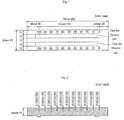
- the grind gauge to be used is any of the grind gauges described in JIS K5400. For an understanding, these grind gauges are summarized below.
- the grind gauges are constituted of a main body and a scraper which have the shapes and dimensions shown in Figs. 1 to 7.
- the material thereof is a hardened steel.
- Each main body and the scraper have been finished according to Table 2.
- the upper face of each main body and the tips of the scraper have been finished so as to be flat. Namely, these have been finished so that when each blade of the scraper is caused to vertically meet the upper face of the grind gauge and slide thereon, no gap is formed between these except for the grooves.
- the examination range for each grind gauge is as shown in Table 1.
- the grind gauges are used in the manner described in JIS K5400. For an understanding, however, the manner is summarized below.
- a dispersion is poured in the grooves of a grind gauge and scraped with a scraper to form in each groove a dispersion layer whose thickness changes continuously..- The thickness of that point of the layer at which three or more streak lines attributable to coarse particles in the dispersion began to appear is read, and this value is taken as "the particle diameter at which particles begin to appear".
- the graduation at which three or more streak lines extending in parallel over at least 10 mm began to appear in the surface of the dispersion in each groove is read. However, when the boundary where particles began to appear densely is intermediate between graduations or differs between the two grooves, then the larger graduation is read.
- the median for the found values obtained in the three measurements is taken as the degree of dispersion of the dispersion.
- a negative-electrode active material layer is generally formed by a step in which a slurry fluid prepared by dispersing a negative-electrode active material and an organic material having binding and thickening effects (hereinafter often referred to as "binder") in water or an organic solvent (hereinafter, the slurry fluid is often referred to as "active-material slurry”) is thinly applied to a current collector, e.g., a metal foil, and dried and a subsequent pressing step in which the resultant coating is densified to a given thickness/density.
- a current collector e.g., a metal foil
- the active-material slurry For the step of thinly applying the active-material slurry to a current collector, use is generally made of: a method in which the active-material slurry is scraped with a blade or the like to thereby apply the slurry in a given thickness; or a method in which the slurry is ejected in a constant amount from a nozzle having a thin slit orifice and evenly applied to a current collector.
- active-material slurries for use in forming negative-electrode active material layers contain coarse particles. Such particles may be ones which came in due to various sources during the production of the carbonaceous powder as a negative-electrode active material, or may be ones formed by aggregation or size enlargement of particles during the step of forming active material layers under the coating conditions used. However, if such coarse particles are present in an active-material slurry, these particles come to reside in the blade gap or nozzle orifice to inhibit the slurry from being sufficiently fed thereafter.
- the amount of the active-material slurry applied on the current collector becomes insufficient in those areas in the current collector which correspond to the parts where coarse particles reside, and subsequent drying and pressing give an active material layer having considerable unevenness in thickness. Even in the case where the residence of coarse particles in the scraping blade or ejection nozzle, as in the case described above, does not occur, coarse particles in the active material layer after pressing are present as projections on the negative-electrode plate and are causative of considerably impaired surface evenness.
- the present inventors have found that for obtaining an electrode plate satisfying that requirement, it is important that coarse particles in an active material should be removed beforehand not by mere sieving but under specific conditions.
- the inventors examined the behavior of coarse particles in a given aqueous dispersion with respect to individual particles and ascertained the presence of those coarse particles in the active-material powder which, although contained in a small amount, exert a serious influence on the active material layer, i.e., the coarse particles which are not coarse particles merely influencing the occurrence of separator damage but coarse particles which are causative of the unevenness in current density, deposition of lithium metal, etc. described above.
- the inventors found out techniques for evaluation and acquisition as to what powder properties an active material should satisfy for attaining sufficient performance. The invention has been thus completed.
- the conditions for the removal of coarse particles in the invention are as follows.
- the sample dispersion described above is examined with a grind gauge by the method according to JIS K5400 to measure the maximum dispersed-particle diameter, and a negative-electrode active material containing no coarse particles in such a degree that the value of the maximum dispersed-particle diameter, as a criterion, is 50 ⁇ m or smaller is used.
- fine particles which have come in due to various sources during the production of the negative-electrode active material in a carbonaceous powder form or coarse particles which generate by aggregation or size enlargement of particles during the step of forming an active material layer under the coating conditions to be used can be detected or predicted.
- a negative-electrode active material in a carbonaceous powder form in which the particle diameter at which particles begin to appear, as determined through the examination, is 50 ⁇ m or smaller is used, whereby an active material layer having a high degree of evenness with eliminated surface irregularities is formed to thereby diminish unevenness in current density.
- the upper limit of the maximum dispersed-particle diameter is 50 ⁇ m or smaller, preferably 35 ⁇ m or smaller, more preferably 30 ⁇ m or smaller, most preferably 25 ⁇ m or smaller.
- the lower limit thereof is 5 ⁇ m or larger, preferably 10 ⁇ m or larger. It is thought that when an active material having a maximum dispersed-particle diameter exceeding 50 ⁇ m is used to form an active material layer, the coarse particles function as a kind of nucleus for lithium metal deposition in repetitions of charge/discharge to cause lithium metal deposition to proceed and this is causative of short-circuiting. Because of this, the maximum dispersed-particle diameter is regulated to 50 ⁇ m or smaller.
- a preferred upper limit of the maximum dispersed-particle diameter is suitably determined in the range up to 50 ⁇ m according to the thickness of the active material layer to be formed on a negative-electrode current collector and to the evenness thereof.
- a preferred lower limit of the maximum dispersed-particle diameter too small a value thereof tends to result in impaired suitability for high-density packing. Because of this, a preferred lower limit thereof is generally 5 ⁇ m or larger.
- the negative-electrode active material for lithium secondary battery of the invention preferably is one in which when the sample dispersion is examined by the grind gauge method for determining the degree of dispersion in accordance with JIS K5400, the number of particles having a particle diameter of 35 ⁇ m or larger and 50 ⁇ m or smaller (hereinafter referred to as "number of 35-50 ⁇ m particles") is 10 or smaller.
- the upper limit of the number of 35-50 ⁇ m particles is more preferably 8 or smaller, especially preferably 5 or smaller. With respect to the lower limit thereof, smaller numbers are preferred. However, the lower limit thereof may be about 2.
- the negative-electrode active material for lithium secondary battery of the invention preferably is one in which when the sample dispersion is examined by the grind gauge method for determining the degree of dispersion in accordance with JIS K5400, the particle diameter at which the proportion of streak lines in the gauge width direction reaches 50% or more (hereinafter, this particle diameter is referred to as "average dispersed-particle diameter") is generally 40 ⁇ m or smaller, preferably 35 ⁇ m or smaller, more preferably 30 ⁇ m or smaller, most preferably 25 ⁇ m or smaller.
- coarse particles are generally recorded as streak lines.
- the particle diameter at which the proportion of such streak lines in the gauge width reaches 50% or more was employed as an index to the proportion of these coarse particles in the active material.
- the particle diameters determined by the grind gaugemethod in accordance with JIS K5400 as described above are not always the particle diameters of the active material powder but the particle diameters of the dispersed particles in the sample dispersion, and include, e.g., the particle diameters of aggregated particles formed by the aggregation of the active material powder and/or carboxymethyl cellulose.
- the negative-electrode active material for lithium secondary battery of the invention when examined as an active-material powder with a laser diffraction type particle diameter distribution analyzer, preferably has the following values of average particle diameter (D 50 ) and maximum particle diameter (D max ).
- the average particle diameter (D 50 ) is the median diameter (50% particle diameter) in a volume-based particle diameter distribution obtained with a laser diffraction type particle diameter distribution analyzer.
- the value of this (D 50 ) in the carbonaceous powder of the negative-electrode active material of the invention is generally 20 ⁇ m or smaller, preferably 15 ⁇ m or smaller, more preferably 13 ⁇ m or smaller, especially preferably 10-13 ⁇ m.
- the average particle diameter of an active material as measured with a laser diffraction type particle diameter distribution analyzer indicates an average size of the active-material particles, in contrast to the particle diameter as measured by the grind gauge method in accordance with JIS K5400 described above, which corresponds to the maximum particle diameter of coarse particles which can be present in an active material layer actually formed. Consequently, the value obtained with a laser diffraction type particle diameter distribution analyzer is not an index to a correlation with electrode thickness but an index which is important in relation with battery performances.
- the average particle diameter (D 50 ) of the active material exceeds the upper limit shown above, the property of diffusing lithium ions into the active material is impaired, resulting in a battery having reduced input/output characteristics.
- the lower limit of this average particle diameter (D 50 ) is generally 5 ⁇ m or larger, preferably 7 ⁇ m or larger.
- the average particle diameter (D 50 ) is preferably 5 ⁇ m or larger.
- the upper limit of the maximum particle diameter (D max ) as measured with a laser diffraction type particle diameter distribution analyzer is generally 70 ⁇ m or smaller, preferably 60 ⁇ m or smaller, more preferably 52 ⁇ m or smaller, especially preferably 45 ⁇ m or smaller, most preferably 45-52 ⁇ m.
- the lower limit thereof is generally 20 ⁇ m or larger.
- the maximumparticle diameter (D max ) is preferably 20 ⁇ m or larger.
- the maximum dispersed-particle diameter as measured by the grind gauge method in accordance with JIS K5400 is a value which conforms to situations in which the active material in a slurry form is actually applied to current collectors
- the maximum particle diameter (D max ) as measured with a laser diffraction type particle diameter distribution analyzer is the maximum particle diameter (100% particle diameter) calculated from a particle diameter distribution obtained on the assumption that the individual particles are spheres.
- the maximum dispersed-particle diameter as measured by the grind gauge method in accordance with JIS K5400 indicates the size and number of coarse particles which are an obstacle to the formation of an even electrode plate.
- the upper limit of the BET specific surface area of the negative-electrode active material for lithium secondary battery of the invention be generally 13 m 2 /g or smaller, preferably 8 m 2 /g or smaller, more preferably 5 m 2 /g or smaller, especially preferably 2.5-4.5 m 2 /g, and the lower limit thereof be generally 1 m 2 /g or larger, preferably 2 m 2 /g or larger, more preferably 2.5 m 2 /g or larger.
- this specific surface area exceeds that upper limit, durability in storage is apt to deteriorate.
- input/output characteristics are apt to deteriorate.
- carbonaceous as used for the active material is not particularly limited as long as the active material comprises a carbonaceous material capable of occluding and releasing lithium. Examples thereof include graphitic, amorphous, and graphitic/amorphous composite materials. Any of these may be used in the invention.
- the graphitic material is a graphitic carbon selected from artificial graphite, natural graphite, graphite derived frommesophasepitch, graphitized carbon fibers, highly purified products obtained from these, products obtained by the reheating of these, and mixtures of these. Examples of forms thereof include: mixed particles in which graphitic carbon particles of different kinds coexist; and particles each made up of many fine graphitic carbon particles isotropically bonded to one another. A graphitic material in the following powder state is preferred.
- the interplanar spacing d 002 for the crystal face (002) is 0.348 nm or smaller and the thickness of superposed layers L c is 10 nm or larger. More preferred is one in which the interplanar spacing d 002 for the crystal face (002) is 0.338 nm or smaller and the thickness of superposed layers L c is 20 nm or larger. Most preferred is one in which the interplanar spacing d 002 for the crystal face (002) is 0.337 nm or smaller and the thickness of superposed layers L c is 40 nm or larger.
- the specific capacity of the graphitic material as measured in an electrical-capacity measurement with a half battery employing lithium metal as the counter electrode at a charge/discharge rate of 0.2 mA/cm 2 , is preferably 320 mAH/g or higher, more preferably 340 mAh/g or higher, even more preferably 350 mAH/g or higher.
- the amorphous material to be used preferably is a carbonaceous powder in which the interplanar spacing d 002 for the crystal face (002) is 0.349 nm or larger and the thickness of superposed layers L c is smaller than 10 nm. More preferred is one in which the interplanar spacing d 002 for the crystal face (002) is 0.349 nm or larger and 0.355 nm or smaller and the crystallite thickness in the c-axis direction L c is 7 nm or smaller. With respect to L c , in particular, one in which L c is 1.5-10 nm, especially 1.5-5 nm, is most preferred.
- Examples of forms of the amorphous material include mixed particles in which amorphous carbon particles of different kinds coexist and particles each made up of many fine amorphous carbon particles bonded to one another.
- the graphitic/amorphous composite material is not particularly limited as long as it is in a form comprising the graphitic material and amorphous material described above.
- Examples thereof include materials obtained by partly or wholly coating a graphitic powder with an amorphous material, mixtures of a graphitic powder and an amorphous material, and an artificial graphite comprising many fine graphite particles bonded to one another at least partly isotropically through an amorphous material or graphitized amorphous material.
- the materials obtained by partly or wholly coating a graphitic powder with an amorphous material are suitable for use especially in applications such as large driving power sources, electric motorcars, and hybrid motor vehicles because performances such as high capacity, high-output characteristics, andhigh-current pulse cycle durability are obtained therewith.
- the negative-electrode active material in a carbonaceous powder form of the invention which may be any of those graphitic and amorphous materials and the like, preferably has the following properties.
- the lower limit of the peak intensity ratio R is preferably 0.01 or larger. Furthermore, it is preferred that the upper limit of the half-value width ⁇ be 60 cm -1 or smaller, preferably 40 cm -1 or smaller, more preferably 30 cm -1 or smaller, especially preferably 24 cm -1 or smaller. The smaller the lower limit of the half-value width ⁇ , the better. In general, however, the lower limit thereof is 14 cm -1 or larger.
- Processes for producing a carbonaceous material to be applied to the active material of the invention are not particularly limited.
- the target material can be obtained from any of the carbon precursors shown below by carbonizing or graphitizing the precursor by suitably changing burning conditions.
- the carbon precursor to be carbonized in a liquid phase may be one or more organic compounds capable of carbonization which are selected from coal tar pitches ranging from soft pitch to hard pitch and coal-derived heavy oils such as oils obtained by dry distillation/liquefaction, petroleum-derived heavy cracking oils, such as ethylene tar, which are yielded as by-products in the thermal cracking of straight-run heavy oils from topping residues or vacuum distillation residues or of crude oil, naphtha, etc., aromatic hydrocarbons suchasacenaphthylene, decacyclene, anthracene, and phenanthrene, nitrogenous-ring compounds such as phenazine and acridine, sulfurized-ring compounds such as thiophene and bithiophene, polyphenylenes such as biphenyl and terphenyl, organic polymers such as poly(vinyl chloride), poly(vinyl alcohol), poly (vinyl butyral), insolubilized polymers obtained from these, nitrogen-containing
- a graphitic powder and/or an amorphous powder is pulverized and classified first.
- Any pulverizer can be used for the pulverization of a graphitic powder and/or an amorphous powder as long as it can pulverize the powder into particles in a preferred particle diameter range.
- Examples thereof include high-speed pulverizers (e.g., hammer mill and pin mill), various ball mills (e.g., rolling type, vibration type, and planetary type), agitation mills (e.g., bead mill), screen mills, turbo mills, and jet mills.
- the pulverization can be conducted by either a wet process or a dry process.
- any operation capable of separating the particles may be used.
- the classification may be conducted by either a wet process or a dry process.
- Use can be made of a wet or dry sieving process, an air classifier such as a forced cyclone type centrifugal classifier (e.g., Micron Separator, Turboplex, Turboclasifier, or Super Separatior) or an inertial classifier (e.g., Elblow Jet), or a wet process for sedimentation separation or centrifugal classification.
- a forced cyclone type centrifugal classifier e.g., Micron Separator, Turboplex, Turboclasifier, or Super Separatior
- an inertial classifier e.g., Elblow Jet
- graphitic carbon particles of desired kinds may be suitably mixed in a desired proportion.
- these particles preferably are produced, for example, in the following manner. Fine graphitic carbon particles of one or more kinds are mixed with a carbon precursor optionally together with a solvent (usually, an organic solvent such as an aromatic hydrocarbon solvent, e.g., toluene or xylene) by means of a mixing machine or kneading machine.
- a solvent usually, an organic solvent such as an aromatic hydrocarbon solvent, e.g., toluene or xylene
- This mixture is heat-treated at a temperature which is generally about 2,800°C or higher, in particular about 2, 900°C or higher and is generally about 3, 500°C or lower, in particular about 3,100°C or lower, until a crystal structure equal to that of the fine graphitic carbon particles is formed, generally under such conditions that the mixture is less apt to oxidize.
- the mixture is burned in a vacuum, in an atmosphere of a volatile gas generated from the mixture or a raw material in the course of heat treatment, or in an inert gas atmosphere such as nitrogen. Thereafter, the product of burning is suitably pulverized and classified to regulate the resultant particles so as to have a desired particle size.
- this mixture is generally molded into a block, rod, or another shape before being subjected to heating and burning treatment.
- Examples of the mixing machine to be used here include vertical or horizontal mixing machines such as a high-speed shearing mixer, bead mill, Henschel mixer, and mixer having a mixing vessel having, disposed therein, a shaft and stirring blades fixed to the shaft on different phases.
- Examples of the kneading machine include an apparatus of the so-called kneader type having a mixing vessel in which a stirring blade of the sigma type or another type rotates along the side wall and a single-screw or twin-screw kneader in general use for resin processing, etc.
- amorphous carbon particles of desired kinds may be suitably mixed in a desired proportion.
- these particles preferably are produced, for example, in the following manner. Fine amorphous carbon particles of one or more kinds are mixed with a carbon precursor optionally together with a solvent (usually, an organic solvent such as an aromatic hydrocarbon solvent, e.g., toluene or xylene) by means of a mixing machine or kneading machine.
- a solvent usually, an organic solvent such as an aromatic hydrocarbon solvent, e.g., toluene or xylene
- This mixture is heat-treated at a temperature at which the carbon precursor does not grow into a graphite structure, i.e., at a temperature which is generally about 700°C or higher, preferably about 800°C or higher, in particular about 1, 000°C or higher, and is generally about 2,800°C or lower, in particular about 2,000°C or lower, especially about 1,500°C or lower, generally under such conditions that the mixture is less apt to oxidize.
- the mixture is burned in a vacuum, in an atmosphere of a volatile gas generated from the mixture or a raw material in the course of heat treatment, or in an inert gas atmosphere such as nitrogen. Thereafter, the product of burning is suitably pulverized and classified to regulate the resultant particles so as to have a desired particle size.
- Examples of the mixing machine to be used here include vertical or horizontal mixing machines such as a high-speed shearing mixer, bead mill, Henschel mixer, and mixer having a mixing vessel having, disposed therein, a shaft and stirring blades fixed to the shaft on different phases.
- Examples of the kneading machine include an apparatus of the so-called kneader type having a mixing vessel in which a stirring blade of the sigma type or another type rotates along the side wall and a single-screw or twin-screw kneader in general use for resin processing, etc.
- a mixture of a graphitic powder and an amorphous powder in any desired ratio may be used according to the intended use of the battery.
- the proportion by weight of the graphitic powder is preferably 50% or higher, more preferably 70% or higher, based on the sum of the graphitic powder and the amorphous powder.
- the proportion of the amorphous powder to the sum of the graphitic powder and the amorphous powder is too high, the influence of irreversible capacity, which is characteristic of amorphous materials, is enhanced. Consequently, the proportion of the amorphous powder is generally preferably 40% or lower.
- a powder which is a composite comprising a graphitic powder as the base and an amorphous powder united therewith can also be used as an active material in the invention.
- the graphitic powder to be used as the base can be selected from ones which satisfy the requirements for graphitic carbon described above and further satisfy the following requirements concerning particle diameter and specific surface area.
- the amorphous material to be united with the base can be selected from ones which satisfy the requirements for amorphous carbon described above.
- the preferred ranges of the particle diameter and specific surface area of the graphitic powder to be used as the base are as follows.
- the average particle diameter (D 50 ) thereof as measured with a laser diffraction type particle diameter distribution analyzer is generally 20 ⁇ m or smaller, preferably 15 ⁇ m or smaller, more preferably 13 ⁇ m or smaller, especially preferably 8-13 ⁇ m.
- the BET specific surface area thereof is 15 m 2 /g or smaller, preferably from 2 m 2 /g to 13 m 2 /g, more preferably from 3 m 2 /g to 12 m 2 /g, most preferably from 8 m 2 /g to 12 m 2 /g.
- the composite comprising a graphitic material and an amorphous material
- use can be made; for example, of: a method in which a carbon precursor for obtaining an amorphous material is used as it is to prepare a mixture of the carbon precursor and a graphitic powder and this mixture is heat-treated and then pulverized to obtain a composite powder; a method in which the amorphous powder described above is produced beforehand and mixed with a graphitic powder and this mixture is heat-treated to obtain a composite; or a method in which the amorphous powder described above is produced beforehand and mixed with a graphitic powder and a carbon precursor and this mixture is heat-treated to obtain a composite.
- an amorphous powder is prepared beforehand, it is preferred to use amorphous particles having an average particle diameter not larger than one-tenth the average particle diameter of the graphitic particles.
- a mixture obtained by mixing either such graphitic particles or a mixture of such graphitic particles and amorphous particles with a carbon precursor is heated to obtain an intermediate, which is then carbonized/burned and pulverized, whereby a graphitic/amorphous composite powder comprising graphitic particles and an amorphous material united therewith can be finally obtained.
- the proportion of the amorphous material in this graphitic/amorphous composite powder is desirably regulated so as to be 50% by weight or lower, preferably 25% by weight or lower, more preferably 15% by weight or lower, especially preferably 10% by weight or lower and be 0.1% by weight or higher, preferably 0.5% by weight or higher, more preferably 1% by weight or higher, especially preferably 2% by weight or higher.
- Processes for obtaining such a graphitic/amorphous composite powder generally comprise the following four steps.
- First step Either graphitic particles or mixed particles comprising graphitic particles and amorphous particles are mixed with a carbon precursor and optionally with a solvent by means of any of various commercial mixing machines, kneading machines, and the like to obtain a mixture.
- Second Step According to need, the mixture is heated with stirring to obtain an intermediate from which the solvent has been removed.
- Third step The mixture or intermediate is heated to a temperature which is 700°C or higher and 2,800°C or lower in an inert gas atmosphere such as nitrogen gas, carbon dioxide gas, or argon gas to obtain a graphitic/amorphous composite material.
- an inert gas atmosphere such as nitrogen gas, carbon dioxide gas, or argon gas
- the composite material is subjected to powder processings such as pulverization, disaggregation, and classification.
- the second and fourth steps can be omitted in some cases, and the fourth step may be conducted before the third step.
- the lower limit of the temperature for the treatment is generally 700°C or higher, preferably 900°C or higher, although it slightly varies depending on the kind of the carbon precursor and the heat history thereof.
- the temperature can basically be elevated to a temperature at which the amorphous material does not come to have a structural order which is higher than the crystal structure of the graphitic particle cores. Consequently, the upper limit of the temperature for the heat treatment preferably is in the range of generally 2,800°C or lower, preferably 2,000°C or lower, more preferably 1,500°C or lower.
- conditions of this heat treatment conditions such as heating rate, cooling rate, and heat treatment time can be determined at will according to purposes. It is also possible to use a method in which the mixture is heat-treated in a relatively low-temperature region and then heated to a given temperature.
- the reactor to be used in the steps may be of the batch type or the continuous type, and one reactor or two or more reactors may be used.
- the composite material thus obtained by uniting an amorphous material with a graphitic material preferably is one whose degree of crystallinity, in terms of the values of the peak intensity ratio R and the half-value width ⁇ of the peak appearing around 1, 580 cm -1 in Raman spectroscopy and the values of the d 002 and L c obtained in an X-ray wide-angle diffraction pattern, is not higher than that of the graphitic material.
- the composite material preferably has a value of R not lower than that of the graphitic material, a value of half-value width ⁇ not lower than that of the graphitic material, a value of d 002 not lower than that of the graphitic material, and a value of L c not higher than that of the graphitic material.
- the value of R of the graphitic/amorphous composite powder material include one which is in the range of from 0.01 to 1.0, preferably from 0.05 to 0.8, more preferably from 0.2 to 0.7, even more preferably from 0.3 to 0.5, and is not lower than that of the graphitic material serving as the base.
- This graphitic/amorphous composite powder material combines high-output characteristics, which are produced because the material has a low-potential charge/discharge curve which is characteristic of graphitic carbon, and excellent lithium-accepting properties characteristic of amorphous carbon.
- the composite powder material hence enables high-output characteristics and high pulse durability to be obtained. Consequently, the composite powder is more suitable for use as the active material of the invention. This is more remarkable in applications such as large driving power sources and electric motorcars, especially hybrid motor vehicles.
- a method for preparing a negative-electrode active material for lithium secondary battery of the invention which is in a carbonaceous powder form produced in the manner described above and satisfies the requirements concerning the specific maximum dispersed-particle diameter, number of 35-50 ⁇ m particles, average dispersed-particle diameter, etc. is explained below.
- negative-electrode active materials for use in lithium secondary battery have been prepared by pulverizing a graphitic powder, amorphous powder, or graphitic/amorphous composite powder and classifying the pulverized particles.
- flat particles and the like undesirably pass through the sieve and such coarse particles which have come into the treated powder cannot be removed. Even if such coarse particles do not cause separator damage, they have exerted adverse influences on battery performances, e.g., by serving nuclei for lithium metal deposition in the active material layer.
- the following technical contrivances are taken in order to obtain an active material which satisfies the requirements concerning the specificmaximum dispersed-particle diameter, number of 35-50 ⁇ m particles, average dispersed-particle diameter, etc. described above.
- a sieving operation is repeated to thereby remove coarse particles without fail.
- an ASTM 400-mesh sieve or a finer sieve is used to repeatedly conduct a sieving operation 2 times ormore, preferably 4 times or more, whereby flatparticles are sieved to remove coarse particles without fail.
- a wet type sieve is used to heighten the efficiency of classification.
- a liquid having no reactivity with the active-material powder such as water or an alcohol, e.g., ethanol, or a mixture of such liquids is used as a medium to prepare a suspension so that this suspension on a sieve retains a solid concentration which is generally about 1% by weight or higher, in particular about 5% by weight or higher, and is generally about 20% by weight or lower, in particular about 10% by weight or lower.
- a solid concentration of this suspension exceeds 20% by weight, the active-material powder is apt to cause clogging and productivity tends to decrease.
- Air classification is repeatedly conducted generally 2 or more times, preferably 4 or more times, to thereby remove coarse particles without fail.
- the upper limit of the number of repetitions of the classification cannot be unconditionally specified because it varies depending on the nature of the active material being treated, it is generally about 10 or smaller, in particular about 8 or smaller.
- an active-material powder containing coarse particles remaining therein is undesirably discharged.
- the active-material powder to be treated is supplied in too large an amount, the energy received per particle from the air flow is small and the regulation of a classification point is difficult, making it difficult to produce the target active-materialpowder.
- the coarser the particles there is a tendency that the coarser the particles, the larger the difference in resistance depending on the direction from which the air flow strikes. Consequently, a higher degree of contrivance for control is necessary.
- the amount of the powder to be treated For conducting air classification with higher certainty, it is preferred to reduce the amount of the powder to be treated and to thereby enable coarse particles to fall smoothly without accompanying small particles in the air flow and thus floating and coming into the treated powder.
- the degree of this reduction is preferably such that the powder feed amount is from one-fourth to one-third the amount used under general conditions heretofore in use for powders containing coarse particles.
- Specific conditions for air classification include the following.
- a gas flow having no reactivity with the active-material powder is supplied at a rate whose lower limit is generally 5 m 3 /min or higher, in particular 10 m 3 /min or higher, and whose upper limit is generally 80 m 3 /min or lower, in particular 50 m 3 /min or lower, to thereby classify the powder at a treatment rate whose lower limit is generally 0.5 kg/min or higher, in particular 1 kg/min or higher, and whose upper limit is generally 10 kg/min or lower, in particular 8 kg/min or lower.
- the negative electrode for lithium secondary battery of the invention comprises a current collector having provided thereon an active material layer comprising a negative-electrode active material and an organic material having binding and thickening effects (hereinafter, the layer is sometimes referred to as "negative-electrode mix layer").
- This negative electrode is characterized in that the activematerial layer has a thickness of 50 ⁇ m or smaller and an arithmetic mean roughness (Ra) as measured in accordance with JIS B0601 of 5 ⁇ m or smaller.
- Ra arithmetic mean roughness
- the surface roughness (Ra) is determined through a measurement with a laser microscope in accordance with JIS B0601 with respect to a measuring range which is about 10 times the average particle diameter (D 50 ) measured with a laser diffraction type particle diameter distribution analyzer and through a calculation.
- This measuring range is generally 100 ⁇ m, which is adequate to conduct the measurement, although the measuring range depends on the particle diameter of the active-material powder.
- the upper limit of the surface roughness (Ra) of this active material layer is 5 ⁇ m or lower, preferably 2 ⁇ m or lower.
- the lower the lower limit the better.
- the surface roughness is about 0.1 ⁇ m, lithium metal deposition can be prevented without fail.
- an active material layer is frequently formed on each side of a current collector.
- the thickness of one active material layer can be reduced to 100 ⁇ m or smaller, in particular 80 ⁇ m or smaller, especially 50 ⁇ m or smaller, and particularly 40 ⁇ m or smaller, e.g., 30-40 ⁇ m.
- This active material layer of the negative electrode for lithium secondary battery of the invention can be realized by using the above-described negative-electrode active material for lithium secondary battery of the invention as the active material.
- the negative-electrode active material layer (negative-electrode mix layer) is generally formed by a step in which a slurry fluid prepared by dispersing the negative-electrode active material and an organic material having binding and thickening effects in an aqueous solvent or an organic solvent is thinly applied to a current collector, e.g., a metal foil, and dried and a subsequent pressing step in which the resultant coating is densified to a given thickness/density.
- the density of the negative-electrode active material layer (negative-electrode mix layer) be generally 0.9 g/cm 3 or higher, in particular 1.2 g/cm 3 or higher, especially 1.5 g/cm 3 or higher and be generally 2.2 g/cm 3 or lower, in particular 1.9 g/cm 3 or lower, especially 1.7 g/cm 3 or lower.
- the organic material having binding and thickening effects which is used for forming the negative-electrode active material layer is not particularly limited. Generally, however, the material may be either a thermoplastic resin or a thermosetting resin.
- Preferred examples of the binder in the invention include polyethylene, polypropylene, polytetrafluoroethylene (PTFF), poly(vinylidene fluoride) (PVDF), styrene/butadiene rubbers, tetrafluoroethylene/hexafluoroethylene copolymers, tetrafluoroethylene/hexafluoropropylene copolymers (FEP), tetrafluoroethylene/perfluoro(alkyl vinyl ether) copolymers (PFA), vinylidene fluoride/hexafluoropropylene copolymers, vinyldidene fluoride/chlorotrifluoroethylene copolymers, ethylene/tetrafluoroethylene copolymers (ETFE resins
- These materials can be used alone or as a mixture thereof. More preferred materials among those materials are styrene/butadiene rubbers, poly(vinylidene fluoride), ethylene/acrylic acid copolymers or these materials crosslinked with (Na + ) ions, ethylene/methacrylic acid copolymers or these materials crosslinked with (Na + ) ions, ethylene/methyl acrylate copolymers or these materials crosslinked with (Na + ) ions, and ethylene/methyl methacrylate copolymers or these materials crosslinked with (Na + ) ions.
- a conductive material for negative electrodes may be used in the negative-electrode active material layer according to need.
- the negative-electrode conductive material may be any electron-conductive material which does not impair the evenness of the active material layer. Examples thereof include graphites such as natural graphite (e.g., flaky graphite), artificial graphite, and expandable graphite, carbon blacks such as acetylene black, Ketjen black, channel black, furnace black, lamp black, and thermal black, conductive fibers such as carbon fibers and metal fibers, metal powders such as copper and nickel, and organic conductive materials such as polyphenylene derivatives. Such conductive materials can be incorporated alone or as a mixture thereof.
- conductive materials are artificial graphite, acetylene black, and carbon fibers.
- a conductive material having an average particle diameter of 3 ⁇ m or smaller, in particular 1 ⁇ m or smaller is more effective in inhibiting the formation of coarse particles on the electrode plate.
- the lower limit of the average particle diameter of the conductive material may be about several nanometers. As long as the conductive material has such an average particle diameter, it produces especially no adverse influence on the performance of the electrode plate.
- a filler, dispersant, ion conductor, compression enhancer, and other various additives can be incorporated into the negative-electrode active material layer besides the conductive material.
- the filler can be used any fibrous material which does not undergo any chemical change in the battery fabricated.
- fibers of an olefin polymer such as polypropylene or polyethylene or of glass, carbon, etc. are used.
- an aqueous solvent or an organic solvent is used as a dispersion medium.
- Water is generally used as the aqueous solvent.
- an additive such as an alcohol, e.g., ethanol, or a cyclic amide, e.g., N-methylpyrrolidone, may be added to the water in an amount of up to about 30% by weight based on the water.
- Examples of the organic solvent generally include cyclic amides such as N-methylpyrrolidone, linear amides such as N,N-dimethylformamide and N,N-dimethylacetamide, aromatic hydrocarbons such as anisole, toluene, and xylene, and alcohols such as butanol and cyclohexanol.
- cyclic amides such as N-methylpyrrolidone
- linear amides such as N,N-dimethylformamide and N,N-dimethylacetamide
- aromatic hydrocarbons such as anisole, toluene, and xylene
- alcohols such as butanol and cyclohexanol.
- cyclic amides such as N-methylpyrrolidone
- linear amides such as N,N-dimethylformamide and N,N-dimethylacetamide
- aromatic hydrocarbons such as anisole, toluene, and xylene
- alcohols such as but
- the active material, an organic material having binding and thickening effects as a binder, and optional ingredients such as a negative-electrode conductive material and a filler are mixed with any of those solvents to prepare an active-material slurry.
- This slurry is applied to a negative-electrode current collector in a given thickness to thereby form a negative-electrode active material layer.
- the upper limit of the concentration of the active material in this active-material slurry is generally 70% by weight or lower, preferably 55% by weight or lower.
- the lower limit thereof is generally 30% by weight to higher, preferably 40% by weight or higher.
- the concentration of the active material exceeds the upper limit, the active material in the active-material slurry is apt to aggregate.
- the active material is apt to sediment during the storage of the active-material slurry.
- the upper limit of the concentration of the binder in the active-material slurry is generally 30% by weight or lower, preferably 10% by weight or lower.
- the lower limit thereof is generally 0.1% by weight or higher, preferably 0.5% by weight or higher.
- the electrode has increased internal resistance.
- the electrode obtained has poor bonding with electrode particles.
- the concentration of the negative-electrode conductive material in the active-material slurry is preferably 0-5% by weight.
- concentration of other ingredients including a filler is preferably 0-30% by weight.
- the negative-electrode current collector may be any electron conductor which does not undergo any chemical change in the battery fabricated.
- one made of stainless steel, nickel, copper, titanium, carbon, a conductive resin, or the like may be used, or a material obtained by treating the surface of copper or stainless steel with carbon, nickel, or titanium may be used. Copper or a copper alloy is especially preferred. These materials may be used after having undergone surface oxidation. It is desirable to subject a current collector to a surface treatment to impart surface irregularities thereto.
- usable forms include film, sheet, net, punched film or sheet, lath, porous material, foam, molded fibers, and the like.
- the thickness of such a negative-electrode current collector to be used is not particularly limited, and may be 1-500 ⁇ m.
- the active-material slurry prepared by incorporating the active material, a binder, and optional ingredients into a solvent may be filtered through a sieve in order to satisfy the requirement described above that the negative-electrode active material layer should have an average surface roughness (Ra) of 5 ⁇ m or lower.
- a sieve of generally ASTM 270 mesh (opening size, 53 ⁇ m) or finer, preferably ASTM 325 mesh (opening size, 43 ⁇ m) or finer, more preferably ASTM 400 mesh (opening size, 35 ⁇ m) or finer be used to conduct a filtering operation generally 1 or more times, preferably 2 or more times.
- the lower limit of the temperature conditions in this filtration operation be generally 5°C or higher, especially 10°C or higher, and the upper limit thereof be 50°C or lower, especially 30C° or lower.
- the dispersion medium is apt to vaporize.
- the dispersion medium is apt to have an increased viscosity.
- the lower side of the sieve openings is gradually pressurized to a pressure higher than the atmospheric pressure as the filtration proceeds. It is therefore preferred to periodically open this side to the atmosphere to thereby return the pressure to the atmospheric pressure.
- the lower side of the sieve may be kept at a reduced pressure.
- the reduced-pressure conditions in this case preferably include a reduced pressure of about 10-30 Pa. It is also preferred to dispose a scraper on the upper side of the sieve and to stir the dispersion in such a manner that the dispersion is spread on the sieve so as to be always in even contact with the screen openings.
- the lithium secondary battery of the invention which comprises a positive electrode capable of occluding/releasing lithium, a negative electrode capable of occluding/releasing lithium, and an electrolyte and in which the negative electrode is the negative electrode for lithium secondary battery of the invention described above.
- the positive electrode plate in the lithium secondary battery of the invention comprises a current collector having provided thereon an active material layer comprising a positive-electrode active material and an organic material (binder) having binding and thickening effects (hereinafter, the layer is sometimes referred to as "positive-electrode mix layer").
- the positive-electrode active material layer is generally formed by a step in which a slurry fluid prepared by dispersing a positive-electrode active material and an organic material having binding and thickening effects in water or an organic solvent is thinly applied to a current collector, e.g., a metal foil, and dried and a subsequent pressing step in which the resultant coating is densified to a given thickness/density.
- a slurry fluid prepared by dispersing a positive-electrode active material and an organic material having binding and thickening effects in water or an organic solvent is thinly applied to a current collector, e.g., a metal foil, and dried and a subsequent pressing step in which the resultant coating is densified to a given thickness/density.
- the positive-electrode active material is not particularly limited as long as it has the function of being capable of occluding/releasing lithium.
- a lithium-containing transition metal oxide can be used.
- x is a value before initiation of charge/discharge, and increases/decreases with charge/discharge.
- any of these oxides in which the cobalt, nickel, and manganese have been partly displaced by one or more elements, e.g., other transition metals can also be used.
- other positive-electrode materials such as, e.g., transition metal charcogen compounds, vanadium oxides and lithium compounds thereof, niobium oxides and lithium compounds thereof, conjugated-compound polymers containing an organic conductive substance, and Chevrel-phase compounds.
- a mixture of two or more different positive-electrode materials can be used.
- the average particle diameter of the positive-electrode active material particles is not particularly limited, but is preferably 1-30 ⁇ m.
- a conductive material for positive electrodes may be used in the positive-electrode active material layer.
- the positive-electrode conductive material may be any electron-conductive material which does not undergo any chemical change at the charge/discharge potentials of the positive-electrode material used.
- Examples thereof include graphites such as natural graphite (e.g., flaky graphite) and artificial graphite, carbon blacks such as acetylene black, Ketjen black, channel black, furnace black, lamp black, and thermal black, conductive fibers such as carbon fibers and metal fibers, carbon fluorides, metal powders such as aluminum, conductive whiskers such as zinc oxide whiskers and potassium titanate whiskers, conductive metal oxides such as titanium oxide, and organic conductive materials such as polyphenylene derivatives. Such conductive materials can be incorporated alone or as a mixture thereof. Especially preferred of these conductive materials are artificial graphite and acetylene black.
- carbon blacks such as acetylene black, Ketjen black, channel black, furnace black, lamp black, and thermal black
- conductive fibers such as carbon fibers and metal fibers
- carbon fluorides such as aluminum
- conductive whiskers such as zinc oxide whiskers and potassium titanate whiskers
- conductive metal oxides such as titanium oxide
- the amount of the conductive material to be added is not particularly limited, but it is preferably 1-50% by weight, especially preferably 1-30% by weight, based on the positive-electrode material. In the case of carbon or graphites, the amount thereof is especially preferably 2-15% by weight.
- the organic material having binding and thickening effects which is used for forming the positive-electrode active material layer is not particularly limited, may be either a thermoplastic resin or a thermosetting resin.
- examples thereof include polyethylene, polypropylene, polytetrafluoroethylene (PTFF), poly(vinylidene fluoride) (PVDF), styrene/butadiene rubbers, tetrafluoroethylene/hexafluoroethylene copolymers, tetrafluoroethylene/hexafluoropropylene copolymers (FEP), tetrafluoroethylene/perfluoro(alkyl vinyl ether) copolymers (PFA), vinylidene fluoride/hexafluoropropylene copolymers, vinyldidene fluoride/chlorotrifluoroethylene copolymers, ethylene/tetrafluoroethylene copolymers (ETFE resins), polychlorotrifluoroethylene (PCTFE),
- a filler, dispersant, ion conductor, compression enhancer, and other various additives can be incorporated into the positive-electrode active material layer besides the conductive material.
- the filler can be used any fibrous material which does not undergo any chemical change in the battery fabricated. Generally, fibers of an olefin polymer such as polypropylene or polyethylene or of glass, carbon, etc. are used.
- the amount of the filler to be added is not particularly limited, but is preferably 0-30% by weight in terms of its content in the active material layer.
- the active material, an organic material having binding and thickening effects as a binder, and optional ingredients such as a positive-electrode conductive material and a filler are mixed with any of those solvents to prepare an active-material slurry.
- This slurry is applied to a positive-electrode current collector in a given thickness to thereby form a positive-electrode active material layer.
- the upper limit of the concentration of the active material in this active-material slurry is generally 70% by weight or lower, preferably 55% by weight or lower.
- the lower limit thereof is generally 30% by weight to higher, preferably 40% by weight or higher.
- the concentration of the active material exceeds the upper limit, the active material in the active-material slurry is apt to aggregate.
- the active material is apt to sediment during the storage of the active-material slurry.
- the upper limit of the concentration of the binder in the active-material slurry is generally 30% by weight or lower, preferably 10% by weight or lower.
- the lower limit thereof is generally 0.1% by weight or higher, preferably 0.5% by weight or higher.
- the electrode has increased internal resistance.
- the electrode obtained has poor bonding with electrode particles.
- the positive-electrode current collector may be any electron conductor which does not undergo any chemical change at the charge/discharge potentials of the positive-electrode material used.
- one made of stainless steel, aluminum, titanium, carbon, a conductive resin, or the like may be used, or a material obtained by treating the surface of aluminum or stainless steel with carbon or titanium may be used.
- Aluminum or an aluminum alloy is especially preferred. These materials may be used after having undergone surface oxidation. It is desirable to subject a current collector to a surface treatment to impart surface irregularities thereto.
- usable forms include film, sheet, net, punched film or sheet, lath, porous material, foam, molded fibers or molded nonwoven fabric, and the like.
- the thickness of such a positive-electrode current collector to be used is not particularly limited, and may be 1-500 ⁇ m.
- the negative-electrode plate and the positive-electrode plate are preferably arranged at least so that the positive-electrode active material layer faces the negative-electrode active material layer.
- Examples of the electrolyte to be used in the lithium secondary battery of the invention include nonaqueous electrolytic solutions constituted of a nonaqueous solvent and one or more lithium salts soluble in the solvent.
- nonaqueous solvent examples include aprotic organic solvents such as cyclic carbonates, e.g., ethylene carbonate (EC), propylene carbonate (PC), butylene carbonate (BC), and vinylene carbonate (VC), chain carbonates, e.g., dimethyl carbonate (DMC), diethyl carbonate (DEC), ethyl methyl carbonate (EMC), and dipropyl carbonate (DPC), aliphatic carboxylic esters, e.g., methyl formate, methyl acetate, methyl propionate, and ethyl propionate, ⁇ -lactones, e.g., ⁇ -butyrolactone, chain ethers, e.g., 1,2-dimethoxyethane (DME), 1,2-diethoxyethane (DEE), and ethoxymethoxyethane (EME), cyclic ethers, e.g., tetrahydrofuran and 2-methylt
- cyclic carbonates may be used alone or as a mixture of two or more thereof.
- Preferred of these is a mixture of one or more cyclic carbonates and one or more chain carbonates or a mixture of one or more cyclic carbonates, one or more chain carbonates, and one or more aliphatic carboxylic esters.
- lithium salts soluble in those solvents include LiClO 4 , LiBF 4 , LiPF 6 , LiAlCl 4 , LiSbF 6 , LiSCN, LiCl, LiCF 3 SO 3 , LiCF 3 CO 2 , Li(CF 3 SO 2 ) 2 , LiAsF 6 , LiN(CF 3 SO 2 ) 2 , LiB 10 Cl 10 , the lithium salts of lower aliphatic carboxylic acids, LiCl, LiBr, LiI, chloroborane lithium compounds, lithium tetraphenylborate, and imides. These may be used alone or in combination of two or more thereof. In particular, it is more preferred to incorporate LiPF 6 .
- An especially preferred non aqueous electrolytic solution in the invention is an electrolytic solution comprising at least ethylene carbonate and ethyl methyl carbonate and containing LiPF 6 as a supporting salt.
- the amount of such an electrolyte to be introduced into the battery is not particularly limited.
- the electrolyte can be used in a necessary amount according to the amounts of the positive-electrode material and negative-electrode material and the size of the battery.
- the amount of the lithium salt to be dissolved as a supporting electrolyte in the nonaqueous solvent is not particularly limited. However, the amount there of is preferably 0.2-2 mol/L, especially preferably 0.5-1.5 mol/L.
- Solid electrolytes are classified into inorganic solid electrolytes and organic solid electrolytes.
- the inorganic solid electrolytes include the nitrides, halides, and oxoacid salts of lithium. Effective of these are Li 4 SiO 4 , Li 4 SiO 4 -LiI-LiOH, xLi 3 PO 4 -(1-x)Li 4 SiO 4 , Li 2 SiS 3 , Li 3 PO 4 -Li 2 S-SiS 2 , phosphorus sulfide compounds, and the like.
- organic solid electrolytes include polymeric materials such as poly(ethylene oxide), poly(propylene oxide), polyphosphazenes, polyaziridine, poly(ethylene sulfide), poly(vinyl alcohol), poly(vinylidene fluoride), polyhexa fluoropropylene, and derivatives, mixtures, and composites of these polymers.
- polymeric materials such as poly(ethylene oxide), poly(propylene oxide), polyphosphazenes, polyaziridine, poly(ethylene sulfide), poly(vinyl alcohol), poly(vinylidene fluoride), polyhexa fluoropropylene, and derivatives, mixtures, and composites of these polymers.
- additives include triethyl phosphite, triethanolamine, cyclic ethers, ethylenediamine, n-glyme, pyridine, hexaphosphoric acid triamide, nitrobenzene derivatives, crown ethers, quaternary ammonium salts, and ethylene glycol dialkyl ethers.
- An insulating microporous thin film having high ion permeability and given mechanical strength may be used as a separator in the invention.
- This separator preferably has the function of closing its pores when heated to or above a given temperature and thereby increasing its resistance.
- a sheet, nonwoven fabric, or woven fabric made of an olefin polymer comprising one of or a combination of two or more of polypropylene, polyethylene, and the like or formed from glass fibers or the like is used as the separator.
- the pore diameter of the separator desirably is in such a range that the positive/negative electrode material, binder, and conductive material which have shedded from the electrode do not pass through the separator.
- the pore diameter thereof is desirably 0.01-1 ⁇ m.
- the thickness of the separator to be used is generally 10-300 ⁇ m.
- the porosity is determined according to permeability to electrodes and ions and the material and thickness. It is, however, generally desirable that the porosity of the separator be 30-80%.
- a battery may be fabricated in the following manner.
- An organic electrolytic solution comprising a solvent and a lithium salt soluble in the solvent is absorbed and held in a polymeric material.
- This polymeric material is incorporated into a positive-electrode mix and a negative-electrode mix.
- a porous separator constituted of a polymer capable of absorbing and holding the organic electrolytic solution is united with the positive electrode and negative electrode to fabricate a battery.
- This polymeric material is not particularly limited as long as it can absorb and hold the organic electrolytic solution. However, a copolymer of vinylidene fluoride and hexafluoropropylene is especially preferred.
- the upper limit of the thickness of this separator is generally 60 ⁇ m or smaller, preferably 50 ⁇ m or smaller, more preferably 30 ⁇ m or smaller.
- the lower limit thereof is generally 10 ⁇ m or larger, preferably 15 ⁇ m or larger. In case where the thickness of the separator exceeds the upper limit, the battery is apt to have increased internal resistance. In case where the separator thickness is smaller than the lower limit, short-circuiting is apt to occur between the positive and negative electrodes.
- the shape of the lithiumsecondarybatteryofthe invention is not particularly limited, and may be any of the coin type, button type, sheet type, multilayer type, cylindrical type, flat type, and prismatic type.
- the battery of the invention is applicable not only to small lithium secondary battery but also to all types of lithium secondary battery including large ones for use in electric motorcars.
- the lithium secondary battery of the invention can be used in portable information terminals, portable electronic appliances, domestic small powder storage apparatus, motor bicycles, electric motorcars, hybrid motor vehicles, and the like. However, applications of the battery should not be construed as being especially limited to these.
- the increase in internal resistance caused by pulse cycling and the deposition of lithium metal on the negative-electrode surface can be effectively inhibited by using a negative-electrode active material which has a maximum dispersed-particle diameter, as measured with a grind gauge in accordance with JIS K5400, of 50 ⁇ m or smaller.
- a negative-electrode active material which has a maximum dispersed-particle diameter, as measured with a grind gauge in accordance with JIS K5400, of 50 ⁇ m or smaller.
- the invention provides a lithium secondary battery having high-output/high-input characteristics which, when subjected to a pulse charge/discharge cycle test under the high-load current conditions of 10 C, stably undergoes repetitions of charge/discharge even after 200,000 cycles and shows a battery capacity recovery of 70% or higher.
- the lithium secondary battery of the invention which shows such high-output/high-input characteristics, is especially suitable for use as a large driving power source for electric drills, cutters, or the like or as a lithium secondary battery for electric motorcars, hybrid motor vehicles, and the like, in particular hybrid motor vehicles, among the wide range of applications of lithium secondary battery shown above.
- the commercial natural graphite powder described in the row "Example 4" in Table 3 was mixed with a petroleum heavy oil obtained in the thermal cracking of naphtha. This mixture was subjected to a carbonization treatment at 900°C in an inert gas. Thereafter, the resultant sinter was pulverized/classified to thereby obtain an amorphous-material-coated graphite comprising graphite particles whose surface had been coated with amorphous carbon. In the classification treatment, sieving with an ASTM 400-mesh sieve was repeated 5 times in order to prevent the inclusion of coarse particles to thereby obtain a negative-electrode active-material powder comprising the amorphous-material-coated graphite. It was ascertained from the actual carbon ratio that the negative-electrode active-material powder obtained was constituted of 100 parts by weight of graphite and 2 parts by weight of amorphous carbon with which the graphite was coated.
- This active-material powder was subjected to X-ray analysis, Raman spectrometry, examination with a laser diffraction type particle diameter distribution analyzer, measurement of the specific surface area, and various analyses by examination with a grind gauge in accordance with JIS K5400. The results thereof are shown in Table 3.
- a 2% by volume aqueous solution of polyoxyethylene (20) sorbitan monolaurate was used as a surfactant in an amount of about 1 cc. This surfactant was mixed with an active-material powder beforehand. Thereafter, ion-exchanged water was used as a dispersion medium to measure the volume-based average particle diameter (D 50 ) and maximum particle diameter (D max ) with a laser diffraction type particle size distribution analyzer.
- a sample was predried by heating at 350°C and passing nitrogen gas thereover for 15 minutes. Thereafter, the specific surface area thereof was measured by the BET one-point method based on nitrogen adsorption at a relative pressure of 0.3.
- the amorphous-material-coated graphite powder obtained was used as a negative-electrode active material to fabricate a battery in the following manner.
- the surface roughness of the negative-electrode plate was measured and battery performances were evaluated, by the methods which will be shown later. The results obtained are shown in Table 3.
- lithium nickelate (LiNiO 2 ) as a positive-electrode active material was mixed with 5% by weight acetylene black as a conductive material and 5% by weight poly(vinylidene fluoride) (PVdF) as a binder in N-methylpyrrolidone solvent to prepare a slurry. Thereafter, the slurry was applied to each side of a 20 ⁇ m-thick aluminum foil and dried. The coated aluminum foil was rolled with a pressing machine so as to result in a thickness of 70 ⁇ m. A strip having a width of 52 mm and a length of 830 mm was cut out of this coated foil to obtain a positive electrode.
- PVdF poly(vinylidene fluoride)
- This negative-electrode active-material slurry was evenly applied to a 18 ⁇ m-thick copper foil and dried. Thereafter, the coated foil was rolled with a pressing machine so as to result in a thickness of 40 ⁇ m. A strip having a width of 56 mm and a length of 850 mm was cut out of this coated foil to obtain a negative electrode. These operations were conducted in a 25°C atmosphere.
- lithium hexafluorophosphate LiPF 6
- EC purified ethylene carbonate
- DMC dimethyl carbonate
- DEC diethyl carbonate
- the positive and negative electrodes and a porous polyethylene sheet as a separator (thickness, 25 ⁇ m) sandwiched between these were wound into a roll to obtain an electrode group, which was put in a battery can.
- This battery can was sealed. Thereafter, 5 mL of the electrolytic solution was introduced into the battery can having the electrode group packed therein, and was sufficiently infiltrated into the electrodes. This battery can was caulked to produce a 18650 type cylindrical battery.
- the negative electrode produced was examined for surface roughness with a laser microscope.
- the surface roughness was measured over a range which was about 10 times the average particle diameter (D 50 ) of the negative-electrode active material as measured with a laser diffraction type particle diameter distribution analyzer, and this measurement was repeated 5 times.
- D 50 average particle diameter
- Example 1 a range of 100 ⁇ m was examined.
- the arithmetic mean roughness (Ra) was calculated for the data of each measurement in accordance with JIS B0601 B, and the average of these roughness values was taken as surface roughness (Ra).
- a charge/discharge operation (capacity ascertainment) was conducted in a 25°C room-temperature atmosphere. Based on the results thereof, the charged state of each lithium secondary battery was adjusted to 50%.
- the battery in the state 1) was discharged for 10 seconds at a constant current which was each of 1/4 C, 1/2 C, 1.0 C, 1.5 C, 2.5 C, and 3.0 C (the value of current at which the rated capacity based on 1-hour-rate discharge capacity is discharged over 1 hour is taken as 1 C; the same applies hereinafter).
- the decrease in voltage through the 10-second discharge at each current was measured. From these found values, the value of current I capable of being caused to flow for 10 seconds under the conditions of a final discharge voltage of 3.0 V was calculated.
- the value calculated using the formula 3.0 ⁇ I (W) was taken as the initial output of each battery.
- Table 1 is shown the output in terms of output ratio, with the output of the battery of Comparative Example 1, which will be given later, being 100%.
- a high-temperature cycle test was conducted in a high-temperature atmosphere of 60°C, which is regarded as the upper-limit temperature for the actual use of lithium secondary battery.
- the battery which had undergone the output evaluation in 2) above was charged by the constant-current constant-voltage method at 2 C to a final charge voltage of 4.1 V and then discharged at a constant current of 2 C to a final discharge voltage of 3.0V.
- This charge/discharge operation as one cycle was repeated to conduct 500 cycles in total.
- the proportion of the discharge capacity for the 500th cycle to the discharge capacity for the 1st cycle in this test was taken as capacity retention.
- Apulse cycle test was conducted in a 25°C room-temperature atmosphere.
- the battery which had undergone the output evaluation in 2) above was regulated so as to be in a 50% charged state.
- a high-load current of 10 C was caused to flow in the charge direction and the discharge direction each for about 10 seconds in a voltage range including that voltage at the center. This cycle, which took 15 seconds including a pause period, was successively repeated.
- the battery was taken out and the recovery after the pulse cycling was calculated in the following manner.
- the battery was discharged to 3.0 V, subsequently charged to 4.1 V, and then discharged to 3.0 V again.
- the proportion of the discharge capacity in this charge/discharge to the discharge capacity in the initial charge/discharge in 1) above was taken as recovery.
- Anegative-electrodeactive-materialpowder wasprepared in the same manner as in Example 1, except that an amorphous-material-coated graphite powder constituted of 100 parts by weight of graphite and 8 parts by weight of amorphous carbon was produced.
- Various evaluations were conducted in the same manner as in Example 1. The results thereof are shown in Table 3.
- a negative-electrode active-material powder was prepared in the same manner as in Example 1, except that an amorphous-material-coated graphite powder constituted of 100 parts by weight of graphite and 18 parts by weight of amorphous carbon was produced.
- Various evaluations were conducted in the same manner as in Example 1. The results thereof are shown in Table 3.
- a negative-electrode active-material powder was prepared in the same manner as in Example 1, except that a commercial natural-graphite powder was classified.
- Various evaluations were conducted in the same manner as in Example 1. The results thereof are shown in Table 3.
- a negative-electrode active-material powder was prepared in the same manner as in Example 1, except that the amorphous-material-coated graphite powder prepared in Comparative Example 1 given later, which as a whole had a large particle diameter, was passed through an ASTM 400-mesh sieve 5 times to precisely remove coarse particles therefrom.
- Various evaluations were conducted in the same manner as in Example 1. The results thereof are shown in Table 3.
- a negative-electrode active-material powder was prepared in the same manner as in Example 1, except that the artificial-graphite powder described in Comparative Example 2 given later, which was constituted of many fine graphite particles isotropically bonded to one another through a graphitized binder pitch, was passed through an ASTM 400-mesh sieve 5 times to precisely remove coarse particles therefrom.
- Various evaluations were conducted in the same manner as in Example 1. The results thereof are shown in Table 3.
- a negative-electrode active-material powder was prepared in the same manner as in Example 1, except that a commercial amorphous-carbon powder was classified.
- Various evaluations were conducted in the same manner as in Example 1. The results thereof are shown in Table 3.
- Example 3 Various evaluations were conducted in the same manner as in Example 1, except that an amorphous-material-coated graphite powder which as a whole had a large particle diameter was used as a negative-electrode active material. The results thereof are shown in Table 3.
- the battery obtained had a low value of initial output.
- the battery voltage decreased to 3 V or lower during examination before the number of cycles reached 200,000. Because of this, the cycle test was stopped. This abnormal voltage was presumed to be caused by local short-circuiting within a battery element.
- Example 3 Various evaluations were conducted in the same manner as in Example 1, except that the amorphous-material-coated graphite powder described in Comparative Example 1, which as a whole had a large particle diameter, was passed through an ASTM 400-mesh sieve once and this powder was used as a negative-electrode active-material powder. The results thereof are shown in Table 3.
- an active material layer which, even when as thin as 50 ⁇ m or less, is even and free from the problem of lithium metal deposition in repetitions of charge/discharge can be formed.
- the negative electrode for lithium secondary battery of the invention which has an active material layer having a thickness as small as 50 ⁇ m or below and, despite this, having a highly even surface, can have a reduced thickness, a prolonged life, and improved safety.
- the lithium secondary battery provided by the invention, which employs this negative electrode has excellent high-output/high-input characteristics and a long life and is highly safe.
- the lithium secondary battery of the invention which has such properties, is extremely useful industrially as, e.g., a lithium secondary battery for automotive use in which high-output characteristics are especially required.
Landscapes
- Chemical & Material Sciences (AREA)
- Chemical Kinetics & Catalysis (AREA)
- Electrochemistry (AREA)
- General Chemical & Material Sciences (AREA)
- Engineering & Computer Science (AREA)
- Materials Engineering (AREA)
- Composite Materials (AREA)
- Inorganic Chemistry (AREA)
- Manufacturing & Machinery (AREA)
- Battery Electrode And Active Subsutance (AREA)
Abstract
Description
| Kind of grind gauge | Graduation interval (µm) | Examination range (µm) |
| Grind gauge (100 µm) | 10 | 40-90 |
| Grind gauge (50 µm) | 5 | 15-40 |
| Grind gauge (25 µm) | 2.5 | 5-15 |
| Application standard, JIS B 06590 (standard surface roughness piece for comparison) | ||
| Classification by part | Roughness symbol | Triangle symbol |
| Grooves of grind gauge/tip of scraper | SN4 | ▿▿▿▿ |
| The other parts of grind gauge/scraper | SN5 | ▿▿▿ |
(3) Air classification is repeatedly conducted generally 2 or more times, preferably 4 or more times, to thereby remove coarse particles without fail. Although the upper limit of the number of repetitions of the classification cannot be unconditionally specified because it varies depending on the nature of the active material being treated, it is generally about 10 or smaller, in particular about 8 or smaller.


Claims (4)
- A negative-electrode active material for lithium secondary battery, which is in a carbonaceous powder form,
wherein when a dispersion prepared by dispersing 100 g of the active-material powder in 200 g of water together with 2 g of carboxymethyl cellulose is examined by the grind gauge method for determining the degree of dispersion in accordance with JIS K5400, the particle diameter at which particles begin to appear is 50 µm or smaller. - The negative-electrode active material for lithium secondary battery according to claim 1, wherein the number of particles having a particle diameter of 35 µm or larger and 50 µm or smaller, as determined by the grind gauge method for determining the degree of dispersion in accordance with JIS K5400, is 10 or smaller.
- A negative electrode for lithium secondary battery, which comprises a current collector having provided thereon an active material layer comprising an active material and an organic material having binding and thickening effects,
wherein the active material layer has a thickness of 50 µm or smaller and an arithmetic mean roughness (Ra) as measured in accordance with JIS B0601 of 5 µm or smaller. - A lithium secondary battery comprising a positive electrode capable of occluding/releasing lithium, a negative electrode capable of occluding/releasing lithium, and an electrolyte,
wherein the negative electrode is the negative electrode for lithium secondary battery according to claim 3.
Applications Claiming Priority (3)
| Application Number | Priority Date | Filing Date | Title |
|---|---|---|---|
| JP2003042985 | 2003-02-20 | ||
| JP2003042985 | 2003-02-20 | ||
| PCT/JP2004/001793 WO2004075319A1 (en) | 2003-02-20 | 2004-02-18 | Active substance for negative electrode of lithium secondary battery, negative electrode of lithium secondary battery and lithium secondary battery |
Publications (2)
| Publication Number | Publication Date |
|---|---|
| EP1596451A1 true EP1596451A1 (en) | 2005-11-16 |
| EP1596451A4 EP1596451A4 (en) | 2008-07-09 |
Family
ID=32905385
Family Applications (1)
| Application Number | Title | Priority Date | Filing Date |
|---|---|---|---|
| EP04712180A Withdrawn EP1596451A4 (en) | 2003-02-20 | 2004-02-18 | ACTIVE SUBSTANCE FOR NEGATIVE ELECTRODE OF LITHIUM AUXILIARY BATTERY, NEGATIVE ELECTRODE OF LITHIUM R AUXILIARY BATTERY LITHIUM AUXILIARY BATTERY |
Country Status (5)
| Country | Link |
|---|---|
| US (1) | US7208248B2 (en) |
| EP (1) | EP1596451A4 (en) |
| KR (1) | KR100754258B1 (en) |
| CN (2) | CN1751405B (en) |
| WO (1) | WO2004075319A1 (en) |
Cited By (2)
| Publication number | Priority date | Publication date | Assignee | Title |
|---|---|---|---|---|
| EP2479823A4 (en) * | 2009-09-18 | 2016-03-02 | Jx Nippon Oil & Energy Corp | NEGATIVE ELECTRODE CARBON MATERIAL FOR LITHIUM RECHARGEABLE BATTERY AND METHOD FOR MANUFACTURING THE SAME |
| EP4345063A3 (en) * | 2022-09-30 | 2024-08-07 | Ningde Amperex Technology Ltd. | Negative electrode active material, electrochemical apparatus, and electronic apparatus |
Families Citing this family (59)
| Publication number | Priority date | Publication date | Assignee | Title |
|---|---|---|---|---|
| US20060036147A1 (en) * | 2004-07-20 | 2006-02-16 | Scimed Life Systems, Inc. | Systems and methods for detecting and presenting textural information from medical images |
| CN100438197C (en) * | 2004-09-24 | 2008-11-26 | 比亚迪股份有限公司 | Non aqueous electrolyte and its lithium ion secondary battery |
| KR100759751B1 (en) * | 2006-05-08 | 2007-10-04 | 주식회사 에코프로 | Method for manufacturing lithium secondary battery positive electrode active material using hydrocyclone and apparatus for manufacturing same |
| JP4973269B2 (en) * | 2007-03-26 | 2012-07-11 | トヨタ自動車株式会社 | Method for treating active material and method for producing paste containing treated active material |
| JP2010034024A (en) * | 2008-06-25 | 2010-02-12 | Hitachi Maxell Ltd | Lithium-ion secondary battery |
| CN102341947A (en) * | 2009-03-18 | 2012-02-01 | 日立麦克赛尔能源株式会社 | Electrochemical element |
| JP2011142066A (en) * | 2009-12-11 | 2011-07-21 | Sanyo Electric Co Ltd | Lithium secondary battery |
| US11380890B2 (en) | 2010-01-18 | 2022-07-05 | Enevate Corporation | Surface modification of silicon particles for electrochemical storage |
| US20170040598A1 (en) | 2015-08-07 | 2017-02-09 | Enevate Corporation | Surface modification of silicon particles for electrochemical storage |
| US10461366B1 (en) | 2010-01-18 | 2019-10-29 | Enevate Corporation | Electrolyte compositions for batteries |
| US9553303B2 (en) | 2010-01-18 | 2017-01-24 | Enevate Corporation | Silicon particles for battery electrodes |
| KR101664526B1 (en) * | 2010-02-26 | 2016-10-11 | 제온 코포레이션 | All solid state secondary battery and method for manufacturing all solid state secondary battery |
| US20110256449A1 (en) * | 2010-04-19 | 2011-10-20 | Conocophillips Company | Organic coated fine particle powders |
| JPWO2012001844A1 (en) * | 2010-06-30 | 2013-08-22 | パナソニック株式会社 | Negative electrode for non-aqueous electrolyte secondary battery and method for producing the same |
| EP2600449A4 (en) * | 2010-07-30 | 2016-09-28 | Hitachi Chemical Co Ltd | Negative pole material for lithium ion secondary battery, negative pole for lithium ion secondary battery, and lithium ion secondary battery |
| CN102332604A (en) * | 2011-03-09 | 2012-01-25 | 东莞新能源科技有限公司 | High-power lithium ion battery |
| US8481425B2 (en) | 2011-05-16 | 2013-07-09 | United Microelectronics Corp. | Method for fabricating through-silicon via structure |
| US8822336B2 (en) | 2011-06-16 | 2014-09-02 | United Microelectronics Corp. | Through-silicon via forming method |
| US8828745B2 (en) | 2011-07-06 | 2014-09-09 | United Microelectronics Corp. | Method for manufacturing through-silicon via |
| JP5917361B2 (en) * | 2011-12-16 | 2016-05-11 | Jfeケミカル株式会社 | Method for producing amorphous carbon particles, amorphous carbon particles, negative electrode material for lithium ion secondary battery, and lithium ion secondary battery |
| US8518823B2 (en) | 2011-12-23 | 2013-08-27 | United Microelectronics Corp. | Through silicon via and method of forming the same |
| US8609529B2 (en) | 2012-02-01 | 2013-12-17 | United Microelectronics Corp. | Fabrication method and structure of through silicon via |
| US8691600B2 (en) | 2012-05-02 | 2014-04-08 | United Microelectronics Corp. | Method for testing through-silicon-via (TSV) structures |
| US8691688B2 (en) | 2012-06-18 | 2014-04-08 | United Microelectronics Corp. | Method of manufacturing semiconductor structure |
| US9275933B2 (en) | 2012-06-19 | 2016-03-01 | United Microelectronics Corp. | Semiconductor device |
| US8900996B2 (en) | 2012-06-21 | 2014-12-02 | United Microelectronics Corp. | Through silicon via structure and method of fabricating the same |
| US8525296B1 (en) | 2012-06-26 | 2013-09-03 | United Microelectronics Corp. | Capacitor structure and method of forming the same |
| US8912844B2 (en) | 2012-10-09 | 2014-12-16 | United Microelectronics Corp. | Semiconductor structure and method for reducing noise therein |
| US9035457B2 (en) | 2012-11-29 | 2015-05-19 | United Microelectronics Corp. | Substrate with integrated passive devices and method of manufacturing the same |
| US8716104B1 (en) | 2012-12-20 | 2014-05-06 | United Microelectronics Corp. | Method of fabricating isolation structure |
| WO2014141930A1 (en) * | 2013-03-14 | 2014-09-18 | Necエナジーデバイス株式会社 | Lithium ion secondary battery and charging method therefor |
| US8884398B2 (en) | 2013-04-01 | 2014-11-11 | United Microelectronics Corp. | Anti-fuse structure and programming method thereof |
| US9287173B2 (en) | 2013-05-23 | 2016-03-15 | United Microelectronics Corp. | Through silicon via and process thereof |
| US10062898B2 (en) | 2013-07-10 | 2018-08-28 | GM Global Technology Operations LLC | Surface coating method and method for improving electrochemical performance of an electrode for a lithium based battery |
| DE102014109441B4 (en) * | 2013-07-10 | 2023-10-12 | GM Global Technology Operations LLC (n. d. Ges. d. Staates Delaware) | SURFACE COATING METHOD AND METHOD FOR PRODUCING AN ELECTRODE FOR A LITHIUM-BASED BATTERY |
| US9123730B2 (en) | 2013-07-11 | 2015-09-01 | United Microelectronics Corp. | Semiconductor device having through silicon trench shielding structure surrounding RF circuit |
| US9024416B2 (en) | 2013-08-12 | 2015-05-05 | United Microelectronics Corp. | Semiconductor structure |
| US8916471B1 (en) | 2013-08-26 | 2014-12-23 | United Microelectronics Corp. | Method for forming semiconductor structure having through silicon via for signal and shielding structure |
| US9048223B2 (en) | 2013-09-03 | 2015-06-02 | United Microelectronics Corp. | Package structure having silicon through vias connected to ground potential |
| US9117804B2 (en) | 2013-09-13 | 2015-08-25 | United Microelectronics Corporation | Interposer structure and manufacturing method thereof |
| US9343359B2 (en) | 2013-12-25 | 2016-05-17 | United Microelectronics Corp. | Integrated structure and method for fabricating the same |
| US10340203B2 (en) | 2014-02-07 | 2019-07-02 | United Microelectronics Corp. | Semiconductor structure with through silicon via and method for fabricating and testing the same |
| US10381643B2 (en) | 2014-10-08 | 2019-08-13 | Energizer Brands, Llc | Fluorosurfactant as a zinc corrosion inhibitor |
| US10205206B2 (en) | 2014-10-08 | 2019-02-12 | Energizer Brands, Llc | Zinc-air electrochemical cell |
| WO2016065230A1 (en) | 2014-10-23 | 2016-04-28 | Energizer Brands, Llc | Zinc anode composition |
| US10312501B2 (en) | 2014-12-10 | 2019-06-04 | GM Global Technology Operations LLC | Electrolyte and negative electrode structure |
| US20160172710A1 (en) | 2014-12-10 | 2016-06-16 | The Regents Of The University Of California | Electrolyte and negative electrode structure |
| KR102659163B1 (en) * | 2016-04-20 | 2024-04-22 | 삼성전자주식회사 | Cathode, and lithium battery comprising cathode |
| CN108155351B (en) * | 2016-12-06 | 2021-06-22 | 宁德时代新能源科技股份有限公司 | Lithium-ion battery and its anode material |
| CN107482203B (en) * | 2017-08-21 | 2020-12-18 | 北方奥钛纳米技术有限公司 | Coating modification method of graphite anode material and graphite anode material and application |
| US11735735B2 (en) | 2017-09-28 | 2023-08-22 | Lg Energy Solution, Ltd. | Method for predicting processability of electrode slurry and selecting electrode binder |
| KR102244907B1 (en) * | 2017-10-16 | 2021-04-26 | 주식회사 엘지화학 | Binder, Electrode Comprising the Same and Lithium-Surfur Battery |
| KR102855942B1 (en) | 2017-12-07 | 2025-09-04 | 에네베이트 코포레이션 | Composite comprising silicon carbide and carbon particles |
| US12548760B2 (en) | 2017-12-07 | 2026-02-10 | Enevate Corporation | Silicon particles for battery electrodes |
| CN115863539B (en) * | 2018-01-17 | 2026-01-20 | 株式会社Aesc日本 | Manufacturing method of electrodes for lithium-ion batteries |
| CN110048082B (en) * | 2019-04-03 | 2022-03-04 | 合肥国轩高科动力能源有限公司 | Method for reducing orientation value of graphite negative pole piece of lithium ion battery and pole piece obtained by method |
| EP4040539A1 (en) * | 2021-02-03 | 2022-08-10 | Hyundai Motor Company | Method of manufacturing a solid electrolyte for an all-solid-state battery through liquid stirring |
| US20240243278A1 (en) * | 2021-11-19 | 2024-07-18 | Lg Energy Solution, Ltd. | Composition for cathode active material layer, and lithium secondary battery |
| US20230163309A1 (en) | 2021-11-22 | 2023-05-25 | Enevate Corporation | Silicon based lithium ion battery and improved cycle life of same |
Family Cites Families (16)
| Publication number | Priority date | Publication date | Assignee | Title |
|---|---|---|---|---|
| JP3188033B2 (en) * | 1993-04-02 | 2001-07-16 | 三洋電機株式会社 | Non-aqueous secondary battery |
| WO1997018160A1 (en) * | 1995-11-14 | 1997-05-22 | Osaka Gas Company Limited | Cathode material for lithium secondary battery, process for manufacturing the same, and secondary battery using the same |
| JP3575651B2 (en) * | 1996-06-04 | 2004-10-13 | 株式会社デンソー | Negative electrode for secondary battery and non-aqueous electrolyte secondary battery |
| JPH1078123A (en) * | 1996-09-05 | 1998-03-24 | Toyota Motor Corp | Transmission control device |
| JP3541913B2 (en) | 1996-11-27 | 2004-07-14 | 株式会社デンソー | Non-aqueous electrolyte secondary battery |
| KR100483126B1 (en) * | 1997-05-30 | 2005-04-14 | 마츠시타 덴끼 산교 가부시키가이샤 | Nonaqueous electrolyte secondary battery |
| US5908715A (en) | 1997-05-30 | 1999-06-01 | Hughes Electronics Corporation | Composite carbon materials for lithium ion batteries, and method of producing same |
| JP4187347B2 (en) * | 1998-04-02 | 2008-11-26 | 三星エスディアイ株式会社 | Method for producing negative electrode active material for lithium ion battery |
| CN1184709C (en) * | 1998-10-09 | 2005-01-12 | 昭和电工株式会社 | Carbonaceous material for cell and containing the carbonaceous material |
| JP2000323174A (en) | 1999-05-12 | 2000-11-24 | Japan Storage Battery Co Ltd | Non-aqueous electrolyte secondary battery |
| JP4751497B2 (en) | 1999-12-20 | 2011-08-17 | 日本ゼオン株式会社 | Lithium ion secondary battery electrode manufacturing method, electrode and battery |
| JP5303817B2 (en) | 2001-07-25 | 2013-10-02 | ソニー株式会社 | Nonaqueous electrolyte secondary battery |
| JP4207443B2 (en) | 2002-03-20 | 2009-01-14 | 日本ゼオン株式会社 | Slurry composition for secondary battery electrode, secondary battery electrode and secondary battery |
| JP3709987B2 (en) * | 2001-12-04 | 2005-10-26 | 日本カーボン株式会社 | Negative electrode material for lithium ion secondary battery, method for producing the same, and lithium ion secondary battery using the negative electrode material |
| KR20020042586A (en) | 2002-05-10 | 2002-06-05 | 이영균 | A manufacturing method of globular graphite material from flaky graphite and a manufacturing method of anode active material for lithium secondary battery |
| JP2004103435A (en) * | 2002-09-11 | 2004-04-02 | Hitachi Maxell Ltd | Lithium secondary battery |
-
2004
- 2004-02-18 WO PCT/JP2004/001793 patent/WO2004075319A1/en not_active Ceased
- 2004-02-18 CN CN2004800047695A patent/CN1751405B/en not_active Expired - Lifetime
- 2004-02-18 CN CNB2004800101524A patent/CN100377393C/en not_active Expired - Fee Related
- 2004-02-18 KR KR1020057015468A patent/KR100754258B1/en not_active Expired - Lifetime
- 2004-02-18 EP EP04712180A patent/EP1596451A4/en not_active Withdrawn
-
2005
- 2005-08-18 US US11/206,159 patent/US7208248B2/en not_active Expired - Lifetime
Cited By (2)
| Publication number | Priority date | Publication date | Assignee | Title |
|---|---|---|---|---|
| EP2479823A4 (en) * | 2009-09-18 | 2016-03-02 | Jx Nippon Oil & Energy Corp | NEGATIVE ELECTRODE CARBON MATERIAL FOR LITHIUM RECHARGEABLE BATTERY AND METHOD FOR MANUFACTURING THE SAME |
| EP4345063A3 (en) * | 2022-09-30 | 2024-08-07 | Ningde Amperex Technology Ltd. | Negative electrode active material, electrochemical apparatus, and electronic apparatus |
Also Published As
| Publication number | Publication date |
|---|---|
| US7208248B2 (en) | 2007-04-24 |
| CN1751405A (en) | 2006-03-22 |
| US20060035146A1 (en) | 2006-02-16 |
| KR100754258B1 (en) | 2007-09-03 |
| CN1751405B (en) | 2010-12-08 |
| EP1596451A4 (en) | 2008-07-09 |
| KR20050106023A (en) | 2005-11-08 |
| CN100377393C (en) | 2008-03-26 |
| CN1774826A (en) | 2006-05-17 |
| WO2004075319A1 (en) | 2004-09-02 |
Similar Documents
| Publication | Publication Date | Title |
|---|---|---|
| US7208248B2 (en) | Negative-electrode active material for lithium secondary battery, negative electrode for lithium secondary battery, and lithium secondary battery | |
| EP1605536A1 (en) | Negative electrode of lithium secondary battery and lithium secondary battery | |
| JP6251964B2 (en) | Multi-layer structure carbon material for non-aqueous secondary battery, negative electrode for non-aqueous secondary battery and non-aqueous secondary battery using the same | |
| KR101887952B1 (en) | Negative-electrode material for lithium-ion secondary battery | |
| US11784314B2 (en) | Negative electrode for lithium secondary battery and lithium secondary battery including the same | |
| EP3896758A1 (en) | Negative electrode carbon material for lithium ion secondary battery, production method therefor, and negative electrode and lithium ion secondary battery using same | |
| JP2010251126A (en) | Negative electrode material for non-aqueous electrolyte secondary battery, and negative electrode and non-aqueous electrolyte secondary battery using the same | |
| JP4765253B2 (en) | Negative electrode active material for lithium secondary battery, lithium secondary battery negative electrode and lithium secondary battery | |
| JP2024138433A (en) | Negative electrode material for lithium ion secondary battery, negative electrode for lithium ion secondary battery, and lithium ion secondary battery | |
| EP4379858A1 (en) | Negative active material, method for manufacturing same, and negative electrode and secondary battery comprising same | |
| JP2012138375A (en) | Negative electrode material for lithium ion secondary battery and manufacturing method thereof, negative electrode for lithium ion secondary battery using the negative electrode material, and lithium ion secondary battery | |
| EP4181236B1 (en) | Negative electrode active material, and negative electrode and secondary battery which include the same | |
| KR20240116608A (en) | Negative electrode for lithium secondary battery and lithium secondary battery comprising the same | |
| JP2023538318A (en) | Negative electrode active materials, negative electrodes and secondary batteries containing the same | |
| EP4357301B1 (en) | Method for preparing negative electrode active material, negative electrode, and secondary battery | |
| US20240332529A1 (en) | Negative electrode active material, and negative electrode and secondary battery which include the same | |
| KR20260061393A (en) | Negative electrode active material, negative electrode and secondary battery comprising the same | |
| KR20250097708A (en) | Negative electrode active material, negative electrode and secondary battery comprising the same | |
| KR20250170761A (en) | Anode active materil for lithium secondary battery, manufacturing method of the same and lithium secondary battery comprising the same |
Legal Events
| Date | Code | Title | Description |
|---|---|---|---|
| PUAI | Public reference made under article 153(3) epc to a published international application that has entered the european phase |
Free format text: ORIGINAL CODE: 0009012 |
|
| 17P | Request for examination filed |
Effective date: 20050902 |
|
| AK | Designated contracting states |
Kind code of ref document: A1 Designated state(s): AT BE BG CH CY CZ DE DK EE ES FI FR GB GR HU IE IT LI LU MC NL PT RO SE SI SK TR |
|
| AX | Request for extension of the european patent |
Extension state: AL LT LV MK |
|
| DAX | Request for extension of the european patent (deleted) | ||
| RBV | Designated contracting states (corrected) |
Designated state(s): DE |
|
| RAP1 | Party data changed (applicant data changed or rights of an application transferred) |
Owner name: MITSUBISHI CHEMICAL CORPORATION |
|
| A4 | Supplementary search report drawn up and despatched |
Effective date: 20080605 |
|
| 17Q | First examination report despatched |
Effective date: 20090326 |
|
| RAP1 | Party data changed (applicant data changed or rights of an application transferred) |
Owner name: MITSUBISHI CHEMICAL CORPORATION |
|
| GRAP | Despatch of communication of intention to grant a patent |
Free format text: ORIGINAL CODE: EPIDOSNIGR1 |
|
| GRAC | Information related to communication of intention to grant a patent modified |
Free format text: ORIGINAL CODE: EPIDOSCIGR1 |
|
| RIC1 | Information provided on ipc code assigned before grant |
Ipc: H01M 10/0525 20100101ALI20120801BHEP Ipc: H01M 4/36 20060101ALI20120801BHEP Ipc: H01M 4/587 20100101AFI20120801BHEP Ipc: H01M 4/02 20060101ALI20120801BHEP Ipc: H01M 4/62 20060101ALI20120801BHEP Ipc: H01M 4/133 20100101ALI20120801BHEP |
|
| STAA | Information on the status of an ep patent application or granted ep patent |
Free format text: STATUS: THE APPLICATION IS DEEMED TO BE WITHDRAWN |
|
| 18D | Application deemed to be withdrawn |
Effective date: 20130123 |