EP1595848A1 - Sodium cobalt oxide hydrate - Google Patents
Sodium cobalt oxide hydrate Download PDFInfo
- Publication number
- EP1595848A1 EP1595848A1 EP04703937A EP04703937A EP1595848A1 EP 1595848 A1 EP1595848 A1 EP 1595848A1 EP 04703937 A EP04703937 A EP 04703937A EP 04703937 A EP04703937 A EP 04703937A EP 1595848 A1 EP1595848 A1 EP 1595848A1
- Authority
- EP
- European Patent Office
- Prior art keywords
- coo
- sodium
- layers
- cobalt oxide
- cobalt
- Prior art date
- Legal status (The legal status is an assumption and is not a legal conclusion. Google has not performed a legal analysis and makes no representation as to the accuracy of the status listed.)
- Granted
Links
Images


Classifications
-
- H—ELECTRICITY
- H10—SEMICONDUCTOR DEVICES; ELECTRIC SOLID-STATE DEVICES NOT OTHERWISE PROVIDED FOR
- H10N—ELECTRIC SOLID-STATE DEVICES NOT OTHERWISE PROVIDED FOR
- H10N60/00—Superconducting devices
- H10N60/80—Constructional details
- H10N60/85—Superconducting active materials
- H10N60/855—Ceramic superconductors
-
- C—CHEMISTRY; METALLURGY
- C01—INORGANIC CHEMISTRY
- C01G—COMPOUNDS CONTAINING METALS NOT COVERED BY SUBCLASSES C01D OR C01F
- C01G51/00—Compounds of cobalt
- C01G51/40—Complex oxides containing cobalt and at least one other metal element
- C01G51/42—Complex oxides containing cobalt and at least one other metal element containing alkali metals, e.g. LiCoO2
-
- C—CHEMISTRY; METALLURGY
- C01—INORGANIC CHEMISTRY
- C01P—INDEXING SCHEME RELATING TO STRUCTURAL AND PHYSICAL ASPECTS OF SOLID INORGANIC COMPOUNDS
- C01P2002/00—Crystal-structural characteristics
- C01P2002/20—Two-dimensional structures
-
- C—CHEMISTRY; METALLURGY
- C01—INORGANIC CHEMISTRY
- C01P—INDEXING SCHEME RELATING TO STRUCTURAL AND PHYSICAL ASPECTS OF SOLID INORGANIC COMPOUNDS
- C01P2002/00—Crystal-structural characteristics
- C01P2002/30—Three-dimensional structures
-
- C—CHEMISTRY; METALLURGY
- C01—INORGANIC CHEMISTRY
- C01P—INDEXING SCHEME RELATING TO STRUCTURAL AND PHYSICAL ASPECTS OF SOLID INORGANIC COMPOUNDS
- C01P2002/00—Crystal-structural characteristics
- C01P2002/70—Crystal-structural characteristics defined by measured X-ray, neutron or electron diffraction data
- C01P2002/72—Crystal-structural characteristics defined by measured X-ray, neutron or electron diffraction data by d-values or two theta-values, e.g. as X-ray diagram
-
- C—CHEMISTRY; METALLURGY
- C01—INORGANIC CHEMISTRY
- C01P—INDEXING SCHEME RELATING TO STRUCTURAL AND PHYSICAL ASPECTS OF SOLID INORGANIC COMPOUNDS
- C01P2002/00—Crystal-structural characteristics
- C01P2002/70—Crystal-structural characteristics defined by measured X-ray, neutron or electron diffraction data
- C01P2002/76—Crystal-structural characteristics defined by measured X-ray, neutron or electron diffraction data by a space-group or by other symmetry indications
-
- C—CHEMISTRY; METALLURGY
- C01—INORGANIC CHEMISTRY
- C01P—INDEXING SCHEME RELATING TO STRUCTURAL AND PHYSICAL ASPECTS OF SOLID INORGANIC COMPOUNDS
- C01P2002/00—Crystal-structural characteristics
- C01P2002/70—Crystal-structural characteristics defined by measured X-ray, neutron or electron diffraction data
- C01P2002/77—Crystal-structural characteristics defined by measured X-ray, neutron or electron diffraction data by unit-cell parameters, atom positions or structure diagrams
-
- C—CHEMISTRY; METALLURGY
- C01—INORGANIC CHEMISTRY
- C01P—INDEXING SCHEME RELATING TO STRUCTURAL AND PHYSICAL ASPECTS OF SOLID INORGANIC COMPOUNDS
- C01P2002/00—Crystal-structural characteristics
- C01P2002/70—Crystal-structural characteristics defined by measured X-ray, neutron or electron diffraction data
- C01P2002/78—Crystal-structural characteristics defined by measured X-ray, neutron or electron diffraction data by stacking-plane distances or stacking sequences
-
- C—CHEMISTRY; METALLURGY
- C01—INORGANIC CHEMISTRY
- C01P—INDEXING SCHEME RELATING TO STRUCTURAL AND PHYSICAL ASPECTS OF SOLID INORGANIC COMPOUNDS
- C01P2004/00—Particle morphology
- C01P2004/30—Particle morphology extending in three dimensions
- C01P2004/41—Particle morphology extending in three dimensions octahedron-like
-
- C—CHEMISTRY; METALLURGY
- C01—INORGANIC CHEMISTRY
- C01P—INDEXING SCHEME RELATING TO STRUCTURAL AND PHYSICAL ASPECTS OF SOLID INORGANIC COMPOUNDS
- C01P2006/00—Physical properties of inorganic compounds
- C01P2006/40—Electric properties
-
- C—CHEMISTRY; METALLURGY
- C01—INORGANIC CHEMISTRY
- C01P—INDEXING SCHEME RELATING TO STRUCTURAL AND PHYSICAL ASPECTS OF SOLID INORGANIC COMPOUNDS
- C01P2006/00—Physical properties of inorganic compounds
- C01P2006/42—Magnetic properties
Definitions
- the present invention relates to a hydrated sodium-cobalt oxide exhibiting superconductivity.
- ⁇ -type rhombohedral system
- ⁇ '-type monoclinic system
- ⁇ -type orthorhombic system
- ⁇ -type hexagonal system
- thermoelectric effect since a large thermoelectromotive force was found in a NaCo 2 O 4 single crystal in 1997 (see Non-Patent Publication 4), sodium-cobalt oxides have been regarded as one of noteworthy thermoelectric materials, and a previously reported material includes (Na, Ca) Co 2 O 4 (see Non-Patent Publication 5) and NaCo 2-x Cu x O 4 (see Non-Patent Publication 6).
- a lithium-cobalt oxide represented by LiCoO 2 is currently use as an active material for a positive electrode in lithium-ion secondary batteries.
- This oxide has the same CoO 2 layer as that of the aforementioned sodium-cobalt oxides.
- a sodium-cobalt oxide used as a precursor for substituting a sodium ion residing between CoO 2 layers with a lithium ion makes it possible to obtain a lithium-cobalt oxide having a layer structure laminated in a different manner as compared to that to be obtained through a conventional solid-phase reaction process (see Non-Patent Publication 7). It has been disclosed that such a lithium-cobalt oxide can also be used as a material for a positive electrode in lithium-ion secondary batteries (see Non-Patent Publication 8).
- the present invention provides a hydrated sodium-cobalt oxide comprising a plurality of CoO 2 layers each having edge-sharing CoO 6 octahedra, and a combination of two water molecule layers and a single sodium ion layer, which is interposed between the adjacent CoO 2 layers.
- the distance between the adjacent CoO 2 layers is in the range of 9.5 to 10.5 ⁇ .
- the present invention also provides a hydrated sodium-cobalt oxide, which is represented by the following general formula: Na x CoO 2 . yH 2 O, wherein 0 ⁇ x ⁇ 0.4, and 1. 0 ⁇ y ⁇ 2.0.
- the present invention also provides a method of producing a hydrated sodium-cobalt oxide, comprising; synthesizing, from a sodium compound and a cobalt compound, Na x CoO 2 which comprises a plurality of CoO 2 layers each having edge-sharing CoO 6 octahedra, and a single sodium ion layer interposed between the adjacent CoO 2 layers; deintercalating a part of the sodium ions from said N x CoO 2 ; and then intercalating a water molecule between the adjacent CoO 2 layers.
- a hydrated sodium-cobalt oxide of the present invention is obtained by deintercalating, from a parent compound Na x CoO 2 , a part of the sodium ions residing between CoO 2 layers, and then intercalating water molecules between the CoO 2 layers.
- the parent compound Na x CoO 2 is simply immersed in water, it is difficult to intercalate water molecules between the layers.
- the partial deintercalation of the interlayer sodium ions makes it possible to achieve this intercalation.
- the reason is that, as the result as the partial deintercalation of the sodium ions, a number of vacant sites capable of intercalating water molecules therein are formed around the remaining sodium ions, and the charge between the CoO 2 layers gets close to neutral so as to reduce an electrostatic interaction (electrostatic attraction force) between CoO 2 layer-Na layer-CoO 2 layer to facilitate increase in interlayer distance, whereby water molecules are intercalated, and the distance between the CoO 2 layers is increased.
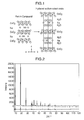
- the hydrated sodium-cobalt oxide obtained in this way has a previously unknown structure in which a single sodium ion layer and two water molecule layers are interposed between the CoO 2 layers as shown in FIG 1, and the cobalt interlayer distance is increased up to about 9.8 ⁇ .
- the parent compound Na x CoO 2 may be synthesized by a convention process comprising mixing a sodium source and a cobalt source, and heating the mixture in an oxygen-containing atmosphere.
- This conventional process may include a process using sodium peroxide (Na 2 O 2 ) and cobalt oxide (Co 3 O 4 ) (Process 1: see the aforementioned Non-Patent Publication 1), a process using sodium oxide (Na 2 O) and cobalt oxide (Co 3 O 4 ) (see "A. Stoklosa, J. Molenda, and D. Than, Solid Srate Ionics, 15, pp.
- a preferable range (x) of the sodium composition is 0.5 ⁇ x ⁇ 1.0. If the sodium composition is less than the lower limit of this range, the cobalt oxide is liable to remain. If the sodium composition is greater than the upper limit of this range, Na 4 CoO 4 is liable to be mixed as an impurity.
- the Na x CoO 2 obtained in the way exhibits various crystal structures disclosed, for example, in the aforementioned Non-Patent Publication 1, its crystal structure fundamentally comprises CoO 2 layers each having edge-sharing CoO 6 octahedra, and a single sodium ion layer interposed between the CoO 2 layers, wherein a cobalt interlayer distance is in the range of 5 ⁇ to 6 ⁇ .
- the deintercalation of sodium ions from the parent compound may be performed through a conventional process, for example, a chemical process using an oxidizing reagent, such as iodine or bromine (S. Miyazaki, S. Kikkawa, and M. Koizumi, Synthetic Met. 6, pp. 211-217 (1983)), or a process based on electrochemical oxidation (J. J. Braconnier, C. Delmas, C. Fouassier, and P. Hagenmuller, Mat. Bull., 15, pp. 1797-1804 (1980)).
- an oxidizing reagent such as iodine or bromine
- electrochemical oxidation J. J. Braconnier, C. Delmas, C. Fouassier, and P. Hagenmuller, Mat. Bull., 15, pp. 1797-1804 (1980)
- the intercalation of water molecules may be performed in the most simplified manner through a process comprising immersing in water the above compound whose sodium ions have been partly deintercalated. Alternatively, it mat be a process comprising exposing the compound to a humid atmosphere.
- a hydrated sodium-cobalt oxide to be obtained through the above method comprises a plurality of CoO 2 layers each having approximately the edge-sharing CoO 6 octahedra as those of the parent compound, and a combination of two water molecule layers and a single sodium ion layer, which is interposed between the adjacent CoO 2 layers, wherein the distance between the adjacent CoO 2 layers is in the range of 9.5 to 10.5 ⁇ .
- the number of water molecules intercalated between the CoO 2 layers is varied depending on humidity. Specifically, the intercalation of water molecules is induced by exposing the hydrated sodium-cobalt oxide to a high-humidity atmosphere. By contrast, the deintercalation is induced by exposing the hydrated sodium-cobalt oxide to a low-humidity atmosphere.
- Each of Co atoms has two sites to be occupied by water molecules (in the after-mentioned structural analysis, water molecules are allocated to six sites residing in each Co atom illustrated in FIG 1 because water molecules actually diffuse between the CoO 2 layers). Thus, the number of water molecules to be intercalated between the CoO 2 layers is two at a maximum.
- the number of water molecules is between one and per Co atom. That is, in a general formula: Na x CoO 2 ⁇ yH 2 O representing the hydrated sodium-cobalt oxide, this relation is expressed by 0 ⁇ x ⁇ 0.4, and 1. 0 ⁇ y ⁇ 2.0.
- a sodium-cobalt oxide expressed by Na 0.7 CoO 2 was synthesized. After deintercalating a part of sodium ions using bromine, water molecules were intercalated between CoO 2 layers to prepare a hydrated sodium-cobalt oxide expressed by Na x CoO 2 ⁇ yH 2 O.
- the deintercalation of sodium ions from the obtained Na 0.7 CoO 2 , and the intercalation of water molecules therein were performed through the following process.
- the synthesized Na 0.7 CoO 2 was firstly crushed and weighted. With respect to the amount of sodium in the weighted Na 0.7 CoO 2 powder, 5 parts of bromine was dissolved in acetonitrile to prepare an acetonitrile solution of bromine. Then, the Na 0.7 CoO 2 powder was immersed in this solution, and left at room temperature for 5 days to deintercalate a part of sodium ions from between the Na 0.7 CoO 2 layer. The obtained power was filtered and cleaned to remove unreacted bromine using acetonitrile, and then immersed in distilled water to intercalate water molecules between the CoO 2 layers.
- U indicates an isotopic atom displacement parameter, and the content of sodium was fixed at the result of the ICP-AES.
- FIG 2 shows a powder X-ray diffraction pattern and a Rietveld analysis result of the hydrated sodium-cobalt oxide in Inventive Example 1.
- the mark + measurement value
- the solid line calculation value
- the vertical bar Bragg reflection position
- the lower solid line the difference between the measurement and calculation values.
- the calculated diffraction pattern based on the structural model well corresponds to the actual measurement value. This proves that this structural model is adequate as the crystal structure of the hydrated sodium-cobalt oxide obtained in Inventive Example 1.
- the obtained hydrated sodium-cobalt oxide comprises approximately the same CoO 2 layers as those of the parent structure, and a combination of a single sodium ion layer and two water molecule layers, which is intercalated between the CoO 2 layers, and has a cobalt interlayer distance of 9.81 ⁇ , which is extremely long as compared with the parent structure.
- the superconductivity of the obtained hydrated sodium-cobalt oxide was checked by resistivity measurement using a four-terminal method, and magnetic-susceptibility measurement using a SQUID (Superconducting Quantum Interference Device).
- FIG 3 shows the result of the resistivity measurement in a zero magnetic filed.
- the hydrated sodium-cobalt oxide exhibited a sharp change of resistivity at about 5 K and fell off.
- the magnetic-susceptibility measurement was performed under the conditions of a zero-field cooling in a temperature range of 2 K to room temperature, wherein a measurement magnetic field was set at 20 Oe. The result is shown in FIG. 4.
- This measurement value at 2K is equivalent to 13 % of a theoretical value (- 1/4 ⁇ emu/cm 3 ) in perfect diamagnetism. Considering this result together with that of resistivity measurement, it was verified that this material exhibits superconductivity.
- a hydrated sodium-cobalt oxide having no intercalated water molecule was synthesized, and its superconductivity characteristic was checked.
- the synthesis of the parent compound Na 0.7 CoO 2 and the partial deintercalation of sodium ions were performed in the same manner as those in Inventive Example 1. Acetonitrile used as a solvent of bromine and for removing excessive bromine was removed by vaporization under reduced pressure.
- FIG. 5 shows a powder X-ray diffraction pattern of a compound obtained in this way.
- the mark + measurement value
- the solid line calculation value
- the vertical bar (upper) Bragg reflection position corresponding to sodium bromide
- the vertical bar (lower) Bragg reflection position corresponding to sodium-cobalt oxide
- the lower solid line the difference between the measurement and calculation values.
- FIG 6 shows a measurement result about magnetic susceptibility of this mixture using a SQUID, wherein the vertical axis represents magnetic susceptibility per Co atom residing in the mixture.
- this mixture no decrease in magnetic susceptibility was observed in a temperature of 2 K or more, and no superconducting phase was created.
- a part of water molecules in the hydrated sodium-cobalt oxide obtained in Inventive Example 1 was deintercalated to synthesize a sodium-cobalt oxide having a single water molecule layers, and its superconductive characteristic was checked.
- the partial deintercalation of water molecules was performed by exposing the hydrated sodium-cobalt oxide obtained in Inventive Example 1, to a nitrogen flow for one week.
- a powder X-ray diffraction pattern of the obtained material is shown in FIG. 7.
- the resulting diffraction peak can be indexed using the unit cell of a hexagonal system as with the hydrated sodium-cobalt oxide obtained in Inventive Example 1.
- the distance between the CoO 2 layers is about 7 ⁇ .
- this structure would have only one water molecule layer between the CoO 2 layers.
- FIG. 8 A measurement result about magnetic susceptibility of this mixture using a SQUID is shown in FIG. 8.
- the decrease in magnetic susceptibility corresponds to the characteristic at a transition temperature to a superconducting phase in the hydrated sodium-cobalt oxide obtained in Inventive Example 1.
- this decrease is induced by the remaining portion of the hydrated sodium-cobalt oxide obtained in Inventive Example 1.
- the hydrated sodium-cobalt oxide of the present invention has an extremely wide interlayer distance increased to about 9.8 ⁇ , and includes highly diffusible sodium ions and water molecules between the layers.
- the hydrated sodium-cobalt oxide can be effectively used as a precursor for synthesizing compounds through ion exchanging.
- this hydrated sodium-cobalt oxide is the first cobalt oxide exhibiting superconductivity.
Landscapes
- Chemical & Material Sciences (AREA)
- Organic Chemistry (AREA)
- Inorganic Chemistry (AREA)
- Engineering & Computer Science (AREA)
- Ceramic Engineering (AREA)
- Inorganic Compounds Of Heavy Metals (AREA)
- Battery Electrode And Active Subsutance (AREA)
Abstract
Description
| Atom | Site | Fractional Coordinate | Occupancy | U/Å | |||
| x | y | | |||||
| Co | 2a | ||||||
| 0 | 0 | 0 | 1 | 0.0063 (6) | |||
| O | 4f | 1/3 | 2/3 | 0.0451 (3) | 1 | 0.0162 (12) | |
| | 2d | 2/3 | 1/3 | 1/4 | 0.159 (4) | = U (O) | |
| Na2 | | 0 | 0 | 1/4 | 0.192 | = U (O) | |
| WO1 | 12k | 0.174(13) | = 2x (WO1) | 0.1793 (2) | 0.070(12) | = U (O) | |
| WO2 | 12k | 0.370(12) | = x (WO2)/2 | = z (WO1) | 0.176(12) | = U (O) |
Claims (5)
- A hydrated sodium-cobalt oxide comprising a plurality of CoO2 layers each having edge-sharing CoO6 octahedra, and a combination of two water molecule layers and a single sodium ion layer, which is interposed between the adjacent CoO2 layers.
- The hydrated sodium-cobalt oxide as defined in claim 1, wherein the distance between the adjacent CoO2 layers is in the range of 9.5 to 10.5 Å.
- A hydrated sodium-cobalt oxide, which is represented by the following general formula:
- The hydrated sodium-cobalt oxide as defined in either one of claims 1 to 3, which exhibits superconductivity at a temperature of 5 K or less.
- A method of producing a hydrated sodium-cobalt oxide, comprising;
synthesizing, from a sodium compound and a cobalt compound, NaxCoO2 (0.5 ≤ x ≤ 1.0) which comprises a plurality of CoO2 layers each having edge-sharing CoO6 octahedra, and a single sodium ion layer interposed between the adjacent CoO2 layers;
deintercalating a part of the sodium ions from said NaxCoO2, and
then intercalating a water molecule between the adjacent CoO2 layers.
Applications Claiming Priority (3)
| Application Number | Priority Date | Filing Date | Title |
|---|---|---|---|
| JP2003017070A JP4041883B2 (en) | 2003-01-27 | 2003-01-27 | Hydrated sodium cobalt oxide and method for producing the same |
| JP2003017070 | 2003-01-27 | ||
| PCT/JP2004/000511 WO2004067450A1 (en) | 2003-01-27 | 2004-01-21 | Sodium cobalt oxide hydrate |
Publications (3)
| Publication Number | Publication Date |
|---|---|
| EP1595848A1 true EP1595848A1 (en) | 2005-11-16 |
| EP1595848A4 EP1595848A4 (en) | 2006-03-29 |
| EP1595848B1 EP1595848B1 (en) | 2007-08-08 |
Family
ID=32820553
Family Applications (1)
| Application Number | Title | Priority Date | Filing Date |
|---|---|---|---|
| EP04703937A Expired - Lifetime EP1595848B1 (en) | 2003-01-27 | 2004-01-21 | Sodium cobalt oxide hydrate |
Country Status (5)
| Country | Link |
|---|---|
| US (1) | US20060257311A1 (en) |
| EP (1) | EP1595848B1 (en) |
| JP (1) | JP4041883B2 (en) |
| DE (1) | DE602004008040T2 (en) |
| WO (1) | WO2004067450A1 (en) |
Families Citing this family (7)
| Publication number | Priority date | Publication date | Assignee | Title |
|---|---|---|---|---|
| JP4823275B2 (en) * | 2007-06-25 | 2011-11-24 | 三洋電機株式会社 | Nonaqueous electrolyte secondary battery |
| WO2009001557A1 (en) * | 2007-06-25 | 2008-12-31 | Sanyo Electric Co., Ltd. | Nonaqueous electrolyte secondary battery and method for producing positive electrode |
| JP5558115B2 (en) | 2008-02-18 | 2014-07-23 | 独立行政法人科学技術振興機構 | Superconducting compound and method for producing the same |
| JP5518295B2 (en) * | 2008-03-27 | 2014-06-11 | 独立行政法人科学技術振興機構 | Superconductor comprising layered compound and method for producing the same |
| WO2010007929A1 (en) | 2008-07-16 | 2010-01-21 | 独立行政法人科学技術振興機構 | Layered compound, superconductor and method for producing same |
| US9580307B2 (en) * | 2011-06-09 | 2017-02-28 | Cornell University | Single crystal mixed metal oxide nanosheet material compositions, methods and applications |
| CN116565189B (en) * | 2023-04-24 | 2024-07-09 | 吉安冠佳新能源开发有限公司 | Layered oxide positive electrode material for sodium ion battery and preparation method thereof |
Family Cites Families (2)
| Publication number | Priority date | Publication date | Assignee | Title |
|---|---|---|---|---|
| JP2001320095A (en) * | 2000-03-03 | 2001-11-16 | Tohoku Techno Arch Co Ltd | Oxide thermoelectric material |
| JP2002274943A (en) * | 2001-03-19 | 2002-09-25 | Tohoku Techno Arch Co Ltd | Oxide thermoelectric material |
-
2003
- 2003-01-27 JP JP2003017070A patent/JP4041883B2/en not_active Expired - Lifetime
-
2004
- 2004-01-21 DE DE602004008040T patent/DE602004008040T2/en not_active Expired - Lifetime
- 2004-01-21 EP EP04703937A patent/EP1595848B1/en not_active Expired - Lifetime
- 2004-01-21 US US10/543,089 patent/US20060257311A1/en not_active Abandoned
- 2004-01-21 WO PCT/JP2004/000511 patent/WO2004067450A1/en not_active Ceased
Also Published As
| Publication number | Publication date |
|---|---|
| DE602004008040D1 (en) | 2007-09-20 |
| JP4041883B2 (en) | 2008-02-06 |
| EP1595848B1 (en) | 2007-08-08 |
| JP2004262675A (en) | 2004-09-24 |
| WO2004067450A1 (en) | 2004-08-12 |
| US20060257311A1 (en) | 2006-11-16 |
| DE602004008040T2 (en) | 2008-05-08 |
| EP1595848A4 (en) | 2006-03-29 |
Similar Documents
| Publication | Publication Date | Title |
|---|---|---|
| Yaghoobnejad Asl et al. | Proton-induced disproportionation of Jahn–Teller-active transition-metal ions in oxides due to electronically driven lattice instability | |
| Berthelot et al. | New layered compounds with honeycomb ordering: Li3Ni2BiO6, Li3NiM′ BiO6 (M′= Mg, Cu, Zn), and the delafossite Ag3Ni2BiO6 | |
| Tessier et al. | Structural study of zinc-substituted nickel hydroxides | |
| Ammundsen et al. | Ion exchange in manganese dioxide spinel: proton, deuteron, and lithium sites determined from neutron powder diffraction data | |
| Okumura et al. | Correlation of lithium ion distribution and X-ray absorption near-edge structure in O3-and O2-lithium cobalt oxides from first-principle calculation | |
| Zhou et al. | Improving electrochemical performance of spinel-type Ni/Mn-based high-voltage cathode material for lithium-ion batteries via La-F co-doping combined with in-situ integrated perovskite LaMnO3 coating layer | |
| Boulineau et al. | Thermal stability of Li2MnO3: from localized defects to the spinel phase | |
| Cheng et al. | High rate performances of the cathode material LiNi1/3Co1/3Mn1/3O2 synthesized using low temperature hydroxide precipitation | |
| Hon et al. | Synthesis and characterization of Li1+ δMn2− δO4 powders prepared by citric acid gel process | |
| Gajraj et al. | Correlation between structural, electrical and electrochemical performance of Zn doped high voltage spinel LiNi0. 5-xZnxMn1. 5O4 porous microspheres as a cathode material for Li-Ion batteries | |
| Fengchun et al. | Preparation and electrochemical performance of Na0. 67Mn0. 67Fe0. 2Co0. 1Cu0. 03O2 cathode material for sodium-ion batteries | |
| EP1595848B1 (en) | Sodium cobalt oxide hydrate | |
| Medina et al. | Proton intercalation into different CoO2 layer matrices | |
| Ecer et al. | Na0. 67Mn0. 33Ni0. 33Co0. 33O2: Effect of synthesis technique on competing P3 and P2 phases | |
| Abuzeid et al. | Nanosized silver-coated and doped manganese dioxide for rechargeable lithium batteries | |
| Patoux et al. | Layered manganese oxide intergrowth electrodes for rechargeable lithium batteries. 2. Substitution with Al | |
| Hashem et al. | Effect of carbon coating process on the structure and electrochemical performance of LiNi0. 5Mn0. 5O2 used as cathode in Li-ion batteries | |
| Li et al. | The synthesis and characterization of nanosized orthorhombic LiMnO2 by in situ oxidation–ion exchange | |
| JP4370382B2 (en) | Hydrated sodium cobalt oxide | |
| Han et al. | Synthesis of CoxMn1− xO4 (0.9≤ x≤ 2.7) nanopowders with controlled phase and composition via a gel-combustion method | |
| Wei et al. | Layered Li–Mn oxides with the O2 structure: preparation of Li2/3 [Mn1− xMx] O2 (M= Li, Cr, Mg, Al) by ion exchange | |
| Chitrakar et al. | Synthesis and characterization of lithium nickel manganese oxides and their delithiated phases | |
| He et al. | Influence of Al3+ ions on the morphology and structure of layered LiMn1–xAlxO2 cathode materials for the lithium ion battery | |
| Idemoto et al. | Dependence of Average and Local Structures and Cathode Performance on Synthetic Condition of Lix (Mn1/3Co1/3Ni1/3) O2 as a Cathode Active Material for Li Ion Battery | |
| Shivakumara et al. | Low temperature synthesis of layered NaxCoO2 and KxCoO2 from NaOH/KOH fluxes and their ion exchange properties |
Legal Events
| Date | Code | Title | Description |
|---|---|---|---|
| PUAI | Public reference made under article 153(3) epc to a published international application that has entered the european phase |
Free format text: ORIGINAL CODE: 0009012 |
|
| 17P | Request for examination filed |
Effective date: 20050818 |
|
| AK | Designated contracting states |
Kind code of ref document: A1 Designated state(s): AT BE BG CH CY CZ DE DK EE ES FI FR GB GR HU IE IT LI LU MC NL PT RO SE SI SK TR |
|
| AX | Request for extension of the european patent |
Extension state: AL LT LV MK |
|
| A4 | Supplementary search report drawn up and despatched |
Effective date: 20060215 |
|
| DAX | Request for extension of the european patent (deleted) | ||
| RBV | Designated contracting states (corrected) |
Designated state(s): DE FR GB |
|
| 17Q | First examination report despatched |
Effective date: 20061019 |
|
| GRAP | Despatch of communication of intention to grant a patent |
Free format text: ORIGINAL CODE: EPIDOSNIGR1 |
|
| GRAS | Grant fee paid |
Free format text: ORIGINAL CODE: EPIDOSNIGR3 |
|
| GRAA | (expected) grant |
Free format text: ORIGINAL CODE: 0009210 |
|
| AK | Designated contracting states |
Kind code of ref document: B1 Designated state(s): DE FR GB |
|
| REG | Reference to a national code |
Ref country code: GB Ref legal event code: FG4D |
|
| REF | Corresponds to: |
Ref document number: 602004008040 Country of ref document: DE Date of ref document: 20070920 Kind code of ref document: P |
|
| EN | Fr: translation not filed | ||
| PLBE | No opposition filed within time limit |
Free format text: ORIGINAL CODE: 0009261 |
|
| STAA | Information on the status of an ep patent application or granted ep patent |
Free format text: STATUS: NO OPPOSITION FILED WITHIN TIME LIMIT |
|
| 26N | No opposition filed |
Effective date: 20080509 |
|
| GBPC | Gb: european patent ceased through non-payment of renewal fee |
Effective date: 20080121 |
|
| PG25 | Lapsed in a contracting state [announced via postgrant information from national office to epo] |
Ref country code: GB Free format text: LAPSE BECAUSE OF NON-PAYMENT OF DUE FEES Effective date: 20080121 |
|
| PG25 | Lapsed in a contracting state [announced via postgrant information from national office to epo] |
Ref country code: FR Free format text: LAPSE BECAUSE OF FAILURE TO SUBMIT A TRANSLATION OF THE DESCRIPTION OR TO PAY THE FEE WITHIN THE PRESCRIBED TIME-LIMIT Effective date: 20080404 |
|
| PGFP | Annual fee paid to national office [announced via postgrant information from national office to epo] |
Ref country code: DE Payment date: 20140122 Year of fee payment: 11 |
|
| REG | Reference to a national code |
Ref country code: DE Ref legal event code: R119 Ref document number: 602004008040 Country of ref document: DE |
|
| PG25 | Lapsed in a contracting state [announced via postgrant information from national office to epo] |
Ref country code: DE Free format text: LAPSE BECAUSE OF NON-PAYMENT OF DUE FEES Effective date: 20150801 |