EP1595518A1 - Inter-labium pad and individual inter-labium pad packaging body - Google Patents
Inter-labium pad and individual inter-labium pad packaging body Download PDFInfo
- Publication number
- EP1595518A1 EP1595518A1 EP04711753A EP04711753A EP1595518A1 EP 1595518 A1 EP1595518 A1 EP 1595518A1 EP 04711753 A EP04711753 A EP 04711753A EP 04711753 A EP04711753 A EP 04711753A EP 1595518 A1 EP1595518 A1 EP 1595518A1
- Authority
- EP
- European Patent Office
- Prior art keywords
- sheet
- interlabial pad
- back face
- seam part
- small
- Prior art date
- Legal status (The legal status is an assumption and is not a legal conclusion. Google has not performed a legal analysis and makes no representation as to the accuracy of the status listed.)
- Withdrawn
Links
Images





Classifications
-
- A—HUMAN NECESSITIES
- A61—MEDICAL OR VETERINARY SCIENCE; HYGIENE
- A61F—FILTERS IMPLANTABLE INTO BLOOD VESSELS; PROSTHESES; DEVICES PROVIDING PATENCY TO, OR PREVENTING COLLAPSING OF, TUBULAR STRUCTURES OF THE BODY, e.g. STENTS; ORTHOPAEDIC, NURSING OR CONTRACEPTIVE DEVICES; FOMENTATION; TREATMENT OR PROTECTION OF EYES OR EARS; BANDAGES, DRESSINGS OR ABSORBENT PADS; FIRST-AID KITS
- A61F13/00—Bandages or dressings; Absorbent pads
- A61F13/15—Absorbent pads, e.g. sanitary towels, swabs or tampons for external or internal application to the body; Supporting or fastening means therefor; Tampon applicators
- A61F13/45—Absorbent pads, e.g. sanitary towels, swabs or tampons for external or internal application to the body; Supporting or fastening means therefor; Tampon applicators characterised by the shape
- A61F13/47—Sanitary towels, incontinence pads or napkins
- A61F13/472—Sanitary towels, incontinence pads or napkins specially adapted for female use
- A61F13/47209—Sanitary towels, incontinence pads or napkins specially adapted for female use having only interlabial part, i.e. with no extralabial parts
-
- A—HUMAN NECESSITIES
- A61—MEDICAL OR VETERINARY SCIENCE; HYGIENE
- A61F—FILTERS IMPLANTABLE INTO BLOOD VESSELS; PROSTHESES; DEVICES PROVIDING PATENCY TO, OR PREVENTING COLLAPSING OF, TUBULAR STRUCTURES OF THE BODY, e.g. STENTS; ORTHOPAEDIC, NURSING OR CONTRACEPTIVE DEVICES; FOMENTATION; TREATMENT OR PROTECTION OF EYES OR EARS; BANDAGES, DRESSINGS OR ABSORBENT PADS; FIRST-AID KITS
- A61F13/00—Bandages or dressings; Absorbent pads
- A61F13/15—Absorbent pads, e.g. sanitary towels, swabs or tampons for external or internal application to the body; Supporting or fastening means therefor; Tampon applicators
- A61F13/15203—Properties of the article, e.g. stiffness or absorbency
- A61F13/15211—Properties of the article, e.g. stiffness or absorbency soluble or disintegratable in liquid
Definitions
- the present invention relates to an interlabial pad to be fitted between a woman's labia. To be more specific, the present invention relates to an interlabial pad that can be discarded in a toilet and an individual wrapping body for individual package of an interlabial pad.
- Interlabial pads which are fitted between a woman's labia and absorb menstrual blood, urine, and other body fluids, have been known as absorbent articles for menstruation or for prevention of continence or for both of these purposes.
- an interlabial pad which comprises a surface side sheet, a back face sheet, and an absorbent body, disposed between the surface side sheet and the back face sheet and absorbing and holding body fluids, and with which the back face sheet is equipped with a mini-sheet piece for insertion of the pad using fingers, has been proposed (for example, International Patent Publication Pamphlet No. 02/094148).
- an interlabial pad has been proposed with which the back face sheet of the interlabial pad is arranged as a biodegradable sheet or a water disintegrable sheet.
- a biodegradable sheet mainly formed of polybutylene succinate, is used for the back face sheet of an interlabial pad (trade name: Envive (Moderate)) that has been test-sold in the USA by The Procter and Gamble Corp. (referred to hereinafter as "PG Corp.”).
- This sheet has a size with a length dimension of 90mm and a width dimension of 50mm and the shape of the sheet is elliptical.
- the used interlabial pad can be disposed by flushing down a toilet, and yet even if the interlabial pad is put in a highly wetted state by the body fluids of a user, the leakage of the body fluids from the interlabial pad can be prevented.
- the polymerization degree and saponification degree of the water disintegrable polymer are increased, the membrane thickness is increased, or an additive is mixed, etc., the rigid sensation of the water disintegrable sheet is increased as well.
- the retention time in the filter element or aeration tube of the septic tank will be long.
- the microbial activity in the septic tank may be affected.
- the present invention has been made in view of such issues as the above and an object thereof is to provide an interlabial pad, which can be discarded by flushing down a toilet without damaging the functions of a septic tank and yet which is not lowered in the functions and comfort during fitting of the interlabial pad.
- the present invention provides an interlabial pad, with which after the interlabial pad is discarded after use by flushing down a toilet, a cover body, covering an absorbent body, or in particular, a back face sheet, which is a part of the cover body, separates into a plurality of small sheet pieces and becomes dispersed in water so that in the wetted state during use, the interlabial pad prevents the leakage of menstrual blood without disintegrating and is maintained in a good state of use.
- the present invention provides an interlabial pad and an individual wrapping body for an interlabial pad, such as the following.
- the entry of water from the exterior can be blocked without fail.
- the interlabial pad inside the individual wrapping body will not become wetted or soiled, thus providing excellent sanitation.
- FIG. 1A and Fig. 2A show diagrams of an interlabial pad 10 of a first embodiment of the present invention, with Fig. 1A being a perspective view of interlabial pad 10 and Fig. 1 B being a sectional view along line X-X, in other words, along the lateral of interlabial pad 10.
- Fig. 2 is a perspective view showing a back face sheet 30 of interlabial pad 10.
- Fig. 3 is a diagram showing the state in which interlabial pad 10 is fitted between labia.
- an interlabial pad 10 has an absorbent body 40, which absorbs body fluids and other liquids, and the absorbent body 40 is covered by a cover body 23.
- the cover body 23 is provided with a surface side sheet 20, having a permeable property for liquids which allows the permeation of liquids, including menstrual blood, urine, and other body fluids (hereinafter, this property shall be referred to as "liquid permeability"), and a back face sheet 30, having an impermeable property against liquids which does not allow the permeation of liquids (hereinafter, this property shall be referred to as "liquid impermeability").
- the absorbent body 40 is disposed between the surface side sheet 20 and the back face sheet 30.
- the interlabial pad 10 is folded in two along a longitudinal central line m so that the back face sheet 30 is set at an inner side and the surface side sheet 20 is set at an outer side.
- the interlabial pad 10 is fitted, as shown in Fig. 3, so that the surface side sheet 20 becomes a body side that contacts the body and the folded part contacts vestibular floor q of labia r. Since with the interlabial pad 10, which has thus been fitted between the labia, the surface side sheet 20 is liquid permeable, body fluids that flow down the labial inner walls permeate through the surface side sheet 20 and become absorbed and held by the absorbent body 40. Since the back face sheet 30 of the interlabial pad 10 is liquid impermeable, the body fluid held by the absorbent body 40 is retained in the absorbent body 40 without leaking out to the exterior of the interlabial pad 10.
- the interlabial pad 10 is long in the longitudinal direction indicated by line Y-Y, short in the lateral direction indicated by line X-X, and has a substantially elliptical shape in plan view.
- the size of the interlabial pad 10 in the longitudinal direction is in the range of 40 to 180mm and preferably 70 to 130mm. If the length is less than 40mm, depending on the individual differences among users, it may not be possible to cover the entirety of the vestibular floor in the longitudinal direction, which extends from the ventral side to the dorsal side, and leakage of body fluids may occur. On the other hand, a length greater than 180mm is unfavorable since the region that protrudes outside from the labia will be too big and readily contact vulvar parts, etc. and increase the possibility for interlabial pad 10 to fall off from the labia.
- the size of interlabial pad 10 in the lateral direction is in the range of 25 to 100mm and preferably 40 to 80mm. If the width is less than 25mm, depending on the individual differences among users, it may not be possible to cover the entirety of the inner labial walls and leakage of body fluids may occur. On the other hand, a width greater than 100mm is unfavorable since the region that protrudes outside from the inner labial walls will be too great and readily contact vulvar parts, etc. and increase the possibility for interlabial pad 10 to fall off from the labia.
- interlabial pad 10 is a substantially elliptical shape in the plan view of the present embodiment, the shape is not limited to this as long as the form is such that the pad can be fitted and held between the labia.
- Other forms of the overall shape of the interlabial pad 10 include, for example, rectangular shapes, gourd-like shapes, teardrop shapes, etc.
- the interlabial pad 10 of the present embodiment is substantially planar, the cross-sectional shape in the lateral direction may be folded three-dimensionally into a substantially V-like shape.
- the surface side sheet 20 and the back side sheet 30 are joined at least partially at the peripheral edge parts of the absorbing member 40 and thereby form the cover body 23.
- means for joining the surface side sheet 20 and the back side sheet 30 include application of an adhesive agent and adhesion by an emboss process, and such means may be used solitarily or in combination. If an emboss process is to be performed, the surface side sheet 20 and the back side sheet 30 may be joined by heat sealing.
- the parts at which the surface side sheet 20 and the back face sheet 30 are joined does not have to be water dispersibile, and with the interlabial pad 10 of the present embodiment, the parts at which the surface side sheet 20 and the back face sheet 30 are joined are not set to become separated by the actions of water.
- the surface side sheet 20 and the back face sheet 30 are joined in a quasi-manner by an engaging pattern, since the surface side sheet 20 and the back face sheet 30 will then separate readily after the interlabial pad 10 is discarded into a toilet.
- a material that is liquid permeable and is not skin-irritating is used for the surface side sheet 20.
- a nonwoven fabric obtained by a manufacturing method, such as melt blowing, spun bonding, through air method, point bonding, needle punching, wet forming spun lacing, etc., may be cited as such a material.
- a biodegradable or water disintegrable sheet that is liquid impermeable is used for the back face sheet 30 .
- a sheet formed mainly of a water disintegrable polymer, such as polyvinyl alcohol (PVA), alkyl cellulose, etc. may be cited as an example of a water disintegrable sheet.
- PVA films, film sheets which is provided by modifying a PVA sheet being subject to water repellent treatment by silicon etc. at one side or both sides or partially, PVA films having silicon mixed in, starch films, and films using a biodegradable resin such as polylactic acid, polybutylene succinate, etc. as the raw material may be cited as examples of a biodegradable sheet.
- the surface (referred to hereinafter as “outer surface”) 30s of the back side sheet 30, which is positioned at the side opposite to the absorbent body attached preferably has the property of being wetted by water (hereinafter referred to as "water wettability").
- water wettability An interlabial pad that uses a back face sheet with water wettability prevents the leakage of body fluids during use and yet becomes wetted with water readily and does not float readily to the water surface when discarded in a toilet.
- Examples of the back face sheet 30, with which the outer surface 30s has water wettability include sheets which is formed by adhering hydrophilic fibers to one side of a biodegradable or a water disintegrable sheet, laminated paper which is formed by laminating liquid impermeable resin onto one side of a hydrophilic nonwoven fabric using hydrophilic fibers as the raw material, and sheets which is formed by a hydrophilic nonwoven fabric being subject to a water repellent treatment using a sizing agent, etc. so that the water repellency is adjusted by the mixing ratio, etc. Also if necessary, coloring may be applied by mixing an inorganic pigment in a range of 0.1 to 5%.
- a wet forming spun laced nonwoven fabric may be cited as a specific example of a hydrophilic nonwoven fabric, which is formed with predetermined amounts of fibers having a fiber length in the range of 1 to 38mm ,preferably 2 to 20mm and fineness in the range of 1.1 to 3.3dtex, like rayon fibers, acetate rayon fibers, cotton fibers, pulp fibers, or synthetic fibers, mixed and adjusted so that the hydrophilic nonwoven fabric has the specific weight is in the range of 10 to 60g/m 2 .
- the liquid impermeable film to be adhered onto the hydrophilic nonwoven fabric preferably has a specific weight of 10 to 40g/m 2 and is adhered by an emboss process or by a water disintegrable adhesive agent at an adhesion percentage in the range of 1 to 30%.
- a resin to be laminated preferably has a thickness in the range of 10 to 40 ⁇ m.
- any absorbent body may be used without restriction as long as body fluids can be absorbed and held.
- a highly water-absorbing absorbent body which is high in liquid absorbing property and can absorb and hold, for example, approximately 15 to 100 times its own weight of liquid, is preferably used. It is furthermore preferable to use an absorbent body that is bulky, is not deformed readily, and is low in chemical irritability.
- constituent materials of the absorbent body 40 a pulp, chemical pulp, rayon, acetate, natural cotton, super absorbent polymer, super absorbent polymer fibers, or synthetic fibers may be used solitarily or in blended form. Carboxymethylcellulose (CMC), which is biodegradable, is especially preferable.
- the form of the absorbent body 40 is not limited in particular and may be sheet-like or powder-like.
- the back face sheet of the interlabial pad of the present invention has parting zone for separation of the back face sheet into a plurality of small sheet pieces by the actions of water.
- back face sheet 30 of Fig. 1 is arranged from two small sheet pieces 30a and 30b as shown in Fig. 2 and a longitudinal seam part 90, extending along the longitudinal central line m at which small sheet pieces 30a and 30b overlap so as to cross longitudinal central line m, is the parting zone.
- the small sheet pieces 30a and 30b overlap with each other over a range of 1 to 25mm and preferably 5 to 15mm to form longitudinal seam part 90.
- the small sheet pieces 30a and 30b may separate due to movements of a user and gaps may thus form to cause leakage of body fluids.
- this width is greater than 25mm, it becomes difficult for the small sheet pieces to disperse upon discarding into a toilet.
- the interlabial pad 10 may therefore become readily retained on a filter element of a small-scale combined treatment septic tank or an aeration tube of an independent treatment septic tank and damage the functions of the septic tank.
- the part at which the small sheet pieces 30a and 30b overlap being excessive, a user may be subject to a foreign-body sensation during use.
- each of the small sheet pieces 30a and 30b has a size of no more than 60 x 60mm, preferably no more than 45 ⁇ 45mm, and more preferably no more than 30 x 30mm as the longitudinal dimension ⁇ lateral dimension.
- the total area of the small sheet pieces 30a and 30b that make up the back face sheet 30 may be made slightly greater than the area of the surface side sheet 20. By doing so, leakage of body fluids due to separation of the small sheet pieces 30a and 30b during the use of the interlabial pad 10 can be prevented.
- the back face sheet 30 in the present embodiment is formed of two small sheet pieces, it may be formed of a larger number of small sheet pieces, and in this case, the size of a single small sheet piece can be made smaller within the abovementioned range.
- the outer surface 30s of the back face sheet 30 is preferably made uneven.
- the outer surface 30s may be made uneven by an emboss process, and the unevenness may also be formed by adhering a nonwoven fabric to the outer surface 30s and confounding the fibers of the fabric.
- the outer surface 30s is made uneven, after the interlabial pad is discarded into a toilet, water will enter readily between the mutually opposing parts of the back face sheet 30 that is folded in two during use.
- a nonwoven fabric is adhered onto the outer surface 30s and a hydrophilic nonwoven fabric is used, the water of the toilet will be absorbed rapidly upon discarding into a toilet. Water will thus enter between the small sheet pieces 30a and 30b that overlap at the longitudinal seam part 90 and the back face sheet 30 will disintegrate readily along the longitudinal seam part 90 and become dispersed as the plurality of small sheet pieces.
- perforation-like slits may be formed in the small sheet piece 30a, which is positioned at the side (hereinafter referred to as the "outer side") opposite to the absorbent body side at the longitudinal seam part 90.
- end part 300a of the small sheet piece 30a may be folded back so that water will enter readily into the longitudinal seam part 90 from the outer side of the interlabial pad 10.
- a part of a small sheet piece for example, the vicinity of end part 300a of small sheet piece 30a may be left free of any adhesive agent.
- the absorbent body 40 may be separated along the longitudinal seam part 90 of the back face sheet 30 or perforation-like slits may be formed in the absorbent body 40 to make the absorbing body 40 integral to small sheet piece 30a or 30b.
- the back face sheet 30 can be prevented from floating to the surface of the water inside the septic tank even if a buoyancy is occurred by foam that is generated in a septic tank,.
- the back face sheet 30 of the interlabial pad 10 of the present embodiment is adhered and joined to the surface side sheet 20 at peripheral edge parts of the absorbent body 40 by an adhesive agent or by fusion and adhesion by an emboss process.
- the small sheet pieces 30a and 30b, which make up the back face sheet 30 are completely separable at longitudinal seam part 90, which is water disintegrable.
- the longitudinal seam part 90 parts and separates the back face sheet 30 into the smaller small sheet pieces 30a and 30b, thereby enabling the load placed on a septic tank to be lightened.
- the back face sheet 30 being provided with the plurality of small sheet pieces 30a and 30b, impacts that arise due to the movements of a wearer of the interlabial pad 10 can be absorbed and the foreign-body sensation during fitting can be lightened.
- the small sheet piece 30b is positioned so as to cover the side closer to the longitudinal central line m and is disposed at the absorbent body 40 side (referred to hereinafter as the "inner side") at the longitudinal seam part 90.
- the other small sheet piece 30a which overlaps with the small sheet piece 30b at the longitudinal seam part 90, is positioned to the outer side of the small sheet 30b and its end part 300a is exposed to the outer side at a position away from the longitudinal central line m.
- the body fluids that move inside absorbent body from longitudinal central line m towards the outer edges of the interlabial pad 10 are prevented from entering into the longitudinal seam part 90 from the open part at the end part 300b of the small sheet piece 30b or the end part 300a of the small sheet piece 30a and the leakage of the body fluid can thus be prevented.
- the small sheet pieces 30a and 30b may or may not be adhered at the longitudinal seam part 90 at which they overlap.
- the small sheet pieces 30a and 30b may be adhered by the application of an adhesive agent or by an emboss process.
- Fig. 4 is a sectional view in the lateral direction of an interlabial pad 11 of a second embodiment of the present invention.
- a small sheet piece 30a and a small sheet piece 30b are overlapped at a longitudinal seam part 90 and an adhesive agent 50 is applied between both pieces.
- the small sheet pieces 30a and 30b are thereby adhered together, the airtightness is improved, and leakage of body fluids can be prevented.
- the adhesive agent 50 be applied to at least one of either small sheet piece 30a or small sheet piece 30b and the adhesive agent 50 does not have to be applied to one or both of the end part 300a of the small sheet piece 30a and the end part 300 b of the small sheet piece 30b.
- the adhesive agent 50 may be applied not just to a part of an absorbent body side surface (referred to hereinafter as the "inner surface") 30u of the back face sheet 30 but to the entirety of this surface.
- the adhesive agent 50 is applied to the entire surface of the inner surface 30u, the absorbent body 40 can be adhered and fixed to the back face sheet 30. Also, the chances of end part 300a or 300b of the small sheet piece 30a or 30b separating from the other small sheet piece and consequent loss of longitudinal seam part 90 and leakage of body fluids can be reduced.
- Adhesive agent 50 is applied to a specific weight in the range of 1 to 20g/m 2 and preferably 3 to 10g/cm 2 .
- the application pattern of adhesive agent 50 may be a wave-form, ⁇ -form, spiral-form, line-form, dotted, etc. and the adhesive agent does not have to be applied to some parts of the longitudinal seam part 90. Since the small sheet pieces 30a and 30b are overlapped at the longitudinal seam part 90, as long as the two small sheet pieces are adhered together at least partially, the leakage of body fluids can be prevented. In the other hand, the back face sheet 30 can be dispersed readily into the small sheet pieces 30a and 30b when the interlabial pad 11 is discarded into a toilet, and foreign-body sensations during fitting can be lightened.
- the type of the adhesive agent 50 can be selected according to the type of the back face sheet 30.
- a pressure-sensitive adhesive agent or a heat-sensitive adhesive agent of a type which does not change readily in physical properties even when wetted with water, may be used in a dotted or other intermittent application pattern. This is because the back face sheet 30 itself is water disintegrable and can be dispersed inside a septic tank even if the adhesive agent 50 is not disintegrated in water.
- SEBS styrene-ethylene-butadiene-styrene block copolymer
- SBS styrene-butadiene-styrene block copolymer
- SIS styrene-isoprene-styrene block copolymer
- EVA ethylene-vinyl-acetate copolymer
- the adhesive agent 50 examples include water-sensitive adhesive agents of a type that is readily changed in physical properties by water and biodegradable agents of a type that is not readily changed in physical properties by water may be cited.
- the back face sheet 30 may be formed of either a water disintegrable material or a biodegradable material.
- the application pattern of the adhesive agent 50 is also not restricted.
- Specific examples of water-sensitive adhesive agents include polyvinyl alcohols, carboxymethylcellulose, gelatin, and other water-soluble polymers, and polyvinyl acetates, sodium polyacrylates, and other water-swelling polymers.
- Starch, sodium alginate, guar gum, gellan gum, etc. may be cited as biodegradable adhesive agents. These may also be cross-linked and made into a gel.
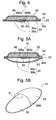
- FIG. 5A and Fig. 5B show diagrams of an interlabial pad 12 of a third embodiment of the present invention that has a mini-sheet piece.
- Fig. 5A is a sectional schematic view in the lateral direction of the interlabial pad 12.
- Fig. 5B is a perspective view of the abovementioned interlabial pad 12, placed with a back face sheet 30 facing upwards so that the left side of the FIGURE becomes the ventral side and the right side becomes the dorsal side when the interlabial pad 12 is fitted on.
- the back face sheet 30 of the interlabial pad 12 is equipped with a mini-sheet piece 60.
- the mini-sheet piece 60 is so as to cover a part of the outer surface 30s of the back face side 30 that is set at the dorsal side when the interlabial pad 12 is worn, and is adhered to the back face sheet 30 at peripheral edge parts of the interlabial pad 12.
- a straight end part 600 of the mini-sheet 60 is not adhered to the back face sheet 30 and a pocket 61, into which a finger is inserted when the interlabial pad 12 is worn and took off, is formed between the mini-sheet piece 60 and the back face sheet 30.
- a film or a nonwoven fabric such as a spun bonded nonwoven fabric, or a melt blown nonwoven fabric, etc., which has polylactic acid, polybutylene succinate, or other biodegradable material as the raw material, a film or a nonwoven fabric having PVA, CMC, or other water disintegrable material as the raw material, a water disintegrable tissue or spun laced nonwoven fabric, etc. having cellulose fibers or regenerated cellulose fibers, etc. as the main component, etc. may be used.
- a spun bonded nonwoven fabric or melt blown nonwoven fabric which is mainly formed of biodegradable material and is a sheet that has been adjusted to a thickness in a range of 0.1 to 3.3dtex and a specific weight in a range of 15 to 40g/m 2 and has been subject to a mechanical corrugating process, is favorable.
- FIG. 6 is a perspective view showing the back face sheet 31 of this embodiment, placed so that the left side of the FIGURE becomes the ventral side when the interlabial pad is worn and so that the side at which the absorbent body is disposed is the upper side.
- the back face sheet 31 is provided with four small sheet pieces 31 a, 31b, 31c, and 31d.
- a longitudinal seam part 90 is provided near a longitudinal central line m.
- a lateral seam part 91 is provided near a lateral central line n.
- the small sheet piece 31 a is overlapped with the small sheet piece 31b at the longitudinal seam part 90 and with the small sheet piece 31 c at the lateral seam part 91, in both cases so that the small sheet piece 31 a is positioned at the side at which the absorbent body is disposed, in other words, at the inner side.
- the small sheet piece 31d is overlapped with the small sheet piece 31c at the longitudinal seam part 90 and with the small sheet piece 31 b at the lateral seam part 91, in both cases so that the small sheet piece 31d is positioned at the inner side.
- the width of mutual overlap of the small sheet pieces at the seam parts 90 and 91 is 1 to 25mm and preferably 5 to 15mm.
- the small sheet pieces 31c and 31d which cover the side that becomes the ventral side when the interlabial pad is fitted on (left side of Fig. 6), are overlapped with the small sheet piece 31 a and the small sheet piece 31 b at the lateral seam part 96 so as to be at the outer side.
- Body fluids that flow in the direction from the dorsal side to the ventral side of the interlabial pad (from the left to right direction in Fig. 6) are thus prevented from entering between the small sheet pieces 31 a and 31 c or between the small sheet pieces 31 b and 31 c from the gaps of the lateral seam part 91, and the leakage of body fluids can thus be prevented.
- the finger can be prevented from catching on to the lateral seam part 91 and can thus be prevented from damaging the lateral seam part 91 and giving rise to a cause of body fluid leakage.
- Fig. 7 is a plan view showing a back face sheet 32 of an interlabial pad 14 of a fifth embodiment of the present invention, placed so that the part that becomes the ventral side is positioned at the left side when the interlabial pad is fitted on and so that the side at which the absorbent body is disposed faces upwards.
- Fig. 8 is a diagram showing a state in which the abovementioned interlabial pad 14 is fitted between labia. In Fig. 8, the interlabial pad 14 is folded in two along a longitudinal central line m and is fitted between labia.
- the back face sheet 32 of the interlabial pad 14 is arranged from nine small sheet pieces 32a, 32b, 32c, 32d, 32e, 32f, 32g, 32h, and 32i.
- a longitudinal seam part 92 has a first longitudinal seam part 92a and a second longitudinal seam part 92b, and a lateral seam part 93 has a first lateral seam part 93a and a second lateral seam part 93b.
- the small sheet pieces that mutually overlap at the longitudinal seam part 92, the small sheet pieces (32a, 32d, and 32g), which cover the side closer to a longitudinal central line m, are overlapped with the small sheet pieces (32b, 32e, 32h, 32c, 32f, and 32i), which cover the side closer to the peripheral parts, so as to be at the outer side.
- the longitudinal seam part 92 is not set at the vicinity of the vestibular floor when the interlabial pad 14 is fitted on as shown in Fig. 8, the foreign-object sensation during fitting can be lightened.
- the small sheet pieces that mutually overlap at lateral seam part 93, the small sheet pieces (for example, 32h, 32g, and 32i), which cover the side closer to the side that is to become the ventral side (left side of the Fig.7) when the interlabial pad is fitted on, are overlapped with the small sheet pieces (for example, 32e, 32d, and 32f), which cover the side closer to the side that is to become the dorsal side (right side of the Fig7.), so as to be at the outer side.
- body fluids which are discharged from the ostium vaginae positioned near the small sheet piece 32a, and flows in the direction of the ventral side at the left side of Fig.
- the back face sheet 32 is provided with a mini-sheet piece, having an opening for insertion of a finger in the direction from the ventral side to the dorsal side, the finger can be prevented from catching on to the lateral seam part 93 and can thus be prevented from damaging the lateral seam part 93 and giving rise to a cause of body fluid leakage.
- the back face sheet may also be arranged from a single sheet piece.
- Fig. 9 is a perspective view showing a back face sheet 33 of an interlabial pad of a sixth embodiment of the present invention as viewed from the outer side, that is, as viewed with the side opposite to the absorbent body side facing upward.
- the back face sheet 33 has two parting lines 94a and 94b and is provided with a single sheet piece.
- Parting lines 94a and 94b are parts at which slits 70, provided in the back face sheet 33, are aligned serially along the longitudinal direction.
- the slits 70 have a length of 10mm each and are disposed discontinuously at a pitch of a 5mm interval. Since these parts are voids formed by slits 70, they are weak in physical strength and thus cause the back face sheet 33 to disintegrate and disperse when the interlabial pad is flushed down a toilet. With the back face sheet 33 of Fig. 9, due to the gaps that the slits 7 form, a small amount of body fluids may permeate from these parts. In order to prevent this, a part of the back face sheet may be overlapped to cover the gaps.
- Fig. 10 is a perspective view showing a back face sheet 34 of an interlabial pad of a seventh embodiment of the present invention as viewed from the outer side, that is, as viewed with the side opposite to the absorbent body side facing upward.
- a part of the back face sheet 34 having parting lines 94a and 94b formed by slits 70, is overlapped so as to cover the gaps that the slits 70 form.
- the back face sheet 34 disintegrates near the slits 70 and disperses into small pieces upon being flushed down a toilet.
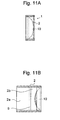
- Fig. 11A is a plan view of an individual wrapping body 1 according to the present invention
- Fig. 11 B is a plan view of a state in which the individual wrapping body 1 of Fig. 11A is partially opened up.
- the individual wrapping body 1 has an interlabial pad 10, which was shown in Fig. 1A, and a wrapping sheet 2, which covers the interlabial pad 10.
- the wrapping sheet 2 is arranged from two short sheet pieces 2a and 2b, and these small sheet pieces overlap to form a seam part 9.
- the wrapping sheet 2 may be a liquid permeable sheet, which is used for the surface side sheet 20 of the abovementioned the interlabial pad 10, or may be a liquid impermeable sheet, which is used for the back face sheet 30.
- a liquid impermeable sheet as the wrapping sheet 2.
- the size of the wrapping sheet 2 depends on the shape of the interlabial pad 10, which is enclosed in the individual wrapping body, it must be made at least larger than the interlabial pad 10, because it must cover the entirety of interlabial pad 10.
- the wrapping sheet 2 when the wrapping sheet 2 is made to have a rectangular shape as shown in Fig. 11B, it preferably has a size in the range of 40 to 360mm in the longitudinal direction and 25 to 200mm in the lateral direction in the opened-up state.
- each of the small sheet pieces 2a and 2b, which make up the wrapping sheet 2 has a longitudinal dimension x width dimension of no more than 60 x 60mm, preferably no more than 45 x 45mm, and more preferably no more than 30 x 30mm.
- the range in which the small sheet pieces 2a and 2b overlap is 1 to 2mm and preferably 5 to 15mm, and preferably small sheet pieces 2a and 2b are adhered together by application of an adhesive agent to one or both of the small sheet pieces.
- an adhesive agent to be used for adhering together the small sheet pieces the same adhesive agent used for adhering together the small sheet pieces that make up a back face sheet of an interlabial pad may be used.
- the adhesive agent is applied to a specific weight in the range of 1 to 20g/m 2 and preferably 3 to 10g/cm 2 , and the application pattern may be selected suitably from among wave-form, ⁇ -form, spiral-form, line-form, dotted, solid, etc.
- a hydrophilic nonwoven fabric may be disposed so as to sandwich a liquid-impermeable wrapping sheet.
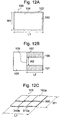
- Fig. 12A is a plan view of an interlabial pad 100 used for evaluating the water disintegrability
- Fig. 12B is a bottom view of the interlabial pad 100
- Fig. 12C is a perspective view of a back face sheet 103 of the interlabial pad 100 of Fig. 12A.
- the interlabial pad of this example is equipped with a surface side sheet 102 and a back face sheet 103, which make up a cover body, an absorbent body 104, enclosed in these sheets, and a mini-sheet piece 105.
- the surface side sheet 102 is a wet forming spun lace, prepared by mixing rayon fibers, with a fiber length of 5mm and fineness of 1.7dtex, and conifer Kraft pulp at proportions of 70% and 30%, respectively, subjecting the fibers to a papermaking process, and then forming into a sheet by hydro-entanglement.
- the absorbent body 104 is prepared by making a conifer pulp sheet into a cotton-like pulp by means of a pulp crusher, adjusting the specific weight of the pulp to 300g/m 2 , adjusting the thickness to 4mm by a press, and forming into a rectangular shape with a width of 52mm and 85mm.
- the back face sheet 103 is arranged from six small sheet pieces 103a of laminated nonwoven fabric, prepared by laminating a polybutylene succinate resin to a thickness of 20 ⁇ m onto a water dispersible paper with dimensions of 37 ⁇ 34mm and a specific weight of 18g/m 2 . As shown in Fig.
- a heat-sensitive, water disintegrable adhesive agent having polyvinyl acetate as the main component, is applied at an application amount of approximately 5g/m 2 in a dotted application pattern and the small sheet pieces 103a are thereby adhered to each other.
- a plurality of lines of a water disintegrable adhesive agent having polyvinyl alcohol as the main component, are applied in a continuous, spiral form at an application amount of 3g/m 2 specific weight. After application of the adhesive agent, the absorbent body 104 is positioned at the absorbent body side of the back face sheet 103.
- the surface side sheet 102 is positioned and an engagement emboss process of a lattice form of 2mm width is performed along the peripheral edges of absorbent body 104, and the surface side sheet 102 and the back face sheet 103 are joined form the cover body with the absorbent body 104 being positioned between the surface side sheet 102 and the back face sheet 103.
- the mini-sheet piece 106 formed of a water dispersible paper with a specific weight of 18g/m 2 , is positioned at the surface of the back face sheet 103 at the side opposite to the absorbent body side so as to cover one side of the longitudinal end part of the interlabial pad 100.
- the mini-sheet piece 106 covers the back face sheet 103 over a range such that length L2 will be 50mm.
- a water disintegrable adhesive agent having polyvinyl acetate as the main component, is applied to form joined parts 107.
- An opening 108 by which a finger can be inserted between the back face sheet 103 and the mini-sheet piece 106 is thus formed.
- the width of application of the adhesive agent to be applied to both side parts of the mini-sheet piece 106 is set so that the opening width W2 of the opening 106 will be 25mm.
- the interlabial pad 100 is cut at positions 3mm from the peripheral edges of the absorbent body 104 so that the value of maximum width W1 will be 58mm and the value of maximum length L1 will be 91mm.
- simulated night soil treatment devices each having a flush toilet and septic tank, were used.
- Fig. 13 are explanatory diagrams for describing the simulated night soil treatment devices, with Fig. 13A showing a device with a small-scale combined treatment septic tank and Fig. 13B showing a device with an independent treatment septic tank.
- the simulated night soil treatment device 200 of Fig. 13A is provided with a semi-siphon type Western-style toilet 201 and a small-scale combined treatment septic tank 203 and with this device, the discharge amount is 8 liters per single time of flushing and the diameter of the trap part is 53mm.
- the toilet 201 and the small-scale combined treatment septic tank 203 are connected by a pipe 202, and the pipe 202 is set to have a diameter of 100mm, a slope grade of 1/100, and a length L3 of 10m.
- the small-scale combined treatment septic tank 203 has a filter element 203a.
- FIG. 13B has, in place of the small-scale combined treatment septic tank 203 of Fig. 13A, an independent treatment septic tank 204, having an aeration tube 204a.
- the interiors of the septic tanks 203 and 204 were both filled with tap water.
- As the filter element 203a of the small-scale combined treatment septic tank 203 skeletal spheres of a diameter of 150mm, which are used in model CXIII of AMS Co., Ltd., are filled inside the small-scale combined treatment septic tank 203 to a height of approximately 650mm.
- the aeration tube 204a of the independent treatment septic tank 204 is made to have a diameter of 18mm.
- the interlabial pad 100 When the interlabial pad 100 was discarded by flushing down the above-described toilet 201, the interlabial pad 100 flowed through the pipe 202, and by the time the interlabial pad 100 was reached to the septic tank 203 or 204, the back face sheet 103 was dispersed into the plurality of small sheet pieces 103a, neither clogging the filter element 203a of the small-scale combination treatment tank 203 nor being entangled onto the aeration tube 204a of the independent treatment septic tank 204.
- a back face sheet is arranged by providing a plurality of mutually adjacent small sheet pieces so that they overlap with each other.
- the back face sheet disperses into the plurality of small sheet pieces upon coming in contact with water and the damaging of the functions of a septic tank by the respective small sheet pieces is thereby lessened.
- the small sheet pieces which cover the side closer to a longitudinal central line, are disposed at the side at which an absorbent body is positioned.
- the end parts of the small sheet pieces which, among the small sheet pieces that are overlapped at the longitudinal seam part provided in the back face sheet, are positioned at the side at which the absorbent body is positioned, are not directed in the direction of stopping the body fluids that flow from the longitudinal central line towards the peripheral edges of the interlabial pad and thus the body fluids will not leak while the interlabial pad is fitted on.
- the side of the back face sheet that is opposite to the body side uneven, even when the interlabial pad is discarded in a toilet in the folded state after use, water will enter readily from the gaps between the mutually facing uneven parts of the folded back face sheet.
- the folded interlabial pad will thus open instantaneously in water, the back face sheet will come in contact uniformly with water from the surface of the back face sheet, and water will enter readily into the seam parts.
- the wrapping sheet of the individual wrapping body that encloses the interlabial pad is arranged from a plurality of small sheet pieces and is thus dispersed readily into the plurality of small sheet pieces when discarded into a toilet after use, the damaging of the functions of a septic tank is lightened. Also, since the entry of water (moisture) from the exterior can be shut out without fail, the sanitary state of the enclosed interlabial pad can be maintained.
Landscapes
- Health & Medical Sciences (AREA)
- Epidemiology (AREA)
- Engineering & Computer Science (AREA)
- Biomedical Technology (AREA)
- Heart & Thoracic Surgery (AREA)
- Vascular Medicine (AREA)
- Life Sciences & Earth Sciences (AREA)
- Animal Behavior & Ethology (AREA)
- General Health & Medical Sciences (AREA)
- Public Health (AREA)
- Veterinary Medicine (AREA)
- Absorbent Articles And Supports Therefor (AREA)
- Orthopedics, Nursing, And Contraception (AREA)
Abstract
Description
Claims (11)
- An interlabial pad comprising:wherein the cover body is provided with a continuous or discontinuous parting zone that is parted by actions of water, along which the cover body is separated into a plurality of small sheet pieces when water acts.an absorbent body for absorbing liquid; anda cover body covering the absorbent body in an enclosing manner and comprising a surface side sheet having a permeable property for liquid and a back face sheet having an impermeable property against liquid;the interlabial pad being fitted between labia with the surface side sheet set at a body side;
- The interlabial pad according to Claim 1;
wherein the parting zone is provided in the back face sheet. - The interlabial pad according to Claim 1 or 2;
wherein the parting zone is a seam part formed by overlapping the plurality of small sheet pieces one another. - The interlabial pad according to Claim 3;
wherein the plurality of small sheet pieces are adhered together at the seam part by an adhesive agent. - The interlabial pad according to Claim 3 or 4;
wherein the seam part is a longitudinal seam part extending in a longitudinal direction of the interlabial pad; and
a sheet piece which overlaps the other sheet piece at the longitudinal seam part and covers a side closer to a longitudinal central line of the interlabial pad is positioned at an absorbent body side. - The interlabial pad according to Claim 3 or 4;
wherein the seam part is a lateral seam part extending in a lateral direction of the interlabial pad; and
a sheet piece which overlaps the other sheet piece at the lateral seam part and covers a side that becomes a dorsal side when the interlabial pad is fitted between labia is positioned at the absorbent body side. - The interlabial pad according to any one of Claims 3 to 5;
wherein the seam parts contain a longitudinal seam part extending in the longitudinal direction of the interlabial pad and a lateral seam part extending in the lateral direction of the interlabial pad; and
a sheet piece which overlaps the other sheet piece at the longitudinal seam part and covers a side closer to a longitudinal central line of the interlabial pad is positioned at the absorbent body side; and
a sheet piece which overlaps the other sheet piece at the lateral seam part and covers a side that becomes a dorsal side when the interlabial pad is fitted between labia is positioned at the absorbent body side. - The interlabial pad according to any one of Claims 1 to 7;
wherein the back face sheet is equipped with a mini-sheet piece on a surface at a side opposite to the absorbent body side. - The interlabial pad according to any one of claims 2 to 8;
wherein the back face sheet is made uneven at least at the surface opposite to the absorbent body side. - An individual wrapping body for an interlabial pad, comprising:wherein the wrapping sheet is provided with a continuous or discontinuous parting zone that is parted by actions of water, along which the wrapping sheet is separated into a plurality of small sheet pieces when water acts.a wrapping sheet; andan interlabial pad covered by the wrapping sheet;
- The individual wrapping body for an interlabial pad according to Claim 10;
wherein the wrapping sheet is a liquid impermeable sheet with an impermeable property against liquid.
Applications Claiming Priority (3)
| Application Number | Priority Date | Filing Date | Title |
|---|---|---|---|
| JP2003040368 | 2003-02-18 | ||
| JP2003040368A JP2004261230A (en) | 2003-02-18 | 2003-02-18 | Washable intra-labium pad |
| PCT/JP2004/001727 WO2004075802A1 (en) | 2003-02-18 | 2004-02-17 | Inter-labium pad and individual inter-labium pad packaging body |
Publications (2)
| Publication Number | Publication Date |
|---|---|
| EP1595518A1 true EP1595518A1 (en) | 2005-11-16 |
| EP1595518A4 EP1595518A4 (en) | 2009-11-11 |
Family
ID=32923235
Family Applications (1)
| Application Number | Title | Priority Date | Filing Date |
|---|---|---|---|
| EP04711753A Withdrawn EP1595518A4 (en) | 2003-02-18 | 2004-02-17 | Inter-labium pad and individual inter-labium pad packaging body |
Country Status (7)
| Country | Link |
|---|---|
| US (1) | US7727209B2 (en) |
| EP (1) | EP1595518A4 (en) |
| JP (1) | JP2004261230A (en) |
| KR (1) | KR101013918B1 (en) |
| CN (1) | CN1750804A (en) |
| TW (1) | TWI267371B (en) |
| WO (1) | WO2004075802A1 (en) |
Families Citing this family (10)
| Publication number | Priority date | Publication date | Assignee | Title |
|---|---|---|---|---|
| JP4482466B2 (en) | 2005-03-04 | 2010-06-16 | ユニ・チャーム株式会社 | Interlabial pad |
| JP4721793B2 (en) * | 2005-07-08 | 2011-07-13 | 花王株式会社 | Absorbent articles |
| US8137327B2 (en) * | 2006-06-16 | 2012-03-20 | Family Health International | Vaginal drug delivery system and method |
| JP4823037B2 (en) * | 2006-12-06 | 2011-11-24 | 花王株式会社 | Auxiliary absorbent pad |
| US8329977B2 (en) | 2007-08-22 | 2012-12-11 | Kimberly-Clark Worldwide, Inc. | Biodegradable water-sensitive films |
| EP2292201A4 (en) * | 2008-06-24 | 2014-05-07 | Unicharm Corp | Absorptive article and manufacturing method therefor |
| US8907155B2 (en) | 2010-11-19 | 2014-12-09 | Kimberly-Clark Worldwide, Inc. | Biodegradable and flushable multi-layered film |
| US9572731B2 (en) | 2014-03-14 | 2017-02-21 | Carrie Thompson | Protective disposable wrapper for tampons |
| EP3079752B1 (en) * | 2013-12-12 | 2020-04-01 | Hollister Incorporated | Flushable catheters |
| IT202000023239A1 (en) * | 2020-10-02 | 2022-04-02 | Fameccanica Data Spa | SANITARY ITEMS PACKAGING UNIT |
Family Cites Families (49)
| Publication number | Priority date | Publication date | Assignee | Title |
|---|---|---|---|---|
| JPS4036397Y1 (en) | 1964-07-22 | 1965-12-24 | ||
| US3510587A (en) * | 1966-03-08 | 1970-05-05 | Colgate Palmolive Co | Disposable diaper |
| US3575173A (en) | 1969-03-13 | 1971-04-20 | Personal Products Co | Flushable disposable absorbent products |
| US3683919A (en) * | 1970-01-15 | 1972-08-15 | Myron B Ells | Flushable sanitary napkin |
| US3606887A (en) | 1970-02-05 | 1971-09-21 | Kimberly Clark Co | Overlap seal and support strip for a sanitary napkin wrapper |
| US3665923A (en) * | 1970-02-05 | 1972-05-30 | Kimberly Clark Co | Flushable sanitary napkin |
| GB1334078A (en) * | 1970-06-12 | 1973-10-17 | Noguchi K | Disposable sanitary napkins |
| JPS5913213B2 (en) * | 1979-04-28 | 1984-03-28 | ゼンミ株式会社 | sanitary napkin |
| US4595392A (en) * | 1983-10-03 | 1986-06-17 | Kimberly-Clark Corporation | Interlabial pad |
| JPH0436397Y2 (en) * | 1986-03-14 | 1992-08-27 | ||
| US5026363A (en) * | 1989-12-27 | 1991-06-25 | Rmed International, Inc. | Flushable diaper device and method |
| GB9124527D0 (en) * | 1991-11-19 | 1992-01-08 | Brown Malcolm | Disposable flushable nappy composite |
| US5300358A (en) * | 1992-11-24 | 1994-04-05 | E. I. Du Pont De Nemours And Co. | Degradable absorbant structures |
| JPH07136209A (en) * | 1993-06-11 | 1995-05-30 | Toyo Ink Mfg Co Ltd | Water disintegrating sanitary material and method for producing the same |
| US5557809A (en) * | 1993-11-08 | 1996-09-24 | Adams; James L. | Toilet seat cover |
| JP2606811B2 (en) * | 1993-11-16 | 1997-05-07 | アダプトゲン製薬株式会社 | Snoring prevention equipment |
| JP3517045B2 (en) | 1995-10-30 | 2004-04-05 | ユニ・チャーム株式会社 | Cellulose-polyacrylic acid-based highly water-retaining fiber and method for producing the same |
| US5885265A (en) | 1995-11-22 | 1999-03-23 | The Procter & Gamble Company | Water dispersible and flushable interlabial absorbent structure |
| US6254584B1 (en) | 1997-01-03 | 2001-07-03 | The Procter & Gamble Company | Thin comfortable interlabial absorbent structure |
| US5916205A (en) * | 1996-08-30 | 1999-06-29 | The Procter & Gamble Company | Absorbent interlabial device |
| US5762644A (en) | 1996-08-30 | 1998-06-09 | The Procter & Gamble Company | Toilet-disposable absorbent interlabial device |
| JPH10243962A (en) * | 1997-03-06 | 1998-09-14 | Takeyasu Sangyo Kk | Water-soluble absorbent pad |
| EP0888764A1 (en) * | 1997-07-01 | 1999-01-07 | The Procter & Gamble Company | Use of a handling aid for a body applied disposable absorbent article |
| JP4036397B2 (en) | 1997-07-07 | 2008-01-23 | 株式会社資生堂 | Whitening agent and external preparation for skin |
| WO1999026573A1 (en) * | 1997-11-21 | 1999-06-03 | The Procter & Gamble Company | Individual packaged absorbent interlabial article |
| AU750632B2 (en) | 1997-11-21 | 2002-07-25 | Procter & Gamble Company, The | Flushable individual packages for absorbent articles |
| JP3748019B2 (en) | 1999-09-16 | 2006-02-22 | ユニ・チャーム株式会社 | Water-decomposable absorbent article and method for producing the same |
| US6258074B1 (en) * | 1999-09-24 | 2001-07-10 | Lisa K. Prazak | Interlabial absorbent device |
| JP3748022B2 (en) | 1999-11-19 | 2006-02-22 | ユニ・チャーム株式会社 | Water-decomposable absorbent article and method for producing the same |
| JP3705981B2 (en) | 2000-01-06 | 2005-10-12 | ユニ・チャーム株式会社 | Water-decomposable absorbent article |
| JP2001190597A (en) | 2000-01-06 | 2001-07-17 | Uni Charm Corp | Water disintegratable absorbent articles |
| JP3833034B2 (en) * | 2000-01-06 | 2006-10-11 | ユニ・チャーム株式会社 | Water-decomposable absorbent article |
| JP2001198160A (en) | 2000-01-21 | 2001-07-24 | Uni Charm Corp | Water-disintegratable absorbent article and method for producing the same |
| JP3805159B2 (en) | 2000-01-25 | 2006-08-02 | ユニ・チャーム株式会社 | Absorbent articles containing skin protection ingredients |
| JP4209062B2 (en) | 2000-02-23 | 2009-01-14 | ユニ・チャーム株式会社 | Absorbent article containing cyclodextrin |
| US6514602B1 (en) | 2000-03-07 | 2003-02-04 | The Procter & Gamble Company | Water-flushable and biodegradable film useful as backsheets for disposable absorbent articles |
| US6670521B2 (en) * | 2000-04-20 | 2003-12-30 | The Procter & Gamble Company | Dispersible absorbent products and methods of manufacture and use |
| JP2002078733A (en) | 2000-06-28 | 2002-03-19 | Uni Charm Corp | Absorbent articles |
| WO2002013877A2 (en) | 2000-08-17 | 2002-02-21 | The Procter & Gamble Company | Flushable and anaerobically degradable films and laminates |
| JP2002102280A (en) | 2000-09-28 | 2002-04-09 | Uni Charm Corp | Absorbing article using organic amines as deodorizer |
| US20040024376A1 (en) * | 2001-01-24 | 2004-02-05 | The Procter & Gamble Company | Absorbent interlabial device |
| JP3938285B2 (en) | 2001-03-08 | 2007-06-27 | ユニ・チャーム株式会社 | Absorbent articles |
| JP4261194B2 (en) * | 2001-04-20 | 2009-04-30 | ザ プロクター アンド ギャンブル カンパニー | Dispersible absorbent product with multilayer structure, and method of manufacture and use |
| JP4230779B2 (en) * | 2001-05-22 | 2009-02-25 | ユニ・チャーム株式会社 | Interlabial pad packaging container for individual packaging |
| EP1426025A4 (en) * | 2001-05-22 | 2004-12-29 | Uni Charm Corp | Interlabial pad and package thereof |
| WO2002094148A1 (en) * | 2001-05-22 | 2002-11-28 | Uni-Charm Corporation | Interlabial pad |
| US6802833B2 (en) * | 2002-02-01 | 2004-10-12 | Uni-Charm Corporation | Hygiene product |
| US6929628B2 (en) * | 2002-04-22 | 2005-08-16 | Frederick W. George | Flushable absorbent article |
| US20040122399A1 (en) * | 2002-12-18 | 2004-06-24 | Kimberly-Clark Worldwide, Inc. | Package for discretely carrying interlabial and other feminine care products |
-
2003
- 2003-02-18 JP JP2003040368A patent/JP2004261230A/en active Pending
-
2004
- 2004-02-17 CN CNA2004800045399A patent/CN1750804A/en active Pending
- 2004-02-17 TW TW093103776A patent/TWI267371B/en not_active IP Right Cessation
- 2004-02-17 EP EP04711753A patent/EP1595518A4/en not_active Withdrawn
- 2004-02-17 KR KR1020057015155A patent/KR101013918B1/en not_active Expired - Fee Related
- 2004-02-17 WO PCT/JP2004/001727 patent/WO2004075802A1/en not_active Ceased
- 2004-02-18 US US10/782,385 patent/US7727209B2/en not_active Expired - Fee Related
Also Published As
| Publication number | Publication date |
|---|---|
| KR101013918B1 (en) | 2011-02-14 |
| WO2004075802A1 (en) | 2004-09-10 |
| CN1750804A (en) | 2006-03-22 |
| KR20050103934A (en) | 2005-11-01 |
| US7727209B2 (en) | 2010-06-01 |
| TW200427436A (en) | 2004-12-16 |
| US20040193124A1 (en) | 2004-09-30 |
| JP2004261230A (en) | 2004-09-24 |
| TWI267371B (en) | 2006-12-01 |
| EP1595518A4 (en) | 2009-11-11 |
Similar Documents
| Publication | Publication Date | Title |
|---|---|---|
| KR100785365B1 (en) | Interlabial products and individual packages with shapes for securing fingers | |
| EP1407742B1 (en) | Interlabial pad | |
| EP1419753A1 (en) | Interlabial pad | |
| JP4119262B2 (en) | Interlabial pad | |
| EP1407736A1 (en) | INTERLABIAL PAD INDIVIDUAL PACKAGING VESSEL, AND INDIVIDUAL PACKAGING BODY | |
| US7727209B2 (en) | Interlabial pad and individual packaging body for individual package of interlabial pad | |
| JP4178043B2 (en) | Interlabial pad | |
| KR100797492B1 (en) | Interlabial pads and their packaging | |
| JP2004121611A (en) | Front surface side sheet for constituting pad between labium pudendis, and pad between labium pudendis | |
| KR101013925B1 (en) | Water-collapsible surface side sheets for interlabial products and interlabial products | |
| JP4939056B2 (en) | Interlabial pad | |
| WO2004045478A1 (en) | Inter-labium pudenda pad and package body for the pad | |
| JP2002238949A (en) | Absorbent articles | |
| WO2024237087A1 (en) | Absorbent article | |
| HK1068241B (en) | Interlabial pad |
Legal Events
| Date | Code | Title | Description |
|---|---|---|---|
| PUAI | Public reference made under article 153(3) epc to a published international application that has entered the european phase |
Free format text: ORIGINAL CODE: 0009012 |
|
| 17P | Request for examination filed |
Effective date: 20050817 |
|
| AK | Designated contracting states |
Kind code of ref document: A1 Designated state(s): AT BE BG CH CY CZ DE DK EE ES FI FR GB GR HU IE IT LI LU MC NL PT RO SE SI SK TR |
|
| AX | Request for extension of the european patent |
Extension state: AL LT LV MK |
|
| DAX | Request for extension of the european patent (deleted) | ||
| RBV | Designated contracting states (corrected) |
Designated state(s): DE FR GB NL SE |
|
| A4 | Supplementary search report drawn up and despatched |
Effective date: 20090910 |
|
| 17Q | First examination report despatched |
Effective date: 20110211 |
|
| STAA | Information on the status of an ep patent application or granted ep patent |
Free format text: STATUS: THE APPLICATION IS DEEMED TO BE WITHDRAWN |
|
| 18D | Application deemed to be withdrawn |
Effective date: 20131213 |