EP1593684A1 - Caprazene as novel compound and derivatives thereof, and caprazol as novel compound and derivatives thereof - Google Patents
Caprazene as novel compound and derivatives thereof, and caprazol as novel compound and derivatives thereof Download PDFInfo
- Publication number
- EP1593684A1 EP1593684A1 EP04706817A EP04706817A EP1593684A1 EP 1593684 A1 EP1593684 A1 EP 1593684A1 EP 04706817 A EP04706817 A EP 04706817A EP 04706817 A EP04706817 A EP 04706817A EP 1593684 A1 EP1593684 A1 EP 1593684A1
- Authority
- EP
- European Patent Office
- Prior art keywords
- group
- derivative
- caprazol
- straight chain
- formula
- Prior art date
- Legal status (The legal status is an assumption and is not a legal conclusion. Google has not performed a legal analysis and makes no representation as to the accuracy of the status listed.)
- Granted
Links
- 0 CCCCCC(C(*)C1CC)OC1O Chemical compound CCCCCC(C(*)C1CC)OC1O 0.000 description 6
Classifications
-
- A—HUMAN NECESSITIES
- A61—MEDICAL OR VETERINARY SCIENCE; HYGIENE
- A61P—SPECIFIC THERAPEUTIC ACTIVITY OF CHEMICAL COMPOUNDS OR MEDICINAL PREPARATIONS
- A61P31/00—Antiinfectives, i.e. antibiotics, antiseptics, chemotherapeutics
- A61P31/04—Antibacterial agents
-
- C—CHEMISTRY; METALLURGY
- C07—ORGANIC CHEMISTRY
- C07H—SUGARS; DERIVATIVES THEREOF; NUCLEOSIDES; NUCLEOTIDES; NUCLEIC ACIDS
- C07H19/00—Compounds containing a hetero ring sharing one ring hetero atom with a saccharide radical; Nucleosides; Mononucleotides; Anhydro-derivatives thereof
- C07H19/02—Compounds containing a hetero ring sharing one ring hetero atom with a saccharide radical; Nucleosides; Mononucleotides; Anhydro-derivatives thereof sharing nitrogen
- C07H19/04—Heterocyclic radicals containing only nitrogen atoms as ring hetero atom
- C07H19/06—Pyrimidine radicals
- C07H19/067—Pyrimidine radicals with ribosyl as the saccharide radical
-
- A—HUMAN NECESSITIES
- A61—MEDICAL OR VETERINARY SCIENCE; HYGIENE
- A61K—PREPARATIONS FOR MEDICAL, DENTAL OR TOILETRY PURPOSES
- A61K31/00—Medicinal preparations containing organic active ingredients
- A61K31/70—Carbohydrates; Sugars; Derivatives thereof
- A61K31/7042—Compounds having saccharide radicals and heterocyclic rings
- A61K31/7052—Compounds having saccharide radicals and heterocyclic rings having nitrogen as a ring hetero atom, e.g. nucleosides, nucleotides
- A61K31/706—Compounds having saccharide radicals and heterocyclic rings having nitrogen as a ring hetero atom, e.g. nucleosides, nucleotides containing six-membered rings with nitrogen as a ring hetero atom
- A61K31/7064—Compounds having saccharide radicals and heterocyclic rings having nitrogen as a ring hetero atom, e.g. nucleosides, nucleotides containing six-membered rings with nitrogen as a ring hetero atom containing condensed or non-condensed pyrimidines
- A61K31/7068—Compounds having saccharide radicals and heterocyclic rings having nitrogen as a ring hetero atom, e.g. nucleosides, nucleotides containing six-membered rings with nitrogen as a ring hetero atom containing condensed or non-condensed pyrimidines having oxo groups directly attached to the pyrimidine ring, e.g. cytidine, cytidylic acid
- A61K31/7072—Compounds having saccharide radicals and heterocyclic rings having nitrogen as a ring hetero atom, e.g. nucleosides, nucleotides containing six-membered rings with nitrogen as a ring hetero atom containing condensed or non-condensed pyrimidines having oxo groups directly attached to the pyrimidine ring, e.g. cytidine, cytidylic acid having two oxo groups directly attached to the pyrimidine ring, e.g. uridine, uridylic acid, thymidine, zidovudine
-
- A—HUMAN NECESSITIES
- A61—MEDICAL OR VETERINARY SCIENCE; HYGIENE
- A61P—SPECIFIC THERAPEUTIC ACTIVITY OF CHEMICAL COMPOUNDS OR MEDICINAL PREPARATIONS
- A61P31/00—Antiinfectives, i.e. antibiotics, antiseptics, chemotherapeutics
- A61P31/04—Antibacterial agents
- A61P31/06—Antibacterial agents for tuberculosis
-
- A—HUMAN NECESSITIES
- A61—MEDICAL OR VETERINARY SCIENCE; HYGIENE
- A61P—SPECIFIC THERAPEUTIC ACTIVITY OF CHEMICAL COMPOUNDS OR MEDICINAL PREPARATIONS
- A61P43/00—Drugs for specific purposes, not provided for in groups A61P1/00-A61P41/00
-
- C—CHEMISTRY; METALLURGY
- C07—ORGANIC CHEMISTRY
- C07D—HETEROCYCLIC COMPOUNDS
- C07D403/00—Heterocyclic compounds containing two or more hetero rings, having nitrogen atoms as the only ring hetero atoms, not provided for by group C07D401/00
- C07D403/02—Heterocyclic compounds containing two or more hetero rings, having nitrogen atoms as the only ring hetero atoms, not provided for by group C07D401/00 containing two hetero rings
- C07D403/08—Heterocyclic compounds containing two or more hetero rings, having nitrogen atoms as the only ring hetero atoms, not provided for by group C07D401/00 containing two hetero rings linked by a carbon chain containing alicyclic rings
-
- C—CHEMISTRY; METALLURGY
- C07—ORGANIC CHEMISTRY
- C07D—HETEROCYCLIC COMPOUNDS
- C07D403/00—Heterocyclic compounds containing two or more hetero rings, having nitrogen atoms as the only ring hetero atoms, not provided for by group C07D401/00
- C07D403/14—Heterocyclic compounds containing two or more hetero rings, having nitrogen atoms as the only ring hetero atoms, not provided for by group C07D401/00 containing three or more hetero rings
-
- C—CHEMISTRY; METALLURGY
- C07—ORGANIC CHEMISTRY
- C07D—HETEROCYCLIC COMPOUNDS
- C07D405/00—Heterocyclic compounds containing both one or more hetero rings having oxygen atoms as the only ring hetero atoms, and one or more rings having nitrogen as the only ring hetero atom
- C07D405/14—Heterocyclic compounds containing both one or more hetero rings having oxygen atoms as the only ring hetero atoms, and one or more rings having nitrogen as the only ring hetero atom containing three or more hetero rings
-
- C—CHEMISTRY; METALLURGY
- C07—ORGANIC CHEMISTRY
- C07H—SUGARS; DERIVATIVES THEREOF; NUCLEOSIDES; NUCLEOTIDES; NUCLEIC ACIDS
- C07H15/00—Compounds containing hydrocarbon or substituted hydrocarbon radicals directly attached to hetero atoms of saccharide radicals
- C07H15/26—Acyclic or carbocyclic radicals, substituted by hetero rings
-
- C—CHEMISTRY; METALLURGY
- C07—ORGANIC CHEMISTRY
- C07H—SUGARS; DERIVATIVES THEREOF; NUCLEOSIDES; NUCLEOTIDES; NUCLEIC ACIDS
- C07H19/00—Compounds containing a hetero ring sharing one ring hetero atom with a saccharide radical; Nucleosides; Mononucleotides; Anhydro-derivatives thereof
- C07H19/02—Compounds containing a hetero ring sharing one ring hetero atom with a saccharide radical; Nucleosides; Mononucleotides; Anhydro-derivatives thereof sharing nitrogen
- C07H19/04—Heterocyclic radicals containing only nitrogen atoms as ring hetero atom
- C07H19/06—Pyrimidine radicals
-
- Y—GENERAL TAGGING OF NEW TECHNOLOGICAL DEVELOPMENTS; GENERAL TAGGING OF CROSS-SECTIONAL TECHNOLOGIES SPANNING OVER SEVERAL SECTIONS OF THE IPC; TECHNICAL SUBJECTS COVERED BY FORMER USPC CROSS-REFERENCE ART COLLECTIONS [XRACs] AND DIGESTS
- Y02—TECHNOLOGIES OR APPLICATIONS FOR MITIGATION OR ADAPTATION AGAINST CLIMATE CHANGE
- Y02P—CLIMATE CHANGE MITIGATION TECHNOLOGIES IN THE PRODUCTION OR PROCESSING OF GOODS
- Y02P20/00—Technologies relating to chemical industry
- Y02P20/50—Improvements relating to the production of bulk chemicals
- Y02P20/55—Design of synthesis routes, e.g. reducing the use of auxiliary or protecting groups
Definitions
- This invention relates to a novel compound, caprazene, which is prepared by acid hydrolysis of antibiotics, caprazamycins A, B, C, D, E, F and/or G in an aqueous solution of an acid, and also this invention relates to a novel compound, caprazol, which is prepared by hydrolysis of caprazamycins in an aqueous solution of an inorganic base.
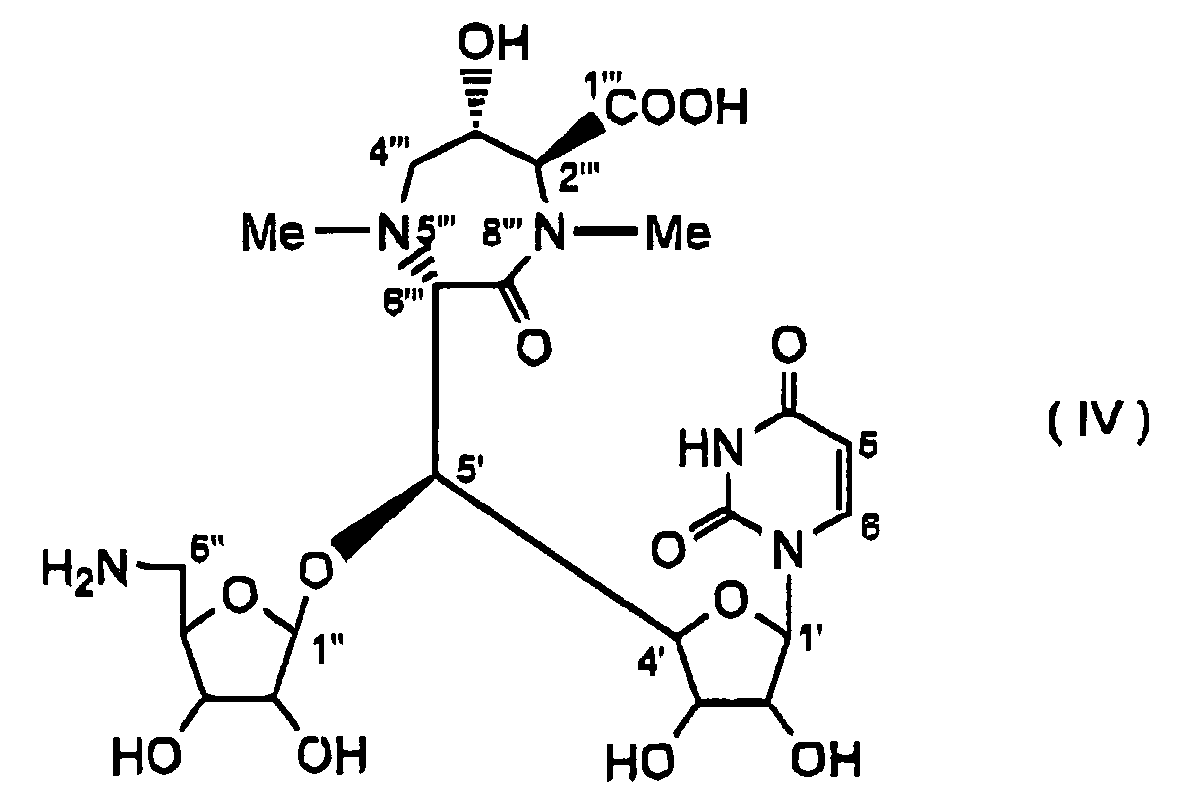
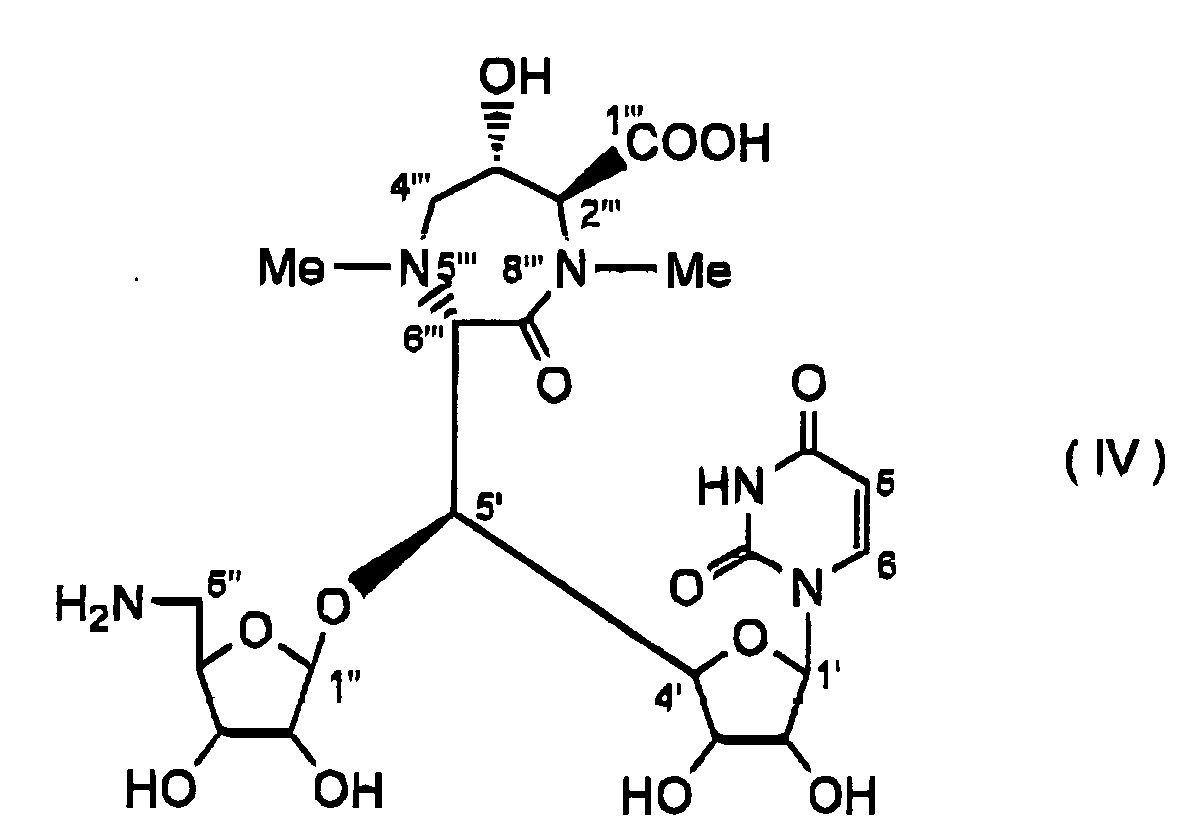
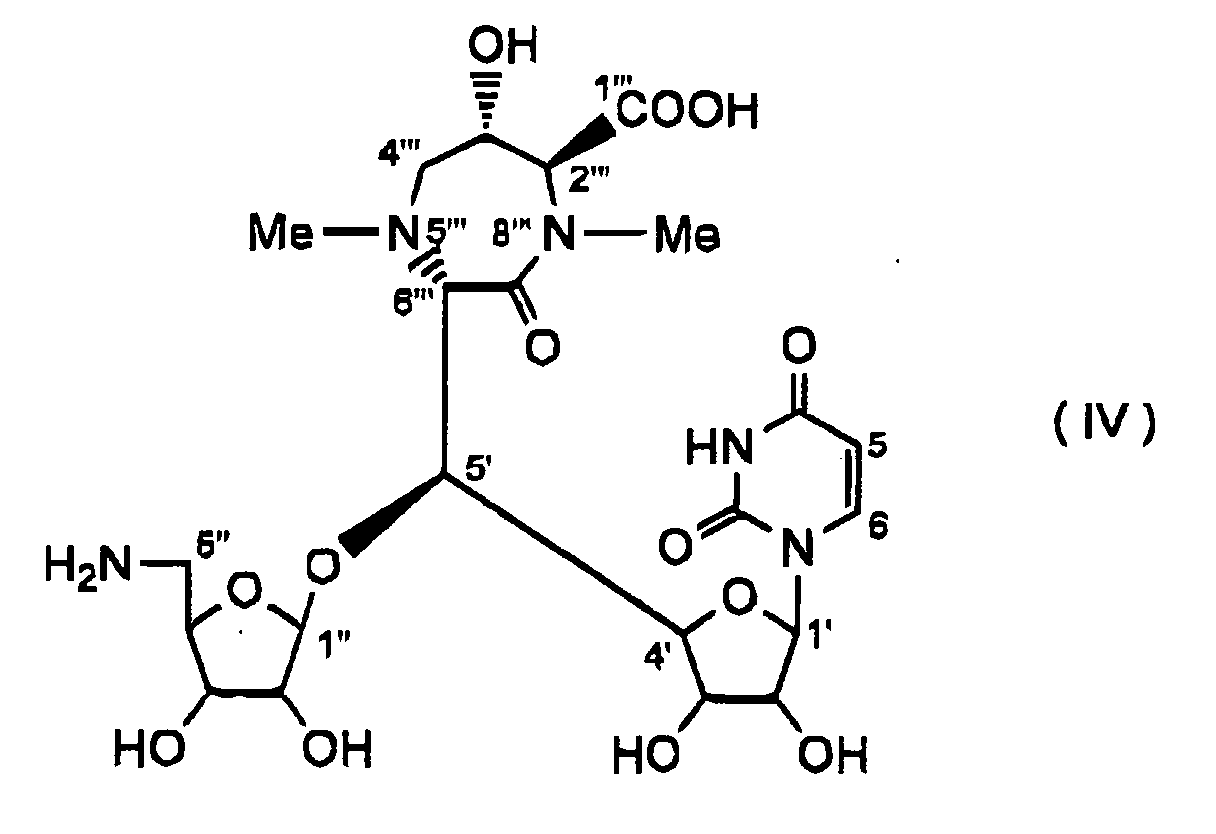
- Caprazene and caprazol are compounds represented by the stereo-structural formulae (I) and (IV) shown hereinafter, respectively, and they have no antibacterial activity, but are useful as intermediate compounds usable for the syntheses of a variety of antibacterial amide derivatives or ester derivatives therefrom. They are also useful as enzyme inhibitors having an inhibitory activity against enzyme MraY which takes part in the biosynthesis of the cell walls of bacteria.
- This invention also includes a process for the preparation of caprazene and a process for the preparation of caprazol, both of which comprise a hydrolysis of caprazamycins.
- This invention further relates to a variety of novel caprazene amide derivatives or caprazene ester derivatives and a variety of novel caprazol amide derivatives or caprazol ester derivatives, all of which have antibacterial activities against various bacteria.
- These antibacterial caprazene derivatives and caprazol derivatives according to this invention are expected to be useful for the therapeutic treatment of tuberculosis and treatment of bacterial infections by atypical acid-fast bacteria, that is Mycobacterium Avium Complex (MAC) infection and other bacterial infections.
- MAC Mycobacterium Avium Complex
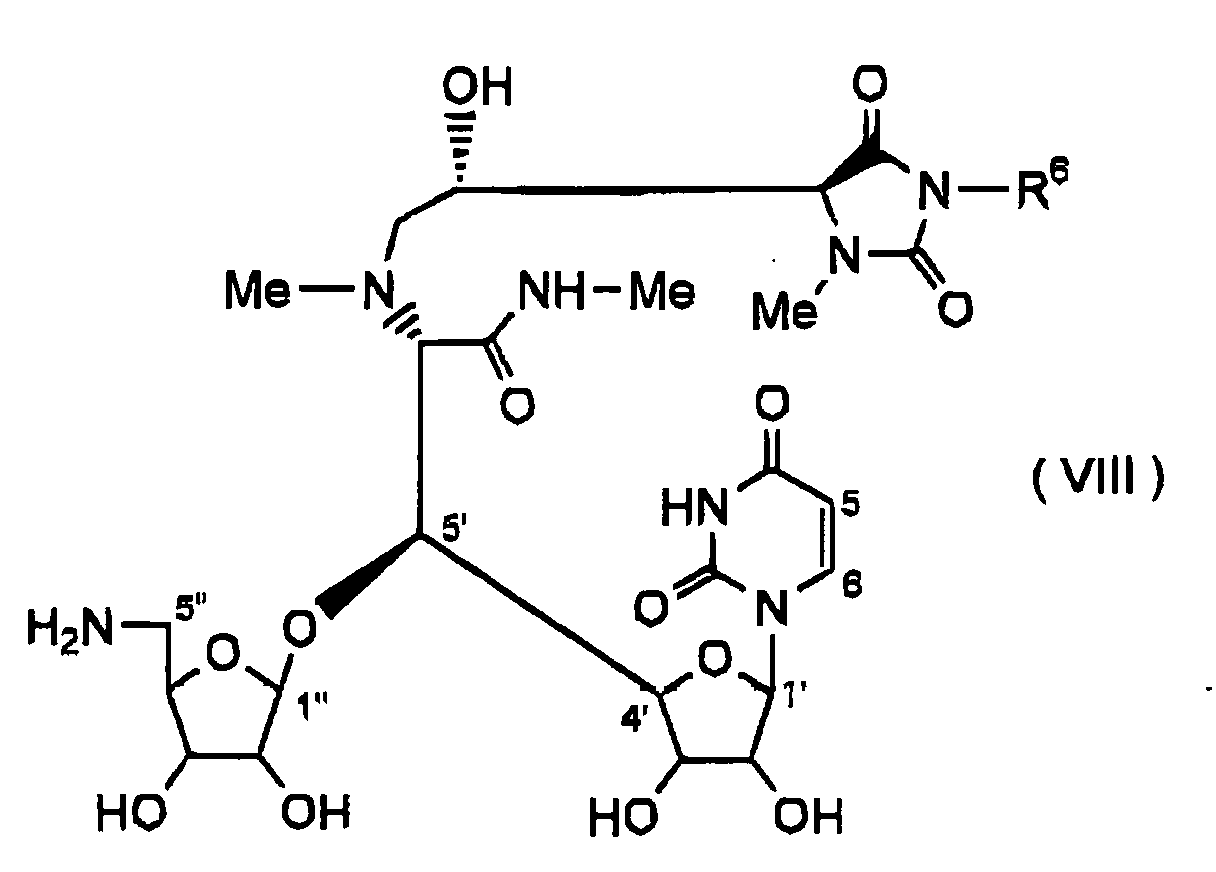
- this invention includes a variety of novel imidazolidinone derivatives (Code name: CP-IM) having the formula (VIII) hereinafter given which may be synthesized from caprazol through several reaction steps and which have an antibacterial activity.
- CP-IM novel imidazolidinone derivatives having the formula (VIII) hereinafter given which may be synthesized from caprazol through several reaction steps and which have an antibacterial activity.
- this invention relates to a pharmaceutical composition
- a pharmaceutical composition comprising as the active ingredient a caprazene derivative or a caprazol derivative or an imidazolidinone derivative as mentioned above.
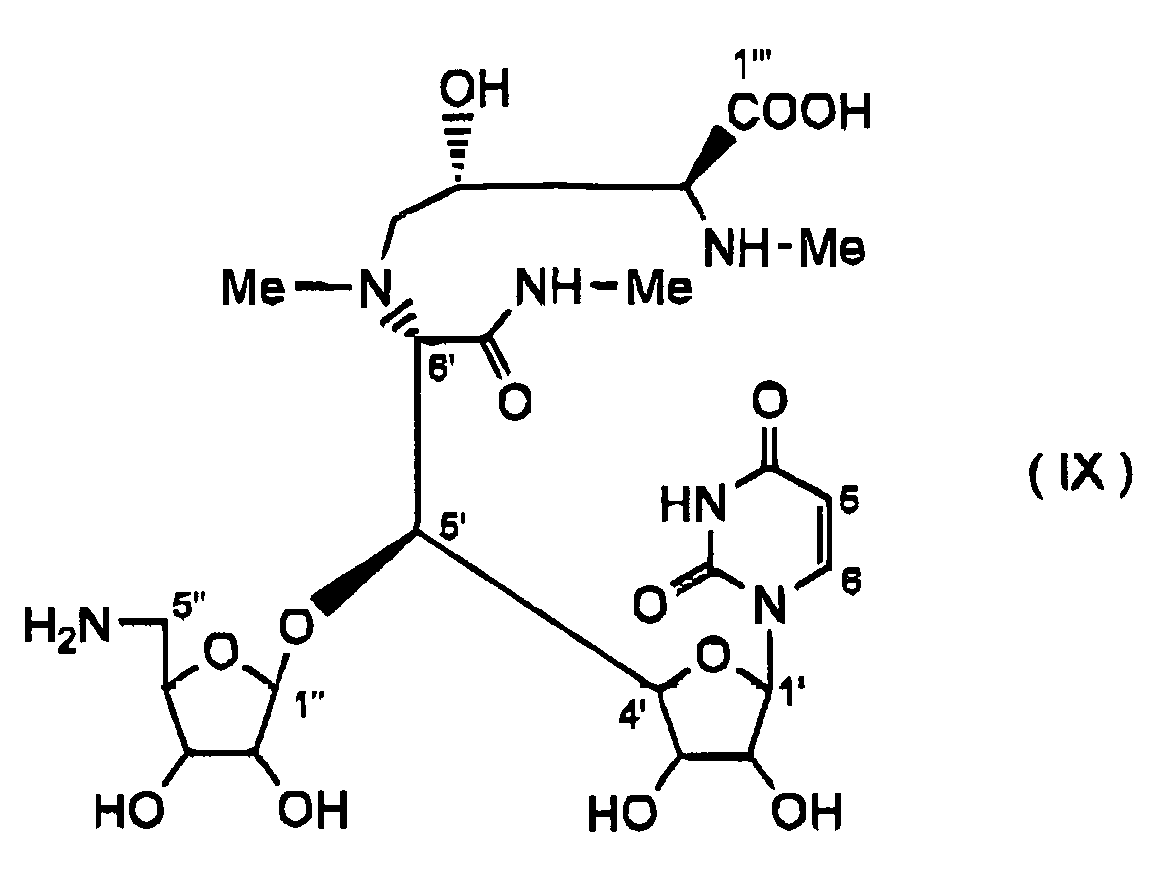
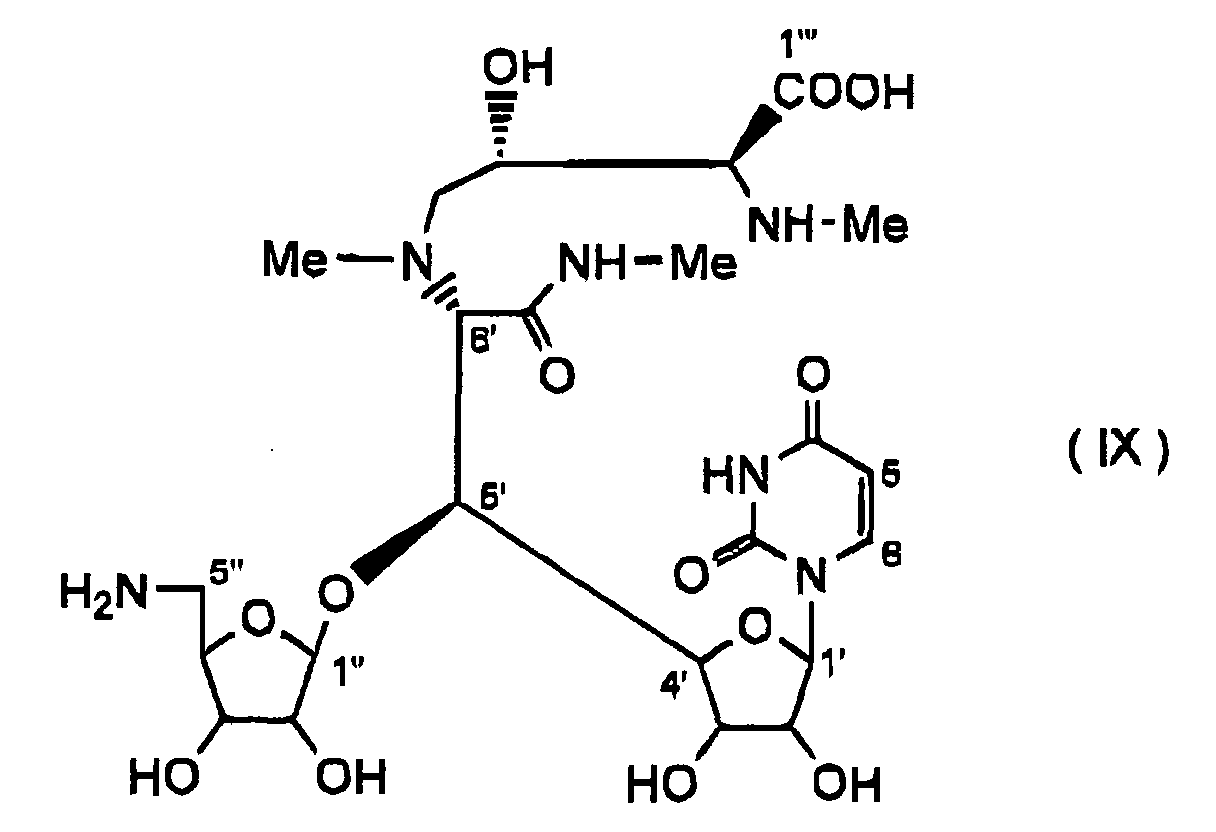
- this invention includes novel uridine derivative of the formula (IX) hereinafter given which is prepared by treating caprazol with methylamine to effect the ring-opening of the diazepine ring of caprazol and which is usable as an intermediate material for the synthesis of the said imidazolidinone derivative CP-IM.
- antibiotics such as rifampicin, kanamycin, streptomycin, viomycin, capreomycin, cycloserine, and the like.
- a serious problem for the chemotherapy of the bacterial infections is in that bacteria causative of the bacterial infections become drug-resistant.
- the appearance of acid-fast bacteria which are resistant to rifampicin, kanamycin, streptomycin, viomycin, capreomycin, cycloserine and the like has brought about a social problem in respect of the chemotherapy of the acid-fast bacterial infections.
- a novel chemotherapeutic agent which is effective against bacterial infections as induced by the acid-fast bacteria resistant to the antibacterial drugs.
- Strongly requested also is a novel chemotherapeutic drug that is effective against the bacterial infections which are induced by atypical acid-fast bacteria and for which no chemotherapeutic treatment has been established yet.
- caprazamycins A, B, C, E and F which have been produced from Streptomyces sp. MK730-62F2 strain (deposited under the depository number of FERM BP-7218 under the Budapest Treaty) and which exhibit high antibacterial activities against acid-fast bacteria [see Pamphlet of PCT International Publication Number WO 01/12643Al and European patent application first publn. EP 1211259A1].
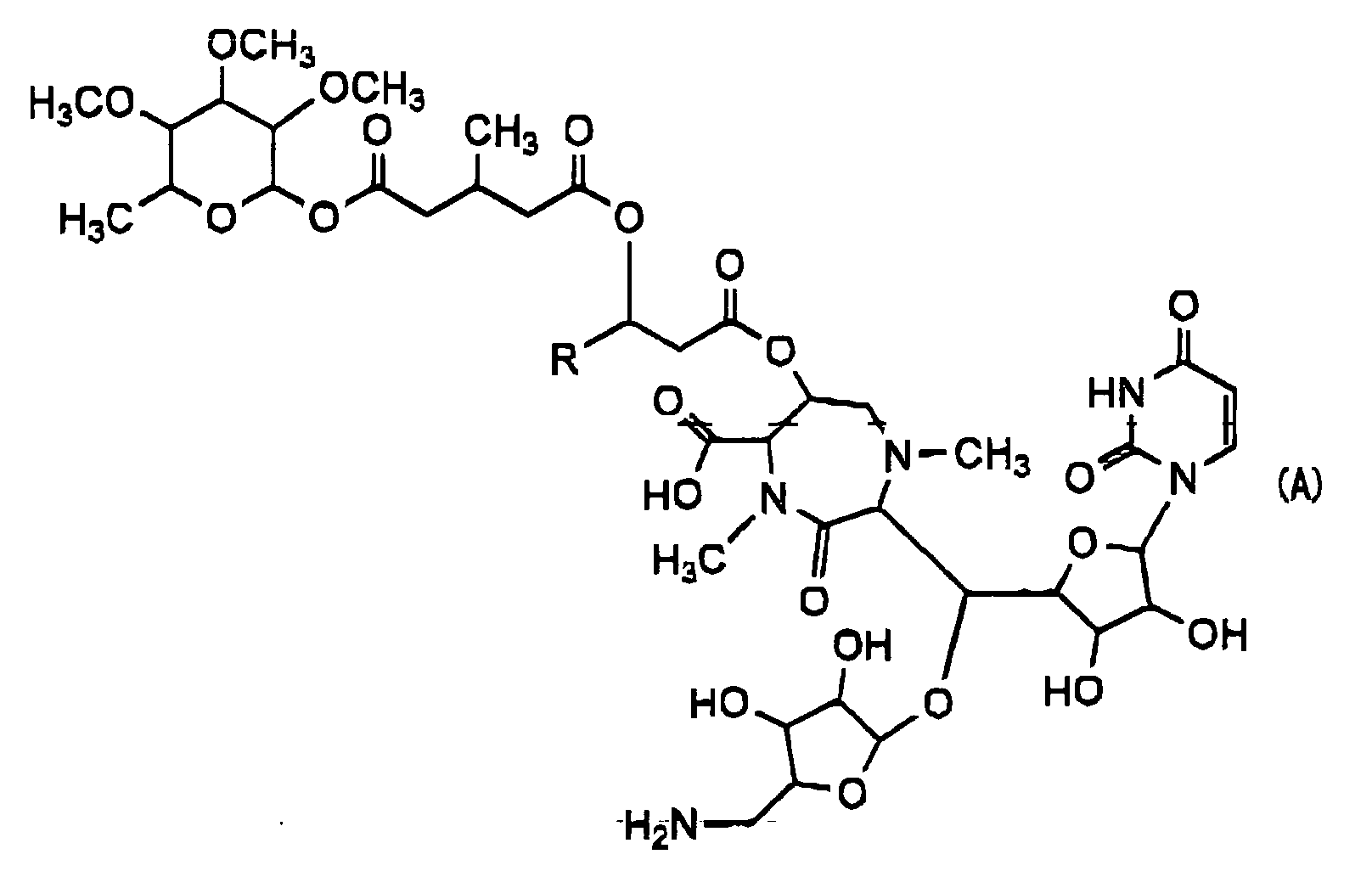
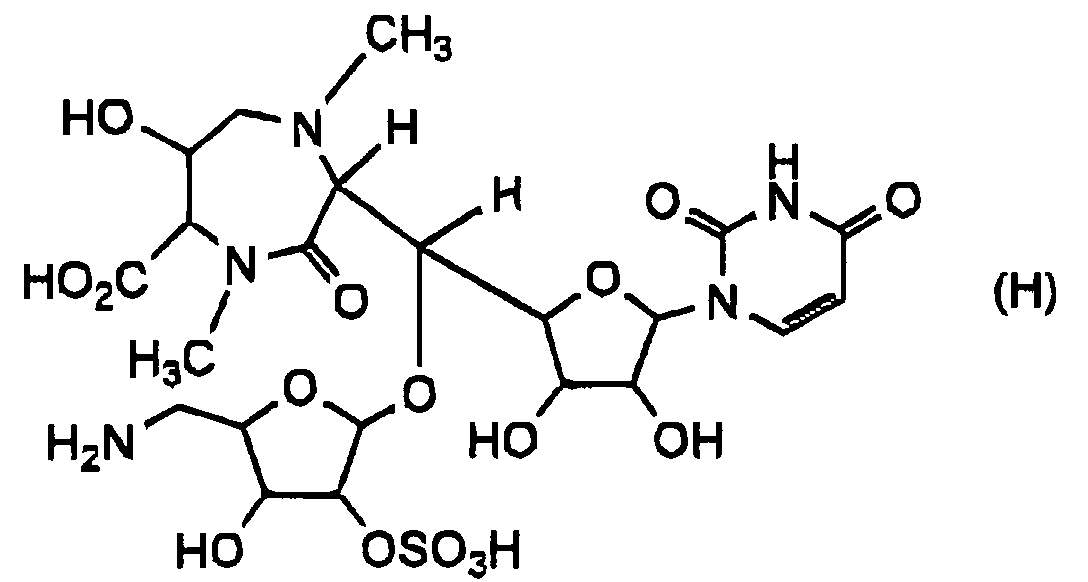
- Caprazamycins A, B, C, E and F are compounds represented by the following general formula (A) wherein R is tridecyl group for caprazamycin A, 11-methyl-dodecyl group for caprazamycin B, dodecyl group for caprazamycin C, undecyl group for caprazamycin E, and 9-methyl-decyl group for caprazamycin F.
- caprazamycins D, G, D1 and G1 which are produced from Streptomyces sp. MK730-62F2 strain (FERM BP-7218) (refer to the specification of PCT application No. PCT/JP02/13386 filed on December 20, 2002).
- Caprazamycin D and caprazamycin G are the compounds represented by the following general formula (B) wherein R is 10-methyl-undecyl group -(CH 2 ) 9 CH(CH 3 ) 2 for caprazamycin D and is 9-methyl-undecyl group -(CH 2 ) 8 CH(CH 3 )CH 2 CH 3 for caprazamycin G.
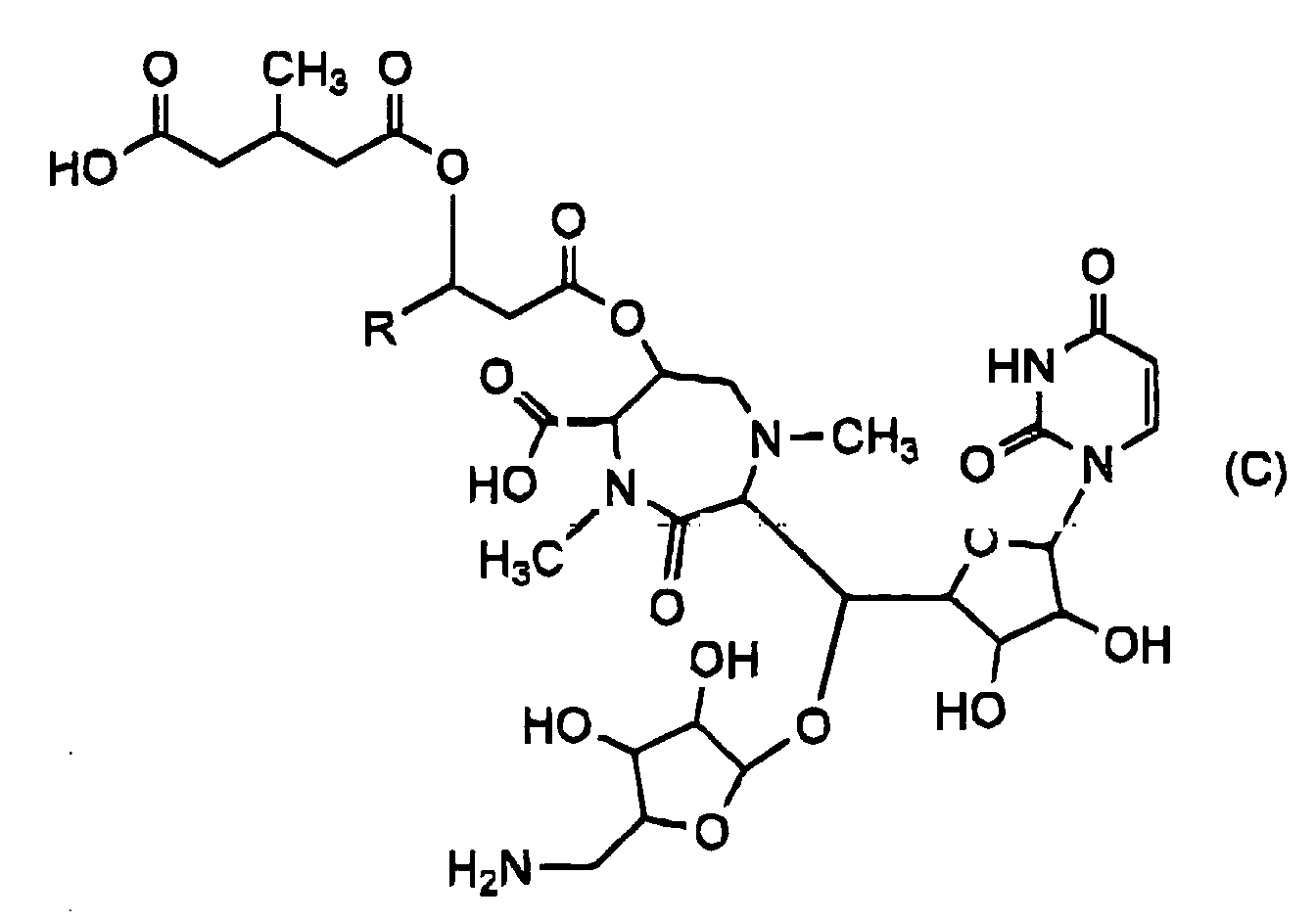
- Caprazamycin D1 and caprazamycin G1 are the compounds represented by the following general formula (C) wherein R is 10-methyl-undecyl group -(CH 2 ) 9 CH(CH 3 ) 2 for caprazamycin D1 and is 9-methyl-undecyl group -(CH 2 ) 8 CH(CH 3 )CH 2 CH 3 for caprazamycin G1.
- Caprazamycins A to G referred to in the above have one common skeletal structure with each another and have excellent antibacterial activities. However, the antibacterial activities of caprazamycins A, B, C, D, E, F and G are different, among them, depending upon the nature of bacteria. Further, upon the preparation of these caprazamycins by the cultivation of Streptomyces sp. MK730-62F2 strain referred to above as a caprazamycin-producing bacterial strain, followed by the recovery of the caprazamycins from the resulting culture broth, it is usual that a mixture of caprazamycins A to G is first obtained. Thus, it is necessary, in order to separate the caprazamycins A to G from each other, to carry out time-consuming and troublesome operations necessarily comprising the high performance liquid chromatography (HPLC).
- HPLC high performance liquid chromatography
- caprazamycins A to G preferably caprazamycin B
- an aqueous acid solution for example, an aqueous acetic acid solution at a concentration of 50-90% by weight, or a dilute aqueous sulfuric acid or hydrogen chloride solution.
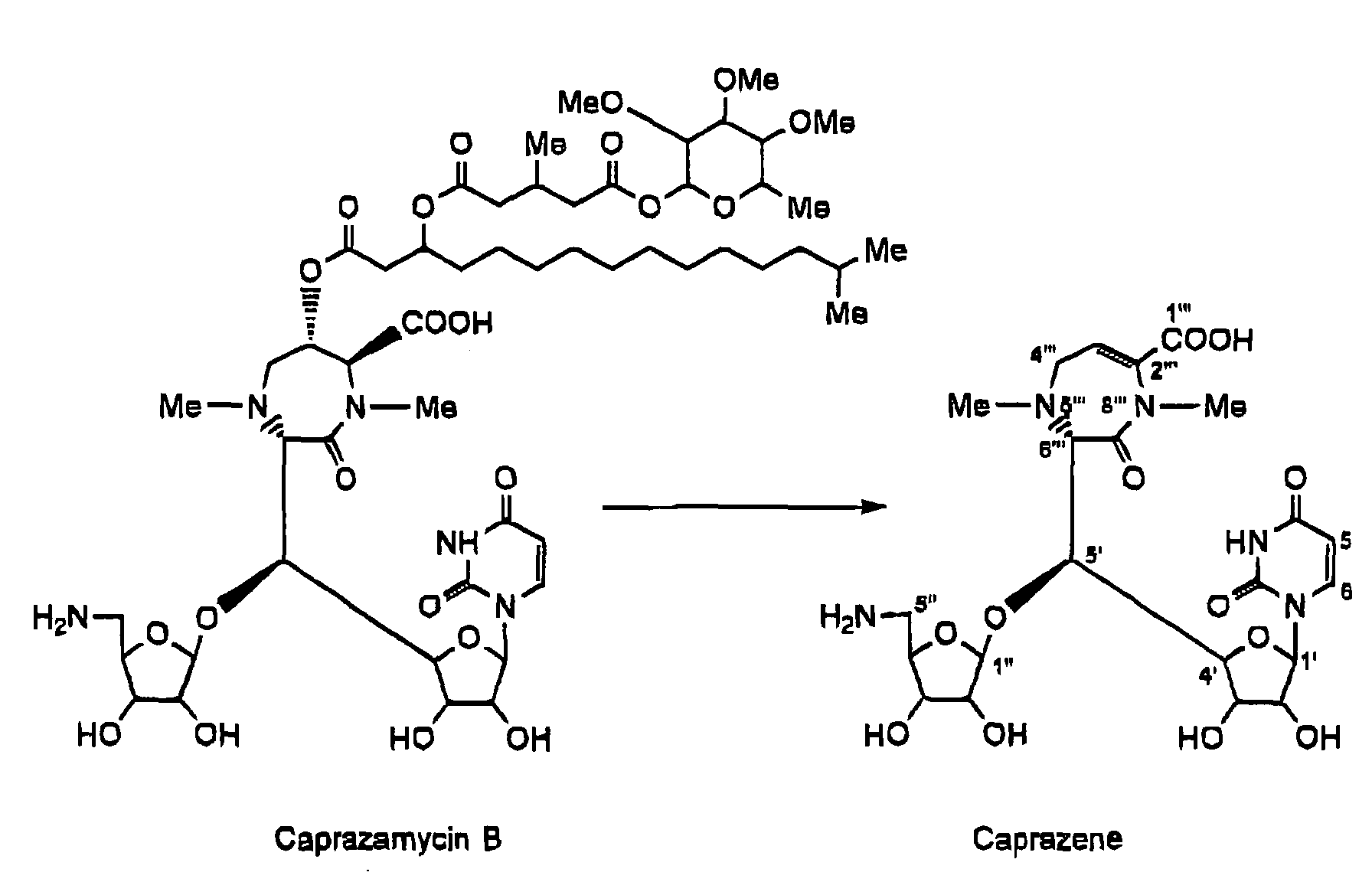
- the resulting reaction solution of the acid-hydrolysis of a caprazamycin contains the compound thus produced which is represented by the following formula (I) wherein Me stands for methyl group, and we have succeeded in isolating said compound as a colorless solid.
- the compound of the formula (I) above has been recognized to comprise in its molecule a 5'-substituted-uridine moiety and a 5-amino-5-deoxy-D-ribose moiety and a 1,4-diazepinone moiety having one double bond.
- caprazene which is the compound represented by the following formula (I) wherein Me stands for methyl group, and a 5''-N-alkoxycarbonyl or 5"-N-aralkyloxycarbonyl derivative thereof.
- caprazene which is the compound represented by the following formula (I) wherein Me stands for methyl group, the process comprising hydrolyzing caprazamycin A, B, C, D, E, F or G or a mixture of two or more of caprazamycins A to G in an aqueous solution of an acid at room temperature or under heating.
- At least one of caprazamycins A to G is hydrolyzed in an aqueous acid solution, for example, in an aqueous acetic acid or an aqueous sulfuric acid or an aqueous hydrogen chloride solution.
- the aqueous solution of an acid used for the acid hydrolysis of caprazamycins may be those of an organic acid, for example, acetic acid or n-propionic acid, or those of an inorganic acid, for example, hydrochloric acid or sulfuric acid. It is preferred to use an aqueous acetic acid solution containing acetic acid at a concentration of 50-90% (by weight) or a dilute aqueous hydrochloric acid solution containing hydrogen chloride (HCl) at a concentration of 3% by weight or less.
- the acid hydrolysis reaction of caprazamycins may be carried out at room temperature, but it may also be effected at an elevated temperature of 40-100°C.
- caprazene of the formula (I) may be recovered as a colorless solid.
- the solid caprazene may be dissolved in a mixture of water-acetone and then deposited as crystals.
- the physicochemical properties of caprazene are shown in Example 1 hereinafter given.
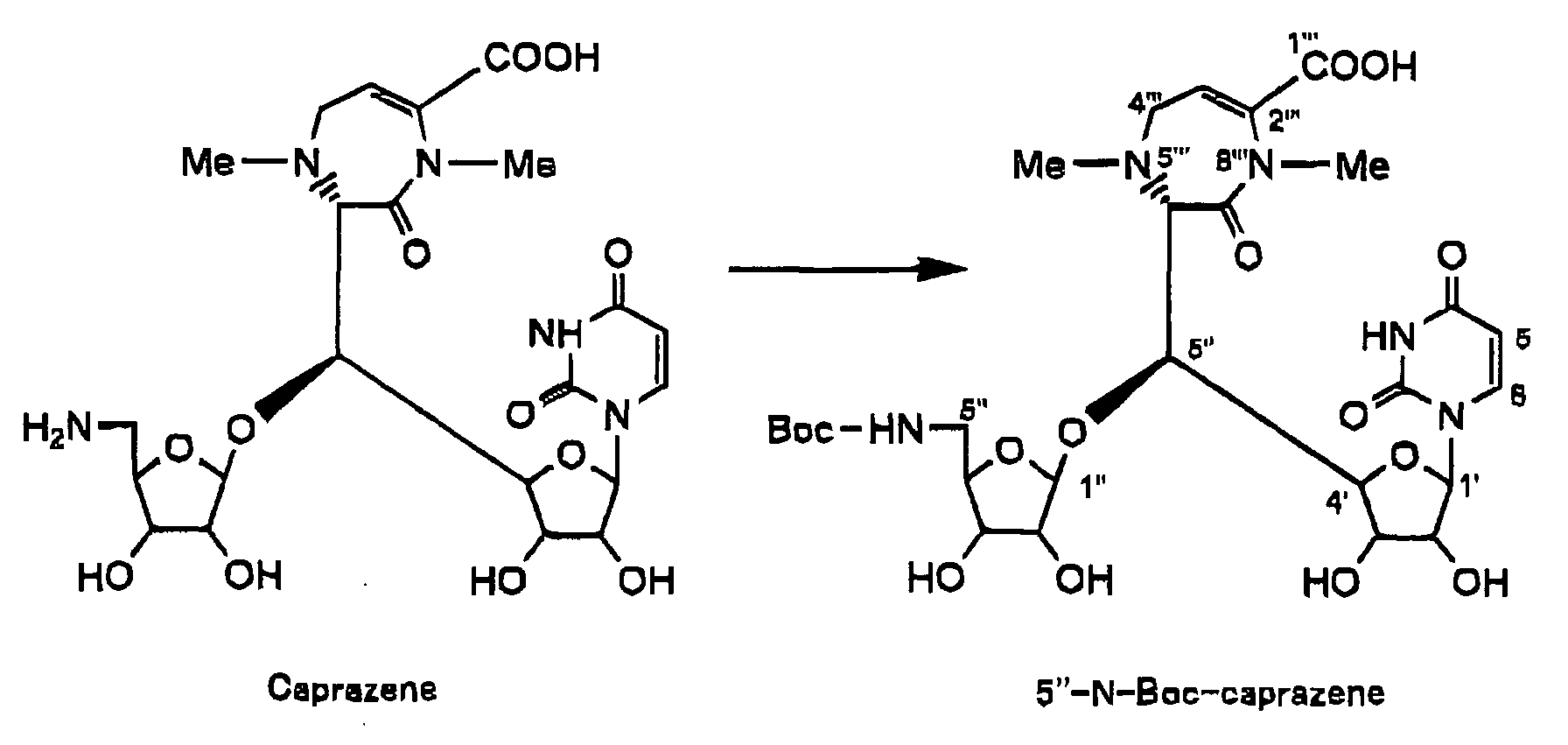
- caprazene is suspended in a mixture of water-dioxane (2:1) and to the resulting suspension is added triethylamine, so that there may be obtained a homogeneous caprazene solution.
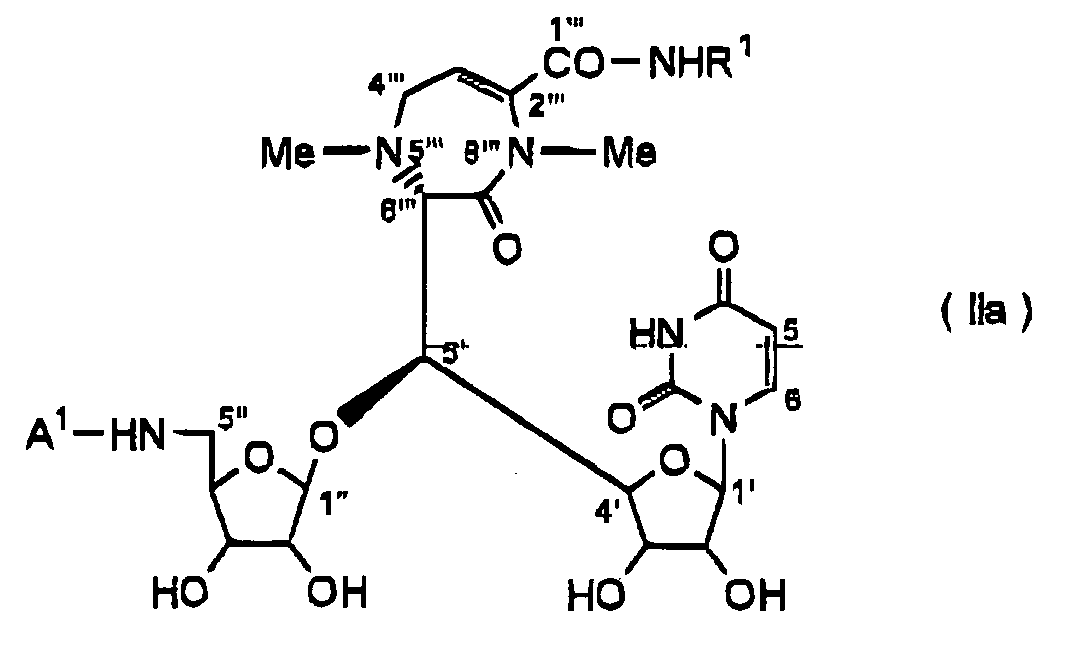
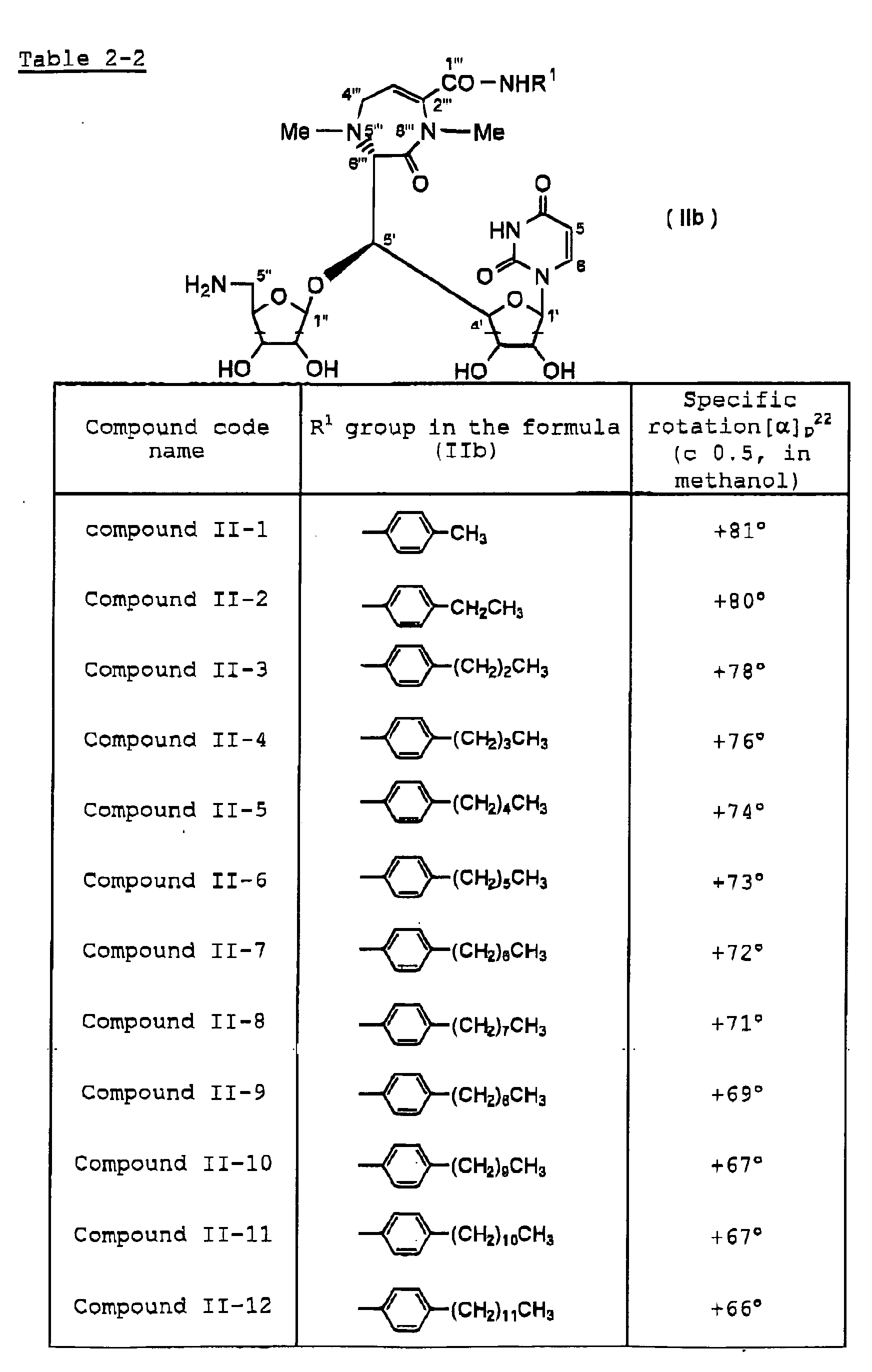
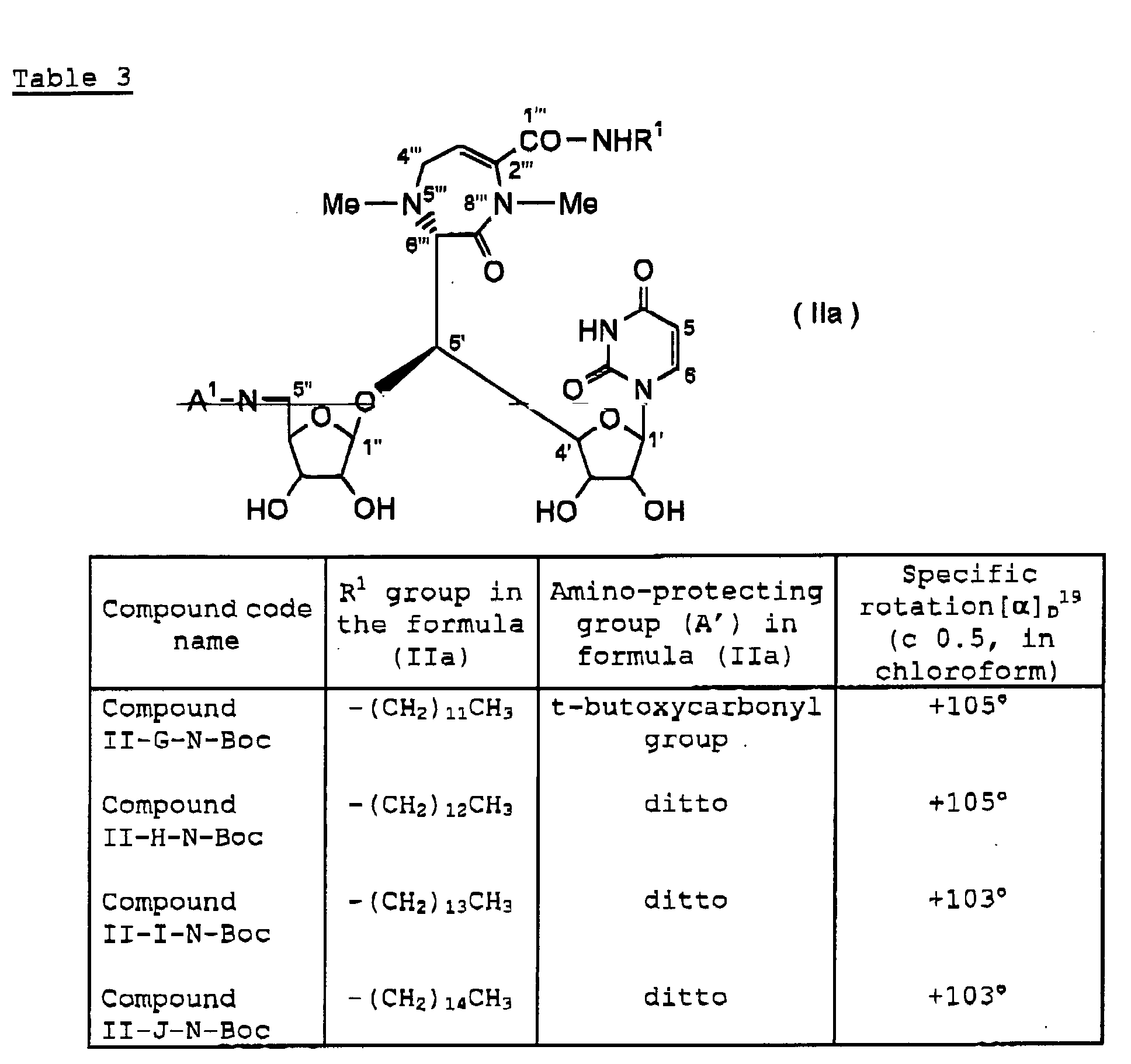
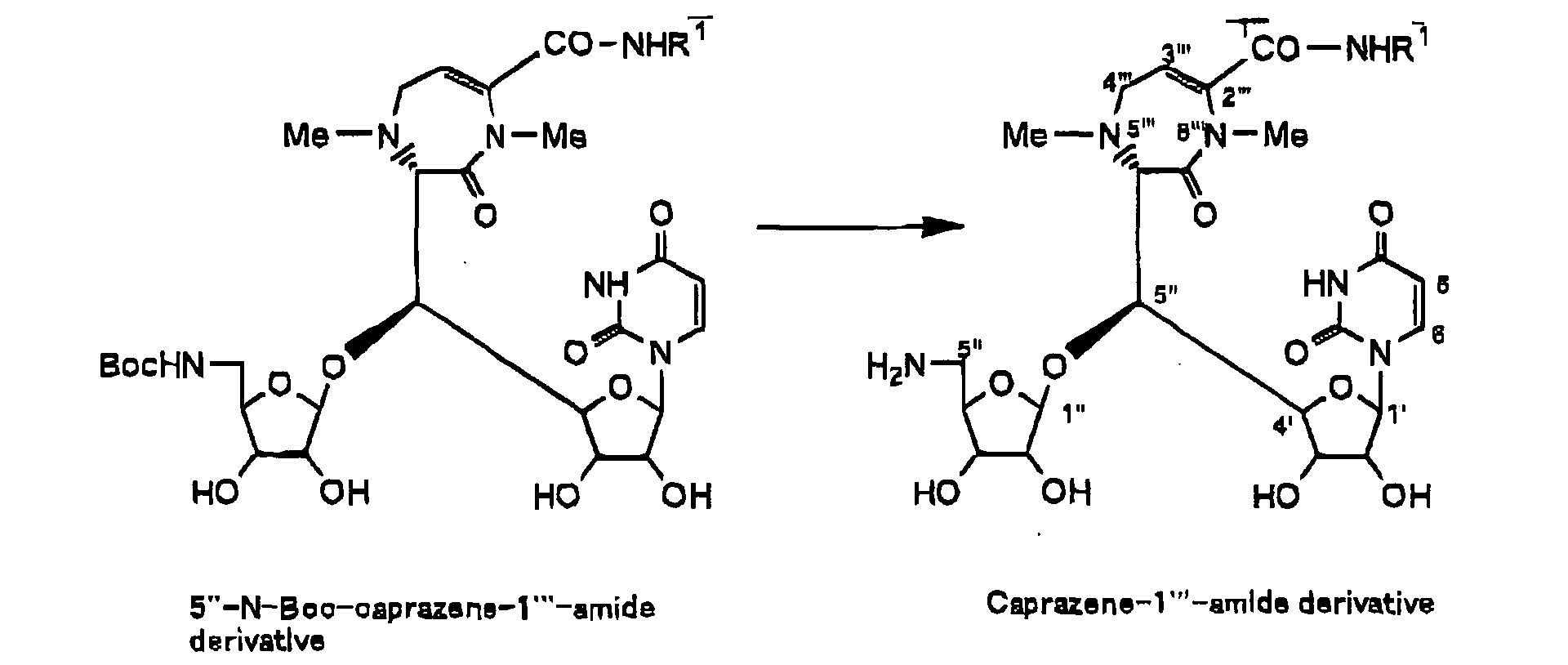
- the elimination of 5''-N-Boc group or 5''-N-Z group from the amide derivative of the formula (IIa) can be made when the 5''-N- protected caprazene-1'''-amide derivative is subj ected to conventional method for the elimination of the amino-protecting group in sugar chemistry, for example, to hydrolysis with trifluoroacetic acid in methanol for the elimination of Boc group, or to hydrogenolysis for the elimination of Z group, thereby affording a caprazene-1'''-amide derivative having the following general formula (IIb) wherein Me and R 1 have the same meanings as defined above.
- the caprazene-1'''-amide derivative of the general formula (IIb) when be reacted with trifluoroacetic acid, hydrochloric acid, sulfuric acid or phosphoric acid, will give the corresponding acid addition salt of the amide derivative of the formula (IIb) which is soluble in water.
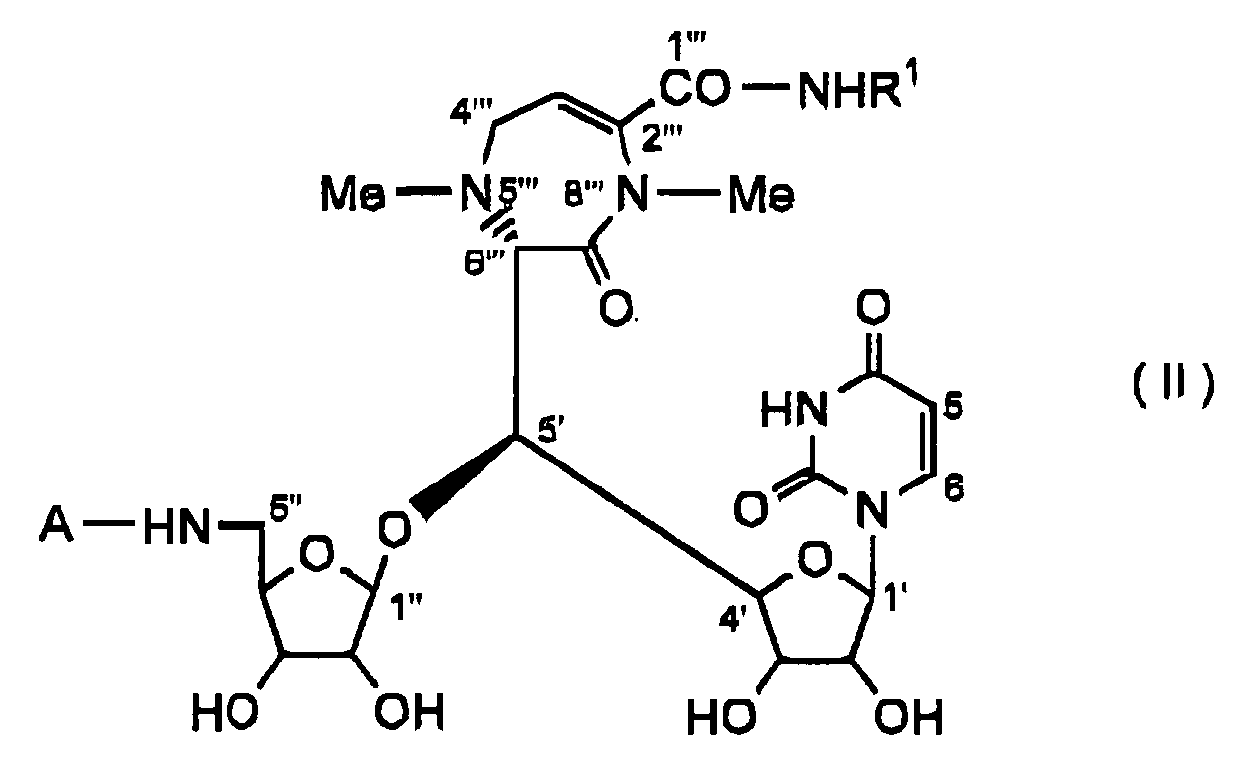
- a caprazene-1'''-amide derivative and its 5" -N-alkoxycarbonyl or aralkyloxycarbonyl derivative which are each presented by the following general formula (II) wherein Me is methyl group, R 1 is a straight chain or a substantially straight chain alkyl group of 5-21 carbon atoms, a straight chain or a substantially straight chain alkenyl group of 5-21 carbon atoms or a cycloalkyl group of 5-12 carbon atoms, or R 1 is a phenyl group having a straight chain alkyl group of 1-14 carbon atoms or a straight chain alkoxy group of 1-9 carbon atoms or a cycloalkyl group of 5-12 carbon atoms at the para-position of the phenyl group, A is hydrogen atom or A is an amino-protecting group including an alkoxycarbonyl group, particularly tert-butoxycarbonyl group, or an aralkyl
- the caprazene-1'''-amide derivative of the general formula (II) includes (i) a caprazene-1'''-amide derivative where A is hydrogen atom and R 1 is an alkyl group, alkenyl group or cycloalkyl group as defined above, and (ii) a caprazene-1'''-amide derivative where A is hydrogen atom and R 1 is a phenyl group having an alkyl group, alkoxy group or cycloalkyl group at the para-position as defined above.
- the straight chain alkyl group of 5-21 carbon atoms as R 1 may be those exemplified in the following Table 1.
- Alkyl group Formula Name C 5 H 11 - Pentyl (Amyl) C 13 H 27 - Tridecyl C 6 H 13 - Hexyl C 14 H 29 - Tetradecyl C 7 H 15 - Heptyl C 15 H 31 - Pentadecyl C 8 H 17 - Octyl C 16 H 33 - Hexadecyl C 9 H 19 - Nonyl C 17 H 35 - Heptadecyl C 10 H 21 - Decyl C 18 H 37 - Octadecyl C 11 H 23 - Undecyl C 19 H 39 - Nonadecyl C 12 H 25 - Dodecyl C 20 H 41 - Icocyl C 21 H 43 - Henicosyl
- Substantially straight chain alkyl group of 5-21 carbon atoms as R 1 defined above may be a (C 5 -C 21 )alkyl group having 1-3 methyl groups, 1-3 ethyl groups or 1-3 n-propyl groups as substituted in the length of the alkyl chain or at the terminal carbon atom of the alkyl chain, which may, for example, include 9-methyl-undecyl group -(CH 2 ) 8 CH(CH 3 )CH 2 CH 3 or 10-methyl-undecyl group -(CH 2 ) 9 CH(CH 3 ) 2 .
- Straight chain alkenyl group of 5-21 carbon atoms as R 1 defined above may be pentenyl group, hexenyl group, heptenyl group, octenyl group, nonenyl group, decenyl group, undecenyl group, dodecenyl group, tridecenyl group, tetradecenyl group, pentadecenyl group, hexadecenyl group, heptadecenyl group, octadecenyl group, nonadecenyl group or icosenyl group.
- the double bond of the alkenyl group may be positioned in the length of the alkenyl chain or at the ⁇ -carbon atom or ⁇ -carbon atom.
- Cycloalkyl group of 5-12 carbon atoms as R 1 defined above may be cyclopentyl group, cyclohexyl group, cycloheptyl group, cyclooctyl group, cyclononyl group, cyclodecyl group, cycloundecyl group or cyclododecyl group. There may be substituted 1-3 methyl groups or 1-3 ethyl groups as the substituents on the cycloalkane ring.
- caprazene of the formula (I) is suspended in a mixture of water-dioxane, and to the resulting suspension is added triethylamine to prepare a homogeneous solution of caprazene.
- an alkoxycarbonylating reagent or an aralkyloxycarbonylating reagent which is conventionally used according to the amino-protecting technique well known in the sugar chemistry, and the reaction intended is conducted at room temperature.
- the resulting reaction solution there is produced in the resulting reaction solution a 5"-N-alkoxycarbonyl- or 5''-N-aralkyloxycarbonyl- caprazene.
- reaction solution is concentrated and the resulting solid residue is washed with ethyl acetate and then dried, and thus there is afforded the desired 5''-N-alkoxycarbonyl- or 5''-N-aralkyloxycarbonyl-caprazene as a solid.
- 5"-N-alkoxycarbonyl- or 5''-N-aralkyloxycarbonyl-caprazene is either dissolved in pyridine to give a solution or is suspended in tetrahydrofuran (THF) to give a suspension and triethylamine is added to the suspension.
- THF tetrahydrofuran
- an amine compound R 1 -NH 2 of the formula (XI) above is reacted with the carboxyl group at the 2'''-position of the 5''-N-protected-caprazene according to the usual method for the amidation of carboxylic acid.
- N,N-bis-(2-oxo-3-oxazolidinyl)-phosphinic chloride as an activator of the carboxyl group, and then to conduct the reaction at room temperature.
- the resulting amidation reaction solution is concentrated, and the resulting syrupy concentrate is extracted with chloroform and then the resulting chloroform extract in the form of a solution is washed with water and then concentrated, thus to give a residue containing the desired 5''-N-protected-caprazene-1'''-amide derivative.
- the residue is dissolved in chloroform and the resulting solution is purified by subjecting it to a silica-gel column chromatography which is developed with a mixed solvent of chloroform-methanol (10:1).
- the elimination of the 5''-N-protecting group from the resulting 5''-N-prvtected-caprazene-1'''-amide derivative can be achieved by treating the said N-protected derivative in a usual manner for the elimination of amino-protecting group, thereby to produce the 5''-N-unprotected-caprazene-1'''-amide derivative of the general formula (II).
- Boc group as the amino-protecting group
- the resulting reaction solution containing the 5''-N-protected caprazene-1'''-ester derivative so produced is concentrated and the resulting syrupy concentrate is extracted with chloroform and then the said chloroform solution is washed with water and concentrated.
- the resulting residue is dissolved in chloroform and the resultant chloroform solution is purified by subjecting it to a silica-gel column chromatography with the development with a mixed solvent of chloroform-methanol (10:1).
- the eluate fractions containing the desired product from the column are concentrated to give a 5''-N-protected-caprazene -1'''-ester derivative of the formula (IIIa) as a solid.
- the 5''-N- protected-caprazene- 1'''-ester derivative of the formula (IIIa) has been found to have an antibacterial activity against bacteria.
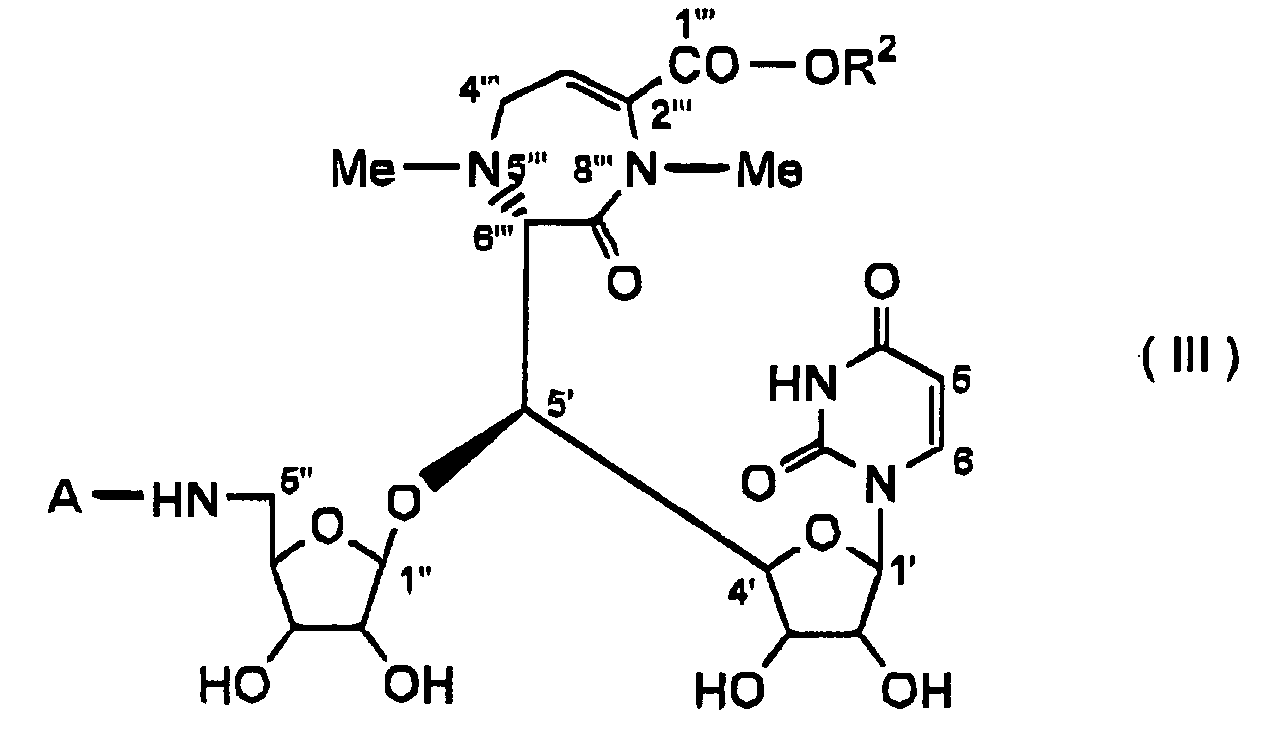
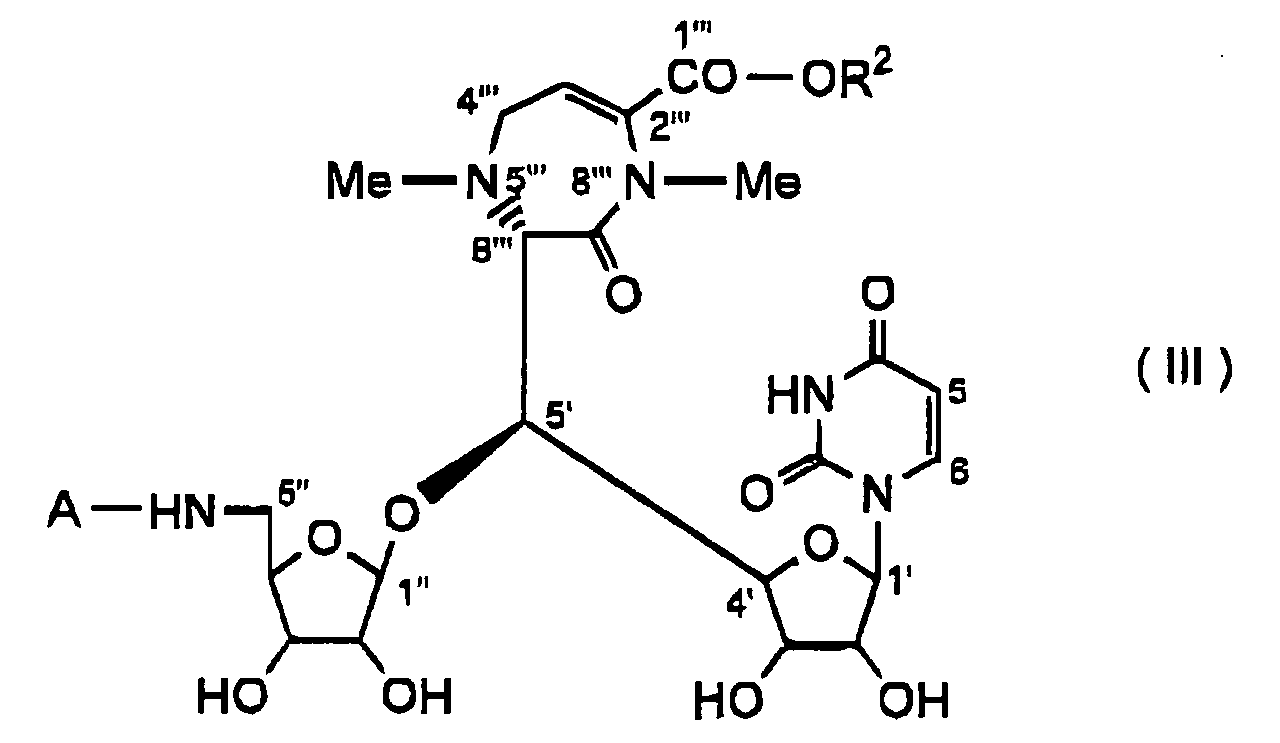
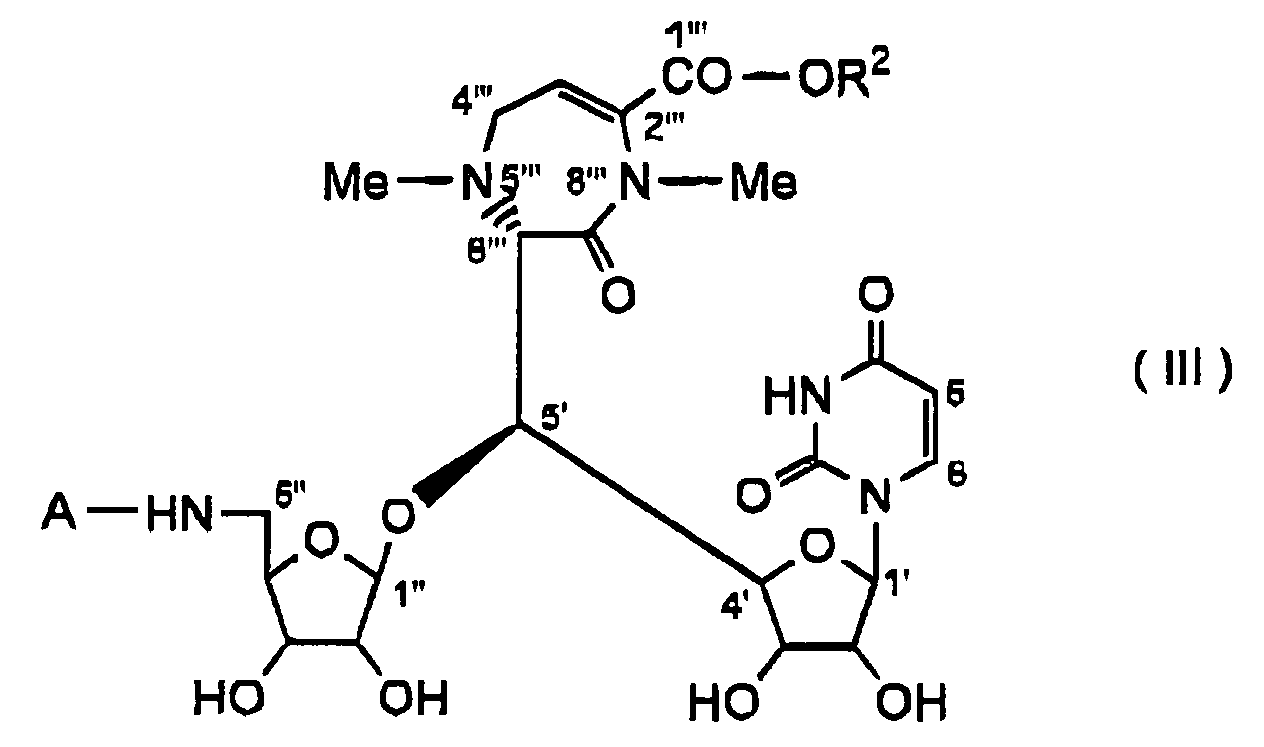
- a caprazene-1'''-ester derivative and a 5''-N-alkoxycarbonyl or a 5''-N-aralkyloxycarbonyl derivative thereof which are each represented by the following general formula (III) wherein Me is methyl group, R 2 is a straight chain or a substantially straight chain alkyl group of 5-21 carbon atoms or a straight chain or a substantially straight chain alkenyl group of 5-21 carbon atoms or an alkynyl group of 5-21 carbon atoms and A is hydrogen atom or an amino-protecting group which is an alkoxycarbonyl group, particularly tert-butoxycarbonyl group, or an aralkyloxycarbonyl group, particularly benzyloxycarbonyl group, or a pharmaceutically acceptable acid addition salt thereof.
- III general formula (III) wherein Me is methyl group, R 2 is a straight chain or a substantially straight chain alkyl group of 5-21 carbon atoms or a straight chain or a substantially straight chain alken
- a straight chain or a substantially straight chain alkyl or alkenyl group of 5-21 carbon atoms for R 2 each may be the same as the alkyl or alkenyl group defined for R 1 in the caprazene-1'''-amide derivative having the general formula (II), respectively.
- An alkynyl group of 5-21 carbon atoms for R 2 may be pentynyl group, hexynyl group, heptynyl group, octynyl group, nonynyl group, decynyl group and so on.
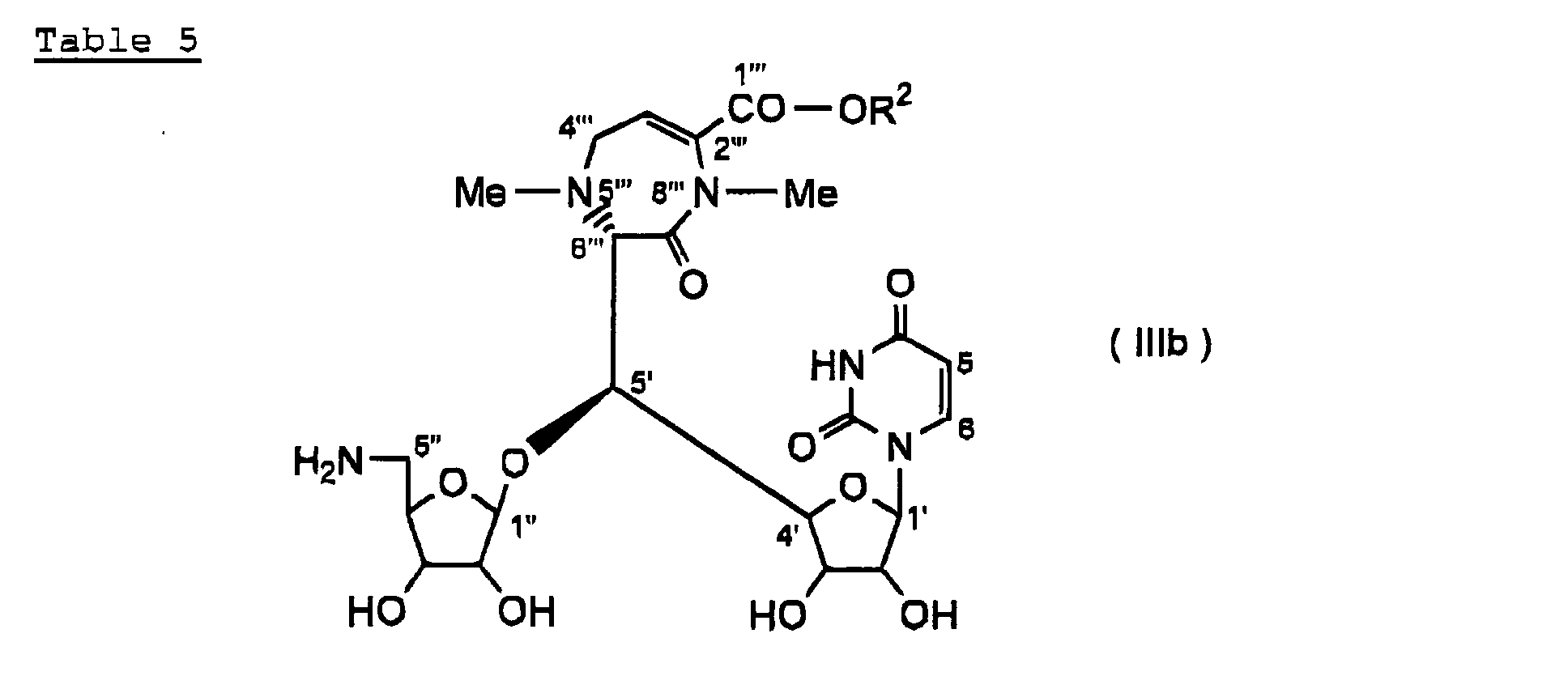
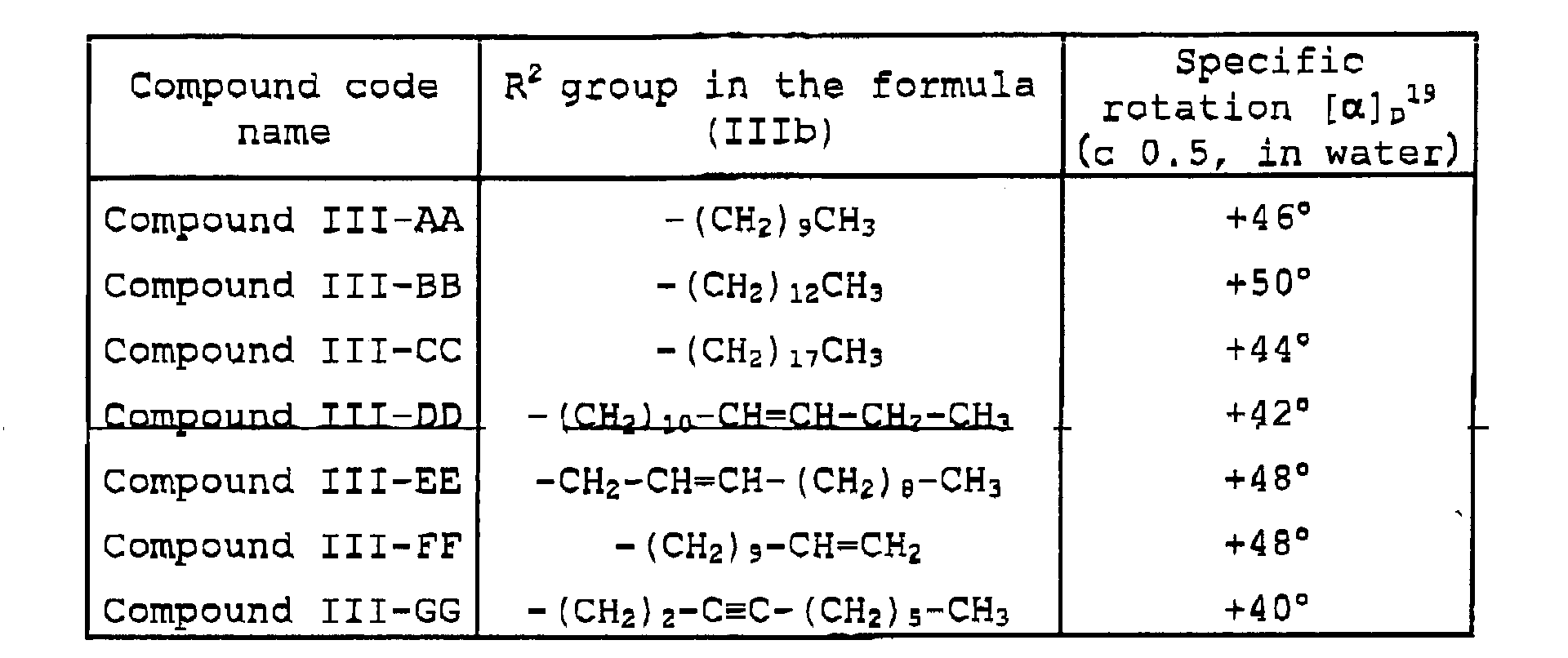
- caprazene-1'''-ester derivative of the following formula (IIIb) which are included within the 5''-N-unprotected caprazene-1'''-ester derivative of the general formula (III) according to the fourth aspect of this invention are shown in the following Table 5 together with their compound codes and specific rotation data.
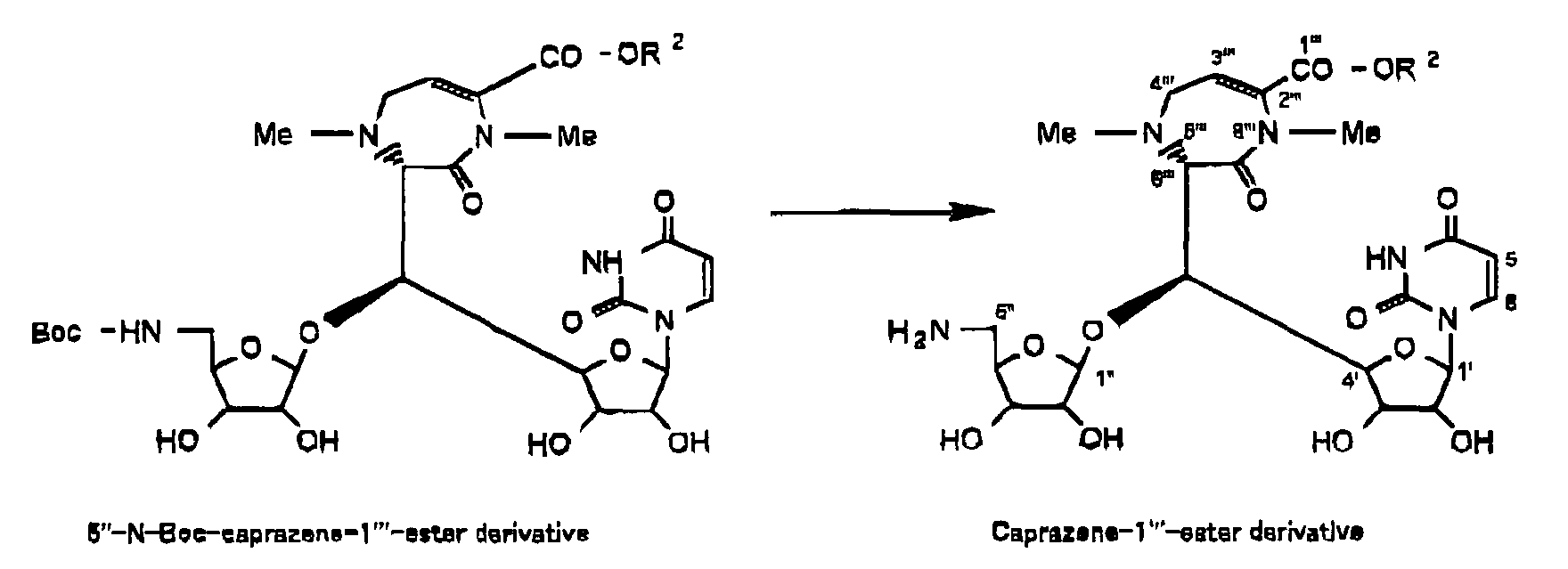
- a 5''-N-alkoxycarbonyl- or 5''-N-aralkyloxycarbonyl-caprazene is prepared. Then, the 5''-N-alkoxycarbonyl- or 5''-N-aralkyloxycarbonyl-caprazene is dissolved in pyridine, and in the resulting pyridine solution, an alcohol compound of the formula (XII) above is reacted with the 2'''-carboxyl group of the 5''-N-protected caprazene according to the usual method for the esterification of carboxylic acids. The esterification reaction is conveniently carried out in the presence of N,N-bis(2-oxo-3-oxazolidinyl)phosphinic chloride as added at room temperature.
- the resulting esterification reaction solution is concentrated, and the resulting concentrate is extracted with chloroform and the resulting chloroform extract is washed with water and then concentrated, to give a residue containing the desired 5''-N-protected caprazene-1'''-ester derivative.
- the residue is dissolved in chloroform and the resulting chloroform solution is purified by subjecting it to a silica-gel column chromatography with the development with a mixed solvent of chloroform-methanol.
- the eluate fractions containing the desired product from the chromatography are collected and concentrated, thus to yield the desired 5''-N-protected caprazene-1'''-ester derivative of the formula (IIIa) as a solid.
- the elimination of the 5''-N-amino-protecting group can be achieved by treating the 5''-N-protected caprazene-1'''-ester derivative by the usual method for the elimination of the amino-protecting group, to produce a 5''-N-unprotected caprazene-1'''-ester derivative of the general formula (IIIb).
- 5''-N-protecting group is Boc group
- it is convenient to eliminate Boc group by dissolving the 5''-N-protected caprazene-1'''-ester derivative in methanol containing 80% TFA and stirring the resultant solution at room temperature.
- caprazol of the formula (IV) of this invention comparison has been made between caprazol of the formula (IV) of this invention and the aforesaid Compound 11 and Compound 12 both of which have sulfuric acid group -SO 3 H and which are given by their planer structural formulae in the above literature "The Journal of Organic Chemistry", vol.57, No.24, pp. 6397-6399 and 6402 and their steric structures are unknown yet. That is, when comparing the 13 C-NMR data (Table III) and 1 H-NMR data (Table IV) of Compounds 11 and 12 with the 13 C-NMR data and 1 H-NMR data (refer to Table 18 of Example 5 given later) of caprazol of this invention, it appears that the numerical data of the former are not necessarily consistent in part with those of the latter. Judging from this comparison, we have concluded that caprazol as prepared by us is different in some part of its steric structure and in the presence or absence of sulfuric acid group, from Compounds 11 and 12, and thus that caprazole
- caprazol which is the compound represented by the following formula (IV) wherein Me is methyl group, and a 5''-N-alkoxycarbonyl and a 5''-N-aralkyloxycarbonyl derivative thereof.
- a process for the preparation of caprazol represented by the following formula (IV) which comprises subjecting caprazamycin A, B, C, D, E, F or G or a mixture of at least two of caprazamycins A to G to a hydrolysis in an aqueous solution of an inorganic base at room temperature or under heating.
- At least one of caprazamycins A to G is hydrolyzed in an aqueous ammonia solution containing 15-30% by weight of ammonia (NH 3 ) at a temperature of about 40°C or lower.
- the alkaline hydrolysis reaction of caprazamycins using an aqueous dilute sodium hydroxide or potassium hydroxide solution may be carried out at room temperature or may also be carried out at an elevated temperature of 40-80°C.
- the resulting reaction solution is post-treated by filtering off the insolubles therefrom, concentrating the resulting filtrate, washing the resulting solid residue with acetone and drying the resulting residue, and thus there can be recovered caprazol of the formula (IV) as a colorless solid.
- the solid caprazol thus recovered may be dissolved in a water-methanol mixture and then crystallized to afford the desired substance as crystals.
- the physicochemical properties of caprazol are shown in Example 5 given hereinafter.
- 5''-N-t-butoxycarbonylcaprazol or 5''-N-benzyloxycarbonylcaprazol may be produced by a process comprising the steps of dissolving caprazol in a solution of dioxane in water and reacting caprazol in the resultant aqueous solution with triethylamine and di-t-butyl dicarbonate or N-(benzyloxycarbonyloxy)succinimide, so that the 5-amino group of the 5-amino-5-deoxy-D-ribose moiety of caprazol is t-butoxycarbonylated or benzyloxycarbonylated.
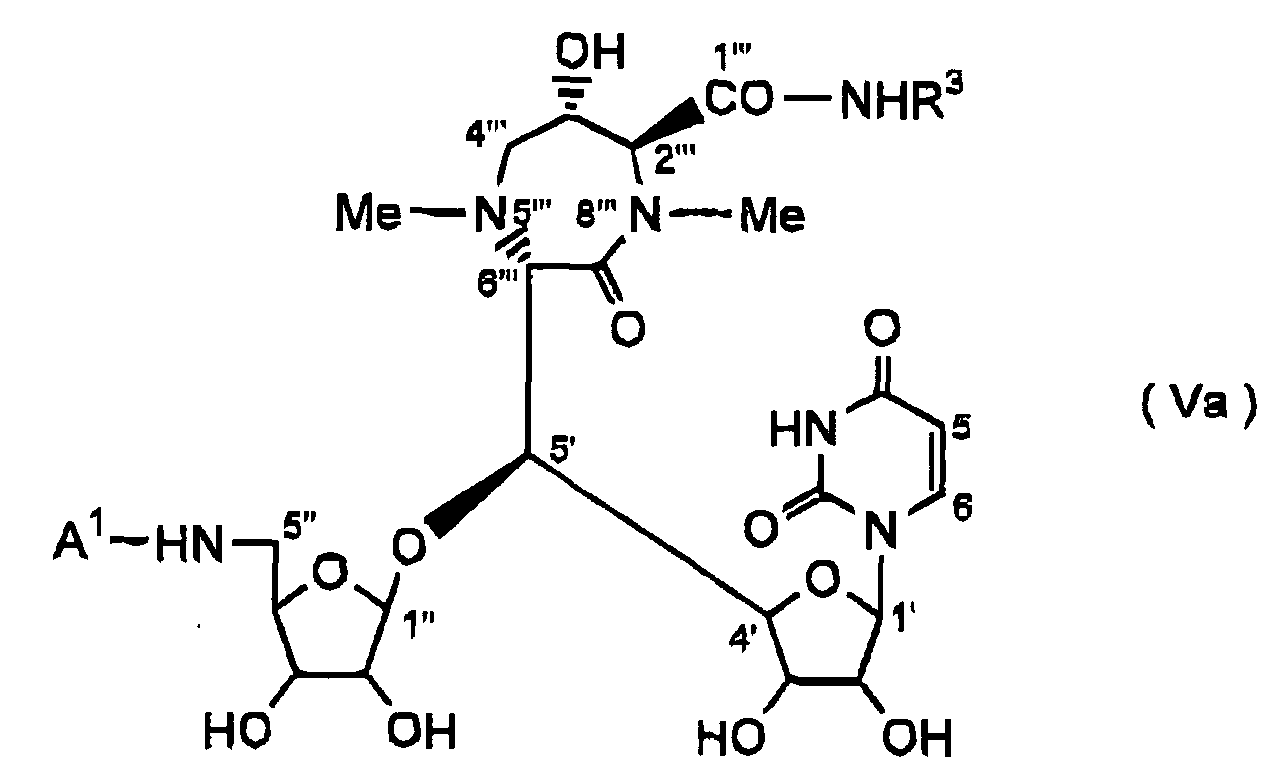
- a 5''-N-protected caprazol-1'''-amide derivative represented by the following general formula (Va) wherein Me stands for methyl group, R 3 is a straight chain or a substantially straight chain alkyl group of 5-21 carbon atoms, a straight chain or a substantially straight chain alkenyl group of 5-21 carbon atoms or a cycloalkyl group of 5-12 carbon atoms, and A 1 stands for t-butoxycarbonyl group (sometimes abbreviated as Boc) or benzyloxycarbonyl group (sometimes abbreviated as Z), by conducting a process comprising the steps of dissolving 5"-N-t-butoxycarbonyl- or benzyloxycarbonyl-caprazol in N,N-dimethylformamide, adding to the resulting solution triethylamine and N,N-bis(2-oxo-3-oxazolidinyl)phosphinic chloride, successively, and subjecting the resulting solution to a reaction
- the 5''-N-protected caprazol-1'''-amide derivative of the formula (Va) above contains Boc group as amino-protecting group
- the 5''-N-Boc group may be eliminated from the amide derivative of the formula (Va) by subjecting the said compound to a method for the elimination of the amino-protecting group conventionally employed in the sugar chemistry, for example, to a hydrolysis with trifluoroacetic acid in methanol, whereby there can be produced a caprazol-1'''-amide derivative represented by the following general formula (Vb) wherein Me and R 3 have the same meanings as defined above.
- the caprazol-1'''-amide derivative of the general formula (Vb) thus obtained, if it be reacted with trifluoroacetic acid, hydrochloric acid, sulfuric acid or phosphoric acid, can afford the corresponding acid addition salt of the amide derivative of the formula (Vb), which is soluble in water.
- caprazol-1'''-amide derivative of the general formula (Vb) above and its 5"-N-Boc- or 5''-N-Z-protected derivative, namely 5''-N-protected caprazol-1''' -amide derivative of the general formula (Va), have antibacterial activities against a variety of bacteria, including tubercle bacillus.
- a caprazol-1'''-amide derivative and its 5''-N-alkoxycarbonyl- or aralkyloxycarbonyl derivatives which are represented by the following general formula (V) wherein Me is methyl group, R 3 is a straight chain or a substantially straight chain alkyl group of 5-21 carbon atoms, a straight chain or a substantially straight chain alkenyl group of 5-21 carbon atoms or a cycloalkyl group of 5-12 carbon atoms, and A is hydrogen atom or an alkoxycarbonyl group, particularly tert-butoxycarbonyl group, or an aralkyloxycarbonyl group, particularly benzyloxycarbonyl group as the amino-protecting group, or a pharmaceutically acceptable acid addition salt thereof.
- V general formula
- an alkyl group, alkenyl group and cycloalkyl group for R 3 may be the same as the alkyl group, alkenyl group and cycloalkyl group for R 1 present in the 5''-N-unprotected or -protected caprazene-1'''-amide derivative of the general formula (II) according to the third aspect of this invention, respectively.
- caprazol-1'''-amide derivative of the following formula (Vb) which are included within the 5"-N-unprotected or -protected caprazol-1'''-amide derivative of the general formula (V) according to the seventh aspect of this invention are shown in the following Table 7 together with their Compound code names and specific rotation data.
- caprazol of the formula (IV) is dissolved in water, and to the resulting aqueous solution of caprazol is added an alkoxycarbonylating reagent or an aralkyloxycarbonylating reagent conventionally used according to the amino-protecting technique well-known in organic chemistry, desirably in the form of its solution in an organic solvent such as dioxane, together with triethylamine.
- the reaction intended is then effected at room temperature. There is produced a 5''-N-alkoxycarbonyl- or 5''-N-aralkyloxycarbonyl-caprazol in the resulting reaction solution.
- the resulting amidation reaction solution is concentrated, and the syrupy concentrate obtained is extracted with chloroform and then the resulting chloroform extract is washed with water, dried and concentrated to dryness, thus affording a solid residue which contains a 5''-N-protected caprazol-1'''-amide derivative desired.
- the residue is dissolved in chloroform and the resultant solution is purified by subjecting it to a silica-gel column chromatography with development with a mixed solvent of chloroform-methanol-concentrated aqueous ammonia (4:1:0.1). Active fractions of the eluate from the silica-gel column are collected and concentrated, whereby there can be yielded the desired 5''-N-protected caprazol -1'''-amide derivative of the general formula (V) as a solid.
- the 5''-amino-protecting group can be eliminated by treating the resulting 5''-N-protected caprazol-1'''-amide derivative in accordance with the conventional technique for the elimination of amino-protecting group, thereby producting the 5''-N-unprotected caprazol-1'''-amide derivative of the general formula (V).
- Boc for the purpose of the elimination of the 5''-amino-protecting group, Boc, it is convenient to dissolve the 5''-N-protected caprazol-1'''-amide derivative in methanol containing 80% trifluoroacetic acid (TFA) and to stirr the resulting solution at room temperature.
- the resulting amidation reaction solution containing the N,O-protected caprazol-1'''-amide derivative of the formula (XV) is concentrated to dryness, and the residue obtained is extracted with chloroform and then the chloroform extract is washed with water, dried and concentrated to dryness.
- the resulting solid residue is dissolved in chloroform and the resulting solution is purified by subjecting it to a silica-gel column chromatography by development with a mixed solvent of chloroform-methanol (50:1).
- the eluate fractions containing the desired product from the silica-gel column are collected and concentrated, and thus there can be recovered the N,O-protected caprazol-1'''-amide derivative of the formula (XV).
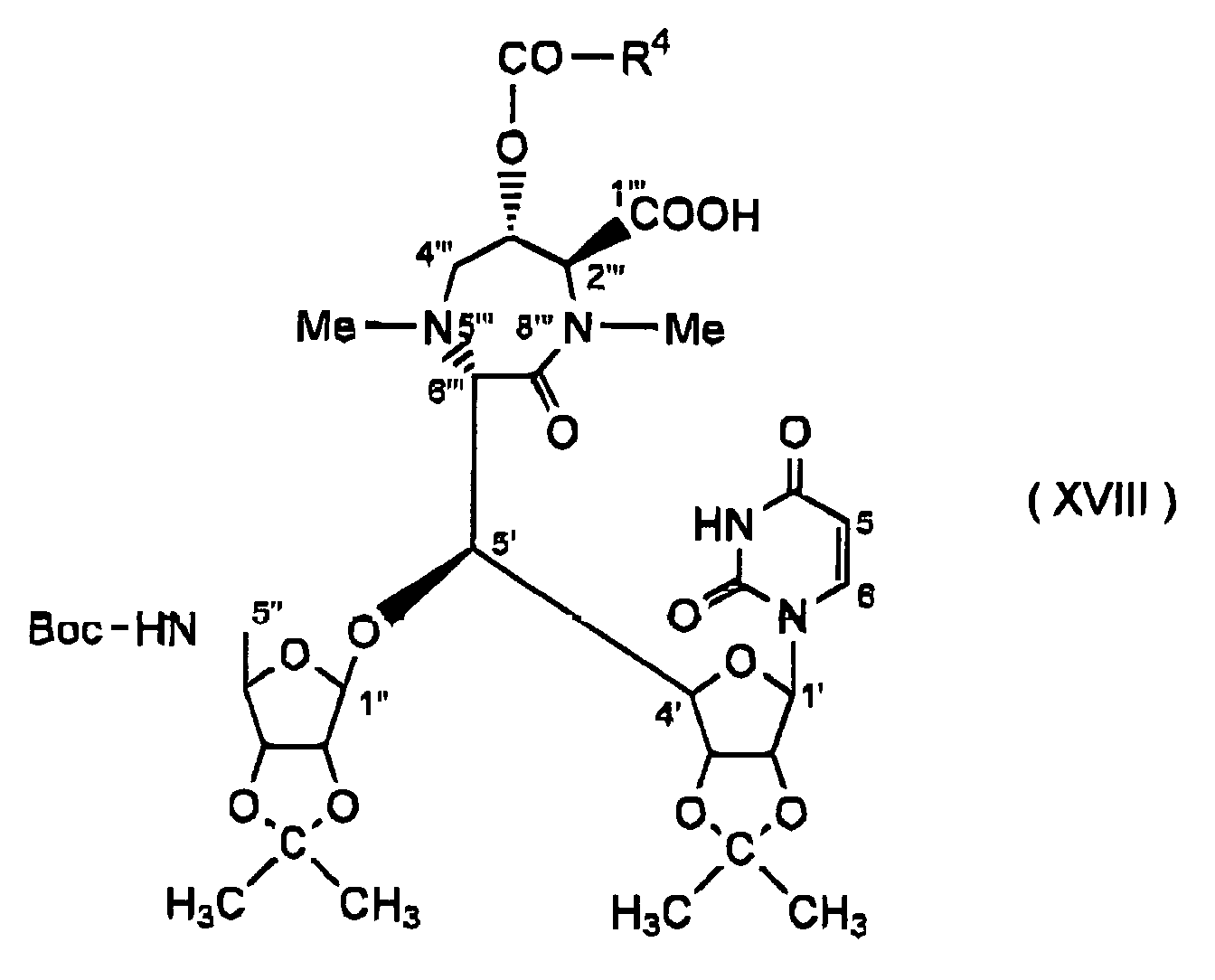
- the N,O-protected caprazol-1'''-amide derivative of the formula (XV) is dissolved in dichloromethane, and to the resultant solution are added 4-dimethylaminopyridine and an acid chloride of the following formula (XVI) Cl-CO-R 4 wherein R 4 is a straight chain or a substantially straight chain alkyl group of 5-21 carbon atoms or a straight chain or a substantially straight chain alkenyl group of 5-21 carbon atoms or an alkynyl group of 5-21 carbon atoms, and the reaction intended is conducted under ice-cooling.
- the 3'''-hydroxyl group of the N,O-protected caprazol-1'''-amide derivative of the formula (XV) is acylated with the acid chloride of the formula (XVI), whereby there can be produced a 5''-N-t-butoxycarbonyl-2',3';2'', 3''-di-O-isopropylidene-caprazol-1'''-amide-3'''-ester derivative represented by the following general formula (XVII) wherein R 3 and R 4 have the same meanings as defined above.
- the resulting residue is dissolved in chloroform and the resultant solution is purified by subjecting it to a silica-gel column chromatography [at first, washing with chloroform, followed by developing with chloroform-methanol (150:1)].There can thus be recovered the derivative of the formula (XVII) by concentrating the eluate fractions containing the derivative of the formula (XVII).
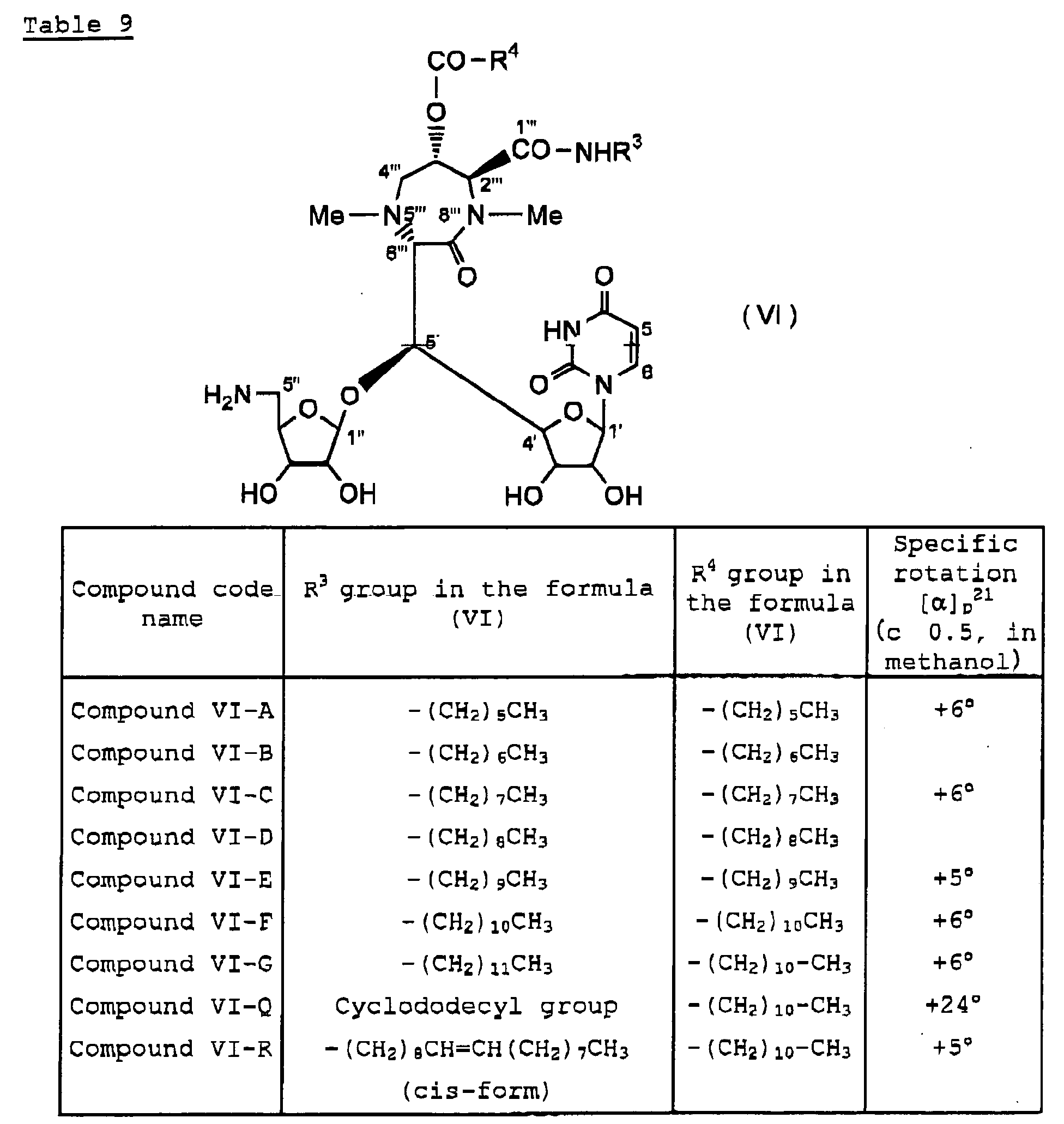
- a caprazol-1'''-amide-3'''-ester derivative represented by the following general formula (VI) wherein Me is methyl group, R 3 is a straight chain or a substantially straight chain alkyl group of 5-21 carbon atoms or a straight chain or a substantially straight chain alkenyl group of 5-21 carbon atoms or a cycloalkyl group of 5-12 carbon atoms, R 4 is a straight chain or a substantially straight chain alkyl group of 5-21 carbon atoms or a straight chain or a substantially straight chain alkenyl group of 5-21 carbon atoms or an alkynyl group of 5-21 carbon atoms, or a pharmaceutically acceptable acid addition salt thereof.
- caprazol-1'''-amide-3'''-ester derivative of the general formula (VI) according to the eighth aspect of this invention are shown in the following Table 9 together with the Compound code names and their specific rotation data.
- the resulting reaction solution containing the caprazol-3'''-ester derivative of the formula (XIX) from the deprotecting treatment with trifluoroacetic acid is concentrated to dryness and the resulting residue is washed with diethyl ether, and thus there can be recovered an addition salt of trifluoroacetic acid of a caprazol-3'''-ester derivative of the formula (XIX).
- the caprazol-3'''-ester derivative of the formula (XIX) has been found also to have antibacterial activities against bacteria.
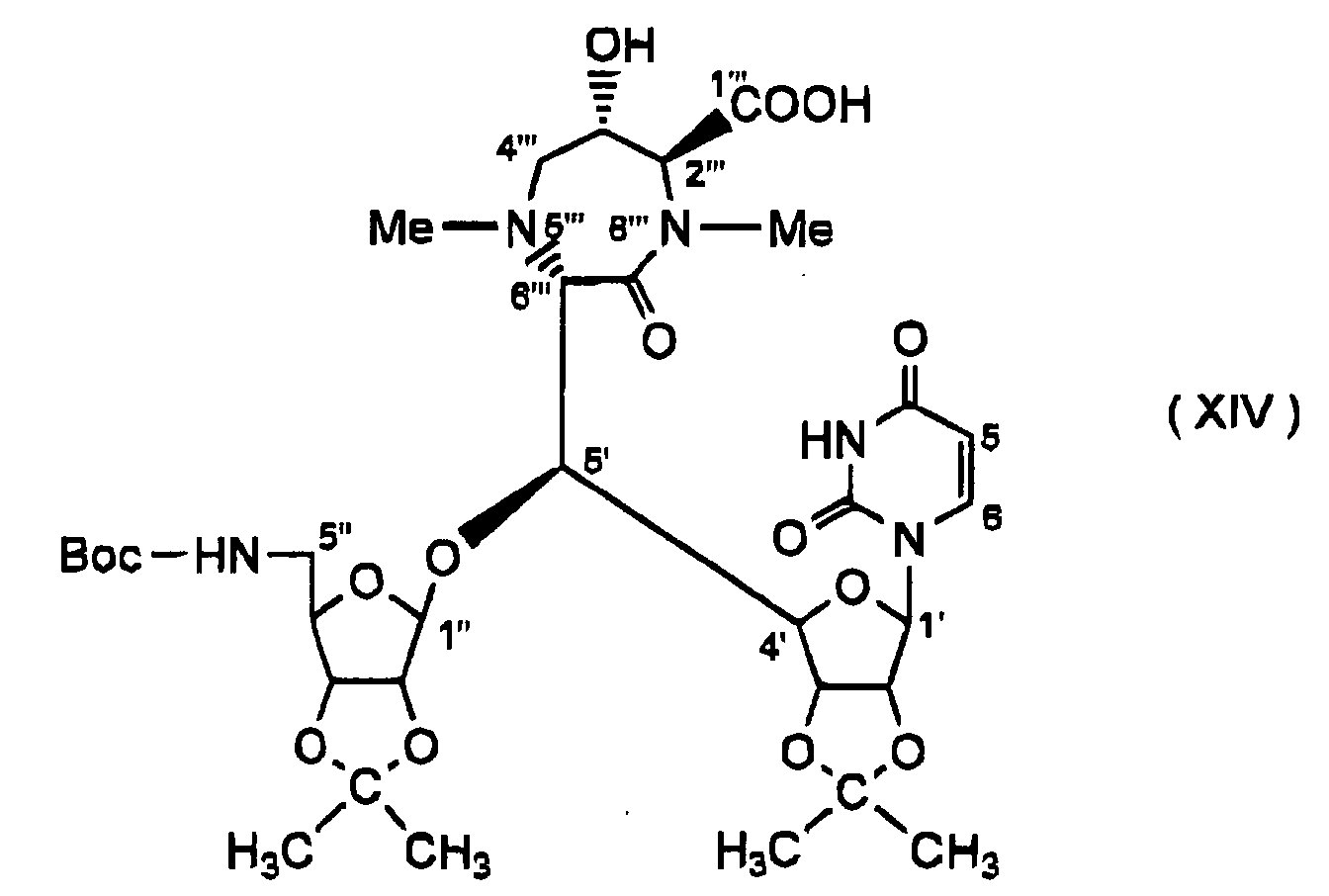
- N,O-protected caprazol of the formula (XIV) above is dissolved in N,N-dimethylformamide, and to the resultant solution are added successively triethylamine and N,N-bis(2-oxo-3-oxazolidinyl)phosphinic chloride, and further added as an esterifying reagent an alkanol of the following formula (XX) R 7 -OH wherein R 7 is an alkyl group of 1-21 carbon atoms, and the reaction intended is conducted at room temperature.
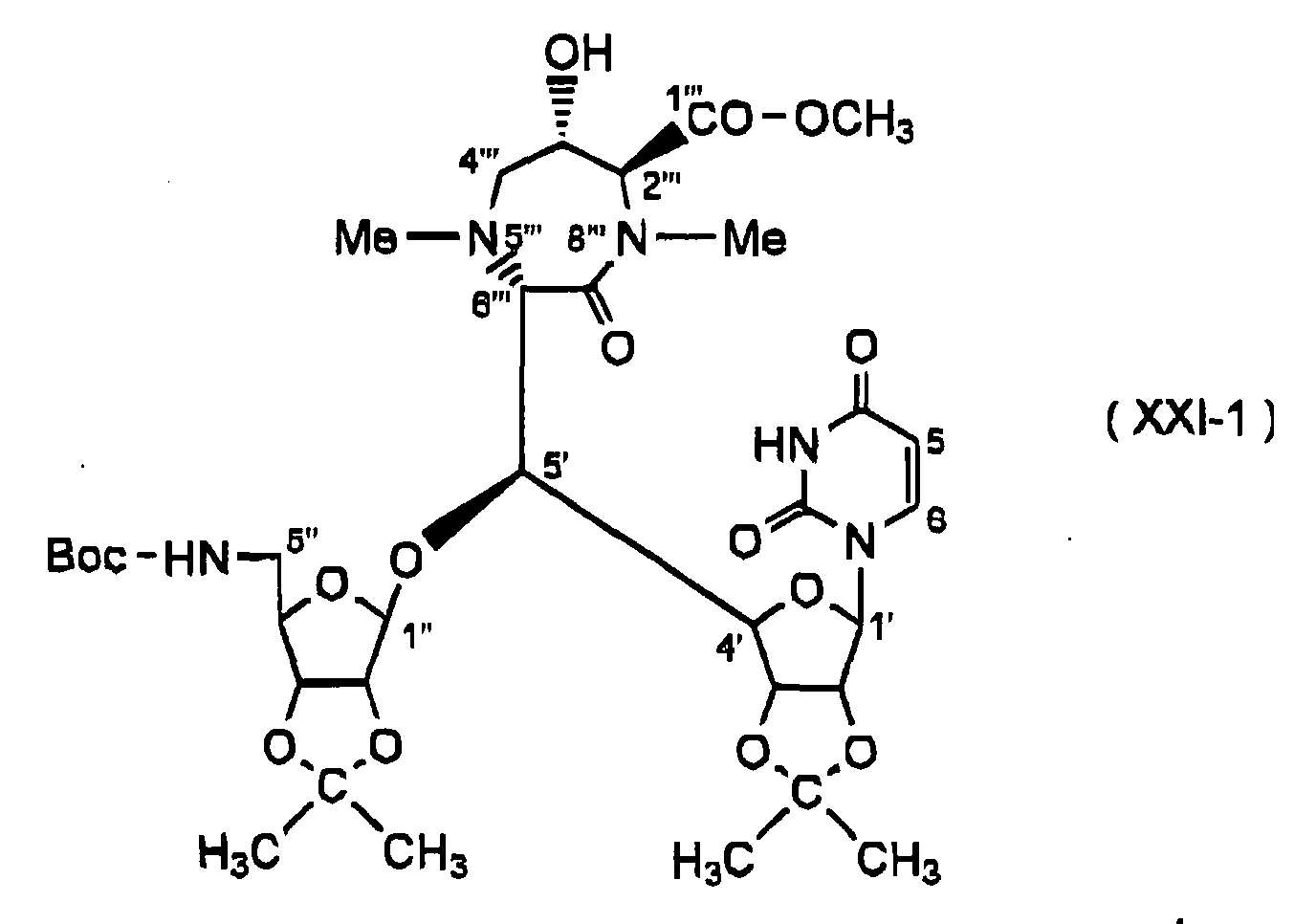
- the 2'''-carboxyl group of the N,O-protected caprazol of the formula (XIV) can be esterified to produce a 5''-N-t-butoxycarbonyl-2',3';2'',3''-di-O-isopropylidene-caprazol-1'''-ester derivative represented by the following general formula (XXI)
- the resulting esterifying reaction solution is concentrated to dryness and the resulting residue is extracted with chloroform.
- the chloroform extract is washed with water, dried and concentrated to dryness, and the resulting residue is dissolved in chloroform.
- the chloroform solution is purified by subjecting it to a silica-gel column chromatography with development with chloroform-methanol (50:1).
- the desired eluate fractions are collected and concentrated to dryness, and thus there can be recovered the desired N,O-protected caprazol-1'''-ester derivative of the formula (XXI).
- the N,O-protected caprazol-1'''-ester derivative of the formula (XXI) is then dissolved in dichloromethane, and to the resulting solution are added 4-dimethylaminopyridine and an acid chloride of the following formula (XVI) Cl-CO-R 4 wherein R 4 is a straight chain or a substantially straight chain alkyl group of 5-21 carbon atoms or a straight chain or a substantially straight chain alkenyl group of 5-21 carbon atoms or an alkynyl group of 5-21 carbon atoms.
- the reaction intended is effected under ice-cooling.
- the 3'''-hydroxyl group of the N,O-protected caprazol-1'''-ester derivative of the formula (XXI) can be acylated with the acid chloride to produce a 5''-N-t-butoxycarbonyl-2',3';2'',3''-di-O-isopropylidene-caprazol-1'''-ester- 3"'-ester derivative represented by the following general formula (XXII) wherein R 4 and R 7 have the same meanings as defined above.
- the resulting reaction solution from the deprotection treatment with trifluoroacetic acid is concentrated to dryness, and the resulting residue is washed with diethyl ether, and thus there can be recovered an addition salt of trifluoroacetatic acid of the caprazol-1'''-ester-3'''-ester derivative of the formula (XXIII).
- the caprazol-1'''-ester -3'''-ester derivative of the formula (XXIII) as well as the caprazol-3'''-ester derivative of the formula (XIX) has been found also to have antibacterial activities against bacteria.
- a caprazol-3'''-ester derivative or a caprazol-1'''-ester-3'''-alkyl ester derivative which is represented by the following general formula (VII) wherein Me is methyl group, R 4 is a straight chain or a substantially straight chain alkyl group of 5-21 carbon atoms or a straight chain or a substantially straight chain alkenyl group of 5-21 carbon atoms or an alkynyl group of 5-21 carbon atoms and R 5 is hydrogen atom or an alkyl group of 1-21 carbon atoms, or a pharmaceutically acceptable acid addition salt thereof.
- caprazol-3'''-ester derivative or a caprazol-1'''-ester-3'''-ester derivative of the general formula (VII) according to the ninth aspect of this invention are shown in the following Table 11 together with their compound code names and specific rotation data.
- caprazol is treated with methylamine in an aqueous solution of caprazol of the formula (IV) at room temperature for a long period of time. It has been found that by this treatment reaction, the diazepinone ring moiety of caprazol can be opened to produce an uridine derivative of the following formula (IX)
- the resulting reaction solution from the reaction of caprazol with methylamine is concentrated under a reduced pressure and dried, and the resulting residue is washed with a mixed solvent of chloroform-diethyl ether and dried.
- the solid thus obtained is dissolved in water.
- the resulting aqueous solution is purified by subjecting it to a chromatography through a column packed with Amberlite CG-50 (NH 4 + form) with the development with water.
- the eluate fractions containing the desired compound are collected, concentrated under a reduced pressure and dried, to afford the uridine derivative of the formula (IX) in a pure state.
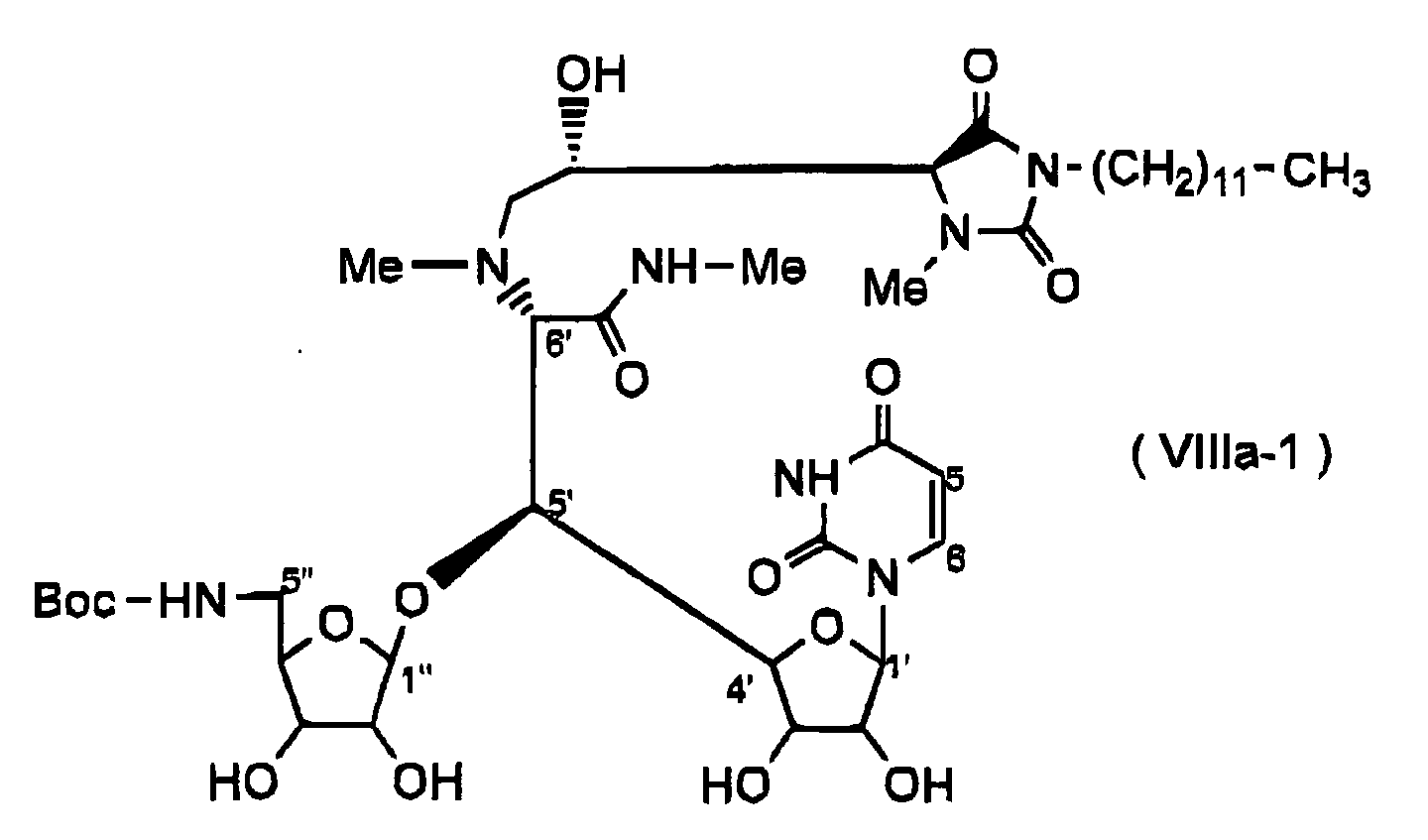
- the solid was recognized to be an imidazolidinone derivative which is a product derived from the compound of the estimated formula (XXV) by a partial cyclization thereof, and which is represented by the following general formula (VIIIa) wherein R 6 has the same meaning as defined above.
- the derivative of the formula (VIIIa) was treated with trifluoroacetic acid in methanol.
- the resulting reaction solution of the elimination reaction was concentrated to dryness under a reduced pressure, and the resulting residue was washed with diethyl ether and then dried, to afford an addition salt of trifluoroacetatic acid of an imidazolidinone derivative of the undermentioned general formula (VIII).
- This derivative of the formula (VIII) was given CP-IM as code name.
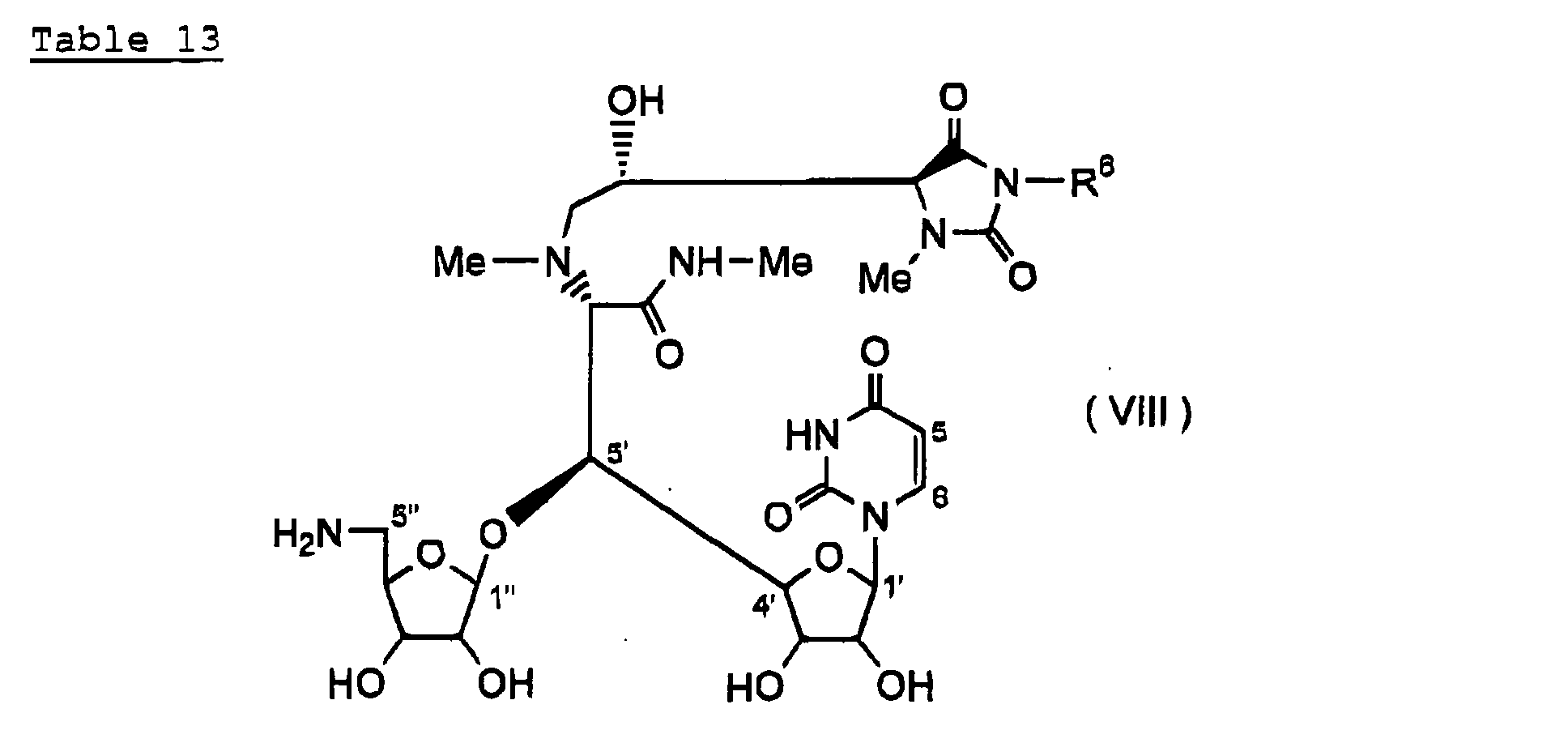
- the imidazolidinone derivative of the formula (VIII) is also found to have antibacterial activities against bacteria.
- an imidazolidinone derivative CP-IM, which is represented by the following general formula (VIII) wherein Me is methyl group and R 6 is a straight chain or a substantially straight chain alkyl group of 1-21 carbon atoms, or a pharmaceutically acceptable acid addition salt thereof.
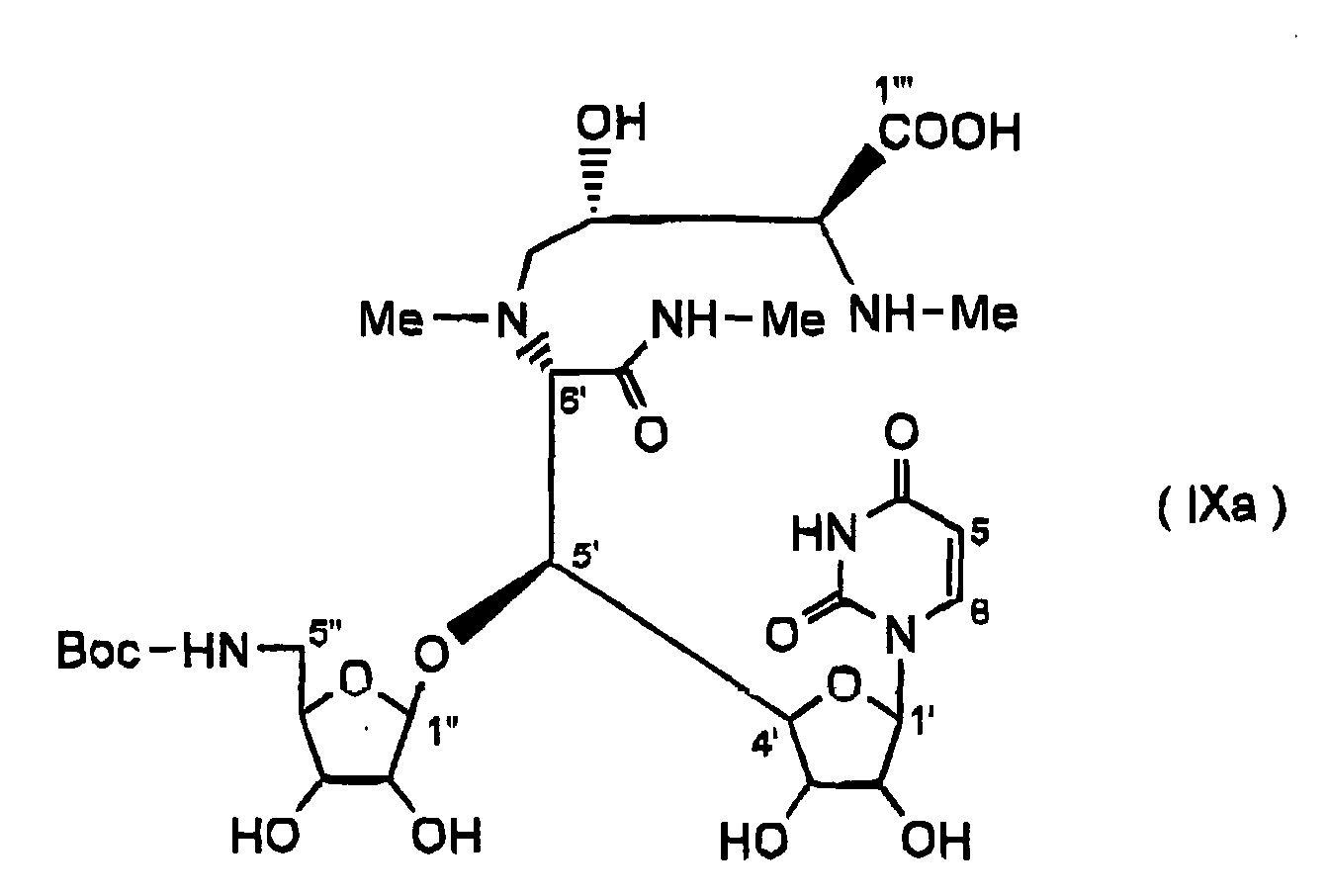
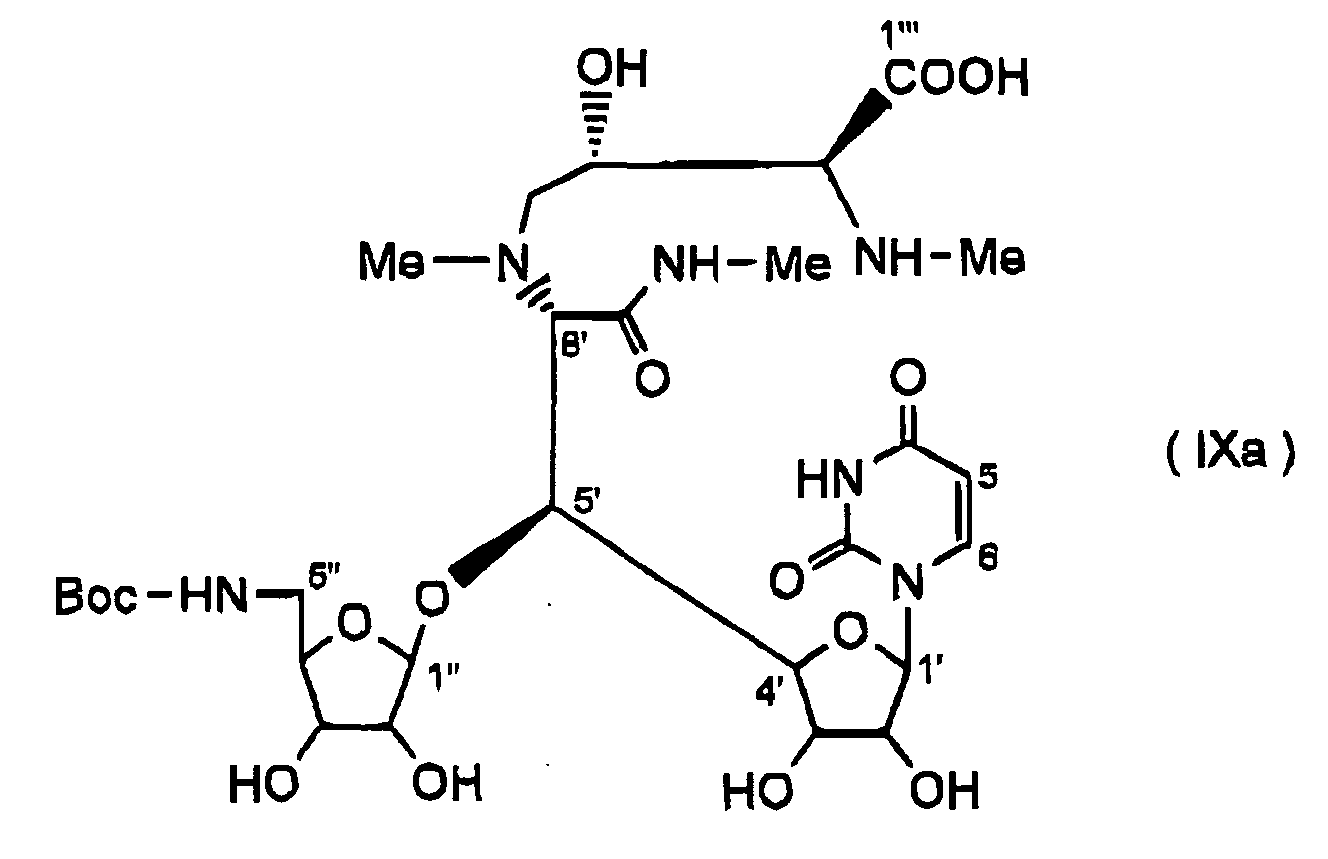
- the uridine derivative of the formula (IX) and the 5''-N-t-butoxycarbonyl-uridine derivative of the formula (IXa) above do not have a significant antibacterial activity, but both the derivatives are novel compounds useful as intermediate compounds for use in the synthesis of the derivative of the formula (VIII).
- an uridine derivative represented by the following formula (IX) wherein Me is methyl group, or its 5''-N-t-butoxycarbonyl derivative.
- the caprazene derivative of the formula (II) or the formula (III), the caprazol derivative of the formula (V) or the formula (VI) or the formula (VII) or the imidazolidinone derivatives of the formula (VIII) or acid addition salts of these derivatives may be administered, either by itself or in the form of a pharmaceutical composition containing it as active ingredient, through any appropriate route.
- a pharmaceutical composition comprising as active ingredient at least one of a caprazene-1'''-amide derivative of the formula (II) or a caprazene-1'''-ester derivative of the formula (III) or a caprazol-1'''-amide derivative of the formula (V) oracaprazol-1'''-amide-3'''-ester derivative of the formula (VI) or a caprazol-3'''-ester derivative or a caprazol-1'''-ester-3'''-ester derivative of the formula (VII) or an imidazolidinone derivative, CP-IM, of the formula (VIII), or an acid addition salt of these derivative, and a pharmaceutically acceptable liquid or solid carrier or carriers, in combination with the active ingredient.
- Caprazamycin B (200 mg) was dissolved in 80% aqueous acetic acid solution (6 ml) and the resulting solution was heated at 70 °C for 2 hours. The resulting reaction solution was concentrated, and to the resulting syrupy concentrate was added an amount of acetone. The precipitate so deposited was recovered by filtration, washed with acetone and dried. Thus, there was afforded caprazene (96.3 mg) as a colorless solid. Yield; 99%. Melting point: 210-211°C (with decomposition) (after the crystallization from water-acetone) Specific rotation: [ ⁇ ] 19 +85°(c 0.5, H 2 O) 1 H-NMR spectrum and 13 C-NMR spectrum of caprazene are shown in the following Table 15.
- caprazamycins B-F (see the general formulae (A) and (B) shown hereinbefore) was dissolved in 80% aqueous acetic acid solution (250 ml) and the resulting solution was heated at 70°C for 2 hours. The reaction solution obtained was concentrated, and to the resulting syrupy concentrate was added an amount of acetone, and the deposited precipitate was recovered by filtration. The solid so precipitated and recovered was washed with acetone and dried, to afford caprazene (5.1 g).
- Caprazene of the formula (I) (8.14 g) was suspended in a mixed solvent (120 ml) of water-dioxane (2:1). To the resultant suspension was added triethylamine (3.7 ml) to give a homogeneous solution of caprazene. To the resulting solution was added a solution of di-t-butyl dicarbonate (3.2 g) dissolved in dioxane (5 ml), and the reaction intended was conducted at room temperature for 1 hour (for the reaction for introducing t-butoxycarbonyl group (Boc) as amino-protecting group).
- Example 3 (a) The 5''-N-Boc-caprazene obtained in Example 3 (a) (150 mg) was suspended in tetrahydrofuran (6 ml). To the resulting suspension were added triethylamine (80 ⁇ l), N,N-bis(2-oxo-3-oxazolidinyl)phosphinic chloride (80 mg) and one of the various amine compounds R 1 -NH 2 shown in the following Table 16 or one of various para-substituted aniline (1.1 to 1.3 molar equivalents each). The resulting mixture was stirred at room temperature for 1 hour to cause the reaction intended (for the amidation reaction).
- Amine compound R 1 -NH 2 Chemical formula Name Chemical formula Name C 6 H 13 -NH 2 Hexylamine C 15 H 31 -NH 2 Pentadecylamine C 7 H 15 -NH 2 Heptylamine C 16 H 33 -NH 2 Hexadecylamine C 8 H 17 -NH 2 Octylamine C 17 H 35 -NH 2 Heptadecylamine C 9 H 19 -NH 2 Nonylamine C 18 H 37 -NH 2 Octadecylamine C 10 H 21 -NH 2 Decylamine C 19 H 39 -NH 2 Nonadecylamine C 11 H 23 -NH 2 Undecylamine C 20 H 41 -NH 2 Icocylamine C 12 H 25 -NH 2 Dodecylamine C 21 H 43 -NH 2 Henicocylamine C 13 H 27 -NH 2 Tridecylamine Cyclo (CH 2 ) 12 -NH 2 Cyclododecylamine C 14 H 29 -NH
- caprazene-1'''-amide derivatives of the formula (II) which are Compound II-A to Compound II-R shown in Table 2-1 above, or Compound II-1 to Compound II-24 shown in Table 2-2 above, respectively, as a colorless solid. Yield; 54.5-58.0 mg (Yield as an addition salt of bis-trifluoroacetic acid; 96-99%).
- Example 3 (a) The 5''-N-Boc-caprazene obtained in Example 3 (a) (150 mg) was dissolved in pyridine (5 ml). To the resultant solution were added N,N-bis (2-oxo-3-oxazolidinyl)phosphinic chloride (120 mg) as well as each one of a variety of alcohol compounds R 2 -OH shown in Table 17 below (2 molar equivalents in each case). The resulting reaction mixture was stirred at room temperature overnight to cause the reaction intended (for the esterification reaction).
- Caprazamycin B (150 mg) was dissolved in N,N-dimethylformamide (1.5 ml), and to the resultant solution was then added 28% aqueous ammonia solution (1.5 ml). The resulting mixture was stirred at room temperature for 4 days to effect the intended hydrolysis. Insolubles formed in the reaction solution were filtered off, and thereafter the reaction solution was concentrated and the resulting residue was washed with acetone and dried. Thus, there was afforded caprazol (74.7 mg) as a colorless solid. Yield; 99%.
- caprazol An amount of caprazol was dissolved in an amount of 1N aqueous hydrochloric acid and the resultant solution was heated at 100°C for 3 hours, thereby to produce caprazene in the yield of 20%. About 20% of caprazol was left unreacted. Respective chemical structure of each compound was confirmed by NMR analysis. The resulting reaction solution was concentrated under a reduced pressure and the resulting residue was subjected to a silica-gel column chromatography. Thus, there can be separated caprazene and caprazol, from each other.
- the 5''-N-Boc-caprazol (97.8mg) obtained in Example 8(a) was dissolved in N,N-dimethylformamide (3 ml), and to the resultant solution were added triethylamine (0.21 ml), n-dodecylamine (137 mg) and N,N-bis(2-oxo-3-oxazolidinyl) phosphinic chloride (188 mg). The resulting mixture was heated at 40°C to effect the reaction intended (for the amidation reaction).
- reaction solution was concentrated to dryness.
- the residue was extracted with chloroform, and the chloroform extract was washed once with water, then twice with aqueous saturated sodium sulfate solution and then dried over anhydrous sodium sulfate.
- the resulting solution was concentrated to dryness to yield a solid.
- the solid was purified by a silica-gel column chromatography (developing system: chloroform-methanol-concentrated aqueous ammonia; 4:1:0.1).
- developer system chloroform-methanol-concentrated aqueous ammonia; 4:1:0.1
- Streptomyces sp. MK730-62F2 (deposited under the depository number of FERM BP-7218), which had been cultured on an agar slant culture medium, was inoculated in a culture medium which had been prepared by placing into Erlenmeyer flasks (500 ml capacity) 110 ml portions of a liquid culture medium comprising 2% galactose, 2% dextrin, 1% glycerine, 1% Bacto-Soyton (a product of Difco Co.), 0.5% corn steep liquor, 0.2% ammonium sulfate and 0.2% calcium carbonate (adjusted to a pH of 7.4) and sterilizing the culture medium in the flasks at 120°C for 20 minutes in a usual manner, before the inoculation of the strain MK730-62F2 was done. The liquid culture medium so inoculated was then subjected to shaking cultivation with rotation at 30°C for 2 days, whereby giving a seed culture broth as intended.
- a culture medium (15 L) comprising 2.4% tomato paste (a product of Kagome Co.), 2.4% dextrin, 1.2% yeast extract (a product of Oriental Co.) and 0.0006% cobalt chloride (adjusted to a pH of 7.4), which was then sterilized to give a productive culture medium.
- a productive culture medium was inoculated a 2% proportion of the above-mentioned seed culture broth. The cultivation of the said strain was conducted in the tank fermenter at 27°C, with aeration of 15 L of air per minute and stirring speed of 200 rpm for 6 days.
- the resulting culture broth was centrifuged to separate the culture broth filtrate (12 L) from the cultured microbial cells. Subsequently, methanol (6 L) was added to the microbial cells and the resulting mixture was well stirred to extract from the microbial cells the already known antibiotics, caprazamycins A, B, C, E and F, and the novel antibiotics, caprazamycins D, G, D1 and G1 into methanol (hereinafter, sometimes, these antibiotics, caprazamycins A, B, C, D, E, F, G, D1 and G1, are generically described as caprazamycins).
- the culture broth filtrate and the methanolic extract of the cells obtained as above were combined together, and the resulting mixture (18 L) was passed through a column packed with 750 ml of a synthetic adsorbent resin made of aromatic polymer, namely Diaion HP-20 (a product of Mitsubishi Chemical Co., Japan) to adsorb caprazamycins therein.
- a synthetic adsorbent resin made of aromatic polymer namely Diaion HP-20 (a product of Mitsubishi Chemical Co., Japan) to adsorb caprazamycins therein.
- Diaion HP-20 column containing the caprazamycins so adsorbed were passed 2.25 L each of deionized water, 50% aqueous methanol, 80% aqueous methanol, 80% aqueous acetone and acetone, in order.
- the caprazamycins were eluted from the column, mainly in the eluate fractions as eluted with 80% aqueous acetone.
- the eluate fractions as eluted with the 50% aqueous methanol and with the 80% aqueous methanol also contained caprazamycins.
- the resulting eluate as eluted with 80% aqueous acetone was combined with the first eluate as eluted with 80% aqueous acetone in the first stage column and the resulting mixture was concentrated to dryness under a reduced pressure, thus affording a partially purified product comprising caprazamycins (10.1 g).
- the partially purified product (10.1 g) containing caprazamycins was dissolved in a mixed solvent (50 ml) of chloroform-methanol (1:2), to which solution was added Kieselgur (Art. 10601, a product of Merek & Co.)(50 ml) and the solvent was removed by concentration to dryness under a reduced pressure.
- Kieselgur Art. 10601, a product of Merek & Co.
- the resulting solid residue obtained by adsorbing the caprazamycins in the Kieselgur was placed on the top of a silica-gel column (54 mm inner diameter and 200 mm long) to be subjected to a chromatography.
- the development treatment was made, in order, with chloroform-methanol-water (4:1:0.1), chloroform-methanol-water (2:1:0.2) and chloroform-methanol-water (1:1:0.2)(1.35 L in each time).
- fractions Nos.1 to 53 were collected each in 20 g portions and fractions Nos. 54 to 117 were collected each in 19 g portions.
- active fractions containing caprazamycins A, B, C, D, E, F and G were eluted in fractions Nos. 66 to 83 and the active fractions containing caprazamycins D1 and G1 were eluted in fractions Nos. 84 to 144.
- caprazamycins A, B, C, D, E, F and G were combined together and concentrated to dryness under a reduced pressure to yield a partially purified product comprising caprazamycins A, B, C, D, E, F and G (625.3 mg).
- the fractions Nos. 54 to 117 were also combined together and concentrated to dryness under a reduced pressure to yield a partially purified product comprising caprazamycins D1 and G1 (1.28 g).
- the partially purified product containing caprazamycins A, B, C, D, E, F and G was subjected to treatments for the isolation and purification of the respective compounds from one another.
- methanol 5 ml was added to the said partially purified product above (625.3 mg) and the the resulting solution was allowed to stand at 5°C under cold and dark conditions, whereby a fraction of precipitate as deposited (537.3 mg) was obtained as a product which contains caprazamycins A, B, C, D, E, F and G.
- the fraction of the deposited precipitate containing caprazamycins A, B, C, D, E, F and G was purified by subjecting it to HPLC (CAPCELLPAK C18, ⁇ 20x250mm, a product of Shiseido, Co.).
- the development was effected by 50% aqueous acetonitrile-0.05% formic acid as the development solvent (at a flow rate of 12.0 ml/min), whereby caprazamycin A was eluted after 61-68 minutes, caprazamycin B was eluted after 52-60 minutes, caprazamycin C was eluted after 39-41 minutes, a mixture of caprazamycin D and caprazamycin G was eluted after 30-38 minutes, caprazamycin E was eluted after 25-28 minutes, and caprazamycin F was eluted after 22-25 minutes of the development.
- caprazamycin A 56.9 mg
- caprazamycin B 90.3 mg
- caprazamycin C (19.7 mg)
- a mixture comprising caprazamycin D and caprazamycin G (162.9 mg)
- caprazamycin E 30.3 mg
- caprazamycin F 25.5 mg
- the mixture comprising caprazamycin D and caprazamycin G obtained as above (162.9 mg) was purified by HPLC (CAPCELLPAK C18, ⁇ 20x250mm, a product of Shiseido, Co.).
- HPLC HPLC
- the development was effected with the solvent system of 50% aqueous acetonitrile-0.025% trifluoroacetic acid (at a flow rate of 9.0 ml/min), whereby caprazamycin D was eluted after 55-69 minutes and caprazamycin G was eluted after 48-53 minutes of the development.
- the respective active fractions were collected separately and then concentrated to dryness under a reduced pressure, thus to afford caprazamycin D (69.7 mg) and caprazamycin G (39.0 mg), respectively.
- the partially purified product (1.28 g) containing caprazamycins D1 and G1 obtained as above was subjected to the treatments for the isolation and purification of the respective compounds from each other by HPLC (CAPCELLPAK C18, ⁇ 20x250mm, a product of Shiseido, Co.).
- HPLC HPLC
- the development was effected with the solvent system of 45% aqueous acetonitrile-0.05% trifluoroacetic acid (at a flow rate of 12.0ml/min), whereby caprazamycins G1 and D1 were eluted after 36-49 minutes of the development.
- caprazene and caprazol are now produced by hydrolysis of caprazamycins according to this invention.
- Caprazene and caprazol are useful compounds for the production of semi-synthesized derivatives having excellent antibacterial activities.
- novel compounds which are a caprazene-1'''-amide derivative of the formula (II), a caprazene-1'''-ester derivative of the formula (III), a caprazol-1'''-amide derivative of the formula (V), a caprazol-1'''-amide-3'''-ester derivative of the formula (VI), a caprazol-3'''-ester derivative and a caprazol-1'''-ester-3'''-ester derivative of the formula (VII) or an imidazolidinone derivative CP-IM of the formula (VIII).
- caprazene and caprazol have excellent antibacterial activities against a variety of bacteria and are useful as antibacterial agents.
- the uridine derivative of the formula (IX) as obtained according to this invention is useful as novel intermediate compound utilizable in the syntheses of a variety of novel compounds.
Landscapes
- Chemical & Material Sciences (AREA)
- Organic Chemistry (AREA)
- Health & Medical Sciences (AREA)
- Life Sciences & Earth Sciences (AREA)
- General Health & Medical Sciences (AREA)
- Molecular Biology (AREA)
- Engineering & Computer Science (AREA)
- Biotechnology (AREA)
- Genetics & Genomics (AREA)
- Biochemistry (AREA)
- Pharmacology & Pharmacy (AREA)
- Veterinary Medicine (AREA)
- Public Health (AREA)
- Animal Behavior & Ethology (AREA)
- Medicinal Chemistry (AREA)
- Nuclear Medicine, Radiotherapy & Molecular Imaging (AREA)
- General Chemical & Material Sciences (AREA)
- Chemical Kinetics & Catalysis (AREA)
- Communicable Diseases (AREA)
- Oncology (AREA)
- Epidemiology (AREA)
- Bioinformatics & Cheminformatics (AREA)
- Pulmonology (AREA)
- Pharmaceuticals Containing Other Organic And Inorganic Compounds (AREA)
- Saccharide Compounds (AREA)
- Low-Molecular Organic Synthesis Reactions Using Catalysts (AREA)
- Plural Heterocyclic Compounds (AREA)
- Organic Low-Molecular-Weight Compounds And Preparation Thereof (AREA)
Abstract

Description







| Alkyl group | |||
| Formula | Name | Formula | Name |
| C5H11- | Pentyl (Amyl) | C13H27- | Tridecyl |
| C6H13- | Hexyl | C14H29- | Tetradecyl |
| C7H15- | Heptyl | C15H31- | Pentadecyl |
| C8H17- | Octyl | C16H33- | Hexadecyl |
| C9H19- | Nonyl | C17H35- | Heptadecyl |
| C10H21- | Decyl | C18H37- | Octadecyl |
| C11H23- | Undecyl | C19H39- | Nonadecyl |
| C12H25- | Dodecyl | C20H41- | Icocyl |
| C21H43- | Henicosyl |


| Compound code name of the test compound (see Table 2, Table 3) | Minimum growth inhibitory concentration (mcg/ml) against bacteria | ||
| Staphylococcus aureus FDA209P | Micrococcus luteus FDA16 | Mycobacterium smegmatis ATCC607 | |
| Compound II-A | >100 | 3.13 | 100 |
| Compound II-B | 25 | 1.56 | 25 |
| Compound II-C | 6.25 | 0.78 | 12.5 |
| Compound II-D | 6.25 | 0.39 | 3.13 |
| Compound II-E | 25 | 0.39 | 0.78 |
| Compound II-F | 1.56 | 0.39 | 0.39 |
| Compound II-G | 3.13 | 0.39 | 0.39 |
| Compound II-H | 3.13 | 0.78 | <0.20 |
| Compound II-I | 3.13 | 0.78 | 0.78 |
| Compound II-J | 1.56 | 0.78 | 1.56 |
| Compound II-K | 3.13 | 0.78 | 3.13 |
| Compound II-L | 1.56 | 1.56 | 3.13 |
| Compound II-M | 6.25 | 0.78 | 3.13 |
| Compound II-N | 6.25 | 0.78 | 50 |
| Compound II-O | 3.13 | 3.13 | 25 |
| Compound II-P | 6.25 | 3.13 | 50 |
| Compound II-Q | 100 | 0.20 | 3.13 |
| Compound II-R | 1.56 | 1.56 | 1.56 |
| Compound II-G-N-Boc | 50 | 50 | 50 |
| Compound II-H-N-Boc | 25 | 12.5 | 25 |
| Compound II-I-N-Boc | 12.5 | 12.5 | 25 |
| Compound II-J-N-Boc | 12.5 | 12.5 | 25 |
| Compound Code name of the test compound (see Table 2, Table 3) | Minimum growth inhibitory concentration (mcg/ml) against bacteria | ||
| Staphylococcus aureus FDA209P | Micrococcus luteus FDA16 | Mycobacterium smegmatis ATCC607 | |
| Compound II-1 | >100 | 3.13 | 100 |
| Compound II 2 | 100 | 3.13 | 50 |
| Compound II-3 | 25 | 3.13 | 12.5 |
| Compound II-4 | 12.5 | 0.78 | 6.25 |
| Compound II-5 | 3.13 | 0.2 | 3.13 |
| Compound II-6 | 1.56 | 0.39 | 0.78 |
| Compound II-7 | 1.56 | <0.20 | <0.20 |
| Compound II-8 | 3.13 | 0.39 | 0.78 |
| Compound II-9 | 3.13 | 0.39 | 1.56 |
| Compound II-10 | 3.13 | <0.20 | 3.13 |
| Compound II-11 | 3.13 | 0.39 | 3.13 |
| Compound II-12 | 3.13 | 0.78 | 6.25 |
| Compound II-13 | 3.13 | 1.56 | 12.5 |
| Compound II-14 | 6.25 | 3.13 | 25 |
| Compound II-15 | 100 | 3.13 | 50 |
| Compound II-16 | 50 | 3.13 | 25 |
| Compound II-17 | 25 | 1.56 | 12.5 |
| Compound II-18 | 12.5 | 0.78 | 6.25 |
| Compound II-19 | 6.25 | 0.78 | 3.13 |
| Compound II-20 | 6.25 | 0.39 | 1.56 |
| Compound II-21 | 3.13 | 0.20 | 0.78 |
| Compound II-22 | 3.13 | 0.39 | 0.78 |
| Compound II-23 | 1.56 | 0.39 | 0.78 |
| Compound II-24 | 12.5 | 0.39 | 1.56 |


| Compound code name of the test compound (see Table 5) | Minimum growth inhibitory concentration (mcg/ml) against bacteria | ||
| Staphylococcus aureus FDA209P | Micrococcus luteus FDA16 | Mycobacterium smegmatis ATCC607 | |
| Compound III-AA | 12.5 | 1.56 | 12.5 |
| Compound III-BB | 3.13 | 3.13 | 12.5 |
| Compound III-CC | 12.5 | 6.25 | >100 |
| Compound III-DD | 6.25 | 1.56 | 25 |
| Compound III-EE | 6.25 | 1.56 | 12.5 |
| Compound III-FF | 25 | 1.56 | 12.5 |
| Compound III-GG | 50 | 6.25 | 25 |




| Compound code name of the test compound (see Table 7) | Minimum growth inhibitory concentration (mcg/ml) against bacteria | ||
| Staphylococcus aureus FDA209P | Micrococcus luteua FDA16 | Mycobacterium smegmatis ATCC607 | |
| Compound V-A | 50 | 50 | 12.5 |
| Compound V-B | |||
| Compound V-C | 25 | 25 | 6.25 |
| Compound V-D | |||
| Compound V-E | 25 | 25 | 6.25 |
| Compound V-F | 12.5 | 25 | 6.25 |
| Compound V-G | 12.5 | 25 | 6.25 |
| Compound V-Q | |||
| Compound V-R | 12.5 | 25 | 6.25 |


| Compound code name of the test compound (see Table 9) | Minimum growth inhibitory concentration (mcg/ml) against bacteria | ||
| Staphylococcus aureus FDA209P | Micrococcus luteus FDA16 | Mycobacterium smegmatis ATCC607 | |
| Compound VI-A | 25 | 25 | 12.5 |
| Compound VI-B | |||
| Compound VI-C | 12.5 | 6.25 | 6.25 |
| Compound VI-D | |||
| Compound VI-E | 12.5 | 6.25 | 6.25 |
| Compound VI-F | 12.5 | 3.13 | 6.25 |
| Compound VI-G | 25 | 3.13 | 6.25 |
| Compound VI-Q | 12.5 | 3.13 | 6.25 |
| Compound VI-R | 25 | 3.13 | 6.25 |




| Compound code name of the test compound (see Table 11) | Minimum growth inhibitory concentration (mcg/ml) against bacteria | ||
| Staphylococcus aureus FDA209P | Micrococcus luteus FDA16 | Mycobacterium smegmatis ATCC607 | |
| Compound VII-A | 25 | >50 | 1.56 |
| Compound VII-B | 12.5 | >50 | 1.56 |
| Compound VII-C | 12.5 | >50 | 0.78 |
| Compound VII-D | 3.13 | 3.13 | 0.78 |
| Compound VII-E | 1.56 | 1.56 | 0.39 |
| Compound VII-F | 0.78 | 3.13 | 0.78 |
| Compound VII-G | >100 | >100 | 50 |
| Compound VII-Q | |||
| Compound VII-R | 1.56 | 3.13 | 6.25 |



| Compound code name of the test compound (see Table 13) | Minimum growth inhibitory concentration (mcg/ml) against bacteria | ||
| Staphylococcus aureus FDA209P | Micrococcus luteus FDA16 | Staphylococcus aureus ATCC607 | |
| Compound VIII-A | |||
| Compound VIII-B | |||
| Compound VIII-C | |||
| Compound VIII-D | |||
| Compound VIII-E | 25 | 6.25 | 6.25 |
| Compound VIII-F | 25 | 6.25 | 6.25 |
| Compound-VIII-G | 25 | 6.25 | 12.5 |

Melting point: 210-211°C (with decomposition) (after the crystallization from water-acetone)
Specific rotation: [α]19 +85°(c 0.5, H2O)
1H-NMR spectrum and 13C-NMR spectrum of caprazene are shown in the following Table 15.
| Position | 1H-NMR data of caprazene (δ, ppm in D2O) | Position | 13C-NMR data of caprazene (δ, ppm in D2O) |
| 5 | 5.82, d, J=8Hz | 2 | 151.7 |
| 6 | 7.69, d, J=8Hz | 4 | 166.8 |
| 5 | 102.0 | ||
| 6 | 142.4 | ||
| 1' | 5.62, d, J=2.5Hz | ||
| 2' | 4.28, dd, J=2.5, 5Hz | 1' | 91.4 |
| 3' | 4.12, dd, J=5, ~8Hz | 2' | 73.9 |
| 4' | 4.24, br. d, J=~8Hz | 3' | 69.4 |
| 5' | 4.34, dd, J=2, 9.5Hz | 4' | 82.7 |
| 5' | 77.0 | ||
| 1'' | 5.22, slightly br. s | ||
| 2" | 4.13, br. d, J=~5Hz | ||
| 3" | 4.26, dd, J=~5, ~8Hz | 1" | 110.0 |
| 4'' | 4.20, m | 2'' | 75.3 |
| 5"a | 3.18, dd, J=5, 14Hz | 3'' | 70.7 |
| 5''b | 3.35, dd, J=4, 14Hz | 4'' | 79.0 |
| 5" | 40.5 | ||
| 2''' | |||
| 3''' | 6.49, t, J=7Hz | 1''' | 169.2 |
| 4'''a | 2.94, dd, J=7, 12.5Hz | 2''' | 144.7 |
| 4"'b | 3.34, dd, J=7, 12.5Hz | 3''' | 123.5 |
| 6''' | 3.92, d, J=9.5Hz | 4''' | 51.5 |
| MeN-5''' | 2.42, s | 6''' | 63.6 (broad) |
| MeN-8''' | 2.99, s | 7''' | 171.3 |
| MeN-5''' | 40.5 | ||
| MeN-8''' | 33.2 |
1H-NMR spectrum (in heavy water (D2O), TMS internal standard)

| Amine compound R1-NH2 | |||
| Chemical formula | Name | Chemical formula | Name |
| C6H13-NH2 | Hexylamine | C15H31-NH2 | Pentadecylamine |
| C7H15-NH2 | Heptylamine | C16H33-NH2 | Hexadecylamine |
| C8H17-NH2 | Octylamine | C17H35-NH2 | Heptadecylamine |
| C9H19-NH2 | Nonylamine | C18H37-NH2 | Octadecylamine |
| C10H21-NH2 | Decylamine | C19H39-NH2 | Nonadecylamine |
| C11H23-NH2 | Undecylamine | C20H41-NH2 | Icocylamine |
| C12H25-NH2 | Dodecylamine | C21H43-NH2 | Henicocylamine |
| C13H27-NH2 | Tridecylamine | Cyclo (CH2)12-NH2 | Cyclododecylamine |
| C14H29-NH2 | Tetradecylamine | CH3(CH2)7C=C(CH2)8-NH2 | Oleylamine |

| Alcohol compound R2-OH | |
| Chemical formula | Name |
| H3C(CH2)9-OH | Decyl alcohol |
| H3C(CH2)12-OH | Tridecyl alcohol |
| H3C(CH2)17-OH | Octadecyl alcohol |
| H3C-CH2-CH=CH-(CH2)10-OH | Cis-11-tetradecene-1-ol |
| H3C-(CH2)8-CH=CH-CH2-OH | Trans-2-dodecenol |
| H2C=CH-(CH2)9-OH | 10-Undecene-1-ol |
| H3C-(CH2)5-C≡C-(CH2)2-OH | 3-Decyne-1-ol |

Yield; 99%.
Melting point: 205-206°C (with decomposition) (after the crystallization from water-methanol)
Specific rotation: [α]D 19 +28° (c 0.5, dimethylsulfoxide)
1H-NMR spectrum and 13C-NMR spectrum of caprazol are shown in the following Table 18.
| Position | 1H-NMR data of caprazol (δ, ppm in D2O) | Position | 13C-NMR data of caprazol (δ, ppm in D2O) |
| 5 | 5.82, d, J=8Hz | 2 | 151.8 |
| 6 | 7.77, d, J=8Hz | 4 | 167.1 |
| 5 | 101.7 | ||
| 6 | 142.9 | ||
| 1' | 5.60, slightly br. s | ||
| 2' | 4.31, br. d, J=5Hz | 1' | 91.8 |
| 3' | 4.08, dd, J=5, 8Hz | 2' | 74.0 |
| 4' | 4.13, d, J=~8Hz | 3' | 69.3 |
| 5' | 4.39, d, J=9Hz | 4' | 82.4 |
| 5' | 77.6 | ||
| 1'' | 5.17, slightly br. s | ||
| 2'' | 4.14, d, J=~3Hz | ||
| 3" | 4.25, m | 1'' | 111.2 |
| 4'' | ~4.21, m | 2'' | 75.4 |
| 5''a | 3.20, dd, J=4, 13.5Hz | 3" | 70.6 |
| 5''b | 3.32, dd, J=3.5, 13.5Hz | 4'' | 79.0 |
| 5" | 40.2 | ||
| 2''' | 4.20, d, J=~5Hz | ||
| 3''' | 4.94, br. s | 1''' | 174.1 |
| 4''' a | 3.01, br. d, J=15Hz | 2''' | 70.0 |
| 4'''b | 3.13, br. d, J=15Hz | 3''' | 69.3 |
| 6''' | 3.85, d, J=9Hz | 4''' | 59.1 |
| MeN-5''' | 2.43, s | 6''' | 63.5 |
| MeN-8''' | 3.07, s | 7''' | 172.7 |
| MeN-5''' | 37.0 | ||
| MeN-8''' | 39.2 |
1H-NMR spectrum (500 MHz, in D2O):
δ 1.40 (9H, s, methyl in the t-butoxycarbonyl group), 2.47 (3H, s, NMe-5'''), 3.13 (3H, s, NMe-8'''), 5.16 (1H, s, H-1''), 5.74 (1H, br. s, H-1').
[α]D 19 +12°(c 1, methanol)
1H-NMR spectrum (500 MHz, in deutero-methanol):
δ 0.89 (3H, t, N(CH2)11 Me, J=7Hz), 2.51 (3H, s, NMe-5'''), 3.18 (3H, s, NMe-8'''), 5.17(1H, s, H-1''), 5.76 (1H, s, H-1'), 5.77 (1H, d, H-5, J5,6=8Hz), 8.08(1H, d, H-6).
Yield; 99%.
[α]D 19 -30°(c 2, chloroform)
1H-NMR spectrum (500 MHz, in deutero-methanol):
δ 1.25, 1.36, 1.40, 1.53 (each 3H, s, methyl in isopropylidene group), 1.45 (9H, s, methyl in t-butoxycarbonyl group), 2.50 (3H, s, NMe-5'''), 3.09 (3H, s, NMe-8'''), 5.24 (1H, s, H-1''), 5.83 (1H, d, H-1', J1',2'=2.7Hz).
(Yield; 54%).
[α]D 19 -31° (c 2, methanol)
1H-NMR spectrum (500 MHz, in deutero-methanol):
δ 0.89 (3H, t, N(CH2)11 Me, J=7Hz), 1.44 (9H, s, methyl in t-butoxycarbonyl group), 2.50 (3H, s, NMe-5"'), 3.16 (3H, s, NMe-8'''), 5.27 (1H, s, H-1''), 5.73 (1H, d, H-5, J5,6=8Hz), 5.94 (1H, d, H-1', J1',2'=2.7Hz), 7.72 (1H, d, H-6).
[α]D 21 +6°(c 0.5, methanol)
1H-NMR spectrum (500 MHz, in deutero-methanol):
δ 0.90 (6H,t, N(CH2)11 Me and (CH2)10 Me, J=7Hz), 2.37 (2H,t, CH 2(CH2)9Me, J=7Hz), 2.45 (3H, s, NMe-5'''), 3.16 (3H, s, NMe-8'''), 5.18 (1H, s, H-1''), 5 53 (1H, br. s, H-3'''), 7.73 (1H, d, H-6, J5,6=8Hz).Further, an illustrative experiment of the preparation of caprazol-3'''-ester derivative of the formula (VII) according to the ninth aspect of this invention is explained with reference to the following Example 10.

[α]D 20 +17°(c 0.5, dimethylsulfoxide)
1H-NMR spectrum (500 MHz, in deutero-dimethylsulfoxide):
δ 0.86 (3H, t, (CH2)10 Me, J=7Hz), 2.26 (3H, s, NMe-5'''), 2.93 (3H, s, NMe-8'''), 5.00 (1H, s, H-1''), 5.40 (1H, br. s, H-3'''), 5.56 (1H, s, H-1'), 5.64 (1H, d, H-5, J5,6=8Hz), 7.81 (1H, d, H-6)
[α]D 19 -33°(c 0.3, methanol)
1H-NMR spectrum (500 MHz, in deutero-methanol):
δ 1.27, 1.37, 1.42, 1.56 (each 3H, s, methyl in the isopropylidene group), 1.43 (9H, s, methyl in the t-butoxycarbonyl group), 2.50 (3H, s, NMe-5'''), 3.15 (3H, s, NMe-8'''), 3.36 (3H, s, COOMe), 5.27 (1H, s, H-1''), 5.71 (1H, d, H-5, J5,6=8Hz), 5.86 (1H, s, H-1'), 7.68 (1H, d, H-6).

[α]D 20 +6°(c 1, methanol)
1H-NMR spectrum (500 MHz, in deutero-methanol):
δ 0.90 (6H, t, N(CH2)11 Me and (CH2)10 Me, J=7Hz), 2.38 (2H, t, CH 2(CH2)9Me, J=7Hz), 2.46 (3H, s, NMe-5'''), 3.13 (3H, s, NMe-8'''), 3.68 (3H, s, COOMe), 5.20 (1H, s, H-1''), 5.42 (1H, br. s, H-3'''), 5.71 (1H, d, H-1', J1',2'=2Hz), 5.75 (1H, d, H-5, J5,6=8Hz), 7.71 (1H, d, H-6).Further, there are given in the following 1H-NMR spectrum data a (in deutero-dimethylsulfoxide, TMS Internal standard) of Compound VII-A, Compound VII-C, Compound VII-E and Compound VII-R which are included within the general formula (VII) above and shown in Table 11 above as concrete examples of these compounds. Compound VII-A
δ 0.86(3H, t, CH 3(CH2)5CO, J=7Hz), 2.29(3H, s, NMe-5'''), 3.02(3H, s, NMe-8'''), 5.02(1H, s, H-1''), 5.52(1H, s, H-1'), 5.66(1H, d, H-5, J=8Hz), 7.72(1H, d, H-6, J=8Hz), 11.33(1H, s, NH-3).
[α]D 20 +30° (c 1, H2O)
1H-NMR spectrum (500 MHz, in D2O)
δ 2.30(3H, s, NMe-6'), 2.50(3H, s, NMe-2'''), 2.61(3H, s, NMe-7'), 3.39(1H, d, H-2''', J2''',3'''=4Hz), 3.47(1H, d, H-6', J5', 6'=9Hz), 5.06(1H, d, H-1'', J1'',2''=2Hz), 5.54(1H, d, H-1', J1', 2'=2.5Hz), 5.67(1H, d, H-5, J5, 6=8Hz), 7.61(1H, d,H-6).
[α]D 21 -13°(c 1.5, methanol)
1H-NMR spectrum (500 MHz, in deutero-methanol)
δ 1.49 (9H, s, methyl in t-butoxycarbonyl group), 2.46(3H, s, NMe-6'), 2.73(3H, s, NMe-7'), 2.75(3H, s, NMe-2'''), 5.09(1H, br. s, H-1''), 5.77(1H, d, H-5, J5, 6=8Hz), 5.88(1H, d, H-1', J1', 2'=4Hz), 7.95(1H, d, H-6).
1H-NMR spectrum (500 MHz, in deutero-methanol)
δ 0.89 (3H, t, N(CH2)11 Me, J=7 Hz), 2.47 (3H, s, NMe-6'), 2.75 (3H, s, NMe-7'), 2.99 (3H, s, NMe-2'''), 5.09 (1H, d, H-1'').

[α]D 20 +13°(c 2, methanol)
1H-NMR spectrum (500 MHz, in deutero-methanol)
δ 0.89 (3H, t, N(CH2)11 Me, J=7 Hz), 5.16 (1H, d, H-1''), 7.74 (1H, d, H-6, J5,6=8 Hz).
Claims (17)
- Caprazene which is the compound represented by the following formula (I)wherein Me stands for methyl group, and a 5''-N-alkoxycarbonyl or 5''-N-aralkyloxycarbonyl derivative thereof.

- A process for the preparation of caprazene which is the compound represented by the following formula (I)wherein Me stands for methyl group, the process comprising hydrolyzing caprazamycin A, B, C, D, E, F or G or a mixture of two or more of caprazamycins A to G in an aqueous solution of an acid at room temperature or under heating.

- The process as claimed in Claim 2 wherein at least one of caprazamycins A to G is hydrolyzed in an acidic aqueous solution of acetic acid, sulfuric acid or hydrogen chloride.
- A caprazene-1'''-amide derivative and its 5''-N-alkoxycarbonyl or aralkyloxycarbonyl derivative which are represented by the following general formula (II)wherein Me is methyl group, R1 is a straight chain or a substantially straight chain alkyl group of 5-21 carbon atoms, a straight chain or a substantially straight chain alkenyl group of 5-21 carbon atoms or a cycloalkyl group of 5-12 carbon atoms, or R1 is a phenyl group having a straight chain alkyl group of 1-14 carbon atoms or a straight chain alkoxy group of 1-9 carbon atoms or a cycloalkyl group of 5-12 carbon atoms at the para-position of the phenyl group, A is hydrogen atom or A is an amino-protecting group including an alkoxycarbonyl group, particularly tert-butoxycarbonyl group, or an aralkyloxycarbonyl group, particularly benzyloxycarbonyl group, or a pharmaceutically acceptable acid addition salt thereof.

- The derivative as claimed in Claim 4 wherein A is hydrogen atom and R1 is an alkyl group, an alkenyl group or a cycloalkyl group in the general formula (II).
- The derivative as claimed in Claim 4 wherein A is hydrogen atom and R1 is a phenyl group having an alkyl group, an alkoxy group or a cycloalkyl group at the para-position thereof.
- A caprazene-1'''-ester derivative and a 5''-N-alkoxycarbonyl or a 5''-N-aralkyloxycarbonyl derivative thereof which are each represented by the following general formula (III)wherein Me is methyl group, R2 is a straight chain or a substantially straight chain alkyl group of 5-21 carbon atoms or a straight chain or a substantially straight chain alkenyl group of 5-21 carbon atoms or an alkynyl group of 5-21 carbon atoms and A is hydrogen atom or an amino-protecting group which is an alkoxycarbonyl group, particularly tert-butoxycarbonyl group, or an aralkyloxycarbonyl group, particularly benzyloxycarbonyl group, or a pharmaceutically acceptable acid addition salt thereof.
- Caprazol which is the compound represented by the following formula (IV)wherein Me is methyl group, and a 5''-N-alkoxycarbonyl or 5''-N-aralkyloxycarbonyl derivative thereof.
- A process for the preparation of caprazol represented by the following formula (IV)the process comprising subjecting caprazamycin A, B, C, D, E, F or G or a mixture of at least two of caprazamycins A to G to a hydrolysis in an aqueous solution of an inorganic base at room temperature or under heating.
- The process as claimed in Claim 9 wherein at least one of caprazamycins A to G is hydrolyzed in an aqueous solution of a base selected from ammonia (NH3), sodium hydroxide and potassium hydroxide at a temperature of about 40°C or lower.
- A caprazol-1'''-amide derivative and its 5"-N-alkoxycarbonyl- or aralkyloxycarbonyl derivative which are represented by the following general formula (V)wherein Me is methyl group, R3 is a straight chain or a substantially straight chain alkyl group of 5-21 carbon atoms, a straight chain or a substantially straight chain alkenyl group of 5-21 carbon atoms or a cycloalkyl group of 5-12 carbon atoms, and A is hydrogen atom or an alkoxycarbonyl group, particularly tert-butoxycarbonyl group, or an aralkyloxycarbonyl group, particularly benzyloxycarbonyl group as an amino-protecting group, or a pharmaceutically acceptable acid addition salts thereof.

- A caprazol-1'''-amide-3'''-ester derivative represented by the following general formula (VI)wherein Me is methyl group, R3 is a straight chain or a substantially straight chain alkyl group of 5-21 carbon atoms or a straight chain or a substantially straight chain alkenyl group of 5-21 carbon atoms or a cycloalkyl group of 5-12 carbon atoms, R4 is a straight chain or a substantially straight chain alkyl group of 5-21 carbon atoms or a straight chain or a substantially straight chain alkenyl group of 5-21 carbon atoms or an alkynyl group of 5-21 carbon atoms, or a pharmaceutically acceptable acid addition salt thereof.
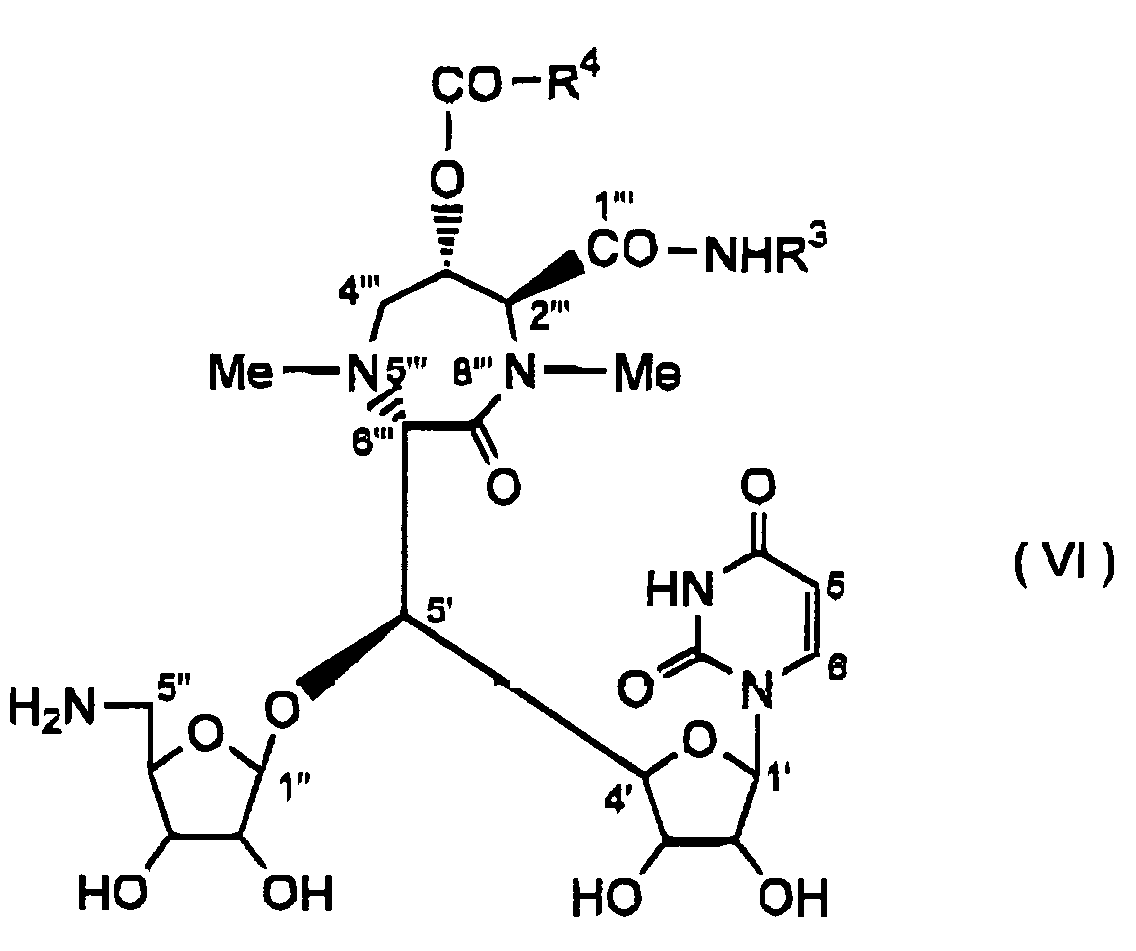
- A caprazol-3'''-ester derivative or a caprazol-1'''-ester-3"'-alkyl ester derivative which is represented by the following general formula (VII)wherein Me is methyl group, R4 is a straight chain or a substantially straight chain alkyl group of 5-21 carbon atoms or a straight chain or a substantially straight chain alkenyl group of 5-21 carbon atoms or an alkynyl group of 5-21 carbon atoms and R5 is hydrogen atom or an alkyl group of 1-21 carbon atoms, or a pharmaceutically acceptable acid addition salt thereof.

- An imidazolidinone derivative, CP-IM, represented by the following general formula (VIII)wherein Me is methyl group and R6 is a straight chain or a substantially straight chain alkyl group of 1-21 carbon atoms, or a pharmaceutically acceptable acid addition salt thereof.
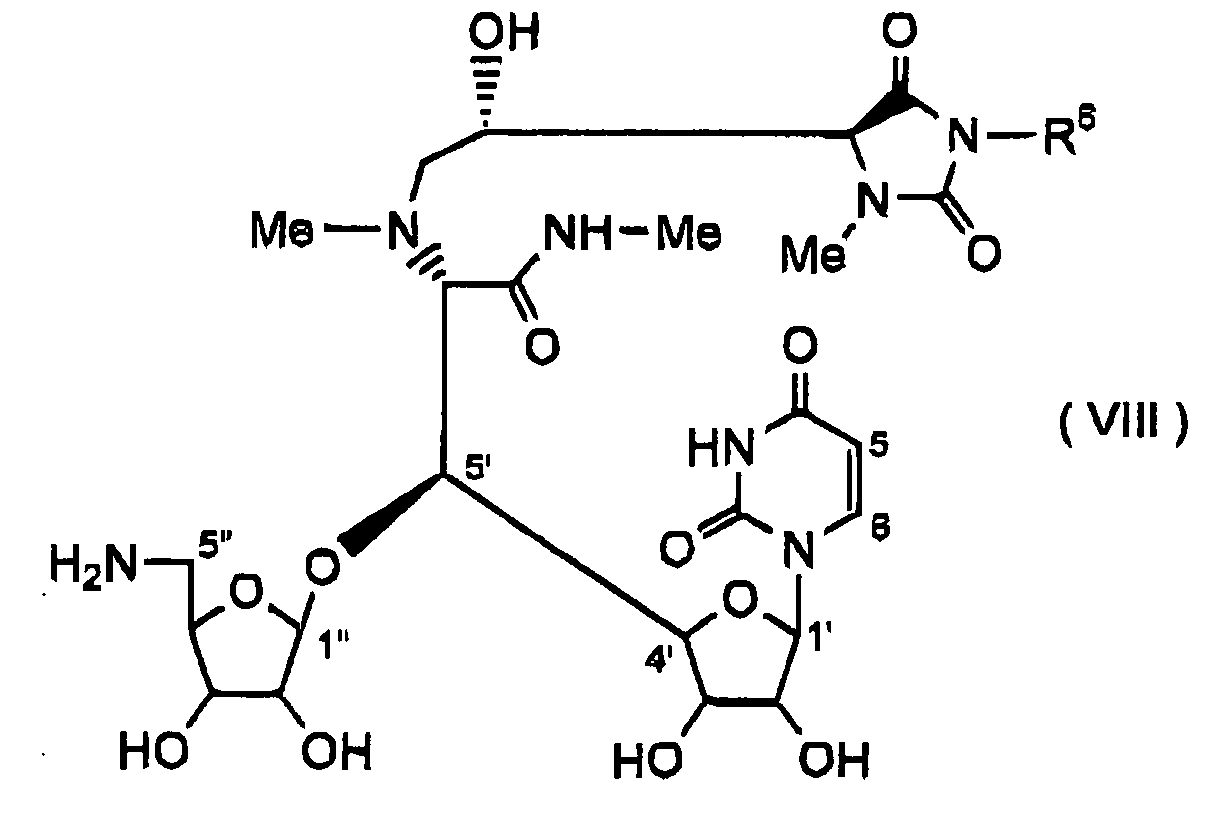
- The derivative as claimed in Claim 14 wherein R6 is an alkyl group of 6-21 carbon atoms in the general formula (VIII).
- An uridine derivative represented by the following formula (IX)wherein Me is methyl group, or its 5''-N-t-butoxycarbonyl derivative.

- A pharmaceutical composition comprising as active ingredient at least one of a caprazene-1'''-amide derivative of the formula (II) or a caprazene-1'''-ester derivative of the formula (III) or a caprazol-1'''-amide derivative of the formula (V) or a caprazol-1'''-amide-3'''-ester derivative of the formula (VI) or a caprazol-3'''-ester derivative or a caprazol-1'''-ester-3'''-ester derivative of the formula (VII) or an imidazolidinone derivative, CP-IM, of the formula (VIII), or an acid addition salt of these derivatives, and a pharmaceutically acceptable liquid or solid carrier or carriers, in combination with the active ingredient.
Priority Applications (6)
| Application Number | Priority Date | Filing Date | Title |
|---|---|---|---|
| EP14197812.2A EP2902403A1 (en) | 2003-01-31 | 2004-01-30 | Caprazene-1'''-esters as antibacterials |
| EP14197813.0A EP2902404A1 (en) | 2003-01-31 | 2004-01-30 | Caprazol esters as antibacterials |
| EP14197814.8A EP2902405A1 (en) | 2003-01-31 | 2004-01-30 | Caprazol-1'''-amides as antibacterials |
| EP12180101.3A EP2527352B1 (en) | 2003-01-31 | 2004-01-30 | Caprazene-1'''-amide derivatives |
| EP15199310.2A EP3023432A1 (en) | 2003-01-31 | 2004-01-30 | 5"-n-alkoxycarbonyl or 5"-n-aralkyloxycarbonyl caprazene compounds |
| EP12180107.0A EP2527353B1 (en) | 2003-01-31 | 2004-01-30 | Caprazol derivatives |
Applications Claiming Priority (3)
| Application Number | Priority Date | Filing Date | Title |
|---|---|---|---|
| JP2003025323 | 2003-01-31 | ||
| JP2003025323 | 2003-01-31 | ||
| PCT/JP2004/000969 WO2004067544A1 (en) | 2003-01-31 | 2004-01-30 | Caprazene as novel compound and derivatives thereof, and caprazol as novel compound and derivatives thereof |
Related Child Applications (12)
| Application Number | Title | Priority Date | Filing Date |
|---|---|---|---|
| EP12180101.3A Division-Into EP2527352B1 (en) | 2003-01-31 | 2004-01-30 | Caprazene-1'''-amide derivatives |
| EP12180101.3A Division EP2527352B1 (en) | 2003-01-31 | 2004-01-30 | Caprazene-1'''-amide derivatives |
| EP12180107.0A Division-Into EP2527353B1 (en) | 2003-01-31 | 2004-01-30 | Caprazol derivatives |
| EP12180107.0A Division EP2527353B1 (en) | 2003-01-31 | 2004-01-30 | Caprazol derivatives |
| EP15199310.2A Division-Into EP3023432A1 (en) | 2003-01-31 | 2004-01-30 | 5"-n-alkoxycarbonyl or 5"-n-aralkyloxycarbonyl caprazene compounds |
| EP15199310.2A Division EP3023432A1 (en) | 2003-01-31 | 2004-01-30 | 5"-n-alkoxycarbonyl or 5"-n-aralkyloxycarbonyl caprazene compounds |
| EP14197812.2A Division EP2902403A1 (en) | 2003-01-31 | 2004-01-30 | Caprazene-1'''-esters as antibacterials |
| EP14197812.2A Division-Into EP2902403A1 (en) | 2003-01-31 | 2004-01-30 | Caprazene-1'''-esters as antibacterials |
| EP14197814.8A Division-Into EP2902405A1 (en) | 2003-01-31 | 2004-01-30 | Caprazol-1'''-amides as antibacterials |
| EP14197814.8A Division EP2902405A1 (en) | 2003-01-31 | 2004-01-30 | Caprazol-1'''-amides as antibacterials |
| EP14197813.0A Division EP2902404A1 (en) | 2003-01-31 | 2004-01-30 | Caprazol esters as antibacterials |
| EP14197813.0A Division-Into EP2902404A1 (en) | 2003-01-31 | 2004-01-30 | Caprazol esters as antibacterials |
Publications (3)
| Publication Number | Publication Date |
|---|---|
| EP1593684A1 true EP1593684A1 (en) | 2005-11-09 |
| EP1593684A4 EP1593684A4 (en) | 2010-06-02 |
| EP1593684B1 EP1593684B1 (en) | 2016-11-02 |
Family
ID=32820791
Family Applications (7)
| Application Number | Title | Priority Date | Filing Date |
|---|---|---|---|
| EP12180101.3A Expired - Lifetime EP2527352B1 (en) | 2003-01-31 | 2004-01-30 | Caprazene-1'''-amide derivatives |
| EP14197814.8A Withdrawn EP2902405A1 (en) | 2003-01-31 | 2004-01-30 | Caprazol-1'''-amides as antibacterials |
| EP14197813.0A Withdrawn EP2902404A1 (en) | 2003-01-31 | 2004-01-30 | Caprazol esters as antibacterials |
| EP15199310.2A Withdrawn EP3023432A1 (en) | 2003-01-31 | 2004-01-30 | 5"-n-alkoxycarbonyl or 5"-n-aralkyloxycarbonyl caprazene compounds |
| EP12180107.0A Expired - Lifetime EP2527353B1 (en) | 2003-01-31 | 2004-01-30 | Caprazol derivatives |
| EP04706817.6A Expired - Lifetime EP1593684B1 (en) | 2003-01-31 | 2004-01-30 | Caprazene derivative for the synthesis of antibiotics |
| EP14197812.2A Withdrawn EP2902403A1 (en) | 2003-01-31 | 2004-01-30 | Caprazene-1'''-esters as antibacterials |
Family Applications Before (5)
| Application Number | Title | Priority Date | Filing Date |
|---|---|---|---|
| EP12180101.3A Expired - Lifetime EP2527352B1 (en) | 2003-01-31 | 2004-01-30 | Caprazene-1'''-amide derivatives |
| EP14197814.8A Withdrawn EP2902405A1 (en) | 2003-01-31 | 2004-01-30 | Caprazol-1'''-amides as antibacterials |
| EP14197813.0A Withdrawn EP2902404A1 (en) | 2003-01-31 | 2004-01-30 | Caprazol esters as antibacterials |
| EP15199310.2A Withdrawn EP3023432A1 (en) | 2003-01-31 | 2004-01-30 | 5"-n-alkoxycarbonyl or 5"-n-aralkyloxycarbonyl caprazene compounds |
| EP12180107.0A Expired - Lifetime EP2527353B1 (en) | 2003-01-31 | 2004-01-30 | Caprazol derivatives |
Family Applications After (1)
| Application Number | Title | Priority Date | Filing Date |
|---|---|---|---|
| EP14197812.2A Withdrawn EP2902403A1 (en) | 2003-01-31 | 2004-01-30 | Caprazene-1'''-esters as antibacterials |
Country Status (7)
| Country | Link |
|---|---|
| US (3) | US7482439B2 (en) |
| EP (7) | EP2527352B1 (en) |
| JP (1) | JP4621588B2 (en) |
| KR (3) | KR101132066B1 (en) |
| CA (6) | CA2514930C (en) |
| ES (3) | ES2556135T3 (en) |
| WO (1) | WO2004067544A1 (en) |
Cited By (1)
| Publication number | Priority date | Publication date | Assignee | Title |
|---|---|---|---|---|
| CN102186872A (en) * | 2008-10-02 | 2011-09-14 | 财团法人微生物化学研究会 | Anti-xdr-tb agent, anti-mdr-tb agent, and combined anti-tuberculous agent |
Families Citing this family (5)
| Publication number | Priority date | Publication date | Assignee | Title |
|---|---|---|---|---|
| ES2556135T3 (en) * | 2003-01-31 | 2016-01-13 | Zaidan Hojin Biseibutsu Kagaku Kenkyu Kai | Caprazeno-1 '' derivatives - amide |
| JP5253168B2 (en) * | 2006-08-15 | 2013-07-31 | 公益財団法人微生物化学研究会 | Antibacterial agent and Johne's disease therapeutic agent containing the same |
| JP5922936B2 (en) * | 2012-01-25 | 2016-05-24 | 公益財団法人微生物化学研究会 | Novel microorganism and method for producing caprazol |
| WO2014196512A1 (en) | 2013-06-04 | 2014-12-11 | 公益財団法人微生物化学研究会 | COMBINED ANTI-ACID-FAST BACTERIAL AGENT, SCREENING METHOD FOR ANTI-ACID-FAST BACTERIAL AGENTS, AND ACTIVITY INHIBITOR OF WecA OR ORTHOLOG THEREOF |
| WO2018226949A1 (en) | 2017-06-08 | 2018-12-13 | Pai Life Sciences Inc. | Cpzen compositions and uses |
Family Cites Families (5)
| Publication number | Priority date | Publication date | Assignee | Title |
|---|---|---|---|---|
| JPH0631311B2 (en) | 1985-06-07 | 1994-04-27 | 理化学研究所 | Antibiotics RK-1061A, RK-1061B, and RK-1061C and method for producing the same |
| US6455694B1 (en) * | 1996-04-26 | 2002-09-24 | Daiichi Pharmaceutical Co., Ltd. | Antibiotics RK-1061 and process for preparing the same |
| JP2000071170A (en) * | 1998-08-28 | 2000-03-07 | Nitta Ind Corp | Polishing wafer holding member and method of attaching / detaching wafer holding member to / from polishing machine surface plate |
| WO2001012643A1 (en) | 1999-08-12 | 2001-02-22 | Zaidan Hojin Biseibutsu Kagaku Kenkyu Kai | Antibiotic caprazamycins and process for producing the same |
| ES2556135T3 (en) * | 2003-01-31 | 2016-01-13 | Zaidan Hojin Biseibutsu Kagaku Kenkyu Kai | Caprazeno-1 '' derivatives - amide |
-
2004
- 2004-01-30 ES ES12180101.3T patent/ES2556135T3/en not_active Expired - Lifetime
- 2004-01-30 JP JP2005504778A patent/JP4621588B2/en not_active Expired - Lifetime
- 2004-01-30 WO PCT/JP2004/000969 patent/WO2004067544A1/en not_active Ceased
- 2004-01-30 CA CA2514930A patent/CA2514930C/en not_active Expired - Lifetime
- 2004-01-30 ES ES12180107.0T patent/ES2626290T3/en not_active Expired - Lifetime
- 2004-01-30 EP EP12180101.3A patent/EP2527352B1/en not_active Expired - Lifetime
- 2004-01-30 CA CA2831202A patent/CA2831202C/en not_active Expired - Lifetime
- 2004-01-30 KR KR1020057014150A patent/KR101132066B1/en not_active Expired - Lifetime
- 2004-01-30 CA CA2773659A patent/CA2773659C/en not_active Expired - Lifetime
- 2004-01-30 CA CA2812356A patent/CA2812356A1/en not_active Abandoned
- 2004-01-30 ES ES04706817.6T patent/ES2612856T3/en not_active Expired - Lifetime
- 2004-01-30 US US10/543,887 patent/US7482439B2/en not_active Expired - Lifetime
- 2004-01-30 EP EP14197814.8A patent/EP2902405A1/en not_active Withdrawn
- 2004-01-30 EP EP14197813.0A patent/EP2902404A1/en not_active Withdrawn
- 2004-01-30 KR KR1020117010785A patent/KR101132945B1/en not_active Expired - Fee Related
- 2004-01-30 CA CA2726147A patent/CA2726147C/en not_active Expired - Lifetime
- 2004-01-30 KR KR1020117010784A patent/KR101194908B1/en not_active Expired - Lifetime
- 2004-01-30 CA CA2831207A patent/CA2831207C/en not_active Expired - Fee Related
- 2004-01-30 EP EP15199310.2A patent/EP3023432A1/en not_active Withdrawn
- 2004-01-30 EP EP12180107.0A patent/EP2527353B1/en not_active Expired - Lifetime
- 2004-01-30 EP EP04706817.6A patent/EP1593684B1/en not_active Expired - Lifetime
- 2004-01-30 EP EP14197812.2A patent/EP2902403A1/en not_active Withdrawn
-
2008
- 2008-12-29 US US12/345,190 patent/US8710198B2/en not_active Expired - Fee Related
-
2013
- 2013-07-12 US US13/940,575 patent/US20140005371A1/en not_active Abandoned
Cited By (2)
| Publication number | Priority date | Publication date | Assignee | Title |
|---|---|---|---|---|
| CN102186872A (en) * | 2008-10-02 | 2011-09-14 | 财团法人微生物化学研究会 | Anti-xdr-tb agent, anti-mdr-tb agent, and combined anti-tuberculous agent |
| CN102186872B (en) * | 2008-10-02 | 2015-09-16 | 公益财团法人微生物化学研究会 | Resist extensive Resistance Mycobacterium Tuberculosis medicine, anti-Drug-fast case tubercule bacillus medicine and and use antitubercular agent |
Also Published As
Similar Documents
| Publication | Publication Date | Title |
|---|---|---|
| US8710198B2 (en) | Caprazene as a novel compound and derivatives thereof, and caprazol as a novel compound and derivatives thereof | |
| WO2005025513A2 (en) | Guanidinium derivatives for improved cellular transport | |
| CN106905386A (en) | Aminoglycoside derivative | |
| JPH11502860A (en) | Sugar-modified cytostatic | |
| WO2017186110A1 (en) | Vancomycin derivative, preparation method, pharmaceutical composition and use thereof | |
| KR20100059990A (en) | 6, 11-bridged biaryl macrolides | |
| WO2008020560A1 (en) | Antibacterial agent and therapeutic agent for johne's disease comprising the same | |
| CA2154890A1 (en) | 3'-aziridino-anthracycline derivatives | |
| US5091523A (en) | Mitomycin derivatives having reduced bone marrow toxicity, processes for their preparation, and the uses thereof | |
| JP2010053079A (en) | 5-aminolevulinic acid derivative and its salt | |
| JPH07179488A (en) | Glucosamine derivative, production method thereof and synthetic intermediate thereof | |
| RU2255089C1 (en) | Derivatives of glycosides of indolo[2,3-a]-pyrrolo[3,4-c]carbazol-5,7-diones eliciting cytotoxic and antitumor activity | |
| Niro | Studies on the Selectivity of Nucleoside Antibiotics | |
| ES2213400T3 (en) | DERIVATIVES OF SIASTATIN B THAT HAVE INHIBITING ACTIVITIES OF GLYCOSIDASE AND PROCEDURES TO PRODUCE THEM. | |
| Anegundi | Synthesis and evaluation of safe antifungal compounds | |
| ITMI20121425A1 (en) | PSEUDOURIDIMICINA (PUM) AND ITS DERIVATIVES | |
| JPH07252290A (en) | 1-N- (5-amino-4-fluoro-2-hydroxyvaleryl) kanamycin |
Legal Events
| Date | Code | Title | Description |
|---|---|---|---|
| PUAI | Public reference made under article 153(3) epc to a published international application that has entered the european phase |
Free format text: ORIGINAL CODE: 0009012 |
|
| 17P | Request for examination filed |
Effective date: 20050829 |
|
| AK | Designated contracting states |
Kind code of ref document: A1 Designated state(s): AT BE BG CH CY CZ DE DK EE ES FI FR GB GR HU IE IT LI LU MC NL PT RO SE SI SK TR |
|
| AX | Request for extension of the european patent |
Extension state: AL LT LV MK |
|
| DAX | Request for extension of the european patent (deleted) | ||
| A4 | Supplementary search report drawn up and despatched |
Effective date: 20100507 |
|
| 17Q | First examination report despatched |
Effective date: 20100823 |
|
| RAP1 | Party data changed (applicant data changed or rights of an application transferred) |
Owner name: ZAIDAN HOJIN BISEIBUTSU KAGAKU KENKYU KAI Owner name: MEIJI SEIKA PHARMA CO., LTD. |
|
| GRAP | Despatch of communication of intention to grant a patent |
Free format text: ORIGINAL CODE: EPIDOSNIGR1 |
|
| RIC1 | Information provided on ipc code assigned before grant |
Ipc: C07D 405/14 20060101ALI20160511BHEP Ipc: C07D 403/08 20060101ALI20160511BHEP Ipc: A61K 31/7072 20060101ALI20160511BHEP Ipc: C07H 19/06 20060101AFI20160511BHEP Ipc: A61P 31/06 20060101ALI20160511BHEP Ipc: C07D 403/14 20060101ALI20160511BHEP Ipc: A61P 31/04 20060101ALI20160511BHEP |
|
| INTG | Intention to grant announced |
Effective date: 20160603 |
|
| GRAS | Grant fee paid |
Free format text: ORIGINAL CODE: EPIDOSNIGR3 |
|
| GRAA | (expected) grant |
Free format text: ORIGINAL CODE: 0009210 |
|
| AK | Designated contracting states |
Kind code of ref document: B1 Designated state(s): AT BE BG CH CY CZ DE DK EE ES FI FR GB GR HU IE IT LI LU MC NL PT RO SE SI SK TR |
|
| REG | Reference to a national code |
Ref country code: GB Ref legal event code: FG4D |
|
| REG | Reference to a national code |
Ref country code: AT Ref legal event code: REF Ref document number: 841757 Country of ref document: AT Kind code of ref document: T Effective date: 20161115 Ref country code: CH Ref legal event code: EP |
|
| REG | Reference to a national code |
Ref country code: IE Ref legal event code: FG4D |
|
| REG | Reference to a national code |
Ref country code: DE Ref legal event code: R096 Ref document number: 602004050204 Country of ref document: DE |
|
| REG | Reference to a national code |
Ref country code: FR Ref legal event code: PLFP Year of fee payment: 14 |
|
| REG | Reference to a national code |
Ref country code: NL Ref legal event code: MP Effective date: 20161102 |
|
| REG | Reference to a national code |
Ref country code: AT Ref legal event code: MK05 Ref document number: 841757 Country of ref document: AT Kind code of ref document: T Effective date: 20161102 |
|
| PG25 | Lapsed in a contracting state [announced via postgrant information from national office to epo] |
Ref country code: SE Free format text: LAPSE BECAUSE OF FAILURE TO SUBMIT A TRANSLATION OF THE DESCRIPTION OR TO PAY THE FEE WITHIN THE PRESCRIBED TIME-LIMIT Effective date: 20161102 Ref country code: NL Free format text: LAPSE BECAUSE OF FAILURE TO SUBMIT A TRANSLATION OF THE DESCRIPTION OR TO PAY THE FEE WITHIN THE PRESCRIBED TIME-LIMIT Effective date: 20161102 Ref country code: GR Free format text: LAPSE BECAUSE OF FAILURE TO SUBMIT A TRANSLATION OF THE DESCRIPTION OR TO PAY THE FEE WITHIN THE PRESCRIBED TIME-LIMIT Effective date: 20170203 |
|
| REG | Reference to a national code |
Ref country code: ES Ref legal event code: FG2A Ref document number: 2612856 Country of ref document: ES Kind code of ref document: T3 Effective date: 20170519 |
|
| PG25 | Lapsed in a contracting state [announced via postgrant information from national office to epo] |
Ref country code: AT Free format text: LAPSE BECAUSE OF FAILURE TO SUBMIT A TRANSLATION OF THE DESCRIPTION OR TO PAY THE FEE WITHIN THE PRESCRIBED TIME-LIMIT Effective date: 20161102 Ref country code: PT Free format text: LAPSE BECAUSE OF FAILURE TO SUBMIT A TRANSLATION OF THE DESCRIPTION OR TO PAY THE FEE WITHIN THE PRESCRIBED TIME-LIMIT Effective date: 20170302 Ref country code: BE Free format text: LAPSE BECAUSE OF NON-PAYMENT OF DUE FEES Effective date: 20170131 Ref country code: FI Free format text: LAPSE BECAUSE OF FAILURE TO SUBMIT A TRANSLATION OF THE DESCRIPTION OR TO PAY THE FEE WITHIN THE PRESCRIBED TIME-LIMIT Effective date: 20161102 |
|
| PG25 | Lapsed in a contracting state [announced via postgrant information from national office to epo] |
Ref country code: RO Free format text: LAPSE BECAUSE OF FAILURE TO SUBMIT A TRANSLATION OF THE DESCRIPTION OR TO PAY THE FEE WITHIN THE PRESCRIBED TIME-LIMIT Effective date: 20161102 Ref country code: SK Free format text: LAPSE BECAUSE OF FAILURE TO SUBMIT A TRANSLATION OF THE DESCRIPTION OR TO PAY THE FEE WITHIN THE PRESCRIBED TIME-LIMIT Effective date: 20161102 Ref country code: CZ Free format text: LAPSE BECAUSE OF FAILURE TO SUBMIT A TRANSLATION OF THE DESCRIPTION OR TO PAY THE FEE WITHIN THE PRESCRIBED TIME-LIMIT Effective date: 20161102 Ref country code: DK Free format text: LAPSE BECAUSE OF FAILURE TO SUBMIT A TRANSLATION OF THE DESCRIPTION OR TO PAY THE FEE WITHIN THE PRESCRIBED TIME-LIMIT Effective date: 20161102 Ref country code: EE Free format text: LAPSE BECAUSE OF FAILURE TO SUBMIT A TRANSLATION OF THE DESCRIPTION OR TO PAY THE FEE WITHIN THE PRESCRIBED TIME-LIMIT Effective date: 20161102 |
|
| REG | Reference to a national code |
Ref country code: DE Ref legal event code: R097 Ref document number: 602004050204 Country of ref document: DE |
|
| PG25 | Lapsed in a contracting state [announced via postgrant information from national office to epo] |
Ref country code: BG Free format text: LAPSE BECAUSE OF FAILURE TO SUBMIT A TRANSLATION OF THE DESCRIPTION OR TO PAY THE FEE WITHIN THE PRESCRIBED TIME-LIMIT Effective date: 20170202 Ref country code: BE Free format text: LAPSE BECAUSE OF FAILURE TO SUBMIT A TRANSLATION OF THE DESCRIPTION OR TO PAY THE FEE WITHIN THE PRESCRIBED TIME-LIMIT Effective date: 20161102 |
|
| REG | Reference to a national code |
Ref country code: CH Ref legal event code: PL |
|
| PLBE | No opposition filed within time limit |
Free format text: ORIGINAL CODE: 0009261 |
|
| STAA | Information on the status of an ep patent application or granted ep patent |
Free format text: STATUS: NO OPPOSITION FILED WITHIN TIME LIMIT |
|
| PG25 | Lapsed in a contracting state [announced via postgrant information from national office to epo] |
Ref country code: MC Free format text: LAPSE BECAUSE OF FAILURE TO SUBMIT A TRANSLATION OF THE DESCRIPTION OR TO PAY THE FEE WITHIN THE PRESCRIBED TIME-LIMIT Effective date: 20161102 |
|
| 26N | No opposition filed |
Effective date: 20170803 |
|
| PG25 | Lapsed in a contracting state [announced via postgrant information from national office to epo] |
Ref country code: LI Free format text: LAPSE BECAUSE OF NON-PAYMENT OF DUE FEES Effective date: 20170131 Ref country code: CH Free format text: LAPSE BECAUSE OF NON-PAYMENT OF DUE FEES Effective date: 20170131 |
|
| REG | Reference to a national code |
Ref country code: IE Ref legal event code: MM4A |
|
| PG25 | Lapsed in a contracting state [announced via postgrant information from national office to epo] |
Ref country code: SI Free format text: LAPSE BECAUSE OF FAILURE TO SUBMIT A TRANSLATION OF THE DESCRIPTION OR TO PAY THE FEE WITHIN THE PRESCRIBED TIME-LIMIT Effective date: 20161102 Ref country code: LU Free format text: LAPSE BECAUSE OF NON-PAYMENT OF DUE FEES Effective date: 20170130 |
|
| REG | Reference to a national code |
Ref country code: FR Ref legal event code: PLFP Year of fee payment: 15 |
|
| PG25 | Lapsed in a contracting state [announced via postgrant information from national office to epo] |
Ref country code: IE Free format text: LAPSE BECAUSE OF NON-PAYMENT OF DUE FEES Effective date: 20170130 |
|
| PG25 | Lapsed in a contracting state [announced via postgrant information from national office to epo] |
Ref country code: HU Free format text: LAPSE BECAUSE OF FAILURE TO SUBMIT A TRANSLATION OF THE DESCRIPTION OR TO PAY THE FEE WITHIN THE PRESCRIBED TIME-LIMIT; INVALID AB INITIO Effective date: 20040130 |
|
| PG25 | Lapsed in a contracting state [announced via postgrant information from national office to epo] |
Ref country code: CY Free format text: LAPSE BECAUSE OF NON-PAYMENT OF DUE FEES Effective date: 20161102 |
|
| PGFP | Annual fee paid to national office [announced via postgrant information from national office to epo] |
Ref country code: FR Payment date: 20221031 Year of fee payment: 20 |
|
| PGFP | Annual fee paid to national office [announced via postgrant information from national office to epo] |
Ref country code: ES Payment date: 20230206 Year of fee payment: 20 |
|
| PGFP | Annual fee paid to national office [announced via postgrant information from national office to epo] |
Ref country code: TR Payment date: 20230124 Year of fee payment: 20 Ref country code: IT Payment date: 20230110 Year of fee payment: 20 Ref country code: GB Payment date: 20230123 Year of fee payment: 20 Ref country code: DE Payment date: 20221122 Year of fee payment: 20 |
|
| REG | Reference to a national code |
Ref country code: DE Ref legal event code: R071 Ref document number: 602004050204 Country of ref document: DE |
|
| REG | Reference to a national code |
Ref country code: ES Ref legal event code: FD2A Effective date: 20240206 |
|
| REG | Reference to a national code |
Ref country code: GB Ref legal event code: PE20 Expiry date: 20240129 |
|
| PG25 | Lapsed in a contracting state [announced via postgrant information from national office to epo] |
Ref country code: ES Free format text: LAPSE BECAUSE OF EXPIRATION OF PROTECTION Effective date: 20240131 |
|
| PG25 | Lapsed in a contracting state [announced via postgrant information from national office to epo] |
Ref country code: ES Free format text: LAPSE BECAUSE OF EXPIRATION OF PROTECTION Effective date: 20240131 Ref country code: GB Free format text: LAPSE BECAUSE OF EXPIRATION OF PROTECTION Effective date: 20240129 |