Technical Field
-
The present invention relates to a new cyclic compound
having CCR antagonist activity, especially CCR5 antagonist
activity, and to use thereof.
Background Art
-
Recently, HIV (human immunodeficiency virus) protease
inhibitors have been developed for treatment of AIDS
(acquired immune deficiency syndrome). With combined use of
the protease inhibitors with two HIV reverse transcriptase
inhibitors which have been commonly used, treatment of AIDS
has made remarkable progress. However, the treatment is
still not efficient enough for the eradication of AIDS, and
development of a new anti-AIDS medicine based on a different
mechanism of action is desired.
-
As a receptor upon invasion of HIV into a target cell,
CD4 has already been known. Recently, CCR5 as a second
receptor of macrophage directed HIV, and CXCR4 as a second
receptor of T cell directed HIV, which are G-protein coupled
chemokine receptors having a seven-transmembrane protein
structure, have been found, and these chemokine receptors
are considered to play an essential role for infection and
transmission of HIV. As a matter of fact, it has been
reported that a man having resistance to HIV infection even
after repeated exposures to the virus had a mutation in
which CCR5 gene was deleted homozygously. Thus, the CCR5
antagonists have been expected to become a new anti-HIV
medicine, and examples of synthesis of new anilide
derivatives having CCR5 antagonist activity have been
reported in the below-mentioned patent applications such as
Patent Document 1, Patent Document 2 and Patent Document 3,
while there has been no report of a CCR5 antagonist which
has been commercialized as a therapeutic medicine for AIDS.
Further, a compound having CCR5 antagonist activity is
described to be useful as a prophylactic and/or therapeutic
medicine for AIDS in the below-mentioned Patent Document 4,
but said compound has a different structure from the
compound of the present invention.
- Patent Document 1: WO99/32100
- Patent Document 2: Japanese Patent Application No. 10-234388
- Patent Document 3: Japanese Patent Application No. 10-363404
- Patent Document 4: JP-A No. 2001-026586
-
Disclosure of the Invention
-
The present invention is to provide a new bicyclic
compound that is useful for preventing and treating HIV
infection, especially AIDS, due to its CCR antagonist
activity, especially CCR5 antagonist activity.
-
The present inventors have intensively studied
compounds having CCR5 antagonist activity and found that a
compound of the following formula (I) or a salt thereof
(hereinafter, sometimes referred to as Compound (I)) has a
clinically favorable pharmacological effect including CCR
antagonist activity, especially excellent CCR5 antagonist
activity, thereby completing the invention.
-
Thus, the invention provides:
- [1] a compound represented by the formula:
wherein R1 is a 5- or 6-membered ring which may be
substituted;
R3 is a hydrogen atom, a lower alkyl group which may be
substituted or a lower alkoxy group which may be
substituted;
R7 and R8 are each a hydrogen atom or a lower alkyl
group which may be substituted;
Z1 is a 5- or 6-membered aromatic ring which may be
further substituted;
Z2 is a group represented by -Z2a-W1-Z2b-, wherein Z2a and
Z2b are each O, S(O)m (wherein m is 0, 1 or 2), an imino
group which may be substituted, or a bond, and W1 is an
alkylene chain which may be substituted, an alkenylene chain
which may be substituted, or a bond;
X is N or CR, wherein R represents a hydrogen atom, a
lower alkyl group which may be substituted, a lower alkoxy
group which may be substituted or an acyl group which may be
substituted, or R and the adjacent R4 may form a 5- or 6-membered
alicyclic heterocyclic group;
R4 is NR5R6, wherein R5 and R6 each represent a hydrogen
atom, a hydrocarbon group which may be substituted, a
heterocyclic group which may be substituted or an acyl group
which may be substituted, or R5 and R6 are bonded to each
other to form a heterocyclic group which may be substituted
represented by NR5R6; and
R2 is (1) an amino group which may be substituted, in
which the nitrogen atom may be converted to a quaternary
ammonium or an oxide, (2) a nitrogen-containing heterocyclic
group which may be substituted and may contain a sulfur atom
or an oxygen atom as the ring-constituting atom, in which
the nitrogen atom may be converted to a quaternary ammonium
or an oxide, (3) a group represented by the formula:
wherein k represents 0 or 1, and when k is 0, the phosphorus
atom may form a phosphonium salt; R9 and R10 are each a
hydrocarbon group which may be substituted, a hydroxy group
which may be substituted or an amino group which may be
substituted; or R9 and R10 may be bonded to each other to
form a cyclic group with the adjacent phosphorus atom, (4)
an amidino group which may be substituted, or (5) a
guanidino group which may be substituted; or a salt thereof; - [2] a prodrug of the compound according to the above
[1] ;
- [3] the compound according to the above [1], wherein R1
is a benzene, a furan, a thiophene, a pyridine, a
cyclopentane, a cyclohexane, a pyrrolidine, a piperidine, a
piperazine, a morpholine, a thiomorpholine or a
tetrahydropyran, each of which may be substituted;
- [4] the compound according to the above [1], wherein R1
is a benzene which may be substituted;
- [5] the compound according to the above [1], wherein
NR5R6 is a heterocyclic group which may be substituted;
- [6] the compound according to the above [1], wherein Z1
is a benzene which may be substituted with a substituent
selected from (1) a halogen atom, (2) a C1-4 alkyl group
which may be substituted with halogen atom(s), and (3) a C1-4
alkoxy group which may be substituted with a halogen atom;
- [7] the compound according to the above [1], wherein Z1
is a benzene which may be substituted with a methyl group or
a trifluoromethyl group;
- [8] the compound according to the above [1], wherein Z2
is a group represented by -Z2a-W2-Z2b-, wherein Z2a and Z2b are
each O, S(O)m (wherein m is 0, 1 or 2), an imino group which
may be substituted, or a bond, and W2 is an alkylene chain
which may be substituted;
- [9] the compound according to the above [1], wherein Z2
is a group represented by -CH2-, -CH(OH)- or -S(O)m-CH2-
(wherein m is 0, 1 or 2) ;
- [10] the compound according to the above [1], wherein Z2
is a group represented by -S(O)m-CH2- (wherein m is 0, 1 or
2) ;
- [11] the compound according to the above [1], wherein R2
is (1) an amino group which may be substituted, in which the
nitrogen atom may be converted to a quaternary ammonium or
an oxide, (2) a nitrogen-containing heterocyclic group which
may be substituted and may contain a sulfur atom or an
oxygen atom as the ring-constituting atom, in which the
nitrogen atom may be converted to a quaternary ammonium or
an oxide, (3) an amidino group which may be substituted, or
(4) a guanidino group which may be substituted;
- [12] the compound according to the above [1], wherein R2
is an amino group which may be substituted, or a nitrogen-containing
heterocyclic group which may be substituted and
may contain a sulfur atom or an oxygen atom as the ring-constituting
atom;
- [13] the compound according to the above [1], wherein R2
is -NRR', wherein R and R' are each an aliphatic hydrocarbon
group which may be substituted or an alicyclic heterocyclic
group which may be substituted;
- [14] the compound according to the above [1], wherein R2
is a nitrogen-containing aromatic heterocyclic group which
may be substituted;
- [15] the compound according to the above [1], wherein R2
is an imidazolyl group which may be substituted or a
triazolyl group which may be substituted;
- [16] the compound according to the above [1], wherein R1
is a benzene, a furan, a thiophene, a pyridine, a
cyclopentane, a cyclohexane, a pyrrolidine, a piperidine, a
piperazine, a morpholine, a thiomorpholine or a
tetrahydropyran, each of which may be substituted with a
halogen, a nitro, a cyano, a C1-6 alkyl, a C1-6 alkoxy, a C1-6
an alkoxy-C1-6 alkyl or a C1-6 alkoxy-C1-6 alkoxy;
Z1 is benzene which may be substituted with a
substituent selected from (1) a halogen atom, (2) a C1-4
alkyl group which may be substituted with a halogen atom,
and (3) a C1-4 alkoxy group which may be substituted with a
halogen atom;
Z2 is -Z2a-W1-Z2b-, wherein Z2a and Z2b are each O, S(O)m
(wherein m is 0, 1 or 2), an imino group which may be
substituted with a C1-4 alkyl group, or a bond, and W1 is a
bond, or a C1-4 alkylene chain or a C2-4 alkenylene chain,
each of which may be substituted with a C1-6 alkyl, a hydroxy
group, a hydroxyimino or a C1-6 alkoxyimino; and
R2 is an amino group which may be substituted with a C1-4
alkyl group, or a nitrogen-containing heterocyclic group
which may contain a sulfur atom or an oxygen atom as the
ring-constituting atom and may be substituted with a C1-4
alkyl group; - [17] a compound represented by the formula:
wherein R1a is a (C1-6 alkoxy-C1-6 alkoxy) phenyl;
R2a is (1) an N-C1-6 alkyl-N-tetrahydropyranylamino, (2)
an imidazolyl which may be substituted with a C1-6 alkyl
which may be substituted, or (3) a triazolyl which may be
substituted with a C1-6 alkyl which may be substituted;
R4a is NR5aR6a, wherein R5a and R6a are bonded to each
other to form a heterocyclic group which may be substituted
represented by NR5aR6a;
Xa is CH or N;
na is 0 or 1;
Z2a is a bond, S, SO or SO2; and
the other symbols have the same meanings as defined
above;
or a salt thereof; - [18] the compound according to the above [17], wherein
Z2a is SO;
- [19] the compound according to the above [18], wherein
Z2a is SO having a configuration of (S);
- [20] the compound according to the above [17], wherein
R4a is a 1-pyrrolidinyl group which may be substituted;
- [21] (Ss)-(2E)-3-[4'-(2-butoxyethoxy)-4-(3-methylpyrrolidin-1-yl)-1,1'-biphenyl-3-yl]-2-methyl-N-[4-[[(1-propyl-1H-imidazol-5-yl)methyl]sulfinyl]phenyl]acrylamide,
(Ss)-(2E)-3-[4'-(2-butoxyethoxy)-4-[3-(hydroxymethyl)pyrrolidin-1-yl]-1,1'-biphenyl-3-yl]-2-methyl-N-[4-[[(1-propyl-1H-imidazol-5-yl)methyl]
sulfinyl]phenyl] acrylamide, (Ss)-(2E)-3-[4'-(2-butoxyethoxy)-4-(3-carboxypyrrolidin-1-yl)-1,1'-biphenyl-3-yl]-2-methyl-N-[4-[[(1-propyl-1H-imidazol)-5-yl]methyl]sulfinyl]phenyl]acrylamide
and diastereomers
thereof;
- [22] (Ss)-(2E)-3-[5-[4-(2-butoxyethoxy)phenyl]-2-[3-(hydroxymethyl)pyrrolidin-1-yl]pyridin-3-yl]-2-methyl-N-[4-[[(1-propyl-1H-imidazol-5-yl)methyl]sulfinyl]phenyl]acrylamide
and a diastereomer
thereof, and (S)-(2E)-3-[5-[4-(2-butoxyethoxy)phenyl]-2-pyrrolidin-1-ylpyridin-3-yl]-2-methyl-N-[4-[[(1-propyl-1H-imidzol-5-yl)methyl]sulfinyl]phenyl]acrylamide;
- [23] a process for producing a compound represented by
the formula:
wherein R2'' is (1) an amino group which may be substituted,
in which the nitrogen atom may be converted to a quaternary
ammonium, (2) a nitrogen-containing heterocyclic group which
may be substituted and may contain a sulfur atom or an
oxygen atom as the ring-constituting atom, in which the
nitrogen atom may be converted to a quaternary ammonium, or
(3) a group represented by formula (Ia), and the other
symbols have the same meanings as defined above,
or a salt thereof, which comprises subjecting a compound
represented by the formula:
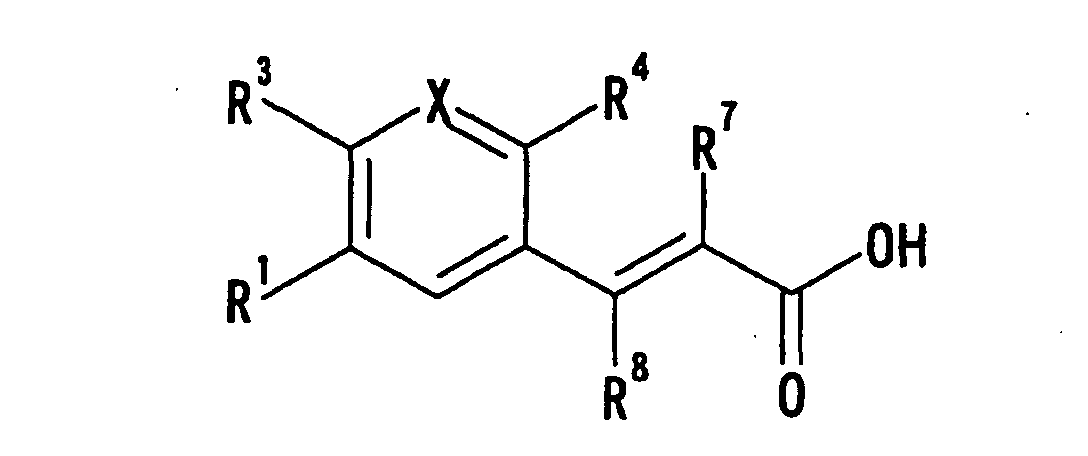
wherein each symbol has the same meaning as defined above,
a salt or a reactive derivative thereof, and a compound
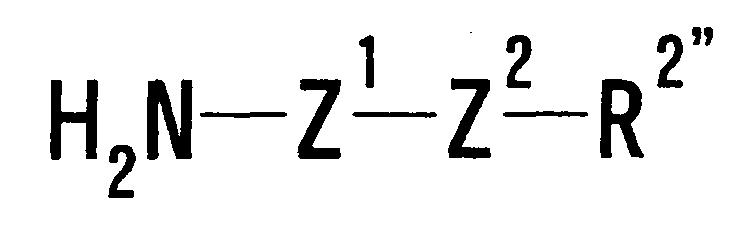
represented by the formula:
wherein each symbol has the same meaning as defined above,
or a salt thereof to a condensation reaction, and then
optionally to deprotection, oxidation-reduction and/or
quaternization reaction; - [24] a pharmaceutical composition comprising the
compound represented by formula (I), a salt or prodrug
thereof;
- [25] the pharmaceutical composition according to the
above [24], which is a CCR antagonist;
- [26] the pharmaceutical composition according to the
above [25], wherein CCR is CCR5 and/or CCR2;
- [27] the pharmaceutical composition according to the
above [25], wherein CCR is CCR5;
- [28] the pharmaceutical composition according to the
above [24], which is a prophylactic and/or therapeutic agent
for HIV infection, chronic rheumatoid arthritis, autoimmune
diseases, allergic diseases, ischemic brain cell disorder,
cardiac infarction, nephritis/nephropathy or
arteriosclerosis;
- [29] the pharmaceutical composition according to the
above [24], which is a prophylactic and/or therapeutic agent
for HIV infection;
- [30] the pharmaceutical composition according to the
above [24], which is a prophylactic and/or therapeutic agent
for AIDS;
- [31] the pharmaceutical composition according to the
above [24], which is a suppressive agent for disease
progression of AIDS;
- [32] a method for preventing or treating HIV infection,
chronic rheumatoid arthritis, autoimmune diseases, allergic
diseases, ischemic brain cell disorder, cardiac infarction,
nephritis/nephropathy, arteriosclerosis or graft-versus-host
diseases, which comprises administering an effective amount
of the compound according to the above [1], a salt or
prodrug thereof to a subject in need thereof; and
- [33] use of the compound according to the above [1], a
salt or prodrug thereof, for the manufacture of a
prophylactic and/or therapeutic agent for HIV infection,
chronic rheumatoid arthritis, autoimmune diseases, allergic
diseases, ischemic brain cell disorder, cardiac infarction,
nephritis/nephropathy, arteriosclerosis or graft-versus-host
diseases.
-
Best Mode for Carrying Out the Invention
-
In the above-described formula (I), the "5- or 6-membered
ring" in the "5- or 6-membered ring group which may
be substituted" represented by R1 may be exemplified by a
group which is formed by eliminating a hydrogen atom from 6-membered
aromatic hydrocarbon such as benzene, etc.; 5- or
6-membered aliphatic hydrocarbon such as cyclopentane,
cyclohexane, cyclopentene, cyclohexene, cyclopentanediene,
cyclohexanediene, etc.; 5- or 6-membered aromatic
heterocycle containing 1 to 4 heteroatoms of one or two
kinds selected from nitrogen, sulfur and oxygen atoms, such
as furan, thiophene, pyrrole, imidazole, pyrazole, thiazole,
oxazole, isothiazole, isoxazole, tetrazole, pyridine,
pyrazine, pyrimidine, pyridazine, triazole, etc.; 5- or 6-membered
non-aromatic heterocycle containing 1 to 4
heteroatoms of one or two kinds selected from nitrogen,
sulfur and oxygen atoms, such as tetrahydrofuran,
tetrahydrothiophene, dithiolane, oxathiolane, pyrrolidine,
pyrroline, imidazolidine, imidazoline, pyrazolidine,
pyrazoline, piperidine, piperazine, oxazine, oxadiazine,
thiazine, thiadiazine, morpholine, thiomorpholine, pyran,
tetrahydropyran, tetrahydrothiopyran, etc.; or the like.
Among them, the "5- or 6-membered ring" is preferably
benzene, furan, thiophene, pyridine, cyclopentane,
cyclohexane, pyrrolidine, piperidine, piperazine, morpholine,
thiomorpholine, tetrahydropyran (preferably, 6-membered
ring), or the like, it being particularly preferably benzene.
-
The substituent which may be carried by the "5- or 6-membered
ring" of the "5- or 6-membered ring group which may
be substituted" represented by R1 may be exemplified by
halogen atom, nitro, cyano, alkyl which may be substituted,
cycloalkyl which may be substituted, hydroxy group which may
be substituted, thiol group which may be substituted
(wherein the sulfur atom may be oxidized, and may form
sulfinyl which may be substituted or sulfonyl which may be
substituted), amino group which may be substituted, acyl
which may be substituted, carboxyl group which may be
esterified, an aromatic group which may be substituted, or
the like.
-
Examples of the halogen as the substituent of R1 include
fluorine, chlorine, bromine, iodine and the like, it being
preferably fluorine and chlorine.
-
The alkyl of the "alkyl which may be substituted" as
the substituent of R1 may be exemplified by linear or
branched alkyl having 1 to 10 carbon atoms, for example, C1-10
alkyl such as methyl, ethyl, propyl, isopropyl, butyl,
isobutyl, sec-butyl, tert-butyl, pentyl, isopentyl,
neopentyl, hexyl, heptyl, octyl, nonyl, decyl, etc., and
preferably lower (C1-6) alkyl. Examples of the substituent
of the "alkyl which may be substituted" include halogen (for
example, fluorine, chlorine, bromine, iodine, etc.), nitro,
cyano, hydroxy group, thiol group which may be substituted
(for example, thiol group, C1-4 alkylthio, etc.), amino group
which may be substituted (for example, amino, mono-C1-4
alkylamino, di-C1-4 alkylamino, 5- or 6-membered cycloamino
such as tetrahydropyrrole, piperazine, piperidine,
morpholine, thiomorpholine, pyrrole, imidazole, etc.),
carboxyl group which may be esterified or amidated (for
example, carboxyl, C1-4 alkoxycarbonyl, carbamoyl, mono-C1-4
alkylcarbamoyl, di-C1-4 alkylcarbamoyl, etc.), C1-4 alkoxy
which may be halogenated (for example, methoxy, ethoxy,
propoxy, butoxy, trifluoromethoxy, trifluoroethoxy, etc.),
C1-4 alkoxy-C1-4 alkoxy which may be halogenated (for example,
methoxymethoxy, methoxyethoxy, ethoxyethoxy,
trifluoromethoxyethoxy, trifluoroethoxyethoxy, etc.), formyl,
C2-4 alkanoyl (for example, acetyl, propionyl, etc.), C1-4
alkylsulfonyl (for example, methanesulfonyl, ethanesulfonyl,
etc.), and the like, and the number of the substituents is
preferably 1 to 3.
-
Examples of the cycloalkyl of the "cycloalkyl which may
be substituted" as the substituent of R1 include C3-7
cycloalkyl such as cyclopropyl, cyclobutyl, cyclopentyl,
cyclohexyl, cycloheptyl, etc. Examples of the substituent
in the "cycloalkyl which may be substituted" include halogen
(for example, fluorine, chlorine, bromine, iodine, etc.),
nitro, cyano, hydroxy group, thiol group which may be
substituted (for example, thiol, C1-4 alkylthio, etc.), amino
group which may be substituted (for example, amino, mono-C1-4
alkylamino, di-C1-4 alkylamino, 5- or 6-membered cycloamino
such as tetrahydropyrrole, piperazine, piperidine,
morpholine, thiomorpholine, pyrrole, imidazole, etc.),
carboxyl group which may be esterified or amidated (for
example, carboxyl, C1-4 alkoxycarbonyl, carbamoyl, mono-C1-4
alkylcarbamoyl, di-C1-4 alkylcarbamoyl, etc.), C1-4 alkoxy
which may be halogenated (for example, methoxy, ethoxy,
propoxy, butoxy, trifluoromethoxy, trifluoroethoxy, etc.),
C1-4 alkoxy-C1-4 alkoxy which may be halogenated (for example,
methoxymethoxy, methoxyethoxy, ethoxyethoxy,
trifluoromethoxyethoxy, trifluoroethoxyethoxy, etc.), formyl,
C2-4 alkanoyl (for example, acetyl, propionyl, etc.), C1-4
alkylsulfonyl (for example, methanesulfonyl, ethanesulfonyl,
etc.), and the like, and the number of the substituents is
preferably 1 to 3.
-
The substituent of the "hydroxy group which may be
substituted" as the substituent of R
1 may be exemplified by
- (1) alkyl which may be substituted (for example, C1-10 alkyl
such as methyl, ethyl, propyl, isopropyl, butyl, isobutyl,
sec-butyl, tert-butyl, pentyl, isopentyl, neopentyl, hexyl,
heptyl, octyl, nonyl, decyl, etc., and preferably lower (C1-6)
alkyl; or the like);
- (2) cycloalkyl which may be substituted and may contain
heteroatom(s) (for example, C3-7 cycloalkyl such as
cyclopropyl, cyclobutyl, cyclopentyl, cyclohexyl,
cycloheptyl, etc.; 5- or 6-membered saturated heterocyclic
group containing 1 or 2 heteroatoms, such as
tetrahydrofuranyl, tetrahydrothienyl, pyrrolidinyl,
pyrazolidinyl, piperidinyl, piperazinyl, morpholinyl,
thiomorpholinyl, tetrahydropyranyl, tetrahydrothiopyranyl,
etc., and preferably tetrahydropyranyl, etc.; or the like);
- (3) alkenyl which may be substituted (for example,
alkenyl having 2 to 10 carbon atoms, such as allyl, crotyl,
2-pentenyl, 3-hexenyl, etc., and preferably lower (C2-6)
alkenyl; or the like);
- (4) cycloalkenyl which may be substituted (for example,
cycloalkenyl having 3 to 7 carbon atoms, such as 2-cyclopentenyl,
2-cyclohexenyl, 2-cyclopentenylmethyl, 2-cyclohexenylmethyl,
etc.; or the like);
- (5) aralkyl which may be substituted (for example,
phenyl-C1-4 alkyl such as benzyl, phenethyl, etc.; or the
like) ;
- (6) formyl, or acyl which may be substituted (for
example, alkanoyl having 2 to 4 carbon atoms, such as acetyl,
propionyl, butyryl, isobutyryl, etc.), alkylsulfonyl having
1 to 4 carbon atoms (for example, methanesulfonyl,
ethanesulfonyl, etc.), or the like);
- (7) aryl which may be substituted (for example, phenyl,
naphthyl, etc.); or the like.
-
-
The substituent of the above-described (1) alkyl which
may be substituted, (2) cycloalkyl which may be substituted,
(3) alkenyl which may be substituted, (4) cycloalkenyl which
may be substituted, (5) aralkyl which may be substituted,
(6) acyl which may be substituted, and (7) aryl which may be
substituted, may be exemplified by halogen (for example,
fluorine, chlorine, bromine, iodine, etc.), nitro, cyano,
hydroxy group, thiol group which may be substituted (for
example, thiol, C1-4 alkylthio, etc.), amino group which may
be substituted (for example, amino, mono-C1-4 alkylamino, di-C1-4
alkylamino, 5- or 6-membered cycloamino such as
tetrahydropyrrole, piperazine, piperidine, morpholine,
thiomorpholine, pyrrole, imidazole, etc.), carboxyl group
which may be esterified or amidated (for example, carboxyl,
C1-4 alkoxycarbonyl, carbamoyl, mono-C1-4 alkylcarbamoyl, di-C1-4
alkylcarbamoyl, etc.), C1-4 alkyl which may be
halogenated (for example, trifluoromethyl, methyl, ethyl,
etc.), C1-6 alkoxy which may be halogenated (for example,
methoxy, ethoxy, propoxy, butoxy, trifluoromethoxy,
trifluoroethoxy, etc.; preferably C1-4 alkoxy which may be
halogenated), formyl, C2-4 alkanoyl (for example, acetyl,
propionyl, etc.), C1-4 alkylsulfonyl (for example,
methanesulfonyl, ethanesulfonyl, etc.), 5- or 6-membered
aromatic heterocycle which may be substituted [for example,
5- or 6-membered aromatic heterocycle containing 1 to 4
heteroatoms of one or two kinds selected from nitrogen,
sulfur and oxygen atoms, such as furan, thiophene, pyrrole,
imidazole, pyrazole, thiazole, oxazole, isothiazole,
isoxazole, tetrazole, pyridine, pyrazine, pyrimidine,
pyridazine, triazole, etc.; examples of the substituent
which may be carried by said heterocycle include halogen
(for example, fluorine, chlorine, bromine, iodine, etc.),
nitro, cyano, hydroxy group, thiol group, amino group,
carboxyl group, C1-4 alkyl which may be halogenated (for
example, trifluoromethyl, methyl, ethyl, etc.), C1-4 alkoxy
which may be halogenated (for example, methoxy, ethoxy,
propoxy, butoxy, trifluoromethoxy, trifluoroethoxy, etc.),
formyl, C2-4 alkanoyl (for example, acetyl, propionyl, etc.),
C1-4 alkylsulfonyl (for example, methanesulfonyl,
ethanesulfonyl, etc.), and the like; and the number of the
substituents is preferably 1 to 3], or the like; and the
number of the substituents is preferably 1 to 3.
-
The substituent of the "thiol group which may be
substituted" as the substituent of R
1 may be exemplified by
the same one as the "substituent of hydroxy group which may
be substituted as the substituent of R
1," and preferred
among them are:
- (1) alkyl which may be substituted (for example, C1-10
alkyl such as methyl, ethyl, propyl, isopropyl, butyl,
isobutyl, sec-butyl, tert-butyl, pentyl, isopentyl,
neopentyl, hexyl, heptyl, octyl, nonyl, decyl, etc., and
preferably lower (C1-6) alkyl; or the like);
- (2) cycloalkyl which may be substituted (for example,
C3-7 cycloalkyl such as cyclopropyl, cyclobutyl, cyclopentyl,
cyclohexyl, cycloheptyl, etc., or the like);
- (3) aralkyl which may be substituted (for example,
phenyl-C1-4 alkyl such as benzyl, phenethyl, etc.);
- (4) aryl which may be substituted (for example, phenyl,
naphthyl, etc.); and the like.
-
-
The substituent which may be carried by the above-described
(1) alkyl which may be substituted, (2) cycloalkyl
which may be substituted, (3) aralkyl which may be
substituted, and (4) aryl which may be substituted, may be
exemplified by halogen (for example, fluorine, chlorine,
bromine, iodine, etc.), nitro, cyano, hydroxy group, thiol
group which may be substituted (for example, thiol, C1-4
alkylthio, etc.), amino group which may be substituted (for
example, amino, mono-C1-4 alkylamino, di-C1-4 alkylamino, 5-
or 6-membered cycloamino such as tetrahydropyrrole,
piperazine, piperidine, morpholine, thiomorpholine, pyrrole,
imidazole, etc.), carboxyl group which may be esterified or
amidated (for example, carboxyl, C1-4 alkoxycarbonyl,
carbamoyl, mono-C1-4 alkylcarbamoyl, di-C1-4 alkylcarbamoyl,
etc.), C1-4 alkoxy which may be halogenated (for example,
methoxy, ethoxy, propoxy, butoxy, trifluoromethoxy,
trifluoroethoxy, etc.), C1-4 alkoxy-C1-4 alkoxy which may be
halogenated (for example, methoxymethoxy, methoxyethoxy,
ethoxyethoxy, trifluoromethoxyethoxy, trifluoroethoxyethoxy,
etc.), formyl, C2-4 alkanoyl (for example, acetyl, propionyl,
etc.), C1-4 alkylsulfonyl (for example, methanesulfonyl,
ethanesulfonyl, etc.), or the like, and the number of the
substituents is preferably 1 to 3.
-
The substituent of the "amino group which may be
substituted" as the substituent of R
1 may be exemplified by
the same one as the "substituent of hydroxy group which may
be substituted as the substituent of R
1," and the number of
substituents on the amino group may be 1 or 2. Among them,
the substituent is preferably:
- (1) alkyl which may be substituted (for example, C1-10
alkyl such as methyl, ethyl, propyl, isopropyl, butyl,
isobutyl, sec-butyl, tert-butyl, pentyl, isopentyl,
neopentyl, hexyl, heptyl, octyl, nonyl, decyl, etc., and
preferably lower (C1-10) alkyl, or the like) ;
- (2) cycloalkyl which may be substituted (for example,
C3-7 cycloalkyl group such as cyclopropyl, cyclobutyl,
cyclopentyl, cyclohexyl, cycloheptyl, etc., or the like);
- (3) alkenyl which may be substituted (for example,
alkenyl having 2 to 10 carbon atoms, such as allyl, crotyl,
2-pentenyl, 3-hexenyl, etc., and preferably lower (C2-6)
alkenyl, or the like);
- (4) cycloalkenyl which may be substituted (for example,
cycloalkenyl having 3 to 7 carbon atoms, such as 2-cyclopentenyl,
2-cyclohexenyl, 2-cyclopentenylmethyl, 2-cyclohexenylmethyl,
etc.; or the like);
- (5) formyl, or acyl which may be substituted (for
example, alkanoyl having 2 to 4 carbon atoms (for example,
acetyl, propionyl, butyryl, isobutyryl, etc.), alkylsulfonyl
having 1 to 4 carbon atoms (for example, methanesulfonyl,
ethanesulfonyl, etc.) or the like);
- (6) aryl which may be substituted (for example, phenyl,
naphthyl, etc.); and the like.
-
-
Examples of the substituent of the above-described (1)
alkyl which may be substituted, (2) cycloalkyl which may be
substituted, (3) alkenyl which may be substituted, (4)
cycloalkenyl which may be substituted, (5) acyl which may be
substituted, (6) aryl which may be substituted, include
halogen (for example, fluorine, chlorine, bromine, iodine,
etc.), nitro, cyano, hydroxy group, thiol group which may be
substituted (for example, thiol, C1-4 alkylthio, etc.), amino
group which may be substituted (for example, amino, mono-C1-4
alkylamino, di-C1-4 alkylamino, 5- or 6-membered cycloamino
such as tetrahydropyrrole, piperazine, piperidine,
morpholine, thiomorpholine, pyrrole, imidazole, etc.),
carboxyl group which may be esterified or amidated (for
example, carboxyl, C1-4 alkoxycarbonyl, carbamoyl, mono-C1-4
alkylcarbamoyl, di-C1-4 alkylcarbamoyl, etc.), C1-4 alkoxy
which may be halogenated (for example, methoxy, ethoxy,
propoxy, butoxy, trifluoromethoxy, trifluoroethoxy, etc.),
C1-4 alkoxy-C1-4 alkoxy which may be halogenated (for example,
methoxymethoxy, methoxyethoxy, ethoxyethoxy,
trifluoromethoxyethoxy, trifluoroethoxyethoxy, etc.), formyl,
C2-4 alkanoyl (for example, acetyl, propionyl, etc.), C1-4
alkylsulfonyl (for example, methanesulfonyl, ethanesulfonyl,
etc.), and the like, and the number of the substituents is
preferably 1 to 3.
-
Further, the substituents of the "amino group which may
be substituted" as the substituent of R1 may be bonded to
each other to form a cycloamino group (for example, a group
which is formed by eliminating a hydrogen atom from the
ring-constituting nitrogen atom of a 5- or 6-membered ring
such as tetrahydropyrrole, piperazine, piperidine,
morpholine, thiomorpholine, pyrrole, imidazole, etc. so that
a bond is made available on the nitrogen atom, or the like).
This cycloamino group may be substituted, and examples of
the substituent include halogen (for example, fluorine,
chlorine, bromine, iodine, etc.), nitro, cyano, hydroxy
group, thiol group which may be substituted (for example,
thiol, C1-4 alkylthio, etc.), amino group which may be
substituted (for example, amino, mono-C1-4 alkylamino, di-C1-4
alkylamino, 5- or 6-membered cycloamino such as
tetrahydropyrrole, piperazine, piperidine, morpholine,
thiomorpholine, pyrrole, imidazole, etc.), carboxyl group
which may be esterified or amidated (for example, carboxyl,
C1-4 alkoxycarbonyl, carbamoyl, mono-C1-4 alkylcarbamoyl, di-C1-4
alkylcarbamoyl, etc.), C1-4 alkoxy which may be
halogenated (for example, methoxy, ethoxy, propoxy, butoxy,
trifluoromethoxy, trifluoroethoxy, etc.), C1-4 alkoxy-C1-4
alkoxy which may halogenated (for example, methoxymethoxy,
methoxyethoxy, ethoxyethoxy, trifluoromethoxyethoxy,
trifluoroethoxyethoxy, etc.), formyl, C2-4 alkanoyl (for
example, acetyl, propionyl, etc.), C1-4 alkylsulfonyl (for
example, methanesulfonyl, ethanesulfonyl, etc.), and the
like, while the number of the substituents is preferably 1
to 3.
-
The "acyl which may be substituted" as the substituent
of R
1 may be exemplified by a group in which
- (1) hydrogen;
- (2) alkyl which may be substituted (for example, C1-10
alkyl such as methyl, ethyl, propyl, isopropyl, butyl,
isobutyl, sec-butyl, tert-butyl, pentyl, isopentyl,
neopentyl, hexyl, heptyl, octyl, nonyl, decyl, etc., and
preferably lower (C1-6) alkyl, or the like);
- (3) cycloalkyl which may be substituted (for example,
C3-7 cycloalkyl such as cyclopropyl, cyclobutyl, cyclopentyl,
cyclohexyl, cycloheptyl, etc., or the like);
- (4) alkenyl which may be substituted (for example,
alkenyl having 2 to 10 carbon atoms, such as allyl, crotyl,
2-pentenyl, 3-hexenyl, etc., and preferably lower (C2-6)
alkenyl, or the like);
- (5) cycloalkenyl which may be substituted (for example,
cycloalkenyl of 3 to 7 carbon atoms, such as 2-cyclopentenyl,
2-cyclohexenyl, 2-cyclopentenylmethyl, 2-cyclohexenylmethyl,
etc., or the like);
- (6) 5- or 6-membered monocyclic aromatic group which
may be substituted (for example, phenyl, pyridyl, etc.) or
the like;
is bonded to a carbonyl group or a sulfonyl group (for
example, formyl, acetyl, propionyl, butyryl, isobutyryl,
valeryl, isovaleryl, pivaloyl, hexanoyl, heptanoyl, octanoyl,
cyclobutanecarbonyl, cyclopentanecarbonyl,
cyclohexanecarbonyl, cycloheptanecarbonyl, crotonyl, 2-cyclohexenecarbonyl,
benzoyl, nicotinoyl, methanesulfonyl,
ethanesulfonyl, etc.). Examples of the substituent of the
above-described (2) alkyl which may be substituted, (3)
cycloalkyl which may be substituted, (4) alkenyl which may
be substituted, (5) cycloalkenyl which may be substituted,
and (6) 5- or 6-membered monocyclic aromatic group which may
be substituted, include halogen (for example, fluorine,
chlorine, bromine, iodine, etc.), nitro, cyano, hydroxy
group, thiol group which may be substituted (for example,
thiol, C1-4 alkylthio, etc.), amino group which may be
substituted (for example, amino, mono-C1-4 alkylamino, di-C1-4
alkylamino, 5- or 6-membered cycloamino such as
tetrahydropyrrole, piperazine, piperidine, morpholine,
thiomorpholine, pyrrole, imidazole, etc.), carboxyl group
which may be esterified or amidated (for example, carboxyl,
C1-4 alkoxycarbonyl, carbamoyl, mono-C1-4 alkylcarbamoyl, di-C1-4
alkylcarbamoyl, etc.), C1-4 alkoxy which may be
halogenated (for example, methoxy, ethoxy, propoxy, butoxy,
trifluoromethoxy, trifluoroethoxy, etc.), C1-4 alkoxy-C1-4
alkoxy which may be halogenated (for example, methoxymethoxy,
methoxyethoxy, ethoxyethoxy, trifluoromethoxyethoxy,
trifluoroethoxyethoxy, etc.), formyl, C2-4 alkanoyl (for
example, acetyl, propionyl, etc.), C1-4 alkylsulfonyl (for
example, methanesulfonyl, ethanesulfonyl, etc.), and the
like, and the number of the substituents is preferably 1 to
3.-
-
The "carboxyl which may be esterified" as the
substituent of R
1 may be exemplified by a group in which (1)
hydrogen;
- (2) alkyl which may be substituted (for example, C1-10
alkyl such as methyl, ethyl, propyl, isopropyl, butyl,
isobutyl, sec-butyl, tert-butyl, pentyl, isopentyl,
neopentyl, hexyl, heptyl, octyl, nonyl, decyl, etc., and
preferably lower (C1-6) alkyl, or the like) ;
- (3) cycloalkyl which may be substituted (for example,
C3-7 cycloalkyl such as cyclopropyl, cyclobutyl, cyclopentyl,
cyclohexyl, cycloheptyl, etc., or the like);
- (4) alkenyl which may be substituted (for example,
alkenyl having 2 to 10 carbon atoms, such as allyl, crotyl,
2-pentenyl, 3-hexenyl, etc., and preferably lower (C2-6)
alkenyl, or the like);
- (5) cycloalkenyl which may be substituted (for example,
cycloalkenyl having 3 to 7 carbon atoms, such as 2-cyclopentenyl,
2-cyclohexenyl, 2-cyclopentenylmethyl, 2-cyclohexenylmethyl,
etc.);
- (6) aryl which may be substituted (for example, phenyl,
naphthyl, etc.); or the like
is bonded to a carbonyloxy group, preferably carboxyl, lower
(C1-6) alkoxycarbonyl, aryloxycarbonyl (for example,
methoxycarbonyl, ethoxycarbonyl, propoxycarbonyl,
phenoxycarbonyl, naphthoxycarbonyl, etc.), or the like.-
-
Examples of the substituent of the above-described (2)
alkyl which may be substituted, (3) cycloalkyl which may be
substituted, (4) alkenyl which may be substituted, (5)
cycloalkenyl which may be substituted, and (6) aryl which
may be substituted, include halogen (for example, fluorine,
chlorine, bromine, iodine, etc.), nitro, cyano, hydroxy
group, thiol group which may be substituted (for example,
thiol, C1-4 alkylthio, etc.), amino group which may be
substituted (for example, amino, mono-C1-4 alkylamino, di-C1-4
alkylamino, 5- or 6-membered cycloamino such as
tetrahydropyrrole, piperazine, piperidine, morpholine,
thiomorpholine, pyrrole, imidazole, etc.), carboxyl group
which may be esterified or amidated (for example, carboxyl,
C1-4 alkoxycarbonyl, carbamoyl, mono-C1-4 alkylcarbamoyl, di-C1-4
alkylcarbamoyl, etc.), C1-4 alkoxy which may be
halogenated (for example, methoxy, ethoxy, propoxy, butoxy,
trifluoromethoxy, trifluoroethoxy, etc.), C1-4 alkoxy-C1-4
alkoxy which may halogenated (for example, methoxymethoxy,
methoxyethoxy, ethoxyethoxy, trifluoromethoxyethoxy,
trifluoroethoxyethoxy, etc.), formyl, C2-4 alkanoyl (for
example, acetyl, propionyl, etc.), C1-4 alkylsulfonyl (for
example, methanesulfonyl, ethanesulfonyl, etc.), and the
like, and the number of the substituents is preferably 1 to
3.
-
The "aromatic group" of the "aromatic group which may
be substituted" as the substituent of R1 may be exemplified
by 5- or 6-membered homocyclic or heterocyclic aromatic
group such as phenyl, pyridyl, furyl, thienyl, pyrrolyl,
imidazolyl, pyrazolyl, thiazolyl, oxazolyl, isothiazolyl,
isoxazolyl, tetrazolyl, pyrazinyl, pyrimidinyl, pyridazinyl,
triazolyl, etc.; fused heterocyclic aromatic group such as
benzofuran, indole, benzothiophene, benzoxazole,
benzothiazole, indazole, benzimidazole, quinoline,
isoquinoline, quinoxaline, phthalazine, quinazoline,
cinnoline, imidazopyridine, etc.; or the like. Examples of
the substituent of the aromatic group include halogen (for
example, fluorine, chlorine, bromine, iodine, etc.), nitro,
cyano, hydroxy group, thiol group which may be substituted
(for example, thiol, C1-4 alkylthio, etc.), amino group which
may be substituted (for example, amino, mono-C1-4 alkylamino,
di-C1-4 alkylamino, 5- or 6-membered cycloamino such as
tetrahydropyrrole, piperazine, piperidine, morpholine,
thiomorpholine, pyrrole, imidazole, etc.), carboxyl group
which may be esterified or amidated (for example, carboxyl,
C1-4 alkoxycarbonyl, carbamoyl, mono-C1-4 alkylcarbamoyl, di-C1-4
alkylcarbamoyl, etc.), C1-4 alkyl which may be
halogenated (for example, trifluoromethyl, methyl, ethyl,
etc.), C1-4 alkoxy which may be halogenated (for example,
methoxy, ethoxy, propoxy, butoxy, trifluoromethoxy,
trifluoroethoxy, etc.), formyl, C2-4 alkanoyl (for example,
acetyl, propionyl, etc.), C1-4 alkylsulfonyl (for example,
methanesulfonyl, ethanesulfonyl, etc.), and the like, and
the number of the substituents is preferably 1 to 3.
-
The number of the above substituents of R1 may be 1 to 4,
preferably 1 to 2, and the substituents which may be
identical with or different from each other may be present
at any possible positions of the ring. When the "5- or 6-membered
ring" of the "5- to 6-membered ring which may be
substituted" represented by R1 has two or more substituents,
two of the substituents may be bonded to each other to form,
for example, lower (C1-6) alkylene (for example, trimethylene,
tetramethylene, etc.), lower (C1-6) alkyleneoxy (for example,
-CH2-O-CH2-, -O-CH2-CH2-, -O-CH2-CH2-CH2-, -O-CH2-CH2-CH2-CH2-,
-O-C(CH3) (CH3)-CH2-CH2-, etc.), lower (C1-6) alkylenethio (for
example, -CH2-S-CH2-, -S-CH2-CH2-, -S-CH2-CH2-CH2-, -S-CH2-CH2-CH2-CH2-,
-S-C(CH3)(CH3)-CH2-CH2-, etc.), lower (C1-6)
alkylenedioxy (for example, -O-CH2-O-, -O-CH2-CH2-O-, -O-CH2-CH2-CH2-O-,
etc.), lower (C1-6) alkylenedithio (for example,
-S-CH2-S-, -S-CH2-CH2-S-, -S-CH2-CH2-CH2-S-, etc.), oxy-lower
(C1-6) alkyleneamino (for example, -O-CH2-NH-, -O-CH2-CH2-NH-,
etc.), oxy-lower (C1-6) alkylenethio (for example, -O-CH2-S-,
-O-CH2-CH2-S-, etc.), lower (C1-6) alkyleneamino (for example,
-NH-CH2-CH2-, -NH-CH2-CH2-CH2-, etc.), lower (C1-6)
alkylenediamino (for example, -NH-CH2-NH-, -NH-CH2-CH2-NH-,
etc.), thialower (C1-6) alkyleneamino (for example, -S-CH2-NH-,
-S-CH2-CH2-NH-, etc.), lower (C2-6) alkenylene (for
example, -CH2-CH=CH-, -CH2-CH2-CH=CH-, -CH2-CH=CH-CH2-, etc.),
lower (C4-6) alkadienylene (for example, -CH=CH-CH=CH-, etc.),
and the like.
-
Further, the divalent group formed by bonding of two
substituents of R1 may contain 1 to 3 substituents which are
the same as the "substituents" of the "5- or 6-membered
ring" of the "5- or 6-membered ring which may be
substituted" represented by R1 (halogen atom, nitro, cyano,
alkyl which may be substituted, cycloalkyl which may be
substituted, hydroxy group which may be substituted, thiol
group which may be substituted (wherein the sulfur atom may
be oxidized, and may form sulfinyl group which may be
substituted or sulfonyl group which may be substituted),
amino group which may be substituted, acyl which may be
substituted, carboxyl group which may be esterified or
amidated, an aromatic group which may be substituted, and
the like).
-
The "substituent" of the "5- or 6-membered ring" of the
"5- or 6-membered ring group which may be substituted"
represented by R1 may be exemplified by, in particular,
lower (C1-4) alkyl which may be halogenated or lower (C1-4)
alkoxylated (for example, methyl, ethyl, t-butyl,
trifluoromethyl, methoxymethyl, ethoxymethyl, propoxymethyl,
butoxymethyl, methoxyethyl, ethoxylethyl, propoxyethyl,
butoxyethyl, etc.), lower (C1-4) alkoxy which may be
halogenated or lower (C1-4) alkoxylated (for example, methoxy,
ethoxy, propoxy, butoxy, t-butoxy, trifluoromethoxy,
methoxymethoxy, ethoxymethoxy, propoxymethoxy, butoxymethoxy,
methoxyethoxy, ethoxyethoxy, propoxyethoxy, butoxyethoxy,
methoxypropoxy, ethoxypropoxy, propoxypropoxy, butoxypropoxy,
etc.), halogen (for example, fluorine, chlorine, etc.),
nitro, cyano, amino which may be substituted with one or two
of lower (C1-4) alkyl, formyl or lower (C2-4) alkanoyl (for
example, amino, methylamino, dimethylamino, formylamino,
acetylamino, etc.), 5- or 6-membered cycloamino (for example,
1-pyrrolidinyl, 1-piperazinyl, 1-piperidinyl, 4-morpholino,
4-thiomorpholino, 1-imidazolyl, 4-tetrahydropyranyl, etc.),
or the like.
-
Examples of the lower alkyl group of the "lower alkyl
group which may be substituted" represented by R3 above
include C1-6 alkyl such as methyl, ethyl, propyl, isopropyl,
butyl, isobutyl, sec-butyl, tert-butyl, pentyl, isopentyl,
neopentyl, hexyl, etc., and the like.
-
Examples of the lower alkoxy group of the "lower alkoxy
group which may be substituted" represented by R3 above
include C1-6 alkoxy such as methoxy, ethoxy, propoxy, butoxy,
etc., and the like.
-
Examples of the substituent which may be carried by the
"lower alkyl group which may be substituted" and "lower
alkoxy group which may be substituted" include halogen (for
example, fluorine, chlorine, bromine, iodine), hydroxy group,
amino, mono(lower alkyl)amino, di(lower alkyl)amino, lower
alkanoyl and the like.
-
The lower alkyl carried by said mono(lower alkyl)amino
and di(lower alkyl)amino may be exemplified by the same one
as the lower alkyl group of the "lower alkyl group which may
be substituted" represented by R3 above.
-
The lower alkanoyl may be exemplified by C2-6 alkanoyl
such as acetyl, propionyl, butyryl, isobutyryl or the like.
-
Among them, for R3, the lower C1-6 alkyl group which may
be substituted is preferred, and particularly a methyl group
which may be substituted is preferred.
-
With respect to the above-described NR
5R
6 represented by
R
4, the "hydrocarbon group" of the "hydrocarbon group which
may be substituted" represented by R
5 and R
6 may be
exemplified by:
- (1) alkyl (for example, C1-10 alkyl such as methyl, ethyl,
propyl, isopropyl, butyl, isobutyl, sec-butyl, tert-butyl,
pentyl, isopentyl, neopentyl, hexyl, heptyl, octyl, nonyl,
decyl, etc., preferably lower (C1-6) alkyl, and more
preferably lower (C1-4) alkyl, or the like) ;
- (2) cycloalkyl (for example, C3-7 cycloalkyl such as
cyclopropyl, cyclobutyl, cyclopentyl, cyclohexyl,
cycloheptyl, etc., or the like);
- (3) alkenyl (for example, alkenyl having 2 to 10 carbon
atoms, such as allyl, crotyl, 2-pentenyl, 3-hexenyl, etc.,
and preferably lower (C2-6) alkenyl, or the like);
- (4) cycloalkenyl (for example, cycloalkenyl having 3 to
7 carbon atoms such as 2-cyclopentenyl, 2-cyclohexenyl, 2-cyclopentenylmethyl,
2-cyclohexenylmethyl, etc., or the
like);
- (5) alkynyl (for example, alkynyl having 2 to 10 carbon
atoms, such as ethynyl, 1-propynyl, 2-propynyl, 1-butynyl,
2-pentynyl, 3-hexynyl, etc., and preferably lower (C2-6)
alkynyl, or the like);
- (6) aralkyl (for example, phenyl-C1-4 alkyl (for example,
benzyl, phenethyl, etc.) or the like);
- (7) aryl (for example, phenyl, naphthyl, etc.);
- (8) cycloalkyl-alkyl (for example, C3-7 cycloalkyl-C1-4
alkyl such as cyclopropylmethyl, cyclobutylmethyl,
cyclopentylmethyl, cyclohexylmethyl, cycloheptylmethyl,
etc.); or the like.
-
-
Examples of the substituent which may be carried by the
above-described (1) alkyl, (2) cycloalkyl, (3) alkenyl, (4)
cycloalkenyl, (5) alkynyl, (6) aralkyl, (7) aryl and (8)
cycloalkyl-alkyl, include halogen (for example, fluorine,
chlorine, bromine, iodine, etc.), nitro, cyano, hydroxy
group, thiol group which may be substituted (for example,
thiol, C1-4 alkylthio, etc.), amino group which may be
substituted (for example, amino, mono-C1-4 alkylamino, di-C1-4
alkylamino, 5- or 6-membered cycloamino such as
tetrahydropyrrole, piperazine, piperidine, morpholine,
thiomorpholine, pyrrole, imidazole, etc.), carboxyl group
which may be esterified or amidated (for example, carboxyl,
C1-4 alkoxycarbonyl, carbamoyl, mono-C1-4 alkylcarbamoyl, di-C1-4
alkylcarbamoyl, etc.), C1-4 alkyl which may be
halogenated (for example, trifluoromethyl, methyl, ethyl,
etc.), C1-4 alkoxy which may be halogenated (for example,
methoxy, ethoxy, propoxy, butoxy, trifluoromethoxy,
trifluoroethoxy, etc.), C1-4 alkylenedioxy (for example, -O-CH2-O-,
-O-CH2-CH2-O-, etc.), sulfonamide which may be
substituted [for example, a group formed by bonding of an
amino group which may be substituted (for example, amino,
mono-C1-4 alkylamino, di-C1-4 alkylamino, 5- or 6-membered
cycloamino such as tetrahydropyrrole, piperazine, piperidine,
morpholine, thiomorpholine, pyrrole, imidazole, etc.) with
-SO2-, etc.], formyl, C2-4 alkanoyl (for example, acetyl,
propionyl, etc.), C1-4 alkylsulfonyl (for example,
methanesulfonyl, ethanesulfonyl, etc.), heterocyclic group
which may be substituted, and the like, and the number of
the substituents is preferably 1 to 3.
-
The "heterocyclic group" of said "heterocyclic group
which may be substituted" and the "heterocyclic group which
may be substituted" represented by R4, may be exemplified by
a group formed by eliminating one hydrogen atom from an
aromatic heterocycle or a non-aromatic heterocycle, or the
like. Examples of such aromatic heterocycle include 5- or
6-membered aromatic heterocycle containing 1 to 4
heteroatoms of one or two kinds selected from nitrogen,
sulfur and oxygen atoms, such as furan, thiophene, pyrrole,
imidazole, pyrazole, thiazole, oxazole, isothiazole,
isoxazole, tetrazole, pyridine, pyrazine, pyrimidine,
pyridazine, triazole, oxadiazole, thiadiazole and the like,
while examples of such non-aromatic heterocycle include 5-
or 6-membered non-aromatic heterocycle containing 1 to 4
heteroatoms of one or two kinds selected from nitrogen,
sulfur and oxygen atoms, such as tetrahydrofuran,
tetrahydrothiophene, dioxolane, dithiolane, oxathiolane,
pyrrolidine, pyrroline, imidazolidine, imidazoline,
pyrazolidine, pyrazoline, piperidine, piperazine, oxazine,
oxadiazine, thiazine, thiadiazine, morpholine,
thiomorpholine, pyran, tetrahydropyran, etc., and non-aromatic
heterocycle in which all or part of the bonds in
the above-mentioned aromatic heterocycles are saturated
bonds (preferably, aromatic heterocycle such as pyrazole,
thiazole, oxazole, tetrazole, etc.).
-
With respect to the above-described NR5R6 represented by
R4, the substituent of the "heterocyclic group" of the
"heterocyclic group which may be substituted" represented by
R5 and R6, may be exemplified by the same substituent of the
"hydrocarbon group" of the "hydrocarbon group which may be
substituted" represented by R4.
-
The hydrocarbon group which may be substituted is
preferably C1-6 alkyl which may be halogenated or
hydroxylated, carboxyl which may be esterified or amidated,
or C2-6 alkenyl which may be halogenated or hydroxylated.
With respect to the above-described NR5R6 represented by R4,
the "acyl group which may be substituted" represented by R5
and R6 may be exemplified by the same one as the "acyl group
which may be substituted" as the substituent which may be
carried by the "5- or 6-membered ring" of the "5- or 6-membered
ring which may be substituted" represented by R1,
and among these, C1-4 alkylsulfonyl which may be halogenated
or hydroxylated, formyl, C2-5 alkanoyl which may be
halogenated or hydroxylated, and the like are preferred.
-
For R5 and R6, C1-4 alkyl which may be halogenated or
hydroxylated, formyl, C2-5 alkanoyl which may be halogenated
or hydroxylated, and the like are more preferred, and propyl,
isobutyl, isobutenyl or 3-hydroxy-2-methylpropyl are
particularly preferred. Another preferred embodiment of R5
and R6 may be exemplified by a group represented by the
formula -(CH2)s-Rx, wherein s is 0 or 1, and Rx is a 5- or 6-membered
ring which may be substituted (for example, those
such as the "5- or 6-membered ring which may be substituted"
represented by R1, etc.; preferably phenyl, pyridyl,
pyrazolyl, thiazolyl, oxazolyl, tetrazolyl, etc., each of
which may be substituted with halogen, C1-4 alkyl which may
be halogenated or hydroxylated, C1-4 alkoxy which may be
halogenated or hydroxylated, etc.), or the like.
-
Among these, R5 and R6 are preferably 1) C1-6 alkyl, 2)
C2-6 alkenyl, 3) C6-10 aryl, 4) C6-10 aryl-methyl, 5)
heterocyclic group and 6) heterocyclic methyl (wherein the
above 1) and 2) may be substituted with halogen, hydroxy
group, or carboxyl group which may be esterified or
amidated; and the above 3), 4), 5) and 6) may be substituted
with C1-6 alkyl which may be substituted with halogen,
hydroxy group, or carboxyl group which may be esterified or
amidated, or C1-6 alkoxy which may be substituted with
halogen, hydroxy group, or carboxyl group which may be
esterified or amidated).
-
With respect to the above-described NR5R6 represented by
R4, the heterocyclic group which may be substituted, which
is formed by NR5R6 as the result of bonding of R5 and R6 ,
may be exemplified by 4- to 10-membered alicyclic cycloamino
such as azetidinyl, pyrrolidinyl, oxazolidinyl,
thiazolidinyl, imidazolidinyl, oxazolinyl, thiazolinyl,
imidazolinyl, piperidinyl, morpholinyl, thiomorpholinyl,
dihydropyridinyl, piperadinyl, azepinyl, oxazepinyl,
thiazepinyl, diazepinyl, azocinyl, oxazocinyl, thiazocinyl,
diazocinyl, etc.; 5- to 10-membered aromatic cycloamino such
as pyrrolyl, imidazolyl, triazolyl, tetrazolyl, etc.
(preferably 5- to 8-membered alicyclic cycloamino, more
preferably 5-membered alicyclic cycloamino such as
pyrrolidinyl, etc.), or the like. These cycloamino groups
may be substituted, and examples of such substituent include
halogen (for example, fluorine, chlorine, bromine, iodine,
etc.), nitro, cyano, hydroxy group, thiol group which may be
substituted (for example, thiol, C1-4 alkylthio, etc.), amino
group which may be substituted (for example, amino, mono-C1-4
alkylamino, di-C1-4 alkylamino, 5- or 6-membered cycloamino
such as pyrrolidine, piperidine, piperazine, morpholine,
thiomorpholine, pyrrole, imidazole, etc., or the like),
carboxyl group which may be esterified or amidated [for
example, carboxyl, C1-4 alkoxycarbonyl (for example,
methoxycarbonyl, ethoxycarbonyl, etc.), carbamoyl, mono-C1-4
alkylcarbamoyl (for example, methylcarbamoyl, ethylcarbamoyl,
etc.), di-C1-4 alkylcarbamoyl (for example, dimethylcarbamoyl,
diethylcarbamoyl, ethylmethylcarbamoyl, etc.), etc.], C1-4
alkyl which may be substituted (for example, in addition to
methyl, ethyl, propyl, etc., halogenated alkyl such as
trifluoromethyl, for example, C2-3 alkanoyloxy-C1-3 alkyl such
as acetyloxymethyl, propionyloxymethyl, acetyloxyethyl,
propionyloxyethyl, etc., for example, C1-4 hydroxyalkyl such
as hydroxymethyl, hydroxyethyl, etc.), C1-4 alkoxy which may
be substituted (for example, methoxy, ethoxy, propoxy,
butoxy, trifluoromethoxy, trifluoroethoxy, carboxy-C1-4
alkoxy, carbamoyl-C1-4 alkoxy, tetrahydrofuranyloxy,
tetrahydropyranyloxy, etc.), formyl, C2-4 alkanoyl (for
example, acetyl, propionyl, etc.), C1-4 alkylsulfonyl (for
example, methanesulfonyl, ethanesulfonyl, etc.), C1-3
alkylenedioxy (for example, methylenedioxy, ethylenedioxy,
etc.), oxo group which may be acetalized (C1-4 dialkoxy, 1,3-diodisolane,
1,3-dioxane, etc.), or the like. The number of
the substituents is preferably 1 to 3.
-
The lower alkyl group of the "lower alkyl group which
may be substituted" represented by each of the above-described
R7 and R8, may be exemplified by C1-6 alkyl such as
methyl, ethyl, propyl, isopropyl, butyl, isobutyl, sec-butyl,
tert-butyl, pentyl, isopentyl, neopentyl, hexyl, etc., or
the like.
-
Examples of the substituent which may be carried by
said "lower alkyl group which may be substituted" and "lower
alkoxy group which may be substituted" include halogen (for
example, fluorine, chlorine, bromine, iodine), hydroxy group,
amino, mono(lower alkyl)amino, di(lower alkyl)amino, lower
alkanoyl or the like.
-
The lower alkyl carried by said mono(lower alkyl)amino
and di(lower alkyl)amino may be exemplified by the same
lower alkyl group of the "lower alkyl group which may be
substituted" represented by each of the above-described R7
and R8.
-
Examples of the lower alkanoyl include C2-6 alkanoyl
such as acetyl, propionyl, butyryl, isobutyryl and the like.
-
Among them, each of R7 and R8 is preferably lower C1-6
alkyl group which may be substituted, and particularly
preferably methyl group which may be substituted.
-
With respect to CR represented by the above-described X,
the lower alkyl group of the "lower alkyl group which may be
substituted" represented by R may be exemplified by C1-6
alkyl such as methyl, ethyl, propyl, isopropyl, butyl,
isobutyl, sec-butyl, tert-butyl, pentyl, isopentyl,
neopentyl, hexyl or the like.
-
For CR represented by the above-described X, the lower
alkoxy group of the "lower alkoxy group which may be
substituted" represented by R may be exemplified by C1-6
alkoxy such as methoxy, ethoxy, propoxy, butoxy or the like.
-
Examples of the substituent which may be carried by
said "lower alkyl group which may be substituted" and "lower
alkoxy group which may be substituted" include halogen (for
example, fluorine, chlorine, bromine, iodine), hydroxy group,
amino, mono(lower alkyl)amino, di(lower alkyl)amino, lower
alkanoyl and the like.
-
The lower alkyl of said mono(lower alkyl)amino and
di(lower alkyl)amino may be exemplified by the same lower
alkyl group as the "lower alkyl group which may be
substituted" represented by the above-described R3.
-
Examples of said lower alkanoyl include C2-6 alkanoyl
such as acetyl, propionyl, butyryl, isobutyryl and the like.
-
With respect to CR represented by the above-described X,
the "acyl group which may be substituted" represented by R
may be exemplified by the same one as the "acyl group which
may be substituted" as the substituent which may be carried
by the "5- or 6-membered ring" of the "5- or 6-membered ring
which may be substituted" represented by R1, and among them,
preferred are C1-4 alkylsulfonyl which may be halogenated or
hydroxylated, formyl, C2-5 alkanoyl which may be halogenated
or hydroxylated, and the like.
-
Among them, for R, lower C1-6 alkyl group which may be
substituted is preferred, and in particular, methyl group
which may be substituted is preferred.
-
The 5- or 6-membered alicyclic heterocycle which is
formed by bonding of X and R4, may be exemplified by
pyrrolidine, oxazolidine, thiazolidine, imidazolidine,
piperidine, morpholine, thiomorpholine, piperazine or the
like. These may be substituted at any arbitrary positions
on the ring, and examples of the substituent include those
described as the substituents of the "5- or 6-membered ring"
with respect to the "5- or 6-membered ring which may be
substituted" represented by R1.
-
In the above formula (I), the "5- or 6-membered
aromatic ring which may be substituted" represented by Z1
may be exemplified by 6-membered aromatic hydrocarbon such
as benzene; 5- to 6-membered aromatic heterocycle containing
1 to 4 heteroatoms of one or two kinds selected from
nitrogen, sulfur and oxygen atoms, such as furan, thiophene,
pyrrole, imidazole, pyrazole, thiazole, oxazole, isothiazole,
isoxazole, tetrazole, pyridine, pyrazine, pyrimidine,
pyridazine, triazole, etc.; fused aromatic heterocycle such
as benzofuran, indole, benzothiophene, benzoxazole,
benzothiazole, indazole, benzimidazole, quinoline,
isoquinoline, quinoxaline, phthalazine, quinazoline,
cinnoline, imidazopyridine, etc.; or the like. Among them,
preferred are benzene, furan, thiophene, pyridine,
pyridazine, pyrimidine, benzimidazole and the like, and
particularly preferably used are benzene, pyridine,
pyridazine and benzimidazole (preferably benzene).
-
The "5- or 6-membered aromatic ring which may be
substituted" represented by Z1 may have the same substituent
as the "substituent" which may be carried by the "5- or 6-membered
ring" of the "5- or 6-membered ring which may be
substituted" represented by R1, and among the substituents,
a halogen atom (for example, fluorine, chlorine, bromine,
etc.), a C1-4 alkyl group which may be substituted with
halogen atom(s) (for example, methyl, ethyl,
trifiluoromethyl, trifluoroethyl, etc.), a C1-4 alkoxy group
which may be substituted with halogen atom(s) (for example,
methoxy, ethoxy, propoxy, trifluoromethoxy, trifluoroethoxy,
etc.) and the like are preferred. However, it is preferred
that there is no other substituent than X2 and Z2, and it is
preferred that when Z1 is a 6-membered ring (preferably
benzene), the position of substitution of Z2 is para to X2.
Further, for the substituent of Z1, benzene which may be
substituted with 1) a halogen atom, 2) a C1-4 alkyl group
which may be substituted with halogen atom(s), or 3) a C1-4
alkoxy group which may be substituted with halogen atom(s)
is preferred, and in particular, benzene which may be
substituted with methyl or trifluoromethyl is preferred.
-
In the above formula (I), with respect to the formula
-Z2a-W1-Z2b- and -Z2a-W2-Z2b- represented by Z2, the substituent
(Ra) of the "imino group which may be substituted"
represented by each of Z2a and Z2b may be exemplified by
hydrogen atom, lower (C1-6) alkyl which may be substituted
[for example, methyl, ethyl, propyl, isopropyl, butyl,
isobutyl, sec-butyl, tert-butyl, pentyl, isopentyl,
neopentyl, hexyl, hydroxy-C1-6 alkyl (for example,
hydroxyethyl, hydroxypropyl, hydroxybutyl, etc.),
halogenated C1-6 alkyl (for example, trifluoromethyl,
trifluoroethyl, etc.), cyanated C1-6 alkyl (for example,
cyanoethyl, cyanopropyl, etc.), carboxyl-C1-6 alkyl which may
be esterified or amidated, etc.], formyl, lower (C2-5)
alkanoyl (for example, acetyl, propionyl, butyryl, etc.),
lower (C1-5) alkylsulfonyl (methylsulfonyl, ethylsulfonyl,
etc.), or the like.
-
The alkylene chain of the "alkylene group which may be
substituted" represented by W1 and W2 may be exemplified by
the alkylene chain represented by -(CH2)k1- (wherein k1 is an
integer of 1 to 4) or the like. The alkenylene group of the
"alkenylene group which may be substituted" represented by
W1 may be exemplified by the alkenylene chain represented by
-(CH2)k2-(CH=CH)-(CH2)k3- (wherein k2 and k3 are identical or
different, and represent 0, 1 or 2, respectively, provided
that the sum of k2 and k3 is 2 or less) or the like. The
alkylene group and alkenylene group represented by said W1
and W2 may be substituted at any arbitrary position
(preferably on a carbon atom), and such substituent may be
any substituent capable of bonding to the alkylene chain or
alkenylene chain which constitutes the straight chain moiety.
Examples thereof include lower (C1-6) alkyl (for example,
methyl, ethyl, propyl, isopropyl, butyl, isobutyl, sec-butyl,
tert-butyl, pentyl, isopentyl, neopentyl, hexyl, etc.),
lower (C3-7)cycloalkyl (for example, cyclopropyl, cyclobutyl,
cyclopentyl, cyclohexyl, cycloheptyl, etc.), formyl, lower
(C2-7) alkanoyl, (for example, acetyl, propionyl, butyryl,
etc.), phosphono which may be esterified, carboxyl which may
be esterified or amidated, hydroxy group, oxo, hydroxyimino
group, lower (C1-6) alkoxyimino group which may be
substituted, and the like, and preferably lower alkyl having
1 to 6 carbon atoms (preferably, C1-3 alkyl), hydroxy group,
oxo, hydroxyimino group, lower (C1-6) alkoxyimino group
(which may be substituted with a polar group such as hydroxy
group, cyano group, carboxyl group which may be esterified
or amidated (for example, carboxyl, C1-4 alkoxycarbonyl,
carbamoyl, mono-C1-4 alkylcarbamoyl, di-C1-4 alkylcarbamoyl,
etc.), etc.) or the like.
-
The phosphono group which may be esterified may be
exemplified by a group represented by P(O) (OR12)(OR13),
wherein R12 and R13 are each hydrogen, an alkyl group having
1 to 6 carbon atoms, or a cycloalkyl group having 3 to 7
carbon atoms, or R12 and R10 may be bonded to each other to
form a 5- to 7-membered ring.
-
In the above-described formula, the alkyl group having
1 to 6 carbon atoms represented by R12 and R13 may be
exemplified by methyl, ethyl, propyl, isopropyl, butyl,
isobutyl, sec-butyl, tert-butyl, pentyl, isopentyl,
neopentyl, hexyl or the like, and the cycloalkyl having 3 to
7 carbon atoms may be exemplified by cyclopropyl, cyclobutyl,
cyclopentyl, cyclohexyl, cycloheptyl or the like. Preferred
is linear lower alkyl having 1 to 6 carbon atoms, and more
preferred is lower alkyl having 1 to 3 carbon atoms. R12 and
R13 may be identical with or different from each other, and
preferably identical. When R12 and R13 are bonded to each
other to form a 5- to 7-membered ring, R12 and R13 are bonded
to each other to form a linear C2-4 alkylene side chain
represented by -(CH2)2-, -(CH2)3- or -(CH2)4-. This side
chain may be substituted, and examples of such substituent
include hydroxy group, halogen and the like.
-
The ester product of the above-described carboxyl group
which may be esterified may be exemplified by a product
resulting from bonding between a carboxyl group and an alkyl
group having 1 to 6 carbon atoms or a cycloalkyl group
having 3 to 7 carbon atoms, for example, methoxycarbonyl,
ethoxycarbonyl, propoxycarbonyl, isopropoxycarbonyl,
butoxycarbonyl, isobutoxycarbonyl, sec-butoxycarbonyl, tert-butoxycarbonyl,
pentyloxycarbonyl, hexyloxycarbonyl,
cyclopentyloxycarbonyl, cyclohexyloxycarbonyl or the like.
-
The amide product of the above-described carboxyl group
which may be amidated may be exemplified by a product
resulting from bonding between a carboxyl group and an
alkylamino group having 1 to 6 carbon atoms, a
cycloalkylamino group having 3 to 7 carbon atoms or a 5- to
8-membered cyclic amine (for example, pyrrolidine,
piperidine, morpholine, etc.), for example, carbamoyl, mono-C1-6
alkylcarbamoyl, di-C1-6 alkylcarbamoyl,
cyclopentylaminocarbonyl, cyclohexylaminocarbonyl,
pyrrolidinocarbonyl, piperidinocarbonyl, morpholinocarbonyl,
thiomorpholinocarbonyl or the like.
-
For Z2, preferably, one of Z2a and Z2b is O, S(O)m
(wherein m is an integer of 0, 1 or 2), or -N(Ra)- (wherein
Ra is a hydrogen atom or a lower C1-4 alkyl group which may
be substituted), the other being a bond, and W is -(CH2)p-(wherein
p is an integer of 1 to 3), or Z2 is a divalent
group of the formula -CH(OH)-. More preferably, one of Z2a
and Z2b is O or S(O)m (wherein m is an integer of 0, 1 or 2),
the other being a bond, and W is -(CH2)p- (wherein p is an
integer of 1 to 3), or Z2 is a divalent group of the formula
-CH(OH)-. Even more preferably, Z2 is -CH2-, -CH(OH)-,
-S(O)m-CH2- (wherein m is 0, 1 or 2), with -S(O)m-CH2-(wherein
m is 0, 1 or 2) being particularly preferred. In
particular, when Z2a is bonded to Z1, Z2 is preferably -SOCH2-.
-
Z2a represents a bond, S, SO or SO2, and among them, SO
is preferred. In this case, the configuration of SO is
preferably (S).
-
The bonding position of Z2 with respect to Z1 is such
that when Z1 is a benzene ring for example, any position may
be selected, but the para position is preferred.
-
In the above formula (I), the "amino group which may be
substituted, in which the nitrogen atom may be converted to
a quaternary ammonium or an oxide" represented by R2 may be
exemplified by an amino group which may have 1 or 2
substituents, an amino group which has three substituents,
in which the nitrogen atom is converted to a quaternary
ammonium, or the like. When the amino group has two or more
substituents on its nitrogen atom, the substituents may be
identical or different; and when the nitrogen atom has 3
substituents, the amino group may be of any type among the
following formulas, -N+RpRpRp, -N+RpRpRq, and -N+RPRqRr, wherein
Rp, Rq, and Rr are different from each other, each being
hydrogen or a substituent. Examples of the counter anion of
the amino group, in which the nitrogen atom is converted to
a quaternary ammonium include, in addition to anions of
halogen (for example, Cl-, Br-, I-, etc.), anions derived
from inorganic acids such as hydrochloric acid, hydrobromic
acid, nitric acid, sulfuric acid, phosphoric acid, etc.;
anions derived from organic acids such as formic acid,
acetic acid, trifluoroacetic acid, fumaric acid, oxalic acid,
tartaric acid, maleic acid, citric acid, succinic acid,
malic acid, methanesulfonic acid, benzenesulfonic acid, p-toluenesulfonic
acid, etc.; and anions derived from acidic
amino acids such as aspartic acid, glutamic acid, etc., and
among them, Cl-, Br-, I- and the like are preferred.
-
Examples of the substituent of said amino group
include:
- (1) alkyl which may be substituted (for example, C1-10
alkyl such as methyl, ethyl, propyl, isopropyl, butyl,
isobutyl, sec-butyl, tert-butyl, pentyl, isopentyl,
neopentyl, hexyl, heptyl, octyl, nonyl, decyl, etc., and
preferably lower (C1-6) alkyl, or the like); and
- (2) cycloalkyl which may be substituted (for example,
C3-8 cycloalkyl such as cyclopropyl, cyclobutyl, cyclopentyl,
cyclohexyl, cycloheptyl, cyanooctyl, etc., or the like);
- (2-1) the cycloalkyl may contain one heteroatom
selected from sulfur, oxygen and nitrogen atoms, forming
oxirane, thiolane, aziridine, tetrahydrofuran,
tetrahydrothiophene, pyrrolidine, tetrahydropyran,
tetrahydrothiopyran, tetrahydrothiopyran 1-oxide, piperidine,
etc. (preferably, a 6-membered ring such as tetrahydropyran,
tetrahydrothiopyran, piperidine, etc.), and the bond with
the amino group is preferably present at the 3- or 4-position
(preferably, at the 4-position);
- (2-2) also, the cycloalkyl may be fused to a benzene
ring, forming indane (for example, indan-1-yl, indan-2-yl,
etc.), tetrahydronaphthalene (for example,
tetrahydronaphthalen-5-yl, tetrahydronaphthalen-6-yl, etc.),
or the like (preferably, indane, etc.);
- (2-3) further, the cycloalkyl may be bridged via a
straight atomic chain having 1 or 2 carbon atoms, forming a
bridged cyclic hydrocarbon residue such as
bicyclo[2.2.1]heptyl, bicyclo[2.2.2]octyl,
bicyclo[3.2.1]octyl, bicyclo[3.2.2]nonyl, etc. (preferably,
cyclohexyl bridged via a straight atomic chain having 1 to 2
carbon atoms, and more preferably, bicyclo[2.2.1]heptyl,
etc.);
- (3) alkenyl which may be substituted (for example,
alkenyl having 2 to 10 carbon atoms, such as allyl, crotyl,
2-pentenyl, 3-hexenyl, etc., and preferably lower (C2-6)
alkenyl, or the like);
- (4) cycloalkenyl which may be substituted (for example,
cycloalkenyl having 3 to 7 carbon atoms, such as 2-cyclopentenyl,
2-cyclohexenyl, 2-cyclopentenylmethyl, 2-cylcohexenylmethyl,
etc., or the like);
- (5) aralkyl which may be substituted (for example,
phenyl-C1-4 alkyl (for example, benzyl, phenethyl, etc.), or
the like);
- (6) formyl, or acyl which may be substituted (for
example, alkanoyl having 2 to 4 carbon atoms (for example,
acetyl, propionyl, butyryl, isobutyryl, etc.), alkylsulfonyl
having 1 to 4 carbon atoms (for example, methanesulfonyl,
ethanesulfonyl, etc.), alkoxycarbonyl having 1 to 4 carbon
atoms (for example, methoxycarbonyl, ethoxycarbonyl, tert-butoxycarbonyl,
etc.), aralkyloxycarbonyl having 7 to 10
carbon atoms (for example, benzyloxycarbonyl, etc.), or the
like) ;
- (7) aryl which may be substituted (for example, phenyl,
naphthyl, etc.);
- (8) heterocyclic group which may be substituted (for
example, a group formed by eliminating a hydrogen atom from
a 5- or 6-membered aromatic heterocycle containing 1 to 4
heteroatoms of one or two kinds selected from nitrogen,
sulfur and oxygen atoms, such as furan, thiophene, pyrrole,
imidazole, pyrazole, thiazole, oxazole, isothiazole,
isoxazole, tetrazole, pyridine, pyrazine, pyrimidine,
pyridazine, triazole, oxadiazole, thiadiazole, etc., or from
a fused heterocyclic aromatic group such as benzofuran,
indole, benzothiophene, benzoxazole, benzothiazole, indazole,
benzimidazole, quinoline, isoquinoline, quinoxaline,
phthalazine, quinazoline, cinnoline, imidazopyridine, etc.;
a group formed by eliminating a hydrogen atom from a 5- or
6-membered non-aromatic heterocycle containing 1 to 4
heteroatoms of one or two kinds selected from nitrogen,
sulfur and oxygen atoms, such as tetrahydrofuran,
tetrahydrothiophene, dithiolane, oxathiolane, pyrrolidine,
pyrroline, imidazolidine, imidazoline, pyrazolidine,
pyrazoline, piperidine, piperazine, oxazine, oxadiazine,
thiazine, thiadiazine, morpholine, thiomorpholine, pyran,
tetrahydropyran, etc.; or the like; and preferably, a group
formed by eliminating a hydrogen atom from a 5- or 6-membered
non-aromatic heterocycle; more preferably, a group
formed by eliminating a hydrogen atom from a 5- or 6-membered
non-aromatic heterocycle containing one heteroatom,
such as tetrahydrofuran, piperidine, tetrahydropyran,
tetrahydrothiopyran, etc.); and the like. The substituents
on the amino group may be bonded to each other to form 5- to
7-membered cycloamino such as piperidine, piperazine,
morpholine, thiomorpholine, etc.
-
-
Examples of the substituent which may be carried by the
above-described (1) alkyl which may be substituted, (2)
cycloalkyl which may be substituted, (3) alkenyl which may
be substituted, (4) cycloalkenyl which may be substituted,
(5) aralkyl which may be substituted, (6) acyl which may be
substituted, (7) aryl which may be substituted, and (8)
heterocyclic group which may be substituted, include halogen
(for example, fluorine, chlorine, bromine, iodine, etc.);
lower (C1-4) alkyl which may be halogenated; lower (C1-4)
alkyl which may be substituted with a polar group such as a
hydroxy group, a cyano group, a carboxyl group which may be
esterified or amidated, etc. (for example, hydroxy-C1-4 alkyl,
cyano-C1-4 alkyl, carboxy-C1-4 alkyl, C1-4 alkoxycarbonyl-C1-4
alkyl, carbamoyl-C1-4 alkyl, mono-C1-4 alkylcarbamoyl-C1-4
alkyl, di-C1-4 alkylcarbamoyl, di-C1-4 alkylcarbamoyl-C1-4
alkyl, pyrrolidinocarbonyl-C1-4 alkyl, piperidinocarbonyl-C1-4
alkyl, morpholinocarbonyl-C1-4 alkyl, thiomorpholinocarbonyl-C1-4
alkyl, etc.); C1-4 alkoxy which may be halogenated (for
example, methoxy, ethoxy, propoxy, butoxy, trifluoromethoxy,
trifluoroethoxy, etc.); C1-4 alkylenedioxy (for example, -O-CH2-O-,
-O-CH2-CH2-O-, etc.); formyl; C2-4 alkanoyl (for
example, acetyl, propionyl, etc.); C1-4 alkylsulfonyl (for
example, methanesulfonyl, ethanesulfonyl, etc.); phenyl-lower
(C1-4) alkyl; C3-7 cycloalkyl; cyano; nitro; hydroxy
group; thiol group which may be substituted (for example,
thiol, C1-4 alkylthio, etc.); amino group which may be
substituted (for example, amino, mono-C1-4 alkylamino, di-C1-4
alkylamino, 5- or 6-membered cycloamino such as
tetrahydropyrrole, piperazine, piperidine, morpholine,
thiomorpholine, pyrrole, imidazole, etc.); carboxyl group
which may be esterified or amidated (for example, carboxyl,
C1-4 alkoxycarbonyl, carbamoyl, mono-C1-4 alkylcarbamoyl, di-C1-4
alkylcarbamoyl, etc.); lower (C1-4) alkoxycarbonyl; lower
(C7-10) aralkyloxy-carbonyl; oxo group (preferably, halogen,
lower (C1-4) alkyl which may be halogenated, lower (C1-4)
alkoxy which may be halogenated, phenyl-lower (C1-4) alkyl,
C3-7 cycloalkyl, cyano, hydroxy group, etc); and the like.
The number of the substituents is preferably 1 to 3.
-
In the above formula (I), the "amino group which may be
substituted, in which the nitrogen atom may be converted to
a quaternary ammonium or an oxide" represented by R
2 is
preferably an amino group which may have 1 to 3 substituents
selected from:
- (1) linear or branched lower (C1-6) alkyl which may be
substituted with one to three of halogen, cyano, hydroxy
group or C3-7 cycloalkyl;
- (2) C5-8 cycloalkyl which may be substituted with one to
three of halogen, lower (C1-4) alkyl which may be halogenated,
or phenyl-lower (C1-4) alkyl, which may contain one
heteroatom selected from sulfur, oxygen and nitrogen atoms,
which may be fused to a benzene ring, and which may be
bridged via a straight atomic chain having 1 or 2 carbon
atoms (for example, cyclopentyl, cyclohexyl, cycloheptyl,
cyclooctyl, tetrahydropyranyl, tetrahydrothiapyranyl,
piperidinyl, indanyl, tetrahydronaphthalenyl,
bicyclo[2.2.1]heptyl, etc., each of which may be
substituted);
- (3) phenyl-lower (C1-4) alkyl which may have one to
three of halogen, lower (C1-4) alkyl which may be halogenated,
or lower (C1-4) alkoxy which may be halogenated;
- (4) phenyl which may have one to three of halogen,
lower (C1-4) alkyl which may be halogenated, or lower (C1-4)
alkoxy which may be halogenated; and
- (5) 5- to 6-membered aromatic heterocyclic group which
may have one to three of halogen, lower (C1-4) alkyl which
may be halogenated, lower (C1-4) alkoxy groups which may be
halogenated, lower (C1-4) alkoxy-lower (C1-4) alkoxy which may
be halogenated, phenyl-lower (C1-4) alkyl, cyano or hydroxy
group (for example, a group formed by eliminating one
hydrogen atom from furan, thiophene, pyrrole, pyridine,
etc.).
-
-
In the above formula (I), the "nitrogen-containing
heterocyclic group" of the "nitrogen-containing heterocyclic
group which may be substituted, which may contain a sulfur
atom or an oxygen atom as the ring-constituting atom, in
which the nitrogen atom may be converted to a quaternary
ammonium or an oxide" represented by R2, may be exemplified
by 5- to 6-membered aromatic heterocycle containing 1 to 4
heteroatoms of one or two kinds selected from nitrogen,
sulfur and oxygen atoms, such as pyrrole, imidazole,
pyrazole, thiazole, oxazole, isothiazole, isoxazole,
tetrazole, pyridine, pyrazine, pyrimidine, pyridazine,
triazole, oxadiazole, thiadiazole, etc.; fused aromatic
heterocycle such as benzofuran, indole, benzothiophene,
benzoxazole, benzothiazole, indazole, benzimidazole,
quinoline, isoquinoline, quinoxaline, phthalazine,
quinazoline, cinnoline, imidazopyridine, etc.; 5- to 8-membered
non-aromatic heterocycle containing a nitrogen atom
and additionally 1 to 3 heteroatoms of one or two kinds
selected from nitrogen, sulfur and oxygen atoms, such as
pyrrolidine, pyrroline, imidazolidine, imidazoline,
pyrazolidine, pyrazoline, piperidine, piperazine, oxazine,
oxadiazine, thiazine, thiadiazine, morpholine,
thiomorpholine, azacycloheptane, azacyclooctane (azocane),
etc.; or the like, and these nitrogen-containing
heterocycles may be bridged via a straight atomic chain
having 1 or 2 carbon atoms, forming a bridged-ring nitrogen-containing
heterocycle such as azabicyclo[2.2.1]heptane,
azabicyclo[2.2.2]octane (quinuclidine), etc. (preferably,
piperidine bridged via a straight atomic chain having 1 or 2
carbon atoms, etc.).
-
Among specific examples of the above-described
nitrogen-containing heterocycle, preferred are pyridine,
pyridazine, pyrazole, imidazole, triazole, tetrazole,
imidazopyridine, pyrrolidine, piperidine, piperazine,
morpholine, thiomorpholine and azabicyclo[2.2.2]octane
(preferably, pyridine, imidazole, triazole, imidazopyridine,
pyrrolidine, piperidine and morpholine).
-
The nitrogen atom of the "nitrogen-containing
heterocycle" may be converted to a quaternary ammonium or
may be oxidized. When the nitrogen atom of the "nitrogen-containing
heterocycle" is conveted to a quaternary ammonium,
the counter anion of the "nitrogen-containing heterocyclic
group in which the nitrogen atom is converte to a quaternary
ammonium" may be exemplified by, in addition to anions of
halogen (for example, Cl-, Br-, I-, etc.), anions derived
from inorganic acids such as hydrochloric acid, hydrobromic
acid, nitric acid, sulfuric acid, phosphoric acid, etc.;
anions derived from organic acids such as formic acid,
acetic acid, trifluoroacetic acid, fumaric acid, oxalic acid,
tartaric acid, maleic acid, citric acid, succinic acid,
malic acid, methanesulfonic acid, benzenesulfonic acid, p-toluenesulfonic
acid, etc.; anions derived from acidic amino
acids such as aspartic acid, glutamic acid, etc.; or the
like, and among them, Cl-, Br-, I- and the like are preferred.
-
The "nitrogen-containing heterocyclic group" may be
bonded to a divalent group represented by Z
2 via a carbon
atom or a nitrogen atom, and may be bonded to a ring-constituting
carbon atom as in 2-pyridyl, 3-pyridyl, 2-piperidinyl,
etc., or to a ring-constituting nitrogen atom
as in the following:
-
The substituent which may be carried by the "nitrogen-containing
heterocycle" may be exemplified by halogen (for
example, fluorine, chlorine, bromine, iodine, etc.), lower
(C1-4) alkyl which may be substituted, lower (C1-4) alkoxy
which may be substituted, phenyl which may be substituted,
mono- or diphenyl-lower (C1-4) alkyl which may be substituted,
C3-7 cycloalkyl which may be substituted, cyano, nitro,
hydroxy group, thiol group which may be substituted (for
example, thiol, C1-4 alkylthio, etc.), amino group which may
be substituted (for example, amino, mono-C1-4 alkylamino, di-C1-4
alkylamino, 5- to 6-membered cycloamino such as
tetrahydropyrrole, piperazine, piperidine, morpholine,
thiomorpholine, pyrrole, imidazole, etc.), carboxyl group
which may be esterified or amidated (for example, carboxyl,
C1-4 alkoxycarbonyl, carbamoyl, mono-C1-4 alkylcarbamoyl, di-C1-4
alkylcarbamoyl, etc.), lower (C1-4) alkoxy-carbonyl,
formyl, lower (C2-4) alkanoyl, lower (C1-4) alkylsulfonyl,
heterocyclic group which may be substituted (for example, a
group formed by eliminating a hydrogen atom from a 5- to 6-membered
aromatic heterocycle containing 1 to 4 heteroatoms
of one or two kinds selected from nitrogen, sulfur and
oxygen atoms, such as furan, thiophene, pyrrole, imidazole,
pyrazole, thiazole, oxazole, isothiazole, isoxazole,
tetrazole, pyridine, pyrazine, pyrimidine, pyridazine,
triazole, oxadiazole, thiadiazole, etc., or from a fused
aromatic heterocyclic group containing 1 to 4 heteroatoms of
one or two kinds selected from nitrogen, sulfur and oxygen
atoms, such as benzofuran, indole, benzothiophene,
benzoxazole, benzothiazole, indazole, benzimidazole,
quinoline, isoquinoline, quinoxaline, phthalazine,
quinazoline, cinnoline, imidazopyridine, etc.; a group
formed by eliminating a hydrogen atom from a 5- to 6-membered
non-aromatic heterocycle containing 1 to 4
heteroatoms of one or two kinds selected from nitrogen,
sulfur and oxygen atoms, such as tetrahydrofuran,
tetrahydrothiophene, dithiolane, oxathiolane, pyrrolidine,
pyrroline, imidazolidine, imidazoline, pyrazolidine,
pyrazoline, piperidine, piperazine, oxazine, oxadiazine,
thiazine, thiadiazine, morpholine, thiomorpholine, pyran,
tetrahydropyran, tetrahydrothiopyran, etc.), or the like,
and the number of the substituents is preferably 1 to 3.
The nitrogen atom in the nitrogen-containing heterocyclic
ring may be oxidized.
-
Examples of the substituent which may be carried
respectively by the "lower (C1-4) alkyl which may be
substituted", the "lower (C1-4) alkoxy which may be
substituted", the "phenyl which may be substituted", the
"mono- or diphenyl-lower (C1-4) alkyl which may be
substituted", the "C3-7 cycloalkyl which may be substituted",
and the "heterocyclic group which may be substituted", all
of which are the substituents that may be carried by the
"nitrogen-containing heterocycle", include halogen atom (for
example, fluorine, chlorine, bromine, iodine, etc.); lower
(C1-4) alkyl which may be halogenated; lower (C1-4) alkyl
which may be substituted by a polar group such as a hydroxy
group, a cyano group, a carboxyl group which may be
esterified or amidated, etc. (for example, hydroxy-C1-4 alkyl,
cyano-C1-4 alkyl, carboxy-C1-4 alkyl, C1-4 alkoxycarbonyl-C1-4
alkyl, carbamoyl-C1-4 alkyl, mono-C1-4 alkylcarbamoyl-C1-4
alkyl, di-C1-4 alkylcarbamoyl-C1-4 alkyl, pyrrolidinocarbonyl-C1-4
alkyl, piperidinocarbonyl-C1-4 alkyl, morpholinocarbonyl-C1-4
alkyl, thiomorpholinocarbonyl-C1-4 alkyl, etc.); lower
(C3-10) cycloalkyl; lower (C3-10) cycloalkenyl; C1-4 alkoxy
which may be halogenated (for example, methoxy, ethoxy,
trifluoromethoxy, trifluoroethoxy, etc.); formyl; C2-4
alkanoyl (for example, acetyl, propionyl, etc.); C1-4
alkylsulfonyl (for example, methanesulfonyl, ethanesulfonyl,
etc.); C1-3 alkylenedioxy (for example, methylenedioxy,
ethylenedioxy, etc.); cyano; nitro; hydroxy group; thiol
group which may be substituted (for example, thiol, C1-4
alkylthio, etc.); amino group which may be substituted (for
example, amino, mono-C1-4 alkylamino, di-C1-4 alkylamino, 5-to
6-membered cycloamino such as tetrahydropyrrole,
piperazine, piperidine, morpholine, thiomorpholine, pyrrole,
imidazole, etc.); carboxyl group which may be esterified or
amidated (for example, carboxyl, C1-4 alkoxy-carbonyl,
carbamoyl, mono-C1-4 alkylcarbamoyl, di-C1-4 alkylcarbamoyl,
etc.); lower (C1-4) alkoxycarbonyl; and the like, and the
number of the substituents is preferably 1 to 3.
-
In the above formula (I), the substituent which may be
carried by the "nitrogen-containing heterocyclic group" of
the "nitrogen-containing heterocyclic group which may be
substituted and may contain a sulfur atom or an oxygen atom
as the ring-constituting atom, in which the nitrogen atom
may be converted to a quaternary ammonium or an oxide" is
preferably (1) halogen, (2) cyano, (3) hydroxy group, (4)
carboxyl group, (5) carbamoyl, (6) lower (C1-4)
alkoxycarbonyl, (7) lower (C1-4) alkylcarbamoyl, or 5- or 6-membered
cycloamino (piperidino, morpholino, etc.)-carbonyl,
(8) lower (C1-4) alkyl which may be substituted with halogen,
hydroxy group, cyano group, lower (C1-4) alkoxy, or carboxyl
which may be esterified or amidated, (9) lower (C1-4) alkoxy
which may be substituted with halogen, hydroxy group or
lower (C1-4) alkoxy, (10) phenyl which may be substituted
with halogen, lower (C1-4) alkyl, hydroxy group, lower (C1-4)
alkoxy or C1-3 alkylenedioxy, (11) mono- or diphenyl-lower
(C1-4) alkyl which may be substituted with halogen, lower (C1-4)
alkyl, hydroxy group, lower (C1-4) alkoxy or C1-3
alkylenedioxy, or (12) a group formed by eliminating a
hydrogen atom from a 5- or 6-membered aromatic heterocycle
such as furan, thiophene, pyrrole, pyridine, etc., or the
like.
-
In the above formula (I), with respect to the group
represented by formula (a) represented by R
2, the
"hydrocarbon group which may be substituted" represented by
R
9 and R
10 may be exemplified by:
- (1) alkyl which may be substituted (for example, C1-10
alkyl such as methyl, ethyl, propyl, isopropyl, butyl,
isobutyl, sec-butyl, tert-butyl, pentyl, isopentyl,
neopentyl, hexyl, heptyl, octyl, nonyl, decyl, etc., and
preferably lower (C1-6) alkyl, or the like) ;
- (2) cycloalkyl which may be substituted (for example,
C3-7 cycloalkyl such as cyclopropyl, cyclobutyl, cyclopentyl,
cyclohexyl, cycloheptyl, etc., or the like);
- (3) alkenyl which may be substituted (for example,
alkenyl having 2 to 10 carbon atoms, such as allyl, crotyl,
2-pentenyl, 3-hexenyl, etc., and preferably lower (C2-6)
alkenyl, or the like);
- (4) cycloalkenyl which may be substituted (for example,
cycloalkenyl having 3 to 7 carbon atoms, such as 2-cyclopentenyl,
2-cyclohexenyl, 2-cyclopentenylmethyl, 2-cylcohexenylmethyl,
etc., or the like);
- (5) alkynyl which may be substituted (for example,
alkynyl having 2 to 10 carbon atoms, such as ethynyl, 1-propynyl,
2-propynyl, 1-butynyl, 2-pentynyl, 3-hexynyl, etc.,
and preferably lower (C2-6) alkynyl, or the like);
- (6) aralkyl which may be substituted (for example,
phenyl-C1-4 alkyl (for example, benzyl, phenethyl, etc.) or
the like) ;
- (7) aryl which may be substituted (for example, phenyl,
naphthyl, etc.); or the like. Examples of the substituents
which may be carried by the above-described (1) alkyl which
may be substituted, (2) cycloalkyl which may be substituted,
(3) alkenyl which may be substituted, (4) cycloalkenyl which
may be substituted, (5) alkynyl which may be substituted,
(6) aralkyl which may be substituted, and (7) aryl which may
be substituted, include halogen (for example, fluorine,
chlorine, bromine, iodine, etc.), nitro, cyano, hydroxy
group, thiol group which may be substituted (for example,
thiol, C1-4 alkylthio, etc.), amino group which may be
substituted (for example, amino, mono-C1-4 alkylamino, di-C1-4
alkylamino, 5- to 6-membered cycloamino such as
tetrahydropyrrole, piperazine, piperidine, morpholine,
thiomorpholine, pyrrole, imidazole, etc.), carboxyl group
which may be esterified or amidated (for example, carboxyl,
C1-4 alkoxycarbonyl, carbamoyl, mono-C1-4 alkylcarbamoyl, di-C1-4
alkylcarbamoyl, etc.), C1-4 alkyl which may be
halogenated (for example, trifluoromethyl, methyl, ethyl,
etc.), C1-4 alkoxy which may be halogenated (for example,
methoxy, ethoxy, propoxy, butoxy, trifluoromethoxy,
trifluoroethoxy, etc.), formyl, C2-4 alkanoyl (for example,
acetyl, propionyl, etc.), C1-4 alkylsulfonyl (for example,
methanesulfonyl, ethanesulfonyl, etc.), and the like, and
the number of the substituents is preferably 1 to 3.
-
-
The "hydroxy group which may be substituted"
represented by R
9 and R
10 may be exemplified by a hydroxy
group which may have:
- (1) alkyl which may be substituted (for example, C1-10
alkyl such as methyl, ethyl, propyl, isopropyl, butyl,
isobutyl, sec-butyl, tert-butyl, pentyl, isopentyl,
neopentyl, hexyl, heptyl, octyl, nonyl, decyl, etc., and
preferably lower (C1-6) alkyl, or the like) ;
- (2) cycloalkyl which may be substituted (for example,
C3-7 cycloalkyl such as cyclopropyl, cyclobutyl, cyclopentyl,
cyclohexyl, cycloheptyl, etc., or the like);
- (3) alkenyl which may be substituted (for example,
alkenyl having 2 to 10 carbon atoms, such as allyl, crotyl,
2-pentenyl, 3-hexenyl, etc., and preferably lower (C2-6)
alkenyl, or the like);
- (4) cycloalkenyl which may be substituted (for example,
cycloalkenyl having 3 to 7 carbon atoms, such as 2-cyclopentenyl,
2-cyclohexenyl, 2-cyclopentenylmethyl, 2-cyclohexenylmethyl,
etc., or the like);
- (5) aralkyl which may be substituted (for example,
phenyl-C1-4 alkyl (for example, benzyl, phenethyl, etc.), or
the like) ;
- (6) formyl, or acyl which may be substituted (for
example, alkanoyl having 2 to 4 carbon atoms (for example,
acetyl, propionyl, butyryl, isobutyryl, etc.), alkylsulfonyl
having 1 to 4 carbon atoms (for example, methanesulfonyl,
ethanesulfonyl, etc.), or the like);
- (7) aryl which may be substituted (for example, phenyl,
naphthyl, etc.); or the like.
-
-
Examples of the substituent which may be carried by the
above-described (1) alkyl which may be substituted, (2)
cycloalkyl which may be substituted, (3) alkenyl which may
be substituted, (4) cycloalkenyl which may be substituted,
(5) aralkyl which may be substituted, (6) acyl which may be
substituted, and (7) aryl which may be substituted, include
halogen (for example, fluorine, chlorine, bromine, iodine,
etc.), nitro, cyano, hydroxy group, thiol group which may be
substituted (for example, thiol, C1-4 alkylthio, etc.), amino
group which may be substituted (for example, amino, mono-C1-4
alkylamino, di-C1-4 alkylamino, 5- to 6-membered cycloamino
such as tetrahydropyrrole, piperazine, piperidine,
morpholine, thiomorpholine, pyrrole, imidazole, etc., or the
like), carboxyl group which may be esterified or amidated
(for example, carboxyl, C1-4 alkoxycarbonyl, carbamoyl, mono-C1-4
alkylcarbamoyl, di-C1-4 alkylcarbamoyl, etc.), C1-4 alkyl
which may be halogenated (for example, trifluoromethyl,
methyl, ethyl, etc.), C1-4 alkoxy which may be halogenated
(for example, methoxy, ethoxy, trifluoromethoxy,
trifluoroethoxy, etc.), formyl, C2-4 alkanoyl (for example,
acetyl, propionyl, etc.), C1-4 alkylsulfonyl (for example,
methanesulfonyl, ethanesulfonyl, etc.), and the like; and
the number of the substituents is preferably 1 to 3.
-
Further, in the above-described formula, R9 and R10 may
be bonded to each other to form a cyclic group (preferably,
5- to 7-membered ring) together with the adjacent phosphorus
atom. Such cyclic group may be substituted, and examples of
the substituents include halogen (for example, fluorine,
chlorine, bromine, iodine, etc.), nitro, cyano, hydroxy
group, thiol group which may be substituted (for example,
thiol, C1-4 alkylthio, etc.), amino group which may be
substituted (for example, amino, mono-C1-4 alkylamino, di-C1-4
alkylamino, 5- to 6-membered cycloamino such as
tetrahydropyrrole, piperazine, piperidine, morpholine,
thiomorpholine, pyrrole, imidazole, etc., or the like),
carboxyl group which may be esterified or amidated (for
example, carboxyl, C1-4 alkoxycarbonyl, carbamoyl, mono-C1-4
alkylcarbamoyl, di-C1-4 alkylcarbamoyl, etc.), C1-4 alkyl
which may be halogenated (for example, trifluoromethyl,
methyl, ethyl, etc.), C1-4 alkoxy which may be halogenated
(for example, methoxy, ethoxy, trifluoromethoxy,
trifluoroethoxy, etc.), formyl, C2-4 alkanoyl (for example,
acetyl, propionyl, etc.), C1-4 alkylsulfonyl (for example,
methanesulfonyl, ethanesulfonyl, etc.), and the like; and
the number of the substituents is preferably 1 to 3.
-
In the above formula (I), the counter anion for the
case where the phosphorus atom forms a phosphonium salt, may
be exemplified by, in addition to anions of halogen (for
example, Cl-, Br-, I-, etc.), anions derived from inorganic
acids such as hydrochloric acid, hydrobromic acid, nitric
acid, sulfuric acid, phosphoric acid, etc.; anions derived
from organic acids such as formic acid, acetic acid,
trifluoroacetic acid, fumaric acid, oxalic acid, tartaric
acid, maleic acid, citric acid, succinic acid, malic acid,
methanesulfonic acid, benzenesulfonic acid, p-toluenesulfonic
acid, etc.; and anions derived from acidic
amino acids such as aspartic acid, glutamic acid, etc., and
among them, Cl-, Br-, I- and the like are preferred.
-
The amino group which may be substituted represented by
R
9 and R
10 may be exemplified by an amino group which may
have one or two of:
- (1) alkyl which may be substituted (for example, C1-10
alkyl such as methyl, ethyl, propyl, isopropyl, butyl,
isobutyl, sec-butyl, tert-butyl, pentyl, isopentyl,
neopentyl, hexyl, heptyl, octyl, nonyl, decyl, etc., and
preferably lower (C1-6) alkyl, or the like) ;
- (2) cycloalkyl which may be substituted (for example,
C3-7 cycloalkyl such as cyclopropyl, cyclobutyl, cyclopentyl,
cyclohexyl, cycloheptyl, etc., or the like);
- (3) alkenyl which may be substituted (for example,
alkenyl having 2 to 10 carbon atoms, such as allyl, crotyl,
2-pentenyl, 3-hexenyl, etc., and preferably lower (C2-6)
alkenyl, or the like);
- (4) cycloalkenyl which may be substituted (for example,
cycloalkenyl having 3 to 7 carbon atoms, such as 2-cyclopentenyl,
2-cyclohexenyl, 2-cyclopentenylmethyl, 2-cyclohexenylmethyl,
etc., or the like);
- (5) formyl, or acyl which may be substituted (for
example, alkanoyl having 2 to 4 carbon atoms (for example,
acetyl, propionyl, butyryl, isobutyryl, etc.), alkylsulfonyl
having 1 to 4 carbon atoms (for example, methanesulfonyl,
ethanesulfonyl, etc.), or the like);
- (6) aryl which may be substituted (for example, phenyl,
naphthyl, etc.); or the like.
-
-
Examples of the substituent of the above-described (1)
alkyl which may be substituted, (2) cycloalkyl which may be
substituted, (3) alkenyl which may be substituted, (4)
cycloalkenyl which may be substituted, (5) acyl which may be
substituted, and (6) aryl which may be substituted, include
halogen (for example, fluorine, chlorine, bromine, iodine,
etc.), nitro, cyano, hydroxy group, thiol group which may be
substituted (for example, thiol, C1-4 alkylthio, etc.), amino
group which may be substituted (for example, amino, mono-C1-4
alkylamino, di-C1-4 alkylamino, 5- to 6-membered cycloamino
such as tetrahydropyrrole, piperazine, piperidine,
morpholine, thiomorpholine, pyrrole, imidazole, etc.),
carboxyl group which may be esterified or amidated (for
example, carboxyl, C1-4 alkoxycarbonyl, carbamoyl, mono-C1-4
alkylcarbamoyl, di-C1-4 alkylcarbamoyl, etc,), C1-4 alkyl
which may be halogenated (for example, trifluoromethyl,
methyl, ethyl, etc.); C1-4 alkoxy which may be halogenated
(for example, methoxy, ethoxy, trifluoromethoxy,
trifluoroethoxy, etc.), formyl, C2-4 alkanoyl (for example,
acetyl, propionyl, etc.), C1-4 alkylsulfonyl (for example,
methanesulfonyl, ethanesulfonyl, etc.), and the like, and
the number of the substituents is preferably 1 to 3.
-
The substituent of the "amidino group which may be
substituted" and the "guanidino group which may be
substituted" represented by R2, may be exemplified by the
same one as the substituent of the above-described "amino
which may be substituted, in which the nitrogen atom may be
converted to a quaternary ammonium or an oxide" represented
by R2.
-
R2 is preferably (1) an amino group which may be
substituted, in which the nitrogen atom may be converted to
a quaternary ammonium or an oxide, (2) a nitrogen-containing
heterocyclic group which may be substituted and may contain
a sulfur atom or an oxygen atom as the ring-constituting
atom, in which the nitrogen atom may be converted to a
quaternary ammonium or an oxide, (3) an amidino group which
may be substituted, or (4) a guanidino group which may be
substituted. R2 is more preferably an amino group which may
be substituted, in which the nitrogen atom may be converted
to a quaternary ammonium; a nitrogen-containing heterocyclic
group which may be substituted and may contain a sulfur atom
or an oxygen atom as the ring-constituting atom, which may
be converted to an oxide; or the like. In particular, it is
preferably an amino group which may be substituted; a
nitrogen-containing heterocyclic group which may be
substituted and may contain a sulfur atom or an oxygen atom
as the ring-constituting atom; or the like.
-
R2 is more preferably a group represented by the formula
-NRR'' or -N+RR'R'', wherein R, R' and R'' are each an
aliphatic hydrocarbon group (linear aliphatic hydrocarbon
group and cyclic aliphatic hydrocarbon group) which may be
substituted, or an alicyclic (non-aromatic) heterocyclic
group which may be substituted, or a nitrogen-containing
aromatic heterocyclic group which may be substituted, in
which the nitrogen atom may be converted to an oxide.
-
In the above formulas, the "aliphatic hydrocarbon group
which may be substituted" and the "alicyclic heterocyclic
group which may be substituted" represented by R, R' and R''
may be exemplified by the same one as the "aliphatic
hydrocarbon group which may be substituted (for example,
alkyl, cycloalkyl, alkenyl, cycloalkenyl, etc., each of
which may be substituted)" and the "alicyclic heterocyclic
group which may be substituted (for example, 5- or 6-membered
non-aromatic heterocycle which may be substituted,
etc.)" that are exemplified as the substituent which may be
carried by the "amino which may be substituted" represented
by substituent R2.
-
Among them, R and R' are each preferably a linear
hydrocarbon group which may be substituted (for example,
alkyl, alkenyl, etc., each of which may be substituted),
more preferably a C1-6 alkyl group which may be substituted,
and particularly preferably a methyl group which may be
substituted.
-
R" is preferably an alicyclic hydrocarbon group which
may be substituted (preferably, a C3-8 cycloalkyl group which
may be substituted; more preferably, cyclohexyl which may be
substituted) or an alicyclic heterocyclic group which may be
substituted (preferably, a saturated alicyclic heterocyclic
group which may be substituted (preferably, a 6-membered
cyclic group); more preferably, tetrahydropyranyl which may
be substituted, tetrahydrothiopyranyl which may be
substituted, or piperidyl which may be substituted;
particularly preferably, tetrahydropyranyl which may be
substituted).
-
Furthermore, as the "nitrogen-containing aromatic
heterocyclic group" of the "nitrogen-containing aromatic
heterocyclic group which may be substituted, in which the
nitrogen atom may be converted to an oxide" represented by
R2 , pyridine, imidazole, triazole and imidazopyridine are
exemplified as preferred, and among these, imidazole and
triazole are particularly preferred.
-
The "amino group which may be substituted, in which the
nitrogen atom may be converted to a quaternary ammonium or
an oxide" represented by R2' and R2" or the like may be
exemplified respectively by the same one as the group
corresponding to the above-described R2.
-
The compound represented by formula (I) is preferably
the compound of the following:
- (Ss)-(2E)-3-[4'-(2-butoxyethoxy)-4-(2-methylpyrrolidin-1-yl)-1,1'-biphenyl-3-yl]-2-methyl-N-[4-[[(1-propyl-1H-imidazol-5-yl)methyl]sulfinyl]phenyl]acrylamide,
(Ss)-(2E)-3-[4'-(2-butoxyethoxy)-4-(3-hydroxypyrrolidin-1-yl)-1,1'-biphenyl-3-yl]-2-methyl-N-[4-[[(1-propyl-1H-imidazol-5-yl)methyl]sulfinyl]phenyl]acrylamide,
(Ss)-(2E)-3-[4-(3-(acetoxymethyl)pyrrolidin-1-yl)-4'-(2-butoxyethoxy)-1,1'-biphenyl-3-yl]-2-methyl-N-[4-[[(1-propyl-1H-imidazol-5-yl)methyl]sulfinyl]phenyl]acrylamide,
(Ss)-(2E)-3-[4'-(2-butoxyethoxy)-4-(3-(methoxycarbonyl)pyrrolidin-1-yl]-1,1'-biphenyl-3-yl]-2-methyl-N-[4-[[(1-propyl-1H-imidazol-5-yl)methyl]sulfinyl]phenyl]acrylamide,
(Ss)-(2E)-3-[4'-(2-butoxyethoxy)-4-(3-carbamoylpyrrolidin-1-yl)-1,1'-biphenyl-3-yl]-2-methyl-N-[4-[[(1-propyl-1H-imidazol-5-yl)methyl]sulfinyl]phenyl]acrylamide,
(Ss)-(2E)-3-[4'-(2-butoxyethoxy)-4-(3-methylpyrrolidin-1-yl)-1,1'-biphenyl-3-yl]-2-methyl-N-[4-[[(1-propyl-1H-imidazol-5-yl)methyl]sulfinyl]phenyl]acrylamide,
(Ss)-(2E)-3-[4'-(2-butoxyethoxy)-4-(3-(hydroxymethyl)pyrrolidin-1-yl)-1,1'-biphenyl-3-yl]-2-methyl-N-[4-[[(1-propyl-1H-imidazol-5-yl)methyl]sulfinyl]phenyl]acrylamide,
(Ss)-(2E)-3-[4'-(2-butoxyethoxy)-4-(3-carboxypyrrolidin-1-yl)-1,1'-biphenyl-3-yl]-2-methyl-N-[4-[[(1-propyl-1H-imidazol-5-yl)methyl]sulfinyl]phenyl]acrylamide
and diastereomers
thereof,
- (Ss)-(2E)-3-[5-[4-(2-butoxyethoxy)phenyl]-2-(3-methylpyrrolidin-1-yl)pyridin-3-yl]-2-methyl-N-[4-[[(1-propyl-1H-imidazol-5-yl)methyl]sulfinyl]phenyl]acrylamide,
(Ss)-(2E)-3-[2-[3-(acetoxymethyl)pyrrolidin-1-yl]-5-[4-(2-butoxyethoxy)phenyl]pyridin-3-yl]-2-methyl-N-[4-[[(1-propyl-1H-imidazol-5-yl)methyl]sulfinyl]phenyl]acrylamide,
(Ss)-(2E)-3-[5-[4-(2-butoxyethoxy)phenyl]-2-[3-(hydroxymethyl)pyrrolidin-1-yl)pyridin-3-yl]-2-methyl-N-[4-[[(1-propyl-1H-imidazol-5-yl)methyl]sulfinyl]phenyl]acrylamide
and diastereomers
thereof,
- (S)-(2E)-3-[4'-(2-butoxyethoxy)-4-pyrrolidin-1-yl-1,1'-biphenyl-3-yl]-N-[4-[[(1-propyl-1H-imidazol-5-yl)methyl]sulfinyl]phenyl]but-2-enamide,
(S)-(2E)-3-[4'-(2-butoxyethoxy)-4-(3,4-dimethylpyrrolidin-1-yl)-1,1'-biphenyl-3-yl]-2-methyl-N-[4-[[(1-propyl-1H-imidazol-5-yl)methyl]sulfinyl]phenyl]acrylamide,
(S)-(2E)-3-[5-[4-(2-butoxyethoxy)phenyl]-2-pyrrolidin-1-ylpyridin-3-yl]-2-methyl-N-[4-[[(1-propyl-1H-imidazol-5-yl)
methyl] sulfinyl]phenyl] acrylamide, (S)-(2E)-3-[6-[4-(2-butoxyethoxy)phenyl]-1-methyl-1,2,3,4-tetrahydroquinolin-8-yl]-2-methyl-N-[4-[[(1-propyl-1H-imidazol-5-yl)methyl]sulfinyl]phenyl]acrylamide
and the like.
-
-
The salt of the compound represented by formula (I) of
the present invention is preferably a pharmaceutically
acceptable salt and may be exemplified by salts with
inorganic bases, salts with organic bases, salts with
inorganic acids, salts with organic acids, salts with basic
or acidic amino acids, or the like. Preferred examples of
the salt with inorganic base include alkali metal salts such
as sodium salt, potassium salt, etc.; alkaline earth metal
salts such as calcium salt, magnesium salt, etc.; aluminum
salt, ammonium salt and the like. Preferred examples of the
salt with organic base include salts with trimethylamine,
triethylamine, pyridine, picoline, ethanolamine,
diethanolamine, triethanolamine, dicyclohexylamine, N,N'-dibenzylethylenediamine
and the like. Preferred examples of
the salt with inorganic acid include salts with hydrochloric
acid, hydrobromic acid, nitric acid, sulfuric acid,
phosphoric acid and the like. Preferred examples of the
salt with organic acid include salts with formic acid,
acetic acid, trifluoroacetic acid, fumaric acid, oxalic acid,
tartaric acid, maleic acid, citric acid, succinic acid,
malic acid, methanesulfonic acid, benzenesulfonic acid, p-toluenesulfonic
acid and the like. Preferred examples of
the salt with basic amino acid include salts with arginine,
lysine, ornithine and the like. Preferred examples of the
salt with acidic amino acid include salts with aspartic acid,
glutamic acid and the like. The compound represented by
formula (I) of the present invention may be either hydrate
or anhydrate. When the compound represented by formula (I)
of the present invention exists as configurational isomers,
diastereomers, conformers or the like, each form can be
isolated by the separation and purification means that are
known per se in the art, if desired. Further, when the
compound represented by formula (I) is a racemate, the (S)
and (R) isomers may be separated by general means for
optical resolution, and each of the optical isomers as well
as the racemates is included in the scope of the present
invention.
-
The prodrug of the compound represented by formula (I)
used in the invention or a salt thereof [hereinafter, may be
sometimes referred to as Compound (I)] refers to a compound
which is converted to Compound (I) by an in vivo reaction
caused by an enzyme, gastric acid or the like under
physiological conditions, that is, a compound which is
converted to Compound (I) upon occurrence of enzymatic
oxidation, reduction, hydrolysis or the like, or a compound
which is converted to Compound (I) upon occurrence of
hydrolysis or the like by gastric acid or the like. The
prodrug of Compound (I) may be exemplified by compounds
resulting from acylation, alkylation or phosphorylation of
the amino group of Compound (I) (for example, the compounds
in which the amino group of Compound (I) is in the form of
eicosanoyl, alanyl, pentylaminocarbonyl, (5-methyl-2-oxo-1,3-dioxolen-4-yl)methoxycarbonyl,
tetrahydrofuranyl,
pyrrolidylmethyl, pivaloyloxymethyl, tert-butyl or the
like); compounds resulting from acylation, alkylation,
phosphorylation or boration of the hydroxy group of Compound
(I) (for example, the compounds in which the hydroxy group
of Compound (I) is in the form of acetyl, palmitoyl,
propanoyl, pivaloyl, succinyl, fumaryl, alanyl,
dimethylaminomethylcarbonyl or the like); compounds
resulting from esterification or amidation of the carboxyl
group of Compound (I) (for example, the compounds in which
the carboxyl group of Compound (I) is in the form of ethyl
ester, phenyl ester, carboxymethyl ester,
dimethylaminomethyl ester, pivaloyloxymethyl ester,
ethoxycarbonyloxyethyl ester, phthalidyl ester, (5-methyl-2-oxo-1,3-dioxolen-4-yl)methyl
ester,
cyclohexyloxycarbonylethyl ester, methylamide or the like);
or the like. These compounds can be prepared from Compound
(I) by methods known per se in the art.
-
Furthermore, the prodrug of Compound (I) may be also a
compound which is converted to Compound (I) under
physiological conditions, as described in "Development of
Pharmaceutical Products", Vol.7, Design of Molecules,
Hirokawa Publisher, pp.163-198 (1990).
-
Also, Compound (I) may be labeled with isotopes (for
example, 3H, 14C, 35S, 125I, etc.).
-
Hereinafter, a process for producing the compound
represented by formula (I) or a salt thereof will be
explained.
-
The compound represented by formula (I) or a salt
thereof can be produced by those processes known per se.
For example, it can be produced by the following processes.
In addition, the compound of formula (I) or a salt thereof
can be produced by the process described in JP-A No. 8-73476
or a similar method thereto.
-
The compounds which will be used in each of the
following processes may form salts similar to the salt of
Compound (I), as far as the salts do not interfere with
reactions.
-
Further, in the following reactions, when the starting
compounds have amino, carboxyl or hydroxy groups as
substituents, these groups may be protected by protective
groups which are commonly used in peptide chemistry, and if
necessary, the protective groups may be removed after the
reactions to obtain desired compounds.
-
Examples of the protective group to be used for an
amino group include C1-6 alkylcarbonyl which may be
substituted (for example, acetyl, propionyl, etc), formyl,
phenylcarbonyl, C1-6 alkyloxycarbonyl (for example,
methoxycarbonyl, ethoxycarbonyl, t-butoxycarbonyl, etc.),
phenyloxycarbonyl (for example, benzoxycarbonyl, etc.), C7-10
aralkyloxycarbonyl (for example, benzyloxycarbonyl, etc.),
trityl, phthaloyl and the like. Examples of the substituent
of the above protective groups include halogen atom (for
example, fluorine, chlorine, bromine, iodine, etc.), C1-6
alkylcarbonyl (for example, acetyl, propionyl, butyryl,
etc.), nitro group and the like, and the number of the
substituents is about 1 to 3.
-
Examples of the protective group to be used for a
carboxyl group include C1-6 alkyl which may be substituted
(for example, methyl, ethyl, propyl, isopropyl, butyl, tert-butyl,
etc.), phenyl, trityl, silyl and the like. Examples
of these substituents include halogen atom (for example
fluorine, chlorine, bromine, iodine, etc.), C1-6
alkylcarbonyl (for example, acetyl, propionyl, butyryl,
etc.), formyl, nitro and the like, and the number of the
substituents is about 1 to 3.
-
Examples of the protective group to be used for a
hydroxy group include C1-6 alkyl which may be substituted
(for example, methyl, ethyl, propyl, isopropyl, butyl, tert-butyl,
etc.), phenyl, C7-10 aralkyl (for example, benzyl,
etc.), C1-6 alkylcarbonyl (for example, acetyl, propionyl,
etc.), formyl, phenyloxycarbonyl, C7-10 aralkyloxycarbonyl
(for example, benzyloxycarbonyl, etc.), pyranyl, furanyl,
silyl and the like. The substituents of these protective
groups include halogen atom (for example, fluorine, chlorine,
bromine, iodine, etc.), C1-6 alkyl, phenyl, C7-10 aralkyl,
nitro and the like, and the number of the substituents is
about 1 to 4.
-
Introduction and removal of protective groups are
carried out according to those methods known per se or
similar methods thereto [for example, the method described
in "Protective Groups in Organic Chemistry", (J.F.W. McOmie
et al., Plenum Press)], and removal is carried out by, for
example, the methods of treating with an acid, a base, a
reducing agent, ultraviolet light, hydrazone,
phenylhydrazine, sodium N-methyldithiocarbamate,
tetrabutylammonium fluoride, palladium acetate or the like.
-
In the following description, the compounds represented
by formulas (I), (Ia), (Ib), (II) and (III) including their
salts may be also simply referred to as Compound (I),
Compound (Ia), Compound (Ib), Compound (II) and Compound
(III).
[Process A]
-
Compound (I) can be prepared by reacting Compound (II)
with Compound (III) according to the following reaction:
wherein each symbol has the same meaning as defined above.
-
In this reaction, a carboxylic acid derivative (II) is
reacted with an amine derivative (III) to prepare Compound
(I).
-
The condensation reaction of Compound (II) and Compound
(III) may be conducted by a conventional means for peptide
synthesis. The means for peptide synthesis may be carried
out according to any method known in the art, for example,
the methods described in M. Bodansky and M.A. Ondetti,
Peptide Synthesis, Interscience, New York (1996); F.M. Finn
and K. Hofmann, The Proteins, Vol.2; H. Nenrath and R.L.
Hill, Ed., Academic Press Inc., New York (1976); and Nobuo
Izumiya et al., Foundation and Experiments in Peptide
Synthesis, Maruzen (1985), which include, for example, azide
method, chloride method, acid anhydride method, mixed acid
anhydride method, DCC method, activated ester method, method
using Woodward's Reagent K, carbonyldiimidazole method,
oxidation/reduction method, DCC/HONB method, as well as WSC
method, diethyl cyanophosphate (DEPC) method and the like.
In other words, examples of the reactive derivatives that
may be used include acid halides (for example, acid chloride,
acid bromide, etc.), acid azides, acid anhydrides, mixed
acid anhydrides [for example, mixed acid anhydrides of mono-C1-6
alkylcarbonic acid (for example, mixed acid anhydrides
of a free acid with monomethylcarbonic acid,
monoethylcarbonic acid, monoisopropylcarbonic acid,
monoisobutylcarbonic acid, mono-tert-butylcarbonic acid,
monobenzylcarbonic acid, mono(p-nitrobenzyl)carbonic acid,
or monoallylcarbonic acid, etc.), mixed acid anhydrides of
C1-6 aliphatic carboxylic acid (for example, mixed acid
anhydrides of a free acid with acetic acid, trichloroacetic
acid, cyanoacetic acid, propionic acid, butyric acid,
isobutyric acid, valeric acid, isovaleric acid, pivalic acid,
trifluoroacetic acid, trichloroacetic acid, acetoacetic acid,
etc.), mixed acid anhydrides of C7-12 aromatic carboxylic
acid (for example, mixed acid anhydrides of a free acid with
benzoic acid, p-toluic acid, p-chlorobenzoic acid, etc.),
mixed acid anhydrides of organic sulfonic acid (for example,
mixed acid anhydrides of a free acid with methanesulfonic
acid, ethanesulfonic acid, benzenesulfonic acid, p-toluenesulfonic
acid, etc.) etc.], activated amides,
activated esters (for example, diethoxyphosphoric acid ester,
diphenoxyphosphoric acid ester, p-nitrophenyl ester, 2,4-dinitrophenyl
ester, etc.), activated thioesters (for
example, 2-pyridylthiol ester, 2-benzothiazolylthiol ester,
etc.) and the like. This condensation reaction can be
carried out in a solvent. Examples of the solvent include
N,N-dimethylformamide, dimethylsulfoxide, pyridine,
chloroform, dichloromethane, tetrahydrofuran, dioxane,
acetonitrile, each of which is dehydrated or hydrated, or
appropriate mixtures thereof. The reaction temperature is
usually about -20°C to about 50°C, and preferably about -10°C
to about 30°C. The reaction time is about 1 to about 100
hours, and preferably about 2 to about 40 hours. The thus-obtained
Compound (I-1) can be isolated and purified by
known separation and purification means such as
concentration, vacuum concentration, solvent extraction,
crystallization, recrystallization, resolubilization,
chromatography or the like.
[Process B]
-
- (1) When R2a' as represented in Compound (I-2) is, for
example, a tertiary amine residue, Compound (I-2) can be
reacted with an alkyl halide or an aralkyl halide to prepare
a quaternized Compound (I'). Herein, examples of the
halogen atom include chlorine, bromine, iodine, etc, and the
alkyl halide (for example, a lower (C1-6) alkyl halide, etc.),
or the aralkyl halide (for example, a lower (C1-4)
alkylphenyl halide, etc.) is typically used in an amount of
about 1 to 5 moles with respect to 1 mole of Compound (I-2).
The reaction may be carried out in an inert solvent, for
example, toluene, benzene, xylene, dichloromethane,
chloroform, 1,2-dichloroethane, dimethylformamide (DMF),
dimethylacetamide, etc., or a mixture of the solvents above.
The reaction temperature is in a range of about 10°C to
about 160°C, and preferably about 20°C to about 120°C. The
reaction time is about 1 to about 100 hours, and preferably
about 2 to about 40 hours. The reaction is preferably
carried out under an inert gas atmosphere (for example,
nitrogen, argon, etc.).
- (2) When R2a' as represented in Compound (I-2) is, for
example, a secondary amine residue, Compound (I-2) can be
reacted with an alkyl halide or an aralkyl halide to prepare
a tertiarized Compound (I'). Herein, examples of the
halogen atom include chlorine, bromine, iodine, etc., and
the alkyl halide or aralkyl halide is typically used in an
amount of about 1 to 2 moles with respect to 1 mole of
Compound (I-2). The reaction can be facilitated, if
necessary, by addition of about 1 to about 3 moles of a base
such as triethylamine, diisopropylethylamine, pyridine,
lithium hydride, sodium hydride, sodium methoxide, sodium
ethoxide, sodium carbonate, potassium carbonate, sodium
hydrogen carbonate or the like, and by further adding sodium
iodide, potassium iodide, or the like.
This reaction of tertiary amination can be carried out
in an inert solvent such as methanol, ethanol, propanol,
isopropanol, n-butanol, tetrahydrofuran, diethyl ether,
dimethoxyethane, 1,4-dioxane, toluene, benzene, xylene,
dichloromethane, chloroform, 1,2-dichloroethane,
dimethylformamide (DMF), dimethylsulfoxide (DMSO), pyridine,
etc., or a mixture of the solvents above. The reaction is
carried out at a temperature ranging from about 0°C to about
180°C for about 1 to about 40 hours. Also, the reaction is
preferably carried out under an inert gas atmosphere (for
example, nitrogen, argon, etc.).
- (3) When R2a' as represented in Compound (I-2) is, for
example, a secondary amine residue, Compound (I-2) can be
reacted with an aldehyde compound in the presence of a
reductive amino reagent such as sodium triacetoxyborohydride,
sodium cyanoborohydride, sodium borohydride or the like to
prepare a tertiarized Compound (I'). The reaction
conditions for this reductive amination reaction are
preferably changed depending on the reagent used. For
example, when sodium triacetoxyborohydride is used, the
reaction is preferably conducted in an inert solvent, for
example, dichloromethane, chloroform, 1,2-dichloroethane,
tetrahydrofuran (THF), diethyl ether, dioxane, acetonitrile,
dimethylformamide (DMF), etc., or a mixture of the solvents
above. The reagent is used in an amount of about 1 to 2
molar equivalents with respect to 1 mole of Compound (I-2).
The reaction is usually carried out at a temperature ranging
from about 0°C to about 80°C for about 1 to about 40 hours.
The reaction is preferably carried out under an inert gas
atmosphere (for example, nitrogen, argon, etc.).
- (4) When R2a' as represented in Compound (I-2) is, for
example, a sulfide residue or a tertiary amine residue, or
when Z2 is, for example, a sulfide residue, Compound (I-2)
can be reacted with an oxidizing agent, for example, m-chloroperbenzoic
acid, perbenzoic acid, p-nitroperbenzoic
acid, magnesium monoperoxyphthalate, peracetic acid,
hydrogen peroxide, sodium periodate, potassium periodate,
etc., to prepare a Compound (I') having a sulfinyl group, a
sulfonyl group or an amine oxide group. The reaction
conditions for this oxidation reaction are preferably
changed in accordance with the oxidizing agent used. For
example, when m-chloroperbenzoic acid is used, the reaction
may be carried out in an inert solvent, for example,
dichloromethane, chloroform, 1,2-dichloroethane, diethyl
ether, tetrahydrofuran, acetone, ethyl acetate, etc., or a
mixture of the solvents above. The oxidizing agent is used
in an amount of about 1 to 3 molar equivalents with respect
to 1 mole of Compound (I-2). The reaction is usually
carried out at a temperature ranging from about -78°C to
about 80°C (preferably from -50 to 25°C), for about 1 to
about 40 hours.
-
-
Alternatively, when Z2 as represented in Compound (I-2)
is, for example, a sulfide residue, a Compound (I') having
an optically active sulfinyl group can be prepared according
to methods that are known per se in the art, for example,
the method described in Ojima, I., Ed., Catalytic Asymmetric
Synthesis, 2000, Wiley-VCH (New York), or a similar method
thereto.
[Process C]
-
-
V of Compound (IV) represents a halogen atom (chlorine,
bromine, iodine, etc.) or a sulfonyloxy group
(methanesulfonyloxy group, trifluoromethanesulfonyloxy group,
benzenesulfonyloxy group, toluenesulfonyloxy group, etc.),
and the other symbols have the same meanings as defined
above.
- (1) Compound (IV) can be reacted with a tertiary amine
to prepare a quaternized Compound (I'). This reaction can
be carried out in an inert solvent, for example, toluene,
benzene, xylene, dichloromethane, chloroform, 1,2-dichloroethane,
dimethylformamide (DMF), dimethylacetamide,
etc., or a mixture of the solvents above. The tertiary
amine is used in an amount of about 1 to 3 moles with
respect to 1 mole of Compound (IV). The reaction is carried
out at a temperature ranging from about 10°C to about 120°C
for about 1 to about 40 hours. The reaction is preferably
carried out under an inert gas atmosphere (for example,
nitrogen, argon, etc.).
- (2) Compound (IV) can be reacted with a tertiary
phosphine to prepare a quaternized Compound (I'). This
reaction can be carried out in an inert solvent, for example,
toluene, benzene, xylene, dichloromethane, chloroform, 1,2-dichloroethane,
acetonitrile, dimethylformamide (DMF), etc.,
or a mixture of the solvents above. The tertiary phosphine
is used in an amount of about 1 to 2 moles with respect to 1
mole of Compound (IV). The reaction is carried out at a
temperature ranging from about 20°C to about 150°C for about
1 to about 50 hours. The reaction is preferably carried out
under an inert gas atmosphere (for example, nitrogen, argon,
etc.).
- (3) Compound (IV) can be reacted with a primary or a
secondary amine compound or a thiol compound to prepare a
Compound (I') having a secondary or tertiary amino group or
a thio group. The primary or secondary amine compound or
the thiol compound is usually used in an amount of about 1
to 3 moles with respect to 1 mole of Compound (IV). This
reaction can be facilitated, if necessary, by adding about
an equivalent to three-fold moles of a base such as
triethylamine, diisopropylethylamine, pyridine, lithium
hydride, sodium hydride, sodium methoxide, sodium ethoxide,
sodium carbonate, potassium carbonate, sodium hydrogen
carbonate or the like, and by further adding sodium iodide,
potassium iodide or the like. The substitution reaction can
be carried out in an inert solvent, for example, methanol,
ethanol, propanol, isopropanol, n-butanol, tetrahydrofuran,
diethyl ether, dimethoxyethane, 1,4-dioxane, toluene,
benzene, xylene, dichloromethane, chloroform, 1,2-dichloroethane,
dimethylformamide (DMF), dimethylsulfoxide
(DMSO), pyridine, etc., or a mixture of the solvents above.
The reaction is carried out at a temperature ranging from
about -10°C to about 180°C for about 1 to about 40 hours. The
reaction is preferably carried out under an inert gas
atmosphere (for example, nitrogen, argon, etc.).
-
[Process D]
-
- (1) Compound (V), wherein V' represents a halogen atom
(bromine, iodine, etc.) or a sulfonyloxy group
(trifluoromethanesulfonyloxy group, etc), and the other
symbols have the same meanings as described above, can
besubjected to, for example, the Suzuki reaction [a cross-condensation
reaction of an arylboric acid and, for example,
an aryl halide or aryloxytrifluoromethanesulfonate,
catalyzed by a palladium catalyst; A. Suzuki et al., Synth.
Commun., 11, 513 (1981)], to prepare a Compound (I") in
which X1 is a bond, and R1' is a 5- or 6-membered aromatic
group. The aryl borate can be used in an amount of about an
equivalent to 1.5-fold moles with respect to 1 mole of
Compound (V) to give Compound (I").
Further, Compound (V) can be subjected to, for example,
a cross-condensation reaction with an arylacetylene compound
in the presence of a palladium catalyst
[dichlorobis(triphenylphosphine)palladium, etc.] [K.S.Y. Lau
et al., J. Org. Chem., 46, 2280 (1981); J.W. Tilley, S.
Zawoisky et al., J, Org. Chem., 53, 386 (1988)] to give a
Compound (I") having an acetylene bond, in which X1
represents -C≡C-. The arylacetylene compound can be used
typically in an amount of about an equivalent to two-fold
moles with respect to 1 mole of Compound (V) to prepare
Compound (I").
- (2) Compound (V), wherein V' represents a hydroxy group,
and the other symbols have the same meanings as described
above, can be subjected to, for example, the Mitsunobu
reaction [an etherification reaction using, for example,
triphenylphosphine and diethyl azodicarboxylate as the
condensing agents; O. Mitsunobu et al., Synthesis, 1 (1981)]
to prepare Compound (I") having an ether bond. The
corresponding alcohol compound or phenol compound can be
used in an amount of about an equivalent to three-fold moles
with respect to 1 mole of Compound (V) to prepare Compound
(I").
The Compound (I") having an ether bond can also be
prepared by an etherification reaction of Compound (V) with
a reactive compound such as a halide (chloride, bromide,
iodide, etc.) compound, a tosylate compound, a mesylate
compound, etc. The reactive compound is used typically in
an amount of about an equivalent to two-fold moles with
respect to 1 mole of Compound (V). This reaction can be
facilitated, if necessary, by adding about an equivalent to
three-fold moles of a base such as triethylamine,
diisopropylethylamine, pyridine, lithium hydride, sodium
hydride, sodium hydroxide, potassium hydroxide, sodium
methoxide, sodium ethoxide, sodium carbonate, potassium
carbonate, sodium hydrogen carbonate, etc., and by further
adding sodium iodide, potassium iodide, etc. The reaction
may be carried out in an inert solvent such as
tetrahydrofuran, diethyl ether, dimethoxyethane, 1,4-dioxane,
toluene, benzene, xylene, dichloromethane, chloroform, 1,2-dichloroethane,
dimethylformamide (DMF), dimethylsulfoxide
(DMSO), pyridine, etc., or a mixture of the solvents above.
The reaction is carried out at a temperature ranging from
about -10°C to 180°C for about 1 to about 40 hours. The
reaction is preferably carried out under an inert gas
atmosphere (for example, nitrogen, argon, etc.).
- (3) Compound (V), wherein V' represents a carbonyl
group which may be substituted, a phosphonium salt or a
phosphonic acid ester residue, and the other symbols have
the same meanings as defined above, can be subjected to, for
example, the Wittig reaction [A. Maercker, Org. React., 14,
270 (1965)] or the Wittig-Horner-Emmons reaction [J. Boutagy
and R. Thomas, Chem. Rev., 74, 87 (1974)] to prepare a
Compound (I") having a vinyl bond. The corresponding
carbonyl compound, phosphonium salt or phosphonic acid ester
compound is used in an amount of about an equivalent to 1.5-fold
moles with respect to 1 mole of Compound (V).
-
[Process E]
-
- (1) First, Compound (VI), wherein V" represents a cyano
group, and the other symbols have the same meanings as
defined above, is reacted with a lower alcohol such as
methanol, ethanol, propanol, etc. in the presence of an acid
such as hydrochloric acid to give an imidate compound. This
reaction is typically carried out using an excess of said
alcohol, at a temperature ranging from about -10°C to 50°C
for about 1 hour to about 40 hours. The reaction can be
conducted in an inert solvent such as diethyl ether, 1,4-dioxane,
toluene, benzene, xylene, dichloromethane,
chloroform, 1,2-dichloroethane, etc., or a mixture of the
solvents above.
Subsequently, the resulting imidate compound can be
subjected to a substitution reaction with a primary or
secondary amine compound to prepare an amidine compound
[I''']. The primary or secondary amine compound is used
typically in an amount of about 1 to 5 moles with respect to
1 mole of the imidate compound. The reaction can be
facilitated, if necessary, by adding about an equivalent to
three-fold moles of a demineralizing agent such as
triethylamine, pyridine, sodium hydroxide, potassium
hydroxide, sodium methoxide, sodium ethoxide, sodium
carbonate, potassium carbonate, etc. This substitution
reaction may be conducted in an inert solvent, for example,
methanol, ethanol, propanol, isopropanol, n-butanol,
tetrahydrofuran, diethyl ether, dimethoxyethane, 1,4-dioxane,
toluene, benzene, xylene, dichloromethane, chloroform, 1,2-dichloroethane,
dimethylformamide (DMF), dimethylsulfoxide
(DMSO), pyridine, etc., or a mixture of the solvents above.
The reaction is carried out at a temperature ranging from
about 0°C to 150°C for about 1 to about 50 hours. The
reaction is also preferably conducted under an inert gas
(for example, nitrogen, argon, etc.) atmosphere.
- (2) Compound (VI), wherein V" is an amino group, and
the other symbols have the same meanings as defined above),
can be subjected to a substitution reaction with an S-alkyl
(for example, methyl, ethyl, etc.)-isothiourea compound to
give a guanidine Compound (I'''). The S-alkyl-isothiourea
compound is typically used in an amount of about an
equivalent to two-fold moles with respect to 1 mole of
Compound (VI). This reaction can be facilitated, if
necessary, by adding about an equivalent to three-fold moles
of a demineralizing agent such as triethylamine, pyridine,
sodium hydroxide, potassium hydroxide, sodium methoxide,
sodium ethoxide, sodium carbonate, potassium carbonate, etc.
The substitution reaction may be carried out in an inert
solvent, for example, methanol, ethanol, propanol,
isopropanol, n-butanol, tetrahydrofuran, diethyl ether,
dimethoxyethane, 1,4-dioxane, toluene, benzene, xylene,
dichloromethane, chloroform, 1,2-dichloroethane,
dimethylformamide (DMF), dimethylsulfoxide (DMSO), pyridine,
etc., or a mixture of the solvents above. The reaction is
conducted at a temperature ranging from about 0°C to 150°C
for about 1 to about 50 hours. The reaction is also
preferably carried out under an inert gas atmosphere (for
example, nitrogen, argon, etc.).
-
-
The thus-obtained Compound (I) can be isolated and
purified by known separation and purification means, for
example, concentration, vacuum concentration, solvent
extraction, crystallization, recrystallization,
resolubilization, chromatography and the like.
-
Compound (II-1) which is used as the starting material
may be prepared by any known methods (for example, the
methods described in JP-A No. 11-263764; and JP-A No. 2001-026586,
etc.) or similar methods thereto, for example, the
method of reaction scheme I, methods in Reference Examples
described below and modifications thereof.
wherein R
11 represents a C
1-4 alkyl group, X
1 and X
2 each
represent a leaving group [halogen atom (chlorine, bromine,
iodine, etc.), methanesulfonyloxy, trifluoromethanesulfonyl,
benzenesulfonyloxy, toluenesulfonyloxy, etc.], and the other
symbols have the same meanings as defined above.
-
Compound (VII) can be subjected to a condensation
reaction with an amine compound in the presence of a base,
to prepare Compound (VIII). An unsaturated carboxylic acid
ester (IX) can be prepared by subjecting Compound (VIII) to,
for example, the Wittig reaction [A. Maercker, Org. React.,
14, 270 (1965)] or the Wittig-Horner-Emmons reaction [J.
Boutagy and R. Thomas, Chem. Rev., 74, 87 (1974)]. Compound
(IX) can be subjected to, for example, the Suzuki reaction
and subsequently to an ester hydrolysis reaction, to prepare
an unsaturated carboxylic acid Compound (II').
-
Compound (II-1) which is used as the starting material
can be prepared by any known methods (for example, the
methods described in JP-A No. 8-73476; and JP-A No. 2001-058988,
etc.) or similar methods thereto, for example, the
method of reaction scheme I, methods in Reference Examples
described below and modifications thereof.
-
Compound (III-1) also can be prepared by any known
methods (for example, the method described in JP-A No. 8-73476,
etc.) or similar methods thereto, for example, the
method of reaction scheme III, methods in Reference Examples
described below and modifications thereof.
wherein each symbol has the same meaning as defined above.
-
Reduction of Compound (XI) can be carried out by
methods that are known per se in the art. For example,
reduction by metal, metal hydride or metal hydrogen complex
compound, reduction by diborane and substituted borane,
catalytic hydrogenation, or the like is used. That is, this
reaction is carried out by treating Compound (XI) with a
reducing agent. Examples of the reducing agent include
metals such as reduced iron, zinc powder, etc.; metal
hydrogen complex compounds such as alkali metal borohydrides
(for example, sodium borohydride, lithium borohydride, etc.),
aluminum lithium hydride, etc.; metal hydrides such as
sodium hydride, etc.; organic tin compounds (triphenyltin
hydride, etc.); metals and metal salts such as nickel
compounds, zinc compounds, etc.; catalytic reducing agents
using hydrogen and transition metal catalysts such as
palladium, platinum, rhodium, etc.; diborane; and the like.
The catalytic reduction using hydrogen and a transition
metal such as palladium, platinum, rhodium, etc., and the
reduction by a metal such as reduced iron are advantageously
employed. The reaction is carried out in an organic solvent
which does not interfere with the reaction. The solvent is
appropriately selected for use from, for example, benzene,
toluene, xylene, chloroform, carbon tetrachloride,
dichloromethane, 1,2-dichloroethane, 1,1,2,2-tetrachloroethane,
diethyl ether, tetrahydrofuran, dioxane,
methanol, ethanol, propanol, isopropanol, 2-methoxyethanol,
N,N-dimethylformamide, acetic acid or a mixture of the
solvents above, depending on the type of reducing agent.
The reaction temperature is about -20°C to about 150°C, and
particularly preferably about 0°C to about 100°C, while the
reaction time is about 1 to about 24 hours.
-
The thus-obtained Compound (III-1) can be isolated and
purified by known separation and purification means such as
concentration, vacuum concentration, solvent extraction,
crystallization, recrystallization, resolubilization,
chromatography and the like.
-
The compound represented by formula (I) of the present
invention or a salt thereof including the above-mentioned
Compound (I-1), Compound (I-2), Compound (I'), Compound
(I'') and Compound (I''') (hereinafter, when it is said "the
compound represented by formula (I)" in brief, it means to
include a salt thereof and the compound represented by
formula (I) and a salt thereof) can be administered orally
or parenterally alone or by as a pharmaceutical composition
comprising the compound mixed with a pharmaceutically
acceptable carrier in the form of a solid preparation such
as tablet, capsule, granule, powder, etc., or a liquid
preparation such as syrup, injectable solution, etc.
-
Examples of the dosage form for parenteral
administration include injectable solution, infusion,
suppository, vaginal suppository, etc., and in particular, a
vaginal suppository is useful for prevention of HIV
infection.
-
As the pharmaceutically acceptable carrier, a variety
of organic or inorganic carriers that are commonly used as
materials for pharmaceutical preparation may be used, and
they are added as excipient, lubricant, binder and
disintegrant in solid preparations, and as solvent,
solubilizing agent, suspending agent, isotonic agent, buffer,
soothing agent or the like in liquid preparations. Other
additives for preparation such as antiseptic agent,
antioxidant, colorant, sweetener or the like may also be
used, if necessary. Preferred examples of the excipient
include lactose, sucrose, D-mannitol, starch, crystalline
cellulose, light anhydrous silica and the like. Preferred
examples of the lubricant include magnesium stearate,
calcium stearate, talc, colloidal silica and the like.
Preferred examples of the binder include crystalline
cellulose, sucrose, D-mannitol, dextrin,
hydroxypropylcellulose, hydroxypropylmethylcellulose,
polyvinylpyrrolidone and the like. Preferred examples of
the disintegrant include starch, carboxymethylcellulose,
calcium carboxymethylcellulose, sodium croscarmellose,
sodium carboxymethylstarch and the like. Preferred examples
of the solvent include water for injection, alcohol,
propylene glycol, macrogol, sesame oil, corn oil and the
like. Preferred examples of the solubilizing agent include
polyethylene glycol, propylene glycol, D-mannitol, benzyl
benzoate, ethanol, trisaminomethane, cholesterol,
triethanolamine, sodium carbonate, sodium citrate and the
like. Preferred examples of the suspending agent include
surfactants such as stearyltriethanolamine, sodium
laurylsulfate, laurylaminopropionic acid, lecithin,
benzalkonium chloride, benzethonium chloride, glycerin
monostearate, etc.; and hydrophilic polymers such as
polyvinyl alcohol, polyvinylpyrrolidone, sodium
carboxymethylcellulose, methylcellulose,
hydroxymethylcellulose, hydroxyethylcellulose,
hydroxypropylcellulose, etc.; and the like. Preferred
examples of the isotonic agent include sodium chloride,
glycerin, D-mannose and the like. Preferred examples of the
buffer include buffer solutions of salts such as phosphate,
acetate, carbonate, citrate and the like. Preferred
examples of the soothing agent include benzyl alcohol and
the like. Preferred examples of the antiseptic agent
include para-oxybenzoic acid esters, chlorobutanol, benzyl
alcohol, phenethyl alcohol, dehydroacetic acid, sorbic acid
and the like. Preferred examples of the antioxidant include
sulfite salts, ascorbic acid and the like.
-
The compound represented by formula (I) of the present
invention or a salt thereof has excellent CCR antagonistic
action, in particular, CCR5 and/or CCR2 antagonistic action,
and especially, a strong CCR5 antagonistic action, and
therefore may be used in prevention and treatment of human
HIV infection, for example, AIDS, and also in prevention and
treatment of other various diseases. Further, the compound
represented by formula (I) of the present invention or a
salt thereof has low toxicity and can be used safely.
-
For example, the pharmaceutical composition containing
the compound represented by formula (I) of the present
invention or a salt thereof can be used as a CCR5 antagonist,
for example, a prophylactic and/or therapeutic agent for
AIDS and a suppressive agent for disease progression of AIDS.
Furthermore, the pharmaceutical composition containing the
compound represented by formula (I) of the present invention
or a salt thereof may be used as a prophylactic and/or
therapeutic agent for a variety of diseases, such as a
prophylactic and/or therapeutic agent for graft-versus-host
diseases (GVHD) and/or rejection reaction, a prophylactic
and/or therapeutic agent for chronic rheumatoid arthritis,
autoimmune diseases, allergic diseases, ischemic brain cell
disorder, cardiac infarction, chronic nephritis and
arteriosclerosis, and the like.
-
Examples of the diseases for which the prophylactic
and/or therapeutic agent of the present invention is used,
include graft rejection (posttransplantational rejection,
posttransplantational polycythemia, hypertension, organ
disorder, vascular hypertrophy, graft-versus-host diseases,
etc.); arthritic osteopathic diseases such as periostitis,
meningitis, etc. (chronic rheumatoid arthritis,
osteoarthritis deformans, rheumatoid myelitis, osteoporosis,
abnormal growth of cell, fracture, refracture, osteomalacia,
osseous Behcet's disease, rigorous myelitis, articular
tissue destruction by gonarthritis deformans and diseases
similar thereto, etc.); autoimmune diseases (collagen
disease , SLE(systemic lupus erythematosus), pachyderma,
polyarteritis, myasthenia gravis, multiple sclerosis, etc.);
allergic diseases (allergic nasal catarrh, conjunctivitis,
gastrointestinal allergy, pollinosis, anaphylaxis, atopic
dermatitis, bronchial asthma, etc.); inflammatory
enteropathic diseases (ulcerative colitis, Crohn's disease,
gastritis, gastric ulcer, gastric cancer, postgastrotomic
disorder, dyspepsia, esophageal ulcer, pancreatitis, polyp
of the colon, cholelithiasis, hemorrhoids, peptic ulcer,
situational ileitis, etc.); inflammatory diseases
(retinopathy, postoperative and posttraumatic inflammation,
remission of puffiness, pharyngitis, cystitis, meningitis,
inflammatory ophthalmic diseases, etc.); respiratory
diseases (cold syndrome, pneumonia, asthma, pulmonary
hypertension, pulmonary thrombi/pulmonary obliteration,
pulmonary sarcoidosis, pulmonary tuberculosis, interstitial
pneumonia, silicosis, adult tachypnea syndrome, chronic
obliterative pulmonary diseases, etc.); infectious diseases
(viral infection caused by cytomegalovirus, influenzavirus,
herpesvirus and the like, Rickettsia infection, bacterial
infection, sexually transmitted diseases, carinii pneumonia,
Helicobacter pylori infection, systemic fungal infection,
tuberculosis, invasive Staphylococcal infection, acute viral
encephalitis, acute bacterial meningitis, AIDS
encephalopathy, septicemia, sepsis, sepsis gravis, septic
shock, endotoxin shock, toxic shock syndrome, etc.); cancers
and accompanying cachexia, cancer metastases (bladder cancer,
breast cancer, cervical cancer, ovarian cancer, chronic
lymphoblastic leukemia, chronic myeloid leukemia, colon
cancer, rectal cancer, colic cancer, multiple myeloma,
malignant myeloma, prostatic cancer, lung cancer, gastric
cancer, Hodgkin's disease, malignant melanoma, malignant
lymphoma, etc.); non-Hodgkin's lymphoma; non-small cell lung
cancer; malignant melanoma, neurodegenerative diseases
(Alzheimer's disease, Parkinson's disease, amyotrophic
lateral sclerosis (ALS), Huntington's chorea, diabetic
neural disorder, Creutzfeldt-Jakob disease, etc.); mental
diseases (depression, epilepsy, alcoholism etc.);
schizophrenia; venous dysfunction; central nerve disorder
(disorder and aftereffect/complication from intracerebral
bleeding, brain infarction and the like, cephalic trauma,
spinal damage, brain edema, sensory malfunction, sensory
dysfunction, autonomic nervous malfunction, autonomic
nervous dysfunction, etc.); central damage (cephalic trauma,
spinal damage, whiplash injury, etc.); vascular dementia
(multi-infarct dementia, Binswanger's disease, etc.);
cerebrovascular accident (asymptomatic cerebrovascular
accident, transient cerebral ischemic attack, stroke,
cerebrovascular dementia, hypertensive encephalopathy,
etc.); recurrence and aftereffect of cerebrovascular
accident (neural symptoms, mental symptoms, subjective
symptoms, operational disorder in daily life, etc.);
cerebral vascular dementia; post-cerebrovascular
obliteration central hypofunction; disorder or abnormality
in autoregulation of cerebral circulation and renal
circulation; blood brain barrier disorder; anxiety symptom;
acute coronary artery syndromes including unstable angina,
etc.; anxious mental state; amnesia; prosopalgia;
otolaryngological diseases (Meniere's syndrome, tinnitus,
gustation disorder, dizziness, dysequilibrium, dysphagia,
etc.); migraine; chronic pain; dermatoses (keloid, angioma,
psoriasis, etc.); arteriosclerosis obliterans;
thromboangiitis obliterans; peripheral obstruction;
postischemic reperfusion injury; Raynaud's disease;
Buerger's disease; myocarditis; cardiac ischemia; cardiac
infarction; progress of cardiac failure after cardiac
infarction; cardiomyopathy; cardiac hypertrophy; acute
cardiac failure and chronic (including estatic) cardiac
failure; angina pectoris; arrhythmia; tachycardia; circadian
rhythm disorder of blood pressure; abnormality in
characteristic of blood haemocyte components (enhancement in
platelet aggregation, abnormality of erythrocyte
deformability, enhancement in leucocyte adhesiveness,
increase in blood viscosity, polycythemia , vascular
peliosis, autoimmune hemolytic anemia, disseminated
intravascular coagulation syndrome, multiple myelopathy,
etc.); arteriosclerosis including atherosclerosis (aneurysm,
coronary arteriosclerosis, cerebral arteriosclerosis,
peripheral arteriosclerosis, etc.); vascular reocclusion and
restenosis after bypass operation; vascular hyperplasia or
occlusion and organ malfunction after intervention
(transdermal coronary arterioplasty, stent detention,
coronary autoscope, vascular ultrasound therapy, coronary
injection thrombolytic therapy, etc.); production and
enhancement of vasoactive materials and thrombi inducing
materials (endothelin, thromboxane A2, etc.);
arterialization (including abnormal vasculogenesis in
abnormal capillary vasoganglion formation in atherosclerotic
outer membrane); thrombosis; fat storage disease
acceleration; ophthalmic diseases (glaucoma, ocular
hypertension, etc.); hypertension; hypertensive tinnitus;
dialysis hypotension; endothelial cell and organ disorders;
endocrinopathy (Addison's disease, Cushing's syndrome,
melanocytoma, primary aldosteronism, etc.); nephritis; renal
diseases (nephritis, glomerulonephritis, glomerulosclerosis,
renal failure, thrombotic microangiopathy, dialysis
complications, organ disorders including nephropathy by
radiation, diabetic nephropathy, etc.); diabetic diseases
(insulin-dependent diabetes, diabetic complications,
diabetic retinopathy, diabetic microangiopathy, diabetic
neuropathy, etc.); glucose tolerance abnormality; hepatic
diseases (hepatitis (including chronic hepatitis), hepatic
cirrhosis, etc.); interstitial hepatic diseases; chronic
pancreatitis; portal pressure enhancement; obesity; male
sterility; gynecologic diseases (climacteric disorder,
gestational toxicosis, endometriosis, hysteromyoma, ovarian
diseases, mammary diseases, etc.); edema; chronic fatigue
syndromes; prostatomegaly; Behcet's disease; Hodgkin's
disease; lacunar infarction; consciousness disorder;
psoriasis; diseases due to environmental or occupational
factors (disorder caused by radiation, disorders caused by
ultraviolet ray/infrared ray/laser ray, altitude sickness,
etc.); intermittent claudication; and the like.
-
The pharmaceutical composition containing the compound
represented by formula (I) or a salt thereof may vary
depending on the kind of disease to be treated and may be
used in combination with other drugs. Examples of the other
drugs include HDL-increasing drugs [squalene synthase
inhibitor, CETP inhibitor, LPL activator, etc.];
prophylactic and/or therapeutic agents for HIV infection
[nucleic acid reverse transcriptase inhibitors such as
zidovudine, didanosine, zalcitabine, lamivudine, stavudine,
abacavir, adefovir, adefovir dipivoxil, fozivudine tidoxil,
etc., non-nucleic acid reverse transcriptase inhibitors such
as nevirapine, delavirdine, efavirenz, loviride, immunocal,
oltipraz, etc., protease inhibitors such as saquinavir,
ritonavir, indinavir, nelfinavir, amprenavir, palinavir,
lasinavir, lopinavir, etc.]; NMG-CoA reductase inhibitors
[cerivastatin, atorvastatin, pravastatin, simvastatin,
itavastatin, lovastatin, fluvastatin, (+)-3R,5S-7-[4-[4-fluorophenyl]-6-isopropyl-2-(N-methyl-N-methanesulfonylamino]pyrimidin-5-yl]-3,5-dihydroxy-6(E)-heptenoic
acid, etc.]; atopic dermatitis drugs [sodium
cromoglycate, etc.]; allergic nasal catarrh drugs [sodium
cromoglycate, chlorpheniramine maleate, alimemazine tartrate,
clemastine fumarate, homochlorcyclizine hydrochloride,
terfenadine, mequitazine, etc.]; imipenem·cilastatin sodium;
endotoxin antagonists or antibodies; oxidosqualene-lanosterol
cyclases [e.g., decalin derivatives, azadecalin
derivatives and indane derivatives]; calcium antagonists
(diltiazem, etc.); glycerol; cholinesterase inhibitors (e.g.,
Aricept (donepezil), etc.); compounds suppressing
cholesterol uptake [e.g., sitosterol, neomycin, etc.];
compounds inhibiting cholesterol biosyntheses [e.g., HMG-CoA
reductase inhibitors such as lovastatin, simvastatin,
pravastatin, etc.];
cyclooxygenase inhibitors [Cox-I, Cox-II inhibitors
such as celecoxib, rofecoxib, salicylic acid derivatives
such as aspirin and the like, diclofenac, indometacin,
loxoprofen, etc.]; signal transduction inhibitors, squalene
epoxidase inhibitors [e.g., NB-598 and the analogous
compounds, etc.]; steroidal drugs [dexamethasone, hexestrol,
methimazole, betamethasone, triamcinolone, triamcinolone
acetonide, fluocinonide, fluocinolone acetonide,
prednisolone, methylprednisolone, cortisone acetate,
hydrocortisone, fluorometholone, beclomethasone propionate,
estriol, etc.]; diacerin; nicotinic acid and derivatives and
analogues thereof [e.g., acipimox and probucol]; nicergoline,
nephrotic syndrome drugs: prednisolone (Predonine),
prednisolone sodium succinate (Predonine),
methylprednisolone sodium succinate (Solumedrol),
betamethasone (Rinderon), dipyridamole (Persantine), dilazep
hydrochloride (Comelian), ticlopidine, clopidogrel,
antiplatelet drugs and anticoagulants such as FXa inhibitors,
etc.; barpital-based anticonvulsants or anaesthetic drugs
(phenobarbital, mephobarbital, metharbital, etc.);
Parkinson's disease drugs (e.g., L-DOPA, etc.); histamine
receptor blockers (cimetidine, famotidine, etc.); hydantoin-based
anticonvulsant drugs (phenytoin, mephenytoin, ethotoin,
etc.); piroxicam, fibrates [e.g., clofibrate, benzafibrate,
gemfibrozil, etc.]; prostaglandins; megestrol acetate;
gastric and intraduodenal ulcer drugs: antacids [e.g.,
histamine H2 antagonists (cimetidine, etc.), proton pump
inhibitors (lansoprazole, etc.), etc.]; inflammatory
mediator inhibitors; coronary vasodilators: nifedipine,
diltiazem, nicoradil, nitrite drugs, etc.; infectious
disease drugs: [e.g., antibiotic formulations (cefotiam
hydrochloride, cefozopran hydrochloride, ampicillin, etc.),
chemotherapeutic agents (sulfa drugs, synthetic
antibacterial agents, antiviral agents, etc.), biological
formulations (vaccines, blood preparations including
immunoglobulins) etc.] etc.; hepatic disease drugs:
glycyrrhizin formulations [e.g., Stronger Minophagen, etc.];
liver hydrolysate; SH compounds [e.g., glutathione, etc.];
special amino acid formulations [e.g., aminoleban, etc.];
phospholipids [e.g., polyene-phosphatidylcholine, etc.];
vitamins [e.g., vitamin B1, B2, B6, B12, C, etc.];
adrenocortical hormones [e.g., dexamethasone, betamethasone,
etc.]; interferons [e.g., interferon α, β, etc.]; hepatic
encephalopathy drugs [e.g., lactulose, etc.];
hemostatic agents used in cases of rupture of
esophageal and gastric varices [e.g., vasopressin,
somatostatin, etc.] etc.; arthritis drugs; muscle relaxants
[pridinol, tubocurarine, pancuronium, tolperisone
hydrochloride, chlorphenesin carbamate, baclofen,
chlormezanone, mephenesin, chlorzoxazone, eperisone,
tizanidine, etc.]; vasodilators [oxyfedrine, diltiazem,
tolazoline, hexobendine, bamethan, clonidine, methyldopa,
guanabenz, etc.]; vasoconstrictors [dopamine, dobutamine,
denopamine, etc.]; platelet coagulation inhibitors (ozagrel,
etc.); thrombogenesis prophylactic and/or therapeutic drugs:
anticoagulant drugs [e.g., heparin sodium, heparin calcium,
warfarin calcium (Warfarin), Xa inhibitor]; thrombolytic
drugs [e.g., tPA, urokinase]; antiplatelet drugs [e.g.,
aspirin, sulfinpyrazone (Anturan), dipyridamole (Persantine),
ticlopidine (Panaldine), cilostazol (Pletal), GPIIb/IIIa
antagonists (ReoPro)]; antidepressants [imipramine,
clomipramine, noxiptiline, fenelzin, amitriptyline
hydrochloride, nortriptyline hydrochloride, amoxapine,
mianserin hydrochloride, maprotiline hydrochloride,
sulpiride, fluvoxamine maleate, trazodone hydrochloride,
etc.]; antiepileptic drugs [gabapentin, phenytoin,
ethosuximide, acetazolamide, chlordiazepoxide, trimethadione,
carbamazepine, phenobarbital, primidone, sultiame, sodium
valproate, clonazepam, diazepam, nitrazepam, etc.];
antiallergic drugs [diphenhydramine, chlorpheniramine,
tripelennamine, methodilamine, clemizole, diphenylpyraline,
methoxyphenamine, sodium cromoglycate, tranilast, repirinast,
amlexanox, ibudilast, ketotifen, terfenadine, mequitazine,
azalastine, epinastine, ozagrel hydrochloride, pranlukast
hydrate, seratrodast, fexofenadine, ebastine, bucillamine,
oxatomide, Stronger Neo-Minophagen C, tranexamic acid,
ketotifen fumarate, etc.]; anticholinergic drugs (e.g.,
ipratropium bromide, flutropium bromide, oxitropium bromide,
etc.); anti-Parkinson drugs (dopamine, levodopa, etc.);
antirheumatic drugs; anti-inflammatory drugs (e.g., aspirin,
acetaminophen, diclofenac sodium, ibuprofen, indometacin,
loxoprofen sodium, dexamethasone, etc.); anticoagulant and
antiplatelet drugs [sodium citrate, activated protein C,
tissue factor pathway inhibitors, antithrombin III,
dalteparin sodium, argatroban, gabexate, ozagrel sodium,
ethyl icosapentate, beraprost sodium, alprostadil,
pentoxifylline, tisokinase, streptokinase, hebarin, etc.];
anticoagulant therapeutic drugs [dipyridamole (Bersantine),
dilazep hydrochloride (Comelian), ticlopidine, clopidogrel,
Xa inhibitors]; antibacterial drugs [(1) sulfa drugs
[sulfamethizole, sulfisoxazole, sulfamonomethoxine,
sulfamethizole, salazosulfapyridine, sulfadiazine silver,
etc.], (2) quinoline-based antibacterial drugs [nalidixic
acid, pipemidic acid trihydrate, enoxacin, norfloxacin,
ofloxacin, tosufloxacin tosilate, ciprofloxacin
hydrochloride, lomefloxacin hydrochloride, sparfloxacin,
fleroxacin, etc.], (3) antituberculous drugs [isoniazid,
ethambutol (ethambutol hydrochloride), p-aminosalicylic acid
(calcium p-aminosalicylate), pyrazinamide, ethionamide,
prothionamide, rifampicin, streptomycin sulfate, kanamycin
sulfate, cycloserine, etc.], (4) anti-acid fast bacterial
drugs [diaphenylsulfone, rifampicilin, etc.], (5) antiviral
drugs [idoxuridine, acyclovir, vidarabine, ganciclovir,
etc.], (6) anti-HIV drugs [zidovudine, didanosine,
zalcitabine, indinavir sulfate ethanolate, ritonavir, etc.],
(7) spirocheticide, (8) antibiotics [tetracycline
hydrochloride, ampicillin, piperacillin, gentamicin,
dibekacin, kanendomycin, lividomycin, tobramycin, amikacin,
fradiomycin, sisomicin, tetracycline, oxytetracycline,
rolitetracycline, doxycycline, ampicillin, piperacillin,
ticarcillin, cephalothin, cephapirin, cephaloridine,
cefaclor, cephalexin, cefroxadine, cefadroxil, cefamandole,
cefotiam, cefuroxime, cefotiam, cefotiam hexetil, cefuroxime
axetil, cefdinir, cefditoren pivoxil, ceftazidime,
cefpiramide, cefsulodin, cefmenoxime, cefpodoxime proxetil,
cefpirome, cefozopran, cefepime, cefsulodin, cefmetazole,
cefminox, cefoxitin, cefbuperazone, latamoxef, flomoxef,
cefazolin, cefotaxime, cefoperazone, ceftizoxime, moxalactam,
thienamycin, sulfazecin, aztreonam or salts thereof,
griseofulvin, lankacidins [J. Antibiotics, 38, 877-885
(1985)], etc.],
cefixime, levofloxacin]; antithrombotic drugs
(argatroban, etc.); antiprotozoal drugs [metronidazole,
tinidazole, diethylcarbamazine citrate, quinine
hydrochloride, quinine sulfate, etc.]; antitumor drugs [6-O-(N-chloroacetylcarbamoyl]fumagillol,
bleomycin, methotrexate,
actinomycin D, mitomycin C, daunorubicin, adriamycin,
neocarzinostatin, cytosine arabinoside, fluorouracil,
tetrahydrofuryl-5-fluorouracil, picibanil, lentinan,
levamisole, bestatin, azimexon, glycyrrhizin, doxorubicin
hydrochloride, aclarubicin hydrochloride, bleomycin
hydrochloride, peplomycin sulfate, vincristine sulfate,
vinblastine sulfate, irinotecan hydrochloride,
cyclophosphamide, melphalan, busulfan, thiotepa,
procarbazine hydrochloride, cisplatin, azathioprine,
mercaptopurine, tegafur, carmofur, cytarabine,
methyltestosterone, testosterone propionate, testosterone
enanthate, mepitiostane, fosfestrol, chlormadinone acetate,
leuproline acetate, buserelin acetate, etc.]; antifungal
drugs [(1) polyethylene-based antibiotics (e.g.,
amphotericin B, nystatin, trichomycin), (2) griseofulvin,
pyrrolnitrin, etc., (3) cytosine metabolism antagonists
(e.g., flucytosine), (4) imidazole derivatives (e.g.,
econazole, clotrimazole, miconazole nitrate, bifonazole,
croconazole), (5) triazole derivatives (e.g., fluconazole,
itoraconazole, azole compounds [2-[(1R,2R)-2-(2,4-difluorophenyl)-2-hydroxy-1-methyl-3-(1H-1,2,4-triazol-1-yl)propyl]-4-[4-(2,2,3,3-tetrafluoropropoxy)phenyl-3-(2H,4H)-1,2,4-triazolone],
(6) thiocarbamate derivatives
[e.g., trinaphthol], (7) echinocandin-based derivatives
(e.g., caspofungin, FK-463, V-echinocandin), etc.];
antipsychotic drugs [chlorpromazine hydrochloride,
prochlorperazine, trifluoperazine, thioridazine
hydrochloride, perphenazine maleate, fluphenazine enanthate,
prochlorperazine maleate, levomepromazine maleate,
promethazine hydrochloride, haloperidol, bromperidol,
spiperone, reserpine, clocapramine hydrochloride, sulpiride,
zotepine, etc.];
antiulcer drugs [metoclopramide, histidine
hydrochloride, lansoprazole, metoclopramide, pirenzepine,
cimetidine, ranitidine, famotidine, urogastron, oxethazaine,
proglumide, omeprazole, sucralfate, sulpiride, cetraxate,
gefarnate, aldioxa, teprenone, prostaglandins, etc.]; antidiabetic
drugs [e.g., pioglitazone, nateglinide, voglibose,
acarbose, etc.]; antiobesity drugs (mazindol, etc.);
antirheumatic drugs, etc.; antianxiety drugs [diazepam,
lorazepam, oxazepam, chlordiazepoxide, medazepam, oxazolam,
cloxazolam, clotiazepam, bromazepam, etizolam, fludiazepam,
hydroxyzine, etc.]; antiarrhythmic drugs : disopyramide,
lidocaine, quinidine sulfate, flecainide acetate, mexiletine
hydrochloride, amiodarone hydrochloride, and β blockers, Ca
antagonists, etc.; antiasthmatic drugs [isoprenaline
hydrochloride, salbutamol sulfate, procaterol hydrochloride,
terbutaline sulfate, trimetoxynol hydrochloride, tulobuterol
hydrochloride, orciprenaline sulfate, fenoterol hydrobromide,
ephedrine hydrochloride, ipratropium bromide, oxitropium
bromide, flutropium bromide, theophylline, aminophylline,
sodium cromoglycate, tranilast, repirinast, amlexanox,
ibudilast, ketotifen, terfenadine, mequitazine, azelastine,
epinastine, ozagrel hydrochloride, pranlukast hydrate,
seratrodast, dexamethasone, prednisolone, hydrocortisone,
beclomethasone propionate, fluticasone propionate,
beclomethasone propionate, procaterol, etc.]; anti-hypothyroidism
drugs [dried thyroid (Thyreoid),
levothyroxine sodium (Thyradin S), liothyronine sodium
(thyronine, tyronamine)]; nephrotic syndrome drugs
[prednisolone (Predonine), prednisolone sodium succinate
(Predonine), methylprednisolone sodium succinate
(Solumedrol), betamethasone (Rinderon)]; antihypertensive
drugs [(1) sympathetic nerve inhibitors [α2 stimulants (e.g.,
clonidine, guanabenz, guanfacine, methyldopa, etc.),
ganglionic blockers (e.g., hexamethonium, trimethaphan,
etc.), presynaptic blockers (e.g., ArsA-Oxylone,
dimethylaminoreserpinate, rescinnamine, reserpine,
syrosingopine, etc.), neuronal blockers (e.g., betanidine ,
guanethidine, etc.), α1 blockers (e.g., bunazosin, doxazosin,
prazosin, terazosin, urapidil, etc.),
β blockers (e.g., propranolol, nadolol, timolol,
nipradilol, bunitrolol, indenolol, penbutolol, carteolol,
carvedilol, pindolol, acebutolol, atenolol, pisoprolol,
metoprolol, labetalol, amosulalol, arotinolol, etc.), etc.],
(2) vasodilators [calcium channel antagonists (e.g.,
manidipine, nicardipine, nilvadipine, nisoldipine,
nitrendipine, benidipine, amlodipine, aranidipine, etc.),
phthalazine derivatives (e.g., budralazine, cadralazine,
ecarazine, hydralazine, todralazine, etc.), etc.], (3) ACE
inhibitors [alacepril, captopril, cilazapril, delapril,
enalapril, lisinopril, temocapril, trandolapril, quinapril,
imidapril, benazepril, perindopril, etc.)], (4) AII
antagonists [losartan, candesartan, valsartan, telmisartan,
irbesartan, forasartan, etc.], (5) diuretic drugs [e.g.,
diuretic drugs described above, etc.]; antihypertensive
drugs: diuretic drugs [e.g., furosemide (Lasix), bumetanide
(Lunetoron), azosemide (Diart)], antihypertensive drugs
[e.g., ACE inhibitors, (enalapril maleate (Renivace), etc.)
and Ca antagonists (manidipine, amlodipine, etc.), α or β
receptor blockers, etc.], antihyperlipemia drugs [HMG-CoA
reductase inhibitors (e.g., fluvastatin, cerivastatin,
atorvastatin, etc.), fibrates [e.g., simfibrate, aluminum
clofibrate, clinofibrate, fenofibrate, etc.], anion exchange
resins (e.g., cholestyramine, etc.), nicotinic acid drugs
(e.g., nicomol, niceritrol, tocopherol nicotinate etc.),
polyvalent unsaturated fatty acid derivatives (e.g., ethyl
icosapentate, polyene phosphatidylcholine, melinamide, etc.),
phytosterols (e.g., gamma-oryzanol, soy sterol, etc.),
elastase, sodium dextran sulfate, squalene synthase
inhibitors, CETP inhibitors, ethyl 2-chloro-3[4-(2-methyl-2-phenylpropoxy)phenyl]propionate
[Chem. Pharm. Bull., 38,
2792-2796 (1990)], etc.]; osteopathic disease drugs: calcium
formulations (e.g., calcium carbonate, etc.), calcitonin
formulations, activated vitamin D3 formulations (e.g.,
alfacalcidol (Alfarol, etc.), calcitriol (Rocaltrol), etc.),
sex hormones (e.g., estrogen, estrandiol, etc.),
hormone formulations [e.g., conjugated estrogen (Premarin),
etc.], ibriflavone formulations [Osten, etc.], vitamin K2,
vitamin K2 formulations [e.g., menatetrenone (Glakay), etc.],
bisphosphonate-based formulations (etidronate, etc.),
prostaglandin E2, fluorine compounds (e.g., sodium fluoride,
etc.), bone morphogenetic protein (BMP), fibroblast growth
factor (FGF), platelet derived growth factor (PDGF),
transforming growth factor (TGF-β), insulin-like growth
factor-1 and -2 (IGF-1,-2), parathyroid adrenal hormones
(PTH), and compounds described in EP-A1-376197, EP-A1-460488,
and EP-A1-719782 (e.g., (2R,4S)-(-)-N-[4-(diethoxyphosphorylmethyl)phenyl]-1,2,4,5-tetrahydro-4-methyl-7,8-methylenedioxy-5-oxo-3-benzothiepin-2-carboxamide,
etc.), etc., fat-soluble vitamin drugs [(1) vitamin A
family: vitamin A1, vitamin A2, and retinol palmitate, (2)
vitamin D family: vitamin D1, D2, D3, D4 and D5, (3) vitamin E
family: α-tocopherol, β-tocopherol, γ-tocopherol, 8-tocopherol,
dl-α-tocopherol nicotinate, (4) vitamin K
family: vitamin K1, K2, K3 and K4, (5) folic acids (vitamin M,
etc.); vitamin derivatives [various vitamin derivatives,
e.g., vitamin D3 derivatives such as 5,6-trans-cholecalciferol,
2,5-hydroxycholecalciferol, 1-α-hydroxycholecalciferol,
vitamin D2 derivatives such as 5,6-trans-ergocalciferol,
and the like]; disease-modifying
antirheumatic and immunosuppressive drugs [e.g.,
methotrexate, leflunomide, prograf, sulfasalazine, D-penicillamine,
oral gold drugs]; hypertensors [dopamine,
dobutamine, denopamine, digitoxin, digoxin, methyldigoxin,
lanatoside C, G-strophanthin, etc.]; myocardial protective
drugs: heart ATP-K opener, Na-H exchange inhibitors,
endothelin antagonists, urotensin antagonist, etc., cardiac
failure drugs [cardiac stimulants (e.g., digitoxin, digoxin,
methyldigoxin, lanatoside C, proscillaridin, etc.), α, β
stimulants (e.g., epinephrine, norepinephrine, isoproterenol,
dopamine, docarpamine, dobutamine, denopamine, etc.),
phosphodiesterase inhibitors (e.g., amrinone, milrinone,
olprinone hydrochloride, etc.),
calcium channel sensitivity enhancers (e.g.,
pimobentan, etc.), nitrate drugs (e.g., nitroglycerin,
isosorbide nitrate, etc.), ACE inhibitors (e.g., the ACE
inhibitor described above, etc.), diuretic drugs (e.g.,
diuretic drugs described above, etc.), calperitide,
ubidecarenone, vesnarinone, aminophylline, etc.];
neurotrophic factors; renal failure and nephropathy drugs;
biological formulations [e.g., monoclonal antibodies (e.g.,
anti-TNF-α antibodies, anti-IL-12 antibodies, anti-IL-6
antibodies, anti-ICAM-I antibodies, anti-CD4 antibodies,
etc.), soluble receptors (e.g., soluble TNF-α receptors,
etc.), protein ligands (IL-I receptor antagonist, etc.)];
bile acid binding resins [e.g., cholestyramine, cholestipol,
etc.]; biliary tract disease drugs: cholepoietic drugs [e.g.,
dehydrocholic acid, etc.], cholekinetic drugs [e.g.,
magnesium sulfate, etc.], etc.; central nervous system
agonists: antianxiety drugs, hypnotic and sedative drugs,
anesthetic drugs, spasmolytic drugs, autonomic drugs, anti-Parkinson
drugs and other psychoneuro drugs, etc.;
antitussive and expectorants [ephedrine hydrochloride,
noscapine hydrochloride, codeine phosphate, dihydrocodeine
phosphate, isoproterenol hydrochloride, ephedrine
hydrochloride, methylephedrine hydrochloride, alloclamide,
clofedanol, picoperidamine, cloperastine, protokylol,
isoproterenol, salbutamol, terbutaline, oxymetebanol,
morphine hydrochloride, dextromethorphan hydrobromide,
oxycodone hydrochloride, dimemorfan phosphate, tipepidine
hibenzate, pentoxyverine citrate, clofedanol hydrochloride,
benzonatate, guaifenesin, bromhexine hydrochloride, ambroxol
hydrochloride, acetylcysteine, ethylcysteine hydrochloride,
carbocisteine, etc.], sedative drugs [chlorpromazine
hydrochloride, atropine sulfate, phenobarbital, barbital,
amobarbital, pentobarbital, thiopental sodium, thiamylal
sodium, nitrazepam, estazolam, flurazepam, haloxazolam,
triazolam, flunitrazepam, bromovalerylurea, chloral hydrate,
triclofos sodium, etc.], analgesic and antiphlogistic drugs
[e.g., central analgesic drugs (e.g., morphine, codeine,
pentazocine etc.), steroidal drugs (e.g., prednisolone,
dexamethasone, betamethasone, etc.), antiphlogistic enzymic
drugs (e.g., bromelain, lysozymes, proctase, etc.)],
diabetic drugs [sulfonylurea drugs (e.g., tolbutamide,
chlorpropamide, glyclopyramide, acetohexamide, tolazamide,
glibenclamide, glibuzole, etc.), biguanide drugs (e.g.,
metformin hydrochloride, buformin hydrochloride, etc.),
α-glucosidase inhibitors (e.g., voglibose, acarbose,
etc.), insulin resistance improvers (e.g., pioglitazone,
troglitazone, etc.), insulin, glucagon, diabetic
complication drugs (e.g., epalrestat, thioctic acid, etc.),
Actos, rosiglitazone, Kinedak, penfill, humulin, euglucon,
glimicron, daonil, novolin, monotard, insulin family,
glucobay, dimelin, rastinone, bacilcon, deamelin S, Iszilin
acid, etc.]; brain function activating agents (e.g.,
idebenone, vinpocetine, etc.); urinary and male genital
disease drugs [e.g., prostatomegaly drugs (tamsulosin
hydrochloride, prazosin hydrochloride, chlormadinone acetate,
etc.), prostate cancer drugs (leuprorelin acetate, goserelin
acetate, chlormadinone acetate, etc.)], etc; nonsteroidal
antiinflammatory drugs [acetaminophen, phenacetin,
ethenzamide, sulpyrine, antipyrine, migrenin, aspirin,
mefenamic acid, fulfenamic acid, diclofenac sodium,
loxoprofen sodium, phenylbutazone, indomethacin, ibuprofen,
ketoprofen, naproxen, oxaprozin, flurbiprofen, fenbufen,
pranoprofen, floctafenine, epirizole, tiaramide
hydrochloride, zaltoprofen, gabexate mesilate, camostat
mesilate, urinastatin, colchicine, probenecid,
sulfinpyrazone, benzbromarone, allopurinol, sodium
aurothiomalate, sodium hyaluronate, sodium salicylate,
morphine hydrochloride, salicylic acid, atropine,
scopolamine, morphine, pethidine, levorphanol, ketoprofen,
naproxen, oxymorphone or salts thereof, etc.]; frequent
urination and incontinence drugs [flavoxate hydrochloride,
etc.]; unstable plaque stabilizers [MMP inhibitors, chymase
inhibitors, etc.]; arrhythmic drugs [sodium channel blockers
(e.g., quinidine, procainamide, disopyramide, ajmaline,
cibenzoline, lidocaine, diphenylhydantoin, mexiletine,
propafenone, flecainide, pilsicainide, phenytoin, etc.), β
blockers (e.g., propranolol, alprenolol, bufetolol,
oxprenolol, atenolol, acebutolol, metoprolol, pisoprolol,
pindolol, carteolol, arotinolol, etc.), potassium channel
blockers (e.g., amiodarone, etc.), calcium channel blockers
(e.g., verapamil, diltiazem, etc.), etc.];
gynecologic disease drugs [e.g., climacteric disorder
drugs (conjugated estrogen, estradiol, testosterone
enanthate, estradiol valerate, etc.), breast cancer drugs
(tamoxifen citrate, etc.), endometriosis and hysteromyoma
drugs (leuprorelin acetate, danazol, etc.)], etc.;
anesthetic drugs [a. local anaesthetic drugs [cocaine
hydrochloride, procaine hydrochloride, lidocaine, dibucaine
hydrochloride, tetracaine hydrochloride, mepivacaine
hydrochloride, bupivacaine hydrochloride, oxybuprocaine
hydrochloride, ethyl aminobenzoate, oxethazaine], etc.]; b.
systemic anesthetic drugs [(1) inhalation anesthetic drugs
(e.g., ether, halothane, nitrous oxide, influrane,
enflurane), (2) intravenous anesthetic drugs (e.g., ketamine
hydrochloride, droperidol, thiopental sodium, thiamylal
sodium, pentobarbital), etc.]]; anesthetic antagonists
[levallorphan, nalorphine, naloxone, or salts thereof,
etc.]; chronic cardiac failure drugs: cardiac stimulants
[e.g., cardiac glycoside (digoxin), etc., β receptor
stimulants (catecholamine preparations such as denopamine,
dobutamine), PDE inhibitors, etc.]; diuretic drugs [e.g.,
furosemide (Lasix), spironolactone (Aldactone), bumetanide
(Lunetoron), azosemide (Diart), etc.]; ACE inhibitors [e.g.,
enalapril maleate (Renivace), etc.]; Ca antagonists [e.g.,
amlodipine, manidipine, etc.] and β receptor blockers, etc.;
immunomodulators [cyclosporin, tacrolimus, gusperimus,
azathioprine, antilymphocyte sera, dried sulfonated
immunoglobulins, erythropoietins, growth promoting
glycoproteins, interleukins, interferons, etc.]; diuretic
drugs [thiazide-based diuretic drugs
(benzylhydrochlorothiazide, cyclopenthiazide, ethiazide,
hydrochlorothiazide, hydroflumethiazide, methyclothiazide,
penfluthiazide, polythiazide, trichlormethiazide, etc.),
loop diuretic drugs (chlortalidone, clofenamide, indapamide,
mefruside, meticrane, sotrazone, tribamide, quinethazone,
metolazone, furosemide, mefruside, etc.), potassium-sparing
diuretic drugs (spironolactone, triamterene, etc.)];
erectile dysfunction drugs (Viagra, apomorphine, etc.); and
the like.
-
These drugs may be formulated, separately or
simultaneously, by mixing with pharmaceutically acceptable
carriers, excipients, binders, diluents or the like, and can
be administered either orally or parenterally. When the
drugs are formulated separately, the separately prepared
formulations may be mixed using a diluent or the like at the
time of use and then administered, or each of the separately
prepared formulations may be administered, simultaneously or
separately with a time interval, to the same subject. Kit
products that are to be used for mixing the separately
prepared formulations using a diluent or the like at the
time of use and administering (for example, an injection kit
including ampoules for containing individual powdery drug,
and a diluent for mixing and dissolving two or more drugs at
the time of use, and the like), kit products that are to be
used for administering each of the separately prepared
formulations, simultaneously or separately with a time
interval, to the same subject (for example, a tablet kit for
administering two or more tablets, simultaneously or
separately with a time interval, each tablet containing each
of the drugs and placed in the same or separate bags, with
space for memorandum provided, if necessary, on the bags for
indication of the drug administration time, or the like),
and the like are also included to the pharmaceutical
composition of the present invention.
-
Dosage of the pharmaceutical composition of the present
invention can be appropriately selected by taking into
consideration of the subject to be administered, age and
body weight of the subject, symptoms, administration time,
method of administration, dosage form and the like.
-
The dosage of a particular subject can be determined
according to the subject's age, body weight, general health
condition, gender, meal, administration time, method of
administration, excretion rate and the extent of disease
condition of the patient at the time of treatment, by taking
into consideration of these and other factors.
-
When the pharmaceutical composition described above is
used as a prophylactic and therapeutic agent for AIDS and as
a suppressive agent for disease progression of AIDS, the
dosage may vary depending on the patient's condition, body
weight or the method of administration. However, in the
case of oral administration, the daily dosage is in a range
of about 5 to 1000 mg, preferably about 10 to 600 mg, more
preferably about 10 to 300 mg, and particularly preferably
about 15 to 150 mg, as the active ingredient [i.e. as the
compound of formula (I)], for an adult having a body weight
of 50 kg, and the composition is administered once, or in 2
or 3 divided doses a day.
-
When the pharmaceutical composition described above is
used as a prophylactic and therapeutic agent for graft-versus-host
diseases and/or rejection associated with
transplantation of organ such as heart, kidney, liver, bone
marrow or the like, administration of the composition starts
three days before the transplantation and is continued even
after the transplantation. The daily dosage of the
pharmaceutical composition may vary depending on the
patient's condition, body weight or method of administration,
but in the case of oral administration, it is about 5 to
1000 mg, preferably about 10 to 600 mg, more preferably
about 10 to 300 mg, and particularly preferably about 15 to
150 mg, as the active ingredient [i.e., as the compound
represented by formula (I)], for an adult having a body
weight of 50 kg, and the composition is administered once,
or in 2 or 3 divided doses a day. In this case, the
composition may also be used in combination with other
suppressive agents for graft-versus-host diseases and/or
rejection associated with organ transplantation. Specific
examples of the suppressive agent for graft-versus-host
diseases and/or rejection associated with organ
transplantation, which are used in combination with the
compound represented by the above formula (I) or a salt
thereof, include cyclosporin, tacrolimus, rapamycin,
steroids, azathioprine, mycophenolate mofetil, mizoribine,
etc. In the case of using these drugs in combination, if
one of the drugs interferes with metabolism of other drugs,
the dosage of each drug is to be appropriately adjusted, but
in general, the dosage for administration of a single drug
is employed for each of the drugs.
-
When the compound represented by formula (I) described
above or a salt thereof is used for diseases other than the
suppressive agents for graft-versus-host diseases and/or
rejection associated with organ transplantation, the daily
dosage thereof may vary depending on the kind of the disease
to be treated, the patient's condition, body weight, or
method of administration. But, in the case of oral
administration, the dosage is about 5 to 1000 mg, preferably
about 10 to 600 mg, more preferably about 10 to 300 mg, and
particularly preferably about 15 to 150 mg, as the active
ingredient [i.e., as the compound represented by formula
(I)], for an adult having a body weight of 50 kg, and the
composition is administered once, or in 2 or 3 divided doses
a day. When the compound is used in combination with other
drugs, the dosage of the other drugs is appropriately
selected in a range of, for example, about 1/200 to 1/2 or
more and about 2 to 3 times or less of a general dosage.
Further, in the case of using the compound in combination
with two or more drugs, if one of the drugs interferes with
metabolism of the other drugs, the dosage of each drug is to
be appropriately adjusted, but in general, the dosage for
administration of a single drug is employed for each of the
drugs.
-
Furthermore, the compound represented by formula (I) or
a salt thereof can be also included in or used in
combination with blood for transfusion or blood derivatives.
Blood for transfusion or blood derivatives are usually
produced by mixing blood obtained from a plurality of
persons, and in some cases, cells infected by HIV virus may
be co-present with HIV-uninfected cells. In such a case,
there is fear for infection of the uninfected cells. Thus,
when the compound represented by formula (I) of the present
invention is added to blood for transfusion or a blood
derivative, it is possible to prevent or control infection
and proliferation of the virus. Especially, upon storage of
blood derivatives, addition of the compound represented by
formula (I) of the present invention is effective for
prevention or control of infection and proliferation of the
virus. In addition, when blood for transfusion or a blood
derivative contaminated with HIV virus is administered to a
person, infection and proliferation of the HIV virus in the
body of the person administered with blood for transfusion
or a blood derivative can be prevented by the compound
represented by formula (I) that has been added to the blood
or blood derivative. For example, in the case of orally
administering the compound to an adult (body weight of about
60 kg) for preventing HIV infection upon blood transfusion
and use of blood derivatives, the dosage for a single
administration is usually in a range of about 0.02 to 50
mg/kg, preferably about 0.05 to 30 mg/kg, and more
preferably about 0.1 to 10 mg/kg, as the CCR antagonist, and
the compound is preferably administered in about 1 to about
3 doses a day. As a matter of fact, the range of dosage can
be adjusted on the basis of the unit dosage necessary for
dividing the daily dosage; however, as described above, the
dosage can be determined by taking into consideration of the
nature and severity of the disease, the patient's age, body
weight, general health condition, gender, meal,
administration time, method of administration, excretion
rate and other factors. In this case, the method of
administration can be also appropriately selected, and the
above-described prophylactic agent for HIV infection of the
present invention may be added directly to the blood or
blood derivative to be transfused, prior to blood
transfusion or use of blood derivative. In such a case, the
addition of the compound is preferably carried out
immediately before to 24 hours before, preferably
immediately before to 12 hours before, and more preferably
immediately before to 6 hours before, the transfusion or use
of blood derivative.
-
When the prophylactic agent for HIV infection of the
present invention is further administered in addition to the
blood or blood derivative to be transfused, at the time of
blood transfusion or use of blood derivative, the agent is
preferably administered from 1 hour before to simultaneously
with transfusion or use of blood derivative, and more
preferably, the agent is administered 1 to 3 times per day,
continuously for 4 weeks.
-
Moreover, when the compound represented by formula (I)
or a salt thereof is used in combination with a reverse
transcriptase inhibitor and/or a protease inhibitor, the
dosage of the reverse transcriptase inhibitor or the
protease inhibitor is appropriately selected in a range of,
for example, about 1/200 to 1/2 or more and about 2 to 3
times or less of the general dosage.
-
The general dosages for representative reverse
transcriptase inhibitors and protease inhibitors are as
follows:
- zidovudine: 100 mg
- didanosine: 125-200 mg
- zalcitabine: 0.75 mg
- lamivudine: 150 mg
- stavudine: 30-40 mg
- saquinavir: 600 mg
- ritonavir: 600 mg
- indinavir: 800 mg
- nelfinavir: 750 mg
-
-
Also, a specific embodiment of the case where the
compound represented by formula (I) or a salt thereof is
used in combination with a reverse transcriptase inhibitor
and/or a protease inhibitor will be described below.
- (1) About 10 to 300 mg of the compound represented by
formula (I) or a salt thereof and about 50 to 200 mg of
zidovudine for an adult (body weight of 50 kg), are
administered in combination to the same subject. Each drug
may be administered simultaneously or separately with a time
interval of 12 hours or less.
- (2) About 10 to 300 mg of the compound represented by
formula (I) or a salt thereof and about 300 to 1200 mg of
saquinavir for an adult (body weight of 50 kg), are
administered in combination to the same subject. Each drug
may be administered simultaneously or separately with a time
interval of 12 hours or less.
-
-
The following Examples, Reference Examples,
Experimental Example and Formulation Examples further
illustrate the present invention in detail but are not to be
construed to limit the scope thereof.
Example 1 (Preparation of Compound 1)
-
To (S)-4-[[(1-propyl-1H-imidazol-5-yl)methyl]sulfinyl]aniline
di-p-toluoyl-D-tartrate
monohydrate (0.89 g) was added 1 N hydrochloric acid (5 ml),
and the mixture was extracted with ethyl acetate. To the
aqueous layer was added an aqueous 25% potassium carbonate
solution (5 ml), followed by extraction with ethyl acetate-2-propanol
(4 : 1) three times. The organic layer was
washed with saturated brine and dried over magnesium sulfate,
which was concentrated under reduced pressure to give (S)-4-[[(1-propyl-1H-imidazol-5-yl)methyl]sulfinyl]aniline
as a
colorless amorphous material.
-
To a solution of (2E)-3-[4-azepan-1-yl-4'-(2-butoxyethoxy)-1,1'-biphenyl-3-yl]acrylic
acid (450 mg) in
THF (10 ml) were added thionyl chloride (0.11 ml) and DMF
(one drop) at room temperature, and the mixture was stirred
for 1 hour. After concentration under reduced pressure, a
solution of the residue in THF (30 ml) was added dropwise to
a suspension of (S)-4-[[(1-propyl-1H-imidazol-5-yl)methyl]sulfinyl]aniline
and triethylamine (0.85 ml) in
THF (20 ml) at room temperature. After stirring the
resulting mixture at room temperature for 20 hours, water
was added thereto and the mixture was extracted with ethyl
acetate. The organic layer was washed with an aqueous 5%
acetic acid solution, an aqueous saturated sodium hydrogen
carbonate solution and saturated brine, and dried over
magnesium sulfate. After concentration under reduced
pressure, the residue was separated and purified by column
chromatography (basic silica gel, ethyl acetate) to give
(S)-(2E)-3-[4-azepan-1-yl-4'-(2-butoxyethoxy)-1,1'-biphenyl-3-yl]-N-[4-[[(1-propyl-1H-imidazol-5-yl)methyl]sulfinyl]phenyl]acrylamide
(Compound 1) (67.7 mg)
as a yellow amorphous material.
1H-NMR (300 MHz, CDCl3) δ 0.90 (3H, t, J=7.2 Hz), 0.91
(3H, t, J=7.5 Hz), 1.31-1.46 (2H, m), 1.51-1.88 (12H, m),
3.23-3.26 (4H, m), 3.56 (2H, t, J=6.8 Hz), 3.76-3.84 (4H, m),
4.02 (1H, d, J=14.1 Hz), 4.10-4.18 (3H, m), 6.52-6.58 (2H,
m), 6.98 (2H, d, J=9.0 Hz), 7.15 (1H, d, J=8.4 Hz), 7.35 (2H,
d, J=8.7 Hz), 7.45-7.50 (4H, m), 7.64 (1H, d, J=2.1 Hz),
7.79 (2H, d, J=8.7 Hz), 8.05 (1H, s), 8.22 (1H, d, J=15.3
Hz) .
Example 2 (Preparation of Compound 2)
-
To (S)-4-[[(1-propyl-1H-imidazol-5-yl)methyl]sulfinyl]aniline
di-p-toluoyl-D-tartrate
monohydrate (0.93 g) was added 1 N hydrochloric acid (5 ml),
and the mixture was extracted with ethyl acetate. To the
aqueous layer was added an aqueous 25% potassium carbonate
solution (5 ml), followed by extraction with ethyl acetate-2-propanol
(4 : 1) three times. The organic layer was
washed with saturated brine and dried over magnesium sulfate,
which was concentrated under reduced pressure to give (S)-4-[[(1-propyl-1H-imidazol-5-yl)methyl]sulfinyl]aniline
as a
colorless amorphous material.
-
To a solution of (2E)-3-[4-azepan-1-yl-4'-(2-butoxyethoxy)-1,1'-biphenyl-3-yl]-2-methylacrylic
acid (0.48
g) in THF (10 ml) were added thionyl chloride (0.12 ml) and
DMF (one drop) at room temperature, and the mixture was
stirred for 1.5 hours. After concentration under reduced
pressure, a solution of the residue in THF (30 ml) was added
dropwise to a suspension of (S)-4-[[(1-propyl-1H-imidazol-5-yl)methyl]sulfinyl]aniline
and triethylamine (0.89 ml) in
THF (30 ml) at room temperature. After stirring the
resulting mixture at room temperature for 2 days, water was
added thereto and the mixture was extracted with ethyl
acetate. The organic layer was washed with an aqueous 5%
acetic acid solution, an aqueous saturated sodium hydrogen
carbonate solution and saturated brine, and dried over
magnesium sulfate. After concentration under reduced
pressure, the residue was separated and purified by column
chromatography (basic silica gel, ethyl acetate) to give
(S)-(2E)-3-[4-azepan-1-yl-4'-(2-butoxyethoxy)-1,1'-biphenyl-3-yl]-2-methyl-N-[4-[[(1-propyl-1H-imidazol-5-yl)methyl]sulfinyl]phenyl]acrylamide
(Compound 2) (77.2 mg)
as a yellow amorphous material.
1H-NMR (300 MHz, CDCl3) δ 0.92 (3H, t, J=7.5 Hz), 0.93
(3H, t, J=7.4 Hz), 1.32-1.45 (2H, m), 1.48-1.84 (12H, m),
2.26 (3H, d, J=1.2 Hz), 3.22-3.26 (4H, m), 3.55 (2H, t,
J=6.8 Hz), 3.77-3.83 (4H, m), 4.04 (1H, d, J=14.1 Hz), 4.11
(1H, d, J=14.1 Hz), 4.16 (2H, t, J=5.0 Hz), 6.60 (1H, s),
6.99 (2H, d, J=9.0 Hz), 7.13 (1H, d, J=8.1 Hz), 7.37-7.48
(7H, m), 7.60 (1H, s), 7.76-7.86 (3H, m).
IR (KBr) 3102, 1669, 1590, 1518, 1489, 1456, 1397, 1312,
1246, 1121, 1047, 822 cm-1.
Example 3 (Preparation of Compound 3)
-
To (S)-4-[[(1-propyl-1H-imidazol-5-yl)methyl]sulfinyl]aniline
di-p-toluoyl-D-tartrate
monohydrate (0.95 g) was added 1 N hydrochloric acid (5 ml),
and the mixture was extracted with ethyl acetate. To the
aqueous layer was added an aqueous 25% potassium carbonate
solution (5 ml), followed by extraction with ethyl acetate-2-propanol
(4 : 1) three times. The organic layer was
washed with saturated brine and dried over magnesium sulfate,
which was concentrated under reduced pressure to give (S)-4-[[(1-propyl-1H-imidazol-5-yl)methyl]sulfinyl]aniline
as a
colorless amorphous material.
-
To a solution of (2E)-3-[4-azocan-1-yl-4'-(2-butoxyethoxy)-1,1'-biphenyl-3-yl]acrylic
acid (0.50 g) in
THF (10 ml) were added oxalic chloride (0.106 ml) and DMF
(one drop) at room temperature, and the mixture was stirred
for 1 hour. The reaction mixture was added dropwise to a
suspension of (S)-4-[[(1-propyl-1H-imidazol-5-yl)methyl]sulfinyl]aniline
and triethylamine (0.92 ml) in
THF (20 ml) at room temperature. After stirring the
resulting mixture at room temperature for 4 days, water was
added thereto and the mixture was extracted with ethyl
acetate. The organic layer was washed with an aqueous 5%
acetic acid solution, an aqueous saturated sodium hydrogen
carbonate solution and saturated brine, and dried over
magnesium sulfate. After concentration under reduced
pressure, the residue was separated and purified by column
chromatography (basic silica gel, ethyl acetate) to give
(S)-(2E)-3-[4-azocan-1-yl-4'-(2-butoxyethoxy)-1,1'-biphenyl-3-yl]-N-[4-[[(1-propyl-1H-imidazol-5-yl)methyl]sulfinyl]phenyl]acrylamide
(Compound 3) (280 mg)
as a yellow amorphous material.
[α]D = -147.7° (c = 0.467%,ethanol solution)
1H-NMR (300 MHz, CDCl3) δ 0.90 (3H, t, J=7.5 Hz), 0.94
(3H, t, J=7.5 Hz), 1.33-1.44 (2H, m), 1.50-1.82 (14H, m),
3.20-3.29 (4H, m), 3.56 (2H, t, J=6.6 Hz), 3.76-3.83 (4H, m),
4.01 (1H, d, J=13.8 Hz), 4.10-4.18 (3H, m), 6.53 (1H, d,
J=15.5 Hz), 6.57 (1H, s), 6.98 (2H, d, J=9.0 Hz), 7.21 (1H,
d, J=8.7 Hz), 7.34 (2H, d, J=8.7 Hz), 7.45-7.51 (4H, m),
7.63 (1H, d, J=2.1 Hz), 7.79 (2H, d, J=8.7 Hz), 8.20 (1H, s),
8.29 (1H, d, J=15.5 Hz).
IR (KBr) 3102, 1686, 1590, 1534, 1491, 1453, 1397, 1343,
1248, 1167, 1121, 1047, 829 cm-1
Elementary analysis C41H52N4O4S·0.5H2O, Calcd. C, 69.76; H,
7.57; N, 7.94 : Found. C, 69.73; H, 7.45; N, 7.97.
Example 4 (Preparation of Compound 4)
-
To (S)-4-[((1-propyl-1H-imidazol-5-yl)methyl]sulfinyl]aniline
di-p-toluoyl-D-tartrate
monohydrate (0.93 g) was added 1 N hydrochloric acid (5 ml),
and the mixture was extracted with ethyl acetate. To the
aqueous layer was added an aqueous 25% potassium carbonate
solution (5 ml), followed by extraction with ethyl acetate-2-propanol
(4 : 1) three times. The organic layer was
washed with saturated brine and dried over magnesium sulfate,
which was concentrated under reduced pressure to give (S)-4-[[(1-propyl-1H-imidazol-5-yl)methyl]sulfinyl]aniline
as a
colorless amorphous material.
-
To a solution of (2E)-3-[4'-(2-butoxyethoxy)-4-(diisobutylamino)-1,1'-biphenyl-3-yl]acrylic
acid (0.50 g)
in THF (10 ml) were added oxalic chloride (0.10 ml) and DMF
(one drop) at room temperature, and the mixture was stirred
for 1 hour. The reaction mixture was added dropwise to a
suspension of (S)-4-[[(1-propyl-1H-imidazol-5-yl)methyl]sulfinyl]aniline
and triethylamine (0.89 ml) in
THF (30 ml) at room temperature. After stirring the
resulting mixture at room temperature for 20 hours, water
was added thereto and the mixture was extracted with ethyl
acetate. The organic layer was washed with an aqueous 5%
acetic acid solution, an aqueous saturated sodium hydrogen
carbonate solution and saturated brine, and dried over
magnesium sulfate. After concentration under reduced
pressure, the residue was separated and purified by column
chromatography (basic silica gel, ethyl acetate) to give
(S)-(2E)-3-[4'-(2-butoxyethoxy)-4-(diisobutylamino)-1,1'-biphenyl-3-yl]-N-[4-[[(1-propyl-1H-imidazol-5-yl)methyl]sulfinyl]phenyl]acrylamide
(Compound 4) (179.3 mg)
as a yellow amorphous material.
[α]D = -151.2° (c = 0.491%,ethanol solution)
1H-NMR (200 MHz, CDCl3) δ 0.86-0.97 (18H, m), 1.31-1.47
(2H, m), 1.51-1.93 (6H, m), 2.86 (4H, d, J=7.4 Hz), 3.56 (2H,
t, J=6.6 Hz), 3.74-3.84 (4H, m), 4.01 (1H, d, J=14.4 Hz),
4.09-4.19 (3H, m), 6.57 (1H, d, J=15.4 Hz), 6.59 (1H, s),
6.98 (2H, d, J=8.6 Hz), 7.19 (1H, d, J=8.8 Hz), 7.34 (2H, d,
J=8.4 Hz), 7.46-7.52 (4H, m), 7.67 (1H, d, J=2.2 Hz), 7.80
(2H, d, J=8.8 Hz), 8.14 (1H, s), 8.28 (1H d, J=15.4 Hz).
IR (KBr) 3103, 1686 1624, 1591, 1489, 1466, 1399, 1343,
1250, 1167, 1121, 1088, 1047, 997, 831 cm-1
Elementary analysis C42H56N4O4S·0.5H2O, Calcd. C, 69.87; H,
7.96; N, 7.76 : Found. C, 69.77; H, 7.79; N, 7.57.
Example 5 (Preparation of Compound 5)
-
To (S)-4-[[(1-propyl-1H-imidazol-5-yl)methyl]sulfinyl]aniline
di-p-toluoyl-D-tartrate
monohydrate (0.95 g) was added 1 N hydrochloric acid (5 ml),
and the mixture was extracted with ethyl acetate. To the
aqueous layer was added an aqueous 25% potassium carbonate
solution (5 ml), followed by extraction with ethyl acetate-2-propanol
(4 : 1) three times. The organic layer was
washed with saturated brine and dried over magnesium sulfate,
which was concentrated under reduced pressure to give (S)-4-[[(1-propyl-1H-imidazol-5-yl)methyl]sulfinyl]aniline
as a
colorless amorphous material.
-
To a solution of (2E)-3-[4'-(2-butoxyethoxy)-4-[isobutyl(propyl)amino]-1,1'-biphenyl-3-yl]acrylic
acid
(0.50 g) in THF (10 ml) were added oxalic chloride (0.106
ml) and DMF (one drop) at room temperature, and the mixture
was stirred for 1 hour. The reaction mixture was added
dropwise to a suspension of (S)-4-[[(1-propyl-1H-imidazol-5-yl)methyl]sulfinyl]aniline
and triethylamine (0.92 ml) in
THF (30 ml) at room temperature. After stirring the
resulting mixture at room temperature for 20 hours, water
was added thereto and the mixture was extracted with ethyl
acetate. The organic layer was washed with an aqueous 5%
acetic acid solution, an aqueous saturated sodium hydrogen
carbonate solution and saturated brine, and dried over
magnesium sulfate. After concentration under reduced
pressure, the residue was separated and purified by column
chromatography (basic silica gel, ethyl acetate) to give
(S)-(2E)-3-[4'-(2-butoxyethoxy)-4-[isobutyl(propyl)amino]-1,1'-biphenyl-3-yl]-N-[4-[[(1-propyl-1H-imidazol-5-yl)methyl]sulfinyl]phenyl]acrylamide
(Compound 5) (175.0 mg)
as a yellow amorphous material.
[α]D = -145.3° (c = 0.487%, ethanol solution)
1H-NMR (200 MHz, CDCl3) δ 0.79-0.97 (15H, m), 1.30-1.86
(9H, m), 2.87-3.00 (4H, m), 3.56 (2H, t, J=6.8 Hz), 3.74-3.84
(4H, m), 4.01 (1H, d, J=13.8 Hz), 4.10-4.19 (3H, m),
6.58 (1H, s), 6.60 (1H, d, J=15.6 Hz), 6.98 (2H, d, J=8.8
Hz), 7.16 (1H, d, J=8.4 Hz), 7.34 (2H, d, J=8.8 Hz), 7.45-7.50
(4H, m), 7.67 (1H, d, J=2.2 Hz), 7.80 (2H, d, J=8.8 Hz),
8.26 (1H, d, J=15.6 Hz), 8.28 (1H, s).
IR (KBr) 3104, 1686, 1624, 1591, 1537, 1487, 1399, 1343,
1250, 1169, 1119, 1088, 1049, 824 cm-1
Elementary analysis C41H54N4O4S·0.5H2O, Calcd. C, 69.56; H,
7.83; N, 7.91 : Found. C, 69.47; H, 7.82; N, 7.93.
Example 6 (Preparation of Compound 6)
-
To (S)-4-[[(1-propyl-1H-imidazol-5-yl)methyl]sulfinyl]aniline
di-p-toluoyl-D-tartrate
monohydrate (1.88 g) was added 1 N hydrochloric acid (10 ml),
and the mixture was extracted with ethyl acetate. To the
aqueous layer was added an aqueous 25% potassium carbonate
solution (10 ml), followed by extraction with ethyl acetate-2-propanol
(4 : 1) three times. The organic layer was
washed with saturated brine and dried over magnesium sulfate,
which was concentrated under reduced pressure to give (S)-4-[[(1-propyl-1H-imidazol-5-yl)methyl]sulfinyl]aniline
as a
colorless amorphous material. To a solution of (2E)-3-[4'-(2-butoxyethoxy)-4-[isobutyl(methyl)amino]-1,1'-biphenyl-3-yl]acrylic
acid (1.0 g) in THF (10 ml) were added oxalic
chloride (0.23 ml) and DMF (one drop) at room temperature,
and the mixture was stirred for 1 hour. The reaction
mixture was added dropwise to a suspension of (S)-4-[[(1-propyl-1H-imidazol-5-yl)methyl]sulfinyl]aniline
and
triethylamine (1.84 ml) in THF (20 ml) at room temperature.
After stirring the resulting mixture at room temperature for
3 days, water was added thereto and the mixture was
extracted with ethyl acetate. The organic layer was washed
with an aqueous 5% acetic acid solution, an aqueous
saturated sodium hydrogen carbonate solution and saturated
brine, and dried over magnesium sulfate. After
concentration under reduced pressure, the residue was
separated and purified by column chromatography (basic
silica gel, ethyl acetate) to give (S)-(2E)-3-[4'-(2-butoxyethoxy)-4-[isobutyl(methyl)amino]-1,1'-biphenyl-3-yl]-N-[4-[[(1-propyl-1H-imidazol-5-yl)methyl]sulfinyl]phenyl]acrylamide
(Compound 6) (362 mg)
as a yellow amorphous material.
[α]D = -158.1° (c = 0.473%,ethanol solution)
1H-NMR (200 MHz, CDCl3) 8 0.85-0.97 (12H, m), 1.30-1.47
(4H, m), 1.52-1.78 (2H, m), 1.84-2.00 (1H, m), 2.73 (3H, s),
2.79 (2H, d, J=7.4 Hz), 3.56 (2H, t, J=6.6 Hz), 3.74-3.84
(4H, m), 3.99 (1H, d, J=14.4 Hz), 4.11-4.19 (3H, m), 6.56
(1H, s) 6.65 (1H, d, J=15.8 Hz), 6.97 (2H, d, J=8.8 Hz),
7.13 (1H, d, J=8.4 Hz), 7.32 (2H, d, J=8.8 Hz), 7.43-7.52
(4H, m), 7.64 (1H, d, J=2.2 Hz), 7.80 (2H, d, J=8.8 Hz),
8.22 (1H, d, J=15.8 Hz), 8.63 (1H, s).
IR (KBr) 3098, 1684, 1591, 1534, 1491, 1343, 1250, 1169,
1123, 1047, 826 cm-1
Elementary analysis C39H50N4O4S·0.5H2O, Calcd. C, 68.89; H,
7.56; N, 8.24 : Found. C, 68.83; H, 7.40; N, 8.14.
Example 7 (Preparation of Compound 7)
-
To (S)-4-[[(1-propyl-1H-imidazol-5-yl)methyl]sulfinyl]aniline
di-p-toluoyl-D-tartrate
monohydrate (1.82 g) was added 1 N hydrochloric acid (10 ml),
and the mixture was extracted with ethyl acetate. To the
aqueous layer was added an aqueous 25% potassium carbonate
solution (10 ml), followed by extraction with ethyl acetate-2-propanol
(4 : 1) three times. The organic layer was
washed with saturated brine and dried over magnesium sulfate,
which was concentrated under reduced pressure to give (S)-4-[[(1-propyl-1H-imidazol-5-yl)methyl]sulfinyl]aniline
as a
colorless amorphous material. To a solution of (2E)-3-[4-azepan-1-yl-4'-(2-butoxyethoxy)-1,1'-biphenyl-3-yl]-2-ethylacrylic
acid (1.0 g) in THF (10 ml) were added oxalic
chloride (0.21 ml) and DMF (one drop) at room temperature,
and the mixture was stirred for 1 hour. The reaction
mixture was added dropwise to a suspension of (S)-4-[[(1-propyl-1H-imidazol-5-yl)methyl]sulfinyl]aniline
and
triethylamine (1.76 ml) in THF (20 ml) at room temperature.
After stirring the resulting mixture at room temperature for
20 hours, water was added thereto and the mixture was
extracted with ethyl acetate. The organic layer was washed
with an aqueous 5% acetic acid solution, an aqueous
saturated sodium hydrogen carbonate solution and saturated
brine, and dried over magnesium sulfate. After
concentration under reduced pressure, the residue was
separated and purified by column chromatography (basic
silica gel, ethyl acetate) to give (S)-(2E)-3-[4-azepan-1-yl-4'-(2-butoxyethoxy)-1,1'-biphenyl-3-yl]-2-ethyl-N-[4-[[(1-propyl-1H-imidazol-5-yl)methyl]sulfinyl]phenyl]acrylamide
(Compound 7) (278 mg)
as a yellow amorphous material.
[α]D = -123.7° (c = 0.494%,ethanol solution)
1H-NMR (200 MHz, CDCl3) δ 0.92 (3H, t, J=7.5 Hz), 0.93
(3H, t, J=7.3 Hz), 1.23 (3H, t, J=7.4 Hz), 1.29-1.48 (2H, m),
1.52-1.85 (12H, m), 2.73 (2H, q, J=7.4 Hz), 3.20-3.25 (4H,
m), 3.55 (2H, t, J=6.8 Hz), 3.76-3.83 (4H, m), 4.02 (1H, d,
J=14.0 Hz), 4.07-4.19 (3H, m), 6.61 (1H, s), 6.99 (2H, d,
J=8.6 Hz), 7.12 (1H, d, J=8.4 Hz), 7.36-7.49 (8H, m), 7.78
(2H, d, J=8.8 Hz), 7.90 (1H, s).
IR (KBr) 3085, 1671, 1590, 1518, 1489, 1399, 1316, 1246,
1123, 1047, 820 cm-1
Elementary analysis C42H54N4O4S·0.5H2O, Calcd. C, 70.07 ;
H, 7.70 ; N, 7.78 : Found. C, 70.10 ; H, 7.74 ; N, 7.70.
Example 8 (Preparation of Compound 8)
-
To (S)-4-[[(1-propyl-1H-imidazol-5-yl)methyl]sulfinyl]aniline
di-p-toluoyl-D-tartrate
monohydrate (1.58 g) was added 1 N hydrochloric acid (10 ml),
and the mixture was extracted with ethyl acetate. To the
aqueous layer was added an aqueous 25% potassium carbonate
solution (10 ml), followed by extraction with ethyl acetate-2-propanol
(4 : 1) three times. The organic layer was
washed with saturated brine and dried over magnesium sulfate,
which was concentrated under reduced pressure to give (S)-4-[[(1-propyl-1H-imidazol-5-yl)methyl]sulfinyl]aniline
as a
colorless amorphous material. To a solution of (2E)-3-[4'-(2-butoxyethoxy)-4-[ethyl(isobutyl)amino]-1,1'-biphenyl-3-yl]acrylic
acid (0.71 g) in THF (10 ml) were added oxalic
chloride (0.14 ml) and DMF (one drop) at room temperature,
and the mixture was stirred for 1 hour. The reaction
mixture was added dropwise to a suspension of aforementioned
aniline and triethylamine (1.5 ml) in THF (20 ml) at 0°C.
After stirring the resulting mixture at room temperature for
20 hours, water was added thereto and the mixture was
extracted with ethyl acetate. The organic layer was washed
with an aqueous 5% acetic acid solution, an aqueous
saturated sodium hydrogen carbonate solution and saturated
brine, and dried over magnesium sulfate. After
concentration under reduced pressure, the residue was
separated and purified by column chromatography (basic
silica gel, ethyl acetate) to give (S)-(2E)-3-[4'-(2-butoxyethoxy)-4-[ethyl(isobutyl)amino]-1,1'-biphenyl-3-yl]-N-[4-[[(1-propyl-1H-imidazol-5-yl)methyl]sulfinyl]phenyl]acrylamide
(Compound 8) (250.6 mg)
as a yellow amorphous material.
[α]D = -156.9° (c = 0.485%,ethanol solution)
1H-NMR (200 MHz, CDCl3) δ 0.85-0.97 (12H, m), 1.04 (3H,
t, J=7.0 Hz), 1.29-1.48 (2H, m), 1.51-1.87 (5H, m), 2.87 (2H,
d, J=7.4 Hz), 3.06 (2H, q, J=7.0 Hz), 3.56 (2H, t, J=6.6 Hz),
3.74-3.84 (4H, m), 4.00 (1H, d, J=14.2 Hz), 4.10-4.19 (3H,
m), 6.58 (1H, s), 6.61 (1H, d, J=15.4 Hz), 6.98 (2H, d,
J=8.8 Hz), 7.15 (1H, d, J=8.6 Hz), 7.33 (2H, d, J=8.6 Hz),
7.44-7.52 (4H, m), 7.67 (1H, d, J=2.2 Hz), 7.79 (2H, d,
J=8.6 Hz), 8.25 (1H, d, J=15.4 Hz), 8.38 (1H, s).
IR (KBr) 3103, 1684, 1591, 1534, 1489, 1399, 1345, 1250,
1169, 1123, 1047, 826 cm-1
Elementary analysis C40H52N4O4S·0.5H2O, Calcd. C, 69.23 ;
H, 7.70 ; N, 8.07 : Found. C, 69.13 ; H, 7.65 ; N, 7.82.
Example 9 (Preparation of Compound 9)
-
To (S)-4-[[(1-propyl-1H-imidazol-5-yl)methyl]sulfinyl]aniline
di-p-toluoyl-D-tartrate
monohydrate (1.64 g) was added 1 N hydrochloric acid (10 ml),
and the mixture was extracted with ethyl acetate. To the
aqueous layer was added an aqueous 25% potassium carbonate
solution (10 ml), followed by extraction with ethyl acetate-2-propanol
(4 : 1) three times. The organic layer was
washed with saturated brine and dried over magnesium sulfate,
which was concentrated under reduced pressure to give (S)-4-[[(1-propyl-1H-imidazol-5-yl)methyl]sulfinyl]aniline
as a
colorless amorphous material. To a solution of (2E)-3-[4'-(2-butoxyethoxy)-4-piperidin-1-yl-1,1'-biphenyl-3-yl]acrylic
acid (0.80 g) in THF (10 ml) were added oxalic chloride
(0.17 ml) and DMF (one drop) at 0°C, and the mixture was
stirred at 0°C for 0.5 hour and then at room temperature for
1 hour. The reaction mixture was added dropwise to a
suspension of (S)-4-[[(1-propyl-1H-imidazol-5-yl)methyl]sulfinyl]aniline
and triethylamine (1.6 ml) in THF
(20 ml) at 0°C. After stirring the resulting mixture at
room temperature for 18 hours, water was added thereto and
the mixture was extracted with ethyl acetate. The organic
layer was washed with an aqueous 5% acetic acid solution, an
aqueous saturated sodium hydrogen carbonate solution and
saturated brine, and dried over magnesium sulfate. After
concentration under reduced pressure, the residue was
separated and purified by column chromatography (basic
silica gel, ethyl acetate → ethanol : ethyl acetate 1 : 99)
to give (S)-(2E)-3-[4'-(2-butoxyethoxy)-4-piperidin-1-yl-1,1'-biphenyl-3-yl]-N-[4-[[(1-propyl-1H-imidazol-5-yl)methyl]sulfinyl]phenyl]acrylamide
(Compound 9) (410.5 mg)
as a yellow amorphous material.
[α]D = -155.1° (c = 0.504%, ethanol solution)
1H-NMR (200 MHz, CDCl3) δ 0.89 (3H, t, J=7.4 Hz), 0.94
(3H, t, J=7.2 Hz), 1.30-1.86 (12H, m), 2.89-3.00 (4H, m),
3.56 (2H, t, J=6.6 Hz), 3.75-3.84 (4H, m), 4.00 (1H, d,
J=13.8 Hz), 4.10-4.19 (3H, m), 6.57 (1H, s), 6.66 (1H, d,
J=15.3 Hz), 6.97 (2H, d, J=8.6 Hz), 7.09 (1H, d, J=8.4 Hz),
7.33 (2H, d, J=8.4 Hz), 7.43-7.53 (4H, m), 7.66 (1H, d,
J=2.6 Hz), 7.80 (2H, d, J=8.4 Hz), 8.17 (1H, d, J=15.3 Hz),
8.25-8.45 (1H, m).
IR (KBr) 3031, 1684, 1590, 1534, 1489, 1343, 1250, 1231,
1169, 1123, 1044, 820 cm-1
Elementary analysis C39H48N4O4S·0.5H2O, Calcd. C, 69.10 ;
H, 7.29 ; N, 8.26 : Found. C, 69.12 ; H, 7.25 ; N, 8.13.
Example 10 (Preparation of Compound 10)
-
To (S)-4-[[(1-propyl-1H-imidazol-5-yl)methyl]sulfinyl]aniline
di-p-toluoyl-D-tartrate
monohydrate (1.58 g) was added 1 N hydrochloric acid (10 ml),
and the mixture was extracted with ethyl acetate. To the
aqueous layer was added an aqueous 25% potassium carbonate
solution (10 ml), followed by extraction with ethyl acetate-2-propanol
(4 : 1) three times. The organic layer was
washed with saturated brine and dried over magnesium sulfate,
which was concentrated under reduced pressure to give (S)-4-[[(1-propyl-1H-imidazol-5-yl)methyl]sulfinyl]aniline
as a
colorless amorphous material. To a solution of (2E)-3-[4'-(2-butoxyethoxy)-4-piperidin-1-yl-1,1'-biphenyl-3-yl]-2-methylacrylic
acid (0.80 g) in THF (10 ml) were added oxalic
chloride (0.17 ml) and DMF (one drop) at 0°C, and the
mixture was stirred at 0°C for 30 minutes and then at room
temperature for 1.5 hours. The reaction mixture was added
dropwise to a suspension of (S)-4-[[(1-propyl-1H-imidazol-5-yl)methyl]sulfinyl]aniline
and triethylamine (1.53 ml) in
THF (20 ml) at 0°C. After stirring the resulting mixture at
room temperature for 20 hours, water was added thereto and
the mixture was extracted with ethyl acetate. The organic
layer was washed with an aqueous 5% acetic acid solution, an
aqueous saturated sodium hydrogen carbonate solution and
saturated brine, and dried over magnesium sulfate. After
concentration under reduced pressure, the residue was
separated and purified by column chromatography (basic
silica gel, ethyl acetate) to give (S)-(2E)-3-[4'-(2-butoxyethoxy)-4-piperidin-1-yl-1,1'-biphenyl-3-yl]-2-methyl-N-[4-[[(1-propyl-1H-imidazol-5-yl)methyl]sulfinyl]phenyl]acrylamide
(Compound 10) (343.7
mg) as a yellow amorphous material.
[α]D = -134.0° (c = 0.487%, ethanol solution)
1H-NMR (200 MHz, CDCl3) δ 0.92 (3H, t, J=7.5 Hz), 0.93
(3H, t, J=7.2 Hz), 1.28-1.81 (12H, m), 2.29 (3H, d, J=1.0
Hz), 2.86-2.98 (4H, m), 3.55 (2H, t, J=6.6 Hz), 3.76-3.83
(4H, m), 4.00-4.19 (4H, m), 6.60 (1H, s), 6.99 (2H, d, J=8.8
Hz), 7.09 (1H, d, J=9.2 Hz), 7.31-7.49 (7H, m), 7.54-7.60
(1H, m), 7.77 (2H, d, J=8.8 Hz), 7.82 (1H, s).
IR (KBr) 3032, 1661, 1591, 1522, 1487, 1453, 1310, 1233,
1178, 1125, 1042, 820 cm-1
Elementary analysis C40H50N4O4S·1.25H2O, Calcd. C, 68.10 ;
H, 7.50 ; N, 7.94 : Found. C, 68.13 ; H, 7.40 ; N, 7.87.
Example 11 (Preparation of Compound 11)
-
To (S)-4-[[(1-propyl-1H-imidazol-5-yl)methyl]sulfinyl]aniline
di-p-toluoyl-D-tartrate
monohydrate (1.27 g) was added 1 N hydrochloric acid (10 ml),
and the mixture was extracted with ethyl acetate. To the
aqueous layer was added an aqueous 25% potassium carbonate
solution (10 ml), followed by extraction with ethyl acetate-2-propanol
(4 : 1) three times. The organic layer was
washed with saturated brine and dried over magnesium sulfate,
which was concentrated under reduced pressure to give (S)-4-[[(1-propyl-1H-imidazol-5-yl)methyl]sulfinyl]aniline
as a
colorless amorphous material. To a solution of (2E)-3-[4'-(2-butoxyethoxy)-4-pyrrolidin-1-yl-1,1'-biphenyl-3-yl]acrylic
acid (0.60 g) in THF (10 ml) were added oxalic
chloride (0.14 ml) and DMF (one drop) at 0°C, and the
mixture was stirred at 0°C for 1 hour. The reaction mixture
was added dropwise to a suspension of (S)-4-[[(1-propyl-1H-imidazol-5-yl)methyl]sulfinyl]aniline
and triethylamine
(1.23 ml) in THF (30 ml) at 0°C. After stirring the
resulting mixture at room temperature for 18 hours, water
was added thereto and the mixture was extracted with ethyl
acetate. The organic layer was washed with an aqueous 5%
acetic acid solution, an aqueous saturated sodium hydrogen
carbonate solution and saturated brine, and dried over
magnesium sulfate. After concentration under reduced
pressure, the residue was separated and purified by column
chromatography (basic silica gel, ethyl acetate → ethanol :
ethyl acetate 1 : 49) to give (S)-(2E)-3-[4'-(2-butoxyethoxy)-4-pyrrolidin-1-yl-1,1'-biphenyl-3-yl]-N-[4-[[(1-propyl-1H-imidazol-5-yl)methyl]sulfinyl]phenyl]acrylamide
(Compound 11) (23 mg)
as a yellow amorphous material.
1H-NMR (200 MHz, CDCl3) δ 0.91 (3H, t, J=7.4 Hz), 0.94
(3H, t, J=7.0 Hz), 1.28-1.49 (6H, m), 1.90-2.01 (4H, m),
3.29-3.41 (4H, m), 3.56 (2H, t, J=6.6 Hz), 3.74-3.84 (4H, m),
3.99-4.19 (4H, m), 6.71 (1H, d, J=15.4 Hz), 6.59 (1H, s),
6.93 (1H, d, J=8.4 Hz), 6.98 (2H, d, J=8.6 Hz), 7.33-7.49
(6H, m), 7.59 (1H, d, J=2.6 Hz), 7.79 (2H, d, J=8.6 Hz),
7.84 (1H, s), 8.20 (1H, d, J=15.4 Hz).
Example 12 (Preparation of Compound 12)
-
To (S)-4-[[(1-propyl-1H-imidazol-5-yl)methyl]sulfinyl]aniline
di-p-toluoyl-D-tartrate
monohydrate (1.64 g) was added 1 N hydrochloric acid (10 ml),
and the mixture was extracted with ethyl acetate. To the
aqueous layer was added an aqueous 25% potassium carbonate
solution (10 ml), followed by extraction with ethyl acetate-2-propanol
(4 : 1) three times. The organic layer was
washed with saturated brine and dried over magnesium sulfate,
which was concentrated under reduced pressure to give (S)-4-[[(1-propyl-1H-imidazol-5-yl)methyl]sulfinyl]aniline
as a
colorless amorphous material. To a solution of (2E)-3-[4'-(2-butoxyethoxy)-4-pyrrolidin-1-yl-1,1'-biphenyl-3-yl]-2-methylacrylic
acid (0.80 g) in THF (10 ml) were added oxalic
chloride (0.18 ml) and DMF (one drop) at 0°C, and the
mixture was stirred at 0°C for 1 hour and then at room
temperature for 0.5 hour. The reaction mixture was added
dropwise to a suspension of (S)-4-[[(1-propyl-1H-imidazol-5-yl)methyl]sulfinyl]aniline
and triethylamine (1.58 ml) in
THF (30 ml) at 0°C. After stirring the resulting mixture at
room temperature for 20 hours, water was added thereto and
the mixture was extracted with ethyl acetate. The organic
layer was washed with an aqueous 10% acetic acid solution,
an aqueous saturated sodium hydrogen carbonate solution and
saturated brine, and dried over magnesium sulfate. After
concentration under reduced pressure, the residue was
separated and purified by column chromatography (basic
silica gel, ethyl acetate) to give (S)-(2E)-3-[4'-(2-butoxyethoxy)-4-pyrrolidin-1-yl-1,1'-biphenyl-3-yl]-2-methyl-N-[4-[[(1-propyl-1H-imidazol-5-yl)methyl]sulfinyl]phenyl]acrylamide
(Compound 12) (488.3
mg) as a yellow amorphous material.
[α]D = -123.0° (c = 0.538%, ethanol solution)
1H-NMR (300 MHz, CDCl3) δ 0.91 (3H, t, J=7.4 Hz), 0.93
(3H, t, J=7.1 Hz), 1.29-1.47 (2H, m), 1.51-1.78 (4H, m),
1.87-1.99 (4H, m), 2.20 (3H, d, J=1.2 Hz), 3.30-3.41 (4H, m),
3.55 (2H, t, J=6.6 Hz), 3.76-3.83 (4H, m), 4.02 (1H, d,
J=14.4 Hz), 4.08-4.18 (3H, m), 6.56 (1H, s), 6.91 (1H, d,
J=8.4 Hz), 6.98 (2H, d, J=9.0 Hz), 7.33-7.48 (7H, m), 7.63
(1H, s), 7.78 (2H, d, J=8.8 Hz), 7.85 (1H, s).
IR (KBr) 3029, 1667, 1603, 1590, 1520, 1497, 1489, 1397,
1314, 1246, 1121, 912, 743 cm-1
Elementary analysis C39H48N4O4S·0.5H2O, Calcd. C, 69.10 ;
H, 7.29 ; N, 8.26 : Found. C, 68.97 ; H, 7.24 ; N, 8.07.
Example 13 (Preparation of Compound 13)
-
To (S)-4-[[(1-propyl-1H-imidazol-5-yl)methyl]sulfinyl]aniline
di-p-toluoyl-D-tartrate
monohydrate (1.59 g) was added 1 N hydrochloric acid (10 ml),
and the mixture was extracted with ethyl acetate. To the
aqueous layer was added an aqueous 25% sodium hydroxide
solution (10 ml), followed by extraction with ethyl acetate-2-propanol
(4 : 1). The organic layer was washed with
saturated brine and dried over magnesium sulfate, which was
concentrated under reduced pressure to give (S)-4-[[(1-propyl-1H-imidazol-5-yl)methyl]sulfinyl]aniline.
To a
solution of (2E)-3-[4'-(2-butoxyethoxy)-4-(4-methylpiperidin-1-yl)-1,1'-biphenyl-3-yl]acrylic
acid (0.80
g) and DMF (one drop) in THF (10 ml) was added oxalic
chloride (0.176 ml) at 0°C, and the mixture was stirred at
room temperature for 1.5 hours. The solution was added
dropwise to a mixture of (S)-4-[[(1-propyl-1H-imidazol-5-yl)methyl]sulfinyl]aniline
and triethylamine (1.52 ml) in
THF (20 ml) at 0°C. After stirring the resulting mixture at
room temperature for 20 hours, water was added thereto and
the mixture was extracted with ethyl acetate. The organic
layer was washed with an aqueous 10% acetic acid solution,
an aqueous sodium hydrogen carbonate solution and saturated
brine, and dried over magnesium sulfate. After
concentration under reduced pressure, the residue was
separated and purified by column chromatography (basic
silica gel, ethyl acetate → ethanol : ethyl acetate 1 : 49)
to give (S)-(2E)-3-[4'-(2-butoxyethoxy)-4-(4-methylpiperidin-1-yl)-1,1'-biphenyl-3-yl]-N-[4-[[(1-propyl-1H-imidazol-5-yl)methyl]sulfinyl]phenyl]acrylamide
(Compound
13) (11 mg) as a yellow amorphous material.
1H-NMR (200 MHz, CDCl3) δ 0.87-1.03 (9H, m), 1.31-1.82
(11H, m), 2.62-2.81 (2H, m), 3.13-3.26 (2H, m), 3.56 (2H, t,
J=6.8 Hz), 3.75-3.84 (4H, m), 3.97-4.19 (4H, m), 6.55-6.65
(2H, m), 6.99 (2H, d, J=9.0 Hz), 7.10 (1H, d, J=8.8 Hz),
7.35 (2H, d, J=8.8 Hz), 7.45-7.52 (4H, m), 7.65-7.69 (1H, m),
7.80 (2H, d, J=8.8 Hz), 8.17 (1H, d, J=15.4 Hz).
Example 14 (Preparation of Compound 14)
-
To (S)-4-[[(1-propyl-1H-imidazol-5-yl)methyl]sulfinyl]aniline
di-p-toluoyl-D-tartrate
monohydrate (1.19 g) was added 1 N hydrochloric acid (10 ml),
and the mixture was extracted with ethyl acetate. To the
aqueous layer was added an aqueous 25% sodium hydroxide
solution (10 ml), followed by extraction with ethyl acetate-2-propanol
(4 : 1). The organic layer was washed with
saturated brine and dried over magnesium sulfate, which was
concentrated under reduced pressure to give (S)-4-[[(1-propyl-1H-imidazol-5-yl)methyl]sulfinyl]aniline.
To a
solution of (2E)-3-[4'-(2-butoxyethoxy)-4-(4-methylpiperidin-1-yl)-1,1'-biphenyl-3-yl]-2-methylacrylic
acid (0.60 g) and DMF (one drop) in THF (10 ml) was added
oxalic chloride (0.12 ml) at 0°C, and the mixture was
stirred at room temperature for 10 minutes. To the reaction
system were added THF (20 ml) and DMF (4 ml) and the mixture
was further stirred for 1 hour. The solution was added
dropwise to a mixture of (S)-4-[[(1-propyl-1H-imidazol-5-yl)methyl]sulfinyl]aniline
and triethylamine (1.15 ml) in
THF (20 ml) at 0°C. After stirring the resulting mixture at
room temperature for 20 hours, water was added thereto and
the mixture was extracted with ethyl acetate. The organic
layer was washed with an aqueous 10% acetic acid solution,
an aqueous sodium hydrogen carbonate solution and saturated
brine, and dried over magnesium sulfate. After
concentration under reduced pressure, the residue was
separated and purified by column chromatography (basic
silica gel, ethyl acetate) to give (S)-(2E)-3-[4'-(2-butoxyethoxy)-4-(4-methylpiperidin-1-yl)-1,1'-biphenyl-3-yl]-2-methyl-N-[4-[[(1-propyl-1H-imidazol-5-yl)methyl]sulfinyl]phenyl]acrylamide
(Compound 14) (536.6
mg) as a yellow amorphous material.
[α]D = -131.6° (c = 0.472%, ethanol solution)
1H-NMR (200 MHz, CDCl3) δ 0.92 (3H, t, J=7.3 Hz), 0.93
(3H, t, J=7.2 Hz), 0.99 (3H, d, J=6.2 Hz), 1.26-1.81 (11H,
m), 2.29 (3H, s), 2.61-2.79 (2H, m), 3.12-3.25 (2H, m), 3.55
(2H, t, J=6.6 Hz), 3.75-3.83 (4H, m), 4.03 (1H, d, J=14.2
Hz), 4.08-4.19 (3H, m), 6.61 (1H, s), 7.00 (2H, d, J=8.4 Hz),
7.09 (1H, d, J=9.2 Hz), 7.37-7.56 (8H, m), 7.78 (2H, d,
J=8.8 Hz), 7.82 (1H, s).
IR (KBr) 3185, 1669, 1607, 1590, 1518, 1487, 1312, 1248,
1225, 1121, 823 cm-1
Elementary analysis C41H52N4O4S·0.5H2O, Calcd. C, 69.76 ;
H, 7.57 ; N, 7.94 : Found. C, 69.73 ; H, 7.62 ; N, 7.85.
Example 15 (Preparation of Compound 15)
-
To (S)-4-[[(1-propyl-1H-imidazol-5-yl)methyl]sulfinyl]aniline
di-p-toluoyl-D-tartrate
monohydrate (1.59 g) was added 1 N hydrochloric acid (10 ml),
and the mixture was extracted with ethyl acetate. To the
aqueous layer was added an aqueous 25% sodium hydroxide
solution (10 ml), followed by extraction with ethyl acetate-2-propanol
(4 : 1). The organic layer was washed with
saturated brine and dried over magnesium sulfate, which was
concentrated under reduced pressure to give (S)-4-[[(1-propyl-1H-imidazol-5-yl)methyl]sulfinyl]aniline.
To a
solution of (2E)-3-[4'-(2-butoxyethoxy)-4-pyrrolidin-1-yl-1,1'-biphenyl-3-yl]-2-ethylacrylic
acid (0.80 g) and DMF
(0.1 ml) in THF (10 ml) was added oxalic chloride (0.175 ml)
at 0°C, and the mixture was stirred at room temperature for
1.5 hours. The solution was added dropwise to a mixture of
(S)-4-[[(1-propyl-1H-imidazol-5-yl)methyl]sulfinyl]aniline
and pyridine (1.48 ml) in THF (30 ml) at 0°C. After
stirring the resulting mixture at room temperature for 20
hours, water was added thereto and the mixture was extracted
with ethyl acetate. The organic layer was washed with an
aqueous 10% acetic acid solution, an aqueous sodium hydrogen
carbonate solution and saturated brine, and dried over
magnesium sulfate. After concentration under reduced
pressure, the residue was separated and purified by column
chromatography (basic silica gel, ethyl acetate) to give
(S)-(2E)-3-[4'-(2-butoxyethoxy)-4-pyrrolidin-1-yl-1,1'-biphenyl-3-yl]-2-ethyl-N-[4-[[(1-propyl-1H-imidazol-5-yl)methyl]sulfinyl]phenyl]acrylamide
(Compound 15) (917.6
mg) as a yellow amorphous material.
1H-NMR (200 MHz, CDCl3) δ 0.91 (3H, t, J=7.5 Hz), 0.93
(3H, t, J=7.1 Hz), 1.22 (3H, t, J=7.5 Hz), 1.30-1.48 (2H, m),
1.55-1.79 (4H, m), 1.86-2.01 (4H, m), 2.70 (2H, q, J=7.5 Hz),
3.21-3.32 (4H, m), 3.55 (2H, t, J=6.6 Hz), 3.77-3.84 (4H, m),
4.01 (1H, d, J=14.2 Hz), 4.07-4.19 (3H, m), 6.56 (1H, s),
6.91 (1H, d, J=8.4 Hz), 6.99 (2H, d, J=8.8 Hz), 7.34-7.48
(8H, m), 7.79 (2H, d, J=8.8 Hz), 7.99 (1H, s).
Elementary analysis C40H50N4O4S·0.5H2O, Calcd. C, 70.35 ;
H, 7.38 ; N, 8.20 : Found. C, 70.31 ; H, 7.63 ; N, 8.20.
Example 16 (Preparation of Compound 16)
-
To (S)-4-[[(1-propyl-1H-imidazol-5-yl)methyl]sulfinyl]aniline
di-p-toluoyl-D-tartrate
monohydrate (1.64 g) was added 1 N hydrochloric acid (10 ml),
and the mixture was extracted with ethyl acetate. To the
aqueous layer was added an aqueous 25% sodium hydroxide
solution (10 ml), followed by extraction with ethyl acetate-2-propanol
(4 : 1). The organic layer was washed with
saturated brine and dried over magnesium sulfate, which was
concentrated under reduced pressure to give (S)-4-[[(1-propyl-1H-imidazol-5-yl)methyl)sulfinyl]aniline.
To a
solution of (2E)-3-[4'-(2-butoxyethoxy)-4-(2-methylpyrrolidin-1-yl)-1,1'-biphenyl-3-yl]acrylic
acid (0.80
g) and DMF (0.1 ml) in THF (20 ml) was added oxalic chloride
(0.18 ml) at 0°C, and the mixture was stirred at room
temperature for 1.5 hours. The solution was added dropwise
to a mixture of (S)-4-[[(1-propyl-1H-imidazol-5-yl)methyl]sulfinyl]aniline
and pyridine (1.52 ml) in THF (20
ml) at 0°C. After stirring the resulting mixture at room
temperature for 3 days, water was added thereto and the
mixture was extracted with ethyl acetate. The organic layer
was washed with an aqueous 10% acetic acid solution, an
aqueous sodium hydrogen carbonate solution and saturated
brine, and dried over magnesium sulfate. After
concentration under reduced pressure, the residue was
separated and purified by column chromatography (basic
silica gel, ethyl acetate → ethanol : ethyl acetate 1 : 49)
to give (Ss)-(2E)-3-[4'-(2-butoxyethoxy)-4-(2-methylpyrrolidin-1-yl)-1,1'-biphenyl-3-yl]-N-[4-[[(1-propyl-1H-imidazol-5-yl)methyl]sulfinyl]phenyl]acrylamide
(Compound
16) (976 mg) as a yellow amorphous material.
[α]D = -155.4° (c = 0.525%, ethanol solution)
1H-NMR (200 MHz, CDCl3) δ 0.89 (3H, t, J=7.3 Hz), 0.94
(3H, t, J=7.3 Hz), 1.11 (3H, d, J=6.0 Hz), 1.29-1.49 (2H, m),
1.53-2.01 (7H, m), 2.08-2.28 (1H, m), 2.93-3.08 (1H, m),
3.56 (2H, t, J=6.6 Hz), 3.64-3.84 (6H, m), 3.99 (1H, d,
J=14.2 Hz), 4.07-4.19 (3H, m), 6.54 (1H, s), 6.56 (1H, d,
J=15.4 Hz), 6.97 (2H, d, J=8.8 Hz), 6.99 (1H, d, J=8.4 Hz),
7.32 (2H, d, J=8.8 Hz), 7.42-7.49 (4H, m), 7.59 (1H, d,
J=2.2 Hz), 7.80 (2H, d, J=8.8 Hz), 8.13 (1H, d, J=15.4 Hz),
8.74-8.78 (1H, m).
Elementary analysis C39H48N4O4S·0.5H2O, Calcd. C, 69.10 ;
H, 7.29 ; N, 8.26 : Found. C, 68.96 ; H, 7.43 ; N, 8.21.
Example 17 (Preparation of Compound 17)
-
To (S)-4-[[(1-propyl-1H-imidazol-5-yl)methyl]sulfinyl]aniline
di-p-toluoyl-D-tartrate
monohydrate (1.59 g) was added 1 N hydrochloric acid (10 ml),
and the mixture was extracted with ethyl acetate. To the
aqueous layer was added an aqueous 25% sodium hydroxide
solution (10 ml), followed by extraction with ethyl acetate-2-propanol
(4 : 1). The organic layer was washed with
saturated brine and dried over magnesium sulfate, which was
concentrated under reduced pressure to give (S)-4-[[(1-propyl-1H-imidazol-5-yl)methyl]sulfinyl]aniline.
To a
solution of (2E)-3-[4'-(2-butoxyethoxy)-4-(2-methylpyrrolidin-1-yl)-1,1'-biphenyl-3-yl]-2-methylacrylic
acid (0.80 g) and DMF (0.1 ml) in THF (20 ml) was added
oxalic chloride (0.175 ml) at 0°C, and the mixture was
stirred at room temperature for 1.5 hours. The solution was
added dropwise to a mixture of (S)-4-[[(1-propyl-1H-imidazol-5-yl)methyl]sulfinyl]aniline
and pyridine (1.48 ml)
in THF (20 ml) at 0°C. After stirring the resulting mixture
at room temperature for 64 hours, water was added thereto
and the mixture was extracted with ethyl acetate. The
organic layer was washed with an aqueous 10% acetic acid
solution, water, an aqueous sodium hydrogen carbonate
solution and saturated brine, and dried over magnesium
sulfate. After concentration under reduced pressure, the
residue was separated and purified by column chromatography
(basic silica gel, ethyl acetate → ethanol : ethyl acetate
1 : 49) to give (Ss)-(2E)-3-[4'-(2-butoxyethoxy)-4-(2-methylpyrrolidin-1-yl)-1,1'-biphenyl-3-yl]-2-methyl-N-[4-[[(1-propyl-1H-imidazol-5-yl)methyl]sulfinyl]phenyl]acrylamide
(Compound 17) (427 mg)
as a yellow amorphous material.
[α]D = -137.9° (c = 0.501%, ethanol solution)
1H-NMR (200 MHz, CDCl3) δ 0.89 (3H, t, J=7.3 Hz), 0.93
(3H, t, J=7.4 Hz), 1.12 (3H, d, J=5.8 Hz), 1.26-1.46 (2H, m),
1.51-1.95 (7H, m), 2.10-2.27 (4H, m), 2.84-3.04 (1H, m),
3.45-3.63 (3H, m), 3.73-3.91 (5H, m), 4.03 (1H, d, J=13.2
Hz), 4.08-4.18 (3H, m), 6.56 (1H, s), 6.96 (1H, d, J=8.4 Hz),
6.98 (2H, d, J=8.4 Hz), 7.35-7.53 (8H, m), 7.78 (2H, d,
J=8.4 Hz), 7.82 (1H, s).
IR (KBr) 3026, 1669, 1590, 1518, 1489, 1312, 1248, 1119,
820 cm-1
Elementary analysis C40H50N4O4S·0.5H2O, Calcd. C, 69.43 ;
H, 7.43 ; N, 8.10 : Found. C, 69.24 ; H, 7.73 ; N, 7.97.
Example 18 (Preparation of Compound 18)
-
To (S)-4-[[(1-propyl-1H-imidazol-5-yl)methyl]sulfinyl]aniline
di-p-toluoyl-D-tartrate
monohydrate (1.63 g) was added 1 N hydrochloric acid (10 ml),
and the mixture was extracted with ethyl acetate. To the
aqueous layer was added an aqueous 25% sodium hydroxide
solution (10 ml), followed by extraction with ethyl acetate-2-propanol
(4 : 1). The organic layer was washed with
saturated brine and dried over magnesium sulfate, which was
concentrated under reduced pressure to give (S)-4-[[(1-propyl-1H-imidazol-5-yl)methyl]sulfinyl]aniline.
To a
solution of (2E)-3-[4'-(2-butoxyethoxy)-4-morpholin-4-yl-1,1'-biphenyl-3-yl]acrylic
acid (0.80 g) and DMF (0.1 ml) in
THF (20 ml) was added oxalic chloride (0.18 ml) at 0°C, and
the mixture was stirred at room temperature for 1.5 hours.
The solution was added dropwise to a mixture of (S)-4-[[(1-propyl-1H-imidazol-5-yl)methyl]sulfinyl]aniline
and pyridine
(1.52 ml) in THF (20 ml) at 0°C. After stirring the
resulting mixture at room temperature for 20 hours, water
was added thereto and the mixture was extracted with ethyl
acetate. The organic layer was washed with an aqueous 10%
acetic acid solution, water, an aqueous sodium hydrogen
carbonate solution and saturated brine, and dried over
magnesium sulfate. After concentration under reduced
pressure, the residue was separated and purified by column
chromatography (basic silica gel, ethyl acetate → ethanol :
ethyl acetate 1 : 49) to give (S)-(2E)-3-[4'-(2-butoxyethoxy)-4-morpholin-4-yl-1,1'-biphenyl-3-yl]-N-[4-[[(1-propyl-1H-imidazol-5-yl)methyl]sulfinyl]phenyl]acrylamide
(Compound 18) (1.17 g)
as a yellow amorphous material.
[α]D = -158.3° (c = 0.551%, ethanol solution)
1H-NMR (200 MHz, CDCl3) δ 0.88 (3H, t, J=7.3 Hz), 0.94
(3H, t, J=7.3 Hz), 1.31-1.49 (2H, m), 1.56-1.80 (4H, m),
2.92-3.05 (4H, m), 3.57 (2H, t, J=6.6 Hz), 3.80-3.98 (8H, m),
4.11-4.23 (4H, m), 6.48 (1H, s), 6.73 (1H, d, J=13.7 Hz),
6.96 (2H, d, J=8.4 Hz), 7.10 (1H, d, J=8.4 Hz), 7.30 (2H, d,
J=8.8 Hz), 7.43 (2H, d, J=8.8 Hz), 7.50-7.55 (2H, m), 7.63
(1H, d, J=1.8 Hz), 7.80 (2H, d, J=8.8 Hz), 8.19 (1H, d,
J=15.7 Hz), 9.23-9.34 (1H, m).
Elementary analysis C38H46N4O5S·0.5H2O, Calcd. C, 67.13 ;
H, 6.97 ; N, 8.24 : Found. C, 67.07 ; H, 7.10 ; N, 7.97.
Example 19 (Preparation of Compound 19)
-
To (S)-4-[[(1-propyl-1H-imidazol-5-yl)methyl]sulfinyl]aniline
di-p-toluoyl-D-tartrate
monohydrate (1.69 g) was added 1 N hydrochloric acid (10 ml),
and the mixture was extracted with ethyl acetate. To the
aqueous layer was added an aqueous 25% sodium hydroxide
solution (10 ml), followed by extraction with ethyl acetate-2-propanol
(4 : 1). The organic layer was washed with
saturated brine and dried over magnesium sulfate, which was
concentrated under reduced pressure to give (S)-4-[[(1-propyl-1H-imidazol-5-yl)methyl]sulfinyl]aniline.
To a
solution of (2E)-3-[4'-(2-butoxyethoxy)-4-[methyl(propyl)amino]-1,1'-biphenyl-3-yl]acrylic
acid (0.80
g) and DMF (0.1 ml) in THF (20 ml) was added oxalic chloride
(0.18 ml) at 0°C, and the mixture was stirred at room
temperature for 2 hours. The solution was added dropwise to
a mixture of (S)-4-[[(1-propyl-1H-imidazol-5-yl)methyl]sulfinyl]aniline
and pyridine (1.57 ml) in THF (20
ml) at 0°C. After stirring the resulting mixture at room
temperature for 18 hours, water was added thereto and the
mixture was extracted with ethyl acetate. The organic layer
was washed with an aqueous 10% acetic acid solution, water,
an aqueous sodium hydrogen carbonate solution and saturated
brine, and dried over magnesium sulfate. After
concentration under reduced pressure, the residue was
separated and purified by column chromatography (basic
silica gel, ethyl acetate → ethanol : ethyl acetate 1 : 49)
to give (S)-(2E)-3-[4'-(2-butoxyethoxy)-4-[methyl(propyl)amino]-1,1'-biphenyl-3-yl]-N-[4-[[(1-propyl-1H-imidazol-5-yl)methyl]sulfinyl]phenyl]acrylamide
(Compound
19) (1.17 g) as a yellow amorphous material.
[α]D = -161.9° (c = 0.486%, ethanol solution)
1H-NMR (200 MHz, CDCl3) δ 0.85-0.97 (9H, m), 1.32-1.47
(2H, m), 1.52-1.81 (6H, m), 2.77 (3H, s), 2.91-2.98 (2H, m),
3.57 (2H, t, J=6.6 Hz), 3.75-3.85 (4H, m), 3.99 (1H, d,
J=14.6 Hz), 4.12-4.19 (3H, m), 6.55 (1H, s), 6.66 (1H, d,
J=15.8 Hz), 6.97 (2H, d, J=8.8 Hz), 7.12 (1H, d, J=8.6 Hz),
7.32 (2H, d, J=8.8 Hz), 7.43-7.52 (4H, m), 7.63 (1H, d,
J=2.2 Hz), 7.80 (2H, d, J=8.8 Hz), 8.18 (1H, d, J=15.8 Hz),
8.64-8.75 (1H, m).
Elementary analysis C38H48N4O4S·0.25H2O, Calcd. C, 69.01 ;
H, 7.39 ; N, 8.47 : Found. C, 69.17 ; H, 7.70 ; N, 8.30.
Example 20 (Preparation of Compound 20)
-
To (S)-4-[[(1-propyl-1H-imidazol-5-yl)methyl]sulfinyl]aniline
di-p-toluoyl-D-tartrate
monohydrate (1.59 g) was added 1 N hydrochloric acid (10 ml),
and the mixture was extracted with ethyl acetate. To the
aqueous layer was added an aqueous 25% sodium hydroxide
solution (10 ml), followed by extraction with ethyl acetate-2-propanol
(4 : 1). The organic layer was washed with
saturated brine and dried over magnesium sulfate, which was
concentrated under reduced pressure to give (S)-4-[[(1-propyl-1H-imidazol-5-yl)methyl]sulfinyl]aniline.
-
To a solution of (2E)-3-[4'-(2-butoxyethoxy)-4-(3-methylpiperidin-1-yl)-1,1'-biphenyl-3-yl]acrylic
acid (0.80
g) and DMF (0.1 ml) in THF (20 ml) was added oxalic chloride
(0.175 ml) at 0°C, and the mixture was stirred at room
temperature for 1.5 hours. The solution was added dropwise
to a mixture of (S)-4-[[(1-propyl-1H-imidazol-5-yl)methyl]sulfinyl]aniline
and pyridine (1.48 ml) in THF (20
ml) at 0°C. After stirring the resulting mixture at room
temperature for 64 hours, water was added thereto and the
mixture was extracted with ethyl acetate. The organic layer
was washed with an aqueous 10% acetic acid solution, water,
an aqueous sodium hydrogen carbonate solution and saturated
brine, and dried over magnesium sulfate. After
concentration under reduced pressure, the residue was
separated and purified by column chromatography (basic
silica gel, ethyl acetate) to give (Ss)-(2E)-3-[4'-(2-butoxyethoxy)-4-(3-methylpiperidin-1-yl)-1,1'-biphenyl-3-yl]-N-[4-[[(1-propyl-1H-imidazol-5-yl)methyl]sulfinyl]phenyl]acrylamide
(Compound 20) (1.03 g)
as a yellow amorphous material.
[α]D = -158.3° (c = 0.508%, ethanol solution)
1H-NMR (200 MHz, CDCl3) δ 0.85-0.97 (9H, m), 1.30-1.49
(2H, m), 1.55-2.04 (9H, m), 2.33-2.44 (1H, m), 2.52-2.73 (1H,
m), 3.04-3.21 (2H, m), 3.56 (2H, t, J=6.6 Hz), 3.75-3.84 (4H,
m), 3.99 (1H, d, J=14.4 Hz), 4.11-4.19 (3H, m), 6.55 (1H, s),
6.69 (1H, d, J=15.6 Hz), 6.97 (2H, d, J=8.8 Hz), 7.09 (1H,
d, J=8.4 Hz), 7.33 (2H, d, J=8.8 Hz), 7.43-7.53 (4H, m),
7.65 (1H, d, J=2.2 Hz), 7.80 (2H, d, J=8.8 Hz), 8.16 (1H, d,
J=15.6 Hz), 8.47-8.60 (1H, m).
Elementary analysis C40H50N4O4S·0.5H2O, Calcd. C, 69.43 ;
H, 7.43 ; N, 8.10 : Found. C, 69.58 ; H, 7.44 ; N, 7.92.
Example 21 (Preparation of Compound 21)
-
To (S)-4-[[(1-propyl-1H-imidazol-5-yl)methyl]sulfinyl]aniline
di-p-toluoyl-D-tartrate
monohydrate (1.59 g) was added 1 N hydrochloric acid (10 ml),
and the mixture was extracted with ethyl acetate. To the
aqueous layer was added an aqueous 25% sodium hydroxide
solution (10 ml), followed by extraction with ethyl acetate-2-propanol
(4 : 1). The organic layer was washed with
saturated brine and dried over magnesium sulfate, which was
concentrated under reduced pressure to give (S)-4-[[(1-propyl-1H-imidazol-5-yl)methyl]sulfinyl]aniline.
To a
solution of (2E)-3-[4'-(2-butoxyethoxy)-4-(2-methylpiperidin-1-yl)-1,1'-biphenyl-3-yl]acrylic
acid (0.80
g) and DMF (0.1 ml) in THF (20 ml) was added oxalic chloride
(0.175 ml) at 0°C, and the mixture was stirred at room
temperature for 1.5 hours. The solution was added dropwise
to a mixture of (S)-4-[[(1-propyl-1H-imidazol-5-yl)methyl]sulfinyl]aniline
and pyridine (1.48 ml) in THF (20
ml) at 0°C. After stirring the resulting mixture at room
temperature for 2 days, water was added thereto and the
mixture was extracted with ethyl acetate. The organic layer
was washed with an aqueous 10% acetic acid solution, water,
an aqueous sodium hydrogen carbonate solution and saturated
brine, and dried over magnesium sulfate. After
concentration under reduced pressure, the residue was
separated and purified by column chromatography (basic
silica gel, ethyl acetate) to give (Ss)-(2E)-3-[4'-(2-butoxyethoxy)-4-(2-methylpiperidin-1-yl)-1,1'-biphenyl-3-yl]-N-[4-[[(1-propyl-1H-imidazol-5-yl)methyl]sulfinyl]phenyl]acrylamide
(Compound 21) (0.99 g)
as a yellow amorphous material.
[α]D = -156.9° (c = 0.495%, ethanol solution)
1H-NMR (200 MHz, CDCl3) δ 0.85-0.97 (9H, m), 1.28-1.97
(12H, m), 2.54-2.75 (1H, m), 2.93-3.24 (2H, m), 3.57 (2H, t,
J=6.6 Hz), 3.74-3.85 (4H, m), 3.99 (1H, d, J=14.4 Hz), 4.11-4.19
(3H, m), 6.56 (1H, s), 6.69 (1H, d, J=15.8 Hz), 6.98
(2H, d, J=8.8 Hz), 7.18 (1H, d, J=8.0 Hz), 7.32 (2H, d,
J=8.4 Hz), 7.45-7.54 (4H, m), 7.69 (1H, d, J=2.2 Hz), 7.81
(2H, d, J=8.4 Hz), 8.35 (1H, d, J=15.8 Hz), 8.63 (1H, br s).
Elementary analysis C40H50N4O4S·0.5H2O, Calcd. C, 69.43 ;
H, 7.43 ; N, 8.10 : Found. C, 69.17 ; H, 7.42 ; N, 7.90.
Example 22 (Preparation of Compound 22)
-
To (S)-4-[[(1-propyl-1H-imidazol-5-yl)methyl]sulfinyl]aniline
di-p-toluoyl-D-tartrate
monohydrate (1.02 g) was added 1 N hydrochloric acid (7.0
ml), and the mixture was extracted with ethyl acetate. To
the aqueous layer was added an aqueous 25% sodium hydroxide
solution (7.0 ml), followed by extraction with ethyl
acetate-2-propanol (4 : 1). The organic layer was washed
with saturated brine and dried over magnesium sulfate, which
was concentrated under reduced pressure to give (S)-4-[[(1-propyl-1H-imidazol-5-yl)methyl]sulfinyl]aniline.
To a
solution of (2E)-3-[4'-(2-butoxyethoxy)-4-(3-methylpyrrolidin-1-yl)-1,1'-biphenyl-3-yl]acrylic
acid (0.50
g) and DMF (0.1 ml) in THF (10 ml) was added oxalic chloride
(0.11 ml) at 0°C, and the mixture was stirred at 0°C for 40
minutes. The solution was added dropwise to a mixture of
(S)-4-[[(1-propyl-1H-imidazol-5-yl)methyl]sulfinyl]aniline
and pyridine (0.95 ml) in THF (20 ml) at 0°C. After
stirring the resulting mixture at room temperature for 3
days, water was added thereto and the mixture was extracted
with ethyl acetate. The organic layer was washed with an
aqueous 10% acetic acid solution, water, an aqueous sodium
hydrogen carbonate solution and saturated brine, and dried
over magnesium sulfate. After concentration under reduced
pressure, the residue was separated and purified by column
chromatography (basic silica gel, ethyl acetate → ethanol :
ethyl acetate 1 : 49) to give (Ss)-(2E)-3-[4'-(2-butoxyethoxy)-4-(3-methylpyrrolidin-1-yl)-1,1'-biphenyl-3-yl]-N-[4-[[(1-propyl-1H-imidazol-5-yl)methyl]sulfinyl]phenyl]acrylamide
(Compound 22) (511 mg)
as a yellow amorphous material.
[α]D = -164.8° (c = 0.484%, ethanol solution)
1H-NMR (200 MHz, CDCl3) δ 0.87 (3H, t, J=7.3 Hz), 0.93
(3H, t, J=7.3 Hz), 1.11 (3H, d, J=6.6 Hz), 1.30-1.49 (2H, m),
1.55-1.82 (5H, m), 1.98-2.44 (2H, m), 2.98-3.07 (1H, m),
3.28-3.51 (3H, m), 3.56 (2H, t, J=6.6 Hz), 3.74-3.84 (4H, m),
3.97 (1H, d, J=14.4 Hz), 4.13-4.19 (3H, m), 6.50 (1H, d,
J=15.0 Hz), 6.52 (1H, s), 6.86 (1H, d, J=8.8 Hz), 6.95 (2H,
d, J=8.8 Hz), 7.30 (2H, d, J=8.8 Hz), 7.40-7.53 (5H, m),
7.80 (2H, d, J8.8 Hz), 8.17 (1H, d, J=15.0 Hz), 9.09 (1H, s).
Example 23 (Preparation of Compound 23)
-
To (S)-4-[[(1-propyl-1H-imidazol-5-yl)methyl]sulfinyl]aniline
di-p-toluoyl-D-tartrate
monohydrate (1.59 g) was added 1 N hydrochloric acid (10.0
ml), and the mixture was extracted with ethyl acetate. To
the aqueous layer was added an aqueous 25% sodium hydroxide
solution (10.0 ml), followed by extraction with ethyl
acetate-2-propanol (4 : 1). The organic layer was washed
with saturated brine and dried over magnesium sulfate, which
was concentrated under reduced pressure to give (S)-4-[[(1-propyl-1H-imidazol-5-yl)methyl]sulfinyl]aniline.
To a
solution of (2E)-3-[4'-(2-butoxyethoxy)-4-(3-methylpyrrolidin-1-yl)-1,1'-biphenyl-3-yl]-2-methylacrylic
acid (0.80 g) and DMF (0.1 ml) in THF (20 ml) was added
oxalic chloride (0.17 ml) at 0°C, and the mixture was
stirred at room temperature for 1.5 hours. The solution was
added dropwise to a mixture of (S)-4-[[(1-propyl-1H-imidazol-5-yl)methyl]sulfinyl]aniline
and pyridine (1.48 ml)
in THF (20 ml) at 0°C. After stirring the resulting mixture
at room temperature for 20 hours, water was added thereto
and the mixture was extracted with ethyl acetate. The
organic layer was washed with an aqueous 10% acetic acid
solution, water, an aqueous sodium hydrogen carbonate
solution and saturated brine, and dried over magnesium
sulfate. After concentration under reduced pressure, the
residue was separated and purified by column chromatography
(basic silica gel, ethyl acetate → ethanol : ethyl acetate
1 : 49) to give (Ss)-(2E)-3-[4'-(2-butoxyethoxy)-4-(3-methylpyrrolidin-1-yl)-1,1'-biphenyl-3-yl]-2-methyl-N-[4-[[(1-propyl-1H-imidazol-5-yl)methyl]sulfinyl]phenyl]acrylamide
(Compound 23) (990 mg)
as a yellow amorphous material.
[α]D = -132.3° (c = 0.498%, ethanol solution)
1H-NMR (200 MHz, CDCl3) δ 0.91 (3H, t, J=7.4 Hz), 0.93
(3H, t, J=7.1 Hz), 1.11 (3H, d, J=6.6 Hz), 1.30-1.48 (2H, m),
1.55-1.84 (5H, m), 1.98-2.44 (5H, m), 2.88-2.96 (1H, m),
3.17-3.48 (3H, m), 3.55 (2H, t, J=6.6 Hz), 3.76-3.83 (4H, m),
4.02 (1H, d, J=14.2 Hz), 4.08-4.18 (3H, m), 6.56 (1H, s),
6.87 (1H, d, J=8.6 Hz), 6.98 (2H, d, J=8.8 Hz), 7.32-7.47
(7H, m), 7.63 (1H, s), 7.78 (2H, d, J=8.8 Hz), 7.86 (1H, s).
Example 24 (Preparation of Compound 24)
-
To (S)-4-[[(1-propyl-1H-imidazol-5-yl)methyl]sulfinyl]aniline
di-p-toluoyl-D-tartrate
monohydrate (1.53 g) was added 1 N hydrochloric acid (10.0
ml), and the mixture was extracted with ethyl acetate. To
the aqueous layer was added an aqueous 25% sodium hydroxide
solution (10.0 ml), followed by extraction with ethyl
acetate-2-propanol (4 : 1). The organic layer was washed
with saturated brine and dried over magnesium sulfate, which
was concentrated under reduced pressure to give (S)-4-[[(1-propyl-1H-imidazol-5-yl)methyl]sulfinyl]aniline.
To a
solution of (2E)-3-[4'-(2-butoxyethoxy)-4-(3-methylpyrrolidin-1-yl)-1,1'-biphenyl-3-yl]-2-methylacrylic
acid (0.80 g) and DMF (0.1 ml) in THF (20 ml) was added
oxalic chloride (0.17 ml) at 0°C, and the mixture was
stirred at room temperature for 1.5 hours. The solution was
added dropwise to a mixture of (S)-4-[[(1-propyl-1H-imidazol-5-yl)methyl]sulfinyl]aniline
and pyridine (1.42 ml)
in THF (20 ml) at 0°C. After stirring the resulting mixture
at room temperature for 4 days, water was added thereto and
the mixture was extracted with ethyl acetate. The organic
layer was washed with an aqueous 10% acetic acid solution,
water, an aqueous sodium hydrogen carbonate solution and
saturated brine, and dried over magnesium sulfate. After
concentration under reduced pressure, the residue was
separated and purified by column chromatography (basic
silica gel, ethyl acetate → ethanol : ethyl acetate 1 : 49)
to give (Ss)-(2E)-3-[4'-(2-butoxyethoxy)-4-(3-methylpyrrolidin-1-yl)-1,1'-biphenyl-3-yl]-2-methyl-N-[4-[[(1-propyl-1H-imidazol-5-yl)methyl]sulfinyl]phenyl]acrylamide
(Compound 24) (0.76 g)
as a yellow amorphous material.
[α]D = -127.6° (c = 0.488%, ethanol solution)
1H-NMR (200 MHz, CDCl3) δ 0.91 (3H, t, J=7.5 Hz), 0.93
(3H, t, J=7.4 Hz), 1.28-1.48 (2H, m), 1.51-1.83 (4H, m),
2.03-2.23 (5H, m), 3.12-3.51 (7H, m), 3.55 (2H, t, J=6.6 Hz),
3.75-3.83 (4H, m), 3.95-4.19 (5H, m), 6.59 (1H, s), 6.93 (1H,
d, J=8.8 Hz), 6.99 (2H, d, J=9.0 Hz), 7.35-7.48 (7H, m),
7.57 (1H, s), 7.78 (2H, d, J=8.8 Hz), 7.95 (1H, s).
Example 25 (Preparation of Compound 25)
-
To (S)-4-[[(1-propyl-1H-imidazol-5-yl)methyl]sulfinyl]aniline
di-p-toluoyl-D-tartrate
monohydrate (1.80 g) was added 1 N hydrochloric acid (10.0
ml), and the mixture was extracted with ethyl acetate. To
the aqueous layer was added an aqueous 25% sodium hydroxide
solution (10.0 ml), followed by extraction with ethyl
acetate-2-propanol (4 : 1). The organic layer was washed
with saturated brine and dried over magnesium sulfate, which
was concentrated under reduced pressure to give (S)-4-[[(1-propyl-1H-imidazol-5-yl)methyl]sulfinyl]aniline.
To a
solution of (2E)-3-[4-[3-(acetoxy)pyrrolidin-1-yl-4'-(2-butoxyethoxy)]-1,1'-biphenyl-3-yl]acrylic
acid (1.0 g) and
DMF (0.1 ml) in THF (20 ml) was added oxalic chloride (0.20
ml) at 0°C, and the mixture was stirred at 0°C for 2 hours.
The solution was added dropwise to a mixture of (S)-4-[[(1-propyl-1H-imidazol-5-yl)methyl]sulfinyl]aniline
and pyridine
(1.68 ml) in THF (20 ml) at 0°C. After stirring the
resulting mixture at room temperature for 3 days, water was
added thereto and the mixture was extracted with ethyl
acetate. The organic layer was washed with an aqueous 10%
acetic acid solution, water, an aqueous sodium hydrogen
carbonate solution and saturated brine, and dried over
magnesium sulfate. After concentration under reduced
pressure, the residue was separated and purified by column
chromatography (basic silica gel, ethyl acetate) to give
(S)-(2E)-3-[4-[3-(acetoxy)pyrrolidin-1-yl-4'-(2-butoxyethoxy)]-1,1'-biphenyl-3-yl]-2-methyl-N-[4-[[(1-propyl-1H-imidazol-5-yl)methyl]sulfinyl]phenyl]acrylamide
(Compound 25) (739.3 mg) as a yellow amorphous material.
[α]D = -127.5° (c = 0.493%, ethanol solution)
1H-NMR (200 MHz, CDCl3) δ 0.91 (3H, t, J=7.6 Hz), 0.93
(3H, t, J=7.1 Hz), 1.25-1.46 (2H, m), 1.51-1.83 (4H, m),
2.00-2.35 (8H, m), 3.17-3.31 (2H, m), 3.42-3.67 (4H, m),
3.76-3.83 (4H, m), 4.02 (1H, d, J=14.2 Hz), 4.08-4.19 (3H,
m), 5.26-5.36 (1H, m), 6.57 (1H, s), 6.92 (1H, d, J=8.6 Hz),
6.99 (2H, d, J=8.8 Hz), 7.35-7.48 (7H, m), 7.63 (1H, s),
7.78 (2H, d, J=8.8 Hz), 7.86 (1H, s).
Example 26 (Preparation of Compound 26)
-
To a solution of (S)-(2E)-3-[4-[3-(acetoxy)pyrrolidin-1-yl-4'-(2-butoxyethoxy)]-1,1'-biphenyl-3-yl]-2-methyl-N-[4-[[(1-propyl-1H-imidazol-5-yl)methyl]sulfinyl]phenyl]acrylamide
(640 mg) in ethanol (10
ml) was added a 1 N aqueous sodium hydroxide solution (1.5
ml) at room temperature. After stirring the mixture at room
temperature for 20 hours, ethanol was distilled off under
reduced pressure, which was extracted with ethyl acetate.
The organic layer was washed with water and saturated brine
and dried over magnesium sulfate. After concentration under
reduced pressure, the residue was separated and purified by
column chromatography (basic silica gel, ethanol : ethyl
acetate 1 : 49) to give (Ss)-(2E)-3-[4'-(2-butoxyethoxy)-4-[3-hydroxypyrrolidin-1-yl-1,1'-biphenyl-3-yl]-2-methyl-N-[4-[[(1-propyl-1H-imidazol-5-yl)methyl]sulfinyl]phenyl]acrylamide
(Compound 26) (500 mg)
as a yellow amorphous material.
[α]D = -131.4° (c = 0.488%, ethanol solution)
1H-NMR (200 MHz, CDCl3) δ 0.89 (3H, t, J=7.8 Hz) 0.93
(3H, t, J=7.0 Hz), 1.29-1.49 (2H, m), 1.54-1.82 (4H, m),
1.91-2.32 (5H, m), 3.12-3.38 (3H, m), 3.42-3.59 (3H, m),
3.73-3.83 (4H, m), 3.99 (1H, d, J=14.4 Hz), 4.06-4.18 (3H,
m), 4.46-4.56 (1H, m), 6.50 (1H, s), 6.94 (1H, d, J=8.0 Hz),
6.99 (2H, d, J=8.8 Hz), 7.30 (2H, d, J=8.4 Hz), 7.36-7.48
(5H, m), 7.55 (1H, s), 7.79 (2H, d, J=8.4 Hz), 8.32-8.39 (1H,
m).
Example 27 (Preparation of Compound 27)
-
To (S)-4-[[(1-propyl-1H-imidazol-5-yl)methyl]sulfinyl]aniline
di-p-toluoyl-D-tartrate
monohydrate (1.03 g) was added 1 N hydrochloric acid (8.0
ml), and the mixture was extracted with ethyl acetate. To
the aqueous layer was added an aqueous 25% sodium hydroxide
solution (8.0 ml), followed by extraction with ethyl
acetate-2-propanol (4 : 1). The organic layer was washed
with saturated brine and dried over magnesium sulfate, which
was concentrated under reduced pressure to give (S)-4-[[(1-propyl-1H-imidazol-5-yl)methyl]sulfinyl]aniline.
To a
solution of (2E)-3-[4'-(2-butoxyethoxy)-4-(1H-pyrazol-1-yl)-1,1'-biphenyl-3-yl]-2-methylacrylic
acid (0.50 g) and DMF
(0.1 ml) in THF (10 ml) was added oxalic chloride (0.094 ml)
at 0°C, and the mixture was stirred at room temperature for
1 hour. The solution was added dropwise to a mixture of
(S)-4-[[(1-propyl-1H-imidazol-5-yl)methyl]sulfinyl]aniline
and pyridine (0.96 ml) in THF (20 ml) at 0°C. After
stirring the resulting mixture at room temperature for 18
hours, water was added thereto and the mixture was extracted
with ethyl acetate. The organic layer was washed with an
aqueous 5% acetic acid solution, water, an aqueous sodium
hydrogen carbonate solution and saturated brine, and dried
over magnesium sulfate. After concentration under reduced
pressure, the residue was separated and purified by column
chromatography (basic silica gel, ethyl acetate → ethanol :
ethyl acetate 1 : 49) to give (S)-(2E)-3-[4'-(2-butoxyethoxy)-4-(1H-pyrazol-1-yl)-1,1'-biphenyl-3-yl]-2-methyl-N-[4-[[(1-propyl-1H-imidazol-5-yl)methyl]sulfinyl]phenyl]acrylamide
(Compound 27) (433 mg)
as a colorless amorphous material.
[α]D = -136.3° (c = 0.484%, ethanol solution)
1H-NMR (200 MHz, CDCl3) δ 0.93 (3H, t, J=7.4 Hz), 0.94
(3H, t, J=7.4 Hz), 1.29-1.47 (2H, m), 1.55-1.82 (4H, m),
2.11 (3H, d, J=1.4 Hz), 3.56 (2H, t, J=6.6 Hz), 3.74-3.85
(4H, m), 4.02 (1H, d, J=14.2 Hz), 4.07-4.21 (3H, m), 6.50
(1H, t, J=2.2 Hz), 6.58 (1H, s), 7.04 (2H, d, J=8.8 Hz),
7.22-7.29 (1H, m), 7.35 (2H, d, J=8.4 Hz), 7.47-7.80 (10H,
m), 7.96 (1H, s).
Example 28 (Preparation of Compound 28)
-
To (S)-4-[[(1-propyl-1H-imidazol-5-yl)methyl]sulfinyl]aniline
di-p-toluoyl-D-tartrate
monohydrate (1.48 g) was added 1 N hydrochloric acid (10.0
ml), and the mixture was extracted with ethyl acetate. To
the aqueous layer was added an aqueous 25% sodium hydroxide
solution (10.0 ml), followed by extraction with ethyl
acetate-2-propanol (4 : 1). The organic layer was washed
with saturated brine and dried over magnesium sulfate, which
was concentrated under reduced pressure to give (S)-4-[[(1-propyl-1H-imidazol-5-yl)methyl]sulfinyl]aniline.
To a
solution of (2E)-3-[6-[4-(2-butoxyethoxy)phenyl]-1-methyl-1,2,3,4-tetrahydroquinolin-8-yl]acrylic
acid (0.70 g) and
DMF (0.1 ml) in THF (10 ml) was added oxalic chloride (0.16
ml) at 0°C, and the mixture was stirred at room temperature
for 1 hour. DMF (5 ml) and THF (20 ml) were added thereto,
and the solution was then added dropwise to a mixture of
(S)-4-[[(1-propyl-1H-imidazol-5-yl)methyl]sulfinyl]aniline
and pyridine (1.38 ml) in THF (20 ml) at 0°C. After
stirring the resulting mixture at room temperature for 20
hours, water was added thereto and the mixture was extracted
with ethyl acetate. The organic layer was washed with an
aqueous 10% acetic acid solution, water, an aqueous sodium
hydrogen carbonate solution and saturated brine, and dried
over magnesium sulfate. After concentration under reduced
pressure, the residue was separated and purified by column
chromatography (basic silica gel, ethyl acetate → ethanol :
ethyl acetate 1 : 49) to give (S)-(2E)-3-[6-[4-(2-butoxyethoxy)phenyl]-1-methyl-1,2,3,4-tetrahydroquinolin-8-yl]-N-[4-[[(1-propyl-1H-imidazol-5-yl)methyl]sulfinyl]phenyl]-2-acrylic
amide (Compound 28)
(784.5 mg) as a yellow amorphous material.
[α]D = -115.4° (c = 0.525%, ethanol solution)
1H-NMR (200 MHz, CDCl3) δ 0.88 (3H, t, J=7.3 Hz), 0.94
(3H, t, J=7.2 Hz), 1.29-1.49 (2H, m), 1.55-1.77 (4H, m),
1.81-1.96 (2H, m), 2.80-2.86 (5H, m), 3.12-3.22 (2H, m),
3.56 (2H, t, J=6.6 Hz), 3.74-3.84 (4H, m), 3.98 (1H, d,
J=13.8 Hz), 4.11-4.18 (3H, m), 6.56 (1H, s), 6.63 (1H, d,
J=16.5 Hz), 6.95 (2H, d, J=8.8 Hz), 7.21 (1H, d, J=2.2 Hz),
7.32 (2H, d, J=8.6 Hz), 7.40-7.48 (4H, m), 7.80 (2H, d,
J=8.6 Hz), 8.05 (1H, d, J=16.5 Hz), 8.73 (1H, s).
Example 29 (Preparation of Compound 29)
-
To (S)-4-[[(1-propyl-1H-imidazol-5-yl)methyl]sulfinyl]aniline
di-p-toluoyl-D-tartrate
monohydrate (1.23 g) was added 1 N hydrochloric acid (8.0
ml), and the mixture was extracted with ethyl acetate. To
the aqueous layer was added an aqueous 25% sodium hydroxide
solution (8.0 ml), followed by extraction with ethyl
acetate-2-propanol (4 : 1). The organic layer was washed
with saturated brine and dried over magnesium sulfate, which
was concentrated under reduced pressure to give (S)-4-[[(1-propyl-1H-imidazol-5-yl)methyl]sulfinyl]aniline.
To a
solution of (2E)-3-[6-[4-(2-butoxyethoxy)phenyl]-1-methyl-1,2,3,4-tetrahydroquinolin-8-yl]-2-methylacrylic
acid (0.60
g) and DMF (0.1 ml) in THF (10 ml) was added oxalic chloride
(0.124 ml) at 0°C, and the mixture was stirred at 0°C for 1
hour. The solution was added dropwise to a mixture of (S)-4-[[(1-propyl-1H-imidazol-5-yl)methyl]sulfinyl]aniline
and
pyridine (1.15 ml) in THF (20 ml) at 0°C. After stirring
the resulting mixture at room temperature for 20 hours,
water was added thereto and the mixture was extracted with
ethyl acetate. The organic layer was washed with an aqueous
10% acetic acid solution, water, an aqueous sodium hydrogen
carbonate solution and saturated brine, and dried over
magnesium sulfate. After concentration under reduced
pressure, the residue was separated and purified by column
chromatography (basic silica gel, ethyl acetate → ethanol :
ethyl acetate 1 : 49) to give (S)-(2E)-3-[6-[4-(2-butoxyethoxy)phenyl]-1-methyl-1,2,3,4-tetrahydroquinolin-8-yl]-2-methyl-N-[4-[[(1-propyl-1H-imidazol-5-yl)methyl]sulfinyl]phenyl]-2-acrylic
amide (Compound 29)
(461 mg) as a yellow amorphous material.
[α]D = -134.2° (c = 0.495%, ethanol solution)
1H-NMR (200 MHz, CDCl3) δ 0.91 (3H, t, J=7.4 Hz), 0.93
(3H, t, J=7.4 Hz), 1.31-1.45 (2H, m), 1.56-1.89 (4H, m),
1.84-1.95 (2H, m), 2.26 (3H, d, J=1.2 Hz), 2.78 (3H, s),
2.84-2.88 (2H, m), 3.16-3.19 (2H, m), 3.55 (2H, t, J=6.6 Hz),
3.75-3.82 (4H, m), 4.03 (1H, d, J=14.1 Hz), 4.07-4.17 (3H,
m), 6.57 (1H, s), 6.97 (2H, d, J=9.2 Hz), 7.21 (1H, d, J=1.8
Hz), 7.27 (1H, d, J=1.8 Hz), 7.35 (2H, d, J=8.6 Hz), 7.42-7.45
(4H, m), 7.77 (2H, d, J=8.6 Hz), 7.96 (1H, s).
Example 30 (Preparation of Compounds 30 and 31)
-
(Ss)-(2E)-3-[4'-(2-butoxyethoxy)-4-(3-methylpyrrolidin-1-yl)-1,1'-biphenyl-3-yl]-2-methyl-N-[4-[[(1-propyl-1H-imidazol-5-yl)methyl]sulfinyl]phenyl]acrylamide
(Compound
23) (570 mg) was optically resolved by using CHIRALPAK AD
(50 mmID × 500 mmL) (elusion solvent, ethanol : 2-propanol =
7 : 3). The fraction was concentrated into dry solid, and
the residue was dissolved in ethanol, which was filtered by
a 0.45 µm filter. The filtrate was concentrated to give two
diastereomers of Compound 23 [the former fraction:
diastereomer 1 (Compound 30) (170 mg, 99.6%de) and the
latter fraction: diastereomer 2 (Compound 31) (173 mg,
98.0%de)].
Compound 30 [α]D = -64.6° (c = 0.502%, ethanol solution)
Compound 31 [α]D = -197.1° (c = 0.520%, ethanol
solution)
Example 31 (Preparation of Compound 32)
-
(S)-4-(((1-propylimidazol-5-yl)methyl)sulfinyl)aniline
di-p-toluoyl-D-tartrate monohydrate (1.01 g) was dissolved
in ethyl acetate (10 ml) and 1 N hydrochloric acid (5.17 ml),
followed by separation. To the aqueous layer was added an
aqueous 25% potassium carbonate solution (5.17 ml), followed
by extraction with 2-propanol-ethyl acetate (1 : 4) twice.
The organic layers were combined, washed with saturated
brine and dried over magnesium sulfate, and then the solvent
was distilled off under reduced pressure. To the resulting
residue was added tetrahydrofuran, and then the solvent was
again distilled off under reduced pressure to give (S)-4-(((1-propylimidazol-5-yl)methyl)sulfinyl)aniline.
To a
solution of (2E)-3-[4'-(2-butoxyethoxy)-4-[(2-methoxyethyl)(methyl)amino]-1,1'-biphenyl-3-yl]acrylic
acid
(500 mg) in tetrahydrofuran (10 ml) was added a drop of DMF,
and then oxalyl chloride (0.133 ml) at 0°C. The mixture was
returned to room temperature and stirred for 30 minutes
under a nitrogen atmosphere. The solution was then added
dropwise to a solution of (S)-4-(((1-propylimidazol-5-yl)methyl)sulfinyl)aniline
and pyridine (2.46 ml) in
tetrahydrofuran (10 ml) at 0°C under a nitrogen atmosphere.
The mixture was returned to room temperature and stirred for
3 hours. Then, water was added thereto and the mixture was
extracted with ethyl acetate. The organic layer was washed
with an aqueous 10% acetic acid solution twice, an aqueous
saturated sodium hydrogen carbonate solution twice and
saturated brine once, and dried over magnesium sulfate. The
solvent was distilled off under reduced pressure, and then
the resulting residue was separated and purified by basic
silica gel column chromatography (ethyl acetate →
methanol : ethyl acetate = 3 : 100) to give (S)-(2E)-3-[4'-(2-butoxyethoxy)-4-[(2-methoxyethyl)(methyl)amino]-1,1'-biphenyl-3-yl]-N-[4-[[(1-propyl-1H-imidazol-5-yl)methyl]sulfinyl]phenyl]acrylamide
(527 mg) (Compound 32)
as a yellow amorphous material.
1H-NMR (300 MHz, CDCl3) δ 0.88-0.96 (6H, m), 1.34-1.46
(2H, m), 1.57-1.79 (4H, m), 2.87 (3H, s), 3.18 (2H, t, J=5.7
Hz), 3.43 (3H, s), 3.56 (2H, t, J=6.9 Hz), 3.69 (2H, t,
J=5.7 Hz), 3.77 (2H, t, J=7.5 Hz), 3.82 (2H, t, J=4.5 Hz),
4.03 (1H, d, J=14.1 Hz), 4.11 (1H, d, J=14.1 Hz), 4.17 (2H,
t, J=4.5 Hz), 6.61-6.67 (2H, m), 7.00 (2H, d, J=8.7 Hz),
7.18 (1H, d, J=8.4 Hz), 7.36 (2H, d, J=8.7 Hz), 7.46-7.54
(4H, m), 7.70 (1H, d, J=2.1 Hz), 7.79 (2H, d, J=8.7 Hz),
8.13 (1H, d, J=16.2 Hz), 8.56 (1H, s).
Elementary analysis C38H48N4O5S·0.25H2O, Calcd. C, 67.38 ;
H, 7.22 ; N, 8.27 ; Found. C, 67.08 ; H, 7.62 ; N, 8.16.
[α]D = -158.1° (C = 0.322%, in ethanol)
Example 32 (Preparation of Compound 33)
-
(S)-4-(((1-propylimidazol-5-yl)methyl)sulfinyl)aniline
di-p-toluoyl-D-tartrate monohydrate (636 mg) was dissolved
in ethyl acetate (10 ml) and 1 N hydrochloric acid (3.24 ml),
followed by separation. To the aqueous layer was added an
aqueous 25% potassium carbonate solution (3.24 ml), followed
by extraction with 2-propanol-ethyl acetate (1 : 4). The
organic layer was washed with saturated brine, dried over
magnesium sulfate, and then the solvent was distilled off
under reduced pressure. To the resulting residue was added
tetrahydrofuran, and then the solvent was again distilled
off under reduced pressure to give (S)-4-(((1-propylimidazol-5-yl)methyl)sulfinyl)aniline.
To a solution
of (2E)-3-[4'-(2-butoxyethoxy)-4-[methyl[(1-methyl-1H-pyrazol-4-yl)methyl]amino]-1,1'-biphenyl-3-yl]acrylic
acid
(350 mg) in dichloromethane (20 ml) was added a drop of DMF,
and then oxalyl chloride (0.083 ml) at 0°C. The mixture was
returned to room temperature and stirred for 30 minutes
under a nitrogen atmosphere. The solution was then added
dropwise to a solution of (S)-4-(((1-propylimidazol-5-yl)methyl)sulfinyl)aniline
and pyridine (1.54 ml) in
tetrahydrofuran (20 ml) at 0°C under a nitrogen atmosphere.
The mixture was returned to room temperature and stirred for
3 hours. Then, water was added thereto and the mixture was
extracted with ethyl acetate. The organic layer was washed
with an aqueous 10% acetic acid solution twice, an aqueous
saturated sodium hydrogen carbonate solution twice and
saturated brine once, and dried over magnesium sulfate. The
solvent was distilled off under reduced pressure, and then
the resulting residue was separated and purified by basic
silica gel column chromatography (ethyl acetate →
methanol : ethyl acetate = 1 : 12) to give (S)-(2E)-3-[4'-(2-butoxyethoxy)-4-[methyl[(1-methyl-1H-pyrazol-4-yl)methyl]amino]-1,1'-biphenyl-3-yl]-N-[4-[[(1-propyl-1H-imidazol-5-yl)methyl]sulfinyl]phenyl]acrylamide
(328 mg)
(Compound 33) as a yellow amorphous material.
1H-NMR (300 MHz, CDCl3) δ 0.86-0.96 (6H, m), 1.34-1.47
(2H, m), 1.58-1.78 (4H, m), 2.71 (3H, s), 3.57 (2H, t, J=6.6
Hz), 3.77-3.84 (4H, m), 3.88 (3H, s), 3.95 (2H, s), 3.99 (1H,
d, J=13.8 Hz), 4.13-4.18 (3H, m), 6.54 (1H, s), 6.71 (1H, d,
J=15.6 Hz), 6.98 (2H, d, J=8.4 Hz), 7.07 (1H, d, J=8.4 Hz),
7.32 (2H, d, J=8.7 Hz), 7.38 (1H, s), 7.44-7.51 (5H, m),
7.66 (1H, d, J=2.1 Hz), 7.80 (2H, d, J=8.7 Hz), 8.27 (1H, d,
J=15.6 Hz), 8.87 (1H, s).
Elementary analysis C40H48N6O4S·0.75H2O, Calcd. C, 66.50 ;
H, 6.91 ; N, 11.63 ;Found. C, 66.59 ; H, 7.02 ; N, 11.52.
[α]D = -147.3° (C = 0.398%, in ethanol)
Example 33 (Preparation of Compound 34)
-
(S)-4-(((1-propylimidazol-5-yl)methyl)sulfinyl)aniline
di-p-toluoyl-D-tartrate monohydrate (424 mg) was dissolved
in ethyl acetate (5 ml) and 1 N hydrochloric acid (2.13 ml),
followed by separation. To the aqueous layer was added an
aqueous 25% potassium carbonate solution (2.13 ml), followed
by extraction with 2-propanol-ethyl acetate (1 : 4) twice.
The organic layers were combined, washed with saturated
brine and dried over magnesium sulfate, and then the solvent
was distilled off under reduced pressure. To the resulting
residue was added tetrahydrofuran, and then the solvent was
again distilled off under reduced pressure to give (S)-4-(((1-propylimidazol-5-yl)methyl)sulfinyl)aniline.
To a
solution of (2E)-3-[4'-(2-butoxyethoxy)-4-[methyl[(1-methyl-1H-pyrazol-4-yl)methyl]amino]-1,1'-biphenyl-3-yl]-2-methylacrylic
acid (230 mg) in dichloromethane (10 ml) was
added a drop of DMF, and then oxalyl chloride (0.055 ml) at
0°C. The mixture was returned to room temperature and
stirred for 30 minutes under a nitrogen atmosphere. The
solution was then added dropwise to a solution of (S)-4-(((1-propylimidazol-5-yl)methyl)sulfinyl)aniline
and
pyridine (1.01 ml) in tetrahydrofuran (10 ml) at 0°C under a
nitrogen atmosphere. The mixture was returned to room
temperature and stirred for 3 hours. Then, water was added
thereto and the mixture was extracted with ethyl acetate.
The organic layer was washed with an aqueous 10% acetic acid
solution twice, an aqueous saturated sodium hydrogen
carbonate solution twice and saturated brine once, and dried
over magnesium sulfate. The solvent was distilled off under
reduced pressure, and then the resulting residue was
separated and purified by basic silica gel column
chromatography (ethyl acetate → methanol : ethyl acetate =
1 : 12) to give (S)-(2E)-3-[4'-(2-butoxyethoxy)-4-[methyl[(1-methyl-1H-pyrazol-4-yl)methyl]amino]-1,1'-biphenyl-3-yl]-2-methyl-N-[4-[[(1-propyl-1H-imidazol-5-yl)methyl]sulfinyl]phenyl]acrylamide
(236 mg) (Compound 34)
as a yellow amorphous material.
1H-NMR (300 MHz, CDCl3) δ 0.89-0.96 (6H, m), 1.34-1.46
(2H, m), 1.56-1.78 (4H, m), 2.29 (3H, d, J=0.9 Hz), 2.74 (3H,
s), 3.56 (2H, t, J=6.9 Hz), 3.80-3.83 (7H, m), 3.96 (2H, s),
4.04 (1H, d, J=14.1 Hz), 4.10 (1H, d, J=14.1 Hz), 4.17 (2H,
t, J=5.4 Hz), 6.59 (1H, s), 7.01 (2H, d, J=8.7 Hz), 7.06 (1H,
d, J=9.3 Hz), 7.26-7.28 (1H, m), 7.36-7.39 (3H, m), 7.47-7.50
(5H, m), 7.62 (1H, s), 7.73 (2H, d, J=8.7 Hz), 7.84 (1H,
s) .
Elementary analysis C41H50N6O4S·0.5H2O, Calcd. C, 67.28 ;
H, 7.02 ; N, 11.48 ; Found. C, 66.97 ; H, 6.97 ; N, 11.37.
[α]D = -126.7° (C = 0.357%, in ethanol)
Example 34 (Preparation of Compound 35)
-
(S)-4-(((1-propylimidazol-5-yl)methyl)sulfinyl)aniline
di-p-toluoyl-D-tartrate monohydrate (256 mg) was dissolved
in ethyl acetate (5 ml) and 1 N hydrochloric acid (2.6 ml),
followed by separation. To the aqueous layer was added an
aqueous 25% potassium carbonate solution (2.6 ml), followed
by extraction with 2-propanol-ethyl acetate (1 : 4) twice.
The organic layers were combined, washed with saturated
brine and dried over magnesium sulfate, and then the solvent
was distilled off under reduced pressure. To the resulting
residue was added tetrahydrofuran, and then the solvent was
again distilled off under reduced pressure to give (S)-4-(((1-propylimidazol-5-yl)methyl)sulfinyl)aniline.
To a
solution of (2E)-3-[4'-(2-butoxyethoxy)-4-pyrrolidin-1-yl-1,1'-biphenyl-3-yl]but-2-enoic
acid (125 mg) in
tetrahydrofuran (10 ml) was added a drop of DMF, and then
oxalyl chloride (0.034 ml) at 0°C. The mixture was returned
to room temperature and stirred for 30 minutes under a
nitrogen atmosphere. The solution was then added dropwise
to a solution of (S)-4-(((1-propylimidazol-5-yl)methyl)sulfinyl)aniline
and pyridine (0.62 ml) in
tetrahydrofuran (10 ml) at 0°C under a nitrogen atmosphere.
The mixture was returned to room temperature and stirred for
3 hours. Then, water was added thereto and the mixture was
extracted with ethyl acetate. The organic layer was washed
with an aqueous 10% acetic acid solution twice, an aqueous
saturated sodium hydrogen carbonate solution twice and
saturated brine once, and dried over magnesium sulfate. The
solvent was distilled off under reduced pressure, and then
the resulting residue was separated and purified by basic
silica gel column chromatography (hexane : ethyl acetate =
1 : 1 → ethyl acetate) to give (S)-(2E)-3-[4'-(2-butoxyethoxy)-4-pyrrolidin-1-yl-1,1'-biphenyl-3-yl]-N-[4-[[(1-propyl-1H-imidazol-5-yl)methyl]sulfinyl]phenyl]but-2-enoic
amide (41 mg) (Compound 35) as a yellow amorphous
material.
1H-NMR (300 MHz, CDCl3) δ 0.87-0.95 (6H, m), 1.35-1.43
(2H, m), 1.55-1.75 (4H, m), 1.88-1.95 (4H, m), 2.60 (3H, s),
3.20-3.30 (4H, m), 3.55 (2H, t, J=6.3 Hz), 3.75-3.82 (4H, m),
3.99 (1H, d, J=13.8 Hz), 4.07-4.16 (3H, m), 6.02 (1H, s),
6.53 (1H, s), 6.87 (1H, d, J=8.4 Hz), 6.96 (2H, d, J=9.0 Hz),
7.24-7.47 (7H, m), 7.74 (2H, d, J=8.7 Hz), 7.86 (1H, s).
Elementary analysis C39H48N4O4S·0.5H2O, Calcd. C, 69.10 ;
H, 7.29 ; N, 8.26 ; Found. C, 69.20 ; H, 7.37 ; N, 8.33.
[α]D = -144.7° (C = 0.301%, in ethanol)
Example 35 (Preparation of Compound 36)
-
(S)-4-(((1-propylimidazol-5-yl)methyl)sulfinyl)aniline
di-p-toluoyl-D-tartrate monohydrate (371 mg) was dissolved
in ethyl acetate (5 ml) and 1 N hydrochloric acid (2.8 ml),
followed by separation. To the aqueous layer was added an
aqueous 25% potassium carbonate solution (2.8 ml), followed
by extraction with 2-propanol-ethyl acetate (1 : 4) twice.
The organic layers were combined, washed with saturated
brine and dried over magnesium sulfate, and then the solvent
was distilled off under reduced pressure. To the resulting
residue was added tetrahydrofuran, and then the solvent was
again distilled off under reduced pressure to give (S)-4-(((1-propylimidazol-5-yl)methyl)sulfinyl)aniline.
To a
solution of (2E)-3-[4'-(2-butoxyethoxy)-4-(2,5-dihydro-1H-pyrrol-1-yl)-1,1'-biphenyl-3-yl]-2-methylacrylic
acid (180
mg) in tetrahydrofuran (10 ml) was added a drop of DMF, and
then oxalyl chloride (0.048 ml) at 0°C. The mixture was
returned to room temperature and stirred for 30 minutes
under a nitrogen atmosphere. The solution was then added
dropwise to a solution of (S)-4-(((1-propylimidazol-5-yl)methyl)sulfinyl)aniline
and pyridine (0.9 ml) in
tetrahydrofuran (10 ml) at 0°C under a nitrogen atmosphere.
The mixture was returned to room temperature and stirred for
3 hours. Then, water was added thereto and the mixture was
extracted with ethyl acetate. The organic layer was washed
with an aqueous 10% acetic acid solution twice, an aqueous
saturated sodium hydrogen carbonate solution twice and
saturated brine once, and dried over magnesium sulfate. The
solvent was distilled off under reduced pressure, and then
the resulting residue was separated and purified by basic
silica gel column chromatography (ethyl acetate →
methanol : ethyl acetate = 1 : 25) to give (S)-(2E)-3-[4'-(2-butoxyethoxy)-4-(1H-pyrrol-1-yl)-1,1'-biphenyl-3-yl]-2-methyl-N-[4-[[(1-propyl-1H-imidazol-5-yl)methyl]sulfinyl]phenyl]acrylamide
(107 mg) (Compound 36)
as a yellow amorphous material.
1H-NMR (300 MHz, CDCl3) δ 0.89-0.96 (6H, m), 1.35-1.50
(2H, m), 1.55-1.80 (4H, m), 2.16 (3H, s), 3.56 (2H, t, J=6.3
Hz), 3.76-3.84 (4H, m), 4.00-4.20 (4H, m), 6.36-6.40 (2H, m),
6.57 (1H, s), 6.85-6.91 (3H, m), 7.04 (2H, d, J=8.7 Hz),
7.35 (2H, d, J=9.0 Hz), 7.43-7.69 (9H, m).
Elementary analysis C39H44N4O4S·0.5H2O, Calcd. C, 69.51 ;
H, 6.73 ; N, 8.31 ; Found. C, 69.38 ; H, 6.72 ; N, 8.06.
[α]D = -130.1° (C = 0.244%, in ethanol)
Example 36 (Preparation of Compound 37)
-
(S)-4-(((1-propylimidazol-5-yl)methyl)sulfinyl)aniline
di-p-toluoyl-D-tartrate monohydrate (721 mg) was dissolved
in ethyl acetate (10 ml) and 1 N hydrochloric acid (5.4 ml),
followed by separation. To the aqueous layer was added an
aqueous 25% potassium carbonate solution (5.4 ml), followed
by extraction with 2-propanol-ethyl acetate (1 : 4) twice.
The organic layers were combined, washed with saturated
brine and dried over magnesium sulfate, and then the solvent
was distilled off under reduced pressure. To the resulting
residue was added tetrahydrofuran, and then the solvent was
again distilled off under reduced pressure to give (S)-4-(((1-propylimidazol-5-yl)methyl)sulfinyl)aniline.
To a
solution of (2E)-3-[4'-(2-butoxyethoxy)-4-(1,4-dioxa-7-azaspiro[4.4]non-7-yl)-1,1'-biphenyl-3-yl]-2-methylacrylic
acid (400 mg) in tetrahydrofuran (10 ml) was added a drop of
DMF, and then oxalyl chloride (0.094 ml) at 0°C. The
mixture was returned to room temperature and stirred for 30
minutes under a nitrogen atmosphere. The solution was then
added dropwise to a solution of (S)-4-(((1-propylimidazol-5-yl)methyl)sulfinyl)aniline
and pyridine (1.75 ml) in
tetrahydrofuran (10 ml) at 0°C under a nitrogen atmosphere.
The mixture was returned to room temperature and stirred for
3 hours. Then, water was added thereto and the mixture was
extracted with ethyl acetate. The organic layer was washed
with water twice and saturated brine once, and then dried
over magnesium sulfate. The solvent was distilled off under
reduced pressure, which was separated and purified by basic
silica gel column chromatography (ethyl acetate →
methanol : ethyl acetate = 1 : 50). The resulting residue
was recrystallized from diisopropyl ether-ethyl acetate to
give (S)-(2E)-3-[4'-(2-butoxyethoxy)-4-(1,4-dioxa-7-azaspiro[4.4]non-7-yl)-1,1'-biphenyl-3-yl]-2-methyl-N-[4-[[(1-propyl-1H-imidazol-5-yl)methyl]sulfinyl]phenyl]acrylamide
(319 mg) (Compound 37)
as yellow crystals.
m.p. 139.5-140.5°C
1H-NMR (300 MHz, CDCl3) δ 0.89-0.96 (6H, m), 1.33-1.46
(2H, m), 1.56-1.77 (4H, m), 2.18-2.23 (5H, m), 3.26 (2H, s),
3.38 (2H, t, J=6.6 Hz), 3.55 (2H, t, J=6.6 Hz), 3.75-3.82
(4H, m), 3.89-4.18 (8H, m), 6.62 (1H, s), 6.94-7.00 (3H, m),
7.37-7.51 (8H, m), 7.81 (2H, d, J=8.7 Hz), 8.00 (1H, s).
Elementary analysis C41H50N4O6S, Calcd. C, 67.74 ; H,
6.93 ; N, 7.71 ; Found. C, 67.48 ; H, 7.17 ; N, 7.57.
[α]D = -128.4° (C = 0.465%, in ethanol)
Example 37 (Preparation of Compound 38)
-
(-)-4-(((1-Propylimidazol-5-yl)methyl)sulfinyl)aniline
di-p-toluoyl-D-tartrate monohydrate (473 mg) was dissolved
in ethyl acetate (10 ml) and 1 N hydrochloric acid (3.54 ml),
followed by separation. To the aqueous layer was added an
aqueous 25% potassium carbonate solution (3.54 ml), followed
by extraction with 2-propanol-ethyl acetate (1 : 4) twice.
The organic layers were combined, washed with saturated
brine and dried over magnesium sulfate, and then the solvent
was distilled off under reduced pressure. To the resulting
residue was added tetrahydrofuran, and then the solvent was
again distilled off under reduced pressure to give (-)-4-(((1-propylimidazol-5-yl)methyl)sulfinyl)aniline.
To a
solution of (2E)-3-[4-[3-[(acetyloxy)methyl]pyrrolidin-1-yl]-4'-(2-butoxyethoxy)-1,1'-biphenyl-3-yl]-2-methylacrylic
acid (270 mg) in tetrahydrofuran (10 ml) was added a drop of
DMF, and then oxalyl chloride (0.062 ml) at 0°C. The
mixture was returned to room temperature and stirred for 30
minutes under a nitrogen atmosphere. The solution was then
added dropwise to a solution of (-)-4-(((1-propylimidazol-5-yl)methyl)sulfinyl)aniline
and pyridine (1.15 ml) in
tetrahydrofuran (10 ml) at 0°C under a nitrogen atmosphere.
The mixture was returned to room temperature and stirred
overnight. Then, water was added thereto and the mixture
was extracted with ethyl acetate. The organic layer was
washed with water twice and saturated brine once, and then
dried over magnesium sulfate. The solvent was distilled off
under reduced pressure, and then the resulting residue was
separated and purified by basic silica gel column
chromatography (ethyl acetate → methanol : ethyl acetate =
1 : 25) to give (Ss)-(2E)-3-[4-[3-(acetoxymethyl)pyrrolidin-1-yl]-4'-(2-butoxyethoxy)-1,1'-biphenyl-3-yl]-2-methyl-N-[4-[[(1-propyl-1H-imidazol-5-yl)methyl]sulfinyl]phenyl]acrylamide
(222 mg) (Compound 38)
as a yellow amorphous material.
1H-NMR (300 MHz, CDCl3) δ 0.90-0.96 (6H, m), 1.36-1.43
(2H, m), 1.50-1.78 (5H, m), 2.05-2.19 (7H, m), 2.55-2.70 (1H,
m), 3.09-3.15 (1H, m), 3.29-3.35 (3H, m), 3.55 (2H, t, J=6.6
Hz), 3.78-3.83 (4H, m), 4.02-4.18 (6H, m), 6.58 (1H, s),
6.92 (1H, d, J=9.0 Hz), 6.99 (2H, d, J=9.0 Hz), 7.35-7.47
(7H, m), 7.59 (1H, s), 7.77-7.80 (3H, m).
Elementary analysis C42H52N4O6S·0.5H2O, Calcd. C, 67.26 ;
H, 7.12 ; N, 7.47 ; Found. C, 67.01 ; H, 7.06 ; N, 7.28.
[α]D = -118.2° (C = 0.350%, in ethanol)
Example 38 (Preparation of Compound 39)
-
To a solution of (Ss)-(2E)-3-[4-[3-(acetoxymethyl)pyrrolidin-1-yl]-4'-(2-butoxyethoxy)-1,1'-biphenyl-3-yl]-2-methyl-N-[4-[[(1-propyl-1H-imidazol-5-yl)methyl]sulfinyl]phenyl]acrylamide
(Compound 38) (150 mg)
in tetrahydrofuran (3 ml) and methanol (3 ml) was added a 1
N aqueous sodium hydroxide solution (0.3 ml), and the
mixture was stirred at room temperature for 3 hours. To the
reaction solution was added water, and the mixture was
extracted with ethyl acetate. The organic layer was washed
with saturated brine and dried over magnesium sulfate. The
solvent was distilled off under reduced pressure, and then
the resulting residue was separated and purified by basic
silica gel column chromatography (ethyl acetate →
methanol : ethyl acetate = 1 : 19) to give (Ss)-(2E)-3-[4'-(2-butoxyethoxy)-4-[3-(hydroxymethyl)pyrrolidin-1-yl]-1,1'-biphenyl-3-yl]-2-methyl-N-[4-[[(1-propyl-1H-imidazol-5-yl)methyl]sulfinyl]phenyl]acrylamide
(91.8 mg) (Compound 39)
as a yellow amorphous material.
1H-NMR (300 MHz, CDCl3) δ 0.89-0.96 (6H, m), 1.36-1.46
(2H, m), 1.50-1.85 (5H, m), 2.10-2.25 (4H, m), 2.45-2.55 (1H,
m), 2.83-2.90 (1H, m), 3.15-3.30 (2H, m), 3.48-3.57 (3H, m),
3.75-3.82 (6H, m), 3.98-4.17 (4H, m), 6.51 (1H, d, J=6.3 Hz),
6.97-7.03 (3H, m), 7.31-7.35 (2H, m), 7.41-7.47 (6H, m),
7.82 (2H, d, J=8.1 Hz), 8.78 (1H, d, J=3.9 Hz).
Elementary analysis C40H50N4O5S·0.5H2O, Calcd. C, 67.87 ;
H, 7.26 ; N, 7.91 ; Found. C, 67.58 ; H, 7.24 ; N, 7.88.
[α]D = -125.9° (C = 0.370%, in ethanol)
Example 39 (Preparation of Compound 40)
-
(-)-4-(((1-Propylimidazol-5-yl)methyl)sulfinyl)aniline
di-p-toluoyl-D-tartrate monohydrate (423 mg) was dissolved
in ethyl acetate (10 ml) and 1 N hydrochloric acid (3.17 ml),
followed by separation. To the aqueous layer was added an
aqueous 25% potassium carbonate solution (3.17 ml), followed
by extraction with 2-propanol-ethyl acetate (1 : 4) twice.
The organic layers were combined, washed with saturated
brine and dried over magnesium sulfate, and then the solvent
was distilled off under reduced pressure. To the resulting
residue was added tetrahydrofuran, and then the solvent was
again distilled off under reduced pressure to give (-)-4-(((1-propylimidazol-5-yl)methyl)sulfinyl)aniline.
To a
solution of (2E)-3-[4'-(2-butoxyethoxy)-4-[3-(methoxycarbonyl)pyrrolidin-1-yl]-1,1'-biphenyl-3-yl]-2-methylacrylic
acid (235 mg) in tetrahydrofuran (10 ml) was
added a drop of DMF, and then oxalyl chloride (0.055 ml) at
0°C. The mixture was returned to room temperature and
stirred for 30 minutes under a nitrogen atmosphere. The
solution was then added dropwise to a solution of (-)-4-(((1-propylimidazol-5-yl)methyl)sulfinyl)aniline
and
pyridine (1.03 ml) in tetrahydrofuran (10 ml) at 0°C under a
nitrogen atmosphere. The mixture was returned to room
temperature and stirred overnight. Then, water was added
thereto and the mixture was extracted with ethyl acetate.
The organic layer was washed with water twice and saturated
brine once, and then dried over magnesium sulfate. The
solvent was distilled off under reduced pressure, and then
the resulting residue was separated and purified by basic
silica gel column chromatography (ethyl acetate →
methanol : ethyl acetate = 1 : 20) to give (Ss)-(2E)-3-[4'-(2-butoxyethoxy)-4-[3-(methoxycarbonyl)pyrrolidin-1-yl]-1,1'-biphenyl-3-yl]-2-methyl-N-[4-[[(1-propyl-1H-imidazol-5-yl)methyl]sulfinyl]phenyl]acrylamide
(38 mg) (Compound 40)
as a yellow amorphous material.
1H-NMR (300 MHz, CDCl3) δ 0.88-0.96 (6H, m), 1.35-1.47
(2H, m), 1.50-1.80 (4H, m), 2010-2.25 (4H, m), 2.30-2.50 (1H,
m), 2.77-2.83 (1H, m), 3.10-3.35 (3H, m), 3.56 (2H, t, J=6.6
Hz), 3.70-3.77 (5H, m), 3.81 (2H, t, J=4.8 Hz), 3.95-4.18
(5H, m), 6.66 (1H, s), 6.97-7.01 (3H, m), 7.37 (2H, d, J=7.8
Hz), 7.44-7.49 (6H, m), 7.98-8.02 (2H, m), 9.04 (1H, s).
Elementary analysis C41H50N4O6S·0.5H2O, Calcd. C, 66.91 ;
H, 6.98 ; N, 7.61 ; Found. C, 66.83 ; H, 6.99 ; N, 7.44.
[α]D = -123.6° (C = 0.223%, in ethanol)
Example 40 (Preparation of Compound 41)
-
To a solution of (Ss)-(2E)-3-[4'-(2-butoxyethoxy)-4-[3-(methoxycarbonyl)pyrrolidin-1-yl]-1,1'-biphenyl-3-yl]-2-methyl-N-[4-[[(1-propyl-1H-imidazol-5-yl)methyl]sulfinyl]phenyl]acrylamide
(Compound 40) (220 mg)
in tetrahydrofuran (6 ml) and methanol (6 ml) was added a 1
N aqueous sodium hydroxide solution (0.12 ml), and the
mixture was stirred at room temperature for 7 hours. To the
reaction solution were added water and 1 N hydrochloric acid
(0.9 ml), and the mixture was extracted with ethyl acetate.
The organic layer was washed with saturated brine and dried
over magnesium sulfate. The solvent was distilled off under
reduced pressure, and then the resulting residue was
separated and purified by preparative HPLC to give (Ss)-(2E)-3-[4'-(2-butoxyethoxy)-4-(3-carboxypyrrolidin-1-yl)-1,1'-biphenyl-3-yl]-2-methyl-N-[4-[[(1-propyl-1H-imidazol-5-yl)methyl]sulfinyl]phenyl]acrylamide
(117 mg) (Compound 41)
as a yellow amorphous material.
m.p. 184.0-186.0°C
Elementary analysis C40H48N4O6S·0.5H2O, Calcd. C, 66.55 ;
H, 6.84 ; N, 7.76 ; Found. C, 66.68 ; H, 6.76 ; N, 7.49.
[α]D = -155.0° (C = 0.324%, in ethanol)
Example 41 (Preparation of Compound 42)
-
(-)-4-(((1-Propylimidazol-5-yl)methyl)sulfinyl)aniline
di-p-toluoyl-D-tartrate monohydrate (768 mg) was dissolved
in ethyl acetate (10 ml) and 1 N hydrochloric acid (5.75 ml),
followed by separation. To the aqueous layer was added an
aqueous 25% potassium carbonate solution (5.75 ml), followed
by extraction with 2-propanol-ethyl acetate (1 : 4) twice.
The organic layers were combined, washed with saturated
brine and dried over magnesium sulfate, and then the solvent
was distilled off under reduced pressure. To the resulting
residue was added tetrahydrofuran, and then the solvent was
again distilled off under reduced pressure to give (-)-4-(((1-propylimidazol-5-yl)methyl)sulfinyl)aniline.
To a
solution of (2E)-3-[4'-(2-butoxyethoxy)-4-(3,4-dimethylpyrrolidin-1-yl)-1,1'-biphenyl-3-yl]-2-methylacrylic
acid (400 mg) in tetrahydrofuran (10 ml) was added a drop of
DMF, and then oxalyl chloride (0.1 ml) at 0°C. The mixture
was returned to room temperature and stirred for 30 minutes
under a nitrogen atmosphere. The solution was then added
dropwise to a solution of (-)-4-(((1-propylimidazol-5-yl)methyl)sulfinyl)aniline
and pyridine (1.86 ml) in
tetrahydrofuran (15 ml) at 0°C under a nitrogen atmosphere.
The mixture was returned to room temperature and stirred
overnight. Then, water was added thereto and the mixture
was extracted with ethyl acetate. The organic layer was
washed with water twice and saturated brine once, and then
dried over magnesium sulfate. The solvent was distilled off
under reduced pressure, and then the resulting residue was
separated and purified by basic silica gel column
chromatography (ethyl acetate → methanol : ethyl acetate =
1 : 20) to give (S)-(2E)-3-[4'-(2-butoxyethoxy)-4-(3,4-dimethylpyrrolidin-1-yl)-1,1'-biphenyl-3-yl]-2-methyl-N-[4-[[(1-propyl-1H-imidazol-5-yl)methyl]sulfinyl]phenyl]acrylamide
(316 mg) (Compound 42)
as a yellow amorphous material.
1H-NMR (300 MHz, CDCl3) δ 0.89-0.98 (12H, m), 1.35-1.45
(2H, m), 1.50-1.65 (2H, m), 1.70-1.78 (2H, m), 2.16 (3H, d,
J=1.2 Hz), 2.22-2.37 (2H, m), 2.99-3.04 (2H, m), 3.41-3.46
(2H, m), 3.54 (2H, t, J=6.6 Hz), 3.77-3.81 (4H, m), 4.03 (1H,
d, J=14.1 Hz), 4.07-4.16 (3H, m), 6.56 (1H, s), 6.83 (1H, d,
J=8.7 Hz), 6.96 (2H, d, J=8.7 Hz), 7.30 (1H, d, J=1.8 Hz),
7.35-7.45 (6H, m), 7.64 (1H, s), 7.75-7.79 (3H, m).
Elementary analysis C41H52N4O4S·0.5H2O, Calcd. C, 69.76 ;
H, 7.57 ; N, 7.94 ; Found. C, 69.62 ; H, 7.47 ; N, 7.69.
[α]D = -126.6° (C = 0.374%, in ethanol)
Example 42 (Preparation of Compound 43)
-
To a solution of (Ss)-(2E)-3-[4'-(2-butoxyethoxy)-4-(3-carboxypyrrolidin-1-yl)-1,1'-biphenyl-3-yl]-2-methyl-N-[4-[[(1-propyl-1H-imidazol-5-yl)methyl]sulfinyl]phenyl]acrylamide
(Compound 41) (120 mg),
ammonium chloride (11.2 mg) and 1-hydroxybenzotriazole
monohydrate (33.4 mg) in DMF (5 ml) were added triethylamine
(0.03 ml) and a catalytic amount of 4-(N,N-dimethylamino)pyridine,
followed by adding 1-ethyl-3-(3-dimethylaminopropyl)-carbodiimide
hydrochloride (41.8 mg),
and the mixture was stirred overnight under a nitrogen
atmosphere. Water was added thereto and the mixture was
extracted with ethyl acetate. The organic layer was washed
with saturated brine and dried over magnesium sulfate. The
solvent was distilled off under reduced pressure, and then
the resulting residue was purified by silica gel column
chromatography (ethyl acetate → methanol : ethyl acetate =
1 : 11) to give (Ss)-(2E)-3-[4'-(2-butoxyethoxy)-4-(3-carbamoylpyrrolidin-1-yl)-1,1'-biphenyl-3-yl]-2-methyl-N-[4-[[(1-propyl-1H-imidazol-5-yl)methyl]sulfinyl]phenyl]acrylamide
(Compound 43) (32.4 mg)
as a yellow amorphous material.
1H-NMR (300 MHz, CDCl3) δ 0.87-0.96 (6H, m), 1.33-1.46
(2H, m), 1.56-1.90 (4H, m), 2.10-2.30 (4H, m), 2.35-2.45 (1H,
m), 2.71 (1H, t, J=8.1 Hz), 2.95-3.07 (1H, m), 3.11-3.20 (1H,
m), 3.32-3.37 (1H, m), 3.55 (2H, t, J=6.9 Hz), 3.73-3.83 (4H,
m), 3.93-4.18 (5H, m), 5.78 (1H, br), 5.97-6.09 (1H, m),
6.50 (1H, d, J=17.1 Hz), 6.96-7.01 (3H, m), 7.26-7.32 (2H,
m), 7.41-7.48 (6H, m), 6.69 (2H, d, J=7.5 Hz), 9.45 (1H, s).
Elementary analysis C40H49N5O5S·1.0H2O, Calcd. C, 65.82 ;
H, 7.04 ; N, 9.59 ; Found. C, 65.82 ; H, 7.01 ; N, 9.28.
[α]D = -122.8° (C = 0.247%, in ethanol)
Example 43 (Preparation of Compound 44)
-
To a solution of (Ss)-(2E)-3-[4'-(2-butoxyethoxy)-4-[3-carboxypyrrolidin-1-yl]-1,1'-biphenyl-3-yl]-2-methyl-N-[4-[[(1-propyl-1H-imidazol-5-yl)methyl]sulfinyl]phenyl]acrylamide
(Compound 41) (120 mg),
methylammonium chloride (14.2 mg) and 1-hydroxybenzotriazole
monohydrate (33.4 mg) in DMF (5 ml) were added triethylamine
(0.03 ml) and a catalytic amount of 4-(N,N-dimethylamino)pyridine,
followed by adding 1-ethyl-3-(3-dimethylaminopropyl)-carbodiimide
hydrochloride (41.8 mg),
and the mixture was stirred overnight under a nitrogen
atmosphere. Water was added thereto and the mixture was
extracted with ethyl acetate. The organic layer was washed
with saturated brine and dried over magnesium sulfate. The
solvent was distilled off under reduced pressure, and then
the resulting residue was purified by silica gel column
chromatography (ethyl acetate → methanol : ethyl acetate =
1 : 11) and recrystallized from ethyl acetate-diisopropyl
ether to give (Ss)-(2E)-3-[4'-(2-butoxyethoxy)-4-[3-(methylaminocarbonyl)pyrrolidin-1-yl]-1,1'-biphenyl-3-yl]-2-methyl-N-[4-[[(1-propyl-1H-imidazol-5-yl)methyl]sulfinyl]phenyl]acrylemide
(Compound 44) (65.2 mg)
as yellow crystals.
m.p. 127.0-128.5°C
1H-NMR (300 MHz, CDCl3) δ 0.87-0.96 (6H, m), 1.36-1.43
(2H, m), 1.50-1.74 (4H, m), 2.05-2.25 (4H, m), 2.30-2.45 (1H,
m), 2.60-2.70 (1H, m), 2.85-3.00 (4H, m), 3.05-3.20 (1H, m),
3.30-3.40 (1H, m), 3.55 (2H, t, J=6.6 Hz), 3.65-3.75 (2H, m),
3.81 (2H, t, J=4.2 Hz), 4.00-4.18 (5H, m), 5.60-5.70 (1H, m),
6.71 (1H, s), 6.98-7.01 (3H, m), 7.35-7.38 (2H, m), 7.46-7.49
(6H, m), 8.14-8.19 (2H, m), 9.70 (1H, s).
Elementary analysis C41H51N5O5S·0.5H2O, Calcd. C, 67.00 ;
H, 7.13 ; N, 9.53 ; Found. C, 66.78 ; H, 7.06 ; N, 9.25.
[α]D = -124.7° (C = 0.322%, in ethanol)
Example 44 (Preparation of Compound 45)
-
To a solution of (Ss)-(2E)-3-[4'-(2-butoxyethoxy)-4-[3-carboxypyrrolidin-1-yl]-1,1'-biphenyl-3-yl]-2-methyl-N-[4-[[(1-propyl-1H-imidazol-5-yl)methyl]sulfinyl]phenyl]acrylamide
(Compound 41) (120 mg),
dimethylammonium chloride (17.1 mg) and 1-hydroxybenzotriazole
monohydrate (33.4 mg) in DMF (5 ml)
were added triethylamine (0.03 ml) and a catalytic amount of
4-(N,N-dimethylamino)pyridine, followed by adding 1-ethyl-3-(3-dimethylaminopropyl)-carbodiimide
hydrochloride (41.8 mg),
and the mixture was stirred overnight under a nitrogen
atmosphere. Water was added thereto and the mixture was
extracted with ethyl acetate. The organic layer was washed
with saturated brine and dried over magnesium sulfate. The
solvent was distilled off under reduced pressure, and then
the resulting residue was purified by silica gel column
chromatography (ethyl acetate → methanol : ethyl acetate =
1 : 11) and recrystallized from ethyl acetate-diisopropyl
ether to give (Ss)-(2E)-3-[4'-(2-butoxyethoxy)-4-[3-(dimethylaminocarbonyl)pyrrolidin-1-yl]-1,1'-biphenyl-3-yl]-2-methyl-N-[4-[[(1-propyl-1H-imidazol-5-yl)methyl]sulfinyl]phenyl]acrylamide
(Compound 45) (76.5 mg)
as yellow crystals.
m.p. 151.0-152.0°C
1H-NMR (300 MHz, CDCl3) δ 0.86-0.96 (6H, m), 1.36-1.73
(6H, m), 1.90-2.05 (1H, m), 2.25 (3H, s), 2.45-2.60 (2H, m),
2.95-3.20 (7H, m), 3.22-3.40 (2H, m), 3.55 (2H, t, J=6.6 Hz),
3.62-3.70 (2H, m), 3.81 (2H, t, J=4.5 Hz), 4.00-4.29 (5H, m),
6.74 (1H, d, J=4.8 Hz), 6.96-7.01 (3H, m), 7.33-7.37 (2H, m),
7.44-7.54 (6H, m), 8.13-8.19 (2H, m), 10.09 (1H, s).
Elementary analysis C42H53N5O5S·0.75H2O, Calcd. C, 66.95 ;
H, 7.29 ; N, 9.29 ; Found. C, 66.96 ; H, 7.13 ; N, 9.32.
[α]D = -117.7° (C = 0.331%, in ethanol)
Example 45 (Preparation of Compound 46)
-
(-)-4-(((1-Propylimidazol-5-yl)methyl)sulfinyl)aniline
di-p-toluoyl-D-tartrate monohydrate (360 mg) was dissolved
in ethyl acetate (5 ml) and 1 N hydrochloric acid (2.7 ml),
followed by separation. To the aqueous layer was added an
aqueous 25% potassium carbonate solution (2.7 ml), followed
by extraction with 2-propanol-ethyl acetate (1 : 4) twice.
The organic layers were combined, washed with saturated
brine and dried over magnesium sulfate, and then the solvent
was distilled off under reduced pressure. To the resulting
residue was added tetrahydrofuran, and then the solvent was
again distilled off under reduced pressure to give (-)-4-(((1-propylimidazol-5-yl)methyl)sulfinyl)aniline.
To a
solution of (2E)-3-[5-[4-(2-butoxyethoxy)phenyl]-2-pyrrolidin-1-ylpyridin-3-yl]acrylic
acid (170 mg) in
dichloromethane (10 ml) was added a drop of DMF, and then
oxalyl chloride (0.047 ml) at 0°C. The mixture was returned
to room temperature and stirred for 30 minutes under a
nitrogen atmosphere. The solution was then added dropwise
to a solution of (-)-4-(((1-propylimidazol-5-yl)methyl)sulfinyl)aniline
and pyridine (0.87 ml) in
tetrahydrofuran (10 ml) at 0°C under a nitrogen atmosphere.
The mixture was returned to room temperature and stirred for
3 hours. Then, water was added thereto and the mixture was
extracted with ethyl acetate. The organic layer was washed
with water twice and saturated brine once, and then dried
over magnesium sulfate. The solvent was distilled off under
reduced pressure, and then the resulting residue was
separated and purified by basic silica gel column
chromatography (ethyl acetate → methanol : ethyl acetate =
3 : 100) to give (S)-(2E)-3-[5-[4-(2-butoxyethoxy)phenyl]-2-pyrrolidin-1-ylpyridin-3-yl]-N-[4-[[(1-propyl-1H-imidazol-5-yl)methyl]sulfinyl]phenyl]acrylamide
(131 mg) (Compound 46)
as a yellow amorphous material.
1H-NMR (200 MHz, CDCl3) δ 0.87-0.96 (6H, m), 1.34-1.44
(2H, m), 1.50-1.80 (4H, m), 1.90-1.96 (4H, m), 3.56 (2H, t,
J=6.9 Hz), 3.60-3.68 (4H, m), 3.78-3.83 (4H, m), 3.98 (1H, d,
J=14.1 Hz), 4.13-4.18 (3H, m), 6.40 (1H, d, J=15.0 Hz), 6.51
(1H, s), 6.98 (2H, d, J=8.7 Hz), 7.32 (2H, d, J=9.0 Hz),
7.40 (2H, d, J=8.7 Hz), 7.48 (1H, s), 7.71 (1H, d, J=2.4 Hz),
7.78 (2H, d, J=9.0 Hz), 8.11 (2H, d, J=15.0 Hz), 8.36 (1H, d,
J=2.4 Hz), 8.59 (1H, s) .
Elementary analysis C37H45N5O4S·0.5H2O, Calcd. C, 66.84 ;
H, 6.97 ; N, 10.53 ; Found. C, 66.72 ; H, 6.96 ; N, 10.24.
[α]D = -166.5° (C = 0.327%, in ethanol)
Example 46 (Preparation of Compound 47)
-
(-)-4-(((1-Propylimidazol-5-yl)methyl)sulfinyl)aniline
di-p-toluoyl-D-tartrate monohydrate (327 mg) was dissolved
in ethyl acetate (5 ml) and 1 N hydrochloric acid (2.45 ml),
followed by separation. To the aqueous layer was added an
aqueous 25% potassium carbonate solution (2.45 ml), followed
by extraction with 2-propanol-ethyl acetate (1 : 4) twice.
The organic layers were combined, washed with saturated
brine and dried over magnesium sulfate, and then the solvent
was distilled off under reduced pressure. To the resulting
residue was added tetrahydrofuran, and then the solvent was
again distilled off under reduced pressure to give (-)-4-(((1-propylimidazol-5-yl)methyl)sulfinyl)aniline.
To a
solution of (2E)-3-[5-[4-(2-butoxyethoxy)phenyl]-2-pyrrolidin-1-ylpyridin-3-yl]-2-methylacrylic
acid (160 mg)
in dichloromethane (10 ml) was added a drop of DMF, and then
oxalyl chloride (0.043 ml) at 0°C. The mixture was returned
to room temperature and stirred for 30 minutes under a
nitrogen atmosphere. The solution was then added dropwise
to a solution of (-)-4-(((1-propylimidazol-5-yl)methyl)sulfinyl)aniline
and pyridine (0.79 ml) in
tetrahydrofuran (10 ml) at 0°C under a nitrogen atmosphere.
The mixture was returned to room temperature and stirred for
3 hours. Then, water was added thereto and the mixture was
extracted with ethyl acetate. The organic layer was washed
with water twice and saturated brine once, and then dried
over magnesium sulfate. The solvent was distilled off under
reduced pressure, and then the resulting residue was
separated and purified by basic silica gel column
chromatography (ethyl acetate → methanol : ethyl acetate =
1 : 100) to give (S)-(2E)-3-[5-[4-(2-butoxyethoxy)phenyl]-2-pyrrolidin-1-ylpyridin-3-yl]-2-methyl-N-[4-[[(1-propyl-1H-imidazol-5-yl)methyl]sulfinyl]phenyl]acrylamide
(156 mg)
(Compound 47) as a yellow amorphous material.
1H-NMR (200 MHz, CDCl3) δ 0.91-0.96 (6H, m), 1.36-1.43
(2H, m), 1.52-1.66 (2H, m), 1.72-1.79 (2H, m), 1.90-2.00 (4H,
m), 2.13 (3H, s), 3.50-3.57 (6H, m), 3.79-3.85 (4H, m), 4.03
(1H, d, J=14.4 Hz), 4.09-4.18 (3H, m), 6.53 (1H, s), 7.00
(2H, d, J=8.7 Hz), 7.35-7.47 (5H, m), 7.50 (1H, d, J=2.4 Hz),
7.64 (1H, s), 7.76-7.79 (3H, m), 8.36 (1H, d, J=2.4 Hz).
Elementary analysis C38H47N5O4S·0.5H2O, Calcd. C, 67.23 ;
H, 7.13 ; N, 10.32 ; Found. C, 67.11 ; H, 7.05 ; N, 10.08.
[α]D = -134.8° (C = 0.407%, in ethanol)
Example 47 (Preparation of Compound 48)
-
(-)-4-(((1-Propylimidazol-5-yl)methyl)sulfinyl)aniline
di-p-toluoyl-D-tartrate monohydrate (988 mg) was dissolved
in ethyl acetate (7 ml) and 1 N hydrochloric acid (5.03 ml),
followed by separation. To the aqueous layer was added an
aqueous 25% potassium carbonate solution (5.03 ml), followed
by extraction with 2-propanol-ethyl acetate (1 : 4) twice.
The organic layers were combined, washed with saturated
brine and dried over magnesium sulfate, and then the solvent
was distilled off under reduced pressure. To the resulting
residue was added tetrahydrofuran, and then the solvent was
again distilled off under reduced pressure to give (-)-4-(((1-propylimidazol-5-yl)methyl)sulfinyl)aniline.
To a
solution of (2E)-3-[5-[4-(2-butoxyethoxy)phenyl]-2-(3-methylpyrrolidin-1-yl)pyridin-3-yl]-2-methylacrylic
acid
(500 mg) in dichloromethane (10 ml) was added a drop of DMF,
and then oxalyl chloride (0.13 ml) at 0°C. The mixture was
returned to room temperature and stirred for 30 minutes
under a nitrogen atmosphere. The solution was then added
dropwise to a solution of (-)-4-(((1-propylimidazol-5-yl)methyl)sulfinyl)aniline
and pyridine (2.4 ml) in
tetrahydrofuran (10 ml) at 0°C under a nitrogen atmosphere.
The mixture was returned to room temperature and stirred for
3 hours. Then, water was added thereto and the mixture was
extracted with ethyl acetate. The organic layer was washed
with water twice and saturated brine once, and then dried
over magnesium sulfate. The solvent was distilled off under
reduced pressure, and then the resulting residue was
separated and purified by basic silica gel column
chromatography (ethyl acetate → methanol : ethyl acetate =
3 : 100) to give (Ss)-(2E)-3-[5-[4-(2-butoxyethoxy)phenyl]-2-(3-methylpyrrolidin-1-yl)pyridin-3-yl]-2-methyl-N-[4-[[(1-propyl-1H-imidazol-5-yl)methyl]sulfinyl]phenyl]acrylamide
(660 mg) (Compound 48) as a yellow amorphous material.
1H-NMR (200 MHz, CDCl3) δ 0.90-0.95 (6H, m), 1.10 (3H, d,
J=6.6 Hz), 1.36-1.43 (2H, m), 1.50-1.78 (5H, m), 2.00-2.11
(1H, m), 2.13 (3H, d, J=1.2 Hz), 2.20-2.40 (1H, m), 3.11-3.18
(1H, m), 3.48-3.66 (5H, m), 3.78-3.84 (4H, m), 4.02 (1H,
d, J=14.1 Hz), 4.09-4.17 (3H, m), 6.52 (1H, s), 6.99 (2H, d,
J=9.0 Hz), 7.34-7.48 (6H, m), 7.62 (1H, s), 7.75-7.80 (3H,
m), 8.34 (1H, d, J=2.4 Hz).
Elementary analysis C39H49N5O4S·0.5H2O, Calcd. C, 67.60 ;
H, 7.27 ; N, 10.11 ; Found. C, 67.50 ; H, 7.18 ; N, 9.88.
[α]D = -135.6° (C = 0.333%, in ethanol)
Example 48 (Preparation of Compound 49)
-
(-)-4-(((1-Propylimidazol-5-yl)methyl)sulfinyl)aniline
di-p-toluoyl-D-tartrate monohydrate (701 mg) was dissolved
in ethyl acetate (10 ml) and 1 N hydrochloric acid (3.6 ml),
followed by separation. To the aqueous layer was added an
aqueous 25% potassium carbonate solution (3.6 ml), followed
by extraction with 2-propanol-ethyl acetate (1 : 4) twice.
The organic layers were combined, washed with saturated
brine and dried over magnesium sulfate, and then the solvent
was distilled off under reduced pressure. To the resulting
residue was added tetrahydrofuran, and then the solvent was
again distilled off under reduced pressure to give (-)-4-(((1-propylimidazol-5-yl)methyl)sulfinyl)aniline.
To a
solution of (2E)-3-[2-(3-acetoxymethyl)pyrrolidin-1-yl]-5-[4-(2-butoxyethoxy)phenyl]pyridin-3-yl]-2-methylacrylic
acid
(400 mg) in dichloromethane (10 ml) was added a drop of DMF,
and then oxalyl chloride (0.092 ml) at 0°C. The mixture was
returned to room temperature and stirred for 30 minutes
under a nitrogen atmosphere. The solution was then added
dropwise to a solution of (-)-4-(((1-propylimidazol-5-yl)methyl)sulfinyl)aniline
and pyridine (2.08 ml) in
tetrahydrofuran (10 ml) at 0°C under a nitrogen atmosphere.
The mixture was returned to room temperature and stirred for
3 hours. Then, water was added thereto and the mixture was
extracted with ethyl acetate. The organic layer was washed
with water twice and saturated brine once, and then dried
over magnesium sulfate. The solvent was distilled off under
reduced pressure, and then the resulting residue was
separated and purified by basic silica gel column
chromatography (ethyl acetate → methanol : ethyl acetate =
1 : 19) to give (Ss)-(2E)-3-[2-[3-(acetoxymethyl)pyrrolidin-1-yl]-5-[4-(2-butoxyethoxy)phenyl]pyridin-3-yl]-2-methyl-N-[4-[[(1-propyl-1H-imidazol-5-yl)methyl]sulfinyl]phenyl]acrylamide
(458 mg) (Compound 49)
as a yellow amorphous material.
1H-NMR (200 MHz, CDCl3) δ 0.90-0.96 (6H, m), 1.33-1.43
(2H, m), 1.55-1.79 (5H, m), 1.95-2.13 (7H, m), 2.55-2.65 (1H,
m), 3.37-3.43 (1H, m), 3.53-3.59 (4H, m), 3.63-3.69 (1H, m),
3.79-3.85 (4H, m), 4.01-4.18 (6H, m), 6.53 (1H, s), 7.00 (2H,
d, J=8.7 Hz), 7.36-7.47 (5H, m), 7.52 (1H, d, J=1.8 Hz),
7.60 (1H, s), 7.79 (2H, d, J=8.7 Hz), 7.85 (1H, s), 8.36 (1H,
d, J=2.4 Hz).
Elementary analysis C41H51N5O6S·0.5H2O, Calcd. C, 65.58 ;
H, 6.98 ; N, 9.33 ; Found. C, 65.59 ; H, 7.01 ; N, 9.03.
[α]D = -119.8° (C = 0.408%, in ethanol)
Example 49 (Preparation of Compound 50)
-
To a solution of (Ss)-(2E)-3-[2-[3-(acetoxymethyl)pyrrolidin-1-yl]-5-[4-(2-butoxyethoxy)phenyl]pyridin-3-yl]-2-methyl-N-[4-[[(1-propyl-1H-imidazol-5-yl)methyl]sulfinyl]phenyl]acrylamide
(Compound
49) (220 mg) in tetrahydrofuran (4 ml) and methanol (4 ml)
was added a 1 N aqueous sodium hydroxide solution (0.445 ml),
and the mixture was stirred at room temperature for 3.5
hours. To the reaction solution were added water and 1 N
hydrochloric acid (0.4 ml), and the mixture was extracted
with ethyl acetate. The organic layer was washed with
saturated brine and dried over magnesium sulfate. The
solvent was distilled off under reduced pressure, and then
the resulting residue was separated and purified by silica
gel column chromatography (ethyl acetate → methanol : ethyl
acetate = 1 : 9) to give (Ss)-(2E)-3-[5-[4-(2-butoxyethoxy)phenyl]-2-[3-(hydroxymethyl)pyrrolidin-1-yl]pyridin-3-yl]-2-methyl-N-[4-[[(1-propyl-1H-imidazol-5-yl)methyl]sulfinyl]phenyl]acrylamide
(150 mg) (Compound 50)
as a yellow amorphous material.
1H-NMR (200 MHz, CDCl3) δ 0.88-0.96 (6H, m), 1.33-1.46
(2H, m), 1.50-1.79 (5H, m), 2.05-2.16 (4H, m), 2.45-2.55 (1H,
m), 3.35-3.50 (1H, m), 3.53-3.58 (4H, m), 3.67-3.71 (1H, m),
3.79-4.18 (10H, m), 6.41 (1H, d, J=4.8 Hz), 7.00 (2H, d,
J=9.0 Hz), 7.28-7.46 (6H, m), 7.52 (1H, d, J=2.4 Hz), 7.80
(2H, dd, J=8.7, 1.8 Hz), 8.26 (1H, d, J=3.9 Hz), 8.36 (1H, d,
J=2.7 Hz).
Elementary analysis C39H49N5O5S·0.75H2O, Calcd. C, 65.66 ;
H, 7.13 ; N, 9.82 ; Found. C, 65.60 ; H, 7.08 ; N, 9.54.
[α]D = -128.6° (C = 0.436%, in ethanol)
Example 50 (Preparation of Compound 51)
-
(-)-4-(((1-Propylimidazol-5-yl)methyl)sulfinyl)aniline
di-p-toluoyl-D-tartrate monohydrate (409 mg) was dissolved
in ethyl acetate (5 ml) and 1 N hydrochloric acid (2.1 ml),
followed by separation. To the aqueous layer was added an
aqueous 25% potassium carbonate solution (2.1 ml), followed
by extraction with 2-propanol-ethyl acetate (1 : 4) twice.
The organic layers were combined, washed with saturated
brine and dried over magnesium sulfate, and then the solvent
was distilled off under reduced pressure. To the resulting
residue was added tetrahydrofuran, and then the solvent was
again distilled off under reduced pressure to give (-)-4-(((1-propylimidazol-5-yl)methyl)sulfinyl)aniline.
To a
solution of (2E)-3-[5-[4-(2-butoxyethoxy)phenyl]-2-(3,4-dimethylpyrrolidin-1-yl)pyridin-3-yl]-2-methylacrylic
acid
(220 mg) in dichloromethane (10 ml) was added a drop of DMF,
and then oxalyl chloride (0.053 ml) at 0°C. The mixture was
returned to room temperature and stirred for 30 minutes
under a nitrogen atmosphere. The solution was then added
dropwise to a solution of (-)-4-(((1-propylimidazol-5-yl)methyl)sulfinyl)aniline
and pyridine (0.99 ml) in
tetrahydrofuran (10 ml) at 0°C under a nitrogen atmosphere.
The mixture was returned to room temperature and stirred for
3 hours. Then, water was added thereto and the mixture was
extracted with ethyl acetate. The organic layer was washed
with water twice and saturated brine once, and then dried
over magnesium sulfate. The solvent was distilled off under
reduced pressure, and then the resulting residue was
separated and purified by basic silica gel column
chromatography (hexane : ethyl acetate = 1 : 1 → ethyl
acetate) to give (S)-(2E)-3-[5-[4-(2-butoxyethoxy)phenyl]-2-(3,4-dimethylpyrrolidin-1-yl)pyridin-3-yl]-2-methyl-N-[4-[[(1-propyl-1H-imidazol-5-yl)methyl]sulfinyl]phenyl]acrylamide
(220 mg) (Compound 51)
as a yellow amorphous material.
1H-NMR (200 MHz, CDCl3) δ 0.90-0.98 (12H, m), 1.36-1.46
(2H, m), 1.56-1.80 (4H, m), 2.12 (3H, s), 2.20-2.40 (2H, m),
3.22-3.27 (2H, m), 3.55 (2H, t, J=6.6 Hz), 3.58-3.65 (2H, m),
3.79-3.85 (4H, m), 4.03 (1H, d, J=14.1 Hz), 4.09-4.17 (3H,
m), 6.53 (1H, s), 6.99 (2H, d, J=8.7 Hz), 7.35-7.52 (6H, m),
7.64 (1H, s), 7.77-7.81 (3H, m), 8.39 (1H, d, J=2.1 Hz).
Elementary analysis C40H51N5O4S·0.5H2O, Calcd. C, 67.96 ;
H, 7.41 ; N, 9.91 ; Found. C, 67.86 ; H, 7.23 ; N, 9.67.
[α]D = -133.5° (C = 0.260%, in ethanol)
Example 51 (Preparation of Compound 52)
-
To a solution of (2E)-3-[5-[4-(2-butoxyethoxy)phenyl]-2-(3-methylpyrrolidin-1-yl)pyridin-3-yl]-2-methylacrylic
acid (210 mg) in dichloromethane (10 ml) was added a drop of
DMF, and then oxalyl chloride (0.054 ml) at 0°C. The
mixture was returned to room temperature and stirred for 30
minutes under a nitrogen atmosphere. The solution was then
added dropwise to a solution of 4-[[(4-propyl-4H-1,2,4-triazol-3-yl)methyl]sulfanyl]aniline
(155 mg) in pyridine
(10 ml) at 0°C under a nitrogen atmosphere. The mixture was
returned to room temperature and stirred for 3 hours. Then,
water was added thereto and the mixture was extracted with
ethyl acetate. The organic layer was washed with water
twice and saturated brine once, and then dried over
magnesium sulfate. The solvent was distilled off under
reduced pressure, and then the resulting residue was
separated and purified by basic silica gel column
chromatography (hexane : ethyl acetate = 3 : 2 → ethyl
acetate) to give (2E)-3-[5-[4-(2-butoxyethoxy)phenyl]-2-(3-methylpyrrolidin-1-yl)pyridin-3-yl]-2-methyl-N-[4-[[(4-propyl-4H-1,2,4-triazol-3-yl)methyl]sulfanyl]phenyl]acrylamide
(270 mg) (Compound 52)
as a yellow amorphous material.
1H-NMR (200 MHz, CDCl3) δ 0.93 (3H, t, J=7.2 Hz), 1.00
(3H, t, J=7.5 Hz), 1.11 (3H, d, J=6.6 Hz), 1.36-1.45 (2H, m),
1.50-1.70 (3H, m), 1.83-1.93 (2H, m), 2.05-2.15 (4H, m),
2.25-2.35 (1H, m), 3.10-3.20 (1H, m), 3.52-3.70 (5H, m),
3.81 (2H, t, J=4.5 Hz), 3.98 (2H, t, J=7.5 Hz), 4.16 (2H, t,
J=4.5 Hz), 4.21 (2H, s), 7.00 (2H, d, J=9.0 Hz), 7.33-7.65
(9H, m), 8.08 (1H, s), 8.35 (1H, d, J=2.1 Hz).
Elementary analysis C38H48N6O3S·0.75H2O, Calcd. C, 66.88 ;
H, 7.31 ; N, 12.32 ; Found. C, 66.79 ; H, 7.36 ; N, 12.04.
Example 52 (Preparation of Compound 53)
-
To a solution of (2E)-3-[5-[4-(2-butoxyethoxy)phenyl]-2-(3-methylpyrrolidin-1-yl)pyridin-3-yl]-2-methyl-N-[4-[[(4-propyl-4H-1,2,4-triazol-3-yl)methyl]sulfanyl]phenyl]acrylamide
(200 mg) in
dichloromethane (10 ml) was added dropwise at -78°C a
solution of 3-chloroperbenzoic acid (70%, 112 mg) in
dichloromethane (10 ml). After stirring the mixture as such
for 30 minutes, the dry ice-acetone bath was removed, and an
aqueous sodium thiosulfate solution was added thereto while
vigorously stirring. The resulting mixture was returned to
room temperature and stirred for 30 minutes, which was then
extracted with ethyl acetate. The organic layer was washed
with an aqueous saturated sodium hydrogen carbonate solution
and saturated brine, and dried over magnesium sulfate. The
solvent was distilled off under reduced pressure, and then
the resulting residue was separated and purified by basic
silica gel column chromatography (ethyl acetate →
methanol : ethyl acetate = 1 : 19) to give (2E)-3-[5-[4-(2-butoxyethoxy)phenyl]-2-(3-methylpyrrolidin-1-yl)pyridin-3-yl]-2-methyl-N-[4-[[(4-propyl-4H-1,2,4-triazol-3-yl)methyl]sulfinyl]phenyl]acrylamide
(112 mg) (Compound 53)
as a yellow amorphous material.
1H-NMR (200 MHz, CDCl3) δ 0.90-0.99 (6H, m), 1.12 (3H, d,
J=6.6 Hz), 1.33-1.46 (2H, m), 1.50-1.85 (5H, m), 2.00-2.15
(4H, m), 2.20-2.40 (1H, m), 3.12-3.18 (1H, m), 3.45-3.66 (5H,
m), 3.81 (2H, t, J=4.5 Hz), 4.00 (2H, t, J=7.8 Hz), 4.10-4.23
(3H, m), 4.33 (1H, d, J=13.8 Hz), 7.00 (2H, d, J=8.7
Hz), 7.38-7.50 (5H, m), 7.61 (1H, s), 7.79-7.82 (3H, m),
8.13 (1H, s), 8.35 (1H, d, J=2.4 Hz).
Elementary analysis C38H48N6O4S·0.5H2O, Calcd. C, 65.77 ;
H, 7.12 ; N, 12.11 ; Found. C, 65.62 ; H, 7.29 ; N, 11.82.
Example 53 (Preparation of Compound 54)
-
To a solution of (2E)-3-[2-[3-(acetoxymethyl)pyrrolidin-1-yl]-5-[4-(2-butoxyethoxy)phenyl]pyridin-3-yl]-2-methylacrylic
acid (370
mg) in dichloromethane (10 ml) was added a drop of DMF, and
then oxalyl chloride (0.085 ml) at 0°C. The mixture was
returned to room temperature and stirred for 30 minutes
under a nitrogen atmosphere. The solution was then added
dropwise to a solution of 4-[[(4-propyl-4H-1,2,4-triazol-3-yl)methyl]sulfanyl]aniline
(241 mg) in pyridine (10 ml) at
0°C under a nitrogen atmosphere. The mixture was returned
to room temperature and stirred for 3 hours. Then, water
was added thereto and the mixture was extracted with ethyl
acetate. The organic layer was washed with water twice and
saturated brine once, and then dried over magnesium sulfate.
The solvent was distilled off under reduced pressure, and
then the resulting residue was separated and purified by
basic silica gel column chromatography (hexane : ethyl
acetate = 3 : 2 → ethyl acetate) to give (2E)-3-[2-[3-(acetoxymethyl)pyrrolidin-1-yl]-5-[4-(2-butoxyethoxy)phenyl]pyridin-3-yl]-2-methyl-N-[4-[[(4-propyl-4H-1,2,4-triazol-3-yl)methyl]sulfanyl]phenyl]acrylamide
(388
mg) (Compound 54) as a yellow amorphous material.
1H-NMR (200 MHz, CDCl3) δ 0.91-1.03 (6H, m), 1.33-1.46
(2H, m), 1.53-1.90 (5H, m), 2.03-2.10 (7H, m), 2.55-2.65 (1H,
m), 3.36-3.41 (1H, m), 3.53-3.57 (4H, m), 3.63-3.69 (1H, m),
3.81 (2H, t, J=4.8 Hz), 3.98 (2H, t, J=7.5 Hz), 4.05-4.17
(4H, m), 4.21 (2H, s), 7.00 (2H, d, J=9.0 Hz), 7.35 (2H, d,
J=9.0 Hz), 7.42 (2H, d, J=9.0 Hz), 7.51 (1H, d, J=2.4 Hz),
7.55-7.59 (3H, m), 7.69 (1H, s), 8.07 (1H, s), 8.35 (1H, d,
J=2.4 Hz).
Elementary analysis C40H50N6O5S, Calcd. C, 66.09 ; H,
6.93 ; N, 11.56 ; Found. C, 65.92 ; H, 7.04 ; N, 11.59.
Example 54 (Preparation of Compound 55)
-
To a solution of (2E)-3-[2-[3-(acetoxymethyl)pyrrolidin-1-yl]-5-[4-(2-butoxyethoxy)phenyl]pyridin-3-yl]-2-methyl-N-[4-[[(4-propyl-4H-1,2,4-triazol-3-yl)methyl]sulfanyl]phenyl]acrylamide
(Compound 54) (240 mg) in dichloromethane (10 ml) was added
dropwise at -78°C a solution of 3-chloroperbenzoic acid (70%,
106 mg) in dichloromethane (10 ml). After stirring the
mixture as such for 10 minutes, the dry ice-acetone bath was
removed, and an aqueous sodium thiosulfate solution was
added thereto while vigorously stirring. The resulting
mixture was returned to room temperature and stirred for 30
minutes, which was extracted with ethyl acetate. The
organic layer was washed with an aqueous saturated sodium
hydrogen carbonate solution and saturated brine, and dried
over magnesium sulfate. The solvent was distilled off under
reduced pressure, and then the resulting residue was
separated and purified by basic silica gel column
chromatography (ethyl acetate → methanol : ethyl acetate =
1 : 19) to give (2E)-3-[2-[3-(acetoxymethyl)pyrrolidin-1-yl]-5-[4-(2-butoxyethoxy)phenyl]pyridin-3-yl]-2-methyl-N-[4-[[(4-propyl-4H-1,2,4-triazol-3-yl)methyl]sulfinyl]phenyl]acrylamide
(147 mg) (Compound 55)
as a yellow amorphous material.
1H-NMR (200 MHz, CDCl3) δ 0.89-0.99 (6H, m), 1.36-1.43
(2H, m), 1.55-1.83 (5H, m), 2.02-2.22 (7H, m), 2.55-2.65 (1H,
m), 3.37-3.42 (1H, m), 3.50-3.57 (4H, m), 3.62-3.70 (1H, m),
3.80 (2H, t, J=4.8 Hz), 4.00 (2H, t, J=7.8 Hz), 4.09-4.23
(5H, m), 4.32 (1H, d, J=14.1 Hz), 6.99 (2H, d, J=9.0 Hz),
7.40-7.57 (6H, m), 7.79-7.82 (3H, m), 8.12 (1H, s), 8.35 (1H,
d, J=2.1 Hz).
Elementary analysis C40H50N6O6S·0.5H2O, Calcd. C, 63.89 ;
H, 6.84 ; N, 11.18 ; Found. C, 63.61 ; H, 6.75 ; N, 10.88.
Example 55 (Preparation of Compound 56)
-
To a solution of (2E)-3-[2-[3-(acetoxymethyl)pyrrolidin-1-yl]-5-[4-(2-butoxyethoxy)phenyl]pyridin-3-yl]-2-methyl-N-[4-[[(4-propyl-4H-1,2,4-triazol-3-yl)methyl]sulfinyl]phenyl]acrylamide
(Compound 55) (110 mg) in tetrahydrofuran (2 ml) and
methanol (2 ml) was added a 1 N aqueous sodium hydroxide
solution (0.222 ml), and the mixture was stirred at room
temperature for 5.5 hours. To the reaction solution were
added water and 1 N hydrochloric acid (0.25 ml), and the
mixture was extracted with ethyl acetate. The organic layer
was washed with saturated brine and dried over magnesium
sulfate. The solvent was distilled off under reduced
pressure, and then the resulting residue was separated and
purified by basic silica gel column chromatography (ethyl
acetate → methanol : ethyl acetate = 1 : 6) to give (2E)-3-[5-[4-(2-butoxyethoxy)phenyl]-2-[3-(hydroxymethyl)pyrrolidin-1-yl]pyridin-3-yl]-2-methyl-N-[4-[[(4-propyl-4H-1,2,4-triazol-3-yl)methyl]sulfinyl]phenyl]acrylamide
(74 mg) (Compound 56)
as a yellow amorphous material.
1H-NMR (200 MHz, CDCl3) δ 0.90-0.98 (6H, m), 1.36-1.43
(2H, m), 1.50-1.83 (5H, m), 2.00-2.55 (6H, m), 3.39-4.21
(15H, m), 4.31 (1H, d, J=12.6 Hz), 6.99 (2H, d, J=8.7 Hz),
7.32-7.60 (6H, m), 7.79-7.82 (2H, m), 8.11-8.14 (2H, m),
8.35 (1H, d, J=2.1 Hz).
Elementary analysis C38H48N6O5S·0.5H2O, Calcd. C, 64.29 ;
H, 6.96 ; N, 11.84 ; Found. C, 64.19 ; H, 7.06 ; N, 11.61.
Example 56 (Preparation of Compounds 57 and 58)
-
(Ss)-(2E)-3-[4'-(2-butoxyethoxy)-4-[3-(methoxycarbonyl)pyrrolidin-1-yl]-1,1'-biphenyl-3-yl]-2-methyl-N-[4-[[(1-propyl-1H-imidazol-5-yl)methyl]sulfinyl]phenyl]acrylamide
(300 mg) was resolved
by using CHIRAKPAK AD (50 mmID × 500 mmL) (hexane : 2-propanol
= 1 : 1) to give two diastereomers [the former
fraction: diastereomer 1 (Compound 57) (147 mg, >99%de) and
the latter fraction: diastereomer 2 (Compound 58) (146 mg,
>99%de)].
Compound 57 [α]D = -197.8° (C = 0.177%, in ethanol)
Compound 58 [α]D = -44.2° (C = 0.175%, in ethanol)
Example 57 (Preparation of Compound 59)
-
The optically resolved (Ss)-(2E)-3-[4'-(2-butoxyethoxy)-4-[3-(methoxycarbonyl)pyrrolidin-1-yl]-1,1'-biphenyl-3-yl]-2-methyl-N-[4-[[(1-propyl-1H-imidazol-5-yl)methyl]sulfinyl]phenyl]acrylamide
(75 mg) (the former
fraction: diastereomer 1 (Compound 57)) in Example 56 was
dissolved in tetrahydrofuran (2.5 ml) and methanol (2.5 ml),
and a 1 N aqueous sodium hydroxide solution (0.31 ml) was
added thereto. The mixture was stirred for 7 hours under a
nitrogen atmosphere and light shielding. After adding 1 N
hydrochloric acid (0.5 ml), water and saturated brine were
added thereto, and the mixture was extracted with ethyl
acetate. The organic layer was dried over magnesium sulfate,
and then the solvent was distilled off under reduced
pressure. The resulting residue was recrystallized from
methanol-acetone to give (Ss)-(2E)-3-[4'-(2-butoxyethoxy)-4-(3-carboxypyrrolidin-1-yl)-1,1'-biphenyl-3-yl]-2-methyl-N-[4-[[(1-propyl-1H-imidazol-5-yl)methyl]sulfinyl]phenyl]acrylamide
(diastereomer 1
(Compound 59)) (21.0 mg, 99.0%de) as colorless crystals.
[α]D = -376.1° (C = 0.224%, in chloroform)
Example 58 (Preparation of Compound 60)
-
The optically resolved (Ss)-(2E)-3-[4'-(2-butoxyethoxy)-4-[3-(methoxycarbonyl)pyrrolidin-1-yl]-1,1'-biphenyl-3-yl]-2-methyl-N-[4-[[(1-propyl-1H-imidazol-5-yl)methyl]sulfinyl]phenyl]acrylamide
(115 mg) (the latter
fraction: diastereomer 2 (Compound 58)) in Example 56 was
dissolved in tetrahydrofuran (4 ml) and methanol (4 ml), and
a 1 N aqueous sodium hydroxide solution (0.47 ml) was added
thereto. The mixture was stirred for 7 hours under a
nitrogen atmosphere and light shielding. After adding 1 N
hydrochloric acid (0.75 ml), water and saturated brine were
added thereto, and the mixture was extracted with ethyl
acetate. The organic layer was dried over magnesium sulfate,
and then the solvent was distilled off under reduced
pressure. The resulting residue was recrystallized from
methanol-acetone to give (Ss)-(2E)-3-[4'-(2-butoxyethoxy)-4-(3-carboxypyrrolidin-1-yl)-1,1'-biphenyl-3-yl]-2-methyl-N-[4-[[(1-propyl-1H-imidazol-5-yl)methyl]sulfinyl]phenyl]acrylamide
(diastereomer 2
(Compound 60)) (26.9 mg, 99.8%de) as colorless crystals.
[α]D = +76.6° (C = 0.208%, in chloroform)
Example 59 (Preparation of Compound 61)
-
(S)-4-[[(1-propyl-1H-imidazol-5-yl)methyl]sulfinyl]aniline
di-p-toluoyl-D-tartrate
monohydrate (1.20 g) was dissolved in ethyl acetate (10 ml)
and 1 N hydrochloric acid (6.09 ml), followed by separation.
To the aqueous layer was added an aqueous 25% potassium
carbonate solution (6.09 ml), followed by extraction with 2-propanol-ethyl
acetate (1 : 4) twice. The organic layers
were combined, washed with saturated brine and dried over
magnesium sulfate, and then the solvent was distilled off
under reduced pressure. To the resulting residue was added
toluene, and then the solvent was again distilled off under
reduced pressure to give (S)-4-[[(1-propyl-1H-imidazol-5-yl)methyl]sulfinyl]aniline.
To a solution of (2E)-3-[4'-(2-butoxyethoxy)-4-[3-(2-ethoxy-2-oxoethyl)pyrrolidin-1-yl]-1,1'-biphenyl-3-yl]-2-methylacrylic
acid (700 mg) in
tetrahydrofuran (10 ml) was added a drop of DMF, and then
oxalyl chloride (0.156 ml) at 0°C. The mixture was returned
to room temperature and stirred for 30 minutes under a
nitrogen atmosphere. The solution was then added dropwise
to a solution of (S)-4-[[(1-propyl-1H-imidazol-5-yl)methyl]sulfinyl]aniline
and pyridine (2.89 ml) in
tetrahydrofuran (10 ml) at 0°C under a nitrogen atmosphere.
The mixture was returned to room temperature and stirred
overnight. Then, water was added thereto and the mixture
was extracted with ethyl acetate. The organic layer was
washed with water twice and saturated brine once, and then
dried over magnesium sulfate. The solvent was distilled off
under reduced pressure, and then the resulting residue was
separated and purified by basic silica gel column
chromatography (ethyl acetate → methanol : ethyl acetate =
3 : 100) to give (Ss)-(2E)-3-[4'-(2-butoxyethoxy)-4-[3-(2-ethoxy-2-oxoethyl)pyrrolidin-1-yl]-1,1'-biphenyl-3-yl]-2-methyl-N-[4-[[(1-propyl-1H-imidazol-5-yl)methyl]sulfinyl]phenyl]acrylamide
(710 mg) (Compound 61)
as a yellow amorphous material.
1H-NMR (300 MHz, CDCl3) δ 0.89-0.96 (6H, m), 1.25 (3H, t,
J=7.2 Hz), 1.30-1.43 (2H, m), 1.55-1.80 (5H, m), 2.10-2.25
(4H, m), 2.47-2.49 (2H, m), 2.60-2.75 (1H, m), 3.08-3.13 (2H,
m), 3.25-3.45 (3H, m), 3.55 (2H, t, J=6.9 Hz), 3.77-3.82 (4H,
m), 4.02-4.17 (6H, m), 6.59 (1H, s), 6.89 (1H, d, J=8.1 Hz),
6.98 (2H, d, J=8.7 Hz), 7.34-7.47 (7H, m), 7.57 (1H, s),
7.80 (2H, d, J=8.7 Hz), 7.95 (1H, s).
Elementary analysis C43H54N4O6S·0.5H2O, Calcd. C, 67.60 ;
H, 7.26 ; N, 7.33 ; Found. C, 67.41 ; H, 7.26 ; N, 7.25.
[α]D = -108.3° (C = 0.492%, in ethanol)
Example 60 (Preparation of Compound 62)
-
To a solution of (Ss)-(2E)-3-[4'-(2-butoxyethoxy)-4-[3-(2-ethoxy-2-oxoethyl)pyrrolidin-1-yl]-1,1'-biphenyl-3-yl]-2-methyl-N-[4-[[(1-propyl-1H-imidazol-5-yl)methyl]sulfinyl]phenyl]acrylamide
(360 mg) in
tetrahydrofuran (10 ml) and methanol (10 ml) was added a 1 N
aqueous sodium hydroxide solution (1.43 ml), and the mixture
was stirred for 1 day at room temperature. To the reaction
solution were added water, 1 N hydrochloric acid (2.0 ml)
and saturated brine, and the mixture was then extracted with
ethyl acetate. The organic layer was washed with saturated
brine and dried over magnesium sulfate. The solvent was
distilled off under reduced pressure, and then the resulting
residue was separated and purified by preparative HPLC to
give (Ss)-(2E)-3-[4'-(2-butoxyethoxy)-4-[3-(carboxymethyl)pyrrolidin-1-yl]-1,1'-biphenyl-3-yl]-2-methyl-N-[4-[[(1-propyl-1H-imidazol-5-yl)methyl]sulfinyl]phenyl]acrylamide
(182 mg) (Compound 62)
as a yellow amorphous material.
Elementary analysis C41H50N4O6S·0.5H2O, Calcd. C, 66.91 ;
H, 6.98 ; N, 7.61 ; Found. C, 66.71 ; H, 6.99 ; N, 7.47.
[α]D = -118.5° (C = 0.501%, in ethanol)
Reference Example 1
-
A mixture of 5-bromo-2-fluorobenzaldehyde (5.0 g, 24.6
mmol), hexahydro-1H-azepine (3.33 ml, 29.5 mmol) and
potassium carbonate (5.1 g, 36.9 mmol) in DMF (50 ml) was
stirred at 80°C for 20 hours. To the reaction system was
added water, and the mixture was extracted with ethyl
acetate. The organic layer was washed with water and
saturated brine, and dried over magnesium sulfate. After
concentration under reduced pressure, the residue was
separated and purified by column chromatography (ethyl
acetate : hexane = 1 : 19) to give 2-azepan-1-yl-5-bromobenzaldehyde
(5.2 g) as a yellow oily material.
1H-NMR (200 MHz, CDCl3) δ 1.51-1.86 (8H, m), 3.56-3.41
(4H, m), 6.96 (1H, d, J=9.0 Hz), 7.46 (1H, dd, J=9.0, 2.6
Hz), 7.82 (1H, d, J=2.6 Hz), 10.10 (1H, s).
IR (neat) 1680, 1588, 1481, 1404, 1267, 1175 cm-1
Reference Example 2
-
To a solution of 2-azepan-1-yl-5-bromobenzaldehyde (1.0
g) and ethyl acetate (0.42 ml) in dimethyl carbonate (10 ml)
was added sodium methoxide (28% solution in methanol, 2.2 g)
at room temperature, and the mixture was stirred at 50°C for
20 hours. 1 N Hydrochloric acid was added to the reaction
system until the pH reached 3 to 4, and the resulting
mixture was extracted with ethyl acetate. The organic layer
was washed with saturated brine, and dried over magnesium
sulfate. After concentration under reduced pressure, the
residue was separated and purified by column chromatography
(ethyl acetate : hexane = 1 : 19) to give ethyl (2E)-3-(2-azepan-1-yl-5-bromophenyl)acrylate
(0.96 g) as a yellow oily
material.
1H-NMR (200 MHz, CDCl3) δ 1.34 (3H, t, J=7.1 Hz), 1.63-1.86
(8H, m), 3.05-3.19 (4H, m), 4.26 (2H, q, J=7.1 Hz),
6.30 (1H, d, J=16.2 Hz), 6.95 (1H, d, J=8.8 Hz), 7.35 (1H,
dd, J=8.8, 2.6 Hz), 7.58 (1H, d, J=2.6 Hz), 7.99 (1H, d,
J=16.2 Hz).
IR (neat) 1713, 1630, 1480, 1260, 1177, 912, 743 cm-1
Reference Example 3
-
Under an argon atmosphere, a mixture of ethyl (2E)-3-(2-azepan-1-yl-5-bromophenyl)acrylate
(0.96 g), 4-(2-butoxyethoxy)phenylboric
acid (0.78 g) and potassium
carbonate (0.75 g) in toluene (30 ml), ethanol (3 ml) and
water (3 ml) was stirred for 1 hour at room temperature.
Tetrakis(triphenylphosphine)palladium (0.16 g) was added to
the reaction system, and the mixture was heated under reflux
for 6 hours. After cooling to room temperature, the
resulting mixture was extracted with ethyl acetate. The
organic layer was washed with saturated brine, and dried
over magnesium sulfate. After concentration under reduced
pressure, the residue was separated and purified by column
chromatography (ethyl acetate : hexane = 1 : 19 → 1 : 15)
to give ethyl (2E)-3-[4-azepan-1-yl-4'-(2-butoxyethoxy)-1,1'-biphenyl-3-yl]acrylate
(842 mg) as a yellow oily
material.
1H-NMR (200 MHz, CDCl3) δ 0.93 (3H, t, J=7.3 Hz), 1.28-1.48
(5H, m), 1.53-1.67 (2H, m), 1.69-1.90 (8H, m), 3.12-3.26
(4H, m), 3.55 (2H, t, J=6.6 Hz), 3.81 (2H, t, J=4.8 Hz),
4.16 (2H, t, J=4.8 Hz), 4.28 (2H, q, J=6.9 Hz), 6.40 (1H , d,
J=16.1 Hz), 6.98 (2H, d, J=8.8 Hz), 7.13 (1H , d, J=8.8 Hz),
7.44-7.51 (3H, m), 7.67 (1H, d, J=2.2 Hz), 8.51 (1H, d,
J=16.1 Hz).
IR (neat) 1709, 1630, 1607, 1487, 1453, 1302, 1246,
1175, 1125, 820 cm-1
Reference Example 4
-
To a solution of ethyl (2E)-3-[4-azepan-1-yl-4'-(2-butoxyethoxy)-1,1'-biphenyl-3-yl]acrylate
(842 mg, 1.81
mmol) in THF (5 ml) and ethanol (10 ml) was added a 1 N
aqueous sodium hydroxide solution (4.0 ml, 4.0 mmol) at room
temperature, and the mixture was stirred at 60°C for 24
hours. After cooling to room temperature, 1 N hydrochloric
acid (4.0 ml) was added thereto, and the resulting mixture
was extracted with ethyl acetate. The organic layer was
washed with saturated brine, and dried over magnesium
sulfate. After concentration under reduced pressure, the
precipitated crystals were collected by filtration. The
crystals were washed with diisopropyl ether and hexane to
give (2E)-3-[4-azepan-1-yl-4'-(2-butoxyethoxy)-1,1'-biphenyl-3-yl]acrylic
acid (551 mg) as yellow crystals.
m.p. 135-138°C
1H-NMR (300 MHz, CDCl3) δ 0.93 (3H, t, J=7.2 Hz), 1.34-1.46
(2H, m), 1.57-1.66 (2H, m), 1.70-1.86 (8H, m), 3.21-3.25
(4H, m), 3.56 (2H, t, J=6.6 Hz), 3.81 (2H, t, J=5.0 Hz),
4.17 (2H, t, J=5.0 Hz), 6.41 (1H , d, J=15.9 Hz), 6.99 (2H,
d, J=9.0 Hz), 7.15 (1H, d, J=8.7 Hz), 7.47-7.52 (3H, m),
7.68 (1H, d, J=2.4 Hz), 8.24 (1H, d, J=15.9 Hz).
IR (KBr) 1692, 1618, 1605, 1487, 1327, 1304, 1279, 1246,
1117, 816 cm-1
Elementary analysis C27H35NO4, Calcd. C, 74.11 ; H,
8.06 ; N, 3.20 : Found. C, 74.18 ; H, 8.07 ; N, 2.98.
Reference Example 5
-
To a solution of 2-azepan-1-yl-5-bromobenzaldehyde (2.0
g) and methyl propionate (0.75 ml) in dimethyl carbonate (20
ml) was added sodium methoxide (28% solution in methanol,
2.0 g), and the mixture was stirred at 60°C for 64 hours.
After neutralization with 1 N hydrochloric acid, the
resulting mixture was extracted with ethyl acetate. The
organic layer was washed with saturated brine, and dried
over magnesium sulfate. After concentration under reduced
pressure, the residue was separated and purified by column
chromatography (ethyl acetate : hexane = 1 : 99) to give
methyl (2E)-3-(2-azepan-1-yl-5-bromophenyl)-2-methylacrylate
(1.306 g) as a yellow oily material.
1H-NMR (300 MHz, CDCl3) δ 1.63-1.78 (8H, m), 2.06 (3H, d,
J=1.5 Hz), 3.12-3.15 (4H, m), 3.82 (3H, s), 6.91 (1H, d,
J=9.3 Hz), 7.29-7.33 (2H, m), 7.69 (1H, s).
IR (neat) 1713, 1481, 1449, 1275, 1248, 1192, 1119, 909,
737 cm-1
Reference Example 6
-
Under an argon atmosphere, a mixture of methyl (2E)-3-(2-azepan-1-yl-5-bromophenyl)-2-methylacrylate
(1.3 g), 4-(2-butoxyethoxy)phenylboric
acid (1.05 g) and potassium
carbonate (1.02 g) in toluene (40 ml), ethanol (4 ml) and
water (4 ml) was stirred for 1 hour at room temperature.
Tetrakis(triphenylphosphine)palladium (0.20 g) was added to
the reaction system, and the mixture was heated under reflux
for 5 hours. After cooling to room temperature, water was
added thereto, and the resulting mixture was extracted with
ethyl acetate. The organic layer was washed with saturated
brine, and dried over magnesium sulfate. After
concentration under reduced pressure, the residue was
separated and purified by column chromatography (ethyl
acetate : hexane = 1 : 19) to give methyl (2E)-3-[4-azepan-1-yl-4'-(2-butoxyethoxy)-1,1'-biphenyl-3-yl]-2-methylacrylate
(1.38 g) as yellow crystals.
m.p. 86-89°C
1H-NMR (300 MHz, CDCl3) δ 0.93 (3H, t, J=7.5 Hz), 1.34-1.46
(2H, m), 1.55-1.66 (2H, m), 1.67-1.82 (8H, m), 2.13 (3H,
d, J=1.8 Hz), 3.18-3.22 (4H, m), 3.55 (2H, t, J=6.6 Hz),
3.80 (2H, t, J=5.0 Hz), 3.83 (3H, s), 4.15 (2H, t, J=5.0 Hz),
6.98 (2H, d, J=8.7 Hz), 7.09 (1H, d, J=9.3 Hz), 7.41-7.48
(4H, m), 7.85 (1H, s).
IR (KBr) 1711, 1605, 1487, 1273, 1246, 1119, 909, 820,
737 cm-1
Elementary analysis C29H39NO4, Calcd. C, 74.81 ; H,
8.44 ; N, 3.01 : Found. C, 74.83 ; H, 8.38 ; N, 2.88.
Reference Example 7
-
To a solution of methyl (2E)-3-[4-azepan-1-yl-4'-(2-butoxyethoxy)-1,1'-biphenyl-3-yl]-2-methylacrylate
(1.38 g)
in THF (5 ml) and ethanol (10 ml) was added a 1 N aqueous
sodium hydroxide solution (5.0 ml) at room temperature, and
the mixture was stirred at 60°C for 5 days. 1 N
Hydrochloric acid (5.0 ml) was added thereto at 0°C, and the
resulting mixture was extracted with ethyl acetate. The
organic layer was washed with saturated brine, and dried
over magnesium sulfate. After concentration under reduced
pressure, the precipitated crystals were collected by
filtration. The crystals were washed with diisopropyl ether
to give (2E)-3-[4-azepan-1-yl-4'-(2-butoxyethoxy)-1,1'-biphenyl-3-yl]2-methylacrylic
acid (877.9 mg) as yellow
crystals.
m.p. 124-126°C
1H-NMR (300 MHz, CDCl3) δ 0.93 (3H, t, J=7.2 Hz), 1.32-1.45
(2H, m), 1.56-1.66 (2H, m), 1.67-1.84 (8H, m), 2.16 (3H,
d, J=1.5 Hz), 3.20-3.23 (4H, m), 3.55 (2H, t, J=6.8 Hz),
3.81 (2H, t, J=5.0 Hz), 4.10 (2H, t, J=5.0 Hz), 6.98 (2H, d,
J=8.7 Hz), 7.11 (1H, d, J=9.0 Hz), 7.42-7.48 (4H, m), 7.99
(1H, s).
IR (KBr) 1663, 1605, 1590, 1495, 1316, 1246, 1182, 1117,
1046, 831 cm-1
Elementary analysis C28H37NO4, Calcd. C, 74.47 ; H,
8.26 ; N, 3.10 : Found. C, 74.30 ; H, 8.19 ; N, 2.93.
Reference Example 8
-
A mixture of 5-bromo-2-fluorobenzaldehyde (2.5 g),
hexamethyleneimine (1.7 ml) and potassium carbonate (2.5 g)
in DMF (25 ml) was stirred at 80°C for 16 hours. To the
reaction system was added water, and the mixture was
extracted with ethyl acetate. The organic layer was washed
with water and saturated brine, and dried over magnesium
sulfate. After concentration under reduced pressure, the
residue was separated and purified by column chromatography
(ethyl acetate : hexane = 1 : 19) to give 2-azocan-1-yl-5-bromobenzaldehyde
(2.91 g) as a yellow oily material.
1H-NMR (300 MHz, CDCl3) δ 1.55-1.80 (10H, m), 3.39-3.42
(4H, m), 7.00 (1H, d, J=9.0 Hz), 7.47 (1H, dd, J=9.0, 2.6
Hz), 7.82 (1H, d, J=2.6 Hz), 10.17 (1H, s).
Reference Example 9
-
To a solution of 2-azocan-1-yl-5-bromobenzaldehyde (2.9
g) and ethyl acetate (1.24 ml) in diethyl carbonate (30 ml)
was added sodium ethoxide (20% solution in ethanol, 5.0 g),
and the mixture was stirred at 50°C for 18 hours. After
neutralization with 1 N hydrochloric acid, the resulting
mixture was extracted with ethyl acetate. The organic layer
was washed with saturated brine, and dried over magnesium
sulfate. After concentration under reduced pressure, the
residue was separated and purified by column chromatography
(ethyl acetate : hexane = 1 : 19) to give ethyl (2E)-3-(2-azocan-1-yl-5-bromophenyl)acrylate
(2.77 g) as a yellow oily
material.
1H-NMR (200 MHz, CDCl3) δ 1.34 (3H, t, J=7.1 Hz), 1.61-1.80
(10H, m), 3.06-3.21 (4H, m), 4.26 (2H, q, J=7.1 Hz),
6.28 (1H, d, J=15.9 Hz), 7.02 (1H, d, J=8.6 Hz), 7.37 (1H,
dd, J=8.6, 2.5 Hz), 7.59 (1H, d, J=2.5 Hz), 8.11 (1H, d,
J=15.9 Hz).
IR (neat) 1713, 1480, 1312, 1264, 1177, 909, 737 cm-1
Reference Example 10
-
Under an argon atmosphere, a mixture of ethyl (2E)-3-(2-azocan-1-yl-5-bromophenyl)acrylate
(2.77 g), 4-(2-butoxyethoxy)phenylboric
acid (2.16 g) and potassium
carbonate (2.09 g) in toluene (80 ml), ethanol (8 ml) and
water (8 ml) was stirred for 1 hour at room temperature.
Tetrakis(triphenylphosphine)palladium (0.44 g) was added to
the reaction system, and the mixture was heated under reflux
for 6 hours. After cooling to room temperature, water was
added thereto and the mixture was extracted with ethyl
acetate. The organic layer was washed with saturated brine,
and dried over magnesium sulfate. After concentration under
reduced pressure, the residue was separated and purified by
column chromatography (ethyl acetate : hexane = 1 : 19) to
give ethyl (2E)-3-[4-azocan-1-yl-4'-(2-butoxyethoxy)-1,1'-biphenyl-3-yl]acrylate
(2.97 g) as a yellow oily material.
1H-NMR (200 MHz, CDCl3) δ 0.93 (3H, t, J=7.3 Hz), 1.25-1.48
(5H, m), 1.53-1.84 (12H, m), 3.12-3.27 (4H, m), 3.55
(2H, t, J=6.6 Hz), 3.81 (2H, t, J=4.9 Hz), 4.16 (2H, t,
J=4.9 Hz), 4.27 (2H, q, J=7.2 Hz), 6.38 (1H, d, J=16.3 Hz),
6.98 (2H, d, J=8.8 Hz), 7.21 (1H, d, J=8.8 Hz), 7.44-7.52
(3H, m), 7.68 (1H, d, J=2.6 Hz), 8.27 (1H, d, J=16.3 Hz).
IR (neat) 1709, 1630, 1609, 1487, 1453, 1366, 1248,
1175, 1128, 1044, 910, 826, 737 cm-1
Reference Example 11
-
To a solution of ethyl (2E)-3-[4-azocan-1-yl-4'-(2-butoxyethoxy)-1,1'-biphenyl-3-yl]acrylate
(2.97 g) in THF
(30 ml) and ethanol (60 ml) was added a 1 N aqueous sodium
hydroxide solution (12.0 ml) at room temperature, and the
mixture was stirred at 60°C for 3 days. 1 N Hydrochloric
acid (12.0 ml) was added thereto at 0°C, and the resulting
mixture was extracted with ethyl acetate. The organic layer
was washed with saturated brine, and dried over magnesium
sulfate. After concentration under reduced pressure, the
residue was separated and purified by column chromatography
(ethyl acetate : hexane = 1 : 9 → 1 : 8 → 1 : 7 → 1 : 5)
to give (2E)-3-[4-azocan-1-yl-4'-(2-butoxyethoxy)-1,1'-biphenyl-3-yl]acrylic
acid (1.48 g) as yellow crystals.
1H-NMR (300 MHz, CDCl3) δ 0.94 (3H, t, J=7.2 Hz), 1.34-1.46
(2H, m), 1.57-1.66 (2H, m), 1.67-1.85 (10H, m), 3.17-3.27
(4H, m), 3.56 (2H, t, J=6.6 Hz), 3.81 (2H, t, J=5.0 Hz),
4.17 (2H, t, J=5.0 Hz), 6.39 (1H, d, J=16.0 Hz), 7.00 (2H, d,
J=9.0 Hz), 7.21 (1H, d, J=8.7 Hz), 7.46-7.53 (3H, m), 7.69
(1H, d, J=2.1 Hz), 8.35 (1H, d, J=16.0 Hz).
IR (KBr) 1682, 1620, 1607, 1487, 1451, 1418, 1271, 1246,
1208, 1127, 1067, 831, 814 cm-1
Elementary analysis C28H37NO4, Calcd. C, 74.47 ; H,
8.26 ; N, 3.10 : Found. C, 74.47 ; H, 8.28 ; N, 2.93.
Reference Example 12
-
A mixture of 5-bromo-2-fluorobenzaldehyde (2.5 g),
diisobutylamine (2.8 ml) and sodium carbonate (2.0 g) in
DMSO (25 ml) and water (10 ml) was heated under reflux for
13 hours. After cooling to room temperature, the resulting
mixture was extracted with ethyl acetate. The organic layer
was washed with water and saturated brine, and dried over
magnesium sulfate. After concentration under reduced
pressure, the residue was separated and purified by column
chromatography (ethyl acetate : hexane = 1 : 49) to give 5-bromo-2-(diisobutylamino)benzaldehyde
(1.93 g) as a yellow
oily material.
1H-NMR (300 MHz, CDCl3) δ 0.84 (12H, d, J=6.6 Hz), 1.82-1.98
(2H, m), 3.10 (4H, d, J=7.5 Hz), 7.02 (1H, d, J=8.7 Hz),
7.50 (1H, dd, J=8.7, 2.7 Hz), 7.85 (1H, d, J=2.7 Hz), 10.19
(1H, s).
IR (neat) 1684, 1586, 1480, 1468, 1389, 1254, 1177,
1152, 1113 cm-1
Reference Example 13
-
To a suspension of sodium hydride (60%, 0.30 g) in
toluene (30 ml) was added dropwise a solution of ethyl
diethylphosphonoacetate (1.66 g) in toluene (10 ml) at 0°C
under a nitrogen atmosphere. After stirring at 0°C for 30
minutes, a solution of aldehyde (1.93 g) in toluene (20 ml)
was added dropwise thereto, and the mixture was heated under
reflux for 2 hours. Then, water was added thereto, and the
mixture was extracted with ethyl acetate. The organic layer
was washed with saturated brine, and dried over magnesium
sulfate. After concentration under reduced pressure, the
residue was separated and purified by column °chromatography
(ethyl acetate : hexane = 1 : 49) to give ethyl (2E)-3-[4'-(2-buthoxyethoxy)-4-(diisobutylamino)-1,1'-biphenyl-3-yl]acrylate
(2.21 g) as a yellow oily material.
1H-NMR (300 MHz, CDCl3) δ 0.86 (12H, d, J=6.6 Hz), 1.33
(3H, t, J=7.2 Hz), 1.72-1.86 (2H, m), 2.75 (4H, d, J=7.2 Hz),
4.26 (2H, q, J=7.2 Hz), 6.32 (1H, d, J=16.2 Hz), 7.01 (1H, d,
J=8.7 Hz), 7.38 (1H, dd, J=8.7, 2.4 Hz), 7.63 (1H, d, J=2.4
Hz), 8.08 (1H, d, J=16.2 Hz).
IR (neat) 1715, 1632, 1480, 1391, 1368, 1312, 1279,
1175, 909, 739 cm-1
Reference Example 14
-
Under an argon atmosphere, a mixture of ethyl (2E)-3-[5-bromo-2-(diisobutylamino)phenyl]acrylate
(2.21 g), 4-(2-butoxyethoxy)phenylboric
acid (1.65 g) and potassium
carbonate (1.60 g) in toluene (60 ml), ethanol (6 ml) and
water (6 ml) was stirred for 1 hour at room temperature.
Tetrakis(triphenylphosphine)palladium (0.33 g) was added to
the reaction system, and the mixture was heated under reflux
for 6 hours. After cooling to room temperature, water was
added thereto and the mixture was extracted with ethyl
acetate. The organic layer was washed with saturated brine,
and dried over magnesium sulfate. After concentration under
reduced pressure, the residue was separated and purified by
column chromatography (ethyl acetate : hexane 1 : 49 → 1 :
29 → 1 : 19) to give ethyl (2E)-3-[4'-(2-butoxyethoxy)-4-(diisobutylamino)-1,1'-biphenyl-3-yl]acrylate
(2.12 g) as a
yellow oily material.
1H-NMR (300 MHz, CDCl3) δ 0.90 (12H, d, J=6.6 Hz), 0.94
(3H, t, J=7.5 Hz), 1.32-1.45 (5H, m), 1.52-1.66 (2H, m),
1.78-1.92 (2H, m), 2.79 (4H, d, J=7.2 Hz), 3.56 (2H, t,
J=6.8 Hz), 3.81 (2H, t, J=4.9 Hz), 4.17 (2H, t, J=4.9 Hz),
4.27 (2H, q, J=7.2 Hz), 6.41 (1H, d, J=16.2 Hz), 6.99 (2H, d,
J=8.7 Hz), 7.19 (1H, d, J=8.7 Hz), 7.48-7.51 (3H, m), 7.71
(1H, d, J=2.4 Hz), 8.26 (1H, d, J=16.2 Hz).
IR (neat) 1711, 1630, 1487, 1466, 1277, 1248, 1177,
1127, 910, 737 cm-1
Reference Example 15
-
To a solution of ethyl (2E)-3-[4'-(2-butoxyethoxy)-4-(diisobutylamino)-1,1'-biphenyl-3-yl]acrylate
(2.12 g) in
THF (10 ml) and ethanol (20 ml) was added a 1 N aqueous
sodium hydroxide solution (10.0 ml) at room temperature, and
the mixture was stirred at 60°C for 20 hours. 1 N
Hydrochloric acid (10.0 ml) was added thereto at 0°C, and
the resulting mixture was extracted with ethyl acetate. The
organic layer was washed with saturated brine, and dried
over magnesium sulfate. After concentration under reduced
pressure, the precipitated crystals were collected by
filtration. The crystals were washed with hexane to give
(2E)-3-[4'-(2-butoxyethoxy)-4-(diisobutylamino)-1,1'-biphenyl-3-yl]acrylic
acid (1.90 g) as yellow crystals.
1H-NMR (200 MHz, CDCl3) δ 0.89 (12H, d, J=6.6 Hz), 0.93
(3H, t, J=7.4 Hz), 1.30-1.48 (2H, m), 1.55-1.67 (2H, m),
1.75-1.96 (2H, m), 2.84 (4H, d, J=7.4 Hz), 3.56 (2H, t,
J=6.6 Hz), 3.81 (2H, t, J=5.0 Hz), 4.17 (2H, t, J=5.0 Hz),
6.42 (1H, d, J=16.1 Hz), 6.99 (2H, d, J=8.8 Hz), 7.19 (1H, d,
J=8.6 Hz), 7.47-7.54 (3H, m), 7.72 (1H, d, J=2.2 Hz), 8.32
(1H, d, J=16.1 Hz).
IR (KBr) 1707, 1674, 1624, 1485, 1275, 1244, 1128, 995,
814 cm-1
Elementary analysis C29H41NO4, Calcd. C, 74.48 ; H,
8.84 ; N, 3.00 : Found. C, 74.36 ; H, 8.84 ; N, 2.92.
Reference Example 16
-
A mixture of 5-bromo-2-fluorobenzaldehyde (2.5 g),
isobutylpropylamine hydrochloride (2.80 g) and sodium
carbonate (3.91 g) in DMSO (25 ml) and water (10 ml) was
heated under reflux for 24 hours. After cooling to room
temperature, the resulting mixture was extracted with ethyl
acetate. The organic layer was washed with water and
saturated brine, and dried over magnesium sulfate. After
concentration under reduced pressure, the residue was
separated and purified by column chromatography (ethyl
acetate : hexane = 1 : 49) to give 5-bromo-2-[isobutyl(propyl)amino]benzaldehyde
(2.18 g) as a yellow
oily material.
-
To a suspension of sodium hydride (60%, 0.48 g) in
toluene (10 ml) was added dropwise a solution of ethyl
diethylphosphonoacetate (2.4 ml) in toluene (10 ml) at 0°C
under a nitrogen atmosphere. After stirring at 0°C for 30
minutes, a solution of 5-bromo-2-[isobutyl(propyl)amino]benzaldehyde
(2.18 g) in toluene (20
ml) was added dropwise thereto, and the mixture was heated
under reflux for 2 hours. Then, water was added thereto,
and the mixture was extracted with ethyl acetate. The
organic layer was washed with saturated brine, and dried
over magnesium sulfate. After concentration under reduced
pressure, the residue was separated and purified by column
chromatography (ethyl acetate : hexane = 1 : 49) to give
ethyl (2E)-3-[5-bromo-2-[isobutyl(propyl)amino]phenyl]acrylate
(1.96 g) as a yellow
oily material.
1H-NMR (300 MHz, CDCl3) δ 0.81 (3H, t, J=7.5 Hz), 0.87
(6H, d, J=6.6 Hz), 1.34 (3H, t, J=7.1 Hz), 1.41-1.54 (2H, m),
1.68-1.81 (1H, m), 2.79 (2H, d, J=7.1 Hz), 2.85-2.90 (2H, m),
4.26 (2H, q, J=7.1 Hz), 6.33 (1H, d, J=16.2 Hz), 6.97 (1H, d,
J=8.7 Hz), 7.38 (1H, dd, J=8.7, 2.4 Hz), 7.64 (1H, d, J=2.4
Hz), 8.04 (1H, d, J=16.2 Hz).
IR (neat) 1717, 1480, 1312, 1275, 1179, 1111, 1034, 909,
739 cm-1
Reference Example 17
-
Under an argon atmosphere, a mixture of ethyl (2E)-3-[5-bromo-2-[isobutyl(propyl)amino]phenyl]acrylate
(1.96 g),
4-(2-butoxyethoxy)phenylboric acid (1.51 g) and potassium
carbonate (1.47 g) in toluene (50 ml), ethanol (5 ml) and
water (5 ml) was stirred for 1 hour at room temperature.
Tetrakis(triphenylphosphine)palladium (0.30 g) was added to
the reaction system, and the mixture was heated under reflux
for 6 hours. After cooling to room temperature, water was
added thereto and the mixture was extracted with ethyl
acetate. The organic layer was washed with saturated brine,
and dried over magnesium sulfate. After concentration under
reduced pressure, the residue was separated and purified by
column chromatography (ethyl acetate : hexane 1 : 29 → 1 :
19) to give ethyl (2E)-3-[4'-(2-butoxyethoxy)-4-[isobutyl(propyl)amino]-1,1'-biphenyl-3-yl]acrylate
(1.56 g)
as a yellow oily material.
1H-NMR (300 MHz, CDCl3) δ 0.83 (3H, t, J=7.4 Hz), 0.91
(6H, d, J=6.6 Hz), 0.93 (3H, t, J=7.4 Hz), 1.32-1.66 (9H, m),
1.74-1.85 (1H, m), 2.81-2.96 (4H, m), 3.56 (2H, t, J=6.6 Hz),
3.81 (2H, t, J=5.0 Hz), 4.17 (2H, t, J=5.0 Hz), 4.27 (2H, q,
J=7.1 Hz), 6.43 (1H, d, J=16.4 Hz), 6.99 (2H, d, J=8.7 Hz),
7.16 (1H, d, J=8.7 Hz), 7.47-7.50 (3H, m), 7.71 (1H, d,
J=2.4 Hz), 8.20 (1H, d, J=16.4 Hz).
IR (neat) 1711, 1487, 1279, 1248, 1175, 909, 737 cm-1
Reference Example 18
-
To a solution of ethyl (2E)-3-[4'-(2-butoxyethoxy)-4-[isobutyl(propyl)amino]-1,1'-biphenyl-3-yl]acrylate
(1.56 g)
in THF (10 ml) and ethanol (20 ml) was added a 1 N aqueous
sodium hydroxide solution (6.5 ml) at room temperature, and
the mixture was stirred at 60°C for 20 hours. 1 N
Hydrochloric acid (6.5 ml) was added thereto at 0°C, and the
resulting mixture was extracted with ethyl acetate. The
organic layer was washed with saturated brine, and dried
over magnesium sulfate. After concentration under reduced
pressure, the residue was separated and purified by column
chromatography (ethyl acetate : hexane 1 : 9 → 1 : 3 → 1 :
2) to give (2E)-3-[4'-(2-butoxyethoxy)-4-[isobutyl(propyl)amino]-1,1'-biphenyl-3-yl]acrylic
acid
(1.03 g) as yellow crystals.
1H-NMR (300 MHz, CDCl3) δ 0.83 (3H, t, J=7.4 Hz), 0.91
(6H, d, J=6.6 Hz), 0.94 (3H, t, J=7.4 Hz), 1.33-1.65 (6H, m),
1.74-1.87 (1H, m), 2.87 (2H, d, J=7.5 Hz), 2.92-2.97 (2H, m),
3.56 (2H, t, J=6.8 Hz), 3.82 (2H, t, J=5.0 Hz), 4.17 (2H, t,
J=5.0 Hz), 6.45 (1H, d, J=16.2 Hz), 7.00 (2H, d, J=9.0 Hz),
7.16 (1H, d, J=8.7 Hz), 7.48-7.53 (3H, m), 7.73 (1H, d,
J=2.4 Hz), 8.29 (1H, d, J=16.2 Hz).
IR (KBr) 1707, 1688, 1626, 1485, 1279, 1248, 1127, 1071,
995, 818 cm-1
Elementary analysis C28H39NO4, Calcd. C, 74.14 ; H,
8.67 ; N, 3.09 : Found. C, 73.90 ; H, 8.47 ; N, 3.08.
Reference Example 19
-
A mixture of 5-bromo-2-fluorobenzaldehyde (2.5 g),
isobutylmethylamine (1.61 g) and sodium carbonate (2.60 g)
in DMSO (40 ml) and water (25 ml) was heated under reflux
for 20 hours. After cooling to room temperature, the
resulting mixture was extracted with ethyl acetate. The
organic layer was washed with water and saturated brine, and
dried over magnesium sulfate. After concentration under
reduced pressure, the residue was separated and purified by
column chromatography (ethyl acetate : hexane = 1 : 29) to
give 5-bromo-2-[isobutyl(methyl)amino]benzaldehyde (3.14 g)
as a yellow oily material.
1H-NMR (300 MHz, CDCl3) δ 0.90 (6H, d, J=6.6 Hz), 1.89-2.04
(1H, m), 2.89 (3H, s), 2.93 (2H, d, J=7.2 Hz), 6.98 (1H,
d, J=8.7 Hz), 7.52 (1H, dd, J=8.7, 2.6 Hz), 7.86 (1H, d,
J=2.6 Hz), 10.19 (1H, s).
IR (neat) 1684, 1588, 1485, 1389, 1260, 1179, 1154,
1113, 912, 880, 741 cm-1
Reference Example 20
-
To a suspension of sodium hydride (60%, 0.55 g) in
toluene (50 ml) was added dropwise a solution of ethyl
diethylphosphonoacetate (2.7 ml) in toluene (10 ml) at 0°C
under a nitrogen atmosphere. After stirring at 0°C for 30
minutes, a solution of 5-bromo-2-[isobutyl(methyl)amino]benzaldehyde
(3.14 g) in toluene (20
ml) was added dropwise thereto, and the mixture was heated
under reflux for 2 hours. Then, water was added thereto,
and the mixture was extracted with ethyl acetate. The
organic layer was washed with saturated brine, and dried
over magnesium sulfate. After concentration under reduced
pressure, the residue was separated and purified by column
chromatography (ethyl acetate : hexane = 1 : 29) to give
ethyl (2E)-3-[5-bromo-2-[isobutyl(methyl)amino]phenyl]acrylate
(3.72 g) as a yellow
oily material.
1H-NMR (300 MHz, CDCl3) δ 0.92 (6H, d, J=6.6 Hz), 1.34
(3H, t, J=7.1 Hz), 1.81-1.96 (1H, m), 2.67 (3H, s), 2.69 (2H,
d, J=7.2 Hz), 4.26 (2H, q, J=7.1 Hz), 6.35 (1H, d, J=16.2
Hz), 6.95 (1H, d, J=8.7 Hz), 7.39 (1H, dd, J=8.7, 2.4 Hz),
7.62 (1H, d, J=2.4 Hz), 8.00 (1H, d, J=16.2 Hz).
IR (neat) 1713, 1632, 1481, 1314, 1175, 912, 743 cm-1
Reference Example 21
-
Under an argon atmosphere, a mixture of ethyl (2E)-3-[5-bromo-2-[isobutyl(methyl)amino]phenyl]acrylate
(3.72 g),
4-(2-butoxyethoxy)phenylboric acid (3.11 g) and potassium
carbonate (3.01 g) in toluene (100 ml), ethanol (10 ml) and
water (10 ml) was stirred for 1 hour at room temperature.
Tetrakis(triphenylphosphine)palladium (0.63 g) was added to
the reaction system, and the mixture was heated under reflux
for 6 hours. After cooling to room temperature, water was
added thereto and the mixture was extracted with ethyl
acetate. The organic layer was washed with saturated brine,
and dried over magnesium sulfate. After concentration under
reduced pressure, the residue was separated and purified by
column chromatography (ethyl acetate : hexane 1 : 29 → 1 :
19) to give ethyl (2E)-3-[4'-(2-butoxyethoxy)-4-[isobutyl(methyl)amino]-1,1'-biphenyl-3-yl]acrylate
(3.29 g)
as a yellow oily material.
1H-NMR (300 MHz, CDCl3) δ 0.93 (3H, t, J=7.4 Hz), 0.95
(6H, d, J=6.6 Hz), 1.32-1.44 (5H, m), 1.54-1.66 (2H, m),
1.85-2.01 (1H, m), 2.72 (3H, s), 2.74 (2H, d, J=7.2 Hz),
3.55 (2H, t, J=6.8 Hz), 3.80 (2H, t, J=5.0 Hz), 4.16 (2H, t,
J=5.0 Hz), 4.27 (2H, q, J=7.1 Hz) 6.44 (1H, d, J=16.4 Hz),
6.98 (2H, d, J=9.0 Hz), 7.12 (1H, d, J=8.4 Hz), 7.44-7.51
(3H, m), 7.68 (1H, d, J=2.1 Hz), 8.15 (1H, d, J=16.4 Hz).
IR (neat) 1711, 1489, 1300, 1246, 1177, 1127, 912, 823
cm-1
Reference Example 22
-
To a solution of ethyl (2E)-3-[4'-(2-butoxyethoxy)-4-[isobutyl(methyl)amino]-1,1'-biphenyl-3-yl]acrylate
(3.49 g)
in THF (10 ml) and ethanol (20 ml) was added a 1 N aqueous
sodium hydroxide solution (15 ml) at room temperature, and
the mixture was stirred at 60°C for 2 days. 1 N
Hydrochloric acid (15 ml) was added thereto at 0°C, and the
resulting mixture was extracted with ethyl acetate. The
organic layer was washed with saturated brine, and dried
over magnesium sulfate. After concentration under reduced
pressure, the precipitated crystals were collected by
filtration. The crystals were washed with ethyl acetate and
hexane to give (2E)-3-[4'-(2-butoxyethoxy)-4-[isobutyl(methyl)amino]-1,1'-biphenyl-3-yl]acrylic
acid
(2.61 g) as yellow crystals.
1H-NMR (200 MHz, CDCl3) δ 0.90-0.97 (9H, m), 1.28-1.47
(2H, m), 1.52-1.71 (2H, m), 1.82-2.05 (1H, m), 2.74 (3H, s),
2.78 (2H, d, J=7.4 Hz), 3.56 (2H, t, J=6.6 Hz), 3.81 (2H, t,
J=5.0 Hz), 4.17 (2H, t, J=5.0 Hz), 6.47 (1H, d, J=16.1 Hz),
7.00 (2H, d, J=8.8 Hz) 7.14 (1H, d, J=8.6 Hz), 7.46-7.55 (3H,
m), 7.71 (1H, d, J=2.2 Hz), 8.26 (1H, d, J=16.1 Hz).
IR (KBr) 1686, 1624, 1487, 1466, 1422, 1300, 1269, 1246,
1182, 1127, 1065, 974, 924, 826 cm-1
Elementary analysis C26H35NO4, Calcd. C, 73.38 ; H,
8.29 ; N, 3.29 : Found. C, 73.15 ; H, 8.35 ; N, 3.32.
Reference Example 23
-
To a suspension of sodium hydride (60%, 0.39 g) in
toluene (10 ml) was added dropwise a solution of ethyl 2-(diethylphosphono)butyrate
(2.47 g) in toluene (10 ml) at
0°C under a nitrogen atmosphere. After stirring at room
temperature for 1 hour, a solution of 2-azepan-1-yl-5-bromobenzaldehyde
(2.3 g) in toluene (20 ml) was added
dropwise thereto. The reaction mixture was heated under
reflux for 5 hours. Then, water was added thereto, and the
mixture was extracted with ethyl acetate. The organic layer
was washed with saturated brine, and dried over magnesium
sulfate. After concentration under reduced pressure, the
residue was separated and purified by column chromatography
(ethyl acetate : hexane = 1 : 39) to give ethyl (2E)-3-(2-azepan-1-yl-5-bromophenyl)-2-ethylacrylate
(2.95 g) as a
yellow oily material.
1H-NMR (200 MHz, CDCl3) δ 1.14 (3H, t, J=7.5 Hz), 1.34
(3H, t, J=7.2 Hz), 1.62-1.82 (8H, m), 2.52 (2H, q, J=7.5 Hz),
3.04-3.18 (4H, m), 4.28 (2H, q, J=7.2 Hz), 6.90 (1H, d,
J=9.2 Hz), 7.26-7.33 (2H, m), 7.65 (1H, s).
IR (neat) 1709, 1480, 1235, 1130, 912, 743 cm-1
Reference Example 24
-
Under an argon atmosphere, a mixture of ethyl (2E)-3-(2-azepan-1-yl-5-bromophenyl)-2-ethylacrylate
(2.95 g), 4-(2-butoxyethoxy)phenylboric
acid (2.21 g) and potassium
carbonate (2.14 g) in toluene (80 ml), ethanol (8 ml) and
water (8 ml) was stirred for 1 hour at room temperature.
Tetrakis(triphenylphosphine)palladium (0.45 g) was added to
the reaction system, and the mixture was heated under reflux
for 7 hours. After cooling to room temperature, water was
added thereto and the mixture was extracted with ethyl
acetate. The organic layer was washed with saturated brine,
and dried over magnesium sulfate. After concentration under
reduced pressure, the residue was separated and purified by
column chromatography (ethyl acetate : hexane 1 : 39 → 1 :
19 → 1 : 9) to give ethyl (2E)-3-[4-azepan-1-yl-4'-(2-butoxyethoxy)-1,1'-biphenyl-3-yl]-2-ethylacrylate
(2.63 g)
as pale yellow crystals.
1H-NMR (200 MHz, CDCl3) δ 0.93 (3H, t, J=7.1 Hz), 1.19
(3H, t, J=7.3 Hz), 1.30-1.46 (5H, m), 1.51-1.84 (10H, m),
2.61 (2H, q, J=7.3 Hz), 3.16-3.22 (4H, m), 3.55 (2H, t,
J=6.6 Hz), 3.80 (2H, t, J=5.0 Hz), 4.16 (2H, t, J=5.0 Hz),
4.29 (2H, q, J=7.1 Hz), 6.98 (2H, d, J=8.8 Hz), 7.09 (1H, d,
J=9.2 Hz), 7.40-7.48 (4H, m), 7.81 (1H, s).
IR (KBr) 1707, 1607, 1489, 1454, 1246, 1128, 818 cm-1
Elementary analysis C31H43NO4, Calcd. C, 75.42 ; H,
8.78 ; N, 2.84 : Found. C, 75.39 ; H, 8.61 ; N, 2.61.
Reference Example 25
-
To a solution of ethyl (2E)-3-[4-azepan-1-yl-4'-(2-butoxyethoxy)-1,1'-biphenyl-3-yl]-2-ethylacrylate
(2.63 g)
in THF (20 ml) and ethanol (40 ml) was added a 1 N aqueous
sodium hydroxide solution (12 ml) at room temperature, and
the mixture was stirred at 60°C for 20 hours. 1 N
Hydrochloric acid (12 ml) was added thereto at 0°C, and the
resulting mixture was extracted with ethyl acetate. The
organic layer was washed with saturated brine, and dried
over magnesium sulfate. After concentration under reduced
pressure, the precipitated crystals were collected by
filtration to give (2E)-3-[4-azepan-1-yl-4'-(2-butoxyethoxy)-1,1'-biphenyl-3-yl]-2-ethylacrylic
acid (1.90
g) as yellow crystals.
1H-NMR (200 MHz, CDCl3) δ 0.93 (3H, t, J=7.1 Hz), 1.24
(3H, t, J=7.4 Hz), 1.31-1.48 (2H, m), 1.52-1.86 (10H, m),
2.63 (2H, q, J=7.4 Hz), 3.19-3.24 (4H, m), 3.55 (2H, t,
J=6.6 Hz), 3.80 (2H, t, J=5.0 Hz), 4.16 (2H, t, J=5.0 Hz),
6.99 (2H, d, J=8.8 Hz), 7.10 (1H, d, J=9.2 Hz), 7.44-7.48
(4H, m), 7.96 (1H, s).
IR (KBr) 1672, 1603, 1487, 1472, 1453, 1296, 1244, 1123,
816 cm-1
Elementary analysis C29H39NO4, Calcd. C, 74.08 ; H,
8.47 ; N, 2.98 : Found. C, 73.98 ; H, 8.53 ; N, 2.73.
Reference Example 26 .
-
A mixture of 5-bromo-2-fluorobenzaldehyde (2.5 g),
ethylisobutylamine hydrochloride (2.7 g) and sodium
carbonate (4.16 g) in DMSO (25 ml) and water (10 ml) was
heated under reflux for 5 hours. After cooling to room
temperature, the resulting mixture was extracted with ethyl
acetate. The organic layer was washed with water and
saturated brine, and dried over magnesium sulfate. After
concentration under reduced pressure, the residue was
separated and purified by column chromatography (ethyl
acetate : hexane 1 : 49) to give 5-bromo-2-[ethyl(isobutyl)amino]benzaldehyde
(1.90 g) as a yellow oily
material. To a suspension of sodium hydride (60%, 0.35 g)
in toluene (20 ml) was added dropwise a solution of ethyl
diethylphosphonoacetate (1.6 ml) in toluene (5 ml) at 0°C
under a nitrogen atmosphere. After stirring at 0°C for 30
minutes, a solution of 5-bromo-2-[ethyl(isobutyl)amino]benzaldehyde
(1.90 g) in toluene (10
ml) was added dropwise thereto, and the mixture was heated
under reflux for 2 hours. Then, water was added thereto,
and the mixture was extracted with ethyl acetate. The
organic layer was washed with saturated brine, and dried
over magnesium sulfate. After concentration under reduced
pressure, the residue was separated and purified by column
chromatography (ethyl acetate : hexane 1 : 49) to give ethyl
(2E)-3-[5-bromo-2-[ethyl(isobutyl)amino]phenyl]acrylate
(1.38 g) as a yellow oily material. A mixture of ethyl
(2E)-3-[5-bromo-2-[ethyl(isobutyl)amino]phenyl]acrylate
(1.38 g), 4-(2-butoxyethoxy)phenylboric acid (1.21 g) and
potassium carbonate (1.08 g) in toluene (40 ml), ethanol (4
ml) and water (4 ml) was stirred for 1 hour at room
temperature under an argon atmosphere.
Tetrakis(triphenylphosphine)palladium (0.23 g) was added to
the reaction system, and the mixture was heated under reflux
for 4 hours. After cooling to room temperature, water was
added thereto and the mixture was extracted with ethyl
acetate. The organic layer was washed with saturated brine,
and dried over magnesium sulfate. After concentration under
reduced pressure, the residue was separated and purified by
column chromatography (ethyl acetate : hexane 1 : 29 → 1 :
19) to give ethyl (2E)-3-[4'-(2-butoxyethoxy)-4-[ethyl(isobutyl)amino]-1,1'-biphenyl-3-yl]acrylate
(947 mg)
as a yellow oily material.
1H-NMR (200 MHz, CDCl3) δ 0.90-1.07 (12H, m), 1.30-1.50
(5H, m), 1.52-1.67 (2H, m), 1.71-1.88 (1H, m), 2.85 (2H, d,
J=7.2 Hz), 3.02 (2H, q, J=7.1 Hz), 3.56 (2H, t, J=6.4 Hz),
3.81 (2H, t, J=4.9 Hz), 4.17 (2H, t, J=4.9 Hz), 4.27 (2H, q,
J=7.2 Hz), 6.44 (1H, d, J=16.0 Hz), 6.99 (2H, d, J=8.8 Hz),
7.14 (1H, d, J=8.8 Hz), 7.47-7.52 (3H, m), 7.72 (1H, d,
J=2.2 Hz), 8.18 (1H, d, J=16.0 Hz).
IR (neat) 1711, 1488, 1277, 1248, 1175, 912, 743 cm-1
Reference Example 27
-
To a solution of ethyl (2E)-3-[4'-(2-butoxyethoxy)-4-[ethyl(isobutyl)amino]-1,1'-biphenyl-3-yl]acrylate
(947 mg)
in THF (5 ml) and ethanol (10 ml) was added a 1 N aqueous
sodium hydroxide solution (4.0 ml) at room temperature, and
the mixture was stirred at 60°C for 20 hours. 1 N
Hydrochloric acid (4.0 ml) was added thereto at 0°C, and the
resulting mixture was extracted with ethyl acetate. The
organic layer was washed with saturated brine, and dried
over magnesium sulfate. After concentration under reduced
pressure, the residue was separated and purified by column
chromatography (ethyl acetate : hexane 1 : 2) to give (2E)-3-[4'-(2-butoxyethoxy)-4-[ethyl(isobutyl)amino]-1,1'-biphenyl-3-yl]acrylic
acid (870.3 mg) as yellow crystals.
1H-NMR (200 MHz, CDCl3) δ 0.90-1.08 (12H, m), 1.30-1.47
(2H, m), 1.52-1.88 (3H, m), 2.87 (2H, d, J=7.4 Hz), 3.04 (2H,
q, J=7.1 Hz), 3.56 (2H, t, J=6.6 Hz), 3.81 (2H, t, J=5.0 Hz),
4.17 (2H, t, J=5.0 Hz), 6.45 (1H, d, J=16.6 Hz), 7.00 (2H, d,
J=8.8 Hz), 7.16 (1H, d, J=8.4 Hz), 7.47-7.55 (3H, m), 7.73
(1H, d, J=2.2 Hz), 8.28 (1H, d, J=16.6 Hz).
IR (KBr) 1684, 1628, 1603, 1485, 1279, 1248, 1127, 1071,
820 cm-1
Elementary analysis C27H37NO4, Calcd. C, 73.77 ; H,
7.48 ; N, 3.19 : Found. C, 73.51 ; H, 8.42 ; N, 2.91.
Reference Example 28
-
A mixture of 5-bromo-2-fluorobenzaldehyde (2.5 g),
piperidine (1.46 ml) and potassium carbonate (2.70 g) in DMF
(25 ml) was stirred at 80°C for 3 days. Water was added to
the reaction system, and the resulting mixture was extracted
with ethyl acetate. The organic layer was washed with water
and saturated brine, and dried over magnesium sulfate.
After concentration under reduced pressure, the residue was
separated and purified by column chromatography (ethyl
acetate : hexane = 1 : 49) to give 5-bromo-2-piperidin-1-ylbenzaldehyde
(2.20 g) as a yellow oily material.
1H-NMR (200 MHz, CDCl3) δ 1.50-1.82 (6H, m), 3.00-3.05
(4H, m), 6.98 (1H, d, J=8.6 Hz), 7.57 (1H, dd, J=8.6, 2.6
Hz), 7.89 (1H, d, J=2.6 Hz), 10.20 (1H, s).
IR (neat) 1682, 1586, 1480, 1466, 1379, 1258, 1227,
1177, 912, 820, 747 cm-1
Reference Example 29
-
To a suspension of sodium hydride (60%, 0.18 g) in
toluene (10 ml) was added dropwise a solution of ethyl
diethylphosphonoacetate (1.01 g) in toluene (5 ml) at 0°C
under a nitrogen atmosphere. After stirring at 0°C for 30
minutes, a solution of 2-piperidin-5-bromobenzaldehyde (1.0
g) in toluene (20 ml) was added dropwise thereto. The
reaction mixture was heated under reflux for 3 hours. Then,
water was added thereto, and the mixture was extracted with
ethyl acetate. The organic layer was washed with saturated
brine, and dried over magnesium sulfate. After
concentration under reduced pressure, the residue was
separated and purified by column chromatography (ethyl
acetate : hexane = 1 : 49) to give ethyl (2E)-3-(5-bromo-2-piperidin-1-ylphenyl)acrylate
(1.22 g) as a yellow oily
material.
1H-NMR (200 MHz, CDCl3) δ 1.31 (3H, t, J=7.2 Hz), 1.50-1.82
(6H, m), 2.84-2.89 (4H, m), 4.27 (2H, q, J=7.2 Hz),
6.37 (1H, d, J=16.1 Hz), 6.89 (1H, d, J=8.6 Hz), 7.40 (1H,
dd, J=8.6, 2.2 Hz), 7.62 (1H, d, J=2.2 Hz), 7.95 (1H, d,
J=16.1 Hz).
IR (neat) 1717, 1634, 1480, 1312, 1262, 1233, 1181,
1125, 1105, 1028, 912, 814, 743 cm-1
Reference Example 30
-
Under an argon atmosphere, a mixture of ethyl (2E)-3-(5-bromo-2-piperidin-1-ylphenyl)acrylate
(1.22 g), 4-(2-butoxyethoxy)phenylboric
acid (1.03 g) and potassium
carbonate (1.00 g) in toluene (36 ml), ethanol (3.6 ml) and
water (3.6 ml) was stirred for 1 hour at room temperature.
Tetrakis(triphenylphosphine)palladium (0.20 g) was added to
the reaction system, and the mixture was heated under reflux
for 7 hours. After cooling to room temperature, water was
added thereto, and the resulting mixture was extracted with
ethyl acetate. The organic layer was washed with saturated
brine, and dried over magnesium sulfate. After
concentration under reduced pressure, the residue was
separated and purified by column chromatography (ethyl
acetate : hexane 1 : 19 → 1 : 9) to give ethyl (2E)-3-[4'-(2-butoxyethoxy)-4-piperidin-1-yl-1,1'-biphenyl-3-yl]acrylate
(1.53 g) as a yellow oily material.
1H-NMR (200 MHz, CDCl3) δ 0.93 (3H, t, J=7.1 Hz), 1.30-1.46
(5H, m), 1.51-1.67 (4H, m), 1.70-1.85 (4H, m), 2.91-2.96
(4H, m), 3.55 (2H, t, J=6.4 Hz), 3.80 (2H, t, J=4.8 Hz),
4.16 (2H, t, J=4.8 Hz), 4.26 (2H, q, J=7.2 Hz), 6.47 (1H, d,
J=16.3 Hz), 6.98 (2H, d, J=8.6 Hz), 7.07 (1H, d, J=8.4 Hz),
7.44-7.54 (3H, m), 7.70 (1H, d, J=2.2 Hz), 8.10 (1H, d,
J=16.3 Hz).
IR (neat) 1713, 1634, 1607, 1487, 1248, 1231, 1177,
1125, 1038, 820 cm-1
Reference Example 31
-
To a solution of ethyl (2E)-3-[4'-(2-butoxyethoxy)-4-piperidin-1-yl-1,1'-biphenyl-3-yl]acrylate
(1.53 g) in THF
(5 ml) and ethanol (10 ml) was added a 1 N aqueous sodium
hydroxide solution (7.0 ml) at room temperature, and the
mixture was stirred at 65°C for 3 days. 1 N Hydrochloric
acid (7.0 ml) was added thereto at 0°C, and the resulting
mixture was extracted with ethyl acetate. The organic layer
was washed with saturated brine, and dried over magnesium
sulfate. After concentration under reduced pressure, the
precipitated crystals were collected by filtration. The
crystals were washed with diisopropyl ether to give (2E)-3-[4'-(2-butoxyethoxy)-4-piperidin-1-yl-1,1'-biphenyl-3-yl]acrylic
acid (1.13 g) as yellow crystals.
1H-NMR (200 MHz, CDCl3) δ 0.93 (3H, t, J=7.3 Hz), 1.30-1.45
(2H, m), 1.52-1.69 (4H, m), 1.72-1.87 (4H, m), 2.92-2.97
(4H, m), 3.56 (2H, t, J=6.6 Hz), 3.81 (2H, t, J=5.0 Hz),
4.17 (2H, t, J=5.0 Hz), 6.49 (1H, d, J=16.2 Hz), 6.99 (2H, d,
J=8.8 Hz), 7.09 (1H, d, J=8.4 Hz), 7.44-7.56 (3H, m), 7.72
(1H, d, J=2.2 Hz), 8.21 (1H, d, J=16.2 Hz).
IR (KBr) 1684, 1624, 1607, 1489, 1302, 1248, 1231, 1121,
820, 808 cm-1
Elementary analysis C26H33NO4, Calcd. C, 73.73 ; H,
7.85 ; N, 3.31 : Found. C, 73.55 ; H, 7.81 ; N, 3.16.
Reference Example 32
-
To a suspension of sodium hydride (60%, 0.21 g) in
toluene (10 ml) was added dropwise a solution of ethyl 2-(diethylphosphono)propionate
(1.28 g) in toluene (5 ml) at
0°C under a nitrogen atmosphere. After stirring at 0°C for 1
hour, a solution of 5-bromo-2-piperidin-1-ylbenzaldehyde
(1.2 g) in toluene (20 ml) was added dropwise thereto. The
reaction mixture was heated under reflux for 3 hours. Then,
water was added thereto, and the mixture was extracted with
ethyl acetate. The organic layer was washed with saturated
brine, and dried over magnesium sulfate. After
concentration under reduced pressure, the residue was
separated and purified by column chromatography (ethyl
acetate : hexane = 1 : 49) to give ethyl (2E)-3-(5-bromo-2-piperidin-1-ylphenyl)-2-methylacrylate
(1.47 g) as a yellow
oily material.
1H-NMR (200 MHz, CDCl3) δ 1.35 (3H, t, J=7.1 Hz), 1.46-1.80
(6H, m), 2.09-2.10 (3H, m), 2.82-2.87 (4H, m), 4.28 (2H,
q, J=7.1 Hz), 6.85 (1H, d, J=8.4 Hz), 7.34-7.41 (2H, m),
7.72 (1H, s).
IR (neat) 1709, 1480, 1451, 1275, 1250, 1233, 1130,
1113, 814 cm-1
Reference Example 33
-
Under an argon atmosphere, a mixture of ethyl (2E)-3-(5-bromo-2-piperidin-1-ylphenyl)-2-methylacrylate
(1.47 g),
4-(2-butoxyethoxy)phenylboric acid (1.19 g) and potassium
carbonate (1.15 g) in toluene (40 ml), ethanol (4 ml) and
water (4 ml) was stirred for 1 hour at room temperature.
Tetrakis(triphenylphosphine)palladium (0.24 g) was added to
the reaction system, and the mixture was heated under reflux
for 6 hours. After cooling to room temperature, water was
added thereto, and the resulting mixture was extracted with
ethyl acetate. The organic layer was washed with saturated
brine, and dried over magnesium sulfate. After
concentration under reduced pressure, the residue was
separated and purified by column chromatography (ethyl
acetate : hexane 1 : 29 → 1 : 19) to give ethyl (2E)-3-[4'-(2-butoxyethoxy)-4-piperidin-1-yl-1,1'-biphenyl-3-yl]-2-methylacrylate
(1.68 g) as pale yellow crystals.
1H-NMR (200 MHz, CDCl3) δ 0.93 (3H, t, J=7.2 Hz), 1.28-1.45
(5H, m), 1.49-1.79 (8H, m), 2.17 (3H, d, J=1.6 Hz),
2.89-2.94 (4H, m), 3.55 (2H, t, J=6.6 Hz), 3.80 (2H, t,
J=5.0 Hz), 4.16 (2H, t, J=5.0 Hz), 4.29 (2H, q, J=7.2 Hz),
6.96-7.05 (3H, m), 7.44-7.48 (4H, m), 7.87 (1H, s).
IR (neat) 1703, 1605, 1485, 1271, 1240, 1128, 1111, 820
cm-1
Reference Example 34
-
To a solution of ethyl (2E)-3-[4'-(2-butoxyethoxy)-4-piperidin-1-yl-1,1'-biphenyl-3-yl]-2-methylacrylate
(1.58 g)
in THF (5 ml) and ethanol (10 ml) was added a 1 N aqueous
sodium hydroxide solution (7.0 ml) at room temperature, and
the mixture was stirred at 65°C for 20 hours. 1 N
Hydrochloric acid (7.0 ml) was added thereto at 0°C, and the
resulting mixture was extracted with ethyl acetate. The
organic layer was washed with saturated brine, and dried
over magnesium sulfate. After concentration under reduced
pressure, the precipitated crystals were collected by
filtration. The crystals were washed with diisopropyl ether
and hexane to give (2E)-3-[4'-(2-butoxyethoxy)-4-piperidin-1-yl-1,1'-biphenyl-3-yl]-2-methylacrylic
acid (1.11 mg) as
yellow crystals.
1H-NMR (200 MHz, CDCl3) δ 0.93 (3H, t, J=7.1 Hz), 1.28-1.84
(10H, m), 2.19 (3H, d, J=1.4 Hz), 2.86-2.96 (4H, m),
3.55 (2H, t, J=6.6 Hz), 3.80 (2H, t, J=5.0 Hz), 4.16 (2H, t,
J=5.0 Hz), 6.99 (2H, d, J=8.8 Hz), 7.06 (1H, d, J=8.0 Hz),
7.44-7.51 (4H, m), 8.00 (1H, s).
IR (KBr) 1678, 1609, 1487, 1450, 1285, 1235, 1132, 826
cm-1
Elementary analysis C27H35NO4, Calcd. C, 74.11 ; H,
8.06 ; N, 3.20 : Found. C, 73.39 ; H, 7.98 ; N, 3.07.
Reference Example 35
-
A mixture of 5-bromo-2-fluorobenzaldehyde (2.5 g),
pyrrolidine (1.33 ml) and potassium carbonate (2.55 g) in
DMF (25 ml) was stirred at 80°C for 4 days. Water was added
to the reaction system, and the resulting mixture was
extracted with ethyl acetate. The organic layer was washed
with water and saturated brine, and dried over magnesium
sulfate. After concentration under reduced pressure, the
residue was separated and purified by column chromatography
(ethyl acetate : hexane 1 : 19 → 1 : 9) to give 5-bromo-2-pyrrolidin-1-ylbenzaldehyde
(2.50 g) as a yellow oily
material.
1H-NMR (300 MHz, CDCl3) δ 1.98-2.02 (4H, m), 3.32-3.37
(4H, m), 6.71 (1H, d, J=9.0 Hz), 7.41 (1H, dd, J=9.0, 2.7
Hz), 7.78 (1H, d, J=2.7 Hz), 10.01 (1H, s).
IR (neat) 1667, 1593, 1480, 1462, 1406, 1167, 912, 743
cm-1
Reference Example 36
-
To a suspension of sodium hydride (60%, 0.236 g) in
toluene (10 ml) was added dropwise a solution of ethyl
diethylphosphonoacetate (1.32 g) in toluene (10 ml) at 0°C
under a nitrogen atmosphere. After stirring at 0°C for 1
hour, a solution of 5-bromo-2-pyrrolidin-1-ylbenzaldehyde
(1.25 g) in toluene (10 ml) was added dropwise thereto. The
reaction mixture was heated under reflux for 4 hours. Then,
water was added thereto, and the mixture was extracted with
ethyl acetate. The organic layer was washed with saturated
brine, and dried over magnesium sulfate. After
concentration under reduced pressure, the residue was
separated and purified by column chromatography (ethyl
acetate : hexane 1 : 15 → 1 : 9) to give ethyl (2E)-3-(5-bromo-2-pyrrolidin-1-ylphenyl)acrylate
(1.387 g) as a yellow
oily material.
1H-NMR (200 MHz, CDCl3) δ 1.33 (3H, t, J=7.1 Hz), 1.90-1.97
(4H, m), 3.23-3.29 (4H, m), 4.25 (2H, q, J=7.1 Hz),
6.21 (1H, d, J=15.8 Hz), 6.71 (1H, d, J=9.0 Hz), 7.29 (1H,
dd, J=9.0, 2.4 Hz), 7.49 (1H, d, J=2.4 Hz), 7.93 (1H, d,
J=15.8 Hz).
IR (neat) 1711, 1628, 1480, 1314, 1175, 912, 743 cm-1
Reference Example 37
-
Under an argon atmosphere, a mixture of ethyl (2E)-3-(5-bromo-2-pyrrolidin-1-ylphenyl)acrylate
(1.387 g), 4-(2-butoxyethoxy)phenylboric
acid (1.22 g) and potassium
carbonate (1.18 g) in toluene (40 ml), ethanol (4.0 ml) and
water (4.0 ml) was stirred for 1 hour at room temperature.
Tetrakis(triphenylphosphine)palladium (0.24 g) was added to
the reaction system, and the mixture was heated under reflux
for 6 hours. After cooling to room temperature, water was
added thereto, and the resulting mixture was extracted with
ethyl acetate. The organic layer was washed with saturated
brine, and dried over magnesium sulfate. After
concentration under reduced pressure, the residue was
separated and purified by column chromatography (ethyl
acetate : hexane 1 : 19 → 1 : 9) to give ethyl (2E)-3-[4'-(2-butoxyethoxy)-4-pyrrolidin-1-yl-1,1'-biphenyl-3-yl]acrylate
(0.835 g) as yellow crystals.
1H-NMR (200 MHz, CDCl3) δ 0.93 (3H, t, J=7.1 Hz), 1.30-1.45
(5H, m), 1.51-1.69 (2H, m), 1.92-1.99 (4H, m), 3.29-3.36
(4H, m), 3.55 (2H, t, J=6.6 Hz), 3.80 (2H, t, J=4.9 Hz),
4.16 (2H, t, J=4.9 Hz), 4.26 (2H, q, J=7.1 Hz), 6.31 (1H, d,
J=16.0 Hz), 6.91 (1H, d, J=8.8 Hz), 6.97 (2H, d, J=8.6 Hz),
7.41-7.48 (3H, m), 7.60 (1H, d, J=2.2 Hz), 8.08 (1H, d,
J=16.0 Hz).
Reference Example 38
-
To a solution of ethyl (2E)-3-[4'-(2-butoxyethoxy)-4-pyrrolidin-1-yl-1,1'-biphenyl-3-yl]acrylate
(0.835 g) in THF
(5 ml) and ethanol (10 ml) was added a 1 N aqueous sodium
hydroxide solution (4.0 ml) at room temperature, and the
mixture was stirred at 60°C for 2 days. 1 N Hydrochloric
acid (4.0 ml) was added thereto at 0°C, and the resulting
mixture was extracted with ethyl acetate. The organic layer
was washed with saturated brine, and dried over magnesium
sulfate. After concentration under reduced pressure, the
precipitated crystals were collected by filtration. The
crystals were washed with diisopropyl ether to give (2E)-3-[4'-(2-butoxyethoxy)-4-pyrrolidin-1-yl-1,1'-biphenyl-3-yl]acrylic
acid (707 mg) as yellow crystals.
1H-NMR (200 MHz, CDCl3) δ 0.93 (3H, t, J=7.2 Hz), 1.29-1.48
(2H, m), 1.51-1.66 (2H, m), 1.94-2.00 (4H, m), 3.31-3.38
(4H, m), 3.55 (2H, t, J=6.6 Hz), 3.81 (2H, t, J=4.9 Hz),
4.16 (2H, t, J=4.9 Hz), 6.32 (1H, d, J=15.8 Hz), 6.92 (1H, d,
J=8.8 Hz), 6.98 (2H, d, J=8.6 Hz), 7.44-7.49 (3H, m), 7.62
(1H, d, J=2.2 Hz), 8.19 (1H, d, J=15.8 Hz).
Elementary analysis C25H31NO4, Calcd. C, 73.32 ; H,
7.63 ; N, 3.42 : Found. C, 73.11 ; H, 7.54 ; N, 3.24.
Reference Example 39
-
To a suspension of sodium hydride (60%, 0.235 g) in
toluene (10 ml) was added dropwise a solution of ethyl 2-(diethylphosphono)propionate
(1.40 g) in toluene (10 ml) at
0°C under a nitrogen atmosphere. After stirring at 0°C for 1
hour, a solution of aldehyde (1.25 g) in toluene (10 ml) was
added dropwise thereto. The reaction mixture was heated
under reflux for 6 hours. Then, water was added thereto,
and the mixture was extracted with ethyl acetate. The
organic layer was washed with water and saturated brine, and
dried over magnesium sulfate. After concentration under
reduced pressure, the residue was separated and purified by
column chromatography (ethyl acetate : hexane = 1 : 19) to
give ethyl (2E)-3-(5-bromo-2-pyrrolidin-1-ylphenyl)-2-methylacrylate
(1.489 g) as a pale yellow oily material.
1H-NMR (200 MHz, CDCl3) δ 1.34 (3H, t, J=7.1 Hz), 1.87-1.94
(4H, m), 1.97 (3H, d, J=1.6 Hz), 3.15-3.21 (4H, m),
4.26 (2H, q, J=7.1 Hz), 6.66 (1H, d, J=8.4 Hz), 7.19-7.29
(2H, m), 7.67 (1H, s).
IR (neat) 1709, 1478, 1273, 1111, 912, 745 cm-1
Reference Example 40
-
Under an argon atmosphere, a mixture of ethyl (2E)-3-(5-bromo-2-pyrrolidin-1-ylphenyl)-2-methylacrylate
(1.489 g),
4-(2-butoxyethoxy)phenylboric acid (1.26 g) and potassium
carbonate (1.22 g) in toluene (45 ml), ethanol (4.5 ml) and
water (4.5 ml) was stirred for 1 hour at room temperature.
Tetrakis(triphenylphosphine)palladium (0.25 g) was added to
the reaction system, and the mixture was heated under reflux
for 6 hours. After cooling to room temperature, water was
added thereto, and the resulting mixture was extracted with
ethyl acetate. The organic layer was washed with water and
saturated brine, and dried over magnesium sulfate. After
concentration under reduced pressure, the residue was
separated and purified by column chromatography (ethyl
acetate : hexane 1 : 19 → 1 : 9) to give ethyl (2E)-3-[4'-(2-butoxyethoxy)-4-pyrrolidin-1-yl-1,1'-biphenyl-3-yl]-2-methylacrylate
(1.51 g) as pale yellow crystals.
1H-NMR (200 MHz, CDCl3) δ 0.93 (3H, t, J=7.3 Hz), 1.29-1.48
(5H, m), 1.51-1.68 (2H, m), 1.89-1.95 (4H, m), 2.04 (3H,
d, J=1.4 Hz), 3.22-3.28 (4H, m), 3.55 (2H, t, J=6.8 Hz),
3.80 (2H, t, J=4.9 Hz), 4.15 (2H, t, J=4.9 Hz), 4.27 (2H, q,
J=7.1 Hz), 6.86 (1H, d, J=8.4 Hz), 6.96 (2H, d, J=8.8 Hz),
7.32-7.48 (4H, m), 7.83 (1H, s).
IR (KBr) 1705, 1605, 1495, 1483, 1271, 1246, 1113, 909,
737 cm-1
Elementary analysis C28H37NO4, Calcd. C, 74.47 ; H,
8.26 ; N, 3.10 : Found. C, 74.34 ; H, 8.32 ; N, 2.89.
Reference Example 41
-
To a solution of ethyl (2E)-3-[4'-(2-butoxyethoxy)-4-pyrrolidin-1-yl-1,1'-biphenyl-3-yl]-2-methylacrylate
(1.46
g) in THF (5 ml) and ethanol (10 ml) was added a 1 N aqueous
sodium hydroxide solution (7.0 ml) at room temperature, and
the mixture was stirred at 60°C for 3 days. 1 N
Hydrochloric acid (7.0 ml) was added thereto at 0°C, and the
resulting mixture was extracted with ethyl acetate. The
organic layer was washed with saturated brine, and dried
over magnesium sulfate. After concentration under reduced
pressure, the precipitated crystals were collected by
filtration. The crystals were washed with diisopropyl ether
and hexane to give (2E)-3-[4'-(2-butoxyethoxy)-4-pyrrolidin-1-yl-1,1'-biphenyl-3-yl]-2-methylacrylic
acid (1.04 g) as
yellow crystals.
1H-NMR (300 MHz, CDCl3) δ 0.93 (3H, t, J=7.2 Hz), 1.34-1.71
(4H, m), 1.91-1.95 (4H, m), 2.07 (3H, d, J=1.2 Hz),
3.24-3.29 (4H, m), 3.54 (2H, t, J=6.6 Hz), 3.80 (2H, t,
J=5.0 Hz), 4.15 (2H, t, J=5.0 Hz), 6.87 (1H, d, J=8.7 Hz),
6.96 (2H, d, J=9.0 Hz), 7.34-7.46 (4H, m), 7.95 (1H, s).
IR (KBr) 1671, 1607, 1483, 1287, 1244, 1123, 816 cm-1
Elementary analysis C26H33NO4, Calcd. C, 73.73 ; H,
7.85 ; N, 3.31 : Found. C, 73.53 ; H, 7.71 ; N, 3.10.
Reference Example 42
-
A mixture of 5-bromo-2-fluorobenzaldehyde (2.50 g), 4-methylpiperidine
(1.46 ml) and potassium carbonate (2.55 g)
in DMF (25 ml) was stirred at 80°C for 3 days. Water was
added to the reaction system, and the resulting mixture was
extracted with ethyl acetate. The organic layer was washed
with water and saturated brine, and dried over magnesium
sulfate. After concentration under reduced pressure, the
residue was separated and purified by column chromatography
(ethyl acetate : hexane 1 : 49) to give 5-bromo-(4-methylpiperidin-1-yl)benzaldehyde
(2.95 g) as a yellow oily
material.
1H-NMR (200 MHz, CDCl3) δ 1.06 (3H, d, J=5.8 Hz), 1.31-1.55
(3H, m), 1.71-1.83 (2H, m), 2.81-2.92 (2H, m), 3.16-3.29
(2H, m), 6.98 (1H, d, J=8.8 Hz), 7.56 (1H, dd, J=8.8,
2.6 Hz), 7.88 (1H, d, J=2.6 Hz), 10.19 (1H, s).
IR (neat) 1682, 1586, 1480, 1464, 1379, 1219, 910, 737
cm-1
Reference Example 43
-
To a suspension of sodium hydride (60%, 0.24 g) in
toluene (10 ml) was added dropwise a solution of ethyl
diethylphosphonoacetate (1.18 ml) in toluene (10 ml) at 0°C
under an argon atmosphere. After stirring at 0°C for 1 hour,
a solution of 5-bromo-(4-methylpiperidin-1-yl)benzaldehyde
(1.40 g) in toluene (10 ml) was added thereto, and the
resulting mixture was heated under reflux for 4 hours.
Water was added to the reaction system and the mixture was
extracted with ethyl acetate. The organic layer was washed
with water and saturated brine, and dried over magnesium
sulfate. After concentration under reduced pressure, the
residue was separated and purified by column chromatography
(ethyl acetate : hexane 1 : 49) to give ethyl (2E)-3-[5-bromo-2-(4-methylpiperidin-1-yl)phenyl]acrylate
(1.59 g) as
yellow crystals.
1H-NMR (200 MHz, CDCl3) δ 1.00 (3H, d, J=5.6 Hz), 1.31-1.56
(6H, m), 1.63-1.79 (2H, m), 2.56-2.72 (2H, m), 3.03-3.16
(2H, m), 4.27 (2H, q, J=7.1 Hz), 6.37 (1H, d, J=16.1
Hz), 6.89 (1H, d, J=8.4 Hz), 7.39 (1H, dd, J=8.4, 2.6 Hz),
7.62 (1H, d, J=2.6 Hz), 7.94 (1H, d, J=16.1 Hz).
Elementary analysis C17H22NO2Br, Calcd. C, 57.96 ; H,
6.29 ; N, 3.98 : Found. C, 57.80 ; H, 6.12 ; N, 3.86.
Reference Example 44
-
Under an argon atmosphere, a mixture of ethyl (2E)-3-[5-bromo-2-(4-methylpiperidin-1-yl)phenyl]acrylate
(1.47 g),
4-(2-butoxyethoxy)phenylboric acid (1.24 g) and potassium
carbonate (1.11 g) in toluene (40 ml), ethanol (4 ml) and
water (4 ml) was stirred for 1 hour at room temperature.
Tetrakis(triphenylphosphine)palladium (0.23 g) was added to
the reaction system, and the mixture was heated under reflux
for 6 hours. After cooling to room temperature, water was
added thereto, and the resulting mixture was extracted with
ethyl acetate. The organic layer was washed with water and
saturated brine, and dried over magnesium sulfate. After
concentration under reduced pressure, the residue was
separated and purified by column chromatography (ethyl
acetate : hexane 1 : 39 → 1 : 19 → 1 : 9) to give ethyl
(2E)-3-[4'-(2-butoxyethoxy)-4-(4-methylpiperidin-1-yl)-1,1'-biphenyl-3-yl]acrylate
(1.83 g) as a yellow oily material.
1H-NMR (200 MHz, CDCl3) δ 0.93 (3H, t, J=7.2 Hz), 1.02
(3H, d, J=5.2 Hz), 1.28-1.82 12H, m), 2.64-2.79 (2H, m),
3.11-3.24 (2H, m), 3.56 (2H, t, J=6.6 Hz), 3.81 (2H, t,
J=4.9 Hz), 4.17 (2H, t, J=4.9 Hz), 4.28 (2H, q, J=7.1 Hz),
6.47 (1H, d, J=16.2 Hz), 6.99 (2H, d, J=8.8 Hz), 7.08 (1H, d,
J=8.4 Hz), 7.44-7.54 (3H, m), 7.70 (1H, d, J=2.2 Hz), 8.09
(1H, d, J=16.2 Hz).
IR (neat) 1711, 1487, 1246, 1223, 1177, 822 cm-1
Reference Example 45
-
To a solution of ethyl (2E)-3-[4'-(2-butoxyethoxy)-4-(4-methylpiperidin-1-yl)-1,1'-biphenyl-3-yl]acrylate
(1.83
g) in ethanol (10 ml) and THF (5 ml) was added a 1 N aqueous
sodium hydroxide solution (8.0 ml) at room temperature, and
the mixture was stirred at 60°C for 20 hours. 1 N
Hydrochloric acid (8.0 ml) was added thereto at 0°C, and the
resulting mixture was extracted with ethyl acetate. The
organic layer was washed with water and saturated brine, and
dried over magnesium sulfate. After concentration under
reduced pressure, the precipitated crystals were collected
by filtration. The crystals were washed with diisopropyl
ether and hexane to give (2E)-3-[4'-(2-butoxyethoxy)- 4-(4-methylpiperidin-1-yl)-1,1'-biphenyl-3-yl]acrylic
acid (1.556
g) as yellow crystals.
m.p. 159-160°C
1H-NMR (200 MHz, CDCl3) δ 0.94 (3H, t, J=7.2 Hz), 1.03
(3H, d, J=4.8 Hz), 1.31-1.82 (9H, m), 2.64-2.80 (2H, m),
3.11-3.25 (2H, m), 3.56 (2H, t, J=6.6 Hz), 3.82 (2H, t,
J=5.0 Hz), 4.17 (2H, t, J=5.0 Hz), 6.49(1H, d, J=16.3 Hz),
7.00 (2H, d, J=8.8 Hz), 7.10 (1H, d, J=8.4 Hz), 7.47-7.57
(3H, m), 7.72 (1H, d, J=2.2 Hz), 8.19 (1H, d, J=16.3 Hz).
Elementary analysis C27H35NO4, Calcd. C, 74.11 ; H,
8.06 ; N, 3.20 : Found. C, 73.92 ; H, 7.96 ; N, 2.98.
Reference Example 46
-
To a suspension of sodium hydride (60%, 0.26 g) in
toluene (10 ml) was added dropwise a solution of ethyl 2-(diethylphosphono)propionate
(1.57 ml) in toluene (5.0 ml)
at 0°C under an argon atmosphere. After stirring at 0°C for
1 hour, a solution of 5-bromo-(4-methylpiperidin-1-yl)benzaldehyde
(1.55 g) in toluene (20 ml) was added
thereto, and the mixture was heated under reflux for 5 hours.
Water was added to the reaction system, and the resulting
mixture was extracted with ethyl acetate. The organic layer
was washed with water and saturated brine, and dried over
magnesium sulfate. After concentration under reduced
pressure, the residue was separated and purified by column
chromatography (ethyl acetate : hexane 1 : 49) to give ethyl
(2E)-3-[5-bromo-2-(4-methylpiperidin-1-yl)phenyl]-2-methylacrylate
(2.0 g) as yellow crystals.
1H-NMR (200 MHz, CDCl3) δ 0.98 (3H, d, J=5.8 Hz), 1.23-1.49
(6H, m), 1.61-1.76 (2H, m), 2.10 (3H, d, J=1.0 Hz),
2.53-2.68 (2H, m), 3.04-3.16 (2H, m), 4.28 (2H, q, J=7.2 Hz),
6.86 (1H, d, J=8.4 Hz), 7.34-7.41 (2H, m), 7.71 (1H, s).
IR (neat) 1709, 1464, 1277, 1254, 1225, 1132, 1115, 909,
737 cm-1
Reference Example 47
-
Under an argon atmosphere, a mixture of ethyl (2E)-3-[5-bromo-2-(4-methylpiperidin-1-yl)phenyl]-2-methylacrylate
(2.00 g), 4-(2-butoxyethoxy)phenylboric acid (1.69 g) and
potassium carbonate (1.51 g) in toluene (50 ml), ethanol (5
ml) and water (5 ml) was stirred for 1 hour at room
temperature. Tetrakis(triphenylphosphine)palladium (0.19 g)
was added to the reaction system, and the mixture was heated
under reflux for 6 hours. After cooling to room temperature,
the resulting mixture was extracted with ethyl acetate. The
organic layer was washed with water and saturated brine, and
dried over magnesium sulfate. After concentration under
reduced pressure, the residue was separated and purified by
column chromatography (ethyl acetate : hexane 1 : 39 → 1 :
19 → 1 : 9) to give ethyl (2E)-3-[4'-(2-butoxyethoxy)-4-(4-methylpiperidin-1-yl)-1,1'-biphenyl-3-yl]-2-methylacrylate
(2.30 g) as yellow crystals.
1H-NMR (200 MHz, CDCl3) δ 0.93 (3H, t, J=7.3 Hz), 1.00
(3H, d, J=5.4 Hz), 1.28-1.79 (12H, m), 2.17 (3H, d, J=1.6
Hz), 2.59-2.74 (2H, m), 3.11-3.25 (2H, m), 3.55 (2H, t,
J=6.6 Hz), 3.81 (2H, t, J=4.9 Hz), 4.16 (2H, t, J=4.9 Hz),
4.30 (2H, q, J=7.1 Hz), 6.98 (2H, d, J=8.6 Hz), 7.04 (1H, d,
J=8.0 Hz), 7.44-7.48 (4H, m), 7.86 (1H, s).
IR (neat) 1705, 1607, 1487, 1273, 1244, 1130, 1117, 824
cm-1
Reference Example 48
-
To a solution of ethyl (2E)-3-[4'-(2-butoxyethoxy)-4-(4-methylpiperidin-1-yl)-1,1'-biphenyl-3-yl]-2-methylacrylate
(2.30 g) in ethanol (20 ml) and THF (10 ml)
was added a 1 N aqueous sodium hydroxide solution (10.0 ml)
at room temperature, and the mixture was stirred at 60°C for
4 days. 1 N Hydrochloric acid (10.0 ml) was added thereto
at 0°C, and the resulting mixture was extracted with ethyl
acetate. The organic layer was washed with water and
saturated brine, and dried over magnesium sulfate. After
concentration under reduced pressure, the precipitated
crystals were collected by filtration. The crystals were
washed with diisopropyl ether and hexane to give (2E)-3-[4'-(2-butoxyethoxy)-4-(4-methylpiperidin-1-yl)-1,1'-biphenyl-3-yl]-2-methylacrylic
acid (1.60 g) as yellow crystals.
m.p. 154-155°C
1H-NMR (200 MHz, CDCl3) δ 0.93 (3H, t, J=7.3 Hz), 1.01
(3H, d, J=5.6 Hz), 1.28-1.80 (9H, m), 2.20 (3H, d, J=1.4 Hz),
2.61-2.75 (2H, m), 3.11-3.25 (2H, m), 3.56 (2H, t, J=6.6 Hz),
3.81 (2H, t, J=5.0 Hz), 4.17 (2H, t, J=5.0 Hz), 6.99 (2H, d,
J=8.8 Hz), 7.07 (1H, d, J=8.0 Hz), 7.45-7.52 (4H, m), 8.00
(1H, s).
Elementary analysis C28H37NO4, Calcd. C, 74.47 ; H,
8.26 ; N, 3.10 : Found. C, 74.59 ; H, 8.39 ; N, 3.02.
Reference Example 49
-
To a suspension of sodium hydride (60%, 0.238 g) in
toluene (10 ml) was added dropwise a solution of ethyl 2-(diethylphosphono)butyrate
(1.41 ml) in toluene (10 ml) at
0°C under an argon atmosphere. After stirring at 0°C for 1
hour, a solution of 5-bromo-2-pyrrolidin-1-ylbenzaldehyde
(1.263 g) in toluene (30 ml) was added thereto, and the
mixture was heated under reflux for 6 hours. Water was
added to the reaction system, and the resulting mixture was
extracted with ethyl acetate. The organic layer was washed
with water and saturated brine, and dried over magnesium
sulfate. After concentration under reduced pressure, the
residue was separated and purified by column chromatography
(ethyl acetate : hexane 1 : 9) to give ethyl (2E)-3-(5-bromo-2-pyrrolidin-1-ylphenyl)-2-ethylacrylate
(1.666 g) as
a yellow oily material.
1H-NMR (200 MHz, CDCl3) δ 1.10 (3H, t, J=7.3 Hz), 1.34
(3H, t, J=7.1 Hz), 1.87-1.94 (4H, m), 2.48 (2H, q, J=7.3 Hz),
3.17-3.23 (4H, m), 4.27 (2H, q, J=7.1 Hz), 6.65 (1H, d,
J=8.8 Hz), 7.20-7.29 (2H, m), 7.62 (1H, s).
IR (neat) 1709, 1480, 1236, 1128, 912, 741 cm-1
Reference Example 50
-
Under an argon atmosphere, a mixture of ethyl (2E)-3-(5-bromo-2-pyrrolidin-1-ylphenyl)-2-ethylacrylate
(1.666 g),
4-(2-butoxyethoxy)phenylboric acid (1.35 g) and potassium
carbonate (1.31 g) in toluene (50 ml), ethanol (5 ml) and
water (5 ml) was stirred for 1 hour at room temperature.
Tetrakis(triphenylphosphine)palladium (0.16 g) was added to
the reaction system, and the mixture was heated under reflux
for 6 hours. After cooling to room temperature, the
resulting mixture was extracted with ethyl acetate. The
organic layer was washed with water and saturated brine, and
dried over magnesium sulfate. After concentration under
reduced pressure, the residue was separated and purified by
column chromatography (ethyl acetate : hexane 1 : 19) to
give ethyl (2E)-3-[4'-(2-butoxyethoxy)-4-pyrrolidin-1-yl-1,1'-biphenyl-3-yl]-2-ethylacrylate
(1.46 g) as pale yellow
crystals.
1H-NMR (200 MHz, CDCl3) δ 0.93 (3H, t, J=7.1 Hz), 1.15
(3H, t, J=7.3 Hz), 1.29-1.48 (5H, m), 1.54-1.68 (2H, m),
1.89-1.95 (4H, m), 2.57 (2H, q, J=7.3 Hz), 3.24-3.31 (4H, m),
3.55 (2H, t, J=6.6 Hz), 3.80 (2H, t, J=5.0 Hz), 4.16 (2H, t,
J=5.0 Hz), 4.28 (2H, q, J=7.1 Hz), 6.85 (1H, d, J=8.4 Hz),
6.97 (2H, d, J=8.6 Hz), 7.34-7.49 (4H, m), 7.77 (1H, s).
IR (neat) 1709, 1480, 1236, 1128, 912, 741 cm-1
Elementary analysis C29H39NO4, Calcd. C, 74.81 ; H,
8.44 ; N, 3.01 : Found. C, 74.70 ; H, 8.53 ; N, 2.73.
Reference Example 51
-
To a solution of ethyl (2E)-3-[4'-(2-butoxyethoxy)-4-pyrrolidin-1-yl-1,1'-biphenyl-3-yl]-2-ethylacrylate
(1.40 g)
in ethanol (20 ml) and THF (10 ml) was added a 1 N aqueous
sodium hydroxide solution (6.0 ml) at room temperature, and
the mixture was stirred at 65°C for 24 hours. 1 N
Hydrochloric acid (6.0 ml) was added thereto at 0°C, and the
resulting mixture was extracted with ethyl acetate. The
organic layer was washed with water and saturated brine, and
dried over magnesium sulfate. After concentration under
reduced pressure, the precipitated crystals were collected
by filtration. The crystals were washed with diisopropyl
ether and hexane to give (2E)-3-[4'-(2-butoxyethoxy)-4-pyrrolidin-1-yl-1,1'-biphenyl-3-yl]-2-ethylacrylic
acid (962
mg) as yellow crystals.
m.p. 155-156°C
1H-NMR (200 MHz, CDCl3) δ 0.93 (3H, t, J=7.1 Hz), 1.21
(3H, t, J=7.5 Hz), 1.30-1.48 (2H, m), 1.54-1.68 (2H, m),
1.90-1.99 (4H, m), 2.60 (2H, q, J=7.5 Hz), 3.26-3.33 (4H, m),
3.55 (2H, t, J=6.6 Hz), 3.80 (2H, t, J=5.0 Hz), 4.16 (2H, t,
J=5.0 Hz), 6.87 (1H, d, J=8.8 Hz), 6.98 (2H, d, J=8.8 Hz),
7.37-7.48 (4H, m), 7.93 (1H, s).
Elementary analysis C27H35NO4, Calcd. C, 74.11 ; H,
8.06 ; N, 3.20 : Found. C, 73.98 ; H, 8.15 ; N, 3.22.
Reference Example 52
-
A mixture of 5-bromo-2-fluorobenzaldehyde (2.50 g), 2-methylpyrrolidine
(1.63 ml) and sodium carbonate (2.6 g) in
DMSO (25 ml) and water (5 ml) was stirred at 100°C for 12
hours. Water was added to the reaction system, and the
resulting mixture was extracted with ethyl acetate. The
organic layer was washed with saturated brine, and dried
over magnesium sulfate. After concentration under reduced
pressure, the residue was separated and purified by column
chromatography (ethyl acetate : hexane 1 : 19 → 1 : 9) to
give 5-bromo-2-(2-methylpyrrolidin-1-yl)benzaldehyde (2.76
g) as a yellow oily material.
1H-NMR (200 MHz, CDCl3) δ 1.20 (3H, d, J=5.8 Hz), 1.63-1.82
(2H, m), 1.88-2.03 (1H, m), 2.08-2.32 (1H, m), 3.03-3.13
(1H, m), 3.69-3.96 (2H, m), 6.81 (1H, d, J=9.2 Hz),
7.44 (1H, dd, J=9.0, 2.6 Hz), 7.82 (1H, d, J=2.6 Hz), 10.04
(1H, s).
IR (neat) 1674, 1590, 1474, 1402, 1175, 912, 741 cm-1
Reference Example 53
-
To a suspension of sodium hydride (60%, 0.25 g) in
toluene (10 ml) was added dropwise a solution of ethyl
diethylphosphonoacetate (1.23 ml) in toluene (10 ml) at 0°C
under an argon atmosphere. After stirring at 0°C for 30
minutes, a solution of 5-bromo-2-(2-methylpyrrolidin-1-yl)benzaldehyde
(1.38 g) in toluene (20 ml) was added
thereto, and the resulting mixture was heated under reflux
for 3 hours. Water was added to the reaction system, and
the mixture was extracted with ethyl acetate. The organic
layer was washed with water and saturated brine, and dried
over magnesium sulfate. After concentration under reduced
pressure, the residue was separated and purified by column
chromatography (ethyl acetate : hexane 1 : 19) to give ethyl
(2E)-3-[5-bromo-2-(2-methylpyrrolidin-1-yl)phenyl]acrylate
(1.64 g) as a yellow oily material.
1H-NMR (200 MHz, CDCl3) δ 1.06 (3H, d, J=6.0 Hz), 1.34
(3H, t, J=7.1 Hz), 1.50-1.96 (3H, m), 2.06-2.24 (1H, m),
2.88-3.00 (1H, m), 3.52-3.76 (2H, m), 4.26 (2H, q, J=7.1 Hz),
6.27 (1H, d, J=16.1 Hz), 6.80 (1H, d, J=8.6 Hz), 7.33 (1H,
dd, J=8.6, 2.3 Hz), 7.55 (1H, d, J=2.3 Hz), 7.88 (1H, d,
J=16.1 Hz).
IR (neat) 1713, 1632, 1476, 1314, 1175, 1038, 909, 742
cm-1
Reference Example 54
-
Under an argon atmosphere, a mixture of ethyl (2E)-3-[5-bromo-2-(2-methylpyrrolidin-1-yl)phenyl]acrylate
(1.64 g),
4-(2-butoxyethoxy)phenylboric acid (1.39 g) and potassium
carbonate (1.24 g) in toluene (50 ml), ethanol (5 ml) and
water (5 ml) was stirred for 1 hour at room temperature.
Tetrakis(triphenylphosphine)palladium (0.17 g) was added to
the reaction system, and the mixture was heated under reflux
for 6 hours. After cooling to room temperature, the
resulting mixture was extracted with ethyl acetate. The
organic layer was washed with water and saturated brine, and
dried over magnesium sulfate. After concentration under
reduced pressure, the residue was separated and purified by
column chromatography (ethyl acetate : hexane 1 : 19 → 1 :
14 → 1 : 9) to give ethyl (2E)-3-[4'-(2-butoxyethoxy)-4-(2-methylpyrrolidin-1-yl)-1,1'-biphenyl-3-yl]acrylate
(1.87 g)
as a yellow oily material.
1H-NMR (200 MHz, CDCl3) δ 0.93 (3H, t, J=7.2 Hz), 1.11
(3H, d, J=6.2 Hz), 1.31-1.48 (6H, m), 1.61-1.98 (4H, m),
2.08-2.28 (1H, m), 2.91-3.06 (1H, m), 3.56 (2H, t, J=6.6 Hz),
3.62-3.84 (4H, m), 4.16 (2H, t, J=4.8 Hz), 4.27 (2H, q,
J=7.1 Hz), 6.37 (1H, d, J=15.8 Hz), 6.98 (2H, d, J=8.8 Hz),
6.99 (1H, d, J=8.4 Hz), 7.44-7.50 (3H, m), 7.64 (1H, d,
J=2.0 Hz), 8.04 (1H, d, J=15.8 Hz).
IR (neat) 1709, 1628, 1605, 1489, 1300, 1279, 1246,
1177, 1123, 910, 741 cm-1
Reference Example 55
-
To a solution of ethyl (2E)-3-[4'-(2-butoxyethoxy)-4-(2-methylpyrrolidin-1-yl)-1,1'-biphenyl-3-yl]acrylate
(1.87
g) in ethanol (20 ml) and THF (10 ml) was added a 1 N
aqueous sodium hydroxide solution (12.0 ml) at room
temperature, and the mixture was stirred at 65°C for 20
hours. 1 N Hydrochloric acid (12.0 ml) was added thereto at
0°C, and the resulting mixture was extracted with ethyl
acetate. The organic layer was washed with water and
saturated brine, and dried over magnesium sulfate. After
concentration under reduced pressure, the precipitated
crystals were collected by filtration. The crystals were
washed with diisopropyl ether to give (2E)-3-[4'-(2-butoxyethoxy)-4-(2-methylpyrrolidin-1-yl)-1,1'-biphenyl-3-yl]acrylic
acid (1.438 g) as yellow crystals.
m.p. 102-103°C
1H-NMR (200 MHz, CDCl3) δ 0.93 (3H, t, J=7.3 Hz), 1.13
(3H, d, J=5.8 Hz), 1.29-1.49 (2H, m), 1.53-2.04 (5H, m),
2.08-2.29 (1H, m), 2.96-3.11 (1H, m), 3.56 (2H, t, J=6.6 Hz),
3.60-3.84 (4H, m), 4.17 (2H, t, J=5.0 Hz), 6.38 (1H, d,
J=16.2 Hz), 6.97-7.02 (3H, m), 7.44-7.51 (3H, m), 7.66 (1H,
d, J=2.2 Hz), 8.15 (1H, d, J=16.2 Hz).
Elementary analysis C26H33NO4, Calcd. C, 73.73 ; H,
7.85 ; N, 3.31 : Found. C, 73.72 ; H, 7.69 ; N, 3.10.
Reference Example 56
-
To a suspension of sodium hydride (60%, 0.25 g) in
toluene (10 ml) was added dropwise a solution of ethyl 2-(diethylphosphono)propionate
(1.48 g) in toluene (10 ml) at
0°C under an argon atmosphere. After stirring at 0°C for 1
hour, a solution of 5-bromo-2-(2-methylpyrrolidin-1-yl)benzaldehyde
(1.39 g) in toluene (20 ml) was added
thereto, and the resulting mixture was heated under reflux
for 7 hours. Water was added to the reaction system, and
the mixture was extracted with ethyl acetate. The organic
layer was washed with water and saturated brine, and dried
over magnesium sulfate. After concentration under reduced
pressure, the residue was separated and purified by column
chromatography (ethyl acetate : hexane 1 : 19) to give ethyl
(2E)-3-[5-bromo-2-(2-methylpyrrolidin-1-yl)phenyl]-2-methylacrylate
(1.74 g) as a yellow oily material.
1H-NMR (200 MHz, CDCl3) δ 1.04 (3H, d, J=5.8 Hz), 1.34
(3H, t, J=7.1 Hz), 1.49-1.92 (3H, m), 2.00 (3H, d, J=1.6 Hz),
2.07-2.26 (1H, m), 2.80-2.95 (1H, m), 3.38-3.49 (1H, m),
3.63-3.82 (1H, m), 4.27 (2H, q, J=7.1 Hz), 6.73 (1H, d,
J=9.6 Hz), 7.21-7.31 (2H, m), 7.59 (1H, s).
IR (neat) 1709, 1476, 1273, 1250, 1111 cm-1
Reference Example 57
-
Under an argon atmosphere, a mixture of ethyl (2E)-3-[5-bromo-2-(2-methylpyrrolidin-1-yl)phenyl]-2-methylacrylate
(1.74 g), 4-(2-butoxyethoxy)phenylboric acid (1.41 g) and
potassium carbonate (1.36 g) in toluene (50 ml), ethanol (5
ml) and water (5 ml) was stirred for 1 hour at room
temperature. Tetrakis(triphenylphosphine)palladium (0.17 g)
was added to the reaction system, and the mixture was heated
under reflux for 6 hours. After cooling to room temperature,
the resulting mixture was extracted with ethyl acetate. The
organic layer was washed with water and saturated brine, and
dried over magnesium sulfate. After concentration under
reduced pressure, the residue was separated and purified by
column chromatography (ethyl acetate : hexane 1 : 19 → 1 :
9) to give ethyl (2E)-3-[4'-(2-butoxyethoxy)-4-(2-methylpyrrolidin-1-yl)-1,1'-biphenyl-3-yl]-2-methylacrylate
(1.528 g) as a yellow oily material.
1H-NMR (200 MHz, CDCl3) δ 0.93 (3H, t, J=7.3 Hz), 1.11
(3H, d, J=6.2 Hz), 1.28-1.48 (5H, m), 1.51-1.94 (5H, m),
2.07 (3H, d, J=1.4 Hz), 2.08-2.25 (1H, m), 2.85-3.01 (1H, m),
3.45-3.58 (3H, m), 3.78-3.90 (3H, m), 4.16 (2H, t, J=4.8 Hz),
4.28 (2H, q, J=7.1 Hz), 6.90-6.99 (3H, m), 7.38-7.48 (4H, m),
7.76 (1H, s).
IR (neat) 1705, 1489, 1269, 1244, 1115, 912, 743 cm-1
Reference Example 58
-
To a solution of ethyl (2E)-3-[4'-(2-butoxyethoxy)-4-(2-methylpyrrolidin-1-yl)-1,1'-biphenyl-3-yl]-2-methylacrylate
(1.528 g) in ethanol (20 ml) and THF (10 ml)
was added a 1 N aqueous sodium hydroxide solution (10.0 ml)
at room temperature, and the mixture was stirred at 65°C for
2 days. 1 N Hydrochloric acid (10.0 ml) was added thereto
at 0°C, and the resulting mixture was extracted with ethyl
acetate. The organic layer was washed with water and
saturated brine, and dried over magnesium sulfate. After
concentration under reduced pressure, the precipitated
crystals were collected by filtration. The crystals were
washed with diisopropyl ether and hexane to give (2E)-3-[4'-(2-butoxyethoxy)-4-(2-methylpyrrolidin-1-yl)-1,1'-biphenyl-3-yl]-2-methylacrylic
acid (1.07 g) as yellow crystals.
m.p. 137-139°C
1H-NMR (200 MHz, CDCl3) δ 0.93 (3H, t, J=7.3 Hz), 1.12
(3H, d, J=6.0 Hz), 1.28-1.49 (2H, m), 1.52-1.96 (5H, m),
2.05-2.27 (4H, m), 2.89-3.02 (1H, m), 3.47-3.63 (3H, m),
3.75-3.89 (3H, m), 4.16 (2H, t, J=4.9 Hz), 6.92-7.00 (3H, m),
7.41-7.48 (4H, m), 7.91 (1H, s).
Elementary analysis C27H35NO4, Calcd. C, 74.11 ; H,
8.06 ; N, 3.20 : Found. C, 74.08 ; H, 7.90 ; N, 3.10.
Reference Example 59
-
A mixture of 5-bromo-2-fluorobenzaldehyde (1.30 g),
morpholine (0.67 g) and potassium carbonate (1.33 g) in DMF
(10 ml) was stirred at 80°C for 3 days. Water was added to
the reaction system, and the resulting mixture was extracted
with ethyl acetate. The organic layer was washed with water
and saturated brine, and dried over magnesium sulfate.
After concentration under reduced pressure, the residue was
separated and purified by column chromatography (ethyl
acetate : hexane 1 : 19 → 1 : 9 → 1 : 4) to give 5-bromo-2-morpholin-4-ylbenzaldehyde
(720.5 mg) as pale yellow
crystals.
1H-NMR (200 MHz, CDCl3) δ 3.04-3.09 (4H, m), 3.87-3.92
(4H, m), 7.02 (1H, d, J=8.4 Hz), 7.64 (1H, dd, J=8.4, 2.6
Hz), 7.92 (1H, d, J=2.6 Hz), 10.26 (1H, s).
Reference Example 60
-
To a suspension of sodium hydride (60%, 0.266 g) in
toluene (10 ml) was added dropwise a solution of ethyl
diethylphosphonoacetate (1.32 ml) in toluene (10 ml) at 0°C
under an argon atmosphere. After stirring at 0°C for 30
minutes, a solution of 5-bromo-2-morpholin-4-ylbenzaldehyde
(1.5 g) in toluene (40 ml) was added thereto, and the
resulting mixture was heated under reflux for 3 hours.
Water was added to the reaction system, and the mixture was
extracted with ethyl acetate. The organic layer was washed
with water and saturated brine, and dried over magnesium
sulfate. After concentration under reduced pressure, the
residue was separated and purified by column chromatography
(ethyl acetate : hexane 1 : 9 → 1 : 4) to give ethyl (2E)-3-(5-bromo-2-morpholin-4-ylphenyl)acrylate
(1.757 g) as pale
yellow crystals.
1H-NMR (200 MHz, CDCl3) δ 1.34 (3H, t, J=7.1 Hz), 2.90-2.95
(4H, m), 3.86-3.90 (4H, m), 4.27 (2H, q, J=7.1 Hz),
6.39 (1H, d, J=16.1 Hz), 6.92 (1H, d, J=8.8 Hz), 7.45 (1H,
dd, J=8.8, 2.6 Hz), 7.65 (1H, d, J=2.6 Hz), 7.97 (1H, d,
J=16.1 Hz).
Elementary analysis C15H18NO3Br, Calcd. C, 52.96 ; H,
5.33 ; N, 4.12 : Found. C, 52.97 ; H, 5.32 ; N, 4.25.
Reference Example 61
-
Under an argon atmosphere, a mixture of ethyl (2E)-3-(5-bromo-2-morpholin-4-ylphenyl)acrylate
(1.697 g), 4-(2-butoxyethoxy)phenylboric
acid (1.43 g) and potassium
carbonate (1.38 g) in toluene (50 ml), ethanol (5 ml) and
water (5 ml) was stirred for 30 minutes at room temperature.
Tetrakis(triphenylphosphine)palladium (0.17 g) was added to
the reaction system, and the mixture was heated under reflux
for 6 hours. After cooling to room temperature, the
resulting mixture was extracted with ethyl acetate. The
organic layer was washed with water and saturated brine, and
dried over magnesium sulfate. After concentration under
reduced pressure, the residue was separated and purified by
column chromatography (ethyl acetate : hexane 1 : 15 → 1 :
9 → 1 : 4) to give ethyl (2E)-3-[4'-(2-butoxyethoxy)-4-morpholin-4-yl-1,1'-biphenyl-3-yl]acrylate
(2.176 g) as
yellow crystals.
1H-NMR (200 MHz, CDCl3) δ 0.93 (3H, t, J=7.2 Hz), 1.29-1.49
(5H, m), 1.55-1.69 (2H, m), 2.97-3.02 (4H, m), 3.56 (2H,
t, J=6.8 Hz), 3.81 (2H, t, J=5.0 Hz), 3.89-3.94 (4H, m),
4.17 (2H, t, J=5.0 Hz), 4.28 (2H, q, J=7.1 Hz), 6.49 (1H, d,
J=16.2 Hz), 7.00 (2H, d, J=8.8 Hz), 7.11 (1H, d, J=8.4 Hz),
7.49 (2H, d, J=8.8 Hz), 7.55 (1H, dd, J=8.4, 2.2 Hz), 7.72
(1H, d, J=2.2 Hz), 8.12 (1H, d, J=16.2 Hz).
Elementary analysis C27H35NO5, Calcd. C, 71.50 ; H,
7.78 ; N, 3.09 : Found. C, 71.54 ; H, 7.95 ; N, 2.96.
Reference Example 62
-
To a solution of ethyl (2E)-3-[4'-(2-butoxyethoxy)-4-morpholin-4-yl-1,1'-biphenyl-3-yl]acrylate
(2.07 g) in
ethanol (20 ml) and THF (10 ml) was added a 1 N aqueous
sodium hydroxide solution (10.0 ml) at room temperature, and
the mixture was stirred at 65°C for 4 hours. 1 N
Hydrochloric acid (10.0 ml) was added thereto at 0°C, and
the resulting mixture was extracted with ethyl acetate. The
organic layer was washed with water and saturated brine, and
dried over magnesium sulfate. After concentration under
reduced pressure, the precipitated crystals were collected
by filtration. The crystals were washed with diisopropyl
ether and hexane to give (2E)-3-[4'-(2-butoxyethoxy)-4-morpholin-4-yl-1,1'-biphenyl-3-yl]acrylic
acid (1.79 g) as
yellow crystals.
m.p. 155-157°C
1H-NMR (200 MHz, CDCl3) δ 0.94 (3H, t, J=7.3 Hz), 1.27-1.48
(2H, m), 1.55-1.69 (2H, m), 2.98-3.03 (4H, m), 3.56 (2H,
t, J=6.6 Hz), 3.82 (2H, t, J=5.0 Hz), 3.91-3.95 (4H, m),
4.18 (2H, t, J=5.0 Hz), 6.51 (1H, d, J=16.2 Hz), 7.01 (2H, d,
J=8.4 Hz), 7.13 (1H, d, J=8.4 Hz), 7.50 (2H, d, J=8.4 Hz),
7.58 (1H, dd, J=8.4, 2.2 Hz), 7.74 (1H, d, J=2.2 Hz), 8.23
(1H, d, J=16.2 Hz).
Elementary analysis C25H31NO5, Calcd. C, 70.57 ; H,
7.34 ; N, 3.29 : Found. C, 70.37 ; H, 7.53 ; N, 3.11.
Reference Example 63
-
A mixture of 5-bromo-2-fluorobenzaldehyde (1.35 g),
methylpropylamine (0.54 g) and sodium carbonate (0.98 g) in
DMSO (10 ml) and water (2.5 ml) was stirred at 125°C for 20
hours. The resulting mixture was extracted with ethyl
acetate. The organic layer was washed with water and
saturated brine, and dried over magnesium sulfate. After
concentration under reduced pressure, the residue was
separated and purified by column chromatography (ethyl
acetate : hexane 1 : 49 → 1 : 19) to give 5-bromo-2-[methyl(propyl)amino]benzaldehyde
(1.43 g) as a yellow oily
material.
1H-NMR (200 MHz, CDCl3) δ 0.88 (3H, t, J=7.5 Hz), 1.52-1.71
(2H, m), 2.87 (3H, s), 3.04-3.11 (2H, m), 6.97 (1H, d,
J=8.8 Hz), 7.53 (1H, dd, J=8.8, 2.6 Hz), 7.87 (1H, d, J=2.6
Hz), 10.17 (1H, s).
Reference Example 64
-
To a suspension of sodium hydride (60%, 0.27 g) in
toluene (10 ml) was added dropwise a solution of ethyl
diethylphosphonoacetate (1.33 ml) in toluene (10 ml) at 0°C
under an argon atmosphere. After stirring at 0°C for 30
minutes, a solution of 5-bromo-2-[methyl(propyl)amino]benzaldehyde
(1.43 g) in toluene (20
ml) was added thereto, and the resulting mixture was heated
under reflux for 2 hours. Water was added to the reaction
system, and the mixture was extracted with ethyl acetate.
The organic layer was washed with water and saturated brine,
and dried over magnesium sulfate. After concentration under
reduced pressure, the residue was separated and purified by
column chromatography (ethyl acetate : hexane 1 : 19) to
give ethyl (2E)-[5-bromo-2-[methyl(propyl)amino]phenyl]acrylate
(1.86 g) as a yellow
oily material.
1H-NMR (200 MHz, CDCl3) δ 0.89 (3H, t, J=7.4 Hz), 1.34
(3H, t, J=7.2 Hz), 1.48-1.66 (2H, m), 2.71 (3H, s), 2.85 (2H,
t, J=7.3 Hz), 4.27 (2H, q, J=7.2 Hz), 6.35 (1H, d, J=16.1
Hz), 6.92 (1H, d, J=8.8 Hz), 7.39 (1H, dd, J=8.8, 2.4 Hz),
7.61 (1H, d, J=2.4 Hz), 7.95 (1H, d, J=16.1 Hz).
IR (neat) 1715, 1634, 1481, 1314, 1175, 912, 743 cm-1
Reference Example 65
-
Under an argon atmosphere, a mixture of ethyl (2E)-[5-bromo-2-[methyl(propyl)amino]phenyl]acrylate
(1.869 g), 4-(2-butoxyethoxy)phenylboric
acid (1.73 g) and potassium
carbonate (1.54 g) in toluene (60 ml), ethanol (6 ml) and
water (6 ml) was stirred for 0.5 hour at room temperature.
Tetrakis(triphenylphosphine)palladium (0.19 g) was added to
the reaction system, and the mixture was heated under reflux
for 6 hours. After cooling to room temperature, the
resulting mixture was extracted with ethyl acetate. The
organic layer was washed with water and saturated brine, and
dried over magnesium sulfate. After concentration under
reduced pressure, the residue was separated and purified by
column chromatography (ethyl acetate : hexane 1 : 19 → 1 :
9) to give ethyl (2E)-3-[4'-(2-butoxyethoxy)-4-[methyl(propyl)amino]-1,1'-biphenyl-3-yl]acrylate
(2.22 g)
as a yellow oily material.
1H-NMR (200 MHz, CDCl3) δ 0.90 (3H, t, J=7.3 Hz), 0.93
(3H, t, J=7.2 Hz), 1.28-1.46 (5H, m), 1.55-1.69 (4H, m),
2.76 (3H, s), 2.91 (2H, t, J=7.5 Hz), 3.56 (2H, t, J=6.8 Hz),
3.81 (2H, t, J=5.0 Hz), 4.17 (2H, t, J=5.0 Hz), 4.28 (2H, q,
J=7.1 Hz), 6.45 (1H, d, J=16.3 Hz), 6.99 (2H, d, J=8.8 Hz),
7.11 (1H, d, J=8.4 Hz), 7.44-7.53 (3H, m), 7.69 (1H, d,
J=2.2 Hz), 8.11 (1H, d, J=16.3 Hz).
IR (neat) 1709, 1632, 1607, 1489, 1302, 1273, 1246,
1177, 912, 821, 739 cm-1
Reference Example 66
-
To a solution of ethyl (2E)-3-[4'-(2-butoxyethoxy)-4-[methyl(propyl)amino]-1,1'-biphenyl-3-yl]acrylate
(2.22 g)
in ethanol (20 ml) and THF (10 ml) was added a 1 N aqueous
sodium hydroxide solution (10.0 ml) at room temperature, and
the mixture was stirred at 65°C for 6 hours. 1 N
Hydrochloric acid (10.0 ml) was added thereto at 0°C, and
the resulting mixture was extracted with ethyl acetate. The
organic layer was washed with water and saturated brine, and
dried over magnesium sulfate. After concentration under
reduced pressure, the precipitated crystals were collected
by filtration. The crystals were washed with diisopropyl
ether and hexane to give (2E)-3-[4'-(2-butoxyethoxy)-4-[methyl(propyl)amino]-1,1'-biphenyl-3-yl]acrylic
acid (1.52
g) as yellow crystals.
m.p. 95-97°C
1H-NMR (200 MHz, CDCl3) δ 0.90 (3H, t, J=7.3 Hz), 0.93
(3H, t, J=7.3 Hz), 1.29-1.49 (2H, m), 1.55-1.68 (4H, m),
2.78 (3H, s), 2.93 (2H, t, J=7.5 Hz), 3.56 (2H, t, J=6.6 Hz),
3.81 (2H, t, J=5.0 Hz), 4.17 (2H, t, J=5.0 Hz), 6.47 (1H, d,
J=16.1 Hz), 7.00 (2H, d, J=8.6 Hz), 7.12 (1H, d, J=8.4 Hz),
7.47-7.55 (3H, m), 7.71 (1H, d, J=2.6 Hz), 8.22 (1H, d,
J=16.1 Hz).
Elementary analysis C25H33NO4, Calcd. C, 72.96 ; H,
8.08 ; N, 3.40 : Found. C, 72.70 ; H, 8.16 ; N, 3.37.
Reference Example 67
-
A mixture of 5-bromo-2-fluorobenzaldehyde (1.30 g), 3-methylpiperidine
(1.13 ml) and potassium carbonate (1.77 g)
in DMF (20 ml) was stirred at 80°C for 2 days. Water was
added to the reaction system, and the resulting mixture was
extracted with ethyl acetate. The organic layer was washed
with water and saturated brine, and dried over magnesium
sulfate. After concentration under reduced pressure, the
residue was separated and purified by column chromatography
(ethyl acetate : hexane 1 : 49) to give 5-bromo-2-(3-methylpiperidin-1-yl)benzaldehyde
(1.47 g) as a yellow oily
material.
1H-NMR (200 MHz, CDCl3) δ 0.93 (3H, d, J=6.0 Hz), 0.96-1.15
(1H, m), 1.68-1.98 (4H, m), 2.49 (1H, dd, J=11.8, 10.2
Hz), 2.67-2.88 (1H, m), 3.09-3.25 (2H, m), 6.98 (1H, d,
J=8.8 Hz), 7.57 (1H, dd, J=8.8, 2.6 Hz), 7.89 (1H, d, J=2.6
Hz), 10.19 (1H, s) .
IR (neat) 1682, 1586, 1480, 1383, 1231, 1177, 912, 743
cm-1
Reference Example 68
-
To a suspension of sodium hydride (60%, 0.27 g) in
toluene (10 ml) was added dropwise a solution of ethyl
diethylphosphonoacetate (1.34 ml) in toluene (10 ml) at 0°C
under an argon atmosphere. After stirring at 0°C for 30
minutes, a solution of 5-bromo-2-(3-methylpiperidin-1-yl)benzaldehyde
(1.47 g) in toluene (20 ml) was added
thereto, and the resulting mixture was heated under reflux
for 3 hours. Water was added to the reaction system, and
the mixture was extracted with ethyl acetate. The organic
layer was washed with water and saturated brine, and dried
over magnesium sulfate. After concentration under reduced
pressure, the residue was separated and purified by column
chromatography (ethyl acetate : hexane 1 : 49 → 1 : 19) to
give ethyl (2E)-3-[5-bromo-2-(3-methylpiperidin-1-yl)phenyl]acrylate
(1.78 g) as a yellow oily material.
1H-NMR (200 MHz, CDCl3) δ 0.93 (3H, d, J=6.6 Hz), 0.95-1.14
(1H, m), 1.34 (3H, t, J=7.2 Hz), 1.68-1.98 (4H, m),
2.27-2.37 (1H, m), 2.49-2.66 (1H, m), 2.97-3.12 (2H, m),
4.27 (2H, q, J=7.2 Hz), 6.37 (1H, d, J=16.1 Hz), 6.70 (1H, d,
J=8.6 Hz), 7.40 (1H, dd, J=8.6, 2.4 Hz), 7.62 (1H, d, J=2.4
Hz), 7.94 (1H, d, J=16.1 Hz).
Reference Example 69
-
Under an argon atmosphere, a mixture of ethyl (2E)-3-[5-bromo-2-(3-methylpiperidin-1-yl)phenyl]acrylate
(1.78 g),
4-(2-butoxyethoxy)phenylboric acid (1.56 g) and potassium
carbonate (1.40 g) in toluene (50 ml), ethanol (5 ml) and
water (5 ml) was stirred for 30 minutes at room temperature.
Tetrakis(triphenylphosphine)palladium (0.17 g) was added to
the reaction system, and the mixture was heated under reflux
for 6 hours. After cooling to room temperature, the
resulting mixture was extracted with ethyl acetate. The
organic layer was washed with water and saturated brine, and
dried over magnesium sulfate. After concentration under
reduced pressure, the residue was separated and purified by
column chromatography (ethyl acetate : hexane 1 : 29 → 1 :
19 → 1 : 9) to give ethyl (2E)-3-[4'-(2-butoxyethoxy)-4-(3-methylpiperidin-1-yl)-1,1'-biphenyl-3-yl]acrylate
(2.15 g)
as a yellow oily material.
1H-NMR (200 MHz, CDCl3) δ 0.93 (3H, t, J=7.2 Hz), 0.95
(3H, d, J=6.6 Hz), 1.28-1.48 (5H, m), 1.53-2.04 (6H, m),
2.33-2.43 (2H, m), 2.52-2.73 (1H, m), 3.03-3.17 (2H, m),
3.56 (2H, t, J=6.6 Hz), 3.81 (2H, t, J=4.9 Hz), 4.17 (2H, t,
J=4.9 Hz), 4.28 (2H, q, J=7.2 Hz), 6.47 (1H, d, J=16.3 Hz),
6.99 (2H, d, J=8.8 Hz), 7.08 (1H, d, J=8.4 Hz), 7.44-7.54
(3H, m), 7.70 (1H, d, J=2.2 Hz), 8.09 (1H, d, J=16.3 Hz).
IR (neat) 1711, 1632, 1607, 1489, 1248, 1235, 1177, 912,
821, 743 cm-1
Reference Example 70
-
To a solution of ethyl (2E)-3-[4'-(2-butoxyethoxy)-4-(3-methylpiperidin-1-yl)-1,1'-biphenyl-3-yl]acrylate
(2.17
g) in ethanol (20 ml) and THF (10 ml) was added a 1 N
aqueous sodium hydroxide solution (10.0 ml) at room
temperature, and the mixture was stirred at 65°C for 4 hours.
1 N Hydrochloric acid (10.0 ml) was added thereto at 0°C,
and the resulting mixture was extracted with ethyl acetate.
The organic layer was washed with water and saturated brine,
and dried over magnesium sulfate. After concentration under
reduced pressure, the residue was separated and purified by
column chromatography (ethyl acetate : hexane 1 : 4 → 1 :
2) to give (2E)-3-[4'-(2-butoxyethoxy)-4-(3-methylpiperidin-1-yl)-1,1'-biphenyl-3-yl]acrylic
acid (1.48 g) as yellow
crystals.
m.p. 125-127°C
1H-NMR (200 MHz, CDCl3) δ 0.93 (3H, t, J=7.4 Hz), 0.95
(3H, d, J=6.6 Hz), 1.30-2.02 (9H, m), 2.33-2.44 (1H, m),
2.52-2.78 (1H, m), 3.03-3.18 (2H, m), 3.56 (2H, t, J=6.6 Hz),
3.81 (2H, t, J=4.9 Hz), 4.17 (2H, t, J=4.9 Hz), 6.49 (1H, d,
J=16.2 Hz), 6.99 (2H, d, J=8.6 Hz), 7.09 (1H, d, J=8.6 Hz),
7.46-7.56 (3H, m), 7.71 (1H, d, J=2.2 Hz), 8.19 (1H, d,
J=16.2 Hz).
Elementary analysis C27H35NO4, Calcd. C, 74.11 ; H,
8.06 ; N, 3.20 : Found. C, 74.41 ; H, 7.94 ; N, 2.89.
Reference Example 71
-
A mixture of 5-bromo-2-fluorobenzaldehyde (1.50 g), 2-methylpiperidine
(1.74 ml) and sodium carbonate (1.57 g) in
DMSO (20 ml) and water (5 ml) was stirred at 110°C for 2.5
days. Water was added to the reaction system, and the
resulting mixture was extracted with ethyl acetate. The
organic layer was washed with water and saturated brine, and
dried over magnesium sulfate. After concentration under
reduced pressure, the residue was separated and purified by
column chromatography (ethyl acetate : hexane 1 : 49) to
give 5-bromo-2-(2-methylpiperidin-1-yl)benzaldehyde (1.365
g) as a yellow oily material.
1H-NMR (200 MHz, CDCl3) δ 0.91 (3H, d, J=6.2 Hz), 1.37-1.59
(2H, m), 1.63-1.97 (4H, m), 2.72-2.86 (1H, m), 2.99-3.25
(2H, m), 7.11 (1H, d, J=8.6 Hz), 7.62 (1H, dd, J=8.6,
2.6 Hz), 7.92 (1H, d, J=2.6 Hz), 10.40 (1H, s).
IR (neat) 1682, 1584, 1474, 1370, 1256, 1175, 876 cm-1
Reference Example 72
-
To a suspension of sodium hydride (60%, 0.23 g) in
toluene (10 ml) was added dropwise a solution of ethyl
diethylphosphonoacetate (1.15 ml) in toluene (10 ml) at 0°C
under an argon atmosphere. After stirring at 0°C for 30
minutes, a solution of 5-bromo-2-(2-methylpiperidin-1-yl)benzaldehyde
(1.365 g) in toluene (20 ml) was added
thereto, and the resulting mixture was heated under reflux
for 2 hours. Water was added to the reaction system, and
the mixture was extracted with ethyl acetate. The organic
layer was washed with water and saturated brine, and dried
over magnesium sulfate. After concentration under reduced
pressure, the residue was separated and purified by column
chromatography (ethyl acetate : hexane 1 : 49 → 1 : 19) to
give ethyl (2E)-3-[5-bromo-2-(2-methylpiperidin-1-yl)phenyl]acrylate
(1.666 g) as a yellow oily material.
1H-NMR (300 MHz, CDCl3) δ 0.85 (3H, d, J=6.3 Hz), 1.34
(3H, t, J=7.1 Hz), 1.41-1.54 (2H, m), 1.59-1.94 (4H, m),
2.54-2.62 (1H, m), 2.89-2.97 (1H, m), 3.02-3.12 (1H, m),
4.21-4.32 (2H, m), 6.37 (1H, d, J=16.2 Hz), 6.98 (1H, d,
J=8.6 Hz), 7.41 (1H, dd, J=8.6, 2.4 Hz), 7.66 (1H, d, J=2.4
Hz), 8.11 (1H, d, J=16.2 Hz).
IR (neat) 1713, 1634, 1478, 1312, 1179, 912, 743 cm-1
Reference Example 73
-
Under an argon atmosphere, a mixture of ethyl (2E)-3-[5-bromo-2-(2-methylpiperidin-1-yl)phenyl]acrylate
(1.666 g),
4-(2-butoxyethoxy)phenylboric acid (1.35 g) and potassium
carbonate (1.31 g) in toluene (50 ml), ethanol (5 ml) and
water (5 ml) was stirred for 30 minutes at room temperature.
Tetrakis(triphenylphosphine)palladium (0.16 g) was added to
the reaction system, and the mixture was heated under reflux
for 6 hours. After cooling to room temperature, the
resulting mixture was extracted with ethyl acetate. The
organic layer was washed with water and saturated brine, and
dried over magnesium sulfate. After concentration under
reduced pressure, the residue was separated and purified by
column chromatography (ethyl acetate : hexane 1 : 19 → 1 :
9) to give ethyl (2E)-3-[4'-(2-butoxyethoxy)-4-(2-methylpiperidin-1-yl)-1,1'-biphenyl-3-yl]acrylate
(2.137 g)
as yellow crystals.
1H-NMR (200 MHz, CDCl3) δ 0.90 (3H, d, J=6.2 Hz), 0.93
(3H, t, J=7.1 Hz), 1.28-1.98 (13H, m), 2.56-2.72 (1H, m),
2.91-3.21 (2H, m), 3.56 (2H, t, J=6.6 Hz), 3.81 (2H, t,
J=4.9 Hz), 4.14-4.33 (4H, m), 6.49 (1H, d, J=16.2 Hz), 6.99
(2H, d, J=8.8 Hz), 7.16 (1H, d, J=8.0 Hz), 7.17-7.55 (3H, m),
7.74 (1H, d, J=2.2 Hz), 8.27 (1H, d, J=16.2 Hz).
IR (neat) 1711, 1632, 1609, 1485, 1283, 1246, 1175,
1125, 912, 742 cm-1
Reference Example 74
-
To a solution of ethyl (2E)-3-[4'-(2-butoxyethoxy)-4-(2-methylpiperidin-1-yl)-1,1'-biphenyl-3-yl]acrylate
(2.137
g) in ethanol (20 ml) and THF (10 ml) was added a 1 N
aqueous sodium hydroxide solution (10.0 ml) at room
temperature, and the mixture was stirred at 60°C for 4 hours.
1 N Hydrochloric acid (10.0 ml) was added thereto at 0°C,
and the resulting mixture was extracted with ethyl acetate.
The organic layer was washed with water and saturated brine,
and dried over magnesium sulfate. After concentration under
reduced pressure, the precipitated crystals were collected
by filtration. The crystals were washed with diisopropyl
ether and hexane to give (2E)-3-[4'-(2-butoxyethoxy)-4-(2-methylpiperidin-1-yl)-1,1'-biphenyl-3-yl]acrylic
acid (1.26
g) as yellow crystals.
m.p. 106-108°C
1H-NMR (200 MHz, CDCl3) δ 0.90-0.97 (6H, m), 1.29-2.01
(10H, m), 2.59-2.75 (1H, m), 2.93-3.24 (2H, m), 3.56 (2H, t,
J=6.6 Hz), 3.82 (2H, t, J=5.0 Hz), 4.17 (2H, t, J=5.0 Hz),
6.51 (1H, d, J=16.3 Hz), 7.00 (2H, d, J=8.8 Hz), 7.19 (1H, d,
J=8.4 Hz), 7.49-7.58 (3H, m), 7.76 (1H, d, J=2.4 Hz), 8.38
(1H, d, J=16.3 Hz).
Elementary analysis C27H35NO4, Calcd. C, 74.11 ; H,
8.06 ; N, 3.20 : Found. C, 74.08 ; H, 8.08 ; N, 3.04.
Reference Example 75
-
A mixture of 5-bromo-2-fluorobenzaldehyde (2.50 g), 3-methylpiperidine
(3.32 g) and potassium carbonate (5.1 g) in
DMF (30 ml) was stirred at 80°C for 2 days. Water was added
to the reaction system, and the resulting mixture was
extracted with ethyl acetate. The organic layer was washed
with water and saturated brine, and dried over magnesium
sulfate. After concentration under reduced pressure, the
residue was separated and purified by column chromatography
(ethyl acetate : hexane 1 : 49 → 1 : 19) to give 5-bromo-2-(3-methylpyrrolidin-1-yl)benzaldehyde
(2.37 g) as a yellow
oily material.
1H-NMR (200 MHz, CDCl3) δ 1.13 (3H, d, J=6.6 Hz), 1.53-1.72
(1H, m), 2.05-2.19 (1H, m), 2.23-2.44 (1H, m), 3.02-3.11
(1H, m), 3.25-3.57 (3H, m), 6.69 (1H, d, J=9.2 Hz),
7.41 (1H, dd, J=9.2, 2.6 Hz), 7.79 (1H, d, J=2.6 Hz), 10.02
(1H, s).
Reference Example 76
-
To a suspension of sodium hydride (60%, 0.21 g) in
toluene (10 ml) was added dropwise a solution of ethyl
diethylphosphonoacetate (1.04 ml) in toluene (10 ml) at 0°C
under an argon atmosphere. After stirring at 0°C for 30
minutes, a solution of 5-bromo-2-(3-methylpyrrolidin-1-yl)benzaldehyde
(1.17 g) in toluene (10 ml) was added
thereto, and the resulting mixture was heated under reflux
for 2 hours. Water was added to the reaction system, and
the mixture was extracted with ethyl acetate. The organic
layer was washed with water and saturated brine, and dried
over magnesium sulfate. After concentration under reduced
pressure, the residue was separated and purified by column
chromatography (ethyl acetate : hexane 1 : 19) to give ethyl
(2E)-3-[5-bromo-2-(3-methylpyrrolidin-1-yl)phenyl]acrylate
(1.32 g) as a yellow oily material.
1H-NMR (200 MHz, CDCl3) δ 1.10 (3H, d, J=6.6 Hz), 1.33
(3H, t, J=7.1 Hz), 1.42-1.66 (1H, m), 1.99-2.15 (1H, m),
2.23-2.43 (1H, m), 2.90-2.98 (1H, m), 3.21-3.47 (3H, m),
4.25 (2H, q, J=7.1 Hz), 6.20 (1H, d, J=16.0 Hz), 6.67 (1H, d,
J=8.8 Hz), 7.28 (1H, dd, J=8.8, 2.6 Hz), 7.48 (1H, d, J=2.6
Hz), 7.93 (1H, d, J=16.0 Hz).
IR (neat) 1713, 1626, 1474, 1316, 1175, 912, 741 cm-1
Reference Example 77
-
Under an argon atmosphere, a mixture of ethyl (2E)-3-[5-bromo-2-(3-methylpyrrolidin-1-yl)phenyl]acrylate
(1.32 g),
4-(2-butoxyethoxy)phenylboric acid (1.11 g) and potassium
carbonate (1.08 g) in toluene (40 ml), ethanol (4 ml) and
water (4 ml) was stirred for 30 minutes at room temperature.
Tetrakis(triphenylphosphine)palladium (0.13 g) was added to
the reaction system, and the mixture was heated under reflux
for 6 hours. After cooling to room temperature, the
resulting mixture was extracted with ethyl acetate. The
organic layer was washed with water and saturated brine, and
dried over magnesium sulfate. After concentration under
reduced pressure, the residue was separated and purified by
column chromatography (ethyl acetate : hexane 1 : 19 → 1 :
9) to give ethyl (2E)-3-[4'-(2-butoxyethoxy)-4-(3-methylpyrrolidin-1-yl)-1,1'-biphenyl-3-yl]acrylate
(761 mg)
as a yellow oily material.
1H-NMR (200 MHz, CDCl3) δ 0.93 (3H, t, J=7.3 Hz), 1.12
(3H, d, J=6.6 Hz), 1.28-1.48 (5H, m), 1.51-1.68 (3H, m),
1.99-2.20 (1H, m), 2.24-2.47 (1H, m), 2.97-3.05 (1H, m),
3.26-3.59 (5H, m), 3.81 (2H, t, J=4.9 Hz), 4.16 (2H, t,
J=4.9 Hz), 4.26 (2H, q, J=7.2 Hz), 6.30 (1H, d, J=15.8 Hz),
6.87 (1H, d, J=8.4 Hz), 6.97 (2H, d, J=8.6 Hz), 7.41-7.48
(3H, m), 7.59 (1H, d, J=2.6 Hz), 8.08 (1H, d, J=15.8 Hz).
IR (neat) 1709, 1607, 1495, 1478, 1300, 1246, 1175, 912,
743 cm-1
Reference Example 78
-
To a solution of ethyl (2E)-3-[4'-(2-butoxyethoxy)-4-(3-methylpyrrolidin-1-yl)-1,1'-biphenyl-3-yl]acrylate
(761
mg) in ethanol (10 ml) and THF (5 ml) was added a 1 N
aqueous sodium hydroxide solution (4.0 ml) at room
temperature, and the mixture was stirred at 65°C for 6 hours.
1 N Hydrochloric acid (4.0 ml) was added thereto at 0°C, and
the resulting mixture was extracted with ethyl acetate. The
organic layer was washed with water and saturated brine, and
dried over magnesium sulfate. After concentration under
reduced pressure, the precipitated crystals were collected
by filtration. The crystals were washed with diisopropyl
ether and hexane to give (2E)-3-[4'-(2-butoxyethoxy)-4-(3-methylpyrrolidin-1-yl)-1,1'-biphenyl-3-yl]acrylic
acid (596
mg) as yellow crystals.
m.p. 136-139°C
1H-NMR (200 MHz, CDCl3) δ 0.93 (3H, t, J=7.3 Hz), 1.13
(3H, d, J=6.6 Hz), 1.31-1.49 (2H, m), 1.53-1.68 (3H, m),
2.02-2.19 (1H, m), 2.25-2.47 (1H, m), 2.99-3.07 (1H, m),
3.28-3.59 (5H, m), 3.81 (2H, t, J=4.9 Hz), 4.16 (2H, t,
J=4.9 Hz), 6.30 (1H, d, J=15.8 Hz), 6.88 (1H, d, J=8.8 Hz),
6.98 (2H, d, J=8.6 Hz), 7.43-7.49 (3H, m), 7.61 (1H, d,
J=2.2 Hz), 8.19 (1H, d, J=15.8 Hz).
Reference Example 79
-
To a suspension of sodium hydride (60%, 0.21 g) in
toluene (10 ml) was added dropwise a solution of ethyl 2-(diethylphosphono)propionate
(1.28 g) in toluene (10 ml) at
0°C under an argon atmosphere. After stirring at 0°C for 1
hour, a solution of 5-bromo-2-(3-methylpyrrolidin-1-yl)benzaldehyde
(1.20 g) in toluene (20 ml) was added
thereto, and the resulting mixture was heated under reflux
for 6 hours. Water was added to the reaction system, and
the mixture was extracted with ethyl acetate. The organic
layer was washed with water and saturated brine, and dried
over magnesium sulfate. After concentration under reduced
pressure, the residue was separated and purified by column
chromatography (ethyl acetate : hexane 1 : 19 → 1 : 9) to
give ethyl (2E)-3-[5-bromo-2-(3-methylpyrrolidin-1-yl)phenyl]-2-methylacrylate
(1.49 g) as yellow crystals.
1H-NMR (200 MHz, CDCl3) δ 1.08 (3H, d, J=7.0 Hz), 1.34
(3H, t, J=7.1 Hz), 1.44-1.62 (1H, m), 1.95-2.10 (4H, m),
2.19-2.39 (1H, m), 2.80-2.89 (1H, m), 3.10-3.38 (3H, m),
4.26 (2H, q, J=7.1 Hz), 6.64 (1H, d, J=8.8 Hz), 7.20-7.28
(2H, m), 7.67 (1H, s).
Reference Example 80
-
Under an argon atmosphere, a mixture of ethyl (2E)-3-[5-bromo-2-(3-methylpyrrolidin-1-yl)phenyl]-2-methylacrylate
(1.49 g), 4-(2-butoxyethoxy)phenylboric acid (1.21 g) and
potassium carbonate (1.17 g) in toluene (40 ml), ethanol (4
ml) and water (4 ml) was stirred for 30 minutes at room
temperature. Tetrakis(triphenylphosphine)palladium (0.15 g)
was added to the reaction system, and the mixture was heated
under reflux for 6 hours. After cooling to room temperature,
the resulting mixture was extracted with ethyl acetate. The
organic layer was washed with water and saturated brine, and
dried over magnesium sulfate. After concentration under
reduced pressure, the residue was separated and purified by
column chromatography (ethyl acetate : hexane 1 : 19 → 1 :
9) to give ethyl (2E)-3-[4'-(2-butoxyethoxy)-4-(3-methylpyrrolidin-1-yl)-1,1'-biphenyl-3-yl]-2-methylacrylate
(1.4467 g) as a yellow oily material.
1H-NMR (200 MHz, CDCl3) δ 0.93 (3H, t, J=7.1 Hz), 1.10
(3H, d, J=6.6 Hz), 1.27-1.48 (6H, m), 1.54-1.68 (2H, m),
1.96-2.15 (4H, m), 2.21-2.45 (1H, m), 2.88-2.96 (1H, m),
3.17-3.45 (3H, m), 3.55 (2H, t, J=6.6 Hz), 3.80 (2H, t,
J=5.0 Hz), 4.15 (2H, t, J=5.0 Hz), 4.27 (2H, q, J=7.2 Hz),
6.83 (1H, d, J=8.8 Hz), 6.97 (2H, d, J=8.8 Hz), 7.32-7.49
(4H, m), 7.83 (1H, s) .
Reference Example 81
-
To a solution of ethyl (2E)-3-[4'-(2-butoxyethoxy)-4-(3-methylpyrrolidin-1-yl)-1,1'-biphenyl-3-yl]-2-methylacrylate
(1.45 g) in ethanol (20 ml) and THF (10 ml)
was added a 1 N aqueous sodium hydroxide solution (7.5 ml)
at room temperature, and the mixture was stirred at 65°C for
4 hours. 1 N Hydrochloric acid (7.5 ml) was added thereto
at 0°C, and the resulting mixture was extracted with ethyl
acetate. The organic layer was washed with water and
saturated brine, and dried over magnesium sulfate. After
concentration under reduced pressure, the precipitated
crystals were collected by filtration. The crystals were
washed with diisopropyl ether and hexane to give (2E)-3-[4'-(2-butoxyethoxy)-4-(3-methylpyrrolidin-1-yl)-1,1'-biphenyl-3-yl]-2-methylacrylic
acid (1.057 g) as yellow crystals.
m.p. 139-141°C
1H-NMR (200 MHz, CDCl3) δ 0.93 (3H, t, J=7.3 Hz), 1.11
(3H, d, J=6.6 Hz), 1.30-1.69 (5H, m), 1.95-2.16 (4H, m),
2.21-2.45 (1H, m), 2.89-2.98 (1H, m), 3.21-3.48 (3H, m),
3.55 (2H, t, J=6.6 Hz), 3.81 (2H, t, J=4.8 Hz), 4.16 (2H, t,
J=4.8 Hz), 6.85 (1H, d, J=8.8 Hz), 6.97 (2H, d, J=8.8 Hz),
7.35-7.47 (4H, m), 7.98 (1H, s).
Reference Example 82
-
A mixture of 5-bromo-2-fluorobenzaldehyde (3.0 g), 3-pyrrolidinol
(2.57 g) and sodium carbonate (3.12 g) in DMSO
(30 ml) and water (6 ml) was stirred at 100°C for 4 hours,
which was extracted with ethyl acetate. Next, the organic
layer was washed with water and saturated brine, and dried
over magnesium sulfate. After concentration under reduced
pressure, the residue was separated and purified by column
chromatography (ethyl acetate : hexane 1 : 1 → 1 : 2) to
give 5-bromo-2-(3-hydroxypyrrolidin-1-yl)benzaldehyde (3.53
g) as a yellow oily material.
1H-NMR (200 MHz, CDCl3) δ 1.70 (1H, d, J=4.0 Hz), 1.99-2.28
(2H, m), 2.99-3.08 (1H, m), 3.30-3.41 (1H, m), 3.64-3.77
(2H, m), 4.55-4.66 (1H, m), 6.75 (1H, d, J=9.1 Hz),
7.46 (1H, dd, J=9.1, 2.5 Hz), 7.79 (1H, d, J=2.5 Hz), 9.99
(1H, s).
IR (neat) 3347, 1661, 1593, 1489, 1472, 1408, 1179, 912,
741 cm-1
Reference Example 83
-
To a solution of 5-bromo-2-(3-hydroxypyrrolidin-1-yl)benzaldehyde
(2.17 g) in DMF (20 ml) was added sodium
hydride (60%, 0.36 g) at 0°C, and the mixture was stirred at
0°C for 1 hour. To the reaction system was added
iodomethane (0.75 ml), and the mixture was stirred at room
temperature for 14 hours. Water was added to the reaction
system, and the resulting mixture was extracted with ethyl
acetate. The organic layer was washed with water and
saturated brine, and dried over magnesium sulfate. After
concentration under reduced pressure, the residue was
separated and purified by column chromatography (ethyl
acetate : hexane 1 : 19 → 1 : 9 → 1 : 4) to give 5-bromo-2-(3-methoxypyrrolidin-1-yl)benzaldehyde
(1.0275 g) as a
yellow oily material.
1H-NMR (200 MHz, CDCl3) δ 1.97-2.25 (2H, m), 3.04-3.13
(1H, m), 3.26-3.43 (4H, m), 3.51-3.59 (1H, m), 3.68 (1H, dd,
J=11.6, 4.6 Hz), 4.02-4.10 (1H, m), 6.73 (1H, d, J=8.8 Hz),
7.44 (1H, dd, J=8.8, 2.6 Hz), 7.79 (1H, d, J=2.6 Hz), 10.00
(1H, s).
IR (neat) 1676, 1593, 1489, 1470, 1406, 1177, 1103, 912,
743 cm-1
Reference Example 84
-
Under an argon atmosphere, to a suspension of sodium
hydride (60%, 0.17 g) in toluene (10 ml), was added dropwise
a solution of ethyl 2-(diethylphosphono)propionate (1.03 g)
in toluene (10 ml) at 0°C. After stirring at 0°C for 301
hours, a solution of 5-bromo-2-(3-methoxypyrrolidin-1-yl)benzaldehyde
(1.0275 g) in toluene (20 ml) was added
thereto, and the mixture was heated under reflux for 3.5
hours. To the reaction system was added water, and the
mixture was extracted with ethyl acetate. The organic layer
was washed with water and saturated brine, and dried over
magnesium sulfate. After concentration under reduced
pressure, the residue was separated and purified by column
chromatography (ethyl acetate : hexane 1 : 4) to give ethyl
(2E)-3-[5-bromo-2-(3-methoxypyrrolidin-1-yl)phenyl]-2-methylacrylate
(1.199 g) as a yellow oily material.
1H-NMR (200 MHz, CDCl3) δ 1.34 (3H, t, J=7.1 Hz), 1.99
(3H, d, J=1.4 Hz), 2.01-2.09 (2H, m), 3.10-3.23 (2H, m),
3.32-3.46 (5H, m), 3.94-4.04 (1H, m), 4.26 (2H, q, J=7.1 Hz),
6.67 (1H, d, J=8.8 Hz), 7.22-7.30 (2H, m), 7.66 (1H, s).
IR (neat) 1705, 1474, 1273, 912, 743 cm-1
Reference Example 85
-
Under an argon atmosphere, a mixture of ethyl (2E)-3-[5-bromo-2-(3-methoxypyrrolidin-1-yl)phenyl]-2-methylacrylate
(1.199 g), 4-(2-butoxyethoxy)phenylboric acid
(0.93 g) and potassium carbonate (0.90 g) in toluene (30 ml),
ethanol (3 ml) and water (3 ml) was stirred for 30 minutes
at room temperature. Tetrakis(triphenylphosphine)palladium
(0.11 g) was added to the reaction system, and the mixture
was heated under reflux for 6 hours. After cooling to room
temperature, the reaction mixture was extracted with ethyl
acetate. The organic layer was washed with water and
saturated brine, and dried over magnesium sulfate. After
concentration under reduced pressure, the residue was
separated and purified by column chromatography (ethyl
acetate : hexane 1 : 9 → 1 : 4) to give ethyl (2E)-3-[4'-(2-butoxyethoxy)-4-(3-methoxypyrrolidin-1-yl)-1,1'-biphenyl-3-yl]-2-methylacrylate
(1.177 g) as a yellow oily material.
1H-NMR (300 MHz, CDCl3) δ 0.93 (3H, t, J=7.4 Hz), 1.32-1.45
(5H, m), 1.51-1.65 (2H, m), 1.97-2.13 (5H, m), 3.19-3.28
(2H, m), 3.33 (3H, s), 3.36-3.57 (4H, m), 3.80 (2H, t,
J=5.0 Hz), 3.96-4.05 (1H, m), 4.15 (2H, t, J=5.0 Hz), 4.27
(2H, q, J=7.1 Hz), 6.87 (1H, d, J=8.1 Hz), 6.97 (2H, d,
J=8.7 Hz), 7.33 (1H, d, J=2.4 Hz), 7.39-7.46 (3H, m), 7.81
(1H, s).
IR (neat) 1705, 1605, 1495, 1271, 1244, 1113, 912, 743
cm-1
Reference Example 86
-
To a solution of ethyl (2E)-3-[4'-(2-butoxyethoxy)-4-(3-methoxypyrrolidin-1-yl)-1,1'-biphenyl-3-yl]-2-methylacrylate
(1.177 g) in ethanol (10 ml) and THF (5 ml),
was added a 1 N aqueous sodium hydroxide solution (5.0 ml)
at room temperature. After stirring at 65°C for 6 hours, 1
N hydrochloric acid (5.0 ml) was added thereto at 0°C, and
the mixture was extracted with ethyl acetate. The organic
layer was washed with water and saturated brine, and dried
over magnesium sulfate. After concentration under reduced
pressure, the precipitated crystals were collected by
filtration. The crystals were washed with diisopropyl ether
and hexane to give (2E)-3-[4'-(2-butoxyethoxy)-4-(3-methoxypyrrolidin-1-yl)-1,1'-biphenyl-3-yl]-2-methylacrylic
acid (967 mg) as yellow crystals.
m.p. 144-145°C
1H-NMR (300 MHz, CDCl3) δ 0.93 (3H, t, J=7.2 Hz), 1.33-1.45
(2H, m), 1.56-1.65 (2H, m), 2.02-2.12 (5H, m), 3.18-3.29
(2H, m), 3.34 (3H, s), 3.40-3.57 (4H, m), 3.80 (2H, t,
J=5.0 Hz), 3.99-4.06 (1H, m), 4.15 (2H, t, J=5.0 Hz), 6.88
(1H, d, J=8.7 Hz), 6.96 (2H, d, J=8.7 Hz), 7.35 (1H, d,
J=1.8 Hz), 7.39-7.45 (3H, m), 7.94 (1H, s).
Elementary analysis C27H35NO5, Calcd. C, 71.50 ; H,
7.78 ; N, 3.09 : Found. C, 71.63 ; H, 7.78 ; N, 3.03.
Reference Example 87
-
To a solution of 5-bromo-2-(3-hydroxypyrrolidin-1-yl)benzaldehyde
(3.53 g) in pyridine (20 ml), was added
acetic anhydride (2.5 ml) at 0°C. The mixture was stirred
for 4 days at room temperature and concentrated under
reduced pressure. Water was added to the residue, and the
mixture was extracted with ethyl acetate. The organic layer
was washed with water and saturated brine, and dried over
magnesium sulfate. After concentration under reduced
pressure, the residue was separated and purified by column
chromatography (ethyl acetate : hexane 1 : 9 → 1 : 4 → 1 :
2) to give 5-bromo-2-(3-acetoxypyrrolidin-1-yl)benzaldehyde
(4.15 g) as a yellow oily material.
1H-NMR (200 MHz, CDCl3) δ 2.04 (3H, s), 2.13-2.31 (2H,
m), 3.06-3.13 (1H, m), 3.30-3.40 (1H, m), 3.59-3.72 (1H, m),
3.82 (1H, dd, J=12.1, 4.7 Hz), 5.31-5.44 (1H, m), 6.74 (1H,
d, J=8.8 Hz), 7.48 (1H, dd, J=8.8, 2.6 Hz), 7.80 (1H, d,
J=2.6 Hz), 9.98 (1H, s).
Reference Example 88
-
Under an argon atmosphere, a mixture of 5-bromo-2-(3-acetoxypyrrolidin-1-yl)benzaldehyde
(1.0 g) and tert-butyl
2-(triphenylphosphoranylidene)propionate (1.88 g) in toluene
(10 ml) was heated under reflux for 2 hours. To the
reaction system was added water, and the mixture was
extracted with ethyl acetate. The organic layer was washed
with water and saturated brine, and dried over magnesium
sulfate. After concentration under reduced pressure, the
residue was separated and purified by column chromatography
(ethyl acetate : hexane 1 : 9) to give tert-butyl (2E)-3-[2-[3-(acetoxy)pyrrolidin-1-yl]-5-bromophenyl]-2-methylacrylate
(1.21 g) as a pale yellow oily material.
1H-NMR (200 MHz, CDCl3) δ 1.53 (9H, s), 1.95 (3H, d,
J=1.2 Hz), 1.98-2.31 (5H, m), 3.09-3.28 (2H, m), 3.36-3.58
(2H, m), 5.25-5.36 (1H, m), 6.68 (1H, d, J=8.6 Hz), 7.26-7.31
(2H, m), 7.54 (1H, s).
Reference Example 89
-
Under
an argon atmosphere, a mixture of tert-butyl (2E)-3-[2-[3-(acetoxy)pyrrolidin-1-yl]-5-bromophenyl]-2-methylacrylate
(5.37 g), 4-(2-butoxyethoxy)phenylboric acid (3.92 g) and
potassium carbonate (3.50 g) in toluene (130 ml), ethanol
(13 ml) and water (13 ml) was stirred for 30 minutes at room
temperature. Tetrakis(triphenylphosphine)palladium (0.44 g)
was added to the reaction system, and the mixture was heated
under reflux for 6 hours. After cooling to room temperature,
the mixture was extracted with ethyl acetate. The organic
layer was washed with water and saturated brine, and dried
over magnesium sulfate. After concentration under reduced
pressure, the residue was separated and purified by column
chromatography (ethyl acetate : hexane 1 : 9 → 1 : 4) to
give tert-butyl (2E)-3-[4-[3-(acetoxy)pyrrolidin-1-yl-4'-(2-butoxyethoxy)]-1,1'-biphenyl-3-yl]acrylate
(5.66 g) as a
yellow oily material.
1H-NMR (200 MHz, CDCl3) δ 0.93 (3H, t, J=7.2 Hz), 1.30-1.41
(2H, m), 1.55-1.66 (11H, m), 2.01-2.38 (8H, m), 3.18-3.65
(6H, m), 3.80 (2H, t, J=4.9 Hz), 4.15 (2H, t, J=4.9 Hz),
5.26-5.38 (1H, m), 6.87 (1H, d, J=8.4 Hz), 6.97 (2H, d,
J=8.8 Hz), 7.35-7.47 (4H, m), 7.69 (1H, s).
IR (neat) 1740, 1703, 1493, 1478, 1277, 1246, 1123 cm-1
Reference Example 90
-
To a solution of tert-butyl (2E)-3-[4-[3-(acetoxy)pyrrolidin-1-yl-4'-(2-butoxyethoxy)]-1,1'-biphenyl-3-yl]acrylate
(2.0 g) in ethyl acetate (20 ml) was added 4 N
hydrochloric acid (in ethyl acetate, 5.0 ml) at 0°C. After
stirring for 14 hours at room temperature, 4 N hydrochloric
acid (in ethyl acetate, 10.0 ml) was further added thereto,
and the mixture was stirred for 1 hour. To the reaction
system was added water, and the mixture was extracted with
ethyl acetate. The organic layer was washed with water and
saturated brine, and dried over magnesium sulfate. After
concentration under reduced pressure, the precipitated
crystals were collected by filtration. The crystals were
washed with diisopropyl ether to give (2E)-3-[4-[3-(acetoxy)pyrrolidin-1-yl-4'-(2-butoxyethoxy)]-1,1'-biphenyl-3-yl]acrylic
acid (1.41 g) as yellow crystals.
m.p. 135-137°C
1H-NMR (200 MHz, CDCl3) δ 0.93 (3H, t, J=7.2 Hz), 1.28-1.47
(2H, m), 1.55-1.69 (2H, m), 2.07-2.33 (8H, m), 3.18-3.34
(2H, m), 3.42-3.64 (4H, m), 3.80 (2H, t, J=5.0 Hz),
4.16 (2H, t, J=5.0 Hz), 5.27-5.38 (1H, m), 6.90 (1H, d,
J=8.4 Hz), 6.98 (2H, d, J=8.8 Hz), 7.38-7.47 (4H, m), 7.94
(1H, s).
Reference Example 91
-
A mixture of 5-bromo-2-fluorobenzonitrile (1.0 g),
pyrazole (0.34 g) and potassium carbonate (0.76 g) in DMSO
(10 ml) was stirred for 6 hours at 100°C. To the reaction
system was added water, and the mixture was extracted with
ethyl acetate. The organic layer was washed with water and
saturated brine, and dried over magnesium sulfate. After
concentration under reduced pressure, the precipitated
crystals were collected by filtration. The crystals were
washed with diisopropyl ether and hexane to give 5-bromo-2-(1H-pyrazol-1-yl)benzonitrile
(1.048 g) as colorless
crystals.
1H-NMR (200 MHz, CDCl3) δ 6.56 (1H, dd, J=2.4, 2.1 Hz),
7.70 (1H, d, J=8.7 Hz), 7.79-7.83 (2H, m), 7.89 (1H, d,
J=2.1 Hz), 8.13 (1H, d, J=2.4 Hz).
IR (KBr) 2232, 1526, 1491, 1399, 934, 750 cm-1
Reference Example 92
-
Under an argon atmosphere, a mixture of 5-bromo-2-(1H-pyrazol-1-yl)benzonitrile
(2.50 g), 4-(2-butoxyethoxy)phenylboric
acid (2.88 g) and potassium
carbonate (2.79 g) in toluene (100 ml), ethanol (10 ml) and
water (10 ml) was stirred for 30 minutes at room temperature.
Tetrakis(triphenylphosphine)palladium (0.35 g) was added to
the reaction system, and the mixture was heated under reflux
for 7 hours. After cooling to room temperature, the
reaction mixture was extracted with ethyl acetate. The
organic layer was washed with water and saturated brine, and
dried over magnesium sulfate. After concentration under
reduced pressure, the residue was separated and purified by
column chromatography (ethyl acetate : hexane 1 : 4) to give
4'-(2-butoxyethoxy)-4-(1H-pyrazol-1-yl)-1,1'-biphenyl-3-carbonitrile
(3.25 g) as a pale yellow oily material.
1H-NMR (200 MHz, CDCl3) δ 0.94 (3H, t, J=7.2 Hz), 1.30-1.50
(2H, m), 1.54-1.69 (2H, m), 3.56 (2H, t, J=6.6 Hz),
3.82 (2H, t, J=5.0 Hz), 4.19 (2H, t, J=5.0 Hz), 6.56 (1H, t,
J=2.6 Hz), 7.05 (2H, d, J=9.0 Hz), 7.53 (2H, d, J=9.0 Hz),
7.80-7.94 (4H, m), 8.17 (1H, d, J=2.6 Hz).
IR (neat) 2230, 1609, 1518, 1499, 1397, 1252, 1125, 936,
910, 826, 737 cm-1
Reference Example 93
-
Under an argon atmosphere, to a solution of 4'-(2-butoxyethoxy)-4-(1H-pyrazol-1-yl)-1,1'-biphenyl-3-carbonitrile
(3.25 g) in toluene (100 ml) was added dropwise
diisobutylaluminum hydride (in 1.0 M toluene, 14.0 ml) at
0°C. After stirring for 2 hours at room temperature,
diisobutylaluminum hydride (in 1.0 M toluene, 9.0 ml) was
added dropwise at room temperature. After stirring the
mixture for 30 minutes at room temperature, an aqueous
ammonium chloride solution was added thereto. The
precipitates were removed by filtration, and the filtrate
was extracted with ethyl acetate. The organic layer was
washed with saturated brine, and dried over magnesium
sulfate. After concentration under reduced pressure, the
residue was separated and purified by column chromatography
(ethyl acetate : hexane 1 : 4 → 1 : 3 → 1 : 2) to give 4'-(2-butoxyethoxy)-4-(1H-pyrazol-1-yl)-1,1'-biphenyl-3-carbaldehyde
(788 mg) as a pale yellow oily material.
1H-NMR (200 MHz, CDCl3) δ 0.94 (3H, t, J=7.1 Hz), 1.30-1.48
(2H, m), 1.51-1.68 (2H, m), 3.56 (2H, t, J=6.6 Hz),
3.82 (2H, t, J=5.0 Hz), 4.19 (2H, t, J=5.0 Hz), 6.57 (1H, t,
J=2.2 Hz), 7.04 (2H, d, J=8.8 Hz), 7.53-7.61 (3H, m), 7.82-7.89
(3H, m), 8.20 (1H, d, J=2.2 Hz), 10.08 (1H, s).
IR (neat) 1688, 1609, 1512, 1397, 1252, 1184, 1128, 937,
828 cm-1
Reference Example 94
-
Under an argon atmosphere, to a suspension of sodium
hydride (60%, 0.11 g) in toluene (10 ml) was added dropwise
a solution of ethyl 2-(diethylphosphono)propionate (0.67 g)
in toluene (10 ml) at 0°C. After stirring for 1 hour at 0°C,
a solution of 4'-(2-butoxyethoxy)-4-(1H-pyrazol-1-yl)-1,1'-biphenyl-3-carbaldehyde
(788 mg) in toluene (10 ml) was
added thereto, and the mixture was heated under reflux for 4
hours. To the reaction system was added water, and the
mixture was extracted with ethyl acetate. The organic layer
was washed with water and saturated brine, and dried over
magnesium sulfate. After concentration under reduced
pressure, the residue was separated and purified by column
chromatography (ethyl acetate : hexane 1 : 4) to give ethyl
(2E)-3-[4'-(2-butoxyethoxy)-4-(1H-pyrazol-1-yl)-1,1'-biphenyl-3-yl]-2-methylacrylate
(842 g) as pale yellow
crystals.
1H-NMR (200 MHz, CDCl3) δ 0.94 (3H, t, J=7.4 Hz), 1.26-1.50
(5H, m), 1.55-1.69 (2H, m), 2.03 (3H, d, J=1.6 Hz),
3.56 (2H, t, J=6.6 Hz), 3.82 (2H, t, J=4.9 Hz), 4.16-4.29
(4H, m), 6.45 (1H, t, J=1.8 Hz), 7.03 (2H, d, J=8.8 Hz),
7.52-7.58 (4H, m), 7.63-7.65 (3H, m), 7.74 (1H, d, J=1.8 Hz).
IR (neat) 1709, 1609, 1514, 1493, 1399, 1271, 1246,
1115, 912, 745 cm-1
Reference Example 95
-
To a solution of ethyl (2E)-3-[4'-(2-butoxyethoxy)-4-(1H-pyrazol-1-yl)-1,1'-biphenyl-3-yl]-2-methylacrylate
(790
mg) in ethanol (20 ml) and THF (10 ml) was added a 1 N
aqueous sodium hydroxide solution (3.5 ml) at room
temperature. After stirring for 4 hours at 50°C, 1 N
hydrochloric acid (3.5 ml) was added thereto at 0°C, and the
mixture was extracted with ethyl acetate. The organic layer
was washed with water and saturated brine, and dried over
magnesium sulfate. After concentration under reduced
pressure, the precipitated crystals were collected by
filtration. The crystals were washed with diisopropyl ether
to give (2E)-3-[4'-(2-butoxyethoxy)-4-(1H-pyrazol-1-yl)-1,1'-biphenyl-3-yl]-2-methylacrylic
acid (700 mg) as yellow
crystals.
m.p. 132-134°C
1H-NMR (300 MHz, CDCl3) δ 0.94 (3H, t, J=7.4 Hz), 1.34-1.46
(2H, m), 1.57-1.66 (2H, m), 2.05 (3H, d, J=1.5 Hz),
3.56 (2H, t, J=6.6 Hz), 3.82 (2H, t, J=4.9 Hz), 4.18 (2H, q,
J=4.9 Hz), 6.45 (1H, t, J=1.8 Hz), 7.02 (2H, d, J=8.7 Hz),
7.52 (2H, d, J=8.7 Hz), 7.58 (1H, s), 7.62-7.66 (4H, m),
7.74 (1H, d, J=1.8 Hz).
Reference Example 96
-
Under an argon atmosphere, to a suspension of sodium
hydride (1.44 g) in DMF (150 ml) was added dropwise a
solution of 1,2,3,4-tetrahydroquinoline (4.0 g) in DMF (20
ml) at 0°C. After stirring for 1 hour at 0°C, iodomethane
(2.06 ml) was added to the reaction system at 0°C, and the
mixture was stirred for 12 hours at room temperature. To
the reaction system was added water, and the mixture was
extracted with ethyl acetate. The organic layer was washed
with water and saturated brine, and dried over magnesium
sulfate. After concentration under reduced pressure, the
residue was separated and purified by column chromatography
(ethyl acetate : hexane 1 : 19) to give 1-methyl-1,2,3,4-tetrahydroquinoline
(3.64 g) as a colorless oily material.
1H-NMR (300 MHz, CDCl3) δ 1.94-2.02 (2H, m), 2.76 (2H, t,
J=6.6 Hz), 2.88 (3H, s), 3.21 (2H, t, J=5.7 Hz), 6.57-6.62
(2H, m), 6.93-6.96 (1H, m), 7.04-7.25 (1H, m).
Reference Example 97
-
To a solution of 1-methyl-1,2,3,4-tetrahydroquinoline
(3.64 g) in dichloromethane (50 ml) was added
tetrabutylammonium tribromide (11.92 g) at 0°C. The mixture
was stirred for 30 minutes at 0°C and for 18 hours at room
temperature. Water was added to the reaction system, and
the mixture was extracted with dichloromethane. The organic
layer was washed with an aqueous sodium thiosulfate solution
and saturated brine, and dried over magnesium sulfate.
After concentration under reduced pressure, the residue was
separated and purified by column chromatography (ethyl
acetate : hexane 1 : 19) to give 6-bromo-1-methyl-1,2,3,4-tetrahydroquinoline
(4.65 g) as a pale yellow oily material.
1H-NMR (200 MHz, CDCl3) δ 1.89-2.01 (2H, m), 2.73 (2H, t,
J=6.4 Hz), 2.85 (3H, s), 3.20 (2H, t, J=5.7 Hz), 6.43 (1H, d,
J=8.6 Hz), 7.02-7.05 (1H, m), 7.10-7.16 (1H, m).
IR (neat) 1501, 1323, 1208, 912, 740 cm-1
Reference Example 98
-
To a solution of 6-bromo-1-methyl-1,2,3,4-tetrahydroquinoline
(4.65 g) in DMF (40 ml) was added
chloromethylenedimethylammonium chloride (3.95 g) at room
temperature, and the mixture was stirred for 1 hour at 65°C.
The reaction mixture was added to ice water. After
neutralization using potassium carbonate, the mixture was
extracted with ethyl acetate. The organic layer was washed
with water and saturated brine, and dried over magnesium
sulfate. After concentration under reduced pressure, the
residue was separated and purified by column chromatography
(ethyl acetate : hexane 1 : 19 → 1 : 9) to give 6-bromo-1-methyl-1,2,3,4-tetrahydroquinoline-8-carbaldehyde
(2.82 g)
as a yellow oily material.
1H-NMR (200 MHz, CDCl3) δ 1.87-1.99 (2H, m), 2.75 (2H, t,
J=6.2 Hz), 3.04 (3H, s), 3.27 (2H, t, J=5.6 Hz), 7.20 (1H, d,
J=2.6 Hz), 7.63 (1H, d, J=2.6 Hz), 9.94 (1H, s).
Reference Example 99
-
Under an argon atmosphere, to a suspension of sodium
hydride (60%, 0.25 g) in toluene (10 ml) was added dropwise
a solution of ethyl diethylphosphonoacetate (1.22 ml) in
toluene (10 ml) at 0°C. After stirring for 30 minutes at 0°C,
6-bromo-1-methyl-1,2,3,4-tetrahydroquinoline-8-carbaldehyde
(1.30 g) in toluene (20 ml) was added dropwise thereto, and
the mixture was heated under reflux for 2 hours. To the
reaction system was added water, and the mixture was
extracted with ethyl acetate. The organic layer was washed
with water and saturated brine, and dried over magnesium
sulfate. After concentration under reduced pressure, the
residue was separated and purified by column chromatography
(ethyl acetate : hexane 1 : 19 → 1 : 9) to give ethyl (2E)-3-(6-bromo-1-methyl-1,2,3,4-tetrahydroquinolin-8-yl)acrylate
(1.49 g) as a pale yellow oily material.
1H-NMR (200 MHz, CDCl3) δ 1.33 (3H, t, J=7.1 Hz), 1.76-1.90
(2H, m), 2.71-2.78 (5H, m), 3.10-3.15 (2H, m), 4.26 (2H,
q, J=7.1 Hz), 6.32 (1H, d, J=16.1 Hz), 7.13 (1H, d, J=2.2
Hz), 7.41 (1H, d, J=2.2 Hz), 7.84 (1H, d, J=16.1 Hz).
IR (neat) 1711, 1632, 1451, 1470, 1416, 1310, 1265,
1233, 1175, 1040, 912, 743 cm-1
Reference Example 100
-
Under an argon atmosphere, a mixture of ethyl (2E)-3-(6-bromo-1-methyl-1,2,3,4-tetrahydroquinolin-8-yl)acrylate
(1.49 g), 4-(2-butoxyethoxy)phenylboric acid (1.31 g) and
potassium carbonate (1.27 g) in toluene (50 ml), ethanol (5
ml) and water (5 ml) was stirred for 30 minutes at room
temperature. Tetrakis(triphenylphosphine)palladium (0.26 g)
was added to the reaction system, and the mixture was heated
under reflux for 6 hours. After cooling to room temperature,
the mixture was extracted with ethyl acetate. The organic
layer was washed with water and saturated brine, and dried
over magnesium sulfate. After concentration under reduced
pressure, the residue was separated and purified by column
chromatography (ethyl acetate : hexane 1 : 19 → 1 : 7) to
give ethyl (2E)-3-[6-[4-(2-butoxyethoxy)phenyl]-1-methyl-1,2,3,4-tetrahydroquinolin-8-yl]acrylate
(1.56 g) as a
yellow oily material.
1H-NMR (200 MHz, CDCl3) δ 0.93 (3H, t, J=7.1 Hz), 1.26-1.48
(5H, m), 1.50-1.70 (2H, m), 1.79-1.97 (2H, m), 2.76-2.89
(5H, m), 3.11-3.24 (2H, m), 3.55 (2H, t, J=6.6 Hz),
3.81 (2H, t, J=5.0 Hz), 4.16 (2H, t, J=5.0 Hz), 4.20 (2H, q,
J=7.2 Hz), 6.42 (1H, d, J=16.2 Hz), 6.97 (2H, d, J=8.4 Hz),
7.21-7.23 (1H, m), 7.46 (2H, d, J=8.4 Hz), 7.47-7.50 (1H, m),
7.99 (1H, d, J=16.2 Hz).
IR (neat) 1709, 1630, 1609, 1516, 1454, 1275, 1248,
1177, 1125, 1040, 910, 741 cm-1
Reference Example 101
-
To a solution of ethyl (2E)-3-[6-[4-(2-butoxyethoxy)phenyl]-1-methyl-1,2,3,4-tetrahydroquinolin-8-yl]acrylate
(1.56 g) in ethanol (20 ml) and THF (10 ml) was
added a 1 N aqueous sodium hydroxide solution (8.0 ml) at
room temperature. After stirring for 20 hours at 65°C, 1 N
hydrochloric acid (8.0 ml) was added thereto at 0°C, and the
mixture was extracted with ethyl acetate. The organic layer
was washed with water and saturated brine, and dried over
magnesium sulfate. After concentration under reduced
pressure, the precipitated crystals were collected by
filtration. The crystals were washed with diisopropyl ether
and hexane to give (2E)-3-[6-[4-(2-butoxyethoxy)phenyl]-1-methyl-1,2,3,4-tetrahydroquinolin-8-yl]acrylic
acid (1.37 g)
as yellow crystals.
m.p. 128-129°C
1H-NMR (200 MHz, CDCl3) δ 0.93 (3H, t, J=7.3 Hz), 1.29-1.48
(2H, m), 1.55-1.68 (2H, m), 1.82-1.97 (2H, m), 2.82-2.86
(5H, m), 3.16-3.21 (2H, m), 3.56 (2H, t, J=6.6 Hz),
3.81 (2H, t, J=4.9 Hz), 4.16 (2H, t, J=4.9 Hz), 6.44 (1H, d,
J=16.1 Hz), 6.98 (2H, d, J=8.8 Hz), 7.25 (1H, d, J=2.0 Hz),
7.46 (2H, d, J=8.8 Hz), 7.52 (1H, d, J=2.0 Hz), 8.10 (1H, d,
J=16.1 Hz).
Reference Example 102
-
Under an argon atmosphere, to a suspension of sodium
hydride (60%, 0.27 g) in toluene (10 ml) was added dropwise
a solution of ethyl 2-(diethylphosphono)propionate (1.58 g)
in toluene (10 ml) at 0°C. After stirring for 1 hour at 0°C,
6-bromo-1-methyl-1,2,3,4-tetrahydroquinoline-8-carbaldehyde
(1.40 g) in toluene (20 ml) was added dropwise thereto, and
the mixture was heated under reflux for 4 hours. To the
reaction system was added water, and the mixture was
extracted with ethyl acetate. The organic layer was washed
with water and saturated brine, and dried over magnesium
sulfate. After concentration under reduced pressure, the
residue was separated and purified by column chromatography
(ethyl acetate : hexane 1 : 19 → 1 : 15) to give ethyl
(2E)-3-(6-bromo-1-methyl-1,2,3,4-tetrahydroquinolin-8-yl)-2-methylacrylate
(1.677 g) as a yellow oily material.
1H-NMR (200 MHz, CDCl3) δ 1.34 (3H, t, J=7.1 Hz), 1.75-1.89
(2H, m), 2.06 (3H, d, J=1.4 Hz), 2.71-2.78 (5H, m),
3.10-3.15 (2H, m), 4.27 (2H, q, J=7.1 Hz), 7.10 (1H, d,
J=2.2 Hz), 7.16 (1H, d, J=2.2 Hz), 7.59 (1H, s).
IR (neat) 1707, 1449, 1412, 1264, 1240, 1223, 1111,
1044, 912, 748 cm-1
Reference Example 103
-
Under an argon atmosphere, a mixture of ethyl (2E)-3-(6-bromo-1-methyl-1,2,3,4-tetrahydroquinolin-8-yl)-2-methylacrylate
(1.677 g), 4-(2-butoxyethoxy)phenylboric acid
(1.42 g) and potassium carbonate (1.37 g) in toluene (50 ml),
ethanol (5 ml) and water (5 ml) was stirred for 30 minutes
at room temperature. Tetrakis(triphenylphosphine)palladium
(0.17 g) was added to the reaction system, and the mixture
was heated under reflux for 6 hours. After cooling to room
temperature, the mixture was extracted with ethyl acetate.
The organic layer was washed with water and saturated brine,
and dried over magnesium sulfate. After concentration under
reduced pressure, the residue was separated and purified by
column chromatography (ethyl acetate : hexane 1 : 19 → 1 :
9) to give ethyl (2E)-3-[6-[4-(2-butoxyethoxy)phenyl]-1-methyl-1,2,3,4-tetrahydroquinolin-8-yl]-2-methylacrylate
(1.55 g) as a yellow oily material.
1H-NMR (200 MHz, CDCl3) δ 0.93 (3H, t, J=7.3 Hz), 1.27-1.47
(5H, m), 1.51-1.68 (2H, m), 1.82-1.96 (2H, m), 2.13 (3H,
d, J=1.2 Hz), 2.77 (3H, s), 2.80-2.87 (2H, m), 3.15-3.20 (2H,
m), 3.55 (2H, t, J=6.6 Hz), 3.80 (2H, t, J=4.9 Hz), 4.15 (2H,
t, J=4.9 Hz), 4.28 (2H, q, J=7.1 Hz), 6.96 (2H, d, J=8.8 Hz),
7.19-7.29 (2H, m), 7.44 (2H, d, J=8.8 Hz), 7.74 (1H, s).
IR (neat) 1705, 1516, 1456, 1248, 1123, 912, 829 cm-1
Reference Example 104
-
To a solution of ethyl (2E)-3-[6-[4-(2-butoxyethoxy)phenyl]-1-methyl-1,2,3,4-tetrahydroquinolin-8-yl]-2-methylacrylate
(1.55 g) in ethanol (20 ml) and THF (10
ml) was added a 1 N aqueous sodium hydroxide solution (7.0
ml) at room temperature. After stirring for 4 hours at 65°C,
1 N hydrochloric acid (7.0 ml) was added thereto at 0°C, and
the mixture was extracted with ethyl acetate. The organic
layer was washed with water and saturated brine, and dried
over magnesium sulfate. After concentration under reduced
pressure, the precipitated crystals were collected by
filtration. The crystals were washed with diisopropyl ether
and hexane to give (2E)-3-[6-[4-(2-butoxyethoxy)phenyl]-1-methyl-1,2,3,4-tetrahydroquinolin-8-yl]-2-methylacrylic
acid
(1.27 g) as yellow crystals.
m.p. 133-134°C
1H-NMR (200 MHz, CDCl3) δ 0.93 (3H, t, J=7.4 Hz), 1.28-1.47
(2H, m), 1.54-1.68 (2H, m), 1.82-1.97 (2H, m), 2.17 (3H,
d, J=1.6 Hz), 2.79-2.87 (5H, m), 3.16-3.22 (2H, m), 3.55 (2H,
t, J=6.6 Hz), 3.80 (2H, t, J=5.0 Hz), 4.16 (2H, t, J=5.0 Hz),
6.97 (2H, d, J=8.8 Hz), 7.21 (1H, d, J=2.2 Hz), 7.30 (1H, d,
J=2.2 Hz), 7.44 (2H, d, J=8.8 Hz), 7.90 (1H, s).
Reference Example 105
-
5-Bromo-2-fluorobenzaldehyde (2.5 g), N-(2-methoxyethyl)methylamine
(1.43 g), sodium carbonate (3.91 g)
were added to dimethyl sulfoxide (40 ml) and water (20 ml),
and the mixture was stirred for 6 hours at 90°C under a
nitrogen atmosphere. After returning to room temperature,
water was added thereto and the mixture was extracted with
ethyl acetate. The organic layer was washed with saturated
brine and dried over magnesium sulfate. The solvent was
distilled off under reduced pressure, and then the resulting
residue was purified by silica gel column chromatography
(hexane : ethyl acetate = 6 : 1 → hexane : ethyl acetate =
1 : 1) to give 5-bromo-2-[(2-methoxyethyl)(methyl)amino]benzaldehyde
(2.47 g) as a yellow
oily material.
1H-NMR (300 MHz, CDCl3) δ 2.93 (3H, s), 3.29-3.33 (5H,
m), 3.56 (2H, t, J=5.4 Hz), 7.02 (1H, d, J=9.0 Hz), 7.54 (1H,
dd, J=9.0, 2.4 Hz), 7.86 (1H, d, J=2.4 Hz), 10.21 (1H, s).
Reference Example 106
-
To a suspension of sodium hydride (194 mg) in toluene
(10 ml) was added dropwise a solution of ethyl
diethylphosphonoacetate (987 mg) in toluene (10 ml) at 0°C
under a nitrogen atmosphere, and then the mixture was
stirred as such for 1 hour. Next, a solution of 5-bromo-2-[(2-methoxyethyl)(methyl)amino]benzaldehyde
(1.0 g) in
toluene (10 ml) was added dropwise thereto at 0°C under a
nitrogen atmosphere, and then the resulting mixture was
refluxed for 3 hours. After removing from the oil bath,
water was added thereto and the mixture was extracted with
ethyl acetate. The organic layer was washed with saturated
brine and dried over magnesium sulfate. The solvent was
distilled off under reduced pressure, and then the resulting
residue was purified by silica gel column chromatography
(hexane : ethyl acetate = 6 : 1) to give ethyl (2E)-3-[5-bromo-2-[(2-methoxyethyl)(methyl)amino]phenyl]acrylate
(1.03
g) as a yellow oily material.
1H-NMR (300 MHz, CDCl3) δ 1.34 (3H, t, J=7.2 Hz), 2.80
(3H, s), 3.12 (2H, t, J=6.0 Hz), 3.32 (3H, s), 3.54 (2H, t,
J=6.0 Hz), 4.26 (2H, q, J=7.2 Hz), 6.35 (1H, d, J=16.2 Hz),
6.96 (1H, d, J=8.4 Hz), 7.39 (1H, dd, J=8.4, 2.4 Hz), 7.59
(1H, d, J=2.4 Hz), 7.94 (1H, d, J=16.2 Hz).
Reference Example 107
-
A suspension of ethyl (2E)-3-[5-bromo-2-[(2-methoxyethyl)(methyl)amino]phenyl]acrylate
(900 mg), 4- (2-butoxyethoxy)phenylboric
acid (814 mg) and potassium
carbonate (945 mg) in toluene (15 ml), ethanol (1.5 ml) and
water (1.5 ml) was stirred for 1 hour under an argon
atmosphere. Then, tetrakis(triphenylphosphine)palladium
(152 mg) was added thereto, and the resulting mixture was
refluxed for 6 hours. After returning to room temperature,
water was added thereto and the mixture was extracted with
ethyl acetate. The organic layer was washed with saturated
brine and dried over magnesium sulfate. The solvent was
distilled off under reduced pressure, and then the resulting
residue was purified by silica gel column chromatography
(hexane : ethyl acetate = 19 : 1 → hexane : ethyl acetate =
5 : 1) to give ethyl (2E)-3-[4'-(2-butoxyethoxy)-4-[(2-methoxyethyl)(methyl)amino]-1,1'-biphenyl-3-yl]acrylate
(1.19 g) as a yellow oily material. Ethyl (2E)-3-[4'-(2-butoxyethoxy)-4-[(2-methoxyethyl)(methyl)amino]-1,1'-biphenyl-3-yl]acrylate
(980 mg) was dissolved in THF (25 ml)
and methanol (25 ml). Then, a 1 N aqueous sodium hydroxide
solution (8.6 ml) was added thereto, and the mixture was
stirred for 3 hours at 90°C. After adding water at 0°C, the
resulting mixture was neutralized with 1 N hydrochloric acid
and extracted with ethyl acetate. The organic layer was
washed with saturated brine and dried over magnesium sulfate.
The solvent was distilled off under reduced pressure, and
then the resulting residue was washed with hexane to give
(2E)-3-[4'-(2-butoxyethoxy)-4-[(2-methoxyethyl)(methyl)amino]-1,1'-biphenyl-3-yl]acrylic
acid
(717 mg) as yellow crystals.
m.p. 86.4-87.4°C.
1H-NMR (300 MHz, CDCl3) δ 0.94 (3H, t, J=7.5 Hz), 1.34-1.46
(2H, m), 1.56-1.66 (2H, m), 2.87 (3H, s), 3.19 (2H, t,
J=6.6 Hz), 3.37 (3H, s), 3.56 (2H, t, J=6.6 Hz), 3.61 (2H, t,
J=6.0 Hz), 3.82 (2H, t, J=5.1 Hz), 4.17 (2H, t, J=5.1 Hz),
6.47 (1H, d, J=16.2 Hz), 7.01 (2H, d, J=7.8 Hz), 7.18 (1H, d,
J=8.7 Hz), 7.49 (2H, d, J=7.8 Hz), 7.54 (1H, dd, J=8.7, 2.1
Hz), 7.71 (1H, d, J=2.1 Hz), 8.23 (1H, d, J=16.2 Hz).
Elementary analysis C25H33NO5, Calcd. C, 70.23 ; H,
7.78 ; N, 3.28 : Found C, 70.08 ; H, 7.84 ; N, 3.26.
Reference Example 108
-
1-Methylpyrazole-4-carboxyaldehyde (1.2 g), methylamine
hydrochloride (736 mg) and triethylamine (3.04 ml) were
dissolved in methanol (15 ml), and then palladium carbon
(10%, 0.2 g) was added thereto, and the mixture was stirred
overnight under a hydrogen atmosphere. The insolubles were
removed by filtration, and then the solvent was distilled
off under reduced pressure. To the resulting residue were
added DMSO (20 ml), water (15 ml) and sodium carbonate (3.47
g), and then a solution of 5-bromo-2-fluorobenzaldehyde
(2.21 g) in DMSO (10 ml) was added dropwise thereto at 115°C
under a nitrogen atmosphere. After stirring as such for 5
hours at 115°C, the reaction mixture was returned to room
temperature. Water was added thereto and the mixture was
extracted with ethyl acetate. The organic layer was washed
with saturated brine and dried over magnesium sulfate. The
solvent was distilled off under reduced pressure, and then
the resulting residue was separated and purified by silica
gel column chromatography (hexane : ethyl acetate = 3 : 1 →
hexane : ethyl acetate = 1 : 1), which was recrystallized
from hexane-ethyl acetate to give 5-bromo-2-[methyl[(1-methyl-1H-pyrazol-4-yl)methyl]amino]benzaldehyde
(784 mg) as
brown crystals.
m.p. 80.0-81.0°C.
1H-NMR (300 MHz, CDCl3) δ 2.78 (3H, s), 3.86 (3H, s),
4.14 (2H, s), 6.92 (1H, d, J=9.0 Hz), 7.18 (1H, s), 7.30 (1H,
s), 7.54 (1H, dd, J=9.0, 2.7 Hz), 7.89 (1H, d, J=2.7 Hz),
10.25 (1H, s).
Elementary analysis C13H14N3OBr, Calcd. C, 50.67 ; H,
4.58 ; N, 13.64 : Found C, 50.68 ; H, 4.48 ; N, 13.44.
Reference Example 109
-
To a suspension of sodium hydride (72 mg) in toluene
(10 ml) was added dropwise a solution of ethyl
diethylphosphonoacetate (365 mg) in toluene (10 ml) at 0°C
under a nitrogen atmosphere, and then the mixture was
stirred as such for 1 hour. Next, a solution of 5-bromo-2-[methyl[(1-methyl-1H-pyrazol-4-yl)methyl]amino]benzaldehyde
(420 mg) in toluene (10 ml) was added dropwise thereto at
0°C under a nitrogen atmosphere, and then the resulting
mixture was refluxed for 3 hours. After removing from the
oil bath, water was added thereto and the mixture was
extracted with ethyl acetate. The organic layer was washed
with saturated brine and dried over magnesium sulfate. The
solvent was distilled off under reduced pressure, and then
the resulting residue was purified by silica gel column
chromatography (hexane : ethyl acetate = 7 : 3 → ethyl
acetate) and recrystallized from hexane-ethyl acetate to
give ethyl (2E)-3-[5-bromo-2-[methyl[(1-methyl-1H-pyrazol-4-yl)methyl]amino]phenyl]acrylate
(310 mg) as yellow crystals.
m.p. 67.0-68.0°C.
1H-NMR (300 MHz, CDCl3) δ 1.35 (3H, t, J=7.5 Hz), 2.65
(3H, s), 3.87 (5H, s), 4.27 (2H, q, J=7.5 Hz), 6.40 (1H, d,
J=16.2 Hz), 6.86 (1H, d, J=8.7 Hz), 7.31 (1H, s), 7.34 (1H,
s), 7.38 (1H, dd, J=8.7, 2.4 Hz), 7.64 (1H, d, J=2.4 Hz),
8.06 (1H, d, J=16.2 Hz).
Elementary analysis C17H20N3O2Br, Calcd. C, 53.98 ; H,
5.33 ; N, 11.11 : Found C, 53.94 ; H, 5.25 ; N, 10.96.
Reference Example 110
-
A suspension of ethyl (2E)-3-[5-bromo-2-[methyl[(1-methyl-1H-pyrazol-4-yl)methyl]amino]phenyl]acrylate
(450 mg),
4-(2-butoxyethoxy)phenylboric acid (369 mg) and potassium
carbonate (427 mg) in toluene (15 ml), ethanol (1.5 ml) and
water (1.5 ml) was stirred for 1 hour under an argon
atmosphere. Then, tetrakis(triphenylphosphine)palladium (69
mg) was added thereto, and the resulting mixture was
refluxed for 6 hours. After returning to room temperature,
water was added thereto and the mixture was extracted with
ethyl acetate. The organic layer was washed with saturated
brine and dried over magnesium sulfate. The solvent was
distilled off under reduced pressure, and then the resulting
residue was purified by silica gel column chromatography
(hexane : ethyl acetate = 3 : 1 → ethyl acetate) to give
ethyl (2E)-3-[4'-(2-butoxyethoxy)-4-[methyl[(1-methyl-1H-pyrazol-4-yl)methyl]amino]-1,1'-biphenyl-3-yl]acrylate
(522
mg) as a yellow oily material.
1H-NMR (300 MHz, CDCl3) δ 0.94 (3H, t, J=7.2 Hz), 1.34-1.46
(5H, m), 1.55-1.67 (2H, m), 2.70 (3H, s), 3.56 (2H, t,
J=6.6 Hz), 3.82 (2H, t, J=4.8 Hz), 3.89 (3H, s), 3.93 (2H,
s), 4.17 (2H, t, J=4.8 Hz), 4.29 (2H, q, J=7.2 Hz), 6.51 (1H,
d, J=13.2 Hz), 7.00 (2H, d, J=8.7 Hz), 7.07 (1H, d, J=8.4
Hz), 7.38 (1H, s), 7.40 (1H, s), 7.48-7.53 (3H, m), 7.73 (1H,
d, J=2.1 Hz), 8.23 (1H, d, J=13.2 Hz).
Reference Example 111
-
Ethyl (2E)-3-[4'-(2-butoxyethoxy)-4-[methyl[(1-methyl-1H-pyrazol-4-yl)methyl]amino]-1,1'-biphenyl-3-yl]acrylate
(495 mg) was dissolved in THF (12 ml) and methanol (12 ml).
Then, a 1 N aqueous sodium hydroxide solution (4 ml) was
added thereto, and the mixture was stirred for 5 hours at
90°C. After adding water at 0°C, the resulting mixture was
neutralized with 1 N hydrochloric acid and extracted with
ethyl acetate. The organic layer was washed with saturated
brine and dried over magnesium sulfate. The solvent was
distilled off under reduced pressure, and then the resulting
residue was washed with hexane-diisopropyl ether to give
(2E)-3-[4'-(2-butoxyethoxy)-4-[methyl[(1-methyl-1H-pyrazol-4-yl)methyl]amino]-1,1'-biphenyl-3-yl]acrylic
acid (425 mg)
as yellow crystals.
m.p. 125.0-127.0°C.
1H-NMR (300 MHz, CDCl3) δ 0.94 (3H, t, J=7.5 Hz), 1.36-1.44
(2H, m), 1.50-1.70 (2H, m), 2.72 (3H, s), 3.56 (2H, t,
J=6.6 Hz), 3.82 (2H, t, J=4.5 Hz), 3.92 (5H, s), 4.17 (2H, t,
J=4.5 Hz), 6.52 (1H, d, J=15.9 Hz), 7.01 (2H, d, J=8.7 Hz),
7.10 (1H, d, J=8.1 Hz), 7.37 (1H, s), 7.49-7.55 (4H, m),
7.76 (1H, d, J=2.1 Hz), 8.34 (1H, d, J=15.9 Hz).
Elementary analysis C28H33N3O4·0.5H2O, Calcd. C, 69.40 ; H,
7.07 ; N, 8.67 : Found C, 69.69 ; H, 7.24 ; N, 8.87.
Reference Example 112
-
To a suspension of sodium hydride (52 mg) in toluene
(10 ml) was added dropwise a solution of triethyl 2-phosphonopropionate
(278 mg) in toluene (10 ml) at 0°C under
a nitrogen atmosphere, and then the mixture was stirred as
such for 1 hour. Next, a solution of 5-bromo-2-[methyl[(1-methyl-1H-pyrazol-4-yl)methyl]amino]benzaldehyde
(300 mg) in
toluene (10 ml) was added dropwise thereto at 0°C under a
nitrogen atmosphere, and then the resulting mixture was
refluxed for 3 hours. After removing from the oil bath,
water was added thereto and the mixture was extracted with
ethyl acetate. The organic layer was washed with saturated
brine and dried over magnesium sulfate. The solvent was
distilled off under reduced pressure, and then the resulting
residue was purified by basic silica gel column
chromatography (ethyl acetate) to give ethyl (2E)-3-[5-bromo-2-[methyl[(1-methyl-1H-pyrazol-4-yl)methyl]amino]phenyl]-2-methylacrylate
(381 mg) as a brown
oily material.
1H-NMR (300 MHz, CDCl3) δ 1.36 (3H, t, J=6.9 Hz), 2.10
(3H, d, J=1.5 Hz), 2.62 (3H, s), 3.82 (2H, s), 3.86 (3H, s),
4.28 (2H, q, J=6.9 Hz), 6.84 (1H, d, J=8.7 Hz), 7.25-7.40
(4H, m), 7.79 (1H, s) .
Reference Example 113
-
A suspension of ethyl (2E)-3-[5-bromo-2-[methyl[(1-methyl-1H-pyrazol-4-yl)methyl]amino]phenyl]-2-methylacrylate
(360 mg), 4-(2-butoxyethoxy)phenylboric acid (283 mg) and
potassium carbonate (330 mg) in toluene (10 ml), ethanol (1
ml) and water (1 ml) was stirred for 1 hour under an argon
atmosphere. Then, tetrakis(triphenylphosphine)palladium (53
mg) was added thereto, and the resulting mixture was
refluxed for 6 hours. After returning to room temperature,
water was added thereto and the mixture was extracted with
ethyl acetate. The organic layer was washed with saturated
brine and dried over magnesium sulfate. The solvent was
distilled off under reduced pressure, and then the resulting
residue was purified by silica gel column chromatography
(hexane : ethyl acetate = 2 : 1 → hexane : ethyl acetate =
1 : 4) to give ethyl (2E)-3-[4'-(2-butoxyethoxy)-4-[methyl[(1-methyl-1H-pyrazol-4-yl)methyl]amino]-1,1'-biphenyl-3-yl]-2-methylacrylate
(344 mg) as a yellow oily
material.
1H-NMR (300 MHz, CDCl3) δ 0.93 (3H, t, J=7.2 Hz), 1.33-1.46
(5H, m), 1.50-1.66 (2H, m), 2.17 (3H, d, J=1.2 Hz),
2.68 (3H, s), 3.55 (2H, t, J=6.9 Hz), 3.81 (2H, t, J=4.8 Hz),
3.85-3.87 (5H, m), 4.16 (2H, t, J=4.8 Hz), 4.30 (2H, q,
J=7.2 Hz), 6.99 (2H, d, J=9.0 Hz), 7.05 (1H, d, J=8.7 Hz),
7.32 (1H, s), 7.40 (1H, s), 7.45-7.49 (4H, m), 7.96 (1H, s).
Reference Example 114
-
Ethyl (2E)-3-[4'-(2-butoxyethoxy)-4-[methyl[(1-methyl-1H-pyrazol-4-yl)methyl]amino]-1,1'-biphenyl-3-yl]-2-methylacrylate
(330 mg) was dissolved in THF (8 ml) and
methanol (8 ml). Then, a 1 N aqueous sodium hydroxide
solution (2.6 ml) was added thereto, and the mixture was
stirred for 5 hours at 90°C. After adding water at 0°C, the
resulting mixture was neutralized with 1 N hydrochloric acid
and extracted with ethyl acetate. The organic layer was
washed with saturated brine and dried over magnesium sulfate.
The solvent was distilled off under reduced pressure, and
then the resulting residue was washed with hexane to give
(2E)-3-[4'-(2-butoxyethoxy)-4-[methyl[(1-methyl-1H-pyrazol-4-yl)methyl]amino]-1,1'-biphenyl-3-yl]-2-methylacrylic
acid
(260 mg) as yellow crystals.
m.p. 139.5-140.5°C.
1H-NMR (300 MHz, CDCl3) δ 0.94 (3H, t, J=7.5 Hz), 1.34-1.46
(2H, m), 1.57-1.66 (2H, m), 2.21 (3H, d, J=1.5 Hz),
2.69 (3H, s), 3.56 (2H, t, J=6.6 Hz), 3.82 (2H, t, J=4.8 Hz),
3.85 (2H, s), 3.94 (3H, s), 4.17 (2H, t, J=4.8 Hz), 7.01 (2H,
d, J=9.0 Hz), 7.10 (1H, d, J=7.8 Hz), 7.34 (1H, s), 7.46-7.56
(4H, m), 7.65 (1H, s), 8.12 (1H, s).
Elementary analysis C28H35N3O4·0.25H2O, Calcd. C, 69.76 ;
H, 7.42 ; N, 8.72 : Found C, 69.98 ; H, 7.37 ; N, 8.42.
Reference Example 115
-
To a solution of 4-bromofluorobenzene (15.0 g) in dry
tetrahydrofuran (150 ml) was added dropwise LDA (2.0 M, 55.7
ml) at -78°C under an argon atmosphere. After stirring as
such for 2 hours, a solution of N-methoxy-N-methylacetamide
(10.6 g) in dry tetrahydrofuran (20 ml) was added dropwise
thereto. The reaction mixture was returned to room
temperature and stirred for 2 hours, which was acidified
with 1 N hydrochloric acid and extracted with ether. The
organic layer was washed with saturated brine and dried over
magnesium sulfate. The solvent was distilled off under
reduced pressure, and then the resulting residue was
separated and purified by silica gel column chromatography
(hexane : ethyl acetate = 50 : 1 → hexane : ethyl acetate =
25 : 1) to give 1-(5-bromo-2-fluorophenyl)ethanone (13.1 g)
as a colorless oily material.
1H-NMR (300 MHz, CDCl3) δ 2.64 (3H, d, J=5.1 Hz), 7.02-7.09
(1H, m), 7.59-7.65 (1H, m), 7.98-8.01 (1H, m).
Reference Example 116
-
To a solution of pyrrolidine (3.85 ml) and potassium
carbonate (12.7 g) in DMF (60 ml) was added dropwise a
solution of 1-(5-bromo-2-fluorophenyl)ethanone (5.0 g) in
DMF (20 ml) at 75°C under a nitrogen atmosphere, and the
mixture was heated while stirring for 6 hours as such.
After returning to room temperature, water was added thereto
and the mixture was extracted with ethyl acetate. The
organic layer was washed with saturated brine and dried over
magnesium sulfate. The solvent was distilled off under
reduced pressure, and then the resulting residue was
separated and purified by silica gel column chromatography
(hexane : ethyl acetate = 19 : 1) to give 1-(5-bromo-2-pyrrolidin-1-ylphenyl)ethanone
(2.28 g) as a brown oily
material.
1H-NMR (300 MHz, CDCl3) δ 1.93-1.98 (4H, m), 2.57 (3H,
s), 3.07-3.11 (4H, m), 6.70 (1H, d, J=9.0 Hz), 7.37 (1H, dd,
J=9.0, 2.4 Hz), 7.58 (1H, d, J=2.4 Hz).
Reference Example 117
-
A suspension of 1-(5-bromo-2-pyrrolidin-1-ylphenyl)ethanone
(750 mg), 4-(2-butoxyethoxy)phenylboric
acid (867 mg) and potassium carbonate (1.0 g) in toluene (15
ml), ethanol (1.5 ml) and water (1.5 ml) was stirred for 1
hour under an argon atmosphere. Then,
tetrakis(triphenylphosphine)palladium (162 mg) was added
thereto, and the resulting mixture was refluxed for 6 hours.
After returning to room temperature, water was added thereto
and the mixture was extracted with ethyl acetate. The
organic layer was washed with saturated brine and dried over
magnesium sulfate. The solvent was distilled off under
reduced pressure, and then the resulting residue was
purified by silica gel column chromatography (hexane : ethyl
acetate = 19 : 1 → hexane : ethyl acetate = 6 : 1). The
resulting solids were washed with hexane to give 1-[4'-(2-butoxyethoxy)-4-pyrrolidin-1-yl-1,1'-biphenyl-3-yl]ethanone
(495 mg) as yellow crystals.
m.p. 87.0-88.0°C.
1H-NMR (300 MHz, CDCl3) δ 0.93 (3H, t, J=7.2 Hz), 1.36-1.46
(2H, m), 1.55-1.66 (2H, m), 1.94-1.99 (4H, m), 2.64 (3H,
s), 3.15-3.20 (4H, m), 3.55 (2H, t, J=6.9 Hz), 3.81 (2H, t,
J=4.8 Hz), 4.16 (2H, t, J=4.8 Hz), 6.88 (1H, d, J=9.0 Hz),
6.98 (2H, d, J=9.0 Hz), 7.46 (2H, d, J=9.0 Hz), 7.53 (1H, dd,
J=9.0, 2.1 Hz), 7.66 (1H, d, J=2.1 Hz).
Elementary analysis C24H31NO3, Calcd. C, 75.56 ; H,
8.19 ; N, 3.67 : Found C, 75.52 ; H, 8.19 ; N, 3.41.
Reference Example 118
-
To a suspension of sodium hydride (296 mg) in toluene
(10 ml) was added dropwise a solution of ethyl
diethylphosphonoacetate (1.24 ml) in toluene (20 ml) at 0°C
under a nitrogen atmosphere, and the mixture was stirred as
such for 1 hour. Next, a solution of 1-[4'-(2-butoxyethoxy)-4-pyrrolidin-1-yl-1,1'-biphenyl-3-yl]ethanone
(470 mg) in toluene (10 ml) was added dropwise thereto at
0°C under a nitrogen atmosphere, and then the resulting
mixture was refluxed for 3 hours. After removing from the
oil bath, water was added thereto and the mixture was
extracted with ethyl acetate. The organic layer was washed
with saturated brine and dried over magnesium sulfate. The
solvent was distilled off under reduced pressure, and then
the resulting residue was purified by basic silica gel
column chromatography(ethyl acetate). The resulting solids
were washed with hexane to give ethyl (2E)-3-[4'-(2-butoxyethoxy)-4-pyrrolidin-1-yl-1,1'-biphenyl-3-yl]but-2-enoate
(250 mg) as yellow crystals.
m.p. 81.0-82.0°C.
1H-NMR (300 MHz, CDCl3) δ 0.93 (3H, t, J=7.5 Hz), 1.24-1.43
(5H, m), 1.50-1.65 (2H, m), 1.85-1.95 (4H, m), 2.50 (3H,
s), 3.15-3.25 (4H, m), 3.55 (2H, t, J=6.6 Hz), 3.80 (2H, t,
J=4.8 Hz), 4.11-4.25 (4H, m), 5.98 (1H, s), 6.85 (1H, d,
J=9.0 Hz), 6.96 (2H, d, J=8.4 Hz), 7.25 (1H, d, J=2.7 Hz),
7.40 (1H, dd, J=9.0, 2.7 Hz), 7.46 (2H, d, J=8.4 Hz).
Elementary analysis C28H37NO4·0.5H2O, Calcd. C, 73.01 ; H,
8.32 ; N, 3.04 : Found C, 73.06 ; H, 8.15 ; N, 2.87.
Reference Example 119
-
Ethyl (2E)-3-[4'-(2-butoxyethoxy)-4-pyrrolidin-1-yl-1,1'-biphenyl-3-yl]but-2-enoate
(260 mg) was dissolved in
THF (7 ml) and methanol (7 ml). Then, a 1 N aqueous sodium
hydroxide solution (2.3 ml) was added thereto, and the
mixture was stirred for 3 hours at 90°C. After adding water
at 0°C, the resulting mixture was neutralized with 1 N
hydrochloric acid and extracted with ethyl acetate. The
organic layer was washed with saturated brine and dried over
magnesium sulfate. The solvent was distilled off under
reduced pressure, and then the resulting residue was washed
with hexane to give (2E)-3-[4'-(2-butoxyethoxy)-4-pyrrolidin-1-yl-1,1'-biphenyl-3-yl]but-2-enoic
acid (158 mg)
as yellow crystals.
m.p. 127.5-128.5°C.
1H-NMR (300 MHz, CDCl3) δ 0.93 (3H, t, J=7.2 Hz), 1.35-1.43
(2H, m), 1.56-1.63 (2H, m), 1.90-1.94 (4H, m), 2.52 (3H,
d, J=1.2 Hz), 3.19-3.23 (4H, m), 3.54 (2H, t, J=6.6 Hz),
3.80 (2H, t, J=4.5 Hz), 4.15 (2H, t, J=4.5 Hz), 6.01 (1H, d,
J=1.5 Hz), 6.86 (1H, d, J=8.7 Hz), 6.96 (2H, d, J=8.4 Hz),
7.26 (1H, d, J=2.4 Hz), 7.40 (1H, dd, J=8.7, 2.4 Hz), 7.45
(2H, d, J=8.4 Hz).
Elementary analysis C26H33NO4·0.5H2O, Calcd. C, 72.19 ; H,
7.92 ; N, 3.24 : Found C, 72.20 ; H, 7.74 ; N, 2.97.
Reference Example 120
-
A suspension of 5-bromo-2-fluorobenzaldehyde (2.0 g),
3-pyrroline (0.98 ml) and potassium carbonate (1.77 g) in
DMF (30 ml) was heated for 5 hours at 75°C under a nitrogen
atmosphere. After returning to room temperature, water was
added thereto and the mixture was extracted with ethyl
acetate. The organic layer was washed with saturated brine
and dried over magnesium sulfate. The solvent was distilled
off under reduced pressure, and then the resulting residue
was separated and purified by silica gel column
chromatography (hexane : ethyl acetate = 19 : 1 → hexane :
ethyl acetate = 6 : 1). The resulting solids were washed
with hexane to give 5-bromo-2-(2,5-dihydro-1H-pyrrol-1-yl)benzaldehyde
(592 mg) as yellow crystals.
m.p. 88.2-89.2°C.
1H-NMR (300 MHz, CDCl3) δ 4.21 (4H, s), 5.95 (2H, s),
6.68 (1H, d, J=9.0 Hz), 7.46 (1H, dd, J=9.0, 2.4 Hz), 7.82
(1H, d, J=2.4 Hz), 10.08 (1H, s).
Elementary analysis C11H10NOBr, Calcd. C, 52.41 ; H,
4.00 ; N, 5.56 : Found C, 52.24 ; H, 3.94 ; N, 5.33.
Reference Example 121
-
A suspension of 5-bromo-2-(2,5-dihydro-1H-pyrrol-1-yl)benzaldehyde
(550 mg), 4-(2-butoxyethoxy)phenylboric acid
(676 mg) and potassium carbonate (784 mg) in toluene (15 ml),
ethanol(1.5 ml) and water (1.5 ml) was stirred for 1 hour
under an argon atmosphere. Then,
tetrakis(triphenylphosphine)palladium (126 mg) was added
thereto, and the resulting mixture was refluxed for 5 hours.
After returning to room temperature, water was added thereto
and the mixture was extracted with ethyl acetate. The
organic layer was washed with saturated brine and dried over
magnesium sulfate. The solvent was distilled off under
reduced pressure, and then the resulting residue was
purified by silica gel column chromatography (hexane : ethyl
acetate = 19 : 1 → hexane : ethyl acetate = 5 : 1) and
recrystallized from hexane-ethyl acetate to give 4'-(2-butoxyethoxy)-4-(2,5-dihydro-1H-pyrrol-1-yl)-1,1'-biphenyl-3-carbaldehyde
(431 mg) as yellow crystals.
m.p. 79.0-81.0°C.
1H-NMR (300 MHz, CDCl3) δ 0.93 (3H, t, J=8.7 Hz), 1.34-1.45
(2H, m), 1.48-1.68 (2H, m), 3.55 (2H, t, J=6.6 Hz),
3.81 (2H, t, J=4.8 Hz), 4.16 (2H, t, J=4.8 Hz), 4.28 (4H, s),
5.96 (2H, s), 6.87 (1H, d, J=8.7 Hz), 6.99 (2H, d, J=9.0 Hz),
7.49 (2H, d, J=9.0 Hz), 7.64 (1H, dd, J=8.7, 2.4 Hz), 7.92
(1H, d, J=2.4 Hz), 10.21 (1H, s).
Elementary analysis C23H27NO3, Calcd. C, 75.59 ; H,
7.45 ; N, 3.83 : Found C, 75.48 ; H, 7.46 ; N, 3.66.
Reference Example 122
-
To a suspension of sodium hydride (61 mg) in toluene
(10 ml) was added dropwise a solution of triethyl 2-phosphonopropionate
(0.3 ml) in toluene (10 ml) at 0°C under
a nitrogen atmosphere, and the mixture was stirred as such
for 1 hour. Next, a solution of 4'-(2-butoxyethoxy)-4-(2,5-dihydro-1H-pyrrol-1-yl)-1,1'-biphenyl-3-carbaldehyde
(390
mg) in toluene (10 ml) was added dropwise thereto at 0°C
under a nitrogen atmosphere, and then the resulting mixture
was refluxed for 3 hours. After removing from the oil bath,
water was added thereto and the mixture was extracted with
ethyl acetate. The organic layer was washed with saturated
brine and dried over magnesium sulfate. The solvent was
distilled off under reduced pressure, and then the resulting
residue was purified by basic silica gel column
chromatography (hexane : ethyl acetate 10 : 1 → hexane :
ethyl acetate = 4 : 1) to give ethyl (2E)-3-[4'-(2-butoxyethoxy)-4-(2,5-dihydro-1H-pyrrol-1-yl)-1,1'-biphenyl-3-yl]-2-methylacrylate
(389 mg) as a yellow oily material.
1H-NMR (300 MHz, CDCl3) δ 0.93 (3H, t, J=7.5 Hz), 1.30-1.70
(7H, m), 2.01 (3H, s), 3.52-3.58 (2H, m), 3.79 (2H, t,
J=4.8 Hz), 4.13-4.31 (8H, m), 5.87 (2H, t, J=4.2 Hz), 6.81
(1H, d, J=9.0 Hz), 6.95 (2H, d, J=9.0 Hz), 7.38-7.46 (4H, m),
7.91 (1H, s).
Reference Example 123
-
Ethyl (2E)-3-[4'-(2-butoxyethoxy)-4-(2,5-dihydro-1H-pyrrol-1-yl)-1,1'-biphenyl-3-yl]-2-methylacrylate
(360 mg)
was dissolved in THF (10 ml) and methanol (10 ml). Then, a
1 N aqueous sodium hydroxide solution (3.2 ml) was added
thereto, and the mixture was stirred for 3 hours at 90°C.
After adding water at 0°C, the resulting mixture was
neutralized with 1 N hydrochloric acid and extracted with
ethyl acetate. The organic layer was washed with saturated
brine and dried over magnesium sulfate. The solvent was
distilled off under reduced pressure, and then the resulting
residue was washed with hexane to give (2E)-3-[4'-(2-butoxyethoxy)-4-(2,5-dihydro-1H-pyrrol-1-yl)-1,1'-biphenyl-3-yl]-2-methylacrylic
acid (265 mg) as yellow crystals.
m.p. 138.5-139.5°C.
1H-NMR (300 MHz, CDCl3) δ 0.93 (3H, t, J=7.2 Hz), 1.33-1.45
(2H, m), 1.56-1.65 (2H, m), 2.04 (3H, s), 3.55 (2H, t,
J=6.9 Hz), 3.80 (2H, t, J=5.1 Hz), 4.15 (2H, t, J=5.1 Hz),
4.20 (4H, s), 5.88 (2H, s), 6.82 (1H, d, J=9.0 Hz), 6.96 (2H,
d, J=8.7 Hz), 7.28 (1H, d, J=2.1 Hz), 7.40-7.45 (3H, m),
8.06 (1H, s).
Elementary analysis C26H31NO4, Calcd. C, 74.08 ; H,
7.41 ; N, 3.32 : Found C, 74.21 ; H, 7.29 ; N, 3.17.
Reference Example 124
-
To a solution of 5-bromo-2-(3-hydroxypyrrolidin-1-yl)benzaldehyde
(6.4 g) and 3,4-dihydro-2H-pyran (4.33 ml)
in dichloromethane (70 ml) was added pyridinium p-toluenesulfonate
(1.19 g), and the mixture was stirred
overnight under a nitrogen atmosphere. Water was added
thereto and the mixture was extracted with ethyl acetate.
The organic layer was washed with an aqueous saturated
sodium hydrogen carbonate solution and saturated brine, and
dried over magnesium sulfate. The solvent was distilled off
under reduced pressure to give 5-bromo-2-[3-(tetrahydro-2H-pyran-2-yloxy)pyrrolidin-1-yl]benzaldehyde
(8.15 g) as a
brown oily material. To a suspension of sodium hydride
(1.41 g) in toluene (50 ml) was added dropwise a solution of
triethyl 2-phosphonopropionate (6.88 ml) in toluene (50 ml)
at 0°C under a nitrogen atmosphere, and the mixture was
stirred as such for 1 hour. Next, a solution of 5-bromo-2-[3-(tetrahydro-2H-pyran-2-yloxy)pyrrolidin-1-yl]benzaldehyde
(8.5 g) in toluene (50 ml) was added dropwise thereto at 0°C
under a nitrogen atmosphere, and then the resulting mixture
was refluxed for 3 hours. After removing from the oil bath,
water was added thereto and the mixture was extracted with
ethyl acetate. The organic layer was washed with saturated
brine, and then dried over magnesium sulfate. The solvent
was distilled off under reduced pressure, and then the
resulting residue was purified by basic silica gel column
chromatography (hexane : ethyl acetate 6 : 1) to give ethyl
(2E)-3-[5-bromo-2-[3-(tetrahydro-2H-pyran-2-yloxy)pyrrolidin-1-yl]phenyl]-2-methylacrylate
(9.69 g) as a
yellow oily material. To a solution of ethyl (2E)-3-[5-bromo-2-[3-(tetrahydro-2H-pyran-2-yloxy)pyrrolidin-1-yl]phenyl]-2-methylacrylate
(9.5 g) in methanol (270 ml) was
added 1 N hydrochloric acid (86.8 ml), and the mixture was
stirred for 2 hours. After distilling off the solvent under
reduced pressure, water was added thereto and the mixture
was extracted with ethyl acetate. The organic layer was
washed with saturated brine and dried over magnesium sulfate.
The solvent was distilled off under reduced pressure, and
then the resulting residue was purified by silica gel column
chromatography (hexane : ethyl acetate = 1 : 1 → ethyl
acetate) to give ethyl (2E)-3-[5-bromo-2-(3-hydroxypyrrolidin-1-yl)phenyl]-2-methylacrylate
(7.38 g) as
a yellow oily material.
1H-NMR (300 MHz, CDCl3) δ 1.34 (3H, t, J=7.2 Hz), 1.69
(1H, d, J=5.1 Hz), 1.90-2.05 (4H, m), 2.07-2.25 (1H, m),
3.08-3.18 (2H, m), 3.41-3.53 (2H, m), 4.26 (2H, q, J=7.2 Hz),
4.43-4.53 (1H, m), 6.69 (1H, d, J=8.7 Hz), 7.20-7.35 (2H, m),
7.66 (1H, s).
Reference Example 125
-
To a solution of oxalyl chloride (1.2 ml) in
dichloromethane (20 ml) was added dropwise a solution of
DMSO (2.1 ml) in dichloromethane (20 ml) at -78°C under an
argon atmosphere. After stirring as such for 15 minutes, a
solution of ethyl (2E)-3-[5-bromo-2-(3-hydroxypyrrolidin-1-yl)phenyl]-2-methylacrylate
(3.5 g) in dichloromethane (20
ml) was added dropwise thereto. After stirring as such for
15 minutes, triethylamine (8.26 ml) was added dropwise
thereto. The reaction mixture was stirred as such for 2
hours, and then returned to room temperature. Water was
added thereto and extracted with ethyl acetate. The organic
layer was washed with saturated brine. The solvent was
distilled off under reduced pressure, and then the resulting
residue was purified by silica gel column chromatography
(hexane : ethyl acetate = 1 : 1) to give ethyl (2E)-3-[5-bromo-2-(3-oxopyrrolidin-1-yl)phenyl]-2-methylacrylate
(2.67
g) as a yellow oily material.
1H-NMR (300 MHz, CDCl3) δ 1.34 (3H, t, J=6.9 Hz), 2.04
(3H, s), 2.62 (2H, t, J=6.9 Hz), 3.47-3.52 (4H, m), 4.27 (2H,
q, J=6.9 Hz), 6.81 (1H, d, J=8.7 Hz), 7.33 (1H, d, J=2.4 Hz),
7.37 (1H, dd, J=8.7, 2.4 Hz), 7.59 (1H, s).
Reference Example 126
-
A suspension of ethyl (2E)-3-[5-bromo-2-(3-oxopyrrolidin-1-yl)phenyl]-2-methylacrylate
(2.6 g), 4-(2-butoxyethoxy)phenylboric
acid (2.29 g) and potassium
carbonate (2.65 g) in toluene (50 ml), ethanol (5 ml) and
water (5 ml) was stirred for 1 hour under an argon
atmosphere. Then, tetrakis(triphenylphosphine)palladium
(597 mg) was added thereto, and the resulting mixture was
refluxed for 5 hours. After returning to room temperature,
water was added thereto and the mixture was extracted with
ethyl acetate. The organic layer was washed with saturated
brine and dried over magnesium sulfate. The solvent was
distilled off under reduced pressure, and then the resulting
residue was purified by silica gel column chromatography
(hexane : ethyl acetate = 19 : 1 → hexane : ethyl acetate =
5 : 1). The resulting solids were washed with hexane to
give ethyl (2E)-3-[4'-(2-butoxyethoxy)-4-(3-oxopyrrolidin-1-yl)-1,1'-biphenyl-3-yl]-2-methylacrylate
(1.51 g) as yellow
crystals.
m.p. 98.5-99.0°C.
1H-NMR (300 MHz, CDCl3) δ 0.93 (3H, t, J=7.2 Hz), 1.32-1.46
(5H, m), 1.50-1.66 (2H, m), 2.11 (3H, d, J=1.5 Hz),
2.65 (2H, t, J=7.2 Hz), 3.53-3.58 (6H, m), 3.81 (2H, t,
J=4.8 Hz), 4.16 (2H, t, J=4.8 Hz), 4.28 (2H, q, J=7.2 Hz),
6.98-7.02 (3H, m), 7.42-7.51 (4H, m), 7.55 (1H, s).
Elementary analysis C28H35NO5, Calcd. C, 72.23 ; H,
7.58 ; N, 3.01 : Found C, 72.09 ; H, 7.37 ; N, 2.78.
Reference Example 127
-
To a solution of ethyl (2E)-3-[4'-(2-butoxyethoxy)-4-(3-oxopyrrolidin-1-yl)-1,1'-biphenyl-3-yl]-2-methylacrylate
(1.25 g) and ethylene glycol (1.5 ml) in toluene (20 ml) was
added p-toluenesulfonic acid monohydrate (26 mg), and the
mixture was refluxed overnight while dehydrating under a
nitrogen atmosphere. The reaction mixture was returned to
room temperature. Water and an aqueous saturated sodium
hydrogen carbonate solution were sequentially added thereto,
which was extracted with ethyl acetate. The organic layer
was washed with saturated brine, and the solvent was
distilled off under reduced pressure. The resulting residue
was subjected to a silica gel column chromatography
(hexane : ethyl acetate = 4 : 1 → hexane : ethyl acetate =
1 : 1) to give ethyl (2E)-3-[4'-(2-butoxyethoxy)-4-(1,4-dioxa-7-azaspiro[4.4]non-7-yl)-1,1'-biphenyl-3-yl]-2-methylacrylate
(1.14 g) as a brown oily material.
1H-NMR (300 MHz, CDCl3) δ 0.93 (3H, t, J=7.2 Hz), 1.33-1.45
(5H, m), 1.50-1.65 (2H, m), 2.05 (3H, d, J=1.2 Hz),
2.15 (2H, t, J=6.9 Hz), 3.31 (2H, s), 3.38 (2H, t, J=6.9 Hz),
3.55 (2H, t, J=6.9 Hz), 3.80 (2H, t, J=4.5 Hz), 3.95-3.99
(4H, m), 4.15 (2H, t, J=4.5 Hz), 4.28 (2H, q, J=6.9 Hz),
6.86 (1H, d, J=8.1 Hz), 6.96 (2H, d, J=8.7 Hz), 7.34 (1H, d,
J=2.4 Hz), 7.39-7.46 (3H, m), 7.79 (1H, s).
Reference Example 128
-
Ethyl (2E)-3-[4'-(2-butoxyethoxy)-4-(1,4-dioxa-7-azaspiro[4.4]non-7-yl)-1,1'-biphenyl-3-yl]-2-methylacrylate
(1.1 g) was dissolved in THF (12 ml) and methanol (12 ml).
Then, a 1 N aqueous sodium hydroxide solution(4.3 ml) was
added thereto, and the mixture was stirred overnight at 50°C.
After adding water at 0°C, the resulting mixture was
neutralized with 1 N hydrochloric acid and extracted with
ethyl acetate. The organic layer was washed with saturated
brine and dried over magnesium sulfate. The solvent was
distilled off under reduced pressure, and then the resulting
residue was washed with hexane-diisopropyl ether to give
(2E)-3-[4'-(2-butoxyethoxy)-4-(1,4-dioxa-7-azaspiro[4.4]non-7-yl)-1,1'-biphenyl-3-yl]-2-methylacrylic
acid (1.02 g) as
yellow crystals.
m.p. 129.5-131.5°C.
1H-NMR (300 MHz, CDCl3) δ 0.93 (3H, t, J=7.2 Hz), 1.33-1.45
(2H, m), 1.56-1.65 (2H, m), 2.08 (3H, d, J=1.5 Hz),
2.16 (2H, t, J=7.2 Hz), 3.33 (2H, s), 3.40 (2H, t, J=6.9 Hz),
3.55 (2H, t, J=6.9 Hz), 3.80 (2H, t, J=4.8 Hz), 3.92-4.02
(4H, m), 4.15 (2H, t, J=4.8 Hz), 6.87 (1H, d, J=8.7 Hz),
6.97 (2H, d, J=8.7 Hz), 7.36 (1H, d, J=2.1 Hz), 7.40-7.46
(3H, m), 7.93 (1H, s).
Elementary analysis C28H35NO6, Calcd. C, 69.83 ; H,
7.33 ; N, 2.91 : Found C, 69.67 ; H, 7.45 ; N, 2.65.
Reference Example 129
-
A suspension of 5-bromo-2-fluorobenzaldehyde (2.5 g),
3-hydroxymethylpyrrolidine hydrochloride (3.39 g) and sodium
carbonate (3.26 g) in DMSO (75 ml) and water (37.5 ml) was
heated for 5 hours at 75°C under a nitrogen atmosphere.
After returning to room temperature, water was added thereto
and the mixture was extracted with ethyl acetate. The
organic layer was washed with saturated brine and dried over
magnesium sulfate. The solvent was distilled off under
reduced pressure, and then the resulting residue was
separated and purified by silica gel column chromatography
(hexane : ethyl acetate = 9 : 1 → hexane : ethyl acetate =
1 : 4) to give 5-bromo-2-[3-(hydroxymethyl)pyrrolidin-1-yl]benzaldehyde
(2.9 g) as a yellow oily material.
1H-NMR (300 MHz, CDCl3) δ 1.77-1.89 (1H, m), 2.09-2.19
(1H, m), 2.51-2.60 (1H, m), 3.26-3.50 (4H, m), 3.65-3.78 (2H,
m), 6.73 (1H, d, J=9.0 Hz), 7.45 (1H, dd, J=9.0, 2.7 Hz),
7.79 (1H, d, J=2.7 Hz), 10.01 (1H, s).
Reference Example 130
-
To a solution of 5-bromo-2-[3-(hydroxymethyl)pyrrolidin-1-yl]benzaldehyde
(2.85 g) in
pyridine (11 ml) was added dropwise acetic anhydride (3.77
ml) at 0°C under a nitrogen atmosphere. The mixture was
returned to room temperature and stirred for 5 hours, and
then the solvent was distilled off under reduced pressure.
To the resulting residue was added water at 0°C and further
added sodium carbonate, which was neutralized and extracted
with ethyl acetate. The organic layer was then washed with
saturated brine, and the solvent was distilled off under
reduced pressure. The resulting residue was purified by
silica gel column chromatography (hexane : ethyl acetate =
3 : 1 → hexane : ethyl acetate = 2 : 1) to give [1-(4-bromo-2-formylphenyl)pyrrolidin-3-yl]methyl
acetate (2.91 g)
as a yellow oily material.
1H-NMR (300 MHz, CDCl3) δ 1.80-1.90 (1H, m), 2.07 (3H,
s), 2.10-2.33 (1H, m), 2.61-2.71 (1H, m), 3.20-3.53 (4H, m),
4.02-4.22 (2H, m), 6.72 (1H, d, J=9.3 Hz), 7.45 (1H, dd,
J=9.3, 2.4 Hz), 7.79 (1H, d, J=2.4 Hz), 10.01 (1H, s).
Reference Example 131
-
A solution of [1-(4-bromo-2-formylphenyl)pyrrolidin-3-yl]methyl
acetate (2.47 g) and tert-butyl 2-(triphenylphosphoranylidene)propanoate
(3.4 g) in toluene
(100 ml) was refluxed overnight under a nitrogen atmosphere.
After returning to room temperature, water was added thereto
and the mixture was extracted with ethyl acetate. The
organic layer was washed with saturated brine and dried over
magnesium sulfate. The solvent was distilled off under
reduced pressure, and then the resulting residue was
purified by basic silica gel column chromatography (hexane :
ethyl acetate = 4 : 1) to give tert-butyl (2E)-3-[2-[3-[(acetyloxy)methyl]pyrrolidin-1-yl]-5-bromophenyl]-2-methylacrylate
(2.29 g) as a yellow oily material.
1H-NMR (300 MHz, CDCl3) δ 1.53 (9H, s), 1.60-1.75 (1H,
m), 1.95 (3H, d, J=1.5 Hz), 2.00-2.15 (4H, m), 2.53-2.63 (1H,
m), 2.98-3.08 (1H, m), 3.18-3.28 (3H, m), 3.95-4.16 (2H, m),
6.66 (1H, d, J=8.4 Hz), 7.20-7.33 (2H, m), 7.52 (1H, s).
Reference Example 132
-
A suspension of tert-butyl (2E)-3-[2-[3-(acetoxymethyl)pyrrolidin-1-yl]-5-bromophenyl]-2-methylacrylate
(1.2 g), 4-(2-butoxyethoxy)phenylboric acid
(848 mg) and potassium carbonate (984 mg) in toluene (20 ml),
ethanol (2 ml) and water (2 ml) was stirred for 1 hour under
an argon atmosphere. Then,
tetrakis(triphenylphosphine)palladium (158 mg) was added
thereto, and the resulting mixture was refluxed for 5 hours.
After returning to room temperature, water was added thereto
and the mixture was extracted with ethyl acetate. The
organic layer was washed with saturated brine and dried over
magnesium sulfate. The solvent was distilled off under
reduced pressure, and then the resulting residue was
purified by silica gel column chromatography (hexane : ethyl
acetate = 9 : 1 → hexane : ethyl acetate = 3 : 1) to give
tert-butyl (2E)-3-[4-[3-(acetoxymethyl)pyrrolidin-1-yl]-4'-(2-butoxyethoxy)-1,1'-biphenyl-3-yl]-2-methylacrylate
(770
mg) as a yellow oily material.
1H-NMR (300 MHz, CDCl3) δ 0.93 (3H, t, J=7.2 Hz), 1.30-1.80
(14H, m), 1.95-2.15 (7H, m), 2.55-2.65 (1H, m), 3.07-3.13
(1H, m), 3.27-3.35 (3H, m), 3.55 (2H, t, J=6.6 Hz),
3.80 (2H, t, J=4.5 Hz), 4.02-4.18 (4H, m), 6.87 (1H, d,
J=8.1 Hz), 6.97 (2H, d, J=9.0 Hz), 7.36-7.46 (4H, m), 7.69
(1H, s).
Reference Example 133
-
tert-Butyl (2E)-3-[4-[3-(acetoxymethyl)pyrrolidin-1-yl]-4'-(2-butoxyethoxy)-1,1'-biphenyl-3-yl]-2-methylacrylate
(750 mg) was dissolved in ethyl acetate (7.5 ml). Then, a 4
N hydrochloric acid-ethyl acetate solution (11 ml) was added
thereto, and the mixture was stirred overnight under a
nitrogen atmosphere. Water was added thereto at 0°C and the
mixture was extracted with ethyl acetate. The organic layer
was washed with saturated brine and dried over magnesium
sulfate. The solvent was distilled off under reduced
pressure, and then the resulting residue was washed with
hexane-diisopropyl ether to give (2E)-3-[4-[3-(acetoxymethyl)pyrrolidin-1-yl]-4'-(2-butoxyethoxy)-1,1'-biphenyl-3-yl]-2-methylacrylic
acid (542 mg) as yellow
crystals.
m.p. 109.5-111.0°C.
1H-NMR (300 MHz, CDCl3) δ 0.93 (3H, t, J=6.9 Hz), 1.33-1.46
(2H, m), 1.56-1.80 (3H, m), 2.00-2.20 (7H, m), 2.55-2.70
(1H, m), 3.10-3.15 (1H, m), 3.29-3.35 (3H, m), 3.55 (2H,
t, J=6.6 Hz), 3.81 (2H, t, J=5.1 Hz), 4.04-4.17 (4H, m),
6.90 (1H, d, J=8.7 Hz), 6.98 (2H, d, J=9.0 Hz), 7.38 (1H, d,
J=2.1 Hz), 7.41-7.47 (3H, m), 7.93 (1H, s).
Elementary analysis C29H37NO6, Calcd. C, 70.28 ; H,
7.52 ; N, 2.83 : Found C, 70.03 ; H, 7.51 ; N, 2.72.
Reference Example 134
-
To a solution of methyl 1-benzylpyrrolidine-3-carboxylate
in methanol (50 ml) and 1 N hydrochloric acid
(16.9 ml) was added palladium carbon (10%, 1.8 g), and the
mixture was stirred overnight under a hydrogen atmosphere.
The insolubles were removed by filtration, and then the
solvent was distilled off under reduced pressure. Toluene
was added thereto, and then the solvent was again distilled
off under reduced pressure to give methyl pyrrolidine-3-carboxylate
hydrochloride (2.71 g) as a yellow oily material.
1H-NMR (300 MHz, DMSO-d6) δ 1.95-2.25 (2H, m), 3.11-3.45
(5H, m), 3.66 (3H, s), 9.23 (2H, br).
Reference Example 135
-
A suspension of 5-bromo-2-fluorobenzaldehyde (2.12 g),
methyl pyrrolidine-3-carboxylate hydrochloride (2.6 g) and
potassium carbonate (3.63 g) in DMF (40 ml) was stirred
overnight at 80°C under a nitrogen atmosphere. After
returning to room temperature, water was added thereto and
the mixture was extracted with ethyl acetate. The organic
layer was washed with saturated brine and dried over
magnesium sulfate. The solvent was distilled off under
reduced pressure, and then the resulting residue was
separated and purified by silica gel column chromatography
(hexane : ethyl acetate = 16 : 1 → hexane : ethyl acetate =
4 : 1) to give methyl 1-(4-bromo-2-formylphenyl)pyrrolidine-3-carboxylate
(816 mg) as a yellow oily material.
1H-NMR (300 MHz, CDCl3) δ 2.26-2.33 (2H, m), 3.15-3.24
(1H, m), 3.33-3.41 (1H, m), 3.47-3.58 (3H, m), 3.73 (3H, s),
6.75 (1H, d, J=9.0 Hz), 7.46 (1H, dd, J=9.0, 2.4 Hz), 7.80
(1H, d, J=2.4 Hz), 10.01 (1H, s).
Reference Example 136
-
A solution of methyl 1-(4-bromo-2-formylphenyl)pyrrolidine-3-carboxylate
(800 mg) and tert-butyl
2-(triphenylphosphoranylidene)propanoate (1.34 g) in
toluene (20 ml) was refluxed for 6 hours under a nitrogen
atmosphere. After returning to room temperature, water was
added thereto and the mixture was extracted with ethyl
acetate. The organic layer was washed with saturated brine
and dried over magnesium sulfate. The solvent was distilled
off under reduced pressure, and then the resulting residue
was purified by silica gel column chromatography (hexane :
ethyl acetate = 10 : 1 → hexane : ethyl acetate = 1 : 4) to
give methyl 1-[4-bromo-2-[(1E)-3-tert-butoxy-2-methyl-3-oxoprop-1-enyl]phenyl]pyrrolidine-3-carboxylate
(580 mg) as
a yellow oily material.
1H-NMR (300 MHz, CDCl3) δ 1.53 (9H, s), 1.95 (3H, d,
J=1.5 Hz), 2.17-2.24 (2H, m), 3.10-3.15 (1H, m), 3.21-3.29
(2H, m), 3.41 (2H, d, J=7.5 Hz), 3.71 (3H, s), 6.69 (1H, d,
J=8.7 Hz), 7.24-7.30 (2H, m), 7.53 (1H, s).
Reference Example 137
-
A suspension of methyl 1-[4-bromo-2-[(1E)-3-tert-butoxy-2-methyl-3-oxoprop-1-enyl]phenyl]pyrrolidine-3-carboxylate
(550 mg), 4-(2-butoxyethoxy)phenylboric acid
(402 mg) and potassium carbonate (466 mg) in toluene (15 ml),
ethanol (1.5 ml) and water (1.5 ml) was stirred for 1 hour
under an argon atmosphere. Then,
tetrakis(triphenylphosphine)palladium (75 mg) was added
thereto, and the resulting mixture was refluxed for 5 hours.
After returning to room temperature, water was added thereto
and the mixture was extracted with ethyl acetate. The
organic layer was washed with saturated brine and dried over
magnesium sulfate. The solvent was distilled off under
reduced pressure, and then the resulting residue was
purified by silica gel column chromatography (hexane : ethyl
acetate = 18 : 1 → hexane : ethyl acetate = 4 : 1) to give
methyl 1-[4'-(2-butoxyethoxy)-3-[(1E)-3-tert-butoxy-2-methyl-3-oxoprop-1-enyl]-1'1-biphenyl-4-yl]pyrrolidine-3-carboxylate
(409 mg) as a yellow oily material.
1H-NMR (300 MHz, CDCl3) δ 0.93 (3H, t, J=7.2 Hz), 1.33-1.45
(2H, m), 1.51-1.65 (11H, m), 2.02 (3H, d, J=1.2 Hz),
2.19-2.26 (2H, m), 3.10-3.20 (1H, m), 3.25-3.35 (2H, m),
3.48 (2H, d, J=7.5 Hz), 3.55 (2H, t, J=6.6 Hz), 3.72 (3H, s),
3.80 (2H, t, J=4.5 Hz), 4.15 (2H, t, J=4.5 Hz), 6.89 (1H, d,
J=8.4 Hz), 6.97 (2H, d, J=8.7 Hz), 7.35-7.46 (4H, m), 7.68
(1H, s).
Reference Example 138
-
Methyl 1-[4'-(2-butoxyethoxy)-3-[(1E)-3-tert-butoxy-2-methyl-3-oxoprop-1-enyl]-1'1-biphenyl-4-yl]pyrrolidine-3-carboxylate
(400 mg) was dissolved in ethyl acetate (4 ml).
Then, a 4 N hydrochloric acid-ethyl acetate solution (7 ml)
was added thereto, and the mixture was stirred for 4 hours
under a nitrogen atmosphere. Water was added thereto at 0°C
and the mixture was extracted with ethyl acetate. The
organic layer was washed with saturated brine and dried over
magnesium sulfate. After distilling off the solvent under
reduced pressure, the resulting solids were washed with
hexane to give (2E)-3-[4'-(2-butoxyethoxy)-4-[3-(methoxycarbonyl)pyrrolidin-1-yl]-1,1'-biphenyl-3-yl]-2-methylacrylic
acid (273 mg) as yellow crystals.
m.p. 140.0-141.0°C.
1H-NMR (300 MHz, CDCl3) δ 0.93 (3H, t, J=7.2 Hz), 1.33-1.45
(2H, m), 1.50-1.70 (2H, m), 2.10 (3H, d, J=1.2 Hz),
2.20-2.28 (2H, m), 3.10-3.25 (1H, m), 3.28-3.40 (2H, m),
3.46-3.50 (2H, m), 3.55 (2H, t, J=6.6 Hz), 3.73 (3H, s),
3.80 (2H, t, J=4.5 Hz), 4.16 (2H, t, J=4.5 Hz), 6.92 (1H, d,
J=8.7 Hz), 6.98 (2H, d, J=8.7 Hz), 7.38-7.47 (4H, m), 7.91
(1H, s).
Elementary analysis C28H35NO6, Calcd. C, 69.83 ; H,
7.33 ; N, 2.91 : Found C, 69.76 ; H, 7.45 ; N, 2.64.
Reference Example 139
-
To a solution of 1-benzyl-3,4dimethylpyrrolidine (9.0
g) in methanol (100 ml) and 1 N hydrochloric acid (48.9 ml)
was added palladium carbon (10%, 4.5 g), and the mixture was
stirred overnight under a hydrogen atmosphere. The
insolubles were removed by filtration, and then the solvent
was distilled off under reduced pressure. Toluene was added
thereto, and then the solvent was again distilled off under
reduced pressure. The resulting residue was washed with
hexane to give 3,4-dimethylpyrrolidine hydrochloride (5.93
g) as pale red crystals.
1H-NMR (300 MHz, DMSO-d6) δ 0.90 (6H, d, J=3.4 Hz),
2.22-2.31 (2H, m), 2.73-2.82 (2H, m), 3.17-3.27 (2H, m),
9.32 (2H, br).
Reference Example 140
-
A suspension of 5-bromo-2-fluorobenzaldehyde (2.5 g),
3,4-dimethylpyrrolidine hydrochloride (2.51 g) and sodium
carbonate (3.59 g) in DMSO (50 ml) and water (25 ml) was
stirred for 4 hours at 80°C under a nitrogen atmosphere.
After returning to room temperature, water was added thereto
and the mixture was extracted with ethyl acetate. The
organic layer was washed with saturated brine and dried over
magnesium sulfate. The solvent was distilled off under
reduced pressure, and then the resulting residue was
separated and purified by silica gel column chromatography
(hexane : ethyl acetate = 20 : 1 → hexane : ethyl acetate =
6 : 1) to give 5-bromo-2-(3,4-dimethylpyrrolidin-1-yl)benzaldehyde
(2.84 g) as a brown oily material.
1H-NMR (300 MHz, CDCl3) δ 0.99 (6H, d, J=6.9 Hz), 2.35-2.40
(2H, m), 3.06-3.11 (2H, m), 3.44-3.49 (2H, m), 6.66 (1H,
d, J=9.0 Hz), 7.39 (1H, dd, J=9.0, 2.7 Hz), 7.78 (1H, d,
J=2.7 Hz), 10.00 (1H, s).
Reference Example 141
-
To a suspension of sodium hydride (550 mg) in toluene
(30 ml) was added dropwise a solution of triethyl 2-phosphonopropionate
(2.66 ml) in toluene (20 ml) at 0°C
under a nitrogen atmosphere, and the mixture was stirred as
such for 1 hour. Next, a solution of 5-bromo-2-(3,4-dimethylpyrrolidin-1-yl)benzaldehyde
(2.7 g) in toluene (30
ml) was added dropwise thereto at 0°C under a nitrogen
atmosphere, and then the resulting mixture was refluxed for
3 hours. After removing from the oil bath, water was added
thereto and the mixture was extracted with ethyl acetate.
The organic layer was washed with saturated brine and dried
over magnesium sulfate. The solvent was distilled off under
reduced pressure, and then the resulting residue was
purified by basic silica gel column chromatography (hexane :
ethyl acetate = 19 : 1 → hexane : ethyl acetate = 6 : 1) to
give ethyl (2E)-3-[5-bromo-2-(3,4-dimethylpyrrolidin-1-yl)phenyl]-2-methylacrylate
(3.48 g) as a yellow oily
material.
1H-NMR (300 MHz, CDCl3) δ 0.95 (6H, d, J=6.6 Hz), 1.34
(3H, t, J=6.9 Hz), 1.95 (3H, d, J=1.5 Hz), 2.23-2.32 (2H, m),
2.90-2.95 (2H, m), 3.30-3.35 (2H, m), 4.26 (2H, q, J=6.9 Hz),
6.61 (1H, d, J=8.7 Hz), 7.19-7.27 (2H, m), 7.67 (1H, s).
Reference Example 142
-
A suspension of ethyl (2E)-3-[5-bromo-2-(3,4-dimethylpyrrolidin-1-yl)phenyl]-2-methylacrylate
(3.35 g),
4-(2-butoxyethoxy)phenylboric acid (2.83 g) and potassium
carbonate (3.29 g) in toluene (50 ml), ethanol(5 ml) and
water (5 ml) was stirred for 1 hour under an argon
atmosphere. Then, tetrakis(triphenylphosphine)palladium
(530 mg) was added thereto, and the resulting mixture was
refluxed for 5 hours. After returning to room temperature,
water was added thereto and the mixture was extracted with
ethyl acetate. The organic layer was washed with saturated
brine and dried over magnesium sulfate. The solvent was
distilled off under reduced pressure, and then the resulting
residue was purified by silica gel column chromatography
(hexane : ethyl acetate = 19 : 1 → hexane : ethyl acetate =
6 : 1). The resulting residue was washed with hexane to
give ethyl (2E)-3-[4'-(2-butoxyethoxy)-4-(3,4-dimethylpyrrolidin-1-yl)-1,1'-biphenyl-3-yl]-2-methylacrylate
(1.77 g) as yellow crystals.
m.p. 67.0-69.0°C.
1H-NMR (300 MHz, CDCl3) δ 0.88-0.98 (9H, m), 1.32-1.45
(5H, m), 1.55-1.65 (2H, m), 2.02 (3H, d, J=1.2 Hz), 2.22-2.35
(2H, m), 2.98-3.03 (2H, m), 3.37-3.42 (2H, m), 3.54 (2H,
t, J=6.9 Hz), 3.80 (2H, t, J=4.8 Hz), 4.14 (2H, t, J=4.8 Hz),
4.27 (2H, q, J=6.9 Hz), 6.79 (1H, d, J=8.4 Hz), 6.95 (2H, d,
J=8.7 Hz), 7.30 (1H, d, J=2.1 Hz), 7.38 (1H, dd, J=8.4, 2.1
Hz), 7.43 (2H, d, J=8.7 Hz), 7.81 (1H, s).
Elementary analysis C30H41NO4, Calcd. C, 75.12 ; H,
8.62 ; N, 2.92 : Found C, 74.83 ; H, 8.33 ; N, 2.77.
Reference Example 143
-
Ethyl (2E)-3-[4'-(2-butoxyethoxy)-4-(3,4-dimethylpyrrolidin-1-yl)-1,1'-biphenyl-3-yl]-2-methylacrylate
(1.04 g) was dissolved in THF (35 ml) and
methanol (35 ml). Then, a 1 N aqueous sodium hydroxide
solution (8.7 ml) was added thereto, and the mixture was
stirred for 3 hours at 90°C. After adding water at 0°C, the
resulting mixture was neutralized with 1 N hydrochloric acid
and extracted with ethyl acetate. The organic layer was
washed with saturated brine and dried over magnesium sulfate.
The solvent was distilled off under reduced pressure, and
then the resulting residue was washed with hexane to give
(2E)-3-[4'-(2-butoxyethoxy)-4-(3,4-dimethylpyrrolidin-1-yl)-1,1'-biphenyl-3-yl]-2-methylacrylic
acid (0.97 g) as yellow
crystals.
m.p. 126.3-128.3°C.
1H-NMR (300 MHz, CDCl3) δ 0.87-0.99 (9H, m), 1.33-1.45
(2H, m), 1.56-1.65 (2H, m), 2.05 (3H, d, J=1.2 Hz), 2.27-2.37
(2H, m), 3.00-3.05 (2H, m), 3.40-3.45 (2H, m), 3.55 (2H,
t, J=6.9 Hz), 3.80 (2H, t, J=4.8 Hz), 4.15 (2H, t, J=4.8 Hz),
6.83 (1H, d, J=7.2 Hz), 6.97 (2H, d, J=8.7 Hz), 7.34 (1H, d,
J=1.8 Hz), 7.40 (1H, dd, J=7.2, 1.8 Hz), 7.44 (2H, d, J=8.7
Hz), 7.97 (1H, s).
Elementary analysis C28H37NO4, Calcd. C, 74.47 ; H,
8.26 ; N, 3.10 : Found C, 74.32 ; H, 8.44 ; N, 2.87.
Reference Example 144
-
To 5-bromo-2-hydroxynicotinic acid (40 g) was added
dropwise thionyl chloride (200 ml) at 0°C. Next, DMF (12.5
ml) was added dropwise thereto at 0°C, and the resulting
mixture was refluxed for 2 hours. After returning to room
temperature, excess thionyl chloride was distilled off under
reduced pressure. To the resulting residue was added
dropwise methanol (450 ml) at 0°C, and the solvent was
distilled off under reduced pressure. To the resulting
residue was added an aqueous saturated sodium hydrogen
carbonate solution at 0°C, which was neutralized and then
extracted with ethyl acetate. The organic layer was washed
with saturated brine and dried over magnesium sulfate. The
solvent was distilled off under reduced pressure, and then
the resulting residue was purified by silica gel column
chromatography (hexane : ethyl acetate = 9 : 1) to give
methyl 5-bromo-2-chloronicotinate (39.5 g) as colorless
crystals.
1H-NMR (300 MHz, CDCl3) δ 3.97 (3H, s), 8.28 (1H, d,
J=2.4 Hz), 8.56 (1H, d, J=2.4 Hz).
Elementary analysis C7H5NO2ClBr, Calcd. C, 33.57 ; H,
2.01 ; N, 5.59 : Found C, 33.53 ; H, 2.21 ; N, 5.66.
Reference Example 145
-
To a suspension of sodium hydride (60% oily material,
48 mg) in DMF (5 ml) was added pyrrolidine (0.1 ml) at 0°C,
and the mixture was stirred for 1 hour at room temperature
under a nitrogen atmosphere. Next, a solution of methyl 5-bromo-2-chloronicotinate
(100 mg) in DMF (5 ml) was added
dropwise at thereto 0°C under a nitrogen atmosphere, and the
mixture was stirred overnight at 75°C. After returning to
room temperature, 0.1 N hydrochloric acid was added thereto,
which was acidified and then extracted with ethyl acetate.
The organic layer was washed with saturated brine and dried
over magnesium sulfate. The solvent was distilled off under
reduced pressure, and then the resulting residue was washed
with hexane to give 5-bromo-2-pyrrolidin-1-ylnicotinic acid
(67 mg) as colorless crystals.
1H-NMR (300 MHz, CDCl3) δ 2.01-2.11 (4H, m), 3.38-3.43
(4H, m), 8.35 (1H, d, J=2.4 Hz), 8.43 (1H, d, J=2.4 Hz).
Elementary analysis C10H11N2O2Br, Calcd. C, 44.30 ; H,
4.09 ; N, 10.33 : Found C, 44.34 ; H, 4.06 ; N, 10.29.
Reference Example 146
-
To a solution of 5-bromo-2-pyrrolidin-1-ylnicotinic
acid (800 mg), N,O-dimethylhydroxylamine hydrochloride (375
mg) and 1-hydroxybenzotriazole monohydrate (588 mg) in DMF
(20 ml) was added triethylamine (0.54 ml) and a catalytic
amount of 4-(N,N-dimethylamino)pyridine, followed by adding
1-ethyl-3-(3-dimethylaminopropyl)-carbodiimide hydrochloride
(736 mg), and the mixture was stirred overnight under a
nitrogen atmosphere. Water was added thereto and the
mixture was extracted with ethyl acetate. The organic layer
was washed with an aqueous saturated sodium hydrogen
carbonate solution, water and saturated brine, and then
dried over magnesium sulfate. The solvent was distilled off
under reduced pressure, and then the resulting residue was
purified by silica gel column chromatography (hexane : ethyl
acetate = 8 : 1 → hexane : ethyl acetate = 1 : 1) and
recrystallized from hexane-ethyl acetate to give 5-bromo-N-methoxy-N-methyl-2-pyrrolidin-1-ylnicotinamide
(812 mg) as
colorless crystals.
m.p. 94.0-96.0°C.
1H-NMR (300 MHz, CDCl3) δ 1.91-1.96 (4H, m), 3.29 (3H,
s), 3.37-3.41 (4H, m), 3.57 (3H, br), 7.49 (1H, d, J=2.4 Hz),
8.17 (1H, d, J=2.4 Hz).
Elementary analysis C12H16N3O2Br, Calcd. C, 45.87 ; H,
5.13 ; N, 13.37 : Found C, 45.83 ; H, 5.07 ; N, 13.22.
Reference Example 147
-
To a solution of lithium aluminum hydride (74.2 mg) in
tetrahydrofuran (10 ml) was added dropwise a solution of 5-bromo-N-methoxy-N-methyl-2-pyrrolidin-1-ylnicotinamide
(615
mg) in tetrahydrofuran (10 ml) at 0°C under a nitrogen
atmosphere, and then the mixture was returned to room
temperature and stirred for 30 minutes. Water (0.08 ml), an
aqueous 15% sodium hydroxide solution (0.08 ml) and water
(0.24 ml) were sequentially added thereto at 0°C, and then
the mixture was returned to room temperature and stirred
overnight. After adding magnesium sulfate, the insolubles
were removed by filtration. The solvent was distilled off
under reduced pressure to give 5-bromo-2-pyrrolidin-1-ylnicotinaldehyde
(470 mg) as a yellow oily material.
1H-NMR (300 MHz, CDCl3) δ 1.96-2.01 (4H, m), 3.50-3.54
(4H, m), 8.00 (1H, d, J=2.4 Hz), 8.30 (1H, d, J=2.4 Hz),
9.95 (1H, s).
Reference Example 148
-
A suspension of 5-bromo-2-pyrrolidin-1ylnicotinaldehyde
(450 mg), 4-(2-butoxyethoxy)phenylboric acid (545 mg) and
potassium carbonate (634 mg) in toluene (20 ml), ethanol (2
ml) and water (2 ml) was stirred for 1 hour under an argon
atmosphere. Then, tetrakis(triphenylphosphine)palladium
(102 mg) was added thereto, and the resulting mixture was
refluxed for 7 hours. After returning to room temperature,
water was added thereto and the mixture was extracted with
ethyl acetate. The organic layer was washed with saturated
brine and dried over magnesium sulfate. The solvent was
distilled off under reduced pressure, and then the resulting
residue was purified by silica gel column chromatography
(hexane : ethyl acetate = 9 : 1 → hexane : ethyl acetate =
2 : 1) and recrystallized from hexane-ethyl acetate to give
5-[4-(2-butoxyethoxy)phenyl]-2-pyrrolidin-1-ylnicotinaldehyde
(558 mg) as yellow crystals.
1H-NMR (300 MHz, CDCl3) δ 0.93 (3H, t, J=7.5 Hz), 1.33-1.47
(2H, m), 1.55-1.66 (2H, m), 1.99-2.05 (4H, m), 3.51-3.62
(6H, m), 3.81 (2H, t, J=5.1 Hz), 4.15 (2H, t, J=5.1 Hz),
7.01 (2H, d, J=9.0 Hz), 7.46 (2H, d, J=9.0 Hz), 8.11 (1H, d,
J=2.4 Hz), 8.56 (1H, d, J=2.4 Hz), 10.11 (1H, s).
Elementary analysis C22H28N2O3, Calcd. C, 71.71 ; H,
7.66 ; N, 7.60 : Found C, 71.63 ; H, 7.71 ; N, 7.42.
Reference Example 149
-
To a suspension of sodium hydride (42 mg) in toluene
(10 ml) was added dropwise a solution of ethyl
diethylphosphonoacetate (0.189 ml) in toluene (10 ml) at 0°C
under a nitrogen atmosphere, and the mixture was stirred as
such for 1 hour. Next, a solution of 5-[4-(2-butoxyethoxy)phenyl]-2-pyrrolidin-1-ylnicotinaldehyde
(270
mg) in toluene (10 ml) was added dropwise thereto at 0°C
under a nitrogen atmosphere, and then the resulting mixture
was refluxed for 3 hours. After removing from the oil bath,
water was added thereto and the mixture was extracted with
ethyl acetate. The organic layer was washed with saturated
brine and dried over magnesium sulfate. The solvent was
distilled off under reduced pressure, and then the resulting
residue was purified by basic silica gel column
chromatography (hexane : ethyl acetate = 13 : 1 → hexane :
ethyl acetate = 1 : 1) to give ethyl (2E)-3-[5-[4-(2-butoxyethoxy)phenyl]-2-pyrrolidin-1-ylpyridin-3-yl]acrylate
(229 mg) as a yellow oily material.
1H-NMR (300 MHz, CDCl3) δ 0.93 (3H, t, J=7.2 Hz), 0.96-1.43
(5H, m), 1.51-1.64 (2H, m), 1.92-1.97 (4H, m), 3.53-3.63
(6H, m), 3.81 (2H, t, J=5.1 Hz), 4.16 (2H, t, J=5.1 Hz),
4.26 (2H, q, J=7.2 Hz), 6.23 (1H, d, J=15.6 Hz), 6.99 (2H, d,
J=8.7 Hz), 7.43 (2H, d, J=8.7 Hz), 7.76 (1H, d, J=1.8 Hz),
8.01 (1H, d, J=15.6 Hz), 8.37 (1H, d, J=1.8 Hz).
Reference Example 150
-
Ethyl (2E)-3-[5-[4-(2-butoxyethoxy)phenyl]-2-pyrrolidin-1-ylpyridin-3-yl]acrylate
(215 mg) was dissolved
in THF (6 ml) and methanol (6 ml). Then, a 1 N aqueous
sodium hydroxide solution (2.0 ml) was added thereto, and
the mixture was stirred for 3 hours at 90°C. After adding
water at 0°C, the resulting mixture was neutralized with 1 N
hydrochloric acid and extracted with ethyl acetate. The
organic layer was washed with saturated brine and dried over
magnesium sulfate. The solvent was distilled off under
reduced pressure, and then the resulting residue was washed
with hexane to give (2E)-3-[5-[4-(2-butoxyethoxy)phenyl]-2-pyrrolidin-1-ylpyridin-3-yl]acrylic
acid (200 mg) as yellow
crystals.
m.p. 162.5-164.5°C.
1H-NMR (300 MHz, CDCl3) δ 0.93 (3H, t, J=7.2 Hz), 1.35-1.47
(2H, m), 1.52-1.70 (2H, m), 1.93-1.98 (4H, m), 3.55 (2H,
t, J=6.6 Hz), 3.58-3.63 (4H, m), 3.81 (2H, t, J=4.8 Hz),
4.16 (2H, t, J=4.8 Hz), 6.24 (1H, d, J=15.6 Hz), 7.00 (2H, d,
J=8.7 Hz), 7.44 (2H, d, J=8.7 Hz), 7.79 (1H, d, J=2.4 Hz),
8.10 (1H, d, J=15.6 Hz), 8.39 (1H, d, J=2.4 Hz).
Elementary analysis C24H30N2O4, Calcd. C, 70.22 ; H,
7.37 ; N, 6.82 : Found C, 69.97 ; H, 7.22 ; N, 6.61.
Reference Example 151
-
To a suspension of sodium hydride (42 mg) in toluene
(10 ml) was added dropwise a solution of triethyl 2-phosphonopropionate
(0.204 ml) in toluene (10 ml) at 0°C
under a nitrogen atmosphere, and the mixture was stirred as
such for 1 hour. Next, a solution of 5-[4-(2-butoxyethoxy)phenyl]-2-pyrrolidin-1-ylnicotinaldehyde
(270
mg) in toluene (10 ml) was added dropwise thereto at 0°C
under a nitrogen atmosphere, and then the resulting mixture
was refluxed for 3 hours. After removing from the oil bath,
water was added thereto and the mixture was extracted with
ethyl acetate. The organic layer was washed with saturated
brine and dried over magnesium sulfate. The solvent was
distilled off under reduced pressure, and then the resulting
residue was purified by basic silica gel column
chromatography (hexane : ethyl acetate = 9 : 1 → hexane :
ethyl acetate = 6 : 1) to give ethyl (2E)-3-[5-[4-(2-butoxyethoxy)phenyl]-2-pyrrolidin-1-ylpyridin-3-yl]-2-methylacrylate
(275 mg) as a green oily material.
1H-NMR (300 MHz, CDCl3) δ 0.93 (3H, t, J=8.1 Hz), 1.33-1.50
(5H, m), 1.55-1.65 (2H, m), 1.84-1.94 (4H, m), 1.99 (3H,
d, J=1.5 Hz), 3.47-3.57 (6H, m), 3.80 (2H, t, J=4.5 Hz),
4.15 (2H, t, J=4.5 Hz), 4.28 (2H, q, J=6.9 Hz), 6.99 (2H, d,
J=9.0 Hz), 7.41 (2H, d, J=9.0 Hz), 7.50 (1H, d, J=2.4 Hz),
7.77 (1H, s), 8.33 (1H, d, J=2.4 Hz).
Reference Example 152
-
Ethyl (2E)-3-[5-[4-(2-butoxyethoxy)phenyl]-2-pyrrolidin-1-ylpyridin-3-yl]-2-methylacrylate
(265 mg) was
dissolved in THF (7 ml) and methanol (7 ml). Then, a 1 N
aqueous sodium hydroxide solution (2.34 ml) was added
thereto, and the mixture was stirred for 3 hours at 90°C.
After adding water at 0°C, the resulting mixture was
neutralized with 1 N hydrochloric acid and extracted with
ethyl acetate. The organic layer was washed with saturated
brine and dried over magnesium sulfate. The solvent was
distilled off under reduced pressure, and then the resulting
residue was washed with hexane to give (2E)-3-[5-[4-(2-butoxyethoxy)phenyl]-2-pyrrolidin-1-ylpyridin-3-yl]-2-methylacrylic
acid (184 mg) as yellow crystals.
m.p. 106.0-107.0°C.
1H-NMR (300 MHz, CDCl3) δ 0.93 (3H, t, J=7.5 Hz), 1.33-1.46
(2H, m), 1.56-1.65 (2H, m), 1.91-1.95 (4H, m), 2.02 (3H,
d, J=1.2 Hz), 3.50-3.57 (6H, m), 3.80 (2H, t, J=4.8 Hz),
4.16 (2H, t, J=4.8 Hz), 6.99 (2H, d, J=8.7 Hz), 7.42 (2H, d,
J=8.7 Hz), 7.53 (1H, d, J=1.8 Hz), 7.90 (1H, s), 8.35 (1H, d,
J=1.8 Hz).
Elementary analysis C25H32N2O4, Calcd. C, 70.73 ; H,
7.60 ; N, 6.60 : Found C, 70.65 ; H, 7.86 ; N, 6.42.
Reference Example 153
-
To a suspension of calcium chloride (33.6 g) in ethanol
(250 ml) and tetrahydrofuran (250 ml) was added sodium
borohydride (23.0 g) at 0°C portionwise. After stirring for
1 hour at 0°C with a calcium chloride tube equipped, methyl
5-bromo-2-chloronicotinate (19.0 g) was added thereto, and
the mixture was stirred as such overnight at 0°C. The
reaction mixture was acidified with 2.5 N hydrochloric acid
at 0°C, which was returned to room temperature and stirred
for 1 hour. After neutralization with an aqueous sodium
hydrogen carbonate solution, the insolubles were removed by
filtration. The solvent was distilled off under reduced
pressure, and then the resulting residue was purified by
silica gel column chromatography (hexane : ethyl acetate =
9 : 1 → hexane : ethyl acetate = 4 : 1) to give (5-bromo-2-chloropyridin-3-yl)methanol
(15.0 g) as colorless crystals.
m.p. 86.7-87.5°C.
1R-NMR (300 MHz, CDCl3) δ 4.77 (2H, s), 8.04 (1H, d,
J=2.4 Hz), 8.36 (1H, d, J=2.4 Hz).
Elementary analysis C6H5NOClBr, Calcd. C, 32.39 ; H,
2.27 ; N, 6.30 : Found C, 32.38 ; H, 2.24 ; N, 6.28.
Reference Example 154
-
To a solution of oxalyl chloride (1.98 ml) in
dichloromethane (20 ml) was added dropwise a solution of
DMSO (3.45 ml) in dichloromethane (30 ml) at -78°C under a
nitrogen atmosphere. The mixture was stirred as such for 10
minutes, and then a solution of 5-bromo-2-chloropyridin-3-yl)methanol
(3.6 g) in dichloromethane (35 ml) was added
dropwise thereto. The mixture was stirred as such for 10
minutes, and then triethylamine (13.5 ml) was added dropwise
thereto. After stirring as such for 10 minutes, the
resulting mixture was returned to room temperature and
stirred for 1 hour. To the reaction solution was added
water, followed by separation. The organic layer was washed
with water and saturated brine, and dried over magnesium
sulfate. The solvent was distilled off under reduced
pressure, and then the resulting residue was purified by
silica gel column chromatography (hexane : ethyl acetate =
6 : 1) to give 5-bromo-2-chloronicotinaldehyde (3.4 g) as
colorless crystals.
m.p. 88.0-89.0°C.
1H-NMR (300 MHz, CDCl3) δ 8.33 (1H, d, J=2.7 Hz), 8.67
(1H, d, J=2.7 Hz), 10.38 (1H, s).
Elementary analysis C6H3NOClBr, Calcd. C, 32.69 ; H,
1.37 ; N, 6.35 : Found C, 32.51 ; H, 1.33 ; N, 6.18.
Reference Example 155
-
A suspension of 5-bromo-2-chloronicotinaldehyde (1.2 g),
3-methylpyrrolidine (928 mg) and sodium carbonate (1.16 g)
in DMSO (40 ml) and water (20 ml) was stirred for 2 hours at
75°C under a nitrogen atmosphere. After returning to room
temperature, water was added thereto and the mixture was
extracted with ethyl acetate. The organic layer was washed
with water and saturated brine, and dried over magnesium
sulfate. The solvent was distilled off under reduced
pressure, and then the resulting residue was separated and
purified by silica gel column chromatography (hexane : ethyl
acetate = 20 : 1 → hexane : ethyl acetate = 4 : 1). The
resulting solids were washed with hexane to give 5-bromo-2-(3-methylpyrrolidin-1-yl)nicotinaldehyde
(761 mg) as yellow
crystals.
m.p. 72.0-73.0°C.
1H-NMR (300 MHz, CDCl3) δ 1.13 (3H, d, J=6.6 Hz), 1.53-1.67
(1H, m), 2.07-2.16 (1H, m), 2.28-2.41 (1H, m), 3.17-3.24
(1H, m), 3.46-3.56 (2H, m), 3.61-3.70 (1H, m), 8.01 (1H,
d, J=2.4 Hz), 8.31 (1H, d, J=2.4 Hz), 9.96 (1H, s).
Elementary analysis C11H13N2OBr, Calcd. C, 49.09 ; H,
4.87 ; N, 10.41 : Found C, 49.07 ; H, 4.88 ; N, 10.29.
Reference Example 156
-
To a suspension of sodium hydride (155 mg) in toluene
(10 ml) was added dropwise a solution of triethyl 2-phosphonopropionate
(0.76 ml) in toluene (10 ml) at 0°C
under a nitrogen atmosphere, and the mixture was stirred as
such for 1 hour. Next, a solution of 5-bromo-2-(3-methylpyrrolidin-1-yl)nicotinaldehyde
(730 mg) in toluene
(10 ml) was added dropwise thereto at 0°C under a nitrogen
atmosphere, and the resulting mixture was refluxed for 3
hours. After removing from the oil bath, water was added
thereto and the mixture was extracted with ethyl acetate.
The organic layer was washed with saturated brine and dried
over magnesium sulfate. The solvent was distilled off under
reduced pressure, and then the resulting residue was
purified by basic silica gel column chromatography (hexane :
ethyl acetate = 19 : 1 → hexane : ethyl acetate = 4 : 1) to
give ethyl (2E)-3-[5-bromo-2-(3-methylpyrrolidin-1-yl)pyridin-3-yl]-2-methylacrylate
(914 mg) as a yellow oily
material.
1H-NMR (300 MHz, CDCl3) δ 1.07 (3H, d, J=6.6 Hz), 1.34
(3H, t, J=6.9 Hz), 1.45-1.62 (1H, m), 1.94 (3H, d, J=1.5 Hz),
1.96-2.08 (1H, m), 2.20-2.35 (1H, m), 3.01-3.07 (1H, m),
3.42-3.55 (3H, m), 4.26 (2H, q, J=6.9 Hz), 7.37 (1H, d,
J=2.4 Hz), 7.60 (1H, s), 8.10 (1H, d, J=2.4 Hz).
Reference Example 157
-
A suspension of ethyl (2E)-3-[5-bromo-2-(3-methylpyrrolidin-1-yl)pyridin-3-yl]-2-methylacrylate
(880
mg), 4-(2-butoxyethoxy)phenylboric acid (774 mg) and
potassium carbonate (898 mg) in toluene (15 ml), ethanol
(1.5 ml) and water (1.5 ml) was stirred for 1 hour under an
argon atmosphere. Then,
tetrakis(triphenylphosphine)palladium (144 mg) was added
thereto, and the resulting mixture was refluxed for 5 hours.
After returning to room temperature, water was added thereto
and the mixture was extracted with ethyl acetate. The
organic layer was washed with saturated brine and dried over
magnesium sulfate. The solvent was distilled off under
reduced pressure, and then the resulting residue was
purified by silica gel column chromatography (hexane : ethyl
acetate = 19 : 1 → hexane : ethyl acetate = 4 : 1) to give
ethyl (2E)-3-[5-[4-(2-butoxyethoxy)phenyl]-2-(3-methylpyrrolidin-1-yl)pyridin-3-yl]-2-methylacrylate
(970
mg) as a green oily material.
1H-NMR (300 MHz, CDCl3) δ 0.93 (3H, t, J=7.5 Hz), 1.10
(3H, d, J=6.6 Hz), 1.32-1.65 (8H, m), 1.98-2.10 (4H, m),
2.20-2.40 (1H, m), 3.09-3.16 (1H, m), 3.47-3.63 (5H, m),
3.79 (2H, t, J=4.8 Hz), 4.16 (2H, t, J=4.8 Hz), 4.27 (2H, q,
J=7.5 Hz), 6.97 (2H, d, J=8.7 Hz), 7.40 (2H, d, J=8.7 Hz),
7.48 (1H, d, J=2.4 Hz), 7.75 (1H, s), 8.31 (1H, d, J=2.4 Hz).
Reference Example 158
-
Ethyl (2E)-3-[5-[4-(2-butoxyethoxy)phenyl]-2-(3-methylpyrrolidin-1-yl)pyridin-3-yl]-2-methylacrylate
(950
mg) was dissolved in THF (32 ml) and methanol (32 ml). Then,
a 1 N aqueous sodium hydroxide solution (8.14 ml) was added
thereto, and the mixture was stirred for 3 hours at 90°C.
After adding water at 0°C, the resulting mixture was
neutralized with 1 N hydrochloric acid and extracted with
ethyl acetate. The organic layer was washed with saturated
brine and dried over magnesium sulfate. The solvent was
distilled off under reduced pressure, and then the resulting
residue was purified by silica gel column chromatography
(hexane : ethyl acetate = 1 : 1 → ethyl acetate). The
resulting solids were washed with hexane to give (2E)-3-[5-[4-(2-butoxyethoxy)phenyl]-2-(3-methylpyrrolidin-1-yl)pyridin-3-yl]-2-methylacrylic
acid (758 mg) as yellow
crystals.
m.p. 106.5-108.5°C.
1H-NMR (300 MHz, CDCl3) δ 0.93 (3H, t, J=7.5 Hz), 1.11
(3H, d, J=6.6 Hz), 1.33-1.46 (2H, m), 1.51-1.66 (3H, m),
1.95-2.10 (4H, m), 2.22-2.40 (1H, m), 3.12-3.18 (1H, m),
3.50-3.64 (5H, m), 3.81 (2H, t, J=4.8 Hz), 4.16 (2H, t,
J=4.8 Hz), 6.99 (2H, d, J=8.7 Hz), 7.42 (2H, d, J=8.7 Hz),
7.53 (1H, d, J=2.4 Hz), 7.90 (1H, s), 8.35 (1H, d, J=2.4 Hz).
Elementary analysis C26H34N2O4, Calcd. C, 71.21 ; H,
7.81 ; N, 6.39 : Found C, 71.07 ; H, 7.74 ; N, 6.13.
Reference Example 159
-
A suspension of 5-bromo-2-chloronicotinaldehyde (1.5 g),
3-hydroxymethylpyrrolidine hydrochloride (1.87 g) and sodium
carbonate (1.8 g) in DMSO (45 ml) and water (22.5 ml) was
heated for 2 hours at 75°C under a nitrogen atmosphere.
After returning to room temperature, water was added thereto
and the mixture was extracted with ethyl acetate. The
organic layer was washed with water and saturated brine, and
dried over magnesium sulfate. The solvent was distilled off
under reduced pressure, and then the resulting residue was
separated and purified by silica gel column chromatography
(hexane : ethyl acetate = 2 : 1 → ethyl acetate). The
resulting solids were washed with hexane to give 5-bromo-2-[3-(hydroxymethyl)pyrrolidin-1-yl]nicotinaldehyde
(1.67 g)
as yellow crystals.
m.p. 84.0-85.5°C.
1H-NMR (300 MHz, CDCl3) δ 1.47-1.60 (1H, m), 1.78-1.90
(1H, m), 2.08-2.20 (1H, m), 2.49-2.59 (1H, m), 3.42-3.74 (6H,
m), 8.02 (1H, d, J=2.4 Hz), 8.32 (1H, d, J=2.4 Hz), 9.96 (1H,
s) .
Elementary analysis C11H13N2O2Br, Calcd. C, 46.33 ; H,
4.60 ; N, 9.82 : Found C, 46.50 ; H, 4.57 ; N, 9.74.
Reference Example 160
-
To a solution of 5-bromo-2-[3-(hydroxymethyl)pyrrolidin-1-yl]nicotinaldehyde
(1.75 g) in
pyridine (10 ml) was added dropwise acetic anhydride (2.32
ml) at 0°C under a nitrogen atmosphere. The mixture was
returned to room temperature and stirred for 3 hours. Then,
water was added thereto at 0°C, and further added sodium
carbonate, which was neutralized. After extraction with
ethyl acetate, the organic layer was washed with water and
saturated brine, and the solvent was distilled off under
reduced pressure. The resulting residue was purified by
silica gel column chromatography (hexane : ethyl acetate=
3 : 1 → hexane : ethyl acetate = 1 : 1) to give [1-(5-bromo-3-formylpyridin-2-yl)pyrrolidin-3-yl]methyl
acetate
(1.76 g) as a yellow oily material.
1H-NMR (300 MHz, CDCl3) δ 1.74-1.86 (1H, m), 2.07 (3H,
s), 2.12-2.17 (1H, m), 2.60-2.70 (1H, m), 3.38-3.45 (1H, m),
3.50-3.70 (3H, m), 4.02-4.21 (2H, m), 8.02 (1H, d, J=1.8 Hz),
8.32 (1H, d, J=1.8 Hz), 9.95 (1H, s).
Reference Example 161
-
A solution of [1-(5-bromo-3-formylpyridin-2-yl)pyrrolidin-3-yl]methyl
acetate (1.6 g), tert-butyl 2-(triphenylphosphoranylidene)propanoate
(2.48 g) in toluene
(50 ml) was refluxed for 3 hours under a nitrogen atmosphere.
After returning to room temperature, water was added thereto
and the mixture was extracted with ethyl acetate. The
organic layer was washed with saturated brine, and dried
over magnesium sulfate. The solvent was distilled off under
reduced pressure, and then the resulting residue was
purified by basic silica gel column chromatography (hexane :
ethyl acetate = 15 : 1 → hexane : ethyl acetate = 4 : 1) to
give tert-butyl (2E)-3-[2-[3-(acetoxymethyl)pyrrolidin-1-yl]-5-bromopyridin-3-yl]-2-methylacrylate
(1.44 g) as a
yellow oily material.
1H-NMR (300 MHz, CDCl3) δ 1.53 (9H, s), 1.67-1.76 (1H,
m), 1.90 (3H, d, J=1.5 Hz), 2.00-2.10 (4H, m), 2.52-2.61 (1H,
m), 3.25-3.31 (1H, m), 3.45-3.50 (2H, m), 3.55-3.61 (1H, m),
4.00-4.15 (2H, m), 7.38 (1H, d, J=3.0 Hz), 7.48 (1H, s),
8.10 (1H, d, J=3.0 Hz).
Reference Example 162
-
A suspension of tert-butyl (2E)-3-[2-[3-(acetoxymethyl)pyrrolidin-1-yl]-5-bromopyridin-3-yl]-2-methylacrylate
(1.4 g), 4-(2-butoxyethoxy)phenylboric acid
(986 mg) and potassium carbonate (1.15 g) in toluene (25 ml),
ethanol(2.5 ml) and water (2.5 ml) was stirred for 1 hour
under an argon atmosphere. Then,
tetrakis(triphenylphosphine)palladium (184 mg) was added
thereto, and the resulting mixture was refluxed for 6 hours.
After returning to room temperature, water was added thereto
and the mixture was extracted with ethyl acetate. The
organic layer was washed with saturated brine and dried over
magnesium sulfate. The solvent was distilled off under
reduced pressure, and then the resulting residue was
purified by silica gel column chromatography (hexane : ethyl
acetate = 9 : 1 → hexane : ethyl acetate = 3 : 1) to give
tert-butyl (2E)-3-[2-[3-(acetoxymethyl)pyrrolidin-1-yl)-5-[4-(2-butoxyethoxy)phenyl]pyridin-3-yl]-2-methylacrylate
(1.41 g) as a yellow oily material.
1H-NMR (300 MHz, CDCl3) δ 0.93 (3H, t, J=7.5 Hz), 1.30-1.80
(14H, m), 1.95 (3H, d, J=1.5 Hz), 2.00-2.20 (4H, m),
2.50-2.65 (1H, m), 3.34-3.40 (1H, m), 3.53-3.57 (4H, m),
3.63-3.69 (1H, m), 3.80 (2H, t, J=4.5 Hz), 4.03-4.18 (4H, m),
6.99 (2H, d, J=9.0 Hz), 7.41 (2H, d, J=9.0 Hz), 7.51 (1H, d,
J=2.1 Hz), 7.64 (1H, s), 8.32 (1H, d, J=2.1 Hz).
Reference Example 163
-
tert-Butyl (2E)-3-[2-[3-(acetoxymethyl)pyrrolidin-1-yl]-5-[4-(2-butoxyethoxy)phenyl]pyridin-3-yl]-2-methylacrylate
(1.25 g) was dissolved in ethyl acetate (17
ml). Then, a 4 N hydrochloric acid-ethyl acetate solution
(17 ml) was added thereto, and the mixture was stirred
overnight under a nitrogen atmosphere. After adding water
at 0°C, potassium carbonate (4.7 g) was added thereto, and
the mixture was extracted with ethyl acetate. The organic
layer was washed with water and saturated brine, and dried
over magnesium sulfate. The solvent was distilled off under
reduced pressure, and then the resulting residue was
purified by silica gel column chromatography (hexane : ethyl
acetate = 1 : 1 → ethyl acetate). The resulting solids
were washed with hexane-diisopropyl ether to give (2E)-3-[2-[3-(acetoxymethyl)pyrrolidin-1-yl]-5-[4-(2-butoxyethoxy)phenyl]pyridin-3-yl]-2-methylacrylic
acid (823
mg) as yellow crystals.
m.p. 82.2-84.2°C.
1H-NMR (300 MHz, CDCl3) δ 0.93 (3H, t, J=7.2 Hz), 1.33-1.45
(2H, m), 1.50-1.80 (3H, m), 2.02-2.17 (7H, m), 2.50-2.67
(1H, m), 3.35-3.41 (1H, m), 3.49-3.59 (4H, m), 3.63-3.69
(1H, m), 3.81 (2H, t, J=4.8 Hz), 4.04-4.17 (4H, m),
7.00 (2H, d, J=8.7 Hz), 7.42 (2H, d, J=8.7 Hz), 7.54 (1H, d,
J=2.1 Hz), 7.87 (1H, s), 8.35 (1H, d, J=1.5 Hz).
Elementary analysis C28H36N2O6, Calcd. C, 67.72 ; H,
7.31 ; N, 5.64 : Found C, 67.64 ; H, 7.26 ; N, 5.48.
Reference Example 164
-
A suspension of 5-bromo-2-chloronicotinaldehyde (1.5 g),
3,4-dimethylpyrrolidine hydrochloride (1.85 g) and sodium
carbonate (1.8 g) in DMSO (45 ml) and water (22.5 ml) was
stirred for 3 hours at 80°C under a nitrogen atmosphere.
After returning to room temperature, water was added thereto
and the mixture was extracted with ethyl acetate. The
organic layer was washed with saturated brine, and dried
over magnesium sulfate. The solvent was distilled off under
reduced pressure, which was separated and purified by silica
gel column chromatography (hexane : ethyl acetate = 19 : 1
→ hexane : ethyl acetate = 4 : 1). The resulting residue
recrystallized from hexane-ethyl acetate to give 5-bromo-2-(3,4-dimethylpyrrolidin-1-yl)nicotinaldehyde
(1.56 g) as
yellow crystals.
m.p. 98.5-99.5°C.
1H-NMR (300 MHz, CDCl3) δ 0.98 (6H, d, J=6.6 Hz), 2.31-2.41
(2H, m), 3.22-3.28 (2H, m), 3.59-3.65 (2H, m), 8.00 (1H,
d, J=2.4 Hz), 8.29 (1H, d, J=2.4 Hz), 9.95 (1H, s).
Elementary analysis C12H15N2OBr, Calcd. C, 50.90 ; H,
5.34 ; N, 9.89 : Found C, 50.93 ; H, 5.35 ; N, 9.82.
Reference Example 165
-
To a suspension of sodium hydride (303 mg) in toluene
(20 ml) was added dropwise a solution of triethyl 2-phosphonopropionate
(1.48 ml) in toluene (20 ml) at 0°C
under a nitrogen atmosphere, and the mixture was stirred as
such for 1 hour. Next, a solution of 5-bromo-2-(3,4-dimethylpyrrolidin-1-yl)nicotinaldehyde
(1.5 g) in toluene
(20 ml) was added dropwise thereto at 0°C under a nitrogen
atmosphere, and then the resulting mixture was refluxed for
3 hours. After removing from the oil bath, water was added
thereto and the mixture was extracted with ethyl acetate.
The organic layer was washed with saturated brine, and dried
over magnesium sulfate. The solvent was distilled off under
reduced pressure, and then the resulting residue was
purified by basic silica gel column chromatography (hexane :
ethyl acetate = 10 : 1 → hexane : ethyl acetate = 1 : 1) to
give ethyl (2E)-3-[5-bromo-2-(3,4-dimethylpyrrolidin-1-yl)pyridin-3-yl]-2-methylacrylate
(1.94 g) as a yellow oily
material.
1H-NMR (300 MHz, CDCl3) δ 0.94 (6H, d, J=6.6 Hz), 1.34
(3H, t, J=7.2 Hz), 1.93 (3H, d, J=1.5 Hz), 2.20-2.30 (2H, m),
3.11-3.17 (2H, m), 3.48-3.54 (2H, m), 4.26 (2H, q, J=7.2 Hz),
7.37 (1H, d, J=2.1 Hz), 7.60 (1H, s), 8.09 (1H, d, J=2.1 Hz).
Reference Example 166
-
A suspension of ethyl (2E)-3-[5-bromo-2-(3,4-dimethylpyrrolidin-1-yl)pyridin-3-yl]-2-methylacrylate
(1.9
g), 4-(2-butoxyethoxy)phenylboric acid (1.6 g) and potassium
carbonate (1.87 g) in toluene (30 ml), ethanol (3 ml) and
water (3 ml) was stirred for 1 hour under an argon
atmosphere. Then, tetrakis(triphenylphosphine)palladium
(300 mg) was added thereto, and the resulting mixture was
refluxed for 5 hours. After returning to room temperature,
water was added thereto and the mixture was extracted with
ethyl acetate. The organic layer was washed with saturated
brine and dried over magnesium sulfate. The solvent was
distilled off under reduced pressure, and then the resulting
residue was purified by silica gel column chromatography
(hexane : ethyl acetate = 19 : 1 → hexane : ethyl acetate =
4 : 1) to give ethyl (2E)-3-[5-[4-(2-butoxyethoxy)phenyl]-2-(3,4-dimethylpyrrolidin-1-yl)pyridin-3-yl]-2-methylacrylate
(1.92 g) as a yellow oily material.
1H-NMR (300 MHz, CDCl3) δ 0.90-0.98 (9H, m), 1.33-1.45
(5H, m), 1.55-1.65 (2H, m), 1.98 (3H, d, J=1.2 Hz), 2.22-2.37
(2H, m), 3.20-3.25 (2H, m), 3.53-3.62 (4H, m), 3.80 (2H,
t, J=4.8 Hz), 4.15 (2H, t, J=4.8 Hz), 4.28 (2H, q, J=7.2 Hz),
6.98 (2H, d, J=8.7 Hz), 7.41 (2H, d, J=8.7 Hz), 7.49 (1H, d,
J=2.4 Hz), 7.76 (1H, s), 8.32 (1H, d, J=2.4 Hz).
Reference Example 167
-
Ethyl (2E)-3-[5-[4-(2-butoxyethoxy)phenyl]-2-(3,4-dimethylpyrrolidin-1-yl)pyridin-3-yl]-2-methylacrylate
(1.9
g) was dissolved in THF (60 ml) and methanol (60 ml). Then,
a 1 N aqueous sodium hydroxide solution (15.8 ml) was added
thereto, and the mixture was stirred for 4 hours at 90°C.
After adding water at 0°C, the resulting mixture was
neutralized with 1 N hydrochloric acid and extracted with
ethyl acetate. The organic layer was washed with saturated
brine, and dried over magnesium sulfate. The solvent was
distilled off under reduced pressure, and then the resulting
residue was washed with hexane to give (2E)-3-[5-[4-(2-butoxyethoxy)phenyl]-2-(3,4-dimethylpyrrolidin-1-yl)pyridin-3-yl]-2-methylacrylic
acid (1.51 g) as yellow crystals.
m.p. 90.0-92.0°C.
1H-NMR (300 MHz, CDCl3) δ 0.93 (3H, t, J=7.5Hz), 1.03
(6H, d, J=6.3 Hz), 1.33-1.45 (2H, m), 1.56-1.66 (2H, m),
2.03 (3H, d, J=1.2 Hz), 2.38-2.50 (2H, m), 3.52-3.60 (4H, m),
3.80 (2H, t, J=4.8 Hz), 3.85-4.00 (2H, m), 4.15 (2H, t,
J=4.8 Hz), 7.00 (2H, d, J=8.7 Hz), 7.40 (2H, d, J=8.7 Hz),
7.75 (1H, s), 7.80 (1H, s), 8.44 (1H, s).
Elementary analysis C27H36N2O4·0.25H2O, Calcd. C, 70.95 ;
H, 8.05 ; N, 6.13 : Found C, 71.17 ; H, 7.67 ; N, 6.08.
Reference Example 168
-
To a solution of hydrazine monohydrate (9.66 g) in
ethanol (100 ml) was slowly added dropwise ethyl glycolate
(20.09 g) at room temperature while the temperature of the
reaction system was maintained at 10°C or lower. After
stirring the mixture for 4 hours at room temperature, propyl
isothiocyanate (20 ml) was slowly added dropwise thereto
while the temperature of the reaction system was maintained
at 10°C or lower. After stirring for 64 hours at 40°C, the
resulting mixture was cooled to room temperature, and ice
water (50 ml) was added thereto. The mixture was stirred
for 15 minutes and a 5 N aqueous sodium hydroxide solution
(40 ml) was then added thereto, which was stirred for 4
hours at 60°C. Concentrated hydrochloric acid was added
dropwise thereto at 0°C until the pH reached 6, and the
precipitated crystals were removed by filtration. After
concentration under reduced pressure, the precipitated
crystals were collected by filtration. The crystals were
washed with water to give 3-hydroxymethyl-5-mercapto-4-propyl-4H-1,2,4-triazole
(23.45 g) as colorless crystals.
To a mixture of 90% nitric acid (18 ml) and water (26 ml)
was added sodium nitrite (0.07 g), followed by slowly adding
3-hydroxymethyl-5-mercapto-4-propyl-4H-1,2,4-triazole (10 g)
at 45°C over 0.5 hour. After cooling to room temperature,
sodium carbonate was slowly added thereto at 0°C until the
pH reached 7. After concentration under reduced pressure,
methanol was added thereto, and the precipitates were
removed by filtration. After concentration under reduced
pressure, dichloromethane was added thereto, and the
precipitates were removed by filtration. The filtrate was
concentrated to give 3-hydroxymethyl-4-propyl-4H-1,2,4-triazole
(5.95 g) as a crude product. To 3-hydroxymethyl-4-propyl-4H-1,2,4-triazole
(5.95 g) was slowly added thionyl
chloride (40 ml) at 0°C. The mixture was heated under
reflux for 1 hour, and then concentrated under reduced
pressure. To the residue was added ethanol, and further
concentrated. To the residue was added ethyl acetate and a
small amount of ethanol, and the precipitated crystals were
collected by filtration. The crystals were washed with
ethyl acetate to give 3-chloromethyl-4-propyl-4H-1,2,4-triazole
hydrochloride (5.43 g) as pale yellow crystals.
m.p. 91-94°C.
1H-NMR (200 MHz, CDCl3) δ 0.80 (3H, t, J=7.3 Hz), 1.73-1.94
(2H, m), 4.11 (2H, t, J=7.4 Hz), 5.10 (2H, s), 9.26 (1H,
s) .
IR (KBr) 3353, 1574, 1537, 1470, 1331, 1204, 1177, 957
cm-1
Elementary analysis C6H11N3Cl2·0.25H2O, Calcd. C, 35.93 ;
H, 5.78 ; N, 20.95 : Found. C, 36.13 ; H, 5.77 ; N, 21.23.
Reference Example 169
-
To a solution of aminothiophenol (2.9 g) and
triethylamine (14.2 ml) in tetrahydrofuran (70 ml) was added
dropwise a solution of 3-(chloromethyl)-4-propyl-4H-1,2,4-triazole
hydrochloride (5.0 g) in methanol (30 ml) at 0°C
under a nitrogen atmosphere. The mixture was returned to
room temperature and stirred for 4 hours, and then the
solvent was distilled off under reduced pressure. To the
resulting residue was added an aqueous sodium hydrogen
carbonate solution, and the mixture was extracted with ethyl
acetate three times. The organic layers were combined and
dried over magnesium sulfate, and the solvent was distilled
off under reduced pressure. The resulting residue was
purified by basic silica gel column chromatography (ethyl
acetate → methanol : ethyl acetate = 1 : 10) to give 4-[[(4-propyl-4H-1,2,4-triazole-3-yl)methyl]sulfanyl]aniline
(5.39 g) as a brown oily material.
1H-NMR (300 MHz, CDCl3) δ 0.98 (3H, t, J=7.2 Hz), 1.77-1.90
(2H, m), 3.74 (2H, br), 3.91 (2H, t, J=7.5 Hz), 4.08
(2H, s), 6.56 (2H, d, J=8.7 Hz), 7.12 (2H, d, J=8.7 Hz),
8.06 (1H, s).
Reference Example 170
-
A mixture of potassium thiocyanate (119.2 g),
dihydroxyacetone dimer (73.9 g) and propylamine
hydrochloride (100 g) was portionwise added to a mixed
solution of acetic acid (89 ml) and 1-butanol (590 ml). The
mixture was stirred at room temperature for 1 day, and then
water (118 ml) was added thereto, followed by stirring for
30 minutes. The precipitated solid was collected by
filtration, and further washed with water (180 ml) twice and
hexane once. The resulting solid was dried under reduced
pressure to give 5-hydroxymethyl-2-mercapto-1-propylimidazole
(71.2 g) as colorless crystals.
1H-NMR (200 MHz, CDCl3) δ 0.87 (3H, t, J=7.4 Hz), 1.61-1.79
(2H, m), 3.91 (2H, t, J=7.4 Hz), 4.32 (2H, s), 5.26 (1H,
br), 6.79 (1H, s), 11.95 (1H, s).
Elementary analysis C7H12N2OS·0.25H2O, Calcd. C, 47.57 ;
H, 7.13 ; N, 15.85 ; Found. C, 47.22 ; H, 6.94 ; N, 15.99.
Reference Example 171
-
To 5.0 M nitric acid (370 ml) was added sodium nitrite
(1.14 g), and then 5-hydroxymethyl-2-mercapto-1-propylimidazole
(71.0 g) was added at 0°C portionwise. The
mixture was returned to room temperature and stirred for 2
hours, followed by adding water (200 ml). Thereto was added
potassium carbonate at 0°C to neutralize the mixture. Then,
the solvent was distilled off under reduced pressure.
Ethanol was added thereto, insolubles were filtered off, and
the solvent was then distilled off under reduced pressure.
To the resulting residue was added methanol-ethyl acetate,
and then basic silica gel was added thereto. The resulting
mixture was purified by basic silica gel column
chromatography (methanol-ethyl acetate = 1 : 8). The
resulting solid was recrystallized from diisopropyl ether-ethyl
acetate to give 5-hydroxymethyl-1-propylimidazole
(33.6 g) as brown crystals.
1H-NMR (200 MHz, CDCl3) δ 0.96 (3H, t, J=7.4 Hz), 1.76-1.94
(2H, m), 3.97 (2H, t, J=7.2 Hz), 4.63 (2H, s), 6.97 (1H,
s), 7.48 (1H, s).
Reference Example 172
-
To 5-hydroxymethyl-1-propylimidazole (33.0 g) was added
thionyl chloride (80 ml) at 0°C portionwise, and the mixture
was heated at 90°C for 30 minutes under a nitrogen
atmosphere. The mixture was returned to room temperature,
and then the solvent was distilled off under reduced
pressure. The resulting residue was dissolved in methanol,
and the solvent was again distilled off under reduced
pressure. The resulting solid was recrystallized from ethyl
acetate to give 5-chloromethyl-1-propylimidazole
hydrochloride (43.8 g) as colorless crystals.
1H-NMR (200 MHz, DMSO-d6) δ 0.92 (3H, t, J=7.4 Hz),
1.84-1.95 (2H, m), 4.18 (2H, t, J=7.2 Hz), 5.04 (2H, s),
7. 82 (1H, s), 9.24 (1H, s).
Reference Example 173
-
4-Aminothiophenol (2.5 g) was dissolved in water (2.5
ml) and isopropanol (10 ml). Triethylamine (5.5 ml) was
added thereto, and then the mixture was cooled to -15 to -
10°C. A solution of 5-(chloromethyl)-1-propyl-1H-imidazole
hydrochloride (3.9 g) in water (2.5 ml) was added dropwise
thereto at -15 to -10°C, and the mixture was stirred at the
same temperature for 1 hour. After isopropanol was
distilled off under reduced pressure, methyl isobutyl ketone
(25 ml) was then added thereto, and the organic layer was
washed with water. To the organic layer was added activated
carbon (0.1 g), and the mixture was stirred at room
temperature for 10 minutes. The organic layer was
concentrated and dissolved in methyl isobutyl ketone (30 ml).
Separately, di-p-toluoyl-(D)-tartaric acid (7.7 g) was
dissolved in a mixed solution of toluene (90 ml) and methyl
isobutyl ketone (60 ml), and to the solution was added water
(3.6 ml). Then, the above methyl isobutyl ketone solution
was slowly added dropwise thereto over 2 hours. After
stirring the resulting mixture for 1 hour, aqueous 30%
hydrogen peroxide (6.8 g) was added thereto, and the mixture
was stirred at room temperature for 24 hours. Methanol (30
ml) was added thereto, and the mixture was stirred at 50°C
for 8 hours. Water (30 ml) was added thereto, and the
mixture was stirred at room temperature for 5 hours. The
precipitated crystals were collected by filtration and
washed with water (30 ml) to give (-)-4-{[(1-propyl-1H-imidazol-5-yl)methyl]sulfinyl}phenylamine
di-p-toluoyl-D-tartrate
monohydrate (7.1 g).
m.p. 134-136°C.
Reference Example 174
-
A suspension of 5-bromo-2-fluorobenzaldehyde (300 mg),
ethyl pyrrolidin-3-yl acetate hydrochloride (401 mg) and
sodium carbonate (330 mg) in DMSO (10 ml) and water (5 ml)
was stirred for 4 hours at 90°C under a nitrogen atmosphere.
After returning to room temperature, water was added thereto
and the mixture was extracted with ethyl acetate. The
organic layer was washed with water and saturated brine, and
dried over magnesium sulfate. The solvent was distilled off
under reduced pressure, and then the resulting residue was
separated and purified by silica gel column chromatography
(hexane : ethyl acetate = 10 : 1 → hexane : ethyl acetate =
3 : 1) to give 5-bromo-2-[3-(2-ethoxy-2-oxoethyl)pyrrolidin-1-yl]benzaldehyde
(455 mg) as a yellow oily material.
1H-NMR (300 MHz, CDCl3) δ 1.27 (3H, t, J=6.9 Hz), 1.69-1.79
(1H, m), 2.15-2.30 (1H, m), 2.46-2.49 (2H, m), 2.65-2.80
(1H, m), 3.15-3.21 (1H, m), 3.30-3.60 (3H, m), 4.12-4.19
(2H, m), 6.71 (1H, d, J=9.0 Hz), 7.43 (1H, dd, J=9.0,
2.4 Hz), 7.79 (1H, d, J=2.4 Hz), 9.99 (1H, s).
Reference Example 175
-
A solution of 5-bromo-2-[3-(2-ethoxy-2-oxoethyl)pyrrolidin-1-yl]benzaldehyde
(4.3 g) and tert-butyl
2-(triphenylphosphoranylidene)propanoate (7.4 g) in toluene
(200 ml) was refluxed for 8 hours under a nitrogen
atmosphere. After returning to room temperature, water was
added thereto and the mixture was extracted with ethyl
acetate. The organic layer was washed with saturated brine
and dried over magnesium sulfate. After distilling off the
solvent under reduced pressure, the resulting residue was
purified by silica gel column chromatography (hexane : ethyl
acetate = 9 : 1 → hexane : ethyl acetate = 7 : 3) to give
tert-butyl (2E)-3-[5-bromo-2-[3-(2-ethoxy-2-oxoethyl)pyrrolidin-1-yl]phenyl]-2-methylacrylate
(2.64 g)
as a brown oily material.
1H-NMR (300 MHz, CDCl3) δ 1.26 (3H, t, J=7.2 Hz), 1.53-1.65
(10H, m), 1.94 (3H, d, J=1.5 Hz), 2.10-2.20 (1H, m),
2.43-2.46 (2H, m), 2.55-2.70 (1H, m), 2.93-2.96 (1H, m),
3.20-3.36 (3H, m), 4.11-4.18 (2H, m), 6.65 (1H, d, J=8.4 Hz),
7.20-7.28 (2H, m), 7.54 (1H, s).
Reference Example 176
-
A suspension of tert-butyl (2E)-3-[5-bromo-2-[3-(2-ethoxy-2-oxoethyl)pyrrolidin-1-yl]phenyl]-2-methylacrylate
(2.5 g), 4-(2-butoxyethoxy)phenylboric acid (1.71 g) and
potassium carbonate (1.99 g) in toluene (50 ml), ethanol (5
ml) and water (5 ml) was stirred for 1 hour under an argon
atmosphere. Then, tetrakis(triphenylphosphine)palladium
(324 mg) was added thereto, and the resulting mixture was
refluxed for 5 hours. After returning to room temperature,
water was added thereto and the mixture was extracted with
ethyl acetate. The organic layer was washed with saturated
brine and dried over magnesium sulfate. The solvent was
distilled off under reduced pressure, and then the resulting
residue was purified by silica gel column chromatography
(hexane : ethyl acetate = 18 : 1 → hexane : ethyl acetate =
4 : 1) to give tert-butyl (2E)-3-[4'-(2-butoxyethoxy)-4-[3-(2-ethoxy-2-oxoethyl)pyrrolidin-1-yl]-1,1'-biphenyl-3-yl]-2-methylacrylate
(1.87 g) as a yellow oily material.
1H-NMR (300 MHz, CDCl3) δ 0.93 (3H, t, J=7.2 Hz), 1.27
(3H, t, J=6.3 Hz), 1.33-1.70 (14H, m), 2.01 (3H, d, J=1.2
Hz), 2.10-2.20 (1H, m), 2.46-2.48 (2H, m), 2.60-2.75 (1H, m),
3.00-3.06 (1H, m), 3.20-3.45 (3H, m), 3.55 (2H, t, J=6.6 Hz),
3.80 (2H, t, J=4.5 Hz), 4.11-4.19 (4H, m), 6.84 (1H, d,
J=8.4 Hz), 6.96 (2H, d, J=8.7 Hz), 7.33-7.46 (4H, m), 7.69
(1H, s).
Reference Example 177
-
tert-Butyl (2E)-3-[4'-(2-butoxyethoxy)-4-[3-(2-ethoxy-2-oxoethyl)pyrrolidin-1-yl]-1,1'-biphenyl-3-yl]-2-methylacrylate
(1.8 g) was dissolved in ethyl acetate (20
ml). Then, a 4 N hydrochloric acid-ethyl acetate solution
(23.9 ml) was added thereto, and the mixture was stirred for
1 day under a nitrogen atmosphere. Water was added thereto
at 0°C, and the mixture was extracted with ethyl acetate.
The organic layer was washed with saturated brine and dried
over magnesium sulfate. After distilling off the solvent
under reduced pressure, the resulting solids were washed
with hexane to give (2E)-3-[4'-(2-butoxyethoxy)-4-[3-(2-ethoxy-2-oxoethyl)pyrrolidin-1-yl]-1,1'-biphenyl-3-yl]-2-methylacrylic
acid (1.42 g) as yellow crystals.
m.p. 115.5-116.5°C.
1H-NMR (300 MHz, CDCl3) δ 0.93 (3H, t, J=7.5 Hz), 1.27
(3H, t, J=7.2 Hz), 1.33-1.80 (5H, m), 2.08 (3H, d, J=1.2 Hz),
2.10-2.21 (1H, m), 2.46-2.49 (2H, m), 2.65-2.80 (1H, m),
3.02-3.07 (1H, m), 3.20-3.45 (3H, m), 3.55 (2H, t, J=6.6 Hz),
3.80 (2H, t, J=5.1 Hz), 4.12-4.19 (4H, m), 6.87 (1H, d,
J=8.4 Hz), 6.98 (2H, d, J=8.7 Hz), 7.36-7.47 (4H, m), 7.94
(1H, s).
Elementary analysis C30H39NO6, Calcd. C, 70.70 ; H,
7.71 ; N, 2.75 : Found C, 70.33 ; H, 7.67 ; N, 2.71.
Experimental Example
(1) Cloning of human CCR5 chemokine receptor
-
Cloning of a CCR5 gene was conducted from human spleen
cDNA by a PCR method. Using 0.5 ng of spleen cDNA (Toyobo
Co., Ltd., QUICK-Clone cDNA) as a template, the PCR reaction
was carried out in a DNA Thermal Cycler 480 (Perkin Elmer)
using a TaKaRa EX Taq (Takara Shuzo Co., Ltd.) (reaction
conditions: 30 cycles of treatments at 95°C for 1 minute, at
60°C for 1 minute, and at 75°C for 5 minutes) by adding 25
pmol of primers, SEQ ID NO. 1 (sequence length: 34; sequence
type: nucleic acid; number of chains: a single chain;
topology: linear; sequence kind: other nucleic acid,
synthetic DNA) described in Experimental Example (1) of WO
99/32100, and SEQ ID NO. 2 (sequence length: 34; sequence
type: nucleic acid; number of chains: a single chain;
topology: linear; sequence kind: other nucleic acid,
synthetic DNA) described in Experimental Example (1) of WO
99/32100, respectively, which were prepared by referring to
the base sequence of the CCR5 gene described by Samson et al.
(Biochemistry 35 (11), 3362-3367 (1996)). The PCR products
were subjected to agarose gel electrophoresis to collect DNA
fragments of about 1.0 kb. Then, the CCR5 gene was cloned
using an Original TA Cloning Kit (Funakoshi Co., Ltd.).
(2) Preparation of Plasmid for Expression of human CCR5
-
The plasmids obtained above were digested with
restriction enzymes XbaI (Takara Shuzo Co., Ltd.) and BamHI
(Takara Shuzo Co., Ltd.), and subjected to agarose gel
electrophoresis to collect DNA fragments of about 1.0 kb.
The DNA fragments and a plasmid pcDNA3.1 (Funakoshi Co.,
Ltd.) for expression in animal cells, which was previously
digested with XbaI and BamHI, were mixed and ligated by DNA
Ligation Kit Ver.2 (Takara Shuzo Co., Ltd.). Transformation
of E. coli JM109 competent cells (Takara Shuzo Co., Ltd.)
gave plasmid pCKR5.
(3) Introduction of the Plasmid for Expression of human
CCR5 into CHO-K1 cells and Expression thereof
-
CHO-K1 cells grown in a 750 ml tissue culture flask
(Becton Dickinson) using Ham's F12 medium (Nihon
Pharmaceutical Co., Ltd.) containing 10% fetal bovine serum
(Lifetech Oriental) were collected from the flask by using
0.5 g/L trypsin-0.2 g/L EDTA (Lifetech Oriental). The cells
were then washed with PBS (Lifetech Oriental), centrifuged
(1000 rpm, 5 minutes), and suspended in PBS. Next, DNA was
introduced into the cells using Gene Pulser (Bio-Rad
Laboratories Inc.) under the following conditions. Namely,
8 × 10⁶ cells and 10 µg of plasmid pCKR5 for expression of
human CCR5 were added into a cuvette of a 0.4 cm-gap, and
electroporation was carried out at an electric voltage of
0.25 kV and a capacitance of 960 µF. Subsequently, the
cells were transferred into Ham's F12 medium containing 10%
fetal bovine serum, and incubated for 24 hours. The cells
were again collected, centrifuged, and then suspended in
Ham's F12 medium containing 10% fetal bovine serum and
Geneticin (Lifetech Oriental) at a concentration of 500
µg/ml. The suspension of cells was diluted to a
concentration of 104 cells/ml, and inoculated on a 96-well
plate (Becton Dickinson) to give Geneticin-resistant strains.
-
Subsequently, the Geneticin-resistant strains were
cultured in the 96-well plate (Becton Dickinson), and then
CCR5-expressing cells were selected from the resistant
strains. Namely, an assay buffer (Ham's F12 medium
containing 0.5% BSA, and 20 mM HEPES (Wako Pure Chemical
Industries, Ltd., pH 7.2)) containing 200 pM [125I]-RANTES
(Amersham) as a ligand was added to each well and the
binding reaction was carried out at room temperature for 40
minutes. Each well plate containing the cells was washed
with ice-cooled PBS, and then to each well was added 1 M
NaOH in an amount of 50 µl/well, which was stirred. The
cells to which the ligand bound specifically, i.e., CCR5/CHO
strains, were selected by measurement of radioactivity by γ-counter.
(4) Evaluation of Compound based on CCR5 antagonist
activity
-
The CCR5/CHO strains were inoculated on a 96-well
microplate at a concentration of 5 × 10⁴ cells/well,
respectively and were cultured for 24 hours. After the
medium was removed by suction, to each well was added an
assay buffer containing a test compound (1 µM), and [125I]-RANTES
(Amersham) used as a ligand at a concentration of 100
pM. The reaction was carried out at room temperature for 40
minutes. After the assay buffer was removed by suction,
each well plate containing the cells were washed with ice-cooled
PBS twice. Then, to each well was added 200 µl of
MicroScint-20 (Packard Industry Company, Inc.), and the
radioactivity was measured with TopCount (Packard Industry
Company, Inc.).
-
According to the method above, inhibitory ratios to
CCR5 binding of the test compounds were determined. The
results are shown in Table 1.
| Compound No. | Binding Inhibitory Ratio (%) |
| 17 | 100 |
| 23 | 100 |
| 26 | 90 |
| 29 | 100 |
| 35 | 100 |
| 38 | 93 |
| 39 | 99 |
| 40 | 100 |
| 41 | 100 |
| 42 | 100 |
| 43 | 86 |
| 47 | 96 |
| 48 | 98 |
| 49 | 100 |
| 50 | 100 |
| 57 | 100 |
| 58 | 95 |
| 59 | 89 |
| 60 | 91 |
| 61 | 94 |
| 62 | 100 |
Formulation Example 1 (capsules)
-
| (1) |
(Ss)-(2E)-3-[4'-(2-butoxyethoxy)-4-(3-carboxypyrrolidin1-yl)-1,1'-biphenyl-3-yl]-2-methyl-N-[4-[[(1-propyl-1H-imidazole-5-yl)methyl]sulfinyl]phenyl]acrylamide |
40 mg |
| (2) |
lactose |
61 mg |
| (3) |
microcrystalline cellulose |
18 mg |
| (4) |
magnesium stearate |
1 mg |
| |
contents of 1 capsule |
120 mg |
-
After mixing (1), (2), (3) and (4), the mixture is
filled in gelatin capsules.
Formulation Example 2 (capsules)
-
| (1) |
(Ss)-(2E)-3-[4'-(2-butoxyethoxy)-4-(3-methylpyrrolidin1-yl)-1,1'-biphenyl-3-yl]-2-methyl-N-[4-[[(1-propyl-1H-imidazole-5-yl)methyl]sulfinyl]phenyl]acrylamide |
40 mg |
| (2) |
lactose |
61 mg |
| (3) |
microcrystalline cellulose |
18 mg |
| (4) |
magnesium stearate |
1 mg |
| |
contents of 1 capsule |
120 mg |
-
After mixing (1), (2), (3) and (4), the mixture is
filled in gelatin capsules.
Formulation Example 3 (capsules)
-
| (1) |
(S)-(2E)-3-[5-[4-(2-butoxyethoxy)phenyl]-2-pyrrolidin-1-ylpyridin-3-yl]-2-methyl-N-[4-[[(1-propyl-1H-imidazole-5-yl)methyl]sulfinyl]phenyl]acrylamide |
40 mg |
| (2) |
lactose |
61 mg |
| (3) |
microcrystalline cellulose |
18 mg |
| (4) |
magnesium stearate |
1 mg |
| |
contents of 1 capsule |
120 mg |
-
After mixing (1), (2), (3) and (4), the mixture is
filled in gelatin capsules.
Formulation Example 4 (tablets)
-
| (1) |
(Ss)-(2E)-3-[4'-(2-butoxyethoxy)-4-(3-methylpyrrolidin-1-yl)-1,1'-biphenyl-3-yl]-2-methyl-N-[4-[[(1-propyl-1H-imidazole-5-yl)methyl]sulfinyl]phenyl]acrylamide |
40 mg |
| (2) |
mannitol |
51.2 mg |
| (3) |
microcrystalline cellulose |
18 mg |
| (4) |
hydroxypropyl cellulose |
3.6 mg |
| (5) |
croscarmellose sodium |
6 mg |
| (6) |
magnesium stearate |
1.2 mg |
| |
1 tablet |
120 mg |
-
(1), (2), (3) and (4) are mixed and granulated. To the
granules are added (5) and (6), and the mixture is
compressed into tablets.
Formulation Example 5 (tablets)
-
| (1) |
(Ss)-(2E)-3-[4'-(2-butoxyethoxy)-4-(3-carboxypyrrolidin-1-yl)-1,1'-biphenyl-3-yl]-2-methyl-N-[4-[[(1-propyl-1H-imidazole-5-yl)methyl]sulfinyl]phenyl]acrylamide |
40 mg |
| (2) |
mannitol |
51.2 mg |
| (3) |
microcrystalline cellulose |
18 mg |
| (4) |
hydroxypropyl cellulose |
3.6 mg |
| (5) |
croscarmellose sodium |
6 mg |
| (6) |
magnesium stearate |
1.2 mg |
| |
1 tablet |
120 mg |
-
(1), (2), (3) and (4) are mixed and granulated. To the
granules are added (5) and (6), and the mixture is
compressed into tablets.
Formulation Example 6 (tablets)
-
| (1) |
(S)-(2E)-3-[5-[4-(2-butoxyethoxy)phenyl]-2-pyrrolidin-1-ylpyridin-3-yl]-2-methyl-N-[4-[[(1-propyl-1H-imidazole-5-yl)methyl]sulfinyl]phenyl]acrylamide |
40 mg |
| (2) |
mannitol |
51.2 mg |
| (3) |
microcrystalline cellulose |
18 mg |
| (4) |
hydroxypropyl cellulose |
3.6 mg |
| (5) |
croscarmellose sodium |
6 mg |
| (6) |
magnesium stearate |
1.2 mg |
| |
1 tablet |
120 mg |
-
(1), (2), (3) and (4) are mixed and granulated. To the
granules are added (5) and (6), and the mixture is
compressed into tablets.
Industrial Applicability
-
The compound represented by formula (I) of the present
invention or a salt thereof has strong CCR5 antagonistic
activity and improved water solubility, and thus can be used
advantageously in prevention and treatment of a variety of
HIV infection, for example, AIDS, in humans.
 wherein R1 is a 5- or 6-membered ring; R3 is a hydrogen atom,
a lower alkyl group or a lower alkoxy group; R7 and R8 are
each a hydrogen atom or a lower alkyl group; Z1 is another
5- or 6-membered aromatic ring; Z2 is a group represented by
-Z2a-W1-Z2b- [wherein Z2a and Z2b are each O, S(O)m (wherein m
is 0, 1 or 2), an imino group or a bond, and W1 is an
alkylene chain]; X is CR (wherein R is a hydrogen atom, a
lower alkyl group, a lower alkoxy group, an acyl group, or R
and adjacent R4 may form a 5- or 6-membered alicyclic
heterocyclic group) or N; R4 is NR5R6 (wherein R5 and R6 are
each a hydrogen atom, a hydrocarbon group, a heterocyclic
group or an acyl group), or R5 and R6 are bonded to each
other to form a heterocyclic group of NR5R6; and R2 is (1) an
amino group which may be a quaternary ammonium or oxide, (2)
a nitrogen-containing heterocyclic group which may contain a
sulfur atom or an oxygen atom as the ring-constituting atom,
in which the nitrogen atom may be converted to a quaternary
ammonium or an oxide, or the like;
or a salt thereof.
wherein R1 is a 5- or 6-membered ring; R3 is a hydrogen atom,
a lower alkyl group or a lower alkoxy group; R7 and R8 are
each a hydrogen atom or a lower alkyl group; Z1 is another
5- or 6-membered aromatic ring; Z2 is a group represented by
-Z2a-W1-Z2b- [wherein Z2a and Z2b are each O, S(O)m (wherein m
is 0, 1 or 2), an imino group or a bond, and W1 is an
alkylene chain]; X is CR (wherein R is a hydrogen atom, a
lower alkyl group, a lower alkoxy group, an acyl group, or R
and adjacent R4 may form a 5- or 6-membered alicyclic
heterocyclic group) or N; R4 is NR5R6 (wherein R5 and R6 are
each a hydrogen atom, a hydrocarbon group, a heterocyclic
group or an acyl group), or R5 and R6 are bonded to each
other to form a heterocyclic group of NR5R6; and R2 is (1) an
amino group which may be a quaternary ammonium or oxide, (2)
a nitrogen-containing heterocyclic group which may contain a
sulfur atom or an oxygen atom as the ring-constituting atom,
in which the nitrogen atom may be converted to a quaternary
ammonium or an oxide, or the like;
or a salt thereof.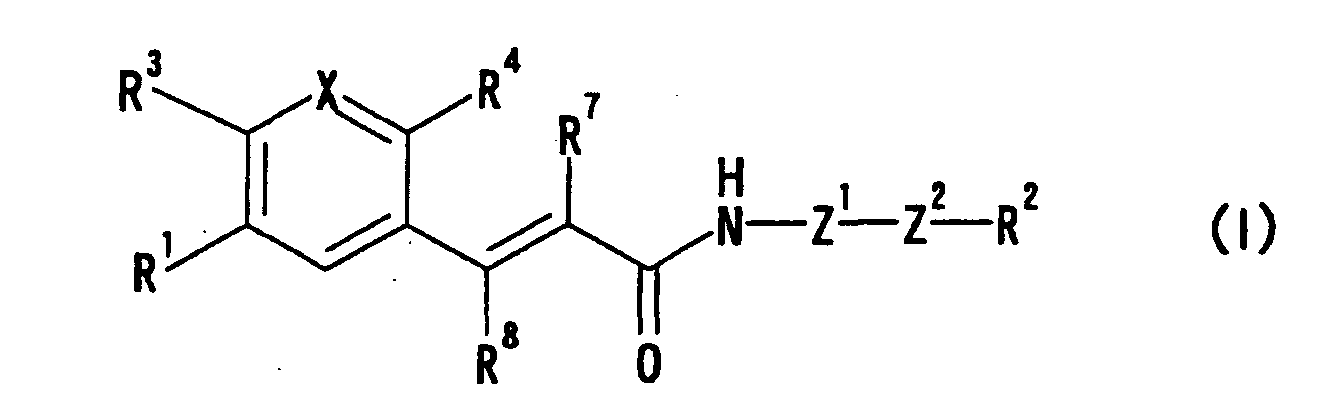


 wherein each symbol has the same meaning as defined above, or a salt thereof to a condensation reaction, and then optionally to deprotection, oxidation-reduction and/or quaternization reaction;








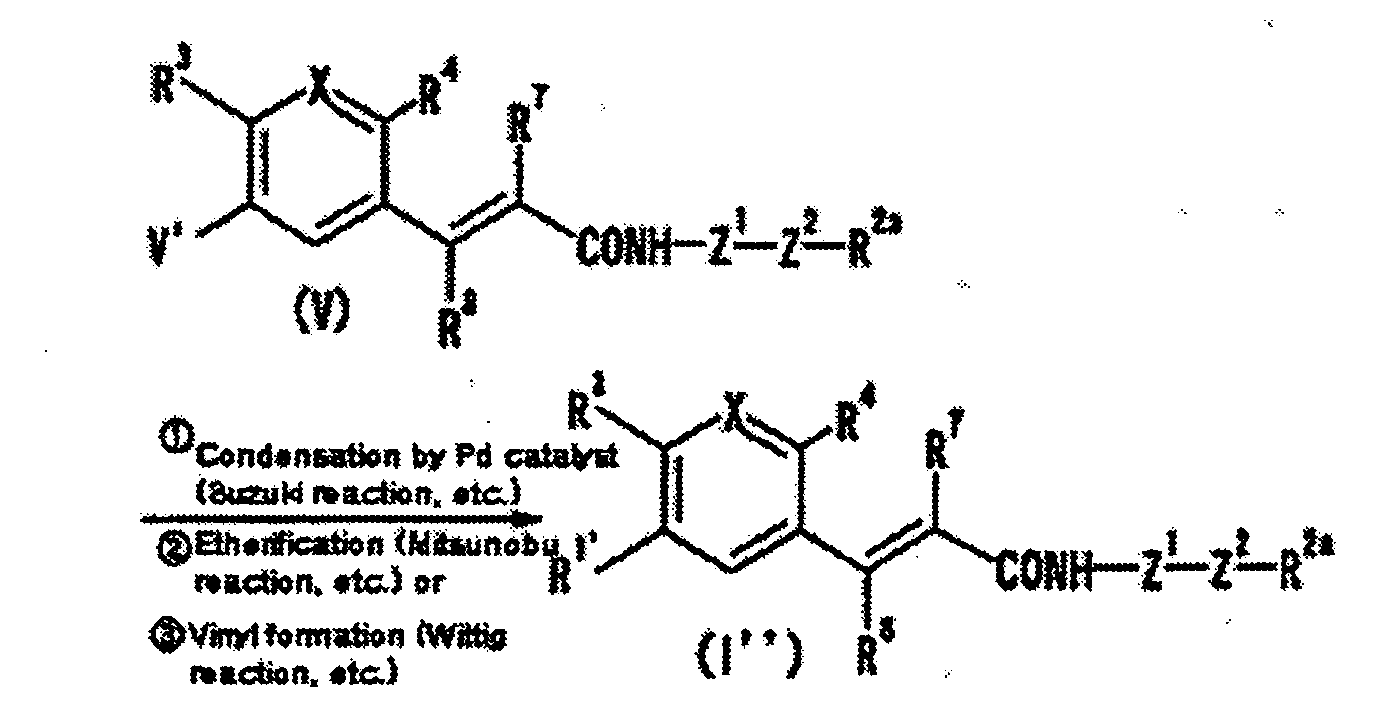
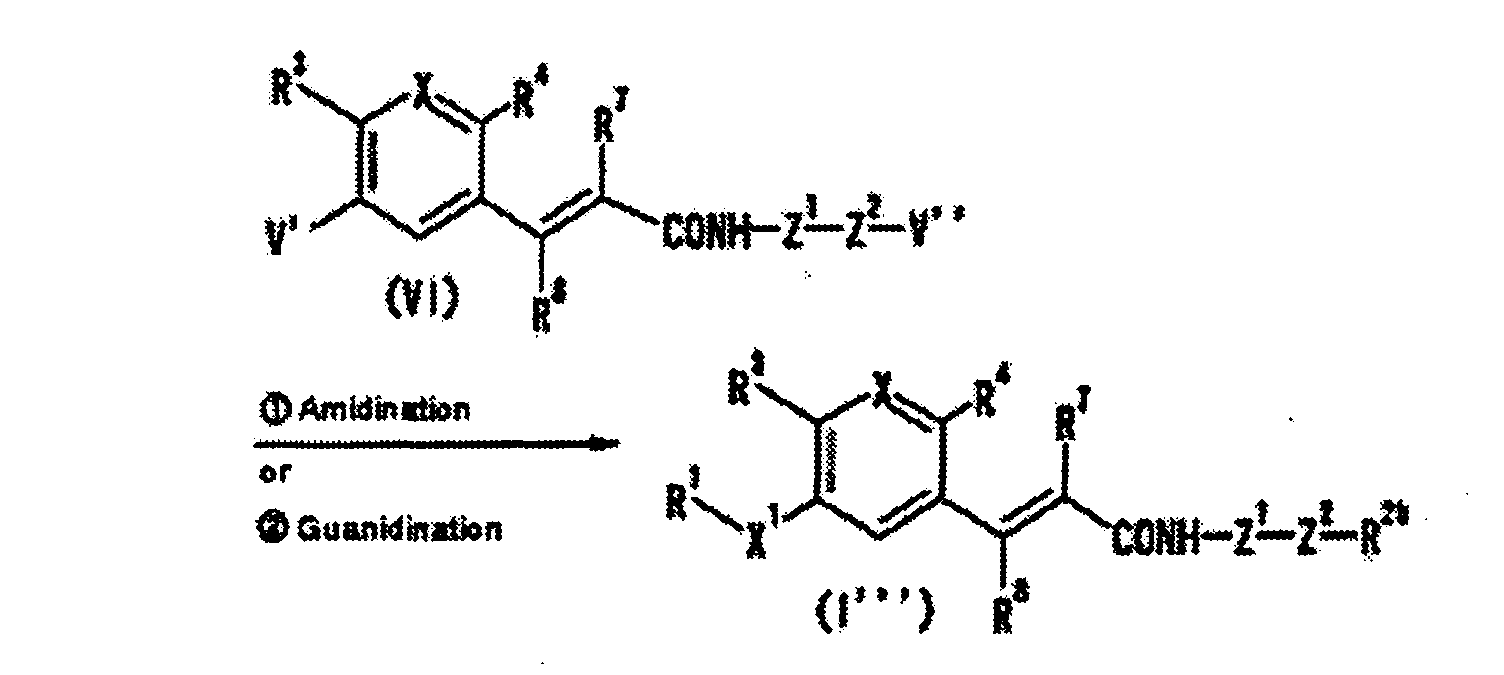
 wherein R11 represents a C1-4 alkyl group, X1 and X2 each represent a leaving group [halogen atom (chlorine, bromine, iodine, etc.), methanesulfonyloxy, trifluoromethanesulfonyl, benzenesulfonyloxy, toluenesulfonyloxy, etc.], and the other symbols have the same meanings as defined above.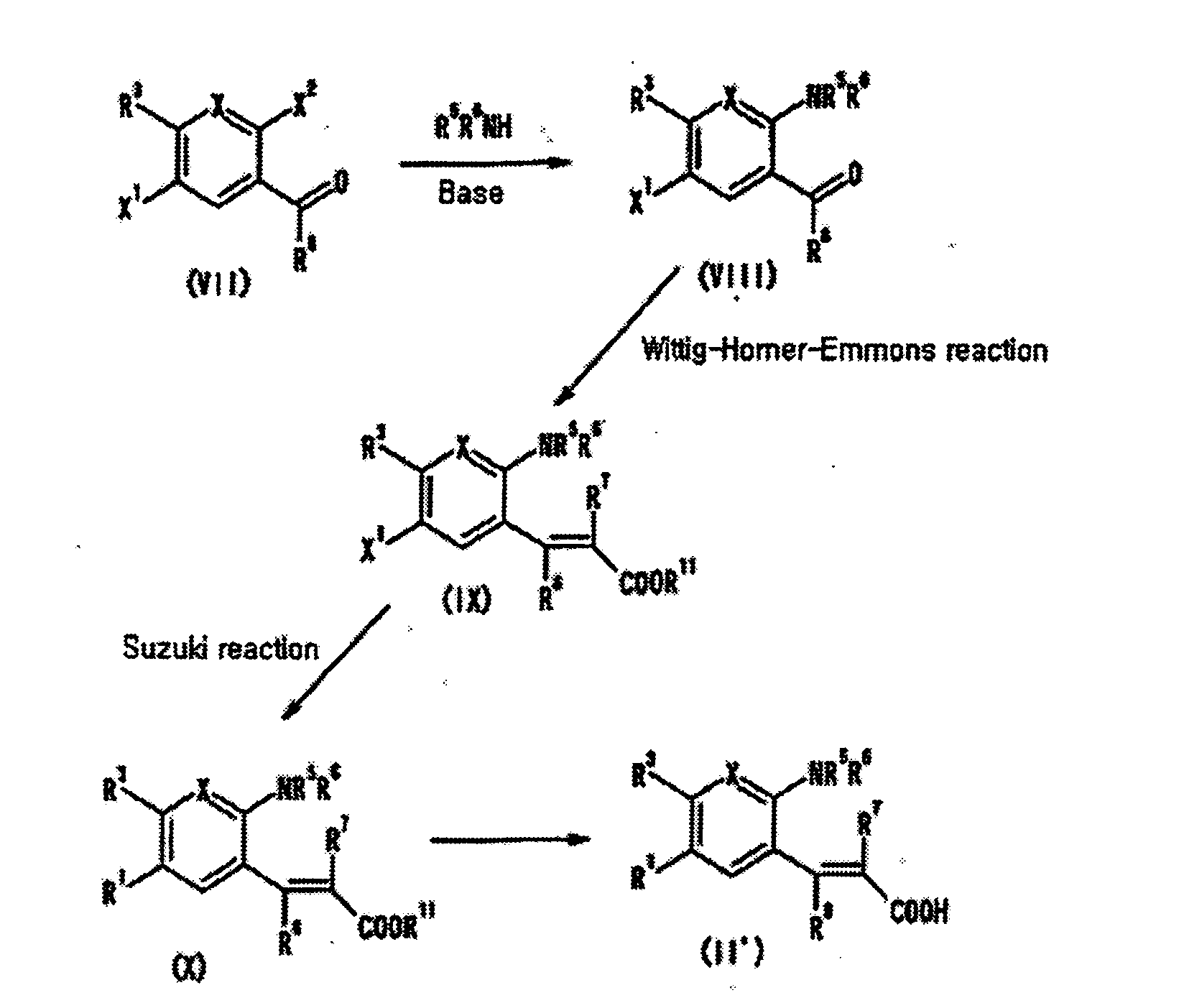
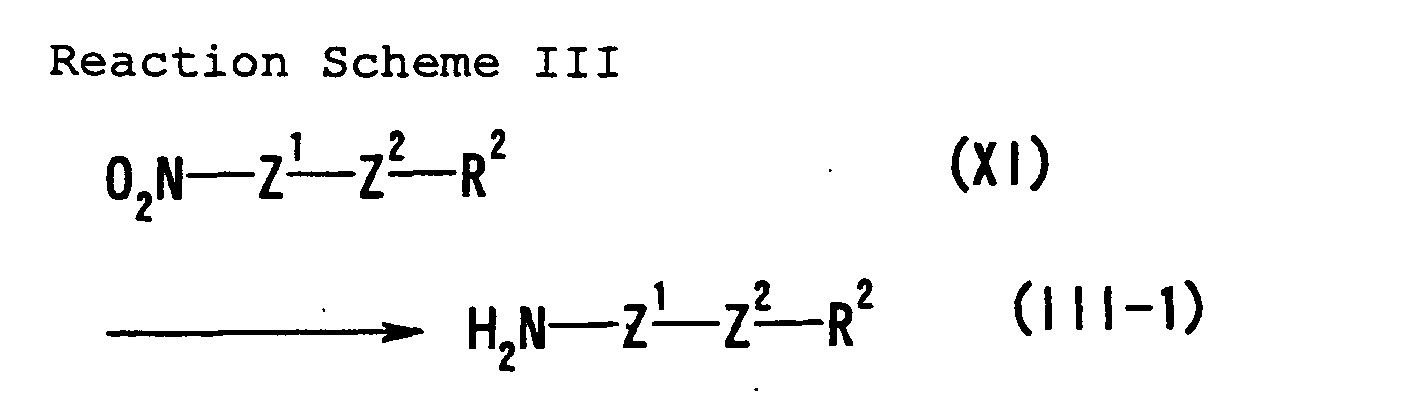
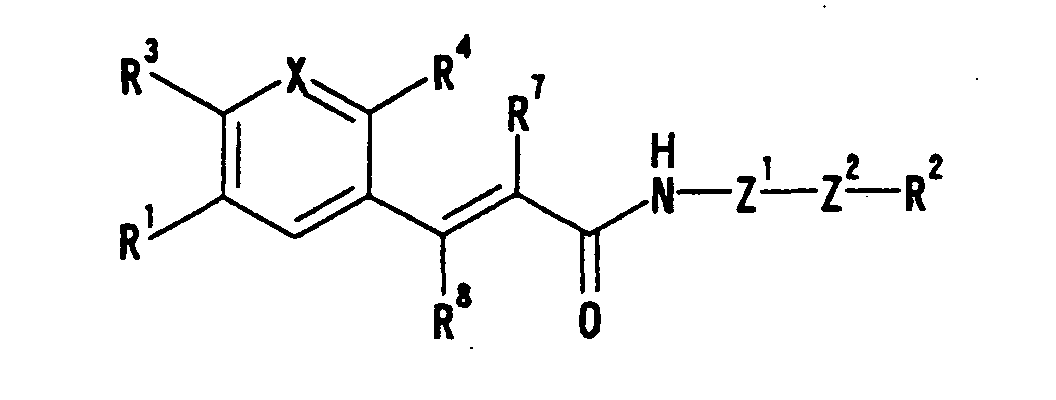
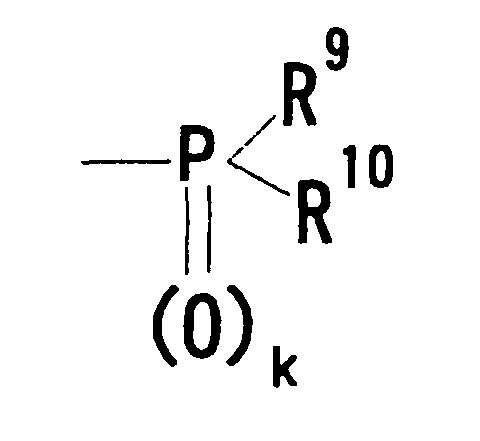
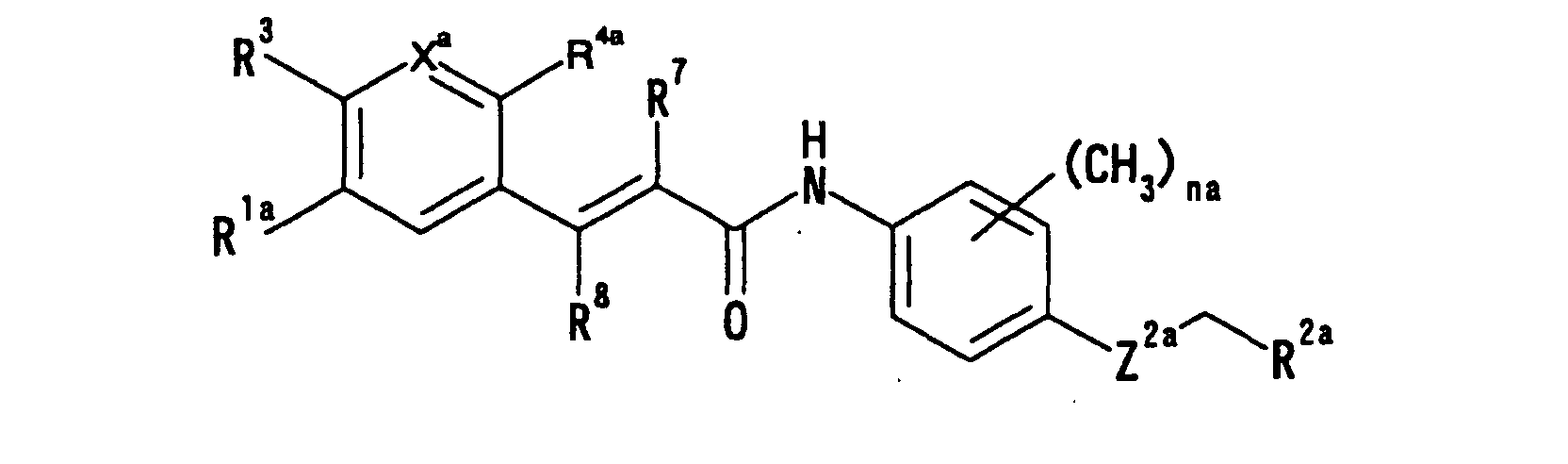
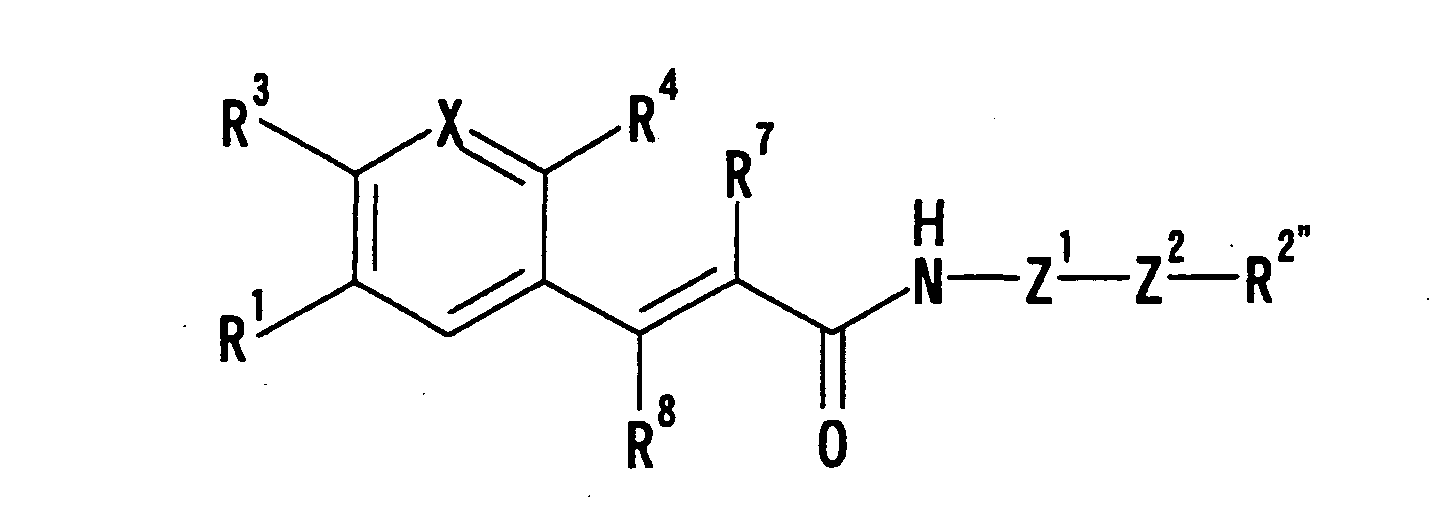 wherein k represents 0 or 1, and when k is 0, the phosphorus atom may form a phosphonium salt; R9 and R10 are each a hydrocarbon group which may be substituted, a hydroxy group which may be substituted or an amino group which may be substituted; or R5 and R6 may be bonded to each other to form a cyclic group with the adjacent phosphorus atom; and the other symbols have the same meanings as defined in claim 1; or a salt thereof, which comprises subjecting a compound represented by the formula:
 wherein each symbol has the same meaning as defined in claim 1;