EP1593420A1 - Filter member producing method - Google Patents
Filter member producing method Download PDFInfo
- Publication number
- EP1593420A1 EP1593420A1 EP04704770A EP04704770A EP1593420A1 EP 1593420 A1 EP1593420 A1 EP 1593420A1 EP 04704770 A EP04704770 A EP 04704770A EP 04704770 A EP04704770 A EP 04704770A EP 1593420 A1 EP1593420 A1 EP 1593420A1
- Authority
- EP
- European Patent Office
- Prior art keywords
- wire
- thermal treatment
- contact surface
- filter
- surface pressure
- Prior art date
- Legal status (The legal status is an assumption and is not a legal conclusion. Google has not performed a legal analysis and makes no representation as to the accuracy of the status listed.)
- Granted
Links
Images


Classifications
-
- B—PERFORMING OPERATIONS; TRANSPORTING
- B01—PHYSICAL OR CHEMICAL PROCESSES OR APPARATUS IN GENERAL
- B01D—SEPARATION
- B01D39/00—Filtering material for liquid or gaseous fluids
- B01D39/10—Filter screens essentially made of metal
-
- B—PERFORMING OPERATIONS; TRANSPORTING
- B60—VEHICLES IN GENERAL
- B60R—VEHICLES, VEHICLE FITTINGS, OR VEHICLE PARTS, NOT OTHERWISE PROVIDED FOR
- B60R21/00—Arrangements or fittings on vehicles for protecting or preventing injuries to occupants or pedestrians in case of accidents or other traffic risks
- B60R21/02—Occupant safety arrangements or fittings, e.g. crash pads
- B60R21/16—Inflatable occupant restraints or confinements designed to inflate upon impact or impending impact, e.g. air bags
- B60R21/26—Inflatable occupant restraints or confinements designed to inflate upon impact or impending impact, e.g. air bags characterised by the inflation fluid source or means to control inflation fluid flow
- B60R21/264—Inflatable occupant restraints or confinements designed to inflate upon impact or impending impact, e.g. air bags characterised by the inflation fluid source or means to control inflation fluid flow using instantaneous generation of gas, e.g. pyrotechnic
- B60R21/2644—Inflatable occupant restraints or confinements designed to inflate upon impact or impending impact, e.g. air bags characterised by the inflation fluid source or means to control inflation fluid flow using instantaneous generation of gas, e.g. pyrotechnic using only solid reacting substances, e.g. pellets, powder
-
- Y—GENERAL TAGGING OF NEW TECHNOLOGICAL DEVELOPMENTS; GENERAL TAGGING OF CROSS-SECTIONAL TECHNOLOGIES SPANNING OVER SEVERAL SECTIONS OF THE IPC; TECHNICAL SUBJECTS COVERED BY FORMER USPC CROSS-REFERENCE ART COLLECTIONS [XRACs] AND DIGESTS
- Y10—TECHNICAL SUBJECTS COVERED BY FORMER USPC
- Y10T—TECHNICAL SUBJECTS COVERED BY FORMER US CLASSIFICATION
- Y10T29/00—Metal working
- Y10T29/49—Method of mechanical manufacture
- Y10T29/496—Multiperforated metal article making
-
- Y—GENERAL TAGGING OF NEW TECHNOLOGICAL DEVELOPMENTS; GENERAL TAGGING OF CROSS-SECTIONAL TECHNOLOGIES SPANNING OVER SEVERAL SECTIONS OF THE IPC; TECHNICAL SUBJECTS COVERED BY FORMER USPC CROSS-REFERENCE ART COLLECTIONS [XRACs] AND DIGESTS
- Y10—TECHNICAL SUBJECTS COVERED BY FORMER USPC
- Y10T—TECHNICAL SUBJECTS COVERED BY FORMER US CLASSIFICATION
- Y10T29/00—Metal working
- Y10T29/49—Method of mechanical manufacture
- Y10T29/496—Multiperforated metal article making
- Y10T29/49604—Filter
Definitions
- the present invention relates to fabrication methods for a filtering member in which a wire arranged in a layered manner is bonded integrally for forming a mesh, such as a coil type filter, which is, for example, a filter used in an airbag inflator.
- a vehicle is provided with an airbag device, which inflates a bag by quickly supplying gas when a rapid deceleration occurs due to, for example, a car crash.
- the airbag device includes an inflator for quickly supplying gas when the device is activated and a bag inflated by the gas from the inflator for protecting passengers.
- the inflator incorporates an igniter, a gas generating agent burned in an explosive-like manner by the heat generated by the igniter, and a filter.
- the filter collects and cools solid or liquid residue contained in hot gas generated through combustion of the gas generating agent.
- the filter is configured normally by a coil type filter, which is formed by winding a circular wire or a deformed wire, such as a square wire, formed of metal (hereinafter, referred to as "a wire") in a layered manner for defining a meshed cylindrical body.
- a coil type filter which is formed by winding a circular wire or a deformed wire, such as a square wire, formed of metal (hereinafter, referred to as "a wire") in a layered manner for defining a meshed cylindrical body.
- a filter serving as a filtering member for an airbag is exposed to extremely hot gas. It is thus necessary to employ a bonding method that ensures a relatively high bonding strength. Therefore, for improving the bonding strength, it has been proposed that the sintering be conducted at a higher temperature, or for a prolonged time, or in a modified atmosphere (see Japanese Laid-Open Patent Publication No. 2001-171472).
- an embodiment of the present invention provides a method for fabricating a filtering member in which overlapping portions of a wire are bonded together in a layered manner through thermal treatment for forming a mesh.
- a contact surface pressure between portions of the wire to be bonded together is maintained as equal to or higher than a predetermined level set depending on a thermal treatment condition.
- the thermal treatment is conducted such that a bonding portion of the wire has a strength equal to or greater than 4 N (4 Newtons).
- the filtering member be a coil type filter in which the wire is wound in a layered manner for forming a mesh and that the contact surface pressure be reliably produced by tension applied to the wire during winding of the wire.
- a winding end of the wire be fixed while maintaining the tension applied to the wire during winding of the wire in a state acting on the wire. It is also desirable that the contact surface pressure be adjusted by changing the tension applied to the wire during winding of the wire.
- a detonator 11 and a burnable igniter 12 are installed in a middle portion of an inflator 10 of the airbag device.
- the detonator 11 is activated in response to an activation signal from a sensor (not shown).
- a chamber portion 13 is defined around the outer circumference of the detonator 11 and that of the igniter 12.
- the chamber portion 13 receives the heat generated through activation of the detonator 11 and resulting combustion of the igniter 12.
- a gas generating agent 14 is installed in the chamber portion 13.
- the gas generating agent 14 generates a relatively large amount of gas when burned in an explosion-like manner by the heat generated through the activation of the detonator 11 and the combustion of the igniter 12. The generated gas is then supplied to a bag (not shown) of the airbag device.
- a filter 15 is arranged in the inflator 10 and encompasses the chamber portion 13.
- the filter 15 functions as a cooling member for cooling the hot gas generated through combustion of the gas generating agent 14 and supplying the gas and as a filtering member for recovering solid residue contained in the gas.
- a circular wire or a deformed wire, such as a square wire, formed of metal (hereinafter, referred to as "a wire") 16 is wound around a cylindrical bobbin (not shown) for defining a mesh.
- the bobbin is then removed such that the filter 15 is shaped like a hollow cylinder.
- a wire material formed mainly of iron (having a cross-sectional area of 0.2 mm 2 ) is employed as the wire 16.
- the wire 16 is wound around the outer circumferential surface of the bobbin for 500 cycles, thus defining a mesh.
- the filter 15 has a hollow cylindrical shape with an outer diameter of ⁇ 60mm and an inner diameter of ⁇ 50mm.
- the filter 15 is allowed to cool the gas and recover solid residue contained in the gas.
- the winding pitch of the wire 16 is defined as a pitch C
- the angle between the crossing portions of the wire 16 is defined as a crossing angle ⁇
- the dimension of the wire 16 in the bobbin axial direction is defined as a winding dimension L
- the crossing portions of the wire 16 are referred to as a contact portion S, referring to Figs. 2(a) and 2(b).
- the fabrication method for the filter 15 will be explained in detail as follows.
- the wire 16 is wound around the outer circumferential surface of the bobbin in a crisscross manner, with a predetermined level of tension applied to the wire 16, such that a mesh is formed by the wire 16.
- the wire 16 may be wound around the bobbin by moving the wire 16 in the axial direction of the bobbin or moving the shaft of the bobbin in the bobbin's axial direction.
- the pitch C, the winding dimension L, the crossing angle ⁇ of the wire 16 are obtained through computer simulation.
- the filter 15 is thus fabricated in accordance with the optimal values of these parameters. In this manner, the mesh pattern or the winding density are set as desired, such that various types of meshes may be formed depending on different requirements for the filtering function.
- the filter 15 is used as a filtering member for an airbag, the filter 15 is exposed to extremely hot gas (at approximately 2,200 degrees Celsius). It is thus necessary to bond the contact portions S together with a relatively high bonding strength. Accordingly, for meeting such necessity, certain conditions are set in fabrication of the filter 15 in accordance with the illustrated embodiment. These conditions will be explained as follows.
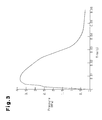
- Fig. 3 is a graph representing the pressure variation in the chamber portion 13 in the inflator 10 as time elapses when the airbag is actuated.
- the graph of Fig. 3 indicates that the pressure in the chamber portion 13 reaches a maximum level, approximately 4 MPa, immediately after actuation of the airbag. Since the filter 15 is arranged in the chamber portion 13, the bonding strength of the contact portions S of the filter 15 must be sufficiently high for tolerating the pressure of approximately 4 MPa.
- ⁇ represents the tension applied to the single wire section
- P1 represents the interior pressure acting on the filter
- ⁇ 1 is the outer diameter of the filter
- ⁇ 2 is the inner diameter of the filter
- ⁇ is the radius of the filter ( ⁇ 2 ⁇ ⁇ ⁇ ⁇ 1 )
- Z represents the cross-sectional area of the wire.
- the equation (1) represents the tension applied to a single section of the wire 16 when the gas generating agent 14 is burned.
- the values representing the specification of the filter 15 (the wire cross-sectional area: 0.2 mm 2 , the number of winding cycles: 500, the outer diameter: ⁇ 60, the inner diameter: ⁇ 50) to the equation (1), a value ⁇ substantially equal to 4 N is obtained. It is thus understood that a load of about 4 N acts on the single section of the wire 16 of the filter 15 as the tension, when the airbag is actuated.
- the bonding strength must be sufficiently high for producing resistance against a load of about 4 N.
- x represents the radius of a substantially circular contact surface formed through sintering of the metal line or a half of the lateral dimension of a strip-like contact surface if the contact surface obtained through sintering is developed in a strip-like shape
- a represents the radius of the metal line
- ⁇ represents the surface tension of the metal line
- V represents the volume of 1 mol of the metal line
- D v represents the diffusion coefficient in sintering
- t represents the sintering time
- R represents the gas constant (1.987cal/degree)
- T represents the sintering temperature (the absolute temperature).
- the coefficients C1, C2 are determined based on the assumption that the squared value of x (the radius of the contact surface and the like) of the equation (2) corresponds to the bonding area (or the bonding strength) brought about through sintering of the contact portions S of the filter 15, in accordance with the graph of Fig. 4 representing the relationship between the bonding strength between the bonding portions of the wire 16 and the contact surface pressure between the bonding portions of the wire 16.
- the graph of Fig. 4 shows the results of the test that has been conducted for determining the relationship between the contact surface pressure and the bonding strength between the bonding portions of the wire 16, representing the relationship between the bonding strength between the bonding portions of the wire 16 and the contact surface pressure between the bonding portions of the wire 16 in accordance with sintering conditions (temperature ⁇ time) when the number n of the bonding portion of the wire 16 corresponds to one.
- the relationship between the bonding strength between the bonding portions of the wire 16 and the contact surface pressure between the bonding portions of the wire 16 in accordance with a first sintering condition (1,100 degrees Celsius ⁇ 30 minutes) is represented by the solid line (a) and such relationship in accordance with a second sintering condition (1,100 degrees Celsius ⁇ 10 minutes) is represented by the solid line (b).
- the relationship between the bonding strength between the bonding portions of the wire 16 and the contact surface pressure between the bonding portions of the wire 16 in accordance with a third sintering condition (1,000 degrees Celsius ⁇ 30 minutes) is represented by the solid line (c) and such relationship in accordance with a fourth sintering condition (1,000 degrees Celsius ⁇ 10 minutes) is represented by the solid line (d).
- the filter 15 should be fabricated such that the condition represented by the following equation (4), which is obtained from the test equation (3), is satisfied: 4 ⁇ C1 ⁇ exp(-C2/T) ⁇ (t/T) 0.4 ⁇ P ⁇ b 2 ⁇ n
- T, t, P, b, n, C1, and C2 are defined in the same manner as those of the equation (3).
- a filter 15 having a bonding strength F equal to or higher than 4 N is obtained by setting the contact surface pressure to 0.25 N/mm 2 or higher. If the contact surface pressure is set to 0.39 N/mm 2 or higher, a filter 15 having a bonding strength F equal to or higher than 4 N can be obtained while improving productivity, as in the case of the second sintering condition (1,100 degrees Celsius ⁇ 10 minutes).
- a filter 15 having a bonding strength F equal to or higher than 4 N can be obtained at a sintering temperature lower than that of the first sintering condition, as in the case of the third sintering condition (1,000 degrees Celsius ⁇ 30 minutes).
- a filter 15 having a bonding strength F equal to or higher than 4 N can be obtained at a relatively low sintering temperature with improved productivity, as in the case of the fourth sintering condition (1,000 degrees Celsius ⁇ 10 minutes).
- the level of the surface pressure (the contact surface pressure) between the bonding portions of the wire 16, as well as the sintering conditions including the sintering temperature, is an important factor for determining the bonding strength.
- a tapered jig may be inserted into the hollow shaft portion of the filter 15 when sintering is performed such that the crossing portions of the wire 16 are held in contact as pressed together.
- the contact surface pressure can be produced by the tension applied to the wire 16 during winding. The contact surface pressure is thus ensured relatively easily.
- Equation (5) represents the relationship between the contact surface pressure between the bonding portions of the wire 16 and the tension in the case of the illustrated embodiment.
- P ⁇ /(r ⁇ b)
- P represents the contact surface pressure (N/mm 2 ) between the wire bonding portions
- ⁇ represents the tension (N) acting on a single section of the wire 16
- r represents the winding radius (mm) of the wire 16
- b represents the lateral contact dimension (mm) between the bonding portions of the wire 16.
- the tension applied to the wire 16 during winding is a factor related to the contact surface pressure of the contact portions S.
- the contact surface pressure P becomes higher.
- the tension ⁇ applied during winding becomes smaller, the contact surface pressure P becomes lower.
- the tension ⁇ obtained by the equation (5) is 9.61 N when the lateral contact dimension b is 0.5 mm and the winding radius r is 31 mm.
- the tension ⁇ as a whole cannot act as the contact surface pressure.
- the actual number n of the bonding portions of the wire 16 cannot be one. With these conditions considered, it is known that the actually obtained effect corresponds to at least 60% of the computed value.
- the contact surface pressure at each of the contact portions S of the wire 16 can be set to 0.62 N/mm 2 or higher.
- the illustrated embodiment has the following advantages.
- a line formed mainly of iron (having a cross-sectional area of 0.2 mm 2 ) is employed as the wire 16.
- the wire 16 is wound around the bobbin for 500 cycles for forming a hollow cylindrical coil type filter 15 with an outer diameter of ⁇ 60 and an inner diameter of ⁇ 50.
- the material or the dimensions of the filter 15 may be selected as needed in accordance with the shape or the dimensions of the inflator 10, in which the filter 15 is installed.
- the mesh is formed by winding the wire 16, the metal square or circular line, around the shaft of the bobbin.
- the mesh of the filter 15 may be formed in different suitable manners modified from that of the embodiment.
- the filter 15 may include a knitted mesh such as a stockinet type mesh.
- the mesh of the filter 15 may be formed by winding a flat-woven mesh in an overlapping manner.
- the contact surface pressure acting on each of the contact portions S between the bonded portions of the wire 16 of the filter 15 is produced by the tension applied to the wire 16 during winding of the wire 16.
- contact surface pressure may be generated using a tapered jig or the like, when sintering is conducted.
- the overlapping portions of the wire 16 which are arranged in a layered manner, are bonded together though sintering.
- bonding of the wire 16 may be brought about by different suitable methods other than the sintering.
- the overlapping portions of the wire 16 may be bonded together through highfrequency induction heating.
Landscapes
- Chemical & Material Sciences (AREA)
- Chemical Kinetics & Catalysis (AREA)
- Air Bags (AREA)
- Filtering Materials (AREA)
Abstract
Description
C1, C2 are coefficients; C1 = 4,105, C2 = 9,000.
Claims (10)
- A method for fabricating a filtering member in which overlapping portions of a wire are bonded together in a layered manner through thermal treatment for forming a mesh, the method being characterized in that:a contact surface pressure between portions of the wire to be bonded together is maintained as equal to or higher than a predetermined level that is set in accordance with a thermal treatment condition, and the thermal treatment is conducted in this state, such that each bonding portion of the wire has a strength equal to or greater than 4 N.
- The method according to Claim 1, characterized in that, when a thermal treatment temperature and a thermal treatment time are specified as the thermal treatment condition, the thermal treatment is performed such that the following inequality is satisfied:
T: thermal treatment temperature, t: thermal treatment time, P: contact surface pressure, b: lateral contact dimension between contact portions of the wire, n: number of bonding portions of the wire, and
wherein C1 and C2 are coefficients, with C1 = 4,105, and C2 = 9,000. - The method according to Claims 1 or 2, wherein:the filtering member is a coil type filter in which the wire is wound in a layered manner for forming a mesh, and the contact surface pressure is produced by tension applied to the wire during winding of the wire.
- The method according to Claim 3, wherein a winding end of the wire is fixed while the tension is applied to the wire during winding of the wire.
- The method according to Claim 3 or 4, wherein the contact surface pressure is adjusted by changing the tension applied to the wire during winding of the wire.
- A method for fabricating a filter for an airbag inflator in which overlapping portions of a metal wire are bonded together in a layered manner through thermal treatment for forming a mesh, the method being characterized in that:a contact surface pressure between portions of the wire to be bonded together is maintained as equal to or higher than a predetermined level that is set in accordance with a thermal treatment condition, and the thermal treatment is conducted in this state, such that each bonding portion of the wire has a strength equal to or greater than 4 N.
- The method according to Claim 6, characterized in that, when a thermal treatment temperature and a thermal treatment time are specified as the thermal treatment condition, the thermal treatment is performed such that the following inequality is satisfied:T: thermal treatment temperature, t: thermal treatment time, P: contact surface pressure, b: lateral contact dimension between contact portions of the wire, n: number of bonding portions of the wire, andC1 and C2 are coefficients, which C1 = 4,105, and C2 = 9,000.
- The method according to Claims 6 or 7, wherein the filter is a coil type filter in which the wire is wound in a layered manner for forming a mesh, and the contact surface pressure is produced by tension applied to the wire during winding of the wire.
- The method according to Claim 8, wherein a winding end of the wire is fixed while the tension is applied to the wire during winding of the wire.
- The method according to Claim 8 or 9, wherein the contact surface pressure is adjusted by changing the tension applied to the wire during winding of the wire.
Applications Claiming Priority (3)
| Application Number | Priority Date | Filing Date | Title |
|---|---|---|---|
| JP2003016616 | 2003-01-24 | ||
| JP2003016616A JP4377134B2 (en) | 2003-01-24 | 2003-01-24 | Filtration member manufacturing method |
| PCT/JP2004/000634 WO2004064979A1 (en) | 2003-01-24 | 2004-01-23 | Filter member producing method |
Publications (3)
| Publication Number | Publication Date |
|---|---|
| EP1593420A1 true EP1593420A1 (en) | 2005-11-09 |
| EP1593420A4 EP1593420A4 (en) | 2007-04-18 |
| EP1593420B1 EP1593420B1 (en) | 2012-04-04 |
Family
ID=32767484
Family Applications (1)
| Application Number | Title | Priority Date | Filing Date |
|---|---|---|---|
| EP04704770A Expired - Lifetime EP1593420B1 (en) | 2003-01-24 | 2004-01-23 | Filter member producing method |
Country Status (5)
| Country | Link |
|---|---|
| US (1) | US7640663B2 (en) |
| EP (1) | EP1593420B1 (en) |
| JP (1) | JP4377134B2 (en) |
| CN (1) | CN1330401C (en) |
| WO (1) | WO2004064979A1 (en) |
Cited By (1)
| Publication number | Priority date | Publication date | Assignee | Title |
|---|---|---|---|---|
| US7452397B2 (en) | 2004-01-29 | 2008-11-18 | Chuo Hatsujo Kabushiki Kaisha | Filtration member for inflator and method of manufacturing the same |
Families Citing this family (10)
| Publication number | Priority date | Publication date | Assignee | Title |
|---|---|---|---|---|
| JP4377134B2 (en) | 2003-01-24 | 2009-12-02 | 中央発條株式会社 | Filtration member manufacturing method |
| JP4753692B2 (en) * | 2005-11-15 | 2011-08-24 | 富士フィルター工業株式会社 | Inflator for airbag |
| DE102007005588B4 (en) * | 2007-02-05 | 2014-02-13 | Trw Airbag Systems Gmbh | Filter for use in a gas generator, gas generator, vehicle occupant restraint system, method of making the filter and use of the filter |
| CN102848089B (en) * | 2011-06-30 | 2016-05-11 | 上海空间推进研究所 | The manufacture method of satellite filter element |
| JP6297814B2 (en) * | 2012-12-28 | 2018-03-20 | 富士フィルター工業株式会社 | Metal porous body |
| JP6397204B2 (en) * | 2014-04-01 | 2018-09-26 | 学校法人金沢工業大学 | Metal porous body |
| MY189586A (en) * | 2014-10-30 | 2022-02-18 | Fuji Filter Mfg Co Ltd | Hollow cylindrical filter and manufacturing apparatus |
| DE102018007294A1 (en) * | 2018-09-14 | 2020-03-19 | Guntram Krettek | Process for fixing a sheet and filter device produced therewith |
| KR102217342B1 (en) * | 2019-02-12 | 2021-02-19 | 엘지전자 주식회사 | Linear compressor |
| JP7784911B2 (en) * | 2022-02-02 | 2025-12-12 | 日本化薬株式会社 | Wirewound Filter |
Family Cites Families (14)
| Publication number | Priority date | Publication date | Assignee | Title |
|---|---|---|---|---|
| US2271662A (en) * | 1939-01-17 | 1942-02-03 | Rubissow George Alexis | Filtering element and new method for its manufacture |
| US3920170A (en) * | 1973-03-23 | 1975-11-18 | Universal Oil Prod Co | Apparatus for making cylindrical screens |
| DE2720278C2 (en) | 1977-05-05 | 1985-03-21 | Nippon Seisen Co., Ltd., Hirakata, Osaka | Method of making a reinforced metal filter |
| JPH01293112A (en) * | 1988-05-17 | 1989-11-27 | Ngk Insulators Ltd | Filter for gas generator and its production |
| DE4201741A1 (en) * | 1992-01-23 | 1993-07-29 | Dynamit Nobel Ag | FILTER DEVICE FOR FILTERING A GAS FLOW |
| JP2781807B2 (en) * | 1992-06-11 | 1998-07-30 | 日本化薬株式会社 | Gas filter for gas generator |
| JPH09226507A (en) * | 1996-02-20 | 1997-09-02 | Nippon Kayaku Co Ltd | Gas generator for air bag |
| JP3976155B2 (en) * | 1998-06-05 | 2007-09-12 | 富士フィルター工業株式会社 | Inflator for airbag |
| ATE229366T1 (en) * | 1999-02-02 | 2002-12-15 | Bekaert Sa Nv | TAPE WOUND FILTER CARTRIDGE |
| JP3861520B2 (en) * | 1999-07-22 | 2006-12-20 | チッソ株式会社 | Cylindrical filter |
| JP3973814B2 (en) * | 1999-12-17 | 2007-09-12 | 富士フィルター工業株式会社 | Air bag inflator filter and manufacturing method thereof |
| CN1131091C (en) * | 2000-07-07 | 2003-12-17 | 清华大学 | Filter material and filter for reverse spray to regenerate carbon smoke filter |
| JP4776799B2 (en) | 2001-04-17 | 2011-09-21 | 富士フィルター工業株式会社 | Method for manufacturing wire wound filter device |
| JP4377134B2 (en) | 2003-01-24 | 2009-12-02 | 中央発條株式会社 | Filtration member manufacturing method |
-
2003
- 2003-01-24 JP JP2003016616A patent/JP4377134B2/en not_active Expired - Lifetime
-
2004
- 2004-01-23 EP EP04704770A patent/EP1593420B1/en not_active Expired - Lifetime
- 2004-01-23 WO PCT/JP2004/000634 patent/WO2004064979A1/en not_active Ceased
- 2004-01-23 US US10/542,537 patent/US7640663B2/en not_active Expired - Lifetime
- 2004-01-23 CN CNB2004800024157A patent/CN1330401C/en not_active Expired - Lifetime
Cited By (2)
| Publication number | Priority date | Publication date | Assignee | Title |
|---|---|---|---|---|
| US7452397B2 (en) | 2004-01-29 | 2008-11-18 | Chuo Hatsujo Kabushiki Kaisha | Filtration member for inflator and method of manufacturing the same |
| DE112005000121B4 (en) * | 2004-01-29 | 2009-04-09 | Chuo Hatsujo K.K., Nagoya | Filter element for a gas generator and method for producing the same |
Also Published As
| Publication number | Publication date |
|---|---|
| CN1330401C (en) | 2007-08-08 |
| JP2004261629A (en) | 2004-09-24 |
| EP1593420A4 (en) | 2007-04-18 |
| CN1738673A (en) | 2006-02-22 |
| JP4377134B2 (en) | 2009-12-02 |
| WO2004064979A1 (en) | 2004-08-05 |
| US20060112559A1 (en) | 2006-06-01 |
| EP1593420B1 (en) | 2012-04-04 |
| US7640663B2 (en) | 2010-01-05 |
Similar Documents
| Publication | Publication Date | Title |
|---|---|---|
| EP1593420B1 (en) | Filter member producing method | |
| US7559146B2 (en) | Wire mesh filter with improved hoop strength | |
| US5665131A (en) | Inflator filter made of wrapped mesh | |
| KR101098063B1 (en) | Filter for air bag gas producer and method for manufacturing the same, and gas producer for air bag | |
| JP3973814B2 (en) | Air bag inflator filter and manufacturing method thereof | |
| WO1999006248A1 (en) | Gas generator and its filter | |
| WO2018051814A1 (en) | Gas generator filter and gas generator | |
| US7452397B2 (en) | Filtration member for inflator and method of manufacturing the same | |
| JP4402705B2 (en) | Air bag inflator filter and manufacturing method thereof | |
| JP2781807B2 (en) | Gas filter for gas generator | |
| JP5848914B2 (en) | Air bag inflator filter and manufacturing method thereof | |
| JP5094047B2 (en) | Wound filter member and manufacturing method thereof | |
| US5086550A (en) | Method of assembling an inflator for a vehicle occupant restraint | |
| JP3983297B2 (en) | Airbag inflator | |
| JP2003080012A (en) | Method for manufacturing filter for inflator | |
| JP4681867B2 (en) | Filtration member and method of manufacturing filtration member | |
| KR101099280B1 (en) | Gas producer-use filter and method of manufacturing the same, and gas producer for air bag | |
| JP3041850U (en) | Gas generator filter | |
| JPH01172047A (en) | Filter device for air bag expander and forming method thereof | |
| JP2005153202A (en) | Porous body and its manufacturing method | |
| JP2004337672A (en) | Manufacturing method of filtration member |
Legal Events
| Date | Code | Title | Description |
|---|---|---|---|
| PUAI | Public reference made under article 153(3) epc to a published international application that has entered the european phase |
Free format text: ORIGINAL CODE: 0009012 |
|
| 17P | Request for examination filed |
Effective date: 20050722 |
|
| AK | Designated contracting states |
Kind code of ref document: A1 Designated state(s): AT BE BG CH CY CZ DE DK EE ES FI FR GB GR HU IE IT LI LU MC NL PT RO SE SI SK TR |
|
| AX | Request for extension of the european patent |
Extension state: AL LT LV MK |
|
| DAX | Request for extension of the european patent (deleted) | ||
| RBV | Designated contracting states (corrected) |
Designated state(s): DE FR |
|
| A4 | Supplementary search report drawn up and despatched |
Effective date: 20070321 |
|
| 17Q | First examination report despatched |
Effective date: 20090817 |
|
| GRAP | Despatch of communication of intention to grant a patent |
Free format text: ORIGINAL CODE: EPIDOSNIGR1 |
|
| GRAS | Grant fee paid |
Free format text: ORIGINAL CODE: EPIDOSNIGR3 |
|
| RAP1 | Party data changed (applicant data changed or rights of an application transferred) |
Owner name: CHUO HATSUJO KABUSHIKI KAISHA |
|
| GRAA | (expected) grant |
Free format text: ORIGINAL CODE: 0009210 |
|
| AK | Designated contracting states |
Kind code of ref document: B1 Designated state(s): DE FR |
|
| REG | Reference to a national code |
Ref country code: DE Ref legal event code: R096 Ref document number: 602004037169 Country of ref document: DE Effective date: 20120531 |
|
| PLBE | No opposition filed within time limit |
Free format text: ORIGINAL CODE: 0009261 |
|
| STAA | Information on the status of an ep patent application or granted ep patent |
Free format text: STATUS: NO OPPOSITION FILED WITHIN TIME LIMIT |
|
| 26N | No opposition filed |
Effective date: 20130107 |
|
| REG | Reference to a national code |
Ref country code: DE Ref legal event code: R097 Ref document number: 602004037169 Country of ref document: DE Effective date: 20130107 |
|
| REG | Reference to a national code |
Ref country code: FR Ref legal event code: PLFP Year of fee payment: 12 |
|
| REG | Reference to a national code |
Ref country code: DE Ref legal event code: R082 Ref document number: 602004037169 Country of ref document: DE Representative=s name: GRUENECKER PATENT- UND RECHTSANWAELTE PARTG MB, DE |
|
| PGFP | Annual fee paid to national office [announced via postgrant information from national office to epo] |
Ref country code: FR Payment date: 20150115 Year of fee payment: 12 |
|
| REG | Reference to a national code |
Ref country code: DE Ref legal event code: R081 Ref document number: 602004037169 Country of ref document: DE Owner name: DAICEL CORPORATION, JP Free format text: FORMER OWNER: CHUO HATSUJO K.K., NAGOYA-SHI, JP Effective date: 20150511 Ref country code: DE Ref legal event code: R081 Ref document number: 602004037169 Country of ref document: DE Owner name: DAICEL CORPORATION, JP Free format text: FORMER OWNER: CHUO HATSUJO K.K., NAGOYA, AICHI, JP Effective date: 20120405 Ref country code: DE Ref legal event code: R082 Ref document number: 602004037169 Country of ref document: DE Representative=s name: GRUENECKER PATENT- UND RECHTSANWAELTE PARTG MB, DE Effective date: 20150511 Ref country code: DE Ref legal event code: R081 Ref document number: 602004037169 Country of ref document: DE Owner name: DAICEL CORPORATION, OSAKA-SHI, JP Free format text: FORMER OWNER: CHUO HATSUJO K.K., NAGOYA-SHI, JP Effective date: 20150511 Ref country code: DE Ref legal event code: R081 Ref document number: 602004037169 Country of ref document: DE Owner name: DAICEL CORPORATION, OSAKA-SHI, JP Free format text: FORMER OWNER: CHUO HATSUJO K.K., NAGOYA, AICHI, JP Effective date: 20120405 |
|
| REG | Reference to a national code |
Ref country code: FR Ref legal event code: TP Owner name: DAICEL CORPORATION, JP Effective date: 20150729 |
|
| REG | Reference to a national code |
Ref country code: FR Ref legal event code: ST Effective date: 20160930 |
|
| PG25 | Lapsed in a contracting state [announced via postgrant information from national office to epo] |
Ref country code: FR Free format text: LAPSE BECAUSE OF NON-PAYMENT OF DUE FEES Effective date: 20160201 |
|
| PGFP | Annual fee paid to national office [announced via postgrant information from national office to epo] |
Ref country code: DE Payment date: 20230123 Year of fee payment: 20 |
|
| REG | Reference to a national code |
Ref country code: DE Ref legal event code: R071 Ref document number: 602004037169 Country of ref document: DE |