EP1592684B1 - Malonamide derivatives as gamma-secretase inhibitors - Google Patents
Malonamide derivatives as gamma-secretase inhibitors Download PDFInfo
- Publication number
- EP1592684B1 EP1592684B1 EP04705404A EP04705404A EP1592684B1 EP 1592684 B1 EP1592684 B1 EP 1592684B1 EP 04705404 A EP04705404 A EP 04705404A EP 04705404 A EP04705404 A EP 04705404A EP 1592684 B1 EP1592684 B1 EP 1592684B1
- Authority
- EP
- European Patent Office
- Prior art keywords
- methyl
- benzyl
- malonamide
- oxo
- dihydro
- Prior art date
- Legal status (The legal status is an assumption and is not a legal conclusion. Google has not performed a legal analysis and makes no representation as to the accuracy of the status listed.)
- Expired - Lifetime
Links
- 0 CN1CC*(*)CCC1 Chemical compound CN1CC*(*)CCC1 0.000 description 15
- AOCWQPKHSMJWPL-UHFFFAOYSA-N CC(CCN1)C1=O Chemical compound CC(CCN1)C1=O AOCWQPKHSMJWPL-UHFFFAOYSA-N 0.000 description 1
- BYLGAIQXALUHSF-UHFFFAOYSA-N CC1N=C(c2ccccc2)c(cccc2CC3)c2N3C1O Chemical compound CC1N=C(c2ccccc2)c(cccc2CC3)c2N3C1O BYLGAIQXALUHSF-UHFFFAOYSA-N 0.000 description 1
- UZRUKLJLGXLGDM-UHFFFAOYSA-N CCCC(C(N)=O)N Chemical compound CCCC(C(N)=O)N UZRUKLJLGXLGDM-UHFFFAOYSA-N 0.000 description 1
- WBTANXHOAUWNIK-UHFFFAOYSA-N CC[n]1nc(C)cc1C Chemical compound CC[n]1nc(C)cc1C WBTANXHOAUWNIK-UHFFFAOYSA-N 0.000 description 1
- SVYKKECYCPFKGB-UHFFFAOYSA-N CN(C)C1CCCCC1 Chemical compound CN(C)C1CCCCC1 SVYKKECYCPFKGB-UHFFFAOYSA-N 0.000 description 1
- JBFMAXUVSWCKMB-UHFFFAOYSA-N CN(C)CC1OC=CC1 Chemical compound CN(C)CC1OC=CC1 JBFMAXUVSWCKMB-UHFFFAOYSA-N 0.000 description 1
- QAIBOSDADREVLH-UHFFFAOYSA-N CN(C)CC1OCCO1 Chemical compound CN(C)CC1OCCO1 QAIBOSDADREVLH-UHFFFAOYSA-N 0.000 description 1
- OJDQXDNHWPIWAK-UHFFFAOYSA-N CN(C)c1cccc(-c2ccccc2)c1 Chemical compound CN(C)c1cccc(-c2ccccc2)c1 OJDQXDNHWPIWAK-UHFFFAOYSA-N 0.000 description 1
- UZDBWHMHPZZCNE-UHFFFAOYSA-N CN(C)c1ccccc1Cc1ccccc1 Chemical compound CN(C)c1ccccc1Cc1ccccc1 UZDBWHMHPZZCNE-UHFFFAOYSA-N 0.000 description 1
- MJBULFRLWKGDIP-UHFFFAOYSA-N CN(C)c1ccccc1Oc1ccccc1 Chemical compound CN(C)c1ccccc1Oc1ccccc1 MJBULFRLWKGDIP-UHFFFAOYSA-N 0.000 description 1
- ILABWDUPVPANGS-UHFFFAOYSA-N CN(CC1)C(C2)c3c1cccc3C2O Chemical compound CN(CC1)C(C2)c3c1cccc3C2O ILABWDUPVPANGS-UHFFFAOYSA-N 0.000 description 1
- IKULEWGSUBVJJN-UHFFFAOYSA-N CN(CC1)CCN1S(C)=O Chemical compound CN(CC1)CCN1S(C)=O IKULEWGSUBVJJN-UHFFFAOYSA-N 0.000 description 1
- OUMSVISIEHVIIW-UHFFFAOYSA-N CN(CC1)Cc(cc2)c1c1c2OCO1 Chemical compound CN(CC1)Cc(cc2)c1c1c2OCO1 OUMSVISIEHVIIW-UHFFFAOYSA-N 0.000 description 1
- XNZFFRJWTVYMBF-UHFFFAOYSA-N CN(CC1)Cc2c1cc1OCOc1c2 Chemical compound CN(CC1)Cc2c1cc1OCOc1c2 XNZFFRJWTVYMBF-UHFFFAOYSA-N 0.000 description 1
- GGALHNPESOQMJS-JQWIXIFHSA-N CN([C@@H](CC1)C2)[C@@H]1c1c2cccc1 Chemical compound CN([C@@H](CC1)C2)[C@@H]1c1c2cccc1 GGALHNPESOQMJS-JQWIXIFHSA-N 0.000 description 1
- ZKUKXSWKWGHYKJ-UHFFFAOYSA-N CN1CCCCCC1 Chemical compound CN1CCCCCC1 ZKUKXSWKWGHYKJ-UHFFFAOYSA-N 0.000 description 1
- MMCXKYPKYQMCRM-NXEZZACHSA-N CN1C[C@@H](CCCC2)[C@H]2CC1 Chemical compound CN1C[C@@H](CCCC2)[C@H]2CC1 MMCXKYPKYQMCRM-NXEZZACHSA-N 0.000 description 1
- MOKCWNNJPFWPDL-UHFFFAOYSA-N CNC1=C(C2)C2C1 Chemical compound CNC1=C(C2)C2C1 MOKCWNNJPFWPDL-UHFFFAOYSA-N 0.000 description 1
- JIVIQMOCEOPOHG-UHFFFAOYSA-N CNCC(C1)OCCN1c1ccccc1 Chemical compound CNCC(C1)OCCN1c1ccccc1 JIVIQMOCEOPOHG-UHFFFAOYSA-N 0.000 description 1
- CAWHJQAVHZEVTJ-UHFFFAOYSA-N Cc1cnccn1 Chemical compound Cc1cnccn1 CAWHJQAVHZEVTJ-UHFFFAOYSA-N 0.000 description 1
- TWGNOYAGHYUFFR-UHFFFAOYSA-N Cc1cncnc1 Chemical compound Cc1cncnc1 TWGNOYAGHYUFFR-UHFFFAOYSA-N 0.000 description 1
- BSKHPKMHTQYZBB-UHFFFAOYSA-N Cc1ncccc1 Chemical compound Cc1ncccc1 BSKHPKMHTQYZBB-UHFFFAOYSA-N 0.000 description 1
Classifications
-
- C—CHEMISTRY; METALLURGY
- C07—ORGANIC CHEMISTRY
- C07C—ACYCLIC OR CARBOCYCLIC COMPOUNDS
- C07C237/00—Carboxylic acid amides, the carbon skeleton of the acid part being further substituted by amino groups
- C07C237/02—Carboxylic acid amides, the carbon skeleton of the acid part being further substituted by amino groups having the carbon atoms of the carboxamide groups bound to acyclic carbon atoms of the carbon skeleton
- C07C237/22—Carboxylic acid amides, the carbon skeleton of the acid part being further substituted by amino groups having the carbon atoms of the carboxamide groups bound to acyclic carbon atoms of the carbon skeleton having nitrogen atoms of amino groups bound to the carbon skeleton of the acid part, further acylated
-
- A—HUMAN NECESSITIES
- A61—MEDICAL OR VETERINARY SCIENCE; HYGIENE
- A61P—SPECIFIC THERAPEUTIC ACTIVITY OF CHEMICAL COMPOUNDS OR MEDICINAL PREPARATIONS
- A61P25/00—Drugs for disorders of the nervous system
- A61P25/28—Drugs for disorders of the nervous system for treating neurodegenerative disorders of the central nervous system, e.g. nootropic agents, cognition enhancers, drugs for treating Alzheimer's disease or other forms of dementia
-
- A—HUMAN NECESSITIES
- A61—MEDICAL OR VETERINARY SCIENCE; HYGIENE
- A61P—SPECIFIC THERAPEUTIC ACTIVITY OF CHEMICAL COMPOUNDS OR MEDICINAL PREPARATIONS
- A61P43/00—Drugs for specific purposes, not provided for in groups A61P1/00-A61P41/00
-
- C—CHEMISTRY; METALLURGY
- C07—ORGANIC CHEMISTRY
- C07C—ACYCLIC OR CARBOCYCLIC COMPOUNDS
- C07C233/00—Carboxylic acid amides
- C07C233/01—Carboxylic acid amides having carbon atoms of carboxamide groups bound to hydrogen atoms or to acyclic carbon atoms
- C07C233/45—Carboxylic acid amides having carbon atoms of carboxamide groups bound to hydrogen atoms or to acyclic carbon atoms having the nitrogen atom of at least one of the carboxamide groups bound to a carbon atom of a hydrocarbon radical substituted by carboxyl groups
- C07C233/46—Carboxylic acid amides having carbon atoms of carboxamide groups bound to hydrogen atoms or to acyclic carbon atoms having the nitrogen atom of at least one of the carboxamide groups bound to a carbon atom of a hydrocarbon radical substituted by carboxyl groups with the substituted hydrocarbon radical bound to the nitrogen atom of the carboxamide group by an acyclic carbon atom
- C07C233/47—Carboxylic acid amides having carbon atoms of carboxamide groups bound to hydrogen atoms or to acyclic carbon atoms having the nitrogen atom of at least one of the carboxamide groups bound to a carbon atom of a hydrocarbon radical substituted by carboxyl groups with the substituted hydrocarbon radical bound to the nitrogen atom of the carboxamide group by an acyclic carbon atom having the carbon atom of the carboxamide group bound to a hydrogen atom or to a carbon atom of an acyclic saturated carbon skeleton
-
- C—CHEMISTRY; METALLURGY
- C07—ORGANIC CHEMISTRY
- C07C—ACYCLIC OR CARBOCYCLIC COMPOUNDS
- C07C323/00—Thiols, sulfides, hydropolysulfides or polysulfides substituted by halogen, oxygen or nitrogen atoms, or by sulfur atoms not being part of thio groups
- C07C323/23—Thiols, sulfides, hydropolysulfides or polysulfides substituted by halogen, oxygen or nitrogen atoms, or by sulfur atoms not being part of thio groups containing thio groups and nitrogen atoms, not being part of nitro or nitroso groups, bound to the same carbon skeleton
- C07C323/39—Thiols, sulfides, hydropolysulfides or polysulfides substituted by halogen, oxygen or nitrogen atoms, or by sulfur atoms not being part of thio groups containing thio groups and nitrogen atoms, not being part of nitro or nitroso groups, bound to the same carbon skeleton at least one of the nitrogen atoms being part of any of the groups, X being a hetero atom, Y being any atom
- C07C323/40—Y being a hydrogen or a carbon atom
- C07C323/41—Y being a hydrogen or an acyclic carbon atom
-
- C—CHEMISTRY; METALLURGY
- C07—ORGANIC CHEMISTRY
- C07D—HETEROCYCLIC COMPOUNDS
- C07D209/00—Heterocyclic compounds containing five-membered rings, condensed with other rings, with one nitrogen atom as the only ring hetero atom
- C07D209/02—Heterocyclic compounds containing five-membered rings, condensed with other rings, with one nitrogen atom as the only ring hetero atom condensed with one carbocyclic ring
- C07D209/04—Indoles; Hydrogenated indoles
- C07D209/10—Indoles; Hydrogenated indoles with substituted hydrocarbon radicals attached to carbon atoms of the hetero ring
- C07D209/18—Radicals substituted by carbon atoms having three bonds to hetero atoms with at the most one bond to halogen, e.g. ester or nitrile radicals
-
- C—CHEMISTRY; METALLURGY
- C07—ORGANIC CHEMISTRY
- C07D—HETEROCYCLIC COMPOUNDS
- C07D209/00—Heterocyclic compounds containing five-membered rings, condensed with other rings, with one nitrogen atom as the only ring hetero atom
- C07D209/02—Heterocyclic compounds containing five-membered rings, condensed with other rings, with one nitrogen atom as the only ring hetero atom condensed with one carbocyclic ring
- C07D209/44—Iso-indoles; Hydrogenated iso-indoles
-
- C—CHEMISTRY; METALLURGY
- C07—ORGANIC CHEMISTRY
- C07D—HETEROCYCLIC COMPOUNDS
- C07D215/00—Heterocyclic compounds containing quinoline or hydrogenated quinoline ring systems
- C07D215/02—Heterocyclic compounds containing quinoline or hydrogenated quinoline ring systems having no bond between the ring nitrogen atom and a non-ring member or having only hydrogen atoms or carbon atoms directly attached to the ring nitrogen atom
- C07D215/16—Heterocyclic compounds containing quinoline or hydrogenated quinoline ring systems having no bond between the ring nitrogen atom and a non-ring member or having only hydrogen atoms or carbon atoms directly attached to the ring nitrogen atom with hetero atoms or with carbon atoms having three bonds to hetero atoms with at the most one bond to halogen, e.g. ester or nitrile radicals, directly attached to ring carbon atoms
- C07D215/20—Oxygen atoms
- C07D215/22—Oxygen atoms attached in position 2 or 4
- C07D215/227—Oxygen atoms attached in position 2 or 4 only one oxygen atom which is attached in position 2
-
- C—CHEMISTRY; METALLURGY
- C07—ORGANIC CHEMISTRY
- C07D—HETEROCYCLIC COMPOUNDS
- C07D217/00—Heterocyclic compounds containing isoquinoline or hydrogenated isoquinoline ring systems
- C07D217/02—Heterocyclic compounds containing isoquinoline or hydrogenated isoquinoline ring systems with only hydrogen atoms or radicals containing only carbon and hydrogen atoms, directly attached to carbon atoms of the nitrogen-containing ring; Alkylene-bis-isoquinolines
- C07D217/06—Heterocyclic compounds containing isoquinoline or hydrogenated isoquinoline ring systems with only hydrogen atoms or radicals containing only carbon and hydrogen atoms, directly attached to carbon atoms of the nitrogen-containing ring; Alkylene-bis-isoquinolines with the ring nitrogen atom acylated by carboxylic or carbonic acids, or with sulfur or nitrogen analogues thereof, e.g. carbamates
-
- C—CHEMISTRY; METALLURGY
- C07—ORGANIC CHEMISTRY
- C07D—HETEROCYCLIC COMPOUNDS
- C07D223/00—Heterocyclic compounds containing seven-membered rings having one nitrogen atom as the only ring hetero atom
- C07D223/14—Heterocyclic compounds containing seven-membered rings having one nitrogen atom as the only ring hetero atom condensed with carbocyclic rings or ring systems
- C07D223/18—Dibenzazepines; Hydrogenated dibenzazepines
-
- C—CHEMISTRY; METALLURGY
- C07—ORGANIC CHEMISTRY
- C07D—HETEROCYCLIC COMPOUNDS
- C07D243/00—Heterocyclic compounds containing seven-membered rings having two nitrogen atoms as the only ring hetero atoms
- C07D243/06—Heterocyclic compounds containing seven-membered rings having two nitrogen atoms as the only ring hetero atoms having the nitrogen atoms in positions 1 and 4
- C07D243/10—Heterocyclic compounds containing seven-membered rings having two nitrogen atoms as the only ring hetero atoms having the nitrogen atoms in positions 1 and 4 condensed with carbocyclic rings or ring systems
- C07D243/12—1,5-Benzodiazepines; Hydrogenated 1,5-benzodiazepines
-
- C—CHEMISTRY; METALLURGY
- C07—ORGANIC CHEMISTRY
- C07D—HETEROCYCLIC COMPOUNDS
- C07D243/00—Heterocyclic compounds containing seven-membered rings having two nitrogen atoms as the only ring hetero atoms
- C07D243/06—Heterocyclic compounds containing seven-membered rings having two nitrogen atoms as the only ring hetero atoms having the nitrogen atoms in positions 1 and 4
- C07D243/10—Heterocyclic compounds containing seven-membered rings having two nitrogen atoms as the only ring hetero atoms having the nitrogen atoms in positions 1 and 4 condensed with carbocyclic rings or ring systems
- C07D243/14—1,4-Benzodiazepines; Hydrogenated 1,4-benzodiazepines
-
- C—CHEMISTRY; METALLURGY
- C07—ORGANIC CHEMISTRY
- C07D—HETEROCYCLIC COMPOUNDS
- C07D243/00—Heterocyclic compounds containing seven-membered rings having two nitrogen atoms as the only ring hetero atoms
- C07D243/06—Heterocyclic compounds containing seven-membered rings having two nitrogen atoms as the only ring hetero atoms having the nitrogen atoms in positions 1 and 4
- C07D243/10—Heterocyclic compounds containing seven-membered rings having two nitrogen atoms as the only ring hetero atoms having the nitrogen atoms in positions 1 and 4 condensed with carbocyclic rings or ring systems
- C07D243/14—1,4-Benzodiazepines; Hydrogenated 1,4-benzodiazepines
- C07D243/16—1,4-Benzodiazepines; Hydrogenated 1,4-benzodiazepines substituted in position 5 by aryl radicals
- C07D243/18—1,4-Benzodiazepines; Hydrogenated 1,4-benzodiazepines substituted in position 5 by aryl radicals substituted in position 2 by nitrogen, oxygen or sulfur atoms
- C07D243/24—Oxygen atoms
-
- C—CHEMISTRY; METALLURGY
- C07—ORGANIC CHEMISTRY
- C07D—HETEROCYCLIC COMPOUNDS
- C07D265/00—Heterocyclic compounds containing six-membered rings having one nitrogen atom and one oxygen atom as the only ring hetero atoms
- C07D265/28—1,4-Oxazines; Hydrogenated 1,4-oxazines
- C07D265/30—1,4-Oxazines; Hydrogenated 1,4-oxazines not condensed with other rings
-
- C—CHEMISTRY; METALLURGY
- C07—ORGANIC CHEMISTRY
- C07D—HETEROCYCLIC COMPOUNDS
- C07D401/00—Heterocyclic compounds containing two or more hetero rings, having nitrogen atoms as the only ring hetero atoms, at least one ring being a six-membered ring with only one nitrogen atom
- C07D401/02—Heterocyclic compounds containing two or more hetero rings, having nitrogen atoms as the only ring hetero atoms, at least one ring being a six-membered ring with only one nitrogen atom containing two hetero rings
- C07D401/04—Heterocyclic compounds containing two or more hetero rings, having nitrogen atoms as the only ring hetero atoms, at least one ring being a six-membered ring with only one nitrogen atom containing two hetero rings directly linked by a ring-member-to-ring-member bond
-
- C—CHEMISTRY; METALLURGY
- C07—ORGANIC CHEMISTRY
- C07D—HETEROCYCLIC COMPOUNDS
- C07D401/00—Heterocyclic compounds containing two or more hetero rings, having nitrogen atoms as the only ring hetero atoms, at least one ring being a six-membered ring with only one nitrogen atom
- C07D401/02—Heterocyclic compounds containing two or more hetero rings, having nitrogen atoms as the only ring hetero atoms, at least one ring being a six-membered ring with only one nitrogen atom containing two hetero rings
- C07D401/06—Heterocyclic compounds containing two or more hetero rings, having nitrogen atoms as the only ring hetero atoms, at least one ring being a six-membered ring with only one nitrogen atom containing two hetero rings linked by a carbon chain containing only aliphatic carbon atoms
-
- C—CHEMISTRY; METALLURGY
- C07—ORGANIC CHEMISTRY
- C07D—HETEROCYCLIC COMPOUNDS
- C07D401/00—Heterocyclic compounds containing two or more hetero rings, having nitrogen atoms as the only ring hetero atoms, at least one ring being a six-membered ring with only one nitrogen atom
- C07D401/02—Heterocyclic compounds containing two or more hetero rings, having nitrogen atoms as the only ring hetero atoms, at least one ring being a six-membered ring with only one nitrogen atom containing two hetero rings
- C07D401/12—Heterocyclic compounds containing two or more hetero rings, having nitrogen atoms as the only ring hetero atoms, at least one ring being a six-membered ring with only one nitrogen atom containing two hetero rings linked by a chain containing hetero atoms as chain links
-
- C—CHEMISTRY; METALLURGY
- C07—ORGANIC CHEMISTRY
- C07D—HETEROCYCLIC COMPOUNDS
- C07D403/00—Heterocyclic compounds containing two or more hetero rings, having nitrogen atoms as the only ring hetero atoms, not provided for by group C07D401/00
- C07D403/02—Heterocyclic compounds containing two or more hetero rings, having nitrogen atoms as the only ring hetero atoms, not provided for by group C07D401/00 containing two hetero rings
- C07D403/06—Heterocyclic compounds containing two or more hetero rings, having nitrogen atoms as the only ring hetero atoms, not provided for by group C07D401/00 containing two hetero rings linked by a carbon chain containing only aliphatic carbon atoms
-
- C—CHEMISTRY; METALLURGY
- C07—ORGANIC CHEMISTRY
- C07D—HETEROCYCLIC COMPOUNDS
- C07D405/00—Heterocyclic compounds containing both one or more hetero rings having oxygen atoms as the only ring hetero atoms, and one or more rings having nitrogen as the only ring hetero atom
- C07D405/02—Heterocyclic compounds containing both one or more hetero rings having oxygen atoms as the only ring hetero atoms, and one or more rings having nitrogen as the only ring hetero atom containing two hetero rings
- C07D405/12—Heterocyclic compounds containing both one or more hetero rings having oxygen atoms as the only ring hetero atoms, and one or more rings having nitrogen as the only ring hetero atom containing two hetero rings linked by a chain containing hetero atoms as chain links
-
- C—CHEMISTRY; METALLURGY
- C07—ORGANIC CHEMISTRY
- C07D—HETEROCYCLIC COMPOUNDS
- C07D409/00—Heterocyclic compounds containing two or more hetero rings, at least one ring having sulfur atoms as the only ring hetero atoms
- C07D409/02—Heterocyclic compounds containing two or more hetero rings, at least one ring having sulfur atoms as the only ring hetero atoms containing two hetero rings
- C07D409/12—Heterocyclic compounds containing two or more hetero rings, at least one ring having sulfur atoms as the only ring hetero atoms containing two hetero rings linked by a chain containing hetero atoms as chain links
-
- C—CHEMISTRY; METALLURGY
- C07—ORGANIC CHEMISTRY
- C07D—HETEROCYCLIC COMPOUNDS
- C07D471/00—Heterocyclic compounds containing nitrogen atoms as the only ring hetero atoms in the condensed system, at least one ring being a six-membered ring with one nitrogen atom, not provided for by groups C07D451/00 - C07D463/00
- C07D471/02—Heterocyclic compounds containing nitrogen atoms as the only ring hetero atoms in the condensed system, at least one ring being a six-membered ring with one nitrogen atom, not provided for by groups C07D451/00 - C07D463/00 in which the condensed system contains two hetero rings
- C07D471/04—Ortho-condensed systems
-
- C—CHEMISTRY; METALLURGY
- C07—ORGANIC CHEMISTRY
- C07D—HETEROCYCLIC COMPOUNDS
- C07D471/00—Heterocyclic compounds containing nitrogen atoms as the only ring hetero atoms in the condensed system, at least one ring being a six-membered ring with one nitrogen atom, not provided for by groups C07D451/00 - C07D463/00
- C07D471/02—Heterocyclic compounds containing nitrogen atoms as the only ring hetero atoms in the condensed system, at least one ring being a six-membered ring with one nitrogen atom, not provided for by groups C07D451/00 - C07D463/00 in which the condensed system contains two hetero rings
- C07D471/06—Peri-condensed systems
-
- C—CHEMISTRY; METALLURGY
- C07—ORGANIC CHEMISTRY
- C07D—HETEROCYCLIC COMPOUNDS
- C07D471/00—Heterocyclic compounds containing nitrogen atoms as the only ring hetero atoms in the condensed system, at least one ring being a six-membered ring with one nitrogen atom, not provided for by groups C07D451/00 - C07D463/00
- C07D471/02—Heterocyclic compounds containing nitrogen atoms as the only ring hetero atoms in the condensed system, at least one ring being a six-membered ring with one nitrogen atom, not provided for by groups C07D451/00 - C07D463/00 in which the condensed system contains two hetero rings
- C07D471/08—Bridged systems
-
- C—CHEMISTRY; METALLURGY
- C07—ORGANIC CHEMISTRY
- C07D—HETEROCYCLIC COMPOUNDS
- C07D487/00—Heterocyclic compounds containing nitrogen atoms as the only ring hetero atoms in the condensed system, not provided for by groups C07D451/00 - C07D477/00
- C07D487/02—Heterocyclic compounds containing nitrogen atoms as the only ring hetero atoms in the condensed system, not provided for by groups C07D451/00 - C07D477/00 in which the condensed system contains two hetero rings
- C07D487/04—Ortho-condensed systems
-
- C—CHEMISTRY; METALLURGY
- C07—ORGANIC CHEMISTRY
- C07D—HETEROCYCLIC COMPOUNDS
- C07D487/00—Heterocyclic compounds containing nitrogen atoms as the only ring hetero atoms in the condensed system, not provided for by groups C07D451/00 - C07D477/00
- C07D487/02—Heterocyclic compounds containing nitrogen atoms as the only ring hetero atoms in the condensed system, not provided for by groups C07D451/00 - C07D477/00 in which the condensed system contains two hetero rings
- C07D487/06—Peri-condensed systems
-
- C—CHEMISTRY; METALLURGY
- C07—ORGANIC CHEMISTRY
- C07C—ACYCLIC OR CARBOCYCLIC COMPOUNDS
- C07C2601/00—Systems containing only non-condensed rings
- C07C2601/12—Systems containing only non-condensed rings with a six-membered ring
- C07C2601/14—The ring being saturated
Definitions
- the invention relates to malonamide derivatives of formula or wherein L is a bond, -(CH 2 ) 1,2 -, -CH(CH 3 )-, or is c is a cyclic ring, selected from the group consisting of phenyl, pyridinyl, furanyl, benzo[b]thiophenyl, tetrahydronaphthyl, indanyl, 2,2-dimethyl-[1,3]dioxolanyl or tetrahydrofuranyl; R 1 and R 1' are the same or different and are hydrogen, lower alkyl, halogen, benzyl, lower alkenyl; (R 2 ) 1,2,3 is independently from each other hydrogen, hydroxy, halogen, lower alkyl, lower alkoxy or trifluoromethyl; R 3
- lower alkyl denotes a saturated straight- or branched-chain alkyl group containing from 1 to 6 carbon atoms, for example, methyl, ethyl, propyl, isopropyl, n-butyl, i-butyl, 2-butyl, t-butyl and the like.
- Preferred lower alkyl groups are groups with 1 - 4 carbon atoms.
- cycloalkyl denotes a saturated carbocyclic group, containing 3 - 7 carbon atoms.
- halogen denotes chlorine, iodine, fluorine and bromine.
- lower alkoxy denotes a group wherein the alkyl residues is as defined above, and which is attached via an oxygen atom.
- pharmaceutically acceptable acid addition salts embraces salts with inorganic and organic acids, such as hydrochloric acid, nitric acid, sulfuric acid, phosphoric acid, citric acid, formic acid, fumaric acid, maleic acid, acetic acid, succinic acid, tartaric acid, methane-sulfonic acid, p-toluenesulfonic acid and the like.
- the compounds of general formulas IA and IB are ⁇ -secretase inhibitors and the related compounds may be useful in the treatment of Alzheimer's disease.
- AD Alzheimer's disease
- Pathologically AD is characterized by the deposition in the brain of amyloid in extracellular plaques and intracellular neurofibrillary tangles.
- the amyloid plaques are mainly composed of amyloid peptides (Abeta peptides) which originate from the ⁇ -Amyloid Precursor Protein (APP) by a series of proteolytic cleavage steps.
- APP ⁇ -Amyloid Precursor Protein
- APP ⁇ -Amyloid Precursor Protein
- Abeta peptides are produced from APP through the sequential action of 2 proteolytic enzymes termed ⁇ - and ⁇ -secretase.
- ⁇ -Secretase cleaves first in the extracellular domain of APP just outside of the trans-membrane domain (TM) to produce a C-terminal fragment of APP containing the TM- and cytoplasmatic domain (CTF ⁇ ).
- CTF ⁇ is the substrate for ⁇ -secretase which cleaves at several adjacent positions within the TM to produce the A ⁇ peptides and the cytoplasmic fragment.
- the majority of Abeta peptides is of 40 amino acids length (A ⁇ 40), a minor species carries 2 additional amino acids at its C-terminus. Latter is supposed to be the more pathogenic amyloid peptide.
- the ⁇ -secretase is a typical aspartyl protease.
- the ⁇ -secretase is a proteolytic activity consisting of several proteins, its exact composition is incompletely understood. However, the presenilins are essential components of this activity and may represent a new group of atypical aspartyl proteases which cleave within the TM of their substates and which are themselves polytopic membrane proteins. Other essential components of ⁇ -secretase may be nicastrin and the products of the aph1 and pen-2 genes.
- Proven substrates for ⁇ -secretase are the APP and the proteins of the Notch receptor family, however, ⁇ -secretase has a loose substrate specificity and may cleave further membrane proteins unrelated to APP and Notch.
- the ⁇ -secretase activity is absolutely required for the production of Abeta peptides. This has been shown both by genetic means, i.e., ablation of the presenilin genes and by low-molecular-weight inhibitory compounds. Since according to the amyloid hypothesis or AD the production and deposition of Abeta is the ultimate cause for the disease, it is thought that selective and potent inhibitors of ⁇ -secretase will be useful for the prevention and treatment of AD.
- the compounds of this invention will be useful treating AD by blocking the activity of ⁇ -secretase and reducing or preventing the formation of the various amyloidogenic Abeta peptides.
- Objects of the present invention are the compounds of formula IA or IB per se, the use of compounds of formulas IA or IB and their pharmaceutically acceptable salts for the manufacture of medicaments for the treatment of diseases, related to the ⁇ -secretase inhibition, their manufacture, medicaments based on a compound in accordance with the invention and their production as well as the use of compounds of formulas IA or IB in the control or prevention of Alzheimer's disease.
- a further object of the invention are all forms of optically pure enantiomers, recemates or diastereomeric mixtures for compounds of formulas IA or IB.
- An embodiment of the invention are compounds of the general formula or wherein R 1 and R 1' are the same or different and are hydrogen, lower alkyl, halogen, benzyl, lower alkenyl or are together with the carbon atom to which they are attached lower cycloalkyl; (R 2 ) 1,2,3 is independently from each other hydrogen, halogen, lower alkyl, lower alkoxy or trifluoromethyl; R 3 is phenyl or benzyl, which are unsubstituted or substituted by one or two substituents, selected from the group consisting of halogen or cyano, or is
- the most preferred compounds are those of formula IA, for example for being a) and c being phenyl. These are the following specific compounds: N-(3,5-difluoro-benzyl)-2-methyl-N'-(5-methyl-6-oxo-6,7-dihydro-5H-dibenzo(b,d)azepin-7-yl)-malonamide, N-(3,5-difluoro-benzyl)-2-fluoro-2-methyl-N'-(5-methyl-6-oxo-6,7-dihydro-5H-dibenzo[b,d]azepin-7-yl)-malonamide, N-(3,5-difluoro-benzyl)-2-isopropyl-N'-(5-methyl-6-oxo-6,7-dihydro-5H-dibenzo[b,d]azepin-7-yl)-malonamide, N-(3,5-difluoro-benzyl)
- Preferred compounds are further those of formula IA, wherein is a) and c is a cyclic ring, selected from the group consisting of furanyl, benzo[b]thiophenyl or indanyl, for example the following specific compounds: N-furan-2-ylmethyl-2-methyl-N'-(5-methyl-6-oxo-6,7-dihydro-5H-dibenzo[b,d]azepin-7-yl)-malonamide, N-benzo[b]thiophen-3-ylmethyl-2-methyl-N'-(5-methyl-6-oxo-6,7-dihydro-5H-dibenzo[b,d]azepin-7-yl)-malonamide or N-(4,6-diffuoro-indan-1-yl)-2-methyl-N'-(5-methyl-6-oxo-6,7-dihydro-5H-dibenzo [b,d] azepin-7-yl)-malonamide.
- Preferred compounds are further those of formula IA, for being c), for example N-(5-benzyl-1-methyl-2-oxo-2,3,4,5-tetrahydro-1H-benzo[b] [1,4]diazepin-3-yl)-N'-(3,5-difluoro-benzyl)-2-methyl-malonamide, N-(5-benzenesulfonyl-1-methyl-2-oxo-2,3,4,5-tetrahydro-1H-benzo [b] [1,4]diazepin-3-yl)-N'-(3,5-difluoro-benzyl)-2-methyl-malonamide or N-(5-benzoyl-1-methyl-2-oxo-2,3,4,5-tetrahydro-1H-benzo[b][1,4]diazepin-3-yl)-N'-(3,5-difluoro-benzyl)-2-methyl-malonamide.
- a further preferred group of compounds are those, wherein is the group e), for example the following compounds: (2S-cis)-N-(3,5-difluoro-benzyl)-2-methyl-N'- ⁇ 4-oxo-2-[(2-thiophen-2-yl-acetylamino)-(2R,S)-methyl]-1,2,4,5,6,7-hexahydro-azepino[3,2,1-hi]indol-5-yl ⁇ -malonamide or (2S-cis)-N-(3,5-difluoro-benzyl)-N'-(2- ⁇ [2-(4-fluoro-phenyl)-acetylamino]-methyl ⁇ -4-oxo-1,2,4,5,6,7-hexahydro-azepino[3,2,1-hi]indol-5-yl)-2,2-dimethyl-malonamide.
- a methyl-malonate of formula II is added and the mixture is refluxed for about 4 hours. After cooling the reaction mixture is concentrated and dried in conventinal manner and used without further purification in the next step.
- a compound of formula IV for example 3,5-difluorobenzylamine, N-(3-dimethylaminopropyl)-N'-ethylcarbodiimide hydrochloride, 1-hydroxybenzotrizole hydrate and N,N-diisopropyl-ethylamine are added.
- a compound of formula IA may be obtained as follows: To a solution of a compound of formula VI, for example N-(3,5-difluoro-benzyl)-2-methyl-malonamic acid in tetrahydrofuran, a compound of formula VII, N-(3-dimethylaminopropyl)-N'-ethylcarbodiimide hydrochloride, 1-hydroxybenzotrizole hydrate and N,N-diisopropyl-ethylamine are added. The mixture is stirred at room temperature for about 18 h. After concentrating, drying and purifying a compound of formula IA is obtained. A compound of formula IB may be obtained under the same conditions as described above, using a compound of formula VIII.
- the compounds of formula IB-1 may be prepared as described in scheme 1 for the last step (VI with VII or VIII ⁇ IA or IB).
- the compounds of formula IB-1 are identical with those of formula IB, wherein R 1 , R 1' , R 2 and R 3 are described as above and wherein R 4 is -NR 15 R 16 , R 15 is hydrogen or lower alkyl and R 16 is lower alkyl, -(CH 2 ) 1,2 -C ⁇ CH or -(CH 2 ) 0,1,2 -mono-) di or tricyclic group, unsubstituted or substituted by R 5 to R 10 as described above.
- the substituents are as described above. The detailed description can be found below and in Examples 151-158.
- a compound of formula VII for example 7-amino-5-methyl-5H,7H-dibenzo[b,d]azepin-6-one and N-(3-dimethylaminopropyl)-N'-ethylcarbodiimide hydrochloride, 1-hydroxybenzotrizole and N,N-diisopropyl-ethylamine are added. The mixture is stirred at room temperature for about 12 h.
- a compound of formula X is obtained which is treated with an acid, for instance TFA, in a suitable solvent, for instance dichloromethane, to give a compound of formula XI.
- an acid for instance TFA
- a suitable solvent for instance dichloromethane
- Some compounds of formula IA or IB may be converted to a corresponding acid addition salt, for example compounds, containing an amine group.
- the conversion is accomplished by treatment with at least a stoichiometric amount of an appropriate acid, such as hydrochloric acid, hydrobromic acid, sulfuric acid, nitric acid, phosphoric acid and the like, and organic acids suchas acetic acid, propionic acid, glycolic acid, pyruvic acid, oxalic acid, malic acid, malonic acid, succinic acid, maleic acid, fumaric acid, tartaric acid, citric acid, benzoic acid, cinnamic acid, mandelic acid, methanesulfonic acid, ethanesulfonic acid, p-toluenesulfonic acid, salicylic acid and the like.
- an appropriate acid such as hydrochloric acid, hydrobromic acid, sulfuric acid, nitric acid, phosphoric acid and the like
- organic acids suchas acetic acid, propionic acid, glycolic acid, pyruvic acid, oxalic acid, malic acid, malonic acid
- the free base is dissolved in an inert organic solvent such as diethyl ether, ethyl acetate, chloroform, ethanol or methanol and the like, and the acid added in a similar solvent.
- an inert organic solvent such as diethyl ether, ethyl acetate, chloroform, ethanol or methanol and the like.
- the temperature is maintained between 0 °C and 50 °C.
- the resulting salt precipitates spontaneously or may be brought out of solution with a less polar solvent.
- the acid addition salts of compounds of formula IA or IB may be converted to the corresponding free bases by treatment with at least a stoichiometric equivalent of a suitable base such as sodium or potassium hydroxide, potassium carbonate, sodium bicarbonate, ammonia, and the like.
- a suitable base such as sodium or potassium hydroxide, potassium carbonate, sodium bicarbonate, ammonia, and the like.
- the compounds of formulas IA and IB and their pharmaceutically usable addition salts possess valuable pharmacological properties. Specifically, it has been found that the compounds of the present invention may inhibit the ⁇ -secretase.
- test compounds can be evaluated in assays which measure the proteolytic cleavage of suitable substrates by ⁇ -secretase activity.
- assays which measure the proteolytic cleavage of suitable substrates by ⁇ -secretase activity.
- ⁇ -secretase activity can be cellular assays where e.g., a substrate of the ⁇ -secretase is fused in its cytoplasmic domain to a transcription factor. Cells are transfected with this fusion gene and a reporter gene, e.g., firefly luciferase, which expression is enhanced by the transcription factor. Cleavage of the fused substrate by ⁇ -secretase will lead to expression of the reporter gene which can be monitored in appropriate assays.
- a reporter gene e.g., firefly luciferase
- the ⁇ -secretase activity can also be determined in cell-free in vitro asays where e.g., a cell lysate containing the ⁇ -secretase complex is incubated with a suitable APP-derived substrate which is cleaved to the Abeta peptides.
- the amount of produced peptides can be determined with specific ELISA assays.
- Cell lines of neuronal origin secrete Abeta peptides which can be measured with the specific ELISA assay. Treatment with compounds which inhibit ⁇ -secretase leads to a reduction of secreted Abeta thus providing a measure of inhibition.
- the in vitro assay of ⁇ -secretase activity uses a HEK293 membrane fraction as a source of ⁇ -secretase and a recombinant APP substrate.
- Latter consist of the C-terminal 100 amino acids of human APP fused to a 6xHistidin tail for purification which is expressed in E.coli in a regulatable expression vector, e.g. pEtl5.
- This recombinant protein corresponds to the truncated APP fragment which results after ⁇ -secretase cleavage of the extracellular domain and which constitutes the ⁇ -secretase substrate.
- the assay principle is described in Li YM et al, PNAS 97(11), 6138-6143 (2000 ).
- Hek293 cells are mechanically disrupted and the microsomal fraction is isolated by differential centrifugation.
- the membranes are solubilized in detergent (0.25 % CHAPSO) and incubated with the APP substrate.
- the Abeta peptides which are produced by ⁇ -secretase cleavage of the substrate are detected by specific ELISA assays as described ( Brockhaus M et al, Neuroreport 9(7), 1481-1486 (1998 ).
- Example No. IC 50 in vitro ( ⁇ M) Example No. IC 50 in vitro ( ⁇ M) 1 0.083 128 0.052 2 0.021 130 0.043 12 0.05 133 0.04 13 0.018 134 0.03 14 0.004 141 0.1 16 0.25 151 0.09 21 0.70 152 0.08 102 0.92 157 0.09 103 0.72 162 0.1 107 0.027 165 0.045 110 0.04 167 0.70 113 0.003 169 0.66 114 0.087 171 0.11 115 0.008 173 0.05 0.011 175 0.31 117 0.041 176 0.1 118 0.019 179 0.2 0.015 183 0.09 125 0.064
- the compounds of formula IA or IB and the pharmaceutically acceptable salts of the compounds of formula IA or IB can be used as medicaments, e.g. in the form of pharmaceutical preparations.
- the pharmaceutical preparations can be administered orally, e.g. in the form of tablets, coated tablets, dragées, hard and soft gelatine capsules, solutions, emulsions or suspensions.
- the administration can, however, also be effected rectally, e.g. in the form of suppositories, parenterally, e.g. in the form of injection solutions.
- the compounds of formula IA or IB can be processed with pharmaceutically inert, inorganic or organic carriers for the production of pharmaceutical preparations.
- Lactose, corn starch or derivatives thereof, talc, stearic acids or its salts and the like can be used, for example, as such carriers for tablets, coated tablets, dragées and hard gelatine capsules.
- Suitable carriers for soft gelatine capsules are, for example, vegetable oils, waxes, fats, semi-solid and liquid polyols and the like. Depending on the nature of the active substance no carriers are, however, usually required in the case of soft gelatine capsules.
- Suitable carriers for the production of solutions and syrups are, for example, water, polyols, glycerol, vegetable oil and the like.
- Suitable carriers for suppositories are, for example, natural or hardened oils, waxes, fats, semi-liquid or liquid polyols and the like.
- the pharmaceutical preparations can, moreover, contain preservatives, solubilizers, stabilizers, wetting agents, emulsifiers, sweeteners, colorants, flavorants, salts for varying the osmotic pressure, buffers, masking agents or antioxidants. They can also contain still other therapeutically valuable substances.
- Medicaments containing a compound of formula IA and IB or a pharmaceutically acceptable salt thereof and a therapeutically inert carrier are also an object of the present invention, as is a process for their production, which comprises bringing one or more compounds of formula IA and IB and/or pharmaceutically acceptable acid addition salts and, if desired, one or more other therapeutically valuable substances into a galenical administration form together with one or more therapeutically inert carriers.
- compounds of formula IA and IB as well as their pharmaceutically acceptable salts are useful in the control or prevention of illnesses based on the inhibition of the ⁇ -secretase, such as of Alzheimer's disease.
- the dosage can vary within wide limits and will, of course, have to be adjusted to the individual requirements in each particular case.
- the dosage for adults can vary from about 0.01 mg to about 1000 mg per day of a compound of general formula I or of the corresponding amount of a pharmaceutically acceptable salt thereof.
- the daily dosage may be administered as single dose or in divided doses and, in addition, the upper limit can also be exceeded when this is found to be indicated.
- Tablet Formulation (Wet Granulation) Item Ingredients mg/tablet 5 mg 25 mg 100 mg 500 mg 1.
- Lactose Anhydrous DTG 125 105 30 150 3.
- Sta-Rx 1500 6 6 6 30 4.
- Microcrystalline Cellulose 30 30 30 150 5. Magnesium Stearate 1 1 1 1 Total 167 167 167 831
- tert -Butyloxycarbonyl-L-tryptophan (3.00 g, 9.9 mmol) and 1,2,3,4-tetrahydroisoquinoline (1.31g, 9.9mmol) were suspended in THF (20ml).
- THF 20ml
- hydroxybenzotriazole (1.33 g, 9.9 mmol
- diisopropylethylamine (1.27 g, 9.9 mmol)
- EDC N-3-dimethylaminopropyl-N'-ethylcarbodiimide hydrochloride, 1.89 g, 9.9 mmol
- N-(3,5-Difluoro-benzyl)-2-methyl-malonamic acid (3.00 g, 12.3 mmol)
- L-tryptophan- tert -butylester hydrochloride (3.66 g, 12.3 mmol)
- TBTU O-(benzotriazol-1-yl)-N, N, N', N'-tetramethyluronium-tetrafluoroborate, 3.96 g, 12.3 mmol
- triethylamin 3.74 g, 3.70 mmol
- Solid phase synthesis was performed on a benzhydrylamine polystyrene resin, functionalized with an Fmoc-amide linker, p-[(R,S)-a-1-(9H-fluoren-9-yl)methoxyformamido-2,4-dimethoxybenzyl]phenoxyacetic acid.
- the functionalized resin 300 mg., 0.6 mmol/g loading
Landscapes
- Organic Chemistry (AREA)
- Chemical & Material Sciences (AREA)
- Health & Medical Sciences (AREA)
- Bioinformatics & Cheminformatics (AREA)
- Engineering & Computer Science (AREA)
- Veterinary Medicine (AREA)
- Neurosurgery (AREA)
- Nuclear Medicine, Radiotherapy & Molecular Imaging (AREA)
- General Chemical & Material Sciences (AREA)
- Pharmacology & Pharmacy (AREA)
- Life Sciences & Earth Sciences (AREA)
- Animal Behavior & Ethology (AREA)
- General Health & Medical Sciences (AREA)
- Public Health (AREA)
- Chemical Kinetics & Catalysis (AREA)
- Biomedical Technology (AREA)
- Medicinal Chemistry (AREA)
- Neurology (AREA)
- Hospice & Palliative Care (AREA)
- Psychiatry (AREA)
- Pharmaceuticals Containing Other Organic And Inorganic Compounds (AREA)
- Acyclic And Carbocyclic Compounds In Medicinal Compositions (AREA)
- Nitrogen Condensed Heterocyclic Rings (AREA)
- Organic Low-Molecular-Weight Compounds And Preparation Thereof (AREA)
- Plural Heterocyclic Compounds (AREA)
- Other In-Based Heterocyclic Compounds (AREA)
- Hydrogenated Pyridines (AREA)
- Heterocyclic Carbon Compounds Containing A Hetero Ring Having Nitrogen And Oxygen As The Only Ring Hetero Atoms (AREA)
- Indole Compounds (AREA)
Abstract
Description
- The invention relates to malonamide derivatives of formula


L is a bond, -(CH2)1,2-, -CH(CH3)-, or is
R1 and R1' are the same or different and are hydrogen, lower alkyl, halogen, benzyl, lower alkenyl;
(R2)1,2,3 is independently from each other hydrogen, hydroxy, halogen, lower alkyl, lower alkoxy or trifluoromethyl;
R3 - is phenyl or benzyl, which are unsubstituted or substituted by one or two substituents, selected from the group consisting of halogen or cyano, or is
- lower alkyl,
- two hydrogen atoms,
- (CH2)1,2-S-lower alkyl,
- (CH2)1,2-cydoakyl,
- (CH2)1,2-OH,
- CH2OCH2-phenyl, or the groups

- mono-or dialkyl amino,
- N(CH3)(CH2)1,2-C≡CH,
or is a mono-, di or tricyclic group, unsubstituted or substituted by R5 to R10, and which groups may be linked by -N(CH3)(CH2)0,1,2, to the -C(O) -group in formula IB,

X is -CH2, -S(O)2 or -C(O)-;
R11 is hydrogen or lower alkyl;
R12 is hydrogen or halogen;
R13 is hydrogen, CN, hydroxy, -C(O)NH2, or
and to pharmaceutically suitable acid addition salts thereof, with the exception of (S)-N-(3,4-dichlorophenyl)-N'-(1-phenyl-2-oxo-dimethylamino)ethyl malonamide. - This excluded compound is used in
WO 93/03011 
R6 is hydrogen, halogen or lower alkoxy;
R7 is hydrogen or -CH2OCH3;
R8 is hydrogen or halogen;
R9 is hydrogen, lower alkoxy, lower alkyl or amino;
(R10)1,2,3 is independently from each other hydrogen, lower alkyl, lower alkoxy, lower cycloalkyl, halogen, hydroxy, =O, amino, nitro, -CH2CN, -OCH2C6H5, or the groups
- As used herein, the term "lower alkyl" denotes a saturated straight- or branched-chain alkyl group containing from 1 to 6 carbon atoms, for example, methyl, ethyl, propyl, isopropyl, n-butyl, i-butyl, 2-butyl, t-butyl and the like. Preferred lower alkyl groups are groups with 1 - 4 carbon atoms.
- The term "cycloalkyl" denotes a saturated carbocyclic group, containing 3 - 7 carbon atoms.
- The term "halogen" denotes chlorine, iodine, fluorine and bromine.
- The term "lower alkoxy" denotes a group wherein the alkyl residues is as defined above, and which is attached via an oxygen atom.
- The term "pharmaceutically acceptable acid addition salts" embraces salts with inorganic and organic acids, such as hydrochloric acid, nitric acid, sulfuric acid, phosphoric acid, citric acid, formic acid, fumaric acid, maleic acid, acetic acid, succinic acid, tartaric acid, methane-sulfonic acid, p-toluenesulfonic acid and the like.
- It has been found that the compounds of general formulas IA and IB are γ-secretase inhibitors and the related compounds may be useful in the treatment of Alzheimer's disease.
- Alzheimer's disease (AD) is the most common cause of dementia in later life. Pathologically AD is characterized by the deposition in the brain of amyloid in extracellular plaques and intracellular neurofibrillary tangles. The amyloid plaques are mainly composed of amyloid peptides (Abeta peptides) which originate from the β-Amyloid Precursor Protein (APP) by a series of proteolytic cleavage steps. Several forms of APP have been identified of which the most abundant are proteins of 695, 751 and 770 amino acids length. They all arise from a single gene through differential splicing. The Abeta peptides are derived from the same domain of the APP but differ at their N- and C-termini, the main species are of 40 and 42 amino-acid length.
- Abeta peptides are produced from APP through the sequential action of 2 proteolytic enzymes termed β- and γ-secretase. β-Secretase cleaves first in the extracellular domain of APP just outside of the trans-membrane domain (TM) to produce a C-terminal fragment of APP containing the TM- and cytoplasmatic domain (CTFβ). CTFβ is the substrate for γ-secretase which cleaves at several adjacent positions within the TM to produce the Aβ peptides and the cytoplasmic fragment. The majority of Abeta peptides is of 40 amino acids length (Aβ40), a minor species carries 2 additional amino acids at its C-terminus. Latter is supposed to be the more pathogenic amyloid peptide.
- The β-secretase is a typical aspartyl protease. The γ-secretase is a proteolytic activity consisting of several proteins, its exact composition is incompletely understood. However, the presenilins are essential components of this activity and may represent a new group of atypical aspartyl proteases which cleave within the TM of their substates and which are themselves polytopic membrane proteins. Other essential components of γ-secretase may be nicastrin and the products of the aph1 and pen-2 genes. Proven substrates for γ-secretase are the APP and the proteins of the Notch receptor family, however, γ-secretase has a loose substrate specificity and may cleave further membrane proteins unrelated to APP and Notch.
- The γ-secretase activity is absolutely required for the production of Abeta peptides. This has been shown both by genetic means, i.e., ablation of the presenilin genes and by low-molecular-weight inhibitory compounds. Since according to the amyloid hypothesis or AD the production and deposition of Abeta is the ultimate cause for the disease, it is thought that selective and potent inhibitors of γ-secretase will be useful for the prevention and treatment of AD.
- Thus, the compounds of this invention will be useful treating AD by blocking the activity of γ-secretase and reducing or preventing the formation of the various amyloidogenic Abeta peptides.
- Numerous documents describe the current knowledge on γ-secretase inhibition, for example the following publications:
- Nature Reviews/Neuroscience, Vol. 3, April 2002/281,
- Biochemical Society Transactions (2002), Vol. 30. part 4,
- Current Topics in Medicinal Chemistry, 2002, 2, 371-383,
- Current Medicinal Chemistry, 2002, Vol. 9, No. 11, 1087-1106,
- Drug Development Research, 56, 211-227, 2002,
- Drug Discovery Today, Vol. 6, No. 9, May 2001, 459-462,
- FEBS Letters, 483, (2000), 6-10,
- Science, Vol. 297, 353-356, July 2002 and
- Journ. of Medicinal Chemistry, Vol. 44, No. 13, 2001, 2039-2060.
- Objects of the present invention are the compounds of formula IA or IB per se, the use of compounds of formulas IA or IB and their pharmaceutically acceptable salts for the manufacture of medicaments for the treatment of diseases, related to the γ-secretase inhibition, their manufacture, medicaments based on a compound in accordance with the invention and their production as well as the use of compounds of formulas IA or IB in the control or prevention of Alzheimer's disease.
- A further object of the invention are all forms of optically pure enantiomers, recemates or diastereomeric mixtures for compounds of formulas IA or IB.
- An embodiment of the invention are compounds of the general formula


R1 and R1' are the same or different and are hydrogen, lower alkyl, halogen, benzyl, lower alkenyl or are together with the carbon atom to which they are attached lower cycloalkyl;
(R2)1,2,3 is independently from each other hydrogen, halogen, lower alkyl, lower alkoxy or trifluoromethyl;
R3 is phenyl or benzyl, which are unsubstituted or substituted by one or two substituents, selected from the group consisting of halogen or cyano, or is - lower alkyl,
- two hydrogen atoms,
- (CH2)1,2-S-lower alkyl,
- (CH2)1,2-Cydoalkyl,
- (CH2)1,2-OH,
- CH2OCH2-phenyl, or the groups

- mono-or dialkyl amino,
- N(CH3)(CH2)1,2-C≡CH,
or is a mono-, di or tricyclic group, unsubstituted or substituted by R5 to R10, and which groups may be linked by -N(CH3)(CH2)0,1,2, to the -C(O) -group in formula IB, selected from the group consisting of
(R5)1,2 is independently from each other hydrogen, halogen, lower alkyl or -(CH2)1,2OH;
R6 is hydrogen, halogen or lower alkoxy;
R7 is hydrogen or -CH2OCH3;
R8 is hydrogen or halogen;
R9 is hydrogen, lower alkoxy, lower alkyl or amino;
(R10)1,2,3 is independently from each other hydrogen, lower alkyl, lower alkoxy, lower cycloalkyl, halogen, hydroxy, =O, amino, nitro, -CH2CN, -OCH2C6H5, or the groups


X is -CH2, -S(O)2 or -C(O)-;
R11 is hydrogen or lower alkyl;
R12 is hydrogen or halogen;
R13 is hydrogen, CN, hydroxy, -C(O)NH2, or
- The most preferred compounds are those of formula IA, for example for

N-(3,5-difluoro-benzyl)-2-methyl-N'-(5-methyl-6-oxo-6,7-dihydro-5H-dibenzo(b,d)azepin-7-yl)-malonamide,
N-(3,5-difluoro-benzyl)-2-fluoro-2-methyl-N'-(5-methyl-6-oxo-6,7-dihydro-5H-dibenzo[b,d]azepin-7-yl)-malonamide,
N-(3,5-difluoro-benzyl)-2-isopropyl-N'-(5-methyl-6-oxo-6,7-dihydro-5H-dibenzo[b,d]azepin-7-yl)-malonamide,
N-(3,5-difluoro-benzyl)-2-ethyl-N'-(5-methyl-6-oxo-6,7-dihydro-5H-dibenzo[b,d]azepin-7-yl)-malonamide,
N-(3,5-difluoro-benzyl)-2-fluoro-N'-(5-methyl-6-oxo-6,7-dihydro-5H-dibenzo[b,d]azepin-7-yl)-malonamide,
N-(3,5-difluoro-benzyl)-2,2-dimethyl-N'-(5-methyl-6-oxo-6,7-dihydro-5H-dibenzo [b,d] azepin-7-yl)-malonamide,
N-(3,5-difluoro-benzyl)-N'-(5-methyl-6-oxo-6,7-dihydro-5H-dibenzo[b,d]azepin-7-yl)-2-propyl-malonamide,
N-benzyl-2-methyl-N'-(5-methyl-6-oxo-6,7-dihydro-5H-dibenzo[b,d]azepin-7-yl)-malonamide,
N-(4-fluoro-benzyl)-2-methyl-N'-(5-methyl-6-oxo-6,7-dihydro-5H-dibenzo [b,d] azepin-7-yl)-malonamide,
N-(4-chloro-benzyl)-2-methyl-N'-(5-methyl-6-oxo-6,7-dihydro-5H-dibenzo [b,d] azepin-7-yl)-malonamide,
N-(3-fluoro-benzyl)-2-methyl-N'-(5-methyl-6-oxo-6,7-dihydro-5H-dibenzo[b,d]azepin-7-yl)-malonamide,
N-(2,5-difluoro-benzyl)-2-methyl-N'-(5-methyl-6-oxo-6,7-dihydro-5H-dibenzo [b,d] azepin-7-yl)-malonamide,
2-methyl-N-(5-methyl-6-oxo-6,7-dihydro-5H-dibenzo[b,d]azepin-7-yl)-N'-(2,3,5-trifluoro-benzyl)-malonamide,
N-(2-fluoro-benzyl)-2-methyl-N'-(5-methyl-6-oxo-6,7-dihydro-5H-dibenzo [b,d] azepin-7-yl)-malonamide,
N-(2-chloro-benzyl)-2-methyl-N'-(5-methyl-6-oxo-6,7-dihydro-5H-dibenzo[b,d]azepin-7-yl)-malonamide or
N-(3-chloro-benzyl)-2-methyl-N'-(5-methyl-6-oxo-6,7-dihydro-5H-dibenzo [b,d] azepin-7-yl)-malonamide. - Preferred compounds are further those of formula IA, wherein

N-furan-2-ylmethyl-2-methyl-N'-(5-methyl-6-oxo-6,7-dihydro-5H-dibenzo[b,d]azepin-7-yl)-malonamide,
N-benzo[b]thiophen-3-ylmethyl-2-methyl-N'-(5-methyl-6-oxo-6,7-dihydro-5H-dibenzo[b,d]azepin-7-yl)-malonamide or
N-(4,6-diffuoro-indan-1-yl)-2-methyl-N'-(5-methyl-6-oxo-6,7-dihydro-5H-dibenzo [b,d] azepin-7-yl)-malonamide. - Further preferred compounds are those of formula IA, for

(N-(3,5-difluoro-benzyl)-2-methyl-N'-(1-methyl-2-oxo-5-phenyl-2,3-dihydro-1H-benzo[e] [1,4]diazepin-3-yl)-malonamide,
N-(3,5-difluoro-benzyl)-2-fluoro-2-methyl-N'-(1-methyl-2-oxo-5-phenyl-2,3-dihydro-1H-benzo[e][1,4]diazepin-3-yl)-malonamide,
N-(3,5-difluoro-benzyl)-N'-(1-methyl-2-oxo-5-phenyl-2,3-dihydro-1H-benzo[e][1,4]diazepin-3-yl)-2-propyl-malonamide,
N-(3,5-difluoro-benzyl)-2-ethyl-N'-(1-methyl-2-oxo-5-phenyl-2,3-dihydro-1H-benzo[e] [1,4]diazepin-3-yl)-malonamide or
N-(4-chloro-benzyl)-2-methyl-N'-(1-methyl-2-oxo-5-phenyl-2,3-dihydro-1H-benzo[e] [1,4]diazepin-3-yl)-malonamide. - Preferred compounds are further those of formula IA, for

N-(5-benzyl-1-methyl-2-oxo-2,3,4,5-tetrahydro-1H-benzo[b] [1,4]diazepin-3-yl)-N'-(3,5-difluoro-benzyl)-2-methyl-malonamide,
N-(5-benzenesulfonyl-1-methyl-2-oxo-2,3,4,5-tetrahydro-1H-benzo [b] [1,4]diazepin-3-yl)-N'-(3,5-difluoro-benzyl)-2-methyl-malonamide or
N-(5-benzoyl-1-methyl-2-oxo-2,3,4,5-tetrahydro-1H-benzo[b][1,4]diazepin-3-yl)-N'-(3,5-difluoro-benzyl)-2-methyl-malonamide. - A further preferred group of compounds are those, wherein

(2S-cis)-N-(3,5-difluoro-benzyl)-2-methyl-N'-{4-oxo-2-[(2-thiophen-2-yl-acetylamino)-(2R,S)-methyl]-1,2,4,5,6,7-hexahydro-azepino[3,2,1-hi]indol-5-yl}-malonamide or
(2S-cis)-N-(3,5-difluoro-benzyl)-N'-(2-{[2-(4-fluoro-phenyl)-acetylamino]-methyl}-4-oxo-1,2,4,5,6,7-hexahydro-azepino[3,2,1-hi]indol-5-yl)-2,2-dimethyl-malonamide. - Furthermore, compounds of formulas IA and IB are preferred, wherein at least one of (R2)1,2,3 is fluoro.
- The present compounds of formulas IA and IB and their pharmaceutically acceptable salts can be prepared by methods known in the art, for example, by processes described below, which processes comprise
- a) reacting a compound of formula


or - b) reacting a compound of formula


- c) reacting a compound of formula

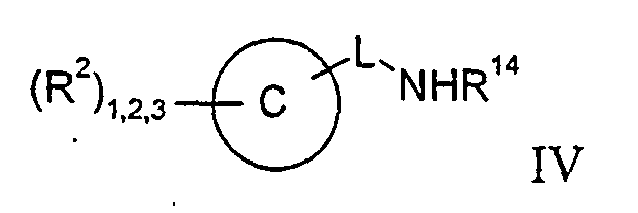

- The compounds of formulas IA and IB may be prepared in accordance with the following schemes 1, 2, and 3:

The detailed description can be found below and in Examples 1-150 and 159. - To a solution of potassium or sodium hydroxide in a solvent, such as ethanol, a methyl-malonate of formula II is added and the mixture is refluxed for about 4 hours. After cooling the reaction mixture is concentrated and dried in conventinal manner and used without further purification in the next step. To a solution of the obtained methyl-malonic acid monoethyl ester (III) in tetrahydrofuran, a compound of formula IV, for example 3,5-difluorobenzylamine, N-(3-dimethylaminopropyl)-N'-ethylcarbodiimide hydrochloride, 1-hydroxybenzotrizole hydrate and N,N-diisopropyl-ethylamine are added. The mixture is stirred at room temperature for about 18 h. After concentration in vacuo HCl is added and the mixture is extracted, dried and purified as usual. To the obtained solution of a compound of formula V water and lithium hydroxide are added and the mixture is refluxed for about 5 hours. After purification a compound of formula IA may be obtained as follows: To a solution of a compound of formula VI, for example N-(3,5-difluoro-benzyl)-2-methyl-malonamic acid in tetrahydrofuran, a compound of formula VII, N-(3-dimethylaminopropyl)-N'-ethylcarbodiimide hydrochloride, 1-hydroxybenzotrizole hydrate and N,N-diisopropyl-ethylamine are added. The mixture is stirred at room temperature for about 18 h. After concentrating, drying and purifying a compound of formula IA is obtained. A compound of formula IB may be obtained under the same conditions as described above, using a compound of formula VIII.
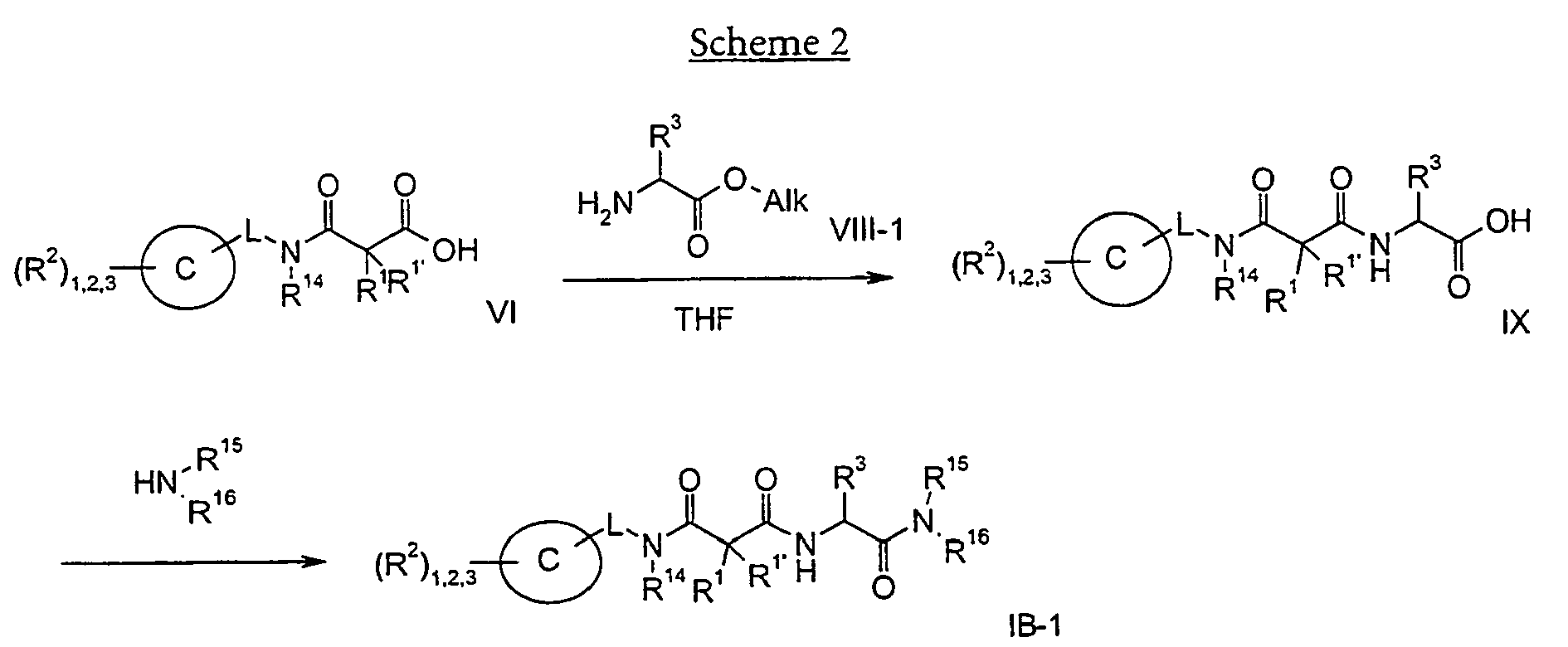
The compounds of formula IB-1 are identical with those of formula IB, wherein R1, R1', R2 and R3 are described as above and wherein R4 is -NR15R16,
R15 is hydrogen or lower alkyl and
R16 is lower alkyl, -(CH2)1,2-C≡CH or -(CH2)0,1,2-mono-) di or tricyclic group,
unsubstituted or substituted by R5 to R10 as described above.
The detailed description can be found below and in Examples 151-158.
To a solution of the obtained methyl-malonic acid mono-tert-butyl ester (III-tBu) in tetrahydrofuran, a compound of formula VII, for example 7-amino-5-methyl-5H,7H-dibenzo[b,d]azepin-6-one and N-(3-dimethylaminopropyl)-N'-ethylcarbodiimide hydrochloride, 1-hydroxybenzotrizole and N,N-diisopropyl-ethylamine are added. The mixture is stirred at room temperature for about 12 h. After purification, a compound of formula X is obtained which is treated with an acid, for instance TFA, in a suitable solvent, for instance dichloromethane, to give a compound of formula XI. Using compounds of formula XI and IV, compounds of formula IA can be obtained following the amide coupling procedure described above. - Some compounds of formula IA or IB may be converted to a corresponding acid addition salt, for example compounds, containing an amine group.
- The conversion is accomplished by treatment with at least a stoichiometric amount of an appropriate acid, such as hydrochloric acid, hydrobromic acid, sulfuric acid, nitric acid, phosphoric acid and the like, and organic acids suchas acetic acid, propionic acid, glycolic acid, pyruvic acid, oxalic acid, malic acid, malonic acid, succinic acid, maleic acid, fumaric acid, tartaric acid, citric acid, benzoic acid, cinnamic acid, mandelic acid, methanesulfonic acid, ethanesulfonic acid, p-toluenesulfonic acid, salicylic acid and the like. Typically, the free base is dissolved in an inert organic solvent such as diethyl ether, ethyl acetate, chloroform, ethanol or methanol and the like, and the acid added in a similar solvent. The temperature is maintained between 0 °C and 50 °C. The resulting salt precipitates spontaneously or may be brought out of solution with a less polar solvent.
- The acid addition salts of compounds of formula IA or IB may be converted to the corresponding free bases by treatment with at least a stoichiometric equivalent of a suitable base such as sodium or potassium hydroxide, potassium carbonate, sodium bicarbonate, ammonia, and the like.
- The compounds of formulas IA and IB and their pharmaceutically usable addition salts possess valuable pharmacological properties. Specifically, it has been found that the compounds of the present invention may inhibit the γ-secretase.
- The compounds were investigated in accordance with the test given hereinafter.
- The activity of test compounds can be evaluated in assays which measure the proteolytic cleavage of suitable substrates by γ-secretase activity. These can be cellular assays where e.g., a substrate of the γ-secretase is fused in its cytoplasmic domain to a transcription factor. Cells are transfected with this fusion gene and a reporter gene, e.g., firefly luciferase, which expression is enhanced by the transcription factor. Cleavage of the fused substrate by γ-secretase will lead to expression of the reporter gene which can be monitored in appropriate assays. The γ-secretase activity can also be determined in cell-free in vitro asays where e.g., a cell lysate containing the γ-secretase complex is incubated with a suitable APP-derived substrate which is cleaved to the Abeta peptides. The amount of produced peptides can be determined with specific ELISA assays. Cell lines of neuronal origin secrete Abeta peptides which can be measured with the specific ELISA assay. Treatment with compounds which inhibit γ-secretase leads to a reduction of secreted Abeta thus providing a measure of inhibition.
- The in vitro assay of γ-secretase activity uses a HEK293 membrane fraction as a source of γ-secretase and a recombinant APP substrate. Latter consist of the C-terminal 100 amino acids of human APP fused to a 6xHistidin tail for purification which is expressed in E.coli in a regulatable expression vector, e.g. pEtl5. This recombinant protein corresponds to the truncated APP fragment which results after β-secretase cleavage of the extracellular domain and which constitutes the γ-secretase substrate. The assay principle is described in Li YM et al, PNAS 97(11), 6138-6143 (2000). Hek293 cells are mechanically disrupted and the microsomal fraction is isolated by differential centrifugation. The membranes are solubilized in detergent (0.25 % CHAPSO) and incubated with the APP substrate. The Abeta peptides which are produced by γ-secretase cleavage of the substrate are detected by specific ELISA assays as described (Brockhaus M et al, Neuroreport 9(7), 1481-1486 (1998).
- The preferred compounds show a IC50<1.0 µM. In the list below are described some data to the γ-secretase inhibition:
Example No. IC50 in vitro (µM) Example No. IC50 in vitro (µM) 1 0.083 128 0.052 2 0.021 130 0.043 12 0.05 133 0.04 13 0.018 134 0.03 14 0.004 141 0.1 16 0.25 151 0.09 21 0.70 152 0.08 102 0.92 157 0.09 103 0.72 162 0.1 107 0.027 165 0.045 110 0.04 167 0.70 113 0.003 169 0.66 114 0.087 171 0.11 115 0.008 173 0.05 116 0.011 175 0.31 117 0.041 176 0.1 118 0.019 179 0.2 123 0.015 183 0.09 125 0.064 - The compounds of formula IA or IB and the pharmaceutically acceptable salts of the compounds of formula IA or IB can be used as medicaments, e.g. in the form of pharmaceutical preparations. The pharmaceutical preparations can be administered orally, e.g. in the form of tablets, coated tablets, dragées, hard and soft gelatine capsules, solutions, emulsions or suspensions. The administration can, however, also be effected rectally, e.g. in the form of suppositories, parenterally, e.g. in the form of injection solutions.
- The compounds of formula IA or IB can be processed with pharmaceutically inert, inorganic or organic carriers for the production of pharmaceutical preparations. Lactose, corn starch or derivatives thereof, talc, stearic acids or its salts and the like can be used, for example, as such carriers for tablets, coated tablets, dragées and hard gelatine capsules. Suitable carriers for soft gelatine capsules are, for example, vegetable oils, waxes, fats, semi-solid and liquid polyols and the like. Depending on the nature of the active substance no carriers are, however, usually required in the case of soft gelatine capsules. Suitable carriers for the production of solutions and syrups are, for example, water, polyols, glycerol, vegetable oil and the like. Suitable carriers for suppositories are, for example, natural or hardened oils, waxes, fats, semi-liquid or liquid polyols and the like.
- The pharmaceutical preparations can, moreover, contain preservatives, solubilizers, stabilizers, wetting agents, emulsifiers, sweeteners, colorants, flavorants, salts for varying the osmotic pressure, buffers, masking agents or antioxidants. They can also contain still other therapeutically valuable substances.
- Medicaments containing a compound of formula IA and IB or a pharmaceutically acceptable salt thereof and a therapeutically inert carrier are also an object of the present invention, as is a process for their production, which comprises bringing one or more compounds of formula IA and IB and/or pharmaceutically acceptable acid addition salts and, if desired, one or more other therapeutically valuable substances into a galenical administration form together with one or more therapeutically inert carriers.
- In accordance with the invention compounds of formula IA and IB as well as their pharmaceutically acceptable salts are useful in the control or prevention of illnesses based on the inhibition of the γ-secretase, such as of Alzheimer's disease.
- The dosage can vary within wide limits and will, of course, have to be adjusted to the individual requirements in each particular case. In the case of oral administration the dosage for adults can vary from about 0.01 mg to about 1000 mg per day of a compound of general formula I or of the corresponding amount of a pharmaceutically acceptable salt thereof. The daily dosage may be administered as single dose or in divided doses and, in addition, the upper limit can also be exceeded when this is found to be indicated.
Tablet Formulation (Wet Granulation) Item Ingredients mg/tablet 5 mg 25 mg 100 mg 500 mg 1. Compound of formula IA or IB 5 25 100 500 2. Lactose Anhydrous DTG 125 105 30 150 3. Sta-Rx 1500 6 6 6 30 4. Microcrystalline Cellulose 30 30 30 150 5. Magnesium Stearate 1 1 1 1 Total 167 167 167 831 -
- 1. Mix items 1, 2, 3 and 4 and granulate with purified water.
- 2. Dry the granules at 50°C.
- 3. Pass the granules through suitable milling equipment.
- 4. Add item 5 and mix for three minutes; compress on a suitable press.
-
- 1. Mix items 1, 2 and 3 in a suitable mixer for 30 minutes.
- 2. Add items 4 and 5 and mix for 3 minutes.
- 3. Fill into a suitable capsule.
- To a solution of 6.44 g (115 mmol) potassium hydroxide in 200 ml of ethanol 20.0 g diethyl methyl-malonate (115 mmol) was added and the mixture was refluxed for 4 hours. After cooling the reaction mixture was concentrated on a rotary evaporator, 50 ml of water was added and the mixture was extracted with ether (two times 50 ml). The aqueous solution was acidified with 4M hydrochloric acid and extracted with ethyl acetate (three times 50 ml). The combined organic layers were dried (MgSO4), concentrated under reduced pressure and used without further purification.
MS m/e (%): 101.1 (M-EtO, 100), 147.1 (M+H+, 8). - To a solution of 2.92 g (20 mmol) methyl-malonic acid monoethyl ester in 100 ml of tetrahydrofuran 2.86 g (20 mmol) of 3,5-difluorobenzylamine, 3.83 g (20 mmol) of N-(3-dimethylaminopropyl)-N'-ethylcarbodiimide hydrochloride, 2.70 g (20 mmol) of 1-hydroxybenzotrizole hydrate and 2.58 g (20 mmol) of N,N-diisopropyl-ethylamine were added. The mixture was stirred at room temperature for 18 h. After concentration in vacuo 0.5 N HCl (50 ml) was added and the mixture was extracted with dichloromethane (three times 50 ml). The combined organic layers were extracted with 0.5 N aqueous NaHCO3 solution, dried (MgSO4) and evaporated on the rotary evaporator. The residue was purified by flash chromatography (hexane/ethyl acetate = 3:1) to yield 4.29 g (79 %) of the title compound as white crystalline solid.
MS m/e (%): 272.2 (M+H+, 100). - To a solution of 4.0 g (14.75 mmol) N-(3,5-difluoro-benzyl)-2-methyl-malonamic acid ethyl ester in 300 ml of ethanol, 15 ml of water and 1.41 g (59 mmol) of lithium hydroxide were added and the mixture was refluxed for 5 hours. After concentration in vacuo water (50 ml) was added and the mixture was extracted with dichloromethane (three times 30 ml). The aqueous phase was acidified with 8 N hydrochloric acid and extracted with dichloromethane (four times 30 ml).
The combined organic layers from the second extraction were dried (MgSO4) and evaporated in vacuo to yield an orange oil. The mixture was dissolved in a small amount of ethyl acetate and hexane and left overnight. The resulting white crystals were collected by filtration to give 11.4 g (74.8 %) of the title compound.
MS m/e (%): 142.1 (C6H3F2-CH=NH2+, 100), 243.1 (M+H+, 16). - To a solution of 0.073 g (0.3 mmol) N-(3,5-difluoro-benzyl)-2-methyl-malonamic acid in 5 ml of tetrahydrofuran 0.080 g (0.3 mmol) of (3RS)-3-amino-1,3-dihydro-1-methyl-5-phenyl-2H-1,4-benzodiazepin-2-one, 0.058 g (0.3 mmol) of N-(3-dimethylaminopropyl)-N'-ethylcarbodiimide hydrochloride, 0.040 g (0.3 mmol) of 1-hydroxybenzotrizole hydrate and 0.039 g (0.3 mmol) of N,N-diisopropyl-ethylamine were added. The mixture was stirred at room temperature for 18 h. After concentration in vacuo 0.5 N HCl (5 ml) was added and the mixture was extracted with dichloromethane (three times 5 ml). The combined organic layers were extracted with 0.5 N aqueous NaHCO3 solution, dried (MgSO4) and evaporated on the rotary evaporator. The residue was purified by flash chromatography (hexane/ethyl acetate = 3:1) to yield 0.099 g (67 %) of the diastereomeric mixture of title compound as white solid.
MS m/e (%):491.2 (M+H+, 100). - The title compound was obtained in comparable yields according to the procedures described for example 1 using 2-fluoro-2-methyl-malonic acid diethyl ester instead of diethyl methyl-malonate in step a).
MS m/e (%): 509.3 (M+H+, 100). - The title compound was obtained in comparable yields according to the procedures described for example 1 using 2,2-dimethyl-malonic acid diethyl ester instead of diethyl methyl-malonate in step a).
MS m/e (%): 505.2 (M+H+, 100). - The title compound was obtained in comparable yields according to the procedures described for example 1 using diethyl malonate instead of diethyl methyl-malonate in step a).
MS m/e (%): 477.2 (M+H+, 100). - The title compound was obtained in comparable yields according to the procedures described for example 1 using 2-fluoro-2-methyl-malonic acid diethyl ester instead of diethyl methyl-malonate in step a) and (3RS)-3-amino-1-phenyl-6,7-dihydro-3H-[1,4]diazepino[6,7,1-hi]indol-4-one instead of (3RS)-3-amino-1,3-dihydro-1-methyl-5-phenyl-2H-1,4-benzodiazepin-2-one in step d).
MS m/e (%): 521.1 (M+H+, 100). - The title compound was obtained in comparable yields according to the procedures described for example 1 using (2S)-2-amino-2-phenyl-N-((2RS)-4-phenyl-morpholin-2-ylmethyl)-acetamide instead of (3RS)-3-amino-1,3-dihydro-1-methyl-5-phenyl-2H-1,4-benzodiazepin-2-one in step d).
MS m/e (%): 551.2 (M+H+, 100). - The title compound was obtained in comparable yields according to the procedures described for example 1 using (S)-phenylglycine tert.butyl ester instead of (3RS)-3-amino-1,3-dihydro-1-methyl-5-phenyl-2H-1,4-benzodiazepin-2-one in step d).
MS m/e (%): 377.3 (M+H+, 100). - The title compound was obtained in comparable yields according to the procedures described for example 1 using (2S)-2-amino-N-cyclohexyl-N-methyl-2-phenyl-acetamide instead of (3RS)-3-amino-1,3-dihydro-1-methyl-5-phenyl-2H-1,4-benzodiazepin-2-one in step d).
MS m/e (%): 472.3 (M+H+, 100). - The title compound was obtained in comparable yields according to the procedures described for example 1 using (S)-phenylalanine tert.butyl ester instead of (3RS)-3-amino-1,3-dihydro-1-methyl-5-phenyl-2H-1,4-benzodiazepin-2-one in step d).
MS m/e (%): 391.2 (M+H+, 100). - The title compound was obtained in comparable yields according to the procedures described for example 1 using 2-fluoro-2-methyl-malonic acid diethyl ester instead of diethyl methyl-malonate in step a) and (S)-phenylglycine tert.butyl ester instead of (3RS)-3-amino-1,3-dihydro-1-methyl-5-phenyl-2H-1,4-benzodiazepin-2-one in step d). MS m/e (%): 473.1 ( M+Na+, 100), 451.0 (M+H+, 29).
- The title compound was obtained in comparable yields according to the procedures described for example 1 using 2-fluoro-2-methyl-malonic acid diethyl ester instead of diethyl methyl-malonate in step a) and (RS)-3-amino-3,4-dihydro-1H-quinolin-2-one instead of (3RS)-3-amino-1,3-dihydro-1-methyl-5-phenyl-2H-1,4-benzodiazepin-2-one in step d).
MS m/e (%): 406.4 (M+H+, 100). - To a solution of 0.94 g (3.38 mmol) (S)-(2-oxo-2,3,4,5-tetrahydro-1H-benzo[b][1,4]diazepin-3-yl)-carbamic acid tert-butyl ester dissolved in 20 ml of tetrahydrofurane at -78°C, 3.4 ml of lithium bis(trimethylsilyl)amide (IN solution in tetrahydrofurane) were added. The reaction mixture was stirred for 30 minutes at - 78 °C and was allowed to reach room temperature. Iodomethane was slowly added and stirring was continued for 2 hours. The reaction mixture was diluted with ethyl acetate, washed with saturated NaHSO4 solution and separated. The aqueous phase was extracted twice with ethyl acetate (2 x 50 ml). The combined organic layers were washed with water (2 x 100 ml), with brine (1 x 100 ml), dried over MgSO4, filtered and evaporated. The residue was purified by chromatography (heptane/ethyl acetate = 7:3) to yield 0.855 g (87 %) of the product as a light yellow solid.
MS m/e (%): 292.2 (M+H+, 100) - To a solution of 0.087 g (1-methyl-2-oxo-2,3,4,5-tetrahydro-1H-benzo[b][1,4]diazepin-3-yl)-carbamic acid tert-butyl ester in 1 ml of dimethylformamide 0.138 g of potassium carbonate and 0.062 g of benzyl bromide were added. The reaction mixture was shaken for 16 hours at room temperature. The solvent was evaporated in vacuo and the residue was dissolved in ethyl acetate and washed with water. The organic layer was dried over MgSO4, filtered and evaporated. The residue was purified by chromatography (heptane/ethyl acetate = 2: 1) to yield 0.10 g (87 %) of the product as a light yellow foam. MS m/e (%): 382.3 (M+H+, 100).
- To a solution of 0.086 g (5-benzyl-1-methyl-2-oxo-2,3,4,5-tetrahydro-1H-benzo[b] [1,4]diazepin-3-yl)-carbamic acid tert-butyl ester in 1 ml of dichloromethane, 1 ml of trifluoracetic acid was added. The reaction mixture was allowed to stir at room temperature for 2-3 h while monitoring the reaction progress by LC-MS. Upon completion of the reaction, the solvent and excess of trifluoracetic acid were evaporated and the residue was dried under high vacuo for 1 hour. To the foam obtained dissolved in 1 ml of tetrahydrofurane, 0.060 g N-(3,5-difluoro-benzyl)-2-methyl-malonamic acid 0.043 g of N-(3-dimethylaminopropyl)-N'-ethylcarbodiimide hydrochloride, 0.030 g of 1-hydroxybenzotrizole hydrate and 0.087 g of N,N-diisopropyl-ethylamine were added. After stirring the mixture at room temperature for 18 h, 0.5 N HCl (1 ml) was added and the mixture was extracted with dichloromethane (2 ml) The organic layer was extracted with 0.5 N aqueous NaHCO3 solution, dried (MgSO4) and evaporated on the rotary evaporator. The residue was crystallized with heptane/EtOAc=4:1 to yield 0.057 g (50 %) of the epimeric mixture of title compound as white solid.
MS m/e (%): 507.3 (M+H+, 100). - To a solution of 0.087 g (1-methyl-2-oxo-2,3,4,5-tetrahydro-1H-benzo[b] [1,4]diazepin-3-yl)-carbamic acid tert-butyl ester in 1 ml of dichloromethane, 0.064 g of benzene sulfonyl chloride and 0.052 g of pyridine were added. The reaction mixture was stirred at room temperature for 16 hours. The reaction was quenched by addition of 1 M HCl (1 ml) and extracted with dichloromethane. The organic layer was washed with saturated NaHCO3, dried (MgSO4) and evaporated on the rotary evaporator to yield 0.113 g (95 %) of the product as a light yellow foam.
MS m/e (%): 432.3 (M+H+, 100). - The title compound was obtained in comparable yields according to the procedure described for example 12c) using (5-benzenesulfonyl-1-methyl-2-oxo-2,3,4,5-tetrahydro-1H-benzo[b][1,4]diazepin-3-yl)-carbamic acid tert-butyl ester instead of (5-benzyl-1-methyl-2-oxo-2,3,4,5-tetrahydro-1H-benzo[b][1,4]diazepin-3-yl)-carbamic acid tert-butyl ester.
MS m/e (%): 557.2 (M+H+, 100). - To a solution of 0.087 g (1-methyl-2-oxo-2,3,4,5-tetrahydro-1H-benzo[b][1,4]diazepin-3-yl)-carbamic acid tert-butyl ester in 1 ml of dichloromethane, 0.051 g of benzoyl chloride and 0.061 g of triethylamine were added. The reaction mixture was stirred at room temperature for 16 hours. The reaction was quenched by addition of 1 M HCI (1 ml) and extracted with dichloromethane. The organic layer was washed with saturated NaHCO3, dried (MgSO4) and evaporated on the rotary evaporator to yield 0.125 g (97 %) of the product as a light yellow foam.
MS m/e (%): 396.3 (M+H+, 100). - The title compound was obtained in comparable yields according to the procedure described for example 12c) using (5-benzenesulfonyl-1-methyl-2-oxo-2,3,4,5-tetrahydro-1H-benzo[b][1,4]diazepin-3-yl)-carbamic acid tert-butyl ester instead of (5-benzyl-1-methyl-2-oxo-2,3,4,5-tetrahydro-1H-benzo[b][1,4]diazepin-3-yl)-carbamic acid tert-butyl ester.
MS m/e (%): 521.3 (M+H+, 100). - The title compound was obtained in comparable yields according to the procedures described for example 1 using (3RS)-3-amino-1,3-dihydro-7-chloro-1-methyl-5-phenyl-2H-1,4-benzodiazepin-2-one instead of (3RS)-3-amino-1,3-dihydro-1-methyl-5-phenyl-2H-1,4-benzodiazepin-2-one in step d).
MS m/e (%): 525.3 (M+H+, 100). - tert-Butyloxycarbonyl-L-tryptophan (3.00 g, 9.9 mmol) and 1,2,3,4-tetrahydroisoquinoline (1.31g, 9.9mmol) were suspended in THF (20ml). At a temperature of 0 °C, hydroxybenzotriazole (1.33 g, 9.9 mmol), diisopropylethylamine (1.27 g, 9.9 mmol), and EDC (N-3-dimethylaminopropyl-N'-ethylcarbodiimide hydrochloride, 1.89 g, 9.9 mmol) were added. The reaction mixture was stirred overnight at r.t. The solvent was evaporated, the residue was taken up in ethyl acetate, washed with water, and dried (Na2SO4). After evaporation of the solvent, the title compound, MS: m/e = 420.5 (M+H+), (2.90 g, 70 %) was obtained by chromatographic purification of the residue (silica gel, MeOH, CH2Cl2).
- [2-(3,4-Dihydro-1H-isoquinolin-2-yl)-1-(1H-indol-3-ylmethyl)-2-oxo-ethyl] -carbamic acid tert-butyl ester (2.90 g, 6.91 mmol) was dissolved in CH2Cl2 (10ml). Trifluoroacetic acid (10 ml) was added and the mixture was stirred for 90 minutes at r.t. until analytical HPLC indicated complete consumption of the starting material. The solvent was evaporated , the residue was taken up in ethyl acetate, washed (water), and dried (Na2SO4). After evaporation of the solvent, the title compound, MS: m/e = 320.4 (M+H+), (1.73 g, 69 %) was obtained by chromatographic purification of the residue (silica gel, MeOH, CH2Cl2).
- 2-Amino-1-(3,4-dihydro-1H-isoquinolin-2-yl)-3-(1H-indol-3-yl)-propan-1-one (57 mg, 0.18 mmol) was placed in a disposable polypropylene tube and dissolved in DMF (1 ml). TBTU (O-(benzotriazol-1-yl)-N, N, N', N'-tetramethyluronium-tetrafluoroborate, 65 mg, 0.2 mmol) and N-(3,5-difluoro-benzyl)-2-methyl-malonamic acid (49 mg, 0.2 mmol) were added, and the mixture was shaken overnight at r.t. The title compound, MS: m/e = 545.3 (M+H+), was isolated from the reaction mixture by automated, preparative HPLC (YMC CombiPrep C18 column 50 x 20 mm, solvent gradient 5-95 % CH3CN in 0.1 % TFA(aq) over 6.0 min, λ = 230 nm, flow rate 40 ml/min).
- The title compound, MS: m/e = 506.3 (M+H+), was prepared in analogy to example 16 from tert-butyloxycarbonyl-L-phenylalanine.
- The title compound, MS: m/e = 536.4 (M+H+), was prepared in analogy to example 16 from N-(tert-butoxycarbonyl)-O-benzyl-L-serine.
- The title compound, MS: m/e = 492.3 (M+H+), was prepared in analogy to example 16 from N-alpha-(tert-butoxycarbonyl)-L-phenylglycine.
- The title compound, MS: m/e = 492.3 (M+H+), was prepared in analogy to example 16 from N-alpha-(tert-butoxycarbonyl)-D-phenylglycine.
- The title compound, MS: m/e = 446.3 (M+H+), was prepared in analogy to example 16 from tert-butyloxycarbonyl-L-serine.
- The title compound, MS: m/e = 540.4 (M+), was prepared in analogy to example 16 from N-alpha-(tert-butyloxycarbonyl)-p-chloro-L-phenylalanine.
- The title compound, MS: m/e = 562.4 (M+H+), was prepared in analogy to example 16 from N-alpha-(tert-butyloxycarbonyl)-L-benzothienylalanine.
- The title compound, MS: m/e = 574.3 (M+), was prepared in analogy to example 16 from N-alpha-(tert-butyloxycarbonyl)-m,p-dichloro-L-phenylalanine.
- The title compound, MS: m/e = 511.6 (M+H+), was prepared in analogy to example 16 from N-alpha-(tert-butyloxycarbonyl)- L-cyclohexylalanine.
- The title compound, MS: m/e = 490.4 (M+H+), was prepared in analogy to example 16 from tert-butyloxycarbonyl-L-methionine.
- The title compound, MS: m/e = 472.3 (M+H+), was prepared in analogy to example 16 from N-alpha-tert-butyloxycarbonyl-L-2-aminocaproic acid.
- The title compound, MS: m/e = 486.4 (M+H+), was prepared in analogy to example 16 from tert-butyloxycarbonyl-L-neopentylglycine.
- The title compound, MS: m/e = 444.4 (M+H+), was prepared in analogy to example 16 from tert-butyloxycarbonyl-L-2-aminobutanoic acid.
- The title compound, MS: m/e = 531.4 (M+H+), was prepared in analogy to example 16 from N-alpha-(tert-butyloxycarbonyl)-o-cyano-L-phenylalanine.
- The title compound, MS: m/e = 472.4 (M+H+), was prepared in analogy to example 16 from tert-butyloxycarbonyl-L-isoleucine.
- N-(3,5-Difluoro-benzyl)-2-methyl-malonamic acid (3.00 g, 12.3 mmol), L-tryptophan-tert-butylester hydrochloride (3.66 g, 12.3 mmol), TBTU (O-(benzotriazol-1-yl)-N, N, N', N'-tetramethyluronium-tetrafluoroborate, 3.96 g, 12.3 mmol) and triethylamin (3.74 g, 3.70 mmol) were dissolved in DMF (15 ml) and stirred for 5 h at r.t.. The reaction mixture was poured into water and the product mixture was extracted with ethyl acetate. The organic layers were dried (Na2S04). After evaporation of the solvent, the title compound, MS: m/e = 486.4 (M+H+), (6.45 g, quant.) was obtained by chromatographic purification of the residue (silica gel, MeOH, CH2Cl2).
- 2-[2-(3,5-Difluoro-benzylcarbamoyl)-propionylamino]-3-(1H-indol-3-yl)-propionic acid tert-butyl ester (5.99 g, 12.3 mmol) was dissolved in dichloromethane (15 ml), and trifluoroacetic acid (15 ml) was added at 0 °C. The mixture was stirred overnight at r.t. until all starting material was consumed (analytical HPLC). The volatiles were evaporated, the residue was taken up in ethyl acetate and washed with water. The organic layers were dried (Na2SO4). After evaporation of the solvent, the title compound, MS: m/e = 429.4 (M+H+), (3.5 g, 66 %) was obtained by chromatographic purification of the residue (silica gel, MeOH, CH2Cl2).
- 2-[2-(3,5-Difluoro-benzylcarbamoyl)-propionylamino]-3-(1H-indol-3-yl)-propionic acid (64 mg, 0.15 mmol) was placed in a disposable polypropylene tube and dissolved in DMF (1ml). TPTU (O-[2-oxo-1(2H)-pyridyl]-N, N, N', N'-tetramethyluronium-tetrafluoroborate, 49 mg, 0.165 mmol) and 6-methoxy-1,2,3,4-tetrahydro-isoquinoline (24 mg, 0.15 mmol) were added, and the mixture was shaken overnight at r.t. The title compound, MS: m/e = 575.3 (M+H+), was isolated from the reaction mixture by automated, preparative HPLC (YMC CombiPrep C18 column 50 x 20 mm, solvent gradient 5-95 % CH3CN in 0.1 % TFA(aq) over 6.0 min, λ = 230 nm, flow rate 40 ml/min).
- The title compound, MS: m/e = 600.3 (M+H+), was prepared in analogy to example 32 from L-phenylalanine-tert-butylester hydrochloride and (RS)-1-(2,5-Dimethyl-2H-pyrazol-3-yl)-1,2,3,4-tetrahydro-isoquinoline.
- The title compound, MS: m/e = 612.3 (M+H+), was prepared in analogy to example 32 from L-phenylalanine-tert-butylester hydrochloride and 5-benzyloxy-1,2,3,4-tetrahydroisoquinoline.
- The title compound, MS: m/e = 579.3 (M+H+), was prepared in analogy to example 32 from 8-chloro-1,2,3,4-tetrahydro-isoquinoline.
- The title compound, MS: m/e = 536.4 (M+H+), was prepared in analogy to example 32 from L-phenylalanine-tert-butylester hydrochloride and 6-methoxy-1,2,3,4-tetrahydroisoquinoline.
- The title compound, MS: m/e = 605.3 (M+H+), was prepared in analogy to example 32 from 7,8-dimethoxy-1,2,3,4-tetrahydro-isoquinoline.
- The title compound, MS: m/e = 584.4 (M+H+), was prepared in analogy to example 32 from L-phenylalanine-tert-butylester hydrochloride and (RS)-1-pyrazin-2-yl-1,2,3,4-tetrahydro-isoquinoline.
- The title compound, MS: m/e = 520.3 (M+H+), was prepared in analogy to example 32 from L-phenylalanine-tert-butylester hydrochloride and 4-methyl-1,2,3,4-tetrahydroisoquinoline.
- The title compound, MS: m/e = 531.3 (M+H+), was prepared in analogy to example 32 from isoindoline.
- The title compound, MS: m/e = 589.5 (M+H+), was prepared in analogy to example 32 from 6,7,8,9-tetrahydro- [1,3] dioxolo [4,5-h]isoquinoline.
- The title compound, MS: m/e = 583.4 (M+H+), was prepared in analogy to example 32 from L-phenylalanine-tert-butylester hydrochloride and 1,2,3,4-tetrahydro-1-(2-pyridyl)isoquinoline.
- The title compound, MS: m/e = 559.4 (M+H+), was prepared in analogy to example 32 from 4-methyl-1,2,3,4-tetrahydro-isoquinoline.
- The title compound, MS: m/e = 532.4 (M+H+), was prepared in analogy to example 32 from L-phenylalanine-tert-butylester hydrochloride and 9-aza-tricyclo[6.2.2.0 2,7]dodeca-2,4,6-triene.
- The title compound, MS: m/e = 635.4 (M+H+), was prepared in analogy to example 32 from 6,7,8-trimethoxy-1,2,3,4-tetrahydro-isoquinoline.
- The title compound, MS: m/e = 668.5 (M+H+), was prepared in analogy to example 32 from L-phenylalanine-tert-butylester hydrochloride and 7-(4-methyl-piperazine-1-sulfonyl)-1,2,3,4-tetrahydro-isoquinoline.
- The title compound, MS: m/e = 545.3 (M+H+), was prepared in analogy to example 32 from L-phenylalanine-tert-butylester hydrochloride and 1,2,3,4-tetrahydro-beta-carboline.
- The title compound, MS: m/e = 540.4 (M+), was prepared in analogy to example 32 from L-phenylalanine-tert-butylester hydrochloride and 5-chloro-1,2,3,4-tetrahydroisoquinoline.
- The title compound, MS: m/e = 533.4 (M+H+), was prepared in analogy to example 32 from 4,4-difluoropiperidine.
- The title compound, MS: m/e = 550.3 (M+H+), was prepared in analogy to example 32 from L-phenylalanine-tert-butylester hydrochloride and 5,6,7,8-tetrahydro-1,3-dioxolo(4,5-G)isoquinoline.
- The title compound, MS: m/e = 584.4 (M+H+), was prepared in analogy to example 32 from L-phenylalanine-tert-butylester hydrochloride and 1-pyrimidin-5-yl-1,2,3,4-tetrahydro-isoquinoline.
- The title compound, MS: m/e = 511.4 (M+H+), was prepared in analogy to example 32 from 3-methylpiperidine.
- The title compound, MS: m/e = 566.3 (M+H+), was prepared in analogy to example 32 from L-phenylalanine-tert-butylester hydrochloride and 6,7-dimethoxy-1,2,3,4-tetrahydro-isoquinoline.
- The title compound, MS: m/e = 512.3 (M+H+), was prepared in analogy to example 32 from L-phenylalanine-tert-butylester hydrochloride and trans-decahydroisoquinoline.
- The title compound, MS: m/e = 492.4 (M+H+), was prepared in analogy to example 32 from L-phenylalanine-tert-butylester hydrochloride and Isoindoline.
- The title compound, MS: m/e = 494.6 (M+H+), was prepared in analogy to example 32 from 1,2,3,6-tetrahydropyridine.
- The title compound, MS: m/e = 550.3 (M+H+), was prepared in analogy to example 32 from L-phenylalanine-tert-butylester hydrochloride and 6,7,8,9-tetrahydro-[1,3] dioxolo [4,5-h] isoquinoline.
- The title compound, MS: m/e = 596.3 (M+H+), was prepared in analogy to example 32 from L-phenylalanine-tert-butylester hydrochloride and 6,7,8-trimethoxy-1,2,3,4-tetrahydro-isoquinoline.
- The title compound, MS: m/e = 458.3 (M+H+), was prepared in analogy to example 32 from L-phenylalanine-tert-butylester hydrochloride and piperidine.
- The title compound, MS: m/e = 515.4 (M+H+), was prepared in analogy to example 32 from 4-fluoropiperidine.
- The title compound, MS: m/e = 605.3 (M+H+), was prepared in analogy to example 32 from 6,7-dimethoxy-1,2,3,4-tetrahydro-isoquinoline.
- The title compound, MS: m/e = 481.4(M+H+), was prepared in analogy to example 32 froml-isopropyl-1,2,3,4-tetrahydro-isoquinoline.
- The title compound, MS: m/e = 548.4 (M+H+), was prepared in analogy to example 32 from L-phenylalanine-tert-butylester hydrochloride and isopropyl-1,2,3,4-tetrahydroisoquinoline.
- The title compound, MS: m/e = 456.4 (M+H+), was prepared in analogy to example 32 from L-phenylalanine-tert-butylester hydrochloride and 8-chloro-1,2,3,4-tetrahydroisoquinoline.
- The title compound, MS: m/e = 540.4 (M+H+), was prepared in analogy to example 32 from L-phenylalanine-tert-butylester hydrochloride and 8-chloro-1,2,3,4-tetrahydroisoquinoline.
- The title compound, MS: m/e = 605.4 (M+H+), was prepared in analogy to example 32 from L-phenylalanine-tert-butylester hydrochloride and 1-cyanomethyl-6,7-dimethoxy-1,2,3,4-tetrahydro-isoquinoline.
- The title compound, MS: m/e = 586.3 (M+H+), was prepared in analogy to example 32 from L-phenylalanine-tert-butylester hydrochloride and 7-bromo-1,2,3,4-tetrahydroisoquinoline.
- The title compound, MS: m/e = 633.4 (M+H+), was prepared in analogy to example 32 from 6,7-diethoxy-1,2,3,4-tetrahydro-isoquinoline.
- The title compound, MS: m/e = 546.4 (M+H+), was prepared in analogy to example 32 from 2,3-dihydro-1H-isoindol-4-ylamine.
- The title compound, MS: m/e = 579.3 (M+), was prepared in analogy to example 32 from 8-chloro-1,2,3,4-tetrahydro-isoquinoline.
- The title compound, MS: m/e = 483.3 (M+H+), was prepared in analogy to example 32 from pyrrolidine.
- The title compound, MS: m/e = 527.3 (M+H+), was prepared in analogy to example 32 from 2-methoxymethyl-pyrrolidin.
- The title compound, MS: m/e = 613.3 (M+H+), was prepared in analogy to example 32 from 7,8-dichloro-1,2,3,4-tetrahydro-isoquinoline.
- The title compound, MS: m/e = 494.4 (M+H+), was prepared in analogy to example 32 from L-phenylalanine-tert-butylester hydrochloride and benzyl-methyl-amine.
- The title compound, MS: m/e = 511.4 (M+H+), was prepared in analogy to example 32 from azepane.
- The title compound, MS: m/e = 457.5 (M+H+), was prepared in analogy to example 32 from dimethylamine.
- The title compound, MS: m/e = 590.4 (M+H+), was prepared in analogy to example 32 from 7-nitro-1,2,3,4-tetrahydro-isoquinoline.
- The title compound, MS: m/e = 606.5 (M+H+), was prepared in analogy to example 32 from L-phenylalanine-tert-butylester hydrochloride and 1-cyclopropyl-6,7-dimethoxy-1,2,3,4-tetrahydro-isoquinoline.
- The title compound, MS: m/e = 579.3 (M+H+), was prepared in analogy to example 32 from 7-chloro-1,2,3,4-tetrahydro-isoquinoline.
- The title compound, MS: m/e = 444.4 (M+H+), was prepared in analogy to example 32 from L-phenylalanine-tert-butylester hydrochloride and pyrrolidine.
- The title compound, MS: m/e = 566.4 (M+H+), was prepared in analogy to example 32 from L-phenylalanine-tert-butylester hydrochloride and 7,8-dimethoxy-1,2,3,4-tetrahydro-isoquinoline.
- The title compound, MS: m/e = 523.3 (M+H+), was prepared in analogy to example 32 from furan-2-ylmethyl-methyl-amine.
- The title compound, MS: m/e = 625.3 (M+H+), was prepared in analogy to example 32 from 7-bromo-1,2,3,4-tetrahydro-isoquinoline.
- The title compound, MS: m/e = 559.4 (M+H+), was prepared in analogy to example 32 from 1-methyl-1,2,3,4-tetrahydro-isoquinoline.
- The title compound, MS: m/e = 587.4 (M+H+), was prepared in analogy to example 32 from 1,2,2a,3,4,5-hexahydro-3-aza-acenaphthylen-1-ol.
- The title compound, MS: m/e = 442.3 (M+H+), was prepared in analogy to example 32 from L-phenylalanine-tert-butylester hydrochloride and methylpropargylamine.
- The title compound, MS: m/e = 527.4 (M+H+), was prepared in analogy to example 32 from 2-methoxymethyl-pyrrolidin.
- The title compound, MS: m/e = 497.4 (M+H+), was prepared in analogy to example 32 from piperidine.
- The title compound, MS: m/e = 575.5 (M+H+), was prepared in analogy to example 32 from L-phenylalanine-tert-butylester hydrochloride and 8-methoxy-2,3,4,5-tetrahydro-1H-pyrido [4,3-b] indole.
- The title compound, MS: m/e = 561.5 (M+H+), was prepared in analogy to example 32 from 4-hydroxy-1,2,3,4-tetrahydro-isoquinoline.
- The title compound, MS: m/e = 563.4 (M+H+), was prepared in analogy to example 32 from L-phenylalanine-tert-butylester hydrochloride and 6-fluoro-2,3,4,5-tetrahydro-1H-pyrido [4,3-b] indole.
- The title compound, MS: m/e = 471.3 (M+H+), was prepared in analogy to example 32 from ethylmethylamine.
- The title compound, MS: m/e = 511.5 (M+H+), was prepared in analogy to example 32 from 2-methylpiperidine.
- The title compound, MS: m/e = 568.4 (M+H+), was prepared in analogy to example 32 from L-phenylalanine-tert-butylester hydrochloride and N-methylhomoveratrylamine.
- The title compound, MS: m/e = 469.3 (M+H+), was prepared in analogy to example 32 from azetidine.
- The title compound, MS: m/e = 529.4 (M+H+), was prepared in analogy to example 32 from 2-methylaminomethyl-1,3-dioxolane.
- The title compound, MS: m/e = 527.3 (M+H+), was prepared in analogy to example 32 from 4-hydroxymethylpiperidine.
- The title compound, MS: m/e = 563.4 (M+H+), was prepared in analogy to example 32 from L-phenylalanine-tert-butylester hydrochloride and 8-fluoro-2,3,4,5-tetrahydro-1H-pyrido [4,3-b]indole.
-
- a) N-(3,5-difluoro-benzyl)-2-propyl-malonamic acid was prepared in analogy to N-(3,5-difluoro-benzyl)-2-methyl-malonamic acid (example 1) from diethyl propyl-malonate.
- b) N-(3,5-Difluoro-benzyl)-N'-[2-(3,4-dihydro-1H-isoquinolin-2-yl)-1-(1H-indol-3-ylmethyl)-2-oxo-ethyl]-2-propyl-malonamide, MS: m/e = 573.4 (M+H+), was prepared in analogy to N-(3,5-difluoro-benzyl)-N'-[2-(3,4-dihydro-1H-isoquinolin-2-yl)-1-(1H-indol-3-ylmethyl)-2-oxo-ethyl]-2-methyl-malonamide (example 16) from N-(3,5-difluoro-benzyl)-2-propyl-malonamic acid.
-
- a) N-(3,5-Difluoro-benzyl)-2-isopropyl-malonamic acid was prepared in analogy to N-(3,5-difluoro-benzyl)-2-methyl-malonamic acid (example 1) from diethyl isopropyl-malonate.
- b) N-(3,5-Difluoro-benzyl)-N'-[2-(3,4-dihydro-1H-isoquinolin-2-yl)-1-(1H-indol-3-ylmethyl)-2-oxo-ethyl]-2-isopropyl-malonamide, MS: m/e = 573.3 (M+H+), was prepared in analogy to N-(3,5-difluoro-benzyl)-N'-[2-(3,4-dihydro-1H-isoquinolin-2-yl)-1-(1H-indol-3-ylmethyl)-2-oxo-ethyl]-2-methyl-malonamide (example 16) from N-(3,5-difluoro-benzyl)-2-isopropyl-malonamic acid.
-
- a) N-(3,5-Difluoro-benzyl)-2-ethyl-malonamic acid was prepared in analogy to N-(3,5-difluoro-benzyl)-2-methyl-malonamic acid (example 1) from diethyl ethyl-malonate.
- b) N-(3,5-Difluoro-benzyl)-N'-[2-(3,4-dihydro-1H-isoquinolin-2-yl)-1-(1H-indol-3-ylmethyl)-2-oxo-ethyl]-2-ethyl-malonamide, MS: m/e = 559.4 (M+H+), was prepared in analogy to N-(3,5-difluoro-benzyl)-N'-[2-(3,4-dihydro-1H-isoquinolin-2-yl)-1-(1H-indol-3-ylmethyl)-2-oxo-ethyl]-2-methyl-malonamide (example 16) from N-(3,5-difluoro-benzyl)-2-ethyl-malonamic acid.
-
- a) N-(3,5-Difluoro-benzyl)-2-allyl-malonamic acid was prepared in analogy to N-(3,5-difluoro-benzyl)-2-methyl-malonamic acid (example 1) from diethyl allyl-malonate.
- b) N-(3,5-Difluoro-benzyl)-N'-[2-(3,4-dihydro-1H-isoquinolin-2-yl)-1-(1H-indol-3-ylmethyl)-2-oxo-ethyl]-2-allyl-malonamide, MS: m/e = 571.4 (M+H+), was prepared in analogy to N-(3,5-difluoro-benzyl)-N'-[2-(3,4-dihydro-1H-isoquinolin-2-yl)-1-(1H-indol-3-ylmethyl)-2-oxo-ethyl]-2-methyl-malonamide (example 16) from N-(3,5-difluoro-benzyl)-2-allyl-malonamic acid.
-
- a) N-(3,5-Difluoro-benzyl)-2-fluoro-2-methyl-malonamic acid was prepared in analogy to N-(3,5-difluoro-benzyl)-2-methyl-malonamic acid (example 1) from diethyl 2-fluoro-2-methyl-malonate.
- b) N-(3,5-Difluoro-benzyl)-N'-[2-(3,4-dihydro-1H-isoquinolin-2-yl)-1-(1H-indol-3-ylmethyl)-2-oxo-ethyl]-2-fluoro-2-methyl-malonamide, MS: m/e = 563.4 (M+H+), was prepared in analogy to N-(3,5-difluoro-benzyl)-N'-[2-(3,4-dihydro-1H-isoquinolin-2-yl)-1-(1H-indol-3-ylmethyl)-2-oxo-ethyl]-2-methyl-malonamide (example 16) from N-(3,5-difluoro-benzyl)-2-fluoro-2-methyl-malonamic acid.
-
- a) N-(3,5-Difluoro-benzyl)-malonamic acid was prepared in analogy to N-(3,5-difluoro-benzyl)-2-methyl-malonamic acid (example 1) from diethyl malonate.
- b) N-(3,5-Difluoro-benzyl)-N'-[2-(3,4-dihydro-1H-isoquinolin-2-yl)-1-(1H-indol-3-ylmethyl)-2-oxo-ethyl]-malonamide, MS: m/e = 531.3 (M+H+), was prepared in analogy to N-(3,5-difluoro-benzyl)-N'-[2-(3,4-dihydro-1H-isoquinolin-2-yl)-1-(1H-indol-3-ylmethyl)-2-oxo-ethyl]-2-methyl-malonamide (example 16) from N-(3,5-difluoro-benzyl)-malonamic acid.
-
- a) N-(3,5-Difluoro-benzyl)-2,2-dimethyl-malonamic acid was prepared in analogy to N-(3,5-difluoro-benzyl)-2-methyl-malonamic acid (example 1) from diethyl 2,2-dimethyl-malonate.
- b) N-(3,5-Difluoro-benzyl)-N'-[2-(3,4-dihydro-1H-isoquinolin-2-yl)-1-(1H-indol-3-ylmethyl)-2-oxo-ethyl]-2,2-dimethyl-malonamide, MS: m/e = 559.3 (M+H+), was prepared in analogy to N-(3,5-difluoro-benzyl)-N'-[2-(3,4-dihydro-1H-isoquinolin-2-yl)-1-(1H-indol-3-ylmethyl)-2-oxo-ethyl]-2-methyl-malonamide (example 16) from N-(3,5-difluoro-benzyl)-2,2-dimethyl-malonamic acid.
- The title compound, MS: m/e = 525.1 (M+H+), was prepared in analogy to example 16 from 3-amino-7-chloro-1,3-dihydro-1-methyl-5-phenyl-2H-1,4-benzodiazepin-2-one.
- The title compound, MS: m/e = 519.3 (M+H+), was prepared in analogy to example 16 from 3-amino-1,3-dihydro-1-methyl-5-phenyl-2H-1,4-benzodiazepin-2-one and N-(3,5-difluoro-benzyl)-2-propyl-malonamic acid.
- The title compound, MS: m/e = 533.3 (M+H+), was prepared in analogy to example 16 from 3-amino-1,3-dihydro-1-methyl-5-phenyl-2H-1,4-benzodiazepin-2-one and N-(3,5-difluoro-benzyl)-2-tert-butyl-malonamic acid.
- The title compound, MS: m/e = 519.3 (M+H+), was prepared in analogy to example 16 from 3-amino-1,3-dihydro-1-methyl-5-phenyl-2H-1,4-benzodiazepin-2-one and N-(3,5-difluoro-benzyl)-2-isopropyl-malonamic acid.
- The title compound, MS: m/e = 505.3 (M+H+), was prepared in analogy to example 16 from 3-amino-1,3-dihydro-1-methyl-5-phenyl-2H-1,4-benzodiazepin-2-one and N-(3,5-difluoro-benzyl)-2-ethyl-malonamic acid.
- The title compound, MS: m/e = 495.3 (M+H+), was prepared in analogy to example 16 from 3-amino-1,3-dihydro-1-methyl-5-phenyl-2H-1,4-benzodiazepin-2-one and N-(3,5-difluoro-benzyl)-2-fluoro-malonamic acid.
- The title compound, MS: m/e = 464.3 (M+H+), was prepared in analogy to example 16 from 7-amino-5-methyl-5H,7H-dibenzo[b,d]azepin-6-one.
- The title compound, MS: m/e = 482.3 (M+H+), was prepared in analogy to example 16 from 7-amino-5-methyl-5H,7H-dibenzo[b,d]azepin-6-one and N-(3,5-difluoro-benzyl)-2-fluoro-2-methyl-malonamic acid.
- The title compound, MS: m/e = 491.2 (M+H+), was prepared in analogy to example 16 from 7-amino-5-methyl-5H,7H-dibenzo[b,d]azepin-6-one and N-(3,5-difluoro-benzyl)-2-isopropyl-malonamic acid.
- The title compound, MS: m/e = 478.2 (M+H+), was prepared in analogy to example 16 from 7-amino-5-methyl-5H,7H-dibenzo[b,d]azepin-6-one and N-(3,5-difluoro-benzyl)-2-ethyl-malonamic acid.
- The title compound, MS: m/e = 468.2 (M+H+), was prepared in analogy to example 16 from 7-amino-5-methyl-5H,7H-dibenzo[b,d]azepin-6-one and N-(3,5-difluoro-benzyl)-2-fluoro-malonamic acid.
- The title compound, MS: m/e = 478.2 (M+H+), was prepared in analogy to example 16 from 7-amino-5-methyl-5H, 7H-dibenzo[b,d]azepin-6-one and N-(3,5-difluoro-benzyl)-2,2-dimethyl-malonamic acid.
- The title compound, MS: m/e = 492.3 (M+H+), was prepared in analogy to example 16 from 7-amino-5-methyl-5H,7H-dibenzo[b,d]azepin-6-one and N-(3,5-difluoro-benzyl)-2-propyl-malonamic acid.
- The title compound, MS: m/e = 539.2 (M+H+), was prepared in analogy to example 16 from 7-amino-5-methyl-5H,7H-dibenzo[b,d]azepin-6-one and N-(3,5-difluoro-benzyl)-2-benzyl-malonamic acid.
- The title compound, MS: m/e = 506.3 (M+H+), was prepared in analogy to example 16 from 7-amino-5-methyl-5H,7H-dibenzo[b,d]azepin-6-one and N-(3,5-difluoro-benzyl)-2-tert-butyl-malonamic acid.
- The title compound, MS: m/e = 450.2 (M+H+), was prepared in analogy to example 16 from 7-amino-5-methyl-5H,7H-dibenzo[b,d]azepin-6-one and N-(3,5-difluoro-benzyl)-malonamic acid.
- The title compound was prepared in analogy to N-(3,5-difluoro-benzyl)-2-methyl-malonamic acid (example 1).
- The title compound, MS: m/e = 458.3 (M+H+), was prepared in analogy to example 16 from 7-amino-5-methyl-5H,7H-dibenzo[b,d]azepin-6-one and N-(4-methoxy-benzyl)-2-methyl-malonamic acid.
- The title compound was prepared in analogy to N-(3,5-difluoro-benzyl)-2-methyl-malonamic acid (example 1).
- The title compound, MS: m/e = 428.3 (M+H+), was prepared in analogy to example 16 from 7-amino-5-methyl-5H,7H-dibenzo[b,d]azepin-6-one and N-benzyl-2-methyl-malonamic acid.
- The title compound was prepared in analogy to N-(3,5-difluoro-benzyl)-2-methyl-malonamic acid (example 1).
- The title compound, MS: m/e = 488.3 (M+H+), was prepared in analogy to example 16 from 7-amino-5-methyl-5H,7H-dibenzo[b,d]azepin-6-one and N-(3,4-dimethoxybenzyl)-2-methyl-malonamic acid.
- The title compound was prepared in analogy to N-(3,5-difluoro-benzyl)-2-methyl-malonamic acid (example 1).
- The title compound, MS: m/e = 446.2 (M+H+), was prepared in analogy to example 16 from 7-amino-5-methyl-5H,7H-dibenzo[b,d]azepin-6-one and N-(4-fluoro-benzyl)-2-methyl-malonamic acid.
- The title compound was prepared in analogy to N-(3,5-difluoro-benzyl)-2-methyl-malonamic acid (example 1).
- The title compound, MS: m/e = 442.3 (M+H+), was prepared in analogy to example 16 from 7-amino-5-methyl-5H,7H-dibenzo[b,d]azepin-6-one and 2-methyl-N-(3-methylbenzyl)-malonamic acid.
- The title compound was prepared in analogy to N-(3,5-difluoro-benzyl)-2-methyl-malonamic acid (example 1).
- The title compound, MS: m/e = 441.2 (M+H+), was prepared in analogy to example 16 from 7-amino-5-methyl-5H,7H-dibenzo[b,d]azepin-6-one and 2-methyl-N-(4-methylbenzyl)-malonamic acid.
- The title compound was prepared in analogy to N-(3,5-difluoro-benzyl)-2-methyl-malonamic acid (example 1).
- The title compound, MS: m/e = 462.2 (M+H+), was prepared in analogy to example 16 from 7-amino-5-methyl-5H,7H-dibenzo[b,d]azepin-6-one and 2-methyl-N-(4-chlorobenzyl)-malonamic acid.
- The title compound was prepared in analogy to N-(3,5-difluoro-benzyl)-2-methyl-malonamic acid (example 1).
- The title compound, MS: m/e = 496.2 (M+H+), was prepared in analogy to example 16 from 7-amino-5-methyl-5H,7H-dibenzo[b,d]azepin-6-one and 2-methyl-N-(3,5-dichloro-benzyl)-malonamic acid.
- The title compound was prepared in analogy to N-(3,5-difluoro-benzyl)-2-methyl-malonamic acid (example 1).
- The title compound, MS: m/e = 446.2 (M+H+), was prepared in analogy to example 16 from 7-amino-5-methyl-5H,7H-dibenzo[b,d]azepin-6-one and 2-methyl-N-(3-fluorobenzyl)-malonamic acid.
- The title compound was prepared in analogy to N-(3,5-difluoro-benzyl)-2-methyl-malonamic acid (example 1).
- The title compound, MS: m/e = 488.3 (M+H+), was prepared in analogy to example 16 from 7-amino-5-methyl-5H,7H-dibenzo[b,d]azepin-6-one and 2-methyl-N-(3,5-dimethoxy-benzyl)-malonamic acid.
- The title compound was prepared in analogy to N-(3,5-difluoro-benzyl)-2-methyl-malonamic acid (example 1).
- The title compound, MS: m/e = 496.3 (M+H+), was prepared in analogy to example 16 from 7-amino-5-methyl-5H,7H-dibenzo[b,d]azepin-6-one and 2-methyl-N-(3-trifluoromethyl-benzyl)-malonamic acid.
- The title compound was prepared in analogy to N-(3,5-difluoro-benzyl)-2-methyl-malonamic acid (example 1).
- The title compound, MS: m/e = 464.2 (M+H+), was prepared in analogy to example 16 from 7-amino-5-methyl-5H,7H-dibenzo[b,d]azepin-6-one and 2-methyl-N-(2,5-difluoro-benzyl)-malonamic acid.
- The title compound was prepared in analogy to N-(3,5-difluoro-benzyl)-2-methyl-malonamic acid (example 1).
- The title compound, MS: m/e = 482.2 (M+H+), was prepared in analogy to example 16 from 7-amino-5-methyl-5H,7H-dibenzo[b,d]azepin-6-one and 2-methyl-N-(2,3,5-trifluoro-benzyl)-malonamic acid.
- The title compound, MS: m/e = 485.4 (M+H+), was prepared in analogy to example 16 from 3-amino-1,3-dihydro-1-methyl-5-phenyl-2H-1,4-benzodiazepin-2-one and 2-methyl-N-(4-methoxy-benzyl)-malonamic acid.
- The title compound, MS: m/e = 455.3 (M+H+), was prepared in analogy to example 16 from 3-amino-1,3-dihydro-1-methyl-5-phenyl-2H-1,4-benzodiazepin-2-one and 2-methyl-N-benzyl-malonamic acid.
- The title compound, MS: m/e = 515.3 (M+H+), was prepared in analogy to example 16 from 3-amino-1,3-dihydro-1-methyl-5-phenyl-2H-1,4-benzodiazepin-2-one and 2-methyl-N-(3,4-dimethoxy-benzyl)-malonamic acid.
- The title compound, MS: m/e = 473.2 (M+H+), was prepared in analogy to example 16 from 3-amino-1,3-dihydro-1-methyl-5-phenyl-2H-1,4-benzodiazepin-2-one and 2-methyl-N-(4-fluoro-benzyl)-malonamic acid.
- The title compound, MS: m/e = 468.2 (M+H+), was prepared in analogy to example 16 from 3-amino-1,3-dihydro-1-methyl-5-phenyl-2H-1,4-benzodiazepin-2-one and 2-methyl-N-(4-methyl-benzyl)-malonamic acid.
- The title compound, MS: m/e = 468.2 (M+H+), was prepared in analogy to example 16 from 3-amino-1,3-dihydro-1-methyl-5-phenyl-2H-1,4-benzodiazepin-2-one and 2-methyl-N-(3-methyl-benzyl)-malonamic acid.
- The title compound, MS: m/e = 489.3 (M+H+), was prepared in analogy to example 16 from 3-amino-1,3-dihydro-1-methyl-5-phenyl-2H-1,4-benzodiazepin-2-one and 2-methyl-N-(4-chloro-benzyl)-malonamic acid.
- The title compound, MS: m/e = 523.3 (M+H+), was prepared in analogy to example 16 from 3-amino-1,3-dihydro-1-methyl-5-phenyl-2H-1,4-benzodiazepin-2-one and 2-methyl-N-(3,5-dichloro-benzyl)-malonamic acid.
- The title compound, MS: m/e = 473.2 (M+H+), was prepared in analogy to example 16 from 3-amino-1,3-dihydro-1-methyl-5-phenyl-2H-1,4-benzodiazepin-2-one and 2-methyl-N-(3-fluoro-benzyl)-malonamic acid.
- The title compound, MS: m/e = 515.3 (M+H+), was prepared in analogy to example 16 from 3-amino-1,3-dihydro-1-methyl-5-phenyl-2H-1,4-benzodiazepin-2-one and 2-methyl-N-(3,5-dimethoxy-benzyl)-malonamic acid.
- The title compound, MS: m/e = 523.4 (M+H+), was prepared in analogy to example 16 from 3-amino-1,3-dihydro-1-methyl-5-phenyl-2H-1,4-benzodiazepin-2-one and 2-methyl-N-(3-trifluoromethyl-benzyl)-malonamic acid.
- The title compound, MS: m/e = 491.3 (M+H+), was prepared in analogy to example 16 from 3-amino-1,3-dihydro-1-methyl-5-phenyl-2H-1,4-benzodiazepin-2-one and 2-methyl-N-(2, 5-difluoro-benzyl)-malonamic acid.
- The title compound, MS: m/e = 509.3 (M+H+), was prepared in analogy to example 16 from 3-amino-1,3-dihydro-1-methyl-5-phenyl-2H-1,4-benzodiazepin-2-one and 2-methyl-N-(2,3,5-trifluoro-benzyl)-malonamic acid.
- The title compound, MS: m/e = 480.3 (M+H+), was prepared in analogy to example 16 from 2-amino-2'-benzyl-N-methylacetanilide.
- The title compound, MS: m/e = 533.4 (M+H+), was prepared in analogy to example 16 from 2-amino-4'-chloro-N-methyl-2'-(phenylthio)acetanilide.
- The title compound, MS: m/e = 528.4 (M+H+), was prepared in analogy to example 16 from 2-amino-2'-benzoyl-4'-chloro-N-methylacetanilide.
- To a cooled solution (0 °C) of 2-methyl-malonic acid mono-tert-butyl ester (1.01 g, 5.79 mmol) and 7-amino-5-methyl-5H,7H-dibenzo[b,d]azepin-6-one (1.15 g, 4.83 mmol) in THF (8 ml) was added hydroxybenzotriazole (652 mg, 4.83 mmol), diisopropylethylamine (624 mg, 4.83 mmol)and N-(3-dimethylaminopropyl)-N'-ethylcarbodiimide hydrochloride (925 mg, 4.83 mmol), and the mixture was stirred overnight at r.t. The solvent was evaporated, the residue was taken up in ethyl acetate, washed with water, and dried (Na2SO4). After evaporation of the solvent, the title compound, MS: m/e = 395.3 (M+H+), (920mg, 48 %) was obtained by chromatographic purification of the residue (silica gel, MeOH, CH2Cl2).
- TFA (3 ml) was added to a solution of 2-methyl-N-(5-methyl-6-oxo-6,7-dihydro-5H-dibenzo[b,d]azepin-7-yl)-malonamic acid tert-butyl ester (920 mg, 2.33 mmol) in dichloromethane (3 ml) and the mixture was stirred at r.t. overnight. The mixture was then taken up in more dichloromethane, washed with water, and dried (Na2SO4). After evaporation of the solvent, the title compound, MS: m/e = 339.3 (M+H+), (580 mg, 73 %) was obtained by chromatographic purification of the residue (silica gel, MeOH, CH2Cl2).
- 2-Methyl-N-(5-methyl-6-oxo-6,7-dihydro-5H-dibenzo[b,d]azepin-7-yl)-malonamic acid (20 mg, 0.059 mmol) and 2-fluorobenzylamine (7.4 mg, 0.059 mmol) were placed in a disposable polypropylene tube and dissolved in DMF (2 ml). TPTU (2-(2-pyridon-1-yl)-1,1,3,3-tetramethyl uronium tetrafluoroborate, 19 mg, 0.065 mmol) was added, and the mixture was shaken overnight at r.t. The title compound, MS: m/e = 446.2 (M+H+), was isolated from the reaction mixture by automated, preparative HPLC (YMC CombiPrep C18 column 50 x 20mm, solvent gradient 5 - 95 % CH3CN in 0.1 % TFA(aq) over 6.0 min, λ = 230 nm, flow rate 40 ml/min).
- The title compound, MS: m/e = 462.2 (M+H+), was prepared in analogy to example 151 from 2-chlorobenzylamine.
- The title compound, MS: m/e = 442.3 (M+H+), was prepared in analogy to example 151 from 2-methylbenzylamine.
- The title compound, MS: m/e = 458.3 (M+H+), was prepared in analogy to example 151 from 2-methoxybenzylamine.
- The title compound, MS: m/e = 496.3 (M+H+), was prepared in analogy to example 151 from 2-trifluoromethylbenzylamine.
- The title compound, MS: m/e = 458.3 (M+H+), was prepared in analogy to example 151 from 3-methoxybenzylamine.
- The title compound, MS: m/e = 462.2 (M+H+), was prepared in analogy to example 151 from 3-chlorobenzylamine.
- The title compound, MS: m/e = 496.3 (M+H+), was prepared in analogy to example 151 from 4-trifluorobenzylamine.
- The title compound, MS: m/e = 480.2 (M+H+), was prepared in analogy to example 16 from 7-amino-5-methyl-5H,7H-dibenzo[b,d]azepin-6-one and N-(3,5-difluoro-benzyl)-2-methoxy-malonamic acid.
- Solid phase synthesis was performed on a benzhydrylamine polystyrene resin, functionalized with an Fmoc-amide linker, p-[(R,S)-a-1-(9H-fluoren-9-yl)methoxyformamido-2,4-dimethoxybenzyl]phenoxyacetic acid.
The functionalized resin (300 mg., 0.6 mmol/g loading) was treated with 20 % piperidine/DMF (10 ml, 10 min) and then washed (3 x alternating DMF/isopropanol). (2S-cis)-5-(9H-fluoren-9-yl)methoxycarbonylamino-4-oxo-1,2,4,5,6,7-hexahydro-azepino[3,2,1-hi]indole-2-carboxylic (127 mg, 0.27 mmol), O-(1,2-dihydro-2-oxopyridyl-1-yl)-N,N,N',N'-tetramethyluroniumtetrafluoroborate (TPTU) (80 mg, 0.41 mmol), diisopropylethylamine (140 µl, 1.22 mmol) and DMF (5 ml) were added to the resin. The mixture was shaken for 1 h. (Ninhydrin test: negative) and the resin was filtered and washed as above. (131 mg, 0.54 mmol), TPTU (160 mg, 0.54 mmol), diisopropylethylamine (280 µl, 1.62 mmol) and DMF (5 ml) were added to the resin and coupled as above. Product was cleaved from the resin using 90 %TFA aqueous (5 ml) for 1 h. The filtrate was concentrated under reduced pressure and purified by prep. RP(C18)HPLC. Desired fractions were pooled and lyophilized: 30 mg, MS: 471.2 (MH+ (60 %)), 493.1 (MNa+ (100), 426.3 (MH+-CONH2); - A mixture containing (2S-cis)-N-(2-carbamoyl-4-oxo-1,2,4,5,6,7-hexahydro-azepino[3,2,1-hi]indol-5-yl)-N'-(3,5-difluoro-benzyl)-(2R,S)-methyl-malonamide (18.5 mg, 0.04 mmol), methoxycarbonylsulfamoyl-triethylammonium hydroxide (Burgess reagent) (19 mg, 0.08 mmol) in THF (1.5 ml) was shaken for 30 h at 70 °C under an argon atmosphere. The reaction mixture was concentrated under reduced pressure and ethyl acetate was added. The organic phase was washed with water, dried (Na2SO4), filtered and concentrated under reduced pressure. Purification by prep.RP(C18)HPLC: 10 mg, MS: 530.1 (MH+(100 %)), 552.1 (MNa+(30));
-
- a) (2S-cis)-(2-Cyano-4-oxo-1,2,4,5,6,7-hexahydro-azepino[3,2,1-hi]indol-5-yl)-carbamic acid tert-butyl ester
9-Fmoc-aminoxanthen-3-yloxy-methyl resin (Sieber Amide resin; Calbiochem-Novabiochem AG) (5 g, 0.52 mmol/g loading) was treated with 20 % piperidine/DMF (50 ml, 10 min) and then washed (3 x alternating DMF/isopropanol). (2S-cis)-5-(9H-Fluoren-9-yl)methoxycarbonylamino-4-oxo-1,2,4,5,6,7-hexahydro-azepino[3,2,1-hi]indole-2-carboxylic (1.83 g, 3.9 mmol), TPTU (1.2 g, 3.9 mmol), diisopropylethylamine (3 ml, 17.6 mmol) and DMF (10 ml) were added to the resin. Coupling was allowed to proceed for 1 h ( Ninhydrin test: negative) and the resin was filtered and washed as before. Fmoc group removal was followed by t-Boc group amine protection using t-Boc anhydride (5.7 g, 26 mmol) diisopropylethylamine (2.2. ml, 13 mmol) in 12 ml dichloromethane. The washed, dried resin was treated with trifluoroacetic anhydride (1.8 ml, 13 mmol), pyridine (2.1 ml, 26 mmol) in 15 ml dichloromethane for 16 h at room temperature. The filtrate was collected and the resin washed (CH2Cl2, 2x10 ml). The combined organic fractions were washed with 5 % NaHCO3, dried (MgSO4) filtered and concentrated under reduced pressure yielding a crude oil which was purified by flash chromatography (ethyl acetate-n-hexanes 1:3): 0.71 g; MS: 328.3 (MH+(20 %)); 228.2 (MH+-Boc(100)). - b) (25-cis)-{4-Oxo-2-[(2-thiophen-2-yl-acetylamino)-methyl]-1,2,4,5,6,7-hexahydro-azepino[3,2,1-hi]indol-5-yl}-carbamic acid tert-butyl ester
(2S-cis)-(2-Cyano-4-oxo-1,2,4,5,6,7-hexahydro-azepino[3,2,1-hi]indol-5-yl)-carbamic acid tert-butyl ester (0.59 g, 1.80 mmol) was hydrogenated over palladium on carbon (10 %, 0.22 g) in 80 ml acetic acid for 1 h. The mixture was filtered (Decalite) and the filtrate was lyophilized: 0.33 g white solid. A part of this lyophilisate (0.16 g, 0.48 mmol) was dissolved in 8 ml DMF and was coupled to thiophene-2-acetic acid (0.21 g, 1.45 mmol) in the presence of TPTU (0.43 g, 1.45 mmol), diisopropylethylamine (0.84 ml, 5 mmol) for 1 h. The reaction mixture was concentrated under reduced pressure and the residue was dissolved in ethyl acetate and washed successively with IN NaHCO3, 0.2 N KHSO4, water and the organic phase was dried (MgSO4) filtered and concentrated under reduced pressure, Purification by flash chromatgraphy (ethyl acetate.n.hexanes 3:1): white foam, 125 mg; MS: 456.3 (MH+(60 %)). - c) (2S-cis)-N-(3,5-Difluoro-benzyl)-2-methyl-N'-{4-oxo-2-[(2-thiophen-2-yl-acetylamino)-(2R,S)-methyl]-1,2,4,5,6,7-hexahydro-azepino[3,2,1-hi]indol-5-yl}-malonamide
(2S-cis)-{4-Oxo-2-[(2-thiophen-2-yl-acetylamino)-methyl]-1,2,4,5,6,7-hexahydro-azepino[3,2,1-hi]indol-5-yl}-carbamic acid tert-butyl ester was treated with 4 M HCl/1,4-dioxan (3 ml) for 1 h at room temperature and the reaction mixture was concentrated under reduced pressure and concentrated another two times from acetonitrile. The hydrochloride salt (ca. 20 mg) was dissolved in 1 ml DMF and the pH of the solution was adjusted to 8. Malonic acid derivative, (41 mg, 0.17 mmol) TPTU (50 mg, 0.17 mmol) diisopropylethylamine (87 µl, 0.51 mmol) in 0,5 ml DMF were added and the reaction mixture was shaken for 1 h. The reaction mixture was acidified with acetic acid, concentrated to a smaller volume and directly purified by prep.RP(C18)HPLC: 14.5 mg, MS: 581.1 (MH+(100 %)); - The title compound was obtained in comparable yields according to the procedures described for example 162 using 4-fluorophenylacetic acid instead of thiophene-2-acetic acid: 15.8 mg, MS: 593.2 (MH+(100 %));
- The title compound was obtained in comparable yields according to the procedures described for example 162 using malonic acid derivative N-(3,5-difluorobenzyl)-2,2-dimethyl-malonamic acid instead of derivative N-(3,5-difluorobenzyl)-2-methyl-malonamic acid: 15.0 mg, MS: 595.1 (MH+(100 %));
- The title compound was obtained in comparable yields according to the procedures described for example 162 using 4-fluorophenylacetic acid instead of thiophene-2-acetic acid and malonic acid derivative N-(3,5-difluorobenzyl)-2,2-dimethyl-malonamic acid instead of N-(3,5-difluorobenzyl)-2-methyl-malonamic acid: 5.4 mg, MS: 607.1 (MH+(100 %));
-
- a) 2-Methyl-N-(5-methyl-6-oxo-6,7-dihydro-5H-dibenzo[b,d]azepin-7-yl)-malonamic acid tert-butyl ester
To a cooled solution (0 °C) of 2-methyl-malonic acid mono-tert-butyl ester (1.01g, 5.79 mmol) and 7-amino-5-methyl-5H,7H-dibenzo[b,d]azepin-6-one (1.15 g, 4.83 mmol) in THF (8 ml) was added hydroxybenzotriazole (652mg, 4.83mmol), diisopropylethylamine (624 mg, 4.83 mmol)and N-(3-dimethylaminopropyl)-N'-ethylcarbodiimide hydrochloride (925 mg, 4.83 mmol), and the mixture was stirred overnight at r.t. The solvent was evaporated, the residue was taken up in ethyl acetate, washed with water, and dried (Na2SO4). After evaporation of the solvent, the title compound, MS: m/e = 395.3 (M+H+), (920 mg, 48 %) was obtained by chromatographic purification of the residue (silica gel, MeOH, CH2Cl2). - b) 2-Methyl-N-(5-methyl-6-oxo-6,7-dihydro-5H-dibenzo[b,d]azepin-7-yl)-malonamic acid
TFA (3 ml) was added to a solution of 2-methyl-N-(5-methyl-6-oxo-6,7-dihydro-5H-dibenzo[b,d]azepin-7-yl)-malonamic acid tert-butyl ester (920 mg, 2.33 mmol) in dichloromethane (3 ml) and the mixture was stirred at r.t. overnight. The mixture was then taken up in more dichloromethane, washed with water, and dried (Na2SO4). After evaporation of the solvent, the title compound, MS: m/e = 339.3 (M+H+), (580 mg, 73 %) was obtained by chromatographic purification of the residue (silica gel, MeOH, CH2Cl2). - c) 2-Methyl-N-(5-methyl-6-oxo-6,7-dihydro-5H-dibenzo[b,d]azepin-7-yl)-N'-phenyl-malonamide
2-Methyl-N-(5-methyl-6-oxo-6,7-dihydro-5H-dibenzo[b,d]azepin-7-yl)-malonamic acid (20 mg, 0.059 mmol) and aniline (6 mg, 0.059 mmol) were placed in a disposable polypropylene tube and dissolved in DMF (2 ml). TPTU (2-(2-pyridon-1-yl)-1,1,3,3-tetramethyl uronium tetrafluoroborate, 19 mg, 0.065 mmol) was added, and the mixture was shaken overnight at r.t. The title compound, MS: m/e = 414.2 (M+H+), was isolated from the reaction mixture by automated, preparative HPLC (YMC CombiPrep C18 column 50 x 20mm, solvent gradient 5-95 % CH3CN in 0.1 % TFA(aq) over 6.0min, λ = 230 nm, flow rate 40 ml/min). - The title compound, MS: m/e = 442.3 (M+H+), was prepared in analogy to example 166 from 2-phenethylamine.
- The title compound, MS: m/e = 460.3 (M+H+), was prepared in analogy to example 166 from 4-fluorophenethylamine.
- The title compound, MS: m/e = 476.2 (M+H+), was prepared in analogy to example 166 from 4-chlorophenethylamine.
- The title compound, MS: m/e = 460.3 (M+H+), was prepared in analogy to example 166 from 3-fluorophenethylamine.
- The title compound, MS: m/e = 429.3 (M+H+), was prepared in analogy to example 166 from 3-aminomethylpyridine.
- The title compound, MS: m/e = 429.3 (M+H+), was prepared in analogy to example 166 from 2-aminomethylpyridine.
- The title compound, MS: m/e = 418.3 (M+H+), was prepared in analogy to example 166 from 2-aminomethylfurane.
- The title compound, MS: m/e = 429.3 (M+H+), was prepared in analogy to example 166 from 4-aminomethylpyridine.
- The title compound, MS: m/e = 432.3 (M+H+), was prepared in analogy to example 166 from 5-methylfurfurylamine.
- The title compound, MS: m/e = 484.3 (M+H+), was prepared in analogy to example 166 from 3-aminomethylbenzothiophene.
- The title compound, MS: m/e = 442.3 (M+H+), was prepared in analogy to example 166 from (R)-(+)-1-phenylethylamine.
- The title compound, MS: m/e = 472.3 (M+H+), was prepared in analogy to example 166 from N-benzylethanolamine.
- The title compound, MS: m/e = 442.3 (M+H+), was prepared in analogy to example 166 from N-methylbenzylamine.
- The title compound, MS: m/e = 481.3 (M+H+), was prepared in analogy to example 166 from N-benzyl-aminoacetonitrile.
- The title compound, MS: m/e = 468.3 (M+H+), was prepared in analogy to example 166 from 1,2,3,4-tetrahydro-naphthalen-1-yl-amine.
- The title compound, MS: m/e = 454.3 (M+H+), was prepared in analogy to example 166 from 1-aminoindane.
- The title compound, MS: m/e = 490.3 (M+H+), was prepared in analogy to example 166 from 4,6-difluoro-1-aminoindane.
- The title compound, MS: m/e = 470.4 (M+H+), was prepared in analogy to example 166 from 2-amino-1-indanol.
- The title compound, MS: m/e = 454.3 (M+H+), was prepared in analogy to example 166 from 2-aminoindane.
- The title compound, MS: m/e = 504.3 (M+H+), was prepared in analogy to example 166 from C-(2,2-difluoro-1-phenyl-cyclopropyl)-methylamine.
- The title compound, MS: m/e = 450.3 (M-H+), was prepared in analogy to example 166 from (RS)-2,2- dimethyl-[1,3]dioxolan-4-ylmethylamine.
- The title compound, MS: m/e = 420.2 (M-H+), was prepared in analogy to example 166 from (RS)-tetrahydro-furan-2-ylmethylamine.
if desired, converting the compounds obtained into pharmaceutically acceptable acid addition salts.
| Item | Ingredients | mg/capsule | |||
| 5 mg | 25 mg | 100 mg | 500 mg | ||
| 1. | Compound of formula IA or IB | 5 | 25 | 100 | 500 |
| 2. | Hydrous Lactose | 159 | 123 | 148 | --- |
| 3. | Corn Starch | 25 | 35 | 40 | 70 |
| 4. | Talc | 10 | 15 | 10 | 25 |
| 5. | Magnesium Stearate | 1 | 2 | 2 | 5 |
| Total | 200 | 200 | 300 | 600 | |
Claims (19)
- Compounds of the general formula


L is a bond, -(CH2)1,2-, -CH(CH3)-, or is
R1 and R1' are the same or different and are hydrogen, C1-C6 alkyl, halogen, benzyl or allyl;
(R2)1,2,3 is independently from each other hydrogen, hydroxy, halogen, C1-C6 alkyl, C1-C6 alkoxy or trifluoromethyl;
R3 - is phenyl or benzyl, which are unsubstituted or substituted by one or two substituents, selected from the group consisting of halogen or cyano, or is- C1-C6 alkyl,- two hydrogen atoms,- (CH2)1,2-S-C1-C6 alkyl,- (CH2)1,2-C3-C7 cycloalkyl,- (CH2)1,2-OH,- CH2OCH2-phenyl, or the groups - mono-or dialkyl amino,- N(CH3)(CH2)1,2-C≡CH,or is a mono-, di or tricyclic group, unsubstituted or substituted by R5 to R10, and which groups may be linked by-N(CH3)(CH2)0,1,2, to the -C(O) -group in formula IB, selected from the group consisting of
(R5)1,2 is independently from each other hydrogen, halogen, C1-C6 alkyl or- (CH2)1,2OH;wherein
R6 is hydrogen, halogen or C1-C6 alkoxy;
R7 is hydrogen or -CH2OCH3;
R8 is hydrogen or halogen;
R9 is hydrogen, C1-C6 alkoxy, C1-C6 alkyl or amino;
(R10)1,2,3 is independently from each other hydrogen, C1-C6 alkyl, C1-C6 alkoxy, cyclopropyl, halogen, hydroxy, =O, amino, nitro, -CH2CN, -OCH2C6H5,
or the groups


X is -CH2, -S(O)2 or -C(O)-;
R11 is hydrogen or C1-C6 alkyl;
R12 is hydrogen or halogen;
R13 is hydrogen, CN, hydroxy, -C(O)NH2, or
and to pharmaceutically suitable acid addition salts thereof, with the exception of (S)-N-(3,4-dichlorophenyl)-N'-(1-phenyl-2-oxo-dimethylamino)ethyl malonamide. - Compounds of the general formula


R1 and R1' are the same or different and are hydrogen, C1-C6 alkyl, halogen, benzyl or allyl;
(R2)1,2,3 is independently from each other hydrogen, halogen, C1-C6 alkyl, C1-C6 alkoxy or trifluoromethyl;
R3 is phenyl or benzyl, which are unsubstituted or substituted by one or two substituents, selected from the group consisting of halogen or cyano, or is- C1-C6 alkyl,- two hydrogen atoms,- (CH2)1,2-S-C1-C6 alkyl,- (CH2)1,2-C3-C7 cycloalkyl,- (CH2)1,2-OH,- CH2OCH2-phenyl, or the groups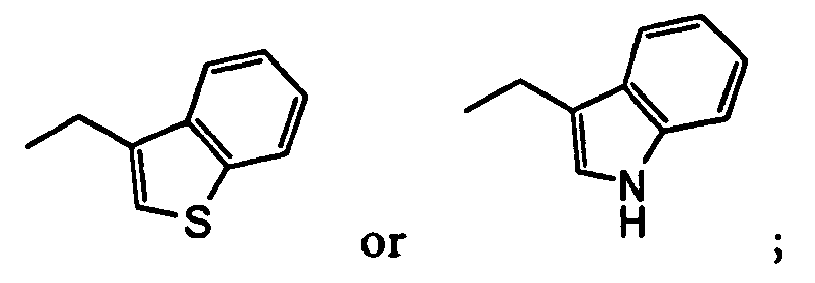 - mono-or dialkyl amino,- N(CH3)(CH2)1,2-C≡CH,wherein
or is a mono-, di or tricyclic group, unsubstituted or substituted by R5 to R10, and which groups may be linked by -N(CH3)(CH2)0,1,2, to the -C(O) -group in formula IB, selected from the group consisting of
(R5)1,2 is independently from each other hydrogen, halogen, C1-C6 alkyl or -(CH2)1,2OH;
R6 is hydrogen, halogen or C1-C6 alkoxy;
R7 is hydrogen or -CH2OCH3;
R8 is hydrogen or halogen;
R9 is hydrogen, C1-C6 alkoxy, C1-C6 alkyl or amino;
(R10)1,2,3 is independently from each other hydrogen, C1-C6 alkyl, C1-C6 alkoxy, cyclopropyl, halogen, hydroxy, =O, amino, nitro, -CH2CN, -OCH2C6H5,
or the groups


X is -CH2, -S(O)2 or -C(O)-;
R11 is hydrogen or C1-C6 alkyl;
R12 is hydrogen or halogen;
R13 is hydrogen, CN, hydroxy, -C(O)NH2, or
- Compounds of formula IA in accordance with claim 2.
- Compounds of formula IA in accordance with claim 3, wherein

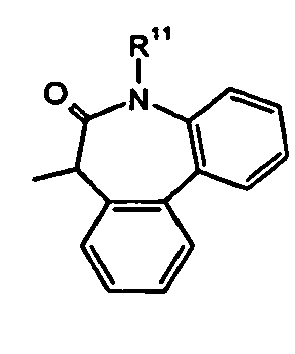
- Compounds of formula IA in accordance with claim 4, which compounds are
N-(3,5-difluoro-benzyl)-2-methyl-N'-(5-methyl-6-oxo-6,7-dihydro-5H-dibenzo[b,d]azepin-7-yl)-malonamide,
N-(3,5-difluoro-benzyl)-2-fluoro-2-methyl-N'-(5-methyl-6-oxo-6,7-dihydro-5H-dibenzo[b,d]azepin-7-yl)-malonamide,
N-(3,5-difluoro-benzyl)-2-isopropyl-N'-(5-methyl-6-oxo-6,7-dihydro-5H-dibenzo[b,d]azepin-7-yl)-malonamide,
N-(3,5-difluoro-benzyl)-2-ethyl-N'-(5-methyl-6-oxo-6,7-dihydro-5H-dibenzo[b,d]azepin-7-yl)-malonamide,
N-(3,5-difluoro-benzyl)-2-fluoro-N'-(5-methyl-6-oxo-6,7-dihydro-5H-dibenzo[b,d]azepin-7-yl)-malonamide,
N-(3,5-difluoro-benzyl)-2,2-dimethyl-N'-(5-methyl-6-oxo-6,7-dihydro-5H-dibenzo[b,d]azepin-7-yl)-malonamide,
N-(3,5-difluoro-benzyl)-N'-(5-methyl-6-oxo-6,7-dihydro-5H-dibenzo[b,d]azepin-7-yl)-2-propyl-malonamide,
N-benzyl-2-methyl-N'-(5-methyl-6-oxo-6,7-dihydro-5H-dibenzo[b,d]azepin-7-yl)-malonamide,
N-(4-fluoro-benzyl)-2-methyl-N'-(5-methyl-6-oxo-6,7-dihydro-5H-dibenzo[b,d]azepin-7-yl)-malonamide,
N-(4-chloro-benzyl)-2-methyl-N'-(5-methyl-6-oxo-6,7-dihydro-5H-dibenzo[b,d]azepin-7-yl)-malonamide,
N-(3-fluoro-benzyl)-2-methyl-N'-(5-methyl-6-oxo-6,7-dihydro-5H-dibenzo[b,d]azepin-7-yl)-malohamide,
N-(2,5-difluoro-benzyl)-2-methyl-N'-(5-methyl-6-oxo-6,7-dihydro-5H-dibenzo [b,d] azepin-7-yl)-malonamide,
2-methyl-N-(5-methyl-6-oxo-6,7-dihydro-5H-dibenzo[b,d]azepin-7-yl)-N'-(2,3,5-trifluoro-benzyl)-malonamide,
N-(2-fluoro-benzyl)-2-methyl-N'-(5-methyl-6-oxo-6,7-dihydro-5H-dibenzo[b,d]azepin-7-yl)-malonamide,
N-(2-chloro-benzyl)-2-methyl-N'-(5-methyl-6-oxo-6,7-dihydro-5H-dibenzo[b,d]azepin-7-yl)-malonamide or
N-(3-chloro-benzyl)-2-methyl-N'-(5-methyl-6-oxo-6,7-dihydro-5H-dibenzo[b,d]azepin-7-yl)-malonamide. - Compounds of formula IA in accordance with claim 1, wherein

- Compounds of formula IA in accordance with claim 6, which compounds are
N-furan-2-ylmethyl-2-methyl-N'-(5-methyl-6-oxo-6,7-dihydro-5H-dibenzo[b,d]azepin-7-yl)-malonamide,
N-benzo [b]thiophen-3-ylmethyl-2-methyl-N'-(5-methyl-6-oxo-6,7-dihydro-5H-dibenzo[b,d]azepin-7-yl)-malonamide or
N-(4,6-difluoro-indan-1-yl)-2-methyl-N'-(5-methyl-6-oxci-6,7-dihydro-5H-dibenzo[b,d]azepin-7-yl)-malonamide. - Compounds of formula IA in accordance with claims 1 or 2, wherein


- Compounds of formula IA in accordance with claim 8, wherein the compounds are
(N-(3,5-difluoro-benzyl)-2-methyl-N'-(1-methyl-2-oxo-5-phenyl-2,3-dihydro-1H-benzo[e] [1,4]diazepin-3-yl)-malonamide,
N-(3,5-difluoro-benzyl)-2-fluoro-2-methyl-N'-(1-methyl-2-oxo-5-phenyl-2,3-dihydro-1H-benzo[e] [1,4]diazepin-3-yl)-malonamide,
N-(3,5-difluoro-benzyl)-N'-(1-methyl-2-oxo-5-phenyl-2,3-dihydro-1H-benzo[e][1,4]diazepin-3-yl)-2-propyl-malonamide,
N-(3,5-difluoro-benzyl)-2-ethyl-N'-(1-methyl-2-oxo-5-phenyl-2,3-dihydro-1H-benzo[e] [1,4]diazepin-3-yl)-malonamide or
N-(4-chloro-benzyl)-2-methyl-N'-(1-methyl-2-oxo-5-phenyl-2,3-dihydro-1H-benzo[e] [1,4]diazepin-3-yl)-malonamide. - Compounds of formula IA in accordance with claims 1 or 2, wherein


- Compounds of formula IA in accordance with claim 10, which compounds are
N-(5-benzyl-1-methyl-2-oxo-2,3,4,5-tetrahydro-1H-benzo[b] [1,4]diazepin-3-yl)-N'-(3,5-difluoro-benzyl)-2-methyl-malonamide,
N-(5-benzenesulfonyl-1-methyl-2-oxo-2,3,4,5-tetrahydro-1H-benzo[b][1,4]diazepin-3-yl)-N'-(3,5-difluoro-benzyl)-2-methyl-malonamide or
N-(5-benzoyl-1-methyl-2-oxo-2,3,4,5-tetrahydro-1H-benzo[b][1,4]diazepin-3-yl)-N'-(3,5-difluoro-benzyl)-2-methyl-malonamide. - Compounds of formula IA in accordance with claims 1 or 2, wherein
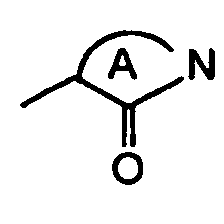

- Compounds of formula IA in accordance with claim 12, wherein the compounds are (2S-cis)-N-(3,5-difluoro-benzyl)-2-methyl-N'-{4-oxo-2-[(2-thiophen-2-yl-acetylamino)-(2R,S)-methyl]-1,2,4,5,6,7-hexahydro-azepino[3,2,1-hi]indol-5-yl}-malonamide or (2S-cis)-N-(3,5-difluoro-benzyl)-N'-(2-{[2-(4-fluoro-phenyl)-acetylamino]-methyl}-4-oxo-1,2,4,5,6,7-hexahydro-azepino[3,2,1-hi]indol-5-yl)-2,2-dimethyl-malonamide.
- Compounds of formula IB in accordance with claims 1 or 2.
- Compounds of formulas IA or IB in accordance with claims 1 or 2, wherein at least one of (R2)1,2,3 is fluoro.
- A process for preparing a compound of formulas IA or IB as defined in claims 1-15, which process comprises


or
b) reacting a compound of formula


c) reacting a compound of formula


if desired, converting the compounds obtained into pharmaceutically acceptable acid addition salts. - A medicament containing one or more compounds as claimed in any one of claims 1-15 and pharmaceutically acceptable excipients.
- A medicament according to claim 17 for the treatment of Alzheimer's disease.
- The use of a compound in any one of claims 1-15 for the manufacture of medicaments for the treatment of Alzheimer's disease.
Priority Applications (1)
| Application Number | Priority Date | Filing Date | Title |
|---|---|---|---|
| EP04705404A EP1592684B1 (en) | 2003-02-04 | 2004-01-27 | Malonamide derivatives as gamma-secretase inhibitors |
Applications Claiming Priority (4)
| Application Number | Priority Date | Filing Date | Title |
|---|---|---|---|
| EP03002190 | 2003-02-04 | ||
| EP03002190 | 2003-02-04 | ||
| EP04705404A EP1592684B1 (en) | 2003-02-04 | 2004-01-27 | Malonamide derivatives as gamma-secretase inhibitors |
| PCT/EP2004/000674 WO2004069826A1 (en) | 2003-02-04 | 2004-01-27 | Malonamide derivatives as gamma-secretase inhibitors |
Publications (2)
| Publication Number | Publication Date |
|---|---|
| EP1592684A1 EP1592684A1 (en) | 2005-11-09 |
| EP1592684B1 true EP1592684B1 (en) | 2008-07-30 |
Family
ID=32842686
Family Applications (1)
| Application Number | Title | Priority Date | Filing Date |
|---|---|---|---|
| EP04705404A Expired - Lifetime EP1592684B1 (en) | 2003-02-04 | 2004-01-27 | Malonamide derivatives as gamma-secretase inhibitors |
Country Status (23)
| Country | Link |
|---|---|
| US (1) | US7375099B2 (en) |
| EP (1) | EP1592684B1 (en) |
| JP (1) | JP4662914B2 (en) |
| KR (1) | KR100810810B1 (en) |
| CN (1) | CN100480248C (en) |
| AR (1) | AR042996A1 (en) |
| AT (1) | ATE402934T1 (en) |
| BR (1) | BRPI0407262A (en) |
| CA (1) | CA2514267C (en) |
| CL (1) | CL2004000174A1 (en) |
| CO (1) | CO5580761A2 (en) |
| DE (1) | DE602004015415D1 (en) |
| ES (1) | ES2311795T3 (en) |
| HR (1) | HRP20050663A2 (en) |
| IL (1) | IL169691A (en) |
| MX (1) | MXPA05008172A (en) |
| NO (1) | NO20053627L (en) |
| NZ (1) | NZ541324A (en) |
| PL (1) | PL378405A1 (en) |
| RU (1) | RU2330849C2 (en) |
| TW (1) | TWI293070B (en) |
| WO (1) | WO2004069826A1 (en) |
| ZA (1) | ZA200506212B (en) |
Cited By (1)
| Publication number | Priority date | Publication date | Assignee | Title |
|---|---|---|---|---|
| WO2014035707A1 (en) * | 2012-08-25 | 2014-03-06 | The Johns Hopkins University | Gapdh cascade inhibitor compounds and methods of use and treatment of stress induced disorders including mental illness |
Families Citing this family (54)
| Publication number | Priority date | Publication date | Assignee | Title |
|---|---|---|---|---|
| US7521481B2 (en) | 2003-02-27 | 2009-04-21 | Mclaurin Joanne | Methods of preventing, treating and diagnosing disorders of protein aggregation |
| BRPI0413533A (en) * | 2003-09-09 | 2006-10-10 | Hoffmann La Roche | malonamide derivatives that block gamma secretase activity |
| SI1673347T1 (en) | 2003-10-06 | 2015-10-30 | F. Hoffmann - La Roche Ag | Substituted dibenzo-azepine and benzo-diazepine derivatives useful as gamma-secretase inhibitors |
| US7211573B2 (en) * | 2004-12-08 | 2007-05-01 | Hoffmann-La Roche Inc. | Malonamide derivatives |
| CA2605110A1 (en) | 2005-04-20 | 2006-11-02 | Merck & Co., Inc. | Benzothiophene derivatives |
| AR059898A1 (en) | 2006-03-15 | 2008-05-07 | Janssen Pharmaceutica Nv | DERIVATIVES OF 3-CIANO-PIRIDONA 1,4-DISUSTITUTED AND ITS USE AS ALLOSTERIC MODULATORS OF MGLUR2 RECEIVERS |
| WO2007110335A1 (en) | 2006-03-27 | 2007-10-04 | F. Hoffmann-La Roche Ag | Malonamide derivatives as gamma secretase inhibitors |
| WO2008034735A2 (en) | 2006-09-20 | 2008-03-27 | F. Hoffmann-La Roche Ag | 4-oxo-2,3,4,5-tetrahydro-benzo[b][1,4]diazepine derivatives |
| US8278345B2 (en) | 2006-11-09 | 2012-10-02 | Probiodrug Ag | Inhibitors of glutaminyl cyclase |
| ATE554085T1 (en) | 2006-11-30 | 2012-05-15 | Probiodrug Ag | NEW INHIBITORS OF GLUTAMINYL CYCLASE |
| KR101150574B1 (en) * | 2007-02-02 | 2012-05-30 | 에프. 호프만-라 로슈 아게 | 6-oxo-6,7-dihydro-5h-dibenzo[b,d]azepin-7-yl derivatives |
| JP5930573B2 (en) | 2007-03-01 | 2016-06-15 | プロビオドルグ エージー | New use of glutaminyl cyclase inhibitors |
| TW200845978A (en) | 2007-03-07 | 2008-12-01 | Janssen Pharmaceutica Nv | 3-cyano-4-(4-tetrahydropyran-phenyl)-pyridin-2-one derivatives |
| TW200900065A (en) | 2007-03-07 | 2009-01-01 | Janssen Pharmaceutica Nv | 3-cyano-4-(4-pyridinyloxy-phenyl)-pyridin-2-one derivatives |
| WO2008128985A1 (en) | 2007-04-18 | 2008-10-30 | Probiodrug Ag | Thiourea derivatives as glutaminyl cyclase inhibitors |
| US7579464B2 (en) * | 2007-05-25 | 2009-08-25 | Hoffmann-La Roche Inc. | Process for preparation of enantiomerically pure compounds |
| EA017648B1 (en) | 2007-09-14 | 2013-02-28 | Орто-Макнейл-Янссен Фармасьютикалз, Инк. | 1',3'-disubstituted-4-phenyl-3,4,5,6-tetrahydro-2h,1'h-[1,4']bipyridinyl-2'-ones |
| TW200922566A (en) | 2007-09-14 | 2009-06-01 | Ortho Mcneil Janssen Pharm | 1,3 disubstituted 4-(aryl-X-phenyl)-1H-pyridin-2-ones |
| BRPI0816970A2 (en) | 2007-09-14 | 2015-03-24 | Ortho Mcneil Janssen Pharm | 1,3-disubstituted-4-phenyl-1h-pyridin-2-ones |
| CA2704436C (en) | 2007-11-14 | 2016-01-05 | Ortho-Mcneil-Janssen Pharmaceuticals, Inc. | Imidazo[1,2-a]pyridine derivatives and their use as positive allosteric modulators of mglur2 receptors |
| JP5547194B2 (en) | 2008-09-02 | 2014-07-09 | ジャンセン ファーマシューティカルズ, インコーポレイテッド. | 3-Azabicyclo [3.1.0] hexyl derivatives as modulators of metabotropic glutamate receptors |
| WO2010043396A1 (en) | 2008-10-16 | 2010-04-22 | Ortho-Mcneil-Janssen Pharmaceuticals, Inc. | Indole and benzomorpholine derivatives as modulators of metabotropic glutamate receptors |
| JP5690277B2 (en) | 2008-11-28 | 2015-03-25 | ジャンセン ファーマシューティカルズ, インコーポレイテッド. | Indole and benzoxazine derivatives as modulators of metabotropic glutamate receptors |
| HRP20131122T1 (en) | 2009-05-12 | 2013-12-20 | Janssen Pharmaceuticals, Inc. | 1,2,3-triazolo [4,3-a]pyridine derivatives and their use for the treatment or prevention of neurological and psychiatric disorders |
| MY153913A (en) | 2009-05-12 | 2015-04-15 | Janssen Pharmaceuticals Inc | 7-aryl-1,2,4-triazolo[4,3-a]pyridine derivatives and their use as positive allosteric modulators of mglur2 receptors |
| CN102439015B (en) | 2009-05-12 | 2015-05-13 | 杨森制药有限公司 | 1,2,4-Triazolo[4,3-a]pyridine derivatives and their use as positive allosteric modulators of mGluR2 receptors |
| PL2475428T3 (en) | 2009-09-11 | 2015-12-31 | Probiodrug Ag | Heterocylcic derivatives as inhibitors of glutaminyl cyclase |
| US20110190269A1 (en) * | 2010-02-01 | 2011-08-04 | Karlheinz Baumann | Gamma secretase modulators |
| ES2586231T3 (en) | 2010-03-03 | 2016-10-13 | Probiodrug Ag | Glutaminyl cyclase inhibitors |
| MX2012010470A (en) | 2010-03-10 | 2012-10-09 | Probiodrug Ag | Heterocyclic inhibitors of glutaminyl cyclase (qc, ec 2.3.2.5). |
| US8541596B2 (en) | 2010-04-21 | 2013-09-24 | Probiodrug Ag | Inhibitors |
| EP2661435B1 (en) | 2010-11-08 | 2015-08-19 | Janssen Pharmaceuticals, Inc. | 1,2,4-TRIAZOLO[4,3-a]PYRIDINE DERIVATIVES AND THEIR USE AS POSITIVE ALLOSTERIC MODULATORS OF MGLUR2 RECEPTORS |
| JP5852664B2 (en) | 2010-11-08 | 2016-02-03 | ジヤンセン・フアーマシユーチカルズ・インコーポレーテツド | 1,2,4-Triazolo [4,3-a] pyridine derivatives and their use as positive allosteric modulators of the mGluR2 receptor |
| ES2536433T3 (en) | 2010-11-08 | 2015-05-25 | Janssen Pharmaceuticals, Inc. | 1,2,4-Triazolo [4,3-a] pyridine derivatives and their use as positive allosteric modulators of mGluR2 receptors |
| EP2686313B1 (en) | 2011-03-16 | 2016-02-03 | Probiodrug AG | Benzimidazole derivatives as inhibitors of glutaminyl cyclase |
| TWI530489B (en) | 2011-03-22 | 2016-04-21 | 必治妥美雅史谷比公司 | Bis(fluoroalkyl)-1,4-benzodiazepine compound |
| AR087107A1 (en) | 2011-07-27 | 2014-02-12 | Lilly Co Eli | INHIBITOR COMPOUND OF THE SIGNALING OF THE NOTCH TRAJECTORY |
| WO2014047393A1 (en) | 2012-09-21 | 2014-03-27 | Bristol-Myers Squibb Company | N-substituted bis(fluoroalkyl)-1,4-benzodiazepinone compounds as notch inhibitors |
| JP2015531792A (en) | 2012-09-21 | 2015-11-05 | ブリストル−マイヤーズ スクイブ カンパニーBristol−Myers Squibb Company | Prodrugs of 1,4-benzodiazepinone compounds |
| CN104822665A (en) | 2012-09-21 | 2015-08-05 | 百时美施贵宝公司 | Fluoroalkyl and fluorocycloalkyl 1,4-benzodiazepinone compounds as notch inhibitors |
| WO2014047374A1 (en) | 2012-09-21 | 2014-03-27 | Bristol-Myers Squibb Company | Alkyl, fluoroalkyl-1,4-benzodiazepinone compounds |
| EP2897954B1 (en) | 2012-09-21 | 2016-10-26 | Bristol-Myers Squibb Company | Fluoroalkyl-1,4-benzodiazepinone compounds |
| US9133126B2 (en) | 2012-09-21 | 2015-09-15 | Bristol-Myers Squibb Company | Fluoroalkyl dibenzoazepinone compounds |
| US9187434B2 (en) | 2012-09-21 | 2015-11-17 | Bristol-Myers Squibb Company | Substituted 1,5-benzodiazepinones compounds |
| CN104797584A (en) | 2012-09-21 | 2015-07-22 | 百时美施贵宝公司 | Tricyclic heterocyclic compounds as notch inhibitors |
| TWI614238B (en) | 2012-09-21 | 2018-02-11 | 必治妥美雅史谷比公司 | Bis(fluoroalkyl)-1,4-benzodiazepine compounds and prodrugs thereof |
| CN105101968A (en) | 2013-04-04 | 2015-11-25 | 百时美施贵宝公司 | Combination therapy for the treatment of proliferative diseases |
| JO3368B1 (en) | 2013-06-04 | 2019-03-13 | Janssen Pharmaceutica Nv | 6, 7- dihydropyrazolu [5,1-a] pyrazine-4 (5 hands) -on compounds and their use as negative excretory regulators of Miglore 2 receptors. |
| JO3367B1 (en) | 2013-09-06 | 2019-03-13 | Janssen Pharmaceutica Nv | 1,2,4-TRIAZOLO[4,3-a]PYRIDINE COMPOUNDS AND THEIR USE AS POSITIVE ALLOSTERIC MODULATORS OF MGLUR2 RECEPTORS |
| PL3096790T3 (en) | 2014-01-21 | 2020-01-31 | Janssen Pharmaceutica, N.V. | COMBINATIONS CONTAINING POSITIVE ALLOSTERIC MODULATORS OR ORTOSTERIC AGONISTS OF THE METABOTROPIC GLUTAMINERGIC SUB-TYPE 2 RECEPTOR AND THEIR USE |
| ME03518B (en) | 2014-01-21 | 2020-04-20 | Janssen Pharmaceutica Nv | COMBINATIONS INCLUDING POSITIVE ALOSTERIC MODULATORS OR ORTHOSTERIC AGONISTS OF METABOTROPIC GLUTAMATERGIC RECEPTOR SUBTYPE 2 AND THEIR APPLICATIONS |
| PL3461819T3 (en) | 2017-09-29 | 2020-11-30 | Probiodrug Ag | Inhibitors of glutaminyl cyclase |
| NO20200333A1 (en) * | 2020-03-20 | 2021-03-29 | Axichem As | Synthesis of capsaicin derivatives |
| WO2022020658A1 (en) * | 2020-07-23 | 2022-01-27 | Purdue Research Foundation | Notch signaling inhibitors for treating obesity and metabolic disorders |
Family Cites Families (7)
| Publication number | Priority date | Publication date | Assignee | Title |
|---|---|---|---|---|
| JPS597193A (en) * | 1982-07-02 | 1984-01-14 | Shionogi & Co Ltd | Isomerization of malonylmethyl group |
| US4968678A (en) * | 1988-02-19 | 1990-11-06 | Eli Lilly And Company | Tetrazole excitatory amino acid receptor antagonists |
| AU2390892A (en) * | 1991-08-08 | 1993-03-02 | Yamanouchi Pharmaceutical Co., Ltd. | Urea derivative |
| EP1222176A1 (en) * | 1999-10-08 | 2002-07-17 | Bristol-Myers Squibb Pharma Company | AMINO LACTAM SULFONAMIDES AS INHIBITORS OF A$g(b) PROTEIN PRODUCTION |
| MXPA02009755A (en) * | 2000-04-03 | 2003-03-27 | Bristol Myers Squibb Pharma Co | CYCLIC LACTAMS AS INHIBITORS OF Abeta PROTEIN PRODUCTION. |
| WO2001077086A1 (en) | 2000-04-11 | 2001-10-18 | Dupont Pharmaceuticals Company | SUBSTITUTED LACTAMS AS INHIBITORS OF Aβ PROTEIN PRODUCTION |
| BRPI0413533A (en) * | 2003-09-09 | 2006-10-10 | Hoffmann La Roche | malonamide derivatives that block gamma secretase activity |
-
2004
- 2004-01-27 CN CNB2004800033052A patent/CN100480248C/en not_active Expired - Fee Related
- 2004-01-27 ES ES04705404T patent/ES2311795T3/en not_active Expired - Lifetime
- 2004-01-27 DE DE602004015415T patent/DE602004015415D1/en not_active Expired - Lifetime
- 2004-01-27 HR HR20050663A patent/HRP20050663A2/en not_active Application Discontinuation
- 2004-01-27 AT AT04705404T patent/ATE402934T1/en active
- 2004-01-27 NZ NZ541324A patent/NZ541324A/en unknown
- 2004-01-27 WO PCT/EP2004/000674 patent/WO2004069826A1/en not_active Ceased
- 2004-01-27 KR KR1020057014244A patent/KR100810810B1/en not_active Expired - Fee Related
- 2004-01-27 RU RU2005127666/04A patent/RU2330849C2/en not_active IP Right Cessation
- 2004-01-27 JP JP2006500017A patent/JP4662914B2/en not_active Expired - Fee Related
- 2004-01-27 PL PL378405A patent/PL378405A1/en not_active Application Discontinuation
- 2004-01-27 BR BR0407262-6A patent/BRPI0407262A/en not_active IP Right Cessation
- 2004-01-27 CA CA2514267A patent/CA2514267C/en not_active Expired - Fee Related
- 2004-01-27 EP EP04705404A patent/EP1592684B1/en not_active Expired - Lifetime
- 2004-01-27 MX MXPA05008172A patent/MXPA05008172A/en active IP Right Grant
- 2004-01-29 US US10/767,784 patent/US7375099B2/en not_active Expired - Fee Related
- 2004-01-30 TW TW093102218A patent/TWI293070B/en active
- 2004-02-02 AR ARP040100306A patent/AR042996A1/en not_active Application Discontinuation
- 2004-02-02 CL CL200400174A patent/CL2004000174A1/en unknown
-
2005
- 2005-07-14 IL IL169691A patent/IL169691A/en not_active IP Right Cessation
- 2005-07-25 CO CO05072813A patent/CO5580761A2/en not_active Application Discontinuation
- 2005-07-26 NO NO20053627A patent/NO20053627L/en not_active Application Discontinuation
- 2005-08-03 ZA ZA200506212A patent/ZA200506212B/en unknown
Cited By (2)
| Publication number | Priority date | Publication date | Assignee | Title |
|---|---|---|---|---|
| WO2014035707A1 (en) * | 2012-08-25 | 2014-03-06 | The Johns Hopkins University | Gapdh cascade inhibitor compounds and methods of use and treatment of stress induced disorders including mental illness |
| US10292980B2 (en) | 2012-08-25 | 2019-05-21 | The Johns Hopkins University | GAPDH cascade inhibitor compounds and methods of use and treatment of stress induced disorders including mental illness |
Also Published As
| Publication number | Publication date |
|---|---|
| NZ541324A (en) | 2008-10-31 |
| CA2514267A1 (en) | 2004-08-19 |
| PL378405A1 (en) | 2006-04-03 |
| JP2006516556A (en) | 2006-07-06 |
| RU2330849C2 (en) | 2008-08-10 |
| CO5580761A2 (en) | 2005-11-30 |
| KR100810810B1 (en) | 2008-03-06 |
| CA2514267C (en) | 2011-05-17 |
| TWI293070B (en) | 2008-02-01 |
| JP4662914B2 (en) | 2011-03-30 |
| IL169691A (en) | 2011-03-31 |
| DE602004015415D1 (en) | 2008-09-11 |
| ES2311795T3 (en) | 2009-02-16 |
| NO20053627L (en) | 2005-08-10 |
| HRP20050663A2 (en) | 2006-12-31 |
| CL2004000174A1 (en) | 2005-01-14 |
| MXPA05008172A (en) | 2005-10-05 |
| EP1592684A1 (en) | 2005-11-09 |
| AR042996A1 (en) | 2005-07-13 |
| WO2004069826A1 (en) | 2004-08-19 |
| BRPI0407262A (en) | 2006-01-31 |
| ZA200506212B (en) | 2006-05-31 |
| US20040220222A1 (en) | 2004-11-04 |
| KR20050105452A (en) | 2005-11-04 |
| IL169691A0 (en) | 2007-07-04 |
| US7375099B2 (en) | 2008-05-20 |
| RU2005127666A (en) | 2006-04-27 |
| AU2004210036A1 (en) | 2004-08-19 |
| CN1745076A (en) | 2006-03-08 |
| ATE402934T1 (en) | 2008-08-15 |
| CN100480248C (en) | 2009-04-22 |
| TW200423928A (en) | 2004-11-16 |
Similar Documents
| Publication | Publication Date | Title |
|---|---|---|
| CA2514267C (en) | Malonamide derivatives as gamma-secretase inhibitors | |
| CA2537440C (en) | Malonamide derivatives blocking the activity of gama-secretase | |
| CN1894217B (en) | Substituted dibenzo-azepine and benzo-diazepine derivatives useful as gamma-secretase inhibitors | |
| JP2003534333A (en) | Benzodiazepine derivatives as APP modifying substances | |
| AU2004210036B2 (en) | Malonamide derivatives as gamma-secretase inhibitors | |
| BRPI0717587A2 (en) | 4-OXO-2,3,4,5-TETRA-HYDRO-BENZO DERIVATIVES [B] [1,4] DIAZEPINE |
Legal Events
| Date | Code | Title | Description |
|---|---|---|---|
| PUAI | Public reference made under article 153(3) epc to a published international application that has entered the european phase |
Free format text: ORIGINAL CODE: 0009012 |
|
| 17P | Request for examination filed |
Effective date: 20050905 |
|
| AK | Designated contracting states |
Kind code of ref document: A1 Designated state(s): AT BE BG CH CY CZ DE DK EE ES FI FR GB GR HU IE IT LI LU MC NL PT RO SE SI SK TR |
|
| AX | Request for extension of the european patent |
Extension state: AL LT LV MK |
|
| RAX | Requested extension states of the european patent have changed |
Extension state: LV Payment date: 20050905 Extension state: LT Payment date: 20050905 |
|
| 17Q | First examination report despatched |
Effective date: 20060821 |
|
| RIN1 | Information on inventor provided before grant (corrected) |
Inventor name: GALLEY, GUIDO Inventor name: GOERGLER, ANNICK Inventor name: KITAS, ERIC, ARGIRIOS Inventor name: PETERS, JENS-UWE Inventor name: JACOBSEN, HELMUT |
|
| GRAP | Despatch of communication of intention to grant a patent |
Free format text: ORIGINAL CODE: EPIDOSNIGR1 |
|
| GRAS | Grant fee paid |
Free format text: ORIGINAL CODE: EPIDOSNIGR3 |
|
| GRAA | (expected) grant |
Free format text: ORIGINAL CODE: 0009210 |
|
| AK | Designated contracting states |
Kind code of ref document: B1 Designated state(s): AT BE BG CH CY CZ DE DK EE ES FI FR GB GR HU IE IT LI LU MC NL PT RO SE SI SK TR |
|
| AX | Request for extension of the european patent |
Extension state: LT LV |
|
| REG | Reference to a national code |
Ref country code: GB Ref legal event code: FG4D |
|
| REG | Reference to a national code |
Ref country code: CH Ref legal event code: EP |
|
| REF | Corresponds to: |
Ref document number: 602004015415 Country of ref document: DE Date of ref document: 20080911 Kind code of ref document: P |
|
| REG | Reference to a national code |
Ref country code: IE Ref legal event code: FG4D |
|
| REG | Reference to a national code |
Ref country code: SE Ref legal event code: TRGR |
|
| REG | Reference to a national code |
Ref country code: HU Ref legal event code: AG4A Ref document number: E003933 Country of ref document: HU |
|
| LTIE | Lt: invalidation of european patent or patent extension |
Effective date: 20080730 |
|
| PG25 | Lapsed in a contracting state [announced via postgrant information from national office to epo] |
Ref country code: PT Free format text: LAPSE BECAUSE OF FAILURE TO SUBMIT A TRANSLATION OF THE DESCRIPTION OR TO PAY THE FEE WITHIN THE PRESCRIBED TIME-LIMIT Effective date: 20081230 |
|
| REG | Reference to a national code |
Ref country code: ES Ref legal event code: FG2A Ref document number: 2311795 Country of ref document: ES Kind code of ref document: T3 |
|
| PG25 | Lapsed in a contracting state [announced via postgrant information from national office to epo] |
Ref country code: SI Free format text: LAPSE BECAUSE OF FAILURE TO SUBMIT A TRANSLATION OF THE DESCRIPTION OR TO PAY THE FEE WITHIN THE PRESCRIBED TIME-LIMIT Effective date: 20080730 Ref country code: BG Free format text: LAPSE BECAUSE OF FAILURE TO SUBMIT A TRANSLATION OF THE DESCRIPTION OR TO PAY THE FEE WITHIN THE PRESCRIBED TIME-LIMIT Effective date: 20081030 |
|
| PG25 | Lapsed in a contracting state [announced via postgrant information from national office to epo] |
Ref country code: DK Free format text: LAPSE BECAUSE OF FAILURE TO SUBMIT A TRANSLATION OF THE DESCRIPTION OR TO PAY THE FEE WITHIN THE PRESCRIBED TIME-LIMIT Effective date: 20080730 Ref country code: EE Free format text: LAPSE BECAUSE OF FAILURE TO SUBMIT A TRANSLATION OF THE DESCRIPTION OR TO PAY THE FEE WITHIN THE PRESCRIBED TIME-LIMIT Effective date: 20080730 |
|
| PG25 | Lapsed in a contracting state [announced via postgrant information from national office to epo] |
Ref country code: SK Free format text: LAPSE BECAUSE OF FAILURE TO SUBMIT A TRANSLATION OF THE DESCRIPTION OR TO PAY THE FEE WITHIN THE PRESCRIBED TIME-LIMIT Effective date: 20080730 Ref country code: CZ Free format text: LAPSE BECAUSE OF FAILURE TO SUBMIT A TRANSLATION OF THE DESCRIPTION OR TO PAY THE FEE WITHIN THE PRESCRIBED TIME-LIMIT Effective date: 20080730 Ref country code: RO Free format text: LAPSE BECAUSE OF FAILURE TO SUBMIT A TRANSLATION OF THE DESCRIPTION OR TO PAY THE FEE WITHIN THE PRESCRIBED TIME-LIMIT Effective date: 20080730 |
|
| PLBE | No opposition filed within time limit |
Free format text: ORIGINAL CODE: 0009261 |
|
| STAA | Information on the status of an ep patent application or granted ep patent |
Free format text: STATUS: NO OPPOSITION FILED WITHIN TIME LIMIT |
|
| 26N | No opposition filed |
Effective date: 20090506 |
|
| PG25 | Lapsed in a contracting state [announced via postgrant information from national office to epo] |
Ref country code: MC Free format text: LAPSE BECAUSE OF NON-PAYMENT OF DUE FEES Effective date: 20090131 |
|
| PG25 | Lapsed in a contracting state [announced via postgrant information from national office to epo] |
Ref country code: GR Free format text: LAPSE BECAUSE OF FAILURE TO SUBMIT A TRANSLATION OF THE DESCRIPTION OR TO PAY THE FEE WITHIN THE PRESCRIBED TIME-LIMIT Effective date: 20081031 |
|
| PG25 | Lapsed in a contracting state [announced via postgrant information from national office to epo] |
Ref country code: LU Free format text: LAPSE BECAUSE OF NON-PAYMENT OF DUE FEES Effective date: 20090127 |
|
| PG25 | Lapsed in a contracting state [announced via postgrant information from national office to epo] |
Ref country code: TR Free format text: LAPSE BECAUSE OF FAILURE TO SUBMIT A TRANSLATION OF THE DESCRIPTION OR TO PAY THE FEE WITHIN THE PRESCRIBED TIME-LIMIT Effective date: 20080730 |
|
| PG25 | Lapsed in a contracting state [announced via postgrant information from national office to epo] |
Ref country code: CY Free format text: LAPSE BECAUSE OF FAILURE TO SUBMIT A TRANSLATION OF THE DESCRIPTION OR TO PAY THE FEE WITHIN THE PRESCRIBED TIME-LIMIT Effective date: 20080730 |
|
| PGFP | Annual fee paid to national office [announced via postgrant information from national office to epo] |
Ref country code: IT Payment date: 20120124 Year of fee payment: 9 |
|
| PGFP | Annual fee paid to national office [announced via postgrant information from national office to epo] |
Ref country code: GB Payment date: 20121228 Year of fee payment: 10 |
|
| PGFP | Annual fee paid to national office [announced via postgrant information from national office to epo] |
Ref country code: CH Payment date: 20130129 Year of fee payment: 10 Ref country code: IE Payment date: 20130104 Year of fee payment: 10 Ref country code: SE Payment date: 20130108 Year of fee payment: 10 Ref country code: ES Payment date: 20130118 Year of fee payment: 10 Ref country code: HU Payment date: 20121228 Year of fee payment: 10 Ref country code: FI Payment date: 20130108 Year of fee payment: 10 Ref country code: DE Payment date: 20130131 Year of fee payment: 10 Ref country code: FR Payment date: 20130128 Year of fee payment: 10 |
|
| PGFP | Annual fee paid to national office [announced via postgrant information from national office to epo] |
Ref country code: NL Payment date: 20130110 Year of fee payment: 10 Ref country code: BE Payment date: 20130205 Year of fee payment: 10 |
|
| PGFP | Annual fee paid to national office [announced via postgrant information from national office to epo] |
Ref country code: AT Payment date: 20121228 Year of fee payment: 10 |
|
| BERE | Be: lapsed |
Owner name: F. HOFFMANN-LA ROCHE A.G. Effective date: 20140131 |
|
| REG | Reference to a national code |
Ref country code: DE Ref legal event code: R119 Ref document number: 602004015415 Country of ref document: DE |
|
| REG | Reference to a national code |
Ref country code: NL Ref legal event code: V1 Effective date: 20140801 |
|
| REG | Reference to a national code |
Ref country code: CH Ref legal event code: PL |
|
| REG | Reference to a national code |
Ref country code: AT Ref legal event code: MM01 Ref document number: 402934 Country of ref document: AT Kind code of ref document: T Effective date: 20140127 |
|
| REG | Reference to a national code |
Ref country code: SE Ref legal event code: EUG |
|
| GBPC | Gb: european patent ceased through non-payment of renewal fee |
Effective date: 20140127 |
|
| REG | Reference to a national code |
Ref country code: DE Ref legal event code: R119 Ref document number: 602004015415 Country of ref document: DE Effective date: 20140801 |
|
| PG25 | Lapsed in a contracting state [announced via postgrant information from national office to epo] |
Ref country code: NL Free format text: LAPSE BECAUSE OF NON-PAYMENT OF DUE FEES Effective date: 20140801 Ref country code: CH Free format text: LAPSE BECAUSE OF NON-PAYMENT OF DUE FEES Effective date: 20140131 Ref country code: DE Free format text: LAPSE BECAUSE OF NON-PAYMENT OF DUE FEES Effective date: 20140801 Ref country code: LI Free format text: LAPSE BECAUSE OF NON-PAYMENT OF DUE FEES Effective date: 20140131 Ref country code: FI Free format text: LAPSE BECAUSE OF NON-PAYMENT OF DUE FEES Effective date: 20140127 |
|
| REG | Reference to a national code |
Ref country code: FR Ref legal event code: ST Effective date: 20140930 |
|
| REG | Reference to a national code |
Ref country code: IE Ref legal event code: MM4A |
|
| PG25 | Lapsed in a contracting state [announced via postgrant information from national office to epo] |
Ref country code: HU Free format text: LAPSE BECAUSE OF NON-PAYMENT OF DUE FEES Effective date: 20140128 Ref country code: SE Free format text: LAPSE BECAUSE OF NON-PAYMENT OF DUE FEES Effective date: 20140128 Ref country code: AT Free format text: LAPSE BECAUSE OF NON-PAYMENT OF DUE FEES Effective date: 20140127 Ref country code: FR Free format text: LAPSE BECAUSE OF NON-PAYMENT OF DUE FEES Effective date: 20140131 Ref country code: GB Free format text: LAPSE BECAUSE OF NON-PAYMENT OF DUE FEES Effective date: 20140127 |
|
| PG25 | Lapsed in a contracting state [announced via postgrant information from national office to epo] |
Ref country code: IE Free format text: LAPSE BECAUSE OF NON-PAYMENT OF DUE FEES Effective date: 20140127 Ref country code: BE Free format text: LAPSE BECAUSE OF NON-PAYMENT OF DUE FEES Effective date: 20140131 |
|
| PG25 | Lapsed in a contracting state [announced via postgrant information from national office to epo] |
Ref country code: IT Free format text: LAPSE BECAUSE OF NON-PAYMENT OF DUE FEES Effective date: 20140127 |
|
| PG25 | Lapsed in a contracting state [announced via postgrant information from national office to epo] |
Ref country code: ES Free format text: LAPSE BECAUSE OF NON-PAYMENT OF DUE FEES Effective date: 20140128 |