EP1592650B1 - Improved method for hydrocarbon isomerization - Google Patents
Improved method for hydrocarbon isomerization Download PDFInfo
- Publication number
- EP1592650B1 EP1592650B1 EP03816002A EP03816002A EP1592650B1 EP 1592650 B1 EP1592650 B1 EP 1592650B1 EP 03816002 A EP03816002 A EP 03816002A EP 03816002 A EP03816002 A EP 03816002A EP 1592650 B1 EP1592650 B1 EP 1592650B1
- Authority
- EP
- European Patent Office
- Prior art keywords
- catalyst
- steamed
- zsm
- process according
- catalysts
- Prior art date
- Legal status (The legal status is an assumption and is not a legal conclusion. Google has not performed a legal analysis and makes no representation as to the accuracy of the status listed.)
- Expired - Lifetime
Links
Images

Classifications
-
- C—CHEMISTRY; METALLURGY
- C07—ORGANIC CHEMISTRY
- C07C—ACYCLIC OR CARBOCYCLIC COMPOUNDS
- C07C5/00—Preparation of hydrocarbons from hydrocarbons containing the same number of carbon atoms
- C07C5/22—Preparation of hydrocarbons from hydrocarbons containing the same number of carbon atoms by isomerisation
- C07C5/27—Rearrangement of carbon atoms in the hydrocarbon skeleton
- C07C5/2767—Changing the number of side-chains
- C07C5/277—Catalytic processes
- C07C5/2775—Catalytic processes with crystalline alumino-silicates, e.g. molecular sieves
-
- B—PERFORMING OPERATIONS; TRANSPORTING
- B01—PHYSICAL OR CHEMICAL PROCESSES OR APPARATUS IN GENERAL
- B01J—CHEMICAL OR PHYSICAL PROCESSES, e.g. CATALYSIS OR COLLOID CHEMISTRY; THEIR RELEVANT APPARATUS
- B01J29/00—Catalysts comprising molecular sieves
- B01J29/04—Catalysts comprising molecular sieves having base-exchange properties, e.g. crystalline zeolites
- B01J29/06—Crystalline aluminosilicate zeolites; Isomorphous compounds thereof
- B01J29/65—Crystalline aluminosilicate zeolites; Isomorphous compounds thereof of the ferrierite type, e.g. types ZSM-21, ZSM-35 or ZSM-38, as exemplified by patent documents US4046859, US4016245 and US4046859, respectively
-
- B—PERFORMING OPERATIONS; TRANSPORTING
- B01—PHYSICAL OR CHEMICAL PROCESSES OR APPARATUS IN GENERAL
- B01J—CHEMICAL OR PHYSICAL PROCESSES, e.g. CATALYSIS OR COLLOID CHEMISTRY; THEIR RELEVANT APPARATUS
- B01J29/00—Catalysts comprising molecular sieves
- B01J29/04—Catalysts comprising molecular sieves having base-exchange properties, e.g. crystalline zeolites
- B01J29/06—Crystalline aluminosilicate zeolites; Isomorphous compounds thereof
- B01J29/65—Crystalline aluminosilicate zeolites; Isomorphous compounds thereof of the ferrierite type, e.g. types ZSM-21, ZSM-35 or ZSM-38, as exemplified by patent documents US4046859, US4016245 and US4046859, respectively
- B01J29/66—Crystalline aluminosilicate zeolites; Isomorphous compounds thereof of the ferrierite type, e.g. types ZSM-21, ZSM-35 or ZSM-38, as exemplified by patent documents US4046859, US4016245 and US4046859, respectively containing iron group metals, noble metals or copper
- B01J29/67—Noble metals
-
- B—PERFORMING OPERATIONS; TRANSPORTING
- B01—PHYSICAL OR CHEMICAL PROCESSES OR APPARATUS IN GENERAL
- B01J—CHEMICAL OR PHYSICAL PROCESSES, e.g. CATALYSIS OR COLLOID CHEMISTRY; THEIR RELEVANT APPARATUS
- B01J29/00—Catalysts comprising molecular sieves
- B01J29/04—Catalysts comprising molecular sieves having base-exchange properties, e.g. crystalline zeolites
- B01J29/06—Crystalline aluminosilicate zeolites; Isomorphous compounds thereof
- B01J29/70—Crystalline aluminosilicate zeolites; Isomorphous compounds thereof of types characterised by their specific structure not provided for in groups B01J29/08 - B01J29/65
- B01J29/7026—MFS-type, e.g. ZSM-57
-
- B—PERFORMING OPERATIONS; TRANSPORTING
- B01—PHYSICAL OR CHEMICAL PROCESSES OR APPARATUS IN GENERAL
- B01J—CHEMICAL OR PHYSICAL PROCESSES, e.g. CATALYSIS OR COLLOID CHEMISTRY; THEIR RELEVANT APPARATUS
- B01J29/00—Catalysts comprising molecular sieves
- B01J29/04—Catalysts comprising molecular sieves having base-exchange properties, e.g. crystalline zeolites
- B01J29/06—Crystalline aluminosilicate zeolites; Isomorphous compounds thereof
- B01J29/70—Crystalline aluminosilicate zeolites; Isomorphous compounds thereof of types characterised by their specific structure not provided for in groups B01J29/08 - B01J29/65
- B01J29/703—MRE-type, e.g. ZSM-48
-
- B—PERFORMING OPERATIONS; TRANSPORTING
- B01—PHYSICAL OR CHEMICAL PROCESSES OR APPARATUS IN GENERAL
- B01J—CHEMICAL OR PHYSICAL PROCESSES, e.g. CATALYSIS OR COLLOID CHEMISTRY; THEIR RELEVANT APPARATUS
- B01J29/00—Catalysts comprising molecular sieves
- B01J29/04—Catalysts comprising molecular sieves having base-exchange properties, e.g. crystalline zeolites
- B01J29/06—Crystalline aluminosilicate zeolites; Isomorphous compounds thereof
- B01J29/70—Crystalline aluminosilicate zeolites; Isomorphous compounds thereof of types characterised by their specific structure not provided for in groups B01J29/08 - B01J29/65
- B01J29/7042—TON-type, e.g. Theta-1, ISI-1, KZ-2, NU-10 or ZSM-22
-
- B—PERFORMING OPERATIONS; TRANSPORTING
- B01—PHYSICAL OR CHEMICAL PROCESSES OR APPARATUS IN GENERAL
- B01J—CHEMICAL OR PHYSICAL PROCESSES, e.g. CATALYSIS OR COLLOID CHEMISTRY; THEIR RELEVANT APPARATUS
- B01J29/00—Catalysts comprising molecular sieves
- B01J29/04—Catalysts comprising molecular sieves having base-exchange properties, e.g. crystalline zeolites
- B01J29/06—Crystalline aluminosilicate zeolites; Isomorphous compounds thereof
- B01J29/70—Crystalline aluminosilicate zeolites; Isomorphous compounds thereof of types characterised by their specific structure not provided for in groups B01J29/08 - B01J29/65
- B01J29/7046—MTT-type, e.g. ZSM-23, KZ-1, ISI-4 or EU-13
-
- B—PERFORMING OPERATIONS; TRANSPORTING
- B01—PHYSICAL OR CHEMICAL PROCESSES OR APPARATUS IN GENERAL
- B01J—CHEMICAL OR PHYSICAL PROCESSES, e.g. CATALYSIS OR COLLOID CHEMISTRY; THEIR RELEVANT APPARATUS
- B01J29/00—Catalysts comprising molecular sieves
- B01J29/04—Catalysts comprising molecular sieves having base-exchange properties, e.g. crystalline zeolites
- B01J29/06—Crystalline aluminosilicate zeolites; Isomorphous compounds thereof
- B01J29/70—Crystalline aluminosilicate zeolites; Isomorphous compounds thereof of types characterised by their specific structure not provided for in groups B01J29/08 - B01J29/65
- B01J29/72—Crystalline aluminosilicate zeolites; Isomorphous compounds thereof of types characterised by their specific structure not provided for in groups B01J29/08 - B01J29/65 containing iron group metals, noble metals or copper
- B01J29/74—Noble metals
- B01J29/7461—MRE-type, e.g. ZSM-48
-
- B—PERFORMING OPERATIONS; TRANSPORTING
- B01—PHYSICAL OR CHEMICAL PROCESSES OR APPARATUS IN GENERAL
- B01J—CHEMICAL OR PHYSICAL PROCESSES, e.g. CATALYSIS OR COLLOID CHEMISTRY; THEIR RELEVANT APPARATUS
- B01J29/00—Catalysts comprising molecular sieves
- B01J29/04—Catalysts comprising molecular sieves having base-exchange properties, e.g. crystalline zeolites
- B01J29/06—Crystalline aluminosilicate zeolites; Isomorphous compounds thereof
- B01J29/70—Crystalline aluminosilicate zeolites; Isomorphous compounds thereof of types characterised by their specific structure not provided for in groups B01J29/08 - B01J29/65
- B01J29/72—Crystalline aluminosilicate zeolites; Isomorphous compounds thereof of types characterised by their specific structure not provided for in groups B01J29/08 - B01J29/65 containing iron group metals, noble metals or copper
- B01J29/74—Noble metals
- B01J29/7484—TON-type, e.g. Theta-1, ISI-1, KZ-2, NU-10 or ZSM-22
-
- B—PERFORMING OPERATIONS; TRANSPORTING
- B01—PHYSICAL OR CHEMICAL PROCESSES OR APPARATUS IN GENERAL
- B01J—CHEMICAL OR PHYSICAL PROCESSES, e.g. CATALYSIS OR COLLOID CHEMISTRY; THEIR RELEVANT APPARATUS
- B01J29/00—Catalysts comprising molecular sieves
- B01J29/04—Catalysts comprising molecular sieves having base-exchange properties, e.g. crystalline zeolites
- B01J29/06—Crystalline aluminosilicate zeolites; Isomorphous compounds thereof
- B01J29/70—Crystalline aluminosilicate zeolites; Isomorphous compounds thereof of types characterised by their specific structure not provided for in groups B01J29/08 - B01J29/65
- B01J29/72—Crystalline aluminosilicate zeolites; Isomorphous compounds thereof of types characterised by their specific structure not provided for in groups B01J29/08 - B01J29/65 containing iron group metals, noble metals or copper
- B01J29/74—Noble metals
- B01J29/7492—MTT-type, e.g. ZSM-23, KZ-1, ISI-4 or EU-13
-
- B—PERFORMING OPERATIONS; TRANSPORTING
- B01—PHYSICAL OR CHEMICAL PROCESSES OR APPARATUS IN GENERAL
- B01J—CHEMICAL OR PHYSICAL PROCESSES, e.g. CATALYSIS OR COLLOID CHEMISTRY; THEIR RELEVANT APPARATUS
- B01J37/00—Processes, in general, for preparing catalysts; Processes, in general, for activation of catalysts
- B01J37/08—Heat treatment
- B01J37/10—Heat treatment in the presence of water, e.g. steam
-
- C—CHEMISTRY; METALLURGY
- C07—ORGANIC CHEMISTRY
- C07C—ACYCLIC OR CARBOCYCLIC COMPOUNDS
- C07C9/00—Aliphatic saturated hydrocarbons
- C07C9/14—Aliphatic saturated hydrocarbons with five to fifteen carbon atoms
- C07C9/16—Branched-chain hydrocarbons
-
- C—CHEMISTRY; METALLURGY
- C10—PETROLEUM, GAS OR COKE INDUSTRIES; TECHNICAL GASES CONTAINING CARBON MONOXIDE; FUELS; LUBRICANTS; PEAT
- C10G—CRACKING HYDROCARBON OILS; PRODUCTION OF LIQUID HYDROCARBON MIXTURES, e.g. BY DESTRUCTIVE HYDROGENATION, OLIGOMERISATION, POLYMERISATION; RECOVERY OF HYDROCARBON OILS FROM OIL-SHALE, OIL-SAND, OR GASES; REFINING MIXTURES MAINLY CONSISTING OF HYDROCARBONS; REFORMING OF NAPHTHA; MINERAL WAXES
- C10G45/00—Refining of hydrocarbon oils using hydrogen or hydrogen-generating compounds
- C10G45/58—Refining of hydrocarbon oils using hydrogen or hydrogen-generating compounds to change the structural skeleton of some of the hydrocarbon content without cracking the other hydrocarbons present, e.g. lowering pour point; Selective hydrocracking of normal paraffins
- C10G45/60—Refining of hydrocarbon oils using hydrogen or hydrogen-generating compounds to change the structural skeleton of some of the hydrocarbon content without cracking the other hydrocarbons present, e.g. lowering pour point; Selective hydrocracking of normal paraffins characterised by the catalyst used
- C10G45/64—Refining of hydrocarbon oils using hydrogen or hydrogen-generating compounds to change the structural skeleton of some of the hydrocarbon content without cracking the other hydrocarbons present, e.g. lowering pour point; Selective hydrocracking of normal paraffins characterised by the catalyst used containing crystalline alumino-silicates, e.g. molecular sieves
-
- B—PERFORMING OPERATIONS; TRANSPORTING
- B01—PHYSICAL OR CHEMICAL PROCESSES OR APPARATUS IN GENERAL
- B01J—CHEMICAL OR PHYSICAL PROCESSES, e.g. CATALYSIS OR COLLOID CHEMISTRY; THEIR RELEVANT APPARATUS
- B01J2229/00—Aspects of molecular sieve catalysts not covered by B01J29/00
- B01J2229/30—After treatment, characterised by the means used
- B01J2229/36—Steaming
-
- C—CHEMISTRY; METALLURGY
- C07—ORGANIC CHEMISTRY
- C07C—ACYCLIC OR CARBOCYCLIC COMPOUNDS
- C07C2529/00—Catalysts comprising molecular sieves
- C07C2529/04—Catalysts comprising molecular sieves having base-exchange properties, e.g. crystalline zeolites, pillared clays
- C07C2529/06—Crystalline aluminosilicate zeolites; Isomorphous compounds thereof
- C07C2529/65—Crystalline aluminosilicate zeolites; Isomorphous compounds thereof of the ferrierite type, e.g. types ZSM-21, ZSM-35 or ZSM-38
- C07C2529/66—Crystalline aluminosilicate zeolites; Isomorphous compounds thereof of the ferrierite type, e.g. types ZSM-21, ZSM-35 or ZSM-38 containing iron group metals, noble metals or copper
- C07C2529/67—Noble metals
-
- C—CHEMISTRY; METALLURGY
- C07—ORGANIC CHEMISTRY
- C07C—ACYCLIC OR CARBOCYCLIC COMPOUNDS
- C07C2529/00—Catalysts comprising molecular sieves
- C07C2529/04—Catalysts comprising molecular sieves having base-exchange properties, e.g. crystalline zeolites, pillared clays
- C07C2529/06—Crystalline aluminosilicate zeolites; Isomorphous compounds thereof
- C07C2529/70—Crystalline aluminosilicate zeolites; Isomorphous compounds thereof of types characterised by their specific structure not provided for in groups C07C2529/08 - C07C2529/65
- C07C2529/72—Crystalline aluminosilicate zeolites; Isomorphous compounds thereof of types characterised by their specific structure not provided for in groups C07C2529/08 - C07C2529/65 containing iron group metals, noble metals or copper
- C07C2529/74—Noble metals
Definitions
- the present invention is directed at an improved hydrocarbon isomerization process. More particularly, the present invention is directed at an improved isomerization process for C 10+ hydrocarbon feedstreams through the use of a steamed catalyst.
- United States Patent Number 4,418,235 discloses the use of zeolites with a pore dimension greater than 5 Angstroms, preferably 10-membered rings, with a silica to alumina ratio of at least 12 and a constraint index of 1 to 12. These zeolites undergo a treatment with steam or water prior to use and are used in an acid catalyzed conversion process.
- United States Patent Number 4,374,296 discloses the use of zeolites with a pore dimension greater than 5 Angstroms, preferably 10-membered rings, with a silica to alumina ratio of greater than 12 and a constraint index of 1 to 12.
- the catalysts undergo a controlled treatment to enhance the acidity, expressed as alpha, to 300. These catalysts are used in the hydroisomerization of a C 4 to C 8 paraffin.
- EP-A-0 378 887 discloses a process for paraffin isomerization.
- the present invention is directed at a process to isomerize C 10+ hydrocarbon feedstreams comprising:
- the 10-ring medium pore zeolite is selected from ZSM-22, ZSM-23, ZSM-35, ZSM-57, ZSM-48, and ferrierite
- the molecular sieve is ZSM-48.
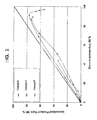
- Figure 1 is a graph comparing the decane hydroisomerization performance of a base Pt-containing ZSM-48 catalyst in relation to two steamed Pt-containing ZSM-48 catalysts steamed at 482,7°C (900°F) for 3 hours.
- Catalyst B was steamed after Pt-impregnation and Catalyst C was been steamed before Pt-impregnation.
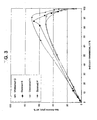
- Figure 2 is a graph comparing the decane hydroisomerization performance of a base Pt-containing ZSM-48 catalyst in relation to two steamed Pt-containing ZSM-48 catalysts steamed at 537,8°C (1000°F) for 10 hours.
- Catalyst E was steamed after Pt-impregnation and Catalyst F was been steamed before Pt-impregnation.
- Figure 3 is a graph comparing the decane hydroisomerization performance of base Pt-containing ZSM-22 and ZSM-23 catalysts in relation to steamed Pt-containing ZSM-22 and ZSM-23 catalysts.
- the present invention utilizes steamed catalysts comprising a molecular sieve in the hydroisomerization of a C 10+ hydrorarbon feedstream.
- the C 10+ hydrocarbon feedstream is contacted with the treated catalyst under hydroisomerization conditions that include temperatures from 204,4°C to 426,7°C (400 to 800°F) and pressures from 2,76 x 10 6 Pa to 1,38 x 10 7 Pa (400 to 2000 psig)
- Steamed as used herein, is meant to refer to a catalyst that has been subjected to steaming prior to use, and unsteamed is meant to refer to a catalyst that has not been subjected to steaming.
- Feedstreams suitable for use in the present process are C 10+ hydrocarbon feedstreams boiling in the range of 343,3°C to 565,6°C (650 to 1050°F), preferably 371°C to 537,8°C (700 to 1000°F), and more preferably 398,9°C - 510°C (750 to 950°F).
- Catalysts used in the present process comprise molecular sieves.
- Molecular sieves suitable for use in the present invention are selected from acidic metallosilicates, such as silicoaluminophophates (SAPOs), and unidimensional 10-ring zeolites, i.e. medium pore zeolites having unidimensional channels comprising 10-member rings. It is preferred that the molecular sieve be a zeolite.
- SAPOs silicoaluminophophates
- SAPOs silicoaluminophophates
- Preferred SAPOs include SAPO-11, SAPO-34, and SAPO-41.
- the unidimensional 10-ring zeolites i.e. medium pore zeolites, used herein can be any of those known.
- Zeolites are porous crystalline materials and medium pore zeolites are generally defined as those having a pore size of 5 to 7 Angstroms, such that the zeolite freely sorbs molecules such as n-hexane, 3-methylpentane, benzene and p-xylene.
- Another common classification used for medium pore zeolites involves the Constraint Index test which is described in United States Patent Number 4,016,218 , which is hereby incorporated by reference.
- Medium pore zeolites typically have a Constraint Index of 1 to 12, based on the zeolite alone without modifiers and prior to treatment to adjust the diffusivity of the catalyst.
- Preferred unidimensional 10-ring zeolites are ZSM-22, ZSM-23, ZSM-35, ZSM-57, ZSM-48, and ferrierite. More preferred are ZSM-22, ZSM-23, ZSM-35, ZSM-48, and ZSM-57. The most preferred is ZSM-48.
- the catalysts used herein contain at least one Group VIII metal, preferably a Group VIII noble metal, more preferably Pt and Pd, and most preferably Pt.
- the metals are present in an amount from 0.05 to 2.0 wt.%, preferably from 0.1 to 1.0 wt.%, based on the weight of the catalyst.
- the metals may be incorporated through the use of any means or technique known, such as, for example, incipient wetness.
- the catalysts used herein are effectively steamed steam prior to use in the present process, and thus are referred to herein as steam-treated or steamed catalysts.
- the steaming can be accomplished in an atmosphere of 100% steam or an atmosphere comprising steam and a gas that is substantially inert to the catalyst. Suitable steaming temperatures range from 371°C to 537,8°C (700°F to 1000°F), preferably 426,7°C to 482,2°C (800°F to 900°F).
- the catalysts are subjected to steaming conditions for an effective amount of time, which will typically be less than 10 hours, preferably less than 8 hours, and more preferably 2 to 8 hours.
- Other steaming techniques are disclosed in United States Patent Number 4,418,235 and United States Patent Number 4,374,296 .
- Alpha value is a measure of zeolite acidic functionality and is more fully described together with details of its measurement in United States Patent Number 4,016,218 , J. Catalysis, 6, pages 278-287 (1966 ) and J. Catalysis, 61, pages 390-396 (1980 ).
- the alpha value reflects the relative activity with respect to a high activity silica-alumina cracking catalyst.
- n-hexane conversion is determined at 426,7°C (800°F).
- Conversion is varied by variation in space velocity such that a conversion level of 10 to 60 percent of n-hexane is obtained and converted to a rate constant per unit volume of zeolite and compared with that of the silica-alumina catalyst, which is normalized to a reference activity of 537,8°C (1000°F).
- Catalytic activity is expressed as a multiple of this standard, i.e. the silica-alumina standard.
- the silica-alumina reference catalyst contains 10 wt.% Al 2 O 3 and the remainder is SiO 2 . Therefore, as the alpha value of a catalyst decreases, the tendency towards non-selective cracking also decreases.
- the alpha value of the steamed catalysts does not exceed the alpha value of the same unsteamed catalyst by more than 1 to 10.
- the steaming of a zeolite results in the extraction of the aluminum sites from the framework of the zeolite, which has the effect of decreasing the acid activity (acidity) of the zeolite, resulting in a catalyst with a lower alpha number, i.e. having less tendency to non-selectively crack.
- steaming is often used to control the activity of cracking catalysts, such as, for example, catalysts used in a fluidized catalytic cracking unit.
- the steaming of the catalysts used herein is conducted in such a way that the alpha value of the steamed catalysts does not increase by more than 1 to 10 alpha numbers above that of the unsteamed catalysts, preferably 1 to 5 alpha numbers, and more preferably 1 to 3 alpha numbers.
- the steaming of the catalysts used herein should not decrease the alpha value of the unsteamed catalyst by more than 50%.
- the steamed catalyst has an alpha value lower than the unsteamed catalyst, the decrease in alpha value should be maintained within 10 alpha numbers of the unsteamed catalyst. It is preferred that the steamed catalyst have an alpha value 5 alpha numbers lower than that of the unsteamed catalyst, more preferably 3 alpha numbers.
- the catalysts used herein contain at least one Group VIII metal, preferably a Group VIII noble metal, and most preferably Pt, as previously discussed.
- the catalyst may be steamed prior to or subsequent to adding the at least one Group VIII metal. It is preferred, however, that the catalyst be steamed subsequent to the incorporation of the at least one Group VIII metal.
- the molecular sieves used herein be a zeolite.
- the zeolite can be combined with a suitable binder or matrix material.
- suitable binder or matrix material include active and inactive materials such as clays, silica, and/or metal oxides such as alumina.
- Naturally occurring clays that can be composited include clays from the montmorillonite and kaolin families including the subbentonites, and the kaolins commonly known as Dixie, McNamee, Georgia, and Florida clays. Others in which the main mineral constituent is halloysite, kaolinite, dickite, nacrite, or anauxite may also be used.
- the clays can be used in the raw state as originally mixed or subjected to calcination, acid treatment, or chemical modification prior to being combined with the zeolite.
- the zeolite can also comprise a porous matrix or binder material such as silica-alumina, silica-magnesia, silica-zirconia, silica-thoria, silica-beryllia, or silica-titania.
- the zeolite can also comprise a ternary composition such as silica-alumina-thoria, silica-alumina-zirconia, silica-alumina-magnesia, and silica-magnesia-zirconia.
- the porous matrix or binder material comprises silica, alumina, or a kaolin clay. It is more preferred that the binder material comprise alumina. In this embodiment the alumina is present in a ratio of less than 15 parts zeolite to one part binder, preferably less than 10, more preferably less than 5, and most preferably 2.
- the present invention is practiced by contacting a C 10+ hydrocarbon feedstream with a steamed catalyst under hydroisomerization conditions.
- the hydroisomerization conditions include temperatures between 204,4°C (400) and 426,7°C (800°F), pressures between 2,76 ⁇ 10 6 Pa and 1,38 ⁇ 10 7 Pa (400 and 2000 psig), hydrogen circulation rates between 1000 and 5000 scf/bbl, and space velocities between 0.25 and 2.0.
- the use of the treated catalysts improves the product selectivity of the hydroisomerization process by more than 2 percent, preferably more than 3 percent, more preferably 5 percent, and most preferably more than 5 percent.
- a base, untreated catalyst, here ZSM-48 was crystallized according to the procedure of United States Patent Number 5,961,951 . Following crystallization, decanting, and washing, the ZSM-48 crystal was filtered and dried. ZSM-48 powder was dry-mixed with Versal 300 alumina in proportion to give 2 parts zeolite to 1 part binder. Water was added to form an extrudable mull, the mull was extruded to yield a 1/20" quadralobe extrudate, and the extrudate was dried at 121,1°C (250°F). The extrudate was then precalcined in nitrogen to decompose the organic directing agent in a rotary calciner.
- the extrudate was then humidified, exchanged twice with 1N NH 4 NO 3 at room temperature, rinsed with deionized water, and dried at 121,1°C (250°F).
- the untreated catalyst was then calcined in air at 537,8°C (1000°F).
- the catalyst produced in Example 1 was impregnated with Pt to obtain a final Pt loading of 0.6 wt.%, based on the weight of the catalyst and measured on a dry basis.
- the catalyst was impregnated with platinum through the incipient wetness technique.
- the platinum salt used for the impregnation was platinum tetraamine nitrate (Pt(NH 3 ) 4 (NO 3 ) 2 ).
- the catalyst was dried at 121,1°C (250°F) and calcined in air at 360°C (680°F) for 2 hours.
- the finished catalyst is referred to herein as Catalyst A.
- the alpha value of this catalyst was determined by taking a sample of the catalyst, approximately 1g, and placing it in a glass reactor at atmospheric pressure. The sample was contacted with hexane at 537,8°C (1000°F), and the conversion of the hexane was measured at steady state. The alpha value of this catalyst is shown in Table 1 below.
- Example 2 the base catalyst of Example 1 was steamed at 482,2°C (900°F) for 3 hours in a fixed bed steamer. After steaming, Pt was added to the catalyst to a level of 0.6 wt.% as described in Example 2. This catalyst is referred to herein as Catalyst B.
- the platinum-containing catalyst of Example 2 was also steamed at 482,2°C (900°F) for 3 hours in a fixed bed steamer. This catalyst is referred to herein as Catalyst C.
- the alpha values of the steamed catalysts of the present invention do not exhibit a significant change in alpha value from that of the base catalyst as can be seen in Table 1.
- Catalysts A, B, and C were evaluated in an atmospheric n-decane isomerization unit. Approximately 1 gram of 14/24 mesh-sized catalyst was used for the test. The sample was first heated under nitrogen to 260°C (500oF), and then the flow was switched to hydrogen and n-decane while the system cooled to the first setpoint of 162,8°C (325°F). After lining out at this temperature, an on-line gas chromatograph analyzed the product exiting the isomerization unit, and the next set-point temperature was attained. The catalyst was evaluated at a total of 9 different temperatures within the range of 162,8°C (325°F) to 257,2°C (495°F). The data was retrieved and analyzed. All products were analyzed as completely as possible, and the isomerized products discussed below include all isomerized C 10 components (methylnonanes, ethyloctanes, etc.).
- Figure 1 illustrates the catalytic performance of ZSM-48 in decane hydroisomerization. The selectivity towards isomerized C 10 is shown on the Y-axis relative to conversion of n- C 10 .
- Figure 1 depicts that steaming the base(unsteamed) catalyst produces significant improvements in iso-decane yields.
- Figure 1 also illustrates that steaming the catalyst after incorporation of the at least one Group VIII metal produces greater iso-decane yields than the base catalyst.
- the alpha value of the steamed catalysts do not differ significantly from those of the unsteamed catalysts. Therefore, approximately the same total hydrocarbon conversion is maintained at a given temperature. Thus, a controlled steaming of the catalyst is able to improve product selectivity while not adversely affecting catalyst activity.
- a second catalyst was prepared in the same manner as the catalyst of Example 1. This catalyst was steamed, separately, at 537,8°C (1000°F) for 10 hours and at 648,9°C (1200°F) for 12 hours.
- the base catalyst and the catalysts subjected to steaming under the above steaming conditions are referred to as catalysts D, E, and F, respectively.
- Catalysts D, E, and F were impregnated with Pt as described in Example 2, and tested using n-decane as described in Example 4. The alpha value of each of these catalysts was, determined according to the procedure outlined in Example 2.
- Catalyst G and H were formed according to the procedure outlined in Example 1. The catalysts were then steamed following the method outlined in Example 3. Catalyst G was steamed at 482,2°C (900°F) for 3 hours. Catalyst H was steamed at 426,7°C (800°F) for 3 hours.
- Catalysts G and H were determined according to the procedure of Example 2. The alpha values of Catalysts G and H were measured. It should be noted that although Catalysts G and H are referred to as Pt-containing in the "Catalyst Description" column of Table 3, the alpha value of the unsteamed catalysts was measured prior to Pt loading. Table 3 Catalyst Catalyst Description Alpha Value Unsteamed Alpha Value Steamed G Pt-containing ZSM-22 30 39 H Pt-containing ZSM-23 33 34
Landscapes
- Chemical & Material Sciences (AREA)
- Organic Chemistry (AREA)
- Chemical Kinetics & Catalysis (AREA)
- Crystallography & Structural Chemistry (AREA)
- Engineering & Computer Science (AREA)
- Materials Engineering (AREA)
- Oil, Petroleum & Natural Gas (AREA)
- Physics & Mathematics (AREA)
- Thermal Sciences (AREA)
- General Chemical & Material Sciences (AREA)
- Catalysts (AREA)
- Organic Low-Molecular-Weight Compounds And Preparation Thereof (AREA)
- Low-Molecular Organic Synthesis Reactions Using Catalysts (AREA)
- Production Of Liquid Hydrocarbon Mixture For Refining Petroleum (AREA)
- Dental Preparations (AREA)
- Organic Insulating Materials (AREA)
Abstract
Description
- The present invention is directed at an improved hydrocarbon isomerization process. More particularly, the present invention is directed at an improved isomerization process for C10+hydrocarbon feedstreams through the use of a steamed catalyst.
- The use of steamed catalysts in isomerization processes is described in the art and literature. For example, United States Patent Number
5,166,112 claims and describes a steamed catalyst containing zeolite Beta and a Group VIII metal, and United States Patent Number5,052,988 claims the use of a similar catalyst in isomerizing a feedstream containing predominantly C5 to C7 hydrocarbons. - United States Patent Number
4,418,235 discloses the use of zeolites with a pore dimension greater than 5 Angstroms, preferably 10-membered rings, with a silica to alumina ratio of at least 12 and a constraint index of 1 to 12. These zeolites undergo a treatment with steam or water prior to use and are used in an acid catalyzed conversion process. - United States Patent Number
4,374,296 discloses the use of zeolites with a pore dimension greater than 5 Angstroms, preferably 10-membered rings, with a silica to alumina ratio of greater than 12 and a constraint index of 1 to 12. The catalysts undergo a controlled treatment to enhance the acidity, expressed as alpha, to 300. These catalysts are used in the hydroisomerization of a C4 to C8 paraffin. -
EP-A-0 378 887 discloses a process for paraffin isomerization. - However, there still exists a need in the art for an improved process for isomerizing a C10+ hydrocarbon feedstream.
- The present invention is directed at a process to isomerize C10+ hydrocarbon feedstreams comprising:
- a) contacting a C10+ hydrocarbon feedstream with a steamed catalyst comprising a unidimensional 10-ring medium pore zeolite under hydroisomerization conditions including:
- i) temperatures of 204,4°C to 426,7°C (400 to 800°F); and
- ii) pressures of 2,76x10⁶Pa to 1,38x10⁷ Pa (400 to 2000 psig);
- In one embodiment the 10-ring medium pore zeolite is selected from ZSM-22, ZSM-23, ZSM-35, ZSM-57, ZSM-48, and ferrierite
- In another embodiment the molecular sieve is ZSM-48.
-
Figure 1 is a graph comparing the decane hydroisomerization performance of a base Pt-containing ZSM-48 catalyst in relation to two steamed Pt-containing ZSM-48 catalysts steamed at 482,7°C (900°F) for 3 hours. Catalyst B was steamed after Pt-impregnation and Catalyst C was been steamed before Pt-impregnation. -
Figure 2 is a graph comparing the decane hydroisomerization performance of a base Pt-containing ZSM-48 catalyst in relation to two steamed Pt-containing ZSM-48 catalysts steamed at 537,8°C (1000°F) for 10 hours. Catalyst E was steamed after Pt-impregnation and Catalyst F was been steamed before Pt-impregnation. -
Figure 3 is a graph comparing the decane hydroisomerization performance of base Pt-containing ZSM-22 and ZSM-23 catalysts in relation to steamed Pt-containing ZSM-22 and ZSM-23 catalysts. - The present invention utilizes steamed catalysts comprising a molecular sieve in the hydroisomerization of a C10+hydrorarbon feedstream. The C10+ hydrocarbon feedstream is contacted with the treated catalyst under hydroisomerization conditions that include temperatures from 204,4°C to 426,7°C (400 to 800°F) and pressures from 2,76 x 10⁶ Pa to 1,38 x 10⁷ Pa (400 to 2000 psig) Steamed, as used herein, is meant to refer to a catalyst that has been subjected to steaming prior to use, and unsteamed is meant to refer to a catalyst that has not been subjected to steaming.
- Feedstreams suitable for use in the present process are C10+ hydrocarbon feedstreams boiling in the range of 343,3°C to 565,6°C (650 to 1050°F), preferably 371°C to 537,8°C (700 to 1000°F), and more preferably 398,9°C - 510°C (750 to 950°F).
- Catalysts used in the present process comprise molecular sieves. Molecular sieves suitable for use in the present invention are selected from acidic metallosilicates, such as silicoaluminophophates (SAPOs), and unidimensional 10-ring zeolites, i.e. medium pore zeolites having unidimensional channels comprising 10-member rings. It is preferred that the molecular sieve be a zeolite.
- The silicoaluminophophates (SAPOs) useful as the molecular sieve in the present invention can be any of the SAPOs known. Preferred SAPOs include SAPO-11, SAPO-34, and SAPO-41.
- The unidimensional 10-ring zeolites, i.e. medium pore zeolites, used herein can be any of those known. Zeolites are porous crystalline materials and medium pore zeolites are generally defined as those having a pore size of 5 to 7 Angstroms, such that the zeolite freely sorbs molecules such as n-hexane, 3-methylpentane, benzene and p-xylene. Another common classification used for medium pore zeolites involves the Constraint Index test which is described in United States Patent Number
4,016,218 , which is hereby incorporated by reference. Medium pore zeolites typically have a Constraint Index of 1 to 12, based on the zeolite alone without modifiers and prior to treatment to adjust the diffusivity of the catalyst. Preferred unidimensional 10-ring zeolites are ZSM-22, ZSM-23, ZSM-35, ZSM-57, ZSM-48, and ferrierite. More preferred are ZSM-22, ZSM-23, ZSM-35, ZSM-48, and ZSM-57. The most preferred is ZSM-48. - It is also preferred that the catalysts used herein contain at least one Group VIII metal, preferably a Group VIII noble metal, more preferably Pt and Pd, and most preferably Pt. The metals are present in an amount from 0.05 to 2.0 wt.%, preferably from 0.1 to 1.0 wt.%, based on the weight of the catalyst. The metals may be incorporated through the use of any means or technique known, such as, for example, incipient wetness.
- As previously mentioned, the catalysts used herein are effectively steamed steam prior to use in the present process, and thus are referred to herein as steam-treated or steamed catalysts. The steaming can be accomplished in an atmosphere of 100% steam or an atmosphere comprising steam and a gas that is substantially inert to the catalyst. Suitable steaming temperatures range from 371°C to 537,8°C (700°F to 1000°F), preferably 426,7°C to 482,2°C (800°F to 900°F). The catalysts are subjected to steaming conditions for an effective amount of time, which will typically be less than 10 hours, preferably less than 8 hours, and more preferably 2 to 8 hours. Other steaming techniques are disclosed in United States Patent Number
4,418,235 and United States Patent Number4,374,296 . - By "effectively steamed" we mean that that the steaming does not significantly increase the alpha value of the unsteamed catalyst. Alpha value, or alpha number, is a measure of zeolite acidic functionality and is more fully described together with details of its measurement in United States Patent Number
4,016,218 , J. Catalysis, 6, pages 278-287 (1966) and J. Catalysis, 61, pages 390-396 (1980). Generally the alpha value reflects the relative activity with respect to a high activity silica-alumina cracking catalyst. To determine the alpha value as used herein, n-hexane conversion is determined at 426,7°C (800°F). Conversion is varied by variation in space velocity such that a conversion level of 10 to 60 percent of n-hexane is obtained and converted to a rate constant per unit volume of zeolite and compared with that of the silica-alumina catalyst, which is normalized to a reference activity of 537,8°C (1000°F). Catalytic activity is expressed as a multiple of this standard, i.e. the silica-alumina standard. The silica-alumina reference catalyst contains 10 wt.% Al2O3 and the remainder is SiO2. Therefore, as the alpha value of a catalyst decreases, the tendency towards non-selective cracking also decreases. - By significantly increase, it is meant that the alpha value of the steamed catalysts does not exceed the alpha value of the same unsteamed catalyst by more than 1 to 10. Typically, the steaming of a zeolite results in the extraction of the aluminum sites from the framework of the zeolite, which has the effect of decreasing the acid activity (acidity) of the zeolite, resulting in a catalyst with a lower alpha number, i.e. having less tendency to non-selectively crack. Thus, steaming is often used to control the activity of cracking catalysts, such as, for example, catalysts used in a fluidized catalytic cracking unit.
- The steaming of the catalysts used herein is conducted in such a way that the alpha value of the steamed catalysts does not increase by more than 1 to 10 alpha numbers above that of the unsteamed catalysts, preferably 1 to 5 alpha numbers, and more preferably 1 to 3 alpha numbers.
- It is also possible, however, to see a decrease in the alpha value of the steamed catalysts in relation to the unsteamed catalysts. The decrease in the alpha value indicates that the treated catalysts have decreased cracking tendencies, i.e. the catalyst is less likely to crack the C10+ hydrocarbon feedstream. While lower alpha values indicate a lower tendency towards non-selective cracking, they also represent a decrease in catalyst activity. Therefore, the steaming of the catalysts used herein should not decrease the alpha value of the unsteamed catalyst by more than 50%. Thus, in the case where the steamed catalyst has an alpha value lower than the unsteamed catalyst, the decrease in alpha value should be maintained within 10 alpha numbers of the unsteamed catalyst. It is preferred that the steamed catalyst have an alpha value 5 alpha numbers lower than that of the unsteamed catalyst, more preferably 3 alpha numbers.
- It is preferred that the catalysts used herein contain at least one Group VIII metal, preferably a Group VIII noble metal, and most preferably Pt, as previously discussed. The catalyst may be steamed prior to or subsequent to adding the at least one Group VIII metal. It is preferred, however, that the catalyst be steamed subsequent to the incorporation of the at least one Group VIII metal.
- As previously mentioned, it is preferred that the molecular sieves used herein be a zeolite. The zeolite can be combined with a suitable binder or matrix material. Such materials include active and inactive materials such as clays, silica, and/or metal oxides such as alumina. Naturally occurring clays that can be composited include clays from the montmorillonite and kaolin families including the subbentonites, and the kaolins commonly known as Dixie, McNamee, Georgia, and Florida clays. Others in which the main mineral constituent is halloysite, kaolinite, dickite, nacrite, or anauxite may also be used. The clays can be used in the raw state as originally mixed or subjected to calcination, acid treatment, or chemical modification prior to being combined with the zeolite.
- Additionally, the zeolite can also comprise a porous matrix or binder material such as silica-alumina, silica-magnesia, silica-zirconia, silica-thoria, silica-beryllia, or silica-titania. The zeolite can also comprise a ternary composition such as silica-alumina-thoria, silica-alumina-zirconia, silica-alumina-magnesia, and silica-magnesia-zirconia.
- It is preferred that the porous matrix or binder material comprises silica, alumina, or a kaolin clay. It is more preferred that the binder material comprise alumina. In this embodiment the alumina is present in a ratio of less than 15 parts zeolite to one part binder, preferably less than 10, more preferably less than 5, and most preferably 2.
- In general, the present invention is practiced by contacting a C10+ hydrocarbon feedstream with a steamed catalyst under hydroisomerization conditions. The hydroisomerization conditions include temperatures between 204,4°C (400) and 426,7°C (800°F), pressures between 2,76×10⁶ Pa and 1,38×10⁷ Pa (400 and 2000 psig), hydrogen circulation rates between 1000 and 5000 scf/bbl, and space velocities between 0.25 and 2.0.
- The use of the treated catalysts improves the product selectivity of the hydroisomerization process by more than 2 percent, preferably more than 3 percent, more preferably 5 percent, and most preferably more than 5 percent.
- The above description is directed to one embodiment of the present invention. Those skilled in the art will recognize that other embodiments that are equally effective could be devised for carrying out the spirit of this invention.
- The following examples will illustrate the effectiveness of the present process, but are not meant to limit the present invention.
- A base, untreated catalyst, here ZSM-48, was crystallized according to the procedure of United States Patent Number
5,961,951 . Following crystallization, decanting, and washing, the ZSM-48 crystal was filtered and dried. ZSM-48 powder was dry-mixed with Versal 300 alumina in proportion to give 2 parts zeolite to 1 part binder. Water was added to form an extrudable mull, the mull was extruded to yield a 1/20" quadralobe extrudate, and the extrudate was dried at 121,1°C (250°F). The extrudate was then precalcined in nitrogen to decompose the organic directing agent in a rotary calciner. The extrudate was then humidified, exchanged twice with 1N NH4NO3 at room temperature, rinsed with deionized water, and dried at 121,1°C (250°F). The untreated catalyst was then calcined in air at 537,8°C (1000°F). - The catalyst produced in Example 1 was impregnated with Pt to obtain a final Pt loading of 0.6 wt.%, based on the weight of the catalyst and measured on a dry basis. The catalyst was impregnated with platinum through the incipient wetness technique. The platinum salt used for the impregnation was platinum tetraamine nitrate (Pt(NH3)4(NO3)2). After platinum impregnation, the catalyst was dried at 121,1°C (250°F) and calcined in air at 360°C (680°F) for 2 hours. The finished catalyst is referred to herein as Catalyst A. The alpha value of this catalyst was determined by taking a sample of the catalyst, approximately 1g, and placing it in a glass reactor at atmospheric pressure. The sample was contacted with hexane at 537,8°C (1000°F), and the conversion of the hexane was measured at steady state. The alpha value of this catalyst is shown in Table 1 below.
- In this Example, the base catalyst of Example 1 was steamed at 482,2°C (900°F) for 3 hours in a fixed bed steamer. After steaming, Pt was added to the catalyst to a level of 0.6 wt.% as described in Example 2. This catalyst is referred to herein as Catalyst B.
- The platinum-containing catalyst of Example 2 was also steamed at 482,2°C (900°F) for 3 hours in a fixed bed steamer. This catalyst is referred to herein as Catalyst C.
- The alpha value of both of these catalysts was determined according to the process described in Example 2, and these alpha values are shown in Table 1 below.
Table 1 Catalyst Catalyst Description Alpha Value A Unsteamed metal-containing ZSM-48 base catalyst 23 B ZSM-48 Catalyst treated, i.e. steamed, after Pt impregnation 22 C ZSM-48 Catalyst treated, i.e. steamed, before Pt impregnation 19 - The alpha values of the steamed catalysts of the present invention do not exhibit a significant change in alpha value from that of the base catalyst as can be seen in Table 1.
- Catalysts A, B, and C were evaluated in an atmospheric n-decane isomerization unit. Approximately 1 gram of 14/24 mesh-sized catalyst was used for the test. The sample was first heated under nitrogen to 260°C (500oF), and then the flow was switched to hydrogen and n-decane while the system cooled to the first setpoint of 162,8°C (325°F). After lining out at this temperature, an on-line gas chromatograph analyzed the product exiting the isomerization unit, and the next set-point temperature was attained. The catalyst was evaluated at a total of 9 different temperatures within the range of 162,8°C (325°F) to 257,2°C (495°F). The data was retrieved and analyzed. All products were analyzed as completely as possible, and the isomerized products discussed below include all isomerized C10 components (methylnonanes, ethyloctanes, etc.).
-
Figure 1 below illustrates the catalytic performance of ZSM-48 in decane hydroisomerization. The selectivity towards isomerized C10 is shown on the Y-axis relative to conversion of n- C10.Figure 1 depicts that steaming the base(unsteamed) catalyst produces significant improvements in iso-decane yields.Figure 1 also illustrates that steaming the catalyst after incorporation of the at least one Group VIII metal produces greater iso-decane yields than the base catalyst. It should be noted that the alpha value of the steamed catalysts do not differ significantly from those of the unsteamed catalysts. Therefore, approximately the same total hydrocarbon conversion is maintained at a given temperature. Thus, a controlled steaming of the catalyst is able to improve product selectivity while not adversely affecting catalyst activity. - A second catalyst was prepared in the same manner as the catalyst of Example 1. This catalyst was steamed, separately, at 537,8°C (1000°F) for 10 hours and at 648,9°C (1200°F) for 12 hours. The base catalyst and the catalysts subjected to steaming under the above steaming conditions are referred to as catalysts D, E, and F, respectively. After steaming, Catalysts D, E, and F were impregnated with Pt as described in Example 2, and tested using n-decane as described in Example 4. The alpha value of each of these catalysts was, determined according to the procedure outlined in Example 2.
- The alpha values for catalysts D, E, and F are shown in Table 2. The steaming conditions resulted in a decrease in alpha value. While this implies that these catalysts have less of a tendency towards non-selective cracking, it also resulted in activity loss, as seen in
Figure 2 . Comparing the results of Example 4 to the results of this Example demonstrates that steaming catalysts to very low alpha values is undesirable.Table 2 Catalyst Catalyst Description Alpha Value Steamed D Unsteamed Pt-containing ZSM-48 base catalyst 16 E Pt-containing ZSM-48 base catalyst steamed at 1000°F for 10 hours (1000°F 537,8°C)
10 F Pt-containing ZSM-48 base catalyst steamed at 1000°F for 10 hours 3 - Other medium pore zeolites were also evaluated. ZSM-22 and ZSM-23 were evaluated. These two catalysts are referred to herein as Catalyst G and H, respectively. Catalysts G and H were formed according to the procedure outlined in Example 1. The catalysts were then steamed following the method outlined in Example 3. Catalyst G was steamed at 482,2°C (900°F) for 3 hours. Catalyst H was steamed at 426,7°C (800°F) for 3 hours.
- After steaming, Pt was incorporated onto the catalysts using the same procedure discussed in Example 2. The alpha values of Catalysts G and H were determined according to the procedure of Example 2. The alpha values of Catalysts G and H were measured. It should be noted that although Catalysts G and H are referred to as Pt-containing in the "Catalyst Description" column of Table 3, the alpha value of the unsteamed catalysts was measured prior to Pt loading.
Table 3 Catalyst Catalyst Description Alpha Value
UnsteamedAlpha Value
SteamedG Pt-containing ZSM-22 30 39 H Pt-containing ZSM-23 33 34 - Again, the alpha value of the catalyst does not significantly change after steaming. The catalysts were evaluated in steamed and unsteamed form according to the procedure outlined in Example 4.
Figure 3 below shows the improvement of the steamed catalysts in relation to the unsteamed catalysts.
Claims (11)
- A process to isomerize C10+ hydrocarbon feedstreams comprising:a) contacting a C10+ hydrocarbon feedstream with a steamed catalyst comprising a unidimensional 10-ring medium pore zeolite under hydroisomerization conditions including:wherein said steamed catalyst is steamed under conditions such that the alpha value of said steamed catalyst does not exceed the alpha value of an unsteamed catalyst comprising the same unidimensional 10-ring medium pore zeolite by more than 1 to 10.i) temperatures of 204,4°C-426,7°C (400 to 800°F); andii) pressures of 2,76×10⁶ Pa - 1,38×10⁷ Pa (400 to 2000 psig);
- The process according to Claim 1 wherein said steamed catalysts are steamed for less than 10 hours at a temperature ranging from 371°C-537,8°C (700°F to 1000°F),
- The process according to any of the preceding claims wherein said unidimensional 10-ring medium pore zeolites is ZSM-22, ZSM-23, ZSM-35, ZSM-57, ZSM-48, and ferrierite.
- The process according to any of the preceding claims wherein said steamed catalyst is steamed under conditions such that the alpha value of said steamed catalyst does not exceed the alpha value of an unsteamed catalyst comprising the same unidimensional 10-ring medium pore zeolite by more than 1 to 5.
- The process according to any of the preceding claims wherein the product selectivity of the hydroisomerization process improves by more than 2%.
- The process according to any of the preceding claims wherein said unidimensional 10-ring medium pore zeolites further comprise at least one Group VIII metal.
- The process according to any of the preceding claims wherein said Group VIII metal is a Group VIII noble metal.
- The process according to any of the preceding claims wherein said catalyst is steamed after the addition of the metals.
- The process according to any of the preceding claims wherein said unidimensional 10-ring medium pore zeolites comprise at least one binder or matrix material selected from clays, silica, and alumina.
- The process according to any of the preceding claims wherein said binder or matrix material is alumina present in a ratio of less than 15 parts zeolite to one part binder.
- The process according to any of the preceding claims wherein said alumina is present in a ratio of 2 parts zeolite to one part binder.
Applications Claiming Priority (3)
| Application Number | Priority Date | Filing Date | Title |
|---|---|---|---|
| US44741603P | 2003-02-14 | 2003-02-14 | |
| US447416P | 2003-02-14 | ||
| PCT/US2003/041757 WO2004074221A1 (en) | 2003-02-14 | 2003-12-30 | Improved method for hydrocarbon isomerization |
Publications (2)
| Publication Number | Publication Date |
|---|---|
| EP1592650A1 EP1592650A1 (en) | 2005-11-09 |
| EP1592650B1 true EP1592650B1 (en) | 2011-01-05 |
Family
ID=32908437
Family Applications (1)
| Application Number | Title | Priority Date | Filing Date |
|---|---|---|---|
| EP03816002A Expired - Lifetime EP1592650B1 (en) | 2003-02-14 | 2003-12-30 | Improved method for hydrocarbon isomerization |
Country Status (10)
| Country | Link |
|---|---|
| US (1) | US7166756B2 (en) |
| EP (1) | EP1592650B1 (en) |
| JP (1) | JP2006514086A (en) |
| KR (1) | KR101087894B1 (en) |
| AT (1) | ATE494269T1 (en) |
| AU (1) | AU2003300464B2 (en) |
| CA (1) | CA2514254C (en) |
| DE (1) | DE60335662D1 (en) |
| ES (1) | ES2359139T3 (en) |
| WO (1) | WO2004074221A1 (en) |
Families Citing this family (6)
| Publication number | Priority date | Publication date | Assignee | Title |
|---|---|---|---|---|
| TWI473652B (en) | 2008-12-26 | 2015-02-21 | Nippon Oil Corp | Hydrogenated isomerization catalyst, method for producing the same, dewaxing method for hydrocarbon oil and method for producing lubricating base oil |
| ES2601799T3 (en) | 2009-06-12 | 2017-02-16 | Albemarle Europe Sprl. | SAPO molecular sieve catalysts and their preparation and uses |
| US8840779B2 (en) * | 2010-02-09 | 2014-09-23 | Exxonmobil Research And Engineering Company | Dewaxing catalysts |
| WO2014164406A1 (en) | 2013-03-13 | 2014-10-09 | Basf Corporation | Hydroisomerization catalysts based on fe containing molecular sieves |
| FR3088338B1 (en) * | 2018-11-08 | 2021-10-29 | Ifp Energies Now | FIXED BED REFORMING PROCESS USING A PARTICULAR SHAPED CATALYST |
| PL3898559T3 (en) * | 2018-12-21 | 2023-10-16 | Shell Internationale Research Maatschappij B.V. | Isomerization method |
Family Cites Families (23)
| Publication number | Priority date | Publication date | Assignee | Title |
|---|---|---|---|---|
| US4423266A (en) * | 1980-10-08 | 1983-12-27 | Mobil Oil Corporation | Extending isomerization catalyst life by treating with phosphorous and/or steam |
| US4374296A (en) * | 1980-02-14 | 1983-02-15 | Mobil Oil Corporation | Isomerization of paraffin hydrocarbons using zeolites with high steam-enhanced acidity |
| US4418235A (en) * | 1980-02-14 | 1983-11-29 | Mobil Oil Corporation | Hydrocarbon conversion with zeolite having enhanced catalytic activity |
| US4326994A (en) * | 1980-02-14 | 1982-04-27 | Mobil Oil Corporation | Enhancement of zeolite catalytic activity |
| US4594146A (en) * | 1983-10-06 | 1986-06-10 | Mobil Oil Corporation | Conversion with zeolite catalysts prepared by steam treatment |
| US4686313A (en) * | 1984-12-31 | 1987-08-11 | Mobil Oil Corporation | Low nitrogen iron-containing Fischer-Tropsch catalyst and conversion of synthesis gas therewith |
| US4808296A (en) * | 1985-10-18 | 1989-02-28 | Mobil Oil Corporation | Process for dewaxing hydrocarbon feedstock |
| US4789656A (en) * | 1986-03-03 | 1988-12-06 | Mobil Oil Corporation | Crystalline silicate zeolite beta of improved stability |
| US4814543A (en) | 1987-12-28 | 1989-03-21 | Mobil Oil Corporation | Nitrogen resistant paraffin hydroisomerization catalysts |
| US5082988A (en) * | 1988-01-29 | 1992-01-21 | Chevron Corporation | Isomerization catalyst and process for its use |
| US5166112A (en) * | 1988-01-29 | 1992-11-24 | Chevron Research Company | Isomerization catalyst and process for its use |
| US4986894A (en) * | 1988-10-06 | 1991-01-22 | Mobil Oil Corp. | Catalytic hydroisomerization process |
| AU638336B2 (en) | 1990-07-05 | 1993-06-24 | Mobil Oil Corporation | Production of high viscosity index lubricants |
| US5157187A (en) * | 1991-01-02 | 1992-10-20 | Mobil Oil Corp. | Hydroisomerization process for pour point reduction of long chain alkyl aromatic compounds |
| JP3110068B2 (en) * | 1991-03-28 | 2000-11-20 | 薫 藤元 | Catalyst for hydrocarbon isomerization and method for isomerizing hydrocarbon using the same |
| CA2198213A1 (en) | 1994-09-08 | 1996-03-14 | Mobil Oil Corporation | Wax hydroisomerization process |
| CA2200945C (en) | 1994-10-27 | 2006-06-06 | Minas Robert Apelian | Wax hydroisomerization process |
| JP2002502436A (en) * | 1995-11-14 | 2002-01-22 | モービル・オイル・コーポレイション | An integrated way to improve lubricant quality |
| US5961951A (en) * | 1998-01-12 | 1999-10-05 | Mobil Oil Corporation | Synthesis ZSM-48 |
| FR2788269B1 (en) * | 1999-01-08 | 2001-02-09 | Rhodia Chimie Sa | PROCESS FOR THE PREPARATION OF A BENZYL ETHER |
| US6372949B1 (en) * | 1999-10-15 | 2002-04-16 | Mobil Oil Corporation | Single stage process for converting oxygenates to gasoline and distillate in the presence of undimensional ten member ring zeolite |
| US6294077B1 (en) | 2000-02-02 | 2001-09-25 | Mobil Oil Corporation | Production of high viscosity lubricating oil stock with improved ZSM-5 catalyst |
| US6652735B2 (en) * | 2001-04-26 | 2003-11-25 | Exxonmobil Research And Engineering Company | Process for isomerization dewaxing of hydrocarbon streams |
-
2003
- 2003-11-25 US US10/722,242 patent/US7166756B2/en not_active Expired - Lifetime
- 2003-12-30 EP EP03816002A patent/EP1592650B1/en not_active Expired - Lifetime
- 2003-12-30 AT AT03816002T patent/ATE494269T1/en not_active IP Right Cessation
- 2003-12-30 AU AU2003300464A patent/AU2003300464B2/en not_active Expired - Fee Related
- 2003-12-30 DE DE60335662T patent/DE60335662D1/en not_active Expired - Lifetime
- 2003-12-30 CA CA002514254A patent/CA2514254C/en not_active Expired - Lifetime
- 2003-12-30 ES ES03816002T patent/ES2359139T3/en not_active Expired - Lifetime
- 2003-12-30 KR KR1020057014987A patent/KR101087894B1/en not_active Expired - Lifetime
- 2003-12-30 JP JP2004568599A patent/JP2006514086A/en active Pending
- 2003-12-30 WO PCT/US2003/041757 patent/WO2004074221A1/en not_active Ceased
Also Published As
| Publication number | Publication date |
|---|---|
| ES2359139T3 (en) | 2011-05-18 |
| ATE494269T1 (en) | 2011-01-15 |
| US20040162455A1 (en) | 2004-08-19 |
| DE60335662D1 (en) | 2011-02-17 |
| CA2514254C (en) | 2009-06-30 |
| WO2004074221A1 (en) | 2004-09-02 |
| KR20050100687A (en) | 2005-10-19 |
| US7166756B2 (en) | 2007-01-23 |
| CA2514254A1 (en) | 2004-09-02 |
| JP2006514086A (en) | 2006-04-27 |
| WO2004074221A8 (en) | 2004-10-14 |
| EP1592650A1 (en) | 2005-11-09 |
| KR101087894B1 (en) | 2011-11-30 |
| AU2003300464A1 (en) | 2004-09-09 |
| AU2003300464B2 (en) | 2009-10-01 |
Similar Documents
| Publication | Publication Date | Title |
|---|---|---|
| AU2003279223B2 (en) | Process for preparing basestocks having high VI using oxygenated dewaxing catalyst | |
| EP2373413B1 (en) | Dewaxing catalysts and processes | |
| KR101885190B1 (en) | Novel process and catalyst system for improving dewaxing catalyst stability and lubricant oil yield | |
| US6667266B1 (en) | Method for impregnation of molecular sieve-binder extrudates | |
| US4837397A (en) | Nobile metal containing catalysts of improved stability | |
| KR101840886B1 (en) | Sweet or sour service catalytic dewaxing in block mode configuration | |
| JP2012514074A (en) | Sour-operated hydroprocessing to produce diesel fuel | |
| US7166756B2 (en) | Method for hydrocarbon isomerization | |
| US20040065582A1 (en) | Enhanced lube oil yield by low hydrogen pressure catalytic dewaxing of paraffin wax | |
| US4790928A (en) | Catalytic conversion over dehydroxylated zeolite | |
| JP2506409B2 (en) | Method for synthesizing pyridine and alkyl pyridine | |
| US10583425B2 (en) | Activation of noble metal catalysts on siliceous supports | |
| CA1262364A (en) | Method and catalyst for converting propane to propylene | |
| AU2003286537A1 (en) | Enhanced lube oil yield by low hydrogen pressure catalytic dewaxing of paraffin wax | |
| US20040065586A1 (en) | Enhanced lube oil yield by low or no hydrogen partial pressure catalytic dewaxing of paraffin wax | |
| JP6034479B2 (en) | Novel process and catalyst system for improving dewaxing catalyst stability and lubricant yield | |
| CA1201702A (en) | Zeolite activation process | |
| TWI843781B (en) | Isomerisation process | |
| US20070179331A1 (en) | Method for hydrocarbon isomerization | |
| CN107790176B (en) | Preparation method of hydrodewaxing catalyst, catalyst prepared by method and application of catalyst | |
| US20060258526A1 (en) | Modification of ferrierite catalysts by aqueous treatment |
Legal Events
| Date | Code | Title | Description |
|---|---|---|---|
| PUAI | Public reference made under article 153(3) epc to a published international application that has entered the european phase |
Free format text: ORIGINAL CODE: 0009012 |
|
| 17P | Request for examination filed |
Effective date: 20050822 |
|
| AK | Designated contracting states |
Kind code of ref document: A1 Designated state(s): AT BE BG CH CY CZ DE DK EE ES FI FR GB GR HU IE IT LI LU MC NL PT RO SE SI SK TR |
|
| AX | Request for extension of the european patent |
Extension state: AL LT LV MK |
|
| RIN1 | Information on inventor provided before grant (corrected) |
Inventor name: ACHARYA, MADHAV Inventor name: STERN, DAVID, L. |
|
| DAX | Request for extension of the european patent (deleted) | ||
| GRAP | Despatch of communication of intention to grant a patent |
Free format text: ORIGINAL CODE: EPIDOSNIGR1 |
|
| GRAS | Grant fee paid |
Free format text: ORIGINAL CODE: EPIDOSNIGR3 |
|
| GRAA | (expected) grant |
Free format text: ORIGINAL CODE: 0009210 |
|
| AK | Designated contracting states |
Kind code of ref document: B1 Designated state(s): AT BE BG CH CY CZ DE DK EE ES FI FR GB GR HU IE IT LI LU MC NL PT RO SE SI SK TR |
|
| REG | Reference to a national code |
Ref country code: GB Ref legal event code: FG4D |
|
| REG | Reference to a national code |
Ref country code: CH Ref legal event code: EP |
|
| REG | Reference to a national code |
Ref country code: IE Ref legal event code: FG4D |
|
| REF | Corresponds to: |
Ref document number: 60335662 Country of ref document: DE Date of ref document: 20110217 Kind code of ref document: P |
|
| REG | Reference to a national code |
Ref country code: DE Ref legal event code: R096 Ref document number: 60335662 Country of ref document: DE Effective date: 20110217 |
|
| REG | Reference to a national code |
Ref country code: NL Ref legal event code: T3 |
|
| REG | Reference to a national code |
Ref country code: ES Ref legal event code: FG2A Ref document number: 2359139 Country of ref document: ES Kind code of ref document: T3 Effective date: 20110506 |
|
| PG25 | Lapsed in a contracting state [announced via postgrant information from national office to epo] |
Ref country code: SI Free format text: LAPSE BECAUSE OF FAILURE TO SUBMIT A TRANSLATION OF THE DESCRIPTION OR TO PAY THE FEE WITHIN THE PRESCRIBED TIME-LIMIT Effective date: 20110105 |
|
| PG25 | Lapsed in a contracting state [announced via postgrant information from national office to epo] |
Ref country code: GR Free format text: LAPSE BECAUSE OF FAILURE TO SUBMIT A TRANSLATION OF THE DESCRIPTION OR TO PAY THE FEE WITHIN THE PRESCRIBED TIME-LIMIT Effective date: 20110406 Ref country code: SE Free format text: LAPSE BECAUSE OF FAILURE TO SUBMIT A TRANSLATION OF THE DESCRIPTION OR TO PAY THE FEE WITHIN THE PRESCRIBED TIME-LIMIT Effective date: 20110105 Ref country code: PT Free format text: LAPSE BECAUSE OF FAILURE TO SUBMIT A TRANSLATION OF THE DESCRIPTION OR TO PAY THE FEE WITHIN THE PRESCRIBED TIME-LIMIT Effective date: 20110505 |
|
| PG25 | Lapsed in a contracting state [announced via postgrant information from national office to epo] |
Ref country code: AT Free format text: LAPSE BECAUSE OF FAILURE TO SUBMIT A TRANSLATION OF THE DESCRIPTION OR TO PAY THE FEE WITHIN THE PRESCRIBED TIME-LIMIT Effective date: 20110105 Ref country code: CY Free format text: LAPSE BECAUSE OF FAILURE TO SUBMIT A TRANSLATION OF THE DESCRIPTION OR TO PAY THE FEE WITHIN THE PRESCRIBED TIME-LIMIT Effective date: 20110105 Ref country code: FI Free format text: LAPSE BECAUSE OF FAILURE TO SUBMIT A TRANSLATION OF THE DESCRIPTION OR TO PAY THE FEE WITHIN THE PRESCRIBED TIME-LIMIT Effective date: 20110105 Ref country code: BG Free format text: LAPSE BECAUSE OF FAILURE TO SUBMIT A TRANSLATION OF THE DESCRIPTION OR TO PAY THE FEE WITHIN THE PRESCRIBED TIME-LIMIT Effective date: 20110405 |
|
| PG25 | Lapsed in a contracting state [announced via postgrant information from national office to epo] |
Ref country code: EE Free format text: LAPSE BECAUSE OF FAILURE TO SUBMIT A TRANSLATION OF THE DESCRIPTION OR TO PAY THE FEE WITHIN THE PRESCRIBED TIME-LIMIT Effective date: 20110105 Ref country code: DK Free format text: LAPSE BECAUSE OF FAILURE TO SUBMIT A TRANSLATION OF THE DESCRIPTION OR TO PAY THE FEE WITHIN THE PRESCRIBED TIME-LIMIT Effective date: 20110105 |
|
| PLBE | No opposition filed within time limit |
Free format text: ORIGINAL CODE: 0009261 |
|
| STAA | Information on the status of an ep patent application or granted ep patent |
Free format text: STATUS: NO OPPOSITION FILED WITHIN TIME LIMIT |
|
| PG25 | Lapsed in a contracting state [announced via postgrant information from national office to epo] |
Ref country code: SK Free format text: LAPSE BECAUSE OF FAILURE TO SUBMIT A TRANSLATION OF THE DESCRIPTION OR TO PAY THE FEE WITHIN THE PRESCRIBED TIME-LIMIT Effective date: 20110105 Ref country code: CZ Free format text: LAPSE BECAUSE OF FAILURE TO SUBMIT A TRANSLATION OF THE DESCRIPTION OR TO PAY THE FEE WITHIN THE PRESCRIBED TIME-LIMIT Effective date: 20110105 Ref country code: RO Free format text: LAPSE BECAUSE OF FAILURE TO SUBMIT A TRANSLATION OF THE DESCRIPTION OR TO PAY THE FEE WITHIN THE PRESCRIBED TIME-LIMIT Effective date: 20110105 |
|
| 26N | No opposition filed |
Effective date: 20111006 |
|
| REG | Reference to a national code |
Ref country code: DE Ref legal event code: R097 Ref document number: 60335662 Country of ref document: DE Effective date: 20111006 |
|
| PG25 | Lapsed in a contracting state [announced via postgrant information from national office to epo] |
Ref country code: MC Free format text: LAPSE BECAUSE OF NON-PAYMENT OF DUE FEES Effective date: 20111231 |
|
| REG | Reference to a national code |
Ref country code: CH Ref legal event code: PL |
|
| REG | Reference to a national code |
Ref country code: IE Ref legal event code: MM4A |
|
| PG25 | Lapsed in a contracting state [announced via postgrant information from national office to epo] |
Ref country code: IE Free format text: LAPSE BECAUSE OF NON-PAYMENT OF DUE FEES Effective date: 20111230 Ref country code: CH Free format text: LAPSE BECAUSE OF NON-PAYMENT OF DUE FEES Effective date: 20111231 Ref country code: LI Free format text: LAPSE BECAUSE OF NON-PAYMENT OF DUE FEES Effective date: 20111231 |
|
| PG25 | Lapsed in a contracting state [announced via postgrant information from national office to epo] |
Ref country code: LU Free format text: LAPSE BECAUSE OF NON-PAYMENT OF DUE FEES Effective date: 20111230 |
|
| PG25 | Lapsed in a contracting state [announced via postgrant information from national office to epo] |
Ref country code: TR Free format text: LAPSE BECAUSE OF FAILURE TO SUBMIT A TRANSLATION OF THE DESCRIPTION OR TO PAY THE FEE WITHIN THE PRESCRIBED TIME-LIMIT Effective date: 20110105 |
|
| PG25 | Lapsed in a contracting state [announced via postgrant information from national office to epo] |
Ref country code: HU Free format text: LAPSE BECAUSE OF FAILURE TO SUBMIT A TRANSLATION OF THE DESCRIPTION OR TO PAY THE FEE WITHIN THE PRESCRIBED TIME-LIMIT Effective date: 20110105 |
|
| REG | Reference to a national code |
Ref country code: FR Ref legal event code: PLFP Year of fee payment: 13 |
|
| REG | Reference to a national code |
Ref country code: FR Ref legal event code: PLFP Year of fee payment: 14 |
|
| REG | Reference to a national code |
Ref country code: FR Ref legal event code: PLFP Year of fee payment: 15 |
|
| PGFP | Annual fee paid to national office [announced via postgrant information from national office to epo] |
Ref country code: NL Payment date: 20221226 Year of fee payment: 20 Ref country code: GB Payment date: 20221220 Year of fee payment: 20 Ref country code: FR Payment date: 20221222 Year of fee payment: 20 |
|
| PGFP | Annual fee paid to national office [announced via postgrant information from national office to epo] |
Ref country code: BE Payment date: 20221226 Year of fee payment: 20 |
|
| PGFP | Annual fee paid to national office [announced via postgrant information from national office to epo] |
Ref country code: ES Payment date: 20230118 Year of fee payment: 20 |
|
| PGFP | Annual fee paid to national office [announced via postgrant information from national office to epo] |
Ref country code: IT Payment date: 20221222 Year of fee payment: 20 Ref country code: DE Payment date: 20221227 Year of fee payment: 20 |
|
| P01 | Opt-out of the competence of the unified patent court (upc) registered |
Effective date: 20230516 |
|
| REG | Reference to a national code |
Ref country code: DE Ref legal event code: R071 Ref document number: 60335662 Country of ref document: DE |
|
| REG | Reference to a national code |
Ref country code: NL Ref legal event code: MK Effective date: 20231229 |
|
| REG | Reference to a national code |
Ref country code: ES Ref legal event code: FD2A Effective date: 20240108 |
|
| PG25 | Lapsed in a contracting state [announced via postgrant information from national office to epo] |
Ref country code: GB Free format text: LAPSE BECAUSE OF EXPIRATION OF PROTECTION Effective date: 20231229 |
|
| REG | Reference to a national code |
Ref country code: BE Ref legal event code: MK Effective date: 20231230 |
|
| PG25 | Lapsed in a contracting state [announced via postgrant information from national office to epo] |
Ref country code: ES Free format text: LAPSE BECAUSE OF EXPIRATION OF PROTECTION Effective date: 20231231 |
|
| REG | Reference to a national code |
Ref country code: GB Ref legal event code: PE20 Expiry date: 20231229 |
|
| PG25 | Lapsed in a contracting state [announced via postgrant information from national office to epo] |
Ref country code: GB Free format text: LAPSE BECAUSE OF EXPIRATION OF PROTECTION Effective date: 20231229 Ref country code: ES Free format text: LAPSE BECAUSE OF EXPIRATION OF PROTECTION Effective date: 20231231 |