EP1592215A1 - Method and apparatus for surveillance of voice over internet protocol communications - Google Patents
Method and apparatus for surveillance of voice over internet protocol communications Download PDFInfo
- Publication number
- EP1592215A1 EP1592215A1 EP05252367A EP05252367A EP1592215A1 EP 1592215 A1 EP1592215 A1 EP 1592215A1 EP 05252367 A EP05252367 A EP 05252367A EP 05252367 A EP05252367 A EP 05252367A EP 1592215 A1 EP1592215 A1 EP 1592215A1
- Authority
- EP
- European Patent Office
- Prior art keywords
- server
- network communication
- surveillance
- party
- internet protocol
- Prior art date
- Legal status (The legal status is an assumption and is not a legal conclusion. Google has not performed a legal analysis and makes no representation as to the accuracy of the status listed.)
- Ceased
Links
- 238000004891 communication Methods 0.000 title claims abstract description 94
- 238000000034 method Methods 0.000 title claims abstract description 17
- 238000005516 engineering process Methods 0.000 description 6
- 238000012544 monitoring process Methods 0.000 description 5
- 238000013459 approach Methods 0.000 description 2
- 230000005540 biological transmission Effects 0.000 description 2
- 238000010586 diagram Methods 0.000 description 2
- 238000012986 modification Methods 0.000 description 2
- 230000004048 modification Effects 0.000 description 2
- 230000011664 signaling Effects 0.000 description 2
- 238000011835 investigation Methods 0.000 description 1
Images

Classifications
-
- H—ELECTRICITY
- H04—ELECTRIC COMMUNICATION TECHNIQUE
- H04M—TELEPHONIC COMMUNICATION
- H04M3/00—Automatic or semi-automatic exchanges
- H04M3/22—Arrangements for supervision, monitoring or testing
- H04M3/2281—Call monitoring, e.g. for law enforcement purposes; Call tracing; Detection or prevention of malicious calls
-
- H—ELECTRICITY
- H04—ELECTRIC COMMUNICATION TECHNIQUE
- H04L—TRANSMISSION OF DIGITAL INFORMATION, e.g. TELEGRAPHIC COMMUNICATION
- H04L63/00—Network architectures or network communication protocols for network security
-
- H—ELECTRICITY
- H04—ELECTRIC COMMUNICATION TECHNIQUE
- H04L—TRANSMISSION OF DIGITAL INFORMATION, e.g. TELEGRAPHIC COMMUNICATION
- H04L63/00—Network architectures or network communication protocols for network security
- H04L63/30—Network architectures or network communication protocols for network security for supporting lawful interception, monitoring or retaining of communications or communication related information
-
- H—ELECTRICITY
- H04—ELECTRIC COMMUNICATION TECHNIQUE
- H04M—TELEPHONIC COMMUNICATION
- H04M7/00—Arrangements for interconnection between switching centres
- H04M7/006—Networks other than PSTN/ISDN providing telephone service, e.g. Voice over Internet Protocol (VoIP), including next generation networks with a packet-switched transport layer
-
- H—ELECTRICITY
- H04—ELECTRIC COMMUNICATION TECHNIQUE
- H04M—TELEPHONIC COMMUNICATION
- H04M7/00—Arrangements for interconnection between switching centres
- H04M7/12—Arrangements for interconnection between switching centres for working between exchanges having different types of switching equipment, e.g. power-driven and step by step or decimal and non-decimal
- H04M7/1205—Arrangements for interconnection between switching centres for working between exchanges having different types of switching equipment, e.g. power-driven and step by step or decimal and non-decimal where the types of switching equipement comprises PSTN/ISDN equipment and switching equipment of networks other than PSTN/ISDN, e.g. Internet Protocol networks
- H04M7/125—Details of gateway equipment
- H04M7/1255—Details of gateway equipment where the switching fabric and the switching logic are decomposed such as in Media Gateway Control
-
- H—ELECTRICITY
- H04—ELECTRIC COMMUNICATION TECHNIQUE
- H04M—TELEPHONIC COMMUNICATION
- H04M7/00—Arrangements for interconnection between switching centres
- H04M7/12—Arrangements for interconnection between switching centres for working between exchanges having different types of switching equipment, e.g. power-driven and step by step or decimal and non-decimal
- H04M7/1205—Arrangements for interconnection between switching centres for working between exchanges having different types of switching equipment, e.g. power-driven and step by step or decimal and non-decimal where the types of switching equipement comprises PSTN/ISDN equipment and switching equipment of networks other than PSTN/ISDN, e.g. Internet Protocol networks
- H04M7/126—Interworking of session control protocols
-
- H—ELECTRICITY
- H04—ELECTRIC COMMUNICATION TECHNIQUE
- H04M—TELEPHONIC COMMUNICATION
- H04M7/00—Arrangements for interconnection between switching centres
- H04M7/12—Arrangements for interconnection between switching centres for working between exchanges having different types of switching equipment, e.g. power-driven and step by step or decimal and non-decimal
- H04M7/1205—Arrangements for interconnection between switching centres for working between exchanges having different types of switching equipment, e.g. power-driven and step by step or decimal and non-decimal where the types of switching equipement comprises PSTN/ISDN equipment and switching equipment of networks other than PSTN/ISDN, e.g. Internet Protocol networks
- H04M7/128—Details of addressing, directories or routing tables
Definitions
- the present invention relates generally to voice over Internet protocol technology, and in particular, to a method and apparatus for surveillance of voice over Internet protocol communications by law enforcement organizations and the like.
- VoIP Voice over Internet protocol
- IP Internet Protocol
- PSTN public switched telephone networks
- VoIP Voice over Internet protocol
- IP Internet Protocol
- IP Internet Protocol
- PSTN public switched telephone networks
- VoIP Voice over Internet protocol
- VoIP Voice over IP
- Individual VoIP packets may travel over different network paths to reach a final destination where the packets are reassembled in correct sequence to reconstruct the voice information.
- Law enforcement agencies such as the FBI (Federal Bureau of Investigation) may be authorized under court order to carry out surveillance of calls to and from a suspect party.
- the technology solutions for this surveillance currently only applies to circuit-switched based telephone systems.
- VoIP technology With the increased awareness of VoIP technology and available VoIP services, it has become easy for criminals to get around lawful surveillance.
- the need is met and an advance in the art is made by the present invention, which allows surveillance of calls originated or delivered using VoIP technology.
- the call may originate and/or terminate on a personal computer or other VoIP terminal.
- a server associated with a network service provider for the party receives an identification of the party under surveillance.
- the identification varies based on the implementation, but the identification uniquely identifies communications directed to or from the party.
- the identification is, for example, a user identification or MAC address.
- a surveillance server receives all communications to or from the identified party. The communications are analyzed to detect if they relate to a VoIP communication. If a VoIP communication is detected, preferably by the identification of call set up messages, then identifiers for related subsequent VoIP communications are determined and used to locate further VoIP communications. Preferably, the further communications are sent to a surveillance agency for monitoring, analysis, storage and the like.
- FIG. 1 is a block diagram of a communications system 100.
- Communications system 100 indudes apparatus for surveillance of VoIP calls in accordance with the present invention.
- the VoIP approach illustrated by communications system 100 is characterized by the use of a "mediating" server 114 to implement VoIP.
- Communications system 100 includes multiple VoIP terminals 102.
- the VoIP terminals 102 in communications system 100 are shown as personal computers for convenience.
- Other VoIP terminals include any devices capable of attaching to the Internet and providing a voice interface, including, wireless VoIP terminals, IP telephones, and circuit phones using a VoIP service provider network and associated equipment.
- VoIP terminals 102 communicate with each other over a network, such as Internet 104, using voice over Internet protocol technology. VoIP terminals 102 also communicate with standard telephones, such as telephone 106, that are coupled to a public switched telephone network 108.
- a network such as Internet 104
- VoIP terminals 102 also communicate with standard telephones, such as telephone 106, that are coupled to a public switched telephone network 108.
- VoIP terminals 102 are coupled to an Internet service provider (ISP) access network 110 in any known manner.
- ISP access network 110 is in turn coupled to the Internet 104.
- One or more access routers 112 controlled by an Internet service provider provide access from the ISP access network to the Internet 104.
- the access routers 112 typically provide temporary IP addresses to subscribers, authenticate subscribers for access, and block or distribute traffic to internal networks.
- a mediating server 114 is coupled to Internet 104 to facilitate VoIP communications.
- Mediating server 114 receives VoIP packets for VoIP conversations and correlates such packets for VoIP communications. More specifically, a port is established for outgoing and incoming communications for a VoIP terminal. One port receives all the VoIP voice packets from the VoIP terminal, while the other sends the VoIP voice packets received from the far end and corresponding to this session to the VoIP terminal. Hence, all VoIP traffic for that VoIP terminal passes through the mediating server 114.
- Communications system 100 also includes a media gateway 120 and a media gateway controller 122.
- Media gateway 120 receives voice packets from the Internet protocol domain and translates them to a format, for example, Pulse Code Modulation (PCM), suitable for a public switched telephone network 108.
- Media gateway controller 122 receives signaling packets from the Internet protocol domain and translates that signaling to a protocol, for example, SS7-ISUP, suitable for a public switched telephone network 108.
- PCM Pulse Code Modulation
- a surveillance server 130 is coupled to an access router 112 of an Internet service provider.
- a server 132 at a surveillance agency is coupled to the surveillance server 130.
- surveillance server 130 interacts with the access router 112 and the surveillance agency server 132, to receive VoIP communications and forward those communications to surveillance agency server 132, as discussed further below with respect to FIG. 2.
- Access router 112, surveillance server 130, and surveillance agency server 132 are preferably implemented with one or more processors programmed to implement specific functionality, as described herein and as is known in the art.
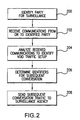
- FIG. 2 is a flowchart illustrating a method for monitoring VolP calls in accordance with the present invention. The method is described below with reference to communications system 100, shown in FIG. 1.
- the party for which surveillance is sought is identified (200).
- the law enforcement agency has some information to identify the party under surveillance. This information may include a phone number, a name, an address or other indicia.
- the Internet service provider for the party is then contacted to initiate the surveillance. In most cases, the Internet service provider must determine the computer identification for the party under surveillance. In accordance with the invention, this computer identification is provided to surveillance server 130 to alert the server to communications that should be monitored.
- the computer identification may vary over time and will vary with the type of system. For example, broadband Internet access, such as, for example, to a cable modem, may identify the subscriber by the MAC address of the cable modem. A dial-up service may identify the subscriber by a user ID.
- a DSL service may identify the subscriber by a phone number.
- communication with the access router may be necessary to determine specific communication packets associated with the party under surveillance.
- surveillance server 130 and an access router 112 of the Internet service provider of the party under surveillance must communicate and interact with each other such that the access router can uniquely identify all communications directed to or from the party under surveillance.
- the access router 112 identifies the communications to and from the party under surveillance and forwards that traffic to the surveillance server 130.
- surveillance server 130 analyzes the received communications to determine whether such traffic relates to a VoIP conversation (204).
- the traffic is analyzed to determine whether it conforms to known standard protocols for VoIP.
- the traffic is analyzed to determine whether it conforms to an H.323 protocol or a SIP protocol or other VoIP protocols.
- the VoIP protocols have a call setup stage, wherein a message is sent to set up or initiate a call.
- the call setup message is an INVITE request.
- the call setup is a SETUP request.
- surveillance server 130 analyzes the traffic for the party under surveillance to determine whether a VoIP session is a being initiated through a call setup stage.
- subsequent traffic is analyzed for specific identifiers that allow further identification of all traffic associated with the VoIP conversations subsequent to the call setup stage (206). That is, information exchanged during the setup of VoIP calls is preferably used to identify subsequent data packets that relate to the calls.
- a SIP INVITE request has a unique session identifier.
- the SIP INVITE request also contains the IP address and port number that should be used for receiving voice traffic for the VoIP call directed to the call originator.
- the response to the SIP INVITE request includes the unique session identifier and is identified accordingly.
- the response to the SIP INVITE request includes the IP address and port number where the other party expects to receive voice traffic for the VoIP exchange.
- IP addresses and port addresses identified in the SIP INVITE request and the response thereto are identifiers that can be used to identify subsequent packets associated with the VoIP call.
- monitoring of the identified IP addresses and port addresses by the access router 112 or surveillance server 130 provides a ready means to distinguish and identify all traffic associated with the VoIP calls for the party under surveillance.
- IP addresses and port addresses used for the VoIP exchange are typically addresses associated with the mediating server 114, rather that addresses associated with either terminal involved in the VoIP communication.
- This level of redirection in VoIP communications makes it difficult for law enforcement agencies to merely "sniff" Internet packets for select VoIP communications for particular parties. Hence, the need for the novel methods and apparatus disclosed herein.
- surveillance agency server 132 may be manned or not. That is, there may be an operator available to hear such transmissions after they are reconstructed into voice in real-time or those communications may be stored for subsequent listening.
- surveillance agency server 132 uses the content forwarded from surveillance server 130 to record the calling and called party and the time of the call. In addition, preferably, all call content is stored for the particular call. Other monitoring is possible, including an alert for real-time monitoring of conversations based on a call or calling party or the like.
- the invention provides a means to effectively monitor VoIP communications associated with a particular party.
- the surveillance is not overly obtrusive, in that only communications of interest are subject to surveillance.
- the surveillance is effective, in spite of inherent redirection employed in VoIP communications.
Landscapes
- Engineering & Computer Science (AREA)
- Signal Processing (AREA)
- Computer Security & Cryptography (AREA)
- Computer Networks & Wireless Communication (AREA)
- Technology Law (AREA)
- Computer Hardware Design (AREA)
- Computing Systems (AREA)
- General Engineering & Computer Science (AREA)
- Data Exchanges In Wide-Area Networks (AREA)
- Telephonic Communication Services (AREA)
Abstract
Description
- The present invention relates generally to voice over Internet protocol technology, and in particular, to a method and apparatus for surveillance of voice over Internet protocol communications by law enforcement organizations and the like.
- Voice over Internet protocol (VoIP) telephone services and related systems are known. Such systems allow voice calls using Internet Protocol ("IP") networks such as the Internet as an alternative to traditional public switched telephone networks ("PSTN"). Unlike the PSTN, which is circuit-switched, the Internet is packet-switched. As such, communications on the Internet is accomplished by transmitting and receiving packets of data. In addition to data, each packet contains a destination address to ensure that it is routed correctly. The format of these packets is defined by the IP. One type of allowable data is encoded, digitized voice, termed voice over IP (VoIP). VoIP is voice that is packetized as defined by the Internet protocol, and communicated over the internet for telephone-like communication. Individual VoIP packets may travel over different network paths to reach a final destination where the packets are reassembled in correct sequence to reconstruct the voice information.
- Law enforcement agencies such as the FBI (Federal Bureau of Investigation) may be authorized under court order to carry out surveillance of calls to and from a suspect party. The technology solutions for this surveillance currently only applies to circuit-switched based telephone systems. There is presently no solution that allows law enforcement agencies to effectively monitor calls made via VolP technology. With the increased awareness of VoIP technology and available VoIP services, it has become easy for criminals to get around lawful surveillance.
- Therefore, a need exists for a method and apparatus for law enforcement agencies and the like to conduct surveillance of VoIP calls.
- The need is met and an advance in the art is made by the present invention, which allows surveillance of calls originated or delivered using VoIP technology. The call may originate and/or terminate on a personal computer or other VoIP terminal.
- In one aspect of the present invention, surveillance of VoIP calls for a party is provided. First, a server associated with a network service provider for the party receives an identification of the party under surveillance. The identification varies based on the implementation, but the identification uniquely identifies communications directed to or from the party. The identification is, for example, a user identification or MAC address. A surveillance server receives all communications to or from the identified party. The communications are analyzed to detect if they relate to a VoIP communication. If a VoIP communication is detected, preferably by the identification of call set up messages, then identifiers for related subsequent VoIP communications are determined and used to locate further VoIP communications. Preferably, the further communications are sent to a surveillance agency for monitoring, analysis, storage and the like.
-
- FIG. 1 is a block diagram of a communications system with capability for surveillance of voice over Internet protocol communications in accordance with the present invention.
- FIG. 2 is a flow chart illustrating a method for surveillance of voice over Internet protocol communications in accordance with the present invention.
-
- FIG. 1 is a block diagram of a
communications system 100.Communications system 100 indudes apparatus for surveillance of VoIP calls in accordance with the present invention. The VoIP approach illustrated bycommunications system 100 is characterized by the use of a "mediating"server 114 to implement VoIP. -
Communications system 100 includesmultiple VoIP terminals 102. TheVoIP terminals 102 incommunications system 100 are shown as personal computers for convenience. Those of skill in the art will recognize that other VoIP terminals include any devices capable of attaching to the Internet and providing a voice interface, including, wireless VoIP terminals, IP telephones, and circuit phones using a VoIP service provider network and associated equipment. -
VoIP terminals 102 communicate with each other over a network, such as Internet 104, using voice over Internet protocol technology.VoIP terminals 102 also communicate with standard telephones, such astelephone 106, that are coupled to a public switchedtelephone network 108. - In order to communicate over the Internet 104,
VoIP terminals 102 are coupled to an Internet service provider (ISP)access network 110 in any known manner. TheISP access network 110 is in turn coupled to the Internet 104. One ormore access routers 112 controlled by an Internet service provider provide access from the ISP access network to the Internet 104. Theaccess routers 112 typically provide temporary IP addresses to subscribers, authenticate subscribers for access, and block or distribute traffic to internal networks. - In a common VoIP approach, a mediating
server 114 is coupled to Internet 104 to facilitate VoIP communications. Mediatingserver 114 receives VoIP packets for VoIP conversations and correlates such packets for VoIP communications. More specifically, a port is established for outgoing and incoming communications for a VoIP terminal. One port receives all the VoIP voice packets from the VoIP terminal, while the other sends the VoIP voice packets received from the far end and corresponding to this session to the VoIP terminal. Hence, all VoIP traffic for that VoIP terminal passes through themediating server 114. -
Communications system 100 also includes amedia gateway 120 and amedia gateway controller 122.Media gateway 120 receives voice packets from the Internet protocol domain and translates them to a format, for example, Pulse Code Modulation (PCM), suitable for a public switchedtelephone network 108.Media gateway controller 122 receives signaling packets from the Internet protocol domain and translates that signaling to a protocol, for example, SS7-ISUP, suitable for a public switchedtelephone network 108. - In accordance with the present invention, a
surveillance server 130 is coupled to anaccess router 112 of an Internet service provider. Preferably, aserver 132 at a surveillance agency is coupled to thesurveillance server 130. To facilitate surveillance of VoIP conversations,surveillance server 130 interacts with theaccess router 112 and thesurveillance agency server 132, to receive VoIP communications and forward those communications tosurveillance agency server 132, as discussed further below with respect to FIG. 2. Accessrouter 112,surveillance server 130, andsurveillance agency server 132 are preferably implemented with one or more processors programmed to implement specific functionality, as described herein and as is known in the art. - FIG. 2 is a flowchart illustrating a method for monitoring VolP calls in accordance with the present invention. The method is described below with reference to
communications system 100, shown in FIG. 1. - First, the party for which surveillance is sought is identified (200). Typically, the law enforcement agency has some information to identify the party under surveillance. This information may include a phone number, a name, an address or other indicia. The Internet service provider for the party is then contacted to initiate the surveillance. In most cases, the Internet service provider must determine the computer identification for the party under surveillance. In accordance with the invention, this computer identification is provided to
surveillance server 130 to alert the server to communications that should be monitored. The computer identification may vary over time and will vary with the type of system. For example, broadband Internet access, such as, for example, to a cable modem, may identify the subscriber by the MAC address of the cable modem. A dial-up service may identify the subscriber by a user ID. A DSL service may identify the subscriber by a phone number. In any event, after the computer identification is determined, communication with the access router may be necessary to determine specific communication packets associated with the party under surveillance. In other words,surveillance server 130 and anaccess router 112 of the Internet service provider of the party under surveillance must communicate and interact with each other such that the access router can uniquely identify all communications directed to or from the party under surveillance. - Once the communications to and from the party under surveillance are capable of identification, all of those communications are received for further analysis (202). Preferably, the
access router 112 identifies the communications to and from the party under surveillance and forwards that traffic to thesurveillance server 130. Preferably,surveillance server 130 analyzes the received communications to determine whether such traffic relates to a VoIP conversation (204). - To determine whether some traffic is VoIP traffic, the traffic is analyzed to determine whether it conforms to known standard protocols for VoIP. In particular, the traffic is analyzed to determine whether it conforms to an H.323 protocol or a SIP protocol or other VoIP protocols. The VoIP protocols have a call setup stage, wherein a message is sent to set up or initiate a call. For SIP the call setup message is an INVITE request. In H.323, the call setup is a SETUP request. Preferably,
surveillance server 130 analyzes the traffic for the party under surveillance to determine whether a VoIP session is a being initiated through a call setup stage. - After a call setup stage is identified, subsequent traffic is analyzed for specific identifiers that allow further identification of all traffic associated with the VoIP conversations subsequent to the call setup stage (206). That is, information exchanged during the setup of VoIP calls is preferably used to identify subsequent data packets that relate to the calls. For example, a SIP INVITE request has a unique session identifier. In addition, the SIP INVITE request also contains the IP address and port number that should be used for receiving voice traffic for the VoIP call directed to the call originator. The response to the SIP INVITE request includes the unique session identifier and is identified accordingly. Also, the response to the SIP INVITE request includes the IP address and port number where the other party expects to receive voice traffic for the VoIP exchange. The IP addresses and port addresses identified in the SIP INVITE request and the response thereto are identifiers that can be used to identify subsequent packets associated with the VoIP call. In particular, monitoring of the identified IP addresses and port addresses by the
access router 112 orsurveillance server 130 provides a ready means to distinguish and identify all traffic associated with the VoIP calls for the party under surveillance. - Notably, the IP addresses and port addresses used for the VoIP exchange are typically addresses associated with the mediating
server 114, rather that addresses associated with either terminal involved in the VoIP communication. This level of redirection in VoIP communications makes it difficult for law enforcement agencies to merely "sniff" Internet packets for select VoIP communications for particular parties. Hence, the need for the novel methods and apparatus disclosed herein. - Once the VoIP transmissions are identified, those communications are preferably sent to the surveillance agency server 132 (208). The
surveillance agency server 132 may be manned or not. That is, there may be an operator available to hear such transmissions after they are reconstructed into voice in real-time or those communications may be stored for subsequent listening. Preferably,surveillance agency server 132 uses the content forwarded fromsurveillance server 130 to record the calling and called party and the time of the call. In addition, preferably, all call content is stored for the particular call. Other monitoring is possible, including an alert for real-time monitoring of conversations based on a call or calling party or the like. - The invention provides a means to effectively monitor VoIP communications associated with a particular party. Advantageously, the surveillance is not overly obtrusive, in that only communications of interest are subject to surveillance. On the other hand, the surveillance is effective, in spite of inherent redirection employed in VoIP communications.
- Whereas the present invention has been described with respect to specific embodiments thereof, it will be understood that various changes and modifications will be suggested to one skilled in the art and it is intended that the invention encompass such changes and modifications as fall within the scope of the appended claims.
Claims (10)
- A method for surveillance of voice over Internet protocol communications for a party, the method using a first server that provides Internet access to the party, the method comprising the steps of:the first server receiving an identification of the party for which surveillance is sought;the first server determining whether a network communication received by the server is from or directed to the party;a second server receiving the network communication if the network communication is determined to be from or directed to the party;the second server analyzing whether the network communication that is determined to be from or directed to the party is a voice over Internet protocol communication; andif the network communication is a voice over Internet protocol communication, then the second server sending the network communication and all subsequent related network communications to a surveillance server.
- The method of claim 1 wherein the step of analyzing whether the network communication is a voice over Internet protocol communication further comprises the steps of:determining whether the network communication conforms to a voice over Internet protocol;if the network communication conforms to a voice over Internet protocol, then determining whether the network communication includes a call setup stage for the voice over Internet protocol;if the network communication includes the call setup stage, then storing a first identifier that identifies subsequent network communications associated with the network communication.
- The method of claim 2 further comprising the step of:if the network communication includes the call setup stage, then receiving a response to the call setup stage, the response being identified in part by the first identifier; andstoring a second identifier included in the response.
- The method of claim 3 wherein the step of sending the network communication and all subsequent related network communications to the surveillance server further includes the steps of:determining whether any further network communications from or directed to the party include the first identifier or second identifier; andsending further network communications with the first identifier or the second identifier to the surveillance server.
- The method of claim 4 wherein the first identifier includes an IP address and a port number.
- A server for surveillance of voice over Internet protocol communications for a party, the server providing Internet access to the party, the server comprising:a processor that:receives an identification of the party for which surveillance is sought;determines a computer identity of the party for which surveillance is sought;determines whether a network communication received by the server is from or directed to the party;if the network communication received by the server is from or direct to the party, analyzes whether the network communication is a voice over Internet protocol communication; andif the network communication is a voice over Internet protocol communication, then sends the network communication and subsequent related network communications to a surveillance server.
- The server of claim 6 wherein when the processor analyzes whether the network communication is a voice over Internet protocol communication, the processor:determines whether the network communication conforms to a voice over Internet protocol;if the network communication conforms to a voice over Internet protocol, then determines whether the network communication includes a call setup stage for the voice over Internet protocol; andif the network communication includes the call setup stage, then stores a first identifier that identifies subsequent network communications associated with the network communication.
- The server of claim 7 wherein the processor:if the network communication includes the call setup stage, then receives a response to the call setup stage, the response being identified in part by the first identifier; andstores a second identifier included in the response.
- The method of claim 8 wherein when the processor sends the network communication and subsequent related network communications to the surveillance server, the processor:determines whether any further network communications from or directed to the party include the first identifier or second identifier; andsends further network communications with the first identifier or the second identifier to the surveillance server.
- The method of claim 7 wherein the call setup stage includes one of a SIP INVITE request and an H.323 setup request.
Applications Claiming Priority (2)
| Application Number | Priority Date | Filing Date | Title |
|---|---|---|---|
| US837088 | 1986-03-06 | ||
| US10/837,088 US7570743B2 (en) | 2004-04-30 | 2004-04-30 | Method and apparatus for surveillance of voice over internet protocol communications |
Publications (1)
| Publication Number | Publication Date |
|---|---|
| EP1592215A1 true EP1592215A1 (en) | 2005-11-02 |
Family
ID=34940857
Family Applications (1)
| Application Number | Title | Priority Date | Filing Date |
|---|---|---|---|
| EP05252367A Ceased EP1592215A1 (en) | 2004-04-30 | 2005-04-15 | Method and apparatus for surveillance of voice over internet protocol communications |
Country Status (2)
| Country | Link |
|---|---|
| US (1) | US7570743B2 (en) |
| EP (1) | EP1592215A1 (en) |
Cited By (1)
| Publication number | Priority date | Publication date | Assignee | Title |
|---|---|---|---|---|
| GB2456827A (en) * | 2008-01-28 | 2009-07-29 | Hewlett Packard Development Co | Intercepting IP calls |
Families Citing this family (45)
| Publication number | Priority date | Publication date | Assignee | Title |
|---|---|---|---|---|
| US20060146784A1 (en) * | 2001-11-16 | 2006-07-06 | Ibasis, Inc. | System and method for monitoring a voice over internet protocol (VoIP) system |
| US7933260B2 (en) | 2004-06-29 | 2011-04-26 | Damaka, Inc. | System and method for routing and communicating in a heterogeneous network environment |
| US7570636B2 (en) | 2004-06-29 | 2009-08-04 | Damaka, Inc. | System and method for traversing a NAT device for peer-to-peer hybrid communications |
| US8050272B2 (en) | 2004-06-29 | 2011-11-01 | Damaka, Inc. | System and method for concurrent sessions in a peer-to-peer hybrid communications network |
| US8009586B2 (en) | 2004-06-29 | 2011-08-30 | Damaka, Inc. | System and method for data transfer in a peer-to peer hybrid communication network |
| US7764768B2 (en) * | 2004-10-06 | 2010-07-27 | Alcatel-Lucent Usa Inc. | Providing CALEA/legal intercept information to law enforcement agencies for internet protocol multimedia subsystems (IMS) |
| US7519075B2 (en) * | 2004-12-10 | 2009-04-14 | Mediatek Inc. | Method and system for serverless VoIP service in personal communication network |
| US7535880B1 (en) | 2005-01-13 | 2009-05-19 | 2Wire, Inc. | Method and apparatus for controlling wireless access to a network |
| US7499438B2 (en) * | 2005-01-13 | 2009-03-03 | 2Wire, Inc. | Controlling wireless access to a network |
| US8295851B2 (en) * | 2005-08-03 | 2012-10-23 | Michael Edward Finnegan | Realtime, interactive and geographically defined computerized personal matching systems and methods |
| US8880047B2 (en) | 2005-08-03 | 2014-11-04 | Jeffrey C. Konicek | Realtime, location-based cell phone enhancements, uses, and applications |
| US8873723B1 (en) * | 2005-08-24 | 2014-10-28 | At&T Intellectual Property Ii, L.P. | IP telephone geographic locator |
| US8689317B2 (en) | 2005-12-19 | 2014-04-01 | Level 3 Communications, Llc | Providing SIP signaling data for third party surveillance |
| US8553854B1 (en) * | 2006-06-27 | 2013-10-08 | Sprint Spectrum L.P. | Using voiceprint technology in CALEA surveillance |
| KR100799193B1 (en) * | 2007-02-12 | 2008-01-29 | 삼성전자주식회사 | Apparatus and method for interception in mobile communication system |
| CA2701894C (en) | 2007-09-03 | 2015-11-17 | Damaka, Inc. | Device and method for maintaining a communication session during a network transition |
| WO2009043016A2 (en) | 2007-09-28 | 2009-04-02 | Damaka, Inc. | System and method for transitioning a communication session between networks that are not commonly controlled |
| US8380859B2 (en) | 2007-11-28 | 2013-02-19 | Damaka, Inc. | System and method for endpoint handoff in a hybrid peer-to-peer networking environment |
| US8725895B2 (en) | 2010-02-15 | 2014-05-13 | Damaka, Inc. | NAT traversal by concurrently probing multiple candidates |
| US8892646B2 (en) * | 2010-08-25 | 2014-11-18 | Damaka, Inc. | System and method for shared session appearance in a hybrid peer-to-peer environment |
| US8874785B2 (en) | 2010-02-15 | 2014-10-28 | Damaka, Inc. | System and method for signaling and data tunneling in a peer-to-peer environment |
| US8689307B2 (en) | 2010-03-19 | 2014-04-01 | Damaka, Inc. | System and method for providing a virtual peer-to-peer environment |
| US9043488B2 (en) | 2010-03-29 | 2015-05-26 | Damaka, Inc. | System and method for session sweeping between devices |
| US9191416B2 (en) | 2010-04-16 | 2015-11-17 | Damaka, Inc. | System and method for providing enterprise voice call continuity |
| US8352563B2 (en) | 2010-04-29 | 2013-01-08 | Damaka, Inc. | System and method for peer-to-peer media routing using a third party instant messaging system for signaling |
| US8446900B2 (en) | 2010-06-18 | 2013-05-21 | Damaka, Inc. | System and method for transferring a call between endpoints in a hybrid peer-to-peer network |
| US8611540B2 (en) | 2010-06-23 | 2013-12-17 | Damaka, Inc. | System and method for secure messaging in a hybrid peer-to-peer network |
| US8468010B2 (en) | 2010-09-24 | 2013-06-18 | Damaka, Inc. | System and method for language translation in a hybrid peer-to-peer environment |
| US8743781B2 (en) | 2010-10-11 | 2014-06-03 | Damaka, Inc. | System and method for a reverse invitation in a hybrid peer-to-peer environment |
| US8938534B2 (en) | 2010-12-30 | 2015-01-20 | Ss8 Networks, Inc. | Automatic provisioning of new users of interest for capture on a communication network |
| US9058323B2 (en) | 2010-12-30 | 2015-06-16 | Ss8 Networks, Inc. | System for accessing a set of communication and transaction data associated with a user of interest sourced from multiple different network carriers and for enabling multiple analysts to independently and confidentially access the set of communication and transaction data |
| US8407314B2 (en) | 2011-04-04 | 2013-03-26 | Damaka, Inc. | System and method for sharing unsupported document types between communication devices |
| US8972612B2 (en) | 2011-04-05 | 2015-03-03 | SSB Networks, Inc. | Collecting asymmetric data and proxy data on a communication network |
| US8694587B2 (en) | 2011-05-17 | 2014-04-08 | Damaka, Inc. | System and method for transferring a call bridge between communication devices |
| US8478890B2 (en) | 2011-07-15 | 2013-07-02 | Damaka, Inc. | System and method for reliable virtual bi-directional data stream communications with single socket point-to-multipoint capability |
| US9350762B2 (en) | 2012-09-25 | 2016-05-24 | Ss8 Networks, Inc. | Intelligent feedback loop to iteratively reduce incoming network data for analysis |
| US9027032B2 (en) | 2013-07-16 | 2015-05-05 | Damaka, Inc. | System and method for providing additional functionality to existing software in an integrated manner |
| US9357016B2 (en) | 2013-10-18 | 2016-05-31 | Damaka, Inc. | System and method for virtual parallel resource management |
| US10375126B2 (en) | 2013-11-22 | 2019-08-06 | At&T Mobility Ii Llc | Methods, devices and computer readable storage devices for intercepting VoIP traffic for analysis |
| US9830593B2 (en) | 2014-04-26 | 2017-11-28 | Ss8 Networks, Inc. | Cryptographic currency user directory data and enhanced peer-verification ledger synthesis through multi-modal cryptographic key-address mapping |
| CA2956617A1 (en) | 2014-08-05 | 2016-02-11 | Damaka, Inc. | System and method for providing unified communications and collaboration (ucc) connectivity between incompatible systems |
| US10091025B2 (en) | 2016-03-31 | 2018-10-02 | Damaka, Inc. | System and method for enabling use of a single user identifier across incompatible networks for UCC functionality |
| US20220086197A1 (en) | 2020-09-14 | 2022-03-17 | Damaka, Inc. | System and method for establishing and managing multiple call sessions from a centralized control interface |
| US11902343B1 (en) | 2021-04-19 | 2024-02-13 | Damaka, Inc. | System and method for highly scalable browser-based audio/video conferencing |
| US11770584B1 (en) | 2021-05-23 | 2023-09-26 | Damaka, Inc. | System and method for optimizing video communications based on device capabilities |
Citations (1)
| Publication number | Priority date | Publication date | Assignee | Title |
|---|---|---|---|---|
| EP1111892A2 (en) * | 1999-12-23 | 2001-06-27 | Nortel Networks Limited | Methods and systems for internet protocol (IP) network surveillance |
Family Cites Families (25)
| Publication number | Priority date | Publication date | Assignee | Title |
|---|---|---|---|---|
| US6871229B2 (en) * | 1998-08-26 | 2005-03-22 | Sts Software Systems Ltd. | Method for storing on a computer network a portion of a communication session between a packet source and a packet destination |
| US7131136B2 (en) * | 2002-07-10 | 2006-10-31 | E-Watch, Inc. | Comprehensive multi-media surveillance and response system for aircraft, operations centers, airports and other commercial transports, centers and terminals |
| US6563797B1 (en) * | 1999-08-18 | 2003-05-13 | At&T Corp. | IP voice call surveillance through use of non-dedicated IP phone with signal alert provided to indicate content of incoming call prior to an answer as being a monitored call |
| US8185040B2 (en) * | 1999-08-24 | 2012-05-22 | Gogo Llc | System for managing voice over internet protocol communications in a network |
| US6839323B1 (en) * | 2000-05-15 | 2005-01-04 | Telefonaktiebolaget Lm Ericsson (Publ) | Method of monitoring calls in an internet protocol (IP)-based network |
| US8150013B2 (en) * | 2000-11-10 | 2012-04-03 | Securelogix Corporation | Telephony security system |
| EP1344376A2 (en) * | 2000-12-12 | 2003-09-17 | Nice Systems Ltd. | A method and system for monitoring and recording voice from circuit-switched switches via a packet-switched network |
| US7152103B1 (en) * | 2001-01-10 | 2006-12-19 | Nortel Networks Limited | Lawful communication interception—intercepting communication associated information |
| EP1396113B1 (en) * | 2001-05-16 | 2009-07-29 | Nokia Corporation | Method and system allowing lawful interception of connections such as voice-over-internet-protocol calls |
| US7106741B2 (en) * | 2002-02-04 | 2006-09-12 | Lucent Technologies Inc. | Establishing communication paths to law enforcement agencies |
| US7277528B2 (en) * | 2002-02-12 | 2007-10-02 | Siemens Information And Communication Networks, Inc.- Boca Raton | Call-content determinative selection of interception access points in a soft switch controlled network |
| ES2411693T3 (en) * | 2002-03-15 | 2013-07-08 | Alcatel Lucent | Procedure for listening to communication connections |
| US20030215069A1 (en) * | 2002-05-14 | 2003-11-20 | Hitzeman Bonnie Marie | Law enforcement call monitoring |
| US20040086093A1 (en) * | 2002-10-29 | 2004-05-06 | Schranz Paul Steven | VoIP security monitoring & alarm system |
| US6947525B2 (en) * | 2002-12-20 | 2005-09-20 | Lucent Technologies Inc. | Monitoring system for a remote telephone station |
| US20040165709A1 (en) * | 2003-02-24 | 2004-08-26 | Pence Robert Leslie | Stealth interception of calls within a VoIP network |
| US20040218731A1 (en) * | 2003-03-25 | 2004-11-04 | Bizhan Karimi-Cherkandi | Communications assistance for law enforcement act (CALEA) device |
| US20040219911A1 (en) * | 2003-03-25 | 2004-11-04 | Kouchri Farrokh Mohammadzadeh | Virtual communications assistance for law enforcement act (CALEA) device |
| DE10323006A1 (en) * | 2003-05-21 | 2004-12-23 | Siemens Ag | Central listening and evaluation unit |
| US7092493B2 (en) * | 2003-10-01 | 2006-08-15 | Santera Systems, Inc. | Methods and systems for providing lawful intercept of a media stream in a media gateway |
| US20050094773A1 (en) * | 2003-10-31 | 2005-05-05 | Lucent Technologies Inc. | CALEA application server complex |
| US20050180446A1 (en) * | 2004-01-30 | 2005-08-18 | Adc Broadband Access Systems, Inc. | Telecommunications surveillance |
| US20050175156A1 (en) * | 2004-02-05 | 2005-08-11 | Afshar Siroos K. | Calea in a VPN environment (formerly called restricted anti-calea |
| US7587757B2 (en) * | 2004-02-11 | 2009-09-08 | Texas Instruments Incorporated | Surveillance implementation in managed VOP networks |
| US20060212933A1 (en) * | 2004-02-11 | 2006-09-21 | Texas Instruments Incorporated | Surveillance implementation in a voice over packet network |
-
2004
- 2004-04-30 US US10/837,088 patent/US7570743B2/en active Active
-
2005
- 2005-04-15 EP EP05252367A patent/EP1592215A1/en not_active Ceased
Patent Citations (1)
| Publication number | Priority date | Publication date | Assignee | Title |
|---|---|---|---|---|
| EP1111892A2 (en) * | 1999-12-23 | 2001-06-27 | Nortel Networks Limited | Methods and systems for internet protocol (IP) network surveillance |
Cited By (2)
| Publication number | Priority date | Publication date | Assignee | Title |
|---|---|---|---|---|
| GB2456827A (en) * | 2008-01-28 | 2009-07-29 | Hewlett Packard Development Co | Intercepting IP calls |
| US8817787B2 (en) | 2008-01-28 | 2014-08-26 | Hewlett-Packard Development Company, L.P. | Data processing method and system |
Also Published As
| Publication number | Publication date |
|---|---|
| US20050243802A1 (en) | 2005-11-03 |
| US7570743B2 (en) | 2009-08-04 |
Similar Documents
| Publication | Publication Date | Title |
|---|---|---|
| US7570743B2 (en) | Method and apparatus for surveillance of voice over internet protocol communications | |
| US7907551B2 (en) | Voice over internet protocol (VoIP) location based 911 conferencing | |
| US8218534B2 (en) | VoIP anomaly traffic detection method with flow-level data | |
| US20040165709A1 (en) | Stealth interception of calls within a VoIP network | |
| US9549076B2 (en) | Method for lawful interception during call forwarding in a packet-oriented telecommunications network | |
| EP3545670A1 (en) | Utilizing sip messages to determine the status of a remote terminal in voip communication systems | |
| KR100602638B1 (en) | Voice service system and its connection method | |
| CN100488309C (en) | Monitoring in a telecommunication network | |
| EP1111892B1 (en) | Methods and systems for internet protocol (IP) network surveillance | |
| US7542475B2 (en) | Communication between users located behind a NAT device | |
| US8789141B2 (en) | Method and apparatus for providing security for an internet protocol service | |
| TWI240516B (en) | System for automatically selecting voice data transmission and reception system for IP network, method thereof, and IP terminal | |
| US8179821B2 (en) | Identifying participants of an audio conference call | |
| CA2664706A1 (en) | Embedded media terminal adapter (emta) endpoint redirect mode | |
| CN101127777A (en) | Method, device and system for processing voice communication security threat information | |
| US8351593B2 (en) | Emergency recording during VoIP session | |
| KR101043185B1 (en) | Interception system and method in next generation communication network | |
| EP1985095B1 (en) | Telephone call processing method and apparatus | |
| SG176262A1 (en) | Telecommunication quality measurement system adapted for sharing test equipment between operators | |
| US20090016324A1 (en) | Method and Gateway for Connecting IP Communication Entities via a Residential Gateway | |
| US7599357B1 (en) | Method and apparatus for detecting and correcting electrical interference in a conference call | |
| Sherr et al. | Can they hear me now? A security analysis of law enforcement wiretaps | |
| KR101098472B1 (en) | IP-based call processing method and apparatus | |
| TWM393936U (en) | System for detecting disability on packets | |
| CN1937530A (en) | Method, device and system for identifying illegal packet phones |
Legal Events
| Date | Code | Title | Description |
|---|---|---|---|
| PUAI | Public reference made under article 153(3) epc to a published international application that has entered the european phase |
Free format text: ORIGINAL CODE: 0009012 |
|
| 17P | Request for examination filed |
Effective date: 20050506 |
|
| AK | Designated contracting states |
Kind code of ref document: A1 Designated state(s): AT BE BG CH CY CZ DE DK EE ES FI FR GB GR HU IE IS IT LI LT LU MC NL PL PT RO SE SI SK TR |
|
| AX | Request for extension of the european patent |
Extension state: AL BA HR LV MK YU |
|
| AKX | Designation fees paid |
Designated state(s): DE FR GB |
|
| RAP3 | Party data changed (applicant data changed or rights of an application transferred) |
Owner name: LUCENT TECHNOLOGIES INC. |
|
| RAP1 | Party data changed (applicant data changed or rights of an application transferred) |
Owner name: ALCATEL-LUCENT USA INC. |
|
| 111Z | Information provided on other rights and legal means of execution |
Free format text: DE FR GB Effective date: 20130410 |
|
| STAA | Information on the status of an ep patent application or granted ep patent |
Free format text: STATUS: THE APPLICATION HAS BEEN REFUSED |
|
| 18R | Application refused |
Effective date: 20131212 |