EP1592157A1 - Methods and apparatus for code division multiple access communication using code book that provides reduced peak-to-average power ratio - Google Patents
Methods and apparatus for code division multiple access communication using code book that provides reduced peak-to-average power ratio Download PDFInfo
- Publication number
- EP1592157A1 EP1592157A1 EP05252370A EP05252370A EP1592157A1 EP 1592157 A1 EP1592157 A1 EP 1592157A1 EP 05252370 A EP05252370 A EP 05252370A EP 05252370 A EP05252370 A EP 05252370A EP 1592157 A1 EP1592157 A1 EP 1592157A1
- Authority
- EP
- European Patent Office
- Prior art keywords
- code book
- vectors
- cdma system
- average power
- power ratio
- Prior art date
- Legal status (The legal status is an assumption and is not a legal conclusion. Google has not performed a legal analysis and makes no representation as to the accuracy of the status listed.)
- Granted
Links
Images



Classifications
-
- H—ELECTRICITY
- H04—ELECTRIC COMMUNICATION TECHNIQUE
- H04J—MULTIPLEX COMMUNICATION
- H04J13/00—Code division multiplex systems
-
- H—ELECTRICITY
- H04—ELECTRIC COMMUNICATION TECHNIQUE
- H04B—TRANSMISSION
- H04B2201/00—Indexing scheme relating to details of transmission systems not covered by a single group of H04B3/00 - H04B13/00
- H04B2201/69—Orthogonal indexing scheme relating to spread spectrum techniques in general
- H04B2201/707—Orthogonal indexing scheme relating to spread spectrum techniques in general relating to direct sequence modulation
- H04B2201/70706—Orthogonal indexing scheme relating to spread spectrum techniques in general relating to direct sequence modulation with means for reducing the peak-to-average power ratio
-
- H—ELECTRICITY
- H04—ELECTRIC COMMUNICATION TECHNIQUE
- H04J—MULTIPLEX COMMUNICATION
- H04J13/00—Code division multiplex systems
- H04J13/10—Code generation
Definitions
- the present invention relates to code division multiple access (CDMA) communication systems and, more particularly, to direct sequence CDMA (DS-CDMA) systems having reduced peak-to-average power ratios (PAPRs).
- CDMA code division multiple access
- DS-CDMA direct sequence CDMA
- PAPRs peak-to-average power ratios
- CDMA techniques transmit multiple information signals on the same channel, and differentiate each user sub-channel by encoding it with a unique spreading code.
- CDMA networks were designed to carry only voice traffic and exhibited limited data rate variability.
- CDMA networks are evolving to encompass a variety of applications, each requiring potentially different data rates or quality of service needs.
- a CDMA system that employs four spreading codes is said to have a "spreading factor" of four and can transmit four distinct streams of data.
- the output of a given CDMA transmitter is generally the sum, s , of each data stream multiplied by the corresponding spreading code.
- s there are 16 possible output vectors, s .
- the peak-to-average p ower ratio of such a CDMA system is the maximum value over each possible output vector, s , of the peak energy divided by the average energy. If the peak-to-average power ratio of a CDMA system is greater than one then it is obvious that power of different signals vary.
- the output vector, s is amplified prior to transmission by a non-linear amplifier, which are commonly found in communications devices, the transmitted signal will be amplified differently for each possible output vector, s , creating non-linear distortion.
- a method and apparatus are provided for generating a code book for use in a CDMA system.
- the code book comprises of a plurality of vectors that are used to encode user data.
- the amplitude and polarity for each vector in the code book are selected to provide a reduced peak-to-average power ratio.
- the amplitude values can be selected to provide a reduced peak-to-average power ratio while maintaining a desired average energy per chip.
- the desired energy per chip can be based on the energy per chip of a CDMA system having a lower order spreading factor.
- a CDMA system has a spreading factor of eight for communicating eight distinct data streams.
- One or more of the data streams can be reserved to maintain a desired data rate, such as a data rate of a CDMA system with a spreading factor of four.
- the exemplary code book employs vectors having amplitude values that provide a significant reduction in the peak-to-average power ratio, relative to a frequently deployed conventional CDMA system having a spreading factor of four.
- performance can be further improved by employing a first code book under a first signal-to-noise ratio condition and a second code book under a second signal-to-noise ratio condition.
- the encoded data stream is based on a code book comprised of a plurality of vectors, each of the vectors having non-uniform amplitude values selected to provide a reduced peak-to-average power ratio, in accordance with the present invention.
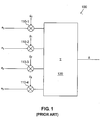
- FIG. 1 illustrates a conventional DS-CDMA system 100 with a spreading factor (SF) of four (4).
- the conventional DS-CDMA system 100 is used, for example, in mobile telephones.
- exemplary DS-CDMA systems 100 see, for example, T. Ottosson, "Precoding for Minimization of Envelope Variations in Multicode D S-CDMA S ystems," Wireless Personal Communications, 13, 57-78 (2000), incorporated by reference herein.
- the conventional DS-CDMA system 100 shown in FIG. 1 is used for simultaneous transmission of four streams of information, a 0 , a 1 , a 2 and a 3 , that carry information of streams 0, 1, 2, and 3, respectively.
- the vector s is referred to as the output vector that is applied to a communications channel.
- the vectors c 0 , c 1 , c 2 and c 3 are spreading sequences.
- each information stream a 0 ,a 1 , a 2 and a 3 is multiplied by a corresponding spreading sequence, c 0 , c 1 , c 2 and c 3 , respectively, by corresponding multipliers 110-1 through 110-4, and the spread signals are combined at stage 120 prior to application to the channel.
- FIG. 2 illustrates an exemplary code book A 200 that can be employed by the DS-CDMA system 100 of FIG. 1.
- the vectors a form the code book A of FIG. 2.
- the information bit from the i th information stream is encoded into the sign of the i th entry of a vector a .
- the logical zeroes (0s) correspond to positive entries of a vector a and logical ones (1s) correspond to negative entries.
- the vector a ( a,-a,-a, a ) is transmitted.
- the value a is the amplitude of transmitted signals.
- the amplitudes of each of the four streams of information, a 0 , a 1 , a 2 and a 3 is the same.
- the amplitude of one or more of the four streams of information, a 0 , a 1 , a 2 and a 3 may be increased to provide a corresponding increase in energy (and thus protection) of the stream.
- the amplitude of stream a 0 which may be associated with a pilot signal, may be increased to improve the channel estimation.
- the vectors c 0 , c 1 , c 2 , c 3 are spreading sequences assigned to corresponding information streams.
- the multiplication operation a i c i occupies four chips of time. Therefore, in any DS-CDMA system, such as the DS-CDMA system 100 of FIG. 1, with the spreading factor four, variables a 0 , a 1 , a 2 and a 3 c an c hange their values not faster than every four consecutive chips.
- the DS-CDMA system 100 is a system in which the variables a 1 , a 2 , a 3 take new values every four chips, and the variable a 0 takes a new value only every m chips, where m is an integer divisible by 8. It is assumed that the 0th stream plays a special role in the system 100. For example, the 0th stream of a mobile telephone can be used for transmitting voice, while other streams can be used for transmitting data. The voice changes significantly slower compared to data and therefore a 0 has to take a new value only every i consecutive chips. Another common and important case is when the 0th stream is used for transmitting a pilot signal. The pilot signal usually remains constant for a long time interval, typically 256 chips, that allows the decoder to accurately estimate the channel fading coefficient.
- h i sign ( h i ) a . If the channel noise is not very strong, in other words, if entries of the vector z are small numbers, then with a large probability the quantity
- the energy of a vector of signals x ( x 0 , x 1 ...., x n -1 ) is defined as x 2 / 0 + x 2 / 1 + ... +x 2 / n -1.
- E av ( s ) 1 4 ( s 2 0 + s 2 1 + s 2 2 + s 2 3 ).
- the average energy per chip for the system is defined as the value E ( s ) averaged over all 16 possible vectors s corresponding to vectors from code book A , shown in FIG. 2.
- the peak energy of s is defined as
- the peak to average power ratio of the DS-CDMA system 100 equals: Thus, the peak to average power ratio will vary. For non-linear amplifiers, which are commonly found in communications devices, such as mobile telephones, different components of the transmitted signal will be amplified differently, creating non-linear distortion. A need therefore exists for a DS-CDMA system that provides a reduced peak to average power ratio.
- FIG. 3 illustrates a DS-CDMA system 300 incorporating features of the present invention.
- the DS-CDMA system 300 can have the same (i) rate, (ii) average energy per chip and (iii) amplitude, a , of signals transmitted in the 0th stream as the conventional DS-CDMA system 100. In this manner, the rate of the conventional system is maintained without increasing the average power p er chip. In addition, the p ower for signals transmitted in the 0th stream is not changed, thereby resulting in the same bit error probability.
- the 0th stream plays a special role in the system it can be important to maintain the bit error probability for the 0th stream, relative to the DS-CDMA system 100. For example, if the 0th stream is used for sending a pilot signal and the amplitude of the signal is reduced, this will result in a less accurate estimate of the channel fading coefficients, which, in turn, leads to failure to decode other streams of information.
- Vectors b ( b 0 , b 1 , b 2 , b 3 , b 4 , b 5 , b 6 , b 7 ) are taken from the code book, defined below in conjunction with FIG. 4.
- the signs (polarities) of the variables b 0 ,..., b 6 represent values of transmitted bits, in a similar manner to the DS-CDMA system 100.
- positive entries can correspond to logical 0 and negative entries can correspond to logical 1.
- different amplitudes and polarities are chosen for signals from different streams (such that a desired average energy, E A , is maintained).
- the sequences w 0 , w 1 ,..., w 7 form rows of the Hadamard matrix H 8 of dimension eight (8) and therefore they are orthogonal.
- the variables b 1 ,..., b 6 take new values every eight chips and the variable b 0 takes a new value every m chips.
- the conventional DS-CDMA system 100 can transmit 6 bits (over two cycles).
- the seventh user stream can be used to maintain performance (e.g., to improve the PAPR).
- a code book of size 2 7 is needed.
- the code book is defined using an algorithm.
- the matrices G pc and G rm are defined as follows:
- the matrices G pc and G rm are generator matrices of the single parity check code and the first order Reed-Muller code of length 8 (see, e.g. F. J. MacWilliams and N. J. Sloane, The theory of Error-Correcting Codes, North-Holland (1977)). They define properties of a code book B .
- a be the signal amplitude used in the conventional DS-CDMA system 100 and c , e and d be signal amplitudes for the DS-CDMA system 300 of the present invention.
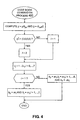
- the corresponding vector b is defined according to the following code book generation process 400, shown in FIG. 4:
- Vectors b form the code book B .
- the power of a vector of the first type is a 2 +7 c 2 .
- the power of a vector of the second type is a + 6 e 2 + d 2 .
- PAPR B max ⁇
- a small bit error probability is also desired.
- a decoding algorithm will be described in the next section. It is noted that for minimizing the bit error probability, different approaches are used for channels with low and with high signal to noise ratios (SNR). In a channel with a high signal to noise ratio, a code book with a large minimum distance will have smaller bit error probability.
- vectors of the form will have the minimum pairwise distance, say d 1 , among all pairs of vectors of the first type.
- the vectors of the following form will have the minimum pairwise distance, say d 2 , among all pairs of vectors of the second type.
- the vectors of the folllowing form will have the minimum pairwise distance, say d 3 , among all pairs of vectors one of which is a vector of the first type and another is the vector of the second type.
- the minimum distance of the code book must be maximized. This can be done by changing values for the constant amplitudes c , d, and e, which increases the PAPR of the system.
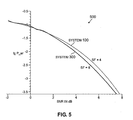
- FIG. 5 is a plot 500 illustrating the relative decoding performance (bit error probability versus signal-to-noise ratio) of the conventional DS-CDMA system 100 and the DS-CDMA system 300 of the present invention, in the presence of an additive white Gaussian noisy (AWGN) channel.
- AWGN additive white Gaussian noisy
- two different code books are employed based on whether the channel exhibits low or high signal to noise ratios (SNR), distinguished by a specified threshold.
- SNR signal to noise ratios
- SNR signal to noise ratios
- a code book with a large minimum distance will have smaller bit error probability. For example, as shown in FIG. 5, for a SNR above 2, the codebook associated with the DS-CDMA system 300 of FIG. 3 will exhibit a better bit error probability.
- a vector b ( b 0 , b 1 ,...,b 7 ) . is transmitted.
- the channel is an additive white Gaussian noisy (AWGN) channel.
- AWGN additive white Gaussian noisy
- FIG. 6 is a flow chart describing an exemplary decoding process 600. As shown in FIG. 6, the exemplary decoding process 600 performs as follows:
- t i is the log likelihood ratio of the i th bit.
- the algorithm 600 requires about 1000 operations over real numbers.
Landscapes
- Engineering & Computer Science (AREA)
- Computer Networks & Wireless Communication (AREA)
- Signal Processing (AREA)
- Mobile Radio Communication Systems (AREA)
Abstract
Description
- The present invention relates to code division multiple access (CDMA) communication systems and, more particularly, to direct sequence CDMA (DS-CDMA) systems having reduced peak-to-average power ratios (PAPRs).
- CDMA techniques transmit multiple information signals on the same channel, and differentiate each user sub-channel by encoding it with a unique spreading code. Originally, CDMA networks were designed to carry only voice traffic and exhibited limited data rate variability. CDMA networks, however, are evolving to encompass a variety of applications, each requiring potentially different data rates or quality of service needs. A CDMA system that employs four spreading codes is said to have a "spreading factor" of four and can transmit four distinct streams of data.
- The output of a given CDMA transmitter is generally the sum, s , of each data stream multiplied by the corresponding spreading code. In a system having a spreading factor of four, there are 16 possible output vectors, s. It can be shown that the peak-to-average p ower ratio of such a CDMA system is the maximum value over each possible output vector, s , of the peak energy divided by the average energy. If the peak-to-average power ratio of a CDMA system is greater than one then it is obvious that power of different signals vary. Thus, when the output vector, s , is amplified prior to transmission by a non-linear amplifier, which are commonly found in communications devices, the transmitted signal will be amplified differently for each possible output vector, s, creating non-linear distortion.
- A need therefore exists for a CDMA system that provides a reduced peak to average power ratio.
- Generally, a method and apparatus are provided for generating a code book for use in a CDMA system. The code book comprises of a plurality of vectors that are used to encode user data. According to one aspect of the invention, the amplitude and polarity for each vector in the code book are selected to provide a reduced peak-to-average power ratio. The amplitude values can be selected to provide a reduced peak-to-average power ratio while maintaining a desired average energy per chip. The desired energy per chip can be based on the energy per chip of a CDMA system having a lower order spreading factor.
- In one exemplary implementation, a CDMA system has a spreading factor of eight for communicating eight distinct data streams. One or more of the data streams can be reserved to maintain a desired data rate, such as a data rate of a CDMA system with a spreading factor of four. The exemplary code book employs vectors having amplitude values that provide a significant reduction in the peak-to-average power ratio, relative to a frequently deployed conventional CDMA system having a spreading factor of four. In a further variation, performance can be further improved by employing a first code book under a first signal-to-noise ratio condition and a second code book under a second signal-to-noise ratio condition.
- From the system point of view, a CDMA transmitter incorporating features of the present invention comprises a plurality of multipliers that multiply an encoded data stream by a corresponding spreading code. The encoded data stream is based on a code book comprised of a plurality of vectors, each of the vectors having non-uniform amplitude values selected to provide a reduced peak-to-average power ratio, in accordance with the present invention.
- A more complete understanding of the present invention, as well as further features and advantages of the present invention, will be obtained by reference to the following detailed description and drawings.
-
- FIG. 1 illustrates a conventional DS-CDMA system;
- FIG. 2 illustrates an exemplary code book that can be employed by the DS-CDMA system of FIG. 1'
- FIG. 3 illustrates a DS-CDMA system incorporating features of the present invention;
- FIG. 4 is a flow chart describing an exemplary implementation of a code book generation process;
- FIG. 5 is a plot illustrating the relative decoding performance (bit error probability versus signal-to-noise ratio) of the conventional DS-CDMA system of FIG. 1 and the DS-CDMA system of FIG. 3, in the presence of an additive white Gaussian noisy (AWGN) channel; and
- FIG. 6 is a flow chart describing an exemplary implementation of a decoding process.
-
- FIG. 1 illustrates a conventional DS-CDMA system 100 with a spreading factor (SF) of four (4). The conventional DS-CDMA system 100 is used, for example, in mobile telephones. For a detailed discussion of exemplary DS-CDMA systems 100, see, for example, T. Ottosson, "Precoding for Minimization of Envelope Variations in Multicode D S-CDMA S ystems," Wireless Personal Communications, 13, 57-78 (2000), incorporated by reference herein.
- The conventional DS-CDMA system 100 shown in FIG. 1 is used for simultaneous transmission of four streams of information, a 0, a 1, a 2 and a 3, that carry information of streams 0, 1, 2, and 3, respectively. Variables a 0, a 1, a 2 and a 3 form the vector a = (a 0 ,a 1 ,a 2 ,a 3). The vector s is referred to as the output vector that is applied to a communications channel. The vectors c 0 , c 1 , c 2 and c 3 are spreading sequences. Generally, each information stream a 0 ,a 1 , a 2 and a 3 is multiplied by a corresponding spreading sequence, c 0 , c 1 , c 2 and c 3 , respectively, by corresponding multipliers 110-1 through 110-4, and the spread signals are combined at stage 120 prior to application to the channel.
- FIG. 2 illustrates an exemplary code book A 200 that can be employed by the DS-CDMA system 100 of FIG. 1. Thus, the vectors a form the code book A of FIG. 2. The information bit from the ith information stream is encoded into the sign of the ith entry of a vector a . The logical zeroes (0s) correspond to positive entries of a vector a and logical ones (1s) correspond to negative entries. For example, in order to transmit logical zero in the 0th and 3rd information streams a nd logical one in the 1 st and 2 nd streams, the vector a = (a,-a,-a, a) is transmitted. The value a is the amplitude of transmitted signals. Typically, the amplitudes of each of the four streams of information, a 0, a 1, a 2 and a 3 , is the same. In some implementations of the conventional DS-CDMA system 100, the amplitude of one or more of the four streams of information, a 0, a 1, a 2 and a 3, may be increased to provide a corresponding increase in energy (and thus protection) of the stream. For example, the amplitude of stream a 0, which may be associated with a pilot signal, may be increased to improve the channel estimation.
- The vectors c 0, c 1, c 2, c 3 are spreading sequences assigned to corresponding information streams.
- The spreading sequences c 0 , c 1, c 2, c 3 are defined as follows:
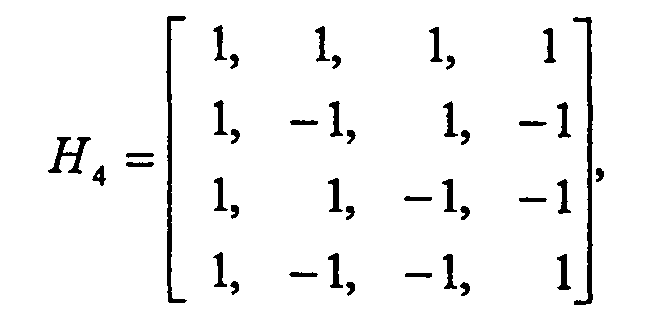
- It can be seen that these sequences form rows of the well-known Hadamard matrix H 4 of dimension four (see, e.g., F.J. MacWilliams and N.J.A. Sloane, The Theory of Error-Correcting Codes, North-Holland (1977)), as follows:and therefore they are orthogonal. In other words
 where the multiplication · is the inner product of two vectors defined by the following rule:
- For example,
- The output vector s =(s 0 ,s 1 ,s 2 ,s 3), which is later modulated and then transmitted into the channel, is computed as follows:
- The multiplication operation a i c i occupies four chips of time. Therefore, in any DS-CDMA system, such as the DS-CDMA system 100 of FIG. 1, with the spreading factor four, variables a 0 , a 1 , a 2 and a 3 c an c hange their values not faster than every four consecutive chips.
- Thus, the DS-CDMA system 100 is a system in which the variables a 1,a 2,a 3 take new values every four chips, and the variable a 0 takes a new value only every m chips, where m is an integer divisible by 8. It is assumed that the 0th stream plays a special role in the system 100. For example, the 0th stream of a mobile telephone can be used for transmitting voice, while other streams can be used for transmitting data. The voice changes significantly slower compared to data and therefore a 0 has to take a new value only every i consecutive chips. Another common and important case is when the 0th stream is used for transmitting a pilot signal. The pilot signal usually remains constant for a long time interval, typically 256 chips, that allows the decoder to accurately estimate the channel fading coefficient.
- The rate of a DS-CDMA system 100 is defined as the average number of information bits transmitted per chip. It is easy to see that the DS-CDMA system 100 has the following rate:
- During transmission through an exemplary channel, the vector s is corrupted by additive noise and the vector x = s + z is received, where z is a vector of noise. To recover a value of a i , a despreading procedure is used, which consists of multiplying the received vector x by the vector c i :
- Taking into account the orthogonality property of equation (1), the following is obtained:
- Finally, the sign of h i is computed and the original bit is reconstructed as â i = sign(h i )a . If the channel noise is not very strong, in other words, if entries of the vector z are small numbers, then with a large probability the quantity | z · c i | will be smaller than |4a i | . Therefore, h i will have the same sign as a i , and hence â i , will be equal to a i .
- For example, without loss of generality it can be assumed that a=1. Let a =(1, -1, 1, 1) and z =(2.1, -1.8, -1.85, -1.75). Then, s =(2, 2, -2, 2) and h =(2.1, -1.8, - 1.85, -1.75). Computing, for instance, h 1 according to equation (3), h 1 equal to -3.3 and â 1 = a 1 are obtained.
- Since the variable a 0 changes its value only every m chips and since it is spread with the help of the sequence c 0 = (1,1,1,1), the value of a 0 is reconstructed using a different rule. x (i) ,i = 1,...,m /4 denotes vectors received from the channel after transmitting m chips. z (i),i=1,...,m/4 denotes the corresponding noisy vectors. To determine the value a 0 , compute:and reconstruct â 0 = sign(h 0)a. It can be shown that the probability of decoding error, defined below, is significantly lower for a 0 compared to other values of a i .

- The bit error probability of a DS-CDMA system, such as the DS-CDMA system 100, is defined as follows
- The energy of a vector of signals x = (x 0, x 1...., x n-1) is defined as x 2 / 0 + x 2 / 1 +...+x 2 / n-1.
- Hence, the average energy per chip of an output vector s equals:
- The average energy per chip for the system is defined as the value E (s ) averaged over all 16 possible vectors s corresponding to vectors from code book A , shown in FIG. 2.

- The peak energy of s is defined as

- The peak to average power ratio of the DS-CDMA system 100 equals:Thus, the peak to average power ratio will vary. For non-linear amplifiers, which are commonly found in communications devices, such as mobile telephones, different components of the transmitted signal will be amplified differently, creating non-linear distortion. A need therefore exists for a DS-CDMA system that provides a reduced peak to average power ratio.

- Let H n be an n dimensional Hadamard matrix and y = (y 0,...,y n-1) be a real vector and v = y H n . The Parseval rule (see, e.g., F.J. MacWilliams and N.J.A. Sloane, The Theory of Error-Correcting Codes, Chapter 14.3, Corollary 3) relates the energy of the vector y , which equals
- If a vector a = (a 0 , a 1 , a 2 , a 3) is transmitted, then according to the Parseval rule (equation (7)), the corresponding output vector s will have the following average energy per chip:
- Thus, according to equation (4):
- The PAPR of the DS-CDMA system 100 is now estimated. It can be shown that half of the output vectors s =(s 0 , s 1 , s2, s 3) have the property that three variables of s 0 , s 1 , s 2, s 3 are zeros and one variable has the absolute value |4a 2|. For instance, if a = (a, a, - a, - a) then the corresponding output vector has the form s = (0, 0, 4a, 0). The second half of the output vectors have the property that all s 0 , s 1 , s 2 , s 3 variables have the same absolute value |2a|. For instance, if a = (a,-a, a, a) then s = (2a, 2a, - 2a, 2a) . Therefore, according to equations (6), (5), and (9), the peak to average power ratio of the DS-CDMA system 100 can be expressed as follows:
- FIG. 3 illustrates a DS-CDMA system 300 incorporating features of the present invention. The exemplary DS-CDMA system 300 provides a spreading factor SF = 8, with a reduced peak to average power ratio and bit error probability, relative to the conventional DS-CDMA system 100. In various implementations, the DS-CDMA system 300 can have the same (i) rate, (ii) average energy per chip and (iii) amplitude, a, of signals transmitted in the 0th stream as the conventional DS-CDMA system 100. In this manner, the rate of the conventional system is maintained without increasing the average power p er chip. In addition, the p ower for signals transmitted in the 0th stream is not changed, thereby resulting in the same bit error probability. Since the 0th stream plays a special role in the system it can be important to maintain the bit error probability for the 0th stream, relative to the DS-CDMA system 100. For example, if the 0th stream is used for sending a pilot signal and the amplitude of the signal is reduced, this will result in a less accurate estimate of the channel fading coefficients, which, in turn, leads to failure to decode other streams of information.
- Vectors b = (b 0, b 1, b 2, b 3, b 4, b 5, b 6, b 7) are taken from the code book, defined below in conjunction with FIG. 4. In the exemplary implementation, only streams 0,1,..., 6 carry information and stream 7 plays an auxiliary role. The signs (polarities) of the variables b 0,...,b 6 represent values of transmitted bits, in a similar manner to the DS-CDMA system 100. For example, positive entries can correspond to logical 0 and negative entries can correspond to logical 1. The absolute values |b 0|,...,|b 7| represent signal amplitudes of transmitted signals. In the DS-CDMA system 300 of the present invention, different amplitudes and polarities are chosen for signals from different streams (such that a desired average energy, EA, is maintained).
- The spreading sequences w 0, w 1,..., w 7, can be expressed as follows:
- The sequences w 0, w 1,..., w 7, form rows of the Hadamard matrix H 8 of dimension eight (8) and therefore they are orthogonal. The variables b 1,...,b 6 take new values every eight chips and the variable b 0 takes a new value every m chips. It is noted that during a time interval of 8 chips, the conventional DS-CDMA system 100 can transmit 6 bits (over two cycles). Thus, in order to transmit 6 bits with the DS-CDMA system 300 in the same time interval of 8 chips, only six user streams are needed. According to one aspect of the invention, the seventh user stream can be used to maintain performance (e.g., to improve the PAPR). Thus, during m chips the DS-CDMA system 300 will transmit 6 m / 8+1 bits of information and therefore the rate of the DS-CDMA system 300 equals the rate of the conventional DS-CDMA system 100:
- To be able to transmit seven streams of information, a code book of size 27 is needed. Instead of defining a code book for the DS-CDMA system 300 explicitly, the code book is defined using an algorithm. The matrices G pc and G rm are defined as follows:

- The matrices G pc and G rm are generator matrices of the single parity check code and the first order Reed-Muller code of length 8 (see, e.g. F. J. MacWilliams and N. J. Sloane, The theory of Error-Correcting Codes, North-Holland (1977)). They define properties of a code book B.
- Let a be the signal amplitude used in the conventional DS-CDMA system 100 and c, e and d be signal amplitudes for the DS-CDMA system 300 of the present invention. Let a binary vector u = (u 0, u 1,..., u 6) take all 27 = 128 possible values from (0, 0,..., 0) to (1,1,...,1) . For each vector u , the corresponding vector b is defined according to the following code book generation process 400, shown in FIG. 4:
- 1. Compute v = u G pc
- 2. Compute h = G rm v ⊥ (here ⊥ indicates the vector transposition);
- 3. If h ⊥ = (0,0,0,0) then assign t = 2 , else assign t = 1;
- 4. Let v i = 1 - 2v i , i = 0,..., 7;
- 5. Form the vector b as follows. If t =1 then assign b 0 = av 0 and b i =cv i,i =1,...,7,, else assign b 0 =av 0,b i = ev i ,i=1,...,6, and b 7= -dv 7.
-
- Vectors b form the code book B.
- For example, let u =(0, 1, 1, 0, 0, 0, 0). Then, v = (0, 1, 1, 0, 0, 1, 1, 0) and further h ⊥ = (0,0,0,0). Therefore, t = 2 and b = (a,-e,-e, e, e - e,-e, d) .
- It can be shown that any vectors u whose entries u 4 ,u 5 ,u 6 are all zeros will lead to t = 2. In a further example, let u =(0, 1, 1, 0, 0, 0, 1). Then, v =(0, 1, 1, 0, 0, 1, 0, 1) and further h ⊥ = (0, 1, 0, 0). Therefore, t =1 and b = (a, - c, - c, c, c, - c, c, - c) .
- It can be shown that any vectors u in which at least one of entries u 4 ,u 5 ,u 6 is not zero will lead to t =1.
- Vectors b that correspond to the case t =1 are referred to as vectors of the first type and vectors b that correspond to the case t = 2 vectors of the second type. It can be s hown that the number of vectors of the first type is 7·16=112 and the number of vectors of the second type is 16.
- The power of a vector of the first type is a 2 +7c 2 . The power of a vector of the second type is a + 6e 2 + d 2 . The total number of vectors is 27 =128. Hence, the average energy of a vector from the code book equals
- Using the Parseval rule of equation (7), the average energy per chip is expressed as follows:
- In order to maintain the average energy per chip in the DS-CDMA system 300 the same as in the conventional DS-CDMA system 100, the amplitudes e, c, and d must be selected so that E B =E A , where E A is defined in equation (8).
- Consider the PAPR of the DS-CDMA system 300 of the present invention. It can be shown that for any vector b of the first type, the corresponding output vector s = b H 8 will have one and the same set of absolute values of entries:
- Thus, the PAPR of the DS-CDMA system 300 is expressed as follows:
- To obtain a system with a small PAPR, the amplitudes b, c, and e must be selected to provide E B = E A and minimize expression (11).
- In one exemplary solution of this optimization problem, the following amplitudes were obtained:
- It can be shown that under this choice, E B = E A and PAPR=2.013.
- In addition to a small PAPR, a small bit error probability is also desired. A decoding algorithm will be described in the next section. It is noted that for minimizing the bit error probability, different approaches are used for channels with low and with high signal to noise ratios (SNR). In a channel with a high signal to noise ratio, a code book with a large minimum distance will have smaller bit error probability. The minimum distance of code book B is defined as follows:
- It is can be shown that vectors of the formwill have the minimum pairwise distance, say d 1 , among all pairs of vectors of the first type. Similarly, the vectors of the following form:
 will have the minimum pairwise distance, say d 2, among all pairs of vectors of the second type.
- Finally, the vectors of the folllowing form:will have the minimum pairwise distance, say d 3 , among all pairs of vectors one of which is a vector of the first type and another is the vector of the second type. As previously indicated, for achieving small bit error probability in a channel with large SNR, the minimum distance of the code book must be maximized. This can be done by changing values for the constant amplitudes c, d, and e, which increases the PAPR of the system.
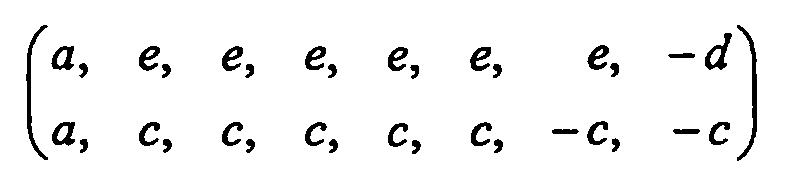
- Assume that a PAPR equal to 2.2 is desired. It can be shown that the minimum of distances d 2 and d 3 will define the minimum distance of the code book, while the distance d 1 is always much larger than d 2 and d 3 . Thus, an optimal choice of the constant amplitudes c, d, and e is one that provides d 2 ≈ d 3 under the condition that PAPR B ≈ 2.2 and E A = E B .
- For example, if c = 0.611617844 · a, e = 0.63 d 3 a, and d = 1.813520605 d 3 a are selected, then a DS-CDMA system is obtained with PAPR ≈ 2.2009 and d1 ≈ 2.992·a 2, d2 = 2,987 ·a2, d3 = 3.1752·a 2 ,
- FIG. 5 is a plot 500 illustrating the relative decoding performance (bit error probability versus signal-to-noise ratio) of the conventional DS-CDMA system 100 and the DS-CDMA system 300 of the present invention, in the presence of an additive white Gaussian noisy (AWGN) channel. According to another aspect of the invention, two different code books are employed based on whether the channel exhibits low or high signal to noise ratios (SNR), distinguished by a specified threshold. Thus, to minimize the bit error probability, different approaches are used for channels with low and with high signal to noise ratios (SNR). In a channel with a high signal to noise ratio, a code book with a large minimum distance will have smaller bit error probability. For example, as shown in FIG. 5, for a SNR above 2, the codebook associated with the DS-CDMA system 300 of FIG. 3 will exhibit a better bit error probability.
- For reconstruction of the variable b 0 we use exactly the same procedure as in system A. Since in systems B and C we keep the same amplitude for signals transmitted in the 0th stream as in system A the probability of error remains also the same. For reconstruction information from other streams in systems B a nd C we can also use the same procedure of despreading as in system A. However, since signal amplitudes for streams 1, 2,...,7 are lower than in system A the bit error probability will increase. For this reason, in addition to despreading, a posteriori probability (APP) decoding of the received vector can be used.
- It is again assumed that a vector b = (b 0 , b 1 ,...,b 7 ). is transmitted. The output vectoris transmitted through a noisy channel and the vector x = s + z is received. Without loss of generality, it is assumed that the channel is an additive white Gaussian noisy (AWGN) channel. In other words, it is assumed that the density function f(z i ) of any element of the vector z can be expressed as:

- FIG. 6 is a flow chart describing an exemplary decoding process 600. As shown in FIG. 6, the exemplary decoding process 600 performs as follows:
- 1. For i from 0 to 7 compute y i = x· w i ;
- 2. For all b = (b 0 , b 1 , ..., b 7 ) from B compute
- 3. For i from 0 to 7 do

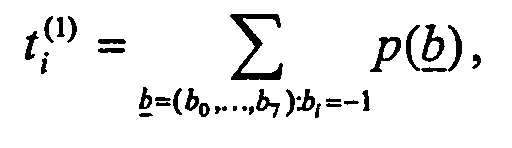
- 4. For i from 0 to 7 do

- 5. End.
-
- Using standard arguments (see, e.g., L. R. Bahl et al., "Optimal Decoding of Linear Codes for Minimizing Symbol Error Rate," IEEE Trans. Inform. Theory, 2 0, 284-87 (1974)), it can be shown that:
- In other words, t i is the log likelihood ratio of the ith bit. The algorithm 600 requires about 1000 operations over real numbers.
- It is to be understood that the embodiments and variations shown and described herein are merely illustrative of the principles of this invention and that various modifications may be implemented by those skilled in the art without departing from the scope and spirit of the invention.
Claims (10)
- A method for generating a code book for use in a CDMA system, said code book comprised of a plurality of vectors, said method comprising:selecting an amplitude and polarity value for each vector of said code book to provide a reduced peak-to-average power ratio.
- The method of claim 1, wherein said amplitude values are selected to maintain a desired energy per chip.
- The method of claim 2, wherein said desired energy per chip is based on an energy per chip of a CDMA system having a lower order spreading factor.
- The method of claim 1, wherein said selecting step further comprises the steps of selecting said amplitude values to provide a reduced peak-to-average power ratio while maintaining a desired average energy per chip.
- The method of claim 1, further comprising the steps of generating a first code book to be used under a first signal-to-noise ratio condition and generating a second code book to be used under a second signal-to-noise ratio condition.
- A transmitter in a CDMA system, comprising:a plurality of multipliers, each of said multipliers multiplying an encoded data stream by a corresponding spreading code, wherein said encoded data stream is based on a code book comprised of a plurality of vectors, each of said vectors having non-uniform amplitude values selected to provide a reduced peak-to-average power ratio; anda combiner for aggregating an output of each of said plurality of multipliers for transmission.
- A communication method, comprising:encoding a data stream based on a code book comprised of a plurality of vectors, each of said vectors having coefficient values that provide a reduced peak-to-average power ratio relative to a peak-to-average power ratio that would result if said vectors contained coefficient values of uniform magnitude.
- The method of claim 7, further comprising the step of transmitting said encoded data stream.
- The method of claim 7, further comprising the step of multiplying an encoded data stream by a corresponding spreading code,
- The method of claim 7, wherein said encoded data stream is based on a first code book to be used under a first signal-to-noise ratio condition and a second code book to be used under a second signal-to-noise ratio condition.
Applications Claiming Priority (2)
| Application Number | Priority Date | Filing Date | Title |
|---|---|---|---|
| US835085 | 1997-04-04 | ||
| US10/835,085 US9094144B2 (en) | 2004-04-29 | 2004-04-29 | Methods and apparatus for code division multiple access communication using code book that provides reduced peak-to-average power ratio |
Publications (2)
| Publication Number | Publication Date |
|---|---|
| EP1592157A1 true EP1592157A1 (en) | 2005-11-02 |
| EP1592157B1 EP1592157B1 (en) | 2016-06-29 |
Family
ID=34940860
Family Applications (1)
| Application Number | Title | Priority Date | Filing Date |
|---|---|---|---|
| EP05252370.1A Expired - Lifetime EP1592157B1 (en) | 2004-04-29 | 2005-04-15 | Methods and apparatus for code division multiple access communication using code book that provides reduced peak-to-average power ratio |
Country Status (3)
| Country | Link |
|---|---|
| US (1) | US9094144B2 (en) |
| EP (1) | EP1592157B1 (en) |
| JP (1) | JP5313428B2 (en) |
Families Citing this family (5)
| Publication number | Priority date | Publication date | Assignee | Title |
|---|---|---|---|---|
| DE102004032666B4 (en) * | 2004-07-06 | 2008-09-04 | Infineon Technologies Ag | Method and circuit for limiting the power of a signal composed of spread-coded signals |
| US8270515B2 (en) * | 2007-09-06 | 2012-09-18 | Alcatel Lucent | Providing feedback in a MIMO system |
| WO2010109548A1 (en) | 2009-03-27 | 2010-09-30 | 富士通株式会社 | Transmission power control parameter calculation method and device |
| RU2571587C2 (en) * | 2014-04-10 | 2015-12-20 | Самсунг Электроникс Ко., Лтд. | Method and device for encoding and decoding data in convoluted polar code |
| WO2020029128A1 (en) * | 2018-08-08 | 2020-02-13 | Zte Corporation | Multiple access schemes with interference mitigation |
Citations (2)
| Publication number | Priority date | Publication date | Assignee | Title |
|---|---|---|---|---|
| EP1359678A1 (en) * | 2001-12-12 | 2003-11-05 | Mitsubishi Electric Information Technology Centre Europe B.V. | Code allocation method in an MC-CDMA telecommunication system |
| US6680978B1 (en) * | 1999-03-01 | 2004-01-20 | Adtran, Inc. | Method and apparatus for nonlinear filtering and controlling the peak-to-average ratio |
Family Cites Families (6)
| Publication number | Priority date | Publication date | Assignee | Title |
|---|---|---|---|---|
| US6563808B1 (en) * | 1998-03-04 | 2003-05-13 | Stanford Telecommunications, Inc. | Apparatus for incorporating multiple data rates in an orthogonal direct sequence code division multiple access (ODS-CDMA) communications system |
| US6310869B1 (en) * | 1998-08-31 | 2001-10-30 | Qualcomm Incorporated | Method and apparatus for reducing amplitude variations and interference in communication signals, such as in wireless communication signals employing inserted pilot symbols |
| US6314107B1 (en) * | 1998-10-20 | 2001-11-06 | Qualcomm Incorporated | Method and apparatus for assigning spreading codes |
| US6389138B1 (en) * | 1998-11-12 | 2002-05-14 | Lucent Technologies Inc. | Method and apparatus for generating a complex scrambling code sequence |
| US7061991B2 (en) * | 2000-07-21 | 2006-06-13 | Pmc - Sierra Inc. | Systems and methods for the reduction of peak to average signal levels of multi-bearer single-carrier and multi-carrier waveforms |
| WO2002069516A1 (en) * | 2001-02-27 | 2002-09-06 | Itt Manufacturing Enterprises, Inc. | Methods and apparatus for multiplexing signal codes via weighted majority logic |
-
2004
- 2004-04-29 US US10/835,085 patent/US9094144B2/en active Active
-
2005
- 2005-04-15 EP EP05252370.1A patent/EP1592157B1/en not_active Expired - Lifetime
- 2005-04-28 JP JP2005131542A patent/JP5313428B2/en not_active Expired - Fee Related
Patent Citations (2)
| Publication number | Priority date | Publication date | Assignee | Title |
|---|---|---|---|---|
| US6680978B1 (en) * | 1999-03-01 | 2004-01-20 | Adtran, Inc. | Method and apparatus for nonlinear filtering and controlling the peak-to-average ratio |
| EP1359678A1 (en) * | 2001-12-12 | 2003-11-05 | Mitsubishi Electric Information Technology Centre Europe B.V. | Code allocation method in an MC-CDMA telecommunication system |
Non-Patent Citations (3)
| Title |
|---|
| MURPHY C D: "High-order optimum hexagonal constellations", PERSONAL, INDOOR AND MOBILE RADIO COMMUNICATIONS, 2000. PIMRC 2000. THE 11TH IEEE INTERNATIONAL SYMPOSIUM ON SEPT. 18-21, 2000, PISCATAWAY, NJ, USA,IEEE, vol. 1, 18 September 2000 (2000-09-18), pages 143 - 146, XP010520620, ISBN: 0-7803-6463-5 * |
| OTTOSSON T: "PRECODING FOR MINIMIZATION OF ENVELOPE VARATIONS IN MULTICODE DS-CDMA SYSTEMS", WIRELESS PERSONAL COMMUNICATIONS, KLUWER ACADEMIC PUBLISHERS, NL, vol. 13, no. 1/2, May 2000 (2000-05-01), pages 57 - 77, XP000894159, ISSN: 0929-6212 * |
| SATHANANTHAN K ET AL: "Peak-to-average power ratio analysis in multicode cdma", VTC 2002-FALL. 2002 IEEE 56TH. VEHICULAR TECHNOLOGY CONFERENCE PROCEEDINGS. VANCOUVER, CANADA, SEPT. 24 - 28, 2002, IEEE VEHICULAR TECHNOLGY CONFERENCE, NEW YORK, NY : IEEE, US, vol. VOL. 1 OF 4. CONF. 56, 24 September 2002 (2002-09-24), pages 500 - 504, XP010608607, ISBN: 0-7803-7467-3 * |
Also Published As
| Publication number | Publication date |
|---|---|
| EP1592157B1 (en) | 2016-06-29 |
| JP5313428B2 (en) | 2013-10-09 |
| US9094144B2 (en) | 2015-07-28 |
| US20050243895A1 (en) | 2005-11-03 |
| JP2005318631A (en) | 2005-11-10 |
Similar Documents
| Publication | Publication Date | Title |
|---|---|---|
| JP3365513B2 (en) | Variable speed transmission method and variable speed transmission device | |
| CN1115792C (en) | Device and method for generating spread spectrum signal in transmitter of mobile communication system | |
| CN100425016C (en) | code division multiple access system | |
| US6233271B1 (en) | Method and apparatus for decoding trellis coded direct sequence spread spectrum communication signals | |
| US20020097781A1 (en) | Correlated spreading sequenes for high rate non-coherent communication systems | |
| KR20040067707A (en) | Constant amplitude coded bi-orthogonal coding and decoding apparatus | |
| US6122310A (en) | Method and apparatus for facilitating multi-rate data transmission by selecting a plurality of spreading codes | |
| US6125136A (en) | Method and apparatus for demodulating trellis coded direct sequence spread spectrum communication signals | |
| US6215813B1 (en) | Method and apparatus for encoding trellis coded direct sequence spread spectrum communication signals | |
| JPH11275059A (en) | Variable speed transmission method and variable speed transmission device | |
| Elsaraf et al. | Performance analysis of code-domain NOMA in 5G communication systems | |
| CN111294082A (en) | A spread spectrum-based parallel transmission OFDM communication method and system | |
| CN101540747A (en) | Enhanced method for demodulating constant-amplitude multi-code biorthogonal modulation signals | |
| US9094144B2 (en) | Methods and apparatus for code division multiple access communication using code book that provides reduced peak-to-average power ratio | |
| EP1287625B1 (en) | Improved multi-level sequences for cdma data communcation | |
| Ottosson | Precoding for minimization of envelope variations in multicode DS-CDMA systems | |
| Ülgen et al. | Sparse code multiple access with time spreading and repetitive transmissions | |
| KR20030093177A (en) | Apparatus and Design Method of Binary Constant Amplitude CDMA (CA-CDMA) Communication System Using a New Pre-Coding Scheme of code rate 1.0 | |
| Yaseen et al. | Design and Analysis of Grouping Non-Active Frequency-Time Index Modulation for Differential Chaos Shift Keying Communication System. | |
| Kulhandjian et al. | Uniquely decodable ternary codes via augmented Sylvester-Hadamard matrices | |
| RU2810264C1 (en) | Method for transmitting and receiving signals in multi-user radio communication system with multiple transmitting and multiple receiving antennas | |
| KR20150131521A (en) | Apparatus and method for transmitting data using human body | |
| CN1894877B (en) | Method for transmitting signals in a communication system | |
| Zhou et al. | Codes with low peak-to-average power ratio for multi-code CDMA | |
| Weerasinghe et al. | A convolutional spreading CDMA scheme with cyclic prefix for downlink transmission |
Legal Events
| Date | Code | Title | Description |
|---|---|---|---|
| PUAI | Public reference made under article 153(3) epc to a published international application that has entered the european phase |
Free format text: ORIGINAL CODE: 0009012 |
|
| 17P | Request for examination filed |
Effective date: 20050506 |
|
| AK | Designated contracting states |
Kind code of ref document: A1 Designated state(s): AT BE BG CH CY CZ DE DK EE ES FI FR GB GR HU IE IS IT LI LT LU MC NL PL PT RO SE SI SK TR |
|
| AX | Request for extension of the european patent |
Extension state: AL BA HR LV MK YU |
|
| AKX | Designation fees paid |
Designated state(s): DE FR GB |
|
| 17Q | First examination report despatched |
Effective date: 20050921 |
|
| RAP3 | Party data changed (applicant data changed or rights of an application transferred) |
Owner name: LUCENT TECHNOLOGIES INC. |
|
| RAP1 | Party data changed (applicant data changed or rights of an application transferred) |
Owner name: ALCATEL-LUCENT USA INC. |
|
| 111Z | Information provided on other rights and legal means of execution |
Free format text: DE FR GB Effective date: 20130410 |
|
| D11X | Information provided on other rights and legal means of execution (deleted) | ||
| GRAP | Despatch of communication of intention to grant a patent |
Free format text: ORIGINAL CODE: EPIDOSNIGR1 |
|
| INTG | Intention to grant announced |
Effective date: 20160119 |
|
| INTG | Intention to grant announced |
Effective date: 20160204 |
|
| GRAS | Grant fee paid |
Free format text: ORIGINAL CODE: EPIDOSNIGR3 |
|
| GRAA | (expected) grant |
Free format text: ORIGINAL CODE: 0009210 |
|
| RAP1 | Party data changed (applicant data changed or rights of an application transferred) |
Owner name: ALCATEL LUCENT |
|
| AK | Designated contracting states |
Kind code of ref document: B1 Designated state(s): DE FR GB |
|
| REG | Reference to a national code |
Ref country code: GB Ref legal event code: FG4D |
|
| REG | Reference to a national code |
Ref country code: DE Ref legal event code: R096 Ref document number: 602005049610 Country of ref document: DE |
|
| REG | Reference to a national code |
Ref country code: DE Ref legal event code: R097 Ref document number: 602005049610 Country of ref document: DE |
|
| PLBE | No opposition filed within time limit |
Free format text: ORIGINAL CODE: 0009261 |
|
| STAA | Information on the status of an ep patent application or granted ep patent |
Free format text: STATUS: NO OPPOSITION FILED WITHIN TIME LIMIT |
|
| 26N | No opposition filed |
Effective date: 20170330 |
|
| REG | Reference to a national code |
Ref country code: DE Ref legal event code: R119 Ref document number: 602005049610 Country of ref document: DE |
|
| GBPC | Gb: european patent ceased through non-payment of renewal fee |
Effective date: 20170415 |
|
| REG | Reference to a national code |
Ref country code: FR Ref legal event code: ST Effective date: 20171229 |
|
| PG25 | Lapsed in a contracting state [announced via postgrant information from national office to epo] |
Ref country code: FR Free format text: LAPSE BECAUSE OF NON-PAYMENT OF DUE FEES Effective date: 20170502 Ref country code: DE Free format text: LAPSE BECAUSE OF NON-PAYMENT OF DUE FEES Effective date: 20171103 |
|
| PG25 | Lapsed in a contracting state [announced via postgrant information from national office to epo] |
Ref country code: GB Free format text: LAPSE BECAUSE OF NON-PAYMENT OF DUE FEES Effective date: 20170415 |