EP1592120A2 - Apparatus for controlling the power used in required operating conditions that vary over time, particularly for supplying power to lighting systems - Google Patents
Apparatus for controlling the power used in required operating conditions that vary over time, particularly for supplying power to lighting systems Download PDFInfo
- Publication number
- EP1592120A2 EP1592120A2 EP05103407A EP05103407A EP1592120A2 EP 1592120 A2 EP1592120 A2 EP 1592120A2 EP 05103407 A EP05103407 A EP 05103407A EP 05103407 A EP05103407 A EP 05103407A EP 1592120 A2 EP1592120 A2 EP 1592120A2
- Authority
- EP
- European Patent Office
- Prior art keywords
- voltage
- phase
- power
- inverter
- over time
- Prior art date
- Legal status (The legal status is an assumption and is not a legal conclusion. Google has not performed a legal analysis and makes no representation as to the accuracy of the status listed.)
- Withdrawn
Links
Images
Classifications
-
- H—ELECTRICITY
- H02—GENERATION; CONVERSION OR DISTRIBUTION OF ELECTRIC POWER
- H02M—APPARATUS FOR CONVERSION BETWEEN AC AND AC, BETWEEN AC AND DC, OR BETWEEN DC AND DC, AND FOR USE WITH MAINS OR SIMILAR POWER SUPPLY SYSTEMS; CONVERSION OF DC OR AC INPUT POWER INTO SURGE OUTPUT POWER; CONTROL OR REGULATION THEREOF
- H02M5/00—Conversion of AC power input into AC power output, e.g. for change of voltage, for change of frequency, for change of number of phases
- H02M5/02—Conversion of AC power input into AC power output, e.g. for change of voltage, for change of frequency, for change of number of phases without intermediate conversion into DC
- H02M5/04—Conversion of AC power input into AC power output, e.g. for change of voltage, for change of frequency, for change of number of phases without intermediate conversion into DC by static converters
- H02M5/22—Conversion of AC power input into AC power output, e.g. for change of voltage, for change of frequency, for change of number of phases without intermediate conversion into DC by static converters using discharge tubes with control electrode or semiconductor devices with control electrode
- H02M5/275—Conversion of AC power input into AC power output, e.g. for change of voltage, for change of frequency, for change of number of phases without intermediate conversion into DC by static converters using discharge tubes with control electrode or semiconductor devices with control electrode using devices of a triode or transistor type requiring continuous application of a control signal
- H02M5/293—Conversion of AC power input into AC power output, e.g. for change of voltage, for change of frequency, for change of number of phases without intermediate conversion into DC by static converters using discharge tubes with control electrode or semiconductor devices with control electrode using devices of a triode or transistor type requiring continuous application of a control signal using semiconductor devices only
-
- H—ELECTRICITY
- H02—GENERATION; CONVERSION OR DISTRIBUTION OF ELECTRIC POWER
- H02J—ELECTRIC POWER NETWORKS; CIRCUIT ARRANGEMENTS OR SYSTEMS FOR SUPPLYING OR DISTRIBUTING ELECTRIC POWER; SYSTEMS FOR STORING ELECTRIC ENERGY
- H02J3/00—Circuit arrangements for AC mains or AC distribution networks
- H02J3/18—Arrangements for adjusting, eliminating or compensating reactive power in networks
- H02J3/1807—Arrangements for adjusting, eliminating or compensating reactive power in networks using series compensators, e.g. thyristor-controlled series capacitors [TCSC]
- H02J3/1814—Arrangements for adjusting, eliminating or compensating reactive power in networks using series compensators, e.g. thyristor-controlled series capacitors [TCSC] having reactive elements actively controlled by bridge converters, e.g. unified power flow controllers [UPFC] or controlled series voltage compensators
-
- H—ELECTRICITY
- H05—ELECTRIC TECHNIQUES NOT OTHERWISE PROVIDED FOR
- H05B—ELECTRIC HEATING; ELECTRIC LIGHT SOURCES NOT OTHERWISE PROVIDED FOR; CIRCUIT ARRANGEMENTS FOR ELECTRIC LIGHT SOURCES, IN GENERAL
- H05B41/00—Circuit arrangements or apparatus for igniting or operating discharge lamps
- H05B41/14—Circuit arrangements
- H05B41/36—Controlling
- H05B41/38—Controlling the intensity of light
- H05B41/39—Controlling the intensity of light continuously
- H05B41/392—Controlling the intensity of light continuously using semiconductor devices, e.g. thyristor
- H05B41/3921—Controlling the intensity of light continuously using semiconductor devices, e.g. thyristor with possibility of light intensity variations
- H05B41/3924—Controlling the intensity of light continuously using semiconductor devices, e.g. thyristor with possibility of light intensity variations by phase control, e.g. using a triac
-
- H—ELECTRICITY
- H05—ELECTRIC TECHNIQUES NOT OTHERWISE PROVIDED FOR
- H05B—ELECTRIC HEATING; ELECTRIC LIGHT SOURCES NOT OTHERWISE PROVIDED FOR; CIRCUIT ARRANGEMENTS FOR ELECTRIC LIGHT SOURCES, IN GENERAL
- H05B41/00—Circuit arrangements or apparatus for igniting or operating discharge lamps
- H05B41/14—Circuit arrangements
- H05B41/36—Controlling
- H05B41/38—Controlling the intensity of light
- H05B41/39—Controlling the intensity of light continuously
- H05B41/392—Controlling the intensity of light continuously using semiconductor devices, e.g. thyristor
- H05B41/3921—Controlling the intensity of light continuously using semiconductor devices, e.g. thyristor with possibility of light intensity variations
- H05B41/3927—Controlling the intensity of light continuously using semiconductor devices, e.g. thyristor with possibility of light intensity variations by pulse width modulation
-
- H—ELECTRICITY
- H02—GENERATION; CONVERSION OR DISTRIBUTION OF ELECTRIC POWER
- H02M—APPARATUS FOR CONVERSION BETWEEN AC AND AC, BETWEEN AC AND DC, OR BETWEEN DC AND DC, AND FOR USE WITH MAINS OR SIMILAR POWER SUPPLY SYSTEMS; CONVERSION OF DC OR AC INPUT POWER INTO SURGE OUTPUT POWER; CONTROL OR REGULATION THEREOF
- H02M1/00—Details of apparatus for conversion
- H02M1/0083—Converters characterised by their input or output configuration
- H02M1/0093—Converters characterised by their input or output configuration wherein the output is created by adding a regulated voltage to or subtracting it from an unregulated input
-
- Y—GENERAL TAGGING OF NEW TECHNOLOGICAL DEVELOPMENTS; GENERAL TAGGING OF CROSS-SECTIONAL TECHNOLOGIES SPANNING OVER SEVERAL SECTIONS OF THE IPC; TECHNICAL SUBJECTS COVERED BY FORMER USPC CROSS-REFERENCE ART COLLECTIONS [XRACs] AND DIGESTS
- Y02—TECHNOLOGIES OR APPLICATIONS FOR MITIGATION OR ADAPTATION AGAINST CLIMATE CHANGE
- Y02E—REDUCTION OF GREENHOUSE GAS [GHG] EMISSIONS, RELATED TO ENERGY GENERATION, TRANSMISSION OR DISTRIBUTION
- Y02E40/00—Technologies for an efficient electrical power generation, transmission or distribution
- Y02E40/10—Flexible AC transmission systems [FACTS]
Definitions
- the present invention relates to an apparatus for controlling the power used in required operating conditions that vary over time, particularly for supplying power to single- or three-phase lighting systems (in the particular case, reference is made to three-phase systems, but the invention can extend its protection to single-phase devices).
- Known power control devices usually operate in more or less steep steps and have components with moving contacts and/or with moving mechanical elements, such as for example sliding contacts between separate mechanical parts or electromechanical elements such as relays or contactors: the presence of moving contacts can lead to low reliability and short life of the machine and, if the voltage steps are broad, also of the lamps used.
- the aim of the present invention is to obviate the cited drawbacks of the background art, by providing an apparatus for controlling the power used in required operating conditions that vary over time, particularly for supplying power to lighting systems, that does not have moving mechanical elements and operates continuously without having steps: in addition to this, the apparatus according to the invention allows a more precise reconstruction of the sinusoidal waveform during the step of adjustment and stabilization of the load supply voltage and an immediate response dynamics: the higher speed allows better control of transient phenomena.
- an object of the present invention is to provide an apparatus that is simple, relatively easy to provide in practice, safe in use, effective in operation, and has a relatively low cost.
- the present apparatus for controlling the power used in required operating conditions that vary over time, particularly for supplying power to lighting systems, characterized in that it uses solid-state technology and comprises an inverter unit which, above a certain value of voltage and power drawn directly from the power supply line, supplies a high-frequency voltage, which is suitable to be applied to series transformers and to be added to the line voltage in order to supply the load, and also comprises a voltage regulation and stabilization unit.
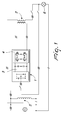
- Figure 1 is a block diagram of a system provided with the apparatus according to the invention.
- the reference numeral 1 generally designates an apparatus for controlling the power used in required operating conditions that vary over time, particularly for supplying power to lighting systems according to the invention.
- the apparatus uses solid-state technology, i.e., static components, and comprises an inverter unit 1 which, above a certain voltage and power value drawn directly from the power supply line, supplies a high-frequency voltage, which is suitable to be applied to series transformers 2 and to be added to the line voltage in order to supply the load 6, and also comprises a voltage regulation and stabilization unit.
- solid-state technology i.e., static components
- inverter unit 1 which, above a certain voltage and power value drawn directly from the power supply line, supplies a high-frequency voltage, which is suitable to be applied to series transformers 2 and to be added to the line voltage in order to supply the load 6, and also comprises a voltage regulation and stabilization unit.
- the inverter 1 is a system with a high-frequency IGBT (Insulated Gate Bipolar Transistor) 4, which utilizes the pulse width modulation technique to regulate the output voltage and is suitable to set, at its output, three single-phase sinusoidal voltages with an amplitude that can vary from 0 to 75 VAC.
- IGBT Insulated Gate Bipolar Transistor
- the three single-phase voltages are regulated independently in order to produce different reductions in the value and duration of the light flux on each phase.
- the inverter is supplied by a current rectifier, which is suitable to convert the three-phase mains alternating current into direct current by means of a three-phase diode bridge, leveled by a capacitor 3, and then convert it back to alternating current by means of an IGBT bridge 4 with frequency and voltage values that can be set within preset parameters.
- the apparatus after the step for preheating the lamps, automatically configures itself to the regulation setting, preprogrammed by the user, and keeps the output voltage regulated by means of the static converter with integrated inverter, a unit with high-frequency IGBT that utilizes the pulse width modulation technique to regulate the output voltage.
- the unit which is fully static, is capable of setting at its output three single-phase sinusoidal voltages with variable phase and amplitude, and said voltages can be regulated independently to obtain different light flux variations on each phase in terms of value and duration.
- the apparatus stabilizes the output voltage, reconstructing a perfect sinusoid in phase with the input voltage and adding it to the transformed line voltage, keeping the output voltage under instantaneous control, with a higher stabilization speed than known devices, which allows better control of transient phenomena in input and in output from the apparatus.
- Data checking occurs at preset time intervals; for example, a preferred solution provides intervals of 300 microseconds, allowing rapid stabilization of the voltage supplied to the lamps (all microvariations in voltage are compensated rapidly) and interfacing with the line in order to eliminate problems caused by voltage variations or by other phenomena of various kinds.
- the inverter also monitors all the electrical parameters of the line, constantly checking the correctness of the values, and in case of anomaly the apparatus assumes a safe (bypass) configuration 5, in which the line is still supplied with a reduced voltage.
- the inverter is capable of recovering, manually or automatically, in percentage terms, the power factor correction of the system deteriorated over time due to wear of the capacitors that are present in said system, with a consequent increase in the power factor and better utilization of said line. With respect to known solutions, there are lower energy losses and therefore the overall efficiency is higher.
- the fact that the apparatus uses solid-state technology i.e., that with respect to known types there are no electromechanical elements, such as moving elements and sliding contacts between separate parts, entails a considerable reduction in maintenance costs and extends the life of said apparatus.
- the operation in bypass mode 5 of the apparatus provides a power supply that is lower than the mains supply (in any case capable of ensuring correct operation of the load), allowing an energy saving.
- control panel in the same cabinet as the apparatus allows conveniently to reduce space occupation.
- the embodiment of the present invention shall be carried out in the most scrupulous compliance with the statutory and regulatory provisions related to the products of the invention or correlated thereto and following any required authorization of the corresponding competent authorities, with particular reference to regulations related to safety, environmental pollution and health.
Landscapes
- Engineering & Computer Science (AREA)
- Power Engineering (AREA)
- Circuit Arrangements For Discharge Lamps (AREA)
- Inverter Devices (AREA)
Abstract
Description
Claims (5)
- An apparatus for controlling the power used in required operating conditions that vary over time, characterized in that it uses solid-state technology and comprises an inverter unit (1) which, above a certain value of voltage and power drawn directly from the power supply line, supplies a high-frequency voltage, which is suitable to be applied to series transformers (2) and to be added to the line voltage in order to supply the load (6), and also comprises a voltage regulation and stabilization unit.
- The apparatus according to claim 1, characterized in that said inverter (1) is a system with high-frequency IGBT (Insulated Gate Bipolar Transistor) (4) that utilizes the pulse width modulation technique to regulate the output voltage.
- The apparatus according to one or more of the preceding claims, characterized in that said inverter (1) is suitable for setting, at its output, three single-phase sinusoidal voltages with variable amplitude to the value required to regularize the system.
- The apparatus according to one or more of the preceding claims, characterized in that said three single-phase voltages are suitable to be regulated independently to produce different reductions in the value and duration of the light flux on each phase.
- The apparatus according to one or more of the preceding claims, characterized in that said inverter (1) is supplied by a current rectifier that is suitable to convert the three-phase mains alternating current into direct current by means of a three-phase diode bridge that is leveled by a capacitor (3) and to then convert it back to alternating current by means of an IGBT bridge (4) with frequency and voltage values that can be set within preset parameters.
Applications Claiming Priority (2)
| Application Number | Priority Date | Filing Date | Title |
|---|---|---|---|
| ITBO20040265 | 2004-04-27 | ||
| IT000265A ITBO20040265A1 (en) | 2004-04-27 | 2004-04-27 | EQUIPMENT FOR THE CONTROL OF THE POWER USED IN CONDITIONS OF |
Publications (3)
| Publication Number | Publication Date |
|---|---|
| EP1592120A2 true EP1592120A2 (en) | 2005-11-02 |
| EP1592120A3 EP1592120A3 (en) | 2007-08-15 |
| EP1592120A8 EP1592120A8 (en) | 2007-10-17 |
Family
ID=34939527
Family Applications (1)
| Application Number | Title | Priority Date | Filing Date |
|---|---|---|---|
| EP05103407A Withdrawn EP1592120A3 (en) | 2004-04-27 | 2005-04-26 | Apparatus for controlling the power used in required operating conditions that vary over time, particularly for supplying power to lighting systems |
Country Status (2)
| Country | Link |
|---|---|
| EP (1) | EP1592120A3 (en) |
| IT (1) | ITBO20040265A1 (en) |
Cited By (1)
| Publication number | Priority date | Publication date | Assignee | Title |
|---|---|---|---|---|
| EP2221705A1 (en) * | 2009-02-09 | 2010-08-25 | Bob Hammer Systems Solutions S.A. | Programmable AC voltage regulator and stabilizer system, particularly for optimized control of lighting fixtures with fluorescent lamps and the like |
Family Cites Families (3)
| Publication number | Priority date | Publication date | Assignee | Title |
|---|---|---|---|---|
| DE19737590C1 (en) * | 1997-08-28 | 1998-10-22 | Siemens Ag | Voltage supply quality improvement method e.g. for automated processes |
| US6020726A (en) * | 1998-06-24 | 2000-02-01 | U.S.Energy, Inc. | AC voltage regulator |
| US6144191A (en) * | 2000-02-18 | 2000-11-07 | Utility Systems Technologies, Inc. | Voltage regulator |
-
2004
- 2004-04-27 IT IT000265A patent/ITBO20040265A1/en unknown
-
2005
- 2005-04-26 EP EP05103407A patent/EP1592120A3/en not_active Withdrawn
Cited By (1)
| Publication number | Priority date | Publication date | Assignee | Title |
|---|---|---|---|---|
| EP2221705A1 (en) * | 2009-02-09 | 2010-08-25 | Bob Hammer Systems Solutions S.A. | Programmable AC voltage regulator and stabilizer system, particularly for optimized control of lighting fixtures with fluorescent lamps and the like |
Also Published As
| Publication number | Publication date |
|---|---|
| ITBO20040265A1 (en) | 2004-07-27 |
| EP1592120A3 (en) | 2007-08-15 |
| EP1592120A8 (en) | 2007-10-17 |
Similar Documents
| Publication | Publication Date | Title |
|---|---|---|
| TWI610054B (en) | Apparatus and method to electrically power an electric arc furnace | |
| US9451663B2 (en) | Apparatus for driving light emitting diode | |
| WO2006124893A3 (en) | Two-wire dimmer with power supply and load protection circuit in the event of switch failure | |
| MX9504237A (en) | High frequency ac/ac converter with power factor correction. | |
| WO2009139077A1 (en) | Alternating voltage control unit | |
| EP1503491A3 (en) | Motor driving apparatus | |
| CN102801299B (en) | The control method of power factor corrector and uninterrupted power supply | |
| US20100213850A1 (en) | Fluorescent dimming ballast | |
| US6300878B1 (en) | Constant current regulator using IGBT control | |
| US6172489B1 (en) | Voltage control system and method | |
| US5883502A (en) | Power rectifier circuit | |
| TWI449470B (en) | A circuit for driving light sources and related method | |
| EP1592120A2 (en) | Apparatus for controlling the power used in required operating conditions that vary over time, particularly for supplying power to lighting systems | |
| EP2221705A1 (en) | Programmable AC voltage regulator and stabilizer system, particularly for optimized control of lighting fixtures with fluorescent lamps and the like | |
| FI981686A0 (en) | Arrangement to eliminate radio interference in the electronic power controller | |
| WO2015107498A1 (en) | Power control by phase cutting | |
| KR970032299A (en) | Electronic ballast circuit | |
| KR101370531B1 (en) | a Power Apparatus for Lighting LED | |
| KR100317356B1 (en) | Drive control device of boost converter for power factor control | |
| EP3376826A1 (en) | Power delivery system for an induction cooktop with multi-output inverters | |
| KR100449123B1 (en) | The fan filter unit control system of BLDC motor for extreme cleanness and method thereof and the management system manageability a fan filter unit control system using network | |
| KR100392310B1 (en) | Step down AC regulator and its control method | |
| KR101618603B1 (en) | Photovoltaics system with static synchronous phase modifier | |
| KR100440393B1 (en) | 3 Phase Step Down AC Regulator | |
| KR20250144646A (en) | power factor correction appartus |
Legal Events
| Date | Code | Title | Description |
|---|---|---|---|
| PUAI | Public reference made under article 153(3) epc to a published international application that has entered the european phase |
Free format text: ORIGINAL CODE: 0009012 |
|
| AK | Designated contracting states |
Kind code of ref document: A2 Designated state(s): AT BE BG CH CY CZ DE DK EE ES FI FR GB GR HU IE IS IT LI LT LU MC NL PL PT RO SE SI SK TR |
|
| AX | Request for extension of the european patent |
Extension state: AL BA HR LV MK YU |
|
| PUAL | Search report despatched |
Free format text: ORIGINAL CODE: 0009013 |
|
| AK | Designated contracting states |
Kind code of ref document: A3 Designated state(s): AT BE BG CH CY CZ DE DK EE ES FI FR GB GR HU IE IS IT LI LT LU MC NL PL PT RO SE SI SK TR |
|
| AX | Request for extension of the european patent |
Extension state: AL BA HR LV MK YU |
|
| AKX | Designation fees paid | ||
| REG | Reference to a national code |
Ref country code: DE Ref legal event code: 8566 |
|
| STAA | Information on the status of an ep patent application or granted ep patent |
Free format text: STATUS: THE APPLICATION IS DEEMED TO BE WITHDRAWN |
|
| 18D | Application deemed to be withdrawn |
Effective date: 20080216 |