EP1592015A2 - Method and device for recording or playing back a data stream - Google Patents
Method and device for recording or playing back a data stream Download PDFInfo
- Publication number
- EP1592015A2 EP1592015A2 EP04009912A EP04009912A EP1592015A2 EP 1592015 A2 EP1592015 A2 EP 1592015A2 EP 04009912 A EP04009912 A EP 04009912A EP 04009912 A EP04009912 A EP 04009912A EP 1592015 A2 EP1592015 A2 EP 1592015A2
- Authority
- EP
- European Patent Office
- Prior art keywords
- mxf
- data
- file
- mxf file
- connection data
- Prior art date
- Legal status (The legal status is an assumption and is not a legal conclusion. Google has not performed a legal analysis and makes no representation as to the accuracy of the status listed.)
- Withdrawn
Links
Images




Classifications
-
- G—PHYSICS
- G11—INFORMATION STORAGE
- G11B—INFORMATION STORAGE BASED ON RELATIVE MOVEMENT BETWEEN RECORD CARRIER AND TRANSDUCER
- G11B20/00—Signal processing not specific to the method of recording or reproducing; Circuits therefor
- G11B20/10—Digital recording or reproducing
- G11B20/12—Formatting, e.g. arrangement of data block or words on the record carriers
-
- G—PHYSICS
- G06—COMPUTING OR CALCULATING; COUNTING
- G06F—ELECTRIC DIGITAL DATA PROCESSING
- G06F13/00—Interconnection of, or transfer of information or other signals between, memories, input/output devices or central processing units
- G06F13/10—Program control for peripheral devices
-
- G—PHYSICS
- G11—INFORMATION STORAGE
- G11B—INFORMATION STORAGE BASED ON RELATIVE MOVEMENT BETWEEN RECORD CARRIER AND TRANSDUCER
- G11B20/00—Signal processing not specific to the method of recording or reproducing; Circuits therefor
- G11B20/10—Digital recording or reproducing
-
- G—PHYSICS
- G11—INFORMATION STORAGE
- G11B—INFORMATION STORAGE BASED ON RELATIVE MOVEMENT BETWEEN RECORD CARRIER AND TRANSDUCER
- G11B27/00—Editing; Indexing; Addressing; Timing or synchronising; Monitoring; Measuring tape travel
- G11B27/10—Indexing; Addressing; Timing or synchronising; Measuring tape travel
- G11B27/19—Indexing; Addressing; Timing or synchronising; Measuring tape travel by using information detectable on the record carrier
- G11B27/28—Indexing; Addressing; Timing or synchronising; Measuring tape travel by using information detectable on the record carrier by using information signals recorded by the same method as the main recording
- G11B27/30—Indexing; Addressing; Timing or synchronising; Measuring tape travel by using information detectable on the record carrier by using information signals recorded by the same method as the main recording on the same track as the main recording
-
- G—PHYSICS
- G11—INFORMATION STORAGE
- G11B—INFORMATION STORAGE BASED ON RELATIVE MOVEMENT BETWEEN RECORD CARRIER AND TRANSDUCER
- G11B20/00—Signal processing not specific to the method of recording or reproducing; Circuits therefor
- G11B20/10—Digital recording or reproducing
- G11B2020/10935—Digital recording or reproducing wherein a time constraint must be met
- G11B2020/10944—Real-time recording or reproducing, e.g. for ensuring seamless playback of AV data
-
- G—PHYSICS
- G11—INFORMATION STORAGE
- G11B—INFORMATION STORAGE BASED ON RELATIVE MOVEMENT BETWEEN RECORD CARRIER AND TRANSDUCER
- G11B2220/00—Record carriers by type
- G11B2220/40—Combinations of multiple record carriers
- G11B2220/41—Flat as opposed to hierarchical combination, e.g. library of tapes or discs, CD changer, or groups of record carriers that together store one title
Definitions
- the present invention relates to a method or a device for recording a data stream on a distributed storage system. Furthermore, the present invention relates to a method or device for playing back such a data stream recorded on a distributed storage system.
- a distributed storage system can make use of all storage capacity of connected peers, i.e. nodes, to store data, such as duplicating important data in different peers, or splitting large-size data and sharing or storing them in different peers.
- MXF Material Exchange Format
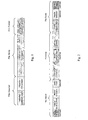
- the MXF Format consists of a File Header, a File Body and a File Footer.
- the File Header contains Header Metadata, which provides information about the file as a whole, including labels for the early determination of decoder compliance.
- the File Body comprises picture, sound and data essence stored in Essence Containers. Essence Containers from different tracks may be interleaved or separated as shown in Fig. 2. Body Partition Packs of File Body may optionally contain repetition of Header Metadata.
- the File Footer terminates the file and may optionally contain Header Metadata.
- the File Footer may further include some information not available at the time of writing the File Header (such as the duration of the file). In certain specialized cases, the File Footer may be omitted.
- the File Header is designed to be small enough that it can easily be isolated and sent to a microprocessor for parsing.
- the bulk of the file will usually be the File Body - this is the picture, sound and data essence.
- the File Footer provides capacity to put the Header Metadata at the end of the file. The reason is: in certain applications, such as recording a stream to an MXF file, there will be Header Metadata values that will not be known until the recording is finished.
- the File Footer provides a mechanism for doing this. It also provides clear indication that the file has terminated.
- the basic MXF structure supports embedded metadata throughout the MXF file.
- MXF files will often be processed in streaming environments. This will include streaming to and from videotapes and data tapes, and transmission over unidirectional links or links with a narrow-band return-channel.
- Sequential writing is necessary when the source or the link or the destination operates only in streaming mode. Random access writing is permissible before or after data transfer, for example, to optimize downstream access performance.
- MXF's Operational Patterns have a special qualifier bit that indicates that the file has been created for streaming.
- MXF files may be directly created from standardized formats such as MPEG2 systems and elementary streams, AES3 data streams (Audio Engineering Society Standard), and Digital Video (DV) DIF packet streams. These formats may be mapped from one of several real-time interfaces such as SMPTE 259M (Serial Digital Interface, SDI), SMPTE 305M (Serial Digital Transport Interface, SDTI), SMPTE 292M (High-Definition Serial Digital Interface, HD-SDI), or transport interfaces with real-time protocols such as IEEE-1394, ATM, IEEE802 (ethernet), ANSI Fibre Channel and so on.
- SDI Serial Digital Interface
- SDTI Serial Digital Transport Interface
- HD-SDI High-Definition Serial Digital Interface
- transport interfaces with real-time protocols such as IEEE-1394, ATM, IEEE802 (ethernet), ANSI Fibre Channel and so on.
- the basic MXF structure supports stream recording and playback.
- the distributed storage system has to deal with different lengths of application packets coming along with the streaming data of different standards (e.g. MPEG-2, DV, etc.).
- streaming data has to be handled by the distributed storage system, it is not generally possible to get the size of the data in advance. So seamless real-time splitting of data could be necessary when the maximum capacity of a peer, or node, will be reached.
- This invention proposes methods for the processing of streaming data in the distributed storage environment for the record and playback condition.
- this object is solved by a method for recording a data stream on a distributed storage system by packing said data stream into at least a first MXF file and a second MXF file, inserting first connection data into said first MXF file, said first connection data pointing to said second MXF file, and inserting second connection data into said second MXF file, said second connection data pointing to said first MXF file.
- a corresponding device for recording a data stream on a distributed storage system including packing means for packing said data stream into at least a first MXF file and a second MXF file, data processing means for inserting first connection data into said first MXF file, said first connection data pointing to said second MXF file, and for inserting second connection data into said second MXF file, said second connection data pointing to said first MXF file.
- connection data from a first MXF file, said connection data pointing to a second MXF file, building an MXF file chain on the basis of said connection data and playing back the essence data of said first MXF file and said second MXF file according to said MXF file chain.
- a corresponding device for playing back a data stream recorded on a distributed storage system including reading means for reading connection data from a first MXF file, said connection data pointing to a second MXF file, data processing means for building a MXF file chain on the basis of said connection data and playing means for playing back the essence data of said first MXF file and said second MXF file according to said MXF file chain.
- the advantage of such methods and devices is, that while stream recording, if a peer reaches its storage-capacity, the input stream may be rerouted to another peer or other peers, in order to record the input stream continuously.
- the file splitting can be performed in real-time. Consequently, the present invention enables such seamless real-time stream recording and stream-able data play back for MXF files.
- the inventive method of recording a data stream further includes the step of inserting third connection data into said second MXF file, wherein said third connection data pointing to a third MXF file.
- a current MXF file points to the last MXF file and to the next MXF file.
- the step or steps of inserting connection data into the MXF file may be performed while terminating said recording of an MXF file. At that moment the last MXF file and the next MXF file are available, or known respectively.
- the data stream may be split into a specific number of MXF files, wherein the specific number is not known in advance, and connection data pointing to all of these MXF files may be stored in each of said specific number of MXF files. This enables to obtain the complete MXF file chain by reading only one MXF file.
- connection data may be inserted as metadata into the header and/or the footer of an MXF file. If the connection data are stored both in the header and the footer, the MXF file can be split later without problems.
- the step of reading connection data may be repeated for each MXF file of said MXF file chain.
- the MXF file chain can be built up step by step.
- connection data pointing to all MXF files of said MXF file chain are included in each of said MXF files of said MXF file chain. In this case it is only necessary to read any one of the MXF files in order to obtain the complete MXF file chain.
- connection data include task data, attribute data and reference data.
- the task data contains a task ID value
- the attribute data contains a status value like "next" (for a following MXF file) or "last" (for a preceding MXF file)
- the reference value contains an ID value, e.g. UUID, of the other MXF file.
- This Connection Metadata is inserted in the Header Metadata of the MXF file.
- the Header Metadata may be located in the File Header, the File Body and/or the File Footer.
- a Connection Metadata As shown in Fig. 3, a Connection Metadata according to the present embodiment consists of at least three parts: Task, Attribute and Reference. These parts may e.g. be fields.
- the Task field contains a task ID value. For example, each stream recording action has an own task ID.
- the Attribute field value can represent at least two statuses: "next" and "last".
- the "next” attribute means that the current MXF file is followed by a subsequent MXF file, because of the split stream recording.
- the subsequent MXF file can be found by the UUID (Universal Unique Identifier) included in the Reference field.
- UUID Universal Unique Identifier
- the "last” attribute means that the current file follows a preceding MXF file and is a part of a split stream.
- the preceding MXF file can be found by the UUID included in the Reference field.
- a Header Metadata may contain multiple Connection Metadata.
- the Connection Metadata may be firstly generated by both the MXF File Header and the File Footer.
- MXF files To handle concatenated stream objects in a distributed storage system, all associated MXF files will be labeled by a UUID, and the complete sequence of connected streamable objects (MXF files) can be generated with the help of Connection Metadata embedded in each of the MXF files.
- One requirement of the distributed storage system is the self-organizing of all functions that are not significant for the user. For these tasks (e.g. file splitting when the capacity of one node is achieved), a self-controlled exchange of control messages between the nodes is necessary.
- an input stream shall be real-time recorded continuously into n MXF files of n peers.
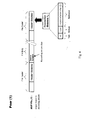
- Connection Metadata in all these MXF files have the same task ID value. Every peer communicates with each other through control metadata designed by the distributed storage system. The recording procedure is described in detail in the following (compare Fig. 4 to 8):
- the input stream is recorded into a sequence of MXF files (1,2,..n).
- MXF files (1,2,..n).
- MXF features enable stream-able playback of its essence in the MXF Essence Container.
- control metadata that are designed and generated by the distributed storage system, it is possible to set up stream-able playback among a group of peers.
- MXF decoders are not required to be able to decode Open MXF files, it shall be assumed herein to be possible to playback these concatenated Open MXF files with Connected Metadata. As shown in Fig. 4-7, usually these embedded Connection Metadata in each MXF file provide reference to all prior concatenated MXF files and only the next MXF file. For playback of these MXF files, it may be started from any MXF file of any peer (1,2,...,n) to set up the playback task.
- each MXF file contains compact Connection Metadata, which link to all other concatenated MXF files.
- a playback task may start from any MXF file of any peer (1,...,n). Only Connection Metadata in the current MXF file need to be parsed, since it includes all reference messages about all concatenated MXF files from any one selected MXF file. Based on the reference messages from one MXF file in one peer, the stream-able playback task in the system can be set up.
- Connection Metadata Packages in the Header Metadata. Connection Metadata in different packages are distinguished with their Task ID. Different Connection Metadata Packages direct to different sequences of concatenated MXF files. This design may be useful in the following scenarios:
- Connection Metadata in the same package will have the same Task ID, which represents a sequence of concatenated MXF files. Different packages direct to different sequences of MXF files. In this application, multiple sequences of concatenated MXF files are generated.
- the invention is usable for all kinds of stream recording devices that can be used in distributed storage networks, particularly audio and/or video stream recorders in decentralized networks, such as peer-to-peer networks.
Landscapes
- Engineering & Computer Science (AREA)
- Signal Processing (AREA)
- Theoretical Computer Science (AREA)
- Physics & Mathematics (AREA)
- General Engineering & Computer Science (AREA)
- General Physics & Mathematics (AREA)
- Information Retrieval, Db Structures And Fs Structures Therefor (AREA)
- Television Signal Processing For Recording (AREA)
Abstract
Description
- Fig. 1
- an overall data structure of a simple MXF file according to the standard;
- Fig. 2
- an overall data structure of an MXF file with some optional components;
- Fig. 3
- a scheme of splitting a metadata according to the present invention;
- Fig. 4
- the insertion of connection metadata to an
MXF file 1 after stream recording on apeer 1 of a distributed storage system; - Fig. 5
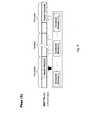
- the insertion of connection metadata to an
MXF file 2 before and after stream recording on apeer 2 of the distributed storage system; - Fig. 6
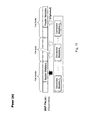
- the insertion of connection metadata to an MXF file k before and after stream recording on a peer k [k= 2,3, ... (n-1)] of the distributed storage systems;
- Fig. 7
- the insertion of connection metadata to an MXF file n before and after stream recording on a peer n;
- Fig. 8
- the connection metadata of the
MXF file 1 in a closed and completed status; - Fig. 9
- the connection metadata in the MXF file k in the closed and completed status;
- Fig. 10
- the connection metadata in the MXF file n in the closed and completed status; and
- Fig. 11
- connection metadata packages in an MXF file.
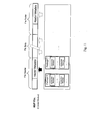
The input stream will be rerouted to another peer after terminating the recording task in peer (2), a Connection Metadata (2N) will be inserted in the Header Metadata of the File Footer of peer (2). The Attribute of Connection Metadata (2N) is "next" and its Reference includes the UUID of the next MXF file (3), see Fig. 5.
Claims (16)
- Method for recording a data stream on a distributed storage system
characterized bypacking said data stream into at least a first MXF file (1) and a second MXF file (2),inserting first connection data (1N) into said first MXF file (1), said first connection data (1N) pointing to said second MXF file (2), andinserting second connection data (2L) into said second MXF file (2), said second connection data (2L) pointing to said first MXF file (1). - Method according to claim 1, further including the step of inserting third connection data (2N) into said second MXF file (2), said third connection data (2N) pointing to a third MXF file (3).
- Method according to claim 1 or 2, wherein said step or steps of inserting connection data is/are performed while terminating said recording of the respective MXF file.
- Method according to one of the preceding claims, wherein said data stream is split into a specific number of MXF files and connection data pointing to all of these MXF files are stored in each of said specific number of MXF files.
- Method according to one of the preceding claims, wherein connection data are inserted into header and/or footer data of an MXF file.
- Device for recording a data stream on a distributed storage system
characterized bypacking means for packing said data stream into at least a first MXF file (1) and a second MXF file (2),data processing means for inserting first connection data (1N) into said first MXF file (1), said first connection data (1N) pointing to said second MXF file (2), and for inserting second connection data (2L) into said second MXF file (2), said second connection data (2L) pointing to said first MXF file (1). - Device according to claim 6, wherein said data processing means is suitable for inserting third connection data (2N) into said second MXF file (2), said third connection data (2N) pointing to a third MXF file (3).
- Device according to claim 6 or 7, wherein said packing means enables splitting of said data stream into a specific number of MXF files and connection data pointing to all these MXF files are storable in each of said specific number of MXF files.
- Device according to one of the claims 6 to 8, wherein said data processing means are suitable for inserting connection data into header and/or footer data of a MXF file.
- Method for playing back a data stream recorded on a distributed storage system
characterized byreading connection data (1N) from a first MXF file (1), said connection data (1N) pointing to a second MXF file (2),building a MXF file chain on the basis of said connection data (1N) andplaying back the essence data of said first MXF file (1) and said second MXF file (2) according to said MXF file chain. - Method according to claim 10, wherein said step of reading connection data is repeated for each MXF file of said MXF file chain.
- Method according to claim 10, wherein said step of reading connection data is performed only once for one MXF file chain, wherein connection data pointing to all MXF files of said MXF file chain are included in each of said MXF files of said MXF file chain.
- Device for playing back a data stream recorded on a distributed storage system
characterized byreading means for reading connection data (1N) from a first MXF file (1), said connection data pointing to a second MXF file (2),data processing means for building a MXF file chain on the basis of said connection data (1N) andplaying means for playing back the essence data of said first MXF file (1) and said second MXF file (2) according to said MXF file chain. - Device according to claim 13, wherein said reading means is able to read connection data from each MXF file of said MXF file chain.
- Device according to claim 13, wherein said reading means is able to read all connection data of a MXF file chain from one MXF file of said MXF file chain.
- Method or device according to one of the preceding claims, wherein said connection data includes task data, attribute data and reference data, said task data contains a task ID value, said attribute data contains a status value like "next" or "last" and said reference data contains an ID value of another MXF file.
Priority Applications (7)
| Application Number | Priority Date | Filing Date | Title |
|---|---|---|---|
| EP04009912A EP1592015A3 (en) | 2004-04-27 | 2004-04-27 | Method and device for recording or playing back a data stream |
| JP2007509945A JP2008500608A (en) | 2004-04-27 | 2005-04-22 | Method and stream in a distributed storage system |
| EP05734272A EP1741105A1 (en) | 2004-04-27 | 2005-04-22 | Method and sreams in distributed storage systems |
| CN2005800126564A CN1965368B (en) | 2004-04-27 | 2005-04-22 | Method and device for playback for data stream |
| US11/587,473 US8615602B2 (en) | 2004-04-27 | 2005-04-22 | Method and device for recording or playing back a data stream |
| PCT/EP2005/004377 WO2005104127A1 (en) | 2004-04-27 | 2005-04-22 | Method and sreams in distributed storage systems |
| KR1020067022148A KR20070007160A (en) | 2004-04-27 | 2005-04-22 | Methods and Streams in Distributed Storage Systems |
Applications Claiming Priority (1)
| Application Number | Priority Date | Filing Date | Title |
|---|---|---|---|
| EP04009912A EP1592015A3 (en) | 2004-04-27 | 2004-04-27 | Method and device for recording or playing back a data stream |
Publications (2)
| Publication Number | Publication Date |
|---|---|
| EP1592015A2 true EP1592015A2 (en) | 2005-11-02 |
| EP1592015A3 EP1592015A3 (en) | 2005-11-09 |
Family
ID=34924746
Family Applications (2)
| Application Number | Title | Priority Date | Filing Date |
|---|---|---|---|
| EP04009912A Withdrawn EP1592015A3 (en) | 2004-04-27 | 2004-04-27 | Method and device for recording or playing back a data stream |
| EP05734272A Withdrawn EP1741105A1 (en) | 2004-04-27 | 2005-04-22 | Method and sreams in distributed storage systems |
Family Applications After (1)
| Application Number | Title | Priority Date | Filing Date |
|---|---|---|---|
| EP05734272A Withdrawn EP1741105A1 (en) | 2004-04-27 | 2005-04-22 | Method and sreams in distributed storage systems |
Country Status (6)
| Country | Link |
|---|---|
| US (1) | US8615602B2 (en) |
| EP (2) | EP1592015A3 (en) |
| JP (1) | JP2008500608A (en) |
| KR (1) | KR20070007160A (en) |
| CN (1) | CN1965368B (en) |
| WO (1) | WO2005104127A1 (en) |
Cited By (2)
| Publication number | Priority date | Publication date | Assignee | Title |
|---|---|---|---|---|
| CN102118315A (en) * | 2011-02-28 | 2011-07-06 | 华为技术有限公司 | Method for fluidizing, recording and reading data and system adopting same |
| EP2234392B1 (en) * | 2008-01-07 | 2017-11-29 | Kabushiki Kaisha Toshiba | Material processing apparatus and material processing method |
Families Citing this family (24)
| Publication number | Priority date | Publication date | Assignee | Title |
|---|---|---|---|---|
| US8782654B2 (en) | 2004-03-13 | 2014-07-15 | Adaptive Computing Enterprises, Inc. | Co-allocating a reservation spanning different compute resources types |
| WO2005089239A2 (en) | 2004-03-13 | 2005-09-29 | Cluster Resources, Inc. | System and method of providing a self-optimizing reservation in space of compute resources |
| US20070266388A1 (en) | 2004-06-18 | 2007-11-15 | Cluster Resources, Inc. | System and method for providing advanced reservations in a compute environment |
| US8176490B1 (en) | 2004-08-20 | 2012-05-08 | Adaptive Computing Enterprises, Inc. | System and method of interfacing a workload manager and scheduler with an identity manager |
| US8271980B2 (en) | 2004-11-08 | 2012-09-18 | Adaptive Computing Enterprises, Inc. | System and method of providing system jobs within a compute environment |
| US8863143B2 (en) | 2006-03-16 | 2014-10-14 | Adaptive Computing Enterprises, Inc. | System and method for managing a hybrid compute environment |
| US9075657B2 (en) | 2005-04-07 | 2015-07-07 | Adaptive Computing Enterprises, Inc. | On-demand access to compute resources |
| US9231886B2 (en) | 2005-03-16 | 2016-01-05 | Adaptive Computing Enterprises, Inc. | Simple integration of an on-demand compute environment |
| EP1866767B1 (en) | 2005-03-16 | 2018-04-18 | III Holdings 12, LLC | Automatic workload transfer to an on-demand center |
| US20100281165A1 (en) * | 2006-11-14 | 2010-11-04 | Christoph Gerdes | Method for the load distribution in a peer-to-peer-overlay network |
| US8041773B2 (en) | 2007-09-24 | 2011-10-18 | The Research Foundation Of State University Of New York | Automatic clustering for self-organizing grids |
| JP4679609B2 (en) * | 2008-06-05 | 2011-04-27 | 株式会社東芝 | Video recording / reproducing apparatus, video recording method and video reproducing method |
| KR101475939B1 (en) | 2008-07-02 | 2014-12-23 | 삼성전자 주식회사 | A control method of an image processing apparatus, an image processing apparatus, |
| JP4686587B2 (en) * | 2008-10-16 | 2011-05-25 | 株式会社東芝 | Video recording / reproducing apparatus and file management method |
| US11720290B2 (en) | 2009-10-30 | 2023-08-08 | Iii Holdings 2, Llc | Memcached server functionality in a cluster of data processing nodes |
| US10877695B2 (en) | 2009-10-30 | 2020-12-29 | Iii Holdings 2, Llc | Memcached server functionality in a cluster of data processing nodes |
| JP5822452B2 (en) * | 2010-10-22 | 2015-11-24 | 株式会社インテック | Storage service providing apparatus, system, service providing method, and service providing program |
| CN102737196A (en) * | 2011-09-23 | 2012-10-17 | 新奥特(北京)视频技术有限公司 | Method for configuring information, user equipment, server and system in data safety prevention and control |
| CN102737176A (en) * | 2011-09-23 | 2012-10-17 | 新奥特(北京)视频技术有限公司 | Data security prevention and control file analysis method and device |
| CN102693374A (en) * | 2011-09-23 | 2012-09-26 | 新奥特(北京)视频技术有限公司 | File analysis method, user equipment, server and system for data security monitoring and controlling |
| US9473668B2 (en) * | 2011-11-01 | 2016-10-18 | Siemens Industry, Inc. | Distributed storage and processing of mail image data |
| JP5174255B2 (en) * | 2012-02-28 | 2013-04-03 | 株式会社インテック | Storage service providing apparatus, system, service providing method, and service providing program |
| US9762634B2 (en) * | 2012-04-06 | 2017-09-12 | At&T Intellectual Property I, L.P. | System and method to transmit digital broadcast grade video via a cellular data network |
| US9159367B2 (en) | 2013-08-19 | 2015-10-13 | Nvidia Corporation | Automatic playback of one or more excerpt(s) of a video sequence on a data processing device |
Family Cites Families (7)
| Publication number | Priority date | Publication date | Assignee | Title |
|---|---|---|---|---|
| JPH11175377A (en) * | 1997-12-11 | 1999-07-02 | Meidensha Corp | File management method |
| JP2000099375A (en) * | 1998-09-22 | 2000-04-07 | Nec Eng Ltd | File management device, file managing method for the same and storage medium with its control program recorded therein |
| US6499083B1 (en) * | 1999-09-15 | 2002-12-24 | Western Digital Ventures, Inc. | Disk-based storage system responsive to a direction-selection signal for autonomously controlling seeks in a sequence determined by the direction-selection signal and a locally-stored doubly linked list |
| GB2371889A (en) * | 2001-02-02 | 2002-08-07 | Sony Uk Ltd | Data structures |
| JP2002351705A (en) * | 2001-05-23 | 2002-12-06 | Matsushita Electric Ind Co Ltd | Digital signal recording / reproducing apparatus and digital signal recording / reproducing method |
| US7295755B2 (en) * | 2001-06-22 | 2007-11-13 | Thomson Licensing | Method and apparatus for simplifying the access of metadata |
| US7149750B2 (en) * | 2001-12-19 | 2006-12-12 | International Business Machines Corporation | Method, system and program product for extracting essence from a multimedia file received in a first format, creating a metadata file in a second file format and using a unique identifier assigned to the essence to access the essence and metadata file |
-
2004
- 2004-04-27 EP EP04009912A patent/EP1592015A3/en not_active Withdrawn
-
2005
- 2005-04-22 US US11/587,473 patent/US8615602B2/en not_active Expired - Fee Related
- 2005-04-22 JP JP2007509945A patent/JP2008500608A/en active Pending
- 2005-04-22 WO PCT/EP2005/004377 patent/WO2005104127A1/en not_active Ceased
- 2005-04-22 KR KR1020067022148A patent/KR20070007160A/en not_active Ceased
- 2005-04-22 EP EP05734272A patent/EP1741105A1/en not_active Withdrawn
- 2005-04-22 CN CN2005800126564A patent/CN1965368B/en not_active Expired - Fee Related
Cited By (3)
| Publication number | Priority date | Publication date | Assignee | Title |
|---|---|---|---|---|
| EP2234392B1 (en) * | 2008-01-07 | 2017-11-29 | Kabushiki Kaisha Toshiba | Material processing apparatus and material processing method |
| CN102118315A (en) * | 2011-02-28 | 2011-07-06 | 华为技术有限公司 | Method for fluidizing, recording and reading data and system adopting same |
| CN102118315B (en) * | 2011-02-28 | 2013-01-09 | 华为技术有限公司 | Method for fluidizing, recording and reading data and system adopting same |
Also Published As
| Publication number | Publication date |
|---|---|
| KR20070007160A (en) | 2007-01-12 |
| EP1592015A3 (en) | 2005-11-09 |
| CN1965368A (en) | 2007-05-16 |
| EP1741105A1 (en) | 2007-01-10 |
| US8615602B2 (en) | 2013-12-24 |
| US20070226313A1 (en) | 2007-09-27 |
| JP2008500608A (en) | 2008-01-10 |
| CN1965368B (en) | 2012-07-18 |
| WO2005104127A1 (en) | 2005-11-03 |
Similar Documents
| Publication | Publication Date | Title |
|---|---|---|
| US8615602B2 (en) | Method and device for recording or playing back a data stream | |
| US7480441B2 (en) | Method for seamless real-time splitting and concatenating of a data stream | |
| US11647071B2 (en) | Method and apparatus for transmitting and receiving content | |
| JP4953407B2 (en) | Combining video material and data | |
| CN100501725C (en) | Simplifying nethod and apparatus for access of metadata | |
| US7337320B2 (en) | Streaming system for distributing encrypted data, and streaming method therefor | |
| US8667158B2 (en) | Video splitting and distributed placement scheme for clustered video servers | |
| JP2005504480A (en) | Streaming multimedia files including metadata and media data | |
| US20050005289A1 (en) | Method of linking metadata to a data stream | |
| CA2337116A1 (en) | Method of converting a packetized stream of information signals into a stream of information signals with time stamps and vice versa | |
| KR20050075633A (en) | Information storage medium containing multimedia data, reproducing method and apparatus thereof | |
| JP4679609B2 (en) | Video recording / reproducing apparatus, video recording method and video reproducing method | |
| KR101012187B1 (en) | Method for seamless real-time separation and connection of data streams | |
| CN113169969A (en) | Multicast to unicast conversion | |
| KR100315310B1 (en) | Multiple data synchronizing method and multiple multimedia data streaming method using the same | |
| Wilkinson et al. | The material exchange format (mxf) and its application | |
| JP2006129078A (en) | Data file editing method and apparatus, control program, and storage medium | |
| JP2004356751A (en) | Information processing apparatus, information processing method, and recording medium | |
| JP2000010984A (en) | Data retrieval device | |
| JP2006129081A (en) | Data file editing method and apparatus, control program, and storage medium | |
| JP2004515022A (en) | Method of providing program specification information on information recording medium | |
| Shibata et al. | Introduction to XDCAM Metadata | |
| Edge et al. | SMPTE 360M: General Exchange Format | |
| Wells et al. | 15 Practical Examples and Approaches to Using MXF | |
| Edge et al. | SMPTE 360M: General Exchange |
Legal Events
| Date | Code | Title | Description |
|---|---|---|---|
| PUAI | Public reference made under article 153(3) epc to a published international application that has entered the european phase |
Free format text: ORIGINAL CODE: 0009012 |
|
| PUAL | Search report despatched |
Free format text: ORIGINAL CODE: 0009013 |
|
| AK | Designated contracting states |
Kind code of ref document: A2 Designated state(s): AT BE BG CH CY CZ DE DK EE ES FI FR GB GR HU IE IT LI LU MC NL PL PT RO SE SI SK TR |
|
| AX | Request for extension of the european patent |
Extension state: AL HR LT LV MK |
|
| AK | Designated contracting states |
Kind code of ref document: A3 Designated state(s): AT BE BG CH CY CZ DE DK EE ES FI FR GB GR HU IE IT LI LU MC NL PL PT RO SE SI SK TR |
|
| AX | Request for extension of the european patent |
Extension state: AL HR LT LV MK |
|
| AKX | Designation fees paid | ||
| STAA | Information on the status of an ep patent application or granted ep patent |
Free format text: STATUS: THE APPLICATION IS DEEMED TO BE WITHDRAWN |
|
| 18D | Application deemed to be withdrawn |
Effective date: 20060510 |
|
| REG | Reference to a national code |
Ref country code: DE Ref legal event code: 8566 |