EP1591847A1 - Scheduling of industrial production processes - Google Patents
Scheduling of industrial production processes Download PDFInfo
- Publication number
- EP1591847A1 EP1591847A1 EP04405261A EP04405261A EP1591847A1 EP 1591847 A1 EP1591847 A1 EP 1591847A1 EP 04405261 A EP04405261 A EP 04405261A EP 04405261 A EP04405261 A EP 04405261A EP 1591847 A1 EP1591847 A1 EP 1591847A1
- Authority
- EP
- European Patent Office
- Prior art keywords
- variable
- optimal
- parameter variables
- decision variable
- parameter
- Prior art date
- Legal status (The legal status is an assumption and is not a legal conclusion. Google has not performed a legal analysis and makes no representation as to the accuracy of the status listed.)
- Withdrawn
Links
Images

Classifications
-
- G—PHYSICS
- G05—CONTROLLING; REGULATING
- G05B—CONTROL OR REGULATING SYSTEMS IN GENERAL; FUNCTIONAL ELEMENTS OF SUCH SYSTEMS; MONITORING OR TESTING ARRANGEMENTS FOR SUCH SYSTEMS OR ELEMENTS
- G05B13/00—Adaptive control systems, i.e. systems automatically adjusting themselves to have a performance which is optimum according to some preassigned criterion
- G05B13/02—Adaptive control systems, i.e. systems automatically adjusting themselves to have a performance which is optimum according to some preassigned criterion electric
- G05B13/04—Adaptive control systems, i.e. systems automatically adjusting themselves to have a performance which is optimum according to some preassigned criterion electric involving the use of models or simulators
-
- Y—GENERAL TAGGING OF NEW TECHNOLOGICAL DEVELOPMENTS; GENERAL TAGGING OF CROSS-SECTIONAL TECHNOLOGIES SPANNING OVER SEVERAL SECTIONS OF THE IPC; TECHNICAL SUBJECTS COVERED BY FORMER USPC CROSS-REFERENCE ART COLLECTIONS [XRACs] AND DIGESTS
- Y02—TECHNOLOGIES OR APPLICATIONS FOR MITIGATION OR ADAPTATION AGAINST CLIMATE CHANGE
- Y02E—REDUCTION OF GREENHOUSE GAS [GHG] EMISSIONS, RELATED TO ENERGY GENERATION, TRANSMISSION OR DISTRIBUTION
- Y02E20/00—Combustion technologies with mitigation potential
- Y02E20/16—Combined cycle power plant [CCPP], or combined cycle gas turbine [CCGT]
Landscapes
- Engineering & Computer Science (AREA)
- Software Systems (AREA)
- Artificial Intelligence (AREA)
- Computer Vision & Pattern Recognition (AREA)
- Evolutionary Computation (AREA)
- Medical Informatics (AREA)
- Health & Medical Sciences (AREA)
- Physics & Mathematics (AREA)
- General Physics & Mathematics (AREA)
- Automation & Control Theory (AREA)
- Management, Administration, Business Operations System, And Electronic Commerce (AREA)
- General Factory Administration (AREA)
- Multi-Process Working Machines And Systems (AREA)
Abstract
The drawback of traditional production scheduling algorithms is that the time dependent parameters must be known in advance and must be fixed. In practice this is never the case, which implies that the optimization problem has to be re-solved in order to compute the optimum production schedule. The present invention shows that a corresponding rescheduling problem can be reformulated as a multi-parametric (mp-QP) optimization problem which can be solved explicitly. The subsequent exploitation of this algebraic solution is computationally significantly cheaper than the traditional approach where an optimization problem has to be solved for each reschedule.
Description
- The invention relates to the field of industrial production processes and their optimal scheduling. It departs from a production scheduler and a method of optimizing an industrial production schedule as described in the preamble of claims 1 and 3, respectively.
- Operators of modem industrial processes are increasingly confronted with the simultaneous tasks of satisfying technological, contractual and environmental constraints. For example, there is pressure on operators and owners to increase profit and margins while at the same time there is a high public interest on sustainable and environmentally friendly use of natural resources. Profit maximization production scheduling tasks capable of handling the aforementioned requirements can often be formulated as the minimization problem of a performance index, objective function or cost function in a condensed way as follows:Here, the matrix Q is assumed to be symmetric (this entails no loss of generality, because any quadratic form can be rewritten as
 with the constraints Q ji = Q ij , i, j =1, ... , n ). Furthermore, the matrix Q is assumed to be positive semi-definite, in order for the optimization problem to be convex and have a global optimum solution.
- In the above minimization problem, u is the production decision variable (e.g., the vector of production values indicating the quantity of each product to be produced), p is the sales price (e.g., row vector of prices obtainable for each product), Q and c are cost matrices of appropriate size that define the production cost, and A (constraint matrix) and b (constraint vector) define constraints or boundaries on the production (e.g. minimum and maximum production limits). The solution u* of the above problem gives the preferred production values or quantities of the various products for a given set of parameters p, Q, c, A and b.
- However, the vectors of production costs and prices generally take different values at different times. Hence the drawback of such a formulation is that the time dependent parameters, e.g. sales price p and the production limit values A and b, must be known in advance and must be fixed. In practice this is never the case, as e.g. the price values are uncertain or the production costs might change abruptly. This implies that the optimization problem has to be re-solved in order to compute the optimum production schedule, which is known as the rescheduling problem. One approach to the rescheduling problem is to use a receding horizon or Model Predictive Control (MPC) scheme.
- In the article "Using Model Predictive Control and Hybrid Systems for Optimal Scheduling of Industrial Processes", by E. Gallestey et al., AT Automatisierungstechnik, Vol. 51, no. 6, 2003, pp. 285-293, a cascade approach is presented, based on an outer and an inner loop Model Predictive Control (MPC) scheme. The outer loop MPC algorithm computes reference schedules by using objective functions related to the plant economic goals (minimum electricity consumption and fuel usage, ageing costs, respect of contractual constraints such as customer orders or supply of raw materials, etc.). Applied to the practical case of a combined cycle power plant (CCPP), the scheduling process uses forecast prices for electricity and steam generated by the CCPP and energy demands as inputs and returns an operation schedule indicating when the gas and steam turbines should be turned on/off and what production level should be selected. Updating or re-computation of this reference schedule is done every two or more days. The inner loop's goal is to react to deviations due to changing conditions by penalizing deviations from the reference schedule. Using real-time plant data, the necessary corrections are computed online every hour or two. This cascade approach allows that short-term rescheduling and production plan corrections are handled with minimum changes to the overall plant schedule, and in a way suitable for implementation under real conditions. Yet no matter how sophisticated the assignment of the changing parameters to the one of the two loops and the choice of the respective receding horizons may be, an optimization problem with appreciable computational efforts has to be solved for the short-term corrections.
- On the other hand, in the field of controller design, and in particular in the area of Model Predictive Control (MPC), a significant amount of research effort has gone into explicit computation of MPC controllers for use in embedded environments. In the article "An Algorithm for Multi-Parametric Quadratic Programming and Explicit MPC Solutions" by P. Tondel et al., Automatica, Vol. 39, no. 3, March 2003, pp 489-497, constrained linear MPC optimization problems are investigated. The state variable is converted into a vector of parameters and the MPC problem is algebraically reformulated as a multi-parametric quadratic programming (mp-QP) problem. Explicit solutions, i.e. analytic expressions for an input variable suitable for implementation in on-line controllers are shown to exist, c.f. theorem 1 of the paper, and obtained by off-line solving the mp-QP problem. In this context, multi-parametric programming stands for solving an optimization problem for a range (e.g. a time series) of parameter values of a vector of parameters.
- It is therefore an objective of the invention to adapt an industrial production schedule to changing conditions in real-time and with reasonable computational efforts. These objectives are achieved by a production scheduler for an optimal scheduling of industrial production processes and a method of optimizing an industrial production schedule according to the claims 1 and 3. Further preferred embodiments are evident from the dependent patent claims.
- According to the invention, an algebraic expression or analytic function depending on parameter variables of an industrial production process is provided for rescheduling or adaptation of the industrial production schedule to a change in the values of said parameter variables. Hence, no time-consuming optimization problem has to be solved online upon the occurrence of a changing parameter value. The algebraic expression results from a multi-parametric quadratic programming (mp-QP) reformulation of the original optimization problem involving said parameter variables as parameters. A QP-variable is defined as a transformation of the original production decision variable via augmentation or mapping. The proposed solution however is limited to situations where the original optimization problem can be represented by a convex objective function that is quadratic in the decision variable and bilinear in the decision and parameter variable. No logical process related constraints are taken into account.
- The invention shows that an approach based on multi-parametric programming can be used for the rescheduling problems described in the introductory part. The primary advantage over existing techniques is the much faster rescheduling computation times. It is to be understood that the protection for the invention is not intended to be limited to the actual scheduler and method listed, but is expected to cover the corresponding computer programs as well.
- The subject matter of the invention will be explained in more detail in the following text with reference to preferred exemplary embodiments which are illustrated in the attached drawing (fig.1), which shows a flow chart of a method of deriving the optimal production schedule u*(b, c, p).
- As the techniques for solving multi-parametric quadratic programs (mp-QP) are known in the literature as set out in the introductory part, the invention shows how the rescheduling problem can be reformulated as an mp-QP. In the following two embodiments, the sale prices p and the production costs c are considered to be time-dependent parameters of the original scheduling problem, but uncertainties on other parameters could also be treated in a similar way. For instance, the vector b of production limits could be, albeit in a straightforward manner, included in a mp-QP formulation.
- In Fig.1, a flow chart depicts the main steps required for obtaining the optimal production schedule u*(b, c, p) according to an embodiment of the invention. The ingredients of the original optimization problem, i.e. the objective function for and the constraints on the original production decision variable u are redefined or transformed. In order to formulate the mp-QP problem, a QP-variable z is introduced and QP-constraints on this QP-variable z are established. As set out above, the mp-QP problem can be solved analytically, yielding an algebraic expression for the optimum QP-variable z*, from which in turn the optimum decision variable u* can be reversely determined.
- Using the variable definitions as set out above, the relevant difference between the potentially uncertain or time-dependent production parameters c and p are combined into an augmenting parameter variable P by notingA QP-variable z is then defined by augmenting the original production decision variable u with the augmenting parameter variable P
 and the initial rescheduling optimization problem is rewritten as an mp-QP problem of the following form:

- The constraints on the decision variable u are complemented by constraints on the augmenting parameter variable P in order to constrain the production parameters c and p to their actual values. The resulting constraints on the QP-variable z thus become

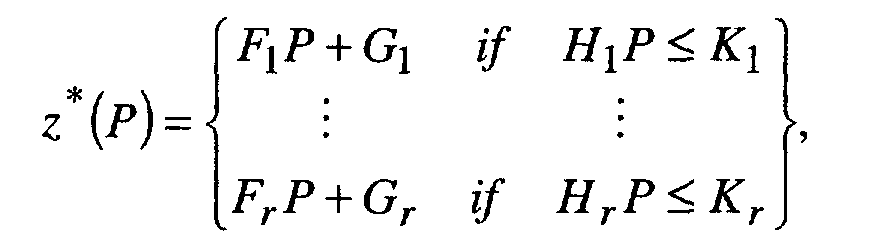
- According to the abovementioned article by Tondel et al., the algebraic expression or analytic solution of a quadratic program is a piecewise-affine mapping. In consequence, the solution z* of the mp-QP problem is of the explicit formwhere, for i = 1, ..., r, the parameters F i , G i , H i , and K i are matrices of appropriate size and the index r refers to an area in the space of the parameter P. This implies that the optimal values of the original production decision variable u*(P) = u*(c,p) can be computed directly from the parameters c, p without having to solve an optimization problem. Hence, an entire production schedule can be established given the known future parameter values, and/or can be adapted on-line upon a parameter change with a reasonable computational effort.
- In the second embodiment, the requirements regarding the properties of the cost matrix Q are slightly more stringent: Q is assumed to be (strictly) positive definite. It implies that Q is invertible, which allows to centralize the quadratic form, thereby reducing the complexity of the multi-parametric optimization problem significantly. Using the corallary below, the original scheduling problemcan be centralized to


- Making use of the symmetry of Q,where d = -2Qy 0 and hence y 0 =- 1 / 2Q -1 d. It follows that
 is equivalent to
 as the term y T / 0 Qy 0 is constant in the optimization variable y.
Claims (6)
- A production scheduler for an optimal scheduling of industrial production processes determined bywherein the scheduler comprises computing means for calculating an optimal production schedule u*,a decision variable (u) and constraints (A, b) on the decision variable (u),parameter variables (b, c, p) representing generalized limits, costs and revenues,a positive semi-definite cost matrix (Q),an objective function depending quadratically, via the cost matrix (Q), on the decision variable (u) and depending bilinearly on the decision variable (u) and the parameter variables (b, c, p),
characterized in that the computing means evaluate an algebraic expression for the optimal production schedule u*(b, c, p) as a function of the parameter variables (b, c, p). - The production scheduler according to claim 1, characterized in that the algebraic expression for the optimal production schedule u*(b, c, p) is obtained bya) formulating a multi-parametric quadratic programming (mp-QP) problem, includinga QP-variable (z) being defined based on the decision variable (u) and the parameter variables (b, c, p),the objective function being rewritten in general quadratic form (eq.1.1, eq.2.1) in the QP-variable (z),linear constraints on the QP-variable (z) (eq.1.2, eq.2.2) being defined based on the constraints (A, b) on the decision variable (u) and the parameter variables (b, c, p),b) solving the mp-QP problem for an algebraic expression of the optimal QP-variable z* as a function of the parameter variables (b, c, p), andc) deriving the algebraic expression for the optimal production schedule u*(b, c, p) from the algebraic expression of the optimal QP-variable z*.
- A method of optimizing a production schedule of an industrial production process determined bycharacterized in that an algebraic expression for the optimal production schedule u*(b, c, p) as a function of the parameter variables (b, c, p) is obtained bya decision variable (u) and constraints (A, b) on the decision variable (u),parameter variables (b, c, p) representing generalized limits, costs and revenues,a positive semi-definite cost matrix (Q),an objective function depending quadratically, via the cost matrix (Q), on the decision variable (u) and depending bilinearly on the decision variable (u) and the parameter variables (b, c, p),and in that the algebraic expression for the optimal production schedule u*(b, c, p) obtained is evaluated as a function of the parameter variables (b, c, p).a) formulating a multi-parametric quadratic programming (mp-QP) problem, includinga QP-variable (z) being defined based on the decision variable (u) and the parameter variables (b, c, p),the objective function being rewritten in general quadratic form (eq.1.1, eq.2.1) in the QP-variable (z),linear constraints on the QP-variable (z) (eq.1.2, eq.2.2) being defined based on the constraints (A, b) on the decision variable (u) and the parameter variables (b, c, p),b) solving the mp-QP problem for an algebraic expression of the optimal QP-variable z* as a function of the parameter variables (b, c, p),c) deriving the algebraic expression for the optimal production schedule u*(b, c, p) from the algebraic expression of the optimal QP-variable z*,
- The method according to claim 3, characterized in that the algebraic expression for the optimal production schedule u*(b, c, p) is evaluated on-line upon a change in the value of a parameter variable (b, c, p).
- The method according to claim 3, characterized in that the QP-variable (z) has the twofold dimension as the decision variable (u) and is obtained by augmenting the decision variable (u) with an augmenting parameter variable (P) equal to a difference between the parameter variables (c-p), and in that constraints on the QP-variable (z) (eq.1.2) constrain the augmenting parameter variable (P) to its given value.
- The method according to claim 3, wherein the matrix Q is positive definite, characterized in that the QP-variable (z) has the same dimension as the decision variable (u) and is obtained by mapping the parameter variables (c, p) on the decision variable (u).
Priority Applications (9)
| Application Number | Priority Date | Filing Date | Title |
|---|---|---|---|
| EP04405261A EP1591847A1 (en) | 2004-04-27 | 2004-04-27 | Scheduling of industrial production processes |
| JP2007509849A JP2007535046A (en) | 2004-04-27 | 2005-04-25 | Scheduling industrial production processes |
| CNA2005800133695A CN1947074A (en) | 2004-04-27 | 2005-04-25 | Scheduling of industrial production processess |
| PCT/CH2005/000231 WO2005103847A1 (en) | 2004-04-27 | 2005-04-25 | Scheduling of industrial production processess |
| DE602005002839T DE602005002839T2 (en) | 2004-04-27 | 2005-04-25 | PROCESSING OF INDUSTRIAL PRODUCTION PROCESSES |
| KR1020067022440A KR20070004912A (en) | 2004-04-27 | 2005-04-25 | Scheduling of Industrial Production Process |
| EP05731516A EP1743223B1 (en) | 2004-04-27 | 2005-04-25 | Scheduling of industrial production processess |
| AT05731516T ATE375533T1 (en) | 2004-04-27 | 2005-04-25 | SEQUENCE PLANNING OF INDUSTRIAL PRODUCTION PROCESSES |
| US11/586,713 US20070088447A1 (en) | 2004-04-27 | 2006-10-26 | Scheduling of industrial production processes |
Applications Claiming Priority (1)
| Application Number | Priority Date | Filing Date | Title |
|---|---|---|---|
| EP04405261A EP1591847A1 (en) | 2004-04-27 | 2004-04-27 | Scheduling of industrial production processes |
Publications (1)
| Publication Number | Publication Date |
|---|---|
| EP1591847A1 true EP1591847A1 (en) | 2005-11-02 |
Family
ID=34932079
Family Applications (2)
| Application Number | Title | Priority Date | Filing Date |
|---|---|---|---|
| EP04405261A Withdrawn EP1591847A1 (en) | 2004-04-27 | 2004-04-27 | Scheduling of industrial production processes |
| EP05731516A Expired - Lifetime EP1743223B1 (en) | 2004-04-27 | 2005-04-25 | Scheduling of industrial production processess |
Family Applications After (1)
| Application Number | Title | Priority Date | Filing Date |
|---|---|---|---|
| EP05731516A Expired - Lifetime EP1743223B1 (en) | 2004-04-27 | 2005-04-25 | Scheduling of industrial production processess |
Country Status (8)
| Country | Link |
|---|---|
| US (1) | US20070088447A1 (en) |
| EP (2) | EP1591847A1 (en) |
| JP (1) | JP2007535046A (en) |
| KR (1) | KR20070004912A (en) |
| CN (1) | CN1947074A (en) |
| AT (1) | ATE375533T1 (en) |
| DE (1) | DE602005002839T2 (en) |
| WO (1) | WO2005103847A1 (en) |
Cited By (2)
| Publication number | Priority date | Publication date | Assignee | Title |
|---|---|---|---|---|
| EP2607975A1 (en) * | 2011-12-21 | 2013-06-26 | Siemens Aktiengesellschaft | Model-based predictive regulator and method for regulating a technical process |
| EP2639435A1 (en) * | 2012-03-16 | 2013-09-18 | Perkins Engines Company Limited | Optimised real-time control of a highly dynamic engine system |
Families Citing this family (40)
| Publication number | Priority date | Publication date | Assignee | Title |
|---|---|---|---|---|
| US7948769B2 (en) | 2007-09-27 | 2011-05-24 | Hemisphere Gps Llc | Tightly-coupled PCB GNSS circuit and manufacturing method |
| US7885745B2 (en) * | 2002-12-11 | 2011-02-08 | Hemisphere Gps Llc | GNSS control system and method |
| US8634993B2 (en) | 2003-03-20 | 2014-01-21 | Agjunction Llc | GNSS based control for dispensing material from vehicle |
| US9002565B2 (en) | 2003-03-20 | 2015-04-07 | Agjunction Llc | GNSS and optical guidance and machine control |
| US8594879B2 (en) | 2003-03-20 | 2013-11-26 | Agjunction Llc | GNSS guidance and machine control |
| US8138970B2 (en) | 2003-03-20 | 2012-03-20 | Hemisphere Gps Llc | GNSS-based tracking of fixed or slow-moving structures |
| US8190337B2 (en) | 2003-03-20 | 2012-05-29 | Hemisphere GPS, LLC | Satellite based vehicle guidance control in straight and contour modes |
| US8140223B2 (en) | 2003-03-20 | 2012-03-20 | Hemisphere Gps Llc | Multiple-antenna GNSS control system and method |
| US8271194B2 (en) | 2004-03-19 | 2012-09-18 | Hemisphere Gps Llc | Method and system using GNSS phase measurements for relative positioning |
| US8265826B2 (en) | 2003-03-20 | 2012-09-11 | Hemisphere GPS, LLC | Combined GNSS gyroscope control system and method |
| US8214111B2 (en) * | 2005-07-19 | 2012-07-03 | Hemisphere Gps Llc | Adaptive machine control system and method |
| US8686900B2 (en) | 2003-03-20 | 2014-04-01 | Hemisphere GNSS, Inc. | Multi-antenna GNSS positioning method and system |
| US8583315B2 (en) | 2004-03-19 | 2013-11-12 | Agjunction Llc | Multi-antenna GNSS control system and method |
| US8457997B2 (en) * | 2005-04-29 | 2013-06-04 | Landmark Graphics Corporation | Optimization of decisions regarding multiple assets in the presence of various underlying uncertainties |
| US8311696B2 (en) | 2009-07-17 | 2012-11-13 | Hemisphere Gps Llc | Optical tracking vehicle control system and method |
| US7835832B2 (en) | 2007-01-05 | 2010-11-16 | Hemisphere Gps Llc | Vehicle control system |
| USRE48527E1 (en) | 2007-01-05 | 2021-04-20 | Agjunction Llc | Optical tracking vehicle control system and method |
| US8000381B2 (en) | 2007-02-27 | 2011-08-16 | Hemisphere Gps Llc | Unbiased code phase discriminator |
| US7808428B2 (en) | 2007-10-08 | 2010-10-05 | Hemisphere Gps Llc | GNSS receiver and external storage device system and GNSS data processing method |
| US9002566B2 (en) | 2008-02-10 | 2015-04-07 | AgJunction, LLC | Visual, GNSS and gyro autosteering control |
| US8018376B2 (en) * | 2008-04-08 | 2011-09-13 | Hemisphere Gps Llc | GNSS-based mobile communication system and method |
| US8217833B2 (en) * | 2008-12-11 | 2012-07-10 | Hemisphere Gps Llc | GNSS superband ASIC with simultaneous multi-frequency down conversion |
| US8386129B2 (en) | 2009-01-17 | 2013-02-26 | Hemipshere GPS, LLC | Raster-based contour swathing for guidance and variable-rate chemical application |
| US8085196B2 (en) | 2009-03-11 | 2011-12-27 | Hemisphere Gps Llc | Removing biases in dual frequency GNSS receivers using SBAS |
| US8401704B2 (en) | 2009-07-22 | 2013-03-19 | Hemisphere GPS, LLC | GNSS control system and method for irrigation and related applications |
| US8174437B2 (en) * | 2009-07-29 | 2012-05-08 | Hemisphere Gps Llc | System and method for augmenting DGNSS with internally-generated differential correction |
| US8334804B2 (en) | 2009-09-04 | 2012-12-18 | Hemisphere Gps Llc | Multi-frequency GNSS receiver baseband DSP |
| US8649930B2 (en) | 2009-09-17 | 2014-02-11 | Agjunction Llc | GNSS integrated multi-sensor control system and method |
| US8548649B2 (en) | 2009-10-19 | 2013-10-01 | Agjunction Llc | GNSS optimized aircraft control system and method |
| US20110188618A1 (en) * | 2010-02-02 | 2011-08-04 | Feller Walter J | Rf/digital signal-separating gnss receiver and manufacturing method |
| US8583326B2 (en) | 2010-02-09 | 2013-11-12 | Agjunction Llc | GNSS contour guidance path selection |
| US8897900B2 (en) * | 2011-03-18 | 2014-11-25 | Rockwell Automation Technologies, Inc. | Graphical language for optimization and use |
| WO2013095624A1 (en) * | 2011-12-23 | 2013-06-27 | Hewlett-Packard Development Company, L.P. | Generating a capacity schedule for a facility |
| US9429924B2 (en) | 2012-06-26 | 2016-08-30 | International Business Machines Corporation | Controlling power generators and chillers |
| CN106610658A (en) * | 2016-05-26 | 2017-05-03 | 四川用联信息技术有限公司 | Neural network based algorithm for solving workshop scheduling problem |
| CN106650999B (en) * | 2016-10-25 | 2020-12-01 | 杭州电子科技大学 | A method for optimizing beer production scheduling |
| US20240201670A1 (en) * | 2022-12-20 | 2024-06-20 | Honeywell International Inc. | Apparatuses, computer-implemented methods, and computer program products for closed loop optimal planning and scheduling under uncertainty |
| US12554233B2 (en) | 2022-12-20 | 2026-02-17 | Honeywell International Inc. | Methods, apparatuses, and computer programming products implementing a multi-variable, closed loop approach for determining an optimization pathway |
| CN117032115A (en) * | 2023-08-10 | 2023-11-10 | 科大讯飞股份有限公司 | A scheduling method, device, electronic equipment and storage medium for workshop machines |
| US20250271841A1 (en) * | 2024-02-28 | 2025-08-28 | Plataine Ltd. | Scheduling of Recipe-Driven Manufacturing |
Citations (1)
| Publication number | Priority date | Publication date | Assignee | Title |
|---|---|---|---|---|
| US4698745A (en) * | 1984-02-07 | 1987-10-06 | Kabushiki Kaisha Toshiba | Process control apparatus for optimal adaptation to a disturbance |
Family Cites Families (1)
| Publication number | Priority date | Publication date | Assignee | Title |
|---|---|---|---|---|
| JP2004527860A (en) * | 2001-05-25 | 2004-09-09 | パラメトリック・オプティミゼーション・ソリューションズ・リミテッド | Improved process control |
-
2004
- 2004-04-27 EP EP04405261A patent/EP1591847A1/en not_active Withdrawn
-
2005
- 2005-04-25 DE DE602005002839T patent/DE602005002839T2/en not_active Expired - Lifetime
- 2005-04-25 CN CNA2005800133695A patent/CN1947074A/en active Pending
- 2005-04-25 WO PCT/CH2005/000231 patent/WO2005103847A1/en not_active Ceased
- 2005-04-25 KR KR1020067022440A patent/KR20070004912A/en not_active Withdrawn
- 2005-04-25 JP JP2007509849A patent/JP2007535046A/en active Pending
- 2005-04-25 AT AT05731516T patent/ATE375533T1/en not_active IP Right Cessation
- 2005-04-25 EP EP05731516A patent/EP1743223B1/en not_active Expired - Lifetime
-
2006
- 2006-10-26 US US11/586,713 patent/US20070088447A1/en not_active Abandoned
Patent Citations (1)
| Publication number | Priority date | Publication date | Assignee | Title |
|---|---|---|---|---|
| US4698745A (en) * | 1984-02-07 | 1987-10-06 | Kabushiki Kaisha Toshiba | Process control apparatus for optimal adaptation to a disturbance |
Non-Patent Citations (2)
| Title |
|---|
| E. GALLESTREY ET AL.: "Using Model Predictive Control and Hybrid Systems for Optimal Scheduling of Industrial Processes", AT AUTOMATISIERUNGSTECHNIK, vol. 51, no. 6, 2003, pages 285 - 293, XP002319197 * |
| P. TONDEL ET AL.: "An Algorithm for Multi-Parametric Quadratic Programming and Explicit MPC Solutions", AUTOMATICA, vol. 39, no. 3, March 2003 (2003-03-01), pages 489 - 497, XP002319198 * |
Cited By (2)
| Publication number | Priority date | Publication date | Assignee | Title |
|---|---|---|---|---|
| EP2607975A1 (en) * | 2011-12-21 | 2013-06-26 | Siemens Aktiengesellschaft | Model-based predictive regulator and method for regulating a technical process |
| EP2639435A1 (en) * | 2012-03-16 | 2013-09-18 | Perkins Engines Company Limited | Optimised real-time control of a highly dynamic engine system |
Also Published As
| Publication number | Publication date |
|---|---|
| WO2005103847A1 (en) | 2005-11-03 |
| EP1743223A1 (en) | 2007-01-17 |
| KR20070004912A (en) | 2007-01-09 |
| ATE375533T1 (en) | 2007-10-15 |
| CN1947074A (en) | 2007-04-11 |
| US20070088447A1 (en) | 2007-04-19 |
| EP1743223B1 (en) | 2007-10-10 |
| DE602005002839D1 (en) | 2007-11-22 |
| DE602005002839T2 (en) | 2008-05-08 |
| JP2007535046A (en) | 2007-11-29 |
Similar Documents
| Publication | Publication Date | Title |
|---|---|---|
| EP1743223B1 (en) | Scheduling of industrial production processess | |
| Abdel-Basset et al. | PV-Net: An innovative deep learning approach for efficient forecasting of short-term photovoltaic energy production | |
| Han et al. | Real time prediction for converter gas tank levels based on multi-output least square support vector regressor | |
| Kopanos et al. | Reactive scheduling by a multiparametric programming rolling horizon framework: a case of a network of combined heat and power units | |
| Kempf | Control-oriented approaches to supply chain management in semiconductor manufacturing | |
| US20130013233A1 (en) | Electric-power-generation level predicting apparatus, method and program | |
| Amara-Ouali et al. | Daily peak electrical load forecasting with a multi-resolution approach | |
| CN102549512A (en) | Apparatus and method for integrating planning, scheduling, and control for enterprise optimization | |
| Bassett et al. | Perspectives on model based integration of process operations | |
| Tieng et al. | I4. 2-GiM: A novel green intelligent manufacturing framework for net zero | |
| Fujimoto et al. | Day-ahead scheduling of wind-hydro balancing group operation to maximize expected revenue considering wind power output uncertainty | |
| Pistikopoulos et al. | Towards the integration of process design, control and scheduling: Are we getting closer? | |
| Zhang et al. | A hybrid particle swarm optimization and tabu search algorithm for order planning problems of steel factories based on the make-to-stock and make-to-order management architecture | |
| EP4345705B1 (en) | Asset management in a process control system | |
| Gröwe et al. | A simple recourse model for power dispatch under uncertain demand | |
| Braun et al. | Application of model predictive control to robust management of multiechelon demand networks in semiconductor manufacturing | |
| Biswal et al. | AI-Enabled Energy Management for Sustainable Smart Greenhouses: An Integrated Review | |
| Norouzi | The effect of forecast evolution on production planning with resources subject to congestion | |
| Zavala et al. | Computational and economic limitations of dispatch operations in the next-generation power grid | |
| CN116050653A (en) | A data-driven closed-loop forecasting-decision scheduling method for power systems | |
| Rangel-Martínez et al. | Data-driven techniques for optimal and sustainable process integration of chemical and manufacturing systems | |
| Burnak et al. | Simultaneous Process Design, Scheduling, and Advanced Model Based Control | |
| Ramakrishnan et al. | A dual approximate dynamic programming approach to multi-stage stochastic unit commitment | |
| Pablos de la Fuente | Coordinating industrial production and cogeneration systems to exploit electricity price fluctuations | |
| Sytov | Construction of guaranteeing controls in the model of the production subsystem of the enterprise |
Legal Events
| Date | Code | Title | Description |
|---|---|---|---|
| PUAI | Public reference made under article 153(3) epc to a published international application that has entered the european phase |
Free format text: ORIGINAL CODE: 0009012 |
|
| AK | Designated contracting states |
Kind code of ref document: A1 Designated state(s): AT BE BG CH CY CZ DE DK EE ES FI FR GB GR HU IE IT LI LU MC NL PL PT RO SE SI SK TR |
|
| AX | Request for extension of the european patent |
Extension state: AL HR LT LV MK |
|
| AKX | Designation fees paid | ||
| REG | Reference to a national code |
Ref country code: DE Ref legal event code: 8566 |
|
| STAA | Information on the status of an ep patent application or granted ep patent |
Free format text: STATUS: THE APPLICATION IS DEEMED TO BE WITHDRAWN |
|
| 18D | Application deemed to be withdrawn |
Effective date: 20060503 |