EP1591578A2 - Method and apparatus for dyeing cellulosic textile substrates with an inert leuco state dye and dyed product - Google Patents
Method and apparatus for dyeing cellulosic textile substrates with an inert leuco state dye and dyed product Download PDFInfo
- Publication number
- EP1591578A2 EP1591578A2 EP05008983A EP05008983A EP1591578A2 EP 1591578 A2 EP1591578 A2 EP 1591578A2 EP 05008983 A EP05008983 A EP 05008983A EP 05008983 A EP05008983 A EP 05008983A EP 1591578 A2 EP1591578 A2 EP 1591578A2
- Authority
- EP
- European Patent Office
- Prior art keywords
- dye
- dyeing
- cellulosic textile
- foam
- textile substrate
- Prior art date
- Legal status (The legal status is an assumption and is not a legal conclusion. Google has not performed a legal analysis and makes no representation as to the accuracy of the status listed.)
- Withdrawn
Links
Images


Classifications
-
- D—TEXTILES; PAPER
- D06—TREATMENT OF TEXTILES OR THE LIKE; LAUNDERING; FLEXIBLE MATERIALS NOT OTHERWISE PROVIDED FOR
- D06P—DYEING OR PRINTING TEXTILES; DYEING LEATHER, FURS OR SOLID MACROMOLECULAR SUBSTANCES IN ANY FORM
- D06P1/00—General processes of dyeing or printing textiles, or general processes of dyeing leather, furs, or solid macromolecular substances in any form, classified according to the dyes, pigments, or auxiliary substances employed
- D06P1/22—General processes of dyeing or printing textiles, or general processes of dyeing leather, furs, or solid macromolecular substances in any form, classified according to the dyes, pigments, or auxiliary substances employed using vat dyestuffs including indigo
- D06P1/228—Indigo
-
- D—TEXTILES; PAPER
- D06—TREATMENT OF TEXTILES OR THE LIKE; LAUNDERING; FLEXIBLE MATERIALS NOT OTHERWISE PROVIDED FOR
- D06B—TREATING TEXTILE MATERIALS USING LIQUIDS, GASES OR VAPOURS
- D06B19/00—Treatment of textile materials by liquids, gases or vapours, not provided for in groups D06B1/00 - D06B17/00
- D06B19/0088—Treatment of textile materials by liquids, gases or vapours, not provided for in groups D06B1/00 - D06B17/00 using a short bath ratio liquor
- D06B19/0094—Treatment of textile materials by liquids, gases or vapours, not provided for in groups D06B1/00 - D06B17/00 using a short bath ratio liquor as a foam
-
- D—TEXTILES; PAPER
- D06—TREATMENT OF TEXTILES OR THE LIKE; LAUNDERING; FLEXIBLE MATERIALS NOT OTHERWISE PROVIDED FOR
- D06P—DYEING OR PRINTING TEXTILES; DYEING LEATHER, FURS OR SOLID MACROMOLECULAR SUBSTANCES IN ANY FORM
- D06P1/00—General processes of dyeing or printing textiles, or general processes of dyeing leather, furs, or solid macromolecular substances in any form, classified according to the dyes, pigments, or auxiliary substances employed
- D06P1/0004—General aspects of dyeing
- D06P1/0016—Dye baths containing a dyeing agent in a special form such as for instance in melted or solid form, as a floating film or gel, spray or aerosol, or atomised dyes
-
- D—TEXTILES; PAPER
- D06—TREATMENT OF TEXTILES OR THE LIKE; LAUNDERING; FLEXIBLE MATERIALS NOT OTHERWISE PROVIDED FOR
- D06P—DYEING OR PRINTING TEXTILES; DYEING LEATHER, FURS OR SOLID MACROMOLECULAR SUBSTANCES IN ANY FORM
- D06P1/00—General processes of dyeing or printing textiles, or general processes of dyeing leather, furs, or solid macromolecular substances in any form, classified according to the dyes, pigments, or auxiliary substances employed
- D06P1/96—Dyeing characterised by a short bath ratio
- D06P1/965—Foam dyeing
Definitions
- the present invention relates to a method and apparatus for dyeing cellulosic textile substrates with an inert leuco state dye and a dyed product. More particularly, the present invention relates to a method and apparatus for dyeing cellulosic textile substrates with a reduced leuco state dye foamed with an inert gas and applied in the leuco foamed state to the textile substrate and oxidized thereon to affix the indigo dye to the cellulosic textile substrate.
- the present invention also relates to a dyed cellulosic textile product, to one surface of which is dyed by a leuco state dye and the other surface dyed by a dye having a different characteristic in shade, color or type.
- Dyeing cellulosic textile material such as cotton yarn or fabric, with a leuco state dye, such as indigo dye, has a large market, particularly for cotton denim clothing items, such as blue jeans.
- the fastness of the indigo dye on cotton and the deep color or shade that can be obtained make indigo dyed fabric a very popular commodity.
- dyeing cellulosic textile material with indigo dye is a complicated, complex and expensive procedure, because indigo in its natural state will not affix to cellulosic fibers.
- indigo dye capable of affixing to cellulosic fibers
- the leuco state indigo dye must be sufficiently dilute to penetrate into the interstices of the cellulosic material.
- indigo dye is obtained from a supplier in a paste form that is, for example, in a 40% solution.
- the dye in the vats must be continuously and rapidly recirculated in a tank or tanks into which reduced water or other similar material is added and regulated to remove oxygen taken up in the dye vats and to return any oxidized indigo dye to the reduced leuco state.
- FIG. 1 A typical prior art dye vat section of a rope dyeing range is illustrated in Fig. 1.
- the section S consists of a series of eight individual dye vats, each containing a solution of indigo dye D.
- a rope of yarn Y is guided around a series of immersed rolls I in each bath and then guided around a series of guide rolls G above each vat V to expose the yarn Y to the atmosphere for oxidization of the indigo dye that has been picked up from the preceding vat V.
- the multiple applications of indigo dye through the series of vats are necessary for the dye to reach a desired shade or color depth.
- the dye solution in all of the vats V are continuously recirculated to be charged with new dye and resubjected to a reducing agent or agents to maintain the desired leuco state for application to the substrate being dyed.
- the indigo dyeing is expensive, complicated and inefficient.
- both surfaces are exposed to the same dye bath when the material is immersed in the dye vats, it is practicably impossible to dye a cellulosic fabric, such as cotton denim, with an indigo dye on one surface and another dye of a different shade, color or type on the opposite surface.
- the present invention provides a method and apparatus for dyeing cellulosic material with indigo dye in a single application without requiring multiple baths and multiple oxidation sections. This greatly reduces the amount and cost of equipment, the complexity of operation and waste water disposal problems. It also allows dyeing of opposite surfaces of a fabric with dyes of different shades, colors or types.
- the present invention provides a method and apparatus for dyeing cellulosic textile substrate and a product dyed thereby.
- the method involves providing a supply of reduced dye in a leuco state, substantially isolating the leuco state dye from oxidizing substances, generating a foam of the leuco state dye and an inert gas while maintaining the dye in its leuco state, applying the foam to at least one surface of the substrate, and exposing the applied foam on the substrate to an oxidizing substance to regenerate the dye and affix it to the textile substrate.
- the cellulosic textile material is cotton and may be dyed either in the form of a sheet of warp yarns or in the form of a rope of yarn or in the form of a denim fabric.
- the dye is preferably an indigo dye used in its commercially available form as indigo paste or prereduced indigo at approximately 40% concentration.
- Isolating the leuco state dye from oxidizing substances can be obtained by providing a supply of the reduced dye in a closed container with an inert gas covering the top surface of the dye in the container.
- This inert gas is preferably nitrogen.
- a floating cover may be applied to the dye in the container with the cover substantially covering the top surface of the dye.
- the exposing of the foam to an oxidizing substance is exposing the foam to the atmosphere after it is applied to the substrate.
- the foam is applied to only one surface of the substrate, and another dye of the same type, or of the same form, or of a different type or form or shade or color is applied to the opposite surface so that different dye characteristics appear on the opposite sides of the substrate.
- the different characteristics may be differences in shade, color or type of dye.
- a blow ratio in the range of 0.01:1 to 50:1 may be utilized, with a preferred blow ratio of approximately 3:1.
- the apparatus for dyeing a cellulosic textile substrate with a leuco state dye includes a container for containing a supply of dye in a leuco state.
- the container substantially isolates the dye from oxidizing substances.
- a foam generator generates a foam of the leuco state dye with an inert gas while maintaining the dye in the leuco state.
- a foam applicator applies the foam to at least one surface of the substrate with the substrate with the foam applied being free for exposure to an oxidizing substance to regenerate the dye and affix the dye to the textile substrate.
- a cover is provided for floating on the dye in the supply container, with the cover covering substantially the entire surface of the dye in the container, which is preferably a closed container.
- a supply of inert gas is connected to the container for supplying inert gas to the container as dye is delivered from the container to the generator.
- the textile substrate is a traveling substrate and the applicator includes a nozzle extending across the traveling substrate for application of the foam to one surface of the substrate.
- the applicator includes a distribution chamber that uniformly distributes foam across the extent of the nozzle and onto the substrate.
- another foam applicator may be provided for applying foam to the opposite surface of the substrate.
- the apparatus is open exteriorly of the applicator for exposure of the foam applied to the substrate to the atmosphere for oxidation of the dye, thereby affixing the dye to the substrate.
- the dye is an indigo dye in leuco state and the cellulosic textile product is a cotton denim fabric with a first indigo dye on one surface of the fabric and a different second dye on the opposite surface.
- the two dyes may have different characteristics, such as differences in shade, color or type, and they both may be regenerated indigo dyes or may be of different dye types.
- the apparatus is purged of any oxygen before providing the leuco state dye by purging the apparatus with a fluid that does not contain oxygen, such as an inert gas or reduced water.
- Fig. 1 is a schematic illustration of a prior art indigo dyeing section of a rope dyeing range
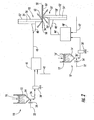
- Fig. 2 is a schematic illustration of an apparatus for dyeing according to the preferred embodiment of the method and apparatus of the present invention, producing the dyed product of the present invention
- Fig. 3 is a vertical sectional view of a supply tank containing dye in leuco state in the apparatus of Fig. 1;
- Fig. 4 is an alternate form of an indigo supply container for use with the apparatus of the present invention.
- the apparatus 10 of the preferred embodiment of the present invention is illustrated in Figs. 2, 3 and 4.
- the apparatus includes a supply container or feed tank 12 containing a supply of indigo dye 14 in a reduced leuco state.
- this indigo dye 14 can be used in the form received from a supplier, which typically may be a paste of 40% concentration.
- a supplier typically may be a paste of 40% concentration.
- concentrations may be used as desired for particular dyeing application.
- water can be added to reduce the concentration to any other suitable amount, such as 20%.
- conventional pigments, penetrants and foaming agents can be added to vary the shade or color and to facilitate application.
- the pigment and penetrant additives may reduce the indigo dye concentration to, for example, 32%.
- a floating cover 16 is positioned on top of the dye 14 in the feed tank 12.
- the cover 16 has a flat base 18 extending over substantially the entire surface of the dye 14, leaving only sufficient clearance at the edges for the cover to be able to move freely in response to the change in the level of the dye in the tank.
- the cover 16 is formed with a peripheral, upstanding flange 20.
- the clearance between the peripheral flange 20 and the wall of the feed tank 12 is only of an extent sufficient to permit free movement of the cover within the container. For example, a gap 22 of no more than 1/16 th inch can be employed.
- the feed tank 12 may be open to the atmosphere above the supply of dye 14, but preferably, as illustrated in Fig. 3, the feed tank 12 is covered by a top plate 26 and an inert gas, such as nitrogen, is fed through the top plate 26 from an upstanding inlet pipe 24.
- an inert gas such as nitrogen
- a soft resilient seal of any conventional material can be provided around the peripheral flange 20 to further maintain isolation of the reduced indigo dye from exposure to any air or other oxygen that may be in the feed tank 12 above the floating cover 16.
- the floating cover 16 may not be necessary, if the feed tank 12 and its top plate 26 provide a sufficient seal so that air cannot leak into the feed tank 12 above the level of the dye in the tank and contaminate the nitrogen or inert gas sufficiently to result in undesirable oxidation of the dye.
- a purge pipe 30 is mounted on the top plate 26 and opens into the interior of the feed tank 12 with a flap valve or other conventional valve preventing reverse flow of atmosphere through the purge pipe 30 into the interior of the feed tank 12.
- the purge pipe 30 allows escape of air or other gases as they are being replaced by the nitrogen.
- the purge pipe 30 also allows escape of nitrogen so as to maintain a desired pressure of nitrogen in the feed tank 12.
- the purge pipe 30 further serves to allow initial purging of the feed tank 12 prior to initial loading of dye into the feed tank. This purging is accomplished by nitrogen or other inert gas being introduced into the bottom of the feed tank 12 through a purge feed line 32 controlled by a valve 34.
- inert purging material While nitrogen is used as the preferred inert purging material, other inert fluids, such as reduced water, which is water containing hydro (sodium hydro-sulfide), may be used. With the entire apparatus filled with fluid, there will not be any air in the apparatus to oxygenize the leuco dye.
- reduced water which is water containing hydro (sodium hydro-sulfide)
- Feed of the dye liquor supply 14 into the feed tank 12 is through an inlet pipe 28 near the bottom of the feed tank 12 and is controlled in a conventional manner with sensors (not shown) that sense the level of the dye liquor 14 in the feed tank 12 to control feed of the dye liquor through the inlet pipe 28 to maintain the level of the dye liquor 14 in the feed tank 12 between set limits.
- the reduced indigo dye 14 in its leuco state is conveyed through a conduit 36 at the bottom of the feed tank 12 through a conventional strainer/filter mechanism 38 to a foam generator 40.
- This foam generator 40 is a conventional foam generator of the type commonly used to generate dye carrying foam for application to traveling textile substrates, such as yarns and fabric. It differs in use from a conventional foam generator in that instead of the gas for foaming being air, it is nitrogen or some other inert gas that, by its nature, will maintain the isolation of the reduced indigo dye from oxidation.
- the nitrogen is supplied through a nitrogen supply line 42.
- the foam generated in the foam generator 40 is conducted through a foam feed line 44 to the inlet 48 of an applicator 50.
- the applicator 50 may be of any conventional type suitable for a desired application.
- the applicator is the type disclosed in Zeiffer U.S. Patent No. 4,655,056, issued April 7, 1987. It includes a parabolically shaped distribution chamber 52 with the inlet 48 located in the center of the base chord and a parabolically shaped divider panel 54 mounted in the distribution chamber 52 at a spacing therewithin so that the foam entering the inlet 48 flares upwardly and outwardly to the edge of the panel 40 and then over the edge of the panel and vertically downward to a nozzle 56 at the base of the distribution chamber 52.
- the substrate 58 is a cellulosic material, such as cotton or rayon. In one embodiment, the substrate 58 is a sheet of warp cotton yarns intended for weaving denim blue jean fabric. The substrate 58 travels beneath the nozzle 56, which extends transversely across the traveling substrate for application of foam 60 thereto. If desired, more than one nozzle may be utilized and other forms of nozzles and applicators can be used.
- the foam As the substrate 58 with the foam 60 deposited thereon travels away from the applicator 50, the foam is exposed to the atmosphere and is free for oxidation of the reduced indigo dye as the foam degenerates on and in the traveling substrate 58. As the indigo dye is oxidized, it regenerates and affixes to the substrate 58.
- the apparatus is readied for application of the indigo dye by first purging the feed tank 12 by introducing nitrogen into the feed tank 12 through the nitrogen inlet pipe 24. Reduced dye in a leuco state is then fed into the feed tank 12 through the dye supply inlet pipe 28 until a desired level of dye is in the feed tank 12. The operation is then begun by feeding the dye from the supply 12 to the foam generator 40.
- the operation of the foam generator is adjusted to generate foam at a blow ratio suitable for the particular application. This blow ratio may be in the range of 0:01 to 50:1. In a typical operation, the blow ratio may be approximately 3:1.
- the foam 60 is then fed from the foam generator 40 to the applicator 50 and is maintained in its reduced leuco state isolated from any oxidizing substance, such as air. With the foam so isolated, it passes through the applicator 50 and is deposited on the traveling sheet of warp yarns 58 and is then free for contact by the atmosphere, the oxygen in which oxidizes the originally reduced indigo dye 14 as the foam dissipates on the substrate, with the result that the indigo dye affixes itself in and to the yarn 58.
- the oxidation can be facilitated by applying an oxidizing gas in addition to the atmosphere as the substrate leaves the applicator 50.
- Foaming agents of any desired known type can be introduced in the foam generator to facilitate foaming and pigments, reactives, sulfurs and penetrants may be added to the dye before or while the dye 14 is in the feed tank 12.
- the dye can be applied once to obtain a desired color or shade, contrary to the multiple immersions required to build a shade with conventional indigo dyeing apparatus.
- the apparatus 10 illustrated in Fig. 2 can be used to apply a second foam to the surface of the substrate opposite that to which the foam is applied by the apparatus described heretofore.
- the foam applied by the first, second or both applicators may be controlled so that the dye carried in the foam from one or both of the applicators would not penetrate fully through the fabric on to the opposite surface.
- This apparatus 10' includes a feed tank 12' containing a supply of reduced indigo dye in leuco state, which may be a different shade, color or type than that applied by the first applicator 50'.
- This second apparatus 10' also includes a foam generator 40' to which a supply line 42' supplies nitrogen, and from which the foam 60' is supplied to the applicator 50' that applies the foam 60' to the traveling substrate 58'.
- a dye other than indigo can be applied to the second surface of the substrate by the second apparatus 10', which dye may be a reduced dye using the apparatus as described or it can be any other conventional dye that is foamed in any other conventional manner and applied to the surface of the substrate. Also, some other second apparatus may be used to apply foamed or non-foamed dye.
- Fig. 4 illustrates an alternative to the feed tank 12 illustrated in Figs. 2 and 3.
- a replaceable container 62 of the type received from a supplier containing reduced indigo dye in a leuco state is attached directly to the feed line 36 to the foam generator 40.
- This container 62 is closed and has an inlet tube 64 through which the supplier filled the container 62 and which is maintained closed during operation.
- a vent tube 66 opens into the container 62 for venting of the interior of the container when the reduced indigo dye is introduced.
- the container 62 is emptied during operation, another container 62 will be substituted and the operation continued.
- the remaining indigo dye is drained from the apparatus and the components are flushed to remove any remaining dye, particularly any indigo dye that has been oxidized and regenerated into insoluble particles.
- the flushing is accomplished using reduced water, which, when coming in contact with regenerated indigo dye particles, will cause reduction of the particles into clear soluble material that can be easily drained from the system with the reduced water.
- Reduced water can also be used during operation by being added to the feed tank 12 to counteract any tendency of the indigo dye to oxidize.
Landscapes
- Engineering & Computer Science (AREA)
- Textile Engineering (AREA)
- Chemical & Material Sciences (AREA)
- Dispersion Chemistry (AREA)
- Coloring (AREA)
- Treatment Of Fiber Materials (AREA)
Abstract
Description
Claims (42)
- A method of dyeing a cellulosic textile substrate comprising: providing a supply of reduced dye in a leuco state, substantially isolating said leuco state dye from oxidizing substances, generating a foam of said leuco state dye and an inert gas while maintaining said dye in said leuco state, applying said foam to at least one surface of said substrate, and exposing said applied foam to an oxidizing substance to regenerate said dye and affix said dye to said textile substrate.
- A method of dyeing a cellulosic textile substrate according to claim 1 wherein said cellulosic textile material is a woven fabric.
- A method of dyeing a cellulosic textile substrate according to claim 1 wherein said cellulosic textile material is cotton.
- A method of dying a cellulosic textile substrate according to claim 3 wherein said reduced dye is an indigo dye in leuco state.
- A method of dyeing a cellulosic textile substrate according to claim 1 wherein said cellulosic textile material is in the form of a rope of yarn.
- A method of dyeing a cellulosic textile substrate according to claim 4 wherein said cotton material is in the form of a sheet of warp yarns for weaving denim fabric.
- A method of dyeing a textile substrate according to claim 4 wherein said cotton textile material is in the form of a denim fabric.
- A method of dyeing a cellulosic textile substrate according to claim 4 wherein said indigo dye comprises indigo paste diluted in water.
- A method of dyeing a cellulosic textile substrate according to claim 8 wherein said indigo dye comprises indigo paste at a concentration of approximately 40% or less.
- A method of dyeing a cellulosic textile substrate according to claim 1 wherein said isolating said leuco state dye from oxidizing substances comprises containing the supply of reduced dye in a closed container with an inert gas covering the top surface of the dye in said container.
- A method of dyeing a cellulosic textile substrate according to claim 10 in which the inert gas is nitrogen.
- A method of dyeing a cellulosic textile substrate according to claim 1 wherein isolating said leuco state dye from oxidizing substances comprises containing the supply of reduced dye in a container with a cover floating on said dye and substantially covering the top surface of said dye.
- A method of dyeing a cellulosic textile substrate according to claim 12 wherein the container is a closed container and an inert gas is provided in the container above said floating cover.
- A method of dyeing a cellulosic textile substrate according to claim 13 in which the inert gas is nitrogen.
- A method of dyeing a cellulosic textile substrate according to claim 1 wherein the exposing is exposing to the atmosphere.
- A method of dyeing a cellulosic textile substrate according to claim 1 wherein said foam is applied to both surfaces of said substrate.
- A method of dyeing a cellulosic textile substrate according to claim 1 wherein said foam is applied to only one surface of said substrate.
- A method of dyeing a cellulosic textile substrate according to claim 1, wherein said foam contains a first dye applied to one surface of said textile substrate, and a second dye having at least one characteristic different from that of the first dye is applied to the opposite surface of said textile substrate.
- A method of dyeing a cellulosic textile substrate according to claim 18 wherein said different characteristic is a difference in color or shade.
- A method of dyeing a cellulosic textile substrate according to claim 19 wherein said other dye is a reduced dye applied in a leuco state in a foamed condition.
- A method of dyeing a cellulosic textile substrate according to claim 20 wherein both said first and said second dyes are indigo dyes.
- A method of dyeing a cellulosic textile substrate according to claim 1 wherein said foam generating is performed at a blow ratio in the range of 0.0 1: 1 to 50:1.
- A method of dyeing a cellulosic textile substrate according to claim 1 wherein said foam generating is performed at a blow ratio of approximately 3:1.
- A method of dyeing a cellulosic textile substrate in an apparatus having a container for receiving reduced dye in a leuco state, a foam generator, and an applicator, said method comprising purging the apparatus with a fluid that does not contain oxygen to remove any oxygen from the apparatus, providing a supply of reduced dye in a leuco state in said container while substantially isolating said leuco state dye from oxidizing substances, a generating in said foam generator a foam of said reduced dye in leuco state and an inert gas while maintaining said dye in a leuco state, applying said foam with said applicator to at least one surface of said substrate, and exposing said applied foam to an oxidizing substrate to regenerate said dye and affix said dye to said textile substrate.
- A method of dyeing a cellulosic textile substrate according to claim 24 wherein said purging fluid is an inert gas.
- A method of dyeing a cellulosic textile substrate according to claim 24 wherein said purging fluid is reduced water.
- An apparatus for dyeing a cellulosic textile substrate with a dye in leuco state comprising: a container for containing a supply of reduced dye in a leuco state, said container substantially isolating said dye from oxidizing substances, a foam generator for generating a foam of said leuco state dye with an inert gas while maintaining said dye in said leuco state, a foam applicator for applying said foam to at least one surface of said substrate with the dye on said substrate being free for exposure to an oxidizing substance to regenerate said dye and affix said dye to said textile substrate.
- An apparatus for dyeing a cellulosic textile substrate according to claim 27 characterized further by a cover for floating on said dye in said container, said cover covering substantially the entire surface of said dye in said container.
- An apparatus for dyeing a cellulosic textile substrate according to claim 24 characterized further in that said container is a closed container isolating said contained dye from oxidizing substances.
- An apparatus for dyeing a cellulosic textile substrate according to claim 26 characterized further by a cover in said container for floating on said dye in said container and covering substantially the entire surface of said dye in said container.
- An apparatus for dyeing a cellulosic textile substrate according to claim 24 characterized further by a supply of inert gas connected to said container for supplying inert gas to said container as dye is delivered from said container to said generator.
- An apparatus for dyeing a cellulosic textile substrate according to claim 24 characterized further in that said textile substrate is a traveling substrate and said applicator includes at least one nozzle extending across the traveling substrate for application of said foam to one surface of said traveling substrate.
- An apparatus for dyeing a cellulosic textile substrate according to claim 29 characterized further in that said foam applicator includes a distribution chamber that uniformly distributes foam across the extent of said nozzle for uniform delivery of foam across said traveling substrate.
- An apparatus for dyeing a cellulosic textile substrate according to claim 29 characterized further by another foam applicator for applying foam to the opposite surface of the traveling substrate.
- An apparatus for dyeing a cellulosic textile substrate according to claim 31 characterized further in that said another foam applicator includes a distribution chamber that uniformly distributes foam across the extent of said nozzle for uniform delivery of foam to said traveling substrate.
- An apparatus for dyeing a cellulosic textile substrate according to claim 27 and characterized further in that said apparatus is open exteriorly of said applicator for exposure of the foam applied to the substrate to the atmosphere for oxidation of the dye and affix said dye to said textile substrate.
- A dyed cellulosic textile product comprising: a denim fabric, a first dye having been applied in leuco state on one surface of said fabric and a different second dye on the opposite surface of said fabric.
- A dyed cellulosic textile product according to claim 37 characterized further in that said first and second dyes have different characteristics.
- A dyed cellulosic textile product according to claim 38 characterized further in that said different characteristics include differences in shade or color.
- A dyed cellulosic textile product according to claim 37 characterized further in that said dye is an indigo dye.
- A dyed cellulosic textile product according to claim 37 characterized further in that both said first and second dyes have been applied in a leuco state.
- A dyed cellulosic textile product according to claim 38 characterized further in that both said first and second dyes are indigo dyes.
Applications Claiming Priority (2)
| Application Number | Priority Date | Filing Date | Title |
|---|---|---|---|
| US833450 | 2004-04-28 | ||
| US10/833,450 US20050241078A1 (en) | 2004-04-28 | 2004-04-28 | Method and apparatus for dyeing cellulosic textile substrates with an inert leuco state dye and dyed product |
Publications (2)
| Publication Number | Publication Date |
|---|---|
| EP1591578A2 true EP1591578A2 (en) | 2005-11-02 |
| EP1591578A3 EP1591578A3 (en) | 2007-01-24 |
Family
ID=34935662
Family Applications (1)
| Application Number | Title | Priority Date | Filing Date |
|---|---|---|---|
| EP05008983A Withdrawn EP1591578A3 (en) | 2004-04-28 | 2005-04-25 | Method and apparatus for dyeing cellulosic textile substrates with an inert leuco state dye and dyed product |
Country Status (2)
| Country | Link |
|---|---|
| US (2) | US20050241078A1 (en) |
| EP (1) | EP1591578A3 (en) |
Cited By (3)
| Publication number | Priority date | Publication date | Assignee | Title |
|---|---|---|---|---|
| WO2008056256A1 (en) * | 2006-11-09 | 2008-05-15 | Master S.R.L. | Device and continuous dyeing process with indigo |
| DE102008039500A1 (en) | 2008-08-23 | 2010-02-25 | Dystar Textilfarben Gmbh & Co. Deutschland Kg | Process for dyeing textile materials |
| CN101883888B (en) * | 2007-05-25 | 2012-07-18 | 加斯顿系统公司 | Equipment for dyeing textile substrates with foam dyes |
Families Citing this family (11)
| Publication number | Priority date | Publication date | Assignee | Title |
|---|---|---|---|---|
| US20050241078A1 (en) * | 2004-04-28 | 2005-11-03 | Gaston Systems, Inc. | Method and apparatus for dyeing cellulosic textile substrates with an inert leuco state dye and dyed product |
| CN101984355A (en) * | 2010-09-30 | 2011-03-09 | 华纺股份有限公司 | Screening method for foam dyeing chemical |
| CN102587134B (en) * | 2011-01-12 | 2014-04-02 | 香港纺织及成衣研发中心 | Processing method of ready-made clothes with washing effect and ready-made clothes processed by processing method |
| ES2428765B1 (en) * | 2013-10-04 | 2014-03-27 | Tejidos Royo S.L. | Denim fabric with fire retardant characteristics and warp dyeing process with indigo blue dye |
| CN105155301B (en) * | 2015-07-21 | 2018-08-03 | 东华大学 | A kind of cotton fabric blending foam dyeing liquid and its application |
| CN110036075B (en) | 2016-09-12 | 2022-05-10 | 靛蓝轧机设计有限责任公司 | Indigo dyeing process and equipment and indigo dyed yarns and fabrics made therefrom |
| US11168423B2 (en) | 2018-03-12 | 2021-11-09 | Gaston Systems, Inc. | Dye fixing section for an indigo dyeing machine |
| US11179744B2 (en) | 2018-11-13 | 2021-11-23 | Gaston Systems, Inc. | Segmented distribution assembly for distributing fluid to an applicator nozzle |
| IT202000029285A1 (en) * | 2020-12-01 | 2022-06-01 | Master Srl | MULTI-SECTION EQUIPMENT FOR DYEING, IN INERT ENVIRONMENT, OF YARNS AND FABRICS, WITH INDIGO AND OTHER REDUCING DYES |
| CN113512892B (en) * | 2021-04-29 | 2022-05-10 | 武汉纺织大学 | A kind of fabric indigo dyeing method |
| CN115807349B (en) * | 2022-12-28 | 2024-06-14 | 黑牡丹纺织有限公司 | Foaming agent for jean indigo foam dyeing and foaming method thereof |
Family Cites Families (29)
| Publication number | Priority date | Publication date | Assignee | Title |
|---|---|---|---|---|
| US3067758A (en) * | 1962-04-03 | 1962-12-11 | Seymour L Hersh | Liquid actuated sealing means |
| US3762860A (en) * | 1971-05-27 | 1973-10-02 | Dexter Chemical Corp | Foam dyeing process |
| US3913359A (en) * | 1972-06-22 | 1975-10-21 | Rca Corp | Dyeing station in an apparatus for continuously dyeing fibrous material |
| ES448040A1 (en) * | 1975-05-24 | 1977-07-01 | Hoechst Ag | Device for the application of foam on textile webs |
| US4023526A (en) * | 1976-03-25 | 1977-05-17 | Union Carbide Corporation | Apparatus for application of foam to a substrate |
| US4099913A (en) * | 1976-03-25 | 1978-07-11 | Union Carbide Corporation | Foams for treating fabrics |
| US4193762A (en) * | 1978-05-01 | 1980-03-18 | United Merchants And Manufacturers, Inc. | Textile treatment process |
| US4365968A (en) * | 1978-09-19 | 1982-12-28 | United Merchants & Manufacturers, Inc. | Method of treating textile materials |
| US4237818A (en) * | 1978-12-15 | 1980-12-09 | Gaston County Dyeing Machine Company | Means for applying treating liquor to textile substrate |
| US4283198A (en) * | 1980-01-11 | 1981-08-11 | Fletcher John M | Inert atmosphere indigo dyeing |
| US4562097A (en) * | 1980-05-09 | 1985-12-31 | Union Carbide Corporation | Process of treating fabrics with foam |
| US4394289A (en) * | 1981-07-01 | 1983-07-19 | Brown Lamar W | Continuous foam generating system |
| US4402200A (en) * | 1981-09-04 | 1983-09-06 | Gaston County Dyeing Machine Company | Means for applying foamed treating liquor |
| US4485508A (en) * | 1982-06-23 | 1984-12-04 | Otting International, Inc. | Method and apparatus for dyeing of textile material |
| US4435062A (en) * | 1982-12-27 | 1984-03-06 | Polaroid Corporation | Film processing apparatus |
| EP0139617B1 (en) * | 1983-09-27 | 1990-09-05 | Ciba-Geigy Ag | Process and apparatus for applying and simultaneously fixing a chemical to a textile substrate |
| US4534189A (en) * | 1984-01-05 | 1985-08-13 | Clifford Albert F | Apparatus for applying chemicals to textiles |
| DE3563547D1 (en) * | 1984-05-18 | 1988-08-04 | Ciba Geigy Ag | Process for dyeing or printing fabrics containing cellulose with vat dyes |
| US4655056A (en) * | 1985-06-11 | 1987-04-07 | Gaston County Dyeing Machine Co. | Foamed treating liquor applicator |
| US4790155A (en) * | 1986-11-18 | 1988-12-13 | Burlington Industries, Inc. | Replaceable fluid dye applicator for inert-blanketed regions |
| US4884893A (en) * | 1987-07-10 | 1989-12-05 | Gaston County Dyeing Machine Co. | Method and apparatus for generating and dispersing immiscible liquid particles in a carrier liquid and dispensing said carrier liquid |
| US4874390A (en) * | 1988-09-29 | 1989-10-17 | Du Pont Canada Inc. | Method and apparatus for tinting yarn |
| US5195225A (en) * | 1990-07-27 | 1993-03-23 | Gaston County Dyeing Machine Co. | Means and method for extracting moisture from a traveling web of textile material |
| US5063646A (en) * | 1990-07-27 | 1991-11-12 | Gaston County Dyeing Machine Co. | Means and method for extracting moisture from a traveling web of textile material |
| US5323629A (en) * | 1992-09-09 | 1994-06-28 | Gaston County Dyeing Machine Co. | Apparatus and method for treatment of yarn in package form |
| US5378246A (en) * | 1993-05-10 | 1995-01-03 | Allegro Natural Dyes, Inc. | Indigo dye process |
| DE19704797B4 (en) * | 1997-02-08 | 2005-11-17 | Krüger, Rudolf, Dr. | Process for the continuous dyeing of cellulose-containing yarn with indigo in a single pass under the control of the ph value |
| US6395088B1 (en) * | 1999-06-30 | 2002-05-28 | Gaston Systems, Inc. | Apparatus for applying foamed coating material to a traveling textile substrate |
| US20050241078A1 (en) * | 2004-04-28 | 2005-11-03 | Gaston Systems, Inc. | Method and apparatus for dyeing cellulosic textile substrates with an inert leuco state dye and dyed product |
-
2004
- 2004-04-28 US US10/833,450 patent/US20050241078A1/en not_active Abandoned
-
2005
- 2005-04-25 EP EP05008983A patent/EP1591578A3/en not_active Withdrawn
-
2007
- 2007-05-25 US US11/805,893 patent/US20070266505A1/en not_active Abandoned
Cited By (5)
| Publication number | Priority date | Publication date | Assignee | Title |
|---|---|---|---|---|
| WO2008056256A1 (en) * | 2006-11-09 | 2008-05-15 | Master S.R.L. | Device and continuous dyeing process with indigo |
| US8215138B2 (en) | 2006-11-09 | 2012-07-10 | Master S.R.L. | Device and continuous dyeing process with indigo |
| CN101883888B (en) * | 2007-05-25 | 2012-07-18 | 加斯顿系统公司 | Equipment for dyeing textile substrates with foam dyes |
| DE102008039500A1 (en) | 2008-08-23 | 2010-02-25 | Dystar Textilfarben Gmbh & Co. Deutschland Kg | Process for dyeing textile materials |
| US8167958B2 (en) | 2008-08-23 | 2012-05-01 | Dystar Colours Deutschland Gmbh | Multiple step dyeing textile with concentrated dye systems |
Also Published As
| Publication number | Publication date |
|---|---|
| EP1591578A3 (en) | 2007-01-24 |
| US20070266505A1 (en) | 2007-11-22 |
| US20050241078A1 (en) | 2005-11-03 |
Similar Documents
| Publication | Publication Date | Title |
|---|---|---|
| US20050241078A1 (en) | Method and apparatus for dyeing cellulosic textile substrates with an inert leuco state dye and dyed product | |
| EP2150648B1 (en) | Apparatus for dyeing textile substrates with foamed dye | |
| US8215138B2 (en) | Device and continuous dyeing process with indigo | |
| CN109196157A (en) | The multi-functional continuous dyeing device of the warp thread chain of fabric | |
| US5611822A (en) | Indigo dye process | |
| US2321974A (en) | Method of producing shade and color contrasts in textile fabrics | |
| IT202000029285A1 (en) | MULTI-SECTION EQUIPMENT FOR DYEING, IN INERT ENVIRONMENT, OF YARNS AND FABRICS, WITH INDIGO AND OTHER REDUCING DYES | |
| US2693995A (en) | Process and apparatus for dyeing or performing related | |
| CN102046875B (en) | Dyeing warp yarns with leucoindigo foam | |
| HK1084983A (en) | Method and apparatus for dyeing cellulosic textile substrate with an inert leuco state dye and dyed product | |
| US11015289B2 (en) | Process for dyeing of textile materials using supercritical fluid | |
| JPH0333257A (en) | Pad dyeing machine for dyeing warp | |
| KR101619850B1 (en) | Dyeing and color forming apparatus and dyeing method for fabric using polygonum indigo | |
| WO2019142224A1 (en) | Method and installation for the continuous dyeing of yarns or fabric webs | |
| JP2922192B1 (en) | Dropping method and apparatus used for it | |
| Aspland | Colorants: dyes | |
| USRE23004E (en) | Continuous dyeing of textile | |
| JP2544841Y2 (en) | Pad steamer | |
| US20230340726A1 (en) | Methods and systems to dye textile materials with dye blend compositions having differential dye exhaust rates | |
| Choudhury | Fabric dyeing and printing | |
| GB2072725A (en) | Continuous print dyeing of a cloth | |
| HK1150640B (en) | Apparatus for dyeing textile substrates with foamed dye | |
| DE266289C (en) | ||
| Fox | The Dyeing of Tubular‐knitted Cotton Fabrics | |
| HK1148324A (en) | Apparatus for dyeing textile fabrics and yarns with foamed dye |
Legal Events
| Date | Code | Title | Description |
|---|---|---|---|
| PUAI | Public reference made under article 153(3) epc to a published international application that has entered the european phase |
Free format text: ORIGINAL CODE: 0009012 |
|
| AK | Designated contracting states |
Kind code of ref document: A2 Designated state(s): AT BE BG CH CY CZ DE DK EE ES FI FR GB GR HU IE IS IT LI LT LU MC NL PL PT RO SE SI SK TR |
|
| AX | Request for extension of the european patent |
Extension state: AL BA HR LV MK YU |
|
| REG | Reference to a national code |
Ref country code: HK Ref legal event code: DE Ref document number: 1084983 Country of ref document: HK |
|
| PUAL | Search report despatched |
Free format text: ORIGINAL CODE: 0009013 |
|
| AK | Designated contracting states |
Kind code of ref document: A3 Designated state(s): AT BE BG CH CY CZ DE DK EE ES FI FR GB GR HU IE IS IT LI LT LU MC NL PL PT RO SE SI SK TR |
|
| AX | Request for extension of the european patent |
Extension state: AL BA HR LV MK YU |
|
| AKX | Designation fees paid | ||
| STAA | Information on the status of an ep patent application or granted ep patent |
Free format text: STATUS: THE APPLICATION IS DEEMED TO BE WITHDRAWN |
|
| 18D | Application deemed to be withdrawn |
Effective date: 20070725 |
|
| REG | Reference to a national code |
Ref country code: DE Ref legal event code: 8566 |
|
| REG | Reference to a national code |
Ref country code: HK Ref legal event code: WD Ref document number: 1084983 Country of ref document: HK |