EP1591536A1 - Method of selecting sunflower genotypes with high oleic acid content in seed oil - Google Patents

Method of selecting sunflower genotypes with high oleic acid content in seed oil Download PDF

Info

Publication number
EP1591536A1
EP1591536A1 EP04291102A EP04291102A EP1591536A1 EP 1591536 A1 EP1591536 A1 EP 1591536A1 EP 04291102 A EP04291102 A EP 04291102A EP 04291102 A EP04291102 A EP 04291102A EP 1591536 A1 EP1591536 A1 EP 1591536A1
Authority
EP
European Patent Office
Prior art keywords
seq
nucleic acid
sequence
pervenets
genotypes
Prior art date
Legal status (The legal status is an assumption and is not a legal conclusion. Google has not performed a legal analysis and makes no representation as to the accuracy of the status listed.)
Withdrawn
Application number
EP04291102A
Other languages
German (de)
French (fr)
Inventor
André Berville
Séverine Lacombe
Stanislas Veillet
Christel Granier
Sandrine Léger
Philippe Jouve
Current Assignee (The listed assignees may be inaccurate. Google has not performed a legal analysis and makes no representation or warranty as to the accuracy of the list.)
Institut National de la Recherche Agronomique INRA
Monsanto SAS
Original Assignee
Institut National de la Recherche Agronomique INRA
Monsanto SAS
Priority date (The priority date is an assumption and is not a legal conclusion. Google has not performed a legal analysis and makes no representation as to the accuracy of the date listed.)
Filing date
Publication date
Application filed by Institut National de la Recherche Agronomique INRA, Monsanto SAS filed Critical Institut National de la Recherche Agronomique INRA
Priority to EP04291102A priority Critical patent/EP1591536A1/en
Priority to AU2005238189A priority patent/AU2005238189A1/en
Priority to US11/587,956 priority patent/US20090258346A1/en
Priority to CA002564761A priority patent/CA2564761A1/en
Priority to EP05744918A priority patent/EP1751305A2/en
Priority to EA200601787A priority patent/EA200601787A1/en
Priority to PCT/EP2005/004635 priority patent/WO2005106022A2/en
Publication of EP1591536A1 publication Critical patent/EP1591536A1/en
Withdrawn legal-status Critical Current

Links

Images

Classifications

    • CCHEMISTRY; METALLURGY
    • C12BIOCHEMISTRY; BEER; SPIRITS; WINE; VINEGAR; MICROBIOLOGY; ENZYMOLOGY; MUTATION OR GENETIC ENGINEERING
    • C12QMEASURING OR TESTING PROCESSES INVOLVING ENZYMES, NUCLEIC ACIDS OR MICROORGANISMS; COMPOSITIONS OR TEST PAPERS THEREFOR; PROCESSES OF PREPARING SUCH COMPOSITIONS; CONDITION-RESPONSIVE CONTROL IN MICROBIOLOGICAL OR ENZYMOLOGICAL PROCESSES
    • C12Q1/00Measuring or testing processes involving enzymes, nucleic acids or microorganisms; Compositions therefor; Processes of preparing such compositions
    • C12Q1/68Measuring or testing processes involving enzymes, nucleic acids or microorganisms; Compositions therefor; Processes of preparing such compositions involving nucleic acids
    • C12Q1/6876Nucleic acid products used in the analysis of nucleic acids, e.g. primers or probes
    • C12Q1/6888Nucleic acid products used in the analysis of nucleic acids, e.g. primers or probes for detection or identification of organisms
    • C12Q1/6895Nucleic acid products used in the analysis of nucleic acids, e.g. primers or probes for detection or identification of organisms for plants, fungi or algae
    • AHUMAN NECESSITIES
    • A01AGRICULTURE; FORESTRY; ANIMAL HUSBANDRY; HUNTING; TRAPPING; FISHING
    • A01HNEW PLANTS OR NON-TRANSGENIC PROCESSES FOR OBTAINING THEM; PLANT REPRODUCTION BY TISSUE CULTURE TECHNIQUES
    • A01H1/00Processes for modifying genotypes ; Plants characterised by associated natural traits
    • A01H1/04Processes of selection involving genotypic or phenotypic markers; Methods of using phenotypic markers for selection
    • A01H1/045Processes of selection involving genotypic or phenotypic markers; Methods of using phenotypic markers for selection using molecular markers
    • AHUMAN NECESSITIES
    • A01AGRICULTURE; FORESTRY; ANIMAL HUSBANDRY; HUNTING; TRAPPING; FISHING
    • A01HNEW PLANTS OR NON-TRANSGENIC PROCESSES FOR OBTAINING THEM; PLANT REPRODUCTION BY TISSUE CULTURE TECHNIQUES
    • A01H5/00Angiosperms, i.e. flowering plants, characterised by their plant parts; Angiosperms characterised otherwise than by their botanic taxonomy
    • A01H5/10Seeds
    • AHUMAN NECESSITIES
    • A01AGRICULTURE; FORESTRY; ANIMAL HUSBANDRY; HUNTING; TRAPPING; FISHING
    • A01HNEW PLANTS OR NON-TRANSGENIC PROCESSES FOR OBTAINING THEM; PLANT REPRODUCTION BY TISSUE CULTURE TECHNIQUES
    • A01H6/00Angiosperms, i.e. flowering plants, characterised by their botanic taxonomy
    • A01H6/14Asteraceae or Compositae, e.g. safflower, sunflower, artichoke or lettuce
    • A01H6/1464Helianthus annuus [sunflower]
    • CCHEMISTRY; METALLURGY
    • C12BIOCHEMISTRY; BEER; SPIRITS; WINE; VINEGAR; MICROBIOLOGY; ENZYMOLOGY; MUTATION OR GENETIC ENGINEERING
    • C12NMICROORGANISMS OR ENZYMES; COMPOSITIONS THEREOF; PROPAGATING, PRESERVING, OR MAINTAINING MICROORGANISMS; MUTATION OR GENETIC ENGINEERING; CULTURE MEDIA
    • C12N9/00Enzymes; Proenzymes; Compositions thereof; Processes for preparing, activating, inhibiting, separating or purifying enzymes
    • C12N9/0004Oxidoreductases (1.)
    • C12N9/0071Oxidoreductases (1.) acting on paired donors with incorporation of molecular oxygen (1.14)
    • C12N9/0083Miscellaneous (1.14.99)
    • CCHEMISTRY; METALLURGY
    • C12BIOCHEMISTRY; BEER; SPIRITS; WINE; VINEGAR; MICROBIOLOGY; ENZYMOLOGY; MUTATION OR GENETIC ENGINEERING
    • C12QMEASURING OR TESTING PROCESSES INVOLVING ENZYMES, NUCLEIC ACIDS OR MICROORGANISMS; COMPOSITIONS OR TEST PAPERS THEREFOR; PROCESSES OF PREPARING SUCH COMPOSITIONS; CONDITION-RESPONSIVE CONTROL IN MICROBIOLOGICAL OR ENZYMOLOGICAL PROCESSES
    • C12Q2600/00Oligonucleotides characterized by their use
    • C12Q2600/13Plant traits
    • CCHEMISTRY; METALLURGY
    • C12BIOCHEMISTRY; BEER; SPIRITS; WINE; VINEGAR; MICROBIOLOGY; ENZYMOLOGY; MUTATION OR GENETIC ENGINEERING
    • C12QMEASURING OR TESTING PROCESSES INVOLVING ENZYMES, NUCLEIC ACIDS OR MICROORGANISMS; COMPOSITIONS OR TEST PAPERS THEREFOR; PROCESSES OF PREPARING SUCH COMPOSITIONS; CONDITION-RESPONSIVE CONTROL IN MICROBIOLOGICAL OR ENZYMOLOGICAL PROCESSES
    • C12Q2600/00Oligonucleotides characterized by their use
    • C12Q2600/156Polymorphic or mutational markers

Definitions

  • the present invention relates to the selection of sunflower genotypes with high oleic acid content in seed oil.
  • the invention concerns more particularly molecular markers useful for a rapid and easy selection of sunflower lines and then sunflower hybrids capable of producing seeds having high oleic acid content.
  • high oleic acid content seeds designates seeds containing more than 60% of oleic acid.
  • fatty acids in vegetable oils are fatty acids having 16 or 18 carbon atoms.
  • Certain unsaturated fatty acids are not synthesized by the human body and are of an insufficient amount in fats of animal origin.
  • the mono-unsaturated 18:1 oleic acid has properties which is particularly suitable for preventing cardiovascular diseases.
  • High oleic acid content oils are more resistant to heating and are thus recommended for frying.
  • the fatty acids composition in vegetable oils deriving from seeds is variable depending on the oleaginous plant.
  • Olive oil has naturally high 18:1 content (around 70%), nevertheless, its non-lipid part of the oil decreases the interest of this oil.
  • Normal sunflower (hereinafter named LO varieties) oil contains mainly linoleic acid and high levels of phytosterols and tocopherol conferring hypocholesterolemic and anti-oxidant properties to the non-lipid part of the oil.
  • Sunflower lines and hybrids, which have high 18:1 content in their seeds hereinafter named HO varieties
  • HO varieties Sunflower lines and hybrids, which have high 18:1 content in their seeds (hereinafter named HO varieties) have been obtained by selection programs from the HO Pervenets mutant, said mutant being obtained by chemical mutagenesis (1). They are particularly interesting since they have the combined benefits of oleic acid and the non-lipid part of the sunflower oil (phytosterol and tocopherol). They therefore respond to the requirement of quality by consumers.
  • vegetable oils are of significant industrial interest. Indeed, they represent a source of fatty acids as starting material used in the lipochemical industry (detergents, paints, cosmetics). Vegetable oil from the HO sunflower type is a substantially pure industrial source of 18:1, that reduces the purification steps.
  • the improvement of the oleaginous varieties is concerned with the control and the change of their fatty acid compositions by means of conventional selection programs, but also by mutagenesis and transgenesis.
  • the chemical mutagenesis carried out by Soldatov in 1976 ( 1 ) on a sunflower population allowed the Pervenets mutant population to be obtained.
  • the average content of 18:1 of the seeds from this population is higher than 65%, the individual contents being between 60 and 80% whereas in normal LO varieties this content is about 20%.
  • the Pervenets population was distributed throughout the world and used in many selection programs in order to convert selected genotypes with low 18:1 content into genotypes having 18:1 content in their seeds higher than 80%.
  • the selection is generally based on the 18:1 content of the seeds. This phenotypic determination does not allow a rapid and early detection of HO genotypes and cannot distinguish between homozygote and heterozygote genotypes for the mutation. It is therefore necessary to have selection markers at genomic level allowing earlier and rapid determination of the HO phenotype homozygous for the mutation during conversion process.
  • the accumulation of the 18:1 in the seeds is mainly dependent on two enzymatic reactions: the upstream desaturation of 18:0 into 18:1 and the downstream desaturation of 18:1 into 18:2.
  • the normal LO lines do not carry the ⁇ 12HOS allele but another allele named ⁇ 12LOR at this locus (named ⁇ 12HL locus) ( 6, 7 ).
  • ⁇ 12HL locus another allele named ⁇ 12LOR at this locus (named ⁇ 12HL locus) ( 6, 7 ).
  • Lacombe et al. ( 6 ) revealed that the HO phenotype co-segregated with the ⁇ 12HOS allele pointing out that the Pervenets mutation is carried or genetically tightly linked to the ⁇ 12HOS allele.
  • Lacombe et al. ( 7 ) showed that all the HO lines carry the ⁇ 12HOS allele.
  • the recombinant lines carrying ⁇ 12HOS are equally shared into HO or LO classes.
  • the absence of HO plants carrying the ⁇ 12LOR allele eliminates the occurrence of a recombination event between the ⁇ 12HL locus and the locus containing the Pervenets mutation.
  • the HO phenotype is therefore due to two independent loci: the ⁇ 12HL locus carrying the ⁇ 12HOS allele and consequently the Pervenets mutation, and another locus, where an allele suppresses the effect of the ⁇ 12HOS allele leading to restore the LO phenotype.
  • Lacombe et al. 8 established physical maps of the ⁇ 12HOS and ⁇ 12LOR alleles at the ⁇ 12HL locus (Fig 1). For this purpose, they used the HO and LO RFLP profiles revealed with the ⁇ 12-desaturase cDNA used as a probe.
  • the ⁇ 12LOR allele in LO genotypes corresponds to a 5.8 kb EcoRI and to a 8 kb Hind III fragments carrying ⁇ 12-desaturase like sequences.
  • the double digest with Eco RI + Hind III leads to a 2.2 kb fragment.
  • the ⁇ 12LOR allele carries one region whereas the ⁇ 12HOS allele carries 2 adjacent regions with ⁇ 12-desaturase like sequences: the ⁇ 12HOS / ⁇ 12LOR common region determined by the common 5.8 kb Eco RI fragment and a HO specific region determined by the 7.9 kb Eco RI extra fragment (Fig 1, ref 8 ).
  • the present invention relates to molecular markers that are strictly linked to genetic factors involved in 18:1 accumulation in seed oil of HO genotypes of sunflower: the Pervenets mutation and another independent factor, the supole factor.
  • the invention relates to PCR molecular markers that partly amplify the Pervenets mutation. It also relates to a SSR marker (15-17 TTA motifs) in the intron of the ⁇ 12-desaturase functional gene adjacent to the mutation that enables to map the gene locus in most of segregating populations and to select genotypes carrying the Pervenets mutation.
  • the invention also relates to specific markers of a genetic factor suppressing the Pervenets mutation effect.
  • the presence of the suppressor (supole) is revealed in genotypes by combining the presence of the ⁇ 12HOS allele and the low 18:1 content in seed oil.
  • the invention also relates to processes for the selection of sunflower producing seeds with a high oleic acid content.
  • the present invention also relates to primers useful for nucleic acid amplification and to combinations thereof.
  • the invention concerns the test kits for selecting sunflower having seeds with a high content of oleic acid which contain at least one of the above combinations.
  • the present invention relates to Pervenets mutation specific molecular markers located in a 29 kb region, a map thereof is represented on Fig 2. This region carrying these molecular markers is divided in 3 sequences, from 5' to 3':
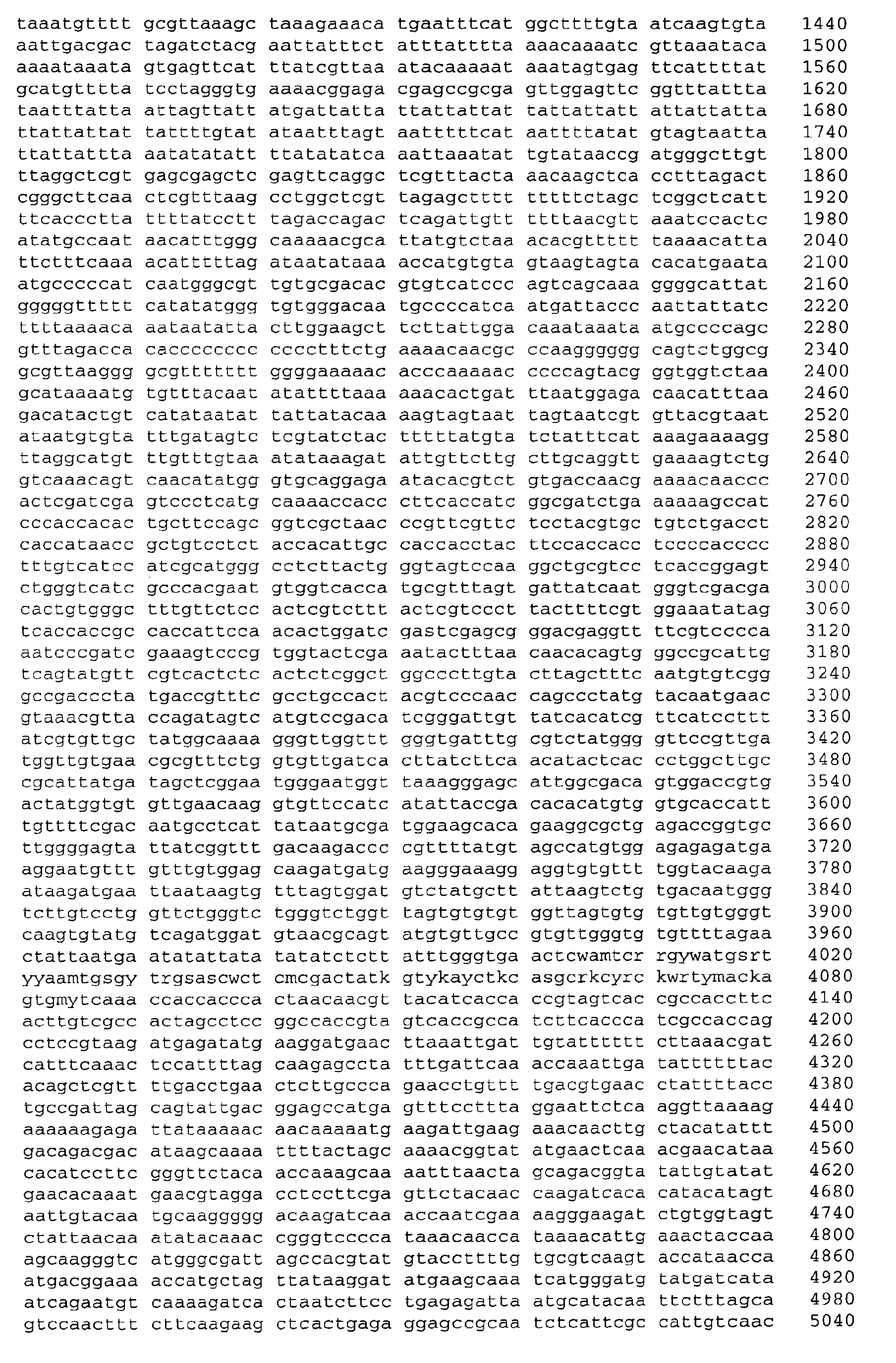
  • the molecular marker of the invention comprises the isolated nucleic acid SEQ ID N° 3 having 872 bp or a sequence having a high degree of homology with sequence SEQ ID N°3.
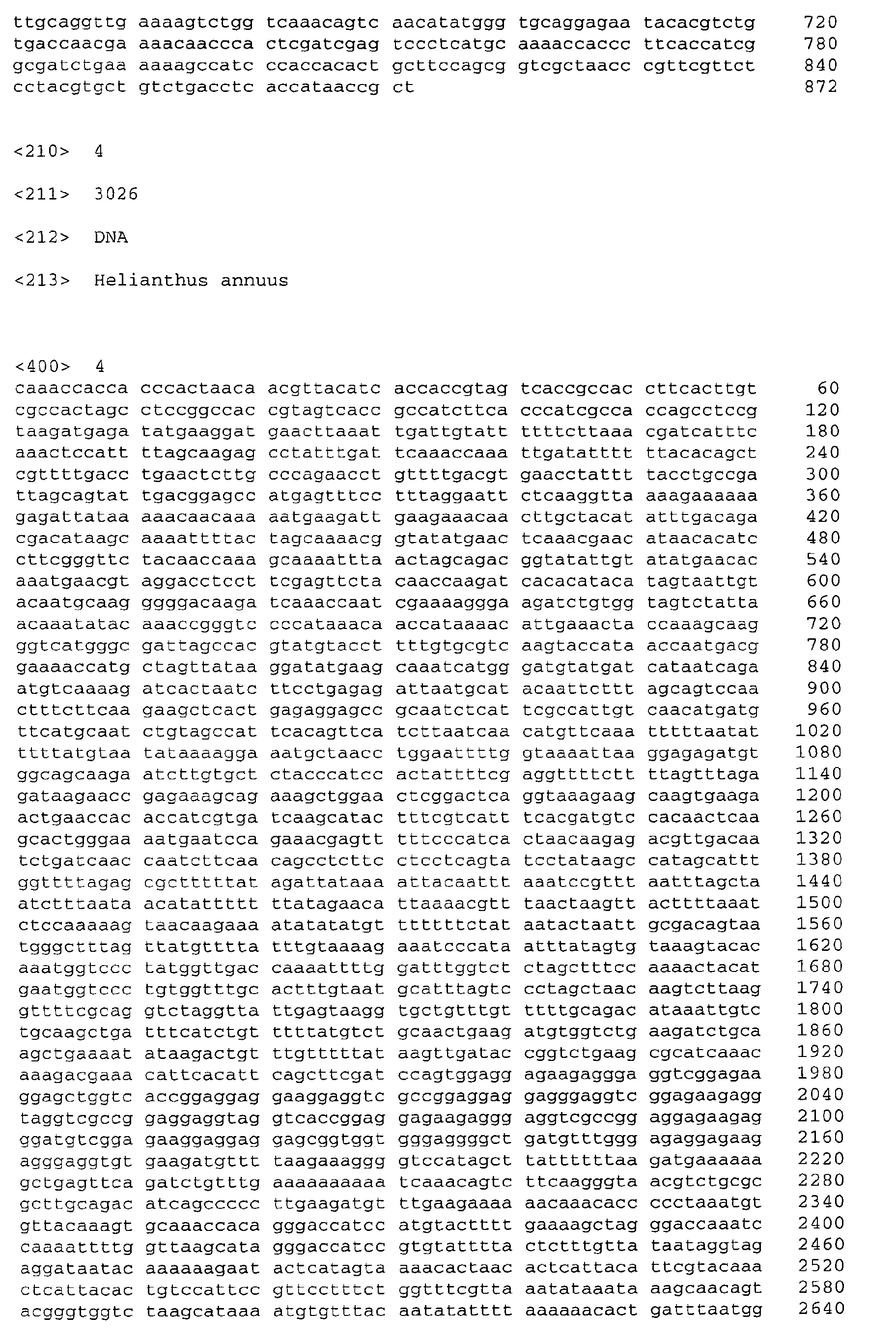
  • Said nucleic acid sequence is a part of sequence SEQ ID NO:4 having 3026 bp and being identified as sequence N1/2 on Fig 2.
  • the marker having SEQ ID NO:3 is located between 2154 bp and 3026 bp of SEQ ID NO:4.
  • a high degree of homology denotes a homology (ratio of the identical nucleotides to the total number of nucleotides) of at least 85 %, and preferably 90 %, for the nucleotide sequences when they are aligned according to the maximum homology by the optimal sequence alignment method of ALIGN. This method is used especially in the GCG software of Devereux et al. (9).
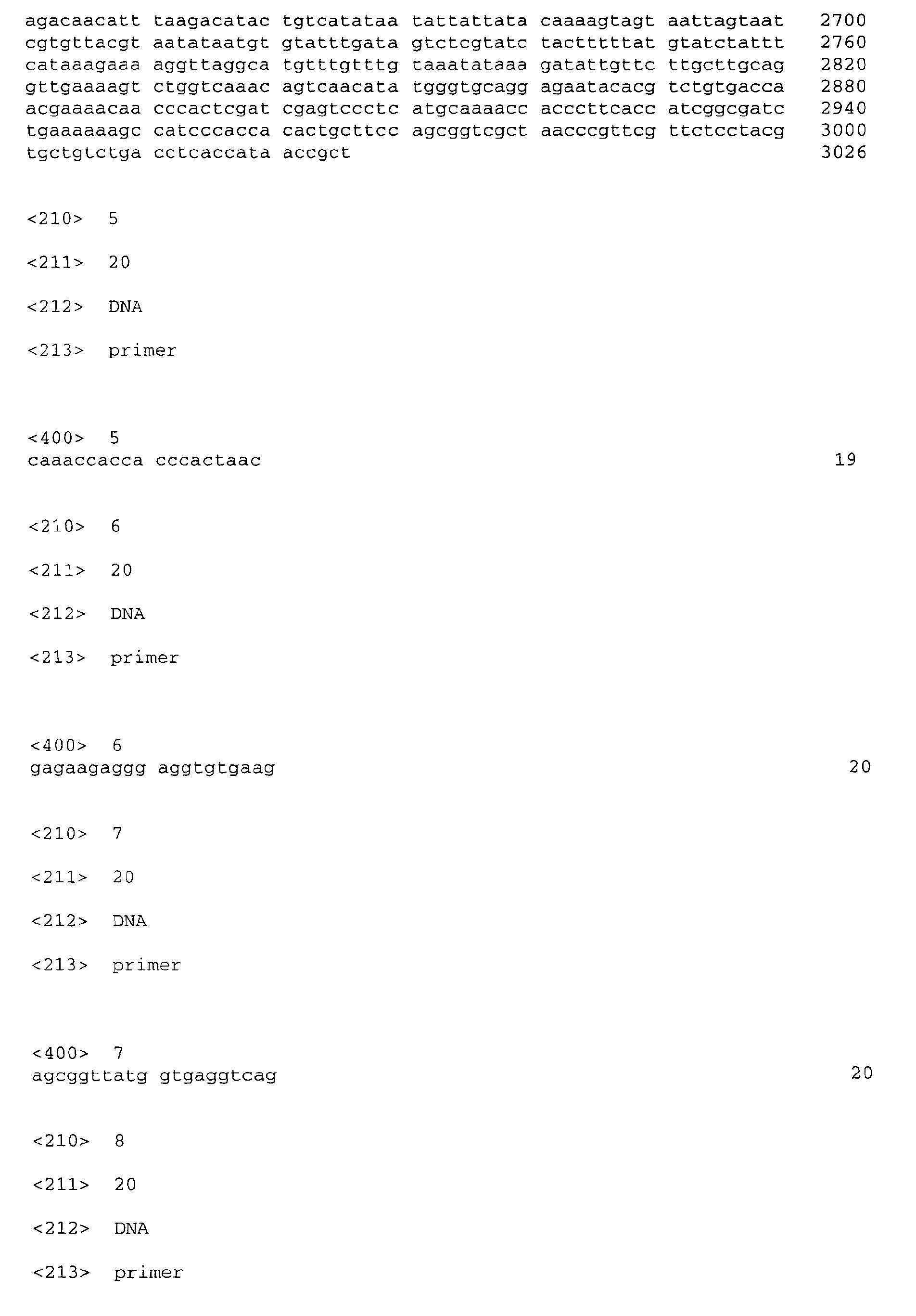
  • the invention also relates to the isolated nucleic acid fragments having 10-30 bp and which hybridize with SEQ N2 (SEQ ID NO:2). Said fragments are particularly useful tools as primers for nucleic acid amplification, for example PCR amplification.
  • the invention also relates to the primer pairs useful for nucleic acid amplification, which comprise:
  • Examples of such pairs of primers comprise as:
  • acid nucleic sequences codes end by a number whereas acid nucleic fragments useful as primers end by F or R depending on they are designed forward or reverse, respectively. These references are reported on the map of the 29 kb region (Fig 2).
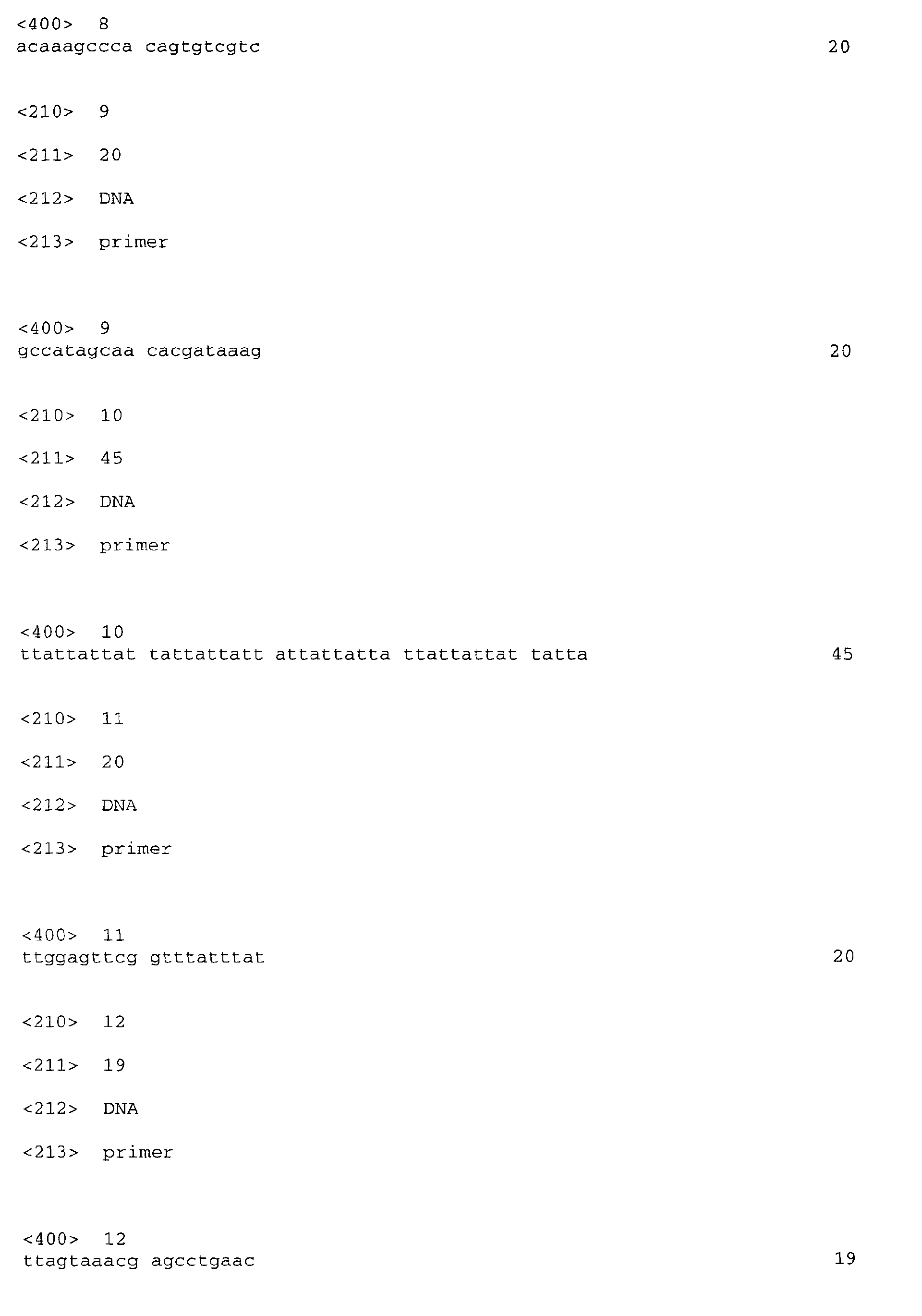
  • the invention also relates to the isolated SSR nucleic acid sequence SEQ ID N° 10 having 45 bp with 16 TTA repeat microsallelites TTA. This sequence involving a polymorphism associated with the Pervenets mutation may be used in selection programs for rapidly identifying the locus of the Pervenets mutation.
  • Said SSR sequence is located in the intron of the oleate-desaturase gene besides the Pervenets insertion.
  • said SSR sequence is very useful for mapping the oleate-desaturase gene in the genome of sunflower plants to be selected.
  • the invention also concerns the molecular marker specific for mapping the oleate-desaturase gene in the genome of the sunflower to be selected which comprises the nucleic acid sequence SEQ ID N° 10 or a sequence having a high degree of homology with sequence SEQ ID N° 10.
  • the invention also concerns the isolated nucleic acid fragments SEQ ID N° 11 and SEQ ID N° 12. Said fragments are useful as primers for amplifying the above SSR sequence:
  • the invention also relates to a process for selecting sunflower having seeds with a high content of oleic acid which comprises the steps of:
  • This process allows the selection of genotypes having the Pervenets mutation without needing to determine the oleic acid content of the seeds, which considerably reduces the selection time.
  • the Pervenets mutation is firstly mapped in most of progenies (most of sunflower line couples display polymorphism for the SSR) by a process comprising the steps of:
  • the thus selected clones have the Pervenets mutation and are used as such in the above invention process.
  • primer pairs useful in the invention process are the:
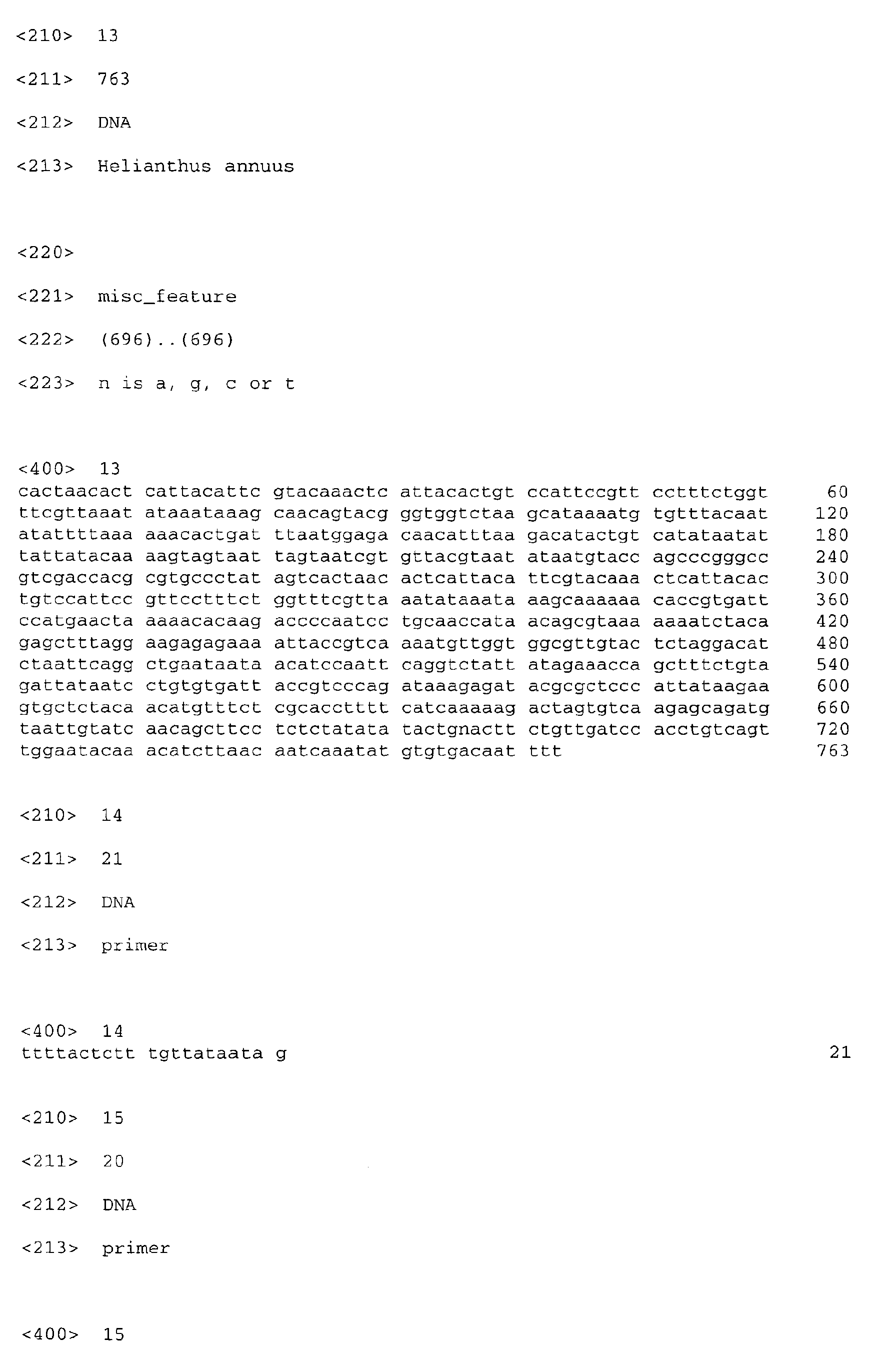
  • the invention also relates to the molecular marker constituted by the isolated nucleic sequence SEQ ID NO:13 having 763 bp, which is common to LO and HO regions and located over the insertion point of the Pervenets mutation.
  • the insertion point is located between the bp 83 and bp 366 of SEQ ID NO:13.
  • the invention also relates to the isolated nucleic acid fragments having 10-30 bp and which hybridise with SEQ ID NO:13. Said fragments are also useful tools as primers for nucleic acid amplification, for example for PCR amplification.
  • the invention also relates to the process for amplifying the region across the insertion Pervenets mutation site both in LO and HO genotypes. Said process comprises the steps of :
  • the amplification step may be carried out by any nucleic amplification method known by the person skilled in the art, for example by the well-known PCR amplification method.
  • a 6662 kb region carrying the ⁇ 12HOS and ⁇ 12LOR common part in RHA 345 HO line (SEQ N1) was cloned, sequenced and characterized. It was shown that it carries a putative functional ⁇ 12-desaturase gene (SEQ N1- ⁇ 12). Indeed, the TATAAA and CAAT consensus promoter elements are present at positions -92 bp and -42 bp upstream the +1 transcriptional point, respectively. Because of its sequence and its position, the AAGTAA sequence, 16nt before the end of the transcribed part, corresponds to a poly-A signal AATAAA, except for one nucleotide.
  • the ⁇ 12-desaturase gene is interrupted by a 1686pb intron between nt 83 and nt 1767 upstream the +1 transcriptional point.
  • the consensus splicing sites GT and AG are present at the intron extremities.
  • a 16 repeats of a TTA SSR motive is revealed in the intron sequence between nt 784 and 832 upstream the +1 transcriptional point.
  • SEQ N1-1F and SEQ N1-1R size polymorphism at this locus in a set of 42 HO and LO genotypes was tested (Table 1).
  • PCR amplification leads to 237 / 240 / 243 bp fragments corresponding to 15 / 16 / 17 SSR repeats, respectively.
  • SSR polymorphism of the HO parental line (16 motifs) and the ⁇ 12HOS allele (EXAMPLE 2) was revealed. So, this SSR sequence displays a polymorphism tightly linked to the Pervenets mutation. Consequently, it can be used to map the locus of the ⁇ 12-desaturase gene in sunflower genome in most of crosses. Moreover, it may be used in selection programs for fast screening of genotypes carrying the Pervenets mutation by PCR method.
  • the invention relates to this SSR nucleic acid sequence present in SEQ ID N1 and SEQ ID N1- ⁇ 12.
  • the invention also relates to sequences having a high degree of homology with sequence SEQ ID N1 or N1- ⁇ 12 and nucleic acid fragments that can be used as PCR primers to amplify the SSR motive such as SEQ ID N1-1F and SEQ ID N1-1R leading to a PCR fragment carrying the 15, 16 or 17 TTA motives.
  • the invention relates to SEQ N1/2 (SEQ ID NO:1) corresponding to part of the ⁇ 12-desaturase HO specific fragment, and sequences having a high degree of homology with SEQ N1/2 (SEQ ID NO:1).
  • the invention also relates to nucleic acid fragments which can be used as PCR primers to amplify genomic region having a high degree of homology with SEQ ID N1/2 such as combinations of SEQ ID N1-2F or SEQ ID N1-3F with SEQ ID N2-1R, SEQ ID N2-2R and SEQ ID N2-3R.
  • primer pair combinations enable to obtain fragment lengths of 3026bp (sequence N1-2F+ sequence N2-1R), 870bp (sequence N1-3F + sequence N2-1R), 1000bp (sequence N1-3F + sequence N2-2R) and 1400bp (sequence N1-3F + sequence N2-3R), respectively.
  • Those primer sequences are coded:
  • the invention also relates to a sequence common to LO and HO regions which is localised over the insertion point of the Pervenets mutation.
  • This sequence SEQ ID NO:13 was isolated by RAGE PCR and the sequences of the cloned LO and HO fragments clearly displays the break-up at the insertion point. Primer pairs were defined to amplify across the insertion Pervenets mutation point.
  • these primer pair combinations always revealed these short fragments whatever the LO or HO genotypes.
  • this region enables to further characterize revertant mutant that still carry a short insertion that cannot silence the wild desaturase gene, since these were still LO.
  • the combination of the markers (SSR, ⁇ 12HOS allele and that across the insertion site) enables to unravel what happened. Since there is no genetic recombination between the SSR locus and the ⁇ 12HL locus, the SSR allele will be always linked (in the same phasis) to the ⁇ 12HL allele that was present. If it reverts the ⁇ 12LOR allele will be found linked to the incorrect SSR allele.
  • the suppressor is detected when the presence of the ⁇ 12HOS allele does not lead to the HO phenotype.
  • ⁇ 12-desaturase cDNA used in the following example has 1458 bp and is similar to the complete ⁇ 12-desaturase cDNA deposited in the GenBank under n° U91341 and described by Hongtrakul et al (5).
  • Oil composition measurement and 18:1 content determination were performed on half a cotyledon using gas chromatography as described by Conte et al. (10).
  • the DNA was extracted from 5g of ground leaves in liquid nitrogen according to the method disclosed by Gentzbittel ( 11 ).
  • CTAB 10X CTAB 10% (w/v), NaCl 0.7 M
  • 7 ml of chloroform/isoamylic alcohol 24/1, v/v
  • the supernatant was recovered in a precipitation buffer, the volume of which corresponds to two volumes of the supernatant (CTAB 1% (w/v), Tris-HCl 50mM pH8, EDTA 100mM pH8).
  • the pellet was recovered and dissolved in 3 ml of TE High buffer (Tris-HCl 10 mM pH8, Na 2 EDTA 1mM pH8, NaCl 1M) and two volumes of 95% cold ethanol, before a further centrifugation at 12,000 rpm, for 15 min.
  • the pellet containing the DNA was dissolved in 1 ml of TE 0.1X (Tris-HCl 1 mM pH8, Na 2 EDTA 0.1 mM).
  • the amount of DNA is determined using an absorbance spectrophotometer (DO) at 260 nm.
  • restriction products were separated by gel electrophoresis on Agarose 0.8% (w/v) gel in the 0.5X TBE buffer (Tris-HCl 45 mM pH8, boric acid 45mM, EDTA pH8 1mM) at 1 v/cm for 16 hours. The gel was then colored in EtBr bath (1 ⁇ g/ml). The migration profiles were made visible under UV light (at 312 nm).
  • the samples were transferred onto a Nylon membrane (Appligene).
  • the transfer was made under reduced pressure at 60 mbar during 2 hours using a vacuum transfer apparatus (Appligene).
  • a 0.4 N NaOH solution was used as a transfer solution.
  • the membranes were then washed in a 2X SSC solution (NaCl 3M, sodium citrate 0.3 M pH 7).
  • the DNA was fixed on the membranes by incubation at 80°C for two hours. The membranes were stocked at 4°C until using them for hybridization.
  • the radioactive labelling of the probes was carried out by the random primer elongation in the presence of a desoxyribonucleotide labelled by a radioactive isotype, ⁇ 32 P-dCTP according to the method described by Feinberg and Volgelstein ( 12 ).
  • the prehybridization and the hybridization were carried out in the same buffer containing SDS 7% (w/v), Sodium Phosphate buffer 0.5 M (pH 7.2), EDTA 1mM (pH 8), stirring at 62°C for 1 hour (prehybridization) and 12 hours (hybridization). Two washes for 10 min.
  • PCR amplification was carried out starting from 80 ng of genomic DNA in a final volume of 30 ⁇ l containing Tris-HCl 10mM (pH 8.3); KCI 50 mM, MgCl 2 1.5 mM; dNTPs 200 ⁇ M; 1 ⁇ M of each primer, Taq polymerase 1U (Sigma).
  • the amplifications were carried out using a PTC 100 thermocycler (MJ Research) according to the following program:
  • the amplification products were then either separated by electrophoresis on Agarose gel or purified in order to be cloned and sequenced.
  • the electrophoresis was carried out on 1.2% (w/v) Agarose gel in TBE 0.5X buffer (10v/cm) for two hours. Purification of the amplification products was carried out with the Wizard PCR Prep DNA Purification Systems kit (Promega).
  • the amplification using the SSR primers was carried out using 40 ng of genomic DNA in a final volume of 25 ⁇ l containing Tris-HCl 10 mM (pH 8.3), KCI 50 mM, MgCl 2 1.5 mM, dNTPs 200 ⁇ M, 1 ⁇ M of each primer; Taq polymerase 1U (Sigma).
  • the amplifications were carried out using a PTC 100 thermocycler (MJ Research) according to the following program:
  • Amplification product were loaded onto 6% denaturing polyacrylamide gels containing 7.5 M urea, 6% acrylamide and 1X TBE buffer (Tris-HCl 90mM pH8, boric acid 90 mM, EDTA pH8 2mM). Gels were run in a 1X TBE buffer for 90 min at 60V. SSR amplifications were visualized by sliver staining with a commercial kit from Promega.
  • EXAMPLE 1 Diversity analysis with the HO specific PCR fragment across the insertion Pervenets point.
  • the Pervenets mutation was labelled by HO specific PCR amplifications across the 5' insertion point using designed primer pair combinations (SEQ N1-3F located on SEQ N1 with SEQ N2-1R, -2R or -3R designed on ⁇ 12-desaturase cDNA sequence).
  • HO and LO genotypes were used for these PCR experiments. These genotypes were previously genotyped using ⁇ 12-desaturase cDNA as a probe to reveal RFLPs. All the HO genotypes displayed the ⁇ 12HOS allele whereas the LO genotypes displayed the ⁇ 12LOR one ( 6 ).
  • PCR amplification products of about 870bp (SEQ ID N1-3F + SEQ ID N2-1R), 1000bp (SEQ ID N1-3F + SEQ ID N2-2R) and 1400bp (SEQ ID N1-3F + SEQ ID N2-3R) were specifically revealed in HO genotypes carrying the Pervenets mutation (Fig 3 A, B and C, respectively). All the 42 genotypes were categorized into LO or HO without any error according to these HO specific PCR amplifications.
  • the recombinant inbred line families were obtained by crossing the lines 83HR4 (LO) by RHA 345 (HO) according to the method described above. Using ⁇ 12-desaturase as a probe to reveal RFLP, we showed that the RHA 345 HO parent line carries the ⁇ 12HOS allele whereas the 83HR4 LO parental line displayed the ⁇ 12LOR allele. In the 174 recombinant inbred line population, the ⁇ 12HOS / ⁇ 12LOR alleles segregated as 78 / 96.
  • the Pervenets mutation was labelled by the 870bp PCR fragment across the 5' insertion point and by the polymorphism of the SSR locus located on the ⁇ 12-desaturase gene intron. Moreover this SSR polymorphism labelled the ⁇ 12-desaturase gene itself.
  • SSR polymorphism between RHA 345 and 83HR4 parental line was revealed by PCR amplification using the primer pair SEQ ID N1-1F/ SEQ ID N1-1R. This PCR amplification leads to 237 bp (15 SSR motives) and 240 bp (16 SSR motives) in 83HR4 and RHA 345, respectively. The segregation of this SSR polymorphism was tested in the 174 recombinant inbred line population.
  • genotypes carrying the ⁇ 12HOS allele displayed the HO RHA 345 SSR polymorphism (16 SSR motives) whereas genotypes carrying the ⁇ 12LOR allele displayed the LO 83HR4 SSR polymorphism (15 SSR motives).
  • the SSR sequence and the HO PCR specific fragment may be used in selection programs to identify genotypes carrying the Pervenets mutation.
  • the SSR polymorphism can be used to map the ⁇ 12-desaturase gene.

Landscapes

  • Life Sciences & Earth Sciences (AREA)
  • Health & Medical Sciences (AREA)
  • Chemical & Material Sciences (AREA)
  • Genetics & Genomics (AREA)
  • Engineering & Computer Science (AREA)
  • Organic Chemistry (AREA)
  • Zoology (AREA)
  • Wood Science & Technology (AREA)
  • Botany (AREA)
  • Bioinformatics & Cheminformatics (AREA)
  • Analytical Chemistry (AREA)
  • Environmental Sciences (AREA)
  • Developmental Biology & Embryology (AREA)
  • Biotechnology (AREA)
  • General Health & Medical Sciences (AREA)
  • Proteomics, Peptides & Aminoacids (AREA)
  • Physiology (AREA)
  • Molecular Biology (AREA)
  • General Engineering & Computer Science (AREA)
  • Physics & Mathematics (AREA)
  • Microbiology (AREA)
  • Biochemistry (AREA)
  • Biomedical Technology (AREA)
  • Medicinal Chemistry (AREA)
  • Mycology (AREA)
  • Natural Medicines & Medicinal Plants (AREA)
  • Spectroscopy & Molecular Physics (AREA)
  • Biophysics (AREA)
  • Immunology (AREA)
  • Measuring Or Testing Involving Enzymes Or Micro-Organisms (AREA)
  • Low-Molecular Organic Synthesis Reactions Using Catalysts (AREA)
  • Organic Low-Molecular-Weight Compounds And Preparation Thereof (AREA)
  • Breeding Of Plants And Reproduction By Means Of Culturing (AREA)

Abstract

The present invention relates to the selection of sunflower genotypes with high oleic acid content in seed oil. The invention concerns more particularly molecular markers useful for a rapid and easy selection of sunflower lines and then sunflower hybrids capable of producing seeds having high oleic acid content.

Description

  • The present invention relates to the selection of sunflower genotypes with high oleic acid content in seed oil. The invention concerns more particularly molecular markers useful for a rapid and easy selection of sunflower lines and then sunflower hybrids capable of producing seeds having high oleic acid content.
  • In the present description, the expression "high oleic acid content seeds" designates seeds containing more than 60% of oleic acid.
  • BACKGROUND OF THE INVENTION
  • Since the 1960s, vegetable oils rich in unsaturated fatty acids have become particularly important due to the relationship established between the saturated fatty acids present notably in animal fats and the cholesterol level increase.
  • Most of the fatty acids in vegetable oils are fatty acids having 16 or 18 carbon atoms. The C16-fatty are generally saturated fatty acids (16:0 = palmitic acid). Conversely, the C18 fatty acids are either saturated (18:0 = stearic acid) or unsaturated having 1, 2 or 3 double bonds (18:1 = oleic acid; 18:2 = linoleic acid; 18:3 = linolenic acid).
  • Certain unsaturated fatty acids, notably linolenic acid, are not synthesized by the human body and are of an insufficient amount in fats of animal origin. Among the unsaturated fatty acids, the mono-unsaturated 18:1 oleic acid, has properties which is particularly suitable for preventing cardiovascular diseases. Moreover, High oleic acid content oils are more resistant to heating and are thus recommended for frying.
  • The fatty acids composition in vegetable oils deriving from seeds is variable depending on the oleaginous plant. Olive oil has naturally high 18:1 content (around 70%), nevertheless, its non-lipid part of the oil decreases the interest of this oil. Normal sunflower (hereinafter named LO varieties) oil contains mainly linoleic acid and high levels of phytosterols and tocopherol conferring hypocholesterolemic and anti-oxidant properties to the non-lipid part of the oil. Sunflower lines and hybrids, which have high 18:1 content in their seeds (hereinafter named HO varieties) have been obtained by selection programs from the HO Pervenets mutant, said mutant being obtained by chemical mutagenesis (1). They are particularly interesting since they have the combined benefits of oleic acid and the non-lipid part of the sunflower oil (phytosterol and tocopherol). They therefore respond to the requirement of quality by consumers.
  • In addition to their dietary benefits, vegetable oils are of significant industrial interest. Indeed, they represent a source of fatty acids as starting material used in the lipochemical industry (detergents, paints, cosmetics). Vegetable oil from the HO sunflower type is a substantially pure industrial source of 18:1, that reduces the purification steps.
  • In order to respond to the needs of vegetable oils of food or industrial interest, the improvement of the oleaginous varieties is concerned with the control and the change of their fatty acid compositions by means of conventional selection programs, but also by mutagenesis and transgenesis.
  • The chemical mutagenesis carried out by Soldatov in 1976 (1) on a sunflower population allowed the Pervenets mutant population to be obtained. The average content of 18:1 of the seeds from this population is higher than 65%, the individual contents being between 60 and 80% whereas in normal LO varieties this content is about 20%. The Pervenets population was distributed throughout the world and used in many selection programs in order to convert selected genotypes with low 18:1 content into genotypes having 18:1 content in their seeds higher than 80%.
  • During the conversion process of the normal LO material into HO one, the selection is generally based on the 18:1 content of the seeds. This phenotypic determination does not allow a rapid and early detection of HO genotypes and cannot distinguish between homozygote and heterozygote genotypes for the mutation. It is therefore necessary to have selection markers at genomic level allowing earlier and rapid determination of the HO phenotype homozygous for the mutation during conversion process.
  • The accumulation of the 18:1 in the seeds is mainly dependent on two enzymatic reactions: the upstream desaturation of 18:0 into 18:1 and the downstream desaturation of 18:1 into 18:2. Studies carried out by Garcés and Mancha in 1989 and 1991 (2, 3) demonstrated that the HO phenotype is associated with a marked activity decrease of the Δ12-desaturase enzyme, which catalyses the desaturation of 18:1 into 18:2 in the HO seeds during the critical stages of constructing the lipidic stocks, explaining the 18:1 accumulation. Kabbaj et al (4) subsequently demonstrated that one HO genotype presents a significant decrease in the Δ12-desaturase mRNA levels in the seeds during the critical stages of producing the lipidic stocks compared to 2 LO genotypes. This decrease explains the decrease of the amount of enzyme and therefore of Δ12-desaturase activity already demonstrated. Hongtrakul et al. (5) and then Lacombe et al. (6, 7) showed that HO lines derived from Pervenets mutant carry specific restriction fragment length polymorphisms (RFLPs) revealed using a Δ12-desaturase cDNA as a probe. These RFLPs determine the Δ12 HO specific allele, Δ12HOS. The normal LO lines do not carry the Δ12HOS allele but another allele named Δ12LOR at this locus (named Δ12HL locus) (6, 7). Studying the inheritance of the phenotype HO in an F2 population, Lacombe et al. (6) revealed that the HO phenotype co-segregated with the Δ12HOS allele pointing out that the Pervenets mutation is carried or genetically tightly linked to the Δ12HOS allele. In another segregating population (recombinant inbred lines F6 population), Lacombe et al. (7) showed that all the HO lines carry the Δ12HOS allele. However, the recombinant lines carrying Δ12HOS are equally shared into HO or LO classes. The absence of HO plants carrying the Δ12LOR allele eliminates the occurrence of a recombination event between the Δ12HL locus and the locus containing the Pervenets mutation. In the genetic background of this population, the HO phenotype is therefore due to two independent loci: the Δ12HL locus carrying the Δ12HOS allele and consequently the Pervenets mutation, and another locus, where an allele suppresses the effect of the Δ12HOS allele leading to restore the LO phenotype.
  • Once the coincidence or the very tightly genetic linkage between the Pervenets mutation and the Δ12HOS allele revealed, Lacombe et al. (8) established physical maps of the Δ12HOS and Δ12LOR alleles at the Δ12HL locus (Fig 1). For this purpose, they used the HO and LO RFLP profiles revealed with the Δ12-desaturase cDNA used as a probe. The Δ12LOR allele in LO genotypes corresponds to a 5.8 kb EcoRI and to a 8 kb HindIII fragments carrying Δ12-desaturase like sequences. The double digest with EcoRI + HindIII leads to a 2.2 kb fragment. For the Δ12HOS allele in HO genotypes, the 5.8 kb EcoRI fragment is still present but another 7.9 kb EcoRI extra fragment is also revealed. With HindIII, the 8 kb fragment revealed in LO genotypes lengthens to 16 kb in HO genotypes. With the EcoRI + HindIII double digest, the Δ12HOS allele displayed the 2.2 kb fragment revealed in Δ12LOR allele plus the 7.9 kb EcoRI extra fragment. According to all these data, the Δ12HOS and Δ12LOR allele physical maps were established. The Δ12LOR allele carries one region whereas the Δ12HOS allele carries 2 adjacent regions with Δ12-desaturase like sequences: the Δ12HOS / Δ12LOR common region determined by the common 5.8 kb EcoRI fragment and a HO specific region determined by the 7.9 kb EcoRI extra fragment (Fig 1, ref 8).
  • Studying genomic clones carrying Δ12-desaturase like sequence from a HO genotype genomic library, Lacombe et al. (8) revealed that the Δ12HOS / Δ12LOR common fragment should carry a functional Δ12-desaturase gene interrupted by a 1686bp intron in the 5'UTR part of the gene.
  • SUMMARY OF THE INVENTION
  • The present invention relates to molecular markers that are strictly linked to genetic factors involved in 18:1 accumulation in seed oil of HO genotypes of sunflower: the Pervenets mutation and another independent factor, the supole factor.
  • The invention relates to PCR molecular markers that partly amplify the Pervenets mutation. It also relates to a SSR marker (15-17 TTA motifs) in the intron of the Δ12-desaturase functional gene adjacent to the mutation that enables to map the gene locus in most of segregating populations and to select genotypes carrying the Pervenets mutation.
  • The invention also relates to specific markers of a genetic factor suppressing the Pervenets mutation effect. The presence of the suppressor (supole) is revealed in genotypes by combining the presence of the Δ12HOS allele and the low 18:1 content in seed oil.
  • All these molecular markers may represent advantageous and useful tools in selection programs for rapid screening and early detection of HO genotypes producing seeds with a high 18:1 content, carrying the Pervenets mutation without the unfavourable supole factor by means of the PCR technology.
  • The invention also relates to processes for the selection of sunflower producing seeds with a high oleic acid content.
  • The present invention also relates to primers useful for nucleic acid amplification and to combinations thereof.
  • Finally, the invention concerns the test kits for selecting sunflower having seeds with a high content of oleic acid which contain at least one of the above combinations.
  • DETAILED DESCRIPTION OF THE INVENTION
  • The present invention relates to Pervenets mutation specific molecular markers located in a 29 kb region, a map thereof is represented on Fig 2. This region carrying these molecular markers is divided in 3 sequences, from 5' to 3':
    • sequence N1 having 6.662 kb: Δ12HOS / Δ12LOR common part carrying a Δ12-desaturase gene (SEQ ID NO:1) ;
    • sequence N2: HO specific insertion; (this sequence has been partially sequenced (SEQ ID NO:2) ;
    • sequence N3: the 3' adjacent part of the HO specific insertion fragment.
  • The molecular marker of the invention comprises the isolated nucleic acid SEQ ID N° 3 having 872 bp or a sequence having a high degree of homology with sequence SEQ ID N°3. Said nucleic acid sequence is a part of sequence SEQ ID NO:4 having 3026 bp and being identified as sequence N1/2 on Fig 2. The marker having SEQ ID NO:3 is located between 2154 bp and 3026 bp of SEQ ID NO:4.
  • In the present description, a high degree of homology denotes a homology (ratio of the identical nucleotides to the total number of nucleotides) of at least 85 %, and preferably 90 %, for the nucleotide sequences when they are aligned according to the maximum homology by the optimal sequence alignment method of ALIGN. This method is used especially in the GCG software of Devereux et al. (9).
  • The invention also relates to the isolated nucleic acid fragments having 10-30 bp and which hybridize with SEQ N2 (SEQ ID NO:2). Said fragments are particularly useful tools as primers for nucleic acid amplification, for example PCR amplification.
  • Examples of said fragments are the fragments having the following sequences:
    Figure 00050001
    Figure 00050002
    Figure 00050003
  • The invention also relates to the primer pairs useful for nucleic acid amplification, which comprise:
  • 1) as the first member of the pair a nucleic acid fragment having 1 to 30 bp and which hybridises with sequence N1 (SEQ ID N°1) and
  • 2) as the second member of the pair a nucleic acid fragment having 10 to 30 bp and which hybridises with SEQ ID NO:2.
  • Examples of such pairs of primers comprise as:
  • 1) first member :
    Figure 00060001
    or
    Figure 00060002
  • 2) second member :
    Figure 00060003
    Figure 00060004
    Figure 00060005
  • In the present description, acid nucleic sequences codes end by a number whereas acid nucleic fragments useful as primers end by F or R depending on they are designed forward or reverse, respectively. These references are reported on the map of the 29 kb region (Fig 2).
  • The invention also relates to the isolated SSR nucleic acid sequence SEQ ID N° 10 having 45 bp with 16 TTA repeat microsallelites TTA. This sequence involving a polymorphism associated with the Pervenets mutation may be used in selection programs for rapidly identifying the locus of the Pervenets mutation.
  • Said SSR sequence is located in the intron of the oleate-desaturase gene besides the Pervenets insertion.
  • Therefore, said SSR sequence is very useful for mapping the oleate-desaturase gene in the genome of sunflower plants to be selected.
  • The invention also concerns the molecular marker specific for mapping the oleate-desaturase gene in the genome of the sunflower to be selected which comprises the nucleic acid sequence SEQ ID N° 10 or a sequence having a high degree of homology with sequence SEQ ID N° 10.
  • The invention also concerns the isolated nucleic acid fragments SEQ ID N° 11 and SEQ ID N° 12. Said fragments are useful as primers for amplifying the above SSR sequence:
    Figure 00060006
    Figure 00060007
  • All the isolated nucleic acid sequences and fragments of the invention may be obtained by chemical synthesis following the conventional methods well known by the person skilled in the art.
  • The invention also relates to a process for selecting sunflower having seeds with a high content of oleic acid which comprises the steps of:
    • extracting the genomic DNA;
    • amplifying said genomic DNA by means of primer pair, said pair being constituted with a first member of nucleic acid fragment having 10 to 30 bp, which hybridises with sequence N1 (SEQ ID NO:1) and a second member of nucleic acid fragment having 10 to 30 bp, which hybridises with sequence N2 (SEQ ID NO:2);
    • hybridizing the amplified DNA fragment with the labelled sequence SEQ ID N° 3 and
    • isolating the genotypes giving a positive hybridisation signal.
  • This process allows the selection of genotypes having the Pervenets mutation without needing to determine the oleic acid content of the seeds, which considerably reduces the selection time.
  • Following an advantageous embodiment of this process, the Pervenets mutation is firstly mapped in most of progenies (most of sunflower line couples display polymorphism for the SSR) by a process comprising the steps of:
    • extracting the genomic DNA;
    • amplifying said genomic DNA by means of primers SEQ ID N° 11 and SEQ ID N° 12;
    • isolating the clones having a DNA fragment length which is different from a reference clone without the Pervenets mutation.
  • The thus selected clones have the Pervenets mutation and are used as such in the above invention process.
  • Examples of the primer pairs useful in the invention process are the:
    • isolated nucleic acid fragments SEQ ID NO:5 and SEQ ID NO:6 as first member of said pair, and
    • isolated nucleic acid fragments SEQ ID NO:7 to SEQ ID NO:9 as second member of said pair.
  • The invention also relates to the molecular marker constituted by the isolated nucleic sequence SEQ ID NO:13 having 763 bp, which is common to LO and HO regions and located over the insertion point of the Pervenets mutation. The insertion point is located between the bp 83 and bp 366 of SEQ ID NO:13.
  • The invention also relates to the isolated nucleic acid fragments having 10-30 bp and which hybridise with SEQ ID NO:13. Said fragments are also useful tools as primers for nucleic acid amplification, for example for PCR amplification.
  • Examples of said fragments are the fragments having the following sequences:
    Figure 00080001
    Figure 00080002
    Figure 00080003
    Figure 00080004
    Figure 00080005
    Figure 00080006
  • The invention also relates to the process for amplifying the region across the insertion Pervenets mutation site both in LO and HO genotypes. Said process comprises the steps of :
    • extracting the genomic DNA;
    • amplifying said genomic DNA by means of primer pair, said pair being constituted with a first member of nucleic acid fragments having 10 to 30 bp which hybridises with sequence N1 (SEQ ID N0:13).
  • In all the invention processes, the amplification step may be carried out by any nucleic amplification method known by the person skilled in the art, for example by the well-known PCR amplification method.
  • A 6662 kb region carrying the Δ12HOS and Δ12LOR common part in RHA 345 HO line (SEQ N1) was cloned, sequenced and characterized. It was shown that it carries a putative functional Δ12-desaturase gene (SEQ N1-Δ12). Indeed, the TATAAA and CAAT consensus promoter elements are present at positions -92 bp and -42 bp upstream the +1 transcriptional point, respectively. Because of its sequence and its position, the AAGTAA sequence, 16nt before the end of the transcribed part, corresponds to a poly-A signal AATAAA, except for one nucleotide. The Δ12-desaturase gene is interrupted by a 1686pb intron between nt 83 and nt 1767 upstream the +1 transcriptional point. The consensus splicing sites GT and AG are present at the intron extremities. A 16 repeats of a TTA SSR motive is revealed in the intron sequence between nt 784 and 832 upstream the +1 transcriptional point. Using primer pairs enabling this SSR amplification (SEQ N1-1F and SEQ N1-1R), size polymorphism at this locus in a set of 42 HO and LO genotypes was tested (Table 1).

    Figure 00090001
    Figure 00090002
  • PCR amplification leads to 237 / 240 / 243 bp fragments corresponding to 15 / 16 / 17 SSR repeats, respectively. In the 174 individuals segregating population already studied (7), a strict co-segregation between the SSR polymorphism of the HO parental line (16 motifs) and the Δ12HOS allele (EXAMPLE 2) was revealed. So, this SSR sequence displays a polymorphism tightly linked to the Pervenets mutation. Consequently, it can be used to map the locus of the Δ12-desaturase gene in sunflower genome in most of crosses. Moreover, it may be used in selection programs for fast screening of genotypes carrying the Pervenets mutation by PCR method.
  • The invention relates to this SSR nucleic acid sequence present in SEQ ID N1 and SEQ ID N1-Δ12. The invention also relates to sequences having a high degree of homology with sequence SEQ ID N1 or N1-Δ12 and nucleic acid fragments that can be used as PCR primers to amplify the SSR motive such as SEQ ID N1-1F and SEQ ID N1-1R leading to a PCR fragment carrying the 15, 16 or 17 TTA motives.
  • In order to select molecular markers corresponding to the Pervenets mutation itself, parts of the 7.9 kb EcoRI HO specific fragment that should carry the Pervenets mutation was cloned, sequenced and characterized. Primer pairs on both side of the 5' Pervenets mutation insertion point: SEQ ID N1-2F located on SEQ N1 and SEQ ID N2-1R located on the SEQ N2 and designed in Δ12-desaturase cDNA were selected.
    Figure 00090003
    Figure 00090004
  • Because of their positions, these primers lead to a 3026bp PCR amplification fragment only in RHA 345 HO genotype compared to LO4 and other LO genotypes. Subsequently, we cloned sequenced and characterised this PCR fragments carrying the 5' Pervenets mutation insertion point (SEQ ID N1/2) was cloned, sequenced and characterized. The organisation of this sequence is, from 5' to 3':
    • A 2576bp HO / LO common region
    • the 5' insertion point
    • HO specific Δ12-desaturase gene like sequence: part of the intron (239bp) and part of the coding region (211bp).
  • Based on this characterisation, new primers were computed (SEQ ID N1-3F located on SEQ ID N1, SEQ ID N2-2R and SEQ ID N2-3R designed on Δ12-desaturase cDNA sequence).
    Figure 00100001
    Figure 00100002
    Figure 00100003
  • These primer pair combinations lead to HO specific amplification fragments of about 870bp (SEQ ID N1-3F + SEQ ID N2-1R), 1000bp (SEQ ID N1-3F + SEQ ID N2-2R) and 1400bp (SEQ ID N1-3F + SEQ ID N2-3R) in PCR experiments involving 42 HO and LO genotypes (EXAMPLE 1). In the 174 recombinant inbred line population, a strict co-segregation between the SEQ ID N1-3F + N2-1R HO specific fragment and the Δ12HOS allele (EXAMPLE 2) was revealed.
  • The invention relates to SEQ N1/2 (SEQ ID NO:1) corresponding to part of the Δ12-desaturase HO specific fragment, and sequences having a high degree of homology with SEQ N1/2 (SEQ ID NO:1). The invention also relates to nucleic acid fragments which can be used as PCR primers to amplify genomic region having a high degree of homology with SEQ ID N1/2 such as combinations of SEQ ID N1-2F or SEQ ID N1-3F with SEQ ID N2-1R, SEQ ID N2-2R and SEQ ID N2-3R. These primer pair combinations enable to obtain fragment lengths of 3026bp (sequence N1-2F+ sequence N2-1R), 870bp (sequence N1-3F + sequence N2-1R), 1000bp (sequence N1-3F + sequence N2-2R) and 1400bp (sequence N1-3F + sequence N2-3R), respectively. Those primer sequences are coded:
    Figure 00100004
    Figure 00100005
    Figure 00100006
    Figure 00100007
    Figure 00100008
  • As above-mentioned the invention also relates to a sequence common to LO and HO regions which is localised over the insertion point of the Pervenets mutation. This sequence SEQ ID NO:13 was isolated by RAGE PCR and the sequences of the cloned LO and HO fragments clearly displays the break-up at the insertion point. Primer pairs were defined to amplify across the insertion Pervenets mutation point.
    Figure 00110001
    Figure 00110002
    Figure 00110003
    Figure 00110004
    Figure 00110005
    Figure 00110006
  • The use of these primers respectively leads to :
    • a fragment of 170 bp (SEQ ID N0:14 and SEQ ID N0:15)
    • a fragment of 160 bp (SEQ ID NO:16 and SEQ ID N0:17)
    • a fragment of 170 bp (SEQ ID N0:18 and SEQ ID N0:19)
  • We also demonstrated that sunflower carries also a duplicated sequence at a second locus but where there is no insertion. Thus, the use of these primer pair combinations always revealed these short fragments whatever the LO or HO genotypes. However, this region enables to further characterize revertant mutant that still carry a short insertion that cannot silence the wild desaturase gene, since these were still LO.
  • Combination of primers amplifying the SSR, the Δ12HOS allele and the sequence across the insertion site will boost improvement of sunflower with high oleic oil content.
  • Troubles faced by breeders to improved HOAC sunflower are mainly due to the instability of the Pervenets mutation that seems to disappear for two reasons:
  • 1) There is a reversion, corresponding to a deletion in the insertion (several have been characterized) that may lead to the LO phenotype when the silencing mechanism is stopped.
  • 2) There is a suppressor that prevents the silencing mechanism and consequently, the phenotype is LO.
  • For the reversion the combination of the markers (SSR, Δ12HOS allele and that across the insertion site) enables to unravel what happened. Since there is no genetic recombination between the SSR locus and the Δ12HL locus, the SSR allele will be always linked (in the same phasis) to the Δ12HL allele that was present. If it reverts the Δ12LOR allele will be found linked to the incorrect SSR allele.
  • Moreover, when the reversion leaves a small DNA fragment in the insertion site, it is possible to directly detect it with the primer pairs described that amplify the sequence over the insertion site.
  • Changes in the length of the insertion were found in twelve out of 174 recombinant inbred lines. Thus it is frequent and may disturb the expected frequency ratio for HO/LO.
  • In the progenies, ten individuals carried the SSR of the HO parent (RHA345) linked with a modified insertion. Once corrected the HO LO ratio fits the Mendelian proportion that was distorted since ten LO progenies were in fact revertant.
  • The suppressor is detected when the presence of the Δ12HOS allele does not lead to the HO phenotype.
  • DESCRIPTION OF THE FIGURES
    • FIG. 1 Δ12HOS and Δ12LOR physical maps established according to EcoRI and/or HindIII RFLP profiles revealed with the Δ12-desaturase cDNA (8).
    • FIG. 2 Outcome map of the 29 kb region with SEQ positions in HO genotypes (B) and in LO genotypes (A).
    • FIG. 3 HO specific PCR amplifications in a set of HO and LO genotypes using primer pair combination SEQ ID N1-3F + SEQ ID N 2-1R (A), SEQ ID N1-3F + SEQ ID N 2-2R (B), SEQ ID N1-3F + SEQ ID N 2-3R (C).
    DESCRIPTION OF MATERIALS AND METHODS - MATERIALS . Plant materials
  • a. Diversity analysis: 42 HO and LO genotypes to test SSR and other PCR amplification polymorphisms were selected from different public and private institutes in order to represent a wide sunflower genetic diversity. The HO RHA345 and the LO LO4 genotypes (Table 1) were used for long PCR experiments.
    List of genotypes used to test SSR and other PCR amplification polymorphisms with their pedigree, origin and phenotype.
    CODE PEDIGREE ORIGIN PHENOTYPE HO/LO
    LO1 Monsanto LO
    LO2 Monsanto LO
    LO3 Monsanto LO
    LO4 Monsanto LO
    LO5 Monsanto LO
    LO11 Monsanto LO
    LO14 Monsanto LO
    LO17 Monsanto LO
    LO36 Monsanto LO
    LO38 Monsanto LO
    LO40 Monsanto LO
    HA89A VNIIMK8931 Russia LO
    BD70080 Monsanto LO
    HO1 Monsanto HO
    HO2 Monsanto HO
    HO5 Monsanto HO
    HO9 Monsanto HO
    HO19 Monsanto HO
    HO22 Monsanto HO
    HO24 Monsanto HO
    HO26 Monsanto HO
    HO37 Monsanto HO
    HO39 Monsanto HO
    HO41 Monsanto HO
    HO42 Monsanto HO
    HO43 Monsanto HO
    OPA1 PAC2 x RHA344 INRA - France HO

    R-OL1 Cordoba HO
    OPA2 PAC2 x RHA344 INRA - France HO
    BE73201-1 Monsanto HO
    BE-73201-4 Monsanto HO
    BE-73201-5 Monsanto HO
    RHA345 USA HO
    RHA346 USA HO
    RHA347 USA HO
    LG26 Russia HO
    S1 Pervenets VNIIMK 8931 Russia HO
    S1 Pervenets VNIIMK 8931 Russia HO
    S1 Pervenets VNIIMK 8931 Russia HO
    RHA 345 USA HO
    VNIIMK 8931 Russia LO
  • b. Segregating recombinant inbred line population:
  • The (LO) line 83HR4 (INRA), male-sterilized by gibberellin, was crossed with the (HO) line RHA345 (USA) in the INRA nursery during the summer of 1996. Nine F1 hybrid seeds were obtained and the F1 plants were inter-crossed to produce a F2 generation in a greenhouse during the following winter. 174 F6 progenies were obtained from these F1 plants. These progenies were used to determine 18:1 content separately on half of a cotyledon of five seeds for each F6 family. These seeds were sown in Jiffypots and after 6 days in a greenhouse they were transferred to the field. For each F6 family, plant number 2 in the field was selected for molecular characterizations (RFLP and PCR genotyping). 83HR4 and RHA345 parental lines were included as controls.
  • Probes
  • Δ12-desaturase cDNA used in the following example has 1458 bp and is similar to the complete Δ12-desaturase cDNA deposited in the GenBank under n° U91341 and described by Hongtrakul et al (5).
  • - METHODS . 18:1 oleic acid measurement
  • Oil composition measurement and 18:1 content determination were performed on half a cotyledon using gas chromatography as described by Conte et al. (10).
  • . Extraction of the genomic DNAs.
  • The DNA was extracted from 5g of ground leaves in liquid nitrogen according to the method disclosed by Gentzbittel (11).
  • After the addition of 9 ml of a sodium sulphate solution (28 mg/ml) prepared in the buffer CTAB 2X (CTAB 2% (w/v), Tris-HCl 10mM pH8, Na2 EDTA 100 mM pH8, NaCl 1.4 M, PVP 1% (w/v)), the mixture was incubated at 65°C for 30 minutes. Five ml of chloroform/isoamylic alcohol (24/1, v/v) was added before centrifugation at 10.000 rpm, 10 min. The supernatant was recovered and incubated at 37°C for 30 min after the addition of 500 mg RNase A, then for one hour also at 37°C after the addition of 4 mg of proteinase K. One ml of CTAB 10X (CTAB 10% (w/v), NaCl 0.7 M) and 7 ml of chloroform/isoamylic alcohol (24/1, v/v) was added before centrifugation at 10.000 rpm, 10 min. The supernatant was recovered in a precipitation buffer, the volume of which corresponds to two volumes of the supernatant (CTAB 1% (w/v), Tris-HCl 50mM pH8, EDTA 100mM pH8).
  • After centrifugation at 12.000 rpm, for 15 min., the pellet was recovered and dissolved in 3 ml of TE High buffer (Tris-HCl 10 mM pH8, Na2 EDTA 1mM pH8, NaCl 1M) and two volumes of 95% cold ethanol, before a further centrifugation at 12,000 rpm, for 15 min. The pellet containing the DNA was dissolved in 1 ml of TE 0.1X (Tris-HCl 1 mM pH8, Na2 EDTA 0.1 mM).
  • The amount of DNA is determined using an absorbance spectrophotometer (DO) at 260 nm.
  • . RFLP TECHNIQUES Southern blot
  • Eight µg of DNA of each genotype were restricted with EcoRI and/or HindIII enzymes according to the provider recommendations (Boehringer). Eight enzyme units per µg of DNA were used and each restriction reaction was carried out at 37°C for 6 hours.
  • The restriction products were separated by gel electrophoresis on Agarose 0.8% (w/v) gel in the 0.5X TBE buffer (Tris-HCl 45 mM pH8, boric acid 45mM, EDTA pH8 1mM) at 1 v/cm for 16 hours. The gel was then colored in EtBr bath (1 µg/ml). The migration profiles were made visible under UV light (at 312 nm).
  • After 30 min of partial depurination of the DNA by a 0.25 N HCl solution, the samples were transferred onto a Nylon membrane (Appligene). The transfer was made under reduced pressure at 60 mbar during 2 hours using a vacuum transfer apparatus (Appligene). A 0.4 N NaOH solution was used as a transfer solution. The membranes were then washed in a 2X SSC solution (NaCl 3M, sodium citrate 0.3 M pH 7). The DNA was fixed on the membranes by incubation at 80°C for two hours. The membranes were stocked at 4°C until using them for hybridization.
  • Hybridization
  • The radioactive labelling of the probes was carried out by the random primer elongation in the presence of a desoxyribonucleotide labelled by a radioactive isotype, α32P-dCTP according to the method described by Feinberg and Volgelstein (12). The prehybridization and the hybridization were carried out in the same buffer containing SDS 7% (w/v), Sodium Phosphate buffer 0.5 M (pH 7.2), EDTA 1mM (pH 8), stirring at 62°C for 1 hour (prehybridization) and 12 hours (hybridization). Two washes for 10 min. at 60°C were carried out using a buffer containing SDS 1% (w/v), Sodium Phosphate buffer 40mM (pH 7.2), EDTA 1mM (pH 8) according to methods described by Sambrook et al. (13). The conditions of Na+ molarity and of temperature determine stringence conditions high enough to ensure specific hybridizations. An autoradiographic film was then exposed to the membrane at -70°C for a duration, which depends on the intensity of the radioactive signals emitted by the membrane.
  • . Specific PCR amplification
  • Each PCR amplification was carried out starting from 80 ng of genomic DNA in a final volume of 30 µl containing Tris-HCl 10mM (pH 8.3); KCI 50 mM, MgCl2 1.5 mM; dNTPs 200 µM; 1 µM of each primer, Taq polymerase 1U (Sigma). The amplifications were carried out using a PTC 100 thermocycler (MJ Research) according to the following program:
    • denaturation: 94°C; 4 min.
    • production (35 cycles): 94°C; 1 min.
            55°C; 1 min.
            72°C; 1 min.
    • final elongation: 72°C; 5 min.
  • The amplification products were then either separated by electrophoresis on Agarose gel or purified in order to be cloned and sequenced. The electrophoresis was carried out on 1.2% (w/v) Agarose gel in TBE 0.5X buffer (10v/cm) for two hours. Purification of the amplification products was carried out with the Wizard PCR Prep DNA Purification Systems kit (Promega).
  • . Amplification of SSR fragments.
  • The amplification using the SSR primers was carried out using 40 ng of genomic DNA in a final volume of 25 µl containing Tris-HCl 10 mM (pH 8.3), KCI 50 mM, MgCl2 1.5 mM, dNTPs 200 µM, 1 µM of each primer; Taq polymerase 1U (Sigma). The amplifications were carried out using a PTC 100 thermocycler (MJ Research) according to the following program:
  • Denaturation: 94°C; 5 min.
  • - production (35 cycles): 94°C; 30 s.
          50°C; 1 min.
          72°C; 1 min.
  • - final elongation: 72°C; 5 min.
  • Amplification product were loaded onto 6% denaturing polyacrylamide gels containing 7.5 M urea, 6% acrylamide and 1X TBE buffer (Tris-HCl 90mM pH8, boric acid 90 mM, EDTA pH8 2mM). Gels were run in a 1X TBE buffer for 90 min at 60V. SSR amplifications were visualized by sliver staining with a commercial kit from Promega.
  • . Long PCR amplification
  • In order to amplify PCR fragment from genomic DNA longer than 2 kb, we used the Expend Long Template PCR System from Roche Applied Science. The long PCR were made according to the provider instructions.
  • EXAMPLE 1: Diversity analysis with the HO specific PCR fragment across the insertion Pervenets point.
  • The Pervenets mutation was labelled by HO specific PCR amplifications across the 5' insertion point using designed primer pair combinations (SEQ N1-3F located on SEQ N1 with SEQ N2-1R, -2R or -3R designed on Δ12-desaturase cDNA sequence).
    Figure 00180001
    Figure 00180002
    Figure 00180003
    Figure 00180004
  • Forty-two HO and LO genotypes were used for these PCR experiments. These genotypes were previously genotyped using Δ12-desaturase cDNA as a probe to reveal RFLPs. All the HO genotypes displayed the Δ12HOS allele whereas the LO genotypes displayed the Δ12LOR one (6). PCR amplification products of about 870bp (SEQ ID N1-3F + SEQ ID N2-1R), 1000bp (SEQ ID N1-3F + SEQ ID N2-2R) and 1400bp (SEQ ID N1-3F + SEQ ID N2-3R) were specifically revealed in HO genotypes carrying the Pervenets mutation (Fig 3 A, B and C, respectively). All the 42 genotypes were categorized into LO or HO without any error according to these HO specific PCR amplifications.
  • EXAMPLE 2: Pervenets mutation labelling in the recombinant inbred line population
  • The recombinant inbred line families were obtained by crossing the lines 83HR4 (LO) by RHA 345 (HO) according to the method described above. Using Δ12-desaturase as a probe to reveal RFLP, we showed that the RHA 345 HO parent line carries the Δ12HOS allele whereas the 83HR4 LO parental line displayed the Δ12LOR allele. In the 174 recombinant inbred line population, the Δ12HOS / Δ12LOR alleles segregated as 78 / 96.
  • The Pervenets mutation was labelled by the 870bp PCR fragment across the 5' insertion point and by the polymorphism of the SSR locus located on the Δ12-desaturase gene intron. Moreover this SSR polymorphism labelled the Δ12-desaturase gene itself.
  • 870bp HO specific PCR amplification: We used designed primer pair combination SEQ ID N1-3F with SEQ ID N2-1R:
    Figure 00190001
    Figure 00190002
  • In the 174 recombinant inbred line population, it leads to PCR amplification of about 870 bp only in genotypes carrying the Δ12HOS allele and thus the Pervenets mutation.
  • Amplification of the SSR sequence: The SSR polymorphism between RHA 345 and 83HR4 parental line was revealed by PCR amplification using the primer pair SEQ ID N1-1F/ SEQ ID N1-1R. This PCR amplification leads to 237 bp (15 SSR motives) and 240 bp (16 SSR motives) in 83HR4 and RHA 345, respectively. The segregation of this SSR polymorphism was tested in the 174 recombinant inbred line population. All the genotypes carrying the Δ12HOS allele displayed the HO RHA 345 SSR polymorphism (16 SSR motives) whereas genotypes carrying the Δ12LOR allele displayed the LO 83HR4 SSR polymorphism (15 SSR motives).
  • PCR methods with these primer pairs enabling to amplify either the Pervenets mutation itself or the SSR locus, lead to distinguish between genotypes carrying the Pervenets mutation and genotypes without the mutation. Consequently, the SSR sequence and the HO PCR specific fragment may be used in selection programs to identify genotypes carrying the Pervenets mutation. Moreover, the SSR polymorphism can be used to map the Δ12-desaturase gene.
  • REFERENCES
  • (1) Soldatov KI. (1976). Chemical mutagenesis in sunflower breeding. In Proc. VII th Int. Sunflower Conference, June 27th - July 3rd, 1976, Krasnodar.
  • (2) Garcès R, Garcia J, Mancha M. (1989). Lipid characterization in seeds of a high oleic acid sunflower mutant. Phytochemistry 28 (10): 2597-2600.
  • (3) Garcés R et Mancha M. (1991). In vitro oleate desaturase in developping sunflower seeds. Phytochemistry30:2127-2130.
  • (4) Kabbaj A. et al. (1996). Polymorphism in Helianthus and expression of stearate, oleate and linoleate desaturase genes in sunflower with normal and high oleic content. Helia 19:1-18.
  • (5) Hongtrakul V, Slabaugh MB, Knapp SJ (1998). A seed specific □12 oleate-desaturase gene is duplicated, rearranged and weakly expressed in high oleic acid sunflower lines. Crop Science 38:1245-1249
  • (6) Lacombe S et Bervillé A (2001). A dominant mutation for high oleic acid content in sunflower (Helianthus annuus L.) seed oil is genetically linked to a single oleate-desaturase RFLP locus. Molecular Breeding 8:129-137.
  • (7) Lacombe S et al. (2001). An oleate-desaturase and a suppressor locus direct high oleic acid content of sunflower (Helianthus annuus L.) oil in the Pervenets mutant. C.R. Acad. Sci, Sciences de la vie 324:839-845.
  • (8) Lacombe et al. (2002) Genetic, molecular and expression feature of the Pervenets mutant leading to high oleic acid content of seed oil in sunflower. OCL 9:17-23
  • (9) Devereux, Haeberli and Smithies (1984). A Comprehensive Set of Sequence Analysis Programs for VAX. Nucleic Acids Research 12(1); 387-395
  • (10) Conte et al. (1989) Half seed analysis: rapic chromatographic determination of the main fatty acids of sunflower seeds. Plant Breeding 102:158-165
  • (11) Gentzbittel et al. (1994) RFLP studies of genetic relationships among inbred lines of cultivated sunflower (Helianthus annuus L.): evidence of distinct restorer and maintener germplasm pools. Theor. App. Genet 89:419-425.
  • (12) Feinberg AP et Vogelstein B. (1983). A technic for radiolabelling DNA restriction endonuclease fragments to high specific activity. Analytical Biochemistry 132: 6-13.
  • (13) Sambrook J, Fritsch EF, Maniatis T. (1989). Molecular cloning: a laboratory manual (2nd edn). Cold Spring Harbor Laboratory Press, Cold Spring Harbor, NY.
    Figure 00220001
    Figure 00230001
    Figure 00240001
    Figure 00250001
    Figure 00260001
    Figure 00270001
    Figure 00280001
    Figure 00290001
    Figure 00300001

Claims (15)

  1. Isolated nucleic acid having the sequence SEQ ID NO:3.
  2. Isolated nucleic acid fragments having 10-30 bp and which hybridize with SEQ ID NO:2.
  3. Isolated nucleic acid fragments according to claim 3, which are selected from :
    Figure 00310001
    Figure 00310002
    Figure 00310003
  4. Isolated nucleic acid fragments having the sequence SEQ ID NO:11 or SEQ ID NO: 12.
  5. Primer pairs useful for nucleic acid amplification, which comprise :
    1) as the first member of the pair a nucleic acid fragment having 10 to 30 bp and which hybridises with sequence N1 (SEQ ID N°1) and
    2) as the second member of the pair a nucleic acid fragment having 10 to 30 bp and which hybridises with SEQ ID NO:2.
  6. Primers pairs according to claim 5, which comprise as :
    1) first member :
    Figure 00310004
    or
    Figure 00310005
    2) second member :
    Figure 00310006
    Figure 00310007
    Figure 00310008
  7. Isolated nucleic acid having the sequence SEQ ID NO:13.
  8. Isolated nucleic acid fragments having 10-30 bp and which hybridize with SEQ ID NO:13.
  9. Isolated nucleic acid fragments according to claim 8, which are selected from :
    Figure 00310009
    Figure 00310010
    Figure 00310011
  10. Isolated nucleic acid fragments according to claim 8, which are selected from :
    Figure 00320001
    Figure 00320002
    Figure 00320003
  11. Process for selecting sunflower having seeds with a high content of oleic acid which comprises the steps of:
    extracting the genomic DNA;
    amplifying said genomic DNA by means of primer pair, said pair being constituted with a first member of nucleic acid fragment having 10 to 30 bp which hybridises with sequence N1 (SEQ ID NO:1) and a second member of nucleic acid fragment having 10 to 30 bp which hybridises with sequence N2 (SEQ ID NO:2);
    hybridizing the amplified DNA fragment with the labelled sequence SEQ ID N° 3 and
    isolating the genotypes giving a positive hybridization signal.
  12. Process for mapping the Pervenets mutation on the genome, which comprise the steps of:
    extracting the genomic DNA;
    amplifying said genomic DNA by means of primers SEQ ID N° 11 and SEQ ID N° 12;
    isolating the clones having a DNA fragment length which is different from a reference clone without the Pervenets mutation.
  13. Process for amplifying the region across the insertion Pervenets mutation site both in LO and HO genotypes, which comprises the steps of :
    extracting the genomic DNA;
    amplifying said genomic DNA by means of primer pair, said pair being constituted with a first member of nucleic acid fragments having 10 to 30 bp which hybridizes with sequence N1 (SEQ ID NO: 13).
  14. Combination of primers comprising at least a primer pair according to claims 5 and 6, at least a primer pair selected from the nucleic acid fragments as defined in claims 8-10 and at least a primer pair having the sequence SEQ ID NO:11 and the sequence SEQ ID NO: 12.
  15. Test kits for selecting sunflower having seeds with high content of oleic acid comprising at least a primer pair according to claims 5 and 6, at least a primer pair selected from the nucleic acid fragments as defined in claims 8-10 and at least a primer pair having the sequence SEQ ID NO:11 and the sequence SEQ ID NO:12.
EP04291102A 2004-04-29 2004-04-29 Method of selecting sunflower genotypes with high oleic acid content in seed oil Withdrawn EP1591536A1 (en)

Priority Applications (7)

Application Number Priority Date Filing Date Title
EP04291102A EP1591536A1 (en) 2004-04-29 2004-04-29 Method of selecting sunflower genotypes with high oleic acid content in seed oil
AU2005238189A AU2005238189A1 (en) 2004-04-29 2005-04-27 Method of selecting sunflower genotypes with high oleic acid content in seed oil
US11/587,956 US20090258346A1 (en) 2004-04-29 2005-04-27 Method of selecting sunflower genotypes with high oleic acid content in seed oil
CA002564761A CA2564761A1 (en) 2004-04-29 2005-04-27 Method of selecting sunflower genotypes with high oleic acid content in seed oil
EP05744918A EP1751305A2 (en) 2004-04-29 2005-04-27 Method of selecting sunflower genotypes with high oleic acid content in seed oil
EA200601787A EA200601787A1 (en) 2004-04-29 2005-04-27 METHOD OF SELECTION OF SUNFLOWER GENOTYPES WITH HIGH CONTENT OF OLEIC ACID IN SEEDS OIL
PCT/EP2005/004635 WO2005106022A2 (en) 2004-04-29 2005-04-27 Method of selecting sunflower genotypes with high oleic acid content in seed oil

Applications Claiming Priority (1)

Application Number Priority Date Filing Date Title
EP04291102A EP1591536A1 (en) 2004-04-29 2004-04-29 Method of selecting sunflower genotypes with high oleic acid content in seed oil

Publications (1)

Publication Number Publication Date
EP1591536A1 true EP1591536A1 (en) 2005-11-02

Family

ID=34931058

Family Applications (2)

Application Number Title Priority Date Filing Date
EP04291102A Withdrawn EP1591536A1 (en) 2004-04-29 2004-04-29 Method of selecting sunflower genotypes with high oleic acid content in seed oil
EP05744918A Withdrawn EP1751305A2 (en) 2004-04-29 2005-04-27 Method of selecting sunflower genotypes with high oleic acid content in seed oil

Family Applications After (1)

Application Number Title Priority Date Filing Date
EP05744918A Withdrawn EP1751305A2 (en) 2004-04-29 2005-04-27 Method of selecting sunflower genotypes with high oleic acid content in seed oil

Country Status (6)

Country Link
US (1) US20090258346A1 (en)
EP (2) EP1591536A1 (en)
AU (1) AU2005238189A1 (en)
CA (1) CA2564761A1 (en)
EA (1) EA200601787A1 (en)
WO (1) WO2005106022A2 (en)

Families Citing this family (3)

* Cited by examiner, † Cited by third party
Publication number Priority date Publication date Assignee Title
WO2013004280A1 (en) 2011-07-01 2013-01-10 Advanta International Bv Isolated mutated nucleotide sequences that encode a modified oleate destaurase sunflower protein, modified protein, methods and uses
UA119026C2 (en) 2011-07-01 2019-04-25 Едванта Інтернешнл Бв Nucleotide sequences mutated by insertion that encode a truncated oleate desaturase protein, proteins, methods and uses
FR3099178A1 (en) 2019-07-24 2021-01-29 Soltis High oleic acid sunflower and process for obtaining it

Citations (1)

* Cited by examiner, † Cited by third party
Publication number Priority date Publication date Assignee Title
WO2000042210A2 (en) * 1999-01-15 2000-07-20 International Paper Company Microsatellite dna markers and uses thereof

Patent Citations (1)

* Cited by examiner, † Cited by third party
Publication number Priority date Publication date Assignee Title
WO2000042210A2 (en) * 1999-01-15 2000-07-20 International Paper Company Microsatellite dna markers and uses thereof

Non-Patent Citations (6)

* Cited by examiner, † Cited by third party
Title
DATABASE EMBL-EBI [online] EUROPEAN MOLECULAR BIOLOGY LABORATORY; 9 March 2004 (2004-03-09), HNGTRAKUL V ET AL.: "Helianthus annuus delta-12 oleate desaturase mRNA, complete cds.", XP002297878, retrieved from EMBL Database accession no. U91341 *
HONGTRAKUL V ET AL.: "A seed specific delta-12 oleate desaturase geneis duplicated, rearranged, and weakly expressed in high oleic acid sunflower lines", CROP SCIENCE, vol. 38, September 1998 (1998-09-01), pages 1245 - 1249, XP008035350 *
KABBAJ A ET AL.: "Expression d'une stéarate et d'une oléate désaturases chez le tournesol normal et à haute teneur en acide oléique, clonage de fragments génomiques et variabilité chez quelques Helianthus", OCL, vol. 3, no. 6, 1996, pages 452 - 458, XP008035426 *
LACOMBE S AND BERVILLÉ A: "A dominant mutation for high oleic acid content in sunflower (Helianthus annuus L.) seed oil is genetically linked to a single oleate-desaturase RFLP locus", MOLECULAR BREEDING, vol. 8, no. 2, September 2001 (2001-09-01), pages 129 - 137, XP008035364 *
LACOMBE S ET AL.: "An oleate desaturase and a suppressor loci direct high oleic acid content of sunflower (Helianthus annuus L.) oil in the Pervenets mutant", COMPTES RENDUES DE L'ACADEMIE SCIENTIFIQUE, vol. 324, 2001, pages 839 - 845, XP002297877 *
LACOMBE S ET AL.: "Genetic, molecular and expression features of the Pervenets mutant leading to high oleic acid content of seed oil in sunflower", OCL, vol. 9, no. 1, January 2002 (2002-01-01), pages 17 - 23, XP008035373 *

Also Published As

Publication number Publication date
EA200601787A1 (en) 2007-04-27
US20090258346A1 (en) 2009-10-15
WO2005106022A3 (en) 2006-04-13
WO2005106022A2 (en) 2005-11-10
EP1751305A2 (en) 2007-02-14
AU2005238189A1 (en) 2005-11-10
CA2564761A1 (en) 2005-11-10

Similar Documents

Publication Publication Date Title
CA2840630C (en) Alfalfa plant and seed corresponding to transgenic event kk 179-2 and methods for detection thereof
Todd et al. Duplications that suppress and deletions that restore expression from a chalcone synthase multigene family.
Schuppert et al. The sunflower high-oleic mutant Ol carries variable tandem repeats of FAD2-1, a seed-specific oleoyl-phosphatidyl choline desaturase
US11033593B2 (en) Brassica events LBFLFK and LBFDAU and methods for detection thereof
Lacombe et al. An insertion of oleate desaturase homologous sequence silences via siRNA the functional gene leading to high oleic acid content in sunflower seed oil
AU2020202265B2 (en) Genetic markers for myb28
EP2342337B1 (en) Method for diagnostic marker development
US9894861B2 (en) Determinate castor
CN105087573A (en) Method for identifying rice Wx-mw gene and application of rice Wx-mw gene in high-quality rice breeding
AU2013235401A1 (en) Molecular markers for low palmitic acid content in sunflower (Helianthus annus), and methods of using the same
EP1591536A1 (en) Method of selecting sunflower genotypes with high oleic acid content in seed oil
US20220228159A1 (en) Genetic locus for regulating thcas activity in cannabis sativa l.
AU2014318042A1 (en) Molecular markers for blackleg resistance gene Rlm4 in Brassica napus and methods of using the same
US20240057538A1 (en) Methods for identifying and selecting maize plants with cytoplasmatic male sterility restorer gene
Hu et al. G-to-A mutation at a 5′ splice site of fad3c caused impaired splicing in a low linolenic mutant of canola (Brassica napus L.)
CN121759632A (en) Functional molecular marker of peanut kernel oil content regulating gene AhWRI1 and application thereof
EA049683B1 (en) METHODS OF IDENTIFICATION AND SELECTION OF CORN PLANTS WITH A GENE-RESTORER OF CYTOPLASMIC MALE STERILITY
KR20170068457A (en) Genetic loci associated with culture and transformation in maize
CA3217450A1 (en) Enhanced disease resistance of maize to northern corn leaf blight by a qtl on chromosome 4
HK1139981A (en) Brassica plant comprising mutant fatty acyl-acp thioesterase alleles
JP2000342267A (en) DNA MARKER LOCATED IN THE VICINITY OF Oryza sativa HYBRID STERILITY LOCUS S-5 LOCUS AND DESCRIMINATION OF GENOTYPE OF S-5 LOCUS USING THE SAME

Legal Events

Date Code Title Description
PUAI Public reference made under article 153(3) epc to a published international application that has entered the european phase

Free format text: ORIGINAL CODE: 0009012

AK Designated contracting states

Kind code of ref document: A1

Designated state(s): AT BE BG CH CY CZ DE DK EE ES FI FR GB GR HU IE IT LI LU MC NL PL PT RO SE SI SK TR

AX Request for extension of the european patent

Extension state: AL HR LT LV MK

AKX Designation fees paid
REG Reference to a national code

Ref country code: DE

Ref legal event code: 8566

STAA Information on the status of an ep patent application or granted ep patent

Free format text: STATUS: THE APPLICATION IS DEEMED TO BE WITHDRAWN

18D Application deemed to be withdrawn

Effective date: 20060503