EP1591440A1 - Alanines compounds, method of preparing them and their use - Google Patents
Alanines compounds, method of preparing them and their use Download PDFInfo
- Publication number
- EP1591440A1 EP1591440A1 EP03815509A EP03815509A EP1591440A1 EP 1591440 A1 EP1591440 A1 EP 1591440A1 EP 03815509 A EP03815509 A EP 03815509A EP 03815509 A EP03815509 A EP 03815509A EP 1591440 A1 EP1591440 A1 EP 1591440A1
- Authority
- EP
- European Patent Office
- Prior art keywords
- amino
- trans
- isopropylcyclohexylcarbonyl
- propionic acid
- phenyl
- Prior art date
- Legal status (The legal status is an assumption and is not a legal conclusion. Google has not performed a legal analysis and makes no representation as to the accuracy of the status listed.)
- Withdrawn
Links
- 0 CC(C)C(CC1)CCC1C(N*C(*)Cc(cc1)ccc1O*)=O Chemical compound CC(C)C(CC1)CCC1C(N*C(*)Cc(cc1)ccc1O*)=O 0.000 description 4
Classifications
-
- A—HUMAN NECESSITIES
- A61—MEDICAL OR VETERINARY SCIENCE; HYGIENE
- A61K—PREPARATIONS FOR MEDICAL, DENTAL OR TOILETRY PURPOSES
- A61K31/00—Medicinal preparations containing organic active ingredients
- A61K31/185—Acids; Anhydrides, halides or salts thereof, e.g. sulfur acids, imidic, hydrazonic or hydroximic acids
- A61K31/19—Carboxylic acids, e.g. valproic acid
- A61K31/195—Carboxylic acids, e.g. valproic acid having an amino group
- A61K31/197—Carboxylic acids, e.g. valproic acid having an amino group the amino and the carboxyl groups being attached to the same acyclic carbon chain, e.g. gamma-aminobutyric acid [GABA], beta-alanine, epsilon-aminocaproic acid or pantothenic acid
- A61K31/198—Alpha-amino acids, e.g. alanine or edetic acid [EDTA]
-
- A—HUMAN NECESSITIES
- A61—MEDICAL OR VETERINARY SCIENCE; HYGIENE
- A61P—SPECIFIC THERAPEUTIC ACTIVITY OF CHEMICAL COMPOUNDS OR MEDICINAL PREPARATIONS
- A61P3/00—Drugs for disorders of the metabolism
- A61P3/08—Drugs for disorders of the metabolism for glucose homeostasis
- A61P3/10—Drugs for disorders of the metabolism for glucose homeostasis for hyperglycaemia, e.g. antidiabetics
-
- C—CHEMISTRY; METALLURGY
- C07—ORGANIC CHEMISTRY
- C07C—ACYCLIC OR CARBOCYCLIC COMPOUNDS
- C07C233/00—Carboxylic acid amides
- C07C233/57—Carboxylic acid amides having carbon atoms of carboxamide groups bound to carbon atoms of rings other than six-membered aromatic rings
- C07C233/63—Carboxylic acid amides having carbon atoms of carboxamide groups bound to carbon atoms of rings other than six-membered aromatic rings having the nitrogen atom of at least one of the carboxamide groups bound to a carbon atom of a hydrocarbon radical substituted by carboxyl groups
-
- C—CHEMISTRY; METALLURGY
- C07—ORGANIC CHEMISTRY
- C07C—ACYCLIC OR CARBOCYCLIC COMPOUNDS
- C07C2601/00—Systems containing only non-condensed rings
- C07C2601/12—Systems containing only non-condensed rings with a six-membered ring
- C07C2601/14—The ring being saturated
Definitions
- the present invention relates to the fields of medicinal chemistry and endocrinotherapy, specifically to the synthesis of alanine compounds and their use in the preparation of drugs for type II diabetes.
- Type II diabetes is a metabolic disorder characterized by hyperglycemia (the fasting blood glucose concentration is above 130mg/dL) and glucosuria.
- hyperglycemia the fasting blood glucose concentration is above 130mg/dL
- glucosuria Long-term hyperglycemia often leads to various complications, such as neuropathy, retinopathy and nephropathy.
- the cardiovascular complications are the main causes of leading to disability and death in diabetic patients [Shinkai, H. Exp. Opin. Ther. Patents. 2000, 10: 596]. Therefore, controlling the blood glucose level in diabetic patients is very important for postponing or blocking the occurrence of the complications.
- Drugs currently available for clinically controlling the blood glucose level in the patients are mainly sulfonylureas for promoting the release of insulin and biguanides.
- One objective of the present invention is to provide novel alanine compounds having insulin-sensitizing activities and their pharmaceutical acceptable salts.
- Another objective of the present invention is to provide preparative methods for the alanine compounds and their salts.
- a further objective of the present invention is to provide the application of the alanine compounds and their salts in the preparation of drugs for type II diabetes.
- the invention provides the alanine compounds represented by the following formula (I) and their salts:
- the configuration of ⁇ -carbon atom of alanine is R or S.
- R 1 is hydrogen, unsubstituted or substituted C 1-6 alkyl, or unsubstituted or substituted aromatic ring group or aromatic heterocyclic group, such as
- R 2 is hydrogen or unsubstituted or substituted C 1-6 alkyl.
- the present invention also provides two preparative methods for the alanine compounds with the structure of formula (I) and their salts.
- the first preparative method includes the following steps:
- the second preparative method includes the following steps:
- the present invention further provides application of alanine compounds of formula (I) and their salts in the preparation of drugs for type II diabetes.
- C 1-6 alkyl represents the saturated or unsaturated, substituted or unsubstituted linear or branched alkane-derived radical containing 1 to 6 carbon atoms, the specific examples include methyl, ethyl, propyl, isopropyl, butyl, isobutyl, sec -butyl, tert -butyl, amyl, isoamyl, neo -pentyl, tert -amyl, 1-methylbutyl, 2-methylpropyl, hexyl, isohexyl, 1-methylamyl, 2-methylamyl, 3-methylamyl, 2-methylbutyl, 1,1-dimethylbutyl, 1,2-dimethylbutyl, 1,3-dimethylbutyl, 2,3-dimethylbutyl, 3,3-dimethylbutyl, 1-ethylbutyl, 2-ethylbutyl, 1,1,2-trimethylpropyl, 1,2,2-tri
- the alkyls of 1 to 4 carbon atoms such as methyl, ethyl, propyl, isopropyl, butyl, or the like, are preferable. And methyl, ethyl, propyl are more preferable, methyl and ethyl are the most preferable.
- aryl means aromatic radical, and the aryl of 6 to 14 carbon atoms are preferable, the specific examples include phenyl, tolyl, xylyl, biphenyl, naphthyl, indenyl, anthryl, phenanthryl, phenyl and naphthyl are more preferable, and phenyl is the most preferable.
- the "aromatic heterocyclic group” means five or six-membered hetero aromatic radical containing 1 to 4 hetero atoms selected from oxygen atom, nitrogen atom or sulfur atom, such as furyl, thienyl, pyrrolyl, imidazolyl, thiazolyl, pyrazolyl, isothiazolyl, isooxazolyl, pyridyl, pyrimidinyl, pyridazinyl, pyrazinyl, triazolyl, tetrazolyl , or the like.
- thienyl, furyl, oxazolyl, isooxazolyl and thiazolyl are preferable, thienyl, oxazolyl and isooxazolyl are more preferable.
- substituted alkyl means the above “alkyl”, “aryl” and “heteroaryl” can be optionally substituted by the groups selected from halogen atoms, alkyl, alkoxyl, acyloxy, -OH, -NH 2 , -NO 2 , -NHAc.
- the "pharmaceutical acceptable salts” may specifically include the salts with inorganic acids, such as hydrochloric acid, hydrobromic acid, hydrofluoric acid, sulfuric acid, nitric acid, phosphoric acid or the like; the acid-addtion salts with organic acids, such as formic acid, acetic acid, propionic acid, oxalic acid, malonic acid, succinic acid, fumaric acid, maleic acid, lactic acid, malic acid, tartaric acid, citric acid, picric acid, methanesulfonic acid, ethylsulfonic acid or the like, or with acidic amino acids, such as aspartic acid, glutamic acid or the like; or the salts formed with alkalis, such as the salts with inorganic alkalis of Na, K, Ca, Al or the like, ammonium salt, methylamine salt, ethylamine salt, ethanolamine salt or the like; or the salts formed with basic amino acids, such as lysine,
- alanine compounds of formula (I) and their salts in the present invention are prepared as follows:
- Insulin-sensitizing agents can promote the differentiation of preadipocytes toward adipocytes, thus insulin-sensitizing agents could be identified according to the differentiation of pre-adipocytes.
- insulin-sensitizing activities of the compounds of formula (I) in the present invention were evaluated in 3T3-L1 preadipocyte model with triglyceride accumulation in cells as the indication of differentiation.
- the 3T3-L1 preadipocytes were incubated in DMEM (Dulbecco's Modified Eagle's Medium) containing 10% NBS (newborn calf serum) and subcultured every 3 days.
- the cells were transferred to 24-pore plates, and after the pores were filled completely the cells were treated with IBMX (isobutylmethylxanthine) (0.5mmol/L), DEX (dexamethasone) (1 ⁇ mol/L) and insulin (1.0 ⁇ mol/L) for 48h, and in the meantime different amounts of test compounds were added and the cells were incubated until the end of the experiment.
- Cells were collected and the contents of triglyceride and protein therein were determined by colorimetry, and the enhancements of triglyceride in cells after drug-administrating were calculated.
- the positive control group is rosiglitazone
- the solvent control group is culturing medium containing 0.1% of DMSO.
- the enhancement of triglyceride in cells was determined in three different concentrations (0.01, 0.1, 1 ⁇ mol/L) of the tested compounds.
- the insulin-sensitizing activity of the alanine compounds in the present invention are presented in table 2, from which it can be seen that Compound 1 and compound 2 have stronger insulin-sensitizing activity.
- the alanine compounds in the present invention can be used to control the blood glucose level in type II diabetes patients and inhibit the occurrence of complications.
- the alanine compounds in the present invention don't contain the thiazolidinedione group, but possess similar insulin-sensitizing activity as the thiazolidinedione compounds. Therefore, it is possible that these compounds are developed as novel drugs for treatment of type II diabetes and its complications.
- the Percentage of Triglyceride Increased in 3T3-L1 Cells Compounds Concentrations ( ⁇ mol/L) 0.01 0.1 1 1 1. 56 21. 18 47.09 2 10.
- the compounds and their pharmaceutical acceptable salts of the present invention may be prepared into many forms of preparations, which contain a safe and effective dosage of the compounds or their pharmaceutical acceptable salts in the present invention, and the pharmaceutical acceptable carrier.
- safe and effective dosage means the amount of the compounds that can improve the condition of patients but do not lead to serious side effects.
- the safe and effective dosage of compounds is determined according to the age, condition, and course of treatment of the subjects accepting the therapy.
- “Pharmaceutical acceptable carrier” refers to one or many kinds of compatible solid or liquid stuffing materials or gel substances, which are suitable for man use and have enough purity and low toxicity. " compatible " refers to each component in the compositions can mixed with the compounds of the present invention and with each other without significantly reducing the effect of the compounds.
- the pharmaceutical acceptable carrier examples include cellulose and its derivatives (CMC-Na, EC-Na, cellulose acetatic acid ester etc.), gelatin, steatite, solid lubricants (such as stearic acid, magnesium stearate), CaSO 4 , vegetable oils (such as soya oil, sesame oil, peanut oil, olive oil etc.), polybasic alcohol (such as propylene glycol, glycerin, mannitol, sorbierite etc.), emulsifying agent (such as tweens®), moistening agent (such as sodium dodecylsulfate), coloring agent, flavoring agent, stabilizer, antioxidant, antiseptic, pyrogen-free water etc.
- CMC-Na, EC-Na, cellulose acetatic acid ester etc. examples include cellulose and its derivatives (CMC-Na, EC-Na, cellulose acetatic acid ester etc.), gelatin, steatite, solid lub
- Example 1 (2 S )-2-[N-( trans -4-isopropylcyclohexylcarbonyl)amino]-3-[4-[2-(5-methyl-2-phenyl-4-oxazole)ethoxy]phenyl]propionic acid(1);
- compound (11) was prepared following the similar synthesis procedure as in example 9. Yield: 70.3 %. m.p. 120-121 °C. [ ⁇ ] D 25 87.9 (c, 1.145, CHCl 3 ).
- the target compound was obtained by hydrolysis of ( S )-B with LiOH. Yield: 81.1 %. m.p. 156-157°C. [ ⁇ ] D 25 76.4 (c, 0.845, CHCl 3 ).
Landscapes
- Health & Medical Sciences (AREA)
- Chemical & Material Sciences (AREA)
- Organic Chemistry (AREA)
- Diabetes (AREA)
- Veterinary Medicine (AREA)
- Public Health (AREA)
- General Health & Medical Sciences (AREA)
- Animal Behavior & Ethology (AREA)
- Life Sciences & Earth Sciences (AREA)
- Pharmacology & Pharmacy (AREA)
- Medicinal Chemistry (AREA)
- Epidemiology (AREA)
- Hematology (AREA)
- Endocrinology (AREA)
- General Chemical & Material Sciences (AREA)
- Chemical Kinetics & Catalysis (AREA)
- Obesity (AREA)
- Bioinformatics & Cheminformatics (AREA)
- Engineering & Computer Science (AREA)
- Nuclear Medicine, Radiotherapy & Molecular Imaging (AREA)
- Emergency Medicine (AREA)
- Pharmaceuticals Containing Other Organic And Inorganic Compounds (AREA)
- Heterocyclic Carbon Compounds Containing A Hetero Ring Having Nitrogen And Oxygen As The Only Ring Hetero Atoms (AREA)
- Pyridine Compounds (AREA)
- Indole Compounds (AREA)
- Acyclic And Carbocyclic Compounds In Medicinal Compositions (AREA)
- Organic Low-Molecular-Weight Compounds And Preparation Thereof (AREA)
Abstract
The present invention provides alanine compounds of formula (I) or their salts:

In the formula (I), the configuration of α ― Carbon atom of alanine is R or S;
R1 is hydrogen, unsubstituted or substituted C1-6 alkyl, unsubstituted or substituted
aromatic ring or aromatic heterocyclic ring; R2 is hydrogen or unsubstituted or
substituted C1-6 alkyl. The present invention also provides two methods of preparing
these compounds or their salts, and their use in preparing anti II type diabetic
medicine.
Description
The present invention relates to the fields of medicinal chemistry and
endocrinotherapy, specifically to the synthesis of alanine compounds and their use in
the preparation of drugs for type II diabetes.
Type II diabetes is a metabolic disorder characterized by hyperglycemia (the
fasting blood glucose concentration is above 130mg/dL) and glucosuria. Long-term
hyperglycemia often leads to various complications, such as neuropathy, retinopathy
and nephropathy. Especially, the cardiovascular complications are the main causes of
leading to disability and death in diabetic patients [Shinkai, H. Exp. Opin. Ther.
Patents. 2000, 10: 596]. Therefore, controlling the blood glucose level in diabetic
patients is very important for postponing or blocking the occurrence of the
complications. Drugs currently available for clinically controlling the blood glucose
level in the patients are mainly sulfonylureas for promoting the release of insulin and
biguanides. Since insulin resistance is the predominant pathogenesis in type II
diabetes, study on insulin-sensitizing agents has become an important direction in the
development of anti-type II diabetes drugs. The first thiazolidinedione
insulin-sensitizer troglitazone was marketed in 1997. This drug and another two
thiazolidinediones, piglitazone and rosiglitazone which were released later, were
reported to clinically control the blood glucose level in patients effectively. However,
hepatic toxicity were found for these thiazolidinediones after marketing [Henry, R. R.
Endocrinol. Metab. Clic. North Am. 1997, 26, 553], and troglitazone was even
withdrawn from market for its higher hepatic toxicity. The toxicity of this type of
compounds was suspected relating to the thiazolidinedione ring group, so the
emphasis of insulin-sensitizers study has transferred to the synthesis and development
of non-thiazolidinedione compounds become gradually a main trend of the study on
the anti-type II diabetes drugs.
The references mentioned above are cited herein in their entireties.
One objective of the present invention is to provide novel alanine compounds
having insulin-sensitizing activities and their pharmaceutical acceptable salts.
Another objective of the present invention is to provide preparative methods for
the alanine compounds and their salts.
A further objective of the present invention is to provide the application of the
alanine compounds and their salts in the preparation of drugs for type II diabetes.
The invention provides the alanine compounds represented by the following
formula (I) and their salts:
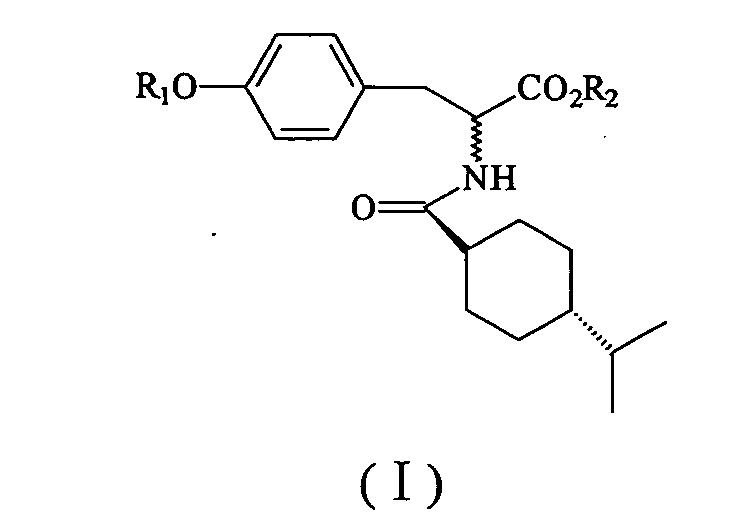
In the formula (I), the configuration of α -carbon atom of alanine is R or S.
R1 is hydrogen, unsubstituted or substituted C1-6 alkyl, or unsubstituted or
substituted aromatic ring group or aromatic heterocyclic group, such as


R2 is hydrogen or unsubstituted or substituted C1-6 alkyl.
The present invention also provides two preparative methods for the alanine
compounds with the structure of formula (I) and their salts.
The first preparative method includes the following steps:

Conducting an etherification of compound B and corresponding alkyl halide under alkali condition to obtain the compound of formula (I), wherein R1 is:

Hydrolyzing compound B to obtain the compound of formula (I), wherein R1 and R2 both are hydrogen;
The second preparative method includes the following steps:

The present invention further provides application of alanine compounds of
formula (I) and their salts in the preparation of drugs for type II diabetes.
Unless otherwise specified, the terms in the description have the following
definitions:
The "C1-6 alkyl" represents the saturated or unsaturated, substituted or
unsubstituted linear or branched alkane-derived radical containing 1 to 6 carbon
atoms, the specific examples include methyl, ethyl, propyl, isopropyl, butyl, isobutyl,
sec-butyl, tert-butyl, amyl, isoamyl, neo-pentyl, tert-amyl, 1-methylbutyl,
2-methylpropyl, hexyl, isohexyl, 1-methylamyl, 2-methylamyl, 3-methylamyl,
2-methylbutyl, 1,1-dimethylbutyl, 1,2-dimethylbutyl, 1,3-dimethylbutyl,
2,3-dimethylbutyl, 3,3-dimethylbutyl, 1-ethylbutyl, 2-ethylbutyl,
1,1,2-trimethylpropyl, 1,2,2-trimethylpropyl, 1-ethyl-1-methylpropyl,
1-ethyl-2-methylpropyl or the like. Among these groups, the alkyls of 1 to 4 carbon
atoms, such as methyl, ethyl, propyl, isopropyl, butyl, or the like, are preferable. And
methyl, ethyl, propyl are more preferable, methyl and ethyl are the most preferable.
The "aryl" means aromatic radical, and the aryl of 6 to 14 carbon atoms are
preferable, the specific examples include phenyl, tolyl, xylyl, biphenyl, naphthyl,
indenyl, anthryl, phenanthryl, phenyl and naphthyl are more preferable, and phenyl is
the most preferable.
The "aromatic heterocyclic group" means five or six-membered hetero aromatic
radical containing 1 to 4 hetero atoms selected from oxygen atom, nitrogen atom or
sulfur atom, such as furyl, thienyl, pyrrolyl, imidazolyl, thiazolyl, pyrazolyl,
isothiazolyl, isooxazolyl, pyridyl, pyrimidinyl, pyridazinyl, pyrazinyl, triazolyl,
tetrazolyl , or the like. Among these groups, thienyl, furyl, oxazolyl, isooxazolyl and
thiazolyl are preferable, thienyl, oxazolyl and isooxazolyl are more preferable.
The "substituted alkyl", "substituted aryl" and "substituted aromatic heterocyclic
group" mean the above "alkyl", "aryl" and "heteroaryl" can be optionally substituted
by the groups selected from halogen atoms, alkyl, alkoxyl, acyloxy, -OH, -NH2, -NO2,
-NHAc.
The "pharmaceutical acceptable salts" may specifically include the salts with
inorganic acids, such as hydrochloric acid, hydrobromic acid, hydrofluoric acid,
sulfuric acid, nitric acid, phosphoric acid or the like; the acid-addtion salts with
organic acids, such as formic acid, acetic acid, propionic acid, oxalic acid, malonic
acid, succinic acid, fumaric acid, maleic acid, lactic acid, malic acid, tartaric acid,
citric acid, picric acid, methanesulfonic acid, ethylsulfonic acid or the like, or with
acidic amino acids, such as aspartic acid, glutamic acid or the like; or the salts formed
with alkalis, such as the salts with inorganic alkalis of Na, K, Ca, Al or the like,
ammonium salt, methylamine salt, ethylamine salt, ethanolamine salt or the like; or
the salts formed with basic amino acids, such as lysine, arginine, ornithine or the like.
The alanine compounds of formula (I) and their salts in the present invention are
prepared as follows:

In the scheme: a. N-hydroxylsuccimide, Dicyclohexylcarbodiimide; b. chloroform;
c. R3-OH, triphenylphosphine, diethyl azodicarboxylate; or RX, K2CO3, DMF; d. 1N
lithium hydroxide, tetrahydrofuran/methanol (3:1).
An embodiment of procedure I is as follows:
In the scheme: a. triphenylphosphine, diethyl azodicarboxylate,
2-(N-carbobenzoxy-N-methylamino)ethanol, tetrahydrofuran; b. trifluoracetic acid,
dichloromethane; c. 2-fluoropyridine, reflux; d. 1N lithium hydroxide,
tetrahydrofuran/methanol (3:1).
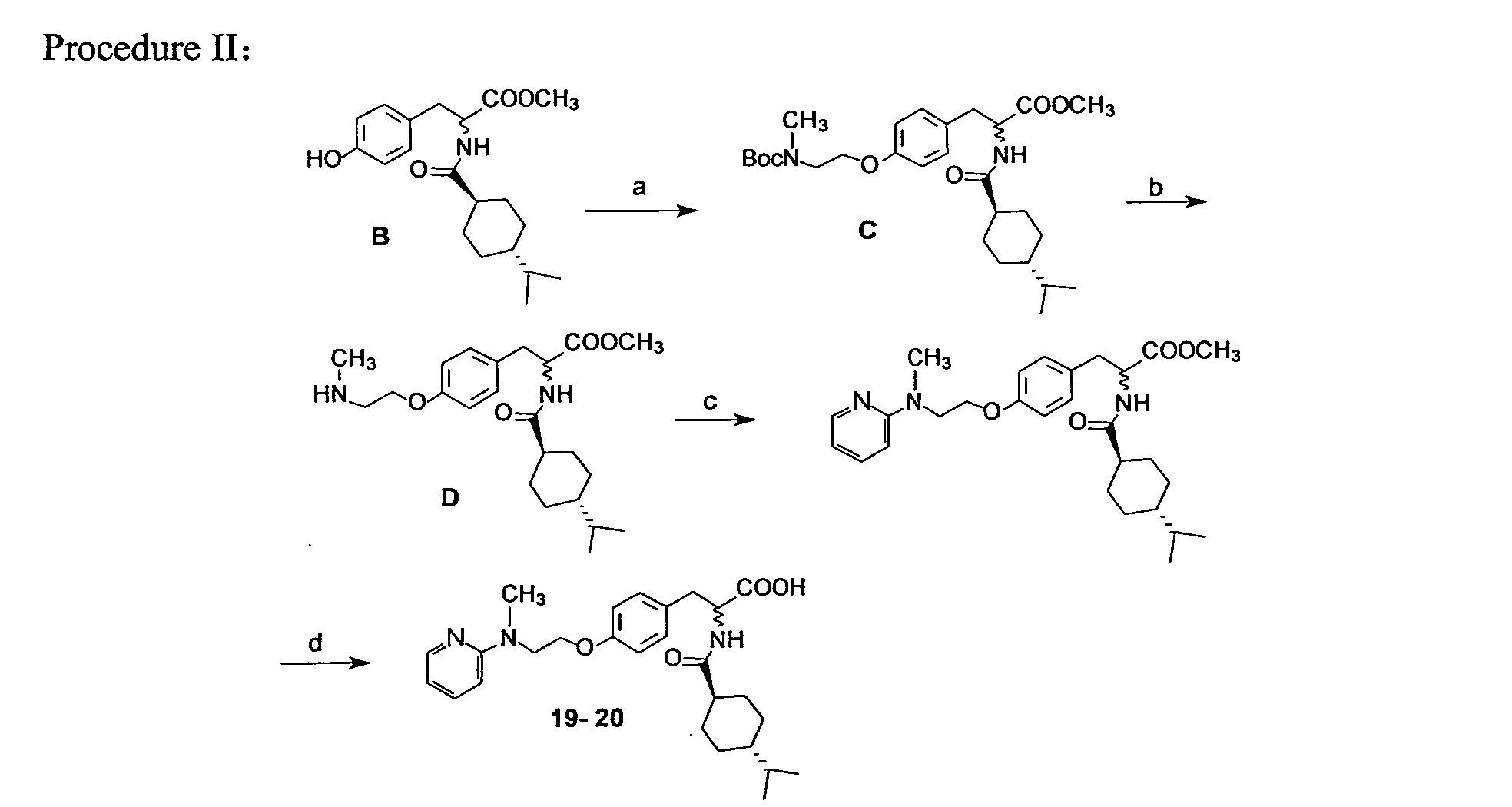
An embodiment of procedure II is as follows:
The representative alanine compounds of formula (I) according to the present
invention are listed as follows:
or

Insulin-sensitizing agents can promote the differentiation of preadipocytes
toward adipocytes, thus insulin-sensitizing agents could be identified according to the
differentiation of pre-adipocytes. Following the methods reported in reference
[Kletzein BF. Mol. Pharm. 1991, 41, 393], the insulin-sensitizing activities of the
compounds of formula (I) in the present invention were evaluated in 3T3-L1
preadipocyte model with triglyceride accumulation in cells as the indication of
differentiation.
The 3T3-L1 preadipocytes were incubated in DMEM (Dulbecco's Modified
Eagle's Medium) containing 10% NBS (newborn calf serum) and subcultured every 3
days. The cells were transferred to 24-pore plates, and after the pores were filled
completely the cells were treated with IBMX (isobutylmethylxanthine) (0.5mmol/L),
DEX (dexamethasone) (1µmol/L) and insulin (1.0µmol/L) for 48h, and in the
meantime different amounts of test compounds were added and the cells were
incubated until the end of the experiment. Cells were collected and the contents of
triglyceride and protein therein were determined by colorimetry, and the
enhancements of triglyceride in cells after drug-administrating were calculated.
The positive control group is rosiglitazone, the solvent control group is culturing
medium containing 0.1% of DMSO. The enhancement of triglyceride in cells was
determined in three different concentrations (0.01, 0.1, 1 µmol/L) of the tested
compounds.
The insulin-sensitizing activity of the alanine compounds in the present invention
are presented in table 2, from which it can be seen that Compound 1 and compound 2
have stronger insulin-sensitizing activity. Thus the alanine compounds in the present
invention can be used to control the blood glucose level in type II diabetes patients
and inhibit the occurrence of complications.
The alanine compounds in the present invention don't contain the
thiazolidinedione group, but possess similar insulin-sensitizing activity as the
thiazolidinedione compounds. Therefore, it is possible that these compounds are
developed as novel drugs for treatment of type II diabetes and its complications.
| The Percentage of Triglyceride Increased in 3T3-L1 Cells | |||
| Compounds | Concentrations (µmol/L) | ||
| 0.01 | 0.1 | 1 | |
| 1 | 1. 56 | 21. 18 | 47.09 |
| 2 | 10. 73 | 16.54 | 30.68 |
| 3 | -0.37 | 6.70 | 19.97 |
| 4 | -4.77 | 5.05 | 10.97 |
| 5 | -1.54 | -4.64 | -6.92 |
| 6 | ND | ND | ND |
| 7 | 11.75 | 5.80 | 4.68 |
| 8 | ND | ND | ND |
| 9 | 6.00 | 3.35 | -0.69 |
| 10 | ND | ND | ND |
| 11 | 0.00 | 0.36 | 2. 23 |
| 12 | ND | ND | ND |
| 13 | 1. 89 | 1. 83 | -4. 74 |
| 14 | ND | ND | ND |
| 15 | -0. 21 | 5. 99 | 5. 04 |
| 16 | ND | ND | ND |
| 17 | 0.22 | 10.84 | 0.85 |
| 18 | ND | ND | ND |
| 19 | -1.46 | -2.24 | -1.62 |
| Rosiglitazone | 27.20±2.35 | 34.93±2.14 | 39.21±2.27 |
The compounds and their pharmaceutical acceptable salts of the present
invention may be prepared into many forms of preparations, which contain a safe and
effective dosage of the compounds or their pharmaceutical acceptable salts in the
present invention, and the pharmaceutical acceptable carrier.
"safe and effective dosage" means the amount of the compounds that can
improve the condition of patients but do not lead to serious side effects. The safe and
effective dosage of compounds is determined according to the age, condition, and
course of treatment of the subjects accepting the therapy.
"Pharmaceutical acceptable carrier" refers to one or many kinds of compatible
solid or liquid stuffing materials or gel substances, which are suitable for man use and
have enough purity and low toxicity. " compatible " refers to each component in the
compositions can mixed with the compounds of the present invention and with each
other without significantly reducing the effect of the compounds. Examples of the
pharmaceutical acceptable carrier include cellulose and its derivatives (CMC-Na,
EC-Na, cellulose acetatic acid ester etc.), gelatin, steatite, solid lubricants (such as
stearic acid, magnesium stearate), CaSO4, vegetable oils (such as soya oil, sesame oil,
peanut oil, olive oil etc.), polybasic alcohol (such as propylene glycol, glycerin,
mannitol, sorbierite etc.), emulsifying agent (such as tweens®), moistening agent
(such as sodium dodecylsulfate), coloring agent, flavoring agent, stabilizer,
antioxidant, antiseptic, pyrogen-free water etc.
The present invention will be further explained with reference to the following
examples, but they don't limit the present invention in any way. In all examples, the
melting points were measured with MEL-TEMP melting point apparatus and the
thermometer was not calibrated; 1H NMR spectra were recorded on a Varian Mercury
400 NMR spectrometer, the chemical shifts are expressed as δ (ppm); silica gel for
separation is 200-300 mesh unless otherwise specified.
1H NMR (DMSO-d6): δ = 0.80(d, J=7.6Hz, 6H, isoproply-CH3), 0.85-1.0(m, 3H, isoproply-CH, cyclohexyl-CH2-), 1.10-1.40(m, 3H, cyclohexyl-CH2-, -CH-), 1.50-1.72(m, 4H, cyclohexyl-CH2-), 2.00(m, 1H, cyclohexyl-CH-), 2.35(s, 3H, oxazolyl-CH3), 2.75(dd, J=14Hz, 9.9Hz, 1H, Ph-CH-), 2.90(t, J=6.6Hz, 2H, oxazolyl-CH2-), 2.96(dd, J=14Hz, 4.7Hz, 1H, Ph-CH-), 4.17(t, J=6.6Hz, 2H, -CH2O-), 4.21(m, 1H, -CHCOO-), 6.81(d, J=8.8Hz, 2H, Ph-H), 7.13(d, J=8.8Hz, 2H, Ph-H), 7.50(m, 3H, Ph-H), 7.92(m, 3H, Ph-H, -NH), 12.6(s, 1H, -COOH); 13C NMR (CDCl3): δ = 10.0, 19.9, 25.8, 28.8, 29.2, 29.5, 32.6, 36.1, 43.0, 45.9, 53.0, 66.2, 114.3, 126.2, 127.0, 128.0, 128.5, 130.3, 130.4, 132.1, 145.9, 157.8, 160.0, 175.8, 176.3.
Elemental Analysis, C31H38N2O5 (518):
Calculated C, 71.81; H, 7.34; N, 5.41.
Found C, 71.49; H, 7.24; N, 5.36.
IR (KBr): 3282.3, 2933.2, 1710.6, 1631.5, 1554.4, 1513.9, 1251.6, 684.6 cm-1; EI-MS(m/z): 518(1, M+), 186(100); HRMS: 518.2772 (C31H38N2O5).
With (2R)-2-[N-(trans-4-isopropylcyclohexylcarbonyl)amino]-3-(4-hydroxyphenyl)propionic
acid methyl ester ((R)-B) as starting material, compound (2) was
prepared by the same method as in example 1. m.p. 151-153 °C (dec). [α]D 25 -82.5 (c,
0.217, CHCl3). 1H NMR is the same as that of compound (1) in example 1.
Elemental Analysis, C31H38N2O5(518):
Calculated C, 71.81; H, 7.34; N, 5.41.
Found C, 71.40; H, 8.16; N, 5.33.
IR(KBr): 3282.3, 2933.2, 2854.2, 1712.5, 1633.4, 1554.4, 1513.9, 1249.7,1176.4, 715.5, 686.5 cm-1.
Elemental Analysis, C31H38N2O5(518):
Calculated C, 71.81; H, 7.34; N, 5.41.
Found C, 71.40; H, 8.16; N, 5.33.
IR(KBr): 3282.3, 2933.2, 2854.2, 1712.5, 1633.4, 1554.4, 1513.9, 1249.7,1176.4, 715.5, 686.5 cm-1.
A solution of 11g (0.21mmol) of compound D in 2ml of tetrahydrofuran was
added with 240µl (0.51mmol) of triethylamine and 40mg (0.26mmol) of
2-chlorobenzoxazole. The resulting solution was stirred at room temperature for 24h.
Tetrahydrofuran was removed under reduced pressure, the residue was mixed with
4ml of ethyl acetate, then added 4ml of saturated solution of NaHCO3 in H2O and
stirred. Remained standing and separated the ethyl acetate layer, dried with anhydrous
Na2SO4, and the residue was mixed with a mixed solvent of petrolether/ethyl acetate
(1:1) to separate out a white solid. The solid was hydrolyzed with LiOH to give
0.042g of the target compound. Yield: 39.6%. m.p. 179-180°C(dec). [α]D 25 81.1 (c,
0.535, CHCl3).
1H NMR(DMSO): δ =0.81(d, J=6.9Hz, 6H), 0.80-1.0(m, 3H), 1.15-1.40(m, 3H), 1.60(m, 4H), 1.95(m, 1H), 2.78(dd, J=13.5Hz, 7.3Hz, 1H), 2.96(dd, J=13.5Hz, 4.8Hz, 1H), 3.20(s, 3H), 3.82(t, J=5.5Hz, 2H), 4.10(m, 1H), 4.20(t, J=5.5Hz, 2H), 6.78(d, J=8.4Hz, 2H), 6.95(t, J=7.7Hz, 1H), 7.00(d, J=8.4Hz, 2H), 7.10(t, J=7.0Hz, 1H), 7.28(d, J=8.3Hz, 1H), 7.35(d, J=8.0Hz, 1H), 7.40(d, J=7.3Hz, 1H).
Elemental Analysis, C29H37N3O5 (507):
Calculated C, 68.64; H, 7.30; N, 8.28.
Found C, 68.45; H, 7.49; N, 8.21;
IR(KBr) : 3322.8, 2935.2, 2865.7, 1731.8, 1648.9, 1589.1, 1513.9, 1465.7, 1247.7, 1250.3, 925.7, 740.5 cm-1; EI-MS(m/z): 507(12, M+), 148(100).
1H NMR(DMSO): δ =0.81(d, J=6.9Hz, 6H), 0.80-1.0(m, 3H), 1.15-1.40(m, 3H), 1.60(m, 4H), 1.95(m, 1H), 2.78(dd, J=13.5Hz, 7.3Hz, 1H), 2.96(dd, J=13.5Hz, 4.8Hz, 1H), 3.20(s, 3H), 3.82(t, J=5.5Hz, 2H), 4.10(m, 1H), 4.20(t, J=5.5Hz, 2H), 6.78(d, J=8.4Hz, 2H), 6.95(t, J=7.7Hz, 1H), 7.00(d, J=8.4Hz, 2H), 7.10(t, J=7.0Hz, 1H), 7.28(d, J=8.3Hz, 1H), 7.35(d, J=8.0Hz, 1H), 7.40(d, J=7.3Hz, 1H).
Elemental Analysis, C29H37N3O5 (507):
Calculated C, 68.64; H, 7.30; N, 8.28.
Found C, 68.45; H, 7.49; N, 8.21;
IR(KBr) : 3322.8, 2935.2, 2865.7, 1731.8, 1648.9, 1589.1, 1513.9, 1465.7, 1247.7, 1250.3, 925.7, 740.5 cm-1; EI-MS(m/z): 507(12, M+), 148(100).
Using (R)-B as starting material, compound (4) was prepared by the same method
in example 3. m.p. 179-180°C. 1H NMR is the same as that of compound (3) in
example 3.
Elemental Analysis, C29H37N3O5 (507):
Calculated C, 68.64; H, 7.30; N, 8.28.
Found C, 68.64; H, 7.22; N, 8.08;
EI-MS(m/z): 507(6, M+), 148(100).
Elemental Analysis, C29H37N3O5 (507):
Calculated C, 68.64; H, 7.30; N, 8.28.
Found C, 68.64; H, 7.22; N, 8.08;
EI-MS(m/z): 507(6, M+), 148(100).
Using 2-(1-indolyl)ethanol and compound (S)-B as starting materials, following
the procedure as in example 1, the residue after removal of tetrahydrofuran was mixed
with methanol and then separated out a solid. The target compound was obtained by
hydrolyzation of the solid with LiOH. Yield: 39.6%.
1H NMR(CDCl3): δ =0.81(d, J=6.9Hz, 6H), 0.80-1.10(m, 3H), 1.30-1.45(m, 3H), 1.70-1.90(m, 4H), 1.99(m, 1H), 3.07(dd, J=14.3Hz, 6.2Hz, 1H), 3.15(dd, J=14.3Hz, 5.2Hz, 1H), 4.23(t, J=5.5Hz, 2H), 4.50(t, J=5.5Hz, 2H), 4.75(m, 1H), 5.89(d, J=6.6Hz, 1H), 6.50(d, J=3.9Hz, 1H), 6.76(d, J=8.4Hz, 2H), 7.00(d, J=8.4Hz, 2H), 7.11(t, J=7.3Hz, 1H), 7.24(m, 2H), 7.40(d, J=8.1Hz, 1H), 7.62(d, J=7.7Hz, 1H);
IR(KBr): 3305.4, 2933.2, 2863.8, 1712.5, 1650.8, 1513.9, 1463.7, 1242.0, 742.5 cm-1; EI-MS(m/z): 476(11, M+), 144(100); HRMS: 476.2670 (C29H36N2O4).
1H NMR(CDCl3): δ =0.81(d, J=6.9Hz, 6H), 0.80-1.10(m, 3H), 1.30-1.45(m, 3H), 1.70-1.90(m, 4H), 1.99(m, 1H), 3.07(dd, J=14.3Hz, 6.2Hz, 1H), 3.15(dd, J=14.3Hz, 5.2Hz, 1H), 4.23(t, J=5.5Hz, 2H), 4.50(t, J=5.5Hz, 2H), 4.75(m, 1H), 5.89(d, J=6.6Hz, 1H), 6.50(d, J=3.9Hz, 1H), 6.76(d, J=8.4Hz, 2H), 7.00(d, J=8.4Hz, 2H), 7.11(t, J=7.3Hz, 1H), 7.24(m, 2H), 7.40(d, J=8.1Hz, 1H), 7.62(d, J=7.7Hz, 1H);
IR(KBr): 3305.4, 2933.2, 2863.8, 1712.5, 1650.8, 1513.9, 1463.7, 1242.0, 742.5 cm-1; EI-MS(m/z): 476(11, M+), 144(100); HRMS: 476.2670 (C29H36N2O4).
using (R)-B as starting materials, compound (6) was prepared following the same
procedure as in example 5. 1H NMR is the same as that of compound (5) in example
5.
IR(KBr): 3291.9, 2933.2, 2863.8, 1712.5, 1650.8, 1513.9, 1463.7, 1242.0, 742.5 cm-1.
IR(KBr): 3291.9, 2933.2, 2863.8, 1712.5, 1650.8, 1513.9, 1463.7, 1242.0, 742.5 cm-1.
Using 4-trifluoromethylbenzyl alcohol and compound (S)-B as starting materials,
ethyl ether as solvent, compound (7) was prepared following the procedure as of
compound 21. Yield: 60.6%. m.p. 171-172°C. [α]D 25 53.9 (c, 0.285, CHCl3).
1H NMR(CDCl3): δ =0.81(d, J=6.7Hz, 6H), 1.0(m, 3H), 1.40(m, 3H), 1.70-1.90(m, 4H), 2.05(m, 1H), 3.08(dd, J=5.5Hz, 14.1Hz, 1H), 3.19(dd, J=5.5Hz, 14.3Hz, 1H), 4.80(m, 1H), 5.08(s, 2H), 5.98(d, J=6.4Hz, 1H), 6.88(d, J=8.2Hz, 2H), 7.08(d, J=8.2Hz, 2H), 7.52(d, J=8.0Hz, 2H), 7.62(d, J=8.2Hz, 2H).
Elemental Analysis, C27H32F3NO4·1/2H2O (500):
Calculated C, 64.80; H, 6.60; N, 2.80.
Found C, 65.20; H, 6.43; N, 3.01.
IR(KBr): 3328.6, 2931.3, 1731.8, 1612.2, 1511.9, 1328.7, 1243.9, 1166.7, 1124.3, 1068.4, 1018.2, 827.3 cm-1; EI-MS(m/z): 491(3, M+), 159(100).
1H NMR(CDCl3): δ =0.81(d, J=6.7Hz, 6H), 1.0(m, 3H), 1.40(m, 3H), 1.70-1.90(m, 4H), 2.05(m, 1H), 3.08(dd, J=5.5Hz, 14.1Hz, 1H), 3.19(dd, J=5.5Hz, 14.3Hz, 1H), 4.80(m, 1H), 5.08(s, 2H), 5.98(d, J=6.4Hz, 1H), 6.88(d, J=8.2Hz, 2H), 7.08(d, J=8.2Hz, 2H), 7.52(d, J=8.0Hz, 2H), 7.62(d, J=8.2Hz, 2H).
Elemental Analysis, C27H32F3NO4·1/2H2O (500):
Calculated C, 64.80; H, 6.60; N, 2.80.
Found C, 65.20; H, 6.43; N, 3.01.
IR(KBr): 3328.6, 2931.3, 1731.8, 1612.2, 1511.9, 1328.7, 1243.9, 1166.7, 1124.3, 1068.4, 1018.2, 827.3 cm-1; EI-MS(m/z): 491(3, M+), 159(100).
Using (R)-B as starting materials, compound (8) was prepared following the same
procedure as in example 7. m.p. 171-172°C. 1H NMR is the same as that of the
compound 7.
EI-MS(m/z): 491(10, M+), 159(100); HRMS: 491.2260(C27H32F3NO4).
EI-MS(m/z): 491(10, M+), 159(100); HRMS: 491.2260(C27H32F3NO4).
A solution of 0.137ml (1.14mmol) of benzyl bromide and 0.13g (0.38mmol) of
(2S)-2-[N-(trans-4-isopropylcyclohexylcarbonyl)amino]-3-(4-hydroxyphenyl)propioni
c acid methyl ester (compound (S)-B) in lml N,N-dimethylformamide (DMF) was
added with 0.16g (1.14mmol) of levigated K2CO3. The resulting mixture was stirred
at 70°C for 12h. After cooling to 0°C, 5ml of H2O was added, the resulting solution
was extracted with ethyl acetate (5ml×2). The combined extract was washed with
H2O, dried with anhydrous Na2SO4. Solvent was removed under reduced pressure, the
residue mixed with ether, and a white solid separated. The solid was hydrolyzed with
LiOH to give 0.10g of the target compound. Yield: 62.5%. m.p. 140-142°C(dec).
[α]D 25 70.9 (c, 0.83, CHCl3).
1H NMR(CDCl3): δ =0.81(d, J=6.9Hz, 6H), 1.0(m, 3H), 1.40(m, 3H), 1.70-1.90(m, 4H), 2.05(m, 1H), 3.04(dd, J=5.5Hz, 13.9Hz, 1H), 3.19(dd, J=5.5Hz, 13.9Hz, 1H), 4.81(m, 1H), 5.01 (s, 2H), 6.12(d, J=7.3Hz, 1H), 6.91(d, J=8.4Hz, 2H), 7.08(d, J=8.4Hz, 2H), 7.39(m, 5H).
Elemental Analysis, C26H33NO4·1/2H2O (432):
Calculated C, 72.22; H, 7.87; N, 3.24.
Found C, 72.34; H, 7.71; N, 3.47;
IR(KBr): 3328.6, 2929.4, 2852.2, 1731.8, 1648.9, 1529.3, 1513.9, 1452.2, 1243.9, 1178.3, 1027.9, 732.8, 694.3 cm-1; EI-MS(m/z): 423(4, M+), 254(24), 91(100).
1H NMR(CDCl3): δ =0.81(d, J=6.9Hz, 6H), 1.0(m, 3H), 1.40(m, 3H), 1.70-1.90(m, 4H), 2.05(m, 1H), 3.04(dd, J=5.5Hz, 13.9Hz, 1H), 3.19(dd, J=5.5Hz, 13.9Hz, 1H), 4.81(m, 1H), 5.01 (s, 2H), 6.12(d, J=7.3Hz, 1H), 6.91(d, J=8.4Hz, 2H), 7.08(d, J=8.4Hz, 2H), 7.39(m, 5H).
Elemental Analysis, C26H33NO4·1/2H2O (432):
Calculated C, 72.22; H, 7.87; N, 3.24.
Found C, 72.34; H, 7.71; N, 3.47;
IR(KBr): 3328.6, 2929.4, 2852.2, 1731.8, 1648.9, 1529.3, 1513.9, 1452.2, 1243.9, 1178.3, 1027.9, 732.8, 694.3 cm-1; EI-MS(m/z): 423(4, M+), 254(24), 91(100).
using (R)-B as starting materials, compound (10) was prepared following the same
procedure as in example 9. m.p. 140-142°C(dec). 1H NMR is the same as that of the
compound 9.
Elemental Analysis, C26H33NO4·1/2H2O (432):
Calculated C, 72.22; H, 7.87; N, 3.24.
Found C, 72.36; H, 7.91; N, 3.32.
IR(KBr): 3326.7, 2929.4, 2852.2, 1729.9, 1648.9, 1529.3, 1513.9, 1452.2, 1243.9, 1178.3, 1027.9, 732.8, 694.3 cm-1; EI-MS(m/z): 423(12, M+), 254(100).
Elemental Analysis, C26H33NO4·1/2H2O (432):
Calculated C, 72.22; H, 7.87; N, 3.24.
Found C, 72.36; H, 7.91; N, 3.32.
IR(KBr): 3326.7, 2929.4, 2852.2, 1729.9, 1648.9, 1529.3, 1513.9, 1452.2, 1243.9, 1178.3, 1027.9, 732.8, 694.3 cm-1; EI-MS(m/z): 423(12, M+), 254(100).
Using n-bromobutane and compound (S)-B as starting materials, compound (11)
was prepared following the similar synthesis procedure as in example 9. Yield: 70.3 %.
m.p. 120-121 °C. [α]D 25 87.9 (c, 1.145, CHCl3).
1H NMR(CDCl3): δ=0.82(d, J=6.9Hz, 6H), 0.96(m, 6H), 1.38(m, 3H), 1.50(m, 2H), 1.75-1.90(m, 6H), 2.05(m, 1H), 3.04(dd, J=5.8Hz, 14.3Hz, 1H), 3.19(dd, J=5.5Hz, 14.2Hz, 1H), 3.91(t, J=6.6Hz, 2H), 4.80(m, 1H), 5.99(d, J=7.3Hz, 1H), 6.81(d, J=8.4Hz, 2H), 7.07(d, J=8.4Hz, 2H).
Elemental Analysis, C23H35NO4·1/3H2O (395):
Calculated C, 69.87, H, 9.03, N, 3.54.
Found C, 69.60, H, 8.88, N, 3.64.
IR(KBr): 3305.4, 2933.2, 2869.6, 1716.4, 1646.9, 1544.7, 1513.9, 1245.8, 1178.3, 827.3 cm-1; EI-MS(m/z): 389(7, M+), 163(100).
1H NMR(CDCl3): δ=0.82(d, J=6.9Hz, 6H), 0.96(m, 6H), 1.38(m, 3H), 1.50(m, 2H), 1.75-1.90(m, 6H), 2.05(m, 1H), 3.04(dd, J=5.8Hz, 14.3Hz, 1H), 3.19(dd, J=5.5Hz, 14.2Hz, 1H), 3.91(t, J=6.6Hz, 2H), 4.80(m, 1H), 5.99(d, J=7.3Hz, 1H), 6.81(d, J=8.4Hz, 2H), 7.07(d, J=8.4Hz, 2H).
Elemental Analysis, C23H35NO4·1/3H2O (395):
Calculated C, 69.87, H, 9.03, N, 3.54.
Found C, 69.60, H, 8.88, N, 3.64.
IR(KBr): 3305.4, 2933.2, 2869.6, 1716.4, 1646.9, 1544.7, 1513.9, 1245.8, 1178.3, 827.3 cm-1; EI-MS(m/z): 389(7, M+), 163(100).
Using n-bromobutane and compound (R)-B as starting materials, compound (12)
was prepared following the similar synthesis procedure as in example 9. m.p. 120-121
°C. 1H NMR is the same as that of the compound 11.
Elemental Analysis, C23H35NO4 (389):
Calculated C, 70.95; H, 9.00; N,3.60.
Found C, 71.05; H, 9.11; N, 3.93.
IR(KBr): 3320.9, 2869.6, 2933.2, 1731.8, 1652.7, 1612.2, 1544.7, 1511.9, 1243.9, 827.3 cm-1; EI-MS(m/z): 389(7, M+), 163(67), 220(100).
Elemental Analysis, C23H35NO4 (389):
Calculated C, 70.95; H, 9.00; N,3.60.
Found C, 71.05; H, 9.11; N, 3.93.
IR(KBr): 3320.9, 2869.6, 2933.2, 1731.8, 1652.7, 1612.2, 1544.7, 1511.9, 1243.9, 827.3 cm-1; EI-MS(m/z): 389(7, M+), 163(67), 220(100).
Using ethyl bromide and compound (S)-B as starting materials, compound (13)
was prepared following the procedure as in example 9. Yield: 75.0%. m.p. 168-170
°C. [α]D 25 93.2 (c, 1.13, CHCl3).
1H NMR(CDCl3): δ =0.81(d, J=6.9Hz, 4H), 1.0(m, 3H), 1.40(m, 5H), 1.75-1.90(m, 4H), 2.05(m, 1H), 3.04(dd, J=5.5Hz, 14.0Hz, 1H), 3.17(dd, J=5.1Hz, 14.3Hz, 1H), 4.00(m, 2H), 4.80(m, 1H), 5.97(d, J=7.6Hz, 1H), 6.81(d, J=8.4Hz, 2H), 7.03(d, J=8.3Hz, 2H).
ElementalAnalysis, C21H31NO4·1/3H2O (367):
Calculated C, 68.66; H, 8.63; N, 3.81.
Found C, 68.93; H, 8.43; N, 3.86.
IR(KBr): 3303.5, 2935.2, 2958, 1724.1, 1708.6, 1643.1, 1542.8, 1513.9, 1442.5, 1247.7, 1215, 1176.4, 1051, 525.4 cm-1; EI-MS(m/z): 361(16, M+), 192(100).
1H NMR(CDCl3): δ =0.81(d, J=6.9Hz, 4H), 1.0(m, 3H), 1.40(m, 5H), 1.75-1.90(m, 4H), 2.05(m, 1H), 3.04(dd, J=5.5Hz, 14.0Hz, 1H), 3.17(dd, J=5.1Hz, 14.3Hz, 1H), 4.00(m, 2H), 4.80(m, 1H), 5.97(d, J=7.6Hz, 1H), 6.81(d, J=8.4Hz, 2H), 7.03(d, J=8.3Hz, 2H).
ElementalAnalysis, C21H31NO4·1/3H2O (367):
Calculated C, 68.66; H, 8.63; N, 3.81.
Found C, 68.93; H, 8.43; N, 3.86.
IR(KBr): 3303.5, 2935.2, 2958, 1724.1, 1708.6, 1643.1, 1542.8, 1513.9, 1442.5, 1247.7, 1215, 1176.4, 1051, 525.4 cm-1; EI-MS(m/z): 361(16, M+), 192(100).
Using ethyl bromide and compound (R)-B as starting materials, compound (14)
was prepared following the synthesis procedure in example 9. m.p. 168-170°C. 1H
NMR is the same as that of the compound 13.
Elemental Analysis, C21H31NO4 (361):
Calculated C, 69.81; H, 8.59; N, 3.87.
Found C, 69.40; H, 8.32; N, 3.90.
IR(KBr): 3305.4, 2933.2, 1706.7, 1641.2, 1540.9, 1513.9, 1444.4, 1249.7, 1215, 1049.1, 925.7, 804.2 cm-1.
Elemental Analysis, C21H31NO4 (361):
Calculated C, 69.81; H, 8.59; N, 3.87.
Found C, 69.40; H, 8.32; N, 3.90.
IR(KBr): 3305.4, 2933.2, 1706.7, 1641.2, 1540.9, 1513.9, 1444.4, 1249.7, 1215, 1049.1, 925.7, 804.2 cm-1.
Using methyl iodide and compound (S)-B as starting materials, compound (15)
was prepared following the synthesis procedure in example 9. Yield: 67.1%. m.p.
149-151°C. [α]D 25 96.5 (c, 0.665, CHCl3).
1H NMR(CDCl3): δ = 0.85(d, J=6.6Hz, 6H), 1.00(m, 3H), 1.40(m, 3H), 1.71-1.90(m, 4H), 2.05(m, 1H), 3.10(dd, J=5.9Hz, 14.0Hz, 1H), 3.17(dd, J=5.5Hz, 13.9Hz, 1H), 3.80(s, 3H), 4.80(m, 1H), 5.98(d, J=7.6Hz, 1H), 6.81(d, J=8.8Hz, 2H), 7.03(d, J=8.8Hz, 2H).
Elemental Analysis, C20H29NO4 (347):
Calculated C, 69.16; H, 8.36; N, 4.03.
Found C, 69.06; H, 8.54; N, 4.14.
IR (KBr): 3280.4, 2937.1, 2860, 1720.2, 1646.9, 1542.8, 1515.8, 1440.6, 1249.7, 1215, 1031.7, 829.3 cm-1; EI-MS(m/z): 347(1, M+), 121(100).
1H NMR(CDCl3): δ = 0.85(d, J=6.6Hz, 6H), 1.00(m, 3H), 1.40(m, 3H), 1.71-1.90(m, 4H), 2.05(m, 1H), 3.10(dd, J=5.9Hz, 14.0Hz, 1H), 3.17(dd, J=5.5Hz, 13.9Hz, 1H), 3.80(s, 3H), 4.80(m, 1H), 5.98(d, J=7.6Hz, 1H), 6.81(d, J=8.8Hz, 2H), 7.03(d, J=8.8Hz, 2H).
Elemental Analysis, C20H29NO4 (347):
Calculated C, 69.16; H, 8.36; N, 4.03.
Found C, 69.06; H, 8.54; N, 4.14.
IR (KBr): 3280.4, 2937.1, 2860, 1720.2, 1646.9, 1542.8, 1515.8, 1440.6, 1249.7, 1215, 1031.7, 829.3 cm-1; EI-MS(m/z): 347(1, M+), 121(100).
Using methyl iodide and compound (R)-B as starting materials, compound (16)
was prepared following the similar synthesis procedure in example 9. m.p. 149-151°C.
1H NMR is the same as that of compound (S)-15.
Elemental Analysis, C20H29NO4·1/3H2O(353):
Calculated C, 67.99; H, 8.41; N, 3.97.
Found C, 68.44; H, 8.08; N, 4.07.
IR (KBr): 3274.6, 2939, 2860, 1720, 1645, 1552.4, 1513.9, 1440, 1249.7, 1216.9, 1031.7, 829.3 cm-1; EI-MS(m/z): 347(16, M+), 121(100).
Elemental Analysis, C20H29NO4·1/3H2O(353):
Calculated C, 67.99; H, 8.41; N, 3.97.
Found C, 68.44; H, 8.08; N, 4.07.
IR (KBr): 3274.6, 2939, 2860, 1720, 1645, 1552.4, 1513.9, 1440, 1249.7, 1216.9, 1031.7, 829.3 cm-1; EI-MS(m/z): 347(16, M+), 121(100).
The target compound was obtained by hydrolysis of (S)-B with LiOH. Yield: 81.1
%. m.p. 156-157°C. [α]D 25 76.4 (c, 0.845, CHCl3).
1H NMR(DMCO-d6): δ =0.81(d, J=7.0Hz, 6H), 1.0(m, 3H), 1.40(m, 3H), 1.75-1.90(m, 4H), 2.15(m, 1H), 2.90(dd, J=8.1Hz, 13.9Hz, 1H), 3.10(dd, J=5.1Hz, 13.9Hz, 1H), 4.82(m, 1H), 6.72(d, J=8.4Hz, 2H), 7.05(d, J=8.4Hz, 2H).
Elements Analysis, C19H27NO4·2H2O(369):
Calculated C, 61.79; H, 8.40; N, 3.79.
Found C, 61.94; H, 8.17; N, 3.84.
IR(KBr): 3303.5, 2937.1, 2861.9, 1619.9, 1546.7, 1517.7, 1446.4, 1232.3, 827.3 cm-1; EI-MS(m/z): 333(10, M+), 170(100), 107(84).
1H NMR(DMCO-d6): δ =0.81(d, J=7.0Hz, 6H), 1.0(m, 3H), 1.40(m, 3H), 1.75-1.90(m, 4H), 2.15(m, 1H), 2.90(dd, J=8.1Hz, 13.9Hz, 1H), 3.10(dd, J=5.1Hz, 13.9Hz, 1H), 4.82(m, 1H), 6.72(d, J=8.4Hz, 2H), 7.05(d, J=8.4Hz, 2H).
Elements Analysis, C19H27NO4·2H2O(369):
Calculated C, 61.79; H, 8.40; N, 3.79.
Found C, 61.94; H, 8.17; N, 3.84.
IR(KBr): 3303.5, 2937.1, 2861.9, 1619.9, 1546.7, 1517.7, 1446.4, 1232.3, 827.3 cm-1; EI-MS(m/z): 333(10, M+), 170(100), 107(84).
The compound (18) was obtained by hydrolysis of (R)-B with LiOH. m.p.
156-157°C. 1H NMR is the same as that of compound 17.
Elemental Analysis, C19H27NO4·2/3H2O(345):
Calculated C, 66.09; H, 8.21; N, 4.06.
Found C, 65.57; H, 8.71; N, 4.03.
IR(KBr): 3309.3, 2939.0, 2861.9, 1745.3, 1726.0, 1619.9, 1517.7, 1548.6, 1444.4, 1230.4, 825.4, 680.8, 538.1 cm-1; EI-MS(m/z): 333(10, M+), 170(100), 107(54).
Elemental Analysis, C19H27NO4·2/3H2O(345):
Calculated C, 66.09; H, 8.21; N, 4.06.
Found C, 65.57; H, 8.71; N, 4.03.
IR(KBr): 3309.3, 2939.0, 2861.9, 1745.3, 1726.0, 1619.9, 1517.7, 1548.6, 1444.4, 1230.4, 825.4, 680.8, 538.1 cm-1; EI-MS(m/z): 333(10, M+), 170(100), 107(54).
A solution of 0.19g (1.1mmol) of 2-[(N-tert-butoxycarbonyl)-methylamino]ethanol
and 0.347g (1mmol) of (S)-B in 15ml of anhydrous
tetrahydrofuran was added with 0.38g (1.5mmol) of triphenylphosphine, then 240µl
(1.5mmol) of diethyl azodicarboxylate was added drop-wise at 0°C. The resulting
solution was stirred at room temperature for 24h.The solvent was removed under
reduced pressure, and the residue was chromatographed over silica gel H column with
petroleum/ethyl acetate (2: 1) as eluent to obtain 0.21 g of a colorless syrup, yield: 41.6
%.
0.21g (0.42mmol) of the colorless syrup obtained in last step was dissolved in
4.8ml of dichloromethane, then 4.8ml of trifluoroacetic acid was added. The resulting
solution was stirred at room temperature for 1h. Then a part of the solvent was
removed under reduced pressure at room temperature. The residual solution was
neutralized with saturated NaHCO3 and extracted with dichloromethane (10ml×2).
The combined organics were washed with H2O, dried on Mg2SO4, filtered and
concentrated in vacuo. The solvent was evaporated off from the filtrate. The residue
was refluxed with 2ml of 2-fluoropyridine for 24h. Excessive 2-fluoropyridine was
removed under reduced pressure, the residue was dissolved in small amount of
acetone, then chromatographed over silica gel H column with acetone/petroleum (1:2)
as eluent to obtain 0.081g of white solid. Hydrolysis of the white solid following the
same procedure in example 1 provided 0.06g of compound (19). Yield: 76.8%. m.p.
158-160°C. [α]D 2530.0 (c, 0.26, CHCl3).
1H NMR (CDCl3): δ = 0.80 (d, J=7.6Hz, 6H), 0.80-1.00(m, 3H), 1.13-1.40(m, 3H), 1.62-1.82(m, 4H), 1.96(m, 1H), 3.03(d, J=4.4Hz, 2H), 3.10(s, 3H), 3.88(t, J=6.5Hz), 3.98(t, J=6.6Hz), 4.62(m, 1H), 5.40(s, 1H), 6.21(d, J=6.9Hz, 1H), 6.55(m, 1H), 6.75(d, J=8.5Hz, 2H), 6.98(d, J=8.5Hz, 2H), 7.48(m, 1H), 8.03(m, 1H).
Elemental Analysis, C27H37N3O4·1/2H2O(476):
Calculated C, 68.07; H, 7.98; N, 8.82.
Found C, 67.86; H, 7.75; N, 8.79.
IR (KBr): 3299.7, 2931.3, 1720.2, 1637.3, 1608.4, 1511.9, 1425.2, 1247.7, 1213, 1000.9, 763.7 cm-1; EI-MS(m/z): 467(2, M+), 121(98), 135(100).
1H NMR (CDCl3): δ = 0.80 (d, J=7.6Hz, 6H), 0.80-1.00(m, 3H), 1.13-1.40(m, 3H), 1.62-1.82(m, 4H), 1.96(m, 1H), 3.03(d, J=4.4Hz, 2H), 3.10(s, 3H), 3.88(t, J=6.5Hz), 3.98(t, J=6.6Hz), 4.62(m, 1H), 5.40(s, 1H), 6.21(d, J=6.9Hz, 1H), 6.55(m, 1H), 6.75(d, J=8.5Hz, 2H), 6.98(d, J=8.5Hz, 2H), 7.48(m, 1H), 8.03(m, 1H).
Elemental Analysis, C27H37N3O4·1/2H2O(476):
Calculated C, 68.07; H, 7.98; N, 8.82.
Found C, 67.86; H, 7.75; N, 8.79.
IR (KBr): 3299.7, 2931.3, 1720.2, 1637.3, 1608.4, 1511.9, 1425.2, 1247.7, 1213, 1000.9, 763.7 cm-1; EI-MS(m/z): 467(2, M+), 121(98), 135(100).
Compound (20) was obtained by the same procedure as in example 19 using (R)-B
as starting material. m.p. 154-155°C. [α]D 25 -30.5(c, 0.19, CHCl3). 1H NMR is the
same as that of compound 19. IR (KBr): 3315.1, 2921.7, 2854.2, 1594.9, 1502.3,
1421.3, 1247.7, 765.6 cm-1.
A solution of 0.7g (4.1mmol) of trans-4-isopropylcyclohexylcarboxylic acid and
0.53g (4.6mmol) of HOSu in 14ml of chloroform was added 0.95g (4.6mmol)of DCC
batchwise. The resulting solution was stirred at room temperature for 3h. The solid
produced was filtered off. 0.4ml of glacial acetic acid was added into the filtrate and
stirred at room temperature. After 2h, 10ml of saturated aqueous solution of NaHCO3
was added into, stirred, and the water layer was removed. The chloroform layer was
washed with 5ml of H2O and saturated saline solution, then dried over anhydrous
Mg2SO4 and filtered under reduced pressure. 0.80g (4.1mmol) of L-tyrosine methyl
ester was added, then stirred at room temperature for 24h. The solution was washed
with 1N HCl and water, dried with anhydrous Mg2SO4 and filtered under reduced
pressure. After removal of the solvent under reduced pressure, the residue was
dissolved in methanol, stand at -20°C, a white solid was separated out. The mother
liquor was concentrated and then another portion of solid was collected. 0.53g of
white compound ((S)-B) was obtained together. Yield: 37.8 %.
1H NMR(CDCl3): δ =0.82(d, J=6.9Hz, 6H), 0.89-1.12(m, 3H), 1.30-1.43(m, 3H), 1.70-1.90(m, 4H), 2.05(m, 1H), 2.96(dd, J=6.5Hz, 14.2Hz, 1H), 3.09(dd, J=5.5Hz, 14.7Hz, 1H), 3.72(s, 3H), 4.85(m, 1H), 6.00(d, J=8.1Hz, 1H), 6.70(d, J=8.4Hz, 2H), 6.90(d, J=8.2Hz, 2H).
1H NMR(CDCl3): δ =0.82(d, J=6.9Hz, 6H), 0.89-1.12(m, 3H), 1.30-1.43(m, 3H), 1.70-1.90(m, 4H), 2.05(m, 1H), 2.96(dd, J=6.5Hz, 14.2Hz, 1H), 3.09(dd, J=5.5Hz, 14.7Hz, 1H), 3.72(s, 3H), 4.85(m, 1H), 6.00(d, J=8.1Hz, 1H), 6.70(d, J=8.4Hz, 2H), 6.90(d, J=8.2Hz, 2H).
(R)-B was obtained with D-tyrosine methyl ester as starting material by following
the above operations.
Claims (9)
- Alanine compounds represented by following formula (I) or their salts:wherein the configuration of the α-carbon atom of alanine is R or S;

R1 is hydrogen, substituted or unsubstituted C1-6 alkyl, or aromatic ring or aromatic heterocyclic ring group selected from the following group: R2 is hydrogen or substituted or unsubstituted C1-6 alkyl.
- The alanine compounds or their salts of claim 1 which are selected from the group consisting of:(1) (2S)-2-[N-(trans-4-isopropylcyclohexylcarbonyl)amino]-3-[4-[2-(5-methyl-2 -phenyl-4-oxazolyl) ethoxy]phenyl]propionic acid;(2) (2S)-2-[N-(trans-4-isopropylcyclohexylcarbonyl)amino]-3-[4-[2-[N-methyl-N-(2-benzoxazolyl)amino]ethoxy]phenyl]propionic acid;(3) (2R)-2-[N-(trans-4-isopropylcyclohexylcarbonyl)amino]-3-[4-[2-(5-methyl-2-phenyl-4-oxazolyl)ethoxy]phenyl]propionic acid;(4) (2R)-2-[N-(trans-4-isopropylcyclohexylcarbonyl)amino]-3-[4-[2-[N-methyl-N-(2-ben zoxazolyl)amino]ethoxy]phenyl]propionic acid;(5) (2S)-2-[N-(trans-4-isopropylcyclohexylcarbonyl)amino]-3-[4-[2-(1-indolyl)-ethoxy]phenyl]propionic acid;(6) (2R)-2-[N-(trans-4-isopropylcyclohexylcarbonyl)amino]-3-[4-[2-(1-indolyl)-ethoxy]phenyl]propionic acid;(7) (2S)-2-[N-(trans-4-isopropylcyclohexylcarbonyl)amino]-3-[4-(4-trifluoromethyl-benz yloxy)phenyl]propionic acid;(8) (2R)-2-[N-(trans-4-isopropylcyclohexylcarbonyl)amino]-3-[4-(4-trifluoromethylbenz yloxy)phenyl]propionic acid;(9) (2S)-2-[N-(trans-4-isopropylcyclohexylcarbonyl)amino]-3-(4-benzyloxy phenyl) propionic acid;(10) (2R)-2-[N-(trans-4-isopropylcyclohexylcarbonyl)amino]-3-(4-benzyloxyphenyl) propionic acid;(11)(2S)-2-[N-(trans-4-isopropylcyclohexylcarbonyl)amino]-3-(4-butoxyphenyl)-propionic acid;(12)(2R)-2-[N-(trans-4-isopropylcyclohexylcarbonyl)amino]-3-(4-butoxyphenyl)-propionic acid;(13) (2S)-2-[N-(trans-4-isopropylcyclohexylcarbonyl)amino]-3-(4-ethoxyphenyl)-propionic acid;(14)(2R)-2-[N-(trans-4-isopropylcyclohexylcarbonyl)amino]-3-(4-ethoxyphenyl)-propionic acid;(15)(2S)-2-[N-(trans-4-isopropylcyclohexylcarbonyl)amino]-3-(4-methoxyphenyl)propionic acid;(16)(2R)-2-[N-(trans-4-isopropylcyclohexylcarbonyl)amino]-3-(4-ethoxyphenyl)p ropionic acid;(17)(2S)-2-[N-(trans-4-isopropylcyclohexylcarbonyl)amino]-3-(4-hydroxyphenyl) propionic acid;(18)(2R)-2-[N-(trans-4-isopropylcyclohexylcarbonyl)amino]-3-(4-hydroxyphenyl) propionic acid;(19) (2S)-2-[N-(trans-4-isopropylcyclohexylcarbonyl)amino]-3-[4-[2-[N-methyl-N-(2-pyridyl)amino]ethoxyl]phenyl]propionic acid;(20) (2R)-2-[N-(trans-4-isopropylcyclohexylcarbonyl)amino]-3-[4-[2-[N-methyl-N-(2-pyridyl)amino]ethoxyl]phenyl]propionic acid;(21) (2S)-2-[N-(trans-4-isopropylcyclohexylcarbonyl)amino]-3-(4-hydroxyphenyl) propionic acid methyl ester; or(22) (2R)-2-[N-(trans-4-isopropylcyclohexylcarbonyl)amino]-3-(4-hydroxyphenyl) propionic acid methyl ester.
- A method of preparing the alanine compounds or their salts of claim 1, comprising the following steps:(1) trans-4-isopropylcyclohexylcarboxylic acid N-hydroxylsuccinimide ester and L-tyrosine methyl ester or D-tyrosine methyl ester conduct a condensation in inert solvents to produce 2-[N-(trans-4-isopropylcyclohexylcarbonyl) amino]-3-(4-hydroxyphenyl) propionic acid methyl ester;(2) 2-[N-(trans-4-isopropylcyclohexylcarbonyl)amino]-3-(4-hydroxyphenyl) propionic acid methyl ester and the corresponding heterocycloalkyl alcohol or aromatic alcohol conduct Mitsunobu reaction, followed by hydrolyzing with an inorganic base to obtain the compounds of formula (I), wherein R1 isR2 is hydrogen; or

2-[N-(trans-4-isopropylcyclohexylcarbonyl)amino]-3-(4-hydroxyphenyl) propionic acid methyl ester and corresponding alkyl halide conduct etherification under basic condition to obtain the compounds of formula (I), wherein R1 isR2 is hydrogen; or
2-[N-(trans-4-isopropylcyclohexylcarbonyl)amino]-3-(4-hydroxyphenyl) propionic acid methyl ester is hydrolyzed to obtain the compound of formula(I), wherein R1 and R2 both are hydrogen;(3) if desired, corresponding pharmaceutical acceptable salts are prepared. - The method of claim 3, wherein the inert solvent is selected from chloroform, dichloromethane, ether, tetrahydrofuran.
- The method of claim 3, wherein the inorganic base for hydrolysis is selected from sodium hydroxide, lithium hydroxide, potassium hydroxide, sodium carbonate, potassium carbonate and lithium carbonate and the solvent for hydrolysis is selected from mixed solvent of tetrahydrofuran and methanol, or mixed alcohol, or chloroform, benzene.
- The method of claim 3, wherein the inorganic base for etherification is selected from sodium hydroxide, lithium hydroxide, potassium hydroxide, sodium carbonate, potassium carbonate and lithium carbonate and the temperature of etherification is between -10-180°C, suitable solvent is selected from N,N-dimethylformamide, DMSO and H2O, and the reaction time is 1-72h.
- A method of preparing the alanine compounds or their salts of claim 1, comprising the following steps:(1) Condensing 2-[N-(trans-4-isopropylcyclohexylcarbonyl)]-3-(4-hydroxyphenyl) propionic acid methyl ester with amino-protected 2-methylaminoethanol, then deprotecting, refluxing with excessive 2-fluoropyridine, and obtaining the compounds of formula (I) by hydrolysis with bases, wherein R1 isR2 is hydrogen;
 (2) if desired, corresponding pharmaceutical acceptable salts are prepared.
 - The method of claim 7, wherein the inorganic base for hydrolysis is selected from sodium hydroxide, lithium hydroxide, potassium hydroxide, sodium carbonate, potassium carbonate, lithium carbonate and the solvent for hydrolysis is selected from mixed solvent of tetrahydrofuran and methanol, or mixed alcohols, or chloroform, benzene.
- The use of the alanine compounds of formula (I) and their salts in the preparation of drugs for type II diabetes.
Applications Claiming Priority (1)
| Application Number | Priority Date | Filing Date | Title |
|---|---|---|---|
| PCT/CN2003/000096 WO2004067495A1 (en) | 2003-01-28 | 2003-01-28 | Alanines compounds, method of preparing them and their use |
Publications (2)
| Publication Number | Publication Date |
|---|---|
| EP1591440A1 true EP1591440A1 (en) | 2005-11-02 |
| EP1591440A4 EP1591440A4 (en) | 2006-03-29 |
Family
ID=32778641
Family Applications (1)
| Application Number | Title | Priority Date | Filing Date |
|---|---|---|---|
| EP03815509A Withdrawn EP1591440A4 (en) | 2003-01-28 | 2003-01-28 | ALANINE COMPOUNDS, PROCESS FOR THEIR PREPARATION AND THEIR USE |
Country Status (5)
| Country | Link |
|---|---|
| US (1) | US20060154970A1 (en) |
| EP (1) | EP1591440A4 (en) |
| JP (1) | JP2006513250A (en) |
| AU (1) | AU2003303815A1 (en) |
| WO (1) | WO2004067495A1 (en) |
Cited By (1)
| Publication number | Priority date | Publication date | Assignee | Title |
|---|---|---|---|---|
| CN110015978A (en) * | 2019-04-29 | 2019-07-16 | 康化(上海)新药研发有限公司 | O- [2- [[tertbutyloxycarbonyl] amino] ethyl]-N- [fluorenylmethyloxycarbonyl]-l-tyrosine synthetic method |
Families Citing this family (4)
| Publication number | Priority date | Publication date | Assignee | Title |
|---|---|---|---|---|
| CN100467456C (en) * | 2004-05-24 | 2009-03-11 | 北京摩力克科技有限公司 | α-Piperazine-substituted phenylpropionic acid derivatives as hPPARα and/or hPPARγ activators |
| CN100436430C (en) * | 2004-05-24 | 2008-11-26 | 北京摩力克科技有限公司 | Alkanoyl-substituted tyrosine derivatives as hPPARα and hPPARγ agonists |
| US20150045435A1 (en) * | 2013-08-06 | 2015-02-12 | Indiana University Research And Technology Corporation | Compounds and methods for treating diabetes |
| US12116352B2 (en) * | 2019-04-11 | 2024-10-15 | Inke, S.A. | Process for preparing 1-deoxy-1-methylamino-d-glucitol 2-(3,5-dichlorophenyl)-6-benzoxazolecarboxylate |
Family Cites Families (3)
| Publication number | Priority date | Publication date | Assignee | Title |
|---|---|---|---|---|
| JPS6354321A (en) * | 1985-03-27 | 1988-03-08 | Ajinomoto Co Inc | Blood sugar lowering agent |
| EP1001974B1 (en) * | 1997-07-31 | 2006-05-24 | Elan Pharmaceuticals, Inc. | 4-amino-phenylalanine type compounds which inhibit leukocyte adhesion mediated by vla-4 |
| WO2001047868A1 (en) * | 1999-12-28 | 2001-07-05 | Ajinomoto Co., Inc. | Novel phenylalanine derivatives |
-
2003
- 2003-01-28 EP EP03815509A patent/EP1591440A4/en not_active Withdrawn
- 2003-01-28 AU AU2003303815A patent/AU2003303815A1/en not_active Abandoned
- 2003-01-28 WO PCT/CN2003/000096 patent/WO2004067495A1/en not_active Ceased
- 2003-01-28 US US10/543,091 patent/US20060154970A1/en not_active Abandoned
- 2003-01-28 JP JP2004567216A patent/JP2006513250A/en active Pending
Cited By (2)
| Publication number | Priority date | Publication date | Assignee | Title |
|---|---|---|---|---|
| CN110015978A (en) * | 2019-04-29 | 2019-07-16 | 康化(上海)新药研发有限公司 | O- [2- [[tertbutyloxycarbonyl] amino] ethyl]-N- [fluorenylmethyloxycarbonyl]-l-tyrosine synthetic method |
| CN110015978B (en) * | 2019-04-29 | 2021-03-19 | 康化(上海)新药研发有限公司 | Synthesis method of O- [2- [ [ (tert-butyloxycarbonyl) amino ] ethyl ] -N- [ fluorenylmethoxycarbonyl ] -L-tyrosine |
Also Published As
| Publication number | Publication date |
|---|---|
| US20060154970A1 (en) | 2006-07-13 |
| WO2004067495A1 (en) | 2004-08-12 |
| JP2006513250A (en) | 2006-04-20 |
| AU2003303815A1 (en) | 2004-08-23 |
| EP1591440A4 (en) | 2006-03-29 |
Similar Documents
| Publication | Publication Date | Title |
|---|---|---|
| KR20010042787A (en) | Novel 2-Heterocyclically Substituted Dihydropyrimidines | |
| HU203228B (en) | Process for producing new thiazole derivatives and leukotriene-antagonist pharmaceutical compositions comprising same as active ingredient | |
| US9606089B2 (en) | Methods for detecting and reducing impurities of Lapatinib and salts thereof | |
| CN102086195A (en) | Dasatinib polymorphic substance as well as preparation method and medicinal composition thereof | |
| JPS6229570A (en) | 3,5-diisopropylbenzylidene heterocyclic compound | |
| US20060154970A1 (en) | Alanines compounds, method of preparing them and their use | |
| WO2020187165A1 (en) | Crystal form of phosphodiesterase inhibitor, preparation method therefor and use thereof | |
| EP1266888A1 (en) | Quinoline derivatives and medicinal use thereof | |
| US7446127B2 (en) | Chroman carboxylic acid derivatives for the treatment of diabetes and lipid disorders | |
| CN103694178A (en) | Dabigatran etexilate analog centered by fluorine-containing-group-modified benzene ring and synthesis method thereof | |
| CN113387969A (en) | Establishment of customizable proline structure-based fluorescent probe platform | |
| TWI333856B (en) | Crystals of taxane and process for their production | |
| JP2002521477A (en) | Piperazine having antidiabetic activity, method for producing the same, and composition containing the same | |
| US7456205B2 (en) | Benzopyran compounds, process for preparing the same and their use | |
| CN111777626B (en) | Venetian-dihydroartemisinin split compound and preparation and application thereof | |
| CN102285933B (en) | A kind of have the compound of agonism, its preparation method and application to hypotype peroxisome proliferator-activated receptor | |
| US20030176475A1 (en) | Therapeutically useful new salts of cck inhibitors, process for the preparation thereof and pharmaceutical preparations containing them | |
| CN113004188A (en) | Indole derivative, preparation method and application | |
| US7456293B2 (en) | Substituted carboxylic acid derivatives for the treatment of diabetes and lipid disorders, their preparation and use | |
| CN108929260B (en) | 2,3-Naphthalimide derivatives, preparation method and application thereof | |
| CN115477588B (en) | Lipid regulating compound based on cholesterol reverse transport path, synthesis method and application | |
| CN115197164B (en) | Novel thiazole compound and its preparation method and use | |
| CN114213416B (en) | A kind of irreversible BTK inhibitor of oxazolo[4,5-b]pyridine structure and its application | |
| CN111057059B (en) | Benzodithiepyrrole compound or pharmaceutically acceptable salt thereof, and preparation method and application thereof | |
| JP2020528067A (en) | Crystalline or amorphous steroid derivative FXR agonist, its production method and use |
Legal Events
| Date | Code | Title | Description |
|---|---|---|---|
| PUAI | Public reference made under article 153(3) epc to a published international application that has entered the european phase |
Free format text: ORIGINAL CODE: 0009012 |
|
| AK | Designated contracting states |
Kind code of ref document: A1 Designated state(s): AT BE BG CH CY CZ DE DK EE ES FI FR GB GR HU IE IT LI LU MC NL PT SE SI SK TR |
|
| AX | Request for extension of the european patent |
Extension state: AL LT LV MK RO |
|
| 17P | Request for examination filed |
Effective date: 20050802 |
|
| A4 | Supplementary search report drawn up and despatched |
Effective date: 20060214 |
|
| DAX | Request for extension of the european patent (deleted) | ||
| 17Q | First examination report despatched |
Effective date: 20061030 |
|
| STAA | Information on the status of an ep patent application or granted ep patent |
Free format text: STATUS: THE APPLICATION IS DEEMED TO BE WITHDRAWN |
|
| 18D | Application deemed to be withdrawn |
Effective date: 20070310 |