BACKGROUND ART
1. Field of the Invention
The invention relates to wheels used with motor vehicles. More specifically, the
invention relates to wheels having rims that contact a larger portion of a tire.
2. Description of the Related Art
Over the last fifty years, three major innovations have significantly changed tire
technology. The three changes include switching to radial ply construction, the enhanced
usability of tubeless tires, and popularization of tires with lower aspect ratios than those
historically used.
Tires that utilize radial ply construction have a single-ply carcass made of radially
oriented cords reinforced by steel cord belts located under the tread. Tubeless tires, in
which the inner tube has been eliminated, are capable of creating a seal when mounted on
a wheel. And the lowering of the aspect ratio of the tire, or the ratio of sidewall height to
the width of the tire, has optimized overall performance of radial tires and enhanced car
styling. The result of such innovations has been a radial tire with remarkable durability,
low fuel consumption, and excellent handling characteristics.
Radial tires are, however, still affected by inconveniences. For example, low
aspect ratio tires feature a low sidewall height and as a result offer unsatisfactory vertical
elasticity, i.e., poor road conditions are transferred directly to the motor vehicle from the
tire through the wheel assembly. Current radial tires also generate road noise through
unwanted vibrations that are created by the repetitive deformation of a heavy tread
supported by a soft carcass. In addition, tire roll-off, that is, the unseating of tires when
taking sharp turns or under severe cornering forces, is still a significant problem.
Flat tires are another major inconvenience that affects radial tires. It is estimated
that 70,000 flat tire incidents per day occur in the United States of America. Common
causes of flat tires include puncture by a foreign object, reckless driving, tire failure,
hitting a curb, a defective air valve, an unseated tire bead, rim leak, and running over an
obstacle or through a pothole. Although many run flat systems have been developed over
the years, none of these systems have been substantially utilized within the global
automotive industry. Thus, there is a need for a solution to the foregoing inconveniences
present in radial tires.
SUMMARY OF THE INVENTION
Accordingly, the present invention provides a run flat assembly for use with a
wheel and a pneumatic tire having a tread, two sidewalls and an interior carcass surface.
The run flat assembly includes an inner tube having an outer surface bonded to the
interior contour of the pneumatic tire; and an inner rim bonded to said inner tube opposite
the interior contour. The inner rim abuts a wheel rim when pressure in the pneumatic tire
is reduced to a non-operational level.
BRIEF DESCRIPTION OF THE DRAWINGS
Advantages of the invention will be readily appreciated as the same becomes
better understood by reference to the following detailed description when considered in
connection with the accompanying drawings, wherein:
DETAILED DESCRIPTION OF THE PREFERRED EMBODIMENTS
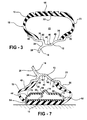
Referring to FIGS. 1, 2 and 3, a tire 10 is mounted to a rim 12 of a wheel
assembly, generally indicated at 14. The tire 10 includes a tread 16 and two sidewalls 18,
20. The interior of the tire 10 includes an interior carcass surface 22. The interior carcass
surface 22 is the surface that is interior of the tire 10 and opposite the tread 16. More
specifically, the tread 16 and the interior contour or surface 22 are opposite sides of the
same wall or surface of the tire 10. Together, the interior carcass surface 22, the sidewalls
18, 20 and the rim 12 define an interior space 23 of the tire 10.
Each of the sidewalls 18, 20 includes a tire bead 24, 26. The tire beads 24, 26
extend around the entire inner diameter of the tire 10. Although not shown, the tire beads
24, 26 include a coil of wires extending therethrough. The coils cannot be stretched and,
therefore, inhibit the tire 10 from becoming wider, under pressure, than the flanges of the
rim 12.
The wheel assembly 14 includes a disk 28. The disk 28 defines a hub receiving
center 30. The hub receiving center 30 is mounted to a hub of a motor vehicle (neither
shown). The hub receiving center 30 typically includes a plurality of holes 32 that extend
therethrough for receiving lug studs and/or lug nuts to secure the wheel assembly 14 to
the hub of the motor vehicle.
The disk 28 extends out to an outer peripheral edge 34. As may be appreciated by
those skilled in the art, the outer peripheral edge 34 is circular in design.
The rim 12 is fixedly secured to the outer peripheral edge 34. The rim 12 and the
disk 28 may be manufactured as a unitary structure, as in the construction of an
aluminum wheel (FIG. 3). The rim 12 and disk 28 may be disparate pieces joined
together via a well known welding procedure and the like, according to the metal used for
the manufacture of the wheel. This is the standard steel wheel construction, as is shown
in FIG. 2.
The rim 12 includes first 36 and second 38 tire seat surfaces. The tire seat surfaces
36, 38 extend generally perpendicular to the disk 28. The tire beads 24, 26 abut and
engage the tire seat surfaces 36, 38 when the tire 10 is inflated on the wheel assembly 14.
In the Figures 2 and 3 the tire seat surfaces 36, 38 extend through respective planes that
are approximately five degrees off with respect to the surface upon which the tire 10 is
being rotated.
A wheel well, generally indicated at 40, separates the two tire seat surfaces 36, 38.
The wheel well 40 is defined by a bottom surface 42 and two side surfaces 44, 46. The
bottom surface 42 is the structure that is fixedly secured to the outer peripheral edge 34 of
the disk 28. The wheel well 40 is designed to allow the tire beads 24, 26 to temporarily
rest therein while the portion of the tire beads 24, 26 diametrically opposite may be slid
over the rim 12 to be secured thereto. Therefore, the wheel well 40 is the structure in the
wheel assembly 14 that allows the wheel assembly 14 to be a unitary structure having no
removable parts. In other words, the wheel assembly 14 is a single structure because the
wheel well 40 allows the tire 10 to be mounted thereto without having to change, alter or
compromise the profile of the wheel assembly 14.
The rim 12 of the wheel assembly 14 also includes first 48 and second 50 rim
flanges. The first 48 and second 50 rim flanges are fixedly secured to the first 36 and
second 38 tire seat surfaces, respectively. The rim flanges 48, 50 receive a portion of the
sidewalls 18, 20 disposed adjacent the tire beads 24, 26. The rim flanges 48, 50 extend
out from the tire seat surfaces 36, 38 at an angle less than or equal to thirty degrees. In the
preferred embodiments shown in the Figures, the angle between the rim flanges 48, 50
and the tire seat surfaces 36, 38 is within the range of twenty and thirty degrees and
preferably twenty-five degrees, with respect to a horizontal plane. The angle depends,
however, on the carcass line (not shown in the Figures) of the tire 10. The shallowness of
the rim flanges 48, 50 improves the vertical elasticity of the tires 10 featuring low aspect
ratios while enhancing the overall performance of the tire 10, even those tires 10 with the
low aspect ratios.
As discussed above, the rim 12, including the tire seat surfaces 36, 38 and the rim
flanges 48, 50 form a unitary structure, which creates strength in the wheel assembly 14.
Referring now to FIGS. 4 through 7, a run flat device is generally indicated at 62.
In geometric terms, the run flat device 62 is designed to provide support to the tread 16 of
the tire 10 should the tire 10 lose pressure to a non-operational level, i.e., flat. In
mechanical terms, the run flat device 62 protects the sidewalls 18, 20 from collapsing. As
should be appreciated by those skilled in the art, a tire 10 that is operated in a flat
situation is eventually destroyed due to the stresses, strains and friction applied to the
sidewalls 18, 20 that have collapsed onto each other and are pinched between the rim
flanges 48, 50 and the road.
The run flat device 62 includes an inner rim 64. The inner rim 64 extends between
first 66 and second 68 ends. Each of the ends 66, 68 includes a flange 70, 72. The overall
width of the inner rim 64 is determined by the geometry of the tire 10.
The inner rim 64 also includes a channel 74. The channel 74 is designed to extend
through a portion of the length of the inner rim 64 at a location in alignment with the
wheel well 40 of the rim 12. The channel 74 performs two functions. First, the channel 74
strengthens the inner rim 64. Second, the channel 74 centers an inner tube 78, discussed
subsequently, on the inner rim 64. In situations when the pressure inside the tire 10 has
been reduced to a non-operational level, the channel 74 may engage the wheel well 40
and helps prevent the inner rim 64 from becoming misaligned with the wheel assembly
14. Alignment between the two rims 12, 64 helps maintain the tire 10 on the wheel
assembly 14 in situations of flats and low pressure operation.
A valve system 76 is mounted within the channel 74 through the inner tube 78.
The valve system 76 may be a traditional valve stem. Or, in the alternative, the valve
system 76 may be a cured self-sealing material that can re-seal itself after a needle has
been removed therefrom.
The run flat device 62 further includes an inner tube 78. The inner tube 78 is
fabricated from the same type of material that is used to manufacture the carcass of the
tire 10. The inner tube 78 is bonded to the inner rim 64 along the entire surface of the
inner rim 64 extending therebetween.
The inner tube 78 is also bonded to the interior contour or surface 22 of the tire
10. By bonding the inner tube 78 to both the interior contour or surface 22 and the inner
rim 64, slippage between the inner tube 78 and the tire 10 is eliminated. When the tread
16 of a rolling tire 10 comes in contact with a driving surface, large deformations appear
in the structure of the tire 10. As a consequence, relative speeds of the tire components
are modified.
As a consequence, slippages appear between components that are not firmly
bonded. In fact, for a standard tire 10, the only actual slippage appears at the interface of
the tread 16 and the driving surface. The resulting friction is directly responsible for the
wear of the tread 16. Bonding the inner tube 78 to the tire 10 substantially reduces the
wear of the inner tube 78, thus increasing the life thereof. In this situation, the integrity of
the tire 10 is not compromised and the pressure within the tire 10 remains constant. If the
nail 80 is long enough that it could potentially extend through the inner tube 78,
especially after the inner tube 78 has lost pressure, the inner rim 64 prevents the nail 80
from penetrating further, thus protecting the integrity of the tire 10.
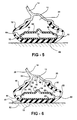
Referring to FIG. 6, a channel 82 deflects a nail 83 from the tire 10. In addition,
should a second nail 85 penetrate the inner tube 78, the inner rim 64 protects the interior
of the tire 10from deflating by preventing the nail 85 from extending into the interior of
the tire 10. In other words, the integrity of the tire 10 is maintained even though the tread
16 has taken in the nail 85.
Should a nail 84, FIG. 7, penetrate the tire 10 and not the inner tube 78, the
pressure in the inner tube 78 is maintained allowing the motor vehicle to continue
operating until the tire 10 can be repaired.
In FIG. 5, an alternative embodiment of the inner tube 78 is shown. In this
embodiment, the inner tube 78 includes reinforced sidewall appliques 86. The reinforced
sidewall appliques 86 provide increased resistance to puncture and avoids wobbling when
the inner tube 78 is deflated.
The invention has been described in an illustrative manner. It is to be understood
that the terminology, which has been used, is intended to be in the nature of words of
description rather than of limitation.
Many modifications and variations of the invention are possible in light of the
above teachings. Therefore, within the scope of the appended claims, the invention may
be practiced other than as specifically described.