EP1591025A1 - Coated perfume inspection device and a cigarette making machine provided with this - Google Patents
Coated perfume inspection device and a cigarette making machine provided with this Download PDFInfo
- Publication number
- EP1591025A1 EP1591025A1 EP04703473A EP04703473A EP1591025A1 EP 1591025 A1 EP1591025 A1 EP 1591025A1 EP 04703473 A EP04703473 A EP 04703473A EP 04703473 A EP04703473 A EP 04703473A EP 1591025 A1 EP1591025 A1 EP 1591025A1
- Authority
- EP
- European Patent Office
- Prior art keywords
- flavoring
- wrapping paper
- cigarette
- flavoring material
- fluorescence
- Prior art date
- Legal status (The legal status is an assumption and is not a legal conclusion. Google has not performed a legal analysis and makes no representation as to the accuracy of the status listed.)
- Granted
Links
Images



Classifications
-
- A—HUMAN NECESSITIES
- A24—TOBACCO; CIGARS; CIGARETTES; SIMULATED SMOKING DEVICES; SMOKERS' REQUISITES
- A24C—MACHINES FOR MAKING CIGARS OR CIGARETTES
- A24C5/00—Making cigarettes; Making tipping materials for, or attaching filters or mouthpieces to, cigars or cigarettes
- A24C5/32—Separating, ordering, counting or examining cigarettes; Regulating the feeding of tobacco according to rod or cigarette condition
- A24C5/34—Examining cigarettes or the rod, e.g. for regulating the feeding of tobacco; Removing defective cigarettes
-
- G—PHYSICS
- G01—MEASURING; TESTING
- G01N—INVESTIGATING OR ANALYSING MATERIALS BY DETERMINING THEIR CHEMICAL OR PHYSICAL PROPERTIES
- G01N21/00—Investigating or analysing materials by the use of optical means, i.e. using sub-millimetre waves, infrared, visible or ultraviolet light
- G01N21/62—Systems in which the material investigated is excited whereby it emits light or causes a change in wavelength of the incident light
- G01N21/63—Systems in which the material investigated is excited whereby it emits light or causes a change in wavelength of the incident light optically excited
- G01N21/64—Fluorescence; Phosphorescence
- G01N21/645—Specially adapted constructive features of fluorimeters
- G01N21/6456—Spatial resolved fluorescence measurements; Imaging
-
- A—HUMAN NECESSITIES
- A24—TOBACCO; CIGARS; CIGARETTES; SIMULATED SMOKING DEVICES; SMOKERS' REQUISITES
- A24C—MACHINES FOR MAKING CIGARS OR CIGARETTES
- A24C5/00—Making cigarettes; Making tipping materials for, or attaching filters or mouthpieces to, cigars or cigarettes
- A24C5/005—Treatment of cigarette paper
-
- A—HUMAN NECESSITIES
- A24—TOBACCO; CIGARS; CIGARETTES; SIMULATED SMOKING DEVICES; SMOKERS' REQUISITES
- A24C—MACHINES FOR MAKING CIGARS OR CIGARETTES
- A24C5/00—Making cigarettes; Making tipping materials for, or attaching filters or mouthpieces to, cigars or cigarettes
- A24C5/14—Machines of the continuous-rod type
- A24C5/18—Forming the rod
-
- G—PHYSICS
- G01—MEASURING; TESTING
- G01N—INVESTIGATING OR ANALYSING MATERIALS BY DETERMINING THEIR CHEMICAL OR PHYSICAL PROPERTIES
- G01N21/00—Investigating or analysing materials by the use of optical means, i.e. using sub-millimetre waves, infrared, visible or ultraviolet light
- G01N21/62—Systems in which the material investigated is excited whereby it emits light or causes a change in wavelength of the incident light
- G01N21/63—Systems in which the material investigated is excited whereby it emits light or causes a change in wavelength of the incident light optically excited
- G01N21/64—Fluorescence; Phosphorescence
- G01N21/6428—Measuring fluorescence of fluorescent products of reactions or of fluorochrome labelled reactive substances, e.g. measuring quenching effects, using measuring "optrodes"
- G01N21/643—Measuring fluorescence of fluorescent products of reactions or of fluorochrome labelled reactive substances, e.g. measuring quenching effects, using measuring "optrodes" non-biological material
-
- G—PHYSICS
- G01—MEASURING; TESTING
- G01N—INVESTIGATING OR ANALYSING MATERIALS BY DETERMINING THEIR CHEMICAL OR PHYSICAL PROPERTIES
- G01N21/00—Investigating or analysing materials by the use of optical means, i.e. using sub-millimetre waves, infrared, visible or ultraviolet light
- G01N21/62—Systems in which the material investigated is excited whereby it emits light or causes a change in wavelength of the incident light
- G01N21/63—Systems in which the material investigated is excited whereby it emits light or causes a change in wavelength of the incident light optically excited
- G01N21/64—Fluorescence; Phosphorescence
- G01N21/645—Specially adapted constructive features of fluorimeters
- G01N21/6456—Spatial resolved fluorescence measurements; Imaging
- G01N2021/646—Detecting fluorescent inhomogeneities at a position, e.g. for detecting defects
-
- Y—GENERAL TAGGING OF NEW TECHNOLOGICAL DEVELOPMENTS; GENERAL TAGGING OF CROSS-SECTIONAL TECHNOLOGIES SPANNING OVER SEVERAL SECTIONS OF THE IPC; TECHNICAL SUBJECTS COVERED BY FORMER USPC CROSS-REFERENCE ART COLLECTIONS [XRACs] AND DIGESTS
- Y10—TECHNICAL SUBJECTS COVERED BY FORMER USPC
- Y10S—TECHNICAL SUBJECTS COVERED BY FORMER USPC CROSS-REFERENCE ART COLLECTIONS [XRACs] AND DIGESTS
- Y10S131/00—Tobacco
- Y10S131/908—Sensing unique characteristic or specific condition of finished product
Definitions
- This invention relates to an applied flavoring material inspection device for inspecting an applying state of a flavoring-material applied on cigarette wrapping paper and a cigarette making machine provided with an applied flavoring-material inspection device.
- a cigarette is a rod of cut tobacco wrapped in wrapping paper, where the opposite sides of the wrapping paper are stuck together with seam glue.
- a flavoring material to cut tobacco.
- adding a flavoring material to seam glue in advance has been proposed (see Japanese Examined Patent Publication No. hei 6-95921, for example).
- a flavoring material is applied onto cigarette wrapping paper to improve the taste of cigarettes and/or suppress the odor of sidestream smoke. It is to be noted that in order to obtain a good taste of cigarettes by applying a flavoring material onto wrapping paper, the amount of the flavoring material applied onto the wrapping paper needs to be adjusted. In particular, when an odor-eliminating flavoring material capable of suppressing the odor of sidestream smoke is applied onto wrapping paper, the amount of the flavoring material applied needs to be adjusted more finely. Further, cigarettes made using that part of wrapping paper on which too small or too large an amount of a flavoring material is applied needs to be removed as defective products.
- Japanese Unexamined Patent Publication No. hei 4-34348 discloses a device for detecting defects due to non-uniformity of a sheet or the like such as a paper sheet or a polymeric film, using fluorescence radiated from a fluorescent substance.
- the principle of this inspection is that if a sheet or the like containing a fluorescent substance has structural non-uniformity in its surface or interior, light excited by the fluorescent reaction when the sheet or the like is illuminated by ultraviolet light is non-uniform. This non-uniform light is detected as indicating the existence of defects.
- An object of the invention is to provide an applied flavoring-material inspecting device suitable to inspect an applying state of a flavoring material applied on cigarette wrapping paper.
- Another object of the invention is to provide a cigarette making machine provided with an applied flavoring-material inspecting device for inspecting an applying state of a flavoring material applied on cigarette wrapping paper.
- the inventors observed fluorescence radiated when ultraviolet light was cast onto wrapping paper on which a flavoring material containing a fluorescent substance was applied, under various conditions. Specifically, a flavoring material containing a fluorescent substance or with a fluorescent substance added was linearly applied onto a long strip of wrapping paper used for making cigarettes; an image of an imaging region with a predetermined area preset for the wrapping paper was obtained by a camera from radiated fluorescence when ultraviolet light was cast onto the surface of the wrapping paper on which the flavoring material was applied; and irradiation intensity distribution in the image was obtained.
- FIGS. 1A and 1B relate, a flavoring material F with a fluorescent substance added or containing a fluorescent substance was applied onto the wrapping paper P in a predetermined width, and ultraviolet light was cast onto the surface of the wrapping paper P on which the flavoring material was applied, before the flavoring material F infiltrated into the wrapping paper P (for example, within about 5 seconds after the flavoring material was applied).
- An image signal from the camera was digitized by comparing the brightness of each pixel with a predetermined threshold value, and the widths D1 and D2 of the fluorescence irradiation zones having pixels with a brightness greater than the threshold value were obtained.
- FIGS. 1A and 1B relate
- the amount of the flavoring material applied was larger in the instance shown in FIG. 1B than in the instance shown in FIG 1A, while the width D0 in which the flavoring material was applied was the same. Because of this, the irradiation intensity in the image was stronger in the instance shown in FIG. 1B than in the instance shown in FIG 1A, and the width of the fluorescence irradiation zone was larger in the instance of FIG. 1B (D2 > D1). It is inferred that this comes from the difference in the thickness of the flavoring material F on the wrapping paper P, which difference is caused by the difference in the amount of the flavoring material applied.
- the inventors calculated the area of the fluorescence irradiation zone in the image and obtained relation between the area of the fluorescence irradiation zone and the amount of the flavoring material applied. Specifically, a series of images of the wrapping paper on which a known amount of a flavoring material was applied was successively obtained by a camera, the width of the fluorescence irradiation zone in each image was obtained, and then the width of this zone times the known length of the fluorescence irradiation zone, namely the area of the fluorescence irradiation zone was obtained. Further, by adding the areas of all the fluorescence irradiation zones together, the total area of fluorescence irradiation zones in the series of images was obtained. Under different experimental conditions where different fluorescence substances were used and the amount of the flavoring material applied was changed, the total area of fluorescence irradiation zones were calculated in the same way.
- FIG. 2 shows the relation between the total area of fluorescence irradiation zones, which was calculated this way, and the amount of the flavoring material applied, which was known. The relation was obtained for two instances where different fluorescent substances were used, which are indicated by a solid line and a broken line, respectively.
- the total area of fluorescence irradiation zones and the amount of the flavoring material applied are expressed in percentage (%) relative to the typical area and amount. As seen from FIG. 2, the total area of fluorescence irradiation zones is almost proportional to the amount of the flavoring material applied.
- the experiment showed that there is a correlation between the amount of the flavoring material applied on the cigarette wrapping paper (more generally, an application state of the flavoring material applied) and the fluorescence irradiation intensity distribution in the image, and that there is a particularly distinctive correlation between the width of the fluorescence irradiation zone and the amount of the flavoring material applied.
- the inventors made the present invention.
- the invention provides an applied flavoring-material inspecting device for inspecting an applying state of a flavoring material applied on cigarette wrapping paper, comprising a light source for casting ultraviolet light onto a flavoring-material applied surface of cigarette wrapping paper on which a flavoring material with a fluorescent substance added or containing a fluorescent substance is applied; a camera for obtaining an image of the flavoring-material applied surface from fluorescence radiated due to the ultraviolet light; image processing means for obtaining information correlative to an application state of the flavoring material applied on the cigarette wrapping paper, from fluorescence irradiation intensity distribution in the image; and determination means for determining the applying state of the flavoring material applied on the cigarette wrapping paper on the basis of the information correlative to the application state of the flavoring material.
- This invention is based on the knowledge that when an image of wrapping paper, on which a flavoring material containing a fluorescent substance or with a fluorescent substance added is applied, is obtained from fluorescence radiated by casting ultraviolet light onto the wrapping paper, there is found a correlation between fluorescence irradiation intensity distribution in the image and an application state of flavoring material applied on the wrapping paper. Therefore, this invention is attained by determining an applying state of the flavoring material applied on the basis of the information correlative to the application state of the flavoring material, the information being obtained from the fluorescence irradiation intensity distribution. Thus, by using the fluorescent reaction, the applying state of the flavoring material applied on the wrapping paper can be inspected reliably and easily.
- control information for controlling an flavoring-material application device provided in a cigarette making machine it is possible to control the application of the flavoring material onto the wrapping paper by the flavoring-material application device, in a good manner, to control the applying state of the flavoring material. Therefore, it is possible to produce cigarettes having a good taste, particularly cigarettes capable of suppressing the odor of sidestream smoke.
- the camera successively obtains a series of images of an inspection region preset for the cigarette wrapping paper; the image processing means detects a fluorescence irradiation zone having fluorescence irradiation intensities greater than a predetermined value, from fluorescence irradiation intensity distribution in each of the images; and the determination means identifies a flavoring-material application region of the wrapping paper, from the fluorescence irradiation zone detected in each of the images.
- a flavoring-material application region can be identified in an inspection region in each image of the wrapping paper, and therefore, whether or not the flavoring-material application region is present in an inspection region and whether or not the flavoring-material application region has a break can be determined.
- the image processing means detects, from the fluorescence irradiation intensity distribution in each of the images, the width of the fluorescence irradiation region in each of the images as information correlative to the application state of the flavoring material, and further obtains the area of the fluorescence irradiation region in each of the images, on the basis of the width of the fluorescence irradiation region in each of the images. Further, the determination means determines the amount of the flavoring material applied, on the basis of the total of the areas of the fluorescence irradiation regions in the images. There is a distinctive correlation between the width of the fluorescence irradiation region detected in each of the images and the amount of the flavoring material applied.
- the amount of the flavoring material which well indicates the applying state of the flavoring material, can be determined precisely, and the applying state of the flavoring material can be inspected reliably.
- the flavoring material is applied linearly along the length of the cigarette wrapping paper, and the camera obtains a series of images of an inspection region set for the cigarette wrapping paper so as to widthwise cover the part of the cigarette wrapping paper in which the flavoring material is applied.
- the applying state of the flavoring material can be inspected over all that part of the wrapping paper in which the flavoring material is applied. The applying state of the flavoring material applied on the wrapping paper therefore can be inspected reliably.
- the present invention provides a cigarette making machine, comprising a wrapping section for wrapping cut tobacco in cigarette wrapping paper; an application device for applying a flavoring material onto a flavoring-material application surface of the wrapping paper; and an applied flavoring-material inspecting device for inspecting an applying state of the flavoring material applied on the cigarette wrapping paper, wherein the applied flavoring-material inspecting device includes a light source for casting ultraviolet light onto the flavoring-material application surface of the cigarette wrapping paper on which the flavoring material with a fluorescent substance added or containing a fluorescent substance is applied; a camera for obtaining an image of the flavoring-material application surface from fluorescence radiated due to the ultraviolet light; image processing means for obtaining information correlative to an application state of the flavoring material applied on the cigarette wrapping paper, from fluorescence irradiation intensity distribution in the image; and determination means for determining an applying state of the flavoring material applied on the cigarette wrapping paper, on the basis of the information correlative to the application state of the flavoring material, and
- an applying state of the flavoring material applied on the cigarette wrapping paper to be fed to the wrapping section can be controlled well.
- the invention can provide a cigarette making machine suitable to make cigarettes having a good taste, particularly cigarettes capable of suppressing the odor of sidestream smoke.
- the cigarette wrapping paper includes an inner wrapper for wrapping cut tobacco therein and an outer wrapper for being wrapped around the inner wrapper, and the application device applies the flavoring material onto the inner surface of the outer wrapper which forms the flavoring-material application surface of the cigarette wrapping paper.
- the flavoring material is applied onto the inner surface of the outer wrapper of the cigarette wrapping paper (the surface of the outer wrapper which faces the inner wrapper). Therefore, cigarettes capable of suppressing the odor of sidestream smoke without affecting the taste of the cigarettes can be produced. Specifically, by applying an odor-eliminating flavoring material capable of suppressing the odor of sidestream smoke onto the outer wrapper, the flavoring material produces the odor elimination effect better, compared with when such flavoring material is added to cut tobacco, for example, and the odor of sidestream smoke can be suppressed well. In addition, the inner wrapper sandwiched between the outer wrapper and cut tobacco prevents the flavoring material from entering mainstream smoke when the cigarette is smoked.
- the camera of the applied flavoring-material inspecting device is located downstream from the application device in a feeding path along which the cigarette wrapping paper is fed to obtain an image of the flavoring-material application surface of the wrapping paper immediately after the flavoring material is applied. More desirably, the camera and the application device is separated by a distance corresponding to a predetermined time shorter than the time taken for the flavoring material applied onto the cigarette wrapping paper to infiltrate into the cigarette wrapping paper or the time taken for volatile constituents of the flavoring material applied onto the cigarette wrapping paper to evaporate from the flavoring material. In these desirable modes, an applying state of the flavoring material applied, particularly an amount of the flavoring material applied can be inspected reliably, before the flavoring material infiltrates into the wrapping paper or before the volatile constituents thereof evaporates.
- the cigarette making machine includes an applied amount control section for controlling the amount of the flavoring material to be applied by the application device, depending on inspection data about an applying state of the flavoring material applied on the cigarette wrapping paper, the inspection data being supplied by the determination means of the applied flavoring-material inspecting device.
- the amount of the flavoring material applied onto the wrapping paper can be controlled well.
- the cigarette making machine can remove a cigarette formed with that part of the cigarette wrapping paper about which the determination means of the applied flavoring-material inspecting device has determined that the flavoring material is not applied properly, in accordance with a defective-product removal signal which the determination means sends out when the determination means determines that the flavoring material is not applied properly.
- a cigarette formed with the defective part of the wrapping paper can be removed reliably.
- the camera of the applied flavoring-material inspecting device obtains an image of the flavoring-material application surface of the cigarette wrapping paper, in synchronization with controlled operation of the cigarette making machine.
- control on the application of the flavoring material onto the wrapping paper and the removal of a cigarette formed with a defective part of the wrapping paper can be properly performed on the basis of the information about an applying state of the flavoring material applied, at a timing in harmony with a timing at which the operation of the cigarette making machine is controlled.
- This applied flavoring material inspecting device is, for example incorporated into a cigarette making machine to inspect an applying state of a flavoring material applied on wrapping paper P used for making cigarettes.
- the applied flavoring material inspecting device includes a light source 10 for casting ultraviolet light onto a flavoring-material application surface of the wrapping paper P on which a flavoring material is applied, a camera 20 for obtaining an image of the flavoring-material application surface of the wrapping paper P illuminated by the light source 10, and an image processing device 30 for processing an image obtained by the camera 20.
- the flavoring material applied onto the wrapping paper P is one for alleviating or masking odor produced when cigarettes are smoked, particularly the odor of sidestream smoke.
- the flavoring material comprises one or more substances selected from a group consisting of terpenes, esters, alcohols such as linalool, nerol and geraniol, phenols such as anethole, aldehydes such as vanillin and ethyl vanillate, lactones, plant extracts, fruit extracts, and others.
- the flavoring material may be any of materials as disclosed in Japanese Unexamined Patent Publication No. 2002-146386.
- the flavoring material may be one in liquid form and containing a fluorescent substance as its constituent, or a fluorescent substance may be added to the flavoring material.
- a fluorescent substance for example methyl anthoranilate or orange peel essential oil can be used, where fluorescent benzyl alcohol or the like can be used as a solvent.
- the flavoring material containing a fluorescent substance as mentioned above is supplied to an application nozzle 41, for example by a pump 40 and linearly applied onto the flavoring-material application surface P1 of the wrapping paper P.
- the application nozzle 41 is located to a wrapping-paper travelling path which extends from a roll (not shown) to a wrapping section (not shown) of a cigarette making machine.
- the application nozzle 41 is used as a device for applying the flavoring material, the flavoring material may be applied using a roller.
- the application nozzle 41 has an end which contacts a widthwise central part of the flavoring-material application surface P1 of the wrapping paper P, and the flavoring material forced out of this nozzle end is put on the flavoring-material application surface.
- the flavoring material is applied onto the flavoring-material application surface P1 of the wrapping paper and forms a line of a predetermined width continuing along the length of the wrapping paper.
- the amount of the flavoring material applied is optimized by controlling the operation of the pump 40 by an applied amount control section 42, as will be described later.
- the wrapping paper P with the flavoring material applied on is fed to the wrapping section of the cigarette making machine and used to wrap cut tobacco therein. It is to be noted that although in the example described here, the flavoring material is applied onto the wrapping paper P to form a single line, the flavoring material may be so applied as to form two or more lines widthwise separated from each other by a predetermined distance.
- the light source 10 includes an ultraviolet lamp 12 as the main part thereof, the lamp 12 is driven by a high-frequency power source 11 to cast ultraviolet light (at wavelengths from 300 to 400 nm, for example).
- the light source 10 further includes a photo detector 13 for detecting the intensity (amount) of ultraviolet light cast from the ultraviolet lamp 12, and automatic light control means 14 for drive-controlling the high-frequency power supply 11 depending on the amount of light detected by the photo detector 13 to keep the intensity of ultraviolet illumination by the ultraviolet lamp 12 constant.
- the light control by the automatic light control means 14 is performed to keep the intensity of illumination at a value set by an illumination-intensity setting device 15 to thereby ensure that the wrapping paper P is illuminated at a constant intensity of illumination.
- the light source 10 is not limited to the one shown here by way of example, as long as the light source 10 can illuminate the flavoring-material application surface P1 of the wrapping paper P with ultraviolet light.
- the camera 20 for obtaining an image of the flavoring-material application surface P1 of the wrapping paper P is a small-sized one using solid-state image sensing devices such as CCDs. This camera 20 is actuated at predetermined timings by a trigger circuit 21, and controlled to successively obtain images of a predetermined length of the flavoring-material application surface P1 of the continuously travelling wrapping paper P.
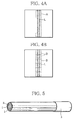
- the imaging range of the camera 20 is set, for example as a rectangular region of which the sides parallel to the width of the wrapping paper P is longer than the overall width of the wrapping paper and the sides parallel to the length of the wrapping paper P has a predetermined length (see FIG. 4A).
- the imaging range of the camera 20 is set as a rectangular region of which the sides parallel to the width of the wrapping paper are 34 mm long and the sides parallel to the length of the wrapping paper are 36 mm long.
- the camera 20 is so arranged as to obtain an image of the flavoring-material application surface of the wrapping paper P, with a linear flavoring-material application region located in the center of the image.
- the camera has a polarizing filter 20b mounted in front of its imaging lens 20a to obtain an image in which fluorescence radiated from the flavoring material exposed to ultraviolet light is emphasized.
- This inspecting device is adapted to inspect an applying state of the flavoring material applied on wrapping paper P, on the basis of the images of the wrapping paper P onto which the flavoring material was applied by the application nozzle 41, obtained by the camera 20.
- the camera 20 in order to perform the inspection in a good manner, is located downstream from the application nozzle 41, separated from the application nozzle 41 by a short distance corresponding to a predetermined time which is shorter than the time taken for the flavoring material applied onto the wrapping paper by the application nozzle 41 to infiltrate into the wrapping paper or the time taken for the volatile constituents of the flavoring material to evaporate from the flavoring material.
- a predetermined time varies depending on the type of wrapping paper, the type of flavoring material, the speed at which the wrapping paper travels, and others, the time is generally 5 seconds or shorter, and in some cases 0.02 to 0.5 seconds or shorter.
- the distance between the camera 20 and the application nozzle 41 is predetermined to correspond to the time predetermined this way.
- the trigger circuit 21 for actuating the camera 20 is driven by a pulse generator 23 which generates a predetermined pulse signal by receiving an output from a synchronization circuit 22 such as an encoder which generates the signal in synchronization with the operation of the cigarette making machine, and triggers the camera 20 in synchronization with the travelling of the wrapping paper P.
- the trigger circuit 21 controls the camera 20 to image the wrapping paper P, in synchronization with the cutting for forming cigarettes of a predetermined length.
- the wrapping paper P is imaged at such imaging timings, successively, over a predetermined length, on the basis of positions at which the wrapping paper is cut at the later stage.
- the images obtained are used for the inspection on the flavoring material applied by means of image processing described below.
- the image processing device 30 in the applied flavoring material inspecting device is materialized using a general-purpose image processor, and processes the images obtained by the camera 20 and inspects the flavoring material applied.
- the image processing device 30 has a digitization function 31, namely a function of digitizing an image obtained by the camera 20 using a predetermined threshold value to obtain an image for inspection, a presence determination function 32, namely a function of determining whether or not a flavoring-material application region is present in the image for inspection, an area detection function 33, namely a function of detecting the size of the flavoring-material application region, and a break detection function 34, namely a function of detecting a break in the flavoring-material application region.
- a determination circuit 35 comprehensively evaluating the information obtained by these determination and detection functions 32, 33 and 34, whether the flavoring material is properly applied or not is determined.
- the threshold value used in digitization is set by a setter 36 depending on inspecting specifications, more specifically the optimum applied amount for the flavoring material, which will be described later.
- the evaluation of an applying state of the flavoring material applied which is produced by the evaluation circuit 35, is supplied to an external device through an output circuit 37, for example in the form of a defective-product removal signal to the cigarette making machine, or an alarm display about a defective product. Further, the evaluation is supplied to a personal computer (not shown) or the like as inspection data, and also fed back to the applied amount control section 42 as applied amount control data.
- a first inspection region A is set to cover a flavoring-material application region L appearing in the image for inspection.
- a plurality, for example 6 of second inspection regions B into which the region A is lengthwise divided are set in the image for inspection.
- the first inspection region A is set as a ⁇ 6 mm x 36 mm rectangular region located in a central part of an image for inspection to cover the flavoring-material application region.
- the second inspection regions are set as 6 mm ⁇ 6 mm regions.
- the applying state the presence of the flavoring-material application region, the area (size) thereof, and the presence of a break therein) of the flavoring material is inspected for each of the first and second inspection regions A and B.
- a region L radiating fluorescence due to ultraviolet light (fluorescence irradiation region showing fluorescence irradiation intensities greater than the threshold value in digitization) in each of the first and second inspection regions A and B is identified as the flavoring-material application region.
- the area detection function 33 the area of the fluorescence irradiation region L in each of the first and second inspection regions A and B is obtained by counting pixels in the fluorescence irradiation region L.
- whether or not the flavoring material application region has a break is determined by inspecting the continuity of the fluorescence irradiation regions L along the length of the wrapping paper, particularly by inspecting that each of the second inspection regions B includes a predetermined area or an area larger than that of the fluorescence irradiation region L.
- the determination circuit 35 detects excess or deficiency of the flavoring material applied in a region of the wrapping paper P that corresponds to one image for inspection, for example by obtaining the ratio (proportion) of the number of pixels contained in the fluorescence irradiation region L to the number of pixels contained in the first inspection region A, and also detects local variation in the amount of the flavoring material applied and local excess or deficiency thereof by obtaining the ratio (proportion) of the number of pixels contained in the fluorescence irradiation region L to the number of pixels contained in each second inspection region B. By comprehensively evaluating the information thus obtained, the determination circuit 35 determines whether or not the flavoring material is applied on the wrapping paper P in a proper manner (in a proper amount). When excess or deficiency of the flavoring material applied or a break in the linear application region is detected, a removal signal is output in order to remove cigarettes wrapped in that part of the wrapping paper P in which such excess, deficiency or a break has been detected.
- the removal signal is given to a removal section, according to the timing that a cigarette rod formed with that part of the wrapping paper is cut into a predetermined length.
- the amount of the flavoring material applied obtained from the area of the fluorescence irradiation region L is fed back to the applied amount control section 42 for use in controlling the amount of the flavoring material supplied to the application nozzle 41 by the pump 40.
- the amount of the flavoring material supplied is made constant.
- the applied flavoring material inspecting device materialized as described above uses the phenomenon that the fluorescent substance contained in the flavoring material applied on the wrapping paper P radiates fluorescence when illuminated by ultraviolet light.
- This device can detect the area of the fluorescence irradiation region L in an image for inspection which is obtained by digitizing an image formed from the fluorescence radiated, by comparing pixels contained in this image with a predetermined threshold value. Further, by obtaining the amount of the flavoring material applied from the area of the fluorescence irradiation region L, this device can detect excess or deficiency of the flavoring material applied, and also detect easily a break in the flavoring-material application region. This produces beneficial effects such that quality control can be performed easily and effectively when a flavoring material is continuously applied onto a long strip of wrapping paper P and when cigarettes are produced using this wrapping paper P.
- a double-wrapped cigarette is a cigarette in which cut tobacco (filler) K is wrapped in an inner wrapper 1 to form a cylindrical rod, an outer wrapper 2 is wrapped around the inner wrapper 1 concentrically, and a filter tip is attached to an end of the rod.
- the inner wrapper 1 has a width suited to wrap cut tobacco K therein, with its opposite sides met each other.
- the outer wrapper 2 has a width greater than that of the inner wrapper 1.
- the outer wrapper 2 wrapped around the inner wrapper 1 has its opposite sides which are laid on each other and bonded together by seam glue. Between the inner wrapper 1 and the outer wrapper 2, a flavor-emitting material 4 is arranged.
- the flavor-emitting material 4 is a mixture of a flavoring material as described above and a carrier such as glue, and applied, for example onto the inner wrapper 1 to completely or partially cover its outer surface, or onto the outer wrapper 2 to completely or partially cover its inner surface.
- the flavor-emitting material 4 containing an odor-eliminating flavoring material capable of suppressing the odor of sidestream smoke onto the inner surface of the outer wrapper 2 (the surface of the outer wrapper 2 that faces the inner wrapper).
- the odor-eliminating flavoring material produces the odor-elimination effect better and therefore suppresses the order of sidestream smoke better, compared with when such flavoring material is added to cut tobacco, for example.
- the inner wrapper 1 arranged between the outer wrapper 2 and cut tobacco K prevents the fragrance from transferring mainstream smoke when the cigarette is smoked. Therefore, for example the concern that the effect of another flavoring material added to cut tobacco K to improve the taste is damaged is reduced. Further, compared with when the flavoring material is added onto the outer surface of the outer wrapper 2, change in the state of the flavoring material applied on the outer wrapper 2 with time can be reduced, and the concern that the cigarette deteriorates in appearance can be reduced.
- the cut tobacco K is a mixture of cut tobacco obtained by cutting tobacco laminae and midribs, shreds obtained by cutting reconstituted sheet tobacco, and expanded cut tobacco obtained by expanding cut tobacco.
- the inner wrapper 1 and the outer wrapper 2 are made from flax pulp, wood pulp or other plant pulp with additives such as calcium carbonate or a magnesium compound added.
- the inner wrapper 1 and the outer wrapper 2 may contain a burning regulator such as an organic acid salt or an ash regulator such as a phosphoric acid.
- a cigarette making machine for making the above-described double-wrapped cigarette is assembled as schematically shown in FIG. 7.
- the making machine is provided with a roll R1 of wrapping paper W1 for the inner wrapper 1 and a roll R2 of wrapping paper W2 for the outer wrapper 2.
- the wrapping paper W1 and the wrapping paper W2 are let out from the roll R1 and the roll 2 along the feeding paths 51 and 52.
- the feeding paths 51 and 52 are defined by a plurality of guide rollers.
- the feeding paths 51 and 52 extend up to an inlet to a wrapping section 60.
- a feed roller (not shown) and a reservoir 53 are disposed along the path.
- the wrapping section 60 has an endless garniture tape 61. Onto the garniture tape 61, the wrapping paper W1 and the wrapping paper W2 are successively fed from the terminal ends of the feeding paths 51 and 52. The wrapping paper W1 is laid on the wrapping paper W2 on the garniture tape 61 to form a double wrapper.
- the garniture tape 61 is extended to pass around a drive drum 62. As the drive drum 62 rotates, the garniture tape 61 travels in a forming groove (not shown) in a forming bed 63, with the double wrapper, in one direction.
- the forming groove in the forming bed 63 is so shaped that its width and the radius of curvature of its bottom gradually decrease from the inlet to the outlet of the wrapping section 60 so that the forming groove is approximately a semicircle in cross section at the outlet of the wrapping section 60.
- cut tobacco K is supplied onto the upper side of the wrapping paper W1 which forms the inner wrapper 1 of the double wrapper. More specifically, cut tobacco K is sucked onto the lower side of an endless tobacco band 70 to form a cut tobacco layer KL, and supplied to the inlet of the wrapping section 60 as the tobacco band 70 travels. The cut tobacco layer KL sucked on the tobacco band 70 is peeled from the tobacco band 70 by a tongue shoe 64 disposed at the inlet of the wrapping section 60 and transfers onto the wrapping paper W1 which forms the inner wrapper.
- the cut tobacco layer KL with the double wrapper passes through the wrapping section 60, more specifically through the tongue shoe 64, a short holder 65, a glue application nozzle 66 and a long holder 67, successively. While passing through the wrapping section, the cut tobacco K is wrapped in the double wrapper to form a continuous double-wrapped rod TR.
- the double-wrapped rod TR is delivered from the outlet of the wrapping section 60.
- the tongue shoe 64 compression-molds the cut tobacco layer KL from above into a circular arc in cross section, while the forming groove in the forming bed 63 bends the double wrapper from below into a U shape in cross section, with the garniture tape 21.
- the cut tobacco layer KL is compression-molded from above and from below, so that the upper and lower halves thereof are each formed into a circular arc in cross section.
- the short holder 65 bends a side part (first side part) of the double wrapper with the garniture tape 61 to describe an arc, and puts this first side part over a half of the upper half of the cut tobacco layer KL.
- the glue application nozzle 66 applies seam glue onto the other side part (second side part) of the wrapping paper W2 of the double wrapper.
- the long holder 67 bends the second side part of the double wrapper with the garniture tape 61 to describe likewise an arc, and puts this second side part over the other half of the upper half of the cut tobacco layer KL.
- the second side part of the wrapping paper W2 overlaps the first side part thereof and is stuck to it with the seam glue.
- the double-wrapped tobacco rod TR is formed.
- the tobacco rod TR delivered from the outlet of the wrapping section 60 passes under a heater 68, the seam glue is dried. Then, while passing through a cutting section 71, the tobacco rod TR is cut into cigarette rods SR of a predetermined length, namely twice the length of a double-wrapped cigarette, by a rotary knife 72 provided in the cutting section 60.
- the cigarette rods SR are supplied to the next stage, namely filter attachment (not shown), by a kicker 73.
- each cigarette rod SR is cut into two double-wrapped cigarettes, then a filter plug is placed between these two double-wrapped cigarettes, then these two double-wrapped cigarettes with the filter plug therebetween are connected by wrapping a piece of tip paper around them to form a double filter cigarette, and then the double filter cigarette is divided equally to form filter cigarettes shown in FIG. 1.
- a flavoring-material application device 80 including, for example an application nozzle 41 for applying a flavoring material onto wrapping paper W1 or W2 is arranged in the feeding path 51, downstream of the reservoir 53 as shown in FIG. 7.
- the flavoring-material application device 80 is adapted to apply a flavor-emitting material (flavoring-material) 4 in liquid form onto the inner surface of the wrapping paper W2, in a region except for the region in which seam glue is applied, or in a region of a predetermined width.
- the flavoring material applied by the flavoring-material application device 80 forms a layer of the flavor-emitting material 4 between the wrapping paper W1 and the wrapping paper W2.
- the flavor-emitting material 4 used here is a mixture of the flavoring material as mentioned above and a carrier such as EVA glue or PVAC glue used as seam glue. Therefore, the flavor-emitting material 4 functions as an adhesive for sticking the wrapping paper W1 and the wrapping paper W2 together.
- the PVAC glue has higher capacity to hold the flavoring material than the EVA glue and the CMC glue, and releases the fragrance better when the cigarette is smoked.
- the applied flavoring-material inspecting device 81 according to the present invention is arranged downstream of the flavoring-material application device 80 to inspect an applying state of the flavoring material immediately after the flavoring-material application device 80 applies the flavor-emitting material 4 onto the wrapping paper W2.
- the applying state of the flavoring material applied on the wrapping paper W2 used for making the cigarettes can be inspected in real time. If the flavoring material is not applied properly, the cigarettes wrapped in such defective part of the wrapping paper can be removed quickly. Thus, the quality of cigarettes produced can be guaranteed stably.
- the cigarette making machine is not restricted to that shown in FIG. 7.
- the flavoring-material application device 80 may form a layer having a plurality of streaks, on the inner surface of the wrapping paper W1.
- the present invention can be applied to the machine in which the flavoring-material application device 80 is located in the feeding path 52 as indicated in chain double-dashed lines.
- the flavoring-material application device 80 applies the flavor-emitting material on the outer surface of the wrapping paper W1.
- the flavoring-material application devices 80 may be located in the feeding paths 51 and 52, respectively.
- the flavoring-material application device 80 may be adapted to spray the flavor-emitting material in power form onto the wrapping paper W1 or W2.
- an adhesive is applied onto a surface of the wrapping paper W2, and then the flavor-emitting material in power form is sprayed onto the surface with the adhesive applied on.
- the flavor-emitting material in powder form may be a flavoring material such as dextrin or curdlan in power form, or a carrier such as ⁇ -cyclodedtrin carrying the flavoring material as mentioned above.
- the double wrapper having an inner wrapper 1 and an outer wrapper 2 is used, and a flavor-emitting material 3 containing an order-eliminating flavoring material capable of suppressing the odor of sidestream smoke is applied onto the outer wrapper 2.
- the invention is however not restricted to this way of applying the flavoring material.
- such odor-eliminating flavoring material or a flavoring material for improving the taste may be applied onto a single wrapper.
- the threshold value used in digitizing images of the flavoring-material application surface should be set depending on the conditions in which the flavoring-material application surface is illuminated by ultraviolet light to obtain images and the fluorescence-irradiation characteristics of the fluorescent substance contained in the flavoring material.
- the imaging range of the camera 20 may be determined depending on the size of the inspection region and others.
- the resolution (resolving power) of the camera 20 may be selected depending on the inspecting specifications. In other respects, the present invention can be modified in various ways without departing from its spirit.
Landscapes
- Health & Medical Sciences (AREA)
- Immunology (AREA)
- Life Sciences & Earth Sciences (AREA)
- Physics & Mathematics (AREA)
- Chemical & Material Sciences (AREA)
- Nuclear Medicine, Radiotherapy & Molecular Imaging (AREA)
- Analytical Chemistry (AREA)
- Biochemistry (AREA)
- General Health & Medical Sciences (AREA)
- General Physics & Mathematics (AREA)
- Pathology (AREA)
- Chemical Kinetics & Catalysis (AREA)
- Optics & Photonics (AREA)
- Molecular Biology (AREA)
- Cigarettes, Filters, And Manufacturing Of Filters (AREA)
- Manufacturing Of Cigar And Cigarette Tobacco (AREA)
- Investigating, Analyzing Materials By Fluorescence Or Luminescence (AREA)
- Investigating Materials By The Use Of Optical Means Adapted For Particular Applications (AREA)
Abstract
Description
Claims (11)
- An applied flavoring-material inspecting device for inspecting an applying state of a flavoring material applied on cigarette wrapping paper, comprising:a light source for casting ultraviolet light onto a flavoring-material application surface of cigarette wrapping paper on which a flavoring material with a fluorescent substance added or containing a fluorescent substance is applied,a camera for obtaining an image of the flavoring-material application surface from fluorescence radiated due to the ultraviolet light,image processing means for obtaining information correlative to an applied state of the flavoring material applied on the cigarette wrapping paper, from fluorescence irradiation intensity distribution in the image, anddetermination means for determining the applying state of the flavoring material on the cigarette wrapping paper, on the basis of the information correlative to the applied state of the flavoring material.
- The applied flavoring-material inspecting device according to claim 1, whereinsaid camera obtains a series of images of an inspection region set for the cigarette wrapping paper in advance, successively,said image processing means detects a fluorescence irradiation region having fluorescence irradiation intensities greater than a predetermined value, from fluorescence irradiation intensity distribution in each of the images, andsaid determination means identifies a flavoring-material application region of the cigarette wrapping paper, from the fluorescence irradiation region detected in each of the images.
- The applied flavoring-material inspecting device according to claim 2, wherein
said image processing means detects, from the fluorescence irradiation intensity distribution in each of the images, a width of the fluorescence irradiation region in each of the images as information correlative to the applied state of the flavoring material, and further obtains an area of the fluorescence emission region in each of the images, on the basis of the width of the fluorescence irradiation region in each of the images, and
said determination means determines an amount of the flavoring material applied, on the basis of a total of the areas of the fluorescence irradiation regions in the images. - The applied flavoring-material inspecting device according to claim 3, wherein
the flavoring material is applied linearly along the length of the cigarette wrapping paper, and
said camera obtains a series of images of an inspection region set for the cigarette wrapping paper to widthwise cover the part of the cigarette paper in which the flavoring material is applied. - A cigarette making machine, comprising
a wrapping section for wrapping cut tobacco in cigarette wrapping paper,
an application device for applying a flavoring material onto a flavoring-material application surface of the wrapping paper, and
an applied flavoring-material inspecting device for inspecting an applying state of the flavoring material applied on the cigarette wrapping paper, wherein
said applied flavoring-material inspecting device includes a light source for casting ultraviolet light onto the flavoring-material application surface of the cigarette wrapping paper on which the flavoring material with a fluorescent substance added or containing a fluorescent substance is applied; a camera for obtaining an image of the flavoring-material application surface from fluorescence radiated due to the ultraviolet light; image processing means for obtaining information correlative to an application state of the flavoring material applied on the cigarette wrapping paper, from fluorescence irradiation intensity distribution in the image; and determination means for determining the applied state of the flavoring material on the cigarette wrapping paper, on the basis of the information correlative to the application state of the flavoring material, and
said camera of said applied flavoring-material inspecting device and said application device are located in a stage prior to said wrapping section. - The cigarette making machine according to claim 5, wherein
the cigarette wrapping paper has an inner wrapper for wrapping cut tobacco therein and an outer wrapper for being wrapped around the inner wrapper, and
said application device applies the flavoring material onto the inner surface of the outer wrapper which forms the flavoring-material application surface of the cigarette wrapping paper. - The cigarette making machine according to claim 5, wherein said camera of the applied flavoring-material inspecting device is located in a feeding path along which the cigarette wrapping paper is fed, downstream of said application device, to obtain an image of the flavoring-material application surface of the wrapping paper immediately after the flavoring material is applied.
- The cigarette making machine according to claim 7, wherein said camera and said application device is separated by a distance corresponding to a predetermined time shorter than the time taken for the flavoring material applied onto the cigarette wrapping paper to infiltrate into the cigarette wrapping paper or the time taken for volatile constituents of the flavoring material applied onto the cigarette wrapping paper to evaporate from the flavoring material.
- The cigarette making machine according to claim 5, further including an applied amount control section for controlling an amount of the flavoring material to be applied by said application device, depending on inspection data about the applying state of the flavoring material on the cigarette wrapping paper, the inspection data being supplied by said determination means of said applied flavoring-material inspecting device.
- The cigarette making machine according to claim 5, wherein the cigarette making machine is adapted to remove a cigarette formed with that part of the cigarette wrapping paper about which said determination means of said applied flavoring-material inspecting device has determined that the flavoring material is not applied properly, according to a defective-product removal signal which said determination means outputs when said determination means determines that the flavoring material is not applied properly.
- The cigarette making machine according to claim 5, wherein said camera of said applied flavoring-material inspecting device obtains an image of the flavoring-material application surface of the cigarette wrapping paper, in synchronization with controlled operation of the cigarette making machine.
Applications Claiming Priority (3)
| Application Number | Priority Date | Filing Date | Title |
|---|---|---|---|
| JP2003012478 | 2003-01-21 | ||
| JP2003012478 | 2003-01-21 | ||
| PCT/JP2004/000392 WO2004064546A1 (en) | 2003-01-21 | 2004-01-20 | Coated perfume inspection device and a cigarette making machine provided with this |
Publications (3)
| Publication Number | Publication Date |
|---|---|
| EP1591025A1 true EP1591025A1 (en) | 2005-11-02 |
| EP1591025A4 EP1591025A4 (en) | 2011-03-30 |
| EP1591025B1 EP1591025B1 (en) | 2016-04-13 |
Family
ID=32767330
Family Applications (1)
| Application Number | Title | Priority Date | Filing Date |
|---|---|---|---|
| EP04703473.1A Expired - Lifetime EP1591025B1 (en) | 2003-01-21 | 2004-01-20 | Coated perfume inspection device and a cigarette making machine provided with this |
Country Status (8)
| Country | Link |
|---|---|
| US (1) | US7938124B2 (en) |
| EP (1) | EP1591025B1 (en) |
| JP (1) | JP4262248B2 (en) |
| KR (1) | KR100666410B1 (en) |
| CN (1) | CN100336478C (en) |
| RU (1) | RU2295266C2 (en) |
| TW (1) | TWI240068B (en) |
| WO (1) | WO2004064546A1 (en) |
Cited By (1)
| Publication number | Priority date | Publication date | Assignee | Title |
|---|---|---|---|---|
| WO2021180681A1 (en) * | 2020-03-10 | 2021-09-16 | Hauni Maschinenbau Gmbh | Measuring arrangement and method for optically testing articles of the tobacco processing industry |
Families Citing this family (32)
| Publication number | Priority date | Publication date | Assignee | Title |
|---|---|---|---|---|
| WO2006092881A1 (en) * | 2005-03-02 | 2006-09-08 | Japan Tobacco Inc. | Cigarette production apparatus |
| RU2355265C1 (en) * | 2005-03-02 | 2009-05-20 | Джапан Тобакко Инк. | Cigarette production machine |
| JP5349734B2 (en) * | 2005-12-19 | 2013-11-20 | 大日本印刷株式会社 | Printed matter having a colorless and transparent perfume printing layer |
| KR101113504B1 (en) * | 2009-11-03 | 2012-02-29 | 삼성에스디아이 주식회사 | Apparatus for detecting different pattern of electrode |
| WO2011104866A1 (en) * | 2010-02-26 | 2011-09-01 | 日本たばこ産業株式会社 | Production method and production device for coated paper |
| WO2012056568A1 (en) * | 2010-10-29 | 2012-05-03 | 日本たばこ産業株式会社 | Inspection system for coated paper |
| DE102011015882A1 (en) * | 2011-04-01 | 2012-10-04 | Hauni Maschinenbau Ag | Method for determining the amount of a flowable application applied to a wrapping material |
| US9244017B2 (en) | 2011-05-26 | 2016-01-26 | Altria Client Services Llc | Oil detection process and apparatus |
| US9080987B2 (en) | 2011-05-26 | 2015-07-14 | Altria Client Services, Inc. | Oil soluble taggants |
| CN102323244A (en) * | 2011-05-30 | 2012-01-18 | 江南大学 | Method for rapidly detecting portable food packaging fluorescent material and device |
| US9282772B2 (en) | 2012-01-31 | 2016-03-15 | Altria Client Services Llc | Electronic vaping device |
| MX2014010189A (en) | 2012-02-22 | 2014-11-14 | Altria Client Services Inc | Electronic smoking article and improved heater element. |
| CN102679883B (en) * | 2012-05-09 | 2014-06-18 | 中国科学院光电技术研究所 | A Measuring Method of Shredded Tobacco Width Based on Image Processing |
| US10900897B2 (en) | 2012-05-29 | 2021-01-26 | Altria Client Services Llc | Oil detection process |
| USD695449S1 (en) | 2013-01-14 | 2013-12-10 | Altria Client Services Inc. | Electronic smoking article |
| USD841231S1 (en) | 2013-01-14 | 2019-02-19 | Altria Client Services, Llc | Electronic vaping device mouthpiece |
| USD691765S1 (en) | 2013-01-14 | 2013-10-15 | Altria Client Services Inc. | Electronic smoking article |
| USD691766S1 (en) | 2013-01-14 | 2013-10-15 | Altria Client Services Inc. | Mouthpiece of a smoking article |
| USD849993S1 (en) | 2013-01-14 | 2019-05-28 | Altria Client Services | Electronic smoking article |
| US9097668B2 (en) | 2013-03-15 | 2015-08-04 | Altria Client Services Inc. | Menthol detection on tobacco |
| US9073091B2 (en) | 2013-03-15 | 2015-07-07 | Altria Client Services Inc. | On-line oil and foreign matter detection system and method |
| WO2015022035A1 (en) * | 2013-08-12 | 2015-02-19 | Sicpa Holding Sa | Packaging for smoking products having a marking thereon |
| BR302014001648S1 (en) | 2013-10-14 | 2015-06-09 | Altria Client Services Inc | Smoke Applied Configuration |
| JP2015152412A (en) * | 2014-02-14 | 2015-08-24 | リンテック株式会社 | defect identification method and defect identification system |
| KR101688124B1 (en) | 2014-07-24 | 2016-12-20 | (주)성진지오텍 | Uplift water pressure control equipment |
| US20160108293A1 (en) * | 2014-10-16 | 2016-04-21 | Altria Client Services Inc. | Inks, coatings and adhesives as carriers for taggants for tobacco product authentication and component detection |
| US10782279B2 (en) | 2014-11-11 | 2020-09-22 | Altria Client Services Llc | Method for detecting oil on tobacco products and packaging |
| CN111492230A (en) * | 2017-12-15 | 2020-08-04 | 日本烟草产业株式会社 | Method for inspecting cigarette filter, device for inspecting cigarette filter, and program for inspecting cigarette filter |
| BR112022011739A2 (en) * | 2020-01-07 | 2022-08-30 | Philip Morris Products Sa | MARKER DETECTION AND REJECTION METHOD AND DEVICES |
| CN111337490A (en) * | 2020-01-19 | 2020-06-26 | 广东微电新能源有限公司 | Battery gluing detection method |
| GB202013714D0 (en) * | 2020-09-01 | 2020-10-14 | Nicoventures Trading Ltd | An apparatus and method for manufacturing a comsumalbe for an aerosol provision system |
| CN115356297B (en) * | 2022-08-26 | 2024-12-24 | 中国烟草总公司郑州烟草研究院 | Method and device for identifying slightly green flue-cured tobacco leaves |
Family Cites Families (20)
| Publication number | Priority date | Publication date | Assignee | Title |
|---|---|---|---|---|
| US3006347A (en) * | 1959-09-21 | 1961-10-31 | Reynolds Tobacco Co R | Additives for smoking tobacco products |
| US4845374A (en) * | 1987-07-20 | 1989-07-04 | R. J. Reynolds Tobacco Company | Method and apparatus for detecting the deposition of an adhesive on a travelling web |
| JP2866382B2 (en) | 1988-05-18 | 1999-03-08 | 大日本印刷株式会社 | Glue detection method and apparatus for glue processing of continuous sheet |
| US5022950A (en) * | 1989-07-17 | 1991-06-11 | Philip Morris Incorporated | On-line embossing apparatus for a labeling machine |
| US5110213A (en) * | 1989-12-21 | 1992-05-05 | R. J. Reynolds Tobacco Company | Method and apparatus for measuring concentration of a material in a sample |
| JPH0434348A (en) | 1990-05-31 | 1992-02-05 | Kanzaki Paper Mfg Co Ltd | Sheet material inspection equipment |
| AU627658B2 (en) * | 1990-06-13 | 1992-08-27 | Aluminium Company Of America | Video inspection system |
| US5156169A (en) * | 1990-11-06 | 1992-10-20 | R. J. Reynolds Tobacco Company | Apparatus for making cigarettes |
| EP0506610A1 (en) | 1991-03-25 | 1992-09-30 | Burrus Holding Sa | Method for making cigarettes and cigarette using this method |
| US5432600A (en) * | 1992-05-15 | 1995-07-11 | Philip Morris Incorporated | Systems for optically inspecting cylindrical surfaces |
| US5228462A (en) * | 1992-05-27 | 1993-07-20 | Philip Morris Incorporated | Cigarette inspection device |
| US5366096A (en) * | 1993-11-17 | 1994-11-22 | Brown & Williamson Tobacco Corp. | Apparatus for and method of automatically detecting and eliminating cigarettes with visual defects during cigarette manufacture |
| US5531233A (en) * | 1994-06-22 | 1996-07-02 | R. J. Reynolds Tobacco Company | Method of and apparatus for applying adhesive to cigarette paper and the paper and cigarette produced thereby |
| JP3345288B2 (en) * | 1996-12-11 | 2002-11-18 | 株式会社日立製作所 | Electric vehicle control device |
| US6020969A (en) * | 1997-07-11 | 2000-02-01 | Philip Morris Incorporated | Cigarette making machine including band inspection |
| JP3372193B2 (en) * | 1997-08-20 | 2003-01-27 | 日本たばこ産業株式会社 | Cigarette manufacturing equipment |
| JP3824244B2 (en) * | 1997-08-21 | 2006-09-20 | キッコーマン株式会社 | Method for producing cholesterol esterase |
| JP2938067B1 (en) | 1998-09-11 | 1999-08-23 | 日本たばこ産業株式会社 | Method for fixing fragrance and cigarette for improving tobacco sidestream smoke odor |
| DE60136617D1 (en) * | 2000-03-28 | 2009-01-02 | Japan Tobacco Inc | STABILIZER FOR VENTILATION CHARACTERISTICS FOR FILTER CIGARETTES |
| US6929013B2 (en) * | 2001-08-14 | 2005-08-16 | R. J. Reynolds Tobacco Company | Wrapping materials for smoking articles |
-
2004
- 2004-01-20 CN CNB200480002547XA patent/CN100336478C/en not_active Expired - Fee Related
- 2004-01-20 TW TW093101524A patent/TWI240068B/en not_active IP Right Cessation
- 2004-01-20 KR KR1020057013322A patent/KR100666410B1/en not_active Expired - Fee Related
- 2004-01-20 WO PCT/JP2004/000392 patent/WO2004064546A1/en not_active Ceased
- 2004-01-20 RU RU2005126410/12A patent/RU2295266C2/en not_active IP Right Cessation
- 2004-01-20 EP EP04703473.1A patent/EP1591025B1/en not_active Expired - Lifetime
- 2004-01-20 JP JP2005508077A patent/JP4262248B2/en not_active Expired - Fee Related
-
2005
- 2005-07-20 US US11/184,789 patent/US7938124B2/en not_active Expired - Fee Related
Cited By (1)
| Publication number | Priority date | Publication date | Assignee | Title |
|---|---|---|---|---|
| WO2021180681A1 (en) * | 2020-03-10 | 2021-09-16 | Hauni Maschinenbau Gmbh | Measuring arrangement and method for optically testing articles of the tobacco processing industry |
Also Published As
| Publication number | Publication date |
|---|---|
| EP1591025B1 (en) | 2016-04-13 |
| US7938124B2 (en) | 2011-05-10 |
| US20050252516A1 (en) | 2005-11-17 |
| RU2005126410A (en) | 2006-01-10 |
| CN100336478C (en) | 2007-09-12 |
| TWI240068B (en) | 2005-09-21 |
| JP4262248B2 (en) | 2009-05-13 |
| CN1741752A (en) | 2006-03-01 |
| JPWO2004064546A1 (en) | 2006-05-18 |
| KR20050096943A (en) | 2005-10-06 |
| KR100666410B1 (en) | 2007-01-10 |
| RU2295266C2 (en) | 2007-03-20 |
| TW200420875A (en) | 2004-10-16 |
| WO2004064546A1 (en) | 2004-08-05 |
| EP1591025A4 (en) | 2011-03-30 |
Similar Documents
| Publication | Publication Date | Title |
|---|---|---|
| US7938124B2 (en) | Applied flavoring-material inspection device and cigarette making machine provided with same | |
| KR102317533B1 (en) | Method of making a rod for use as an aerosol-forming substrate having controlled porosity distribution | |
| EP2245948B1 (en) | Wrapping material for cigarettes | |
| US7234471B2 (en) | Cigarette and wrapping materials therefor | |
| US9788570B2 (en) | Filtered smoking article inspection system, and associated method | |
| CN101856145B (en) | Method for optical control of wrapping paper strips for the tobacco industry | |
| CA2510018C (en) | Wrapping paper inspection apparatus and tobacco wrapping machine | |
| CA2456683C (en) | Double wrapper cigarette, and machine and method for manufacturing the cigarette | |
| US20040129281A1 (en) | Equipment and methods for manufacturing cigarettes | |
| US20060207616A1 (en) | Detection of non-homogeneities in a continuous filter rod | |
| US20110050879A1 (en) | Optical inspection system employing short wave infrared sensing | |
| US20040122547A1 (en) | Equipment and methods for manufacturing cigarettes | |
| JPH1156335A (en) | Cigarette manufacturing equipment | |
| JP2025520256A (en) | Taggant Inspection System | |
| WO2004089121A1 (en) | Wrapping paper-inspecting device and cigarette-wrapping device |
Legal Events
| Date | Code | Title | Description |
|---|---|---|---|
| PUAI | Public reference made under article 153(3) epc to a published international application that has entered the european phase |
Free format text: ORIGINAL CODE: 0009012 |
|
| AK | Designated contracting states |
Kind code of ref document: A1 Designated state(s): AT BE BG CH CY CZ DE DK EE ES FI FR GB GR HU IE IT LI LU MC NL PT RO SE SI SK TR |
|
| AX | Request for extension of the european patent |
Extension state: AL LT LV MK |
|
| 17P | Request for examination filed |
Effective date: 20050706 |
|
| DAX | Request for extension of the european patent (deleted) | ||
| RBV | Designated contracting states (corrected) |
Designated state(s): DE GB IT NL |
|
| REG | Reference to a national code |
Ref country code: DE Ref legal event code: R079 Ref document number: 602004049036 Country of ref document: DE Free format text: PREVIOUS MAIN CLASS: A24C0005180000 Ipc: A24C0005000000 |
|
| A4 | Supplementary search report drawn up and despatched |
Effective date: 20110224 |
|
| RIC1 | Information provided on ipc code assigned before grant |
Ipc: A24C 5/34 20060101ALI20110218BHEP Ipc: A24C 5/18 20060101ALI20110218BHEP Ipc: A24C 5/00 20060101AFI20110218BHEP |
|
| 17Q | First examination report despatched |
Effective date: 20120802 |
|
| GRAP | Despatch of communication of intention to grant a patent |
Free format text: ORIGINAL CODE: EPIDOSNIGR1 |
|
| INTG | Intention to grant announced |
Effective date: 20151201 |
|
| GRAS | Grant fee paid |
Free format text: ORIGINAL CODE: EPIDOSNIGR3 |
|
| GRAA | (expected) grant |
Free format text: ORIGINAL CODE: 0009210 |
|
| AK | Designated contracting states |
Kind code of ref document: B1 Designated state(s): DE GB IT NL |
|
| REG | Reference to a national code |
Ref country code: GB Ref legal event code: FG4D |
|
| REG | Reference to a national code |
Ref country code: DE Ref legal event code: R096 Ref document number: 602004049036 Country of ref document: DE |
|
| REG | Reference to a national code |
Ref country code: NL Ref legal event code: FP |
|
| REG | Reference to a national code |
Ref country code: DE Ref legal event code: R097 Ref document number: 602004049036 Country of ref document: DE |
|
| PLBE | No opposition filed within time limit |
Free format text: ORIGINAL CODE: 0009261 |
|
| STAA | Information on the status of an ep patent application or granted ep patent |
Free format text: STATUS: NO OPPOSITION FILED WITHIN TIME LIMIT |
|
| 26N | No opposition filed |
Effective date: 20170116 |
|
| PGFP | Annual fee paid to national office [announced via postgrant information from national office to epo] |
Ref country code: NL Payment date: 20180119 Year of fee payment: 15 |
|
| PGFP | Annual fee paid to national office [announced via postgrant information from national office to epo] |
Ref country code: GB Payment date: 20180119 Year of fee payment: 15 Ref country code: DE Payment date: 20180122 Year of fee payment: 15 |
|
| PGFP | Annual fee paid to national office [announced via postgrant information from national office to epo] |
Ref country code: IT Payment date: 20180129 Year of fee payment: 15 |
|
| REG | Reference to a national code |
Ref country code: DE Ref legal event code: R119 Ref document number: 602004049036 Country of ref document: DE |
|
| REG | Reference to a national code |
Ref country code: NL Ref legal event code: MM Effective date: 20190201 |
|
| GBPC | Gb: european patent ceased through non-payment of renewal fee |
Effective date: 20190120 |
|
| PG25 | Lapsed in a contracting state [announced via postgrant information from national office to epo] |
Ref country code: DE Free format text: LAPSE BECAUSE OF NON-PAYMENT OF DUE FEES Effective date: 20190801 Ref country code: NL Free format text: LAPSE BECAUSE OF NON-PAYMENT OF DUE FEES Effective date: 20190201 |
|
| PG25 | Lapsed in a contracting state [announced via postgrant information from national office to epo] |
Ref country code: GB Free format text: LAPSE BECAUSE OF NON-PAYMENT OF DUE FEES Effective date: 20190120 |
|
| PG25 | Lapsed in a contracting state [announced via postgrant information from national office to epo] |
Ref country code: IT Free format text: LAPSE BECAUSE OF NON-PAYMENT OF DUE FEES Effective date: 20190120 |