EP1590932B1 - Lattices based generation of compressible RSA keys for use in certificates - Google Patents
Lattices based generation of compressible RSA keys for use in certificates Download PDFInfo
- Publication number
- EP1590932B1 EP1590932B1 EP03780595A EP03780595A EP1590932B1 EP 1590932 B1 EP1590932 B1 EP 1590932B1 EP 03780595 A EP03780595 A EP 03780595A EP 03780595 A EP03780595 A EP 03780595A EP 1590932 B1 EP1590932 B1 EP 1590932B1
- Authority
- EP
- European Patent Office
- Prior art keywords
- pattern
- certificate
- lattice
- function
- prime
- Prior art date
- Legal status (The legal status is an assumption and is not a legal conclusion. Google has not performed a legal analysis and makes no representation as to the accuracy of the status listed.)
- Expired - Lifetime
Links
- 238000000034 method Methods 0.000 claims description 33
- 238000004519 manufacturing process Methods 0.000 claims description 8
- 238000011084 recovery Methods 0.000 description 11
- 239000013598 vector Substances 0.000 description 9
- 238000012360 testing method Methods 0.000 description 8
- 230000006835 compression Effects 0.000 description 4
- 238000007906 compression Methods 0.000 description 4
- 238000000790 scattering method Methods 0.000 description 3
- 230000007774 longterm Effects 0.000 description 2
- 238000012795 verification Methods 0.000 description 2
Images

Classifications
-
- H—ELECTRICITY
- H04—ELECTRIC COMMUNICATION TECHNIQUE
- H04L—TRANSMISSION OF DIGITAL INFORMATION, e.g. TELEGRAPHIC COMMUNICATION
- H04L9/00—Cryptographic mechanisms or cryptographic arrangements for secret or secure communications; Network security protocols
- H04L9/32—Cryptographic mechanisms or cryptographic arrangements for secret or secure communications; Network security protocols including means for verifying the identity or authority of a user of the system or for message authentication, e.g. authorization, entity authentication, data integrity or data verification, non-repudiation, key authentication or verification of credentials
-
- H—ELECTRICITY
- H04—ELECTRIC COMMUNICATION TECHNIQUE
- H04L—TRANSMISSION OF DIGITAL INFORMATION, e.g. TELEGRAPHIC COMMUNICATION
- H04L9/00—Cryptographic mechanisms or cryptographic arrangements for secret or secure communications; Network security protocols
- H04L9/30—Public key, i.e. encryption algorithm being computationally infeasible to invert or user's encryption keys not requiring secrecy
- H04L9/3006—Public key, i.e. encryption algorithm being computationally infeasible to invert or user's encryption keys not requiring secrecy underlying computational problems or public-key parameters
- H04L9/302—Public key, i.e. encryption algorithm being computationally infeasible to invert or user's encryption keys not requiring secrecy underlying computational problems or public-key parameters involving the integer factorization problem, e.g. RSA or quadratic sieve [QS] schemes
-
- H—ELECTRICITY
- H04—ELECTRIC COMMUNICATION TECHNIQUE
- H04L—TRANSMISSION OF DIGITAL INFORMATION, e.g. TELEGRAPHIC COMMUNICATION
- H04L9/00—Cryptographic mechanisms or cryptographic arrangements for secret or secure communications; Network security protocols
-
- H—ELECTRICITY
- H04—ELECTRIC COMMUNICATION TECHNIQUE
- H04L—TRANSMISSION OF DIGITAL INFORMATION, e.g. TELEGRAPHIC COMMUNICATION
- H04L9/00—Cryptographic mechanisms or cryptographic arrangements for secret or secure communications; Network security protocols
- H04L9/08—Key distribution or management, e.g. generation, sharing or updating, of cryptographic keys or passwords
-
- H—ELECTRICITY
- H04—ELECTRIC COMMUNICATION TECHNIQUE
- H04L—TRANSMISSION OF DIGITAL INFORMATION, e.g. TELEGRAPHIC COMMUNICATION
- H04L9/00—Cryptographic mechanisms or cryptographic arrangements for secret or secure communications; Network security protocols
- H04L9/30—Public key, i.e. encryption algorithm being computationally infeasible to invert or user's encryption keys not requiring secrecy
-
- H—ELECTRICITY
- H04—ELECTRIC COMMUNICATION TECHNIQUE
- H04L—TRANSMISSION OF DIGITAL INFORMATION, e.g. TELEGRAPHIC COMMUNICATION
- H04L9/00—Cryptographic mechanisms or cryptographic arrangements for secret or secure communications; Network security protocols
- H04L9/30—Public key, i.e. encryption algorithm being computationally infeasible to invert or user's encryption keys not requiring secrecy
- H04L9/3093—Public key, i.e. encryption algorithm being computationally infeasible to invert or user's encryption keys not requiring secrecy involving Lattices or polynomial equations, e.g. NTRU scheme
-
- H—ELECTRICITY
- H04—ELECTRIC COMMUNICATION TECHNIQUE
- H04L—TRANSMISSION OF DIGITAL INFORMATION, e.g. TELEGRAPHIC COMMUNICATION
- H04L9/00—Cryptographic mechanisms or cryptographic arrangements for secret or secure communications; Network security protocols
- H04L9/32—Cryptographic mechanisms or cryptographic arrangements for secret or secure communications; Network security protocols including means for verifying the identity or authority of a user of the system or for message authentication, e.g. authorization, entity authentication, data integrity or data verification, non-repudiation, key authentication or verification of credentials
- H04L9/3263—Cryptographic mechanisms or cryptographic arrangements for secret or secure communications; Network security protocols including means for verifying the identity or authority of a user of the system or for message authentication, e.g. authorization, entity authentication, data integrity or data verification, non-repudiation, key authentication or verification of credentials involving certificates, e.g. public key certificate [PKC] or attribute certificate [AC]; Public key infrastructure [PKI] arrangements
Definitions
- US-A-2002/0152385 discloses a digital signature verification protocol that utilises a pair of signature components incorporating a pair of private key, one of which is a long term key and the other of which is a short term key.
- the long term key is applied to one of the signature component to reveal the short term key.
- the short term key is then used to compute a value of a signature component contained in the signature. If the computed value and received value agree then the authenticity is verified.
- the present invention in preferred embodiments thereof, seeks to provide solutions to the problems of prior art certificates.
- the invention provides a method for producing a certificate in accordance with claim 1.
- the including s and t in the certificate includes including s concatenated with t in the certificate.
- the method may further comprise signing the certificate by an entity A for an entity B, wherein the public E is a public key of the entity B.
- the method may further comprise, generating a modulus N, wherein the modulus N is generated by a scattering method L; a function R; and a seed s; N is generated, in part, by scattering the bits of R(s) throughout N using the scattering method L; and all bits of N other than those scattered by the scattering method L are denoted t.
- the R(s) includes data associated with an owner of the certificate.
- N includes an RSA modulus.
- the lattice is defined, in part, by a generalized pattern G.
- V k+2 ( 2 2 ⁇ n ⁇ r 1 + .5 2 2 ⁇ n ⁇ r 2 + .5 ... 2 2 ⁇ n ⁇ r k + .5 0 2 2n )
- n, x, z are integers
- S1, ..., Sk are position numbers of contiguous groups of symbols "*" in a generalized 2n-bit pattern G, where positions are numbered from the least significant (0) to the most significant (2n-1), and S1 ⁇ S2 ⁇ ...
- a signer produces a certificate signed with recovery.
- Signatures not signed with recovery are also termed herein “regular signatures” or “regular asymmetric signatures”.
- the signed certificate is C // S, where "//" denotes concatenation.
- redundancy refers to a condition P(C) that holds for a random C with a very small probability.
- the payload may be padded with a sufficiently long constant bit string, or preferably with any appropriate type of payload checksum, such types of checksum being well known in the art.
- the public key (and optionally other data) may be compressed. While data may be compressed using standard compression algorithms well known in the art, in many asymmetric algorithms the public keys generated in standard ways have high entropy. As is well known in the art, information having high entropy can not be compressed, and therefore public keys generated in standard ways can not be compressed.
- t may be some portion of the bits of E (such as, for example, the least significant half of E, the most significant half of E, or bits in positions scattered over E).
- Function F is preferably chosen to be a function that:
- the certificate preferably includes s // t, which is shorter than E.
- a certificate typically includes: credentials; characteristics; and a public key, signed all together. All the certificate fields, besides the public key, are referred to herein as "data".
- signature with recovery the recovery process performs only recovery, but does not verify that the person who created the certificate knew the private key.
- One option is to use a sufficiently long field (say, 16 bytes) with a fixed value.
- Another option is to use a checksum, or a hash, of the data. Unfortunately, both options require an additional field, so that less bytes are left for a useful payload.
- H is a publicly known function.
- the data itself may be used as a seed s.
- RSA signature scheme is described, for example, in R.L.Rivest, A. Shamir, and L.M.Adelman, "A method for obtaining digital signatures and public-key cryptosystems". Communications of the ACM, 21 (1978), 120-126 .
- RSA is used by way of example only and is not meant to be limiting.
- the public key comprises a modulus and a public exponent.
- the limitations on the public exponent are quite loose.
- the public exponent may be chosen to be a fixed publicly known number that does not to have to be explicitly included into the certificate, so there is no problem with compression of the public exponent.
- RSA modulus compression is believed to save about half of the length of the RSA modulus.
- the function R may, for example, comprise a suitable pseudo-random number generator that receives a seed s and expands it to a pseudo-random sequence.
- R(s) The least significant bit of R(s) must be forced to 1 , which means that R(s) is odd.
- R(s) has some regular structure
- cryptographic attacks based on R(s) are less likely if bits of R(s) are scattered.
- An important special case in which scattering the bits is likely to be helpful in making cryptographic attack less likely is when data itself (which almost certainly has a regular structure) is used as R(s) or its part, in order to have an ID of an owner and / or other data simply embedded into his public key; embedding such data in a public key is well known in the art.
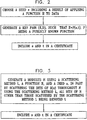
- FIG. 2 is a simplified flowchart illustration of a preferred method for producing a certificate in accordance with a preferred embodiment of the present invention.
- the flowchart of Fig. 2 is self-explanatory with reference to the above discussion.
- FIG. 3 is a simplified flowchart illustration of a preferred method for producing a certificate in accordance with an alternative preferred-embodiment of the present invention.
- the flowchart of Fig. 3 is self-explanatory with reference to the above discussion.
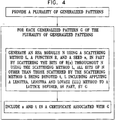
- Fig. 4 is a simplified flowchart illustration of a preferred method for producing a plurality of certificates in accordance with a further alternative preferred embodiment of the present invention. It is noted that, in Fig. 4 , reference is made to generating a single modulus N and a single associated certificate for each generalized pattern G; persons skilled in the art will appreciate that it is also possible to generates a plurality of moduli and a plurality of associated certificates for each generalized pattern G. The case of a plurality of moduli N and a plurality of associated certificates is believed to be preferred.
- the flowchart of Fig. 4 is self-explanatory with reference to the above discussion.
Landscapes
- Engineering & Computer Science (AREA)
- Computer Security & Cryptography (AREA)
- Computer Networks & Wireless Communication (AREA)
- Signal Processing (AREA)
- Computing Systems (AREA)
- Theoretical Computer Science (AREA)
- Physics & Mathematics (AREA)
- Algebra (AREA)
- General Physics & Mathematics (AREA)
- Mathematical Analysis (AREA)
- Mathematical Optimization (AREA)
- Mathematical Physics (AREA)
- Pure & Applied Mathematics (AREA)
- Management, Administration, Business Operations System, And Electronic Commerce (AREA)
- Storage Device Security (AREA)
Description
- The present invention relates to digitally signed certificates.
- The use of digitally signed certificates is well known in the art.
- Consider the following example: Two entities A and B each have asymmetric key pairs, each key pair comprising a public key and a private key, as is well known in the art. Entity A is to sign a certificate for entity B, the certificate comprising the public key of entity B and other data regarding entity B.
- The widespread and well known X-509 format is typically used in the prior art for the purpose of producing certificates of the type described above. The X.509 format is defined in ITU-T Recommendation for X.509, published March 2000, available from ITU-T (the International Telecommunication Union Standardization Sector).
-
US-A-2002/0152385 discloses a digital signature verification protocol that utilises a pair of signature components incorporating a pair of private key, one of which is a long term key and the other of which is a short term key. The long term key is applied to one of the signature component to reveal the short term key. The short term key is then used to compute a value of a signature component contained in the signature. If the computed value and received value agree then the authenticity is verified. - Document XP2421157 : Lattice reduction in cryptology: an update, discloses the different uses of Lattice reduction in cryptography.
- The present invention seeks to provide improved digitally signed certificates and improved methods for producing digitally signed certificates.
- Known solutions, as described above, do not provide optimal solutions for some applications. For example, the inventors of the present invention believe that the known solutions described above are not optimal for applications in which certificate verification is implemented in random logic, non-CPU type hardware (also termed herein "hardware"); in such application, the inventors of the present invention believe that it is desirable for the certificate to be short and to have a form that is easy to parse in hardware. The well-known X.509 format, described above, is not good for this purpose, at least because certificates produced in accordance with the X.509 format have a variable length structure that is difficult to parse in hardware; also, X.509 format certificates are generally long, with certificates of 2 KB (kilobytes) in length being common.
- The present invention, in preferred embodiments thereof, seeks to provide solutions to the problems of prior art certificates.
- The invention provides a method for producing a certificate in accordance with claim 1.
- Further in accordance with a preferred embodiment of the present invention the including s and t in the certificate includes including s concatenated with t in the certificate.
- - Still further in accordance with a preferred embodiment of the present invention the function H includes a hash function.
- Additionally in accordance with a preferred embodiment of the present invention the function H includes a checksum function.
- Moreover in accordance with a preferred embodiment of the present invention the function H includes adding redundancy to the data.
- In an embodiment, s and t are included in the certificate prior to signing the certificate.
- The method may further comprise signing the certificate by an entity A for an entity B, wherein the public E is a public key of the entity B.
- The method may further comprise, generating a modulus N, wherein the modulus N is generated by a scattering method L; a function R; and a seed s; N is generated, in part, by scattering the bits of R(s) throughout N using the scattering method L; and all bits of N other than those scattered by the scattering method L are denoted t.
- Further in accordance with a preferred embodiment of the present invention the R(s) includes data associated with an owner of the certificate.
- Still further in accordance with a preferred embodiment of the present invention the data includes an owner identifier.
- Additionally in accordance with a preferred embodiment of the present invention N includes an RSA modulus.
- Moreover in accordance with a preferred embodiment of the present invention L includes applying a Lenstra, Lenstra and Lovasz (LLL) method to a lattice.
- Further in accordance with a preferred embodiment of the present invention the lattice is defined, in part, by a generalized pattern G.
- Still further in accordance with a preferred embodiment of the present invention the lattice includes
V1 = ( 
0 ... 0 0 0 ) V2 = ( 0 
... 0 0 0 ) . ... ... . . .. Vk = ( 0 0 ... 
0 0 ) Vk+j = ( 

... 

0 ) Vk+2 = ( 

... 
0 22n ) - There is also provided in accordance with another preferred embodiment of the present invention a certificate produced by the method.
- The present invention will be understood and appreciated more fully from the following detailed description, taken in conjunction with the drawings in which:
-
Fig. 1 is an illustration of base vectors for a lattice in (k+2)-dimensional space, useful in understanding a preferred embodiment of the present invention; -
Fig. 2 is a simplified flowchart illustration of a preferred method for producing a certificate in accordance with a preferred embodiment of the present invention; - Fig.-3 is a simplified flowchart illustration of a preferred method for producing a certificate in accordance with an alternative preferred embodiment of the present invention; and
-
Fig. 4 a simplified flowchart illustration of a preferred method for producing a plurality of certificates in accordance with a further alternative preferred embodiment of the present invention. - In accordance with a preferred embodiment of the present invention, a signer produces a certificate signed with recovery. Signatures not signed with recovery, as are well known in the art, are also termed herein "regular signatures" or "regular asymmetric signatures".
- To produce a regular asymmetric signature of a certificate C, the signer computes a signature S as follows:

where: - f is a publicly known function;
- h is a publicly known hash function; and
- D is the private key of the signer.
- The signed certificate is C // S, where "//" denotes concatenation.
- The verifier verifies that:

- g is a publicly known function; and
- E is the public key of the signer.
- Preferably, f, g, D, E are chosen as follows:
- 1. A set M of permitted cleartexts is defined; function f defined on the set M.
- 2. g(y,E) is the inverse of f(x,D), i.e. for any x∈M g(f(x,D),E) = x.
- 3. g, f, E are public.
- 4. It is difficult to find D based only on E.
- 5. h is chosen such that it is difficult to find different x, y such that h(x) = h(y). A non-limiting example of an appropriate choice for h is SHA-1, which is described in FIPS PUB 180-1, published 17 April 1995 and entitled "Secure Hash Standard", available on the Internet at: www.itl.nist.gov/fipspubs/fip180-1.htm.
- The following is a non-limiting specific example of appropriate choices for f, g, D, E :
- Let N = pq - an RSA number, that is, a product of two primes;
- let M be the set of all integers from 0 to N-1 ;
- let e, d be arbitrary integers such that ed = 1 modulo ϕ(N), ϕ(N) being Euler's totient function;
- let E be an ordered pair <N,e>;
- let D be an ordered pair <N,d>;
- let:

- let:

- For signature with recovery the signer ensures that C has some redundancy in it, or adds such a redundancy. The term "redundancy", as used throughout the present specification and claims, refers to a condition P(C) that holds for a random C with a very small probability. For example and without limiting the generality of the foregoing, the payload may be padded with a sufficiently long constant bit string, or preferably with any appropriate type of payload checksum, such types of checksum being well known in the art.
- The signer then computes:

where S is the certificate signed with recovery. - The verifier first recovers C from S:
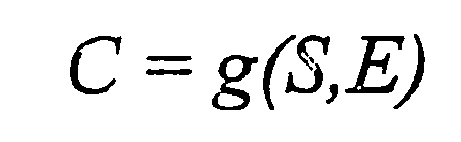
and then verifies that C has the pre-defined redundancy. - Persons skilled in the art will appreciate that, when using signature with recovery, signed certificates are shorter than certificates produced with regular signature. On the other hand, unlike regular signature, signature with recovery imposes a limitation on the length of C, because the set M is limited. For example, in the particular example of RSA described above, only numbers less than the modulus N may be signed with recovery. Therefore, in a certificate for B signed by A there may not be enough space in C for the public key of B and for other data; in particular, there will not be enough space in a common case where the keys of A and of B are of the same length.
- In order to save space and make signature with recovery more efficient and in order to overcome the limitations mentioned above, the public key (and optionally other data) may be compressed. While data may be compressed using standard compression algorithms well known in the art, in many asymmetric algorithms the public keys generated in standard ways have high entropy. As is well known in the art, information having high entropy can not be compressed, and therefore public keys generated in standard ways can not be compressed.
- The following method may be used for generation of compressible public keys:
- 1. Choose an arbitrary seed s.
- 2. Generate a key pair (E,D) in such a way that:

- For example, t may be some portion of the bits of E (such as, for example, the least significant half of E, the most significant half of E, or bits in positions scattered over E).
- Any appropriate value s may be used.
- Function F is preferably chosen to be a function that:
- 1. expands s pseudo-randomly to a pre-defined number of bits, similarly to the function of the function R described below; and
- 2. combines the expanded s with t in a pre-defined way (such as, for example, using the expanded s as the least significant part of the result of the combining, while using t as the most significant part, or vice versa; or in some interleaving fashion).
- Instead of E, the certificate preferably includes s // t, which is shorter than E.
- A particular choice of the function F, the method of generation of a suitable key pair, and the amount of space which is saved depend on the asymmetric algorithm which is used.
- Persons skilled in the art will appreciate that a certificate typically includes: credentials; characteristics; and a public key, signed all together. All the certificate fields, besides the public key, are referred to herein as "data". When one uses signature with recovery, the recovery process performs only recovery, but does not verify that the person who created the certificate knew the private key. In order to verify that the person who created the certificate knew the private key, it is necessary to have some redundancy in the clear text; that is, some pre-defined condition regarding the recovered message must be met, which condition has a sufficiently low probability for a random bit string. One option is to use a sufficiently long field (say, 16 bytes) with a fixed value. Another option is to use a checksum, or a hash, of the data. Unfortunately, both options require an additional field, so that less bytes are left for a useful payload.
- To save more space, the seed s may be used as redundancy, if we set:

where H is a publicly known function. Thus, space is saved by double use of s, both as the checksum / hash of the data, and as a seed as described above. - Alternatively, the data itself, with some redundancy added, may be used as a seed s.
- The following discussion describes a certain particularly detailed preferred implementation of the present invention, useful if the well-known prior art RSA signature scheme is used. The RSA signature scheme is described, for example, in R.L.Rivest, A. Shamir, and L.M.Adelman, "A method for obtaining digital signatures and public-key cryptosystems". Communications of the ACM, 21 (1978), 120-126. RSA is used by way of example only and is not meant to be limiting.
- If RSA is used for signature, the public key comprises a modulus and a public exponent. The limitations on the public exponent are quite loose. In particular, the public exponent may be chosen to be a fixed publicly known number that does not to have to be explicitly included into the certificate, so there is no problem with compression of the public exponent. RSA modulus compression is believed to save about half of the length of the RSA modulus.
- Several compression techniques for the RSA modulus are now described. For purposes of the following description, by way of example only and without limiting the generality of the present invention, suppose that 2n-bit RSA moduli of the form N = pq are used, where p and q are primes having n - x and n + x bits, respectively; the seed s has y bits; and R is a publicly known function that expands the seed s to n + x - z bits, where z is a parameter described below. The function R may, for example, comprise a suitable pseudo-random number generator that receives a seed s and expands it to a pseudo-random sequence. For example, the function R may set:

where h comprises an appropriate hash function (for example SHA1, which is described in FIPS PUB 180-1, published 17 April 1995 and entitled "Secure Hash Standard", available on the Internet at: www.itl.nist.gov/fipspubs/fip180-1.htm; and in RFC 3174, published September 2001 and entitled "US Secure Hash Algorithm 1 (SHA1), available on the Internet at: www.ietf.org/rfc/rfc3174.txt?number=3174), or E(x) XOR x, where E is encryption with a block cipher (for example AES - FIPS Publication 197, November 26, 2001, Announcing the Advanced Encryption Standard (AES) available on the Internet at csrc.nist.gov/publications/fips/fips197/fips-197.pdf). - First, consider "expansion of the most significant half'. The following method generates a compressible RSA key:
- 1. Generate an arbitrary (n - x) -bit prime p and a y-bit seed s. Methods for generating such a prime are well known in the art. In general, such methods (which are described, for example, in Handbook of Applied Cryptography by Alfred J.Menezes, Paul C. van Oorschot, Scott A.Vanstone, section 4.2 "Probabilistic Primality Tests") involve generating an arbitrary number having the required number of bits; testing for primality using a suitable primality test (such as Fermat's test, the Solovay-Strassen test, or the Miller-Rabin test, described in section 4.2 of Handbook of Applied Cryptography, referred to above); and, if the number is not prime, repeating the generating and testing until a prime number is found.
- 2. Set

rounded up to an odd integer. The most significant bit of R(s) must be forced to 1, by setting the most significant bit of R(s) to 1 even if the function R produces a 0 for the most significant bit - 3. Check q for primality, using a suitable primality test, as discussed in step 1 above. If failure (q is not prime), set q = q+2 and repeat the present step. If success (q is prime), continue to the next step.
- 4. Check if the n+x-z most significant bits of N = pq are R(s). If not, repeat the method from the beginning (from step 1). If yes, Nis the modulus. In compressed form, the n+x-z most significant bits are replaced with the seed s, so the length of the compressed modulus is n-x+z+y bits.
- To make the probability of success on step 4 reasonably close to 1, z must be a little more than log2(n), since it is known from number theory that the density of primes around N is proportional to 1/ln N, which means that a search for a prime number will succeed after c In N steps in average, where c is some constant. For example, for a reasonable setting of n=1024 (2048-bit modulus), with x = z = 16, y = 96, the length of the compressed modulus is n-x+z+y, = 1120 bits.
- Now, consider "expansion of the least significant half". The following method generates a compressible RSA key:
- 1. Generate an arbitrary (n-x)-bit prime p and a y-bit seed s.
- 2. Compute:

- The least significant bit of R(s) must be forced to 1, which means that R(s) is odd.
- Since p is odd, it is invertible modulo 2 n+x-z , so q exists and is odd.
- 3. Check q for primality. If failure, set

and repeat the present step. If success, continue to the next step. - 4. Check if N has exactly 2n bits. If not, repeat from the beginning of the present method, at step 1. If yes, N is the modulus. In compressed form, the n+x-z least significant bits are replaced with the seed s, so the length of the compressed modulus is n-x+z+y bits.
- The same settings mentioned above in the case of expansion of the most significant half may preferably be used.
- Instead of R(s) being the n+x-z most significant or least significant bits of N as described above, it is possible to scatter the bits of R(s) over N. In accordance with a preferred embodiment of the present invention, a preferred method for generation of such N may be based on the LLL (Lenstra, Lenstra, and Lovasz) algorithm (described, for example, in Handbook of Applied Cryptography, referred to above, at section 3.10.1). The LLL algorithm is also termed herein the "LLL method".
- A method in accordance with a preferred embodiment of the present invention, for scattering the bits of R(s) over N, using a particular application of the LLL algorithm, is now described.
- Consider the following definitions:
- A pattern P is a string of 2n symbols from the alphabet {0,1,?}.
We'll say that a 2n-bit number N matches pattern P if and only if for every 0 in P there is 0 in the corresponding position of N, and for every l in P there is l in the corresponding position of N. - A generalized pattern G is a string of 2n symbols from the alphabet {*,?}.
- A pattern P is an instantiation of a generalized pattern G if and only if for every symbol "? " in G there is "?" in the corresponding position of P.
- Let G be a generalized pattern. Suppose that all the symbols "*" in G form k contiguous sequences. For any

the i-th sequence starts from position
and contains
It is possible to assume that
(that is, the sequences are listed from the most significant part to the least significant). - In accordance with a preferred embodiment of the present invention, the following method generates a compressible RSA key for a given generalized pattern G that contains exactly n+x-z symbols "*":
- 1. Generate an arbitrary (n-x)-bit prime p and a y-bit seed s, as described above.
- 2. Create an instantiation P of G by replacing all symbols "*" with bits of R(s), in the same order. Let

be the
sequence of bits, read as a number, that have replaced the i-th sequence of symbols "*". - 3. Build a lattice in (k+2)-dimensional space, with base vectors

as shown inFig. 1 . - 4. Using the LLL algorithm, find another base

for the same lattice, consisting of short vectors; a vector (x1,x2,...,xn) is considered "short" if x1 2 +x2 2 +...+xn 2 is small. Persons skilled in the art will appreciate that the LLL algorithm is intended to find vectors that are close to the shortest ones in the lattice. - 5. Verify that the (k+2)-th coordinate is not equal to zero for only one vector from the new base, and for that vector it is equal to

If this condition is not satisfied, repeat from the beginning of the present method (from step 1) - 6. Let

be the vector whose (k+2)-th coordinate is not equal to zero, and
be the (k+1)-th coordinate of the vector
- 7. Compute

- Verify that pq matches the pattern P. If yes, check q for primality. If q is prime, N = pq is the modulus. If not, or if pq does not match the pattern, try another linear combination. If the search failed, repeat from the beginning of the present method (from step 1)
- The inventors of the present invention believe that scattering of the expanded part has at least the following advantages, compared with expansion of the most significant or least significant bits:
- In case that R(s) has some regular structure, cryptographic attacks based on R(s) are less likely if bits of R(s) are scattered. An important special case in which scattering the bits is likely to be helpful in making cryptographic attack less likely is when data itself (which almost certainly has a regular structure) is used as R(s) or its part, in order to have an ID of an owner and / or other data simply embedded into his public key; embedding such data in a public key is well known in the art.
- Since there are many different ways to scatter the bits of R(s) (by choosing different generalized patterns G, for example) it is possible to create multiple PKI systems that use the same algorithmic base, but are not interoperable because of difference in parameters.
- Reference is now made to
Fig. 2 , which is a simplified flowchart illustration of a preferred method for producing a certificate in accordance with a preferred embodiment of the present invention. The flowchart ofFig. 2 is self-explanatory with reference to the above discussion. - Reference is now made to
Fig. 3 , which is a simplified flowchart illustration of a preferred method for producing a certificate in accordance with an alternative preferred-embodiment of the present invention. The flowchart ofFig. 3 is self-explanatory with reference to the above discussion. - Reference is now made to
Fig. 4 , which is a simplified flowchart illustration of a preferred method for producing a plurality of certificates in accordance with a further alternative preferred embodiment of the present invention. It is noted that, inFig. 4 , reference is made to generating a single modulus N and a single associated certificate for each generalized pattern G; persons skilled in the art will appreciate that it is also possible to generates a plurality of moduli and a plurality of associated certificates for each generalized pattern G. The case of a plurality of moduli N and a plurality of associated certificates is believed to be preferred. The flowchart ofFig. 4 is self-explanatory with reference to the above discussion. - It is appreciated that various features of the invention which are, for clarity, described in the contexts of separate embodiments may also be provided in combination in a single embodiment. Conversely, various features of the invention which are, for brevity, described in the context of a single embodiment may also be provided separately or in any suitable subcombination.
- It will be appreciated by persons skilled in the art that the present invention is not limited by what has been particularly shown and described hereinabove. Rather the scope of the invention is defined only by the claims which follow:
Claims (8)
- A method for producing a certificate, the certificate comprising data, the method comprising:choosing a seed s, the seed s comprising a result of applying a function H to the data;generating a modulus N, where the modulus N is an RSA modulus, the modulus N being a product of exactly two prime numbers p and q, p having (n-x) bits, q having (n+x) bits, n and x being integers, the modulus N being generated, in part by:a) arbitrarily generating the prime p;b) expanding the seed s to (n+x-z) bits using a first publicly known function, z being an integer;c) providing a generalized pattern G as a string of 2n symbols from the alphabet {*,?}, such that: the symbols "*" in the generalized pattern G form k contiguous sequences; i is greater than, or equal, to 1 and less than, or equal to, k; for any i, the ith sequence starts from position Si and contains Li symbols "*"; the positions in the generalized pattern G are numbered from 0 to 2n-1; S1 ≥ S2 ≥ .... ≥ Sk so that the sequences are listed from the most significant part to the least significant; and the generalized pattern G includes exactly n+x-z symbols "*";d) creating the pattern P as an instantiation of the generalized pattern G by replacing all the symbols "*" in the generalized pattern G with the expanded hits of the seed s in the same order, the pattern P being a string of 2n symbols from the alphabet {0,1,?}, for every symbol "?" in G there being a "?" in the corresponding position of P;e) building a lattice based on the prime p, the pattern P, the position Si, Li and ri, ri being the sequence of 0s and 1s having length Li, read as a binary number, that have replaced the ith sequence of symbols "*";f) applying a lattice reduction method to the lattice;g) deriving a candidate q from the lattice after application of the lattice reduction method;h) verifying that the product of the prime p and the candidate q matches the pattern P if and only if for every 0 in the pattern P there is a 0 in the corresponding position of the product and for every 1 in the pattern P there is a 1 in the corresponding position of the product;(i) checking the candidate q for primality; and(j) if the product of the prime p and the candidate q matches the pattern and the candidate q is prime, setting the modulus N as the product of the prime p and the candidate q, otherwise:deriving another candidate q from the reduced lattice and repeating steps(h) to (j); andwhen searching for another suitable candidate q fails, repeating steps (a) to (j);denoting all bits of N other than the expanded bits of s as t;generating a key pair (E,D), D being a private key, E being a public key, the public key E being an output of a second publicly known function with inputs s and t; andincluding s and t in the certificate instead of the public key E, s and t together being shorter than E, thereby compressing the public key E in the certificate.
- The method according to claim 1 and wherein the including s and t in the certificate comprises including s concatenated with t in the certificate.
- The method according to claim 1 or claim 2 and wherein the function H is a hash function.
- The method according to claim 1 or claim 2 and wherein the function H comprises a checksum function.
- The method according to claim 1 or claim 2 and wherein the function H comprise adding redundancy to the data of the certificate.
- The method according to any one of the preceding claims, wherein the lattice reduction method is the LLL method.
- The method according to any one of the preceding claims, wherein the lattice is:
V1 = ( 
0 ... 0 0 0 ) V2 = ( 0 
... 0 0 0 ) . ... ... . . Vk = ( 0 0 ... 
0 0 ) Vk+1 = ( 

... 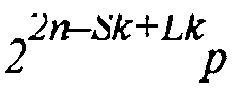

0 ) Vk+2 = ( 

... 
0 22n ). - The method according to any one of the preceding claims, wherein the lattice is a k+2 dimensional space lattice.
Applications Claiming Priority (3)
| Application Number | Priority Date | Filing Date | Title |
|---|---|---|---|
| IL15660603 | 2003-06-23 | ||
| IL156606A IL156606A (en) | 2003-06-23 | 2003-06-23 | Digital certificates |
| PCT/IL2003/001108 WO2004114587A1 (en) | 2003-06-23 | 2003-12-29 | Digital certificates |
Publications (3)
| Publication Number | Publication Date |
|---|---|
| EP1590932A1 EP1590932A1 (en) | 2005-11-02 |
| EP1590932A4 EP1590932A4 (en) | 2007-04-04 |
| EP1590932B1 true EP1590932B1 (en) | 2013-02-13 |
Family
ID=32652224
Family Applications (1)
| Application Number | Title | Priority Date | Filing Date |
|---|---|---|---|
| EP03780595A Expired - Lifetime EP1590932B1 (en) | 2003-06-23 | 2003-12-29 | Lattices based generation of compressible RSA keys for use in certificates |
Country Status (7)
| Country | Link |
|---|---|
| US (2) | US7340606B2 (en) |
| EP (1) | EP1590932B1 (en) |
| KR (1) | KR101050993B1 (en) |
| CN (1) | CN1771687B (en) |
| AU (1) | AU2003288520A1 (en) |
| IL (1) | IL156606A (en) |
| WO (1) | WO2004114587A1 (en) |
Families Citing this family (10)
| Publication number | Priority date | Publication date | Assignee | Title |
|---|---|---|---|---|
| CA2692817A1 (en) | 2007-07-17 | 2009-01-22 | Certicom Corp. | Method of compressing a cryptographic value |
| US8327146B2 (en) * | 2008-03-31 | 2012-12-04 | General Motors Llc | Wireless communication using compact certificates |
| US8582775B2 (en) * | 2009-02-12 | 2013-11-12 | General Motors Llc | Method of securing and authenticating data using micro-certificates |
| EP2417726B1 (en) * | 2009-12-24 | 2016-03-30 | NDS Limited | Private key compression |
| IL204565A0 (en) | 2010-03-17 | 2010-11-30 | Nds Ltd | Data expansion using an approximate method |
| US9106624B2 (en) | 2010-05-16 | 2015-08-11 | James Thomas Hudson, JR. | System security for network resource access using cross firewall coded requests |
| IL213497A0 (en) | 2011-06-12 | 2011-08-31 | Eliphaz Hibshoosh | Light public key cryptography |
| CN112740618A (en) * | 2018-09-28 | 2021-04-30 | 三菱电机株式会社 | Signature device, verification device, signature system, signature method, signature program, verification method, and verification program |
| US10637837B1 (en) | 2019-11-27 | 2020-04-28 | Marpex, Inc. | Method and system to secure human and also internet of things communications through automation of symmetric encryption key management |
| US20260187262A1 (en) * | 2024-12-26 | 2026-07-02 | Dell Products L.P. | Protection of custom data and software during transit |
Family Cites Families (14)
| Publication number | Priority date | Publication date | Assignee | Title |
|---|---|---|---|---|
| US5373561A (en) | 1992-12-21 | 1994-12-13 | Bell Communications Research, Inc. | Method of extending the validity of a cryptographic certificate |
| JP3145407B2 (en) * | 1994-07-15 | 2001-03-12 | 株式会社エヌ・ティ・ティ・ドコモ | Signal transmission system and communication system |
| US5999711A (en) * | 1994-07-18 | 1999-12-07 | Microsoft Corporation | Method and system for providing certificates holding authentication and authorization information for users/machines |
| US5717757A (en) * | 1996-08-29 | 1998-02-10 | Micali; Silvio | Certificate issue lists |
| CA2228185C (en) * | 1997-01-31 | 2007-11-06 | Certicom Corp. | Verification protocol |
| US6266771B1 (en) * | 1997-02-10 | 2001-07-24 | The Regents Of The University Of California | Probabilistic signature scheme |
| US6298153B1 (en) * | 1998-01-16 | 2001-10-02 | Canon Kabushiki Kaisha | Digital signature method and information communication system and apparatus using such method |
| US6233577B1 (en) * | 1998-02-17 | 2001-05-15 | Phone.Com, Inc. | Centralized certificate management system for two-way interactive communication devices in data networks |
| US6404890B1 (en) | 1998-04-08 | 2002-06-11 | Citibank, Na | Generating RSA moduli including a predetermined portion |
| JP3517663B2 (en) * | 1998-07-27 | 2004-04-12 | 村田機械株式会社 | Encryption communication method and encryption communication system |
| EP1190523A4 (en) * | 1999-05-03 | 2004-08-04 | Ntru Cryptosystems Inc | Secure user identification based on ring homomorphisms |
| US20010014738A1 (en) | 1999-06-30 | 2001-08-16 | Madhup K. Dhaon | Process for the preparation of imidazodiazepine intermediates |
| GB2366938B (en) * | 2000-08-03 | 2004-09-01 | Orange Personal Comm Serv Ltd | Authentication in a mobile communications network |
| US20030005317A1 (en) | 2001-06-28 | 2003-01-02 | Audebert Yves Louis Gabriel | Method and system for generating and verifying a key protection certificate |
-
2003
- 2003-06-23 IL IL156606A patent/IL156606A/en not_active IP Right Cessation
- 2003-12-29 KR KR1020057016313A patent/KR101050993B1/en not_active Expired - Lifetime
- 2003-12-29 WO PCT/IL2003/001108 patent/WO2004114587A1/en not_active Ceased
- 2003-12-29 US US10/545,737 patent/US7340606B2/en not_active Expired - Fee Related
- 2003-12-29 AU AU2003288520A patent/AU2003288520A1/en not_active Abandoned
- 2003-12-29 CN CN200380110291XA patent/CN1771687B/en not_active Expired - Fee Related
- 2003-12-29 EP EP03780595A patent/EP1590932B1/en not_active Expired - Lifetime
-
2007
- 2007-12-27 US US12/005,523 patent/US7904721B2/en not_active Expired - Lifetime
Non-Patent Citations (2)
| Title |
|---|
| SCHNORR C P: "Block Korkin-Zolotarev Bases and Successive Minima", 19920901, no. TR-92-063, 1 September 1992 (1992-09-01), pages 1 - 19, XP007920440 * |
| SCHNORR C P: "Lattice Reduction by Random Sampling and Birthday Methods", LECTURE NOTES IN COMPUTER SCIENCE - LNCS, SPRINGER, DE, vol. 2607, 1 March 2003 (2003-03-01), pages 145 - 156, XP007920442, ISSN: 0302-9743 * |
Also Published As
| Publication number | Publication date |
|---|---|
| IL156606A0 (en) | 2004-02-19 |
| IL156606A (en) | 2011-07-31 |
| KR20060020602A (en) | 2006-03-06 |
| KR101050993B1 (en) | 2011-07-26 |
| US7340606B2 (en) | 2008-03-04 |
| WO2004114587A1 (en) | 2004-12-29 |
| AU2003288520A1 (en) | 2005-01-04 |
| EP1590932A1 (en) | 2005-11-02 |
| US7904721B2 (en) | 2011-03-08 |
| US20090037738A1 (en) | 2009-02-05 |
| CN1771687A (en) | 2006-05-10 |
| EP1590932A4 (en) | 2007-04-04 |
| HK1088748A1 (en) | 2006-11-10 |
| CN1771687B (en) | 2010-09-15 |
| US20060107053A1 (en) | 2006-05-18 |
Similar Documents
| Publication | Publication Date | Title |
|---|---|---|
| US7904721B2 (en) | Digital certificates | |
| US7853016B2 (en) | Signature schemes using bilinear mappings | |
| Paillier | Public-key cryptosystems based on composite degree residuosity classes | |
| US20100008496A1 (en) | Encryption and signature schemes using message mappings to reduce the message size | |
| CN100440776C (en) | Elliptic Curve Signature and Verification Signature Method and Device | |
| Tseng et al. | Digital signature with message recovery using self-certified public keys and its variants | |
| JP2012019559A (en) | Custom static diffie-hellman groups | |
| US20050220300A1 (en) | Public key cryptographic methods and systems | |
| KR100395158B1 (en) | Public key cryptosystem using finite non abelian groups | |
| Heninger | RSA, DH, and DSA in the Wild. | |
| Bohli et al. | On subliminal channels in deterministic signature schemes | |
| Wang et al. | Signature schemes based on two hard problems simultaneously | |
| Pon et al. | Dynamic reblocking RSA-based multisignatures scheme for computer and communication networks | |
| EP1921790A1 (en) | Signature schemes using bilinear mappings | |
| Gauravaram et al. | On randomizing hash functions to strengthen the security of digital signatures | |
| Jacobson Jr et al. | An adaptation of the NICE cryptosystem to real quadratic orders | |
| Das | Introduction to Cryptography | |
| US20040205337A1 (en) | Digital message signature and encryption | |
| HK1088748B (en) | Digital certificates | |
| KR20020003059A (en) | A Public Key Cryptosystem using Matrix which is composed of Integers and Polynomials | |
| KR19980045017A (en) | Multi-Signature Method and its Modular Value Generation Method | |
| Rahouma | Utilization of multiple block cipher hashing in authentication and digital signatures | |
| Chen et al. | An authenticated encryption scheme for securely signing a signature with message linkages | |
| Wansu et al. | A forward secure ring signature scheme | |
| Chun | Secure digital signature using RSA |
Legal Events
| Date | Code | Title | Description |
|---|---|---|---|
| PUAI | Public reference made under article 153(3) epc to a published international application that has entered the european phase |
Free format text: ORIGINAL CODE: 0009012 |
|
| 17P | Request for examination filed |
Effective date: 20050822 |
|
| AK | Designated contracting states |
Kind code of ref document: A1 Designated state(s): AT BE BG CH CY CZ DE DK EE ES FI FR GB GR HU IE IT LI LU MC NL PT RO SE SI SK TR |
|
| AX | Request for extension of the european patent |
Extension state: AL LT LV MK |
|
| DAX | Request for extension of the european patent (deleted) | ||
| RIC1 | Information provided on ipc code assigned before grant |
Ipc: H04L 21/00 20060101ALI20060914BHEP Ipc: H04L 9/32 20060101AFI20060914BHEP |
|
| A4 | Supplementary search report drawn up and despatched |
Effective date: 20070305 |
|
| 17Q | First examination report despatched |
Effective date: 20070511 |
|
| 111Z | Information provided on other rights and legal means of execution |
Free format text: AT BE BG CH CY CZ DE DK EE ES FI FR GB GR HU IE IT LU MC NL PT RO SE SI SK TR Effective date: 20090430 |
|
| RAP1 | Party data changed (applicant data changed or rights of an application transferred) |
Owner name: NDS LIMITED |
|
| REG | Reference to a national code |
Ref country code: DE Ref legal event code: R079 Ref document number: 60343269 Country of ref document: DE Free format text: PREVIOUS MAIN CLASS: H04L0021000000 Ipc: H04L0009000000 |
|
| RIC1 | Information provided on ipc code assigned before grant |
Ipc: H04L 9/32 20060101ALI20120402BHEP Ipc: H04L 9/30 20060101ALI20120402BHEP Ipc: H04L 9/00 20060101AFI20120402BHEP |
|
| RTI1 | Title (correction) |
Free format text: LATTICES BASED GENERATION OF COMPRESSIBLE RSA KEYS FOR USE IN CERTIFICATES |
|
| GRAP | Despatch of communication of intention to grant a patent |
Free format text: ORIGINAL CODE: EPIDOSNIGR1 |
|
| GRAJ | Information related to disapproval of communication of intention to grant by the applicant or resumption of examination proceedings by the epo deleted |
Free format text: ORIGINAL CODE: EPIDOSDIGR1 |
|
| GRAJ | Information related to disapproval of communication of intention to grant by the applicant or resumption of examination proceedings by the epo deleted |
Free format text: ORIGINAL CODE: EPIDOSDIGR1 |
|
| GRAP | Despatch of communication of intention to grant a patent |
Free format text: ORIGINAL CODE: EPIDOSNIGR1 |
|
| GRAP | Despatch of communication of intention to grant a patent |
Free format text: ORIGINAL CODE: EPIDOSNIGR1 |
|
| GRAS | Grant fee paid |
Free format text: ORIGINAL CODE: EPIDOSNIGR3 |
|
| GRAA | (expected) grant |
Free format text: ORIGINAL CODE: 0009210 |
|
| AK | Designated contracting states |
Kind code of ref document: B1 Designated state(s): AT BE BG CH CY CZ DE DK EE ES FI FR GB GR HU IE IT LI LU MC NL PT RO SE SI SK TR |
|
| REG | Reference to a national code |
Ref country code: GB Ref legal event code: FG4D |
|
| REG | Reference to a national code |
Ref country code: AT Ref legal event code: REF Ref document number: 596969 Country of ref document: AT Kind code of ref document: T Effective date: 20130215 |
|
| REG | Reference to a national code |
Ref country code: IE Ref legal event code: FG4D |
|
| REG | Reference to a national code |
Ref country code: DE Ref legal event code: R096 Ref document number: 60343269 Country of ref document: DE Effective date: 20130411 |
|
| REG | Reference to a national code |
Ref country code: CH Ref legal event code: NV Representative=s name: MARKS AND CLERK (LUXEMBOURG) LLP, CH |
|
| REG | Reference to a national code |
Ref country code: NL Ref legal event code: T3 |
|
| REG | Reference to a national code |
Ref country code: AT Ref legal event code: MK05 Ref document number: 596969 Country of ref document: AT Kind code of ref document: T Effective date: 20130213 |
|
| PG25 | Lapsed in a contracting state [announced via postgrant information from national office to epo] |
Ref country code: BG Free format text: LAPSE BECAUSE OF FAILURE TO SUBMIT A TRANSLATION OF THE DESCRIPTION OR TO PAY THE FEE WITHIN THE PRESCRIBED TIME-LIMIT Effective date: 20130513 Ref country code: CY Free format text: LAPSE BECAUSE OF FAILURE TO SUBMIT A TRANSLATION OF THE DESCRIPTION OR TO PAY THE FEE WITHIN THE PRESCRIBED TIME-LIMIT Effective date: 20130213 Ref country code: AT Free format text: LAPSE BECAUSE OF FAILURE TO SUBMIT A TRANSLATION OF THE DESCRIPTION OR TO PAY THE FEE WITHIN THE PRESCRIBED TIME-LIMIT Effective date: 20130213 Ref country code: ES Free format text: LAPSE BECAUSE OF FAILURE TO SUBMIT A TRANSLATION OF THE DESCRIPTION OR TO PAY THE FEE WITHIN THE PRESCRIBED TIME-LIMIT Effective date: 20130524 Ref country code: SE Free format text: LAPSE BECAUSE OF FAILURE TO SUBMIT A TRANSLATION OF THE DESCRIPTION OR TO PAY THE FEE WITHIN THE PRESCRIBED TIME-LIMIT Effective date: 20130213 |
|
| PG25 | Lapsed in a contracting state [announced via postgrant information from national office to epo] |
Ref country code: SI Free format text: LAPSE BECAUSE OF FAILURE TO SUBMIT A TRANSLATION OF THE DESCRIPTION OR TO PAY THE FEE WITHIN THE PRESCRIBED TIME-LIMIT Effective date: 20130213 Ref country code: PT Free format text: LAPSE BECAUSE OF FAILURE TO SUBMIT A TRANSLATION OF THE DESCRIPTION OR TO PAY THE FEE WITHIN THE PRESCRIBED TIME-LIMIT Effective date: 20130613 Ref country code: BE Free format text: LAPSE BECAUSE OF FAILURE TO SUBMIT A TRANSLATION OF THE DESCRIPTION OR TO PAY THE FEE WITHIN THE PRESCRIBED TIME-LIMIT Effective date: 20130213 Ref country code: FI Free format text: LAPSE BECAUSE OF FAILURE TO SUBMIT A TRANSLATION OF THE DESCRIPTION OR TO PAY THE FEE WITHIN THE PRESCRIBED TIME-LIMIT Effective date: 20130213 Ref country code: GR Free format text: LAPSE BECAUSE OF FAILURE TO SUBMIT A TRANSLATION OF THE DESCRIPTION OR TO PAY THE FEE WITHIN THE PRESCRIBED TIME-LIMIT Effective date: 20130514 |
|
| PG25 | Lapsed in a contracting state [announced via postgrant information from national office to epo] |
Ref country code: SK Free format text: LAPSE BECAUSE OF FAILURE TO SUBMIT A TRANSLATION OF THE DESCRIPTION OR TO PAY THE FEE WITHIN THE PRESCRIBED TIME-LIMIT Effective date: 20130213 Ref country code: RO Free format text: LAPSE BECAUSE OF FAILURE TO SUBMIT A TRANSLATION OF THE DESCRIPTION OR TO PAY THE FEE WITHIN THE PRESCRIBED TIME-LIMIT Effective date: 20130213 Ref country code: CZ Free format text: LAPSE BECAUSE OF FAILURE TO SUBMIT A TRANSLATION OF THE DESCRIPTION OR TO PAY THE FEE WITHIN THE PRESCRIBED TIME-LIMIT Effective date: 20130213 Ref country code: DK Free format text: LAPSE BECAUSE OF FAILURE TO SUBMIT A TRANSLATION OF THE DESCRIPTION OR TO PAY THE FEE WITHIN THE PRESCRIBED TIME-LIMIT Effective date: 20130213 Ref country code: EE Free format text: LAPSE BECAUSE OF FAILURE TO SUBMIT A TRANSLATION OF THE DESCRIPTION OR TO PAY THE FEE WITHIN THE PRESCRIBED TIME-LIMIT Effective date: 20130213 |
|
| PLBE | No opposition filed within time limit |
Free format text: ORIGINAL CODE: 0009261 |
|
| STAA | Information on the status of an ep patent application or granted ep patent |
Free format text: STATUS: NO OPPOSITION FILED WITHIN TIME LIMIT |
|
| 26N | No opposition filed |
Effective date: 20131114 |
|
| REG | Reference to a national code |
Ref country code: DE Ref legal event code: R097 Ref document number: 60343269 Country of ref document: DE Effective date: 20131114 |
|
| PG25 | Lapsed in a contracting state [announced via postgrant information from national office to epo] |
Ref country code: LU Free format text: LAPSE BECAUSE OF FAILURE TO SUBMIT A TRANSLATION OF THE DESCRIPTION OR TO PAY THE FEE WITHIN THE PRESCRIBED TIME-LIMIT Effective date: 20131229 Ref country code: MC Free format text: LAPSE BECAUSE OF FAILURE TO SUBMIT A TRANSLATION OF THE DESCRIPTION OR TO PAY THE FEE WITHIN THE PRESCRIBED TIME-LIMIT Effective date: 20130213 |
|
| REG | Reference to a national code |
Ref country code: IE Ref legal event code: MM4A |
|
| PG25 | Lapsed in a contracting state [announced via postgrant information from national office to epo] |
Ref country code: IE Free format text: LAPSE BECAUSE OF NON-PAYMENT OF DUE FEES Effective date: 20131229 |
|
| PG25 | Lapsed in a contracting state [announced via postgrant information from national office to epo] |
Ref country code: TR Free format text: LAPSE BECAUSE OF FAILURE TO SUBMIT A TRANSLATION OF THE DESCRIPTION OR TO PAY THE FEE WITHIN THE PRESCRIBED TIME-LIMIT Effective date: 20130213 |
|
| PG25 | Lapsed in a contracting state [announced via postgrant information from national office to epo] |
Ref country code: HU Free format text: LAPSE BECAUSE OF FAILURE TO SUBMIT A TRANSLATION OF THE DESCRIPTION OR TO PAY THE FEE WITHIN THE PRESCRIBED TIME-LIMIT; INVALID AB INITIO Effective date: 20031229 |
|
| REG | Reference to a national code |
Ref country code: FR Ref legal event code: PLFP Year of fee payment: 13 |
|
| REG | Reference to a national code |
Ref country code: FR Ref legal event code: PLFP Year of fee payment: 14 |
|
| PG25 | Lapsed in a contracting state [announced via postgrant information from national office to epo] |
Ref country code: IT Free format text: LAPSE BECAUSE OF NON-PAYMENT OF DUE FEES Effective date: 20151229 |
|
| PG25 | Lapsed in a contracting state [announced via postgrant information from national office to epo] |
Ref country code: IT Free format text: LAPSE BECAUSE OF NON-PAYMENT OF DUE FEES Effective date: 20151229 |
|
| PGRI | Patent reinstated in contracting state [announced from national office to epo] |
Ref country code: IT Effective date: 20170710 |
|
| REG | Reference to a national code |
Ref country code: FR Ref legal event code: PLFP Year of fee payment: 15 |
|
| REG | Reference to a national code |
Ref country code: GB Ref legal event code: 732E Free format text: REGISTERED BETWEEN 20180809 AND 20180815 |
|
| REG | Reference to a national code |
Ref country code: CH Ref legal event code: PUE Owner name: ACANO (UK) LIMITED, GB Free format text: FORMER OWNER: NDS LIMITED, GB |
|
| REG | Reference to a national code |
Ref country code: DE Ref legal event code: R082 Ref document number: 60343269 Country of ref document: DE Representative=s name: MARKS & CLERK (LUXEMBOURG) LLP, LU Ref country code: DE Ref legal event code: R081 Ref document number: 60343269 Country of ref document: DE Owner name: ACANO (UK) LTD., GB Free format text: FORMER OWNER: NDS LTD., STAINES, MIDDLESEX, GB |
|
| REG | Reference to a national code |
Ref country code: NL Ref legal event code: PD Owner name: ACANO (UK) LIMITED; GB Free format text: DETAILS ASSIGNMENT: CHANGE OF OWNER(S), ASSIGNMENT; FORMER OWNER NAME: NDS LIMITED Effective date: 20181023 |
|
| PGFP | Annual fee paid to national office [announced via postgrant information from national office to epo] |
Ref country code: NL Payment date: 20191226 Year of fee payment: 17 |
|
| PGFP | Annual fee paid to national office [announced via postgrant information from national office to epo] |
Ref country code: IT Payment date: 20191219 Year of fee payment: 17 Ref country code: FR Payment date: 20191226 Year of fee payment: 17 |
|
| PGFP | Annual fee paid to national office [announced via postgrant information from national office to epo] |
Ref country code: DE Payment date: 20191231 Year of fee payment: 17 Ref country code: GB Payment date: 20200102 Year of fee payment: 17 |
|
| PGFP | Annual fee paid to national office [announced via postgrant information from national office to epo] |
Ref country code: CH Payment date: 20191231 Year of fee payment: 17 |
|
| REG | Reference to a national code |
Ref country code: DE Ref legal event code: R119 Ref document number: 60343269 Country of ref document: DE |
|
| REG | Reference to a national code |
Ref country code: CH Ref legal event code: PL |
|
| REG | Reference to a national code |
Ref country code: NL Ref legal event code: MM Effective date: 20210101 |
|
| GBPC | Gb: european patent ceased through non-payment of renewal fee |
Effective date: 20201229 |
|
| PG25 | Lapsed in a contracting state [announced via postgrant information from national office to epo] |
Ref country code: NL Free format text: LAPSE BECAUSE OF NON-PAYMENT OF DUE FEES Effective date: 20210101 |
|
| PG25 | Lapsed in a contracting state [announced via postgrant information from national office to epo] |
Ref country code: FR Free format text: LAPSE BECAUSE OF NON-PAYMENT OF DUE FEES Effective date: 20201231 |
|
| PG25 | Lapsed in a contracting state [announced via postgrant information from national office to epo] |
Ref country code: LI Free format text: LAPSE BECAUSE OF NON-PAYMENT OF DUE FEES Effective date: 20201231 Ref country code: CH Free format text: LAPSE BECAUSE OF NON-PAYMENT OF DUE FEES Effective date: 20201231 Ref country code: DE Free format text: LAPSE BECAUSE OF NON-PAYMENT OF DUE FEES Effective date: 20210701 Ref country code: GB Free format text: LAPSE BECAUSE OF NON-PAYMENT OF DUE FEES Effective date: 20201229 |
|
| PG25 | Lapsed in a contracting state [announced via postgrant information from national office to epo] |
Ref country code: IT Free format text: LAPSE BECAUSE OF NON-PAYMENT OF DUE FEES Effective date: 20201229 |
|
| P01 | Opt-out of the competence of the unified patent court (upc) registered |
Effective date: 20230523 |