EP1589730A1 - Method for management of Vcards - Google Patents
Method for management of Vcards Download PDFInfo
- Publication number
- EP1589730A1 EP1589730A1 EP05003928A EP05003928A EP1589730A1 EP 1589730 A1 EP1589730 A1 EP 1589730A1 EP 05003928 A EP05003928 A EP 05003928A EP 05003928 A EP05003928 A EP 05003928A EP 1589730 A1 EP1589730 A1 EP 1589730A1
- Authority
- EP
- European Patent Office
- Prior art keywords
- vcard
- data
- jpeg
- mobile terminal
- file
- Prior art date
- Legal status (The legal status is an assumption and is not a legal conclusion. Google has not performed a legal analysis and makes no representation as to the accuracy of the status listed.)
- Ceased
Links
Images


Classifications
-
- H—ELECTRICITY
- H04—ELECTRIC COMMUNICATION TECHNIQUE
- H04M—TELEPHONIC COMMUNICATION
- H04M1/00—Substation equipment, e.g. for use by subscribers
- H04M1/26—Devices for calling a subscriber
- H04M1/27—Devices whereby a plurality of signals may be stored simultaneously
- H04M1/274—Devices whereby a plurality of signals may be stored simultaneously with provision for storing more than one subscriber number at a time, e.g. using toothed disc
- H04M1/2745—Devices whereby a plurality of signals may be stored simultaneously with provision for storing more than one subscriber number at a time, e.g. using toothed disc using static electronic memories, e.g. chips
- H04M1/2753—Devices whereby a plurality of signals may be stored simultaneously with provision for storing more than one subscriber number at a time, e.g. using toothed disc using static electronic memories, e.g. chips providing data content
- H04M1/2757—Devices whereby a plurality of signals may be stored simultaneously with provision for storing more than one subscriber number at a time, e.g. using toothed disc using static electronic memories, e.g. chips providing data content by data transmission, e.g. downloading
Definitions
- the present invention relates to a vCard or an electronic business card, and more particularly to a method for managing a vCard sent or received between mobile communication terminals to enable a user to store or easily locate the vCard when needed.
- Typical paper or plastic business cards used for personal data interchange carry some basic information, such as company names, titles, phone numbers, fax numbers and email addresses. Personal data interchange occurs every time two or more individuals communicate in either a business or personal context. Business cards are useful as a means for maintaining business relationships.
- vCards virtual business cards or electronic business cards
- automate the exchange of personal information using mobile terminals, personal computers or other electronic means have been suggested to eliminate the inconvenience and inefficiencies of conventional business cards.
- VCards can be used to forward personal data over the Internet.
- VCards use small text files which include company names, addresses, phone numbers, email addresses and other contact information which is inputted electronically by users.
- vCards can be sent or received along with email messages.
- VCards can also include graphics and multimedia files (e.g., photographs or company logos.)
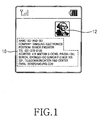
- the vCard as shown in FIG. 1 includes a simple image 10 and user information.
- the vCard has a structured block of data that includes an image portion for inserting a picture or a photograph and a text portion for inserting the user information, such as user's name, company name and phone number.
- vCard is encoded so that it is compatible with an Internet standard, vCard MIME (multi-purpose internet mail extension) content-type, and then sent to desired recipients.
- MIME is an email transfer protocol that defines a method of sending multimedia data, such as text, voice and image data, via Internet email.
- the vCard MIME content-type is a format for encoding a file to be sent by the sender and to be recognized as a vCard by the recipient.
- the vCard created by the encoding process can be sent via MMS (Multimedia Message Service).
- MMS Multimedia Message Service
- vCards Existing vCard technologies focus on the vCards compatibility with mobile terminals or computers and also focus on easy ways to create vCards. Recently, however, vCards have become fashionable to suit diverse personal tastes and individuality. Most vCard users prefer to send and receive unique and distinctive vCards. Also, newly-launched mobile communication devices, mobile terminals and the like with built-in cameras enable users to directly edit images. Such mobile terminals can store a variety of image files through data transmission to and from peripheral devices, such as computers. With the increasing penetration of mobile terminals, transmission of image data via MMS has become commonplace. In other words, users prefer to use graphics-based messaging services that enable transmission of various image data. Due to the increased compatibility with other devices in data transmission, mobile terminals are used to send MMS messages using an Internet standard protocol.
- vCard MIME type which is an Internet standard protocol
- terminals with small memories have a limited capacity and thus are limited in their ability to insert an image into a text-based vCard using an image insert tag. Accordingly, this limitation makes it difficult to create and send a graphics-based vCard that has a graphical element.
- a vCard in MIME type can be opened only by mobile terminals which support the MIME data type.
- a recipient can open a vCard file only if the mobile terminal which is being used has a MIME decoder and a decoder for interpreting an image included in the vCard information.
- the present invention has been made to solve the above-mentioned problems occurring in the prior art.
- vCards virtual business cards or electronic business cards
- An aspect of the present invention is to provide a method for creating vCards with images inserted and edited by a user to show diverse personal tastes and individuality.
- a method for managing vCards including the steps of: creating a vCard by inputting user information and an image on a sender's mobile terminal and storing the created vCard in a JPEG (Joint Photographic Experts Group) vCard file; sending the vCard file to a desired recipient's mobile terminal from the sender's mobile terminal; analyzing the vCard file received from the sender's mobile terminal; and decoding and storing the vCard file in the recipient's mobile terminal according to the results of the analysis.
- JPEG Joint Photographic Experts Group
- the present invention provides a mobile terminal with a function that enables users to create vCards of their own design and then be able to easily exchange the vCards.
- a vCard displayed on the mobile terminal is stored as image data in a JPEG file. Since the mobile terminal sends an image file generated by the combination of the user information in the vCard with corresponding image data in a predetermined format, it has an improved vCard compatibility with other devices. Also, users can create graphics intensive vCards that satisfy their demand for distinctiveness.
- a recipient's mobile terminal that receives a graphics intensive vCard can store the vCard as displayed in a JPEG image file or can store only the user information which is extracted from the vCard, for example, by updating an existing vCard database.
- a vCard table having information fields which are contained in a vCard is also used to store a vCard which is sent to or received from any other mobile terminal, in the vCard database.
- a vCard e.g., such as a sender's name, phone number, email address and company name
- vCard database is also used to store a vCard which is sent to or received from any other mobile terminal, in the vCard database.
- the vCard displayed on the user's mobile terminal is generated as image data.
- the image data can be sent along with a vCard table showing the user information.
- the user information which is input into the information fields of the vCard table includes personal and business information such as company name, title, position, address, phone number, fax number and email address.
- a method for inserting user information or an image, such as a picture, in a vCard is not described herein, it is obvious that any text or image can be inserted into a vCard using a variety of currently available editing programs. Accordingly, a detailed explanation of a vCard editing method will be omitted.
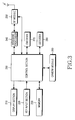
- FIG. 3 is a block diagram showing the structure of a mobile terminal according to the present invention.
- a control section 200 controls the overall operation of the mobile terminal.
- the control section 200 performs functions of creating and sending and/or receiving vCards, in addition to the control of general communication functions.
- the control section 200 displays items included in a vCard, such as picture, background and user information, on a display section 210 to enable the user to edit each item and easily create a vCard.
- the control section 200 updates the vCard database to store the inputted vCard data.
- the display section 210 displays data inputted through a key input section 220 under the control of the control section 200. It also displays the operational state and other information of the mobile terminal using icons and/or other characters.
- the display section 210 visibly shows whether a function is selected or implemented.
- the display section 210 displays detailed items which are necessary for forming a vCard. These items include user information, such as user's (or sender's) name, company name, phone number, and an image.
- the display section 210 displays a picture showing the vCard sending or receiving state under the control of the control section 200.
- the key input section 220 is provided with a plurality of number keys and function keys for implementing various functions.
- the key input section 220 applies any key inputted data to the control section 200.
- the key input section 220 outputs data corresponding to a key pressed by the user and applies the outputted data to the control section 200.
- the control section 200 detects the data and performs a required function according to the detected data.
- a memory 230 which is connected to the control section 200, includes a ROM (Read Only Memory), a RAM (Random Access Memory) and a voice memory for storing a plurality of programs and data necessary to control the operation of the mobile terminal.
- the memory 230 also stores data which is input to create a vCard, a vCard table of a received vCard, and a program for sending a vCard under the control of the control section 200.
- the memory 230 has a vCard database for storing vCard tables.
- a standardized structure of fields is established in the vCard database to store vCard tables which make vCards commonly recognizable in all communication networks.
- a vCard table includes user information as shown in FIG. 1.
- the vCard table as matched to the MIME type 22 which is the portion other than the insert image tag 20 which shown in FIG. 2.
- An RF module 250 sends and receives RF signals to and from a base station through an antenna 255.
- the RF module 250 converts a received RF signal into an IF (intermediate frequency) signal and outputs the IF signal to a baseband processor 240.
- the RF module 250 converts an IF signal inputted from the baseband processor 240 into an RF signal and transmits the RF signal through an antenna 255.
- the baseband processor 240 converts a baseband digital signal applied from the control section 200 into an analog IF signal and applies the analog IF signal to the RF module 250.
- the baseband processor 240 converts an analog IF signal applied from the RF module 250 into a baseband digital signal and applies the digital signal to the control section 200.
- the baseband processor 240 also plays a role to send a vCard to a recipient's mobile terminal and deliver a vCard received from a sender's mobile terminal to the control section 200.
- a camera module 260 is mounted in the mobile terminal to implement a camera phone function.
- the control section 200 detects the selection and controls the camera function of the mobile terminal.
- a vCard image file can be a picture taken with the camera module 260.
- An encoder 270 inserts vCard data, which is a vCard table in vCard MIME type, into image data in JPEG format.
- the encoder 270 comprises a JPEG encoding section, a vCard encoding section and an encoded data compound section.
- the JPEG encoding section (not shown) of the encoder 270 encodes image data, which is the vCard itself as displayed on the mobile terminal, into a predetermined format and generates JPEG image data.
- the vCard encoding section (not shown) of the encoder 270 encodes a vCard table into a predetermined format, i.e., a MIME type, and generates vCard data.
- the encoded data compound section (not shown) of the encoder 270 combines every encoded data into one and generates JPEG data.
- the vCard table according to the present invention includes user information in the information fields, such as sender's name, phone number, email address, street address, company name, etc.
- a decoder 280 separates vCard data from a received vCard, i.e., from JPEG data with the vCard MIME type inserted.
- the decoder 280 comprises a vCard data extracting section, a JPEG decoding section and a vCard decoding section.
- the vCard data extracting section (not shown) of the decoder 280 separates JPEG image data and vCard data from JPEG data with the vCard MIME type inserted.
- the JPEG decoding section (not shown) of the decoder 280 decodes the JPEG image data and vCard data separated from the JPEG data.
- the vCard decoding section (not shown) of the decoder 280 decodes the extracted vCard data to interpret the content corresponding to the user information included in the vCard.
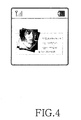
- FIG. 4 shows a graphics intensive vCard displayed on a mobile terminal according to an embodiment of the present invention.
- a method for exchanging graphics intensive vCards will be explained in detail.
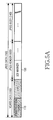
- FIG. 5A shows the structure of a vCard file sent according to the present invention.
- FIG. 5B shows the vCard file in FIG. 5a converted into ASCII codes.
- JPEG data in a vCard file to be sent to a recipient is generally composed of vCard data and image data in JPEG format.
- a vCard displayed on the mobile terminal is generated as one set of image data in JPEG format.
- a vCard file is combined JPEG data with vCard data in MIME type which is inserted into the JPEG image data.
- the vCard file is considered to be an image file.
- vCard files are generated by appropriately combining all encoded data into a predetermined format, users can create vCards with image data showing their own individuality and exchange the vCards through mobile terminals, without any additional work for recognizing vCard files.
- the JPEG image data is encoded and generated by the JPEG encoding section of the encoder 270.
- the encoded JPEG image data is composed of a JPEG header 120 labeling the data as image data and a JPEG body 140 corresponding to the actual image data.
- the vCard encoding section of the encoder 270 encodes a vCard table corresponding to the user information into a vCard MIME type and generates vCard data in the MIME type formed, for example, using the user data as shown in FIG. 5B.
- the MIME type 122 in FIG. 5B is identical to the portion 22 excluding the image tag 20 in FIG. 2.
- the encoded data compound section combines the JPEG image data generated by the JPEG encoding section with the vCard data generated by the vCard encoding section to form a single encoded JPEG data set.
- vCard data 100 in MIME type is inserted into the JPEG header 120 as shown in FIG. 5A.
- an SOI (Start Of Image) marker 130 is set at the beginning of the JPEG header 120 so that the combined data following the SOI marker can be recognized as JPEG image data.
- the vCard data inserted into the JPEG image data includes an identification code 110 at the beginning thereof as an indication "it is vCard data.”
- the vCard file in FIG. 5A is actually sent in ASCII codes.
- the ASCII codes corresponding to the vCard data 100 are inserted ahead of the ASCII codes corresponding to the JPEG header 120.
- the identification code 110 containing an ASCII code "FF E1" at the beginning of the vCard data 100 is a comment marker which indicates that that the data following the identification code 110 should not be treated as JPEG image data. Due to the identification code 110 (which contains the ASCII code "FE E1," the vCard data is recognized as being separate and independent from the JPEG image so that it cannot influence the decoding of the JPEG image data.
- the vCard data inserted into the JPEG header 120 is positioned ahead of the SOI marker 130 with an ASCII code "FF D8.”
- An encoded data set generated during the inserting process can be treated as JPEG data.
- JPEG decoding is performed independently of the vCard data decoding, thereby enabling a recipient to store the vCard in a picture form as a single image file.
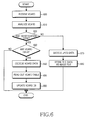
- FIG. 6 is a flow chart showing a process of managing a received vCard.
- step 600 the control section 200 proceeds with step 610 to analyze the received vCard file. The analysis is performed to determine whether vCard data is included in the vCard file which is deemed to be an image file.
- the control section 200 controls the decoder to perform a different decoding process for each data portion included in the received vCard file according to the data type.
- the control section 200 interprets the content of each decoded data portion and performs a required function based on the interpretation. All decoding processes are performed in the decoder 280 under the control of the control section 200.
- the decoder 280 separates vCard data in vCard MIME type from JPEG data corresponding to the received vCard file. For this separation, the control section 200 proceeds with step 620 to search the whole vCard file for an identification code 110 indicating that vCard data 100 is included in a JPEG header 120.
- the control section 200 controls the vCard data extracting section to divide the JPEG data into image data in JPEG format and vCard data in vCard MIME type and extract each data.
- the control section 200 determines whether there is any vCard data to be extracted. If there is, the control section 200 will proceed with step 640 to decode the vCard data, independently of the image data in JPEG format.
- the control section 200 reads out a vCard table from the decoded vCard data.
- the control section 200 stores the vCard table, updating the vCard database.
- the control section 200 reads out user information fields included in a single vCard table from the vCard data through the decoding process.
- the control section 200 stores the information fields, such as, sender's name, phone number, email address, street address and company name, in the vCard database of the memory 230, thereby updating the vCard database.
- the control section 200 controls the JPEG decoding section of the decoder 280 to decode the JPEG data.
- the control section 200 can recognize that the vCard file does not include any vCard data. In other words, the control section 200 can determine whether any vCard data is included in a vCard file according to the presence of an identification code.
- control section 200 proceeds with step 670. As described above, the control section 200 controls the JPEG decoding section to decode the JPEG data only. At step 680, the control section 200 stores the decoded JPEG image data in a single image file.
- one data set generated by encoding the JPEG image data including the vCard data is regarded as JPEG data.
- the control section 200 determines whether any vCard data is included in the received vCard file. Based on this determination, the control section 200 extracts image data in JPEG format and vCard data from the JPEG data.
- the control section 200 searches the received vCard file to determine whether an identification code having an ASCII code "FF E1" is included in the vCard data inserted ahead of the JPEG header 120. When the identification code is detected, the control section 200 detects an ASCII code "BEGIN::VCARD" that indicates the beginning of the vCard data in vCard MIME type as shown in FIG. 2 to extract the actual vCard data that comes after the identification code.
- control section 200 will recognize the data block after the ASCII code "BEGIN::VCARD” and before an ASCII code "END::VCARD” indicating the end of the data as the vCard data.
- a vCard including user information, a background image and a photograph can be encoded into JPEG image data by the JPEG encoding section and sent to a recipient as an image file.
- the control section 200 sends the vCard file to the recipient's mobile terminal using MMS (Multimedia Messaging Service).
- MMS Multimedia Messaging Service
- the user's (sender's) mobile terminal sends the file in JPEG format via MMS for the compatibility with the vCard database storing user information included in existing vCards and with the recipient's mobile terminal.
- the sender's mobile terminal can also send vCard data in vCard MIME content-type by including it in the JPEG image file.
- the recipient's mobile terminal When receiving a vCard file in JPEG format from the sender's mobile terminal, the recipient's mobile terminal can store the received file as an image file that can be set as a wallpaper or the like.
- the recipient's mobile terminal When receiving a vCard file with vCard data included in a JPEG image file, the recipient's mobile terminal can read out a vCard table from the vCard data and store the table, updating the existing vCard database.
- vCards that satisfy the demand for distinctiveness using mobile terminals.
- a graphics intensive vCard itself as displayed on a recipient's mobile terminal can be stored as a single image file.
- the vCard can be stored in a JPEG file according to the present invention. Since the vCard can be sent to the recipient's mobile terminal in the same manner as that which is used to send a picture file, the compatibility of vCards exchanged between mobile terminals and other devices (for example, desktop and notebook PCs) is improved.
Landscapes
- Engineering & Computer Science (AREA)
- Computer Networks & Wireless Communication (AREA)
- Signal Processing (AREA)
- Mobile Radio Communication Systems (AREA)
- Information Transfer Between Computers (AREA)
Abstract
Description
- The present invention relates to a vCard or an electronic business card, and more particularly to a method for managing a vCard sent or received between mobile communication terminals to enable a user to store or easily locate the vCard when needed.
- Typical paper or plastic business cards used for personal data interchange carry some basic information, such as company names, titles, phone numbers, fax numbers and email addresses. Personal data interchange occurs every time two or more individuals communicate in either a business or personal context. Business cards are useful as a means for maintaining business relationships.
- People are known to collect business cards in card holders. Alternatively, they briefly write down important data, such as the names and phone numbers of individuals which may be listed on business cards. When information contained in a business card is changed, new business cards must be printed and distributed to inform others of the change.
- With the development of telecommunication technologies, vCards (virtual business cards or electronic business cards) that automate the exchange of personal information using mobile terminals, personal computers or other electronic means have been suggested to eliminate the inconvenience and inefficiencies of conventional business cards.
- VCards can be used to forward personal data over the Internet. VCards use small text files which include company names, addresses, phone numbers, email addresses and other contact information which is inputted electronically by users. Moreover, vCards can be sent or received along with email messages. Furthermore, VCards can also include graphics and multimedia files (e.g., photographs or company logos.)
- Hereinafter, an example vCard will be explained with reference to FIG. 1. The vCard as shown in FIG. 1 includes a
simple image 10 and user information. The vCard has a structured block of data that includes an image portion for inserting a picture or a photograph and a text portion for inserting the user information, such as user's name, company name and phone number. - The vCard is encoded so that it is compatible with an Internet standard, vCard MIME (multi-purpose internet mail extension) content-type, and then sent to desired recipients. MIME is an email transfer protocol that defines a method of sending multimedia data, such as text, voice and image data, via Internet email. When a sender encodes multimedia data into a predefined file type and sends the encoded data, a recipient can read the data by decoding it according to the predefined file type.
- In other words, the vCard MIME content-type is a format for encoding a file to be sent by the sender and to be recognized as a vCard by the recipient. The
user data 10 andimage 12 illustrated in FIG. 1 can be encoded into the MIME type as shown in FIG. 2, wherein, a conventional encoding process separately specifies animage insert tag 20 in theMIME type 22 to include both user data and an image in a vCard file. More specifically, an image can be included in theMIME type 22 using theimage insert tag 20 in a format of "image;value=uri;format=jpeg:ftp://some.host/som/path.jpg" as shown. The vCard created by the encoding process can be sent via MMS (Multimedia Message Service). - Existing vCard technologies focus on the vCards compatibility with mobile terminals or computers and also focus on easy ways to create vCards. Recently, however, vCards have become fashionable to suit diverse personal tastes and individuality. Most vCard users prefer to send and receive unique and distinctive vCards. Also, newly-launched mobile communication devices, mobile terminals and the like with built-in cameras enable users to directly edit images. Such mobile terminals can store a variety of image files through data transmission to and from peripheral devices, such as computers. With the increasing penetration of mobile terminals, transmission of image data via MMS has become commonplace. In other words, users prefer to use graphics-based messaging services that enable transmission of various image data. Due to the increased compatibility with other devices in data transmission, mobile terminals are used to send MMS messages using an Internet standard protocol.
- To meet the current trends and improve the usefulness of electronic business cards using various images, a new method for creating vCards is demanded.
- As explained above, the vCard MIME type which is an Internet standard protocol, is used in the prior art to make mobile terminals compatible with vCards. However, terminals with small memories have a limited capacity and thus are limited in their ability to insert an image into a text-based vCard using an image insert tag. Accordingly, this limitation makes it difficult to create and send a graphics-based vCard that has a graphical element.
- Further, a vCard in MIME type can be opened only by mobile terminals which support the MIME data type. In other words, a recipient can open a vCard file only if the mobile terminal which is being used has a MIME decoder and a decoder for interpreting an image included in the vCard information.
- In order to send a vCard via MMS, it is additionally required to separately send vCard data to use the MMS service.
- Accordingly, the present invention has been made to solve the above-mentioned problems occurring in the prior art.
- It is the object of the present invention to provide a method for managing vCards (virtual business cards or electronic business cards) to improve the vCard compatibility of mobile terminals and other devices, such as PCs, and enable a recipient to recognize vCard files without any additional process.
- This object is solved by the subject matter of the independent claims.
- Preferred embodiments are defined in the dependent claims.
- An aspect of the present invention is to provide a method for creating vCards with images inserted and edited by a user to show diverse personal tastes and individuality.
- In order to accomplish the above object and aspects of the present invention, there is provided a method for managing vCards, including the steps of: creating a vCard by inputting user information and an image on a sender's mobile terminal and storing the created vCard in a JPEG (Joint Photographic Experts Group) vCard file; sending the vCard file to a desired recipient's mobile terminal from the sender's mobile terminal; analyzing the vCard file received from the sender's mobile terminal; and decoding and storing the vCard file in the recipient's mobile terminal according to the results of the analysis.
- The above features and advantages of the present invention will be more apparent from the following detailed description taken in conjunction with the accompanying drawings, in which:
- FIG. 1 shows an example vCard displayed on a mobile terminal according to the prior art;
- FIG. 2 shows the vCard in FIG. 1 as matched to a MIME type;
- FIG. 3 is a block diagram illustrating the structure of a mobile terminal according to the present invention;
- FIG. 4 shows a graphics intensive vCard displayed on a mobile terminal according to the present invention;
- FIG. 5A shows the structure of a vCard file sent according to the present invention;
- FIG. 5B illustrates the ASCII code corresponding to the vCard file which is shown in FIG. 5A; and
- FIG. 6 is a flow chart showing a process of managing a received vCard according to the present invention.
-
- Hereinafter, a preferred embodiment of the present invention will be described with reference to the accompanying drawings. Also, in the following description of the present invention, a detailed description of known functions and configurations incorporated herein will be omitted when it may make the subject matter of the present invention unclear.
- The present invention provides a mobile terminal with a function that enables users to create vCards of their own design and then be able to easily exchange the vCards. According to the present invention, a vCard displayed on the mobile terminal is stored as image data in a JPEG file. Since the mobile terminal sends an image file generated by the combination of the user information in the vCard with corresponding image data in a predetermined format, it has an improved vCard compatibility with other devices. Also, users can create graphics intensive vCards that satisfy their demand for distinctiveness.
- A recipient's mobile terminal that receives a graphics intensive vCard can store the vCard as displayed in a JPEG image file or can store only the user information which is extracted from the vCard, for example, by updating an existing vCard database.
- Also, a vCard table having information fields which are contained in a vCard(e.g., such as a sender's name, phone number, email address and company name), is also used to store a vCard which is sent to or received from any other mobile terminal, in the vCard database. To easily exchange vCards through mobile communications and store the vCards in mobile terminals, it is necessary to standardize the fields of vCard database for storing vCard tables through discussion between mobile service providers or to convert vCards to meet a standard protocol.
- When a user creates a vCard by arranging user information and desired images to show his or her own individuality, the vCard displayed on the user's mobile terminal is generated as image data. The image data can be sent along with a vCard table showing the user information. The user information which is input into the information fields of the vCard table includes personal and business information such as company name, title, position, address, phone number, fax number and email address.
- Although a method for inserting user information or an image, such as a picture, in a vCard is not described herein, it is obvious that any text or image can be inserted into a vCard using a variety of currently available editing programs. Accordingly, a detailed explanation of a vCard editing method will be omitted.
- FIG. 3 is a block diagram showing the structure of a mobile terminal according to the present invention. A
control section 200 controls the overall operation of the mobile terminal. In the present invention, thecontrol section 200 performs functions of creating and sending and/or receiving vCards, in addition to the control of general communication functions. - When a user selects a vCard editing mode according to the present invention, the
control section 200 displays items included in a vCard, such as picture, background and user information, on adisplay section 210 to enable the user to edit each item and easily create a vCard. When any data is inputted during the vCard editing mode, thecontrol section 200 updates the vCard database to store the inputted vCard data. - The
display section 210 displays data inputted through akey input section 220 under the control of thecontrol section 200. It also displays the operational state and other information of the mobile terminal using icons and/or other characters. Thedisplay section 210 visibly shows whether a function is selected or implemented. In the present invention, thedisplay section 210 displays detailed items which are necessary for forming a vCard. These items include user information, such as user's (or sender's) name, company name, phone number, and an image. When a vCard is being sent or received, thedisplay section 210 displays a picture showing the vCard sending or receiving state under the control of thecontrol section 200. - The
key input section 220 is provided with a plurality of number keys and function keys for implementing various functions. Thekey input section 220 applies any key inputted data to thecontrol section 200. In other words, thekey input section 220 outputs data corresponding to a key pressed by the user and applies the outputted data to thecontrol section 200. Thecontrol section 200 detects the data and performs a required function according to the detected data. - A
memory 230 which is connected to thecontrol section 200, includes a ROM (Read Only Memory), a RAM (Random Access Memory) and a voice memory for storing a plurality of programs and data necessary to control the operation of the mobile terminal. Thememory 230 also stores data which is input to create a vCard, a vCard table of a received vCard, and a program for sending a vCard under the control of thecontrol section 200. Thememory 230 has a vCard database for storing vCard tables. A standardized structure of fields is established in the vCard database to store vCard tables which make vCards commonly recognizable in all communication networks. For example, a vCard table includes user information as shown in FIG. 1. The vCard table as matched to theMIME type 22 which is the portion other than theinsert image tag 20 which shown in FIG. 2. - An
RF module 250 sends and receives RF signals to and from a base station through an antenna 255. TheRF module 250 converts a received RF signal into an IF (intermediate frequency) signal and outputs the IF signal to abaseband processor 240. Also, theRF module 250 converts an IF signal inputted from thebaseband processor 240 into an RF signal and transmits the RF signal through an antenna 255. As a BAA (Baseband Analog ASIC) that provides an interface between thecontrol section 200 and theRF module 250, thebaseband processor 240 converts a baseband digital signal applied from thecontrol section 200 into an analog IF signal and applies the analog IF signal to theRF module 250. Also, thebaseband processor 240 converts an analog IF signal applied from theRF module 250 into a baseband digital signal and applies the digital signal to thecontrol section 200. Thebaseband processor 240 also plays a role to send a vCard to a recipient's mobile terminal and deliver a vCard received from a sender's mobile terminal to thecontrol section 200. - A
camera module 260 is mounted in the mobile terminal to implement a camera phone function. When the user selects a camera function using thekey input section 220, thecontrol section 200 detects the selection and controls the camera function of the mobile terminal. In the preferred embodiment of the present invention, a vCard image file can be a picture taken with thecamera module 260. - An
encoder 270 inserts vCard data, which is a vCard table in vCard MIME type, into image data in JPEG format. Theencoder 270 comprises a JPEG encoding section, a vCard encoding section and an encoded data compound section. - The JPEG encoding section (not shown) of the
encoder 270 encodes image data, which is the vCard itself as displayed on the mobile terminal, into a predetermined format and generates JPEG image data. The vCard encoding section (not shown) of theencoder 270 encodes a vCard table into a predetermined format, i.e., a MIME type, and generates vCard data. The encoded data compound section (not shown) of theencoder 270 combines every encoded data into one and generates JPEG data. The vCard table according to the present invention includes user information in the information fields, such as sender's name, phone number, email address, street address, company name, etc. - A
decoder 280 separates vCard data from a received vCard, i.e., from JPEG data with the vCard MIME type inserted. Thedecoder 280 comprises a vCard data extracting section, a JPEG decoding section and a vCard decoding section. - The vCard data extracting section (not shown) of the
decoder 280 separates JPEG image data and vCard data from JPEG data with the vCard MIME type inserted. The JPEG decoding section (not shown) of thedecoder 280 decodes the JPEG image data and vCard data separated from the JPEG data. The vCard decoding section (not shown) of thedecoder 280 decodes the extracted vCard data to interpret the content corresponding to the user information included in the vCard. - FIG. 4 shows a graphics intensive vCard displayed on a mobile terminal according to an embodiment of the present invention. Hereinafter, a method for exchanging graphics intensive vCards will be explained in detail.
- A method for sending a vCard designed to show a sender's individuality as shown in FIG. 4 will be explained with reference to FIGS. 5A and 5B. FIG. 5A shows the structure of a vCard file sent according to the present invention. FIG. 5B shows the vCard file in FIG. 5a converted into ASCII codes.
- Referring to FIG. 5A, JPEG data in a vCard file to be sent to a recipient is generally composed of vCard data and image data in JPEG format. A vCard displayed on the mobile terminal is generated as one set of image data in JPEG format. A vCard file is combined JPEG data with vCard data in MIME type which is inserted into the JPEG image data. The vCard file is considered to be an image file.
- Since vCard files are generated by appropriately combining all encoded data into a predetermined format, users can create vCards with image data showing their own individuality and exchange the vCards through mobile terminals, without any additional work for recognizing vCard files.
- A process for combining encoded data in a predetermined format to insert vCard data into JPEG image data will be explained in detail. The JPEG image data is encoded and generated by the JPEG encoding section of the
encoder 270. The encoded JPEG image data is composed of aJPEG header 120 labeling the data as image data and aJPEG body 140 corresponding to the actual image data. - The vCard encoding section of the
encoder 270 encodes a vCard table corresponding to the user information into a vCard MIME type and generates vCard data in the MIME type formed, for example, using the user data as shown in FIG. 5B. The MIME type 122 in FIG. 5B is identical to theportion 22 excluding theimage tag 20 in FIG. 2. - The encoded data compound section combines the JPEG image data generated by the JPEG encoding section with the vCard data generated by the vCard encoding section to form a single encoded JPEG data set. For the generation of the single JPEG data set,
vCard data 100 in MIME type is inserted into theJPEG header 120 as shown in FIG. 5A. At this time, an SOI (Start Of Image)marker 130 is set at the beginning of theJPEG header 120 so that the combined data following the SOI marker can be recognized as JPEG image data. The vCard data inserted into the JPEG image data includes anidentification code 110 at the beginning thereof as an indication "it is vCard data." - Referring to FIG. 5B, the vCard file in FIG. 5A is actually sent in ASCII codes. The ASCII codes corresponding to the
vCard data 100 are inserted ahead of the ASCII codes corresponding to theJPEG header 120. Particularly, theidentification code 110 containing an ASCII code "FF E1" at the beginning of thevCard data 100 is a comment marker which indicates that that the data following theidentification code 110 should not be treated as JPEG image data. Due to the identification code 110 (which contains the ASCII code "FE E1," the vCard data is recognized as being separate and independent from the JPEG image so that it cannot influence the decoding of the JPEG image data. - The vCard data inserted into the
JPEG header 120 is positioned ahead of theSOI marker 130 with an ASCII code "FF D8." An encoded data set generated during the inserting process can be treated as JPEG data. Thus, when a received vCard file is decoded to interpret the content, JPEG decoding is performed independently of the vCard data decoding, thereby enabling a recipient to store the vCard in a picture form as a single image file. Also, it is possible to separately decode the inserted vCard data, extract a vCard table corresponding to the user information from the vCard data and store the extracted vCard table, updating the vCard database. - When a vCard created by the encoding process is sent, the recipient decodes the received vCard according to a predetermined format to interpret the content. The decoding process will be explained with reference to FIG. 6 which is a flow chart showing a process of managing a received vCard.
- When a vCard file is received at
step 600, thecontrol section 200 proceeds withstep 610 to analyze the received vCard file. The analysis is performed to determine whether vCard data is included in the vCard file which is deemed to be an image file. Thecontrol section 200 controls the decoder to perform a different decoding process for each data portion included in the received vCard file according to the data type. Thecontrol section 200 interprets the content of each decoded data portion and performs a required function based on the interpretation. All decoding processes are performed in thedecoder 280 under the control of thecontrol section 200. - The
decoder 280 separates vCard data in vCard MIME type from JPEG data corresponding to the received vCard file. For this separation, thecontrol section 200 proceeds withstep 620 to search the whole vCard file for anidentification code 110 indicating thatvCard data 100 is included in aJPEG header 120. - When the
identification code 110, indicating that vCard data is included in theJPEG header 120, is detected, thecontrol section 200 controls the vCard data extracting section to divide the JPEG data into image data in JPEG format and vCard data in vCard MIME type and extract each data. Atstep 630, thecontrol section 200 determines whether there is any vCard data to be extracted. If there is, thecontrol section 200 will proceed withstep 640 to decode the vCard data, independently of the image data in JPEG format. - At
step 650, thecontrol section 200 reads out a vCard table from the decoded vCard data. Atstep 660, thecontrol section 200 stores the vCard table, updating the vCard database. In other words, thecontrol section 200 reads out user information fields included in a single vCard table from the vCard data through the decoding process. Subsequently, thecontrol section 200 stores the information fields, such as, sender's name, phone number, email address, street address and company name, in the vCard database of thememory 230, thereby updating the vCard database. - When no identification code is detected at
step 620, thecontrol section 200 controls the JPEG decoding section of thedecoder 280 to decode the JPEG data. In case of a vCard file which does not include an identification code, thecontrol section 200 can recognize that the vCard file does not include any vCard data. In other words, thecontrol section 200 can determine whether any vCard data is included in a vCard file according to the presence of an identification code. - When no identification code is detected at
step 620, thecontrol section 200 proceeds withstep 670. As described above, thecontrol section 200 controls the JPEG decoding section to decode the JPEG data only. Atstep 680, thecontrol section 200 stores the decoded JPEG image data in a single image file. - According to the present invention, one data set generated by encoding the JPEG image data including the vCard data is regarded as JPEG data. When receiving a vCard file of JPEG data, the
control section 200 determines whether any vCard data is included in the received vCard file. Based on this determination, thecontrol section 200 extracts image data in JPEG format and vCard data from the JPEG data. - More specifically, referring to FIG. 5A, the
control section 200 searches the received vCard file to determine whether an identification code having an ASCII code "FF E1" is included in the vCard data inserted ahead of theJPEG header 120. When the identification code is detected, thecontrol section 200 detects an ASCII code "BEGIN::VCARD" that indicates the beginning of the vCard data in vCard MIME type as shown in FIG. 2 to extract the actual vCard data that comes after the identification code. - If the ASCII code "BEGIN::VCARD" (as shown in FIG 2.) is detected, the
control section 200 will recognize the data block after the ASCII code "BEGIN::VCARD" and before an ASCII code "END::VCARD" indicating the end of the data as the vCard data. - In accordance with the present invention, a vCard including user information, a background image and a photograph can be encoded into JPEG image data by the JPEG encoding section and sent to a recipient as an image file. When the user selects a function to send a vCard file, the
control section 200 sends the vCard file to the recipient's mobile terminal using MMS (Multimedia Messaging Service). At this time, the user's (sender's) mobile terminal sends the file in JPEG format via MMS for the compatibility with the vCard database storing user information included in existing vCards and with the recipient's mobile terminal. In accordance with the present invention, the sender's mobile terminal can also send vCard data in vCard MIME content-type by including it in the JPEG image file. - When receiving a vCard file in JPEG format from the sender's mobile terminal, the recipient's mobile terminal can store the received file as an image file that can be set as a wallpaper or the like. When receiving a vCard file with vCard data included in a JPEG image file, the recipient's mobile terminal can read out a vCard table from the vCard data and store the table, updating the existing vCard database.
- It is possible to overcome the limitation in data compatibility during vCard transmission by sending a vCard in a JPEG image file. Thus, users can insert various images, including a picture photographed using a camera provided in a mobile terminal and a background image, to create fashionable graphics-intensive vCards that suit their diverse tastes and individuality.
- With the increasing penetration of mobile terminals, users can create and exchange vCards that satisfy the demand for distinctiveness using mobile terminals. A graphics intensive vCard itself as displayed on a recipient's mobile terminal can be stored as a single image file. Alternatively, it is possible to extract only the user information from the vCard and store the extracted information in the existing vCard list, i.e., a vCard database.
- Also, the vCard can be stored in a JPEG file according to the present invention. Since the vCard can be sent to the recipient's mobile terminal in the same manner as that which is used to send a picture file, the compatibility of vCards exchanged between mobile terminals and other devices (for example, desktop and notebook PCs) is improved.
- Although a preferred embodiment of the present invention has been described for illustrative purposes, those skilled in the art will appreciate that various modifications, additions and substitutions are possible, without departing from the scope of the invention as disclosed in the accompanying claims.
Claims (4)
- A method for managing vCards, comprising the steps of:creating a vCard by inputting user information and an image on a sender's mobile terminal and storing the created vCard in a JPEG vCard file;sending the JPEG vCard file to a desired recipient's mobile terminal from the sender's mobile terminal;analyzing the JPEG vCard file received from the sender's mobile terminal in the recipient's mobile terminal; anddecoding and storing the JPEG vCard file in the recipient's mobile terminal according to the results of the analysis.
- The method according to claim 1, wherein said step of creating a vCard by inputting user information and an image on a sender's mobile terminal and storing the created vCard in a JPEG vCard file includes:forming a vCard table comprising a plurality of information fields in which the user information is inserted, and encoding the vCard table into Multi-purpose Internet Mail Extension, MIME, type to generate vCard data;generating the vCard displayed on the mobile terminal as image data and encoding the image data into a predetermined format to generate image data in JPEG format; andcombining the vCard data and the JPEG image data to generate a single JPEG data set.
- The method according to claim 1 or 2, wherein said step of decoding and storing the JPEG vCard file in the recipient's mobile terminal according to the results of the analysis includes:searching for an identification code to determine whether any vCard data is included in the vCard file;if an identification code is detected, extracting JPEG image data and vCard data from the JPEG vCard file; anddecoding the extracted JPEG image data and storing the same as an image file.
- The method according to claim 3, further comprising the step of reading out a vCard table from the extracted vCard data and storing the vCard table for, updating a vCard database.
Applications Claiming Priority (2)
| Application Number | Priority Date | Filing Date | Title |
|---|---|---|---|
| KR1020040026628A KR100819263B1 (en) | 2004-04-19 | 2004-04-19 | Electronic business card management device and method |
| KR2004026628 | 2004-04-19 |
Publications (1)
| Publication Number | Publication Date |
|---|---|
| EP1589730A1 true EP1589730A1 (en) | 2005-10-26 |
Family
ID=34933895
Family Applications (1)
| Application Number | Title | Priority Date | Filing Date |
|---|---|---|---|
| EP05003928A Ceased EP1589730A1 (en) | 2004-04-19 | 2005-02-23 | Method for management of Vcards |
Country Status (4)
| Country | Link |
|---|---|
| US (1) | US20050233697A1 (en) |
| EP (1) | EP1589730A1 (en) |
| KR (1) | KR100819263B1 (en) |
| CN (1) | CN100418325C (en) |
Cited By (6)
| Publication number | Priority date | Publication date | Assignee | Title |
|---|---|---|---|---|
| WO2009042038A3 (en) * | 2007-09-27 | 2009-06-18 | Siemens Comm Inc | Method and apparatus for identification of conference call participants |
| WO2010018427A1 (en) * | 2008-08-15 | 2010-02-18 | Telefonaktiebolaget L M Ericsson (Publ) | Method, terminal and server for merging a source and a destination electronic business card |
| US8243902B2 (en) | 2007-09-27 | 2012-08-14 | Siemens Enterprise Communications, Inc. | Method and apparatus for mapping of conference call participants using positional presence |
| EP2317785A4 (en) * | 2008-07-15 | 2013-02-20 | Wootion Technology Co Ltd | Address list system and implementation method thereof |
| US9031614B2 (en) | 2007-09-27 | 2015-05-12 | Unify, Inc. | Method and apparatus for secure electronic business card exchange |
| US9846858B2 (en) | 2010-01-04 | 2017-12-19 | Einnovations Holdings Pte. Ltd. | System and method for a global directory service |
Families Citing this family (25)
| Publication number | Priority date | Publication date | Assignee | Title |
|---|---|---|---|---|
| JP2006101469A (en) * | 2004-09-29 | 2006-04-13 | Microsoft Corp | Terminal for exchanging electronic business card |
| US7974877B2 (en) * | 2005-06-23 | 2011-07-05 | Microsoft Corporation | Sending and receiving electronic business cards |
| US20060293905A1 (en) * | 2005-06-23 | 2006-12-28 | Microsoft Corporation | Exchanging electronic business cards over digital media |
| JP4800686B2 (en) * | 2005-06-30 | 2011-10-26 | マイクロソフト コーポレーション | Electronic business card exchange system and method |
| US9241056B2 (en) * | 2006-06-22 | 2016-01-19 | Sony Corporation | Image based dialing |
| US8634875B1 (en) * | 2006-12-07 | 2014-01-21 | Kyocera Corporation | Address book management method and user interface |
| TW201010396A (en) * | 2008-08-18 | 2010-03-01 | Chongqing Momo Tech Ct | Address book system and implementation method thereof |
| CN101730002A (en) * | 2008-10-20 | 2010-06-09 | 深圳富泰宏精密工业有限公司 | Realizing system and realizing method of electronic name card |
| KR20110027589A (en) * | 2009-09-09 | 2011-03-16 | 삼성전자주식회사 | Method and device for inserting and sharing information in electronic devices |
| CN101901436B (en) * | 2010-07-19 | 2017-03-29 | 中兴通讯股份有限公司 | A kind of methods, devices and systems for realizing that business pays |
| CN102385572A (en) * | 2011-06-30 | 2012-03-21 | 广东欧珀移动通信有限公司 | A method to avoid garbled characters from vCard import |
| WO2012097645A2 (en) * | 2011-11-28 | 2012-07-26 | 华为终端有限公司 | Encoding/decoding method, encoder/decoder and terminal |
| CN103297319A (en) * | 2012-03-05 | 2013-09-11 | 北京千橡网景科技发展有限公司 | Message sending and receiving method and device |
| US8611930B2 (en) * | 2012-05-09 | 2013-12-17 | Apple Inc. | Selecting informative presentations based on navigation cues and user intent |
| CN103581846B (en) * | 2012-07-30 | 2018-06-22 | 腾讯科技(深圳)有限公司 | A kind of user's business card update method and system |
| US20140082092A1 (en) * | 2012-09-14 | 2014-03-20 | International Business Machines Corporation | Method of resolving a contact while composing text and/or email message |
| CN103369478B (en) * | 2013-07-18 | 2016-04-13 | 杨昕吉 | Method and system for realizing incoming call electronic business card and intelligent information real-time display |
| WO2015199264A1 (en) | 2014-06-27 | 2015-12-30 | (주) 파인텍 | Method for manufacturing porous alumina tube |
| CN105472086A (en) * | 2014-08-18 | 2016-04-06 | 中兴通讯股份有限公司 | Contact feature information sending method, contact feature information sending device, receiving method and receiving device |
| CN112291408A (en) * | 2015-08-27 | 2021-01-29 | 北京必和易达知识产权咨询中心(有限合伙) | Electronic business card system |
| JP6149324B1 (en) * | 2016-10-24 | 2017-06-21 | ミミワークス株式会社 | Profile information exchange system |
| US10817584B2 (en) | 2017-10-19 | 2020-10-27 | Glu, Inc. | System and method for grouping and sharing social media data |
| CN108616611A (en) * | 2018-03-23 | 2018-10-02 | 北京大国慧谷科技股份有限公司 | A kind of generation method and device of dynamic scape business card |
| JP2019200710A (en) * | 2018-05-18 | 2019-11-21 | シャープ株式会社 | Image processing apparatus, image forming apparatus, image processing method, and image processing program |
| KR102512903B1 (en) * | 2021-02-26 | 2023-03-23 | (주) 파운더 | System that provides digital video business card production services |
Citations (2)
| Publication number | Priority date | Publication date | Assignee | Title |
|---|---|---|---|---|
| EP1276338A2 (en) * | 1996-02-26 | 2003-01-15 | Nokia Corporation | Wireless transmission of electronic business cards |
| EP1328120A1 (en) * | 2000-09-18 | 2003-07-16 | Matsushita Electric Industrial Co., Ltd. | Image recording/reproducing device and method, disk, and image reproducing device |
Family Cites Families (13)
| Publication number | Priority date | Publication date | Assignee | Title |
|---|---|---|---|---|
| US6450407B1 (en) * | 1998-04-17 | 2002-09-17 | Viztec, Inc. | Chip card rebate system |
| US6175741B1 (en) * | 1998-12-30 | 2001-01-16 | Ericsson Inc. | System and method for enhancing business card services within a cellular network |
| KR100336628B1 (en) * | 1999-09-01 | 2002-05-16 | 조정남 | An electronic visiting card service method of mobile communication system |
| US20030050920A1 (en) * | 2001-02-12 | 2003-03-13 | Chen Sun | Contacts management using virtual subdomains |
| KR100421247B1 (en) * | 2000-05-06 | 2004-03-04 | 주식회사 칼라짚미디어 | A personal information managing method using code image represented by a plurality of color cells and apparatus thereof |
| US20020029250A1 (en) * | 2000-08-09 | 2002-03-07 | Jay Reiner | Method and apparatus for transmitting an electronic message on electronic letterhead |
| KR100664729B1 (en) * | 2000-11-11 | 2007-01-03 | (주)싸이언소프트 | Electronic Information Transmission System and Method Using Mask Picture Control |
| KR20020040480A (en) * | 2000-11-24 | 2002-05-30 | 구자홍 | Method to Manage Individual Imformation |
| KR20040024302A (en) * | 2002-09-13 | 2004-03-20 | 고희승 | A Business Card Device Of Electronic |
| US6978939B2 (en) * | 2003-03-19 | 2005-12-27 | Hewlett-Packard Development Company, L.P. | Portable imaging device accessory for a personal data assistant |
| US7246099B2 (en) * | 2003-10-23 | 2007-07-17 | Feldhahn Jeffrey M | Method and system for updating electronic business cards |
| US20050103838A1 (en) * | 2003-11-19 | 2005-05-19 | Zap Card Corporation | Method and apparatus for electronically exchanging and storing an image of a business card along with associated card information |
| US7702128B2 (en) * | 2005-03-03 | 2010-04-20 | Cssn Inc. Card Scanning Solutions | System and method for scanning a business card from within a contacts address book and directly inserting into the address book database |
-
2004
- 2004-04-19 KR KR1020040026628A patent/KR100819263B1/en not_active Expired - Fee Related
-
2005
- 2005-01-07 US US11/031,137 patent/US20050233697A1/en not_active Abandoned
- 2005-02-23 EP EP05003928A patent/EP1589730A1/en not_active Ceased
- 2005-04-19 CN CNB2005100659819A patent/CN100418325C/en not_active Expired - Fee Related
Patent Citations (2)
| Publication number | Priority date | Publication date | Assignee | Title |
|---|---|---|---|---|
| EP1276338A2 (en) * | 1996-02-26 | 2003-01-15 | Nokia Corporation | Wireless transmission of electronic business cards |
| EP1328120A1 (en) * | 2000-09-18 | 2003-07-16 | Matsushita Electric Industrial Co., Ltd. | Image recording/reproducing device and method, disk, and image reproducing device |
Non-Patent Citations (2)
| Title |
|---|
| "DIGITAL COMPRESSION AND CODING OF CONTINUOUS-TONE STILL IMAGES PART I: REQUIREMENTS AND GUIDELINES", APPENDIX A. ISO DIS 10918-1. REQUIREMENTS AND GUIDELINES. INTERNATIONAL STANDARD DIS 10918-1. CCITT RECOMMENDATION T.81, 1993, pages 337,339 - 369,371, XP001023580 * |
| DAWSON LOTUS DEVELOPMENT CORPORATION T HOWES NETSCAPE COMMUNICATIONS F: "vCard MIME Directory Profile", IETF STANDARD, INTERNET ENGINEERING TASK FORCE, IETF, CH, September 1998 (1998-09-01), XP015008210, ISSN: 0000-0003 * |
Cited By (8)
| Publication number | Priority date | Publication date | Assignee | Title |
|---|---|---|---|---|
| WO2009042038A3 (en) * | 2007-09-27 | 2009-06-18 | Siemens Comm Inc | Method and apparatus for identification of conference call participants |
| US8050917B2 (en) | 2007-09-27 | 2011-11-01 | Siemens Enterprise Communications, Inc. | Method and apparatus for identification of conference call participants |
| US8243902B2 (en) | 2007-09-27 | 2012-08-14 | Siemens Enterprise Communications, Inc. | Method and apparatus for mapping of conference call participants using positional presence |
| US9031614B2 (en) | 2007-09-27 | 2015-05-12 | Unify, Inc. | Method and apparatus for secure electronic business card exchange |
| EP2317785A4 (en) * | 2008-07-15 | 2013-02-20 | Wootion Technology Co Ltd | Address list system and implementation method thereof |
| US9020983B2 (en) | 2008-07-15 | 2015-04-28 | Wootion Technology Co., Ltd. | Address list system and method of implementing an address list |
| WO2010018427A1 (en) * | 2008-08-15 | 2010-02-18 | Telefonaktiebolaget L M Ericsson (Publ) | Method, terminal and server for merging a source and a destination electronic business card |
| US9846858B2 (en) | 2010-01-04 | 2017-12-19 | Einnovations Holdings Pte. Ltd. | System and method for a global directory service |
Also Published As
| Publication number | Publication date |
|---|---|
| KR100819263B1 (en) | 2008-04-02 |
| US20050233697A1 (en) | 2005-10-20 |
| CN100418325C (en) | 2008-09-10 |
| CN1691631A (en) | 2005-11-02 |
| KR20050101415A (en) | 2005-10-24 |
Similar Documents
| Publication | Publication Date | Title |
|---|---|---|
| EP1589730A1 (en) | Method for management of Vcards | |
| US7308479B2 (en) | Mail server, program and mobile terminal synthesizing animation images of selected animation character and feeling expression information | |
| US7669135B2 (en) | Using emoticons, such as for wireless devices | |
| JP5209124B2 (en) | Send and receive electronic business cards | |
| CN101547249B (en) | Mobile termination and information classification management method thereof | |
| JP2010518505A (en) | Adding tag information to a person image | |
| JPH10254802A (en) | Communication system and its method for unitarily designating opposite party by using digital code as identifier | |
| US10503777B2 (en) | Method and device relating to information management | |
| CN101790850A (en) | Method for storing phone numbers by automatically analyzing information and mobile terminal for executing the method | |
| KR20130005406A (en) | Method and apparatus for transmitting message in portable terminnal | |
| US20130082100A1 (en) | System and Method for Processing Barcodes in Electronic Data Communications | |
| US20040248599A1 (en) | [method of sending personalized short message] | |
| KR20090008853A (en) | Method and device for providing phone book using images in portable terminal | |
| US20070266099A1 (en) | Method and wireless communication apparatus for transmitting and receiving contact information | |
| JP5242202B2 (en) | Mobile communication terminal | |
| JP2004504676A (en) | Method and apparatus for identifying and processing commands in a digital image in which a user marks commands, for example in a circle | |
| CN100490468C (en) | Personalized short message sending method | |
| KR20000050148A (en) | System and method for transmitting photo-image | |
| CN1738462A (en) | Background image and music service method of mobile phone | |
| JP2002132799A (en) | Electronic mail summary transfer system | |
| CN101247548A (en) | Method for transmitting information and communication device | |
| CN100499849C (en) | Mobile terminal and user interface method thereof | |
| TW200822676A (en) | Method and communication device for transmitting message | |
| KR20020090273A (en) | Online business card service method for mobile communication device | |
| JP2004158910A (en) | Additional function providing system for terminal with electronic mail transmission/reception function |
Legal Events
| Date | Code | Title | Description |
|---|---|---|---|
| PUAI | Public reference made under article 153(3) epc to a published international application that has entered the european phase |
Free format text: ORIGINAL CODE: 0009012 |
|
| 17P | Request for examination filed |
Effective date: 20050223 |
|
| AK | Designated contracting states |
Kind code of ref document: A1 Designated state(s): AT BE BG CH CY CZ DE DK EE ES FI FR GB GR HU IE IS IT LI LT LU MC NL PL PT RO SE SI SK TR |
|
| AX | Request for extension of the european patent |
Extension state: AL BA HR LV MK YU |
|
| AKX | Designation fees paid |
Designated state(s): DE FR GB |
|
| 17Q | First examination report despatched |
Effective date: 20060316 |
|
| APBN | Date of receipt of notice of appeal recorded |
Free format text: ORIGINAL CODE: EPIDOSNNOA2E |
|
| APBR | Date of receipt of statement of grounds of appeal recorded |
Free format text: ORIGINAL CODE: EPIDOSNNOA3E |
|
| APAF | Appeal reference modified |
Free format text: ORIGINAL CODE: EPIDOSCREFNE |
|
| APBT | Appeal procedure closed |
Free format text: ORIGINAL CODE: EPIDOSNNOA9E |
|
| STAA | Information on the status of an ep patent application or granted ep patent |
Free format text: STATUS: THE APPLICATION HAS BEEN WITHDRAWN |
|
| 18W | Application withdrawn |
Effective date: 20090814 |
|
| 18R | Application refused |
Effective date: 20090814 |
|
| R18W | Application withdrawn (corrected) |
Effective date: 20090814 |