EP1589049A2 - Electroactive polymer, device made therefrom and method - Google Patents
Electroactive polymer, device made therefrom and method Download PDFInfo
- Publication number
- EP1589049A2 EP1589049A2 EP05252070A EP05252070A EP1589049A2 EP 1589049 A2 EP1589049 A2 EP 1589049A2 EP 05252070 A EP05252070 A EP 05252070A EP 05252070 A EP05252070 A EP 05252070A EP 1589049 A2 EP1589049 A2 EP 1589049A2
- Authority
- EP
- European Patent Office
- Prior art keywords
- group
- alkyl
- polymer
- independently
- value
- Prior art date
- Legal status (The legal status is an assumption and is not a legal conclusion. Google has not performed a legal analysis and makes no representation as to the accuracy of the status listed.)
- Granted
Links
- 0 CC1(c(cc(cc2)O)c2-c(cc2)c1cc2NC1=Nc2ccccc2*1)N Chemical compound CC1(c(cc(cc2)O)c2-c(cc2)c1cc2NC1=Nc2ccccc2*1)N 0.000 description 2
Images


Classifications
-
- C—CHEMISTRY; METALLURGY
- C08—ORGANIC MACROMOLECULAR COMPOUNDS; THEIR PREPARATION OR CHEMICAL WORKING-UP; COMPOSITIONS BASED THEREON
- C08F—MACROMOLECULAR COMPOUNDS OBTAINED BY REACTIONS ONLY INVOLVING CARBON-TO-CARBON UNSATURATED BONDS
- C08F214/00—Copolymers of compounds having one or more unsaturated aliphatic radicals, each having only one carbon-to-carbon double bond, and at least one being terminated by a halogen
- C08F214/18—Monomers containing fluorine
-
- C—CHEMISTRY; METALLURGY
- C08—ORGANIC MACROMOLECULAR COMPOUNDS; THEIR PREPARATION OR CHEMICAL WORKING-UP; COMPOSITIONS BASED THEREON
- C08G—MACROMOLECULAR COMPOUNDS OBTAINED OTHERWISE THAN BY REACTIONS ONLY INVOLVING UNSATURATED CARBON-TO-CARBON BONDS
- C08G61/00—Macromolecular compounds obtained by reactions forming a carbon-to-carbon link in the main chain of the macromolecule
- C08G61/12—Macromolecular compounds containing atoms other than carbon in the main chain of the macromolecule
-
- C—CHEMISTRY; METALLURGY
- C08—ORGANIC MACROMOLECULAR COMPOUNDS; THEIR PREPARATION OR CHEMICAL WORKING-UP; COMPOSITIONS BASED THEREON
- C08G—MACROMOLECULAR COMPOUNDS OBTAINED OTHERWISE THAN BY REACTIONS ONLY INVOLVING UNSATURATED CARBON-TO-CARBON BONDS
- C08G75/00—Macromolecular compounds obtained by reactions forming a linkage containing sulfur with or without nitrogen, oxygen, or carbon in the main chain of the macromolecule
-
- C—CHEMISTRY; METALLURGY
- C09—DYES; PAINTS; POLISHES; NATURAL RESINS; ADHESIVES; COMPOSITIONS NOT OTHERWISE PROVIDED FOR; APPLICATIONS OF MATERIALS NOT OTHERWISE PROVIDED FOR
- C09K—MATERIALS FOR MISCELLANEOUS APPLICATIONS, NOT PROVIDED FOR ELSEWHERE
- C09K11/00—Luminescent materials, e.g. electroluminescent or chemiluminescent
- C09K11/06—Luminescent materials, e.g. electroluminescent or chemiluminescent containing organic luminescent materials
-
- H—ELECTRICITY
- H05—ELECTRIC TECHNIQUES NOT OTHERWISE PROVIDED FOR
- H05B—ELECTRIC HEATING; ELECTRIC LIGHT SOURCES NOT OTHERWISE PROVIDED FOR; CIRCUIT ARRANGEMENTS FOR ELECTRIC LIGHT SOURCES, IN GENERAL
- H05B33/00—Electroluminescent light sources
- H05B33/12—Light sources with substantially two-dimensional [2D] radiating surfaces
- H05B33/14—Light sources with substantially two-dimensional [2D] radiating surfaces characterised by the chemical or physical composition or the arrangement of the electroluminescent material, or by the simultaneous addition of the electroluminescent material in or onto the light source
-
- H—ELECTRICITY
- H10—SEMICONDUCTOR DEVICES; ELECTRIC SOLID-STATE DEVICES NOT OTHERWISE PROVIDED FOR
- H10K—ORGANIC ELECTRIC SOLID-STATE DEVICES
- H10K85/00—Organic materials used in the body or electrodes of devices covered by this subclass
- H10K85/10—Organic polymers or oligomers
- H10K85/141—Organic polymers or oligomers comprising aliphatic or olefinic chains, e.g. poly N-vinylcarbazol, PVC or PTFE
-
- C—CHEMISTRY; METALLURGY
- C09—DYES; PAINTS; POLISHES; NATURAL RESINS; ADHESIVES; COMPOSITIONS NOT OTHERWISE PROVIDED FOR; APPLICATIONS OF MATERIALS NOT OTHERWISE PROVIDED FOR
- C09K—MATERIALS FOR MISCELLANEOUS APPLICATIONS, NOT PROVIDED FOR ELSEWHERE
- C09K2211/00—Chemical nature of organic luminescent or tenebrescent compounds
- C09K2211/14—Macromolecular compounds
- C09K2211/1408—Carbocyclic compounds
- C09K2211/1416—Condensed systems
-
- C—CHEMISTRY; METALLURGY
- C09—DYES; PAINTS; POLISHES; NATURAL RESINS; ADHESIVES; COMPOSITIONS NOT OTHERWISE PROVIDED FOR; APPLICATIONS OF MATERIALS NOT OTHERWISE PROVIDED FOR
- C09K—MATERIALS FOR MISCELLANEOUS APPLICATIONS, NOT PROVIDED FOR ELSEWHERE
- C09K2211/00—Chemical nature of organic luminescent or tenebrescent compounds
- C09K2211/14—Macromolecular compounds
- C09K2211/1441—Heterocyclic
- C09K2211/1483—Heterocyclic containing nitrogen and sulfur as heteroatoms
-
- H—ELECTRICITY
- H10—SEMICONDUCTOR DEVICES; ELECTRIC SOLID-STATE DEVICES NOT OTHERWISE PROVIDED FOR
- H10K—ORGANIC ELECTRIC SOLID-STATE DEVICES
- H10K50/00—Organic light-emitting devices
- H10K50/10—OLEDs or polymer light-emitting diodes [PLED]
- H10K50/11—OLEDs or polymer light-emitting diodes [PLED] characterised by the electroluminescent [EL] layers
-
- H—ELECTRICITY
- H10—SEMICONDUCTOR DEVICES; ELECTRIC SOLID-STATE DEVICES NOT OTHERWISE PROVIDED FOR
- H10K—ORGANIC ELECTRIC SOLID-STATE DEVICES
- H10K85/00—Organic materials used in the body or electrodes of devices covered by this subclass
- H10K85/60—Organic compounds having low molecular weight
- H10K85/615—Polycyclic condensed aromatic hydrocarbons, e.g. anthracene
-
- H—ELECTRICITY
- H10—SEMICONDUCTOR DEVICES; ELECTRIC SOLID-STATE DEVICES NOT OTHERWISE PROVIDED FOR
- H10K—ORGANIC ELECTRIC SOLID-STATE DEVICES
- H10K85/00—Organic materials used in the body or electrodes of devices covered by this subclass
- H10K85/60—Organic compounds having low molecular weight
- H10K85/649—Aromatic compounds comprising a hetero atom
-
- Y—GENERAL TAGGING OF NEW TECHNOLOGICAL DEVELOPMENTS; GENERAL TAGGING OF CROSS-SECTIONAL TECHNOLOGIES SPANNING OVER SEVERAL SECTIONS OF THE IPC; TECHNICAL SUBJECTS COVERED BY FORMER USPC CROSS-REFERENCE ART COLLECTIONS [XRACs] AND DIGESTS
- Y02—TECHNOLOGIES OR APPLICATIONS FOR MITIGATION OR ADAPTATION AGAINST CLIMATE CHANGE
- Y02E—REDUCTION OF GREENHOUSE GAS [GHG] EMISSIONS, RELATED TO ENERGY GENERATION, TRANSMISSION OR DISTRIBUTION
- Y02E10/00—Energy generation through renewable energy sources
- Y02E10/50—Photovoltaic [PV] energy
- Y02E10/549—Organic PV cells
-
- Y—GENERAL TAGGING OF NEW TECHNOLOGICAL DEVELOPMENTS; GENERAL TAGGING OF CROSS-SECTIONAL TECHNOLOGIES SPANNING OVER SEVERAL SECTIONS OF THE IPC; TECHNICAL SUBJECTS COVERED BY FORMER USPC CROSS-REFERENCE ART COLLECTIONS [XRACs] AND DIGESTS
- Y02—TECHNOLOGIES OR APPLICATIONS FOR MITIGATION OR ADAPTATION AGAINST CLIMATE CHANGE
- Y02P—CLIMATE CHANGE MITIGATION TECHNOLOGIES IN THE PRODUCTION OR PROCESSING OF GOODS
- Y02P70/00—Climate change mitigation technologies in the production process for final industrial or consumer products
- Y02P70/50—Manufacturing or production processes characterised by the final manufactured product
Definitions
- the present invention relates to electroactive polymers and electroactive devices comprising said polymers.
- the present invention relates to polymers comprising side-chain 2-(7-benzothiazolyl-9,9-disubstituted fluorene) structural units and methods for preparing them.
- Electroactive compounds containing a side-chain 9,9-disubstituted fluorene structural unit have been described in U.S. Patent No. 6,312,839.
- these electroactive compounds are low molecular weight, non-polymeric compounds which require a conjugated polymeric backbone accompanying the 9,9-disubstituted fluorene side-chain. It remains of interest, therefore, to develop polymeric electroactive materials, particularly for use in electroactive devices.
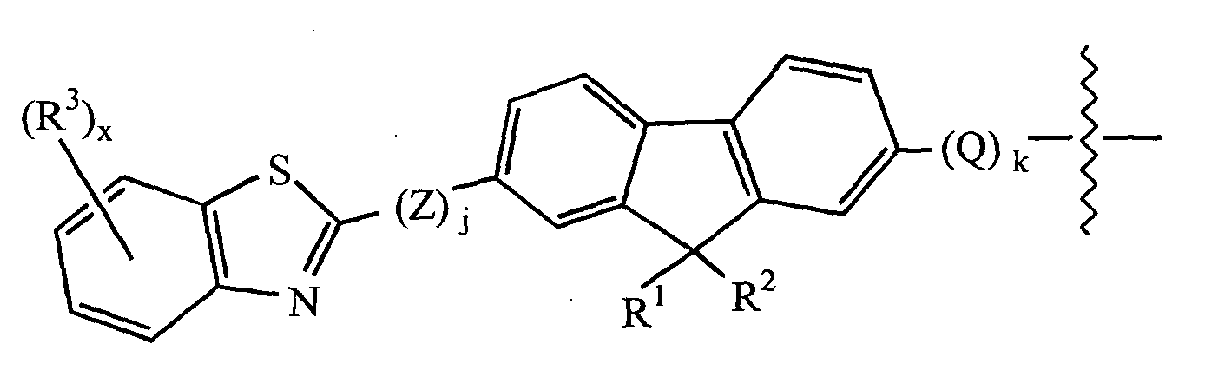
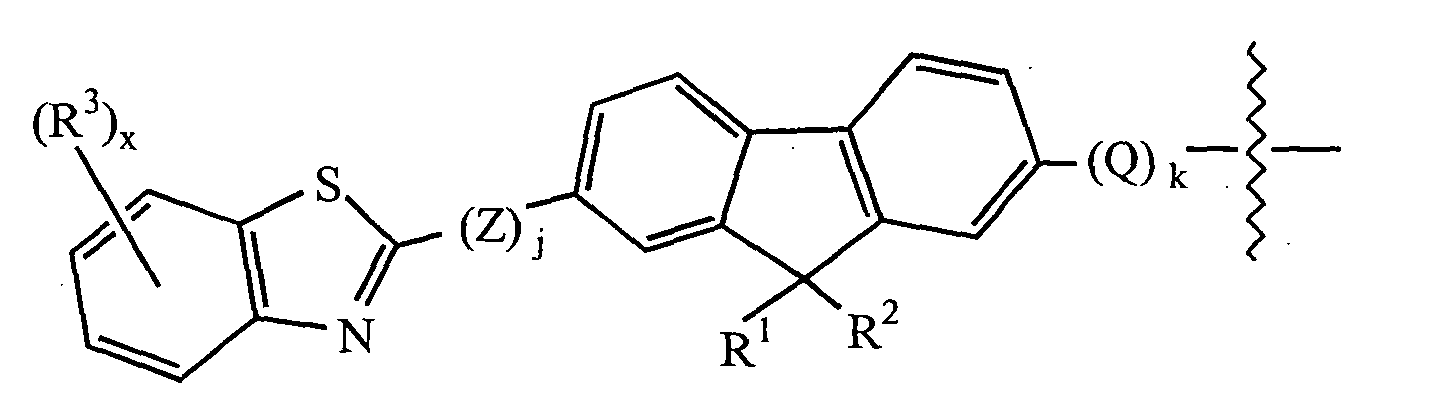
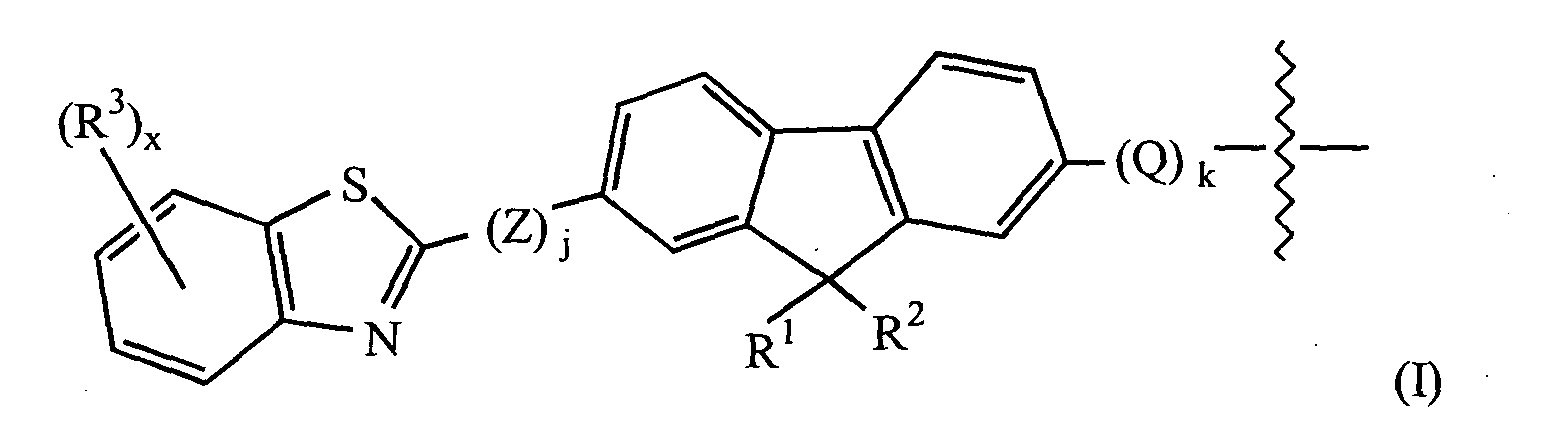
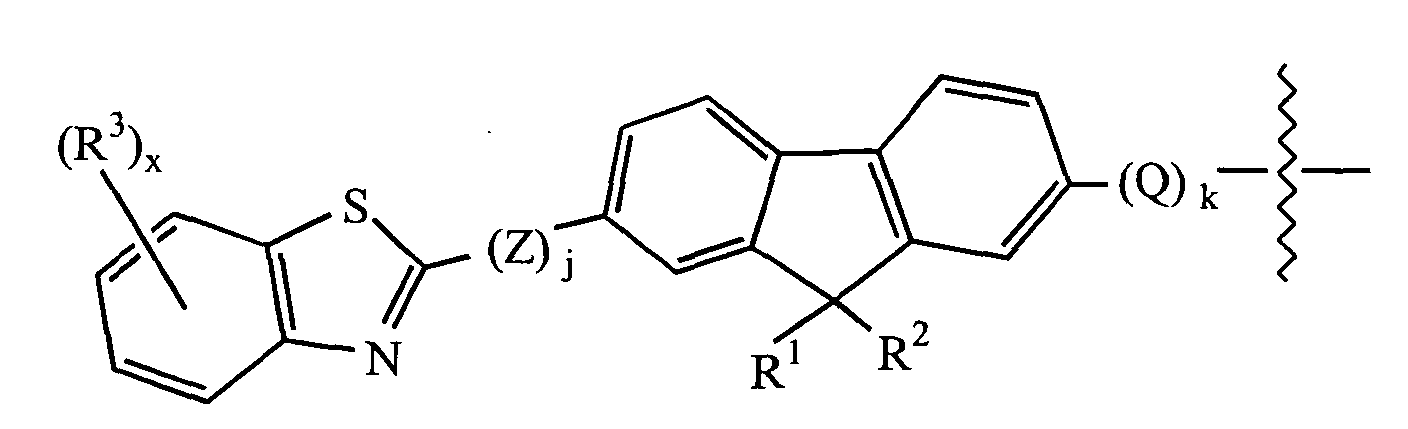
- the present invention is directed to a polymer comprising 2-(7-benzothiazolyl-9,9-disubstituted fluorene) structural units of the formula wherein R 1 and R 2 are each independently an alkyl group, an aralkyl group, an aryl group, or an -Si(R) 3 group wherein R is an alkyl group; R 3 is selected from the group consisting of an electron-donating substituent and an electron-withdrawing substituent; x has the value of from zero up to the number of hydrogens available for substitution on the aromatic ring; Z and Q are each independently a group which is in conjugation with both the fluorene group and the benzothiazole group; and the parameters j and k each independently have the value of 0-2.
- the present invention is directed to a method for making the said polymers.
- the present invention is directed to a monomer to make said polymers.
- Polymers suitable for use in an electroactive device of the present invention comprise 2-(7-benzothiazolyl-9,9-disubstituted fluorene) structural units as shown in formula (I): wherein R 3 is selected from the group consisting of an electron-donating substituent and an electron-withdrawing substituent; x has the value of from zero up to the number of hydrogens available for substitution on the aromatic ring; Z and Q are each independently a group which is in conjugation with both the fluorene group and the benzothiazole group; and the parameters j and k each independently have the value of 0-2. In a particular embodiment x is zero.
- x is at least one and R 3 is alkyl; alkoxy; nitrile; halogen, chloro, bromo, fluoro; or nitro.
- j or k or both j and k have the value of 1, and Z or Q or both Z and Q are selected from the group consisting of phenyl, substituted phenyl, ethenyl, substituted ethenyl, fluorenyl and the like. It is to be understood that when both j and k have a value of greater than zero, then Z and Q may be the same or different. In another particular embodiment both j and k have the value of zero.
- the unsubstituted sites on the aromatic rings may comprise hydrogen, deuterium or a mixture of hydrogen and deuterium.
- the unsubstituted sites on the aromatic rings comprise hydrogen.
- the R 1 and R 2 substituents may be the same or different.
- the R 1 and R 2 substituents are each independently an alkyl group, an aralkyl group, an aryl group, or an -Si(R) 3 group wherein R is an alkyl group. phenyl; and trialkylsilyl groups with alkyl groups comprising 1-10 carbon atoms, such as trimethylsilyl.
- the R 1 and R 2 substituents are different.
- the R 1 and R 2 substituents are the same.
- neither of the R 1 and R 2 substituents is hydrogen.
- polymers comprising 2-(7-benzothiazolyl-9,9-disubstituted fluorene) structural units comprise homopolymers with said structural units present as side-chains pendant from the main polymer chain.
- the polymer backbone is non-conjugated.
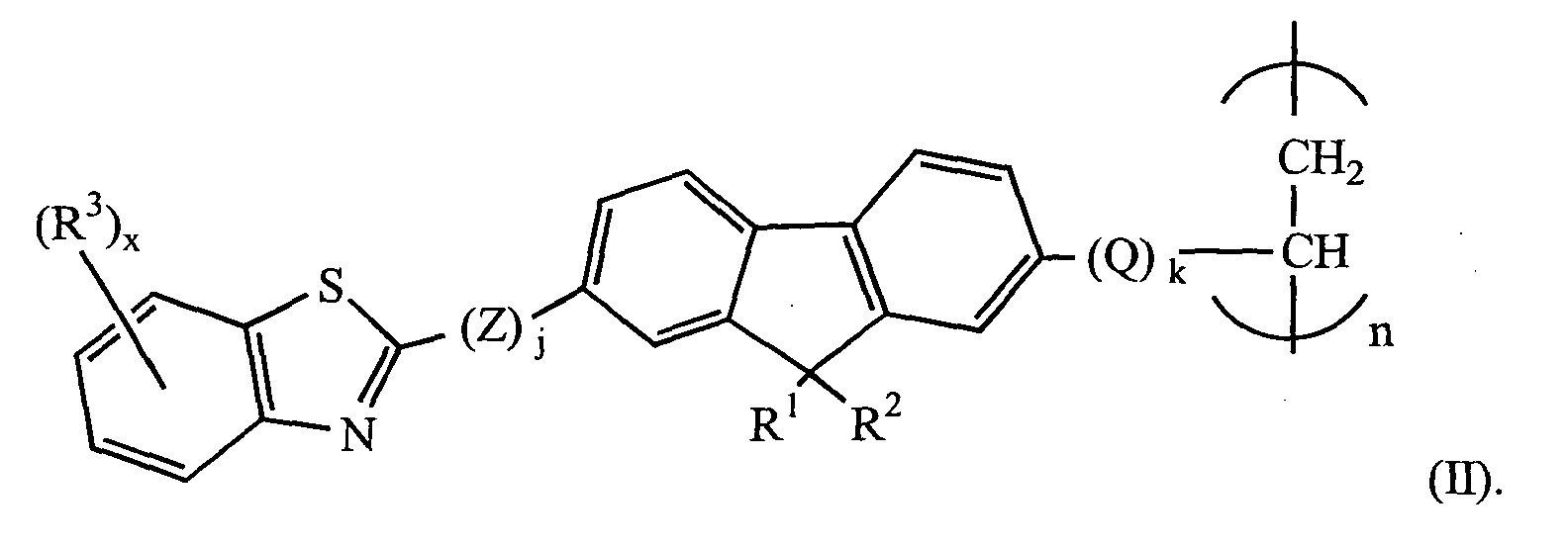
- homopolymers include, but are not limited to, those of the formula (II) wherein R 1 , R 2 , R 3 , x, Z, Q, j and k have the values described herein above:
- the molecular weight of the homopolymer is not particularly critical provided that a layer comprising said homopolymer may be processed for inclusion into an electroactive device.
- the value for n is such to provide a homopolymer weight average molecular weight in one embodiment in a range of about 4,000 and about 200,000; in another embodiment in a range of about 10,000 and about 200,000; in another embodiment in a range of about 20,000 and about 120,000; in another embodiment in a range of about 50,000 and about 120,000; in another embodiment in a range of about 50,000 and about 100,000; and in another embodiment in a range of about 60,000 and about 80,000, as determined by gel permeation chromatography in chloroform versus polystyrene standards.
- the value for n is such to provide a homopolymer molecular weight in one embodiment in a range of about 4,000 and about 30,000; in another embodiment in a range of about 5,000 and about 25,000; and in another embodiment in a range of about 6,000 and about 12,000, as determined by gel permeation chromatography in chloroform versus polystyrene standards.
- the value for n is such to provide a homopolymer molecular weight in a range of about 20,000 and about 26,000, as determined by gel permeation chromatography in chloroform versus polystyrene standards.
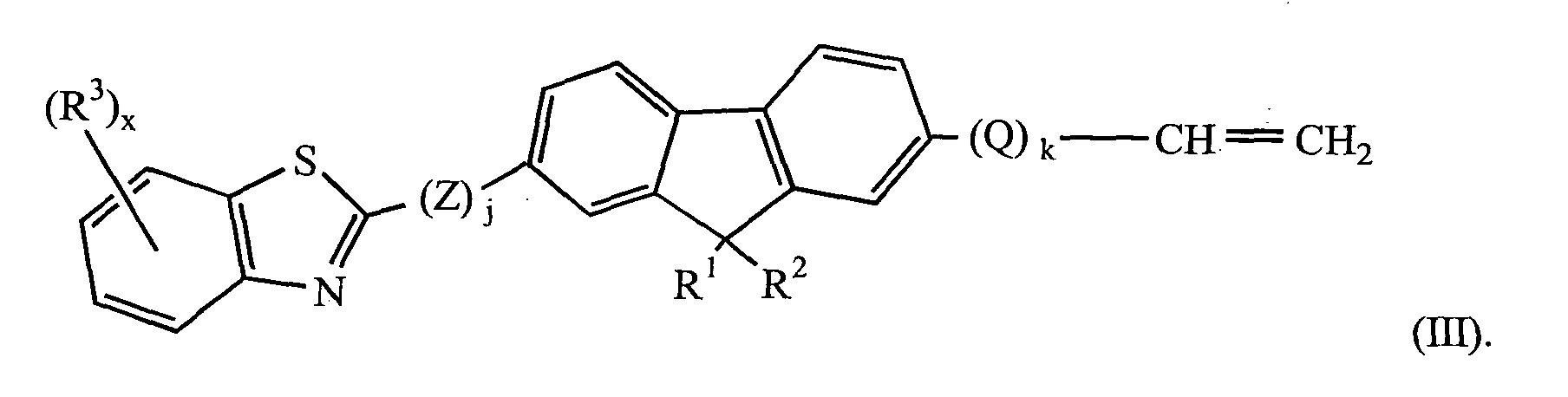
- Homopolymers of the formula (II) may be derived, for example, from polymerization of a monomer of the formula (III) wherein R 1 , R 2 , R 3 , x, Z, Q, j and k have the values described herein above:
- polymers comprising 2-(7-benzothiazolyl-9,9-disubstituted fluorene) structural units comprise copolymers with said structural units present as side-chains pendant from the main polymer chain.
- the polymer backbone is non-conjugated.
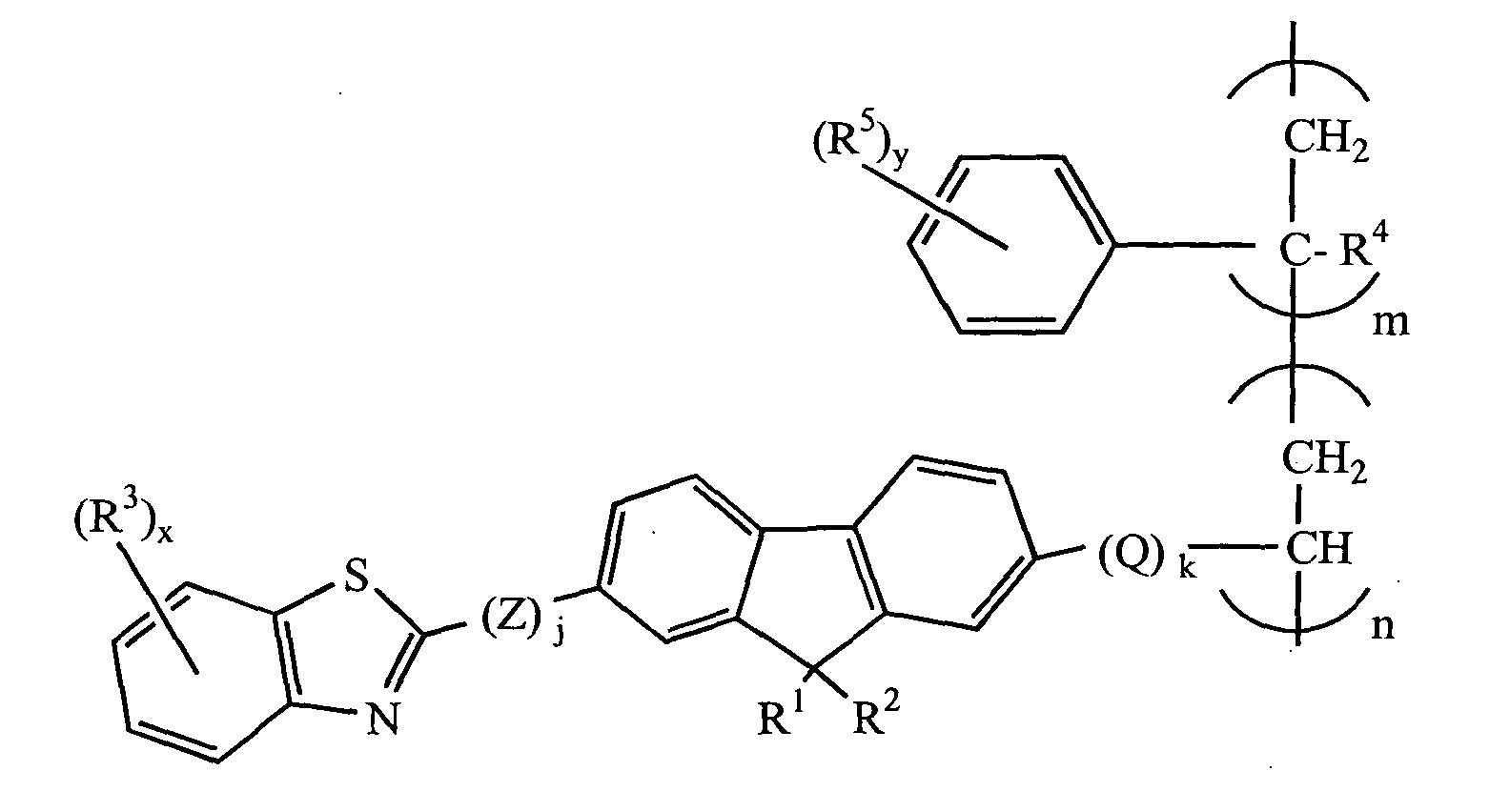
- Such copolymers include, but are not limited to, those comprising structural units derived from alkenyl aromatic compounds such as those of the formula (IV) wherein R 1 , R 2 , R 3 , x, Z, Q, j and k have the values described herein above:
- R 4 is hydrogen or alkyl, and R 5 is selected from the group consisting of an electron-donating substituent and an electron-withdrawing substituent; and y has the value of from zero up to the number of hydrogens available for substitution. In a particular embodiment y is zero. In another particular embodiment y is at least one and R 5 is alkyl; alkoxy; halogen; chloro; bromo; fluoro; nitrile or nitro.
- Copolymers such as that depicted in formula (IV) may be derived by copolymerization of a polymerizable monomer, such as a vinyl monomer comprising 2-(7-benzothiazolyl-9,9-disubstituted fluorene) structural units such as in formula (III) with at least one alkenyl aromatic compound.
- a polymerizable monomer such as a vinyl monomer comprising 2-(7-benzothiazolyl-9,9-disubstituted fluorene) structural units such as in formula (III) with at least one alkenyl aromatic compound.
- alkenyl aromatic compounds comprise styrene and substituted styrenes having one or more alkyl, alkoxy, hydroxy or halo substituent groups attached to the aromatic ring, including, but not limited to, alpha-methyl styrene, 2-methylstyrene, 3-methylstyrene, 4-methylstyrene, alpha-methyl vinyltoluene, vinyl xylene, trimethyl styrene, 3,5-diethylstyrene, 4-n-propylstyrene, butyl styrene, 2-t-butylstyrene, 3-t-butylstyrene, 4-t-butylstyrene, styrenes having from 1 to 5 halogen substituents on the aromatic ring, chlorostyrene, alpha-chlorostyrene, dichlorostyrene, tetrachlorostyrene, bromostyrene,
- illustrative examples of copolymers with 2-(7-benzothiazolyl-9,9-disubstituted fluorene) structural units present as side-chains pendant from the main polymer chain include, but are not limited to, those copolymers comprising structural units derived from at least one monoethylenically unsaturated alkyl (meth)acrylate monomer selected from (C 1 -C 12 )alkyl(meth)acrylate monomers and mixtures comprising at least one of said monomers.
- the terminology “monoethylenically unsaturated” means having a single site of ethylenic unsaturation per molecule
- the terminology “(meth)acrylate monomers” refers collectively to acrylate monomers and methacrylate monomers.
- the terminology “(C x -C y )”, as applied to a particular unit, such as, for example, a chemical compound or a chemical substituent group means having a carbon atom content of from “x” carbon atoms to "y” carbon atoms per such unit.
- “(C 1 -C 12 )alkyl” means an alkyl group having from 1 to 12 carbon atoms per group.
- Suitable (C 1 -C 12 )alkyl(meth)acrylate monomers include, but are not limited to, (C 1 -C 12 )alkyl acrylate monomers, illustrative examples of which include ethyl acrylate, butyl acrylate, iso-pentyl acrylate, n-hexyl acrylate, and 2-ethyl hexyl acrylate; and their (C 1 -C 12 )alkyl methacrylate analogs, illustrative examples of which include methyl methacrylate, ethyl methacrylate, propyl methacrylate, iso-propyl methacrylate, butyl methacrylate, hexyl methacrylate, and decyl methacrylate.
- a copolymer comprises structural units derived from methyl methacrylate.
- the portion of the copolymer derived from alkenyl aromatic compound or from monoethylenically unsaturated alkyl (meth)acrylate monomer is in an amount in one embodiment in a range of between about 0.5 wt.% and about 85 wt.%; in another embodiment in a range of between about 0.5 wt.% and about 75 wt.%; in another embodiment in a range of between about 10 wt.% and about 55 wt.%; in another embodiment in a range of between about 20 wt.% and about 55 wt.%; in another embodiment in a range of between about 30 wt.% and about 55 wt.%; and in another embodiment in a range of between about 40 wt.% and about 55 wt.%, based on the total weight of the copolymer.
- the values for n and m in formula (IV) are such that the portion of the copolymer derived from alkenyl aromatic compound is in an amount in the ranges described herein above. In another particular embodiment the values for n and m in formula (IV) are such that the portion of the copolymer derived from alkenyl aromatic compound is in an amount in a range of between about 45 wt.% and about 55 wt.%, based on the total weight of the copolymer.
- illustrative examples of copolymers with 2-(7-benzothiazolyl-9,9-disubstituted fluorene) structural units present as side-chains pendant from the main polymer chain include, but are not limited to, those copolymers comprising structural units derived from a mixture of at least one alkenyl aromatic compound and at least one monoethylenically unsaturated alkyl (meth)acrylate monomer selected from (C 1 -C 12 )alkyl(meth)acrylate monomers.
- 2-(7-benzothiazolyl-9,9-disubstituted fluorene) structural units are typically present such copolymers in an amount of less than about 50 wt.%; and the wt./wt. ratio of structural units derived from alkenyl aromatic compound to structural units derived from monoethylenically unsaturated alkyl (meth)acrylate monomer is in a range of between 10:90 and 90:10.
- Copolymers comprising 2-(7-benzothiazolyl-9,9-disubstituted fluorene) structural units may be random or block. In a particular embodiment suitable copolymers have random structure.
- the molecular weight of the copolymer is not particularly critical provided that a layer comprising said copolymer may be processed for inclusion into an electroactive device.
- the values for n and m are such to provide a copolymer weight average molecular weight in one embodiment in a range of about 4,000 and about 200,000; in another embodiment in a range of about 10,000 and about 200,000; in another embodiment in a range of about 20,000 and about 120,000; in another embodiment in a range of about 50,000 and about 120,000; in another embodiment in a range of about 50,000 and about 100,000; and in another embodiment in a range of about 60,000 and about 80,000, as determined by gel permeation chromatography in chloroform versus polystyrene standards.
- Polymers of the present invention may be employed in electroactive devices.
- said polymers may be employed in an emissive layer in an electroactive device.
- the electroactive device typically comprises: (a) an anode; (b) a cathode; and (c) a layer of light emitting material comprising a polymer of the present invention.
- the electroactive device typically comprises: (i) a substrate; (ii) an anode formed over the substrate; (iii) optionally a layer of a conductive polymer or a hole transporter material formed over the anode; (iv) a layer of light emitting material comprising a polymer of the present invention; (v) optionally a layer comprising a hole-blocking material; (vi) optionally a layer of an electron transporter material; and (vii) a cathode.
- the electroactive device typically emits light in the wavelength range of about 400 nm to about 650 nm, or in the wavelength range of about 400 nm to about 550 nm, or in the wavelength range of about 400 nm to about 500 nm.
- said polymers may be employed in a hole-blocking layer in an electroactive device.
- the electroactive device typically comprises: (a) an anode; (b) a cathode; and (c) a hole-blocking layer comprising a polymer of the present invention.
- the electroactive device typically comprises: (i) a substrate; (ii) an anode formed over the substrate; (iii) a layer of a conductive polymer or a hole transporter material formed over the anode; (iv) a layer of light emitting material formed over the hole transporter material; (v) a layer of a hole-blocking material comprising a polymer of the present invention (vi) a layer of an electron transporter material formed over the light emitting material; and (vii) a cathode formed over the layer of electron transporter material.
- a polymer comprising 7-benzothiazolyl-9,9-dialkylfluorene structural units of the present invention may be used in any electroactive device in which an emissive layer or a hole blocking layer may be beneficially employed.
- the polymer is employed in an electroluminescent device, an LED, an OLED, a photovoltaic device, a photoconductor, a photodetector, or in a chemical or biochemical sensor.
- Electroluminescent devices are used, for example, as self-illuminating display elements, such as control lamps, alphanumeric displays, signs, or in opto-electronic couplers and like applications.
- Suitable cathode materials for electroactive devices generally comprise those having a low work function value such that a relatively small voltage causes emission of electrons from the cathode.
- Illustrative examples of cathode materials generally comprise K, Li, Na, Rb, Mg, La, Ce, Ca, Sr, Ba, Al, Ag, In, Sn, Zn, Zr, or mixtures thereof.
- Other illustrative examples of cathode materials may comprise alkali metal fluorides, or alkaline earth fluorides, or mixtures of fluorides.
- cathode materials may comprise a metal such as gold, indium, manganese, tin, lead, aluminum, silver, magnesium, or alloys thereof; particularly a magnesium/silver, magnesium/indium, calcium/aluminum or lithium/aluminum alloy.
- the cathode can be made of two layers to enhance electron injection.
- Illustrative examples include, but are not limited to, an inner layer of either LiF or NaF followed by an outer layer of aluminum or silver, or an inner layer of calcium followed by an outer layer of aluminum or silver.
- Suitable anode materials for electroactive devices typically comprise those having a high work function value.
- Illustrative examples of anode materials include, but are not limited to, indium tin oxide (ITO), tin oxide, indium oxide, zinc oxide, indium zinc oxide, nickel, gold, and mixtures thereof.
- the layer comprising a polymer of the invention may be applied by any suitable conventional technique such as spin-casting, spraying, dip coating, draw bar coating, gravure coating, silk screening, air knife coating, reverse roll coating, vacuum deposition, chemical treatment and the like.
- the said layers are often applied in the form of a dilute solution, with the solvent being removed after deposition of the coating by conventional techniques such as by vacuum, heating and the like.
- a layer comprising a polymer of the invention may be formed into a film using conventional techniques such as, but not limited to, compression molding and film extrusion. Said film may be employed in fabricating an electroactive device using conventional techniques such as, but not limited to, lamination.
- two or more layers of the electroactive device may be prepared in a separate step and combined before assembly of the final electroactive device.
- PVB means the homopolymer poly(vinyl fluorene benzothiazole).
- PVFBS means the copolymer poly(vinyl fluorene benzothiazole-co-styrene).
- the layers were separated and the acidic solution was extracted twice with 25 mL pentane.
- the organic fractions were combined and neutralized by washing twice with 100 mL of saturated sodium bicarbonate solution.
- the basic solution was extracted twice with 25 mL of pentane.
- the organic fractions were combined and dried over magnesium sulfate and decolorized with activated carbon to leave a bright yellow solution. Concentration in vacuo resulted in 29.68 g of recovered yellow oil.
- the product was purified by column chromatography (alumina, 1500 g) eluted with a mixture of xylenes and cyclohexane (4:1) and re-crystallized from cold methanol. The yield was 18.0g (53% yield) of a colorless crystalline solid with melting point 79°-81°C.
- the reaction contained a blue-green precipitate upon cooling to room temperature.
- the contents of the flask were extracted with 20 mL of diethyl ether.
- the white solid residue was filtered leaving a bright orange organic solution.
- the organic layer was dried and decolorized with 2.0 g activated charcoal and 2.0 g 4 ⁇ molecular sieves.
- the light orange solution was concentrated and the remaining oil was added dropwise into dry acetonitrile leaving 4.0 g of a bright yellow solid.
- the bright yellow solid was then extracted twice with 10 mL diethyl ether leaving an insoluble white solid.
- the ether extract was concentrated by rotary evaporation to yield 2.8 g (61 % yield) of a yellow microcrystalline product.
- the yellow solid was analyzed by 1 H and 13 C NMR confirming the synthesis in greater than 95% purity.
- the polymer As determined by gel permeation chromatography versus polystyrene standards, the polymer had weight average molecular weight (Mw) of 8,600 and number average molecular weight (Mn) of 5,100 with a polydispersity index of 1.68.
- Mw weight average molecular weight
- Mn number average molecular weight
- the polymer was characterized by cyclic voltammetry in acetonitrile with tetra-n-butyl tetrafluoroborate as electrolyte using a glassy carbon working electrode and a platinum counter electrode.
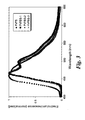
- Figure 1 shows the UV-visible absorption spectrum in chloroform solution and photoluminescence spectra for the homopolymer, PVFB, in chloroform solution and in the solid-state.
- a strong blue emission with lambda max of about 410 nm is observed in solution upon excitation at 345 nm.
- Excitation at 430 nm gives rise to a weakly fluorescent blue component with lambda max emission at 441 and 467 nm.
- Excitation of the same material at 345 nm as a film on quartz gave rise to strong blue fluorescence with lambda max emission at 441 and 467 nm, which overlays well with the solution excitation value.
- Figure 2 illustrates the absorption and photoluminescence spectra of a copolymer (comprising structural units derived from 50 wt.% styrene) in chloroform solution with excitation at 410 nm. The figure shows that copolymer emits in the blue region of spectrum.
- PVFB and PVFBS were prepared using methods similar to those described in Examples 4, 5 and 6.
- copolymer examples were prepared comprising structural units derived from 75 wt.% styrene (PVFBS-1), 50 wt.% styrene (PVFBS-2) and 25 wt.% styrene (PVFBS-3).
- Table 1 shows physical properties for these examples.
- Lambda (abs) refers to the absorption maximum in the ultraviolet range measured in chloroform solution.
- Lambda (PL) refers to the photoluminescence maximum measured in chloroform solution.
- HOMO and LUMO values were determined by cyclic voltammetry measurements on a thin film of the polymer on a glassy carbon electrode in acetonitrile/tetrabutylammonium fluoroborate solution using a platinum counter electrode and silver/silver nitrate reference electrode (aqueous ferrocene/ferrocenium external standard, 4.8 eV). Fluorescence quantum yields were determined in chloroform with coumarin 540 in ethyl acetate as reference. Weight average molecular weight values were determined in chloroform versus polystyrene standards. Ex. 8 Ex. 9 Ex.10 Ex.
- Synthesis of poly(methylmethacrylate-co-2-vinyl-7-benzothiazolyl-9,9'-dioctylfluorene Copolymerization of methyl methacrylate (2.0 mL, 18.7 mmoles) with 2-vinyl-7-benzothiazolyl-9,9'-dioctylfluorene (100 mg, 0.18 mmoles) was performed in a septum-sealed serum bottle containing 12 mL benzene under nitrogen initiated by AIBN (40mg, 0.24 mmoles) at 72°C for 18 hours while protected from light.
- AIBN 40mg, 0.24 mmoles
- Synthesis of poly(styrene-co-methylmethacrylate-co-2-vinyl-7-benzothiazolyl-9,9'-dioctylfluorene Copolymerization of styrene, methyl methacrylate and 2-vinyl-7-benzothiazolyl-9,9'-dioctylfluorene in a wt./wt./wt. ratio of 75:25:25 is performed in a septum-sealed serum bottle containing a solvent which dissolves the reactants under nitrogen. The reaction mixture is heated in the presence of an initiator optionally with protection from light. The product is isolated by anti-solvent precipitation and collected by filtration and dried in vacuo. The desired terpolymer is obtained.
- ITO/PEDT:PSS/X/NaF/A1 Indium-Tin-Oxide (ITO) films on glass were obtained from a subsidiary of Applied Films (Colorado Concept Coatings LLC) and patterned by photolithography. After the ITO was solvent cleaned and subjected to a 10 minute UV/ozone treatment, the conductive polymer poly(3,4-ethylenedioxythiophene)/poly(styrenesulfonate) (PEDT:PSS) (Baytron P VP CH 8000) was spun-cast from aqueous dispersion onto the ITO film and then the assembly was baked for at least 15 minutes at about 175°C.
- PEDT:PSS conductive polymer poly(3,4-ethylenedioxythiophene)/poly(styrenesulfonate)
- the polymers of Examples 8-11 (designated as X) were dissolved in an organic solvent (e.g. m-xylene) at a concentration of about 2 wt.%, and then spun-cast to form a film for an emissive layer of about 60 nm thickness on top of the PEDT:PSS layer.
- the devices were then moved into a vacuum deposition chamber located inside an argon-filled glove box, where a 4 nm thick film of sodium fluoride (NaF), followed by a film of aluminum (Al) about 100 nm thick were deposited through a shadow mask at a base pressure of about 2 ⁇ 10 -6 torr.
- NaF sodium fluoride
- Al aluminum
- a thin layer of gold was deposited instead of the NaF/Al top electrode.
- the devices were encapsulated with a cover glass and an edge seal using a UV-cured adhesive.
- the current and brightness of the devices were measured vs. voltage with a Keithley sourcemeter and a calibrated photodiode, respectively, using standard measurement protocols.
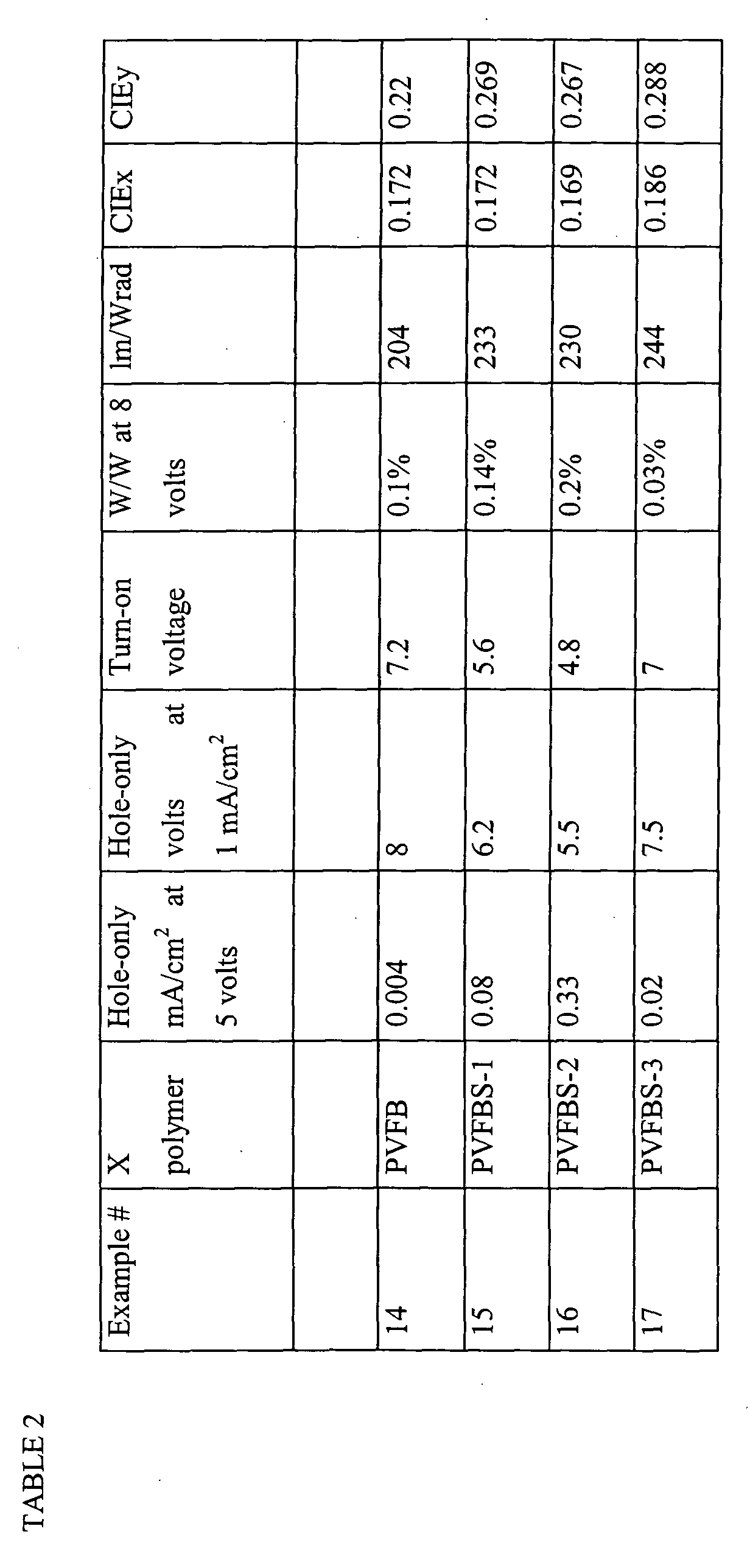
- the main properties of the devices are listed in Table 2. Columns 3 and 4 list, respectively, the current density at 5 volts (V) and the voltage at a current density of 1 milliampere (mA) per square centimeter (cm 2 ) for hole-only structures.
- the remaining property columns refer to bipolar devices.
- the turn-on voltage is defined as the voltage for reaching a brightness 1 candela per square meter (cd/m 2 ), and the power efficiency watts/watts (W/W) is listed at 8 volts.
- the electroluminescence spectrum is described by lumens per watt radian (1m/Wrad), and the CIE x and y-coordinates. The devices reached a brightness of up to about 100 cd/m 2 .
- the hole-only devices showed a relatively high resistance.
- a large hole-injection barrier of about 1 electron volt (eV) between PEDT:PSS (work-function about 5.1 eV) and PVFB (HOMO about 6.0 eV) would be expected.
- the copolymers with styrene were more conductive. Although the invention is in no way dependent upon any theory of operation, this higher conductivity may correlate to the minor change in the HOMO values, or to changes of the hole mobility, or to changes in dipole layer formation at the PEDT interface.
- PVFBS2 that has a PVFB-to-styrene mole ratio of about 2
- EL hole transport and electroluminescence
- the power efficiency of up to 0.2% is similar to test devices obtained from commercially available polymers with similar energy levels, such as poly(9,9-dioctylfluorenyl-2.7-diyl) and poly(9,9-dihexylfluorenyl-2.7-diyl).
- a significant increase in efficiency can be expected by inserting a hole-transport layer between PEDT:PSS and these materials, or by blending a small percentage (for example, 10-25%) of a good hole-transporting material to form the emissive layer. All devices displayed a decay in conductivity and EL intensity of unknown origin, but likely from impurities as no special purification procedures beyond precipitation were performed.
- Figure 3 shows normalized electroluminescence spectra of devices made with an emissive layer of examples 14 to 17. In all cases the emissive layer was about 60 nm thick.
- the spectra for copolymer-comprising devices show a small red-shift and a clearer vibronic progression as compared to the spectrum for the homopolymer-comprising device.
Landscapes
- Chemical & Material Sciences (AREA)
- Organic Chemistry (AREA)
- Health & Medical Sciences (AREA)
- Chemical Kinetics & Catalysis (AREA)
- Medicinal Chemistry (AREA)
- Polymers & Plastics (AREA)
- Engineering & Computer Science (AREA)
- Materials Engineering (AREA)
- Addition Polymer Or Copolymer, Post-Treatments, Or Chemical Modifications (AREA)
- Electroluminescent Light Sources (AREA)
- Other Resins Obtained By Reactions Not Involving Carbon-To-Carbon Unsaturated Bonds (AREA)
Abstract
Description


| Ex. 8 | Ex. 9 | Ex.10 | Ex. 11 | |
| Polymer | PVFB | PVFBS-1 | PVFBS-2 | PVFBS-3 |
| Lambda (abs), nm | 362 | 422 | 422 | 422 |
| Lambda (PL), nm | 403 | 435 | 436 | 433 |
| HOMO, eV | 6.02 | 5.9 | 5.95 | 5.9 |
| LUMO, eV | 3.08 | 2.63 | 2.72 | 2.72 |
| E gap, eV | 2.94 | 3.27 | 3.23 | 3.18 |
| Quantum yield, % | 59 | 97 | 97 | 97 |
| Mw | 23,800 | 114,600 | 99,600 | 156,600 |
| PDI | 2.01 | 2.3 | 2.79 | 5.1 |
Claims (10)
- A polymer comprising 2-(7-benzothiazolyl-9,9-disubstituted fluorene) structural units of the formulawherein R1 and R2 are each independently an alkyl group, an aralkyl group, an aryl group, or an -Si(R)3 group wherein R is an alkyl group; R3 is selected from the group consisting of an electron-donating substituent and an electron-withdrawing substituent; x has the value of from zero up to the number of hydrogens available for substitution on the aromatic ring; Z and Q are each independently a group which is in conjugation with both the fluorene group and the benzothiazole group; and the parameters j and k each independently have the value of 0-2.
- The polymer of claim 1 wherein j or k, or both j and k have the value of 1, and Z or Q or both Z and Q are selected from the group consisting of phenyl, substituted phenyl, ethenyl, substituted ethenyl, and fluorenyl.
- The polymer of claim 1 wherein R1 and R2 are each independently selected from the group consisting of phenyl, trialkylsilyl, trimethylsilyl, t-butyl, dimethylhexyl, ethylhexyl, n-octyl, and C6-C32 alkyl optionally substituted with one or more groups selected from C1-C6 alkyl.
- The polymer of claim 1 wherein x, j and k are zero, and R1 and R2 are the same.
- The polymer of claim 4 wherein R1 and R2 are selected from the group consisting of phenyl, trialkylsilyl, trimethylsilyl, t-butyl, dimethylhexyl, ethylhexyl, n-octyl, and C6-C32 alkyl optionally substituted with one or more groups selected from C1-C6 alkyl.
- The polymer of claim 1 further comprising structural units derived from at least one alkenyl aromatic compound, or from at least one monoethylenically unsaturated alkyl (meth)acrylate monomer selected from (C1-C12)alkyl(meth)acrylate monomers, or from a mixture of at least one alkenyl aromatic compound and at least one monoethylenically unsaturated alkyl (meth)acrylate monomer selected from (C1-C12)alkyl(meth)acrylate monomers.
- The polymer of claim 6 having the formulawherein R4 is hydrogen or alkyl, and R5 is selected from the group consisting of an electron-donating substituent and an electron-withdrawing substituent; y has the value of from zero up to the number of hydrogens available for substitution; and the value of m is such that the structural units derived from the alkenyl aromatic compound are present in a range of between about 0.5 wt.% and about 85 wt.%, based on the total weight of the polymer.
- An electroactive device comprising the polymer of any of the preceding claims.
- The electroactive device of claim 8, which is an electroluminescent device, an LED, an OLED, a photovoltaic device, a photoconductor, a photodetector, or in a chemical or biochemical sensor.
- A method for making a polymer comprising 2-(7-benzothiazolyl-9,9-disubstituted fluorene) structural units of the formulawherein R1 and R2 are each independently an alkyl group, an aralkyl group, an aryl group, or an -Si(R)3 group wherein R is an alkyl group; R3 is selected from the group consisting of an electron-donating substituent and an electron-withdrawing substituent; x has the value of from zero up to the number of hydrogens available for substitution on the aromatic ring; Z and Q are each independently a group which is in conjugation with both the fluorene group and the benzothiazole group; and the parameters j and k each independently have the value of 0-2; wherein the method comprises the step of polymerizing a monomer of the formula
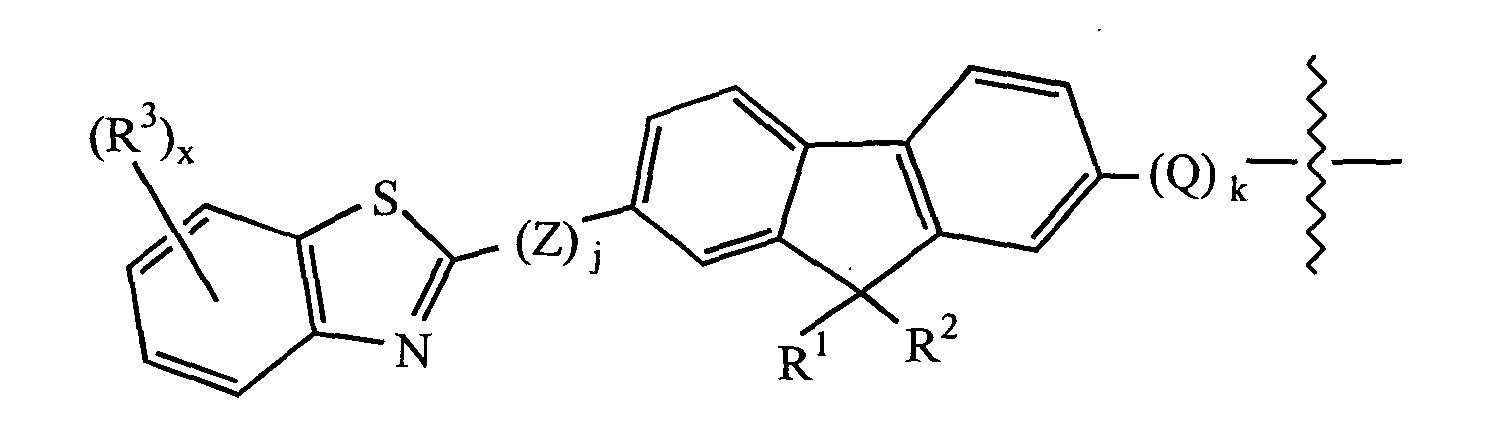 or optionally mixture of said monomer and a second monomer selected from the group consisting of an alkenyl monomer and a monoethylenically unsaturated alkyl (meth)acrylate monomer selected from (C1-C12)alkyl(meth)acrylate monomers; wherein said second monomer is present in a range of between about 0.5 wt.% and about 85 wt.%, based on the total weight of monomers.
Applications Claiming Priority (2)
| Application Number | Priority Date | Filing Date | Title |
|---|---|---|---|
| US814748 | 1991-12-24 | ||
| US10/814,748 US7217774B2 (en) | 2004-04-01 | 2004-04-01 | Electroactive polymer, device made therefrom and method |
Publications (3)
| Publication Number | Publication Date |
|---|---|
| EP1589049A2 true EP1589049A2 (en) | 2005-10-26 |
| EP1589049A3 EP1589049A3 (en) | 2009-05-06 |
| EP1589049B1 EP1589049B1 (en) | 2017-11-01 |
Family
ID=34940690
Family Applications (1)
| Application Number | Title | Priority Date | Filing Date |
|---|---|---|---|
| EP05252070.7A Expired - Lifetime EP1589049B1 (en) | 2004-04-01 | 2005-04-01 | Electroactive polymer, device made therefrom and method |
Country Status (6)
| Country | Link |
|---|---|
| US (1) | US7217774B2 (en) |
| EP (1) | EP1589049B1 (en) |
| JP (1) | JP5638175B2 (en) |
| KR (1) | KR101237139B1 (en) |
| CN (1) | CN1680456B (en) |
| TW (1) | TWI392690B (en) |
Cited By (1)
| Publication number | Priority date | Publication date | Assignee | Title |
|---|---|---|---|---|
| WO2008052559A3 (en) * | 2006-11-03 | 2009-03-19 | Danfoss As | A dielectric composite and a method of manufacturing a dielectric composite |
Families Citing this family (9)
| Publication number | Priority date | Publication date | Assignee | Title |
|---|---|---|---|---|
| CN102549791B (en) * | 2009-08-28 | 2015-01-07 | 新加坡科技研究局 | Ambipolar polymeric semiconductor materials and organic electronic devices |
| DE102010006377A1 (en) * | 2010-01-29 | 2011-08-04 | Merck Patent GmbH, 64293 | Styrene-based copolymers, in particular for use in optoelectronic components |
| JP2012111942A (en) * | 2010-11-05 | 2012-06-14 | Osaka Gas Chem Kk | Fluorene skeleton-containing polymer |
| KR101507004B1 (en) | 2011-12-29 | 2015-03-30 | 제일모직 주식회사 | Compound for organic optoelectronic device, organic light emitting diode including the same and display including the organic light emitting diode |
| CN104871336B (en) * | 2012-12-18 | 2017-08-08 | 默克专利有限公司 | Emitters with fused ring systems |
| CN103360581B (en) * | 2013-07-11 | 2015-09-16 | 华南理工大学 | A kind of conjugated polymers containing 5,6-difluoro benzothiazole and preparation method thereof and application |
| CN103483407B (en) * | 2013-10-10 | 2015-11-18 | 宁夏启元药业有限公司 | A kind of Matachrom extractive crystallization double solvent and extractive crystallization method |
| CN107004777B (en) * | 2014-12-04 | 2019-03-26 | 广州华睿光电材料有限公司 | Polymers, mixtures, compositions, organic electronic devices containing the same, and monomers thereof |
| KR101833672B1 (en) | 2016-04-12 | 2018-03-02 | 주식회사 엘지화학 | Compound and organic electronic device comprising the same |
Family Cites Families (12)
| Publication number | Priority date | Publication date | Assignee | Title |
|---|---|---|---|---|
| JP2537540B2 (en) * | 1988-07-19 | 1996-09-25 | 株式会社トクヤマ | Monomer composition |
| JPH02265907A (en) * | 1989-04-07 | 1990-10-30 | Nippon Oil & Fats Co Ltd | High-refractive index optical resin |
| JP2742093B2 (en) * | 1989-05-31 | 1998-04-22 | 出光興産株式会社 | Method for producing styrenic copolymer |
| JPH0463301A (en) * | 1990-07-03 | 1992-02-28 | Nippon Oil & Fats Co Ltd | Optical resin |
| US5777070A (en) * | 1997-10-23 | 1998-07-07 | The Dow Chemical Company | Process for preparing conjugated polymers |
| JP2000026542A (en) * | 1998-07-07 | 2000-01-25 | Yokohama Rubber Co Ltd:The | Sulfur-vulcanizable butyl rubber and rubber composition containing the same |
| DE60007080T2 (en) * | 2000-04-26 | 2004-09-23 | Sony International (Europe) Gmbh | Polyfluorene with end groups, films and arrangements based thereon |
| EP1297060B2 (en) * | 2000-06-12 | 2012-04-04 | Sumitomo Chemical Company Limited | Polymer matrix electroluminescent materials and devices |
| ATE358170T1 (en) * | 2000-10-03 | 2007-04-15 | Cambridge Display Tech Ltd | LIGHT-EMITTING POLYMER MIXTURES AND LIGHT-EMITTING ARRANGEMENTS MADE THEREFROM |
| MY128940A (en) * | 2001-07-10 | 2007-03-30 | Dow Global Technologies Inc | Electroactive polymers and devices made therefrom |
| KR100414394B1 (en) * | 2001-08-16 | 2004-01-07 | 일진다이아몬드(주) | Novel Light-emitting Fluorene-based Copolymers, EL Devices Comprising Said Copolymers, and Synthetic Method thereof |
| US7179542B2 (en) * | 2003-05-20 | 2007-02-20 | Canon Kabushiki Kaisha | Thiazole- and imidazole-fused phenanthroline molecules in organic light-emitting devices |
-
2004
- 2004-04-01 US US10/814,748 patent/US7217774B2/en not_active Expired - Lifetime
-
2005
- 2005-03-31 JP JP2005101051A patent/JP5638175B2/en not_active Expired - Lifetime
- 2005-03-31 KR KR1020050027095A patent/KR101237139B1/en not_active Expired - Lifetime
- 2005-04-01 TW TW094110533A patent/TWI392690B/en not_active IP Right Cessation
- 2005-04-01 CN CN2005100676405A patent/CN1680456B/en not_active Expired - Lifetime
- 2005-04-01 EP EP05252070.7A patent/EP1589049B1/en not_active Expired - Lifetime
Cited By (1)
| Publication number | Priority date | Publication date | Assignee | Title |
|---|---|---|---|---|
| WO2008052559A3 (en) * | 2006-11-03 | 2009-03-19 | Danfoss As | A dielectric composite and a method of manufacturing a dielectric composite |
Also Published As
| Publication number | Publication date |
|---|---|
| CN1680456A (en) | 2005-10-12 |
| US20050222352A1 (en) | 2005-10-06 |
| JP2005320512A (en) | 2005-11-17 |
| KR101237139B1 (en) | 2013-02-25 |
| EP1589049A3 (en) | 2009-05-06 |
| US7217774B2 (en) | 2007-05-15 |
| CN1680456B (en) | 2010-04-07 |
| TW200613321A (en) | 2006-05-01 |
| EP1589049B1 (en) | 2017-11-01 |
| TWI392690B (en) | 2013-04-11 |
| JP5638175B2 (en) | 2014-12-10 |
| KR20060045360A (en) | 2006-05-17 |
Similar Documents
| Publication | Publication Date | Title |
|---|---|---|
| CN100532497C (en) | Electrolumineseence bule light polymer and organic electroluminescence device using same | |
| JP2008519140A (en) | A new class of cross-linked biphenylin polymers | |
| JP2005521783A (en) | Hole transport polymer and devices made using such polymer | |
| JP3898063B2 (en) | Organic light emitting material | |
| Kim et al. | Synthesis and luminescence properties of poly (p-phenylenevinylene) derivatives carrying directly attached carbazole pendants | |
| JP3505761B2 (en) | Copolymer, method for producing the same, and electroluminescent device using the same | |
| EP1589049B1 (en) | Electroactive polymer, device made therefrom and method | |
| Wettach et al. | Deep blue organic light-emitting diodes based on triphenylenes | |
| EP1516903A1 (en) | Light-emitting compound and polymer and luminescent element | |
| KR100730454B1 (en) | Blue light emitting polymers containing 9,10-diphenylanthracene moiety and the electroluminescent device prepared using the same | |
| Hwang et al. | Light-emitting properties of a germyl-substituted PPV derivative synthesized via a soluble precursor | |
| KR20030041996A (en) | Poly(phenylenevinylene) derivatives substituted with spirobifluorenyl group(s) and electroluminescent devices prepared using the same | |
| WO2005042176A9 (en) | Light-emitting copolymers and electronic devices using such copolymers | |
| KR100453809B1 (en) | Spirobifluorene compounds, electroluminescence polymer and electroluminescence element having the same | |
| EP1477544A2 (en) | Blue Light-emitting Compounds, Blue Light-emitting Polymers, Processes of Preparing the Blue Light-emitting Compounds and Luminescent Element Including the Blue Light-emitting Polymers | |
| RU2501123C1 (en) | Dendronised polyaryl silane-based organic light-emitting diodes | |
| CN1247636C (en) | Polymer with main chain possessing biphenyl flumaronitrile structural unit, its preparation method and uses | |
| KR101412813B1 (en) | Organic electroluminescent polymer containing oxadiazole group and organic electroluminescent device manufactured using the same | |
| KR100440901B1 (en) | Poly(aceanthrylene)-based Light Emitting Polymers and Electroluminescent Device Prepared Using the Same | |
| KR101522629B1 (en) | Light-emitting fluorene-based copolymer and el device using the polymer | |
| KR101174083B1 (en) | Polymer, organic photoelectronic device and display including the same | |
| KR20040055236A (en) | Blue Light Emitting Polymers Containing Electron-donating and Electron-accepting Moiety, and Electroluminescent Device Using the Same | |
| KR100710985B1 (en) | Poly (phenylenevinylene) derivative substituted with styryl group including aryl group and electroluminescent device using same | |
| KR100710987B1 (en) | An organic light emitting molecule having a polyarylene main chain containing an ethylene group substituted with fluorene at a 1,2-position of a vinyl group, and an organic electroluminescent device using the same | |
| KR20070017733A (en) | Fluorene derivatives, organic electroluminescent molecules and organic electroluminescent devices prepared therefrom |
Legal Events
| Date | Code | Title | Description |
|---|---|---|---|
| PUAI | Public reference made under article 153(3) epc to a published international application that has entered the european phase |
Free format text: ORIGINAL CODE: 0009012 |
|
| AK | Designated contracting states |
Kind code of ref document: A2 Designated state(s): AT BE BG CH CY CZ DE DK EE ES FI FR GB GR HU IE IS IT LI LT LU MC NL PL PT RO SE SI SK TR |
|
| AX | Request for extension of the european patent |
Extension state: AL BA HR LV MK YU |
|
| PUAL | Search report despatched |
Free format text: ORIGINAL CODE: 0009013 |
|
| AK | Designated contracting states |
Kind code of ref document: A3 Designated state(s): AT BE BG CH CY CZ DE DK EE ES FI FR GB GR HU IE IS IT LI LT LU MC NL PL PT RO SE SI SK TR |
|
| AX | Request for extension of the european patent |
Extension state: AL BA HR LV MK YU |
|
| 17P | Request for examination filed |
Effective date: 20091106 |
|
| 17Q | First examination report despatched |
Effective date: 20091210 |
|
| AKX | Designation fees paid |
Designated state(s): AT BE BG CH CY CZ DE DK EE ES FI FR GB GR HU IE IS IT LI LT LU MC NL PL PT RO SE SI SK TR |
|
| RAP1 | Party data changed (applicant data changed or rights of an application transferred) |
Owner name: BOE TECHNOLOGY GROUP CO., LTD. |
|
| STAA | Information on the status of an ep patent application or granted ep patent |
Free format text: STATUS: EXAMINATION IS IN PROGRESS |
|
| GRAP | Despatch of communication of intention to grant a patent |
Free format text: ORIGINAL CODE: EPIDOSNIGR1 |
|
| STAA | Information on the status of an ep patent application or granted ep patent |
Free format text: STATUS: GRANT OF PATENT IS INTENDED |
|
| INTG | Intention to grant announced |
Effective date: 20170511 |
|
| GRAS | Grant fee paid |
Free format text: ORIGINAL CODE: EPIDOSNIGR3 |
|
| GRAA | (expected) grant |
Free format text: ORIGINAL CODE: 0009210 |
|
| STAA | Information on the status of an ep patent application or granted ep patent |
Free format text: STATUS: THE PATENT HAS BEEN GRANTED |
|
| AK | Designated contracting states |
Kind code of ref document: B1 Designated state(s): AT BE BG CH CY CZ DE DK EE ES FI FR GB GR HU IE IS IT LI LT LU MC NL PL PT RO SE SI SK TR |
|
| REG | Reference to a national code |
Ref country code: GB Ref legal event code: FG4D |
|
| REG | Reference to a national code |
Ref country code: CH Ref legal event code: EP Ref country code: AT Ref legal event code: REF Ref document number: 941945 Country of ref document: AT Kind code of ref document: T Effective date: 20171115 |
|
| REG | Reference to a national code |
Ref country code: IE Ref legal event code: FG4D |
|
| REG | Reference to a national code |
Ref country code: DE Ref legal event code: R096 Ref document number: 602005052967 Country of ref document: DE |
|
| REG | Reference to a national code |
Ref country code: NL Ref legal event code: FP |
|
| REG | Reference to a national code |
Ref country code: FR Ref legal event code: PLFP Year of fee payment: 14 |
|
| REG | Reference to a national code |
Ref country code: LT Ref legal event code: MG4D |
|
| REG | Reference to a national code |
Ref country code: AT Ref legal event code: MK05 Ref document number: 941945 Country of ref document: AT Kind code of ref document: T Effective date: 20171101 |
|
| PG25 | Lapsed in a contracting state [announced via postgrant information from national office to epo] |
Ref country code: SE Free format text: LAPSE BECAUSE OF FAILURE TO SUBMIT A TRANSLATION OF THE DESCRIPTION OR TO PAY THE FEE WITHIN THE PRESCRIBED TIME-LIMIT Effective date: 20171101 Ref country code: FI Free format text: LAPSE BECAUSE OF FAILURE TO SUBMIT A TRANSLATION OF THE DESCRIPTION OR TO PAY THE FEE WITHIN THE PRESCRIBED TIME-LIMIT Effective date: 20171101 Ref country code: ES Free format text: LAPSE BECAUSE OF FAILURE TO SUBMIT A TRANSLATION OF THE DESCRIPTION OR TO PAY THE FEE WITHIN THE PRESCRIBED TIME-LIMIT Effective date: 20171101 Ref country code: LT Free format text: LAPSE BECAUSE OF FAILURE TO SUBMIT A TRANSLATION OF THE DESCRIPTION OR TO PAY THE FEE WITHIN THE PRESCRIBED TIME-LIMIT Effective date: 20171101 |
|
| PG25 | Lapsed in a contracting state [announced via postgrant information from national office to epo] |
Ref country code: GR Free format text: LAPSE BECAUSE OF FAILURE TO SUBMIT A TRANSLATION OF THE DESCRIPTION OR TO PAY THE FEE WITHIN THE PRESCRIBED TIME-LIMIT Effective date: 20180202 Ref country code: AT Free format text: LAPSE BECAUSE OF FAILURE TO SUBMIT A TRANSLATION OF THE DESCRIPTION OR TO PAY THE FEE WITHIN THE PRESCRIBED TIME-LIMIT Effective date: 20171101 Ref country code: BG Free format text: LAPSE BECAUSE OF FAILURE TO SUBMIT A TRANSLATION OF THE DESCRIPTION OR TO PAY THE FEE WITHIN THE PRESCRIBED TIME-LIMIT Effective date: 20180201 Ref country code: IS Free format text: LAPSE BECAUSE OF FAILURE TO SUBMIT A TRANSLATION OF THE DESCRIPTION OR TO PAY THE FEE WITHIN THE PRESCRIBED TIME-LIMIT Effective date: 20180301 |
|
| PG25 | Lapsed in a contracting state [announced via postgrant information from national office to epo] |
Ref country code: CZ Free format text: LAPSE BECAUSE OF FAILURE TO SUBMIT A TRANSLATION OF THE DESCRIPTION OR TO PAY THE FEE WITHIN THE PRESCRIBED TIME-LIMIT Effective date: 20171101 Ref country code: DK Free format text: LAPSE BECAUSE OF FAILURE TO SUBMIT A TRANSLATION OF THE DESCRIPTION OR TO PAY THE FEE WITHIN THE PRESCRIBED TIME-LIMIT Effective date: 20171101 Ref country code: EE Free format text: LAPSE BECAUSE OF FAILURE TO SUBMIT A TRANSLATION OF THE DESCRIPTION OR TO PAY THE FEE WITHIN THE PRESCRIBED TIME-LIMIT Effective date: 20171101 Ref country code: CY Free format text: LAPSE BECAUSE OF FAILURE TO SUBMIT A TRANSLATION OF THE DESCRIPTION OR TO PAY THE FEE WITHIN THE PRESCRIBED TIME-LIMIT Effective date: 20171101 Ref country code: SK Free format text: LAPSE BECAUSE OF FAILURE TO SUBMIT A TRANSLATION OF THE DESCRIPTION OR TO PAY THE FEE WITHIN THE PRESCRIBED TIME-LIMIT Effective date: 20171101 |
|
| REG | Reference to a national code |
Ref country code: DE Ref legal event code: R097 Ref document number: 602005052967 Country of ref document: DE |
|
| PG25 | Lapsed in a contracting state [announced via postgrant information from national office to epo] |
Ref country code: RO Free format text: LAPSE BECAUSE OF FAILURE TO SUBMIT A TRANSLATION OF THE DESCRIPTION OR TO PAY THE FEE WITHIN THE PRESCRIBED TIME-LIMIT Effective date: 20171101 Ref country code: IT Free format text: LAPSE BECAUSE OF FAILURE TO SUBMIT A TRANSLATION OF THE DESCRIPTION OR TO PAY THE FEE WITHIN THE PRESCRIBED TIME-LIMIT Effective date: 20171101 Ref country code: PL Free format text: LAPSE BECAUSE OF FAILURE TO SUBMIT A TRANSLATION OF THE DESCRIPTION OR TO PAY THE FEE WITHIN THE PRESCRIBED TIME-LIMIT Effective date: 20171101 |
|
| PLBE | No opposition filed within time limit |
Free format text: ORIGINAL CODE: 0009261 |
|
| STAA | Information on the status of an ep patent application or granted ep patent |
Free format text: STATUS: NO OPPOSITION FILED WITHIN TIME LIMIT |
|
| 26N | No opposition filed |
Effective date: 20180802 |
|
| PG25 | Lapsed in a contracting state [announced via postgrant information from national office to epo] |
Ref country code: MC Free format text: LAPSE BECAUSE OF FAILURE TO SUBMIT A TRANSLATION OF THE DESCRIPTION OR TO PAY THE FEE WITHIN THE PRESCRIBED TIME-LIMIT Effective date: 20171101 Ref country code: SI Free format text: LAPSE BECAUSE OF FAILURE TO SUBMIT A TRANSLATION OF THE DESCRIPTION OR TO PAY THE FEE WITHIN THE PRESCRIBED TIME-LIMIT Effective date: 20171101 |
|
| REG | Reference to a national code |
Ref country code: CH Ref legal event code: PL |
|
| REG | Reference to a national code |
Ref country code: BE Ref legal event code: MM Effective date: 20180430 |
|
| REG | Reference to a national code |
Ref country code: IE Ref legal event code: MM4A |
|
| PG25 | Lapsed in a contracting state [announced via postgrant information from national office to epo] |
Ref country code: LU Free format text: LAPSE BECAUSE OF NON-PAYMENT OF DUE FEES Effective date: 20180401 |
|
| PG25 | Lapsed in a contracting state [announced via postgrant information from national office to epo] |
Ref country code: LI Free format text: LAPSE BECAUSE OF NON-PAYMENT OF DUE FEES Effective date: 20180430 Ref country code: CH Free format text: LAPSE BECAUSE OF NON-PAYMENT OF DUE FEES Effective date: 20180430 Ref country code: BE Free format text: LAPSE BECAUSE OF NON-PAYMENT OF DUE FEES Effective date: 20180430 |
|
| PG25 | Lapsed in a contracting state [announced via postgrant information from national office to epo] |
Ref country code: IE Free format text: LAPSE BECAUSE OF NON-PAYMENT OF DUE FEES Effective date: 20180401 |
|
| PG25 | Lapsed in a contracting state [announced via postgrant information from national office to epo] |
Ref country code: TR Free format text: LAPSE BECAUSE OF FAILURE TO SUBMIT A TRANSLATION OF THE DESCRIPTION OR TO PAY THE FEE WITHIN THE PRESCRIBED TIME-LIMIT Effective date: 20171101 |
|
| PG25 | Lapsed in a contracting state [announced via postgrant information from national office to epo] |
Ref country code: HU Free format text: LAPSE BECAUSE OF FAILURE TO SUBMIT A TRANSLATION OF THE DESCRIPTION OR TO PAY THE FEE WITHIN THE PRESCRIBED TIME-LIMIT; INVALID AB INITIO Effective date: 20050401 Ref country code: PT Free format text: LAPSE BECAUSE OF FAILURE TO SUBMIT A TRANSLATION OF THE DESCRIPTION OR TO PAY THE FEE WITHIN THE PRESCRIBED TIME-LIMIT Effective date: 20171101 |
|
| P01 | Opt-out of the competence of the unified patent court (upc) registered |
Effective date: 20230630 |
|
| PGFP | Annual fee paid to national office [announced via postgrant information from national office to epo] |
Ref country code: GB Payment date: 20240312 Year of fee payment: 20 |
|
| PGFP | Annual fee paid to national office [announced via postgrant information from national office to epo] |
Ref country code: NL Payment date: 20240422 Year of fee payment: 20 |
|
| PGFP | Annual fee paid to national office [announced via postgrant information from national office to epo] |
Ref country code: FR Payment date: 20240314 Year of fee payment: 20 |
|
| PGFP | Annual fee paid to national office [announced via postgrant information from national office to epo] |
Ref country code: DE Payment date: 20240418 Year of fee payment: 20 |
|
| REG | Reference to a national code |
Ref country code: DE Ref legal event code: R071 Ref document number: 602005052967 Country of ref document: DE |
|
| REG | Reference to a national code |
Ref country code: NL Ref legal event code: MK Effective date: 20250331 |
|
| REG | Reference to a national code |
Ref country code: GB Ref legal event code: PE20 Expiry date: 20250331 |
|
| PG25 | Lapsed in a contracting state [announced via postgrant information from national office to epo] |
Ref country code: GB Free format text: LAPSE BECAUSE OF EXPIRATION OF PROTECTION Effective date: 20250331 |