EP1589027A1 - Processes for production of nucleosides - Google Patents
Processes for production of nucleosides Download PDFInfo
- Publication number
- EP1589027A1 EP1589027A1 EP04700532A EP04700532A EP1589027A1 EP 1589027 A1 EP1589027 A1 EP 1589027A1 EP 04700532 A EP04700532 A EP 04700532A EP 04700532 A EP04700532 A EP 04700532A EP 1589027 A1 EP1589027 A1 EP 1589027A1
- Authority
- EP
- European Patent Office
- Prior art keywords
- group
- nucleoside
- formula
- compound
- carboxylic acid
- Prior art date
- Legal status (The legal status is an assumption and is not a legal conclusion. Google has not performed a legal analysis and makes no representation as to the accuracy of the status listed.)
- Withdrawn
Links
- 0 *C(C(*)OC1CO)C1O Chemical compound *C(C(*)OC1CO)C1O 0.000 description 6
- GDOPTJXRTPNYNR-UHFFFAOYSA-N CC1CCCC1 Chemical compound CC1CCCC1 GDOPTJXRTPNYNR-UHFFFAOYSA-N 0.000 description 1
Classifications
-
- C—CHEMISTRY; METALLURGY
- C07—ORGANIC CHEMISTRY
- C07H—SUGARS; DERIVATIVES THEREOF; NUCLEOSIDES; NUCLEOTIDES; NUCLEIC ACIDS
- C07H19/00—Compounds containing a hetero ring sharing one ring hetero atom with a saccharide radical; Nucleosides; Mononucleotides; Anhydro-derivatives thereof
- C07H19/02—Compounds containing a hetero ring sharing one ring hetero atom with a saccharide radical; Nucleosides; Mononucleotides; Anhydro-derivatives thereof sharing nitrogen
- C07H19/04—Heterocyclic radicals containing only nitrogen atoms as ring hetero atom
- C07H19/16—Purine radicals
- C07H19/167—Purine radicals with ribosyl as the saccharide radical
-
- C—CHEMISTRY; METALLURGY
- C07—ORGANIC CHEMISTRY
- C07H—SUGARS; DERIVATIVES THEREOF; NUCLEOSIDES; NUCLEOTIDES; NUCLEIC ACIDS
- C07H19/00—Compounds containing a hetero ring sharing one ring hetero atom with a saccharide radical; Nucleosides; Mononucleotides; Anhydro-derivatives thereof
- C07H19/02—Compounds containing a hetero ring sharing one ring hetero atom with a saccharide radical; Nucleosides; Mononucleotides; Anhydro-derivatives thereof sharing nitrogen
- C07H19/04—Heterocyclic radicals containing only nitrogen atoms as ring hetero atom
- C07H19/06—Pyrimidine radicals
-
- C—CHEMISTRY; METALLURGY
- C07—ORGANIC CHEMISTRY
- C07H—SUGARS; DERIVATIVES THEREOF; NUCLEOSIDES; NUCLEOTIDES; NUCLEIC ACIDS
- C07H19/00—Compounds containing a hetero ring sharing one ring hetero atom with a saccharide radical; Nucleosides; Mononucleotides; Anhydro-derivatives thereof
- C07H19/02—Compounds containing a hetero ring sharing one ring hetero atom with a saccharide radical; Nucleosides; Mononucleotides; Anhydro-derivatives thereof sharing nitrogen
- C07H19/04—Heterocyclic radicals containing only nitrogen atoms as ring hetero atom
- C07H19/06—Pyrimidine radicals
- C07H19/067—Pyrimidine radicals with ribosyl as the saccharide radical
-
- C—CHEMISTRY; METALLURGY
- C07—ORGANIC CHEMISTRY
- C07H—SUGARS; DERIVATIVES THEREOF; NUCLEOSIDES; NUCLEOTIDES; NUCLEIC ACIDS
- C07H19/00—Compounds containing a hetero ring sharing one ring hetero atom with a saccharide radical; Nucleosides; Mononucleotides; Anhydro-derivatives thereof
- C07H19/02—Compounds containing a hetero ring sharing one ring hetero atom with a saccharide radical; Nucleosides; Mononucleotides; Anhydro-derivatives thereof sharing nitrogen
- C07H19/04—Heterocyclic radicals containing only nitrogen atoms as ring hetero atom
- C07H19/16—Purine radicals
Definitions
- the present invention relates to a production method of a particular nucleoside compound and a derivative thereof.
- the present invention relates to a production method of a nucleoside-carboxylic acid compound or a salt thereof, more particularly, a production method of a nucleoside-carboxylic acid compound or a salt thereof, which comprises oxidation of a nucleoside compound under particular conditions, and further a production method of a crystal of a nucleoside-carboxylic acid compound or a salt thereof, which comprises crystal precipitation of the compound or a salt thereof under particular conditions, and the like.
- R 4 is a group represented by wherein X is a hydrogen atom, a halogen atom, an amino group, an alkyl group, an aralkyl group, a substituted amino group or a hydroxyl group, and Y is a hydrogen atom, a halogen atom, an alkyl group, an aralkyl group or an aryl group.
- conventional methods include subjecting a sugar compound, wherein three hydroxyl groups of a ribose skeleton have been protected, to a coupling reaction with a nucleic acid base, or subjecting nucleoside, after protecting three hydroxyl groups of the sugar moiety thereof, to various reactions for modifying a nucleic acid base, thereby producing a hydroxyl-protected nucleoside compound represented by the following formula: wherein R 4 is as defined above and P 1 , P 2 and P 3 are the same or different and each independently is a hydroxyl-protecting group. (hereinafter sometimes to be abbreviated as a protected compound), which is followed by deprotection.
- Method 1 is associated with a problem in that a by-product (6-methoxy form), wherein a chlorine atom at the 6-position is substituted by a methoxy group, is produced
- Method 2 is also associated with a problem in that ammonia (NH 3 ) is reacted at the position of a chlorine atom to give a by-product (6-amino form).
- nucleoside compound which suppresses a side reaction (e.g., reaction at the chloro group of the 6-position when nucleic acid base is a purine base, reaction at the chloro group of the 4-position in the case of a pyrimidine base and the like) and production of a salt and which, in consequence, can suppress by-production, has been desired.
- a side reaction e.g., reaction at the chloro group of the 6-position when nucleic acid base is a purine base, reaction at the chloro group of the 4-position in the case of a pyrimidine base and the like
- nucleoside-carboxylic acid compound represented by 2',3'-isopropylidene-6-chloropurineriboside-5'-carboxylic acid represented by the following formula (6) is useful as a synthetic intermediate for a pharmaceutical product and the like.
- a production method of such nucleoside-carboxylic acid compound for example, a method comprising oxidizing the corresponding 5'-hydroxyl group of a nucleoside compound to lead to a 5'-carboxyl group is known.
- Example 1 a method comprising oxidizing 2',3'-isopropylidene-6-chloropurineriboside with sodium bromite in the presence of 4-hydroxy-2,2,6,6-tetramethylpiperidine-1-oxybenzoate to give 2',3'-isopropylidene-6-chloropurineriboside-5'-carboxylic acid is disclosed. Furthermore, 2',3'-isopropylidene-6-chloropurineriboside-5'-carboxylic acid is isolated as a solid from the obtained reaction mixture by extraction, concentration and vacuum drying.
- Sodium bromite used in the above-mentioned known method is a reagent having high reactivity and use thereof on an industrial scale is not necessarily appropriate from the aspects of control of reaction and safety. Therefore, the present inventors considered use of hypochlorite or hypobromite, which are milder oxidants, and studied further.
- the reaction mixture tends to have a high pH value.
- hypochlorite or hypobromite is used as an oxidant, however, the reaction mixture tends to have a high pH value.
- the tendency toward formation of a hydroxyl group due to hydrolysis of a chloro group of the nucleoside compound has been found when the oxidation is carried out while the pH of the reaction mixture is high.
- these commercially available oxidants show high basicity of pH 12 or above in an aqueous solution state, and the tendency toward hydrolysis is remarkable.
- the impurity (hydroxyl derivative) generated by hydrolysis during the oxidation cannot be removed easily in subsequent steps and causes a serious problem in terms of quality.
- a nucleoside-carboxylic acid compound is extracted from the reaction mixture into an organic solvent, and concentrated to dryness to give a nucleoside-carboxylic acid compound as a solid. While the present inventors tried crystal precipitation of a nucleoside-carboxylic acid compound from such organic solvent in an attempt to increase purification efficiency, it was found that the crystallinity of the compound was poor as evidenced by the production of the object product as an oil and the like, and the impurity generated by the above-mentioned hydrolysis could not be removed efficiently.
- a further object of the present invention is to provide (3) a production method of a nucleoside-carboxylic acid compound or a salt thereof, which is suitable for industrial production, namely, to provide an efficient production method of a nuecleoside-carboxlic acid compound wherein hydrolysis, which is a side reaction of an oxidation, is suppressed in a production system which uses, in a production process of a nucleoside-carboxylic acid compound, which is a 5'-carboxyl group derivative, or a salt thereof, comprising oxidation of a 5'-hydroxyl group of the nucleoside compound, hypochlorite or hypobromite, which is highly safe and permits easy control of the reaction, as an oxidant.
- a still further object of the present invention is to provide (4) a production method of a crystal of a nucleoside-carboxylic acid compound, which can efficiently remove hydrolysate produced during an oxidation.
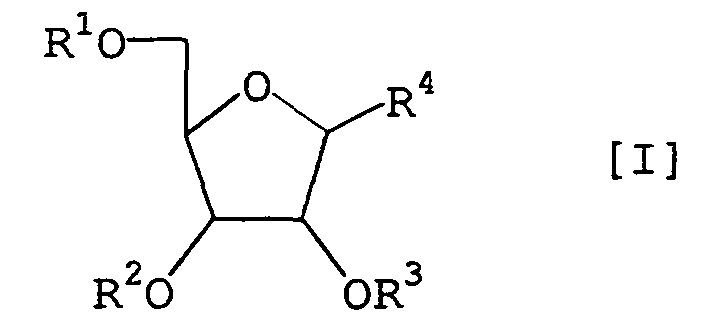
- the present inventors have conducted intensive studies in an attempt to solve the aforementioned problems. As a result, they have found that a nucleoside compound can be produced while suppressing a by-product, by subjecting a 2',3',5'-triacyloxynucleoside compound represented by the formula [I] to be mentioned below to deacylation using alkali metal hydroxide in a 0.01- to 0.5-fold amount in a molar ratio relative to the 2',3',5'-triacyloxynucleoside compound.
- a 2',3',5'-triacyloxynucleoside compound represented by the formula [I] to be mentioned below to deacylation using alkali metal hydroxide in a 0.01- to 0.5-fold amount in a molar ratio relative to the 2',3',5'-triacyloxynucleoside compound.
- the present inventors have also found that the production of hydrolysate can be markedly suppressed by carrying out an oxidation of a nucleoside-carboxylic acid compound while adjusting the pH value during the oxidation to fall within a particular range. Furthermore, the present inventors have found that a highly pure crystal of a nucleoside-carboxylic acid compound, wherein the impurity generated due to hydrolysis during an oxidation has been markedly reduced, can be obtained by extracting a nucleoside-carboxylic acid compound in a reaction mixture into an organic solvent under acidic conditions, back-extracting the compound from the organic solvent into an aqueous alkali solution, and neutralizing the aqueous alkali solution by adding an acid thereto to allow precipitation of a crystal.
- the present inventors have completed the present invention based on these findings.
- the present invention provides the following.
- R 1 , R 2 and R 3 in the present invention may be the same or different and each independently is an acyl group.
- the acyl group here is an acyl group generally having 1 to 20, preferably 2 to 8, carbon atoms and, for example, acetyl, propionyl, benzoyl and the like can be mentioned, with preference given to acetyl.
- X in the present invention is a hydrogen atom, a halogen atom, an amino group, an alkyl group, an aralkyl group, a substituted amino group or a hydroxyl group
- Y is a hydrogen atom, a halogen atom, an alkyl group, an aralkyl group or an aryl group.
- the halogen atom here is a chlorine atom, a fluorine atom, a bromine atom or an iodine atom, with preference given to a chlorine atom.
- the alkyl group here is a linear or branched chain alkyl group preferably having 1 to 10, more preferably 1 to 3, carbon atoms.
- methyl, ethyl, propyl and the like can be mentioned, with preference given to methyl.
- the aralkyl group here is an aralkyl group wherein the alkyl moiety is a linear or branched chain preferably having 1 to 5, more preferably 1, carbon atom, and the aryl moiety preferably has 6 to 10, more preferably 6 to 8, carbon atoms.
- benzyl and the like can be mentioned.
- the aryl group here preferably has 6 to 10, more preferably 6 to 8.
- a phenyl group and the like can be mentioned.
- the substituted amino group is an amino group monosubstituted or di-substituted by the following substituent and the like.
- the di-substituted amino group may have the same or different substituents.
- an acyl group (as defined above, preferably having 1 to 7 carbon atoms, for example, acetyl, propionyl, benzoyl and the like can be mentioned, and acetyl is particularly preferable), an alkyl group (as defined above, and methyl and ethyl are particularly preferable), an aryl group (as defined above, and phenyl is particularly preferable), an aralkyl group (as defined above, and benzyl is particularly preferable) and the like can be mentioned.
- substituted amino group acetylamino, methylamino, ethylamino, phenylamino, benzylamino and the like can be mentioned, with preference given to acetylamino and benzylamino.
- R 5 and R 6 in the present invention are optionally the same or different and each independently is an alkyl group.
- the alkyl group here is defined to be the same as the alkyl group for X or Y.
- the production method of nucleoside compound [II] in the present invention is characterized by deacylation of a 2',3',5'-triacyloxynucleoside compound using alkali metal hydroxide in a 0.01- to 0.5-fold amount in a molar ratio relative to the 2',3',5'-triacyloxynucleoside compound.
- a 2',3',5'-triacyloxynucleoside compound and alkali metal hydroxide 0.01-0.5 mol of the 2',3',5'-triacyloxynucleoside compound
- methanol-containing solvents e.g., methanol, or a mixed solvent of methanol and an organic solvent and the like
- methanol-containing solvent a solvent containing methanol generally at not less than 10%, preferably not less than 50%, more preferably not less than 70%, by volume
- the solvent contained other than methanol is not particularly limited as long as it is an organic solvent and, for example, tetrahydrofuran, acetonitrile and the like can be mentioned.
- the solvent usable for the production of nucleoside compound [II] is particularly preferably a single solvent of methanol.
- the total amount of the solvent to be used is generally 2-20, preferably 5-15, relative to the 2',3',5'-triacyloxynucleoside compound in a weight ratio.
- alkali metal hydroxide for example, sodium hydroxide, potassium hydroxide, lithium hydroxide and the like can be mentioned, with preference given to sodium hydroxide.
- the amount of alkali metal hydroxide to be used in the present invention is essentially 0.01- to 0.5-fold of the 2',3',5'-triacyloxynucleoside compound in a molar ratio.
- a preferable amount of use is 0.03- to 0.4-fold of the 2',3',5'-triacyloxynucleoside compound in a molar ratio.
- the temperature for the production of nucleoside compound [II] is generally -20°C to 50°C, preferably 0°C to 20°C.
- nucleoside compound [II] can be isolated and purified by conventional methods. For example, after the completion of the reaction, an acid (e.g., acetic acid and the like) and an organic solvent (e.g., ethyl acetate and the like) are added, the mixture is stirred, and the precipitate is collected by filtration and dried to give nucleoside compound [II].
- an acid e.g., acetic acid and the like
- organic solvent e.g., ethyl acetate and the like
- the 2',3'-hydroxyl-protected nucleoside compound in the present invention can be easily produced from nucleoside compound [II] in the present invention by a method known to those of ordinary skill in the art.
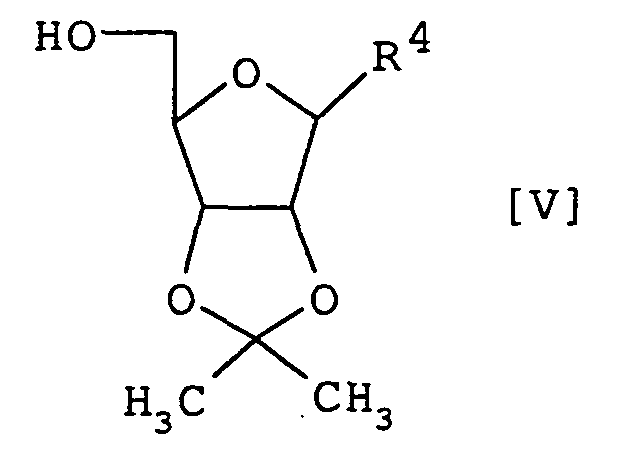
- an isopropylidene compound represented by the following formula (V): wherein R 4 is as defined above is particularly preferable.
- nucleoside compound [II] obtained by the method of the present invention is converted to an isopropylidene compound of the formula [V] by a conventional method by, for example, (A) reacting nucleoside compound [II] with 2,2-dimethoxypropane in an aprotic organic solvent in the presence of an acid catalyst, or (B) reacting nucleoside compound [II] with acetone to be used as a solvent and reaction reagent in the presence of an acid catalyst.
- the acid catalyst to be used in the above-mentioned methods (A) and (B) for example, inorganic acids such as hydrochloric acid, sulfuric acid and the like, and organic acids such as methanesulfonic acid, p -toluenesulfonic acid and the like (including hydrates thereof) can be mentioned.
- the amount of the acid catalyst to be used is generally 0.01 to 1-fold, preferably 0.01 to 0.5-fold, in a molar ratio relative to nucleoside compound [II].
- aprotic organic solvent to be used in the above-mentioned method (A) for example, acetone, acetonitrile, tetrahydrofuran, dichloromethane and the like can be mentioned, and the amount thereof to be used is generally 5-50, preferably 8-20, in a weight ratio relative to nucleoside compound [II].
- the amount of 2,2-dimethoxypropane to be used in the above-mentioned method (A) is generally 1-5, preferably 1-3, in a molar ratio relative to nucleoside compound [II].
- the amount of acetone to be used in the above-mentioned method (B) is generally 5-50, preferably 8-20, in a weight ratio relative to nucleoside compound [II].
- 2',3'-Hydroxyl-protected nucleoside compounds other than the isopropylidene compound can be also produced by a method similar to the above-mentioned production method of the isopropylidene compound or a method analogous thereto.
- the 2',3'-hydroxyl-protected nucleoside compound can be isolated and purified by a conventional method and, for example, the reaction mixture is added to an aqueous alkali (e.g., sodium hydrogen carbonate etc.) solution, the mixture is concentrated under reduced pressure, and the precipitate is filtered, washed with water and dried.
- an aqueous alkali e.g., sodium hydrogen carbonate etc.
- the carboxylic acid compound in the present invention can be produced from nucleoside compound [II] in the present invention via, for example, the 2',3'-hydroxyl-protected nucleoside compound in the present invention.
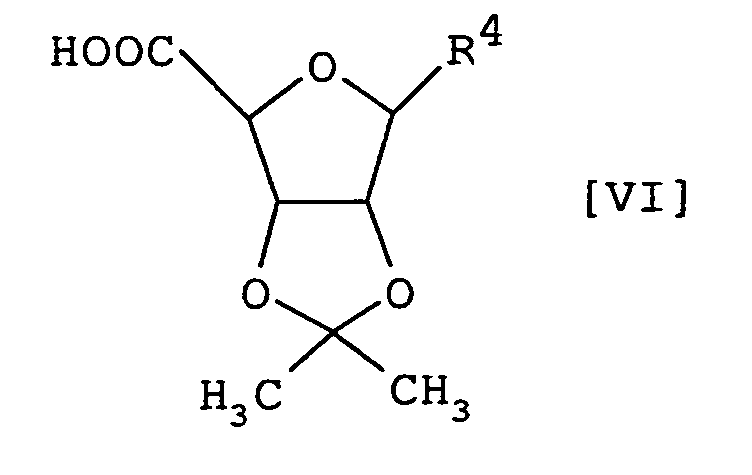
- the 2',3'-hydroxyl-protected nucleoside compound is particularly preferably an isopropylidene compound represented by the aforementioned formula [V] and the carboxylic acid compound is particularly preferably an isopropylidenecarboxylic acid compound represented by the following formula [VI]: wherein R 4 is as defined above.
- the 2',3'-hydroxyl-protected nucleoside compound can be converted to a carboxylic acid compound by oxidation of a 2',3'-hydroxyl-protected nucleoside compound.
- conventionally known methods for example, the methods described in JP-A-2000-524801, Tetrahedron Letters, vol. 37, No. 10, 1567-1570 and the like, methods analogous thereto and the like can be mentioned.
- a method capable of producing a carboxylic acid compound at a higher purity than by these conventionally known methods a method comprising oxidation of a 2',3'-hydroxyl-protected nucleoside compound in the presence of a 2,2,6,6-tetramethylpiperidine-1-oxy catalyst (TEMPO catalyst), and hypochlorite or hypobromite, while adjusting pH to fall within the range of 5 to 9, can be mentioned.
- TEMPO catalyst 2,2,6,6-tetramethylpiperidine-1-oxy catalyst
- reaction solvent usable for the above-mentioned reaction a mixed solvent of water and an organic solvent, and a two-phase solvent wherein an aqueous phase and an organic solvent phase are phase-separated are preferable.
- the organic solvent may be any as long as it is free of an influence of an oxidation and, for example, for use for a mixed solvent with water, acetonitrile, tetrahydrofuran, acetone and the like can be mentioned, and for use for a two-phase solvent, chloroform, dichloromethane, tert -butylmethylether, ethyl acetate and the like can be mentioned.
- the amount of the reaction solvent to be used is generally 3-50, preferably 5-20, in a weight ratio relative to a 2',3'-hydroxyl-protected nucleoside compound.
- a mixed solvent of water and an organic solvent or a two-phase solvent is used as a reaction solvent, the total amount of the solvent only needs to be included in this range.
- TEMPO-like compounds showing an oxidation catalytic function similar to that of TEMPO can be mentioned besides TEMPO.
- TEMPO-like compound for example, 4-hydroxy-2,2,6,6-tetramethylpiperidin-1-oxy, 4-methoxy-2,2,6,6-tetramethylpiperidin-1-oxy, 4-hydroxy-2,2,6,6-tetramethylpiperidin-1-oxybenzoate and the like can be mentioned.
- the amount of the TEMPO catalyst to be used is generally 0.0001-0.3, preferably 0.005-0.02, in a molar ratio relative to a 2',3'-hydroxyl-protected nucleoside compound.
- hypochlorite for example, sodium hypochlorite, calcium hypochlorite and the like can be mentioned.
- hypobromite for example, sodium hypobromite and the like can be mentioned.
- Sodium hypochlorite and sodium hypobromite are commercially available generally in the form of an aqueous solution
- calcium hypochlorite is commercially available generally in the form of a solid.
- the amount of hypochlorite or hypobromite to be used is generally 1.9-3.0, preferably 2.0-2.3, in a molar ratio relative to a 2',3'-hydroxyl-protected nucleoside compound.
- the amount is too small, the reaction becomes insufficient and the starting material tends to remain as an impurity.
- the amount is too high, it is economically unpreferable, and the impurity due to hydrolysis tends to increase.
- the pH for the oxidation is adjusted to the range of 5-9, preferably 6.5-8.
- a 2',3'-hydroxyl-protected nucleoside compound tends to decompose and when the pH is too low, the reaction rate of the oxidation tends to decrease.
- the oxidation can be carried out by, for example, adding hypochlorite or hypobromite to a solvent containing a 2',3'-hydroxyl-protected nucleoside compound and a TEMPO catalyst.
- the 2',3'-hydroxyl-protected nucleoside compound does not need to be completely dissolved in the solvent, and may be reacted in a suspension state as long as the object carboxylic acid compound is dissolved in a solvent in the system.
- hypochlorite and hypobromite are preferably added in the form of an aqueous solution, in the case of, for example, commercially available solid such as calcium hypochlorite, it can be added as a solid.
- Addition of hypochlorite or hypobromite tends to increase pH, and when added in a short time, the pH value of the reaction mixture becomes too high to allow hydrolysis. Therefore, addition by small portions while adjusting pH to fall within the range of 5-9, preferably 6.5-8, is preferable.
- the addition can be performed generally in 30 min - 5 hr, preferably 2-4 hr.
- the reaction may be carried out while dissolving a buffer such as sodium hydrogen carbonate, potassium hydrogen carbonate, sodium hydrogen phosphate and the like in a reaction mixture.
- the buffer may be dissolved in a reaction mixture from the start.
- the pH can be adjusted by controlling the addition rate of hypochlorite or hypobromite and buffer as mentioned above, as well as by appropriately adding a base such as sodium hydroxide, sodium carbonate, potassium hydroxide and the like, and an acid such as phosphoric acid, hydrochloric acid, sulfuric acid and the like. Even when the oxidation is conducted while adjusting pH, hydrolysis cannot be completely inhibited. However, the impurity generated by hydrolysis can be efficiently removed by obtaining the object crystal according to the crystal precipitation method of the present invention explained in the following.
- the oxidant compound having an oxidizing ability derived from hypochlorite or hypobromite added
- hydrogen sulfite such as sodium hydrogen sulfite and the like. Contamination of the object product with an oxidant possibly causes a problem of an adverse influence on the reaction during production of a derivative compound using the object product and the like.
- Hydrogen sulfite may be added in a solid state or an aqueous solution state.
- the amount of addition is not particularly limited, and it is preferable to confirm progress of the decomposition of the oxidant using a peroxide test paper (e.g., Merckoquant (trademark, manufactured by Merck)) and the like, and continue to add until the oxidant is completely decomposed.
- a peroxide test paper e.g., Merckoquant (trademark, manufactured by Merck)
- Use of sulfites such as sodium sulfite and the like is not preferable, because it is basic and tends to cause hydrolysis.
- a crystal can be obtained stably by, after extraction of the object carboxylic acid compound into an organic solvent under acidic conditions, back-extracting the compound from the organic solvent into an aqueous alkali solution, and neutralizing the obtained aqueous alkali solution by adding an acid thereto to allow crystal precipitation of the carboxylic acid compound.
- highly pure carboxylic acid compound, from which impurity has been considerably removed, can be obtained.
- the 2',3',5'-triacyloxynucleoside compound to be used as a starting material can be produced by, for example, a method described in Nucleic Acid Chem. (1991), 264-268.
- 2',3',5'-triacetyl-6-chloropurineriboside which is one of the starting materials, can be produced by adding dropwise thionyl chloride to 2',3',5'-triacetylinosine in a solvent, stirring under refluxing and workup by a conventional method.
- the carboxylic acid compound of the present invention can be led to a compound such as adenosine A1 agonist etc. useful as a pharmaceutical product by, for example, a method described in JP-A-2000-514801 and the like or a method analogous thereto.
- the hydroxyl groups at the 2'-position and 3'-position of the nucleoside compound are preferably protected.
- a nucleoside-carboxylic acid compound represented by the formula (2) can be efficiently produced.
- hydrolysis that occurs during the oxidation can be also suppressed. wherein each symbol in the formula is as defined below.
- R 9 shows a group of the following formula (3) or (4) :
- nucleoside compound represented by the formula (1) shows a compound represented by the following (1-a) or (1-b)
- a nucleoside-carboxylic acid compound represented by the formula (2) shows a compound represented by the following (2-a) or (2-b):
- X' is a hydrogen atom, a halogen atom, an amino group, a substituted (i.e., protected) amino group or a hydroxyl group.
- halogen atom a chlorine atom, a bromine atom, a fluorine atom and the like can be mentioned.
- an acylamino group having 1 to 7 carbon atoms e.g., acetylamino group, benzoylamino group etc.
- an alkylamino group having 1 to 6 carbon atoms e.g., methylamino group etc.
- an aralkylamino group having 7 to 11 carbon atoms e.g., benzylamino group
- Y' is a hydrogen atom, a halogen atom, an alkyl group or an aralkyl group.
- halogen atom for example, chlorine atom, bromine atom, fluorine atom and the like can be mentioned.
- alkyl group for example, an alkyl group having 1 to 6 carbon atoms such as a methyl group and the like, and the like can be mentioned.
- aralkyl group for example, an aralkyl group having 7 to 11 carbon atoms such as a benzyl group and the like, and the like can be mentioned.
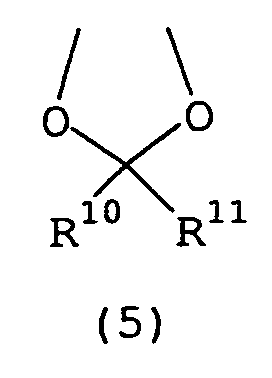
- R 7 and R 8 are each independently a hydrogen atom, an acyloxy group, an alkyloxy group, an aralkyloxy group or a tert -butyldimethylsilyloxy group, or R 7 and R 8 in combination show a group represented by the following formula (5):
- R 10 and R 11 are each independently an alkyl group.
- the alkyl group for example, an alkyl group having 1 to 6 carbon atoms such as a methyl group and the like, and the like can be mentioned.
- acyloxy group for example, an acyl group having 1 to 7 carbon atoms such as acetyloxy group, benzoyloxy group and the like can be mentioned.
- alkyloxy group for example, an alkyloxy group having 1 to 6 carbon atoms such as a methyloxy group and the like can be mentioned.
- aralkyloxy group for example, an aralkyloxy group having 7 to 11 carbon atoms such as a benzyloxy group and the like can be mentioned.
- alkyl group represented by R 10 or R 11 for example, an alkyl group having 1 to 6 carbon atoms such as a methyl group and the like can be mentioned.
- the nucleoside compound represented by the formula (1) of the present invention can be produced according to a known method, for example, such as a method described in Journal of Organic Chemistry, 1987, vol. 52, pp. 1344-1347, a method described in Collection of Czechoslovak Chemical Communications, 2002, vol. 67, pp. 325-335 and the like.
- a nucleoside-carboxylic acid compound represented by the formula (2) or a salt thereof can be obtained by oxidation (TEMPO catalyst oxidation) of the nucleoside compound represented by the formula (1) in the presence of a 2,2,6,6-tetramethylpiperidine-1-oxy catalyst (TEMPO catalyst), and hypochlorite or hypobromite, while adjusting pH to fall within the range of 5-9.
- TEMPO catalyst oxidation 2,2,6,6-tetramethylpiperidine-1-oxy catalyst
- hypochlorite or hypobromite while adjusting pH to fall within the range of 5-9.
- a reaction solvent a mixed solvent of water and an organic solvent, and a two-phase solvent wherein an aqueous phase and an organic solvent phase are phase-separated are preferable.
- the organic solvent may be any as long as it is free of an influence of an oxidation and, for example, for use for a mixed solvent with water, an organic solvent such as acetonitrile, tetrahydrofuran, acetone and the like can be mentioned, and for use for a two-phase solvent, an organic solvent such as chloroform, dichloromethane, tert-butylmethylether, acetates (e.g., methyl acetate, ethyl acetate etc.) and the like can be mentioned.
- the amount of the reaction solvent to be used is generally 3-50, preferably 5-20, in a weight ratio relative to a nucleoside compound (1).
- a mixed solvent of water and an organic solvent or a two-phase solvent is used, the whole solvent only needs to be included in this range.
- 2,2,6,6-tetramethylpiperidine-1-oxy catalyst 2,2,6,6-tetramethylpiperidine-1-oxy(TEMPO) and TEMPO-like compounds showing an oxidation catalytic function similar to that of TEMPO
- TEMPO catalyst 2,2,6,6-tetramethylpiperidine-1-oxy catalyst
- TEMPO-like compound for example, 4-hydroxy-2,2,6,6-tetramethylpiperidin-1-oxy, 4-methoxy-2,2,6,6-tetramethylpiperidin-1-oxy, 4-hydroxy-2,2,6,6-tetramethylpiperidin-1-oxybenzoate and the like can be mentioned.
- the amount of the TEMPO catalyst to be used is generally 0.0001-0.3, preferably 0.005-0.02, in a molar ratio relative to nucleoside compound (1).
- hypochlorite for example, sodium hypochlorite, calcium hypochlorite and the like can be mentioned.
- hypobromite for example, sodium hypobromite and the like can be mentioned.
- Sodium hypochlorite and sodium hypobromite are commercially available generally in the form of an aqueous solution
- calcium hypochlorite is commercially available generally in the form of a solid.
- the amount of hypochlorite or hypobromite to be used is generally 1.9-3.0, preferably 2.0-2.5, more preferably 2.0-2.3, in a molar ratio relative to nucleoside compound (1).
- the amount is too small, the reaction becomes insufficient and the starting material tends to remain as an impurity.
- the amount is too high, it is economically unpreferable, and the impurity due to hydrolysis tends to increase.
- the pH for the oxidation is adjusted to the range of 5-9, preferably 6.5-8.
- the nucleoside compound (1) tends to decompose and when the pH is too low, the reaction rate of the oxidation tends to decrease.
- the oxidation can be carried out by, for example, adding hypochlorite or hypobromite to a solvent containing a nucleoside compound (1) and a TEMPO catalyst.
- the nucleoside compound (1) does not need to be completely dissolved in the solvent, and may be reacted in a suspension state as long as the object carboxylic acid compound is dissolved in a solvent in the system.
- hypochlorite and hypobromite are preferably added in the form of an aqueous solution, in the case of, for example, commercially available solid such as calcium hypochlorite, it can be added as a solid.
- Addition of hypochlorite or hypobromite tends to increase pH, and when added in a short time, the pH value of the reaction mixture becomes too high to allow hydrolysis. Therefore, addition by small portions while adjusting pH to fall within the range of 5-9, preferably 6.5-8, is preferable.
- the addition can be performed generally in 30 min - 5 hr, preferably 2-4 hr.
- the reaction may be carried out while dissolving a buffer such as sodium hydrogen carbonate, potassium hydrogen carbonate, sodium hydrogen phosphate and the like in a reaction mixture.
- the buffer may be dissolved in a reaction mixture from the start.
- the pH can be adjusted by controlling the addition rate of hypochlorite or hypobromite and buffer as mentioned above, as well as by appropriately adding a base such as sodium hydroxide, sodium carbonate, potassium hydroxide and the like, and an acid such as phosphoric acid, hydrochloric acid, sulfuric acid and the like. Even when oxidation is conducted while adjusting pH, hydrolysis cannot be completely inhibited. However, the impurity generated by hydrolysis during oxidation can be efficiently removed by obtaining the object crystal according to the crystal precipitation method of the present invention explained in the following.
- the oxidant compound having an oxidizing ability derived from hypochlorite or hypobromite added
- hydrogen sulfite such as sodium hydrogen sulfite and the like.
- Contamination of the object product with an oxidant possibly causes a problem of an adverse influence on the reaction during production of a derivative compound using the object product and the like.
- Hydrogen sulfite may be added in a solid state or an aqueous solution state.
- the amount of addition is not particularly limited, and it is preferable to confirm progress of the decomposition of the oxidant using a peroxide test paper (e.g., Merckoquant (trademark, manufactured by Merck)) and the like, and continue to add until the oxidant is completely decomposed.
- a peroxide test paper e.g., Merckoquant (trademark, manufactured by Merck)
- Use of sulfites such as sodium sulfite and the like is not preferable, because it is basic and tends to cause hydrolysis.
- a crystal of the object nucleoside-carboxylic acid compound can be obtained stably by, after extraction of the object nucleoside-carboxylic acid compound into an organic solvent under acidic conditions, back-extracting the compound from the organic solvent into an aqueous alkali solution, and neutralizing the obtained aqueous alkali solution by adding an acid thereto to allow crystal precipitation of the nucleoside-carboxylic acid compound.
- highly pure nucleoside-carboxylic acid compound, from which impurity has been considerably removed, can be obtained.
- a crystal of a salt of the nucleoside-carboxylic acid compound can be also obtained by precipitating a crystal after extraction of the object nucleoside-carboxylic acid compound into an organic solvent under acidic conditions and back-extracting the compound from the organic solvent into an aqueous alkali solution to allow neutralization, or back-extracting the compound from the organic solvent into water and neutralization with an aqueous alkali solution.
- alkali metal salts such as sodium salt, potassium salt and the like, and the like can be mentioned.
- a case wherein crystal precipitation of a nucleoside-carboxylic acid compound is performed sequentially from an oxidation is taken as an example and explained. Recrystallization of a solid of a nucleoside-carboxylic acid compound containing impurity for purification can be conducted according to this method.
- a chlororiboside carboxylic acid compound present in a reaction mixture is extracted into an organic solvent under acidic conditions.
- an acid such as phosphoric acid, hydrochloric acid, sulfuric acid and the like and the pH is adjusted to the range of 1.5-3.5, preferably 2.0-3.0, to acidify the solution.
- an acid is added to the aqueous layer side to adjust pH to the above-mentioned range.
- the organic solvent to be used for extraction ethyl acetate, chloroform, tert -butylmethyl ether and the like can be mentioned, with particular preference given to ethyl acetate.
- the organic solvent may be added before or after the pH adjustment.
- extraction is performed by a conventional method and the organic layer, into which the object product has been extracted, is separated. While the temperature of extraction is not particularly limited, it is generally in the range of 10-40°C.
- the amount of the organic solvent to be used for the extraction is generally 5-50, preferably 8-20, in weight ratio relative to the object product. Extraction may be performed multiple times where necessary.
- the object product is back-extracted from the organic solvent, into which the object product has been extracted, into the aqueous alkali solution.
- a base such as sodium hydroxide, potassium hydroxide, sodium hydrogen carbonate and the like is added to water, pH is adjusted to the range of 5-12, preferably 6-8, to give an aqueous alkali solution.
- Extraction is performed using the above-mentioned organic solvent and the aqueous alkali solution by a conventional method and, after back-extraction of the object product into the aqueous layer (aqueous alkali solution layer), the aqueous layer, into which the object product has been extracted, is separated. While the temperature of extraction is not particularly limited, it is generally in the range of 0-40°C.
- the amount of water to be used for the extraction is generally 5-50, preferably 8-20, in weight ratio relative to the object product. Extraction may be performed multiple times where necessary.
- an acid is added to the aqueous alkali solution, into which the object product has been extracted, to perform neutralization to allow crystal precipitation. It is also possible to perform neutralization to allow crystal precipitation after appropriately adding an organic solvent miscible with water, such as methanol, ethanol, acetone and the like, to the aqueous alkali solution. In this case, the amount of the organic solvent to be added is in the range of generally 1-50 in volume ratio relative to the aqueous alkali solution.
- the acid to be used for the neutralization to allow crystal precipitation phosphoric acid, hydrochloric acid, sulfuric acid and the like can be mentioned.
- the pH of neutralization to allow crystal precipitation is generally 1.5-3.5, preferably 2.0-3.0.
- the temperature of crystal precipitation is generally 0-80°C, preferably 10-40°C.
- the crystal precipitation is generally performed under stirring.
- the slurry obtained by crystal precipitation is subjected to solid-liquid separation by a conventional method such as filtration, centrifugation and the like to isolate a crystal.
- the crystal may be washed with water, alcohol and the like, and a drying step may be introduced according to a conventional method.
- the crystal obtained in this way becomes a highly pure crystal, wherein the hydrolysate difficult to be removed can be efficiently removed by the method of the present invention.
- nucleoside-carboxylic acid compounds represented by the formula (2) 2',3'-isopropylidene-6-chloropurineriboside - 5'-carboxylic acid represented by the following formula (6) is preferable in consideration of the usefulness of an adenosine receptor agonist as a synthetic intermediate and easiness of deprotection:
- 2',3',5'-Triacetylinosine (20 g) was added to chloroform (160 ml) and N,N-dimethylformamide (2.7 g), thionyl chloride (19.9 g) was added dropwise thereto, and the mixture was stirred under reflux for 3 hr. Water (200 ml) was added under cooling in an ice bath. The mixture was stirred for 1 hr and partitioned. The organic layer was washed with 5% aqueous sodium hydrogen carbonate solution and saturated brine, dried over sodium sulfate and concentrated to dryness to give 2',3',5'-triacetyl-6-chloropurineriboside (24.4 g) as an oil.
- 2',3',5'-Triacetyl-6-chloropurineriboside (oil, 6.0 g) was dissolved in methanol (30 ml). The mixture was cooled to 5°C and 1N sodium hydroxide-methanol solution (0.6 ml) was added. The mixture was stirred for 5 hr. Acetic acid (0.04 ml) and ethyl acetate (30 ml) was added to the reaction mixture and the mixture was stirred under ice-cooling for 1 hr. The precipitate was collected by filtration, washed with ethyl acetate, and vacuum dried at 40°C to give the title compound (3.08 g).
- 6-Chloropurineriboside (10.0 g) was suspended in acetone (70 ml), 2,2-dimethoxypropane (7.3 g) and p -toluenesulfonic acid monohydrate (3.3 g) was added thereto, and the mixture was stirred at 10°C for 3 hr.
- the reaction mixture was added to a solution of sodium hydrogen carbonate (1.8 g) and water (70 ml).
- the mixture was concentrated under reduced pressure, and stirred at 20°C for 3 hr.
- the precipitate was collected by filtration, washed with water, and dried overnight at 40°C under reduced pressure to give 2',3'-isopropylidene-6-chloropurineriboside (9.7 g).
- 2',3'-Isopropylidene-6-chloropurineriboside (605 g, 1.085 mol) was added to a mixed solvent of acetonitrile (3630 ml) and water (1025 ml).
- Sodium hydrogen carbonate 106 g
- 2,2,6,6-tetramethylpiperidin-1-oxy TEMPO, 5.8 g
- An aqueous sodium hypochlorite solution (effective chlorine concentration 11%, 3034 g) was added dropwise over 3.4 hr while stirring at 5°C, and the mixture was further stirred for 1 hr.
- the aqueous layer was adjusted to pH 2.8 with 6N hydrochloric acid and the mixture was subjected to neutralization to allow crystal precipitation at 30°C. After crystal precipitation with stirring for about 17 hr, the slurry was filtered. The separated crystals were washed with water and dried overnight at 50°C under reduced pressure to give 2',3'-isopropylidene-6-chloropurineriboside-5'-carboxylic acid as crystals (493 g, 1.45 mol).
- 6-Chloropurineriboside (640 g, 2.23 mol) was suspended in acetone (5120 ml), and dimethoxypropane (494 g) and p-toluenesulfonic acid monohydrate (212 g) were added. The mixture was stirred at 17-23°C for 5 hr. This reaction mixture was added to an aqueous solution of sodium hydrogen carbonate (99 g) and water (4480 ml). The aqueous solution was concentrated under reduced pressure, and stirred at 60°C for 2 hr and further at room temperature for about 17 hr. The obtained slurry was filtered, and the separated crystals were washed with water to give 2',3'-isopropylidene-6-chloropurineriboside as crystals (612 g, 1.87 mol).
- 2',3'-Isopropylidene-6-chloropurineriboside (605 g, 1.85 mol) was added to a mixed solvent of acetonitrile (3630 ml) and water (3025 ml), and sodium hydrogen carbonate (106 g) and 2,2,6,6-tetramethylpiperidine-1-oxy (TEMPO) (5.8 g, 0.037 mol) were added.
- An aqueous sodium hypochlorite solution (effective chlorine concentration 11%, 3034 g, 4.25 mol) was added dropwise over 3.4 hr while stirring at 5°C, and the mixture was further stirred for 1 hr.
- the aqueous layer containing the extracted object product was separated, and the aqueous layer was adjusted to pH 2.8 with 6N hydrochloric acid.
- the mixture was subjected to neutralization to allow crystal precipitation at 30°C.
- the slurry was filtered.
- the separated crystals were washed with water and dried overnight at 50°C under reduced pressure to give 2',3'-isopropylidene-6-chloropurineriboside-5'-carboxylic acid as crystals (493 g, 1.45 mol).
- the content of the impurity in the crystals was confirmed by HPLC and found to be 0.1%.
- 2',3'-Isopropylidene-6-chloropurineriboside (0.5 g, 1.53 mmol) was suspended in acetonitrile (3.5 ml) and water (3 ml), and sodium dihydrogen phosphate (0.4 g) was added to adjust its pH to 7.
- 2,2,6,6-Tetramethylpiperidin-1-oxy (TEMPO) (8 mg, 0.05 mmol) was added.
- An aqueous sodium hypochlorite solution (effective chlorine concentration 111%, 2.86 g, 3.87 mmol) was added dropwise over 60 min while stirring at 5°C, and the mixture was further stirred for 1 hr. During the reaction, the reaction mixture was maintained at pH 7.0-7.5.
- reaction mixture was analyzed by HPLC.
- 2',3'-isopropylidene-6-chloropurineriboside-5'-carboxylic acid was produced in a yield of 92%, and the content of the impurity was 2%.
- 2',3'-Isopropylidene-6-chloropurineriboside (0.6 g, 1.8 mmol) was suspended in acetonitrile (3.5 ml) and water (3 ml), and sodium hydrogen carbonate (0.2 g) and tetramethylpyridyl oxy (TEMPO) (8 mg, 0.05 mmol) were added.
- 60% Calcium hypochlorite (0.57 g, 4.39 mmol) was added in 4 portions over 1 hr while stirring at 5°C, and the mixture was further stirred for 1 hr.
- the pH immediately after the start of the reaction was 9.5, and it was adjusted to 7 to 8 in about 10 min after addition of the calcium hypochlorite. Thereafter, this pH value was maintained.
- reaction mixture was analyzed by HPLC.
- 2',3'-isopropylidene-6-chloropurineriboside-5'-carboxylic acid was produced in a yield of 91%, and the content of the impurity was 3%.
- 2',3'-Isopropylidene-6-chloropurineriboside (6.05 g, 18.5 mmol) was added to acetonitrile (36 ml) and water (21 ml), and sodium hydrogen carbonate (0.4 g) and tetramethylpyridyloxy (TEMPO) (0.058 g, 0.37 mmol) were added.
- the mixture was stirred at 5°C.
- An aqueous sodium chlorite solution (effective chlorine concentration 11%, 30.4 g, 41.1 mmol) was added over 3 hr, during which the pH was maintained at 6.5-7.5 by the addition of 20% aqueous sodium hydrogen carbonate solution. The mixture was further stirred overnight, and the pH was maintained at 6.5-7.5.
- 2',3'-Isopropylidene-6-chloropurineriboside (0.5 g, 1.5 mmol) was suspended in acetonitrile (3.5 ml) and water (3 ml), and sodium hydrogen carbonate (0.35 g) and 2,2,6,6-tetramethylpiperidine-1-oxy (TEMPO) (8 mg, 0.05 mmol) were added.
- An aqueous sodium hypochlorite solution (effective chlorine concentration 11%, 2.86 g) was added dropwise over 10 min while stirring at 5°C, and the mixture was further stirred for 1 hr.
- the pH of the reaction mixture was between 8.0 and 12.0.
- the reaction mixture was analyzed by HPLC. As a result, 2',3'-isopropylidene-6-chloropurineriboside-5'-carboxylic acid was produced in a yield of 85%, and the content of the impurity was 9%.
- nucleoside compound [II] formation of byproducts can be suppressed and nucleoside compound [II] can be produced. Therefore, nucleoside derivatives (2',3'-hydroxyl-protected nucleoside compound [III], carboxylic acid compound [IV]) can be also produced utilizing the nucleoside compound [II].
- the aforementioned nucleoside-carboxylic acid compound represented by the formula (2) and a salt thereof can be produced by a method suitable for industrial production.
- hypochlorite or hypobromite which is highly safe as an oxidant and which can easily control the reaction
- hydrolysis which is a side reaction
- the resulting hydrolysate can be efficiently removed, and highly pure crystals of a nucleoside-carboxylic acid compound represented by the formula (2) and a salt thereof can be produced by a method suitable for industrial production.
Landscapes
- Chemical & Material Sciences (AREA)
- Organic Chemistry (AREA)
- Health & Medical Sciences (AREA)
- Life Sciences & Earth Sciences (AREA)
- Engineering & Computer Science (AREA)
- Biochemistry (AREA)
- Biotechnology (AREA)
- General Health & Medical Sciences (AREA)
- Genetics & Genomics (AREA)
- Molecular Biology (AREA)
- Saccharide Compounds (AREA)
- Pharmaceuticals Containing Other Organic And Inorganic Compounds (AREA)
Abstract
The present invention relates to a production method of a
nucleoside compound represented by the formula [II] which
includes subjecting a 2',3',5'-triacyloxynucleoside compound
represented by the formula [I] to deacylation using alkali metal
hydroxide in a 0.01- to 0.5-fold amount in a molar ratio
relative to the 2',3',5'-triacyloxynucleoside compound.
According to the present invention, a production method of a
nucleoside compound of the formula [II] which suppresses a by-product,
and a production method of a nucleoside derivative
which utilizes this method can be provided. In addition, the
present invention relates to oxidation of a nucleoside compound
represented by the formula (1) in the presence of a 2,2,6,6-tetramethylpiperidine-1-oxy
catalyst, and hypochlorite or
hypobromite, while adjusting pH to fall within the range of 5-9,
and further, extracting a nucleoside-carboxylic acid compound
represented by the formula (2) into an organic solvent under
acidic conditions, back-extracting the compound from the organic
solvent into an aqueous alkali solution, and neutralizing the
aqueous alkali solution by adding an acid thereto to allow
precipitation of a crystal. Thus, a highly pure particular
nucleoside-carboxylic acid compound or a salt thereof can be
produced by a method suitable for industrial production:

Description
The present invention relates to a production method of a
particular nucleoside compound and a derivative thereof.
Moreover, the present invention relates to a production
method of a nucleoside-carboxylic acid compound or a salt
thereof, more particularly, a production method of a nucleoside-carboxylic
acid compound or a salt thereof, which comprises
oxidation of a nucleoside compound under particular conditions,
and further a production method of a crystal of a nucleoside-carboxylic
acid compound or a salt thereof, which comprises
crystal precipitation of the compound or a salt thereof under
particular conditions, and the like.
A nucleoside compound represented by the formula [II]:
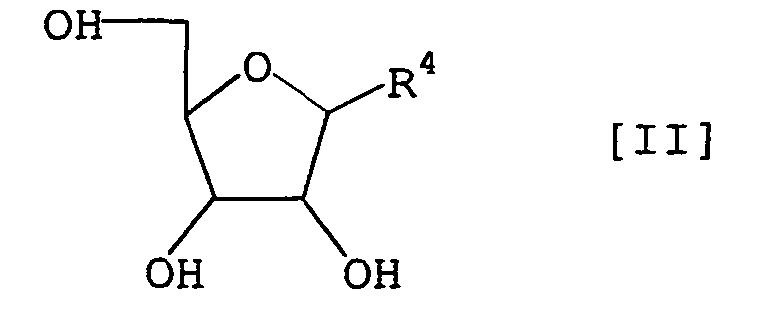 wherein R4 is a group represented by
 wherein X is a hydrogen atom, a halogen atom, an amino group, an
alkyl group, an aralkyl group, a substituted amino group or a
hydroxyl group, and Y is a hydrogen atom, a halogen atom, an
alkyl group, an aralkyl group or an aryl group
is useful as a synthetic intermediate for pharmaceutical
products. There are various known production methods for the
nucleoside compound. For example, conventional methods include
subjecting a sugar compound, wherein three hydroxyl groups of a
ribose skeleton have been protected, to a coupling reaction with
a nucleic acid base, or subjecting nucleoside, after protecting
three hydroxyl groups of the sugar moiety thereof, to various
reactions for modifying a nucleic acid base, thereby producing a
hydroxyl-protected nucleoside compound represented by the
following formula:
wherein X is a hydrogen atom, a halogen atom, an amino group, an
alkyl group, an aralkyl group, a substituted amino group or a
hydroxyl group, and Y is a hydrogen atom, a halogen atom, an
alkyl group, an aralkyl group or an aryl group
is useful as a synthetic intermediate for pharmaceutical
products. There are various known production methods for the
nucleoside compound. For example, conventional methods include
subjecting a sugar compound, wherein three hydroxyl groups of a
ribose skeleton have been protected, to a coupling reaction with
a nucleic acid base, or subjecting nucleoside, after protecting
three hydroxyl groups of the sugar moiety thereof, to various
reactions for modifying a nucleic acid base, thereby producing a
hydroxyl-protected nucleoside compound represented by the
following formula:
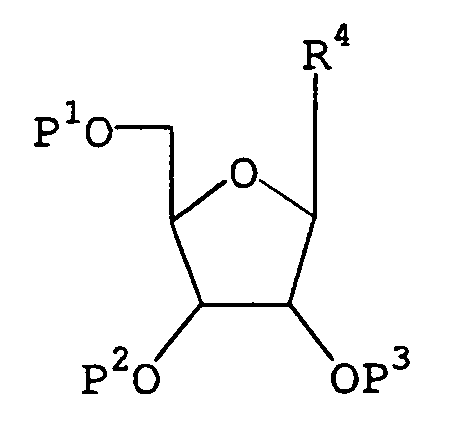 wherein R4 is as defined above and P1, P2 and P3 are the same or
different and each independently is a hydroxyl-protecting group.
(hereinafter sometimes to be abbreviated as a protected
compound), which is followed by deprotection.
wherein R4 is as defined above and P1, P2 and P3 are the same or
different and each independently is a hydroxyl-protecting group.
(hereinafter sometimes to be abbreviated as a protected
compound), which is followed by deprotection.
As specific examples of deprotection of a protected
compound, wherein a nucleic acid base is a purine base, and a
compound analogous thereto, the methods shown in the following
scheme can be mentioned.
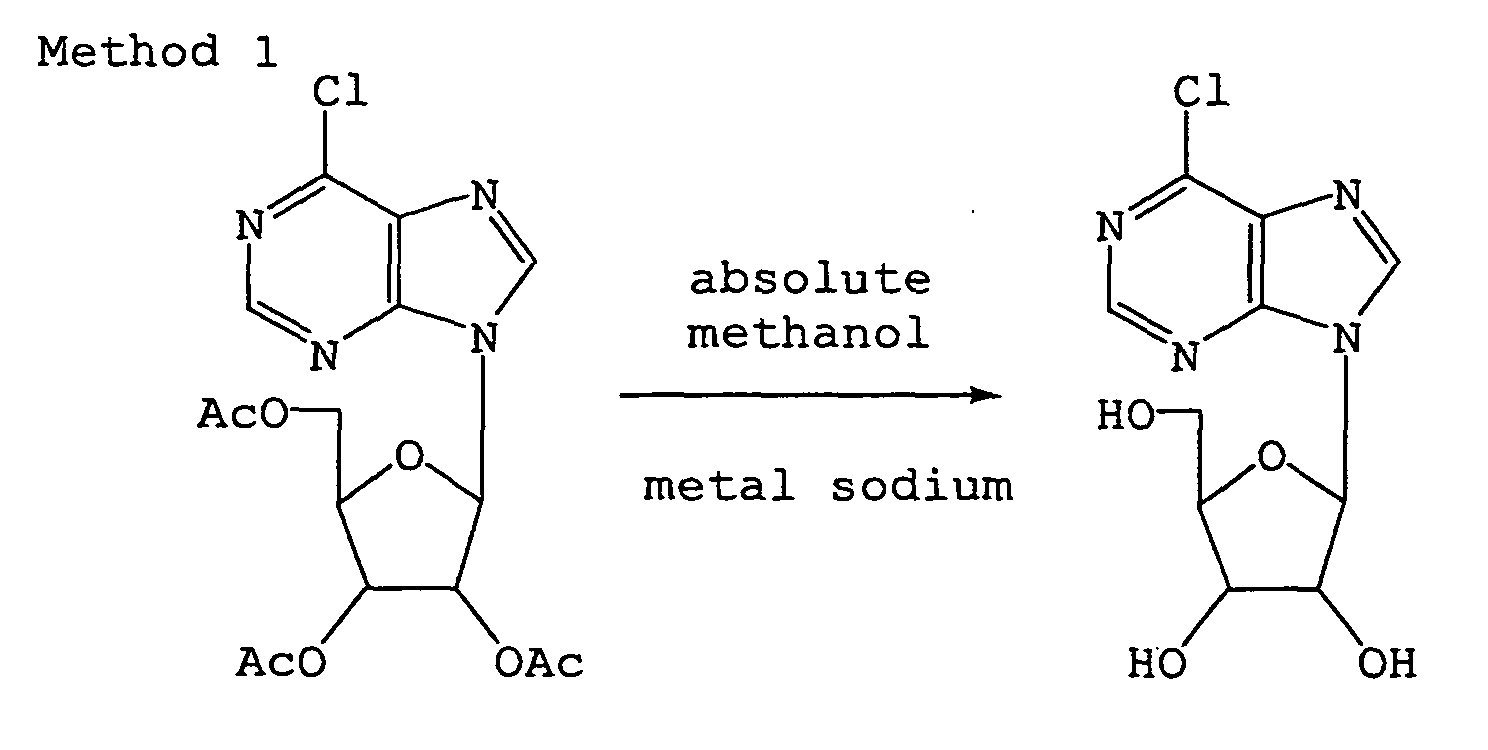
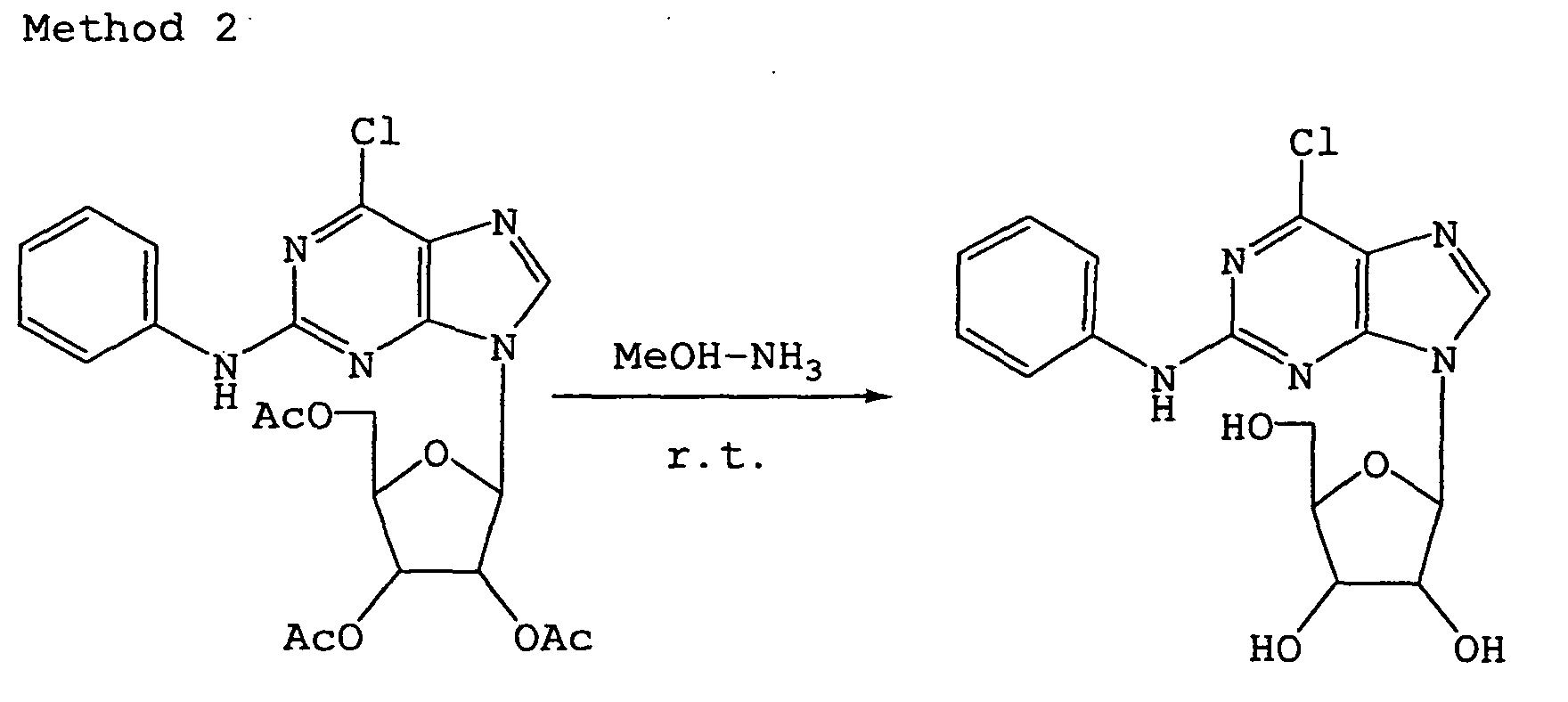
Method 1 is associated with a problem in that a by-product
(6-methoxy form), wherein a chlorine atom at the 6-position is
substituted by a methoxy group, is produced, and Method 2 is
also associated with a problem in that ammonia (NH3) is reacted
at the position of a chlorine atom to give a by-product (6-amino
form).
Various reports have been made on the deprotection of a
protected compound wherein the 6-position of the purine ring of
the protected compound is not a chloro group but an oxo group
and, for example, a method using an aqueous potassium hydroxide
solution and the like in not less than an equivalent amount
relative to a hydroxyl-protecting group (e.g., acetyl group and
the like) in an aqueous methanol solution (e.g., Journal of
Organic Chemistry, (US), 1988, vol. 53, No. 3, p. 505), and the
like can be mentioned. However, when this method is applied to
a 6-chloro-2',3',5'-hydroxyl-protected-nucleoside compound,
hydrolysis occurs at the 6-position (chloro-position) to give a
by-product (6-hydroxyl form). In addition, since an aqueous
organic solvent is used in the above-mentioned method, when a
protected compound is subjected to a deacetylation reaction with
alkali metal hydroxide, the released protecting group becomes an
acid (acetic acid when the protecting group is an acetyl group),
which is further neutralized with alkali metal hydroxide used
for deacetylation, whereby a salt is by-produced in an almost
stoichiometric amount relative to the protected compound.
Therefore, a step for removing the salt by-produced in the
above-mentioned method by extraction, washing and the like
becomes necessary.
Thus, the development of a production method of a
nucleoside compound, which suppresses a side reaction (e.g.,
reaction at the chloro group of the 6-position when nucleic acid
base is a purine base, reaction at the chloro group of the 4-position
in the case of a pyrimidine base and the like) and
production of a salt and which, in consequence, can suppress by-production,
has been desired.
In addition, it is known that a nucleoside-carboxylic acid
compound represented by 2',3'-isopropylidene-6-chloropurineriboside-5'-carboxylic
acid represented by the
following formula (6)
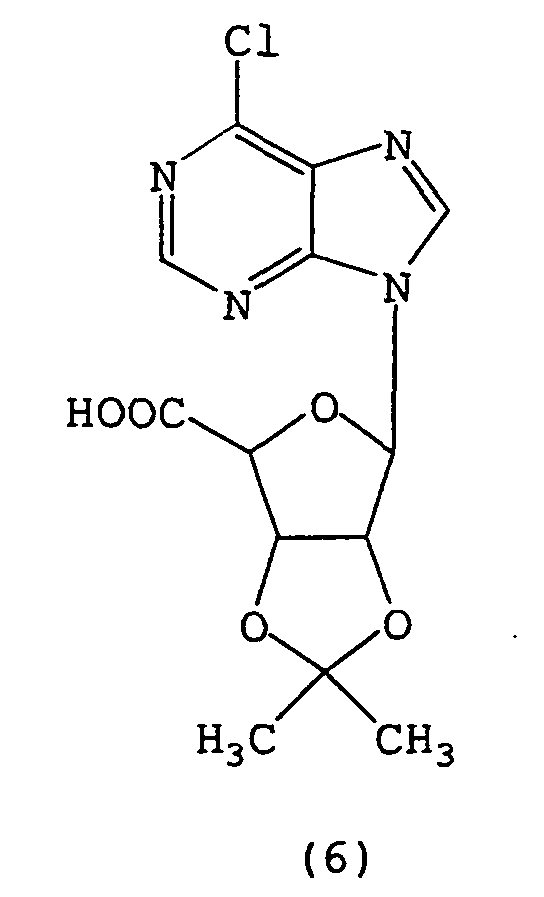 is useful as a synthetic intermediate for a pharmaceutical
product and the like. As a production method of such
nucleoside-carboxylic acid compound, for example, a method
comprising oxidizing the corresponding 5'-hydroxyl group of a
nucleoside compound to lead to a 5'-carboxyl group is known.
For example, in JP-A-2000-514801, Example 1, a method comprising
oxidizing 2',3'-isopropylidene-6-chloropurineriboside with
sodium bromite in the presence of 4-hydroxy-2,2,6,6-tetramethylpiperidine-1-oxybenzoate
to give 2',3'-isopropylidene-6-chloropurineriboside-5'-carboxylic
acid is
disclosed. Furthermore, 2',3'-isopropylidene-6-chloropurineriboside-5'-carboxylic
acid is isolated as a solid
from the obtained reaction mixture by extraction, concentration
and vacuum drying.
is useful as a synthetic intermediate for a pharmaceutical
product and the like. As a production method of such
nucleoside-carboxylic acid compound, for example, a method
comprising oxidizing the corresponding 5'-hydroxyl group of a
nucleoside compound to lead to a 5'-carboxyl group is known.
For example, in JP-A-2000-514801, Example 1, a method comprising
oxidizing 2',3'-isopropylidene-6-chloropurineriboside with
sodium bromite in the presence of 4-hydroxy-2,2,6,6-tetramethylpiperidine-1-oxybenzoate
to give 2',3'-isopropylidene-6-chloropurineriboside-5'-carboxylic
acid is
disclosed. Furthermore, 2',3'-isopropylidene-6-chloropurineriboside-5'-carboxylic
acid is isolated as a solid
from the obtained reaction mixture by extraction, concentration
and vacuum drying.
Sodium bromite used in the above-mentioned known method is
a reagent having high reactivity and use thereof on an
industrial scale is not necessarily appropriate from the aspects
of control of reaction and safety. Therefore, the present
inventors considered use of hypochlorite or hypobromite, which
are milder oxidants, and studied further.
When hypochlorite or hypobromite is used as an oxidant,
however, the reaction mixture tends to have a high pH value. As
a result of the consideration by the present inventors, the
tendency toward formation of a hydroxyl group due to hydrolysis
of a chloro group of the nucleoside compound has been found when
the oxidation is carried out while the pH of the reaction
mixture is high. Particularly, these commercially available
oxidants show high basicity of pH 12 or above in an aqueous
solution state, and the tendency toward hydrolysis is remarkable.
The impurity (hydroxyl derivative) generated by hydrolysis
during the oxidation cannot be removed easily in subsequent
steps and causes a serious problem in terms of quality.
In the above-mentioned patent reference, moreover, a
nucleoside-carboxylic acid compound is extracted from the
reaction mixture into an organic solvent, and concentrated to
dryness to give a nucleoside-carboxylic acid compound as a solid.
While the present inventors tried crystal precipitation of a
nucleoside-carboxylic acid compound from such organic solvent in
an attempt to increase purification efficiency, it was found
that the crystallinity of the compound was poor as evidenced by
the production of the object product as an oil and the like, and
the impurity generated by the above-mentioned hydrolysis could
not be removed efficiently.
An object of the present invention is to provide (1) a
production method of a nucleoside compound that suppresses a by-product.
Another object of the present invention is to provide
(2) a production method of a nucleoside derivative, which
utilizes the production method of a nucleoside compound. A
further object of the present invention is to provide (3) a
production method of a nucleoside-carboxylic acid compound or a
salt thereof, which is suitable for industrial production,
namely, to provide an efficient production method of a
nuecleoside-carboxlic acid compound wherein hydrolysis, which is
a side reaction of an oxidation, is suppressed in a production
system which uses, in a production process of a nucleoside-carboxylic
acid compound, which is a 5'-carboxyl group
derivative, or a salt thereof, comprising oxidation of a 5'-hydroxyl
group of the nucleoside compound, hypochlorite or
hypobromite, which is highly safe and permits easy control of
the reaction, as an oxidant. A still further object of the
present invention is to provide (4) a production method of a
crystal of a nucleoside-carboxylic acid compound, which can
efficiently remove hydrolysate produced during an oxidation.
The present inventors have conducted intensive studies in
an attempt to solve the aforementioned problems. As a result,
they have found that a nucleoside compound can be produced while
suppressing a by-product, by subjecting a 2',3',5'-triacyloxynucleoside
compound represented by the formula [I] to
be mentioned below to deacylation using alkali metal hydroxide
in a 0.01- to 0.5-fold amount in a molar ratio relative to the
2',3',5'-triacyloxynucleoside compound.
The present inventors have also found that the production
of hydrolysate can be markedly suppressed by carrying out an
oxidation of a nucleoside-carboxylic acid compound while
adjusting the pH value during the oxidation to fall within a
particular range. Furthermore, the present inventors have found
that a highly pure crystal of a nucleoside-carboxylic acid
compound, wherein the impurity generated due to hydrolysis
during an oxidation has been markedly reduced, can be obtained
by extracting a nucleoside-carboxylic acid compound in a
reaction mixture into an organic solvent under acidic conditions,
back-extracting the compound from the organic solvent into an
aqueous alkali solution, and neutralizing the aqueous alkali
solution by adding an acid thereto to allow precipitation of a
crystal.
The present inventors have completed the present invention
based on these findings.
Accordingly, the present invention provides the following.
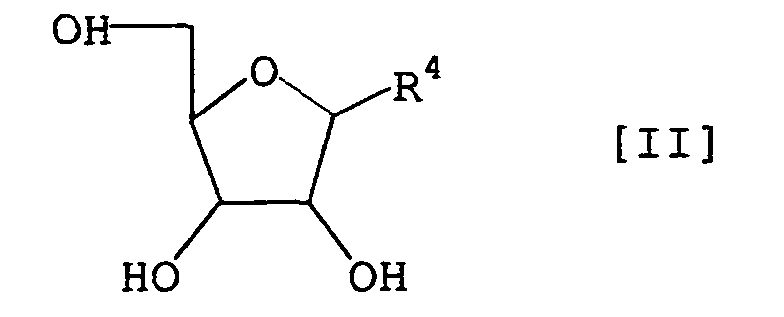

(hereinafter sometimes to be simply abbreviated as nucleoside compound [II]), which comprises
subjecting a 2',3',5'-triacyloxynucleoside compound represented by the formula [I]:

(hereinafter sometimes to be simply abbreviated as a 2',3'-hydroxyl-protected nucleoside compound), which comprises a step of obtaining a nucleoside compound represented by the formula [II] by the production method of any of the above-mentioned [1]-[3].

(hereinafter sometimes to be simply abbreviated as a carboxylic acid compound), which comprises a step of obtaining a nucleoside compound represented by the formula [II] by the production method of any of the above-mentioned [1]-[3].




The present invention is explained in detail by referring
to the following reaction scheme.

Each symbol in the formula is as defined in the following.
R1, R2 and R3 in the present invention may be the same or
different and each independently is an acyl group. The acyl
group here is an acyl group generally having 1 to 20, preferably
2 to 8, carbon atoms and, for example, acetyl, propionyl,
benzoyl and the like can be mentioned, with preference given to
acetyl.
X in the present invention is a hydrogen atom, a halogen
atom, an amino group, an alkyl group, an aralkyl group, a
substituted amino group or a hydroxyl group, and Y is a hydrogen
atom, a halogen atom, an alkyl group, an aralkyl group or an
aryl group.
The halogen atom here is a chlorine atom, a fluorine atom,
a bromine atom or an iodine atom, with preference given to a
chlorine atom.
The alkyl group here is a linear or branched chain alkyl
group preferably having 1 to 10, more preferably 1 to 3, carbon
atoms. For example, methyl, ethyl, propyl and the like can be
mentioned, with preference given to methyl.
The aralkyl group here is an aralkyl group wherein the
alkyl moiety is a linear or branched chain preferably having 1
to 5, more preferably 1, carbon atom, and the aryl moiety
preferably has 6 to 10, more preferably 6 to 8, carbon atoms.
As preferable examples, benzyl and the like can be mentioned.
The aryl group here preferably has 6 to 10, more
preferably 6 to 8. As preferable examples, a phenyl group and
the like can be mentioned.
The substituted amino group is an amino group monosubstituted
or di-substituted by the following substituent and
the like. The di-substituted amino group may have the same or
different substituents. As the substituent, for example, an
acyl group (as defined above, preferably having 1 to 7 carbon
atoms, for example, acetyl, propionyl, benzoyl and the like can
be mentioned, and acetyl is particularly preferable), an alkyl
group (as defined above, and methyl and ethyl are particularly
preferable), an aryl group (as defined above, and phenyl is
particularly preferable), an aralkyl group (as defined above,
and benzyl is particularly preferable) and the like can be
mentioned. As the substituted amino group, acetylamino,
methylamino, ethylamino, phenylamino, benzylamino and the like
can be mentioned, with preference given to acetylamino and
benzylamino.
R5 and R6 in the present invention are optionally the same
or different and each independently is an alkyl group. The
alkyl group here is defined to be the same as the alkyl group
for X or Y.
The production method of nucleoside compound [II] in the
present invention is characterized by deacylation of a 2',3',5'-triacyloxynucleoside
compound using alkali metal hydroxide in a
0.01- to 0.5-fold amount in a molar ratio relative to the
2',3',5'-triacyloxynucleoside compound. To be specific, for
example, a 2',3',5'-triacyloxynucleoside compound and alkali
metal hydroxide (0.01-0.5 mol of the 2',3',5'-triacyloxynucleoside
compound) are added to a solvent and the
mixture is stirred.
As the solvent to be used for the production of nucleoside
compound [II], methanol-containing solvents (e.g., methanol, or
a mixed solvent of methanol and an organic solvent and the like)
can be mentioned. Here, as the methanol-containing solvent, a
solvent containing methanol generally at not less than 10%,
preferably not less than 50%, more preferably not less than 70%,
by volume can be used. The solvent contained other than
methanol is not particularly limited as long as it is an organic
solvent and, for example, tetrahydrofuran, acetonitrile and the
like can be mentioned. The solvent usable for the production of
nucleoside compound [II] is particularly preferably a single
solvent of methanol. When the methanol-containing solvent
contains a considerable amount of water, a by-product tends to
occur. From the aspects of improvement of yield and the like,
therefore, it is preferable to not use water. However, if the
amount of water in the methanol-containing solvent does not
cause substantial influence on the reaction, water may be
contained in the solvent. The total amount of the solvent to be
used is generally 2-20, preferably 5-15, relative to the
2',3',5'-triacyloxynucleoside compound in a weight ratio.
As the alkali metal hydroxide, for example, sodium
hydroxide, potassium hydroxide, lithium hydroxide and the like
can be mentioned, with preference given to sodium hydroxide.
The amount of alkali metal hydroxide to be used in the present
invention is essentially 0.01- to 0.5-fold of the 2',3',5'-triacyloxynucleoside
compound in a molar ratio. When the amount
of alkali metal hydroxide to be used exceeds this range,
production of a by-product (6-methoxy form when nucleic acid
base is purine base, 4-methoxy form in the case of pyrimidine
base) increases and when the amount is smaller, the reaction
does not complete. A preferable amount of use is 0.03- to 0.4-fold
of the 2',3',5'-triacyloxynucleoside compound in a molar
ratio.
The temperature for the production of nucleoside compound
[II] is generally -20°C to 50°C, preferably 0°C to 20°C.
After the completion of the reaction, nucleoside compound
[II] can be isolated and purified by conventional methods. For
example, after the completion of the reaction, an acid (e.g.,
acetic acid and the like) and an organic solvent (e.g., ethyl
acetate and the like) are added, the mixture is stirred, and the
precipitate is collected by filtration and dried to give
nucleoside compound [II].
The 2',3'-hydroxyl-protected nucleoside compound in the
present invention can be easily produced from nucleoside
compound [II] in the present invention by a method known to
those of ordinary skill in the art. As the 2',3'-hydroxyl-protected
nucleoside compound, an isopropylidene compound
represented by the following formula (V):
 wherein R4 is as defined above
is particularly preferable. For example, nucleoside compound [II] obtained by the method of the present invention is converted to an isopropylidene compound of the formula [V] by a conventional method by, for example, (A) reacting nucleoside compound [II] with 2,2-dimethoxypropane in an aprotic organic solvent in the presence of an acid catalyst, or (B) reacting nucleoside compound [II] with acetone to be used as a solvent and reaction reagent in the presence of an acid catalyst.
is particularly preferable. For example, nucleoside compound [II] obtained by the method of the present invention is converted to an isopropylidene compound of the formula [V] by a conventional method by, for example, (A) reacting nucleoside compound [II] with 2,2-dimethoxypropane in an aprotic organic solvent in the presence of an acid catalyst, or (B) reacting nucleoside compound [II] with acetone to be used as a solvent and reaction reagent in the presence of an acid catalyst.
As the acid catalyst to be used in the above-mentioned
methods (A) and (B), for example, inorganic acids such as
hydrochloric acid, sulfuric acid and the like, and organic acids
such as methanesulfonic acid, p-toluenesulfonic acid and the
like (including hydrates thereof) can be mentioned. The amount
of the acid catalyst to be used is generally 0.01 to 1-fold,
preferably 0.01 to 0.5-fold, in a molar ratio relative to
nucleoside compound [II]. As the aprotic organic solvent to be
used in the above-mentioned method (A), for example, acetone,
acetonitrile, tetrahydrofuran, dichloromethane and the like can
be mentioned, and the amount thereof to be used is generally 5-50,
preferably 8-20, in a weight ratio relative to nucleoside
compound [II].
The amount of 2,2-dimethoxypropane to be used in the
above-mentioned method (A) is generally 1-5, preferably 1-3, in
a molar ratio relative to nucleoside compound [II].
The amount of acetone to be used in the above-mentioned
method (B) is generally 5-50, preferably 8-20, in a weight ratio
relative to nucleoside compound [II].
In the above-mentioned (A) and (B), conversion of
nucleoside compound [II] to an isopropylidene compound is
performed at a reaction temperature of generally 0°C-50°C,
preferably 0°C-room temperature, and the reaction completes
generally in 0.5-24 hr, preferably 1-5 hr.
2',3'-Hydroxyl-protected nucleoside compounds other than
the isopropylidene compound can be also produced by a method
similar to the above-mentioned production method of the
isopropylidene compound or a method analogous thereto.
The 2',3'-hydroxyl-protected nucleoside compound can be
isolated and purified by a conventional method and, for example,
the reaction mixture is added to an aqueous alkali (e.g., sodium
hydrogen carbonate etc.) solution, the mixture is concentrated
under reduced pressure, and the precipitate is filtered, washed
with water and dried.
The carboxylic acid compound in the present invention can
be produced from nucleoside compound [II] in the present
invention via, for example, the 2',3'-hydroxyl-protected
nucleoside compound in the present invention. The 2',3'-hydroxyl-protected
nucleoside compound is particularly
preferably an isopropylidene compound represented by the
aforementioned formula [V] and the carboxylic acid compound is
particularly preferably an isopropylidenecarboxylic acid
compound represented by the following formula [VI]:
 wherein R4 is as defined above.
The 2',3'-hydroxyl-protected nucleoside compound can be
converted to a carboxylic acid compound by oxidation of a 2',3'-hydroxyl-protected
nucleoside compound. As such method,
conventionally known methods, for example, the methods described
in JP-A-2000-524801, Tetrahedron Letters, vol. 37, No. 10, 1567-1570
and the like, methods analogous thereto and the like can be
mentioned.
As a method capable of producing a carboxylic acid
compound at a higher purity than by these conventionally known
methods, a method comprising oxidation of a 2',3'-hydroxyl-protected
nucleoside compound in the presence of a 2,2,6,6-tetramethylpiperidine-1-oxy
catalyst (TEMPO catalyst), and
hypochlorite or hypobromite, while adjusting pH to fall within
the range of 5 to 9, can be mentioned.
As a reaction solvent usable for the above-mentioned
reaction, a mixed solvent of water and an organic solvent, and a
two-phase solvent wherein an aqueous phase and an organic
solvent phase are phase-separated are preferable. The organic
solvent may be any as long as it is free of an influence of an
oxidation and, for example, for use for a mixed solvent with
water, acetonitrile, tetrahydrofuran, acetone and the like can
be mentioned, and for use for a two-phase solvent, chloroform,
dichloromethane, tert-butylmethylether, ethyl acetate and the
like can be mentioned. The amount of the reaction solvent to be
used is generally 3-50, preferably 5-20, in a weight ratio
relative to a 2',3'-hydroxyl-protected nucleoside compound.
When a mixed solvent of water and an organic solvent or a two-phase
solvent is used as a reaction solvent, the total amount of
the solvent only needs to be included in this range.
As the TEMPO catalyst, TEMPO-like compounds showing an
oxidation catalytic function similar to that of TEMPO can be
mentioned besides TEMPO. As the TEMPO-like compound, for
example, 4-hydroxy-2,2,6,6-tetramethylpiperidin-1-oxy, 4-methoxy-2,2,6,6-tetramethylpiperidin-1-oxy,
4-hydroxy-2,2,6,6-tetramethylpiperidin-1-oxybenzoate
and the like can be mentioned.
The amount of the TEMPO catalyst to be used is generally
0.0001-0.3, preferably 0.005-0.02, in a molar ratio relative to
a 2',3'-hydroxyl-protected nucleoside compound.
As hypochlorite, for example, sodium hypochlorite, calcium
hypochlorite and the like can be mentioned. As hypobromite, for
example, sodium hypobromite and the like can be mentioned.
Sodium hypochlorite and sodium hypobromite are commercially
available generally in the form of an aqueous solution, and
calcium hypochlorite is commercially available generally in the
form of a solid.
The amount of hypochlorite or hypobromite to be used is
generally 1.9-3.0, preferably 2.0-2.3, in a molar ratio relative
to a 2',3'-hydroxyl-protected nucleoside compound. When the
amount is too small, the reaction becomes insufficient and the
starting material tends to remain as an impurity. When the
amount is too high, it is economically unpreferable, and the
impurity due to hydrolysis tends to increase.
The pH for the oxidation is adjusted to the range of 5-9,
preferably 6.5-8. When the pH is high, a 2',3'-hydroxyl-protected
nucleoside compound tends to decompose and when the pH
is too low, the reaction rate of the oxidation tends to decrease.
The oxidation can be carried out by, for example, adding
hypochlorite or hypobromite to a solvent containing a 2',3'-hydroxyl-protected
nucleoside compound and a TEMPO catalyst.
The 2',3'-hydroxyl-protected nucleoside compound does not need
to be completely dissolved in the solvent, and may be reacted in
a suspension state as long as the object carboxylic acid
compound is dissolved in a solvent in the system. While
hypochlorite and hypobromite are preferably added in the form of
an aqueous solution, in the case of, for example, commercially
available solid such as calcium hypochlorite, it can be added as
a solid. Addition of hypochlorite or hypobromite tends to
increase pH, and when added in a short time, the pH value of the
reaction mixture becomes too high to allow hydrolysis.
Therefore, addition by small portions while adjusting pH to fall
within the range of 5-9, preferably 6.5-8, is preferable. The
addition can be performed generally in 30 min - 5 hr, preferably
2-4 hr. To facilitate adjustment of pH, the reaction may be
carried out while dissolving a buffer such as sodium hydrogen
carbonate, potassium hydrogen carbonate, sodium hydrogen
phosphate and the like in a reaction mixture. The buffer may be
dissolved in a reaction mixture from the start. Depending on
the buffer, however, since the pH value tends to become high in
the initial stage of the reaction, it is preferable to add an
acid and the like where necessary to adjust the pH to fall
within the above-mentioned optimal range and suppress the
progress of hydrolysis as far as possible. Since production of
the object carboxylic acid compound tends to lower the pH of the
reaction mixture, even if the pH value is somewhat high in the
initial stage of the reaction, it can be adjusted to the optimal
range in a relatively short time by adding hypochlorite or
hypobromite by small portions. The pH can be adjusted by
controlling the addition rate of hypochlorite or hypobromite and
buffer as mentioned above, as well as by appropriately adding a
base such as sodium hydroxide, sodium carbonate, potassium
hydroxide and the like, and an acid such as phosphoric acid,
hydrochloric acid, sulfuric acid and the like. Even when the
oxidation is conducted while adjusting pH, hydrolysis cannot be
completely inhibited. However, the impurity generated by
hydrolysis can be efficiently removed by obtaining the object
crystal according to the crystal precipitation method of the
present invention explained in the following.
After the completion of the reaction, it is preferable to
decompose the oxidant (compound having an oxidizing ability
derived from hypochlorite or hypobromite added) remaining in the
reaction mixture by adding hydrogen sulfite such as sodium
hydrogen sulfite and the like. Contamination of the object
product with an oxidant possibly causes a problem of an adverse
influence on the reaction during production of a derivative
compound using the object product and the like. Hydrogen
sulfite may be added in a solid state or an aqueous solution
state. The amount of addition is not particularly limited, and
it is preferable to confirm progress of the decomposition of the
oxidant using a peroxide test paper (e.g., Merckoquant
(trademark, manufactured by Merck)) and the like, and continue
to add until the oxidant is completely decomposed. Use of
sulfites such as sodium sulfite and the like is not preferable,
because it is basic and tends to cause hydrolysis.
As a method of isolating a carboxylic acid compound as a
solid from a reaction mixture, a known method comprising
extraction with an organic solvent and concentration to dryness
can be mentioned. However, this method shows poor purification
efficiency and a highly pure object product cannot be obtained
easily. In addition, a method comprising crystal precipitation
using an organic solvent affords an oil and the like, and a
crystal cannot be obtained easily, and the impurity caused by
hydrolysis cannot be removed sufficiently. However, a crystal
can be obtained stably by, after extraction of the object
carboxylic acid compound into an organic solvent under acidic
conditions, back-extracting the compound from the organic
solvent into an aqueous alkali solution, and neutralizing the
obtained aqueous alkali solution by adding an acid thereto to
allow crystal precipitation of the carboxylic acid compound. In
addition, highly pure carboxylic acid compound, from which
impurity has been considerably removed, can be obtained.
The 2',3',5'-triacyloxynucleoside compound to be used as a
starting material can be produced by, for example, a method
described in Nucleic Acid Chem. (1991), 264-268. For example,
2',3',5'-triacetyl-6-chloropurineriboside, which is one of the
starting materials, can be produced by adding dropwise thionyl
chloride to 2',3',5'-triacetylinosine in a solvent, stirring
under refluxing and workup by a conventional method.
The carboxylic acid compound of the present invention can
be led to a compound such as adenosine A1 agonist etc. useful as
a pharmaceutical product by, for example, a method described in
JP-A-2000-514801 and the like or a method analogous thereto.
Because of the oxidation of only the 5'-position by the
above-mentioned oxidation, the hydroxyl groups at the 2'-position
and 3'-position of the nucleoside compound are
preferably protected. As shown in the following reaction scheme,
when the above-mentioned oxidation is applied to the oxidation
of a nucleoside compound represented by the formula (1) defined
below, a nucleoside-carboxylic acid compound represented by the
formula (2) can be efficiently produced. In addition,
hydrolysis that occurs during the oxidation can be also
suppressed.
 wherein each symbol in the formula is as defined below.
In the nucleoside compound represented by the formula (1),
and a nucleoside-carboxylic acid compound represented by the
formula (2), R9 shows a group of the following formula (3) or
(4) :
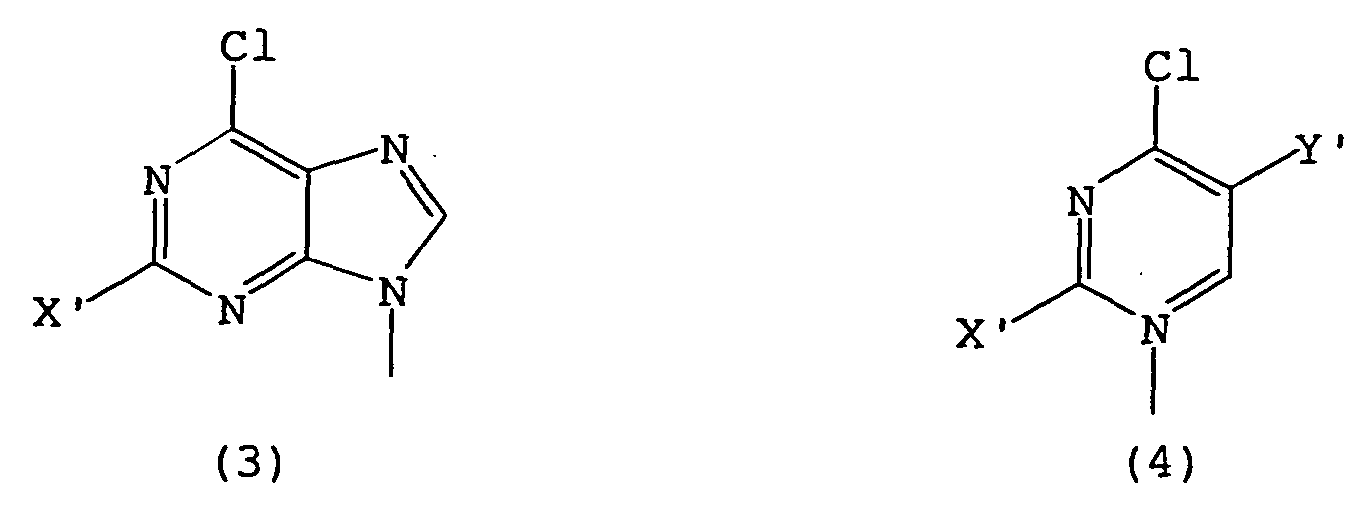
In other words, the nucleoside compound represented by the
formula (1) shows a compound represented by the following (1-a)
or (1-b), and a nucleoside-carboxylic acid compound represented
by the formula (2) shows a compound represented by the following
(2-a) or (2-b):

In the formulas in the present invention, X' is a hydrogen
atom, a halogen atom, an amino group, a substituted (i.e.,
protected) amino group or a hydroxyl group.
As the halogen atom, a chlorine atom, a bromine atom, a
fluorine atom and the like can be mentioned.
As the substituted (i.e., protected) amino group, for
example, an acylamino group having 1 to 7 carbon atoms (e.g.,
acetylamino group, benzoylamino group etc.), an alkylamino group
having 1 to 6 carbon atoms (e.g., methylamino group etc.), an
aralkylamino group having 7 to 11 carbon atoms (e.g.,
benzylamino group) and the like can be mentioned.
In the formulas in the present invention, Y' is a hydrogen
atom, a halogen atom, an alkyl group or an aralkyl group.
As the halogen atom, for example, chlorine atom, bromine
atom, fluorine atom and the like can be mentioned.
As the alkyl group, for example, an alkyl group having 1
to 6 carbon atoms such as a methyl group and the like, and the
like can be mentioned.
As the aralkyl group, for example, an aralkyl group having
7 to 11 carbon atoms such as a benzyl group and the like, and
the like can be mentioned.
In the formulas in the present invention, R7 and R8 are
each independently a hydrogen atom, an acyloxy group, an
alkyloxy group, an aralkyloxy group or a tert-butyldimethylsilyloxy
group, or R7 and R8 in combination show a
group represented by the following formula (5):

In the formula (5), R10 and R11 are each independently an
alkyl group. As the alkyl group, for example, an alkyl group
having 1 to 6 carbon atoms such as a methyl group and the like,
and the like can be mentioned.
As the acyloxy group, for example, an acyl group having 1
to 7 carbon atoms such as acetyloxy group, benzoyloxy group and
the like can be mentioned.
As the alkyloxy group, for example, an alkyloxy group
having 1 to 6 carbon atoms such as a methyloxy group and the
like can be mentioned.
As the aralkyloxy group, for example, an aralkyloxy group
having 7 to 11 carbon atoms such as a benzyloxy group and the
like can be mentioned.
As the alkyl group represented by R10 or R11, for example,
an alkyl group having 1 to 6 carbon atoms such as a methyl group
and the like can be mentioned.
The nucleoside compound represented by the formula (1) of
the present invention can be produced according to a known
method, for example, such as a method described in Journal of
Organic Chemistry, 1987, vol. 52, pp. 1344-1347, a method
described in Collection of Czechoslovak Chemical Communications,
2002, vol. 67, pp. 325-335 and the like.
In the present invention, a nucleoside-carboxylic acid
compound represented by the formula (2) or a salt thereof can be
obtained by oxidation (TEMPO catalyst oxidation) of the
nucleoside compound represented by the formula (1) in the
presence of a 2,2,6,6-tetramethylpiperidine-1-oxy catalyst
(TEMPO catalyst), and hypochlorite or hypobromite, while
adjusting pH to fall within the range of 5-9.
As a reaction solvent, a mixed solvent of water and an
organic solvent, and a two-phase solvent wherein an aqueous
phase and an organic solvent phase are phase-separated are
preferable. The organic solvent may be any as long as it is
free of an influence of an oxidation and, for example, for use
for a mixed solvent with water, an organic solvent such as
acetonitrile, tetrahydrofuran, acetone and the like can be
mentioned, and for use for a two-phase solvent, an organic
solvent such as chloroform, dichloromethane, tert-butylmethylether,
acetates (e.g., methyl acetate, ethyl acetate
etc.) and the like can be mentioned. The amount of the reaction
solvent to be used is generally 3-50, preferably 5-20, in a
weight ratio relative to a nucleoside compound (1). As
mentioned above, when a mixed solvent of water and an organic
solvent or a two-phase solvent is used, the whole solvent only
needs to be included in this range.
As the 2,2,6,6-tetramethylpiperidine-1-oxy catalyst (TEMPO
catalyst), 2,2,6,6-tetramethylpiperidine-1-oxy(TEMPO) and TEMPO-like
compounds showing an oxidation catalytic function similar
to that of TEMPO can be mentioned. As the TEMPO-like compound,
for example, 4-hydroxy-2,2,6,6-tetramethylpiperidin-1-oxy, 4-methoxy-2,2,6,6-tetramethylpiperidin-1-oxy,
4-hydroxy-2,2,6,6-tetramethylpiperidin-1-oxybenzoate
and the like can be mentioned.
The amount of the TEMPO catalyst to be used is generally
0.0001-0.3, preferably 0.005-0.02, in a molar ratio relative to
nucleoside compound (1). As hypochlorite, for example, sodium
hypochlorite, calcium hypochlorite and the like can be mentioned.
As hypobromite, for example, sodium hypobromite and the like can
be mentioned. Sodium hypochlorite and sodium hypobromite are
commercially available generally in the form of an aqueous
solution, and calcium hypochlorite is commercially available
generally in the form of a solid.
The amount of hypochlorite or hypobromite to be used is
generally 1.9-3.0, preferably 2.0-2.5, more preferably 2.0-2.3,
in a molar ratio relative to nucleoside compound (1). When the
amount is too small, the reaction becomes insufficient and the
starting material tends to remain as an impurity. When the
amount is too high, it is economically unpreferable, and the
impurity due to hydrolysis tends to increase.
The pH for the oxidation is adjusted to the range of 5-9,
preferably 6.5-8. When the pH is high, the nucleoside compound
(1) tends to decompose and when the pH is too low, the reaction
rate of the oxidation tends to decrease.
The oxidation can be carried out by, for example, adding
hypochlorite or hypobromite to a solvent containing a nucleoside
compound (1) and a TEMPO catalyst. The nucleoside compound (1)
does not need to be completely dissolved in the solvent, and may
be reacted in a suspension state as long as the object
carboxylic acid compound is dissolved in a solvent in the system.
While hypochlorite and hypobromite are preferably added in the
form of an aqueous solution, in the case of, for example,
commercially available solid such as calcium hypochlorite, it
can be added as a solid. Addition of hypochlorite or
hypobromite tends to increase pH, and when added in a short time,
the pH value of the reaction mixture becomes too high to allow
hydrolysis. Therefore, addition by small portions while
adjusting pH to fall within the range of 5-9, preferably 6.5-8,
is preferable. The addition can be performed generally in 30
min - 5 hr, preferably 2-4 hr. To facilitate adjustment of pH,
the reaction may be carried out while dissolving a buffer such
as sodium hydrogen carbonate, potassium hydrogen carbonate,
sodium hydrogen phosphate and the like in a reaction mixture.
The buffer may be dissolved in a reaction mixture from the start.
Depending on the buffer, however, since the pH value tends to
become high in the initial stage of the reaction, it is
preferable to add an acid and the like where necessary to adjust
the pH to fall within the above-mentioned optimal range and
suppress the progress of the hydrolysis as far as possible.
Since production of the object carboxylic acid nucleoside
compound tends to lower the pH of the reaction mixture, even if
the pH value is somewhat high in the initial stage of the
reaction, it can be adjusted to the optimal range in a
relatively short time by adding hypochlorite or hypobromite by
small portions. The pH can be adjusted by controlling the
addition rate of hypochlorite or hypobromite and buffer as
mentioned above, as well as by appropriately adding a base such
as sodium hydroxide, sodium carbonate, potassium hydroxide and
the like, and an acid such as phosphoric acid, hydrochloric acid,
sulfuric acid and the like. Even when oxidation is conducted
while adjusting pH, hydrolysis cannot be completely inhibited.
However, the impurity generated by hydrolysis during oxidation
can be efficiently removed by obtaining the object crystal
according to the crystal precipitation method of the present
invention explained in the following.
After the completion of the oxidation, it is preferable to
decompose the oxidant (compound having an oxidizing ability
derived from hypochlorite or hypobromite added) remaining in the
reaction mixture by adding hydrogen sulfite such as sodium
hydrogen sulfite and the like. Contamination of the object
product with an oxidant possibly causes a problem of an adverse
influence on the reaction during production of a derivative
compound using the object product and the like. Hydrogen
sulfite may be added in a solid state or an aqueous solution
state. The amount of addition is not particularly limited, and
it is preferable to confirm progress of the decomposition of the
oxidant using a peroxide test paper (e.g., Merckoquant
(trademark, manufactured by Merck)) and the like, and continue
to add until the oxidant is completely decomposed. Use of
sulfites such as sodium sulfite and the like is not preferable,
because it is basic and tends to cause hydrolysis.
As a method of isolating a nucleoside-carboxylic acid
compound as a solid from a reaction mixture, a method comprising
extraction with an organic solvent and concentration to dryness
to give a solid, as in the above-mentioned known method, can be
mentioned. However, this method shows poor purification
efficiency and a highly pure object product cannot be obtained
easily. In addition, as mentioned above, even a method
comprising crystal precipitation using an organic solvent
affords an oil, hence a crystal cannot be obtained easily, and
the impurity caused by hydrolysis cannot be removed sufficiently.
However, a crystal of the object nucleoside-carboxylic acid
compound can be obtained stably by, after extraction of the
object nucleoside-carboxylic acid compound into an organic
solvent under acidic conditions, back-extracting the compound
from the organic solvent into an aqueous alkali solution, and
neutralizing the obtained aqueous alkali solution by adding an
acid thereto to allow crystal precipitation of the nucleoside-carboxylic
acid compound. In addition, highly pure nucleoside-carboxylic
acid compound, from which impurity has been
considerably removed, can be obtained. Here, a crystal of a
salt of the nucleoside-carboxylic acid compound can be also
obtained by precipitating a crystal after extraction of the
object nucleoside-carboxylic acid compound into an organic
solvent under acidic conditions and back-extracting the compound
from the organic solvent into an aqueous alkali solution to
allow neutralization, or back-extracting the compound from the
organic solvent into water and neutralization with an aqueous
alkali solution. As the salt of the nucleoside-carboxylic acid
compound, alkali metal salts such as sodium salt, potassium salt
and the like, and the like can be mentioned.
A case wherein crystal precipitation of a nucleoside-carboxylic
acid compound is performed sequentially from an
oxidation is taken as an example and explained.
Recrystallization of a solid of a nucleoside-carboxylic acid
compound containing impurity for purification can be conducted
according to this method.
First, a chlororiboside carboxylic acid compound present
in a reaction mixture is extracted into an organic solvent under
acidic conditions. To the reaction mixture is added an acid
such as phosphoric acid, hydrochloric acid, sulfuric acid and
the like and the pH is adjusted to the range of 1.5-3.5,
preferably 2.0-3.0, to acidify the solution. When a two-phase
solvent wherein water and an organic solvent are phase-separated
is used, an acid is added to the aqueous layer side to adjust pH
to the above-mentioned range. As the organic solvent to be used
for extraction, ethyl acetate, chloroform, tert-butylmethyl
ether and the like can be mentioned, with particular preference
given to ethyl acetate. When a highly water-soluble organic
solvent was used for the reaction mixture, it is preferable to
add the above-mentioned organic solvent to the reaction mixture
for extraction. In this case, the organic solvent may be added
before or after the pH adjustment. After pH adjustment,
extraction is performed by a conventional method and the organic
layer, into which the object product has been extracted, is
separated. While the temperature of extraction is not
particularly limited, it is generally in the range of 10-40°C.
The amount of the organic solvent to be used for the extraction
is generally 5-50, preferably 8-20, in weight ratio relative to
the object product. Extraction may be performed multiple times
where necessary.
Then, the object product is back-extracted from the
organic solvent, into which the object product has been
extracted, into the aqueous alkali solution. A base such as
sodium hydroxide, potassium hydroxide, sodium hydrogen carbonate
and the like is added to water, pH is adjusted to the range of
5-12, preferably 6-8, to give an aqueous alkali solution.
Extraction is performed using the above-mentioned organic
solvent and the aqueous alkali solution by a conventional method
and, after back-extraction of the object product into the
aqueous layer (aqueous alkali solution layer), the aqueous layer,
into which the object product has been extracted, is separated.
While the temperature of extraction is not particularly limited,
it is generally in the range of 0-40°C. The amount of water to
be used for the extraction is generally 5-50, preferably 8-20,
in weight ratio relative to the object product. Extraction may
be performed multiple times where necessary.
Then, an acid is added to the aqueous alkali solution,
into which the object product has been extracted, to perform
neutralization to allow crystal precipitation. It is also
possible to perform neutralization to allow crystal
precipitation after appropriately adding an organic solvent
miscible with water, such as methanol, ethanol, acetone and the
like, to the aqueous alkali solution. In this case, the amount
of the organic solvent to be added is in the range of generally
1-50 in volume ratio relative to the aqueous alkali solution.
As the acid to be used for the neutralization to allow crystal
precipitation, phosphoric acid, hydrochloric acid, sulfuric acid
and the like can be mentioned. The pH of neutralization to
allow crystal precipitation is generally 1.5-3.5, preferably
2.0-3.0. The temperature of crystal precipitation is generally
0-80°C, preferably 10-40°C. The crystal precipitation is
generally performed under stirring. The slurry obtained by
crystal precipitation is subjected to solid-liquid separation by
a conventional method such as filtration, centrifugation and the
like to isolate a crystal. Where necessary, the crystal may be
washed with water, alcohol and the like, and a drying step may
be introduced according to a conventional method. The crystal
obtained in this way becomes a highly pure crystal, wherein the
hydrolysate difficult to be removed can be efficiently removed
by the method of the present invention.
Of the nucleoside-carboxylic acid compounds represented by
the formula (2), 2',3'-isopropylidene-6-chloropurineriboside -
5'-carboxylic acid represented by the following formula (6) is
preferable in consideration of the usefulness of an adenosine
receptor agonist as a synthetic intermediate and easiness of
deprotection:

The present invention is explained in more detail in
the following by referring to Examples, which are not to be
construed as limitative.
2',3',5'-Triacetylinosine (20 g) was added to chloroform
(160 ml) and N,N-dimethylformamide (2.7 g), thionyl chloride
(19.9 g) was added dropwise thereto, and the mixture was stirred
under reflux for 3 hr. Water (200 ml) was added under cooling
in an ice bath. The mixture was stirred for 1 hr and
partitioned. The organic layer was washed with 5% aqueous
sodium hydrogen carbonate solution and saturated brine, dried
over sodium sulfate and concentrated to dryness to give
2',3',5'-triacetyl-6-chloropurineriboside (24.4 g) as an oil.
1H-NMR(CDCl3, ppm) δ: 2.10 (3H, s), 2.12(3H, s), 2.17 (3H, s), 4.37-4.51(3H, m), 5.64-5.67(1H, m), 5.94-5.97(1H, m), 6.24-6.25(1H, d, J=5.2Hz), 8.30(1H, s), 8.79(1H, s).
1H-NMR(CDCl3, ppm) δ: 2.10 (3H, s), 2.12(3H, s), 2.17 (3H, s), 4.37-4.51(3H, m), 5.64-5.67(1H, m), 5.94-5.97(1H, m), 6.24-6.25(1H, d, J=5.2Hz), 8.30(1H, s), 8.79(1H, s).
2',3',5'-Triacetyl-6-chloropurineriboside (oil, 6.0 g) was
dissolved in methanol (30 ml). The mixture was cooled to 5°C and
1N sodium hydroxide-methanol solution (0.6 ml) was added. The
mixture was stirred for 5 hr. Acetic acid (0.04 ml) and ethyl
acetate (30 ml) was added to the reaction mixture and the
mixture was stirred under ice-cooling for 1 hr. The precipitate
was collected by filtration, washed with ethyl acetate, and
vacuum dried at 40°C to give the title compound (3.08 g).
1H-NMR(DMSO-d6, ppm) δ: 3.59-3.74 (2H, m), 4.00-4.01(1H, s), 4.19-4.21(1H, m), 4.59-4.62(1H, m), 5.10-5.12(1H, m), 5.27(1H, d, J=5.1Hz), 5.59(1H, d, J=5.8Hz), 6.06(1H, d, J=5.3Hz), 8.83(1H, s), 9.06(1H, s).
1H-NMR(DMSO-d6, ppm) δ: 3.59-3.74 (2H, m), 4.00-4.01(1H, s), 4.19-4.21(1H, m), 4.59-4.62(1H, m), 5.10-5.12(1H, m), 5.27(1H, d, J=5.1Hz), 5.59(1H, d, J=5.8Hz), 6.06(1H, d, J=5.3Hz), 8.83(1H, s), 9.06(1H, s).
6-Chloropurineriboside (10.0 g) was suspended in acetone
(70 ml), 2,2-dimethoxypropane (7.3 g) and p-toluenesulfonic acid
monohydrate (3.3 g) was added thereto, and the mixture was
stirred at 10°C for 3 hr. The reaction mixture was added to a
solution of sodium hydrogen carbonate (1.8 g) and water (70 ml).
The mixture was concentrated under reduced pressure, and stirred
at 20°C for 3 hr. The precipitate was collected by filtration,
washed with water, and dried overnight at 40°C under reduced
pressure to give 2',3'-isopropylidene-6-chloropurineriboside
(9.7 g).
1H-NMR(DMSO-d6, ppm) δ: 1.34 (3H, s), 1.55(3H, s), 3.50-3.58(2H, m), 4.30-4.32(1H, m), 4.97-4.99(1H, m), 5.09-5.11(1H, s), 5.41-5.43(1H, s), 6.28(1H, d, J=2.4Hz), 8.82(1H, s), 8.87(1H, s).
1H-NMR(DMSO-d6, ppm) δ: 1.34 (3H, s), 1.55(3H, s), 3.50-3.58(2H, m), 4.30-4.32(1H, m), 4.97-4.99(1H, m), 5.09-5.11(1H, s), 5.41-5.43(1H, s), 6.28(1H, d, J=2.4Hz), 8.82(1H, s), 8.87(1H, s).
2',3'-Isopropylidene-6-chloropurineriboside (605 g, 1.085
mol) was added to a mixed solvent of acetonitrile (3630 ml) and
water (1025 ml). Sodium hydrogen carbonate (106 g) and 2,2,6,6-tetramethylpiperidin-1-oxy
(TEMPO, 5.8 g) were added thereto.
An aqueous sodium hypochlorite solution (effective chlorine
concentration 11%, 3034 g) was added dropwise over 3.4 hr while
stirring at 5°C, and the mixture was further stirred for 1 hr.
While the pH immediately after the start of the reaction was 9.5,
it dropped to not more than 9 within 10 min after dropwise
addition of the aqueous sodium hypochlorite solution.
Thereafter, the pH was adjusted to 7 to 8 and this pH value was
maintained during the reaction. After the completion of the
reaction, 20% aqueous sodium hydrogen sulfite solution (1650 g)
was added, and the mixture was stirred for 1 hr. At this time
point, complete decomposition of the oxidant was confirmed using
a peroxide test paper (Merckoquant, trademark, manufactured by
Merck). The content of the impurity in the reaction mixture was
confirmed by HPLC and found to be 3%. Then, ethyl acetate (4880
ml) was added to the reaction mixture, and the aqueous layer was
adjusted to pH 2.8 with 6N hydrochloric acid, whereby extraction
was carried out at 25°C. The organic solvent layer was separated,
ethyl acetate (1120 ml) was added to the residual aqueous layer,
which was then extracted again. The organic solvent layer was
separated and combined with the organic solvent layer obtained
earlier. Water (5064 ml) was added to the organic solvent layer
and, after the aqueous layer was adjusted to pH 6.7 with aqueous
sodium hydroxide solution, the mixture was subjected to a back-extraction
at 25°C. The aqueous layer containing the extracted
object product was separated. The aqueous layer was adjusted to
pH 2.8 with 6N hydrochloric acid and the mixture was subjected
to neutralization to allow crystal precipitation at 30°C. After
crystal precipitation with stirring for about 17 hr, the slurry
was filtered. The separated crystals were washed with water and
dried overnight at 50°C under reduced pressure to give 2',3'-isopropylidene-6-chloropurineriboside-5'-carboxylic
acid as
crystals (493 g, 1.45 mol).
1H-NMR(DMSO-d6, ppm) δ: 1.37 (3H, s), 1.53 (3H, s), 4.79(1H, d, J=1.6Hz), 5.55(1H, dd, J=1.6, 5.9Hz), 5.61(1H, d, J=5.9Hz), 6.50(1H, s), 8.76(1H, s), 8.83(1H, s).
1H-NMR(DMSO-d6, ppm) δ: 1.37 (3H, s), 1.53 (3H, s), 4.79(1H, d, J=1.6Hz), 5.55(1H, dd, J=1.6, 5.9Hz), 5.61(1H, d, J=5.9Hz), 6.50(1H, s), 8.76(1H, s), 8.83(1H, s).
6-Chloropurineriboside (640 g, 2.23 mol) was suspended in
acetone (5120 ml), and dimethoxypropane (494 g) and p-toluenesulfonic
acid monohydrate (212 g) were added. The
mixture was stirred at 17-23°C for 5 hr. This reaction mixture
was added to an aqueous solution of sodium hydrogen carbonate
(99 g) and water (4480 ml). The aqueous solution was
concentrated under reduced pressure, and stirred at 60°C for 2 hr
and further at room temperature for about 17 hr. The obtained
slurry was filtered, and the separated crystals were washed with
water to give 2',3'-isopropylidene-6-chloropurineriboside as
crystals (612 g, 1.87 mol).
2',3'-Isopropylidene-6-chloropurineriboside (605 g, 1.85
mol) was added to a mixed solvent of acetonitrile (3630 ml) and
water (3025 ml), and sodium hydrogen carbonate (106 g) and
2,2,6,6-tetramethylpiperidine-1-oxy (TEMPO) (5.8 g, 0.037 mol)
were added. An aqueous sodium hypochlorite solution (effective
chlorine concentration 11%, 3034 g, 4.25 mol) was added dropwise
over 3.4 hr while stirring at 5°C, and the mixture was further
stirred for 1 hr. While the pH immediately after the start of
the reaction was 9.5, it dropped to not more than 9 within 10
min after dropwise addition of the aqueous sodium hypochlorite
solution. Thereafter the pH was adjusted to 7 to 8 and this pH
value was maintained during the reaction. After the completion
of the reaction, 20% aqueous hydrogen sulfite sodium solution
(1650 g) was added, and the mixture was stirred for 1 hr. At
this time point, complete decomposition of the oxidant was
confirmed using a peroxide test paper (Merckoquant, trademark,
manufactured by Merck). The content of the impurity in the
reaction mixture was confirmed by HPLC and found to be 3%
(reaction yield was 95%). Then, ethyl acetate (4880 ml) was
added to the reaction mixture, the aqueous layer was adjusted to
pH 2.8 with 6N hydrochloric acid, whereby extraction was carried
out at 25°C. The organic solvent layer was separated, ethyl
acetate (1120 ml) was added to the residual aqueous layer, which
was then extracted again. The organic solvent layer was
separated and combined with the organic solvent layer obtained
earlier. Water (5064 ml) was added to the organic solvent layer,
and the aqueous layer was adjusted to pH 6.7 with aqueous sodium
hydroxide solution. The mixture was subjected to a back-extraction
at 25°C. The aqueous layer containing the extracted
object product was separated, and the aqueous layer was adjusted
to pH 2.8 with 6N hydrochloric acid. The mixture was subjected
to neutralization to allow crystal precipitation at 30°C. After
crystal precipitation with stirring for about 17 hr, the slurry
was filtered. The separated crystals were washed with water and
dried overnight at 50°C under reduced pressure to give 2',3'-isopropylidene-6-chloropurineriboside-5'-carboxylic
acid as
crystals (493 g, 1.45 mol). The content of the impurity in the
crystals was confirmed by HPLC and found to be 0.1%.
2',3'-Isopropylidene-6-chloropurineriboside (0.5 g, 1.53
mmol) was suspended in acetonitrile (3.5 ml) and water (3 ml),
and sodium dihydrogen phosphate (0.4 g) was added to adjust its
pH to 7. 2,2,6,6-Tetramethylpiperidin-1-oxy (TEMPO) (8 mg, 0.05
mmol) was added. An aqueous sodium hypochlorite solution
(effective chlorine concentration 111%, 2.86 g, 3.87 mmol) was
added dropwise over 60 min while stirring at 5°C, and the mixture
was further stirred for 1 hr. During the reaction, the reaction
mixture was maintained at pH 7.0-7.5. The reaction mixture was
analyzed by HPLC. As a result, 2',3'-isopropylidene-6-chloropurineriboside-5'-carboxylic
acid was produced in a yield
of 92%, and the content of the impurity was 2%.
2',3'-Isopropylidene-6-chloropurineriboside (0.6 g, 1.8
mmol) was suspended in acetonitrile (3.5 ml) and water (3 ml),
and sodium hydrogen carbonate (0.2 g) and tetramethylpyridyl oxy
(TEMPO) (8 mg, 0.05 mmol) were added. 60% Calcium hypochlorite
(0.57 g, 4.39 mmol) was added in 4 portions over 1 hr while
stirring at 5°C, and the mixture was further stirred for 1 hr.
The pH immediately after the start of the reaction was 9.5, and
it was adjusted to 7 to 8 in about 10 min after addition of the
calcium hypochlorite. Thereafter, this pH value was maintained.
The reaction mixture was analyzed by HPLC. As a result,
2',3'-isopropylidene-6-chloropurineriboside-5'-carboxylic acid
was produced in a yield of 91%, and the content of the impurity
was 3%.
2',3'-Isopropylidene-6-chloropurineriboside (6.05 g, 18.5
mmol) was added to acetonitrile (36 ml) and water (21 ml), and
sodium hydrogen carbonate (0.4 g) and tetramethylpyridyloxy
(TEMPO) (0.058 g, 0.37 mmol) were added. The mixture was
stirred at 5°C. An aqueous sodium chlorite solution (effective
chlorine concentration 11%, 30.4 g, 41.1 mmol) was added over 3
hr, during which the pH was maintained at 6.5-7.5 by the
addition of 20% aqueous sodium hydrogen carbonate solution. The
mixture was further stirred overnight, and the pH was maintained
at 6.5-7.5. Sequentially, 20% aqueous sulfite hydrogen sodium
solution (5.1 g) was added, and the mixture was stirred for 1 hr.
At this time point, complete decomposition of the oxidant was
confirmed using a peroxide test paper (Merckoquant, trademark,
manufactured by Merck). The content of the impurity in the
reaction mixture was confirmed by HPLC and found to be 1.8%
(reaction yield was 97%). Ethyl acetate (49 ml) was added to
the reaction mixture, and the mixture was adjusted to pH 2.7
with 6N hydrochloric acid. After layer separation, the aqueous
layer was extracted with ethyl acetate (11 ml). Water (30 ml)
was added to the combined organic layer and the mixture was
adjusted to pH 6.7 with aqueous sodium hydroxide solution. The
layers were separated and the aqueous layer was concentrated.
Toluene (30 ml) was added and the mixture was stirred overnight.
The precipitate was collected by filtration, washed with toluene,
and dried overnight at 50°C under reduced pressure to give sodium
2',3'-isopropylidene-5'-carboxyl-6-chloropurineriboside-5'-acetate
(6.5 g, 15.7 mmol). The content of the impurity in the
crystal was confirmed by HPLC and found to be 1.4%.
1H-NMR(DMSO-d6) δ (ppm): 1.32(3H, s), 1.54(3H, s), 4.43(1H, s), 5.08(1H, d, J=5.9Hz), 5.18(1H, d, J=5.9Hz), 6.30(1H, s), 8.77(1H, s), 9.51(1H, s).
1H-NMR(DMSO-d6) δ (ppm): 1.32(3H, s), 1.54(3H, s), 4.43(1H, s), 5.08(1H, d, J=5.9Hz), 5.18(1H, d, J=5.9Hz), 6.30(1H, s), 8.77(1H, s), 9.51(1H, s).
2',3'-Isopropylidene-6-chloropurineriboside (0.5 g, 1.5
mmol) was suspended in acetonitrile (3.5 ml) and water (3 ml),
and sodium hydrogen carbonate (0.35 g) and 2,2,6,6-tetramethylpiperidine-1-oxy
(TEMPO) (8 mg, 0.05 mmol) were added.
An aqueous sodium hypochlorite solution (effective chlorine
concentration 11%, 2.86 g) was added dropwise over 10 min while
stirring at 5°C, and the mixture was further stirred for 1 hr.
During the reaction, the pH of the reaction mixture was between
8.0 and 12.0. The reaction mixture was analyzed by HPLC. As a
result, 2',3'-isopropylidene-6-chloropurineriboside-5'-carboxylic
acid was produced in a yield of 85%, and the content
of the impurity was 9%.
According to the present invention, formation of byproducts
can be suppressed and nucleoside compound [II] can be
produced. Therefore, nucleoside derivatives (2',3'-hydroxyl-protected
nucleoside compound [III], carboxylic acid compound
[IV]) can be also produced utilizing the nucleoside compound
[II].
According to the present invention, moreover, the
aforementioned nucleoside-carboxylic acid compound represented
by the formula (2) and a salt thereof can be produced by a
method suitable for industrial production. Thus, according to
the present invention, hypochlorite or hypobromite, which is
highly safe as an oxidant and which can easily control the
reaction, can be used and hydrolysis, which is a side reaction,
can be strikingly suppressed, in a production process of
nucleoside-carboxylic acid compound of the formula (2), which is
a 5'-carboxyl group derivative, comprising oxidation of a 5'-hydroxyl
group of the nucleoside compound of the above-mentioned
formula (1). In addition, the resulting hydrolysate can be
efficiently removed, and highly pure crystals of a nucleoside-carboxylic
acid compound represented by the formula (2) and a
salt thereof can be produced by a method suitable for industrial
production.
This application is based on patent application Nos.
010373/2003, 122614/2003 and 169534/2003 filed in Japan, the
contents of which are hereby incorporated by reference.
Claims (12)
- A production method of a nucleoside compound represented by the formula [II]:wherein R4 is a group represented by
 wherein X is a hydrogen atom, a halogen atom, an amino group, an alkyl group, an aralkyl group, a substituted amino group or a hydroxyl group, and Y is a hydrogen atom, a halogen atom, an alkyl group, an aralkyl group or an aryl group,
which comprises
subjecting a 2',3',5'-triacyloxynucleoside compound represented by the formula [I]:wherein R1, R2 and R3 are the same or different and each independently is an acyl group, and R4 is as defined above to deacylation using alkali metal hydroxide in a 0.01- to 0.5-fold amount in a molar ratio relative to the 2',3',5'-triacyloxynucleoside compound.
- The production method of claim 1, wherein the deacylation is conducted in methanol, or a mixed solvent of methanol and an organic solvent.
- The production method of claim 1 or 2, wherein the alkali metal hydroxide is sodium hydroxide.
- A production method of a 2',3'-hydroxyl-protected nucleoside compound represented by the formula [III]:wherein R4 is as defined in claim 1, and R5 and R6 are optionally the same or different and each independently is an alkyl group, which comprises a step of obtaining a nucleoside compound represented by the formula [II] by the production method of any of claims 1 to 3.

- A production method of a carboxylic acid compound represented by the formula [IV]:wherein R4 is as defined in claim 1, and R5 and R6 are optionally the same or different and each independently is an alkyl group, which comprises a step of obtaining a nucleoside compound represented by the formula [II] by the production method of any of claims 1 to 3.
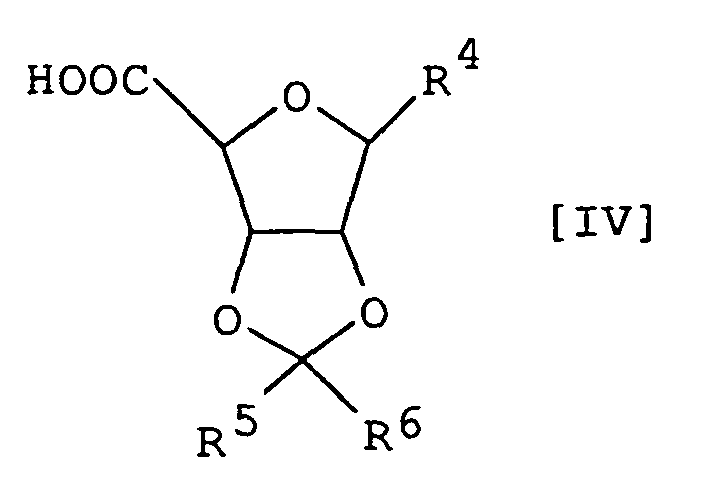
- The production method of claim 5, wherein the nucleoside compound of the formula [II] is converted to a 2',3'-hydroxyl-protected nucleoside compound of the formula [III], which is subsequently oxidized to give the carboxylic acid compound of the formula [IV].
- A production method of a nucleoside-carboxylic acid compound represented by the formula (2) or a salt thereof, which comprises oxidizing a nucleoside compound represented by the formula (1) in the presence of a 2,2,6,6-tetramethylpiperidine-1-oxy catalyst, and hypochlorite or hypobromite, while adjusting pH to fall within the range of 5-9:wherein R9 is a group represented by the following formula (3) or (4), and R7 and R8 are each independently a hydrogen atom, an acyloxy group, an alkyloxy group, an aralkyloxy group or a tert-butyldimethylsilyloxy group, or R7 and R8 in combination show a group of the following formula (5):
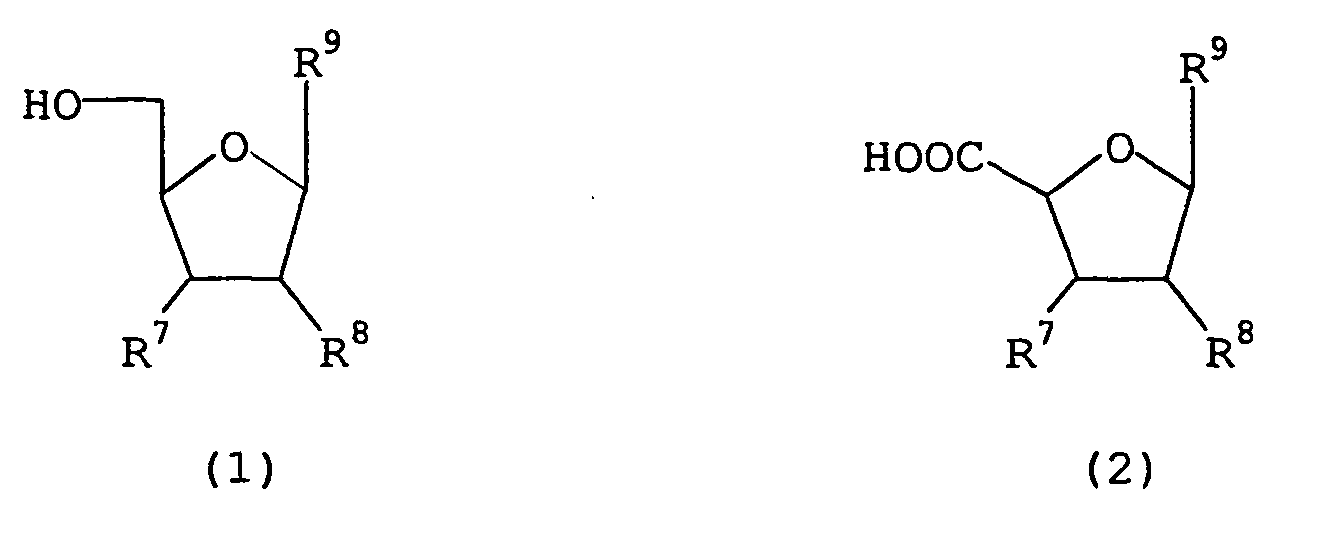 wherein X' is a hydrogen atom, a halogen atom, an amino group, a substituted amino group or a hydroxyl group, and Y' is a hydrogen atom, a halogen atom, an alkyl group or an aralkyl group:
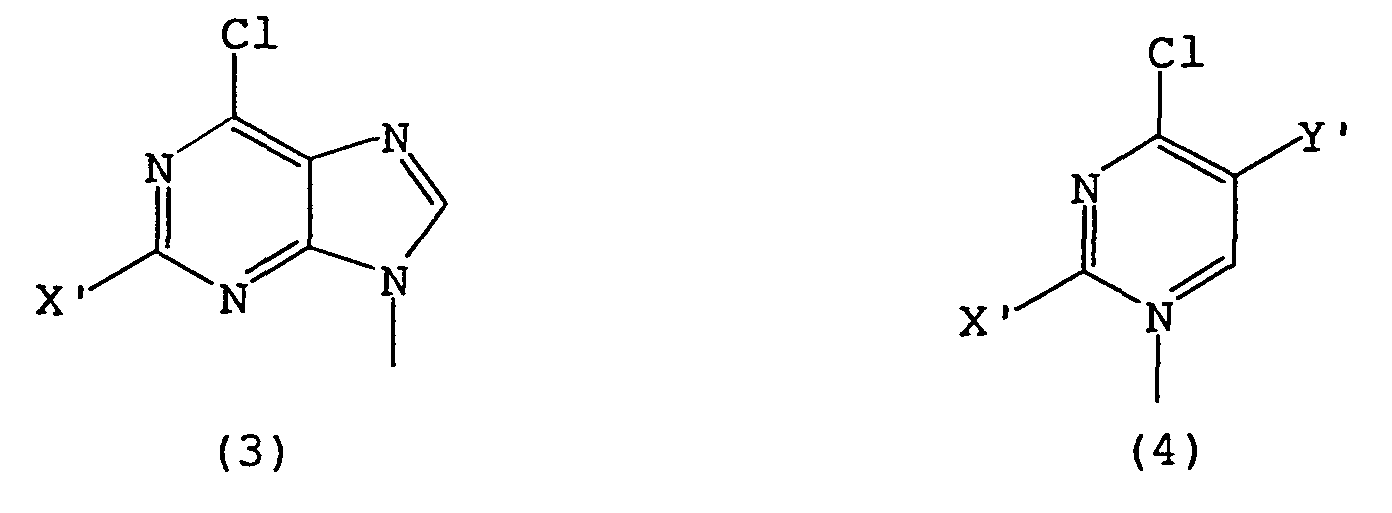 wherein R10 and R11 are each independently an alkyl group.
- The production method of claim 7, which comprises a step of decomposing the oxidant remaining in the reaction mixture with hydrogen sulfite after the completion of the oxidation.
- The production method of claim 7, which comprises a step of producing a crystal of a nucleoside-carboxylic acid compound represented by the formula (2) by extracting the nucleoside-carboxylic acid compound in a reaction mixture into an organic solvent under acidic conditions, back-extracting the compound from the organic solvent into an aqueous alkali solution, and neutralizing the aqueous alkali solution by adding an acid thereto to allow precipitation of a crystal.
- The production method of claim 7, which comprises a step of producing a crystal of a salt of the nucleoside-carboxylic acid compound represented by the formula (2) by precipitating a crystal after extracting the nucleoside-carboxylic acid compound in a reaction mixture into an organic solvent under acidic conditions, and back-extracting the compound from the organic solvent into an aqueous alkali solution to allow neutralization or back-extracting the compound from the organic solvent into water and neutralization with an aqueous alkali solution.
- A production method of a crystal of a nucleoside-carboxylic acid compound represented by the formula (2), which comprises extracting the nucleoside-carboxylic acid compound represented by the formula (2) into an organic solvent under acidic conditions, back-extracting the compound from the organic solvent into an aqueous alkali solution, and neutralizing the aqueous alkali solution by adding an acid thereto to allow crystal precipitation of the nucleoside-carboxylic acid compound:wherein R9 is a group represented by the following formula (3) or (4), and R7 and R8 are each independently a hydrogen atom, an acyloxy group, an alkyloxy group, an aralkyloxy group or a tert-butyldimethylsilyloxy group, or R7 and R8 in combination show a group represented by the following formula (5):
 wherein X' is a hydrogen atom, a halogen atom, an amino group, a substituted amino group or a hydroxyl group, and Y' is a hydrogen atom, a halogen atom, an alkyl group or an aralkyl group,
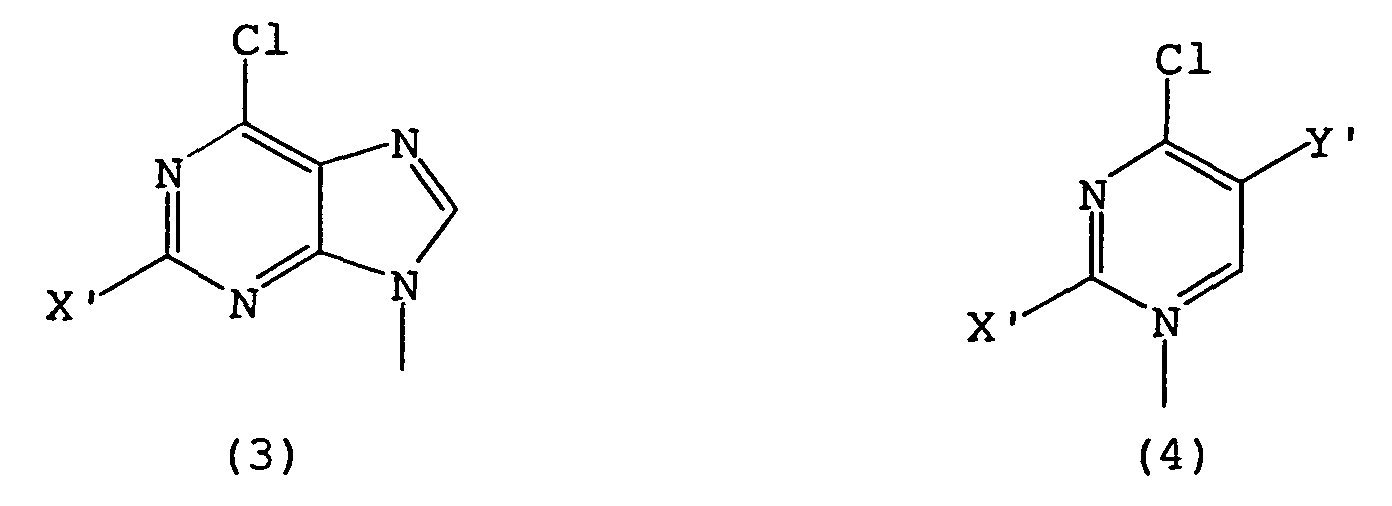 wherein R10 and R11 are each independently an alkyl group.
- The production method of any of claims 7 to 11, wherein the nucleoside-carboxylic acid compound represented by the formula (2) is a 2',3'-isopropylidene-6-chloropurineriboside-5'-carboxylic acid represented by the following formula (6):
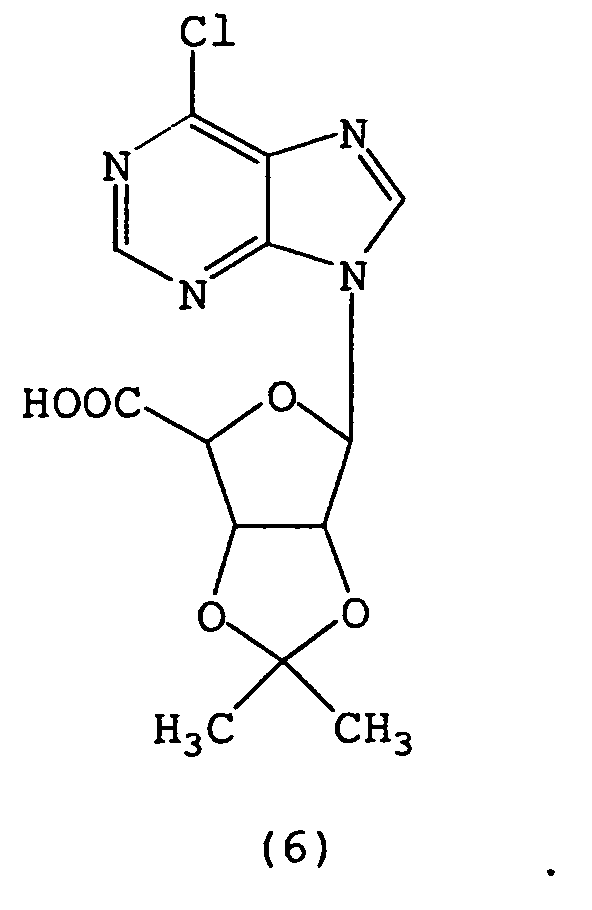
Applications Claiming Priority (7)
| Application Number | Priority Date | Filing Date | Title |
|---|---|---|---|
| JP2003010373 | 2003-01-17 | ||
| JP2003010373 | 2003-01-17 | ||
| JP2003122614 | 2003-04-25 | ||
| JP2003122614 | 2003-04-25 | ||
| JP2003169534 | 2003-06-13 | ||
| JP2003169534 | 2003-06-13 | ||
| PCT/JP2004/000048 WO2004065403A1 (en) | 2003-01-17 | 2004-01-07 | Processes for production of nucleosides |
Publications (1)
| Publication Number | Publication Date |
|---|---|
| EP1589027A1 true EP1589027A1 (en) | 2005-10-26 |
Family
ID=32776802
Family Applications (1)
| Application Number | Title | Priority Date | Filing Date |
|---|---|---|---|
| EP04700532A Withdrawn EP1589027A1 (en) | 2003-01-17 | 2004-01-07 | Processes for production of nucleosides |
Country Status (5)
| Country | Link |
|---|---|
| US (1) | US20060014944A1 (en) |
| EP (1) | EP1589027A1 (en) |
| JP (1) | JPWO2004065403A1 (en) |
| CA (1) | CA2513545A1 (en) |
| WO (1) | WO2004065403A1 (en) |
Cited By (1)
| Publication number | Priority date | Publication date | Assignee | Title |
|---|---|---|---|---|
| CN105085595A (en) * | 2015-09-15 | 2015-11-25 | 安阳工学院 | Method for synthesizing 2,6-hologenated purine nucleoside by deacylation protection |
Families Citing this family (3)
| Publication number | Priority date | Publication date | Assignee | Title |
|---|---|---|---|---|
| WO2005042499A1 (en) * | 2003-11-04 | 2005-05-12 | Ajinomoto Co., Inc. | Processes for production of pyrimidine derivatives and intermediates |
| US7596078B2 (en) | 2005-11-10 | 2009-09-29 | Acellent Technologies, Inc. | Method and apparatus for reducing crosstalk in a structural health monitoring system |
| US9102698B2 (en) * | 2007-03-14 | 2015-08-11 | Can-Fite Biopharma Ltd. | Process for the synthesis of IB-MECA |
Family Cites Families (10)
| Publication number | Priority date | Publication date | Assignee | Title |
|---|---|---|---|---|
| GB2218417B (en) * | 1988-04-21 | 1991-09-18 | Central Glass Co Ltd | Preparation of 2'-deoxy-5,6-dihydro-5-fluoro-6-hydroxy uridine and diaryl 2'- deoxy-5-fluorouridines |
| JPH0676433B2 (en) * | 1988-04-25 | 1994-09-28 | セントラル硝子株式会社 | Process for producing 2'-deoxy-5-fluorouridine-diacyl derivative |
| CA2092305C (en) * | 1990-09-25 | 2003-02-11 | Alfred P. Spada | Compounds having antihypertensive and anti-ischemic properties |
| TW254946B (en) * | 1992-12-18 | 1995-08-21 | Hoffmann La Roche | |
| EP1553090A4 (en) * | 2002-06-14 | 2006-07-05 | Ajinomoto Kk | Process for producing pyrimidine compound |
| US20050176966A1 (en) * | 2003-04-11 | 2005-08-11 | Ajinomoto Co., Inc. | Process for the preparation of pyrimidine derivative, intermediate therefor and process for the preparation thereof |
| JP2004323433A (en) * | 2003-04-25 | 2004-11-18 | Ajinomoto Co Inc | Method for producing 5'-acyloxy nucleoside compound |
| EP1533306A1 (en) * | 2003-11-04 | 2005-05-25 | Ajinomoto Co., Inc. | Azlactone compound and method for preparation thereof |
| JP4501015B2 (en) * | 2004-03-17 | 2010-07-14 | 味の素株式会社 | Method for producing aminopyrimidine compound |
| JP4613501B2 (en) * | 2004-03-17 | 2011-01-19 | 味の素株式会社 | Process for producing 5-protected aminopyrimidine compound |
-
2004
- 2004-01-07 JP JP2005508024A patent/JPWO2004065403A1/en not_active Abandoned
- 2004-01-07 EP EP04700532A patent/EP1589027A1/en not_active Withdrawn
- 2004-01-07 WO PCT/JP2004/000048 patent/WO2004065403A1/en not_active Ceased
- 2004-01-07 CA CA002513545A patent/CA2513545A1/en not_active Abandoned
-
2005
- 2005-07-15 US US11/181,985 patent/US20060014944A1/en not_active Abandoned
Non-Patent Citations (1)
| Title |
|---|
| See references of WO2004065403A1 * |
Cited By (2)
| Publication number | Priority date | Publication date | Assignee | Title |
|---|---|---|---|---|
| CN105085595A (en) * | 2015-09-15 | 2015-11-25 | 安阳工学院 | Method for synthesizing 2,6-hologenated purine nucleoside by deacylation protection |
| CN105085595B (en) * | 2015-09-15 | 2017-12-29 | 安阳工学院 | A kind of method of deacylation base protection 2,6 halosubstituted purine nucleosides of synthesis |
Also Published As
| Publication number | Publication date |
|---|---|
| JPWO2004065403A1 (en) | 2006-05-18 |
| WO2004065403A1 (en) | 2004-08-05 |
| US20060014944A1 (en) | 2006-01-19 |
| CA2513545A1 (en) | 2004-08-05 |
Similar Documents
| Publication | Publication Date | Title |
|---|---|---|
| US20080300401A1 (en) | Novel chlorination process for preparing sucralose | |
| JP4667691B2 (en) | Process for the preparation of nitroxyalkyl esters of naproxen | |
| KR970002659B1 (en) | Process for preparing 2 ', 2'-difluoronucleosides and intermediates | |
| JPH07206856A (en) | Mass production method of 2 ', 3'-didehydro-3'-deoxythymidine (d4T) using 5-methyluridine | |
| JP2008266172A (en) | Method for producing 3-o-alkyl-5,6-o-(1-methylethylidene)-l-ascorbic acid and method for producing 5,6-o-(1-methylethylidene)-l-ascorbic acid | |
| JPH0859662A (en) | Preparation of N-9-substituted guanine compound | |
| KR100908363B1 (en) | Stereoselective preparation method of tri-O-acetyl-5-deoxy-β-D-ribofuranose and separation method thereof | |
| US20060014944A1 (en) | Processes for production of nucleosides | |
| JP2011006379A (en) | Method for recrystallizing {2-amino-1,4-dihydro-6-methyl-4-(3-nitrophenyl)-3,5-pyridine dicarboxylic acid-3-[1-(diphenylmethyl)azetidin-3-yl]ester-5-isopropyl ester}(azelnidipine), isopropyl alcohol adduct of azelnidipine, and method for producing azelnidipine | |
| US20080300392A1 (en) | Novel chlorination process for preparing sucralose | |
| JPH0797391A (en) | Nucleoside derivative and its production | |
| US5262531A (en) | Process for preparing 2'-deoxy-β-adenosine | |
| EP0984976B1 (en) | Process for the preparation of a deoxyuridine derivative | |
| US7361745B2 (en) | Process for the preparation of 1-chloro-3,5-di-o-acyl-2-deoxy-l-ribofuranoside derivatives | |
| JP4691101B2 (en) | 1-α-halo-2,2-difluoro-2-deoxy-D-ribofuranose derivative and method for producing the same | |
| JP2005239552A (en) | Method for producing 2'-deoxy-5-trifluoromethyluridine | |
| US20030236397A1 (en) | Process for preparing beta-L-2'deoxy-thymidine | |
| EP0806425B1 (en) | An improved regiospecific process for synthesis of acyclic nucleosides | |
| US5821367A (en) | Regiospecific process for synthesis of acyclic nucleosides | |
| US6800742B2 (en) | Method for producing β-D-ribofuranose derivatives or optical isomers thereof | |
| US6593467B2 (en) | Process for the preparation of a deoxyuridine derivative | |
| EP0341562A1 (en) | Process for preparing(+)-and(-)-beta-[(2-amino-1-naphthalenyl)thio]-alpha-hydroxy-4-methoxy-benzenepropanoic acid | |
| US20140235848A1 (en) | Method for making a precursor of l-fucose from d-glucose | |
| JPH01272595A (en) | Production of 2'-deoxy-5-fluorouridine-diacyl derivative | |
| JPH11209365A (en) | Production of beta,gamma-unsaturated carboxylic acid derivative |
Legal Events
| Date | Code | Title | Description |
|---|---|---|---|
| PUAI | Public reference made under article 153(3) epc to a published international application that has entered the european phase |
Free format text: ORIGINAL CODE: 0009012 |
|
| 17P | Request for examination filed |
Effective date: 20050805 |
|
| AK | Designated contracting states |
Kind code of ref document: A1 Designated state(s): AT BE BG CH CY CZ DE DK EE ES FI FR GB GR HU IE IT LI LU MC NL PT RO SE SI SK TR |
|
| AX | Request for extension of the european patent |
Extension state: AL LT LV MK |
|
| DAX | Request for extension of the european patent (deleted) | ||
| STAA | Information on the status of an ep patent application or granted ep patent |
Free format text: STATUS: THE APPLICATION HAS BEEN WITHDRAWN |
|
| 18W | Application withdrawn |
Effective date: 20080725 |