EP1588649A1 - Armrest height-adjusting device - Google Patents
Armrest height-adjusting device Download PDFInfo
- Publication number
- EP1588649A1 EP1588649A1 EP03768183A EP03768183A EP1588649A1 EP 1588649 A1 EP1588649 A1 EP 1588649A1 EP 03768183 A EP03768183 A EP 03768183A EP 03768183 A EP03768183 A EP 03768183A EP 1588649 A1 EP1588649 A1 EP 1588649A1
- Authority
- EP
- European Patent Office
- Prior art keywords
- armrest
- leg portion
- hook
- collar
- coil portion
- Prior art date
- Legal status (The legal status is an assumption and is not a legal conclusion. Google has not performed a legal analysis and makes no representation as to the accuracy of the status listed.)
- Withdrawn
Links
Images




Classifications
-
- B—PERFORMING OPERATIONS; TRANSPORTING
- B60—VEHICLES IN GENERAL
- B60N—SEATS SPECIALLY ADAPTED FOR VEHICLES; VEHICLE PASSENGER ACCOMMODATION NOT OTHERWISE PROVIDED FOR
- B60N2/00—Seats specially adapted for vehicles; Arrangement or mounting of seats in vehicles
- B60N2/75—Arm-rests
- B60N2/763—Arm-rests adjustable
- B60N2/767—Angle adjustment
-
- B—PERFORMING OPERATIONS; TRANSPORTING
- B60—VEHICLES IN GENERAL
- B60N—SEATS SPECIALLY ADAPTED FOR VEHICLES; VEHICLE PASSENGER ACCOMMODATION NOT OTHERWISE PROVIDED FOR
- B60N2/00—Seats specially adapted for vehicles; Arrangement or mounting of seats in vehicles
- B60N2/75—Arm-rests
- B60N2/753—Arm-rests movable to an inoperative position
Definitions
- the present invention relates to an armrest height-adjusting device of a vehicle seat.
- a height-adjusting device having a lock spring and a shaft disposed within a coil portion of the lock spring and holding an armrest at an arbitrary position by frictional resistance generated between the coil portion and the shaft has been publicly known (for example, Japanese Utility Model Application Laid-Open No. 5-53547).
- the prior art device has been carrying a problem of requiring an operating lever to increase and decrease the frictional resistance between the coil portion and the shaft.
- the prior art device has caused trouble in the position adjustment method of the armrest.
- An object of the present invention is to provide an armrest height-adjusting device, which does not require an operating lever.
- Another object of the present invention is to provide an armrest height-adjusting device, which is simple in an operation method.
- Another object of the present invention is to provide an armrest height-adjusting device, which can simply change a working range of the armrest.
- a vehicle seat 1 has a seat bottom 2 slidably attached to a vehicle body (not shown), a reclining seat back 3 rotatably supported by the seat bottom 2, and an armrest 4 provided at the side portion of the seat back 3.
- a seat back frame 5 of the seat back 3 is fixed with a bracket 6.
- a shaft 7 has an engaging portion 8 to engage with an engaging hole 9 of the bracket 6.
- An armrest frame 10 of the armrest 4 is fixed with an arm bracket 33.
- the armrest 10 is rotatably attached to the shaft 7. The other end of the shaft 7 penetrates the armrest frame 10 and the arm bracket 33, and extends laterally, and the circumference of the protruding portion of the shaft 7 is provided with a lock device 40.
- the armrest 4, as shown in FIG. 1, is displaceable between a lower limit position L and an upper limit position H.
- the armrest 4 is usually used in a working range A.
- the armrest 4 In the working range A, the armrest 4 is held at an arbitrary position by the lock device 40. That is, the displacement of the armrest 4 toward the lower limit position L is restricted by the lock device 40.
- the lock device 40 does not restrict the displacement of the armrest 4 toward the upper limit position H.
- the upper limit position H is used as a storage position of the armrest 4.
- the lock device 40 stops a locking function thereof when the armrest 4 is displaced into the upper limit position H, and allows the displacement of the armrest 4 toward the working range A from the upper limit position H.
- the locking function of the lock device 40 in the working range A is restored after the armrest 4 is substantially displaced into the lower limit position L.
- the lock device 40 has a lock spring 11.
- a coil portion 11A of the spring 11 is disposed around the shaft 7.
- a first bent leg portion 11B of the lock spring 11 is engaged with an engaging hole 13 of the arm bracket 33.
- a second straight leg portion 11C is allowed to protrude long in the radial direction of the coil portion 11A.
- the coil portion 11A closely contacts the shaft 7 with adequate strength.
- the end portion of the shaft 7 is fixed with a sprig cover 25.
- the spring cover 25 comprises a plate 27 orthogonal to the axial direction of the shaft 7, and a bent flange 38 extending toward the arm frame 10 from the outer peripheral edge of the plate 27.
- the bent flange 38 has a window portion 41 in which the second straight leg portion 11C is stored.
- One side surface of the window portion 41 is formed with an unlock abutting wall 26 approximately in parallel with the axial direction of the shaft 7, and the other side surface of the window portion 41 is formed with a return inclined wall 30.
- the return inclined wall 30 consists of a sharp inclined portion 30A and a gentle inclined portion 30B.
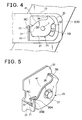
- the straight leg portion 11C When the arm frame 10 is in the vicinity of the lower limit position L, as shown in FIGS. 3 to 5 and 14, the straight leg portion 11C is positioned in the vicinity of the inclined wall 30, and when the arm frame 10 moves to the top position in the working range A, as shown in FIGS. 7, 8 and 15, the straight leg portion 11C just abuts against the unlock abutting wall 26. Consequently, when the arm frame 10 is positioned in the working range A, the straight leg portion 11C does not substantially abut against the spring cover 25, and the straight leg portion 11C is kept in a state in which whatever external force is not received.
- the coil portion 11A When the straight leg portion 11C is in a state in which whatever external force is not received, the coil portion 11A closely contacts the shaft 7 with adequate strength. By the frictional resistance due to this contact, the armrest 4 is kept at an arbitrary position in the working range A.
- the elbow of a driver and the like is mounted on the armrest 4 and the armrest 4 (shaft 7) tries to rotate downward, the coil portion 11A becomes short in diameter and strongly wounds around the shaft 7, so that the frictional resistance between the coil portion 11A and the shaft 7 is instantaneously increased. This increased frictional resistance prevents the downward rotation of the armrest 4.
- the arm bracket 33 has a bent plate 23 in parallel with the axial direction of the shaft 7, and the top end of the bent plate 23 is formed with a hook 21 capable of engaging with the straight leg portion 11C.
- the outer peripheral surface of the hook 21 is formed with an inclined guide cam surface 22 which guides the straight leg portion 11C into the hook 21.
- the straight leg portion 11C when not receiving whatever external force, is positioned in the vicinity of the guide cam surface 22.
- the end edge of the unlock abutting wall 26 of the spring cover 25 protrudes further to the arm frame side than the guide cam surface 22 of the hook 21.
- the bracket 33 of the armrest frame 10 is fixed with a stopper 32, which controls a rotational range of the spring cover 25.
- the stopper 32 serves also as a function to prevent the first bent leg portion 11B from coming off.
- the structure is simple since the armrest 4 functions as an operating lever.
- the width of the working range A of the armrest 4 can be simply changed through the change of the distance between the unlock abutting wall 26 of the spring cover 25 and the inclined wall 30.
- the armrest 4 when the armrest 4 is displaced from the upper limit position H toward the working range A, the frictional resistance between the coil portion 11A and the shaft 7 becomes considerably small so as to stop the locking function of the lock device 40, and therefore, the armrest 4 can be smoothly displaced till the lower limit L of the working range A.
Landscapes
- Engineering & Computer Science (AREA)
- Aviation & Aerospace Engineering (AREA)
- Transportation (AREA)
- Mechanical Engineering (AREA)
- Seats For Vehicles (AREA)
- Steps, Ramps, And Handrails (AREA)
- Chairs For Special Purposes, Such As Reclining Chairs (AREA)
Abstract
Description
Claims (2)
- An armrest height-adjusting device of a vehicle seat having a seat bottom and a seat back rotatably attached to the seat bottom, comprising:wherein the coil portion, in a state in which the second leg portion does not receive an external force, closely contacts the collar with adequate strength so as to generate an ordinary frictional resistance between the coil portion and the collar;a collar fixed to a seat back frame of the seat back and rotatably supporting an arm frame of the armrest;a spring cover integrally rotating with the collar;a lock spring having a coil portion disposed around the collar, a first leg portion engaging with the seat back frame, and a second leg portion stored into a window portion of the spring cover; anda stationary plate fixed to the arm frame and having a hook capable of engaging with the second leg portion;
wherein, when the armrest is rotated downward, a diameter of the coil portion becomes short by the ordinary fractional resistance so as to increase the frictional resistance between the coil portion and the collar;
wherein, when the armrest is rotated upward, the diameter of the coil portion becomes large by the ordinary frictional resistance so as to reduce the frictional resistance between the coil portion and the collar;
wherein, the window portion has an unlock abutting wall for abutting against the second leg portion so as to guide the second leg portion into the hook when the armrest is rotated upward beyond a predetermined position;
wherein, the window portion further has a return inclined wall for abutting against the second leg portion so as to return the second leg portion to the inside of the window from the hook when the armrest is rotated downward in a state in which the second leg portion engages with the hook;
wherein the frictional resistance between the coil portion and the collar, in a state in which the second leg portion engages with the hook, is kept in a weaker state than the ordinary frictional resistance. - The armrest height-adjusting device according to claim 1, wherein the hook has an inclined guide cam surface to guide the second leg portion into the hook when the second leg portion is displaced by abutment with the unlock abutting wall.
Applications Claiming Priority (3)
| Application Number | Priority Date | Filing Date | Title |
|---|---|---|---|
| JP2002378521 | 2002-12-26 | ||
| JP2002378521A JP4133311B2 (en) | 2002-12-26 | 2002-12-26 | Armrest height adjustment device |
| PCT/JP2003/016595 WO2004058009A1 (en) | 2002-12-26 | 2003-12-24 | Armrest height-adjusting device |
Publications (2)
| Publication Number | Publication Date |
|---|---|
| EP1588649A1 true EP1588649A1 (en) | 2005-10-26 |
| EP1588649A4 EP1588649A4 (en) | 2006-04-19 |
Family
ID=32677437
Family Applications (1)
| Application Number | Title | Priority Date | Filing Date |
|---|---|---|---|
| EP03768183A Withdrawn EP1588649A4 (en) | 2002-12-26 | 2003-12-24 | Armrest height-adjusting device |
Country Status (6)
| Country | Link |
|---|---|
| US (1) | US7198331B2 (en) |
| EP (1) | EP1588649A4 (en) |
| JP (1) | JP4133311B2 (en) |
| CN (1) | CN100444765C (en) |
| AU (1) | AU2003292767A1 (en) |
| WO (1) | WO2004058009A1 (en) |
Families Citing this family (17)
| Publication number | Priority date | Publication date | Assignee | Title |
|---|---|---|---|---|
| DE602005018577D1 (en) * | 2004-08-18 | 2010-02-11 | Bizen Hatsujoh Co Ltd | armrest |
| JP4488839B2 (en) * | 2004-08-26 | 2010-06-23 | テイ・エス テック株式会社 | Armrest mounting method and mounting configuration |
| JP4509730B2 (en) * | 2004-10-12 | 2010-07-21 | 備前発条株式会社 | Western toilet with armrest |
| DE102005002853B3 (en) * | 2005-01-20 | 2006-04-27 | Johnson Controls Gmbh | Bolt axial fixing device for motor vehicle, has wire shaped safety device loosely accommodated with slot, and axial force for loosening safety device is changed based on function of turning position relative to bolt or wave |
| JP4526448B2 (en) * | 2005-06-27 | 2010-08-18 | テイ・エス テック株式会社 | Armrests for vehicle seats |
| US20070278050A1 (en) * | 2006-06-06 | 2007-12-06 | Larson George D | Toe position control |
| JP4910133B2 (en) * | 2006-07-13 | 2012-04-04 | 日本発條株式会社 | Armrest device |
| US7607727B2 (en) * | 2006-12-04 | 2009-10-27 | Hyundai Mobis Co., Ltd. | Armrest locking device |
| JP4412500B2 (en) * | 2006-12-28 | 2010-02-10 | 日本発條株式会社 | Armrest device |
| JP4222626B1 (en) * | 2008-05-29 | 2009-02-12 | 備前発条株式会社 | Armrest device |
| ITPD20080253A1 (en) * | 2008-08-20 | 2010-02-21 | Clerprem Spa | ADJUSTABLE ARMREST IN INCLINATION, IN PARTICULAR FOR VEHICLES |
| US9132755B2 (en) * | 2011-03-17 | 2015-09-15 | Lear Corporation | Structure and method for pivotably supporting an armrest on a seat |
| JP5890525B2 (en) | 2012-08-10 | 2016-03-22 | 備前発条株式会社 | Armrest mechanism unit |
| JP5654168B1 (en) * | 2014-07-28 | 2015-01-14 | 備前発条株式会社 | Armrest |
| DE102014215432B4 (en) * | 2014-08-05 | 2019-06-13 | Adient Luxembourg Holding S.À R.L. | Secured armrest |
| JP2017105312A (en) * | 2015-12-09 | 2017-06-15 | テイ・エス テック株式会社 | One-way clutch and vehicle seat |
| CZ201932A3 (en) * | 2019-01-21 | 2020-03-11 | BORCAD Medical a.s. | Medical chair with adjustable armrests |
Family Cites Families (11)
| Publication number | Priority date | Publication date | Assignee | Title |
|---|---|---|---|---|
| US3807799A (en) * | 1972-11-06 | 1974-04-30 | G Freedman | Universal armrest assembly |
| JPH0513253U (en) * | 1991-05-27 | 1993-02-23 | 株式会社タチエス | Armrest device |
| JPH0513253A (en) | 1991-07-05 | 1993-01-22 | Fuji Electric Co Ltd | Instrument current transformer unit |
| US5489143A (en) * | 1993-09-06 | 1996-02-06 | Suncall Corporation | Arm rest device |
| US6050645A (en) * | 1998-03-04 | 2000-04-18 | Tachi-S Engineering U.S.A., Inc. | Clutching mechanism for an infinitely adjustable armrest |
| CN2371874Y (en) * | 1999-03-24 | 2000-04-05 | 泰桦家具股份有限公司 | Seat armrest height adjustment structure |
| US6467847B2 (en) * | 2001-01-19 | 2002-10-22 | Johnson Controls Technology Company | Comfort armrest with memory |
| FR2820375B1 (en) * | 2001-02-06 | 2003-04-18 | Faurecia Sieges Automobile | FIXING DEVICE FOR A REMOVABLE ARMREST AND SEAT DEVICE COMPRISING SUCH A FIXING DEVICE |
| JP2003033252A (en) * | 2001-07-24 | 2003-02-04 | Otics Corp | Stepless adjustable retractable armrest device |
| JP4089386B2 (en) * | 2002-10-29 | 2008-05-28 | 日本発条株式会社 | Armrest device |
| JP4094421B2 (en) * | 2002-12-26 | 2008-06-04 | テイ・エス テック株式会社 | Armrest height adjustment device |
-
2002
- 2002-12-26 JP JP2002378521A patent/JP4133311B2/en not_active Expired - Fee Related
-
2003
- 2003-12-24 US US10/540,851 patent/US7198331B2/en not_active Expired - Lifetime
- 2003-12-24 CN CNB200380107653XA patent/CN100444765C/en not_active Expired - Fee Related
- 2003-12-24 AU AU2003292767A patent/AU2003292767A1/en not_active Abandoned
- 2003-12-24 WO PCT/JP2003/016595 patent/WO2004058009A1/en not_active Ceased
- 2003-12-24 EP EP03768183A patent/EP1588649A4/en not_active Withdrawn
Also Published As
| Publication number | Publication date |
|---|---|
| CN1731946A (en) | 2006-02-08 |
| CN100444765C (en) | 2008-12-24 |
| WO2004058009A1 (en) | 2004-07-15 |
| US20060273647A1 (en) | 2006-12-07 |
| EP1588649A4 (en) | 2006-04-19 |
| JP4133311B2 (en) | 2008-08-13 |
| US7198331B2 (en) | 2007-04-03 |
| AU2003292767A1 (en) | 2004-07-22 |
| JP2004208720A (en) | 2004-07-29 |
Similar Documents
| Publication | Publication Date | Title |
|---|---|---|
| US7393058B2 (en) | Armrest height-adjusting device | |
| US7198331B2 (en) | Armrest height-adjusting device | |
| US6050645A (en) | Clutching mechanism for an infinitely adjustable armrest | |
| EP1074426B1 (en) | Reclining mechanism for vehicle seat | |
| US9694784B2 (en) | Webbing take-up device | |
| US8777317B2 (en) | Adjustable armrest device | |
| EP0561278A1 (en) | Safety catch for storage device lid | |
| JP2767756B2 (en) | Seat belt retractor | |
| KR20140113924A (en) | Self-locking belt retractor with switch-off action on its belt-strap-sensitive control system that is effective in the winding direction of the belt shaft | |
| JPH0336291Y2 (en) | ||
| JP4345670B2 (en) | Safety belt winder with vehicle sensor that can be shut off | |
| JP2653764B2 (en) | Vehicle seat belt retractor | |
| JP2913790B2 (en) | Seat belt retractor | |
| KR20160059312A (en) | Latch device for trunk | |
| US20050150988A1 (en) | Seat belt retractor | |
| US5251933A (en) | Seat belt retractor | |
| JP2913789B2 (en) | Seat belt retractor | |
| JP3643859B2 (en) | Reclining device for seat | |
| JP3936077B2 (en) | Stop angle adjustment mechanism of door closer | |
| JPS6030438Y2 (en) | Mounting structure of operating parts | |
| JPH11229709A (en) | Spring-up type door for vehicle | |
| JP3658438B2 (en) | Accelerator lever device such as traveling work machine | |
| JP2002281875A (en) | Spinning reel for fishing | |
| JPS61271142A (en) | Lock mechanism for rear seat | |
| JPH0661609U (en) | Seat belt retractor |
Legal Events
| Date | Code | Title | Description |
|---|---|---|---|
| PUAI | Public reference made under article 153(3) epc to a published international application that has entered the european phase |
Free format text: ORIGINAL CODE: 0009012 |
|
| 17P | Request for examination filed |
Effective date: 20050726 |
|
| AK | Designated contracting states |
Kind code of ref document: A1 Designated state(s): AT BE BG CH CY CZ DE DK EE ES FI FR GB GR HU IE IT LI LU MC NL PT RO SE SI SK TR |
|
| AX | Request for extension of the european patent |
Extension state: AL LT LV MK |
|
| A4 | Supplementary search report drawn up and despatched |
Effective date: 20060306 |
|
| DAX | Request for extension of the european patent (deleted) | ||
| 17Q | First examination report despatched |
Effective date: 20060811 |
|
| GRAP | Despatch of communication of intention to grant a patent |
Free format text: ORIGINAL CODE: EPIDOSNIGR1 |
|
| GRAS | Grant fee paid |
Free format text: ORIGINAL CODE: EPIDOSNIGR3 |
|
| STAA | Information on the status of an ep patent application or granted ep patent |
Free format text: STATUS: THE APPLICATION IS DEEMED TO BE WITHDRAWN |
|
| 18D | Application deemed to be withdrawn |
Effective date: 20070701 |