EP1586617A1 - Substituted fluorene polymers, their preparations and use in optical devices - Google Patents
Substituted fluorene polymers, their preparations and use in optical devices Download PDFInfo
- Publication number
- EP1586617A1 EP1586617A1 EP05007146A EP05007146A EP1586617A1 EP 1586617 A1 EP1586617 A1 EP 1586617A1 EP 05007146 A EP05007146 A EP 05007146A EP 05007146 A EP05007146 A EP 05007146A EP 1586617 A1 EP1586617 A1 EP 1586617A1
- Authority
- EP
- European Patent Office
- Prior art keywords
- polymer
- group
- formula
- optionally substituted
- monomer
- Prior art date
- Legal status (The legal status is an assumption and is not a legal conclusion. Google has not performed a legal analysis and makes no representation as to the accuracy of the status listed.)
- Withdrawn
Links
- NLRVWXULDJDFBO-UHFFFAOYSA-N [AlH2]C1(c2cc(P)ccc2-c(cc2)c1cc2P)[AlH2] Chemical compound [AlH2]C1(c2cc(P)ccc2-c(cc2)c1cc2P)[AlH2] NLRVWXULDJDFBO-UHFFFAOYSA-N 0.000 description 1
Images

Classifications
-
- C—CHEMISTRY; METALLURGY
- C09—DYES; PAINTS; POLISHES; NATURAL RESINS; ADHESIVES; COMPOSITIONS NOT OTHERWISE PROVIDED FOR; APPLICATIONS OF MATERIALS NOT OTHERWISE PROVIDED FOR
- C09K—MATERIALS FOR MISCELLANEOUS APPLICATIONS, NOT PROVIDED FOR ELSEWHERE
- C09K11/00—Luminescent materials, e.g. electroluminescent or chemiluminescent
- C09K11/06—Luminescent materials, e.g. electroluminescent or chemiluminescent containing organic luminescent materials
-
- C—CHEMISTRY; METALLURGY
- C08—ORGANIC MACROMOLECULAR COMPOUNDS; THEIR PREPARATION OR CHEMICAL WORKING-UP; COMPOSITIONS BASED THEREON
- C08G—MACROMOLECULAR COMPOUNDS OBTAINED OTHERWISE THAN BY REACTIONS ONLY INVOLVING UNSATURATED CARBON-TO-CARBON BONDS
- C08G61/00—Macromolecular compounds obtained by reactions forming a carbon-to-carbon link in the main chain of the macromolecule
- C08G61/02—Macromolecular compounds containing only carbon atoms in the main chain of the macromolecule, e.g. polyxylylenes
-
- C—CHEMISTRY; METALLURGY
- C08—ORGANIC MACROMOLECULAR COMPOUNDS; THEIR PREPARATION OR CHEMICAL WORKING-UP; COMPOSITIONS BASED THEREON
- C08G—MACROMOLECULAR COMPOUNDS OBTAINED OTHERWISE THAN BY REACTIONS ONLY INVOLVING UNSATURATED CARBON-TO-CARBON BONDS
- C08G61/00—Macromolecular compounds obtained by reactions forming a carbon-to-carbon link in the main chain of the macromolecule
- C08G61/02—Macromolecular compounds containing only carbon atoms in the main chain of the macromolecule, e.g. polyxylylenes
- C08G61/10—Macromolecular compounds containing only carbon atoms in the main chain of the macromolecule, e.g. polyxylylenes only aromatic carbon atoms, e.g. polyphenylenes
-
- H—ELECTRICITY
- H01—ELECTRIC ELEMENTS
- H01B—CABLES; CONDUCTORS; INSULATORS; SELECTION OF MATERIALS FOR THEIR CONDUCTIVE, INSULATING OR DIELECTRIC PROPERTIES
- H01B1/00—Conductors or conductive bodies characterised by the conductive materials; Selection of materials as conductors
- H01B1/06—Conductors or conductive bodies characterised by the conductive materials; Selection of materials as conductors mainly consisting of other non-metallic substances
- H01B1/12—Conductors or conductive bodies characterised by the conductive materials; Selection of materials as conductors mainly consisting of other non-metallic substances organic substances
-
- H—ELECTRICITY
- H05—ELECTRIC TECHNIQUES NOT OTHERWISE PROVIDED FOR
- H05B—ELECTRIC HEATING; ELECTRIC LIGHT SOURCES NOT OTHERWISE PROVIDED FOR; CIRCUIT ARRANGEMENTS FOR ELECTRIC LIGHT SOURCES, IN GENERAL
- H05B33/00—Electroluminescent light sources
- H05B33/12—Light sources with substantially two-dimensional [2D] radiating surfaces
- H05B33/14—Light sources with substantially two-dimensional [2D] radiating surfaces characterised by the chemical or physical composition or the arrangement of the electroluminescent material, or by the simultaneous addition of the electroluminescent material in or onto the light source
-
- H—ELECTRICITY
- H10—SEMICONDUCTOR DEVICES; ELECTRIC SOLID-STATE DEVICES NOT OTHERWISE PROVIDED FOR
- H10K—ORGANIC ELECTRIC SOLID-STATE DEVICES
- H10K85/00—Organic materials used in the body or electrodes of devices covered by this subclass
- H10K85/10—Organic polymers or oligomers
- H10K85/111—Organic polymers or oligomers comprising aromatic, heteroaromatic, or aryl chains, e.g. polyaniline, polyphenylene or polyphenylene vinylene
- H10K85/115—Polyfluorene; Derivatives thereof
-
- H—ELECTRICITY
- H10—SEMICONDUCTOR DEVICES; ELECTRIC SOLID-STATE DEVICES NOT OTHERWISE PROVIDED FOR
- H10K—ORGANIC ELECTRIC SOLID-STATE DEVICES
- H10K85/00—Organic materials used in the body or electrodes of devices covered by this subclass
- H10K85/10—Organic polymers or oligomers
- H10K85/151—Copolymers
-
- C—CHEMISTRY; METALLURGY
- C09—DYES; PAINTS; POLISHES; NATURAL RESINS; ADHESIVES; COMPOSITIONS NOT OTHERWISE PROVIDED FOR; APPLICATIONS OF MATERIALS NOT OTHERWISE PROVIDED FOR
- C09K—MATERIALS FOR MISCELLANEOUS APPLICATIONS, NOT PROVIDED FOR ELSEWHERE
- C09K2211/00—Chemical nature of organic luminescent or tenebrescent compounds
- C09K2211/14—Macromolecular compounds
- C09K2211/1408—Carbocyclic compounds
-
- C—CHEMISTRY; METALLURGY
- C09—DYES; PAINTS; POLISHES; NATURAL RESINS; ADHESIVES; COMPOSITIONS NOT OTHERWISE PROVIDED FOR; APPLICATIONS OF MATERIALS NOT OTHERWISE PROVIDED FOR
- C09K—MATERIALS FOR MISCELLANEOUS APPLICATIONS, NOT PROVIDED FOR ELSEWHERE
- C09K2211/00—Chemical nature of organic luminescent or tenebrescent compounds
- C09K2211/14—Macromolecular compounds
- C09K2211/1408—Carbocyclic compounds
- C09K2211/1416—Condensed systems
-
- C—CHEMISTRY; METALLURGY
- C09—DYES; PAINTS; POLISHES; NATURAL RESINS; ADHESIVES; COMPOSITIONS NOT OTHERWISE PROVIDED FOR; APPLICATIONS OF MATERIALS NOT OTHERWISE PROVIDED FOR
- C09K—MATERIALS FOR MISCELLANEOUS APPLICATIONS, NOT PROVIDED FOR ELSEWHERE
- C09K2211/00—Chemical nature of organic luminescent or tenebrescent compounds
- C09K2211/14—Macromolecular compounds
- C09K2211/1408—Carbocyclic compounds
- C09K2211/1425—Non-condensed systems
-
- C—CHEMISTRY; METALLURGY
- C09—DYES; PAINTS; POLISHES; NATURAL RESINS; ADHESIVES; COMPOSITIONS NOT OTHERWISE PROVIDED FOR; APPLICATIONS OF MATERIALS NOT OTHERWISE PROVIDED FOR
- C09K—MATERIALS FOR MISCELLANEOUS APPLICATIONS, NOT PROVIDED FOR ELSEWHERE
- C09K2211/00—Chemical nature of organic luminescent or tenebrescent compounds
- C09K2211/14—Macromolecular compounds
- C09K2211/1408—Carbocyclic compounds
- C09K2211/1433—Carbocyclic compounds bridged by heteroatoms, e.g. N, P, Si or B
-
- H—ELECTRICITY
- H10—SEMICONDUCTOR DEVICES; ELECTRIC SOLID-STATE DEVICES NOT OTHERWISE PROVIDED FOR
- H10K—ORGANIC ELECTRIC SOLID-STATE DEVICES
- H10K50/00—Organic light-emitting devices
- H10K50/10—OLEDs or polymer light-emitting diodes [PLED]
- H10K50/11—OLEDs or polymer light-emitting diodes [PLED] characterised by the electroluminescent [EL] layers
-
- H—ELECTRICITY
- H10—SEMICONDUCTOR DEVICES; ELECTRIC SOLID-STATE DEVICES NOT OTHERWISE PROVIDED FOR
- H10K—ORGANIC ELECTRIC SOLID-STATE DEVICES
- H10K85/00—Organic materials used in the body or electrodes of devices covered by this subclass
- H10K85/60—Organic compounds having low molecular weight
- H10K85/631—Amine compounds having at least two aryl rest on at least one amine-nitrogen atom, e.g. triphenylamine
-
- Y—GENERAL TAGGING OF NEW TECHNOLOGICAL DEVELOPMENTS; GENERAL TAGGING OF CROSS-SECTIONAL TECHNOLOGIES SPANNING OVER SEVERAL SECTIONS OF THE IPC; TECHNICAL SUBJECTS COVERED BY FORMER USPC CROSS-REFERENCE ART COLLECTIONS [XRACs] AND DIGESTS
- Y10—TECHNICAL SUBJECTS COVERED BY FORMER USPC
- Y10S—TECHNICAL SUBJECTS COVERED BY FORMER USPC CROSS-REFERENCE ART COLLECTIONS [XRACs] AND DIGESTS
- Y10S428/00—Stock material or miscellaneous articles
- Y10S428/917—Electroluminescent
-
- Y—GENERAL TAGGING OF NEW TECHNOLOGICAL DEVELOPMENTS; GENERAL TAGGING OF CROSS-SECTIONAL TECHNOLOGIES SPANNING OVER SEVERAL SECTIONS OF THE IPC; TECHNICAL SUBJECTS COVERED BY FORMER USPC CROSS-REFERENCE ART COLLECTIONS [XRACs] AND DIGESTS
- Y10—TECHNICAL SUBJECTS COVERED BY FORMER USPC
- Y10T—TECHNICAL SUBJECTS COVERED BY FORMER US CLASSIFICATION
- Y10T428/00—Stock material or miscellaneous articles
- Y10T428/31504—Composite [nonstructural laminate]
- Y10T428/3154—Of fluorinated addition polymer from unsaturated monomers
-
- Y—GENERAL TAGGING OF NEW TECHNOLOGICAL DEVELOPMENTS; GENERAL TAGGING OF CROSS-SECTIONAL TECHNOLOGIES SPANNING OVER SEVERAL SECTIONS OF THE IPC; TECHNICAL SUBJECTS COVERED BY FORMER USPC CROSS-REFERENCE ART COLLECTIONS [XRACs] AND DIGESTS
- Y10—TECHNICAL SUBJECTS COVERED BY FORMER USPC
- Y10T—TECHNICAL SUBJECTS COVERED BY FORMER US CLASSIFICATION
- Y10T428/00—Stock material or miscellaneous articles
- Y10T428/31504—Composite [nonstructural laminate]
- Y10T428/31855—Of addition polymer from unsaturated monomers
Definitions
- the invention relates to materials for optical devices, in particular organic electroluminescent devices, and the control of their physical properties.
- One class of opto-electrical devices is those using an organic material for light emission or detection.
- the basic structure of these devices is a light emissive organic layer, for instance a film of a poly (p-phenylenevinylene) ("PPV”) or polyfluorene, sandwiched between a cathode for injecting negative charge carriers (electrons) and an anode for injecting positive charge carriers (holes) into the organic layer.
- PSV poly (p-phenylenevinylene)
- polyfluorene sandwiched between a cathode for injecting negative charge carriers (electrons) and an anode for injecting positive charge carriers (holes) into the organic layer.
- the electrons and holes combine in the organic layer generating photons.
- the organic light-emissive material is a polymer.
- the organic light-emissive material is of the class known as small molecule materials, such as (8-hydroxyquinoline) aluminium (“Alq3"). In a practical device one of the
- FIG. 1 illustrates the cross-sectional structure of a typical organic light-emissive device ("OLED").
- OLED organic light-emissive device
- the OLED is typically fabricated on a glass or plastic substrate 1 coated with a transparent first electrode 4 such as indium-tin-oxide ("ITO").
- ITO indium-tin-oxide
- a layer of a thin film of at least one electroluminescent organic material 3 covers the first electrode.
- a cathode 2 covers the layer of electroluminescent organic material.
- the cathode is typically a metal or alloy and may comprise a single layer, such as aluminium, or a plurality of layers such as calcium and aluminium. Other layers can be added to the device, for example to improve charge injection from the electrodes to the electroluminescent material.
- a hole injection layer such as poly(ethylene dioxythiophene) / polystyrene sulfonate (PEDOT-PSS) or polyaniline may be provided between the anode 4 and the electroluminescent material 3.
- PEDOT-PSS polystyrene sulfonate
- polyaniline may be provided between the anode 4 and the electroluminescent material 3.
- binding energies measured with respect to the vacuum level of the electronic energy levels, particularly the "highest occupied molecular orbital” (HOMO) and the “lowest unoccupied molecular orbital” (LUMO) level. These can be estimated from measurements of photoemission and particularly measurements of the electrochemical potentials for oxidation and reduction. It is well understood in this field that such energies are affected by a number of factors, such as the local environment near an interface, and the point on the curve (peak) from which the value is determined. Accordingly, the use of such values is indicative rather than quantitative.
- a focus in the field of polymer OLEDs is the development of full colour displays for which red, green and blue emissive materials are required.
- lifetime is meant the time for the brightness of the OLED to fall from 100 cd/m 2 to 50 cd/m 2 when operated under DC drive at room temperature.
- lifetime is meant the time for the brightness of the OLED to fall from 100 cd/m 2 to 50 cd/m 2 when operated under DC drive at room temperature.
- One drawback with existing polymer OLED displays relevant to this development is the relatively short lifetime of blue emissive materials known to date.
- the lifetime of the emissive material may be extended by optimisation of the OLED architecture; for example lifetime of the red, green and blue materials may be dependant on the cathode being used.
- a polymer in particular a blue electroluminescent polymer that is inherently stable, i.e. one having a high lifetime in a variety of OLED architectures, is clearly desirable.
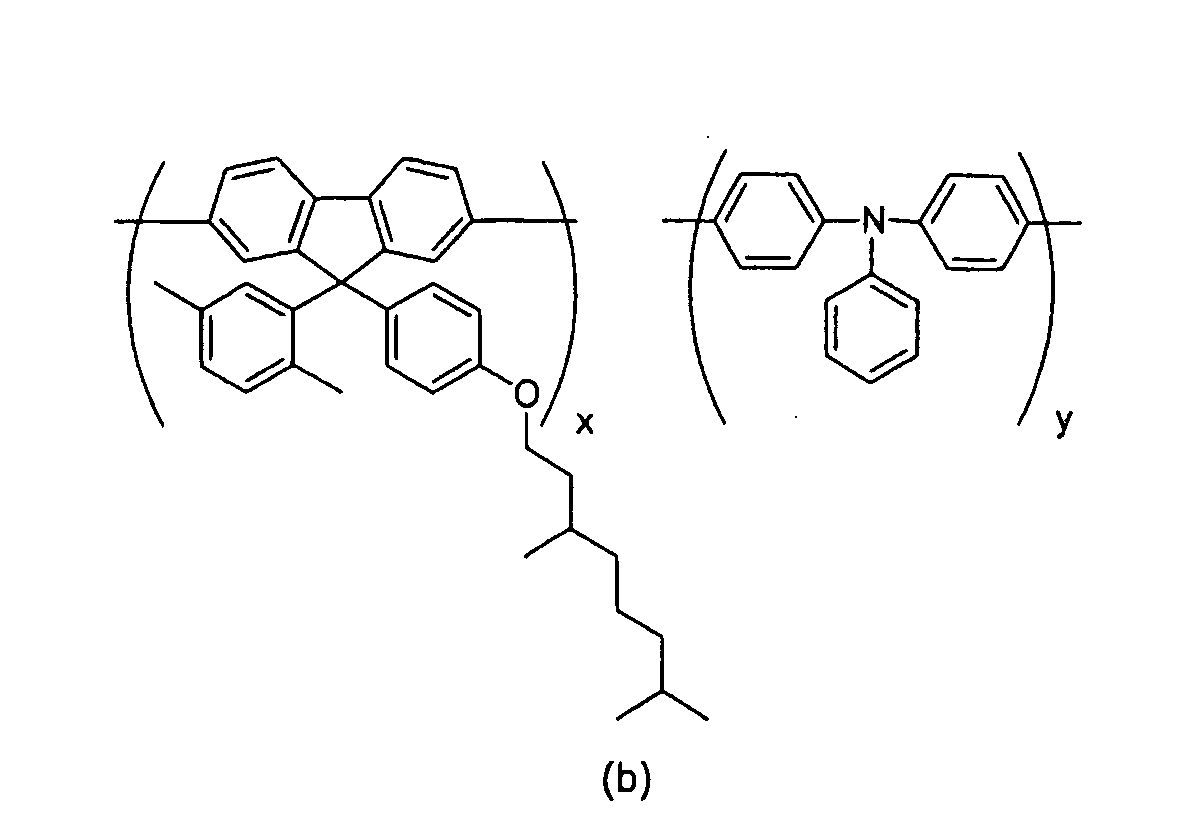
- WO 00/22026 discloses polymers of formula (b): wherein X is 97 or 99 and Y is 3 or 1 respectively. These polymers are disclosed for use in electroluminescent devices.
- electroluminescent polymers comprising diphenylfluorene repeat units
- diphenylfluorene repeat units include:
- the lifetime of a polymer for use in an optical device may be increased by the incorporation of repeat units that increase the glass temperature (Tg) of the polymer.
- Tg glass temperature
- incorporation of 2,7-linked 9,9-diarylfluorene repeat units into an electroluminescent polymer, particularly a blue emissive electroluminescent polymer results in significant increase in that polymer's lifetime.
- an increase in the Tg of a polymer is inherently desirable because of the increase in thermal stability.
- the invention provides a polymer for use in an optical device comprising:
- Particularly preferred groups R are hydrogen and optionally substituted alkyl or alkoxy.
- R is hydrogen or butyl.
- butyl is meant n -, sec - or tert -butyl 9,9-diarylfluorene repeat units present in polymers as disclosed in the aforementioned prior art have been used for the purpose of electron transport and / or as a linking group for a second repeat unit. To this end, these prior art polymers consist of 50% or more of 9,9-diarylfluorene units.
- the present inventors have determined that a lower amount of repeat units of formula (I) may be employed for the purpose of increasing glass transition temperature by comparison with a corresponding polymer not comprising repeat units of formula (I). Accordingly, the polymer of the invention preferably comprises less than 50 mol %, more preferably 10-40 mol % of repeat units of formula (I).
- the polymer is an electroluminescent polymer. More preferably, the polymer is a blue electroluminescent polymer.
- blue electroluminescent polymer is meant a polymer that by electroluminescence emits radiation having a wavelength in the range of 400-500 nm, preferably 430-500 nm.
- the invention provides an optical device, preferably an electroluminescent device, comprising a first electrode for injection of positive charge carriers, a second electrode for injection of negative charge carriers and a layer located between the first and second electrode comprising a polymer comprising:
- the invention provides a method of controlling the glass transition temperature of a polymer which comprises polymerising in a polymerisation mixture a monomer of formula (III): wherein each Ar is the same or different and comprises an optionally substituted aryl group and each P is a functional group for polymerisation, the process comprising the steps of polymerising an amount of the monomer of formula (III) required to reach a preselected glass transition temperature.
- monomers of formula (III) comprise less than 50 mol %, more preferably 10-40 mol %, of monomers in the polymerisation mixture of monomers in the polymerisation mixture.
- Suzuki polymerisation as disclosed in, for example, WO 00/53656 and Yamamoto polymerisation as disclosed in, for example, "Macromolecules", 31, 1099-1103 (1998).
- Suzuki polymerisation entails the coupling of halide and boron derivative functional groups;
- Yamamoto polymerisation entails the coupling of halide functional groups.
- each P is independently selected from the group consisting of (a) boron derivative functional groups selected from boronic acid groups, boronic ester groups and borane groups and (b) halide functional groups.
- the method comprises a step of reacting a first monomer of formula (III) with a second monomer that may be the same or different from the first monomer in the presence of a metal co-ordination complex catalyst and under conditions so as to polymerise the monomers to form a polymer.
- the method comprises a step of polymerizing in a reaction mixture (a) a first aromatic monomer having at least two boron derivative functional groups selected from a boronic acid group, a boronic ester group and a borane group, and a second aromatic monomer having at least two reactive halide functional groups wherein at least one of the first or second aromatic monomers comprises a monomer of formula (III); or (b) an aromatic monomer of formula (III) having one reactive halide functional group and one boron derivative functional group selected from a boronic acid group, a boronic ester group and a borane group, wherein the reaction mixture comprises a catalytic amount of a catalyst suitable for catalysing the polymerisation of the aromatic monomers, and a base in an amount sufficient to convert the boron derivative functional groups into -BX 3 - anionic groups, wherein X is independently selected from the group consisting of F and OH.
- the base is an organic base, more preferably a tetra-alkylammonium carbonate or hydroxide as disclosed in WO 00/53656.
- the invention provides use of an optionally substituted repeat unit of formula (I) in a polymer, preferably an electroluminescent polymer, as a glass transition temperature enhancing agent: wherein each Ar is as defined above.
- the invention provides an polymer, preferably an electroluminescent polymer, comprising less than 50 mol %, preferably 10-40 mol % of an optionally substituted repeat unit of formula (I): wherein each Ar is as defined above.
- Each region may comprise a single repeat unit or a plurality of repeat units conjugated together.
- Each of the hole transporting region, electron transporting region and emissive region may only occur once within the polymer.
- a region may only occur once within the polymer, particularly when it comprises an extended chain of conjugated repeat units.
- there may be a plurality of one or more of the hole transporting region, electron transporting region and emissive region distributed throughout the polymer. It should be noted that each of the three regions are chemically different from one another, i.e. preferably, in use, a given region will not function as more than one of a hole transport region, an electron transport region or an emissive region.
- hole transporting region As outlined below.
- hole transporting region is meant a region having a HOMO level lower than the HOMO level of the emissive region or the electron transporting region.
- electron transporting region is meant a region having a LUMO level higher than the LUMO level of the emissive region or the hole transporting region. located between the LUMO level of the emissive region and the workfunction of the cathode of the device in which the polymer of the invention is used. Typically, the workfunction of the cathode is around 2.5 eV
- emissive region is meant a region having a HOMO-LUMO bandgap smaller than that of the hole transporting region or the electron transporting region.
- the HOMO and LUMO levels and bandgaps of a region of the polymer may be accurately estimated by measuring the HOMO level of a corresponding homopolymer or 1:1 copolymer by cyclic voltammetry.
- the LUMO level of a region may also be measured in this way; alternatively, it may be calculated by measurement of the HOMO level and the HOMO-LUMO bandgap.
- the emissive region will be readily identifiable from on the electroluminescent spectra of homopolymers or 1:1 copolymers corresponding to each region.
- Substantially all hole transport, electron transport or emission will arise from regions meeting the corresponding definition given above, however a relatively minor amount of hole transport, electron transport or emission may be due to regions not meeting the corresponding definition. For example, a relatively minor amount of emission may be observed from a hole or electron transporting region if the HOMO-LUMO bandgap of that region is not much greater than the HOMO-LUMO bandgap of the emissive region.
- a typical electroluminescent device comprises an anode having a workfunction of 4.8 eV. Accordingly, the HOMO level of the hole transporting region is preferably around 4.8-5.5 eV. Similarly, the cathode of a typical device will have a workfunction of around 3 eV. Accordingly, the LUMO level of the electron transporting region is preferably around 3-3.5 eV.
- Preferred as hole transporting regions are triarylamines as disclosed in, for example, WO 99/54385 the contents of which are incorporated herein by reference.
- Preferred as electron transporting regions are 2,7-linked fluorene repeat units and conjugated chains thereof.
- Particularly preferred polyfluorenes include 2,7-linked-9,9-dialkyl fluorenes as disclosed in, for example, EP 0842208, the contents of which are incorporated herein by reference; spirobifluorenes as disclosed in, for example, EP 0707020, the contents of which are incorporated herein by reference, and indenofluorenes.
- repeat units of formula (I), and conjugated chains thereof may function as electron transporting regions as well as serving to increase the glass transition temperature of polymers of the invention.
- Also preferred as electron transporting regions are 1,4-linked phenyl repeat units and conjugated chains thereof.
- emissive regions are emissive repeat units as disclosed in WO 00/55927 and WO 00/46321, the contents of which are incorporated herein by reference.
- a particularly preferred blue emissive repeat unit comprises an optionally substituted repeat unit of formula (IV): Wherein each R' is independently selected from hydrogen or a solubilising group. Particularly preferred solubilising groups are optionally substituted alkyl or alkoxy. Most preferably, R' is n-butyl.
- Each of the hole transporting region, electron transporting region and emissive region may be provided as part of the polymer backbone as disclosed in, for example, WO 00/55927.
- one or more of the said regions may be pendant from the polymer backbone as disclosed in, for example, WO 01/49769 and WO 02/26859 wherein hole transporting regions are pendant from an electron transporting backbone.
- 4,4-dibromo-2-carboxylic acid biphenyl (171.14g, 0.481 mol) was suspended in methanol (700 mL) and sulfuric acid (15 mL) then heated at 80 °C for 21 hours. The solvent was removed and the oil was dissolved in ethyl acetate. This solution was washed with 2N sodium hydroxide, water, saturated sodium chloride, dried over magnesium sulfate, filtered and evaporated to give an orange oil. This oil was treated with hot methanol, on cooling the ester precipitated out and was filtered. The mother liquor was evaporated and the solid recrystallised giving additional product.
- 4,4-dibromo-2-methyl ester-biphenyl (24.114g, 65.1 mmol) was dissolved in dry diethyl ether (120 mL) and the solution was cooled to -60 °C by using an isopropanol/dry ice bath. Phenyl lithium (1.8M solution in cyclohexane-ether, 91 mL) was then added dropwise. The mixture was stirred and let to warm to room temperature. The reaction was complete after four hours. Water was added (70 mL) then the aqueous layer washed once with diethyl ether. Combined organic phases were washed with sodium chloride, dried over magnesium sulfate, filtered and evaporated to give a yellow powder.
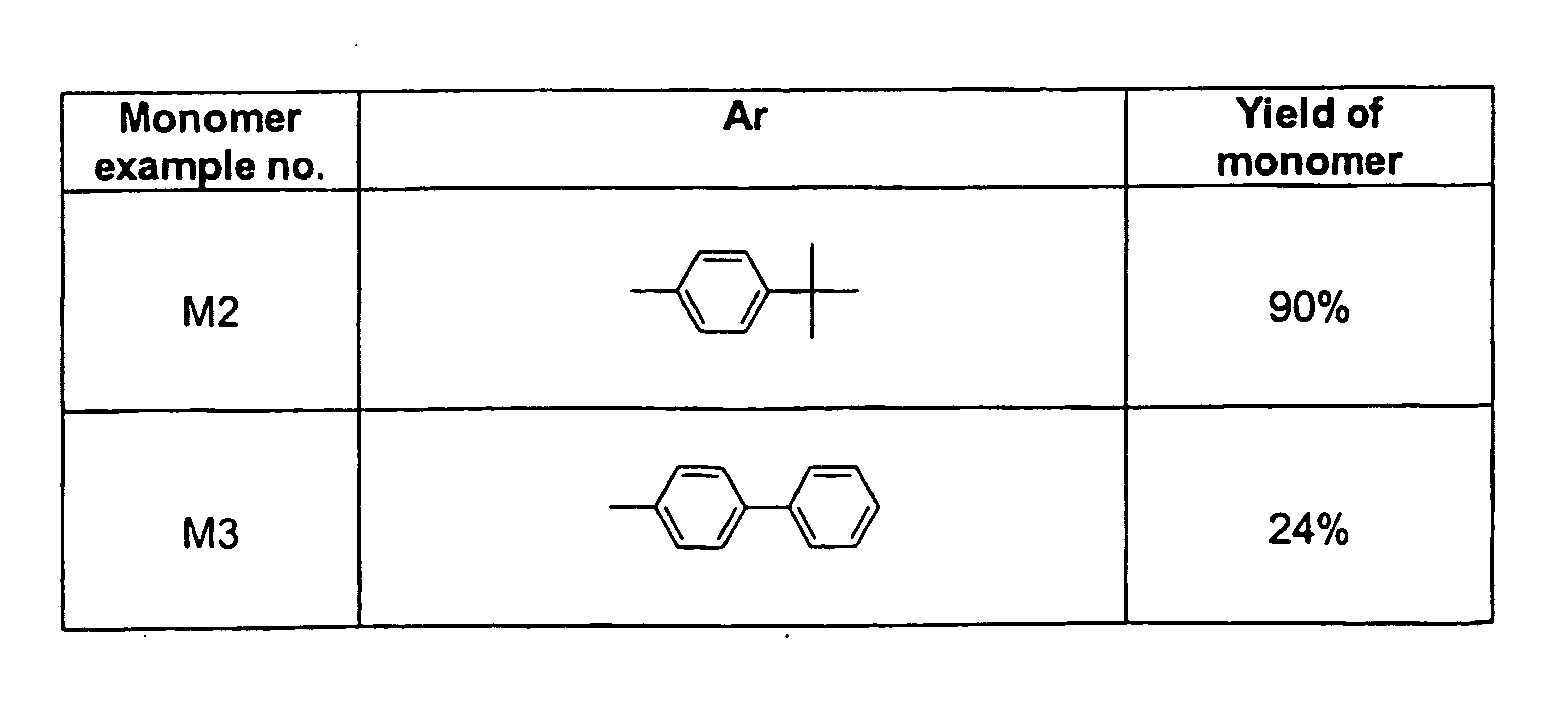
- Monomers with Ar groups as detailed in the table below were prepared in accordance with the scheme and general experimental process outlined above.
- Aryllithium compounds corresponding to Ar groups shown in the table were prepared from the corresponding aryl bromide.
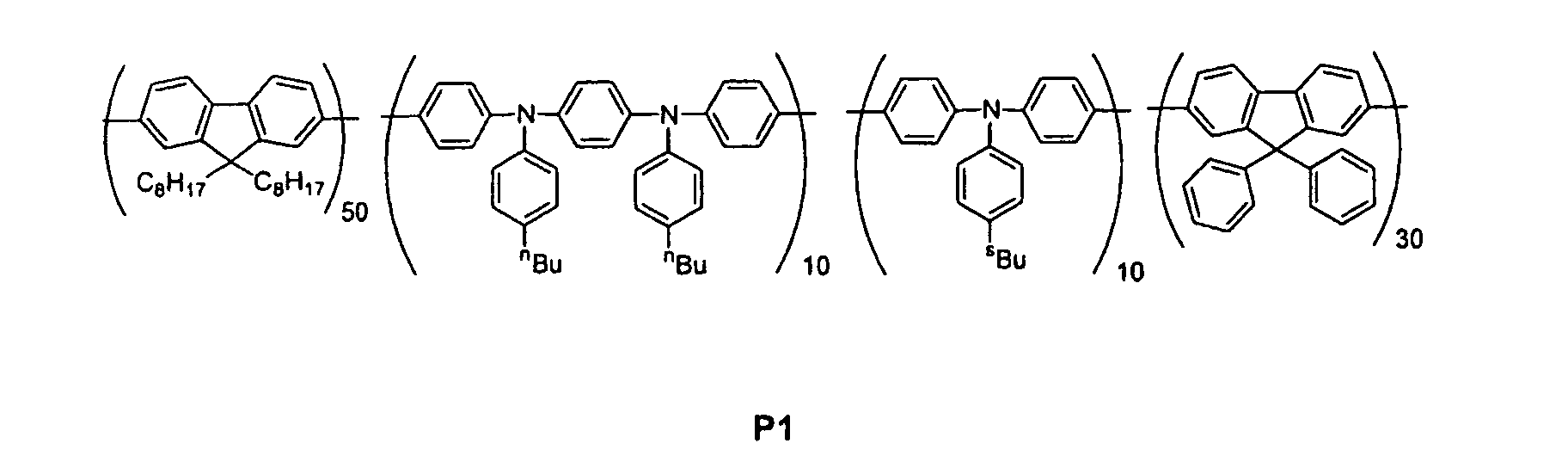
- a blue electroluminescent polymer according to the invention was prepared in accordance with the process of WO 00/53656 by reaction of 9,9-di-n-octylfluorene-2,7-di (ethylenylboronate) (0.5 equivalents), 2,7-dibromo-9,9-diphenylfluorene (0.3 equivalents), N,N-di(4-bromophenyl)-sec-butylphenylamine (0.1 equivalents) and N,N'-di(4-bromophenyl)-N,N'-di(4-n-butylphenyl)-1,4-diaminobenzene (0.1 equivalents) to give polymer P1:
- Polymers were prepared in accordance with the method of example P1 except that ratios of 9,9-dioctylfluorene repeat units and 9,9-diphenylfluorene repeat units present in the polymer were varied as follows: Example no. 9,9-diphenylfluorene (mol %) 9,9-dioctylfluorene (mol %) P2 50 30 P3 60 20
- a polymer was prepared in accordance with the method of example P1 except that 2,7-dibromo-9,9-di(biphenyl)fluorene (monomer example M3; 0.3 eq) was used in place of 2,7-dibromo-9,9-diphenylfluorene.
- a blue emissive polymer as disclosed in WO 00/55927, was prepared in accordance with polymer example 1 wherein all 9,9-diphenylfluorene repeat units were replaced with 9,9-di-n-octylfluorene repeat units. This was done by following the preparation of polymer example 1 except that 0.3 equivalents of 2,7-dibromo-9,9-di-n-octylfluorene was used in place of 2,7-dibromo-9,9-diphenylfluorene.
- a glass substrate carrying an ITO substrate of thickness was deposited by spin coating poly(ethylenedioxythiopene)/polystyrene sulfonate (available from BayerTM as Baytron P TM) to a thickness of 270 microns. Over this was deposited a polymer according to the invention to a thickness of 50 nm by spin coating. A layer of lithium fluoride (thickness 4 nm) was deposited onto the polymer by evaporation followed by a cathode of calcium (thickness 50 nm), again deposited by evaporation. The device was encapsulated using a metal can.
- poly(ethylenedioxythiopene)/polystyrene sulfonate available from BayerTM as Baytron P TM
- a device was prepared in accordance with the method outlined for the device example above except that the comparative polymer described above was used in place of the polymer according to the invention.
- polymers according to the invention have significantly higher Tg values than the comparative prior art polymer, giving them greater thermal stability.
- Tg increases with the quantity of repeat units of formula (I) incorporated into the polymer.
- different repeat units of formula (I) differ in the extent to which they affect Tg.
- polymer P4 (comprising 30% di(biphenyl)fluorene repeat units) has a higher Tg than polymer P1 (comprising 30% diphenylfluorene repeat units).
- polymers P1-P4 have a lifetime of around 3,000 hours or more whereas the comparative polymer example has a lifetime of around 1,000 hours.
Landscapes
- Chemical & Material Sciences (AREA)
- Engineering & Computer Science (AREA)
- Materials Engineering (AREA)
- Organic Chemistry (AREA)
- Health & Medical Sciences (AREA)
- Chemical Kinetics & Catalysis (AREA)
- Medicinal Chemistry (AREA)
- Polymers & Plastics (AREA)
- Physics & Mathematics (AREA)
- Spectroscopy & Molecular Physics (AREA)
- Polyoxymethylene Polymers And Polymers With Carbon-To-Carbon Bonds (AREA)
- Electroluminescent Light Sources (AREA)
- Addition Polymer Or Copolymer, Post-Treatments, Or Chemical Modifications (AREA)
- Polyesters Or Polycarbonates (AREA)
- Medicinal Preparation (AREA)
Abstract
- a hole transporting region
- an electron transporting region
- an emissive region

Description
- The invention relates to materials for optical devices, in particular organic electroluminescent devices, and the control of their physical properties.
- One class of opto-electrical devices is those using an organic material for light emission or detection. The basic structure of these devices is a light emissive organic layer, for instance a film of a poly (p-phenylenevinylene) ("PPV") or polyfluorene, sandwiched between a cathode for injecting negative charge carriers (electrons) and an anode for injecting positive charge carriers (holes) into the organic layer. The electrons and holes combine in the organic layer generating photons. In WO 90/13148 the organic light-emissive material is a polymer. In US 4,539,507 the organic light-emissive material is of the class known as small molecule materials, such as (8-hydroxyquinoline) aluminium ("Alq3"). In a practical device one of the electrodes is transparent, to allow the photons to escape the device.
- Figure 1 illustrates the cross-sectional structure of a typical organic light-emissive device ("OLED"). The OLED is typically fabricated on a glass or
plastic substrate 1 coated with a transparent first electrode 4 such as indium-tin-oxide ("ITO"). A layer of a thin film of at least one electroluminescent organic material 3 covers the first electrode. Finally, acathode 2 covers the layer of electroluminescent organic material. The cathode is typically a metal or alloy and may comprise a single layer, such as aluminium, or a plurality of layers such as calcium and aluminium. Other layers can be added to the device, for example to improve charge injection from the electrodes to the electroluminescent material. For example, a hole injection layer such as poly(ethylene dioxythiophene) / polystyrene sulfonate (PEDOT-PSS) or polyaniline may be provided between the anode 4 and the electroluminescent material 3. When a voltage is applied between the electrodes from a power supply one of the electrodes acts as a cathode and the other as an anode. - For organic semiconductors important characteristics are the binding energies, measured with respect to the vacuum level of the electronic energy levels, particularly the "highest occupied molecular orbital" (HOMO) and the "lowest unoccupied molecular orbital" (LUMO) level. These can be estimated from measurements of photoemission and particularly measurements of the electrochemical potentials for oxidation and reduction. It is well understood in this field that such energies are affected by a number of factors, such as the local environment near an interface, and the point on the curve (peak) from which the value is determined. Accordingly, the use of such values is indicative rather than quantitative.
- A focus in the field of polymer OLEDs is the development of full colour displays for which red, green and blue emissive materials are required. For commercial applications, it is desirable for the OLED to have a lifetime of several thousand hours (by "lifetime" is meant the time for the brightness of the OLED to fall from 100 cd/m2 to 50 cd/m2 when operated under DC drive at room temperature). One drawback with existing polymer OLED displays relevant to this development is the relatively short lifetime of blue emissive materials known to date. The lifetime of the emissive material may be extended by optimisation of the OLED architecture; for example lifetime of the red, green and blue materials may be dependant on the cathode being used. However, a polymer (in particular a blue electroluminescent polymer) that is inherently stable, i.e. one having a high lifetime in a variety of OLED architectures, is clearly desirable.
- WO 00/55927 discloses a polymer of formula (a):wherein w + x + y = 1, w < 0.5, 0 ≤ x + y ≤ 0.5 and n < 2

- This application does not disclose polymers comprising diphenylfluorene repeat units.
- WO 00/22026 discloses polymers of formula (b):wherein X is 97 or 99 and Y is 3 or 1 respectively. These polymers are disclosed for use in electroluminescent devices.
- Other disclosures of electroluminescent polymers comprising diphenylfluorene repeat units include:
- EP 1088875 which discloses a copolymer based on 9-(4-adamantylphenyl-10-phenylanthracene and 2-adamantylfluorene repeat units;
- WO 99/20675 which discloses a 1:1 copolymer of 9,9-di-n-octylfluorene and 9,9-di(4-methoxyphenyl)fluorene.
-
- It is an object of the present invention to provide a means for increasing the lifetime of polymers for use in an optical device above that of prior art polymers. It is a further object of the invention to provide a long-lived polymer for use in an optical device, particularly a long-lived blue electroluminescent material. It is a yet further object of the invention to provide a means for increasing the thermal stability of prior art polymers.
- The present inventors have surprisingly found that the lifetime of a polymer for use in an optical device, in particular an electroluminescent polymer, may be increased by the incorporation of repeat units that increase the glass temperature (Tg) of the polymer. In particular, incorporation of 2,7-linked 9,9-diarylfluorene repeat units into an electroluminescent polymer, particularly a blue emissive electroluminescent polymer, results in significant increase in that polymer's lifetime. In addition to its effect on lifetime of a polymer, an increase in the Tg of a polymer is inherently desirable because of the increase in thermal stability.
- Accordingly, in a first aspect the invention provides a polymer for use in an optical device comprising:
- a hole transporting region
- an electron transporting region, and
- an emissive region
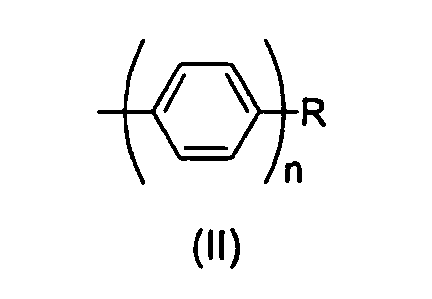
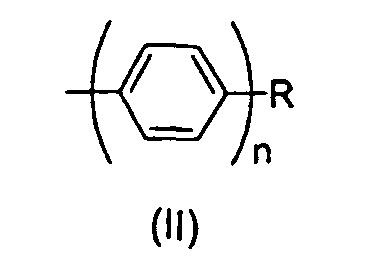
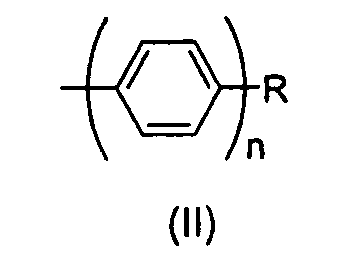
- Preferably, each Ar is independently selected from the group comprising an optionally substituted residue of formula (II):wherein n = 1, 2 or 3 and R is a solubilising group or hydrogen. Particularly preferred groups R are hydrogen and optionally substituted alkyl or alkoxy. Most preferably, R is hydrogen or butyl. By "butyl" is meant n-, sec- or tert-butyl 9,9-diarylfluorene repeat units present in polymers as disclosed in the aforementioned prior art have been used for the purpose of electron transport and / or as a linking group for a second repeat unit. To this end, these prior art polymers consist of 50% or more of 9,9-diarylfluorene units. However, the present inventors have determined that a lower amount of repeat units of formula (I) may be employed for the purpose of increasing glass transition temperature by comparison with a corresponding polymer not comprising repeat units of formula (I). Accordingly, the polymer of the invention preferably comprises less than 50 mol %, more preferably 10-40 mol % of repeat units of formula (I).
- Preferably, the polymer is an electroluminescent polymer. More preferably, the polymer is a blue electroluminescent polymer. By "blue electroluminescent polymer" is meant a polymer that by electroluminescence emits radiation having a wavelength in the range of 400-500 nm, preferably 430-500 nm.
- In a second aspect, the invention provides an optical device, preferably an electroluminescent device, comprising a first electrode for injection of positive charge carriers, a second electrode for injection of negative charge carriers and a layer located between the first and second electrode comprising a polymer comprising:
- a hole transporting region
- an electron transporting region
- an emissive region
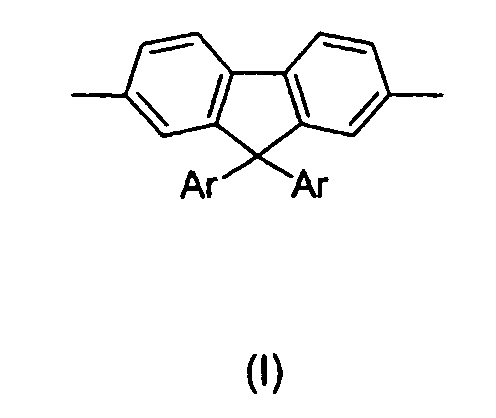
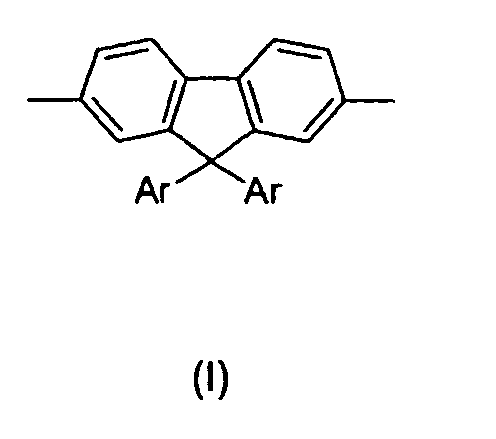
said polymer comprising a repeat unit of formula (I):

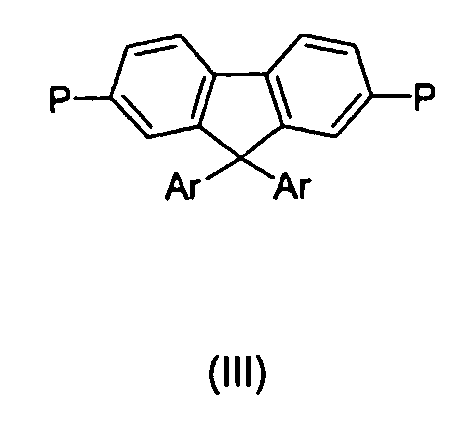
- In a third aspect, the invention provides a method of controlling the glass transition temperature of a polymer which comprises polymerising in a polymerisation mixture a monomer of formula (III):wherein each Ar is the same or different and comprises an optionally substituted aryl group and each P is a functional group for polymerisation, the process comprising the steps of polymerising an amount of the monomer of formula (III) required to reach a preselected glass transition temperature.

- Preferably, monomers of formula (III) comprise less than 50 mol %, more preferably 10-40 mol %, of monomers in the polymerisation mixture of monomers in the polymerisation mixture.
- Two polymerisation techniques that are particularly amenable to preparation of conjugated polymers from aromatic monomers are Suzuki polymerisation as disclosed in, for example, WO 00/53656 and Yamamoto polymerisation as disclosed in, for example, "Macromolecules", 31, 1099-1103 (1998). Suzuki polymerisation entails the coupling of halide and boron derivative functional groups; Yamamoto polymerisation entails the coupling of halide functional groups. Accordingly, it is preferred that each P is independently selected from the group consisting of (a) boron derivative functional groups selected from boronic acid groups, boronic ester groups and borane groups and (b) halide functional groups.
- Preferably, the method comprises a step of reacting a first monomer of formula (III) with a second monomer that may be the same or different from the first monomer in the presence of a metal co-ordination complex catalyst and under conditions so as to polymerise the monomers to form a polymer.
- Preferably, the method comprises a step of polymerizing in a reaction mixture (a) a first aromatic monomer having at least two boron derivative functional groups selected from a boronic acid group, a boronic ester group and a borane group, and a second aromatic monomer having at least two reactive halide functional groups wherein at least one of the first or second aromatic monomers comprises a monomer of formula (III); or (b) an aromatic monomer of formula (III) having one reactive halide functional group and one boron derivative functional group selected from a boronic acid group, a boronic ester group and a borane group, wherein the reaction mixture comprises a catalytic amount of a catalyst suitable for catalysing the polymerisation of the aromatic monomers, and a base in an amount sufficient to convert the boron derivative functional groups into -BX3 - anionic groups, wherein X is independently selected from the group consisting of F and OH.
- Preferably, the base is an organic base, more preferably a tetra-alkylammonium carbonate or hydroxide as disclosed in WO 00/53656.
- In a fourth aspect, the invention provides use of an optionally substituted repeat unit of formula (I) in a polymer, preferably an electroluminescent polymer, as a glass transition temperature enhancing agent:wherein each Ar is as defined above.
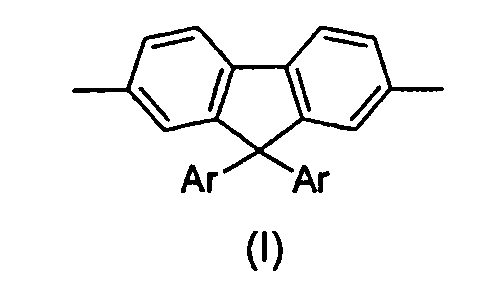
- In a fifth aspect, the invention provides an polymer, preferably an electroluminescent polymer, comprising less than 50 mol %, preferably 10-40 mol % of an optionally substituted repeat unit of formula (I):wherein each Ar is as defined above.

- Each region may comprise a single repeat unit or a plurality of repeat units conjugated together. Each of the hole transporting region, electron transporting region and emissive region may only occur once within the polymer. A region may only occur once within the polymer, particularly when it comprises an extended chain of conjugated repeat units. Alternatively, there may be a plurality of one or more of the hole transporting region, electron transporting region and emissive region distributed throughout the polymer. It should be noted that each of the three regions are chemically different from one another, i.e. preferably, in use, a given region will not function as more than one of a hole transport region, an electron transport region or an emissive region.
- The terms "hole transporting region", "electron transporting region" and "emissive region" are defined relative to one another as outlined below.
- By "hole transporting region" is meant a region having a HOMO level lower than the HOMO level of the emissive region or the electron transporting region.
- By "electron transporting region" is meant a region having a LUMO level higher than the LUMO level of the emissive region or the hole transporting region. located between the LUMO level of the emissive region and the workfunction of the cathode of the device in which the polymer of the invention is used. Typically, the workfunction of the cathode is around 2.5 eV
- By "emissive region" is meant a region having a HOMO-LUMO bandgap smaller than that of the hole transporting region or the electron transporting region.
- The HOMO and LUMO levels and bandgaps of a region of the polymer may be accurately estimated by measuring the HOMO level of a corresponding homopolymer or 1:1 copolymer by cyclic voltammetry. The LUMO level of a region may also be measured in this way; alternatively, it may be calculated by measurement of the HOMO level and the HOMO-LUMO bandgap. Furthermore, the emissive region will be readily identifiable from on the electroluminescent spectra of homopolymers or 1:1 copolymers corresponding to each region.
- Substantially all hole transport, electron transport or emission will arise from regions meeting the corresponding definition given above, however a relatively minor amount of hole transport, electron transport or emission may be due to regions not meeting the corresponding definition. For example, a relatively minor amount of emission may be observed from a hole or electron transporting region if the HOMO-LUMO bandgap of that region is not much greater than the HOMO-LUMO bandgap of the emissive region.
- A typical electroluminescent device comprises an anode having a workfunction of 4.8 eV. Accordingly, the HOMO level of the hole transporting region is preferably around 4.8-5.5 eV. Similarly, the cathode of a typical device will have a workfunction of around 3 eV. Accordingly, the LUMO level of the electron transporting region is preferably around 3-3.5 eV.
- Preferred as hole transporting regions are triarylamines as disclosed in, for example, WO 99/54385 the contents of which are incorporated herein by reference.
- Preferred as electron transporting regions are 2,7-linked fluorene repeat units and conjugated chains thereof. Particularly preferred polyfluorenes include 2,7-linked-9,9-dialkyl fluorenes as disclosed in, for example, EP 0842208, the contents of which are incorporated herein by reference; spirobifluorenes as disclosed in, for example, EP 0707020, the contents of which are incorporated herein by reference, and indenofluorenes. In addition, repeat units of formula (I), and conjugated chains thereof, may function as electron transporting regions as well as serving to increase the glass transition temperature of polymers of the invention. Also preferred as electron transporting regions are 1,4-linked phenyl repeat units and conjugated chains thereof.
- Preferred as emissive regions are emissive repeat units as disclosed in WO 00/55927 and WO 00/46321, the contents of which are incorporated herein by reference. A particularly preferred blue emissive repeat unit comprises an optionally substituted repeat unit of formula (IV):Wherein each R' is independently selected from hydrogen or a solubilising group. Particularly preferred solubilising groups are optionally substituted alkyl or alkoxy. Most preferably, R' is n-butyl.

- Each of the hole transporting region, electron transporting region and emissive region may be provided as part of the polymer backbone as disclosed in, for example, WO 00/55927. Alternatively, one or more of the said regions may be pendant from the polymer backbone as disclosed in, for example, WO 01/49769 and WO 02/26859 wherein hole transporting regions are pendant from an electron transporting backbone.
- Monomers according to the invention were prepared in accordance with the scheme below:

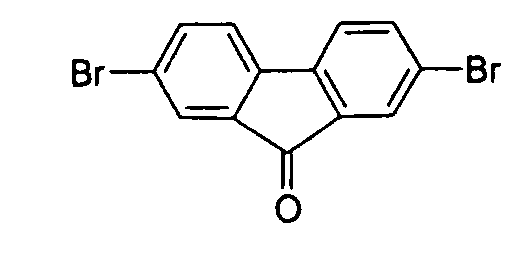
- In a 3L flange flask fluorenone (100.006g, 0.555 mol), phosphorus pentoxide (110.148g, 0.776 mol) and trimethylphosphate (1200 mL) were mixed. Under mechanical stirring, a solution of bromine (63 mL, 1.23 mol) in trimethylphosphate (200 mL) was quickly added. This clear solution was then heated for 22 hours at 120 °C. The mixture was allowed to cool to room temperature, then poured into 3L of water. When sodium thiosulfate was added (50.045g) the mixture turned yellow. Stirring was maintained for 1 hour then the yellow solid was filtered. This solid was heated in methanol to remove the mono-brominated compound and gave 176.183g (98% pure by HPLC, 94% yield).
1H NMR (CDCl3) 7.73 (2H, d, J 2.0), 7.61 (2H, dd, J 7.6, 2.0), 7.36 (2H, d, J 8.0); 13C NMR (CDCl3) 142.3, 137.5, 135.3, 127.9, 123.3, 121.8, 109.8. - In a
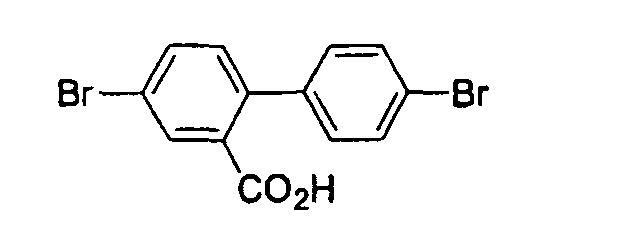
2L flange flask 2,7-dibromofluorenone (120.526g, 0.356 mol), potassium hydroxide (finely powdered flakes, 168.327g, 3.000 mol) and toluene (600 mL) were placed. This mixture was heated at 120 °C for four hours then left to cool to room temperature. Water was added to dissolve the solid (~ 2L) under vigorous stirring. The greenish aqueous layer was removed and the yellow toluene layer was washed twice with water. The combined aqueous layers were acidified with concentrated hydrochloric acid then the precipitated solid was filtered, dried then recrystallised from toluene to give 100.547g of off white crystals (79% yield); 1H NMR ((CD3)2CO) 8.00 (1H, d, J 2.0), 7.77 (1H, dd, J 8.0, 2.4), 7.57 (2H, d, J 8.0), 7.34 (1H, d, J 8.4), 7.29 (2H, d, J 8.8) ; 13C NMR ((CD3)2CO) 167.1, 140.4, 139.8, 134.2, 133.5, 132.8, 132.7, 131.2, 130.6, 121.4, 121.1. - 4,4-dibromo-2-carboxylic acid biphenyl (171.14g, 0.481 mol) was suspended in methanol (700 mL) and sulfuric acid (15 mL) then heated at 80 °C for 21 hours. The solvent was removed and the oil was dissolved in ethyl acetate. This solution was washed with 2N sodium hydroxide, water, saturated sodium chloride, dried over magnesium sulfate, filtered and evaporated to give an orange oil. This oil was treated with hot methanol, on cooling the ester precipitated out and was filtered. The mother liquor was evaporated and the solid recrystallised giving additional product. The ester was 100% pure by GCMS, a yield of 123.27g (69%) was obtained; 1H NMR (CDCl3) 7.99 (1H, d, J 2.0), 7.64 (1H, dd, J 8.0, 1.6), 7.51 (2H, d, J 8.4), 7.19 (1H, d, J 8.8), 7.13 (2H, d, J 8.8), 3.67 (3H, s) ; 13C NMR (CDCl3) 167.1, 140.3, 139.1, 134.4, 132.9, 132.1, 132.0, 131.3, 129.8, 121.9, 121.5, 52.3; GCMS: M+ = 370

- 4,4-dibromo-2-methyl ester-biphenyl (24.114g, 65.1 mmol) was dissolved in dry diethyl ether (120 mL) and the solution was cooled to -60 °C by using an isopropanol/dry ice bath. Phenyl lithium (1.8M solution in cyclohexane-ether, 91 mL) was then added dropwise. The mixture was stirred and let to warm to room temperature. The reaction was complete after four hours. Water was added (70 mL) then the aqueous layer washed once with diethyl ether. Combined organic phases were washed with sodium chloride, dried over magnesium sulfate, filtered and evaporated to give a yellow powder. Recrystallisation from isopropanol afforded 19g of white solid (59% yield);GC-MS (m/z, relative intensity %) 494 (M+, 100);1H NMR (CDCl3) 7.43 (1H, dd, J 8.4, 2.4), 7.28 (6H, m), 7.23 (2H, d, J 8.0), 7.11 (4H, m), 6.99 (1H, d, J 2.4), 6.94 (1H, d, J 8.4), 6.61 (2H, d, J 8.4) ; 13C NMR (CDCl3) 147.5, 146.7, 140.3, 139.3, 134.0, 133.0, 131.2, 131.1, 130.3, 128.2, 128.1, 127.8, 121.8, 121.3, 83.2.

-

- The alcohol (69.169g, 140mmol) and glacial acetic acid (450ml) were stirred and heated to reflux, then concentrated hydrochloric acid (0.5ml) was added dropwise. When the addition was completed the mixture was heated for one hour and then cooled. The reaction mixture was poured into water (500ml), after which the solid was filtered off. The white solid was recrystallised from n-butyl acetate three times to give 20.03g of desired product (99.59% by HPLC, 30% yield).
1H NMR (CDCl3), δ/ppm: 7.58 (2H, d, J 7.6), 7.49 (2H, d, 1.2), 7.48 (2H, dd, 1.6), 7.25 (6H, m), 7.14 (4H, m).
13C NMR (CDCl3), δ/ppm: 153.2, 144.6, 138.3, 131.1, 129.6, 128.7, 128.2, 127.4, 122.0, 121.7, 65.8. - Monomers with Ar groups as detailed in the table below were prepared in accordance with the scheme and general experimental process outlined above. Aryllithium compounds corresponding to Ar groups shown in the table were prepared from the corresponding aryl bromide.

- A blue electroluminescent polymer according to the invention was prepared in accordance with the process of WO 00/53656 by reaction of 9,9-di-n-octylfluorene-2,7-di (ethylenylboronate) (0.5 equivalents), 2,7-dibromo-9,9-diphenylfluorene (0.3 equivalents), N,N-di(4-bromophenyl)-sec-butylphenylamine (0.1 equivalents) and N,N'-di(4-bromophenyl)-N,N'-di(4-n-butylphenyl)-1,4-diaminobenzene (0.1 equivalents) to give polymer P1:
- Polymers were prepared in accordance with the method of example P1 except that ratios of 9,9-dioctylfluorene repeat units and 9,9-diphenylfluorene repeat units present in the polymer were varied as follows:
Example no. 9,9-diphenylfluorene (mol %) 9,9-dioctylfluorene (mol %) P2 50 30 P3 60 20 - A polymer was prepared in accordance with the method of example P1 except that 2,7-dibromo-9,9-di(biphenyl)fluorene (monomer example M3; 0.3 eq) was used in place of 2,7-dibromo-9,9-diphenylfluorene.
- A blue emissive polymer, as disclosed in WO 00/55927, was prepared in accordance with polymer example 1 wherein all 9,9-diphenylfluorene repeat units were replaced with 9,9-di-n-octylfluorene repeat units. This was done by following the preparation of polymer example 1 except that 0.3 equivalents of 2,7-dibromo-9,9-di-n-octylfluorene was used in place of 2,7-dibromo-9,9-diphenylfluorene.
- Onto a glass substrate carrying an ITO substrate of thickness was deposited by spin coating poly(ethylenedioxythiopene)/polystyrene sulfonate (available from Bayer™ as Baytron P ™) to a thickness of 270 microns. Over this was deposited a polymer according to the invention to a thickness of 50 nm by spin coating. A layer of lithium fluoride (thickness 4 nm) was deposited onto the polymer by evaporation followed by a cathode of calcium (thickness 50 nm), again deposited by evaporation. The device was encapsulated using a metal can.
- A device was prepared in accordance with the method outlined for the device example above except that the comparative polymer described above was used in place of the polymer according to the invention.
- The table below provides glass transition temperature data for polymers described above.
Polymer example Glass transition temperature (°C) Comparative example ca. 80 P1 140 P2 210 P3 240 P4 175 - As can be seen, polymers according to the invention have significantly higher Tg values than the comparative prior art polymer, giving them greater thermal stability. Tg increases with the quantity of repeat units of formula (I) incorporated into the polymer. Furthermore, different repeat units of formula (I) differ in the extent to which they affect Tg. Thus, polymer P4 (comprising 30% di(biphenyl)fluorene repeat units) has a higher Tg than polymer P1 (comprising 30% diphenylfluorene repeat units).
- In addition to the increase in thermal stability, polymers P1-P4 have a lifetime of around 3,000 hours or more whereas the comparative polymer example has a lifetime of around 1,000 hours.
- Although the present invention has been described in terms of specific exemplary embodiments, it will be appreciated that various modifications, alterations and / or combinations of features disclosed herein will be apparent to those skilled in the art without departing from the spirit and scope of the invention as set forth in the following claims.
Claims (22)
- A polymer for use in an optical device comprising:said polymer comprising an optionally substituted repeat unit of formula (I):a hole transporting regionan electron transporting regionan emissive regionwherein each Ar is the same or different and comprises an optionally substituted aryl group.
- A polymer according to claim 1 wherein each Ar is independently selected from the group comprising an optionally substituted residue of formula (II):wherein n = 1, 2 or 3 and R is a solubilising group or hydrogen
- A polymer according to claim 2 wherein R is selected from the group consisting of optionally substituted alkyl or alkoxy.
- A polymer according to claim 2 wherein R is hydrogen or butyl.
- A polymer according to any preceding claim comprising less than 50 mol % of repeat units of formula (I).
- A polymer according to claim 5 comprising 10-40 mol % of repeat units of formula (I).
- A polymer according to any preceding claim wherein the electron transporting region comprises at least one repeat unit of formula (I).
- A polymer according to any one of claims 1-6 wherein the electron transporting region does not comprise a repeat unit of formula (I).
- A polymer according to any one of claims 1-8 capable of emitting light in the wavelength range 400-500 nm, preferably 430-500 nm.
- An optical device comprising a first electrode for injection of positive charge carriers, a second electrode for injection of negative charge carriers and a layer located between the first and second electrode comprising a polymer as defined in any one of claims 1-9.
- A method of controlling the glass transition temperature of a polymer which comprises polymerising in a polymerisation mixture a monomer of formula (III):wherein each Ar is the same or different and comprises an optionally substituted aryl group and each P is a functional group for polymerisation, the process comprising the steps of polymerising an amount of the monomer of formula (III) required to reach a preselected glass transition temperature.
- A method according to claim 11 wherein each Ar comprising an optionally substituted residue of formula (II):wherein n = 1, 2 or 3 and R is a solubilising group or hydrogen.
- A method according to claim 12 wherein R is selected from the group consisting of optionally substituted alkyl or alkoxy.
- A method according to any one of claims 11-13 wherein monomers of formula (III) comprise less than 50 mol % of monomers in the polymerisation mixture.
- A method according to claim 14 wherein monomers of formula (III) comprise 10-40 mol % of monomers in the polymerisation mixture.
- A method according to one of claims 11-15 wherein each P is independently selected from the group consisting of (a) boron derivative functional groups selected from boronic acid groups, boronic ester groups and borane groups and (b) halide functional groups.
- A method according to any one of claims 11-16 comprising a step of reacting a first monomer of formula (III) with a second monomer that may be the same or different from the first monomer in the presence of a metal co-ordination complex catalyst and under conditions so as to polymerise the monomers to form a polymer.
- A method of controlling the glass transition temperature of a polymer comprising a step of polymerizing in a reaction mixture (a) a first aromatic monomer having at least two boron derivative functional groups selected from a boronic acid group, a boronic ester group and a borane group, and a second aromatic monomer having at least two reactive halide functional groups wherein at least one of the first or second aromatic monomers comprises a monomer according to claim 16; or (b) an aromatic monomer according to claim 16 having one reactive halide functional group and one boron derivative functional group selected from a boronic acid group, a boronic ester group and a borane group, wherein the reaction mixture comprises a catalytic amount of a catalyst suitable for catalysing the polymerisation of the aromatic monomers, and a base in an amount sufficient to convert the boron derivative functional groups into -BX3 - anionic groups, wherein X is independently selected from the group consisting of F and OH.
- A method according to claim 17 wherein the base is an organic base.
- A method according to any one of claims 11-19 wherein the polymer is an electroluminescent polymer.
- Use of an optionally substituted repeat unit of formula (I) in a polymer as a glass transition temperature enhancing agent:wherein each Ar is as defined in any one of claims 1-4.

- A polymer according to claim 21 that is an electroluminescent polymer.
Applications Claiming Priority (5)
| Application Number | Priority Date | Filing Date | Title |
|---|---|---|---|
| GB0111549 | 2001-05-11 | ||
| GBGB0111549.2A GB0111549D0 (en) | 2001-05-11 | 2001-05-11 | Polymers, their preparation and uses |
| US31562301P | 2001-08-29 | 2001-08-29 | |
| US315623P | 2001-08-29 | ||
| EP02722513A EP1385918B1 (en) | 2001-05-11 | 2002-05-10 | Substituted fluorene polymers, their preparation and use in optical devices |
Related Parent Applications (1)
| Application Number | Title | Priority Date | Filing Date |
|---|---|---|---|
| EP02722513A Division EP1385918B1 (en) | 2001-05-11 | 2002-05-10 | Substituted fluorene polymers, their preparation and use in optical devices |
Publications (1)
| Publication Number | Publication Date |
|---|---|
| EP1586617A1 true EP1586617A1 (en) | 2005-10-19 |
Family
ID=9914463
Family Applications (3)
| Application Number | Title | Priority Date | Filing Date |
|---|---|---|---|
| EP02722513A Expired - Lifetime EP1385918B1 (en) | 2001-05-11 | 2002-05-10 | Substituted fluorene polymers, their preparation and use in optical devices |
| EP05007146A Withdrawn EP1586617A1 (en) | 2001-05-11 | 2002-05-10 | Substituted fluorene polymers, their preparations and use in optical devices |
| EP02722520A Expired - Lifetime EP1385919B1 (en) | 2001-05-11 | 2002-05-10 | Substituted fluorene polymers, their preparation and uses |
Family Applications Before (1)
| Application Number | Title | Priority Date | Filing Date |
|---|---|---|---|
| EP02722513A Expired - Lifetime EP1385918B1 (en) | 2001-05-11 | 2002-05-10 | Substituted fluorene polymers, their preparation and use in optical devices |
Family Applications After (1)
| Application Number | Title | Priority Date | Filing Date |
|---|---|---|---|
| EP02722520A Expired - Lifetime EP1385919B1 (en) | 2001-05-11 | 2002-05-10 | Substituted fluorene polymers, their preparation and uses |
Country Status (8)
| Country | Link |
|---|---|
| EP (3) | EP1385918B1 (en) |
| JP (2) | JP4959100B2 (en) |
| CN (2) | CN100417703C (en) |
| AT (2) | ATE273363T1 (en) |
| DE (2) | DE60200951T2 (en) |
| GB (1) | GB0111549D0 (en) |
| TW (2) | TWI279429B (en) |
| WO (2) | WO2002092724A1 (en) |
Families Citing this family (44)
| Publication number | Priority date | Publication date | Assignee | Title |
|---|---|---|---|---|
| GB0111549D0 (en) * | 2001-05-11 | 2001-07-04 | Cambridge Display Tech Ltd | Polymers, their preparation and uses |
| KR100580026B1 (en) * | 2001-05-11 | 2006-05-12 | 캠브리지 디스플레이 테크놀로지 리미티드 | Substituted fluorene polymers, their preparation and their use in optical devices |
| US7696303B2 (en) | 2002-05-10 | 2010-04-13 | Cambridge Display Technology Limited | Polymers their preparation and uses |
| GB0225869D0 (en) * | 2002-11-06 | 2002-12-11 | Cambridge Display Tech Ltd | Polymer |
| EP1443093A1 (en) * | 2003-01-29 | 2004-08-04 | Samsung SDI Co., Ltd. | Molecular chemical compounds capable of emitting photoluminescence comprising electron shiftable structures and their use in photoluminescence erasure display devices |
| US7402343B2 (en) | 2003-01-29 | 2008-07-22 | Samsung Sdi Co., Ltd. | Molecular chemical compounds with structures allowing electron displacement and capable of emitting photoluminescent radiation, and photoluminescence quenching device employing the same |
| US7049392B2 (en) | 2003-02-12 | 2006-05-23 | E. I. Du Pont De Nemour And Company | Electroluminescent copolymers with multi-functional monomers and methods for use thereof |
| US7138483B2 (en) | 2003-02-12 | 2006-11-21 | E.I. Du Pont De Nemours And Company | Monomers, conjugated polymers and electronic devices using such polymers |
| GB0306414D0 (en) * | 2003-03-20 | 2003-04-23 | Cambridge Display Tech Ltd | Polymers,their preparations and uses |
| JP4846191B2 (en) * | 2003-06-04 | 2011-12-28 | 住友化学株式会社 | Color conversion film and light emitting device |
| JP4878554B2 (en) * | 2003-09-16 | 2012-02-15 | ダウ グローバル テクノロジーズ エルエルシー | Method for preparing an insoluble polymer film on a substrate using a soluble polymer containing an unstable solubilizing group |
| US7652126B2 (en) * | 2003-10-07 | 2010-01-26 | General Electric Company | Monomers and polymers comprising conjugated groups and methods for making thereof |
| US7119360B2 (en) * | 2003-10-29 | 2006-10-10 | Max-Plank-Society | Light-emitting polymers and electronic devices using such polymers |
| US7115899B2 (en) | 2003-10-29 | 2006-10-03 | E. I. Du Pont De Nemours And Company | Light-emitting copolymers and electronic devices using such copolymers |
| GB0329364D0 (en) | 2003-12-19 | 2004-01-21 | Cambridge Display Tech Ltd | Optical device |
| DE10361385B4 (en) * | 2003-12-29 | 2011-07-28 | OSRAM Opto Semiconductors GmbH, 93055 | Polymers, phosphorescent organic semiconducting emitter materials based on perarylated boranes, process for their preparation and uses thereof |
| KR101170168B1 (en) * | 2004-01-30 | 2012-07-31 | 에스케이이노베이션 주식회사 | Organic electroluminescent polymer having 9,9-difluorenyl-2,7-fluorenyl unit and organic electroluminescent device manufactured using the same |
| DE102004015845B4 (en) * | 2004-03-31 | 2012-12-20 | Osram Opto Semiconductors Gmbh | Organic light emitting diode, as well as uses thereof |
| GB0422391D0 (en) * | 2004-10-08 | 2004-11-10 | Cambridge Display Tech Ltd | Light emitting device |
| DE112005002495B4 (en) | 2004-10-11 | 2016-11-17 | Cambridge Display Technology Ltd. | Polar semiconducting hole transport material |
| CN101838387B (en) * | 2004-12-03 | 2012-02-29 | 住友化学株式会社 | Salicylate substituted conjugated polymers and devices |
| ATE555506T1 (en) | 2004-12-24 | 2012-05-15 | Cdt Oxford Ltd | LIGHT EMITTING DEVICE |
| WO2006070185A1 (en) | 2004-12-29 | 2006-07-06 | Cambridge Display Technology Limited | Rigid amines |
| GB0428445D0 (en) | 2004-12-29 | 2005-02-02 | Cambridge Display Tech Ltd | Blue-shifted triarylamine polymer |
| GB0507684D0 (en) * | 2005-04-15 | 2005-05-25 | Cambridge Display Tech Ltd | Pulsed driven displays |
| KR20080020674A (en) | 2005-06-10 | 2008-03-05 | 스미또모 가가꾸 가부시키가이샤 | Aromatic polymer |
| JP2007016226A (en) * | 2005-06-10 | 2007-01-25 | Sumitomo Chemical Co Ltd | Aromatic polymer |
| KR101463271B1 (en) | 2006-09-14 | 2014-11-18 | 스미또모 가가꾸 가부시키가이샤 | Organic electroluminescent device |
| GB2454890B (en) * | 2007-11-21 | 2010-08-25 | Limited Cambridge Display Technology | Light-emitting device and materials therefor |
| JP5353186B2 (en) | 2007-11-30 | 2013-11-27 | 住友化学株式会社 | Amine-based polymer compound and light emitting device using the same |
| EP2846374B1 (en) * | 2008-03-07 | 2019-11-06 | Sumitomo Chemical Company Limited | Layered structure |
| GB0814161D0 (en) | 2008-08-01 | 2008-09-10 | Cambridge Display Tech Ltd | Blue-light emitting material |
| KR101769173B1 (en) | 2010-01-28 | 2017-08-17 | 스미또모 가가꾸 가부시키가이샤 | Polymer compound and light-emitting device using same |
| US8617724B2 (en) | 2010-01-28 | 2013-12-31 | Sumitomo Chemical Company, Limited | Polymer compound and light emitting device using the same |
| GB2486203A (en) | 2010-12-06 | 2012-06-13 | Cambridge Display Tech Ltd | Transition metal oxide doped interface by deposition and drying of precursor |
| GB2486202A (en) | 2010-12-06 | 2012-06-13 | Cambridge Display Tech Ltd | Adhesion layer for solution-processed transition metal oxides on inert metal contacts of organic thin film transistors. |
| KR101799137B1 (en) | 2010-12-21 | 2017-11-17 | 스미또모 가가꾸 가부시키가이샤 | High-molecular compound and light-emitting element using same |
| KR101911971B1 (en) * | 2011-01-31 | 2018-10-25 | 캠브리지 디스플레이 테크놀로지 리미티드 | Polymer |
| GB2494096B (en) | 2011-01-31 | 2013-12-18 | Cambridge Display Tech Ltd | Polymer |
| GB201110770D0 (en) | 2011-06-24 | 2011-08-10 | Cambridge Display Tech Ltd | Process for controlling the acceptor strength of solution-processed transition metal oxides for OLED applications |
| GB201200619D0 (en) * | 2012-01-16 | 2012-02-29 | Cambridge Display Tech Ltd | Polymer |
| GB2505893A (en) | 2012-09-13 | 2014-03-19 | Cambridge Display Tech Ltd | Compounds for use in organic optoelectronic devices |
| GB201320881D0 (en) | 2013-11-26 | 2014-01-08 | Cambridge Display Tech Ltd | Organic light-emitting device and method |
| GB2597797A (en) * | 2020-08-07 | 2022-02-09 | Sumitomo Chemical Co | Light-emitting marker |
Citations (3)
| Publication number | Priority date | Publication date | Assignee | Title |
|---|---|---|---|---|
| EP0259229A1 (en) * | 1986-09-03 | 1988-03-09 | ETAT FRANCAIS représenté par le Ministre des PTT (Centre National d'Etudes des Télécommunications) | 9,9'-Disubstituted polyfluorenes, process for their preparation and their use in electro-optics and electrochemistry |
| WO2000046321A1 (en) * | 1999-02-04 | 2000-08-10 | The Dow Chemical Company | Fluorene copolymers and devices made therefrom |
| WO2000055927A1 (en) * | 1999-03-12 | 2000-09-21 | Cambridge Display Technology Limited | Polymers, their preparation and uses |
Family Cites Families (9)
| Publication number | Priority date | Publication date | Assignee | Title |
|---|---|---|---|---|
| JP3865406B2 (en) * | 1995-07-28 | 2007-01-10 | 住友化学株式会社 | 2,7-Aryl-9-substituted fluorene and 9-substituted fluorene oligomers and polymers |
| JPH10104861A (en) * | 1996-08-08 | 1998-04-24 | Canon Inc | Electrophotographic photoreceptor, process cartridge having the electrophotographic photoreceptor, and electrophotographic apparatus |
| US6309763B1 (en) * | 1997-05-21 | 2001-10-30 | The Dow Chemical Company | Fluorene-containing polymers and electroluminescent devices therefrom |
| US5777070A (en) * | 1997-10-23 | 1998-07-07 | The Dow Chemical Company | Process for preparing conjugated polymers |
| DE19846768A1 (en) * | 1998-10-10 | 2000-04-20 | Aventis Res & Tech Gmbh & Co | A conjugated polymer useful as an organic semiconductor, an electroluminescence material, and for display elements in television monitor and illumination technology contains fluorene building units |
| DE19846766A1 (en) * | 1998-10-10 | 2000-04-20 | Aventis Res & Tech Gmbh & Co | A conjugated fluorene-based polymer useful as an organic semiconductor, electroluminescence material, and for display elements |
| JP3310658B1 (en) * | 1999-03-05 | 2002-08-05 | ケンブリッジ ディスプレイ テクノロジー リミテッド | Polymer synthesis method |
| JP2001151868A (en) * | 1999-11-24 | 2001-06-05 | Toyota Central Res & Dev Lab Inc | Functional copolymer and organic electroluminescent device, optical memory and hole transport device using the same |
| GB0111549D0 (en) * | 2001-05-11 | 2001-07-04 | Cambridge Display Tech Ltd | Polymers, their preparation and uses |
-
2001
- 2001-05-11 GB GBGB0111549.2A patent/GB0111549D0/en not_active Ceased
-
2002
- 2002-05-10 CN CNB028112660A patent/CN100417703C/en not_active Expired - Lifetime
- 2002-05-10 CN CN2008100051347A patent/CN101215370B/en not_active Expired - Fee Related
- 2002-05-10 EP EP02722513A patent/EP1385918B1/en not_active Expired - Lifetime
- 2002-05-10 WO PCT/GB2002/002179 patent/WO2002092724A1/en not_active Ceased
- 2002-05-10 WO PCT/GB2002/002167 patent/WO2002092723A1/en not_active Ceased
- 2002-05-10 TW TW091109838A patent/TWI279429B/en not_active IP Right Cessation
- 2002-05-10 TW TW091109837A patent/TWI304436B/en not_active IP Right Cessation
- 2002-05-10 JP JP2002589593A patent/JP4959100B2/en not_active Expired - Lifetime
- 2002-05-10 AT AT02722520T patent/ATE273363T1/en not_active IP Right Cessation
- 2002-05-10 DE DE60200951T patent/DE60200951T2/en not_active Expired - Lifetime
- 2002-05-10 EP EP05007146A patent/EP1586617A1/en not_active Withdrawn
- 2002-05-10 AT AT02722513T patent/ATE292662T1/en not_active IP Right Cessation
- 2002-05-10 JP JP2002589592A patent/JP4050988B2/en not_active Expired - Fee Related
- 2002-05-10 EP EP02722520A patent/EP1385919B1/en not_active Expired - Lifetime
- 2002-05-10 DE DE60203610T patent/DE60203610T2/en not_active Expired - Lifetime
Patent Citations (3)
| Publication number | Priority date | Publication date | Assignee | Title |
|---|---|---|---|---|
| EP0259229A1 (en) * | 1986-09-03 | 1988-03-09 | ETAT FRANCAIS représenté par le Ministre des PTT (Centre National d'Etudes des Télécommunications) | 9,9'-Disubstituted polyfluorenes, process for their preparation and their use in electro-optics and electrochemistry |
| WO2000046321A1 (en) * | 1999-02-04 | 2000-08-10 | The Dow Chemical Company | Fluorene copolymers and devices made therefrom |
| WO2000055927A1 (en) * | 1999-03-12 | 2000-09-21 | Cambridge Display Technology Limited | Polymers, their preparation and uses |
Also Published As
| Publication number | Publication date |
|---|---|
| DE60203610D1 (en) | 2005-05-12 |
| GB0111549D0 (en) | 2001-07-04 |
| JP2004527628A (en) | 2004-09-09 |
| DE60203610T2 (en) | 2005-09-15 |
| ATE292662T1 (en) | 2005-04-15 |
| CN101215370A (en) | 2008-07-09 |
| TWI279429B (en) | 2007-04-21 |
| DE60200951T2 (en) | 2005-01-27 |
| EP1385918B1 (en) | 2005-04-06 |
| DE60200951D1 (en) | 2004-09-16 |
| EP1385918A1 (en) | 2004-02-04 |
| CN101215370B (en) | 2012-06-20 |
| CN1513044A (en) | 2004-07-14 |
| EP1385919A1 (en) | 2004-02-04 |
| EP1385919B1 (en) | 2004-08-11 |
| CN100417703C (en) | 2008-09-10 |
| WO2002092723A1 (en) | 2002-11-21 |
| JP2004532325A (en) | 2004-10-21 |
| JP4050988B2 (en) | 2008-02-20 |
| JP4959100B2 (en) | 2012-06-20 |
| TWI304436B (en) | 2008-12-21 |
| ATE273363T1 (en) | 2004-08-15 |
| WO2002092724A1 (en) | 2002-11-21 |
Similar Documents
| Publication | Publication Date | Title |
|---|---|---|
| EP1385918B1 (en) | Substituted fluorene polymers, their preparation and use in optical devices | |
| EP1504075B1 (en) | Polymers their preparation and uses | |
| JP2004532325A5 (en) | ||
| JP2009024174A (en) | Substituted fluorene polymer and its preparation method | |
| EP1603963B1 (en) | Polymers, their preparation and uses | |
| JP5059410B2 (en) | Optical device | |
| HK1062832B (en) | Substituted fluorene polymers, their preparation and use in optical devices | |
| HK1084962B (en) | Polymers, their preparation and uses | |
| KR20040055238A (en) | Light emitting polymers having improved electron and hole transport, and electroluminescent devices including the same |
Legal Events
| Date | Code | Title | Description |
|---|---|---|---|
| PUAI | Public reference made under article 153(3) epc to a published international application that has entered the european phase |
Free format text: ORIGINAL CODE: 0009012 |
|
| 17P | Request for examination filed |
Effective date: 20050401 |
|
| AC | Divisional application: reference to earlier application |
Ref document number: 1385918 Country of ref document: EP Kind code of ref document: P |
|
| AK | Designated contracting states |
Kind code of ref document: A1 Designated state(s): AT BE CH CY DE DK ES FI FR GB GR IE IT LI LU MC NL PT SE TR |
|
| AKX | Designation fees paid |
Designated state(s): AT BE CH CY DE DK ES FI FR GB GR IE IT LI LU MC NL PT SE TR |
|
| STAA | Information on the status of an ep patent application or granted ep patent |
Free format text: STATUS: THE APPLICATION IS DEEMED TO BE WITHDRAWN |
|
| 18D | Application deemed to be withdrawn |
Effective date: 20060802 |