FIELD OF THE INVENTION
-
The present invention is related to chemical compositions, processes for the
preparation thereof and uses of the composition. Particularly, the present invention relates
to compositions that include substituted thioacetamides, and their use in the treatment of
diseases, such as excessive sleepiness, promotion and/or improvement of wakefulness
(preferably improvement of wakefulness in patients with excessive sleepiness associated
with narcolepsy, sleep apnea (preferably obstructive sleep apnea/hypopnea) and shift work
disorder), treatment of Parkinson's disease, Alzheimer's disease, cerebral ischemia, stroke,
eating disorders, attention deficit disorder ("ADD"), attention deficit hyperactivity disorder
("ADHD"), depression, schizophrenia, fatigue (preferably fatigue associated with cancer or
neurological diseases, such as multiple sclerosis and chronic fatigue syndrome), stimulation
of appetite and weight gain and improvement of cognitive dysfunction.
BACKGROUND OF THE INVENTION
-
The compounds disclosed herein are related to the biological and chemical analogs
of modafinil. Modafinil, C15H15NO2S, also known as 2-(benzhydrylsulfinyl) acetamide, or
2-[(diphenylmethyl) sulfinyl] acetamide, a synthetic acetamide derivative with wake-promoting
activity, has been described in French Patent No. 78 05 510 and in U.S. Patent
No. 4,177,290 ("the '290 patent"). It has been approved by the United States Food and
Drug Administration for use in the treatment of excessive daytime sleepiness associated
with narcolepsy. Methods for preparing modafinil and several derivatives are described in
the '290 patent. The levorotatory isomer of modafinil, along with additional modafinil
derivatives are described in U.S. Patent No. 4,927,855, and are reported to be useful for
treatment of hypersomnia, depression, Alzheimer's disease and to have activity towards the
symptoms of dementia and loss of memory, especially in the elderly.
-
Modafinil has also been described as a useful agent in the treatment of Parkinson's
disease (U.S. Patent No. 5,180,745); in the protection of cerebral tissue from ischemia (U.S.
Patent No. 5,391,576); in the treatment of urinary and fecal incontinence (U.S. Patent No.
5,401,776); and in the treatment of sleep apneas and disorders of central origin (U.S. Patent
No. 5,612,379). In addition, modafinil may be used in the treatment of eating disorders,
and to promote weight gain or stimulate appetite in humans or animals (U.S. Patent No.
6,455,588), and in the treatment of attention deficit hyperactivity disorder (U.S. Patent No.
6,346,548), and fatigue, especially fatigue associated with multiple sclerosis (US Patent No.
6,488,164). U.S. Pat. No. 4,066,686 describes various benzhydrylsulphinyl derivatives as
being useful in therapy for treating disturbances of the central nervous system.
-
Several published patent applications describe derivative forms of modafinil and the
use of modafinil derivatives in the treatment of various disorders. For example, PCT
publication WO 99/25329 describes various substituted phenyl analogs of modafinil as
being useful for treating drug-induced sleepiness, especially sleepiness associated with
administration of morphine to cancer patients. U.S. Pat No. 5,719,168 and PCT Publication
No. 95/01171 describes modafinil derivatives that are useful for modifying feeding
behavior. PCT Publication No. 02/10125 describes several modafinil derivatives of
modafinil, along with various polymorphic forms of modafinil.
-
Additional publications describing modafinil derivatives include U.S. Pat. No.
6,492,396, and PCT Publ. No. WO 02/10125.
-
Terauchi, H, et al. described nicotinamide derivatives useful as ATP-ase inhibitors
(Terauchi, H, et al, J. Med. Chem., 1997, 40, 313-321). In particular, several N-alkyl
substituted 2-(Benzhydrylsulfinyl) nicotinamides are described.
-
U.S. Pat. Nos. 4,980,372 and 4,935,240 describe benzoylaminophenoxybutanoic
acid derivatives. In particular, sulfide derivatives of modafinil containing a phenyl and
substituted phenyl linker between the sulfide and carbonyl, and a substituted aryl in the
terminal amide position, are disclosed.
-
Other modafinil derivatives have been disclosed wherein the terminal phenyl groups
are constrained by a linking group. For example, in U.S. Pat. No. 5,563,169, certain
xanthenyl and thiaxanthenyl derivatives having a substituted aryl in the terminal amide
position are reported.
-
Other xanthenyl and thiaxanthenyl derivatives are disclosed in Annis, I; Barany, G.
Pept. Proc. Am. Pept. Symp. 15 th (Meeting Date 1997) 343-344, 1999 (preparation of a
xanthenyl derivative of Ellman's Reagent, useful as a reagent in peptide synthesis); Han, Y.;
Barany, G. J Org. Chem., 1997, 62, 3841-3848 (preparation of S-xanthenyl protected
cysteine derivatives, useful as a reagent in peptide synthesis); and El-Sakka, I.A., et al.
Arch. Pharm. (Weinheim), 1994, 327, 133-135 (thiaxanthenol derivatives of thioglycolic
acid).
-
Thus, there is a need for novel classes of compounds that possess the beneficial
properties similar to that of modafinil. It has been discovered that a class of compounds,
referred to herein as substituted thioacetamides, are useful as agents for treating or
preventing various diseases or disorders disclosed herein.
SUMMARY OF THE INVENTION
-
The present invention in one aspect is directed to novel compounds which are useful
in the treatment of diseases, such as excessive sleepiness, promotion and/or improvement of
wakefulness (preferably improvement of wakefulness in patients with excessive sleepiness
associated with narcolepsy, sleep apnea (preferably obstructive sleep apnea/hypopnea) and
shift work disorder), treatment of Parkinson's disease, Alzheimer's disease, cerebral
ischemia, stroke, eating disorders, attention deficit disorder ("ADD"), attention deficit
hyperactivity disorder ("ADHD"), depression, schizophrenia, fatigue (preferably fatigue
associated with cancer or neurological diseases, such as multiple sclerosis and chronic
fatigue syndrome), stimulation of appetite and weight gain and improvement of cognitive
dysfunction.
-
These compounds have the structure:
and its stereoisomeric forms, mixtures of stereoisomeric forms, or pharmaceutically
acceptable salt forms thereof, wherein the constituent members are defined
infra. -
In another aspect, the present invention is directed to a pharmaceutical composition
which comprises a pharmaceutically acceptable carrier and a therapeutically effective
amount of a compound of the present invention.
-
In yet another aspect, the present invention is directed to methods of preventing or
treating the diseases or disorders disclosed herein.
DETAILED DESCRIPTION OF THE INVENTION
-
In one aspect of the present invention there are provided compounds of formula (A)
for the utilities provided herein:
wherein
- Ar is
wherein X is a bond, CH2, O, S(O)y, or NR10;
- rings A, C, and D are optionally substituted with one to three groups selected from
F, Cl, Br, I, OR21, OR25, NR23R24 NHOH, NO2, CN, CF3, C1-C6 alkyl, C2-C6
alkenyl, C2-C6 alkynyl, C3-C7 cycloalkyl, 3-7 membered
heterocycloalkyl, phenyl, 5 or 6 membered heteroaryl, arylalkyl, C(=O)R22,
CO2R21, OC(=O)R22, C(=O)NR23R24, NR21C(=O)R22, NR21CO2R22,
OC(=O)NR23R24, NR21C(=S)R22, and S(O)yR22;
- ring B is optionally substituted with one to three groups selected from C1-C6 alkyl,
phenyl, and 5-6 membered heteroaryl;
- Y is C1-C9 alkylene-R1, wherein one or two carbon atoms can be replaced by one or two O,
NR10, or S(O)y groups, or a carbon atom can be replaced by a C6-C10 arylene, 5-10
membered heteroarylene, C3-C6 cycloalkylene, or 3-6 membered
heterocycloalkylene group; C2-C6 alkenylene-R1; or C2-C6 alkynylene-R1; wherein
said alkylene, alkenylene, alkynylene, arylene, heteroarylene, cycloalkylene, and
heterocycloalkylene groups are optionally substituted with one to three R20 groups;
- R1 is H, NR12R13, NR21C(=O)R14, C(=O)R15, COOH, CO2R14, OC(=O)R11, C(=O)NR12R13,
C(=O)NR21OR14, C(=N)NR12R13, NR21S(O)2R11, S(O)2NR12R13,
NR21S(O)2NR12R13, or PO(OR21)2;
- R10 and R10A are each independently selected from H, C1-C6 alkyl, C6-C10 aryl, C(=O)R15,
and S(O)yR14; wherein said alkyl and aryl groups are optionally substituted with one
to three R20 groups;
- R11 at each occurrence is independently selected from H, C1-C6 alkyl, and C6-C10 aryl;
wherein said alkyl and aryl groups are optionally substituted with one to three R20
groups;
- R12 and R13 at each occurrence are each independently selected from H, C1-C6 alkyl, and
C6-C10 aryl, or R12 and R13, together with the nitrogen to which they are attached,
form a 3-7 membered heterocycloalkyl ring;
wherein said alkyl and aryl groups and heterocycloalkyl ring are optionally
substituted with one to three R20 groups; - R14 at each occurrence is independently selected from C1-C6 alkyl, C6-C10 aryl, and
arylalkyl; wherein said alkyl, aryl and arylalkyl groups are optionally substituted
with one to three R20 groups;
- R15 at each occurrence is independently selected from C1-C6 alkyl, C6-C10 aryl, arylalkyl,
and heteroaryl; wherein said alkyl, aryl, arylalkyl, and heteroaryl groups are
optionally substituted with one to three R20 groups;
- R20 at each occurrence is independently selected from F, Cl, Br, I, OR21, OR25, O(C1-C4
alkylene)OR21, NR23R24, NHOH, NO2, CN, CF3, C1-C6 alkyl, C3-C6
spirocycloalkyl, C2-C6 alkenyl, C2-C6 alkynyl, C3-C7 cycloalkyl, 3-7 membered
heterocycloalkyl, phenyl, 5 or 6 membered heteroaryl, arylalkyl, =O, C(=O)R22,
CO2R21, OC(=O)R22, C(=O)NR23R24, NR21C(=O)R22, NR21CO2R22,
OC(=O)NR23R24 , NR21C(=O)R22, NR21C(=S)R22, and S(O)yR22;
- R21 at each occurrence is independently selected from H and C1-C6 alkyl;
- R22 at each occurrence is independently selected from H, C1-C6 alkyl, and C6-C10 aryl;
- R23 and R24 at each occurrence are each independently selected from H, C1-C6 alkyl, and
C6-C10 aryl, or R23 and R24, together with the nitrogen to which they are attached,
form a 3-7 membered heterocycloalkyl ring;
- R25 at each occurrence is independently the residue of an amino acid after the hydroxyl
group of the carboxyl group is removed;
- m is 0 or 1;
- n is 0 or 1;
- q is 0, 1, or 2;
- y is 0, 1, or 2;
and the stereoisomeric forms, mixtures of stereoisomeric forms or pharmaceutically
acceptable salts forms thereof.-
-
In an additional aspect of the present invention there are provided compounds of
formula (I):
wherein
- Ar is
wherein X is a bond, CH2, O, S(O)y, or NR10;
- rings A, C, and D are optionally substituted with one to three groups selected from
F, Cl, Br, I, OR21, OR25, NR23R24, NHOH, NO2, CN, CF3, C1-C6 alkyl, C2-C6
alkenyl, C2-C6 alkynyl, C3-C7 cycloalkyl, 3-7 membered
heterocycloalkyl, phenyl, 5 or 6 membered heteroaryl, arylalkyl, C(=O)R22,
CO2R21, OC(=O)R22, C(=O)NR23R24, NR21C(=O)R22, NR21CO2R22,
OC(=O)NR23R24, NR21C(=S)R22, and S(O)yR22;
- ring B is optionally substituted with one to three groups selected from C1-C6 alkyl,
phenyl, and 5-6 membered heteroaryl;
- Y is (C1-C6 alkylene)-R1; or (C1-C4 alkylene)m-Z-(C1-C4 alkylene)n-R1;
wherein said alkylene groups are optionally substituted with one to three R20
groups; - Z is O, NR10A, S(O)y, CR21=CR21, C=C(R21)2, C=C, C6-C10 arylene, 5-10 membered
heteroarylene, C3-C6 cycloalkylene, or 3-6 membered heterocycloalkylene; wherein
said arylene, heteroarylene, cycloalkylene, and heterocycloalkylene groups are
optionally substituted with one to three R20 groups;
- R1 is NR12R13, NR21C(=O)R14, C(=O)R15, COOH, CO2R14, OC(=O)R11, C(=O)NR12R13,
C(=N)NR12R13, OC(=O)NR12R13, NR21S(O)2R11, S(O)2NR12R13,
NR21C(=O)NR12R13, NR21S(O)2NR12R13, or PO(OR21)2;
- R10 and R10A are each independently selected from H, C1-C6 alkyl, C6-C10 aryl, C(=O)R15,
and S(O)yR14; wherein said alkyl and aryl groups are optionally substituted with one
to three R20 groups;
- R11 at each occurrence is independently selected from H, C1-C6 alkyl, and C6-C10 aryl;
wherein said alkyl and aryl groups are optionally substituted with one to three R20
groups;
- R12 and R13 at each occurrence are each independently selected from H, C1-C6 alkyl, and
C6-C10 aryl, or R12 and R13, together with the nitrogen to which they are attached,
form a 3-7 membered heterocycloalkyl ring;
wherein said alkyl and aryl groups and heterocycloalkyl ring are optionally
substituted with one to three R20 groups; - R14 at each occurrence is independently selected from C1-C6 alkyl, C6-C10 aryl, and
arylalkyl; wherein said alkyl, aryl and arylalkyl groups are optionally substituted
with one to three R20 groups;
- R15 at each occurrence is independently selected from C1-C6 alkyl, C6-C10 aryl, arylalkyl,
and heteroaryl; wherein said alkyl, aryl, arylalkyl, and heteroaryl groups are
optionally substituted with one to three R20 groups;
- R20 at each occurrence is independently selected from F, Cl, Br, I, OR21, OR25, O(C1-C4
alkylene)OR21, NR23R24, NHOH, NO2, CN, CF3, C1-C6 alkyl, C3-C6
spirocycloalkyl, C2-C6 alkenyl, C2-C6 alkynyl, C3-C7 cycloalkyl, 3-7 membered
heterocycloalkyl, phenyl, 5 or 6 membered heteroaryl, arylalkyl, =O, C(=O)R22,
CO2R21, OC(=O)R22, C(=O)NR23R24, NR21C(=O)R22, NR21CO2R22,
OC(=O)NR23R24, NR21C(=O)R22, NR21C(=S)R22, and S(O)yR22;
- R21 at each occurrence is independently selected from H and C1-C6 alkyl;
- R22 at each occurrence is independently selected from H, C1-C6 alkyl, and C6-C10 aryl;
- R23 and R24 at each occurrence are each independently selected from H, C1-C6 alkyl, and
C6-C10 aryl, or R23 and R24, together with the nitrogen to which they are attached,
form a 3-7 membered heterocycloalkyl ring;
- R25 at each occurrence is independently the residue of an amino acid after the hydroxyl
group of the carboxyl group is removed;
- m is 0 or 1;
- n is 0 or 1;
- q is 0, 1, or 2;
- y is 0, 1, or 2;
with the proviso that when Y is C1-C4 alkyl-C(=O)NR12R13 and:
- i) X is CH2 or O, then q must be 1 or 2;
- ii) Ar is naphthyl, then one of R12 and R13 must be C1-C6 alkyl, or C1-C6 alkyl
substituted with at least one OR21 or C(=O)NR23R24 group, or R12 and R13,
together with the nitrogen to which they are attached, form a 5-6 membered
heterocycloalkyl ring; wherein said heterocycloalkyl ring is optionally
substituted with one R20 group;
and the stereoisomeric forms, mixtures of stereoisomeric forms or pharmaceutically
acceptable salts forms thereof.-
-
In yet another embodiment of the present invention there are provided compounds
of formula (II):
wherein
- Ar is
wherein X is a bond, CH2, O, S(O)y, or NR10;
- rings A, C, and D are optionally substituted with one to three groups selected from F, Cl,
Br, I, OR21, OR25, NR23R24, NHOH, NO2, CN, C1-C6 alkyl, and C(=O)R22;
- ring B is optionally substituted with one to three groups selected from C1-C4 alkyl, and
phenyl;
- Y is (C1-C6 alkylene)-R1;
wherein said alkylene group is optionally substituted with one to three R20
groups; - R1 is NR12R13, NR21C(=O)R14, C(=O)R15, COOH, CO2R14, OC(=O)R11, C(=O)NR12R13,
C(=O)NR21OR14, C(=N)NR12R13, OC(=O)NR12R13, NR21S(O)2R11,
S(O)2NR12R13, NR21C(=O)NR12R13, NR21S(O)2NR12R13, or PO(OR21)2;
- R10 is independently selected from H, C1-C6 alkyl, C(=O)R15, and S(O)yR14; wherein said
alkyl group is optionally substituted with one to three R20 groups;
- R11 at each occurrence is independently selected from H, and C1-C6 alkyl ; wherein said
alkyl and aryl groups are optionally substituted with one to three R20 groups;
- R12 and R13 at each occurrence are each independently selected from H and C1-C6 alkyl, or
R12 and R13, together with the nitrogen to which they are attached, form a 5-6
membered heterocycloalkyl;
wherein said alkyl and heterocycloalkyl groups are optionally substituted
with one to three R20 groups; - R14 at each occurrence is independently selected from C1-C6 alkyl, C6-C10 aryl, and
arylalkyl; wherein said alkyl, aryl and arylalkyl groups are optionally substituted
with one to three R20 groups;
- R15 at each occurrence is independently selected from C1-C6 alkyl, C6-C10 aryl, arylalkyl,
and heteroaryl; wherein said alkyl, aryl, arylalkyl, and heteroaryl groups are
optionally substituted with one to three R20 groups;
- R20 at each occurrence is independently selected from F, Cl, Br, I, OR21, OR25, O(C1-C4
alkylene)OR21, NR23R24, NHOH, NO2, CN, CF3, phenyl, benzyl, 5-6 membered
heteroaryl, =O, C(=O)R22, CO2R21, OC(=O)R22, C(=O)NR23R24, NR21C(=O)R22,
NR21CO2R22, OC(=O)NR23R24, NR21C(=O)R22, NR21C(=S)R22, and S(O)yR22;
- R21 at each occurrence is independently selected from H and C1-C6 alkyl;
- R22 at each occurrence is independently selected from C1-C6 alkyl, and phenyl;
- R23 and R24 at each occurrence are each independently selected from H and C1-C6 alkyl, or
R23 and R24, together with the nitrogen to which they are attached, form a 5-6
membered heterocycloalkyl;
- R25 at each occurrence is independently the residue of an amino acid after the hydroxyl
group of the carboxyl group is removed;
- q is 0, 1, or 2;
- y is 0, 1, or 2;
with the proviso that when Y is C1-C4 alkyl-C(=O)NR12R13 and:
- i) X is CH2 or O, then q must be 1 or 2;
- ii) Ar is naphthyl, then one of R12 and R13 must be C1-C6 alkyl, or C1-C6 alkyl
substituted with at least one OR21 or C(=O)NR23R24 group, or R12 and R13, together with the
nitrogen to which they are attached, form a 5-6 membered heterocycloalkyl ring; wherein
said heterocycloalkyl ring is optionally substituted with one R20 group;
and the stereoisomeric forms, mixtures of stereoisomeric forms or pharmaceutically
acceptable salts forms thereof.
-
-
In yet another embodiment of the present invention there are provided compounds
of formula (III):
wherein
- Ar is
wherein X is a bond, CH2, O, S(O)y, or NR10;
- rings A, C, and D are optionally substituted with one to three groups selected from
F, Cl, Br, I, OR21, OR25, NR23R24, NHOH, NO2, CN, C1-C6 alkyl, and
C(=O)R22;
- ring B is optionally substituted with one to three groups selected from C1-C4 alkyl,
and phenyl;
- Y' is C1-C4 alkylene;
- R10 is independently selected from H, C1-C6alkyl, C(=O)R15, and S(O)yR14;
- R12 and R13 at each occurrence are each independently selected from H and C1-C6 alkyl, or
R12 and R13, together with the nitrogen to which they are attached, form a 5-6
membered heterocycloalkyl;
wherein said alkyl and heterocycloalkyl groups are optionally substituted
with one to three R20 groups; - R14 at each occurrence is independently C1-C6 alkyl; wherein said alkyl is optionally
substituted with one to three R20 groups;
- R15 at each occurrence is independently selected from C1-C6 alkyl, phenyl, and benzyl;
wherein said alkyl, phenyl and benzyl groups are optionally substituted with
one to three R20 groups;
- R20 at each occurrence is independently selected from F, Cl, Br, I, OR21, OR25, O(C1-C4
alkylene)OR21, NR23R24, NHOH, NO2, CN, CF3, phenyl, benzyl, 5-6 membered
heteroaryl, =O, C(=O)R22, CO2R21, OC(=O)R22, C(=O)NR23R24, NR21C(=O)R22,
NR21CO2R22, OC(=O)NR23R24, NR21C(=O)R22, NR21C(=S)R22, and S(O)yR22;
- R21 at each occurrence is independently selected from H and C1-C6 alkyl;
- R22 at each occurrence is independently selected from C1-C6 alkyl, and phenyl;
- R23 and R24 at each occurrence are each independently selected from H and C1-C6 alkyl, or
R23 and R24, together with the nitrogen to which they are attached, form a 5-6
membered heterocycloalkyl;
- R25 at each occurrence is independently the residue of an amino acid after the hydroxyl
group of the carboxyl group is removed;
- q is 0, 1, or 2;
- y is 0, 1, or 2;
with the proviso that when Ar is naphthyl, then one of R12 and R13 must be C1-C6 alkyl, or
C1-C6 alkyl substituted with at least one OR21 or C(=O)NR23R24 group, or R12 and
R13, together with the nitrogen to which they are attached, form a 5-6 membered
heterocycloalkyl ring; wherein said heterocycloalkyl ring is optionally substituted
with one R20 group;
and the stereoisomeric forms, mixtures of stereoisomeric forms or pharmaceutically
acceptable salts forms thereof.-
-
In yet another embodiment of the present invention, there are provided compounds
of formula (IV):
wherein
- Ar is
wherein X is a bond, CH2, O, S, or S(O);
- rings A, C, and D are optionally substituted with one to three groups selected from
F, Cl, Br, I, OR21, OR25, NR23R21 , NHOH, NO2, CN, C1-C6 alkyl, and
C(=O)R22;
- ring B is optionally substituted with one to three groups selected from C1-C4 alkyl,
and phenyl;
- Y' is C1-C4 alkylene, wherein said alkylene group is optionally substituted with an R20
group;
- R12 and R13 at each occurrence are each independently selected from H, C1-C6 alkyl,
wherein said alkyl group can optionally be substituted with one or two CN, OR21,
O(CH2)1-4OR21, C(=O)N(R21)2, or pyridyl groups, or R12 and R13, together with the
nitrogen to which they are attached, form a pyrrolidinyl, piperidinyl, or piperazinyl
ring, optionally substituted with OR21, C(=O)N(R21)2, or C(=O)R21; provided that
when Ar is naphthyl, R12 and R13 cannot both be H;
- R20 at each occurrence is independently selected from F, Cl, Br, I, OR21, OR25, NR23R24,
NHOH, NO2, CN, or CF3;
- R21 at each occurrence is independently selected from H and C1-C6 alkyl;
- R22 at each occurrence is independently selected from C1-C6 alkyl, and phenyl;
- R23 and R24 at each occurrence are each independently selected from H and C1-C6 alkyl, or
R23 and R24, together with the nitrogen to which they are attached, form a 5-6
membered heterocycloalkyl;
- R25 at each occurrence is independently the residue of an amino acid after the hydroxyl
group of the carboxyl group is removed;
and the stereoisomeric forms, mixtures of stereoisomeric forms or pharmaceutically
acceptable salts forms thereof.-
-
In one aspect, there are included compounds of formula (IV) wherein X is a bond; q
is 1; Y' is (C1-C2 alkylene), or Y' is CH2, or Y' is CH2CH2; R12 and R13 at each occurrence
are each independently selected from H, C1-C6 alkyl, optionally substituted with a CN,
OR21, O(CH2)1-4OR21 group, or R12 and R13, together with the nitrogen to which they are
attached, form a pyrrolidinyl, piperidinyl, or piperazinyl ring, optionally substituted with
OR21, C(=O)N(R21)2, or C(=O)R21 group, or they form a pyrrolidinyl ring, optionally
substituted with C(=O)N(R21)2; a piperidinyl ring, optionally substituted with OR21; or a
piperazinyl ring, optionally substituted with C(=O)R21.
-
In another aspect, there are provided compounds of formula (IV) wherein X is CH2;
q is 1; Y' is CH2; R12 and R13 at each occurrence are each independently selected from H,
C1-C6 alkyl, or R12 and R13, together with the nitrogen to which they are attached, form a
pyrrolidinyl ring.
-
In a further aspect, there are provided compounds of formula (IV) wherein X is O; q
is 1; Y' is CH2; R12 and R13 at each occurrence are each independently selected from H, C1-C6
alkyl, wherein said alkyl group can optionally be substituted with pyridyl, or R12 and
R13, together with the nitrogen to which they are attached, form a pyrrolidinyl ring.
-
In yet another aspect, there are provided compounds of formula (IV) wherein X is S
or S=O; q is 1; Y' is CH2; R12 and R13 at each occurrence are each independently selected
from H, C1-C6 alkyl.
-
In a further aspect, there are provided compounds of formula (IV) wherein Ar is
naphthyl; q is 1, Y' is CH2; R12 and R13 at each occurrence are each independently selected
from C1-C6 alkyl, wherein said alkyl group can optionally be substituted with OR21, or one
or two C(=O)N(R21)2 groups, or R12 and R13, together with the nitrogen to which they are
attached, form a pyrrolidinyl ring, optionally substituted with C(=O)N(R21)2.
-
In a further embodiment of the present invention there are provided compounds of
formula (V):
wherein the phenylene ring is optionally substituted with one to three groups selected from
F, Cl, Br, I, OR
21, OR
25, NR
23R
24, NHOH, NO
2, CN, C
1-C
6 alkyl, and C(=O)R
22;
- X is a bond, CH2, O, S, or S(O);
- Y' is C1-C4 alkylene, wherein said alkylene group is optionally substituted with an R20
group;
- R12 and R13 at each occurrence are each independently selected from H, C1-C6 alkyl,
wherein said alkyl group can optionally be substituted with one or two CN, OR21,
O(CH2)1-4OR21, C(=O)N(R21)2, or pyridyl groups, or R12 and R13, together with the
nitrogen to which they are attached, form a pyrrolidinyl, piperidinyl, or piperazinyl
ring, optionally substituted with OR21, C(=O)N(R21)2, or C(=O)R21;
- R20 at each occurrence is independently selected from F, Cl, Br, I, OR21, OR25, NR23R24,
NHOH, NO2, CN, or CF3;
- R21 at each occurrence is independently selected from H and C1-C6 alkyl;
- R22 at each occurrence is independently selected from C1-C6 alkyl, and phenyl;
- R23 and R24 at each occurrence are each independently selected from H and C1-C6 alkyl, or
R23 and R24, together with the nitrogen to which they are attached, form a 5-6
membered heterocycloalkyl;
- R25 at each occurrence is independently the residue of an amino acid after the hydroxyl
group of the carboxyl group is removed;
and the stereoisomeric forms, mixtures of stereoisomeric forms or pharmaceutically
acceptable salts forms thereof.-
-
In an additional embodiment of the present invention there are provided compounds
of formula (VI):
wherein the naphthyl ring is optionally substituted with one to three groups selected from
F, Cl, Br, I, OR
21, OR
25, NR
23R
24, NHOH, NO
2, CN, C
1-C
6 alkyl, and C(=O)R
22;
- Y' is C1-C4 alkylene, wherein said alkylene group is optionally substituted with an R20
group;
- R12 and R13 at each occurrence are each independently selected from H, C1-C6 alkyl,
wherein said alkyl group can optionally be substituted with one OR21 or
C(=O)N(R21)2 group, or R12 and R13, together with the nitrogen to which they are
attached, form a pyrrolidinyl, piperidinyl, or piperazinyl ring, optionally substituted
with OR21, C(=O)N(R21)2, or C(=O)R21; provided that both R12 and R13 are not H;
- R20 at each occurrence is independently selected from F, Cl, Br, I, OR21, OR25, NR23R24,
NHOH, NO2, CN, or CF3;
- R21 at each occurrence is independently selected from H and C1-C6 alkyl;
- R22 at each occurrence is independently selected from C1-C6 alkyl, and phenyl;
- R23 and R24 at each occurrence are each independently selected from H and C1-C6 alkyl, or
R23 and R24, together with the nitrogen to which they are attached, form a 5-6
membered heterocycloalkyl;
- R25 at each occurrence is independently the residue of an amino acid after the hydroxyl
group of the carboxyl group is removed;
and the stereoisomeric forms, mixtures of stereoisomeric forms or pharmaceutically
acceptable salts forms thereof.-
-
In a further aspect, there are provided compounds of formula (VI) having a structure
of formula (VII):
-
A further aspect of the present invention includes compounds of formula (A)
wherein Y is C1-C6 alkyl substituted with halogen, CF3, or OR21; C1-C6 alkylene-R1; C1-C4
alkylene-Z1-C1-C4 alkylene-R2; or C1-C4 alkylene-Z2-C1-C4 alkylene-R2A; wherein R2 and
R2A are the same as R1 less the H moiety, and wherein said alkylene groups are optionally
substituted with one to three C1-C6 alkyl groups; Z1 is CR21=CR21, C=C(R21)2, C=C, or
phenyl; Z2 is O, NR10A, or S(O)y; R1 is selected from NR21C(=O)R14, C(=O)R14, CO2R11,
OC(=O)R11, and C(=O)NR12R13. In other aspects, Y is C1-C6 alkylene-R1, or C1-C4
alkylene-Z1-C1-C4 alkylene-R2. In additional aspects, Y is C1-C6 alkylene-R1. In other
aspects, R1 is selected from NR12R13, wherein R12 and R13 are each independently selected
from H and C1-C6 alkyl, or R12 and R13, together with the nitrogen to which they are
attached, form a pyrrolidinyl, piperidinyl, or morpholinyl; NR21C(=O)R14; C(=O)NR12R13;
C(=N)NR12R13; and NR21C(=O)NR12R13. In additional aspects, R1 is C(=O)NR12R13.
-
In additional aspects of the present invention there are included compounds of any
of the preceding formulas wherein q is 1 or 2. In certain aspects, q is 0. In other aspects q
is 1. In further aspects, q is 2.
-
In certain aspects of the present invention, there are included compounds of any of
the preceding formulas wherein q have any of the values of the previous embodiments and
Ar is selected as follows. In one aspect, Ar is
, particularly those where X is a bond, or X is CH
2, or X is O, or X is S, or X
is S=O), or X is NR
10. Other aspects include compounds where Ar is naphthyl. In still
further aspects, the present invention includes compounds wherein q and Ar have any
values of their previous embodiments.
-
Other aspects of the present invention include compounds of any of the preceding
formulas wherein Ar and q can be any moieties of the previous embodiments, and Y is C1-C6
alkylene-R1, particularly those where Y is C1-C4 alkylene-R1, or Y is CH2-R1 or Y is
CH2CH2-R1.
-
Additional aspects of the present invention include compounds of any of the
preceding formulas wherein Ar, q, and Y can be any moieties of the previous embodiments,
and Y is (C1-C4 alkylene)m-Z1-(C1-C4 alkylene)n-R1, wherein Z1 is CR21=CR21, C=C(R22),
C≡C, C6-C10 arylene, 5-10 membered heteroarylene, C3-C6 cycloalkylene, or 3-6 membered
heterocycloalkylene, particularly those where Y is C1-C4 alkylene-Z1-R1, or Y is Z1-C1-C4
alkylene-R1, or Y is C1-C4 alkylene-Z1-C1-C4 alkylene-R1. In other aspects, Z1 is
CR21=CR21, C=C(R22), C≡C, or phenylene, or more particularly where Z1 is CR21=CR21 or
Z1 is phenylene. Other aspects include compounds where Z1 is CR21=CR21, or C≡C.
-
Further aspects of the present invention include compounds of any of the preceding
formulas wherein Ar, q, and Y can be any moieties of the previous embodiments, and Y is
(C1-C4 alkylene)m-Z2-(C1-C4 alkylene)n-R1, wherein Z2 is O, NR10A, or S(O)y, particularly
those where Z2 is O. In certain aspects, Y is C1-C4 alkylene-Z2-C1-C4 alkylene-R1, or Y is
C1-C4 alkylene-Z2-R1.
-
Further aspects of the present invention include compounds of any of the preceding
formulas wherein Ar, Y, Z1, and Z2, and q can be any moieties of the previous
embodiments, and R1 can be any moiety selected from the following enumerated
paragraphs:
- 1.
- NR12R13.
- 2.
- NR21C(=O)R14.
- 3.
- C(=O)R15.
- 4.
- COOH or CO2R14.
- 5.
- OC(=O)R11.
- 6.
- C(=O)NR12R13.
- 7.
- C(=O)NR21OR14.
- 8.
- C(=N)NR12R13.
- 9.
- OC(=O)NR12R13.
- 10.
- NR21S(O)2R11.
- 11.
- S(O)2NR12R13.
- 12.
- NR21C(=O)NR12R13.
- 13.
- NR21S(O)2NR12R13.
- 14.
- PO(OR21)2.
-
Other additional aspects of the present invention include compounds of any of the
preceding formulas wherein Ar, Y, Z1, and Z2, and q can be any moieties of the previous
embodiments, and R1 can be a combination of the values selected from the previous
enumerated paragraphs. The preceding enumerated paragraphs may be combined to further
define additional preferred embodiments of compounds of any of the preceding formulas.
For example, one such combination includes NR12R13, NR21C(=O)R14 C(=O)R15, COOH,
CO2R14, OC(=O)R11, C(=O)NR12R13, C(=N)NR12R13, OC(=O)NR12R13, NR21S(O)2R11,
S(O)2NR12R13, NR21C(=O)NR12R13, NR21S(O)2NR12R13, or PO(OR21)2. An additional
combination includes NR12R13, NR21C(=O)R14, C(=O)NR12R13, C(=N)NR12R13,
NR21S(O)2R11, S(O)2NR12R13, NR21S(O)2NR12R13, or PO(OR21)2.
-
A third such combination includes NR21C(=O)R14, C(=O)NR12R13, C(=N)NR12R13,
or NR21C(=O)NR12R13.
-
Further aspects of the present invention include compounds of any of the preceding
formulas wherein q, Ar, Y, and R1 can be any moieties of the previous embodiments, and
R12 and R13 is selected as follows. In one aspect, R12 and R13 are both H, or are both C1-C6
alkyl. In another aspect, one of R12 and R13 is H and the other is C1-C6 alkyl. In any of the
above aspects, the C1-C6 alkyl groups are unsubstituted, or are substituted with one to three
R20 groups, or with one R20 group, or with one to two CN, OR21, O(C1-C4 alkylene)OR21,
C(=O)NR23R24, or 5-6 membered heteroaryl rings, particularly pyridyl. In other aspects,
R12 and R13, together with the nitrogen to which they are attached, form a 3-7 membered
heterocycloalkyl ring, particularly a 5-6 membered heterocycloalkyl ring, such as a
pyrrolidinyl, piperidinyl, piperazinyl, or morpholinyl ring. In other aspects, they form a 5-6
membered heterocycloalkyl ring containing only one nitrogen, such as a pyrrolidinyl, or a
piperidinyl ring. In any of the above aspects, said rings are unsubstituted, or are substituted
with one to three R20 groups, or with one R20 group, or with an OR21, C(=O)R21, or
C(=O)NR23R24 group.
-
The following terms and expressions contained herein are defined as follows:
-
As used herein, the term "about" refers to a range of values from ± 10% of a
specified value. For example, the phrase "about 50 mg" includes ± 10% of 50, or from 45
to 55 mg.
-
As used herein, a range of values in the form "x-y" or "x to y", or "x through y",
include integers x, y, and the integers therebetween. For example, the phrases "1-6", or "1
to 6" or "1 through 6" are intended to include the integers 1, 2, 3, 4, 5, and 6. Preferred
embodiments include each individual integer in the range, as well as any subcombination of
integers. For example, preferred integers for "1-6" can include 1, 2, 3, 4, 5, 6, 1-2, 1-3, 1-4,
1-5, 2-3, 2-4, 2-5, 2-6, etc.
-
As used herein "stable compound" or "stable structure" refers to a compound that is
sufficiently robust to survive isolation to a useful degree of purity from a reaction mixture,
and preferably capable of formulation into an efficacious therapeutic agent. The present
invention is directed only to stable compounds.
-
As used herein, the term "alkyl" refers to a straight-chain, or branched alkyl group
having 1 to 8 carbon atoms, such as methyl, ethyl, propyl, isopropyl, butyl, isobutyl, sec-butyl,
tert-butyl, pentyl, isoamyl, neopentyl, 1-ethylpropyl, 3-methylpentyl, 2,2-dimethylbutyl,
2,3-dimethylbutyl, hexyl, octyl, etc. The alkyl moiety of alkyl-containing
groups, such as alkoxy, alkoxycarbonyl, and alkylaminocarbonyl groups, has the same
meaning as alkyl defined above. Lower alkyl groups, which are preferred, are alkyl groups
as defined above which contain 1 to 4 carbons. A designation such as "C1-C4 alkyl" refers
to an alkyl radical containing from 1 to 4 carbon atoms.
-
As used herein, the term "alkenyl" refers to a straight chain, or branched
hydrocarbon chains of 2 to 8 carbon atoms having at least one carbon-carbon double bond.
A designation "C2-C8 alkenyl" refers to an alkenyl radical containing from 2 to 8 carbon
atoms. Examples of alkenyl groups include ethenyl, propenyl, isopropenyl, 2,4-pentadienyl,
etc.
-
As used herein, the term "alkynyl" refers to a straight chain, or branched
hydrocarbon chains of 2 to 8 carbon atoms having at least one carbon-carbon triple bond.
A designation "C2-C8 alkynyl" refers to an alkynyl radical containing from 2 to 8 carbon
atoms. Examples include ethynyl, propynyl, isopropynyl, 3,5-hexadiynyl, etc.
-
As used herein, the term "alkylene" refers to a substituted or unsubstituted,
branched or straight chained hydrocarbon of 1 to 8 carbon atoms, which is formed by the
removal of two hydrogen atoms. A designation such as "C1-C4 alkylene" refers to an
alkylene radical containing from 1 to 4 carbon atoms. Examples include methylene (-CH2-),
propylidene (CH3CH2CH=), 1,2-ethandiyl (-CH2CH2-), etc.
-
As used herein, the term "phenylene" refers to a phenyl group with an additional
hydrogen atom removed, i.e. a moiety with the structure of:
-
As used herein, the terms "carbocycle", "carbocyclic" or "carbocyclyl" refer to a
substituted or unsubstituted, stable monocyclic or bicyclic hydrocarbon ring system which
is saturated, partially saturated or unsaturated, and contains from 3 to 10 ring carbon atoms.
Accordingly the carbocyclic group may be aromatic or non-aromatic, and includes the
cycloalkyl and aryl compounds defined herein. The bonds connecting the endocyclic
carbon atoms of a carbocyclic group may be single, double, triple, or part of a fused
aromatic moiety.
-
As used herein, the term "cycloalkyl" refers to a saturated or partially saturated
mono- or bicyclic alkyl ring system containing 3 to 10 carbon atoms. A designation such as
"C5-C7 cycloalkyl" refers to a cycloalkyl radical containing from 5 to 7 ring carbon atoms.
Preferred cycloalkyl groups include those containing 5 or 6 ring carbon atoms. Examples
of cycloalkyl groups include such groups as cyclopropyl, cyclobutyl, cyclopentyl,
cyclohexl, cycloheptyl, cyclooctyl, pinenyl, and adamantanyl.
-
As used herein, the term "aryl" refers to a substituted or unsubstituted, mono- or
bicyclic hydrocarbon aromatic ring system having 6 to 12 ring carbon atoms. Examples
include phenyl and naphthyl. Preferred aryl groups include unsubstituted or substituted
phenyl and naphthyl groups. Included within the definition of "aryl" are fused ring
systems, including, for example, ring systems in which an aromatic ring is fused to a
cycloalkyl ring. Examples of such fused ring systems include, for example, indane,
indene, and tetrahydronaphthalene.
-
As used herein, the terms "heterocycle", "heterocyclic" or "heterocyclyl" refer to a
substituted or unsubstituted carbocyclic group in which the ring portion includes at least
one heteroatom such as O, N, or S. The nitrogen and sulfur heteroatoms may be optionally
oxidized, and the nitrogen may be optionally substituted in non-aromatic rings.
Heterocycles are intended to include heteroaryl and heterocycloalkyl groups.
-
As used herein, the term "heterocycloalkyl" refers to a cycloalkyl group in which
one or more ring carbon atoms are replaced by at least one hetero atom such as -O-, -N-, or
-S-. Examples of heterocycloalkyl groups include pyrrolidinyl, pyrrolinyl, imidazolidinyl,
imidazolinyl, pirazolidinyl, pirazolinyl, pyrazalinyl, piperidyl, piperazinyl, morpholinyl,
thiomorpholinyl, tetrahydrofuranyl, dithiolyl, oxathiolyl, dioxazolyl, oxathiazolyl, pyranyl,
oxazinyl, oxathiazinyl, and oxadiazinyl.
-
As used herein, the term "heteroaryl" refers to an aromatic group containing 5 to 10
ring carbon atoms in which one or more ring carbon atoms are replaced by at least one
hetero atom such as -O-, -N-, or -S-. Examples of heteroaryl groups include pyrrolyl, furyl,
thienyl, pyrazolyl, imidazolyl, thiazolyl, isothiazolyl, isoxazolyl, oxazolyl, oxathiolyl,
oxadiazolyl, triazolyl, oxatriazolyl, furazanyl, tetrazolyl, pyridyl, pyrazinyl, pyrimidinyl,
pyridazinyl, triazinyl, picolinyl, indolyl, isoindolyl, indazolyl, benzofuranyl,
isobenzofuranyl, purinyl, quinazolinyl, quinolyl, isoquinolyl, benzoimidazolyl,
benzothiazolyl, benzothiophenyl, thianaphthenyl, benzoxazolyl, benzisoxazolyl, cinnolinyl,
phthalazinyl, naphthyridinyl, and quinoxalinyl. Included within the definition of
"heteroaryl" are fused ring systems, including, for example, ring systems in which an
aromatic ring is fused to a heterocycloalkyl ring. Examples of such fused ring systems
include, for example, phthalamide, phthalic anhydride, indoline, isoindoline,
tetrahydroisoquinoline, chroman, isochroman, chromene, and isochromene.
-
As used herein, the term "arylalkyl" refers to an alkyl group that is substituted with
an aryl group. Examples of arylalkyl groups include, but are not limited to, benzyl,
bromobenzyl, phenethyl, benzhydryl, diphenylmethyl, triphenylmethyl, diphenylethyl,
naphthylmethyl, etc.
-
As used herein, the term "amino acid" refers to a group containing both an amino
group and a carboxyl group. Embodiments of amino acids include α-amino, β-amino, γ-amino
acids. The α-amino acids have a general formula HOOC-CH(side chain)-NH
2. In
certain embodiments, substituent groups for the compounds of the present invention
include the residue of an amino acid after removal of the hydroxyl moiety of the carboxyl
group thereof; i.e., groups of formula -C(=O)CH(NH
2)-(side chain). The amino acids can
be in their D, L or racemic configurations. Amino acids include naturally-occurring and
non-naturally occurring moieties. The naturally-occurring amino acids include the
standard 20 α-amino acids found in proteins, such as glycine, serine, tyrosine, proline,
histidine, glutamine, etc. Naturally-occurring amino acids can also include non-α-amino
acids (such as β-alanine, γ-aminobutyric acid, homocysteine, etc.), rare amino acids (such
as 4-hydroxyproline, 5-hydroxylysine, 3-methylhistidine, etc.) and non-protein amino acids
(such as citrulline, ornithine, canavanine, etc.). Non-naturally occurring amino acids are
well-known in the art, and include analogs of natural amino acids. See Lehninger, A. L.
Biochemistry, 2
nd ed.; Worth Publishers: New York, 1975; 71-77, the disclosure of which
is incorporated herein by reference. Non-naturally occurring amino acids also include α-amino
acids wherein the side chains are replaced with synthetic derivatives.
Representative side chains of naturally occurring and non-naturally occurring α-amino
acids are shown below in Table A.
| H | CH3 | CH(CH3)2 |
| CH2CH(CH3)2 | CH(CH3)CH2CH3 | CH2OH |
| CH2SH | CH(OH)CH3 | CH2CH2SCH3 |
| CH2C6H5 | (CH2)4NH2 | (CH2)3NHC(=NH)NH2 |
| CH2COOH | CH2CH2COOH | CH2CONH2 |
| CH2CH2CONH2 | CH2CH3 | CH2CH2CH3 |
| CH2CH2CH2CH3 | CH2CH2SH | CH2CH2OH |
| CH2CH2SCH3 | (CH2)3NH2 | (CH2)2CH(OH)CH2NH2 |
| (CH2)3NHC(=O)NH2 | (CH2)2ONHC(=NH)NH2 | CH2C(=O)NHCH2COOH |
-
As used herein, the term "subject" refers to a warm blooded animal such as a
mammal, preferably a human, or a human child, which is afflicted with, or has the potential
to be afflicted with one or more diseases and conditions described herein.
-
As used herein, a "therapeutically effective amount" refers to an amount of a
compound of the present invention effective to prevent or treat the symptoms of particular
disorder. Such disorders include, but are not limited to, those pathological and neurological
disorders associated with the aberrant activity described herein, wherein the treatment or
prevention comprises inhibiting, inducing, or enhancing the activity thereof by contacting
the receptor with a compound of the present invention.
-
As used herein, the term "pharmaceutically acceptable" refers to those compounds,
materials, compositions, and/or dosage forms which are, within the scope of sound medical
judgment, suitable for contact with the tissues of human beings and animals without
excessive toxicity, irritation, allergic response, or other problem complications
commensurate with a reasonable benefit/risk ratio.
-
As used herein, the term "unit dose" refers to a single dose which is capable of
being administered to a patient, and which can be readily handled and packaged, remaining
as a physically and chemically stable unit dose comprising either the active compound
itself, or as a pharmaceutically acceptable composition, as described hereinafter.
-
All other terms used in the description of the present invention have their meanings
as is well known in the art.
-
In another aspect, the present invention is directed to pharmaceutically acceptable
salts of the compounds described above. As used herein, "pharmaceutically acceptable
salts" includes salts of compounds of the present invention derived from the combination of
such compounds with non-toxic acid or base addition salts.
-
Acid addition salts include inorganic acids such as hydrochloric, hydrobromic,
hydroiodic, sulfuric, nitric and phosphoric acid, as well as organic acids such as acetic,
citric, propionic, tartaric, glutamic, salicylic, oxalic, methanesulfonic, para-toluenesulfonic,
succinic, and benzoic acid, and related inorganic and organic acids.
-
Base addition salts include those derived from inorganic bases such as ammonium
and alkali and alkaline earth metal hydroxides, carbonates, bicarbonates, and the like, as
well as salts derived from basic organic amines such as aliphatic and aromatic amines,
aliphatic diamines, hydroxy alkamines, and the like. Such bases useful in preparing the
salts of this invention thus include ammonium hydroxide, potassium carbonate, sodium
bicarbonate, calcium hydroxide, methylamine, diethylamine, ethylenediamine,
cyclohexylamine, ethanolamine and the like.
-
In addition to pharmaceutically-acceptable salts, other salts are included in the
invention. They may serve as intermediates in the purification of the compounds, in the
preparation of other salts, or in the identification and characterization of the compounds or
intermediates.
-
The pharmaceutically acceptable salts of compounds of the present invention can
also exist as various solvates, such as with water, methanol, ethanol, dimethylformamide,
ethyl acetate and the like. Mixtures of such solvates can also be prepared. The source of
such solvate can be from the solvent of crystallization, inherent in the solvent of preparation
or crystallization, or adventitious to such solvent. Such solvates are within the scope of the
present invention.
-
The present invention also encompasses the pharmaceutically acceptable prodrugs
of the compounds disclosed herein. As used herein, "prodrug" is intended to include any
compounds which are converted by metabolic processes within the body of a subject to an
active agent that has a formula within the scope of the present invention. Since prodrugs
are known to enhance numerous desirable qualities of pharmaceuticals (e.g., solubility,
bioavailability, manufacturing, etc.) the compounds of the present invention may be
delivered in prodrug form. Conventional procedures for the selection and preparation of
suitable prodrug derivatives are described, for example, in Prodrugs, Sloane, K. B., Ed.;
Marcel Dekker: New York, 1992, incorporated by reference herein in its entirety
-
It is recognized that compounds of the present invention may exist in various
stereoisomeric forms. As such, the compounds of the present invention include all
stereoisomeric forms, such as the diastereomeric and enantiomeric forms. The compounds
are normally prepared as racemates and can conveniently be used as such, but individual
stereoisomers can be isolated or synthesized by conventional techniques if so desired. Such
stereoisomeric forms are included in the present invention, including the racemates,
individual enantiomers and diastereomers, and mixtures thereof.
-
It is well known in the art how to prepare and isolate such optically active forms.
Specific stereoisomers can be prepared by stereospecific synthesis using enantiomerically
pure or enantiomerically enriched starting materials. The specific stereoisomers of either
starting materials or products can be resolved and recovered by techniques known in the art,
such as resolution of racemic forms, normal, reverse-phase, and chiral chromatography,
recrystallization, enzymatic resolution, or fractional recrystallization of addition salts
formed by reagents used for that purpose. Useful methods of resolving and recovering
specific stereoisomers described in Eliel, E. L.; Wilen, S.H. Stereochemistry of Organic
Compounds; Wiley: New York, 1994, and Jacques, J, et al. Enantiomers, Racemates, and
Resolutions; Wiley: New York, 1981, each incorporated by reference herein in their
entireties.
-
It is further recognized that functional groups present on the compounds of the
present invention may contain protecting groups. For example, the amino acid side chain
substituents of the compounds of the present invention can be substituted with protecting
groups such as benzyloxycarbonyl or t-butoxycarbonyl groups. Protecting groups are
known per se as chemical functional groups that can be selectively appended to and
removed from functionalities, such as hydroxyl groups and carboxyl groups. These groups
are present in a chemical compound to render such functionality inert to chemical reaction
conditions to which the compound is exposed. Any of a variety of protecting groups may
be employed with the present invention. Preferred groups for protecting lactams include
silyl groups such as t-butyldimethylsilyl ("TBDMS"), dimethoxybenzhydryl ("DMB"),
acyl, benzyl ("Bn"), and methoxybenzyl groups. Preferred groups for protecting hydroxy
groups include TBS, acyl, benzyl, benzyloxycarbonyl ("CBZ"), t-butyloxycarbonyl
("Boc"), and methoxymethyl. Many other standard protecting groups employed by one
skilled in the art can be found in Greene, T.W. and Wuts, P.G.M., "Protective Groups in
Organic Synthesis" 2d. Ed., Wiley & Sons, 1991.
Synthesis and Examples
-
The compounds of the present invention may be prepared in a number of methods
well known to those skilled in the art, including, but not limited to those described below,
or through modifications of these methods by applying standard techniques known to those
skilled in the art of organic synthesis. The reagents and starting materials are commercially
available, or readily synthesized by well-known techniques by one of ordinary skill in the
arts. All substituents in the synthetic schemes, unless otherwise indicated, are as previously
defined. All processes disclosed in association with the present invention are contemplated
to be practiced on any scale, including milligram, gram, multigram, kilogram,
multikilogram or commercial industrial scale. Illustrative of compounds encompassed by
the present invention that are useful in the utilities disclosed herein include those set forth
in the following tables. This list is meant to be representative only and is not intended to
limit the scope of the invention in any way.
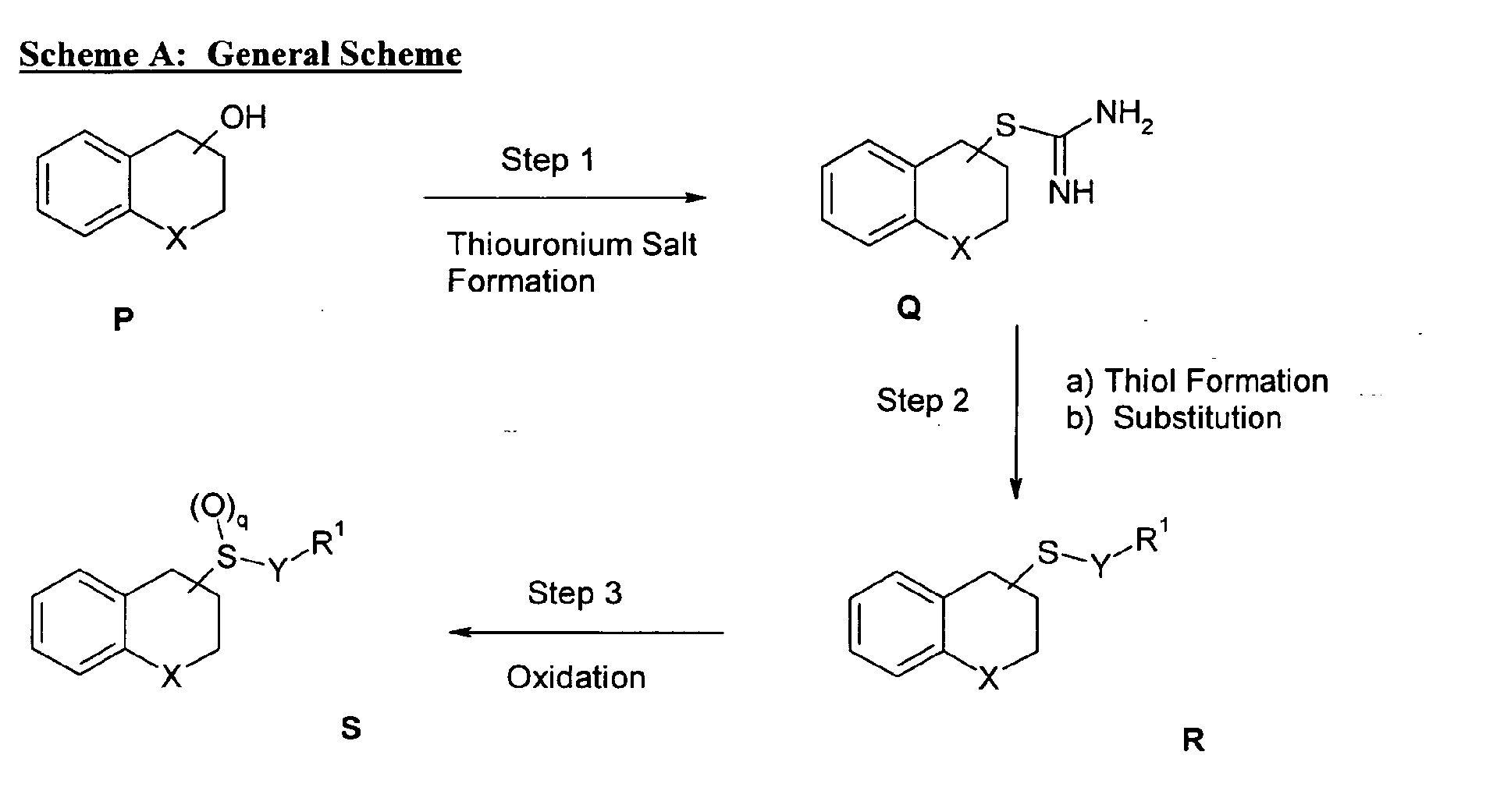
Step 1: Synthesis of compounds of general structure Q:
-
In step 1, the alcohol moiety of compound P is converted to the corresponding thiouronium
salt. For example, an appropriate amount of thiourea is taken into 48% HBr and water.
The mixture is warmed (preferably to 60 - 70 °C), followed by addition of compound P.
The temperature of the reaction mixture is elevated (preferably to 90-95 °C) and the stirring
is continued for an additional period of time for completion of the reaction. The reaction
mixture is cooled to room temperature (in some cases, an ice-bath might be needed) and the
precipitated solid is filtered and thoroughly washed with water to generate compound Q.
Step 2: Synthesis of compounds of general structure R:
-
In step 2a, the thiouronium salt Q from previous step is converted to corresponding thiol.
In step 2b, the thiol undergoes a substitution reaction with an appropriate reactant to
generate compound R. Thus, compound Q from step 1 is taken into additional water and
treated with an aqueous base, preferably a sodium hydroxide solution. The mixture is
warmed (preferably to 70 - 80 °C, but in some cases a higher temperature might be needed)
and to it an appropriate amount of a reactant of generic structure W-Y-R1 (where W is a
suitable leaving group) in water (or in some cases, an alcoholic solvent) is added. The
reaction mixture is maintained at an elevated temperature (preferably 100-110°C) for an
appropriate period of time, cooled, taken into water and washed with an organic solvent
(preferably ether). The basic aqueous layer is acidified with an inorganic acid solution (e.g.
aqueous HCl solution). The aqueous (acidic) solution is then extracted several times into
an organic solvent (e.g. ether or ethyl acetate). The combined organic layer is washed with
brine, dried (MgSO4 or Na2SO4) and concentrated to give the crude product that may be
used directly in the next step. However, purification could be achieved by employing
known purification techniques (e.g. recrystallization) to provide pure compound R. The
method is an adaptation from a procedure previously described in U.S. Pat. No. 4,177,290,
incorporated by reference herein in its entirety.
Step 3: Synthesis of compounds of general structure S:
-
Compounds of structure
R may optionally be oxidized to generate compounds of structure
S. Thus, compound
S is prepared by reacting compound
R in an appropriate solvent with
an appropriate oxidizing agent. An appropriate oxidizing agent is one that oxidizes the
sulfide group of compound
R. The corresponding product is isolated and purified by
methods well known in the art. For example, to a cooled (-15 °C to -25 °C) solution of
compound
R in an organic solvent (preferably methylene chloride or chloroform), an
appropriate oxidizing agent (e.g. m-chloroperoxybenzoic acid ["
m-CPBA"], 1 equivalent)
in the same solvent is slowly added. Stirring is continued at low temperature until the
disappearance of the starting material, as evidenced by various analytical techniques. The
reaction mixture is then thoroughly washed with a saturated sodium bicarbonate solution,
water and brine, respectively, dried over a drying agent (e.g. MgSO
4 or Na
2SO
4) and
concentrated. The desired product (compound
S) is purified, if needed, by employing
known purification techniques (preferably by column chromatography and/or
recrystallization). In other cases, the oxidation is performed by employing 50% H
2O
2 in
glacial acetic acid solvent.
Example 1
Synthesis of compound C
-
To a mixture of thiourea (8.3 g, 109 mmol) and 48% HBr (76 mL, 705 mmol) at 60°C was
added compound A (10 g, 75 mmole) in portions. The reaction mixture was then gently
heated to reflux for 1 h, cooled and filtered. The residue was washed successively with
water and ether, and dried in vacuo to yield compound 10.7 g of compound B (white solid)
that was directly used in the next step without any further purification. Thus, to a mixture
of compound B (6 g, 22 mmol) and aq. NaOH (12.5%, 17.6 mL) at 70°C was added slowly
a solution of chloroacetic acid (2.3 g, 24 mmol) in aq. NaOH (3.3%, 2.3 mL). The reaction
mixture was then heated at 110°C for 1 h, cooled, diluted with ice-water, washed with ether
and acidified (pH ~2). The resultant acidic mixture was extracted into ethyl acetate (3 x
100 mL). The combined organic layer was washed with brine (1 x 100 mL), dried over
MgSO4, and concentrated to yield compound C (3g, semi-solid, R t : 9.90 min). This
compound was directly used in the next step without any further purification.
Example 2
Synthesis of compound C1
-
This compound was prepared following the same procedure as described in Example 2
using 2-bromopropionic acid in place of chloroacetic acid; R t : 10.81 min.
Example 3
Synthesis of compound D (NR1R2 = NH2)
-
To a cooled (ice-bath) mixture of compound C (3 g, 14 mmol), and EDCI (3.3 g, 17 mmol)
in DMF (15 mL) was added NH3.HOBt-complex (2.7 g, 18 mmol). The cooling bath was
removed and the mixture was stirred at room temperature for 1 h. It was then diluted with
ethyl acetate (100 mL), washed successively with water (1 x 50 mL), 2% aq. citric acid (2 x
50 mL), water (1 x 50 mL), 2% aq. NaHCO3 (2 x 50 mL), water (1 x 50 mL), and brine (1 x
50 mL) and dried (MgSO4). On concentration, the solution generated a solid product that
was filtered, washed with ether and dried to give 1.76 g of compound D (NR1R2 =NH2); R t :
8.58 min.
Example 4
Synthesis of compound D1 (NR1R2 = NH2)
-
This compound was prepared following the same procedure as described in Example 3
using C1 in place of C.
Example 5
Synthesis of compound D (NR1R2 = N-pyrrolidinyl)
-
To a cooled (ice-bath) mixture of compound C (1.5 g, 7.2 mmol), and 2-(1H-benzotriazol-1-yl)-1,1,3,3-tetramethyluronium
tetrafluoroborate (TBTU, 3.5 g, 11 mmol), and
pyrrolidine (720 µL, 8.6 mmol) in DMF (15 mL) was added NMM (N-methylmorpholine,
1.2 mL, 11 mmol). The cooling bath was removed and the mixture was stirred at room
temperature for 1 h. It was then diluted with ethyl acetate (100 mL), washed successively
with water (1 x 50 mL), 2% aq. citric acid (2 x 50 mL), water (1 x 50 mL), 2% aq. NaHCO3
(2 x 50 mL), water (1 x 50 mL), and brine (1 x 50 mL) and dried (MgSO4). Solvent
evaporation gave a crude product that was purified by flash chromatography (ethyl acetate)
to give 1.11 g of compound D (NR1R2 = N-pyrrolidinyl); R t : 11.13 min.
Examples 6-8
Synthesis of compounds D (NR1R2 = N-pyrrolidinyl-2-(S)-carboxamide, NMe2, N-(4-acetyl)-piperazinyl,
respectively)
-
These compounds were prepared from compound C following the same procedure as
described in Example 5 using the appropriate amine.
Example 9
Synthesis of compound D1 (NR1R2 = N-(4-acetyl)-piperazinyl))
-
This compound was prepared following the same procedure as described in Example 5
using the appropriate amine.
Example 10
Synthesis of compound E (NR1R2 = NH2)
-
To a cooled solution (ice-bath) of compound D (NR1R2 =NH2, 1.76 g, 8.5 mmol) in glacial
acetic acid (8 ml) was added 50% aqueous H2O2 (1.3 eqv). The ice-bath was removed and
the mixture was stirred until no more starting material was detected (HPLC), concentrated
at high vacuum and triturated with ether to give a solid that was dried on a lyophilizer to
generate 1.69 g of compound E (NR1R2 = NH2).
Analytical data: 1H-NMR (DMSO-d6) δ 7.69 (d, 1H), 7.46 - 7.18 (m, 5H), 4.43 - 3.66 (m,
1H), 3.65 - 3.44 (m, 2H), 3.04 - 2.86 (m, 2H), 2.60 - 2.19 (m, 2H).
Example 11
Synthesis of compound E1 (NR1R2 = NH2)
-
This compound was prepared from compound D1 following the same procedure as
described in Example 10 using compound C1 and the appropriate amine.
Analytical Data: 1H-NMR (DMSO-d6) δ 7.50 (s, 1H), 7.45 (m, 1H), 7.25 (m, 3H), 6.95 (s,
1H), 4.40 (m, 1H), 2.95 (m, 3H), 2.90 (m, 1H), 2.50-2.10 (m, 4H).
Example 12
Synthesis of compound E (NR1R2 = N-pyrrolidinyl)
-
This compound was prepared, following the same procedure as described in Example 10
using compound C and the appropriate amine.
Analytical data: 1H-NMR (DMSO-d6) δ 7.43 (t, 1H), 7.34 - 7.18 (m, 3H), 4.55 (q, 1H),
3.88 - 3.75 (m, 2H), 3.56 - 3.27 (m, 4H), 3.03 - 2.86 (m, 2H), 2.64 - 2.53 (m, 1H), 2.47 -
2.17 (m, 1H), 1.91 - 1.74 (m, 4H).
Example 13
Synthesis of compound E (NR1R2 = N-pyrrolidinyl-2-(S)-carboxamide)
-
This compound was prepared, following the same procedure as described in Example 10
using compound C and the appropriate amine.
Example 14
Synthesis of compound E (NR1R2 = NMe2)
-
This compound was prepared, following the same procedure as described in Example 10
using compound C and the appropriate amine.
Analytical data: 1H-NMR (DMSO-d6) δ 7.41 (t, 1H), 7.34 - 7.18 (m, 3H), 4.55 - 4.49 (m,
1H), 3.89 (q, 2H), 3.03 (s, 3H), 3.01- 2.89 (m, 2H), 2.86 (s, 3H), 2.64 - 2.17 (m, 2H).
Example 15
Synthesis of compound E (NR1R2 = N-(4-acetyl)-piperazinyl)
-
This compound was prepared, following the same procedure as described in Example 10
using compound C and the appropriate amine.
Analytical data: 1H-NMR (DMSO-d6) δ 7.44 (t, 1H), 7.34 - 7.19 (m, 3H), 4.25 (d, 1H),
4.03 - 3.92 (m, 2H), 3.61 - 3:32 (m, 8H), 3.06 - 2.87 (m, 2H), 2.66 - 2.17 (m, 2H), 2.06 -
1.99 (s, 3H).
Example 16
Synthesis of compound E1 (NR1R2 = N-(4-acetyl)-piperazinyl)
-
This compound was prepared following the same procedure as described in Example 10
using compound C1 and the appropriate amine.
Analytical Data: 1H-NMR (DMSO-d6) δ 7.45 (m, 1H), 7.30 (m, 3H), 4.45 (m, 1H), 3.50 (m,
8H), 3.00 (m, 3H), 3.80 (m, 3H), 2.30 (m, 2H), 2.00 (s, 3H).
Example 17
Synthesis of compound F (NR1R2 = NH2)
-
A mixture of compound
E (NR
1R
2 = NH
2, 0.3 g, 1.46 mmol) and m-chloroperbenzoic acid
(77%, 0.5 g, 2.92 mmol) in methylene chloride (10 mL) was stirred at room temperature for
0.5 h. The reaction mixture was diluted with methylene chloride (20 mL) and washed with
2% NaHCO
3 (3 x 25 mL), water (1 x 20 mL), and brine (1 x 25 mL), dried (MgSO
4),
concentrated and triturated with cold ether to generate 0.14 g of compound
F.
Analytical data:
1H-NMR (DMSO-d
6): δ 7.80 (s, 1H), 7.50 (d, 2H), 7.30 (d, 2H), 7.25 (m,
1H), 5.00 (m, 1H), 4.15 (d, 1H), 4.00 (d, 1H), 3.05 (m, 1H), 2.90 (m, 1H), 2.60 (m, 1H),
2.50 (m, 1H).
Example 18
Synthesis of compound H
-
A mixture of compound B (4 g, 15 mmol) and 10 N NaOH (6 ml), and water (37 mL) was
heated at 70 °C for 0.5 h, cooled, diluted with ice-water and acidified (pH ~2). The acidic
solution was extracted with ethyl acetate (3 x 100 mL). The combined organic layers were
washed with brine (1 x 50 mL), dried (MgSO4), and concentrated to yield 1.59 g of
compound G (white solid; R t : 13.67 min) that was directly used in the next step. Thus, a
mixture of compound G (1.58 g, 10.5 mmol) in methanol (14 mL) and sodium methoxide in
methanol (0.5 M, 21 mL) was heated at 60 °C for 0.5 h, cooled and treated with
iodomethane (2 mL, 32 mmol). The reaction was stirred at 60 °C for 7 h, cooled, diluted
with ice-water and acidified (pH ~2). The acidic solution was extracted with ethyl acetate
(3 x 100 mL). The combined organic layers were washed with brine (1 x 50 mL), dried
(MgSO4), and concentrated to yield compound H (1.3 g, R t : 14.12 min) that was directly
used in the next step without any further purification.
Example 19
Synthesis of compound I
-
Starting with compound
H, this compound was prepared following the same procedure as
described in Example 10.
Analytical data:
1H-NMR (CHCl3-d) δ 7.44 (q, 1H), 7.32 - 7.20 (m, 3H), 4.34 (dq, 1H),
3.15 - 2.94 (m, 2H), 2.64 - 2.39 (m, 2H), 2.35 (s, 3H).
Example 20
Synthesis of compound c
-
To a mixture of thiourea (2.84 g, 37.3 mmol) and 48% HBr (10 mL, 80 mmol) in water (50
mL) at 60°C was added compound a (4 g, 26.6 mmol) in portions. The reaction mixture
was then gently heated to reflux for 1 h, cooled and filtered. The residue was washed
successively with water and ether, triturated with ethyl acetate and dried in vacuo to yield
compound b (10.7g, white solid) that was directly used in the next step without any further
purification. Thus, to a mixture of compound b (4.08 g, 14.1 mmol), aq. NaOH (10 N, 5.6
mL), and water (35 mL) at 70 °C was added slowly a solution of chloroacetic acid (1.87 g,
19.7 mmol) in water (6 mL). The reaction mixture was then stirred at 100 °C for 2.5 h,
cooled, diluted with ice-water, washed with ether and acidified (pH ~2). The resultant
acidic mixture was extracted into ethyl acetate (3 x 100 mL). The combined organic layer
was washed with brine (1 x 100 mL), dried (MgSO4), and concentrated to yield compound
c (2.27 g, viscous oil). This compound was directly used in the next step without any
further purification.
Example 21
Synthesis of compound d (NR1R2 = NH2)
-
To a cooled (ice-bath) mixture of compound c (2.14 g, 7.45 mmol), NMM (1.47 mL, 13.3
mmol) and TBTU (3.37 g, 10.5 mmol) in DMF (30 mL) was added NH3.HOBt-complex-(2.9
g, 19 mmol). The cooling bath was removed and the mixture was stirred at room
temperature for 4 h. It was then diluted with ethyl acetate (100 mL), washed successively
with water (1 x 50 mL), 2% aq. citric acid (2 x 50 mL), water (1 x 50 mL), 2% aq. NaHCO3
(2 x 50 mL), water (1 x 50 mL), and brine (1 x 50 mL) and dried (MgSO4). On
concentration, the solution generated a solid product that was filtered, triturated with ether
and dried to give 0.84 g of compound d (NR1R2 = NH2).
Examples 22-24
Synthesis of compound d (NR1R2 = N-pyrrolidinyl, NHCH2-(3-pyridyl), NHCH2CHMe2,
respectively)
-
These compounds were prepared from compound c, following the same procedure as
described in Example 21 using the appropriate amine.
Example 25
Synthesis of compound d (NR1R2 = NMe2)
-
To a refluxing solution of compound c (1.81 g, 8.1 mol) in benzene (20 mL) was added
thionyl chloride (3.18 mL) dropwise. The reaction mixture was refluxed for an additional 1
h, and concentrated to remove the volatiles to generate the corresponding acid-chloride.
This material was re-dissolved in methylene chloride (25 mL) and treated with
dimethylamine gas. It was then stirred for 6 h at room temperature, washed successively
with water (2 x 20 mL), sat. NaHCO3 solution (2 x 25 mL), water (1 x 25 mL), and brine (1
x 25 mL), dried (Na2SO4) and concentrated to generate 2.14 g of compound d (NR1R2 =
NMe2) that was directly used in next step.
Example 26
Synthesis of compound e (NR1R2 = NH2)
-
This compound was synthesized by oxidation of corresponding compound d as described in
Example 10.
Analytical data: 1H-NMR (DMSO-d6) δ 7.73 (s, 1H), 7.36 (d, 1H), 7.22 (m, 2H), 6.93 (dt,
1H), 6.84 (d, 1H), 4.27 - 4.12 (m, 3H), 3.72 (q, 1H), 3.69 (dd, IH), 2.55 - 2.15 (m, 2H).
Example 27
Synthesis of compound e (NR1R2 = N-pyrrolidinyl)
-
This compound was synthesized by oxidation of corresponding compound d as described in
Example 10.
Analytical data: 1H-NMR (DMSO-d6) δ 7.43 - 6.83 (m, 4H), 4.33 - 3.87 (m, 5H), 3.58 -
3.44 (m, 2H), 3.41 - 3.33 (m, 1H), 2.59 - 2.16 (m, 3H), 1.92 - 1.76 (m, 4H).
Example 28
Synthesis of compound e (NR1R2 = NMe2)
-
This compound was synthesized by oxidation of corresponding compound d as described in
Example 10.
Analytical data: 1H-NMR (DMSO-d6) δ 7.43 - 6.82 (m, 4H), 4.30 - 3.98 (m, 5H), 3.04 (s,
3H), 2.87 (s, 3H), 2.70 - 2.52 (m, 1H), 2.36 - 2.16 (m, 2H).
Example 29
Synthesis of compound e (NR1R2 = NHCH2-(3-pyridyl))
-
This compound was synthesized by oxidation of corresponding compound d as described in
Example 10.
Analytical data: 1H-NMR (DMSO-d6): δ 11.90 (bs, 1H), 8.90 (s, 1H), 8.50 - 8.45 (m, 2H),
7.75 (d, 1H), 7.30 (t, 1H), 7.25 (m, 1H), 6.80 - 7.00 (m, 2H), 4.40 - 4.01 (m, 6H), 4.00 -
3.70 (m, 2H), 2.40-2.20 (m ,2H), 1.90 (s, 3H).
Example 30
Synthesis of compound e (NR1R2 = NHCH2CHMe2)
-
This compound was synthesized by oxidation of corresponding compound
d as described in
Example 10.
Analytical data:
1H-NMR (DMSO-d
6): δ 8.20 (t, 2H), 7.35 - 7.20 (m, 2H), 7.00 - 6.80 (m,
3H), 4.30 - 4.10 (m, 6H), 3.90-3.50 (m, 5H), 2.40 - 2.10 (m, 3H).
Example 31
Synthesis of compound cc
-
To a solution of thiochroman-4-one (9.95 g, 60.6 mmol) in anhydrous ethanol (73 mL) was
added sodium borohydride (2.29 g) in small portions. The reaction mixture was stirred at
room temperature for 1 h, evaporated to dryness, and treated with ice-water. The aqueous
layer was acidified (pH ~2), and extracted into ethyl acetate (3 x 100 mL). The combined
organic layers were washed with water (1 x 50 ml) and brine (1 x 50 mL), dried (MgSO4),
and concentrated to give 9.32 g of compound aa; 1H-NMR (DMSO-d6) δ 7.35 - 6.83 (m,
4H), 5.32 (br s, 1H), 4.59 (m, 1H), 3.32 - 3.13 (m, 1H), 2.95 - 2.89 (m, 1H), 2.12 - 2.05
(m, 1H), 1.99-1.92 (m, 1H).
-
Compound aa was converted to compound cc via compound bb following the same
procedure in Example 20.
Example 32
Synthesis of compound dd (NR1R2 = NMe2)
-
This compound was prepared from compound cc, following the same procedure as
described in Example 25.
Analytical data: 1H-NMR (DMSO-d6) δ 7.27 - 6.98 (m, 4H), 4.35 (m, 1H), 3.54 - 3.38
(m,3H), 3.02 (s, 3H), 2.99 - 2.91 (m, 1H), 2.86 (s, 3H), 2.50-2.44 (m, 1H), 2.07 - 1.99 (m,
1H).
Examples 33-34
Synthesis of compound ee (NR1R2 = NMe2) and compound ff (NR1R2 = NMe2),
respectively
-
To a solution of compound
dd (NR
1R
2 = NMe
2)(3.39 g, 12.8 mmol) in glacial acetic acid
(40 mL) at room temperature was added aq. H
2O
2 (50%, 812 µL, 14 mmol). The mixture
was stirred for 5.5 h, diluted with water, and extracted into ethyl acetate (3 x 50 mL). The
combined organic layers were washed with 2% aq. NaHCO
3 (2 x 50 mL). The basic wash
layer was re-extracted into ethyl acetate (2 x 50 mL). Combined organic layer was washed
with water (1 x 50 mL), brine (1 x 50 mL), dried (MgSO
4), and concentrated to give a
residue that was purified by silica-gel flash chromatography (9:1:: ethyl acetate - methanol)
to provide 0.168 mg of compound
ee (NR
1R
2 = NMe
2)(less polar, eluted first) and 0.291 mg
of compound
ff (NR
1R
2 = NMe
2)(more polar, eluted later), respectively.
Analytical Data: Compound
ee (NR
1R
2 = NMe
2):
1H-NMR (DMSO-d
6) δ 7.45 (d, 1H),
7.22 - 7.06 (m, 3H), 4.45 (t, 1H), 4.01 (q, 1H), 3.38 - 3.32 (m, 1H), 3.02 (s, 3H), 3.00 -
2.97 (m, 1H), 2.85 (s, 3H), 2.84 - 2.79 (m, 1H), 2.22 - 2.08 (m, 1H).
Compound
ff (NR
1R
2 = NMe
2):
1H-NMR (DMSO-d
6) δ 7.69 - 7.45 (m, 4H), 4.54 (t, 1H),
3.61 - 3.53 (m, 2H), 3.50 - 3.43 (m, 1H), 3.06 - 3.04 (m, 1H), 3.01 (s, 3H), 2.85 (s, 3H),
2.72 - 2.63 (m, 1H), 2.29 - 2.23 (m, 1H).
Examples 35-36
Synthesis of compounds bbb and ccc, respectively
-
To a stirred slurry ofNaH in oil (60%, 3 g, 0.075 mol) in anhydrous THF (50 mL) at 0°C,
was slowly added compound aaa (11.3 g, 0.070 mol) in anhydrous THF (50 ml). After the
evolution of hydrogen gas ceased, a solution of methyl bromoacetate (11.4 g, 0.075 mol) in
anhydrous THF (40 mL) was added dropwise to the reaction mixture. Stirring was
continued for another 1 h at room temperature. The reaction mixture was then quenched
with ice-water (100 mL) and extracted into diethyl ether (3 x 200 ml). The combined
organic layers were washed with water (1 x 50 mL) and brine (1 x 50 mL), dried (MgSO4),
and concentrated to generate a crude product that was triturated with petroleum ether
followed by diethyl ether to obtain 14.2 g of compound bbb (off-white solid) that was
directly used in the next step. Thus, a mixture of compound bbb (11.1 g), methanol (70
mL), and aq. NaOH (1.2 N, 60 ml) was stirred at room temperature for several hours,
diluted with water (80 mL), cooled (ice-bath) and acidified (pH ~ 2). The precipitate was
filtered, washed with cold water and dried under high vacuum to generate compound ccc
(8.7 g, white solid) that was directly used in the next step without further purification.
Examples 37-43
Synthesis of compound ddd (NR1R2 = NH2, NH-(S)-CH(CH3)CONH2, NH(CH2)2OH, N-pyrrolidinyl,
NH-(S)-CH(CH2CONH2)CONH2, N-pyrrolidinyl-2-(S)-carboxamide, NMe2,
respectively)
-
These compounds were prepared from compound ccc following the same procedure as
described in Example 3 using the appropriate amine.
Example 44
Synthesis of compound eee (NR1R2 = NH2)
-
This compound was prepared from compound ddd following the same procedure as
described in Example 10.
Analytical data: 1H-NMR (DMSO-d6) δ 8.32 (s, 1H), 8.15-8.05 (m, 3H), 7.62 (d, 1H), 7.55
(m, 2H), 7.5 (s, 1H), 7.25 (s, 1H), 3.85 (q, 2H).
Example 45
Synthesis of compound eee (NR1R2 = NH-(S)-CH(CH3)CONH2)
-
This compound was prepared from compound ddd following the same procedure as
described in Example 10.
Analytical data: 1H-NMR (DMSO-d6) δ 8.25 (d, 1H), 7.86 (m, 4H), 7.5 (m, 3H), 7.45 (s,
1H), 7.0 (s, 1H), 4.21 (m, 1H), 3.95 (q, 2H), 1.25 (d, 3H).
Example 46
Synthesis of compound eee (NR1R2 = NH(CH2)2OH)
-
This compound was prepared from compound ddd following the same procedure as
described in Example 10.
Analytical Data: 1H-NMR (DMSO-d6) δ 8.32 (s, 1H), 8-8.25 (m, 4H), 7.81(d, 2H), 7.7 (m,
1H), 4.82 (t, 1H), 3.95 (q, 2H), 3.26 (m, 2H), 3.15 (m, 2H).
Example 47
Synthesis of compound eee (NR1R2 = N-pyrrolidinyl)
-
This compound was prepared from compound ddd following the same procedure as
described before for the synthesis of compound E (NR1R2 = NH2) from compound D.
Analytical Data: 1H-NMR (DMSO-d6) δ 8.32 (s, 1H), 8.25 - 8.00 (m, 4H), 7.81 (d, 1H),
7.70 (m, 2H), 4.01 (s, 2H), 3.55 (m, 1H), 3.26 (m, 2H), 1.74 (m, 4H).
Example 48
Synthesis of compound eee (NR1R2 = NH-(S)-CH(CH2CONH2)CONH2)
-
This compound was prepared from compound ddd following the same procedure as
described in Example 10.
Analytical Data: 1H-NMR (DMSO-d6) δ 8.50 (q, 1H), 8.25 (d, 1H), 8.00 (m, 3H), 7.80 (m,
1H), 7.65 (m, 2H), 7.40 - 6.91 (m, 4H), 4.50 (m, 1H), 3.95 (m, 2H), 2.45 (m, 2H).
Example 49
Synthesis of compound eee (NR1R2 = N-pyrrolidinyl-2-(S)-carboxamide)
-
This compound was prepared from compound ddd, following the same procedure as
described in Example 10.
Analytical Data: 1H-NMR (DMSO-d6) δ 8.45 - 6.95 (m, 9H), 4.45 - 4.25 (dd, 1H), 4.10
(m, 2H), 3.50 (m, 2H), 2.20 - 1.80 (m, 4H).
Example 50
Synthesis of compound eee (NR1R2 = NMe2)
-
This compound was prepared from compound
ddd following the same procedure as
described in Example 10.
Preparation 1
Synthesis of compound bbbb
-
To a stirred solution of compound aaaa (26.8 g, 200 mmol) and triphenylphosphine
(55.2 g, 210 mmol) in dry CH2Cl2 (400 ml) under N2 was slowly added bromine
(10.8 mL, 212 mmol) at 0 °C. The cooling bath was removed and the reaction was stirred at
room temperature for an additional 2 h. It was then concentrated under reduced pressure
with gentle heating (40 °C) and the hot residue was slowly poured into Et2O (400 ml) with
vigorous stirring. The solution was cooled at 0 °C for 15 min and filtered. The filtrate was
washed with 5% aq. Na2SO3 solution, water, dried (MgSO4) and evaporated to give
compound bbbb (38.4 g, Rf = 0.75 in 9:1 cyclohexane/ethyl acetate) as an oil that was
directly used in the subsequent step without any further purification. The method was an
adaptation from a procedure previously described in J Med Chem. 1994, 37, 1586-1601,
incorporated herein by reference in its entirety.
Example 51
Synthesis of compound cccc
-
To a cooled (ice-bath) solution of potassium t-butylate (6.9 g, 61 mmol) in dry methanol
(150 ml) under N2 was added methyl 2-sulfanyl acetate (5.5 mL, 62 mmol). The reaction
mixture was stirred for an additional 10 min and to it a solution of compound bbbb (10 g,
51 mmol) in dry methanol (20 ml) was slowly added. The ice-bath was removed and the
reaction mixture was refluxed for 1 h., concentrated to dryness and quenched with sat.
ammonium chloride solution (200 ml). It was then extracted into ethyl acetate (2 X 150 ml).
The combined organic layers were dried (MgSO4), concentrated in vacuo to generate a
crude product that was purified by silica gel column chromatography (cyclohexane:ethyl
acetate :: 9:1) to afford 8.46 g of compound cccc (oil, Rf= 0.32 in 9:1 cyclohexane/ethyl
acetate).
Example 52
Synthesis of compound cccc1
-
This compound was prepared from compound bbbb following the same procedure as
described in Example 51 using methyl 3-sulfanylpropanoate in place of methyl 2-sulfanyl
acetate.
Rf = 0.36 (9:1 cyclohexane/ethyl acetate).
Example 53
Synthesis of compound dddd (NR1R2 = N-pyrrolidinyl)
-
To a solution of compound cccc (1 g , 4.5 mmol) in dichloromethane (20 mL) at room
temperature was added pyrrolidine (0.45 mL, 5.4 mmol) followed by a solution of
trimethylaluminium hydride in toluene (2M, 2.7 mL, 5.4 mmol). The reaction mixture was
stirred for 96 h, diluted with dichloromethane (50 mL) and carefully quenched with 1NHCl
solution (dropwise; 50 mL). The organic layer was separated and concentrated to give a
crude product that was purified by silica gel column chromatography
(dichloromethane:methanol :: 98:2) to generate 0.78 g of compound dddd (NR1R2 = N-pyrrolidinyl).
Rf = 0.24 (98:2 dichloromethane/methanol).
Example 54
Synthesis of compound dddd1 (NR1R2 = NH2)
-
A mixture of compound cccc1 (1g ; 4.2 mmol), MeOH (40 mL) and 28% NH4OH
(40 mL) was stirred at room temperature overnight, concentrated to dryness, triturated with
water and filtered. The residue was washed several times with water and dried in vacuo to
generate 0.64 g of compound dddd1 (NR1R2 = NH2) that was directly used in the next step
without any further purification.
Analytical Data: 1H-NMR (DMSO-d6) δ : 7.35 (s, 1H), 7.2 (m, 2H), 7.1 (m, 2H), 6.85 (s,
1H), 3.65 (m, 1H), 3.35-3.25 (m, 2H), 2.85-2.7 (m, 4H), 2.35 (t, 2H).
Example 55
Synthesis of compound dddd (NR1R2 = NH2)
-
This compound was prepared from compound cccc following the same procedure as
described in Example 54.
Rf = 0.41 (95:5 dichloromethane/methanol).
Example 56
Synthesis of compound dddd (NR1R2 = NMe2)
-
This compound was prepared from compound cccc following the same procedure as
described in Example 53 using the appropriate amine.
Rf = 0.27 (98:2 dichloromethane/methanol).
Example 57
Synthesis of compound dddd (NR1R2 = NHCHMe2)
-
This compound was prepared from compound cccc following the same procedure as
described in Example 53 using the appropriate amine.
Rf = 0.35 (98:2 dichloromethane/methanol).
Example 58
Synthesis of compound dddd (NR1R2 = N-(4-acetyl)-piperazinyl))
-
This compound was prepared from compound cccc following the same procedure as
described in Example 53 using the appropriate amine.
Rf = 0.33 (94:6 dichloromethane/methanol).
Example 59
Synthesis of compound dddd1 (NR1R2 = N-pyrrolidinyl)
-
This compound was prepared from compound cccc1 following the same procedure as
described in Example 53 using the appropriate amine.
Rf = 0.27 (98:2 dichloromethane/methanol).
Example 60
Synthesis of compound dddd1 (NR1R2 = NHCHMe2)
-
This compound was prepared from compound cccc1 following the same procedure as
described in Example 53 using the appropriate amine.
Rf = 0.25 (98:2 dichloromethane/methanol).
Example 61
Synthesis of compound dddd1 (NR1R2 = NMe2)
-
This compound was prepared from compound cccc1 following the same procedure as
described in Example 53 using the appropriate amine.
Rf = 0.27 (98:2 dichloromethane/methanol).
Example 62
Synthesis of compound ffff
-
To a cooled (ice-bath) solution of compound cccc (3.4 g, 16 mmol) in MeOH (36 mL) was
added LiOH·H2O (1.9 g, 45 mmol) in water (12 mL). The cooling bath was removed and
the reaction mixture was stirred for an additional 1 h, diluted with water, acidified (1N
HCl), and extracted several times into Et2O. The combined organic layers were dried
(MgSO4) and concentrated in vacuo to generate a crude residue that on trituration with
petroleum ether produced 2.3 g of compound ffff as a white solid. This material was
directly used in the next step without further purification.
Analytical Data: 1H-NMR (DMSO-d6) δ : 7.25-7.18 (m, 2H), 7.15-7.7.1 (m, 2H), 3.75 (m,
1H),
3.35 (s, 2H), 3.25 (dd, 2H), 2.85 (dd, 2H).
Example 63
Synthesis of compound gggg
-
To a solution of compound ffff (2.3 g, 11 mmol) in acetic acid (30 mL) at room temperature
was added aq. hydrogen peroxide (30%, 1.4 mL, 15 mmol). After stirring for 1 h, the
reaction mixture was filtered and the residue was washed successively with acetic acid and
ether. The solid was dried in vacuo to give 2.24 g of compound gggg that was directly used
in the next step without further purification.
Analytical Data: 1H-NMR (DMSO-d6) δ : 7.3-7.2 (m, 2H), 7.15 (broad, 2H), 3.95 (d, 1H),
3.85 (m, 1H), 3.6 (d, 1H), 3.4-3.15 (m, 3H), 3.0 (dd, 1H).
Example 64
Synthesis of compound eeee1 (NR1R2 = NH2)
-
To a solution of compound dddd1 (NR1R2 = NH2) (0.64 g ; 2.9 mmol) in acetic acid
(7 mL) at room temperature was added aq. hydrogen peroxide (30% by wt, 0.38 mL, 3.7
mmol). The reaction mixture was stirred for additional 1 h, concentrated and purified by
silica gel column chromatography (dichloromethane:methanol :: 9:1) to give 0.33 g of
compound eeee1 (NR1R2 = NH2). Rf = 0.43 (9:1 dichloromethane/methanol).
Analytical Data: 1H-NMR (DMSO-d6) δ :7.5 (s, 1H), 7.25 (m, 2H), 7.2 (m, 2H), 7.0 (s,
1H), 3.7 (m, 1H), 3.3 (m, 1H), 3.2 (m, 2H), 3.0 (m, 2H), 2.75 (m, 1H), 2.5 (t, 2H).
Example 65
Synthesis of compound eeee (NR1R2 = N-pyrrolidinyl)
-
This compound was prepared from compound dddd (NR1R2 = N-pyrrolidinyl) following
the same procedure as described in Example 64. Rf = 0.36 in 95:5
dichloromethane/methanol).
Analytical Data: 1H-NMR (DMSO-d6) δ : 7.25 (m, 2H), 7.2 (broad, 2H), 3.85 (m, 3H), 3.5
(m, 2H), 3.45-3.15 (a series of m, 5H), 3.0 (m, 1H), 1.8 (broad m, 4H).
Example 66
Synthesis of compound eeee (NR1R2 = N-(4-hydroxy)piperidinyl)
-
To a cooled (ice-bath) solution of compound gggg (0.3 g ; 1.3 mmol) in CH2Cl2 (25 mL)
was successively added 4-piperidinol (0.15 g, 1.5 mmol), EDCI (0.28 g, 1.5 mmol) and
HOBT (0.2 g ; 1.5 mmol). The cooling bath was removed and the reaction mixture was
stirred for 72 h. It was then successively washed with acid (1N HCl) and water, dried
(MgSO4) and concentrated in vacuo to generate a crude product that was purified by silica
gel column chromatography (9:1 dichloromethane / methanol) to give 0.2 g of compound
eeee.(NR1R2 = N-(4-hydroxy)piperidinyl. Rf = 0.43 (9:1 dichloromethane/methanol).
Analytical Data: 1H-NMR (CDCl3) δ : 7.2 (broad, 4H), 4.05 (m, 1H), 3.95 (m, 2H), 3.80
(m, 2H), 3.55 (broad d, 1H), 3.3 (m, 4H), 3.15 (m, 1H), 1.95 (broad, 2H), 1.55 (broad, 2H).
Example 67
Synthesis of compound eeee (NR1R2 = NH2)
-
This compound was prepared from compound dddd (NR1R2 = NH2) following the same
procedure as described in Example 64. Rf = 0.16 (95:5 dichloromethane/methanol).
Analytical Data: 1H-NMR (DMSO-d6) δ : 7.70 (s, 1H), 7.30 (s, 1H), 7.25 (m, 1H), 7.20
(m, 1H), 7.10 (m, 2H), 3.80 (m, 1H), 3.60 (d, 1H), 3.50 (d, 1H), 3.4-3.1 (m, 3H), 3.0 (dd,
1H).
Example 68
Synthesis of compound eeee (NR1R2 = NMe2)
-
This compound was prepared from compound dddd (NR1R2 = NMe2) following the same
procedure as described in Example 64. Rf = 0.28 (95:5 dichloromethane/methanol).
Analytical Data: 1H-NMR (DMSO-d6) δ : 7.30 (m, 1H), 7.20 (m, 1H), 7.1 (broad, 2H),
3.95 (d, 2H), 3.85 (m, 1H), 3.45 (dd, 1H), 3.3-3.1 (m, 2H), 3.05 (s, 3H), 3.0 (m, 1H)2.85 (s,
3H).
Example 69
Synthesis of compound eeee (NR1R2 = NHCHMe2)
-
This compound was prepared from compound dddd (NR1R2 = NHCHMe2) following the
same procedure as described in Example 64.
Analytical Data: 1H-NMR (DMSO-d6) δ : 8.2 (broad d, 1H), 7.3-7.1 (m, 4H), 3.85 (m,
2H), 3.65 (d 1H), 3.5 (d, 1H), 3.4-3.2 (m, 4H), 3.0 (dd, 1H)1.1 (d, 6H).
Example 70
Synthesis of compound eeee (NR1R2 = N-(4-acetyl)-piperazinyl)
-
This compound was prepared from compound dddd (NR1R2 = N-(4-acetyl)-piperazinyl)
following the same procedure as described in Example 64.
Analytical Data: 1H-NMR (DMSO-d6) δ : 7.3-7.1 (broad, 4H), 4.1-3.95 (broad, 2H), 3.85
(broad, 1H), 3.6-3.2 (broad m , 11H), 3.0 (dd, 1H), 2.0 (broad s, 3H).
Example 71
Synthesis of compound eeee (NR1R2 = NH(CH2)2O(CH2)2OH)
-
This compound was prepared from compound gggg following the same procedure as
described in Example 66 using hydroxyethoxyethylamine in place of 4-piperidinol.
Rf = 0.33 (9:1 dichloromethane/methanol).
Analytical Data: 1H-NMR (DMSO-d6) δ : 8.3 (broad s, 1H), 7.3-7.1 (broad, 4H), 4.55
(broad s, 1H), 3.8 (broad, 1H), 3.75 (d, 1H), 3.6 (d, 1H), 3.55-3.1 (broad, 11 H), 3.05 (broad
dd, 1H).
Example 72
Synthesis of compound eeee1 (NR1R2 = N-pyrrolidinyl)
-
This compound was prepared from compound dddd1 (NR1R2 =N-pyrrolidinyl) following
the same procedure as described in Example 64. Rf = 0.43 (93 :7
dichloromethane/methanol).
Analytical Data: 1H-NMR (DMSO-d6) δ : 7.3-7.1 (m, 4H), 3.75 (m, 1H), 3.45 (t, 2H), 3.4-3.2
(m, 5H), 3.1-2.9 (m, 2H), 2.8 (q, 1H), 2.7 (q, 2H), 1.9 (m, 2H), 1.7 (m, 2H).
Example 73
Synthesis of compound eeee1 (NR1R2 = NHCHMe2)
-
This compound was prepared from compound dddd1 (NR1R2 = NHCHMe2) following the
same procedure as described in Example 64. Rf= 0.49 (9:1 dichloromethane/methanol).
Analytical Data: 1H-NMR (DMSO-d6) δ : 7.9 (d, 1H), 7.3-7.2 (m, 2H), 7.1 (m, 2H), 3.8
(m, 1H), 3.75 (m, 1H), 3.4-3.1 (m, 3H), 3.05-2.9 (m, 2H), 2.75 (m, 1H), 2.5 (m, 2H), 1.05
(d, 6H).
Example 74
Synthesis of compound eeee1 (NR1R2 = NMe2)
-
This compound was prepared from compound dddd1 (NR1R2 = NMe2) following the same
procedure as described in Example 64. Rf = 0.24 (95:5 dichloromethane/methanol).
Analytical Data: 1H-NMR (DMSO-d6) δ : 7.3-7.2 (broad, 2H), 7.1 (broad, 2H), 3.75 (m,
1H), 3.4-3.2 (m, 2H), 3.05 (m, 2H), 3.0 (s, 3H), 2.8 (s, 3H), 2.75 (broad, 4H).
Example 75
Synthesis of compound eeee (NR1R2 = NH(CH2)2OH)
-
This compound was prepared from compound gggg following the same procedure as
described in Example 66 using hydroxyethylamine in place of 4-piperidinol.
Rf = 0.35 (9:1 dichloromethane/methanol).
Analytical Data: 1H-NMR (DMSO-d6) δ : 8.3 (m, 1H), 7.3-7.2 (m, 2H), 7.1 (broad, 2H),
4.7 (t, 1H), 3.8 (m, 1H), 3.7 (d, 1H), 3.6 (d, 1H), 3.4 (m, 2H), 3.35-3.1 (m, 4H), 3.05 (dd,
1H).
Example 83
Synthesis of compound eeee (NR1R2 = NHCH2CN)
-
This compound was prepared from compound
cccc following the same procedure as
described in Example 53 using the appropriate amine.
Analytical Data:
1H-NMR (DMSO-d
6) δ : 9.0 (t, 1H), 7.30 - 7.10 (broad m, 4H), 4.25 (d,
2H), 3.85 (m, 1H), 3.80 (d, 1H), 3.65 (d, 1H), 3.4 - 3.10 (m, 3H), 3.0 (dd, 1H).
MS : 285 (M+Na).
Example 76
Synthesis of compound ccccc
-
Starting with compound aaaaa, this compound was prepared following the same procedure
as described in Example 1. Thus, the reaction between 10 g of compound aaaaa and 7.4 g
of thiourea in the presence of 68 mL of 48% HBr generated 18.6 g of compound bbbbb
(white solid; R t : 7.16 min).
-
Subsequently, the reaction between 18.5 g of compound bbbbb and 6.6 g of chloroacetic
acid in the presence of aq. NaOH produced 12.85 g of compound ccccc as an oil (R t : 10.84
min).
Example 77
Synthesis of compound ddddd (NR1R2 = NH2)
-
Starting with compound ccccc, this compound was prepared following the same procedure
as described in Example 3. Thus, the reaction between 2 g of compound ccccc and 1.8 g of
NH3·HOBt-complex in the presence of EDCI generated 1.4 g of compound ddddd (NR1R2
= NH2, R t : 9.43 min).
Example 78
Synthesis of compound ddddd (NR1R2 = N-pyrrolidinyl)
-
Starting with compound ccccc, this compound was prepared following the same procedure
as described in Example 5. Thus, the reaction between 2 g of compound ccccc and 0.77 g
of pyrrolidine in the presence of TBTU generated 2 g of compound ddddd (NR1R2 = N-pyrrolidinyl,
R t : 12.04 min).
Example 79
Synthesis of compound ddddd (NR1R2 = NMe2)
-
Starting with compound ccccc, this compound was prepared following the same procedure
as described in Example 5. Thus, the reaction between 2 g of compound ccccc and 0.9 g of
dimethylamine hydrochloride in the presence of TBTU generated 1.6 g of compound
ddddd (NR1R2 = NMe2, R t : 10.85 min).
Example 80
Synthesis of compound eeeee (NR1R2 = NH2)
-
Starting with compound ddddd (NR1R2 =NH2), this compound was prepared following the
same procedure as described in Example 10. Thus, the oxidation of 1.4 g of compound
ddddd (NR1R2 = NH2) with aq. 50% H2O2 generated 1.18 g of compound eeeee (NR1R2 =
NH2).
Analytical data: 1H-NMR (DMSO-d6) δ 7.67 (d, 2H), 7.38 - 7.14 (m, 4H), 4.27 (t, 0.5H),
4.19 (t, 0.5H), 3.68-3.46 (m, 2H), 2.74 (t, 1H), 2.68 (t, 1H), 2.36 - 2.27 (m, 0.5H), 2.13 -
1.96 (m, 2H), 1.92 - 1.82 (m, 0.5H), 1.75 - 1.61 (m, 1H).
Example 81
Synthesis of compound eeeee (NR1R2 = N-pyrrolidinyl)
-
Starting with compound ddddd (NR1R2 = N-pyrrolidinyl), this compound was prepared
following the same procedure as described in Example 12. Thus, the oxidation of 2 g of
compound ddddd (NR1R2 = N-pyrrolidinyl) with aq. 50% H2O2 generated 0.37 g of
compound eeeee (NR1R2 = N-pyrrolidinyl).
Analytical data: 1H-NMR (DMSO-d6) δ 7.44 - 7.42 (m, 1H), 7.24 - 7.12 (m, 3H), 4.34 (t,
0.25H), 4.28 (t, 0.75H), 3.92 - 3.80 (m, 2H), 3.55 - 3.28 (m, 4H), 2.75 (t, 0.5H), 2.69 (t,
1.5H), 2.38 - 2.31 (m, 1H), 2.08 -1.97 (m, 2H), 1.90 -1.75 (m, 4H), 1.73 - 1.63 (m, 1H).
Example 82
Synthesis of compound eeeee (NR1R2 = NMe2)
-
Starting with compound ddddd (NR1R2 = NMe2), this compound was prepared following
the same procedure as described in Example 14. Thus, the oxidation of 1.6 g of compound
ddddd (NR1R2 = NMe2) with aq. 50% H2O2 generated 0.3 g of compound eeeee (NR1R2 =
NMe2).
Analytical data: 1H-NMR (DMSO-d6) δ 7.50 - 7.10 (m, 4H), 4.32 (t, 0.67 H), 4.25 (t, 0.33
H), 3.97 (s, 0.67 H), 3.91 (s, 1.33H), 3.02 (s, 1H), 3.02 (s, 2H), 2.86 (s, 2H), 2.85 (s, 1H),
2.75 (t, 1.33H), 2.68 (t, 0.67 H), 2.34 - 1.63 (m, 4H).
-
Illustrative of compounds encompassed by the present invention include those set
forth in the following table. This list is meant to be representative only and is not intended
to limit the scope of the invention in any way:
Utility
-
The present invention provides a method of treating diseases and conditions in a
subject in need thereof comprising administering to said subject a therapeutically effective
amount of a compound of the present invention. For example, the compounds of the
present invention may be useful for the treatment of diseases, such as excessive sleepiness,
promotion and/or improvement of wakefulness (preferably improvement of wakefulness in
patients with excessive sleepiness associated with narcolepsy, sleep apnea (preferably
obstructive sleep apnea/hypopnea) and shift work disorder), treatment of Parkinson's
disease, Alzheimer's disease, cerebral ischemia, stroke, eating disorders, attention deficit
disorder ("ADD"), attention deficit hyperactivity disorder ("ADHD"), depression,
schizophrenia, fatigue (preferably fatigue associated with cancer or neurological diseases,
such as multiple sclerosis and chronic fatigue syndrome), stimulation of appetite and weight
gain and improvement of cognitive dysfunction.
Methodology: Evaluation of Wake Promoting Activity in Rats
-
The methodology utilized for evaluating wake promoting activity of test compounds
is based on that described by Edgar and Seidel, Journal of Pharmacology and Experimental
Therapeutics, 283:757-769, 1997, and incorporated herein in its entirety by reference.
-
Animal Surgery. Adult, male Wistar rats (275-320g from Charles River
Laboratories, Wilmington, MA) were anesthetized (Nembutal, 45 mg/kg, ip.) and surgically
prepared with implants for recording of chronic EEG (encephalographic) and EMG
(electromyographic) recording. The EEG implants were made from commercially available
components (Plastics One, Roanoke, VA). EEG signals were recorded from stainless steel
screw electrodes: 2 frontal (+3.0 mm AP from bregma, ±2.0 mm ML), and 2 occipital (-4.0
mm AP from bregma, ±2.0 mm ML). Two Teflon-coated stainless steel wires were
positioned under the nuchal trapezoid muscles for EMG recording. All electrode leads
were inserted into a connector pedestal and the pedestal affixed to the skull by application
dental acrylic. Antibiotic was administered post surgically and antibiotic cream was
applied to the wound edges to prevent infection. At least one week elapsed between
surgery and recording.
-
Recording environment. Postsurgically, rats were housed in pairs in an isolated
room. Food and water were available ad libitum, ambient temperature was 21°C, and
humidity was 55%. At least 24 hrs prior to recording, they were placed in Nalgene
containers (31 x 31 x 31 cm) with a wire-grid top, and entry to the room was prohibited
during the day of recording except for dosing. The containers were placed on a rack with
two shelves, 4 containers per shelf. Fluorescent overhead room lights were set to a 24 hr.
light/dark cycle (on at 7 AM, off at 7 PM). Light levels inside the containers were 38 and
25 lux for the top and bottom shelves respectively. Background white-noise (68db inside
the containers) was present in the room to mask ambient sounds.
-
Data acquisition. EEG and EMG signals were led via cables to a commutator
(Plastics One) and then to pre-amplifiers (model 1700, A-M Systems, Carlsborg, WA).
EEG and EMG signals were amplified (10K and 1K respectively) and band pass filtered
between 0.3 and 500 Hz for EEG and between 10 and 500 Hz for EMG. These signals
were digitized at 128 samples per second using ICELUS sleep research software (M. Opp,
U. Texas; see Opp, Physiology and Behavior 63:67-74, 1998, and Imeri, Mancia, and Opp,
Neuroscience 92:745-749, 1999, incorporated by reference herein in their entirety) running
under Labview 5.1 software and data acquisition hardware (PCI-MIO-16E-4; National
Instruments, Austin, TX). On the day of dosing, data was recorded for 6 to 10 hours
beginning at 11 AM.
-
Drug administration and study design. Compounds were evaluated on groups of
from 4 to 8 rats carried out over one or two separate test sessions. Each animal was tested
with a different compound or vehicle for up to 10 weeks with at least 7 days between
successive tests. A vehicle group was included in all experiments, and each animal
received vehicle every 4th test. Test compounds were suspended in sterile 0.25%
methylcellulose (pH=6.2; Upjohn Co., Kalamazoo, MI) at 30 mg/mL. Unless otherwise
noted, compounds were administered at a single dose of 100 mg/kg. Dosing was carried
out at noon, while the rats were predominantly asleep. Each rat was lifted out of its
container, given an intraperitoneal injection in a volume of 5 mL/kg, and replaced. Dosing
required approximately 30 sec per rat.
-
Sleep / wake scoring. Sleep and wake activity were determined using a procedure
involving manual scoring using the ICELUS software, followed by application of an
autoscoring program written in Microsoft Excel (Microsoft, Inc., Redmond, WA) The
ICELUS program displays the EEG and EMG data in blocks of 6 sec along with the EEG
frequency spectrum (FFT) amplitudes. Arousal state was scored as awake, rapid eye-movement
(REM), or slow-wave or non-REM sleep according to visual analysis of EEG
frequency and amplitude characteristics and EMG activity (Opp and Krueger, 1994; Van
Gelder, et al., 1991; Edgar, et al., 1991, 1997; Seidel, et al, 1995, incorporated by reference
herein in their entirety). Essentially, waking activity consists of relatively low-amplitude
EEG activity with relatively lower power in the frequency band from 0.5 - 6 Hz,
accompanied by moderate to high level EMG activity. In a particular waking state ("thetawaking"),
EEG power can be relatively focused in the 6-9 Hz (theta) range, but significant
EMG activity is always present. NREM sleep is characterized by relative high-amplitude
EEG activity with relatively greater power in the low frequency band from 0.5 - 6 Hz,
accompanied by little or no EMG activity. REM sleep is characterized by moderate and
constant amplitude EEG focused in the theta (6-9 Hz) range, similar to waking theta, but
with no EMG activity.
-
To convert the raw data to sleep / wake stage scores, normally the first hour of
activity (prior to dosing) is manually scored into sleep, wake, or REM states. Subsequent
activity is evaluated using a computer algorithm which takes into account FFT amplitudes,
theta-band activity, and EMG activity for each 6 second epoch. An iterative procedure is
used to adjust 3 different parameter thresholds until the first hour of data scored by the
computer algorithm matches as closely as possible with the manual values. These
parameter values are then used to score the remaining activity. The data are then reduced
to "wake" (wake + waking theta activity) or "sleep" (REM + non-REM) for each 6 sec
epoch. The time spent awake was then calculated for each 5 and 30 min interval relative to
the specific time of dosing (approximately 12:00 noon).
Data analysis and statistics.
-
Two basic outcome measures were used to ascertain whether a compound exhibited
wake-enhancing activity. The first was the percent time spent awake (0 - 100%) for each
30 min period following dosing. The second was the sum in minutes of the time spent
awake for the first 6 half-hour periods following dosing (3 hr AUC; maximum 180 min).
-
For purposes of ascertaining activity of a test compound, wake activity values were
compared against corresponding vehicle values. The vehicle values were of two types. The
first type was the corresponding within-experiment vehicle, that is, a value derived from the
vehicle group run concurrently with the test compound. A second reference vehicle value
was also used for comparison, which consisted of the mean 3 hr AUC value calculated from
234 animals in 59 separate experiments carried out during the same time period as the
evaluations of the test compounds (mean ± SD = 69.22 ± 20.12; 95% confidence limits =
66.63 - 71.81). Two-tailed, unpaired t-tests were performed on the wake time values for
drug versus vehicle treated animals, and compounds with p ≤ 0.05 were deemed
significantly wake-promoting. A test compound was considered active as a wake
promoting agent if it met one or more of the following three criteria.
- (i) The 3 hr AUC value for the test compound was significantly greater (p ≤ 0.05) than
the mean wake value for the reference vehicle group (N = 234).
- (ii) The 3 hr AUC value for the test compound was significantly greater (p ≤ 0.05) than
the corresponding value for the within -experiment vehicle group.
- (iii) One or more of the half-hour wake time values from 0.5 to 2 hrs after dosing were
significantly greater (p ≤ 0.05) in the test compound group compared to the within-experiment
vehicle group.
-
Results.
-
Compounds of the invention either have demonstrated or are expected to
demonstrate utility for wake promoting activity.
-
References. The following references, to the extent that they provide exemplary
procedural or other details supplementary to those set forth herein, are specifically
incorporated in their entirety herein by reference:
- Touret, et al., Neuroscience Letters, 189:43-46, 1995.
- Van Gelder, R.N. et al., Sleep 14:48-55, 1991.
- Edgar, D.M., J. Pharmacol. Exp.Ther. 282:420-429, 1997.
- Edgar and Seidel, J. Pharmacol. Exp. Ther., 283:757-69, 1997.
- Hernant et al., Psychopharmacology, 103:28-32, 1991.
- Lin et al., Brain Research, 591:319-326, 1992.
- Opp and Krueger, American Journal of Physiology 266:R688-95, 1994
- Panckeri et al., Sleep, 19(8):626-631, 1996.
- Seidel, W.F., et al., J. Pharmacol. Exp. Ther. 275:263-273, 1995.
- Shelton et al., Sleep 18(10):817-826, 1995.
- Welsh, D.K., et al., Physiol. Behav. 35:533-538, 1985.
-
Dosage and Formulation.
-
The compounds of the present invention can be administered for therapeutic
purposes by any means that results in the contact of the active agent with the agent's site of
action in a subject. The compounds may be administered by any conventional means
available for use in conjunction with pharmaceuticals, either as individual therapeutic
agents or in a combination with other therapeutic agents, such as, for example, analgesics,
or in combination with antidepressants, including but are not limited to tricyclic
antidepressants ("TCAs"), Selective Serotonin Reuptake Inhibitors ("SSRIs"), Serotonin
and Noradrenalin Reuptake Inhibitors ("SNRIs"), Dopamine Reuptake Inhibitors ("DRIs"),
Noradrenalin Reuptake Inhibitors ("NRUs"), Dopamine, Serotonin and Noradrenalin
Reuptake Inhibitors ("DSNRIs") and Monoamine Oxidase Inhibitors ("MAOIs) including
reversible inhibitors of monoamine oxidase type A (RIMAs). The compounds of the
present invention are preferably administered in therapeutically effective amounts for the
treatment of the diseases and disorders described herein.
-
A therapeutically effective amount can be readily determined by the attending
diagnostician, as one skilled in the art, by the use of conventional techniques. The effective
dose will vary depending upon a number of factors, including the pharmacodynamics of the
active agent, the type and extent of progression of the disease or disorder, the age, weight
and health of the particular patient, the formulation of the active and its mode and
frequency of administration, and the desired effect with a minimization of side effects.
Typically, the compounds are administered at lower dosage levels, with a gradual increase
until the desired effect is achieved.
-
Typical dose ranges are from about 0.01 mg/kg to about 100 mg/kg of body weight
per day, with a preferred dose from about 0.01 mg/kg to 10 mg/kg of body weight per day.
A typical daily dose for adult humans can range from about 1 to about 1000 mg of the
active agent, particularly from about 1 to about 400 mg, and including 25, 50, 85, 100, 150,
170, 200, 255, 250, 255, 340, 400, 425, 500, 600, 700, 750, 800, and 900 mg doses, and
equivalent doses for a human child.
-
The compounds may be administered in one or more unit dose forms, and they may
be administered in a single daily dose or in two, three or four doses per day. The unit dose
ranges from about 1 to about 1000 mg, particularly from about 1 to about 400 mg, and
including 25, 50, 85, 100, 150, 170, 200, 255, 250, 255, 340, 400, 425, 500, 600, 700, 750,
800, and 900 mg unit doses, and equivalent unit doses for a human child. In particular, the
unit dosages range from about 1 to about 500 mg administered one to four times a day,
preferably from about 10 mg to about 300 mg, two times a day. In an alternate method of
describing an effective dose, an oral unit dose is one that is necessary to achieve a blood
serum level of about 0.05 to 20 µg/ml in a subject, and preferably about 1 to 20 µg/ml.
-
The compounds of the present invention may be formulated into pharmaceutical
compositions by admixture with one or more pharmaceutically acceptable excipients. The
active agent may be present in about 0.5-95% by weight of the composition. The excipients
are selected on the basis of the chosen route of administration and standard pharmaceutical
practice, as described, for example, in Remington: The Science and Practice of Pharmacy,
20th ed.; Gennaro, A. R., Ed.; Lippincott Williams & Wilkins: Philadelphia, PA, 2000.
-
The compositions can be prepared for administration by oral means, including
tablets, pills, powders, capsules, troches and the like; parenteral means, including
intravenous, intramuscular, and subcutaneous means; topical or transdermal means,
including patches, creams, ointments, lotions, pastes, gels, solutions, suspensions, aerosols,
and powders and the like; transmucosal means, including nasal, rectal, vaginal, sublingual
and buccal means; ophthalmic or inhalation means. Preferably the compositions are
prepared for oral administration, particularly in the form of tablets, capsules or syrups;
parenteral administration, particularly in the form of liquid solutions, suspensions or
emulsions; intranasal administration, particularly in the form of powders, nasal drops, or
aerosols; or for topical use, such as patches, creams, ointments, and lotions.
-
For oral administration, the tablets, pills, powders, capsules, troches and the like can
contain one or more of the following: diluents or fillers such as starch, or cellulose; binders
such as microcrystalline cellulose, gelatins, or polyvinylpyrrolidone; disintegrants such as
starch or cellulose derivatives; lubricants such as talc or magnesium stearate; glidants such
as colloidal silicon dioxide; sweetening agents such as sucrose or saccharin; and flavoring
agents such as peppermint or cherry flavoring. Capsules may contain any of the above
ingredients, and may also contain a semi-solid or liquid carrier, such as a polyethylene
glycol. The solid oral dosage forms may have coatings of sugar, shellac, or enteric agents.
Liquid preparations may be in the form of aqueous or oily suspensions, solutions,
emulsions, syrups, elixirs, etc., or may be provided as a dry product for reconstitution with
water or other suitable vehicle before use. Such liquid preparations may contain
conventional additives such as surfactants, suspending agents, emulsifying agents, diluents,
sweetening and flavoring agents, dyes and preservatives.
-
The compositions may also be administered parenterally. The pharmaceutical forms
acceptable for injectable use include, for example, sterile aqueous solutions, or suspensions.
Aqueous carriers include mixtures of alcohols and water, buffered media, and the like.
Nonaqueous solvents include alcohols and glycols, such as ethanol, and polyethylene
glycols; oils, such as vegetable oils; fatty acids and fatty acid esters, and the like. Other
components can be added including surfactants; such as hydroxypropylcellulose; isotonic
agents, such as sodium chloride; fluid and nutrient replenishers; electrolyte replenishers;
agents which control the release of the active compounds, such as aluminum monostearate,
and various co-polymers; antibacterial agents, such as chlorobutanol, or phenol; buffers;
suspending agents; thickening agents; and the like. The parenteral preparations can be
enclosed in ampules, disposable syringes or multiple dose vials. Other potentially useful
parenteral delivery systems for the active compounds include ethylene-vinyl acetate
copolymer particles, osmotic pumps, implantable infusion systems, and liposomes.
-
Other possible modes of administration include formulations for inhalation, which
include such means as dry powder, aerosol, or drops. They may be aqueous solutions
containing, for example, polyoxyethylene-9-lauryl ether, glycocholate and deoxycholate, or
oily solutions for administration in the form of nasal drops, or as a gel to be applied
intranasally. Formulations for topical use are in the form of an ointment, cream, or gel.
Typically these forms include a carrier, such as petrolatum, lanolin, stearyl alcohol,
polyethylene glycols, or their combinations, and either an emulsifying agent, such as
sodium lauryl sulfate, or a gelling agent, such as tragacanth. Formulations suitable for
transdermal administration can be provided as discrete patches, as in a reservoir or
microreservoir system, adhesive diffusion-controlled system or a matrix dispersion-type
system. Formulations for buccal administration include, for example lozenges or pastilles
and may also include a flavored base, such as sucrose or acacia, and other excipients such
as glycocholate. Formulations suitable for rectal administration are preferably provided as
unit-dose suppositories, with a solid based carrier, such as cocoa butter, and may include a
salicylate.
-
The compositions of the present invention may be formulated to control and/or
delay the release of the active agent(s). Such controlled-, delayed, sustained-, or extended-release
compositions are well-known in the art, and may include, for example, reservoir or
matrix diffusion products, as well as dissolution systems. Some compositions may utilize,
for example biocompatible, biodegradable lactide polymer, lactide/glycolide copolymer, or
polyoxyethylene-polyoxypropylene copolymers as excipients.
-
As those skilled in the art will appreciate, numerous modifications and variations of
the present invention are possible in light of the above teachings. It is therefore understood
that within the scope of the appended claims, the invention may be practiced otherwise than
as specifically described herein, and the scope of the invention is intended to encompass all
such variations.

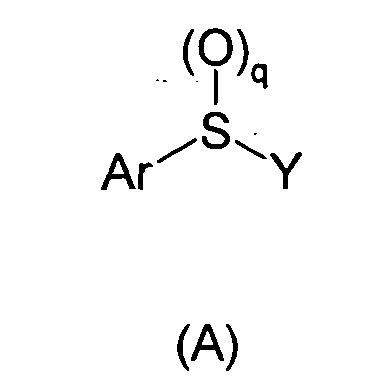

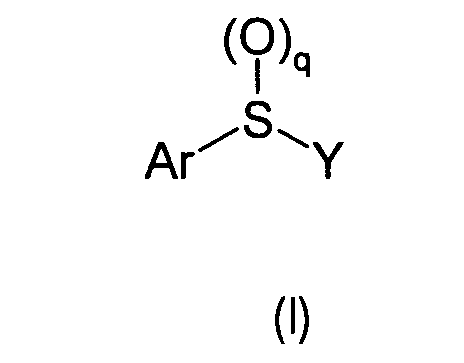


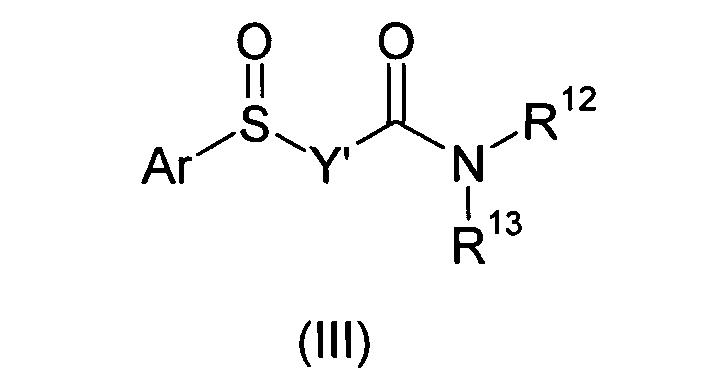




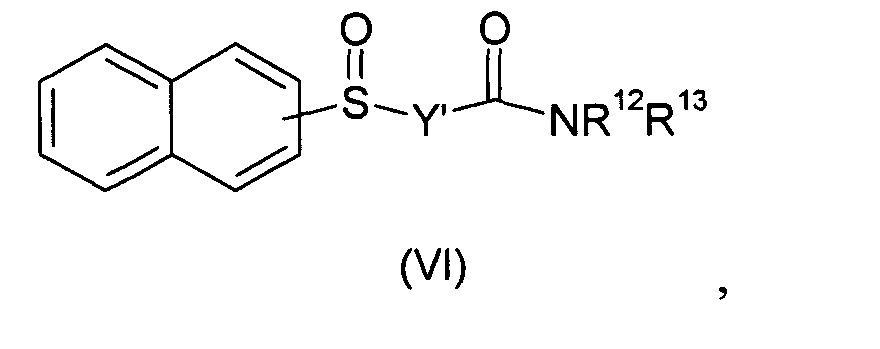


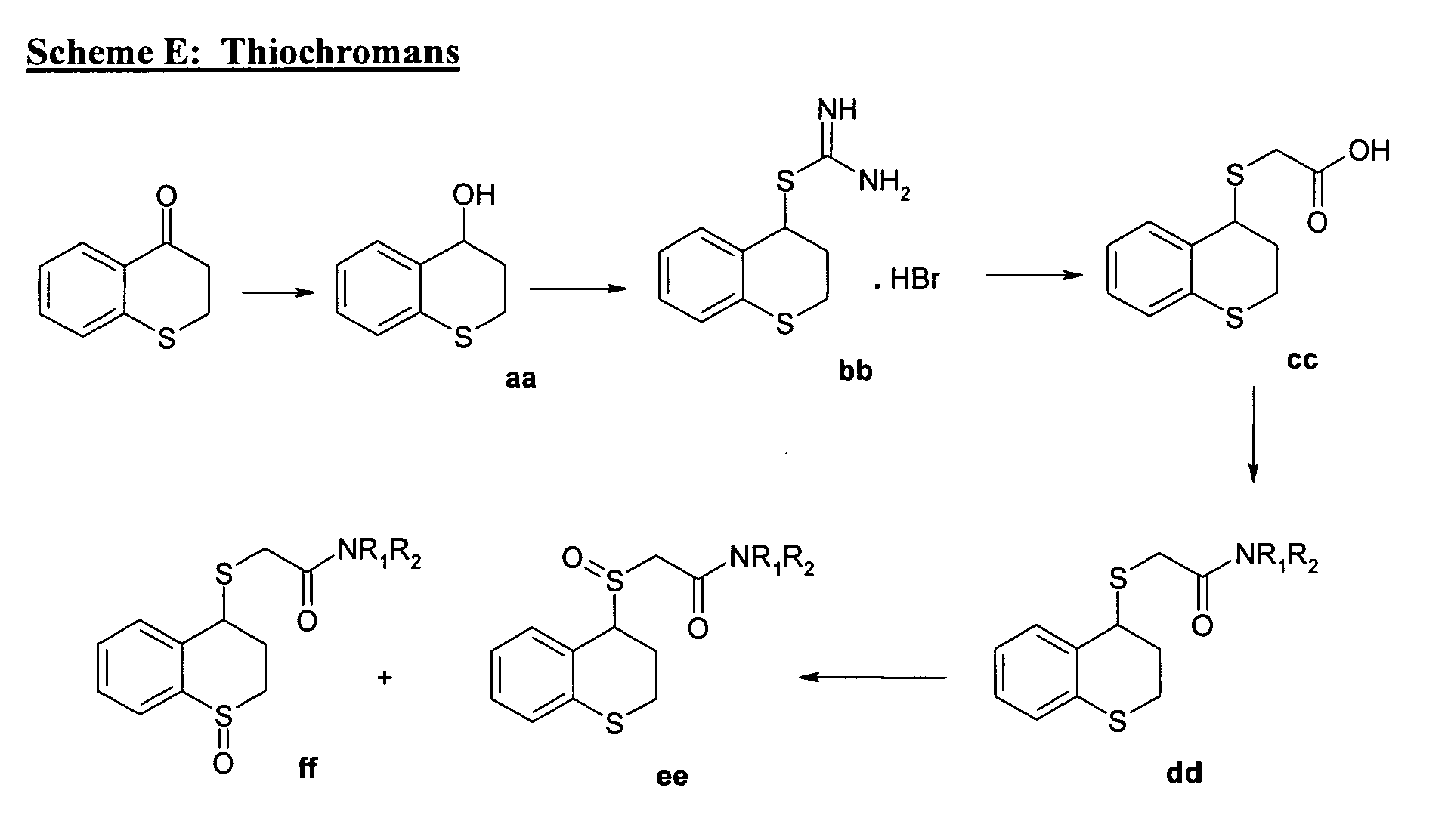
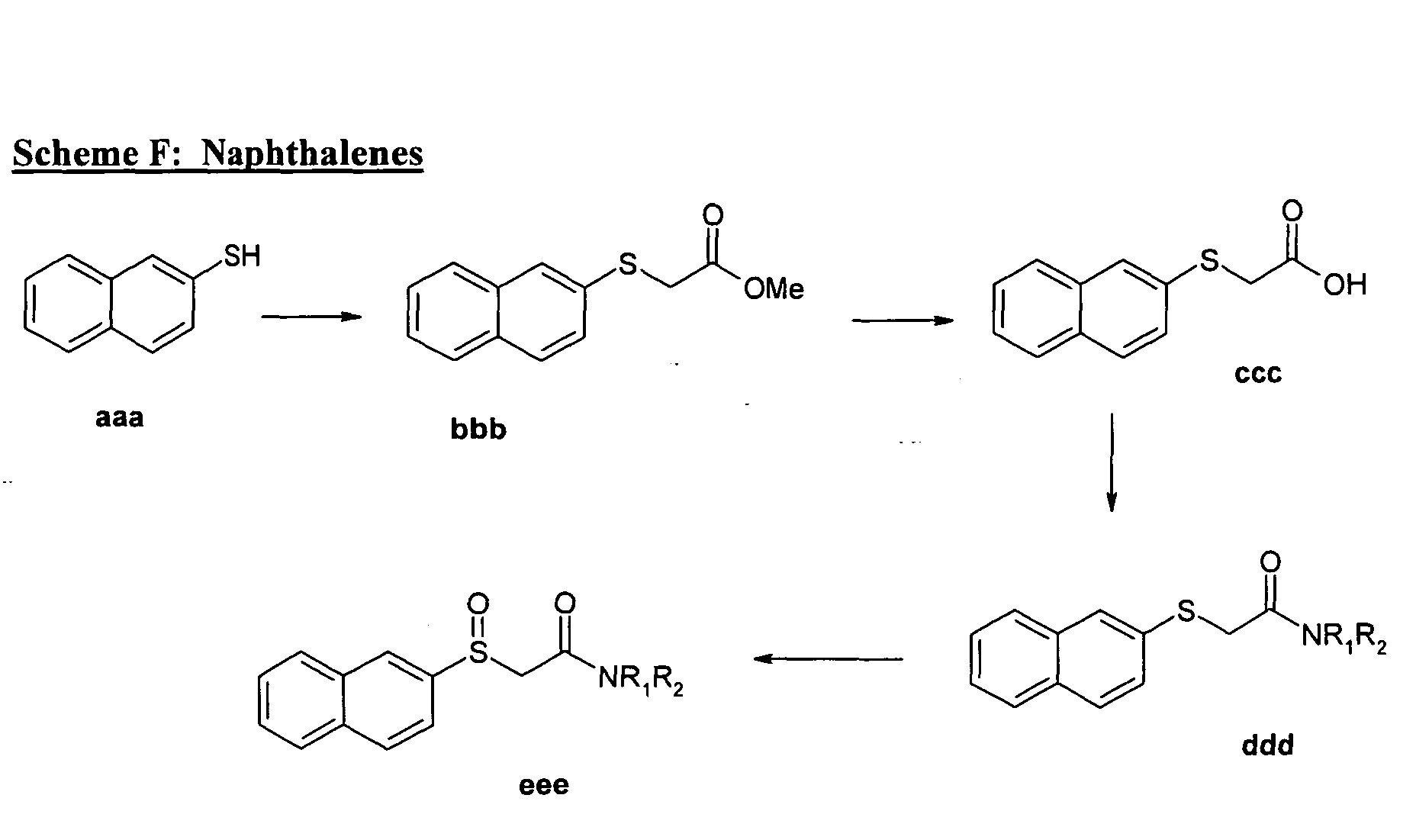

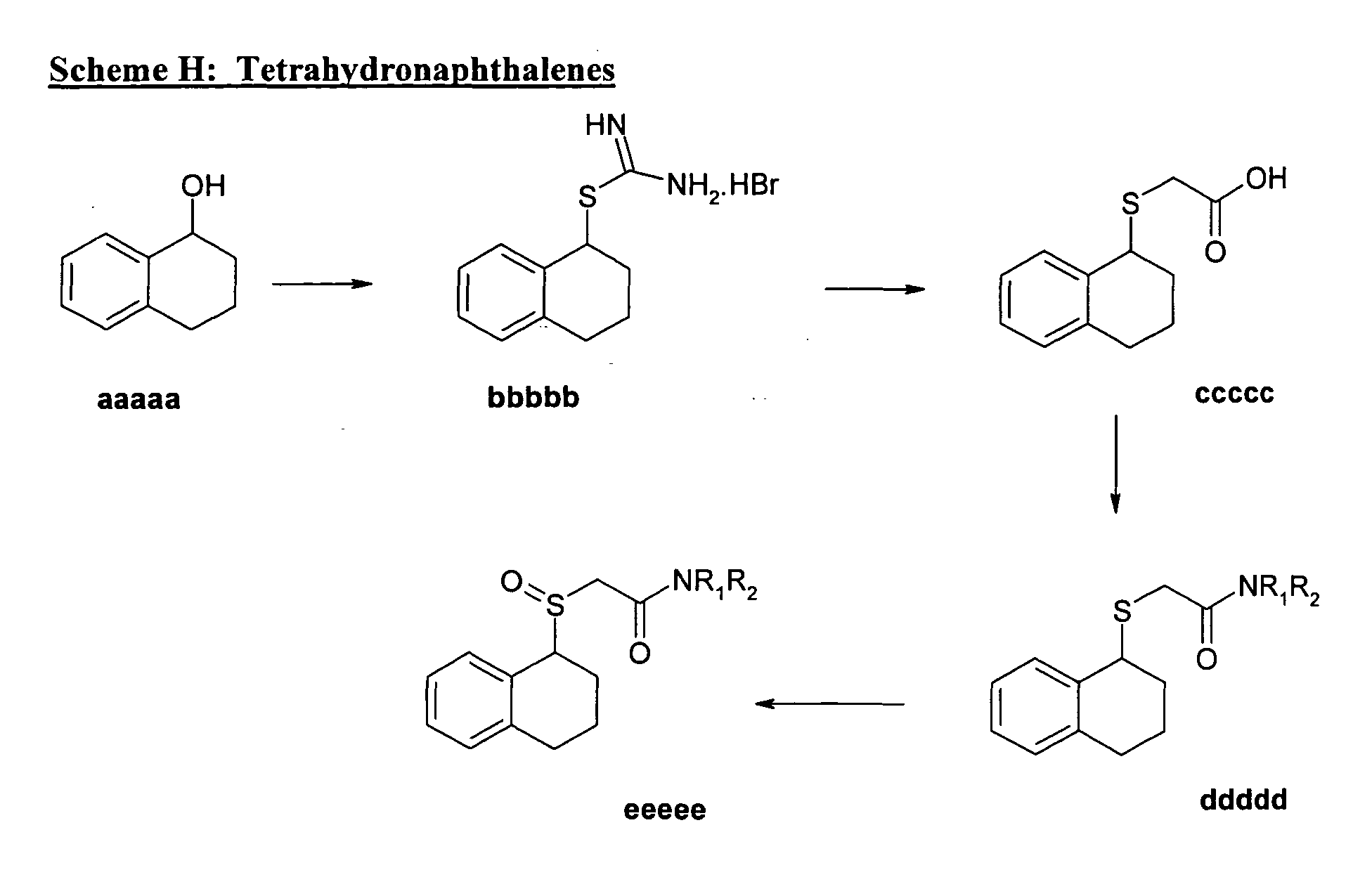


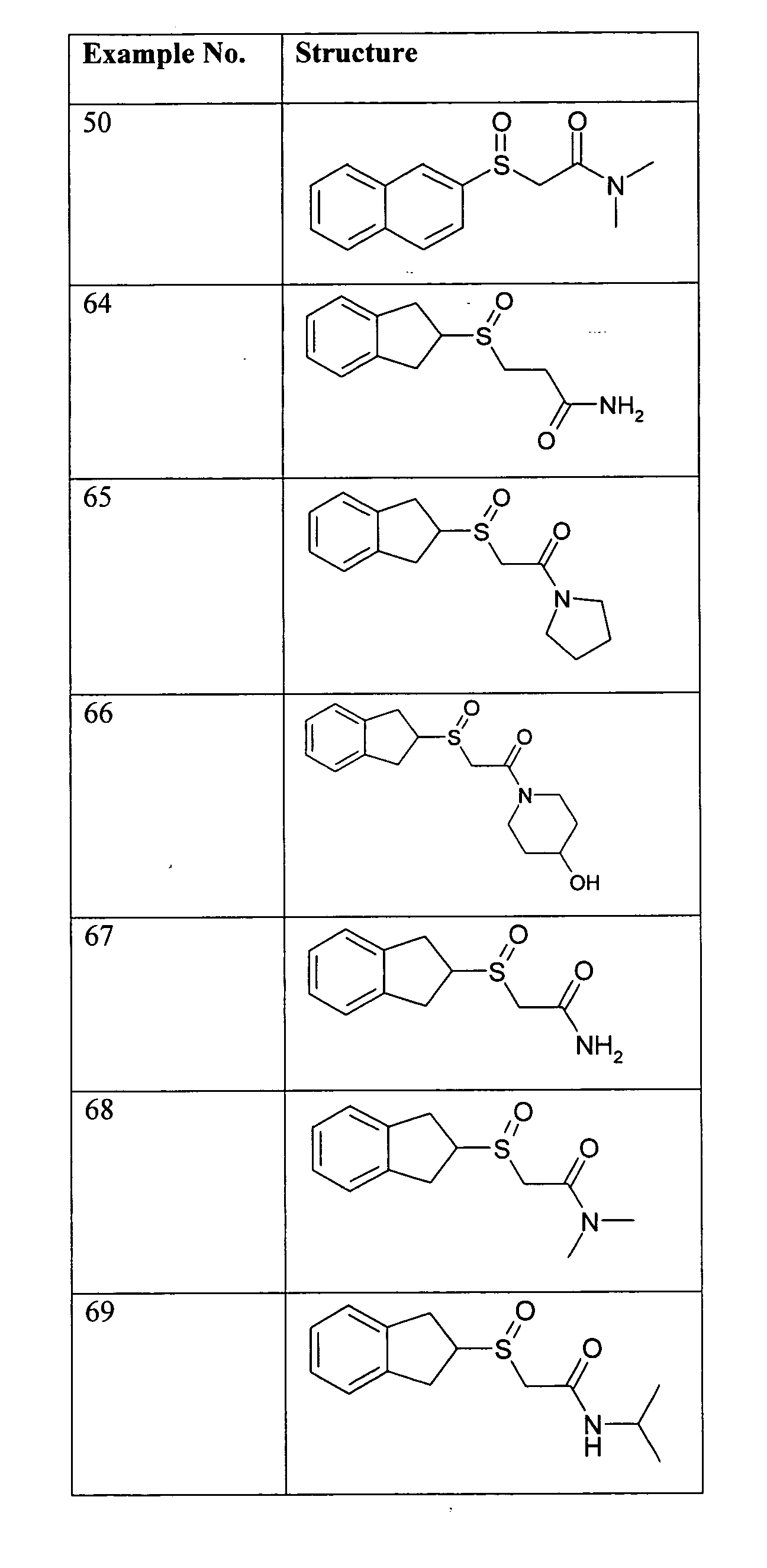

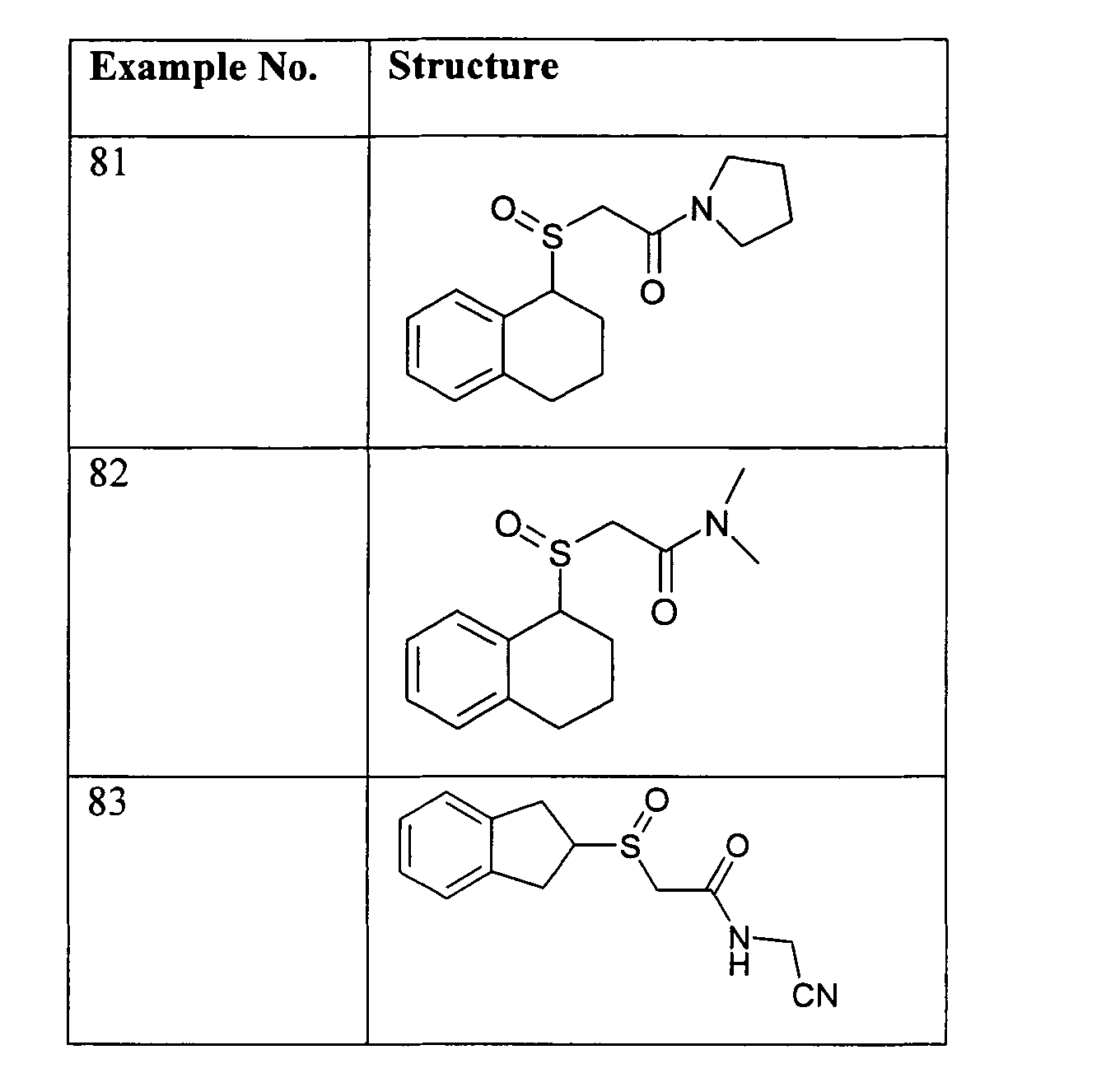
 and the stereoisomeric forms, mixtures of stereoisomeric forms or pharmaceutically acceptable salts forms thereof.Ar iswherein X is a bond, CH2, O, S(O)y, or NR10;
 rings A, C, and D are optionally substituted with one to three groups selected from F, Cl, Br, I, OR21, OR25, NR23R24, NHOH, NO2, CN, CF3, C1-C6 alkyl, C2-C6 alkenyl, C2-C6 alkynyl, C3-C7 cycloalkyl, 3-7 membered heterocycloalkyl, phenyl, 5 or 6 membered heteroaryl, arylalkyl, C(=O)R22, CO2R21, OC(=O)R22, C(=O)NR23R24, NR21C(=O)R22, NR21CO2R22, OC(=O)NR23R24, NR22C(=S)R22, and S(O)yR22;ring B is optionally substituted with one to three groups selected from C1-C6 alkyl, phenyl, and 5-6 membered heteroaryl;Y is (C1-C6 alkylene)-R1; or (C1-C4 alkylene)m-Z-(C1 -C4 alkylene)n-R1;
 and the stereoisomeric forms, mixtures of stereoisomeric forms or pharmaceutically acceptable salts forms thereof.Ar iswherein X is a bond, CH2, O, S, or S(O);
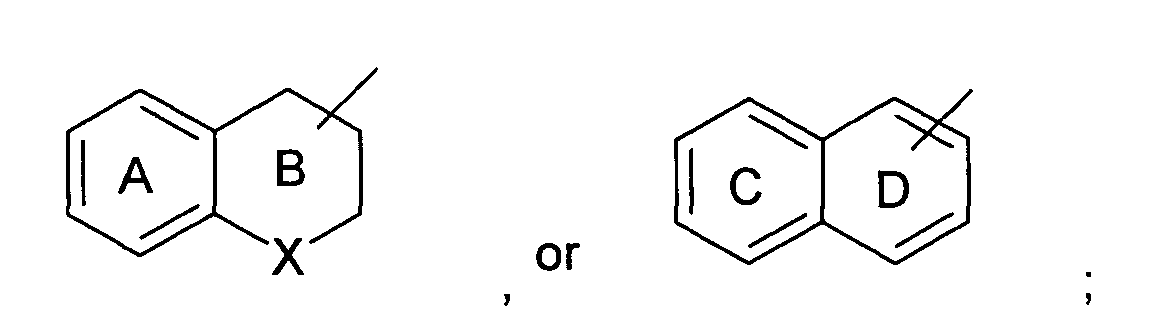 rings A, C, and D are optionally substituted with one to three groups selected from F, Cl, Br, I, OR21, OR25, NR23R24, NHOH, NO2, CN, C1-C6 alkyl, and C(=O)R22;ring B is optionally substituted with one to three groups selected from C1-C4 alkyl, and phenyl;Y' is C1-C4 alkylene, wherein said alkylene group is optionally substituted with an R20 group;R12 and R13 at each occurrence are each independently selected from H, C1-C6 alkyl, wherein said alkyl group can optionally be substituted with one or two CN, OR21, O(CH2)1-4OR21, C(=O)N(R21)2, or pyridyl groups, or R12 and R13, together with the nitrogen to which they are attached, form a pyrrolidinyl, piperidinyl, or piperazinyl ring, optionally substituted with OR21, C(=O)N(R21)2, or C(=O)R21; provided that when Ar is naphthyl, R12 and R13 cannot both be H;R20 at each occurrence is independently selected from F, Cl, Br, I, OR21, OR25, NR23R24, NHOH, NO2, CN, or CF3;R21 at each occurrence is independently selected from H and C1-C6 alkyl;R22 at each occurrence is independently selected from C1-C6 alkyl, and phenyl;R23 and R24 at each occurrence are each independently selected from H and C1-C6 alkyl, or R23 and R24, together with the nitrogen to which they are attached, form a 5-6 membered heterocycloalkyl;R25 at each occurrence is independently the residue of an amino acid after the hydroxyl group of the carboxyl group is removed;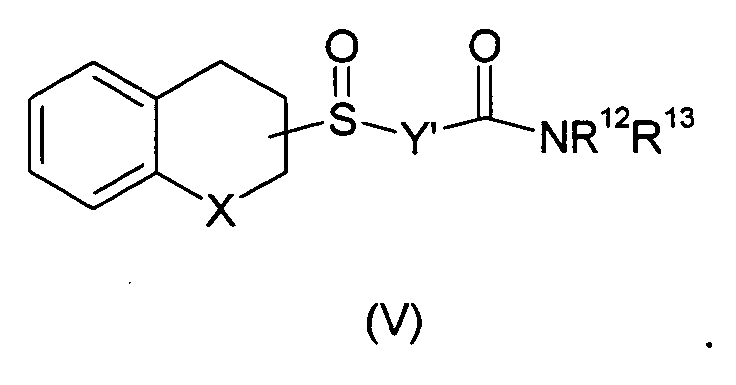

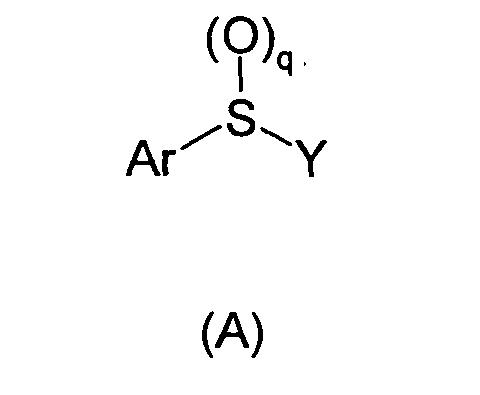 and the stereoisomeric forms, mixtures of stereoisomeric forms or pharmaceutically acceptable salts forms thereof.Ar iswherein X is a bond, CH2, O, S(O)y, or NR10;
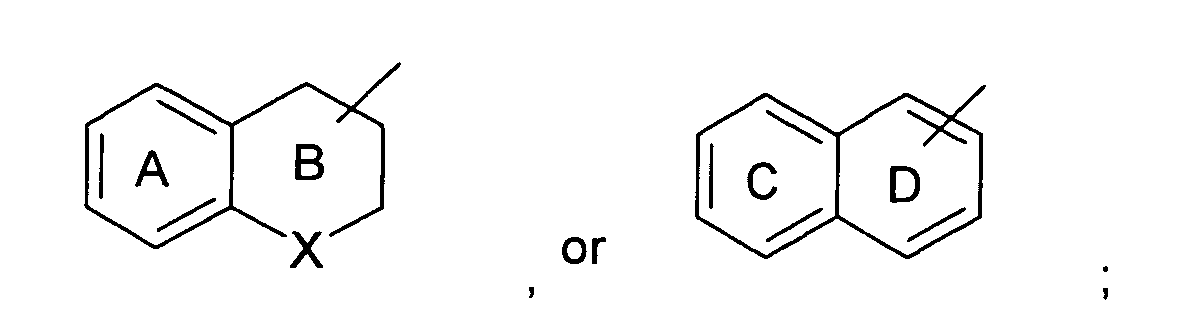 rings A, C, and D are optionally substituted with one to three groups selected from F, Cl, Br, I, OR21, OR25, NR23R24, NHOH, NO2, CN, CF3, C1-C6 alkyl, C2-C6 alkenyl, C2-C6 alkynyl, C3-C7 cycloalkyl, 3-7 membered heterocycloalkyl, phenyl, 5 or 6 membered heteroaryl, arylalkyl, C(=O)R22, CO2R21, OC(=O)R22, C(=O)NR23R24, NR21C(=O)R22, NR21CO2R22, OC(=O)NR23R24, NR21C(=S)R22, and S(O)yR22;ring B is optionally substituted with one to three groups selected from C1-C6 alkyl, phenyl, and 5-6 membered heteroaryl;Y is C1-C9 alkylene-R1, wherein one or two carbon atoms can be replaced by one or two O, NR10, or S(O)y groups, or a carbon atom can be replaced by a C6-C10 arylene, 5-10 membered heteroarylene, C3-C6 cycloalkylene, or 3-6 membered heterocycloalkylene group; C2-C6 alkenylene-R1; or C2-C6 alkynylene-R1; wherein said alkylene, alkenylene, alkynylene, arylene, heteroarylene, cycloalkylene, and heterocycloalkylene groups are optionally substituted with one to three R20 groups;R1 is H, NR12R13, NR21C(=O)R14, C(=O)R15, COOH, CO2R14, OC(=O)R11, C(=O)NR12R13, C(=O)NR21OR14, C(=N)NR12R13, NR21S(O)2R11, S(O)2NR12R13, NR21S(O)2NR12R13, or PO(OR21)2;R10 and R10A are each independently selected from H, C1-C6 alkyl, C6-C10 aryl, C(=O)R15, and S(O)yR14; wherein said alkyl and aryl groups are optionally substituted with one to three R20 groups;R11 at each occurrence is independently selected from H, C1-C6 alkyl, and C6-C10 aryl; wherein said alkyl and aryl groups are optionally substituted with one to three R20 groups;R12 and R13 at each occurrence are each independently selected from H, C1-C6 alkyl, and C6-C10 aryl, or R12 and R13, together with the nitrogen to which they are attached, form a 3-7 membered heterocycloalkyl ring;