EP1586188B1 - System, method and function for ethernet mac address management - Google Patents
System, method and function for ethernet mac address management Download PDFInfo
- Publication number
- EP1586188B1 EP1586188B1 EP04702474A EP04702474A EP1586188B1 EP 1586188 B1 EP1586188 B1 EP 1586188B1 EP 04702474 A EP04702474 A EP 04702474A EP 04702474 A EP04702474 A EP 04702474A EP 1586188 B1 EP1586188 B1 EP 1586188B1
- Authority
- EP
- European Patent Office
- Prior art keywords
- address
- mac address
- virtual mac
- unique
- virtual
- Prior art date
- Legal status (The legal status is an assumption and is not a legal conclusion. Google has not performed a legal analysis and makes no representation as to the accuracy of the status listed.)
- Expired - Lifetime
Links
- 238000000034 method Methods 0.000 title claims abstract description 25
- 238000013507 mapping Methods 0.000 claims abstract description 34
- 238000004891 communication Methods 0.000 claims description 2
- 238000012360 testing method Methods 0.000 description 7
- 238000010586 diagram Methods 0.000 description 4
- 238000013459 approach Methods 0.000 description 3
- 230000005540 biological transmission Effects 0.000 description 1
- 238000005516 engineering process Methods 0.000 description 1
- 230000008520 organization Effects 0.000 description 1
- 238000012546 transfer Methods 0.000 description 1
- 238000011144 upstream manufacturing Methods 0.000 description 1
Images


Classifications
-
- H—ELECTRICITY
- H04—ELECTRIC COMMUNICATION TECHNIQUE
- H04L—TRANSMISSION OF DIGITAL INFORMATION, e.g. TELEGRAPHIC COMMUNICATION
- H04L12/00—Data switching networks
- H04L12/28—Data switching networks characterised by path configuration, e.g. LAN [Local Area Networks] or WAN [Wide Area Networks]
- H04L12/2854—Wide area networks, e.g. public data networks
- H04L12/2856—Access arrangements, e.g. Internet access
- H04L12/2869—Operational details of access network equipments
- H04L12/2898—Subscriber equipments
-
- H—ELECTRICITY
- H04—ELECTRIC COMMUNICATION TECHNIQUE
- H04L—TRANSMISSION OF DIGITAL INFORMATION, e.g. TELEGRAPHIC COMMUNICATION
- H04L12/00—Data switching networks
-
- H—ELECTRICITY
- H04—ELECTRIC COMMUNICATION TECHNIQUE
- H04L—TRANSMISSION OF DIGITAL INFORMATION, e.g. TELEGRAPHIC COMMUNICATION
- H04L61/00—Network arrangements, protocols or services for addressing or naming
- H04L61/09—Mapping addresses
- H04L61/25—Mapping addresses of the same type
- H04L61/2596—Translation of addresses of the same type other than IP, e.g. translation from MAC to MAC addresses
-
- H—ELECTRICITY
- H04—ELECTRIC COMMUNICATION TECHNIQUE
- H04L—TRANSMISSION OF DIGITAL INFORMATION, e.g. TELEGRAPHIC COMMUNICATION
- H04L61/00—Network arrangements, protocols or services for addressing or naming
- H04L61/50—Address allocation
- H04L61/5038—Address allocation for local use, e.g. in LAN or USB networks, or in a controller area network [CAN]
-
- H—ELECTRICITY
- H04—ELECTRIC COMMUNICATION TECHNIQUE
- H04L—TRANSMISSION OF DIGITAL INFORMATION, e.g. TELEGRAPHIC COMMUNICATION
- H04L2101/00—Indexing scheme associated with group H04L61/00
- H04L2101/60—Types of network addresses
- H04L2101/604—Address structures or formats
-
- H—ELECTRICITY
- H04—ELECTRIC COMMUNICATION TECHNIQUE
- H04L—TRANSMISSION OF DIGITAL INFORMATION, e.g. TELEGRAPHIC COMMUNICATION
- H04L2101/00—Indexing scheme associated with group H04L61/00
- H04L2101/60—Types of network addresses
- H04L2101/618—Details of network addresses
- H04L2101/622—Layer-2 addresses, e.g. medium access control [MAC] addresses
Definitions
- the present invention relates to digital communication systems. More particularly, and not by way of limitation, the invention relates to a system and method for managing locally administered Media Access Control (MAC) addresses in an Ethernet Local Area Network (LAN).
- MAC Media Access Control
- Ethernet is a packet-based transmission protocol that is primarily used in LANs. Ethernet is the common name for the IEEE 802.3 industry specification. Data is transmitted in Ethernet frames, and FIG. 1 is an illustration of a typical Ethernet frame 10.
- SFD Start of Frame Delimiter
- Media Access Control (MAC) client data 16, together with a Packet Assembler/Disassembler (PAD) 17 may vary in length from 46 to 1500 octets.
- a Frame Check Sequence (FCS) 18 adds four more octets.
- the frame size is counted from the destination address to the FCS, inclusive, and thus may vary between 64 and 1518 octets, not including an optional Virtual Local Area Network (VLAN) tag, which adds 4 octets.
- VLAN Virtual Local Area Network
- FIG. 2 is an illustration of a typical Ethernet destination and source address structure, known as a MAC address, as shown in IEEE 802.3, which is incorporated herein by reference.
- An I/G field 21 indicates whether the address is an individual or a group address. A zero (0) in this field indicates an individual address, while a one (1) indicates a group address (multicast). Note that a source address can only have a zero (0) in the I/G field.
- a U/L field 22 indicates whether the address is a universal or local address. A zero (0) in this field indicates a universally administered address, while a one (1) indicates a locally administered address. A destination address with all ones represents a broadcast address.
- the MAC address structure is completed with the actual address bits 23.
- FIG. 3 is an illustration of a globally administered, Unit-unique MAC address 30, as shown in IEEE standard 802-1990, which is incorporated herein by reference.
- An Organizationally Unique Identifier (OUI) 31 is assigned to each global MAC address to ensure uniqueness.
- the OUI is a 3-octet hexadecimal number that is used as the first half of a 6-octet MAC address.
- An organization using a given OUI is responsible for ensuring uniqueness of the MAC address by assigning each produced unit its own unique 3-octet Unit-unique MAC address 32.
- FIG. 4 is an illustration of a locally administered MAC address 40.
- IEEE standard 802.3 describes how to ensure unique MAC addresses for locally administered addresses by assigning "1" and "0" as the two least significant bits (LSB) of the first transmitted octet 41. These bits are also shown as 21 and 22 in FIG. 2 .
- the bit "1" indicates that the address is a locally administered address, and the bit "0" indicates that it is a unicast address.
- IEEE standard 802.3 fails to disclose any method of ensuring unique locally administered MAC addresses when several nodes operate autonomously, or when several nodes belonging to separate solutions operate in the same Ethernet network utilizing locally administered addresses. The present invention provides a solution to this shortcoming.
- the present invention is directed to a method in an Ethernet network of mapping an original Media Access Control (MAC) address to a unique locally administered virtual MAC address.
- the method includes the steps of utilizing a first portion of the virtual MAC address to define a domain for the address; utilizing a second portion of the virtual MAC address to indicate that the address is a locally administered address; utilizing a third portion of the virtual MAC address to indicate a unit-specific use; and utilizing a fourth portion of the virtual MAC address to indicate an organizationally assigned unit-unique MAC address.
- MAC Media Access Control
- the present invention is directed to a system in an Ethernet network for mapping an original MAC address to a unique locally administered virtual MAC address.
- the system includes at least one address mapping function that maps inbound original MAC addresses from inbound Ethernet packets to one of a plurality of assigned locally administered virtual MAC addresses.
- the address mapping function includes means for utilizing a first portion of the virtual MAC address to define a domain for the address, means for utilizing a second portion of the virtual MAC address to indicate that the address is a locally administered address, means for utilizing a third portion of the virtual MAC address to indicate a unit-specific use, and means for utilizing a fourth portion of the virtual MAC address to indicate an organizationally assigned unit-unique MAC address.
- the system may also include a MAC address database that stores unit-unique MAC addresses for all nodes in the network; means for accessing the MAC address database and for comparing the node's unit-unique MAC address against unit-unique MAC addresses that are already used in other nodes; and means within the address mapping function for defining a new MAC domain for the node's locally administered MAC address if the node's unit-unique MAC address has already been used in another node.
- the present invention is directed to a method of preventing subscriber spoofing in an Ethernet network.
- the method includes the steps of mapping an original MAC address to a locally administered virtual MAC address; and ensuring the locally administered virtual MAC address is unique. Uniqueness of each address is ensured by utilizing a first portion of the virtual MAC address to define a domain for the address; utilizing a second portion of the virtual MAC address to indicate that the address is a locally administered address; utilizing a third portion of the virtual MAC address to indicate a unit-specific use; and utilizing a fourth portion of the virtual MAC address to indicate an organizationally assigned unit-unique MAC address.
- the invention may be implemented in an address mapping function adapted to operate in an access node in an Ethernet network.
- the present invention is directed to a method in an Ethernet network of mapping an original MAC address to a unique locally administered virtual MAC address.
- the method includes the steps of utilizing a first portion of the virtual MAC address to define a domain for the address; utilizing a second portion of the virtual MAC address to indicate that the address is a locally administered address; and utilizing a third portion of the virtual MAC address to uniquely identify specific users within each MAC domain.
- This method may be used autonomously by 64 different systems or nodes if they each have their own MAC domain. Alternatively, each node may consult a database to determine which addresses are available for use.
- FIG. 5 is an illustration of a locally administered, Unit-unique virtual MAC address 50 structured in accordance with the teachings of the present invention.
- the present invention provides a method of providing unique locally administered MAC addresses when several nodes operate autonomously, or several nodes belonging to separate solutions operate in the same Ethernet network.
- the last two bits 51 of the first octet may be assigned the values "1" and "0" to indicate that the address is a locally administered unicast address, as currently specified in IEEE 802.3.
- the first six bits 52 of the first octet are available, and the invention uses them to define domains for locally administered MAC addresses (referred to hereinafter as "MAC domains").
- the invention utilizes the node's Unit-unique MAC address and substitutes, for the OUI used in globally administered unicast addresses, an identification of a domain and an indication that the address is a locally administered unicast address. In this manner, the invention enables the node to utilize the remaining 16 bits 54 to assign unique locally administered MAC addresses.
- Unit-unique MAC address as part of a locally administered MAC address cannot, by itself, ensure unique addresses.
- Duplicate Unit-unique MAC addresses can occur when several organizations deliver equipment to be utilized in one network, or when equipment from the same supplier is delivered with a new OUI and a duplicate Unit-unique MAC address.
- the MAC domain of the present invention is utilized to distinguish these addresses and to ensure unique locally administered MAC addresses.
- the MAC domain is preferably selected when installing and configuring network units.
- Several approaches may be used when assigning MAC domains to units.
- nodes with different OUIs are assigned different MAC domains.
- the new node's Unit-unique MAC address is validated against Unit-unique MAC addresses that are already used in other nodes. If the new Unit-unique MAC address has already been used, a new MAC domain is assigned. However, if the new Unit-unique MAC address has not already been used, a new MAC domain is not assigned.
- These functions may be performed within each Access Node, thereby enabling each Access Node to assign unique virtual MAC addresses independently, without having to access a centralized database.
- a centralized database registering the assigned virtual MAC addresses of all units may be implemented to ensure the uniqueness of each locally administered address.
- a node that autonomously uses locally assigned MAC addresses is an access point for network traffic, and must respond like any network interface.
- the interface needs to respond to and manage the mapping of all assigned MAC addresses.
- the mapped network traffic may originate from sources such as a port, user, or sessions, and the like.
- Ethernet traffic may be remapped through, for example an access node, so that the original MAC address is interchanged with a locally administered virtual MAC address. This can prevent subscriber spoofing and provide the network operator with control of the Ethernet traffic.
- the mapping is done one-to-one.
- the invention is also useful when multiple pieces of test equipment are connected to the same network. If each piece of test equipment is assigned a different locally administered unique virtual MAC address, then each piece of test equipment can send and receive information over the network without affecting the other pieces of test equipment.
- the virtual MAC address can be generated using an assigned MAC domain 52 or a Unit-unique MAC address field 53 together with a randomly selected unit specific use field 54.
- each piece of test equipment (unit) can assign its own locally administered MAC addresses based on the test equipment's own Unit-unique MAC address 53.
- FIG. 6 is a simplified functional block diagram illustrating the functions performed when managing locally administered MAC addresses and mapping Ethernet traffic in a network in which nodes autonomously utilize locally assigned MAC addresses.
- An address mapping application 61 includes a plurality of address mapping functions 62 that map inbound MAC addresses 63 from inbound Ethernet packets to one of a plurality of assigned locally administered MAC addresses 64.
- a unit MAC address database 65 that registers all units' MAC addresses is also shown.
- a unit application 66 for a network node interfaces with the database to validate the node's Unit-unique MAC address against Unit-unique MAC addresses that are already used in other nodes.
- the application 66 has knowledge about the MAC addresses of all other nodes. This knowledge may be internal to the node, or may be external to the node and may be controlled, for example, by a Public Ethernet Manager (PEM) 79 (see FIG. 7 ).
- PEM Public Ethernet Manager
- DSL Digital Subscriber Line
- the present invention introduces the use of locally administered unique virtual MAC addresses.
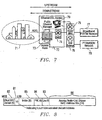
- FIG. 7 is a simplified block diagram of a network architecture illustrating an original MAC address domain 71 and a virtual MAC address domain 72.
- Stations in the original MAC address domain access the network using Asymmetric DSL (ADSL) technology.
- An Access Node 73 maps all original MAC addresses to appropriate virtual MAC addresses.
- the source MAC address field in the Ethernet frame has a virtual MAC address inserted instead of the original MAC address
- the destination MAC address field in the Ethernet frame has the original MAC address inserted instead of the virtual MAC address. Therefore, the original MAC addresses exist only on the tributary (subscriber) side of the Access Node, while virtual MAC addresses exist on the aggregate (network) side of the Access Node.
- the benefit of this functionality is that the MAC addresses utilized on the network side are controlled solely by the network, and no original MAC addresses can "pollute" the network. This eliminates the MAC address spoofing threat because there cannot be two identical MAC addresses in the network.
- the network architecture also includes a switch 74, a router/Broadband Remote Access Server (BRAS) 75, and a local exchange 76.
- the router/BRAS may connect the network to an external broadband network 77 such as an IP network or Asynchronous Transfer Mode (ATM) network.
- the local exchange may connect the network to an external telephone network 78 such as the Public Switched Telephone Network (PSTN) or an Integrated Services Digital Network (ISDN).
- PSTN Public Switched Telephone Network
- ISDN Integrated Services Digital Network
- a Public Ethernet Manager (PEM) 79 controls the virtual MAC address domain 72, but is not included in the virtual MAC address domain itself because the virtual MAC addresses are not utilized in the management Virtual LAN (VLAN).
- the network may also include multiple Access Nodes 73, each of which maps original MAC addresses from different sources onto the same Ethernet network while maintaining the uniqueness of each virtual MAC address.
- FIG. 8 is an illustration of the layout of an exemplary embodiment of the locally administered, virtual MAC address of FIG. 5 , illustrating an exemplary implementation of the unit specific use field 54.
- the layout of the virtual MAC addresses has been designed in the present invention to provide unique addresses and thus to avoid the possibility of two identical virtual MAC addresses being generated by the Access Node 73 ( FIG. 7 ).
- the virtual MAC address layout reflects tradeoffs between flexibility and traceability. As shown, the two least significant bits 81 of the first octet are assigned the values "1" and "0" indicating that the address is a locally administered unicast address. The second least significant bit (LSB) is set to "1" indicating that the address is a locally administered address. By setting this bit, the Access Node can administer 46 of the 48 bits in the Ethernet MAC address. It must be ensured, however, that the virtual MAC address never reaches a public network where other special locally administered MAC addresses could cause loss of uniqueness.
- LSB least significant bit
- the six most significant bits 82 of the first octet are utilized to define a virtual MAC address domain.
- half of the Access Node MAC address (the last three octets 86) is inserted in the virtual MAC address.
- the remaining three octets of the Access Node MAC address (i.e., the Organizationally Unique Identifier (OUI) 31) are not utilized.
- the PEM 79 should set different virtual MAC domains for Access Nodes that have the three last octets of the MAC address in common. In this manner, it is ensured that the virtual MAC addresses stay unique for approximately one billion network units. It should be noted that the virtual MAC domain is introduced for the purpose of ensuring uniqueness of virtual MAC addresses when equipment or systems from multiple vendors are used in the same Ethernet network utilizing locally administered MAC addresses.
- the virtual MAC address is always unique if a virtual MAC address from one Access Node is compared to an address generated by another Access Node.
- the unit specific use field 54 illustrated in FIG. 5 is divided into a number of fields 83-85.
- four (Line) bits 83 have been selected to contain the ADSL line number (i.e., either 1-8, 1-10, or 1-12) for each user.
- Each Permanent Virtual Circuit (PVC) may also be distinguished in the virtual MAC address, and four (PVC) bits 84 have been selected to represent the PVC.
- a remaining octet 85 is used as an index.
- Three address octets 86 provide an Access Node-unique MAC address.
- the various fields in the virtual MAC address provide traceability. That is, the location on the network of any user of a virtual MAC address can be precisely determined through the MAC domain 82, the line field 83, the PVC field 84, the index field 85, and the Access Node-unique MAC address bits 86.
- MAC domain 52 FIG. 5
- Unit Specific Use field 54 can be used to denote the device type. The latter, however, will complicate the task of backtracking a given virtual MAC number.
- the index field 85, the PVC field 84, and the Line field 83 FIG. 8
- the PVC and Line fields may be combined to indicate 256 different ports.
- the layout of the Unit Specific Use field 54 of the virtual MAC address may be altered as needed since the mapping of the virtual MAC addresses into original MAC addresses (and vice versa) is controlled solely by the Access Node.
Landscapes
- Engineering & Computer Science (AREA)
- Computer Networks & Wireless Communication (AREA)
- Signal Processing (AREA)
- Power Engineering (AREA)
- Small-Scale Networks (AREA)
- Data Exchanges In Wide-Area Networks (AREA)
Abstract
Description
- The present invention relates to digital communication systems. More particularly, and not by way of limitation, the invention relates to a system and method for managing locally administered Media Access Control (MAC) addresses in an Ethernet Local Area Network (LAN).
- Ethernet is a packet-based transmission protocol that is primarily used in LANs. Ethernet is the common name for the IEEE 802.3 industry specification. Data is transmitted in Ethernet frames, and
FIG. 1 is an illustration of a typical Ethernetframe 10. To synchronize the receiving node(s), each frame starts with 64 bits used only for synchronization, consisting of a 56-bit preamble 11 and an 8-bit Start of Frame Delimiter (SFD) 12. Adestination address 13, asource address 14, and a length/type identifier 15 follow the preamble. Media Access Control (MAC)client data 16, together with a Packet Assembler/Disassembler (PAD) 17 may vary in length from 46 to 1500 octets. A Frame Check Sequence (FCS) 18 adds four more octets. The frame size is counted from the destination address to the FCS, inclusive, and thus may vary between 64 and 1518 octets, not including an optional Virtual Local Area Network (VLAN) tag, which adds 4 octets. -
FIG. 2 is an illustration of a typical Ethernet destination and source address structure, known as a MAC address, as shown in IEEE 802.3, which is incorporated herein by reference. An I/G field 21 indicates whether the address is an individual or a group address. A zero (0) in this field indicates an individual address, while a one (1) indicates a group address (multicast). Note that a source address can only have a zero (0) in the I/G field. A U/L field 22 indicates whether the address is a universal or local address. A zero (0) in this field indicates a universally administered address, while a one (1) indicates a locally administered address. A destination address with all ones represents a broadcast address. The MAC address structure is completed with theactual address bits 23. -
FIG. 3 is an illustration of a globally administered, Unit-unique MAC address 30, as shown in IEEE standard 802-1990, which is incorporated herein by reference. An Organizationally Unique Identifier (OUI) 31 is assigned to each global MAC address to ensure uniqueness. The OUI is a 3-octet hexadecimal number that is used as the first half of a 6-octet MAC address. An organization using a given OUI is responsible for ensuring uniqueness of the MAC address by assigning each produced unit its own unique 3-octet Unit-unique MAC address 32. -
FIG. 4 is an illustration of a locally administeredMAC address 40. IEEE standard 802.3 describes how to ensure unique MAC addresses for locally administered addresses by assigning "1" and "0" as the two least significant bits (LSB) of the first transmittedoctet 41. These bits are also shown as 21 and 22 inFIG. 2 . The bit "1" indicates that the address is a locally administered address, and the bit "0" indicates that it is a unicast address. However, IEEE standard 802.3 fails to disclose any method of ensuring unique locally administered MAC addresses when several nodes operate autonomously, or when several nodes belonging to separate solutions operate in the same Ethernet network utilizing locally administered addresses. The present invention provides a solution to this shortcoming. - It is therefore an object of the present invention to overcome the above mentioned problems and to provide a method of ensuring unique locally administered MAC addresses when several nodes operate autonomously, or when several nodes belonging to separate solutions operate in the same Ethernet network utilizing locally administered addresses. In this way, multiple nodes can operate autonomously, while assigning unique locally administered MAC addresses.
- Thus, in one aspect, the present invention is directed to a method in an Ethernet network of mapping an original Media Access Control (MAC) address to a unique locally administered virtual MAC address. The method includes the steps of utilizing a first portion of the virtual MAC address to define a domain for the address; utilizing a second portion of the virtual MAC address to indicate that the address is a locally administered address; utilizing a third portion of the virtual MAC address to indicate a unit-specific use; and utilizing a fourth portion of the virtual MAC address to indicate an organizationally assigned unit-unique MAC address.
- In yet another aspect, the present invention is directed to a system in an Ethernet network for mapping an original MAC address to a unique locally administered virtual MAC address. The system includes at least one address mapping function that maps inbound original MAC addresses from inbound Ethernet packets to one of a plurality of assigned locally administered virtual MAC addresses. The address mapping function includes means for utilizing a first portion of the virtual MAC address to define a domain for the address, means for utilizing a second portion of the virtual MAC address to indicate that the address is a locally administered address, means for utilizing a third portion of the virtual MAC address to indicate a unit-specific use, and means for utilizing a fourth portion of the virtual MAC address to indicate an organizationally assigned unit-unique MAC address.
- The system may also include a MAC address database that stores unit-unique MAC addresses for all nodes in the network; means for accessing the MAC address database and for comparing the node's unit-unique MAC address against unit-unique MAC addresses that are already used in other nodes; and means within the address mapping function for defining a new MAC domain for the node's locally administered MAC address if the node's unit-unique MAC address has already been used in another node.
- In still yet another aspect, the present invention is directed to a method of preventing subscriber spoofing in an Ethernet network. The method includes the steps of mapping an original MAC address to a locally administered virtual MAC address; and ensuring the locally administered virtual MAC address is unique. Uniqueness of each address is ensured by utilizing a first portion of the virtual MAC address to define a domain for the address; utilizing a second portion of the virtual MAC address to indicate that the address is a locally administered address; utilizing a third portion of the virtual MAC address to indicate a unit-specific use; and utilizing a fourth portion of the virtual MAC address to indicate an organizationally assigned unit-unique MAC address. The invention may be implemented in an address mapping function adapted to operate in an access node in an Ethernet network.
- In still yet another aspect, the present invention is directed to a method in an Ethernet network of mapping an original MAC address to a unique locally administered virtual MAC address. The method includes the steps of utilizing a first portion of the virtual MAC address to define a domain for the address; utilizing a second portion of the virtual MAC address to indicate that the address is a locally administered address; and utilizing a third portion of the virtual MAC address to uniquely identify specific users within each MAC domain. This method may be used autonomously by 64 different systems or nodes if they each have their own MAC domain. Alternatively, each node may consult a database to determine which addresses are available for use.
- In the following section, the invention will be described with reference to exemplary embodiments illustrated in the figures, in which:
-
FIG. 1 (Prior Art) is an illustration of a typical Ethernet frame; -
FIG. 2 (Prior Art) is an illustration of a typical Ethernet destination and source address structure, known as a MAC address; -
FIG. 3 (Prior Art) is an illustration of the layout of a typical globally administered, Unit-unique MAC address; -
FIG. 4 . (Prior Art) is an illustration of the layout of a typical locally administered MAC address; -
FIG. 5 is an illustration of the layout of a locally administered, Unit-unique virtual MAC address structured in accordance with the teachings of the present invention; -
FIG. 6 is a simplified functional block diagram illustrating the functions performed when managing locally administered MAC addresses and mapping Ethernet traffic in a network in which units autonomously utilize locally assigned MAC addresses; -
FIG. 7 is a simplified block diagram of a network architecture illustrating an original MAC address domain and a virtual MAC address domain; and -
FIG. 8 is an illustration of the layout of a locally administered, virtual MAC address structured in accordance with the teachings of the present invention. - In the following description, for purposes of explanation and not limitation, specific details are set forth, such as particular embodiments, circuits, signal formats etc. in order to provide a thorough understanding of the present invention. It will be apparent to one skilled in the art that the present invention may be practiced in other embodiments that depart from these specific details.
-
FIG. 5 is an illustration of a locally administered, Unit-uniquevirtual MAC address 50 structured in accordance with the teachings of the present invention. The present invention provides a method of providing unique locally administered MAC addresses when several nodes operate autonomously, or several nodes belonging to separate solutions operate in the same Ethernet network. As shown inFIG. 5 , the last twobits 51 of the first octet may be assigned the values "1" and "0" to indicate that the address is a locally administered unicast address, as currently specified in IEEE 802.3. However, the first sixbits 52 of the first octet are available, and the invention uses them to define domains for locally administered MAC addresses (referred to hereinafter as "MAC domains"). In this manner, 64 different domains may be defined, each of which may be combined with a node's organizationally assigned Unit-unique MAC address 53. Thus, the invention utilizes the node's Unit-unique MAC address and substitutes, for the OUI used in globally administered unicast addresses, an identification of a domain and an indication that the address is a locally administered unicast address. In this manner, the invention enables the node to utilize the remaining 16bits 54 to assign unique locally administered MAC addresses. - Using the Unit-unique MAC address as part of a locally administered MAC address cannot, by itself, ensure unique addresses. Duplicate Unit-unique MAC addresses can occur when several organizations deliver equipment to be utilized in one network, or when equipment from the same supplier is delivered with a new OUI and a duplicate Unit-unique MAC address. The MAC domain of the present invention is utilized to distinguish these addresses and to ensure unique locally administered MAC addresses.
- The MAC domain is preferably selected when installing and configuring network units. Several approaches may be used when assigning MAC domains to units. In one approach, nodes with different OUIs are assigned different MAC domains. In another approach, for each new node, the new node's Unit-unique MAC address is validated against Unit-unique MAC addresses that are already used in other nodes. If the new Unit-unique MAC address has already been used, a new MAC domain is assigned. However, if the new Unit-unique MAC address has not already been used, a new MAC domain is not assigned. These functions may be performed within each Access Node, thereby enabling each Access Node to assign unique virtual MAC addresses independently, without having to access a centralized database. Alternatively, a centralized database registering the assigned virtual MAC addresses of all units may be implemented to ensure the uniqueness of each locally administered address.
- A node that autonomously uses locally assigned MAC addresses is an access point for network traffic, and must respond like any network interface. The interface needs to respond to and manage the mapping of all assigned MAC addresses. The mapped network traffic may originate from sources such as a port, user, or sessions, and the like. Even Ethernet traffic may be remapped through, for example an access node, so that the original MAC address is interchanged with a locally administered virtual MAC address. This can prevent subscriber spoofing and provide the network operator with control of the Ethernet traffic. The mapping is done one-to-one.
- The invention is also useful when multiple pieces of test equipment are connected to the same network. If each piece of test equipment is assigned a different locally administered unique virtual MAC address, then each piece of test equipment can send and receive information over the network without affecting the other pieces of test equipment. The virtual MAC address can be generated using an assigned
MAC domain 52 or a Unit-uniqueMAC address field 53 together with a randomly selected unitspecific use field 54. In addition, when the test equipment generates a large amount of traffic, each piece of test equipment (unit) can assign its own locally administered MAC addresses based on the test equipment's own Unit-unique MAC address 53. -
FIG. 6 is a simplified functional block diagram illustrating the functions performed when managing locally administered MAC addresses and mapping Ethernet traffic in a network in which nodes autonomously utilize locally assigned MAC addresses. Anaddress mapping application 61 includes a plurality of address mapping functions 62 that map inbound MAC addresses 63 from inbound Ethernet packets to one of a plurality of assigned locally administered MAC addresses 64. A unitMAC address database 65 that registers all units' MAC addresses is also shown. Aunit application 66 for a network node interfaces with the database to validate the node's Unit-unique MAC address against Unit-unique MAC addresses that are already used in other nodes. Theapplication 66 has knowledge about the MAC addresses of all other nodes. This knowledge may be internal to the node, or may be external to the node and may be controlled, for example, by a Public Ethernet Manager (PEM) 79 (seeFIG. 7 ). - In systems in which an Ethernet LAN is accessed by Digital Subscriber Line (DSL), it is desirable to provide a high level of flexibility, enabling an end-user to change the MAC address of end-user equipment. For example, it is desirable for an end-user to be able to purchase a new Ethernet adapter without operator intervention. In order to provide this flexibility, and at the same time avoid any potential MAC addressing spoofing threat, the present invention introduces the use of locally administered unique virtual MAC addresses.
-
FIG. 7 is a simplified block diagram of a network architecture illustrating an originalMAC address domain 71 and a virtualMAC address domain 72. Stations in the original MAC address domain access the network using Asymmetric DSL (ADSL) technology. AnAccess Node 73 maps all original MAC addresses to appropriate virtual MAC addresses. Thus, for upstream traffic, the source MAC address field in the Ethernet frame has a virtual MAC address inserted instead of the original MAC address, while for downstream traffic, the destination MAC address field in the Ethernet frame has the original MAC address inserted instead of the virtual MAC address. Therefore, the original MAC addresses exist only on the tributary (subscriber) side of the Access Node, while virtual MAC addresses exist on the aggregate (network) side of the Access Node. The benefit of this functionality is that the MAC addresses utilized on the network side are controlled solely by the network, and no original MAC addresses can "pollute" the network. This eliminates the MAC address spoofing threat because there cannot be two identical MAC addresses in the network. - The network architecture also includes a
switch 74, a router/Broadband Remote Access Server (BRAS) 75, and alocal exchange 76. The router/BRAS may connect the network to anexternal broadband network 77 such as an IP network or Asynchronous Transfer Mode (ATM) network. The local exchange may connect the network to anexternal telephone network 78 such as the Public Switched Telephone Network (PSTN) or an Integrated Services Digital Network (ISDN). A Public Ethernet Manager (PEM) 79 controls the virtualMAC address domain 72, but is not included in the virtual MAC address domain itself because the virtual MAC addresses are not utilized in the management Virtual LAN (VLAN). The network may also includemultiple Access Nodes 73, each of which maps original MAC addresses from different sources onto the same Ethernet network while maintaining the uniqueness of each virtual MAC address. -
FIG. 8 is an illustration of the layout of an exemplary embodiment of the locally administered, virtual MAC address ofFIG. 5 , illustrating an exemplary implementation of the unitspecific use field 54. The layout of the virtual MAC addresses has been designed in the present invention to provide unique addresses and thus to avoid the possibility of two identical virtual MAC addresses being generated by the Access Node 73 (FIG. 7 ). The virtual MAC address layout reflects tradeoffs between flexibility and traceability. As shown, the two leastsignificant bits 81 of the first octet are assigned the values "1" and "0" indicating that the address is a locally administered unicast address. The second least significant bit (LSB) is set to "1" indicating that the address is a locally administered address. By setting this bit, the Access Node can administer 46 of the 48 bits in the Ethernet MAC address. It must be ensured, however, that the virtual MAC address never reaches a public network where other special locally administered MAC addresses could cause loss of uniqueness. - The six most
significant bits 82 of the first octet are utilized to define a virtual MAC address domain. In order to ensure that a particular Access Node generates unique virtual MAC addresses, half of the Access Node MAC address (the last three octets 86) is inserted in the virtual MAC address. The remaining three octets of the Access Node MAC address (i.e., the Organizationally Unique Identifier (OUI) 31) are not utilized. When installing an Access Node, thePEM 79 should set different virtual MAC domains for Access Nodes that have the three last octets of the MAC address in common. In this manner, it is ensured that the virtual MAC addresses stay unique for approximately one billion network units. It should be noted that the virtual MAC domain is introduced for the purpose of ensuring uniqueness of virtual MAC addresses when equipment or systems from multiple vendors are used in the same Ethernet network utilizing locally administered MAC addresses. - With the bits described above, the virtual MAC address is always unique if a virtual MAC address from one Access Node is compared to an address generated by another Access Node. To provide further distinction of users within a given Access Node, the unit
specific use field 54 illustrated inFIG. 5 is divided into a number of fields 83-85. To distinguish each user within a given Access Node, four (Line)bits 83 have been selected to contain the ADSL line number (i.e., either 1-8, 1-10, or 1-12) for each user. Each Permanent Virtual Circuit (PVC) may also be distinguished in the virtual MAC address, and four (PVC)bits 84 have been selected to represent the PVC. To ensure that the end-user can use more than one MAC address with a particular PVC, a remainingoctet 85 is used as an index. Threeaddress octets 86 provide an Access Node-unique MAC address. - It should also be noted that in addition to uniqueness, the various fields in the virtual MAC address provide traceability. That is, the location on the network of any user of a virtual MAC address can be precisely determined through the
MAC domain 82, theline field 83, thePVC field 84, theindex field 85, and the Access Node-uniqueMAC address bits 86. - Other types of devices can also be used within the network. To ensure uniqueness from other network devices, a different MAC domain 52 (
FIG. 5 ) can be used to denote each type of device. Alternatively, the UnitSpecific Use field 54 can be used to denote the device type. The latter, however, will complicate the task of backtracking a given virtual MAC number. Additionally, theindex field 85, thePVC field 84, and the Line field 83 (FIG. 8 ) can be used for different network purposes. For example, if an Access Node or Ethernet switch with 100 ports performs a mapping such as that performed by the Access Node 73 (FIG. 7 ), the PVC and Line fields may be combined to indicate 256 different ports. The layout of the UnitSpecific Use field 54 of the virtual MAC address may be altered as needed since the mapping of the virtual MAC addresses into original MAC addresses (and vice versa) is controlled solely by the Access Node. - As will be recognized by those skilled in the art, the innovative concepts described in the present application can be modified and varied over a wide range of applications. Accordingly, the scope of patented subject matter should not be limited to any of the specific exemplary teachings discussed above, but is instead defined by the following claims.
Claims (18)
- In an Ethernet network, a method of mapping an original Media Access Control (MAC) address to a unique locally administered virtual MAC address, said method comprising the steps of:utilizing a first portion of the virtual MAC address to define a domain for the address;utilizing a second portion of the virtual MAC address to indicate that the address is a locally administered address;utilizing a third portion of the virtual MAC address to indicate a unit-specific use; andutilizing a fourth portion of the virtual MAC address to indicate an organizationally assigned unit-unique MAC address.
- The method of claim 1, wherein the unique locally administered virtual MAC address includes six octets, and wherein:the step of utilizing a first portion of the virtual MAC address to define a domain for the address utilizes the six most significant bits of the first octet of the virtual MAC address to define the domain; andthe step of utilizing a second portion of the virtual MAC address to indicate that the address is a locally administered address utilizes the second-least significant bit of the first octet of the virtual MAC address to indicate that the address is a locally administered address.
- The method of claim 2, wherein the step of utilizing a third portion of the virtual MAC address to indicate the unit-specific use includes utilizing the second and third octets of the virtual MAC address to indicate the unit-specific use.
- The method of claim 3, wherein the step of utilizing the second and third octets of the virtual MAC address to indicate the unit-specific use includes utilizing fields within the second and third octets to indicate a line number for each user, a Permanent Virtual Circuit (PVC) for each user, and an index for each virtual MAC address utilized for each PVC.
- The method of claim 1, wherein different nodes are assigned different Organizationally Unique Identifiers (OUls), and the step of utilizing a first portion of the virtual MAC address to define a MAC domain for the address includes defining a different domain for each assigned OUI.
- The method of claim 1, wherein the step of utilizing a first portion of the node's locally administered MAC address to define a domain includes the steps of:comparing the unit-unique MAC address against unit-unique MAC addresses that are already used in other nodes; andif the unit-unique MAC address has already been used in another node, defining a new MAC domain for the virtual MAC address.
- The method of claim 6, wherein the step of comparing the unit-unique MAC address against unit-unique MAC addresses that are already used in other nodes includes accessing a MAC address database that stores MAC addresses for all nodes in the network.
- The method of claim 1, wherein the original MAC address is received by an address mapping function that maps original MAC addresses from Ethernet packets to one of a plurality of assigned locally administered virtual MAC addresses.
- In an Ethernet network, a system for mapping an original Media Access Control (MAC) address to a unique locally administered virtual MAC address, said system comprising:at least one address mapping function that maps original MAC addresses to one of a plurality of assigned locally administered virtual MAC addresses;means within the mapping function for utilizing a first portion of the virtual MAC address to define a domain for the virtual MAC address;means within the mapping function for utilizing a second portion of the virtual MAC address to indicate that the address is a locally administered address;means within the mapping function for utilizing a third portion of the virtual MAC address to denote a unit-specific use; andmeans within the mapping function for utilizing a fourth portion of the virtual MAC address to denote an organizationally assigned unit-unique MAC address.
- The system of claim 9, wherein the unique locally administered virtual MAC address includes six octets, and wherein the first portion of the virtual MAC address that is utilized to define the domain is the six most significant bits of the first octet of the virtual MAC address.
- The system of claim 10, wherein the second portion of the virtual MAC address that is utilized to indicate that the address is a locally administered MAC address is the second-least significant bit of the first octet of the virtual MAC address.
- The system of claim 11, wherein the third portion of the virtual MAC address that is utilized to denote a unit specific use includes a second and third octet of the virtual MAC address.
- The system of claim 9, further comprising:a MAC address database that stores unit-unique MAC addresses for all nodes in the network;means for accessing the MAC address database and for comparing the unit-unique MAC address against unit-unique MAC addresses that are already used in other nodes; andmeans within the address mapping function for defining a new domain for the original MAC address if the unit-unique MAC address has already been used in another node.
- A method of preventing subscriber spoofing in an Ethernet network comprising the steps of:mapping an original Media Access Control (MAC) address to a locally administered virtual MAC address; andensuring the locally administered virtual MAC address is unique by:utilizing a first portion of the virtual MAC address to define a domain for the address;utilizing a second portion of the virtual MAC address to indicate that the address is a locally administered address;utilizing a third portion of the virtual MAC address to indicate a unit-specific use; andutilizing a fourth portion of the virtual MAC address to indicate an organizationally assigned unit-unique MAC address.
- An address mapping function adapted to operate in an access node in an Ethernet network, said address mapping function comprising:logic adapted to map each original Media Access Control (MAC) address to one of a plurality of assigned locally administered virtual MAC address; andlogic adapted to ensure that each assigned locally administered virtual MAC address is unique, said uniqueness ensuring logic including:logic adapted to utilize a first portion of the virtual MAC address to define a domain for the virtual MAC address;- logic adapted to utilize a second portion of the virtual MAC address to indicate that the address is a locally administered address;logic adapted to utilize a third portion of the virtual MAC address to denote a unit-specific use; andlogic adapted to utilize a fourth portion of the virtual MAC address to denote an organizationally assigned unit-unique MAC address.
- The address mapping function of claim 15, further comprising a database function adapted to store all assigned locally administered virtual MAC addresses.
- The address mapping function of claim 15, further comprising a communication function adapted to communicate with an external database that stores all assigned locally administered virtual MAC addresses.
- In an Ethernet network, a method of mapping an original Media Access Control (MAC) address to a unique locally administered virtual MAC address, said method comprising the steps of:utilizing a first portion of the virtual MAC address to define a MAC domain for the address;utilizing a second portion of the virtual MAC address to indicate that the address is a locally administered address; andutilizing a third portion of the virtual MAC address to uniquely identify specific users within each MAC domain.
Applications Claiming Priority (5)
| Application Number | Priority Date | Filing Date | Title |
|---|---|---|---|
| US44153803P | 2003-01-21 | 2003-01-21 | |
| US441538P | 2003-01-21 | ||
| US756969 | 2004-01-14 | ||
| US10/756,969 US7457300B2 (en) | 2003-01-21 | 2004-01-14 | Ethernet address management system |
| PCT/SE2004/000055 WO2004066589A1 (en) | 2003-01-21 | 2004-01-15 | System, method and function for ethernet mac address management |
Publications (2)
| Publication Number | Publication Date |
|---|---|
| EP1586188A1 EP1586188A1 (en) | 2005-10-19 |
| EP1586188B1 true EP1586188B1 (en) | 2008-03-12 |
Family
ID=32718219
Family Applications (1)
| Application Number | Title | Priority Date | Filing Date |
|---|---|---|---|
| EP04702474A Expired - Lifetime EP1586188B1 (en) | 2003-01-21 | 2004-01-15 | System, method and function for ethernet mac address management |
Country Status (11)
| Country | Link |
|---|---|
| US (1) | US7457300B2 (en) |
| EP (1) | EP1586188B1 (en) |
| KR (1) | KR101089442B1 (en) |
| CN (1) | CN1739276B (en) |
| AT (1) | ATE389293T1 (en) |
| BR (1) | BRPI0406849B1 (en) |
| DE (1) | DE602004012387T2 (en) |
| DK (1) | DK1586188T3 (en) |
| ES (1) | ES2300737T3 (en) |
| RU (1) | RU2342798C2 (en) |
| WO (1) | WO2004066589A1 (en) |
Families Citing this family (71)
| Publication number | Priority date | Publication date | Assignee | Title |
|---|---|---|---|---|
| US7389332B1 (en) | 2001-09-07 | 2008-06-17 | Cisco Technology, Inc. | Method and apparatus for supporting communications between nodes operating in a master-slave configuration |
| US7421478B1 (en) | 2002-03-07 | 2008-09-02 | Cisco Technology, Inc. | Method and apparatus for exchanging heartbeat messages and configuration information between nodes operating in a master-slave configuration |
| US7433952B1 (en) | 2002-04-22 | 2008-10-07 | Cisco Technology, Inc. | System and method for interconnecting a storage area network |
| US7200610B1 (en) | 2002-04-22 | 2007-04-03 | Cisco Technology, Inc. | System and method for configuring fibre-channel devices |
| US7165258B1 (en) | 2002-04-22 | 2007-01-16 | Cisco Technology, Inc. | SCSI-based storage area network having a SCSI router that routes traffic between SCSI and IP networks |
| US7415535B1 (en) * | 2002-04-22 | 2008-08-19 | Cisco Technology, Inc. | Virtual MAC address system and method |
| US7188194B1 (en) | 2002-04-22 | 2007-03-06 | Cisco Technology, Inc. | Session-based target/LUN mapping for a storage area network and associated method |
| US7587465B1 (en) | 2002-04-22 | 2009-09-08 | Cisco Technology, Inc. | Method and apparatus for configuring nodes as masters or slaves |
| US7240098B1 (en) | 2002-05-09 | 2007-07-03 | Cisco Technology, Inc. | System, method, and software for a virtual host bus adapter in a storage-area network |
| US7831736B1 (en) | 2003-02-27 | 2010-11-09 | Cisco Technology, Inc. | System and method for supporting VLANs in an iSCSI |
| US7295572B1 (en) | 2003-03-26 | 2007-11-13 | Cisco Technology, Inc. | Storage router and method for routing IP datagrams between data path processors using a fibre channel switch |
| JP3922571B2 (en) * | 2003-03-26 | 2007-05-30 | ソニー株式会社 | Information processing apparatus, information processing method, recording medium, and program |
| US7433300B1 (en) | 2003-03-28 | 2008-10-07 | Cisco Technology, Inc. | Synchronization of configuration data in storage-area networks |
| US7904599B1 (en) | 2003-03-28 | 2011-03-08 | Cisco Technology, Inc. | Synchronization and auditing of zone configuration data in storage-area networks |
| US7526527B1 (en) | 2003-03-31 | 2009-04-28 | Cisco Technology, Inc. | Storage area network interconnect server |
| CN1277373C (en) * | 2003-05-07 | 2006-09-27 | 华为技术有限公司 | Method for transmitting user position information in network communication system |
| DE10321799A1 (en) * | 2003-05-14 | 2004-12-16 | Röhm GmbH & Co. KG | Coating composition and plastic body with anti-graffiti effect and process for the preparation |
| US7440415B2 (en) * | 2003-05-30 | 2008-10-21 | Ixia | Virtual network addresses |
| US8005958B2 (en) | 2003-06-27 | 2011-08-23 | Ixia | Virtual interface |
| US7451208B1 (en) | 2003-06-28 | 2008-11-11 | Cisco Technology, Inc. | Systems and methods for network address failover |
| US8401024B2 (en) * | 2004-01-14 | 2013-03-19 | Telefonaktiebolaget Lm Ericsson (Publ) | Ethernet address management system |
| US7907615B2 (en) * | 2004-03-12 | 2011-03-15 | At&T Intellectual Property Ii, L.P. | Method and apparatus to manage network addresses for private voice communications |
| US7433356B2 (en) * | 2004-05-13 | 2008-10-07 | International Business Machines Corporation | Methods and apparatus for creating addresses |
| KR100654449B1 (en) * | 2005-02-01 | 2006-12-06 | 삼성전자주식회사 | Apparatus and method for transmitting and receiving data over multiple radio links in a single wireless network interface |
| EP1694035B1 (en) * | 2005-02-16 | 2012-09-19 | Televic Rail NV | Network device and network for reliable packet routing |
| US7961724B2 (en) * | 2005-03-18 | 2011-06-14 | Qualcomm Incorporated | Dynamic media access control (MAC) address assignment |
| US7548563B1 (en) * | 2005-04-01 | 2009-06-16 | Marvell International Ltd. | Data transmission using address encoding |
| CN100450080C (en) * | 2005-05-17 | 2009-01-07 | 华为技术有限公司 | Method and device for converging layer 2 MAC address |
| BRPI0520371A2 (en) * | 2005-06-30 | 2009-09-29 | Ericsson Telefon Ab L M | wireless access node, method for mapping, to terminals communicating wirelessly through connection point devices with an access node, an original media access control address (mac) from a terminal to a virtual mac and network |
| US20070201490A1 (en) * | 2005-07-13 | 2007-08-30 | Mahamuni Atul B | System and method for implementing ethernet MAC address translation |
| WO2007074283A2 (en) * | 2005-12-22 | 2007-07-05 | France Telecom | Method for dynamic control of addresses for access control to an ethernet network |
| CN100571202C (en) * | 2006-01-27 | 2009-12-16 | 华为技术有限公司 | A data transmission method and transmission system with routing information |
| US7801150B1 (en) * | 2006-02-14 | 2010-09-21 | Juniper Networks, Inc. | Multiple media access control (MAC) addresses |
| DE102006021574A1 (en) * | 2006-05-09 | 2007-11-15 | Airbus Deutschland Gmbh | Performance improvement method for use during processing of process-overlapping digital test model, involves addressing and assigning geometry data units and meta data units to geometry structure and metastructure, respectively |
| US8144698B2 (en) * | 2006-06-09 | 2012-03-27 | Ericsson Ab | Scalable data forwarding techniques in a switched network |
| US7730197B2 (en) * | 2006-06-30 | 2010-06-01 | International Business Machines Corporation | Server-based acquisition and usage of dynamic MAC addresses in a virtualized ethernet environment |
| CN101102264B (en) * | 2006-07-04 | 2011-07-20 | 华为技术有限公司 | Ethernet data forwarding method and Ethernet system |
| CN101127696B (en) * | 2006-08-15 | 2012-06-27 | 华为技术有限公司 | Data forwarding method for layer 2 network and network and node devices |
| EP1892913A1 (en) | 2006-08-24 | 2008-02-27 | Siemens Aktiengesellschaft | Method and arrangement for providing a wireless mesh network |
| CN100563211C (en) * | 2006-09-29 | 2009-11-25 | 华为技术有限公司 | Method and system for realizing virtual gateway and virtual subnet |
| US20080181243A1 (en) * | 2006-12-15 | 2008-07-31 | Brocade Communications Systems, Inc. | Ethernet forwarding in high performance fabrics |
| US20100287287A1 (en) * | 2006-12-21 | 2010-11-11 | Daniele Trentini | Network Apparatus and Method for Translating Media Access Control Addresses |
| US7564850B2 (en) * | 2007-01-17 | 2009-07-21 | Huawei Technologies Co., Ltd. | Method for transmitting layer 2 packet and access device thereof |
| US8184631B2 (en) * | 2007-01-22 | 2012-05-22 | Oracle America, Inc. | Method for specifying a MAC identifier for a network-interface-device |
| US8077720B2 (en) * | 2007-02-27 | 2011-12-13 | Alcatel-Lucent Usa Inc. | Methods and devices for generating and forwarding translated MAC addresses |
| US9413130B2 (en) | 2012-12-12 | 2016-08-09 | Cvi Laser, Llc | Optical systems |
| US8975572B2 (en) * | 2008-04-04 | 2015-03-10 | Cvi Laser, Llc | Compact, thermally stable fiber-optic array mountable to flow cell |
| US7873711B2 (en) | 2008-06-27 | 2011-01-18 | International Business Machines Corporation | Method, system and program product for managing assignment of MAC addresses in a virtual machine environment |
| EP2150028A1 (en) * | 2008-07-31 | 2010-02-03 | Nokia Siemens Networks OY | Method and device for address translation and communication system comprising such device |
| KR100973695B1 (en) * | 2008-08-14 | 2010-08-04 | 숭실대학교산학협력단 | Shortest Path Decision Using Node Device and Spanning Tree |
| JP2010193146A (en) * | 2009-02-18 | 2010-09-02 | Funai Electric Co Ltd | Communication apparatus, and communication system |
| CN102148735B (en) * | 2010-02-10 | 2013-07-10 | 成都市华为赛门铁克科技有限公司 | Virtual link establishing method, communication network element and Ethernet network system |
| CA2795288A1 (en) * | 2010-05-07 | 2011-11-10 | Samsung Electronics Co., Ltd. | Apparatus and method for notifying packet information using start frame delimiter |
| CN101888388A (en) * | 2010-07-15 | 2010-11-17 | 中兴通讯股份有限公司 | A method and device for realizing virtual media access control address |
| EP2630774A1 (en) * | 2010-10-22 | 2013-08-28 | Telefonaktiebolaget L M Ericsson (PUBL) | Differentiated handling of network traffic using network address translation |
| CN102055641A (en) * | 2010-12-28 | 2011-05-11 | 华为技术有限公司 | Distribution method for virtual local area network and related device |
| US8824678B2 (en) * | 2011-04-05 | 2014-09-02 | Broadcom Corporation | MAC address anonymizer |
| CN102246495A (en) * | 2011-04-20 | 2011-11-16 | 华为技术有限公司 | Method and access node for preventing address conflict |
| CN102790751A (en) * | 2011-05-17 | 2012-11-21 | 鸿富锦精密工业(深圳)有限公司 | Server sharing method and system |
| CN102209123B (en) * | 2011-05-30 | 2013-10-30 | 中国电信股份有限公司 | MAC (media access control) address management method and system, MAC address server and client |
| DE102011078424A1 (en) * | 2011-06-30 | 2013-01-03 | Siemens Aktiengesellschaft | Methods and apparatus for creating addresses for subscribers in a network |
| TWI481242B (en) * | 2011-08-15 | 2015-04-11 | Mediatek Inc | Method for processing management frame and related communication device |
| DE102013215029B4 (en) * | 2013-07-31 | 2015-07-30 | Siemens Aktiengesellschaft | Method for data communication in a network and network |
| CN105959429A (en) * | 2016-04-28 | 2016-09-21 | 浪潮电子信息产业股份有限公司 | A method for ensuring the uniqueness of the MAC address of the network card in the batch production of the whole computer system |
| DE102016116077A1 (en) | 2016-08-29 | 2018-03-01 | Unify Patente Gmbh & Co. Kg | A method for assigning a MAC address to a communication device in a network environment and database with MAC addresses |
| US11418460B2 (en) | 2017-05-15 | 2022-08-16 | Consensii Llc | Flow-zone switching |
| WO2020000430A1 (en) * | 2018-06-29 | 2020-01-02 | Nokia Shanghai Bell Co., Ltd. | Methods, device and computer-readable medium for protecting mac addresses |
| US11146527B2 (en) * | 2018-12-28 | 2021-10-12 | Verizon Media Inc. | Mapping network MAC addresses to physical locations |
| CN112637188B (en) * | 2020-12-18 | 2022-07-08 | 浙江农林大学暨阳学院 | A Switch Frame Forwarding Method Based on Virtual Address Formation |
| CN113242268B (en) * | 2021-07-12 | 2021-10-15 | 北京宇创瑞联信息技术有限公司 | Authentication method, data security transmission method and system for secure data transmission |
| CN116418848A (en) * | 2021-12-31 | 2023-07-11 | 华为技术有限公司 | Method and device for configuring network nodes and access requests |
Family Cites Families (8)
| Publication number | Priority date | Publication date | Assignee | Title |
|---|---|---|---|---|
| US5617421A (en) * | 1994-06-17 | 1997-04-01 | Cisco Systems, Inc. | Extended domain computer network using standard links |
| CN1104687C (en) * | 1996-01-31 | 2003-04-02 | 伊普思龙网络公司 | Improved method and apparatus for dynamically shifting between routing select and switching packets in transmission network |
| US5946313A (en) * | 1997-03-20 | 1999-08-31 | Northern Telecom Limited | Mechanism for multiplexing ATM AAL5 virtual circuits over ethernet |
| CN1096780C (en) * | 1998-03-02 | 2002-12-18 | 友讯科技股份有限公司 | Routing switch device and method for improving the function of the second-layer Ethernet switch |
| US6487601B1 (en) | 1999-09-30 | 2002-11-26 | International Business Machines Corporation | Dynamic mac allocation and configuration |
| WO2002086712A1 (en) | 2001-04-20 | 2002-10-31 | Egenera, Inc. | Virtual networking system and method in a processing system |
| US7231430B2 (en) * | 2001-04-20 | 2007-06-12 | Egenera, Inc. | Reconfigurable, virtual processing system, cluster, network and method |
| JP2003060662A (en) * | 2001-08-21 | 2003-02-28 | Sony Corp | Communication device and communication method, and program and recording medium |
-
2004
- 2004-01-14 US US10/756,969 patent/US7457300B2/en not_active Expired - Lifetime
- 2004-01-15 WO PCT/SE2004/000055 patent/WO2004066589A1/en not_active Ceased
- 2004-01-15 DK DK04702474T patent/DK1586188T3/en active
- 2004-01-15 AT AT04702474T patent/ATE389293T1/en not_active IP Right Cessation
- 2004-01-15 ES ES04702474T patent/ES2300737T3/en not_active Expired - Lifetime
- 2004-01-15 RU RU2005126425/09A patent/RU2342798C2/en active
- 2004-01-15 KR KR1020057013248A patent/KR101089442B1/en not_active Expired - Lifetime
- 2004-01-15 DE DE602004012387T patent/DE602004012387T2/en not_active Expired - Lifetime
- 2004-01-15 CN CN2004800023991A patent/CN1739276B/en not_active Expired - Lifetime
- 2004-01-15 BR BRPI0406849A patent/BRPI0406849B1/en active IP Right Grant
- 2004-01-15 EP EP04702474A patent/EP1586188B1/en not_active Expired - Lifetime
Also Published As
| Publication number | Publication date |
|---|---|
| WO2004066589A1 (en) | 2004-08-05 |
| RU2005126425A (en) | 2006-01-10 |
| DE602004012387T2 (en) | 2009-04-02 |
| CN1739276A (en) | 2006-02-22 |
| US20040141468A1 (en) | 2004-07-22 |
| DE602004012387D1 (en) | 2008-04-24 |
| ATE389293T1 (en) | 2008-03-15 |
| DK1586188T3 (en) | 2008-06-30 |
| EP1586188A1 (en) | 2005-10-19 |
| KR101089442B1 (en) | 2011-12-07 |
| CN1739276B (en) | 2010-04-28 |
| BRPI0406849A (en) | 2005-12-27 |
| KR20050094440A (en) | 2005-09-27 |
| ES2300737T3 (en) | 2008-06-16 |
| RU2342798C2 (en) | 2008-12-27 |
| BRPI0406849B1 (en) | 2017-03-07 |
| US7457300B2 (en) | 2008-11-25 |
Similar Documents
| Publication | Publication Date | Title |
|---|---|---|
| US7457300B2 (en) | Ethernet address management system | |
| US8401024B2 (en) | Ethernet address management system | |
| US8094666B2 (en) | Mapping an original MAC address of a terminal to a unique locally administrated virtual MAC address | |
| US7515592B2 (en) | Fast-path implementation for transparent LAN services using double tagging | |
| EP1471684B1 (en) | Method and apparatus for determining shared broadcast domains of network switches, ports and interfaces | |
| US7843923B2 (en) | Methods and apparatus for determining the port and/or physical location of an IP device and for using that information | |
| US7843934B2 (en) | Methods and apparatus for providing emergency telephone service to IP-based telephone users | |
| CN100403710C (en) | Automatic setup of Voice over Internet Protocol device associations with VLANs | |
| CA2157193C (en) | System for reverse address resolution for remote network device independent of its physical address | |
| KR101357457B1 (en) | Point-to-multipoint functionality in a bridged network | |
| US20030200311A1 (en) | Methods and apparatus for wiretapping IP-based telephone lines | |
| US6993048B1 (en) | ATM permanent virtual circuit and layer 3 auto-configuration for digital subscriber line customer premises equipment | |
| US6741576B1 (en) | Re-assignment method of re-assigning a connection identifier in a network operating in the connection mode | |
| US20150030027A1 (en) | Switch Device With Device-Specified Bridge Domains | |
| EP1499072B1 (en) | Method for interconnecting a PLC LAN with any other non-PLC LAN | |
| US20030018804A1 (en) | Method and apparatus for deriving a standard MAC address from physical location | |
| US20040202185A1 (en) | Multiple virtual local area network support for shared network adapters | |
| EP1646188B1 (en) | A method for ethernet network service safety isolation | |
| WO2001075626A9 (en) | Bridge configuration over ip/web | |
| US20060159071A1 (en) | Method of starting an IP station, system, server and station implementing same and method of setting up a telephone call | |
| KR100224318B1 (en) | LAN Traffic Handling Method in Public Network Asynchronous Transfer Mode (ATM) Switching System | |
| WO2001076137A2 (en) | Local bridge configuration and maintenance |
Legal Events
| Date | Code | Title | Description |
|---|---|---|---|
| PUAI | Public reference made under article 153(3) epc to a published international application that has entered the european phase |
Free format text: ORIGINAL CODE: 0009012 |
|
| 17P | Request for examination filed |
Effective date: 20050622 |
|
| AK | Designated contracting states |
Kind code of ref document: A1 Designated state(s): AT BE BG CH CY CZ DE DK EE ES FI FR GB GR HU IE IT LI LU MC NL PT RO SE SI SK TR |
|
| AX | Request for extension of the european patent |
Extension state: AL LT LV MK |
|
| DAX | Request for extension of the european patent (deleted) | ||
| GRAP | Despatch of communication of intention to grant a patent |
Free format text: ORIGINAL CODE: EPIDOSNIGR1 |
|
| GRAS | Grant fee paid |
Free format text: ORIGINAL CODE: EPIDOSNIGR3 |
|
| GRAA | (expected) grant |
Free format text: ORIGINAL CODE: 0009210 |
|
| AK | Designated contracting states |
Kind code of ref document: B1 Designated state(s): AT BE BG CH CY CZ DE DK EE ES FI FR GB GR HU IE IT LI LU MC NL PT RO SE SI SK TR |
|
| REG | Reference to a national code |
Ref country code: GB Ref legal event code: FG4D |
|
| REG | Reference to a national code |
Ref country code: CH Ref legal event code: EP |
|
| REG | Reference to a national code |
Ref country code: IE Ref legal event code: FG4D |
|
| REF | Corresponds to: |
Ref document number: 602004012387 Country of ref document: DE Date of ref document: 20080424 Kind code of ref document: P |
|
| REG | Reference to a national code |
Ref country code: SE Ref legal event code: TRGR |
|
| REG | Reference to a national code |
Ref country code: ES Ref legal event code: FG2A Ref document number: 2300737 Country of ref document: ES Kind code of ref document: T3 |
|
| REG | Reference to a national code |
Ref country code: CH Ref legal event code: NV Representative=s name: ISLER & PEDRAZZINI AG |
|
| REG | Reference to a national code |
Ref country code: DK Ref legal event code: T3 |
|
| PG25 | Lapsed in a contracting state [announced via postgrant information from national office to epo] |
Ref country code: AT Free format text: LAPSE BECAUSE OF FAILURE TO SUBMIT A TRANSLATION OF THE DESCRIPTION OR TO PAY THE FEE WITHIN THE PRESCRIBED TIME-LIMIT Effective date: 20080312 |
|
| PG25 | Lapsed in a contracting state [announced via postgrant information from national office to epo] |
Ref country code: SI Free format text: LAPSE BECAUSE OF FAILURE TO SUBMIT A TRANSLATION OF THE DESCRIPTION OR TO PAY THE FEE WITHIN THE PRESCRIBED TIME-LIMIT Effective date: 20080312 Ref country code: BE Free format text: LAPSE BECAUSE OF FAILURE TO SUBMIT A TRANSLATION OF THE DESCRIPTION OR TO PAY THE FEE WITHIN THE PRESCRIBED TIME-LIMIT Effective date: 20080312 |
|
| PG25 | Lapsed in a contracting state [announced via postgrant information from national office to epo] |
Ref country code: PT Free format text: LAPSE BECAUSE OF FAILURE TO SUBMIT A TRANSLATION OF THE DESCRIPTION OR TO PAY THE FEE WITHIN THE PRESCRIBED TIME-LIMIT Effective date: 20080818 Ref country code: CZ Free format text: LAPSE BECAUSE OF FAILURE TO SUBMIT A TRANSLATION OF THE DESCRIPTION OR TO PAY THE FEE WITHIN THE PRESCRIBED TIME-LIMIT Effective date: 20080312 Ref country code: SK Free format text: LAPSE BECAUSE OF FAILURE TO SUBMIT A TRANSLATION OF THE DESCRIPTION OR TO PAY THE FEE WITHIN THE PRESCRIBED TIME-LIMIT Effective date: 20080312 |
|
| PG25 | Lapsed in a contracting state [announced via postgrant information from national office to epo] |
Ref country code: RO Free format text: LAPSE BECAUSE OF FAILURE TO SUBMIT A TRANSLATION OF THE DESCRIPTION OR TO PAY THE FEE WITHIN THE PRESCRIBED TIME-LIMIT Effective date: 20080312 |
|
| EN | Fr: translation not filed | ||
| PLBE | No opposition filed within time limit |
Free format text: ORIGINAL CODE: 0009261 |
|
| STAA | Information on the status of an ep patent application or granted ep patent |
Free format text: STATUS: NO OPPOSITION FILED WITHIN TIME LIMIT |
|
| 26N | No opposition filed |
Effective date: 20081215 |
|
| PG25 | Lapsed in a contracting state [announced via postgrant information from national office to epo] |
Ref country code: BG Free format text: LAPSE BECAUSE OF FAILURE TO SUBMIT A TRANSLATION OF THE DESCRIPTION OR TO PAY THE FEE WITHIN THE PRESCRIBED TIME-LIMIT Effective date: 20080612 Ref country code: EE Free format text: LAPSE BECAUSE OF FAILURE TO SUBMIT A TRANSLATION OF THE DESCRIPTION OR TO PAY THE FEE WITHIN THE PRESCRIBED TIME-LIMIT Effective date: 20080312 Ref country code: FR Free format text: LAPSE BECAUSE OF FAILURE TO SUBMIT A TRANSLATION OF THE DESCRIPTION OR TO PAY THE FEE WITHIN THE PRESCRIBED TIME-LIMIT Effective date: 20090102 |
|
| PG25 | Lapsed in a contracting state [announced via postgrant information from national office to epo] |
Ref country code: MC Free format text: LAPSE BECAUSE OF NON-PAYMENT OF DUE FEES Effective date: 20090131 |
|
| PG25 | Lapsed in a contracting state [announced via postgrant information from national office to epo] |
Ref country code: CY Free format text: LAPSE BECAUSE OF FAILURE TO SUBMIT A TRANSLATION OF THE DESCRIPTION OR TO PAY THE FEE WITHIN THE PRESCRIBED TIME-LIMIT Effective date: 20080312 |
|
| PG25 | Lapsed in a contracting state [announced via postgrant information from national office to epo] |
Ref country code: IE Free format text: LAPSE BECAUSE OF NON-PAYMENT OF DUE FEES Effective date: 20090115 |
|
| PG25 | Lapsed in a contracting state [announced via postgrant information from national office to epo] |
Ref country code: GR Free format text: LAPSE BECAUSE OF FAILURE TO SUBMIT A TRANSLATION OF THE DESCRIPTION OR TO PAY THE FEE WITHIN THE PRESCRIBED TIME-LIMIT Effective date: 20080613 |
|
| PG25 | Lapsed in a contracting state [announced via postgrant information from national office to epo] |
Ref country code: LU Free format text: LAPSE BECAUSE OF NON-PAYMENT OF DUE FEES Effective date: 20090115 |
|
| PG25 | Lapsed in a contracting state [announced via postgrant information from national office to epo] |
Ref country code: HU Free format text: LAPSE BECAUSE OF FAILURE TO SUBMIT A TRANSLATION OF THE DESCRIPTION OR TO PAY THE FEE WITHIN THE PRESCRIBED TIME-LIMIT Effective date: 20080913 |
|
| PG25 | Lapsed in a contracting state [announced via postgrant information from national office to epo] |
Ref country code: TR Free format text: LAPSE BECAUSE OF FAILURE TO SUBMIT A TRANSLATION OF THE DESCRIPTION OR TO PAY THE FEE WITHIN THE PRESCRIBED TIME-LIMIT Effective date: 20080312 |
|
| REG | Reference to a national code |
Ref country code: DE Ref legal event code: R079 Ref document number: 602004012387 Country of ref document: DE Free format text: PREVIOUS MAIN CLASS: H04L0029120000 Ipc: H04L0067286900 |
|
| PGFP | Annual fee paid to national office [announced via postgrant information from national office to epo] |
Ref country code: FI Payment date: 20230127 Year of fee payment: 20 Ref country code: ES Payment date: 20230201 Year of fee payment: 20 Ref country code: DK Payment date: 20230127 Year of fee payment: 20 Ref country code: CH Payment date: 20230130 Year of fee payment: 20 |
|
| PGFP | Annual fee paid to national office [announced via postgrant information from national office to epo] |
Ref country code: SE Payment date: 20230127 Year of fee payment: 20 Ref country code: IT Payment date: 20230120 Year of fee payment: 20 Ref country code: GB Payment date: 20230127 Year of fee payment: 20 Ref country code: DE Payment date: 20230127 Year of fee payment: 20 |
|
| P01 | Opt-out of the competence of the unified patent court (upc) registered |
Effective date: 20230523 |
|
| PGFP | Annual fee paid to national office [announced via postgrant information from national office to epo] |
Ref country code: NL Payment date: 20230126 Year of fee payment: 20 |
|
| REG | Reference to a national code |
Ref country code: DE Ref legal event code: R071 Ref document number: 602004012387 Country of ref document: DE Ref country code: CH Ref legal event code: PL |
|
| REG | Reference to a national code |
Ref country code: NL Ref legal event code: MK Effective date: 20240114 |
|
| REG | Reference to a national code |
Ref country code: DK Ref legal event code: EUP Expiry date: 20240115 |
|
| REG | Reference to a national code |
Ref country code: ES Ref legal event code: FD2A Effective date: 20240126 |
|
| REG | Reference to a national code |
Ref country code: GB Ref legal event code: PE20 Expiry date: 20240114 |
|
| REG | Reference to a national code |
Ref country code: SE Ref legal event code: EUG |
|
| PG25 | Lapsed in a contracting state [announced via postgrant information from national office to epo] |
Ref country code: ES Free format text: LAPSE BECAUSE OF EXPIRATION OF PROTECTION Effective date: 20240116 |
|
| PG25 | Lapsed in a contracting state [announced via postgrant information from national office to epo] |
Ref country code: ES Free format text: LAPSE BECAUSE OF EXPIRATION OF PROTECTION Effective date: 20240116 Ref country code: GB Free format text: LAPSE BECAUSE OF EXPIRATION OF PROTECTION Effective date: 20240114 |