EP1585106A2 - Mobile communication terminal with audio tunning function - Google Patents
Mobile communication terminal with audio tunning function Download PDFInfo
- Publication number
- EP1585106A2 EP1585106A2 EP05005412A EP05005412A EP1585106A2 EP 1585106 A2 EP1585106 A2 EP 1585106A2 EP 05005412 A EP05005412 A EP 05005412A EP 05005412 A EP05005412 A EP 05005412A EP 1585106 A2 EP1585106 A2 EP 1585106A2
- Authority
- EP
- European Patent Office
- Prior art keywords
- sound
- mobile communication
- communication terminal
- tuning
- tuning function
- Prior art date
- Legal status (The legal status is an assumption and is not a legal conclusion. Google has not performed a legal analysis and makes no representation as to the accuracy of the status listed.)
- Withdrawn
Links
- 238000010295 mobile communication Methods 0.000 title claims abstract description 21
- 230000006870 function Effects 0.000 claims abstract description 27
- 230000001413 cellular effect Effects 0.000 description 26
- 239000011295 pitch Substances 0.000 description 15
- 238000010586 diagram Methods 0.000 description 6
- 238000000034 method Methods 0.000 description 3
- 238000004891 communication Methods 0.000 description 2
- 230000011664 signaling Effects 0.000 description 1
Images

Classifications
-
- G—PHYSICS
- G10—MUSICAL INSTRUMENTS; ACOUSTICS
- G10G—REPRESENTATION OF MUSIC; RECORDING MUSIC IN NOTATION FORM; ACCESSORIES FOR MUSIC OR MUSICAL INSTRUMENTS NOT OTHERWISE PROVIDED FOR, e.g. SUPPORTS
- G10G7/00—Other auxiliary devices or accessories, e.g. conductors' batons or separate holders for resin or strings
- G10G7/02—Tuning forks or like devices
Definitions
- the present invention relates to a mobile communication terminal with an audio tuning function, more particularly, to a mobile communication terminal which produces a reference tone for a musical performance and picks up instrumental sounds and voiced sounds, thus enabling the pitch of each note to be checked.
- the player, singer, etc. adjusts the pitch for playing or singing musical notes correctly based on a reference tone using a tuning fork or a tuner.
- the player or the like when playing an instrument, the player or the like has to tune the instrument in advance so that it plays at the correct pitch. In this case, the player tunes the instrument while checking the pitch of each note with a tuning meter. Consequently, the player is required to carry the tuning meter into a venue for a concert each time he/ she gives a performance as well as to take care of it.
- a mobile communication terminal with a tuning function comprising a memory for storing a plurality of reference tones or pitches for tuning, a selector for selecting at least one of the reference tones stored in the memory, an inputting means for inputting an instrumental sound or a voiced sound, a sound generator for generating a sound whose frequency approximates that of the instrumental sound or the voiced sound input through the inputting means and which corresponds to the reference tone selected by the selector, a comparator for comparing the sound generated by the sound generator with the sound input through the inputting means, and a display for displaying the result of the comparison obtained by the comparator.
- the sound generator in the mobile communication terminal with a tuning function of the first aspect, the sound generator generates a sound corresponding to the reference tone selected by the selector to output the sound.
- the sound generator in the mobile communication terminal with a tuning function of the first aspect, the sound generator generates sounds sequentially from the highest or lowest sound (note) based on the reference tone selected by the selector.
- the sound generator in the mobile communication terminal with a tuning function of the first aspect, the sound generator generates a sound corresponding to the reference tone selected by the selector, the mobile communication terminal further comprising a sound wave superimposing means for superimposing the frequency of the sound generated by the sound generator on that of the instrumental sound or the voiced sound input through the inputting means.
- the mobile communication terminal with a tuning function of the fourth aspect further comprises a detector for detecting the smallest phase difference and the smallest frequency difference between the two waves superimposed one on the other by the sound wave superimposing means.
- the sound generator in the mobile communication terminal with a tuning function of the fifth aspect, the sound generator generates a sound with the phase and the frequency detected by the detector, and the display indicates the sound generated by the sound generator.
- a mobile communication terminal is provided with a tuning function, which saves a player, singer, etc. the trouble of carrying around a tuning meter or the like and facilitates the tuning of instruments.
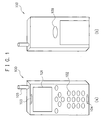
- Fig. 1 (a) is a diagram showing the front view of a cellular phone according to an embodiment of the present invention.
- Fig. 1 (b) is a diagram showing the back view of the cellular phone.
- the cellular phone 100 is provided on its front with a display 101 capable of color display, an operating section 102 including keys or buttons for inputting telephone numbers, letters, characters or the like to operate the cellular phone, a receiver 103 by which the user listen to the other party in a telephone conversation, a microphone 104 through which the user speaks to the other party on the cellular phone, and an antenna 105 for controlling communication between the cellular phone 100 and a base station.
- a display 101 capable of color display
- an operating section 102 including keys or buttons for inputting telephone numbers, letters, characters or the like to operate the cellular phone
- a receiver 103 by which the user listen to the other party in a telephone conversation
- a microphone 104 through which the user speaks to the other party on the cellular phone
- an antenna 105 for controlling communication between
- the cellular phone 100 is provided on its back with a speaker 106 for generating a ring tone signaling the user of a call in.
- the display 101, operating section 102, receiver 103, microphone 104, antenna 105, and speaker 106 are connected to a controller 200 shown in Fig. 2, and operate under the control of the controller 200.
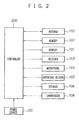
- Fig. 2 is a block diagram showing functions of the cellular phone 100.
- the cellular phone 100 further comprises a memory 107 and a synthesizer 108, which are also connected to the controller 200.
- the memory 107 stores a program to make the cellular phone 100 operate, data processed by the program, settings for the cellular phone 100 and the like.
- the synthesizer 108 generates sounds.
- a power source 201 for supplying power to the cellular phone 100 is connected to the controller 200.
- the controller 200 controls the receiver 103, microphone 104, and antenna 105 according to input provided by the operating section 102 so that communication becomes available.
- the controller 200 once stores the data in the memory 107. After having been converted to an appropriate data format, the data is output through the display 101 if it is text or image data, or output through the speaker 106 if it is music data.
- the input provided by the operating section 102 is stored in the memory 107 according to the program in the memory 107. The result of the processing by the controller 200 is output on the display 101.
- Fig. 3 is a flowchart showing the operation of the cellular phone for performing the tuning function.
- the audio tuning function of the cellular phone 100 will be described with reference to Fig. 3.
- the controller 200 reads the program stored in the memory 107 according to the input provided by the operating section 102.
- a menu screen is displayed on the display 101 (step S100).
- the user if the user has the intention to use the tuning function, he/she operates the operating section 102 to display the menu screen for selecting the tuning function on the display 101.
- the user selects the tuning function so that it is to be performed on the cellular phone 100 (step S101).
- the display 101 displays the screen for letting the user designate a reference pitch (step S102).
- the reference pitch indicates the frequency of a reference tone or note. In general, the frequency of "la" or "A" (the sixth note in C major) is set to around 440 Hz, and based on which, the frequencies of other notes are calculated.
- step S103 the user operates the operating section 102 to designate a reference pitch.
- step S104 the user inputs the sound of an instrument to be tuned or a voice into the microphone 104 (step S104).
- the synthesizer 108 generates sounds sequentially from the highest or lowest sound (note) according to the reference pitch designated in step S103 (step S105).
- the wave of the respective sounds generated by the synthesizer 108 is superimposed on that of the sound input through the microphone 104 in step S104 while the phase of the wave is being scanned or changed (step S106).
- step S107 The wave of the sound generated by the synthesizer 108 with a varied phase is compared with that of the sound input through the microphone 104 to detect the smallest difference in sound components, such as phase and frequency, between them (step S107).
- the two sound waves superimposed one on the other are compared to detect a sound generated by the synthesizer 108 that most approximates the sound input through the microphone 104.
- This process is repeated to indicate on the display 101, as a result, the sound generated by the synthesizer 108, which shows the smallest difference in sound components (phase, frequency, etc.) when compared with the sound input in step S104 (step S108).
- step S109 the user determines whether or not to continue to tune a different sound (step S109).
- the tuning is to be continued (step S109, YES)
- the process returns to step S104.
- step S109, NO the menu screen is displayed on the display 101 to finish the tuning.
- a reference tone or sound generated by the synthesizer 108 may be supplied to the speaker, which is generally installed in a cellular phone, to thereby output a reference tone easily.
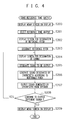
- Fig. 4 is a flowchart showing the operation of the cellular phone for outputting a reference tone. Referring to Fig. 4, a description will be given of the operation for outputting a reference tone.
- a menu screen is displayed on the display 101 (step S200).
- the user operates the operating section 102 to display the menu screen for selecting the output of a reference tone on the display 101.
- the user operates the operating section 102 to select the reference tone output from the menu screen so that it is to be performed on the cellular phone 100 (step S201).
- the display 101 displays the screen for letting the user designate a reference pitch (step S202). Thereafter, the user operates the operating section 102 to designate a reference pitch (step S203). After a reference pitch is designated, the display 101 displays the screen for letting the user designate a sound (step S204). The user designates a sound to be output (step S205). The synthesizer 108 generates a sound designated in step S205 according to the reference pitch designated in step S203 (step S206).
- the synthesizer 108 generates a sound that has been designated by the user in step 205 and corresponds to the reference pitch designated in step S203.
- the sound generated by the synthesizer 108 is output from the speaker 106 (step S207).
- the user determines whether or not to continue the operation for outputting a different sound (step S208).
- step S208 YES
- the process returns to step S204.
- step S208, NO the user operates the operating section 102 to display the menu screen on the display 101 to bring the reference tone output to an end.
- a mobile communication terminal is provided with a tuning function, which saves a player the trouble of carrying around a tuning meter or the like and facilitates the tuning of instruments.
Landscapes
- Physics & Mathematics (AREA)
- Engineering & Computer Science (AREA)
- Acoustics & Sound (AREA)
- Multimedia (AREA)
- Auxiliary Devices For Music (AREA)
- Telephone Function (AREA)
- Electrophonic Musical Instruments (AREA)
- Measurement Of Mechanical Vibrations Or Ultrasonic Waves (AREA)
Abstract
Description
- The present invention relates to a mobile communication terminal with an audio tuning function, more particularly, to a mobile communication terminal which produces a reference tone for a musical performance and picks up instrumental sounds and voiced sounds, thus enabling the pitch of each note to be checked.
- Before playing an instrument or singing, the player, singer, etc. adjusts the pitch for playing or singing musical notes correctly based on a reference tone using a tuning fork or a tuner.
- Besides, when playing an instrument, the player or the like has to tune the instrument in advance so that it plays at the correct pitch. In this case, the player tunes the instrument while checking the pitch of each note with a tuning meter. Consequently, the player is required to carry the tuning meter into a venue for a concert each time he/ she gives a performance as well as to take care of it.
- If a cellular phone, which has been in widespread use, has a tuning function as for example described in Japanese Patent Application laid open No. 2002-49368, the player need not carry around the tuning meter.
- It is therefore an object of the present invention to provide a mobile communication terminal, such as a cellular phone, having a tuning function, which facilitates the tuning of instruments or the like.
- In accordance with the first aspect of the present invention, to achieve the object mentioned above, there is provided a mobile communication terminal with a tuning function, comprising a memory for storing a plurality of reference tones or pitches for tuning, a selector for selecting at least one of the reference tones stored in the memory, an inputting means for inputting an instrumental sound or a voiced sound, a sound generator for generating a sound whose frequency approximates that of the instrumental sound or the voiced sound input through the inputting means and which corresponds to the reference tone selected by the selector, a comparator for comparing the sound generated by the sound generator with the sound input through the inputting means, and a display for displaying the result of the comparison obtained by the comparator.
- In accordance with the second aspect of the present invention, in the mobile communication terminal with a tuning function of the first aspect, the sound generator generates a sound corresponding to the reference tone selected by the selector to output the sound.
- In accordance with the third aspect of the present invention, in the mobile communication terminal with a tuning function of the first aspect, the sound generator generates sounds sequentially from the highest or lowest sound (note) based on the reference tone selected by the selector.
- In accordance with the fourth aspect of the present invention, in the mobile communication terminal with a tuning function of the first aspect, the sound generator generates a sound corresponding to the reference tone selected by the selector, the mobile communication terminal further comprising a sound wave superimposing means for superimposing the frequency of the sound generated by the sound generator on that of the instrumental sound or the voiced sound input through the inputting means.
- In accordance with the fifth aspect of the present invention, the mobile communication terminal with a tuning function of the fourth aspect further comprises a detector for detecting the smallest phase difference and the smallest frequency difference between the two waves superimposed one on the other by the sound wave superimposing means.
- In accordance with the sixth aspect of the present invention, in the mobile communication terminal with a tuning function of the fifth aspect, the sound generator generates a sound with the phase and the frequency detected by the detector, and the display indicates the sound generated by the sound generator.
- As described above, in accordance with the present invention, a mobile communication terminal is provided with a tuning function, which saves a player, singer, etc. the trouble of carrying around a tuning meter or the like and facilitates the tuning of instruments.
- The objects and features of the present invention will become more apparent from the consideration of the following detailed description taken in conjunction with the accompanying drawings in which:
- Fig. 1 (a) is a diagram showing the front view of a cellular phone according to an embodiment of the present invention;
- Fig. 1 (b) is a diagram showing the back view of the cellular phone depicted in Fig. 1 (a);
- Fig. 2 is a block diagram showing functions of the cellular phone depicted in Fig. 1;
- Fig. 3 is a flowchart showing the operation of the cellular phone for performing the tuning function; and
- Fig. 4 is a flowchart showing the operation of the cellular phone for outputting a reference tone.
-
- Referring now to the drawings, a description of a preferred embodiment of the present invention will be given in detail.
- Fig. 1 (a) is a diagram showing the front view of a cellular phone according to an embodiment of the present invention. Fig. 1 (b) is a diagram showing the back view of the cellular phone. Referring to Fig. 1 (a), the
cellular phone 100 is provided on its front with adisplay 101 capable of color display, anoperating section 102 including keys or buttons for inputting telephone numbers, letters, characters or the like to operate the cellular phone, areceiver 103 by which the user listen to the other party in a telephone conversation, amicrophone 104 through which the user speaks to the other party on the cellular phone, and anantenna 105 for controlling communication between thecellular phone 100 and a base station. As can be seen in Fig. 1 (b), thecellular phone 100 is provided on its back with aspeaker 106 for generating a ring tone signaling the user of a call in. Thedisplay 101,operating section 102,receiver 103,microphone 104,antenna 105, andspeaker 106 are connected to acontroller 200 shown in Fig. 2, and operate under the control of thecontroller 200. - Fig. 2 is a block diagram showing functions of the
cellular phone 100. As shown in Fig. 2, thecellular phone 100 further comprises amemory 107 and asynthesizer 108, which are also connected to thecontroller 200. Thememory 107 stores a program to make thecellular phone 100 operate, data processed by the program, settings for thecellular phone 100 and the like. Thesynthesizer 108 generates sounds. Additionally, apower source 201 for supplying power to thecellular phone 100 is connected to thecontroller 200. - In the following, the operation of the
cellular phone 100 will be described with reference to Fig. 2. - Based on the program and the settings stored in the
memory 107, thecontroller 200 controls thereceiver 103,microphone 104, andantenna 105 according to input provided by theoperating section 102 so that communication becomes available. When theantenna 105 receives data other than voice data, thecontroller 200 once stores the data in thememory 107. After having been converted to an appropriate data format, the data is output through thedisplay 101 if it is text or image data, or output through thespeaker 106 if it is music data. The input provided by theoperating section 102 is stored in thememory 107 according to the program in thememory 107. The result of the processing by thecontroller 200 is output on thedisplay 101. - Fig. 3 is a flowchart showing the operation of the cellular phone for performing the tuning function. In the following, the audio tuning function of the
cellular phone 100 will be described with reference to Fig. 3. - In order to implement the tuning function, the
controller 200 reads the program stored in thememory 107 according to the input provided by theoperating section 102. - First, a menu screen is displayed on the display 101 (step S100). At this point, if the user has the intention to use the tuning function, he/she operates the
operating section 102 to display the menu screen for selecting the tuning function on thedisplay 101. Subsequently, the user selects the tuning function so that it is to be performed on the cellular phone 100 (step S101). Accordingly, thedisplay 101 displays the screen for letting the user designate a reference pitch (step S102). The reference pitch indicates the frequency of a reference tone or note. In general, the frequency of "la" or "A" (the sixth note in C major) is set to around 440 Hz, and based on which, the frequencies of other notes are calculated. - Next, the user operates the
operating section 102 to designate a reference pitch (step S103). Having designated a reference pitch, the user inputs the sound of an instrument to be tuned or a voice into the microphone 104 (step S104). Thesynthesizer 108 generates sounds sequentially from the highest or lowest sound (note) according to the reference pitch designated in step S103 (step S105). The wave of the respective sounds generated by thesynthesizer 108 is superimposed on that of the sound input through themicrophone 104 in step S104 while the phase of the wave is being scanned or changed (step S106). - The wave of the sound generated by the
synthesizer 108 with a varied phase is compared with that of the sound input through themicrophone 104 to detect the smallest difference in sound components, such as phase and frequency, between them (step S107). In other words, the two sound waves superimposed one on the other are compared to detect a sound generated by thesynthesizer 108 that most approximates the sound input through themicrophone 104. This process is repeated to indicate on thedisplay 101, as a result, the sound generated by thesynthesizer 108, which shows the smallest difference in sound components (phase, frequency, etc.) when compared with the sound input in step S104 (step S108). After that, the user determines whether or not to continue to tune a different sound (step S109). When the tuning is to be continued (step S109, YES), the process returns to step S104. On the other hand, when the tuning is completed (step S109, NO), the menu screen is displayed on thedisplay 101 to finish the tuning. - Incidentally, a reference tone or sound generated by the
synthesizer 108 may be supplied to the speaker, which is generally installed in a cellular phone, to thereby output a reference tone easily. - Fig. 4 is a flowchart showing the operation of the cellular phone for outputting a reference tone. Referring to Fig. 4, a description will be given of the operation for outputting a reference tone.
- First, a menu screen is displayed on the display 101 (step S200). At this point, the user operates the
operating section 102 to display the menu screen for selecting the output of a reference tone on thedisplay 101. Subsequently, the user operates theoperating section 102 to select the reference tone output from the menu screen so that it is to be performed on the cellular phone 100 (step S201). - Then, the
display 101 displays the screen for letting the user designate a reference pitch (step S202). Thereafter, the user operates theoperating section 102 to designate a reference pitch (step S203). After a reference pitch is designated, thedisplay 101 displays the screen for letting the user designate a sound (step S204). The user designates a sound to be output (step S205). Thesynthesizer 108 generates a sound designated in step S205 according to the reference pitch designated in step S203 (step S206). - On this occasion, the
synthesizer 108 generates a sound that has been designated by the user in step 205 and corresponds to the reference pitch designated in step S203. The sound generated by thesynthesizer 108 is output from the speaker 106 (step S207). Then, the user determines whether or not to continue the operation for outputting a different sound (step S208). When the operation is to be continued (step S208, YES), the process returns to step S204. On the other hand, when finishing the operation (step S208, NO), the user operates theoperating section 102 to display the menu screen on thedisplay 101 to bring the reference tone output to an end. - As set forth hereinabove, in accordance with the present invention, a mobile communication terminal is provided with a tuning function, which saves a player the trouble of carrying around a tuning meter or the like and facilitates the tuning of instruments.
- While the present invention has been described with reference to the particular illustrative embodiment, it is not to be restricted by the embodiment but only by the appended claims. It is to be appreciated that those skilled in the art can change or modify the embodiment without departing from the scope and spirit of the present invention.
Claims (6)
- A mobile communication terminal with a tuning function, comprising:a memory for storing a plurality of reference tones for tuning;a selector for selecting at least one of the reference tones stored in the memory;an inputting means for inputting an instrumental sound or a voiced sound;a sound generator for generating a sound whose frequency approximates that of the instrumental sound or the voiced sound input through the inputting means, and which corresponds to the reference tone selected by the selector;a comparator for comparing the sound generated by the sound generator with the sound input through the inputting means; anda display for displaying the result of the comparison obtained by the comparator.
- The mobile communication terminal with a tuning function claimed in claim 1, wherein the sound generator generates a sound corresponding to the reference tone selected by the selector to output the sound.
- The mobile communication terminal with a tuning function claimed in claim 1, wherein the sound generator generates sounds sequentially from the highest or lowest sound based on the reference tone selected by the selector.
- The mobile communication terminal with a tuning function claimed in claim 1, wherein the sound generator generates a sound corresponding to the reference tone selected by the selector, the mobile communication terminal further comprising a sound wave superimposing means for superimposing the frequency of the sound generated by the sound generator on that of the instrumental sound or the voiced sound input through the inputting means.
- The mobile communication terminal with a tuning function claimed in claim 4, further comprising a detector for detecting the minimum phase difference and the minimum frequency difference between the two waves superimposed on each other by the sound wave superimposing means.
- The mobile communication terminal with a tuning function claimed in claim 5, wherein the sound generator generates a sound with the phase and the frequency detected by the detector, and the display indicates the sound generated by the sound generator.
Applications Claiming Priority (2)
| Application Number | Priority Date | Filing Date | Title |
|---|---|---|---|
| JP2004069178 | 2004-03-11 | ||
| JP2004069178A JP4632678B2 (en) | 2004-03-11 | 2004-03-11 | Mobile communication terminal with sound tuning function |
Publications (2)
| Publication Number | Publication Date |
|---|---|
| EP1585106A2 true EP1585106A2 (en) | 2005-10-12 |
| EP1585106A3 EP1585106A3 (en) | 2015-02-25 |
Family
ID=34909393
Family Applications (1)
| Application Number | Title | Priority Date | Filing Date |
|---|---|---|---|
| EP05005412.1A Withdrawn EP1585106A3 (en) | 2004-03-11 | 2005-03-11 | Mobile communication terminal with audio tunning function |
Country Status (4)
| Country | Link |
|---|---|
| US (1) | US7259311B2 (en) |
| EP (1) | EP1585106A3 (en) |
| JP (1) | JP4632678B2 (en) |
| CN (1) | CN1667697B (en) |
Cited By (1)
| Publication number | Priority date | Publication date | Assignee | Title |
|---|---|---|---|---|
| WO2009064322A1 (en) * | 2007-11-15 | 2009-05-22 | Sony Ericsson Mobile Communications Ab | Apparatus and methods for augmenting a musical instrument using a mobile terminal |
Families Citing this family (3)
| Publication number | Priority date | Publication date | Assignee | Title |
|---|---|---|---|---|
| IL165817A0 (en) * | 2004-12-16 | 2006-01-15 | Samsung Electronics U K Ltd | Electronic music on hand portable and communication enabled devices |
| US7586031B1 (en) * | 2008-02-05 | 2009-09-08 | Alexander Baker | Method for generating a ringtone |
| US9443497B1 (en) * | 2015-01-09 | 2016-09-13 | Onboard Research Corporation | Time display for a tuning device |
Family Cites Families (11)
| Publication number | Priority date | Publication date | Assignee | Title |
|---|---|---|---|---|
| US5016515A (en) * | 1990-10-29 | 1991-05-21 | Robert L. Scott | Precise electronic aid to musical instrument tuning |
| US5973252A (en) * | 1997-10-27 | 1999-10-26 | Auburn Audio Technologies, Inc. | Pitch detection and intonation correction apparatus and method |
| JP4441961B2 (en) * | 1999-10-22 | 2010-03-31 | ヤマハ株式会社 | Tuning device, tuning method and recording medium |
| US6613971B1 (en) * | 2000-04-12 | 2003-09-02 | David J. Carpenter | Electronic tuning system and methods of using same |
| JP2002049368A (en) | 2000-08-02 | 2002-02-15 | Sony Corp | Mobile phone with music standard confirmation function |
| JP2002073015A (en) * | 2000-08-31 | 2002-03-12 | Kawai Musical Instr Mfg Co Ltd | Tuning assistance device, tuning method, and storage medium |
| US6580024B2 (en) * | 2001-01-11 | 2003-06-17 | Peterson Electro-Musical Products, Inc. | Electronic strobe tuning aid |
| JP4087143B2 (en) * | 2002-04-18 | 2008-05-21 | セイコーインスツル株式会社 | Guitar tuner |
| ZA200206249B (en) * | 2002-08-06 | 2003-06-25 | Bryan Fouche | A tone tuner. |
| US6894212B2 (en) * | 2003-01-22 | 2005-05-17 | David Capano | Wrist musical instrument tuner |
| JP3982443B2 (en) * | 2003-03-31 | 2007-09-26 | ソニー株式会社 | Tempo analysis device and tempo analysis method |
-
2004
- 2004-03-11 JP JP2004069178A patent/JP4632678B2/en not_active Expired - Fee Related
-
2005
- 2005-03-08 US US11/073,542 patent/US7259311B2/en not_active Expired - Fee Related
- 2005-03-09 CN CN200510053640XA patent/CN1667697B/en not_active Expired - Fee Related
- 2005-03-11 EP EP05005412.1A patent/EP1585106A3/en not_active Withdrawn
Non-Patent Citations (1)
| Title |
|---|
| None * |
Cited By (1)
| Publication number | Priority date | Publication date | Assignee | Title |
|---|---|---|---|---|
| WO2009064322A1 (en) * | 2007-11-15 | 2009-05-22 | Sony Ericsson Mobile Communications Ab | Apparatus and methods for augmenting a musical instrument using a mobile terminal |
Also Published As
| Publication number | Publication date |
|---|---|
| US7259311B2 (en) | 2007-08-21 |
| CN1667697A (en) | 2005-09-14 |
| CN1667697B (en) | 2011-06-15 |
| JP4632678B2 (en) | 2011-02-16 |
| EP1585106A3 (en) | 2015-02-25 |
| US20050211065A1 (en) | 2005-09-29 |
| JP2005258048A (en) | 2005-09-22 |
Similar Documents
| Publication | Publication Date | Title |
|---|---|---|
| EP2047658A1 (en) | Song lyrics download for karaoke applications | |
| US6859530B1 (en) | Communications apparatus, control method therefor and storage medium storing program for executing the method | |
| US7259311B2 (en) | Mobile communication terminal with audio tuning function | |
| JPH11242490A (en) | Karaoke performance device that supplies music generation data for ringing melody | |
| JP2000267660A (en) | Melody sound generator | |
| JP2001318677A (en) | Portable telephone set | |
| JP2002049368A (en) | Mobile phone with music standard confirmation function | |
| JP2007114561A (en) | Mobile phone-contained voice conversion system | |
| JP2003131659A (en) | Music sound generating apparatus and music sound generating method | |
| JP6670696B2 (en) | Karaoke equipment | |
| KR100595672B1 (en) | Ring generating device and method of mobile communication terminal | |
| JP2001339487A (en) | Portable communication terminal device | |
| CN100382619C (en) | Mobile communication device with function of changing telephone voice signal and related method | |
| KR20060072877A (en) | How to set alarm bell using MP3 file on mobile communication terminal | |
| KR100499054B1 (en) | Melody input method of wireless mobile communication terminal | |
| KR20030027860A (en) | Device comprising a sound signal generator and method for forming a call signal | |
| JP4437463B2 (en) | Intercom system for karaoke facilities | |
| JP2006011190A (en) | Sound field set up system for music-reproducing device | |
| JP3743357B2 (en) | Mobile phone | |
| JP4429210B2 (en) | Intercom system for karaoke facilities | |
| CN115379042A (en) | Method and device for generating ringtone, terminal and storage medium | |
| KR20010059487A (en) | Electronic pitch tuner embodying method in mobile terminal | |
| JP2001045103A (en) | Telephone equipment | |
| JP2000188627A (en) | Portable telephone set | |
| JP2001045104A (en) | Mobile phone |
Legal Events
| Date | Code | Title | Description |
|---|---|---|---|
| PUAI | Public reference made under article 153(3) epc to a published international application that has entered the european phase |
Free format text: ORIGINAL CODE: 0009012 |
|
| AK | Designated contracting states |
Kind code of ref document: A2 Designated state(s): AT BE BG CH CY CZ DE DK EE ES FI FR GB GR HU IE IS IT LI LT LU MC NL PL PT RO SE SI SK TR |
|
| AX | Request for extension of the european patent |
Extension state: AL BA HR LV MK YU |
|
| RAP1 | Party data changed (applicant data changed or rights of an application transferred) |
Owner name: APPLE INC. |
|
| PUAL | Search report despatched |
Free format text: ORIGINAL CODE: 0009013 |
|
| AK | Designated contracting states |
Kind code of ref document: A3 Designated state(s): AT BE BG CH CY CZ DE DK EE ES FI FR GB GR HU IE IS IT LI LT LU MC NL PL PT RO SE SI SK TR |
|
| AX | Request for extension of the european patent |
Extension state: AL BA HR LV MK YU |
|
| RIC1 | Information provided on ipc code assigned before grant |
Ipc: G10G 7/02 20060101AFI20150120BHEP |
|
| RBV | Designated contracting states (corrected) |
Designated state(s): AT BE BG CH CY CZ DE DK EE ES FI FR GB GR HU IE IS IT LI LT LU MC NL PL PT RO SE SI SK TR |
|
| 17P | Request for examination filed |
Effective date: 20150818 |
|
| AKX | Designation fees paid |
Designated state(s): DE FR |
|
| AXX | Extension fees paid |
Extension state: AL Extension state: MK Extension state: LV Extension state: HR Extension state: BA Extension state: YU |
|
| 17Q | First examination report despatched |
Effective date: 20170503 |
|
| STAA | Information on the status of an ep patent application or granted ep patent |
Free format text: STATUS: THE APPLICATION IS DEEMED TO BE WITHDRAWN |
|
| 18D | Application deemed to be withdrawn |
Effective date: 20170914 |
|
| RIC1 | Information provided on ipc code assigned before grant |
Ipc: G10G 7/02 20060101AFI20150120BHEP |